
READINGS IN EARLY MORMON HISTORY
(Newspapers of Illinois & Indiana)

Misc. Chicago Newspapers
1840-1899 Articles
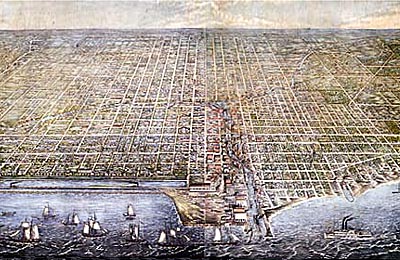
The City of Chicago on Lake Michigan (1857)
Chicago: 1900-99 Misc. Illinois papers: 1830-39 | 1840-45 | 1846-99 | 1900-99
1840-1869
CDem Mar 25 '40 | CDem Jun 01 '42 | CDem Jul 10 '44 | CDem Oct 13 '46 | CDem Nov 10 '46
CDem Oct 12 '47 | CPress Apr 13 '53 | CTrb May ? '54 | CTms Mar 29 '55 | CTms May 31 '55
CEJ May ? '65 | CTrb Mar 27 '66 | CTrb Jul 08 '69
1870-1875
Intr Aug 04 '70 | CTrb Feb 04 '72 | CIO Nov 21 '74 | CIO Jan 03 '75 | CTrb Jan 05 '75 | CTrb Jan 06 '75
CIO Jan 07 '75 | CTrb Feb 20 '75 | CTms Apr 12 '75 | CTms May 5? '75 | CIO May 10 '75 | CIO Jun 17 '75
CIO Jul 21 '75 | CIO Jul 28 '75 | CTms Aug 07 '75 | CIO Aug 11 '75 | CIO Aug 20 '75 | CIO Sep 08 '75
CIO Sep 10 '75 | CTrb Sep 12 '75 | CIO Sep 13 '75 | CTms Nov 20 '75 | CTms Nov 28 '75 | CTrb Dec 08 '75
1876-1879
CIO Jan 31 '76 | CTrb Jul 25 '76 | CIO Aug 05 '76 | CIO Sep 12 '76 | CIO Sep 23 '76 | CIO Oct 18 '76
CTms Mar 23 '77 | CIO Jun 16 '77 | CIO Jun 23 '77 | CTms Aug 30 '77 | CTrb Sep 09 '77 | CDN Sep 18 '77
CC Dec 20 '77 | CTrb Dec 26 '77 | CIO Feb 23 '78 | CC Jun 06 '78 | CC Jul 25 '78 | CTrb Sep 29 '78
1880-1886
CTrb Jun 07 '80 | CIO Nov 22 '80 | CIO Dec 21 '80 | CIO Jun 04 '81 | CIO Jun 11 '81 | CTrb Jul 10 '81
CIO Jul 16 '81 | CIO Jul 30 '81 | CIO Sep 17 '81 | CTms Oct 17 '81 | CIO Oct 29 '81 | CIO Feb 25 '82
CHrd Feb 25 '82 | CIO Jun 10 '82 | CTms Feb 14 '85 | CTrb Mar 26 '85 | CTrb Jul 04 '85 | CTrb Oct 18 '85
CTrb Dec 17 '85 | CMN Jan 28 '86 | CDN Feb ?? '86 | HPH Feb 13 '86 | CTrb Mar 27 '86 | CIO Jul 27 '86
CTrb Oct 02 '86 | CIO Oct 17 '86 | CIO3 Oct 17 '86
1887-1899
CTrb Jan 24 '88 | CTms Jan 24 '88 | CTms Jan 26 '88 | CIO Jan 31 '88 | CTrb Mar 12 '88 | CTms Oct 14 '88
CTrb Feb 20 '90 | CHrd Sep 11 '90 | CHrd Oct 07 '90 | COrc Feb 05 '91 | CTrb Jun 17 '94 | CTrb Jun 19 '94
CIO Apr 11 '95 | CIO Apr 13 '95 | CIO Apr 20 '95 | CTrb May 02 '97 | CEag Nov 06 '97 | CEag Apr 09 '98
CStd Jul 22 '99
Peoria papers | Alton Telegraph | Sangamo Journal
Quincy papers | Warsaw Signal | Nauvoo Neighbor
Return to: Old Newspapers Articles Index
 Vol. ? Chicago, Illinois, Wednesday, March 25, 1840. No. ?  THE MORMONS. We regret to learn that the fell spirit of persecution towards this religious denomination, which has cast such a reproach upon the people of Missouri, is taking root in our own State. We will not go so far as to call the leaders of the Mormons martyr-mongers, but we believe they are men of sufficient sagacity to profit by any thing in the shape of persecution, and fear but little from it. -- To constitute martyrdom, there must be both persecution and sympathy. And with a humane people, the latter follows the former. -- The Mormons have greatly profited by their persecution in Missouri, and let war be commenced here so that the first person shall be killed, and the cry of martyrdom is heralded throughout the Union to the great profit of the Mormons and the disgrace of our State. |
n.s. Vol. X Chicago, Illinois, Tues., October 13, 1846. No. 47.
ELDER REUBEN MILLER, styling himself "of the Church of Jesus Christ of Latter Day Saints," has sent us a pamphlet entitled, "James J. Strang weighed in the balance of truth and found wanting -- his claims as First President of the Melechisedek Priesthood refuted." We shall not interfere in this fight. In the Voree Herald Strang says: |
Vol. 8. Chicago, Illinois, Wed, July 10, 1844. No. 33.
MORMON TROUBLES -- It is now rendered certain that Joseph and Hyram Smith were killed in the affray at the Carthage jail, and none others, though several were wounded. The circumstances of their death are variously represented, except that both were shot by a mob with their clothes turned wrong side out and with blackened faces. The Governor had left Carthage when all seemed quiet to go to Nauvoo. |
n.s. Vol. X Chicago, Illinois, Tues., November 10, 1846. No. 47. HANCOCK TROUBLES. Head Quarters, Nauvoo, Hancock Co., |
n.s. Vol. XI. Chicago, Illinois, Tues., October 12, 1847. No. 47.
BEAVER ISLAND. -- We understand that the North-west Fishing Company is in negotiation with a body of Mormons for the sale of a portion of land on Beaver Island, belonging to that company. The Mormons, it is said, design to build a city there. |
Vol. I. Chicago, Illinois, Wednesday, April 13, 1853. No. ? Mormonism and "Spiritual Wifeism" in Lee County. We had of late years entirely lost track of William Smith, brother of the prophet "Joe." In 1839 we knew him well. He was then keeping tavern in Plymouth. a small village in Hancock county, some thirty miles from Nauvoo. A goodly nu,ber of the "Saints" frequented his house, but he never had much influence with the great body of Mormons. "Bill," as he was familiarly termed by his "Gentile" acquaintances, was always regarded as one of the lesser lights. Compared with his older brother Joe, or his younger [sic] brother Hiram, he was an inferior man. He had much less capacity than the former, and far less cultivation than the latter. Yet he was by no means deficient in that peculiar shrewdness which, from the mother of the prophet down to the youngest of her children, was characteristic of the Smith family. Bill, however, lacked caution. He had not the faculty of concealment which distinguished Joe and Hiram. Perhaps this was the reason that the two latter induced him to take up his residence outside the holy city. The weakness of Bill conduced to his popularity where he lived. He obtained a reputation for frankness and candor that was denied his shrewder brothers, and when he became a candidate for legislative honors, he polled many votes outside of the Mormon organization. |
 Vol. ? Chicago, Illinois, May 22?, 1854. No. ?
Experiments have been made upon the properties of the water of Salt Lake, Utah, for preserving meat, by Mr. Stansbury and his associates. A large piece of fresh beef was suspended from a cord and immersed in the lake for over 12 hours, when it was found to be tolerably well cured. After this, all the meat they wished to be preserved was packed into barrels without any salt whatever, and the vessels were then filled with lake water. No further care or preparation was necessary, and the meat remained perfectly sweet, although constantly exposed to the atmosphere and sun. They are obliged to mix fresh water with the brine to prevent the meat becoming to salt for present use. -- |
CHICAGO WEEKLY TIMES. Vol. I. Chicago, Illinois, Thursday, March 29, 1855. No. 31. News From Deseret. We have received the Deseret News of Feb. 8. In it we had the report of the speeches at the [reception?] given to the members of the legislative council at the last night of their session. As an evidence of how the Mormon customs and [labors] have impressed persons not belonging to the order, we give the speech of Chief Justice Kinney. |
CHICAGO WEEKLY TIMES. Vol. I. Chicago, Illinois, Thursday, May 31, 1855. No. 40. The Mormons -- Brigham Young. The New York Daily Times, says the Rochester Advertiser publishes a letter from Utah, giving the proceedings of the United States District Court at Salt Lake, in the trials of the Indians indicted for the murder of Captain Gunnison and his men. the crime of murder was clearly made out, and no defence attempted, yet a Mormon jury returned a verdict of manslaughter. The extent of the penalty was three years imprisonment, and the parties were handed over to the Mormons for imprisonment. They were confined in compliance with the sentence of the Court, but permitted to escape in a short time thereafter. The Times further adds: |
|
Vol. ? Chicago, Illinois, May ?, 1865. No. ?
A DIVISION IN THE MORMON CHURCH. Plano. Ill., May 22, 1865 |
|
Vol. XIX. Chicago, Illinois, Tuesday, March 27, 1866. No. 296. The Latter Day Saints.
|
|
Vol. XXIII. Chicago, Illinois, Thursday, July 8, 1869. No. 8.
UTAH.
|
|
Vol. ? Chicago, Illinois, Thursday, August 4, 1870. No. ?
A SECOND LOOK AT THE MORMONS.
In a previous article I affirmed that we have misrepresented the Mormons through their own fault of boasting. They are, as a people, neither rich nor numerous. A second look at their present condition is enough to convince us, that, like many other churches which loudly proclaim their unity, they are not united. |
|
Vol. XXV. Chicago, Illinois, Sunday, February 4, 1872. No. 180.
The MORMON CHURCH. To the Editor of the Detroit Tribune: |
 Vol. III. Chicago, Illinois, Saturday, November 21, 1874. No. 241.
MOUNTAIN MEADOW.
|
|
Vol. III. Chicago, Illinois, Sunday, January 3, 1875. No. 284.
MORMON SEANCE.
A reporter of the Times, when a boy, was an attentive listener to his mother's Bible stories about the patriarchs. He always wanted to see a patriarch, or see some person who had seen one, and no words can tell his vexation on learning that the day had gone by, that Daniel and his lions were all dead; and that even old John Robinson, who had been in the lion business for nearly two score years and ten, could give no satisfactory information in regard to old lions or patriarchs. This desire, which hungered so in boyhood, has not altogether left him, and on learning something of the Mohammed of Palmyra, he felt a desire to find Joe Smith, or some person who had acquired the grandeur of his acquaintance. |
 Vol. XXVIII. Chicago, Illinois, Tues., January 5, 1875. No. 136. THE MOUNTAIN MEADOW MASSACRE. Towards the close of the last session of Congress some legislation was effected that greatly aided the Federal Courts in Utah, and enabled the United States Marshal of the Territory to arrest, very recently, the leader of the Mormons in the Mountain Meadow Massacre, and, still later, to arrest the Colonel of the Mormon regiment that committed the atrocious deed. A correspondent of The Tribune, who has just visited the scene of the massacre, furnishes this paper a graphic and thrilling story of the manner in which the terrible tragedy was consummated. Our correspondent gives a complete and authentic history of the terrible slaughter; the latest developments and confessions; the "Mormon causes of provocation;" relates all the circumstances of the military council from which emanated the bloody plot; describes the premature attack; the sending out of the forlorn hope; tells about the Free Masons and Odd Fellows in the train; how the Indians tortured and burned the captives; describes the shooting of 127 defenseless men and women, and the cutting of children's throats; the pinning of an infant to its dead father's body with a knife; the auction sale of the blood-stained spoils; how Brigham Young obtained the cattle belonging to the train; appearance of the ghastly field after eight days' fighting; the piles of dead mutilated by wolves; a child drawing arrows from a dead mother's body; the dashing out of an infant's brains against a wagon-hub; the guilty leaders in the massacre and their antecedents. |
|
Vol. XXVIII. Chicago, Illinois, Wednesday, January 6, 1875. No. 137.
DIABOLISM.
|
|
Vol. III. Chicago, Illinois, Thursday, January 7, 1875. No. 288.
Our "Independent" Republican morning cotemporary of this city yesterday devoted a page and a half to recounting the Mountain Meadow massacre in Utah, as is supposed, by a band of Mormons, secenteen years ago. This account the Tribune has heralded for a day or two, and a double-leaded editorial was employed to tell the world that this was the first history of the affair ever made public. Two months ago the Inter Ocean published, from its special correspondent at Salt Lake, a long and complete account of this affair, together with a history of the arrest of Lee, one of the chief perpetrators of the crime. This letter gave a most graphic account of what had been until then an unexplained mystery. From all appearances, the article in yesterday's Tribune is made up from that in the Inter Ocean, the facts stated being substantially the same, the story being padded out by the writer to increase its measurement without adding to its value. So much for this boasted enterprise.... |
|
Vol. XXVIII. Chicago, Illinois, Wednesday, February 20, 1875. No. 181.
MORMONISM AND THE
To the Editor of The Chicago Tribune: |
 Vol. XXI. Chicago, Illinois, Monday, April 12, 1875. No. ?
BLOOD WILL HAVE BLOOD.
BEAVER CITY, Southern Utah, April 6, 1875. -- This memorable Mountain Meadows massacre [was] committed Sept. 7, 1857, more than 17 years ago. Much has been said and written concerning it, and a great deal more, by far, remains unsaid and unwritten and which the world will never know, unless some of those now charged with its commission turn state's evidence on trial and reveal the shocking truths. In this hardly probable event, what is now generally believed to be the history of the case, would be confirmed as facts by living and unimpeachable evidence. Maj. John D. Lee, the man who led the slaughter, and who is now in chains awaiting trial, may possibly be the man who will reveal the true facts and lay the blame where it more properly belongs -- Brigham Young, the then governor of the territory, and the head of the church; his two councillors, Heber C. Kimball and Geo. A. Smith; Daniel H. Wells, "lieutenant general" commanding the Nauvoo legion; and the "twelve apostles" in whose hands Maj. Lee, Col. Dame, Lieut. Col. Haight, and the other participants were mere instruments, acting under instructions and inspired by their fanatical zeal for the church. Their devotion to, or rather fear of, the church, remains unchanged, with the exception of Lee, who has been "cut off" and is branded by all good Mormons as an apostate. Notwithstanding his apostacy, the church has not entirely forgotten him, but as a recognition for his services which resulted in his present trouble, has generously employed counsel to defend him. Were it not for fear of the "destroying angels" who would pursue an enemy of the church to the ends of the earth, or death, doubtless some of those who are now hiding in the mountain recesses from an avenging justice would surrender themselves to the authorities, confess their guilt, and free their remorse-stricken consciences of their terrible burdens. But in Mormondom there is a "higher law" than the constitution, or the laws thereunder -- it is that of the "blood atonement," and a member who betrays his terrible oaths and sacred vows never feels at rest, and sooner or later his life is forfeited to the vengeance of the church and as a punishment, for his betrayal of its secrets. Evidently, this blood-atoning doctrine was founded on and suggested by the teachings of the murderous "Red Cross" and other orders that existed throughout Italy in the dark days of superstition and the Borgias. |
|
Vol. XXI. Chicago, Illinois, Saturday, May 5?, 1875. No. ? The Mantle of Brigham Young.
|
|
Vol. IV. Chicago, Illinois, Monday, May 10, 1875. No. 40.
GOOD BYE POLYGAMY.
J. H. Beadle writes from Salt Lake to the Cincinnati Commercial as follows: It is now only fitting that I set forth some facts which support the other view of the Reynolds case. There is certainly a great shaking among the Mormons on the subject of polygamy; and while such old fanatics as Orson Pratt, and such schemers as Cannon declare they will never, never, never yield, there is a growing conviction among the people that it most be given up. Fear and disgust combine to produce this feeling. Its most bitter, nay, remorseless and unforgiving enemies are the children reared in it. If ever the reader should come to Utah, he will at once ask the question. Is polygamy on the increase or dying out? And from the oldest Gentile resident, and from those presumably best posted, he will hear two flatly contradictory answers, each violently maintained. Plenty of men will tell you that it is practiced more frequently and defiantly than ever. But it is clear to my mind that the other view is correct. I can say of my own knowledge that while the new converts from Europe still lean toward the institution, the young people brought up in this part of Utah are violently opposed to it. In fact, I lack words to describe the deadly bitterness of their feeling on that subject. In numerous instances it finds vent in cruel and unjustifiable words and acts. I could name many families here in which the offspring of the legal wife utterly refuse to speak to or recognize the children of the others; and no amount of paternal pressure can make them do it. The girls are especially bitter. And yet there is a singular movement now in progress among a few Mormon women looking to an appeal to Congress to give special legislation putting all the wives on legal equality. I was present a few evenings since in the parlor of the Townsend House, when Mrs. Charlotte Godbe read a lecture entitled "The Question of the Hour." She is, or rather, was before her husband apostatized, a fourth wife, and now seeks to organize the Mormon women into a semi-political society, which shall first secure this equality by law, and then quietly get out of polygamy in the easiest and most honorable way possible. She seemed to think (as too many women-reformers do) that all that was needed was a law to that effect, and the "plural" and legal wives would be equally well off. Of course the end aimed at by special legislation is impossible -- unless, indeed, it might result in dividing the property equally. Congress might just as reasonably enact that the atmosphere shall consist of two parts nitrogen to one of oxygen, as that the legal wife and the concubine shall stand in equal regard. Monogamaic ideas are organic in the American people -- as much a part of our daily life as the air we breathe. The social pressure against polygamy is but fairly begun. It must increase with every day of intercourse between Utah and the world, and terrible as are some of the results, destined to be still more crushing, yet no act of Congress can intervene between a people and the natural consequence of their own and their fathers' folly. |
|
Vol. IV. Chicago, Illinois, Thursday, June 17, 1875. No. 73. People and Things. ... A San Francisco paper says the "Josephite" branch of the Mormon Church announce the recent death of Elder Charles Wesley Wandell, at Sydney, New South Wales. This Elder was extensively known some years ago on the Pacific coast, both as a missionary and writer in the interest of Brigham Young's Mormonism. Wandell appears to have been a conscientious disciple, for when he saw the bones of the victims of the Mountain Meadows massacre bleaching on the prairie, his heart sickened against Brigham Young, and he gradually traveled away from him into what is conventionally termed "apostacy." He was a man of good education and plucky as a writer. After he left Brigham's church he addressed to him twenty "open letters," which were published in the Corrine (Utah) Reporter, reviewing the Prophet's life, and charging home upon him the responsibility of that dreadful crime -- the massacre of over 120 Gentile emigrants. The Saints in Southern Utah made Wandell's residence among them very uncomfortable, and he went over the boundary line into southern Nevada, where he was well and favorably known. It was through his labors that Bishop Klingnon Smith was induced to make the confession of his part in the Mountain Meadows massacre, which subsequently led to the apprehension of John D. Lee and Bishop Dame, and to the indictment of about twenty leading Mormons. Wandell claimed to be in possession of evidence to convict Brigham Young and his two councilors of ordering that massacre, and only awaited an opportunity before a court to produce that evidence. Whether he has left that evidence in such shape as to be of service in the trial of Lee next month is unknown. He was to have been called upon in the trial, but he is now beyond the reach of earthly tribunals, and Brigham, Smith, and Wells will no doubt rejoice in his departure. |
|
Vol. IV. Chicago, Illinois, Wednesday, July 21, 1875. No. 101.
The Mountain Meadow Massacre --
BEAVER, Utah July 20. -- District Attorney Carey filed a new indictment this morning, charging murder and conspiracy against Lee, Dame, and seven others jointly. Former indictments filed against Lee and Dame charged them with murder only, and might afford ground for defendants' counsel barring out much important testimony. At the request of counsel for the defense a day was granted to look over the indictment. |
|
Vol. IV. Chicago, Illinois, Wednesday, July 23, 1875. No. 103.
MOUNTAIN MEADOWS.
Special Corresponsence of the Inter-Ocean. |
|
Vol. IV. Chicago, Illinois, Wednesday, July 28, 1875. No. 107.
MORMON POLYGAMY.
|
|
Vol. ? Chicago, Illinois, Saturday, August 7, 1875. No. ?
THE GOLDEN TABLES While everybody knows that Joseph Smith was the founder of the Church of Christ, or, as it is more commonly called, Mormonism, comparatively few know anything more than this of Smith and his greed. To bring out some of the salient points in the life of this wonderful man, to give the true record of the finding of the golden tablets, and the translation of their "reformed Egyptian" hieroglyphics into the book of Mormon, by means of the Urim and Thummim, and to show wherein the Church of Christ of Latter-Day saints differs from the original Church of Christ, as instituted by Joseph Smith, the prophet, are, in brief, the objects of this article. |
|
Vol. IV. Chicago, Illinois, Wednesday, August 11, 1875. No. 119.
MORMON POLYGAMY.
|
|
Vol. IV. Chicago, Illinois, Friday, August 20, 1875. No. 127
A SWINDLING SAINT.
From Our Own Reporter. |
|
Vol. IV. Chicago, Illinois, Wednesday, September 8, 1875. No. 143.
DEATH OF GEORGE A. SMITH.
The Salt Lake Tribune thus announces the death of George A. Smith, one of the few "old original" Mormons: |
|
Vol. IV. Chicago, Illinois, Wednesday, September 10, 1875. No. 145
JOHN DOYLE LEE.
(Special Correspondence of the Inter-Ocean.) |
|
Vol. XXIX. Chicago, Illinois, Sunday, September 12, 1875. No. 19.
A MORMON SAINT
There is in the Cincinnati Commercial an obituary notice of one of the alleged authors of the Mormon Bible, which was evidently written by one who had never heard of the nil nisi bonum percept. It is copied below: |
|
Vol. IV. Chicago, Illinois, Monday, September 13, 1875. No. 147.
THE MORMON BIBLE.
To the Editor of the Inter-Ocean: |
|
Vol. XXII. Chicago, Illinois, Saturday, November 20, 1875. No. ?
THE PROPHET'S DEATH Some three months since The Times published a history of the Mormon church, from its inception, in New York, to the expulsion of the Saints from Missouri, and their subsequent settlement in Illinois. As the particulars of the discovery of the golden tablets in the hill Cumorah, the translation of their hieroglyphics into the book of Mormon by means of the Urim and Thummin, the propagation of the faith, and the graphic details of the Missouri war, resulting in the capture and ultimate escape of Joseph Smith, the prophet, by bribing his guards, were obtained from the only parties now living who are competent to give reliable information regarding these interesting events, the article attracted much attention, and was of historic value. Another and a more tragic chapter in the eventful life of this strange man remains to be written, and The Times is in possession of the facts that enable it to complete the task. |
|
Vol. IX. Chicago, Illinois, Sunday, November 28, 1875. No. ?
THE JOE SMITH RECORD.
In your last [Saturday] issue, in the article on Joe Smith and his tragic end, I find an omission, which if investigated, might lead to some yet unexplained links in that interesting history. It could be traced up yet, while there are some men of that period still living who know something about the matter. The great opposition that was brought against Joe Smith (the paper that was started in his opposition), was undoubtedly the work of his deadly enemies. Here comes the omission in your article. Press and material were thrown into the Mississippi river, and the men notified to leave Nauvoo within 24 hours, which they did. They chartered a ferry-boat, and 24 families arrived from Nauvoo on the same, in Burlington, in rather poor circumstances, and rented what was called the National hotel. In the mean time the arrest of J. Smith took place, when the report came about his imprisonment in Carthage, I was living in the immediate neighborhood of said hotel and noticed that all the men had left, and that none but women could be seen, until shortly after the news spread that Joe and Hyrum Smith were killed. All the men were then back again, but how long after this they staid I cannot tell. It always struck me that they committed the murder in the disguise of Indians. If they have committed the murder, the Mormons could never charge the murder to the "antis" as they now do, and have ever since they left Nauvoo. Yours respectfully. |
|
Vol. XXIX. Chicago, Illinois, Wednesday, December 8, 1875. No. 104.
MORMONDOM.
|
|
Vol. IV. Chicago, Illinois, Monday, January 31, 1876. No. 267.
QUERIES AND ANSWERS.
|
|
Vol. XXX. Chicago, Illinois, Tuesday, July 25, 1876. No. ?
Death of Joe Smith's Successor.
On Friday last there died at Friendship, Allegheny County, N. Y., Sidney Rigdon, in the 84th year of his age. He was a person who had a peculiar history, and one not without interest to Pittsburgers. He was born near Piney Fork, this county, and reached maturity near the place of his birth. When about 25 years old, he entered the ministry in the Bpatist Church, and was for some time pastor at the First Baptist Church, corner of Third and Grant streets. Becoming dissatisfied with the faith, he, Alexander Campbell and a Mr. Church of this city formed the "Campbellite" or "Christian" Church, which at one time had a considerable number of adherents in this section of the country. Some time after he went to Ohio and organized a congregation according to the new faith. There he met Elder Parley Pratt, of the Mormon Church, in debate, and becoming worsted, joined the Mormons, and took his congregation with him. They went to Courtland [sic - Kirtland?], O., where a Mormon congregation was organized. Then they were forced to go to Western Missouri, and, finally, by persecutions, were driven to Nauvoo. There Mr. Rigdon stayed until within six or seven months of Joe Smith's death, when, becoming dissatisfied with polygamy, he returned to Pittsburg. Hearing of Smith's death, and that he was appointed his successor, Mr. Rigdon returned to Nauvoo. On the day appointed for choosing Smith's successor, Mr. Rigdon told the congregation that, if he was elected, he would not only prohibit polygamy, but expel every one who practiced it. He then asked the audience if they desired to have him for President that each man hold up his right hand. Not a hand was raised. Brigham Young then told the audience that he was Smith's successor, and if elected he would carry out his ideas. He was unanimously elected. Mr. Rigdon again returned to Pittsburg, and tried to establish a church. Not succeeding, he moved to the Genesee Valley, N. Y., and has there remained up to the time of his death, a period of about thirty years. After abandoning his religious ventures, he devoted himself to the study of geology, and supported himself, in a great measure, by lecturing upon that science. He is said to have been much respected in his community as a law-abiding, conscientious citizen. |
|
Vol. V. Chicago, Illinois, Saturday, August 5, 1876. No. 115.
QUERIES AND ANSWERS.
|
|
Vol. V. Chicago, Illinois, Saturday, September 12, 1876. No. 147.
A NURSERY OF NOTABLES.
Correspondence of the Inter Ocean. |
|
Vol. V. Chicago, Illinois, Saturday, September 23, 1876. No. 157.
THE BOOK OF MORMON.
|
|
Vol. V. Chicago, Illinois, Wednesday, October 18, 1876. No. 178.
THE BOOK OF MORMON.
|
|
Vol. XXIII. Chicago, Illinois, Friday, March 23, 1877. No. ?
BRIGHAM'S BUTCHERS.
|
|
Vol. VI. Chicago, Illinois, Saturday, June 16, 1877. No. ? OUR CURIOSITY SHOP.
|
|
Vol. VI. Chicago, Illinois, Thursday, June 23, 1877. No. 78.
T H E M O R M O N S.
|
|
Vol. XXIII. Chicago, Illinois, Thursday, August 30, 1877. No. ?
...The practice of poligamy owes its origin among the Mormons to Brigham Young. Himself of a gross, sensual nature, he sought gratification for his lust which would appear sacred, at least to his followers. When the 'revelation' permitting the faithful to have a plurality of wives was given, there was a partial revolt, but as poligamy was a privilege, not a requirement, and was recommended as a means of rapidly increasing their numbers, the saints finally accepted it, and gradually the practice became almost universal among the Mormons in Utah, although a few of the followers of the first prophet, Joseph Smith, still rejected it as heresy... With the death of the prophet who ordained it, poligamy will doubtless begin to die out. |
|
Vol. XXXI. Chicago, Illinois, September 9, 1877. No. ?
AN INTERESTING SKETCH
Chicago, Sept. 6. -- The death of Brigham Young marks the end of the second period of the history of the Mormon Church, as the death of Prophet Joe Smith was the end of the first period. Recent events in the history of this Church render a retrospective view of the life of the organization of interest. |
Vol. ? Chicago, Illinois, Tuesday, September 18, 1877. No. ?
The Prophet’s Son.
SALT LAKE, Utah, September 18. |
Vol. X. Chicago, Thursday, December 20, 1877. No. 12.
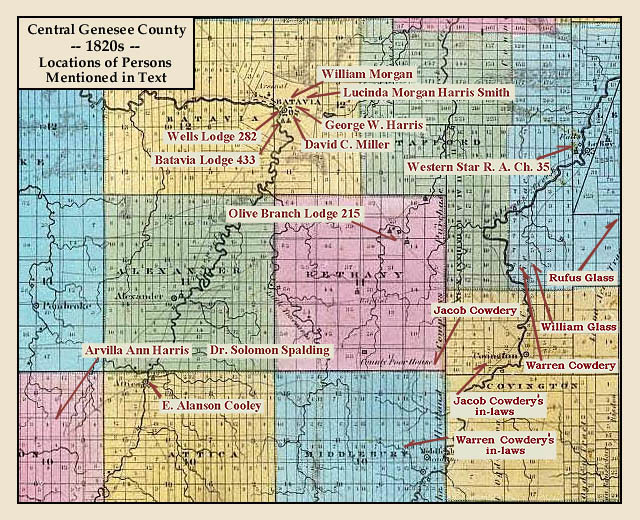
JOSEPH SMITH, THE MORMON. EDITOR CHRISTIAN CYNOSURE: -- Noticing some allusions to my knowledge of Joseph Smith in your columns, I thought I would extract from the written history of my life some facts of the early life and character of Joseph Smith and the commencement of Mormonism. During the time I resided and kept tavern in the large brick house in the north part of Pembroke, Genesee county, New York (twenty-eight miles east of Buffalo and thirteen miles west of Batavia, on the great thoroughfare from Albany to Buffalo), came Joseph Smith to my house, I think, from Vermont. I took him to be about 18 or 19 years old, but he might have been a little older. He seemed to be thoroughly acquainted with the route from Canandaigua to Buffalo. He did not come to take up land on the Holland purchase, which was fast settling at that time, but he seemed to be a tramp. He carried with him three small black stones, with which, placed in the crown of his hat, and his hat placed before his eyes, he pretended to tell the fortunes of individuals; where lost or stolen property could be found; where early settlers had deposited their money. He would tell the girls what kind of a husband they would have, etc. He was very jovial, very cunning, loved to drink juleps, and would often tell fortunes for a drink. It was about the time that the surveying of the route of the canal from Lake Erie to Albany was completed. This project and enterprise of De Witt Clinton had been begun. It was fully in my mind from the facts that transpired at the time. Judge Clark, who resided at Buffalo, was at my house. He laughed at the foolish project of De Witt Clinton, running the State of New York in debt by his folly. The canal, he said, would never be completed. The Judge was on his way to Canandaigua bank for money. As the work on the canal had begun, many came from Connecticut and New England to take up articles for land on the Holland purchase. Many of these men went to work on the land. Another novel cirsumstance occurring at the time made Joe Smith's business quite profitable and popular, and was greatly annoying to me. A man by the name of Huntington, if I remember right, from Norwich, Conn., who brought girls and young women from Connecticut free of expense, to visit their friends and relatives, with the promise that if they did not get married or choose to stay he would take them back for nothing. He brought them to my house, and as I had horses an carriages suitable for the new roads, and knew where all the settlements were made, I was employed to carry them to their places of destination. He brought up three loads, and whether any were returned I never knew, nor did I know whether this man had any contract or bargain. All I knew was, they came to my hpuse, and I took them to the places of destination. Before starting, Joseph Smith would tell their fortunes, and I was greatly annpyed by him and the foolishness of the women, as well as their credulity. Smith would tell some things true and wonderful, like Spiritualism. |

|
Vol. XXXII. Chicago, Wednesday, December 26, 1877. No. ?
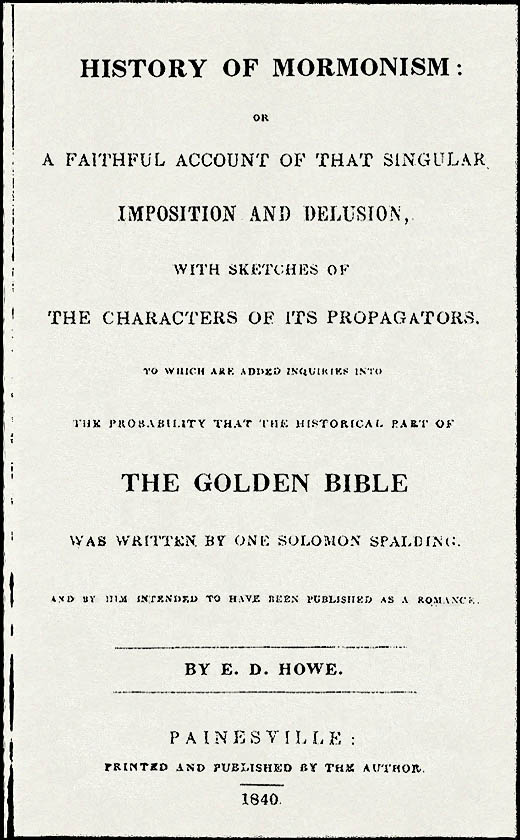
"MANUSCRIPT FOUND"
|
|
Vol. ? Chicago, Illinois, Saturday, February 23, 1878. No. ?
"THE LAST WITNESS."
|
Vol. X. Chicago, Thursday, June 6, 1878. No. 36.
THE GRAVE OF SPAULDING,
|
Vol. X. Chicago, Thursday, July 25, 1878. No. 43.
THE BOOK OF MORMON.
|
|
Vol. XXXIX. Chicago, Sunday, September 29, 1878. No. ? MISCELLANEOUS.
|
|
Vol. XL. Chicago, Illinois, Monday, June 7, 1880. No. ?
ASHTABULA COUNTY.
|
|
Vol. IX. Chicago, Illinois, Monday November 22, 1880. No. 209. MORMONISM AND THE STAGE.
|
|
Vol. IX. Chicago, Illinois, Tuesday December 21, 1880. No. ?
GARFIELD AND THE POLITICIAN.
|
|
Vol. X. Chicago, Illinois, Saturday June 4, 1881. No. 61.
A MORMON CRIME.
Special Correspondence of the Inter Ocean. |
|
Vol. X. Chicago, Illinois, Saturday June 11, 1881. No. 67. AUTHOR OF THE BOOK OF MORMON.
|
|
Vol. XL. Chicago, Illinois, Sunday, July 10, 1881. No. ?
THE MORMON BIBLE.
|
|
Vol. X. Chicago, Illinois, Saturday July 16, 1881. No. 98.
JOSEPH SMITH.
|
|
Vol. X. Chicago, Illinois, Saturday July 30, 1881. No. 107.
JOE SMITH, THE PROPHET.
|
|
Vol. X. Chicago, Illinois, Saturday September 17, 1881. No. ?
MORMONISM.
|
|
Vol. ? Chicago, Illinois, Monday, October 17, 1881. No. ?
THE LAST MAN
In the beautiful shire town of Richmond, Ray county, Mo., there has resided for well nigh half a century, David Whitmer, known to the world as one of the three witnesses that testified to the validity and reality of the golden plates from which it has been asserted that Joseph Smith translated the "Book of Mormon," the original manuscript of which Mr. Whitmer has in possession, which shows by finger marks and where it has been cut into "takes" -- a printer's term -- that it has passed through the hands of the type setters. As a citizen of his town he stands deservedly high, having filled the office of mayor and councilman, is a good scholar, and thoroughly posted in biblical lore. During the past two years he has been slowly declining, and is now confined to his home, carefully attended to by his wife, children and grandchildren. Born in the state of New York, from Revolutionary ancestors, he brought with him to the West his habits of thrift and hospitality. To the stranger or the unfortunate his home and purse have ever been open, and his name is a synonym of probity and integrity. Knowing that he was approaching the full term allotted for man's stay on earth and that the readers of the Times would like to hear what he had to say concerning the origin of the "Book of Mormon," I called at his residence -- a plain and unpretentious frame building -- was ushered into his chamber by his granddaughter and found the old patriot reclining on his bed. Upon being told the object of my visit he promptly responded to my questions, and after an hour's interview I gleaned the following valuable information from him -- he speaking freely and unreservedly -- in regard to the origin and rise of the Mormon Church, as well as to the authenticity of the "Book of Mormon." |
|
Vol. X. Chicago, Illinois, Saturday October 29, 1881. No. 185. MORMONISM. To the Editor of the Inter Ocean. |
|
Vol. X. Chicago, Illinois, Saturday February 25, 1882. No. 298.
OUR CURIOSITY SHOP.
|
|
Vol. I. Chicago, Illinois, Saturday February 25, 1882. No. ?
HORRORS OF POLYGAMY.
Salt Lake City, Feb. 16. -- Like all cowards the Mormons are full of brag and bluster. They are now giving out the idea that battalions of Mormon soldiers are under arms drilling by night, in Southern Utah, ready to meet the armies of Uncle Sam. This is all meant for effect and nothing more. There are fanatics in Utah who would go into battle against an army led by Phil Sheridan and expect that the lightnings of heaven would fall from the sky and wipe out the enemy. But the Mormon leaders know better. There will never be a conflict of arms in Utah unless the Mormons are impolitic enough to indulge in some of their old-time atrocities, when the Gentiles will be quite likely to take the matter of solving the Utah problem into their own hands. They have about lost confidence in the government, and their patience is well nigh exhausted. |
|
Vol. XI. Chicago, Illinois, Saturday June 10, 1882. No. 69.
OUR CURIOSITY SHOP.
Fulton, Ill. -- In Our Curiosity Shop in the Weekly Inter Ocean, of March 2, is a short article in explanation of the early doings of Joseph Smith and Sidney Rigdon. In regard to their fraudulent dealings, as there described, it is truthful only that the truth was not half told. But as to the cause which led to the tarring and feathering the writer had not been correctly informed. The act had no connection with their dishonest financiering, but was brought about by the following circumstances. At the time indicated by the writer, Smith and Rigdon came from Kirtland, Ohio, to the town of Mantua, in Portage County, holding meetings and preaching their new doctrine, and obtained a consideranle following. Among the new ideas then and there set forth was that of spiritual marriages or natural affinity. According to this dogma, when two persons realize a mutual attachment it should be regarded as inspiration, and they being the chosen of God, are not amenable to any law of the gentiles, and all the law of marriage they need observe is the law of natural affinity. At that early day it began to be hinted that the law did not necessarily restrict a man's affinity to one woman. There accompanied Smith and Rigdon on that preaching expedition a young preacher by the name of Kellogg (if my memory is not at fault), who met in that town a young lady by the name of Harriet Miller, fair and intelligent, who soon became a convert to the new doctrine. Kellogg soon received spiritual indications that he ought to take Miss Miller to wife, according to the new faith, to which she readily consented. They for some time appeared in public as husband and wife, having no legal marriage. This so much incensed relatives and friends of the young lady as to cause some threats of personal violence. Kellogg and the lady, considering discretion the better part of valor, retired quietly to another field of labor, but Smith and Rigdon boldly defied their threats, daring them to the worst, stating publicly that if any man should attempt to lay a finger on them God would cause the earth to open her mouth and swallow them up. Whereupon, not a mob was formed, but eight young farmers -- quiet, peaceable, law-abiding citizens -- met at the store of John D. Hazen, in Garrettsville, Ohio, where the back entrance to the cellar-way had been left ajar, and, after securing what tar they required, proceeded to the house where the prophets were abiding, and took them from their beds into the open field. There they made free use of Mr. Hazen's tar, making requisition on the pillows on which they were sleeping for the ornamental part of the job. But there was really no factor in the enterprise except the spiritual-wife business. This was, I think, the first open defiance of the law in that direction and became the stepping-stone to polygamy. It was at this practice, and this only, that the tarring and feathering were aimed. Their fraudulent dealing had not at that time affected the community that far south from Kirtland. J. |
|
Vol. XXXI. Chicago, Illinois, Saturday, February 14, 1885. No. ?
THE BANCROFT LIBRARY.
... The Library of Hubert H. Bancroft, the historian... The owner of the library... said that he found a great deal of valuable material in Utah. |
|
Vol. XLV. Chicago, Illinois, Thursday, March 26, 1885. No. ?
SIDNEY RIGDON.
|
|
Vol. XLV. Chicago, Illinois, Saturday, July 4, 1885. No. ? NEW LIGHT ON MORMONISM. Mrs. E. E. Dickinson, the author of "New Light on Mormonism," has a special fitness for her task. A grand-neice of that Solomon Spaulding who may be called the unconscious originator of the faith of the Latter-Day Saints, she is the first of his family to show clearly his real connection with the Book of Mormon. |
|
Vol. XLV. Chicago, Illinois, Sunday, October 18, 1885. No. ?
THE BOOK OF MORMON. London Standard: The report that the "Book of Mormon" has actually been found will be received with general and justifiable incredulity. This so-called "faith" has long been affirmed to be little better than an illiterate travesty of a novel written by one Solomon Spaulding. Hitherto, however, the assertion has rested solely on the testimony of people who read the romance fifty years ago, and none of whom are now living. The book was never published, and the manuscript, which seems to have passed from hand to hand among Spaulding's acquaintances, was generally believed to have been destroyed by the "Latter-Day Saints" for purposes not difficult to divine. |
|
Vol. XLV. Chicago, Thursday, December 17, 1885. No. ?
DAVID WHITMER ON HIS DEATH-BED.
Richmond, Mo., Dec. 15 -- (Special Correspondence.) David Whitmer, one of the founders of the Mormon Church, and a resident of this quaint and interesting village of Richmond, Ray county, Missouri, for almost a half century, lies at the point of death. At the family homestead are gathered the children, grandchildren, and great grandchildren of the dying patriarch, and beside his death-bed is the devoted woman who linked her life and fortune with his more than forty years ago. When your correspondent called at the house to-day, and was summoned into the bedchamber where Father Whitmer was calmly awaiting the final summons, a smile lighted up the old man's countenance as he half rose and feebly pressed the visitor's hand, and then, as if overcome by the effort, his head sunk back on the pillows. When told of the visitor's mission, and that he had journeyed from Chicago to prepare an historical sketch of one who had played so important a part in translating the Mormon Bible and proselyting for the Mormon Church, the request for information was met with a cheerful response. Fearing however, that the task would be too great, the family deputed a member of the household to relate the history in the presence of Father Whitmer, the narration being closely followed by him and subjected to frequent corrections and interpolations. |
|
Vol. ? Chicago, Illinois, Thursday, January 28, 1886. No. ?
THE SPAULDING ROMANCE.
So much has been written in reference to the "Book of Mormon" and its connection with the literary effusion of Solomon Spaulding, written and lost in the year 1814, that the recent discovery of the so-called "Manuscript Found" has again put before the skeptics the wherewithal to verify the truth of its identity with the Mormon Testament. The writer finds himself, through the courtesy of a reverend correspondent at the Sandwich Islands, enabled to give an outline of this new-found manuscript, including a copy of the first few pages. |
Vol. ? Chicago, Illinois, February ??, 1886. No. ?
A MORMON INVASION.
How many people of this generation know that a Mormon army once marched across Ohio, Indiana and Illinois? That it set forth in the fanaticism of the crusader, breathing vengeance and the punishment of the sword against its enemies? That it came to an inglorious halt and calmly crawled out of action through a timely "revelation" of its leader? Yet all of this was fact half a century ago. |
 Vol. V. Chicago, Illinois, Saturday, February 13, 1886. No. 29.
THE LATTER DAY SAINTS.
Since the memorable 24th of June [sic] 1847, when Brigham Young brought his people out of the narrow canyon which had given them passage through the Rocky mountains, and footsore and weary as the Israelites of old. the leaders of the emigrant column saw smiling beneath their dazzled eyes the huge base of the valley, its green slopes falling gently to the clear Salt Lake in the center, this chosen people of the nineteenth century have not ceased to grow and multiply. They have built cities and towns; they have covered every fertile valley with their farmhouses; they have irrigated the desert, brought water springs out of the dry ground and "made the wilderness to blossom as the rose." They have enlarged their boundaries, sending missionaries into the adjacent territories, until today the Latter Day Saints are found in large numbers among the most thrifty inhabitants of Idaho, Wyoming, Colorado, New Mexico, Nevada, Arizona, and southern California. |
|
Vol. XLVI. Chicago, Illinois, Saturday, March 27, 1886. No. ?
SIDNEY RIGDON.
Other engagements prevented my hearing President Fairchild's lecture last evening upon the Book of Mormon and its relation to the Spalding manuscript. It has been the popular belief among the older citizens of the Reserve, and especially among those who had personal observation and contact with early Mormonism, that the Book of Mormon was compiled or rewritten or at least made up in part from the Spaulding document, and yet there was no direct or positive evidence to prove it. From some facts and incidents connected with the career of Joseph Smith and Sidney Rigdon when they were in Geauga and Portage counties preaching their alleged new gospel, I came to the conclusion some years ago that the Book of Mormon was the work of Sidney Rigdon, with perhaps some chanegs or additions by Smith or others. So far as I know these facts and circumstances have never been published. The truth or falsity of the Spalding matter in no way affects them, and they came to me in a way that leaves no doubt on my mind that the Book of Mormon, or a large part thereof, was written by Rigdon within two miles of the spot where I am now writing. |
|
The Weekly Inter Ocean. Vol. XV. Chicago, Illinois, Tuesday July 27, 1886. No. 18.
OUR CURIOSITY SHOP.
|
|
Vol. XLVI. Chicago, Saturday, October 2, 1886. Price: Three Cents.
THE BOOK OF MORMON,
|
|
The Sunday Inter Ocean. Vol. XV. Chicago, Illinois, Sunday, October 17, 1886. No. 207.
THE BOOK OF MORMON.
The controversy regarding the origin of the Book of Mormon is again revived with some intensity by the publication of a long letter in the Boston [sic - New York] Watchman from the pen of James A. Briggs, of Brooklyn. As he states, he was "one of the self-appointed committee" that met at Mentor, Ohio, some fifty years ago, to compare the manuscript of the Rev. Solomon Spaulding with the Mormon Bible.["] This manuscript had been obtained from Mrs. McKinstry, the daughter of Mr. Spaulding, by Dr. D. P. Hurlbut, a seceding Mormon. It was then claimed, as it is now, that there was a collusion between Sidney Rigdon, a farmer and a Baptist preacher, and Joseph Smith to palm off the Book of Mormon upon the world as a divine revelation, when it really was a bold plagiarism from a romance written by an imaginative clergyman. The "Reorganized Church of Latter Day Saints." of which Joseph Smith, the son of the Prophet, have many times protested against this version of the origin of their Bible, and from its headquarters at Lamoni, Iowa, has put forth strong defenses which few of those who write so flippantly of the subject have perhaps read. |
|
The Sunday Inter Ocean. PART THIRD Vol. XV. Chicago, Illinois, Sunday, October 17, 1886. No. 207.
MORMON RELICS.
RICHMOND, Mo., Oct, 9. -- David Whitmer, the only living witness to “the divine authenticity of the Book of Mormon,” is nearly 82 years of age. One would scarcely infer from his erect carriage and wonderful nerve power any more than from the exceedingly fine control he exercises over a retentive and well-stored memory, which responds readily to his call with accurate details. Newspaper reporters are not admitted to his presence, and it is no wonder when one recalls the shameful misrepresentations which have been sent out as "interviews." Your correspondent has just finished the last of a series of interesting conversations with the old gentleman, in which, after considerable coaching, he expressed himself without reserve by reason of our personal friendship. David Whitmer is one of those three "special witnesses" who in 1829 sent out to the world |
|
Vol. XLVIII. Chicago, Illinois, Tuesday, January 24, 1888. No. ? An Old Mormon's Closing Hours. Richmond, Mo., Jan. 23 -- David Whitmer, the last one of the three witnesses to the truth of the Book of Mormon, is now in a dying condition at his home in Richmond. Last evening he called the family and friends to his bedside, and bore his testimony to the truth of the Book of Mormon and the Bible. He is past eighty-three years of age. Mr. Whitmer is an old citizen of this town, and is known by everyone here as a man of the highest honor, having resided here since the year 1838. He is not and never has been a believer in polygamy. He left the Mormon Church in 1838 on account of their departure from the faith as he believes. His mind is still clear. He is in no pain whatever, but is gradually sinking, and death is expected every hour. During the evening he affixed his signature to several papers in the closing up of his earthly affairs. His hand was wonderfully firm. |
 Vol. XXXIV. Chicago, Illinois, Monday, January 24, 1888. No. ? Journey About Ended. [opening paragraph not yet transcribed] |
|
Vol. XXXIV. Chicago, Illinois, Wednesday, January 26, 1888. No. ?
David Whitmer, one of the original Mormons and a sketch of whose life was printed in Tuesday's Times, died at his home in Richmond, Missouri, at five o'clock yesterday afternoon, the news reaching here last evening in a dispatch to Mr. Vancleave, of the city clerk's office. A Chicago man, on hearing of Mr. Whitmer's death, related the following incident: |
|
Vol. XV. Chicago, Illinois, Tuesday, January 31, 1888. No. ? "SECOND BOOK OF MORMON." Metamora, Ill., Jan. 30th -- The Inter-Ocean of the 27th contained an account of the origin of the "Book of Mormon," which reminded your correspondent of what he knows of the translation and origin of the "Second Book of Mormon." Every one who is at all acquainted with their history will know that this Second Book came to light just prior to the evacuation of Nauvoo, and that the Mormons consider these books much in the same light that Christians consider the Old and New Testaments. |
|
Vol. ? Chicago, Illinois, March 12, 1888. No. ? The Mormon Bible. To the Editor of the New-York Times: The article in your paper of yesterday on Mormonism contains some errors. The Rev. S. Rigdon, who unquestionably compiled the Mormon Bible from "The Manuscript Found" of the Rev. Solomon Spaulding, a graduate of Dartmouth College, never was an "apostate" from his Mormon faith. He was a man of much native eloquence. If the testimony of credible witnesses is to be believed, he got up the Mormon Bible. "The Manuscript Found," said to have been found in the possession of Mr. L. L. Rice, who died at Honolulu on the 14th of April, 1886, is no more like the Mormon Bible than the Book of Job is like "Pope's Essay on Man." I have a copy of the "Manuscript" that Mr. Rice had in his possession, and it came to him when he bought the printing office of the Painesville (Ohio) Telegraph of the late E. D. Howe, author of "Mormonism Exposed." It was among the papers of the office, and on the wrapper was written, "A Manuscript Story." When President Fairchild of Oberlin College was on a visit to his old friend, Mr. Rice, in Honolulu, a few years ago, he asked Mr. Rice to examine his documents, to see if he could not find some anti-slavery pamphlets for the library of Oberlin College. Mr. Rice was one of the first anti-slavery editors in Ohio. Among them Mr. Rice found this "Manuscript Story." It was copied "ver batim et literatim," and printed by Joseph Smith, a son of the Prophet; and I have now a copy of the little book, also a letter from Mr. Rice, telling how it was found, and of his giving it to President Fairchild to be presented to the library of Oberlin College, where it is now for safe keeping, and of no special value. Mormonism was a great fraud. I lived for some eighteen months in Willoughby, Ohio, in 1832-4, within two and a half miles of the Mormon Temple in Kirtland; knew Jo Smith, Cowdery, Pratt, and Hyde, leaders of the faithful; heard Jo Smith in a justice court, where he was before it on a charge of assault and battery, testify as to his finding the "Golden Plates" of the "Mormon Bible," and how he was kicked out of the hole in the earth where he was digging, when he struck the plates, by an unseen power. If there had been a newspaper reporter at that three days' hearing, in the old Methodist church in Painesville, it would have been one of the interesting and curious chapters in history. What a blessing reporters are! We cannot be too thankful for them. |
|
Vol. ? Chicago, Illinois, Sunday, October 14, 1888. No. ?
BIRTH OF MORMONISM In a cottage at 1845 Frederick street, Lake View, is William Hyde. He knows more about the history of Mormonism than any living man who does not hold a card of the "profesh." Although nearly 90 years of age Mr. Hyde is as active as any "colt" in the Chicago team. He has a remarkable memory, and can recall events that happened when he was 5 years of age with apparently little reflection. His descriptions are very graphic, especially in giving his version of the figureheads of the "Latter-Day Saints." In 1881 he went to Manchester, England, where his parents migrated from in 1797, and inherited a snug legacy, on which he is now living. Mr. Hyde was born at Portsmouth, N.H., in 1799 and was left fatherless when scarcely 2 years old, his widowed mother being then left to depend upon her own resources. At the age of 16 young Hyde left his mother and went to Boston, where he served his time as a baker's apprentice, and after wandering about several years landed at Palmyra, N. Y. A TIMES reporter wended his way to "1845" yesterday and found the old gentleman reading. He said: |
|
Vol. ? Chicago, Illinois, February 20, 1890. No. ? A Valuable Manuscript. David Whitmer, who died at Richmond, Ray County, Mo., Jan. 25, 1888, had in his possession one of the most interesting and valuable manuscripts in the world -- the original manuscript of the "Book of Mormon." Some time before his death the Salt Lake hierarchy, through Orson Pratt and others, offered Mr. Whitmer $100,000 for his treasure, which he promptly refused. It is believed that $500,000 would have been given by the parties interested, but the owner told them that "all the gold in the world would not tempt him to part with it." The table upon which it was written, an invaluable relic of itself, is now the property of George Schweich of Richmond. J. D. [Whitmer], a son of David Whitmer, has custody of the manuscript. -- |
|
Vol. X. Chicago, Illinois, Thursday, September 11, 1890. No. ?
RECALLS THE MORMON MURDER
Carthage, Ill., Sept. 10. -- An important discovery has been made by Thomas B. Griffith, a pioneer citizen, who, with a few others, were witnesses to the killing of Joseph and Hyram Smith, the Mormon prophets, at the old stone jail in Carthage, June 27, 1844. It is the original finding of the jury in the tragedy. The paper, which is an excellent quality of old-style foolscap, faintly ruled, was found in an old pile of rubbish in one of the court house jury rooms. The verdict reads as follows: |
|
Vol. X. Chicago, Illinois, Tuesday, October 7, 1890. No. ?
MORMON TEMPLE ON THE PLAINS.
Nebraska City, Neb. Oct. 6. -- Near this city and close by the Missouri river there stands an old and massive building of stone, square and plain in architecture; its surroundings rough and bare and altogether uninviting. It is an old refuge, half fort, half temple, of the Mormons. In 1847-8 when the Mormons were driven out of Nauvoo by the angry mobs, their temple burned and their prophet slain and they took up their wearisome march across the plains to found a new city in Utah; they camped where this building now stands to rest on their march. They resolved to erect a temple in honor of Joseph Smith on the spot, a house of refuge for other emigrants who might come that way on their march to the promised land. The entire company labored upon a stone quarry for a number of days until enough material had been secured for the temple, and then the work was left in the hands of several mechanics and a number of laborers, while the remainder continued on the journey along the trail westward. It was not till the next spring that the temple was finished. It was used for a fort for their defense against several Indian attacks. It also became the tomb of many. Among a train of emigrants that crossed the river in 1848 were an old German couple, new converts to the faith. They seemed to be friendless and homeless. The march across the country and the cold and exposure of winter was too much for the old pilgrims, already worn out with age, and when the half-completed temple was reached the old man died. The death of her husband shook the faith of the woman and she would not continue her journey westward. She remained for several weeks with the workmen at the temple and during the day made almost hourly trips from the house on the bluffs to the grave at the river and back again. Her wearied step and the heavy tap of her walking stick upon the stony path were heard from morning to night. One morning, after the temple was about completed, the old German woman was found dead in her cot. It was a tradition of the Mormons that her spirit revisited the scene nightly and that the tap of her walking stick could be heard along the path of her husband's grave. The building was soon abandoned by the Mormons and was finally occupied for a brief time by a settler, but he too was driven away by the uneasy spirit of the old woman, who, it was said, visited the spot to guard a treasure of gold which she and her husband had burled near the temple. |
Vol. ? Chicago, Illinois, Thursday, February 5, 1891. No. ?
CHRISTIANITY VERSUS MORMONISM.
The origin of Mormonism and the nature of some of its teachings have enabled it to do more harm to that religious body who sometimes call themselves "Disciples" than to any other. Solomon Spaulding, an illiterate, egotistic pretender and cranky bore who had played out as preacher, merchant, and in nearly a score of schemes, conceived a scheme of deceiving the world with a literary fraud. For more than eight years he worked and mooned over this hobby, like a crank over a perpetual motion machine, writing five or six manuscripts of his projected hoax and literary fraud. He was also a soured backslidden preacher, and an infidel. Sidney Rigdon, an illiterate, egotistic, bombastic declaimer of spread eagle, stole one of Spaulding's manuscripts and remodeled it into a religious fraud. He began to arrange his fraud while a Baptist preacher. He joined the Disciples, but he never accepted their position in regard to the work of the Holy Spirit; and always contended for the miraculous work of the Spirit. He was noted for his extravagant yarns and "highfalutin" rant. He had trances, visions, the "power," while preaching, and would fall in a trance in the pulpit. The Disciples, like all religious bodies, overlooked all this, because as a revivalist Rigdon could whoop crowds into the church. If a man is successful as a recruiter to their numbers all churches will overlook anything he may do; exalt him above decent men, and allow him to ride over them. We hereby indorse him as a preacher and a member in full standing in the Church of Christ, and as one of the ablest of our representative preachers, lecturers, writers and debaters, and as our representative in the contemplated debate with a representative of Mormonism, in Lamoni, Iowa; also in the contemplated debate with a representative of Seventh-day Adventism, in Davis City, Iowa, and with a representative of Skepticism, in Leon, Iowa. [five groups of signers follow] Note: The above text comes from a reprint published in the RLDS Saints' Herald of Mar. 28, 1891. |
|
Vol. ? Chicago, Illinois, June 17, 1894. No. ?
JOE'S GOLDEN BIBLE.
|
|
Vol. ? Chicago, Illinois, June 19, 1894. No. ? THE MORMON DELUSION. Daniel Hendrix of California, now 85 years old, who is one of the two persons now living who were acquainted with Joe Smith and his accomplices, Rigdon and Harris, and who is familiar with all the facts connected with the alleged finding of the golden plates of the Book of Mormon, has told the remarkable story of this colossal deception in the columns of Sunday's Tribune. He has described in a graphic way the peculiarities of Smith, the way in which he imposed upon the people of Palmyra with the story of the plates, the manner in which Smith and Rigdon managed the translations by means of the convenient magnifying spectacles which were said to have been found with the plates, the trouble which printers and proofreaders had with the wretched English, the manner in which the Bible was finally printed, and the humbug was spread abroad. The exposure of the fraud is complete. |
|
Vol. XXIV. Chicago, Illinois, Thursday April 11, 1895. No. ?
MORMON ELDERS ARE RESTIVE.
Independence, Mo., April 10. -- Contrary to expectations, the quorum of twelve and Joseph Smith did not bring any revelations from the nether world today. If the quorum does not have a revelation soon touching some of the great matters of church government some of the saints and all of the laity will grow very weary. Since the beginning of the Mormon conference here the most intense interest has been shown in all the sessions, the principal attraction being Joseph Smith, son of the great prophet, and himself a seer of highest standing. But the head of the church has not revealed anything. Beyond persiding over the business sessions he brought nothing to alleviate the anxiety concerning vacancies, which have existed for forty years in the quorum of twelve. The rank and file appear to have reached the conclusion that there is too much "one man" power in the church. The president and the twelve have been in the habit, it is claimed, of disposing of all mooted questions by quietly referring them to "next conference" one year hence. This has displeased the elders and their followers, and now they propose to have a change in the system of presenting and passing upon questions of interest to the church. |
|
Vol. XXIV. Chicago, Illinois, Saturday April 13, 1895. No. 20
"PROPHETS" ARE LOSING PRESTIGE.
Kansas City, Mo., April 12. -- The "saints" in session at Independence are just now in a "peck of trouble." It appears that a long revelation purporting to be from God, was received by Joseph Smith a year ago, which made some important disclosures, and that the "twelve" in a body, have not yet indorsed the revelation. Several members of the twelve claim to have received testimony of God as to the truth of the revelation, but others cannot see it in that way. |
|
Vol. XXIV. Chicago, Illinois, Saturday April 20, 1895. No. 27.
JOSEPH SMITH AND THE MORMONS.
St. Joseph, Mo., April 17. -- To the Editor. -- Thousands of your readers throughout Iowa, Missouri, Illinois, Michigan, Wisconsin, and elsewhere, will note with pain amd mortification the answers given to "J. J. S.," of Atlantic, Iowa, in your issue of the 14th inst., Sunday -- "Jpseph Smith and the Mormons." |
|
Vol. ? Chicago, Illinois, May 2, 1897. No. ?
HOW MORMONISM BEGAN.
|
|
Vol. XVII. Chicago, Illinois, Saturday, November 6, 1897. No. 422. Prophet Was No Fool. An amusing story, showing his shrewdness, is told of Joseph Smith, the Mormon prophet. He had the reputation of being able to work miracles, and on one occasion a man, determined to see for himself, went up to Smith and asked him to glve him some proof of his power. Smith refused, but the man persisted in his demand, and seeing his determination the prophet turned sharply round upon him with the question: |
|
Vol. XVIII. Chicago, Illinois, Saturday, April 09, 1898. No. 444.
LATTER-DAY ISRAELITES.
Liberal as one may be in considering the Mormon as a citizen, you can not escape the curious interest aroused by his religion, says Lippincott's. I select religion from all the expressions of his life because you cannot treat him intelligently apart from it. I doubt if there be any other class of people speaking the English language whose every action is so intimately bound up with its belief in spiritual things. The Bible, or the Book of Mormon, or the "Doctrine and Covenants," is at the bottom of all he does. In body he belongs to the nineteenth century; in spirit he holds close communion with the Israelites of old. No shrine or relic is needed to excite his devotion. He walks among miracles. Cures of the flesh are effected by prayer and instantly obstacles are removed, dangers averted, foes disarmed, material assistance rendered, through divine interposition. It is the faith that would move mountains and marvel not. |
|
Vol. 46. Chicago, Illinois, Saturday, July 22, 1899. No. 47.
The Relation of Sidney Rigdon to Three movements in the second quarter of the nineteenth century, each of which was claimed by its leader to be a reformation of religion, have an important place in American religious history. The earliest of these movements was the one led by Alexander Campbell and Walter Scott, resulting in the establishment of the Disciples of Christ, or Christians, as a separate body. |
Back to top of this page.
News Articles Page | News Articles Index | History Vault
Bookshelf | Spalding Studies Library | Mormon Classics
last updated: July 2, 2014