
READINGS IN EARLY MORMON HISTORY
(Newspapers of Ohio)

Misc. Ohio Newspapers
1880-1899 Articles
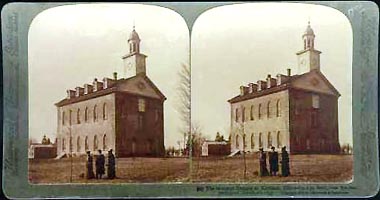
Kirtland Temple, Stereo Pair, late 1880s
1800-28 | 1829-31 | 1832-34 | 1835-39 | 1840-49
1850-59 | 1860-79 | 1880-99 | 1900-09 | 1910-99
1880-1882
ZDC Feb 07 '80 | ZDC Feb 14 '80 | GJr Jun 03 '80 | GJr Jun 10 '80 | GJr Jun 17 '80 | GJr Jun 24 '80
GJr Jul 01 '80 | GJr Jul 08 '80 | GJr Jul 15 '80 | GJr Jul 22 '80 | SCD Oct 07 '80 | CDG Jan 29 '81
CCom Feb 26 '81 | ORep Jul 19 '81 | CDG Dec 12 '81 | ClvH Dec 15 '81 | CDG Jan 27 '82 | CStd Jul 01 '82
CLdr Oct 02 '82 | CStd Dec 02 '82 | ClvH Dec 15 '82 | CStd Dec 16 '82 | CStd Dec 23 '82 | CStd Dec 30 '82
1883-1885
CStd Jan 13 '83 | CStd Jan 27 '83 | CLdr Jan 29 '83 | CStd Feb 10 '83 | CLdr Feb 26 '83 | CLdr Apr 02 '83
CLdr Apr 05 '83 | ClvH Apr 07 '83 | CPD Apr 07 '83 | NDA Apr 10 '83 | CPD Apr 13 '83 | J&M Apr 18 '83
ClvH Jun 20 '83 | CEnq Oct ?? '83 | ClvH Feb 14 '84 | ClvH Feb 16 '84 | ClvH Feb 17 '84 | ClvH Feb 19 '84
ClvH Feb 20 '84 | ClvH Feb 21 '84 | ClvH Feb 22 '84 | ClvH Feb 26 '84 | CLdr Mar 24 '84 | CPD Oct 19 '85
CPD Nov 12 '85
1886-1890
CLdr Jan 26 '86 | CPD Feb 07 '86 | CPD Feb 08 '86 | CLdr Mar 09 '86 | CPD Mar 09 '86 | CLdr Mar 14 '86
MInd Mar 26 '86 | CStd Mar 27 '86 | ORep Oct 06 '86 | CLdr Oct 17 '86 | CPD Apr 12 '87 | CLdr Apr 17 '87
CLdr Apr 18 '87 | CLdr Apr 19 '87 | CPD Apr 24 '87 | CPD Jun 12 '87 | CPD Jun 19 '87 | CPD Feb 05 '88
ORep Jun 21 '88 | WInd May 30 '90 | WInd Jul 11 '90 | WInd Jul 25 '90 | WInd Aug 01 '90 | WInd Aug 08 '90
WInd Aug 15 '90 | WInd Aug 22 '90 | WInd Aug 29 '90 | WInd Sep 05 '90 | WInd Sep 19 '90 | WInd Oct 10 '90
WInd Nov 07 '90
1891-1899
CLdr Apr 05 '91 | HRep Aug 29 '92 | CLdr Dec 04 '92 | NDA Jun 19 '93 | CPD Jan 19 '96
CPD Feb 29 '96 | CPD March 15 '96 | CRec Apr 07 '96 | CRec May 18 '97 | CStd Jan 29 '98
CStd Feb 16 '98 | CStd Mar 05 '98 | CStd Apr 09 '98 | CStd Apr 30 '98 | CStd May 07 '98
CStd Jun 11 '98 | CStd Oct 15 '98 | CStd Apr 15 '99 | CStd Aug 05 '99 | CStd Oct 21 '99
CPD Nov 26 '99 | CStd Dec 09 '99 | CStd Dec 30 '99
Articles Index | Painesville Telegraph
 Vol. ? Zanesville, Ohio, February 7, 1880. No. ?
THE PILGRIMS. In November, 1817, a society of people called the Vermont Pilgrims made their appearance in Zanesville. This society originated in Lower Canada, and in May, 1817, emigrated to Woodstock, Vermont. After sojourning a short time in the latter place they started South, traveling through New Jersey, Virginia, and thence through Eastern Ohio to Zanesville. Very few persons are now living that can call to mind anything definite in regard to these deluded people. The following sketch is from the Zanesville Express, dated November 5, 1817. |
Vol. ? Zanesville, Ohio, February 14, 1880. No. ?
THE PILGRIMS.
From the Zanesville Express, Nov. 20, 1817. |
Vol. ? Garrettsville, Ohio, Thursday, June 3, 1880. No. ?
Early History of Hiram.
Hiram is Township No. 5, in the seventh range of townships in the Connecticut Western Reserve, in the State of Ohio (formerly called New Connecticut.) The township was drawn in the partition of the lands of the Connecticut Land Company by the following original proprietors, viz: Col. Daniel Tilden, Daniel Green, Joseph Metcalf, Levi Case, John Fitch and Joseph Burnham, of Lebanon, Windham county, Conn., and Joseph Perkins of Ashford, in the same county, upon the Draft. They were all Free Masons, and, at a Lodge meeting one evening Col. Tilden proposed to call the township Hiram, in commemoration of the King of Tyre, which was unanimously agreed to.... |
Vol. ? Garrettsville, Ohio, Thursday, June 10, 1880. No. ?
Early History of Hiram.
|
Vol. ? Garrettsville, Ohio, Thursday, June 17, 1880. No. ?
Early History of Hiram.
In the fall of the same year [1810] his [Parley Hughes'] son-in-law Ephraim Hackett arrived with his family and settled on the west part of the east half of lot 22 near where Alexander now lives. The population was now augmented to about 30. In June, 1810, Orrin Pitkin and wife came from the same place with a span of horses and settled on the east one hundred acres of lot 32 where A. Honey made a quite small improvement in 1800. Elijah Mason was to give Mrs. Pitkin, his daughter, one hundred acres of land of her own selection, but she traded her right to her brother Roswell for the land on which they settled. Pitkin was to pay one hundred dollars for the betterments but he never paid the money and Roswell never gave the title which finally passed into the hands of Miles T. Norton by the way of Judge Norton, of Middlebury.... |
Vol. ? Garrettsville, Ohio, Thursday, June 24, 1880. No. ?
Early History of Hiram.
Benjamin Hinckley and family arrived in September 1813 from Connecticut and settled on the west part of the west half of lot 38, the improvements on which he bought of Dyson obtaining his title elsewhere. He purchased considerable land besides. There were now in Hiram thirteen families, embracing sixty-four persons, twenty-nine of whom were adults. Of this twenty-nine none are now known to be living. In the fall of this year a log school house was built upon a spot then called Popular Ridge, about a half mile south of the center of the township near the top of the hill south of where Benjamin Tilden's house now stands. In this house the first school was taught the ensuing winter by Benjamin Hinckley. He begun his school on the 13th of December and taught ten weeks, having an attendance of twenty scholars. The names of the scholars were as follows: Betsy Young, James I. Young, L. P. Young, Andrew Young, Lydia Young, Sally Young, John C. Young, Orrin Hutchinson, Harriet Hutchinson, John Dyson, James Dyson, Sarepta Hughes, Polly Hughes, Samuel Johnson, Alex. Johnson, Susan Johnson, Susan Hinckley, Ann Hinckley, Peggy Hampton and ______ Judson. Six of those are now known to be living, viz: Betsey L. Harris, Susan H. Proctor, James I. Young, John C. Young, Capt. Andrew Young, and Alexander Johnson. In his school book is the following entry: "Father of light and life. Thou God supreme; Oh teach me what is good! Teach me thyself! Save me from folly, vanity, and vice -- from every low pursuit, and feed my soul with knowledge, conscious peace, and virtue fine, sacred, substantial, never failing bliss." He was a surveyor and Justice of the Peace, and set out the beautiful row of maple trees now standing in front of Eber D. Hinckley's house and farm. |
Vol. ? Garrettsville, Ohio, Thursday, July 1, 1880. No. ?
Early History of Hiram.
It was this year [1816] that the first post-office in Hiram was opened at the Center. Thomas F. Young was appointed Post Master, which office he held for thirty-six years, until the day of his death, which occurred on the 27th of November, 1852, at the age of 67.... |
Vol. ? Garrettsville, Ohio, Thursday, July 8, 1880. No. ?
Early History of Hiram.
A few anecdotes will serve to illustrate the status in many respects, of the community of Hiram in the early day, but while reading them, it should be remembered that crudity of ideas in regard to some things, is excusable in men who are proficient in matters pertaining to their particular avocations.... |
Vol. ? Garrettsville, Ohio, Thursday, July 15, 1880. No. ?
Early History of Hiram.
|
Vol. ? Garrettsville, Ohio, Thursday, July 22, 1880. No. ?
Early History of Hiram.
|
Vol. 47. Canton, Ohio, Thursday, October 7, 1880. No. 19.
REV. T. DeWITT TALMAGE.
Sodom and Salt Lake City are eynonyomous. You can hardly think of one without thinking of the other. Both rested in the midst of fertile plains, Sodom and Utah. Both were near salt and fish-less seas. Both were the capitals of the most accursed wickedness. Both are doomed. In 1857 a company of emigrants from Arkansas set out to better their condition in California. They were good, respectable people, but they did what appears to me a most terrible thing -- made the transit of the continent by an emigrant wagon. They suffered everything on their way. By night fires kept away the wolves. By day they stared danger and starvation in the face; tender womanhood and children were there crying for rest. There were 179 in the company, and their way lay across Utah territory. It had been the custom for the emigrant trains to stop in the Utah country and take in new supplies of provision; but Brigham Young had heard of this company, and forbade any one extending even the hand of bought kindness to these emigrants and why? It was a revenge for the fate of Elder Pratt, who had been killed in Arkansas where he had stolen away a man's wife and brought her into Momonism. On, on went the emigrant train, suffering all indignities, until they came into Mountain Meadow. The Indians dashed down upon them, but a temporary barricade was successfully thrown up. Then the Mormon militia came down to their murderous work; but you know how men fight when they are fighting for their wives and children. They were imprisoned in a death-trap, and oh, how they suffered for water, with the spring justt outside, under the sweep of the Mormon rifles. Two little girls, clad in white, were sent out from the barricade to get water. No sooner were they seen than they were shot dead; appeals were made, and three brave fellows volunteered to go out to make the attempt to push on to California and secure help. They were prayed for by the whole band and went out to be butchered. Time passed by and one day wagons were seen coming. They were met, and assurance was given the emigrants that they could pass on peacefully upon giving up their arms. They laid them down and walked out -- first the men, then the women and the children. Then came that blot upon our country's record, the Mountain Meadow massacre. Mormon rifles and daggers and knives slew all save a few little children who were thought too little to tell the story. Women sick within the barricade were taken out into the presence of their murdered husbands, stripped of their clothing, and hurled, as they received their death wounds, upon the heap of corpses. Stock and jewelry, dresses and effects, in all $300,000 worth, were taken by the Mormon government. Years after, one of those saved children saw a dress in the possession of a Mormon woman, and exclaimed, "That is the dress that mamma used to wear. Oh! what have you done with my mother?" John D. Lee was the presiding spirit of that massacre; and when, fifteen years after, he gave his testimony, he said he had orders to do what he did, and that the property taken went to the Mormon power. Gen. Carleton passed over the grounds and gathered the skeletons of the martyrs into decent graves, placed over them the inscription, ''Vengeance is mine, I will repay, saith the Lord." No wonder Brigham Young, when he saw it, ordered it to be torn down. |
Vol. 107. Cincinnati, Saturday, January 29, 1881. No. 25. Special Correspondence to the Cincinnati Gazette. Mentor, Jan. 27. -- ... |
Vol. XLI. Cincinnati, Ohio, Saturday, February 26, 1881. No. 159.
THE OLD MORMON TEMPLE.
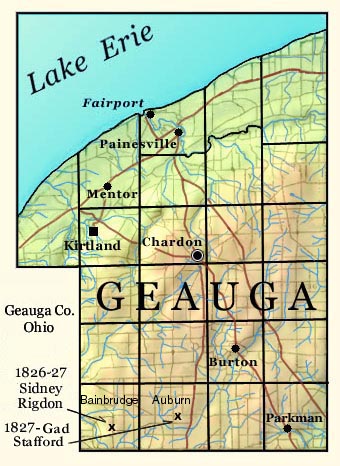
MENTOR, O., February 25. -- Little Lake, almost the smallest county in the State, is famous in two respects. First it is the home of the President-elect, a fact pretty generally well known by this time; and second, it contains the renowned "Mormon Temple." Having a few spare moments at Mentor to-day, the Commercial representative, accompanied by a reporter of the Chicago Times, drove out to the historic edifice. It is situated about three or four miles from the residence of the President-elect in the now quiet and almost obliviated town of Kirtland. It is built on a commanding point of land, and is visible long before the village is reached. The temple is of plain sandstone, and is strongly and substantially constructed. The visitor's first impressions on viewing the temple are the peculiarity of its architecture and its remarkable height. It is two stories high, and two rows of singularly arranged windows run entirely around the building. Two massive green colored doors form the entrance to the front of the Temple. |
Vol. ? Canton, Ohio, Tuesday, July 19, 1881. No. ?
ITEMS OF INTEREST.
The late Henry Wells, founder of the American express system, personally handled the alleged Mormon plates which Joe Smith pretended to find near Palmyra, N. Y., and which contained the "revelations" on which the Mormon religion is founded. They were encased in a cotton bag, and Mr. Wells did not actually see them, but from their lack of weight he did not believe they were metal plates as Joe Smith alleged, but were slates. He was greatly tempted to "smash" them; and if he had -- where would Mormonism have been today? Mr. Wells died in 1878. |
Vol. 108. Cincinnati, Monday, December 12, 1881. No. 137.
BOOK OF MORMON.
Special Correspondence to the Cincinnati Gazette. |
Vol. 48. Cleveland, Thursday, December 15, 1881. No. 298.
BOOK OF MORMON.
|
Vol. ? Cincinnati, Friday, January 27, 1882. No. ?
THE BOOK OF MORMON.
To the Editor of the Cincinnati Gazette. |
 Vol. XVII. Cincinnati, Ohio, Saturday, July 1, 1882. No. 26.
"The Premises." "Let us wait and see what is true in the premises." -- Religious Herald. |
 Vol. ? Cleveland, Ohio, Monday, October 2, 1882. No. ?
A MORMON KING.
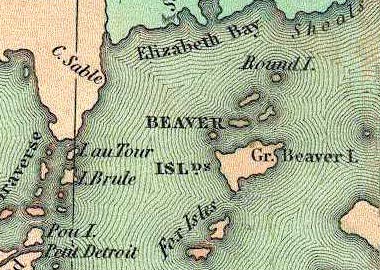
At the foot of Lake Michigan, a few miles outside the Straits of Mackinaw, lies a beautiful island. In winter it is the battleground of blizzards, and the blasts which come howling down from the wilderness of Manitoba, making weird music among the tapering pines which seem to have been driven unto it to hold it in place, render it anything but a desirable habitation. But in summer, when nature has adorned its slopes and headlands with a coat of green, and the cool breezes play across its surface, few more delightful spots can be found. The great number of bare-tailed, broad-toothed, four footed little engineers which used to sun themselves on the beach, build mud houses and dams, or disport themselves in the clear water which surround it gave to it the name of Beaver Island. Every sailor who has made the trip from Cleveland to Chicago is familiar with the place, and though there are few mariners on the lakes who know its history, any man who sailed twenty-five years ago can tell many stories connected with it. At that time Beaver Island was inhabited by a band of |
Vol. XVII. Cincinnati, Ohio, Saturday, December 2, 1882. No. 48.
THE MOUSE BORN. The regular readers of the STANDARD are aware of the blustering announcements made some time ago, through the Religious Herald and other Baptist journals, of Prof. Whitsitt's coming revelations concerning Mormonism as the offspring of Campbellism. It was to be a terrible revelation. One of the editors of the Herald professed to be horror-stricken at the thought of the unearthing of damaging facts which this historical explorer had dug up and was about to exhibit to the astonished gaze of an ignorant world, and another Baptist editor solemnly declared that if what was said could be proved, Alexander Campbell and his coadjutors were guilty of "saddling upon the world the most corrupt and odious system that has disgraced the nineteenth century." This hideous scarecrow has been swinging in the wind from that day to this, to frighten Baptists away from all sympathy with "Campbellism;" and now we have an exhibition of at least a part of the veritable Campbellite-Mormon monster discovered by Prof. Whitsitt, as the result of his wonderful "scientific investigations," in the shape of a lecture on "Mormon Theology" before the Baptist Pastor's Conference in Louisville, Ky., October 23d, 1882. Being published in the Western Recorder, in Prof. Whitsitt's own city, a copy of which was addressed to us in what we take to be Prof. W.'s own handwriting, we must regard the report of the lecture as approved by the lecturer. We give it in full on another page. We do not promise to publish reports of succeeding lectures, for if this is a fair specimen of the course, our space can be better filled than with such pretentious nothingness. After all the bluster and parade in heralding this great show, the exhibition will be found to be quite disappointing. Parturient montes nascetur ridiculous mus. If the reader cannot understand this, we need only say that he is likely to get as much solid good out of it without understanding it, as he can get out of the report of Prof. Whitsitt's lecture, with the best understanding of it that he can reach. |
Vol. 49. Cleveland, Friday, December 15, 1882. No. ?
THE MORMONS.
The article in a recent Herald regarding the reestablishment of the Mormon temple at Kirtland, this State, has caused a good deal of comment throughout Northern Ohio, and many old people who resided in Kirtland, or in that vicinity, during the Mormon excitement, are coming forward with interesting reminiscences of those days. No one can furnish anything more entertaining in this connection than Mr. Isaac Fellows, of Youngstown, one of the old, solid and substantial citizens, foreman in the pattern shops of William Tod & Co. |
Vol. XVII. Cincinnati, Ohio, Saturday, December 16, 1882. No. 50.
Prof. Whitsitt on Mormonism. As we have been necessarily absent from the office for several days, we have not found time to complete our comments on Prof. Whitsitt's lecture. We give, instead, the following letter, sent by Bro. F. D. Power to the Western Recorder. Whether it will be allowed to appear in that paper remains to be seen. It will appear be seen that it sustains the statements my by us relative to Prof. Whitsitt's desire to submit a proposition from the Baptist side of the house, looking to a union of Baptists with a people whose teaching, he now claims, gave birth to the theology and peculiar morality of Mormonism! Whether the Professor is in living sympathy with Mormonism, that he was so earnest to bring the Baptists into association with the pestiferous doctrine that gave birth to it; or whether, since the death of President Garfield, the prize he sought has lost its glittering charm, we must leave our readers to decide for themselves. We know they will be interested in reading Bro. Power's communication to the Recorder: ... |
Vol. XVII. Cincinnati, Ohio, Saturday, December 23, 1882. No. 51.
Prof. Whitsitt's Reply. The Western Recorder of Dec. 14 publishes Bro. Power's letter, which appeared in our columns, last week, and follows it with the following comments, ostensibly from the editor of that paper: |
Vol. XVII. Cincinnati, Ohio, Saturday, December 30, 1882. No. 52.
Prof. Whitsitt's and Mormonism In giving so extended a review of Prof. Whitsitt's lecture on Campbellism and Mormonism, it is not because the lecture, as reported deserves it, but because we think it advisable to take the occasion, for the benefit of the public, to speak at large of some things which need to be better understood. |
Vol. XVIII. Cincinnati, Ohio, Saturday, January 13, 1883. No. 2. Prof. Whitsitt's Second Lecture. The Western Recorder of Dec. 21, contained a report of Prof. Whitsitt's second lecture on Cambellism and Mormonism. Beyond its appearance in that journal, we have noticed no indication of public interest in it. In fact, since the Professor's enthusiasm over the question of the union of the Baptists and Disciples has become known, there is little concern about any thing he may say on the connection between Campbellism and Mormonism. The second lecture is no improvement on the first. It proceeds on the silly supposition that such notorious frauds as Smith and Rigdon were governed by religious convictions in the construction of a religious system which is permeated with the deceit and fraud of of those daring impostors. Think of such rascals being governed by any "fundamental principle" in establishing polygamy, other than the gratification of their own lusts. But the manifest contradictions between the first and second lectures, as to the responsibility for the enormities of Mormonism, are so glaring, that Prof. W.'s competency to deal fairly with the question will be apparent to every candid reader, Look at these extracts: |
Vol. XVIII. Cincinnati, Ohio, Saturday, January 27, 1883. No. 4. Whitsittistic and Mormonistic. The Western Recorder, in its desperate efforts to sustain Prof. Whitsitt in his ridiculous attempts to bring the Disciples into disgrace, gets off the following on the creed question: |
Vol. XXXVI. Cleveland, Ohio, Monday, January 29, 1883. No. 29.
WESTERN RESERVE.
|
Vol. XVIII. Cincinnati, Ohio, Saturday, February 10, 1883. No. 6.
The Whitsitt Discovery! The following is not only a vigorous expression of the sentiments of President Pendleton, but, as far as we can learn, a fair reflection of the general sentiment in our brotherhood; and as such, we give it place. We take occasion to say that we do not hold the Baptists generally responsible for the course of Prof. Whitsitt and the Western Recorder. As far as we have been able to learn, the most of the leading Baptist journals have declined to sneeze when Prof. Whitsitt sneezed, and even the Religious Herald gives a very faint te-hish-u in response, although loudly blowing the horn for the Professor in advance. We are glad to say this, to the credit of our Bpatist brethren. |
 Vol. XXXVI. Cleveland, Ohio, Monday, February 26, 1883. No. 57.
THE MORMONS.
... It is exceedingly astonishing upon what slender bases of fact many of the isms and religious sects of Christendom rest. Mormonism, one of the most remarkable of these, is already divided into several factions, but all of them take the nonsensical Book of Mormon as an authentic revelation from God and as a supplement to the ancient Hebrew Scriptures, more valuable, because more recent than they. |
Vol. XXXVI. Cleveland, Ohio, Monday, April 2, 1883. No. 92.
MORMONISM.
...It is fifty-three years come next Friday since the Mormon Church was organized by its first baptism in the little town of Harmony on the Susquehanna River, in Pennsylvania. About a year later the gathering was made at the first stake of Zion -- Kirtland. It is proposed on the recurrence of the fifty-third anniversary next Friday to revive this first stake by means of a grand reunion. From all that can be ascertained it would seem that the crowds that are likely to come to Kirtland next Friday will be about as badly accommodated as those who stayed in dog kennels and barns and fence corners at the first gathering there. Kirtland itself has stood nearly still in its growth during the fifty-three years that the Mormon Church has been growing from a handful to a formidable communion. |
Vol. XXXVI. Cleveland, Ohio, Thursday, April 5, 1883. No. 95.
THE MORMONS.
...Superintendent Hinsdale tells me that he once heard General Garfield say that he had examined a large history of Mormonism, written in French, a copy of which is to be found in the Library of Congress. This author, who is quite a philosopher in his way, says that the turning point in Mormonism was the tarring and feathering of Joe Smith and Rigdon at Hiram. Up to that time the new doctrine had taken very little root. The converts had been very few. But here was a case of violence. It ws the same old story of persecution over again. The gentiles could not stand argument, but must resort to ruffianism. It is said that this deed was in reality the cause of two deaths. A pair of twins in Smith's house, some eleven months old, were suffering from the measles, and being exposed by the crowd rushing in, they took cold and died. Rigdon was very roughly handled. He was dragged by his heels, and his head was terribly bruised on the rough, frozen ground. He was crazy for some time after, and nearly died. The prophet and Rigdon, as soon as they sufficiently recovered, began to give exaggerated accounts of the affair and not only cemented the faith of their former converts, but used it as a strong means for gaining new ones. There are men still living in and about Hiram who were once tinctured to a certain extent with Mormonism, and there are others who helped to do this tarring and feathering.... |
Vol. 50. Cleveland, Thursday, April 7, 1883. No. 91.
LATTER DAY SAINTS.
Special to The Cleveland Herald. |
Vol. XXXIX. Cleveland, Ohio, Saturday, April 7, 1883. No. 84.
SMITH AND HIS SAINTS
Kirtland, April 7. -- This is the second day of the reunion conference of the Latter Day Saints. A large number of delegates arrived this morning from the Western and Southwestern States. William B. Smith, surviving brother of Joseph Smith, held prayer this morning at eight o'clook in the temple. The conference reconvened at 10:80. The Committee on credentials made their report. A permanent organization is now being effected. Reports of foreign missions will be the first business this afternoon. |
Vol. IV. Newark, Ohio, Tuesday, April 10, 1883. No. 14.
MORMONS IN CONFERENCE. KIRTLAND, O., April 9. -- The great Mormon Conference is being held here. Nearly every State in the Union is represented by delegates, and England, Scotland and Wales by letter. William Smith, brother of the founder, one of the original twelve apostles, and the oldest Mormon now living is here. |
Vol. ? Cleveland, Ohio, Friday, April 13, 1883. No. ?
MAD MORMONS.
The Saints of the Latter Day Mormon Church are a queer lot. They have been persecuted and abused to an alarming extent perhaps and claim the newspapers have never represented them truthfully. When four reporters mingled with the Saints at Kirtland last week there were numerous small specks of gore on the face of the Mormon moon. When a Leader correspondent was skirmishing around the Kirtland hotel looking for a Mormon Bible to slip into his pistol pocket and carry it away as a memento, Joe Smith, the soon of his father and the leader of the reorganized church, cornered him and took him to task for printing numerous falsehoods. A crowd gathered and the afflicted reporter was compelled to hold his own as best he could for an hour or more. |
|
Vol. ? Cincinnati, Ohio, Wednesday, April 18, 1883. No. ?
At a Mormon conference at Kirtland, O., on the 12th inst., a letter was received from Secretary of State Frelinghuysen in response to a request to make a distinction between polygamous and monogamous Mormons, as Secretary Evarts sent circulars abroad, warning emigrants coming here to join polygamous communities, that they thereby expose themselves to the operation of penal laws of the United States. Secretary Frelinghuysen replied: "It is contrary to the practice of this Government to give, by circular, as is proposed, any sanction or indorsement of a specific form of belief. It is for agents of any religion to make their character. Law-abiding emigrants are secure against interference." |
Vol. 50. Cleveland, Wednesday, June 20, 1883. No. 165. Death of C. J. Ryder. A sad accident occurred in the Cuyahoga River, near Mud Mills, in Mantua, about 10 o'clock yesterday. Charles J. [sic - H.] Ryder and his brother Eddie were drowned while washing sheep. The latter, a lad of about fourteen, getting beyond his depth, his brother tried to save him, and both were lost. C. J. Ryder was well known. He was the son of Hartwell Ryder, a prominent citizen of Mantua, and was one of the trustees of Hiram College. He leaves a wife and two children. |
Vol. ? Cincinnati, Ohio, October 26?, 1883. No. ?
JOE SMITH, THE PROPHET.
|
Vol. 51. Cleveland, Thursday, February 14, 1884. No. 45.
THE BOOK OF MORMON.
Kirtland, O., Feb. 13. -- (Special.) -- An elder of the Mormon Church and a Disciple minister stood before a small audience in the Town Hall last evening and inaugurated a sixteen days' battle of words on the question of the authenticity of the Book of Mormon. Kirtland is famous as one of the original stamping grounds of Mormonism. Here stands the famous Mormon Temple, and here Rigdon and Joe Smith and Brigham Young and Martin Harris and Oliver Cowdery, Momon apostles, taught Mormon religion and pretended to perform Divine miracles. Kirtland was then a hot bed of Mormonism, and for that reason the distinguished disputants selected this place for their debate. It is intended before the discussion closes to hold the sessions in the old temple, but the opening meeting was in the midst of a fearful storm and attended by few people. |
Vol. 51. Cleveland, Saturday, February 16, 1884. No. 47.
THE BOOK OF MORMONS.
Kirtland, O., Feb. 15. -- (Special.) -- A change in the weather and better roads brought out a large audience last night. Some were in the audience from Cleveland. The discussion commenced promptly at the appointed hour, Mr. Kelley making the introductory speech.... |
Vol. 51. Cleveland, Sunday, February 17, 1884. No. 48.
THE BOOK OF MORMON.
Kirtland, O., Feb. 16. -- (Special.) -- The audience and disputants were present on tme last evening, and the discussion opened under favorable circumstances, with a large crowd in attendance. Mr. Kelley introduced a legal argument to show that he had made out a prima facie case, and that his opponent had not attempted to break the chain of evdience, but had gone off to endeavor to prove an alibi under the claim of the Spaulding statements, that by doing so the negative conceded that the positions of the affirmative were invulnerable, and upon that hypothesis he would notice that Spaulding story itself, which he denounced as entirely false. ["]It never made its appearance in any shape until years after the publication of the Book of Mormon." |
Vol. 51. Cleveland, Tuesday, February 19, 1884. No. 50.
DISCUSSING MORMONISM.
Kirtland, O., Feb. 17. -- (Special Correspondence.) -- There was a large attendance at the discussions last evening, which were held in the Temple... The question of the evening was the "Divinr Authenticity of the Book of Mormon." |
Vol. 51. Cleveland, Wednesday, February 20, 1884. No. 51.
LATTER DAY SAINTS.
Kirtland, O., Feb. 19. -- (Special Correspondence.) -- The discussion grows more interesting and exciting as the disputants advance along the line of argument. There was a large attendance last evening, notwithstanding the muddy roads and the dark nights. It proved one of the most interesting sessions that has been held. |
Vol. 51. Cleveland, Thursday, February 21, 1884. No. 52.
THE MORMON DISCUSSION.
Kirtland, O., Feb. 20. -- (Special Correspondence.) -- The inclement weather thinned out the audience last evening so that there was not more than two-thirds the usual number in attendance at the discussion. Elder Kelley continued his affirmative argument and answered the negative's objections to the Book of Mormon, being the stick of Ephraim... |
Vol. 51. Cleveland, Friday, February 22, 1884. No. 53.
THE KIRTLAND CONTROVERSY.
Kirtland, O., Feb. 21. -- (Special Correspondence.) -- A large audience greeted the discussers at the town hall last evening. Mr. Kelley went on to answer the objections urged by the negative the previous evening against the Book of Mormon.... He said that Mrs. Spaulding gave D.P. Hurlburt the "Manuscript Found," consisting of forty or fifty pages, and he gave it to E.D. Howe. It was burnt while in Howe's possession,and no part of it was ever published. This was the "Manuscript Found" -- found in a cave. |
Vol. 51. Cleveland, Tuesday, February 26, 1884. No. 57.
PLURAL WIVES.
Kirtland, O., Feb. 15. -- (Special.) -- The discussion of the question, "Is the Book of Mormon of Divine Origin, and its Teachings Entitled to the Belief and Respect of all people?" after ten evenings' sessions, of two hours each, has come to a close, as per announcement. |
Vol. XXXIV. Cleveland, Ohio, Monday, March 24, 1884. No. 84. The Lost Manuscript. To the Editor of the Leader. |
 Vol. ? Cleveland, Monday, October 19, 1885. No. ?
THE MORMON BIBLE.
PLAIN DEALER Special Correspondence. |
Forty-third Year Cleveland, Thursday, November 12, 1885. Sixteen Pages. Price 5 cents.
DEATH OF EBER D. HOWE.
|
Vol. 39. Cleveland, Tuesday Morning, January 26, 1886. No. 28.
|
Vol. 44. Cleveland, Sunday, February 7, 1886. No. ?
A MORMON INVASION.
Mr. J. H. Kennedy of this city writes in the Chicago News an account of how a Mormon army once marched across Ohio and made its way westward to the Mississippi: |
Vol. 44. Cleveland, Monday, February 8, 1886. No. ?
WHO WROTE THE MORMON BIBLE?
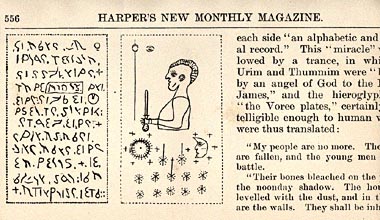
The old dispute about who wrote the Mormon Bible has broken out again, and the theory of those who contend that Joe Smith adapted or someone adapted his Bible from the "Manuscript Found of Solomon Spalding has been very greatly weakened by some recently ascertained facts. Joe Smith claimed, as is generally known and his followers to this day claim, that the book was made up of translations of mysterious writing on golden plates that Joe got out of the ground in Ontario county, New York. Joe, according to his own account, was the only man who could read the writing on these plates, and that he was enabled to do so only by means of an arrangement called the "urim and thummim," miraculously provided. |
Vol. 39. Cleveland, Ohio, Tuesday March 9, 1886. No. ?
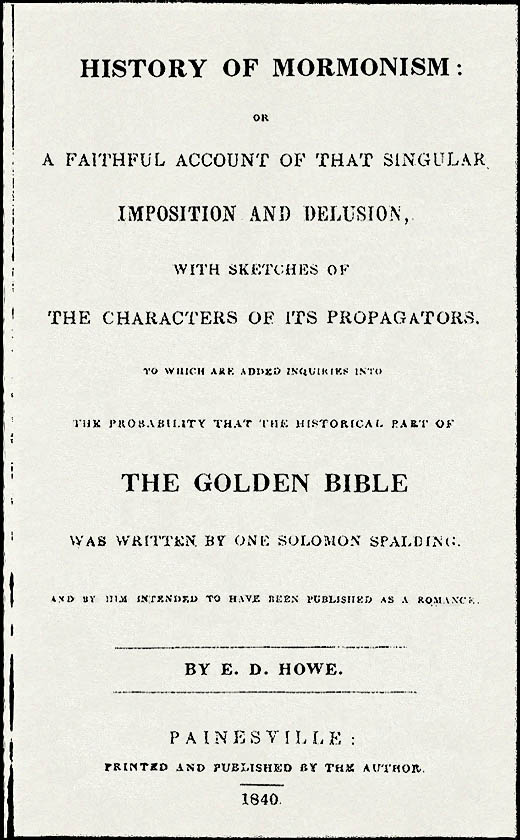
THE MANUSCRIPT FOUND. The fortnightly entertainments given in the assembly rooms of the Board of Education are becoming famous. Last evening a large audience was entertained by President Fairchild of Oberlin, who delivered an interesting lecture on the "Manuscript Found" and its relation to the Book of Mormon. President Fairchild said that it was the accepted tradition of the Book of Mormon that it was from a book written by Solomon Spalding who formerly resided at Conneaut, O. The tradition, as said, has become general, and is accepted by anti-Mormon writers, and has found its way into the encyclopedias. The speaker gave a history of the life of Spalding, who was born in Connecticut, but lived for many years on the Western Reserve. He had a literary tendency, and wrote a manuscript on the early inhabitants, and it was said that he consulted with a Pittsburg printer named Patterson with reference to having it published, but it never appeared. Spalding was in the habit of reading his manuscript to his neighbors and became familiar with it. The name of the manuscript was "The Manuscript Found; a Historical Romance of the American Indians." Twenty years after this Mormon preachers appeared at Conneaut with the Mormon Bible, and the people said that it had been written by Spaulding. The lecturer read from "The History of Mormonism," a book published by E. D. Howe, of Painesville, the testimony of eight witnesses who were positive that the essential portions of the Book of Mormon and the manuscript were identical. They are both in obsolete style, and the phrases "It came to pass," are the same. In 1834 a messenger |
Vol. 44. Cleveland, Tuesday, March 9, 1886. No. ?
THE BOOK OF MORMON.
The subject discussed at the Westorn Reserve historical society meeting last evening was Spaulding's manuscript in relation to the origin of the Book of Mormon. President Fairchild of Oberlin read a paper on the subject, of which he has made a thorough investigation. The theory that the book of the Mormon is simply an enlargement of Solomon Spaulding's "Manuscript Found" was first promulgated by Howe, and is now established and found its way into all the encyclopedias. Dr, Fairchlld said that it was probably impossible to utterly disprove the Spaulding thory, and devoted his time to weighing the evidence pro and con. |
Vol. 39. Cleveland, Ohio, March 14, 1886. No. 73.
THE SPALDING MANUSCRIPT AND Other engagements prevented my hearing President Fairchild's lecture last evening upon the Book of Mormon and its relation to the Spalding manuscript. It has been the popular belief among the older citizens of the Reserve, and especially among those who had personal observation and contact with early Mormonism, that the Book of Mormon was compiled or rewritten, or at least made up in part from the Spalding document, and yet there was no direct or positive evidence to prove it. From some facts and incidents connected with the career of Joseph Smith and Sidney Rigdon when they were in Geauga and Portage counties preaching their alleged new gospel I came to the conclusion some years ago that the Book of Mormon was the work of Sidney Rigdon, with perhaps some changes or additions by Smith or others. So far as I know these facts and circumstances have never been published. The truth or falsity of the Spalding matter in no way affects them, and they came to me in a way that leaves no doubt on my mind that the Book of Mormon, or a large part thereof, was written by Rigdon within two miles of the spot where I am now writing. |
Vol. XXIII. Massillon, Ohio, March 26, 1886. No. 40.
BRIGHAM YOUNG. A Chardon, O., correspondent of the Cincinnati Commercial Gazette writes: |
Vol. XXI. Cincinnati, Ohio, Saturday, March 27, 1886. No. 13.
(Cleveland Leader)
|
Vol. IX. Canton, Ohio, Wednesday, October 6, 1886. No. 194.
VISIT TO MINER'S HILL.
On returning to the village of Palmyra we visited another hill which is celebrated in the annals of Mormon history. In order that the reader may understand the significance of this hill we must go back to Joe Smith and his bible. The book, which, by the way, no one ever saw, was said to consist of metal plates, pierced on one edge, and fastened together by rings which passed through the holes. With the book was also found, or so pretended, a huge pair of spectacles, too large for any mortal eyes, which had the remarkable quality of turning the hieroglyphics on the metal plates into plain English. |
Vol. 39. Cleveland, Ohio, Sunday, October 17, 1886. No. ?
THE BOOK OF MORMON,
|
Forty-Fifth Year Cleveland, Ohio, Tuesday, April 12, 1887. Price 5 cents.
A TRUE PROPHET.
KIRTLAND, O., April 11. -- (Special.) -- There were still some visitors left in town Sunday night and the temple was well filled. Elder Joseph Luff of Independence, Mo., spoke: |
Vol. 40. Cleveland, Ohio, Sunday, April 17, 1887. No. 107.
WHAT THEY BELIEVE.
Kirtland, O., April 16. -- A break has occurred in the beautiful weather which has prevailed thus far during the annual conference of the saints and this morning dawned with a cold, drizzling rain falling from a leaden colored sky. The streets are deserted and the somber looking temple on Zion Hill is without an occupant. The last night's discourse was delivered by Apostle J. H. Lake, from the words: "Get Religion." It was an interesting discourse. So much has been said and so little is really known of the belief of the Reorganized Church of the Latter Day Saints, that the following epitome of its faith and doctrine will be of interest. -- |
Vol. 40. Cleveland, Monday Morning, April 18, 1887. - Ten Pages. No. 108.
|
Vol. 40. Cleveland, Tuesday Morning, April 19, 1887. - Ten Pages. No. 109. James A. Briggs, of Brooklyn, N. Y., well-known as a former Cleveland journalist, writes to the Evening Star in reference to a communication in that paper about the Mormon Bible, published in that paper and telegraphed to the LEADER. The following is the communication of Mr. Briggs: -- |
Forty-Fifth Year Cleveland, Sunday Morning, April 24, 1887. Sixteen Pages. Price 5 cents.
THE BOOK OF MORMON.
The recent conference of the Josephites or monogamous Mormons at Kirtland, O., and the extended reports of their proceedings in the PLAIN DEALER has renewed public interest in the peculiar faith to which members of this church subscribe. The origin of the Book of Mormon has never been clearly established. The Latter Day Saints, of course, accept the statements of Joe Smith and believe it to be an inspired work. The general public, however, are hardly as credulous and regard the alleged Bible as a fraud -- the work of some clever romancist rather than the translation of hieroglyphics on golden plates by a nineteenth century prophet. The Spaulding theory, with which everyone at all acquainted with the subject is familiar, has the most advocates. They hold that Spaulding's manuscript of his romance "The Manuscript Found" fell into the hands of Joe Smith, Sidney Rigdon and others and from that fanciful work was constructed the Book of Mormon. |
Vol. 45. Cleveland, Sunday Morning, June 12, 1887. No. ?
THE MANUSCRIPT.
LAMONI, Ia., June 8. -- (Special Correspondence.) -- It may be unnecessary to apologize for placing any further information respecting the Spaulding manuscript story origin of the Book of Mormon before your readers, but as that remarkable story has been endowed with so great tenacity of life (or lives, for its name is legion), it is almost indispensible that the public should be in possession of all -- the whole variety of stories, from the one told by Dr. Philastus Hurlbut at the beginning to the latest from the PLAIN DEALER -- that the objector to the Book of Mormon may select which of them he chooses to rest his objection upon, and thus leave the rest free to be used in rebuttal. |
Vol. 45. Cleveland, Ohio, Sunday, June 19, 1887. No. ?
THE BOOK OF MORMON.
The intelligent communication of "J. S." in last Sunday's Plain Dealer seems intended to state the truth on a subject that even intelligent and fair men have treated unfairly. The Mormons will never be changed by repeating ridiculous falsehoods about them. My wife was born within eight miles of Conneaut, well acquainted with Aaron Wright and all the witnesses to the Solomon Spaulding manucript story. To her and to the Hon. E. B. Woodbury, who knew all the parties, it seemed incredible that anyone could be misled by it. In 1876 Professor A. S. Hayden, the president of Hyram institute, now college, published a history of the rise or the disciples on the Western Reserve. On page 209 he gives the advent of Mormonism and says: |
Vol. ? Cleveland, Sunday Morning, February 5, 1888. No. ?
THE LAST WITNESS.
The recent death of David Whitmer, the last survivor of the "three witnesses," who testified to the truth of the book of Mormon, and to the alleged miraculous finding of the golden plates by Joseph Smith and their translation by him, revives speculation as to the origin of what most people agree to call a great delusion. And yet the fact must be faced that David Whitmer, who died the other say in Richmond, Mo., was not and had not been for years in the Mormon church as it exists in Utah;was not in accord with it, cordially hated it, was respected and honored by his neighbors as an honest, upright, intelligent and pious man, and died avowing with his last breath his belief that the book of Mormon was a revelation from God and that the story of the golden plates was true. A copy of the Richmond Democrat of Thursday, January 26, contains an account of the life and death of this man whose intimate connection with the early movements of Mormonism and the genesis of that faith give more than ordinary interest to the testimony he bears in regard to it. he was born in Harrisburg, Pa., January 7, 1805, and was in his 83d year when he died. |
Vol. XI. Canton, Ohio, Wednesday, June 21, 1888. No. ?
A REIGN OF TERROR.
|
 Vol. XII. Willoughby, Ohio May 30, 1890. No. ?
PIONEER REMINISCENCES.
|
|
Vol. XII. Willoughby, Ohio July 11, 1890. No. ?
PIONEER REMINISCENCES.
|
|
Vol. XII. Willoughby, Ohio July 25, 1890. No. ?
PIONEER REMINISCENCES.
|
|
Vol. XII. Willoughby, Ohio August 1, 1890. No. ?
PIONEER REMINISCENCES. My recollections of Kirtland would not be complete without mentioning a few of the followers of Joseph Smith. -- Martin Harris, Oliver Cowdery and David Whitmer, witnesses to the Mormon book, or rather, testified that they saw and "hefted" the plates from which the book was transcribed. I believe they all admitted that the plates were covered with a cloth, and they only saw them by the eye of faith. I do not recollect of ever seeing Whitmer, but believe that both he and Cowdery left Kirtland before the camp left, and did not follow Smith to Nauvoo or Missouri. Martin Harris remained in Kirtland twenty-five or thirty years after the Mormons left. His mind, always unbalanced on the subject of Mormonism, had become so demented that he thought himself a bigger man than Smith, or even Christ, and believed that most of the prophecies in the Old Testament referred directly to him. One day, when working for me, he handed me a leaflet that he had got printed, taken from some of the prophets, telling of a wonderful person that should appear and draw all men after him. I looked it over and returned it to him. He said, who do you think it refers to? I said, why, of course, it refers to you. He looked very much pleased, and said, I see you understand the scriptures. In 1867 or 1868, while acting as township trustee, complaint was made to me that Martin Harris was destitute of a home, poorly clothed, feeble, burdensome to friends, and that he ought to he taken to the poor-house. I went down to the flats to investigate, and found him at a house near the Temple, with a family lately moved in, strangers to me. He seemed to dread the poor-house very much. The lady of the house said she would take care of him while their means lasted -- and I was quite willing to postpone the unpleasant task of taking him to the poor-house. Everybody felt sympathy for him. He was willing to work and make himself useful as far as his age and debility would admit of. Soon after that he was sent for and taken to Salt Lake, which was the only act of sympathy I ever knew of the Mormons bestowing on any of their dupes who had been ruined by them. |
|
Vol. XII. Willoughby, Ohio August 8, 1890. No. ?
PIONEER REMINISCENCES. I was reminded the other day by an old school teacher that in my reminiscences I had said nothing about common schools. I told her that common schools were invented since my day. She seemed to doubt my word. On collecting my thoughts together I found that I did remember some things about schools, but they were not very common. When I was five years of age I had learned to read, and thought myself quite proficient in that branch of education, and on reading a chapter in the Testament to my mother she confirmed me in my good opinion of myself. After we came to Ohio and settled in Kirtland there was not much chance for schooling in our part of the township. I think in 1813 a school was started at the Flats, in a private house and my sister hired to teach it. If remembered aright, her wages were fifty cents a week and board around -- that is, with each family, according to the number of scholars sent. My parents wishing to give me a good education hired me boarded at the Flats. I do not know the price of board, but if it corresponded with the quality, it should be low. We had for breakfast johnny-cake, boiled potatoes, fried pork, and the grease that was fried out of it -- which the lady of the house called sop -- and sometimes butter. For dinner it was cold johnny-cake, or cold boiled potatoes; and I will say that I never before or since ate potatoes that, equaled them; they were of an old English variety, large, dry and mealy. A little salt might have improved their flavor; but salt was scarce and high in those days. For supper, the best meal, it was johnny cake or potatoes and milk. I could have stood the fare well enough, for I was well seasoned to short commons and hard fare, if the lady had not been an intolerable scold. She did not scold at me, but at her son, who was about my age. He could do nothing right -- she scolded him for eating so much; scolded him for eating so much butter. Why don't you do as Christopher does? He eats sop on his bread and he don't eat half as much as you do -- eating so much will make you sick. I was very bashful, and of course let the butter alone, and did not quite satisfy the cravings of hunger. I became homesick in a week, and concluded that my education was sufficient. |
|
Vol. XII. Willoughby, Ohio August 15, 1890. No. 20.
"Pioneer Reminiscences Examined." Editors Willoughby Independent: |
|
Vol. XII. Willoughby, Ohio August 22, 1890. No. 21.
PIONEER REMINISCENCES. Are we not a nation of grumblers? We grumble when it is too hot, too cold, too wet or too dry. We grumble at working ten hours for a day's work, and would do the same at eight hours. We grumble at $1.50 and $2.00 per day, because some get more. We grumble because some of our neighbors are getting rich faster than we are. We grumble at the extortions of railroads, bankers, manufacturers, merchants and professional men. We grumble at paying 5c. or 10c. a yard for calico sheeting and shirting, because there is a duty on the imported article. We grumble at paying 75c. for an axe, for the same reason. We grumble at paying $25 for a suit of clothes, because the same can be bought in Canada for $20. We grumble at paying three cents a mile railroad fare, and would grumble the same at two cents. We grumble at two cents letter postage, and want it reduced to one. Those that have to sell grumble at low prices -- at the low price of beef, pork and grain: and those that have to buy grumble at the high prices. In fact, we all have something to grumble about. I think we grumble ten times as much as we did sixty to eighty years ago, when we had ten times the cause for it than now. |
|
Vol. XII. Willoughby, Ohio August 29, 1890. No. 22.
LETTER FROM C. G. C. Editors Willoughby Independent: |
|
Vol. XII. Willoughby, Ohio September 5, 1890. No. 23.
PIONEER REMINISCENCES. I am offered the names of people in Kirtland who have lived through the reign of Mormonism there, to substantiate what I have said about the followers of Joseph Smith in my history of Kirtland, which has so badly disturbed brother Kelley, but I think I can substantiate what I have written and possibly some more, without exposing my friends to his criticism or to the anger of the Danite band. In this article I propose to give a short sketch of Mormon history. Their first intention was to make their headquarters, their Zion, in Missouri. I think they purchased some land there. If they promulgated the same doctrines there that they afterwards did in Kirtland -- that the Gentiles were to be destroyed, and they, the Saints were to inherit the earth -- there is no wonder that the hot southern blood rose in anger and fired them out of the state. They then lit down in Kirtland upon a law-abiding and long-suffering people. To some of their proceedings there I have alluded in my recollections of that township, and will not repeat at this time; suffice it to say, that with God within call to advise and direct they saw themselves completely aground, and had to leave from the folly of their own acts without much outside pressure. |
|
Vol. XII. Willoughby, Ohio September 19, 1890. No. 25.
PIONEER REMINISCENCES. I suppose it is a matter of history, or at least of record, but perhaps not generally known to the present generation, that the states of Ohio and Michigan once stood facing each other in battle array. The way it happened was this: When the states of Virginia, Connecticut, and others whose colonial charters from the British crown extended across the continent to the Pacific ocean, relinquished to Congress their western claims, it was decided by Congress to divide the north-west territory into five territories for admission as states, to be bounded as follows -- Ohio on the east, and south by Pennsylvania and the Ohio River, west by Indiana, and north by a line running due east from the south end of Lake Michigan to Lake Erie; thence by the Lake to the Pennsylvania line; Indiana north by an east and west line ten miles north of the south end of Lake Michigan; Illinois to extend on the west side of Lake Michigan, distance not recollected; and on the west by the Mississippi River, which was then our western boundary. The territory west of the Mississippi was afterward obtained by the Louisiana purchase. Wisconsin was bounded west by the Mississippi, north and east by Lake Superior, St. Mary's River, and Lake Michigan; Michigan by the lakes on the west, north and east, and by Ohio and Indiana on the south. |
|
Vol. XII. Willoughby, Ohio October 10, 1890. No. 28.
PIONEER REMINISCENCES. Lawyer Kelley says that the Temple property was adjudged as belonging to the Saints of to-day, the reorganized church, for the reason that they were in the faith of their brethren who sacrificed for and builded it. Now I would like to know by what authority it was so adjudged by any court or legal authority, or by President Young, the successor of Smith, or the regular orthodox church of Salt Lake -- or do the Saints of to-day hold only by possession without any legal title whatever? But Kelley knows much better than I do how the title stands, and if I have stated anything wrong I would be glad to retract and make due acknowledgment. I may be practically right, but technically wrong. I will give my reason for stating that it was sold on a judgment against Smith and a short account of the Temple. After the Mormons left in 1838 we occupied it one year as a school building. It then remained practically idle for nearly twenty years. Then a gentleman by the name of Huntley came, I think from Illinois, and undertook to build up a Mormon society. He was reported to be a man of wealth; made all needed repairs on the Temple; bought the mill property at the Flats, and gathered in a few of the brethren. Suddenly he sold the mill and soon after left. I heard two reasons assigned for his leaving -- first, that he was a man of fine, sensitive feelings, and could nor endure the oder left in Kirtland by the followers of Smith; and second, that the few followers called in were an impecunious set that he would have to support. Some years later the Temple was offered for sale to the township for a school building. They claimed that they could give a good title -- that it was owned by the prophet Smith -- that it had been sold on a judgment against him and the property had gone by sale into the hands of some of the seceding Mormons, and a deed from the present holders would be good. The township trustees gave notice and a vote was taken authorizing the school board to purchase it, which was declared carried by one majority. But the school board decided not to purchase. -- Now, if Kelley is right and the Temple was not sold, I charge them with an attempt to swindle the township out of three or four hundred dollars with a bogus title, and I retract my statement that it was sold -- Kelley knows. But if it was sold, then I withdraw my charge of swindling, and leave standing against him only that of falsehood. |
|
Vol. XII. Willoughby, Ohio November 7, 1890. No. 32.
PIONEER REMINISCENCES. The year 1837 witnessed the collapse of the most wild, gigantic, and widespread spirit of speculation ever known in the country. Some six or seven years previous the Government funds had been withdrawn from the United States Bank, which was a mammoth institution located in Philadelphia, but had branches in all the principal cities of the Union. It was as good in New Orleans, New York and London as in Philadelphia, and did the principal and general banking business of the country -- the local banks doing only a local business, The withdrawal of Government funds from the United States Bank, and the poor prospect of the renewal of its charter, which was soon to expire, so crippled the bank that it withdrew its circulation and curtailed its business preparatory to the winding up, which it did a few years later. |
Vol. ? Cleveland, Ohio, Sunday, April 5, 1891. No. ?
PROPHET JOE SMITH.
A quiet, unassuming farmer of Wayne county, N. Y., died a few days ago, and among his effects, says the Palmyra N. Y., correspondent of the St. Louis Globe-Democrat, were found three golden plates engraved with some undecipherable hieroglyphics which were to ordinary man meaningless. The plates were thin and not... |
Vol. I. Hamilton, Ohio, Monday, August 29, 1892. No. 37.
JOHN C. ELLIOT.
Joseph Smith, jr., was born in Sharon, Vt., December 23, 1805. His parents were of the lowesr grade of society, being ignorant, illiterate, shiftless and superstitious, which qualities were transmitted to the son. In 1815 the Smiths moved to Palmyra, New York, where Joseph began to assert vague claims as a founder of a new religion. |
Vol. XLV. Cleveland, Ohio, Sunday, December 4, 1892. No. 339.
HER LIFE STORY.
For the Leader. |
Vol. ? Newark, Ohio, Monday, June 19, 1893. No. ?
MORMONS' MECCA.
Lyons, N. Y., June 19 -- Mormon Hill, near Palmyra, is now the Mecca toward which many of the Latter-day Saints are traveling. A party of Mormons from from Woods Cross, Davis county, U. T., reached Palmyra Thursday, and visited the spot where Joseph Smith is supposed to have dug up the sacred plates from which the Mormon Bible printed. Major Gilbert of Palmyra, who printed the Mormon Bible, was visited and he accompanied them on their trip. The owner of the hill has fenced it in, anticipating the pilgrimage, and charges an admission fee of 25 cents a head. The printing press upon which first Mormon Bible was printed is still in use. C. L. Barliss, the present owner, uses it in printing the Rose Counsel and Times. The Mormons are trying to purchase the old printing press, and also Mormon Hill. If successful in their negotiations, they will erect a memorial building on the spot where the plates were discovered. |
Vol. ? Cleveland, Ohio, Sunday, January 19, 1896. No. ?
TALK ABOUT THE MORMONS.
In 1874 I first went to Utah, then the Mormon empire. Brigham Young was in his glory, in the full zenith of his power, then the president of the church, its prophet, seer and revelator. Never on this continent and hardly over any people in the history of the world was the influence of one man more surely felt and exercised. His word was law, the beck of his finger was a command. He ruled with self-possession, always studying for the pecuniary interest of the people, giving forth from his large experience and his distinguished ability so far as worldly affairs were concerned the best of advice and judgment. At that time very few indeed in the Mormon church doubted his power or disobeyed his command. He was supreme not only in worldly affairs, questions of taxation, or political positions such as mayors of cities, representatives to the legislature, both in the house and senate of the territory, but above all was he supreme as the head of the church to which obedience was the first law. A man of distinguished personality, of greater self-possession than I have ever seen in any man, practical in every sense of the word and he was one of the most determined characters in all history. |
Vol. ? Cleveland, Saturday, February 29, 1896. No. ?
SOME OHIO PEOPLE
I notice in one of the recent letters of "L. E. H." on Mormons and Mormonism a reference to Oliver Cowdery, one of the early leading lights of the Mormons, and I think a co-author of their Bible. After Cowdery left Kirtland he came to Tiffin and commenced the practice of the law. He was a small, quiet and retiring man, and I remember as a boy of fifteen years the rumors that prevailed about him in Tiffin. |
Vol. ? Cleveland, Ohio, Sunday, March 15, 1896. No. ?
TALKS ABOUT THE MORMONS.
When I see 6,000 United States troops coming into the territory of Utah, marching down the canyon, ostensibly towards the city of Salt Lake, and all at once I hear rumbling, tumbling down the mountain side immense volleys of rocks, let loose upon the soldiers by the order of Brigham Young; when I see the horses and wagons demolished, the soldiers put to rout and the officers startled and stampeded as if the elements had broken loose in avalanche from the mountain side; when I see afterward this same man, Brigham Young, holding the United States forces at bay and in an adrioit way keeping their camps far distant from the city; when I see that for winter quarters he forces them into encampment fifty miles from the city which they had come to conquer; when I see at last this same army disbanded, their supplies sold out, their horses, mules and wagons, their flour, their bacon and even their guns and amunition sold at auction and bought in for less than one-hundredth part of what they cost the government, and chiefly by Brigham Young and his associates; when I consider also the fact that what these Mormons needed at that time more than anything else was iron, mechanical implements, wagons and harness, and that the disbanding of this army and the sale of the supplies to minister to the need and the very strength of the Mormons, I can but admire the ability of that directing hand wielded by Brigham Young.... |
Vol. ? Tuesday, April 7, 1896. No. ?
Prof. Wright of Oberlin was in Kirtland Monday afternoon. He delivered a lecture in Willoughby the same evening. Prof. Wright came to examine the temple and get certain information to place in the archives of his college relative to the history of the Latter-day Saints. Prof. Wright said the Spaulding manuscript, which for forty years, was believed by some to be the work that Joseph Smith copied the Book of Mormon from, is among the archives of Oberlin college. He says the belief anout the Book of Mormon being copied from the Spaulding manuscript is absurd. He says there is absolutely no similarity in the two documents. |
Vol. ? Tuesday, May 18, 1897. No. ?
I was greatly surprised to see in the World of Sunday a long article on the Mormons, in which the old and long since exploded theory that Solomon Spaulding wrote the Book of Mormon is again exploited. The theory was put forth by E. H. [sic] Howe, of Painesville, many years ago, in a book which was called "Mormonism Unveiled." The book was a lie from the beginning to end, and it is now pretty certain that Howe knew that it was a lie when h e published it. At any rate he had in his possession at the time, Spaulding's silly story in manuscript, and yet told a gauzy yarn about that manuscript having been lost in a printing office in Pittsburg. Howe's book stood as the history of the subject for many years. But about a decade ago, President Fairchild, of Oberlin College, while in Hawaii, discovered among the papers left to the daughter of Howe [sic], who lives there, the original document. Knowing its great historic importance, President Fairchild brought it home with him, and it is now in the library at Oberlin College. |
Vol. 34. Cincinnati, Ohio, January 29, 1898. No. 5.
WAS JOE SMITH A PROPHET? I have read with much enjoyment this vigorous, racy and useful tract of R. B. Neal on the claims of Joseph Smith as a prophet. It meets a present and pressing want that is otherwise unmet. I have had occasion for just such a tract, and I could not find it. The Mormon Evangelists are overrunning large portions of our country, and are zealously seeking to make proselytes to their absurd teachings. Here and there minds are disturbed and communities excited by them, which would only need the circulation of a few tracts like this to be effectually rid of such false teachers. The fitness of Bro. Neal for this task lies in the fact that he knows just how to put a thing in order to reach the class of minds most likely to be deluded by the Mormon doctrines. |
Vol. 34. Cincinnati, Ohio, February 26, 1898. No. 8. MORMONISM AND ITS CHALLENGE. I find the following quotation from Congressman King, of Utah, in a dispatch from New York, published in the Salt Lake Tribune of February 7th: |
Vol. 34. Cincinnati, Ohio, March 5, 1898. No. 9. ANTI-MORMON LITERATURE. ... Our great need is free literature to distribute all through this south land. Not books of several hundred pages, but leaflets, such as R. B. Neal's. Why could not D. H. Bays give us one in a nutshell? And why would it not be the very best missionary work for our Home Society to have one hundred thousand such leaflets printed and distributed free? I would be glad to place one or two thousand in the homes in three or four counties where I will be traveling this year. |
Vol. 34. Cincinnati, Ohio, April 9, 1898. No. 15. NOTES FROM EASTERN KENTUCKY. ... The Standard's endorsement of the course pursued by the church at Grayson is appreciated, and will tend to strengthen the movement for good... |
|
Vol. 34. Cincinnati, Ohio, April 30, 1898. No. 18.
SMITHIANITY; OR MORMONISM REFUTED BY MORMONS. The author of this tract is engaged in thorough and much-needed work. His writing is done with deliberation. He is sure of his ground. He knows on what he stands. His statement of facts is indisputable. Mormon testifies against Mormon. That there is such a lack of unity in the teaching of Mormonism will be a revelation to the readers of the following pages. One's heart stands still as he reads, for the first time, some of the quotations on the following pages concerning our Father and his Son Jesus Christ our Lord. It is difficult to think of anything more repulsive. Even the old Book is changed to bolster up Mormonism. The leaders in the Church of the Latter Day Saints have the effrontery to add and take from the Scriptures given by inspiration of God. The author of "Smithianity: or Mormonism Refuted by Mormons," is not engaged in writing poetry, nor classic prose. A spade is a spade with him. He is without doubt desperately in earnest in exposing what he regards as at once a colossal, blasphemous and dangerous imposture. Facts are needed. The pages of this tract are packed full of them. The thanks of all Christians are due to the author of "Smithianity: or Mormonism Refuted by Mormons," for the work he has done in the preparation of this tract. |
Vol. 34. Cincinnati, Ohio, May 7, 1898. No. 19. NOTES FROM EASTERN KENTUCKY. ... I have a joke on B. B. Tyler. A Mormon got out a tract on Discipleism -- a red affair -- quotes Bro. Tyler and a number of other prominent brethren in a way to do great damage. I wrote Bro. Tyler. He wrote back: "You can pronounce it a forgery, for I never wrote to a Mormon in my life, according to my best recollections." He was not up to Mormon tricks. I sent him the tract. The quotation sounded like Tyler, etc. He was in the fix of the puzzled Dutchman over it. Shortly after I got a call for a tract with only two cents enclosed. Ordinarily the writer would have been taken for a brother. I sent it to Bro. T., told him it was a Mormon Elder, and that I would develop him. I had one of the man's tracts in my desk. I wrote him, calling attention to some points, and enclosed a copy of my tract, "Was Joe Smith a Prophet?" Now, they don't like the "Joe" part -- want you to write Joseph. Through force of habit and education I say and write "Joe Smith " just as I say and write "Abe Lincoln." The last wounds none, manifest nothing about the character or life of the grand man. So its not so much the title and the wearer of it. |
Vol. 34. Cincinnati, Ohio, June 11, 1898. No. 24. EASTERN KENTUCKY NOTES. ... The following is a clipping from the Winchester (Ky.) Democrat: |
Vol. 34. Cincinnati, Ohio, October 15, 1898. No. 42. THE MORMON-CHRISTIAN WAR. The title of my next anti-Mormon tract is: "The Stick of Ephraim" vs. "The Bible of the Western Continent;" or, "The Manuscript Found" vs. The Book of Mormon. F. D. Power, who launches this Tract No. III., has this to say in the way of an introduction: |
Vol. 35. Cincinnati, Ohio, April 15, 1899. No. 15. LETTER TO AND OLD FRIEND. WINGFIELD WATSON, Spring Prairie, Wis. |
Vol. 35. Cincinnati, Ohio, August 5, 1899. No. 31.
THE MORMON-CHRISTIAN WAR.
The following remarkable document ought to be placed upon the "wings of the wind" and scattered all over the earth. Oliver Cowdery was one of the "Three Witnesses" to the Book of Mormon. Every copy of that book sent forth bears this statement from him: |
 Vol. 35. Cincinnati, October 21, 1899. No. 42.
A DEBATE.
A. public debate will begin at 10 A. M.,Tuesday, November 7, in Alma, Ill., between Clark Braden, President of Southern Illinois Christian College, and J. N. White, one of the twelve apostles of the Reorganized Church of Jesus Christ of Latter-day Saints, alias the Josephite wing of Mormonism. Issues: "Was Joseph Smith a Prophet of God?" "Are the Churches of Christ Scriptural Churches?" |
Vol. ? Cleveland, Sunday, November 26, 1899. No. ?
Division in the Mormon Church.
The controversy in the matter of seating B. H. Roberts, the newly elected Utah representative in congress, has revived interest in the rise and growth of that peculiar religious sect known as the Mormons. It is not generally known that there are two distinct bodies or factions known as Mormons, yet differing so widely from each other in church methods and doctrinal tenets that they can hardly be designated as branches of the same church. |
Vol. 35. Cincinnati, December 9, 1899. No. 49.
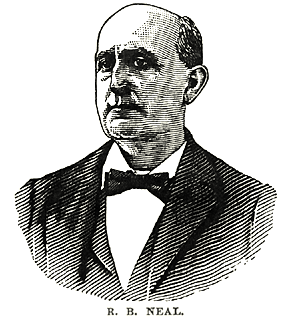
R. B. NEAL.
Under some difficulties and after an amount of persuasion, the STANDARD has been enabled to secure the picture of R. B. Neal, which looks out from this first page of the present issue. Like most intense men, Bro. Neal forgets himself in his work, and does not imagine that many people would be interested in his bodily presence or his individual history. |
Vol. 35. Cincinnati, December 30, 1899. No. 52.
"SMITHIANITY:" OR, MORMONISM REFUTED BY MORMONS.
For the past several months I have been too busy with pastoral and evangelistic work to pay any attention with my pen, to my friends, the Mormons. |
Back to top of this page.
Articles Home Page | Newspaper Articles Index | History Vault
Oliver's Bookshelf | Spalding Studies Library | Mormon Classics
last updated: June 4, 2013