
READINGS IN EARLY MORMON HISTORY
(Newspapers of The South)

Misc. Southern Newspapers
(including AR, KY, VA, LA etc.)
1845-1919 Articles
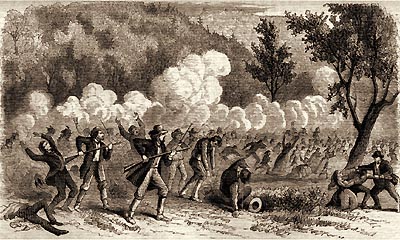
"Massacre at Mountain Meadow" -- from an old engraving
1800-1827 | 1828-1844 | 1845-1919 | 1920-1999
1845-1854
CWat Apr 05 '45 | Jeff Jan 12 '46 | ArkI Mar 28 '46 | TAMr May 06 '46 | HTel Sep 03 '48 | MAH Feb 01 '49 | DCrs Jan 1? '49
MAH Mar '49 | CovJ Apr 13 '49 | MAH May '49 | MAH Jun '49 | DCrs Jun 08 '49 | MAH Aug '49 | MAH Sep '49
NStd Sep 15 '49 | TSG Sep 15 '49 | MAH Oct '49 | DCrs Jan 18 '50 | ASD Feb 01 '50 | MAH Feb '50 | SMN Mar 30 '50
MAH Apr '50 | CDU Jun 05 '50 | PGaz Feb 14 '52
1855-1859
NOPic May 22 '55 | TxRgr Jun 07 '55 | NOPic Aug 31 '55 | NOB Dec 19 '56 | NOC Apr 03 '57 | RiW Apr 17 '57
RiW Apr 21 '57 | RiW Apr 25 '57 | RiW May 01 '57 | ArkI May 15 '57 | RiW May 22 '57 | ArkI May 22 '57
DAdv Dec 23 '57 | ASG Feb 13 '58 | ASG Feb 27 '58 | ASG Apr 17 '58 | ASG Jul 30 '59 | NashU Sep 01 '59
SWM Sep 20 '59 | ASG Sep 24 '59 | YD Oct 01 '59 | Ark Oct 07 '59
1860-1879
ATD Apr 14 '60 | CEn Apr 17 '60 | Ark May 25 '60 | Rch May 26 '60 | Std Jul 07 '60 | DAd Jan 08 '61
MWA Feb 04 '63 | AGaz Oct 15 '64 | DIn Aug 12 '65 | ACon Jul 12 '68 | LRP Apr 16 '72 | DAG Jan 10 '75
DIn Feb 05 '75 | GWT Aug 03 '75 | DAG Aug 05 '75 | DAG Aug 08 '75 | DIn Aug 27 '75 | AChrn Aug 06 '76
DAG Mar 25 '77 | DAG Mar 29 '77 | DAG Apr 03 '77 | NOPic Jan 21 '79 | NOPic Mar 17 '79 | WReg Mar 19 '79
NOPic May 12 '79 | GWN Nov 06 '79
1880-1889
WRec Feb 16 '82 | WRec Oct 26 '82 | WRec Nov 09 '82 | WRec Nov 23 '82 | WRec Dec 21 '82 | WRec Jan 04 '83
ACon Jan 18 '83 | GDN Aug 24 '84 | GDN Apr 07 '85 | ACon Feb 02 '86 | WReg Oct 07 '86
1890-1919
GDN Aug 23 '91 | NOPic May 27 '93 | DMN May 09 '97 | EBul Jul 02 '97 | Land Jan 25 '98 | LexHFeb 13 '98
ACon Aug 13 '99 | Cit Aug 16 '99 | ACon Mar 24 '01 | GDm Sep 29 '02 | MSAd Nov 12 '02 | ACon Jan 15 '05
DMN Jan 29 '05 | BGB Feb 05 '05 | MWav Jun 17 '05 | GTrb Jul 17 '07
Articles Index | Nat. Intelligencer | Niles Register | Mill. Harbinger
 Vol. I. Providence, Louisana, April 5, 1845. No. 21. The Mormon Prophet. It is but a few months since the death of Joe Smith was announced. His body now sleeps, and his spirit has gone to its reward. Various are the opinions of men concerning this singular personage; but whatever may be the views of any in reference to his principles, object, or moral character, all must admit that he was one of the most remarkable men of the age. |
Vol. ? New Orleans, January 12, 1846. No. ?
THE MORMONS. -- We had been inclined to think, from the accounts which reached us from time to time, that the Mormons, although a deluded people, were more sinned against than sinning. |
Vol. ? Van Buren, Ark., March 28, 1846. No. ?
... In the early part of 1846, a body of Mormons removed to the "Cross Timbers" the region in which Cooper is traveling, "and then returned to the Creek Nation, and are endeavoring to excite the Indians of that tribe against the citizens of Missouri... |
Vol. ? Lexington, Kentucky, Wednesday, May 6, 1846. No. ?
MORMONS: Gov. Ford has disbanded the militia and five thousand of Mormons have left on their trek farther west, some to Council Bluffs, others to Wisconsin. |
Vol. ? Houston Texas, September 3, 1848. No. ?
MORMON SETTLEMENT, TEXAS. -- The Mormons have lately been negotiating for the purchase of a large tract of land on the Pierdenalos, above Fredericksburg, and intend to form a new settlement there. The anxiety they manifest to purchase this land has excited some suspicions that they have discovered mines upon it. They have also probably discovered that the soil of the Pierdenalos valley is admirably adapted to the culture of wheat and other grains, which they had been accustomed to raise in Missouri and Illinois, and will afford them all the facilities they desire for a new and extensive settlement. They have also a pretended prophecy that the new Jerusalem of their great prophet, is to be found in Texas. This opinion has long been prevalent among them, and we have been informed by an English gentleman that the presiding elder of the Mormon society in London has often said that the Mormons will, ultimately, all congregate in Texas. We should be sorry to learn that they have located the New Jerusalem on the Pierdenalos, or the San Saba, for our frontier settlement will soon be pushed beyond these streams, and then wars might arise between "the saints" and new settlers. If the Mormons, however, should find the New Jerusalem on the Puerea, many years would probably elapse before the frontier settlements would reach them, and they might build up their city, and fortify it with seven walls, if they desired, long before the advancing limits of the frontier settlements would be pushed even to the sources of the Colorado. |

Vol. I. New Orleans, Louisiana, January 1?, 1849. No. ?
Interesting Account of the Gold Region.
|
|
Vol. I. Covington, Kentucky, February 1, 1849. No. 1. To Our Readers. We have undertaken the publication of this paper for the purpose of disseminating abroad in the earth, those truths which God has manifested unto us concerning the principles of the doctrine of Christ, and the marvelous work of the Most High in these latter days which marvelous work is near at hand. |
 By I. Sheen. Covington, Kentucky, March, 1849. Vol. I. No. 2.
It is now near two years since it was revealed unto us that the Prophet Joseph Smith will continue to hold the keys of the kingdom until the coming of Christ; that his kindred would enjoy extraordinary and special privileges and blessings in the kingdom of God -- the office of patriarch over the church of God is hereditary, and therefore belongs to Brother Wm. Smith; that the priesthood of Aaron is hereditary to the end of time, that we are of the lineage of Aaron. -- (See B. of Cov. 3, 4 and 22 sec.) |
 Vol. I. Covington, Kentucky, Friday, April 13, 1849. No. 11 The Mormon Temple. By a letter received from our brother, P. W. Cook, who was one that left Council Bluff last spring for the Salt Lake, dated August 2d, written while encamped on the Sweet Water River, at the South Pass, (in sight of Fremont's Peak,) we gather some information which may not be uninteresting to our readers. The new Mormon Temple at the Salt Lake is to be a splendid building. They enclosed a lot 17 miles long and 12 miles wide with a mud wall 8 feet high and 4 feet thick. There are to be four cities inside. They have discovered mountain rock that resembles Cornelian stone, which the writer says is beautiful for temples and pillars. |
|
By I. Sheen. Covington, Kentucky, May 1, 1849. Vol. I. No. 3. "OH THAT MY HEAD WERE WATERS, AND MINE EYES A FOUNTAIN OF TEARS, THAT I MIGHT WEEP DAY AND NIGHT FOR THE SLAIN OF THE DAUGHTERS OF MY PEOPLE."
A REVELATION, given to Selah Lane and others, March 19th, 1849, to choose twelve Apostles, and to call other laborers into the vineyard; to set in order the Churches, plant stakes, &c. -- It is also a commandment to all the Churches, and to all in every place that call on the name of [the] Lord; setting forth also the true light that was to come. |
|
By. I. Sheen. Covington, Kentucky, June, 1849. Vol. I. No. 4. "THE DAUGHTER OF ZION IS LEFT AS A COTTAGE IN A VINEYARD, AS A LODGE IN A GARDEN OF CUCUMBERS, AS A BESEIGED CITY."
THE PROPHET’S DEPARTMENT.
|
|
Vol. II. New Orleans, Louisiana, Saturday, June 8, 1849. No. ?
GOLD MOUNTAIN. -- [A telegraphic dispatch informs that] news has been received of the discovery of an extraordinary mountain of gold on the banks of the Great Salt Lake. One thousand Mormons were hastening to the spot. |
|
Vol. I. Covington, Kentucky, August, 1849. No. 5. THE WORK ABROAD. Since our last issue we have received cheering intelligence from Elders and Saints abroad, We learn from letters received from Nathaniel T. James, one of the 12 apostles who has been laboring in various places in Connecticut with success. He has sown the good seed at least that will, we trust, bring forth an abundant harvest. The first Presidency highly approves of the spirit manifested by him, and of his diligent exertions in the cause of our Redeemer. We have received a letter from Elder O. Olney, and also his pamphlet which was published by him (in St. Louis in 1845) concerning the apostacy from the faith. We intend to publish his letter and some remarks of our own in connexion with it in our next. |
|
By I. Sheen. Covington, Kentucky, September, 1849. Vol. I. No. 6. LETTER FROM PRES. WILLIAM SMITH. To the Saints scattered abroad, greeting: |
|
Vol. VII. Clarksville, Texas, Saturday, September 15, 1849. No. 17.
THE MORMONS.
The Cincinnati Atlas says, in reference to those singular people: |
|
Vol. I. Austin, Texas, Saturday, September 15, 1849. No. 4.
A letter from a Mormon at the Salt Lake, to his friend in Ohio says: |
|
Vol. I. Covington, Kentucky, October, 1849. No. 7.
THE UNITED ORDER. -- We intend as soon as possible under existing circumstances to establish the UNITED ORDER of the Stake of Zion according to the sample which is given to the Saints in the book of Cov. page 300. Many counterfeit systems have been set up in the world under pretence of establishing a union of property. Among these may be classed the Order of Enoch, (so called,) which J. J. Strang has set up. The Lord made known his will to the Prophet Joseph that his church should not be called after the name of men.The above is a very small sketch of the enormities of Salt Lake Mormonism. We would advise or recommend, that if the government grants these Salt Lake Mormons a territorial government that they appoint men who are not members of this Salt Lake church or the government will find that they are most desperately bitten by these wolves in sheep's clothing. We are in favor of them having a government but we think that the government and laws should be administered by judicious and honest men and not traitors and conspirators against the rights and liberties of American citizens. But if government will not heed our advice, and will appoint a Salt Lake Mormon to be Governor of that territory, let them appoint A. W. Babbit, Esq., to that office, for we believe that he would be the most faithful servant of the government that can be found among the Salt Lake Mormons. We have authentic information that more than 1500 Salt Lake Mormons took this oath in the temple at Nauvoo. We are entirely opposed to these people and will stand up in favor of the republican institutions of our country. ISAAC SHEEN.
M A R T Y R S
Mr. Barber, Martyred November 4, 1833, in Jackson county, Mo. The following Saints were MARTYRED in Caldwell co, Mo., Oct 30, 1833.
the following persons were MARTYRED, namely, David W. Patten, One of the Twelve Apostles. Gideon Carter, Mr. Obanion, Mr. Carey. Martyred in Carthage JAIL, in the county of Hancock, State of Illinois, on the 27th day of June, 1844, Joseph Smith, the Seer, Hyrum Smith, the Patriarch, Two of the noblest Martyrs whose blood has stained the earth for ages. The murderers of the foregoing persons, though the most of them are well known, are yet running at large, boasting of their deeds. Samuel H. Smith, Brother of Joseph and Hyrum Smith, who died from the effects of poison administered to him. He died within one month after the martyrdom of his brother. Further particulars concerning this matter will appear hereafter. These are all martyrs, and have sealed their testimony with their blood, besides many more whose days have been shortened by the persecutions that they have endured.Note 1: The advice given by William Smith and Isaac Sheen, that the U. S. Government appoint Sheen's brother-in-law, Almon W. Babbit, to be the first Governor of the proposed Utah Territory, put Elder Babbit into an untenable position, in respect to his top leader, Brigham Young and the LDS Church hierarchy at Salt Lake. As things turned out, Babbit was appointed in July, 1849 by the Mormons to serve as the representative in Washington for their proposed "State of Deseret." Babbit arrived in Iowa, from Salt Lake City, on Sept. 3, 1849 and then proceeded on to Washington, D. C. After Babbit arrived in the capital, he entrusted the constitution for the proposed state of Deseret, to Senator Stephen A. Douglas, who placed the matter before the Senate on Dec. 27, 1849. The Mormons' proposal was eventually rejected; in place of the State of Deseret, the Federal Government created, Utah Territory, on Sept. 9, 1850, with Brigham Young appointed to serve as its first Governor. Presumably, Elder Babbit passed through Ohio during November, 1849, and while in Cincinnati he may have conferred with his brother-in-law, Elder Sheen, regarding the future of William Smith's church. William Smith was probably away when Babbit passed through Cincinnati, but then again, William may have crossed paths with the Mormon delegate in St. Louis. According to a story reprinted in the Jefferson City, Missouri Enquirer, on Nov. 15, 1849, William had recently been in St. Louis, promoting Almon W. Babbit for the Utah governorship. Note 2: After he had presented the proposed constitution for the State of Deseret to Stephen A. Douglas, the Illinois senator reportedly "interrogated... the Representative from Deseret," asking Babbit to explain various charges made against the Mormons in the Missouri newspapers, by William Smith, etc. Babbit evidently denied all charges and voiced his wholehearted support for Brigham Young. After the interrogation, he waited in vain, in Washington D. C. hoping that Douglas' Senate committee on territories would recommend creation of the State of Deseret. When this action was not forthcoming, Babbit returned west, apparently stopping along the way to visit with Isaac Sheen in Covington or in Cincinnati. From Elder Sheen (who had by then ended his fellowship with William Smith) Babbit obtained the Church's patriarchial blessing book, Lucy Smith's manuscript, and other papers and records William Smith had abandoned. By Aug. 4, 1850 Babbit had reached Council Bluffs and there explained to a church court: "I have got the records of Father Smith, etc. I have not stole them, but attached them legally for the archives of God." Note 3: "Presidents" William Smith and Isaac Sheen's announcement, saying that "Samuel H. Smith... died from the effects of poison administered to him" at Nauvoo, and that "Further particulars concerning this matter will appear hereafter," could not have set very well with the LDS Church hierarchy at Great Salt Lake City. After all, Samuel's final decline in health during the summer of 1844 was monitored and dealt with by prominent Brighamite leaders in Nauvoo, all of whom later went west to Utah. There is reason to believe that Brigham Young instructed Sheen's brother-in-law, Almon W. Babbit, to intercede and break up the Covington "President's" publication plans. Only one more issue of the A&M Herald was ever published by Sheen at Covington -- he disassociated himself from Smith in May of 1850, under unfriendly circumstances, centering primarily around William's secret participation in "spiritual wifery." William Smith, in a letter to Brigham Young, written July 13, 1856, practically accuses Babbit of turning Sheen against him: "I notice also that you have that scroundrel of A. Babbit about you... he is the man who paid Isaac Sheen one thousand dollars [for] my trunk of Books and advised my wife to separate from me." For William's later, more specific allegations regarding the poisoning of his brother Samuel, see notes appended to William's 1857 letter to the New York Tribune. |
|
Vol. II. New Orleans, Louisiana, Friday January 18, 1850 No. ? THE MORMONS. [The correspondent of the Delta says of the Mormons]... |
|
Vol. IV. Little Rock, Arkansas, February 1, 1850. No. 38.
The Mormons at Salt Lake. -- The St. Louis Republican has received a pamphlet copy of the "Second General Epistle" issued by the Church of the Latter Day Saints, at the Salt Lake Valley, to "the Saints scattered throughout the earth." Ot is a detail of the condition of the Society at home and abroad, and in general embraces every thing that may be supposed to be of interest to the members of the Church. The crops are represented as having been very fine -- and it is stated that they have not only enough for themselves, but for their brethren on the way, until the next harvest... |
|
Vol. I. Covington, Kentucky, February, 1850. No. 8.
From the Cincinnati Commercial.
Mr. K. G. Curtiss -- Sir: I have received the following information in a letter from Pres. William Smith, the brother and successor of the prophet -- Joseph Smith. The conduct of the apostates of the 'Salt land,' (Jer., 17 chap. 6 v.) ought to be published in every newspaper in the United States, that this Salt Lake banditti may be broken up. |
|
Daily Morning News. Vol. I. Savannah, Georgia, Saturday, March 30, 1850. No. 63.
MORMONISM. -- A Mormon Conference was held at Covington, Ky., on the 6th inst. Bill Smith, the brother of the Prophet Joe, was in attendance. Since the Mormons have taken possession of the immense tract of country in California, they are becoming very popular among the free-soil, free-thinking, free-living and free gabbing people in various sections of the country. |
|
Vol. I. Covington, Kentucky, April, 1850. No. 9.
THE GREATEST ANNUAL CONFERENCE,
The Annual Conference of the Church of Jesus Christ of Latter Day Saints was held in Covington April 5th, 1850, commencing at 10 o’clock A. M. -- Conference was organized by the unanimous adoption of the following resolutions: |
Vol. ? Covington, Kentucky, June 5, 1850. No. ? A Prophetic family arrangement. Mr. EDITOR: -- The fornication Church of Covington is now entirely extinct. Mrs. Caldwell, the last adherent of Wm. Smith, has fled to parts unknown. It is supposed, however, that she has either gone to Cincinnati, or to the neighborhood of Hamilton, Ohio, where Smith is staying with one Henry Nisonger one of his 12 apostles. Mrs. Caldwell had previously stated that she would leave her husband and go off with Smith to Texas. She has undoubtedly left her husband. She often declared that if Smith went to hell she would go with him. She said that he was made in the express image of the Saviour. |
Vol. ? Pensacola, Florida, Saturday, February 14, 1852. No. ? Mormonism. The following communication written by Mr. Hardy, formerly an Elder in the Mormon Church, we find in the Boston Transcript. The editor of the Transcript says he he has had some conversation with Mr. Hardy, during which he impressed him most favorably by those external signs of physiognomy and manner, which denote truthfulness and sincerity. He firmly believes his story, confirmed as it is by much concurrent testimony from official and other sources. |
 Vol. ? New Orleans, May 22, 1855. No. ?
Two hundred Mormons from Europe, left Pittsburg on the 11th inst., on their way to Great Salt Lake City. |
Texas [ ] Ranger Vol. VI. Washington, Texas, Thursday, June 7, 1855. No. 35. The Founder of Mormonism. The Sandusky (O.) Mirror, in noticing the rejection of Thurlow Weed of the job of printing the Mormon Bible many years ago, says: |
|
Vol. ? New Orleans, August 31, 1855. No. ?
The Beaver Island Mormons. -- Beaver Island, Lake Michigan, is said to contain 800 Mormons, mostly females. Six yearsago there were but thirty. The women wear the bloomer costume, and many of them are said to be well educated. A large number are from the factory districts of England. Some come with much money. They are absconded wives, daughters, &c. Strange, the chief of the tribe, is described as an educated Philadelphia lawyer, whose lawful wife resides in Wisconsin. He publishes a newspaper, and is postmaster, a member of the Michigan Legislature, and an important man among the Cass Democracy. |
Vol. ? New Orleans, Dec. 19, 1856. No. ? AN ILLUSTRATION OF MORMONISM. We became acquainted a few days since with a short history of certain transactions, partly in this city and partly out of it, which all adds a very fair illustration of the practical effect of their beautiful system of imposture which is shedding its lights and shadows upon the tops of the Western mountains. Possibly our readers may be interested in it -- especially if they should ever, in the mutations of the future, be thrown within the valley where this Upas sheds its poison and revels in the ghastly carcasses which strew the ground, they may perhaps be enabled to turn it to a practical use. |
Vol. ? New Orleans, April 3, 1857. No. ? Interesting from Utah. We had the gratification yesterday morning of a call from Judge W. W. Drummond, of Chicago, late Chief Justice of Utah Territory. He was in that condition of fine health and spirits in which we always rejoice to see good, sturdy, manly Democrats. He entertained us for a considerable time with an account of his personal and judicial experience among the saints, and of their manners, habits, history, notions and purposes. Although we were disgusted with this set of miserable fanatics from accounts which had already reached us, some relations given by Judge Drummond, in addition to those contained in his letter to Attorney-General Black, added many revolting shades to the picture. |
 Vol. 34. Richmond, April 17, 1857. No. 31. The Mormons Again. Yesterday we published an article from the Philadelphia American, commenting upon the atrocities of the Mormon population in the Territory of Utah. It is undeniable that the conduct of these people is becoming unbearable, and such as should casuse the administration to take some steps to remedy the increasing evil. So long as they continued peacefully in their violation of the obligations of morality, as a people, and excluded their enormities from the public eye in the far region to which they have emigrated; so long as they were guiltless of any overt act of treason against the Government to which they profess to submit themselves, it was at least questionable whether the interposition of the administration was necessary or proper. |
Vol. 34. Richmond, April 21, 1857. No. 32. The Utah Saints. We assure our neighbor of the South. that we hold Mormonism in the utmost detestation and abhorrence. But the Mormons themselves declair it to be their own peculiar institution, no matter how offensive it may be to us. And we desire the South to remember that the Abolitionists put Mormonism and Southern slavery upon the same footing precisely, declaring both to be insufferable "nuisances," which should be crushed out with all possible dispatch. Such is the boldly proclaimed Abolition notion on these subjects. The difficulty occuring to us was, whether if we invoked the power of government to put down Mormonism because we considered it a nuisance, the Abolitionists would not have the same right to invoke the same power to put down slavery, because they considered the latter a nuisance. But we have no thought of pursuing the subject. |
Vol. 34. Richmond, April 25, 1857. No. 34. Brigham Young and the Mormons. The Democratic press all over the country have taken a peculiar and malignant pleasure in pointing to the fact that Brigham Young was originally appointed Governor of Utah by Mr. Fillmore for an act which was ratified by a Democratic Senate, and which was concurred in by the Pierce administration throughout. Now, if Mr. Fillmore was wrong in what he did in this matter, why did a Democratic Senate sanction the wrong? And why did Pierce, a Democratic President, also sanction and perpetuate the wrong done by his predecessor? This charging of blame to Mr. Fillmore for the appointment of Young is both ungenerous and unjust. Young had, at the time of his appointment, committed no outrages, and had threatened none. He was known -- although holding a peculiar and absurd religious faith -- only as a just, peaceable, and well-disposed man. But let the following explanation of Mr. Fillmore's appointment of him suffice, which we take from the Buffalo Commercial: |
Vol. 34. Richmond, May 1, 1857. No. 35. Utah a Foreign Colony. We have a rumor from Washington to the effect that Major Benjamin McCulloch has been offered the Governorship of Utah. It is also said that the national authorities have determined to pursue a peaceful course towards the Mormons, in the hope of thus convincing them of the policy of yielding with as good a grace as possible. Brigham Young, will, of course, be removed; and this will, to a certain extent, be a test question. The new Governor will, we infer, be accompanied by an adequate force, as a precautionary measure. Such a step would seem to be indispensable. In the first place, to protect the officers of the Federal Government in the discharge of their duties, and in the second, to protect such residents of the Territory as decline to embrace, or are disposed to abandon the offensive tenets and practices of Mormonism. In this connection, we may mention that a somewhat curious article appeared in a recent number of the "Washington States," in which the editor endeavors to show that Utah is, in fact, an English colony. The Mormons, he says, and truly, have a most extensive organization, which stretches almost over every country in Europe. In Great Britain and Scandinavia they are the most successful. Their conversions are numerous, and chiefly among the ignorant lower-class people. They form communities in various localities, and raise funds by subscription, by which means they are carried to America, then let loose in parties to make their way through the country to the Great Salt Lake. -- It is in this manner that foolish, weak, and prurient people are entangled into their meshes. Some months ago we remember that an Elder Williams arrived from England in the ship Columbia with some two hundred and twenty, whom he himself had converted to the Mormon faith. They were principally from Bristol. They were quartered for the winter in St. Louis, Cincinnati, and New York, and are by this time on their way to the "Promised Land." About a twelve-month ago some details of desolation created in an English family by Mormons directed attention to the ship Enoch Train, which arrived at Boston, from Liverpool, with nine hundred Mormons, of which number three hundred were contributed by Birmingham alone. |
Vol. ? Van Buren, Ark., Friday, May 15, 1857. No. ?
TRAGICAL. -- It is with regret that we have to chronicle the homicide, committed in our vicinity on Wednesday last, by Mr. Hector M. McLean, late of San Francisco, California, upon the person of a Mormon Preacher. More than all we do deplore the melancholy affair that led to its commission. The deceased, whose name was Parley Parker Pratt, was a man of note among the Mormons, and judging from his diary and his letter to Mrs. McLean, he was a man of more than ordinary intelligence and ability. He had been a Preacher and Missionary of the Mormons at San Francisco, California, where he made the acquaintance of Mrs. McLean, whom he induced to embrace the Mormon faith. |
Vol. 34. Richmond, May 22, 1857. No. 21. Mormon Outrages. We publish elsewhere a letter from the New York Times correspondent, written from Salt Lake City under date of March 5th, which details the recent outrages at that city, where a band of armed Mormons entered the United States Court room while the Court was in session, and by threats of personal violence compelled Judge Stiles to adjourn the Court sine die. The judge, it is stated, previous to submitting, appealed to Brigham Young for protection, but he replied that "the boys" should have their own way, for the court had already given him too much trouble. Surely such high-handed outrages on the part of Brigham Young and his followers should prompt the Government to take immediate steps to reduce them to submission to the constituted authorities. It appears that Brigham has not fled the Territory, as reported, but is vigorously preparing for was with the Federal Government. "Iou" of the Baltimore Sun, of yesterday, has the following on the subject: |
Vol. ? Van Buren, Ark., Friday, May 22, 1857. No. ?
DREADFUL PERSECUTION OF MRS. MCLEAN Van Buren, Monday, May 18, 1857. |
Vol. VII. Baton Rouge, La., Friday, December 23, 1857. No. 121.
From the St. Louis Republican.
As the Mormons are just now attracting considerable attention, it may not be amiss to publish what is generally regarded as the history of the book, called the Mormon Bible. The time has not yet arrived when a formal disproof of its being an inspired work is necessary, and a plain story will not be denied on the ground of its excluding the supernatural. |
FAYETTEVILLE OBSERVER. Vol. XLI. Fayetteville, North Carolina, January 11, 1858. No. 2119. MORMONISM. As this disgusting compound of sensuality, despotism and ferociousness is continually thrusting itself upon public attention, it may interest some of our readers to recall the circumstances in which it originated. The calamity has come upon us as one of the results of that excessive freedom in the exercise of which we throw open the gates of the empire to all manner of immigrants from the old world; for this anomalous population is chiefly recruited from Europe. Rev. Solomon Spaulding, a graduate of Dartmouth College, was distinguished for a lively imagination and a love of history. He lived in a part of Ohio abounding with mounds and ruins of old forts, and took much interest in the study of these antiquities. To beguile his hours of retirement he conceived the idea of giving a historical sketch of the race, about which there was so much mystery. It was of course a fanciful undertaking, giving wide scope for the exercise of imagination, and tempting him to indulge in an antique style while describing ancient things. The Old Testament containing the most ancient books in the world, he found it convenient to imitate in style. He therefore launched out at will into the region of free historical romance. This was 1812. His neighbors, hearing of the progress of his curious work, would come to his house and hear portions of it read. It claimed to have been written by one of the lost nation, to have been recovered from the earth, and was christened with the title of "Manuscript Found." This self-amusing gentleman pretended to be decyphering the mysteries of the disinterred manuscript, and regularly reported progress to his neighbors. From the classics and from ancient history he introduced many uncouth and unaccustomed names, which awakened curiosity. Mr. S. removed to Pittsburg, and found a friend in the person of an editor, to whom he showed his manuscript. The editor was pleased, borrowed it, kept it, and offered to print it, if Mr. S. would make out a suitable title page. He promised also to make it a source of profit. Mr. S. declined any such use of it. Sydney Rigdon, who has since figured so largely among the Mormons, was then employed in the editor's printing office; he inspected the manuscript, and had an opportunity to copy it. It was returned to the author who died in 1816. But the influence he had unwittingly originated, did not die with him. There is no doubt that Rigdon took a copy of the whole or parts of the manuscript. He appeared in Palmyra, N. Y., in 1828, working at his trade. About this time there began to be talk of certain mysterious "plates" being found in that region. They had been discovered, it was said, by Joseph Smith, Jr., in the bank of the Erie Canal, near Palmyra. Here Smith and Rigdon conspired to start the fraud. Smith was a man of low cunning, vulgar and sensual in his habits, a fitting accomplice for Rigdon, both being ready to execute any falsehood. Joe was to be set up as a leader, and to assume the title of Prophet. It was given out that Joe was engaged in translating the plates. This was in 1829. Some followers were obtained, chiefly the ignorant and vicious, and the dishonest, who had no character to lose. They called themselves the Church of the Latter Day Saints, and organized at Manchester under Joe Smith, who issued an edition of 1,200 [sic] copies of the "Book of Mormon," at Palmyra. Some three or four seemingly respectable men of that region joined them, which attracted more attention. Smith and his followers selected Kirtland, Ohio, as their "city of refuge," by inspiration, as the blasphemer said, -- the Lord intending and directing that the temple should be built there. Two hundred composed the first settlement.They called their book the "Golden Bible." Smith founded a bogus bank, which of course failed, and he found it necessary to move farther west. Thither has been the disastrous progress of those miserable impostors, whose subsequent history is known to the world. It would seem as if there was no form of folly or impiety which some human beings will not embrace. Polygamy, blasphemy, rebellion, murder, are the natural fruits of this wretched conspiracy, which is troubling the whole land. Smith was overtaken with the judgments of God, and died a miserable death. Young is probably destined to a similar end. -- |
AND DEMOCRAT. Vol. 39. Little Rock, Arkansas, February 13, 1858. No. 1.
==> Extract from a letter to the Editor, dated |
AND DEMOCRAT. Vol. 39. Little Rock, Arkansas, Feb. 27, 1858. No. 3.
PUBLIC MEETING OF THE PEOPLE OF CARROLL COUNTY. -- At a public meeting of the citizens of Carroll county, held in Carrollton, on the 1st day of February, 1858, in pursuance of public notice, the following proceeding[s] were had: |
AND DEMOCRAT. Vol. 39. Little Rock, Arkansas, April 17, 1858. No. 10.
MEETING IN NEWTON COUNTY. -- At a public meeting of the citizens of Newton county, held in Jasper, on the 15th day of March, 1858, in pursuance of public notice the following proceedings were had, viz: |
|
Vol. 40. Little Rock, Arkansas, July 30, 1859. No. 25?
ANOTHER MOUNTAIN MEADOWS CHILD SAVED. -- Superintendent Forney writes to the Indian Bureau, from Utah, June 16th, that he has recovered another of the children saved from the Mountain Meadows massacre, thus making seventeen children now at his charge. He was unable to say when the children will start for the East. |
|
Vol. XXX. Nashville Tenn., Thursday, September 1, 1859. No. 99.
ARRIVAL OF THE MOUNTAIN MEADOW CHILDREN. -- A dispatch has been received by the Commissioner of Indian Affairs from Mr. Wm. C. Mitchell, special agent in charge of these children, informing him that they arrived safely at Fort Leavenworth, in excellent health, and arrangements were immediately to be made for restoring them to their relatives and friends. |
Vol. V. Jackson, Miss., September 20, 1859. No. 18.
From the Leavenworth (Kansas) Herald of August 27.
Yesterday morning at 10 o'clock a train of fourteen wagons arrived at Fort Leavenworth from Utah. It left Salt Lake City on the 26th of June. Major Eastman and Lieut. Elwood, of the fifth infantry; Major Whiting, of the seventh infantry; Lieut. Carroll, of the tenth infantry; and Lieut. [Tyler], of the second dragoons, came in with the train. Accompanying the train are also fifteen of the children who escaped the terrible massacre at Mountain Meadows, in Utah, some two years since. The particulars of the unparalleled outrage, perpetrated by Mormons under the guise of Indians, startled our whole country when the intelligence reached the States. We have not the details before us, but if we remember aright a company numbering one hundred and forty-five persons started from the State of Arkansas in the spring of 1857 for California. |
Vol. 41. Little Rock, Arkansas, Sept. 24, 1859. No. 12.
==> Extract from a letter to this office, dated |
Vol. ? Yazoo City, Miss., Oct. 1, 1859. No. ?
The Mountain Meadows Children. -- The Commissioner of Indian Affairs is in receipt of intelligence that the children saved from the Mountain Meadows massacre, have arrived safe at Leavenworth. They will be at once taken on to Arkansas, whence the parents of the little unfortunates first set out for the Pacific. |
Vol. ? Fayetteville, Arkansas, Oct. 7, 1859. No. ?
Return of the Survivors of the On the 15th day of September A. D. 1859 a large concourse of the people of Carroll County assembled together at the Court House in Carrollton for the purpose of receiving the Mountain Meadow children who have just arrived under the charge of W. C. Mitchel, special agent. |
Vol. ? Little Rock, Ark., April 14, 1860. No. ? The Mountain Meadow Massacre. A friend has sent us a copy of the Valley Tan, published at Salt Lake City, on the 29th ult. It contains a statement by W. H. Rogers concerning the massacre, which, though long, we will transfer to our columns as soon as we can. It fixes the guilt of the Mormons beyond a doubt. -- The narrative is plain, unpretending and clear. We defy any man to read it without feeling his blood thrill in his veins. |
Vol. ? Columbus, Georgia, April 17, 1860. No. ?
The Mountain Meadow Massacre -- The Salt Lake Valley Tan, of February 29th, contains a statement from Wm. H. Rogers, in regard to the massacre at Mountain Meadows in September, 1857, when 120 men, women and children, emigrants from Arkansas, were murdered by Mormons. In company with Dr. Forney, Superintendent of Indian Affairs for Utah Territory, Mr. Rogers, about a year since, traversed the district of country where the massacre occurred. The scene of the tragedy is thus described: |
Vol. ? Fayetteville, Arkansas, May 25, 1860. No. ? The Mountain Meadow Massacre. The Salt Lake Valley Tan, of February 29th, contains a statement in regard to the massacre at Mountain meadows, in September, 1857; when 120 men, women, and children, emigrants from Arkansas, were murdered by Mormons. When Judge Cradlebaugh commenced the session of his court in Utah, supported by the military, among other witnesses who privately, under fear of assassination, informed him of outrages in the territory was one who participated in the Mountain Meadow massacre. He gave the following account of the murder. |
Vol. ? Corpus Christi, Texas, May 26, 1860. No. ?
The Mountain Meadow Massacre. -- The bleached remains of the emigrant party massacred at the Mountain Meadow, in Utah, have been collected into a single grave, and a stone monument, conical in form, fifty feet in height, now marks the spot where they rest. This is surmounted by a cross of red cedar, twelve feet in height, on which is carved the following inscription: "Vengeance is mine, I will repay, saith the Lord." On the base of the monument stands a granite slab, into which are cut the words, "Here 120 men, women and children were massacred in cold blood, early in September, 1857. They were from Arkansas." |
Vol. ? Clarksville, Texas, July 7, 1860. No. ? Tyrannical Treatment of Mormon Women. A correspondent in Utah, writing to the New York Times, has the following in relation to the treatment of women by the Mormons. |
Vol. ? Baton Rouge, La., January 8, 1861. No. ?
A Mormon Killed: -- A letter from Salt Lake to the St. Louis Republican has the following: |
Vol. ? Montgomery, Alabama, February 4, 1863. No. ?
The Mormon Saints have established a theatre at Salt Lake City, Brigham Young and President Kimball officiating at the opening. Songs, dances, the comedy of "The Honeymoon," and the farce of "Paddy Miles' Boy," made up the initiatory bill. |
Vol. ? Alexandria, Virginia, Saturday, October 15, 1864. No. ? The Mormons. A correspondent of the St. Louis Republican who has been journeying to Salt Lake, writes to that journal an interesting account of his experiences and observations by the way. He says: |
Vol. I. Petersburg, Va., August 12, 1865. No. 34.
Joseph Smith, jr., son of the Mormon Joe Smith, of Nauvoo comes out in an article in the Council Bluffs' Nonpareil denouncing Brigham Young and all his works. Smith is at the head of a new organization of latter day saints. He proposes to discuss the grave issues between himself and Brigham Young with any disputatious gentleman who will meet him at Council Bluffs. |
THE CONSTITUTION. Vol. I. Atlanta, Georgia, Sunday, July 12, 1868. No. 24.
THE MORMON BIBLE. -- The Mormon theory of the origin of their Bible is that when the building of the Tower of Babel was brought to the abrupt conclusion spoken of in Genesis, a part of the people scattered at that time came to America and lived there and flourished and dwindled and died out leaving their history buried somewhere in the earth. This history which forms part of the "Mormon Bible," was exhumed by a second Jewish colony which came to that country in the year B. C. 600. The second colony ultimately split into two nations, the Nephites and the Lamanites. From the Lamanites came the American Indians, and from the Nephites came the prophet Mormon, who lived to see his tribe extinguished by the Lamanites, and to write its history, including the appearance to them of Jesus after his resurrection. This history his son Moroni buried in the earth, and there it remained until September 22, 1827, when Joseph Smith discovered it, and with [it] an enormous pair of spectacles with whose aid he translated its contents into the vernacular. It had been buried more than one thousand four hundred years. Mr. Tucker, a resident of Palmyra, the scene of Smith's early operations, and who was well acquainted with him from his boyhood, has just published a work in which he gives what there can be little doubt is the true account of the origin of that "Book of Mormon. According to him it was written by the Rev. Solomon Spaulding an enthusiastic archaeologist. He accepted the theory that America had been peopled by a colony of ancient Israelites. Obliged to give up the active duties of his profession, he employed his leisure in constructing a fabulous historical account of a long lost race. The manuscript was completed in 1812 or 1813, and submitted to a printer in Pittsburg, Pennsylvania. It was finally returned to the author, who died in 1816. Soon after his death the manuscript was stolen. The thief was almost certainly Sidney Rigdon, who had been in the office where the manuscript remained for three or four years and who afterwards used the money-digging proclivities of Smith for a point of attachment round which to cluster the new revelation and become the first Mormon prophet. |
Vol. VI. Little Rock, Arkansas, April 16, 1872. No. 6.
THE FAR WEST.
Salt Lake, April 15. -- The Mormon conference renewed its session to-day at the tabernacle with a comparatively small attendance. |
Vol. 56. Little Rock, Arkansas, January 10, 1875. No. 42.
MOUNTAIN MEADOWS
John D. Lee, the Mormon leader under whose irders the fearful massacre of more than a hundred Arkansas emigrants occurred in 1858 [sic], is now on trial in Utah for the horrid offense. The Chicago Tribune of the 6th instant publishes the minute details of the whole burchery. From it we take these extracts... |
Vol. I. Dardanelle, Arkansas, February 5, 1875. No. 5.
Mountain Meadow Massacre!
Below we publish a letter from a correspondent, written in relation to the Mountain Meadow Massacre, the particulars of which we published a few weeks since. If this horrid massacre is still under the investigation of the courts, the evidence of the witness below named might be of great value in compiling the missing links which would convict the Mormon devils, who held carnival over the dying, reeking, bloody forms of 138 of Arkansas' noble citizens. |
and Georgia Journal & Messenger. Vol. ? Macon, Georgia, August 3, 1875. No. 50.
(From the Louisville Courier-Journal.)
Beaver, Utah, July 23. -- At 2 o'clock the first witness was called. |
Vol. 56. Little Rock, Arkansas, August 5, 1875. No. 217.
The sole survivors of the Mountain Meadows massacre, according to the Salt Lake Tribune, are two young men named John Calvin and Myron Tackett, who are now supposed to be living in Arkansas the former home of their murdered parents. They were about eight years old at the time the massacre occurred. They were then brought to Salt Lake City and put in [the] charge of a benevolent lady who kept them until an opportunity offered for sending them home. |
Vol. 56. Little Rock, Arkansas, August 8, 1875. No. 220.
THE MOUNTAIN MEADOW MASSACRE. At the November session, 1860, of the Arkansas legislature, Elias N. Conway, then governor, brought officially to the notice of the legislature the horrid massacre at Mountain Meadows, (which has recently occupied so much of the public attention, growing out of the prosecution of the Mormon Bishop, John D. Lee, one of the chief perpetrators), in the following paragraph in his biennial message. |
Vol. I. Dardanelle, Arkansas, August 27, 1875. No. 34.
THE MOUNTAIN MEADOW MASSACRE.
Knowing that Mrs. Cates of this County, was one of 17 children spared at the time of the terrible massacre at Mountain Meadow, in 1857, we sent her a request to come to town with her husband, the we might get her statement of this fiendish butchery from her own lips. She accordingly complied, and we endeavor to give it in her own language as near as possible. |
The Chronicle & Sentinel. Vol. XXXIX. Augusta, Georgia, Sunday, August 6, 1876. No. ?
DEATH OF A FOUNDER OF
The death of Sidney Rigdon, one of the founders of Mormonism, in Allegany county, New York, calls to mind the prominent part he once took in that stupendous deception whereby the church of the "Latter Day Saints" was foisted upon the world. He was not the apparently moving spirit of the imposture, but came in about the second hour, to give it a voice and an oratorical respectability that it did not have at its appearance. He was born in Pennsylvania in 1793. At first a Baptist preacher in Pittsburgh, he afterwards drifted to the side of Alexander Campbell, the founder of the organization now know as the Christian church. In the meantime the extraordinary career of Joseph Smith, Jr., had begun near Palmyra, in the western part of this State. Smith came from a low family that immigrated from Vermont, noted more for illiteracy, whiskey-drinking and shiftlessness than for any of the cardinal virtues. Of such a race was to spring the prophet and principal founder of Mormonism. Joseph Smith did not belie his origin in his early life. He was indolent, with a vagabond turn, but developed a taste for scriptural studies and disputes on religious subjects. In 1819 a curious stone was found by a neighbor while digging a well on his farm. It fell into the hands of Smith, and from that event his career of vulgar jugglery and deception dates. He soon gave out that the stone possessed wonderful properties, with which he was enabled to reveal things existent and things to come. By its aid he pretended to discover the whereabouts of deposits of gold and silver in earthen pots and iron chests, buried in the earth. It was not long before he had a company of fools digging at midnight hours for the hidden treasures. Nothing was ever found, but the ingenious impostor contrived to satisfy his dupes that some sinister "condition" baffled their efforts, and thus maintained his own necromantic reputation intact. Soon after followed his spiritual visions: "the angel of the Lord appeared to him," denounced all the religious denominations as believers in false doctrines and promised to reveal to him at some future time the "fullness of the gospel." Several visitations from this divine messenger succeeded and soon after Smith announced that, obeying the instructions of the "angel," he had taken out of the hill a metallic book of great antiquity, which was a record, in mystic letters, or characters, of the long lost tribes of Israel, who, he said, formerly inhabited this country. Smith related marvelous stories of a celestial pyrotechnic display he witnessed on that occasion. The good angel stood upon one side encouraging him, while upon the other myriads of demons from the pit strove in vain to deter him from unearthing the book. The utmost pains were taken to keep the precious prize from "gentile" eyes, and after much tribulation, chiefly for lack of funds, a copy of the new revelation was printed. |
Vol. 58. Little Rock, Arkansas, March 25, 1877. No. 103.
The Mountain Meadows massacre, for which John D. Lee was executed on Friday... will be remembered with interest by many of the citizens of Northwest Arkansas, as the emigrants murdered were from that section. The few survivors, very young children, were brought back to the State in 1858, we believe, by Col. William C. Mitchell, of Carroll County, who was appointed by the Government for that purpose. Most of them were so young that they had but a very imperfect recollection of the horrible affair. |
Vol. 58. Little Rock, Arkansas, March 29, 1877. No. 106. MOUNTAIN MEADOWS. under construction |
Vol. 58. Little Rock, Arkansas, April 3, 1877. No. 110.
TENDER-HEARTED BRIGHAM.
We give up much of the Herald's space this morning to the purported confession or statement of John D. Lee. We publish the document for what it is worth, which we conceive to be very little, in view of such positive truths as are known. The only value of the paper is that it more firmly establishes the absolute unreliable character of that arch-fiend, Lee. He has made so many and such conflicting statements in regard to the Mountain Meadows massacre -- there are no two of them but vary in important particulars -- that no confidence can be placed in any of them, except as they are corroborated by the testimony of better and more worthy persons. The statement which we publish, while it undoubtably contains some truths as to the massacre, is evidently a paper adroitly framed, not for the purpose of exposing the actual facts as they transpired, and the causes which led to them, but rather to shift the responsibility upon others than the guilty parties. The impression sought to be conveyed, and even directly charged, is that the Mormon Church and its leaders authorized the massacre. Lee would throw the entire blame upon others, screening himself under the shallow covering that he entrapped and treacherously betrayed the emigrants and ruthlessly cut the throats of women and children for the sake of his religion. For Lee's crime at the Mountain Meadows we do not care to arraign his ghost, but it would be unfair to let his lying assertions live after him uncontradicted, to the injury of others against whom his mind became embittered for the sole reason that they would not step in and try to assist in cheating the law and justice of their due, in his blood. |
|
Vol. ? New Orleans, La., Tuesday, January 21, 1879. No. ?
The Book of Mormon.
"The Book of Mormon," or Mormon Bible, which Joseph Smith, the founder of Mormonism, claimed to have received direct from an angel of the Lord, was, as he said, a record written upon golden plates nearly eight inches long by seven wide, a litle thinner than ordinary tin, and bound together by three rings running through the whole. As this record was engraved in a language known as the Reformed Egyptian, it was not translatable to the illiterate Joseph, and so two transparent stones, anciently called the Urim and Thummim, set in silver bows after the manner of spectacles, were handed down at the same time. These made the golden plates intelligible, and sitting behind a blanket hung across his room to keep the sacred records from profane eyes, Joseph Smith read off the "Book of Mormon," or Golden Bible, while a disciple, Oliver Cowdery, wrote it down. It was printed in 1830, in a volume of several hundred pages, and the signatures of Cowdery and two others appended as testimony of its genuineness. Later Smith and the three witnesses quarreled; the latter renounced Mormonism and avowed the falsity of their testimony. Another intimate of Smith's testified that the Mormon founder had acknowledged to him that the records and book were all a hoax. The Smiths were known among their neighbors in Palmyra and Wayne counties, N. Y., where Joseph grew to manhood, as persons who avoided honest pursuits, and engaged chiefly in digging hidden treasures, stealing sheep, and robbing their neighbors' hen-roosts, and were accounted false, immoral and frandulent characters, of which Joseph was said to be the worst. Nevertheless, Mormonism grew and flourished, though it was proven that the real author of the book was Solomon Spalding, a quondam preacher and erratic literary genius, who lived in Conneaut, Ohio, in 1809, and who wrote a romantic account of the peopling of America, tracing the American Indians to the lost tribes of Israel. He entitled his work, "Manuscript Found," and further increased its interest by a fictious account of its discovery in a cave in Ohio. He placed the manuscript in a printing office at Pittsburg with which Sidney Rigdon, an accomplice of Smith's, was connected. Rigdon copied it, often mentioning the fact himself; and when the "Book of Mormon" made its appearance, a comparison of the two revealed their almost exact likeness, with the exception of the pious expressions added to the latter. |
|
Vol. ? New Orleans, La., Monday, March 17, 1879. No. ?
A Strange Experience.
There resides near Oak Hill in this county a man by the name of Wm. Garrett, who has a remarkable history, as one of the few survivors of the terrible Mountain Meadow massacre, in September, 1857, where nearly two hundred men, women and children were slain by the Indians and Mormons, under the leadership of John D. Lee, who recently expiated his crime with his life. At that time Garrett was a boy, ten years of age, and with his sister Malinda, then six years old, was captured by the Indians after they had butchered his parents, and for twenty long years he remained a captive. During the Indian campaign in which Gen. Custer was killed, he was captured by United States soldiers, and being found to be a white man, an investigation finally resulted in establishing his identity. He was taken to the home of his childhood, and at once recognized the place. He has an uncle living at his old home in Henry county, in this State. The girl long since had become the wife of Red Cloud, the well known Sioux chief, and has by him three children. She prefers remaining with her Indian friends. When rescued Garrett had forgotten his mother tongue, and was as wild as an untamed savage. He remembered only his own and his sister's name, and the horrible scene of the massacre, which nothing could blot from his memory. He visited the Mirror office on Tuesday last, and gave us some interesting incidents in connection with his twenty years' life among the savages. In appearance he is a little above medium height, erect and muscular, with dark hair and beard, florid complexion and bright, keen blue eyes. He says the Mountain Meadow massacre was undoubtedly planned by Brigham Young. He remembers visiting Salt Lake with the Indians and seeing the Mormon leader pay the savages for the scalps of men, women and children, thus offering them an incentive to murder those not of the Mormon faith. |
Vol. XVI. Wheeling, W. V., Wednesday, March 19, 1879. No. 160. MORMONISM. In another column we print an article from the pen of Alfred Creigh, L.L.D., of Washington, Pa., giving an account of the origin of Mormonism and the history of the Mormon Bible. The village of Amity, ten miles from Washington county, Penn., has the honor (if such it may be called) of having in the year 1815, the author of that work, living within its limits. It was written as a romance, but by the principle of hocus pocus, recognized as a new revelation from God, which has been believed by Mormons to be genuine. Its principle, its doctrine and its teachings are dramatically opposite to God's revealed will and to every honest American it is a matter of astonishment that the Congress of the United States should tolerate a system, which destroys the divinely ordained marriage covenant. Dr. Creigh has important facts in regard to Mormonism, which we shall also publish, from his history of Washington county. |
|
Vol. ? New Orleans, La., Monday, May 12, 1879. No. ?
Mormonism in Mississippi....
Two or three Mormon missionaries, some say they are from Florida last, have been at work in Southern Mississippi more than a year, principally in Jackson county, preaching Mormonism and making proselytes. They have planted a Mormon church at "Three Rivers" and one at Bluff Creek, and one somewhere near Dog River. At Bluff Creek they baptized and received into the church thirteen in one day. Their converts are, as a matter of course, among the most illiterate and benighted in these pineland regions in the rear of the coast. The Rev. Smith claims to be a relative of the celebrated Jo Smith, the distinguished Mormon leader and prophet. The missionaries who are laboring in Mississippi do not call themselves Mormons, but "Latter Day Saints." They stir up a deep interest among their new converts in regard to the terrible events shortly to come to pass. We learn that they are mum on the question of polygamy, and that none of them bring with them a pair or more of wives. Our information comes from strictly reliable sources. |
Vol. XXXVIII. Galveston, Texas, Thursday, November 6, 1879. No. 34.
RELIGIOUS MOUNTEBANKS.
Mr. J. A. Froude, the famous English author, recently contributed an article to the Nineteenth century, which should be instructive to that numerous class of credulous persons who are ever eager to grasp at things apparently wonderful and nupernatural: a class not wholly, though mainly, composed of the ignorant and illiterate.... |
|
Western Recorder. Vol. 48. Louisville, Kentucky, Thursday, February 16, 1882. No. 23.
Prof. Whitsitt's Lecture. Prof. Whitsitt is engaged in delivering a course of lectures before the Baptist Pastors' Conference, under the title of "Studies in the Life of Alexander Campbell." The first lecture, on his Birth and Education, occurred about a month since. The second, entitled "the Haldanean Period, November 3, 1809, - November 29, 1811," will be held on to-morrow morning, at 11 o'clock, in the lecture-room of the Fourth and Walnut street Baptist church. The next will embrace the Sandemanian ("Ancient Order") Period, November 29, 1811, - November 18, 1827, and the fourth will embrace the Walter Scott ("Ancient Gospel") Period, November 18, 1827, - March 4, 1855. Perhaps an additional lecture will be devoted to the origin and tenets of the Mormons, they being the first and largest sect that sprang from Mr. Campbell's church. Persons interested in the history of this distinguished man will be welcome at these lectures. |
|
Western Recorder. Vol. 49. Louisville, Kentucky, Thursday, October 26, 1882. No. 8.
Prof. Whitsitt's Lecture on Mormonism. Prof. Whitsitt gave his opening lecture in the course of Studies in Mormon Theology before the Baptist Pastors' Conference on Monday morning, October 23d. He discussed in this lecture the proposition that Mormon Theology was founded and for the most part developed by apostate Campbellites. In substantiating this proposition he treated, in the first instance, the Book of Mormon, as the earliest work which had appeared in Mormon Theology. Here he confined himself to the internal argument and pointed out, in the first place, that the Book of Mormon was written primarily to support the Campbellite Confession of Faith that "Jesus is the Christ," in the form of its statement that was affected by Mr. Walter Scott, and that such a work intended to demonstrate more clearly than the Jewish Scriptures the truth of that confession, was suggested and almost rendered inevitable by the dictum of Mr. Campbell that "Evidence alone produces faith, or testimony is all that is necessary to faith." Rigdon desired to increase faith by "affording additional evidence," while Mr. Scott and Mr. Campbell were engaging their energies in "brightening the evidence already produced." This purpose of "convincing Jews and Gentiles that Jesus is the Christ," which is announced on the title page, Prof. Whitsitt declares to be the key to the Book of Mormon, and he thinks that this manifest and expressed aim of the book shows that it had a Campbellite origin. |
|
Western Recorder. Vol. 49. Louisville, Kentucky, Thursday, November 9, 1882. No. 10.
Elder Yancey's Letter. Those readers who chance to have before them our report of Prof. Whitsitt's Lecture on Mormon Theology in our issue for October 26th will be at no loss to comprehend our meaning under letter f, in the notes on Elder Yancey's communication as found on page 2 of the present issue. For the benefit of those who did not see that report, we will say that the poor Sandemanian crudity mentioned under letter f, on page 2, is the custom of the Campbellites to make a broad distinction between the efficacy of the two ordinances, baptism and the Lord's Supper; making baptism "a remitting institution" and the Supper a merely memorial ordinance. The Campbellites also borrowed from the Sandemanians the practice of celebrating this memorial ordinance every Sunday, a practice which the Mormons in turn borrowed from the Campbellites, and which will be set down in its appropriate place as one of the numerous proofs that Mormon Theology was founded and developed by Campbellites.
Prof. Whitsitt's Lecture on Mormonism. To the Editor of the Recorder: |
|
Western Recorder. Vol. 49. Louisville, Kentucky, Thursday, November 23, 1882. No. 12.
Campbellism and Mormonism. Elder J. W. McGarvey, of Lexington, appears in the Old Path Guide with a review of Prof. Whitsitt's lecture on Mormonism; but with inferior skill and ability, we think, to that displayed by Elder Yancey in his recent letter to the RECORDER. Moreover, he is in a testy temper, which is usually, though not invariably, the mark of a sense of weakness. Elder McGarvey, it is possible, may not feel, in this instance, that his cause is feeble, in which case his testy temper is liable to do him injustice by leading his readers to suspect that he has no confidence in the strength of it. We regret to observe that he even forgets himself so far as to denounce the "meanness of our motive;" but we believe that, on second thoughts, he will recollect that it is happily not customary among gentlemen of his distinguished respectability to impugn the motives of other people without sufficient cause and information. |
|
Western Recorder. Vol. 49. Louisville, Kentucky, Thursday, December 21, 1882. No. 16.
Prof. Whitsitt's Second Lecture on Mormon Theology. The Pastors' Conference heard the second lecture of Prof. Whitsitt on Monday morning, Dec. 11. but our columns were too much occupied last week to permit us to insert a report of it. This lecture, as the former, was devoted to the establishment of the proposition that Mormon theology was founded by a Campbellite preacher, on Campbellite principles, and that it was developed under the constant influence of Campbellism. In the former lecture the Professor examined the Book of Mormon in its bearing upon this conclusion, and he now sets himself to examine the other sacred books of Mormonism. The Book of "Doctrine and Covenants" was the first that was taken up. Prof. Whitsitt mentioned the need of a bibliography of this work and made a small contribution to it. The edition mainly cited by him was that "divided into chapters and verses, with references, by Orson Pratt, Salt Lake City, 1880." In a few cases he cited the Fourth European Edition, Liverpool, 1854. |
Vol. 49. Louisville, Kentucky, Thursday, January 4, 1883. No. 17.
The Campbellites, although they confess they have no name for their church, sometimes request that people shall address them as "Christians" or "Disciples of Christ." But how do they reciprocate a favor of this kind? The reciprocate it by calling all other religious people "sects" or "mere sects." This, moreover, is not accidental; it is a prominent feature of the "plea for Christian union." What would be thought of a person who, upon entering a drawing-room, should request the members of the company to address him as the "prince of courtesy," and charge them with "vulgarity" if they failed to do so, but who should in turn speak of them, all and singular, as blackguards? |
Vol. XIV. Atlanta, Ga., Thursday, January 18, 1883. No. ?
THE OLD TEMPLE.
Cleveland, January 17. -- The little country town of Kirtland, in Lake county, a score or more miles from this city, is famous for its connection with Mormonism in America. It is an old town, one of the oldest on the Ohio western reserve. It was somewhere about the year 1830 that Joseph Smith, Cowdery and other Mormon apostles dropped down on the villagers one day and commenced preaching the Mormon religion. They claimed to have discovered the plates of the new Bible -- the "Book of Mormon" -- and by strong will power, energetic force and an abundance of hard work, succeeded in winning many new converts to the faith. A disciple preacher of Mantua, a neighboring town, whose name was Rigdon, and one [Orson] Hyde were among the first converts. Hyde entered into the work with much enthusiasm and became in after years a leading and distinguished saint. A prominent farmer named Billings, and other leading citizens named Bellow, Morley, Burt, Dwight and Riggs rallied around Joseph Smith, and it was not long before the now famous Mormon temple was constructed. It was the fist house of worship of the Church of Zion. This historical landmark has stood empty and deserted all these years. During this time it has been visited by thousands of travelers and curiosity seekers. It is a wonderfully queer old structure, with mammouth windows and great box-pews. It stands upon a hill near the center of the village, and can be seen for miles around. Strange to say, there is no one who claims to be the owner of the old temple. An aged matron of the Mormon faith has for years held the key of the building, and has conducted the thousands of visitors through its halls. It was in 1838 that Joe Smith and his followers, who numbered hundreds of new converts, left Kirtland for the far west. The prophet sought a far-off wilderness where they would not be denied freedom of thought and opportunity for religious growth. It was a strange parting of friends in Kirtland on the day of the departure, a cold day in the dead of winter. The party suffered all manner of hardships before they finally settled on the shores of the Great Salt Lake. The band of wanderers were nearly swallowed up by the wilderness, and it was many years afterward that the friends in Kirtland heard from their lost relatives. The party went down the Ohio river to St. Louis, and from there to St. Charles, Mo., where numbers of the party died from the cholera, which was raging in that vicinity. The little band wandered about in two states and settled in various places. They did not reach Salt Lake until July 24, 1847. In the meantime, the anti-polygamists had settled in Plano, Illinois. |
Vol. XX. Raleigh, N. C., Wednesday, February 28, 1883. No. 144.
A FRIEND in Washington City has sent us a pamphlet prepared by Mr. Robert Patterson, of Pittsburg, Penn., which proves quite conclusively that the "Book of Mormon," being the pretended MSS on which the Mormon doctrine is founded, is merely a copy of a fiction written about 1810 by Solomon Spaulding, who was once a Congregationalist in Connecticut and moved to Ohio. It purported to be an account of the lost tribes and detailed their wanderings and their final settlement in America; their wars; their life; the construction of the mounds found in the various parts of this continent, etc. The author demonstrates very satisfactorily that this unpublished manuscript of Spaulding's fell into the hands of another minister who was a crank, and who arranged for [Joe] Smith to work it up [as] gospel truth. Out of that innocent work of Spaulding's imagination [----------] the singular spectacle we see in Utah, a government founded on religion [--------- ---] supposed Jewish customs and [---------] the moral sense of the present age. |
Vol. XIV. Atlanta, Ga., October 28, 1883. No. ?
THE STORY OF JOE SMITH.
A letter from Susquehanna, Pennsylvania, to the Cincinnati Enquirer says: Long before the Erie road was built, however, there was a little settlement on the north bank of the river here called Harmony, and just west of it Joe Smith, the afterward founder of Mormonism, lived from 1821 to 1829, and here he married his first wife, Emma Hale. From all accounts he was a lazy, idle, shrewd, plausible schemer and pretender, who made a precarious living by his wits, was a general favorite with the women, and had considerable influence over certain of the men. When he first came to the county he engaged in timbering, but it was too laborious work for a man of his disposition to follow with good will, and he began to look around for an easier means of livelihood. About this time a resident of Susquehanna county named Jack Belcher, while employed at the salt works near Celina [sic -Salina?], became possessed of a "seeing stone" that, it was alleged, had the miraculous power of enabling those who looked into it to see the whereabouts of lost articles and hidden treasure. It was a green stone, with brown, irregular-shaped spots on it, and was in size about as large as a goose-egg. When he brought it home and covered it with a hat, Belcher's little boy was the first to look at it in the hat, and as he did so he said he saw a candle. The next time he looked into it he exclaimed: "I've found my hatchet" (which had been lost two years), and he immediately ran to the place shown him in the stone, and, sure enough, there was the hatchet, though heavily rusted by exposure to the weather. The boy was soon beset by neighbors far and near, who desired him to reveal to them hidden things, and tradition says he succeeded wonderfully. The fame of the seeing-stone soon reached Joe Smith's ears, and he quickly saw how its possession would enable him to make money rapidly and with ease. He bought the stone of Belcher, and at once set up for a "seer" on his own hook. A straggling Indian told him there was treasure buried in Turkey hill, and Smith got him to indicate as nearly as possible the exact locality. He then gave out that he had seen in the stone an immense amount of buried treasure, and great was the excitement in the little community at the information. Joe induced a moderately well-to-do farmer named Harper, who lived near by in New York state, to go in with him and furnish the capital needed to dig for the buried wealth. They hired a number of men, and began digging on what is now the farm of Jacob I. Skinner. After digging the depth indicated by Smith no trace of the treasure was discovered, whereupon Mr. Harper became discouraged. Smith, who was as tricky as a snake, then pretended that there was an enchantment about the place that was removing the treasure further and further away, and said that Harper must get a perfectly white dog and sprinkle its blood over the ground, and that would dispel the obnoxious charm. Work was suspended and a search for a perfectly white dog was begun. None perfectly white could be found in the neighborhood. Smith said perhaps a perfectly white sheep would answer. One was procured, killed, and its blood sprinkled over the ground and the work of excavation was resumed. No trace of the treasure was found, though six holes, one of them fifty feet in diameter and twenty feet deep, were dug. After expending over $2,000 in this fruitless labor, Mr. Harper refused to put in any more money and the digging ceased. Smith said that God Almighty was angry at them for attempting to palm off a white sheep on Him for that of a white dog, and so had allowed the enchantment to remove the treasure which was there when they began operations. Notwithstanding this failure, Smith audaciously assumed to be possessed of supernatural powers, and was in the habit of ''blessing" his neighbors' crops for a monetary consideration. On one occasion a farmer who had a piece of corn that was planted late and on a moist piece of ground felt a little dubious about its ripening, and paid Smith to bless it. It happened that it was the only piece of corn in the neighborhood that was killed by the frost. When Smith was twitted about this fact he got out of it by saying that he had made a mistake, and had put a curse instead of a blessing on the grain. He didn't return the farmer the money he had paid for a blessing, however. |
Vol. XLIII. Galveston, Texas, Sunday, August 24, 1884. No. 124.
THE BOOK OF MORMON.
How many people know anything about the origin of the Mormon religion, or rather, of the Book of Mormon, which is its authority? I knew precious little about it until this week, when I accidently fell in with Mr. Clark Braden, who has recently given the subject a most searching investigation. His story shows of what stuff a religion may be made. The Mormons number probably 800,000. They are divided into many sects, but the principal are the polygamous Brighamites in Utah and the non-polygamous Josephites scattered in various places. The story may be given in a few words. The Book of Mormon was written by an old broken down Presbyterian clergyman named Solomon Spaulding. Spaulding was born in Connecticut in 1761. He graduated at Dartmouth college, and settled as minister for a Congregational church. He made a sad failure at preaching, and went into business with his brother in New York state, did not succeed, and started up an iron foundry in a town in northern Ohio. He soon failed in that venture and became very much discouraged. His wife supported the family by taking boarders, and he spent his time writing, though what did not then appear. He afterwards rewrote the entire book, adding a third part. This is the origin of the manuscript. |
Vol. XLIII. Galveston, Texas, Tuesday, April 7, 1885. No. 348.
MORMONS IN PENNSYLVANIA.
It would surprise many of the present generation to be told that at one time the lower corner of Armstrong, as well as the upper end of Westmoreland county, was literally infested with Mormons; yet such is the fact. In the fall of 1842 a number of Mormons floated down the Allegheny river on a rude raft. The party was composed of old and young, men, women and children, and at what is now White Rock station, on the Valley road, a stop was made. Winter began about this time, and the party concluded to make that point temporary headquarters and spend the winter there. Joseph Smith and his brother Hiram visited the party while they were located there, and under their instructions the work of proselyting was vigorously begun. A man named Nicholson headed the White Rock branch of the order, and his influence was soon apparent. Converts were made rapidly, and in a short time scores of persons from every walk in life had accepted the faith of the Mormons. |
Vol. XVIII. Atlanta, Ga., February 2, 1886. No. ?
Professor Samuel S. Partello, writing to one of the Chicago newspapers, declares that he has discovered the veritable Spalding romance from which, it is said, Joseph Smith wrote his "Book of Mormon." Professor Portello says: "By the favor of the correspondent, now in Honolulu, it is my privilege to say that the long-lost and noted document has lately been discovered in the hands of L. L. Rice, a Honolulu resident, who removed from Oberlin, Ohio, about five years ago. Not long ago it occurred to the venerable gentleman to make an examination of a box of old papers which had accumulated during a period of twenty-five or thirty years of his life as a newspaper editor and publisher in Cleveland and other places in northeastern Ohio. Among those musty and dust-laden papers there was a small package wrapped in strong buff paper, tied with a piece of stout twine and plainly marked on the outside in pencil, in Mr. Rice's own hand; "Manuscript Story -- Conneaut." * * * Mr. Rice was wholly unable to account for how or when this manuscript came into his possession. He says that he has no knowledge of the persons whose names are mentioned. Some forty of fifty years ago Mr. Rice was editor of The Painesville Telegraph, about thirty miles from Conneaut, the residence of the Rev. Solomon Spaulding, then deceased. He conjectures that it must have been placed in his hands at that period for perusal, and subsequently for publication. He personally knew Samuel [sic] Rigdon, one of Smith's right-hand men and later a Mormon apostle, their first location being at Kirtland, in the same county in which he lived. Some quotations are taken from the manuscript to illustrate the style of the author. |
Vol. XXIV. Wheeling, W. V., Thursday, October 7, 1886. No. 86.
VISIT TO MINER'S HILL.
On returning to the village of Palmyra, we visited anothor hill which is celebrated in the annals of Mormon history. In order that the reader may understand the significance of this hill we must go back to Joe Smith and his bible. The book, which, by the way, no one ever saw, was said to consist of metal plates, pierced on one edge, and fastened together by rings which passed through the holes. With the book was also found, orso pretended, a huge pair of spectacles, too large for any mortal eyes, which had the remarkable quality of turning the hieroglyphics on the metal plates into plain English. |
Vol. L. Galveston, Texas, Sunday, August 23, 1891. No. 152.
THE PROPHET'S MIRACLE.
As the afternoon sun strikes the Mississippi in one of its most sweeping curves it forms deep shadows of the ravines on the Iowa shore. On the Illinois side it shines squarely on the old town of Nauvoo, the former stronghold of the Mormon faith. |
|
Vol. LVII. New Orleans, La., Saturday, May 27, 1893. No. 123.
QUETZALCOATL.
Near Nachez, Miss., May 16. -- Through centuries priests and scholars of the Catholic church have sought to discover the identity of this great teacher of the people of the lower valley of the Mississippi, whose philosophy in morals and government wrought extraordinary results in Peru, in central America and in countries further north. The forms, ceremonials and dress of the Aztec and Toltec priesthood, as it was found by Spaniards when they first appeared in Central and South America, differed little from those of the early Christian church of Europe. The same religious practices distinguished alike Roman and Aztec temples. To the extent that they differed, priests that followed Cortez, as cruel and tyrannical as their brutal master, caused traditions and creeds and books and records of the Aztecs to be destroyed. The Aztecs, 800 years before, had driven out the Toltecs, educated and trained by the "White King. There was no disciple or apostle missing in Europe, surely none so closely assimilated in personal appearance to him whom we are accustomed to revere as the very God, or as the Godlike man, Jesus Christ. or, as denominated in the language of Montezuma, "Quetzalcoatl," an Aztec and Toltec corruption, it may be assumed, of the name "Jesus Christ," given our Savior in the land of his nativity. |
Vol. XII. Dallas, Texas, Sunday, May 9, 1897. No. 221.
WHERE THE PROPHETS AROSE.
The proposition of the people of Utah to place a statue of Brigham Young in the statuary hall at Washington as a representative citizen of that state, brings to mind the fact that the president of the Mormon republic is numbered among the most famous sons of Vermont. Brigham Young was born in Whitingham, among the highest hills of Windham county, on June 1, 1801. The village of his nativity is now an apt illustratlon of Goldsmith's "Deserted Village." The old church has gone into decay and is rapidly falling in ruins. Its dwellings are those of the long past, many without paint for half a century, presenting a sorrowful picture of what was once a prosperous community. The farms of the township are desolate -- in fact, many of them abandoned. Some religious zealots attribute the town's desolation to the fact that it was the birthplace of the "Infamous Mormon prophet." |
Vol. XVI. Maysville, Kentucky, Friday, July 2, 1897. No. 188.
A LOG CABIN PRODUCT.
To many thousands of persons in various parts of the country the signature J. H. Beadle is a familiar one. To these the news that the man whose pen has furnished so much that has been entertaining and instructive has passed away will bring almost a sense of personal loss, although comparatively few of tho readers who were acquainted with his writings had any knowledge of the man. Those who admired the author will be interested to learn that tho man was one who was as worthy of their respect as his work was of their commendation. |
THE LANDMARK Vol. XXIV. Statesville, North Carolina, Jan. 25, 1898. No. 52.
MORMONISM AND ITS ORIGIN.
Rev. W. A. Luis, a Lutheran minister and well known to many of the Landmark's readers, writes in the Winston Journal of the origin of Mormonism. He says: |
Vol. XXVIII. Lexington, Kentucky, Sunday, February 13, 1898. No. 44.
WEBB ENCAMPMENT.
The true history of William Morgan, his abduction and death will never be known to the world. From earliest childhood it has been a fascinating mystery to me. I have talked with old Masons about it, and have read every scrap of print or manuscript bearing on the subject which has come under my observation; yet it is as much a mystery to me now as it was when I was a boy. Such a man did live, and did disappear in the month of September 1826. Behind him he left a wife and two children who were the popular "Ginx's Babies" for two or three years, and then seem to have sunk into the bottomless void of oblivion. This last fact is to me the strangest part of this eventful episode in history. We often hear of the "oldest Mason," the "old black mammie" who knew George Washington, the old fellow who walked ten miles and split a hundred rails on his 100th birthday, and a lot of other miserable old frauds and effete freaks, but who ever heard of a descendant of William Morgan? Should any such people exist it seems as if the desire for cheap notoriety, so prevalent now, would lead them to declare themselves, and it is equally strange that, if no such descendants existed, some blatant fraud does not pretend to be of kin to him. But I have never known any claim of the sort to be made. |
Vol. XXXII. Atlanta, Ga., Sunday, August 13, 1899. No. ?
ARP ON THE MORMONS
These Mormons are a mystery to me -- 3,000 miles from home they are raising a commotion among our people and I don't understand what they are after. Are they really missionaries sent out from Utah to propagate their religion, or are they religious tramps who find this an easy way to live. They compass sea and land to make a single proselyte and remind us of the far-reaching zeal of the Jesuits of the sixteenth century. The Jesuits went to the heathen of all countries who had not heard of Jesus, but these Mormons go to the Protestants in enlightened Christendom and seek covertly to undermine their faith. They work upon the weak minded and fanatical and only make converts by destroying the peace of the family. No wonder that the good people of the communities drive them out and maltreat them. I have no respect for proselyters in a Christian land who would seek to draw their converts from one Christian church to another and sow discord in a family. |
Vol. I Berea, Kentucky, Wednesday, August 16, 1899. No. 9.
Historical Sketch of
Joseph Smith's birth occurred at the time when the Wingate movement was at its height. Ten years later his parents moved to Palmyra, New York. Here Joseph grew up in a home without refinement. His parents were ignorant, indolent and intemperate. He had health and strength, an active mind and a vivid imagination. Being without school advantages he followed his own crude ideas. He was fascinated with the wild romances of Captain Kidd, and with a company of youthful followers he would hunt at night for buried money in the fields about his father's home. He is said to have been of a religious turn of mind and during a revival he was excited very deeply on the subject. His imagination, his superstitions, and his religious excitement combined to create wonderful visions in his untutored mind. He was about fifteen years of age when he began to see visions and dream dreams. These experiences continued through seven years. During four years of this period Joseph was absent from his father's house seeking employment, in various capacities, in Pennsylvania and elsewhere. His movements for two years cannot be definitely traced. But during his absence he was in the employ of Wm. H. Sabine, at whose house the widow of Rev. Solomon Spaulding was making her home. In the garret of the house was stowed away in an old trunk Mr. Spaulding's "Manuscript Found" referred to above, which she had received from the Pittsburg publisher after Mr. Spaulding's death. Soon after Joseph return to his father's home, he was visited by Rigdon from Mentor, Ohio. Whether they had met during Joseph's absence, we do not know. The two doubtless became known to each other through a mutual friend, Mr. Parley P. Pratt, who was a traveling tinker and a preacher of some ability. Mr. Pratt plied his twofold vocation between Palmyra, New York, and Mentor, Ohio. He knew and admired Mr. Rigdon, indeed he was frequently a member of his congregation. After this visit of Mr. Rigdon's, which was early the summer of 1827, Joseph said that he was told in dreams and visions, that he was chosen of the Lord to be a great prophet to restore the Gospel, which had been taken from the world many centuries ago. He went as far as to declare that an angel came into his room at midnight, awoke him and read to him five chapters of the Bible, and afterward took him to a hill which he called Cumorah. The hill is four miles from Palmyra, and is at present the property of Admiral Sampson. There Joseph Smith claimed to have discovered the wonderful plates, and unearthed them by the help the angel. He describes the plates as bound by rings, in the form of a book, concealed in a stone crypt or vault where they had been hidden from the wicked world 1,400 years. The plates, he says, were four inches wide and eight inches long, about the thickness of an ordinary sheet of tin, forming a book six inches thick. |
Vol. ? Atlanta, Ga., Sunday, March 24, 1901. No. ? Religion Two men now in Kalamazoo, Mich., assert that Joseph Smith was not the author of the "Book of Mormon," as he is generally supposed to be. They say that the book was written by Rev. Solomon Spaulding, of western New York, who undertook it merely for the purpose of whiling away time. Rev. S. F. Porter, one of the parties to whom reference is made in the foregoing paragraph, is preparing to take an extensive missionary trip through the northwest for the purpose of exposing what he says is an outrageous fraud. He says that the first edition of the "Book of Mormon" was written by Mr. Spaulding as an historical romance. It was a romantic account of the cave dwellers of North America and of wandering tribes formerly in South America. He used the Greek word Mormon to denote the class who went out with horned heads to frighten their enemies. When at Conneaut, O., Mr. Spaulding is said to have opened a mound and found skeletons, and this, according to Mr. Porter, inspired him to write a book. Spaulding sent the manuscript to the firm of Patterson & Lambdin of Pittsburg, but having no money to meet expenses, it was not published. Sidney Rigdom [sic] was a printer employed in the office, and thought so well of the story that after Spaulding's death he got possession of the manuscript and printed it, and it sold well. Then he called in the aid of Joseph Smith, Jr., who was known as a fortune teller and a conjurer. |
Vol. ? Columbia, South Carolina, September 29, 1902. No. ?
BOOK OF MORMON Proof that Joseph Smith's Book of Mormon, the foundation of the Mormon Church, is a fraud is claimed by the Rev. J. E. Mahaffey, of Grantesville, to be in his possession. Dr. Mahaffey is a prominent figure in the South Carolina Methodist Church and has spent ten years in his investigation. |
Vol. XIII. Mt. Sterling, Kentucky, Wednesday, November 12, 1902. No. 17.
The National Anti-Mormon Association.
The Omaha Convention of the Christian Churches saw the birth of a new missionary enterprise that promises to be of great importance to the disciples in the next few years. Ever since the coming forth of the Book of Mormon, in 1830, there has been a constant conflict between the church and the various Mormon organizations. This very naturally grew out of the fact that Sidney Rigdon, and many other Mormon preachers who began their work under his influence, were originally Christians. Their first efforts were directed against a people whom malace and ill will denominated Campbellites, and thus a bent was given to their work in the past 75 years. |
Vol. 38. Atlanta, Ga., Sunday, January 15, 1905. No. 214.
SOME TIMELY RELIGIOUS
Editor Constitution: The Constitution of Sunday, January 8, contains an article on Mormonism in connection with the Smoot revelations now being conducted at Washington. |
Vol. ? Dallas, Texas, Sunday, January 29, 1905. No. ?
TRIAL OF SMOOT.
Staff Correspondence. |
Vol. XIII. Lexington, Kentucky, Sunday, February 5, 1905. No. 49.
DADDY OF THE MORMONS.
|
Vol. I. Marshall, Arkansas, June 17, 1905. No. 1.
MOUNTAIN MEADOWS.
All the old generation of American people now living may remember the terrible massacre of immigrants by the Mormons in the year 1857, known in history as the Mountain Meadows Massacre. How the ground around the camps of Western immigrants was strewn thick with the slain, men, women, children, whose ghastly remains continued to bleach the ground for weeks after that terrible catastrophe. You may remember the accounts of search parties sent out by the frontier commanders to recover possession of the 17 small children who were suffered to survive the terrible slaughter that they might be retained for ransom, but few are given to know the real story of their final rescue or who it was that accomplished such a daring strategy; and that the hero is yet living in the beautiful sunny Southland, the land of flowers, Sunshine and heroes. Let us give a brief account of the rescuer. |
 Vol. XI. Grayson, Kentucky, July 17, 1907. No. 538.
A PULSE FEELER.
This sheet is sent out to feel the public pulse especially on the question of a real live 50-cent monthly paper, devoted to Mountain Missions and Mormon Elders. |
Back to top of this page.
Newspaper Articles | Articles Index | History Vault
Oliver's Bookshelf | Spalding Library | Mormon Classics
last updated: Nov. 8, 2014