READINGS  IN  EARLY  MORMON  HISTORY
(Newspapers of New York)


New York City Papers of James G. Bennett

New York Herald
1850-1899 Articles
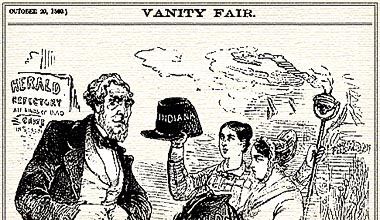

James Gordon Bennett, 1860 -- Vanity Fair


1835-1843   |   1844-1849   |   1850-1899


Jan 09 '50  |  Jan 25 '50  |  Oct 29 '50  |  Jun ? '51  |  Jun 07 '51
Aug 12 '51  |  Jan 04 '52  |  Feb 15 '52  |  Mar 09 '52  |  Apr 24 '52
Jul 15 '52  |  Nov 02 '53  |  Oct 20 '54  |  May 04 '55  |  Jun 17 '56
Apr 15? '57 |  Jul 06 '57  |  Feb 03 '58  |  Feb 04 '58  |  Jul 02 '58
Jan 22 '60  |  Nov 04 '60  |  Oct 29 '69  |  Dec 26 '72  |  Sep 14 '72
Sep 16 '72  |  Sep 30 '72  |  May 06 '77  |  May 17 '77  |  Jun 25 '93


Articles Index  |  misc. New York City papers



Whole No. ?                         N. Y., January 9, 1850.                       Two Cents.


INTERESTING  FROM  THE  SALT  LAKE.

The Difficulty Between the Mormons and Missourians
California Emigrants -- New Mormon Colony -- Pawnee Treaty.

(under construction)


Notes: (forthcoming)


Whole No. ?                         N. Y., January 25, 1850.                       Two Cents.


THE  MORMONS  ON  THE  MOUNTAINS.

Terrible Snow Storm -- Loss of Sixty Cattle -- No Deaths among the Saints.

(under construction)

... Report from Muddy Fork, Oct.18. They crossed the Rocky Ridge, near the summit of the South Pass, with the Wind River chain of mountains on thew north, when it began to snow, etc. Mentions Sweetwater... [Leaders include] E. T. Benson & Capt. Richards...  


Notes: (forthcoming)


Whole No. ?                         N. Y., Tues., Oct. 29, 1850.                       Two Cents.


The Worcester Fanatics -- Progress of Socialism, Abolition, and Infidelity. It has been known ever since Fourier, Brisbane, and Greeley first promulgated their social theories, that society is all wrong. It is known also that their attempts to reform it have signally failed...

But all of these expedients have been found to be mere palliatives, while a radical reform of society has been the great object of the philosophers, Fourier, Brisbane, Greeley, Big Thunder, Combe, Fowler, Collyer and the Model Artists, the Rochester knockers, and Davis, with his revelations, all having failed, all having proved unsatisfactory, tried separately, what next is to be done? Try them all together.

Here we come into broad, open smooth water. Here the daylight of discovery breaks in upon us as the first glimpse of the great Salt Lake broke upon the Mormons. Here we unbuckle our traps, and go straight to work in shovelling up the gold dust. The old Syracuse engineer jumped up in his nether garment, and shouted "Eureka," and Grubby Greeley answers Abby Kelly at Worcester, with "Eureka." We have got it. Got what? The philosopher's stone--the key to the millenium -- the one thing needful -- the schedule of the final reformation. The Lord be praised.


Notes: (forthcoming)


Whole No. ?                         N. Y., June ?, 1851.                       Two Cents.


Mormonism and Its Increase.

We have received by regular mail, accounts from the Great Salt Lake, Deseret, to the 19th of April, contained in the journal printed there, called the Deseret News, No. 31, published half monthly, by W. Richards. It is filled with the minutes of the General Conference of the Church of Jesus Christ, of Latter Day Saints, otherwise called Mormons; also, several epistles to the faithful -- clear accounts of the weather -- the political movements of the territory -- interspersed with articles on the value of manure and the growth of beets, advertisements, ordinations, lists of letters, notices, removals, &c., &c. -- all indicating a settled community, under a stable government, influenced by the new religion, and superintended by the general government.

The stride which the Mormons have made in this country is wonderful, and certainly is deserving of some attention. Mormonism, as a sect, originated in this State about 1830, or twenty years ago -- thence passed to Ohio and Missouri, thence to Illinois, and finally settled down in the Salt Lake country, where it appears to be firmly established, and whence it numbers its adherents and devotees by thousands. It was composed of but very few when it was first started; but within a comparatively short time it has made remarkable progress. It has extended its operations, and instead of being confined to one place, it has spread itself to different parts of the country. Its principal resting place, however, is at Salt Lake, between the Rocky Mountains and the Sierra Nevada, a region which possesses vast agricultral and mineral resources, and is, in many respects, similar to Palestine, in the Holy Land. The increase of the Mormons in that place is remarkable, and, if they go on at the same rate, they will, before many years, be a powerful and influential sect. The communities which they have established in the Northwestern States do not exhibit the same increase, nor the same degree of order, quiet, and respectability, as that of the Salt Lake does. Beaver Island has recently been made notorious in consequence of the gross superstition and villainy of some of the "saints" as they call themselves, who are placed in the position of rulers; but when the wheat is sifted from the chaff there, and the villains are excommunicated, the community will, no doubt, recover its character, and Mormonism will be increased there, and in other parts of the Northwest, and similar regions

The rise and progress of Mormonism in this country presents a singular phenomenon in religious fanaticism, blended with common sense and industrious habits. They show that a revolution is at work in the human mind on the subject of religion, of which they are only a part. It will astonish some of our readers when we inform them that Mormonism has, in this age of boasted intelligence, made more rapid progress, and has more adherents, than Christianity had in the same number of years. The foundation of their faith is a book called the Mormon Bible, a work written by a man of genius, in his hours of leisure, in the same vein, and in much the same language as is used in the Old Testament. It is nothing, in fact, but a religious novel, professing to narrate the wanderings of one of the family mentioned in the Pentateuch. This book of fancy passed into the hands of the celebrated Joe Smith, who was shot in a row in Illinois, The "prophet," as he is termed by his followers, came from Canandaigua, in this State, where he first promulgated the new religion. From Canandaigua he went to Ohio, thence to Missouri -- then to Illinois, where he met his death in the manner stated. He and his followers in Nauvoo became obnoxious to the people of Illinois, a disturbance ensued, the blood of the saints was shed, and Joe Smith was killed.

Finding no resting place in civilized parts of the country, the Mormons at length settled down in the remote Salt Lake country. Since they went there, and since the discovery of the gold mines in California, they have risen to great power -- increased their numbers to an amazing extent; have a territorial government, organized under the authority of the United States, and possess the seeds of further strength and power to an unlimited extent. In many respects, the progress and career of the Mormons resemble those of the Methodists under Wesley and Whitfield, and the probability is that they will go on increasing, until they become one of the leading religious sects of the country, and of the world. At present they are characterised by too much bigotry; but they will become more liberal, no doubt, in course of time, and be as numerous as any other Christian sect.


Notes: (forthcoming)


Whole No. ?                         N. Y., June 7, 1851.                       Two Cents.


INTERESTING FROM THE GREAT SALT LAKE.

MESSAGE OF THE GOVERNOR BRIGHAM YOUNG -- GENERAL EPISTLE
OF THE MORMON CHURCH -- THE CONFERENCE OF THE SEVENTIES.

(under construction)


Notes: (forthcoming)


Whole No. ?                         N. Y., August 12, 1851.                       Two Cents.


THE  MORMON  COLONY, BEAVER  ISLAND.

(under construction)


Note: The above article contains a description of James J. Strang's Mormon colony at the head of Lake Michigan. The text will be added when a full copy of the article becomes available.


Whole ?                         N. Y., Sunday, January 4, 1852.                       2 Cents.


HIGHLY IMPORTANT AND EXTRAORDINARY

DEVELOPMENT  OF  MORMONISM.

Report of the Judges of Utah Territory to the President
Polygamy and Religion Revived in the West.


To HIS EXCELLENCY MILLARD FILLMORE,
            PRESIDENT OF THE UNITED STATES --

SIR -- It becomes our duty, as officers of the United States for the territory of Utah, to inform your Excellency that we have been compelled to withdraw from the territory, and our official duties, in consequence of the lawless acts and the hostile and seditious feelings and sentiments manifested by Brigham Young, the Governor, and the great body of the residents there, towards the government and officers of the United States, in aspersions and denunciations so violent and offensive as to render the discharge of our official duries not only dangerous, but impractical, and a longer residence in the territory, in our jusgements, incompatible with a proper sense of self-respect, and the high regard which is due to the United States...

We deem it our duty to state, in this official communication, that polygamy, or "plurality of wives is openly avowed and practised in the territory, under the sanction and in obedience to the direct commands of the church." So universal is this practice, that very few, if any, leading men in that community can be found who have not more than one wife each, which creates a monopoly, and which was pecuilarly hard upon the officers sent to reside there. The prominent men in the church, whose example in all things it is the ambition of the more humble to imitate have each many wives, some of them, we are credibly informed and beieve, as many as twenty or thirty and Brigham Young, the Governor, even a greater number. Only a few days before we left the territory, the Governor was seen riding through the streets of the city in an omnibus, with a large company of his wives, more than two-thirds of whom had infants in their arms -- a sure sign that the evil is oncreasing. It is not uncommon to find two or more sisters married to the same man; and in one instance, at least, a mother and her two daughters are among the wives of a leading member of the church. This practice, regarded and punished as a high and revolting crime in all civilized countries, would, of course, never be made a statutory offence by a Mormon Legislature; and if a crime at common-law, the court would be powerless to correct the evil with Mormon juries. The City of the Great Salt Lake, is an important point in the overland route to Oregon and California for the emigrant to replenish his stores, or to winter if overtaken by the advance of the season; but the intimidation which is produced by the denunciations and conduct...
(under construction)


Note: See also: House Executive Document, 32d Congress 1st Session, No. 25, "Utah: Message from the President... Jan. 9, 1852," pp. 8-22, (quoted in Spiritual-Wife Doctrine of the Mormons. Report of the Judges of Utah Territory. Cheltenham, England, 1852).


Whole ?                         N. Y., Sunday, February 15, 1852.                       2 Cents.


INTELLIGENCE  FROM  UTAH.

Improvements of the Mormons at Great Salt Lake.


We have received intelligence from Utah, with news to the 15th November. The Deseret News, published at Great Salt Lake City, contains an account of the present state of affairs among the Mormons at that and neighboring settlements...


Expulsion of U. S. Officers from Utah.

The United States officers who returned from Utah, have stated that persons were expelled from the territory if they became obnoxious to the censure of the Mormon authorities. The following is a copy of an editorial article in the News, in relation to a regularly licensed trader, who it seems was not well regarded by the saints... . (under construction)


Notes: (forthcoming)


Whole No. ?                         N. Y., Tuesday, March 9, 1852.                       Two Cents.


                                            Washington, D. C..
                                            April ?, 1852.

To the New York Herald.
JAMES GORDON BENNETT, ESQ.

Sir: -- I will thank you to print, as soon as you can, the substance of this letter. Considered only as news, it ought to be worth your while. There is a great curiosity everywhere to hear about the Mormons, and eagerness to know all the evil that can be spoken of them...

I will begin with the original and beginning of our troubles, found, to my mind, in the notion that, unlike other populous communities, we are not fit, or have not the right, to furnish our own rulers.... At the very outset of our national career, we had to have strangers sent to govern us. Who of worth and standing at home would venture out to Our distant and undescribed country? Accordingly, the offices went begging among all the small-fry politicians who could be suspected of being fit to fill them. And (as I have heard, after sundry nominations were refused) the following were picked up: --

No. 1. -- A Mr. Brandebury, who brought his recommendation, saying he had studied law in the office of a Pennsylvania county-court lawyer renowned for successful high and lofty tumbling in the support of the United States Bank through a bloodless civil war, but who, in every other respect, exaggerated the recommendation of a Presidential candidate, of being perfectly and entirely unknown.

No. 2. -- Zerubbabel Snow, of Ohio, a lawyer practicing in the interior of that State -- qualifications rather ahead of the others -- willing to come out probably, having kinsfolk among us.

No. 8. -- Mr. P. E. Brocchus, of Alabama, of whom I have again to speak -- character unknown, I hope, to the President -- in the lower purlieus of the District of Columbia by no means entitled to that recommendation.

No. 4. -- B. D. Harris, a smart youngster -- from a Vermont printing office, I think -- for Secretary.

And for Indian Agent, No. S, a lazy little fellow named Day -- with half the head of a Yankee, for he was all the time thinking of a '`trade," and half the heart of a woman, for he would have run from a squaw....

The first we knew of our becoming a Territory was the account of the passage, September, 1850, of the law organizing Utah, which reached us before the year was out. Nothing could exceed the clamorous joy of our citizens at learning that they were thus invited into the family party by their brethren of the Union. Our national flags went up, hailed by huzzas, all over the settlement, and when we hoisted our large one on the liberty pole at Temple Block, in Great Salt Lake City, the artillery saluted it with one hundred rounds, rammed home.

The first actual appearance among us, by personal representative, of the government majesty of the United States, was the arrival of No. 1, as above, which came as much as half a year after (the 7th of June, I think), with a limited amount of personal luggage, including one remarkably large black umbrella, and put up at a boarding house on the outskirts of the town, resorted to by traders and carriers passing through the settlement. We welcomed this from our hearts. We did not fire the cannon at it, having saved this honor for our country's standard, or its enemies Nor did we attend to appearances as well as the French, who made ready for their king by putting white kid gloves on the guide posts' fingers, and a clean cambric ruffled shirt and silk stockings on the body of a criminal hanging in irons. Our means, after all, were limited; but we cordially did our best. As it was the Chief Justice, numbers of us paid him our respects; and, though our calls were not returned, proceeded to get up, after our custom, a Ball in his honor....

We had not unmixed cause to be pleased with our new officials. Their speech and conduct, somehow, from the first, created and spread the impression that they wanted to get extra advantage out of us. They complained, not without reason, of the lowness of their salaries; and it was intimated to some that a vote, by ourselves, of a certain increase would be agreeable. They would not organize court, or go to work, but -- an ill example to our youth -- lived indolent together in their boarding houses, day after day -- the only utterly idle persons in our whole community. Yet, at the same time, they assumed airs and graces, and various manners of condescension and superiority; in which, rest assured, they made a very great mistake. It is an error, the prevalent opinion that we all cleanse the nasal orifice with the big toe, and make tea with holy water. We have among us women who play on the piano and mix French with their talk, and men who like tight boots, and who think more of the grammar than the meaning of what they are saying; and who would ask nothing better than to be fed by other people for squaring circles and writing dead languages all their lives -- albeit we would not give one good gunsmith's apprentice for the whole of them. And, though we are all out-and-out democrats, in spirit and in substance, we have plenty of the hard-to-comb curly-pates of people, of whom the saying is true, that we "have seen better days"; so that if there is any thing we can do, it is to take the measure of sham, half-cut pretensions, and write down their figures. There was one personal infirmity of Judge Brandebury, I am sure, was as much remarked upon with us as it could be anywhere -- even the boarding-house folks were not content with it.

    Affect in things about thee cleanliness,
    That all may gladly board thee as a fewer.

May I hope your readers understand? You see, with our score of spring streams rushing through the city plat, our fresh water lakes, our hot springs, baths and Jordan river, more cleansing than Abana and Pharphar rivers of Damascus -- we think so much of washing -- And soap is not very dear with us either. And we read the scriptures, including Zechariah iii., 8 and 4, where we are taught that the angel would not speak with Joshua before he changed his linen. -- And; whistle! that shirt the Judge had on at our 24th of July celebration, where we did our best to make a dignity figure of him, was the greatest -- it came about as near to being the great unwashed -- considering there were ladies present, it was on the whole, I may say, the most Disrespectful Shirt, ever seen at a celebration. The Judge never stirred out without his big umbrella, not so much to keep the sun off, as to hide out people, no account of his being shy; but, after, this, whenever he was seen dragging about under it, it used to be the joke that he was afraid of rain water getting in on to that shirt. But, of course, no notice was taken of such trifles; and everything went on smooth and glassy as the pool of indolence itself, till after the 17th day of August. -- This day, arrived out from the States, Mr. P. E. Brocchus, and in one short six weeks after that this man staid among us, he was the means of stirring up all the evil report that we have had since to encounter....

To our people at Kanesville, where he stopped for other purposes than outfitting, he proclaimed his intention of running as delegate to Congress. He provided intoxicating liquors gratuitously to those in his company who would listen to his discourse on this subject. He said it was his only purpose in going out to Utah; and that, his election secured, he should return at once. He alluded darkly to dangers impending over us at Washington that only he could avert, and declared that he had come out to enable him to be our saviour. Thus he spoke and electioneered with the people of the train till he met a return company, who conveyed intelligence to the States of the election of Dr. John M. Bernhisel. His tone then changed. As soon as he arrived, he announced his intention of returning to the States. He said he was sick, and supported the character in the eyes of his fellow-lodgers by eating enormously, without taking any outdoor exercise. He was hale and busy enough, to our cost He must have obtained his influence over the others almost immediately after his arrival. They soon removed to the boarding house in which he was quartered; and there evidently, as we think we can see now, concerted their schemes and courses of molestation and mischief. We heard now distinctly more of discontent and dissatisfaction, and more of the insufficient compensation and the rest....

One day Brocchus reminded the Governor that he was going away very soon, and asked him to do him the favor of procuring him as large an audience of the people as possible, as he was very anxious to set before them in style the claims of the Washington monument fund. I do not know how he made out his case; but, as he was always specious and smiling, the Governor, willing to show him a pleasure, said, "I V ill invite you, sir, to speak at our approaching conference. It is a religious meeting, I suppose you are aware; but I wish well to your cause." One of the first buildings we ever raised at Salt Lake, was our Bowery, or gallery of rough timber and wattles, for public assemblies. Around it then was all naked ground, though it now stands in the heart of the business part of the city. Our semi-annual conferences have always met in it; and our Fall one assembling here by stated appointment, September the 6th; at its opening day, a handsome representation of the people from all quarters being in attendance, Governor Young took the first opportunity of fulfilling his promise "I was respectfully and honorably introduced'" says the published statement of Judge Brocchus....

I am certain no one of his acquaintance at Salt Lake City was prepared for such a speech as he made on this occasion. In its way it beat Brandebury's shirt. I would give a hundred dollars for the sake of our cause, to have had a phonographer to take down the stupendous effort. I can only now profess to remember a few points of it, recalled to my memory by the use that has been made of them since. He began by stating that he had read our history with deep interest, particularly that part relating to our sufferings in winter quarters, on the Missouri River, during the severe winter of '47. I intended to have visited winter quarters, he said, but, alas, was not able. A friend of mine brought me these flowers; here they are; it is all I can present you of that sainted place! At this sympathetic display he forced a tear, and, the careless observer would have said, wiped it from his cheek, but Deseret eyes saw the handkerchief pass to the right and left, while the tear remained on the cheek by an overcast of the head. His reception was next referred to. I was a stranger and you took me in; sick, and you visited me, &c. Even a kind lady brushed the flies from my forehead; her kindness I can never forget. -- Another tear was forthcoming, and wiped as before. Twenty minutes of this sort of thing quite naturally introduced the consideration of his personal merits. In the course of an able and flattering autobiography, he displayed all his advantages of experience and public service in important imaginary capacities. This sort of thing took up an hour more, by which the patience of the company was pretty nearly worn out, though they remained quiet. "For more than two hours," he writes, "I was favored with the unwavering attention of my audience."

But a changed tone then came on him, with a change of subject. He began a studied assault upon his introducer, Governor Young, and an argument to the people against allowing the man so much influence as he possessed, the sum of it being that so long as this continued we would have no party divisions, and without party divisions we could not be a worthy object of the notice or favor of politicians. Soon, however he found he could do nothing on this head. "Oh ladies, sweet ladies," he cried, "why do you 'go in' for such a man? Your smiles should be turned on the contemplation of men who can handle the sword -- George Washington, and Zachary Taylor, the second Washington. Oh, Governor Young can't handle a sword!" Even such soft appeals as this were thrown away. From bad to worse, disapprobation rose till the orator was groaned. He tried a few insinuations more, and was groaned again, groaned with a will. At this, instead of taking his seat, he changed his ground, and made a direct and undisguised attack upon the audience itself, men and women, without distinction, accusing them of want of patriotism and attachment to the laws, and reproaching and insulting them to their face. General D. H. Wells, of Illinois, an impulsive and hot spoken man, but I am bound to say one of our most liberal and public spirited citizens, had delivered an oration on the 24th of July, severely condemning the course of the federal government towards us. Producing an imperfect report of this speech and commenting on it, Brocchus proceeded to attribute its sentiments to the people, and make them answerable for it, thereupon threatening them with destruction by the whole army and navy of the United States. In the same way he brought up remarks of Governor Young upon General Taylor, threatening the people with destruction for them also, and declaring that his (Brocchus's) influence should break him from office, the instant he arrived in Washington. Finally, the women hissing him here, he mentioned Washington, for the first time in connection with the monument, and as if merely incidentally. "It reminds me, by the way," he said, "that I have commission from the Washington Monument Association, to ask of you (the ladies) a block of marble, as the test of your citizenship and loyalty to the government of the United States. But in order for you to do it acceptably, you must become virtuous, and teach your daughters to become virtuous, or your offering had better remain in the bosom of your native mountains."

At this climax of insult, the meeting rose as one man, and their cries and uproar compelled the speaker to take his seat. The tumult continuing, we looked to the other officers of the United States, who had been

invited to the stand, to reply; but, as they failed to do so, the Governor being loudly called for, rose and spoke in substance (for I cannot imitate or remember successfully his peculiar style), as follows: -- "But for this man's personalities, I would be ashamed not to leave him to be answered by some of our small spouters -- sticks of his own timber. Such an orator, I should suppose, might be made by down-east patent, with Comstock's phonetics and elocution primers; but, I ask you all; have we ever before listened to such trash and nonsense from this stand? Are you a Judge, (he said, turning to him), and can't even talk like a lawyer, or a politician, and haven't read an American school history? Be ashamed, you illiterate ranter, (said he), not to know your Washington better than to praise him for being a mere brutal warrior. Washington was called first in war; but he was first in peace, and first in the hearts of his countrymen. He had a big head and a great heart. Of course, he could fight. But, Lord! What man can't? What man here will dare to say, with women standing by, that he is a bit more a coward than Washington was? Handle a sword! I can handle a sword as well as George Washington. I'd be ashamed to say I couldn't. But you, standing there, white and shaking now, at the hornets'-nest you have stirred up yourself -- you are a coward; and that is why you have cause to praise men that are not; and why you praise Zachary Taylor. President Taylor you can't praise -- you find nothing in him. Old General Taylor! what was he? -- a mere soldier, with regular army-buttons on; no better to go at the head of brave troops than a dozen I could pick up between Leavenworth and Laramie. And, for one, Ill not have Washington insulted by having him compared to Taylor, for a single breath of speech. No, nor what is more, President and General Andrew Jackson crowed down and forgotten, while I am with this people even if I did not know that one is in one place (of punishment), and the other in another (of reward)." Brigham Young spoke this out of his knowledge by the priesthood.

"What's the meaning," continued the Governor, but more at large than I can give it here, "what's the meaning of this insult of our patriotism? Is it the place of miserable vermin that feed upon its sacred body, to teach us the value of the Union? Sense enough you have to see we are bound to be its best friends. But you shall not go home to say you were never told so. Against the Union, are we? We want to have Saint Francisco on one side of us, and Saint Louis on the other, fighting and scratching like any other two saints of different denominations, do we? And the tax on the foreign goods we use isn't enough, to be sure, but we must want to pay one set of duties at a custom-house in New York

or New Orleans, and then another at Jefferson City, may be, and an. other set again at Council Bluffs. That will help us, won't it? No, Sir. we're not nailed to North or South, or any other point of the compass here. We have come out from the North and South as well as East and West, and we want our old States to stick together, because we intend to stick to the whole of them. And we are just the very people to know what tomfool's nonsense it is, the notion of a minority that expects to get into a tight place, going off for safety into close partnership with its next neighbors. Who does not know that there is more bother with a quarrel some neighbor than with a dozen that live further off. And what is a man's chance if, with a neighbor on each side of him, bent upon mischief, he has no other neighbors to help him keep them straight? It is just the same with States. Let the devil of persecution get abroad against any single one of them, as it did against us at home, and let it be Georgia or Illinois on one side, and North Carolina and Tennessee, or Missouri and Iowa on the other, all ready to join, if one is not enough, to put Charleston or Nauvoo down -- and where is Charleston' or South Carolina either, going to be, if she hasn't then one outsider to help her? Now, tell all this, when you return, to some of your folks in Alabama, where you say you belong; -- though' if you tell them instead' the Mormons want to get up a union with Selkirk's Settlement, or the Hudson Fur Company, or be annexed by the Mexican half-breeds, or the Indians, (say the Crows, or the Blackfeet, or the Snakes), I know they'd rather believe it. -- Snake stories are about all they will believe of the Mormons!" After defining very fully his views after this wise, the Governor concluded, I remember, about as follows: -- "What you have not been afraid to intimate about our morals, I will not stoop to notice, except to make my particular personal request of every brother and husband present, not to give your back what such impudence deserves. You talk of things 'you have on hearsay,' since your coming among us. I,11 talk of hearsay then -- the hearsay that you are discontented and will go home, because we cannot make it worth your while to stay. What it would satisfy you to get out of us I think it would be hard to tell; but I am sure it is more than you'll get. If you or any one else is such a baby-calf, we must sugar your soap to coax you to wash yourself of Saturday nights: go home to mammy straight away, and the sooner the better!"

This is the whole of Governor Young's speech, of which so much to-do has been made. What to make of the strange speech of Brocchus, to this day I am not clear....

We could not go on with the church business after the disgraceful occurrence, and our meeting had to be dismissed and dispersed

After the Brocchus outrage, the story of the misconduct of other officers is Soon related. First, we found out, to our astonishment, that neither Brandebury nor Harris were at pains to condemn or disavow his course. Soon we were threatened that Harris would return with Brocchus; not long after we heard the same ill of Brandebury, and soon after this... their purpose of doing so was formally announced to us, The Governor, upon this, fearing they might be as good as their word, and leave the territory to legal anarchy' called a special session of the Legislature to consider of the exigency There was a rupture at once. They would not communicate with that body or notice its existence. The Assembly passed a joint resolution directing the United States Marshal to take into his custody the papers, seals and funds of the Secretary, as about to abscond. He disregarded it, and applying to Judge Brandebury, who, for this special purpose, constituted a United States Court for the first time, obtained an injunction on the marshal against interfering with him. The two houses passing also a resolution directing an order to be drawn for $500 on account of mileage, stationery, &c., out of the $24,000 placed in the Secretary's hands for such expenses; he refused to accept it, and on the contrary, wrote them back an insulting letter, in which he pronounced his (the Secretary's) opinion that they were illegally elected and constituted. This letter, dated September 25, came to the Assembly next day, or Friday, Sept. 26. What they would have done, or what would have been the course of their debates it would be hard to say. But the officers, as if they feared the Assembly really might take the Secretary's objections for more than they were worth, and resign and be reconstituted, which could have been done in a week -- the next thing we knew, they were off -- Sunday morning, bright and early, September 28, A.D., 1851....

I have concluded my narrative. How far it contains cause of offence, perhaps, I am unable to see; but I am sure it will surprise every one that has perused it, to know that, wretched stitching together of trivialities as it appears, it covers the whole ground of the charges made against us....

I am your very obedient servant,
JEDEDIAH M. GRANT.


Note 1: Late in 1851 four of the federal officials appointed to the Territorial Government in Utah, left the territory and returned to Washington. In a Dec. 19, 1851 letter, these officials complained to President Millard Fillmore of open polygamy being practiced in Utah, and said that the Mormon Church was "overshadowing and controlling the opinions, the actions, the property, andÉ the lives of its members; usurping and exercising the functions of legislation and the judicial business of the Territory." The publicizing of the officials' negative report had an adverse effect on the Territory's image in the east, and Governor Brigham Young soon sent his Second Counselor, Jedediah M. Grant, to Washington, D. C. to bolster the Church's public image. Elder Grant was assisted by Thomas L. Kane in writing letters for publication, in which the Mormons and their leaders might be better presented to easterners. At least three such letters, headed "Truth for the Mormons," were submitted to the New York Herald, but Editor Bennett chose to reproduced only one of them in his paper.

Note 2: As to the charge of Mormons practicing polygamy in Utah, Elder Grant wrote to the Herald, "I pronounce it false." But he also added a revealing comment to his denial: "Suppose I should admit it at once? Whose business is it? Does the constitution forbid it?" Unfortunately this particular passage occurs in one of the 1852 Grant letters that Editor Bennett chose not to reproduce in the columns of the Herald.


Whole No. ?                         N. Y., Saturday, April 24, 1852.                       Two Cents.


THE  MORMON  EMPIRE.
________

THE VERY LATEST INTELLIGENCE.


The news from Great Salt Lake City, the chief place of the Mormon Empire, is to the 8th Feb. We received, several days ago, the Deseret News and private advices to that date. We have already given the leading points of these accounts in the New York Herald... . (under construction)


Notes: (forthcoming)


Whole ?                         N. Y., Thursday, July 15, 1852.                       2 Cents.


AFFAIRS  OF  THE  MORMONS.
________

Interesting Letters from the Fathers and Elders of the Church
________

The Trouble with the Government Officers.


                                            Great Salt Lake City.
                                            Utah Terrirtory, May 1, 1852.

James Gordon Bennett, Esq. --

In the Herald of the 9th March, in your comments upon General Grant's reply to the "flying court," or "Babes in the Woods," late of Utah, I see you sagaciously say the Latter Day Saints must "make up their minds to submission to the federal authorities, and come down to the established arrangement of one wife at a time, or abide the consequences of the higher law." -- Now, sir, in all deference to your unique opinion, permit me to dissent, because the constitution has no power over religion, neither has Utah's Congress; "the federal authorities" have no control over morality -- that belongs to the good old book, the word of the Lord, and you know that God allowed any good man, such as Abraham, Jacob, Gideon, David, Solomon, and hundreds of others, a plurality of wives. 'Praise ye the Lord,' and unless all christendom shall, by their 'sacredotal clergy,' petition Jehovah, and repeal king James' repugnant, and as I believe. 'wonderful wiving law,' we shall, as a religious community, hold on to our rights, guarenteed by the constitution & revelation. It is just as virtuous, just as holy, and just as wise, for the Mormons to obey the Scriptures now, as in the days of Moses or Jesus; for Jesus said, 'suffer little childrem and forbid them not to come unto me for of such is the kingdom of heaven.'

You know also, that among other great promises to the Latter Day Saints, an 'hundred fold of mothers and children' is promised. You could not have the children, unless you had the wives, [and] mothers, to bear them. Some of the old prophets sais 'seven women should take hold of one man,' &c. but I think it is no where said that seven men should take hold of one woman, as it is somewhat fashionable among the elite of many nations.

If you have not received a communication from Dr. J. M. Bernhisel, on the plurality of wives, being a dialogue between Bogus-bus, and the king's fool, call on him for it, and let the people have it, and I think your own wife system will sing as small as our racing Gilipons, or, 'dirty cotton court.' Of two evils, a Mormon chooses neither, but goes in for all good and more good, which, if as Solomon said, a good wife is a good thing, then the more you have the more good you have; so that when suffering female kind, over the great globe, are acquainted with the fact, that, "the daughters of kings are among the Lord's honorable wives in heaven," (Psalm 45,) and on the right hand the queen in gold of Ophir, you will hear of more honorable women clinging to the priesthood [than] you ever thought of, or a narrow contracted christian clergy, drove into corruption by night closetings, because their deeds are evil.

Brother Gordon, look into my almanac for this year, and on the 22d page you will observe an account of the 'Eternal Mother,' -- and on the 37th, 'The Philosophy of the Heavens.' Try a little of the Mormon classics. I go in for Hebrew, Greek, Latin, Italian, Spanish and any other language which conveys truth. Should you get the communication I mentioned above, I think that what I have written will do for you and I and others, to circulate that the constitution of the United States, actually allows men and women to love, get and do all the good they can from the Bible, from the Book of Mormon, from the world, and even from one another. 'Praise ye the Lord.'

      Respectfully,         W. W. PHELPS.


Note: Such is the first Mormon attempt at justifying their long secret spiritual wifery. Even the patience and indulgent allowance Editor Bennett generally extended to the Utah Saints must have been taxed in his reading of this communication from "the King's Fool." Bennett's experience in New York journalism stretched back to his days at the National Advocate, when the William Morgan affair was a big story in the press of the Empire State. He was a contemporary of William W. Phelps in the business when Phelps started his anti-masonic Ontario Phoenix at Canandaigua. While Phelps joined the Mormons and "went west," Bennett remained in the east, giving voice to the pro-masonic cause and conducting some of the very first investigative reporting on the origin and rise of Mormonism. No doubt Bennett kept an eye on Phelps over the years, and watched with distaste the man's long, slow downhill slide into obsession and obscurity. After so many years of promulgating lies regarding their secret marital affairs, Phelps' professed love of all "language which conveys truth" must have struck Bennett as both pathetic and comical.


Whole ?                         N. Y., Thursday, Nov. 2, 1853.                       2 Cents.


(under construction)


Notes: (forthcoming)


Whole ?                         N. Y., Friday, Oct. 20, 1854.                       2 Cents.


News from the Plains -- Mormons -- Salt Lake City.

(under construction)


Notes: (forthcoming)


Whole ?                         N. Y., Friday, May 4, 1855.                       2 Cents.


(under construction)


... [quoting Brigham Young] "You must not think, from what I say, that I am opposed to slavery. No! The negro is damned, and is to serve his master till God chooses to remove the curse of Ham."


Note: Brigham Young expressed the LDS Church's doctrine concerning the Negro to John Gordon Bennett's arch-nemesis, abolitionist Horace Greeley, thusly in 1859: "H. G. -- What is the position of your church with respect to slavery? B. Y. -- We consider it of divine institution, and not to be abolished until the curse pronounced on Ham shall have been removed from his descendants. H. G. -- Are any slaves now held in this territory? B. Y. -- There are."


Whole No. ?                   N. Y., Tuesday, June 17, 1856.                 Two Cents.


(advocates Utah statehood, with polygamy -- under construction)


Notes: (forthcoming)


Whole No. ?                         N. Y., April 15?, 1857.                         Two Cents.


(under construction)

... As myself and Mr. E. K. Hanks are the last persons who have come to the States from Great Salt Lake City, I deem it may duty to bear testimony against the lying scribblers who seem to be doing their utmost to stir up a bad feeling against the Utonians. We left our home on the 11th of December, brought the last mail to the States, and certainly should know of the state of things there. The charges of Judge Drummond are as false as he is corrupt. Before I left for the States I was five days in every week in Great Salt Lake City, and I witness to all the world that I never heard one word of the burning of nine hundred volumes of law, records, etc., nor anything of that character, nor do I know, or every heard, of anything of the dumb-boy story he talks of....


Note: The above fragment of a letter from "Elder Little" is part of an article published in the Herald some time between April 15 and May 15, 1857.


Whole No. ?                         N. Y., July 6, 1857.                         Two Cents.


(under construction)

... [the Mormons] do not confine themselves to sacred music. All the popular songs of the day -- English glees, negro melodies, and even sentimental ballads -- they bring into their service. Their hymns are for the most part sung to familiar "profane" airs....


Notes: (forthcoming)


Whole No. 7844.                         N. Y., Monday, February 3, 1858.                         Two Cents.


INTERESTING  FROM  UTAH.

Arrival from Great Salt Lake City of the last Gentile Merchant -- His statement of the Morality of the Mormons -- Polygamy -- Death the Penalty of Seduction -- Treatment of Gentiles -- Federal Officers -- Charges of Murder -- Special Commissioners Expected -- No Preparations for Burning -- Mountain Retreat -- The Army of Defence -- Manufacturing Pistols and Gunpowder -- Colonel Johnson well watched -- Brigham in Business -- The Firm returns unconverted -- Great Emigration from California to Utah -- Indians Saucy and in Arms -- The Indian Chiefs on the War Question, &c.

Mr. Bell of the firm of Livingston, Kinkead & Co., of Great Salt Lake City, having arrived here within the last few days, direct via California and being the last of the "Gentiles" who left that Territory, our reporter sought an interview for the purpose of obtaining reliable information on matters and things generally in Mormondom, and submits the following as the substance of an interesting talk with that gentleman: --

Mr. B. went out to Utah with one of the principals of the firm, in 1849, for the purpose of establishing business relations with the inhabitants of that Territory. Being well received, they immediately opened store, and from that time till the 8th November last, with the exception of six months absence, Mr. B. has been a resident of Great Salt Lake city. From his long residence there, and the nature of his business, throwing him in contact daily with every class of citizens, probably no one who has been to Utah has had better opportunities of forming an opinion of that people, nor could speak with more certainty on the courses of their procedure.

MORALITY OF THE MORMONS.

Of a people as a community, he represents them honest, sober, and very industrious, fully convinced themselves that they are the people of God, and that Brigham is his Prophet. Notwithstanding there are plenty of persons in the Territory who are far from being ornamental to society or models worthy of imitation. Some of the rising generation are fond of a spree, fun and frolic, not over particular how they raise a shindy nor at whose expense they have it. Of this class there are a sprinkling who betimes forget the wholesome teachings of Father Matthew. With all their faults, admitting, he says the legality of polygamy there is, "taking them all in all," not a more moral community in the world than is to be found in Utah, nor indeed any so moral anywhere that he knows of.

POLYGAMY.

The "peculiar institution" is still in its infancy and some irregularities doubtless occur now and again. Some of the fair sex have not got sufficiently acquainted with the traces to run easy and will have their hours of sadness; but as a general thing, the "sisters" have as much faith in the righteousness and divinity of the principle of polygamy as the "brethren," and therewith are contented. "Scenes" that we outside barbarians would naturally expect are of very rare occurrence the patriarch seems to enjoy as much peace at home as the "bachelor" monogamist.

DEATH PENALTY OF SEDUCTION.

Prostitution or seduction is not tolerated in the Territory. Death is the penalty for adultery, for both parties. There have doubtless been transgressors who have escaped; but the non-execution of the law has been, probably more to avoid difficulty with the general government than from a want of will to carrry it through. Should the Mormons be able to assert their independence now, and become a separate people from the united states or become a sovereign state of the Union, the law against the adulterers will doubtless be honored in the observance.

TREATMENT OF GENTILES.

Outsiders or "Gentiles," have not been subjected to abuse or annoyance on account of negative faith in Mormonism. The troubles between the Gentiles and the Mormons have sprung from meddling unnecessarily and unwisely on the part of the former. Many had come to Utah with the idea that the new faith and "peculiar institution" were matters which everybody had a right to criticise, talk about, joke about, ridicule and oppose, and such have invariably got themselves into trouble; but others who have gone there and who have regarded Mormonism and polygamy as matters pertaining to the Mormons and attended to their own affairs, have lived in peace and been respected by the community. That a prejudice exists against Gentiles in general is very certain, but it has no practical results, if they mind their own business.

FEDERAL OFFICERS.

Mr. B. says that he has seen federal officers arrive and seen them leave. He has watched their proceedings but never took part for or against them there; and here he purposes to pursue the same course. Some federal officers were much respected by the Mormons; and they had always amicable intercourse with each other; hence he infers that all might have had the same experience. A federal officer who would go there without prejudice against the people and attend strictly to his own business would have no difficulties; but if he began to meddle with Mormonism; his peace was at an end. No name nor position could shelter him from the contempt of the community. If the Mormons were attacked and they decided on retaliation, they could make the place too hot for the comfort of the offender; and it is not at all unlikely that before the affair ended the sinned against would become the sinner.

Mr. B. thinks it is a pity that special commissions were not sent to Utah to investigate the charges preferred against the Mormons and those preferred by the latter against some of the United States officers. Much interesting information would have been gathered. The fact should not be concealed from the public that the commencement of difficulties has almost invariably sprung from personal matters -- not official.

CHARGES OF MURDER.

Mr. Bell has no doubt of the good faith of some of the recent officials in preferring charges against the Mormon leaders; but on such grave charges as those of those of the murder of Capt. Gunnison, of Col. Babbitt, and of poisoning Judge Shaver, preferred by Drummond, he considers it his duty to protest against the imputation of such crimes being laid at the door of the Mormons. There is no room for doubting the murder of the two former by the Indians far from the influence of the Mormons, and under circumstances which demonstrated that it was entirely an Indian affair. At Judge Shaver's death Mr. B. was called on the Coroner's jury, and there were no grounds for the insinuation of the Judge being poisoned by the Mormons, nor were any such thoughts expressed or entertained by any of the jury, or any person cognizant of the circumstances attending his death.

SPECIAL COMMISSIONERS EXPECTED.

The present position of Brigham Young and the inhabitants of the Territory is the consequence of the past difficulties with such persons as Drummond -- so they believe. They are therefore determined to oppose the approach of the army. Their labors heretofore have been confined solely to crippling and hindering its advance with a view to preventing the effusion of blood. Mr. B. had a lengthy interview with Brigham just previous to his departure and assures us that such was his explanation of the stampeding cattle &c. Brigham thinks that through the winter the government and Congress will have time to consider the matter thoroughly, and, if they wish, withdraw the troops and send in special commissioners. To an investigation, they would never have objected, and he thinks they will not even now object; but to an army entering their valleys under such circumstances, they will not consent; and sooner than the army should enter they will fight, and if overpowered burn all their possessions and take to the mountains. Some have thought Brigham's discourses were for effect outside of Utah, but our Informant thinks to the contrary, and considers that Brigham's works sustain his words.

NO PREPARATIONS FOR BURNING.

The people are devoid of fear touching the future. They are in hopes that there will be no fighting; but if it must come, that victory will perch on the banners of the Saints. Nothing has been done by way of preparation for the burning. Brigham has counseled the Saints in all the settlements to sow, plant, build and improve the same as usual, and he attends to his affairs as before.

MOUNTAIN RETREAT.

This going to the mountains has been learned from the Indians. The Mormons could never whip the indians when they retired to the mountains; so now that they are friendly, the red skins have taught their Mormon brethren mountain warfare and there are numerous places, as Brigham says, where they could retreat and no army could reach them. Echo kanyon, which is considered the gauntlet for Colonel Johnson's army, is really nothing compared with many kanyons leading out from Salt Lake Valley, beyond which the Mormons will doubtless take shelter.

THE ARMY OF DEFENCE.

Three thousand armed Mormons are in Echo kanyon, where they have plenty of timber for fuel and for building shanties; many of which they have erected for their comfort during the winter. It is not intended that they should at any time go out and have a fair stand up fight with the troops -- if war it must be, guerilla will be fashionable. The Mormon boys enjoy camp life and would play a good part at guerilla warfare. This trip to the mountains affords them opportunity of exhibiting their tact and willingness to serve the cause, without which many of them would have remained in the back ground for years to come and perhaps forever.

Lieutenant General Wells dons the cocked hat and plumes, gold epaulettes, gold tinsel fixings here and there, and stripes down the pants; the spurs also do something at glittering. His staff have their military ornamentations and cut quite a dashing appearance in the mountains. Several companies are regularly uniformed; but by far the greater portion of the army is in ordinary dress. The officers generally are in uniform.

MANUFACTURING PISTOLS AND GUNPOWDER.

Shortly before Mr. Bell's departure he visited the Armory, where mechanics were busy in the manufacture of revolvers. They were turning out Colt's holster revolvers at the rate of twenty per week. The Mormons were quite pleased with their manufacture of this article and consider it equal, at least, to Colt's. They have often tried unsuccessfully the manufacture of gunpowder, but they have now got over their difficulties. In October a powder manufacturing company was formed and an excellent sample of the article bad been presented to Brigham and met with his approval. Before they require it, in the spring, they will have it in abundance.

COL. JOHNSTON WELL WATCHED.

The commander of the expedition will not be able to steal a march upon them. Scouting parties are out in every direction. From the mountains round the west south sides of the camp of the expedition the Mormon scouts can see all that is going on without incurring risk. The redoubtable Porter Rockwell told Mr. Bell that he and his company stood on the Fort Hall mountains by the side of which Colonel Alexander was marching his command on the Fort Hall route,, and so near that they could have thrown rocks upon the troops passing. An express leaves the neighborhood of Bridger every evening with an account of the movements of the expedition during the day, and Brigham has it at his breakfast table the next morning, and everything of note is communicated to the people from his office.

BRIGHAM IN BUSINESS.

The firm had extensive business transactions with Brigham -- from first to last probably to the amount of $500,000. They speak of him as an honorable business man, whose word or honor cannot be questioned. An attempt had been made by some parties to trouble the Gentile stores, but immediately on the intelligence reaching Brigham, he and General Wells came and gathered all the information they could, and the following Sunday denounced from the stand the conduct of the offenders, and predictions have since been uttered against all who may be found guilty of stealing, even from the army.

THE FIRM RETURNS UNCONVERTED.

Mr. Bell reports that during his stay of nearly nine years among them he had no difficulty with the Mormons, though he was doubtless regarded as a full blooded Gentile, of whom they could entertain no hope, further than he might yet have the privilege of being boot black or teamster to some of his Utah acquaintance[s] in "The Kingdom to come." When the firm went in 1849 they told Brigham that they had come for business -- wished to have nothing to do with Mormonism, did not want it preached to them, and having stuck to their text they have returned to the States as great Gentiles as when they left for Zion.

GREAT EMIGRATION FROM CALIFORNIA.

Business arranged, our informant, with his lady and child, clerks of the store and others -- in all 16 men and 4 women -- left on the 8th November, by the southern route for California. They met the November mail 10 miles east of Rio Virgin, and with it seven wagons returning to Salt Lake from the lead mines, heavily loaded with precious lead for the "Army of Defence." How many wagons had been on the same errand our informant could not say, it is very probable that they were neither the first nor the last but it is very probable that they were neither the first nor the last.

Two days after, about the middle of the Rio Virgin, the company met five or six wagons with Mormon emigrants from San Bernardino, with horse and mule teams. They were well contented, happy and enthusiastic about going home to Zion. Two days after a larger company of Mormons from San Francisco was met with in a similar position and frame of mind, singing the songs of Zion's deliverance, by the way. On the Mohave river a company with 10 or 12 wagons was met. They had fine mule teams, and were from the upper country -- probably from the diggings. They had in addition to their teams a fine drove of 150 horses. Twenty miles on they met a company with 20 wagons, and came up on the same evening with a company and 15 or 18 wagons. Next evening, at the head of the Mohave river, they came upon several companies in camp with probably 20 wagons. The emigrants seemed well, and appeared a people who had been in comfortable circumstances. Their wagons were very heavily loaded with creature comforts and probably well supplied for the assistance of Zion, as the colony at San Bernardino was among the wealthy Mormons and at such a time the yellow metal is not expected to be tied in a napkin and hid in the ground. Every dime is to be consecrated to the purchase of redemption.

Mr. Bell's company passed next morning over the Sierra Nevada mountains with much difficulty, owing in a great measure to the large number of Mormon emigrants who were to be met with all the way from the mountains to San Bernardino. Probably there were from fifteen hundred to two thousand persons met with on this route. The whole settlement was in motion. Many who had been before luke warm and expected to apostatize surprised the Mormon authorities by selling out and taking the route for Salt Lake.

The call for the "Defence of Zion" has met with a vigorous response in the outside settlements, and the emigrants have taken the road with enthusiasm. The wrongs in Missouri and Illinois warms the blood of those who suffered there or lost relatives in the troubles in those States; in fact the present movement is not the labor of one man or of the leading men; it is the movement of the people. They think they have been trampled upon and that further submission to injustice would draw upon them the just indignation of Heaven.

INDIANS SAUCY AND IN ARMS.

This company was provided with passes, but notwithstanding had great difficulty to persuade "brother Kanosh," the Indian chief, that all was right. Kanosh was in excessive bad humor and his band very much excited. The poisoning of the springs of water causing the death of several Indians, is too true. Several of the California emigrants had been killed in retaliation but the Indians were far from being satiated in vengeance.

Brigham counselled the company to engage interpreters and get the assistance of the bishops in the neighborhood of the Indians, which was wholesome advice, for even with their assistance and Brigham's papers, Kanosh was no more than satisfied. Mr. Bell had frequently seen the Chief at Salt Lake and had been on shaking hands intimacy with him, but with it all, on this occasion, he was very cold and even suspected that Brigham's passes had been forged. They made him what presents of blankets, shirts, tobacco, &c., they could spare, and he escorted them for two days through the dangers of the road. Kanosh was dressed as a citizen but the band was clothed in Indian fashion. They were mounted on good horses, and had fine rifles in addition to their bow and arrows.

THE INDIAN CHIEF ON THE WAR QUESTION.

Kanosh had a word to say on the Utah difficulty. "Washington," said he, (meaning Mr. Buchanan,) "would not like Mormons and Indians to kill Americans; why should Washington send Americans to kill Mormons and Indians?" On Mr. B. assuring Kanosh that he would advise Washington to let Mormons and Indians, alone he seemed amazingly pleased and his services rendered, they parted in peace.

The heavy demand of two thousand dollars for the protection of that company on the trip from Great Salt Lake to Los Angeles, as reported by the Los Angeles Star was a mistake or misrepresentation; that figure was named as the cost of the trip. The interpreters charged high enough unquestionably; but they ought to be fairly represented. Mr. Bell reports a strong prejudice against the Mormons in California.

Mr. Bell found the Indians very favorably impressed towards religious people, or at least professors of religion. The Mormons had their services morning and evening and asked a blessing on their food before partaking. The other emigrants, who were strangers to this observance of the Mormons, were marked as "no good," and found the route to California a dangerous road to travel. In fact it was necessary to be a Mormon or appear to be one, to pass quietly on through the bands of Indians.

Though Kanosh's band and a considerable number of others were favorable to the Mormons, as, in fact, very many of them have been baptized into the Mormon faith, yet some of the tribes are not counted upon as steady friends. Mr. B. relates that only a short time previous to his departure two northern Indians stole a few horses from California emigrants on the northern route. They were pursued, overtaken and one of them was shot; upon which a band of 150 took the road to retaliate upon the emigrants. They did so, killed some and returned with considerable spoil. The Indians had broadcloth for themselves, and silks satins, shawls and gew-gaws for their squaws, with which they immediately clothed themselves. Their vengeance against the whites still unsatiated, they threatened to attack the Mormon settlement at Box Elder and it was only after Lieutenant Colonel Kimball and a company of the military under his command got there that the Indians could be treated with. The Indians demanded some beaves and got them before peace was established.


Notes: (forthcoming)


Whole No. 7825.                         N. Y., Tuesday, February 4, 1858.                         Two Cents.


MORMON  WAR.

The Latest News from the Utah Expedition -- Will There Be a
Compromise? -- Views of the English Mormon Organ -- French Opinions --
The Native Indians -- Sketch of Utah Territory, &c., &c., &c.


(under construction)

An express arrived at Leavenworth on the 22d ult., direct from Camp Scott, near Fort Bridger... Brigham Young had delivered another warlike sermon in the Tabernacle in Salt Lake City, in which he enjoins upon the Saints to stick by him.

Col. Johnston's impression was, from every demonstration made in the valley, that the troops would have to fight.

Added to his own troops (regulars) Col. Johnston has five full companies of volunteers...

The rumored propositions of the Utah delegate, Dr. Bernhisel, to President Buchanan, for the adjustment if the difficulties in that Territory are now the subject of conversation and criticism here... Dr. Bernhisel... that he should have come 3,000 miles from home to sit in Congress without any object to accomplish, is very unlikely. That he should present such an arrangement is neither unlikely nor unworthy of such a journey.

If President Buchanan can get rid of the Mormons by negotiation instead of by the sword, he will find many to sustain him in this measure....

Fanaticism is an unmanageable thing. Once bloodshed, there would be no quarter, and no possibility of arrangement. To calculate on what has been will not serve as a basis for calculations for what shall be in this case. The Mormons have had trouble with their neighbors, and had battles, or something resembling the tempest in a teapot; but the perusal of their organs and the correspondence from the Territory are sufficiently clear to lead us to the conclusion that this is to be the great struggle. They are under the impression that they are fighting for constitutional liberty, and what they call the "kingdom of God." Brigham strenuously maintains that his interpretation of the organic act of the Territory requires him to oppose the approach of armed bands, which he calls the army, unless that he has been notifued of their approach. This is of course regarded as a mere quibble; but it is enough to satisfy the inhabitants of that Territory that he is right, and that they are right in sustaining him in his opposition. No one has shown them the fallacy of their conclusions, and on this Dr. Bernhisel is reported to ground his claim for a commission....

It is probably premature to speak of withdrawing the troops; but that histilities may be retarded to permit of the last effort being made to settle peaceably the difficulty, by vacating the Territory or by some other compromise, is neither impossible nor improbable. You would be astonished to see how many favor this new move, Mormons are no strangers in Washington, and where they have business and relationship they naturally enough do their utmost to set their version of matters forward....


Note 1: The above set of front-page articles contain a very lengthy description of Utah territory, detailed information on the the "Utah Expedition," etc.

Note 2: The New York Herald's "special correspondent" with the Utah Expedition of 1857-58 was Captain Jesse A. Gove. His letters to the newspaper were later reprinted in Otis G. Hammond's 1928 book, The Utah Expedition, 1857-1858: Letters of Captain Jesse A. Gove... In one excerpt Capt. Gove records this bit of wisdom, spoken by Elder Heber C. Kimball: "In our city there are a great many poor women. I am aware of that, and they will be eternally poor, for they waste everything they can get hold of, and they are nasty and filthy... Now you look, when you go out of this meeting, and see if you do not see several of them.... I was speaking to a lady, the other day, about long dresses, and, said she, 'That's the fashion Queen Victoria established;' says I, "What the hell has Queen Victoria to do over here?"


Whole No. 7973.                   N. Y., Friday, July 2, 1858.                 Two Cents.


INTERESTING  ABOUT  THE  MORMONS.

... A LINK OF HISTORY.

MORMONISM AND JOE SMITH -- THE BOOK OF MORMON
OR GOLDEN BIBLE.


(From the Troy Times.)

Within our recollection, Mormonism was "a speck, not bigger than a man's hand." The original Impostor, Joe Smith, came to the writer of this article, only thirty-two years ago, with the manuscript of his Mormon Bible, to be printed. He then had one follower, a respectable and wealthy farmer of the town of Macedon (Palmyra,) who offered himself as security for the printing. But after reading a few chapters, it seemed such a jumble of unintelligible absurdities, that we refused the work, advising Harris not to mortgage his farm and beggar his family. But Joe crossed over the way to our neighbor Elihu F. Marshall, and got his "Mormon Bible." -- Albany Journal.

All this is not within your "recollection," Mr. Weed. Mr. Elihu F. Marshall did not print the Mormon Bible. It was printed by Mr. Egbert B. Grandin (now deceased) at the office of the Wayne Sentinel, Palmyra. We happen to know this fact. Mr. John H. Gilbert, now residing at Palmyra, did the press work, and a large portion of the type-setting of the Bible. If Mr. Weed doubts this, we can show him a copy of the first Mormon Bible with the imprint. --Troy Times.


The story of the printing of the first edition of the "Book of Mormon" is truthfully as follows: -- Joe Smith, the pretended prophet, and finder of the original "metallic records," Oliver Cowdery, amanuensis of Smith, and Martin Harris, the "chosen" dupe for the payment of expenses, constituting, as they claimed, the "inspired" nucleus of the dawning "Church of the Latter Day Saints," applied about the month of June, 1829, to Mr. Egbert B. Grandin, the then publisher of the Wayne Sentinel newspaper, and a job printer at Palmyra, for the printing of the book referred to, commonly called the "Golden Bible." Harris, who was a forehanded farmer at that town, an honest and respectable citizen, but noted for his superstitious and fanatical peculiarities in religious matters, was the only man of the party whose pecuniary respectability was worth a dollar, and he offered to give security by a mortgage upon his unencumbered farm for the cost of the printing and binding of the book. Grandin at once advised them against the supposed folly of the enterprise, and with the aid of other neighbors and friends of Harris sought to influence the latter to desist and withdraw his countenance from the imposture. All importunity of this kind, however, was resisted with determination by Harris (who, no doubt, firmly believed in the genuineness of Smith's pretensions), and resented with assumed pious indignation by Smith. After repeated interviews and much parleying on the subject Grandin was understood to refuse to give it further consideration. Harris, it was thought, became for a time somewhat staggered in his confidence, but Joe could do nothing in the matter of printing without his aid, and so he persevered in his seductive arts, as will be seen with ultimate success.

About this time, in the fore part of the year 1829 (as recollected), the same party, or a portion of them, applied to Mr. Weed, of the Anti-Masonic Inquirer, at Rochester (who, by the way. seems in his reminiscences to have confused Mormonism with anti-Masonry), and there met a similar repulse, as stated by the Journal. Mr. Marshall, or spelling book notoriety, who was also engaged in the printing and publishing business at Rochester, gave his terms to Smith, and his associates for the execution of their work, and his proffered acceptance of the proposed mode of security.

The Saints then returned and renewed their request to Mr. Grandin, assuring him that the printing was to be done at any rate, and explaining that they would be saved much inconvenience and cost of travel (as the manuscripts were to de delivered and the proof sheets examined daily at the printing office) by having their work done at Palmyra, where they resided. It was upon this state of facts and view of the case that Mr. Grandin, after some further hesitation, reconsidered his policy of refusal, and finally entered into a contract for the desired printing and binding of 5,000 copies of the book, for the price of $3,000, to be secured by mortgage as proposed; which contract was faithfully performed on his part, completing the work in the summer of 1830, and as faithfully fulfilled in the payment by Harris. Major Gilbert, as stated by the Troy Times, took the foremanship of the printing, and did most of the press and composition work of the job. He still retains an original copy of the book in sheets as he laid them off in a [file] from the press in working. The manuscripts. in Cowdery's handwriting, were carried to the printing office in daily installments, generally by Joe or his trusty brother Hiram, and were regularly withdrawn for assurity and preservation at evening. The pretension was that they were written out by the amanuensis Cowdery from translations verbally given by the prophet Joe, who alone was enabled to read the hieroglyphics of the sacred plates by means of a wonderful stone and magic spectacles that were found in the earth with the "records." In the performance of this task the "chosen" decipherer was always concealed in a dark room, and by special revelation neither Cowdery or any other persons than the said "chosen" was permitted to see the plates on penalty of instant death. Such was the pretension. The handpress which did the printing (Smith's patent) has been in continued use in the Sentinel office since that important era in the rise of Mormonism.

A word in regard to the origin of Mormonism, whose advent has furnished so marked an illustration of the susceptibilities of human credulity even in the present age of boasted enlightenment, may not be without interest in this connection, now after the lapse of some thirty years. As early as 1820 Joe Smith, at the age of about nineteen years, began to assume the gift of supernatural endowments, and became the leader of a small party of shiftless men and boys like himself, who engaged in nocturnal money digging operations upon the hills in and about Palmyra. These labors were always performed in the night, and during their continuance, many marvelous accounts and rumors in regard to them were put afloat in the neighborhood. Joe professed from time to time to have "almost" secured the hidden treasure, which, however, just at the instant of attempting to grasp it, would vanish by the breaking of the spell of his magic power. Numbers of men and women, as was understood, were found credulous enough to believe "there might be something in it," who were induced by their confidence and cupidity to contribute privately towards the cost of carrying on the imposture, under the promise of sharing in the expected gains; and in this way the loaferly but cunning Smith, who was too lazy to work for his living -- his deluded followers did all the digging -- was enabled to obtain a scanty subsistence for himself without pursuing any useful employment.

The silly imposture was persevered in by Smith and the digging performances occasionally continued by his gang without success, for some eight or ten years, when in 1828 or '29 the climax was reached in the discovery of the wonderful golden record of hieroglyphics, of great antiquity, "written by the hand of Mormon upon plates taken from the plates of Nephi," the translation and publication of which are the foundation of Brigham Young's polygamous empire at Salt Lake, were, according to the published testimony of Joe Smith, "found in the township of Manchester, Ontario county, New York."

The intervening annals of the rise and progress of this Mormon imposture, and of the career and martyrdom of Joe Smith, need no particular notice in this sketch, for these are to be found in various forms of recorded history already extant.

The discovery of the pretended ancient plates, "resembling plates of gold," has a significant connection with a scheme of cupidity plotted by one Sydney Rigdon, a deposed clergyman of Pennsylvania. He had surreptitiously possessed himself of a curious manuscript from the pen of a Rev. Mr. Spaulding, late of Ohio -- a romance, written primarily as a pastime exercise during a lingering decline of health, in 1812 and 1813 -- and Smith's marvellous revelation was an opportune event in the furtherance of Rigdon's speculation. Whether the resulting connection of these two conspiring schemes was incidental or contrived, or whether Smith's part in the conspiracy was the invention of his own cunning or the emanation of his co-worker's perverted mind, are questions that have never been satisfactorily settled in public opinion. Spaulding's production, purporting to have been written by one of the lost nations of Israel, recovered from the earth by some miraculous interposition of Providence, was to have been entitled, if published, "Manuscript Found." An effort was made by the writer, shortly before his death, to procure its publication as a source of profit, but no printer could be found of sufficient faith in its paying expenses to undertake the printing. He died in 1816, and Rigdon, with this manuscript dishonestly procured, as before intimated, happening or designedly appearing in Palmyra about the time of Smith's pretended unearthing of the mysterious plates, the two speculations were joined together, and the two well matched schemers conspired to start the fraud from which originated the myth of the Golden Bible or Book of Mormon, with the attendant fame of Joe Smith, and the world renowned belligerent power of Mormonism in Utah.

The pretended translations of Smith were no doubt transcripts from the Spaulding romance as altered for the occasion by Rigdon. The latter was the first preacher of the newly revealed "Gospel according to Mormon," and made his appearance at Palmyra in that capacity immediately after the publication of the book, but his mission was there a dead failure. Whether he is now alive or dead, or what finally became of him, is not publicly apparent. His Mormon fame appears to have been of short duration. Of course there were never any converts to the Mormon gospel at the locality of its advent, beyond the cases of Harris and three or four similar victims of fanaticism or lunacy. Where its founders were known, the imposture was regarded as too stupid for serious notice by any body possessing a rightful claim to common intelligence or sanity.


The above able resumé of the early history of Mormonism, and the circumstances under which its written gospel first saw the light, we copy from the Wayne Democratic Press. It was furnished for that journal by Mr. Pomeroy Tucker, the founder of the Palmyra Sentinel, in the office of which the "Book of Mormon" was printed, and who was personally cognizant of all the facts relating to its origin. It can be relied upon as an entirely accurate statement.

Martin Harris, the farmer under whose self sacrificing generosity Smith was enabled to get his fictitious Bible into print, was morally and pecuniarily ruined by the superstition. He followed Joe Smith, and the deluded fanatics of both sexes whom he was able to gather in Western New York, to Kirtland, Ohio, where he remained some time, but finally for some reason fell under the ban of the Prophet's displeasure, lost caste in the church, and as he had been forewarned by the thoughtful and friendly Grandin, bankrupted himself by his fanaticism.

The plates on which it was alleged the Bible was engraved, as above described, said to have been found by Smith and his companions while they were digging in a hill in the town of Manchester, some three miles from Palmyra, Wayne county, now known as "Mormon Hill." This hill was situated in a detached valley, and being a small, sugar loafed affair, seemed to bear out the declaration of Smith, that it was a mound in which had been buried the scattered remnant of the lost tribe of Nephi. To this hill the Prophet claimed to have been directed by an angel in a vision.

The manner in which Smith translated these plates was by placing himself behind a screen, and putting on a pair of magic spectacles that he found lying in the "mound" beside them, reading them with perfect ease. Oliver Cowdery, his scribe, or amanuensis, stood outside the screen, and as he read, transcribed them in ordinary manuscript. The sheets as they were finished, were taken possession of by Mormons in waiting, and carried thence to the printing office. They carefully watched them during the process of composition, and took possession of the sheets as they came from the press, much in the same manner as bank notes are watched while in the printer's hands, that no extra copies might be issued. Nevertheless, despite his precautions, Smith declares that he lost one hundred and eighteen pages of his Bible. It might be supposed that with his "plates" before him, he could easily have supplied the omission. And so he no doubt would have done, had he really been the translator of the book as he pretends to be. But to explain his inability on this score, he cunningly pretended to have received information from the Lord that his enemies had altered portions of the lost manuscript, with a view of confounding him. and to have been forbidden to re-write it. Some suppose that the one hundred and eighteen pages of manuscript alluded to were lacking in the original copy surreptitiously obtained by Rigdon from the widow Spaulding, and others that he only pretended to have lost them, in order to make a still stronger impression on the minds of the superstitious.

We have before us the "Book of Mormon." It is printed in octavo form, on coarse type, and with a middling good quality of paper. The Prophet precedes it with a preface, in which he alludes to his real or pretended loss of manuscript, in this manner: -- [The 1830 Preface, Testimony of Three and Eight Witnesses, and a few comments follow.]

... Oliver Cowdery was the scribe who wrote the Bible as Smith "translated" it; Harris was the poor dupe who paid three thousand dollars for the printing of the work, and ruined himself by giving Mormonism a "start;" the five Whitmers were respectable farmers; Joseph Smith was the father of the prophet, who previous to this dispensation supported himself by digging and peddling "rutes and yarbs;" Hyrum Smith was a brother who was killed with the prophet at Nauvoo; and Samuel H. Smith is the brother who recently denounced Brigham Young as an impostor, a renegade and a traitor.

And from such insignificant seed sprang the great evil which now on the soil of a distant Territory threatens the troops of the United States, subverts all principles of law, order and social right, builds a mighty hierarchy of falsehood and lasciviousness, and will draw millions of dollars from the Treasury for its suppression. It is a significant fact that this is not the only humbug of the age that has had its origin in Wayne county. The Fox girls first began their toe cracking experiment at a place called Hydeville, in the town of Newark, in that county, within eight or ten miles of "Mormon Hill," and were looked upon by the sensible people of the neighborhood, as were Joe Smith and his followers at the outset of their career, as vulgar and shameless impostors. Yet Spiritualism, like Mormonism, is now a power in the land, and numbers its dupes by tens of thousands. Great is humbug!

Thus we have got upon record all the facts relating to the origin of the "Book of Mormon," as called for by Mr. Weed, and furnished a chapter long wanting in the history of this startling delusion.


Note 1: Thurlow Weed published similar statements, regarding his encounter with Smith, in an early 1846 issue of his Albany Evening Journal and again on July 31, 1854. The May 19, 1858 Weed statement is quoted by Dan Vogel in his Early Mormon Documents, III, but Vogel does not supply the full text. The May 19th paragraph was quickly responded to in a mid-May issue of the Troy Times, (exact date unknown, text reprinted above). Weed, in turn, replied with his own article in the May 21, 1858 issue of the Journal.

Note 2: The "able resumé" referred to above (a May 26, 1858 article by Pomeroy Tucker) begins with the words: "The story of the printing of the first edition..." Near its end, the above account also paraphrases parts of Tucker's June 2, 1858 follow-up article. Tucker's two 1858 articles appear to have supplied the historical kernel from which he later developed his 1867 book, Origin... of Mormonism. The above paraphrase of Tucker, with its quaint "rutes and yarbs" phraseology, was, in turn, one of the sources James H. Smith used for the section on Mormonism (pp. 152-54) in his 1880 History of Chenango and Madison Counties.


Whole No. ?                         N. Y., January 22, 1860.                        Two Cents.


The Mormons -- Letter from Judge Cradlebaugh.

WASHINGTON, Jan. 18, 1860.    
Wm. H. Hooper, Territorial Delegate from Utah: --

Sir -- I see from time to time the New York Herald's correspondence from Utah, in which denials are made of the charhes preferred against the people you represent, and false suggestions expressed as to the condition of affairs in that Territory.

Now, to the end that the country may know the truth respecting these matters, I have thought it right and necessary to address you this communication. I assert --

1. That the Mormon people are subject to a theocratic government, and recognizes no law as binding which does not coincide with their pretended revelations as promulgated by their "Prophet, Seer and Revelator," Brigham Young.

2. The have taught, and still teach, treason against the government of the United States.

3. That they practice polygamy in a manner shocking to the moral sense of the world, and aggravate the iffence by incest and murder.

4. That they teach the doctrine of "the shedding of human blood for the remission if sin," as defined by their own ecclesiastical code, and these teachings are carried into practice. The murders of Jones and his mother at Poidtown, of the Parishes and Pitter at Springville, of the Aiken party at Chicken Creek, the mud fort at Salt Creek, and at the bone yard, and of Forbes at Springville, are the natural results of these vile doctrines.

5. That they teach the doctrine and practice it, of castrating men, and have declared from their pulpit, with public acquiescence, that the day was near when their valleys would resound with the voice of eunuchs.

I am prepared here and now with proofs to sustain these charges, unpremeditatedly taken from numberless enormities; and occupying the position which you do here -- a member of the Mormon church, having received your endowments and taken upon yourself the oaths and obligations of the church -- I have to say to you that I will at any reasonable time and place of your own selection meet you face to face before the people and Federal authorities here, ready, but sorrowfully, to substantiate every specification herein contained.

I have a file of the Deseret News, your church organ, running from 1850 to 1859, containing Mormon history of current affairs during that period; and should you accept this proposition for calm, fair comparison of testimony on these subjects before a discerning public, this file will be at your call for reference.   Respectfully,
JOHN CRADLEBAUGH.    


Note: The above letter also appeared in the New York Times of Jan. 21st. The Times reprinted the piece from the Washington Star. See also the Utah Valley Tan of Feb. 22, 1860.


Whole No. ?                   N. Y., November 4, 1860.                 Two Cents.


Interesting Utah Affairs.

(under construction)


Notes: (forthcoming)


Whole No. ?                   N. Y., October 29, 1869.                 Two Cents.


SCHISM AMONG THE MORMONS. -- A serious schism is threatening the Mormons. Mr. Stenhouse, the editor of the Mormon paper, heads the opposition to Brigham Young and has been suspended from the editorship or tne church organ. At Brigham's death it is thought a revolution will be inaugurated that will sweep away polygamy.

(under construction)


Notes: (forthcoming)


Whole No. 13,276.                   N. Y., Thur., Dec. 26, 1872.                 Four Cents.


PERSONAL  INTELLIGENCE.
_________

Sidney Rigdon, the reputed author of Joe Smith's Mormon Bible, has been stricken with paralysis at his home in Alleghany county, N. Y. Polygamy was not permitted by Rigdon's Bible...

Note: President Rigdon lingered on for another three and a half years following his decline in health in 1872, before passing on to his great (?) reward. It is a telling fact that little was recalled by the 1870's of his many contributions to Mormonism -- other than that he had been accused of writing the Book of Mormon, and that he was not a polygamist.


Whole No. 13,173.                       New York City,  September 14, 1872.                       Four Cents.


A  MORMON  MONSTROSITY.
______

Letting In Light on the Mountain Meadows Massacre.
______

A Participant in the Slaughter Confesses.
______

Men and Women Were Murdered in Cold Blood --
Only the Children Spared.
______

A DEMON'S FLAG OF TRUCE.
______

Horrible Record of Bloodthirstiness
______

                                               SALT LAKE CITY, Sept 13, 1872.
The following is the affidavit in full by one of the least guitly among the participators In the affair, showing conclusively that the terrible Mountain Meadows massacre was the act of the Mormon authorities. It will be remembered that a large company of emigrants on their way to California are known to have been all killed, with the exception of the young children. When their massacre was discovered tne Mormons set afloat the story that they had perished at the bands of the Indians, but from time to time circumstantial evidence has appeared indicating that they were

MURDERED  IN  COLD  BLOOD

by the Mormons In revenge for previous outrages upon the latter perpetrated In Illinois and Missouri. A competent witness now says under oath that the Mormon millitia attacked the emigrants, and, alter a flght of several days without result, sent a flag of truce offering them protection if they would lay down their arms. The terms being compiled with, the entire party was butchered by their captors.

PHILIP KLINGON SMITH'S  AFFIDAVIT.

State or Nevada, County of Lincoln, ss. -- Personally appeared before me, Peter B. Miller, Clerk of Court of the Seventh Judicial District of the State of Nevada, Philip Klingon Smith, who being duly sworn on his oath, says: -- My name Is Philip Klingon Smith. I reside in the county of Lincoln, in the State of Nevada. I resided at Cedar City, in the County of Iron, in the Territory of Utah from A. D. 1852 to A. D. 1859. I was residing at Cedar City at the time of the massacre at Mountain Meadows, in said Territory of Utah. I had heard that a company of emigrants was on its way from Salt Lake City, bound for California. Said company arrived at Cedar City, tarried there one day, and passed on for California. After said company had left Cedar City

THE  MILITIA  WAS  CALLED  OUT

for the purpose or committing acts of hostility against them. Said call was a regular military call from the superior officers to the subordinate officers and privates of the regiment at Cedar City and vicinity, composing a part of the militia of the Territory of Utah. I do not recollect the number of the regiment. I was at that time the Bishop of the Church of Jesus Christ of Latter-Day Saints at Cedar City. Isaac C. Haight was President over said Church at Cedar City and the southern settlement in of said Territory. My position as Bishop was subordinate to that of said President. W. H. Dame was President of said Church at Parowan, in said Iron County. Said W. H. Dame was also colonel of said regiment. Said Isaac C. Haight was lieut.-colonel of said regiment, and John D. Lee, of Harmony in said Iron county, was major of said regiment. Said regiment was duly ordered to muster, armed and equipped, as the law directs, and prepared for field operations. I had no command nor office in said regiment at that time, neither did I march with said regiment on the expedition which resulted in said company's being massacred at the Mountain Meadows in said county of Iron. About four days after said company of emigrants had left Cedar City that portion of said regiment then mustered at Cedar City took up its line of march in pursuit of them. About two days after said company had left Cedar City, Lieutenant Colonel I. C. Haight expressed in my presence a desire that said company might be permitted to pass on their way in peace; but afterwards he told me that he had

ORDERS  FROM  HEADQUARTERS  TO  KILL  ALL

of said company of emigrants except the little children. I do not know whether said headquarters meant the regimental headquarters at Parowan or the headquarters of the Commander-in-Chief at Salt Lake City.

When the said company had got to Iron Creek, about twenty miles from Cedar City, Captain Joel White started for the Pinto Creek settlement, through which the said company would pass, for the purpose of influencing the people to permit said company to pass on their way in peace. I asked and obtained permission of said White to go with him and aid on in his endeavors to save life. When said White and myself got about three miles from Cedar City we met Major John D. Lee, who asked us where we were going. I replied that we were going to try to prevent the killing of the emigrants. Lee replied, "I have something to say about that."

Lee was at that time on his way to Parowan, the headquarters of Colonel Dame. Said White and I went to Pinto Creek, remained there one night, and the next day returned to Cedar City, meeting said company of emigrants at Iron Creek. Before reaching Cedar City we met one Ira Alien, who told us that "the decree had passed

DEVOTING  SAID  COMPANY  TO  DESTRUCTION."

After the fight had been going on for three or four days a messenger from Major Lee reached Cedar city, who stated that the fight had not been altogether successful, upon which Lieutenant Colonel Haight ordered out a reinforcement. At this time I was ordered out by Captain John M. Higby, who ordered me to muster "armed and equipped as the law directs." It was a matter of life or death to me to muster or not, and I mustered with the reinforcing troops. It was at this time that Lieutenant Colonel Haight said to me that it was the orders from headquarters that all but the little children of said company were to be killed. Said Haight had at that time just returned from headquarters at Parowan, where a military council had been held. There had been a like council held at Parowan previous to that, at which were present Colonel Dame, Lieutenant Colonel I. C. Haight and Major John D. Lee. The result of this first council was the calling out of said regiment for the purpose already stated. The reinforcement aforesaid was marched to the Mountain Meadows, and there formed a junction with the main body. Major Lee massed all the troops at a spring and made a speech to them, saying that his "orders from headquarters were to kill the entire company except the small children." I was not in the ranks at that time, but on one side talking to a man named Slade, and could not have seen a paper in Major Lee's hands.

THE  DEVIL'S  FLAG  OF  TRUCE.

Said Lee then sent a flag of truce into the emigrant camp, offering said emigrants that "If they lay down their arms he would protect them." They accordingly laid down their arms, came out from that camp and delivered themselves up to said Lee. The women and children were then, by the order of said Lee, separated from the men, and were marched ahead of the men. After said emigrants had marched about half a mile towards Cedar City the order was given to shoot them down. At that time said Lee was at the head of the column. I was in the rear. I did not hear Lee give the order to fire, but heard it from the under officers as it was passed down the column.

THE  EMIGRANTS  WERE  THEN  AND  THERE  SHOT  DOWN,

except seventeen little children, whom I Immediately took into my charge. I do not know the total number of said company, as I did not stop to count the dead. I immediately put the little children in baggage wagons belonging to the regiment and took them to Hamlin's Ranch and from there to Cedar City, and procured them homes among the people. John Willis and Samuel Murdy assisted me in taking charge of said children. On the evening of the massacre, Colonel W. H. Dame and Lieutenant-Colonel I. C. Haight came to Hamlin's, where I had the said children, and fell into a dispute, in the course of which said Haight told Colonel Dame that if he was going to report of the Killing of said emigrants "he should not have ordered it done." I do not know when or where said troops were disbanded. About two weeks after said massacre occurred said Major Lee (who was also Indian Agent) went to Salt Lake City, and, as I believe, reported said fight and its results to the commander-in-chief. I was not present at either of the before-mentioned councils, nor at any council connected with the aforesaid military operations, or with said company. I gave no orders except those connected with the saving of the children, and those after the massacre had occurred, and said orders were given as a Bishop and not in a military sense. At the time of the firing of the first volley

I  DISCHARGED  MY  PIECE.

I did not fire afterward, though several subsequent volleys were fired. After the first fire was delivered I at once set about saving the children. I commenced to gather up the children before the firing had ceased. I have made the foregoing statement before the above entitled Court for the reason that I believe that I would be assassinated should I attempt to make the same before any Court in the territory of Utah. Alter said Lee returned from Salt Lake City, as aforesaid, said Lee told me that he had reported fully to the President (meaning the commander-in-chief) the fight at Mountain Meadows and the killing of said emigrants. Brigham Young was at that time the commander-in-chief of the militia of the Territory of Utah; and further deponent saith not.
PHILIP KLINGEN SMITH.    
Subscribed and sworn to before me, this 10th day of April, A. D. 1871. -- P. D. Miller, County Clerk.
[District court, Seventh Judicial district, Lincoln county, Nevada. Copy of seal.]
Utah Territory, county of Salt Lake: --

I, O. F. Strickland, Associate Justice of the Supreme Court of Utah Territory, hereby certify that I have carefully compared the foregoing copy of affidavit with the original of the same, and that the foregoing copy is a true literal copy of said original, and that such comparison was made the 4th day of September, 1872.   O. F. STRICKLAND.

Territory of Utah, Salt Lake county: -- I, James B. McKean, Chief Justice of the Supreme Court of said Territory, do certify that I have carefully compared the above copy of an affidavit with the original of the same, and know the same to be in all particulars a true copy thereof. Dated September 5, 1872.
JAMES B. McKEAN, Chief Justice, &c.    


The Mountain Meadows Massacre --
A Terrible Revelation.

Fifteen years ago a very wealthy train of emigrants left Arkansas for California, there to seek new homes. From all reports it was considered the most comfortably outfitted company of emigrants that ever crossed the Plains. In addition to the usual wagons, freighted with provisions, clothing and the portable valuables of their former homes, together with the implements of agriculture and mechanics, there were several carriages for the more convenient traveling of the ladies, the young and the aged. Altogether, the appearance of the train and the excellent conduct and pleasant associations of the emigrants with one another bespoke the moving of farmers and tradespeople in comfortable circumstances. They rested every seventh day in their journey, and engaged in religious exercises in their own way, as had been their custom at home. They appeared to be related to each other by families or by marriage, and with the toddling infant playing in the camp at night might be seen the venerable patriarch of three score years and ten. All seemed happy together. Such was the emigrant train that passed through Utah in 1857 and perished on the Mountain Meadows, two hundred and fifty miles south of Salt Lake City.

During the past fifteen years this Mountain Meadows massacre has been frequently charged to the Mormons, but with unyielding pertinacity they have denied the implication, and with the boldness of their assertions they have managed to induce even astute Congressmen to believe that the massacre was the work of the Indians. But, singularly enough, on the fifteenth anniversary of that foul and treacherous deed, in which one hundred and twenty men, women and children were murdered, there comes to us from the city of the Prophet Brigham the full and frank confession of one of his own bishops that the bloody work was ordered by the Mormon leaders and executed by their militia.

Philip Klingon Smith makes oath before the Clerk of the Circuit Court of the Seventh Judicial district of the State of Nevada that the massacre of the large body of Arkansas emigrants on their way to California was perpetrated by the Mormon militia, and by order of the Mormon authorities at "headquarters." We need not recite the horrifying story as related in Smith's affidavit, for that can be seen by our readers. Smith was a bishop in the Mormon Church, and was a member of the force sent by the Mormon authorities to massacre the Arkansas emigrants. There seems to be no reason to doubt the statement he makes under oath, and he was certainly in a position to know the facts. We would willingly believe if we could that no people claiming to bo civilized could be guilty of such a horror and base treachery as he describes; but the details are so circumstantial, and the crime was so much in accordance with the fanaticism and revenge of the Mormons generally at that period that the statement cannot be doubted. The motives given for this dreadful butchery are many. One is that it was conceived and carried out in revenge for the injuries sustained by the Mormons in Missouri and Illinois; another is that it was to revenge the killing of a Mormon some time previous in Arkansas by the husband of a woman whom the Mormon had carried off. Of course there would be no justification either of the crime of the Mormon in taking another man's wife or or the husband in taking the life of the wife stealer; but that the Mormons wrought their vengeance on a body of innocent emigrants because they happened to be from the same State as the murderer makes a shallow excuse which the most confessedly brutalized wretches in the world could not expect to pawn off as the true cause. It was, undoubtedly, the desire of the Mormon leaders in carrying out the atrocity to strike such a deadly fear into emigrants that the route across the Territory would be looked on as a grave. They wanted no knowledge of the Territory to go abroad, and they wanted no settlements within, it, save such as filtered through the Mormon Church. This is nakedly what the order to exterminate the Arkansas emigrants meant, no matter what other pretences may have been cunningly circulated to account for it, even among the ignorant Mormons, who would do for revenge what they might fear to do in furtherance of such a bloody policy.

What makes it more horrifying is that after these brave emigrants had fought successfully against their assassins, the Mormon militia, for four days, they were treacherously entrapped by a flag of truce and induced to lay down their arms under a promise of security, and then mercilessly butchered. None but the small children were spared, and these only, perhaps, because the treacherous and brutal Mormons thought they could appropriate persons of such tender years to their own use. There is nothing in the history of civilized countries more fearfully atrocious than this massacre, and no act of treachery dastardly than that by which the emigrants were induced to lay down their arms.

It is an awful confession, and one that will awaken the whole United States to demand that this dark page in our history be illuminated by a full investigation and the prompt punishment of the guilty wretches who slew innocent and unoffending men, women and children. It was with this confession before them that a few honorable citizens of Utah asked Congress, during its last session to so provide for the holding of courts that the murders in Utah could be properly investigated and the guilty brought to punishment. Brigham Young, who knew what was hanging over his head, sent a deputation of two Mormon Gentiles and their wives, together with his favorite Apostle Cannon, to lobby and corrupt where they could, to prevent legislation. And while that was natural enough for Brigham Young to do, it was currently reported that his financial agent at the seat of government had permanently secured in the judiciary committees of both the Senate and the House all the influence necessary to frustrate every measure that promised the dreaded investigation.

With such a record now sworn to by an eyewitness and a participator in the foul deed it will be interesting to watch the action of the Government. Even at this late day it should promptly investigate tho whole matter and bring the guilty wretches to condign punishment A people who could commit such a crime, and a community that would tolerate and cover it up are unfit to be recognized. as civilized. Fortunately, the fr