READINGS  IN  EARLY  MORMON  HISTORY
(Newspapers of Pennsylvania)


Misc. Pennsylvania Newspapers
1810-1819 Articles
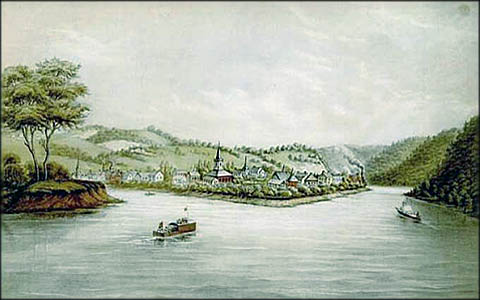

The town of Pittsburgh at it appeared in 1817


1810-19   |   1820-39   |   1840-42   |   1842-43   |   1844-49   |   1850-99   |   1900-99


PitGz Aug 09 '11  |  PitGz Jan 24 '12  |  PitGz Feb 28 '12  |  PitGz Mar 13, '12
PitMr Aug 20 '12  |  PitMr Aug 27 '12  |  PitMr Oct 22 '12  |  PitGz Oct 23 '12
PitMr Nov 05 '12  |  PitMr Dec 24 '12  |  PitGz Dec 25 '12  |  PitMr Mar 11 '13
Com May 05 '13  |  PitMr May 27 '13  |  PitMr Jul 22 '13  |  PitMr Oct 28 '13
Com Nov 10 '13  |  PitMr Dec 09 '13  |  PitMr Feb 23 '14  |  PitMr Mar 16 '14
PitMr May 25 '14  |  PitMr Jun 01 '14  |  PitMr Jun 22 '14  |  PitMr Aug 10 '14
PitGz Aug 19 '14  |  PitMr Aug 31 '14  |  Com. Sep 07 '14  |  PitMr Nov 02 '14
PitMr Jan 18 '15  |  PitMr Feb 01 '15  |  Com Feb 04 '15  |  Com Feb 11 '15
Com Feb 25 '15  |  PitMr Mar 01 '15  |  PitMr Mar 28 '15  |  PitMr May 13 '15
PitMr May 20 '15  |  PitMr Jun 03 '15  |  PitMr Jun 10 '15  |  PitMr Jun 17 '15
PitMr Sep 23 '15  |  PitMr Oct 07 '15  |  WRep Oct 09 '15  |  PitMr Oct 28 '15
Com Oct 28 '15  |  WRep Oct 30 '15  |  PitMr Nov 04 '15  |  PitMr Nov 25 '15
PitMr Dec 02 '15  |  PitMr Dec 23 '15  |  PitGz Dec 30 '15  |  PitGz Feb 10 '16
PitMr Mar 09 '16  |  PitGz Mar 30 '16  |  Com Jul 09 '16  |  PitGz Nov 22 '16
PitGz Dec 27 '16  |  PitGz Jan 07 '17  |  PitGz Mar 11 '17  |  PitGz May 09 '17
PitGz Oct 28 '17  |  PitGz Nov 04 '17  |  SpT Dec 08 '17  |  PitGz Jan 06 '18
SpT Mar 09 '18  |  PitGz May 08 '18  |  PitGz May 22 '18  |  PitGz Jun 12 '18
State Sep 05 '18  |  State Nov 07 '18  |  PitGz Nov 17 '18  |  PitGz Jan 01 '19
PitGz Jan 15 '19  |  State Jan 16 '19  |  PitGz May 04 '19  |  PitGz May 25 '19
PitGz Jun 01 '19  |  PitGz Oct 01 '19


Early Pa. magazines   |   Philadelphia Papers   |   Adams Co. Papers


Vol. ?                                    Pittsburgh, August 9, 1811.                                    No. ?


... Gentlemen who wish to subscribe for this excellent and complete set of Dr. Johnson's Works, are invited to set their names on a subscription paper in the Bookstore of Patterson and Hopkins.


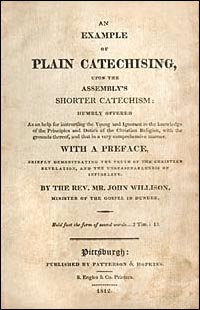
Note 1: The Pittsburgh business firm of Patterson and Hopkins engaged in both book selling and book publishing between mid-1810 and the end of 1812. The senior partner, the Rev. Robert Patterson, Sr., had been the principal of the Pittsburgh Academy and Rev. John H. Hopkins was one of that school's instructors. It is likely that these occasional book publishers contracted their printing out to Patterson's cousin in Pittsburgh, Silas Engles. For example, the partnership's 1812 publication of John Willison's An Example of Plain Catechising... shows Engles as its printer on the title page. Patterson and Hopkins announced the dissolution of their partnership on the Pittsburgh Mercury issue of Nov. 6, 1812

Note 2: If Solomon Spalding arrived in Pittsburgh during October 1812 (it is likely he had relocated there before the end of that month), one of his options in getting his fictional writings published would have disappeared before his eyes. Busness partners Patterson and Hopkins was then having their annual almanac printed (apparently by printer Silas Engles) and were readying that booklet for its Oct. 22nd publication. However, when John Hopkins pulled out of the partnership two weeks later, he no doubt took with him a good deal of the firm's financial assets. Even with his wealthier brother (Joseph Patterson, Jr.) joining him in the new partnership of R. & J. Patterson, the remaining partner in the old book publishing business was probably unwilling and unable to take upon himself the financial burden of publishing Solomon Spalding's intended book.


Vol. ?                                    Pittsburgh, January 24, 1812.                                    No. ?


The Pioneer. Gentlemen holding subscription papers for "The Pioneer" will please return them to S. ENGLES & Co., Printers, Pittsburgh, as the work will be commenced without further delay.


Note: The first issue of Silas Engles' literary magazine, The Pioneer was advertised for sale in the Mercury on Feb. 28, 1812. The magazine was sold in Pittsburgh at the bookstore operated by Patterson and Hopkins. The July 7, 1812 of The Pioneer included an article on the then popular notion that the American Indians were lost Israelite tribes. If Solomon Spalding read a copy of this same issue in Ohio a few weeks later, the subject matter of the July 7th article may have provided him with the hope that Silas Engles (or Engles' cousins, Robert and Joseph Patterson) would publish his own fictional history of the ancient Americans.


Vol. ?                                    Pittsburgh, February 28, 1812.                                    No. ?


The Pioneer. Subscribers to the Pioneer are informed that the first number is now ready for delivery...

Subscribers in Pittsburgh, who may not be regularly served, will please call for their numbers at Messrs. PATTERSON & HOPKINS' Bookstore, and leave their address, that regularity may be observed in future.

Notes: (forthcoming)


Vol. ?                                    Pittsburgh, March 13, 1812.                                    No. ?


PATTERSON & HOPKINS have just received from Chambersburgh, and have for sale at their Bookstore, corner of Wood & 4th Sts., Pittsburgh, a quantity of Fuller's Press Boards, of the best quality.

Notes: (forthcoming)


Vol. I.                                       Pittsburgh,  August 20, 1812.                                       No. 7.


Comparison between Alfred the great
and Washington.

The similarity between the public virtues of Washington and those of Alfred the Great is admirable. These extraordinary men were both celebrated for their love of justice, their fortitude, patriotism, and piety. When Alfred exchanged the military garb for that of the peasant, he suffered greater reverse of fortune than ever befell Washington: and when in disguise he explored the camp of the Danes, and lulled suspicion by the melody of his harp, he evinced a more enterprising genius than the American.

The capture of the Hessians at Trenton, however reminds us of the achievements of Alfred; who by surprising the Danish camp, revived the hopes of his countrymen. Washington founded a republic: he was instrumental to the establishment of its polity, and retired "with all his blushing honors thick upon him" -- obedient to the will of his country, he resumed the command of her armies, and died as he had lived, a true patriot.

Alfred, by the subjection of his country's enemies, secured her liberties and peace; he was "her voice in council, in the field her sword." As a legislator, he ummortalized his name by the institution of a trial by jury; as a magistrate, he presided with unparalled wisdom; the sceptre of power was consecrated by his hands, and he was beloved, revered; nay, almost deified, by his countrymen.

Washington, like Alfred, was energetic and determined in every emergency. Though their virtues were homogeneal, Alfred claims the palm for ardour and brilliancy of genius: Washington excelled him in descretion; he weighed the consequences of every step, and his prudence triumphed over opposition. In short, Alfred the Great was like the rising sun, which breaking through a dark cloud, illumines and beautifies the creation. His superior mind shone with an effulgence that dissipated the gloom of superstition and ignorance which surrounded him, and, like the vice-regent of Heaven, he promised the happiness of the human species.

Washington the great was like the declining sun, that adorns the face of nature with the mildest radiance -- his actions, equally brilliant with Alfred, were more imitable than his; and the virtuous American will be esteemed by posterity as worthy to stand in the same rank with this illustrious Englishman.


Note: It is possible that this short article was written by Solomon Spalding. If so, the piece was perhaps communicated by him via a letter to Pittsburgh. Spalding was probably still residing in New Salem, Ashtabula County, Ohio at the time this article was printed in the new Pittsburgh paper, The Mercury. The article's comparison and contrast of the two heroic figures, Alfred the Great and George Washington, is noteworthy in regard to its significant thematic overlaps with the final chapters of "Romance of Celes," an unpublished novel attributed to Solomon Spalding, and currently on file in the Library of Congress.


Vol. I.                                       Pittsburgh,  August 27, 1812.                                       No. 8.


IMPORTANT!

The following interesting article was received at the post-office, yesterday by express:

            Warren, August 25, 1812.

John Johnston, Esq.


  SIR,
Inclosed I send you for publication a copy of the articles of capitulation entered into by the traitor Hull, with the British. It may br relied on as genuine. It was received by Mr. Seymour Austin from one of the officers of our army, who was landed at Cleveland among the prisoners on Saturday last. The British have released all the Ohio volunteers, but Hull and the regulars are detained, I have just arrived from the Lake, and on enquiry found that no intelligence had been forwarded to the government. I have therefore sent an express with a dispatch directed to the general post office. Unless you are certain that an express is gone ca with this intelligence, I wish you immediately to forward it by an express to Washington city, otherwise send by mail. The people of this country are all in arms, and gone to Cleveland. There is no body left to guard the houses but the women and children. Perhaps this will arrive in time to go by the express mail. If not, do not delay it. In great haste,
Yours, &c.
            CALVIN PEASE.

P.S. There will be no other express mail sent this week.


Note 1:  The sender of this letter was the same Calvin Pease, Sr. of Warren who acted as the legal agent for Gideon Granger in Granger's 1803 land dealings with Solomon Spalding. This Calvin Pease may also have been a brother or cousin of Mary Pease Woodbury, the future mother-in-law of D. P. Hurlbut, the anti-Mormon lecturer. The "John Johnston, Esq." addressed in the letter was the Post Master of the then small U. S. Post Office in Pittsburgh. His daughter, Rebecca Johnston Eichbaum (1792-1882), was the regular clerk in that Post Office between 1811 and 1816.

Note 2:  Spalding and his family were quite likely still residing in New Salem, Ashtabula Co., Ohio at the time Pease wrote this letter. Spalding's widow provided a statement in 1839 in which she said that her husband had been writing an historical romance in Ohio in mid-1812 and that "Hull's surrender at Detroit, occurred near the same time." The USA declared war upon Great Britain on June 18, 1812, but the Ohioans living along the south shore of Lake Erie were not greatly alarmed by the threat of a British invasion from neighboring Canada until about the time of American General William Hull's surrender of his forces to the British (at Detroit on August 16, 1812).

Note 3:  One of the stories Spalding was writing in mid-1812 was his "Roman" manuscript (now on file in the Oberlin College Archives). Parts of the story relate accounts of war-threatened villagers fleeing to ancient earthen forts for refuge from armed enemy invaders. A very similar incident occured among the residents of New Salem on the night of August 11, 1812, when they fled to the safety of the mound-builders' old "Fort Hill" to escape a supposed landing by ship-based British raiders operating on Lake Erie. The possibility that Spalding was still in New Salem at this time, and that he witnessed this memorable event, is strengthened by an incident of that night, which is more or less detailed in an episode from his Oberlin romance. In both reports a woman accidentally nearly suffocates or drowns her lover beneath her weight in a watery mire while urgently attempting to reach its other side.


Vol. I.                              Pittsburgh, Thursday Evening, October 22, 1812.                             No. 10.


The  Honest  Man's  Almanack,
FOR  THE  YEAR
1813.


AT  THE  USUAL  PRICE,

JUST published by PATTERSON & HOPKINS, at their book-store, corner of Fourth and Wood streets. This almanack is designed to inculcate good morals, and communicate useful intelligence, and therefore is called, The Honest Man's. The callender pages are calculated by the Rev. JOHN TAYLOR, who is celebrated for his success in foretelling the state of the weather.

Extract from the first page. "This almanack contains nothing to encourage the evil practices of liars, drunkards, rogues, lazy fellows, infidels, tories, cowards, bad husbands, and old bachelors." Besides many useful tables, lists of roads, &c, it gives a directory to find the chief merchants and manufacturers in Pittsburgh, with the residence of the lawyers, doctors and magistrates in it.


Notes: (forthcoming)


Vol. ?                                     Pittsburgh, October 23, 1812.                                     No. ?


THE  HONEST  MAN'S  ALMANAC
FOR  THE  YEAR  1813.

At the usual price, just published by PATTERSON & HOPKINS, at their Bookstore, corner of Fourth and Wood sts. This Almanac is designed to inculcate good morals, and communicate useful intelligence, and therefore is called the Honest Man's.

The calender pages are calculated by the Rev. JOHN TAYLOR, who is celebrated for his success in foretelling the weather.

Extract from the first page -- "This Almanac contains nothing to encourage the evil practices of Liars, Drunkards, Rogues, Lazy Fellows, Infidels, Tories, Cowards, Bad Husbands, and Old Bachelors," besides many useful Tables, Lists of Roads, &c, it gives a directory to find the chief Merchants and Manufacturers in Pittsburgh, with the residence of the Lawyers, Doctors and Magistrates in it.


Notes: (forthcoming)


Vol. I                                Pittsburgh, Thursday Evening, November 5, 1812.                               No. 18.


Dissolution  of  Partnership.

BY mutual consent, the partnership of PATTERSON and HOPKINS, Booksellers, is dissolved. All engagements entered into by the house of P. &. H. will be attended to and settled by R. &. J. Patterson, the present firm, who have on hand a very large and select assortment of Books and Stationary, which they will sell on the most reasonable terms.
                                        R. & J. PATTERSON.
Pittsburgh, November 5, 1812.

Note: The Rev. Robert Patterson, Sr. entered into the book and stationery selling business with John H. Hopkins in Pittsburgh in 1810. The firm published several small books and pamphlets between 1810 and 1812. The last notable business transacted by Patterson and Hopkins was their publication of the 1813 Honest Man's Extra Almanac. This booklet was probably run through the press during October of 1812 and offered for sale only a few days before the old partnership was dissolved.

Solomon Spalding arrived in Pittsburgh shortly before the firm of Patterson and Hopkins broke up. His timing was not particularly good, especially since he wished to interest the firm in publishing his manuscript book and because the departure of Hopkins no doubt left the new company of Robert and Joseph Patterson without sufficient capital to invest in uncertain publishing ventures. It is likely that, of the two brothers, it was Joseph Patterson who held personal funds adequate to pay for the printing and binding of Spalding's novel. Even so, Spalding was never able to convience either of the Patterson brothers to underwrite the publication of his intended book


Vol. I                            Pittsburgh, Thursday Evening, December 24, 1812.                           No. 25.


Worthy  of  Notice.

The subscriber is authorized and will sell one half of the.

Pittsburgh Steam Mill,

the property of Oliver Evans and son. This valuable property being well known, a description is thought unneccessary. Apply at the premises. The property will be shown, and all necessary information given.
                            GEO. EVANS.


Scutching Tow of Flax & Hemp

A LARGE quantity wanted immediately for use of the

Pittsburgh Steam Paper-Mill.

One cent and an half given by the subscribers, at their bookstore, for Scutching Tow, clean and well shaken.

                    R. & J. PATTERSON.

Note: George Evans advertisement began in the Mercury on Sep. 17, 1812 and ran through the end of the year. The mill referred to in the ad was used in the manufacture of paper and had probably served as the chief supplier of paper to stationers and book publishers Robert Patterson and John Hopkins betwen 1810 and 1812. The Patterson bothers (Robert and Joseph, Jr.) seem to have bought out Evans' share in the mill late in 1812. See also the Pattersons' ad for "scutching tow" in the Pittsburgh Gazette of Dec. 25, 1812.


Vol. ?                                   Pittsburgh, December 25, 1812.                                   No. ?


Scutching Tow of Flax and Hemp, a large quantity wanted immediately for use of the Pittsburgh Steam Paper-Mill.

                    R. & J. PATTERSON.

Note 1: The scraping of flax, to remove its unwanted "boon," is called "scutching" or "swingling." Scutching "tow" is this same material once it has been removed from the flax. Tow is an ingedient used in the making of certain kinds of paper.

Note 2: It appears that Robert and Joseph Patterson were eager to produce a considerable quantity of paper at their newly acquired Steam Paper Mill. Ownership of this mill probably made the two brothers the major suppliers of paper in the Pittsburgh region. Robert P. Du Bois, a former employee of Robert and Joseph Patterson, recalled in 1882 that the Pattersons had under their "control" a "book-store on Fourth Street," as well as "a book-bindary," a "job-office" printing establishment "under the name of Butler & Lambdin" and "a steam paper-mill on the Allegheny (under the name of R. & J. Patterson)."


Vol. I                            Pittsburgh, Thursday Evening, March 11, 1813.                           No. 36.


NEW  PUBLICATIONS.

THE 5th volume of Scott's Family Bible has been, for some time, ready for the subscribers in the western country.

The 1st volume on the New Testament, is ready for those subscribers that take the work only on the New Testament.

The Christian Researches in Asia, by Doctor Buchanan, author of the Star in the East, have been received, and are ready for the subscribers.

It is in contemplation shortly to put to press, the following works, if sufficient encouragement shall be given by subscribers, viz.

Solitude Sweetened, a valuable book of religious essays, by Doctor James Mickle (a Scotch author) containing about 200 pages, 18mo, in half binding, with leather back, and marble paper, price 75 cents.

The Force of Truth, a faithful narrative by the Rev. Thomas Scott, author of the commentary on the bible, to which will be added eight letters by the Rev. John Newton, addressed to Mr. Scott, during the season of his anxious and consciencious search for truth. This work will be highly gratifying and useful to the numerous subscribers for Scott's Family Bible, containing 300 pages, 18mo, in half binding, leather back, and marble paper, price 50 cents.

An edition of the Westminster Confession of Faith, entire and exactly as published in several editions at Edinburgh, containing four or 500 pages, large 8vo full bound in leather, price $1.75 cents.

This book is in great demand, and it is believed it will meet with liberal encouragement.

Any person procuring subscribers for any of these works, and becoming responsible for payment, or taking them on his own account to sell again, shall receive gratis copies in the following ratio, viz. one out of 10, -- three out of 20, -- seven out of 40, -- and twelve out of 60. --- And these will be the terms generally for all works, printed on subscription in Pittsburgh, by
                                    R. &. J. PATTERSON.

N. B. Any person, on the conditions of this advertisement, may proceed to take in subscriptions to any of the above works, and return said papers in all the summer of 1813.


Note 1: If Solomon Spalding was still soliciting the Patterson brothers to publish his fictional writings at this time, he must have come away from that promotional effort discouraged. The Pattersons were primarily interested in publishing reprints of known religious "best-sellers," and especially those written by Calvinist divines. Although Spalding had occasionally served as a Congrgational and Presbyterian minister and was, no doubt, well acquainted with Calvinist practices and theology, his Deist tendencies during the first years of the 19th century precluded his writing faith-promoting and devotional books like the Pattersons' favorite Solitude Sweetened.

Note 2: Although the Patterson brothers did issue several books in the first half of 1813 (see their advertisement of July 22), according to the above announcement, the brothers did not plan to publish their next selection of new books until after "the summer of 1813." This decision by the Pattersons probably meant that Solomon Spalding had no chance of getting them to publish his manuscript writings until near the end of that year -- and only then if sufficient financing became available. Given these policies and restrictions on the part of the Pattersons, Spalding's most reasonable course of action would have been to revamp his mansucript writings, to make them more interesting to contemporary Presbyterians, while, at the same time, attempting to locate the necessary funds to underwrite a publication of his writings sometime after the summer of 1813.


Vol. IX, No. 45.]                             Pittsburg, (Pa.) May 5, 1813.                             [Whole No. 455.


LIST  OF  LETTERS

Remaining in the Post Office, at Pittsburgh, (Penn.) May 1, 1813,
not advertised before.

      S
Solomon Spalding

Robert Sterrit
Mr. Smith
James Slater
Wm. Steward
Peter Strickland
Charles Sholl
Solomon Smith
John Sloan
John Sohn
Joseph Simpson ...


Note: In 1813 Solomon Spalding appears to have been living in downtown Pittsburgh and working as a sales clerk in a shop selling engraved prints. It is likely that he called for his mail at the Pittsburgh Post Office on a regular basis during this period. That fact probably accounts for why his name appears only infrequently on the published letter lists in that town. Sidney Rigdon's name does not appear at all on the lists during the years 1813-1815. Either he always picked up his mail at the Pittsburgh Post Office according to a regular schedule, or, perhaps a friend of his (such as Jonathan Harrison Lambdin) generally performed that task for him.


Vol. I                                Pittsburgh, Thursday Evening, May 27, 1813.                               No. 47.


BOOKS.

Just received from Philadelphia and for sale by the subscribers, at their Bookstore, corner of Fourth and Wood streets, Pittsburgh.

ADAMS view (of different religions).
Alcoran,
Afflicted Man's Companion,
Reign of Grace,
Fourfold State,
Pocket, school and family BIBLE, a great variety
Complete Duty of Man,
Collection of Religious Poems,
David's Psalms (small,)
Gospel Sonnets,
Fuller's Gospel, its own witness,
Josephus -- 4 vols.
Life of Christ,
Lyric Poems, by Dr. Watts,
Cases of Conscience,
Pilgrim's Progress,
Works of the rev'd Thomas Scott, author of the Family Bible, 5 vols.
Zion's Pilgrim,
American Nepos, containing the lives of the Illustrious heroes of the revolution,
Kingston's Biographical Dictionary,
Herries's Cavalry,
Charms of Literature,
Constitutions of all the states, and of the United States,
Dialogues of Devils,
Gass's Journal (with plates,)
Gordon's History of America -- 3 vols.
Humboldt's New Spain -- 2 vols.
Military Tutor,
Mavor's Plutarch,
Paley's Philosophy,
Steuben's Military Exercise,
Articles of War,
Ramsay's Life of Washington,
Steven's Wars -- 2 vols.
Shakespeare's Plays -- 8 vols.
Trumbull's History of the U. States, 1st ver.
Vocal Medley,
Young's Night Thoughts,
Charlotte Temple,
Coelebs in search of a wife,
Elizabeth, or the Exiles of Siberia,
American Preceptor,
Gulliver's Travels,
Sorrows of Werter,
Entick's Dictionary,
Johnson's Dictionary (small)
Jones's edition of Sheridan's Dictionary,
Visit for a week,
Walker's Dictionary, large and small,
Entick's Latin Tyronis,
Nugent's French Dictionary,
Simpson's Algebra,
Tousard's Tactics, 2 vols. and Atlas of plates,
Cheseldon's Anatomy,
Clarke's Travels in Europe, Asia and Africa, part I,
Dwight's Psalms and Hymns,
Clerk's Magazine,
Diamond Songster, 2 small vols.
Ferguson's Astronomy, with Atlas,
Guide to Prayer, by Dr. Watts,
M'Laurin's Essays,
Rollin's Ancient History, 3 vols.
Watts on the mind,
Darwin's Zoonomia, 2 vols.
Quincey's Medical Lexicon,
Edinburgh Dispensatory,
Buck's Miscellanies -- 2 vols.
Cann's Bible,
Buck on Experience,
Christian World,
Force of Truth (by Scott,)
Cowper's Poems,
Hervey's Works,
    Do.     Meditations,
Hieroglyphic Bible,
Cardiphonia -- 2 vols.
Weem's Life of Washington,
Morse's Geography -- large and small,
    Do.     Gazzetteer       do.         do.    
Military Menter -- 2 vols.
Song Books of all kinds,
Natural History,
Milton's Works -- 2 vols.
Jno. Bell's Surgery,
Bell's Anatomy -- vols.
Hey's Surgery,

      NEW WORKS
Letters on Courtship, by Dr. Witherspoon and others,
Home -- a novel in two vols.
Geoffrey Gambado, or the art of riding burlesqued -- with caricatures,
Highlanders, and other Poems, by Mrs. Grant,
Rokeby, by Walter Scott,
Grant on education, addressed to mothers,
Ganith, on political economy, and means of national waelth,
Advice to officers in the army, an English burlesque work,
Influence of Literature,
Crabb's Tales, a Scotch work,
Literary Visitor,
Piety Promoted,
Knickerbocker's New York, 2 vols.
The Young Mother,
Maps of the Seat of War in Russia,
Bahtiar Namah (a Persion story,)
Rejected Addresses, an English work, reprinted in America.
Tales of Terror,
Wealth,
Ink-Powder, Wafers, Inkstands.
The Emporium of Arts and Sciences is now completed for the first year: subscribers are requested to call and pay off their accounts.
                                 R & J PATTERSON.


May 20, 1813.
N. B. Five Cents in Books, and Four Cents in Cash, given for clean linnen, and cotton RAGS per pound -- one Cent for woolen and linnen rags per pound -- and one Dollar and Fifty Cents for scutching tow per hundred pound. While woolen rags and scutching tow are nearly useless at home, they are of service at the paper-mill, to make course wrapping for the use of merchants, and ought to be saved from principles both of economy and encouragement to domestic manufactures.


Notes: (forthcoming)


Vol. I                                Pittsburgh, Thursday Evening, July 22, 1813.                               No. 55.


R. & J.  PATTERSON.

At their Bookstore, corner of Wood and Fourth streets, have lately received from Philadelphia.

BUCHANAN'S Asiatic Researches,
Morses Universal Geography -- 2 vols.
    Do.         do.         do.         small,
    Do.         do.     Gazatteer,   large,
    Do.         do.         do.         small,
Ferguson's Astronomy, with Atlass,
Snowden's History of America,
Chesterfield's Letters to his son,
Buck's Theological Dictionary -- 2 vols.
Mill-wrights' Guide,
Confession of Faith, of the feneral assembly,
Coxe's American Dispensatory,
Faber on the Prophecies,
Rokeby -- a poem by Walter Scott,
Walter Scott's Poems in setts.

R. & J. P. have still on hand, of their own publication, a handsome edition of Watt's Psalms and Hymns, on good type and fine paper, with substantial binding, price 75 cents; where a congregation takes them by the dozen, 62 1/2 cents, and to merchants with a larger discount.

R. & J. have just published a Treatise, by the rev. James Duncan, on the covenant of works, man's fall, and his recovery through Jesus Christ.

ALSO,

A Treatise on civil government, and the extent of the civil power respecting religion; to which are added, some Strictures on a late publication, entitled, "The two Sons of Oil." The subscribers for this original work are requested to call for their copies.

R. & J. P. keep on hand for sale, a considerable assortment of Bibles, School Books, and Catechisms, almost of all kinds. They have lately published Willison's Explanation of the Shorter Catechism, and have it in the hands of the binder.

The numerous subscribers to Scott's Family Bible, are hereby informed, that the last volume will be ready for them in a few days.


Notes: (forthcoming)


Vol. I                                Pittsburgh, Thursday Evening, October 28, 1813.                               No. 69.


JUST PUBLISHED.

BY R. & J.  PATTERSON.


Corner of Wood and Fourth streets, Pittsburgh.

ALMANAC,
For Rogues and Honest Folks,
A. D. 1814.

CONTAINING besides the usual astronomical and calender pages, an account of two marriages, one of them, capt. Lefebre to capt. Thoreau; achronological table of remarkable events; the history of making a pon; directions for farmers every month in the year; reasons for enlarging the title of the Almanac for 1814, so as to suit more than honest men, in a letter from "The Rogues Club," giving some account of their manoevres in politics, religion, fashion, and trade; in trade they advise collecting constables, lawyers and others, to keep money when they receive it, till they take a turn out of it, if it should never be paid. Improvements in Pittsburgh, during one year; trade and commerce same time; prospect of improvement for a year to come; hints on complaining; how to be cured; Indian mummies, found in Tennessee; advice to a female friend, on the choice of a husband; culture of wheat upon clover; important experiment in raising wheat; method of destroying catterpillars; benefit of harrowing clover, corm potatoes, &c. -- new way of raising potatoes; infallible cure for the bite of a mad dog; courts of law in Pennsylvania and Ohio; navy of the U. S. in August 1813; sundry tables, roads, &c.

Price, 6 1/4 cents single, 50 per dozen, and $5.50 per gross.

German Almanacs for sale for 1814. -- And a Magazine Almanac, will shrtly be published, containing a very interesting account of the north-western boundaries of the United States, along the Canadas, the seat of war.

Pittsburgh, October 28, 1813.


Notes: (forthcoming)


Vol. IX, No. 45.]                         Pittsburg (Pa.), November 10, 1813.                         [Whole No. 455.


LIST  OF  LETTERS

Remaining in the post office, at Pittsburgh, (Pa.) Nov. 10, 1813,
not advertised before.

      S
Abraham Stoper
David Simon
John Sterrit
John Sesman
Robert Smith
Robert Stuart
Robert Sinkler
Solomon Spalding
Samuel Swayne
S. C. Stevens
Wm. Shannon
Wm. Smith
Wm. Sterling
Jane Stevenson
Margaret Stuart


Note: It appears possible that during the winter of 1813-14. Solomon Spalding left his wife and daughter in Pittsburgh and devoted him time to rewriting his manuscript story at the home of Hugh Wilson in nearby Washington, Pennsylvania. If this is indeed what he was doing that winter, it is likely that Mrs. Spalding picked up her husband's mail for him at the Pittsburgh Post Office, and then sent it to him in Washington now and then.


Vol. II.                                  Pittsburgh, Thursday, December 9, 1813.                                  No. 75.


Pittsburgh, November 25th, 1813
_________

Cramer, Spear and Eichbaum
PRINTERS  &  BOOKSELLERS.

Have in Press, a New Periodical Publication,
entitled
"The Western Gleaner;
OR
Repository for Arts, Sciences, and
Literature."

CONTENTS of No. I -- Prospectus -- On Bleaching -- Fragments of a history of agriculture, gardening, and table luxuries -- Aphorisms of Political Economy -- Letter written from the baths of St. George, in the south of France -- Reviews of H. M. Brackenridge's "Views of Louisiana" -- Miscellanies -- Poetry -- Literary Intelligence.

CONDITIONS.

The Gleaner will appear in numbers of 64 pages octavo, each, and be published once a month, the first Number in December 1813.

The subscription, Four Dollars per annum, payable on the first day of May, for each year.

No subscriptions will be taken for less than a year.

A liberal discount allowed to gentlemen who undertake to aid us in the publication of the Western Gleaner.


Note: With the demise of The Pioneer after October 1812, Pittsburgh was left without a literary magazine of its own. Cramer, Spear and Eichbaum were rivals of Silas Engles in the local printing business and rivals of the Patterson brothers in local publishing and book sales. When they initiated their Western Gleaner the trio attempted to broaden the new magazine's readership base by appealing to other tastes than those purely literary. The Dec. 1813 and Aug. 1814 issues of the Gleaner published articles featuring the topic of mysterious American antiquities, a subject which no doubt was of interest to Pittsburgh area readers like Solomon Spalding and Sidney Rigdon. William Eichbaum, the third partner in the firm publishing the Gleaner, would later (on Oct. 12, 1815) marry Rebecca Johnston, the daughter of the Pittsburgh Post Master and a lady who knew both Solomon Spalding and Sidney Rigdon.


Vol. II                                Pittsburgh, Wednesday, February 23, 1814.                                No. 87.


NOTICE.

The Partnership of S. Engles & Co.
PRINTERS,

IS dissolved by mutual consent. All persons indebted to said firm are requested to make immediate payment, and those having any demands against the firm, are desired to present them for settlement.

The business will in future be consucted by SILAS ENGLES who will execute any orders in the business, with neatness and promptitude.

N. B. One or two smart Lads wanted to the printing business.


Note 1: By 1811 the printer Silas Engles (c. 1781-1827) was living and working in Pittsburgh. Early the following year he began The Pioneer as the first literary magazine published in the town. Engles and his unnamed partner(s) first operated their printing business on the west side of Wood street, between Third and Fourth streets (as listed in the 1813 city directory). This location apparently placed him adjacent to the book and stationery store of Robert Patterson and John Hopkins, then located on the southwest corner of Wood and Fourth streets.

Note 2: According to Robert Patterson, Jr. (in a communication to Rev. Samuel Williams, late in 1878) Engles was a cousin of Robert Patterson, Sr. and was contracted to do the press work for the occasional publishing efforts of Patterson & Hopkins, as well as for their successors, R. &. J. Patterson. Silas' most likely parents were the Silas Engles, Sr. and Ann Patterson who were married Dec. 8, 1780 at the First Presbyterian Church of Philadelphia. On the other hand, Silas may have been the last child of Silas Engles, Sr. and Mary Trent, who may have died in Philadelphia in 1780. Silas, Sr.'s name appears in the 1782 Philadelphia Census and the 1790 USA Census for the Southwark district of Philadelphia. In both records he is listed as being a carpenter. Silas, Sr.'s will was "proved" on Apr. 2, 1805, at Southwark, Philadelphia, with his wife Ann Patterson Engles acting as sole Executor. Her children are listed as: Silas, Mary, Ann, Martha, Joseph and William. That same year, the Philadelphia firm of "Silas Engles and Samuel Wood" published the first edition of Thomas Branagan's Avenia: or, A Tragical Poem. The year before the Philadelphia firm of "Engles & Stiles" published the first American edition of Alexander Gerard's An Essay on Taste. Probably the printer "Engles" listed on these books' title-pages was Silas Engles, the son of Ann Patterson Engles and cousin of Robert Patterson, Sr. of Pittsburgh. Robert Patterson, Sr. is known to have an Aunt Agnes (who may have married an Engles in Philadelphia) but his relation to Ann Patterson Engles remains undocumented.

Note 3: A certain "Silas Engles" took over the publication of the Fredericktown, MD, Republican Advocate, from John B. Colvin in 1807, but left that position the following year. This must have been the same Silas Engles who was in the Fredericktown firm of Craig, Engles & Co., Printers, in l806 and who operated S. Engles & Co. at Fredericktown from 1806 to 1808. This was probably the same Silas who married Ann Maria Hauer at Fredericktown on Dec. 14, 1809. Whether or not this was the same Silas Engles, Jr. of Philadelphia remains unknown. There was a "Silas Engles" listed as living in Baltimore, MD in the 1810 Census; his name is also listed in the 1796, 1802, 1804, and 1817 Baltimore City Directory.

Note 4: Silas Engles, the printer first placed his name on the title-page of a Pittsburgh imprint in the year 1811, so it is safe to say that he had arrived in that city and set up his firm of "S. Engles & Co." by late 1810 or early 1811. The next year Engles went to work as the printer for the publishing business of Patterson and Hopkins. Engles printed at least two books and one booklet for John Hopkins and Robert Patterson before they dissolved their partnership on Nov. 5th. Engles continued on as the printer for that partnership's successor, R. & J. Patterson. A few months after the dissolution of Engles' own, partnership in February of 1814, he apparently moved his press into a room at the rear of the R. & J. Patterson store. An alternative possibility is that his press remained at its old location, and that a doorway between Engles' printing office and the Pattersons' bookstore was opened up. The location of Silas Engles' press in the same building (along with Engles' printing operations for the Patterson brothers) gave rise to the notion that Robert Patterson, Sr. operated a "printing office" or a "newspaper." In fact, Robert was neither a printer nor a press owner; he was bookseller and an occasional publisher who had his printing done by S. Engles & Co., as well as by other local press operators.


Vol. II                                  Pittsburgh, Wednesday, March 16, 1814.                                  No. 90.


Scraps, Pelts, and Rags!

R. & J. PATTERSON give from three to five cents per pound, according to the quality, for SCRAPS or LIME PIECES; and three cents per pound for hatters' PELTS, well preserved; one dollar and an half per 100 pounds for scutching TOW; and for clean linen and cotton RAGS, four cents per pound in cash, or five cents in books and paper.

To merchants, for large quantities of RAGS, they give the usual established price, either in cash or paper, school books and blank stationery, of which they always keep on hand an extensive assortment, suited to the western country.


Notes: (forthcoming)


Vol. II                                  Pittsburgh, Wednesday, May 25, 1814.                                  No. 99.


Just Published, by R. & J. Patterson,

SOLITUDE SWEETENED, an excellect work of religious essays, by doctor J. Meikle.

In boards, with leather backs,     75 cents.
In giid binding,               87 1/2.

Subscribers are requested to call for their copies.

Note: This reprint of a Scotish divine's devotional book is typical of the Patterson brothers' publishing efforts in 1813 and 1814. Has Solomon Spalding been able to furnish the publishers with a similar work of his own, accompanied by a lengthy subscription list, it is entirely possible that the Pattersons would have ventured to publish the writings of a "local talent." As it turned out, they stuck to their policy of primarily reprinting known good sellers written by Calvinist ministers. Robert Patterson would later reprint other books by Meikle. One locally written volume, Robert Patterson's own book of poetry, The Art of Domestick Happiness, was published by himself at Pittsburgh in 1817, a year after Solomon Spalding died.


Vol. II                                  Pittsburgh, Wednesday, June 1, 1814.                                  No. 100.


BRITISH  CLASSICS.

[A] few copies common and hot-pressed of this valuable selection.

HAVE just been received from New York, by R. & J. PATTERSON. The editors have [hand on] both kinds, allowing the subscribers to [avail] themselves, by selecting the quality (plain and hot-pressed) which they may like best.

But few entire sets, as far as published, have been received, viz. from vol. 1 to vol. 58, and those will be delivered to the first applicants; the remainder shall be ordered as soon as the subscribers to the work determine which sort they will prefer.

It is sincerely wished that they would soon make their choice, and enable the agents in Pittsburgh, to order the balance needed for the western country.


Notes: (forthcoming)


Vol. II                             Pittsburgh, Wednesday, June 22, 1814.                             No. 103.


BROWN'S  CATECHISM.

S. ENGLES, Wood street, Pittsburgh, proposes publishing by subscription, an essay towards an easy, plain, practical and extensive explication of the Assembly's Shorter Catechism, By John Brown, minister of the Gpspel at Haddington.

This work has been so long known and approved, that any commendation of it at this time, would be unnecessary. It will contain about 350 pages, duodecimo, on a good type and paper, and will be delivered to subscribers at One Dollar, neatly bound and lettered. Gentlemen desirous of promoting the circulation of this valuable work, may either be supplied with subscription papers at the printing office of the publisher, or receive subscriptions on this notice. A liberal allowance will be made to those who exert themselves in aid of the publication.


THE "HIVE."

Persons holding subscription papers for the "HIVE," a monthly magazine, will please return the to the publisher, in order that he may ascertain whether the encouragement offered will justify proceeding with the publication.


Note: Silas Engles was operating as a job printer at this time. His Pioneer magazine had failed in the fall of 1812 and he was never able to get its successor, The Hive, into publication. Engles' limited financial situation in 1814 is demonstrated by the fact that he was unable to publish on his own even such a potentially lucrative book as "Brown's Catachism." His advertisement in The Mercury does not mention his close association with the firm of R. & J. Patterson. He was apparently not an employee of the Pattersons in the usual sense of the term, but he and his press were employed by them for their occasional publication projects.


Vol. III                               Pittsburgh, Wednesday, August 10, 1814.                                No. 110.


To Journeymen Book Binders.

WE will give constant employment to five or six JOURNEYMEN BOOK BINDERS, and nine dollars per week wages, with boarding and washing.
                                       WM. ESSEX & SON.

Apply to R. & J. PATTERSON<, Pittsburgh.
Lexington, Ky. Aug. 3, 1814.

Note 1: This advertisement indicates the close relationship the Patterson brothers maintained with book binders and other tradesmen whose work was related to the book production and sales business. The Pattersons evidently operated their own book-bindary in Pittsburgh. Robert P. Du Bois, a former employee of Robert and Joseph Patterson, recalled in 1882 that the Pattersons had under their "control" a "book-store on Fourth Street," as well as "a book-bindary," a "job-office" printing establishment "under the name of Butler & Lambdin" and "a steam paper-mill on the Allegheny (under the name of R. & J. Patterson)."

Note 2: Some researchers have speculated that Sidney Rigdon, who later became a journeyman tanner, also had some personal acquaintance with the leather book-binding industry in Pittsburgh. See, for example, the letter published in 1879 in which old Pittsburgh resident recalled, "So far back as 1822 the firm of Patterson & Lambdin... did business as Publishers... [in Pittsburgh] At the same time Sidney Rigdon, tanner and currier, had his tan-yard... it is likely that, in the business transactions between book-binder and tanner, Sidney Rigdon took the Spaulding manuscript." This information agrees with the findings of Isaac Craig, who researched Sidney Rigdon's early years and reported that Rigdon once "had a small tannery... [in Pittsburgh] for the manufacture of book-binders sheep-skins." Later in life, Sidney Rigdon worked for a while as a cloth dresser, yet another occupation which contributes directly to the manufacture of certain kinds of book bindings.


Vol. 29.                            Pittsburgh, Friday, August 19, 1814.                            No. 1.


REAL  ESTATE  FOR  SALE.


THE subscriber offers FOR SALE, on reasonable terms, all that valuable property at the corner of Wood & Fourth streets, in the borough of Pittsburgh, now occupied by R. & J. Patterson, booksellers. The buildings are commodious for a private family, and the situation for business, excelled by few in the place.

For terms, apply to the subscriber, at Wm. M'Cullough's tavern, or to DAVID EVANS, Liberty street.
                  M. EVANS.


Note: Mr. Evans (Mathias Evans?) was apparently the landlord of the property located on the southwest corner of Wood and Fourth Streets in Pittsburgh. Robert Patterson's business occupied this location at least as early as 1811. The Patterson brothers did not vacate these premises until after the destruction of the buildings there by fire on Oct. 27, 1815. Following that fire, the Pattersons took up a brief residence in the home of Thomas Baird on Third street; early in 1816 they moved into their long-term occupation of a store on Fourth street near Market street. The book and stationery store remained at this address throughout the subsequent partnership of Patterson & Lambdin. Just prior to the bankruptcy of that partnership, it appears that the store was moved once again, to the northwest corner of Wood and Third streets.


Vol. III                             Pittsburgh, Wednesday, August 31, 1814.                              No. 113.


ALMANACKS for 1815.

JUST  PUBLISHED.

The Town and Country
ALMANACK,

FOR  ROGUES  &  HONEST  FOLKS,

For 1815,

CONTAINING the usual matter of the callender pages, list of roads, sundry tables, receipts, &c. and a description, by the pair, of honest men and rogues, viz. the Two Fathers, Two Husbands, Two Masters, Two Western Families, and Two Yankies. -- Sold at the corner of Wood and Fourth streets, Pittsburgh, by
                                              R. & J. PATTERSON.

Notes: (forthcoming)


Vol. X. No. 36]                         Pittsburg (Pa.), September 7, 1814.                         [Whole No. 495.


LIST  OF  LETTERS

Remaining in the post office, at Pittsburgh, Penn. September 4, 1814,
not advertised before.

      S
Andrew Sloan
Clark W. Springer
Danl. F. Steinbeck
Frances Scott
Jacob Sours
James Stevenson
Jas. Shepherd
Jeptha Sweet
John Sanders
John Sinclear
John P. Storm
John Sloan
John Straus
Robert Strain
Saml. B. Smith
Solomon Spalding
Saml. Smith
Seth Shepardson
Eliza Scott
Jane Steward
Susana Shupe
Sarah South
Margaret Steuart


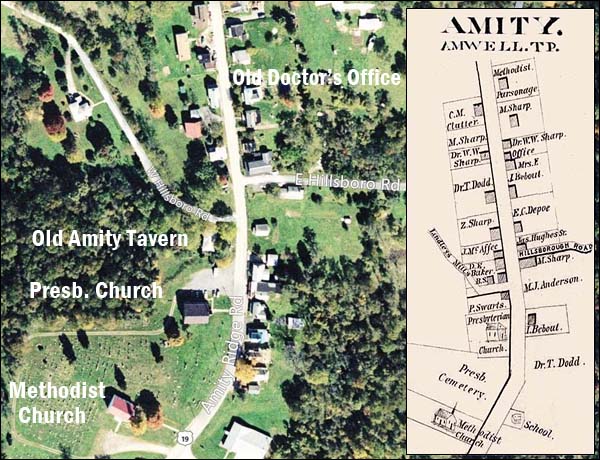
Note: By September of 1814 Solomon Spalding had no doubt moved his family out to Pittsburgh and resettled them at Amity in the adjoining county of Washington. Considering his generally poor health during that period, it is not likely that he traveled to Pittsburgh very often. Most likely he depended upon friends and neighbors to pick up his mail for him.

Solomon's name also appears on the letter lists published in The Commonwealth between Feb. 4 and Feb. 25, 1815, along with that of "John Spalding." It is possible that this John was Solomon's younger brother and that he was visiting Allegheny and Washington counties at the time.


Vol. III.                          Pittsburgh, (Penn.) Wednesday, November 2, 1814.                          No. 122.


The Town of Harmony,

AND lands adjacent, not having been sold entire, the subscriber has laid it out in town lots, and small farms, of a size to suit farmers, mechanics, and manufacturers, which will be sold separate, or in such parcels and quantities, as will accommodate all persons who may make application before the first day of December next, when, if not previously sold or applied for, the subscriber will proceed to a public sale in the town of Harmony, of the premises, in lots and small farms.

A plan for the whole property, and a particular description of the buildings and establishments, may be seen at the store of ISAAC BEAN, in Pittsburgh, at any time after the first day of November next.

The terms of payment will be one fourth in hand, the remainder in three equal annual payments.   FREDK. RAPP,

Attorney in fact for Geo. Rapp, &c.,
Harmony, October 26 --

Note 1: George Rapp's Harmony Society members built their first communal town on Conoquenessing Creek, Butler County, Pennsylvania (20 miles north of Pittsburgh), between 1804 and 1815. In the latter year the community there was disestablished and the property offered for sale to local buyers in mid-June, 1814 (see sales ads placed by George Rapp in the Pittsburgh Mercury between June 15 and Aug. 10).

Note 2: Sidney Rigdon was 22 years of age and living 30 miles south of Harmony when Rapp's followers abandoned the community. Two years later, while studying for the Baptist ministry, Rigdon temporarily resided in North Sewickley, just 5 miles west of the old Harmony townsite. Rigdon almost certainly heard many stories about Rapp's Harmonists and he probably encountered a few former members of the society in person. In 1824, before Rigdon left the Pittsburgh area for good, some members of Rapp's communal group began moving back to the Harmony area, and in the following months established a second Pennsylvania colony (called Economy) near the abandoned site of Harmony. The Rev. Sidney Rigdon was almost certainly fascinated with Rapp's communal group (as he was with the communal Shakers, whom he visited with in Ohio) and he probably developed communal religious ideas of his own from what he learned of the "Harmonists" and "Economists."

Note 3: For more information on the probable effect of George Rapp's ideas upon Sidney Rigdon and the early latter Day Saints, see Karl J. Arndt, "The Harmonists and the Mormons," in The American-German Review, X:5 (June 1944) pp. 6-9 and James H. Kennedy's Early Days of Mormonism, (NYC: Charles Scribner's Sons, 1888) p. 68, n. 1. See also various accounts of use of the divining rod, or "mineral rod," among both the Harmonists and the early Mormons (as well as the articles "The Divining Rod" in the Pittsburgh Mercury of Feb. 1, 1815 and in the Woodstock Observer of Apr. 16, 1822). On pages 110-113, in Dolores Hayden's 1976 book, Seven American Utopias, the author compares Rapp's 1805 city plat for Harmony and the Mormon's 1833 plat for their "City of Zion." Among other things, she says: "Rigdon's knowledge of town building undertaken by the members of the Harmony Society can only be surmised from circumstantial evidence..." She might have also added a similar line regarding Rigdon's knowledge of seers, seer stones, mineral rods, etc., all of which were current among the Pennsylvania Rappites. Finally, James McFarland, a local historian from the Pittsburgh area, stated a presumed association between Rapp's Harmonist ideas, Sidney Rigdon, and the early Mormons in a lecture delivered in 1922. See the notes attached to that article for speculation regarding the Harmonists' possible influence upon both Solomon Spalding and Sidney Rigdon.


Vol. III.                          Pittsburgh, (Penn.) Wednesday, November 16, 1814.                          No. 124.


JUST  RECEIVED,

And for sale at ROBERT PATTERSON'S
BOOKSTORE, Wood street, Pittsburgh,

A NEW Juvenile Atlas -- by John Mellish   Price $5.00

A military and Topographical Atlas of the United States --
By the same   5.00

A new map and statistical account of the United States,
in pocket form, neatly bound -- By the same.   2.00

A new map of the state of Ohio -- By the same   .50

A new description of the seat of war -- By the same   .50

Notes: (forthcoming)


Vol. III.                        Pittsburgh, (Penn.) Wednesday, January 18, 1815.                         No. 133.


FULLERS  BOARDS.

R.  PATTERSON,  BOOKSELLER,


WOOD  STREET,  PITTSBURGH,

HAS now on hand, a quantity of FULLERS BOARDS, of the best quality.


MONEY  FOUND,

WAS found, a small bundle of NOTES. The owner may have them by proving property and paying for this advertising, Enquire at.

R.  PATTERSON s,  Book-store,

Note 1: During the early winter of 1814-15, Joseph Patterson, Jr.'s name disappears from the from the advertising of R. and J. Patterson. After January, 1815, the business is designated simply as "R. Patterson's, Book-store." The last known book published by "R. and J. Patterson" was the New Testament volume of Thomas Scott's Bible, and edition of which was printed by the brothers late in 1815. However, prior to that publication, other books were printed in 1815, by Robert, without the inclusion of his brother's initial on the title-page.

Note 2: The War of 1812 was ended by the signing of a peace treaty at Ghent, Belgium on Dec. 24, 1814. News of the treaty signing did not reach Pittsburgh until February of 1815. Then, according to an entry in James Reid Lambdin's Journal: "At the news of peace there was a grand illumination of the houses in Pittsburg and many transparencies with emblematic devices were exhibited. At the book-store of the Messrs. Patterson, where my brother Harrison was employed, they had one respresenting the figures of the two nations, with the motto 'Enemies in war, in peace friends.'"


Vol. IV.                          Pittsburgh, (Penn.) Saturday, February 1, 1815.                          No. 135.


From the Petersburg Courier.

The Divining Rod.

The art of the divining rod or magic wand, has been in practice for several centuries. It had its origin in Germany, but by whom is uncertain. It was used at first in Europe for the purpose of finding metals and minerals, and afterwards inFrance was even employed by impostors for the discovery of stolen property, and to identify characters guilty of crimes. Until within these few years it was always considered as an art similar to that of animal magnetism, founded on error and deception -- but from a series of experiments which have been made and reported by some of the first experimental philosophers in Europe, the art of the divining rod now begins to assume a scientific form, and the laws by which it is directed are ascertained with nearly the same accuracy as those of electricity and galvanism. The uses to which it may be applyed are perhaps even more extensive than those of t[wo] other sciences, and in this country particularly, it is capable of being rendered extremely advantageous.

The following are the results of experiments which have been made:

1st. A single twig of any tree, whatever, when newly cut will diverge a certain number of minutes or degrees from its proper position when brought directly over or in the immediate vicinity of any conducting substance, such as metals or water. But the best conductors for electricity and galvanism are not the best for the divining rod. Water is found to be more powerful than any of the metals, and salt water still more powerful than fresh. The degree of attraction also depends considerably upon the substance interposed between the conductor and the divining rod.

2d. Although a twig from any tree will prove the experiment -- yet some trees are found to answer much better than others -- the branch of the peach and the cherry tree are said to be superior in this respect. A forked twig will also diverge more powerfully than a single twig.

3dly. If the twig be suspended by an electric, or in immediate contact with an electric, no divergence will take place.

4thly. The angle of divergency depends in a great measure upon the nature of the conductor which is used. -- The human body is found to produce a greater degree of divergency than any other substance -- and the bodies of some individuals produce the effect in a most surprising degree, while in other individuals the action is scarcely perceptible. The effect is also found to vary with the state of the system. What appears most surprising is, that in the same individual the greater the state of debility, the greater the effect produced. If the skin of the human body be moistened, particularly those parts in immediate contact with the divining rod, the effect is much increased. Salt water or a weak solution of muriatic acid, has been found to be the best fluid for this purpose.

5thly. The most effectual mode of using the divining rod, is as follows:

The operator to be bare footed in making the experiment -- and to have the soles of his feet and his hands well moistened with salt water, or such a solution of the muriatic acid, as will not prove disagreeable. The divining rod to be a forked twig of peach, cherry or hazel tree. He holds the extremity of each fork by one hand, in such a manner that the twig may rest in a direction nearly perpendicular to the horizon, having the cut extremity upwards. The operator holding the twig carefully in this position, walks slowly forwards, and so soon as he approaches any subterraneous water or metal, not more than twenty feet below the surface of the earth, the twig begins to turn or bend forwards. If the metal or water be but a few feet below the surface of the earth, the twig turns entirely over with the extremity pointing towards the earth.

The same effect will take place with many individuals without being barefotted -- but if the above precautions be taken, the experiment will succeed with every person.

6thly. If the operator in making the experiment, has silk stockings, or uses silk gloves, no effect will be procured.

The divining rod has been practised in the western country for many years with the greatest success in the finding of water; and there are several gentlemen of the first respect in Kentucky, and whose veracity is unquestionable, with whom the experiment invariably succeeds. There are also two gentlemen in Richmond, who are well known, would never attempt to impose upon the public, equally dexterious in the use of it. Those are the Reverend John D. Blair, and Mr. John Foster. The latter I have seen myself make the experiment.

The European theory to explain the phenomena of the divining rod, is chiefly this. The conductor, whether water or metal, is supposed to form with the superincumbent earth and the fluids of the human body, a galvanic circle, and the more perfect this circle is, so much the more powerful will be the action of the divining rod.

Thus what was regarded only a few years ago as a deception practised by impostors and the credulous, is now cultivated, improved, and made the study of men of science.


Notes: (forthcoming)


Vol. I.]                                 Pittsburgh, Saturday, February 4, 1815.                                 [No. 19.


LIST  OF  LETTERS

Remaining in the Post Office at Pittsburg,
(PA.) Feb 1, 1815, not advertised before.

      S
Chls. Simpson
Daniel Stotler
Henry Steward
Isaac Sheldon
James Sharp
James Stanley
James Stevenson
James Smith
Joseph Sweney
John Spalding
John Smith
John P. Storm
John Scanlin
Martin Simpson
Michael Simmonds
Solm. Spalding
Samuel Spencer
White M. Snyder
Wm. Shannon
Jane Steward
Susannah Swartz
Sarah South

Notes: (forthcoming)


Vol. I.]                                 Pittsburgh, Saturday, February 11, 1815.                                 [No. 20.


LIST  OF  LETTERS

Remaining in the Post Office at Pittsburg,
(PA.) Feb 1, 1815, not advertised before.

      S
Chls. Simpson
Daniel Stotler
Henry Steward
Isaac Sheldon
James Sharp
James Stanley
James Stevenson
James Smith
Joseph Sweney
John Spalding
John Smith
John P. Storm
John Scanlin
Martin Simpson
Michael Simmonds
Solm. Spalding
Samuel Spencer
White M. Snyder
Wm. Shannon
Jane Steward
Susannah Swartz
Sarah South


Notes: (forthcoming)


Vol. I.]                               Pittsburgh, Saturday, February 25, 1815.                               [No. 22.


LIST  OF  LETTERS

Remaining in the Post Office at Pittsburg,
(PA.) Feb 1, 1815, not advertised before.

      S
Chls. Simpson
Daniel Stotler
Henry Steward
Isaac Sheldon
James Sharp
James Stanley
James Stevenson
James Smith
Joseph Sweney
John Spalding
John Smith
John P. Storm
John Scanlin
Martin Simpson
Michael Simmonds
Solm. Spalding
Samuel Spencer
White M. Snyder
Wm. Shannon
Jane Steward
Susannah Swartz
Sarah South

Note: It is possible that the "John Spalding" whose name appears in the list above was Solomon's brother, John, who lived three counties north of Pittsburgh, near Lake Conneaut. Taking that speculation one step further, it is also possible that John came to visit Solomon, (or even came to help him relocate from Pittsburgh to Amity) and that both brothers were no longer in Pittsburgh when this letter list was published.


Vol. III.                              Pittsburgh, (Penn.) Wednesday, March 1, 1815.                              No. 139.


A  Sermon.

JUST published, and for sale by S. Engles, printer, Wood street, Pittsburgh, and at the Bookstores, price 18 3/4 cents.

AN ORDINATION SERMON,

delivered at a meeting of the Ohio Presbytery, at the Forks of Wheeling, April 20th, 1814, by a member of said Presbytery.

Notes: (forthcoming)


Vol. III.                              Pittsburgh, (Penn.) Tuesday, March 28, 1815.                              No. 143.


Military Atlas -- By John Melish,

JUST received, and for sale by the subscriber, price $5.00, and with [nice] extra maps $7.00.

                              ROBERT PATTERSON.
Pittsburgh, March 14

N. B. Lost, lent, taken, or delivered in mistake, the sixth half volume of the American edition of the Edinburgh Encyclopedia, published by Edwards Parker, Philadelphia.

There are twenty two subscribers to this work, in Pittsburgh and its distant vicinity, and a duplicate copy may by mistake have been delivered to a subscriber; it may have been lent, and the name of the person, to whom lent, forgotten; or it may have been otherwise taken. Any person giving satisfactory intelligence, respecting this literary stray, will confer a particular favor.

Notes: (forthcoming)


Vol. III.                          Pittsburgh, (Penn.) Tuesday, May 13, 1815.                          No. 150.


JUST  PUBLISHED,

(Price One Dollar)

"THE  TRAVELLER,"

(by Meikle, Author of Solitude Sweetened)

ANY person who has a relish for reading religious books, and who has read any one of those written by James Meikle, of Cornwath, will not need a recommendation to purchase any of the rest of his works. It may safely be said that the volume now offered to the public is equally as valuable as Solicitude Sweetened; and will probably be more gratifying to pious readers, as it contains the Life of the author. As the first Pittsburgh edition of Solicitude Sweetened has been sold off in less than a year, it is probable that a second edition will shortly go to press.

Conditions on which books published by the subscriber are sold, viz. one copy gratis out of ten -- three out of twenty -- seven out of forty -- twelve out of sixty.

The subscriber will shortly put to press a volume of Ralph Erskine's Sermons, to contain 300 pages, at one dollar.
                RT. PATTERSON.

Notes: (forthcoming)


Vol. III.                          Pittsburgh, (Penn.) Tuesday, May 20, 1815.                          No. 151.


One Dollar Reward.

STRAYED away from the subscriber, a large BLACK COW. Having the tops of her horns cut off, and a five cut out of her left ear; has two white spots on her left shoulder, and some white on her belly -- The above reward and reasonable charges, will be paid on delivery of said cow to the subscriber, in Diamond Alley, between Market and Wood streets.   PRUDENCE  LAMBDIN.

Note 1: Prudence Harrison Lambdin (1772-1846) was the mother of Jonathan H. Lambdin. Jonathan (usually called "Harrison") was the purported Pittsburgh friend of Sidney Rigdon. Prudence was married to James Lambdin, in Talbot Co., Maryland, on Sept. 1, 1795. According to the "Journal" of their son, J. R. Lambdin, the couple decided to move from Baltimore to "the great west" in 1805. They ended up at Pittsburgh, that winter, having traveled there with James' cousins, William and John Lambdin.

Note 2: The couple's children were Jonathan H. Lambdin (Sept. 1, 1798- Aug. 25, 1825), James Reid Lambdin (1807-1889), and Samuel Hopkins Lambdin (1812-1902). Some genealogical records also attach the following siblings to this list: Margaret, Prudence, and Elizabeth (all born in Maryland before 1806) as well as Charles Spencer, Sylvanus James, and Marie (all born at Pittsburgh after 1806). Prudence's husband, James Lambdin, (b. Apr. 7, 1773) died at Pittsburgh in 1812. His son's "Journal" says James died of "pleurisy" on Sept. 12, 1812 but other records say he died on Nov. 12th See the Pittsburgh Gazette of Mar. 9, 1816 for a mention of Prudence then being the "administratrix of James Lambdin, deceased."


Vol. III.                          Pittsburgh, (Penn.) Saturday, June 3, 1815.                          No. 153.


JUST  RECEIVED,

The Following  New  Works:

PORTER's JOURNAL, of a cruise to the Pacific ocean, in the years 1812--13 & 14,
Life of Wellington,
Life of General Lee,
Life of General Eaton,
Recuse of Norway, 2 vols
Waverly, or "Tis sixty years since," 2 vols.
Olive Branch, furth edition, improved and enlarged.
Porter's narrative of the campaign in Russia.
            -- Also --
A supply of Carey's elegant Bibles, with seventy engravings. Price -- in sheep, $12.25 -- morocco, $16.00 -- calf extra, $16.00
                          R. PATTERSON.

Notes: (forthcoming)


Vol. III.                          Pittsburgh, (Penn.) Saturday, June 10, 1815.                          No. 154.


TO  CARPENTERS,

JUST received from Boston, a large supply of Benjamin's Architecture, price $7.00.
            -- Also --
The Rudiments of Architecture, an abridgement of the above, by the same,   3.00
And for sale, by
                          R. PATTERSON.


==> DR.  HORWITZ will deliver his introductory lecture on the HEBREW LANGUAGE, on Monday the 12th inst. in the Academy, at 7 o'clock, P. M. For further information, [apply] at the bookstore of the rev. R. PATTERSON.

Notes: (forthcoming)


Vol. III.                          Pittsburgh, (Penn.) Saturday, June 17, 1815.                          No. 155.


W. W. WOODWARD's

Third edition of the Rev. Dr. Thos Scott's

FAMILY  BIBLE.

... R. PATTERSON, bookseller, Pittsburgh, will receive supscriptions to this edition of Scott, until the first day of January, 1815 and will deliver the work in Pittsburgh, without charge for carriage from Philadelphia, to those subscribers who return their names to him.

It is yet uncertain when the first volume will be published, probably in the winter of 1815-16....


Notes: (forthcoming)


Vol. IV.                         Pittsburgh, (Penn.) Saturday, September 23, 1815.                         No. 169.


ONONDAGA, Aug. 23.

Death of the Indian Prophet.

DIED at the Onondaga Castle, on Sunday last, one of the chiefs of the Alleganies, well known through this country as the Indian Prophet.

Those who have been acquainted with the influence which this man's preaching has had upon the conduct of the Six Nations, (the Oneidas excepted,) cannot but look upon his death as a severe dispensation of Divine Providence. We think that a short biographical sketch of this extraordinary man cannot be unacceptable to the public.

During the first fifty years of his life, he was remarkable only for his stupidity and beastly drunkenness. About 13 years ago, while lighting his pipe, he suddenly fell back upon his bunk, upon which he was then sitting, and continued in a state of insensibility for six or eight hours; his family supposing him dead, had made preparations for laying him out, and while in the act of removing him from his bunk, he revived. His first words were "don't be alarmed, I have seen Heaven; call the nation together that I may tell them what I have seen and heard." The nation having assembled, he informed them he had seen four beautiful young men who had been sent from Heaven by the Great Spirit, and who thus addressed him -- "The Great Spirit is angry with you and all the red men and unless you immediately refrain from drunkenness, lying, stealing, &c. you shall never enter that beautiful place which we will now shew you." He stated that he was then conducted by these young men to the gate of Heaven, which was opened, but he was not allowed to enter; that it was more beautiful than any thing they could conceive of, or he describe; and that the inhabitants appeared to be prefectly happy; that he was suffered to remain there three or four hours and was then conducted by the same young men, who on taking their leave, said they would visit him yearly, and commanded him to inform all other Indians what he had seen and heard. He immediately visited the different tribes of Indians in the west part of the states, Oneidas excepted. They all put the most implicit faith in what he told them, and revered him as a Prophet. The consequence has been that from a filthy, lazy, drunken, wretched set of beings, they have become a cleanly, industrious, sober and happy people. The Prophet has continued, as he says, to receive regular annual visits, from these heavenly messengers, immediately after which, he, in his turn, visited the different tribes. He was on one of his annual visits at the time of his decease.

It will be proper to observe, that he was called the peace prophet, in contradistinction to their brother Tecumseh, who was called the war prophet.


Note: Joseph Smith, Jr., in 1834, claimed to have viewed the remains of a White Lamanite, named Zelph, who was a warrior under the ancient rule of the Prophet Onondagus in North America.


Vol. IV.                          Pittsburgh, (Penn.) Saturday, October 7, 1815.                          No. 171.


LOTS FOR SALE, IN THE TOWN OF

GRANGER.

THE subscribers, having laid out the town of GRANGER, will offer the lots for sale on the premises, at public vendue, on Thursday, the second day of November next

The town of Granger is delightfully situated upon an elevated tract of land, on the shore of Lake Erie, and west bank of Rocky river, in the county of Cuyahoga, and state of Ohio, surrounded by a rich and fertile country which is rapidly settling. Its situation for healthiness, salubrity of air, purity and conveniency of water and fertility of soil, is not surpassed, if qgualled, by any situation upon lake Erie.

Rocky river is a stream of pure water, affording excellent mill seats, a fine fishery, an inexhaustible quantity of building stone. Stone coal has been discovered in its banks. The bay is one of the safest and most commodious harbors on the lake; the course and depth of the channel being never affected by the drifting of sand, a circumstance very uncommon with the mouths of the lake rivers. An island in the river near the mouth, around which the ice and drift wood are forced by a bend in the river, forms an excellent harbor for shipping secure from storm and floods. The facility of erecting warfs at trifling expense, will considerably add to the many advantages Granger possesses.

The prospect of opening a communication to the navigable waters of the Muskingum and Sciota, being 45 miles north of Wooster, 55 miles northwesterly of Canton, 65 miles northeasterly of Mansfield, and 35 miles from the navigable waters of the Ohio; the immediate prospect of good roads in those directions, must within a few years, bring the commerce of the southern parts of Ohio and the adjacent states, to lake Erie.

The situation of the town of Granger, in point of commercial advantages, will give it a decided preference, and bids fair to be a place of considerable importance, worth the attention of the enterprising merchant, manufacturer and mechanic.

Liberal encouragement will be given to those who make early improvements in the town.

Terms of sale, a small portion in hand, and a liberal credit on the residue.

JOHN BEVER,
GIDEON GRANGER,
JOSEPH H. LARWILL,
CALVIN PEASE.

Note: The still undeveloped township of Granger lies about midway between Akron and Cleveland in modern Medina County, Ohio. If Solomon Spalding read this notice in the newspaper, he must have felt some pangs of regret over his own failed land sales efforts along the Erie shore, only a few short years before. The advent of the War of 1812 ended his hopes of making a fortune in land speculation in Ohio. The financial investments of his former associates (Gideon Granger, Calvin Pease, etc.) appear to have weathered the martial storm far better than did Spalding's own star-crossed schemes.


"Tis pleasure, through the loop-holes of retreat, to peep at such a world"

Vol. VIII No. 10]                     Washington, (Pa.) Monday, October 9, 1815.                     [Whole No. 374


From the Niagara Journal of Sept. 12.

A Council was held in this village last week, with the Indians, by Messrs. Parish and Granger, for the purpose of purchasing for the state, their title to the islands in the Niagara. The Indians we understand, consented to the sale, and the bargain requires only the ratification of the governor to be completed.

His Excellency Gov. Tompkins has arrived in this village yesterday evening, on his route to visit the Falls.

Note: The relationship of the Mr. "Granger" mentioned in this news report, to Gideon Granger, a one-time partner of Solomon Spalding in land speculation, remains undetermined. The islands of the Niagara River included Grand Island, where, in 1825, Mordecai M. Noah planned a city of refuge for the gathering of scattered Israel (including the Indians, whom he felt were descended from Israelites). Some students of Book of Mormon geography identify the Niagara River with the "River Sidon" of that book. See also the Oct. 30 issue of The Reporter.


Vol. IV.                          Pittsburgh, (Penn.) Saturday, October 28, 1815.                          No. 174.


Destructive  Fire!

About two o'clock on Friday morning, the citizens of this borough were alarmed with the cry of FIRE. It proved to be in Mr. Church's hatter's shop, in Wood street, about the centre between Third and Fourth streets. The wind was unusually high and stormy; and at one time it seemed almost impossible to stop the ravages of the flames. After raging with great violence for better than two hours, the citizens happily succeeded in stopping their further progress. The whole front of the aquare from Mr. Patterson's book store, on the corner of Fourth, and along Wood street, to John M.Donnell, esq,'s at the corner of Third, including both corners, is entirely consumed, together with a number of back buildings. The loss of property cannot be estimated at less than from 40 to 50,000 dollars. -- We sincerely sympathise with the suffers.
Note: The Pittsburgh Gazette for Oct. 28th also carried this news story: "... a most alarming fire broke out in the hatter's shop of Mr. Church, on the East side of Wood, between Third and Fourth Streets, which before it was extinguished destroyed the whole range of fine brick houses between the two Streets, besides a number of frame and back buildings." Luckily for Solomon Spalding, his manuscript story was either not on the premises when the fire began, or it was rescued from Patterson's office or Silas Engles' print shop before they were consumed by the fire.


Vol. ?                                  Pittsburgh, October 28, 1815.                                    No. ?


MARRIED. -- On the 12th Inst. by the Rev. Joseph Stockton, Mr. William Eichbaum to the amiable Miss Rebecca Johnston, daughter of John Johnston, P. M., in this place.

Note: According to his daughter Rebecca, John Johnston remained in the position of Postmaster in Pittsburgh until 1822. In that year the U. S. Postmaster General officially transferred the position to Johnston's son-in-law, William Eichbaum, Jr. The scanty post office furniture and equipment apparently remained in Johnston's home until Jan. 1824, when Eichbaum moved the post office to his own house on Second street.

Rebecca Johnston Eichbaum was the clerk of the Pittsburgh Post Office from 1811 to 1816. Between 1822 and 1833 she occasionally filled in for her husband in his duties when he was away from the office. In her work at the office she recalled both Solomon Spalding and Sidney Rigdon calling for their letters at her father's house (see note for advertisement of July 1816).


"Tis pleasure, through the loop-holes of retreat, to peep at such a world"

Vol. VIII No. 12]                     Washington, (Pa.) Monday, Oct. 30, 1815.                     [Whole No. 376.


INDIAN  TREATY.

A treaty entered into this 12th day of September, 1815, at Buffalo in the county of Niagara and state of New York, between the chiefs, sachems, and warriors of the Seneca nation of Indians, of the first part and the people of the state of NewYork, on the second part, witnessed as follows:

First. The said chiefs, sachems and warriors of the Seneca nation, in consideration of the sum of one thousand dollars in hand paid by Daniel D. Tompkins, governor of the state of New York, and the covenants and agreements hereinafter contained, do hereby sell grant, convey and confirm, to the people of the state of New York, all the islands in the Niagara river, between Lake Erie and Lake Ontario, and within the jurisdiction of the United States; to have and to hold the same, with the appurtenances unto the said people of the state of New York in free and pure allodium forever -- reserving, however to the said chiefs, sachems and warriors of the Seneca nation of Indians, equal rights and privileges with the citizens of the U. States, in hunting fishing and fowling, in and upon the waters of the Niagara river, and of encamping on any of the said islands for that purpose, whilst the same shall continue to belong to the people of the state of New York.

Secondly. The people of the state of New York, in addition to the sum of one thousand dollars already paid to the said chiefs, sachems and warriors of the Seneca nation, covenant to pay them annually forever, an annuity of five hundred dollars to be paid on or before the first day of June in each year forever hereafter, at Canandaigua, in the county of Ontario, the first payment to be made on the first day of June 1816. In testimony whereof, the aforesaid chiefs, sachems and warriors of the one part, and Daniel D. Tompkins, governor of te state of New York, Peter B. Porter, Henry Crocheron, Samuel Young, Roger Skinner, Esex Cowan, Robert Tillotson, and Lewis Livingston, commisioners in behalf of said state, have hereunto set their hands and seals, at Buffalo in the county of Niagara, the day & year first above written.

(Here follows the signatures of both parties.)


The islands ceded, are Squaw island, opposite the mouth of Conjickety Creek. 3/4ths of a mile in breadth, containing some excellent meadow & but few trees: Strawberry Island, about a mile below. containing wild meadow, and about the size of Squaw Island: -- Grand Island, commences three miles below Black Rock and extends to within a mile of Schlosser 12 miles long and from 2 to 7 broad, well timbered level and said to contain an excellent soil; there is, however, on thr Island a large cranberry marsh, no improvements of any consequence: Navy Island lies partly between the lower wnd of Grand Island and the British shore, is supposed to be within the boundary of Upper Canada, because the branch which passes between Grand island and our shores, united to that which passes between Grand and Navy Islands, are superior to the third branch of the river which passes between the island and the Canada shore -- the questions of territory will doubtless be settled by the commissioners of both governments -- this island is about 3/4ths of a mile long and 100 rods broad, and has been somewhat cultivated: Goat Island, divides [the] Fall of Niagara half a mile long and some 60 or 80 rods broad, it is rocky and covered with very shabby timber & accessible only at a single point.


Note: It was the remnant of these same Seneca Indians to whom Oliver Cowdery and Parley P. Pratt first brought the Book of Mormon, at the commencement of their 1830 "mission to the Lamanites." By that time the Indians were mostly living on the the Cattaraugus Reservation, south of Angola, in Erie County. Although Solomon Spalding does not mention Grand Island nor the Seneca Indians in his extant writings, he does speak of the Cattaraugus region and Indians living there -- who were most likely Senecas.


Vol. IV.                             Pittsburgh, (Penn.) Saturday, November 4, 1815.                          No. 175


S. Engles,  Printer,

INFORMS the public, that he has recommenced his business in Wood street, four doors above Diamond alley, opposite Mr. Sturgeon's tavern, where he solicits a continuance of public patronage.

HANDBILLS,
Cards, Blanks, and Job Work

OF EVERY DESCRIPTION,

Neatly executed, at the shortest notice.

He takes this method of expressing his gratitude to his fellow-citizens, for their unparalelled exertions in saving the principal part of his materials from the destructive Fire on Friday morning, the 27th ultimo and sincerely hopes they may never need a reciprocation of the favour.

He earnestly calls on those indebted to him, to settle their accounts without delay.

Note: Engles placed essentially the same notice in the Gazette for Nov. 4, 1815. On Dec. 2, 1815 he placed another notice in the Mercury and the Gazette, proposing to publish a new paper, to be called the Republican Advocate. This newspaper never was never commenced, however.

A few months later Engles moved his press to a new location on Liberty Street, "nearly opposite Fifth Street" (Gazette, Mar, 30, 1816). At this address he entered into partnership with Ephraim Pentland to print The Statesman, beginning on May 9, 1818. Finally, in April of 1819, Engles moved for the last time -- to the "Diamond," behind the Allegheny County Court House.


Vol. IV.                           Pittsburgh, (Penn.) Saturday, November 25, 1815.                           No. 178.


The Subscriber,

THOUGH ejected by fire and flame, from house or home, in the late calamity in Wood street, has under the kind hand of Providence, sustained very little loss, probably not exceeding three or four hundred dollars, the least it is supposed of any of the sufferers on that occasion. He is much indebted to his friends for their prompt exertions to rescue his property, and guard it from plunder when it lay exposed on the street. Immediately after the fire he recommenced business, WHOLESALE and RETAIL, as usual, in the house of Thomas