READINGS  IN  EARLY  MORMON  HISTORY
(Newspapers of Pennsylvania)


Misc. Pennsylvania Newspapers
1820-1839 Articles
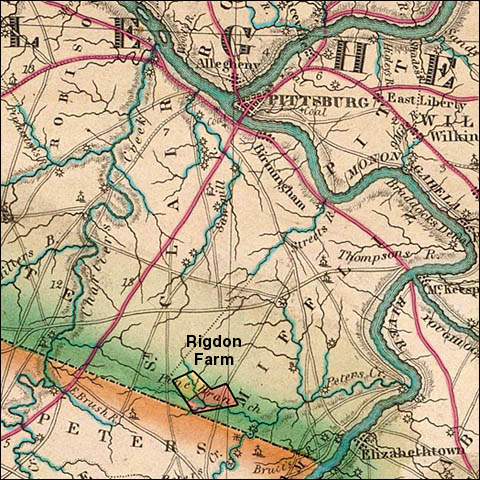

St. Clair Twp. (1826 PA map) - boyhood home of Sidney Rigdon,
who lived on the "Pine Branch" of Peters Cr., near the county line


1810-19   |   1820-39   |   1840-42   |   1842-43   |   1844-49   |   1850-99   |   1900-99


PitGz Jan 07 '20  |   CRp Jan 11 '20  |   PitGz Jul 10 '20  |   PitMr Nov 20 '22  |   PitGz Feb 21 '23
PitGz Apr 04 '23  |   PitMr May 20 '23  |   PitMr Jun 17 '23  |   PitMr Jul 01 '23  |   PitGz Jul 25 '23
PitGz Sep 22 '23  |   PitMr Jan 06 '24  |   PitMr Jan 20 '24  |   PitGz Apr 09 '24  |   PitRc Aug 31 '24
PitRc Oct 05 '24  |   PitRc Nov 02 '24  |   PitRc Dec 07 '24  |   PitGz Jan 28 '25  |   PitGz Feb 04 '25
PitGz Feb 11 '25  |   PitRc Feb 22 '25  |   PitGz Feb 25 '25  |   AlgD Mar 01 '25  |   PitRc Apr 05 '25
PitRc Apr 26 '25  |   PitGz Jun 17 '25  |   PitGz Aug 26 '25  |   PitRc Sep 27 '25  |   AlgD Oct 04 '25
SReg Jan 13 '26  |   PitGz Feb 14 '26  |   SReg Jun 02 '26  |   PitMr Sep 06 '26  |   PitRc Oct 03 '26
ErieGz Mar 22 '27  |   PitMr Jul 24 '27  |   ErieGz May 07 '29  |   ErieGz May 13 '30  |   PAd Dec ? '32
HerT Dec 19 '32   |   ErieOb Sep 07 '33  |   AMfg Feb ? '34  |   SReg May 01 '34  |   IVol Apr 16 '35
IVol Oct 29 '35  |   IVol Aug 04 '36  |   RepH Aug 17 '36  |   IVol Aug 25 '36  |   IVol Jul 27 '37
ErieGz Jun 07 '38  |   Spec Jan 10 '39  |   PitGz Jul 01 '39


Newspaper Articles Index   |   Early Penn. Magazines   |   Philadelphia papers



Vol. 33.                             Pittsburgh, Friday, January 7, 1820.                             No. 175.

Edited by Robert Morris -- Pub. by Jesper Harding, 74 1/2 South 2nd St. & 56 Carter's Alley.


At the annual meeting of the Pittsburgh Sunday School Association, held at the Second Presbyterian Church, on the 28th of December, 1819 -- The following gentlemen were elected officers of the Society, for the ensuing year:

The Rev. Joseph Patterson, President. Mr. Thomas Davis, 1st Vice Prest. Mathew B Lowrie, Esq., 2d. Vice Prest....


Notes: (forthcoming)


THE  CARLISLE  REPUBLICAN.
Vol. I.                            Carlisle, Pa. Tuesday, January 11, 1820.                           No. 10.


The Pilgrims.

The citizens of Carlisle will no doubt recollect a gang of dirty, squalid creatures, who passed through some years ago calling themselves Pilgrims, and stating that they were on their way to the Promised Land -- By the following account, which we copy from the "Christian Watchman," the reader will find that their pilgrimage did not turn out so happy as they were led to believe by the impostor who styled himself their priest. Whilst every friend to humanity cannot but deplore their misfortunes, yet it affords another salutary lesson to those who "depart from the faith of their fathers to seek strange gods."

Extract of a letter from a gentleman in the interior of New York
to a friend in this vicinity.

Passing near Dryden, I was induced to enquire after news from the 'Pilgrims,' who were visited at their encampment in that town, by Mr. Chase, missionary, whose account of them was published in the Am. Baptist Magazine a year ago.

I was told that their prophet led them westward to the Allegheny river, where they took a large boat, and went down that river in search of the 'promised land,' to which their pretended prophet was conducting them; that on their arrival at a certain island, they disembarked, and the prophet began to penetrate the soil with his staff, to discover if there were any indications of their approach to his uptopian Canaan. He at length announced to his deluded followers that this island was in very deed, the sought for land; in proof of which, his staff, which he left in the ground, would, at a given hour, put forth buds and blossom! but that in the mean time, himself, and priest must go to the main land, ' and seek the Lord.' They accordingly took the boat together with all the provisions and money (of both which they had picked up a considerable quantity on the road) and departed; leaving the rest of the party, augmented to about 70 persons, on the island to wait the issue of the prophet's miracle. The given hour however went by, and the prophet's staff remained but a barren stick. Neither bud nor blossom, prophet nor priest, appeared; and what was still worse, they had neither bread nor meat nor the means of procuring either.

In this distressing situation they remained three whole days, when they were providentially discovered & taken up by some passing boats. Neither their prophet nor priest have since been heard of, and the "pilgrims" made the best of their way to their several homes.

For the authenticacy of this account I cannot vouch further than to say that I heard it related within a few miles of the place where Mr. Chase saw them, and where the prophet acquired several new followers; some of whom as I was informed, have returned to tell their own pitiable story.


Note: For a response to this account (as well as a couple of corrections) see the Philadelphia Union of Jan. 26, 1820.


Vol. ?                             Pittsburgh, Monday, July 10, 1820.                             No. ?

Edited by Robert Morris -- Pub. by Jesper Harding, 74 1/2 South 2nd St. & 56 Carter's Alley.


Drowned. -- On Friday evening last, in the Allegheny River, at the old warf, Mr. George Forrester, formerly a teacher in this city, and latterly clerk of the Pittsburgh Steam Engine Company.

In the death of this very worthy gentleman a support & kind protection have been snatched from a rising family, and the community deprived of a virtuous and enlightened citizen.


Rags. -- Four Cents Cash, per pound, will be given for clean Rags of good quality, at the corner of 3d and Wood sts., Pittsburgh, by J. Patterson & Co.


Note: The unexpected death of the "Scotch Baptist" pastor, George Forrester, propelled Walter Scott into the pastorate of that small congregation in Pittsburgh. This group later formed the nucleus for the first Disciples of Christ church in the city.


Vol. ?                            Pittsburgh, (Penn.) Tuesday, November 20, 1822.                           No. ?


Raw  Hides  and  Skins:

THE subscriber. at his tanyard, on the Washington turnpike, four miles from Pittsburgh, wishes to purchase a quantity of

Raw  Hides  and  Skins,

For which the Pittsburgh prices will be paid. He will execute tanning and currying on the shares, and engages that his work shall be well executed.

WANTED,

An APPRENTICE to the above business, he must be of from sixteen to seventeen years of age, and come well recommended.

Thomas M. Henry.

St. Clair township.

Note: In 1822 Sidney Rigdon's close relatives still lived on farms in his hometown of St. Clair township, Allegheny Co. -- within easy walking distance of Mr. Henry's tannery. While it is extremely doubtful that Rigdon would have applied for apprentice work at the tannery in 1822 (when he was already 29 years of age and an ordained Baptist minister), it is possible that he had performed some work for Mr. Henry prior to his leaving the area in 1818. If so, such training in a tannery might help explain how Sidney Rigdon so easily joined with his brother-in-law in 1824 to engage in "journeyman" tanning work in Pittsburgh. The tanning profession, as it was practiced in those days, generally required the preparation of a lengthy apprenticeship prior to employment at the "journeyman" level. If Rigdon did receive some experience in the tanning trade prior to 1818, such work might have easily included the manufacture of leather book-binding material for sale in neighboring Pittsburgh. There were at least two book-binding establishments located in the city before 1818, one of which was owned by Robert and Joseph Patterson (see notes on article for Oct. 4, 1825).


Vol. 38.                                     Friday Morning, February 21, 1823.                                    No. 39.

Edited by Robert Morris -- Pub. by Jesper Harding, 74 1/2 South 2nd St. & 56 Carter's Alley.


The partnership heretofore existing between Robert Patterson & Jonathan H. Lambdin, trading under the firm of R. Patterson & Lambdin is hereby dissolved.

     Pittsburgh Feb. 17, 1823.

Note 1: Unfortunately no account of the exact reason for the partnership's dissolution has survived. The printing firm of Butler & Lambdin appears to have gone under before the end of 1822 and the firm of Patterson & Lambdin may have subsequently declined into being little more than a wallpaper business. Evidently, during this period J. Harrison Lambdin was living with his new bride "in a house on 4th St. below Redoubt Alley." At least that is what his brother James reports, following Rachel Wilbur Lambdin's arrival in Pittsburgh in 1818.

Note 2: Speaking of a time about a year and a half later, James Reid Lambdin places his brother's residence at the corner of Wood and Smithfield streets. The 1819 Pittsburgh Directory lists Prudence Lambdin as living nearby, on the "N. side of 3d, between Wood and Smithfield streets." This is the same general area where James opened his painting studio during the summer of 1824.


Vol. 38.                                     Friday Morning, April 4, 1823.                                    No. 45.

Edited by Robert Morris -- Pub. by Jesper Harding, 74 1/2 South 2nd St. & 56 Carter's Alley.


ERIE  COURT  HOUSE  BURNT.

On Saturday night, the 22d ult, the fine Brick Court House, and all the public offices attached to it, at Erie. Pa. were destroyed by fire. All public records in the offices were consumed.


                            Pittsburgh, March 26th, 1823.
WE take the liberty to inform our friends and the public generally, that R. PATTERSON & LAMBDIN have appointed us their Assignees; and as such we shall continue to keep on hand a general and exhaustive supply of

B O O K S
AND
  STATIONERY,

at the old stand, (corner of Wood and Third Streets) where Rags and country produce will be received in payment as formerly. We have reduced the prices of all articles in this line of business to a cash standard.

M. B. LOWRIE.
HENRY HOLDSHIP, > Assignees,
THOMAS COOPER,
P. S. Address "The Assignees of R. Patterson & Lambdin."

Note 1: Also printed in the April 4th issue of the Gazette was the Notice of a Sheriff's Sale, ordered to dispose of the Pittsburgh properties belonging to the bankrupt firm of R. Patterson & Lambdin. Among the properties sold on Saturday, April 19th was Patterson's steam paper mill. The fact that Lambdin had dissolved his partnership with Patterson on or about Feb. 17, 1823, combined with this forced sale of the assests of the defunt firm, probably indicates that the final weeks and months of the partnership were not amicable ones. James Reid Lambdin says in his "Journal": "my brother's [in 1822] were becoming quite embarassing. Patterson & Lambdin, who were then largely engaged in the manufacture of paper... [suffered] loss without any insurance. This caused increased trouble in their pecuniary affairs.

Note 2: Apparently Matthew B. Lowrie and Henry Holdship (a Lambdin family friend) either sued Patterson and Lambdin in the Allegheny County Court of Common Pleas late in 1822 for financial obligations incurred by the partnership, or in some other way became involved in the firm's financial affairs. The court settlement eventually left Henry Holdship as the owner of most of the partnership's assets. Holdship, in turn, appears to have engaged Robert Patterson and J. Harrison Lambdin (probably seperately) as agents in running the former partnership's paper mill and book store.

Note 3: Into the midst of this unforunate set of circumstances in Pittsburgh came the Rev. Sidney Rigdon at the end of January, 1822. During the following three years of his residence in Pittsburgh, Rigdon could honestly say: "...there was no man by the name of Patterson during my residence at Pittsburgh who had a printing office... He was then acting under an agency, in the book and stationery business, and was the owner of no property of any kind, printing office, or any thing else, during the time I resided in the city." (letter of May 27, 1839).


Vol. XI.                             Pittsburgh, (Penn.) Tuesday, May 20, 1823.                             No. ?


CURIOUS  MANUSCRIPT.

The public has been much amused of late with an account of the discovery of a curious manuscript at Detroit, which not a little puzzled the learned. It was determined that it was not Chinese, Arabic, Syriac -- French, Spanish or English, &c. but what it was no one could tell. Four pages of the book being sent to major general Macomb, at Washington, he submitted it to the examination of the professors at Georgetown college, where it has has been discovered to be Irish, and, with a few exceptions, "truly classical." -- Some "strange abbreviations" make it difficult to unravel it, but a part has been translated, and it is evidently a treatise on some of the doctrines of the catholic church.


Note 1: It is unknown how closely the Rev. Sidney Rigdon followed the outcome of this news story. The Mercury article was reprinted from Niles National Register, which, in turn, paraphrased a news report from the Detroit Gazette of Mar. 14, 1823. At the time of its appearance Rigdon was already deeply in trouble with the orthodox members of the Pittsburgh First Baptist Church and with the neighboring Baptists comprising the Redstone Baptist Association. On July 11, 1823, the Rev. John Winter and other Pittsburgh Baptists brought heretical teaching charges against Pastor Rigdon, in anticipation of their having him dismissed from his ministerial office and excommunicated from the Redstone Baptist Association.

Note 2: If Rigdon's own curiosity was aroused by the "curious manuscript" discovery, he perhaps read the various related newspaper reports and learned that a sample of its seemingly untranslatable characters had been sent to the famous Dr. Samuel Mitchell of New York City, for his analysis. Mitchell speculated that the manuscript was written, not in "Irish," but in a peculiar form of old Latin and that its contents resembled somewhat those of a certain archaic manuscript of the biblical scriptures. It is not unlikely that Rigdon, the Bible student, was then impressed with the idea that Dr. Mitchell might be called upon to confirm the antiquity of any other such puzzling scriptural discoveries that might subsequently be brought to light in North America.

Note 3: Reports of this same "curious manuscript" were also printed in the Apr. 15, 1823 issue of the Canandaigua Ontario Repository (near the home of Joseph Smith, Jr. in New York) and in the Apr. 16, 1823 issue of the Poultney Gazette (near the home of Oliver Cowdery) in Vermont.


Vol. XI.                              Pittsburgh, (Penn.) Tuesday, June 17, 1823.                              No. ?


                            Pittsburgh, March 26th, 1823.
WE take the liberty to inform our friends and the public generally, that R. PATTERSON & LAMBDIN have appointed us their Assignees; and as such we shall continue to keep on hand a general and exhaustive supply of

B O O K S
AND
  STATIONERY,

at the old stand, (corner of Wood and Third Streets) where Rags and country produce will be received in payment as formerly. We have reduced the prices of all articles in this line of business to a cash standard.

M. B. LOWRIE.
HENRY HOLDSHIP, } Assignees,
THOMAS COOPER,
P. S. Address "The Assignees of R. Patterson & Lambdin."


Notes: (forthcoming)


Vol. XI.                              Pittsburgh, (Penn.) Tuesday, July 1, 1823.                              No. ?


JUST  PUBLISHED,

AND for sale at the bookstores of Mr. Loomis and the assignees of R. Patterson and Lambdin, and at the offices of the Mercury and Pittsburgh Recorder, A brief Review of a debate on CHRISTIAN BAPTISM, between Mr. John Walker, a minister of the Seccession Church, and Mr. Alexander Campbell, a Baptist Minister, in a series of letters. By Samuel Ralston, A. M. --
  July 1, 1823.

Note 1: This notice ran in the Mercury through the end of the year. There were also mentions of the Ralston book in the Gazette during the latter months of 1823.

Note 2: Sidney Rigdon, the soon-to-be-abandoned Pastor of the First Baptist Church in Pittsburgh, was at this time distributing the publications of Alexander Campbell in that area. Campbell's book On Christian Baptism, was printed by the local publishing firm of Cramer, Speers, and Eichbaum at the beginning of the summer of 1823. Rigdon (in cooperation with the Rev. Walter Scott) was probably the one responsible for wholesaling of copies of the volume to bookshops like the one owned by Mr. Holdship and "the assignees of R. Patterson and Lambdin." It also seems that both Robert Patterson, Sr. and J. Harrison Lambdin were still connected with the vestiges of their failed book and stationery operations, in the capacity of agents of "assignees." In his distribution of Campbell's publications in Pittsburgh during this period, it is more than likely that Sidney Rigdon interacted with former bookstore owners Patterson and Lambdin on more than an occasional basis. See also allusions of Rigdon's religious activities, in cooperation with Elder Walter Scott, in Lawrence Greatrake's 1824 pamphlet, To Alexander Campbell.


Vol. XXXIX.                                     Pittsburgh,  July 25, 1823.                                    No. 9.

Edited by Robert Morris -- Pub. by Jesper Harding, 74 1/2 South 2nd St. & 56 Carter's Alley.


EDUCATION.
__________

WALTER SCOTT,

TAKES the liberty of informing the citizens, that he has considerably altered the plan of instruction in his Academy, by the introduction of new and much approved elementary books, among which are Woodbridge's Geography, Butler's History, Blair's Universal Precepter, and Lavoisne's Atlas. Woodbridge's Geography has been adopted as a substitute for Willet's. It has great merit as an elementary work -- and has received the approbations of De Witt Clinton, Zephaniah Switt Moore, and other patrons of Literature. Butler's History is in a chatechetical form, the very general reception it has met with, sufficiently recommends it. Its plan is simple, and adapted to the capacities of youth. The Universal Preceptor, a work of 316 pages, 18mo. contains the elements of no fewer than 31 different branches of learning, vis: Geography, Astronomy, Mechanics, Agriculture, Trade, Commerce, Metallurgy, Architecture, &c. &c. with several branches of luxurious knowledge, as Physics, Metaphysics, Heraldry, &c. &c. Lavoisne's Atlas has been thus commended by W. H. Crawford -- "I consider it the most successful effort of the age, to facilitate the acquisition of Historical, Genealogical, Chronological and Geographical information." "And I shall be happy," says Chas. C. Plakney, "to see it received in all our schools." Of this supurb Atlas, the President of St. Mary's College says, "Indocti discant, [et] ament meminisse periti." The Academy is furnished with a pair of Globes, for the solution of problems.

It is well known that one of the greatest obsticles in the way of a teacher, is the endless variety of mental capacity he meets with among his boys. In some he sees reason elevated almost to intuition; in others degraded to mere instinct. This makes it extremely difficult always to discriminate with certainty between incapacity and negligence. The above course is intended to obviate this difficulty, for while it affords the fairest field for juvenile exertion and talent, it is at the same time, suited to the lowest degree of industry and intellect. Boys, at achool, discover a strong predilection for every thing novel in their studies, and are very apt to impose upon us by their strong seeming bent of inclination. We flatter ourselves that it is genius, and are always ready, and even forward to give it that name, but how often are we disappointed! -- How often does all the promptitude, all the fire of our favorite pupil, turn out to be nothing more than the effervescence of an ephermeral and shallow curiosity! Yet it is said there is a predominant faculty in the mind of every child, and that it is half the teacher's art to detect it. Indeed it is best to make the boy a mere drudge to push him forward in the studies for which he has neither relish nor capacity. Besides, this predominent faculty is perhaps never the same in any two boys in the same school, and if it is, it exists in much different degrees of heat and rapidity, that scarce two out of twenty are found capable of progressing together. If there does exist a predominent faculty in the mind of every child, and if it is at all important to know it, what means are to be employed to make the discovery? Is the child to be entirely neglected, until [this ---- -- ----]. by the sheer ardor of its own intensity, lifs itself up above all the other powers of the mind, and beckons to us for culture and assistance? -- Surely not. Are we to tie down the child to a single branch of study, say the digging up of definitions from a dictionary, and thus find a predominent faculty by making one -- at the peril of all others? By no means.

W. S. requests the citizens of Pittsburgh to examine the above course, and see whether it be not well calculated to enrich the scholar's mind with general and correct views of almost all subjects, to enlarge, exercise and elevate his understanding; to furnish him with an infinite variety of words and phrases, to prepare him for the study of language and philosophy, and, in short, to lay a substantial and certain basis for future and higher studies. And of what greater acquisitions are boys of 10 or 12 years of age capable? Indeed the Universal Preceptor contains almost all concerning the arts and sciences that can be taught in any Academy, unless the teacher should proceed to experiment and to the examination of stature, but then, in a school of boys, is impracticable, except in a very limited degree. Now with all the varied knowledge of the Universal Preceptor, Woodbridge's Geography, Butler's History, and the great work of Lavoisne, may we not hope that the predominent faculty in the mind of our pupil will ultimately attach itself to some peculiar and favorite branch, and that he himself will be then borne forward in his studies with alacrity and success? How infinitely better prepared for our University is the boy with all this accession of knowledge, than he who cannot so much as tell where the Greeks and Romans lived, or even afford one a definition of the term Philosophy?

It is hoped this course is at least preparatory to the lessons and prelections of Principal Bruce. [Let it] be observed too that the study of the Universal Preceptor, Woodbridge, Butler, and Lavoisne, is not to interfer with the other equally useful branches, as Reading, Writing, Grammar, Geometry, Arithmetic, &c. All these likewise will be carefully attended to.

Mr. Blair allows two years for committing the Universal Preceptor; some of W. S's boys, however, shall have performed this task in about one third of that time. And for their present knowledge of its contents, W. S. would beg leave to refer to their parents, before whom he has had the pleasure of twice examining them. After a vacation of a month, the Academy will open on the 18th of August, when 10 or 12 more scholars may find admittance. The greatest attention will be paid to their attendance and [general conduct?]. and all shall be treated with the utmost [kindness] and respect. It is hoped that the superior utility of this course will be better [attested?] at the intended quarterly examinations.

Academy in Mr. Church's house, [adjacent?] to Dr. Agnew's, Wood street. Terms [available?].


Note: The "Mr. Church" here mentioned was Dr. William Church, Sr., whose granddaughter, Mary Church, became the wife of Elder Walter Scott's son John in 1848. William was baptized into the Baptist denomination by Walter Scott (probably assisted by Sidney Rigdon) on July 11, 1824.


Vol. ?                                     Pittsburgh,  September 22, 1823.                                    No. ?

Edited by Robert Morris -- Pub. by Jesper Harding, 74 1/2 South 2nd St. & 56 Carter's Alley.


Public  Notice  is  hereby  given,

THAT the Notes, Book Accounts, and all other property of Robert Patterson & J. H. Lambdin, late Stationers and Paper Manufacturers, trading under the firm of R. Patterson & Lambdin, have been assigned to the subscribers this day for the benefit of creditors.
HENRY HOLDSHIP,
C. ANSHUTZ,
MARTIN RAHM.
Pittsburgh, Sept. 22, 1823 --


Note: This notice ran in the classified ads section of the Gazette for at least two years, following its initial appearence in September of 1823.


Vol. XII.                              Pittsburgh, (Penn.) Tuesday, January 6, 1824.                              No. ?


The Assignees of
R. Patterson & Lambdin,

BEING about to close all the concerns of the trust committed to them, the business heretofore transacted in their name, will from this date be discontinued.

The Bookselling and Stationary
Business,


WILL  BE  CONTINUED  BY

HENRY HOLDSHIP,

On his own account, at the old stand, North West Corner of Wood and Third Streets.

Where every accommodation will be afforded to customers.

             J. H. Lambdin,
                   Agent:


Note 1: The absence of the name of Robert Patterson, Sr. in the above announcement probably indicates that by the end of 1823 Patterson had disassociated himself from Lambdin in acting as an "agent" for "the Assignees" of his former book and stationery business in Pittsburgh. That business was continued under the sole ownership of Mr. Holdship, beginning in 1824. Apparently Patterson acted as Holdship's agent in a store located near Fourth and Market streets, while J. Harrison Lambdin was Holdship's agent at another store (or "stand") located at Third and Wood streets. If so, Lambdin labored in that capactity no more than a year and a half.

Note 2: According to Patterson's son (Robert Patterson, Jr.), Lambdin died on Aug. 1, 1825, "in his twenty-seventh year." A more reliable source, his brother James Reid Lambdin, places the death on "the 25th day of August, 1825," a date which agrees with his funeral notice in the Pittsburgh Gazette. It seems probable that, until mid-1825 at least, J. Harrison Lambdin exercised control over any old manuscript submissions still held by the remnants of the old publishing company. In that supervisory capacity he may well have legally disposed of such manuscript holdings in any way he desired.

Note 3: According to James Reid Lambdin, "In the month of October [1825] it was decided that my sister-in-law [Rachael Wilbur Lambdin] and children [Sarah, Mary & Cathrine] should return to her father's at Lyons Farms, N. J. and I hired a carriage to take us..." Apparently J. Harrison's widow never returned to Pittsburgh after that.

Note 4: Essentially the same "Assignees of R. Patterson & Lambdin" notice also ran in the Pittsburgh Gazette, from Jan. 2, 1824 until March of the same year.


Vol. XII.                              Pittsburgh, (Penn.) Tuesday, January 20, 1824.                              No. ?


REMOVAL
OF THE
Post  Office

ON TUESDAY MORNING, the 9th inst. the POST OFFICE will be opened in my Dwelling House, in Second, a few doors east of Market street.

Wm. Eichbaum, Jr.
                  Post Master.


The Assignees of
R. Patterson & Lambdin,

BEING about to close all the concerns of the trust committed to them, the business heretofore transacted in their name, will from this date be discontinued.

The Bookselling and Stationary
Business,


WILL  BE  CONTINUED  BY

HENRY HOLDSHIP,

On his own account, at the old stand, North West Corner of Wood and Third Streets.

Where every accommodation will be afforded to customers.

             J. H. Lambdin,
                   Agent:

Notes: (forthcoming)


ns Vol. II.                                     Pittsburgh,  April 9, 1824.                                    No. 30.

Edited by Robert Morris -- Pub. by Jesper Harding, 74 1/2 South 2nd St. & 56 Carter's Alley.


The Creditors

OF the Subscriber are hereby notified that the Court of Common Pleas of Allegheny County, upon his petition for the benefit of the Acts of Assembly of Pennsylvania "for the relief of Insolvent Debtors," have appointed the third day of May next, at Pittsburgh, for his hearing, when, and where his creditors may show cause, if any they have, why he should not be discharged.
                      Robert Patterson,
                                  Bookseller.


BOOKS & STATIONARY.

BY advertisement in the Pittsburgh news papers of this date, it will be seen that the vicissitudes, and misfortunes, occurring in late years, have fallen heavily on the subscriber, after a long period of engagement in business, so as to reduce him entirely to insolvency; -- under which his distress would be much greater than it is, were it not for the kindness under Providence, of a few generous individuals, who have enabled him under an agency, with a moderate capital, to commence the BOOK & STATIONARY BUSINESS for the support of his family -- and if possible, however hopeless the prospect, at a late period in his life, to gain something toward the payment of debt.

He has taken the room lately occupied by L. Loomis, as a Bookstore, -- where his assortment will be found to contain generally good and useful books, that are in demand in schools and colleges, and read by professional men and others.

His constant efforts will be employed to keep an assortment of the best Paper and Stationary.

The numerous Tracts of the American Tract Society, of which he is agent, together with a well selected supply of Sabbath School Books, will be found to answer the wishes of those who are fond of promoting reading and instruction in this way. He has also a great variety of books for children.

He takes, to sell on commission, such articles as may be conveniently connected with book-selling, and hopes for a share of encouragement, in this way from Pittsburgh manufacturers. Besides money, he receives in payment, Rags, Tanners' Scraps, [Bags?], [Linen?], &c. at the regular cash prices -- and as he neither buys nor sells on a general credit, he can sell as reasonably as regular dealing will justify.

He particularly requests his numerous friends and acquaintances, to bear in mind that a respectable portion of the custom which he has had for many years, in this place, will be sufficient: and he hopes they will not doubt the truth of the old proverb that "every [Means] helps," especially with an individual, such as the subscriber, who has seen and experienced enough to deter from all immediate borrowing, endorsing, and extravagent extension of business, -- and who is content by economy and industry, to seek a living for his family.

His friends and customers will please to recollect that his present stand for Bookselling is not in any of the four places where it has been within 13 or 14 years, but in Market street, a few doors below 4th street.
                      Robert Patterson,
                                           Agent.


Notes: (forthcoming)


PITTSBURGH  RECORDER.

Vol. III.                                      Pittsburgh,  August 31, 1824.                                         No. 31.


NEW  PUBLICATION
______

We have had the perusal of a small work, in the pamphlet form, containing thirty pages octavo, just issued from the press of Eichbaum & Johnson, and for sale at the different book stores in this city at 12 1/2 cents a copy, entitled "Letters to Alexander Campbell, V. D. M. by a Regular Baptist. Together with an Address to the Baptist Churches in the Western Section of the United States. And a Word to the Unconverted." This work, we understand, has excited considerable interest, and produced various sensations in the minds of those who have given it a careful reading, according to their different religious sentiments, characters, and connexions. To give our readers some idea of the object and spirit of the author, and of his style and manner of writing, we make a few brief extracts from the work; remarking that those who, with unbiased minds, read the whole in connexion, and are acquainted with the circumstances which occasioned the publication, will be able to judge most correctly of its merits or defects.

Speaking of the sentiments of Mr. Campbell, the author says: --

"Though it is in the chapter of probabilities that your sentiments may have been misunderstood, yet what is found as the views of your professed disciples, will necessarily be considered as the production of your labours, and correlative with your opinions. In the first place then, we notice, that among your adherents, pupils, or disciples, there are those who believe, and have publicly declared that a man by being baptized was made as holy as an angel! or which is the same thing, and to use the words literatim, that "he came out of the water as holy as an angel." -- Again it has been said by some of them, that "the Almighty had been tired of his own moral law for 1500 years, when he abrogated it by the New Testament dispensation, and that it is no longer a rule of conduct for the believer in our Lord Jesus Christ." -- Again, many of your adherents profess to scout the doctrine of the Holy Spirit's immediate influence in regeneration, as well as in all subsequent stages of Christian ;ife, and to denominate the well known characteristic experience of spiritual Israel, a mere phantasy, or mass of mysticism. -- Again, they profess to believe that prayer is no duty, but rather an insult to the Majesty of heaven. Such are some of the horrible brood of sentiments entertained and expressed by individuals who are recognised as under teachers to you, as well as others who are your joint hearers. Now, I do not exactly say, that these and other kindred doctrines are the offspring of your own teeming brain, but you are certainly and strongly suspected of having begotten them in their ductile pericraniums by certain secret intercoursees; though under more public circumstances you have appeared rather to disown the progeny. If such sentiments, sir, are really the product of your system of theology, the results of your writings and your labours, you must have a mind circumstanced to enjoy them."

The author considers Mr. Campbell as assailing and attempting to destroy the influence of ministers of the Gospel, and on this point makes the following remarks: --

"But leaving every thing that cannot absolutely be identified as part of your opinions, speculations, and teachings, we will proceed to notice what is as tangible thereof as the leaves of your "Christian Baptist." You are then, in the first place, endeavouring to create universal distrust of the ministry, in all denominations, baiting an occasional qualification in the admission of an individual now and then, as an exception to the degraded character you give of the rest. Those individuals that are your exceptions may be calculated upon as those whom you expect to make partizans in your own scheme of operations, hence the occasional allusion to them, in different and well timed expressions of pangyric, becomes a stroke of policy, and not a feeling of charity. But for what, sir, is this almost universal attack upon the character of ministers made? the end in view is obvious, and that end is, that you may dissolve, existing connexions between pastors and people, and thus effect the first step towards making the latter your followers, or the proselytes to your system of theology, under the direction of your agents! and in thus doing, consummate the measure of your fame by becoming the acknowledged head of some new, though yet nameless sect."

Towards the close of his letters to Mr. Campbell, the author addresses him in the following terms: --

"You are, sir, a citizen of America, and, as such, free to worship God after the dictates of your own conscience, to profess to believe, or not to believe, in any, or every part of the Bible -- to advance whatever doctrines you please in the community, unless in hostility to the known laws of the land. But you are not at liberty, sir, to profess a connexion with any religious denomination when you are advancing doctrines diametrically opposite to theirs. Here is the particular point on which I found all my reason for considering you worthy of public exposure. Come forth, sir, to our view, what you really are! but not as a genuine Baptist, for you now are, and have been trying to overthrow the faith, the order, and the ministry of that for years past. Come out then, sir, in your real character, and with your real sentiments -- tell us candidly, that you do not believe in what we emphatically denominate regeneration, or in the Spirit's special influences at all -- tell us that you consider a man eligible to baptism without one word of inquiry as to what God has done for his soul, and upon his bare declaration that he believes -- tell us that you do not believe the moral law to be a rule of life for the believer! -- tell us that you have no fellowship with any forms of faith or church discipline -- tell us, that you have no confidence in the exercise of prayer, as a means of grace, or estimation of it, as a believer's privilege: and that in proof thereof, you have been entirely neglectful of it even in your own family for years past -- tell us these things openly, declare them explicitly, and merit the name of a candid man. You are at full liberty, and under positive obligation to do so. You will then give the public a reasonable pledge, that you are governed by no sinister, no improper motives. The Baptist denomination will then be answerable for the palpable inconsistency of holding connexion with a man whose sentiments are in direct opposition to that faith and order which they hold up to public view, as the foundation of their spiritual hope, and bond of their visible existence."

We shall conclude our notice of this publication by the following brief extract from the author's address to the Regular Baptist Churches.

"Brethren, we profess to believe, that God the Holy Ghost, only, can make a saving application of the gospel of Christ to our souls, by its immediate, enlightening, and regenerating influences: that, without this, the gospel is but a dead letter. We profess to believe, that the adorable Spirit, proceeding from the Father and the Son, is the great, the glorious, the soul-refreshing promise of the New, as Jesus Christ was the promise of the Old Testament. What think you then of the man as a minister in your denomination, who never preaches this doctrine? who, at best, is all equivocation in his remarks upon it? and who, in truth, does not believe in it? Are you going to call such a one brother! can you as ministers and people possibly consider yourselves at liberty to welcome to your churches, and place in your pulpits, a man entertaining such sentiments as these? a man that will tell you, there is no Spirit to regenerate and quicken in righteousness: no Holy Ghost for those who ask it of God: no comforter for the saints now: no Spirit to make intercession for them with groanings which are unutterable; or to bear witness with their spirits that they are the children of God, and to seal them heirs of heaven. Oh! brethren, what a rent is here made in the rock of your salvation! the heavens being shrouded, the Sun of righteousness being hid from your eyes, the stars of glory's firmament vanish from your view."


Note: See the notes appended to the reprint of the above extracts, taken from Rev. Lawrence Greatrake's first 1824 pamphlet, as reprised in the Lexington, Kentucky Western Luminary of Oct. 6, 1824, for further developments of the theological matters articulated in the extracts. Campbell's response and Greatrake's counter-response are there made available for further study.


PITTSBURGH  RECORDER.

Vol. III.                                      Pittsburgh,  October 5, 1824.                                         No. 35.


NOTICE.

Mr. Andrews,

Your Recorder being the only medium through which I have a chance, at present, to communicate a few lines to that part of the community who may be supposed interested in the character of "A Regular Baptist;" and as there may be some of your readers among those supposed to be interested; but more particularly as a matter of favour to myself, I will thank you for permission to say in your next Recorder, that the "Regular Baptist" has duly received the first part of Mr. Campbell's Review of the Letters of the former; that the "Regular Baptist" has it in his power, and will avail himself of an early opportunity, to remove all imputations against his veracity; as well as to inflict another and a harder blow upon the bleeding reputation of Mr. C. Nor can all his efforts, or those of his adherents, to shield his character, as a Baptist, or a Baptist minister, result in any thing less than an aggravation of his calamity by a signal defeat.
A REGULAR BAPTIST.    

N. B. I would esteem it a favour if your readers in the country would exhibit the above paragraph to as many Baptists as possible.


Redstone Baptist Association. -- This association convened at Geprge's Creek, Fayette Co., Pa. on the 3d ult. and continued in session until the 5th. William Brownfield, agreeably to appointment of last year, delivered the introductory sermon from Jude, 3d verse. Letters from the churches were read, which were represented in the Association according to a statement published in the minutes. From this statement it appears, that the number of churches belonging to this Association was 25; ordained ministers, 14; persons baptized during the last year, 36; received by letter, 16; dismissed by letter, 23; excluded 13; deceased, 18; total in communion, 1047. -- The Association passed a resolution that they will have no fellowship with the Brush Run church, of which Thomas Campbell is minister... A Circular Letter is appended to the minutes; but at present we have not room for extracts, and find in it nothing peculiarly interesting.


Note 1: Rev. Lawrence Greatrake, the Pittsburgh Baptist leader who was then taking on Alexander Campbell in a duel of pious words, no doubt read Campbell's two-part "Address to the Public," featured in the 14th and 15th issues of the Christian Baptist. The Campbellite "Review" spoken of by Greatrake in the above notice, must have been the first segment of that "Address," and could not have been Elder Walter Scott's independently published Reply, which appeared from a Pittsburgh press at the end of October, 1824.

Note 2: In his 1825 pamphlet, Alexander Campbell refers to Rev. Greatrake's Sept. 1824 efforts to have his father, Thomas Campbell, excluded from the Redstone Baptist Association, in these words: "His attack upon my father transcends, in its atrocity, all his other misdeeds. It finishes the climax of malevolent calumny... the aforesaid Lawrence Greatrake, a Regular Baptist regenerated Divine, had most vilely slandered Thomas Campbell, at the last Redstone Association." The Minutes for the 1824 Redstone Association show that Lawrence Greatrake represented the Pittsburgh Baptist congregation (the First Baptist Church of that city) and that he was an important participant in the business carried out in the meetings of the Association. Although the 1824 Minutes do not mention Rev. Thomas Campbell by name, they do report that, "The representatives of the church at Brush Run, not being able to give satisfactory reasons for the informality in their letter, were objected to," and thus did not take part in the Association's meetings.


PITTSBURGH  RECORDER.

Vol. III.                                      Pittsburgh,  November 2, 1824.                                         No. 35.


TO  THE  PUBLIC.

At the request of Mr. Greatrake (alais "A Regular Baptist,") and as an act of justice to him, we, the subscribers, unitedly testify, that in the said Greatrake asserting in a recent association or elsewhere, that Mr. Tho. Campbell refused to go to prayer at the request of Elder David Philips, as well as to ask a blessing at meals, we unitedly testify, we say, that in the said assertion we know, and are fully satisfied, and can prove when necessary, that the veracity of the said Greatrake has not been compromised.
WM. H. HART.
A. SINCLAIR.
MICHAEL GREEN.
Mr. Andrews, -- In a publication recently issued from the press of Mr. McFarland, of this City, I am charged with falsifying Mr. T. Campbell to the above effect: oblige me so much more, in addition to what you have already done, as to give insertion to this in your Recorder -- and I pray that it may be considered a small earnest of the entire ability I possess to remove all imputations against my veracity, as well as my intention so to do at an early date.     A REGULAR BAPTIST.


Note 1: Rev. Lawrence Greatrake issued his second anti-Campbell pamphlet in late November or early December of 1824 -- see his letter of Dec. 16th, 1824, as published in the Lexington, KY Western Luminary of Jan. 26, 1825. Greatrake's attempts to justify his previous use of Rev. David Philips' communications, to criticize Thomas Campbell were roundly attacked by the elder Campbell's son, Alexander, in the 1825 pamphlet, Lawrence Greatrake's Calumnies Repell'd.

Note 2: This issue of the Pittsburgh Recorder lists Rev. Joseph Patterson, Jr. and his brother, Rev. Robert Patterson, as "clergymen" ministering at "Fourth, between Wood and Market st." The same Joseph is also listed as being a "paper merchant," operating his business at the "corner of Wood and Third streets," while Robert is listed as a "bookseller and stationer," managing a store located on "Market, between Third and Fourth streets." Immediately after Robert Patterson's name, appears this entry: "Henry Holdship, corner of Wood and Third streets." Contemporary newspaper advertisements show that Robert Patterson's prior ward and business partner, J. Harrison Lambdin, was the manager (or "agent") for Mr. Holdship's Pittsburgh bookshop during 1824-27.


PITTSBURGH  RECORDER.

Vol. III.                                      Pittsburgh,  December 7, 1824.                                         No. 44.


THE

CHRISTIAN

A L M A N A C K


For the year of our Lord & Saviour Jesus Christ.

1825.

Adapted to the Meridian of Pittsburgh,

JUST PUBLISHED AND FOR SALE

At the Office of the Pittsburgh Recorder,
Also, by J. H. Lambdin, Agent, Corner of
Third and Wood Streets, and
By Rev. R. Patterson, Agent, Market, between
Third and Fourth Streets.
This Almanac, considered merely as a Calendar, it is believed, will be found inferior to none that is published in the United States. But, in addition, it contains an excellent Farmers' Calendar, and a great variety of important Religious Information, calculated to interest, instruct and improve the minds of youth which cannot fail to meet the approbation of all the real friends of religion, good morals, and the benevolent institutions of the day.

To be sold at $9 a Gross, 75 cents a Dozen, 12 1/2 single.


Notes: (forthcoming)


ns Vol. III.                                     Pittsburgh,  January 28, 1825.                                    No. 19.

Edited by Robert Morris -- Pub. by Jesper Harding, 74 1/2 South 2nd St. & 56 Carter's Alley.


J. R.  LAMBDIN.

RESPECTFULLY informs the Ladies and Gentlemen of Pittsburgh, that he has returned, and intends remaining only a few weeks in the city. Those who have heretofore engaged their portraits, and those who feel inclined to [encourage] him and have their portraits painted will favor him with an early call, at his Painting Room, in Third Street, opposite the Theatre.


Note: James Reid Lambdin, the noted painter, should not be confused with his older brother, J. Harrison Lambdin. Both young men worked in the Robert Patterson bookshop in Pittsbutgh, at various times. See notes attached to a Pittsburgh Mercury article of Jan. 18, 1815, etc. for further information.


ns Vol. III.                                    Pittsburgh,  Friday,  February 4, 1825.                                   No. 19.


MR.  OWEN'S  LECTURE.
For the Gazette.

Mr. Maclean, -- In hearing this lecture of Mr. Owen, last Tuesday, I was [-----ly] reminded of a new power in human nature, which Mr. Forsyth, in his treatise on the human mind, [mentions], and which I do not recollect to be [considered] as a primary faculty to our nature by any other than himself. The power is thus defined by Mr. Forsyth: "A passion for the improvement of the human race." Forsyth [traces] this passion through past ages, and through different countries, and [cites?] some of his many observations, and yet its general influence on the gradual amelioration of human society. He shows that, in some degree, it operates in most of men, and that it rises in particular instances into a strength of performance which overthrows the deepest rooted prejudice and establishes its own principles as a beneficent gift in perpetuity to mankind.

Mr. Owen appears possessed of many of those features which are found in the character of a reformer. The highest evidence is the correctness and beneficence of the system which they are propagating; a perserverence which opposition of [sentiment] among well informed men cannot cool, and which difficulties cannot discourage, and an immediate application of the principles of the theory which is so warmly espoused to practical operation, under their own immediate superintendence, so far as circumstances will permit. Mr. Owen's system does appear, from the very look of his eye, and the general air of his manner, to have clothed his own mind with all that disinterested benevolence, which, if his plan has great merit in itself, cannot fail to recommend it, and to aid in its operations. If he be a projector, his project is the birth of [-----en] sincerity, and will ever stand high among the well wishers of our species, as the production of a highly amiable and philanthropic man.

His remarks on education, as conducted under his system, particularly attracted attention. His children of five years of age know the mountains, the [seas] and vales, the rivers and cities, the kingdoms and republics of the world, better than the most learned of travellers at the age of fifty... and this education prudently conducted afterwards, may do much to ameliorate the state of society; but the world, it is much to be feared, has not been so deeply [mistaken] hitherto, in its application of [promising] means to procure success, as in the utter inadequacy of any system to banish all injustice and crime.     A HEARER.


Note: The above text is a very abbreviated transcription of a much longer article. The full text will be posted here at a later date. For more on Robert Owen's Feb. 1, 1825 lecture in Pittsburgh, see the Gazette of Feb. 11th.


ns Vol. III.                                     Pittsburgh,  February 11, 1825.                                    No. 20.


                For the Gazette.

MR.  OWEN'S  SYSTEM.

Mr. Maclean. -- A writer in your last week's paper, under the signature of "A Hearer," deserves the thanks of the community for having directed the attention of your various readers to Mr. Owen's system of mutual co-operation. It is pregnant with consequences so important to society, that it cannot be too closely investigated, nor its tendencies too minutely examined. The author is, I believe, willing to submit it to the strictest scrutiny, and truth cannot suffer by the process.

Your correspondent gives Mr. Owen full credit for the sincerity of his intentions, but seems very reluctant to allow him any claim to originality, and considers the system as already tested by experience, and to be inapplicable to the circumstances of the people of this country. It is very natural, when our feelings are excited very strongly in favor of or against any system, that we should be misled' and we are apt, without great care, to misunderstand the facts which have a bearing upon it.

Mr. Owen did not say, "hid children of five years of age knew oceans and mountains, [seas] and vales, [far] better than the most learned of travellers at the age of fifty;" but that they understood geography better than he did, and better than any person with whom he was acquainted; nor did he tell us, nor can it be at all inferred from what he did say, that it was geography alone, in which they were instructed, but mentioned this as a familiar illustration of the advantages arising from his plan of education.

Your correspondent is not "pleased with the comparative light in which Mr. Owen presented his system, as contrasted with every other," nor "with the degree of success he ascribed to the wisdom of the whole world in devising and carrying on the course of its own improvement." He admits there never was any plan promised to us precisely of the kind Mr. O. proposes, but says it must be confessed that the Moravians and Shaking Quakers have attempted something of that social combination which appears to be the most distinguishing feature of his plan of amelioration." Admitting that the principle of association is the distinguishing feature alike of Moravians, Shaking Quakers, Harmonites, and Mr. Owen's plan -- nay, if he pleases, the foundation of each of them, yet I would ask him, is there any other point of resemblance between them?

Without the least wish to deprecate the good efforts produced by their different associations, I would ask your correspondent, whether the main object they had in view was the same as Mr. Owen's? If not, the feature in the success of the one will be no criterion by which to try the other. Was the formation of these societies undertaken with a single eye, to improve the condition, and to cultivate, in the highest possible degree, the intellectual and moral powers of their members? Have they, for this purpose availed themselves of the most improved system of education, introduced the most effectual means of teaching the arts and sciences, and adopted all the modern discoveries in them, in order to abridge human labor, and thereby afford more leisure for the attainment of intellectual acquirements? Their system, as a natural consequence, has created and accumulated a vast amount of wealth; but there it has stopped, and like a deep and stagnant pool, exhales little else than useless or noxious vapors, infecting the moral atmosphere, whilst Mr. Owen's system, like a beautiful stream, not only enriches and fertilizes its banks, but diffuses health and vigor, knowledge and power, moral and intellectual light, through the whole social system.

[Unwilling], Sir, to occupy too much of your paper at once, I shall defer a few more remarks until another opportunity, and in the meantime shall rejoice if your correspondent, "A Hearer," or any other person, will favor the public with their views upon a subject which, with one exception only, is the most interesting and important that can occupy the mind of man.
ANOTHER HEARER.    


Note 1: On January 3, 1825, Robert Owen purchased George Rapp's uptopian community in Harmony, Indiana. Rapp and his followers returned to Pennsylvania and eventually built a new town near Pittsburgh, called Economy. Coverage of Owen's communitarian ideas in the American popular press began before 1825, but it reached a high point that year and there was much speculation over whether or not his colony at Harmony (re-named "New Harmony) would succeed -- it did not. See Alexander Campbell's Christian Baptist for a more or less continuous reflection upon Owen's socialism and his bothersome (to Campbell, anyway) atheism.

Note 2: In his 1962 PhD dissertation, "Shakerism in the Old West," religious historian F. Gerald Ham provides these interesting comments: "Shakers unquestionably infected the susceptible Western Reserve with the communitarian virus. In close proximity... were Berea... Zoar... Equity, the Marlboro Association, the Trumbull Phalanx, and 'The Family' in Kirtland. This last group was an Apostolic communal fellowship founded in 1830 by the renegade Disciples of Christ preacher, Sidney Rigdon. Daryl Chase [in his "Early Shakers," pp. 210-211] is of the opinion that Rigdon borrowed many of his ideas from the [Warren Co., Ohio] Union Shakers."

Note 3: If Sidney Rigdon did take "many of his ideas" from the Shakers (or from George Rapp), that fact might help explain the recollections of the Pittsburgh Baptist minister, Rev. Samuel Williams, who said of Rigdon, in 1842: "in public discourses, he frequently spoke of restoring the 'ancient order of things,' among which he declared was the duty of bringing all that they possessed, and 'laying them down at the Apostles' feet.' Acts 4:32, 35. At the fireside, he frequently introduced his 'common stock system,' as he then called it, and urged with importunity, many of the members to embrace the system; but it seems they comprehended the man so far as to see, that all he desired was to enrich himself at their expense, and luxuriate in the process of their toil." On the other hand, it seems entirely likely that Rigdon was also influenced in "his ideas" by Robert Owen's socialism -- at least from early 1825 onward. If Rigdon did not attend Owen's Feb. 1, 1825 lecture in Pittsburgh, he certainly could not have avoided hearing Owen's communal theories warmly discussed in that city throughout his tenure there (up until the end of 1825). If Owen's system made more of an impression upon "his ideas" than did those of Rapp and the Shakers, it is possible that Rev. Williams' recollections are slightly anachronistic and should be re-dated (from 1822-23, forward to Rigdon's Pittsburgh religious activities during 1825) after his exclusion from the Regular Baptist church there.


PITTSBURGH  RECORDER.

Vol. IV.                                      Pittsburgh,  February 22, 1825.                                         No. 3.


MR.  OWEN'S  LECTURE.

Some time since, we briefly noticed a Lecture which had been delivered by Mr. Owen in the First Presbyterian Church of Pittsburgh, on the subject of establishing communities, for the purpose of meliorating the condition of the labouring classes of mankind. We then briefly stated our views of the doctrine which he advanced, and find that it has since become the subject of considerable discussion in the public prints of this city. The sentiments expressed in some of the pieces that have been published accord with our own; and we are now happy in calling the attention of our readers to the following communication, which will doubtless be read with interest and approbation by the real friends of evangelical truth and holiness.

FOR  THE  PITTSBURGH  RECORDER.

Mr. Andrews. -- This is the age of inquiry. New discoveries for the benefit of mankind are making every day...

(under construction)


Notes: (forthcoming)


ns Vol. III.                                     Pittsburgh,  February 25, 1825.                                    No. 22.


DODDRIDGE'S  NOTES.

FOR SALE at the Bookstore of the Subscriber, in Market Street, "Notes, on the Settlement and Indian Wars of the western parts of Virginia and Pennsylvania, from the year 1763 until the year 1783, inclusive. Together with a view of the state of society and manners of the first settlers of the Western Country. By the Rev. Dr. Joseph Doddridge."   Price $1.
                                         R. Patterson, Agent.


"MR. OWEN'S PLAN,

For the Permanent Relief of the Working Classes." A few copies in pamphlet form, for sale as above. Price 6 1/2 cents.


Public  Notice  is  hereby  given,

THAT the Notes, Book Accounts, and all other property of Robert Patterson & J. H. Lambdin, late Stationers and Paper Manufacturers, trading under the firm of R. Patterson & Lambdin, have been assigned to the subscribers this day for the benefit of creditors.
HENRY HOLDSHIP,
C. ANSHUTZ,
MARTIN RAHM.
Pittsburgh, Sept. 22, 1823 --


Note: The Henry Holdship notice typically ran every week in the Gazette's classified section -- for more than two years, after its initial appearance in September of 1823.


Allegheny  Democrat.

Vol. I.                                          Pittsburgh, March 1, 1825.                                          No. 37.


CAUTION.

Whereas my wife Anne has left my bed & board without any cause or provocation whatever, I forewarn all persons from harboring or trusting her on my account, as I am determined to pay no debts of her contracting after this date.
William Brooks.  
Feb. 1, 1825.

We are requested to state that the above Wm. Brooks, resides in St. Clair Township, and the advertisement has no reference to any person in this city.


To The Public.

Whereas my husband William Brooks has thought proper to advertise that I have left his bed and board; now do I solemnly declare that the above charge is a false and scandalous libel upon me, his lawful wife, now defenceless and unprotected. It was not possible for me to be guilty of leaving his bed or board for he neither had a bed, nor was he willing (if able) to board me. I have been a faithful and affectionate wife to him; but in return, he has not only published the above false and scandalous libel, but has cruelly and wickedly abandoned and deserted me without any sufficient cause, and has cast me upon the charity of friends.
    Her
Anne [ X ] Brooks.
    Mark.
Feb. 8, 1825.


Richardson's  Philadelphia
PRINTING  INK.

Warrented qual. to any (of the same name and price) made in the U. States. Adapted to the seasons of summer, winter, and moderate weather: in small kegs -- recommended by the test of trial; sold and to be sold at the usual prices of good Ink in this city.
Robert Patterson,   
Agent.   
Market Street, Pittsburgh,
March 1, 1825.


Note: William Brooks' notice began running in the Allegheny Democrat on Feb. 1, 1825. It was joined each weeks thereafter by the notice of his estranged wife, Anne. The editor's note reagrding Mr. Brooks' residence was first placed between the two notices in the issue of March 1. This "William Brooks" was most likely Sidney Rigdon's brother-in-law (and partner in the Brooks & Rigdon tannery), William S. Brooks. See the Democrat of Oct, 4, 1825 for the announcement of the tannery partnership's dssolution.


PITTSBURGH  RECORDER.

Vol. IV.                                      Pittsburgh,  April 5, 1825.                                         No. 9.


Mr. Owen. -- In our paper of the 1st of Feb. last, we briefly noticed Mr. Owen's lecture, delivered in this city, on the subject of communities; and some strictures on the same lecture appeared in the Recorder of the 22d of Feb. Mr. Owen went on to Washington city, and delivered two discourses on his new system of society in the Hall of Representatives, before the President and President elect of the U. States...

(under construction)


Notes: (forthcoming)


PITTSBURGH  RECORDER.

Vol. IV.                                      Pittsburgh,  April 26, 1825.                                         No. 12.


ANCIENT  ARCHIVES.

Discovery of very ancient Egyptian Archives, written several
ages before the Trojan war.

The learned are well acquainted with the important discoveries made by Young and Champollion in the art of decyphering the sacred writing of the Egyptians. The latter is still engaged in pursuing this most interesting object, as will appear from the following detail.

The collection made by Drovetti, one of the most successful explorers of Egyptian ruins and tombs, has become the property of the King of Sardinia, and is deposited in the Royal Museum of Turin. In this collection are a great number of manuscripts written upon papyrus. Champollion was at first attracted by a number of them remarkable for their size and beauty, and for their fine state of preservation. Nearly the whole of them were written in hieroglyphics, and adorned with paints; but contained nothing but extracts from the funeral ritual of greater or less extent. The most complete copy of the funeral ceremony previously known, is in the royal library at Paris; and was regarded as containing the entire formula, whence the other hieroglyphic manuscripts found upon mummies, had been extracted, in greater or less proportion, according to the importance of the person for whom they were intended. Champollion had, however, remarked upon some of the finer coffins, figures and texts that were not to be found in the Paris papyrus, although the largest of all the manuscripts that had been previously brought from Egypt, being twenty-two feet in length. He had thence concluded that a more complete form of the funeral ritual existed, which was confirmed by his researches at Turin, where he found a papyrus sixty feet in length; he considers this as complete.

He found but few papyri written in the vulgar character. Among them were a few of the times of the Ptolemies; one as old as the time of Darius; and he at least discovered one of great length, containing a series of receipts for an annual pension, dated in the reign of Psammiticus I, thus conveying us back to the time of the Pharaohs.

Having made this remarkable discovery, he was led to the examination of some papyri which from their perishable state he had first neglected. He had laid aside about twenty of these, folded in a square form, blackened and eaten by time, and without illuminations. He found them written in the hieroglyphic or sacred character, and the first line he perused, offered to his view the name and prenomen of Sesostris. These he found repeated eight or ten times in the course of the manuscript, and he has from his examination inferred that the papyrus contains either a portion of the history or a public act of the reign of that monarch. In the other manuscripts he found the names and dates belonging to the reigns of eight other kings of the eighteenth and nineteenth dynasties of Manetho.

He thus describes his feelings at this discovery of a million leaves, the multilated remains of books written thirty centuries since.

"To describe the sensations I have experienced in dissecting this great corpse of Egyptian history would be difficult; there was a subject for moralizing on the very extreme of patience. I found myself carried back to times of which history had hardly preserved the faintest recollection, in company with gods which for fifteen centuries have been without altars, and in some little fragment of papyrus I have saved the last and only record of the memory of a king, who, when alive, found the vast palace of Theban Carnac too small for him."

The oldest fragment is dated in the 5th year of the reign pf the celebrated Moeris, and of course is the oldest public act in existence.

From a careful examination Champollion has inferred, that whoever has discovered these manuscripts, had had the rare good fortune to stumble upon the entire archives of some temple or public office, that had remained closed and forgotten since the time of Cambyses. What has been saved, and which Champollion will probably succeed in decyphering completely, will probably leave us to lamenr, that so many precious documents have been lost, that might have been preserved by a little care on the part of the persons who first found them -- Atl. Mag.


Notes: (forthcoming)


ns Vol. III.                                     Pittsburgh,  June 17, 1825.                                    No. 38.


ACADEMY, PITTSBURGH,
Wood St. between First and Second Sts.
________


MR. SCOTT

EMBRACES this opportunity of informing the public, that having procured a large and commodious dwelling, he can now admit a few more young gentlemen as

Boarders and Scholars.

The course of Education pursued in the Academy, is intended to furnish boys with a plentiful store of general, useful, and necessary knowledge, to unfold to them the true sources of learning; to introduce them to an acquaintance with the diversified objects of human pursuit; to enoble them to choose a profession for themselves, and ultimately to fit them for Society. -- For those important purposes, Woodbridge's Geography, the Universal Preceptor, containing abstracts of 30 different branches of learning, Lasoiane's famous Atlas of History, Chronology, &c. &c. with books of Grammar, Rhetoric, practical and theoretical Geometry, and Arithmetic, &c. have been introduced into the Academy. -- No boy above 16 years of age will be accepted as a Boarder. Tuition, Board, Washing and Mending, $130 per annum.


Notes: (forthcoming)


ns Vol. III.                                     Pittsburgh,  August 26, 1825.                                    No. ?


Died.

Yesterday, Mr. J. HARRISON LAMBDIN, of this city, aged 27 years. (His funeral is to take place at 9 o'clock this morning.)


Note 1: The 1819 Pittsburgh Directory provides the following listings:
    Lambdin & Butler - printers - Fourth, Wood & Market
    Lambdin, J. H. - bookseller &c. - Fourth, Wood & Market
    Lambdin & Patterson - booksellers - Fourth, Wood & Market
    Lambdin, P. - widow - Third, Wood & Smithfield

Note 2: J. Harrison Lambdin's former associate, in the Patterson publishing business, Mr. Silas Engles, passed away two years later. See his death notice in the Pittsburgh Mercury of July 24, 1827 and in the New York Spectator of July 31, 1827.


PITTSBURGH  RECORDER.

Vol. IV.                                      Pittsburgh,  September 27, 1825.                                         No. 34.


BEAVER  BAPTIST  ASSOCIATION.

This Association convened at Zion's Church, Armstrong county, Pa. on the 25th ult. and continued in session until the 27th. The introductory sermon was delivered by Mr. Winter... Mr. Winter submitted a Treatise on Baptism, which was approved by the Association, and he was requested to publish it...


Note 1: Rev. John Winter's name first appears mentioned in western Pennsylvania Baptist circles, with this brief notice in the Redstone Baptist Minutes of 1823: "4. On motion, Resolved, That the following brethren be invited to take a seat with us, viz. Elder John Rigdon, messenger from the Mohiken Association, and Elder John Winter, lately from England..." The Redstone annual meeting in which Rev. Winter participated was held at Pittsburgh, from September 5-7, 1823. At that time, both the dissenting faction of the Pittsburgh First Baptist Church and the larger faction, led by Rev. Sidney Rigdon, were excluded from the proceedings. This unusual event left Rev. Winter (the de facto leader of the dissenters) the only Pittsburgh Baptist attending the meeting sessions.

Note 2: Rev. John Winter's Treatise on Baptism: Containing a... Citation of all the Texts of the New Testament, which Relate to this Ordinance, was published at Butler, PA in 1826. Rev. John Winter evidently provided the Philadelphia Columbian Star and Christian Index with one or more letters critical of Campbellism. For more on Rev. Winter, see Alexander Campbell's Christian Baptist for July 5, 1830, his Millennial Harbinger for Apr. 5, 1830, and the recollections of his daughter, Mary W. Irvine, as published in 1882.


Allegheny  Democrat.

OUR  COUNTRY  RIGHT  OR  WRONG.
Vol. II.                                          Pittsburgh, October 4, 1825.                                          No. ?


Dissolution  of  Partnership

The partnership heretofore existing under the firm of

BROOKS & RIGDON,

is this day dissolved by mutual consent. Those indebted will please call and make payment to SIDNEY RIGDON, at the old stand,
William S. Brooks.  
Sidney Rigdon.  
Pittsburgh, Sept. [21] -- 8t.

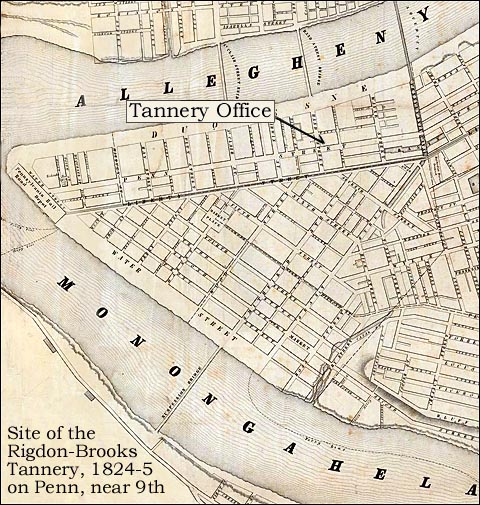
Note 1: According to a biography of Sidney Rigdon published in the 1843 Times & Seasons, "Having now [i. e., in 1824] retired from the ministry, and having no way by which to sustain his family, besides his own industry, he was necessiated to find other employment in order to provide for his maintenance, and for this purpose he engaged in the humble capacity of a journeyman tanner, in that city, and followed his new employment, without murmuring, for two years." This account of Rigdon's having worked as a tanner in Pittsburgh during 1824-25 is confirmed by the wife of the local Postmaster, who years later stated: "He was connected with the tannery before he became a preacher, though he may have continued the business whilst preaching." Sidney Rigdon's son, John Wycliffe Rigdon, reported that "about Aug. 1824... [Sidney Rigdon] entered the tanning business with his brother-in-law, Richard Brooks a couryer [sic - currier] by trade. My father put some money in the business. At the end of 2 years they sold the tannery." Both of Sidney's brothers-in-law, Richard and William, were tanners and curriers by trade -- perhaps Richard Brooks turned his share of the business over to William at some point. The "old stand" was located on Penn St., east of Hand St. (now 9th), in Pittsburgh.

Note 2: In order for Rigdon to have worked as a "journeyman tanner," he almost certainly would have first obtained some experience in the trade at the apprentice level -- even if he never served out a full apprenticeship. This undocumented prior experience is hinted at by the Postmaster's wife when she says that Rigdon was "connected with" a tannery before he became a Baptist minister. The most likely time for Rigdon to have gained this valuable experience was prior to the fall of 1818 (see also notes on article for Nov. 20, 1822 and mis-dated information given by Rigdon's brother in 1843). -- Rigdon eventually left Pittsburgh and returned to resume his earlier life as a preacher in Ohio. He apparently remained in the Pittsburgh area for at least a few months after leaving the tanning business. He petitioned to be relieved of his duties as a foster parent/guardian of David Ferguson later in the year and the court granted his request on Nov. 11, 1825, freeing Sidney to move his family out of Allegheny County.


THE  REGISTER.

Vol. I.                                       Montrose, Pa., Friday, Jan. 13, 1826.                                      No. 7.


"THE RESTORATION OF ISRAEL." -- A society of gentlemen has been formed, whose intention it is to issue from the press at Syracuse, N. Y. a Monthly Pamphlet with the above title. The object of the periodical, is to illustrate more fully and distinctly, interesting historical facts, relating to the nation of the Jews; their being dispossessed of the land given to their forefathers; their "dispersion" and "casting off;" their present condition; the divine predictions respecting their restoration to the promised land; and in a particular manner, to bring to view, the presumptive evidence, that the Indians -- the aboriginees of America -- are, with a few Tartar exceptions, the lineal descendants of Abraham, Isaac, and Jacob. If sufficient encouragement be given, it will commence in March next. -- American Traveller.


Note 1: The modern reader can only wonder if the "society of gentlemen" living at Syracuse at the beginning of 1826 had been heavily influenced by their reading of the Rev. Ethan Smith's A View of the Hebrews. During 1824-26 the western counties of upstate New York were criss-crossed by book agents, fanning out from Albany to sell copies of Josiah Priest's Wonders of Nature and Providence, an ecclectic volume that resurrected substantial excerpts from Smith's out of print thesis on restoring the American "Israelites" (in prepration for the coming millennium). The Syracuse gentlemen were quite possibly dupes of Smith and Priest and had more than likely heard of M. M. Noah's recently hatched plan to gather the remnants of Israel on the western borders of New York state. So far as can be determined their "Restoration of Israel" periodical never saw print. Had it been put through the press, it might have looked and sounded a bit like the contemporary New York City paper, Israel's Advocate.

Note 2: By an odd coincidence, Ellen Chase Smith, the youngest daughter of Ethan Smith lived out her final years in Syracuse and died there in 1846.


Vol. ?                                        Friday Morning, February 14, 1826.                                         No. ?

Edited by Robert Morris -- Pub. by Jesper Harding, 74 1/2 South 2nd St. & 56 Carter's Alley.


("R. Patterson. Agent" advertisement -- under construction)


Notes: (forthcoming)


THE  REGISTER.

Vol. I.                                        Montrose, Pa., Friday, June 2, 1826.                                        No. ?


"Grand Island, alias Arrarat remains as the Governor and Judge of Israel left it, a wilderness, yet admirably adapted to the highest state of cultivation. The passing traveller looks in vain from the deck of a canal boat, to catch a glimpse at the city of refuge, where the remnant of Israel were to be gathered together, and to "sit under their own vine and fig-tree, with none to molest or make them afraid." Instead of Jewish Synagogues and Rabbis, he sees nothing but a forest, with here and there a straggling hunter or fisherman who walks as if on christian ground. We have no disposition however to speak lightly of Mr. Noah's project -- time alone will develope it, if a splendid speculation was concealed under a plan to ameliorate the condition of the Jews. If not, the project is a benevolent one, and its author should have the best motives attributed to him though his judgment might be questioned -- Lockport Observatory.


Note: The above remarks were almost certainly penned by Orsamus Turner. According to his biographer, Harry S. Douglass, the young Turner assumed editorial control of the Lockport Observatory on Sept. 26, 1822 and "continued as editor and writer for various Lockport publications through the 1830s." Later in 1826 Turner's paper was renamed the Sentinel and Observatory.


THE  PITTSBURGH  MERCURY.

Vol. ?                                      Pittsburgh,  September 6, 1826.                                         No. ?


     ==> We are authorized to state, that
     JOSEPH PATTERSON, Esq.
     is a candidate for the ASSEMBLY.
Aug. 30.


Note: The Pittsburgh Directory for 1826 lists Joseph Patterson, esq. as living on Penn, St., "above St. Clair." He is also listed in the same publication, on page 72, in conjunction with "J. Patterson, & Co.," as the owner of the Pittsburgh Steam Paper Mill, located in the "Northern Liberties." Evidently Joseph Patterson separated his paper business from his previous partnership with his brother, the Rev. Robert Patterson, after their disasterous attempt to ship a large consignment paper down the Mississippi on barges. It is possible that there were subsequent personal difficulties between the two brothers -- Joseph married well, was successful in business and real estate ventures, and eventually moved away to Philadelphia, leaving Robert in a state of pious poverty.


PITTSBURGH  RECORDER.

Vol. V.                                      Pittsburgh,  October 3, 1826.                                         No. 34.


"THE  OUTCASTS  OF  ISRAEL."

If "the outcasts of Israel" are not to be found in America, where, suffer me to as are they to be found? Between two and three thousand years ago, they disappeared from the civilized world, and went somewhere -- where we believe that they now exist, a distinct people. Where did they go? And where are they at present? They are not in Europe -- they are not in Africa -- and, so far as is known, they are not in Asia. The habitable earth has been to a very great extent explored and unless we place them in the wilds of America, they are not to be found.

The natives of this continent, if we except Esquimaux & Greenlanders, are manifestly one people. This is proved, from the similarity of their personal appearance, of their customs, of their religious worship and belief, and especially of their language. They are said indeed, to speak different tongues; but it is now agreed, by the best judges, that these are little more than different dialects of the same tongue. The natives of both the Americas, and of every part of the country bear evident marks of a common origin, & of having descended from some common branch of the human family. -- And not only are they of the same origin and race; they have preserved themselves in a great measure distinct from all other people. They are as distinct, at this day, almost as the Jews are. In this view they correspond exactly with what we might expect of the descendants of Israel.

That they are the descendants of Israel, is rendered probable by their traditions respecting the coming and settlement of their forefathers in this country. -- We have seen already, from the apocryphal history, that when the tribes of Israel left Media, they journeyed, in a northeasterly direction, "a year and a half." This might carry them to the north-east extremity of Asia, and very possibly over Bherrings straits, into the limits of America. In strict accordance with this account, the American natives have a tradition, that a long time ago their fathers came here from another country -- that in their journey they passed over great waters -- and that they came to their present settlements from the north-west. The Mexicans, not only had this tradition, but pretended that they could show the places where their fathers stopped, in their journey from the north-west coast. Here, then, on the other hand, we have an account of the tribes of Israel leaving Media, and travelling long enough in a northeasterly direction, to bring them very nearly, if not quite, upon the north-west coast of America; and on the other, we have a current tradition of the Indians, that their fathers actually came from this coast, and beyond it, from another country.

Another argument, to show that the American Indians are the descendants of the Israelites, is derived from their language. Between the language of these Indians and the Hebrew, there is, to say the least, a strong affinity. This fact has been noticed by many wtiters, and by those too who were best able to form a judgment in the case. I could mention as many as thirty words, besides several phrases of some considerable length, which are almost precisely the same in Indian as in Hebrew. The Hebrew word Hallelujah, so common in sacred music among ourselves, is still more common in the sacred songs of the Indians. The Hebrew Jah, another name of the Deity is in Indian Yah. and the Hebrew Ale still another name for the Deity in Indian [is] precisely the same. The construction of the Indian languages, by means of prefixes and suffixes, also gives it a striking resemblance to the Hebrew. How shall we account for the strong affinity between these languages, unless we suppose the American Indians to be in fact Israelites?

Some have thought that a similarity might be traced between the features of American Indians, and those of the Jews. This was the opinion of the celebrated William Penn. In describing the natives, soon after his arrival among them, he says, "I found them with like countenances with the Hebrew race; and their children of so lively a resemblance to them, that a man would think himself in Duke's Place or Berry street, (the Jew's corner,) in London, when he sees them."

The American Indians have many traditions, corresponding with the Sacred History, which can hardly be accounted for, unless on the supposition that their fathers were once acquainted with the inspired volume. They not only have traditions, like many of the heathen, of a general Deluge, but retain some obscure ideas of numerous other facts, mentioned in the scriptures. They believe that the man was created from the earth, and that the woman was formed from a part of the man. They have a tradition of the longevity of the first inhabitants of the world, when men "lived till their feet were worn out with walking, and their throats with eating." They have a tradition of the Confusion of Tongues -- that "a long time ago, the people were to build a high place; and that while they were building, they lost their language, and could not understand each other." They have a tradition that, a great while since, they had a common father, and that this father had twelve sons -- in allusion, doubtless, to the twelve sons of Jacob. They tell us, "that their ancestors had once a sanctified rod which budded in a night's time." -- Like the rod of Aaron. They believe that "the Great Spirit, in very ancient times, often held councils, and smoked with their fathers, and gave them laws to be observed; but that in consequence of their disobedience, he withdrew from them, and abandoned them to the vexations of the bad spirit." These traditionary accounts, )to which I have it in my power to add others) are very remarkable, and clearly indicate that the ancestors of the Indians must at some period have been acquainted with the sacred history of the Old Testament.

The religious belief of the American Indians differs materially from that of the other heathen nations, and agrees, in many points, with that of the ancient Israelites. They believe in the existence of one God the great invisible Spirit, who created, and who constantly governs the world; and although all the tribes may not have kept themselves entirely free from idolatry; yet in general, they agree, and have ever agreed, in directing their worship to God alone. They believe in a superindenting Providence, and manifest often a degree of gratitude on the reception of favours, and submission in adversity, which would not discredit professing Christians. Their sense of dependence on the Great Spirit, leads them very frequently to pray to him. "Every morning," say our Missionaries among the Osages, "we hear them, on all sides around us, to a great distance from their camp, engaged in very earnest prayer to God their Creator. This they do likewise on all extraordinary occasions, as when they receive any distinguishing favour." Such was their practice when the Missionaries found them, and before they had received any religious instruction. The Indians believe in the existence of angels and demons, and that the demons have a chief over them, who is more wicked than the rest. They believe that they are themselves "the beloved people" of the Great Spirit, as the ancient Israelites did; that they were the peculiar, chosen people of God. The Indians also believe in a future state of rewards and punishments, to be distributed according to the characters which are sustained here. If now we compare these religious views and traits with those of the debased & idolatrous heathen, in Asia, and other parts of the world; we shall discover a difference for which it will not be easy to account, but by supposing the remote ancestors of the American Indians to have been acquainted with Divine revelation. -- Christ. Mag.


Notes: (forthcoming)


Vol. VIII - No. 1.                        Thursday, March 22, 1827.                        Whole No. 365.


A Chancery Suit has been instigated in the name of William Morgan, John Davids, and David C. Miller, against some individuals in New-York for publishing a new edition of "Masonry Unvailed," in violation of the copy-right. The editor of one New-York paper says he has seen the injunction.

Note: When Eber D. Howe (an anti-Masonic journalist and editor) published the first anti-Mormon book in 1834, he entitled it "Mormonism Unvailed," recalling the 1826 Masonry Unvailed publication.


Vol. ?                              Pittsburgh, (Penn.) Tuesday, July 24, 1827.                              No. ?


DIED. -- On Tuesday last, after a short illness, SILAS ENGLES, Esq. Clerk of the Mayor's Court, of this city, in the 46th year of his age...

Note: Following the death of Silas Engles on July 17, 1827, it is likely that practically no living person recalled the original circumstances under which manuscript submissions came into the possession of Patterson & Lambdin and continued to be held as the property of that firm's successors after the end of 1822. Engles' possible business association with the successors of Patterson & Lambdin remains undocumented. Perhaps his last links with that firm died along with J. Harrison Lambdin (his previous co-worker in that line of work), on Aug. 1, 1825.


Vol. X - No. 8.                        Thursday, May 7, 1829.                        While No. 476.


FROM  THE  MONTHLY  REVIEW.

A view of the American Indians.
By Israel Worsley, London, 1828

We shall probably surprise most of our readers when we state the object of this little volume, which is nothing less than to show that the Indians of America are, in all probability, the descendants of the lost Ten Tribes of Israel. This is an idea which has, it seems, of late years occupied some attention on the other side of the Atlantick, the Rev. Dr. Elias Boudinot having published a work in support of it in 1816, entitled A star in the West, which was followed, in 1825, by another written by a Mr. Smith, pastor of a church in Poultney. The object of the present writer is chiefly to condence and arrange the facts and reasonings that have been advanced by his predecessors; and to add such additional matter in support of the views which they have advocated, as he has been able to collect in the course of his own reading.

We extract a few sentences from his concluding chapter, in which he gives a summary of his argument. -- After contending that the tribes in question must have an existence some where, and remarking that in the book of Esdras they are mentioned as having journeyed to a land where no man dwelt, he proceeds in reference to the Indians as follows:

"They are living in tribes -- they have all a family likeness, though covering thousands of leagues of land and having a tradition prevailing universally that they came into that country at the northwest corner -- they are very religious people, and yet have entirely escaped the idolitary [sic] of the old world -- they acknowledge One God, the Great Spirit, who created all things seen and unseen -- the name to whom this being is known to all, the old Hebrew name of God; he is also called yehowah, sometimes yah, and also abba -- for this Great Being they profess a high reverence, calling him the head of their community, and themselves his favourite people; they believe that he was more favourable to them in old times than he is now, that their fathers were in covenant with him, that he talked with them and gave them laws; they are distinctly heard to sing with their religious dances, hallellujah and praise to jah; other remarkable sounds go out of their mouths, as shillu yo, shillu he, ale yo, he wah, yohewah, but they profess not to know the meaning of these words; only that they learned to use them upon sacred occasions -- they acknowledge the government of a Providence overruling all things, and express a willing submission in whatever takes places -- they keep annual feasts which resemble those of the Mosaick ritual, a feast of first fruits, which they do not permit themselves to taste until they have made an offering of them to God: also an evening festival, in which no bone of the animal that is eaten may be broken; and if one family be not large enough to consume the whole of it, a neighbouring family is called in to assist: the whole of it is consumed and the relicks are burned before the rising of the next day's sun. There is one part of the animal which they never eat, the hollow part of the thigh; they eat bitter vegetables and observe severe fasts, for the purpose of cleansing themselves from sin; they have also a feast of harvest, when their fruits are gathered in, a daily sacrifice, and a feast of love -- their forefathers practiced the rite of circumcision; but not knowing why so strange a practice was continued and not approving of it, they gave it up -- there is a sort of jubilee kept by some of them -- they have cities of refuge, to which a guilty man and even a murderer may fly and be safe." pp. 181, 182.

Another account we observe, of the lost Ten Tribes has lately been given in a German publication, which on highly probable grounds makes at least a large portion of them to have established themselves in the district of the great Plain of Central Asia called Bucharia, where it appears, they amount even at this day to a third part of the population. The traditions preserved among this remnant of the chosen people might perhaps assist in determining whether or no the American Indians are descendants of the same stock.


Note 1: The Erie Gazette was published in the "panhandle" of Pennsylvania, adjacent to the westernmost part of New York state. Since there was some interest in the Erie area regarding the assertion that the Indians were of Hebrew origin, it seems reasonable to assume that a similar curiosity existed in western New York in 1829 and that the writings of authors like Elias Boudinot and Ethan Smith were known there as well as in the Pennsylvania panhandle.

Note 2: Constantine Rafinesque was expressing an opposing viewpoint at about this same time. See his Aug. 1829 open letter to the Rev. Ethan Smith, published in the New York Evening Post and reprinted in the Fall 1832 issue of the Atlantic Journal.


Vol. XI - No. 9.                        Thursday, May 13, 1830.                        While No. 529.


SILLY  FANATICISM.

A work has recently been published in the western part of the state of New York, entitled Book of Mormon, or the Golden Bible. -- The author is Joseph Smith, Jr. The work contains about 600 pages, and is divided into the books of Marmon [sic], of Ether and Helaman. The Rochester Daily Advertiser contains the preface, and two letters, signed by eleven individuals, setting forth the excellence of the work and the existence of the original "plates," of gold, on which the contents of the volume were engraved, in a language which the translator was taught by inspiration. It seems that one book, Lehi, was translated and stolen -- the translator was commanded never again to translate the same over. We subjoin, with some hesitancy, one of the certificates, which smacks pretty strongly of what would once have been called blasphemy.

The testimony of Three Witnesses. -- Be it known to all nations, kindreds, tongues, and people, unto whom this work shall come, that we, through the grace of God the Father, and our Lord Jesus Christ, have seen the plates which contain this record, which is a record of the people of Nephi, and also of the Lamanites, his brethren, and also of the people of Jared, who came from the tower, of which hath been spoken: and we also know that they have been translated by the gift and power of God, for his voice hath declared it unto us; wherefore we know of a surety that the work is true. And we also testify that we have seen the engravings which are upon the plates; and they have been shown unto us by the power of God, and not of man. And we declare with words of soberness that an Angel of God came down from heaven, and he brought and laid before our eyes, that we beheld and saw the plates, and the engravings thereon; and we know that it is by the grace of God the Father, and our Lord Jesus Christ, that we beheld and bear record that these things are true; and it is marvelous in our eyes. Nevertheless, the voice of the Lord commanded us that we should bear record of it; -- wherefore to be obedient unto the commandments of God, we bear testimony of these things. And we know that if we are faithful in Christ, we shall rid our garments of the blood of all men, and be found spotless before the judgment seat of Christ, and shall dwell with him eternally in the heavens. And the honor be to the Father, the Son, and the Holy Ghost, which is one God. Amen.
DAVID WHITMER.
OLIVER COWDERY.
MARTIN HARRIS.

The other certificate declares that the plates said to have been found in Manchester, Ontario county, N. Y. had the appearance of gold, [and] bore the marks of ancient and curious workmanship.
                          U. S. Gazette.


Note: The above article evidently appeared in the Philadelphia United States Gazette during early May. The Rochester Daily Advertiser issue mentioned was that of April 2, 1830.


The Presbyterian Advocate.
Vol. I.                        Pittsburgh, Pennsylvania,  December ? 1832.                        No. ?


TO  THE  CITIZENS  OF  PITTSBURGH.

The Board of Managers of the African Education Society of the City and Vicinity of Pittsburgh, deem it necessaty that the public should be made acquainted with the object of their association, and of the course they are now about to take.

The object of our association is, the general education of our rising youth, and the moral improvement of those of ourselves who need it, of a more advanced age.

We are well persuaded, that it is ignorance which has plunged our African brethren into that dreadful gulf of degradation, into which they have fallen...

The following paper... was presented to the different clergy whose names are therein stated...

'Having understood that the people of color of the city and vicinity of Pittsburgh have formed an Education Society, and are desirous of carrying into operation a plan for the general education of their youth, this laudable undertaking meets our decided approbation, and is, in our opinion, worthy the patronage of a liberal public.'

FRANCIS HERRON, Pastor 1st Pres. church.
CHAS. B. MAGUIRE, Pastor Cath. Congregation.
DAVID HAMMERER, Pastor German Congregation.
JOHN WINTER, Pastor 3d. Baptist church.
WESLEY BROWNING, Preacher of the Methodist Episcopal church.
JOHN BLACK, Pastor Reformed Pres. church.
JOSEPH STOCKTON, Pastor Pine creek church.
GEORGE UPFOLD, Pastor of Trinity church.
SAMUEL WILLIAMS, Pastor 1st Baptist church.
J. R. KEER, Pastor As. Reformed church.
CHARLES ELLIOTT, Preacher in charge of the Methodist Episcopal church.
JOHN TASSEY, Pastor Independent church.
JACOB MORRIS, Pastor 2d Baptist church, Welch.
ROBERT C. HATTON, Pastor Pro. M. church.
ROBERT PATTERSON, Pastor of Highland's congregation.
J. W. NEVIN, Instructor in West. Theo. Seminary.
LUTHER HALSEY, Prof. of Theology, West. Theo. Seminary.
J. P. HALSEY, Pastor 1st Pres. church, Allegh'town.
E. P. SWIFT, Pastor 2d Presbyterian church.
WM. B. M'ILVAINE, Pastor Pres. Cong. East Liberties, near Pittsburgh.

By the Board of Managers,
      LEWIS WOODSON, Secretary.
Pittsburgh, Nov. 23, 1832.


Note 1: The Presbyterian Advocate was published in Pittsburgh from late 1832 forward. According to a backfile of the paper located at Duke University, it was entitled simply The Advocate in its early years, and later the Advocate and Herald or Advocate and Emporium. All known files of the paper's issues of the 1830s are fragmentary -- the above text is taken from a reprint which appeared in the Boston Liberator of Jan. 12, 1833.

Note 2: Three Protestant pastors associated with the Spalding-Rigdon clains for the authorship of the Book of Mormon are represented in the Nov. 1832 list shown above: Rev. Robert Patterson, Sr. (1773-1854); Elder Samuel Williams (1802-1887); and Elder John Winter (1794-1878). Some personal information on Rev. Patterson may be found here. Biographical sketches of Winter and Williams are excerpted from William Cathcart's 1881-83 Baptist Enyclopedia, vol. 2:

Winter, John, M.D., was born in Wellington, England, in July, 1794. After graduating in theology from Bradford Seminary, he emigrated to America in 1822, and settled in Pittsburgh, Pa. Here for some time he taught a school, and served as pastor of the First Baptist church. During sixty years of a very active and successful ministry his labors were chiefly in the western part of the State. -- For a few years he preached in Illinois, where two sons survive him. He died Nov. 5, 1878, in his eighty-fifth year, after an illness of only three days, in Sharon. Mercer Co.. Pa. -- His energy was more than ordinary, and his character was of a most positive type, blended with childlike simplicity and tenderness of heart. His clearness of thought was remarkable. These traits made him just the man needed for his day. Hence, in his struggles with the errors of Alexander Campbell, he performed pre-eminent service, and checked materially the spread of error, saving many churches from being overwhelmed and destroyed. His crowning glory was his great success in winning souls to Christ. To the last of an honored and useful life he would not allow his mind to remain inactive, but kept himself well informed in general and theological learning. Hence he was always listened to with marked interest, and continued fresh and green until he closed his earthly labors. -- Dr. Winter was twice married. His second wife survives him, and is the mother of two prominent Baptist ministers. Rev. J. D. Herr, D.D., of New York, and Rev. A. J. Bonsall, of Rochester, Pa. A daughter is also married to Rev. David Williams, of Lewisburg, Pa., while a daughter of Dr. Winter is united in marriage to Judge Justin Miller, of the Supreme Court of the United States.
Williams, Rev. Samuel, was born in Connellsville, Fayette Co., Pa., on the 5th of August, 1802. At the age of twenty, while a student at Zanesville, O., he embraced Christ by faith. Along with light upon his heart came the love of souls, and in two years from his conversion he was ordained in Somerset Co., Pa. In May, 1827, he became pastor of the First Baptist church in Pittsburgh, Pa. This relation continued twenty-eight years, during which period six other churches were organized. -- Leaving Pittsburgh, he settled in Akron, O. Here he remained eight years, and then became pastor in Springfield. At both these places he, in connection with his wife, conducted a female seminary. Two subsequent years were spent as pastor in New Castle, Pa., and five years more were employed among churches in the vicinity of Pittsburgh. His present residence is Brooklyn, N. Y. -- Mr. Williams engaged in numerous controversies, both orally and in writing, in defense of Baptist doctrine and practice.

Note 3: Elder Winter's congregation more properly might be called the "Second Baptist Church" of Pittsburgh; but as it was transitory, the local Welsh-speaking group fell heir to the title around 1828, when its members were organized into a congregation under Jacob Morris' predecessor (Elder Peter Lloyd?). Neither group bore any formal relationship to the later Afro-American "Pittsburgh Third Baptist Church." For more on the Welsh congregation, as well as John Winter and Samuel Williams, see the 1913 booklet, Centenary of Organized Baptist Work in and about Pittsburgh... For a glimpse of the Pittsburgh Baptists in the year 1835, see Rev. F. A. Cox's 1836 volume, Baptists in America..., pp. 279-283 (in which returning Elder Joshua Bradley is represented as having taken John Winter's place at the "Third Baptist Church").


In whom ye also trusted, after that ye heard the word of truth the gospel of your salvation - Eph. 1, 13
Stand fast therefore in the liberty wherewith Christ hath made us free. - Gal. 5, 1.
Vol. I.                        Montrose, Penn'a., Wednesday, December 19, 1832.                        No. 7.


MORMONISM.

A few days ago, we borrowed one of those wonderful productions called a "Mormon Bible." We read some fifty pages, and turned our eye slightly over the rest. It purports to be the work of several successive and cotemporaneous writers, a number of centuries before the Christian era.

Nephi relates, that in the first year of the reign of Zedekiah, king of Judah, which was about 600 years before Christ, Lehi his father a descendant of the tribe of Joseph, together with his family, consisting of five persons, fled into the wilderness. The three sons of Lehi were obliged to return to Jerusalem, to get their gold and silver, and certain "plates of brass," on which were engraved the five books of Moses, and many of the prophets, as well as the records of the Jews, by which [they] learnt their pedigree.

The account says, they were about eight years in the wilderness. Their journey from Jerusalem was first Southeast, (nearly parallel with the Red Sea) and then East, until they came to the great waters. This would have carried them to the Arabian Sea. Nephi then constructed a ship in which they committed themselves to the bosom of the waters. After sailing for several days before the wind, the crew indulged themselves in revery and rudeness, which Nephi, who was the youngest of three sons, thought worthy of reproof. But his reproof and admonition only excited their indignation, and they bound him. The Lord sent a storm and terrible tempest, and they were driven backwards four days, They were in immediate peril -- filled with fear, horror and consternation; and to add to their calamity, their compass ceased to work. But when they loosed him, the winds ceased -- a great calm gave them rest from their toils -- the compass again obeyed the laws of nature -- a pleasant breeze wafted them onward, until they arrived at the promised land.

Now it is not our design to enter into a minute detail of circumstances, nor an elaborate and critical investigation. But we will point out two or three little circumstances, apparent to the commonest intellect, irreconcilable with fact, and which the writer of the book of Nephi happened to overlook.

1. These people were Jews. But twice during eight years do we read of their offering burnt offerings, or sacrifices; and afterwards they seem entirely to have forgotten it. Those plates they valued so highly, are said to contain the books of Moses; and though they profess to regard them on that account, little did they observe the rituals they teach, or the sacrifices they require. Fine Jews these?

2. The writer speaks very familiarly of Jesus Christ, Messiah, Saviour, Redeemer, Son of God, &c. -- of his baptism in Bethabara beyond Jordan -- of the dove that descended -- of his moracles, his twelve Apostles, his teaching, acts, crucifixion and resurrection. He speaks of heaven and hell, saints and sinners, believers and unbelievers, Jews and Gentiles, of salvation and damnation, of the Apostles and their preaching. He quotes familiarly their sayings and arguments, similes and metaphors, for instance like this in Romans, "the Olive branch that was broken off, that the branch that was wild by nature might be grafted in," and even of the Revelations of St. John. And thus by garbling their words, he pretends to teach and enforce their doctrines. Bear in mind he is writing all this 600 years before the advent of Christ. These Jews are Christians before the time?

3. According to Chonoologers the mariner's compass was invented by Gioia, or Goya, in the year of our Lord 1300. But if Mormonism is true, the compass was in use nearly 2000 years before that time, that is to say, 600 years before Christ.

But notwithstanding these striking incongruities, they are as orthodox in their doctrines as any of the Limitarians; or, even as modern orthodoxy itself. They talk of probation in the language like this: -- "And they said unto me, doth this thing mean the torment of the body in the days of probation, or doth it mean the final state of the soul after the death of the temporal body?" The atonement is spoken of as a satisfaction to divine justice, and the means of saving men from torment, (see p. 81.) "For the atonement satisfieth the demands of his justice upon all those who have not the law given to them, that they are delivered from that awful monster death, and hell, and the devil, and the lake of fire and brimstone, which is endless torment."

How many there are who have long been seeking for testimony to establish the doctrine of endless torment, so near and dear to their hearts or creeds: -- Who have found the Old and New Testaments insufficient, and for want of a positive declaration, have had the mortification of seeing all their fancied strong-holds crumble at the touch of investigation. We would advise them to turn Mormonites. They can then quote the language of Nephi, Mosiah, Alma or Mormon -- and that is explicit.

How much vain talk has there been about hell, as a place of punishment: When, where, and by whom it was created: just because the bible happened to be silent on the subject. To remove all these doubtful disputations, to meet successfully the Universalist, and hold forth more strongly the saving fear of hell, which is believed to be so necessary to piety and godliness in the soul: Let them acquaint themselves with the Mormon Bible, (see p. 38) "And there is a place prepared, yea, even that awful hell of which I have spoken; and the devil is the preparator of it." The devil prepared it, but God makes use of it to punish his incorrigible children. If the devil is such an enemy to God as has been represented, I should hardly think he would accomodate him with a prison house.

The trinity, the doctrine of all doctrines most essential to the creeds -- this too, is a doctrine of Mormonism. On page 51 we read, "The God of Jacob yieldeth himself into the hands of wicked men to be crucified." On the same page we read, "the God of nature suffers." Query: Was Watts a Mormonite when he wrote the following?

Lo the powers of heaven he shakes,
Nature in convulsion lies,
Earth's profoundest centre shakes,
The Great Jehovah dies.
They are not only orthodox in their ideas, but only see how canonical is their phraseology. Page 120, "And behold this is the doctrine of Christ and the only true doctrine of the Father, and of the Son, and of the Holy Ghost, which is one God without end -- Amen." Besides these sound doctrines, they are nearly as fanatical as other folks. Why would it not be well for all those who agree so well in doctrine and in practice, to form a coalition against plain, rational, common-sensed, sober-minded people?

The book, is puerile in the incidents of its story -- betrays ignorance of human nature, and want of historical research -- is extremely inaccurate in its syntax -- uncouth and awkward in its expression. And then, when we come to consider the circumstances of their rise and origin, the nature of their faith, and the pretensions of their believers; -- It is truly astonishing that in a country like ours, among a people boasting of intelligence, that so base and clumsy an imposition, could be palmed off upon any member of the community. But it is no more astonishing than that those wicked rants, vulgarly called protracted meetings, should receive the countenance of a community professing to be religious.     A. P.


Note: The Herald of Gospel Truth was published in Montrose, Susquehanna Co., Pennsylvania between 1832 and 1833. Given the fact that Joseph Smith, Jr. was active in Susquehanna County (within a few miles of Montrose) in the 1820s, it is strange that the Unitarian book reviewer in this article did not mention him or the advent of Mormonism in the "Great Bend" region, along the New York-Pennsylvania border. Perhaps some subsequent issues of this paper featured articles which paid attention to such topics.


Vol. IV.                        Erie, Pa., Saturday, September 7, 1833.                        No. 16.


Mormonites -- Extract of a letter to the editors of the New York Journal of Commerce, dated Lexington, Missouri, July 25, 1833.

"You have probably heard of the Mormon establishment in this vicinity. Six hundred, or more of that misguided people have emigrated within the last two years to Jackson City in the next county to this, and have rendered themselves obnoxious to the citizens by holding out inducements for free negroes to settle in the county, and urging slaves to be unfaithful. Lately the citizens organized themselves for the purpose of breaking up the establishment. Their (Mormonite) printing press was torn down, store and machine shop broken up, -- the leaders tarred and feathered, and a time set for their departure. What course may be pursued towards the followers, is not yet known.


Note: This same article appeared in the New York Spectator (the sister paper of the Journal of Commerce) on Aug. 26, 1833.)


Vol. VIII. - No. 28.                  Wednesday,  June 23, 1833.                      Whole No. 386.


THE  MORMONS.

(Correspondence of the "Boston Recorder.")


Note: The Methodist Pittsburgh Christian Advocate.


The American Manufacturer.
Vol. ?                                   Pittsburgh, February ?, 1834.                                   No. ?


THE  BOOK  OF  MORMON.

A few days since a friend presented us with the far-famed Book of Mormon, and as many of our readers have not yet seen it, we thought it would not be uninteresting to extract the matter on the title page; which explains the ground on which it claims divine origin. The work itself forms a medium octavo, of nearly six hundred pages, and the language throughout is an imitation of the Old and New Testament. Although Joseph Smith signs himself AUTHOR and proprietor of the work, a man who a few years since lived in this city, and was known to many of our citizens under the appellation of Elder Rigdon, is suspected of being the author. Be this however, as it may, the following affords a curious specimen of the means that may be successfully used to gull the credulous and the superstitious.

"THE  BOOK  OF  MORMON."

An account written by the hand of Mormon upon plates taken from the plates of Nephi.

Wherefore it is an abridgment of the Record of the People of Nephi; and also of the Lamanites; written to the Lamanites, which are a remnant of the House of Israel; and also to Jew and Gentile; written by way the commandment, and also by the spirit of Prophesy and Revelation. Written, and sealed up and hid up unto the Lord that they might not be destroyed; to come forth by the gift and power of God, unto the interpretation thereof; sealed by the hand of Moroni, and hid up unto the Lord, to come forth in due time by the way of Gentile; the interpretation thereof by the gift of God: an abridgement taken from the book of Ether.

Also, which is a Record of the People of Jared, which were scattered at the time, the Lord confounded the language of the people when they were a building a tower to get to Heaven: which is to shew unto the remnant of the House of Israel how great things the Lord hath done for their fathers; and that they may know the covenants of the Lord, that they are not cast off for ever: and also to the convincing of the Jew and Gentile that Jesus is the Christ, the Eternal God, manifesting Himself unto all nations, and now if there be fault, [if] it be the mistake of men; wherefore condemn not the things of God, that ye may be found spotless at the Judgement seat of Christ.   By Joseph Smith, Jr. Author and proprietor."

The plates from which it is stated Joseph Smith made the translation, were as he informs the public, found in the township of Manchester, Ontario co. New York, and when the translation was completed, vanished: according to the depositions of twelve witnesses, up into Heaven.


Notes: (forthcoming)


Public Opinion -- Its Decision In All Free Governments Is As Safe, As It Is Final. --Cass.
Vol. IX.                                Montrose, Penn'a, Thursday, May 1, 1834.                                 No. ?


MORMONISM.

Mr. Ward, Sir, -- The Sect calling themselves Mormons, which started a few years since in Harmony in this County, have, you are aware brought themselves into public notice in many parts of our country. A gentleman in the state of Ohio, applied to Mr. ISAAC HALE, of Harmony, for a history of facts relating to the character of Joseph Smith, jun., author of the Book of Mormon, called by some, the Golden Bible, and the Mormons pronounced the letter a forgery; and said that ISAAC HALE was blind, and could not write his name. -- which was the cause of the taking [of] the accompanying affidavits.

Some of your subscribers, and particularly those at a distance, might feel obliged by your inserting the affidavits, then all might judge for themselves, as to the authenticity of the Revelation claimed to have been made to Joseph Smith, jun'r.     A SUBSCRIBER.
Great Bend 21, March 1834.


                  Painesville, Ohio, Feb. 4, 1834.
Mr. Isaac Hale, --
  Dear Sir, -- I have a letter with your signature, post-marked Dec. 22, 1833 -- addressed to D. P. Hurlbut, on the subject of Mormonism. I have taken all the letters and documents from Mr. Hurlbut, with a view to their publication. An astonishing mass has been collected by him and others, who have determined to lay open the imposition to the world. And as the design is to present facts, and those well authenticated, and beyond dispute, it is very desireable, that your testimony, whatever it may be, should come authenticated before a magistrate.

Your letter has already been pronounced a forgery by the Mormons, who say you are blind and cannot write, even your name. I hope no one have attempted to deceive us: deception and falsehood in this business will do no good in the end, but will help build up the monstrous delusion. We look upon your connexion with Smith, and your knowledge of facts as very important, in the chain of events, -- and if it be your desire to contribute what facts you know, in so desirable an undertaking, I hope you will without delay, have drawn up a full narative of every transaction wherein Smith, jun'r. is concerned and attest them before a magistrate -- This is our plan.

E. D. HOWE.          


Statement of Mr. Hale.

I first became acquainted with Joseph Smith, Jr. in November, 1825. He was at that time in the employ of a set of men who were called "money diggers;" and his occupation was that of seeing, or pretending to see by means of a stone placed in his hat, and his hat closed over his face. In this way he pretended to discover minerals and hidden treasure. His appearance at this time, was that of a careless young man -- not very well educated, and very saucy and insolent to his father. Smith, and his father, with several other 'money-diggers' boarded at my house while they were employed in digging for a mine that they supposed had been opened and worked by the Spaniards, many years since. Young Smith gave the 'money-diggers' great encouragement, at first, but when they had arrived in digging, to near the place where he had stated an immense treasure would be found -- he said the enchantment was so powerful that he could not see. They then became discouraged, and soon after dispersed. This took place about the 17th of November, 1825; and one of the company gave me his note for $12.68 for his board, which is still unpaid.

After these occurrences, young Smith made several visits at my house, and at length asked my consent to his marrying my daughter Emma. This I refused, and gave my reasons for so doing; some of which were, that he was a stranger, and followed a business that I could not approve: he then left the place. Not long after this, he returned, and while I was absent from home, carried off my daughter, into the state of New York, where they were married without my approbation or consent. After they had arrived at Palmyra N. Y., Emma wrote to me enquiring whether she could take her property, consisting of clothing, furniture, cows, &c. I replied that her property was safe, and at her disposal. In a short time they returned, bringing with them a Peter Ingersol, and subsequently came to the conclusion that they would move out, and reside upon a place near my residence.

Smith stated to me, that he had given up what he called "glass-looking," and that he expected to work hard for a living, and was willing to do so. He also made arrangements with my son Alva Hale, to go to Palmyra, and move his (Smith's) furniture &c. to this place. He then returned to Palmyra, and soon after, Alva, agreeable to the arrangement, went up and returned with Smith and his family. Soon after this, I was informed they had brought a wonderful book of Plates down with them. I was shown a box in which it is said they were contained, which had to all appearances, been used as a glass box of the common window glass. I was allowed to feel the weight of the box, and they gave me to understand, that the book of plates was then in the box -- into which, however, I was not allowed to look.

I inquired of Joseph Smith Jr., who was to be the first who would be allowed to see the Book of Plates? He said it was a young child. After this, I became dissatisfied, and informed him that if there was any thing in my house of that description, which I could not be allowed to see, he must take it away; if he did not, I was determined to see it. After that, the Plates were said to be hid in the woods.

About this time, Martin Harris made his appearance upon the stage; and Smith began to interpret the characters or hieroglyphics which he said were engraven upon the plates, while Harris wrote down the interpretation. It was said, that Harris wrote down one hundred and sixteen pages, and lost them. Soon after this happened, Martin Harris informed me that he must have a greater witness, and said that he had talked with Joseph about it -- Joseph informed him that he could not, or durst not show him the plates, but that he (Joseph) would go into the woods where the Book of Plates was, and that after he came back, Harris should follow his track in the snow, and find the Book, and examine it for himself. Harris informed me afterwards, that he followed Smith's directions, and could not find the Plates, and was still dissatisfied.

The next day after this happened, I went to the house where Joseph Smith Jr., lived, and where he and Harris were engaged in their translation of the Book. Each of them had a written piece of paper which they were comparing, and some of the words were "my servant seeketh a greater witness, but no greater witness can be given him." There was also something said about "three that were to see the thing" -- meaning I supposed, the Book of Plates, and that "if the three did not go exactly according to the orders, the thing would be taken from them." I enquired whose words they were, and was informed by Joseph or Emma, (I rather think it was the former) that they were the words of Jesus Christ. I told them then, that I considered the whole of it a delusion, and advised them to abandon it. The manner in which he pretended to read and interpret, was the same as when he looked for the money-diggers, with the stone in his hat, and his hat over his face, while the Book of Plates were at the same time hid in the woods!

After this, Martin Harris went away, and Oliver Cowdery came and wrote for Smith, while he interpreted as above described. This is the same Oliver Cowdery, whose name may be found in the Book of Mormon. Cowdery continued a scribe for Smith until the Book of Mormon was completed as I supposed and understood.

Joseph Smith Jr. resided near me for some time after this, and I had a good opportunity of becoming acquainted with him, and somewhat acquainted with his associates, and I conscientiously believe from the facts I have detailed, and from many other circumstances, which I do not deem it necessary to relate, that the whole "Book of Mormon" (so called) is a silly fabrication of falsehood and wickedness, got up for speculation, and with a design to dupe the credulous and unwary -- and in order that its fabricators may live upon the spoils of those who swallow the deception.   ISAAC HALE.

  Affirmed to and subscribed before me, March 20th, 1834.
      CHARLES DIMON, J. Peace.


State of Pennsylvania,
      Susquehana County, ss.

We, the subscribers, associate Judges of the Court of Common Pleas, in and for said county, do certify that we have been many years personally acquainted with Isaac Hale, of Harmony township in this county, who has attested the foregoing statement; and that he is a man of excellent moral character, and of undoubted veracity. Witness our hands.
      WILLIAM THOMPSON.
      DAVIS DIMOCK.   March 21st, 1834.


I have been acquainted with Isaac Hale for fifty years, and have never know[n] him guilty of wilfully, or deliberately telling a falsehood. His character for truth and veracity has never been questioned. He has been Supervisor, Assessor and Collector, in this town -- has kept his own accounts, and made his returns, to the satisfaction of all concerned. But he is noe old, and his arms are somewhat plasied, so that when he desires any thing written, he usually employs one of his sons, although he retains his sight, and is still capable of writing.
      NATHANIEL LEWIS.
Affirmed and subscribed before me,
March 20, 1834.
      CHARLES DIMON, J. Peace.


State of Pennsylvania,
      Susquehana County, ss.

I do hereby certify, that I have been acquainted with Nathaniel Lewis, who affirmed to, and subscribed the above certificate, for these twenty-seven years, last past, and during the whole of that time he had veen a respectible minister of the Methodist Episcopal Church, a man of veracity, and good moral character. Witness my hand, March 21st, 1834.     WM. THOMPSON.
      Associate Judge.


Elder Lewis also certifies and affirms in relation to Smith as follows:

"I have been acquainted with Joseph Smith Jr. for some time: being a relation of his wife, and residing near him, I have had frequent opportunities of conversation with him, and of knowing his opinions and pursuits. From my standing in the Methodist Episcopal Church, I suppose he was careful how he conducted or expressed himself before me. At one time, however, he came to my house, and asked my advice, whether he should proceed to translate the Book of Plates (referred to by Mr. Hale) or not. He said that God had commanded him to translate it, but he was afraid of the people: he remarked, that he was to exhibit the plates to the world, at a certain time, which was then about eighteen months distant. I told him I was not qualified to give advice in such cases. Smith frequently said to me that I should see the plates at the time appointed.

"After the time stipulated, had passed away, Smith being at my house was asked why he did not fulfil his promise, show the Golden Plates and prove himself an honest man? He replied that he, himself was deceived, but that I should see them if I were where they were. I reminded him then, that I stated at the time he made the promise, I was fearful "the enchantment would be so powerful" as to remove the plates, when the time came in which they were to be revealed.

"These circumstances and many others of a similar tenor, embolden me to say that Joseph Smith Jr. is not a man of truth and veracity; and that his general character in this part of the country, is that of an impostor, hypocrite and liar.
           NATHANIEL C. LEWIS."

Affirmed and subscribed, before me, March 20th, 1834.
             CHARLES DIMON, J. Peace.


We subjoin the substance of several affidavits, all taken and made before Charles Dimon Esq. by credible individuals, who have resided near to, and been well acquainted with Joseph Smith Jr. -- Illustrative of his chraracter and conduct, while in this region.


JOSHUA M'KUNE states, that he "was acquainted with Joseph Smith Jr. and Martin Harris, during their residence in Harmony, Penn'a., and knew them to be artful seducers;" -- That they informed him that "Smith had found a sword, breast-plate, and a pair of spectacles, at the time he found the gold plates" -- that these were to be shown to all the world as evidence of the truth of what was contained in those plates," and that "he (M'Kune) and others should see them at a specified time." He also states that "the time for the exhibition of the Plates, &c. has gone by, and he has not seen them." "Joseph Smith, Jr. told him that (Smith's) first-born child was to translate the characters, and hieroglyphics, upon the Plates into our language at the age of three years; but this child was not permitted to live to verify the prediction." He also states, that "he has been intimately acquainted with Isaac Hale twenty-four years, and has always found him to be a man of truth, and good morals."

HEZEKIAH M'KUNE states, that "in conversation with Joseph Smith Jr., he (Smith) said he was nearly equal to Jesus Christ; that he was a prophet sent by God to bring in the Jews, and that he was the greatest prophet that had ever arisen."


ALVA HALE, son of Isaac Hale, states, that Joseph Smith Jr. told him that his (Smith's) gift in seeing with a stone and hat, was a gift from God," but also states "that Smith told him at another time that this "peeping" was all d---d nonsense. He (Smith) was deceived himself but did not intend to deceive others; -- that he intended to quit the business, (of peeping) and labor for his livelihood." That afterwards, Smith told him, "he should see the Plates from which he translated the book of Mormon," and accordingly at the time specified by Smith, he (Hale) "called to see the plates, but Smith did not show them, but appeared angry." He further states, that he knows Joseph Smith Jr. to be an impostor, and a liar, and knows Martin Harris to be a liar likewise. That his father (Isaac Hale) can both see and write, the declarations of the Mormons tp the contrary notwithstanding; and that the letter sent by his father, Isaac Hale, to Dr. P. Hurlbut was written by Jesse Hale, his (I. Hale's) son, and was correct and true."


LEVI LEWIS states, that he has "been acquainted with Joseph Smith Jr. and Martin Harris, and that he has heard them both say, adultery was no crime. Harris said he did not blame Smith for his (Smith's) attempt to seduce Eliza Winters &c.;" -- Mr. Lewis says that he "knows Smith to be a liar; -- that he saw him (Smith) intoxicated at three different times while he was composing the Book of Mormon, and also that he has heard Smith when driving oxen, use language of the greatest profanity. Mr. Lewis also testifies that he heard Smith say he (Smith) was as good as Jesus Christ; -- that it was as bad to injure him as it was to injure Jesus Christ." "With regard to the plates, Smith said God had deceived him -- which was the reason he (Smith) did not show the plates."


NATHANIEL C.EWIS states "he has always resided in the same neighborhood with Isaac Hale, and knows him to be a man of truth, and good judgment." He further states, that "he has been acquainted with Joseph Smith Jr. and Martin Hassis, and knows them to be lying impostors."


SOPHIA LEWIS, certifies that she "heard a conversation between Joseph Smith Jr., and the Rev. James B. Roach, in which Smith called Mr. R. a d---d fool. Smith also said in the same conversation that he (Smith) was as good as Jesus Christ;" and that she "has frequently heard Smith use profane language. She states that she heard Smith say "the Book of Plates could not be opened under penalty of death by any other person but his (Smith's) first-born, which was to be a male." She says she "was present at the birth of this child, and that it was still-born and very much deformed."


We certify that we have long been acquainted with Joshua M'Kune, Hezekiah M'Kune, Alva Hale, Levi Lewis, Nathaniel C. Lewis and Sophia Lewis (the individuals furnishing the several statements above referred to) and that they are all persons of good moral character, and undoubted truth and veracity.
Abraham Dubois, J. Peace.
Jason Wilson, Post Master.
Herbert Leach.
Great Bend, Susquehanna Co., Penn'a.
March 20th, 1834.


Note 1: Mormonism had previously been discussed in the Montrose newspapers. See the Dec. 19, 1832 issue of the Herald and Watchman.

Note 2: For more on Isaac Hale's 1833 letter to D. P. Hurlbut (as mentioned above by E. D. Howe) see William Riley Hine's 1885 statement.


Vol. ?                                Montrose, Pa., April 16, 1835.                                 No. ?


(Mormons in South Hadley and Northampton, Massachusetts -- under construction.)


Notes: (forthcoming)


Vol. ?                                Montrose, Pa., Oct. 29, 1835.                                 No. ?


Heathen Temple on Lake Erie. -- That bold-faced imposter, Joe Smith, of Golden Bible and Mormon memory, has caused his poor fanatic followers to erect on the shores of Lake Erie, near Painesville, (Ohio,) a stone building 58 by 78 feet, with dormer windows, denominating the same the "Temple of the Lord." We should think this work of iniquity extorted out of the pockets of his dupes, as it reflects its shadows over the blue lake, would make the waters crimson with shame at the prostitution of its beautiful banks to such unhallowed purposes.


Note: This short piece on the Kirtland Temple was reprinted from a mid-October issue of M. M Noah's New York Evening Star.


Vol. ?                                Montrose, Pa., Aug. 4, 1836.                                 No. ?


THE MORMONS. -- Scarcely a day passes that we do not see our roads strewed with these deluded people, marching like Pilgrims to their promised rest, under the influence of their leader, Joe Smith, who we learn promises to be with them this fall. The real object of their concentrating their forces in the neighborhood of Jackson county, cannot be learned from them, so well are they instructed. -- But few of the families seem to have much property to retard their march onward, unless women and children may be styled property; each wagon seems to be filled with these latter articles.

Some of these people pretend, that at or before next fall, the citizens of Jackson county will be glad to sell out their lands and go off; other of whom, we are told, say that they will be permitted to occupy Jackson county by the special interposition if Providence, and that those who now oppose them strongest will be converted to the religion of Joe Smith. -- Journal.


Notes: (forthcoming)


Vol. V. - No. 11.     Pub. by S. B. Lewis, Kingston, Lucerne Co., Pa. Aug. 17, 1836.     Whole No. 329.


HISTORY  OF  MORMONISM.
By a Correspondent of the N. Y. Commercial Advertiser.

    It appears that Mormonism owes its origin to an individual named Solomon Spalding, who wrote the historical part of the Book of Mormon, or, as it is sometimes called, Bible. But it was done more than twenty years ago and without the least intention, on the part of the author of framing a system of delusion for his fellow men. This Solomon Spalding was a native of Ashford in Connecticut, where he was distinguished, at an early age, for his devotion to study, and for the superiority of his success over that of his schoolmates. At a proper age, he received an academic education at Plainfield and afterward commenced the study of law at Windham. But his mind becoming inclined to religious subjects he abandoned the study of law, and went to Dartmouth college for the purpose of preparing himself for the ministry. After receiving the degree of A. M., he was regularly ordained, and continued in the ministry for about three years; but for some reason not known, he abandoned that profession and established himself as a merchant at Cherry Valley, in the State of New York. Failing in trade, he removed to Conneaut in the State of Ohio, where he built a forge; but again failed, and was reduced to great poverty. While in this condition he endeavored to turn his education to account, by writing a book, the sale of which he hoped would enable him to pay his debts and support his family.

    The subject selected for this purpose was one well suited to his education. The work [w]as to be a historical novel, containing a history of the aborigines of America, who according to the notion of those who refer all questions of history, science, and morals to the scriptures, were supposed to be descended from the Jews.

    The title adopted was "The Manuscript Found;" and the history commenced with one Lehi, who lived in the reign of Zedekiah, King of Judea, six hundred years before the Christian era. Lehi, being warned by God of the dreadful calamities that were impending over Jerusalem, abandoned his possessions and fled with his family to the wilderness. After wandering about the desert for a considerable time, they arrived upon the border of the Red Sea and embarked on board a vessel. In this they floated about a long time on the ocean, but at last reached America and landed upon the shores of Darien. From the different branches of this family were made to spring up the various aboriginal nations of the continent. From time to time they rose to high degrees of civilization; but desolating wars arose in turn, by which nations were overthrown and reduced again to barbarism. In this way the condition of the Indians, at the time of Columbus's discovery, was accounted for; and the ancient mounds, fortifications, temples, and other vestiges of former civilization, found in North and South America, were explained. The Governments of these nations were represented to be theocratic, like that of the Jews from whom they descended, and their national transactions were consequently regulated by their prophets and priests who received their commands directly from the deity. In order, therefore, that the style of the romance might be suited to the subject, and to the popular notions of the people, the author of The Manuscript Found, adopted that of the Bible -- the old English style of James the [F]irst.

    When the work was ready for the press, Spalding endeavored to get the pecuniary assistance necessary for its publication; but his affairs were in so low a condition that he could not succeed. He then removed to Pittsburg, and afterward to Amity in Pennsylvania, where he died. The widow of Spalding, states that while at Pittsburg, she believes the manuscript was carried to the printing house of Peterson and Lambdin; but how it afterwards fell into the hands of Joseph Smith, Jr., by whom the Golden Bible was published, cannot be positively proved. Circumstances, however, have been traced, sufficiently strong to convince any one that this occurred through the agency of one Sidney Rigdon, who was one of the first preachers of Mormon faith. The manner, however, in which this occurred, is of little importance. It has been positively proved, since the Mormon Bible began to attract attention, that the historical part, which is the frame work of the whole scheme, is the same as that contained in The Manuscript Found of Solomon Spalding. Among the many respectable witnesses who have certified to this fact, are a brother and also a sister-in-law of the author.

    The next principal character in the humbug of Mormonism, is Joseph Smith, Junr., the great high priest, prophet and founder of the religion. Joseph Smith, the father of the prophet, emigrated from Royalton in Vermont with his family, about the year 1820, and settled in Manchester in the State of New York. Young Joseph was at this time 15 years of age. The family appears to have been very little respected by its neighbors, and superstitious. They believed firmly in the appearance of ghosts, the power of witches, and telling of fortunes. -- And from time to time they were engaged, in conformity with dreams and other signs and wonders, in digging in solitary places for treasures, supposed to have been hidden by Kidd or the Spaniards. Young Joseph became by degrees very much skilled in the arts of necromancy and Juggling. He had the power of using the diving rod and of discovering wonders in a peep stone; and having had the address to collect about him a gang of idle and credulous young men, he employed them in digging for hidden treasures. It was afterwards pretended that in one of the excavations thus made, the mysterious plates, from which the Golden Bible were copied were found. About the year 1825, it was said by the family that Joseph began to have communication [with? angles? and] spirits by which he learned many things that were hidden to the senses and understandings of ordinary men. Among other things, he was informed by an angel of certain plates of unspeakable value and of the manner in which they might be obtained. But as id usual in such cases, he was opposed and thwarted for a long time by an evil spirit, and it was not until 1829 that they were finally obtained. The discovery was then noised about the neighborhood by the family, who said that the plates contained a history of the aborigines of this country, written in "reformed Egyptian characters," which could not be read by any one of the present day except by the power of God. Many proselytes were made among the credulous; but none of them were permitted at that time, to see the plates, for it was said by the prophet that no one could look upon them and live. The translation was commenced by the prophet himself, who was enabled to read the "reformed Egyptian" by the aid of the "peep-stone." This was done by putting the stone in a hat or box, and then by applying his face the prophet was enabled to read one word at a time, which he pronounced aloud to an amanuensis. After continuing in this manner for some time, said he was commanded by God to remove into Pennsylvania, for the purpose of escaping from certain evil minded men who were instigated by the devil to destroy him. There the translation was completed. and the plates were buried again in the earth, by the command of the Lord, in some place unknown to all.

    In 1830, the Golden Bible, containing about 600 pages, appeared in print, having appended to it the testimony of eleven witnesses to prove its divine origin. The three most important of these witnesses are Martin Harris, Oliver Cowdery, and David Whitman; the first two of whom acted as amanuenses of Smith. These men declared upon oath that the golden plates from which the Mormon Bible has been translated, were shown to them by an angel and that they know the translation to have been made by the power of God, because it was so declared to them by the deity himself. Of the eight remaining witnesses, four were brothers of Whitman and three of the family of Smith.

    The Mormon Bible, as has been already stated, professes to furnish a history of part of the Jewish nation. It is pretended that Lehi, who escaped from Jerusalem 600 years before the Christian era, took with him the plates which contained an engraved record of his tribe; and that these plates being transmitted from father to son, the records of the people were continued, until the fifth century, when the tribe being nearly exterminated, the plates were sealed up and hidden in the earth, where they were afterward found by Joseph the prophet.

    According to these records, prophets and generals arose from time to time of great renown among the people, and the various events which commonly took place in the progress of nations occurred in their regular order. By the prophets the most prominent coming events were foretold, especially the coming and crucifixion of Christ, the early condition of the Christian church, the reformation, and the coming of the prophet Joseph in later times. A great many miracles were wrought, of course, to prove the divine authority of the prophecies. The generals had occupation enough in the various wars which arose among the nations descended from the family of Lehi. In one of their military expeditions an army was led into a distant country, which they found entirely desolated by the ravages of war, and filled with the bones of men and beasts. Here, among the ruins, they found some golden plates, containing a record of the people of the Lord, who had escaped the confusion at Babel, and had been conducted by the Lord through Asia to the sea, and finally to America. These people having been entirely exterminated in wars, their records were preserved and sealed up with the records of the people of Lehi.

    Before the publication of the Mormon Bible, many ignorant and credulous persons had been prepared to receive it by the wonderful stories related by Smith. It was accordingly received as soon as it issued from the press, by a sufficient number to form the nucleus of a new community of devotees. The arguments principally relied upon at first to increase the number of proselytes, were the internal evidence of the book itself, and the striking exhibitions of the will and power of God through Joseph Smith. In addition to the extraordinary condescension of the deity in sending angels and spirits to hold communication with him, it seemed marvelous in the eyes of the people, that a man who could not read or write, and who was consequently unacquainted with the science and literature of the world, should be able to produce such a work -- a work wonderful in itself, and still more so for having been translated from a language no longer understood by the world, and found engraved on plates which had been buried for centuries in the earth. Smith is represented as a man exceedingly well fitted for the task he had to perform. For although ignorant, he possessed strong natural powers of mind, an inventive genius, easy address, fascinating manners, a mild and sober exterior, and was withal an excellent judge of human feelings and passions. Soon after the Mormon Bible was published, a member of the congregation of fanatics in Ohio, called Campbellites, happened to be travelling in the State of New York, where he heard of the golden plates. Urged by curiosity he called upon Smith to make inquires, and was converted to the new faith. On his return he was accompanied by missionaries who had been commissioned by Smith to convert the Indians. And on arriving in Ohio, the new religion, its missionaries, and its wonders, were presented to the Campbellites. These people having been for a long time under the [do]minion of enthusiasm, and having fancied that the millennium or some other grand event was about to happen, were in the right condition to receive the new revelation. A great many of them were converted, and with them, Sidney Rigdon, their preacher -- a man of powerful eloquence and of great popularity among them.


The Mormonites. -- This fanatical sect is increasing so formidably in Missouri, as to alarm all the other citizens of the state. Their great influx from Ohio and Illinois into Missouri has lately called forth several public meetings in the latter state, to arrest their influence, more particularly over the Indians on the frontier. Proclaiming themselves the friends of the red men, and teaching them both by argument and by prophesy, that they are destined by Heaven to inherit the land of their fathers in common with the white race, they are believed to have secured the zealous friendship of many powerful tribes. The committee of a public meeting lately held at Liberty, Clay county Missouri, stated that the Mormonites were popularly charged with keeping up a constant communication with the frontier tribes, which the settlers were apprehensive might lead to sanguinary Indian outrages in the south, or at least to a civil war between these bold fanatics and the older settlers.


Note 1: This August 1836 article (originally published in New York City during July 1836) stands in time about mid-way between the appearance of Eber D. Howe's Mormonism Unvailed, published in Ohio at the end of 1834 and LeRoy Sunderland's series of articles on Mormonism printed in the Zion's Watchman newspaper in New York City in 1838. From 1838-39 forward lengthy newspaper articles (along with tracts and pamphlets) on Mormon origins become increasingly common. In mid-1836 such reporting was still relatively rare.

Note 2: The writer of the article obviously made use of Howe's book, but he avoided dwelling upon the more scandalous accusations regarding the conduct of the Mormon Smith family at Palmyra, NY. And, while he substantially paraphrased Howe concerning the Spalding authorship claims for the Book of Mormon, the writer's reporting on the matter is relatively restrained here also. He sticks to the main points of the Spalding-Rigdon scenario without engaging in personal speculation or elaboration. The entire article is generally straight forward, economical in its verbiage, and disinterested in its overall style and manner of presenting information and allegations. The article documents one example (and perhaps a fairly representative example) of how the Mormon origins story was being presented by the Eastern newspapers while the Mormon headquarters was still located at Kirtland. It also provides a useful indication of how and what Spalding authorship claims were being broadcast by the popular press prior to the appearance of the Matilda Spalding Davision "letter" of April 1839.


Vol. ?                                Montrose, Pa., Aug. 25, 1836.                                 No. ?


THE MORMONITES. -- This fanatical sect is increasing so formidably in Missouri, as to alarm all the other citizens of the state. Their great influx from Ohio and Illinois into Missouri has lately called forth several public meetings in the latter state, to arrest their influence, more particularly over the Indians on the frontier. Proclaiming themselves the friends of the red men, and teaching them both by argument and by prophesy, that they are destined by Heaven to inherit the land of their fathers in common with the white race, they are believed to have secured the zealous friendship of many powerful tribes. The committee of a public meeting lately held at Liberty, Clay county Missouri, stated that the Mormonites were popularly charged with keeping up a constant communication with the frontier tribes, which the settlers were apprehensive might lead to sanguinary Indian outrages in the south, or at least to a civil war between these bold fanatics and the older settlers.


Note: This news report was probably taken from a New York City newspaper. It was also published by the Wyoming Republican on August 17th. Another reprint in the Wyoming Republican of that same date was the "History of Mormonism" article from the N. Y. Commercial Advertiser. That lengthy article was evidently reprinted in the Independent Volunteer on or about September 15th.


Vol. ?                                Montrose, Pa., July 27, 1837.                                 No. ?


(article on the Mormons -- under construction.)


Notes: (forthcoming)


Vol. XIX - No. 14.                        Thursday, June 7, 1838.                        While No. 950.


DIED -- In Springfield, Erie Co. Pa. on Saturday the 19th ult. at one o'clock in the morning, Mr. OLIVER SMITH, aged 71 years.

Mr. S. emigrated to this country from one of the New England States, in the year 1801. He endured many privations, it being at that day a matter almost impossible to obtain the necessaries of life; and where now are seen the splendid city and flourishing town, nothing was heard but the howling of Wolves and the hooting of Owls, with here and there a sturdy woodsman that pressed forward amidst all the privations of the country, to cultivate the land and promote civilization. By his industry and frugality and the help of an overruling Providence, Mr. S. became a wealthy and respectable farmer. He was beloved by all that knew him and an active member in society. He has left an aged widow to mourn the loss of a kind husband, and a numerous circle of children to mourn the loss of a beloved parent. He bore his last illness with christian fortitude, and died in the hope of a glorious immortality beyond the grave.   Com.


Note 1: Oliver Smith, Jr. (1767-1838) was one of the eight "Conneaut witnesses" whose statements are featured in E. D. Howe's 1834 book, Mormonism Unvailed. There Mr. Smith says: "When Solomon Spalding first came to this place, he purchased a tract of land, surveyed it out and commenced selling it. While engaged in this business, he boarded at my house, in all nearly six months. All his leisure hours were occupied in writing a historical novel, founded upon the first settlers of this country..." Since Solomon Spalding settled along the Conneaut Creek ("this place") in 1809, it seems that the "six months" period in which he boarded with the Oliver Smith family, in West Springfield, PA, was during the last months of that year, and perhaps during the first part of 1810.

Note 2: In 1891 Anna, a daughter of Oliver Smith, said: "Father, Oliver Smith, came to Springfield, Pa., 1798. Well remember S. Spaulding, who frequently came to our house and remained several days. There was but few settlers, and the latch string always hung out..." The daughter is mistaken as to the date of Oliver's migration to Pennsylvania, but the obituary date of 1801 is correct. Oliver Smith is shown as living in Springfield township, Erie Co., Pennsylvania in the 1810, 1820, and 1830 Federal Census returns, but not in the Springfield listing for 1800. Apparently he came from Massachusetts, with his second wife Betsy Lathrop, and settled at the mouth of Crooked Creek, in Springfield township, upon a piece of property which he purchased from John Rudd, Sr., an old acquaintance of Solomon Spalding's from Otsego Co., N. Y. In 1805 Spalding traded land in Springfield to John Rudd and sometime after Rudd had moved there, that same year, he sold a parcel of the property to his neighbor, Oliver Smith (probably the sale to Smith was in about 1806-07).


The  Spectator
and Freeman's Journal


Vol. ?                                Montrose, Pa., Jan. 10, 1839.                                 No. ?


THE MORMONS. -- The Boonville Emigrant of the 12 of November states that the of trial of Joe Smith and forty-seven other of the Mormons, was to come on at the Circuit Court of Ray county, which was then in session at Richmond. It is further stated that it is not true that the Mormons are to be sent out of the state immediately. They are to be permitted to remain for the present, with the distinct understanding that they are not to make another crop in Missouri, but to leave it between this and next summer. The forces which were engaged in the Mormon war are disbanded and sent home with the exception of one of the troop of cavalry, which will be retained until after the trials are over.


Notes: (forthcoming)


Pub. by Alex. Ingram, Jr., Near SE Corner, Diamond, at $6 per Annum in Advance. - Neville B. Craig, Ed. Volume VI.                                      Thursday Afternoon, July 1, 1839.                                       No. 5?


N O T I C E.

R. PATTERSON, Agent, having disposed of his interest in the firm of Patterson & Ingram, to his partner, Mr. A. Ingram, Jr., (who is authorized to settle the business of the firm,) most cordially recommends him to the confidence and patronage of all his friends and customers.
                          ROBERT  PATTERSON, Agent.
Pittsburgh, July 1, 1839.


The subscriber will continue the Book and Stationery business, in all its various branches at the old stand, No. 78 Market street.
                                             A. INGRAM, Jr.

Note 1: This dissolution of the Patterson & Ingram partnership in the "Book and Stationery business" marked Rev. Robert Patterson's final retirement from retail sales in Pittsburgh. Alexander Ingram, Jr., who took over the business, was also then the publisher of the Pittsburgh Gazette. On May 4, 1840 Ingram advertised in the Gazette his publication of ex-Mormon William Swartzell's 48 page pamphlet, Mormonism Exposed. Although Swartzell's booklet quoted passages from Eber D. Howe's 1834 Mormonism Unvailed, the author neglected to copy anything about Solomon Spalding's dealings with Robert Patterson in Pittsburgh. three decades before.

Note 2: At about this same time various Pennsylvania newspapers were reprinting the Matilda Spalding Davison statement, which had recently appeared in the Boston Recorder. Rev. Robert Patterson perhaps provided some public response to this statement, but, if so, a diligent search of western Pennsylvania newspapers for 1839 has so far failed to uncover any publication of his reaction.


Back to top of this page.


Articles Home Page    |    News Articles Index    |    History Vault
Bookshelf    |    Spalding Studies Library    |    Mormon Classics

last updated: July 6, 2007