READINGS  IN  EARLY  MORMON  HISTORY
(Newspapers of Pennsylvania)


Misc. Pennsylvania Newspapers
1850-1899 Articles


1810-19   |   1820-39   |   1840-42   |   1842-43   |   1844-49   |   1850-99   |   1900-99


PGaz Jan 01 '67  |   WRep Apr 08 '69  |   WRep Apr 21 '69
AthGl Aug 25 '70  |   Wit Jan 01 '75  |   Wit Mar 01 '75  |   PGaz Jul 18 '76
PTel Jul 18 '76  |   PTel Aug 24 '76  |   PLdr Sep 02 '77  |   PBnr Jan 08 '79
PBnr Jan 15 '79  |   WRep Feb 05 '79  |   PTel Feb 06 '79  |   PTel Feb 08 '79
CGaz Feb 08 '79  |   PBnr Feb 12 '79  |   WRep Feb 14 '79  |   CGaz Feb 17 '79
PTel Mar 27 '79  |   RvEx Jun 11 '79  |   PBnr Aug 13 '79  |   PBnr Aug 20 '79
PBnr Sep 10 '79  |   PLdr Feb 20 '80  |   PLdr Feb ? '80  |   BRep Jul 29 '80
PBnr Sep 01 '80  |   WRep Jan 07 '81  |   PLdr Jan '81  |   PTel Feb 07 '81
PBnr Aug 31 '81  |   PBnr Feb 01 '82  |   PBnr Mar 01 '82  |   PGaz May 06 '82
PBnr Nov 15 '82  |   PBnr Apr 11 '83  |   PBnr Feb 13 '84  |   PLdr May 18 '84
PBnr Mar 11 '85  |   CGaz Aug 13 '85   |   PBnr Sep 16 '85  |   PLdr Dec 27 '85
PBnr Aug 25 '86  |   PBnr Sep 22 '86  |   PBnr Oct 27 '86  |   PBnr Apr 13 '87
PBnr Apr 27 '87  |   PCGz Nov 30 '89  |   PCGz Dec 02 '89  |   PPost Jul 01? '99
PPost Jul 10? '99


Articles Index   |   Philadelphia Newspapers   |   Adams County Newspapers

 

Vol. ?                              Pittsburgh, January 1, 1867.                               No. ?


DIED.

EICHBAUM -- On Sunday morning, Dec. 30, at 7 o'clock, WILLIAM EICHBAUM, in the 81st year of his age.

Note: William Eichbaum served as the Postmaster of Pittsburgh during part of the time when Sidney Rigdon is known to have received mail at that postoffice. The statement of Eichbaum's widow in this regard was taken by the Rev. Robert Patterson, Jr. on Sep. 18, 1879.


Vol. ?                              Washington, Pa., April 8, 1869.                               No. ?


Who Wrote the Book of Mormon?

Washington Co., Pa.            
March 26, 1869.            

Some time since, I became the owner of The Book of Mormon, I put it into the hands of Mr. Joseph Miller, Sr., of Amwell Township. After examining it, he makes the following statement concerning the connection of Rev. Solomon Spalding with the authorship of The Book of Mormon,

Mr. Miller is now in the seventy-ninth year of his age. He is an Elder in the Cumberland Presbyterian Church. His judgment is good, and his veracity unimpeachable. He was well acquainted with Mr. Spalding, while he lived at Amity. He waited on him during his last illness. He made his coffin, and assisted to bury his remains where they now lie, in the Presbyterian graveyard at Amity. he also bailed Mr. Spalding's wife when she took out Letters of Administration on his estate.

Mr. Miller's statement may be relied upon as true.

J. W. Hamilton    
(pastor, Presbyterian Church)    


When Mr. Spalding lived in Amity, Pennsylvania, I was well acquainted with him. I was frequently at his house. He kept what was called a tavern. It was understood that he had been a preacher, but his health failed him and he ceased to preach. I never knew him to preach after he came to Amity.

He had in his possession some papers which he said he had written. He used to read select portions of these papers to amuse us [of] evenings.

These papers were detached sheets of foolscap. He said he wrote the papers as a novel. He called it The Manuscript Found, or The Lost Manuscript Found. He said he wrote it to pass away the time when he was unwell; and, after it was written, he thought he would publish it as a novel, as a means to support his family.

Some time since, a copy of The Book of Mormon came into my hands. My son read it for me, as I have a nervous shaking of the head that prevents me from reading. I noticed several passages which I recollect having heard Mr. Spalding read from his Manuscript. One passage, on page 148 (the copy I have is published by J. O. Wright & Co., New York) I remember distinctly. He speaks of a battle, and says the Amalekites had marked themselves with red on their foreheads to distinguish them from the Nephites. The thought of being marked on the forehead was so strange, it fixed itself in my memory. This, together with other passages, I remember to have heard Mr. Spalding read from his Manuscript.

Those who knew Mr. Spalding will soon all be gone and I among the rest. I write that what I know may become a matter of history; and that it may prevent people from being led into Mormonism, that most seductive delusion of the devil.

From what I know of Mr. Spalding's Manuscript and The Book of Mormon, I firmly believe that Joseph Smith, by some means, got possession of Mr. Spalding's Manuscript, and possibly made some changes in it and called it The Book of Mormon.

JOSEPH MILLER, Sr.    


Note 1: This article was reprinted in the Historical Magazine, for August, 1869.

Note 2: Miller gave at least four additional statements on this same topic: the first was dated: Mar. 30, 1879, the second about Dec. 1881, the third on Jan. 20, 1882, and the last on Feb. 13, 1882.

Note 3: The essence of the 1881 Joseph Miller interview is reproduced in Chapter 10 of Sarah Jane (Harris) Kiefer's Genealogical and Biographical Sketches of the New Jersey Branches of the Harris Family in the United States (Madison, WI: Democrat Printing Company, 1888). According to Kiefer, "Mr. Miller died 12 April 1885, aged ninety-five years." An 1882 reprint of this article may be found on pp. 742-743 of the CD-ROM review copy of Wayne Cowdrey et al., The Spalding Enigma, (Los Angeles: 2000), along with the other four Joseph Miller statements.


Vol. ?                              Washington, Pa., April 21, 1869.                               No. ?


Solomon Spalding Again.

Messrs. Editors: --

Here on business with the Government, I have accidentally found, in the Wheeling Intelligencer of the 8th instant, an article copied from your paper, under the caption, "Who Wrote The Book of Mormon?" The statement of Joseph Miller, Sr., enclosed in the communication of your correspondent, J. W. Hamilton, carries me back, in memory, to scenes and occurrences of my youth, at the pleasant old Village of Amity, in your County; and are corroborative, in some measure, of their conjectures as to the real author of that curious production, the "Mormon Bible."

With a view to throw some additional light upon a subject which, in the future, if not at present, may possess historical importance, I have concluded to employ a leisure hour in giving you some of my recollections, touching the Lost History Found, and its author.

In the [Fall] of 1814, I arrived in the village of "Good Will:" and, for eighteen or twenty months, sold goods in the store previously occupied by Mr. Thomas Brice. It was on the Main-street, a few rods West of Spalding's tavern where I was a boarder.

With [both] Mr. Solomon Spalding and his wife, I was quite intimately acquainted. He was regarded as an amiable, inoffensive, intelligent old gentleman, of some sixty winters; and as having been formerly a Teacher or Professor in some eastern Academy or College; but I was not aware of his having been a preacher or called "Reverend." He was afflicted with a rupture, which made locomotion painful, and confined him much to his house. They possessed but little of this world's goods; and, as I understood, selected Amity as a residence, because it was a healthy and inexpensive place to live in.

I recollect, quite well, Mr. Spalding spending much time in writing on sheets of paper (torn out of an old book), what purported to be a veritable history of the nations or tribes who inhabited Canaan when, or before, that country was invaded by the Israelites, under Joshua. He described, with great particularity, their numbers, customs, modes of life; their wars, stratagems, victories, and defeats &c. His style was flowing and grammatical, though gaunt and abrupt -- very like the stories of the "Maccabees" and other apocryphal books, in the old bibles. He called it Lost History Found, -- Lost Manuscript, or some such name: not disguising that it was wholly a work of the imagination, written to amuse himself, and without any immediate view to publication.

I read, or hear[d] him read, many wonderful and amusing passages from different parts of his professed historical records; and was struck with the minuteness of his details and the apparent truthfulness and sincerity of the author. Defoe's veritable Robinson Crusoe was not more reliable.

I have an indistinct recollection of the passages referred to by Mr. Miller, about the Amalekites making a cross with red paint on their foreheads, to distinguish them from their enemies in the confusion of battle; but the manuscript was full of equally ludicrous descriptions. After my removal to Wheeling, in 1818, I understood [note: from Dr. Cephas Dodd, perhaps] that Mr. Spalding had died and his widow had returned to her friends in northern Ohio or western New York. She would naturally take the manuscript with her. Now, it was in northern Ohio, probably in Lake or Ashtabula County, that the first Mormon prophet, or impostor, Jo Smith, lived and published what he called The Book of Mormon, or the "Mormon Bible." It is quite probable therefore, that, with some alterations, The Book of Mormon was, in fact, The Lost Book, or Lost History Found, of my old landlord, Solomon Spalding, of Amity, Washington County, Pennsylvania.

I have also a recollection of reading, in some newspaper, about the time of my removal to California, in 1850, an article on this subject, charging Jo Smith, directly, with purloining or, in some improper way, getting possession of a certain manuscript which an aged clergyman had written for his own amusement, as a novel, and out of it making, up his pretended Mormon Bible. Smith's converts or followers were challenged to deny the statement. Both the date and the name of the paper I have forgotten. Possibly, in your own file of the Reporter, some notice of the matter may be found to verify my recollection.

Many changes have occurred in old "Cat Fish's Camp," as well as in Amity, since I first knew them. Mr. Joseph Miller, Sr., is I presume, my old friend Jo Miller, with whom, in about 1815, I had many a game of house-ball, at the East side of Spalding's tavern. If so and this article meets his eye, he will [recollect] the stripling who sold tape and other necessaries in the frame house, nearly opposite old Ziba Cook's residence, in Amity. He was then in the prime of life; always in good humor; told a story well; a good shot with a rifle; and the best ball-player in the crowd. When he and I happened to be partners, we were sure to win. I wish him many happy days in a green old age --

If any of these desultory recollections of the olden time can aid, in any way, the truth of history and the suppression of a miserable [imposture], use them as you deem proper, either in print or in the waste basket.
Respectfully,      
REDICK M'KEE.

Note 1: Redick McKee supplied additional information on Solomon Spalding, etc., in a letter to Robert Patterson, Jr., dated April 15, 1879, as well as in a second letter published in Patterson's Presbyterian Banner on Nov. 15, 1882. McKee also wrote a lengthy letter to Arthur B. Deming on the same topic, dated Jan. 25, 1886.

Note 2: Robert Patterson, Jr. published Redick McKee's obituary in the Presbyterian Banner on Sep. 22, 1886.


THE  ATHENS  GLEANER.

Vol. ?                   Athens, Penn., Thursday, August 25, 1870.                   No. ?


                        From the Montrose Republican.

JOSEPH  SMITH.

[Beginning is largely illegible -- tells of Smith's blessing a corn field that froze, etc.] ... He was very poor at that time and with several visionary companions was a good deal engaged in digging for money at some place or places near the Susquehanna river.... In those days, Smith was more celebrated for lying than for any other quality, unless it was ignorance, and perhaps a sort of low cunning."

[Smith and Martin Harris ate cornmeal while translating the golden plates]... Emma Hale used a canoe to escape down the river [when she eloped]....


Note 1: Unfortunately this important article is practically unreadable from a microfilm print-out. There is no indication from which issue of the Montrose Republican this was reprinted, though perhaps it was from the summer of 1870. The editor of the Gleaner adds on parts of a second article, also reproduced from the Montrose Republican -- this appears to be an account of Smith walking on the water near Colesville.

Note 2: Some of the anecdotal material in this article was preserved in Emily C. Blackman's 1873 book, The History of Susquehanna County. See also Frederic G. Mather's "The Early Mormons" in the July 29, 1880 issue of the Binghampton Republican.


Vol. ?                         Pittsburgh, Pennsylvania  January 1, 1847.                         No. ?


First Baptist Church of Pittsburgh
Historical Notice by Rev. John Winter.

... When Holland Sumner dealt with Rigdon for his bad teachings, and said to him, "Brother Rigdon, you never got into a Baptist Church without relating your Christian experiences," Rigdon replied, "When I joined the church at Peters Creek I knew I could not be admitted without an experience, so I made up one to suit the purpose; but it was all made up, and was of no use, nor true." This I have just copied from an old memorandum, as taken from Sumner himself...


Note: The full title and content of the above article are unknown. The text was taken from an excerpt published by Robert Patterson, Jr. in 1882. This issue of the Pittsburgh Baptist Witness is currently being researched. The full text and exact masthead will be posted here when a proper transcript has been made.


Vol. ?                         Pittsburgh, Pennsylvania  March 1, 1847.                         No. ?


...Sidney Rigdon, when quite a boy, living with his father some fifteen miles south of Pittsburgh on a farm, was thrown from his horse, his foot entangled in a stirrup and dragged some distance before relieved. In this accident he received such a contusion of the brain as ever after seriously to affect his character and in some respects, his conduct. In fact, his brother always considered Sidney a little deranged in his mind by that accident. His mental powers did hot seem to be impaired, but the equlibrium in his intellectual exertions seemed thereby to have been sadly affected. He still manifested great mental activity and power, but he was to an equal degree inclined to run into wild and visionary views on almost every question. Hence he was a fit subject for any new movement in the religious world...


Note: The full title and content of the above article are unknown. The text was taken from an excerpt published by Robert Patterson, Jr. in 1882, in which Patterson cites it as coming from "A. H. Dunlevy, of Lebanon, Ohio, who, giving as his authority Dr. L[oammi] Rigdon, of Hamilton, Ohio." Anthony H. Dunlevy was evidently either the brother or the nephew of Dr. John C. Dunlevy, Loammi's medical partner in Warren Co., Ohio. This issue of the Pittsburgh Baptist Witness is currently being researched. The full text will be posted here when a proper transcript has been made.


Vol. ?                                      Pittsburgh, Tuesday, July 18, 1876.                                       No. ?


A  PECULIAR  GENIUS.
_______

Death of Sidney Rigdon, Joe Smith's Successor --
Some Facts About His Life.

On Friday last there died at Friendship, Allegany county, N. Y., Sidney Rigdon, in the eighty-fourth year of his age.

He was a person who had a peculiar history, and one not without interest to Pittsburghers. He was born near Piney Fork, this county, and reached maturity near the place of his birth. When about twenty-five years old, he entered the ministry in the Baptist Church, and was for some time pastor at the First Baptist Church, corner of Third and Grant streets. Becoming dissatisfied with the faith, he with Alexander Campbell and a Mr. Church, of this city formed the "Campbellite" or "Christian" church, which at one time had a considerable number of adherents in this section of the country.

Some time after he went to Ohio and organized a congregation according to the new faith. There he met Elder Parley Pratt, of the Mormon church, in debate, and becoming worsted joined the Mormons and took his congregation with him. They went to Courtland [sic - Kirtland?], Ohio, where a Mormon congregation was organized. From that they were forced to go to Western Missouri, and, finally, by persecutions were driven to Nauvoo. There Mr. Rigdon staid until within six or seven months of Joe Smith's death, when, becoming dissatisfied with polygamy, he returned to Pittsburgh. Hearing of Smith's death, and that he was appointed his successor, Mr. Rigdon returned to Nauvoo. On the day appointed for choosing Smith's successor, Mr. Rigdon told the congregation that, if he was elected he would not only prohibit polygamy, but expel every one who practiced it. He then asked the audience if they desired to have him for President that each man hold up his right hand. Not a hand was raised. Brigham Young then told the audience that he was Smith's successor, and if elected he would carry out his ideas. He was unanimously elected.

Mr. Rigdon again returned to Pittsburgh, and tried to establish a church. Not succeeding he moved to the Genesee Valley, N. Y., and has there remained up to the time of his death, a period of about thirty years. After abandoning his religious ventures he devoted himself to the study of geology, and supported himself in a great measure by lecturing upon that science. He is said to have been much respected in his community, as a law-abiding, conscientious citizen.


Note: This article was reprinted in the Chicago Tribune of July 25, 1876. No follow-up news items have yet been discovered in those newspapers.


Vol. IV. - No. ?               Pittsburgh, Tuesday, July 18, 1876.               Three Cents.


A  FOUNDER  OF  MORMONISM.

DEATH OF SIDNEY  RIGDON -- HIS CONNECTION
WITH THE EARLY HISTORY OF THE MORMONS.

The early history of Mormonism is intimately blended with the history of this county and of Western Pennsylvania, the Book of Mormon -- the bible of the polygamists -- having been printed in this city, and two of the most noted founders of the "twin relic" having had "a local habitation and a name" in our midst. Solomon Spalding, the author of the Book of Mormon, lived in this city from 1812 to 1814, when he removed to Amity, Washington County, where he died and was buried. Sidney Rigdon, who died in Friendship, Alleghany County, N. Y., on Friday last, was born in St. Clair Township, this county, Feb. 19, 1793. The manuscript of the Book of Mormon was set up in a printing office in Pittsburg in 1812, with which young Rigdon was connected. Soon after getting possession of a copy of Spalding's manuscript he left the printing office and became a preacher of doctrines peculiar to himself and very similar to those afterward incorporated into the Book of Mormon. He gained a small number of converts to his views, when about 1829 he became associated with Joseph Smith. It is asserted that through Rigdon's agency Smith became possessed of a copy of Spalding's manuscript. Smith and Rigdon then set about to establish a Church having at first vague and confused ideas as to its nature and design, but with the Book of Mormon as their text and authority, they began to preach this new gospel; and Smith's family and a few of his associates, together with some of Rigdon's followers, were soon numerous enough to constitute the Mormon Church, as it was styled by the people around them, or the Latter Day Saints, as they presently began to call themselves. The Church was organized in Manchester, New York, in 1830.

The following year the believers were led by Smith and Rigdon to Kirtland, Ohio, which was to be the seat of the New Jerusalem. Here converts were rapidly made, and Smith and Rigdon established a mill and store, and set up a bank without a charter, of which Smith appointed himself President and made Rigdon cashier. The neighboring country was flooded with notes of a very doubtful value, and in consequence of this and other business transactions, in which Smith and Rigdon were accused of fraudulent dealing, a mob, on the night of March 22, 1832, dragged the two prophets from their beds and tarred and feathered them. About a year afterward a government for the Church was instituted, consisting of three Presidents, Smith, Rigdon, and Frederick G. Williams, who together were styled the First Presidency, a revelation from the Lord having declared that the sins of Rigdon and Williams were forgiven, and that "they were henceforth to be accounted as equal with Smith in holding the keys of His kingdom."

In January, 1838, the bank at Kirtland having failed, Smith and Rigdon, to avoid arrest for fraud fled in the night, pursued by their creditors, and took refuge in Missouri. The Mormons soon became involved in quarrels with the Missourians, and toward the close of 1838 the conflict assumed the character and proportions of civil war. The Militia of the State was called out, and Rigdon and Smith were charged with treason, murder, and felony. Rigdon was released on a habeas corpus. Shirtly after this Rigdon and Smith established themselves in Illinois and built the City of Nauvoo.

After the death of Joe Smith, Sidney Rigdon aspired to succeed him as head of the Church, but Brigham Young was chosen First President, and Rigdon being contumacious, was cut off from the faithful, cursed, and solemnly delivered to the devil "to be duffeted in the flesh for a thousand years." Having thus been turned out of the fold, Mr. Rigdon returned to Pittsburg and tried to establish a church. Not succeeding, he moved to the Genesee Valley, New York, and has there remained up to the time of his death, a period of about thirty years. After abandoning his religious ventures, he devoted himself to the study of geology and supported himself in a great measure by lecturing upon that subject. He was in the eighty-fourth year of his age, and is said to have been highly respected by his neighbors during the declining years of his life.


Note 1: This obituary article was widely circulated in reprints. See, for example, the New York Times for July 24, 1876. Another, more accurate, set of obituaries sprang from the pens of Disciples of Christ writers Isaac Errett and Thomas Dille -- see the Cincinnati Christian Standard of Aug. 5, 1876 for a lengthy example. A locally-generated obituary was published in the NY Friendship Register of July 18, 1876.


Vol. IV. - No. 112.               Pittsburgh, Thursday, August 24, 1876.               Three Cents.


SIDNEY  RIGDON.

A Report of a Lecture He Delivered
Forty Years Ago in Meadville -- Rigdon's
Account of Joe Smith's Revelation.

To the Editor of the Pittsburgh Telegraph:

I observe that several papers besides the TELEGRAPH notice the late Sydney Rigdon. Rigdon was a curious genius, more knave than fool. I will never forget the first and only time that I was ever in his company. A friend had purchased a farm upon Sugar Creek, Crawford county, who wished me to go up to Meadville for him, and have the title examined, and if all right, to make the first payment upon it. This was about the middle of March, 1836. While in Meadville flaming posters were placed all over the town stating that at a certain hour, at the Court House, Sydney Rigdon would deliver a discourse upon Mormonism and how Joe Smith became the Mormon prophet. Upon arriving at the Court House, I found myself somewhat late, as Mr. Rigdon was upon his feet and speaking. The audience was large, and he was telling it a wonderful rigmarole of an eagle arising in the East and flying to the West, and of the [rod] of Ephraim breaking the staff of Jacob, &c., when the people got restless and broke in with, "Mr. Rigdon, we want to hear all about the Mormon bible, and where Joe Smith got it."

This call brought Sydney to a stand still, when he said: "Well, I will tell you all about it. Joe Smith some few years previous was a poor boy who, to earn a living, herded cattle in Ontario county, New York. He was a good boy, and one day while herding cattle he fell into a trance, when the angel Gabriel appeared to him and told him that he was the chosen of God, appointed to be His prophet to reveal mysteries to the world that had been kept hidden to the present time, and for him to go to a particular spot, which he designated and dig, that he would there find a revelation from God, which he was to proclaim to the world. Joe, when he awoke, was so forcibly impressed with the heavenly vision that he started off directly for a mattock and shovel, and went to work at the place. After getting down about waist deep Joe came to a nice square stone box. The four sides and bottom were each eighteen inches square. The top was wider, projecting an inch or so over the sides, so as to throw off water. In the center was a large iron ring into which a man could comfortably put his hand. After clearing out all the earth from around it, Joe laid hold of the ring to pull it out and get it up; but there was no moving it. Joe tugged and tugged and tugged (his exact words) but move it wouldn't. When he raised himself up out of the hole and threw himself down upon his face to wonder over its stubbornness, the fact came to his remembrance that the angel told him that he was to take up the box when he was exactly twenty-one years of age, and that that day he was only twenty. So Joe turned to and filled up the hole and carried back his shovel and hoe and waited another year with great patience, until the eventful hour arrived when he returned in full faith that he was no[w] to receive a crown of rejoicing. The earth was again taken out of the hole, the box cleared off, and he again laid hold of the ring, when (with a graceful wave of his right hand, making a circle in the air, bringing it down past his face to his left side), it just came up like that."

When the box was once safe upon deck every one then was anxious to hear what was in it, when we were told that it contained fourteen gold plates, covered with mysterious characters, together with the sword of Gideon and the spectacles of Samuel the prophet! Joe, he said, was a very illiterate man, was unable either to read or write; but when he put on his nose the prophet's spectacles, and took the gold plates one by one, letter by letter and word by word presented themselves, and with the aid of an amanuensis the Bible that he held in his hand was a literal translation of the writing upon the gold plates. 

As a good many were putting questions to Sydney, the writer's question to him was, "Had he seen the contents of the mysterious box, and what kind of a sword was it that could be packed away in an eighteen inch box?" But Sydney had seen nothing. "But here," he said, turning to the back of the Bible, "are the sworn statements of those who have seen it." To the question, "What eventually became of the box?" we were told that Joe, after having had the mysteries that he was to proclaim translated into English, packed away everything again in the box and put it back where he got it.

As the programme stated that Sydney, like the Apostles of old, was to address us "in tongues," at this stage of the proceedings a sharp, little man to my right, in spectacles, who, I was afterwards told, was a Professor in Allegheny College, said, "Mr Rigdon, I believe you to be a good German and Greek scholar, and after you have spoken to us in those languages, I want you to speak to us in five or six other languages, giving a list of them." This proposition was a stumper which closed up poor Sydney, who, after looking all around him, declared us to be such a set of unbelievers that he wouldn't open his mouth to us again that day, and he sat down with his head upon his breast. Then a lawyer to my left, said to be called Potter, put his hand in his coat tail pocket and brought out a handful of shelled corn, which he flung all around Sydney's head and shoulders, but Sydney neither looked up nor moved. An old gentleman with a small Bible in his hand, called Col. Cochran, here arose, and after a word to the audience, pitched into Sydney. "To think," he said, "that a man who had once been a minister of God joining with an imposter to delude the simple and weakminded that he might be a big and looked up to man among them, is horrible!"

Sydney bore a long, excoriating address without ever looking up or speaking. I left him surrounded by a volunteer guard, who promised to see him off without letting him be mobbed. As Brigham Young has had a great many "latter day revelations," I thought that I would give you Joseph Smith's first one, as told by Sydney Rigdon.
                                    RURAL.


Note: The "Rural" who write this letter to the Pittsburgh Telegraph was identified as being John T. Murdock by Rev. Robert Patterson, Jr.


THE   LEADER
Vol. ?                       Pittsburgh, September 2 1877.                       No. ?


How to Solve the Mormon Problem

... The only way -- is for the U. S. government to help Joseph Smith Jr., the son of the prophet, to assert his leadership and establish himself in the very Lion-house of the usurper, Brigham. In making this suggestion, the other day, we pointed out that young Joseph is the legitimate successor of his father, nominated by inspiration for the office and duly ordained, that the Mormons themselves confess the fact, admit that Brigham tricked the Smith boys out of their rights,  *  *  * and that they have always looked on young Joseph with respect and even with reverence  *  *  * When Joseph visited Salt Lake City, he was treated with the highest respect by the people, nor was it denied by any one that he was the true high priest, prophet and revelator, and would some day come back to rule over the Church of Jesus Christ of Latter Day Saints.

Well, with the death of Brigham that day has arrived if young Joseph has the pluck to assert himself.  *  *  * In this juncture the advent of a genuine leader, the legitimate successor, claiming inspiration, and able to cry, "thus saith the Lord," to a people who believe he has the right, would have a profound and decisive effect, Coming as he would with an accession of adherents to swell the Mormon body and heal a division of thirty years' standing, he ought surely to succeed, if he exhibits half the ability and worldly wisdom of his father.  *  *  * The capture of the Utah Mormons by Joseph Smith of Illinois would insure the downfall of poligamy, and this would be the elimination of the only feature of Mormonism to which the United States has any objection. The Josephites of Illinois, of Iowa, of Pittsburg, are as good and law abiding citizens as the members of any other denomination, and possess no social customs that keep them separate from the rest of the world. With Joseph Smith ruling the Mormon church, Utah would be as open to outside settlement as any other territory.  *  *  * It might prove a very brilliant act of statesmanship for President Hayes to appoint Joseph Smith, Jr., governor of Utah, and thus give him the vantage from which he might conquer the place his father bequeathed him, and peacefully and lawfully root out that relic of barbarism -- poligamy -- from the only spot in the United States where it flourishes." "Let it (the government) keep sternly on in the good work of punishing the Mountain Meadows murders...


Notes: (forthcoming)


Volume LXV.                    Pittsburgh, Wednesday, January 8, 1879.                    No. 19.


It will be gratifying to the whole country to learn on the 6th inst. the Supreme Court at Washington unanimously affirmed the constitutionality of the act of Congress prohibiting polygamy in the Territories. The decision of the court in Utah, in which a Mormon was convicted of bigamy, was affirmed. It only remains for the Government to enforce this righteous law.  

Notes: (forthcoming)


Volume LXV.                    Pittsburgh, Wednesday, January 15, 1879.                    No. 20.


POLYGAMY  AND  THE  CONSTITUTION.

The decision of the U. S. Supreme Court, rendered on the 6th inst. and briefly reported in last week's BANNER, deserves more than a passing reference which was all we could then give it. Like most other evils, polygamy dies hard, and its death struggle is not over. A great point, however, has been gained in the fact that the Third District Court of Utah, in whose jurisdiction this test case originated, and on appeal the Supreme Court of Utah Territory, and on further appeal the Supreme Court of the United States have all decided, as indeed would seem to have been inevitable, that the law of Congress, enacted in 1862, prohibiting bigamy in the Territories, is constitutional. This law provided that "every person having a husband or wife living, who marries another, whether married or single, in a Territory or other place over which the United States have exclusive jurisdiction, is guilty of bigamy, and shall be punished by a fine of not more than $500, and shall be imprisoned for a term of not more than five years." In this statute nothing is said of polygamy, or, as the Mormons designate it, "plural marriage;" but as, according to other precedents, the "plural" husband may be punished for each offence, the subject must be one of peculiar interest in Utah just now for those miscreants who have "pluraled" from ten to twenty times.

It only remains that so righteous a law should be rigorously and impartially enforced, and this foul blot upon our national honor will soon be removed. For twenty years these culprits have defied the laws and authority of the United States, and have added to their licentiousness uncounted acts of violence and cruelty. Some of the most revolting murders have been indubitably fastened upon the Mormon leaders, as in the noted case of the Mountain Meadow massacre. The wretched plea of "religious requirement" as a cover for their crimes, but renders them more revolting. Possibly another Mormon exodus may result from this decision of the Supreme Court, and some unfortunate Mexican province may be the next theatre for the display of their so-called religion. But if they remain upon American soil, they should be compelled to obey American laws or suffer the penalties of their infraction.


Note 1: Publicity given the U. S. Supreme Court's 1879 positive decision on the legality of the "bigamy" law quickly placed the "Mormon Question" back on the front pages of American newspapers, including those in Pennsylvania. For ten years the momentum had been building among the non-Mormon easterners to do something about this "question." With the completion of the railroad through Utah, the death of Brigham Young, and the political irritation generated by the Utahans continued push for statehood, it was inevitable that the legal, religious and political situation of the Mormons would be thrown back into the pages of the popular press in a major way at the end of the 1870s. The Supreme Court's decision was the spark that ignited a ten year blaze of news articles on the Mormons in American papers.

Note 2: While most American newspapers of the period confined their reporting on this topic to matters closely related to the battle over Mormon polygamy, the papers of the Pittsburgh area contributed numerous secondary reports on relevant historical figures like Sidney Rigdon and Solomon Spalding, both of whom had once lived in the city. It was this batch of 1879 Pennsylvania news articles, coupled with the several related articles written by James T. Cobb for the Salt Lake Tribune during 1879 that brought the Spalding authorship matter back before the public attention and resulted in several interesting developments in the "Spalding theory" during the early and mid 1880s. See, for example, the effect of Cobb's research in the Feb. 5, 1879 issue of the Washington Reporter and Albert Creigh's lengthy article in the Feb. 12, 1879 issue of the Banner.


Vol. 3 -- Whole 781.            Washington, Pa., Wed., Feb. 5, 1879.            One Cent.


Origin of Mormonism.
_____

For the Reporter.

(Dr. W. W. Sharp, of Amity, this county, has prepared a statement concerning early Mormonism, for James T. Cobb, Esq., of Salt Lake City, which he has kindly placed in our hands for publication, as follows:)


In view of the magnitude of the Mormon delusion, and of the serious complications it is likely to cause in the near future, by its relations to our government, every thing conected with its origin and history, challenges an almost universal interest.

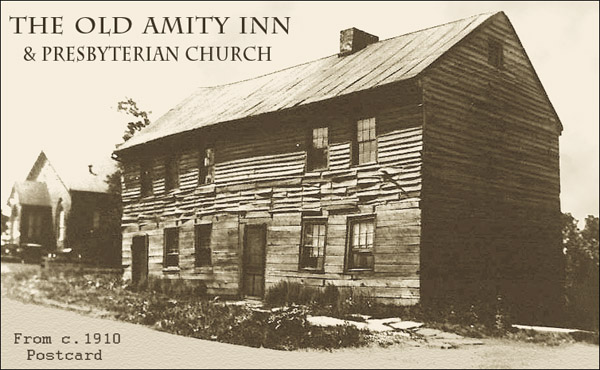
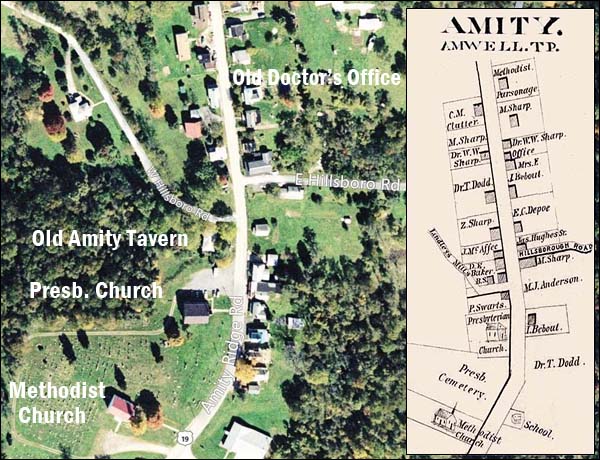
The author of the "Manuscript Found," which doubtless suggested the Book of Mormon, and occupied so important a position in its conception, design and execution, lived and died in Amity, Pa. The old frame house he occupied is still tenable, and his grave in the old cemetery attracts many a curious visitor. A stone still marks the foot of the grave with one of its bold initials obliterated. Time has reduced the headstone to small particles of dust, while many a fragment of it adorns the cabinets of the antiquarians. About eighteen years ago, the writer, by carefully replacing the broken pieces, obtained a fragmentary copy of its inscription, a part of which was a four-line stanza, commencing as follows:

"A seraph tuned his sweetest lay." But we have a living witness -- Joseph Miller -- a veteran of the war of 1812. A Christian gentleman of undoubted veracity, with mind and memory remarkable for their prolonged preservation, and singularly free from any signs of senility. I had an interview with Mr. Miller two days ago. Found him well and hearty barring some muscular disability, and as ready to crack a joke or fling a repartee as ever. He said, if he lived till to-day, (Feb. 1) he would be 88 years old.

I asked him to give me all the information he could from his personal knowledge of Rev. Solomon Spaulding and his family, his recollections and impressions, from association with him, with reference especially to his object in writing the "manuscript found," and its subsequent misuse by the founders of the Mormon sect. Prefacing his reply with the remark that he would not intentionally say one word that he did not believe to be strictly true; he proceeded deliberately, to make in substance, the following statement:


I was well acquainted with Mr. Spaulding while he lived in Amity, Pa. I would say he was 55 to 60 years of age; in person, tall and spare, and considerably stooped, caused in part, I think, from a severe rupture. His hair was quite gray. He was chaste in language and dignified in manner, becoming his profession. I never heard him preach, think he never preached at A.; said he had quit preaching on account of ill health. He kept a public house or tavern of the character common at that day. He died of dysentery in 1816, (in the fall, I think), after an illness of six or eight weeks. Dr. Chephas Dodd attended him.

I watched with him many nights during this illness. After he died I made his coffin and superintended his burial. One night when near his end, he told me he thought he should die, and requested me to assist his wife in settling his estate; accordingly I, with Col. Thomas Venom went on her bond as administratrix, and I helped her close it up.

Mrs. Spaulding was intelligent and of pleasing manners, with fair complexion, and say, from 35 to 40 years of age.

A child of fair complexion and about 14 years of age, lived with them here, think she was their daughter as she bore the Spaulding name.

Mr. S. was poor but honest. I endorsed for him twice to borrow money. His house was a place of common resort especially in the evening. I was prosecuting my trade (carpenter) in the village and frequented his house. Mr. S. seemed to take delight in reading from his manuscript (written on foolscap) for the entertainment of his frequent visitors, heard him read most, if not all of it, and had frequent conversations with him about it.

Sometime ago, I had in my possession, for about six months, the book of Mormon and heard most of it read during the time. I was always forcibly struck with the similarity of the portions of it which purported to be of supernatural origin to the quaint style and peculiar language that had made so deep an impression on my mind when hearing the manuscript read by Mr. S. For instance, the very frequent repetition of the phrase, "and it came to pass." Then on hearing read the account from the book of the battle between the Amalekites and the Nephites, in which the soldiers of one army had placed a red mark on their foreheads to distinguish them from their enemies, it seemed to reproduce in my mind not only the narrative, but the very words as they had been impressed on my mind by the reading of Spaulding's manuscript.

The object of Mr. S. in writing the manuscript found as I understood, was to employ an invalid's lovely imagination, and to supply a romantic history of those last [sic, lost?] races or tribes, whose true history remains buried with their dust beneath those mysterious mounds, so common in a large portion of our country.

Its publication seemed to be an after thought, most likely suggested by pecuniary embarrassment. My recollection is that Mr. S. had left a transcript of the manuscript with Mr. Patterson, of Pittsburgh, Pa., for publication, that its publication was delayed until Mr. S. would write a preface, and in the mean time the transcript was spirited away and could not be found. Mr. S. told me that Sidney Rigdon had taken it, or that he was suspicioned for it. Recollect distinctly that Rigdon's name was used in that connection.

The longer I live the more firmly I am convinced that Spaulding's MS. was appropriated and largely used in getting up the Book of Mormon. I believe, that leaving out of the book the portion that may be easily recognised as the work of Joe Smith and his accomplices that Solomon Spaulding may be truly said to be its author. I have not a doubt of it.

If my life has been prolonged, that I might assist in exposing so base a fraud, and if I shall be permitted to see this abominable delusion dispelled, I shall console myself with the thought that I have not lived in vain.

At the close of the interview I dined with my old life long friend, (we call him uncle Joe) and after a few parting words I was on my way home feeling that it is seldom one enjoys so much pleasure and profit as I had in this interview.   W. W. SHARPE.
February 1st, 1879.


Note: This letter by W. W. Sharpe was re-published (with slight changes) in the Pittsburgh Telegraph of Feb. 6, 1879. The content of Joseph Miller's 1879 statement corresponds in most respects to the one published ten years before in the Daily Evening Reporter on Apr. 8, 1869.


No. 1797.                     Pittsburgh, Thurs. Evening, Feb. 6, 1879.                     3 Cents.


THE  BOOK  OF  MORMON.

A NEW CLAIM OF AUTHORSHIP.
Important Researches at Amity Authorized
From Utah -- The Story of  
Rev. Solomon Spaulding --
Some New Facts.

The little town of Amity, a few miles up the Monongahela River, was the birth place of Mormonism. For many years Sidney Rigdon was thought to have written the Book of Mormon, afterward elaborated by Joe Smith, and made the basis of the faith or system of the Utah Colony, but some investigations lately made at Amity by Dr. W. W, Sharp, under authority from Salt Lake City, have brought out a new story about the origin of the book. Dr. Sharp writes as follows to the Reporter of Washington, Pa.

The author of the "Manuscript Found," which doubtless suggested the Book of Mormon, and occupied so important a position in its conception, design and execution, lived and died in Amity, Pa. The old frame house he occupied is still tenable, and his grave in the old cemetery attracts many a curious visitor. A stone still marks the foot of the grave with one of its bold initials obliterated. Time has reduced the headstone to small particles of dust, while many a fragment of it adorns the cabinets of the antiquarians. About eighteen years ago, the writer, by carefully replacing the broken pieces, obtained a fragmentary copy of its inscription, a part of which was a four-line stanza, commencing as follows:

"A seraph tuned his sweetest lay." But we have a living witness -- Joseph Miller -- a veteran of the war of 1812. A Christian gentleman of undoubted veracity, with mind and memory remarkable for their prolonged preservation, and singularly free from any signs of senility. I had an interview with Mr. Miller two days ago. Found him well and hearty barring some muscular disability, and as ready to crack a joke or fling a repartee as ever. He said, if he lived till to-day, (Feb. 1, 1879) he would be 88 years old.

I asked him to give me all the information he could from his personal knowledge of Rev. Solomon Spaulding and his family, his recollections and impressions, from association with him, with reference especially to his object in writing the "manuscript found," and its subsequent misuse by the founders of the Mormon sect. Prefacing his reply with the remark that he would not intentionally say one word that he did not believe to be strictly true, he proceeded deliberately to make, in substance, the following statement:


I was well acquainted with Mr. Spaulding while he lived in Amity, Pa. I would say he was 55 to 60 years of age; in person, tall and spare, and considerably stooped, caused in part, I think, from a severe rupture. His hair was quite gray. He was chaste in language and dignified in manner, becoming his profession. I never heard him preach, think he never preached at A.; said he had quit preaching on account of ill health. He kept a public house or tavern of the character common to that day. He died of dysentery in 1816 (in the Fall, I think), after an illness of six or eight weeks. Dr. Chephas Dodd attended him.

I watched with him many nights during this illness. After he died I made his coffin and superintended his burial. One night when he was near his end, he told me he thought he should die, and requested me to assist his wife in settling his estate; accordingly I, with Col. Thos. Venom went on her bond as administratrix, and I helped her close it up.

Mrs. Spaulding was intelligent and of pleasing manners, with fair complexion, and say, from 35 to 40 years of age.

A child of fair complexion and about fourteen years of age, lived with them here, think she was their daughter as she bore the Spaulding name.

Mr. S. was poor but honest. I endorsed for him twice to borrow money. His house was a place of common resort especially in the evening. I was prosecuting my trade (carpenter) in the village and frequented his house. Mr. S. seemed to take delight in reading from his manuscript (written on foolscap) for the entertainment of his frequent visitors, heard him read most, if not all of it, and had frequent conversations with him about it.

Some time ago I had in my possession, for about six months, the book of Mormon, and heard most of it read during the time. I was always forcibly struck with the similarity of the portions of it which purported to be of supernatural origin to the quaint style and peculiar language that had made such a deep impression on my mind when hearing the manuscript read by Mr. S. For instance, the very frequent repetition of the phrase, "and it came to pass." Then on hearing read the account from the book of the battle between the Amalekites and the Nephites, in which the soldiers of one army had placed a red mark on their foreheads to distinguish them from their enemies, it seemed to reproduce in my mind not only the narrative, but the very words, as they had been impressed on my mind by the reading of Spaulding's manuscript.

The object of Mr. S. in writing the "Manuscript Found," as I understood, was to employ an invalid's lonely imagination, and to support a romantic history of those l[o]st races or tribes, whose true history remains buried with their dust beneath those mysterious mounds so common in a large portion of our country.

Its publication seemed to be an afterthought, most likely suggested by pecuniary embarrassment. My recollection is that Mr. S. had left a transcript of the manuscript with Mr. Patterson, of Pittsburgh, Pa., for publication, that its publication was delayed until Mr. S. would write a preface, and in the meantime the transcript was spirited away and could not be found. Mr. S. told me that Sidney Rigdon had taken it, or that he was suspicioned for it. Recollect distinctly that Rigdon's name was used in that connection.

The longer I live the more firmly I am convinced that Spaulding's MS. was appropriated and largely used in getting up the Book of Mormon. I believe, that leaving out of the book the portion that may be easily recognised as the work of Joe Smith and his accomplices, that Solomon Spaulding may be truly said to be its author. I have not a doubt of it.

Note: This letter by W. W. Sharpe was taken (with slight changes) from the Daily Evening Reporter of Feb. 5, 1879. The Telegraph's reprint undoubtedly received a wider circulation than did the original article, and it is certain that Salt Lake City journalist James T. Cobb was pleased to see Miller's statement regarding the Spalding authorship reach a large readership.


Commercial  Gazette.

Vol. 9                 Pittsburgh, Monday, Feb. 8, 1879.                 One Cent.


A  QUESTION  OF  AUTHORSHIP.

A correspondent of the Washington, Pa., Reporter, Dr. W. W. Sharp, has given an interesting account of his attempt to investigate the origin of the Book of Mormon. It is nothing less than surprising to find able editors, even of city journals characterizing Dr. Sharp's statement as "a new story about the origin of the book." As we have said, the account is interesting, but its interest consists wholly or chiefly in the fact that the writer repeats with apparent fidelity the narrative of an aged though still competent witness respecting facts often before related. That the book out of which the Book of Mormon was concocted was the work of the Rev. Solomon Spaulding, a Congregationalist clergyman, has been frequently asserted with the allegation of evidence more or less satisfactory. Mr. Spaulding, disqualified for his professional labors by ill health, spent the last two years of his life in the village of Amity, in this State, where, it seems, he kept a decent public house or tavern for subsistence. He died in 1816, and Dr. Sharp has lately conversed with an old man, Mr. Miller, who knew him well, and who retains a distinct recollection of the style and general tenor of the manuscript which has been so often mentioned as the source of the book of Mormon. The style of the manuscript which was an imitation of the style of the King James version of the Bible, and the tenor of it was a romantic history of those lost races or tribes who formerly inhabited this country, and of whom the mysterious mounds of the Mississippi valley are supposed to be the remains. Mr. Miller has seen the Book of Mormon, and not only the style recalled the Spaulding manuscript, but he at once recognized the tribal name of the Nephites as a name used in the romance. Othervdetails proving the general identity of the two books were attested years ago by other persons who knew Spaulding and had read or heard his novel.

Spaulding no doubt wrote the story merely for his own amusement, but the interest with which his neighbors listened to the reading of it, or some cause, seems to have raised in the hope of profit from its publication. At any rate, there is no doubt that a copy of the manuscript was placed in the hands of Mr. Paterson, of Pittsburg, for the purpose of being printed -- that Sidney Rigdon, afterwards so closely associated with Joe Smith in the promulgation of his pretended revelation, was on terms of intimacy with Mr. Patterson -- and that the manuscript suddenly disappeared. Theree must be several persons in the city of Pittsburgh able to say whether these statements are correct, and it seems therefore worth while to repeat them once more with the view of having them attested or denied. We have already seen that the account of the Spaulding origin of the Mormon book is not universally known. A great English writer, Mr. Stuart Mills, has spoken of the rise and progress of Mormonism as perhaps the most remarkable phenomena of the nineteenth century. Whether this be a just estimate or not, there can be no question about the singular curiosity which attaches to the subject. In the light they reflect upon the operation of superstition in remote ages the facts are most significant and instructive, while as mere illustrations of the obscurities and difficulties which attend the historical investigation of origins, both religious and national, Mormonism already offers problems worthy of the most earnest attention.


Note: No copy of this issue of the Commercial Gazette has yet been located for transcription. The text was taken from a reprint published in the Mar. 6, 1879 issue of the Salt Lake Tribune. This Feb. 8th item was responded to by the Rev. Robert Patterson, Jr., in the paper's issue of Feb. 17, 1879.


No. 1799.                     Pittsburgh, Thurs. Evening, Feb. 8?, 1879.                     3 Cents.


REMINISCENCES  OF  RIGDON.
The Early Saint of the Mormon Church. --
One Who Heard Him Preach Here.

To the Editor of the Telegraph.

In your issue of yesterday you published an article in relation to the "Book of Mormon," in which the name of Sidney Rigdon naturally appeared. That man was a popular preacher in his day. There are a few, and but a few, now living, who were men and women in those days, and heard him preach. His manner is just as fresh in my mind to-day, as when in my boyhood I heard him preach in the old Baptist church, on the corner of Third and Grant Streets. It was an old one-story frame building, standing on the spot now occupied by the Universalist church. He must have been an extraordinary man, for the house was always filled to hear him. He was truly eloquent, and used the most elegant language, at least I thought him certainly the best preacher in the city. He preached three times every Sunday throughout the year, and such a thing as "hay fever" was a disease unknown in all our orders. It is greatly to be regretted that such a dreadful plague has of late years been afflicting our preachers, many of them leaving their posts for rural scenes, and some of them taking refuge in Europe from the attacks of the terrible scourge! It is certain that then, as well as now:

"Dangers stood thick through all the ground.
  To push us to the tomb
And fierce diseases waited round
  To hurry mortals home."
Yet they stood up like men and soldiers, and faced the dangers, and if they found that any disease got hold of them, they would leave the pulpit for the care and comfort of their homes and struggle with the monster there, where their wives and children could minister to their wants. How changed the times!

Mr. Rigdon had at [that] time some difficulty with his church, what it was I never knew; but whatever it was, he [left] the church for a season. The people called him back again, and on the Sunday morning following his return he preached from the following text.

"I came unto you without gainsaying, as soon as I was sent for. I therefore ask for what intent you have sent for me?" In the afternoon at 3 o'clock, from the text: "For I am determined to know nothing among you, save Jesus Christ, and Him crucified," and in the evening: "Tell me, if you will deal kindly and truly with my Master, and if not, tell me so that I may turn to the right hand or to the left."

It is not far from sixty years since these sermons were preached, and, to this day, I picture the man in my memory, as he stood in the pulpit pouring forth the strains of fervid eloquence to a house full to repletion, as if it were only yesterday.

One Sunday he preached three sermons from the following text (quoting from memory, I may not give the exact language of scripture) "And in the days of these kings shall the God of Heaven set up a kingdom that shall not be left to the hands of other people, but it shall break in pieces all other kingdoms and shall stand forever." No one ever tired under him, although he would preach more than an hour.

After he turned Mormon it was supposed that he had something of the kind in his mind when he preached from that text. Be this as it may, they were three excellent sermons. I would like to know how [many of those] living at this day heard him on [these] occasions? Oh how many thousands are now sleeping in our "silent cities of the dead" who were among the busy ones thronging our thoroughfares in the days of Sidney Rigdon!

PITTSBURGH, February 7, 1879.


Note 1: The exact date of this letter's publication remains uncertain. It may have been printed the day before, or the day after Feb. 8, 1879.

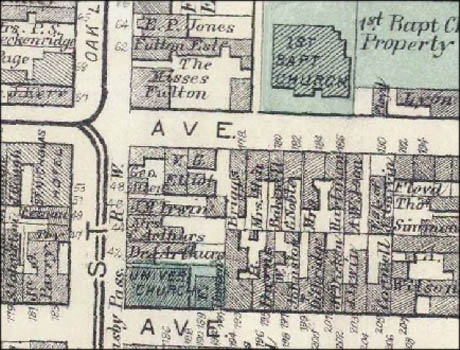
Note 2: The First Baptist Church of Pittsburgh began as a small congregation in 1812, the same year Solomon Spalding arrived in that town. In 1820 the members built a modest frame building at the corner of Third Avenue and Grant Street. It was here that the Rev. Sidney Rigdon served his pastorate in 1822 and 1823. The present stone chapel was erected in 1867 at Fourth Avenue and Grant Street. An extension was constructed in 1876, placing the chapel's new front door on Ross Street, as it remains today.

Note 3: It is interesting that the correspondent recalled Rigdon preaching a proto-Mormon sermon in Pittsburgh as early as 1822-23. The Rev. Samuel Williams reported also hearing that Rigdon was preaching an early version of the Campbellites' adult immersion for the remission of sins at about this same time. This tenet (still new and controversial when introduced on a wide scale by Rev. Walter Scott in the fall of 1827) was a key teaching in the 1830 Book of Mormon.


Volume LXV.                    Pittsburgh, Wednesday, February 12, 1879.                    No. 24.


THE  MORMON  PROBLEM.

In another column will be seen what there is much reason to believe is a true history of the origin of the Mormon Bible." It will be read with the closest attention.

Polygamy was not one of the original features of the delusion, but was afterwards engrafted upon it. And to this day the Mormon emissaries in Europe are careful to conceal their peculiar and distinct views with regard to marriage; otherwise they would prevent their success in obtaining new recruits almost altogether. It is only after their arrival in Utah that the greater part of deceived Europeans learn how purity, law and decency have been set aside in the matter of marriage, John Taylor, now President of the Mormon Church, when in France in 1853, although he then had no less than five wives, denied the existence of polygamy among the Mormons, and had a denial printed in pamphlet form in French and circulated in large numbers. Now this same John Taylor declares that the revelations concerning polygamy came directly from heaven; that is his religion, and neither Congress nor the Supreme Court of the United States which declared the act of 1862 forbidding polygamous marriages in the territories of the United States constitutional, will have no effect except to unite, confirm and strengthen Mormons in their faith. And it is well known that leading Mormons have taken additional wives since the decision of the Supreme Court was given. In direct contempt of the opinion of the court, John W. Young has married his fifth wife, James Welch his second wife and John White his third wife. At the same time Mormon women are beseiging the President and others in authority and Delegate Cannon and representatives of the Mormon Church are petitioning for amnesty and promising obedience to the law.

In view of the state of things it is not strange that a petition has been addressed to Congress by the anti-polygamists in Utah, praying that instead of rendering the law against polygamy more lenient, Congress would amend the act of 1862 by making living together in polygamy under the general reputation of marriage sufficient to constitute the offence, as otherwise the statyte will be practically inoperative. In this movement the law-observing and purity-loving people of Utah should have the co-operation of all opponents of the iniquitous institution, in all parts of the country. Thorough work should be made in delivering the people of the United States from the charge of tolerating a degrading system of concubinage. Too much confidence must not be placed in Congress, without watchfulness on the part of the people; its members ought to be made to feel that the public eye is always upon them, and they will be held to strict account for neglect of duty.


MORMONISM.
_____

BY ALFRED CREIGH, LL., D.
_____

The recent decision of the Supreme Court of the United States, sustaining the constitutionality of the law of Congress, enacted in 1862, punishing bigamy in the Territories with fine and imprisonment, has attracted public attention anew to the most stupendous delusion of the nineteenth century. Thank God for the decision! It is a step in the right direction to crush out a system destructive of good morals, patriotism, the marriage relation and the principles of liberty.

The facts in regard to the origin of the Book of Mormon have been frequently published. They were detailed by the present writer in his "History of Washington County," published in 1870. Briefly they are as follows:

Rev. Solomon Spaulding, a graduate of Dartmouth College, became a resident of New Salem (sometimes called Conneaut), in Ashtabula County, O., in the early part of the present century. Here he was compelled by the state of his health to desist from active labors. To occupy his hours of leisure, he amused himself by writing a historical romance, containing a record of the wanderings and the varied fortunes of the race that reared the mounds so numerous throughout the West, and many of which were to se seen in the vicinity of his residence. This was about the year 1812. The romance, purporting to be written by one of the lost race and to have been recovered from the earth, was entitled the "Manuscript Found." Mr. Spaulding, as his work progressed, frequently read it to his neighbors, many of whom became interested in it and familiar with the events and names recorded. From New Salem Mr. Spaulding removed to Pittsburgh and deposited his manuscript in the printing office of Mr. Patterson for examination, with a view to publication. It is supposed that Sidney Rigdon, one of the originators of the Mormon delusion, had come across this manuscript whilst in the office, became acquainted with its contents, and possibly made or obtained a copy of it. After some time the manuscript was returned to Mr. Spaulding, who soon after removed to Amity, Washington County, Pa., where he died in 1816. About 1830 the Book of Mormon appeared; a Mormon preacher visited New Salem and in a public meeting read copious extracts from the book, which were immediately recognized by the older inhabitants present as the identical work of Mr. Spaulding; and his brother, being present, arose on the spot and with tears expressed his sorrow that the work of his sainted brother should be used for so shocking a purpose. The inhabitants of New Salem held a meeting and deputed one of their number, Dr. Hurlbut, to repair to Monson, Mass., where Mr. Spaulding's widow (who had married a Mr. Davidson) resided, to obtain the original manuscript for comparison with the Mormon Bible. This was in 1834. Mrs. Davidson afterwards wrote a full statement of the facts, of which the above is but an outline. This statement (given in full in the "Hist. of Wash. Co." pp. 91-93, was published in 1839, and elicited from Mr. Rigdon the year a published denial of all knowledge on his part of Mr. Spaulding's manuscript. In connection with Mrs. Davidson's statement, a letter from Joseph Miller, Sr., dated March 26, 1869, is given in the "History above referred to. Mr. Miller (still living at Amity, being 88 years of age) was well acquainted with Mr. Spaulding, waited on him in his last illness and assisted at his burial. Mr. Miller had heard Mr. Spaulding read portions of his novel entitled the "Manuscript Found," and afterwards on hearing the Book of Mormon read, recollected several passages as the same he had heard Mr. Spaulding read. One passage he remembers distinctly, where the Amalekites had marked themselves with red on the foreheads to distinguish them from the Nephites. The singularity had fixed it in his memory.

To the testimony of which the above is a brief sketch, the following facts may be added as not devoid of interest in connection with the history of this colosal fraud:

Mr. McKinstry, a son of the late Dr. McKinstry of Monson, Mass., and the grandson of Rev. S. Spaulding, says that his grandmother came East from Ohio to live with her daughter at Monson many years ago, bringing the manuscript of his grandfather's romance with her. Before her death a plausible young man from Boston came to see and get the Spaulding writing. It was a time of considerable excitement concerning the Mormons, and he claimed to represent some Christian people who wanted to expose Mormonism. He therefore begged the loan of the manuscript for publication. Much against the wishes of Mrs. Dr. McKinstry, the daughter of Mrs. Spaulding (now Davidson) she consented to let her husband's unpublished romance be taken away. Nothing was ever heard of it again, and the family have always considered that the bland young gentleman was an agent of Brigham Young to destroy this convincing evidence that Joe Smith's Mormon Bible was of very earthly origin.

The widow of Mr. Spaulding and her daughter, Mrs. Dr. McKinstry, had compared the Mormon Bible with the romance of the "Manuscript Found," and stated that they were essentially the same -- that the similarity was so overwhelming as to leave no doubt on their minds but that Joe Smith or Sidney Rigdon had copied it in full and made out of it bodily, the divine revelation -- as a special revelation from God on plates of gold engraven by his own hand -- and that after being translated they were taken back to heaven.

The Springfield (Mass.) Republican gives its testimony in these words: The story of how the Rev. Mr, Spaulding came to prepare his romance, which Mr McKinstry remembers as a child to have seen, is very interesting. Mr. Spaulding was out of the active ministry in Ohio, and employed his leisure moments in weaving a romance. It was at the time when the Mound Builders were creating wild excitement and interest -- the implements of cookery and war being unearthed showing the existence of a forgotten race. This furnished the inspiration for the chronicles of the story writen. He entitled the production the "Manuscript Found," the idea being that the romance written by Mr. Spaulding was dug up out of one of the mounds in the region. It was a history of Ancient America, not all written at once, but as leisure and fancy occurred to him, Mr. Spaulding would add to it. His writing was no secret in the neighborhood. In that then frontier region, with few opportunities for literary enjoyment. Rev. Mr. Spaulding was prevailed upon to read to his neighbors. It was written in Bible phraseology and made as quaintly old as possible, so as to carry out the idea of its alleged mound origin.

I might add in this connection that Joe Smith was born on Vermont in 1805, and his friends claim that when he was fifteen years of age he was informed by an angel in a vision of the apostacy of the Primitive church. On September 22, 1827 he received from the hands of a messenger from the Lord the golden plates containing the ancient history of this continent, written by various prophets and concealed by Morni [sic] in the year 420. He was informed that he was the chosen instrument to restore God's church to its former purity and holiness. Accordingly he proceeded to translate the golden plates and the church was organized in 1830.

Three witnesses, viz: Oliver Cowdery, David Whitmer and Martin Harris, testify that an angel of God came down from heaven and he brought and laid before our eyes that we beheld and saw the plates and the engraving thereon;" and I may add, to complete the imposture, that Joe Smith exhibited these plates to Christian Whitmer, Jacob Whitmer, Peter Whitmer, Jr., John Whitmer, Hiram Page, Joseph Smith, Sr., Hiram Smith and Samuel H. Smith, and that they "had the appearance of gold and the engraving was of curious eorkmanship and was handled by their own hands."

We can readily account for the reason why the Whitmers and the Smiths are the principal witnesses -- because the book itself says that "Morni, a son of Mormon, was authorized to show the plates unto those who shall assist to bring forth this work and unto three shall they be shown (viz: Cowdery, Whitmer and Harris) by the power of God wherefore they shall know of a surety that these things are true."

Such is the stupendous fraud and imposture which has been imposed not only on the American people, but upon foreign countries to which emissaries have gone, bringing back ignorant people by the ship load to become American citizens.


Note 1: Alfred Creigh's article in the Banner was quickly reprinted in the Feb. 14th issue of his home-town paper, the Washington Reporter. For Alfred Creigh's earlier account of the Spalding claims for Book of Mormon authorship see pp. 89-93 of his 1870 History of Washington County, Pennsylvania.

Note 2: The John A. McKinstry statement in the Springfield Republican, referred by Mr. Creigh is known by its reprint in the New Haven Connecticut Palladium of Sep. 3, 1877. The same reprint was also carried by the Syracuse Journal on that same date. Creigh's paraphrase of the McKinstry statement changes the original wording considerably. Also, it should be noted here that the 1877 McKinstry statement conflates the two separate visits of D. P. Hurlbut (in 1833) and Jesse Haven (in 1839) into a single, somewhat jumbled account.

Note 3: Rev. Robert Patterson, Jr., the secondary "editor and proprietor" of the Banner Robert Patterson, Jr., was at least marginally involved in investigations of the Spalding claims as early as November of 1878, when the Rev. Samuel Williams contacted Patterson about his father's contact with Spalding in Pittsburgh c. 1812-1816. Through Williams Patterson soon came into contact with the highly motivated Spalding claims researcher, James T. Cobb of Salt Lake City and much of Cobb's enthusiasm for this line of research seems to have quickly rubbed off onto Patterson. Whether Patterson solicited the Feb. 12, 1879 article from Creigh, or whether it was Creigh who first approached Patterson on that matter remains unknown. At the very least the interests of both Creigh and Patterson regarding the Spalding authorship claims appear to have converged early in 1879. For a contemporary letter by Patterson on this subject, see the Commercial-Gazette of Feb. 17, 1879. From this point forward it was Robert Patterson, Jr. who carried forward most of the new research on the Spalding authorship claims (at least he was the primary researcher of this subject in western Pennsylvania in the early 1880s). For example, in August of 1879 Patterson was inspired to seek out and interview the aging D. P. Hurlbut at Gibsonburg, Ohio and obtain a statement from him (printed in the Leader in Feb. 1880 ) regarding the man's involvement in the 1833 effort to recover the writings of Solomon Spalding. It was probably his frustrations and subsequent realizations, developing out of his failed effort to obtain useful information from Hurlbut that motivated Patterson to continue and expand his search for the facts underlying the old Spalding claims.


Vol. 3 -- Whole 783.             Washington, Pa., Fri., Feb. 14, 1879.             One Cent.


Mormonism  By  Spaulding.
_____

We publish in this issue the facts in relation to the origin of the Book of Mormon. It is a curious piece of history which persons yet living can verify. It is due to those who have been deceived by this imposture; to the country under whose institutions it has become so powerful and so insolent, and to christianity which it presumes to supplant as "the church of the latter day saints of Jesus Christ," that some permanent memorial shall be erected to identify and make clear the time, place and circumstances of [its[ origin. Solomon Spalding, as a man or a preacher, is not entitled to any special notice save as the innocent author of a system of religion [which it is fair?] to do a great amount of harm to us as a people and a government. The system is a fraud, although it claims a divine origin, and while the living witnesses of this imposture still exist, [some?] efforts should be made to mark the spot where its author lies, in such a manner as will identify it as a historical fact. In a few years the grave of Spaulding will only be known by tradition, nothing being left to mark the place. The living witnesses will have died, and then in time, it may be a question in the minds of many whether such a man really lived, and whether the origin of the Book of Mormon is not a fiction. In the name of christianity which it shames, a monument should be reared as a protest against the imposture which threatens to mislead so many simple-minded people, and to involve our country in evils of the greatest magnitude. The different christian churches should unite and place a durable monument of granite upon the grave of Spaulding as a permanent memorial which will remind the people of the outrages and crimes perpetrated in the name of a religion which claims to be divine. The christianity of Washington county owes it to itself and the country that this memorial shall be solemnly made. A few hundred dollars thus invested will rear a monument which will be permenant portest against the claims of "the latter day Saints" of Utah.

Will not some of our church bodies move in this matter before the living witnesses shall have departed? What is done should be done with.


MORMONISM.
______

BY ALFRED CREIGH, LL. D.

(see the Feb. 12th Presbyterian Banner for this text)


Notes: (forthcoming)


Commercial  Gazette.

Vol. 16.             Pittsburgh, Monday., Feb. 17, 1879.             No. 93.


The Mormon Bible.
_____

To the Editors of the Commercial Gazette:

Having read with interest your editorial of the 8th inst.: A Question of Authorship," I have watched your columns in the hope that some of our older citizens would responf to your very timely suggestion. If, as generally believed, the romance of Rev. Solomon Spaulding, entitled the "Manuscript Found," was surreptitously obtained from a printing office in Pittsburghm about the year 1815, and reappeared in 1830 under the transforming hand of Sidney Rigdon, as the "Book of Mormon," it is reasonable to suppose, as you remark, that "there must be several persons in the city of Pittsburgh able to say whether these statements are correct, and it seems therefore worthwhile to repeat them once more with the view of having them attested or denied." Permit me to add my voice to yours in urging that such of your readers as have facts to communicate on this point would give them to the public at once. Dr. Sharp, to whom you refer, has set an example which should be generally followed and possibly much additional light may yet be shed upon this question of disputed authorship. Its possible influence upon the minds of Mormons themselves should not be forgotten.
                                        R. P.


To the Editors of the Commercial Gazette:

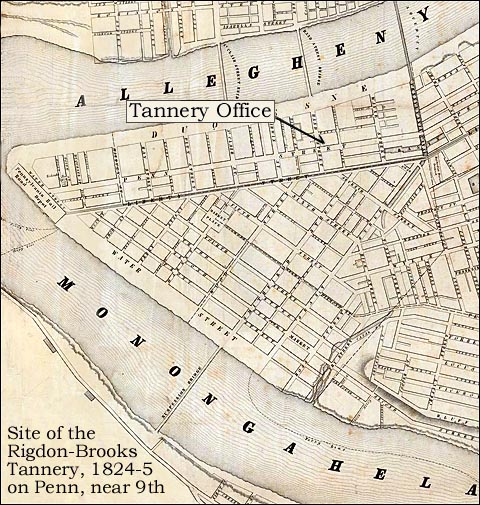
Your "Question of Authorship," relating to the origin of Mormonism, in today's issue, leads me to drop you this item. So far back as 1822 the firm of Patterson & Lambdin, (a shade of doubt about the last name of the firm) did business as Publishers, Bookbinders and Booksellers, at the southeast corner of the Diamond and Market street. At the same time Sidney Rigdon, tanner and currier, had his tan-yard and shop on Penn street, on the lot running from Penn Avenue to Allegheny above Ninth street. The shop stood where the Drs. Dicksons' office now is. In 1841 the administrators of my father's estate found among the papers an unpaid note bearing Rigdon's signature. It was not long after 1822 that Rigdon was reported to have gone to Eastern Ohio.

After the Book of Mormon had appeared, it was remembered by many who read it, and by the members of Mr. Spaulding's family, that parts of it were a reconstruction of [his manuscript?] which had been sent to the Patterson [brs.?] I think this firm went out of the publishing part of their business about that time. Putting these things together, it is likely that, in the business transactions between book-binder and tanner, Sidney Rigdon took the Spaulding manuscript to Ohio, and he became the real, whilst Joseph Smith was the ostensible originator of the Mormon fraud. Rigdon was for a time one of the "Twelve Apostles" of that system, but never gave his assent to its teachings on polygamy. He visited Pittsburgh between 1844 and 1850. As a singular coincidence, in 1841, one of the early residents of Pittsburgh told me that she was at a meeting in a Baptist church in Pittsburgh, and on that evening, Sidney Rigdon and Alexander Campbell both dissolved their connection with the Baptist denomination. The influence of both, as founders of schools or religious thought, has been widely extended, although of very different notions and tendencies.   Y.
            PARNASSUS, PA., Feb. 15, 1879.


Note 1: The first letter was written by the Rev. Robert Patterson, Jr., the son of the publisher with whom Solomon had dealings over sixty years previous (and in 1879, the assistent editor of the Presbyterian Banner, published in Pittsburgh.

Note 2: The second correspondent provides valuable information, saying that "Sidney Rigdon, tanner and currier, had his tan-yard and shop on Penn street." A "currier" of those days prepared leather for special use by treating the rawhide with certain chemicals, trimming it to a uniform thickness, and polishing its outer surface. In a c. 1900 account, Sidney's son, John W. Rigdon, mentioned that his father formed a partnership with Richard S. Brooks to open the short-lived tannery. John calls this same Richard (who was Rigdon's brother-in-law) a corroyeur, so it seems likely that Sidney improved upon his previous, undocumented tanning training, to become a leather dresser (currier) as well as a leather maker. When the business was dissolved in 1825, Sidney's partner at that time was Richard's brother, William S. Brooks. All of Sideny Rigdon's Brooks family brothers-in-law probably had some amount of training in the trade, as their father, Jeremiah Brooks, owned and operated a tannery near Warren, Ohio. One such special use would have been the manufacture of leather sheets for book-binding. An example of the early need for curriers in Pittsburgh may be seen in an advertisement in the Mercury for May 20, 1813, reading: "Wanted immediately -- A tanner and currier -- apply at the office of the Mercury." The same paper advertised for "journeyman book-binders" in its issue of Aug. 10, 1814, requesting respondents to apply to "R. and J. Patterson." See also Isaac Craig's letter of Oct. 14, 1882, where he says: "Rigdon had a small tannery on Penn street, near Hand, for the manufacture of book-binders sheep-skins, and supplying these to the office brought him in contact with [Silas] Engles. This impression I obtained from John Sandersen, an old time butcher, who sold sheep pelts to Rigdon."

Note 3: The second correspondent also says, "it is likely that, in the business transactions between book-binder and tanner, Sidney Rigdon took the Spaulding manuscript..." Sidney Rigdon, after he was removed by the orthodox Baptists of Pittsburgh, preached Campbellite doctrines to a small band of seceders at the court house in that city. At some point became a "journeyman tanner" in the Pittsburgh area and was able to work at that occupation after his dismissal from the regular Baptists. Rebecca J. Eichbaum, who knew Rigdon at Pittsburgh, in her 1879 statement, says: "He was connected with the tannery before he became a preacher, though he may have continued the business whilst preaching. Rebecca's statement is confirmed by Rigdon's own 1843 autobiographical sketch, where he states: "Having now retired from the ministry, and having no way by which to sustain his family, besides his own industry, he was necessiated to find other employment in order to provide for his maintenance, and for this purpose he engaged in the humble capacity of a journeyman tanner, in that city, and followed his new employment, without murmuring, for two years." Of course Rev. Rigdon could not have gone to work as a "journeyman" tanner without first having earlier served an apprenticeship in that same trade.

Note 4:As a "currier," Rigdon would have had personal acquaintance with the leather book-binding industry in Pittsburgh. The main questions to be answered are when and where Rigdon first worked as a currier and when Robert & Joseph Patterson (and/or their business associate Jonathan Harrison Lambdin) were first engaged in the book-binding trade in Pittsburgh. For more discussion on this point see the notes accompanying the ad for "tanning and currying" in the Mercury of Nov. 20, 1822. It may be relevant, that in his 1842 interview with Robert Patterson, Sr., LDS Apostle John E. Page was reportedly told that "Sidney Rigdon was not connected with the office" maintained by Patterson for book publishing in Pittsburgh, until "several years" after Solomon Spalding's 1816 death. A likely period for this "connection" would have been in 1824, when Rigdon was a tanner and currier in Pittsburgh and Jonathan Harrison Lambdin was acting on his own as a sales agent for "the Assignees of R. Patterson & Lambdin," in the remaining business of this previously dissolved partnership.

Note 5: The Commercial Gazette was formed in 1877 by the merger of the city's veteran Pittsburgh Gazette and apparently more viable Daily Commercial.


No. 18__                      Pittsburgh, Thurs. Evening, March 27, 1879.                      3 Cents.


FACT  VERSUS  FAITH.
________

The Book of Mormon and the Spaulding Romance.
________

Documentary Details Demonstrating Their Identity.
________

Fanaticism Fighting a Fatal Fact for Fifty Years.
________

"Such a Resemblance Without Plagiarism
Would be a Greater Miracle than all the Rest".
________


To the Editor of the Telegraph:
The most direct and important testimony which has yet been given, bearing upon this question, is the letter of the widow of Rev. Solomon Spaulding, which was published in the Boston Recorder, in its issue of April 19, 1839, only nine years after the appearance of the Book of Mormon. It has been repeatedly reprinted, but there are many of the present generation who have not seen it, and who will peruse it with deep interest. Especially will this be the case in this city and vicinity, which may be regarded as the birthplace of this great imposture. The prefatory note from Rev. John Storrs, at that time (1839) pastor of the Congregational Church in Holliston, Mass., fully explains the occasion for writing this letter, and the appended testimonies of Rev. Messrs. Ely and Austin, of Monson, Mass., emphatically sustain the reliability of Mrs. Davison.

Here follows the text of the original Davison-Storrs
article from the Boston Recorder of   April 19, 1839.


The above has been carefully compared with a transcript taken from the files of the Boston Recorder, to secure an accurate copy of so important a document. A typographical error occurred in the Recorder, in Which "Mormon preacher" was printed "woman preacher." The correction has been made on the authority of Rev. D. R. Austin, who acted as amanuensis for Mrs. Davison.
                                          P.
PITTSBURGH, March 23.


Note 1: The Mar. 27, 1879 Pittsburg Telegraph article was almost certainly written by the Rev. Robert Patterson, Jr., ("P.") in cooperation with Mr. James T. Cobb of Salt Lake City. James T. Cobb could have easily assisted Patterson in obtaining the 1839 Boston Recorder article typescript, since Cobb had several old friends and relatives then living in the Boston area. Cobb was already in contact with Rev. David R. Austin, upon whose "authority" the correctness of the 1839 Davison-Storrs article was verified.

Note 2: This article was reprinted in the Apr. 11, 1879 issue of the Salt Lake Tribune with additional comments by James T. Cobb. Austin refers to the Mar. 27, 1879 Pittsburg Telegraph article in his Apr. 4, 1879 letter to Cobb, wherein he says he had just received "a paper from Pittsburgh. Pa, containing the account I gave... April 1st - 1839... I send you the paper..." Austin's letter and the forwarded news article probably reached Cobb a couple of days before the Tribune of April 11th went to press. The contents of this letter from Rev. Austin letter are also discussed in the Apr. 12, 1879 issue of the Salt Lake Tribune.


Review  &  Examiner.

Vol. ?                       Washington, Pa., June 11, 1879.                       No. ?


As will be seen by the minutes elsewhere, the Historical Society has appointed a committee to take measures to perpetuate the memory of Rev. Solomon Spaulding, a citizen of this county and the author of the so-called Bible of the Mormons. The collection of marvelous statements which make up that wonderful piece of sacred fiction was written, it is generally believed by the above gentleman as a sort of intellectual gymnastic exercise, and to pass away the idle hours, never thinking it would become the standard of faith for a people gathered from all parts of the world controlling one of the richest territories belonging to the United States. The work was never printed, but the manuscript was left to careless hands as a thing of no value. How Joe Smith, the high priest of Mormonism, got possession of it, we have not heard, but it is said that it can be clearly proven that the story which Solomon Spaulding, the Washington county preacher, wrote for fun, is substantially the same that Joseph Smith, the apostle of polygamy, palmed off for gospel. The work of this committee will be, in addition to making this fact well understood beyond quibble, to devise some permanent memorial of the obscure country preacher, who, however unwittingly, shaped the foundation stones for the religion of Utah.


Note: This notice incurred the ire of the editors of the Salt Lake City newspaper, the Deseret News. See the response in that paper's issue of June 23, 1879.


Volume LXV.                    Pittsburgh, Wednesday, August 13, 1879.                    No. 50.


THE  MORMON  QUESTION.

At last hope is awakened that something decisive is about to be done by the Government in relation to the Mormon iniquties which have been such a foul blot on the land. It is well known that the additions to Mormonism are mostly from Europe, obtained for the most part under false pretences, and in expectation of light labor and comfortable living. If this importation can be stopped a long step will have been taken towards solving the Mormon problem.

By direction of the President, Secretary Evarts has sent a letter to our Ministers to Great Britian, Germany, and several lesser powers, protesting against their allowing subjects who are Mormons to leave for the United States. It sets forth that under the laws of this country bigamy is a crime, and that persons leaving foreign countries for the purpose of settling in Utah go there with the intention of violating the laws of this country. Reference is made in the letter to the fact that according to our treaties with these countries they are under obligations not to allow parties to depart from their jurisdiction who are known to have criminal intentions. The President holds that after having given these nations notice, the Mormons coming here as such render themselves liable to prosecution under our criminal laws, and that we will then be justified in refusing them admission to our ports.

In the meantime the Mormons in Utah have made themselves as agreeable as possible to the Labor Investgating Committee. It is reported that during its stay its members were the guests of the Mormons, who furnished carriages in profusion and carried them to places of interest. They visited John Taylor, and looked over the Tabernacle, the Mormon Temple, and then drove out to the Penitentiary to visit Cannon and his co-excutors, who are imprisoned for contempt. There they partook of a collation together and had a good time. They listened to Cannon's version of the story, believed him the victim of judicial bigotry, and promised to use their influence to secure his release and to procure Statehood for Utah. These visitors were so constantly surrounded by much-married saints that Gentiles would not approach them. The Committee and their friends left for San Francisco in the confident belief that they knew all about Mormonism. Loyal citizens are inquiring if the public money is paid to their representatives to encourage a disloyal sect in wrong-doing?

This if true -- and we are afraid it is, is most discreditable to that committee and should be severely rebuked. It is very certain that since the visit of that committee the Mormons have become more defiant and threatening towards other people now resident in Utah.


Notes: (forthcoming)


Volume LXV.                    Pittsburgh, Wednesday, August 20, 1879.                    No. 51.


SECULAR  NEWS.
National.

The London Times having editorially on the 12th inst. objected to the circular of the U. S. Government on Mormon emigration, on the ground that any interference with Mormons would be a kind of inquisition into religious opinions, the attention of President Hays was called to the article, and he is reported to have said that the circular must have been misunderstood, that it does not make the slightest reference to religion, and that it invites the co-operation of foreign governments in discouraging Mormon emigration, for the protection of their own deluded subjects as well as to prevent an influx into this country of persons coming with criminal intent. Whatever other governments may do in the matter, our own government is determined to enforce the laws against bigamy, and in this is entitled to the support of all good citizens.


Notes: (forthcoming)


Volume LXVI.                    Pittsburgh, Wednesday, September 10, 1879.                    No. 2.


Any one having a copy of "Mormonism Unveiled," published by the author, E. D. Howe, in Painesville, O., in 1834 (and in 1840), to dispose of, may hear of a purchaser by addressing the PRESBYTERIAN BANNER.

Note: This ad solliciting a copy of Howe's 1834 book was placed on the editorial page of the Banner by the secondary editor, Robert Patterson, Jr. This was before Patterson wrote his chapter on Mormonism for Boyd Crumrine's 1882 History of Washington County. Patterson began researching early Mormon history early in 1879, but, strangely enough, none of his reporting on that subject appeared in the Banner during 1879-1882. Perhaps James Allison, the senior editor of the paper did not see fit to allocate space in the Banner for the publication of articles by Patterson on this particular topic.


THE   LEADER

Vol. ?                       Pittsburgh, February 20, 1880.                       No. ?


In reply to many criticisms, Mr. Smith, the Mormon preacher of Pittsburgh, sends us a small letter of about forty pages, which he requests us to print as 'an act of justice' to him. * * * We have to be just to our readers as well as to Mr. Smith, and can not therefore surrender the space where they have a right to look for news, to the missionary efforts of any sect whatever. It should be sufficient hustice to Elder Smith to say right now and here, as we frankly do, that the evidence by which it is sought to prove that 'Joe' Smith or Sidney Rigdon stole the manuscript copy of Rev. Solomon Spaulding's romance, and made the Book of Mormon out of it, is FATALLY DEFECTIVE. The thing can not be proved. The Mormons SUCCESSFULLY RIDDLE the testimony of those who assert it, and very fairly demand that Spaulding's romance be produced and the comparison made or the slander be dropped. The fact that this romance. though alleged to have remained in Gentile hands, never has been produced, and can not be now, is prima facie evidence that it is not the original of the Book of Mormon.


Note 1: Apostle Thomas Wood Smith (1838-1894) was the chief RLDS Elder in Pittsburgh at this time. Smith was a native of Pennsylvania and probably had some relational ties to those Pittsburgh area Rigdonites who eventually joined with the RLDS. His "Mormon" missionary activities in Pittsburgh aroused the unwelcome attention of several people who were opposed to his religion. Utah journalist James T. Cobb apparently submitted more than one letter or article to the Pittsburgh papers, written opposition of the assertion of Elder Smith and others like him. Robert Patterson, Jr. wrote to Cobb from Pittsburgh on Sept. 6, 1879, saying: "... I cannot find your case on the Rigdons in the Com. Gaz. of Aug. 18. Possibly it was in some other Pittsburgh paper?" Again, on Feb. 28, 1881, Patterson says to Cobb:"I mail herewith Pittsburgh 'Dispatch' of this date with your reply to Mr. T. W. Smith." Apparently the joyrnalistic conversation between Elder Smith and his opponents moved back and forth between the pages of the Leader and those of the Dispatch between 1879 and 1881. Elder Smith had a lengthy letter published in a January 1881 issue of the Leader.

Note 2: It is supposed that Robert Patterson, Jr.'s Aug. 19, 1879 interview with D. P. Hurlbut was published in an issue of the Leader soon after the that paper's Feb. 20th notice regarding the local activities of Elder Thomas W. Smith. The exact date for the appearance of Patterson's interview in the Pittsburgh papers remains unknown.


THE   LEADER

Vol. ?                          Pittsburgh, February ? 1880.                           No. ?


... I paid him [D. P. Hurlbut] a visit at his home in Gibsonville, Sandusky county, Ohio, in August, 1879, and interviewed him in reference to his connection with the Spaulding manuscript. He said that he did receive the manuscript from the widow of Spaulding in 1834 [sic - 1833?], which manuscript he gave to E. D. Howe of Painesville, P., but declares his entire ignorance of the contents of that manuscript. He says this was the only Spaulding Manuscript he ever had in his possession. Mr. Howe states that this manuscript was not the one known as the 'Manuscript Found,' but was on an entirely different subject...

GIBSONBURG, OHIO, Aug. 19, 1879.      
I visited Mrs. Matilda (Spaulding) Davison at Monson, Mass., in 1834, and never saw her afterward. I then received from her a manuscript of her husband's, which I did not read, but brought home with me, and immediately gave it to Mr. E. D. Howe, of Painesville, Ohio, who was then engaged in preparing his book -- "Mormonism Unvailed." I do not know whether or not the document I received from Mrs. Davison was Spaulding's "Manuscript Found," as I never read it entire, and it convinced me that it was not the Spaulding manuscript; but whatever it was, Mr. Howe received it under the condition on which I took it from Mrs. Davison -- to compare it with the "Book of Mormon," and then to return it to her. I never received any other manuscript of Spaulding's from Mrs. Davison, or any one else. Of that manuscript I made no other use than to give it, with all my other documents connected with Mormonism, to Mr. Howe. I did not destroy the manuscript nor dispose of it to Joe Smith, or to any other person. No promise was made by me to Mrs. Davison that she should receive any portion of the profits arising from the publication of the manuscript, if it should be published. All the affidavits procured by me for Mr. Howe's book, including all those from Palmyra, N. Y., were certainly genuine.
D. P. HURLBUT.      

Note 1: The exact date of this clipping has yet to be determined. For more information regarding the solititation of this Hurlbut's 1879 statement by the Rev. Robert Patterson, Jr. see Patterson's 1881 article in The Leader and the Sept. 15, 1880 issue of the RLDS Saints Herald..

Note 2: In her 1885 statement for Arthur B. Deming, D. P. Hurlbut's wife recalled Robert Patterson having contacted her husband. She there says: "Mr. Patterson a son of the printer Spaulding left his Manuscript with called and took a statement from Mr. Hurlbut about five years ago. I heard him say at that time that Sidney Rigdon was a relative of his and was frequently in their office when the Manuscript Found was there." Unfortunately Maria Hurlbut's 1885 statement does not mention exactly when it was that "Mr. Patterson" came to visit (August, 1879?), nor who was related to Sidney Rigdon. Apparently Robert Patterson, Jr. claimed this family relationship for his own father, the Rev. Robert Patterson, Sr. If the Pattersons and the Rigdons were related, the connection must have been a distant one. Perhaps Sidney Rigdon was somehow related to Patterson's printer, Silas Engles -- who was himself a distant relative of the Pattersons.

Note 3: In 1882 Rev. Robert Patterson, Jr. recalled that "Hurlbut himself informed the present writer Aug. 19, 1879 that he had never seen Mr. Patterson or had any communication with him." This portion of Hurlbut's communication to Patterson is not included in the partial 1880 Pittsburgh Leader article clipping transcribed above.


THE   REPUBLICAN.

Vol. ?                       Binghamton, N. Y., July 29, 1880.                       No. ?


THE  EARLY  MORMONS.
JOE  SMITH  OPERATES  AT  SUSQUEHANNA.


HIS ADVENT AMONG THE FIRST SETTLERS -- HE MARRIES A DAUGHTER OF A PIONEER
DIGGING IN THE HILLS FOR TREASURE -- PROFESSING MIRACLES AND WINNING
CONVERTS AT HARPERSVILLE.

...There are very trustworthy living witnesses by whom to prove that some of the earlier years of Joe Smith's prophetic career were spent in Susquehanna county, Pennsylvania, where, in fact his prophesy with the "peek-stone" began. It was hare that the Prophet married his wife, and it was here, on a corner of her ancestral estate, that the spiritual pair, the originator of the Latter Day Saints and the "Daughter of God" settled down to the material occupation of housekeeping. It was here that the first male child in the line of chief of the house of Latter Day Saints was barn; and it is here the first born of the Father of Latter Day Saints and the "Electa Cyria" is buried. The prophesy went forth from Joseph that this son was to be a worker of miracles, who should open the golden Bible while in his swaddling bands, and interpret the hieroglyphics "which no fellah could find out." The young prophet was stillborn, In other words he drove through time to that "undiscovered country" without stopping to feed in this sublunary sphere. He never had any swaddling bands; he never had any colic that his father knew of; he never had any milk roil on his stomach, and what gives more relief when contemplating the ills of human nature, he never cut teeth. Truly the wise die young. The early death of this prophet shows that he was too wise to go into the book publishing business on a limited capital, as a member of the firm of Joe Smith & Son, "peepers," and jobbers in new religion.

Recently a reporter of the Republican visited Susquehanna and other towns on the Susquehanna river for the purpose of authenticating rumors of Mormon history, and interviewed several of the oldest inhabitants. It was a very pleasant work, as they were mostly intelligent and [ ----- wise]. The July sun was scalding hot which suggested that it might have been hot in Joe Smith's days, and turned the prophet's fertile mind to thoughts of "a land that is hotter than this." To our readers who have not seen Susquehanna -- there are even some old people in that county who have not seen [the --- ] Susquehanna, and never rode on a railroad -- a sketch of a few words descriptive of the country as it was and as it is may not be uninteresting in this connection.

Then it was pretty much a dense wilderness, and the primeval pines and hemlocks which grew out of the rocky hills and reached their long shady arms over the narrow, deep valleys, must have made Susquehanna the "Black Hills" of the East. Now the pines, except some left for specimens, are gone. And the woodsman doesn't spare the tree any more, even though it be hemlock. All the tillable land, and quite a good deal more, is cleared up. Rattlesnakes always seemed to be a natural production of the hill soil, and for that reason, perhaps, the Indians never regretted that they had to give up the country.

The river, when it cut a channel through the mountain, was economical of its strength, and like an Irishman who ditches a swamp by the yard, it made a cut only just wide enough to stand in. Whatever else undertakes to get in the valley must either hang on the sides or swim.

But notwithstanding the natural drawbacks, a busy humming, and thriving village has grown there. The houses hang in clusters on the sides of the mountain, suggestive of swallow houses under the eaves. By the natural laws of adaptation, it is probable that in future ages children in Susquehanna will be born with wings; and there is no reason why they will not stand as good a chance there as people generally do to all be angels some day. The great railroad shops made the town, and they occupy all the level ground there is in it. Even their sites had to be leveled artificially,

Joe Smith came into this country on a divine mission, at a time when the first few settlers were struggling with the wilds. They always struggle with the wilds here, as has been suggested, but at the time of the advent of the Mormon father Indians and not engines went screeching through the valley. His first mission here was to get a wife. The Lord sent him after one -- so he said -- and told him he would know her when he saw her; that is, he would know this particular Mrs. Smith in prospect from any other coming Mrs. Smith. It was to be a courtship like Cain's in which the usual long drawn out sweets of juvenile spooning were cut short for the necessities of the case -- a succession to the house of Joseph.

The exact time of his advent here is chronicled only in legends, and legend never kept a diary. However, the inscription upon the tomb of the little prophet, when considered in connection with the urgency before mentioned, would indicate that the Abraham of the Latter Day Saints tramped here in the summer or fall of 1827. The little prophet was buried June 15,1828.

The tramp stopped at the house of Isaac Hale, a farmer living about a mile and a half below the present borough of Susquehanna, on the north side of the river, Mr. Hale had three daughters; two of them were married; but Emma, the second daughter, was single, and Joseph "knew his wife." He told her what he knew about it, and in the language of the boys, she "tumbled." But her "old man" didn't. He said "not for Joe." He did not believe in Latter Day Saints; he was not much of a man for saints, anyhow; he did not believe in any species of tramps -- in those days there were no lightning rod peddlers nor book agents -- and told Joe he did not want any son-in-law of his stamp, even though the Lord had sent him.

Joe persuaded Emma to elope; they crossed the State line into Windsor, and were married. The "oldest inhabitant" fails to remember who performed the ceremony, The "Lady of the Lard" is understood to be still sliver at Nauvoo, and it seems to be quite important that she should produce her marriage certificate and settle the question so that no doubtful questions will ever hover about the illustrious name of Smith.

There were certain things which Joe could not do till he had a wife. He reported that the Lord had told him so. There was money buried at Palmyra, he said, which he had tried to get, but had been driven away by a headless Spaniard. Almost anybody would leave when a warrior came around who was proof against braining; and Joe did not want to toe the scratch against a man who had that advantage. However, in this case it was only an imaginary advantage, for Joe couldn't be brained either. It wasn't in his head, even though he had his head on. But he left. Then the Lord told him he did not need money as much as a man who had millinery and dry goods to buy; but if he had such things to purchase he should have the hidden treasure. Prophetic visions are never fulfilled in a day, and when good Elijah prayed for rain the storm appeared a great way off, and no bigger than a man's hand. The necessity of taking one step at a time was evident enough.

A live saint must have pork and beans and cabbages, etc., and the first woman [sent] to the House of Mormon brought with her a small piece of ground -- the amount is stated at six to thirteen acres; probably six is correct. Down here the valley is wide enough so that an industrious man, if he has a farm paid for, can get most of his living without stealing from the railroad. There was no railroad company to steal from then, and it appeared as though Smith would have to earn his own living when he could not live off his father-in-law.

The house he procured, and in which the monkery of translating the characters on the golden plates was gone through with, is still standing, and is part of the farmhouse of Benjamin McKune, the Sheriff of Susquehanna county. It is the one-story portion of the building, and is 26 feet front, 18 feet deep, and 14 feet posts. The Saint did not build it, but purchased it partly finished, and moved it upon his wife's six acres. This little piece of land had been set off the Isaac Hale farm for a son, who disposed of it to his sainted sister. The house was never finished entirely, notwithstanding that since the ownership of the Saint it has been owned and occupied by persons of means. The Saint put a stovepipe up through the roof, and that is the style of chimney it sports today. It is doubtful however, if it still retains the original stovepipe run up by Joe.

After Smith left the country Martin Harris -- the Frank Moulton of Mormonism, for a long time the chief witness -- came back to settle up the Saint's estate, and sold the real estate to Joseph McKune, father of Sheriff McKune. The elder McKune constructed the upright portion from a shed he purchased of another farmer. The structure has had no paint outside to this day, and the only thing cheering about it is a well of cold water in front, with a Dutch sweep and an "old oaken bucket."

For some reason the future ruler of Zion did not start immediately after commencing to suffer the hardships of marriage to claim the purse promised by the Lord whose prophet he was, but used his "peek-stone" to discover a greater treasure nearer home. On a wilderness hill about half a mile north of his house, and now a part of the farm of Jacob I. Skinner, he discovered a ton of silver bars, hid deep in the bowels of the earth. This treasure was placed there by weary Spaniards as they trudged up the Susquehanna river, and became unequal to the task of hauling so much luggage. Just what band of Spanish adventurers they were does not appear, and profane history throws no light upon the mystery. Neither do we ascertain what they were doing with a ton of silver bars several hundred miles from any silver producing country before the advent of Goodenough, the Osborn Hollow and Ross Park mines. No matter how it got there, there can be no doubt that a ton of silver bars was buried in the hill, for the Prophet saw it through his "peek-stone."

Before proceeding further with this narrative we will give a description of the prophet as it was given to the reporter by several aged persons who saw him. He was six feet or a trifle over in height; stout built but wiry; light complexion; light hair and light blue eyes. One aged lady said "he didn't look as though he knowed enough to fool people so." He wore a tall white stovepipe hat. Now imagine this athletic form kneeling down and burying his face in his white stovepipe hat in which was placed the "peek-stone," and you have in your mind's eye a view of the first Latter Day Saint discovering the treasures in the earth which no other fellow ever discovered. It was just like looking into water, he said; he could not tell just how deep it was any more than a man can who looks down into a lake; and the deflection of light sometimes took him out of the right course a few inches. Then too the "rock-ribbed hills" -- and the hills about here are "rock-ribbed" with a vengeance -- were so insecure, and treasure so unstable that things in the bowels of the earth were liable to get mixed up every day. When his party would dig almost to a great treasure the enchantment would move it sometimes several rods out of the way. That sort of enchantment must have "tried the patience of a saint," and all the saints of Mormondom.

As soon as he could collect followers enough about him to do the work -- the Latter Day Saint, unlike St. Paul, did not labor with his own hands -- an excavation was commenced to recover the lost Spanish silver bars. The followers had to strengthen their faith, the visible certainty that if there was anything in that immediate vicinity worth working for it must be under ground. And in this line of reasoning there was no objection to believing it was pretty deep. Still they were not despondent. Their greatest excavation was about thirty feet broad on top, and about thirty-five feet deep. The ground was wet, and it was necessary also to dig a drain to this immense hole in order to let off the water. As the hole was on the crown of a hill a drain was opened by digging a few rods to the south.

The excavation, as the work progressed, was covered with a wooden structure to hide it from the eyes of the profane and scoffers. Down, down they went, the distance being measured by slow shovelfuls and tedious blasts in the rocks until they were just ready, or would be the next day, to stoop down and pick up the ton of silver bullion. "Hocus, pocus, presto, change." The "charm" moved the silver away three hundred feet to the north-east. It was an uphill job, but the charm was sufficient for the task. This was terribly hard on the new church, but the ambitious Saint was not to be cheated in that way. He got down on his marrow bones with his peek-stone and tracked it to its exact hiding place. It was not so far under ground this time -- only about twenty feet. The faithful went for it again with sleeves rolled up. It was a case of necessity. While they had been digging the large hole they had boarded around. Considerable of the prophetic hash had been furnished by Mr. Hale, the Saint' s father-in-law. who was a stiff old Methodist, and by force of circumstances was taking altogether more stock in this Big Bonanza than was agreeable to his judgment of matters of business. It became necessary, therefore, to get to that silver in the shortest possible time, Goodenough might have pinned it with a drill, but; the saints who had no steam engine had to dig with pick and shovel.

At it they went again, with a will known only to those who work with a religious zeal or a worldly hope of a "bar'l of money." Hush, it's here: pick it up! No, it's gone again. Not a rumble nor a jar marked its going, but it went like riches on wings. Softly and silently it flitted away, and lighted fifty feet beyond the big hole. The Saint and faithful followers were exasperated, and fully determined to capture it if they had to take the hill to pieces and shake it through a sieve.

But just mark the valuable services of the Saint's "peek-stone." Every time it got track of the treasure, and enabled the faithful to dig toward it. The third hole was sunk about fifteen feet, when the treasure waltzed around on the other side of the big hole. Now the Saint had a vision; blood must be shed. It must be the blood of a black sheep, sprinkled all around the diggings. The faithful were mighty glad to hear of this, for they were tired of trying to catch a ton of silver which went like a nimble sixpence, and had so much the advantage of them in dodging about. There was a charm about it, for the Prophet said so, but ten prophets could not make them believe there was a charm about the work. That wasn't the kind of men they were, and the Mormons have never been that kind of men.

In all the country around Susquehanna there was not a black sheep. The nearest thing to a black sheep was a black dog, and the Prophet thought that might answer. The dog was killed, and its blood sprinkled about the ground where the silver was. The silver never went away any great distance after that, but it waltzed around the big hole in a manner to defy the dexterity of pick and shovel. Frequent drifts were struck out from the big hole, but the silver couldn't be coaxed with the blood of a black dog, nor cornered by tunneling. The Prophet decided that some man must be slaughtered and become a sacrifice to appease the charm that had the silver under its arm and was playing hide end seek with them. Until that was done the prize would escape them, and there was no use of digging against fate. He called for a volunteer, but none of the faithful could spare themselves for that purpose. For the simple reason that no Marcus Curtius could be found to throw his manhood into the breach, to step forward and have his head cut off for the great benefit of those who were left, this magnificent enterprise was abandoned, and all the silver there ever was in that mountain lies there until this day. When we reflect upon the great number of people who sacrifice themselves for wealth, it seems strange that the founder of Mormonism could find no sacrifice except a black dog which was little better than nothing in its operations. And it is not likely that he obtained the consent of the dog.

Oliver Harper, one of the number employed in the digging, and who furnished some of the sinews of war, was soon afterward shot by Jason Treadwell, near Joe Smith's house, while returning from a rafting expedition down the Susquehanna. The Saint thought this would answer for a sacrifice, and rallied the faithful to dig some more; but the charm remained stubborn, and would not come within sight of anybody with the silver, except the Prophet with his "peek-stone," and the "peek-stone" business was pretty nearly played out in this neighborhood. There was too much hard work and perspiration about it to be clearly connected with a day of miracles.

The Prophet turned his attention again toward Palmyra, and the hidden treasure in that neighborhood, but was supposed by Mr. Hale and his family to be in pursuit of furniture for housekeeping. He was accompanied by his wife's brother Alvah, who officiated as teamster. When they returned to Susquehanna it was learned that the Saint had brought with him the wonderful golden plates. It is recorded in the Book of Mormon that after the prize was won and delivered to the Prophet by angles, his eyes were opened and he saw legions of devils contending against a celestial host to keep the golden Bible hid. What the devils wanted to keep it hid for is hard to understand. Such conduct certainly showed great shortsightedness in them, and they are not supposed to be a superficial race. The Book of Mormon does not record all. It does not tell where the Prophet went immediately after the golden plates were won and delivered to him.

He returned to Susquehanna with his head heavily bandaged, and reported that he had had a personal encounter with the chief devil, and that he (the Prophet) was severely wounded by a blow struck right from the shoulder. The Book of Mormon does not record this magnificent fisticuff. One could easily wish that the devil had prevailed for once, instead of wounding and then meeting with defeat, though this is not equal to wish the devil success. The fact was established, however, that the devil is a hard-hitter, and when [-----] says he "is not afraid of the devil" he does not know just what he is talking about. Joe Smith found out.

The golden plates were brought from the West secreted in a barrel .of beans. They were brought to Joe Smith's house, but were not to be seen nor opened until a prophet should come who would be sufficient for the task. This prophet was sadly laid away in his little earthly cradle, as has been stated, and his infantile mouth was never opened to interpret golden plates. Then the father was miraculously helped out of a great difficulty by finding a pair of spectacles -- perhaps they were presented to him by angels -- which would cause the hieroglyphics to appear written in a language the Latter Day Saint could understand, Joe's language, as nearly as can be ascertained at the present day, was a compound of bad English and Mohawk Dutch. These spectacles were supposed to be something entirely new in the line of spectacles, for at that time it was not well understood that translators and commentators generally use glasses constructed on similar principles. There is a slightly different shade of coloring to different denominational spectacles, but the principle of being cut on the bias, and tinted to order is about the same in all of them.

Joe Smith would write the translation from his plates upon a slate, or dictate what to write, and others would copy upon paper. His assistants were witness Martin Harris, and brother-in-law Reuben Hale. The translating and writing were done in the little low chamber of Joe Smith's house. The Prophet and his precious trust were screened even from the sight of his clerks by blankets nailed to the walls. The nails remained for many years just as they were driven by the Prophet, and it was not until some repairing was done a short time ago that they were drawn out. Neighbors were free to call at the house as much as they pleased while the bible was concocting, and the matter of the golden bible would be talked over. Some persons were permitted to hit the pillow case in which it was kept, and feel the thickness of the volume the plates made, but no one was permitted to see them.

A very important accident occurred at his house while the translation was going on, which materially abridged the Book of Mormon. Witness Harris was a man of moderate means, but he had become the Mormon treasurer, using his own funds for a treasury. His wife became thoroughly alarmed about the manner in which their property was wasting away, and came on from the West to arrest their destruction and reclaim her husband if possible. The husband, infatuated more with Joe Smith than with her, sought to persuade her to hold her peace, by showing her the sacred writings they had made, and which were now nearly completed. She hid the manuscript, and when she was asked to give it up, said Joe Smith might peek for it. Joe brought his "peek-stone" into use, and pointed to several places, but the roll was not found where he directed his attendants to search. He accused her of being unfair, and of removing the manuscript every time, just before the attendant reached it. In other words the bible disappeared just as the silver had done under the influence of an evil charm. After a while Mrs. Harris surrendered part of the manuscript which she took from her straw bed, just to show the Prophet she knew he was a fraud. But a portion was never given up. The Mormons say she retained it. Joe Smith never undertook to use his spectacles for a second translation of the matter on the missing sheets, as he feared Mrs. Harris would produce a different bible consisting of his first translation of the golden plates. The woman, however, was not so shrewd as they suspected she was, and instead of setting the cunning trap they feared she spitefully burned the manuscript, hoping that if it could not be found the religious partnership between her husband and Joe Smith would be dissolved.

The clap-trap of Smith and Harris failed to make any favorable impression at Susquehanna, in Smith's own neighborhood, proving again that "a prophet is not without honor, save in his own land." The scene of his ministry was changed to Harpersville, where one of Mrs. Smith's sisters [Mrs. Wasson, lived]. Joseph landed in Nineveh and Afton. Harpersville [is located?] twenty miles above Susquehanna; Nineveh is about two miles further up the river, and Afton is about three miles above Nineveh, and lies just in the edge of Chenango county. When the country was new, and traversed by narrow and muddy roads through the dense forests, people who lived twenty miles apart seldom met, and when Smith went up to Harpersville to operate he had left his country, substantially, and went to a distant one.

Brother-in-law Benjamin Wasson, of Harpersville, was a cabinet-maker, and made a box in which to carry the golden bible after it was deemed to be unsafe in the pillow-case, Neither Mr. Wasson nor his wife inclined toward Mormonism, but one of their sons joined the Mormons and became a Mormon preacher.

In the days of Joe Smith's early operations people were often found who were actuated by a desire to become suddenly rich. He operated largely upon their cupidity. There are no such people now, consequently adventurers who hold out promises of sudden great wealth never deceive anybody, not even by mining and stock operations, patent wagon-tongue lifters and the like. But Joe Smith was able, by the using of his "peek-stone," to gather around him a band at Harpersville. He procured the following of Joseph Knight, who possessed a small farm, a grist mill, and a carding mill, situated upon a small stream from Perch Pond to the Susquehanna, directly across the river from the present village of Harpersville.

Having enlisted Knight's pocket-book, the Latter Day Saint had something to operate with. Knight's two sons, William and Newell, also joined the fortunes of the "peek-stone" man. William Hale, uncle of the "Electa Cyria," or Daughter of God, as Joe's wife was called, joined the band. Among other converts here -- about sixty finally emigrated from the neighborhood -- were William Stringham and wife, men named Blowers and Culver, and Josiah Stowell. Stowell was a man of some means when he became a Mormon.

This point on the river is north of the Apalachin mountains, and widens from a narrow cut to a broad and open plane, now divided into as fine and productive farms as the sun shines upon. The place was originally settled by emigrants from Vermont, who were known as "Vermont sufferers." The appellation did not attach to them because they suffered privations an the Susquehanna, but because they had settled on a strip of land off Washington county, on grants from New York State, when the land was subsequently proved to belong to Vermont. As compensation for this loss they were given homes at Nineveh. The antecedents of these settlers is mentioned here because it is a noticeable fact that Vermonters of the poorer class were peculiarly susceptible to the influence of bugaboo religions.

The "peek-stone" discovered a salt spring in a marsh on the plane opposite Center Village, and brawny hands and sinewy arms were found to take up shovels and picks and dig for it. This portion of the plane was then owned by Bostwick Badger. It is now owned by George Collington, one of the very substantial farmers of Broome county Mr. Collington was then a lad about sixteen years old, and one evening about twilight he discovered Joe Smith, the elder and the younger Knights, Stringham and Culver and Blowers dodging through the woods with digging implements on their shoulders. He followed them, keeping under cover of the brush until they stopped and held a council. They decided to commence digging the next day. Young Collington saw that Mr. Badger had felled an oak tree near the place a few days before, and had drawn out the timber. He went and got Mr. Badger's permission to cut the top for wood, and the next day, soon after the Prophet and followers began to dig, Collington's ax began in the tree top. In a few moments the lad walked out and inquired what they were doing. They were cross to him, and told him he had better be off about his business. As Mr. Collington now expresses it, he was "pretty spry boy, and did not care much for the Mormon scowls and scolds." He published them about the neighborhood, and every day the salt diggings had unwelcome visitors. They dug the hole down almost thirty-five feet. It was necessary to pump out water by hand to keep the mine from flooding, and operations were very laborious. Frederick Davenport furnished young Collington with half a bushel of salt, which was deposited in the hole one night. There was sufficient water at the bottom to dissolve the salt, and in the morning the Mormons discovered a briny flavor. As many bottles as they could muster were filled with the water and exhibited about the neighborhood. This was the first success of the famous "peek-stone." But the salt well speculation came to grief one night by caving in and burying the picks, crowbars, shovels, etc., which were never taken out. Since Mr. Collington has owned the farm some of his own and his neighbors' cattle were drowned in it, and to avoid further losses of the kind he filled the hole to nearly level with the surrounding plane.

The "peek-stone" discovered an extensive and rich silver mine on the farm of Abraham Cornell, at Bettsburgh, nearly opposite Nineveh, and a hole was dug there to the depth of over thirty feet, but no silver was found except what was contributed by Josiah Stowell to provide for the expenses of the diggers. Mr. Stowell is represented as being not a very bright man, but he had saved considerable money for those times, and Joe Smith managed to get and spend about the whole of it. Searches were made in other places about the neighborhood for treasure. It is not necessary to state with what success.

But now we come to a stage in these early reminiscences of Mormonism when Joe Smith was more successful. Already it has been noticed that he was successful in getting the wife [which?] the Lord sent him to find, and the golden bible, which was a sort of sequel to the marriage. These he got at Susquehanna and Palmyra, the only two neighborhoods where he had operated extensively before he squatted at Harpersville. At Harpersville he made his first successful efforts to found a church. A large barn, 30 by 40 feet -- which was standing until very recently -- on Joseph Knight's farm, was the first Mormon tabernacle. Joe Smith tried to preach there, but is described as not a very great success at preaching. But Sidney Rigdon was sent for, and did better. The excitement ran high; there was a semblance of persecution on the part of the Gentiles, principally among the lads and young men, and converts came in until a church was formed which must have been a great deal more numerous than any other church in that neighborhood.

A dam was constructed in the stream upon which Knight's mills were situated, and in this the Mormon converts were baptized by immersion. The young Gentiles often tore the dam away, but the faithful rebuilt it as often as they needed it for baptismal purposes.

The numerical size and character of the new church was such that other people were exceedingly glad when they shook the dust of Harpersville from their feet and emigrated westward. The train as they departed consisted of eleven passenger wagons and three baggage wagons. There were sixty passengers, some of them were led by a desire for travel and adventure -- polygamy had not yet been introduced into the church -- but others were so much in earnest that they pooled their property, what there was of it, and determined to follow their Prophet at least to the end of his earthly kingdom. Possibly some believed in his heavenly kingdom. His followers were people who would embrace any creed which had for its object the tearing down of other creeds. They were about such people as the communists, and the rank and file of spiritualists of today. They were of the class described by Dr. Holmes, "Whose hair's in the mortar of every new zion," but who are ready to believe anything but the Bible.

There are several stories told in the neighborhoods of Susquehanna and Harpersville about miracles performed by Joe Smith. Joe was in the habit of drinking liquor too freely for the founder of a religion, and perhaps he often mistook a hilarious condition for a very spiritual condition. and undertook to perform on a grand scale very much as other drunken men do without realizing the magnitude of his task and his own utter inability to perform it. He got pretty drunk at one time while out with a party who fished the river with a drag net. The catch was very good, but unlike the fishermen of Galilee, the men were able to pull in all the fish.

One night when a heavy frost was expected, Joe Smith volunteered to go into the cornfield of Michael Morse, his brother-in-law, and pray the frost away. The cornfield was on the hill south of the Susquehanna depot, and fairly exposed to north and west atmospheric influences. Joe went and prayed, but he was not equal to the emergency. The frost came and destroyed the corn. He couldn't warm up equal to the occasion.

At Nineveh the Prophet announced that on a certain evening, at twilight, he would walk upon the water. The place where he was to walk was watched by the Gentiles, and one of the followers was seen to come there and construct a bridge just under the water. When the bridge builder left, congratulating himself that he had done a good job for his Prophet, the boys -- it is the boys always who do such things -- slyly removed a portion of the planks. At twilight that evening the Prophet came out to walk upon the water, and before starting he exhorted his followers to have faith, as faith on their part was absolutely indispensable to enable him to perform a miracle. For a few steps he had a sort of "go as you please," then he didn't go as he pleased, but plunged down and had to swim as he pleased for shore. "Woe unto you of little faith!" was his salutation to his followers as he reached terra firma; "your faith would not hold me up!"

He was sent for to come to Harpersville and bring to life an old Mormon convert named John Morse, who died. He had professed to be able to raise the dead, and his followers wanted an exhibition of his skill in that direction. But when he saw how old the man was he argued that it would be a pity to bring him to life and cause him to suffer death again in a short time, for old age had already rendered him helpless. He was happy in heaven, and it would be cruel to bring him back to struggle with rheumatism and poverty in this world. The argument prevailed and the old man was not prayed back to life with Mormon prayers.

The Prophet found it necessary, however, to pray for the return to life of a deceased shoemaker at Greene. The shoemaker had joined the new church, and was expected to put all his property, consisting of a few hundred dollars, into the Joe Smith treasury, and prepare for the exodus toward the western Zion. The widow would not turn over the property until prayers had been offered for the return of her husband. If the shoemaker was in heaven he preferred staying there to being brought back by Joe Smith. His executors afterwards sought to recover the shoemaker's property, and Judge Thomas A. Johnson, afterwards of Corning, but then a law student in Greene, was sent to Harpersville to get possession of it.

The saints were encamped in Knight's barn, and threatened to shoot Mr. Johnson. By the advice of friends he compromised after they surrendered a valuable horse, prized in those cheap times at $200.

Perhaps the most remarkable miracle ever performed by Joe Smith, and which proved beyond a doubt that he was all he professed to be, was casting the devil out of elder Knight. Knight solemnly declared the devil was cast out of him in the form of a black cat, and when he was cast out he ran into a brush heap. It is not recorded that he ever returned to Knight, and entered his former habitation, but those who knew Knight are of the opinion that the premises were not a great while without a tenant like the one who had vacated.

The Mormon exodus from Harpersville was by the way of the old State road north of Binghamton to Ithaca, and from there they journeyed toward Palmyra by water on Cayuga Lake.


THE  SOURCES  OF  INFORMATION.

The strictly narrative portion of the foregoing account of early Mormonism, as has been stated, was gathered from very creditable eye witnesses, who are now among the aged, and honored, and trusted of their townships. They were among the youth at the time of Joe Smith's earlier adventures and personally pried into every undertaking and watched every movement.

MRS. METHETABLE DOOLITTLE, who Is now living alone on a little place in Susquehanna borough, lived in Wurtsboro, Sullivan county, and visited at the house of Isaac Hale, Joe Smith's father-in-law, when she was seventeen years old. She remembers Emma, afterwards the wife of the Prophet, as a handsome and attractive girl, about her own age. She says Emma was decoyed away for a ride, and married in Windsor, very much against the wishes of her parents.

MRS. SALLIE McKUNE, widow of Joseph McKune and mother of Sheriff McKune, is now eighty years old. She was between twenty-five and thirty years old when Joe Smith was performing about Susquehanna, and lived upon a farm adjoining Joe Smith's lot and the Isaac Hale farm, and in sight of the place where they dug for the ton of silver on Jacob I. Skinner's farm. Smith's residence was between the residence of Joseph McKune and Isaac Hale. Her husband bought the Smith place, built an addition to the house, and Mrs. McKune lived in the house about forty years. She remembers the arrangement of the nails used for hooks to hang blankets on during the translation of the golden bible. The anecdotes of the Spaniard without a head; of Smith's being sent out to find his wife; the charm that moved the silver; the human sacrifice asked for; the relations of Robert Harper with the silver hunt, and his tragic death; the circumstances of bringing the golden plates home; and of the translation by the aid of miraculous spectacles and the trick of Mrs. Harris, are related by her with great clearness.

Smith and his conspirators gave out that the Book of Mormon would make them and the Hale family rich. She understands that the Joe Smith place consisted of only six acres. Mrs. McKune told the story of the miracle in the corn field; of Joe Smith's getting drunk; and of the young prophet who failed to connect with time. She says her husband strongly suspected that Joe Smith and his gang were counterfeiters.

MRS. ELIZABETH SQUIRES, who is about seventy years old, was present at the interview with Mrs. McKune. She always lived in that neighborhood, and thoroughly corroborated Mrs. McKune in all her statements, and often prompted her in her recollections of fifty years ago. The interview occurred at Mrs. Squires' residence, where Mrs. McKune chanced to be visiting. They unite in saying that Joe Smith never made a convert at Susquehanna, and also that his father-in-law became so incensed by his conduct that he threatened to shoot him if he ever returned.

Isaac Hale is represented as a sturdy but somewhat eccentric man, who would have been likely to fulfill his promise toward his unpromising son-in-law. As an instance of his unyielding disposition it is stated that he never forgave the trustees of the neighborhood cemetery with whom he had a dispute, and that in his will he made it obligatory upon his executors to bury him on his farm instead of placing him in the family plot in the cemetery where the remains of his wife, and the young prophet, and other descendants repose.

JACOB I. SKINNER, who now owns and occupies the farm where Smith end his followers dug for silver, was then about sixteen years old. He has been engaged for years in dumping stones into the holes to fill them up, because they were dangerous traps for his cattle. The smaller hole, which is in the edge of a wood, is still used by the boys in wet weather for a swimming pond. Mr. Skinner is sure that the Prophet claimed to have found the golden bible in the big hole on his farm, but in that he is not corroborated by another witness. Yet he has the hole to show in support of his claim, and that must be regarded as a big thing when he comes in controversy with a man who has less proof. Mr. Skinner is clear in his statements about the manner of digging; of going down in the big hole, then going to a hole in the woods, and then coming back to sink shafts and run drifts along the big hole. He is authority saying the big hole was covered by a rough board house; also for the story of the black dog; and that Mr. Hale threatened to shoot his son-in-law if he ever came back. He described Joe Smith's appearance, and his manner of searching for hidden treasure.

He was not aware that Joe ever performed any other miracles, or attempted any. He remembers how the Prophet's residence was built, and thinks that his place consisted of thirteen acres. His opinion is that the place was worth about $500 to $600, but doubts if anything was paid on it. Mr. Skinner was present at the net fishing excursion when Joe Smith got drunk. The Prophet carried a bottle of whiskey in his pocket. His good father-in-law also imbibed more tanglefoot than was compatible with patriarchical dignity and good example, and he and Joe had a good natural rough and tumble.

SAMUEL BRUSH, a smart old gentleman about seventy-five years of age, who is now running a large farm and lumber-mill about three miles southwest of Susquehanna, lived in the Hale neighborhood in the time of Joe Smith's exploits there. While the translation of the gold bible was going on he called often to see Reuben Hale, the scribe. Reuben would always quit work and come down stairs; and sometimes would go away from home with him.

Old Mr. Hale gave Joe Smith the sobriquet of "Peeker." Mr. Brush understood that it was a ton of Spanish silver, and not the golden bible they were digging for on the hill. Martin Harris was a believer in second sight, (which accounts, to a very great extent, for his connection with Joe Smith, for spending his money, and for his testimony to the genuineness of the Mormon revelation.) His faith in second sight was badly shaken when he never got the second sight of his money placed in Joe Smith's hands.

Reuben Hale explained to Mr. Brush why the Prophet could not tell the precise location of an object he could see through his "peek-stone" on the supposition of deflected light. Miss Blackman, author of a history of Susquehanna county, gives Joe Smith the reputation of being tricky. That Mr. Brush claims is a mistake. Mr. Brush was not catechized as to what, in his opinion, constitutes a tricky man. He says Joe Smith was a good, kind, neighbor; and that is the testimony of Mrs. McKune, Mrs. Squires and Mr. Skinner,

GEORGE COLLINGION, ESQ., gave a pretty full account of the Mormon transactions about Harpersville. He told the story of the salt well; and of the first Mormon meetings in Knight's barn; of the baptismal ponds, etc. Mr. Collington was very careful not to appear to know overmuch about the Mormons, and said he was not present when Joe Smith tried to walk upon the water. But others accuse Mr. Collington of taking up the Prophet's bridge and letting him souse into the river, and of playing various other tricks with him. If this accusation is correct, young Collington's absence from the water-walking scene is easily explained. He could see just as well a little further off when the Mormons' dander was certain to come up.

SMITH BAKER, about eighty years old (Mr. Baker died since the interview), and the owner of a handsome property on the plains, had a rich font of early Mormon incidents. He was one of the teamsters who assisted the Mormon exodus from Harpersville. He imparted the information about the shaft sunk at Bettsburgh, opposite Nineveh, for silver, at the expense of Josiah Stowell. He heard Sidney Rigdon preach, and said he was a decent speaker as preachers averaged in those days. He related incidents of Mormon baptisms in the stream from the Perch Pond, and how the boys tore out the dam until the Mormons found it necessary to rebuild it in the night and watch it every time they had a baptism rite to perform. According to Mr. Baker, Josiah Stowell once sent the Prophet to mill and he lost a bag of wheat through a hole in the wagon box. Col. Stow, a prominent settler, saw it fall and picked it up and carried it to his house. The Prophet resorted to his "peek-stone" and saw a man come out of the woods, seize the bag, and make off with it. The robbery was noised about thoroughly for several days, when Col. Stow confessed the part he had played and surrendered the wheat to [the utter?] confusion of Stowell and Smith. Mr. Baker was authority for saying that Joseph was sent to pray John Morse back to life, but discouraged the scheme on the ground that the deceased was an old man and had better remain dead.

Mr. Baker said that the widow of Benjamin Peck, of Afton, who took her two children and went off with the Mormons, placing in the hands of Joe Smith considerable money, repented in great agony of mind while on the road to lthaca, but the Mormons would not restore her property, and she was forced to remain with them,

MRS. HARRIET MARSH, an estimable lady of Harpersville, now about eighty years of age, and wonderfully well preserved in bodily and mental vigor, remembers much of Joe Smith's career, though she only saw him once. She was traveling with her husband toward Susquehanna, and stopped at Waller's tavern where the Prophet and "Electa Cyria" were stopping for a meal. Joe had his head wound in thick bandages and Mrs. Marsh was told by landlord Waller the story of the Prophet's great fight with the devil. This was about two weeks after Smith returned from Palmyra with the golden plates, and he was then on his way to brother-in-law Wasson's to get a box made for it. She thought the "Electa Cyria" below the ordinary grade of intellect for women. Mrs. Marsh told the story of the shoemaker at Greene, whom the Prophet failed to bring to life. Judge Johnson, who recovered the horse for the shoemaker's executors, was Mrs. Marsh's brother.

The Mormon exodus went past her house. She saw Josiah Stowell and his daughter after they returned from the Mormons, and thinks that Mrs. Stowell, who died while West, was poisoned. Mrs. Marsh remembers the attempt of Joe Smith to walk on water. She also remembers that the Knights, while working for her husband in haying, said that Joe Smith could perform miracles, and Joseph, the elder of the Knights, said that Joe Smith had cast the devil out of him; that he was in the shape and style of a black cat, and ran into a brush heap.

MRS. REBECCA NURSE. an elderly lady now residing in Binghamton, lived near Nineveh at the time of the Mormon doings there, and remembers that the Prophet set a day to sink Nineveh after the manner of the destruction of Sodom and Gomorrah. But after a great deal of coaxing he was persuaded to withdraw his curse, or at least to postpone it, otherwise the Albany and Susquehanna railroad would now have to ferry across a Dead Sea.

In a little briar and fern grown cemetery, on a knell a few rods above the place where they bored for oil on the McKune farm, by the side of the Erie Railway, a few years ago, is the legend of the prophet which was to be and wasn't. It is engraved upon a little rude headstone of black sand-stone, and reads: "In memory of an infant son of Joseph and Emma Smith, June 15, 1828. The lettering is rude, in the style of the manuscripts of those days, and the figures' 8's look like a cross between a $ character and the letter S bent the wrong way. They bring to mind visions of an old-fashioned school-master. The embryo prophet is buried in a row with the Hale family, and around him are the McKunes and other pioneers who have passed away, leaving honorable names and honorable descendants.


Note 1: The information compiled by Frederic G. Mather for the above article saw near simultaneous publication, as the "Early Days of Mormonism," in the pages of Lippincott's Magazine for Aug. 1880. Details Mather provided in these two respective sources do not always match perfectly, although the basic story they tell is the same. It appears likely that the editors of both publications emmended Mather's account to some degree. The Lippincott's proof-reader evidently pared down Mather's extended prose somewhat. The account given in the Binghamton Republican probably more closely reflects Mather's own chatty style of writing. And, although both articles relate essentially the same narrative, the Lippincott's version may prove to be slightly more reliable in its concise wording.

Note 2: For more on the same general subject, see the Aug. 25, 1870 issue of the Athens Gleaner, as well as another article by Mather, in the Feb. 26, 1888 issue of the New York Times.


Vol. LXVII.                    Pittsburgh, Wednesday, September 1, 1880.                    No. 1.


Coming Fall of Mormonism.

The Salt Lake Tribune says: "There was a Gentile celebration here on the Fourth of July, and a Mormon celebration on the 24th of the same month. The Mormons are as five to one in the majority, and their effort was to make a showing which should dwarf the display on the Fourth. So far as their procession was concerned they succeeded, but there they stopped. Their crowd marched as veteran soldiers might take up a weary and distasteful march, because they were ordered to. There was no enthusiasm either in the procession or on the streets, when the services were over the participants retired out of sight, save a few that were too drunk to leave. On the Fourth the streets were thronged with young Utah. They were forbitten to take part in the proceedings, but they were here to see what was going on. The difference in the spirit of the two days was most marked, and if we mistake not in a thousand Mormon homes the question has since been asked, 'Why, living in this great Republic, could we not join in celebrating its birthday?' In this respect the little celebration on the Fourth was a grand success; the big celebration on the 24th was a grand failure. The truth is that the iron rule of the Mormon masters, while it seems as firm as ever, is breaking down. The instinct of boys born in America is to gain wealth and honorable name. The instinct of girls born and reared in America is to dress well, to gain knowledge, to mingle with the best society, and to secure as fair and as honorable a husband as possible. Both these instincts are in direct conflict with the Mormon feature of polygamy. And the leaders will in the next few years be forced to decide whether to give up that article of their creed or to see their whole system of fraud tumble to pieces about their ears."


Notes: (forthcoming)


N.S. Vol. 4 - Whole 1383.             Washington, Pa., Friday, Jan. 7, 1881.             One Cent.


THE  BOOK  OF  MORMON.


The interest attaching to the question, Who wrote the "Book of Mormon?" leads us to publish the following correspondence and communication of Abner Jackson, of Canton, Ohio, through Mr. John Aiken in behalf of the Washington County Historical Society.


                        CANTON, OHIO,   Dec. 20, 1880.
Mr. John Aiken, Esq.: -- I here send you the document you solicited so long ago. You see, though a long time coming, that it is poorly written: but I am too old to do it very well. I hope you will be able to read it. You probably have seen Mrs. McKinstry's statement in Scribner's Monthly (already published in the Washington Reporter -- Eds.) for August, 1880. I wish to say that I have not seen her or had any intelligence from her, since they left Conneaut. If any should think we have conferred in any way to make out a case of plagiarism against Joseph Smith, let them know that so far as we are concerned, we are now perfect strangers. I did not know that she was living until I heard, as stated in the accompanying paper. If so many errors had not been published there would be no necessity for this statement. When contradicting statements are published, people often say, one is wrong, maybe neither is right, and so ignore both. Mrs. McKinstry says that her father's iron works was a foundry. This was the little girl's view of it. It was a forge of the older type. Iron was made from ore under a trip hammer, as there were no rollers in this country at that time. But this is not essential, and has nothing to do with Mormonism.

If my statement is not published, please return it to me as soon as convenient. Please inform me if you receive this. I am not anxious for myself at all, but if you can do anything for those entangled by the delusion, it cannot be published too quickly. I hope your Historical Society may prosper and do much good.
       Yours truly,
                               ABNER JACKSON.


ABNER  JACKSON'S  STATEMENT.


It is a fact well established that the book called the Book of Mormon, had its origin from a romance that was written by Solomon Spaulding, in Conneaut, a small village in Ashtabula County, Ohio, about A. D. 1812. Spaulding was a highly educated man about six feet high, of rather slender build, with a dark complexion, black eyes, black hair, rather slow of speech, never trifling, pleasant in conversation, but seldom laughing aloud. His deportment was grave and dignified in society, and he was much respected by those of his acquaintance. He was a clergyman of the Presbyterian order, and for a time a settled pastor in the city of New York. So said his brother John Spaulding and others in the neighborhood, who heard him preach. It was said that failing health caused him to resign the pastorate. He then came to Richfield, Otsego County, New York, and started a store, near where my father lived, about the beginning of the present century.

Spaulding contracted for large tracts of land along the shore of Lake Erie, on each side of the State line, in both Pennsylvania and Ohio. My father exchanged with him the farm on which he lived in Otsego County, New York, for land in Erie County, Pa., where the town of Albion now stands, and moved on it A.D. 1805. It was then a dense forest. Shortly after my father moved, Spaulding sold his store in Richfield, and moved to Conneaut, Ashtabula County, Ohio, and built a forge on Conneaut Creek, two miles from Conneaut Harbor and two miles from the State line. In building this he failed, sold out, and about the beginning of the year 1812, commenced to write his famous romance called by him "The Manuscript Found."

This romance, Mr. Spaulding brought with him on a visit to my father, a short time before he moved from Conneaut to Pittsburgh. At that time I was confined to the house with a lame knee, and so I was in company with them and heard the conversation that passed between them. Spaulding read much of his manuscript to my father, and in conversation with him, explained his views of the old fortifications in this country, and told his Romance. A note in Morse's Geography suggested it as a possibility that our Indians were descendants of the lost tribes of Israel. Said Morse, they might have wandered through Asia up to Behring's Strait, and across the Strait to this continent. Besides there were habits and ceremonies among them that resembled some habits and ceremonies among the Israelites of that day. Then the old fortifications and earth mounds, containing so many kinds of relics and human bones, and some of them so large, altogether convinced him that they were a larger race and more enlightened and civilized than are found among the Indians among us at this day. These facts and reflections prompted him to write his Romance, purporting to be a history of the lost tribes of Israel.

He begins with their departure from Palestine or Judea, then up through Asia, points out their exposures, hardships, and sufferings, also their disputes and quarrels. especially when they built their craft for passing over the Straits. Then after their landing he gave an account of their divisions and subdivisions under different leaders, but two parties controlled the balance. One of them was called the Righteous, worshipers and servants of God. These organized with prophets, priests, and teachers, for the education of their children, and settled down to cultivate the soil, and to a life of civilization. The others were Idolaters. They contended for a life of idleness; in short, a wild, wicked, savage life.

They soon quarreled, and then commenced war anew, and continued to fight, except at very short intervals. Sometimes one party was successful and sometimes the other, until finally a terrible battle was fought, which was conclusive. All the Righteous were slain, except one, and he was Chief Prophet and Recorder. He was notified of the defeat in time by Divine authority; told where, when and how to conceal the record, and He would take care that it should be preserved, and brought to light again at the proper time, for the benefit of mankind. So the Recorder professed to do, and then submitted to his fate. I do not remember what that fate was. He was left alone of his party. I do not remember that anything more was said of him.

Spaulding's Romance professed to find the Record where the Recorder concealed it, in one of those mounds, one of which was but a few rods from Spaulding's residence. Soon after this visit, Spaulding moved to Pittsburgh, and took his manuscript to the Pittsburgh Gazette office, intending to have it printed, but in this he failed. My brother, J. J. Jackson, was a recruiting officer in the U. S. Army, and stationed at Pittsburgh at that time. Being well acquainted with Spaulding and his lady he soon found them, and in his letters home would inform us how they were getting along. The last account he gave us of them was that he was selling pictures and she was sewing up clothing for the soldiers. The next we heard of them was by report. Spaulding moved to Amity, Washington County, Pa., and soon after died and was buried there. His wife and daughter went to her brother, Lawyer Sabine, Onondagp Valley, Onondago, Co., N.Y. When I was returning from Clarksburg, W.Va., to my home in New Brighton, Beaver Co., Pa., A. D. 1840, I passed through Amity, hunted the grave of Spaulding and copied from the headstone the following inscription:

IN  MEMORY  OF
Solomon Spaulding, who departed this life Oct. 20th, A.D., 1816, aged 55 years.

"Kind cherubs guard the sleeping clay,
Until the great decision day.
And saints complete in glory rise,
To share the triumphs of the skies."

Spaulding frequently read his manuscript to the neighbors and amused them as he progressed with his work. He wrote it in Bible style, "And it came to pass" occurred so often that some called him "old come to pass."

So much for Spaulding's Romance; now for the Book of Mormon.

The first account of the Book of Mormon that I saw, was a notice in my father's newspaper, stating that Joseph Smith, Jr., professed having dreamed that an angel had appeared to him and told him to go and search in a place he named in Palmyra, N. Y., and he would find a gold-leaf Bible. Smith was incredulous and did not go until the second or third time he dreamed the same dream. Then he said he went and, to his surprise, he found the golden Bible, according to his dreams. But it was written in a language so ancient that none could be found able either to read it or tell in what language it was written. Sometime after another statement appeared, that an angel had consented to read and interpret it to Joseph Smith, and he should report it to a third person who should write it in plain English, so that all might read the new Bible and understand its import. Some time after, in 1830, the book was published at Palmyra, N. Y., called a "New Revelation: the Book of Mormon." This purports to be a history of the lost tribes of the Children of Israel. It begins with them just where the romance did, and it follows the romance very closely. It is true there are some verbal alterations and additions, enlarging the production somewhat, without changing its main features. The Book of Mormon follows the romance too closely to be a stranger. In both, many persons appear having the same name; as Maroni, Mormon, Nephites, Moroni, Lama, Nephe, and others.

Here then we are presented with Romance, second, called the Book of Mormon, telling the same story of the same people, traveling from the same plain, in the same way, having the same difficulties and destination, with the same wars, same battles, and same results, with thousands upon thousands slain. Then see the Mormon account of the last battle, at Cumorah, where all the righteous were slain. They were called the Nephites, the others were called Lamanites (see Moroni's account of the closing scene) "and it came to pass that a great battle was fought at Cumorah. The Lamanites slew all the Nephites" (except Moroni), and he said "I will write and hide up the Recorder [sic] in the earth, and whither I go it mattereth not." Book of Mormon, page 344, third American edition. How much this resembles the closing scene in the "Manuscript Found." The most singular part of the whole matter is, that it follows the Romance so closely, with this difference: the first claims to be a romance; the second claims to be a revelation of God, a new Bible! When it was brought to Conneaut and read there in public, old Esq. Wright heard it, and exclaimed, "'Old come to pass' has come to life again." Here was the place where Spaulding wrote and read his manuscript to the neighbors for their amusement and 'Squire Wright had often heard him read from his Romance. This was in 1832, sixteen years after Spaulding's death. This 'Squire Wright lived on a farm just outside of the little village. I was acquainted with him for twenty-five years. I lived on his farm when I was a boy and attended school in the village. I am particular to notice these things to show that I had an opportunity of knowing what I am writing about.

After I commenced writing this article, I heard that an article in Scribner's Monthly, for August, 1880, on the "Book of Mormon," contained a note and affidavit of Mrs. Matilda S. McKinstry, Solomon Spaulding's only child, stating that she remembered her father's Romance. I sent at once for the Monthly, and on the 613, 614, 615 and 616 pages, found the article and her testimony. Her statement from the commencement, until they moved to Pittsburgh, in all essential particulars I know to be true. She relates those acts as they occurred to my own personal knowledge, though she was then a little girl. She is now about seventy-five years of age.

I stated before that I knew nothing of Spaulding after he moved to Pittsburgh, except by letters and newspapers. He soon moved to Amity, Washington County, Pa., and shortly after this he died and his wife went to her brother's. His daughter's account of the deceitful method by which Hurlburt gained possession of and retained Spaulding's manuscript, is, I think, important and should not be lost sight of. She was no child then. I think she has done her part well in the vindication of the truth by her unvarnished statement of what she remembered of her father's Romance. I have not seen her since she was a little girl, but I have seen both of these productions, heard Spaulding read much of his Romance to my father and explain his views and reasons for writing it. I also have seen and read the Book of Mormon, and it follows Spaulding's romance too closely to be anything else than a borrowed production from the romance. I think that Mrs. McKinstry's statement fills a gap in my account from Spalding's removal to Pittsburgh, to the death of his wife in 1844. I wish, if my statement is published that hers also be published with it, that the truth may be vindicated by the truth beyond any reasonable doubt.

    (Signed)                                   ABNER JACKSON.
    Canton, Ohio,   Dec. 20, 1880.

* The headstone which marked Mr. Spaulding's grave, and which bore the above inscription, has almost if not altogether disappeared, through the ravages of time and relic hunters. It is due to the memory of Mr. Spaulding, who was the innocent cause of this stupendous fraud of Mormonism, and also to the truth of history, that this tomb-stone be replaced by a suitable and substantial monument bearing the original inscription together with such other legends as may perpetuate the memory of the origin of the greatest imposture of the century. The Christian Church owes it to its own vindication, that such a monument be erected. The Historical Society should also assist in perpetuating a local incident.


Notes: (forthcoming)


THE   LEADER

Vol. ?                           Pittsburgh, January ? 1881.                           No. ?


That Plagiarized "Book of Mormon."

The proposed celebration in Washington county in memory of Rev. Solomon Spaulding, author of the "Book of Mormon," is apparently creating considerable comment in religious circles here. It has for many years been announced that Rev. Spaulding was the original author of the Mormon Bible, which is more commonly known as the "Book of Mormon." But now comes a Latter Day Saint, or Mormon preacher, T. W. Smith by name, who for some time past has been preaching in a hall on Fourth avenue in this city. Mr. Smith, in a lengthy communication to a morning paper, makes the astounding statement and furnishes some proof to the effect that Rev. Spaulding was not the author of the "Book of Mormon." He claims that according to common assertions, Rev. Spaulding wrote in 1812 a romance which he called "Manuscript Found," and that about 1814 the manuscript was sent to a Mr. Patterson of Pittsburg, who kept a printing office in the city. It was also calimed that one Sidney Rigdon, having access to the office of Mr. Patterson, copied the manuscript, and that he and Joseph Smith subsequently had it published to the world as the "Book of Mormon." T. W. Smith further says:

"Mrs. McKinstry, daughter of the Rev. Spaulding, and wife of Dr. A. McKinstry of Monson, Mass., states that her father died at Amity, Pa., in 1816; that directly after, with her mother, she went to visit an uncle named Sabine, in Onondaga county, New York; that she saw a manuscript, 'about an inch thick, closely written, tied with some stories my father had written for me.' On the outside of this manuscript were written the words, 'Manuscript Found.' That in 1834 a Mr. Hurlbert came to her mother (who had in 1820 married a Mr. Davidson), and from her, by an order on Mr. Jerome Clark, with whom she had placed the manuscript, he obtained the same. This Hurlbert was an excommunicated Mormon, and in retaliation for his expulsion sought to destroy the Book of Mormon, thinking from what he had heard that this 'Manuscript Found' was the basis of the Book of Mormon, the latter being the same work with 'slight alterations.'"

Mr. Smith now claims that Hurlburt never returned the MSS. to Mrs. K.; that he still possesses it, and that it can be obtained by law. Mr. Smith is over-anxious that Mr. Hurlburt's MSS. be given to the world in some shape or other. Mr. Smith gives other evidence to the effect that Mr. Patterson never had a printing office in Pittsburg and that Spaulding never wrote the original "Book of Mormon." He also proves that Rigdon was still a youth, as was Joseph Smith, and that the former was on his father's farm when the copied "Book of Mormon" was first issued. Mr. Smith closes his communication by asking "Hurlburt, for trith's sake, let somebody have that 'Manuscript Found.'"

This morning a LEADER reporter called on Rev. Robert Patterson, a son of the Mr. Patterson, mentioned by Mr. Smith, and interviewed that gentleman of the office of the Presbyterian Banner.

"I have read Mr. Smith's article in the Dispatch," said he, "and the only question is whether Sidney Rigdon did make a copy of Spaulding's 'Manuscript Found.' My father did run a printing office here, in Pittsburg, about that time. There is no direct proof that Mr. Rigdon made a copy of the work, as is claimed he did. However, the evidence that the Mormon Bible was derived from the 'Manuscript Found' has been given over and over again. Mr. Spaulding's old partner at Conneaut, Ohio (Mr. Lake, I think his name was), and numerous other witnesses all testify as to the similarity of many of the names and incidents in Spaulding's 'Manuscript Found' and the 'Book of Mormon.' Two or three of the witnesses are still living Joseph Miller, now an old gentleman of ninety, who lives at Amity, Pa., where Spaulding died, and Reddick McKee, Esq., of Washington city, who boarded with Mr., Spaulding at Amity, are still living. These two gentlemen and Rev. Abner Jackson, a retured minister of Canton, Ohio, all rememver distinctly the instances of similarity of names and incidents in the 'Manuscript Found' and the 'Book of Mormon.' That is simply testimony to show that the Mormon Bible was derived from Spaulding's manuscript. but it does not connect Rigdon with it."

"Then as to Rigdon having been in Pittsburg," continued Mr. Patterson, "and having been about and connected with my father's printing office, I have this to offer. There is an old lady still living in Pittsburg, the widow of William Eichbaum, formerly post master of Pittsburg, who distinctly remembers Rigdon, and recollects him as having been an intimate companion of Mr. Lambdin, the partner of Mr. Patterson, and who remembers that Mr. Cyrus [sic] Engle, the foreman of Patterson's printing office, complained of Rigdon's hanging around the office. This is about all the direct testimony I have about Rigdon. As to this man Hulbert, who Mr. Smith claims still retains the manuscripts of Spaulding, I paid him a visit at his home at Gibsonville, Sandusky county, Ohio, in August, 1879, and interviewed him in response to his connection with the Spaulding manuscripts. He said that he did receive the manuscript from the widow of Spaulding in 1834, which manuscript he gave to Mr. E. D. Howe, of Painesville, O., but declares his entire ignorance of the contents of that manuscript. He says this was the only Spaulding manuscript he ever had in his possession. Mr. Howe states that this manuscript was not the one known as 'Manuscript Found,' but was on an entirely different subject. Those who sustain the view that the Mormon bible was borrowed from Spaulding's Manuscript Found, have made all possible efforts to obtain the copy which Hurlbut was said to possess. There is a contradiction between the story of Rigdon's early life, given by Corvill Rigdon and Pater Boyer, and the statement of Mrs. Eichbaum< and others. This is about all I have to offer on the subject, but I would suggest that all the readers of the Leader who possess any information on the subject produce it as soon as possible."

A recent article in Scribner's Monthly on "The Book of Mormon," written by Miss Ellen E. Dickinson, who claims that Rev. Spaulding was her great uncle, contains among other things the following: Rev. Spaulding, while residing at Conneaut, Ohio, made a study of the ancient mounds in that vicinity, and exhumed many skeletons and relics. This discovery suggested to him the subject of a romance, which he called a translation from some hieroglyphical writings exhumed from mounds. The author called his romance "Manuscript Found," and soon after took it to a Pittsburg printer named Patterson for publication. After keeping it a while the latter returned it, declining to issue the work. Sidney Rigdon at this time frequented Patterson's office. In 1823 Joseph Smith, a disreputable fellow, called on Thurlow Weed, who was then proprietor of a weekly paper at Rochester, N. Y., and asked him to print a manuscript. Weed says, "Smith came from Palmyra, N. Y., and said he had been guided by a vision to a spot, where in a cavern he found a golden Bible. He read the first chapter from a tablet, and I listened until I became tired, and told him to go to a book publisher." Smith's book was finally published, and was nearly identixal with that of Spaulding's manuscript.

Rev. Abner Jackson, an aged minister of Canton, Ohio, published a lengthy communication on the Book of Mormon in the Washington, Pa. Reporter of January 12 [7th?]. In this communication Mr. Jackson states that Reverend Spaulding read much of his "Manuscript Found" to his (Jackson's) father, and told him that it was possible that the Indians was descendants of the lost tribes of Israel. "Spaulding," says Jackson "frequently read his book to his neighbors and amused them with it. He wrote it entirely after the style of the Bible." Mr. Jackson further states that when the Mormon Bible of Smith was finally published the neighbors of Spaulding laughed at it and said that Spaulding's manuscript had "come to pass again." They all remembered distinctly the similarity between the passages and selections from the "Book of Mormon" and Spaulding's "Manuscript Found." More testimony regarding the matter is now in order.


Note 1: The exact date of the appearance of this article in The Leader has not yet been determined.

Note 2: RLDS Apostle Thomas Wood Smith (1838-1894) was preaching in Pittsburgh during the early months of 1881. His cited article must have appeared in the Pittsburgh Dispatch around the end of January, 1881. In a Feb. 28, 1881 letter written to anti-Mormon, James T. Cobb, Rev. Robert Patterson, Jr. says, "I mail herewith Pittsburgh 'Dispatch' of this date with your reply to Mr. T. W. Smith..." Thus, it appears that Cobb (then living in Salt Lake City) had sufficient time to receive Smith's article, respond to it, and have his reply received in Pittsburgh well before the end of February, 1881.

Note 3: For further information on the activities of Apostle Smith's activities in Pittsburgh, see the Saints' Herald issues for June 15, 1879, for Sep. 1, 1881, and for Sep. 15, 1881. Apostle Smith's duties in Pittsburgh were later taken over by Elder Mark H. Forscutt (1834-1903) "pastor of Saints' Church" on "Fourth avenue" in that city.

Note 4: For a published copy of Hurlbut's 1879 statement, as taken by the Rev. Robert Patterson, Jr., see The Leader for Feb. 1880.


Vol. ?                              Pittsburgh, February 7, 1881.                               No. ?


(article on Book of Mormon -- under construction)


Notes: (forthcoming)


Vol. LXVIII.                    Pittsburgh, Wednesday, August 31, 1881.                    No. 1.


WASHINGTON  COUNTY  CENTENNIAL

The County of Washington, Pa., will celebrate the centennial anniversary of its organization next week, in the town of Washington, when there is expected to be an immense collection of its present inhabitants and also its sons and daughters from all parts of the United States...

Washington County was organized from a part of Westmoreland in 1781, and was the first of all the numerous counties now bearing that name...

PREACHERS  AND  PREACHING

The early ministers of the gospel in this county were a class of superior men, noted for ability, piety and force of character. The impress made by them upon society is felt and seen to this day and extends to the Pacific coast and even to heathen lands. Their preaching powers were of a very high order and were greatly blessed of God. The sermons delivered by them in private houses, in the woods and in the rude log churches were in demonstration of the Spirit and of power, They were the ardent friends of education and the vigorous opponents of all forms of evil. During the madness of the "Whiskey Insurrection" most of them denounced it, and they were not afraid to speak and labor for the defeat of candidates for public office whom they considered unworthy. The names of McMillan, Dod, Smith, Marquis, Patterson, Finley and others will be in everlasting remembrance; while it is impossible for us to mention in this article the great number of ministers of the gospel reared in this county or educated there who have gone into all parts of the world to make known the glad tidings of salvation. The churches of this county have been visited by frequent and powerful revivals of religion. The great revival of 1802 which swept over Western Pennsylvania and which had begun in Kentucky and Tennessee under the preaching of James McGready, a former pupil of Dr, McMillan, manifested itself first at the church of Three Springs, a part of the charge of Elisha McCurdy, in September, 1802. Rev. Thomas Campbell, who had been a member of the General Associate Synod of Scotland and had been received a member of the Associate Presbytery of Chartiers, and his now distinguished son Alexander Campbell, organized the denomination now known as "Disciples," by forming two congregations, one at Cross Roads, six miles northwest of the town of Washington, and the other at Brush Run, eight miles southwest of the same place. In the Fall of 1831 Revs. A. M. Bryan, John Morgan, R. Burrow, and R. Dunnell, upon the invitation of a few persons disaffected towards the church of Ten Mile, came as "missionaries" to proclaim the doctrines of the Cumberland Presbyterian Church. The grave of the Rev. SOLOMON SPAULDING, author of the romance entitled "Manuscript Found," which was seized and published as the "Book of Mormon," upon which the whole Mormon delusion has been built by SIDNEY RIGDON, JOE SMITH and others, is in the village of Amity, in this county, where he died in 1816...


Note: It may seem rather strange that the name of Solomon Spalding would be brought forth and mentioned among the prominent past religious figures of Washington county. However, interest in preserving the Spalding gravesite at Amity had been alive in the county since early 1879. Eventually Spalding's headstone was replaced with a permanent stone marker and memory of the would-be writer was kept from fading completely away. No doubt the rising feelings against the Mormons during that time provided the local incentive to demonstrate some pride in the fact that the "author of the romance entitled 'Manuscript Found'" was buried in Washington county and that the story of his life and writings provided a possible antidote to pernicious "Mormonism."


Vol. LXVIII.                    Pittsburgh, Wednesday, February 1, 1882.                    No. 23.


THE  MORMON  MONSTROSITY.

Public attention is now directed, in a degree never heretofore equaled, to the growing abomination of polygamy in Utah. This increase of interest is easily accounted for, by the amazing rapidity with which this iniquity has been recently extending and by the insolent daring with which the Mormons continue in the most open way to violate the natural laws and to defy the power of the national Government. The mass of our people are incensed not only with this new rebellion, but also with the shameful truckling with which politicians of both parties have yielded to Mormon arrogance.

The present is an opportune moment for a brief sketch of their peculiar system of polygamy as defined by the Mormons themselves. It is well known that the Book of Mormon itself gives no countenance to polygamy; on the contrary it condemns the practice. Also, in their book of Doctrine and Covenants (section 49), occurs a revelation through Joseph Smith to Rigdon, Pratt, and Copley, who were sent from Kirtland, O., in March, 1831, on a mission to the Shakers, whose anti-marriage vuews are notorious, in which revelation it is affirmed that "whoso forbiddeth to marry is not ordained of God unto man; wherefore it is lawful that he should have one wife and they twain shall be one flesh." By a previous revelation to Smith at Kirtland, Feb. 9, 1831, it was commanded: "Thou shalt love thy wife with all thy heart, and shalt cleave unto her and none else."

But with that proclivity, which not unfrequently distinguishes errorists, to go from bad to worse, the Mormon prophet himself soon lapsed from his original standard and, on the evidence of his own followers, was guilty both of attempted and actual violations of his marriage vows. In 1838 he had persuaded several women to become his "spiritual wives," as he euphemistically expressed it, but under which term was included (to adopt the phraseology of the Beecher trial) "all that the word implies." So flagrant became the cirminal practices of himself and some of his subordinates that a number of his adherents renounced Mormonism on this very account at Nauvoo, Ill., in 1844, and commenced the publication of a paper, called "The Expositor," to reveal his licentiousness. In the first number they printed the affidavits of sixteen women, certifying the attempts of Smith, Rigdon [sic], and others to seduce them under the plea of a special commission from heaven

On May 6th, 1844, a mob composed of Smith and his friends demolished the Expositor office for its daring revelations, thus confessing their guilt. For this they were prosecuted, and having resisted the ordinary legal process, were arrested by the militia under the call of the Governor and were lodged in the jail at Carthage. Here the same mob violence to which they had resorted was in turn visited upon themselves, and on June 27th, 1844, the jail was attacked by a lawless band, and Joseph and Hyrum Smith were shot. Thus the murder of these two Mormon leaders, though an inexcusable outrage, was directly traceable to their licentious practices. (See Appleton's Cyclopedia, title: Mormonism).

So great was the public outcry against the alleged Mormon laxity, that in 1845 the Mormon leaders published the following emphatic denial of both the doctrine and the practice.

"Inasmuch as this Church of Christ has been reproached with the crimes of fornication and polygamy, we declare that we believe that one man should have but one wife, and one woman but one husband; except in case of death, when either is at liberty to marry again."

Notwithstanding these implicit declarations, Brigham Young proclaimed, August 29th, 1852, a "celestial law of marriage," sanctioning polygamy, which he declared had been revealed to Joseph Smith at Nauvoo, July 12th, 1843. Smith's widow and his four sons at once denounced this revelation as a forgery and headed a schism from the Utah body which still continues, the headquarters of the non-polygamist Mormons being at Plano, a small town in Illinois. The vast majority of the Mormons, however, have accepted the polygamous revelation as of divine authority, despite its manifest inconsistency with preceding alleged inspired declarations. This "celestial law" occupies eleven pages of the book of "Doctrine and Covenants." From this disgusting production -- the inspiration of a depraved heart -- we make the following extract:

"If any man espouse a virgin, and desire to espouse another, and the first give her consent, and if he espouse the second, and they are virgins, and have vowed to no other man, then is he justified; he cannot commit adultery for they are given unto him; for he cannot commit adultery with that that belongeth unto him and to no one else; and if he have ten virgins given unto him by this law, he cannot commit adultery, for they belong to him, and they are given unto him; therefore is he justified. But if one or either of the ten virgins, after she is espoused, shall be with another man; she has committed adultery, and shall be destroyed; for they are given unto him to multiply and replenish the earth, according to my commandment, and to fulfil the promise which was given by my Father before the foundation of the world, and for their exaltation in the eternal worlds, that they may bear the souls of men; for herein is the work of my Father continued, that he may be glorified."

This hideous statute, which is the foundation of Mormon polygamy, is intriduced with this blasphemous assumption:

"Behold! I reveal unto you a new and an everlasting covenant; and if ye abide not that covenant, then are ye damned; for no one can reject this covenant and be permitted to enter into my glory.... he that receiveth a fulness thereof must and shall abide the law, or he shall be damned, saith the Lord God."

It may well be doubted whether, in all the history of imposture, a more frightful and destestable instance of a pretender arrogating to himself the solemn office of being the oracle of God, can be found than that presented by this miserable wretch, his own hands dripping with the blood of his countless victims, his own heart festering with the most loathsome corruption, yet presuming to hurl upon all who opposed him the anathemas of the Almighty, whose holy law he was perpetually trampling under his feat. Yet the Government of the United States stoped so low as to concillare this beastly tyrant by appointing him the first Governor of Utah for four years, from 1850 to 1854; and when he subsequently rebelled against and defied the national authority, necessitating the sending of a force of two thousand five hundred men in 1857 to support that authority, our Government stooped again to compromise with an armed rebel, and weakly nursed the viper it should have utterly crushed.

Another rebellion in Utah is now in progress and it remains to be seen whether our readers have learned wisdom from the lessons of the past.


Note: It is not known whether this article was written by Robert Patterson, Jr., but presumably, as the second editor of the Banner, he agreed with and supported its mesage.


Vol. LXVIII.                    Pittsburgh, Wednesday, March 1, 1882.                    No. 27.


THE  HAND-BOOK  ON  MORMONISM.

The Hand-Book on Mormonism will not be ready for distribution before Feb. 25th. This delay is occasioned by a delay in getting paper from the East. The book is now in press, and the Hoe Cylinder is working day and night on the first edition of 20,000 copies. Orders are coming in from all parts of the country. These will be filled in the order of their reception. Those wishing the book should send in their orders as soon as possible. A second edition will follow the first as soon as necessary,

It has been suggested that a copy of the book be put on the desk of each legislator of the country, both State and National, by the Christian women of the country. This will require some 5000 copies. If 2500 women will send to J. M. Coyner or Rev. R. G. McNiece, Salt Lake City, one dollar each, two copies will be sent to the donor and the other two will be used as above suggested, or any other amount donated will be used in the same way at 25 cents a copy. If 5000 copies of the Hand-Book can be placed immediately in the hands of the law makers of the land it will do much to give the right directions to public opinion. Will the press please publish this notice?
J. M. COYNER.    
Salt Lake City, Feb. 15, 1882.


Notes: (forthcoming)


Commercial  Gazette.

Vol. ?                              Pittsburgh, May 6, 1882.                               No. ?


DIED.

EICHBAUM -- On Thursday evening, May 4th, 1882, at 9 o'clock, Mrs. REBECCA J. EICHBAUM, widow of William Eichbaum, in the 90th year of her life.

Funeral from her late residence, Ross and Diamond streets, on Saturday, at 2 o'clock P. M. Friends of the family are respectfully invited to attend.

Notes: (forthcoming)


Vol. LXVIII.                       Pittsburgh, November 15, 1882.                       No. 12.


FROM  A  VETERAN  RULING  ELDER.

Redick McKee, Esq., well known to many of our older readers in Western Pennsylvania and West Virginia, writes for us, Nov. 6th, from Washington, D. C., where he has been residing for a few years past, a private letter, from which we make the following extracts which have a general interest.

THE DAUGHTER OF SOLOMAN SPAULDING.

"On Tuesday last (Oct. 31st) I visited Mrs. McKinstry at the house of her son-in-law, Col. Seaton, and found her an intelligent, active, healthy woman, now in her 77th year. She appeared highly gratified at meeting with me after a separation of 66 or 67 years. Her recollections of early incidents at Amity, where we met daily during the almost two years I boarded in her father's family, are very fresh in her mind, and she recalled many little occurrences which have escaped my memory. Once was my giving her her first horseback ride, sitting behind me, &c.

"The only thing in relation to the lost 'Manuscript' within her recollection of which you have not already learned is her remembering to have heard her mother say that, before they left Pittsburgh, she accompanied her husband to the store of Mr. Patterson and heard a conversation in relation to the publication of the 'Manuscript.' There were two Mr. Pattersons present, one an elderly gentleman, with a remarkably mild, pleasant countenance, and much more robust than the other. The more slender Mr. Patterson told Mr. Spaulding that he had read several chapters of the 'Manuscript' and was struck favorably with its curious descriptions and its likeness to the ancient style of the Old Testament Scriptures. He thought it would be well to publish it, as it would attract attention and meet with a ready sale. He suggested, however, that Mr. Spaulding should write a brief preface, and perhaps a chapter or two in concluding the romance, giving a little more elaborate description of the Indian mounds in Ohio. Her mother thought he was engaged in doing that at the time I was living with the family at Amity. This is confirmatory of my own recollections."

The above reminiscence is important on account of its clearing up one of the difficulties connected with the history of the Spaulding manuscript. The widow of Mr. Spaulding, in a letter published in 1839, had stated that "Mr. Patterson was very much pleased with it (the story) and borrowed it for perusal; he retained it for a long time and informed Mr. Spaulding that if he would make out a title page and preface, he would publish it and it might be a source of profit." Rev. R. Patterson, in a brief certificate published in 1842, states that he "read only a few pages," and appears to have had no very definite knowledge of the story. At the time of Mr. Spaulding's residence in Pittsburgh, the two brothers were carrying on the bookselling and publishing business under the firm name R. & J. Patterson. The description given above of the one who had read several chapters and advised its publication shows that it was Joseph Patterson, Esq., who did this, and the seeming inconsistency in the statements of Mr. Spaulding's widow and Mr. R. Patterson is accounted for."


Note: Here the elderly Redick McKee updates his previous correspondence of April 15, 1879 to Robert Patterson, Jr. on the same subject matter. McKee's solicitation of this information from the adopted daughter of Solomon Spalding serves the important purpose highlighted by Robert Patterson, Jr., when he says that it accounts for the "seeming inconsistency in the statements of Mr. Spaulding's widow and Mr. R. Patterson" (the father of Robert Patterson, Jr.). McKee was instrumental in reviving public interest in the Spalding authorship claims, beginning with the letter he saw published in 1869. For more on Redick McKee, see the statement he provided to Arthur B. Deming on Jan. 25, 1886. His obituary was published in the Sept. 22, 1886 issue of the Banner.


Vol. LXIX.                             Pittsburgh, April 11, 1883.                            No. 33.


THE  MORMON  CELEBRATION.

The village of Kirtland, Lake County, Ohio, is now the scene of a large gathering of that portion of Mormons who repudiate polygamy and other abominations of the Utah branch. Kirtland became, in 1830, the headquarters of the Mormon delusion, and continued to be their centre of operations until the hostility of the surrounding population, occasioned by the dishonest practices of the Mormon leaders, compelled them to seek a home elsewhere. In 1834 Independence, Mo., was selected as the site for the Mormon Zion; in 1835 Joseph Smith disposed of the greater part of his Kirtland property, but seems not to have abandoned that place until January, 1838, when he and Sidney Rigdon, having been arrested on charges of swindling, escaped by night from the sheriff and fled on horseback to Missouri, (Tucker's Origin of Mormonism, p. 155.) During their stay at Kirtland, the Mormons erected their first temple, at a cost of about $50,000, and in this long deserted tabernacle their followers are now holding their reunion. It is reported that a recent decision of a lawsuit has settled the title to this property in the Latter Day Saints, and it is added that they now propose to hold it permanently and use it as a place for an annual convention.

The day for the opening of the present celebration, April 6th, was selected because on that date in 1830, the Mormon Church, as its adherents are fond of calling it, was organized and established at Harmony, Susquehanna Co., Pa. [sic], among a few members of the Smith family and their neighbors. It had but a feeble existence until Sidney Rigdon, a few months afterwards, professed conversion to its faith and became its leading spirit. He was at that time ministering to a congregation of Disciples (Campbellites) at Kirtland, and drew with him a large portion of his flock. Thus Kirtland became the Mecca of this new delusion, and there its 53d anniversary is being celebrated.

The recognized head of this branch of the Mormons is Joseph Smith, of Plano, Ill., a son of the founder of Mormonism. His official title is President of the Church of Latter Day Saints. He delivered the opening address at the exercises on the 6th inst., and was followed by W. W. Blair and Z. H. Gurley, prominent officials. All of the speakers eulogized Joseph Smith, the Prophet, and denounced as strongly as any non-Mormon could do, the polygamous enormities in Utah.

On the succeeding days, up to the present, addresses similar in tone to these, and full of confidence as to the future of pure Mormonism, have been delivered to audiences variously reported as from two hundred to five hundred, comprising delegates from all parts of the United States and Territories. The little town of about three hundred inhabitants is reported to have suddenly increased its numbers to nearly one thousand. The assemblage is an important one as showing the strength and vitality of one of the most transparent delusions in all the history of superstition and imposture.


Notes: (forthcoming)


Vol. LXX.                       Pittsburgh, February 13, 1884.                       No. 25.


THE  BOOK  OF  MORMON.

The authorship of the historical portions of the Book of Mormon has been attributed by all except Mormons themselves to Rev. SOLOMON SPAULDING, who composed it as a romance purporting to give the origin and history of the Indians of this continent, Mr. Spaulding came to Pittsburgh in 1812 and remained until 1814, for the express purpose of effecting the publication of his story, but in this attempt was unsuccessful. He died at Amity, Washington County, Pa., in 1816. What became of his manuscript is a question which has occasioned no small discussion. The prevailing belief is that SIDNEY RIGDON, one of the earliest Mormon leaders, and the most successful in gaining adherents for this imposture at its introduction, had obtained possession of Mr. Spaulding's manuscript, altered it in some places to suit his purposes, and added to it largely from his own erratic theological opinions, thus forming the Book of Mormon.

In support of this theory a large amount of circumstantial and corroborative testimony has been accumulated and widely published in books, pamphlets, and newspapers. But until recently the evidence of only one witness, the late Rev. John Winter, of Sharon, Pa., attested Rigdon's own admission that he had Spaulding's manuscript.To this we are now enabled to add the unequivocal declaration of another unimpeachable witness, Mr. JAS. JEFFERY, of Churchville, Md. For obtaining this testimony we are indebted ti Isaac Craig, Esq., of Allegheny, who has for years interested himself deeply in the origin of the Book of Mormon, and by an extensive correspondence has enlisted others in the same investigation, of which the following testimony is the latest fruit:


STATEMENT  OF  JAMES  JEFFERY.

I know more about the Mormons than any man east of the Alleghenies, although I have given no attention to the matter for twenty-five years. I did not know I was in possession of any information concerning the Book of Mormon unknown to others. I supposed that as Rigdon was so open with me, he had told others the same things.

Forty years ago I was in business in St. Louis. The Mormons then had their temple in Nauvoo, Ill. I had business transactions with them. Sidney Rigdon I knew very well. He was general manager of the affairs of the Mormons.

Rigdon, in hours of conversation told me a number of times there was in the printing office with which he was connected in Ohio, a manuscript of Rev. Spaulding, tracing the origin of the Indian race from the lost tribes of Israel; that this manuscript was in the office for several years; that he was familiar with it; that Spaulding had wanted it printed, but had not the money to pay for the printing; that he (Rigdon) and Joe Smith used to look over the manuscript and read it over Sundays.

Rigdon and Smith took the manuscript and said -- "I'll print it," and went off to Palmyra, N. Y.

I never knew the information was of any importance -- thought others were aware of these facts. I do not now think the matter is of any importance. It will not injure Mormonism. That is an "ism," and chimes in with the wishes of certain classes of people. Nothing will put it down but the strong arm of the law. Otherwise it will go on forever, like Tennyson's "Brook."

This is the substance of what I remember about the matter.     JAMES JEFFERY.

I hereby certify that I wrote the above paper at the dictation of Mr. James Jeffery, in the presence of Mrs. James Jeffery, and and Dr. John M. Finney.     (Rev.) CALVIN D. WILSON. Mrs. James Jeffery.  |
J. M. Finney, M. D.  |Witnesses.
Churchville, Hartford Co., Md., Jan. 29, 1884.

To show the care which has been taken to secure Mr. Jeffery's testimony with the utmost accuracy, we append a private letter from the Rev. Calvin D. Wilson to Mr. Craig, which we have been kindly permitted to use. Mr. Wilson has the pastoral charge of two churches in the Presbytery of Chester. His letter evinces the conscientious pains with which he has endeavored to avoid any possible wrror in adding this new link to the chain of evidence that establishes the RIGDON-SPAULDING origin of the Book of Mormon.

CHURCHVILLE, HARTFORD CO., MD.    
Wednesday, January 30, 1884.    

MR. ISAAC CRAIG: -- Dear Sir -- I enclose you a copy of the information which Mr. James Jeffery gave to me about the origin of the Book of Mormon. It is in my handwriting. I wrote verbatim at his dictation, in the presence of Dr. Finney and Mrs. Jeffery. Mr. Jeffery read and signed the paper, as did also Dr. Finney and Mrs. Jeffery.

Mr. Jeffery, in recounting to me various phases of his life, happened to hit on his acquaintance with the Mormons years ago. I have read the pamphlet of Mr. Patterson which you gave me last summer, saw at once that Mr. Jeffery was a likely man to question. So I asked him about his conversations with Rigdon, and found he was in possession of what seemed to me the information you and Mr. Patterson have been seeking.

Mr. Jeffery insists that Rigdon said the manuscript was in the printing office in Ohio. He could not recall the locality. So it is probable Mr. Patterson, Sr., was correct, as stated in his letter printed in the pamphlet, that the manuscript was returned to Spaulding from the Pittsburgh office. It was probably sent later to the office in Ohio by some one else, after Spaulding's death. At any rate it is clear Rigdon was familiar with it, and that Smith took it to Palmyra.

Yours, truly,              
                        CALVIN D. WILSON.


We need make no apology for giving prominence to this important evidence. Strange as it may seem, there are Mormons who confidently believe in the inspired origin of the Book of Mormon; and if these deluded but honest believers can be reached and made to understand the gross fraud in which their superstition had its birth, their deliverance from the bondage of error will be secured.


Note 1: This is apparently the first publication of information from the generally uncited Jan 29, 1884 Jeffery affidavit (which is best known from Fawn M. Brodie's deeply flawed refutation of the Spalding authorship claims in her 1945 book. The affidavit was almost simultaneously published in the Baltimore Presbyterian Observer, and subsequently reprinted from there by the Keokuk Gate City, and the April 1, 1884 issue of the Saints' Herald.

Note 2: It is also likely that the James Jeffery statement was reprinted in a Disciples of Christ publication, early in 1884. It was probably from such a source that Rev. Clark Braden derived his Feb. 1884 summary of the statement. See also Wilhelm von Wymetal's 1886 book for another condensed version of the Jeffery statement.

Note 3: In her lame attempt to refute the Jeffery statement, Fawn M. Brodie says that "Rigdon never lived in St. Louis..." James Jeffery can be documented from contemporary evidence as having been a merchant in St. Louis during the mid-1840s. Rigdon did not have to live in that city to visited there after his excommunication trial at Nauvoo on Sept. 2, 1844. In that trial he publicly threatened to expose "the secrets" of the Mormons: "'Brother Sidney says, "if we go to opposing him he will tell all of our secrets!'" Apostle Orson Hyde followed Rigdon from Nauvoo to St. Louis and on Sept. 12th wrote to Brigham Young that he observed Rigdon in the company of a gentile merchant named "Clapp." Hyde also wrote on Sep. 16th to Young that Rigdon was spouting off in St. Louis, bragging that he had evidence that would have toppled Smith from religious power years before, had he exposed the activities of the late Mormon leader earlier: "Rigdon claimed in St. Louis to be "in possession of facts and power [sufficient] to have hurled Joseph from his station long ago." Rigdon then published a letter in the Sept. 16, 1844 issue of St. Louis Peoples Organ, saying that Hyde "feared disclosures" Rigdon might make and was readying his henchmen in St. Louis to "commit violence on my person." On Nov. 16, 1844 the Mormon paper in New York City, The Prophet, reported that Rigdon had denied Mormonism while he was in St. Louis: "while in Missouri, he... pronounced Mormonism to be a delusion." These documented circumstances surrounding the excommunicated Rigdon appear to be precisely such circumstances as would have induced him to begin divulging Mormon "secrets" in St. Louis. It is possible that Rigdon was attempting to preserve his life in a delicate balancing act, whereby he demonstrated his willingness expose a few Mormon "secrets" (to leading Missourians like merchant James Jeffery) but kept other secrets hidden, as a valuable bargaining chip against Hyde's alleged plan to have him murdered.

Note 4: Fawn M. Brodie also says: "nor did Joseph Smith ever visit Ohio before 1831." How she can be so certain of that fact is unfathomable. It would have only taken one secret visit by Smith to see Rigdon in Ohio, to provided a basis for Jeffery's statement. However, Rigdon may have negelected to tell Jeffery that it was through the auspices of a middleman (like pedestrian peddlers Oliver Cowdery and Parley P. Pratt) that a copy of the much revised Spalding epic was taken "to Palmyra" so that Smith could "print it." The one element is the Jeffery statement which seems the least likely is that a Spalding mansucript was left unattended in an Ohio printing office. That much of his statement may well have been a mistaken memory.


THE   LEADER

Vol. ?                       Pittsburgh, May 18, 1884.                       No. ?


WHAT  SIDNEY  RIGDON'S  DAUGHTER,  NOW
A  RESIDENT  OF  PITTSBURG,  SAYS  OF
THE  MORMON  BIBLE.

It will be remembered by our readers that just previous to the commencement of the debate with Rev. McVey on the Mormon question, Rev. W. R. Coovert stated to a Leader reporter that Sidney Rigdon, a former resident of Pittsburg, had stolen the manuscript of the Mormon Bible, which had been written by a Doctor Spaulding, of Ohio, as a romance and which the latter had left with a publisher named Patterson, father of the editor of the Presbyterian Banner; that after stealing it he submitted it to Joseph Smith, of Palmyra, N. Y., who, in connection with Rigdon, published it and palmed it off as a revelation from God.

Learning that a daughter of Rigdon was living in Pittsburg, a reporter called on her yesterday, and at first she declined to say anything at all on the subject, but finally, on the scribe promising not to use her name -- she is married -- she said: "I have never had the honor of seeing this so-called Rev. Coovert, who of late has been so free in his use of dead men's names, but I understand he parts his hair in the middle of his head, a fact which, from what I have heard and read of him, is no surprise to me. Now, while I most emphatically decline to be drawn into any controversy over that story of Coovert, which if there was any foundation for it, I can not for the life of me, see why it was allowed to remain quiet for years after all the actors are laid in their graves; yet I will say this, that my father, who had the respect of all who knew him, and at a time when he had but little hope of living from one day to another, said to the clergymen around him, of which there was a number belonging to various denominations: these were his words: "As I expect to die and meet my Maker, I know nothing about where the manuscript of the Mormon Bible came from."

The lady said further that she believed as firmly as she "believed anything, that Joseph Smith (who was, she believed, at one time a good man) had a revelation, and that the Mormon Bible was founded on that revelation. But she was satisfied the Rev. Coovert had never seen a copy of it and consequently did not know what he was talking and writing about."


Notes: (forthcoming)


Vol. LXXI                         Pittsburgh, March 11, 1885.                         No. 36.


MORMONISM  AND  THE  BIBLE.
________

BY REV. J. C. HENCH, DEMOS, OHIO.

EDITORS BANNER: -- Mr. E. R. Perkins, of Cleveland, in a late issue of the Leader, says: "Mormonism claims to believe the Bible and the Book of Mormon." Had Mr. Perkins said Mormonism pretends to receive the Bible, but receives the Book of Mormon as the Word of God, he would have hit the matter. Proof that the Mormons do not receive the Bible as the Word of God: The first witness I adduce is W. W. Blair, a prominent Mormon elder and author. He says, in a book called "Joseph the Seer," published by the Board of Publication of the Reorganized Churst of Christ: "The evident object in giving what is called the Inspired Translation, was to relieve the Scriptures of gross and harmful errors of doctrine, morals, history, and to restore valluable portions that have been taken away." One joint of a turkey's leg is enough to show whether the animal is tainted. But Joseph Smith in the history of his Church, written shortly before his death says: "We believe the Bible to be the word of God as far as it is translated correctly." We see from this that the Mormon elders who preach from our Bible or Testament are deceiving the people by withholding truth. Should they tell the people when on their preaching tours that they reject our Bible when they get to Utah, but few would be humbugged. But they take a text from the New Testament mostly, I preach "Faith, repentance and baptism by immersion for the remission of sins," with all the zeal of an Alexander Campbell. Had Mr. Campbell never beem born Mormonism never would have cursed this world.


Note: Rev. Hench equates the Latter Day Saint promotion of "Faith, repentance and baptism by immersion for the remission of sins," as being the equivalent of early Campbellite doctrine. This same argument has been made, in detail, by other writers. The possibility here appears to be that the Rev. Sidney Rigdon carried over a considerable amount of Campbellite terminology and practice with him when he joined the Mormons in late 1830. If this is true, as it certainly must be, the question remaining to be answered is, "how did such "Campbellite" tenets come to be written into the Book of Mormon, which was published months before Rigdon joined the Saints?"


Commercial  Gazette.

Vol ?                      Pittsburgh, Thursday, August 13, 1885.                      No. ?


... [President James H. Fairchild says of the Oberlin Spalding manuscript, that] the Saints propose to print and publish it at an early day -- to prove that the Spaulding origin of the Book of Mormon is not true. ...


Note: The title and full text of the above article remain unknown. It apparently includes a quotation from a letter written by President James H. Fairchild of Oberlin College.


Vol. LXXII                       Pittsburgh, September 16, 1885.                       No. 11.


Spaulding's  "Manuscript  Found."

Rev. Sereno E. Bishop, of Honolulu, Hawaiian Islands, in a contribution to the Independent of the 10th inst., states that a manuscript romance from the pen of Rev. SOLOMON SPAULDING has been discovered at Honolulu. The manuscript is attested by the signature of D. P. Hurlbut, the man who in 1834 rifled the trunk of Mr. Spaulding's widow of all its manuscript contents save one unfinished story. The circumstances attending this discovery seem to leave no room for doubt that this is a veritable Spaulding document; and its contents, as reported by Mr. Bishop, show that it has no connection with "The Book of Mormon." This brief statement comprises all that Mr. Bishop's article adds to our previous knowledge of the origin of Mormonism.

From these premises Mr. Bishop derives the conclusion that this is the "famous lost manuscript of Solomon Spaulding" which "has obtained its very considerable celebrity as being the supposed original document from which the Book of Mormon was in part derived;" and he regards it as his "privilege to announce that this long lost and noted document has been discovered in Honolulu."

His premises do not warrant his conclusion. At least fifteen unimpeached witnesses, three of whom are still living, have testified to the identity of many of the names and incidents in the Book of Mormon with those with which they became familiar from hearing Mr. Spaulding read his story, the "Manuscript Found." That the Honolulu document does not bear this title and does not contain these names and incidents, proves clearly that it is not the same story; but certainly does not prove, in the face of such an array of testimony, the Spaulding never wrote such a romance

Again, it is well known by those who know anything of Mr. Spaulding's history, that he was a prolific writer. Mr. E. D. Howe, who published at Painesville, O., in 1834 his Mormonism Unveiled, states (p. 287) that he learned from the widow of Spaulding that her husband "had a great variety of manuscripts and that one was entitled the 'Manuscript Found.'" She supposed that "it was then (1834) with his other manuscripts in a trunk which she had left in Otsego County, N. Y."

Mr. Spaulding's daughter, Mrs. McKinstry, now of Washington, D. C., in her statement in Scribner's Monthly for August, 1880, says that her father "frequently wrote little stories which he read to me," She also mentions the trunk in which her "mother had placed all my father's writings which had been preserved. There were sermons and other papers; and I saw a manuscript about an inch thick, closely written, tied with some stories my father had written for me, one of which was called 'The Frogs of Wyndham.' On the outside of this manuscript were written the words 'Manuscript Found.' I did not read it, but looked through it, and had it in my hands many times, and saw the names I had heard at Conneaut, when my father read it to his friends. I was about eleven years of age at this time."

John Hyde, in his Mormonism, published in 1857, states (pp. 278-9): "Mrs Spaulding, widow, says that she believes the Manuscript was put into a trunk with some others, and that she had it at Hartwick from 1820 to 1832.... After the publication and recognition of the Book of Mormon, this trunk was examined, and only one manuscript was found. The other papers that had been in the trunk were gone. This manuscript that was then found was the commencement of a novel on the subject of the Indians, purporting to bring their forefathers from a colony of Latins. Spaulding, after writing a few pages, had abandoned this idea as being "too recent."

Thus we have evidence of three different Spaulding romances, the theme of each being the colonization of this continent by Europeans; the one given to Mr. Howe by D. P. Hurlbut; the one left by Hurlbut in the trunk in Otsego County, N. Y.; and the one in Honolulu certified by Hurlbut. Not one of these corresponds with the descriptions given by fifteen hearers of the Manuscript Found. We have also the testimony that there were still other writings of Spaulding in the trunk. Why, then, should we be shut up to Mr. Bishop's conclusuion that there could not have been any such story of the colonization of Americas by Jews as fifteen reputable witnesses declare they heard Spaulding read? So long as there is even a possibility that such may have been the case, Mr. Bishop's induction is not proved; and an impartial study of the testimony will convince any candid reader that there certaibly was such a Spaulding romance which has not yet been recovered. One copy passed into Rigdon's possession and one into Hurlbut's. The discovery at Honolulu strengthens this last hypothesis, for it proves conclusively that Hurlbut's stout denial that he ever had any Spaulding manuscript except the one he gave to Mr. Howe, was utterly false. Hurlbut's unwilling admission to Mrs. E. E. Dickinson (New Light, p. 67) that he "saw the names Mormon, Maroni, Lamanite, Nephi," in the manuscript in his possession, amounts to a confession of his guilt in making away with the document he had so treacherously obtained, and which would have exploded the whole vile fraud at its very inception as with a blast of dynamite. It is rumored that the Mormons are desirous to publish the Honolulu manuscript in order to disprove the Spaulding origin of their revered myth. It would simply prove that this recently discovered story was not the one which Spaulding himself was so anxious to have printed, but it would prove nothing more.


Note 1: The Rev. Robert Patterson, Jr. wrote several (some not yet located) newspaper articles on the topic of the Spalding authorship claims, both for his own Presbyterian Banner and for other contemporary publications in the Pittsburgh area. His various contributions of this sort have yet to all be collected and compiled into a single sequel to his 1882 Who Wrote the Book of Mormon? The reproduction of some of Patterson's known articles, here on this web-page, will probably be the only such "sequel" compilation attempted for his post-1882 writings on this subject.

Note 2: Patterson is, of course, wrong in insisting upon there having been three different unaccounted-for Spalding mansucripts, other than the infamous "Manuscript Found." In fact, no manuscript whatever is known to have been "left by Hurlbut in the trunk in Otsego County." From all acounts, Hurlbut left that trunk empty when he departed that place late in 1833. One Spalding manuscript certainly recovered from that trunk was indeed "given to Mr. Howe by D. P. Hurlbut;" and it was that same Spalding document which eventually became "the one in Honolulu certified by Hurlbut." On the other hand, Patterson was quite correct in stating in this article that the manuscript described by Rev. Sereno E. Bishop was not the same one described by "fifteen reputable witnesses" who had known Solomon Spalding. Much the same sort of argument against Bishop's conclusions was provided by the Rev. William H. Whitsitt and saw publication in The Independent of Oct. 1, 1885.

Note 3: Other than in this 1885 article, Robert Patterson, Jr. seems to have avoided discussing the Spalding manuscript discovered in Hawaii the year before. The Presbyterian Banner, for example, makes no mention of James H. Fairchild's pronouncements regarding that document. Perhaps Patterson missed seeing the Fairchild news articles in the papers, and by the time he became aware of the manuscript discovered in Hawaii, the news was too stale to mention in the pages of the Banner.


THE   LEADER

Vol. ?                       Pittsburgh, December 27, 1885.                       No. ?


REV.  FORSCUTT  ON  THE  SPAULDING  MANUSCRIPT.

A communication has been received from Mark H. Forscutt, pastor of Saints' Church, Fourth avenue, with reference to the posthumous story of the late Rev. Solomon Spaulding, upon which the Book of Mormon is by many believed to have been founded. In speaking of the "Manuscript Found," by which the original manuscript of Spaulding's story is known, Mr. Forscutt says: 'The publication of the Manuscript Found uncovers the fraud. Friends of the deceased Spaulding have certified that the historic 'incidents,' in detail, name and all contained therein, (except 'the religious part,' as found in the Book of Mormon,) are identical with those written by Mr. Spaulding in his 'Manuscript Found.' They tell us also that 'the sorrow-stricken widow,' and brother, and friends of 'the revered and lamented' Mr. Spaulding were 'much shocked,' and that the 'widowed wife wept bitterly,' when she and they heard the Book of Mormon read, and saw that his work had been prostituted to 'so base a use;' for they recognized the names of Laban, Lehi, Nephi and others there found as 'names which they remembered very distinctly(!)' precisely as they occured in the Manuscript Found! Now that this precious manuscript is published, the phenomenally excellent memories of Mr. Spaulding's friends, who could accurately remember and succinctly describe, more than twenty years aferwards, what they had casually heard read by the fireside to while away the long winter evenings -- these remarkable memories can now be tested. The only drawback to their memorial powers lies in the two facts: Firstly, That they remembered only after hearing the Book of Mormon read, and after having been admonished of the identity; and secondly, and most damaging of all, that they remembered what had no existence in fact and perjured themselves to destroy, if possible, the calims of that book, for not one of these names that they remembered, so distinctly is in the Manuscript Found, and yet it is the veritable manuscript they certified to. It was possessed by Mr. Howe, and would have been published by him only 'it did not read as they expected it would;' for it was obtained for this purpose from Mrs. Spaulding by D. P. Hurlbut, and handed by him to Howe for publication. It was transferred by Howe in 1839-40 to Mr. L. L. Rice, who has owned it ever since. Will these testators and their publishers now -- will the men be manly enough, the women womanly enough, the publishers hinest enough to make the amende honorable? We shall see."


Note 1: The Editor of the Pittsburgh Leader neglects to inform his readers that Elder Mark H. Forscutt (1834-1903) was pastor of the Reorganized Latter Day "Saints' Church" in Pittsburgh at this date. Forscutt had been an RLDS since 1865 and he should have made this fact clear when he wrote his letter to the Leader. His obvious purpose was to promote the new "party line" of the RLDS leaders: that they had recently located and published Solomon Spalding's long lost "Manuscript Found" and shown it to be in no way connected with the Book of Mormon, thus supposedly disproving most of the old evidence supporting the Spalding authorship claims.

Note 2: Elder Forscutt alleges that what little the Conneaut witnesses knew of Solomon Spalding's writings, "they had casually heard read by the fireside to while away the long winter evenings." This is a gross misrepresentation of their testimony relating why and how Spalding communicated the contents of his "Manuscript Found" to neighbors living near the banks of Conneaut Creek. Spalding's writings reportedly gave the long-sought origin of the mysterious ancient mounds and strange artifacts of an "advanced" culture so evident throughout the Conneaut region. The origin of these remarkable antiquities he attributed to an ancient Old World civilization, a colony of which had been miraculously transported to the Americas long before Columbus. For this reason, if for no other, Spalding's readers and auditors were prone to consider his purported "ancient" epic story with great curiosity and interest. After all, he represented his unique American epic as having been a wonderous "ancient record" dug up in their very own, mound-strewn backyards.

Besides this, Spalding parceled out his disclosures from this "ancient record" in small installments, creating the 1812 equivalent of a media serial -- something like a frontier version of the still well-remembered "Roots" TV mini-series. Quite likely Spalding accentuated his readings from the "ancient record" with the dramatic flair of an accomplished oral story-teller, repeating certain portions for emphasis and re-summarizing the story to date at the beginning of each periodic installment reading. Some of his neighbors thus encountered the telling of America's ancient epic in a suspenseful, content repetitive, and uniquely memorable group experience. In an era when there was precious little literary diversion available in the Conneaut region, Spalding's serialized readings of secret works of darkness, bloody contentions, and heroic stratagems may well have been hos neighbors' only entertaining group experience during the dark days of the War of 1812.

In the case of Henry Lake, Solomon Spalding reportedly tried very hard to ensnare Lake as a partner in financing the publication of this "ancient record." Spalding no doubt attempted the same sales promotion with other neighbors in the Conneaut area, foisting upon them endless readings from the verisimilitude of his hand-written epic. As a side issue, Spalding thus publicized his pet notion: that the ancient American were actually Israelites and the Indians were their degenerated descendants. This story element accounted neatly for both the origin of America's mysterious antiquities and explaned where a "remnant" of ancient Israel had been preserved (necessary to fulfill certain important millennialistic prophecies).


Vol. LXVIII.                       Pittsburgh, August 25, 1886.                       No. 8.


SIDNEY RIGDON, formerly a Baptist preacher in this city, became one of the Mormon leaders, and every now and then Mormon missionaries have been sent to this region. A telegram to the Dispatch of this city from McKeesport says: "For some time past a company of men wearing slouch hats and pantaloons bagging heavily at the knees have been tramping up and down the Monongahela Valley. They presented nothing attractive in appearance or in manners or speech. Illiterate and uncouth as they were, still silly women and effeminate men would crowd around them. For some time past they have been holding 'Mormon church' in school houses near Monongahela City. Whenever the announcement was made that the Mormon preachers would hold forth the school houses were crowded with many who came out of curiosity to hear of the doctrine and learn somewhat of the life led in far-off Utah. The missionaries pictured the happy homes and the full coffers of the faithful, and so interested some of their hearers that in several households trouble has arisen." It is charged that several women of whom better things would have been expected have become infatuated with the representationa fiven of Mormon life in Utah.


Note: It is possible that the Pittsburgh Dispatch editor or the sender of the telegram mistook the local "Mormon" disciples of William Bickerton as Utah elders. Bickerton left the Utah Mormons after their 1852 public admission of the doctrine of polygamy and then set up dissenting LDS branches in western Pennsylvania and what is today West Virginia. "Monongahela City" remains the headquarters of the Bickertonite Mormons, which today number about 10,000 members. On the other hand, the preaching missionaries mentioned in the report may have been Utah elders who were looking for converts among the Pennsylvania Bickertonites.


Vol. LXVIII.                       Pittsburgh, September 22, 1886.                       No. 12.


MCKEE'S  OBITUARY.

Redick McKee, Esq., well known to many of the older readers of the BANNER, died at Berkeley Springs, West Virginia, on Monday evening, Sept. 13th, in the 86th year of his age. His death was sudden and unexpected. A private letter from him, of Sept. 9th, was received at the BANNER office Sept. 11th, relating to work which he had then in contemplation. Mr. McKee was born Dec. 7, 1800, at McKeesport, Alleghany County, Pa., of which town his father was the proprietor and founder. In early life he was in such delicate health that he was not expected to reach maturity, and for the same reason his school education was limited to about four months. His mother, however, well fulfilled at home the office of a teacher. A few years of life on the farm of an uncle so far invigorated his health that in his 12th year he entered the employment of Messrs. Hugh and James Jelley, who conducted an extensive mercantile business in Pittsburgh. So rapidly did he develop a faculty for business that two years afterwards and whilst in his 14th year, he was entrusted by his employeers with the management of a branch store which they established at Amity, Washington Co., Pa., with a stock of assorted goods amounting to $5,000 or $6,000. Here he remained nearly two years, during the whole of which time he boarded with Rev. Solomon Spaulding, whose name has been so often mentioned in connection with the authorship of "The Book of Mormon."

Mr. McKee was probably the last survivor of those who heard Mr. Spaulding read his famous "Manuscript Found," and who distinctly remembered Mr. Spaulding having suspected Sidney Rigdon of making a copy of his romance whilst it was in the printing office in Pittsburgh. After leaving Amity Mr. McKee became a prominent business man in Pittsburgh, Wheeling, and for a time in California; was a serious laborer in Sabbath Schools; was early chosen to the office of Ruling Elder, and was for some time before his death the only surviving member of the first Board of Directors of the Western Theological Seminary after Allegheny had been selected as its site, in 1827. He was also one of the speakers at the centennial celebration of the Upper and Lower Ten Mile churches in Washington County, August 29, 1879. He retained to the last the use of his mental powers and his interest in the affairs of Church and State.


Notes: (forthcoming)


Vol. LXVIII.                       Pittsburgh, October 27, 1886.                       No. 17.


About the Mormons.

Rev. T. Lamb, of the Baptist Church, has spent a year in the study of the Mormon problem and in work upon the Mormons in Utah. In a lecture given in Philadelphia a few evenings ago he mentioned some things respecting the beliefs and character of these strange people not generally known. Mormons believe that the heads of the Church upon earth will become gods after death and that they will create a new world for their followers. They believe that each world has a God and that there is one Supreme God governing all. Adam is supposed to be the God controlling this world. At present the divine Adam makes his revelations to John Taylor, president of the Mormon Church, and Taylor, through his disciples and other subordinates, diffuses the knowledge among the people. The system is so perfect that in a day all the Mormons in Utah may become aware of a new revelation.

Mr. Lamb says a true Mormon cannot be loyal to any government until the government is placed below the Church. The first obstacle a missionary meets is the inordinate conceit of a Mormon. They ridicule the idea of anyone teaching them. A second difficulty is their hatred of all Gentiles and especially of all preachers, whom they hold responsible for their troubles with the government. They reject all professions of love. One [Baptist] missionary had for years to go eight or ten miles to supply necessities of life to his family as no Mormon in the town where he lived would sell him anything.

Notwithstanding all that the Edmunds law has done, and it has been at least a partial success, the Mormon priests are urging their people to resist all attempts to prevent or break up polygamous marriages.


Note: Rev. Lamb authored the 1886 book The Golden Bible. Lamb's information on the LDS teaching of "Father Adam" being "Jehovah" is a bit outdated; under President John Taylor's administration, the LDS Church abandoned once and for all the old doctrine of Adam as God. Taylor's 1882 book The Mediation and the Atonement helped restore a more traditional Christian theology among the Utah Saints. Although Lamb claims that Taylor's revelations were very quickly disseminated among the Mormons, oddly enough they never elected to publish any of them in their Doctrine and Covenants.


Vol. LXVIII.                       Pittsburgh, April 13, 1887.                       No. 41.


OLD  MORMONS

It is well known that there is a number of Mormons who claim to be followers of Joseph Smith, as his system was originally instituted, who reject the teachings of Brigham Young with regard to plural marriages and many other things. Joseph Smith, Jr., a son of the founder of the original Mormon sect, is the presidig officer of this section of Mormonism, which claims to be the reorganized Church of the Latter Day Saints, or the old or original Mormons. They are known as "Josephites," because they claim to be followers of Joseph Smith.

Some of these people live in this city and neighborhood, and hold occasional services. But they are widely dispersed and quite active in the propagation of their tenets. Nine years ago there were 17,928 members of the reorganized Church. To-day there are 19, 235 registered members. In the last year 1710 members were baptized, 157 were lost by expulsion and 317 by death, leaving a net gain of 1306 members. Iowa has the largest number of saints, 4237, and Missouri comes next with 2085, Virginia is at the foot of the column with only six members, while Utah, the hot-bed of Morminism, has only 496 Josephites. Besides the membership in the United States, Australia, Denmark, England, Scotland, the Society Islands, Switzerland, Wales, Canada, Manitoba, and Nova Scotia all furnish proselytes to this faith. Twenty-one new branches have been started this year and about $30,000 in cash has been received in contributions from members. Between this beanch of Mormonism and the Utah Mormons there is a fierce hostility.

In the town of Kirtland, Ohio, thirty miles from Cleveland, is the old temple erected by Joseph Smith and Sidney Rigdon -- the copyist of Spaulding's romance which was essentially adopted as the Mormon bible -- in 1834. Ten years afterwards the Mormons divided, and the building fell into the hands of those now known as the Utah Mormons. For years its possession has been contested in the courts, but it has been at length given to the Josephites, or the reorganized Church of the Latter Day Saints, who ashere to the rule of single marriage. Last Wednesday a conference of eight days was begun in that place. About 100 delegates, representing every "Josephite" Society in this country, were present. A good deal of time was taken up in what might be termed devotional services. These people are full believers in the power of working miracles at the present time. Many remarkable instances of what they term "faith cures" were related.


Notes: (forthcoming)


Vol. LXVIII.                       Pittsburgh, April 27, 1887.                       No. 43.


A  MORMON  REVIVAL.

The conference of anti-polygamist Mormons, recently held at Kirtland, Ohio, to which we have heretofore referred, has given evidence of the energy and persistence with which this branch of a deluded sect is exerting itself to win converts, and also of the fact that in some degree it is succeeding in its efforts. The circumstance that these followers of Joseph Smith denounce the polygamous abomination of the Utah Mormons is kept before the public, and is calculated to win for them the reputation of being adherents to a comparatively harmless fanaticism. The public mind should be disabused of this error. Conceding all that has been claimed for them as contrasted with those who adopt and practice the hideous teachings of Brigham Young and his successors, they nevertheless regard as divine the blasphemous pretended revelations of Joseph Smith. Not only so, but if the published reports of the recent proceedings at Kirtland can be relied upon, they still claim that God is making known to them his will by direct special communication.

At the conference there, as reported, the President, Joseph Smith, a son of the founder of Mormonism, announced, April 12th, that he had "communed with the Spirit," and then delivered an alleged revelation. It is impossible to resist the conviction that any man who now makes such a claim must be, if sane, a conscious impostor. The Conference itself seemed to think that caution was necessary, as the reporter proceeded to explain "how such a matter is treated by the Church. In the first place, the revelation is presented to the First Presidency, who consider it in detail, and express their views of it. Then it passes to a quorum of Apostles, who also deliberate and state any objections they may have to it. From them it goes to the Elders' Quorum, and from them to the body of the Church. It is a matter that is freely discussed, and the whole revelation may be discarded (!) if the members of the Church see fit." Think of discarding a divine revelation!

The anti-polygamous Mormons, equally with their sensual co-religionists in Utah, receive as divinely inspired all the monstrosities of "The Book of Mormon." Those persona who have never examined this gigantic imposition can have no conception of the amount of credulity it must require to accept this botched edition of the SPAULDING romance as a revelation from God. As well assert that the wild imaginings of Jules Verne or Baron Munchausen were inspired productions.

To all who wish to inform themselves of the barefaced assumptions, the glaring contradictions, and the amazing puerilities of "The Book of Mormon," we cordially and earnestly commend a recent exposure of this mass of silliness. The work to which we refer is entitled, "The Golden Bible, or The Book of Mormon, Is it From God?" Its author is Rev. M. T. Lamb, assistant pastor of the First Baptist church, Salt Lake City, whose lectures upon the subject in that city drew crowded houses, his audiences being composed mainly of Mormons. The publishers are Messrs. Ward & Drummond, 116 Nassau Street, New York. It is a book which should be widely circulated wherever the apostles of this fraud are working among the people. It would be well if every intelligent Mormon could be supplied with a copy, and benevolent persons who may feel prompted to aid in extending its circulation and usefulness should correspond with the publishers who, we have reason to believe, will supply copies for such an object at the lowest possible price.

A perusal of this work cannot fail to be intensely interesting to those who reflect that this accumulated nonsense is accepted by two hundred thousand persons in this country as the gift of God to his people in these latter days, and as superior in some respects to the Bible itself. The more this singular conglomeration of wild fancy and bungling imposture is examined, the more the wonder grows that any person of ordinary intelligence and common sense could be induced to accept such stuff as divinely inspired. The crowning excellence of Mr. Lamb's exposure of this colossal fraud is the kindly spirit he exhibits. He treats the Mormon sore with the severest caustic, but he applies it with the tenderest touch. The deluded Mormon may wince, but he cannot complain when the impossibilities and contradictions of his sacred book are unsparingly but courteously laid bare.

Among the absurdities of the Mormon fable are the following: 1. That the plates discovered by Joseph Smith contained writings in the Reformed Egyptian language, when there never was such a language. 2. That, as Smith had no acquaintance with this language, he first used in his translating a pair of spectacles which he designated "Urim and Thummim," and afterwards a peculiar stone found in digging a well called a "seer stone," each of which optical instruments had the marvelous power, when used by Smith, of presenting to his eye the exact English word or sentence corresponding to the one or more Egyptian characters. This word or sentence remained visible until his amanuensis had written it precisely as it appeared, and then the next word or sentence would follow. The plates were not always present when this rendition into English was going on; they might as well have remained in the spot whence they were exhumed. This shocking claim would make the Holy Spirit verbally responsible for all the crudities, bad grammar, and bad spelling of the Book of Mormon. 3. Long passages in the "Book of Mormon" are transcribed verbatim from the English Bible; yet the Mormons claim and believe that these passages were contained in the plates discovered by Smith, and are a literal English rendering of the Reformed Egyptian text. How incredible that King James's translators, two hundred and twenty years before the Book of Mormon was published, would hit upon the same English words in translating Hebrew and Greek texts which afterwards appeared in Smith's peep stone as the true rendering of portions of his Reformed Egyptian tablets! 4. Numerous anachronisms occur; as an instance, Nephi, who lived six hundred years before Christ, quotes from Rev. xii:11, which is written about one hundred years after Christ. Similar blunders are frequent. 5. A kindred evidence of fraud is the constant occurrences of words, ideas, references, which are peculiarly modern and betray their recent origin. "From whence no traveler can return" sounds more like Shakespeare than Reformed Egyptian. 6. God's command to the brother of Jared, starting on a voyage, to make a hole in the bottom of each barge, is too startling for belief.

But time and space would fail to enumerate a hundredth part of the absurdities of the Book of Mormon. Mr. Lamb's catalogue of these curiosities is but a selection of specimens. Yet in this era of widely diffused intelligence, the believers in all this nonsense and in this impious claim of Divine authority for it, are awakening to new activity in the propagation of this shameless imposture. If we are to have a revival of Mormonism, it would be wise to scatter broadcast such a book as we have named above. Follow -- or precede -- the bane with the antidote.


Notes: (forthcoming)


The  Pittsburgh  Commercial  Gazette.
Vol. ?                                 Pittsburgh,  November 30, 1889.                                 No. ?


A  USEFUL  LIFE  ENDED.
_______

Prof. Robert Patterson Dies at His Home in Sewickley.

Prof. Robert Patterson who was stricken with paralysis on last Monday afternoon, died at his home in Sewickley at 4:30 o'clock yesterday morning. The deceased was among the thoroughly educated men of the country, and as a writer was particularly brilliant. He was born in Pittsburgh on October 17, 1821, and received his education at Canonsburg Academy and Jefferson College, graduating in 1841. He studied law, but never practiced the profession, but devoted himself to mathematics. He held chairs in that branch in Jefferson College, In Oakland College, Mississippi, and Center College, Danville, Ky.

In 1864 he became one of the editors of the Presbyterian Banner in this city, which position he held until the time of his death. He was always a most bitter opponent of Mormonism and all its doctrines. Some five years ago he wrote a sketch, "The Book of Mormon," which appears in a history of Washington county, in which he treated particularly of the ridiculousness of the inspiration of the Mormon creed, and showing that the book was written by Solomon Spalding. The paper has since become an authority on the Mormon question. He wrote also the "History of the Log College," which was said to have been the first classical school west of the Allegheny Mountains. He took the ground that the first classical school was his alma mater, Jefferson College, and so successfully did he bear out his statements that all further arguments were squelched.

At the time of his death he was engaged in writing a history of the class of '40, Jefferson College, of which he was a member. He leaves besides his widow a son Thomas, a member of the Allegheny County Bar, and two daughters.

The funeral will take place from the chapel of the First Presbyterian Church, on Wood street, on Monday afternoon, at 1:30 o'clock. The Rev. Dr. Campbell will conduct the services.


Notes: (forthcoming)


The  Pittsburgh  Commercial  Gazette.
Vol. ?                                 Pittsburgh,  December 2, 1889.                                 No. ?


DIED.

PATTERSON -- At his residence, in Sewickley, Pa., ROBERT PATTERSON, on Firday, November 19, 1889, at 4 o'clock A.M., in the 69th year of his age.

The funeral services will be held in the chapel of the First Presbyterian Church, Wood st., Pittsburgh, on Monday at 1:30 P.M. Interment private at a later hour.


Note: The American Historical Society's 1922 History of Pittsburgh and Environs, III provides the following biographical sketch on pages 829-831: "Joseph Patterson, son of Robert Patterson, was born March 20, 1752, and about 1773 came to the American colonies, settling in Saratoga county, N. Y. Later he removed to Germantown, Pa., where he became a teacher in the schools. He was present at the first reading of the Declaration of Independence, at the door of the State House, and there- upon dismissed his school and enlisted as a private in the Continental army, serving in 1776-77. Afterward he migrated to York county, where he continued his work as a teacher, and also engaged in fanning. In 1785, under the guidance of Rev. Joseph Smith, he began to study for the ministry, and on Aug. 12, 1788 was licensed to preach. On Nov. 10, 1789 he was ordained and installed pastor of the Raccoon and Montour Run churches, in Allegheny county. In 1816 ill health forced him to resign and he removed to Pittsburgh, where he continued to preach, also distributing Bibles and tracts. When General Lafayette, after an absence of forty years, visited the United States, he recognized Mr. Patterson, who was five years older than himself, as a companion in arms during the War for Independence. Mr. Patterson married (first) in Ireland, Jane Moak, a native of that country, and (second) Rebecca Leach, who was born in Pittsburgh. On Feb. 4, 1832, he closed his long, useful and eventful life, having served his adopted country as educator, soldier and minister of the gospel. --- Robert Patterson, son of Joseph and Jane (Moak) Patterson, was born April 1, 1773, in Saratoga county, N. Y., and in 1790 entered Canonsburg Academy, reciting his first lessons under the shade of large trees, the buildings being not yet ready for occupancy. In 1794 he entered the junior class of the University of Pennsylvania, where his Uncle Robert was professor of mathematics, and in 1796 he began the study of theology. In 1801, after touring about four years, he was licensed to preach, and during the next six years ministered to two churches in the vicinity of Erie, Pa. In 1807 he moved to Pittsburgh and took charge of the Pittsburgh Academy, an institution which later developed into the Western University of Pennsylvania, now the University of Pittsburgh. From 1810 to 1836 he was in business as a book-seller, publisher and manufacturer of paper. From 1807 to 1833 he supplied the pulpit of the Pennsylvania church at Highland, seven miles north of Pittsburgh. It is worthy of note that the "Manuscript Found," supposed to have furnished the basis of the Book of Mormon, was left at Mr. Patterson's printing house. Mr. Patterson married Jane, daughter of Colonel John Canon, founder of Canonsburg, the place named in his honor. In 1840 Mr. Patterson retired to the country, where he passed the remainder of his life. His death occurred Sept. 5, 1854, and two years later his widow passed away. --- Robert Patterson, son of Robert and Jane (Canon) Patterson, was born Aug. 17, 1821, in Pittsburgh, and studied law under the preceptorship of Hon. Thomas H. Baird. At the end of three years he was admitted, in October, 1843, to the Allegheny county bar, and for three years more practiced his profession as the associate of Judge Baird. In 1840 he had graduated from Jefferson College, where he later filled the chair of mathematics. He was also professor in several colleges, including Oakland College, Mississippi, and Centre College, Kentucky. In 1863 he became joint owner and editor of the "Presbyterian Banner." At one period in his life Mr. Patterson performed military service in Kentucky, but during the Civil War his application for enlistment was rejected because of physical disability. In politics he was a Republican, and in religious belief a Presbyterian. Mr. Patterson died Nov. 30, 1889. He was a man of more than ordinary ability and of unblemished purity of character. He married, Aug. 27, 1851, Eliza, daughter of Judge Thomas H. and Nancy (McCullough) Baird, and the following children were born to them: Thomas... Jane, and Elizabeth."


THE  PITTSBURGH  POST.
Vol. ?                               Pittsburgh, July 1?, 1899.                               No. ?


The Rev. W. A. Stanton, in the course of three sermons to be delivered from his pulpit at the Shady Avenue Baptist church, will attempt to prove that Pittsburg is the home of Mormonism. He claims that Joseph Smith, who, tradition has it, was shown through Divine revelation the gold-rimmed palm leaves [sic!] whereon was written the basis of the Mormon doctrine and faith, stole a manuscript formulated by Sidney Rigdon from a Pittsburg printing office, which is the actual foundation of Mormonism. The Rev. Dr. Stanton has been making a special study of this question for more than four years, and claims to have ample proof of his assertions. He lately returned from the Pacific Coast and Salt Lake City, where he had been looking up data on the aubject.


Note: The exact date of this notice remains undetermined. It is taken from a reprint published in the Jul. 3, 1899 issue of the New York Times. Probably the text was taken from the Saturday, March 1st issue of the Post and Rev. William A. Stanton's three sermons were delivered on July 2, 9, and 16, 1899. See the report on the second sermon in this series, as printed in the Post in early July.


THE  PITTSBURGH  POST.
Vol. ?                               Pittsburgh, July 10?, 1899.                               No. ?


RIGDON  AS  THE  ANGEL.

THE EVIDENCE OF HIS CONNECTION WITH THE BOOK OF MORMON.
Rev. W. A. Stanton, D. D., Believes Rigdon Used Solomon Spaulding's Religious Romance to Furnish Material for Joseph Smith's Golden Tablets...

Rev. W. A. Stanton, D. D., pastor of the Shady Avenue Baptist church, East End, yesterday followed his lecture of last Sunday on the early religious history of Campbell, Scott and Rigdon in Pittsburg by a second lecture devoted to the work of Sidney Rigdon as the "angel" who supplied to Joseph Smith, founder of Mormonism, the material which makes up the Book of Mormon. Dr. Stanton, by much evidence shows that Rigdon in some way secured possession of the manuscript of a religious romance wtitten by Solomon Spaulding, who lived in Pittsburg. Dr. Stanton has made a recent study of Mormonism in Utah. He saw the book in the Tabernacle a few weeks ago. Dr. Stanton said, in substance:

"in the address of last Sunday we found that Sidney Rigdon was deposed from the pastorate of the First Baptist church, Pittsburg, and excluded from the Baptist denomination on October 11, 1823. In 1824 he and his followers effected a union with the independent congregation meeting in the Pittsburg court house under the leadership of Walter Scott. Within a few months after this Rigdon went to the Western Reserve, Ohio. From this time until his public connection with Joseph Smith and Mormonism he propagated the doctrines of Campbell and Scott, preaching and circulating their books and periodicals. In a number of instances he succeeded in forming churches where he was allowed to preach, and by stratagem or force, succeeded in securing to his people the church property.

"In August, 1827, Campbell, Scott and Rigdon met again at the Mahoning Baptist association in New Lisbon, O. Campbell was a member of the association . The association disbanded at Austintown in 1829. Scott's biographer, Mr. Baxter, says: 'Those Baptists who had embraced the new views, together with the new converts made, were called Campbellites, and by many Scottites, but after yje dissolution of the association, which was really brought about by the efforts of Scott, they were called 'Disciples.''

"When Rigdon preached at the association in New Lisbon his home was in Kirtland, O. Just 30 days after that sermon Joseph Smith proclaimed his finding of the 'Golden Bible,' better known as 'The Book of Mormon,' at the little village of Manchester, six miles from Palmyra, N. Y. Rigdon soon went thither, professed immediate conversion to the 'find' and straightway preached the first Mormon sermon. It was delivered at Palmyra, and showed a remarkable knowledge of Mormonism for a new convert. It was said that he seemed to know more about it than Joe Smith himself...

"Smith claimed to have been directed by an angel to the burial place of a stone box in which was a volume six inches thick and composed of thin gold leaves eight by seven inches, fastened by these gold rings. The writing on the leaves was said to be 'reformed Egyptian.' There was also a pair of supernatural spectacles consisting of two opaque crystals, that Smith called 'Urim and Thummim.' They were set in a silver bow, and whenever he put that on he could read the 'reformed Egyptian language.' My father-in-law, then 19 years old, lived near there, and is still living. He knew Smith. I have heard him say that Smith was an ignorant, smooth-spoken, slippery fellow, lazy, and that he went about digging for lost treasures and locating water springs with a divining rod. He was just the man for Rigdon's use, although he proved in the long run too much for his master. It will probably never be known why Rigdon had to take second place in Mormonism, but it is certain that Smith proved the better politician, and probably held the whip of secrecy over Rigdon. Neither man had the means to publish this 'Golden Bible.' They succeeded in interesting a well-to-do farmer. Martin Harris, who furnished the money. Oliver Cowdery was employed as an amanuensis, writing what Smith dictated to him, Smith being on the farther side of a concealing curtain. In 1830 the book was printed, and with it a sworn statement by Cowdery, Harris and a David Whitmer that an 'angel of God' had shown them the plates from which the book purported to be a translation.

"In after years these three men renounced Mormonism and said that their sworn statement was false. A few weeks ago I stood in the Tabernacle at Salt Lake City and open the Book of Mormon that lay upon one of the pulpits there. It contained the oath of the three men. When asked asked what became of the the original 'Golden Bible' the Mormons give you to understand that an angel removed it after Smith translated it.

"Now we return to Pittsburg: Solomon Spaulding was born in Ashford, Conn., in 1761, and was graduated from Dartmouth college in 1786. Later he lived in New Salem and Conneaut, O. There he wrote a romance that he called 'The Manuscript Found.' He read it to many of his relatives and friends. In it were such names as Mormon, Maroni, Lamanite and Nephi. It divided the people on this continent long ago, into the righteous and the idolatrous, and told the story of the discovery of their history as recorded in a manuscript that had been for centuries concealed in the earth. It was full of wars and rumors of wars, and presented a record of the preaching of Christianity on this continent during the first century. As a minister Mr. Spaulding had made his story conform closely to the historical closing of the Bible: It fitted in as a sequel. In 1812 he moved to Pittsburg. Robert Patterson had a printing office here; his foreman was Silas Engles. Spaulding wanted Patterson to print his romance, but had not the means to secure the printer in case the book was a failure. Patterson told Engles to publish it if Spaulding furnished the security. Patterson always said he supposed Engles returned the manuscript to the author. In 1814 Spaulding moved to Amity, Washington county, Pa., where he died in 1816. Joseph Miller, of Amity, knew him well and knew the contents of his manuscript. The Pittsburg 'Telegraph,' in 1879, reports Miller as telling that Spaulding told him that while he was writing a preface for the book the manuscript was spirited away, and that he suspected a young man named Rigdon of taking it. Redick McKee, of Washington county, told the same story. Both men recognize the likeness of the Book of Mormon to the lost manuscript. Some of Rigdon's friends at Library claimed that Rigdon never lived in Pittsburg at that time, and did not work in a printing office. On the other hand, we have the testimony of Mrs. R. J. Eichbaum, who died in Pittsburg in 1882. Her father was postmaster and she was clerk in the office from 1811 to 1816. She said that Sidney Rigdon and the young Lambdin, who became Patterson's partner in 1818, were very intimate and often came together for their mail. Also that Engles said that Rigdon was 'always hanging about the office,' Spaulding's widow testified that Rigdon was connected with the printing office in some way.

"Rev. John Winter, M. D., well known to many here to-day, testified that he was in Rigdon's study when he was pastor at the First church. In 1822-3, and that Rigdon took from his desk a large manuscript and said, in substance: 'A Presbyterian minister, Mr. Spaulding, whose health failed, brought this to the printer to see if it would pay to publish it. It is a romance of the Bible,' Rev. A. J. Bonsall, now pastor of the Baptist church at Rochester, Pa., has told me that Dr. Winter, his step-father, often referred to this incident, saying that Rigdon said he got it from the printers. Dr. Winter's daughter, Mrs. Mary W. Irvine, of Sharon, Pa., says" 'I have frequently heard my father speak of Rigdon's having Spaulding's manuscript; that he said he got it from the printer to read it as a curiosity. As such he showed it to my father, but at that time seemed to have no thought of making the use of it that he later did. Father always said that Rigdon helped Smith in his plan by revising and transforming this manuscript into the 'Mormon Bible.'

"In 1879 Mrs. Amos Dunlop, of Warren, O., wrote of having visited the Rigdons when she was young and of his taking a manuscript from his trunk and becoming greatly interested in it. His wife threatened to burn it, but he said, 'No. indeed, you will not: this will be a great thing some day.' In 1820 the Widow Spaulding married a Mr. Davidson, of Hartwick, Otsego county, N. Y.: in May, 1839, the Boston 'Recorder' published a statement from her, made to and recorded by Rev. Dr. R. Austin, of Monson, Mass, to the effect that a Mormon preacher took a copy of the Mormon Bible to New Salem, O., where her husband had lived; and where much of his romance had been written, and read from that Bible in a public meeting. Many of the older people who had known her husband immediately recognized it as her husband's story, and his brother, John Spaulding, rose in the meeting and publicly protested against such a use of his brother's writings. Rigdon wrote a coarse and emphatic denial of this to the 'Recorder,' and said he had never heard of such a man as Spaulding. In August, 1880, 'Scribner's Monthly' published some 'testimony from Spaulding's daughter, Mrs. M. S. McKinstry, of Washington, D. C. She testified to the same facts that her mother had given. Mrs. President Garfield's father, Mr. Z. Rudolph, knew Rigdon well, and has certified that during the winter previous to the appearance of the Mormon Bible, Rigdon spent weeks away from home, gone no one knew where. His joining the Mormons so quickly made his neighbors sure that he was in the secret of the authorship of the 'Book of Mormon.' The 'Book' was printed in the office of the 'Wayne Sentinel,' Palmyra, N. Y. The editor of that paper was Pomeroy Tucker. In 1867 he published 'The Origin and Progress of Mormonism.' In that he says that during the summer of 1827 (Smith's 'finf' being that same autumn) a stranger made several mysterious visits at Smith's house. This stranger was afterward reconized as Rigdon.

"Tucker's statement is corroborated by Mrs. Dr. Horace Eaton, who lived in Palmyra for more than 30 years. Testimony has been secured from many others. As early as 1835 E. D. Howe, of Painesville, O., printed the full testimony of eight reliable witnesses, such persons as John Spaulding and his wife, Henry Lake, a former business associate of Solomon Spaulding; Oliver Smith, Aaron Wright and Naham Howard, all of Conneaut, O., and all of whom certified as to the substantial identity of Spaulding's romance and the Book of Mormon. Rigdon's own brother-in-law, Rev. Adam Bently, and Alexander Campbell both tell of a conversation that Rigdon had with them at least two years before the Book of Mormon made its appearance. He told them 'that such a book was coming out, the manuscript of which had been found engraved on gold plates.' In spite of their united testimony Rigdon claimed that he first heard of the Book of Mormon from Parley P. Pratt in August, 1830, three years after it was found by Smith...


Note 1: This clipping is from a Pittsburgh newspaper -- probably from the July 10, 1899 issue of the Pittsburgh Post. At least, peripherial texts and the format of the main article in the clipping match closely the content of the Post during this period. See also the report published in the Post a few days prior to Rev. Stanton's delivery of the sermon.

Note 2: Rev. William A. Stanton obviously took a good deal of the information related in his sermon from the a pamphlet written by Rev. Robert Patterson, Jr. This pamphlet, Who Wrote The Book of Mormon? appeared in print during the second half of 1882. It is possible that Rev. Stanton received some of his information directly from Rev. Patterson.

Note 3: It is possible that Rev. Stanton, or one of his Baptist associates, served as Robert Patterson, Jr.'s contact with Baptist minister Rev. A. J. Bonsall, who during the late 19th century was living in Rochester. Stanton mentions in his sermon that he had communicated with Bonsall on the matter of Rev. John Winter having once conversed with Sidney Rigdon in Pittsburgh regarding Spalding's writings. It also appears likely that Rev. Stanton was in contact with his fellow Baptist minister, Rev. William H. Whitsitt, lately the President of the Southern Baptist Theological Seminary at Louisville, Kentucky. Whitsitt probably derived some of his information and ideas regarding Sidney Rigdon's early history from communication with Baptist ministers residing in Pittsburgh during the mid-1880s.

Note 4: Rev. William A, Stanton summarized his three sermons an interesting article that he sent to the Chicago Standard and published in that newspaper on July 22, 1899. In this article, "The Relation of Sidney Rigdon to the Book of Mormon," Rev. Stanton ends by saying: "... in spite of this, Rigdon claimed that he first heard of the Book of Mormon from parley P. Pratt in August, 1830. In light of this evidence, whence think ye came the Book of Mormon, and what is its claim to divine authority? Was not Rigdon Joseph Smith's angel?" The claim that Rigdon, in contacts with Joseph Smith, Jr. and other early Mormons, posed as an angelic "fellow servant" in their latter day work of "restoring the fulness of the gospel," was not Stanton's innovation. Other investigators of Mormon origins came to this same conclusion, but Rev. Stanton gave that conclusion wider publicity; his allegation, that Rigdon was the somewhat less than heavenly "messenger" claimed by Smith to be his source for the record of the Nephites, was repeated in Stanton's c. 1907 book, Three Important Movements: Campbellism, Mormonism, and Spiritualism, (see the Aug. 20, 1913 issue of the Saints' Herald for a notice and the Oct 29, 1913 issue for a review). Stanton's Chicago Standard article on Rigdon as the "angel" was reprinted in Edgar E. Folk's 1900 book, The Mormon Monster.

Note 5: Clearly Rev. Robert Patterson, Jr., Rev. William H. Whitsitt, and Rev. William A. Stanton shared some specific views concerning the relationship of Campbellism and early Mormonism, along with their jointly-held notion that Rigdon was the lynch-pin between the two religious movements (and that he was the "angel" of Smith's visionary stories). For speculation on how shining angels might have been manufactured, to dupe Rigdon's credulous followers in Kirtland, Ohio, see the Dec. 17, 1878 and Dec. 17, 1878 letters of Elder J. J. Moss to James T. Cobb.


Back to top of this page.


Articles Home Page   |   Newspaper Articles Index   |   HistoryVault
Oliver's Bookshelf   |   Spalding Studies Library   |   Mormon Classics

last updated: Nov. 10, 2006