
READINGS IN EARLY MORMON HISTORY
(Newspapers of Iowa)

The Saints’ Herald
(Lamoni, Decatur County, Iowa)
1882-1886 Articles
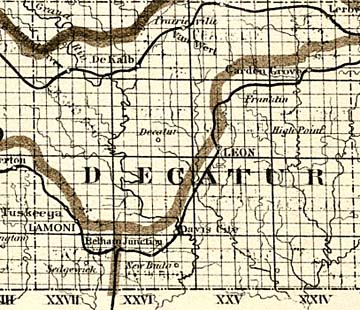
Decatur Co., Iowa - early 1880s - (view 1875 map)
1860-71 (OH/IL) 1872-81 (IL) 1882-86 1887-99 (IA) 1900-21 (IA) 1922-77 (MO)
|
1882-1883
Feb 01 '82 | Mar 01 '82 | May 01 '82 | Jun 15 '82 | Mar 17 '83 Mar 24 '83 | Mar 31 '83 | Apr 28 '83 | Jun 02 '83 | Jun 09 '83 Aug 11 '83 | Sep 29 '83 | Oct 06 '83 1884-1885 Mar 01 '84 | Mar 08 '84 | Mar 22 '84 | Apr 05 '84 | May 10 '84 May 17 '84 | May 24 '84 | May 31 '84 | Jun 07 '84 | Jun 14 '84 Jun 21 '84 | Jun 28 '84 | Jul 12 '84 | Aug 02 '84 | Aug 23 '84 Aug 30 '84 | Sep 27 '84 | Oct 04 '84 | Oct 11 '84 | Oct 18 '84 Nov 08 '84 | Dec 06 '84 | Jan 31 '85 | Feb 07 '85 | Mar 21 '85 Apr 04 '85 | Apr 18 '85 | May 16 '85 | May 30 '85 | Jun 13 '85 Jul 11 '85 | Jul 25 '85 | Aug 08 '85 | Aug 15 '85 | Aug 29 '85 Sep 12 '85 | Sep 26 '85 | Oct 31 '85 | Nov 21 '85 | Dec 05 '85 Dec 12 '85 | Dec 26 '85 1886 Jan 02 '86 | Jan 09 '86 | Jan 23 '86 | Feb 13 '86 | Apr 03 '86 May 29 '86 | Jul 03 '86 | Oct 30 '86 | Nov 13 '86 | Nov 20 '86 Dec 25 '86 |
|
Old Newspapers Index | First Herald Publishing Office Picture
 Vol. 29. Lamoni, Iowa, February 1, 1882. No. 3. 
The Old Story
"THE BOOK OF MORMON," In the beautiful valley of Ten Mile, in the southern part of Washington County, Pennsylvania, lives Mr. Joseph Miller, Sr., now in his 92d year, with whom the Times correspondent has just had an interview. Mr. Miller, is an Elder in the Cumberland Presbyterian Church, and a man of unimpeachable veracity. In answer to the question if he knew Rev. Solomon Spaulding, the author of the "Book of Mormon," he quickly turned, and his face brightened as his mind ran back to the events of the past, and he said, with considerable emphasis: "I most certainly do." |
Vol. 29. Lamoni, Iowa, March 1, 1882. No. 5. Letter From Elder W. H. Kelley. Editor Herald: -- In August last I left home to attend the Semi-Annual Conference, appointed to convene near Council Bluffs, Iowa... In Chicago I was joined by our excellent brother, George A. Blakeslee... |
Vol. 29. Lamoni, Iowa, May 1, 1882. No. 9. ...It is evident that much good will result from [the visit] to see the manuscript copy of the Book of Mormon; and the examination we gave of them satisfied us that there was never but the one copy made, and that one is the one kept by Father Whitmer. It bears unmistakeable proofs of having been in the printer's hands, and is well preserved. The aged and faithful custodian of these records deserves the deepest respect for the unyielding fidelity with which he has discharged the trust reposed in him to preserve and keep this manuscript record. He has been and is now poor, but money has not tempted him to part with a single page of that confided to his keeping so long ago. And we who were permitted to see them and talk with their keeper, could not fail to be impressed with the fitness of the charge. Latter day Israel should rest satisfied that the records fell into so good hands; and now when the opportune time came, to have so strong a witness left to tell the wondrous story of the revival of the Lord's work, in the discovery of the Book of Mormon. As for our part we could not help but think that the hand of God had been over those written records and the one to whose hands they were confided so long ago, and with whom we found them. Nor could we wish now that another had them. Let them remain with him who has so long held them in sacred keeping; and may his already long life be further prolonged for good to the truth which he loves. |
Vol. 29. Lamoni, Iowa, June 15, 1882. No. 12.
|
Vol. 30. Lamoni, Iowa, March 17, 1883. No. 11. LETTER FROM R. PATTERSON. "PRESBYTERIAN BANNER." |
|
Vol. 30. Lamoni, Iowa, March 24, 1883. No. 12.
(Continued from last week.)
The introduction of Mr. Sabine as a witness is also peculiar; Mrs. McKinstry having said "he undoubtedly read the manuscript while it was in his house," and had "faith that its production would show to the world that the Mormon Bible had been taken from it." His "desire to uproot this Mormon fraud" was the motive for urging his sister to loan it to Mr. Hurlbut. If Mr. Sabine had read it, why did he not say so? Mrs. McKinstry states that her mother gave Mr. Hurlbut an order to Mr. Jerome Clark to deliver this manuscript, which she perfectly remembers was in the trunk, to him, which he did. The purpose was that it might be compared with the Book of Mormon. Neither Hurlbut nor Howe ever made this comparison; but Hurlbut does state that he gave what he received to E. D. Howe. Neither Howe, Hurlbut, nor Sabine tells what were the contents of that manuscript. |
|
Vol. 30. Lamoni, Iowa, March 31, 1883. No. 13.
(Continued from last week.)
There is some reason to believe that the Spaulding manuscript story, as a makeshift origin for the Book of Mormon, did not originate with Mr. Hurlbut, but was suggested by Obadiah Dogberry, who published The Reflector, at Palmyra, New York, in 1830-31. This editor furnished the keynote for this cry in his paper for February 23d, l831, as follows: -- |
|
Vol. 30. Lamoni, Iowa, April 28, 1883. No. 17. MINISTRY REPORTS. Elder Wm. B. Smith, of the High Priests Quorum, present, reports: |
|
Vol. 30. Lamoni, Iowa, June 2, 1883. No. 22. Correspondence.
|
|
Vol. 30. Lamoni, Iowa, June 9, 1883. No. 23.
WILLIAM B. SMITH. I will give you my experience in connection with the latter day work, and tell you how I became a Latter Day Saint. I was the youngest son of my father's family. About four years after my father removed with his family from Vermont to New York, my brother Joseph became concerned on the subject of religion. My mother and brother Hyrum and a sister were members of the Presbyterian Church. We knew that Joseph's mind was engrossed on religious subjects for some time, and we compared his condition to one who felt himself a stranger in a strange land, a desert land, without any one to guide him, or to afford him the needed relief. Yet seeming to know that there must be some circumstances to arise that would afford succor, and desiring to know where to find help. This was Joseph's condition. The idea was then, as it is now, that there was another world where the soul must live forever, and some means in existence whereby a man might be prepared for it. |
Vol. 30. Lamoni, Iowa, August 11, 1883. No. 32. Correspondence.
|
Vol. 30. Lamoni, Iowa, September 29, 1883. No. 39.
THE LATTER DAY SAINTS AND DISCIPLES While in the state of Ohio, through the kindness of Bro. I. Lamereaux, of Solon, a book was placed in my hands bearing the title -- "Early History of the Disciples in the Western Reserve, Ohio; with Biographical Sketches of the Principal Agents in their Religious Movement, by A. S. Hayden;" from which a few extracts have been taken, thought to be of interest to the readers of the Herald. |
Vol. 30. Lamoni, Iowa, October 6, 1883. No. 40.
THE LATTER DAY SAINTS AND DISCIPLES "These two men who came to Rigdon's residence, were the young preacher before named, P. P. Pratt, intimately acquainted with Rigdon, and therefore, doubtless, chosen to lead the mission, and Oliver Cowdery. This Mr. Cowdery was one of the three original witnesses to the Book of Mormon. * * * These men staid with Rigdon all the week. [[deleted text: In the neighborhood, lived a Mr. Morley, a member of the church in Kirtland, who, acting on the community principles, had established a "family." The new doctrines of having "all things in common," and of restoring miracles to the world as a fruit and proof of true faith, found a ready welcome by this incipient "community." They were all, seventeen in number, re-immersed in one night into this new dispensation. At this, Rigdon seemed much displeased. He told them what they had done was without precedent or authority from the Scriptures, as they had baptized for the power of miracles, while the apostles, as he showed, baptized penitential believers for the remission of sins. When pressed, they said what they had done was merely at the solicitation of those persons. Rigdon called on them for proofs of the truth of their book and mission. They related the manner in which they obtained faith, which was by praying for a sign, and an angel appeared to them. Rigdon here showed them from Scripture the possibility of their being deceived: "For Satan himself is transformed into an angel of light." "But," said Cowdery, "do you think if I should go to my Heavenly Father, with all sincerity, and pray to him, in the name of Jesus Christ, that he would not show me an angel -- that he would suffer Satan to deceive me?" Rigdon replied: "If the Heavenly Father has ever promised to show you an angel to confirm any thing, he would not suffer you to be deceived; for John says: "If we ask any thing according to his will, he heareth us.' But," he continued, "if you should ask the Heavenly Father to show you an angel, when he has never promised such a thing -- if the devil never had an opportunity before of deceiving you, you give him one now. -- This was a word in season, fitly spoken; yet, strange enough! "two days afterward he was persuaded to tempt God by asking this sign. The sign appeared, and he was convinced that Mormonism was of God! According to his own reasoning, therefore, Satan appeared to him as an angel of light. But he now imputed his former reasoning to pride, incredulity, and the influence of the Evil One.]] |
Vol. 31. Lamoni, Iowa, March 1, 1884. No. 9. EDITORIAL ITEMS. We now have on sale a short biographical sketch of the early life of Bro. William B. Smith, the only surviving brother of Joseph and Hyrum, with an interesting account of some of the incidents connected with the Smith family and the coming forth of the Book of Mormon. Price twenty-five cents each, or in lots of five and upward for twenty cents each. The book can also be had by addressing Wm. B. Smith, Elkander, Clayton Co., Iowa... |
|
Vol. 31. Lamoni, Iowa, March 8, 1884. No. 10. Correspondence. KIRTLAND, Ohio, Feb. 21st, 1884. J. Smith; Dear Brother:-- The discussion of the first proposition closed last evening, having continued eight evenings. Braden has scoured Dan and Beersheba for lies, filth and scandal, and dumped it out in brazen assertions, without proof... |
|
Vol. 31. Lamoni, Iowa, March 22, 1884. No. 12. THE BRADEN-KELLEY DISCUSSION. From the brief and imperfect information that has reached us, we make the following summary of the debate on the first proposition, which reads: "Is the Book of Mormon of Divine origin, and its teachings entitled to the belief and respect of all people?"... |
Vol. 31. Lamoni, Iowa, April 5, 1884. No. 14.
The Cleveland, Ohio Herald, for March 23 contains the following; which is very apropos, for the reason that Rev. Clark Braden reiterated the statement respecting David Whitmer's denia; of his testimony, in the Kirtland discussion and the testimony and explanation given below were read by Bro. E. L. Kelley in refutation of the charge made. |
Vol. 31. Lamoni, Iowa, May 10, 1884. No. 19.
Correspondence. Elkader, Iowa. |
|
Vol. 31. Lamoni, Iowa, May 17, 1884. No. 20. EDITORIAL ITEMS. Bro. Wm. H. and E. L. Kelley are at Pittsburgh, Pennsylvania, where Bro. William was to meet Rev. Coovert, Winebrennerian, on the issues of difference between the churches represented by the two men. Bro. E. L. has been interviewed, of course; and the result is a showing up on Utah Mormonism in the Leader of May 6th. The same paper contains a brief sketch of the first evening's debate, on the question; "Is the Book of Mormon of Divine origin, and is it entitled to the respect and belief of men?" |
|
Vol. 31. Lamoni, Iowa, May 24, 1884. No. 21 The following is clipped from the daily Gate City, of Keokuk, Iowa, AUTHORSHIP OF THE BOOK OF MORMON. The Presbyterian Observer throws a new light on the authorship of the Book of Mormon, The book, it says, has commonly been credited to Rev. Solomon Spaulding, a Presbyterian minister -- a romance purportedly to give the origin and history of the American Indians. He sought to find a publisher for this story in Pittsburg, but was unsuccessful. The author died a few years later. The manuscript of this story most unaccountably disappeared, though it was generally believed that one Sidney Rigdon, a printer, afterwards a Mormon Bishop, got possession of the same, altered and added to it, and, thus altered and amended, it was sent forth to the world as the Mormon Bible. This point is explained by the following letter from Mr. James Jeffries, of Hartford county, Md., whose boyhood was spent a few miles from Pittsburg. He says: "I know more about the Mormons than any man east of the Alleghenies, although I have given the matter no attention for twenty-five years. I did not know I was in possession of any information concerning the Book of Mormon unknown to others. I supposed that as Rigdon was so open with me, he had told others the same things. Forty years ago I was in business in St. Louis. The Mormons then had their temple in Nauvoo, Illinois. I had business transactions with them. Sidney Rigdon I knew very well. He was general manager of the affairs of the Mormons. Rigdon, in hours of conversation, told me a number of times there was in the printing office with which he was connected in Ohio, a manuscript of Rev. Spaulding, tracing the origin of the Indian race from the lost tribes of Israel; that this manuscript was in the office for several years; that he was familiar with it; that Spaulding had wanted it printed, but had not the money to pay for the printing; that he (Rigdon) and Joe Smith used to look over the manuscript and read it over Sundays. Rigdon and Smith took the manuscript and said: "I'll print it," and went off to Palmyra, N. Y. I never knew the information was of any importance. It will not injure Mormonism. That is an "ism," and chimes in with the wishes of certain classes of people. Nothing will put it down but the strong arm of the law." This statement presents the following peculiarities: The witness knows "more about the Mormons than any man east of the Alleghenies," although he has "given the matter no attention for twenty-five years," during which years the claims for and against the Book of Mormon have been more thoroughly presented than ever before. The only source from which he derives this superior knowledge, is private conversations with Sidney Rigdon, which was never given to the world while the said Rigdon was living, and is contradictory of statements made by the said Rigdon and published in his lifetime. It is therefore incompetent and inadmissible. The witness' testimony, being based upon what somebody else told him, is hearsay, and therefore incompetent; so if called to testify in any court of justice in our land in regard to the manner of which he writes, he would not be allowed to make a single statement; because, although the professes to know so much, in the eyes of the law he knows nothing. The communication bears no date; and the only attempt to fix the time when these statements were made by Rigdon to the writer, is the language, "Forty years ago I was in business in St. Louis." Where the statements were made is not intimated, nor who, if anybody, were present and heard them. At what place in Ohio Sidney Rigdon was connected with a printing office; in what capacity or when he was so connected; who owned and who managed said office; how manuscripts came to lie in the office for "several years" without being printed or returned to the writer; how the proprietors came to allow employees to peruse manuscripts, take them home for perusal on Sundays, and finally carry them entirely away from the office and into another state, are matters at which this lucid witness leaves us to guess. The statement is made that "Joe Smith" and Sidney Rigdon used to look this manuscript over together; but the historical fact, upon which both friends and enemies of Joseph Smith have hitherto agreed is, that Joseph Smith never had a residence in the State of Ohio, never was in that State, until after the publication of the Book of Mormon; also, that after his residence in Ohio, he never returned to New York; so if this witness' statements are accepted, those of all former witnesses upon the same side of the case must be rejected; and the legal rule that a party is bound by the testimony of the witness introduced by them, will place the advocates of the Spaulding-Romance-origin of the Book of Mormon in an unenviable situation; and compel them to apologize for the lack of truthfulness in former witnesses, or in this one under consideration. Former witnesses. including the wife and daughter of Rev. Spaulding, have traced the manuscript referred to to a printing office in Pittsburgh, Pennsylvania, if at all, and from that printing office to the State of Massachusetts, not in the possession of either Joseph Smith or Sidney Rigdon, but the family of Spaulding. This chain of evidence, furnished by the testimony advanced against the Book of Mormon, has hitherto been an embarrassing obstacle in the way of those who favor the Spaulding manuscript theory; and it seems that this witness has made the attempt to remove it. But he and his advisors should have remembered that in making this attempt he has squarely contradicted those who have hitherto been the witnesses on his side of the case, and who from the relations they have sustained to the writer and his manuscript, are most likely to know the facts. These witnesses are the wife and daughter of Spaulding, and the owner and manager of the printing office in which he lodged his manuscripts. They should have remembered, too, that they have made their case, placed themselves upon record before the world, avowed their willingness and determination to stand by that record; and now when they realize that their case is a hard one, and that they can not justify or reasonably receive a decision in their favor, to change front, and introduce a new witness to overthrow the testimony of those upon whom they have hitherto relied, comes with very bad grace. This witness however need not feel in any danger of being punished for perjury; for he has been careful to wait until the man who could contradict him was dead, and then to make statements so indefinite, that in a legal sense he swears to nothing, and therefore could not be convicted of swearing to a falsehood. There are two sentences in his statement which we commend: "I never knew this information was of any importance. It will not injure Mormonism." Note 1: The original James Jeffery affidavit, as published in the Feb. 13, 1884 issue of the Pittsburgh Presbyterian Banner and a contemporary issue of the Baltimore Presbyterian Observer, contains considerable additional information deleted by either the Keokuk Gate City, or the Saints' Herald: When he gave his statement, on January 29, 1884, Mr. Jeffery was living in Churchville, Hartford Co., Maryland. He dictated his words to the Rev. Calvin D. Wilson, who certified their accuracy. Mrs. James Jeffery and Dr. J. M. Finney, M. D. attested the statement. Note 2: The content and provenance of the 1884 Jeffery statement is discussed on page 42 of the Braden-Kelley Debate. Fawn Brodie also addressed the Jeffery matter (albeit somewhat ham-handedly) on pp. 452-453 of her 1945 No Man Knows My History. Finally, in Wayne Cowdrey et al., The Spalding Enigma, (Los Angeles: 2000), the entire discussion is reviewed on pp. 219-221. See also the transcriber's comments regarding this topic in his on-line essay, entitled: "When Did Sidney Rigdon Meet Joseph Smith?" Note 3: The Salt Lake City Deseret News of June 17, 1884 published an article entitled "Another Spaulding Story Refuted." in response to allegations made by a "Rev. W. R. Coovert" of Pittsburgh, to the effect that Rigdon had stolen the original text for the Book of Mormon "while he was working at a printing office in Ohio, where Spaulding had left it for publication." William R. Covert (not "Coovert") (1851-1920) was a minister in the West Pennsylvania Eldership of the Churches of God (Winebrenners). Beginning on May 5, 1884, Rev. Covert and RLDS Elder William H. Kelley held a public debate in Pittsburgh to discuss these three propositions: "Is the Book of Mormon of divine origin?" "Is the Church of God in harmony with the church established by Jesus Christ and his Apostles?" "Is the RLDS Church in harmony with the church established by Jesus Christ and his Apostles?" For eight consecutive evenings the first proposition was discussed, with RLDS Elder Edmund L. Kelley, acting as moderator. The debate broke up before the other propositions could be discussed. The article in the May 6, 1884 issue of the Pittsburgh paper, The Leader describing the first part of this debate, has not yet been located. The May 18, 1884 issue of The Leader carried a follow-up article. Note 4: Rev. William R. Covert derived his strange account of Sidney Rigdon "working at a printing office in Ohio" directly from the 1884 Jeffery statement, used the allegation in his debate with Kelley, and then passed then it along to the readers of The Leader. See the explanation accompanying the original printing of the Jeffery statement in the Presbyterian Banner for more on the supposed Ohio connection. In rebutting Covert's version of the story, the editors of Salt Lake City Deseret News placed themselves in the position of responding indirectly to Jeffery by rebutting Rev. Covert. See also the "Coovert" story repeated in the Saints' Herald of June 7, 1884. |
|
Vol. 31. Lamoni, Iowa, May 31, 1884. No. 22 Correspondence.
|
|
Vol. 31. Lamoni, Iowa, June 7, 1884. No. 23. It is evident that Rev. Clark Braden proposes to spread his late effort to demolish Mormonism, root and branch. Of this effort the Salt Lake Deseret News says: |
|
Vol. 31. Lamoni, Iowa, June 14, 1884. No. 24.
Correspondence. Panama, Iowa, Note : It seem unlikely, that while "Uncle William" was overawing his Iowa audiences with glowing accounts of golden plates and angelic visits, that he bothered to take the time to explain why, back in 1857, he had been so adament in his published statement: "permit me to say that I am not a Mormon. The treachery, corruption and murderous practices of the leaders of the Mormon Church long since disgusted me with a doctrine which produces such results, and as a matter of course I left the heaven-defying traitors, as every honest man should do, and leave the guilty wretches to suffer the fate which they so richly merit, and which is certain, sooner or later, to overtake them." |
|
Vol. 31. Lamoni, Iowa, June 21, 1884. No. 25.
Correspondence.
|
|
Vol. 31. Lamoni, Iowa, June 28, 1884. No. 26. BOOK OF MORMON. For more than fifty years the Elders of latter day Israel have been preaching a restored gospel, and the divinity of the Book of Mormon... |
|
Vol. 31. Lamoni, Iowa, July 12, 1884. No. 28.
BRADEN-KELLEY DISCUSSION. Gentlemen Moderators, Ladies and Gentlemen: -- In the concluding speech of my opponent on last evening he undertook to show you that he had been fair in reading from his papers as I have been in my argument. I claim that he ought to present in full his important statements and affidavits, especially so, since they ought to be in the argument if published, as they are not accessible to but a few people; and that if the statements in full are presented I claim they bear the stamp of condemnation upon their face. To permit him to read a small portion here, and then run the entire thing in the book would not be fair either, as that would give him an undue advantage of space, (and time consequently), in the discussion. Besides, it would not be his matter in fact and I would have no opportunity of reviewing it here, and a statement or affidavit which he relies upon and wishes his hearers to, in making his affirmative statements good, I claim he ought to introduce in full. |
|
Vol. 31. Lamoni, Iowa, August 2, 1884. No. 31. The Braden-Kelley debate will contain such ample refutations of Mr. Braden;s onslaught, and so much in defense of the primitive faith as held by the Reorganization; and such unanswerable arguments against the claims for divine origin and sanction of the church to which Mr. Braden belongs, that every elder, and active Saint should have a copy. The contrast in style and argument of the two disputants will be so strikingly in favor of Bro. Kelley's side, that the friends of Mr. Braden, and the Disciple, or Christian Church can not afford to permit it free circulation among them, notwithstanding Mr. Braden's loud praises in his own behalf. There is altogether too much egotism and self-assertion in Mr. Braden's half of the book and such will be the inevitable verdict of those who read it, with few exceptions.This appeared in the St. Louis Republican, and some other papers about at the same time. To it Bro. E. L. Kelley made an excellent answer in the Republican. We give it notice for this reason, we wish Elder Clark Braden to comprehend, if he can, that when he states that Bro. E. L. Kelley was selected by "the officials of the Josephite Mormons to represent them" in the late debate between Bro. Kelley and Clark Braden, at Kirtland, Ohio, he has stated what is false. The officials of the Reorganized (Josephite) Church had nothing to do with originating the debate between Elder Kelley and Braden, either at Wilber, or Kirtland. The first was arranged between Levi Anthony, R. M. Elvin and others of the brethren at Wilber, Nebraska, on the part of the Wilber Branch, and L. L. Luse and others on the part of the opposition, Methodists and Disciples at Wilber, as we suppose. The discussion at Kirtland was an after-thought between the men themselves, for reasons satisfactory to them, we suppose, and the authorities of the Josephite Church had nothing to do with its organization, agreement, or arrangement; they were not even consulted by either Mr. Braden, or Elder Kelley whether they would consent to let Elder Kelley debate. Mr. Braden insultingly demanded of Bro. Kelley after he had agreed to debate at Kirtland that he should appear as the representative man, and "the best and the last that Mormonism could do." We directed Bro. Kelley to assure Mr. Braden that if in his "war to the knife" attack on us, he should succeed in slaughtering Bro. Kelley, in the discussion, his blood if it did not spring up dragon's teeth, as in the fable, it would spring up able Elders; and he would have the entire phalanx to meet and overcome. We also requested Bro. Kelley to demand that if he was to be considered as the representative champion of the "Mormon Church," that Mr. Braden must be endured as the representative champion of the Disciples or Christian Church of which he was a member. Whether Mr. Braden continued to insist that Bro. Kelley must be considered the "forlorn hope" by us "poor deluded Josephites," we do not know. We were not called upon to furnish credentials. Nor were we given to understand that the Christians endorsed Braden. We stood by Bro. Kelley as we should, and as we would have done any other Elder who should have withstood Mr. Braden. We prayed for and exercised care for him, for the sake of the cause he was presenting and defending, and felt an assuring confidence that the Master would take care of his cause and his servant in the conflict. Mr. Braden did not score a victory as he expected. The ghost of Mormonism would not "down at his bidding." The sound facts and arguments of the truth could not be brushed aside by his tissue of slurs and badinage. The faith and its principles presented an array against which his virulent attack upon the dead heroes of its early defense in Ohio could make no headway. His Christianity was not equal to a clear comparison of principle and church foundation and policy. Before the authorities of the Josephite Church can be drawn into a recognition of Clark Braden's right to such notice as he seeks in the challenge quoted above, he must show that he is a recognized and acknowledged servitor in the ranks of the church of which he professes to be a member. When he does this it will be time enough to get on our running toggery so as to get away from the theological slaughter. Another reason. Mr. Braden should know that the Josephite Church does not control the manuscript of the Book of Mormon. It is in the possession of Elder David Whitmer, in what he deems a sacred trust, and only those whom Elder Whitmer would permit could have access to them. He very kindly permitted an examination by the committee appointed by the Reorganized Church, under conditions which he dictated as he was led to make; and to which the committee cheerfully agreed. It is doubtful if a party such as Mr. Braden proposes would be permitted access to the manuscripts, though we are not authorized to speak for Elder Whitmer and his family. They are not members of the Reorganized Church, and take care and control of their own affairs, which is right and proper. They are believers in the Book of Mormon, however, and are anxious that the truths of the gospel as sent by the angel to Joseph Smith should be taught and triumph in the world, as by it they believe man will be saved with an everlasting salvation. They have no love or regard for enemies to the truth and do not care to deal with them touching the faith. Another reason; the manuscripts have been seen and examined by dozens of visitors within the last few years. Elder Whitmer has constantly averred his belief in the book, and verified, over and over again, what he testified to in the testimony found in the Palmyra Edition, and subsequent issues of the book. The manuscript was placed in his charge by Oliver Cowdery's widow for safe keeping. He has reason to know that it is the only manuscript in being, and the one from which the book was set. Any errors of grammar, spelling, or gross misuse of words, found in the Palmyra edition, (with the exception . of typographical errors), must appear in the manuscript; therefore any objection which is worthy to be urged against the book itself must include the manuscript. Nothing would be lost to the friends, or gained by the foes to the book by the examination proposed by Mr. Braden. It is to be presumed that the committee, appointed as they were, will do their duty fairly. That however much any one of them might be disposed to cover up what he could not explain, the safeguards proposed by Elder Whitmer, acquiesced in by the committee and carried into effect by all engaged in the examination would preclude any such attempt being made. Mr. Braden has shown a tendency to falsify both in regard to the appointment of Bro. E. L. Kelley to discuss with him, and the object of the appointment of the committee by last April session of Conference, and hence not to be trusted by those whom he has assailed in his "war to the knife" against "Mormonism." Our visit to Richmond, aside from the work of the committee, was a very pleasant one. We visited the locality of the grave of Oliver Cowdery, but, as the cyclone that visited Richmond and vicinity some years ago took the grave yard in its track and swept everything over, and utter neglect to keep the ground in order since has permitted a dense thicket of locust, briers and weeds to grow up, it was out of the question to find the grave, we did not pay other tribute to the memory of the quiet sleeper than to try to find the spot where he lay. It is a half mile north of the town on a bit of ground which slopes gently to the south, lying adjacent to the main road running out of Richmond to the north. He died in 1849 or 50, maintaining his testimony to the Book of Mormon to his latest moment. General A. W. Doniphan, whom we met, at his hotel, the Hudgins House, told us that he knew Oliver Cowdery well, and knew him till his death; he spoke in good terms of him as a man and as a citizen. We called upon the General the evening before we left Richmond, and had an hour's very interesting chat, in which the General related several incidents which occurred during the days that the Saints were citizens of Clay, Caldwell, Ray and Davies counties. He conducted the defence of O. P. Rockwell, at the time of his arrest for the attempt to assassinate Gov. L. W. Boggs, and for which charge Rockwell was acquitted. There was no evidence connecting Rockwell with the offence, and the General believed him to have been innocent. This was assuring, for so much has been said by those who have assailed the Saints about Rockwell as the agent of Joseph Smith in the outrageous attempt to assassinate the governor of the state of Missouri, that the statement of a man intimately acquainted with the affair at the time of its occurrence, tends to remove the fear that guilt might attach to them against whom it has been charged. The General was also present and attending to the examination of Sidney Rigdon at Liberty, Missouri, when on a writ of _habeas corpus_ he was before Judge King. Elder Rigdon had few if any friends there, about one hundred were gathered, the most of them "Mormon eaters," as they were called, and terribly excited against those under arrest and in custody. After the counsel had argued the legal conditions of the case, Elder Rigdon desired General Doniphan to inquire of the Judge if he might speak in his own behalf. The Judge said "certainly." Elder Rigdon rose and began; and, says the General, "Such a burst of eloquence it was never my fortune to listen to. At its close there was not a dry eye in the room, all were moved to tears." At its close the Judge said: "The prisoner is discharged [from] the custody of the Court, Mr. Rigdon is free to go his way." The effect of Elder Rigdon's words was such that one of the leading men of the crowd picked, up his hat, and turning to the bystanders said: "We came here determined to do injury to this man. He is innocent of crime, as had been made to appear. And now, gentlemen, out with your money and help the man to return to his destitute family." He circulated the hat and the money was showered into it till he placed a hundred dollars in Elder Rigdon's hands, with the remark, "Now old gentleman, make the quickest possible time to your family, who need you and your help." It must have been a remarkable scene, for as General Doniphan related it, the remembrance of it lit up his aged face with a glow of animation pleasant to witness. In answer to the question whether the anti-slavery sentiment which prevailed among the Saints was in any wise at the bottom of the opposition and persecution to which they were subjected, he stated that there could be little doubt that in Jackson county and probably some others, the real reason of the hostility to the church was the pro-slavery dislike to the anti-slavery sentiment of the Mormons. Religious bigots opposed to the doctrines of the Saints made the position of the Saints on the slavery question the pretext of their hate. In answer to the question, Were the leading men among the Saints such bad men as it was urged that they were, the General stated that they were not. He was intimately acquainted with many, had some of them for neighbors, and a "nicer lot of men I never knew; kind, neighborly and upright." Can there be need of better defence for men maligned and persecuted by lawlessness than to have such tribute paid to the memory of business and neighborly relationship with them by one who was in circumstances to know them. Correspondence. LANSING, Michigan.July 17th, 1884. Dear Brother Joseph: -- On yesterday I went to see Bro. Harvey Fairchild over in Eaton county, this state. He is still confined to his bed-room, and will be until he departs this life; unless Jesus cures him and raises him up again. I read to him the article in the Herald, of the 5th of July that I wrote you. He says he was baptized not by Parley P. Pratt, but by Wm. B. Smith. He further states that his work as a mason at Nauvoo was not so much on the Temple as at the stone quarry. The Grand Army of the Republic furnishes him a physician from Grand Lodge; but he stated and so did his wife, that my religious visit did him more good then all his medicine. Yet he appreciates the kindness of his physician. He is very anxious to see one of the Elders before he dies. He cannot speak about it without shedding tears. His wife believes in him, and would, if she had the opportunity join in practically with him. I am not sure but what good could be accomplished in that neighborhood. Allow me to introduce another matter which has been on my mind for some time. I know that the Lord hath said, Prov. 26:17, "He that passeth by and meddleth with strife belonging not to him, is like one that taketh a dog by the ears." But it is also said, "Blessed are the peacemakers, for they shall be called the children of God." And again, "He hath showed thee, O man, what is good; what doth the Lord require of thee, but to do justly, and to love mercy, and to walk humbly with thy God?" Matt. 5:9; Micah 6:8. So then when it is for the promotion of peace, and for the triumph of justice and mercy, to speak; I am not aware that one would be at liberty before God not to speak, though all the dogs were to go mad, and both bark and bite. I remember very distinctly when my father, Robert Rathbun, and uncle George Miller both lived in Mantua, Ohio in the years of 1828, 1829 and 1830. My father had been a minister in the Close Communion Baptist persuasion, But he, with uncle George Miller, had more recently been carried away with the reformation which had swept through the Western Reserve in Ohio. It was a kind of a reform Baptist movement. One Sidney Rigdon was regarded at the time as the one towering above all others in ability, and consequently a leader in the reformation. During the year of 1830, one Parley P. Pratt, and one Oliver Cowdery, came along. Father opened his doors and received them kindly; and they preached in father's house. Mr. Pratt gave father a Book of Mormon, and requested him to read it. He also gave Sidney Rigdon one, making the same request of him that he did of father. My father was much more a preacher than he was a debater. Uncle George Miller was not much of a preacher but an indomitable biblical debater, and a sharp shrew critic. They agreed to read the book through on this wise: 1st. They covenanted together to pray each day at ten o'clock in secret while reading the book through, for divine wisdom, and for the direction of the Holy Spirit, that they might know of a truth and be directed of God for or against the Book of Mormon. 2d. Father was to read, and Uncle George Miller was to criticise. 3d. They were to lay aside all prejudice, all partiality; and with all Christian candor and righteous fairness, endeavor to reach their conclusions. The result was that they both embraced the new faith, and through all the checkered scenes of life maintained it and finally died in the triumph of that faith. Sidney Rigdon at once rejected the Book of Mormon given him as an imposition, and boldly withstood Parley P. Pratt and Oliver Cowdery. But Uncle George Miller set right in upon Sidney Rigdon with all his indomitable and unconquerable perseverance, as though it was a life and death struggle and never gave up the contest until Mr. Rigdon became convicted and finally converted to the new faith also. This was not a public but a private controversy. They called it then, "the faith once delivered to the Saints," This was Sidney Rigdon's first acquaintance with the Book of Mormon. And it was a very trying time with these Reformed Baptists to see their standard bearers with a good many others go over to what was then called "The Church of Christ," and "the faith once delivered to the Saints." In regard to D. P. Hurlbut, sometimes called Dr. P. Hulburt, I have this to say: That it so turns out in the wonderful providence of God, that I have had quite an acquaintance with this very peculiar sort of a man. The facts in his case are these: 1. He was excommunicated from the Methodist Episcopal Church for improprieties with the opposite sex and lying. 2. He was excommunicated from the Church of Jesus Christ of Latter-day Saints for improprieties with the opposite sex and lying. 3. Upon this event he swore vengeance upon the Latter-day Saints and undertook to destroy them. 4. He then went into the more western and newer part of the state of Ohio, where he was not known, and wormed himself into the "Church of the United Brethren in Christ," and was ordained an Elder among them. Here, both in the conference and in the church, there was a constantly growing uneasiness about his improprieties; until in the fall of 1851, when he was held before the Sandusky Annual Conference of said church, for a trial on charges of gross improprieties toward the opposite sex, lying and intemperance. Each charge to wit; First improprieties toward the opposite sex; Second, lying; Third, intemperance, was clearly and fully sustained; and he was suspended from the ministry one year and as that year he grew from bad to worse, he was entirely excommunicated at the next, session of the conference which was held In the fall of 1852. How do I know all these things? I will tell. In regard to the first item, my mother's people were all Methodists, so that I was blessed with seven Methodist preachers as near relatives. Hence the excommunication of said Hurlbut from the Methodist Church was familiar household talk whenever any of them met together. In regard to the second and third items first above enumerated, my father had something more to do with than the former. I remember of hearing him tell about said Hurlbut imposing upon the church; what a bold, impudent, lying man he was, and when excommunicated from the Latter-day Saints, how he swore he would have vengeance upon the Mormons. I remember of hearing all of these things talked over and over again. But in after life, I heard him tell what a time he had with the Methodists, what a time he had with the Mormons; he boasted how he swore vengeance upon them. He said that [the] Spaulding Manuscript was a little insignificant thing of only about twenty pages, and had no more relation to the Book of Mormon than he had to the inhabitants of the moon; "but," said he, "I made it tell upon them to their eternal damnation." And here he seemed to glut himself in what he had done, what a great thing he had done out of nothing. The obscene language I heard him use to an old minister in abusing him when all alone, and as he supposed, no one hearing him, was so disgraceful and black that I would not tell it under any consideration, except under oath, confirmed me in all the charges brought against him. In regard to the fourth item, I only have to say that at that time I was an Elder with Mr. D. P. Hurlbut, of the aforesaid Sandusky Annual Conference of the Church of the United Brethren in Christ, and personally knew of those grievances. I was one of that honorable, august body of Elders, who for over two days before Bishop Edwards patiently heard his trial, and thoroughly and faithfully investigated all the testimony in his case. And we all came to the same conclusion, that he was a very bad man, and guilty of each charge made against him. We all voted yes, I Hyrum Rathbun, voted on the case to suspend him from the ministry for one year, and by so doing give him a chance to redeem himself; but he went on from bad to worse, and at the next annual Conference of 1852, by vote, we excommunicated him from the Church for improprieties with the opposite sex, for lying, and for intemperance. It is a keen sense of duty, under God, that I owe to an innocent people that I see trying and struggling manfully and in a Christian spirit to right themselves before the world and before God, that has inspired me to make known this statement of facts. I could tell many more things, but this must do for the present. Hoping that we may grow in grace and in the knowledge of the truth. I am yours in Christ. HYRUM RATHBUN.
PUBLICATIONS ISSUED AND FOR SALE ... No. 36. -- The Spaulding Story Re-Examined; 20 c. a dozen...
A NEW TRACT.
THE SPAULDING STORY RE-EXAMINED, 15c. per dozen, EDITORIAL ITEMS. Uncle William B. Smith arrived at Lamoni, July 3d and was made the guest of his nephew the Editor of the HERALD. He has visited some of the Saints, some of whom are old acquaintances. He spoke for the Saints at the Old Chapel and also at the new near town. His health is fair, considering his age. He has been speaking in different points in the state, having been from home since May 1st.Note 1: Hyram Rathbun (or Hiram Rathbone) was born 3 Apr. 1820, Wayne, Co., OH, the son of Robert Rathbun, Jr. (1798-1856) and Hannah Warner (1797-?). Hyram was baptized a Mormon on Nov. 20, 1831, in Independence, Jackson Co., MO and re-baptized an RLDS on Oct. 16, 1884, in Vassar, Tuscola Co., MI. Several years prior to his association with the RLDS, Hyram Rathbun edited a very obscure Christian newspaper -- a source for numerous interesting insights into early Mormon history, which as late as the present day remains completely untapped by researchers. Rathbun died in May of 1898 in Lansing, Ingham, MI. His father, Robert, appears to have been baptized a Mormon in late 1830 or early 1831 in the Kirtland, Geauga, OH area, along with Hyram's "uncle," George Miller (1787-1837). Hyrum's mother was born in Gnadenhutten, Tuscarawas, OH. No record has been located concerning her Methodist minister relatives who were acquainted with D. P. Hurlbut in western new York prior to 1833. See also Hiram Rathbun's recollections of Oliver Cowdery in the Aug. 11, 1883 issue of the Herald. Note 2: Elder Hyrum Rathbun's recollections regarding D. P. Hurlbut constitute an important published document for students of early Mormon history. Contemporary LDS officials felt it was informative enough to be reprinted in the Aug. 8, 1884 issue of the Deseret Evening News. Rathbun's name appears in the United Brethren's official published account of Hurlbut's suspension from the sect's ministry and his seeming resultant disfellowshipping. Note 3: For additional reporting on General Doniphan, see interviews with him published in the Kansas City Journal of June 12, 1881 and the Kirksville, Missouri Weekly Graphic of Sept. 28, 1883. Roger Launius' 1997 Alexander William Doniphan: Portrait of a Missouri Moderate provides a detailed account of the General's dealings with the Missouri Mormons. |
|
Vol. 31. Lamoni, Iowa, August 23, 1884. No. 34. The following from the Presbyterian, of Philadelphia, is a specimen of this intolerant dudeism in morals, intellect and religion, so prevalent just now in the United States and the world: |
|
Vol. 31. Lamoni, Iowa, August 30, 1884. No. 35. Correspondence.
|
|
Vol. 31. Lamoni, Iowa, September 27, 1884. No. 39. Correspondence.
|
|
Vol. 31. Lamoni, Iowa, October 4, 1884. No. 40. EDITORIAL ITEMS. By Request we print a letter from Mr. J. T. Cobb of Salt Lake City, to Bro. E. L. Kelley, and Bro. Kelley's reply to it |
|
Vol. 31. Lamoni, Iowa, October 11, 1884. No. 41. A REPORTER for the St. Louis Globe-Democrat, from Lexington, Missouri, under date of September 26th, and published in that paper Sunday, September 28th, reports Mr. Braden thusly: |
|
Vol. 31. Lamoni, Iowa, October 18, 1884. No. 42.
BRADEN ON PUNCTUATION, ETC.
|
|
Vol. 31. Lamoni, Iowa, November 8, 1884. No. 45.
Correspondence.
|
|
Vol. 31. Lamoni, Iowa, December 6, 1884. No. 49. MISTAKES OF BRADEN. 1st. States on p. 34 of Braden and Kelley Debate that the Book of Mormon speaks of "ore plates," when the language of the book is "I did make plates of ore." |
|
Vol. 32. Lamoni, Iowa, January 31, 1885. No. 5. EDITORIAL ITEMS. The Expositor, our California newspaper colleague and co-worker in the gospel, was laid on our table in due course... H. P. Brown, Editor... |
|
Vol. 32. Lamoni, Iowa, February 7, 1885. No. 6. LAMBERT-BRADEN CORRESPONDENCE. (The following correspondence will be interesting to Herald readers... |
|
Vol. 32. Lamoni, Iowa, March 21, 1885. No. 12. Bro. I, N. White sends us the following clipping from the Grinnell, Iowa, Herald for January 23d, 1885. THE BOOK OF MORMON. In the January number of the Bibliotheca Sacra, Rev. D. L. Leonard, of Salt Lake, ascribes the Book of Mormon to a well known source, "There is little room to doubt that Solomon Spaulding's romance furnished the bulk of the historical portion; but how the manuscript came into Smith's hands, no one knows." On a later page, Pres. J. H. Fairchild, of Oberlin, says that Solomon Spaulding's manuscript was discovered among the papers of Mr. L. L. Rice of Honolulu, formerly of Ohio, while he was in the Sandwich Islands, a few months ago. It is "an old worn and faded manuscript of about 175 pages, small quarto, purporting to be a history of the migrations and conflicts of the ancient Indian tribes which occupied the territory now belonging to the states of New York, Ohio and Kentucky. Mr. Rice, myself, and others," says Dr. Fairchild, "compared it with the Book of Mormon, and could detect no resemblance between the two, in general or in detail. There seems to be no name or incident common to the two. The solemn style of the Book of Mormon, in imitation of the English Scriptures, does not appear in the manuscript. The only resemblance is in the fact that both profess to set forth the history of lost tribes. There seems to be no doubt that this is the long-lost story." (Of Mr. Spaulding). Names of several persons who knew this are endorsed on a certificate. "Some other explanation of the origin of the Book of Mormon must be found, if any explanation is required."In connection with the foregoing we publish a letter from Bro. R. J. Anthony who wrote us from one of the country towns of Utah, that he had been informed about the article in the Bibliotheca Sacra by a school teacher. who had seen it; and that when he returned to the city he would send us a transcript from the Magazine itself. We give his letter from the city below: |
|
Vol. 32. Lamoni, Iowa, April 4, 1885. No. 14. Bro. W. H. Kelley wrote March 20th that he had held six meetings in the Quinlan school house, not far from Sandusky, Ohio. Had attentive audiences. It was the first preaching in that country by the Elders. A good interest was manifest, and requests were urgent to return. Bro. Kelley says:The neighborhood is strongly Disciple (Campbellite), United Brethren. &c., and near the home of D. P. Hurlbut. Here he lived for many years, and died almost eighteen months ago. His wife and family reside there still. It is rather amusing to hear the opinions of the neighbors about this famed Dr. Hurlbut, whose name is conspicuous in nearly every work that has been issued against the Saints for the last forty-five years. Sidney Rigdon's setting out of this romantic character is tame compared with the hard phrases used by his neighbors to give him proper presentation. If good character is the test, Hurlbut is down. With the mixed multitude down there and so near the city of Toledo, we may have things a little exciting by and by. |
|
Vol. 32. Lamoni, Iowa, April 18, 1885. No. 16. Correspondence.
|
|
Vol. 32. Lamoni, Iowa, May 16, 1885. No. 20. The Western Watchman, published at Eureka, Humboldt county, California, in its issue for Saturday, April 25th, 1885, goes for the Spaulding Story -- Romance -- Manuscript Found, in the following pithy fashion. As Captain Cuttle remarked, "When found make a note on't."
THE BOOK OF MORMON, It has hitherto been currently assumed by non-Mormons who profess to be conversant with the origin of that sect that their "Book of Mormon" was a plagiarism of a manuscript by Solomon Spaulding, written avowedly as a work of fiction, purporting to give the history of some extinct Indian tribes. As the Manuscript was never published and soon disappeared, that theory was generally accepted, there being no opportunity for comparison. |
|
Vol. 32. Lamoni, Iowa, May 30, 1885. No. 22.
Correspondence
|
|
Vol. 32. Lamoni, Iowa, June 13, 1885. No. 24. BELOW we give another version of the Spaulding Story. It is very extraordinary that that wonderful production, the Spaulding Romance, should be so restless and uneasy; it appears in a thousand shapes; this is the last one we have seen, and it looks terribly out of shape. The St. Louis Republican in which it appeared Friday, May 29th, 1885, justly concludes that the statement that the Book of Mormon was made from such a source is a matter of "inference." What next; Solomon Spaulding will soon have more vocations than the fabled "nine lives of a cat." THE MORMON BIBLE. The venerable Col. Wm. H. Leffingwell, accompanied by an old Mormon friend from Utah, was met by a Republican reporter yesterday afternoon on Olive street. The colonel's friend remarked to the reporter: "Did you know that Leffingwell corrected the manuscript of the Mormon Bible alleged to have been written by Rev. Solomon Spaulding?" |
|
Vol. 32. Lamoni, Iowa, July 11, 1885. No. 28. THE MANUSCRIPT FOUND. The following letters, one from Bro. John M. Horner and one from Mr. L. L. Rice, will be read with interest by thousands, and they can not be regarded as less than full proof that the manuscript now in the hands of Mr. Rice, is none other than the celebrated "Manuscript Found," written by Rev. Solomon Spaulding, and which it is now seen is no more like the Book of Mormon than "a hawk is like a handsaw." But there are more proofs at hand, which will be forthcoming in due time. |
|
Vol. 32. Lamoni, Iowa, July 25, 1885. No. 30. SPAULDING'S MANUSCRIPT. OBERLIN, Ohio, July 15th, 1885. |
|
Vol. 32. Lamoni, Iowa, August 8, 1885. No. 32. SOLOMON SPAULDING'S "Manuscript Found," at least a verbatim copy of it certified by Pres. Jas. H. Fairchild, of Oberlin College, Ohio, is now on our table, and will soon be given to the HERALD readers. It will also be printed in pamphlet form and put on the market, that all who desire may learn just what there is of it, and of the popular claim that it was the egg from which Joseph Smith and Sidney Rigdon hatched the Book of Mormon.
( From Deseret News.)
Applicants for the Manuscript. -- Why They Wanted It. -- The Original Sent to Oberlin College Library. -- Mr. Rice Agrees to Part with the Copy and then Backs Out, but Lends It. Correspondence. Kirtland, Ohio. Note 1: Apostle William H. Kelley supplies some useful information in his description of the Oberlin Spalding manuscript, as it existed prior to being bound in hard covers at a later date. He identifies the manuscript paper as being thick, unruled sheets, thirteen inches wide by eight inches high, folded over once to produce four pages, 6.5" x 8" each in size. Kelley further speculates that these individual sheets may have been halves of 13" x 16" papers. Kelley's figures correspond closely with modern measurements of the pages being about 16.4 cm. x 20.2 cm. (6.34" x 7.95"). More exactly, the Oberlin College Archives "Staff," in 1977, measured the first 24 pages of the manuscript at 6" x 7.75" and the remainder of the pages at 6.375" x 8" (Wayne Cowdrey, et al., The Spalding Enigma p. 136, n. 44. If Kelly was correct in his guess, the original sheets comprising the first 24 pages of the manuscript must have been formed from 3 pieces of paper, 12" x 15.5", folded over twice, to make quarter-size pages. The remainder of the manuscript must have been formed from about 20 pieces of paper, 12.75" x 16", also folded over twice to make little folios of 8 pages each. The 12.75" x 16" papers may have been "foolscap" (very slightly narrower than the usual 13"x16" variety). Note 2: Kelley also provides interesting information when he says: "A few leaves were stitched together with linen thread, thus forming them into little sections, or books, easy to handle." In other words, Spalding took a few of his 13" x 8" sheets at a time, and folded them all together in the center to produce thin signatures of 12, 16, or 20 pages each. These signatures he gave to somebody (perhaps his wife) to stitch along the center fold, producing little booklets. The pages of the "Dictated" manuscript of the Book of Mormon were produced in a somewhat similar manner, only the large papers were only folded once over, producing four long, narrow pages per sheet. These folded sheets were gathered together, a few at a time, and sewn along the center fold to produce signatures of 12, 16, or 20 pages each. Given the likelihood that Spalding formed all of his holograph story documents in this manner, it is easy to see why some of his early auditors and readers referred to "manuscripts" (in the plural) when they were obviously speaking of only a single story in each case. Viewed as a promiscuous pile of individual signatures, Spalding's collected writings may have appeared to be many thin "manuscripts," when, in reality, those signatures comprised only a few discrete documents. Any single hand-written book of his creation was probably made up of numerous little "manuscripts," each about a "quire" (24 pages) in size. Since such a "quire" is exactly the page number of the first portion of the Oberlin manuscript (the part with the 6" x 7.75" pages), this initial folio of the manuscript may well have been what E. D. Howe had in mind when he referred to Spalding's work as "a book, in Spalding's hand-writing, containing about one quire of paper." If, when Howe wrote that sentence, he only had the first 24 page signature of the manuscript in front of him on his desk, he might have casually made reference to that part of the story as a "book" of "about one quire," while, at the same time, dismissing the remainder of Spalding's writings as useless rubbish. Note 3: William Kelley is far more severe in his judgment of the probable character of the eight "Conneaut witnesses" than was his brother, Edmund L. Kelley. In his July 15th, 1885 letter to Counselor in the RLDS Presidency, William W. Blair, Edmund left open the possibility that the Spalding claims witnesses' whose testimony was printed by E. D. Howe in 1834 may have been honestly mistaken in equating the Book of Mormon with one of Spalding's stories. Edmund extended his speculation in this instance to the point of attributing the various points of literary identity provided in the witnesses' testimony to later insertions in their statements: "technical expressions and names that Hurlbut and Howe run in when they wrote up the "statements" for their 'witnesses.'" William, on the other hand, sees D. P. Hurlbut, "along with "Aaron Wright, John Miller, Henry Lake, et al." all "closeted with the [Oberlin] manuscript before them, endeavoring to invent a theory that would account for the origin of the Book of Mormon." This conspiracy between Hurlbut and the Conneaut witnesses, Elder Kelly attributes to their lust for notoriety and some "lucrative business," wherein they could assist "the devil" in "one more chance to close the eyes of the willing blind." Kelley's slander of the Conneaut witnesses here is palpable: he pictures them as nothing more than the anti-Mormon minions of "his Satanic Majesty" and willing liars in the service of "The devil and his agents." The good RLDS Apostle of Jesus Christ demonstrates no evidence of having personally investigated the reputations of the Conneaut witnesses, though he seems to have frequented the Kirtland area and could have easily spent a few hours in adjacent Ashtabula County, researching these people's lives from public records and eye-witness attestations. The fact that the Editor of the Saints' Herald printed such unsubstantiated vilification of likely innocent and honest old associates of Solomon Spalding speaks very poorly of the manager of a supposedly godly church journal. Note 4: Kelley's analysis of the wording penciled upon the Oberlin Spalding manuscript's wrapper is not particularly useful. He took no pains to compare the handwriting with that of Spalding himself, or that of D. P. Hurlbut, examples of which he then had close at hand. The fact that the wrapper appeared to be "a little more modern" than the manuscript, along with the fact that the descriptive title was not written with the quill pen of Spalding's era, appears to confirm Kelly's notion that the wrapper was somewhat less of an antique than were its contents. He is probably correct in attributing the writing of the descriptive title to the 1830s. Unfortunately the wrapper has long since been discarded and there is now no chance of examining it and the writing that was upon it. Note 5: Elder Kelley was seemingly unable to find any classical names in the sample of Spalding's writings he had before him. A critical compilation of the names occurring in the Oberlin Spalding manuscript reveals numerous instances of "classic" names therein: Constantine, Crito, Fabius, Lucian, Trojanus, etc. Spalding character names such as "Elseon," "Heliza," "Helicon," and "Lakoon" all have a Greek ring to them. "Helicon" appears in Virgil's Aeneid. "Crito" was the friend of Socrates. "Fabius" is found in Livy's History of Rome. "Laokoon" was the Trojan priest in Homer's Illiad. "Lucian of Samosata" was a famous Greco-Roman writer. Besides these, the names "Jesus" and "Jeshurun" are ancient biblical names, while Spalding's deathly place name of "Geheno" is an obvious derivation from the biblical valley of "Gehenna," a place of death symbolic of hell. Other ancient Old World proper nouns in Spalding's writings include: Chaldea, Egypt, Rome, Platonic, etc., etc. Clearly, Elder Kelley did not look very carefully at Spalding's names, nor at the fact that Spalding coined unique names by joining certain predictable prefixes or suffixes to a common root syllable (in cases of his related characters, at least) -- a phenomenon of nomenclature also typical in the Book of Mormon. |
|
Vol. 32. Lamoni, Iowa, August 15, 1885. No. 33. WE send this number of the Herald, containing the first pages of the notorious "Manuscript Found," of Solomon Spaulding, and the letters and certificates of Messrs. Rice, Fairchild, and Kelley relating to it, to numerous persons not regular subscribers. We have not yet decided to publish the balance of it in the HERALD, for the reason that we will put it in pamphlet form at an early time, when those who wish can obtain it. Besides, there is a heavy demand on the columns of the HERALD for publication of other and more suitable matter. We shall decide before the next issue
THE "MANUSCRIPT FOUND."
In this issue we begin the publication of the "Manuscript Story ("Manuscript Found"), of the late Rev. Solomon Spalding. What gives this document prominence is the fact that, for the past fifty years it has been made to do duty by the opposers of the Book of Mormon and the Church of Jesus Christ of Latter Day Saints, as the source, the root, and the inspiration, by and from which Joseph Smith and Sydney Rigdon wrote said Book of Mormon and organized the Church. It has been popularly and persistently claimed that the plan, subject matter, including prominent names and localities, history of the origin of the aboriginal races of America, with their arts and sciences, civilizations and customs, were identical in this "Manuscript Found" and in the Book of Mormon. Thousands have believed this false and foolish statement, without giving its truth or falsity an hour's fair and unprejudiced investigation, and then fought the book and the church with a readiness and a zeal almost without a parallel. And now that this veritable "Manuscript Found," with an unbroken chain of evidence proving its identity and running back to E. D. Howe, D. P. Hurlbut, Spalding's "old trunk," and so back to Pittsburgh, Conneaut, and to the very pen of Solomon Spalding, has by the providence of God been furnished us, and that, too, by those not of the Church, we take pleasure in exhibiting in the sunlight of solid facts, this hob-goblin of the pulpit, this "nigger-in-the-woodpile" of the press and the forum, that with which they have fooled and frightened the masses and blinded those inquiring into the origin and character of the Book of Mormon. |
|
Vol. 32. Lamoni, Iowa, August 29, 1885. No. 35. THE "MANUSCRIPT FOUND." It has been deemed best to not print any more of the "Manuscript Story" in the HERALD, but to publish it at once in pamphlet form and place it on the market. It will make a book of about the size of the Voice of Warning, and will cost, post-paid, twenty-five cents in paper covers, and forty cents in fancy cloth. A liberal discount will be made to agents and booksellers. |
|
Vol. 32. Lamoni, Iowa, September 12, 1885. No. 37. Correspondence.
|
|
Vol. 32. Lamoni, Iowa, September 26, 1885. No. 39. By the Huron Times, of Michigan, sent us of late, we see a Mr. Somebody rushes into print to enlighten the world on the "Founder of Mormonism." This zealous mortal revamps many of the stale and oft-refuted yarns hatched up by Howe, Hurlbut, Kidder, Ellen Dickinson, Braden, et al., all avowed enemies of Mormonism. If he had the wit of a _____, or the honesty of a Jesuit, he would know and admit that such parties crucified Christ, slew his disciples, persecuted the church of God... Genuine Mormonism will live and flourish... while its persecutors and maligners become in the world's history like Sodom and Gomorrah... |
|
Vol. 32. Lamoni, Iowa, October 31, 1885. No. 44. THE "MANUSCRIPT FOUND." Now that the "Manuscript Found" of the Rev. Solomon Spalding is printed and on sale at this office, we think it should be noted that when E. D. Howe of late demanded the manuscript of Mr. L. L. Rice of Honolulu, Hawaii, he thereby admits it to be the very one he received from D. P. Hurlbut and Mrs. Spalding (Davison) -- the notorious "Manuscript Found" so often and persistently cited by anti-Mormons as the origin of the Book of Mormon. And it also should be noted that the endorsement by D. P. Hurlbut on said Manuscript identifies it as the very one, and the only one, which "Aaron Wright, Oliver Smith, John N. Miller and others" are made to say by Howe and Hurlbut. that they heard Rev. Spaulding read so often to them, for they testify that they are "the writings," etc. This being true, it is certain that Howe and Hurlbut either manufactured or remodeled and corrupted the statements of Wright, Smith, Miller and others, where they make them say, in their "History of Mormonism," that they perceived a similarity in plot, names, phraseology, and special statements, in both the Book of Mormon and the said manuscript; for all who read the two will see they are not alike in any of these respects. The Book of Mormon describes what occurred under two distinct civilizations in succession -- the first coming out from the Tower of Babel about 2247 years before Christ; the other, Israelites, coming out from Judea about 600 years before Christ -- and both locating and flourishing in the northern part of South America, in Central America, and in the southern part of North America, chiefly, while the scenes of the "Manuscript Found" are located mainly in those limited regions adjacent to the upper Ohio river and tributaries, the chief actors in them being a few ship-wrecked Romans and Indians. |
|
Vol. 32. Lamoni, Iowa, November 21, 1885. No. 47. MRS. DAVISON'S TESTIMONY. On page 429 of The Family Magazine, published in Cincinnati, Ohio, in 1839, occurs the following article in respect to the Book of Mormon having been manufactured out of Rev. Solomon Spaulding's "Manuscript Found." occurs the following article in respect to the Book of Mormon having been manufactured out of Rev. Solomon Spaulding's "Manuscript Found." And now that this identical document, hidden away since 1834, after it went into the hands of the said "Dr. Philastus Hurlbut," who placed it with E. D. Howe of Painesville, Ohio, has lately been found and placed in the library at Oberlin College, Ohio, a copy of which is now published at this office, it seems fitting that the said article be given to our readers, that they may the better judge as to the reliability of these anti-Mormon witnesses. "THE MORMON BIBLE. "The Boston Recorder of April 5th, 1839, contains the following singular development of the origin and history of the Mormon Bible. It accounts most satisfactorily for the existence of the book, a fact which heretofore it has been difficult to explain. It was difficult to imagine how a work containing so many indications of being the production of a cultivated mind, should be connected with knavery so impudent, and a superstition so gross, as that which must have characterized the founders of this pretended religious sect. The present narrative, which, independently of the attestations annexed, appears to be by no means improbable, was procured from the writer by the Rev. Mr. Stow, [sic] of Holliston, who remarks that he has 'had occasion to come in contact with Mormonism in its grossest forms.' It was communicated by him for publication in the Recorder. |
Vol. 32. Lamoni, Iowa, December 5, 1885. No. 49.A late Richmond (Missouri) Democrat, has the following on the "Manuscript Found." The spirit of the criticism is very excellent, its treatment is fair and honorable, but with some of its conclusions we take issue. |
|
Vol. 32. Lamoni, Iowa, December 12, 1885. No. 50. MANY of the journals to whom we sent the "Manuscript Story" of Rev. Solomon Spaulding, have given it a very fair and candid review. Here is one from the "Republican" of Harlan, Iowa. |
|
Vol. 32. Lamoni, Iowa, December 26, 1885. No. 52. DAVID WHITMER. The following is from the Richmond (Mo.) Democrat of the 17th inst. We appreciate the kind feeling and honorable spirit in which it is written. The editor is ready to acknowledge and defend the good in all, irrespective of religious bias, and give credit to every one on their personal merit. The Conservator also of the same city has ever exhibited fairness in treating Bro. Whitmer's connection with Joseph Smith and the Book of Mormon. |
|
Vol. 33. Lamoni, Iowa, January 2, 1886. No. 1. THE "TIMES" ON THE SEER, &c. We append below an editorial from the Chicago Sunday Times of the 20th ult., in respect to Mormonism, Joseph the Seer and David Whitmer, which will be read with deep interest, for the reason that it breathes a spirit of fairness, an inquiry which promises good for the truth and for those who love the truth. |
|
Vol. 33. Lamoni, Iowa, January 9, 1886. No. 2. THE following clipping is from the Pittsburgh (Pa) Leader, of Sunday, December 27th, and is full of good points: "REV. FORSCUTT ON THE SPAULDING MANUSCRIPT. "A communication has been received from Mark H. Forscutt, pastor of Saints' Church, Fourth avenue, with reference to the posthumous story of the late Rev. Solomon Spaulding, upon which the Book of Mormon is by many believed to have been founded. In speaking of the "Manuscript Found," by which the original manuscript of Spaulding's story is known, Mr. Forscutt says: 'The publication of the Manuscript Found uncovers the fraud. Friends of the deceased Spaulding have certified that the historic 'incidents,' in detail, name and all contained therein, (except 'the religious part,' as found in the Book of Mormon,) are identical with those written by Mr. Spaulding in his 'Manuscript Found.' They tell us also that 'the sorrow-stricken widow,' and brother, and friends of 'the revered and lamented' Mr. Spaulding were 'much shocked,' and that the 'widowed wife wept bitterly,' when she and they heard the Book of Mormon read, and saw that his work had been prostituted to 'so base a use;' for they recognized the names of Laban, Lehi, Nephi and others there found as 'names which they remembered very distinctly(!)' precisely as they occurred in the Manuscript Found! Now that this precious manuscript is published, the phenomenally excellent memories of Mr. Spaulding's friends, who could accurately remember and succinctly describe, more than twenty years afterwards, what they had casually heard read by the fireside to while away the long winter evenings -- these remarkable memories can now be tested. The only drawback to their memorial powers lies in the two facts: Firstly, That they remembered only after hearing the Book of Mormon read, and after having been admonished of the identity; and secondly, and most damaging of all, that they remembered what had no existence in fact and perjured themselves to destroy, if possible, the claims of that book, for not one of these names that they remembered, so distinctly is in the Manuscript Found, and yet it is the veritable manuscript they certified to. It was possessed by Mr. Howe, and would have been published by him only 'it did not read as they expected it would;' for it was obtained for this purpose from Mrs. Spaulding by D. P. Hurlbut, and handed by him to Howe for publication. It was transferred by Howe in 1839-40 to Mr. L. L. Rice, who has owned it ever since. Will these testators and their publishers now -- will the men be manly enough, the women womanly enough, the publishers honest enough to make the amends honorable? We shall see." |
|
Vol. 33. Lamoni, Iowa, January 23, 1886. No. 4 The Plano. (Illinois), Pivot, of the 5th ult., has the following to say of the "Manuscript Story." The views the editor takes are decidedly sensible. |
Vol. 33. Lamoni, Iowa, February 13, 1886. No. 7.THERE is a very great amount of reluctance upon the part of the "unco pious" to admit the identity of the Spaulding "Manuscript Found," which was unearthed and brought to light at Honolulu, Hawaiian Islands, as the "Manuscript Found," for which the claim has so long been made that it was the original of the Book of Mormon. Wiseacres are now advancing the idea that "there was, there must have been" two Manuscripts Found; one in common English, the other in Hebraistic; the one a religious romance, the other an allegorical and mythical account of the early settlement of a portion of the Western Continent. Mr. Clark Braden even went to so far as to assert that there were three or four copies of the Manuscript Found, one of which fell into "Smith's hands."
THE SPAULDING ROMANCE.
So much has been written in reference to the "Book of Mormon" and its connection with the literary effusion of Solomon Spaulding, written and lost in the year 1814, that the recent discovery of the so-called "Manuscript Found" has again put before the skeptics the wherewithal to verify the truth of its identity with the Mormon Testament. The writer finds himself, through the courtesy of a reverend correspondent at the Sandwich Islands, enabled to give an outline of this new-found manuscript, including a copy of the first few pages. |
|
Vol. 33. Lamoni, Iowa, April 3, 1886. No. 14. WE publish the following letter from Mr. L. L. Rice who, in the providence of God, unknowingly held the notorious "Manuscript Found" for nearly fifty years just as it came into his hands with the printing office he purchased from the Mormon-eater, E. D. Howe. It will be seen he endorses the printed copy as being correct, "and well preserving the character of the original." His views in respect to the labors of Pres. Joseph Smith in Utah and Idaho last year are just and sensible. |
|
Vol. 33. Lamoni, Iowa, May 29, 1886. No. 21. Mr. L. L. Rice is dead. For forty-four years he had the original "Manuscript Story" ("Manuscript Found") of Solomon Spaulding in his possession without having examined it or in any way knowing what it was. It seems a wise dispensation of an overruling Providence that he should be made, unwittingly, the custodian of that document which has been made a means by cunning and unscrupulous men with which to oppose the Book of Mormon; but which now becomes effectual in unmasking the villainy of those men and in covering their reputation with richly merited shame and confusion. |
|
Vol. 33. Lamoni, Iowa, July 3, 1886. No. 26.
Fountain Green, Ill., May 16th. |
|
Vol. 33. Lamoni, Iowa, July 31, 1886. No. 30.
La Crosse, Ill., July 17th. |
Vol. 33. Lamoni, Iowa, October 30, 1886. No. 43. The October number of The Brooklyn Magazine is just to hand, and we find it well filled with valuable and interesting reading |
Vol. 33. Lamoni, Iowa, November 13, 1886. No. 45.
DAVID WHITMER REVIEWED.
We give what purports to be the last statement of David Whitmer in respect to Joseph the Seer, the Book of Mormon, etc., etc., with what we think is a needed and just review of it. We quote from the article as printed in the Chicago Inter-Ocean, October 17th. It differs a little from that published in the Omaha Herald and other papers. |
Vol. 33. Lamoni, Iowa, November 20, 1886. No. 46.
DAVID WHITMER REVIEWED.
When Mr. Whitmer asserts that "apostles, presidents, councilors and high priests" are not "legitimate appurtenances of the church," he assumes to give an opinion without having the competent authority to make it of any special value; and in some points he is found to differ widely from Jesus and Paul and Joseph. If Joseph the Seer was the servant of God to do the work promised in 2 Nephi 2: 2, 3; Book of Nephi 9:11, 12; Book of Mormon 4:2, then the adverse opinions of David Whitmer are of no worth. God's estimate and guarantee of the Seer and his work are to be preferred vastly before the opinion of a man who, though called to the ministry of Christ has nevertheless been of no force in preaching the word of God, and building up the church except in the mere, (yet important), work of bearing testimony to the Book of Mormon, and necessarily to the further fact that Joseph was a prophet, seer, revelator and translator. Whatever Mr. Whitmer may think, Jesus and Paul and Joseph all taught that God made apostles essential officers of the church. Matt. 10:2; I Cor. 12:28; Book of Nephi 5:9; Moroni 2:1; Doc. Cov. 16:5, etc. |
Vol. 33. Lamoni, Iowa, December 25, 1886. No. 51. We notice that there is a serious charge made against one Samuel S. Partello, a late writer on Mormonism. When such men write, similar articles is the result of "unconscious cerebration." |
Back to top of this page.
Articles Page | Articles Index | History Vault
Oliver's Bookshelf | Spalding Library | Mormon Classics
last updated: Aug. 11, 2013