
READINGS IN EARLY MORMON HISTORY
(Newspapers of Iowa)

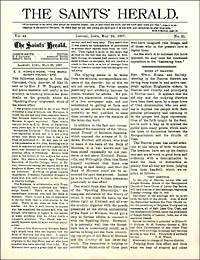
The Saints’ Herald
(Lamoni, Decatur County, Iowa)
1900-1921 Articles
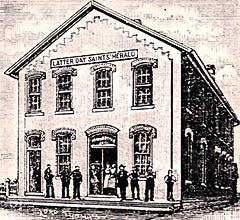
The Original Herald Office, Lamoni, Iowa
1860-71 (OH/IL) 1872-81 (IL) 1882-86 (IA) 1887-99 (IA) 1922-77 (MO)
In Jan., 1907 the Saints' Herald office burned and was re-built.
Near the end of 1921 it was moved to Independence, Missouri.
|
1900-1909 Jul 11 '00 | Jan 02 '01 | Jul 24 '01 | Aug 28 '01 Oct 09 '01 | Nov 06 '01 | Dec 25 '01 | Feb 19 '02 Aug 06 '02 | Oct 15 '02 | Aug 19 '03 | Aug 26 '03 Sep 05 '06 | Mar 20 '07 | May 15 '07 | Jan 15 '08 May 27 '08 | Jul 28 '09 | Aug 04 '09 | Oct 06 '09 Dec 29 '09 1910-1919 Jan 26 '10 | Feb 15 '11 | Jun 25 '13 | Jul 02 '13 Mar 10 '15 | Aug 18 '15 | Nov 14 '17 | Nov 21 '17 Mar 27 '18 | Aug 21 '18 | Aug 28 '18 | Oct 01 '19 |
|
Old Newspapers Index | Zion's Ensign
 Vol. 47. Lamoni, Iowa, July 11, 1900. No. 28.  ANOTHER EXPOSITION OF MORMONISM. We have received from the Pentecostal Publishing Company, of Louisville, Kentucky, a copy of a book written by S. J. S. Davis, called "The Origin of the Book of Mormon, together with an Account of the Rise and Progress of the Mormon Church." This book is being sold for twenty-five cents per copy. The publishers deemed it necessary to apologize for placing the book before the people, and offers such as apology the statement that there were hundreds of missionaries preaching, visiting, and distributing literature, and "doing what else they could to make converts" to the "Mormon" faith. The following is from the publisher's preface:-- |
Vol. 48. Lamoni, Iowa, January 1, 1901. No. 1.
Original Articles
The short sketch of my experiences with the church, considering the length of time in which they have occurred, occupying as they have nearly half a century, is submitted in the hope that some good thought may be furnished to the reader, which shall make him more earnest in the gospel work and more confident in the directing hand of the Lord in the affairs of his people. |
Vol. 48. Lamoni, Iowa, July 24, 1901. No. 30. AS TO THE SUCCESSOR. The letters following will be of great interest to many readers of the Herald, and we gladly give them space... |
|
Vol. 46. Lamoni, Iowa, August 28, 1901. No. 35.
ANOTHER VERSION OF THE The following appeared in the Denver Times for August 18: |
|
Vol. 48. Lamoni, Iowa, October 9, 1901. No. 41. A BRIGHT SPOT IN THE RAGE OF BATTLE. We quote the following from the Carter County Bugle, published at Grayson, Kentucky, for Friday, September 27, 1901. It is from the pen of R. B. Neal, of the Christian Church, who, as it will be seen, avows antagonism to what he is pleased to style "Smithianity," forgetting that the faith he holds may as appropriately be styled "Campbellism... |
|
Vol. 48. Lamoni, Iowa, November 6, 1901. No. 45.
LECTURES ON CHURCH HISTORY. ... In the fall of 1830 a revelation was given commanding Oliver Cowdery, Parley P. Pratt, Ziba Peterson, and John Whitmer to take a mission to the West for the purpose of visiting the Indians. They took their departure shortly after the revelation was given and went most of the way on foot, visiting a tribe of Indians at Buffalo, New York, and then went on to Kirtland, Ohio, where they stopped for a while, not because they had found Indians, but because Parley Pratt, one of the four, was an intimate acquaintance of Sidney Rigdon who resided near Kirtland, and he desired to see his friend and present this new found faith to him. So he called on Sidney Rigdon, who was a prominent minister in what was known as the Disciple Church, and presented the Book of Mormon. We are told Mr. Rigdon objected to the book at first, but the testimony was so strong in its favor that he finally consented to investigate, and after a careful investigation he accepted the truth of the message, and became from that time a prominent defender of the work, and later occupied a prominent position in the church. I may not be able to finish this narrative, but I want to call your attention to a few points in regard to it. There was an effort made afterwards to connect Sidney Rigdon with the Book of Mormon, and to do this they trumped up the story that Rigdon had some connection with what is known as the Spalding Manuscript, and they said that Sidney Rigdon had stolen this manuscript from a printing office in Pittsburg, Pennsylvania, and after he had examined it he sent it to Joseph Smith, and out of the manuscript the Book of Mormon was made. You know more about this theory than I am able to tell you to-night. This story has been circulated from time to time, and has found its way into some of our encyclopedias and histories, where it has done great damage. You will never read in history where any attempt is made to prove it true, it is simply asserted that it was stolen by Sidney Rigdon and changed by him into the Book of Mormon. When public speakers have been called upon to prove that assertion they have totally failed to prove that Sidney Rigdon and Joseph Smith ever met before the publication of the Book of Mormon, that they ever were nearer each other during this time than when Joseph Smith was in western New York and Sidney Rigdon was in northern Ohio. Almost all of the time Sidney Rigdon is accounted for in public records and some of our enemies have come to the conclusion that they can not prove the Spalding story and have abandoned it, while others cling to it. |
|
Vol. 48. Lamoni, Iowa, December 25, 1901. No. 52.
LECTURES ON CHURCH HISTORY. It seems that this subject is almost an endless one. We have been trying to get over the ground as fast as possible. We have felt we were not getting along as fast as we would like to, yet it seems that a part of our audience wants to hear more of the details than we have been presenting. We thought that we would leave Kirtland and the East and commence to-night in regard to Missouri, and the events that happened in connection with the settling of the church in that country, but during the week we received a card from Ohio, in which this request was made: |
|
Vol. 49. Lamoni, Iowa, February 19, 1902. No. 8. DOWN WITH "MORMONISM." -- NO. 3. It is positively out of the power of the defenders of the faith to meet and refute every misstatement made about the beliefs, doctrines, and conduct of the believers... Some pious soul of a preacher, or some unprincipled sensational news-gatherer... Such men do not stop to think... whether they could give satisfactory proof if their statements should be called in question; it seems to be sufficient if it will "down Mormonism." |
|
Vol. 49. Lamoni, Iowa, August 6, 1902. No. 32. REVEREND M'MILLAN AND THE SPALDING ROMANCE. It is always a surprise to those who are interested in the latter-day work to notice the manner of statement and augmentation adopted by certain religious writers who make attempts to account for the origin of the Book of Mormon and the rise of the church, organized April 6, 1830. |
|
Vol. 49. Lamoni, Iowa, October 15, 1902. No. 42.
EDITORIAL.
We have lately received clippings from various papers giving an account of how one Rev. J. E. Mahaffey, of Granitesville, South Carolina, has discovered (?) the origin of the Book of Mormon. Dispatches from Columbia, South Carolina, report Mr. Mahaffey as having made the following statements over his signature. We quote from the Globe-Democrat for September 29. |
|
Vol. 50. Lamoni, Iowa, August 19, 1903. No. 33. "A STAR IN THE WEST." After the McDowell-Bridwell debates, Bro. A. B. Kirkendall, of Creola, Ohio, thought it advisable to be in possession of Boudinot's work, "A Star in the West," issued in 1816, "Archaeologia Americana" (American Archaeology), issued in 1820 [sic]. and "View of the Hebrews," by Ethan Smith, issued in its second edition in 1825. By an extended effort, and paying a pretty good price, he secured them. As they are rare works now I thought something as to their contents might be of value, if the issue in the ever-continuing conflict shall be from Mr. Bridwell's position; and perhaps, otherwise. In the brief on Boudinot, in reference to Bridwell's arraignment of P. P. Pratt, Bro. A. B. Kirkendall's opinion is that quotation marks have been made to include, what was intended by Pratt, as his own language, summing up traditions in a way. This seems quite possible. |
|
Vol. 50. Lamoni, Iowa, August 26, 1903. No. 34.
THE SPALDING THEORY AGAIN.
A subscriber sends a leaf from a paper published in 1881, containing a history of the Book of Mormon. We published the same thing when it appeared about that date, and afterwards republished it. It is undoubtedly the true history of the Mormon Bible. |
|
Vol. 53. Lamoni, Iowa, Sept. 5, 1906. No. 36.
Editorial
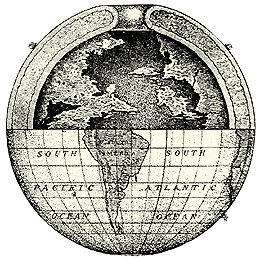
There has come to our desk a copy of The Phantom of the Poles (Walter S. Rockey Company, Publishers, New York), a book of about two hundred and eighty pages, written by William Reed, who advances the theory, and brings forth numerous arguments to sustain it, that the earth is hollow, that the poles, or places where the poles are supposed to be, are openings into the interior of the earth, the opening at the north pole being about a thousand miles in diameter, and that at the south pole fifteen hundred miles, giving his reasons in a clear and convincing way for these conclusions. |
|
Vol. 54. Lamoni, Iowa, March 20, 1907. No. 12.
OLIVER COWDERY'S DEFENSE.
There has recently come into our hands what purports to be a reprint of a tract said to have been written and published by Oliver Cowdery in 1839. The following is the title-page and the tract in full. We have taken the liberty to number the paragraphs for more convenient reference: In the second paragraph he denies having used some doubts, A close examination of it by one acquainted with the style of Oliver Cowdery will reveal that a part of it is his language with but little doubt. For instance paragraph 13 is very much like him; but compare that with paragraph 28 and it will not take much of an expert to detect the difference in style and diction. Other comparisons might be made with the same effect, but we forbear. For the sake of this investigation we will admit that this document as reprinted is a faithful reproduction of the language of Oliver Cowdery and as such proceed to examine it. We think it will be discovered by close examination that there is nothing in the document so damaging to the claims of the Church... The only thing of any importance in paragraph 8, is the statement that the voice of the angel who appeared to Joseph Smith and Oliver Cowdery resembled the voice of Elder Sidney Rigdon; but he does not intimate that it was Sidney Rigdon... It is asserted that Oliver Cowdery subsequent to this denounced Mormonism and united with the Methodist Church. To what extent he renounced Mormonism is not disclosed by the testimony... Subsequently to the writing of this defense and to his uniting with the Methodist Church, if he ever did, he makes a statement which clearly indicates that that manifestation which he supposed to be from God in 1838 was wrong; for in that statement he denounced all priesthood authority in the church; but at a special conference at Council Bluffs, Iowa, held on the 21st of October, 1848, or about ten years after this said manifestation, and nearly ten years after writing his defense, he made the following statement: Friends and brethren, my name is Cowdery -- Oliver Cowdery. In the early history of this church I stood identified with her, and one in her councils. True it is that the gifts and callings of God are without repentance. Not because I was better than the rest of mankind was I called; but, to fulfill the purposes of God, he called me to a high and holy calling. I wrote, with my own pen, the entire Book of Mormon (save a few pages), as it fell from the lips of the Prophet Joseph Smith, as he translated it by the gift and power of God, by the means of the Urim and Thummin, or, as it is called by that book, 'holy interpreters.' I beheld with my eyes and handled with my hands the gold plates from which it was translated. I also saw with my eyes and handled with my hands the 'holy interpreters.' That book is true. Sidney Rigdon did not write it. Mr. Spalding did not write it. I wrote it myself as it fell from the lips of the Prophet... The holy Priesthood is here. I was present with Joseph when an holy angel from God came down from heaven and conferred on us or restored the lesser or Aaronic Priesthood, and said to us, at the same time, that it should remain upon the earth while the earth stands. I was also present with Joseph when the higher or Melchizedek Priesthood was conferred by the holy angel from on high. This Priesthood was then conferred on each other, by the will and commandment of God. This Priesthood, as was then declared, is also to remain upon the earth until the last remnant of time. --- The Myth of the Manuscript Found, pp. 79, 80.: By the above quotation it will be seen that Oliver Cowdery in 1848 had confidence in his former testimony... In regard to the statement that he joined the Methodist Church in Tiffen, Ohio, we present the following: At our request Bishop E. L. Kelley called at Tiffen, Ohio, on February 7 and 8, 1907, to look up the records on this point; and after examining all the records that he could find in the hands of the custodian of the records, Mr. C. J. Yingling, writes in a letter dated Independence, Missouri, February 11, 1907, as follows: Mr. C. J. Yingling who had in charge the records of the Methodist Church thought, before examination, that it showed the Cowdery was a member of the church, but upon examination I discovered that it simply contained his work as an attorney, and pointed out the fact to Mr. Yingling, which he readily assented was the fact. He thought, however, that it was possible that they might have an older record than the one referred to, but could not go at the time to their church library and look for it. He had looked, however, before, before, but said he would do so again at the earliest time practicable and notify me of the results of his search. Since returning home I have a letter from him stating that he had not been enabled as yet, to secure any further information of this record, but discovered in history of Seneca County, Ohio, references to Oliver Cowdery, and he forwarded to me typewritten copy of what the history contains with a further statement that he would place in my hands anything else that he found touching the matter, either for or against Cowdery's connection with the Methodist Church in that place. He seems to be a very fine gentleman, and the leading member of the Methodist society at that place, as I called on the pastor, and he directed me to Mr. Yingling for my information, and said he had full access to all books and papers. He seemed to be ready to furnish me any and all evidence in their possession upon the matter. Mr. Yingling cited me to Mrs. Judge Lang as a party who would likely have an understanding with reference to this, when he found the records did not disclose. She was the only one of the old settlers that would be likely to know, he said. Afterward, I visited her, and inclose her statement in connection with the evidence. She cited me to the widow of Joel W. Wilson, the former law partner of Oliver Cowdery. I visited her, with the results as indicated in the facts set forth. She was living with her daughter, Mts. C. Guitteau, 2039 Adam Street, Toldeo. Ohio, and I called Mrs. Guittau as a witness to her statement with reference to Cowdery's connection with the Methodists in Tiffin. Mrs. Wilson was very positive that neither Oliver Cowdery nor his wife were members of the Methodist Church at Tiffin at any time. His report of the examination of the evidence, accompanying this letter, contains the following: The first reference to the work of the First Methodist Protestant Church of Tiffin, contained in the record book, bears date of January 19, 1843. This was a meeting called at that date of the male members of said church to form society and obtain charter of such society. At the conclusion of the record of this meeting there is entered upon the record in the handwriting of Oliver Cowdery which is marked in brackets, the following: "(See vol. 41, Ohio Local Laws, pages 31 and 32, where the above act may be found, O. Cowdery.)" On January 6, 1844, the Society was called together again with John Souders, Chairman; William Campbell, Secretary, but from the proceedings it seems they did not have sufficient to form a quorum, and their proceedings were not legal. At the conclusion of this record for January 6, 1844, there is inserted by O. Cowdery the following: "(The account of March 5th, 1836, referred to in the charter of this Society recorded on page 1 may be found in the collated acts of 1841, chapter 97, pages 792-783-784., O. Cowdery.)" January 18, 1844, the members of the Society convened again, Reverend Thomas B. Cushman elected Chairman, and Oliver Cowdery secretary of the meeting. In this meeting the following named parties were elected trustees: John Souder, Joseph Walker, William Campbell, John [Shinefelt and Benjamin] Nye. The following resolutions were passed: "Resolved, that the first meeting of the trustees of this Society, elected by this meeting, be held at the office of O. Cowdery on Tuesday, the 23 inst., at half past six o'clock p. m. Resolved, that the proceedings of this meeting be signed by the Chairman and Secretary. On motion adjourned the meeting without [delay]. Thomas B. Cushman, Chairman; Oliver Cowdery, Secretary, January 18, 1844. This furnishes all the reference in the record to Oliver Cowdery. It will be seen from the examination of the facts that Oliver Cowdery acted as the attorney for these parties, hence the association of his name. It has been claimed that he was a trustee of the church, but the record book does not so disclose, and had he been a trustee, that would not necessarily make him a member of the Society, for neither the law of the church at the time, nor the law of the land, made it necessary for a party in order to be a trustee of property, to be a member of the Society. Mrs. W. Lang, the widow of Judge Lang, of Tiffin, was referred to as a witness who would know with reference to Cowdery's connection with the church. She was an aged lady, but of good memory, found at her residence and that of her niece, Miss Lang, at Tiffin, and upon inquiry with reference to Oliver Cowdery's connection with the Methodist church Society at Tiffin during his residence there, she stated that he was not a member of any church society there. She thought his wife might have attended the Methodist Church, and the girl which lived with them, Adeline Fuller, did attend the Methodist Church, but she was certain that Oliver Cowdery was never a member of the Methodist Church at Tiffin. She said on the contrary he was a "Mormon." Mrs. Lang referred to Mrs. Mary E. Wilson, widow of Honorable Joel W. Wilson, former law partner of Oliver Cowdery, as the person most likely to know touching this. Calling upon Mrs. Mary E. Wilson, 2039 Adam Street, Toledo, Ohio, she stated as follows: "I am quite confident that neither Cowdery nor Mrs. Cowdery were members of the Methodist Church in Tiffin. Neither of them were members. I am quite confident that neither of them were members. Oliver Cowdery was a Mormon, and when he left there he went to Cleveland, or near there where the Mormons formerly had builded." Mrs. C. Guitteau, daughter of Mrs. Mary E. Wilson, was present and witnessed the statements of Mrs. Wilson, and stated she would subscribe as a witness to the statements of her mother, Mr. Yingling also sent to Bishop Kelley a copy of what is contained in the history of Seneca County, Ohio, on Oliver Cowdery, which is as follows, a transcript of which has been sent to us: OLIVER COWDERY.
Near the end of the Mormon Bible is added the testimony of Oliver Cowdery as to the "golden plates"
Note 1: This previously unknown, unmentioned, and unaccounted for pamphlet was first produced (as a purported reproduction) by Rev. Robert B. Neal (1847-1925) of Grayson, Kentucky, a former member of the Utah Ministerial Association and the self-styled head of the "The American Anti Mormon Association." Neal published the so-called Cowdery "Defence" under the series title of Anti-Mormon Tracts, No. 9. RLDS Apostle Heman C. Smith apparently thought that some parts of the pamphlet were the original words of Oliver Cowdery and that other parts were not. It is within the margins of possibility that R. B. Neal did obtain some kind of Cowdery holograph or document copy from which he "borrowed" some of the language found in his 1906 production, but the stronger likelihood is that he merely imitated Cowdery's phraseology after reading copies of his authentic writings. Note 2: This purported Cowdery pamphlet quickly found its way into other publications directed against Mormonism. Charles A. Shook reproduced it (along with some other probable forged documents he obtained from Rev. Neal) on pp. 50-54 of his 1914 book, The True Origin of the Book of Mormon and former RLDS Bishop, Richard C. Evans, used the highly questionable 1906 account on p. 24 of his 1920 book Forty Years in the Mormon Church. Years later, in 1976, James Bales reprinted Evans' book and included the entire alleged Cowdery document on pp. 183-187 of his reprint edition. Note 3: Jerald and Sandra Tanner argue in 1989 that the spurious Cowdery "Defence" was probably a forgery written and published by the third President of Southern Baptist Theological Seminary, Dr. William H, Whitsitt. The Tanners present absolutely no convincing evidence for this allegation and consequently no proof of their vicious allegations. For a counter-argument defending Whitsitt, see pp. 104-112 of Rev. Bryan Ready's 2001 Master's thesis. |
|
Vol. 54. Lamoni, Iowa, May 15, 1907. No. 20. NEAL CLUTCHES ANOTHER STRAW. R. B. Neal, of Grayson, Kentucky, breaks forth again in the Christian Standard for April 20, 1907. |
|
Vol. 55. Lamoni, Iowa, January 15, 1908. No. 3.
Elders' Note-Book
"What that doctrine and faith is, and was, I ought to know." |
|
Vol. 55. Lamoni, Iowa, May 27, 1908. No. 22.
Of General Interest
(The cuts used in this article are used by courtesy of the Liahona. -- Editors Herald.) |
|
Vol. 56. Lamoni, Iowa, July 28, 1909. No. 30. TRUE SUCCESSION. Quite a number of years ago, while yet the Herald was being published at Plano, Illinois, Charles W. Penrose, now one of the Twelve in the Utah Church, was publishing at Ogden, Utah, a little journal called the Ogden Junction. In one of the leading articles of this journal at one time was a statement to the effect that "the son of the Prophet" was afraid of what might be discovered of the history of the past, referring to the history of the church before the death of Joseph and Hryum Smith. This statement was called out by a reference made in the Herald to an effort being made by certain parties to find reliable information to the effect that there was collusion between Joseph Smith and Sidney Rigdon in connection with the work... A discovery made by the diligent search of Elder Walter W. Smith, now laboring in Philadelphia, is the case in point. |
Vol. 56. Lamoni, Iowa, August 4, 1909. No. 31.
Original Articles
|
Vol. 56. Lamoni, Iowa, October 6, 1909. No. 40.
Editorial
Some weeks ago an editorial writer for The Boston Traveler became greatly agitated over the report that certain Vermont officials were to cooperate with Reed Smoot in certain exercises at the dedication of a monument to the memory of Joseph Smith, at Sharon, Vermont. |
Vol. 56. Lamoni, Iowa, Dec. 29, 1909. No. 52.
Editorial
From present appearances as gathered from the press dispatches Doctor Cook did not find the North Pole. At all events that which he has offered as evidence lacks the qualification of being proof. One of the American Societies has accepted the claims of Commander Peary, though it remains to be tried out before the general body of scientists in the United States. |
|
Vol. 57. Lamoni, Iowa, Jan. 26, 1910. No. 4.
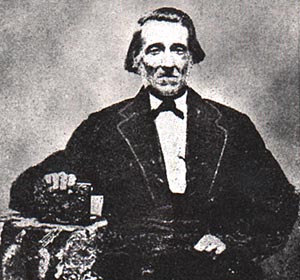
ISAAC SHEEN FIRST EDITOR OF THE "HERALD."
The family record of Isaac Sheen begins in the reign of George the Second when the son of the old Pretender descended like an avalanche into England. At this time lived John and Robert Sheen. John espoused the cause of the Pretender and with the battle of Colloden his estate in Northampshire and further record of him were lost. Robert, the younger brother, was the great-grandfather of Isaac. Thomas, son of Robert, married Elizabeth Warren, and William, their son, married Jane Kirk. To the latter couple were born Isaac, Frederick, Charles, James, Amy and Martha. |
|
Vol. 58. Lamoni, Iowa, February 15, 1911. No. 7. MOTH HOLES IN MARKHAM. The "Book of Mormon" was a successful literary steal and hoax. In 1812 Solomon Spalding, of New York (a would be Jules Verne), anticipating some of our own sensational romancing, made up his mind to create an atmosphere of mystery by naming one of his stories "Manuscript Found," and by claiming that the pages had been discovered in a cave in Ohio. This romance was based on the notion, then prevalent, that ancient America with its Aztecs and Indians was peopled by the descendants of "the lost tribes of Israel." |
|
Vol. 60. Lamoni, Iowa, June 25, 1913. No. 26.
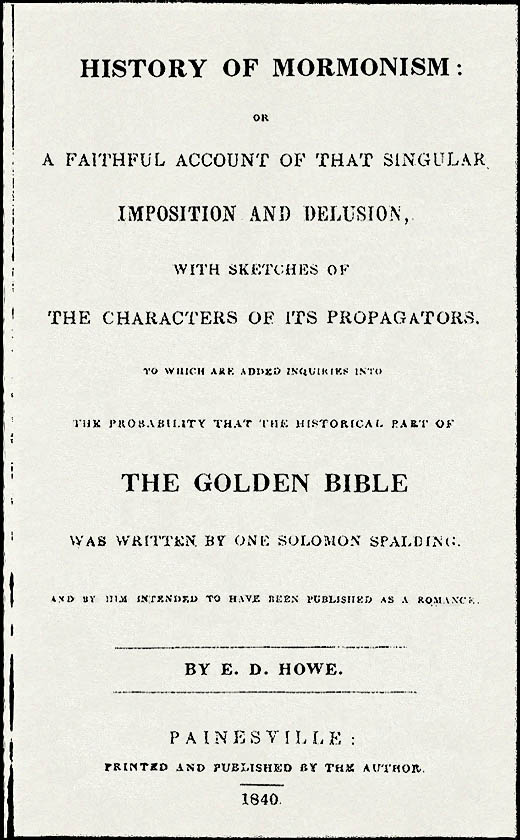
REVIEW OF "MORMONISM, THE ISLAM "A very pretty 'theory,' and somewhat ingenious, but where is the evidence to support it?" -- D. H. Bays. In his effort to explain the book of Mormon, Mr. Kinney has recourse to the old Spalding romance theory. He is aware of the existence of the famous Solomon Spalding manuscript in Oberlin College, ad the fact that it bears no resemblance to the Book of Mormon; but being unwilling to abandon the old, worn-out theory, he concludes that there was a second manuscript, an imaginary, enlarged revision of the first, which has never been discovered, and which served as a basis for the Book of Mormon. In this plea he joins a few others who have tried to make it appear that there were two or even three of these Spalding manuscripts, and who probably would enlarge that number indefinitely, if necessary to bolster [up] their cause. The resurrection of the old, decayed Solomon Spalding story suggests a review of the whole question. Our people met this question years ago and defeated their opponents, even before the manuscript now in the Oberlin College library was discovered. They were able to do this because the testimony connecting the Book of Mormon with the Spalding romance was contradictory and utterly unreliable. Bishop E. L. Kelley characterized it very aptly in his debate with Braden when he said: That thing is so rotten and deceitful in conception, so false and malicious in publication, so absurd and ridiculous in belief, that you shall in your hearts feel ashamed that you ever entertained the thought that there might be something in it. The old story may be briefly epitomized as follows: First, that one Solomon Spalding, a Presbyterian minister, about 1811 lived at Conneaut, Ohio, and being in poor health, for diversion in his invalid state, and with hope of pecuniary profits, wrote a story which was like the present Book of Mormon and left it in manuscript form. Second, that from Conneaut, Ohio, he moved to Pittsburg, Pennsylvania, in 1812, and while there handed the manuscript of this story to a publisher by the name of Robert Patterson for examination and publication. Third, that the manuscript, instead of being published, was returned to Mr. Spalding, and in the year 1814 he left Pittsburg and went to Amity, Pennsylvania, where he died in the year 1816, when his efforts, including the manuscript, fell into the hands of his widow. Fourth, that at the time the manuscript was in the office of the publisher, Mr. Patterson, one Sidney Rigdon was employed there, or in some way connected with the office, and either stole the manuscript or copied it. (The widow of Reverend Spalding testifies that he copied the manuscript and that the original was returned to her. Others claim that he stole it. Still others claim that Joseph Smith himself either copied it or stole it after it had passed into the hands of one Sabine. The vascillating and elastic methods of stating the case give it away at the start.) Fifth, that Sidney Rigdon at the time knew of Joseph Smith and had opportunity to get this manuscript to him. Sixth, that this was done in order that Rigdon and Smith might concoct the Book of Mormon and start a new church. ORIGIN OF THIS CANARD. The Spalding theory was first exploited in 1834, in a book entitled Mormonism Unveiled, by E. D. Howe. Howe was a "Mormon hater" and was assisted in his work by Doctor Hurlbut, who was seeking revenge for having been excommunicated from the church of Jesus Christ of Latter Day Saints for indecent conduct. (See Church History, vol. 1, p. 294.)Doctor Hurlbut secured the Spalding manuscript from the widow of Reverend Spalding and turned it over to Howe, as is shown by his testimony and the testimony of the widow. But Howe did not see fit to publish it, although to have done so would have been the surest way to have exposed the fraud, providing, of course, that his theory was correct. The fact that he did not do so was fatal evidence of the weakness of his position. Instead of publishing the manuscript he contented himself with publishing affidavits from John Spalding (a brother of Solomon Spalding), Martha Spalding (John's wife), Henry Lake, John Miller, Aaron Wright, Oliver Smith, and one or two others who testified that they had heard the Spalding romance read and later heard the Book of Mormon read and discovered a striking resemblance between the two. DOCTORED TESTIMONY. The widow of Solomon Spalding later joined in this denunciation of the Book of Mormon; and in Smucker's work, called the History of the Mormons, pages 43, 44 she tells how, years after the death of her husband, a "woman preacher" came to New Salem, where a meeting was held and copious extracts were read from the Book of Mormon. Mr. John Spalding was present and immediately recognized the book as one almost identical with the work written by his brother years before. This statement, signed by Matilda Davison, widow of Solomon Spalding, in its early form says that this was a "woman preacher." It appears that way in Smucker's History of the Mormons; in the work by T. W. P. Taydler, published in London at a very early date; in Mormons or Latter Day Saints, by another English author (1851); also we understand in Mackey's early work. When it was pointed out that we had no women preachers in the church, our opponents with characteristic mendacity changed this signed testimony, and Mr. Kinney uses it in its changed form on page 54 of his work (perhaps not knowing its original form), where he says that a Mormon elder came to this meeting and read copious extracts from the Book of Mormon. This is but one of many disreputable tricks that the opposition has resorted to, which indicate that they are contending against the truth. If our work is not the truth, why should they fight it with evasion and deceit?THE MANUSCRIPT FOUND COMES TO LIGHT. For many years the Spalding manuscript was lost sight of; but in 1885, Mr. L. L. Rice, who over forty years previously had purchased the Painesville Telegraph from E. D. Howe, and had transferred the printing department, with type, press, and manuscripts to Honolulu [sic!!], discovered this manuscript while going over old documents, in connection with his friend, President Fairchild, of Oberlin College.They read the manuscript carefully and reached the very just conclusion that it could never have served as a basis for the Book of Mormon. The manuscript was delivered into the care of President Fairchild and was placed in the library of Oberlin College. Mr. Fairchild prepared under his own supervision an exact copy of this manuscript, which was published, and may be obtained from the Herald Publishing House, Lamoni, Iowa. The manuscript bore the following indorsement, signed by D. P. Hurlbut: The writings of Solomon Spalding proved by Aaron Wright, Oliver Smith, John N. Miller and others. The testimonies of the above gentlemen are now in my possession. Mr. Kinney claims that this manuscript does not bear the title of "Manuscript Found> on the title-page. Others have made the same criticism. This is explained by the fact that Spalding's widow urged him to make out a title-page and he refused. But in the very introduction of his work the author says that he translated it from manuscript found in a cave. That at once suggests and acknowledges the name by which it was known to the family and friends, so this trivial objection is removed. SPALDING'S WIDOW TESTIFIES. We quote from Matilda Davison, Solomon Spalding's widow, as follows:From New Salem we removed to Pittsburg, in Pennsylvania. Here Mr. Spalding found a friend and acquaintance, in the person of Mr. Patterson, an editor of a newspaper. He exhibited his manuscript to Mr. Patterson, who was very much pleased with it, and borrowed it for perusal. He retained it a long time and informed Mr. Spalding that if he would make out a title page and preface, he would publish it, and it might be a source of profit. This Mr. Spalding refused to do. Sidney Rigdon, who has figured so largely in the history of the Mormons, was at this time connected with the printing office of Mr. Patterson, as is well known in that region, and as Rigdon himself has frequently stated, became acquainted with Mr. Spalding's manuscript and copied it. It was a matter of notoriety and interest to all who were connected with the printing establishment. At length the manuscript was returned to its author, and soon after we removed to Amity, Washington County, etc. Mr. Spalding deceased in 1816. The manuscript then fell into my hands and was carefully preserved. It has frequently been examined by my daughter, Mrs. McKinstry, of Monson, Massachusetts, with whom I now reside, and by other friends. After the Book of Mormon came out, a copy of it was taken to New Salem, the place where Mr. Spaulding's former residence [was], and the very place where the Manuscript Found was written. A woman preacher appointed a meeting there; and in the meeting read and repeated copious extracts from the Book of Mormon. The historical part was immediately recognized by all the older inhabitants, as the identical work of Mr. Spalding, in which they had been so deeply interested years before. Mr. John Spalding was present and recognized perfectly the work of his brother. He was amazed and afflicted that it should have been perverted to so wicked a purpose. His grief found vent in a flood of tears, and he arose on the spot, and expressed to the meeting his sorrow and regret that the writings of his [sainted] brother should be used for a purpose so vile and shocking. The excitement in New Salem became so great, that the inhabitants had a meeting and deputed Doctor Philastus Hurlbut, one of their number to repair to this place and to obtain from them [sic] the original manuscript of Mr. Spalding, for the purpose of comparing it with the Mormon Bible, to satisfy their own minds, and to prevent their friends from embracing an error so delusive. This was in the year 1834. Doctor Hurlbut brought with him an introduction and request for the manuscript, which was [signed by] Messrs. Henry Lake, Aaron Wright and others, with all whom I was acquainted, as they were my neighbors when I resided in New Salem. I am sure that nothing would grieve my husband more, were he living, than the use which has been made of his work. The air of antiquity which was thrown about the composition, doubtless suggested the idea of converting it to the purposes of delusion. Thus an historical romance, with the addition of a few pious expressions and extracts from the sacred Scriptures, has been construed into a new Bible and palmed off upon a company of poor deluded fanatics, as divine. I have given the previous brief narration, that this work of deep deception and wickedness may be searched to the foundation, and its author exposed to the contempt and execration he so justly deserves. Smucker's History of the Mormons, pp. 43-44. We quote from an interview in which Mrs. McKinstry made the following statement: Q. Mrs. McKinstry, have you the Manuscript Found, Mr. Solomon Spalding is said to have written, in your possession? [These] quotations show that this was known as the Manuscript Found, and that it passed from the [hands] of the Spalding family into the hands of [Mr.] Hurlburt, Howe's co-laborer in exposing Mormonism. [A statement] signed by D. P. Hurlbut and published by [Mr.] Patterson of Pittsburg shows that Hurlbut [left it] in the care of E. D. Howe. From this [statement we] quote: GIBSONBURG, OHIO, Aug. 19. 1879. I visited Mrs. Matilda (Spalding) Davidson at Monson, Massachusetts, in 1834, and never saw her afterwards. I then received from her a manuscript of her husband's, which I did not read but brought home with me and immediately gave it to Mr. E. D. Howe, of Painesville, Ohio, who was then engaged in preparing his book, Mormonism Unveiled. I do not know whether or not the document I received from Mrs. Davidson was Spalding's Manuscript Found, as I never read it; but whatever it was, Mr. Howe received it under the condition on which I took it from Mrs. Davidson, to compare it with the Book of Mormon and then return it to her. I never received any other manuscript of Spaulding's from Mrs. Davidson, or any one else. Of that manuscript I made no other use than to give it, with all my other documents connected with Mormonism, to Mr. Howe. I did not destroy the manuscript nor dispose of it to Joe Smith nor to any other person. -- Braden-Kelley Debate, p. 91. DUBIOUS BUT "WILLING" WITNESSES. Thus we have traced the manuscript into the possession of E. D. Howe, among whose effects it was found by L. L. Rice. When Howe came to examine the manuscript he did not publish it, giving as an excuse that it did not read as he expected.How, then, do we account for the fact that relatives and friends of Reverend Solomon Spalding testified that the Book of Mormon resembled his manuscript story? Sometimes the human memory is treacherous. We have frequently heard men and women of undoubted veracity in important cases before the courts squarely counterdict their own testimony given at a preliminary hearing one year previous. A judge of one of the superior courts says that this is a common experience. It must be remembered that these men and women whose affidavits Howe used were testifying concerning a book that they had heard read more than twenty years before they testified. How many of our readers are competent to give accurate testimony regarding a novel that they casually heard read twenty or twenty-three years ago, -- especially when there was nothing to lead them to think that they would ever be called upon to bear witness as to its character, and so did not particularly charge their minds with its contents? They testified to the appearance of exactly similar names in both books. How easy for one who had heard Spalding's manuscript read twenty-two years previously to imagine that the word Mormon, appearing in the Book of Mormon, was identical with Mammons, found in the Manuscript Found, especially as some of these witnesses remembered these names by the initial letter only;-- as they declared that Spalding made peculiar initial letters, Again witnesses whose memory has been made hazy by the lapse of time can be very skillfully directed in their testimony, if they are properly handled by an unscrupulous attorney. These people were bitter enemies of the Saints. They hated the Book of Mormon and desired to destroy it. They were plastic witnesses. They were questioned by men who were seeking revenge and were very skillful in directing them in their testimony. This was brought out by an answer given by Mrs. McKinstry in an interview. She was asked: Q. When did you first think about the names in the Book of Mormon and the manuscript agreeing? A. My attention was first called to it by some parties who asked me if I did not remember it, AND THEN I REMEMBERED THAT THEY WERE. -- Braden-Kelley Debate, p. 82. Thus by skillful questioning and careful direction, Hurlbut and Howe were able to get the kind of testimony that they wanted from these people who were trying to remember the contents of a manuscript that they had heard read more than twenty years before. They were obliging but unreliable witnesses. Upon such a flimsy basis does the Spalding romance theory rest. WHY THE INFIDEL HOWE WROTE HIS BOOK. Howe, himself, gave his reasons for working out this theory in an interview from which we quote as follows:What do you know personally about the Book of Mormon and the Spaulding story being the same? A. I don't know anything. Q. Why did you publish a work claiming that the Book of Mormon was the Spaulding Romance? A. Because I could better believe that Spaulding wrote it than that Joe Smith saw an angel. Q. Are those your grounds? A. Yes, sir, they are; and I want you to understand that you can't cram the Book of Mormon down me. Q. Do you swallow the Bible? A. That is my business. Q. Have you not published a pamphlet which does not endorse the Bible? A. Yes, I have. -- Braden-Kelley Debate, p. 83. Mr. Howe deliberately suppressed this manuscript while in his possession, refusing to publish it, and instead published these affidavits they had so carefully arranged. But the truth will out, and many years later in a strange manner it came out through the researches of President Fairchild and Mr. L. L. Rice.
NO MANUSCRIPT BY SPALDING COULD SERVE AS Anyone with brains enough to work Solomon Spalding's writings over and produce a book as the Book of Mormon would not have needed any help from Spaulding's pen in the first instance. Mr. Kinney's theory that there were two manuscripts rests upon his own imagination and that of other credulous clergymen. It is gotten up to [meet] the extigencies of the case and should be quite [beneficial to] a Baptist preacher who hopes to go to a good Baptist heaven when he dies. It is a fabrication clear and obvious. MEN WHO HAVE ABANDONED THE SPALDING THEORY. Really intelligent and careful students of the question have completely abandoned the Spalding [story}. David Utter is reported to have said:No one who has ever carefully read the Book of Mormon could fail to see that it never in any part was written [as a] romance.... Now, at last, the Spalding manuscript has been found, and it rests secure in the library of Oberlin College. -- The Latter Day Saints, by Kauffman, p. 29. D. H. Bays, who studied the question for [many] years, and was hailed by our Christian friends [as a] "child of providence," whose book, they assured [us] was absolutely reliable as a textbook, says: The long-lost Spalding story has at last been unearthed, and is now on deposit in the library of Oberlin College at Oberlin Ohio, and may be examined by anyone who may take the pains to call on President Fairchild, of that institution.... The Spalding story is a failure. Do not attempt to rely upon it -- it will let you down. The entire theory connecting Sidney Rigdon and the Spalding romance with Joseph Smith in originating the Book of Mormon must be abandoned. -- Doctrine[s] and Dogmas of Mormonism, pp. 24, 25. President Fairchild of Oberlin College, says: The theory of the origin of the Book of Mormon in the traditional manuscript of Solomon Spaulding will probably have to be relinquished.... Some other explanation of the origin of the Book of Mormon must be found, if any explanation is required. -- Manuscript Found, pp. 5, 6. And last, but not least, comes the new Encyclopedia Brittannica (fourteenth edition). in which we read: It was a contention of the early anti-Mormons, [nor was it] ever discredited, that the Book of as published [by] Smith was rewritten with few changes from an unpublished romance, The Manuscript Found, written before 1812 by Solomon Spalding.... There is no actual proof that Rigdon [lived] in Pittsburg, or was employed in a printer's shop there [as] early as when Spalding's "copy" must have been left with the printer; and there is NO EVIDENCE THAT RIGDON KNEW ANYTHING OF MORMONISM UNTIL AFTER THE PUBLICATION OF THE BOOK OF MORMON. -- Encyclopedia Brittannica, vol. __, p. 843. D. H. BAYS ON THE IMAGINARY SECOND MANUSCRIPT. The new fangled theory that there were two or three manuscripts is perhaps best answered by one of the ablest of our opponents, Mr. D. H. Bays, [who] in the Christian Evangelist for November 2, 19__ [says] in reply to one A. T. Schroeder, one of his own [------ mates], but an advocate of the "three manuscript" theory, wrote as follows:I was, at the time my book was written, fully aware that such assertions had repeatedly been made, but as I have never been able to obtain the testimony of a SINGLE WITNESS in support of the claim, I have unhesitatingly dismissed it as an IDLE SPECULATION. You assure me that the first of these manuscripts "simply outlined the story and is the one now in Oberlin." The second, you assert with equal gravity, "was prepared for the printer," while in the third "the plot of the story changed as to place from which Indians came here and the names changed to suit the change in the plot;" and this, you assure me, "is the one which furnishes the basis for the Book of Mormon." This is a very PRETTY "THEORY," AND SOMEWHAT INGENIOUS, BUT WHERE IS THE EVIDENCE TO SUPPORT IT?... I confess myself not a little surprised that an attorney, trained in a school of justice to weigh and determine the value and admissibility of evidence, should ask a candid public to decide so grave a matter upon the bare assertion of an INTERESTED PARTY, WITHOUT THE SHADOW OF EVIDENCE to support it If "three manuscripts" ever existed, why not produce the evidence to prove it? Why not induce that library of "over one thousand books and pamphlets" to yield up some of its hidden treasures of knowledge upon this point, and settle this mooted question once for all? Mormonism for more than half a century has been demanding the production of the Manuscript Found that it might be compared with the Book of Mormon. Since the discovery of that now historic document, and the further unquestionable fact that it bears not the slightest resemblance to the Book of Mormon, the wonderful discovery has been made that Solomon Spalding wrote three manuscripts!" While you affirm very dogmatically, as others have done before you, that Spalding wrote three manuscripts, yet, like your predecessors, you offer not a SINGLE FACT in support of this claim. In the face of these significant facts, you with characteristic pertinacity assert: "If you had made any investigation worth mentioning, you would have found that the absolute identity of the very unusual names in the Book of Mormon with the second Spalding manuscript was originally one of the principal evidences of the connection between the two." Here we have the assumption that a "second Spalding manuscript" actually existed, and from this assumed premise you jump to the conclusion that the names were "absolutely identical" with those in the Book of Mormon. My objections to this statement are: 1. The existence of a second manuscript is assumed, not proved. 2. If such manuscript really existed, no proof is offered to show the "absolute identity" of the names with those in the Book of Mormon. Hence, until you establish the alleged fact that such "second Spalding Manuscript" had a bona fide existence, and that the "very unusual names" found in the Book of Mormon are absolutely identical" with those found in the so-called "second Spalding Manuscript," a fair-minded, just public will reject this new-fangled "Spalding Manuscript theory" AS THE MEREST VAGARY OF A PREJUDICED MIND, AND WHOLLY WITHOUT THE SLIGHTEST FOUNDATION IN FACT. I do not say that the "three manuscripts" had no actual existence; but I do say that if such manuscripts ever had anything more than an imaginary existence somebody knows it; and if somebody knows it, why not have that somebody step upon the witness stand and boldly testify to the fact? But why pursue this question further, since you admit that it is only a "theory" -- a theory, too, supported by such a class of evidence which, as a lawyer, you well know would BE REJECTED BY ANY COURT IN THIS BROAD LAND OF OURS. Acknowledging the fact you say: "I cannot establish these facts except by hearsay evidence, which Greenleaf would bar." In concluding this paragraph you remark that: "Barring the question of the hearsay character of the evidence, I believe that a case can be made out much stronger than the circumstantial evidence upon which many a man has been hung." (Italics mine.) This may be true, but it must be borne in mind that many an innocent man has been hung upon purely "circumstantial evidence," and it is a principle of law from which there is no deviation that a guilty man may better escape the punishment due to his crimes that an innocent man should suffer the extreme penalty of the law. Hence, juries are always instructed to give the prisoner the benefit of a doubt. But of course, I need not remind an experienced attorney that there is a vast difference between "hearsay evidence" and "circumstantial evidence." The former Greenleaf peremptorily excludes. -- Journal of History, vol. 2, p. 94. A SPIDER'S WEB OF SUPPOSITIONS. Some more If-ists.The extremely tenuous nature of the Spalding Romance theory in its present form is best shown by permitting it to be stated by its own proponents. Mr. Charles Shook, who was advertised just recently as the man destined to shake our work to its foundation, shall have that honor. He admits the existence of the Spalding manuscript in Oberlin College, but thinks there may have been another one enlarged and "polished" up. Hear him: It is possible that Spalding, in polishing and finishing his story, rewrote it, and that it was the story rewritten which was submitted to Patterson and which fell into Rigdon's hands; while the old manuscript may have been placed in a trunk, with other papers of Spalding's, which was sent, after his death, to the home of his wife's brother, W. H. Sabine, in Onondaga County, New York, Smith worked as a teamster for Sabine in 1823, and some have claimed that he either copied or stole this manuscript. The first is very unreasonable, the second is POSSIBLE IF SUCH MANUSCRIPT WAS IN SABINE'S POSSESSION. -- Cumorah Revisited, by Shook, p. 28. Grover Cleveland would call these men "ifists." According to him the "ifist," lost in the woods without fire or food, said, >i>If we had a fire, and if we had some eggs, we would have ham and eggs, if we had the ham." Mr. Shook argues that IF Spalding ever rewrote his manuscript, and IF he resubmitted it to the publisher, Rigdon MAY have stolen it; and IF this did not happen, Smith MAY have copied it while in the possession of Sabine, and IF he did not copy it, he MAY have stolen it, IF, last of all SABINE EVER HAD SUCH A MANUSCRIPT. These men have gone back to the original Christian or Campbellite proposition, "IF we have authority to preach we have authority to baptize." We can not too heartily thank Mr. Shook for his very ingenuous statement of the case. Note 1: Advancing from the previously employed RLDS tactic of admitting that their 1885 "Manuscript Found" book may have been mislabeled, the Herald writer here boldly recaptures the old RLDS position of claiming the Oberlin Spalding document to be the famous "Manuscript Found." He next criticizes E. D. Howe for not publishing the Oberlin Spalding text back in 1834. The Herald writer says: "The fact that he did not do so was fatal evidence of the weakness of his position." In fact, E. D. Howe gave a reasonably accurate description of the Oberlin Spalding manuscript in his 1834 book, distinguished it from the "Manuscript Found" and correctly stated that he did not have the "Manuscript Found" in hand for publication. Howe's attempting to print the Oberlin Spalding manuscript would have made no sense at all -- though he might well have provided a lengthier, more detailed description of its contents and his reason for not returning it to the Spalding family, had he allowed himself a little more free space in the final pages of the final signature of his 1834 book. Note 2: The Herald writer really does seem to be whipping a dead horse in his insistence upon the subsequent correction of the 1839 "woman preacher" typo as being "but one of many disreputable tricks that the opposition has resorted to, which indicate that they are contending against the truth." As early as June 28th, 1841, the Rev. D. R. Austin (the man who conducted the 1839 interview in question) said: "Every fact as stated in that letter was related to me by her in the order they are set down. (There is one word misprinted in the published letter, instead of 'woman preacher,' on the second column, it should be Mormon preacher.)" Some later writers, quoting that same 1839 interview, failed to make the textual correction to "Mormon preacher," but a number of writers did fix the obvious error. Pennsylvania historian Alfred Creigh made the change in his Feb. 27, 1879 "Mormonism" article. Following Creigh's lead, Robert Patterson, Jr., writing in the March 27, 1879 issue of the Pittsburg Telegraph, says: "A typographical error occurred in the [1839] Recorder, in which 'Mormon preacher' was printed 'woman preacher.' The correction has been made on the authority of Rev. D. R. Austin, who acted as amanuensis for Mrs. Davison." Patterson's "authority" was the same Rev. D. R. Austin who first corrected the error in 1841. Patterson sent Austin a copy of his Pittsburg Telegraph article and Austin confirmed the same in an 1879 letter to James T. Cobb. Patterson next made the same change in his1882 pamphlet, wherein he quotes Davison: "A Mormon preacher appointed a meeting there..." Patterson sent the pamphlet to Joseph Smith III, who responded to it in the 1883 Saints' Herald without calling into question the validity of that particular correction. In 1884 Clark Braden and Edmund L. Kelley discussed the same textual problem in the "Braden-Kelley Debate." On p. 123 Braden says: "The truth is, a Mormon preacher visited Conneaut and preached his first sermon and read extracts from the Book of Mormon... It was a Mormon preacher, and not a woman preacher. That is a misprint in Schmucker's book -- as other books, that I have, show." Kelley, on p. 123, responds: "with regard to the 'woman preacher' referred to in Mrs. Spaulding's letter, as found in Smucker's History. Does he not know that that is the original statement from which all the rest of these histories of Mormonism go to for their material, and yet the rest of them have struck out the word 'woman,' What right had they to do that?" Note 3: The answer to Elder Kelley's question, "What right had they to do that?" is found in D. R. Austin's published 1841 correction, of course. A. Theodore Schroeder said: "a Mormon preacher brought a copy of the Book of Mormon to Conneaut or New Salem, as it was sometimes called, the very place where Spaulding wrote most of his 'Manuscript Found.' ... In the first publication of Matilda Spaulding Davidson's letter, from which the above is gleaned, the words 'Mormon preacher' in the manuscript published over her name were, by the typesetter, converted into 'woman preacher.' Mormons at once undertook to impeach the statement, not by denying the main features of the story or its value as an argument, but wholly upon the ground that Mormons never had a 'woman' preacher. As the result of this criticism, it was shown to have been due solely to typographical error, thus leaving the statement as corrected free from criticism upon this ground." Mormon apologist B. H. Roberts responded to Schroeder, in 1908, by saying: "It is claimed that 'woman preacher,' was merely a 'typographical error,' of which more in a later note, and should read 'Mormon preacher.'" Roberts' later note reads: "It is claimed that the words 'woman preacher' found in the Davison statement was a typographical error (see Clark's 'Gleanings by the Way,') and should read 'Mormon preacher;' but the typographical error being claimed after it was learned that the Mormon Church at that time had no women preachers, gives it the color of one of those 'after thoughts' which are so frequently seen in this spaulding theory, that one in spite of himself remains doubtful." On the other hand, Charles A. Shook, writing in 1914, was less "doubtful" on the matter: "Mormons claim that they never had a 'woman preacher,' and use this as one of the arguments in their attempt to discredit Mrs. Davison's testimony. But it does not say that it was a Mormon 'woman preacher.' It may have been a woman preacher of some other connection. The probability, however, it that it is a typographical error for 'Mormon preacher...'" Note 4: The final answer to the matter can be found in "Conneaut witness" Aaron Wright's Dec. 31, 1833 letter, in which he says that Elder Orson Hyde first preached from the Book of Mormon, in Conneaut township, early in 1832. Hyde himself admits to being that same first Mormon preacher in Conneaut. The story of Hyde's preaching at Conneaut was relayed to Spalding's widow in 1833 and she recalled the incident in her 1839 interview with Austin. Austin's words "Mormon preacher" were misread by the typesetter (a handwritten "m" often looks much like a "w") who set the words as "woman preacher." There is absolutely no reason why the Saints' Herald writer, composing his argument as late as 1913, should blast this well explained typo and its subsequent correction as being "but one of many disreputable tricks that the opposition has resorted to, which indicate that they are contending against the truth." Note 5: After telling how bad the Oberlin manuscript is and how its lack of quality reflects upon its author, the Herald writer says: "Anyone with brains enough to work Solomon Spalding's writings over and produce a book as the Book of Mormon would not have needed any help from Spaulding's pen in the first instance." The writer does not allow for the possibility that Rigdon might have first proofread and corrected Spalding's text (as a favor or job for his Pittsburgh publisher friend Jonathan Harrison Lambdin) and only several years later have undertaken the task of re-writing Spalding's fictional history. If Rigdon did his work on the text in stages, the third stage could have been his transforming a fictional history of the ancient Americans into a religious record, complete with prophecies, exhortations and late 1820s Campbellite theology. Such a logical evolution in the contents of text, over more than a decade, would well explain why Rigdon did not simply write the Book of Mormon from scratch. Note 6: The journalistic exchange between A. T. Schroeder and D. H. Bays provides insight into what would be required to convince a dedicated skeptic of the validity of the Spalding authorship claims. Mr. Bays demands living witnesses who can offer more than just oral testimony. It seems that nothing less than a living witness who could produce the Spalding holograph for "Manuscript Found" and incontrovertibly account for the history of its production and possession, from Spalding down to the present, would induce a person like Mr. Bays to even consider the possibility of those same authorship claims could be true. Obviously, if such proof existed, there would be no need to discuss the topic at all, except as a matter of past history. Bays overlooks the value of accepting the main points of the "Spalding theory" conditionally, so that they can be analyzed in the light of any previously unknown new evidence, even if "circumstantial." Or, failing any useful outcome through such a conditional hearing, that new supporting evidence could be sought for and uncovered, through extrapolation, from the analysis of various facts and probabilities compiled to date. In other words, Bays neglects the possibility of using compiled evidence as a research asset rather than as material whereby to establish conclusive proof, here and now. |
|
Vol. 60. Lamoni, Iowa, July 2, 1913. No. 27. THE SPALDING ROMANCE HAS A RIVAL. Herewith we reproduce an extract from the Word of Truth, published at Greely, Colorado, February 12, 1913. It is taken from an article appearing in that issue written by one J. H. D. Thompson, entitled "Origin, History, and Characteristics of the Mormon Cult." |
|
Vol. 62. Lamoni, Iowa, March 10, 1915. No. 10. BOOK OF MORMON TAKEN FROM SPALDING ROMANCE. Mr. Shook, whose work R. B. Neal says will "shake the foundation" of Latter Day Saintism, has this to say about the Spalding Romance theory:
THE SPALDING MANUSCRIPT
There are many who seem to think that the Book of Mormon had its origin with the Spalding Manuscript, not knowing that this manuscript is now in the library of Oberlin College, Oberlin, Ohio, copies of which are printed and for sale by the Herald Publishing House, Lamoni, Iowa. |
|
Vol. 62. Lamoni, Iowa, August 18, 1915. No. 33.
PUBLIC OPINION ON SPALDING ROMANCE THEORY Since my return from the Australian Mission, I have noticed quite a change in the attitude of standard reference and current literature toward the Latter Day Saints in general and the Reorganized Church in particular. Of late I have been taking notes which I herewith transcribe. The late editions of the standard encyclopedias show a complete change in the accounts they give of the origin of the Book of Mormon. The Spalding story is now entirely repudiated. I used to wonder why authoritative literature clung so tenaciously to that tradition when it had been so successfully exploded. Fairchild's discovery was made in 1885, and apparently it has taken until very recently for it to influence the scholastic mind and find its way into secular literature. I once despaired of it being read of outside of our publications. The tide, however, has set in the other way, hence we offer the following: |
|
Vol. 64. Lamoni, Iowa, Nov. 14, 1917. No. 46
THE MOUND BUILDERS AND THE (The following article was written by Brother Clark for the Ohio Archaeological and Historical Quarterly, and published in the April, 1917 number. It is reproduced here by kind permission of the editors of that publication, and though written primarily for those who have not espoused our faith, will be of much interest to our readers. Editors). |
|
Vol. 64. Lamoni, Iowa, Nov. 21, 1917. No. 47
THE MOUND BUILDERS AND THE (The following article was written by Brother Clark for the Ohio Archaeological and Historical Quarterly, and published in the April, 1917, number. It is reproduced here by kind permission of the editors of that publication, and though written primarily for those who have not espoused our faith, will be of much interest to our readers. Editors). |
|
Vol. 65. Lamoni, Iowa, March 27, 1918. No. ?
ORIGIN OF THE BOOK OF MORMON (A contributor sent in a lengthy statement to the Buffalo Express recently, setting out the differences between the Reorganized Church and the Utah organization. He seemed to understand the differences but was mistaken as to the origin of the Book of Mormon. Brother James Pycock wrote and had printed the following answer, which we reproduce in part with the idea that it may be valuable as a scrapbook note to help answer the Spalding Romance theory so often used by those who are not well informed. -- Editors.) |
|
Vol. 65. Lamoni, Iowa, August 21, 1918. No. 34.
MANUSCRIPT OF SOLOMON SPALDING AND The accepted theory of the origin of the "Book of Mormon" connects it with a manuscript written by Solomon Spaulding, purporting to set forth the origin and civilization of the American Indians, and to account for the ancient mounds and earthworks and other remains of the ancient inhabitants which are scattered over the land. |
|
Vol. 65. Lamoni, Iowa, August 28, 1918. No. 35.
ON SOLOMON SPALDING STORY Elder James Pycock called our attention to the fact that in volume 3, page 187, of the proceedings of the Western Reserve Historical Society, held in 1886, an address is to be found by James Fairchild, president of Oberlin College, which was delivered at a meeting of that society. This address was published in full in the Saints' Herald of last week. |
|
Vol. 66. Lamoni, Iowa, October 1, 1919. No. 40.
THE SPALDING ROMANCE THEORY "A very pretty 'theory,' and somewhat ingenious, but where is the evidence to support it?" -- D. H. Bays. |
Back to top of this page.
Articles Page | Articles Index | History Vault
Oliver's Bookshelf | Spalding Library | Mormon Classics
last updated: June 18, 2012