
READINGS IN EARLY MORMON HISTORY
(Newspapers of New York)

New York State west of Syracuse
Palmyra Area Papers
1829-31 Articles

Counties Colored Light Green = Palmyra Area
1795-1825 1826-28 1829-31 1832-33 1834-39 1840-46 1847-69 1870-99 1900-99
1829-31 West NY 1829-31 Batavia area 1829-31 Rochester 1829-31 East NY
WS Jan 09 '29 GG Jan 28 '29 GG Feb 11 '29 GG Apr 15 '29 WS Jun 26 '29 WS Jul 24 '29
GG Aug 05 '29 PF Aug 11 '29 WS Aug 14 '29 Rf Sep 02 '29 Rf Sep 09 '29 Rf Sep 16 '29
Rf Sep 23 '29 Rf Sep 30 '29 Rf Oct 07 '29 Rf Oct 21 '29 Rf Oct 28 '29 Rf Nov 04 '29
News Articles Index NY Chronological List Otsego Co. Papers New York City Papers
 Vol. VI. Palmyra, N. Y., Friday, Jan. 9, 1829. No. 26.  Asahel D. Howe, of Norwalk, Ohio, formerly of this village, has recently been detected purloining money from the U. S. Mails, while acting as assistant Post Master. He was arrested and held to bail to appear before the U. States District Court; after which he left the place. He was again arrested at Euclid, a few days after, and conveyed to Columbus, to be tried at the U. S. District Court, then in session. It is said a large amount of bank bills, thus purloined, were found in his possession -- Ontario Repository. |
 Vol. XX. Wednesday, January 28, 1829. No. 34.
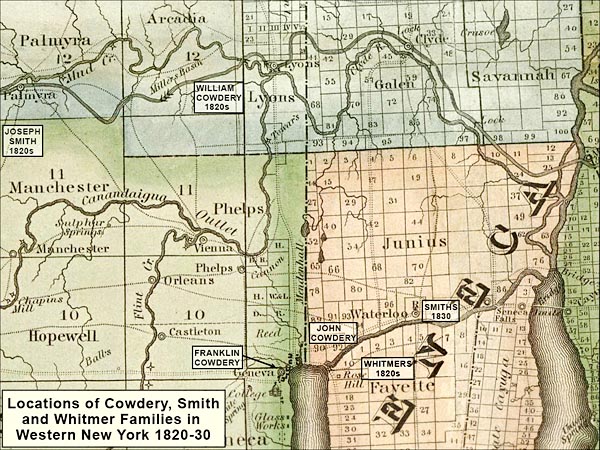
==> Our neighbor of the Chronicle makes a sort of half-way apology for his learned correspondent's wit, if it may be so called, which miserable and vulgar as it is, has certainly given an unusual degree of interest and importance to his columns for the last two weeks. As Mr. Cowdery has but recently taken up his residence among us, he may have yet to learn that there are in the ranks of his political assoviates, many individuals who may be considered fair subjects of retaliation, and against whom the shifts of irony and ridicule may be directed with a pointedness they cannot evade, and with humiliating effect. Those who live in glass houses," &c. &c. |
|
Vol. XX. Wednesday, February 11, 1829. No. 36.
==> The Chronicle (which Mr. Cowdery say has been printed by him 53 weeks,) in reply to our little paragraph glancing at retaliation, has a jumble of matters and things, not even omitting an allusion to [-----], but what that has to do with the subject we are at a loss to conceive, or whether the application is to the editor himself, to the man in the moon, or to us, we cannot gather from the article itself. If, peradventure, his design is to cast upon us reproach on the score, we must reply, in the language of the country editor quoted by Noah, "What the d___l has an editor to do with a wife! Writing for glory, and printing on trust, they ought to be ashamed of themselves to indulge in any such luxuries!!" |
|
Vol. XX. Wednesday, April 15, 1829. No. 45. MARRIED. In Goshen, (Orange co.) on the 12th ult., Major Thomas B. DeKay, to New-Jersey, to Miss Sarah E. Cowdery, daughter of Col. John Cowdery, of the town of Waterloo. |
|
Vol. ? Palmyra, N. Y., Friday, June 26, 1829. No. ? Just about in this particular region, for some time past, much speculation has existed, concerning a pretended discovery, through superhuman means, of an ancient record, of a religious and divine nature and origin, written in ancient characters, impossible to be interpreted by any to whom the special gift has not been imparted by inspiration. It is generally known and spoken of as the "Golden Bible." Most people entertain an idea that the whole matter is the result of a gross imposition, and a grosser superstition. It is pretended that it will be published as soon as the translation is completed. Meanwhile we have been furnished with the following, which is represented to us as intended for the title page of the work -- we give it as a curiosity: |
|
Vol. VI. Palmyra, N. Y., Friday, July 24, 1829. No. 44. (From the Batavia Peoples' Press.) The Aborigines. -- The feeble and scattered fragments of the once powerful Indian tribes who were formerly the lordly proprietors of the whole territory which now constitutes our flourishing and populous country, are fast dwindling away, and will soon be buried in the depths of that oblivion which conceals the history and fate of a people who (judging from the traces discovered of the progress which they had made in civilization, and the arts and sciences, as developed by the western antiquities) must have been but a little behind the present generation in many respects. When we look at the straggling Indians who may occasionally be seen wandering through our [streets] and mark their [--- ----] and dejected countenances, which reveal the ravages of intemperance and almost every other loathsome vice, we can hardly persuade ourselves that they are remnants of the powerful race of people who, as it were but yesterday, stretched from the Atlantic to the Pacific; that they are brethren of the Logans and Philips of other times. It is difficult to withhold the meed of sympathy for the fate of the poor outcasts, when we reflect how much they have been oppressed by the whites. They have been gradually driven farther and farther west, before the dense mass of civilization, till scarcely a vestige of their race remains. |
|
Vol. XXI. Wednesday, August 5, 1829. No. 9.
The Chronicle of Geneva came out last week with a long, disconnected, unintelligible article on the subject of -- the Lord knows what; but after rubbing the glasses and putting on our spectacles, and following along about a foot and nine inches, we ascertained the object of the writer was to invite the Wayne County Patriot and Buffalo Journal to show their colors, and accompany the Chronicle on an electioneering voyage for Henry Clay, as a candidate for the next Presidency... -- Wayne County Patriot. |
Vol. ? Palmyra, New-York, August 11, 1829. No. ? "Golden Bible." The greatest piece of superstition that has ever come within the sphere of our knowledge is one which has for sometime past, and still occupies the attention of a few superstitious and bigoted individuals of this quarter. It is generally known and spoken of as the "Golden Bible." Its proselytes give the following account of it: In the fall of 1827, a person by the name of Joseph Smith, of Manchester, Ontario county, reported that he had been visited in a dream by the spirit of the Almighty, and informed that in a certain hill in that town, was deposited this Golden Bible, containing an ancient record of a divine nature and origin. After having been thrice thus visited, as he states, he proceeded to the spot, and after having penetrating "mother earth" a short distance, the Bible was found, together with a huge pair of spectacles! He had been directed, however, not to let any mortal being examine them, "under no less penalty" than instant death! They were therefore nicely wrapped up, and excluded from the "vulgar gaze of poor wicked mortals!" It was said that the leaves of the Bible were plates, of gold about eight inches long, six wide, and one eighth of an inch thick, on which were engraved characters or hieroglyphics. By placing the spectacles in a hat, and looking into it, Smith could (he said so, at least,) interpret these characters.Note 1: The above is thought to be a faithful reproduction of the text of the article appearing in Jonathan A. Hadley's Palmyra Freeman a few days before it was reprinted in the Aug. 27, 1829 issue of the Niagara Courier. A shortened version of the article was featured in the Aug. 31 issue of the Rochester Daily Advertiser and Telegraph. That edited version of the article was reprinted by Eber D. Howe in the Sep. 22, 1829 issue of his Painesville Telegraph and in the Oct. 2, 1829 issue of the Massachusetts Salem Gazette. Note 2: An exhaustive search of old upstate and western New York newspapers has, so far, failed to uncover any earlier, specific published reference to the Book of Mormon. However, the July and August 1829 issues of the Rochester paper, Paul Pry's Bulletin, make some obscure references to Joseph Smith's "Golden Bible." No contemporary sources provide any indication that Joseph Smith, Jr. was being "persecuted" as early as 1823-27 for claims regarding a gold Bible (or even for his miracle-affirming, restorationist religious views). The picture which emerges from a close study of early sources, is that Smith first began to talk in public about the gold Bible in the year 1827, and that he did not proclaim it to be a divine revelation intended for modern Christians, until late 1827 or early 1828. For more details see Jonathan A.Hadley's 1842 letter, in which he refers to the 1829 Palmyra Freeman calls it "the first article on the Mormons." |
Vol. VI. Palmyra, N. Y., Friday, August 14, 1829. No. 47. On Saturday last, Asil D. Howe, late deputy post-master of Norwalk, Huron co., Ohio, was tried in the United States circuit court at Columbus, for breaking open letters and stealing money enclosed in them. The trial lasted the whole day, and resulted in his conviction. Notice of a motion for a new trial was given, which was to have been heard on Monday last. The result was not learned. -- Cincinnati Republican. |
 No. 1 Palmyra, Wayne Co. -- Wednesday, September 2, 1829. Vol. 1 SELECTED ITEMS. ==> Lorenzo Dow, the celebrated “stump” preacher, preached to three thousand people, on the 22d inst. He also sells the book he has lately published, shewing "how to lie, cheat, swear, and steal, according to law." It has been suggested that it would be a good time for Honest" Attorney to improve (if possible) in the art. |
No. 2 Palmyra, Wayne Co. -- Wed., September 9, 1829. Vol. 1 ==> Paul Pry Esq. of the Rochester Bulletin, has suspended his editorial labors for the present, and intimates in his valedictory address, that his paper has been well supported, and that at some future day, the "Bulletin" will again appear "on an improved and enlarged form." ... |
No. 3 Palmyra, Wayne Co. -- Wednesday, September 16, 1829. Vol. 1. The Book of Mormon is expected to be ready for delivery in the course of one year -- Great and marvellous things will "come to pass" about those days.... |
No. 4. Palmyra, Wayne Co. -- Wednesday, September 23, 1829. Vol. 1 SELECTED ITEMS. ==> We understand that the Anti-Masons have declared war against the Gold Bible -- Oh! how impious! |
|
No. 5. Palmyra, Wayne Co. -- Wednesday, September 30, 1829. Vol. 1
OUR OWN AFFAIRS.
We take the above quotation from the head of the editorial column, in the "PALMYRA FREEMAN," and since we are informed that the Devil can quote scripture whenever it suits his purpose, we acknowledge that our astonishment is somewhat lessened. But where did the grave editor of the Freeman find this "solemn warning?" Has he been permitted to examine the hidden mysteries of "the Book of Mormon?" It appears hung up in double and treble capitals, with double comma's, to prove, (as we suppose,) its authenticity; but the truth of it is, the quotation is not genuine, and probably originated in the muddy brain of Oliver Heartwell, who, we are informed,"dreamed strange dreams and saw visions," about the time he was carrying on a Literary correspondence with John Q. Adams. Be that as it may, we acknowledge we are a little surprised at the silence of the editorial fraternity, in general, on this subject, and can only account for it on the supposition that they considered it a forgery... |
|
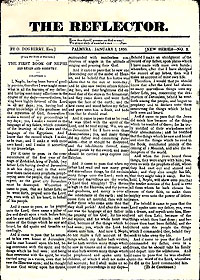
No. 6. Palmyra, Wayne Co. -- Wednesday, October 7, 1829. Vol. 1 SELECTED ITEMS. The "New Jerusalem-Reflector" states that the building of the TEMPLE OF NEPHI is to be commenced about the beginning of the first year of the Millennium. Thousands are already flocking to the standard of Joseph the Prophet. The Book of Mormon is expected to astonish the natives!! |
|
No. 8. Palmyra, Wayne Co. -- Wednesday, October 21, 1829. Vol. 1 TO CORRESPONDENTS. ... "Zion's Church" is inadmissible.... |
|
No. 9. Palmyra, Wayne Co. -- Wednesday, October 28, 1829. Vol. 1
KNIPPERDOLINGS. -- a denomination in the sixteenth century, so called from Bertrand Knipperdoling, who taught that the righteous before the day of Judgment , should have a monarchy on earth and the wicked be destroyed, that men are not justified by their faith in Christ; that there is no original sin; that infants ought not to be baptized, and that immersion is the only mode of baptism; that every one has the authority to preach and administer the sacraments; that men are not obliged to pay respect to magistrates; that all things ought to be in common, and that it is lawful to marry many wives. |
|
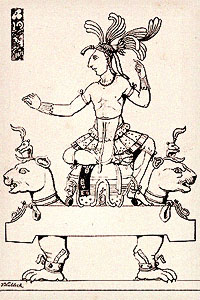
No. 10. Palmyra, Wayne Co. -- Wednesday, November 4, 1829. Vol. 1 ITEMS. M. CHAMPOLLION -- in company with other learned Frenchmen, is now in Egypt investigating the various subjects of antiquity. It is reported that this gentleman reads hierogylphics with as much readiness as his native language. Much light will be thrown upon a dark period of ancient history. |

|
No. 14. Palmyra, Wayne Co. -- Wednesday, December 2, 1829. Vol. 1 IMPOSTORS. No people in the world have been so often and greviously imposed upon as the infatuated Jews. From the birth of our Saviour down to the last century, almost innumerable Impostors, from time to time, have appeared among them in the characters of temporal Princes and false Messiahs. For the amusement and instruction of our readers, we shall attempt to give some account of them. We shall begin with Sabatai Levi, who in the year 1666 made a great noise and gained an immense number of proselytes. |
|
No. 15. Palmyra, Wayne Co. -- Wednesday, December 9, 1829. Vol. 1 GOLD BIBLE. A work bearing this cognomen is now in the Press; as much curiosity has been excited in this section of the country on the subject, and as the work itself will not be ready for delivery for some months to come, -- at the solicitation of many of our readers we have concluded to commence publishing extracts from it on or before the commencement of the second series. |
|
No. 16. Palmyra, Wayne Co. -- Wednesday, December 16, 1829. Vol. 1
FIFTH MONARCHY MEN were a set of enthusiasts in the time of Cromwell who expected the sudden appearance of Christ to establish a new monarchy or kingdom; in consequence of this illusion some of them aimed at the subversion of all human government; in ancient history we read of four great monarchies, the Assyrian, Persian, Grecian, and the Roman. And these men believing that this new spiritual Kingdom of Christ was to be the fifth, -- came to bear the name by which they are called. Their leader was Thomas Venner, a wine Cooper, who in his little conventicle in Coleman-street (London) warned his admirers with passionate expectations of a fifth universal monarchy, under the personal reign of King Jesus upon earth, and that the saints were to take the Kingdom to themselves.... |
 Know then thyself, presume not God to scan! The proper study of mankind is Man - - - Pope. By O. Dogberry, Esq.] Palmyra, December 22, 1829. [New Series -- No. 1.
|
|
Know then thyself, presume not God to scan! The proper study of mankind is Man - - - Pope. By O. Dogberry, Esq.] Palmyra, January 2, 1830. [New Series -- No. 2.
GOLD BIBLE. We do not intend at this time to discuss the merits or demerits of this work, and feel astonished that some of our neighbors, who profess liberal principles, and are probably quite as ignorant on the subject as we are, should give themselves quite so much uneasiness about matters that so little concern them. The Book, when it shall come forth before the public, must stand or fall, according to the whims and fancies of its readers. How it will stand the test of criticism, we are not prepared to say, not having as yet examined many of its pages. -- We are, however, prepared to state, that from a part of the first chapter, now before us, and which we this day publish, we cannot discover anything treasonable, or which will have a tendency to subvert our liberties. As to its religious character, we have as yet no means of determining, and if we had, we should be quite loth to meddle with the tender consciences of our neighbors. |
|
Know then thyself, presume not God to scan! The proper study of mankind is Man - - - Pope. By O. Dogberry, Esq.] Palmyra, January 13, 1830. [New Series -- No. 3.
(From the "Book of Mormon," erroneously called the "Gold Bible.")
And it came to pass that he departed into the wilderness. And he left his house, and the land of his inheritance, and his gold, and his silver, and his precious things, and took nothing with him, save it were his family, and provisions, and tents, and he departed into the wilderness; and he came down by the borders near the shore of the Red Sea; and he traveled in the wilderness, on the borders which was nearer the Red Sea; and he did travel in the wilderness with his family, which consisted of my mother, Sarah, and my elder brothers, who were Laman, Lemuel, and Sam. |
 Vol. I. Lyons, Tuesday, January 19, 1830. No. 1.
New AntiMasonic papers. -- The first of a large and handsomely executed anti-masonic paper, entitled "The Sun," has lately made its appearance in Philadelphia. It is conducted with much ability, and will undoubtedly prove a valuable source of information to those in that city who are in search of light on a dark subject. |
Know then thyself, presume not God to scan! The proper study of mankind is Man - - - Pope. By O. Dogberry, Esq.] Palmyra, January 22, 1830. [New Series -- Extra.
BOOK OF MORMON. Behold, now it came to pass that they durst not come against the Nephites in the borders of Jershon; therefore they departed out of the land of Antionum into the wilderness, and took their journey round about in the wilderness, away by the head of the river Sidon, that they might come into the land of Manti and take possession of the land; for they did not suppose that the armies of Moroni would know whither they had gone. But it came to pass, as soon as they had departed into the wilderness, Moroni sent spies into the wilderness, to watch their camp; and Moroni, also, knowing of the prophecies of Alma, sent certain men unto him, desiring him that he should inquire of the Lord whither the armies of the Nephites should go, to defend themselves against the Lamanites. And it came to pass that the word of the Lord came unto Alma; and Alma informed the messengers of Moroni that the armies of the Lamanites were marching round about in the wilderness, that they might come over into the land of Manti, that they might commence an attack upon the weaker part of the people. And those messengers went and delivered the message unto Moroni. |
|
Know then thyself, presume not God to scan! The proper study of mankind is Man - - - Pope. By O. Dogberry, Esq.] Palmyra, February 13, 1830. [New Series -- No. 6.
KORAN, OR ALKORAN.
The general design of the Koran was to unite the professors of the three different religions, then followed in the populous country of Arabia, (who, for the most part, wandered without guides, the [far] greater number being idolaters, and the rest Jews and Christians, mostly of [-----] opinion,) in the knowledge and worship of our God, under the sanction of certain laws and ceremonies, partly of ancient, and partly of novel institution, enforced by the consideration of rewards and punishments, both temporal and eternal; and to bring them to the obedience of Mahomet, as the prophet and ambassador of God; who after repeated admonitions, promises, and threatening former ages, was sent at last to establish and propagate God's religion on earth; and to be acknowledged chief pontiff in spiritual matters, as well as supreme [prince] in temporal. The doctrine, then, of the Koran is the unity of God, to restore which, Mahomet pretended was the chief end of his mission; it being laid down by him as a fundamental truth that there never was, nor ever can be more than one true orthodox religion: that, though the particular laws or ceremonies are only temporary and subject to alteration, according to the divine direction, yet the substance of it being eternal truth, is not liable to change, but continues immutably the same; and that whenever religion became neglected or corrupted in essentials, God had the goodness to re-inform and re-admonish mankind thereof by several prophets, of whom Moses and Jesus were the most distinguished, till the appearance of Mahomet, who is their seal, and no other to be expected after him. The more effectually to engage people to hearken to him, great part of the Koran is employed in relating examples of dreadful punishments formerly inflicted by God on those who rejected and abused his messengers. Several of which stories, or some circumstances of them, are taken from the Old and New Testaments, but many more from the apocryphal books and traditions of the Jews and Christians of those ages set up in the Koran as truths in opposition to the Scriptures, which the Jews and Christians are charged with having altered; and, indeed, few or none of the relations of circumstances in the Koran were invented by Mahomet, as is generally supposed; it being easy to trace the greater part of them much higher, as the rest might be, were more of the books extent, and were it worthwhile to make the inquiry.... |
|
Vol. VI. Penn-Yan, Tues., February 24, 1830. No. 12. Batavia, N. Y. Feb. 1st, 1830. Frederick A. Sumner, Esq. |
|
Know then thyself, presume not God to scan! The proper study of mankind is Man - - - Pope. By O. Dogberry, Esq.] Palmyra, February 27, 1830. [New Series -- No. 8.
CHRONICLES
1. Now it came to pass, on the first days of the first month of the year, that certain men assembled at the house of Solomon, in the lower city. |
Know then thyself, presume not God to scan! The proper study of mankind is Man - - - Pope. By O. Dogberry, Esq.] Palmyra, March 16, 1830. [New Series -- No. 11.
|
Vol. VII. -- No. 28.] Palmyra, N. Y., Friday, March 19, 1830. [Whole No. 336. We are requested to announce that the "Book of Mormon" will be ready for sale in the course of next week. |
|
Know then thyself, presume not God to scan! The proper study of mankind is Man - - - Pope. By O. Dogberry, Esq.] Palmyra, March 23, 1830. [New Series -- No. 12.
CHRONICLES
1. Now it came to pass, on the tenth day of the first month, of the second year of the reign of Andrew, that I sat in my chamber with the Book of the Chronicles of the Geneva Bull before me, when I fell asleep and I had a vision. |
|
Vol. VII. -- No. 29.] Palmyra, N. Y., Friday, March 26, 1830. [Whole No. 337. THE BOOK OF MORMON. AN account written by the hand of Mormon, upon plates, taken from the plates of Nephi. |
Know then thyself, presume not God to scan! The proper study of mankind is Man - - - Pope. By O. Dogberry, Esq.] Palmyra, March 30, 1830. [New Series -- No. 13 City of Mud, March, 1830. |
|
Know then thyself, presume not God to scan! The proper study of mankind is Man - - - Pope. By O. Dogberry, Esq.] Palmyra, April 19, 1830. [New Series -- No. 16. Mr. Editor -- |
|
Vol. VI. Penn-Yan, Tues., April 20, 1830. No. 20.
From the Rochester Republican.
|
Vol. XXI. Wednesday, April 28, 1830. No. 47.
BLASPHEMY -- "BOOK OF MORMON," The "Book of Mormon" has been placed in our hands. A viler imposition was never practised. It is an evidence of fraud, blasphemy and credulity, shocking to the Christian and moralist. The "author and proprietor" is one "Joseph Smith, jr." -- a fellow who, by some hocus pocus, acquired such an influence over a farmer of Wayne county, that the latter mortgaged his farm for $3,000, which he paid for printing and binding 5000 copies of this blasphemous work. The volume consists of about 600 pages, and is divided into the books of Nephi, of Jacob, of Mosiah, of Alma, of Mormon, of Ether, and of Helaman. -- "Copy-right secured!" The style of the work may be conjectured from the "preface" and "testimonials" which we subjoin. -- Roch. Rep. |
|
Know then thyself, presume not God to scan! The proper study of mankind is Man - - - Pope. By O. Dogberry, Esq.] Palmyra, May 1, 1830. [Second Series -- No. 1. ==> We are informed that an "honest Attourney" (from compunction we suppose,) is about to abandon his lucrative profession, and enter upon the preaching of the "Gospel according to" -- Jo Smith. |
|
Vol. VII. Palmyra, N. Y., Friday, May 14, 1830. No. 84. THE BOOK OF MORMON. An account written by the hand of Mormon, upon plates, taken from the plates of Nephi. Wherefore, it is an abridgment of the Record of the People of Nephi, and also of the Lamanites; written to the Lamanites, which are a remnant of the House of Israel; and also to Jew and Gentile; written by way of commandment, and also by the spirit of Prophecy and of Revelation. Written, and sealed up, and hid up unto the LORD, that they might not be destroyed; to come forth by the gift and power of GOD unto the interpretation thereof, sealed by the hand of Moroni, and hid up unto the LORD, to come forth in due time by way of the Gentile; the interpretation thereof by the gift of GOD. An abridgment taken from the Book of Ether. |
Know then thyself, presume not God to scan! The proper study of mankind is Man - - - Pope. By O. Dogberry, Esq.] Palmyra, June 1, 1830. [Third Series -- No. 4. ==> The apostle to the NEPHITES (Cowdery) has started for the EAST, on board a boat, with a load of "gOld bibles," under a command, (as he says) to declare the truth (according to Jo Smith,) "in all the principal cities in the Union." We must, however, caution this second Mohomet, (Jemima Wilkinson,) to be careful how he treds upon the old Saybrook Platform. Oliver (he left out his two middle names in the "Book of Mormon,") may find his way to the Simsbury mines. |

Know then thyself, presume not God to scan! The proper study of mankind is Man - - - Pope. By O. Dogberry, Esq.] Palmyra, June 12, 1830. [Third Series -- No. 5. THE BOOK OF PUKEI. -- Chap. 1. 1. And it came to pass in the latter days, that wickedness did much abound, and the "Idle and slothful said one to another, let us send for Walters the Magician, who has strange books, and deals with familiar spirits; peradventure he will inform us where the Nephites, hid their treasure, so be it, that we and our vagabond van, do not perish for lack of sustenance. |
Know then thyself, presume not God to scan! The proper study of mankind is Man - - - Pope. By O. Dogberry, Esq.] Palmyra, June 22, 1830. [Third Series -- No. 6. Our citizens were considerably agitated on the morning of the 19th inst. by the strange appearance of a strange animal, whose manner was very little different from that of the famous Lorenzo Dow -- who introduced himself to the notice of a gazing multitude, by raising his stentorian voice to a surprising height, and continued pouring forth his melody, until driven from his station by the rains of heaven (which were not very congenial to the |
Know then thyself, presume not God to scan! The proper study of mankind is Man - - - Pope. By O. Dogberry, Esq.] Palmyra, June 30, 1830. [Third Series -- No. 7.
|
Vol. XXII. Wednesday, June 30, 1830. No. 4.
Blank Deeds, Bonds and Mortages, and Justices Blanks; Poems by Wm. Ray, and Charlotte Temple, for sale at No. 62 Seneca St. by F. COWDERY. |
Know then thyself, presume not God to scan! The proper study of mankind is Man - - - Pope. By O. Dogberry, Esq.] Palmyra, July 7, 1830. [Third Series -- No. 8. THE BOOK OF PUKEI. -- Chap. 2. Contents. -- 1. the idle and slothful reverence the prophet. -- 2 The prophet reveals to them the first appearance of the spirit. -- 3 Its adminition and promises. -- 4 Description of the spirit. -- 5 Mormon -- the ten tribes. -- 6 Their migration -- wars -- extinction. -- 7 Gold Bible and contents. -- 8 spectacles -- breastplate -- Oliver, &c. |
Know then thyself, presume not God to scan! The proper study of mankind is Man - - - Pope. By O. Dogberry, Esq.] Palmyra, July 27, 1830. [Third Series -- No. 10.
From Lyons.
Now it came to pass, in the 52nd and 53d years of American Independence, and during the reign of the Prophet Joseph, there resided not a day's ride east of the tabernacle of St. Martin, a certain (would be) great man, whose sir-name was Daniel -- who was a man of great self-respect, and whose profession was that of administering aid to the afflicted in body -- who found reception and audience amongst Jerseyans and Alleganians. |
|
By J. A. Hadley. Lyons, Tues., August 3, 1830. Vol. I. - No. 29.
"Punish the Guilty." -- So say the fraternity, but what is the language of their actions? The Niagara Courier informs us that Mr. Orsamus Turner, deputy marshall for the county of Niagara, &c., &c., was escorted from Jail on Friday evening last, in a coach and four, by Peter Besancon, Jr., senior editor of the famous Lockport Balance, &c. and sundry other understrappers of the "handmaid." |
Know then thyself, presume not God to scan! The proper study of mankind is Man - - - Pope. By O. Dogberry, Esq.] Palmyra, August 4, 1830. [Third Series -- No. 11.
From Lyons.
|
|
By J. A. Hadley. Lyons, Tues., August 10, 1830. Vol. I. - No. 30.
From the Independent American.
It will be seen by the following letters from this afflicted and worthy woman, that she has not been forgotten by those who can "feel fir others' woes." Her riven and lacerated heart has been made glad by the kind offices and consoling sympathies of those who are not deaf to the widow's waif, nor blind to the orphan's tears. |
|
Know then thyself, presume not God to scan! The proper study of mankind is Man - - - Pope. By O. Dogberry, Esq.] Palmyra, August 14, 1830. [Third Series -- No. 12.
From Syracuse.
1. And it came to pass in the days of Joseph the prophet, that a man whose name was John, a descendant of the martyrs, established himself near unto a place called veracity corner. |
|
Know then thyself, presume not God to scan! The proper study of mankind is Man - - - Pope. By O. Dogberry, Esq.] Palmyra, August 28, 1830. [Third Series -- No. 14. "Everything in this world is big with jest, -- and has wit and instruction, if we can but find it out." |
|
By J. A. Hadley. Lyons, Tues., September 7, 1830. Vol. I. - No. 34.
The Palmyra Sentinel makes high pretentions to purity. It professes to have a great aversion to all kinds of disrespectful publications; and feigns to be one of the most immaculate journals of the day! But in order to show its hypocrisy, it is necessary only to state, that “The Reflector,” a sarcastical, obscene little paper, the character of which is so well known in this quarter, that comment from us respecting it, would be useless, is issued weekly from that office: as also was the infamous, catch-penny work, entitled the “Book of Mormon,” or, as it is generally called, the “Golden Bible.” These two publications have cast a lasting reproach upon the Sentinel -- a reproach which years of penance would not wipe away. This is all right; for when a printer becomes so abandoned, and lost to all sense of decency, as to allow such nuisances to be published in his office, he should be branded with infamy and disgrace. Public indignation cannot be wrought to too high a degree against such a printer. He should be pointed out to the world as an object of scorn and contempt. And this is the case with the printer of the Sentinel and his coadjutors. |
|
Know then thyself, presume not God to scan! The proper study of mankind is Man - - - Pope. By O. Dogberry, Esq.] Palmyra, September 13, 1830. [Third Series -- No. 15. THE MARION MONK. -- Nothing is further from our intentions, than the idea of controlling or interfering with the tender consciences of our neighbors in matters of religious import, provided there is even the appearance of sincerity; and even that gross and bungling imposition the "gold bible," would have passed unnoticed, had it not been necessary to expose the hypocricy and cant of its pretended apostles. We are the decided advocates of civil and religious liberty, and where superstition itself can be considered (if ever it can) harmless, we shall not interfere; but when a cloak of religion, aided by a long beard is made use of for the vilest of purposes, and where a pretended messenger of heaven principly exerts his influence, on the superstitious and ignorant, for the sole purpose of seducing them from the path of virtue, it is time the wretch was unmasked and his hideous form exhibited for the inspection of an indignant public. If in an investigation which we intend to set on fooot at some future period, we shall introduce some of the monks, females co-workers in lasciviousness (we mean the nuns,) we hope no half [literate] poppinjay will accuse us of being inimical to the cause of virtue. |
Extra.] Monday, Nov. 1, 1830. [.Extra
BOOK OF CHRONICLES.
1. Now it came to pass in the second year of the reign of Enos, that there dwelt in the county of On, two men who were enemies. And the name of the one was Stephen the Committee-man, and the name of the other was John C. the Candidate. And they signed his name Sapboiler; and they called John C., John C. Somerset, because he excelled all other men in political evolutions. |
|
Know then thyself, presume not God to scan! The proper study of mankind is Man - - - Pope. Volume II.] Palmyra, December 6, 1830. [Series I. -- No. 7. The manner in which one of the "GOLD BIBLE" witnesses treats his wife, and how he uses “weighty arguments,” to bring her over to the faith according to JO SMITH, has come to hand, but as we understand, a legal investigation may hereafter take place, we shall lay the article on the shelf for the present. In the intrim however, we feel bound to give it as our humble opinion, that a man who will maltreat the wife of his bisom, under such circumstances, should be driven from the society of MEN. |
Vol. XXII. Wednesday, December 8, 1830. No. 27. M A R R I E D. In Batavia, on the 23d. ult, by the Hon. Simeon Cummings, a Judge of Genesee County Courts, George Washington Harris, Esq. to Mrs. Lucinda Morgan, wife of Capt. William Morgan. |
Vol. IV. No. 18. Wednesday, Dec. 22?, 1830. Whole No. 1526.
BOOK OF MORMON. -- This book, otherwise called the Golden Bible, has excited considerable curiosity in some parts of the country; and we learn that preachers have appeared in the State of Ohio and elsewhere, who profess their belief that it is of divine origin. On Thursday evening last, a preacher of this character, delivered a discourse, at the Town House in this village, to an assembly of two or three hundred people. In the course of his remarks, he explicitly avowed his firm belief that the book of Mormon is a revelation from God; that he believed the golden plates on which it is said to have been inscribed in mysterious characters, had been discovered and decyphered by a very ignorant man, through the aid of divine assistance; and that he considered it as of equal authenticity with the Old and New Testaments. Whether these persons are really sincere in the profession of such belief, or whether their object is to promote the sale of the book, we will not undertake to determine. |
 Vol. III. Canandaigua, N. Y., December 29, 1830. No. 35.
A spark of Throop's wisdom which flickers in the gutters as the Messenger of a "small light," in this section, says: -- 'The Book of Mormon was advertised for sale at the Phoenix office, last spring; and those who have curiosity to see the thing, can probably find it there.' This same masonic paper once published an advertisement, which not unfrequently gives the Father of the outrage an air of importance, that honesty is a stranger to, as follows: |
Extra]. Palmyra, N. Y., Saturday, January 1, 1831. [Extra.
ADDRESS OF THE CARRIER, TO THE PATRONS OF
|
Know then thyself, presume not God to scan! The proper study of mankind is Man - - - Pope. Volume II.] Palmyra, January 1, 1831. [Series I. -- No. 9.
A new religious sect under the guidance of a Miss Campbell, has lately sprung up in Scotland, and numbers about 2000. They claim "direct inspiration, and the power of working miracles." In what other particulars they resemble the followers of "JO SMITH JUNIOR," we have not as yet been informed.... |
Know then thyself, presume not God to scan! The proper study of mankind is Man - - - Pope. Volume II.] Palmyra, January 6, 1831. [Series I. -- No. 10. GOLD BIBLE. -- We have long been waiting, with considerable anxiety, to see some of our cotemporaries attempt to explain the immediate causes, which produced that anomaly in religion and literature, which has most strikingly excited the curiosity of our friends at a distance, generally known under the cognomen of the Book of Mormon, or the Gold Bible. |
Know then thyself, presume not God to scan! The proper study of mankind is Man - - - Pope. Volume II.] Palmyra, January 18, 1831. [Series I. -- No. 11. GOLD BIBLE, NO. 2. The page of history informs us, that from time immemorable, MAN has more or less been the dupe of superstitious error and imposition; so much so, that some writers in derision have called him "a religious animal," and it often happens that the more absurd the dogma, the more greedily will it be swallowed, and the more absurd or unnatural the tenet, the more eagerly will it be embraced. |
Vol. III. Canandaigua, N. Y., January 19, 1831. No. 38.
LIST OF LETTERS |
|
Know then thyself, presume not God to scan! The proper study of mankind is Man - - - Pope. Volume II.] Palmyra, February 1, 1831. [Series I. -- No. 12. OUR CLOSET. -- Our patrons will perceive that we are slowly, but surely progressing with our labors, and it is with heartfelt gratitude that we witness a regular and steady increase of our subscription list... |
|
Know then thyself, presume not God to scan! The proper study of mankind is Man - - - Pope. Volume II.] Palmyra, February 14, 1831. [Series I. -- No. 13. GOLD BIBLE, NO. 4. Since we have any knowledge of the habits or propensities of the human species, we find that man has been prone to absurdities; and it too often happens that while we carefully attempt to detect them in others, we fondly cherish some gross inconsistencies within our own bosoms. The lust of power, doubtless stimulates the few, while ignorance binds the many, like passive slaves to the car of superstition. |
|
Vol. III. Canandaigua, N. Y., February 16, 1831. No. 42. The Repository cautioned the public to be slow to believe, that masons kidnapped and murdered Morgan. -- Doctor Morse must have thought he was acting as a faithful watchman on the bulwarks of liberty. Four years after, the Repository gives copious inferences on the Book of Mormon. Doctor Morse must calculate that he is rendering his country a service, as all religions are tolerated by the law of the land. But in reply to whether he supports a mason for the Presidency, the Doctor says he "does not deem it of sufficient importance to merit an answer from him." The learned Doctor may hear the "truth sprang out of the ground" and say -- Ephraim is joined to idols; let him alone. |
|
Know then thyself, presume not God to scan! The proper study of mankind is Man - - - Pope. Volume II.] Palmyra, February 28, 1831. [Series I. -- No. 14. GOLD BIBLE, NO. 5. Every impostor since the creation has owed his success to the ignorance of the people, and the propensity inherent in their natures, to follow everything absurd or ridiculous. Learning it is said, flourished in some parts of Arabia at the time Mahomet made his appearance, and this may sufficiently account for the slow progress that impostor made for the first years of his pretended mission, and had not the Koran been supported by the sword the whole imposition, in all probability, would have died in embryo, and the disciples and followers of the crescent, would never have been able to subjugate the fairest portion of the globe. |
|
Vol. VIII. Palmyra, N. Y., Friday, March 4, 1831. No. 24. (From the Geauga (Ohio) Gazette.) The Golden bible, or the book of Mormon. -- The believers in the sacred authenticity of this miserable production, are known by the name of "Mormonites," and their book is commonly called "the book of Mormon." -- It is asserted by them that their number in this vicinity is four hundred. In a conversation a few days since with a gentleman from Kirtland, well informed, and every way concerned to give us the truth, we are assured that their numbers in the family in that town were two hundred souls. We doubt not then that their whole number in this county and Cayahoga are [sic] at least four hundred. |
|
Know then thyself, presume not God to scan! The proper study of mankind is Man - - - Pope. Volume II.] Palmyra, March 9, 1831. [Series I. -- No. 15. MORMONISM. -- Our Waterloo correspondent informs us, that two of the most responsible Mormonites, as it respects property, in that vicinity, have demurred to the divine command, through Jo Smith, requiring them to sell their property and put it into the common fund, and repair with all convenient speed to the New Jerusalem, lately located by Cowdery somewhere in the western region. A requisition of twelve hundred dollars, in cash, it is said, was made upon one of these gentlemen, (Mr. B.) -- "the Lord having need of it." This request was promptly refused by the gentleman, who, at the same time informed the prophet that he would rather risque his soul as it was (having been dipt) than trust his money or property in the hands of such agents as were applying for it. FRENCH PROPHETS. "They first appeared in Dauphiny and Vivarois. In the year 1689, five or six hundred Protestants of both sexes gave themselves out to be prophets, and inspired by the Holy Ghost. They soon became so numerous, that there were many thousands of them inspired. They were people of all ages and sexes without distinction, though the greatest part of them were boys and girls from six or seven to twenty-five years of age. They had strange fits, which came upon them, with tremblings and faintings, as in a swoon, which made them stretch out their arms and legs, and stagger several times before they dropped down. They struck themselves with their hands, they fell on their backs, shut their eyes, and heaved with their breasts. They remained awhile in trances, and, coming out of them with twitching, uttered all that came into their mouths. They said, they saw the heavens open, the angels, paradise, and hell. -- Those who were just on the point of receiving the spirit of prophecy dropped down not only in their assemblies, crying out mercy, but in fields, and their own houses. The least of these assemblies made up four or five hundred, and some of them amounted even to as many thousands of persons. When the prophets had for a while been under agitations of body they began to prophesy, the burden of their prophecies was, Amend your lives; repent ye; the end of all things draws nigh! The hills resounded with their loud cries for mercy, and imprecations against the priests, the church, the pope, and against the anti-christian dominion, with predictions of the approaching fall of popery. All they said at these times was heard with reverence and awe. |
|
Know then thyself, presume not God to scan! The proper study of mankind is Man - - - Pope. Volume II.] Palmyra, March 19, 1831. [Series I. -- No. 16. GOLD BIBLE, NO. 6. There appears to be a great discrepancy, in the stories told by the famous three witnesses to the Gold Bible; and these pious reprobates, individually, frequently give different versions of the same transaction. In the first place, it was roundly asserted that the plates on which Mormon wrote his history, (in the reformed Egyptian language) were of gold, and hence its name; gentlemen in this vicinity were called on to estimate its value from its weight, (something more than 20 lbs) Smith and Harris gave out that no mortal save Jo could look upon it and live; and Harris declares, that when he acted as amanuenes, and wrote the translation, as Smith dictated, such was his fear of the Divine displeasure that a screen (sheet) was suspended between the prophet and himself. |
|
Vol. I. Palmyra, N. Y., Tuesday, April 5, 1831. No. 43.
BOOKSTORE.
The subscriber has just received, at his new building one door west of the Bank, a general assortment of BOOKS & STATIONERY which he offers for sail at fair prices and on reasonable terms. Among his articles will be found -- |
|
Vol. IV. Canandaigua, N. Y., May 4, 1831. No. 1. N O T I C E. Having been obliged to yield to Caesar, I appoint T. S. Channing an agent to transact all business appertaining to the Phoenix. He will therefore collect all due to the establishment, and apply them to pay debts; and all persons indebted are requested to settle as soon as possible, that matters may go on like clock-work. |
|
Vol. IV. Canandaigua, N. Y., May 11, 1831. No. 2.
Friends and fellow Citizens. -- Circumstances beyond my control, have rendered it necessary for me to relinquish my labors in this paper, -- and, in so doing, permit me to say, I do it with great reluctance. Having grown with your growth and strengthened with your strength, until victory perched upon the brow of Glory -- and your fire, glittering on the distant mountains beyond the Balkan, has become the light house of the west; it seems as if I ought to give you my right hand of fellowship. As one of you, deeply interested in the prosperity of every true friend of equal rights and possessing a warm desire for the laudable success of the laborious farmers, who worthily wield the destinies of Old Ontario, and, above all, anxious for your future welfare, that you may not sell your good name, which has cost the unremitted exertions of three years, pardon me for encouraging you, to continue steadfast in your [warfare] against "all combinations, under whatever plausible character" -- they must be conquered -- or freedom is but the mantle of some avaricious tyrant -- ready to double your [tally] of brick, and that without straw. The paper will be continued, and advocate the same glorious principles, as under my charge, -- persuading all and fearing none, -- and it has my best wishes for its success; for it would sound harsh in my ear to hear that the glory had departed. |
|
Vol. XXII. Wednesday, May 11, 1831. No. 49.
Myron Holly and J. A. Hadley have become joint proprietors of the "Lyons Countryman." by whom it will hereafter be conducted -- the former as Editor, and the latter as Publisher... there can be no doubt, and it is certainly a matter of regret; that talents of so high an order should be engaged in a cause so repulsive to good feeling and honorable motive. |
|
Vol. VIII. - No. 36. Palmyra, N. Y., Friday, May 13, 1831. Whole 396. The Mormonites, it is related in some of the western papers, are gaining many converts in Ohio. The party bids fair to supersede anti-masonry all [hollers?] in that quarter. |
|
Vol. I. Geneva, N.Y., Wed., May 18, 1831. No. 20.
In Painesville, Ohio, a sect of fanatics called Mormonites, who have "all things in common," were lately imposed upon by some persons who joined their society, and left it when they were well clad. |
 No. 8. Vol. XXIX. Canandaigua, Wed., May 18, 1831. Whole 1464. Ontario Phoenix. -- The last number of this paper contains the valedictory of its nominal editor, W. W. Phelps, who, "from circumstances beyond his control," has been "obliged to yield to Caesar." The paper he says will be continued, but on whom his editorial mantle has fallen, the public are not informed. As "reform" is now the order of the day, we trust the stockholders of the concern will adopt measures to "improve" in some respects the character of the paper. If, however, the editorial department of last week is to be taken as a fair specimen of the truth and candor which is to characterize its columns for the future, we cannot hope for a very thorough "reform" in this respect. We allude more particularly to the abuse and calumny levelled at Mr, Clay and his supporters. The assertion, that the party which seeks to elevate that gentleman to the Presidency, is a "personal faction, in the success of defeat of which no principle is in any way involved," is alike destitude of truth and decency; and must have emanated from a corrupt head, if not a depraved heart. |
|
Vol. IV. Wednesday, May 18, 1831. No. 3. Great wits jump. -- It is certainly a matter of gratitude, that the masonic papers, which, by mere accident forget to notice the abduction of Capt. William Morgan, have had the unsuspected frankness to publish my private letter, respecting my imprisonment at Lyons. As one good turn deserves another, will these papers show the same generous spirit, by following up the custom with my address in the Phoenix of May 11? And assure the public, that, although the cabinet may find it necessary to resign, it is my province to hold over, until I have a successor appointed equal in power and glory! I cannot expect any thing less from my brother chips. |
|
No. 9. Vol. XXIX. Canandaigua, Wed., May 25, 1831. Whole 1465. Back Again. -- The Automaton editor appears again in the last Phoenix, and informs the public that he shall hold over, ala mode Jackson ministry, until a successor is appointed, who shall be "equal in power and glory!" to himself. We may safely conclude, therefore, that he is in no immediate danger of being dismissed a second time, it being, we suppose somewhat doubtful whether another such "power and glory" editor can be found in all this region. |
|
Vol. IV. Canandaigua, N. Y., May 25, 1831. No. 4. (the heading is missing)
|
|
Vol. VIII. - No. 38. Palmyra, N. Y., Friday, May 27, 1831. Whole 398. Mormon Emigration. -- Several families, numbering about fifty souls, took up their line of march from this town last week for the "promised land," among whom is Martin Harris, one of the original believers in the "Book of Mormon." Mr. Harris was among the early settlers of this town, and has ever borne the character of an honorable and upright man, and an obliging and benevolent neighbor. He had secured to himself by honest industry a respectable fortune -- and he has left a large circle of acquaintances and friends to pity his delusion. |
|
No. 17 Vol. XXIX. Wednesday, July 20, 1831. Whole 1473. The following article, from the Painesville (Ohio) Telegraph of June 14, has been in type for some time, but crowded out to make room for more important intelligence. Among the number ordained as elders, and commissioned to preach the Mormon faith, we understand is the late editor and publisher of the Ontario Phoenix, W. W. Phelps, Esq. |
|
Vol. VIII. Palmyra, N. Y., Friday, August 23, 1831. No. 49. Mormonism is spreading faster than anti-masonry ever did, and what is rather remarkable, it is espoused by similar minds. The leaders know better, and so do those of anti-masonry. There is also a similarity in the policy of these two extraordinary sects. The Mormonites denounce those who refuse to join them, and so do the anti-masons, -- The only material difference between them is, that the former are seeking money, while the latter care more for office. A man by the name of Davidson has been for some time preaching the Mormon faith in the vicinity of Burlington, Vt. and has already gained quite a number of proselytes in that neighborhood. He professes to be a disciple of one Dilks, of Ohio, and pretends that Dilks has Almighty power, and is equal with God himself! Anti-masons, equally blasphemous, have pretended that "anti-masonry strung from the throne of God." This Davidson is represented as wearing his hair long, and professing a great deal of piety. He preaches that Jesus Christ is a woman and quite inferior to Dilks -- that the millennium will take place in 1832. -- Philadelphia is the place designated where Dilks is to assemble his followers, and then the rest of mankind are to be swept from the face of the earth, and Dilks and his followers are to inherit their possessions. -- The proceedings of this Davidson and the society which he has been enabled to draw around him, who adopt his views, are represented as disgraceful and indecorous to the last degree." It would be extraordinary indeed, if anti-masonry should be outdone in this particular by Mormonism. |
|
Vol. IV Wednesday, September 7, 1831. No. ? Extract of a Letter from the late Editor of this paper, dated |
|
Vol. II. Lyons, Tues., October 5, 1831. No. 1.
LIST OF LETTERS
... |
Back to top of this page.
Articles Home Page | Articles Index | History Vault
Oliver's Bookshelf | Spalding Library | Mormon Classics
last updated: Apr. 18, 2011