
READINGS IN EARLY MORMON HISTORY
(Newspapers of New York)

Misc. New York Newspapers
1847-69 Articles
1795-1825 | 1826-28 | 1829-46 (tabulated) | 1847-1869 | 1870-1899 | 1900-1999
| WEST NY | BATAVIA | ROCHESTER | PALMYRA | EAST NY |
| 1829-31 | 1829-31 | 1829-31 | 1829-31 | 1829-31 |
| 1832-33 | 1832-39 | 1832-33 | 1832-33 | 1832-39 |
| 1834-39 | 1834-39 | 1834-39 | ||
| 1840-46 | 1840-46 | 1840-46 | 1840-46 | 1840-46 |
1847-49
GOli Jan 09 '47 | GOli Jan 30 '47 | GOli Feb 13 '47 | GOli Mar 06 '47 | OnSd Apr 07 '47 | GOli May 26 '47
RDA Jul 26 '47 | RDA Aug 25 '47 | RRp Dec 07 '47 | RDA Jun 16 '48 | RRp Jun 22 '48 | RC Apr 11 '49
REN Jun 13 '49 | RC Jun 27 '49 | RC Jul 18 '49 | RDD Aug 22 '49 | OnSd Sep 19 '49 | RDAm Nov 16 '49
News Articles Index | New York City Papers | Otsego Co. Papers
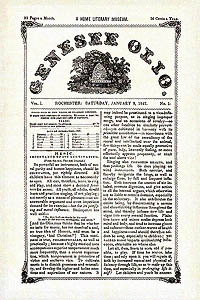
 Vol. I. Rochester, New York, Saturday, January 9, 1847. No. 1. OUR PROSPECTUS If it were a question of the sanity of that passenger at sea, who when the vessel was in danger as being wrecked, lashed himself to the sheet anchor as the best means of preserving life; it may also by some be a query as to the wisdom of our present enterprise. But by an acquaintance with the fact of our early pioneer labors, as partner with the first type setter in Livingston county, and the first maker of news impressions in the counties of Cattaraugus, Allegany and Orleans, in the woods where in those days lived more deer and wolves than men and cattle, it may be rendured less wonderful, that we make this effort to gain an honest living. |
|
Vol. I. Rochester, New York, Saturday, January 30, 1847. No. 2.
==> The Printer's Festival, on the 18th, in this city, brought together several of our cotempraries of the pelt balls and Ramage presses, as far back as 1817, some of whom we had not seen for some twelve or fifteen years past. While Augustine, the president at this board, was at that day printing a little swarthy looking Rochester Gazette, in the north end of Genesee county, we with Hezekiah, were issuing the Genesee Farmer, about as comely in appearance, at Moscow, in the southern part of the same county, and David, (afterwards the great hub in Morgan's disclosures,) was publishing at the centre, his Republican Advocate, the head in canon italic, and a little the smuttiest, unreadable thing of the three. These were, for several months, all the luminaries of the country, embracing what of the counties of Monroe and Livingston lies west of the river, and the present Genesee, Orleans and Wyoming counties, till Everard with his Rochester Telegraph, was the second in the village and fourth in the county. |
|
Vol. I. Rochester, New York, Saturday, February 13, 1847. No. 3.
==> January, 1823, found us abiding in Lockport, a place in name more than in form of any thing comely or civilized. One or two stores were decent framed buildings, some few erections were of stone and mud thrown together, putting architecture to the blush, and numerous log cabins. on uneven rock foundations occupied the village plot in various directions, over Comstock and Brown's late farms, where streets were said to be intended. The cabins answered for dwellings, offices, shops, school house, churches, groggeries and taverns; Mann's Hotel, being the largest cluster of shantees, contained the most cords of wood in its walls, and the most feet of back in its roof, of any building in Upper Lockport, and was, withal, the only resort for genteel company. The Lower Town had not yet been dreamed of; the native forest remaining undisturbed, except by Boland's Ashery at the base of the hill, and the small openings made by cord wood choppers, with whom we sometimes joined. Excavations for the canal through the Mountain Ridge had progressed in some places to the depth of three or four feet, and in many places not yet begun. Hundreds of drillers were every day, click, clicking powder holes into the rock mountain, and blasting out showers of stone, which in descending scared the women, wounded or killed the men, and riddled the roofs of the surrounding erections called houses. It was not uncommon to see mangled men, with eyes and limbs destroyed or skulls broken in. The 'Lockport Observatory' was the paper then published by our friend Orsamus Turner, whom we sometimes assisted and in whose office we printed a pamphlet edition of the New Militia Law, and late in autumn, printed our prospectus, with borrowed head lines from the two Batavia offices, for the 'Newport Patriot,' in the northern part of Genesee County. |
|
Vol. I. Rochester, New York, Saturday, March 6, 1847. No. 4.
==> At Lockport, sometime in the summer of 1823, David M. Day, of the Buffalo Journal, and David C. Miller, of the Batavia Advocate, came into friend Turner's office one day, and were considerably amused by our new way of inking the types. Instead of the balls we were using a composition roller -- of the same material as those now in common use, and probably the first ever in the United States. The instructions for making it were derived from an Irish printer, recently from Dublin, who came to Lockport by way of Canada. But the roller got hard in a few weeks, and the balls were again up, and were not abandoned until the buckskin rollers took their place, several years afterwards. These had their day, after getting into pretty general use; but the composition kind, as soon as printers learned how to keep them in good order, gained the preference, and for twelve or fourteen years have served in all printing establishments, and are used on all sorts of presses. |
ONONDAGA STANDARD. Vol. XX. Syracuse, New York, Wednesday, April 7, 1847. No. 14.
NAUVOO AND THE TEMPLE.
On my way up the Mississippi, I tarried a few hours at the far-famed "City of Nauvoo:" and when I resumed my course, I felt like one just awakened from an incomprehensible dream. -- Surely, surely, Fanaticism is a most foul fiend, and we ought to rejoice with exceeding joy that He who rules the armies of Heaven, is yet the protector of Earth, and its inhabitants, and that He will not leave all mankind alone to the mercy of their idols. |
|
Vol. I. Rochester, New York, Saturday, May 26, 1847. No. 9. Forty Years a Typo. ...Western New York, in 1817, was verdant and woody, and roads and bridges not much for accommodation. The ice in the winter and a rope ferry in the summer were the substitutes for a bridge over the Genesee river between Moscow and Geneseo. The only paper mill was Dr. James FaulknerŐs at Dansville, a place of hardly tenements enough to entitle it to the name of a village. Mt. Morris had a tavern, a few mechanics, and a small store kept by Allen Ayrault. Hon John H. Jones, of Leicester, kept an inn and was first judge of Genesee Co. |
|
ROCHESTER DAILY ADVERTISER. Vol. XX. Rochester, N.Y., July 26, 1847. No. ?
The Mormon City -- The Temple
|
|
ROCHESTER DAILY ADVERTISER. Vol. XX. Rochester, August 25, 1847. No. ?
LATE FROM THE MORMONS: -- A friend has shown us letters of a late date from the pioneer camp of [Mormon] emigrants. They had at length reached the great salt lake near which they had made a halt, and their wearied cattle were enjoying the sweet grass and fresh water with which that region is favored. They had made a new road from the Omaha country to near the base of the mountains, which will no doubt be valuable to other emigrants from the United States. |
 Vol. XXXI. Tuesday, December 7, 1847. No. 49.
Divorce from a Woman who had become the
Henry Cobb vs. Augusta Cobb. This was a libel alleging crim. con. on the part of the respondent with Brigham Young, in Nauvoo, in August, 1844, and December, 1845. After living 21 years in good repute with her lawful husband, the respondent became led away with Mormonism, leaving her husband, went to Nauvuo, and joined the church there. After a year's trial of the system she returned to Boston, but not being able to content herself here, she made another trip to Nauvoo; returned to Boston again, and again went off, and she is now supposed to be in California with Young. |
Vol. XXI. Rochester, Monday, June 16, 1848. No. ? MARRIED. At the Washington St. Church, on the 15th inst., by the Rev. M. J. Hickok, Mr. Daniel F. Alverson to Miss Sarah Cowdery, all of this city. |
Vol. XXXII. Thurs., June 22, 1848. No. 25. Marriages. At the Washington St. Church, on the 15th inst., by the Rev. M. J. Hickok, Mr. Daniel F. Alverson to Miss Sarah Cowdery, all of this city. |
THE ROMAN CITIZEN. Vol. IX. Rome, Oneida County, N.Y. Wed., April 11, 1849. Whole No. 45.
From Blackwood's Magazine.
The Mormons were originally of the sect known as "Latter-day Saints," which sect flourishes wherever Anglo-Saxon gulls are found in sufficient numbers to swallow the egregious nonsense of fanatic humbugs who fatten upon their credulity. In the United States they especially abounded; but, the creed becoming "slow," one Joe Smith, a smart man, arose from its ranks, and instilled a little life into the decaying sect. |
ROCHESTER EVENING NEWS. Vol. I. Rochester, N.Y., Wednesday, June 13, 1849. Whole No. 53. Mormonism. Not long since we saw what purported to be a true account of the origin of Mormonism. It was written, (or professed to be) by the widow of a minister, who, (as she says) a number of years ago, wrote a work of fiction, on the mounds and other monuments of the tribes that have preceded us in the occupancy of this continent. This work was left in a printing office where Sidney Rigdon was an apprentice, who had full opportunities of copying it, which it is supposed he took advantage of. When the Mormon Bible was printed it was found to be neither more nor less than this same romance; which was written to beguile the weary hours of an invalid's life; but was now used to impose upon the credulous, and mislead the superstitious; holding out the hopes of heaven and the fears of hell, as inducements to implicit faith. |
THE ROMAN CITIZEN. Vol. X. Rome, Oneida County, N.Y. Wed., June 27, 1849. Whole No. 4. Items.
|
THE ROMAN CITIZEN. Vol. X. Rome, Oneida County, N.Y. Wed., July 28, 1849. Whole No. 7. Items.
|
Vol. XVII. Rochester, N.Y., August 22, 1849. No. 18.
FIRE. -- A fire broke out yesterday afternoon about 6 o'clock in a dwelling house on the corner of Stilson and Achilles streets, occupied by F. Cowdery and Westbury. The building was entirely consumed, and was worth about $500, and insured. Most of the furniture of the occupants was saved. |
ONONDAGA STANDARD. Vol. XXIII. Syracuse, N.Y., Wed., Sept 19, 1849. No. 38.
MELANCHOLY DELUSION. -- One William Smith who styles himself "President of the Church of Jesus Christ of Latter-Day Saints," tells the following story about a miracle performed by one Strang: |
Vol. V. Rochester, New York, November 16, 1849. No. ?
A Mormon Apostle. -- We received yesterday a visit from Martin Harris, formerly of Palmyra, who was concerned [with Joe Smith]in originally proclaiming the Mormon Faith. He wrote the Book of Mormon from Joe Smith's dictation, the latter reading the text from the Golden Plates by putting his face in a hat. When the volume was written, Harris raised funds for its publication by mortgaging his farm. But he no longer goes with the Mormons, saying that they "have gone to the devil just like other people." He abandoned them fifteen years ago, when they assumed the appellation of "Latter Day Saints," and bore his testimony against them by declaring that "Latter Day Devils" would be a more appropriate designa[t]ion. |
Vol. III. Utica, N.Y., Tuesday, January 1, 1850. No. 51. State of Deseret. A recent article in the Dayton (Ohio) Transcript led to the conclusion that the Government of this new State was based on a Theocracy, but an examination of the liberal Constitution formed by the inhabitants of Salt Lake Valley, compels the Transcript editor to retract the unfounded charge he made against the Deseretians. The Transcript says of the Constitution of Deseret: |
Vol. V. Kingston, N.Y., September 10, 1850. No. 7. The Mormon Colony, Beaver Island. We have conversed with a gentleman who has just returned from a visit to Beaver Island, at the head of Lake Michigan, upon which the Mormon colony is located, headed by the prophet, James Strang. They number about six hundred, and have a farm on the island which is cultivated by them. They also have engaged to a limited extent in taking white fish and trout, which constitute their chief means of subsistence. |
Vol. VII. Syracuse, N.Y., Thursday, Nov. 14, 1850. No. 29.
For the Religious Recorder.
Three miles south from Palmyra is situated Mormon Hill, where Jo Smith, the Mormon prophet, declared he found the Mormon or golden Bible. A recent visit to the place, connected with much interesting conversation on the subject, with the families who resided in the immediate vicinity at the time, has suggested to me a brief notice for the Recorder. |
Vol. ? Buffalo, N.Y., Tuesday, Nov. 19, 1850. No. ?
Author of the Mormon Bible. The New England Puritan states that at a public meeting held lately in Cherry Valley, Judge Campbell said: |
Vol. II. Syracuse, N.Y., Sat., November 23, 1850. No. 125.
Author of the Mormon Bible. The New England Puritan, states that at a public meeting held lately in Cherry Valley Judge Campbell said: |
Vol. VII. Rochester, N.Y., June ?, 1851. No. ? ORIGIN OF THE MORMON IMPOSTURE. As we are now at the home of the Smith family -- in sight of 'Mormon Hill' -- a brief pioneer history will be looked for, of the strange, and singularly successful religious sect -- the Mormons; and brief it must be, merely starting it in its career, and leaving it to their especial historian to trace them to Kirtland, Nauvoo, Beaver Island, and Utah, or the Salt Lake. |
LYONS GAZETTE. Vol. II. Lyons, N.Y., Wednesday, July 2, 1851. No. 37.
THE MORMONS. -- Under the perfect tolaration of religious opinions which is guaranteed by our free system of government, the Mormons have increased probably to their hundreds of thousands, and might continue to propagate their peculiar faith to the end of time undisturbed, were they to be obedient to law and order; but from proceedings on their island in Michigan, it seems that they are not content with a peaceable mode of converting persons to their faith, but use force, and take life when resisted. Their leader, Strang, who calls himself King, has been arrested for violations of law, and his followers have recently committed an unprovoked and premeditated murder. It can hardly be expected that the citizens of Michigan will continue to tolerate this gang of desperadoes in their State; and we therefore anticipate that stringent measures will be taken for their expulsion. |
Vol. IV. Syracuse, N.Y., Monday, August 18, 1851. No. 41.
Religious Humbug. There is more humbug afloat in regard to religion, than upon any other subject. The rapid increase of the Mormons, may be cited in proof of this statement. Not more than fifteen years have elapsed since the Mormon Bible was first printed, and yet the number of believers in the doctrines it teaches, is probably a hundred thousand or over, and the cry is "still they come." |
Vol. XVIII. Buffalo, N.Y., Friday, April 16, 1852. No. 3402. The Different Mormon Tribes or Churches. The following information respecting the different Mormon Tribes or Churches in our States and Territories, is believed to be reliable: |
Vol. XVII. Buffalo, N.Y., Tuesday, Oct. 19, 1852. No. 3549.
The Mormons -- Present appearance of Nauvoo and Vicinity
|
Vol. VI. Syracuse, N.Y., Mon., December 13, 1852. No. 140. ==> Doctor Cowdry, whose death was announced by the telegraph, was the oldest Surgeon of the U.S. Navy, having held the commission fifty two years. His age was about 85 years. Dr. Cowdry was the father of Mr. Franklin Cowdry, printer, formerly of this city, and now a resident of Rochester. In the early part of the present century, Dr. Cowdry was a prisoner at Tripoli, together with William Ray, the poet, and many other Americans. |
|
The Lewis County Republican. Vol. XVIII. Martinsburgh, N.Y., Wed., February 1, 1854. No. 21.
NAUVOO, ILLINOIS -- THE MORMONS.
... In the year 1830, a singular book came from the press, in Palmyra, Wayne county, New York, that attracted less attention from its claims to ancient inspired writings, than as a series of wild, irregular, romantic legends concerning a race of men on the American continent. On the authority of the book, they were an off-shoot from the ancient Jews and the progenitors of the Indian tribes of North America...." |
LYONS GAZETTE. Vol. V. Lyons, New York, Wednesday, Feb. 8, 1854. No. 15.
==> Brigham Young, at the time Joe Smith produced his Mormon Bible, was a resident of the town of Hector in Tompkins County. One of Joe Smith's preachers held his meeting near Reynoldsville, in that town. He preached "in an unknown tongue." Brigham was one of his hearers. He was converted to Mormonism. He is now "Governor Brigham Young" of Utah, appointed by President Fillmore. This is the greatest Blunder of his Administration. Brigham now boasts his thirty wives. I have seen emigrants to California, who have been introduced to several of them by Brigham himself. Those who have listened to his harangues at Salt Lake City, addressed to his subjects, say that his language is more befitting a low grogery where loafers resort to drink, smoke and carouse, than to a congregation where the moral, refined and chaste are wont to assemble for worship. Communication in |
|
The Lewis County Republican. Vol. XVIII. Martinsburgh, New York, Wednesday, February 8, 1854. No. 22.
NAUVOO, ILLINOIS -- THE MORMONS.
...This strange sect was first organized April, 1830, in Manchester, New York, but took the attractive name of "Latter Day Saints," in 1834. They were six in number then, and all interested in the fallacy of the "golden plates." |
 Vol. III. Hornellsville, New York, Thursday, April 13, 1854. No. 21.
UTAH.
Correspondence of the N. Y Tribune. |
 Vol. XV. Albany, New York, Monday, July 31, 1854. No. ?
Recent Progress of the Mormons.
Among the news brought by the Pacific steamers, was the eleventh General Epistle of the Saints, Young, Kimball and Grant, Presidents of the Latter Day Church, to the Saints of the Earth -- the encyclical bull of the apostolic college at the head of that strange and formidable delusion, Mormonism. |
LYONS GAZETTE. Vol. V. Lyons, New York, Wednesday, August 9, 1854. No. 41.
MORMON REMINISCENCE. -- "Twenty-eight years ago, 'Jo Smith,' the Founder of this sect, and 'Harris,' his first convert, applied to the senior editor of the Journal, then residing at Rochester, to print his 'Book of Mormon,' then just transcribed from the 'Golden Bible,' which 'Jo' had found in the cleft of a rock, to which he had been guided by a vision. |
Vol. III. Hornellsville, New York, Thursday, August 31, 1854. No. 41.
Riot on Beaver Island. Strang's Mormons got into an awkward scrape the other day in this out of the way locality. Several of the Sheriff's Possee, who had gone with him to summons jurors, were fired upon and grievously wounded. They are now however doing well, most probably owing to a free use of Lynde's Russian Ointment, the very best remedy in such cases... |
Vol. X. Rochester, New York, Wednesday, November 1, 1854. No. 269.
SPIRITUAL MARRIAGE. -- A man by the name of P. S. Blackman, of Painesville, and a young lady by the name of Julia Hurlburt, daughter of Dr. Hurlburt, of Kirtland, were spiritually married at the latter place on Sunday, Oct. 15. The ceremony consisted of matrimonial declarations made by themselves in the presence of friends, about fifty being present. The services consisted of the following poetical announcement: -- "Have you seen the morning kiss the opening blossom? Thus did our spirits meet and at the first interview; and as the inevitable elements of nature unite and blend in one harmonious impulse; so are our spirits [affinitized] into one accordant living force. Whoever are thus united by the eternal laws of affinity, naught has authority to separate. We thus introduce ourselves unto you in the relation of husband and wife." |
|
The Lewis County Republican. Vol. XIX. Martinsburgh, New York, Wednesday, November 1, 1854. No. 8.
NAUVOO AND DESERET.
... The story of the Spaulding manuscript, &c., as the origin of the Mormon bible, is probably correct so far as it goes; but if correct to any extent, the original document has been greatly mutilated, as no "graduate" of an ordinary common school -- not to say "Dartmouth College" -- would be guilty of so many gross vulgarisms and glaring violations of the plainest rules of grammar. |
Vol. ? Hornellsville, New York, Thursday, November 9, 1854. No. ?
SPIRITUAL MARRIAGE. -- A man by the name of P. S. Blackman, of Painesville, and a young lady by the name of Julia Hurlbut, daughter of Dr. Hurlburt of Kirtland, were spiritually married at the latter place on Sunday, Oct. 15. Thc ceremony consisted of matrimonial declarations made by themselves in the presence of friends, about fifty present. |
Vol. III. Rochester, New York, Tuesday, January 23, 1855. No. 185.
Startling Exposure of Mormonism -- Letters from EDITOR, BOSTON DAILY TIMES: |
Vol. IV. Hornellsville, New York, Thursday, October 11, 1855. No. 46.
Wholesale Robbery by Pirates on
The people along Lake Michigan, from here north to Manisteo, have been thrown into a state of the most intense excitement by the operations of a gang of marauders, who are reported to be Mormons from Beaver Island, and who have carried on their operations with a boldness, coolness, and desperation rarely equaled in the records of highwaymen. They are reported to have burned sawmills and robbed stores north of the Grand River. At Grand Haven they made repeated attempts to break into stores and shops. On Saturday of last week they made their appearance at the mouth of the Kalamazoo and after looking about some, pushed up south as far as the tanneries in the town of Ganges, and on Saturday night broke open Robinson and Plummer's store, robbed them of $1,600 worth of goods, and made back again down the lake. |
 Vol. XXXVI. Fredonia, New York, Wednesday, July 2, 1856. No. 19.
==> Over eight hundred Mormons went through Dunkirk last week, bound for Utah. The Journal states that during their stay in town, they congregated in squads of from two to ten females, with only one male head. They were mostly from Wales and the North of England. |
Vol. XXVIII. Albany, New York, Tuesday, April 28, 1857. No. 8126. From the Atlas and Argus. Mormonism originated in this State -- In that section where Anti-Masonry, Political Temperance, Abolitionism and Know Nothingism had their origin. But of the disciples of Joe Smith, but few were from New York. With the usual fate of prophets, he had to seek honor elsewhere than in his own country. |
Vol. II. Lyons, New York, Wednesday, May 6, 1857. No. ?
==> "Joe Smith," before the discovery of his "Mormon Bible," was a loafing, bar-room _Loco Foco_ politician at Palmyra, Wayne Co. -- |
|
Vol. XXIII. Troy, New York, Saturday, July 18, 1857. No. 3,702. New York's Share in Mormonism. The founder of the Mormon faith, Jo Smith, was for many years previous to the advent of Mormonism, a resident of the village of Palmyra, Wayne county, in this State. Common fame represents him to have been a loose, thriftless follow, leading a vagabondtah life. The "golden plates," from the hieroglyphics inscribed, on which "Jo" pretended to translate, by inspiration, the Mormon Bible, were found by him (according to his veracious story,) imbedded near the summit of a high hill in the town of Manchester, Ontario Co., on the road leading from Palmyra to Canadaigua. Though sacred ground, the hill itself to this day produces from its loamy soil very excellent crops, while the veritable hole from which "Jo" took the "plates'' on a certain night in 1828 or "29, still remains -- a hole. The "Bible" was subsequently printed at Palmyra, the cost of publication falling upon a farmer and a man of means residing in the vicinity, who had been thoroughly deluded by Smith's pretentions, and who became security to the printer. -- He was pecuniarily ruined, but his faith in "Jo" remained unshaken, and he followed him to the West. |
|
ONTARIO REPUBLICAN TIMES. ns. Vol. II. Canandaigua, New York, Thursday, August 27, 1857. No. 18.
Brigham Young Once a Resident
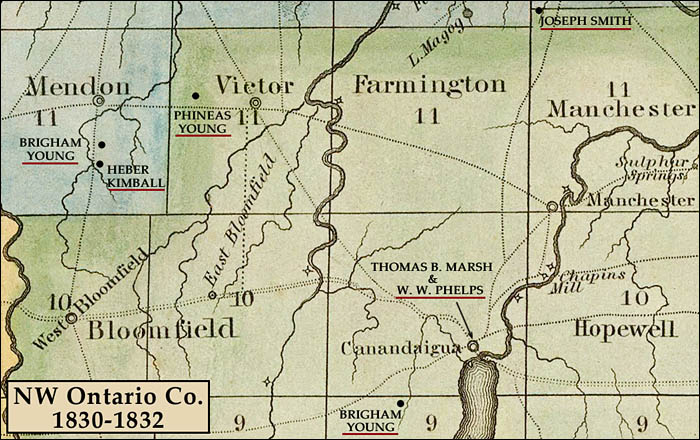
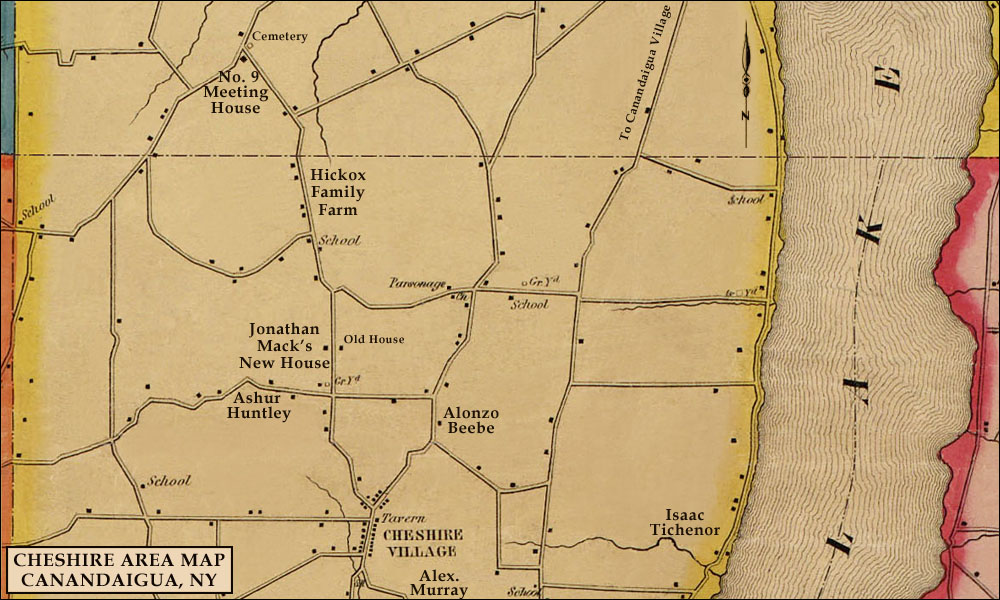
Mr. Milliken: Perhaps very few of your readers know that the somewhat famous (or infamous) Brigham Young ever resided in Canandaigua. Yet, such is the fact. He, and three brothers and a sister came there I believe, from northern Pennsylvania, about 1825 or 1826. -- He then had a wife and was perhaps 23 or 24 years old -- not much older. The four brothers were, apparently, aged in the order they are named, John, Phineas, Brigham and Joseph, the last, probably, then 17 or 18 years of age. The sister was reputed to be a widow, 28 or 30 years of age; small, with dark eyes and hair; -- rather pretty -- went by the name of Mrs. Little, and once worked for Mr. Ebenezer Hale, in the village. Perhaps Mr. or Mrs. Hale will recollect her. Phineas came first, and after awhile the sister and other brother. Brigham at first lived with Phineas, on the farm lately owned by Dr. Alexander Murray, in No. Nine; and aflerwards in a log house a few rods north of the residence of Jonathan Mack, Senior, also in No. 9. Brigham and his brothers then called themselves Reformed Methodists. When Brigham was asked in what respect his sect differed from the Episcopal Methodists, he replied that "The government of the M. E. Church was monarchical, that their religion had degenerated into mere formality -- had lost its vitality and was little better than a dead body." Consequently he was very noisy at meetings; shouting, screaming and howling with all his energy. More than once I have been awakened, after the hour of midnight, by the praying, shouting and singing of Brigham and half a dozen or more of his sect collected in an old uninhabited house, over a hundred rods off, where they were holding an impromptu prayer meeting. He was very fanatical. His mind seemed a soil adapted to the growth of any kind of spiritual seed, however spurious, which might obtain a lodgment therein. He pretended to believe that he, and many of his sect had power to heal the sick; cure the lame; and to perform miracles, even to restoring the dead to life. Several attempts to perforrm such extraordinary works, were actually made by him and those of his faith, while he was at No. 9, as the following account, which is susceptible of absolute proof by several living witnesses of utmost respectability, will more fully show: Among this boisterous, ignorant and fanatical sect, were two brothers, Calvin and Otis Gilmore, both preachers. Otis Gilmore had lost the use of both legs and feet, by some disease, and was unable to walk, even with crutches. He, therefore, was a very appropriate subject on which to operate. They placed several chairs side by side, and had a wide board on them, and Otis was laid on his back, at full length, upon the board. Then followed a long [season] of loud prayer, shouting, howling and manipulations, and finally Otis was commanded to "rise" and "walk," but, to the confusion of the Saints, the cripple obeyed not. It then occurred to them that an anointing with oil, a most necessary part of the performance, had been omitted. Oil was called for; but the house afforded nothing but "coon's oil. This was bro't, and the subject was thoroughly smeared from "head to foot." Then, the prayers and other performances were repeated with increased vehemence for a long time. But to no purpose. -- The failure was attributed to a lack of faith in some of the performers. Otis declared that if he was not speedily cured, he should lose all faith in the Christian religion. This attempt to heal Otis took place at the house lately, and perhaps now, occupied by Isaac M. Tichenor, on the lake shore, about the year 1828 or 1829. |
|
ONTARIO REPUBLICAN TIMES. ns. Vol. II. Canandaigua, New York, Thursday, September 10, 1857. No. 20. "Justice to whom Justice is Due." Mr. Milliken: -- Last week the Readers of the Republican Times were informed through its columns that Brigham Young was once a resident of Canandaigua. In giving this information our informant, Mr. Beebe, has made, we think, some mistakes concerning Brigham, tho' unintentionally no doubt. With your permission we will give your readers what we think a more correct account of Brigham's life in Canandaigua. |
|
Vol. ? Buffalo, New York, Thursday, November 19?, 1857. No. ?
BRIGHAM YOUNG.
The interest which has always been felt in this remarkable character is renewed by the recent events in Utah, which have finally assumed the form of a positive rebellion, and seem likely to terminate in a prolonged religious war. The biography of Brigham Young is like that of Mahomet. Beginning in humble, life, he has grown up to the command of a powerful fanatic sect. He had his Hegiras, and now, like his prototype he takes up the sword for the extermination of the infidels. |
Utica Morning Herald AND DAILY GAZETTE. Vol. XI. Utica, New York, Saturday, November 21, 1857. No. 18. WHAT IS TO BE DONE? Since hostilities have commenced, the country speaks with a single voice demanding the reduction of the Mormons to the authority of the General Government. New evidence multiplies that the murder of emigrant trains on the Plains, so frequent and so terrible, were the result of Mormon machinations. The Santa Clara Indian[s] have been the most ready instruments in these atrocities, and Kanosh, their chief, it is stated, is kept under Mormon control by the attractions of a young squaw who is the ward of Brigham Young. Kanosh and his tribe murdered Lieutenant Gunnison and his party, and the recent horrible massacre of a hundred California emigrants, is fastened upon them, and through them upon the Mormon Governor. |
Vol. ? Buffalo, N.Y., Monday, Feb. 1, 1858. No. ?
Joe Smith's Family at Nauvoo. A correspondent of the Missouri Republican writes that last summer he was at Nauvoo and conversed with Mr. Bitoman, who is married to Joe Smith's widow. He says: -- |
Vol. VII. Hornellsville, N.Y., Feb. 2, 1858. No. 12.
MORMONISM. Mormonism, as a religious system, had its origin in a romance, written about the year 1810 by Solomon Spalding, a native of Connecticut, who had been educated for the ministry, but followed a mercantile employment, removed to Cherry Valley, N. Y., where he amused his leisure hours by weaving a book entitled by him, "The MSS. Found," the notion entertained or suggested by some writers that the American Indians are the descendants of the lost ten tribes of Israel. Hence, he starts them from Palestine, invents for them various fortunes by flood and field, wars, quarrels, turmoils, strifes, separations, until they people this continent, and leave behind them the vestiges of mounds, tumuli, fortifications, sculpture, and cities dilapidated, which are discovered in Northern and Central America. It is written somewhat in Scriptural style, and uses the machinery of the Jewish economy throughout. He read his manuscript to various persons, who yet remember it, but was not successful in procuring its publication. Somewhere, about the year 1823, this manuscript fell into the hands of Joe Smith, a native of Windsor County, Vermont. Smith was about twenty years of age, and already exhibited that singular compound of genius and folly, of cunning and absurdity, of indolence and energy, of craft and earnestness, which distinguished him to the end of his career. |
Vol. XXIX. Albany, N.Y., Wed., May 19, 1858. No. 8453. Prospect of Peace with Utah. We sincerely hope the intelligence from Utah may prove authentic. Of all our Wars, none, so questionable in policy, or so uncertain in its results, has ever occurred. Not uncertain in its immediate issue, but in its effect upon Mormonism. Nobody can foresee what persecution (for that is the name it will assume) is to have upon these People. The question of all others most important, is that in relation to which mankind is most easily cheated. The teachings of eighteen centuries have not fortified the human mind against the darkest delusions. Four-fifths of the human family are now, in some form, the victims of heresies scarcely less monstrous than Mormonism. |
Vol. XXIX. Albany, N.Y., Friday, May 21, 1858. No. 8455. From the Troy Times Mr. Elihu F. Marshall did not print the Mormon Bible. It was printed by Mr. Egbert B. Grandin (now deceased) at the office of the Wayne Sentinel, Palmyra. We happen to know this fact. Mr. John H. Gilbert, now residing at Palmyra, did the press work, and a large portion of the type-setting of the Bible. If Mr. Weed doubts this, we can show him a copy of the first Mormon Bible with the imprint.We have no right to "doubt" the correctness of this statement, though we were strongly impressed with the belief that our Quaker neighbor, MARSHALL, printed the first edition of the Mormon Bible. Was not the Book referred to by the Editor of the Times, a portion only of what became the Mormon Bible? When JOE SMITH called on us, he professed to read fresh revelations from a miraculous Tablet, deposited in his Hat. Will the Editor of the Troy Times oblige us with the copy of the Book it refers to? It can be sent and will be carefully returned, by Express. |
|
Vol. III. Lyons, N.Y., Wed., May 26, 1858. No. 2.
Mormonism and Joe Smith -- The Book of
Within our recollection Mormonism was "a speck, not bigger than a man's hand." The original Impostor, Joe Smith, came to the writer of this article, only thirty-two years ago, with the manuscript of his Mormon Bible, to be printed. -- He then had one follower, (a respectable and wealthy Farmer of the town of Macedon [Palmyra]) who offered himself as security for the printing. But after reading a few chapters, it seemed such a jumble of unintelligible absurdities, that we refused the work, advising Harris not to mortgage his farm and beggar his family. But Joe crossed over the way to our neighbor Elihu F. Marshall, and got his "Mormon Bible" printed. -- Albany Journal. |
|
Vol. VII. Troy, New York, Thursday, May 27, 1858 No. 284. News Summary. The Texas Mormons have "broken themselves up," and are going to remove from Bandera county to a more elegibie section. They couldn't stand the Indians and grasshoppers in their old quarters. Father White [sic - Wight?], leader of the Texas Mormons, declares that they have no sympathy with Brigham Young. |
|
Vol. XXIX. Albany, N.Y., Friday, May 29, 1858. No. ?
MORMONISM AND JOE SMITH.
|
Vol. III. Lyons, N.Y., Wednesday, June 2, 1858. No. 3.
The Mormon Imposture -- The
It is believed there has never been published a particular and connected biography or description of the chief founders of the "Church of Latter-Day Saints." or as they may be fitly denomited, the Aborigines of Mormonism. The magnitude to which the imposture has now reached, and the degree of public attention that is directed towards the position and movements of the Mormons under the Presidency and assumed spiritual Priesthood of Brigham Young, as the successor of the original Prophet and Martyr Joe Smith, impart an importance to the early personal history of these people, which could not have been anticipated even by the most sanguine believers in the marvelous, at the putset of their extraordinary successful experiment upon human credulity and superstition. It is presumed, therefore, that as a supplement to the reminiscential sketch given in last week's "Press," the following additional recollections on the subject may possess a compensating interest in mooting public curiosity. |
Vol. III. Lyons, N.Y., Wednesday, June 9, 1858. No. 4.
The Mormon Hierarchy --
The sketches of the origin of Mormonism and of the early times of its founders, appearing in the two last publications of this paper, have been truthful illustrations, so far as they went, of the charactor of the men and means giving rise to the existing Mormon Hierarchy, which is costing the government of the United States thousands of its best troops and millions of dollars from its treasury. The Troy Times, whose editor has the advantage of an acquaintance with the locality of the imposture at its starting point, and with many of the people who are living witnesses of its first introduction to the public notice, has collected and published some additional particulars in amplification of this primary history of Brigham Young's empire, which are essential in perfecting the chapter of fraud and hypocrisy forming its basis. |
Vol. III. Lyons, N.Y., Wednesday, June 30, 1858. No. 7. The First Mormon Preacher. In a sketch of the origin and authorship of the Mormon Bible, published in the Democratic Press, several weeks since, Sidney Rigdon was referred to as having performed an important part in the outset of that imposture, and shortly afterwards disappearing from the public observation. This Rigdon, it will be remembered, was the first preacher of the pretended Mormon revelation, and is supposed to have furnished the composition purporting to have been Joe Smith's translation of the "golden plates" found in Mormon Hill near Palmyra. Our article having been republished in the Buffalo Express and numbers of other papers, (credited by mistake to the "Palmyra Democrat") it met the eyes of a correspondent who favors us with information of Rigdon's present whereabouts, in the following communication: -- |
Vol. ? Ithaca, New York, Friday, September 3, 1858. No. ?
|
|
ONTARIO REPUBLICAN TIMES. ns. Vol. III. Canandaigua, New York, Thursday, September 9, 1858. No. ? A LETTER FROM BRIGHAM YOUNG. [introductory paragraph missing] |
Vol. XIX. Auburn, N.Y., Wednesday, May 11, 1859. No. 19.
UTAH. -- Mr. Buchanan is confident that the troubles, especially between Gov. Cummings and Col. Johnson, can be arranged. As far as we can learn, Gov. C. is right. There is no doubt now but that the Mormons were involved in the massacres of emigrants. (Dr. Forney has rescued seventeen children captured from emigrants by the Indians at the massacre of the Arkansas train.), but to proceed harshly against all as a body, and give them no chance in the routine of law, as the U.S. Judge urged the Grand Jury to do, was unjustifiable. -- Give the worst fair play, is the rule of justice. Gov. C. condemned the course of the Judge, and Col. J. refused to obey Gov. C. This matter, so ruinous to order in Utah, is now being adjusted in Washington. |
Vol. XXXI. Albany, N.Y., Sat., April 7, 1860. No. 9035.
THE MOUNTAIN MEADOWS MASSACRE.
The Salt Lake Valley Tan of February 29th, the last number of that newspaper issued before its suspension, contains a statement from Wm. H. Rogers, in regard to the massacre at Mountain Meadows, in Sept. 1857, when 120 men, women and children, emigrants from Arkansas, were murdered by Mormons. In company with Dr. Forney, Superintendent of Indian affairs for Utah Territory, Mr. Rogers, about a year since, traversed the district of country where the massacre occurred. The scene of the tragedy is thus described: -- |
Frederick Douglass' Paper. Vol. XIII. Rochester, N.Y., May 25, 1860. No. 21.
THE MORMONS ARE COMING.-- Joe Smith, Jr., and his followers, numbering several thousand persons, have made extensive purchases of real estate in this county, and may be expected among us in a short time. The advance guard will be along in a few weeks, and others will follow as early as they can dispose of their property to the east of us, so that we may confidently look for an influx of at least ten thousand Mormons within the year. |
Vol. XXXII. Albany, N.Y., Thursday, April 11, 1861. No. 9348.
Correspondence of the N. Y. Commercial.
|
SYRACUSE DAILY JOURNAL. Vol. XVII. Syracuse, N.Y., Friday, Apr. 12, 1861. No. 87.
Pleasant Reminiscences.
|
Vol. V. Lyons, N.Y., Wed., April 17, 1861. No. 47. Pleasant Reminiscences. The Albany Journal copies J. A. Hadley's note to the N. Y. Commercial Advertiser and says -- "the writer" being Mr. Geo. Dawson: |
SYRACUSE DAILY JOURNAL. Vol. XVII. Syracuse, N.Y., Wed., Apr. 17, 1861. No. 91. Reminiscences Corrected. The Lyons Democratic Press corrects some statements in the Albany Journal, in reference to Mr. J. A. Hadley. Mr. Weed's oldest apprentice. The Press says: |
Vol. XXXIII. Rochester, N. Y., Fri., Nov. 14, 1865. No. 504.
A Mormon Trouble Brewing.
|
 Vol. XVII. Rochester, N.Y., Saturday, January 6, 1866. No. 1.
WEALTH OF THE MORMONS.
Lieut.-Gov. Bross, of Ilinois, who has been visiting the Mormons, explains the source of their prosperity as follows: |
Palmyra Courier. Vol. XXV. Palmyra, N. Y., Friday, May 10, 1867. No. 6.
...we hasten to a conclusion, by saying that the "Good enough Morgan" story originated in a joke, and though read with effect, politically, for many years, was known at Rochester by all who cared for the truth, to be wholly unfounded. We never uttered the expression. What we did say to Ebenezer Griffin and others, who were insisting that the body found at Oak Orchard Creek, was that of Timothy Monroe, and in reply to the question of "what will you do for Morgan," was: That is a good enough Morgan until you bring back the one you carried away. |
Vol. XL. Rochester, N. Y., Wednesday, May 22, 1867. No. 121.
SERIOUSLY ILL. -- We regret to learn that the vetern printer, B. F. Cowdery, is lying seriously ill at his residence in this city of pneumonia, and his recovery is past looking for. |
Vol. XXXVII. Albany, N.Y., Monday, June 17, 1867. No. 11,263. A History of Mormonism. Some time, we shall estimate rightly the magnitude and importance of the infamous Mormon delusion. At present, it is very imperfectly comprehended. We know that upon the far-away borders of the Republic, exists a community of men and women, numerous, wealthy and powerful, who deny the cardinal tenets of religion, set at naught the philosophy of social ethics, and live in constant and flagrant violation of the laws by which the family has been maintained during all the ages. But we do not know how numerous these people are, how their fanatic faith originated and received its growth, what proportions the organization has assumed, or how it threatens the future stability and loyalty of the vast region now in its possession. |
Vol. XL. Rochester, N. Y., Saturday, September 28, 1867. No. 231.
From the Troy Daily Times
The Appletons are soon to publish a book entitled "Mormonism: It's Origin and Progress: Biography of its Founders, and History of its Church of Latter-day Saints. Personal remembrances and historical collections hitherto unwritten, By P. Tucker." The author, Mr. Tucker, is well qualified for his task -- was intimately acquainted with Joe Smith, the first Mormon prophet, when in Palmyra -- had the chief direction of the printing of the original edition of the Book of Mormon from the manuscripts -- and knew all the principal actors in the Imposture from its commencement. The plan of the work, as we have reason to know, is a candid, truthful, authentic history, dating from the beginning of the Mormon invention, and chronologically tracing the new sect from its insignificant starting point to its present monster proportions. The Union Vedette of Great Salt Lake City, (gentile) has a notice of the forthcoming book on Mormonism, in which, referring to a statement of its author, the editor remarks: |
Vol. XL. Rochester, N. Y., Tuesday, October 1, 1867. No. 233. For the Union & Advertiser.
Messrs. Editors: -- In your last evening's paper (Saturday) in speaking of Mr. Tucker's forthcoming book on Mormonism, you ask who and what was Joe Smith, and you spoke of men in Western New York who can intelligently answer these and more questions from personal knowledge. |
Vol. XXXVII. Albany, N.Y., Tuesday, November 12, 1867. No. ? "History of Mormonism." Appleton & Company, of New York, have just published a volume which is certain to attract much attention from thoughtful readers. Its title is, "Origin, Rise and Progress of Mormonism. Biography of its Founders and History of its Church. Personal reminiscences and historical collections hitherto unwritten." The author, Mr. Pomeroy Tucker, is a veteran editor of Western New York; a gentleman of high culture and unbending integrity; himself an observer of, and to some extent a participant in the scenes which he descrives, connected with the development of this most astonishing mental phenomenon and religious swindle. |
|
Utica Morning Herald AND DAILY GAZETTE. Vol. XXI. Utica, N.Y., Saturday, Nov. 23, 1867. No. 20.
LITERARY MATTERS.
Hitherto no authentic history has been written of the origin of Mormonism. Several books have been written upon the subject of this institution, but they have had to do with it after it became a power in the land. The birth of this gigantic prodigy took place within the memory of men but little past middle age, and yet no one has been found, heretofore, to gather up and preserve in a book the facts connected with that birth. The author of the volume before us was induced to undertake the task he has accomplished, more from a sense of duty than from a desire to appear in print. He is a resident of the place where Mormonism [originated], was a neighbor of its founder, and is as well acquainted with all the circumstances connected with its origin as a man can be with the affairs of his nearest neighbor in the country. This fact goes far to give value to his work. It renders it invaluable as history. Mormonism long ago passed beyond the time when it could be winked at or treated as a visionary upstart of an institution. It has made history for itself, and in doing so, it has added a page to the history of this country that cannot be ignored. It became an absolute duty, therefore, for some one, who was present at its beginning, to write up the facts in the case for the use of the future historian. |
Vol. XXIII. Syracuse, N.Y., Monday, December 16, 1867. No. 299. AFTER-TEA GOSSIP. ...In the summer of the year of the first publication of the Mormon Bible (1830). Prophet Joe Smith, the assumed author of the book, came to Victor on foot, with a basket of his marvelous Bibles for sale. Stopping at the tavern, then kept by the hospitable William C. Dryer, he sought entertainment in exchange for a book, pleading that he was "out of money." The appeal was successful, and after breakfast next morning, Mr. Dryer voluntarily paid his penniles guest three shillings as balance of account. With the aid of this money the "prophet" indulged in whisky potations until (as my informant expresses the idea) "he couldn't navigate;" when the mischievous boys of the town threw him into the horse watering trough at the pump, near the bar-room door and pumped water upon the successor of Nephi until he was sufficiently sobered to bid good bye to Victor and the unbelieving "gentiles." |
Palmyra Courier. Vol. XXV. Palmyra, N. Y., Friday, December 20, 1867. No. ?
Mormon History -- Prophet Joe Smith.
|
LEWIS COUNTY DEMOCRAT. Vol. XII. Lowville, N. Y., April 1, 1868. No. 34.
The Mormon Split.
There being many newspaper items afloat purporting to set forth the present condition of the Mormon Church, the various secessions, offshoots and outgrowths of the same, together with some of the tenets or dogmas of faith to which they severally hold, I thought, with your permission, through the medium of the Journal, to make some statements which may serve in a measure to correct the ideas which must inevitably have been gathered from the items lately and extensively published. The organization of the Church was effected April 6, 1830. |
Vol. XX. Rochester, N.Y., Saturday, January 2, 1869. No. 1.
Historical
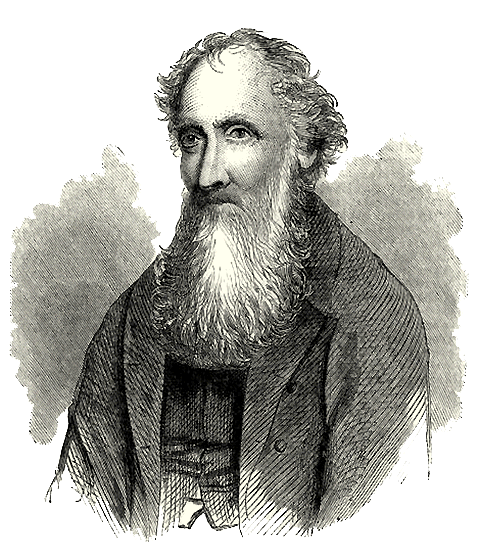
The rise of a new religion in the midst of the nineteenth century, under the very eyes of our most intelligent civilization and in the very center of one of the most highly favored districts of Western New York, is an event that may well excite the attention and interest of every thoughtful mind. The birth of a new faith, the promulgation of a new revelation, is far more rare and strange than the beginning of a new nation. Yet many of the first organizers of the Mormon Church are still alive. The first preacher still lives. Many still remember the first prophet and seer, who gravely asserted his divine commission to discover and translate a new volume of the word of GOD, and to introduce a new and complete dispensation of doctrines, prophecies and miracles, with new promises of earthly prosperity and new securities for eternal salvation. |

Vol. XX. Rochester, N.Y., Saturday, January 23, 1869. No. 4.
Historical
The two most important personages in the earliest days of Mormonism, next to the chief seer, Smith, were Martin Harris and Sidney B. Rigdon. Harris furnished money and Rigdon "brains" for the new movement, for the Smith family were lamentably wanting in both these important requisites for a new religion. Harris was the first convert who had property. All the rest were dependent on their daily labor for a precarious livlihood. Harris had a good farm and was in comparatively easy circumstances. He was, however, a weak, credulous man, very ignorant, and yet a constant reader of the Old Testament. It is said that he learned the whole of it so as to be able to repeat it from memory, and could give chapter and verse for almost any passage. He seemed to himself to have conquered the whole province of revelation, including narratives, doctrines, prophecies and mysteries; and, like a greater personage of olden time, he sighed for a new world to conquer. Familiar with the old Hebrew prophets in his way, and with his own interpretation of their sublime visions, which he of course readily exhausted, he was ready to hail with delight a "live prophet," even if he did, to all human vision, seem like an idle vagabond. This doubtless added to the sacredness of his prophetic character, in his eyes. It perhaps was the weird eccentricity of one familiar with strange visions and mysterious revelations. At any rate, Harris gave all the mind he had and all the influence he could command to the new prophet. He was most thoroughly convinced of the divine mission of Joe Smith. He devoted his time to the new faith, and at length mortgaged his farm to raise means for printing the new Bible. His wife, who had no sympathy for what she fully believed to be the insane delusion of her husband, refused to sign the mortgage, and the alienation became so serious that they separated. Harris persisted in his efforts to publish the New Scriptures of the Mormon faith, and at length an edition of 5,000 copies was printed at a cost of $3,000. One of the printers has now in his possession the original sheets from which the first edition was printed. |
Vol. XX. Rochester, N.Y., Saturday, March 20, 1869. No. 4.
Historical
It is unquestionable that Sidney Rigdon was the real master spirit of the Mormon Church from the time he united his faith and his fortunes with the new movement. He was a ready speaker, a fluent controversialist, having at command new and plausible theories, with a love of contradiction and startling novelties of interpretation. He had gathered a congregation at Mentor, Ohio, of such materials as would naturally cluster round such a man. He had evidently unsettled his own faith and that of large numbers of his hearers in the generally received interpretations of the Old Bible. He was eccentric and bold, and among plain, uneducated people, passed for an oracle. He was ripe for a new religion -- ready to listen to a new revelation. |

Vol. XIV. Plattsburgh, N. Y., Friday, June 4, 1869. No. 51. New York Correspondence.
|
Vol. XXII. Utica, N. Y., Mon., Aug. 2, 1869. No. 83.
A Mormon Sensation.
A few days ago we mentioned the fact that William [sic] Alexander and David Hyrum, the younger sons of Joseph Smith, the Mormon Prophet, were on their way to Salt Lake City to set up the standard of the reorganized or anti-polygamy church. A singular interest attaches to the name of David Hyrum. A few months before Joseph's death, he stated that "the man was not born who was to lead this people, but of Emma Smith should be born a son who would succeed in the presidency after a season of disturbance." Joseph Smith was killed June 27, 1844, and the son, named from his father's direction David Hyrum, was born at the Mansion House in Nauvoo on the 17th of the succeeding November. This prophecy is secretly dear to thousands of Mormons who are weary of the tyranny of Brigham Young, and yet hold to their faith in Joseph Smith. A few days ago the young men reached Salt Lake City, and soon called upon Brigham Young and announced their intention to organize their church at once, asking permission to defend their faith in the Tabernacle, proposing to argue with the Brighamites from the original Mormon books. |
Vol. I. Auburn, N. Y., Thurs., Aug. 26, 1869. No. 50.
BOOK OF MORMON -- RISE AND PROGRESS OF
|
(all NY articles for the years 1870-99 have been moved here)
Back to top of this page.
Articles Page | Articles Index | History Vault
Oliver's Bookshelf | Spalding Library | Mormon Classics
last updated: Dec. 10, 2013