
READINGS IN EARLY MORMON HISTORY
(Newspapers of New England)

Misc. New England Newspapers
1840-1844 Articles
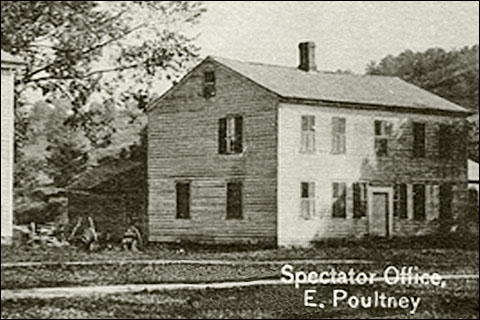
Office of Western Spectator (a.k.a. Poultney Gazette) in Poultney, Vermont.
Operated by the son of the Rev. Ethan Smith: his View of the Hebrews was printed here.
This was the neighborhood where Oliver Cowdery (later a journeyman printer) grew up.
1800-1829 | 1830-1839 | 1840-1844 | 1845-1879 | 1880-1920
1840-1841
BTrp May 05 '40 | CReg Aug 22 '40 | CCrS Aug 29 '40 | LCour Apr 27 '41 | BRec May 07 '41 | ChrW May 14 '41 | BCour Jun 03 '41
BTvl Jun 29 '41 | BCour Jul 08 '41 | BInv Jul 28 '41 | BInv Sep 15 '41 | Witn Sep 28 '41 | Witn Oct 09 '41 | FCab Dec 03 '41
BTvl Dec 14 '41 | CSec Dec 24 '41 | CReg Dec 25 '41 | NHSnt Dec 29 '41 | CSec Dec 31 '41
1842, Jan-Aug
PSun Jan 06 '42 | Lib Jan 07 '42 | NEWR Jan 22 '42 | DWB Apr 9? '42 | DWB Apr 16? '42 | DWB Apr 23? '42 | LCour Apr 23 '42
BInv Apr 27 '42 | Witn Jun 02 '42 | ETrp Jun 07 '42 | SgnT Jun 08 '42 | BInv Jun 08 '42 | BInv Jun 15 '42 | BInv Jun 22 '42
DAtlas Jun 24 '42 | DWB Jun 25 '42 | DWB Jul 02 '42 | BInv Jul 06 '42 | BInv Jul 13 '42 | BCour Jul 14 '42 | DWB Jul 16? '42
BCour Jul 28 '42 | LCour Jul 28 '42 | LCour Aug 02 '42 | BDT Aug 02 '42 | ETrp Aug 03 '42 | SReg Aug 04 '42 | Witn Aug 06 '42
LCour Aug 06 '42 | DWB Aug ? '42 | BCour Aug 08 '42 | BDT Aug 08 '42 | BDT Aug 09 '42 | LCour Aug 09 '42 | LCour Aug 11 '42
FCab Aug 12 '42 | BCour Aug 25 '42 | SReg Aug 25 '42 | BDT Aug 26 '42 | BCour Aug 29 '42 | LCour Aug 30 '42
1842, Sep-Dec
LCour Sep 01 '42 | BRec Sep 02 '42 | PJour Sep 03 '42 | BTrp Sep 06 '42 | BTrp Sep 07 '42
BInv Sep 07 '42 | BTrp Sep 08 '42 | BCour Sep 08 '42 | BTrp Sep 13 '42 | EWas Sep 15 '42 | LCour Sep 17 '42 | BCour Sep 26 '42
MSpy Sep 28 '42 | NHS Oct 14 '42 | BQN Oct 15 '42 | DAtlas Oct 15 '42 | BTvl Oct 21 '42 | BCour Oct 24 '42 | BCour Oct 27 '42
BQN Oct 29 '42 | CReg Oct 29 '42 | DAtlas Nov 01 '42 | BInv Nov 02 '42 | CReg Nov 05 '42 | BDT Nov 08 '42 | DEB Nov 15? '42
CReg Nov 26 '42 | BTrp Nov 28 '42 | SReg Dec 01 '42 | BTvl Dec 02 '42
1843, Jan-Apr
BBee Jan 06 '43 | BBee Jan 10 '43 | BBee Jan 13 '43 | BBee Jan 16 '43 | BBee Jan 17 '43 | BBee Jan 18 '43 | BDT Jan 18 '43
BBee Jan 20 '43 | BBee Jan 26 '43 | BBee Jan 27 '43 | BBee Jan 28 '43 | BBee Jan 30 '43 | BBee Feb 03 '43 | BBee Feb 09 '43
BBee Feb 11 '43 | WBee Feb 11 '43 | WBee Feb 18 '43 | LCour Feb 23 '43 | BBee Feb 25 '43 | WBee Feb 25 '43 | BBee Feb 27 '43
BBee Mar 04 '43 | LCour Mar 07 '43 | BBee Mar 09 '43 | VerP Mar 10 '43 | BBee Mar 10 '43 | WBee Mar 11 '43 | SReg Mar 16 '42
BBee Mar 17 '43 | WBee Mar 18 '43 | BBee Mar 23 '43 | WBee Mar 25 '43 | BBee Mar 28 '43 | BBee Mar 30 '43 | WBee Apr 01 '43
SAdv Apr 05? '43 | BBee Apr 12 '43 | BBee Apr 18 '43 | WBee Apr 22? '43 | LCour Apr 25 '43 | BBee Apr 28 '43 | StarP Apr 29 '43
LCour Apr 29 '43
1843, Jun-Dec
BBee May ?? '43 | BBee May 11 '43 | Perf May 15 '43 | LCour May 20 '43 | BBee May 20 '43 | BBee May 22 '43 | BFP Jun 02 '43
LCour Jul 13 '43 | BDT Jul 15 '43 | SReg Jul 17 '43 | BInv Jul 26 '43 | LCour Aug 05 '43 | BBee Aug 05 '43 | BTrp Aug 12 '43
LCour Aug 17 '43 | HGaz Aug 22 '43 | BTrp Aug 29 '43 | BBee Sep ? '43 | BBee Sep ? '43 | HGaz Sep 05 '43 | BCltv Oct 07 '43
SReg Oct 12 '43 | BBee Nov 16 '43
1844, Jan-Jul
BInv Jan 17 '44 | BQN Mar ? '44 | BCltv Mar 02 '44 | BBee Mar 18 '44 | BTrp Apr 02 '44 | VTChr Apr 03 '44 | BInv May 15 '44
BCWhig May 16 '44 | SReg May 20 '44 | EWC May 22 '44 | BInv May 22? '44 | SpRp May 24 '44 | BCltv Jun 01 '44 | CCR Jun 14 '44
SpRp Jun 15 '44 | BCltv Jun 22 '44 | BBee Jul 02 '44 | Lib Jul 05 '44 | SpRp Jul 06 '44 | CCit Jul 06 '44 | BBee Jul 08 '44
ZHrl Jul 10 '44 | Lib Jul 12 '44 | SpRp Jul 13 '44 | Plow Jul 13 '44 | NGal Jul 17 '44 | FCab Jul 18 '44 | SpRp Jul 18 '44
SpRp Jul 20 '44 | CHrC Jul 20 '44 | BBee Jul 29 '44 | BInv Jul 31 '44 | SpRp Jul 31 '44
1844, Aug-Dec
BFP Aug 02 '44 | SpRp Aug 03 '44 | BCltv Aug 03 '44 | SpRp Aug 08 '44 | BBee Aug 20 '44 | Cal Sep 09 '44 | BCltv Sep 28 '44
BRec Oct 03 '44 | NBR Oct 08 '44 | NGal Oct 09 '44 | BRec Oct 10 '44 | SpRp Oct 14 '44 | BRec Oct 17 '44 | BAt Oct 18 '44
UnvW Oct 26 '44 | Perf Nov 02 '44 | BTrp Nov 05 '44 | BAt Nov 06 '44 | SpRp Nov 09 '44 | SpRp Nov 13 '44 | BTrp Dec 24 '44
SpRp Dec 28 '44
1800-1844 Maine Newspapers | Old Newspaper Articles Index
 Vol. ? Boston, Massachusetts, Tuesday, May 5 1840. No. ? 
ORIGIN OF MORMONISM. More than 30 years since, what now constiutes the historical part of the Mormon Bible was written by one Solomon Spaulding. At a very early age, Spaulding obtained the appellation of a close student from his acquaintances in Ashford, Conn, his native town. After the completion of his collegiate course at Hanover, N. H, he was engaged in the ministry. He abandoned this profession in three years, removed to Cherry Valley, N. Y, and commenced the mercantile business. Being unfortunate, he again removed, and built a forge in the State of Ohio. He was now reduced to great poverty, and commenced writing a book, with the expectation, or hope, that the sale of it might enable him to pay his debts. The work was called, "The Manuscript Found" and contained the fictitious history of the Aborigines of America, whom he proved to be the descendants of the Jews. This narrative commenced with Lehi, who lived during the reign of Zedekiah, 600 years before Christ. This Lehi was warned by God to escape the calamities that were to befal Jerusalem. He, therefore, left the doomed city with his family, and fled to the wilderness. In a short time, they embarked on board a small vessel on the Red Sea, and floating to the ocean, after some length of time reached America, and landed on the shores of Darien. His descendants became, in a high degree, civilized, but were again reduced to barbarism by the numerous wars in which they were engaged. This accounted for the mounds and fortifications found in the western states, and for the condition of the Indians at the time of our forefathers' landing. When the work was completed, Spaulding was unable to raise funds sufficient for its publication. Soon after, he removed to Pennsylvania, where he died. By some means, the manuscript fell into the hands of Joseph Smith, Jr, the originator of Mormonism. The father of Smith emigrated from Royalton, Vt, in 1820, and settled in Manchester, N. Y. At this time the son was only 16 years of age. This family were remarkable for their belief in evil omens, and like things. Collecting some few of his companions, the prophet was engaged several months in seeking hidden treasures. In 1825, it was reported by the friends of young Joseph, that he had been informed, by an angel, of certain golden plates, containing the history of the Aborigines of America. Being opposed by an evil spirit, they were not obtained until 1827. These plates were written in characters which could not be read by any one excepting the prophet. The translation was not completed until 1830. In the meantime he removed to Pennsylvania, escaping the opposition of all evil-minded men. It was pretended that these plates were brought from Jerusalem by Lehi, and were transferred from father to son until the fifth century, when, in obedience to the command of God, they were buried in the earth. The book of the prophet Joseph was received as soon published by a few credulous persons. The reasons given for its belief were, the internal evidence of the book, and the striking exhibitions of the character of God, through Joseph. Soon after the Mormon Bible was published, a sect of fanatics from Ohio, called Cambellites [sic], passed through New York, and heard of the golden plates. They called upon Smith, and many of them were converted to his faith. With them, Sidney Bigelow [sic], their preacher. He was a man of eloquence and great popularity among them. -- |
AND BOSTON OBSERVER.
Devoted to Unitarian Christianity, Sound Morals, Literature and News. Vol. XIX. Boston, Saturday, August 22, 1840. No. 34. CORRESPONDENCE OF THE A. U. A.
|
Vol. VI. Hartford, Conn., Saturday, August 29, 1840. No. 18.
From the Alexandria Gazette
Since the Mormons were expelled from the State of Missouri, they have purchased the town of Commerce, a situation of surpassing beauty, at the head of the lower rapids, on the Illinois shore of the upper Mississippi river. The name of the place they recently changed to Nauvoo, the Hebrew term for Fair or Beautiful. Around this place, as their centre, they are daily gathering from almost every quarter; and several hundred new houses, created within the last few months, attest to the passing traveller the energy, industry, and self-denial with which the community is imbued. They have also obtained possession of extensive lands on the opposite side of the river, in that charming portion of Iowa Territory, known as the 'Half Breed Reservation;' and there, upon the rolling and fertile prairies, they are rapidly selecting their homes and opening their farms. As the traveller now passes through those natural parks and fields of flowers, which the hand of the Creator seems to have originally planted there for the inspection of his own eye, he beholds their cabins dotted down in the most enchanting perspective, either on the borders of the timber, or beside the springs and streams of living water, which are interspersed on every hand. |
|
Lowell Morning Courier. Vol. IX. Lowell, Massachusetts, Tuesday, April 27, 1841. No. 1,295.
The Mormons. -- The Corner Stone of the great Mormon Temple (that is to be) at Nauvoo, Illinois, was laid on the 6th inst. in presence of seven or eight thousand persons, and the Nauvoo Military Legion, consisting of six hundred and fifty men. The Warsaw (Ill.) World says: "Mr. Rigdon officiated at the laying of the chief corner stone, and addressed the assembly in a very energetic manner in a speech of about an hour's length. On the whole the exercises passed off with the utmost order, without accident or the slightest disturbance. Gen. Bennett commanded the Legion, under the direction of the Prophet, and acquitted himself in a truly officer-like manner." |
 Pub. by Nathaniel Willis. 11 Cornmill. Price $3.00 a year, or $2.50 in adv. Vol. XXVI. Boston, Mass., Friday, May 7, 1841. No. 19.
THE MORMONS.
|
CHRISTIAN WATCHMAN. Vol. ? Boston, Mass, Friday, May 14, 1841. No. ? THE MORMONS. The public authorities of Missouri have published judicial testimony to show that their course in the "Mormon war" was justifiable. The evidence was laid before Congress during the last session, and parts of it have been published in the newspapers. According to these witnesses the leaders of Mormonism and many of their followers are but a gang of murderers, assassins, and robbers. We copy a few passages, merely remarking that it is testimony deemed valid in a court of justice, and that there is a vast deal more of the like tenor. |
 Vol. XV. Boston, Mass., Thursday, June 3, 1841. No. 1785.
THE MORMON PREACHER. A person, calling himself "Elder Freeman Nickerson," a preacher of the sect of Mormons, held forth to a large audience in this city, on Sunday morning. The Daily Mail of yesterday contains a report of his discourse, which is nothing but an outpouring of incoherent dogmatism, fanaticism, and cant. Perhaps the prayer which the Elder offered, in the course of his remarks, should be excepted from this censure, for that was simple, devotional, and apparently sincere. That man is a hypocritical knave, or, if honest, is but little removed from an idiot, is manifest from the boastful claims he makes to the power of working miracles. The following conversation took place, as reported in the Mail: -- |
|
Vol. XVI. Boston, Mass, Tuesday, June 29, 1841. No. 103.
CRUEL MURDER. -- Martin Harris, one of the earliest supporters of the Mormons, and the only wealthy man among them, in their origin, has been murdered. He spent all he was worth in supporting the delusion under which he labored, furnishing all the funds for the publication of the Mormon Bible. |
|
Vol. XV. Boston, Mass., Thursday, July 8, 1841. No. 1795. (From the Rochester Democrat.) MARTIN HARRIS, THE MORMON. In an article we published on Tuesday, it was announced that Martin Harris was found near Nauvoo, the city of the Mormons, shot through the head, and that there was no doubt of his having been murdered. |
 Vol. XI. Boston, Massachusetts, Wednesday, July 28, 1841. No. 12.
For The Investigator
Mr. Editor: Please to give the following notice an insertion: |
|
Vol. XI. Boston, Massachusetts, Wednesday, September 15, 1841. No. 19.
Book of Mormon. The Subscriber has agreed to publish a Compendium of the Book of Mormon, or Joseph's Golden Bible, with the subject matter of all the arguments that have been made before the "Boston Free Discussion Society," on the question "The Book of Mormon -- Is there any internal or external evidence, or facts, to prove it Divine Revelation? Or is it not the writings of Solomon Spaulding and others, got up to impose on the ignorant and credulous, about the year 1827?" |
EDITED BY J. H. NOYES & J. L. SKINNER. Speak unto the children of Israel, that they go forward... Exodus, xiv., 15. Vol. II. Putney, Vermont, Tuesday, September 28, 1841. No. 5.
==> The first part of the book of Mormon is occupied with the history of the Nephites, a portion of the tribe of Joseph. They are described as having emigrated from Jerusalem many centuries ago, under the prophet Nephi, and having been miraculously led to America, where they became the progenitors of the Indian race. After the emigrants have sailed, they are described as mutinying against Nephi, as the Spanish crews did against Columbus, but they released him when a tempest came on, as he was the only person capable of working the ship. He is then represented as saying: |
EDITED BY J. H. NOYES & J. L. SKINNER. Speak unto the children of Israel, that they go forward... Exodus, xiv., 15. Vol. II. Putney, Vermont, Saturday, October 9, 1841. No. 6.
THE SECOND MAHOMET. JOE SMITH is said to have declared repeatedly, that he would be a "second Mahomet." We infer from the military manifestations at Nauvoo and from other indications, that the meaning of that declaration is, that he will ultimately, like Mahomet, enforce belief in the divinity of his commission and revelations, by the sword. If this be his meaning, we have a word of caution for him. We advise him to bear in mind, that Mahomet lived some twelve hundred years ago, when physical force and military prowess were the prime elements of power, as they always are in the barbarous stages of human progress. Since Mahomet's time, the world has become intellectual and commercial. Statesmen and merchants have taken the place of warriors. -- There is almost as much difference between the present age and the age of Mahomet, as there is between a Yankee and an Indian. Mahomet adapted his operations to his age. He had a world of Indians to deal with, and he propagated his religion with Indian weapons. Hence he succeeded admirably for a time. But his mode of operation is not adapted to the present age. Mahometanism now has a world of Yankees to deal with. Hence it has ceased to conquer, and is tottering to its fall. So that Mahomet, though he was wise in his generation, was a fool on the scale of ages. He made no provision for the progress of the world. But Joe Smith, if he thinks of propagating Mormonism by the sword, is not even wise in his generation. He is blind not only to the progress of the world, but to human nature as it is; -- a fool on the small scale as well as on the great. He proposes to imitate the barbarism of Mahomet, though the world has manifestly outgrown that barbarism, and has left the mighty structure reared by it, "a wreck upon the shore of time." If Mahomet had lived in this age, his sagacity would have taught him to rely on science and commerce, instead of military power, for the conquest of the world. In fact, Mehemet Ali, who, more than any other man, is the present representative of at least the sagacity and enterprize of the Arabian impostor, has, in a great measure, merged the warrior in the statesman and the merchant. We advise Joe Smith to take a lesson from him, rather than from Mahomet. -- And if our counsel is not heeded, we advise those who suffer under any apprehension of the success of military Mormonism, to cast away their fears. It is very certain that the first flame of faith-compelling war on the part of " the second Mahomet," will be his funeral pile; though he have the 'Nauvoo Legion,' with the refugees of two Continents, and all the Indians of North and South America at his heels. |
FARMER'S CABINET. Vol. ? Amherst, N. H., Friday, December 3, 1841. No. ?
The Mormons. -- The success of the Mormons is one of the most astonishing features of the age, and is beginning to excite a very deep interest in their movements. We find some interesting facts in relation to them in the Journal of Commerce, from which it appears that their numbers reach already one hundred thousand persons, and as many more in Europe. Many of them are men of intelligence, who have stood high in the Christian church. Their members are increasing by the addition of men of property who join their wealth to the common stock. They have acquired so much political importance as to procure of the Legislature of Illinois an act of incorporation, authorizing the Mormons to maintain a standing army of a thousand men. Smith and Rigdon have ordained twelve Apostles, who have been anointed for their work by a sight of the golden plates. They adopt the whole of the Bible and claim that they have an additional revelation which was communicated to Joe Smith on the golden plates. This pretended revelation is said to be, and there is good reason to believe the report true, the production of a deceased clergyman, who wrote it as an amusement during hours of sickness, the manuscript of which was stolen from the printer's office. With all the boasted intelligence of the day, people are as ready to follow strange delusions as much as they ev-er were in the most superstitious periods of world's history. |
Vol. XVII. Boston, Mass, Tuesday, December 14, 1841. No. 48.
The Mormons. -- The Warsaw (Ill.) Signal of the 24th ult. contains a notice of more hostilities between the Mormons and the citizens dwelling in their vicinity. It states that a number of the latter met together and gave formal notice to several families to quit a locality they had settled upon for the purpose of cutting timber, on peril of being removed by force. Another version of the story, however, says that no threats were used. A rumor was prevalent that the citizens of Iowa above Montrose had adopted the same course -- threatening violence in case the Mormons would not remove. The Signal chronicles the arrival of more parties of this sect. |
|
Vol. IV. Hartford, Conn., Friday, December 24, 1841. No. 41.
From the Baptist Advocate.
MR. EDITOR: -- A pamphlet has recently fallen into my hands containing an exposure of Mormonism, by a renouncing Mormon. In this pamphlet are many valuable facts, all going to show up this imposture in its true colors. As you have already published several communications of mine on this subject, and have yourself manifested a good degree of interest in the matter, I now propose to furnish you with two additional communications touching the contents of this pamphlet -- a production exceedingly rich in its way and well worthy of public attention. |
AND BOSTON OBSERVER.
Devoted to Unitarian Christianity, Sound Morals, Literature and News. Vol. XX. Boston, Mass., Saturday, December 25, 1841. No. 52.
For the Register and Observer.
The following account of the Mormon leader Smith, and his deluded followers, from an intelligent and trustworthy gentleman formerly of this city but now residing in St. Louis, while it cannot be read without emotions of the most painful kind, may suggest some topics of reflection which may be useful to not a few; and in more respects that one, even in a community as intelligent and sober as our own. Possibly some movements amongst us are to be ascribed to impulses not much unlike those which have produced the absurd extravagances of the Latter Day Saints at Nauvoo. |
 Vol. XLIII. Keene, N. H., Wednesday, December 29, 1842. No. 52.
MORE MORMON TROUBLES. -- The St. Louis Argus of the 6th gives the following account of anticipated troubles between the citizens of Illinois and the Mormons at Nauvoo: |
Vol. IV. Hartford, Conn., Friday, December 31, 1841. No. 42.
From the Baptist Advocate.
... On this passage, Parley P. Pratt, in the Voice of Warning, (a standard work of the Mormons,) makes the following argument, which I give in this place as an illustration of the wild doctrines of Mormonism: 'See the prayer of Christ recorded by John, concerning his saints becoming one with him and the father, as they are one, and certainly they are equal: and again, the saints are joint heirs with him; and again, he that overcometh shall sit down with Christ on his throne, as he has overcome and set down with the father on his throne; and again, the spirit shall guide his saints unto all truth, God is in possession of all truth, and no more, consequently his saints will know what he knows; and it is an acknowledged principle that knowledge is power; consequently if they had the same knowledge that God has, they will have the same power. And this will fulfil the Scriptures which say, unto him that believeth all things are possible, and I am sure God can do no more than all things; consequently, there must be equality. Hence the propriety of calling them God's, even the sons of God.' |
The Pittsfield Sun. Vol. XLII. Pittsfield, Mass., Thursday, January 6, 1842. No. 2155.
Joe Smith's New Peeping Stone. -- We learn from the most indisputable authority that Joe has found a new peeping stone. The circumstances of its discovery are rather curious, and we give them as received. He was walking some evenings ago, with a young lady, (or woman, which ever you please,) when suddenly he darted aside and leaped into a cellar, where he presently cried out "how came I here?" and "how shall I get out?" The lady with this seized him and raised him as though he had been a child. Joe then stated the miraculous manner of his being drawn by the power of God into the cellar, and to the very spot where laid the stone, which he says has the remarkable property of enabling him to translate unknown languages, and to discover the place where treasures are hidden. |
 Vol. XII. Boston, Massachusetts, Friday, January 7, 1842. No. 1.
From the Missouri Republican.
|
WEEKLY [ ] REVIEW Vol. XV. Hartford, Conn., Saturday, January 22, 1842. No. 4.
Letters from the West. No. 4.
I proceed in this letter to redeem my pledge of giving some description of... the Mormon city of Nauvoo... |
 Vol. I. Boston, Massachusetts, Saturday, April 9?, 1842. No. 1?
THE MORMONS IN BOSTON
As every thing which relates to this unique sect is interesting at this time, we have concluded to give an account of their affairs in this city and vicinity. This information we have derived from Mr. Nickerson, the presiding elder in Boston. Their meetings are held at No. 82 Commercial street, on Sunday, at the usual hours of public worship, and are free to all. This church was formed on Wednesday, the 9th of March last, with little more than thirty members, most of which were baptized by elder Nickerson. The congregation has been large, and a great many have been obliged to turn away in consequence of the crowds which attend. In Chelsea, meetings are held occasionally, and one has been baptized. In Salem and vicinity about seventy have been baptized. In Medifield, Medway, Cape Cod, and many other places, meetings are also held. Mr. Nickerson says there never was such a call for preachers as at the present time. The church in Peterboro, Gilson, and neighborhood, numbers in all upwards of one hundred. What will the end be? |
|
Vol. I. Boston, Massachusetts, Saturday, April 16?, 1842. No. 2? 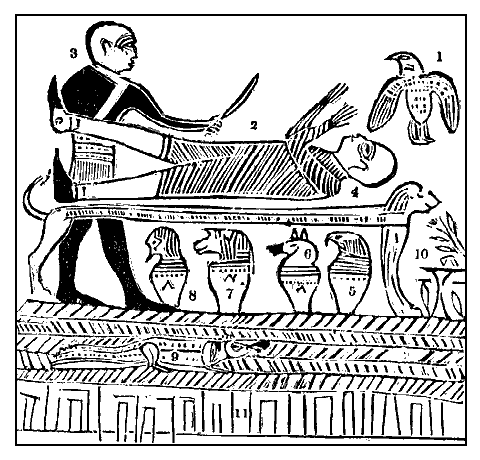
[First chapter of the "Book of Abraham" from the Times & Seasons follows]
THE MORMONS -- JOE SMITH, THE PROPHET. Joe is decidedly the greatest original of the present day. He carries all before him when he undertakes an enterprise -- knows no impediment -- and never halts in his course till he has accomplished his object. His post, at the head of the Mormons, is a conspicuous one, and in a few years of such advancement as he has met with for the past year, will give him a numberless host of followers. We should not be surprised if Joe should become as omnipotent as ever the Pope was in his palmiest days. He is a genius -- and a rare one -- and all the armies of Satan, should they confront him in a solid phalanx, would be sure to meet with sore discomfiture, if not with complete annihilation. The true philosophy of goaheadity -- the quintessence of concentrated moral and spiritual energy-fears no combat-and although we cannot say it exactly courts danger, it never flies from the post of duty on its approach. -- We have so high an opinion of Joe Smith that we intend to open a correspondence with him in order to acquaint ourself with all his secret springs of action, and thus get all the secrets of his success, public and private, worldly and ecclesiastical. |
|
Vol. I. Boston, Massachusetts, Saturday, April 23?, 1842. No. 3?
LATTER DAY SAINTS AGAIN. We have the pleasure to lay before our readers the following letter from Elder Nickerson, the presiding elder of the church of Latter Day Saints in Boston, who believes, to use his own words, that "wickedness will soon be swept from the earth, and that the day of universal righteousness will set in during this generation, when our offices shall all become peace, and our exactions righteousness:" |
 Vol. VIII. Lowell, Massachusetts, Saturday, April 23, 1842. No. 1162.
MORMONS. There are some Mormons preaching up in Middlesex Village, who, it is said, are doing a smart business in the proselyte line. |
|
Vol. XI. Boston, Massachusetts, Wednesday, April 27, 1842. No. 51.
THE MORMONS,
This increasing but persecuted sect, it seems to us, are the only consistent sect now extant. They are the only sect who act up on strict accordance to the Scripture. They are in fact, the only sect who act as if they believed what they profess. In the last chapter of the Epistle of St. James, it is written: "If there be any illness among you, ye shall call for the elders of the Church, and anoint yourselves with oil in the name of the Lord." Here is a plain prescription for the cure of disease, coming directly from God, according to the professed belief of Christians; coming certainly from God, if the New Testament be a divinely inspired volume, Yet how few Christians there are who would not laugh to scorn the very suggestion to treat their sick in this manner! Instead of the elders of the Church, modern Christians send for a physician, and instead of anointing with oil, they dose the patient with drugs which were unknown to St. James or any of the apostles. Does not this neglect of the plain advice of scripture prove that modern Christians believe themselves wise above what is written, and that they are willing to set at naught one of the commands of an inspired Apostle, because they believe themselves wiser than he? |
EDITED BY J. H. NOYES & J. L. SKINNER. Speak unto the children of Israel, that they go forward... Exodus, xiv., 15. Vol. II. Putney, Vermont, Thursday, June 2, 1842. No. 15.
MORMON VIEWS OF BAPTISM. A mormon preacher was present at the discussion of the subject of Baptism, in the Newark Convention. At the close of it, he requested liberty, and was allowed, to give his sentiments on the subject. The following is a specimen of his reasoning. "Paul planted and Apollos watered. Plants will not grow unless they are watered; so men must be watered in order to be saved. This matter may well be compared to the working of a steam engine. The engine will not work without steam, so men cannot be saved without the Holy Ghost. But steam cannot be had without water; so men cannot get the Holy Ghost without baptism!" The preacher was a little disconcerted on being referred to Acts x. 44-48, where it appears that the Holy Ghost was given to the Gentiles before they were baptized. |
|
Vol. ? Boston, Massachusetts, Tuesday, June 7, 1842. No. ?
The Latter-Day Saints have been giving two or three lectures on the beauties and benefits of Mormonism, with what success we have not heard. If they are left to themselves, and not brought into importance by opposition. The agitation will, we have no doubt, die a natural death. -- Cheltenham Examiner. |
AND EXPOSITOR OF PROPHECY. Vol. III. Boston, Massachusetts, Wednesday, June 8, 1842. No. 10.
Mormonism -- Some Curious Facts.
|
|
Vol. XII. Boston, Massachusetts, Wednesday, June 8, 1842. No. 4.
REV. DR. GEORGE MONTGOMERY WEST. -- This redoubtable champion of the Cross, who a few months since visited Boston for the purpose of arguing down Infidelity but who got argued down himself and was glad to be off with what remained of him, has, after repairing his damages, appeared again in this city, and commenced a job at preaching. He had some difficulty, we suspect, in obtaining a house, or he would have selected some other than a Church of the Millerites! An English clergyman and a "D. D" ought to command a station more exalted, and he would, if he is what he pretends to be. How does it happen, that a "Rev. Dr.," of the Episcopal order, can find admittance only to the houses of Free Will Baptists, a small and insignificant sect? There is something in this that looks suspicious, A clergyman unsustained by his own denomination, yet at the same time thrusting himself upon others, is either a person who cannot be trusted by those who know him, or he is one who is attempting to palm himself upon people who he imagines have not sagacity enough to detect imposition. |
|
Vol. I. Boston, Massachusetts, Saturday, June 11, 1842. No. 10.
ADAMS'S LECTURES IN BOSTON. Mr. Editor, -- Having attended the lectures lately delivered at the Boylston Hall by Mr. Adams, the Mormon lecturer of the city of New York, who has just returned from England where he has been for the last fifteen months declaring what he calls "the glories of the new and everlasting covenant," I thought a short review of said lectures would prove interesting to the readers of your valuable paper; and I have no hesitation in saying that Elder Nickerson has made a decided hit in getting Mr. Adams to assist him at this time, as the large, intelligent, and attentive congregations that have attended to hear his lectures fully prove. |
|
Vol. XII. Boston, Massachusetts, Wednesday, June 15, 1842. No. 6.
TO THE EDITOR OF THE INVESTIGATOR: -- |
|
Vol. XII. Boston, Massachusetts, Wednesday, June 22, 1842. No. 7.
DR. WEST AND THE MORMONS. -- A discussion on the subject of Mormonism was commenced at the Marlboro' Chapel, on Monday evening between Dr. West and Mr. G. J. Adams, a Mormon Elder. The audience was numerous; and, for Christian people, as orderly as could be expected -- that is, rather boisterous. However the affair went off pretty well, and was, on the whole, quite interesting. The valiant Dr. did his best, but he got most essentially mauled and "used up." The Mormon, with the whole Bible at his tongue's end, bore down upon him with a torrent of Scripture that swept away his objections like chaff before the hurricane, and the doughty Dr. was fairly at a loss how to get hold of him. This practice of quoting Scripture is a knock down argument with Christians; and as it can be made to prove Mormonism just as well as any thing else, the poor fellows had to swallow it -- though we perceived that many of them made most awful faces. Mr. Adams is a perfect tearer on the Bible quotations; and the way he brought them to bear in confirmation of Mormonism, must have sorely puzzled many of the faithful. To the infidel, however, it afforded another evidence, if any were wanting, that the Bible, in regard to doctrines, as it is made to prove every thing, proves in fact nothing -- or rather, nothing that is consistent. |
Vol. X. Boston, Massachusetts, Friday, June 24, 1842. No. 305.
==> MARLBORO' CHAPEL. Great public debate and discussion, every evening until further notice, In Marlboro' Chapel, between Dr. West and Elder Adams, on the exciting subject of "Mormonism," so called, in relation to the Book of Mormon, Military movements, alleged 200,000 converts, prophetic and miracle working pretensions, inspiration, supremacy, and other astounding claims. Dr. West undetakes to substantiate his preferred "charged" of blasphemy, imposture, murder, &c. &c., which charges Elder Adams, the Apostle and advocate of the "latter day Saints," undertakes to disprove and refute. Doors open at half-past 7 o'clock each evening -- Discussion to commence at 8 o'clock. Clergy admitted free. |
|
Vol. I. Boston, Massachusetts, Saturday, June 25, 1842. No. 12.
GREAT DISCUSSION ON MORMONISM
MR. EDITOR: -- |
|
Vol. XII. Boston, Massachusetts, Wednesday, June 29, 1842. No. 8.
THE. MORMON DISCUSSION. -- The discussion between Dr. West and Elder Adams, alluded to in our last, was brought to a close on Friday, having occupied five evenings. It was well attended throughout; and the nUdience, with some few exceptions, appeared disposed to listen patiently. We certainly have no great relish for Mormonism, and should rejoice to see every vestige of the wild delusion entirely obliteratetd; but candor obliges us to affirm us our opinion, that Mr. Adams defended it in a masterly manner, and so ingeniously and fairly supported it by the Bible, as to prove beyond a reasonable doubt that Mormonism is the doctrine of the Bible; provided it teaches any one particular doctrine more than another. Were the Bible true, Mormonism is true -- but "there's the rub!" Dr. West, therefore, could do scarcely any thing towards disproving Mormonism on Bible ground; while the charges he preferred against its practice, such as treason, murder, &c., were not supported at all, or rather, were supported by no better evidence than the idle stories invented by Christian enemies. -- The fact is -- and every man not blinded by priestcraft will admit it -- the Mormons have been most outrageously persecuted, and their characters believed to be just what their persecutors have represented them. Hence the attempt of the Rev. Dr. West to fix upon their principles and consequently upon themselves, the detestation of the public. Hence, also, his total failure, which was not less apparent to every discriminating mind, than his bigotry and evasion. |
|
Vol. I. Boston, Massachusetts, Saturday, July 2, 1842. No. 13.
[GREAT DISCUSSION ON MORMONISM] In the haste of my remarks last week I briefly referred to the proceedings of the first three evenings of the discussion, but necessarily omitted several interesting features which I wish now to notice. The last paragraph of my communication which was inserted as the paper was going to press stated that the discussion closed on Friday night; but for want of time and room in your columns my sketches of the last two evenings were reserved till this week. Dr. West spent much of the second and third evenings in reading from a Mormon pamphlet containing a history of the rise of their church, of Smith's finding the plates and translating the Book of Mormon, and the testimony of eleven witnesses who say they saw and handled the plates, three of whom vouch for the correctness of the translation. All this the Dr. pronounced a humbug, and all pretension to revelations or miracles in this age, blasphemy! This was sufficient, he said, to fix upon Mormonism his charges, of Lying, Fraud and Blasphemy. This he relied on as one of his strong-holds and often referred to it, though he brought no scripture to prove his assertion. On the third night Elder Adams answered it as follows. He thanked the Dr. for introducing the narrative and the testimony of the witnesses, &c. as it saved him the trouble. The whole he said was correct and true, but why it was introduced at this stage of the discussion in proof of the charges, he could not imagine If the ground the Doctor assumed be conceded it of course fixed upon Mormonism the charges of Lying and Fraud, but that was the contested point which remained to be proved; and his assumptions were not arguments. Here the Rev. E. T Taylor, chairman, and many of the audience made themselves ridiculous by calling aloud for his proof in its favor. Mr. Adams replied, it was already proved if they would admit the power of testimony. No court of justice could require more than eleven positive witnesses to convict a man or establish any fact. Their testimony must be impeached and proved false, before the Doctor's charge can be fixed upon them. The Doctor contended that they were interested witnesses and therefore not to be believed. Mr. A. contended that if worldly interest were in view instead of honor, they had received calumny and detraction -- instead of wealth, and affluence, stripes and imprisonment; but if eternal interests were before them, he said no consistent man could be a disinterested witness of the things of God, none could say the eight writers of the New testament-on whose authority we believe that book -- were not interested in the things they affirm. Elder Adams referred to four or five prophesies in the Bible as parallel testimony in favor of the Book of Mormon, and his reasoning on them was very plausible. Father Taylor called him to order once because he thought he had made a wrong application of one of the prophesies. The merits of his argument not being a point of order, Mr. Adams very significantly replied he would discuss the subject with the chairman when he had done with his present antagonist. But the chairman became so interested that he forgot that Dr. West had spoken three times and Mr. Adams twice and was very anxious to adjourn, but after several remonstrances from different parts of the house, he put on his thinking cap and concluded that Mr. A. was entitled to another speech, but as it was late Mr. Adams said he should detain them but a few moments, and give the rest of his time, which he did, and the meeting adjourned. Previous to the adjournment, however, Father Taylor resigned the chair because the audience were disposed to be noisy; and some thought him partial, but he was forthwith re-elected, and Thursday evening he again took the chair. |
|
Vol. XII. Boston, Massachusetts, Wednesday, July 6, 1842. No. 9. SECTARIAN PHRASES. On running down the line of what is called ecclesiastical history, we distinctly perceive that there is a natural springing up of sects... |
|
Vol. XII. Boston, Massachusetts, Wednesday, July 13, 1842. No. 10.
==> Mr. G. J. Adams, the Mormon Elder who recently held a discussion in this city with Rev. "Dr." West and used him up most essentially, has again challenged him to another debate; but the chop-fullen "Dr." has no stomach for a second encounter; having got enough at the first. He declines to meet him. He doubtless thinks with Falstaff, who; by the by, he somewhat resembles, that "discrection is the better part of valor." Alas! for the glory of the Church, when its fattest champion quails before the thrusts of a Mormon, and he, like Cassius, of "a lean and hungry look!" Brother Hines! where are you in this emergency? Rouse, man; call up the faithful; and, in one body, charge home upon him, giving him occasionally a touch of Millerism! If all this don't frighten the bold Mormon, he is invulnerable, and the day is against you. |
|
Vol. XVI. Boston, Massachusetts, Thursday, July 14, 1842. No. 1,902.
Trouble among the Mormons. The Burlington (Iowa) Hawk Eye says: "We understand by a private letter from Montrose, that Jo Smith has had a quarrel with Rigdon and Bennett, and that he has turned both of the latter out of the synagogue. Some hard swearing passed between these saints during the quarrel. Bennett threatens to write a book, for the purpose of exposing the rascality of the pretender to a spirit of prophesy. We hope the schism is incurable, as it is said to be. |
|
Vol. I. Boston, Massachusetts, Saturday, July 16?, 1842. No. ?
RIGHT. The papers from one end of the country to the other are rejoicing in prospect of a split in the ranks of the Mormons at Nauvoo. The story runs, that, "Major General John C. Bennett, is about making an expose of Jo Smith and the Mormons." The facts are these: John C. Bennett went among the Mormons and professed their religion. Great confidence was placed in him by the people, and several high offices were given him, among which was Mayor of Nauvoo, General of the Nauvoo Legion, &c. &c. Bennett was soon found to be guilty of gross improprieties: such as living in open fornication, &c. for which he was frequently reasoned with by the brethren, but all to no effect. He was threatened but it done no good. Finding all remonstrance in vain, and having their name and religion frequently sneered at on this account, the "Quorum of the Twelve" excommunicated him for his wickedness. They done perfectly right, and if all our churches would mete out the same reward to backsliders, there would not be half the scoffers and revilers of religion there now is. |
|
Vol. XVI. Boston, Mass., Thursday, July 28, 1842. No. 1906.
The Mormons. We have received, says the Buffalo Commercial , the second number of Gen. Bennett's disclosures. It fully confirms all that the Sangamo Journal said of it. Such a mass of villainy of every kind made thick and slab with lust, was never before disclosed to the public. Gen. Bennett supports all his statements by reference to well-known persons and dates and by the affidavits of respectable people, and if the half of it is true, Joe Smith is one of the greatest scoundrals unhanged. |
|
Vol. VIII. Lowell, Mass., Thursday, July 28, 1842. No. 1203.
AN INTERESTING LETTER --
The following letter was addressed, a few days since, to a highly respectable gentleman of this city, a brother of the writer, in reply to some questions proposed to him. The gentleman being a member of my congregation, presented it to me and by giving it publicity in your paper you will much oblige myself and others. |
|
Vol. VIII. Lowell, Mass., Tuesday, August 2, 1842. No. 1205. A VISIT TO JO SMITH. We present the following extract from a letter received, a few days age, from a clergyman now in Illinois: |
 Vol. ? Boston, Massachusetts, Tuesday, August 2, 1842. No. ?
JOE SMITH. -- A Western editor, speaking of this "Mormon Prophet," scouts the idea that he had any hand in the assassination of Ex-Governor Boggs. He says that Smith, beyond all question, is a knave; but is too fat and good-natured to deal in blood. A glance at his corporation and round face, is sufficient to convince the most skeptical, that bad as his life may have been heretofore, he has of late been accustomed to good living. He is not one of the "lean Cassiuses" who are constantly "hatching treason." It is well known in that region, that he is a mere puppet of men of ten times his talents and ambition -- the tool of others. His "revelations" and commands from heaven are all made at the dictation of his rulers who are behind the curtain. |
|
Vol. ? Boston, Massachusetts, Wednesday, August 3, 1842. No. ?
THE MORMONS. The Warsaw Signal, a paper published near Nauvoo, states that information had been received at Warsaw of the sudden disappearance of Elder Orson Pratt, a prominent Mormon. He left a paper stating that his disappearance was caused by Joe Smith's treatment of his wife, and by some wrong doing in the church. He confirms Bennett's statement relative to Joe Smith's attempt to seduce Mrs Pratt. It was supposed by some in Nauvoo, that he had committed suicide, and about 500 were out in search of him. |
 Vol. XLII. Salem, Massachusetts, Thursday, August 4, 1842. No. 62. MORMON-OMANIA. JOE SMITH AND THE MORMONS -- Bennet, the General, has published the following: |
EDITED BY J. H. NOYES & J. L. SKINNER. Speak unto the children of Israel, that they go forward... Exodus, xiv., 15. Vol. II Putney, Vermont, Saturday, August 6, 1842. No. 16.
I T E M S. ==> DIFFICULT TIMES AMONG THE MORMONS. -- Joe Smith has recently got into a broil with one of his chief men, which will probably occasion him some loss of his religious influence. The account of the matter, as we learn from the papers, is this: Smith, together with the authorities of the Mormon church, in May or June last, publicly withdrew the hand of fellowship from Gen. John C. Bennett. Bennett at that time was Mayor of the city of Nauvoo, and Commander of the Nauvoo Legion, and is stated to have been 'the Prophet's great gun,' Sometime after his excommunication, Smith publicly exposed his conduct and character, and cautioned the church and the honorable part of the community against him as "an impostor and base adulterer." On the other hand, Gen. Bennett has come out in the Sangamo Journal in a furious article, charging Joe Smith with being "king of impostors," "the great Mormon seducer," &c., and denouncing him in very harsh terms. he says "his licentiousness is unparaleled [sic] in the annals of time;" and that he makes this exposure under a threat of death from " the holy Joe and his Danite band of murderers." He also promises to give 'some important facts' hereafter. There is not much direct proof advanced by either party in support of his allegation; it is not improbable however, that there has been much truth told by both of them. |
|
Vol. VIII. Lowell, Massachusetts, Saturday, August 6, 1842. No. 1207.
JO SMITH AND GEN. BENNET. The war which has been raging between these two Mormon leaders for the last few weeks has been pretty "much of a muchness." Bennet accuses Smith of all sorts of enormities, which Smith in return denies, and accuses Bennet of being a hypocrite, an adulterer and liar, and supports his charges with a host of evidence. Upon the whole we think the prophet Jo a better man than General Bennet. |
|
Vol. I. Boston, Massachusetts, August ?, 1842. No. ?
MORMONS, OR "LATTER DAY SAINTS."
|
|
Vol. XVI. Boston, Massachusetts, Monday, August 8, 1842. No. 1909.
Gov. Carlin, of Illinois, is said to have made a requisition upon Gov. Reynolds, of Missouri, for the delivery of the person of General Bennett, charged by Jo Smith with high treason against the State of Illinois. This will delay proceedings against Jo until after the election. (St. Louis New Era.) |
|
Vol. ? Boston, Massachusetts, Monday, August 8, 1842. No. ?
THE MORMONS. -- Elder Orson Pratt. -- We mentioned a few days since the disappearance of this gentleman from Nauvoo, Illinois. He left a communication with his friends, which stated that he had been induced to take this course on account of the treatment of his wife by Smith, and of the general management of the affairs of the church by him. The Warsaw (Ill.) Signal says:-- "We learn from other sources that Smith, finding his attempts on Mrs Pratt were matters of notoriety, went to her husband with a manufactured story, that his wife was a base woman, and that the fact was well known to him. This communication had such an effect upon Mr. Pratt, at once blasting his happiness and the reputation of a virtuous woman, that the wretched husband left the city. It will be recollected that Mrs Schindle, in her affidavit detailing the attempt of Smith upon her, said, "he told her she must never tell of his propositions to her, for he had all influence in that place, and if she told, he would ruin her character, and she would be under the necessity of leaving." This same scheme has been carried out in reference to Mrs Pratt. She "told" on the impostor, and was marked by him for destruction. In a public speech in Nauvoo on the 14th, Joe spoke of this lady -- a woman whose reputation had been as fair as virtue could make it until she came in contact with him -- in a manner only befitting the lowest and most degraded vagabond in existence." |
|
Vol. ? Boston, Massachusetts, Tuesday, August 9, 1842. No. ?
DEFIANCE OF THE LAWS IN ILLINOIS. -- We copy from the Alton Telegraph of the 23d ult. "It is a fact, well ascertained, that Joe Smith has, for some days back, been laying in a large amount of ammunition at the city of Nauvoo. The object of this preparation for war, on the part of the Mormans, is to defend themselves by force against any legal process calling for the surrender of Joe Smith and the assassin who shot Gov. Boggs. They admit that the disclosure of Bennett will result in a requisition, on the part of the Governor of Missouri, for the impostor Joe Smith, together with some of his 'Danites;' and they are thus fortifying themselves to defy the strong arm of the law in its administration of justice." |
|
Vol. VIII. Lowell, Massachusetts, Tuesday, August 9, 1842. No. 1208.
There are 5000 voters among the Mormons. -- They all vote the Loco ticket this year, so there is not much doubt of the result in Illinois. |
|
Vol. VIII. Lowell, Massachusetts, Thursday, August 11, 1842. No. 1209.
THE HOLY WAR at Nauvoo, is going on briskly. Bennett and Jo Smith continue to tell the truth of each other, but it must come hard to them, they are so unused to it. |
FARMER'S CABINET. Vol. XL. Amherst, N. H., Friday, August 12, 1842. No. 51. THE MORMON HUMBUG. This stupid and pitiful delusion seems to be approaching a crisis. Its two great champions at the city of Nauvoo, Jo Smith and Bennett, have quarrelled, and gone to telling the truth concerning each other, in a way which bids fair to blow Mormonism sky-high. Bennett has withdrawn from the fraternity and published an expose in which he accuses Smith of a series of attempts upon the virtue of the females of the sect 'unparalleled in the annals of time.' He also charges upon him the agency in the perpetration of several murders which have occurred in that vicinity, and the attempt upon the life of Gov. Boggs of Missouri. Jo also has published a rejoinder in which he shows up Bennett as 'no better than he should be,' having paid his attentions to another woman notwithstanding he has a wife and three children. He declares that Bennett did not voluntarily withdraw, but was excommunicated to preserve the virtue of the saints from contamination. Truth enough had doubtless been told between them to satisfy any reasonable and candid man that a more hellish imposture was never practiced under the garb of religion than the Mormon fanaticism. Can it be wondered that every new opinion enlists its throng of disciples and advocates, when such an absurd and villainous delusion is sustained and believed by rational beings? -- |
|
Vol. XVI. Boston, Massachusetts, Thursday, August 25, 1842. No. 1914.
Important from the Mormon Country. The St. Louis Republican has a letter from Quincy, Ill., which says: -- Since the election, Gov. Carlin has resolved to comply with the requisition of the Governor of Missouri, and deliver up Joe Smith and A. [sic] P. Rockwell. The Sheriff of Hancock county, elected at the recent election, being a Mormon, the writ was placed in the hands of the Sheriff of Adams county. The sheriff repaired to Nauvoo and arrested Smith and Rockwell, when a habeas corpus was issued by some of the Nauvoo authorities, and the prisoners taken out of the sheriff's custody and released. The sheriff had just returned to Quincy and reported the facts. Our informant says that it was currently reported, while he was writing, that Gov. Carlin was then in the act of issuing orders calling out the military to enforce the arrest, and it was expected they would march on the day following for Nauvoo. Our correspondent, however, expresses the confident belief that when the troops reach the city, Joe and his colleague will be among the missing. |
|
Vol. XLII. Salem, Massachusetts, Thursday, August 25, 1842. No. 68.
IMPORTANT FROM THE MORMON COUNTY. -- The St. Louis Republican has a letter from Quincy, Ill., which says: |
|
Vol. ? Boston, Massachusetts, Friday, August 26, 1842. No. ?
THE MORMONS. -- MILITARY CALLED OUT. -- We learn from the St. Louis Republican of last Friday week, that Gov. Carlin of Illinois had complied with the requisition of the Governor of Missouri, to deliver up Joe Smith and O. P. Rockwell, and that they had been arrested by the sheriff of Adams county, but in consequence of an habeas corpus issued by the authorities of Nauvoo, the prisoners were taken from the sheriff and released. The informant of the Republican says that it was currently reported, while he was writing, that Gov. Carlin was then in the act of issuing orders calling out the military, to enforce the arrest, and it was expected that they would march on the day following for Nauvoo. |
|
Vol. XVI. Boston, Mass., Monday, August 29, 1842. No. 1915.
The Mormons. The Cincinnati Microscope says: "We hear that after the Illinois troops had reached the city of Nauvoo, the prophet was not to be found, high or low, neither could a trace be found of Smith or Rockwell. In a few days we shall hear more from the Nauvoo country. It may be possible that Smith has only concealed himself, to gather his forces to resist the authorities of Illinois. He is a bold, reckless fellow, and we would not be much surprised to hear that a battle had been fought, by the next mail, between the forces of the Mormons and the State of Illinois." |
|
Vol. VIII. Lowell, Massachusetts, Tuesday, August 30, 1842. No. 1217.
JO SMITH has completely escaped from the power of the officers sent to arrest him upon the requisitions of the Governor of Missouri. The officers have returned from Nauvoo, and gave it as their opinion that Jo cannot be taken. |
|
Vol. VIII. Lowell, Massachusetts, Thursday, September 1, 1842. No. 1218.
The story of a fight between the Mormons and Anti-Mormons is probably a hoax; no mention being made of it in the Chicago papers. |
|
Pub. by Nathaniel Willis. 11 Cornmill. Price $3.00 a year, or $2.50 in adv. Vol. XXVII. Boston, Massachusetts, Friday, September 2, 1842. No. 1,391. MORMON DISCLOSURES. We should not think it proper to lay before the public such exhibitions of depravity as the following, were it not that Mormonism, in its treasonable designs, and especially its influence upon political partisans, has assumed a serious aspect, it is a matter of grave concern that such a shocking and wicked imposture, should have been able to secure peculiar advantages from the Legislature of one of our states. It is ominous of evils of great magnitude, in view of the prevalent disposition of Romanism in this country, to court the aid of wily politicians. The statements which follow are taken from the "Watchman of the Valley." |
Vol. ? Portsmouth, N. H., Saturday, September 3, 1842. No. ?
==> A MORMON LEGISLATOR. -- Among the representatives elected in Illinois, is WM. SMITH, brother of Joe Smith, the Mormon Prophet. |
|
Vol. XIII. Boston, Mass., Tuesday, September 6, 1842. No. 3,717.
GEN. BENNETT will give a course of three lectures on Mormonism and the wickedness of Joe Smith at Nauvoo, commencing tomorrow evening. The "silly women" and sillier men who have been led captive by the imposter and his apostles cannot do better than to attend these lectures. |
Vol. XIII. Boston, Mass., Wednesday, September 7, 1842. No. 3718.
MORMONISM. In yesterday's paper we mentioned that Gen. Bennett, the great expositor of Mormonism, would commence a course of three lectures on this subject, this evening at the Marlboro' Chapel. This same perosnage has been lecturing at New York. The Journal of Commerce of that city has the following in relation to him and his lectures. |
|
Vol. XII. Boston, Massachusetts, Wednesday, September 7, 1842. No. 18.
William Smith, brother to Joe, the Mormon prophet, has been elected a member of the Illinois Legislature. He is said to be a disciple of his prophet brother. |
|
Vol. XIII. Boston, Mass., Thursday, September 8, 1842. No. 3,719.
Ex-Major General of the Nauvoo Legion John C. Bennett apparently is not the most learned man of the age, but he told some pretty tough stories about Joe Smith and his deluded followers, at the Marlboro' Chapel, last night. The Ex-General thinks that Mormonism is a cancer upon our free institutions, and the sooner it is cut off the better. He is of the opinion that if the Mormons at Nauvoo should be suffered to multiply for a few years more, as fast as they have for a year or two past, they would be able to defy the armed hosts of the whole Union, the position of their city is so impregnable. |
|
Vol. XVI. Boston, Massachusetts, Thursday, September 8, 1842. No. 1918.
Mormonism. We notice that the individual alluded to in the following paragraph from the New-York Journal of Commerce, has advertised a course of lectures in this city. Other New-York papers represent his lectures as improper and disgusting recitals. |
Vol. XIII. Boston, Mass., Tuesday, September 13, 1842. No. 3723.
GEN BENNETT did not have a very large audience last night. After he had finished his discourse upon Joe Smith and Mormonism, a gentleman rose, and begged permission to read a sketch of the General's character, drawn by the Prophet Joe himself. The General consented, and the gentleman commenced reading from the "Times and Seasons" but the audience began to exhibit symptoms of contrary-mindedness, and the "exercises" of the evening were closed by an elderly Boston lady, who rose, and stated, with feelings of indignation, that she had been at Nauvoo, and had learned by experience what bad men the leaders of the Mormons were. They had taken from her upwards of fourteen hundred dollars! The audience seemed inclined to tarry awhile, and talk the matter over, but, the lights being extinguished, they made for the street. Gen Bennett stated that he should give a recapitulatory lecture on Saturday evening, when he should appear in the uniform of a Major General of the Nauvoo Legion. |
Vol. I. Salem & Lynn, Mass., Thursday, September 15, 1842. No. 28. MORMONISM -- GEN. BENNETT, &c. Five feet nine inches high, with black eyes, black hair sprinkled with gray, dark complexion, and rather a thin face, -- such, as nearly as we could judge by lamp light, was the aspect presented by this would be notable personage, the other evening, in Marlboro Chapel, Boston. We hardly knew, after all, what to think of him and his purposes. His manner does not impress us, as that of one actuated by any very high and noble impulses. Yet, that all he is saying and doing is falsehood and forgery we are not at all inclined to think. That he read sundry documents that were genuine we have no manner of doubt. That his original instigation to what he is doing, is the purest in the world, we must confess we do not believe. -- However, be his motives what they may, we have no question he is in possession of evidence laying open no small amount of villainy. We have before expressed our opinion, that the major portion of those who have joined the Mormon body, have done so in simple sincerity of intent. But that many of those in high places among them are very far from single hearted, we are impressed by Gen. Bennett, let him or his design be what they will. We did not like his manner, his aside comments, his ejaculations, -- and we liked just as little the boisterous applause rendered to his readings or remarks. Still, an impression was left by the whole and this though not very favorable to the speaker, yet decidedly gave us to believe that roguery the most scandalous attaches to Jo Smith, if to no others of the Mormon chief ones. Gen. Bennett read, from various newspapers, accounts of crimes committed by Mormons. This might, peradventure, be well for the public, however it might show for General Bennett himself. It is well that truth be revealed, whatever be the mind of its revealer. -- He then related several advances of a disgusting character, made by Joe Smith to women of Nauvoo. If truly stated these were abominable enough, since they were instances of borrowing the cloak of religion to effect the devil's purposes. We are inclined, from the total impression made on us, to believe that he told what actually occurred. And 'twas vile enough, to be sure. He then read a letter, which taking the entire impression made on us, we incline to hold authentic, written by Joe Smith to Miss Rigdon, in explanation, (as he called it) of proposals he had previously made her. 'Twas not without a certain devilish talent, skillfully employing holy words, and striving to make black appear white, -- an effect it might possibly have wrought, had the person addressed believed with undoubting assurance, the writer to be a holy man. |
|
Vol. VIII. Lowell, Massachusetts, Saturday, September 17, 1842. No. 1225.
A New Sect. -- We verily believe that sects and parties, social, political and religious, will multiply and subdivide until, like the parson's clerk, who formed the sole congregation, every man becomes a sect himself. They have "out west" and "down east," their Latter-Day Saints; and here, as if we were determined to keep pace with the spirit of change which is abroad; we have got the Latter Night Saints! As many as three of this new fangled tribe were simultaneously harranguing the multitude as late at 12 o'clock, opposite St. Charles, on Wednesday night. Although they did not speak exactly in "unknown tongues," yet their language was by no means intelligible. He who appeared to be the high priest, the Joe Smith of the party, wound up every fifteen minutes with the following stereotyoed phrase: "These are facts -- most glorious to behold -- keep them before the people!" -- |
|
Vol. XVI. Boston, Massachusetts, Monday, September 26, 1842. No. 1923.
The Mormons. A statement in the western papers contradicts, under oath, the pretended revelations of J. C. Bennett, formerly of the Mormon Society, and shows him up as an offender against decency, who having been punished for his faults, now wishes to take vengeance upon his judges for their righteous decisions. |
|
Vol. 71 Worcester, Massachusetts, Wednesday, September 28, 1842. No. 3627.
==> We believe the following, or the substance of it, was published by the Spy a year or two since. But under existing circumstances, we presume most of our readers will be glad to see it again: |
NS Vol. XXI. Concord, New Hampshire, Friday, October 14, 1842. No. 24.
The wife (or widow,) of William Morgan of Anti-Masonic memory, is at present a Mormoness; having become the wife of one Harris, a chosen friend of Joe Smith; and who is now dwelling among the latter day Saints at Nauvoo. |
 Vol. XVI. Boston, Massachusetts, Saturday, October 15, 1842. No. ?
Mr. Orson Pratt publishes a communication in the Nauvoo Wasp, in which he states that he has not left the Mormons; but makes no mention of Joe Smith's attack on the virtue of his wife. |
|
Vol. XI. Boston, Massachusetts, Saturday, October 15, 1842. No. 91.
GEN. BENNET'S MORMON DISCLOSURES. The subscribers will publish, in the course of the ensuing week, "Mormonism Exposed," or a History of Joe Smith and the Latter Day Saints: By J. C. Bennett. These highly interesting and astounding disclosures exhibit in their true light the profligacy and wickedness of the Mormon leaders. It will be issued in good style in a 12 mo. volume, of upwards of 320 pages. Orders respectfully solicited. |
Vol. XVIII. Boston, Massachusetts, Friday, October 21, 1842. No. 33.
Mormonism. -- A Mr. T. F. Olney, of La Harpe, Illinois, in the last Springfield Journal publicly withdraws from the church of the Latter Day Saints. he says he 'cannot consent to remain a member of said church, while polygamy, lasciviousness and adultery are practised by some fo its leaders.' Mr. Olney confirms the statements of Bennett, as to Joe Smith's practices. |
|
Vol. XVI. Boston, Massachusetts, Monday, October 24, 1842. No. 1930.
Arrest of Joe Smith. An extra from the Quincy (Ill.) Whig, dated 8th inst, says: -- We understand the Governor has received information that Joe Smith is in custody at Carthage, and that he is to be brought before Judge Douglass, who is there holding Court, on a writ of habeas corpus, for the purpose of trying the validity of the Governor's writ of arrest. From the course things are taking, it is not improbable that the same farce played off two years ago, in which the same parties were interested, will be re-acted again in the present instance. |
|
Vol. XVI. Boston, Massachusetts, Thursday, October 27, 1842. No. 1,931.
The Mormons. It seems to be verified that Joe Smith has actually been arrested, or has surrendered himself into custody. The Springfield (Illinois) Journal, however, suspects that his surrender was not made until he was tolderably well assured of a speedy release by habeas corpus, or some other trickery. The same paper contains a formal renunciation of Mormonism, signed by ten members of the Missouri Church, who declare that they have been "most scandelously imposed upon in matters and things of a divine character." Oliver H. Olney, late a preacher of the Mormon doctrines, has also renounced all connexion with the "Latter Day Saints," as they call themselves, having been a witness to the corruptions and debaucheries of their leaders. |
|
Vol. II. Boston, Massachusetts, Saturday, October 29, 1842. No. 3.
ARREST OF JOE SMITH. -- An extra from the Quincy (Ill.) Whig dated 8th inst., says: -- "We understand the Governor has received information that Joe Smith is in custody at Carthage, and that he is to be brought before Judge Douglass, who is there holding court, on a writ of habeas corpus, for the purpose of trying the validity of the Governor's writ of arrest. From the course things are taking, it is not improbable that the same farce played off two years ago, in which the same parties were interested, will be reacted again in the present instance." |
AND BOSTON OBSERVER.
Devoted to Unitarian Christianity, Sound Morals, Literature and News. Vol. XXI. Boston, Massachusetts, Saturday, October 29, 1842. No. 44. (under construction) KNOX COUNTY, Sept. 18, 1842. |
|
Vol. XI. Boston, Massachusetts, Tuesday, November 1, 1842. No. 105.
We are informed that General Bennett will give a gratuitous Lecture this evening at 7 o'clock, in the Marlboro' Chapel. On Wednesday he intends to leave for New York City, from thence to the West. |
|
Vol. XII. Boston, Massachusetts, Wednesday, November 2, 1842. No. 26.
FANATICISM. -- The present century will be spoken of by posterity as the "Age of Fanaticism." Never were so many wild and visionary notions promulgated; -- never was there so much religious extravagance abroad; -- never were absurdities so readily seized upon by the public mind. The people seem to be looking eagerly for something new, with mouths wide open ready to gulp down the first theological monstrosity that offers. Adventurers are taking advantage of this propensity, and are evidently determined to "make hay while the sun shines." Joe Smith is one of these. Some who go about deluding the people are sincere, but fanatical. But so far as he is concerned, all the facts prove deliberate imposture. He has arranged every thing admirably well for a final blow up. He has accumulated a vast amount of wealth at Nauvoo, and it is all in his own name. He holds it in fee simple. But the fact that nearly half a million of people have adopted him as their prophet -- that they believe he actually did dig up some golden plates -- that the Almighty does communicate with him directly -- shows that the public mind has become mighty credulous. |
AND BOSTON OBSERVER.
Devoted to Unitarian Christianity, Sound Morals, Literature and News. Vol. XXI. Boston, Massachusetts, Saturday, November 5, 1842. No. 45. THE MORMONS. In our last paper we gave a publication by Mr. OLIVER H. OLNEY, in which he had come to the conclusion that it was a matter of solemn duty with him to renounce all connection with "the Latter Day Saints." Mr. Olney has been a preacher of this sect, and an earnest believer of its doctrines. To use his own words, he "has suffered with cold, hunger, and almost every deprivation which ever falls to the lot of mortals -- having travelled on foot for thousands of miles; lodging in the open air, almost naked and friendless, exposed to persecution and violence, with a conscience void of offence;" but at length he discovered that the leaders of the church were not the men that he once supposed -- he had become a witness of their corruptions and debaucheries -- and though he was sure to be assailed by them, he took the course of an honest man, and, denouncing their corruptions, he publicly announced that he had withdrawn from the church. |
|
Vol. ? Boston, Massachusetts, Tuesday, November 8, 1842. No. ?
THE INDIAN'S OPINION OF JOE SMITH. -- The Indians have the greatest possible contempt for Joseph Smith, and denominate him a Tshe-wal-lis-ke, which signifies a rascal. Nor have other false prophets risen more highly in their estimation. A few years since, that notorious deceiver, Matthias, made his appearance one evening at the door of Keokuk's (chief of a neighboring tribe) 'waikeon,' or cabin. |
|
Vol. I. Boston, Massachusetts, November 15?, 1842. No. 20?
A History of the Rise and Progress
...The family of Smiths, consisting of an old man with three or four sons, lived in the Western part of New York; their only employment was "digging for money," which occupation brought them into communion with the departed spirits, which spirits, they supposed, had the 'collecting, safekeeping, and disposing' of the hidden treasures. The experience which Joe acquired in his avocation, soon led him to make the discovery that some people were easily gulled, which discovery suggested to him the idea of distinguishing himself by establishing a new religion. Having a profound knowledge of human nature, he soon succeeded in gaining followers, principally from the ignorant and superstitious.... [Joseph Smith] repaired to the place of deposit and demanded the book, which was in a stone box, and so near the top of the ground that he could see one end of it, and raising it up took out the book of gold; but fearing some one might discover where he got it, he laid it down to place back the top stone as he found it; and turning round, to his surprise there was no book in sight. He again opened the box, and in it saw the book; and attempted to take it out, but was hindered. He saw in the box, something like a toad, which assumed the appearance of a man and struck him on the side of his head. Not being discouraged at trifles, he again stooped down and strove to take the book, when the spirit struck him again and knocked him three or four rods, and hurt him prodigiously.
|
|
AND BOSTON OBSERVER.
Devoted to Unitarian Christianity, Sound Morals, Literature and News. Vol. XXI. Boston, Massachusetts, Saturday, November 26, 1842. No. 48. THE LATTER DAY SAINTS. The emigration of the 'Mormons, or Latter day Saints,' from this port is daily increasing. Notwithstanding the rascalities of their Apostle, Joe Smith, having been so often denounced and exposed these well meaning but deluded enthusiasts continue to leave their native country by hundreds, in order to swell the number of his dupes on the other side of the Atlantic. The class of persons thus emigrating are, in appearance and worldly circumstances, above the ordinary run of steerage passengers. The bulk of them are from the midland counties -- farmers and farmers' servants, with their wives and families. Upwards of 5000 have already emigrated, and an equal number will probably leave before spring. As no better freight is offering, the New Orleans vessels are taking these disciples of the knavish blacksmith at a very low figure. The Syden, for instance, only received £115 for 180 of the Mormons, while the Henry has agreed to carry 140 for £100 -- little more than fifteen shillings a head! All this is clearly indicative of two things; first, the utter stagnation of trade between this port and America at the present moment; and, secondly, the prevalence of superstition and simplicity amongst a class of our countrymen who ought to know better than to leave their homes and kindred in order to follow the fortunes of one of the most ignorant and impudent quacks of modern days, whose knavery is so transparent as to be seen through by every person of ordinary capacity. -- |
Vol. XIII. Boston, Massachusetts, Monday, November 28, 1842. No. 3787.
GOOD NEWS FROM NAUVOO. A gentleman just arrived from Nauvoo, says the Philadelphia Inquirer, states that whole families at a time, were continually leaving that place. The delusion appeared to be on the decline. Our informant describes the houses as small and mean looking log, board, and sod shanties. The Temple is to be large -- that is, should it ever be built; but at present the foundation only is laid. Joe Smith keeps the only store of any consequence, and of course monopolizes most of the trading profits. The whole matter is a system, as he conceives, of cruel and heartless deception, selecting victims, not only in this country, but even more extensively in England. |
|
Vol. XLII. Salem, Massachusetts, Thursday, December 1, 1842. No. 96.
MORMONISM -- JOE SMITH -- The Burlington Hawk Eye of the 3d says, Joe Smith preached at Nauvoo last Sunday to an immense concourse of the brethren. He said in one of his late discourses that Governor Carlin was afraid that he (Smith) wanted to be Governor, but no fears need be entertained on that point, as he considered himself even now in a better situation than he would be if he was Governor or President, being Lieut. General for time and Prophet for eternity, either of which he considered pre-ferable to being Governor or President. He also said if there were any who did not believe in him, they might leave him, and, to use his own expression, 'go to hell and be damned.' |
|
Vol. XVIII. Boston, Massachusetts, Friday, December 2, 1842. No. 45.
Good News from Nauvoo. -- A gentleman just arrived from Nauvoo, says the Philadelphia Inquirer, states that whole families at a time, were continually leaving that place. The delusion appeared to be on the decline. Our informant describes the houses as small and mean looking log, board, and sod shanties. The Temple is to be large -- that is, should it ever be built; but at present the foundation only is laid. Joe Smith keeps the only store of any consequence, and of course monopolizes most of the trading profits. The whole matter is a system, as he conceives, of cruel and heartless deception, selecting victims, not only in this country, but even more extensively in England. |
 Vol. II. Boston, Massachusetts, Friday, January 6, 1843. No. 63.
A SHARP LAD. -- A Mormon boy, during the excitement at Nauvoo, was accosted by a man on horseback, who enquired of him for Joe Smith. The lad asked the gentleman what he wanted of the prophet? "I wish to see him on business," replied the stranger. "On business, eh?" looking up rather mysteriously; "you will not see him to-day -- The prophet has just gone up to heaven on his brother's white horse, and I am fixing this kite to send up his dinner to him." The stranger was suddenly taken with a leaving. |
|
Vol. II. Boston, Massachusetts, Tuesday, January 10, 1843. No. 66.
MORE MORMONS. -- The New Orleans Tropic of the 27th says, "The ship Emerald from Liverpool last night, brought 248 Mormons, bound for Illinois, and all consigned to Joe Smith. Another ship with about as many more of the same kidney, is coming up the river." |
|
Vol. II. Boston, Massachusetts, Friday, January 13, 1843. No. 69.
The Mormon Temple at Nauvoo has not been completed. A certain paragraph which is going the rounds to the contrary notwithstanding. The Mormons now find that they commenced the building on too magnificent a scale, inasmuch as they have not the means to carry their ideas out. The same cannot be said of the Miller Tabernacle -- the builders will carry their ideas out of a "tumble down" in April, or we are mistaken. |
|
Vol. II. Boston, Massachusetts, Monday, January 16, 1843. No. 71.
MORMONISM IN NEW YORK. -- An ill-looking fellow, of the name of Joseph Beebe, a disciple of Joe Smith's, who, with his wife and children, occupied the second floor of the house, 177 Goerck street, on the 31st December last, seduced a wife of a man named Irwin, who lived in the same house, and the parties have since resided at 166 Essex street, as man and wife. It appeared from the affidavit of Harry T. Irwin, Mrs. Irwin's son, that his father and mother, with himself and his little sister, resided at 177 Goerck street, and occupied the first floor. Beebe, and his wife and children, occupied the second floor; that on the 31st December last, Beebe, Mrs. Irwin and her two children, took all her husband's furniture to the house No. 166 Essex street; where they have continued to reside up to Thursday last. It further appeared by the affidavit that Beebe and Mrs. Irwin occupied the same room and bed; and that he beat the children several times without any cause. It showed also that the fellow deserted his own wife and children, and left them in a state of utter destitution. He was held to bail. |
|
Vol. II. Boston, Massachusetts, Tuesday, January 17, 1843. No. 72.
VERY IMPORTANT. -- We learn from the Springfield Journal, that a young lad of that city, of the name of John C. Brewster, a member of the Mormon Church, supposing himself to be inspired, has recently written and published, what he says, is one of the lost books of the Bible. This publication having been circulated among the Mormon churches, the Nauvoo "Times and Seasons," Lieutenant General Joseph Smith's organ, has given notice, that no one but the said Lieutenant General Joseph Smith, is permitted to be inspired, and that the work in question is a perfect humbug. In this latter particular we fully concur with Joe. |
|
Vol. II. Boston, Massachusetts, Wednesday, January 18, 1843. No. 73.
JOE SMITH. -- The Springfield (Ill.) correspondent of the St. Louis Republican, under date of Dec. 31st, says: -- "Springfield has been the theatre of quite an excitement to-day, growing out of the appearance among her citizens of Joe Smith, the Mormon Prophet, accompanied by a retinue of some fifteen or twenty of his subjects. Joe surrendered himself to the sheriff of this county, upon the requisition of the Governor of Missouri, upon a charge of being accessory before the fact to an attempted assassination of ex-Gov. Boggs. After his arrest a writ of habeas corpus was sued out by his counsel, and he was brought before the Circuit Court of the United States, for the district of Illinois. The cause is set down for hearing on Monday next, and Smith entered into recognisance in open court in the sum of two thousand dollars, with approved sureties, for his appearance from day to day. The ground of this application is, that the act of Congress as well as the constitution of the United States, authorizing the surrender of a person in one state to the authorities of another state, charged with crime is founded upon the supposition that the individual sought to be given up has fled from the state where the crime is alleged to have been committed, and is then a fugitive from justice in the state where he is arrested. That such is not the fact in the case of Joe Smith. That when Gov. Boggs was shot, Smith was in the state of Illinois, and had been for months previous, without once being without its limits; consequently he could not have fled from the state of Missouri, where the crime was committed, -- and that he is without the provisions, both of the act of Congress and the constitution of the United States, authorizing the surrender of a citizen of one state to the Executive of another for trial of an alleged crime." |
|
Vol. ? Boston, Massachusetts, Wednesday, January 18, 1843. No. ?
JOE SMITH AT FAULT. -- It appears that the notorious prophet has at last given himself up to the authorities of Illinois. He is charged with conspiring to assassinate Gov. Boggs of Missouri. |
|
Vol. II. Boston, Massachusetts, Friday, January 20, 1843. No. 75. THE IMPOSTOR-PROPHET DISCHARGED. We have chronicled the arrest of Smith, the so-called prophet of the Mormons, at Springfield, Illinois, upon a warrant issued by the Governor of that State (on a requisition from the Governor of Missouri) charging him as accessory before the fact to the attempted murder of ex-Governor Boggs. We have also mentioned his application for a habeas corpus, returnable before the U. S. District Court, to question the legality of his arrest and detention. |
|
Vol. II. Boston, Massachusetts, Thursday, January 26, 1843. No. 80.
Elder G. J. Adams will lecture this evening at the Boylston Hall. Subject: Election and Reprobation; or Calvinism in all its windings and absurdities. Seats free. |
|
Vol. II. Boston, Massachusetts, Friday, January 27, 1843. No. 81.
THE MORMONS. -- A correspondent of the New York Express describes the Mormons at Nauvoo, as from 7,000 to 10,000 strong, and constantly increasing. The greater number live in town, but the country for five miles around, is thickly populated. |
|
Vol. II. Boston, Massachusetts, Saturday, January 28, 1843. No. 82.
Elder G. J. Adams, late from Nauvoo, will lecture at the Boylston Hall to-morrow -- on three interesting subjects, connected with the coming of Christ, and his reign on the earth, -- to commence at the usual hours. The seats at this place are free. |
|
Vol. II. Boston, Massachusetts, Monday, January 30, 1843. No. 83.
JOE SMITH -- the Mormon prophet, says an exchange paper, is a large, portly and fine-looking man, six feet without shoes, looks about 40 or 42, and weighs 230 pounds, eyes light blue, approaching to gray -- light brown hair, peaked nose, large head. I think a very little self-esteem, but more of the intellectual than the animal -- dressed in box coat, black, blue dress coat and pants, black silk velvet vest, white cravat, a large gold ring on the finger next to the little one of his left hand, black cane, and wears a continual smile. |
|
Vol. II. Boston, Massachusetts, Friday, February 3, 1843. No. 87.
GREAT MORMON JUBILEE -- We understand there is to "come off" at the Boylston Hall next Thursday (to continue over Sunday) a grand conference or gathering, of the Mormon Chiefs in this region. As there is to be open doors on the occasion, it will give all an opportunity of attending and investigating for themselves. We expect it will afford a rich treat to all lovers of the antique and curious. |
|
Vol. II. Boston, Massachusetts, Thursday, February 9, 1843. No. 92.
MORMON CONFERENCE. -- Our readers will bear in mind that the great Mormon, or Latter Day Saint, Conference is to commence at the Boylston Hall, this day at 2 P.M. Doors open to all, male and female. Preaching at 7 o'clock in the evening by Elder Derby, one of the "faithful" from Nauvoo. Seats free. |
|
Vol. II. Boston, Massachusetts, Saturday, February 11, 1843. No. 94.
ORDINATION. -- We understand that a number of ministers are to be ordained in the Mormon faith, to-day, at 2 o'clock, P.M., in Boylston Hall. A chance for the curious to become acquainted with their ceremonies. They have been preaching three times a day on Sundays. |
|
Vol. I. Boston, Massachusetts, Saturday, February 11?, 1843. No. 1? TO THE EDITOR OF THE WEEKLY BEE. Dear Sir, -- I wish through the medium of your valuable paper, to make some remarks concerning the Latter day Saints or Mormons, as people in general appear to be entirely ignorant of their doctrine. I had been led, from out door and newspaper reports, to believe they were people of the worst character -- a sect who denied the Bible and substituted another book in its stead; and in short, that they were every thing that was bad. Curiosity led me to their meeting at the Boylston Hall and I can truly say I was astonished and most agreeably disappointed. First a beautiful hymn was read and sung. Then a Prayer, apparently sincere, solemn and impressive, was offered up to that God whom Christians profess to worship -- the blessing of Heaven was invoked upon all men, of every sect, creed and denomination; after which a text was chosen from the New Testament, from which the speaker descanted at considerable length; and I must say I never heard a more able sermon. His reasoning, was logical, philosophical, and easy to be understood. Passage after passage seemed to flow like a torrent to prove this position. He contended that the Priesthood which was lost when the Church went into the wilderness, has been restored by the ministering of Angels -- and that this is Christ's Church re-organized; and having Apostles, Prophets, &c. and also the gifts and blessings, such as healing the sick, &c. &c. in ancient times -- and that Joe Smith is a Prophet chosen of God to lay the foundation and be instrumental in carrying on the great work. That this Gospel must be preached unto all people before the second coming of Christ, which from the signs of the times it is expected will be in this generation. They also preach baptism for the remission of sins, and the laying on of hands for the reception of the Holy Ghost, as practised anciently. The doctrine certainly appears to be plausible, consistent and in accordance with that laid down in the Scriptures. I have been induced to make these remarks from a conviction that this people have been grossly slandered and defamed. If they are imposters, as has been so often represented, or if their doctrine be false, let the public know it before more of the unwary are imposed upon. Let some of our learned Divines come out against them and publicly discuss the subject; it is their duty to do so, that if there be error or falsehood, the public may be disabused. If they are wrong the world ought to know it; and if they are right, it is of vital importance that their doctrine should be widely disseminated. |
|
Vol. I. Boston, Massachusetts, Saturday, February 18, 1843. No. 2. MORMON CONFERENCE. The great Mormon Chiefs met in Conference, at Boylston Hall, on Thursday, Feb. 9th, at two p. m. The number of officials was, 16 Elders, 5 Priests, 4 Teachers, and 3 Deacons, together with a large and respectable assembly of all sects and denominations, both Infidel and Christian, who assembled at an early hour, to hear the wonders of the new and everlasting covenant, The Conference was opened by singing and prayer by Elder G. J. Adams, when, on motion, Elder Adams was called to the chair, and Elder E. P. Maginn was chosen Secretary. The Prest. then stated in a brief manner the object of the Conference, which was for the purpose of spreading the fulness of the gospel, throughout New England, and was followed by Elder E. Snow, whose object appeared to be to disabuse the public mind in relation to signs and miracles, showing their real object, which was for the benefit of the Saints. He also showed the inconsistency of their opponents in circulating such foolish reports concerning them, instead of coming out and meeting them with the word of God, upon the broad platform of honorable investigation. Two or three others of the faithful followed on the same subjects. The Conference then adjourned to two p. m. on Friday. In the evening the public were addressed by Elder Derby on the subject of baptism. Friday Conference met pursuant to adjournment, and was opened with singing and prayer, by E. P. Maginn. The Prest. then called upon the presiding Elders to represent the different branches composing this Conference, which was done... |
|
Vol. IX. Lowell, Massachusetts, Thursday, February 23, 1843. No. 1290.
Editorial Correspondence.
I arrived in Philadelphia, by the cars to Camden, Saturday afteraoon, and I have been in the city now about fifty hours, during which time, or most of it, I have been looking out for wonders and strange sights, about which to fill a latter... |
|
Vol. II. Boston, Massachusetts, Saturday, February 25, 1843. No. 106. Our Weekly. The third number of 'The Boston Weekly Bee' is published this morning, containing a large amount of useful and interesting reading matter... [including] an interesting sketch of the Rise, Progress, and Faith of the Mormons; together with all the news of the week, foreign and domestic, miscellany, anecdote, fun and philosophy... Price three cents per copy... |
|
Vol. I. Boston, Massachusetts, Saturday, February 25?, 1843. No. 3?
Mr. Editor, Sir -- As you have (in justice) given the Mormons a chance to defend their principles from the attacks of those who are ignorant of its true tendency, and some who from self interest, or what is worse, join in the cry of the hounds and huntsmen against the flying and defenceless stag -- for no other reason under heaven than because they see others do it. I think if they reflect for an instant on the unmanly, despotic and unjust principle of persecuting the innocent, without knowing the 'why and wherefore' -- I say if our calumniators reflect, they will say you have done what justice and honor requires of man-given us a weapon to defend (what is dearer to us than life) 'the immortal part of man,' our reputation. |
|
Vol. II. Boston, Massachusetts, Monday, February 27, 1843. No. 107. What do the Mormons Believe? This is a question often asked, and the following sketch from the pen of Elder Adams, the big gun of Mormonism in these parts, will throwsome light upon the subject: -- |
|
Vol. II. Boston, Massachusetts, Saturday, March 4, 1843. No. 112.
THROWING DOWN THE GAUNTLET. -- At a large meeting of the citizens of Charlestown the other evening, at the conclusion of a lecture given by the Mormon big gun, Elder Adams, a number of resolutions were adopted, defying the clergy of other denominations to a controversy on the doctrines of the "Latter-day Saints" -- the scriptures of the Old and New Testament to be the rule of evidence. This sect is rapidly increasing in these parts, and it is well worthy of some of our eminent theologians to enter the lists, and Bible in hand, conquer their champions with their own weapons. |
|
Vol. IX. Lowell, Massachusetts, Tuesday, March 7, 1843. No. 1,295.
==> A Mormon elder in Boston is preaching against Millerism! |
|
Vol. II. Boston, Massachusetts, Thursday, March 9, 1843. No. 116.
OUR WEEKLY. -- Some one has sent us a small pamphlet, containing an account of the remarkable visions of Joe Smith, the Latter-day Saint, in reference to the golden plates of the Book of Mormon -- his manner of discovering them -- how the angel looked -- some particulars about Joe himself -- and various other matters connected with what is called the Mormon humbug. As it will doubtless prove interesting to the curious reader, as proving how far the force of imagination and credulity will go, we shall publish a portion of it in our next Weekly, and continue it in parts until finished. It is written by Orson Pratt, one of the Elders of Nauvoo, and "opens rich." |
|
VERMONT PHOENIX. Vol. IX. Brattleboro, Vermont, Friday, March 10, 1843. No. 28. MORMONISM IN WESTERN NEW YORK. One of our oldest subscribers in Genesee county, who has himself embraced the doctrines of Joe Smith, called upon us a few days ago, and stated that he had been appointed agent for some thirty or forty farmers, now residents of the counties of Genesee and Wyoming, who intend emigrating as soon as they can dispose of their property, to the city of Nauvoo, Ill., the head quarters of the "Latter day Saints." They offer their farms, some of which lie in the vicinity of Batavia, and others on the Attica and Buffalo Railroad, at from 15 to 25 dollars per acre. These facts will excite greater wonder, when it is recollected that the prophet Joe Smith commenced his career in Western New York, and was never able to make but one or two converts here until his name became celebrated at the West. -- |
|
Vol. II. Boston, Massachusetts, Friday, March 10, 1843. No. 117.
OUR WEEKLY. -- The number issued this morning is replete with interesting reading... with a number of interesting communications, among which is the commencement of an interesting pamphlet containing "facts in relation to the discovery of the golden plates of the Book of Mormon;" besides poetry, miscellany, news, and "short paragraphs" ad libitum. |
|
Vol. I. Boston, Massachusetts, Saturday, March 11, 1843. No. 4.
... [Joseph Smith, Jr.] therefore, retired to a secret place, in a grove, but a short distance from his father's house, and knelt down, and began to call upon the Lord. At first, he was severely tempted by the powers of darkness, which endeavoured to overcome him; but he continued to seek for deliverance, until darkness gave way from his mind; and he was enabled to pray, in fervency of the spirit, and in faith. And, while thus pouring out his soul, anxiously desiring an answer from God, he, at length, saw a very bright and glorious light in the heavens above; which, at first, seemed to be at a considerable distance. He continued praying, while the light appeared to be gradually descending towards him; and, as it drew nearer, it increased in brightness, and magnitude, so that, by the time that it reached the tops of the trees, the whole wilderness, for some distance around, was illuminated in a most glorious and brilliant manner. He expected to have seen the leaves and boughs of the trees consumed, as soon as the light came in contact with them; but, perceiving that it did not produce that effect, he was encouraged with the hopes of being able to endure its presence. It continued descending, slowly, until it rested upon the earth, and he was enveloped in the midst of it. When it first came upon him, it produced a peculiar sensation throughout his whole system; and, immediately his mind was caught away, from the natural objects with which he was surrounded; and he was enwrapped in a heavenly vision, and saw two glorious personages, who exactly resembled each other in their features or likeness. He was informed, that his sins were forgiven. He was also informed upon the subjects, which had for some time previously agitated his mind, viz.-- that all the religious denominations were believing in incorrect doctrines; and, consequently, that none of them was acknowledged of God, as his church and kingdom. And he was expressly commanded, to go not after them; and he received a promise that the true doctrine -- the fulness of the gospel, should, at some future time, be made known to him; after which, the vision withdrew, leaving his mind in a state of calmness and peace, indescribable. Some time after having received this glorious manifestation, being young, he was again entangled in the vanities of the world, of which he afterwards sincerely and truly repented. |
|
Vol. XLIII. Salem, Massachusetts, Thursday, March 16, 1842. No. 22. LECTURE ON THE WEST. Mr. Newhall, who is to lecture at the Lyceum Hall on Tuesday evening next, passesses ample materials for interesting, instructing and entertaining our citizens. That they may have some idea of what is in store for them, we copy the following from the Lynn Freeman: -- |
|
Vol. II. Boston, Massachusetts, Friday, March 17, 1843. No. 123.
Gen. John C. Bennett, the seceder from the Mormon faith, is now at Plymouth, in this State, at which place he is about to take to himself a "better half." There is no question but what he needs a better half or a better whole. |
|
Vol. I. Boston, Massachusetts, Saturday, March 18, 1843. No. 5.
It was at the [Hill Cumorah], where the record was found to be deposited, on the west side of the hill, not far from the top down its side; and when myself visited the place in the year 1830, there were several trees standing -- enough to cause a shade in summer, but not so much as to prevent the surface being covered with grass -- which was also the case when the record was first found. |
|
Vol. II. Boston, Massachusetts, Thursday, March 23, 1843. No. 128.
NAUVOO ABOLISHED. -- In the Illinois Legislature, on the 27th ult., the Senate repealed the law creating the Nauvoo Legion military corps. They also repealed the charter of the Mormon city of Nauvoo. The vote in favor of the latter was 22 to 11. |
|
Vol. I. Boston, Massachusetts, Saturday, March 25, 1843. No. 6.
...Mr. Smith continued the work of translation, as his pecuniary circumstances would permit, until he finished the unsealed part of the records. The part translated is entitled the "Book of Mormon," which contains nearly as much reading as the Old Testament. |
|
Vol. II. Boston, Massachusetts, Tuesday, March 28, 1843. No. 132.
FAREWELL SERMON. -- We are requested to state that Elder G. J. Adams, the powerful Mormon preacher, will deliver his farewell sermon this evening at Boylston Hall, previous to his departure for the West. |
|
Vol. II. Boston, Massachusetts, Thursday, March 30, 1843. No. 134.
IMMERSION. -- The Mormons had another baptismal ceremony at the Railway on Monday evening, when twenty-five new members were added to their fold. -- This sect is increasing very rapidly in this vicinity, under the zealous activity and enthusiastic preaching of their "great gun," Elder Adams. |
|
Vol. I. Boston, Massachusetts, Saturday, April 1, 1843. No. 7.
...in the year 1829, Mr Smith and Mr Cowdery, having learned the correct mode of baptism, from the teachings of the Saviour to the ancient Nephites, as recorded in the "Book of Mormon," had a desire to be baptized; but knowing that no one had authority to administer that sacred ordinance in any denomination, they were at a loss to know how the authority was to be restored, and while calling upon the Lord with a desire to be informed on the subject, a holy angel appeared and stood before them, and laid his hands upon their heads, and ordained them, and commanded them to baptize each other, which they accordingly did. |
Vol. XX. Salem, Massachusetts, Wednesday, April 5?, 1843. No. ? [a Lecture Delivered in Salem, by Mr. J. B. Newhall] The Nauvoo Temple is a very singular and unique structure. It is 150 feet in length, 98 feet wide, and when finished will be 150 feet high. It is different from any thing in ancient or modern history. Every thing about it is on a magnificent scale, and when finished and seen from the opposite side of the river, it will present one, if not the most beautiful, chaste, and noble specimens of architecture to be found in the world. We should like to be in possession of a model of this building, both on account of its great notoriety, as being connected with the Mormon or Latter Day Saints' religion, and also a work of art. Did our limits here permit, we might give a very minute description of the whole order of architecture. This splendid drawing was executed by Mr. Newhall, while in Nauvoo, from a copy in the archives of that city. We wish he had taken it on a large scale, but he probably did not, on account of transportation. We regret exceedingly that we did not have the privilege of a near inspection of the map of the city of Nauvoo; the place which for some time past has created more intense interest perhaps, than any other city, town or village in the country, if not in the world. But on inquiring for it we found it had been rolled up and packed away. He gave a very glowing and interesting account of this city. The location is one of the most beautiful on earth. Situated on the Mississippi river, rising in an inclined plane, till it reaches the height where it overlooks an extensive tract of territory, unrivaled in rich and varying scenery. His account of the military displays in Nauvoo, where the regiment, or Joe Smith's legion as it is called, turns out, is very interesting and exciting. He spoke of the six ladies on horses, with white feathers or plumes waving over black velvet, riding up and down in front of the last regiment. This must appear singular, at least to a Yankee. |
|
Vol. II. Boston, Massachusetts, Wednesday, April 12, 1843. No. 144. (CORRESPONDENCE OF THE "BOSTON BEE.")
|
|
Vol. II. Boston, Massachusetts, Tuesday, April 18, 1843. No. 149. (CORRESPONDENCE OF THE "BOSTON BEE.")
|
Vol. I Boston, Massachusetts, April 22?, 1843. No. 11? M O R M O N I S M. Dear Sir -- I have for some time past, been a regular attendant at the meeting of the Latter Day Saints, or Mormons, held at the Boylston Hall -- and have thought I would give you some account of how those people are getting along. When Elder Adams left here, some weeks since, for the City of the Saints, where he had been called by the heads of the church, it was supposed that no one could be found competent to fill his place -- that the meetings would decline -- Mormonism die away, and finally sink into its original nothingness. Not so, however -- no sooner had this lion, as he was called, left the field, than his place was supplied in the person of Elder Maginn. Before proceeding, let me give you a description of this man. He is 24 years of age, though his appearance is that of a man farther advanced in years, caused probably by the many hardships, privations, persecutions and mobbings, which he has passed through for the gospel's sake. He is six feet in height, and of rather a commanding appearance; and honest, happy smile plays over countenance, which, (if I am any judge of the "human face divine") indicates that all is right within; and if a thorough knowledge of the scriptures, talent, tact, sound reasoning, and powerful argument, are qualifications, then Elder Maginn is fully qualified for the duties of his office, and must pass as truly a master workman. He seems perfectly intimate with all the old apostles and prophets, and it is truly astonishing with what facility he quotes the scriptures from memory, giving chapter and verse, with the greatest ease, and correctness. On Sunday last, he delivered a most able discourse on the subject of prophesies already fulfilled, from 2d Peter, 1st chapter, 20th and 21st verses: "Knowing this first, that no prophecy of the scripture is of any private interpretation, for the prophecy came not in old time by the will of man, but by holy men of God spake as they were moved by the Holy Ghost:" And went on to prove that from the days of the first prediction to the present time, every prophesy has had a literal fulfilment. He commenced with the days of Noah, Genesis vi: 17, and showed that had Noah understood this spiritualizing system, and supposed the flood of water was to have been a spiritual one, the ark a spiritual ark, &c. &c., Noah and his family must have perished with the rest of the inhabitants of the world. But no -- he believed -- when God said "And behold I, even I do bring a flood of waters upon the earth, to destroy all flesh wherein is the breath of life from under Heaven, and every thing that is in the earth shall die." He meant to do just what he said he would do, and nothing else; and the sequel proved that Noah was right in thus believing. He next referred to Genesis, xv: 13 to 16th verses -- and also to Lot's leaving Sodom, Genesis xix: 12th verse. He next quoted the prophecy of Joseph, Genesis 41st chapter, 29th verse, and showed that misery, sorrow, suffering, death and mourning, would have followed had they believed there was to have been seven years of spiritual plenty and seven years of spiritual famine, only. He then carried us forward to the history of the principal nations, vide Jeremiah 25th chapter, 20th verse. It is out of my power to follow him through, or give even a faint outline of this most noble address. Passage after passage, plain and positive, from Holy writ, were brought forward in rapid succession to prove that all prophecies that have been fulfilled were fulfilled literally, and that those yet in the future must also have a literal fulfilment. His reasoning was plain, logical and conclusive to the mind of every candid hearer; and I much regret that I am not better able to portray his most convincing and able lecture. He remarked that the days of those prophets, are by the sectarian world called the "Dark Age;" whereas men were in fact far more enlightened than even the great divines of the present day, with all their boasted wisdom, knowledge, and pretended piety. Those men were as familiar with the designs of God, and the future destiny of nations, as we are with the history of past events. Instead of darkness, God revealed himself to man, conversed with him, told him what should come to pass in future ages -- where, we are now told that God has ceased to give revelation to man -- that prophesying is done away -- that the only guide necessary is a brief history of certain events which transpired centuries ago, and certain prophecies which they contend mean any thing but what they profess. Enlightened indeed! when the church is cut up into some hundreds of sects and parties, each differing from the other; the blind leading the blind, and all under the dominion of bigotry, superstition and priestcraft; the mind of man shrouded in worse than Egyptian darkness. Could we look down through the dark vista of time and foresee future events as did the prophets of old, then could we boast of living in an enlightened age; but whilst we deny revelation, we are, and must continue to remain in darkness and error. |
|
Vol. IX. Lowell, Massachusetts, Tuesday, April 25, 1843. No. 1315. THE GREAT WEST. At the solicitation of numerous citizens of Lowell, Mr. J. [B.] Newhall, of the territory of Iowa, will deliver a lecture in the John St. Vestry, on Wednesday Evening next, at 7:30 o'clock, upon the physical features, resources, rapid advancement and future prospects of the grest "Far West," particularly the territory of Iowa -- illustrated by soils, minerals, prairie sketches, view of the grand Mormon Temple, and city of Nauvoo; and likewise sketches of Indian character, with portraits of Black Hawk, Keokuck and Appanoose, and exhibition of the full dress of a Sack warrior, and a scalp of their enemies the Sioux. Tickets 12 1/2 cts. |
 Vol. III. Boston, Massachusetts, Friday, April 28, 1843. No. 4. (CORRESPONDENCE OF THE "BOSTON BEE.")
|
Vol. I. Lowell, Massachusetts, Saturday, April 29, 1843. No. 52.
MORMONISM vs. MILLERISM. -- Joe Smith, we speak reverently, the Mormon Prophet, has announced to them that are of a fearful heart, that the World will not come to an end in 1843. Inasmuch as the earth is not yet prepared for the reception of the Latter Day Saints! |
|
Vol. IX. Lowell, Massachusetts, Saturday, April 29, 1843. No. 1317.
DISCUSSIONS. We are informed that the lovers of "free discussion" have been highly entertained with an exhibition of it in Chapel Hall, Wyman's building, during the past week. The discussion has been in reference to the authenticity of the Mormon Bible, and has been carried on by a Mormon Elder and a man named Palmer. We are told that at various times the meeting exhibited a very fair daguerreotype miniature likeness of Pandemonium. Mr. Palmer stands in the same relation to the Mormons that Peter the Hermit did to the Infidels who possessed the holy city. |
Vol. I. Boston, Massachusetts, Saturday, May 20?, 1843. No. ? M O R M O N I S M. Mr. Editor: -- On visiting Boylston Hall, as usual, on Sunday last, I missed Elder Maginn's honest countenance, and in his stead was a stranger, who, I was informed, is called Elder Willey. I was somewhat disappointed, but as I am "seeking after truth," I care not from whom or from what quarter it comes. I determined to pay every attention to what was said, and seated myself with pencil and memorandum book in hand, for, Mr. Editor, I always take notes of chapter and verse, and when I go home, take down my Bible and examine whether they have told me truth; and if I ever do catch them misquoting, or trying to deceive the people by preaching any other doctrine but that contained in the Bible, I'll expose them-the way I'll serve them up will be a caution -- General Bennet's expose will be no touch to it. -- But to return to Elder Willey. He commenced by saying that he meant to take the Bible for his text, and the contents of his sermon; and I was much pleased to hear the manner in which he quoted from that good book. He took up the subject of the restoration of Israel and certainly handled it in a masterly manner. He spoke with much energy and appeared to feel and mean just what he said. He contended that Israel would be restored, and as I have not time, and do not wish to trespass too much on "Every body's Corner," I will briefly quote some few of the many passages he cited to prove his position, so that any of your readers who feel an interest in these things may examine for themselves. But first, he quoted John, chap. 5, v. 39; "Search the scriptures; for in them ye think ye have eternal life; and they are they which testify of me" and then enquired, "How are we to search them? and found an answer in Romans, 15, 4, 2d Peter, 1, 19, to 21; John, 17, 17; Amos 3, 7, - and that taking "thus saith the Lord" for a definite assertion-a figure for a figure and a parable for a parable, a rule was laid down by which to work. He then, to show that Israel would be restored, proceeded to quote and briefly comment on the following texts: Jeremiah, 12, 14 to 17; Isaiah, 11, 11; Deut., 30, 1 to 9; Jeremiah, 16, 21; Isaiah, 40, 1 to 5; 43, 1 to 7; 49, 10 to 23; Jeremiah 30, 3 7 and 11; 31, 3 to 13; Ezekiel, 34, 22 to 31; 29, 21 to 29; 37, 21 to 28; 36 34 and 35, Hosea, 14, 4 to 7; Amos, 11, 15; Psalms, 144, 5 to 15; Joel, 3; Zachariah, 2, 4 to 13; 10, 6 to 12; 12, 8 to 11; 14 ch.; and several other passages, but perhaps when the reader has attentively examined the ones above mentioned, he will be convinced of the fact that the Jews will be gathered back to Jerusalem, that that city will be built up and that they shall again possess the land from which they were driven. |
|
Vol. III. Boston, Massachusetts, Thursday, May 11, 1843. No. 15. (CORRESPONDENCE OF THE "BOSTON BEE.")
|
|
Vol. III. Putney, Vermont, Monday, May 15, 1843. No. 7.
The Book of Mormon. BR. NOYES: Having lately come in contact with the Mormons, the question has arisen in my mind. How can they be most effectually met, in their Heaven daring career of imposture and folly? The answer to the question has appeared to be this: let the people know the contents of the Book of Mormon before they become entangled with their sophistry, and there will be no danger. The Book of Mormon is the greatest compound of grammatical blunders, absurdities, impossibilities, contradictions of fact, and contradictions of the Bible, that I have ever seen. It professes to be not only written, but also to be translated, by inspiration. If you ask a Mormon how inspiration could commit so many blunders, he will tell you that the printer and the type were not inspired, and thus lead you if possible to believe that they are only typographical errors. But each and every edition of the work, although carefully revised by Joseph Smith and others, contains the same blunders; and it is not at all probable that the uninspired type should commit the very same mistakes in every edition. Again; page after page of the Book of Mormon is taken up with quotations from the Bible: those quotations are written correctly, -- no mistakes, no grammatical errors occur, while the other parts of the book abound with the most egregious blunders. I will give you a sample by way of illustration, although my limits will not permit me to do more than glance at this part of my subject. The following are some of them: |
|
Vol. IX. Lowell, Massachusetts, Saturday, May 20, 1843. No. 1326.
Some brass plates, with wonderful inscriptions, have been found out West somewhere. They have been sent to Nauvoo, for Joe Smith to look at. -- Now look out for some extraordinary developments. |
|
Vol. III. Boston, Massachusetts, Saturday, May 20, 1843. No. 23. (CORRESPONDENCE OF THE "BOSTON BEE.")
|
|
Vol. III. Boston, Massachusetts, Monday, May 22, 1843. No. 24. (CORRESPONDENCE OF THE "BOSTON BEE.")
|
|
The Burlington Free Press. Vol. XVI. Burlington, Vermont, Friday, June 2, 1843. No. 52. MORE MORMON PLATES. Two of the Illinois papers, the Whig and the Herald, published at Quincy in that State, have lately put in circulation a tale of six brazen plates dug out of an ancient mound in Pike county, III., in the vicinity of a place called Kinderhook. The plates are stated to be covered on each side with hieroglyphics. Some of the figures have a little resemblance to the sun, others to the moon, others to trees; and ''many," says the Herald, "have a striking similarity to some of the capital letters and figures of the English language." The more material part of the account we copy as follows: |
|
Vol. IX Lowell, Massachusetts, Thursday, July 13, 1843. No. 1348.
Great Excitement at Nauvoo! -- Arrest of Joe Smith, the Mormon Prophet! -- News was brought last evening by the steamer Osprey that Joe Smith, the Mormon Prophet, had been arrested and placed in jail at Ottawa; and further, that when the intelligence reached Nauvoo, two hundred horsemen of the legion started immediately for Ottawa, with the intention of liberating him. The steamboat Iowa had also been chartered at Nauvoo by the Mormons, and is at present ascending the Illinois river with 150 armed men, to second the attack of the horsemen at Ottawa. Ottawa is situated up the Illinois, and is distant about two hundred miles from this city |
|
Vol. ? Boston, Massachusetts, Saturday, July 15, 1843. No. ?
JOE SMITH. -- The St. Louis Republican of July 3d says: "We were informed by a gentlemen from up the river, who arrived here yesterday morning, that Joe the Prophet had been liberated or rescued by his legion. The boat in which he was brought back touched at Quincy on her road back to Nauvoo, having Joe safe and sound onboard." |
|
Vol. XLIII. Salem, Massachusetts, Monday, July 17, 1843. No. 57.
An attempt is to be made, it appears, to convert the Russians to Mormonism. Joe Smith has appointed Elders Hyde and Adams to go to St. Petersburg for that purpose. "Great doings" may be expected. |
|
Vol. XIII. Boston, Massachusetts, Wednesday, July 26, 1843. No. 12. MORMON BIBLE. We give place to the following article on the origin of the Mormon Bible, to oblige an old and much respected friend, and not because the article itself contains any thing new, or because we have the slightest regard for the notorious John C. Bennett, from whose miserable catch-penny book the certificates respecting the authorship of the Mormon Bible are copied. At the same time, we do not wish to be understood as having the least synpathy for this Mormon momstrosity, which may, for any thing we know to the contrary, have been the production of Mr. Spaulding; but we place no sort of reliance, in confirmation of the fact, upon any testimony of Bennett himself, and indeed the testimony which he says was given by others is rendered suspicious by his own contemptible treatment of the Mormons. He says he went among them a stranger; they gave him a friendly welcome, elevated him to stations of honor and trust, and for years he lived upon their bounty. When he could no longer fleece them, the ungrateful whelp, in return for their kindness, published to the world a large volume of their pretended vices and immoralities. We do not know, to be sure, that the volume is not true; but for all that we have no confidence in the statements of a fellow guilty of such consummate meanness and hypocrisy, and we cannot suffer any extract from his vile work to appear in our paper without saying beforehand, that we heartily despose and detest him. |
|
Vol. IX Lowell, Massachusetts, Saturday, August 5, 1843. No. 1358.
Western Correspondence to the Courier.
|
|
Vol. III. Boston, Massachusetts, Saturday, August 5, 1843. No. 89. (CORRESPONDENCE OF THE "BOSTON BEE.")
|
Vol. XIV. Boston, Mass., Saturday, August 12, 1843. No. 4003.
THE MORMONS AND JOE SMITH. the following letter descriptive of the residence of the Mormons, and their "great captain," is by the St. Louis correspondent of the Journal of Commerce. |
|
Vol. IX. Lowell, Massachusetts, Thursday, August 17, 1843. No. 1363.
THE MORMONS. A correspondent of the Baltimore Patriot writes as follows of the city of Nauvoo and its inhabitants: |
|
Vol. ? Northampton, Massachusetts, Tuesday, August 22, 1843. No. ? NAUVOO AND JOE SMITH. A correspondent of the N.Y. Journal of Commerce who hails from St. Louis, says -- |
Vol. XIV. Boston, Mass., Tuesday, August 29, 1843. No. 4017.
WHY JOE SMITH WAS ARRESTED: AND HOW HE ESCAPED. A correspondent of the Bunker Hill Aurora, writing from Fort Madison, gives the following story about the notorious Nauvoo Captain: |
|
Vol. III. Boston, Massachussets, September ?, 1843. No. ?
INCONSISTENCIES OF PROFESSED
Reading an article in the Times of the 20th inst. headed "Taking the Veil," my thoughts were led to muse on the gross inconsistency of the present professed Bible believing generation. Now it is a well known fact, that the present christian world, (with the exception of a few that the rest term infidels,) both priest and people, editors and readers, are professed believers in the Bible, and are ready to denounce a man as infidel, who dares question its authority; they believe it to be a revelation of the will of God to man, for the purpose of effecting his salvation; and (with the exception of the Mormons,) they believe it to be the last and only revelation that man ever did or will receive from his God. Now if they acted consistently, would they not receive and support those who come among them preaching and practicing the plan of salvation, with its ordinances contained in the New Testament, to the very letter and repudiate and condemn all others. Would they not obey the injunction of John, 'if any come among you and obey not the doctrine of Christ, receive him not into your houses, neither bid him God speed.' |
|
Vol. III. Boston, Massachussets, September ?, 1843. No. ? (CORRESPONDENCE OF THE "BOSTON BEE.")
|
|
Vol. ? Northampton, Massachusetts, Tuesday, September 5, 1843. No. ?
THE MORMONS. -- The refusal of Gov. Ford of Illinois to comply with the requisition of the Governor of Missouri, for the surrender of Joe Smith, the Mormon Chief, is likely to produce a serious commotion. It is said that twenty thousand of the people of Missouri are ready to go into the State of Illinois, and take him by force. The offence charged against Smith is that of having been accessory to the assassination of Gov. Boggs of Missouri, about two years since. |
 Vol. ? Boston, Massachusetts, Saturday, October 7, 1843. No. ?
The Mormons and Anti-Mormons. On Wednesday last a meeting of Delegates from Hancock and the surrounding counties was held at Carthage. They had been appointed at a previous meeting of the People opposed to the Mormons. The official proceedings have not yet reached us, but we learn from the Burlington Hawk Eye of Saturday last, that the resolutions adopted, were of the strongest kind. "They declared that if Gov. Ford would not surrender 'Jo Smith' on the requisition of the Governor of Missouri -- which he has refused to do from political considerations -- that they would call in aid from other counties and other States to assist them in delivering him up." As rumors were prevalent that a number of the citizens had their lives threatened by the Mormons, the meeting resolved to avenge any blood that might be shed. -- They agreed not to obey the mandates of the Mormon officers of the county, who have been put in power by the Mormons, the whole county treasury being now at their disposal. There is considerable excitement -- the crisis seems to be rapidly approaching -- and we greatly fear the consequences. -- All may be remedied if the Mormons, as a religious body, will but eschew politics and amalgamate with our citizens -- but we fear it is too late to do even that. -- |
|
Vol. XLIII. Salem, Massachusetts, Thursday, October 12, 1843. No. 82.
THE MORMON PROPHET -- It is a curious feature of the human mind, (says the N. York Commercial Advertiser) and wonderfully illustrative of its proclivity to evil, that the most successful impostors, especially in matters of religious faith, are generally the very kind of men whose delusions ought to be most easily seen through and scouted. Courtney, Matthias, Joanna Southcote, Jacob the White Quaker, and many others who have led thousands astray, were ignorant, uncouth in manners, rude in speech, and utterly incapable of sustaining themselves against intelligent investigation; yet they succeeded in deceiving many whose intelligence and judgment, in ordinary matters, were far superior to their own. And this seems to be the case, too, with the Mormon impostor, as we find him described by the editor of the Pittsburg Gazette, who has recently made a visit to the Mormon capital. He says -- |
|
Vol. IV. Boston, Massachusetts, Thursday, November 16, 1843. No. 20.
JOE SMITH. -- The following odd resolutions, among others, were passed at the opening of Joe Smith's tavern, at Nauvoo, on the 3d. ult. |
|
Vol. ? Boston, Massachusetts, Wednesday, January 17, 1844. No. ?
THE BIBLE AND THE BOOK OF MORMON. --
In the present article, we propose two things: -- 1st, to demonstrate that every part of the Bible, both of the Old and New Testament, has originated in the same way as the Book of Mormon; and 2dly, that Mormonism will ultimately become the predominant sect, and the Book itself be incorporated in the Bible, and they in the Church. This is our PROPHECY. Let the present No. of the Investigator be preserved; for in less than fifty years the prophecy will be fulfilled, and a part in less than ten. We lay aside our indignation of these Christian superstitions, for a time, and enter calmly, coolly, and earnestly on our work. We are as sure of effecting our object, as ever we were of performing successfully an algebraic equation. |
Vol. ? Boston, Massachusetts, Saturday, March ?, 1844. No. ?
|
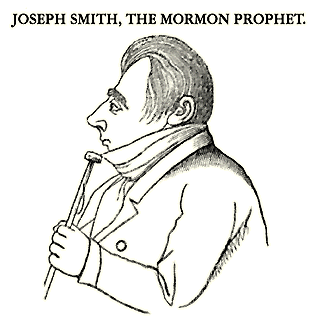
|
Vol. ? Boston, Massachusetts, Friday, March 2, 1844. No. ?
Mormon Difficulties in Illinois The Quincy Herald of the 9th inst., states that four wagons passed through that place on Tuesday previous, on their way to the State Arsenal at Alton, for the purpose of procuring arms to be used against the Mormons, The difficulties and the prospect of an immediate breach between the citizens and the Mormons has been brought to the knowledge of Gov. Ford, and he has been earnestly appealed to, to maintain the peace and protect the innocent. The state of exasperation between the Mormons and the citizens is such that we will not be surprised to hear of actual hostilities at any time quite as violent as formerly existed between them and a portion of our citizens. (St. Louis Repub.) |
|
Vol. IV. Boston, Massachusetts, Monday, March 18, 1844. No. 124.
MORMONS IN ALABAMA. -- The Mobile Journal of the 7th inst., says: -- "The Mormons are upon our borders. we learn from a late letter from Sumpter county, that they are making a somewhat formidable demonstration in the adjoining county of Mississippi. They commenced operations at Pleasant Spring late in the Fall, and now number about seventy-five proselytes -- some twenty being seceders from the Methodist connexion, and about twenty-six from the Baptist -- the balance from non-professors. They have recently commenced propagating their faith at Brooklyn, only a few miles from our State line, where they will probably meet with a like success." |
Vol. XV. Boston, Massachusetts, Tuesday, April 2, 1844. No. 4201.
THE MORMON PROPHET'S FATHER. We yesterday stated that Joe Smith had appealed to the citizens of Vermont, his native State, calling upon them to come to his assistance. The circumstances reminds us of an anecdote told of Joe's father, who was a great sower of discord and fomenter of strife, although he made great pretensions to more godliness, uprightness, and charity, than his neighbors. When the elder Smith died, one of his neighbors, a truly pious, but blunt and plain-spoken person, remarked that he was glad of it, and expressed the hope that he might be sent to that place where "the wicked find no rest." The remark astonished a friend, who asked him how he could talk thus. "Mr. Smith destroyed the peace and broke up three church societies while on earth, and he will break up the bottomless pit itself, if they once get him in there!" |
 Vol. ? Windsor, Vt., Wednesday, April 3, 1844. No. 14. From our Correspondent.
|
|
Vol. ? Boston, Mass., Wednesday, May 15, 1844. No. ?
"GENERAL SMITH'S VIEWS OF THE POWERS AND POLICY OF THE UNITED STATES." -- A Pamphlet of this title has been handed to us, which we have read with much pleasure. The Mormon Prophet has there put forth many excellent ideas worthy of the perusal of a free people. It is a plain philosophical discourse, entirely free from cant, and full of the very best advice. General Smith appears to be neither whig nor democrat; but he is evidently in favor of the largest liberty, discountenances that mob spirit which is so prevalent in our country, and recommends unity, char-ity and universal toleration. The address is well written, and the quotations from American Statesmen are excellent and appropriate, and made without reference to party. He advises legislators to "study the convenience of the People more than the comfort of the Cabinet." He praises Jefferson and Jackson, but seems disposed to sneer at Van Buren and Tyler, whom he calls a "pseudo-Democratic Whig President." He recommends the re-annexation of Texas, under certain circumstances. He says -- "When a neighboring realm petitioned to join the Union of the sons of liberty, my voice would be, come, yea, come Texas; come Mexico; come Canada, and come all the world -- let us be brethren; let us be one great family, and let there be universal peace." Surely, none can complain of a want of liberality in these sentiments! His opinions on the subject of Abolition are worthy of attention. He goes for a liberal and generous policy, and advises Government to use its surplus revenue for the purchase of the freedom of the slaves. He thinks the slaveholders would agree to this, and that no other measure of emancipation is just. |
|
BERKSHIRE COUNTY WHIG. Vol. IV. Pittsfield, Mass., Thursday, May 16, 1844. No. 11.
The Mormon Prophet, Joe Smith, has turned his wife out of doors, for being in conversation with a gentleman of the sect, which she hesitated or refused to disclose. |
|
Vol. XLIV. Salem, Massachusetts, Monday, May 20, 1844. No. 41. From the St. Louis Republican. JO SMITH -- DISSENSION AMONG THE MORMONS AT NAUVOO -- We have good reasons for placing reliance in the details of a letter, the contents of which are hereafter stated, giving an account of an emeute at the chief city of the Mormons, Nauvoo. The occurrences took place on the 26th ult. On that day -- says the writer -- a fracas of an alarming and important character occurred in Nauvoo, threatening with impending destruction the Mormon government and even the life of the prophet himself. Jo Smith, prophet and Mayor elect, having ordered his police to arrest a man named Spencer, for an assault on his brother in his own house -- the residence of his mother also -- the accused refused to become a prisoner, alleging it was illegal to arrest without a writ from the Mayor. |
|
Vol. IX. Boston, Mass., Wednesday, May 22, 1844. No. 4.
PREACHING GRATIS. -- Michael H. Barton, alias Hull Barton, who figured among the Cochranites of Maine a few years since, offers through the Liberator "to preach the gospel of God" to the inhabitants of Boston "without money and without price." He is a great stickler for "Christian Union. -- |
|
Vol. ? Boston, Mass., Wednesday, May 22?, 1844. No. ?
THE MORMONS." -- The New York Aurora says: "The Mormons at Nauvoo have a regular theatre. The play of Pizarro was recently performed there to a fine audience, about one hundred of which were ladies. Here is indeed a most singular place. Some few years hence, the Mormons, or Latter-Day-Saints, will form a stronger sect than the Quakers, possess more money and characteristic marks, and be esteemed as good a denomination." So say we. Not only will they be esteemed as good a denomination, but as intelligent and well-informed. In fact, what accusations of imposture can we bring against the Mormon leader or leaders, that cannot be applied with equal truth to the founders of the Quaker and the Shaker and the Swedenborgian sect, and many others? The founders respectively of each of the above named sects, pretended to be divinely inspired. What more does Joseph Smith pretend? And what better foundation have any other of these sects for the pretences of their original prophet? None at all. Only about ten years since, a volume of Theology was published by a Unitarian minister, (who did not preach,) in the preface of which he pretends to obey a divine command, given him in a vision, to make the publication! In what respect are the pretences of Joseph Smith more flagrant than this? The time will come, and is near at hand, when Mormons will be as common among our citizens as Quakers, and equally esteemed. |
 Vol. I. Springfield, Massachusetts, Friday, May 24, 1844. No. 45.
Besides the Loco and Tyler National Conventions at Baltimore on Monday next, the Mormons hold one to nominate their prophet Joe Smith for the Presidency, unless they unite with one of the former. Won't there be rich times at Baltimore. |
|
Vol. ? Boston, Mass., Saturday, June 1, 1844. No. ?
Schism among the Mormons. The last Warsaw Signal states that a rupture had taken place among the Mormons. -- a respectable number of the most intelligent members of that body having seceded, under the guidance of William Law, and set up for themselves. It does not appear that the religious views of the seceders have undergone any material change. |
Vol. ? New Haven, Conn., Friday, June 14, 1844. No. ?
SCHISM AMONG THE MORMONS: -- The Warsaw Signal states that a rupture has taken place among the Mormons -- a respectable number of the most intelligent members of that body having seceded, under the guidance of WILLIAM LAW, and set up for themselves. It does not appear that the religious views of the seceders have undergone any material change. They profess that JOSEPH SMITH WAS ONCE A TRUE PROPHET, but contend that he is now fallen from grace, and no longer worthy to remain at the head of the Church. Private information confirms the above intelligence in its most estential features. |
 Vol. XXX. Springfield, Massachusetts, Saturday, June 15, 1844. No. 24.
SCHISM AMONG THE MORMONS. -- The last Warsaw Signal states that a rupture has taken place among the Mormons -- a respectable number of the most intelligent members of that body having seceded, under the guidance of William Law, and set up for themselves. It does not appear that the religious views of the seceders have undergone any material change. They profess to believe that Joseph Smith was once a true prophet; but contend that he is now fallen from grace, and no longer worthy to remain at the head of the church. Private information confirms the above intelligence in its most essential features. |
|
Vol. ? Boston, Massachusetts, Saturday, June 22, 1844. No. ? Arrest of Joe Smith. The Warsaw (Illinois) Signal states that the U. S. Marshal had succeeded in arresting Joe Smith, at Nauvoo, and hod proceeded with him down the river. Joe showed fight at first, but afterwards concluded that discretion was the better part of valor. Had Joe persisted, the military would have been called out to enforce the law. |
|
Vol. V. Boston, Massachusetts, Tuesday, July 2, 1844. No. 57.
LATER FROM NAUVOO. -- The St. Louis Reveille, of 23d ult. says -- "By the clerk of the steamer Gen. Brooke, which came down yesterday evening, we are informed that Gov. Ford had arrived at Carthage, approved of present operations, to further which he had ordered out 2500 men. By this time, it is supposed that active preparations have been commenced. |
|
Vol. XIV. Boston, Massachusetts, Friday, July 5, 1844. No. 27. Michael Hull Barton. The certificate of character given by some of our Newburyport friends, in regard to this individual, which may be found on our last page, was published at his request, because we supposed that he was an [honest?] man; but since it was printed, we have had an interview with Richard Plumer, one of the signers, [who] with his associates, is now satisfied that the said Barton is a wolf in sheep's clothing -- a profligate who, under the mask of religion, is attempting to lead captive silly women, and indulge his lustful desires; and [with] the statements which Mr. Plumer has made to us, we are satisfied that M. H. Barton is a rank deceiver, of whom the virtuous and good should beware. But he shall not be excluded from making a defence of himself in our columns, if he wishes to come to a public trial. (See the notice 'To the Public,' of R. Plumer and others, in another column.) |
|
Vol. XXX. Springfield, Massachusetts, Saturday, July 6, 1844. No. 27. THE MORMONS -- EXCITEMENT IN ILLINOIS. All of our intelligence from Illinois indicates the probability and almost the certainty of a speedy and bloody collision between the Mormons and the surrounding citizens of Illinois. The St. Louis Republican of the 17th says:-- |
|
CHRISTIAN CITIZEN. Vol. I. Worcester, Massachusetts, Saturday, July 6, 1844. No. ?
Mormon Convention in Boston. -- On Tuesday forenoon, afternoon and evening, Mormon meetings were held at the Melodeon in Boston, for the purpose of considering the claims of Jo Smith as a candidate for the Presidency. Several Mormons from the holy city of Nauvoo were present, including some of Joe's twelve apostles, and Brigham Young, the President of the Twelve, who presided over the meeting. Lyman White and Mr Hyde addressed the Convention in the forenoon, and delegates were chosen to attend the Baltimore Convention for the purpose of nominating Joe Smith as a candidate for the Presidency. The morning and afternoon sessions were orderly, and there was a pretty fair attendance, principally ladies. The evening meeting broke up in a row. Says the Boston Mail, -- |
|
Vol. V. Boston, Massachusetts, Monday, July 8, 1844. No. 61.
From the Cincinnati Gazette, July 1.
The Goddess of Liberty brings the latest dates from St. Louis, having made her run to Louisville in 48 1/2 hours, the shortest trip ever made between these places. She bring news.... |
 Vol. XV. Boston Mass., Wednesday, July 10, 1844. No. 28.
AFFAIRS AT NAUVOO. -- Great Excitement was produced at Warsaw by the news of the destruction of the office of the "Nauvoo Expositor," and a handbill was issued inviting an appeal to arms. Writs were procured at Carthage, the county seat of Hancock county, and officers despatched to Nauvoo to arrest the persons concerned in the outrage. But this, remarks the St. Louis Republican, we venture to say, will not be done. The law is powerless for good in that region. A rumor prevailed at Warsaw, that Joe Smith was arresting every man at Nauvoo, who was opposed to, or would not justify his proceedings. |
|
Vol. XIV. Boston, Massachusetts, Friday, July 12, 1844. No. 28.
==> Here is another awful and most bloody tragedy. The infatuated leader of the Mormons, having first sanctioned a mobocratic assault on the office of the Nauvoo Expositor, has at last fallen a victim of lawless violence. 'They that take the sword,' &c. |
|
Vol. XXX. Springfield, Mass., Saturday, July 13, 1844. No. 28.
FROM NAUVOO.
The Mormon difficulties have, in all probability been brought to a close for the present. Gov. Ford of Illinois, (not Gov. Tod as we erroneously published it) whose arrival at Nauvoo has been already announced, demanded the State arms of that place, and ordered out a number of militia companies -- Joe Smith and his council thereupon fled precipitately to Iowa. Gov. Ford addressed the people of Carthage, and assured them that the offenders should be brought to punishment. |
|
Vol. ? Boston, Mass., Saturday, July 13, 1844. No. ?
IMPORTANT FROM NAUVOO -- We have just received by the western mail the following particulars of the death of Joe Smith the Prophet, and his brother Hiram |
|
The Northern Galaxy. Vol. IX. Middlebury, Vermont, Wednesday, July 17, 1844. No. 11. THE MORMONS. We are told there are now in the county of Addison four Mormons who have been electioneering in Bristol, Lincoln and Starksboro for Joe Smith as President. One of these, a Mr. Huston has sent us a Pamphlet to publish containing the views of the defunct candidate on Government. This phrenzied sect have also established a press in New York, advocating the claims of their favorite candidate. Recently the Mormons have held a political meeting in one of the beautiful groves which adorn the city of Cleveland. Mr. Winter the chief speaker, assigned as the reason why the saints had resolved on political organization was for redress of the wrongs and outrages committed on their society. The death of General Smith of course ends further political organization for the present. |
FARMER'S CABINET. Vol. XLII. Amherst, N. H., Thursday, July 18, 1844. No. 48.
FROM THE MORMONS. -- All seems quiet and peaceful among these people. An extra from their organ indulges in many lamentations for the death of the Prophet and his brother, and narrates how the deed was accomplished. |
|
Vol. I. Springfield, Mass., Thursday, July 18, 1844. No. 92.
CHIEF OF THE MORMONS. -- General Joe Smith is said to have left in the hands of his wife a document appointing his successor, which she was directed to open on the third day after his death.... |
|
Vol. XXX. Springfield, Massachusetts, Saturday, July 20, 1844. No. 29. THE MORMON WAR. The St. Louis Republican of July 3d, uses the following language: -- |
|
Vol. I. Worcester & Boston, Massachusetts, Saturday, July 20, 1844. No. 29. "JOE SMITH." The murder of him who was familiarly or contemptuously so called, but more respectfully as well as ironically "The Prophet," has taken the country by surprise, and overwhelmed his followers with sudden and deep grief, if not with inextricable confusion. We say his country, because the extraordinary character of the man and the more extraordinary delusion and attachment of his disciples were matters every where talked of, and which the thousand tongues of the press made, for years, the theme of daily public discourse. Doubtless Joe was a man of genius. He, who, without education, without hereditary rank, with-out money, without civil office or public patronage, and against influence that would dishearten almost every other man, can make and keep himself, for so long a time, the centre of so great and strong an attraction, who can dictate the highest public office into such hands as his will may elect, who can build cities, raise and discipline a formidable body of troops, inspire them with a religious fervor to which his own bosom is a stranger, make himself the dread of a large district of the country and set in commotion the civil and military power of a State, needs no other credentials to establish his title to be called a man of genius. He read human nature with no common vision, and combined and wielded its conflicting elements with no common force and dexterity. He possessed acuteness, boldness, calmness, promptness, and firmness of mind, with a fullness adequate to the conception and accomplishment of large designs. We are even afraid that, by many, his genius will be more admired than his bold and subtle knavery detested. Extraordinary genius and an extraordinary death have a power, in very many minds, to canonize the vices and crimes which nothing but corrupt genius could have hoped or dared to achieve, and which nothing can so well perpetuate as the violent and treacherous death of their founder and patron. The country, we think could well spare his genius and his life, but the manner of his death, it should, by all means, have dispensed with. No man of sober sense can contemplate it without regret. It was an act of deliberate, cold-blooded, and cowardly assassination -- a violation of law and honor, of private obligation and public faith. The shot which pierced the heart of the false prophet, lodged in the bosom of public safety, and nothing will stanch its wound but the public indignation against the atrocity of the offence. |
|
Vol. V. Boston, Massachusetts, Monday, July 29, 1844. No. 79.
A MORMON SHOT. -- The St. Louis Republican of the 16th inst. states that a man was shot just back of Warsaw, Ill., on Friday previous. The Guard stationed there saw three men, supposed to be horse thieves, fired on them and one fell. He was a Mormon, and they were retreating at the time. This looks a little like shooting rather too fast. It shows the feeling toward Mormons in that quarter. |
|
Vol. ? Boston, Massachusetts, Wednesday, July 31, 1844. No. ?
LIBERALITY OF A PRIEST. -- The last Jonesboro (Tennessee) Whig, edited by the Rev. Mr. Brownlow, contains the following editorial expression: -- |
|
Vol. I. Springfield, Mass., Wednesday, July 31, 1844. No. 103.
A MORMON SHOT. -- The St. Louis Republican of the 16th inst. states that a man was shot just back of Warsaw, Ill. on Friday previous. The Guard stationed there saw three men, supposed to be horse thieves, fired on them and one fell, He was a Mormon and they were retreating at the time. This looks a little like shooting too fast. It shows the feeling toward Mormons in that quarter. |
|
The Burlington Free Press. Vol. XVIII. Burlington, Vermont, Friday, August 2, 1844. No. 9.
THE MORMONS AT KIRTLAND, OHIO.
Mr. Stacy: -- During the winter of 1836-7, I was employed by the Mormons, in printing the second edition of the Golden Bible or Book of Mormon. I had a good opportunity for observing passing events, and for learning something of their previous history. Perhaps the following sketch of some of their operations in Kirtland, drawn entirely from recollection of what I saw and heard while there, may, in connection with recent events, be interesting to the public; and so far as it goes, furnish an answer to the question, Why are the Mormons, whether in New York, Missouri, Ohio, or Illinois, subjected to such violent opposition and hatred, while the Shakers, whose religious tenets are equally obnoxious, are permitted to live in peace, wherever they locate? |
|
Vol. I. Springfield, Mass., Saturday, August 3, 1844. No. 106.
It is said the Mormon mantle has fallen upon Sam Smith, elder [sic] brother to Joe the late Prophet, who has been or is to be inducted into office with all due solemnity, and take upon himself the entire government of the "Latter Day Saints," as prophet and patriarch in chief. |
|
Vol. ? Boston, Massachusetts, Saturday, August 3, 1844. No. ?
Mormons in Hampden Co. -- We notice a published call for a special conference of the "Latter Day Saints" to be holden in the Town Hall in Westfield on the 27th and 28th of this month, "at which time the Twelve Apostles may be expected to deliver addresses touching the Religious and political destinies of our country and the world." |
|
Vol. I. Springfield, Massachusetts, Thursday, August 8, 1844. No. 110.
A Convention of Mormons, or, as they call themselves, Latter Day Saints, has just occurred at Westfield, where we are told there is a Society numbering forty members. We happened to hear a discourse, in which one of the Elders undertook to prove, "as clear as day-light" that the Mormons had the power of working miracles and the gift of tongues. His points were as follows: -- |
|
Vol. V. Boston, Massachusetts, Tuesday, August 20, 1844. No. 98.
EXCITEMENT AMONG THE MORMONS. -- "Joe Smith risen from the dead" -- More humbug. -- A Mormon has arrived in St. Louis, who reports that Joe Smith has risen from the dead, and has been seen at Carthage and in Nauvoo, mounted on a white horse, and with a drawn sword in his hand. He says that as Joe is thus restored to life everything will go on prosperously with the Mormons. -- Thus a few fanatical leaders induce these ignorant, credulous and superstitious fanatics to believe the greatest possible absurdities. |
The Caledonian. Vol. VIII. St. Johnsbury, Vermont, Monday, September 9, 1844. No. 7.
FROM NAUVOO. We have intelligence from Nauvoo to the 5th ult. All was quiet. It appears that the repnrts of the appearance of Joe Smith, and the appointment of his son as prophet, are false, and originated in a desire to injure the Mormons abroad. -- Sidney Rigdon had returned to Nauvoo from Pittsburg, and preached to the people on the 4th ult. In consequence of the death of Samuel Sinith, Joe's brother, since the death of the prophet, Sidney Rigdon will be chosen Patriarch of the Mormon flock. -- He is their master spirit, and will make a shrewd and energetic leader. There are five widows of the Smith family now living in Nauvoo; the mother of all, and the late wives of Joe, Hiram, and their two brothers. Accessions to the Mormon strength continue to be quite large, |
|
Vol. ? Boston, Mass., Saturday, September 28, 1844. No. ?
Mormonism. -- Sidney Rigdon and Elder Hyde arrived in this city yesterday morning. We learn that Rigdon, who professed to have had a revelation, and returned a few weeks since from Pittsburg, to be the successor of Smith, has been regularly unchurched by the Twelve Apostles. He returns to Pittsburg to establish a paper. -- His views of Mormonism remain unchanged although they will not have him to rule over them. The administration of the affairs of the church for the present is to remain in the hands of the Twelve Apostles. (St. Louis Republican, Sept. 12.) |
Vol. XXIX. Boston, Massachusetts, Thursday, October 3, 1844. No. 40.
FOR THE BOSTON RECORDER.
It was the dark hour of midnight when I landed at Nauvoo, just ten days after the acting of that tragi-comedy, whose closing scene was the murder of the Mormon "Prophet" and his brother. In these circumstances, I confess it was not without some faint misgivings that I entrusted myself, a lone stranger, to the keeping of an uncouth looking personage who figured at the head of the "City Hotel," close to by the place of landing. By him I was conducted to a chamber where were three beds. One was already occupied; the others were being vacated by a motley group comprising two families, who, in their flight from Mormon troubles, were hastening into the boat which I had just left. "Mine host" was not a man to waste words in making foolish apologies. Pointing to the now emptied, but unmade beds, and telling me to take my choice, he withdrew. It so happened that a wandering Mormon, just returned from a reconnoitering tour in the region around Nauvoo, where he had been stealthily gathering up the opinions of the public, came to the city hotel soon after I had retired, and was sent into the same chamber to lodge. Finding a brother Mormon there, whom his coming had rousted from sleep, and not perceiving any one else, he commenced a narrative of his adventures, which lasted till near morning, unfolding many strange things pertaining to Mormonism which nobody but a "latter-day saint" would have been allowed, knowingly, to hear, and which conveyed to my mind several new impressions, to which I may advert hereafter. One thing I learned which was of immediate practical use, viz. that while the Mormons were fearing a fresh outbreak of violence from their enemies, their enemies were also fearing a visitation if vengeance from the Mormons. These mutual fears, it was very evident to me, would keep both parties still for the present. With this quietus I dropped asleep. |
Vol. VI. New Bedford, Massachusetts, Tuesday, October 8, 1844. No. 41.
THE MORMON TROUBLES. -- The following letter was received yesterday, by a gentleman of this city, from another residing in Illinois, which will show the causes which induced Governor Ford, of that State, to invoke the aid of the militia. -- Phil. Ledger. |
|
The Northern Galaxy. Vol. IX. Middlebury, Vermont, Wednesday, October 9, 1844. No. 23.
MORMON NEWS. -- The Warsaw Signal keeps apparently a pretty keen eye upon the Mormons at Nauvoo. That paper states that Lyman Wright, one of the leaders of the Mormons, has left Nauvoo for the pine regions of the Wiscousin, with about two hundred followers, comprising the most reckless of the Mormon community. |
Vol. XXIX. Boston, Massachusetts, Thursday, October 10, 1844. No. 41.
FOR THE BOSTON RECORDER.
As the result of careful observation and inquiry, both in and around Nauvoo, I am persunded that the millennial days of Mormonism are past. Its charm is dissolved. The magic spell was broke in the death of Joseph Smith. His followers may never be exactly like other folks again, but they will cease to be Mormons, in the sense hitherto attached to that outlandish term. No other prophet will ever arise with power to sway the same minds which he infatuated. It is probable that the barbarous and martyr-like way in which he came to his end, will prolong the death struggle of the delusion. Preachers of that order will travel about the land and tell the tragic story, as they have already done in this city with scenic accompaniments; and all right-minded men who hear it will join in reprobating the deed. But what if it should be found that the leaders of the mob, and even the perpetrators of the murder, were Mormons (or lately such,) and were schooled into these morals by the murdered prophet himself? According to the most reliable testimony in the case, such appears to have been the fact. |
|
Vol. ? Springfield, Massachusetts, Monday, October 14, 1844. No. 166.
Correspondence of the Republican.
|
Vol. XXIX. Boston, Massachusetts, Thursday, October 17, 1844. No. 42.
MORMON DISCUSSION. -- A discussion has been going on for several evenings at the Marlboro' Chapel, between a Mormon and a gentleman of this city. Not choosing to patronize the concern so much as to pay 12 1/2 cents, we have lost some of the latest arguments in favor of one of the most ridiculous and worthless systems of belief ever got up by man. We do not hesitate to except Millerism. |
Vol. XIII. Boston, Massachusetts, Friday, October 18, 1844. No. 95.
GOV. FORD'S HUMBUG. -- Sharp and Williams, citizens of Hancock county, with whom Governor Ford entered into a treaty last week, have left Quincy, and gone about their business -- Judge Thomas choosing not to interfere in the matter. Since then, warrants have been issued against William Law, Robert D. Foster, and Charles A. Foster, seceding Mormons, accused of being concerned in the murder of the Smiths. They refused to obey the writ, unless they were taken before Judge Thomas, at Quincy, alleging that their lives were sought by the people of Nauvoo, and while they wished to respect the laws, they would not agree to give themselves up to be murdered. Afterwards, they went to Quincy and delivered themselves to Judge Thomas, but as no witnesses appeared against them, they returned home, intending to answer every indictment against them. |
|
And Christian Repository. Vol. XVI. Montpelier, Vermont, Saturday, October 26, 1844. No. 15.
MRS. JOE SMITH. -- Grand Design of the Prophet. -- A correspondent at Alton, after stating that the recent murder of Joe Smith has been followed by a dispersion of his followers, gives the following interesting items: -- Mrs. Joe Smith, it is said, has lost all confidence (if she ever had any) in the Mormon faith. She will soon retire to some secure situation, undoubtedly the richest lady in the West. Joe had been amassing money for several years, for the purpose of eventually going to Jerusalem, intending to issue a proclamation calling in the Jews, over whom he was to be head till the return of Christ upon the earth -- which event he believed would take place 45 years from 1844. |
AND THEOCRATIC WATCHMAN. Vol. IV. Putney, Vermont, Saturday, November 2, 1844. No. 16.
MRS. JOE SMITH. -- Grand Design of the Prophet. -- A correspondent at Alton, after stating that the recent murder of Smith has been followed by a dispersion of his followers, gives the following interesting items: Mrs. Joe Smith, it is said, has lost all confidence (if she ever had any) in the Mormon faith. She will soon retire to some secure situation, undoubtedly the richest lady in the West. Joe had been amassing money for several years, for the purpose of eventually going to Jerusalem, intending to issue a proclamation calling in the Jews, over whom he was to be head till the return of Christ upon the earth -- which event he believed would take place 45 years from 1844. With reference to this expedition he was crowned 'King of Israel' in 1844, by the Council of fifty, denominated the 'Ancient of days.' The fifty were all sworn to [secrecy]. I had the fact from one who assisted at the coronation -- divulged since Joe's death. This was the prophet's grand design; and had it been generally known, would perhaps, have saved our State from the disgrace and infamy of perpetrating so foul a murder. The fact affords a key to certain movements of the prophet, which are otherwise wholly inexplicable. -- |
Vol. XV. Boston, Massachusetts, Tuesday, November 5, 1844. No. 4,381.
NAUVOO. Its location; how the Mormons came by it;
Nauvoo -- the city of the latter day Saints -- the place where Mormonism is concentrated, is beautifully located on the East side of the Mississippi river, below the first rapids, and therefore accessible to the largest class of steamboats on the "Father of Waters." Its name is derived from two Hebrew words, somewhat distorted, which mean "beautiful rest." |
|
Vol. XIII. Boston, Massachusetts, Wednesday, November 6, 1844. No. 111.
THE MORMONS. -- The St. Louis Republican has the following letters. |
|
Vol. I. Springfield, Massachusetts, Saturday, November 9, 1844. No. 188.
From the St. Louis Republican, Oct. 29.
Gov. Ford appears to be determined to keep up the excitement between the citizens of Hancock County and the Mormons, and if a collision does not ensue, it will certainly not be his fault. |
|
Vol. I. Springfield, Massachusetts, Wednesday, November 13, 1844. No. 191.
FROM THE MORMONS. -- The Grand Jury of Hancock county have found indictments against eight of the murderers of the Smiths, and seven or eight of the Mormons who destroyed the printing press in Nauvoo; thus enforcing the laws against mob violence, whether perpetrated by Mormons or Anti-Mormons. |
|
Vol. XV. Boston, Massachusetts, Tuesday, December 24, 1844. No. 4,422.
MORMONISM. The Springfield (Ills.) correspondent of the St. Louis Republican says: "It is mentioned here that Wood, who acted as one of Joe Smith's counsel at the time of his death, is endeavoring to prevail on the prophet's wife to make a full exposure of Mormonism, and to allow him to publish it, and that she has about consented so to do." |
|
Vol. I. Springfield, Massachusetts, Saturday, December 28, 1844. No. 229.
A bill has been introduced into the Illinois House of Representatives, repealing unconditionally the whole of the Mormon charters, and referred to the Committee on the Judiciary by a vote of 108 yeas to 4 nays -- two of the four voting in the negative were Mormon representatives. The Springfield correspondent of the St. Louis Republican expresses the opinion that the charters will be repealed. |
Back to top of this page.
Articles Page | Articles Index | History Vault
Oliver's Bookshelf | Spalding Library | Mormon Classics
last updated: June 9, 2015