
READINGS IN EARLY MORMON HISTORY
(Newspapers of Pennsylvania)

Philadelphia Newspapers
1846-1920 Articles
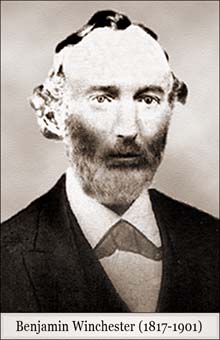
Benjamin Winchester - Philadelphia LDS
1800-29 | 1830-39 | 1840-45 | 1846-1920
1846 (Jan-Jun)
PLg Jan 05 '46 | Dolr Jan 07 '46 | PLg Jan 13 '46 | PLg Jan 22 '46 | NAmr Jan 26 '46 | Dolr Mar 04 '46 | ExpMs Mar 04 '46 | DChrn Apr 24 '46
Dolr Apr 29 '46 | ExpMs Apr 29 '46 | Dolr May 06 '46 | Dolr May 13 '46 | PLg May 15 '46 | Dolr May 27 '46 | DChrn May 29 '46 | PLg May 29 '46
Dolr Jun 03 '46 | PLg Jun 06 '46 | Dolr Jun 17 '46 | DChrn Jun 18 '46 | Dolr Jun 24 '46 | NAmr Jun 25 '46 | NAmr Jun 26 '46 | PLg Jun 29 '46
1849 (Jul-Dec)
Dolr Jul 01 '46 | Dolr Jul 08 '46 | NAmr Jul 18 '46 | DChrn Jul 23 '46 | PLg Jul 31 '46 | PLg Aug 01 '46 | Dolr Aug 05 '46 | PLg Aug 10 '46
Dolr Aug 12 '46 | PLg Aug 20 '46 | Dolr Aug 26 '46 | PLg Sep 02 '46 | Dolr Sep 02 '46 | PLg Sep 03 '46 | NAmr Sep 16 '46 | NAmr Sep 21 '46
Dolr Sep 23 '46 | ExpMs Sep 23 '46 | NAmr Sep 28 '46 | NAmr Sep 30 '46 | Dolr Sep 30 '46 | PLg Oct 07 '46 | PLg Oct 09 '46 | Dolr Oct 14 '46
PLg Oct 22 '46 | NAmr Oct 23 '46 | PLg Oct 26 '46 | Dolr Nov 04 '46 | ExpMs Nov 18 '46 | Dolr Nov 18 '46 | NAmr Nov 23 '46
1847
Dolr Feb 10 '47 | Dolr Mar 24 '47 | Dolr Jun 09 '47 | ExpMs Aug 25 '47 | Dolr Sep 15 '47 | Dolr Nov 10 '47 | SatCo Nov 13 '47 | Dolr Dec 08 '47
1848-1849
SatCo Apr 22 '48 | ExpMs May 24 '48 | Dolr Jun 14 '48 | SatCo Jul 15 '48 | ExpMs Sep 06 '48 | Dolr Sep 27 '48 | Dolr Oct 18 '48 | Dolr Dec 13 '48
SatCo Dec 16 '48 | SatCo Feb 17 '49 | NAmr Mar 10 '49 | NAmr Mar 31 '49 | PInq Apr 14 '49 | NAmr Jun 11 '49 | NAmr Jun 14 '49 | NAmr Aug 08 '49
Dolr Aug 15 '49 | PLg Oct 05 '49 | PInq Oct 09 '49 | Dolr Oct 17 '49 | SEP Nov 24 '49
1850-1859
PLg Mar 12 '50 | Dolr Sep 18 '50 | Sun Nov 17 '51 | SEP Oct 09 '52 | SatCo Dec 11 '52 | PLg Jul 16 '53 | PLg Jul 20 '53 | SEP Aug 13 '53
SEP Nov 18 '54 | SatCo Jan 06 '55 | SEP Mar 17 '55 | SatCo Jul 07 '55 | PLg Oct 17 '56 | PInq Jan 16 '57 | PInq Jan 21 '57 | PLg Mar 24 '57
PLg May 20 '57 | Press Aug 06 '57 | Press Aug 07 '57 | Press Aug 11 '57 | Press Aug 22 '57 | Dolr Sep 17 '57 | Press Sep 25 '57 | Press Oct 01 '57
Press Nov 17 '57 | Press Nov 19 '57 | Press Dec 16 '57 | Press Feb 01 '58 | Press Mar 19 '58 | SEP Apr 03 '58 | SEP Apr 24 '58 | SEP May 01 '58
DEB Jun 08 '58 | SEP Jun 12 '58 | SEP Jun 19 '58 | SEP Jun 26 '58 | DEB Jul 09 '58 | DEB Jul 17 '58 | SEP Jul 17 '58 | SEP Jul 24 '58
DEB Aug 23 '58 | DEB Sep 04 '58 | Press Sep 07 '58 | Penn Nov 23 '58 | Press Jan 17 '59 | SEP May 21 '59 | Press Jun 10 '59 | NAmr Dec 05 '59
1860-1864
Press Aug 31 '60 | AmPr Oct 25 '60 | Press Nov 07 '60 | AmPr Jan 24 '61 | Press Feb 04 '61 | Press May 16 '61 | Press May 21 '61 | Press Dec 02 '61
AmPr Apr 03 '62 | Press Aug 05 '62 | PInq Nov 25 '62 | Press Jan 27 '63 | Press Feb 09 '63 | Press Mar 06 '63 | Press Mar 10 '63 | Press Mar 11 '63
Press Mar 14 '63 | Press Mar 19 '63 | AmPr Mar 26 '63 | Press Apr 02 '63 | Press Jul 28 '63 | AmPr Sep 24 '63 | DEB Feb 23 '64 | Press Feb 26 '64
AmPr Apr 07 '64 | AmPr Jul 14 '64 | AmPr Nov 03 '64 | Press Nov 17 '64
1865-1867
DEB Feb 16 '65 | DEB Mar 03 '65 | DEB Mar 07 '65 | DEB Mar 09 '65 | DEB May 12 '65 | Press Jul 29 '65 | DEB Nov 27 '65 | DEB Nov 28 '65
PInq Nov 29 '65 | DEB Dec 15 '65 | PInq Dec 23 '65 | PInq Dec 28 '65 | DEB Jan 13 '66 | DEB Jan 19 '66 | PInq Apr 28 '66 | DEB May 30 '66
DEB July 24 '66 | AmPr Dec 13 '66 | DEB Dec 24 '66 | PInq Feb 19 '67 | DEB Feb 23 '67 | PInq Mar 01 '67 | PInq Mar 30 '67 | DEB Jul 08 '67
DEB Jul 09 '67 | EvTel Jul 11 '67 | DEB Jul 13 '67 | DEB Jul 16 '67 | DEB Jul 17 '67 | DEB Jul 24 '67 | DEB Aug 02 '67 | DEB Aug 03 '67
DEB Aug 12 '67 | DEB Aug 20 '67
1868-1869
DEB Jan 23 '68 | DEB Feb 27 '68 | DEB Jun 29 '68 | DEB Jul 27 '68 | DEB Aug 06 '68 | DEB Aug 12 '68 | AmPr Sep 03 '68 | DEB Sep 10 '68
DEB Sep 18 '68 | DEB Oct 03 '68 | AmPr Oct 08 '68 | DEB Oct 30 '68 | DEB Nov 06 '68 | DEB Nov 28 '68 | DEB Dec 30 '68 | DEB Jan 21 '69
DEB Jan 22 '69 | DEB Jan 28 '69 | DEB Mar 15 '69 | DEB Jun 07 '69 | PPost Jul 09 '69 | PInq Jul 15 '69 | EvTel Aug 27 '69 | PPost Oct 28 '69
PPost Nov 01 '69
1870-1899
EvTel Mar 16 '70 | PRec Aug 17 '70 | PInq Aug 24 '70 | PRec Sep 19 '70 | NAmr Sep 28 '76 | NAmr Mar 28 '77 | PInq Sep 03 '77
PInq Aug 12 '85 | NAmr Aug 11 '87 | NAmr Mar 24 '92 | PInq Dec 01 '95 | PInq Jul 03 '99
1900-1920
PInq Sep 13 '01 | PInq Sep 13 '08 | PInq Mar 12 '13
Articles Index | misc PA papers | Adams Co. papers | PA Quaker papers
 Vol. XX. Philadelphia, Monday, January 5, 1846. No. 88. 
THE MORMONS. --The Sangamo (Illinois) Journal repeats the statement of the New York Tribune's correspondent respecting the Mormons. The coin counterfeited by them consisted principally of imitations of Mexican dollars and American half dollars and dimes, skillfully executed. The quantity issued is said to be immense, $1500 having been paid out at a mill owned by a Mormon in one week for wheat. Three qualities of the spurious money were manufactured, which was sold for 75, 50 and 25 cents for the dollar. That for which the highest price was asked, is said to be so perfect as to escape the most rigid scrutiny of the eye -- the outer coat being of pure silver, and the alloy so completely covered as to prevent detection in any other way than by cutting. |
 Vol. III. Philadelphia, Wednesday, January 7, 1846. No. 51.
THE MORMONS.
A correspondent of the New York Tribune, writing from Springfield, Ill., says: -- |
|
Vol. XX. Philadelphia, Tuesday, January 13, 1846. No. 95.
THE MORMONS. --The Jacksonville Journal says the Governor of Illinois has refused to permit the State militia to execute the warrants against the Twelve Elders, for counterfeiting U. S. coin, until demanded by the President of the United States. A writer in the St. Louis Reporter asserts that the Elders have been guilty of high treason against the United States, in entering into a league with the Indian tribes against this government, at the suggestion of English agents now in Nauvoo, and that thelr project of emigrating to California or Oregon was suggested by the British Government, to which they have bound themselves. He says there is abundant evidence to warrant the arrest and examination of The Twelve on a charge of high treason as well as counterfeiting. Instead of decreasing, it would appear that excitement is on the increase at the City of the Saints. As a great many families are divided upon the subject of going to Oregon, the Lord has endowed them (they say) with the privilege of casting off their legitimate wives, and taking others to themselves. Crime has experienced little or no abatement. |
|
Vol. XX. Philadelphia, Thursday, January 22, 1846. No. 103.
MORMON INTELLIGENCE. -- The Warsaw Signal of the 7th instant has the following Mormon intelligence: |
 Vol. VII. Philadelphia, Monday, January 26, 1846. No. 2124.
A MORMON ABDUCTION. -- A Detroit paper says that the daughter of a respectable citizen of Southfield, Oakland county, has been inveigled away by the Mormons, and attempted to be conveyed out of the State, to Nauvoo and thence to California. The father has sued out a writ of Habeas corpus for the arrest of the principal offenders. |
|
Vol. IV. Philadelphia, Wednesday, March 4, 1846. No. 7.
THE NEW PROPHET.
A new prophet, named Strang, at Voree, Wisconsin, has been acknowledged by one portion of the Mormons as the head of the church. The Mormons are flocking to Vofee in great numbers. It is to be the gathering place of this strange people, except the Twelve and their adherents, now on their way to California, over the Rocky Mountains. James J. Strang is a lawyer of considerable eminence in the West,'and owns an immense tract of land, the eapifal of which is Voree. He is the person, it is said, who went with the Mormons out of Missouri, at the time of their disturbances, planned the Temple at Nauvoo, and wrote the bulletins of Smith, the prophet. This portion of the Mormons will probably settle in Wisconsin. The greater part will go over the Rocky Mountains. |
|
Vol. ? Philadelphia, Wednesday, March 4, 1846. No. ?
THE MORMON REMOVAL. --The Warsaw Signal, of the 18th ult., in speaking of the emigrating Mormons, says: -- |
 Vol. XIII. Philadelphia, Friday, April 24, 1846. No. ?
Interesting Intelligence from Nauvoo,
We have received the first and second numbers of the Hancock Eagle, a Democratic paper, published in the Holy City of the Mormons. It is edited with considerable ability, and furnishes much matter that is interesting to us in the east. We make the following extracts from that paper of the 10th inst: -- |
|
Vol. IV. Philadelphia, Wednesday, April 29, 1846. No. 15. MORMON lNTELLlGENCE. The Hancock Eagle of the 3d inst. contains the following intelligence: -- "As far we can learn, all is tranquil in this country -- the result in some degree, of the precautions adopted by Major Warren. The "orders" issued a few weeks ago appear to have had a salutary effect. The changes that are taking place here, go on quietly and in a proper spirit. We perceive that efforts are being made in a certain quarter, to depreciate the value of real estate here, and discourage strangers from investing. This disposition to throw obstacles in the way of making sales (to say nothing of its dishonesty) is, at this particular time, reprehensible in the highest degree. Every Mormon who can dispose of his home -- even at a ruinious sacrifice -- is anxious to leave, and these attempts to detract from the value of property is calculated to retard and defeat the consummation of a measure earnestly desired by all parties There is not a point on the river where comfortable residences and improved lands can be had on terms as low as they are offered here. As for Nauvoo itself, it is bound to remain an inhabited city. Its local advantages, as a trading and manufacturing town, render an investment here at present prices, safe and sure This fact we shall demonstrate hereafter. Extensive preparations are making for the departure of the next Mormon detachment. Thev will probably get off in about three weeks, and will muster in considerable force. The draft upon travelling vehicles has been so great, that they are now scarce and in high demand. Most of the artificers in wood and iron are busily engaged in tinkering up wagons for emigrating outfits. The company now on the march are working their way westward by degrees. Their unwieldly numbers and overladen conveyances operate as a material drawback upon their progress, in addition to which, they are compelled to halt every few miles and work tor the fanners on the route, in order to procure fodder for their live stock. The grass not having fairly started, entails upon them the necessity of providing a substitute, for which they pay in labor. They are in good spirits, and work together harmoniously. No discord exists in the camp and thus far all has gone favorably. The masons will resume operations on the Nauvoo House in a few weeks, and hasten that magnificent structure to a speedy completion. When finished, it will surpass any edifice of the kind in the State, for beauty of location, architectural design and extent of accommodations." |
|
Vol. ? Philadelphia, Wednesday, April 29, 1846. No. ?
JAMES J . STRANG: -- This is the gentleman who claims to be the rightful successor of the immaculate Jo Smith, and proves the claim by a letter under Jo's own hand, acknowledging him to be the Holy successor. This letter is said to be genuine, being in Jo's handwriting, and post marked at Nauvoo and Chicago. He owns an immense tract of land at the to-be Holy City of Voree, in Wisconsin. Great numbers of Mormons from all parts of the country, particularly from Nauvoo, are going thither, and a few years will see Voree what Nauvoo is now. |
|
Vol. IV. Philadelphia, Wednesday, May 6, 1846. No. 16. Trouble among the Mormons. From intimations in Western papers it is probable that there will be another disturbance between some of the citizens of Illinois and the Mormons remaining in the State. The Governor either has or is about to disband the troops who have been protecting the peace of Hancock county until the Mormons had removed, and we now see calls for public meetings of the citizens appearing in the newspapers. The following notice we find in the Quincy Whig: |
|
Vol. IV. Philadelphia, Wednesday, May 13, 1846. No. 17.
THE MORMONS. -- The Nauvoo Eagle contains the proceedings of a meeting of citizens, who have recently purchased property in Nauvoo and the surrounding country. A preamble and resolutions were adopted to secure further time for the removal of Ihe Mormons, as it was impossible for them to leave at the time designated. The resolutions set forth that a large body of the Mormons had already gone, that their Church organization has been broken up, and that the "Twelve," with the leading men, have also left, while those who yet remain are using the most strenuous efforts to remove. A disposition is manifested in Hancock and the adjoining counties, to drive the remaining Mormons out of the State. |
|
Vol. XXI. Philadelphia, Friday, May 15, 1846. No. 43.
From California, -- Captain Fremont and his party are now in California. In February he visited the U. S. Consul in Monterey. While there the Prefecto wrote to Mr. Larkin to inquire what business Captain Fremont could have here. He was informed, to find out the most practicable route to the Pacific, and that his party were not United States soldiers. This latter supposition had caused much excitement. Reports have reached as, that the "Mormons" have found another leaf of their Bible, that gives them California as the promised land, and that the Holy Temple and City in Missouri [sic - Illinois?] are for sale. |
|
Vol. IV. Philadelphia, Wednesday, May 27, 1846. No. 19.
Late from Nauvoo --
Late from Nauvoo -- More Persecution against the Mormons. |
|
Vol. XIII. Philadelphia, Friday, May 29, 1846. No. 25.
THE MORMONS. -- The St. Louis Republican says, that the number of Mormons who left Nauvoo during the week ending the 14th inst., may be set down at thirteen hundred and fifty souls. The number of "new settlers" is estimated at two hundred heads of families. Three-fourths of the improved property on the "flat," has changed hands; on the hill, the proportion of sales is not so great. Very few farms remain unsold. The Hancock Eagle makes the total number of teamsnow on the opposite side of the river about fourteen hundred. They are designed to accommodate from seven to eight thousand persons. Some of them have pushed forward to the Des Moines river, and some are encamped on Sugar creek, but the slopes of the hills and the prairie opposite Nauvoo, are still dotted with clusters of tents and wagons. The Eagle thinks that twelve thousand have left the State, and that in a few weeks, it may be announced that "the Mormons have left the State." |
|
Vol. XXI. Philadelphia, Friday, May 29, 1846. No. 55.
FOR CALIFORNIA. -- The St. Louis Republican has the following letter, dated |
|
Vol. IV. Philadelphia, Wednesday, June 3, 1846. No. 20. The Mormons. The St. Louis Republican of the 16th inst. has the following information of the attempt of the lawless, to over awe the authorities stationed to protect the Mormons while preparing for their departure: |
|
Vol. XXI. Philadelphia, Saturday, June 6, 1846. No. 81. The Mormon Movements. The Hancock Eagle of the 22d is filled nearly with notices of the Mormon movements, and the disorderly doings of those opposed to them. Major Warren seems disposed to act with vigor against the Anti-Mormons, and has checked the anticipated outbreak. |
|
Vol. IV. Philadelphia, Wednesday, June 17, 1846. No. 22.
Important Rumor -- Collision between
The officers of the Radnor, which steamboat arrived at St. Louis on the 2d, from the Missouri river, reports that a messenger arrived at Kansas, from the plains, while they lay there, who stated that a collision had taken place between the party of Mormons, now einigraiiiig to California, and Gov. Boggs' party journeying to the same destination. In the encounter, Boggs and several of his company were killed. The last intelligence we had from the plains spoke of a threat which had been made against the California emigrants by the Mormons, and that in consequence Boggs was about to return to Missouri. This may have given rise to the report of a collision. A few days will bring us more particulars, if the messenger's story be true. The settlers at Kansas were arming to go out to the assistance of the emigrants. There was an old grudge against Gov. Boggs on account of his conduct toward the Mormons while in Missouri. The story of the collision we think is very doubtful. |
|
Vol. XIII. Philadelphia, Thursday, June 18, 1846. No. ?
THE MORMONS -- EMIGRATION, &c. -- We extract the following paragraphs from the Hancock Eagle, of the 4th inst., published at Nauvoo, Illinois: -- |
|
Vol. IV. Philadelphia, Wednesday, June 24, 1846. No. 23. Nauvoo. The Hancock Eagle announces the restoration of tranquillity to that neighborhood. Maj. Warren's troops left for Quincy last week, to be mustered into the U. S. service. New settlers are fast arriving at Nauvoo, and the city of the Mormons will soon be filled with an industrious and christian population. The Mormons are anxious to sell the temple immediately, and the Eagle expresses the opinion that a sale of it will be concluded in a few days. There are a number of thieves in the neighborhood, will continue their depredations, in the absence of an efficient police. The new settlers have held a meeting for the purpose of organizing an adequate police, and for starling schools. The Eagle says: |
|
Vol. VIII. Philadelphia, Thursday, June 25, 1846. No. 2254. THE MORMON HEGIRA. The history of the Mormon delusion from its origin up to the present period, is most discreditable able to the country, It is humiliating that so absurd an imposture could have found in the American character, material for its operations; and that the grossness of its impious mummery, and the guilt of its abominable practices, were insufficient to check its progress, The insanity and guilt of Mormonism appear to have but one equal -- and that is anti-Mormonism. If the Mormons have mocked at religion, outraged law and discarded all sense of morality or even of decency in their daily and avowed practices; their foes have managed to emulate, with singular ardour, their example. Upon the pretext that Mormons are hostes humani generis, they hunt them down like wolves. The constitutional rights of that most unfortunate body of citizens, the more unfortunate because so lamentably misguided, are set at naught. A convention is held, and the people, with all the formal solemnity of legal right, deree that another body of the people, amounting to many thousands, possessing equal rights, shall be stripped of their property and driven from the land. This decree, itself a crime against the laws of the land, is respected by the government, and obeyed by the victims. The Mormons prepare for flight; and the government sends a body of troops to carry out peacefully the judgment of the robber convention. Modern times have no parallel for such a movement. A numerous, wealthy and powerful people expatriated by force, on account of their religion; -- and this in a land of religious liberty and laws! The State is bound to protect the Mormons; if the State cannot, the General Government is pledged to do it; and not a drop of American blood but must, if necessary, be poured forth to maintain that first and most vital principleof American constitutional liberty. The persecuted wretches, with heavy hearts, submit. What can they do but submit? The parties that used them while their votes were necessary, discard them. The rights which the constitution secures them are revoked by a popular convention; and not a citizen is found, in or out of office, who dares to rebuke the outrage. The emigration of this whole people -- the abandonment of their land, their homes, and their temple -- and their march with their women and children into a howling wilderness, to seek refuge from American religious liberty -- will not be forgotten. History will record it, and many a cheek wilI crimson with patriotic blush when the tale of wrong and outrage is hereafter retraced. The pure and pious men who drove them out, appropriated their land, houses and property: but they are not yet content. By the late intelligence, it seems that the poor remnant of the Mormons who had been unable to share the flight of the mass of the people, are to be driven forth or massacred; their temple to be razed to the ground, and all trace of their existence to be obliltrated. And such, unquestionably, will be the result. Were these the outrages of an ordinary riot, while we might condemn them with emphasis, we would not regard them as leaving a stain upon the nation. But the movement has been made by a formal convention, which, rising above the constitution, adopted a revolutionary remedy for a real or alleged evil; and that revolutionary remedy, though a violation of the National as well as State Constitution, has been, in effeet, adopted, and carried out by the State government. Now whither may not a precedent so fearful, a wrong so mad and guilty, lead us! What are American rights? What does religious liberty mean? The poor, benighted and guilty multitudes of the Moloch Mormon are driven forth today: whom to-morrow? The truly just will do no evil that good may come; the truly free will will imvade no right to reach a wrong. |
|
Vol. VIII. Philadelphia, Friday, June 26, 1846. No. 2255. Later from Nauvoo. An extract from the Nauvoo paper, dated Sunday, 14th inst., contains further particulars respecting the lawless proceedings in Hancock county. The company of Old Citizens were embodied in a force of about 400 strong with a view to enforce the removal of the Mormons. The New Citizens of Nauvoo, including a considerable number of Germans, have taken up arms, and have a force of about 600 men prepared to resist the anti-Mormons. The anti-Mormons were embodied at Golden's Point, four miles from Nauvoo. Apprehensions of a battle were entertained. |
|
Vol. XXI. Philadelphia, Monday, June 29, 1846. No. 81. Mormon Affairs. An extra from the office of the Hancock Eagle, dated the 15th inst., contains an address of a "Committee of Public Safety," appointed at a meeting of the new citizens of Nauvoo, to the people of Illinois, in relation to the state of affairs in Hancock County. The address is couched in a firm but respectful language, and, while it ascribes no improper motives to a portion of those who are engaged in the crusade against the Mormons, it thinks there are others with objects in view which are neither humane, just or patriotic. The address introduces the affidavit of Thomas Moffett, Jr., to show that he was forced to take part with the Anti-Mormons in their excesses, in order to save himself from being compelled to leave the State, or else be killed. It is also charged that many others have been compelled to adopt the same course, from the apprehension of being stigmatized and driven from their homes. It is said that the Mormons are departing as fast as they can be ferried over the river, and faster than is consistent with their means of subsistence or their safety. Hundreds of [families] are now on the prairies, houseless and unprovided with the necessaries of life, or means upon which to rely for a week's journey. The address expresses a willingness and an anxiety to see the Mormons removed, and this will be done as soon as it possibly can, consistent with the dictates of humanity. They declare that the number of Mormons yet among them is inconsiderable, when compared with the number who have gone, and that they have the power and the will to remove them as soon as they manifest a disinclination to remove themselves. This they have not yet done. Having stated at much length the reason for their actions, they declare: |
|
Vol. IV. Philadelphia, Wednesday, July 1, 1846. No. 24. The War Against the Mormons. The following from the Warsaw Signal Extra, brings down the proceedings of the Anti-Mormons to Sunday night, 16th inst. |
|
Vol. IV. Philadelphia, Wednesday, July 8, 1846. No. 25.
THE MORMONS IN IOWA. -- The Mormons, it appears, are not to be exempt from persecution until they flee into California. We see by the St. Louis Reporter, that on the 8th instant a public meeting was to be held in Davies' County, in that State, for the purpose of sending a suitable delegation to the Mormon encampment in Iowa, immediately north of that county, to ascertain the designs of the Mormons. The Mormon leaders, it is said, have put 1200 acres of land at that point under cultivation, and they are regarded as hostile in their feelings and purposes. This, we suppose, is the branch of that people who refused to emigrate to California. |
|
Vol. VIII. Philadelphia, Saturday, July 18, 1846. No. 2273.
ORIGIN OF MORMONISM. -- The Albany Evening Journal gives the following account of Joe Smith's early operations. |
|
Vol. XIII. Philadelphia, Thursday, July 23, 1846. No. ?
LATE FROM THE MORMON CAMP. -- Intelligence from the Mormon Camp at Council Bluffs, to the 26th ult., has been received by the Hancock, Ill., Eagle. It says: -- The number of teams attached to the Mormon expedition, now encamped at, and in the neighborhood of, Council Bluffs, for the purpose of recruiting themselves and their cattle, is about 3,700, and it is estimated that each team will average at least three persons, and perhaps four. The whole number of souls now on the road may be set down in round numbers at 12,000. From two to three thousand have disappeared from Nauvoo in various directions. About 800 or less still remain in Illinois, which number comprises the entire Mormon population that once flourished in Hancock county. |
|
Vol. XXI. Philadelphia, Friday, July 31, 1846. No. 109.
THE SANTA FE ARMY. -- The number of men under General. Kearney, for Santa Fe, is 1657. Two companies of dragoons under Captains Summer and Cook, followed very shortly after his departure from Fort Leavenworth, increading his force two hundred more. This number will be further increased by the addition of the Mormon infantry, some three or four hund ed of whom were to leave the Mormon camp, under Captain Allen, United States Army, to attach themselves to General Kearney's command. It is now understood that Gen. Kearney will halt at Bent's Fort, for the purpose of recruiting his men, and to await the arrival of Col. Price's regiment, 1,000 strong. When united, his whole force will be about 3,200 men, a force sufficient, under ordinary circumstances, to resist any army which may be sent to meet him, and quite equal lo the conquest of New Mexico, if no reinforcements are sent into that department from other districts. The following extracts from a letter dated Cottonwood Creek, July 10, contain much general information with regard to the movementd of the expedition: |
|
Vol. XXI. Philadelphia, Saturday, August 1, 1846. No. 110.
Interesting from the Mormons --
The Hancock Eagle confirms the report of the enlistment of five hundred Mormons as volunteers under Gen. Kearney. They are to be volunteers for twelve months -- will be marched to California, receiving pay and allowances during the above time, and at its expiration will be discharged and allowed to retain as their private property the guns and accoutrements to be furnished to them. |
|
Vol. IV. Philadelphia, Wednesday, August 5, 1846. No. 29.
IMPORTANT MOVEMENTS.
The Hancock Eagle confirms the report of the enlistment of five hundred Mormons as volunteers under Gen. Kearney. They are to be volunteers for twelve months -- will be marched to California, receiving pay and allowances during the above time, and at its expiration will be discharged and allowed to retain as their private property the guns and accoutrements to be furnished to them. |
|
Vol. XXI. Philadelphia, Monday, August 10, 1846. No. 117. California. Mr. Semple, now in California, writes an interesting letter, dated April 10th, to the St. Louis Reporter. Speaking of the practicability of the Pacific Railroad, he says: "First, then, the road from Independence to the foot of the California mountains, across the Rocky and Calumet mountains, is about as good a road as that from St. Charles to Columbia, (Boon’s Lick road,) and might, with a little work, be made a good deal better. Out of the 2250 miles from Independence, there is but about 100 of bad road. |
|
Vol. IV. Philadelphia, Wednesday, August 12, 1846. No. 30. FROM NAUVOO. FROM NAUVOO. -- Order again reigns at Nauvoo. The prisoners on both sides have been released. There has been no more house-burning or lynching, but hundreds of acres of fine crops remain unharvested, and will be almost entirely lost to the owners. They were all round searching for field hands, and offered very high prices. |
|
Vol. IV. Philadelphia, Wednesday, August 19, 1846. No. 31. FROM NAUVOO. The Hancock Eagle comes to us in, mourning for the death of us editor, Dr. Wm. E. Matlack. Dr. Matlack was born in Philadelphia, descended from a highly respectable and wealthy Quaker family. He graduated at Princeton College, N. J. The Eagle gives an account of the escape of the citizens kidnapped by the Anti-Mormons, and a detail of their sufferings. It strongly denounces the outrages which have been allowed in that State, and says the new citizens are determined to prosecute all engaged in them. Writs are now in the hands of the officers, and many others are preparing to bring to justice every one who has engaged in the crimes. The conduct of the government is thus alluded to. |
|
Vol. XXI. Philadelphia, Thursday, August 20, 1846. No. 126.
LATER FROM FORT LEAVENWORTH. -- The St. Louis Republican has advices from Fort Leavenworth to the 9th inst. |
|
Vol. IV. Philadelphia, Wednesday, August 26, 1846. No. 32.
FROM NAUVOO. -- At a meeting of Anti-Mormons in Hancock county, lately, resolutions were passed to expel the last remnant of the Mormons from Illinois, and a serious outbreak was daily expected. |
|
Vol. XXI. Philadelphia, Wednesday, September 2, 1846. No. 137.
BY MAGNETIC TELEGRAPH
|
|
Vol. IV. Philadelphia, Wednesday, September 2, 1846. No. 33.
THE MORMONS.
There is every prospect of further difficulties (says the St. Louis Republican) between the Mormons and Anti-Mormons in Hancock county. The Anties are reported to be organizing a large party in the vicinity of Green Plains, about six miles back of Warsaw. They have also taken out writs for a number of Mormons who are in and about Nauvoo. The attempt to serve these writs will, we suppose, be the signal for attack. The large Mormon vote cast in Nauvoo at the last election has convinced the Anti-Mormons that there are more Mormons in and about Nauvoo than was previously represented. These they will endeavor to drive out of the country. The Mormons, or rather the citizens of Nauvoo, are anticipating an attack, and are organizing the citizens into armed companies and preparing for resistance. The time in which the Mormons stipulated to leave the State having expired, and there being but few, if any, leaving at this time, the matter will soon be brought to an issue. The political demagogue, (Mr. Dement, the United States land officer at Dixon,) who induced the Mormons to take part in the last election, after they had resolved in their church meeting not to cast another vote in the State, should be held responsible for much that may follow. If they had not voted, the belief would have continued that the greater portion of them were gone; and it would not have added another evidence of their duplicity and falsehood, that they are ever ready to act at the bidding of interested politicians. |
|
Vol. XXI. Philadelphia, Thursday, September 3, 1846. No. 138.
FROM COUNCIL BLUFF AND FORT LEAVENWORTH -- The steamboat Balloon arrived at St. Louis on the 22d inst. from Council Bluff. |
|
Vol. VIII. Philadelphia, Wednesday, September 16, 1846. No. 2324.
THE NAUVOO TROUBLES. -- The following letter speaks for itself. Introducing it, the New York Courier & Enquirer says it "is from a newspaper published in the State of Missouri, one of these United States -- and relates to transactions in and actions of another of these United States. Citizens (the Mormons) who have committed no legal offence, but who are to be hunted out by an exasperated populace acting on their own authority and at their own expense -- as the letter has it -- very much too, at the expense of law, justice and right." |
|
Vol. VIII. Philadelphia, Monday, September 21, 1846. No. 2328.
FROM CALIFORNIA. -- Messrs Sublette and Reddick arrived at St. Louis on the evening of the 10th from California, via Bent's fort. The American gives the following facts from them. |
|
Vol. IV. Philadelphia, Wednesday, September 23, 1846. No. 36.
LATE FROM NAUVOO.
The last accounts from Hancock county represent that the anticipated battle between the Mormons and Anti-Mormons had not yet taken place. The agreement entered into by Gen. Singleton and others on behalf of the Anti-Mormons was rejected. Gen. Singleton withdrew from all connection with the Anti-Mormons on the rejection of the compromise, and Col. Brockman, of Brown county, was elected to take the command. Before Col. Brockman consented to assume this station, he required a sacred pledge from the officers and men who elected him that in case they were permitted to march into Nauvoo without opposition, no injury should be done to person or property. |
|
Vol. ? Philadelphia, Wednesday, September 23, 1846. No. ?
BATTLE AT NAUVOO -- FROM TWELVE TO FIFTEEN KILLED! -- From the St. Louis Republican of the 14th inst., we learn that a battle took place between the Mormons and the anti-Mormons, on the 11th inst. The anties had encamped the day previous within three miles of Nauvoo, and on the morning of the 11th they took up their line of march for the city. On ascertaining the movements of their foes, the Mormons beat to quarters, mustered between three and five hundred men, and went forth to meet their adversaries. The antagonistic parties met about one mile East of the Temple, when a battle commenced. -- The "Saints" and the "Gentiles" fired upon each other for two hours, but the distance was so great that their leaden missiles were materially deprived of their death-dealing properties. Having somewhat appeased their wrath, the belligerents drew off; each party returning to its original position in the morning. The Mormons, in this affair, had one man killed and two badly wounded. The anties, numbering upwards of eight hundred, returned to camp with a loss of from eight to fifteen killed. The excitement was very great in the vicinity, and it was generally supposed that the battle would be resumed, either that evening or the next morning. |
|
Vol. VIII. Philadelphia, Monday, September 28, 1846. No. 2334.
From the St. Louis Republican Extra, of Sep. 19.
The steamboat Alvarado arrived this morning from Keokuk. She brings a letter from our correspondent, written as the boat was starting, yesterday. The Anti·Mormons are, it wilI be seen, in possession of Nauvoo, without further violence upon persons or property. We learn, in addition, that the proscribed people were quitting Nauvoo as fast as possible. The steamer Osprey was to take as many as she could carry, up the river, and others will probably come to St. Louis. The people of Iowa are not weI! disposed toward them, and it is not probable that many will find a resting place in that Territory. |
|
Vol. VIII. Philadelphia, Wednesday, September 30, 1846. No. 2336.
THE NAUVOO MORMONS. -- The St. Louis Republican of the 23d inst. says: -- "Every boat from Keokuk is crowded with Mormons, who have left Nauvoo in compliance with the stipulations of the late treaty. Some of them are in a destitute condition, and demand the sympathy of the public. We learn that many persons have embarked on steamboats going up the river, probably with a view of attaching themselves to the church of Voree, in Wisconsin. |
|
Vol. IV. Philadelphia, Wednesday, September 30, 1846. No. 37.
(From the St. Louis Organ Extra, 19th inst.
From the officers and passengers of the Alvarado, we gather the following particulars: |
|
Vol. XXII. Philadelphia, Wednesday, October 7, 1846. No. 12.
THE MORMONS. One of the journals, professing to be "Democratic," in some remarks upon the expulsion of the Mormons from their homes, says, "At Council Bluffs, much dissatisfaction prevails among the old settlers, on account of their appearance, but as the Mormons are by far the most numerous, they conceive it most prudent to say but little, and to bear with inconveniences and insults with Christian fortitude." |
|
Vol. XXII. Philadelphia, Friday, October 9, 1846. No. 14.
(Correspondence of the Public Ledger.)
I was highly pleased with your remarks in relation to the expulsion of the Mormons, and for this reason will give you some information in relation to the Mormon Camp, and speak of things at Council Bluffs, as they have been referred to in the article. I have just returned from Council Bluffs, and feel myself fully prepared to give you a correct statement of the situation of the situation of the Mormons. I left Washington June 9th, and came to this city, and on the 11th of June started, company with a gentleman of this city, for the general camp of the Mormons, at Council Bluffs. We separated at St. Louis, he going direct to Fort Leavenworth, up the Missouri, and thence to Council Bluffs; I went up the Mississippi the river, and stopped at Nauvoo, the Mormon city, where I stopped two or three days. The location of Nauvoo is delightful; the temple may be seen for nearly fifteen or twenty miles on the river. Nauvoo is situated on a great bend of the river, and you are about the same distance from it for several miles as you pass. The temple is still the property of the Mormons, although they have offered to sell it for much less than it cost; it is built of white hewn stone. I think it is 128 feet long, and 88 wide. It is finished outside, and the first and upper stories inside; the basement and middle stories are not completely finished. In the basement story is a baptismal fount, resting upon twelve oxen, hewn from granite stone, with iron horns. The fount is built of stone, with stone steps to it; this, together with the whole work of the temple, is of the best order. There are many good houses in Nauvoo, some built of brick and some of stone, while there are some that are very poor. The Nauvoo House, (so called,) a building intended for a public house, is a good piece of work, although not completed, also belongs to the Mormons, which they wish to sell, together with many other houses, which the Mormons were compelled to leave last winter unsold. I found but few Mormons in Nauvoo, and the most of them were making every preparation to leave, but their extreme poverty compelled them to stay until they could get fitted out. |
|
Vol. IV. Philadelphia, Wednesday, October 14, 1846. No. 39.
NEWS FROM NAUVOO -- By the last advices from Nauvoo, we learn that the Temple had not yet been sold. The Anties having every thing now in their own way, of course will act accordingly. The Mormons in the vicinity are represented as being in a most pitiable condition. |
|
Vol. XXII. Philadelphia, Thursday, October 22, 1846. No. 25. From Santa Fe. We find the following intelligence from Gen. Kearney's Army, in the St. Louis Republican of the 13th instant: |
|
Vol. VIII. Philadelphia, Friday, October 23, 1846. No. 2356.
STATE OF THINGS IN NAUVOO. -- We learn from Nauvoo that the Mormons have all left the city with the exception of some few, who are too sick to be removed. The anti-Mormons have still in the the city a guard, composed of about 46 men, commanded by Captain Case, who has associated with him Williams, McCally, Brattle and others, notorious for their opposition to the Mormons, and the new settlers who sympathise with them. It is said that under their authority, great outrages are committed against the new citizens; that all law is abrogated in Nauvoo, and every thing there is under the control of an organized mob. -- |
|
Vol. XXII. Philadelphia, Monday, October 26, 1846. No. 28.
MORE TROUBLERS IN EMBRYO. -- The people of Burlington, Iowa, are complaining that their city is overrun by the Mormon population, who have been driven from Nauvoo, and fears are entertained by the editor of the "Hawk-Eye" that some difficulties will grow out of their coming to that city. |
|
Vol. IV. Philadelphia, Wednesday, November 4, 1846. No. 42. AFFAIRS IN HANCOCK COUNTY. -- THE MORMONS. -- By a correspondence between Governor Ford, of Illinois, and some Anti-Mormons in and about Nauvoo, it appears that the portion of their force left in possession of the city, have at length exhibited their real character, and have proceeded to follow their trade, in promiscuous and actual robbery of the inhabitants. From the first we believed that a greater part of the thefts done in Hancock, and charged upon the Mormons, were the acts of shrewd rogues in the Anti-Mormon ranks, who, under cover of the prevailing excitement, stole from the peaceable and honest of both parties, and thus fed the flame of discord. The late acts of a part of the invading force only confirm our former belief. |
|
Vol. IV. Philadelphia, Wednesday, November 18, 1846. No. 44.
LATE FROM NAUVOO.
We find in the St. Louis Republican of the 6th instant, the following letter from Governor Ford, written at Nauvoo on the 31st of October, from which we make the following extracts:The same Republican gives the proceedings of the Anti-Mormon meeting whose Committee the Governor refused to receive. General Brockman "addressed the meeting, after which resolutions were adopted protesting against the Governor's armed force and against the Jack Mormons |
|
Vol. ? Philadelphia, Wednesday, November 18, 1846. No. ?
AFFAIRS IN NAUVOO, ILLINOIS. -- A letter to the St. Louis, Mo., Daily Union, says: -- In my last letter I intimated that his Excellency, Gov. Ford, had called out the militia of the State, and that he intended to take effective measures to put a stop to the foul spirit of mobocracy which so long reigned in Hancock. He remained in Carthage during yesterday, and while there had an interview with the mob leader, Gen. Brockman, who gave his Excellency to understand they felt justified in all their proceedings, and were fully prepared to do the same again; that they were "freemen," and should do just as they thought fit under any circumstances; in fact, he put the Governor at defiance; told him the "boys were on hand" at any time and at any hour. To-day, October 28, his Excellency entered Nauvoo with about two hundred men, two pieces of cannon, and a numerous train of wagons, &c.; but the Governor's entree bore no comparison, in point of number, with that of Brockman. The same silent, desolate scene awaited the Governor, as the mobbers witnessed. There was no joy or pleasure depicted in the countenances of the people. There was ridicule from groups of those friendly to the mob, among whom Brockman was the most conspicuous, for the bold and daring front he carried. It being late in the evening, his Excellency has not addressed the citizens as was supposed he would; but, it is said, he intends to place a strong posse in the city until the Legislature meets in January, and in the meantime to take such steps as will tend to redeem some of the past errors. The crisis has now arrived, whether the laws are to be respected, or mob violence to be supreme. A few months will decide. |
|
Vol. VIII. Philadelphia, Tuesday, November 23, 1846. No. 2365.
LATER FROM SANTA FE.
The St. Louis Republican has received letters with the information that an express had arrived at Fort Leavenworth, with intelligence, from Santa Fe to the 11th September. Gen. Kearney had returned from the South, after a very successful expedition.... On the return of Gen. Kearney, and up to the departure of the express, on the morning of the 17th of September, not a word had reached the camp of the movements of Col. Price's regiment, or of the march of the battalion of Mormons, supposed to be under the command of Capt. Allen. A trader who reached Santa Fe about the 16th, having left Independence the 12th of August, reported to Gen. Kearney that there were no troops on the road. The death of Capt. Allen, and the transfer of the command to Lieut. Smith, and subsequently to Capt. Thompson, was all unknown to Gen. Kearney. Acting under this information, or, rather, want of information, orders had been issued by Gen. Kearney for the U. S. Dragoons, about three hundred in number, under the command of Maj. Sumner, to hold themselves in readiness to proceed to Upper California on the 28th of the month -- the Mormon battalion to follow immediately upon.their arrival at Santa Fe.... |
|
Vol. V. Philadelphia, Wednesday, February 10, 1847. No. 4. LATE FROM THE PACIFIC. ...Postscript from a letter from San Francisco, Aug. 10. |
|
Vol. V. Philadelphia, Wednesday, March 24, 1847. No. 10. STARVATION AMONG MORMONS. The Mormons last to leave Nauvoo -- a great portion of them being the destitute and sickly of the population -- are suffering dreadfully on the Pottawatamie lands, Iowa, one hundred and seventy-five miles west of Montrose. Many of them enlisted and have gone to New Mexico, but the rest are starving upon the prairie. A committee has arrived at St. Louis to solicit relief. As these wretched people were driven from comfortable homes by a lawless mob, without the least shadow of right, they have strong claims upon the sympathy of the humane, and we hope they will receive prompt relief. The husbands and brothers of many of the sufferers are now engaged in New Mexico fighting the battles of their country, an instance of patriotism that speaks nobly for their character, considering the bitter persecution and wrong they have endured in every State in which they have lived. |
|
Vol. V. Philadelphia, Wednesday, June 9, 1847. No. 21. MORMON MURDERS. The St. Louis Reveille of the 27th says: -- A gentleman from Burlington, Iowa, brings news of the return of two men who left that place some time since, with a company of Oregon emigrants, who report that they were forced to return by a band of Mormons, who left Nauvoo last fall. They report that one of the emigrants being sick, was forced to stop at Council Bluffs, that a number of his friends, including the two that have returned, remained with him, designing, as soon as he should [sufficiently] recover, to hasten forward and overtake their companions. After resuming the march, and being far beyond the white settlements, they were attacked by the Mormons, robbed, and all murdered except the two who bring the sad intelligence, and who barely escaped with their lives. Nothing is known of the fate of those in advance. Several of the persons murdered were taking out considerable sums of money, which was made known to the Mormons by a brace of worthies, now under guard at Burlington, who have acted as runners for the Mormons during the past winter. |
|
Vol. ? Philadelphia, Wednesday, August 25, 1847. No. ?
THE MORMONS. -- An extra from the office of the California Star, published at Yerba Buena, contains an address "to the Saints in England and America," which is signed "S. Brannan, President." It proposes to give a brief view of the condition of the Mormons, since their advent in California. Mr. Brannan says they were six months in making their passage from New York to Yerba Buena, and that the colony enjoyed good health. -- About twenty males of their number have, he says, "gone after stray gods," and refuse to assist in providing for their brethren. -- The Mormons had commenced a settlement on the river San Joaquin, a large stream emptying into the Bay of San Francisco. -- Twenty of their number were up at New Hope, ploughing and putting in wheat and other crops, and making preparations for the spring. Gov. Boggs was in the country, and during an interview which Mr. Brannan had with him, he says he expressed much dissatisfaction with the country, and spoke strongly of returning back in the spring. On the arrival of the Mormons at Yerba Buena, a few of the passengers endeavored to make mischief and trouble, but their designs were frustrated. Four persons were excommunicated from the church during the passage, for their wicked and licentious conduct -- Elder E. W. Pell, Orrin Smith, A. T. Moses, and Mrs. Lucy Eager. Afterwards, on their arrival, Elisha Hyate, James Scott, and Isaac Addison, were excommunicated, and others deserved the same fate, but their attention was then more particularly called to temporal than to spiritual affairs. Provisions were high, owing to the arrival of so many emigrants, and the provisioning of the army and navy. He says that emigrants should come well supplied, which can be done only by coming by water. No intelligence had been received from the brethren at the Society Islands. |
|
Vol. V. Philadelphia, Wednesday, September 15, 1847. No. 35. THE MORMONS. The Mormons, who have two large settlements, one on each side of the river, 25 miles below Old Council Bluffs, are in a very prospering condition. They are about ten thousand strong, on each side of the river. The site which they have selected for their new city, and called Winter Quarters, is said to be still more beautiful than the site on which Nauvoo stands. The country, around cannot be excelled for beauty of scenery or richness of soil. The town of Winter Quarters contains six thousand inhabitants. They have about 8,000 acres of the most luxuriant corn, which, it is thought, will yield a bountiful harvest. |
|
Vol. V. Philadelphia, Wednesday, November 10, 1847. No. 43.
THE NEW MORMON LOCATION. -- The Mormons have located their grand gathering place about half way between the Utah and Salt Lake, in California, on a stream which connects the two waters. The distance between the two lakes is about sixty miles -- a fertile valley extending the whole distance of several miles in breadth. There they have laid out a city and commenced making improvements. They are in the midst of the Blackfeet, Utah and Crow tribes of Indians, who are said to be peaceable, and favor this settlement. |
 Vol. XVII. Philadelphia, Saturday, November 13, 1847. No. 36. RELIEF OF THE MORMONS. It having, on the most reliable evidence, come to the knowledge of several of our leading citizens, that there are thousands of our former fellow citizens, men, women and children, called Mormons, literally starving to death, or lingering in medicineless sickness, on or beyond the very outward Western borders of civilization, -- whither they have been impelled by force or circumstances, -- a meeting was held in Independence Hall, on Thursday evening, to devise some plan of sending speedy aid to the sufferers. -- Col. John Swift, the Mayor of the City, was called to the Chair, and Judge Kane, Josiah Randall, and other influential gentlemen, appointed Vice Presidents. Several representatives of the unhappy people were present, and touchingly recounted their distresses: after which, a preamble and resolutions were presented and adopted, and the Chairman authorized to appoint committees to solicit aid from the citizens, which we trust will be generously extended in the holy cause of Charity and Christian Sympathy to the suffering thousands. |
|
Vol. V. Philadelphia, Wednesday, December 8, 1847. No. 47.
DIVORCED FROM A
The Supreme J. Court, sitting at Boston, has decreed a divorce from the bonds of matrimony, between Hen. Cobb and his wife Augusta Cobb, on the application of the husband, who alleged that the wife had lived at Nauvoo as the "spiritual wife" of Brigham Young. Geo. J . Adams, known as Elder Adams, testified to the fact and the subject of a conversation with Mrs. Cobb, on which she avowed that persons had a right to live together in unlawful intercourse, and said it was right. The testimony of Mr. Adams was corroborated [by] a widow lady, who had been to Nauvoo, and while there had taken the first degree in the mysteries of the Mormon Church. The second degree gave the privilege of spiritual wive-hood. Mrs. Cobb took this degree, and urged the witness to take it, and spoke of her connection with Young. Mr. Adams said that Joseph Smith, the founder of Mormons, did not teach the doctrine of spiritual wives. |
|
Vol. XVIII. Philadelphia, Saturday, April 22, 1848. No. 7.
FROM THE MORMONS --
The St. Louis Reveille of the 30th learns from traders just arrived from the falls of the Missouri, that the Mormons encamped at the Old Bluffs, were living in a comfortable condition, and generally seemed well provided for. A large body of the Mormons are to start for the Great Salt Lake in California on the 1st of May. Those not sufficiently provided for on the road will remain another season. There has been a good trade of robes at the forts; Buffalo have been plenty. The Indians had been generally quiet, but, as was stated by some of the Sioux, this latter tribe were preparing to attack the Pawnees treacherously. At a pretended Grand Council of the two tribes, the Pawnees were to be exterminated. |
|
Vol. ? Philadelphia, Wednesday, May 24, 1848. No. ? The City of the Salt Lake. Letters have been received in St. Louis, Mo., by persons connected With the Mormon colony at the city of the Salt Lake, dated in the latter part of December. They represent the situation of the colony as a comfortable one. They had not been molested by the Indians, many of whom were in the habit of visiting the city. An enclosed square, formed of continuous dwellings on each side, facing inwards, intended for defence, of the adobe material, had been erected, as well as other buildings for the colony, comprising some three thousand souls. Up to the time of writing only two deaths had occurred in the colony. Last fall they sowed about three thousand acres of wheat, and they intended, besides, to put in a spring crop of about six thousand acres more. If the crops should prove good, they will have grain to spare to the emigrants to California taking the Salt Lake route. They had erected two sawmills and a grist-mill, and were industriously employed. Seed potatoes were selling at ten dollars per bushel, peas fifty cents per pound, and other things at about the same rates. |
|
Vol. VI. Philadelphia, Wednesday, June 14, 1848. No. 22.
A MORMON CONVENTICLE. Passing up Merrimack street the other day, my attention was arrested by a loud earnest voice, apparently engaged in preaching, or rather "holding forth " in the building opposite. I was in the mood to welcome anything of a novel character, and following the sound I passed up a flight of steps leading to a long, narrow and somewhat shabby room, dignified by the appellation of Classic Hall. |
|
Vol. XVIII. Philadelphia, Saturday, July 15, 1848. No. 19.
For the Model American Courier.
|
|
Vol. ? Philadelphia, Wednesday, September 6, 1848. No. ? Salt Lake of the Rocky Mountains. On one of the southern spurs of the Rocky Mountains, there is a valley full of geological wonders and curiosities, and is at present surrounded with a romantic interest, as being the place where that strange people, the Mormons, have taken up their residence. It is well-known that a peculiar religion founded in the enthusiastic nature of a great number of men and women of all nations, separated the Mormons from all other people in the State of Illinois, where they once had a flourishing colony. It is also well-known that persecution on the one hand and bigoted religious feeling on the other, expelled the Mormons from the borders of our Republic. Taking up their march like the Israelites of old, they have become dwellers in a strange land. Wandering forth from the United States, they took up their line of march for the far, far West, and a portion of them have settled in a valley of California, in which there is a lake of salt water, so salt that it is impossible for a man to sink himself in it above his arm-pits, and after bathing there awhile and drying himself, he will be encrusted over. Into this lake there empties a fresh water river, cold and sparkling from the snowy mountains, and which the Mormons have named the Jordan, in the striking coincidence of that river flowing into the Dead Sea. There is no rain in that part of the world, and the land is watered by turning the cooling brooks from their "water courses," among the fields. They have no need of ice houses as they dwell only four miles from the region of snow, and the water does not get warm before it is dancing at their doors. There are also hot springs on the mountain, boiling hot continually, thus indicating subterranean fires which will one day banish the Mormon from that land by a far fiercer tempest than that enmity which drove them from our midst. The hot waters rush out in great volumes. The water has a sulphurous smell, but is of a clear blue color, and the people go there to bathe for various diseases. There are but few natural fruits in the valley, but the soil will bring forth an abundance by good cultivation, and there the strange Mormon may enjoy the fruit of his toil in peace, if he be peaceful himself. -- From this religious outcast Saxon race, there will spring a stock, which, in the course of two centuries, will be found to possess none of the characteristics of their forefathers. -- Religion and climate produce strange mutations in the physical and mental economy of men. |
|
Vol. VI. Philadelphia, Wednesday, September 27, 1848. No. 37.
ANOTHER MORMON WAR is threatened in Illinois. Two meetings have recently been held in Nauvoo, with a view of adopting measures to drive the remaining Mormons out. It is disgraceful to the character of the West that this persecuting spirit is still allowed to show itself. |
|
Vol. VI. Philadelphia, Wednesday, October 18, 1848. No. 40. MUCH IN LITTLE. Elder Ordon Hyde, the Chief of the Mormons, left St. Louis on the 3d inst. for Council Bluffs, and carries with him a printing press, types and materials for the establishment of a newspaper to be devoted to the support and propagation of the Mormon faith and doctrines. |
|
Vol. VI. Philadelphia, Wednesday, December 13, 1848. No. 48. CALIFORNIA AND HER GOLD. The following is a letter from Col. R. B. Mason, of the 1st U. S. Dragoons, and accom[anies the reports of the Secretary of War. It will be found replete with interest: |
|
Vol. XVIII. Philadelphia, Saturday, December 16, 1848. No. 41.
Original Correspondence.
|
|
Vol. XVIII. Philadelphia, Saturday, February 17, 1849. No. 50.
Original Correspondence.
Mr. Whipple, one of the Mormon leaders, who has recently arrived in the States, thus explains the case in regard to the Mormon claim of a percentage on the gold found in California. The first discovery of gold, he says, was made by Mormons (discharged soldiers) in digging a mill race for Mr. Sutter. As the discovery was on his ground, he gave them the liberty of digging gold, on condition of paying him a certain percentage. This they agreed to do, but soon started off to explore for themselves, and having found some rich spots they demanded a per centage from new comers for digging in their ground, to which they claimed a right of discovery. This practice is general in the mines, and the Mormons, Mr. Whipple says, no more claim the whole of the mines than they claim the whole of California. No gold has been found in the region of the great Salt Lake where they are settled, nor anywhere east of the Sierra Nevada. |
 Vol. LXVII. Philadelphia, Saturday, March 10, 1849. No. 16,566.
THE MORMON TEMPLE. -- By a letter received from our brother, P. W. Cook, who was one that left Council Bluff last spring for the Salt Lake, dated August 2d, written while encamped on the Sweet Water River, at the South Pass -- in sight of Fremont's Peak -- we gather some information which may not be uninteresting to our readers. |
|
Vol. LXVII. Philadelphia, Saturday, March 31, 1849. No. 16,584.
MAILS TO THE PACIFIC. -- A post-office has been established at Salt lake Valley, in California, and Joseph L. Haywood, formerly of Quincy, Illinois, appointed postmaster. The contractor, Mr. Almon W. Babbitt, will deliver the mail six times a year, and forward all mail sent through by way of Kanesville, Iowa, to Oregon and California. The first mail will go through the first of April. |
 Vol. XL. Philadelphia, Saturday, April 14, 1849. No. 90.
Mormons Murdered by Indians.
The Frontier Guardian, published at Kanesville, Iowa, has intelligence from the Salt Lake settlement to the 10th of October. It is stated that Daniel Browitt, Ezra H. Allen and Henderson Cox were murdered by the Indians, in the California Mountains, on the 27th of June last. They left the main company to search out a new road to cross the mountains. They were robbed of their goods and money to the amount of about $500. Some gold dust the Indians failed to find. |
|
Vol. LXVII. Philadelphia, Monday, June 11, 1849. No. 16,645.
FREE-SOIL.
It is very clear that, in some minds, there is more or less confusion of the ideas on two extremely different subjects of the free soil preinciple and the free soil party... The election of General Taylor, pledged to that constitutional neutrality, the right and duty of a President, which left the people of the United States to decide the issue, was a verdict on the side of liberty. The discovery of the gold of California -- an occurrence in all respects, as to character and consequences, worthy to be considered an extraordinary one -- attracting torrents of free emigration to that territory, whence they will spread to and overflow all the western portion of the continent from the Gila and Colorado -- nay, from the frontiers of San Luis and Jalisco, in Mexico -- to the northern bounds of Oregon -- has been a decree in favor of freedom of more force and virtue than any mere re-enactment of the Ordinance of '87 could have been. These events have secured the principle and settled the question forever -- secured the one and settled the other, too, without any danger, or possibility, of a sectional quarrel, such as the truest and best men have apprehended as the last fearful result of the Mexican war. |
|
Vol. LXVII. Philadelphia, Thursday, June 14, 1849. No. 16,648. THE MORMONS AT THE SALT LAKE. Recent advices from the Far West inform us that the Mormons, who have found their promised land and laid the corner-stone of their second temple on the banks of the Timpanogos, or Great Salt Lake, are already preparing to send a Delegate to Washington, and to ask Congress the advantages of a regular Territorial government. |
|
Vol. LXVII. Philadelphia, Wednesday, August 8, 1849. No. 16,693.
IN TOWN SURE. -- Wm. Smith, prophet, priest, president, etcetera, etcetra, &c., is in this very city, for we saw him yesterday for the first time for four years. He claims to be the president of the original Mormon Church of Jesus Christ of Latter Day Saints. He is the brother of the once renowned Joseph Smith, (who, with his brother Hiram, were killed in the jail at Carthage, Illinois,) and says that he is the guardian of Joseph's children, and by right is the successor of Joseph in the Church. We learn that about half of the Mormons are against Mr. Smith's ruling over this late and singular people, and about half acknowledge his right. Smith is now building up a church in Covington, where they hold meetings every Sunday. |
|
Vol. VII. Philadelphia, Wednesday, August 15, 1849. No. 31. THE MORMONS. The Cincinnati Commercial announces the arrival in that city of Wm. Smith, the Grand Prophet of the Mormons, and adds the following: |
|
Vol. XXVIII. Philadelphia, Friday, October 5, 1849. No.10. The Mormon City of Salt Lake. A correspondent of the Pittsburg Gazette, writing from the Mormon City, on the Great Salt Lake, says it covers more ground than Pittsburg, and contains almost ten thousand Mormons. |
|
Vol. XL. Philadelphia, Tuesday, October 9, 1849. No. 90.
A Mormon State.
The St. Joseph Gazette understands that the Mormon settlements, in the Great Basin, will send a delegate to Congress in December, with the design of procuring the organization of a government in the Great Basin as a separate territory, with the view of its admission into the Union as a State. But a few years will elapse before there will be a population of 60,000 in the territory. The Frontier Guardian, the Mormon paper, adds that Dr. John M. Bernhisel, the delegate from Salt Lake city, with a petition for a territorial government, is now on his way to Washington. |
|
Vol. VII. Philadelphia, Wednesday, October 17, 1849. No. 40.
A NEW CANDIDATE FOR ADMISSION
While all eyes have been turned to Canada, Cuba and California, as the quarters whence new accessions to the number of States already in the Union have to be looked for, nobody has thought of finding a sister republic in the heart of the great interior basin of California, which is comparatively an unknown country, has been looked upon almost as a desert, and is occupied by Mormons as the only representatives of civilization. These people driven out of the United States by intolerable persecutions have gone into that desert wilderness and established a city and adopted a Government, elected a representative to Congress, and asks to be admitted into the Union. |
 Vol. XXIX. Philadelphia, Saturday, November 24, 1849. No. 1478.
SKETCHES FROM THE LIFE OF DAN RICE.
In common with other distinguished men, Dan Rice, the noted clown, has friends and admirers who feel an interest in his fortunes. The following extract throws spme light upon the means taken by that arch impostor, Joe Smith, to keep up the delusion of his followers. In the course of his adventures, Dan Rice visits Nauvoo: |
Vol. XXVIII. Philadelphia, Tuesday, March 12, 1850. No.144.
THE MORMONS OF DESERET
The brother and successor of Joseph Smith has published the following letter: |
|
Vol. VIII. Philadelphia, Wednesday, September 18, 1850. No. 36. SKETCH OF THE MORMONS. The geography of the Mormon Territory, and the present condition of that people, are eloquently described in a lecture recently delivered before the Historical Society of Pennsylvania, by Thomas L. Kane, whose acquaintance with the character and history of the Mormons was formed by long association with them in the wilderness, while acting in an official capacity under the United States government. The whole pamphlet is eminently interesting, from the novelty of its facts, and the richness and beauty of its style; but we can make room only for the concluding pages: |
 Vol. ? Philadelphia, Monday, November 17, 1851. No. ? MORMONS BUILDING CITY IN SAN BERNARDINO. The last number of the Times and Transcript contains an interesting article relating to the Mormons in California, from which we glean a few particulars. They have formed a large settlement at San Bernardino, in the southeastern portion of the State, where they possess an excellent tract of land which they take great care in cultivating. They have projected a railroad from the Great Salt Lake to that point, and thence onward to San Diego -- a route considered entirely feasible. The Transcript says: |
|
Vol. XXXII. Philadelphia, Saturday, October 9, 1852. No. ? THE MORMONS AGAIN. A Cincinnati correspondent, who gives the Mormons a regular going-over in his letter, for their doctrines and practice of polygamy, and whom we judge to be something of a Mormon himself, says, very much to the purpose: -- |
|
Vol. XXII. Philadelphia, Saturday, December 11, 1852. No. 41. POLYGAMY -- THE MORMONS. Every writer from the Great Salt Lake City confirms the report of the existence of polygamy among the Mormons. The following letter, bearing date Salt Lake City, July 26th, from a Wisconsin overland traveller, the Milwaukie News says, is addressed to the mother of the writer, and has been furnished for publication to that paper; -- |
Vol. XXXV. Philadelphia, Saturday, July 16, 1853. No. 98.
THE MORMONS AT SALT LAKE. -- From recent accounts of the progress of the Mormons at Salt Lake, it appears that they are like the Gentiles in other parts of the world, and exhibit a large amount of human nature in their internal dissensions, schisms, backbiting and struggles for individual power and supremacy. The general idea of their little saintly settlement in the wilderness beyond the Rocky mountains, is that they are a "band of brothers" and sisters -- closely knit in the bonds of fraternal affection, despising the follies and pomp of the world, and looking only to the spread of the true faith, and the extension of spiritual wifeism. We are sorry to say that this flattering picture is only the distant view of the heavenly scene, a nearer approach shows that there are persecutions for opinions' sake, bitter heart-burnings apostacy, and repudiation of the doctrine of polygamy, which the Prophet Joseph, surnamed Smith, introduced as one of the divine institutions. A writer, who has been among them says, a more discordant set of harmonies, than they, were never combined. A very short acquaintance with them, with some knowledge of their history, exhibits a very curious accumulation and loss of members constantly going on in the Mormon community. It seems to require about as much work to keep the converts after they are made, as to make them. Many of these new-born saints very soon lose the soda-water enthusiasm which is first experienced, and fall away; and many who have zeal enough to start on the great journey towards the modern Zion, cool off, and lodge, like drift wood, by the way. Each emigrating body tapers off something like the army of Peter the Hermit in the first great crusade. The Mormons have, in reality, more backsliders and apostates, and, for the length of time since their commencement, are divided into more sects than any religious denomination known. |
Vol. XXXV. Philadelphia, Wednesday, July 20, 1853. No. 101.
THE MORMONS AT SALT LAKE. -- THE GLADDENITES. -- A correspondent of the New York Times is giving graphic pictures of Mormonism and Mormon dissensions. In a recent letter, he gives the substance of the speech of Elder Snow upon the heretics in the Mormon faith who are located at the Salt Lake, for it appears that the unbelievers are bold in the avowal of their unbelief and numerous enough to sustain themselves. He says -- |
|
Vol. ? Philadelphia, Saturday, August 13, 1853. No. ?
ALARMING PROSPECT. -- We have received a communication from a gentleman of Cincinnati, which contains alarming information that this country will soon be overrun by the Ten Tribes of Israel -- who have been missing for so long a period. He says that the Northern continent will soon be discovered -- which is located in the interior of the earth, the entrance to it being through the open sea at the North Pole. These Ten Tribes are hostile to the United States, because of our treatment of the Indians, who are descendants of Joseph the son of Jacob -- also because of the expulsion of the Mormons from Missouri and Illinois -- and, further, because the President suffers Brigham Young, the "son of perdition," to hold the office of governor of Deseret, notwithstanding his abominable doctrine of Polygamy, which is, our correspondent asserts, alike in defiance of the Book of Mormon and of the Bible. |
|
Vol. XXXIV. Philadelphia, Saturday, November 18, 1854. No. 1738.
THE MORMON POLYGAMY. -- The Richmond Enquirer, probably the most influential Democratic paper of the Southern States, arrays itself strongly against the admission of Utah, with her infamous practice of polygamy. The Enquirer says: |
|
Vol. XXIV. Philadelphia, Saturday, January 6, 1855. No. 44. MORMON ATROCITIES. Some of the recent publications of the Mormon impostors warrant the remark that there is not to be found in all modern literature, anything so disgustingly obscene and blasphemous as the speeches of the elders that rule over Utah. In the last copies of the Deseret News, October 26, is found many columns of this stuff, which would be utterly beneath the notice of respectable people, but that our Government is held responsible by the world for the outrages committed in Utah. Orson Hyde is one of the elders. On the 8th of October he delivered an address in the Mormon Tabernacle, in which the low depravity of the sect is more openly evident than in any other published document we have seen which originated there. |
|
Vol. XXXIV. Philadelphia, Saturday, March 17, 1855. No. 1755. AN APPEAL TO WOMEN. Mrs. E. W. Farnham has published in the Contra Costa, of Oakland, California, an appeal to her sex relative to Mormonism in general, and its odious custom of Polygamy in particular. The appeal occupies more space than we can at present afford to appropriate to the subject in our columns, Mrs. Farnham feels upon this subject as every noble and pure-minded woman, not corrupted by a false or vicious education, must feel. She says, in the conclusion of her address: |
|
Vol. XXV. Philadelphia, Saturday, July 7, 1855. No. 19. FEMALE LIFE AMONG THE MORMONS. We have received (through T. B. Peterson, of this city,) a volume published by J. C. Derby, New York, which purports to be a narrative of many years' personal experience by "The Wife of a Mormon Elder, recently returned from Utah." -- The value of this work depends altogether upon the degree of authenticity which may be attached to it. If merely a work of fiction, it fails in the effect which a truthful revelation would accomplish. Some of the scenes depicted are of so brutal a character that we hesitate in giving them credence, bad as we have always been disposed to think of this sect of marauders, whose acts have well nigh filled the whole catalogue of crime. But that the females should be subject to the cruel outrages related in this volume, seems incredible, even after new favorites have made old ones loathsome to the masters whose debaucheries are a stain on humanity. |
Vol. XLII. Philadelphia, Friday, October 17, 1856. No. 23.
OUR POLICY TOWARDS THE MORMONS. -- There are some who are not a little alarmed and indignant at the Mormons, and ready to make a war of extermination on them. For our part, we consider the treatment of these degraded fanatics the great problem of this age. There they lie, 80,000 strong, midway between St. Louis and California. If they behave as friends and fellow-citizens should, they are so situated that they cannot fail to be of the utmost value at their halfway station to California, a pier in the middle on which to rest the arches that may bridge over the dreary route to those golden regions. If, however, they are going to prove enemies, either owing to their own wickedness or any unjust or injurious treatment of them by others, they are so situated as to be the most formidable and dangerous foes we can possibly possess. On the high road to the most wealthy part of our territory, they are quite independent of all the rest of the world, and will soon only be exceeded in number by the grass-hoppers, that now appear as their fiercest enemies. They have in ordinary seasons, however, food and clothing, in fact they make everything within themselves. It is impossible for us to have any hold on them by cutting off their supplies. And yet they are so situated as to have every conceivable hold on us, for they can cut off every relay of travellers, or without appearing in the matter themselves, can complicate our relations with the Indians in such a manner as to render the route utterly impraticable for peaceful travellers. |
 Vol. LVI. Philadelphia, Friday, January 16, 1857. No. 14.
THE MORMONS.
==> Mr. Josiah Quincy, Junior, of Boston, delivered quite an interesting address on the Mormons in New York, a night or two ago. The sect be said, claimed to be the only true church on earth. He gave a full account of Joe Smith, but he attributed the authorship of the Book of Mormon to the Rev. Solomon Spaulding, of Pittsburg, who in 1813, for the purpose of amusement, wrote, in the popular phraseology of the Scriptures, an imaginary history of the wanderings of the lost ten tribes of Israel. This manuscript work subsequently fell into the hands of Sidney Rigdon, subsequently an active co-operator with Joe Smith in the propagation of the Mormon doctrines. An extract from it described the water-proof barges "like unto a dish" in top, bottom, side and ends, with only a hole in the top and bottom, in which the voyage was made across the Pacific. The power of the Mormon religion lay in the priesthood. Joe Smith was the only Yankee who had attempted to do the prophet, and he had succeeded most admirably. |
|
Vol. LVI. Philadelphia, Wednesday, January 21, 1857. No. 18.
The Condition of Utah -- Governor Young
The condition of the territory of Utah must be regarded as remarkable in several respects. Although a portion of this Republic, and subject to the laws which govern other Territories, the authorities there, and particularly the Governor and Chief Elders or Priests, utterly condemn and defy the National Government. It is known that several attempts have been made under the present Administration, to supersede Brigham Young, but thus far in vain. He continues to officiate as Governor, and not only exercises all civil and political power, but he seems to have a thorough control over the consciences of the many thousands of infatuated dupes. Why the President of the United States has been unable to displace him and substitute another, we are at a loss to understand -- and it would be well perhaps, if an inquiry were instituted by Congress |
Vol. XLIII. Philadelphia, Tuesday, March 24, 1857. No. 1.
Gov. Geary in Washington --
Washington, March 23. -- Gov. Geary having notifed the President of his arrival in Washington. was invited to call at the White House this afternoon, which he did, and was there introduced by the President to the Cabinet, and had with them a long conversation on the affairs of Kansas. |
Vol. XLIII. Philadelphia, Wednesday, May 20, 1857. No. 50.
Washington Affairs --
Washington, May 19. -- A member of the Cabint to-day received a telegraphic despatch from Major McCulloch, declining the Governorship of Utah. He however expects to reach this city in the course of ten days. |
 Vol. I. Philadelphia, Thursday, August 6, 1857. No. 5.
REVIEWS.
This has been announced as a work on Mormonism by "Elder Hyde" -- if any one should thence get the belief that its author is Orson Hyde, the well-known Mormon leader, he will be much mistaken. The author, as we learn from what he tells of himself, (which is not much,) is an Englishman, who, in September, 1848, was baptized into Mormonism... In February, 1854, he was initiated into the mysteries of the "Mormon endowment," and would have gone to California, but want of means prevented him. In April, 1856, he was sent as a Missionary to the Sandwich Islands, and had to leave his wife with her relatives in Salt Lake City, and on his voyage determined not only to renounce Mormonism, but lay his experience of it before the world. He was solemnly cut off from "The Church" in January, 1857, it being unanimously voted "that he be delivered over to Satan to be buffeted in the flesh." At the same time his family was not cut off, (Mrs. H. was probably well-looking,) but it was declared that she was set free from him. There seems no reason to doubt the truth of Mr. John Hyde's account of himself. It would appear, also, that he left Salt Lake City with a testimonial of good character. His experience in the Mormon ministry, the position which he attained, and his residence in Utah, amply qualify him for the authorship of a startling work on Mormons and Mormonism. His book contains several curious revelations, and some striking sketches of Mormon leaders. A large part of it is devoted to a discussion on the authenticity of the Book of Mormon and Theological and Moral Arraignment of the practice of Polygamy. The most racy portions of this book are those which relate to polygamy, but the subject is scarcely suited to the columns of a newspaper. The same cause makes us pass over the account of the mysteries of initiation. A long account of Brigham Young is given... |
|
Vol. I. Philadelphia, Friday, August 7, 1857. No. 6. GENERAL NEWS. The Boston Journal has a letter from a correspondent at Leavenworth, Kansas, giving an account of the arrival in that place of a party of one hundred Mormons, who had fled from the tyranny of Brigham Young and the degradations of Mormonism at Salt Lake. |
|
Vol. I. Philadelphia, Tuesday, August 11, 1857. No. 9. U T A H. The command of Gen. Harney, now on its way to Utah, will be watched with as much expectation and anxiety by the whole country as it will be waited for with interest by the Mormons themselves. Gov. Cumming will speedily follow, if not accompany the troops, along with the other newly-appointed civil representatives of the Government. After the arrival of the army and the Govcernor and suite, the mystery will be decided whether the whole populace of the Territory is bound hand and foot at the feet of the miserable pretender, whose rule has thus far disgraced our common humanity and our common country. Mr. Buchanan has acted in this matter with wise promptitude, and we have no doubt that success will attend his efforts. The Mormon question is one that reaches every heart. Those who care nothing about Kansas, or about a foreign war, or about our Indian difficulties, regard this Mormon question with feelings of angry and impatient solicitude, and he who shall be potent enough to bring order out of chaos and to release the victims of a delusion which has thus far baffled all the ingenuity of our public men, will entitle himself to undying gratitude. At all events, an efficient trial will now be had, and it is to be hoped that by the meeting of Congress it will be known either that this trial has been triumphant, or else that new measures and more stringent ones must be resorted to. In the latter event, the programme of Judge Douglas, in his Springfield speech, will be worthy of primary consideration. Should it be found impossible to eradicate Mormonism by bringing it under the authority of the United States and the rules of civilized life, to secure a fair trial by jury, to protect the lives of our citizens, and to put an end to the system of mysterious massacre that is a part of this Heaven-offending despotism, then it will be high time to decide whether the strong remedy of Judge Douglas shall not be applied, whether the act erecting Utah into a Territory shall not be repealed, and whether those now occupying the soil shall not be declared rebels to the laws and subjected to all the penalties for violating the Constitution and acts of Congress? When a statesman who has been so long identified with States' rights as Judge Douglas, conceives it to be necessary to suggest a remedy like this, the magnitude of the evil which he proposes to abolish may be estimated. But let us fervently hope that the initiatory steps of the President will be of themselves sufficient to tranquilize the public mind on the absorbing subject, and to bring the Mormons under something like subjection to decency and to law. |
|
Vol. I. Philadelphia, Saturday, August 22, 1857. No. 19.
Brigham Young Preparing to
Washington, August 21. -- The Interior Department has received intelligence from reliable gentlemen, and fugitive Mormons, that Brigham Young is preparing to resist General Harney -- that he has relapsed into the grossest infidelity and atheism, and continues to hold up the Government of the United States to the supreme contempt of the Mormons. |
|
Vol. ? Philadelphia, Thursday, September 17, 1857. No. ?
(From the New York Times, of Sept. 12th.)
Yesterday we had the pleasure of an interview with Elder Samuel W. Richards, of Utah, who arrived in this city on Thursday evening, after the remarkably short trip of twenty-eight days from Great Salt Lake City. Our dates from Utah by this arrival reach to the 13th of August. Elder Richards left Salt Lake City in company with four others. He was accompanied to this city by only one of the party. Elder George G. Snyder, with whom he is commissioned to visit the Latter-Day Saints in the Atlantic States and in Great Britain. The two Elders purpose remaining in town for a week or ten days, and will then sail for England. |
|
Vol. I. Philadelphia, Friday, September 25, 1857. No. 48. Additional News From Utah. Washington, Sept. 23. -- In addition to what is stated in my despatch, the Interior Department has received official information that on the 25th of May, a large Mormon colony took possession of the Valley of Deer Creek, one hundred miles west of Fort Laramie, and drove away a band of Souix Indians, whom the Indian agent, Mr. [Twiss], had settled there in April and induced to plant corn, and which region of country was assigned to them by the treaty of 1850. |
|
Vol. 94. Philadelphia, Thursday, October 1, 1857. No. 53.
The Utah Expedition --
Washington, September 30. -- A letter received today from Fort Kearney, dated September 5th, states that two companies of troops had arrived there that day, on the way to Salt Lake, and that the fifth and tenth regiments of infantry had reached Fort Laramie. Colonel Hoffman had seized five hundred kegs of powder in a Mormon train. Returning Californians informed the writer of the letter that the Mormons were making preparations for the fight, and did not conceal their hostile movements. Elder Kimball, in his sermon in the Tabernacle, at Salt Lake, said he could, with his wives, whip the twenty-five hundred troops, and do a good day's work on the farm in the afternoon. He further remarked that the provisions fot the army would reach the valley, but the troops would never enter Salt Lake City. |
|
Vol. 94. Philadelphia, Tuesday, November 17, 1857. No. 50.
(From the Sacramento Age.)
Yesterday we had an interview with a gentleman from Carson Valley who, from intimacy with Mormon families, has some knowledge of their future designs and plans of operation. If his conclusions be correct, not only the settlers east of the mountains, but even the people of this State will have reason to deprecate the exasperation of those American Bedouins. He says that the Mormons of Carson Valley and San Bernardino have sold their cattle and property for nearly nothing, and, at the bidding of their chief, have repaired to Salt Lake with the secret design of re-organizing, arming, equiping, returning murdering and plundering their Gentile neighbors. They declare that, for every saint slain by the United States troops, ten Gentile women shall make atonement; that they will first exterminate the troops from the east, then come west, and, in predatory bands, allied with Indians, they will ravage the border, rob, plunder and murder, until they shall have replentished the Lord's treasury, and revenged insults put upon his chosen people. |
|
Vol. I. Philadelphia, Thursday, November 19, 1857. No. 95.
THE MORMON REBELLION.
WASHINGTON, NOV. 17. -- Col. Johnson's letter, together with Col. Alexander's, was received at the War Department to-day, confirming the destruction of the supply trains; also a letter and proclamation from Brigham Young, which I herewith send you, and Col. Alexander's reply. Col. Alexander was within thirty miles of Fort Bridger, which place is occupied by Mormon troops, when he received the following letter from Brigham Young, through the commander of the "Nauvoo Legion:" |
|
Vol. I. Philadelphia, Wednesday, December 16, 1857. No. 117.
(By papers received by the Star of the West.)
The Sacramento Union, gives a narrative of C. G. Langdon, formerly connected with the United States surveyor's office in Utah. We extract the following: |
|
Vol. I. Philadelphia, Monday, February 1, 1858. No. 155.
GENERAL NEWS.
The correspondent of the New Orleans Picayune sends to that paper some of the testimony taken in Chief Justice Eccles' Court in regard to the burning of the United States trains belonging to the Utah expedition. Several witnesses stated explicitly that the plundering parties were under command of Mormons whom they knew personally, and whose names are given, and they also say that these men told them that they were ordered by Brigham Young to burn the trains and cripple the army in every way possible. |
|
Vol. I. Philadelphia, Friday, March 19, 1858. No. 195.
THE UTAH EXPEDITION.
Very unexpectedly, Mr. John Hartnett, Secretary of the Territory of Utah, arrived in this city Saturday night, from Camp Scott. He left that post on the 26th of January -- bringing us news from the army two or three weeks later than our direct advices. |
|
Vol. ? Philadelphia, Saturday, April 3, 1858. No. ?
LATER FROM UTAH. -- St. Louis, March 29. -- Six mountain men from Camp Scott had arrived at Leavenworth on foot with pack mules. They left the camp Jan. 26th, and encountered several severe snow storms. They think that the Mormons could easily overcome Col. Johnston's force if they wished. |
|
Vol. ? Philadelphia, Saturday, April 24, 1858. No. ? A PEACE MISSION TO UTAH. There seems to be no reason to doubt that Col. Thomas L. Kane -- a brother of the late Dr. Kane -- left this city early in January, on a mission of peace. -- partly official -- to Salt Lake. Col. Kane will be remembered as the author of a pamphlet published some years ago, in which the Mormons were depicted as an honest and industrious, but maligned and persecuted people. If we remember aright, Col. Kane thought all the charges relative to "spiritual wifehood" and polygamy, mere fabrications. |
|
Vol. ? Philadelphia, Saturday, May 1, 1858. No. ?
MORMON EMIGRATION. -- Quite a large Mormon emigration is now preparing to leave for Utah and their rebellious brethren of that Territory. They cross the Missouri river at Florence, N. T., there stopping a short time to recruit. They are started off in separate trains, under experienced frontier men as captains, accompanied by elders, on their toilsome journey of about 1,000 miles. This year the trains will be large, and move westward as early as the grass will admit of sustaining stock. Their route is what is known as the north of the Platte, an old Mormon trail, opened nearly ten years ago, by Orson Hyde and others. |
 Vol. XII. Philadelphia, Tuesday, June 8, 1858. No. ? {Correspondence of the Phila. Bulletin.}
|
|
Vol. ? Philadelphia, Saturday, June 12, 1858. No. ?
THE MORMONS. -- The latest intelligence from Utah would seem to indicate that the Mormons had been "playing possum," as many of us supposed; and that it is very well too much credit was not given to the peaceful tenor of the recent advices. The fourth column of the Utah expedition, under Colonel Morrison, marched on the morning of the 31st. The fifth and sixth columns were in readiness to move, and it was understood that General Harney and staff would take the field about the 10th of June. |
|
Vol. ? Philadelphia, Saturday, June 19, 1858. No. ? THE MORMONS.
At last we have official advices from Utah, denoting with almost absolute certainty that there is to be no war. The Mormon leaders, either yielding to what they perceive to be the necessity of the case, or persuaded by arguments of that weighty character which are so often found to be potent in so-called Christian communities, or with a keen eye to their own personal ease, comfort and safety, have advised their followers to abandon the thought of armed resistance, and adopt instead their old policy of emigration. From the tenor of the Governor s despatches, we should suppose that the whole population of Salt Lake City and Utah Territory, with a few exceptions, had either taken their course southward, or else were preparing to do so. But we hardly think it possible that such a can be the case. It is more probable that only the leaders and the more fanatical portion of the Mormon fraternity will emigrate, and that a large number of the more sensible and less zealous will either remain in their own homes, or else gradually return to them after a few months of absence. As to the fierce threats of burning every dwelling in case the troops should attempt to enter Salt Lake City, it does not seem consistent with any general exodus of the peopl -- while, if any large proportion of them should remain behind, it is scarcely probable that they will consume the roofs over their own and children's heads. As a few wild fanatics, however, if unobstructed, might succeed in doing a great deal of mischief with the aid of incendiary’s torch, the Governor probably will have an eye -- and a hand, if necessary -- upon those indulging in such menaces. |
|
Vol. ? Philadelphia, Saturday, June 26, 1858. No. ?
THE MORMONS. -- The accounts from Utah continue conflicting. The advices from the Army plainly state their disbelief in the peaceable intentions of the Mormons, and intimate that it is only the women and children who are being sent out of the way, in order that the "fighting men" may have a clear field to resist the troops. Gov. Cumming states, however, that he found the people of Salt Lake City almost entirely unprepared for efficient defence -- and that the stories of fortifications, &c., are groundless. The Administration appears to place greater reliance upon the Governor's statements, than upon those from the Army and the Contractors -- the latter parties being supposed to be bent upon having a fight if possible. |
|
Vol. XII. Philadelphia, Friday, July 9, 1858. No. ? {Correspondence of the Phila. Bulletin.}
|
|
Vol. XII. Philadelphia, Saturday, July 17, 1858. No. ? {Correspondence of the Phila. Bulletin.}
|
|
Vol. ? Philadelphia, Saturday, July 17, 1858. No. ? THE MORMON DIFFICULTY. We have been rather astonished of late, at seeing intimations in various quarters, that the settlement of the Mormon difficulty -- if it be settled, which is more than doubtful -- was the work of our fellow citizen, Col. Kane; and that his success as a volunteer ambassador, proved the folly of going to the expense of sending regular officials, with an army at their back, to coerce the rebellious "saints" into submission. |
|
Vol. ? Philadelphia, Saturday, July 24, 1858. No. ? PEACE IN UTAH. Letters to the War Department from the Peace Commissioners, state that the difficulties with the Mormons are at last settled. They write: -- |
|
Vol. XII. Philadelphia, Saturday, August 23, 1858. No. 113.
From Utah -- Letter from a Dragoon.
Fort Kearney, July 21st, 1858. -- The Sixth Column arrived here to-day, at two o'clock, having accomplished the journey from Fort Leavenworth to this place, adistance of about two hundred and ninety miles, in thirty-nine days. This is an evidence of what Uncle Sam can do when he tries, and is a performance of which our military men may well be proud. For the purpose of crushing a rebellion, we actually marched, with good roadsand fair weather, something more than seven miles a day! and beaten the fifth column at that. The latter are camped in the rear of the Fort, and we are on the outside of it. To-morrow they march on, and we remain here until they are thirty-miles ahead, when we will follow. |
|
Vol. XII. Philadelphia, Saturday, September 4, 1858. No. ?
Letter from a Dragoon.
Ash Hollow, Nebraska Territory, Aug. 5. -- Since we have received definite news of the settlement of the mon difficulty, the Sixth column has moved at a greatly accelerated pace. We left Fort Kearney on the 24th ult., and since then have "made" from sixteen to twenty miles per day. On the second day out we met the Peace Commissioners returning, and they gave us the joyful intelligence that there was no fighting to be done. They were escorted by half a dozen dragoons, and had made the journey so far without meeting with any difficulty, the Indians being at this season of the year in the buffalo country, preparing for the necessities of Winter. I was near Major Paul when he received the news, and saw his eye kindle and his cheek glow with pleasure at the information; and I feel confident that there was not a single epauletted coat that did not at that moment cover a lighter heart than it had since the march commenced. I have always disclaimed making any charge of poltroony against our officers, and still do, -- attributing their actions entirely to that "rascally virtue" excessive prudence. But their joy was of short duration, for, like thunder from a cloudless sky, came the doleful news of Col. Steptoe's defeat by the Snake River Indians, and the semi-official statement of the New York Herald that "a large portion of the troops originally intended for Utah would be marched to the new scene of war." I am inclined to think that our present rapid marching is to get far enough ahead to prevent the express from overtaking us before it is too late to commence the campaign this Winter, and then "Peace Commissioners," money, blankets, trinkets, etc., may settle the matter before Summer sets in. Verily, Barnum's Museum and the White House at Washington were great humbugs in their day, but West Point and the Army Headquarters overshadow their glory entirely. |
|
Vol. II. Philadelphia, Tuesday, September 7, 1858. No. 32.
The Utah Territorial Election.
|
 Vol. LXVIII. Philadelphia, Tuesday, November 23, 1858. No. 125.
From Fort Leavenworth.
|
|
Vol. II. Philadelphia, Monday, January 17, 1859. No. 145. Interesting from the Mormon Country.
|
 Vol. ? Philadelphia, Saturday, May 21, 1859. No. ?
A PROPOSITION FROM BRIGHAM YOUNG. -- It is said that Brigham Young has submitted a proposition to a company of capitalists to sell all his right, title and interest to Utah Territory, (don't know whether wives are included) for a reasonable sum of money, and to leave the Territory within a specified time. Some of the company are said to be in Washington, consulting with the Administration. The matter has been kept thus far a profound secret. They desire the aid of the Government in carrying out this praiseworthy undertaking, and it is highly probable that the Government will lend them all the aid in its power. If it cannot be effected in any other way, the subject will be laid before Congress at its meeting. |
|
Vol. II. Philadelphia, Friday, June 10, 1859. No. 268.
Sixteen White Children Recovered
The Commissioner of Indian Affairs has received the following interesting letter from the Superintendent of Indian Affairs in Utah: |
|
Vol. 90. Philadelphia, Monday, December 5, 1859. No. 25,307. MORMON TROUBLES. There are reports in circulation to the effect that the troops at Camp Floyd will, at no distant period, be removed from Utah, as the principal effect of their presence in the territory is to take money out of the chests of the sub-treasury, and put it into the pockets of the Mormons. At one time it was generally hoped that the presence of an efficient force in the vicinity of Salt Lake would, of itself, have a most salutary influence on the Mormons, and that the new Governor and federal officers, strengthened by the circumstance that the support of the military could at any time be afforded them at short notice, would be able to make the laws respected. But any expectation of this kind has been disappointed. We are forced to the conclusion that our troops have been sent on a useless errand. After all the danger and toil attending their march to Salt Lake, and the expense attending their stay there, they will probably be marched back again, without any result worth showing. |
|
Vol. IV. Philadelphia, Friday, August 31, 1860. No. 27.
THE RETURN OF THE MORMONS. -- A rumor that the Mormons, under the lead of Joe Smith, Jr., are about to return and repossess themselves of Nauvoo, has created some excitement in Illinois, and a mass meeting at Carthage has resolved that it cannot be allowed. There is probably no truth in the rumor; when they move again the Mormons will depart out of this Gentile land. |
 Vol. V. Philadelphia, Thursday, October 25, 1860. No. 9.
The Mormons. -- If we may rely upon the accounts that reach us from newspapers and correspondents in relation to Utah and the state of affairs among the Mormoris, Brigham Young has very little idea at the present time of leaving the valley of the Great Salt Lake with his followers. In fact, a revival of the old Mormon spirit seems to be going forward, which is likely to lead to a more firm establishment of the Saints in that region than ever before. The tabernacle which, for some time after the advent of the United States troops, remained closed, has recently been once more opened for public worship, and Brigham himself harangues the people two or three times every Sabbath. Missionaries are also being sent out to Europe and other countries, among whose number is the greatly celebrated Elder Orson Pratt. |
|
Vol. IV. Philadelphia, Wednesday, November 7, 1860. No. 84. The News. We have details of Utah news to Oct. 12. Judge Kinney had arrived from the East, and was warmly welcomed by the Mormons, with whom he is a great favorite. The Mormon Conference commenced on Saturday, the 6th, and was in session two days and a half. During its progress Brigham Young, Heber O. Kimball, and Orson Hyde made speeches, indicative of the present Mormon feeling in regard to the people of the States and to the army, from which we infer that it is not a very amicable one. It was indicated at this Conference that the hand-cart system of emigration is to be given up. Young intends, in the spring, to send ox-teams with the missionaries to the States, which will return in the fall laden with merchandise and emigrants. The cash tithing paid into the Mormon Church for the years 1858-59, and to Oct. 1, 1860, amounted to $14, 552.09, of which amount about $4,500 was raised in Salt Lake City. It is the declared intention of Brigham Young to recommence the building of the Temple next spring. |
|
Vol. V. Philadelphia, Thursday, January 24, 1861. No. 22.
The Saints in High Glee. -- Official information just received from Utah represents the saints in high glee over the prospects of disunion and Mormon independence. Brigham Young proclaims to have prophesied the present condition of' things -- that the Lord would overthrow the despoilers and deliver his chosen people. |
|
Vol. IV. Philadelphia, Monday, February 4, 1861. No. 159. The News. PACIFIC TELEGRAPH. -- A letter from Salt Lake says: |
|
Vol. IV. Philadelphia, Thursday, May 16, 1861. No. 247. English Antagonism to Mormonism. The English press exhibits great alarm at the progress of Mormonism in Great Britain, but particularly in Wales. The last received number of the Morning Star (one of the ablest of the London cheap newspapers) takes the subject up very seriously and expresses its horror at finding that "so hideous a delusion as Mormonism" is not dying out for want of material. It adds: |
|
Vol. IV. Philadelphia, Tuesday, May 21, 1861. No. 251.
Our Utah correspondent, writing from Salt Lake, under date of April 26, states that the fall of Fort Sumpter and the secession of Virginia had created intense interest among the "Saints." The news was read in the Tabernacle by Brigham Young, and the disciples were asked to believe that this was merely the prediction of Jo Smith about the breaking up of the American Union. |
|
Vol. V. Philadelphia, Monday, December 2, 1861. No. 102.
ENGLISH PERIODICALS. -- ...the Illustrated London News of the 16th ult.... has engravings of four Amorican subjects, including portrait of Brigham Young and his residence at Great Salt Lake... |
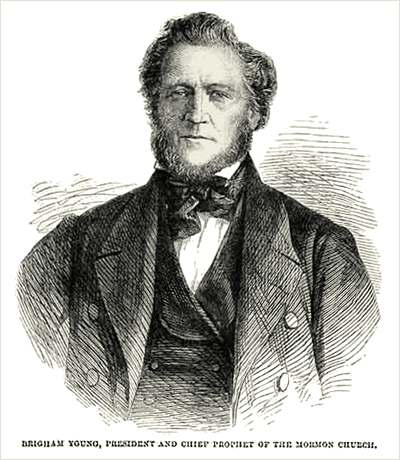
|
Vol. VI. Philadelphia, Thursday, April 3, 1862. No. 31. Missionary Items. Irreligion and Mormonism at the Sandwich Islands. -- Mr. Alexander, of the Sandwich Islands mission, wrote from Wailuku, December 23, that a large weekly newspaper, the Hoka Pakifika (Pacific Star) had lately sprung into existence, advocating the cause of infidelity and immorality. He adds: |
|
Vol. VI. Philadelphia, Tuesday, August 5, 1862. No. 6.
Speck of War in Utah.
It is currently reported in this city that the first Mormon trains from Salt Lake City this season, were stopped at Fort Laramie by the military authorities there, in pursuance of an order from the Government. |
|
Vol. ? Philadelphia, Tuesday, November 25, 1862. No. ?
Letter from Salt Lake.
|
|
Vol. VI. Philadelphia, Tuesday, January 27, 1863. No. 150.
MORMON THEATRE. -- The Mormon Saints have established a theatre at Salt Lake City, Brigham Young and President Kimball officiating at its opening. Songs, dances, the comedy of the "Honeymoon," and the farce of "Paddy Miles' Boy," made up the initiatory bill. |
|
Vol. VI. Philadelphia, Monday, February 9, 1863. No. 161.
The Mormons -- Speech of
Washington, February 7. -- During the proceedings in the House to-day, Mr. Cradlebaugh, the delegate from Nevada Territory, not being able to obtain the floor, received permission to print his speech, of which the following is the substance: |
|
Vol. VI. Philadelphia, Friday, March 6, 1863. No. 183. The Government of Utah. A telegram has been received from Brigham Young stating that a meeting had been held in the tabernacle "to petition the President to remove Governor Harding, and Judges Waite and Drake, and appoint good men in their places." He adds -- "The majority of Federal officers (all the other gentlemen) are acting honorably." From this it appears that Chief Justice Kearney, Secretary of State Fuller, and Superintendent of Indian Aifairs Doty, are included in the compliment. Congress altogether failed to provide by legislation any measure for quieting the disaffection in Utah Territory, leaving that duty to the Executive Department. |
|
Vol. VI. Philadelphia, Tuesday, March 10, 1863. No. 186.
UTAH TERRITORY.
|
|
Vol. VI. Philadelphia, Wednesday, March 11, 1863. No. 187.
UTAH TERRITORY.
Salt Lake City, March 9. -- A collision between the military and the Mormon cirtzens is imminent. |
|
Vol. VI. Philadelphia, Saturday, March 14, 1863. No. 190. Brigham Young Arrested for Polygamy. Salt Lake City, March 10. -- Judge Kinney this day issued a writ against Brigham Young, under the polygamy act of Congress. United States Marshal Gibbs served it without the aid of posse. The writ was responded to, and the defendant personally appeared in court. After a preliminary investigation, the judge held him in two thousand dollars bail, which was promptly given. |
|
Vol. VI. Philadelphia, Thursday, March 19, 1863. No. 194. Affairs in Utah. There is much speculation indulged in concerning the action of the Government respecting affairs in Utah. Private parties have suggested different courses of policy. From what has transpired to-day, it is probable that Governor Harding and the judges complained of by the Mormons will be sustained. It is said by gentlemen well acquainted with Utah affairs that the arrest of Brigham Young by Judge Kinney was an agreed arrangement between the two to test the constitutionality of the anti-polygamy law, and to create the impression that there is no resistance to the judicial powers in that Territory. |
|
Vol. VII. Philadelphia, Thursday, March 26, 1863. No. 30. Miscellaneous. ...Polygamy. -- The report of Brigham Young's arrest in his own dominions, on the charge of bigamy, sounds like the beginning of the end. To the disgrace of our race and our country, we have harbored a nest of horrid profligates from all lands, who under the flimsy guise of a new religion, have made for themselves a city of abominations, compared with which Sodom was righteous. Baffling the laws and strengthening themselves behind their own fortifications, they have defied the authority of government, until they have grown to be a fearful power in the land. We are encouraged to hope that the time is at hand when the Mormons will be scattered and destroyed as a sect, and the vice around which they have been gathered, will be driven into the wilds of heathenism, or to the dominions of the Sultan. And so rapidly is the progress of population gaining upon the Mormons, we may be reasonably sure, that in a few years more, they will be compelled to seek another refuge, unless they abolish their harems, and become conformed to the decencies of a Christian land. -- |
|
Vol. VI. Philadelphia, Thursday, April 2, 1863. No. 206.
DEPARTMENT OF THE PACIFIC.
Washington, April. 1. -- The following is a copy of the report of Colonel [P. E.] Connor, of the 3d California Volenteers, detailing the accounts of a victory recently attained over a party of Indians, on Bear river, Washington Territory, together with a letter from General Halleck to Brigadier General Wright, commanding the Department of the Pacific, acknowledging the receipt of Colonel Conner's report at the headquarters of the army. |
|
Vol. VI. Philadelphia, Tuesday, July 28, 1863. No. 306. Affairs in Utah. Washington, July 27. -- The following interesting report from Gen. Connor has been received at the headquarters of the army of the United States: |
|
Vol. VIII. Philadelphia, Thursday, September 24, 1863. No. 4.
THE PHYSIOLOGY OF MORMONISM.
On a recent visit to Salt Lake I had good opportunities for observing and inquiring into the effects of polygamy as practically exemplified in the case of that people. While sojourning there I mingled much among them, visiting them in their homes, and seeing them at their public assemblies and places of business and pleasure; wherefore I feel qualified to speak of the results of their peculiar institutions, both in their social, physiological, and intellectual bearings. It is, however, chiefly as a physiologist that I shall, at present, consider the subjects, and in this view, I must say, the consequences of the Mormon system, as we find them illustrated in the inhabitants of Salt Lake, are, in every aspect of the case, hurtful and degrading. |
|
Vol. XVII. Philadelphia, Tuesday, February 23, 1864. No. 270.
MINERAL WEALTH OF UTAH. -- Hon. James S. Doty, Governor of Utah, now in Washington, gives the most interesting account of the enormous wealth of that Territory. These treasures of the soil will rival those of California. Brigham Young is exceedingly vigilant in his efforts to prevent any examination, but it is probable that the owner, Uncle Samuel, may sometime put in a pre-emptionary right, and claim to examine into his own premises. |
|
Vol. VII. Philadelphia, Friday, February 26, 1864. No. 178.
MORMONISM. -- It would seem that the lately-reported schism among the Mormons is making headway. We find tbe following in the Cincinnati Gazette of Friday: |
|
nsVol. I. Philadelphia, Thursday, April 7, 1864. No. 14. Editor's Table. THE ATLANTIC MONTHLY for April, is the first number for some months that has seemed to us worthy of an extended notice... Among the Mormons, is an admirable account of a visit to these repulsive people, from one who, with a just indignation against their crime, combined a seemingly calm and impartial judgment, and who determined to recognize and acknowledge everything really commendable among them. He shows their disloyalty to the Union, their complicity with the murder of emigrants across the plains, their practice of assassinating renegades from their own number, the complete despotism of Brigham Young over the community, and utter absence of anything like a republican form of government. His conviction is, that with the death of Brigham, now nearly seventy years old, the whole Mormon system will fall inevitably to pieces. Several factions are already in existence, restrained from open rupture by his influence. A valuable part of this paper, is the exceedingly graphic description of the natural features of the Rocky Mountain district, and especially of the power of the wind in cutting the sand bluffs into their grotesque and artificial-seeming forms.... |
|
nsVol. I. Philadelphia, Thursday, July 14, 1864. No. 28.
Religious Intelligence.
Pittsburg Baptists, Campbellism and Mormonism. -- We clip the two following items from the N. Y. Chronicle: |
|
nsVol. I. Philadelphia, Thursday, November 3, 1864. No. 44.
LETTER FROM UTAH TERRITORY.
A member of one of our Philadelphia congregations now in Great Salt Lake City, writes to his pastor as follows, under date of September 10th, via San Francisco: |
|
Vol. VIII. Philadelphia, Thursday, November 17, 1864. No. 94.
THE MORMONS ALL REBELS -- THEIR POWER BREAKING DOWN. -- The readers of The Press recollect the refusal of Brigham Young to relinquish the post of Governor of Utah, the march of colonel (afterwards rebel General) Johnson, and the treaty with Young. But this treaty bound none but those who made it, and in October, 1862, Gen. Connor, with a brigade, was sent to Utah, making no treaties, enforced the commands of our Government in Utah, and beat the Indians on the Bear river, thus opening the gold regions of Idaho and Montana, and camped his army on a plateau overlooking Salt Lake City, where his artillery could make the adobe houses a mass of pottery at any provocation. When he first entered the city, the prophets, little and large, declared he could never pass the Jordan, small stream flowing into Salt Lake at their city. They said that Brigham had power from God to stop the whole command, and make further approach fatal. But, heedless of all these and other means used to stop him, with flags flying and drums beating, his command crossed the Jordan, entered the city, and the heavens did not fall. Since then he has kept them in perfect.subjection. They hate him for it, and if money could move, or the earth and heaven, they would move them to have him removed. They are all rebels. Their current, open preaching has been treason for some time. Heber Kimball has announced again -- and again to the vast audiences in the Bowery that the "United States are no more." On the authority of Godwin a prophecy of Joseph Smith, he has assured the Mormons that the North and South would annihilate each other, and they should take possession of the country; "and," said the impure vagabonds and ruffians, "what will you do with the wives and daughters whom they leave What? Why put them to raising children!" This was said in the presence of Governor Harding himself, who was seated on the platform near Brigham at the meeting. And an old fanatic and savage, whose pronunciation showed his foreign origin, cries out, with joy at this annunciation of the destiny of our American women to Mormon polygamy, "Ha-men!" But Gen. Connor's chief hope of disarming the Mormon opposition to his government is in the mines, of which the adjacent mountains are full. There is one blast furnace already in operation, saw-mill building to make lumber for more, and he hopes in a year or two to bring in a population of fifty thousand miners, so that the political power will pass into the hands of loyal citizens, and from that hour the supremacy of Mormon priests must fall, as nothing but the most terrible and stringent despotism can keep the Mormon masses in subjection to their stupid, mindless, and senseless superstition. |
|
Vol. XVIII. Philadelphia, Thursday, February 16, 1865. No. 261.
REMARKABLE SILVER MINES IN SOUTHERN UTAH. -- The following account of marvelously rich silver mines in Southern Utah is from the St. Joseph Herald and Tribune of November 1: |
|
Vol. XVIII. Philadelphia, Friday, March 3, 1865. No. 274.
PROSPECTIVE TROUBLE IN UTAH. -- The Colorado News states that, recently, General Connor established a provost guard in Salt Lake City for the purpose of preventing disorder. Brigham Young demanded that they should be removed, and made preparations to attack them; and was only deterred from doing so by General Connor's turning his guns on Brigham's harem and throwing shells over the city to the country beyond, and telling him if he wanted the provost guard removed he must remove them. The guard remained, but the discontent remained also, and the News thinks it probable it will soon break out in acts of violence that will bring the Federal authorities into conflict with those of the semi-ecclesiastical Government of the Territory -- a collision that will inevitably lead to a condition of actual war. Gen. Connor apprehends this, and is making preparations accordingly. |
|
Vol. XVIII. Philadelphia, Tuesday, March 7, 1865. No. 278.
BRIGHAM YOUNG, in a recent sermon, said -- "The North prays that their swords may strike into the heat of every rebel, and I say, amen! and the South prays that the North may be cut down on a thousand battle-fields, and again I say, amen!" |
|
Vol. XVIII. Philadelphia, Thursday, March 9, 1865. No. 280.
TROUBLE is brewing in Utah. General Connor lately establisfied a provost guard in Salt Lake City to keep order, and Brigham Young demanded its removal. Connor turned his guns upon Brigham's harem and told him he must remove them himself if he wanted to. Brigham didn't venture to attack them, but he is very growly about it. |
|
Vol. XIX. Philadelphia, Friday, May 12, 1865. No. 27.
OIL IN UTAH. -- In Utah the Mormons have found oil, and the Deseret News states that a well is to be sunk this season on Sulphur Creek. Coal oil is said to be §12 per gallon at Salt Lake City. Brigham Young opposes the development of the gold and silver mines, but is willing to have any one strike oil. |
|
Vol. VIII. Philadelphia, Saturday, July 29, 1865. No. 229.
A NEW AMERICAN REPUBLIC.
|
|
Vol. XIX. Philadelphia, Monday, November 27, 1865. No. 192.
AFFAIRS IN UTAH.
Salt Lake City, Utah Territory, Wednesday, Oct. 4, 1865. -- There are three governments in Utah, each of which extends over the whole Territory, in form, if not in fact -- the Territorial Government, organized by virtue of the organic act of Congress; the government of the so-called State of Deseret, of which Brigham Young is Governor; and the government of the Church, of which Brigham Young is First President, the anointed of the Lord, and the supreme head. The Church confines its control, not to things eternal and celestial, but extends to all the relations of life and business; to family affairs, and to the fixing of the price of commodities for sale. Nothing is beneath its care, and nothing is above its power. This Church has larger and more positive powers than were ever claimed by the Church of Rome in the dark ages. |
|
Vol. XIX. Philadelphia, Tuesday, November 28, 1865. No. 193.
Hon. Schuyler Colfax On
A very large and brilliant audience thronged the Academy of Music last evening. The occasion was the delivery of the third lecture of the Press Club's admirable course, by Speaker Colfax. At 8 o'clock the orator was introduced by Mr. E. W. C. Greene, the Chairman of the Lecture Committee of the Club, in a few complimentary terms. The audience heartily applauded the speaker, who thus began: |
|
Vol. ? Philadelphia, Wednesday, November 29, 1865. No. ? THE CONDITION OF UTAH. The lecture of Hon. Schuyler Colfax, recently delivered in this city, describing his summer trip "across the continent," contained many subjects of great interest in relation to the boundless wealth and resources of our country. There was one subject to which the speaker referred, which requires close attention from every loyal citizen, and in regard to which there must soon be some sort of interference by the United States Government. It is the manner in which polygamy is permitted to flourish in the Territory of Utah as a system, apparently under the protection, certainly without repression by the United States. This legacy of sin comes to us from the Democratic administrations which formerly controlled our national affairs. They coquetted with the Mormon leaders; they allowed them to defy the laws which govern the Territories, and winked at the immoral practices which were increasing in Utah in the name of religion. Had the administration of Mr. Pierce or Mr. Buchanan firmness and moral principle, the polygamous practices of the Mormons would have been prevented at the beginning, and the system, never having had opportunity to grow, would not have assumed the strong and daring front which it now holds in the face of the law. Utah is nominally a Territory of the United States, but practically it is a foreign State. Its inhabitants are bound to a Government which they consider superior to that of the United States, and which, so long ago as 1857, they declared independent of the Union. The state of Deseret yet continues to exercise power within the Territory of Utah. Congress refused to admit that State and organized a territorial Government for Utah, but that Territorial Government is powerless, except in the immediate neighborhood of United States troops. |
|
Vol. XIX. Philadelphia, Friday, December 15, 1865. No. 207. Wealth of the Mormons. Lieutenant-Governor Bross, of Illinois, who has been visiting the Mormons, explains the source of their prosperity as follows: "Within the last few years they have grown wealthy. The sources of their riches are easily understood. During all the California emigration, scores, and in some years hundreds and even thousands of emigrants would arrive at Salt Lake with their teams broken down, or half of them dead , and, therefore, unable to proceed. Of course the Mormons were ready, in true Yankee style, to trade good animals for those that were about worn out, pocketing a handsome difference in hard cash. In a few months at most, these broken down animals would be fat and sleek, and Mr. Mormon elder was ready to trade with the next emigrant that came along. Of course, many goods and provisions were sold to emigrants. Within the last four years there has been a great rush of emigration to Montana and Idaho, and the Mormons have been able to sell all their surplus grain and provisions at fabulous prices. With corn at three to six dollars a bushel, and wheat at eight to ten dollars, and provisions of all kinds at proportionate figures, the Mormons have become rich far sooner than any other people upon the continent. Now, the hundred thousand people of Utah give a tenth of all they produce or manufacture to the church. Brigham Young and his elders are the church, and hence the untold wealth they have been able to place in their coffers. Two of the merchants of Salt Lake assured us that their freight bill alone would amount, during the present year, to $150,000." |
|
Vol. ? Philadelphia, Saturday, December 23, 1865. No. ? THE GOVERNOR OF THE MORMONS. The United States Senate has confirmed the appointment of Chas. Durkee, of Wisconsin, to be Governor of the Territory of Utah. Governor Durkee is already in the Mormon land, and has discovered, no doubt, that his honor is an uneasy one. He may be the United States Governor, but Brigham Young is Governor in fact. Hitherto the representatives of the United States in that Territory have been unable to command respect. The United States District Judge, John Titus, has an office which he cannot exercise, because the United States Attorney-General is a Mormon, and manages affairs so that no business can be brought before the Court. Until a new policy is adopted, and all the offices are given to "gentiles," the United States will receive neither respect nor obedience in Utah. There should also be a strong military force there, to maintain the national authority, Otherwise Utah will be but nominally a Territory of the United States. But this being done, and the emigration to that Territory and those which adjoin it being encouraged, the result will be an overthrow of the hierarchy which how sustains the surviving "twin barbarism." All this may be done peaceably, in time, provided the "saints" do not openly rebel, a contingency which is not improbable. |
|
Vol. ? Philadelphia, Thursday, December 28, 1865. No. ? Wealth of the Mormons. Lieutenant-Governor Bross, of Illinois, who has been visiting the Mormons, explains the Source of their prosperity as follows: -- |
|
Vol. XIX. Philadelphia, Saturday, January 13, 1866. No. 231. MORMON POLYGAMY. Utah occupies such an important geographical position that her political and moral condition is a matter of concern to the whole country. The State of Colorado lies on the east side and the State of Nevada on the west. Both are rich in mineral and other wealth, and both are fast filling up wilh an industrious and enterprising population. On the north lies the territory of Idaho, and on the south that of Arizona, and these, too, will soon be applying for admission into the Union as States. It is an anomaly that a region thus surrounded should have a government that is an absolute despotism, and that under that despotism an immoral institution that is illegal in every other part of the United States, should be maintained in utter defiance of the national authority. |
|
Vol. XIX. Philadelphia, Friday, January 19, 1866. No. 236.
From Washington
Washington, Jan. 19. -- ...Brigham Young, backed by all his people, is urging the admission of Utah into the Union as a State. The Territorial Committee have the matter under consideration. |
|
Vol. XIX. Philadelphia, Friday, March 2, 1866. No. 272.
XXXIXth CONGRESS -- FIRST SESSION.
...The House went into Committee of the Whole on the Miscellaneous Appropriation bill, Mr. Wentworth in the chair. |
|
Vol. ? Philadelphia, Saturday, April 28, 1866. No. ? THE EFFECT OF POLYGAMY. An atrocious murder was perpetrated in Salt Lake City, Utah, on the 27th ult., the victim being Mr. S. N. Brassfield, lately a resident of Nevada. He had undertaken the dangerous and fatal experiment, as it proved, of marrying a Mormon woman, the second wife of one of the polygamous saints, who was abroad. He was married to the woman by a United States Territorial Judge, who held that the man with whom she had been living having already one wife, his so-called marriage to the second was void, and the latter was at perfect liberty to contract a new matrimonial obligation. This attack upon the "religion" of the Mormon adultress seems to have aroused the latter to fury. Brassfield was arrested on his wedding night, while assisting his wife to remove her goods and clothing from the house of the man whom she had lived. The charge against him then was, "resisting an officer." He was kept in prison all night, and next morning was taken before a Mormon official, holding a "Probate Court," and bound over to answer. The next day he was indicted by a Mormon Grand Jury upon two charges -- one for resisting the officer, the other for the larceny of the goods which his wife was about to carry away. He was promptly put upon trial, and the case partly heard. Meanwhile, the wife attempted to get the custody of two children by the Mormon father, but was resisted by the friends of the latter. The mother got a writ of habeas corpus for the children from a United States Judge, and the friends of the father had another issued by the Mormon Court. The United States writ was first executed, and the United States Marshal took possession of the children. The Mormon writ was served upon him, and he refused to obey it, and was threatened with imprisonment, for contempt, by the Mormon justices. |
|
Vol. XX. Philadelphia, Wednesday, May 30, 1866. No. 45. The Great West. Chief Justice Turner, of Nevada ,delivered an address last evening before the Young Men's Christian Association. His subject was the "New Eldorado, or the Golden Shores of the Pacific.'' He sketched briefly his trip from St. Joseph, Mo., to Carson city, described Fort Kearney, Fort Laramie, South Pass, Fort Bridger, and Salt Lake city. His interview with Brigham Young was graphically described. Over his gate is the emblern of an eagle; his portico a bee hive, his office a couchant lamb, which, being interpreted, are significant of courage, industry and innocence. "How many wives have you, Governor?" he inquired. "Sixty-five, sir," responded the chief of the Saints, "one for each year of my life." He sketched Fort Bridger, Camp Floyd, thename of which being difficult to pronounce, the Government changed to Camp Crittenden.... |
|
Vol. XX. Philadelphia, Tuesday, July 24, 1866. No. 91.
UTAH.
Washington, July 23. -- The House Committee on Territories have made a report on the condition of Utah. They say the testimony discloses the fact that the laws of the United States are openly and defiantly violated throughout the Territory, and that an armed force is necessary to preserve the peace and give security to the lives and property of citizens of the United States residing therein. The only witness introduced at the request of the delegate from Utah admits the necessity of maintaining United States troops in the Territory in order to secure protection and safety to persons and property. |
|
nsVol. III. Philadelphia, Thursday, December 13, 1866. No. 50. XXXIXth CONGRESS -- Second Session. ... House. -- ... Dec. 6. -- Mr. Eliot, of Massachusetts, offered a resolution, which was adopted, providing for a committee of three to investigate the New Orleans riots. The Judiciary Committee were directed to inquire into the expediency of a law to more effectually punish bribery at elections, and to make persons who purchase votes ineligible to office. A committee was appointed to investigate the murder of three U. S. soldiers in South Carolina on the 6th of October, 1865. The Judiciary Committee were instructed to report a bill excluding ex-rebels from suffrage in the District of Columbia. A bill of last session, in relation to the Territory of Utah, was called up for the purpose of reference. It is a very important measure. Under the simple title of a bill to provide for the selection of grand and petit jurors, it proposes really to abolish polygamy. Among other things, it prohibits the solemnization of matrimony by Mormon priests, and commits that office to the Judges of the United States Court in the District. It also annuls a number of laws of the Territory, under which Brigham Young claims possession of lands, water-courses, etc., belonging to the United States.... |
|
Vol. XX. Philadelphia, Monday, December 24, 1866. No. 222.
Utah and the Mormons.
The population of Utah was, in 1860, 40,295. The present maximum estimate is one hundred and fifty thousand, not including United States soldiers nor the miners who go into winter quarters at Salt Lake City. Under ordinary circumstances Utah would have been admitted into the Union long ago, but the conflict of opinion between the local and national authorities on the "peculiar institution" of the Territory is irreconcilable, though perhaps not irrepressible. This conflict, long impending, was first fairly commenced in the 37th Congress, when Utah, or "Deseret," applied for State recognition, and that tody answered the request by passing a bill prohibiting, polygamy in all the Territories, specially naming Utah. It is quite probable that the Mormons had no wish to be admitted, for the real demand of their institution, like that of the one which occasion the late rebellion, is to be let alone. |
|
Vol. ? Philadelphia, Tuesday, February 19, 1867. No. ? Polygamy in Utah. The Legislative Assembly of Utah have petitioned Congress to repeal the act of 1862, providing for the punishment of polygamy in that Territory. In support of their petition they say that there has not been a single case tried under it, and that as the Constitution of the United States prohibits any interference with religion, they have the right to practice polygamy as a part of their creed, that institution being of divine origin. They also assert that polygamy has had a great moral influence in saving the people from prostitution and kindred evils. |
|
Vol. XX. Philadelphia, Saturday, February 23, 1867. No. 273.
LITERARY ITEMS.
Messrs. J. B. Lippineott & Co. have just published Wm. Hepworth Dixon's "New America," being notes of his travels through this country during his late visit. The book is gotten up in superb style, and illustrated with engravings from original photographs. We extract the following interesting account of the Mormon Theatre, its peculiarities and surroundings: |
|
Vol. ? Philadelphia, Friday, March 1, 1867. No. ? Polygamy in Utah. Some days ago a memorial from the Legislature of Utah was presented to the House of Representatives, asking that the anti-polygamy law, as applied to that Territory, be repealed for reasons stated. This memorial was referred to the Committee on the Judiciary, who to-day made a report in which they, in strong terms, denounce polygamy as contrary to the spirit of the Christian religion, and a relic of heathenism and barbarism, and subversive of the marriage relation in all nations where it is tolerated. It is simply legalized prostitution, destroying the original and divine constitution of society. |
|
Vol. ? Philadelphia, Saturday, March 30, 1867. No. ?
Legislative Resolution Against
San Francisco, March 29. -- ...The Nevada Legislature has passed a revenue bill. A concurrent resolution has been introduced in the Senate against the Mormon doctrines as prejudicial to the whole country, and asking the general government to place a military force in the Territory, in order that equal, civil, political and religious rights may be insured to all citizens of the United States, and that the laws of the land may be enforced. |
|
Vol. XXI. Philadelphia, Monday, July 8, 1867. No. 77.
SCHISM AMONG THE MORMONS.
St. Louis, July 7, 1867. -- The Salt Lake Vidette of June 25 says -- On Sunday afternoon Brigham Young preached a lengthy sermon openly, boldly and announcing that Amasa Lyman, Orson Hyde and Orson Pratt had apostatized, and were cut off from the church. Orson Hyde had been chosen President of the twelve apostles last April, Pratt is one of the twelve, and Lyman had been one of the apostles also. Young was severe on Hyde, but particularly so on Pratt. He denounced the latter as an unbeliever, and as now in possession of the devil. |
|
Vol. XXI. Philadelphia, Tuesday, July 9, 1867. No. 78.
There is a row in the Mormon camp, and a fair prospect of an ostracism of some of the leading saints. It has long been known that many of the sisters were disgusted with the condition of things under the Brigham dispensation, and many successful and unsuccessful attempts have been made to escape from the slavery in which the females are held. But it has been within a short time only that any prominent men have shown any sympathy with the disaffected. Some few, indeed, openly declared against polygamy, and practiced their precepts by sealing to themselves but a wife a piece. But sinful as the conduct of these saints was regarded, they were permitted to remain in the bonds of iniquity, without molestation, until they dared to protest against the design of the prophet Brigham to place his son in the high seat of the synagogue as his successor. Then three of the apostles, either filled with high aspirations for themselves, or desirous of putting an end to the despotism of the Youngs, declared against Brigham, and called forth from him a bitter denunciation, in which he pronounced them apostates who had fallen away from grace, and put themselves beyond the pale of the latter day church. |
 Vol. VIII. Philadelphia, Thursday, July 11, 1867. No. 9.
THE MORMONS.
Salt Lake City, June 28. -- I have seen Mormonism in its best garments only. Its dignitaries have made me welcome. Its hospitality encompassed me. Its fruits and flowers, its light spots and pleasant recreations, were all before me. With its humble followers and its shadowed household circles, I must repeat the experience of all other Gentile visitors, and go as I came, a stranger. But on ever hand, on the streets, in the homes where crime wears its richest gilding, in the tabernacle, and even in the very fountain of the polluted stream, are plainly visible the melancholy evidences of mingled fraud and infatuation, of cunning wrong-doers and deluded wrong-sufferers. |
|
Vol. XXI. Philadelphia, Saturday, July 13, 1867. No. 82.
FACTS AND FANCIES.
...Brigham Young malignantly said of the wife of Joe Smith, the Prophet, that she was the d—dest liar he knew." This was part of a Sunday afternoon sermon upon the Smith family. |
|
Vol. XXI. Philadelphia, Tuesday, July 16, 1867. No. 84.
AMONG THE SAINTS.
SALT LAKE, June 18, 1867. I have now spent a week with the Latter Day Saints, admired their green shades, beautiful artificial streams, pleasant homes, and the innumerable evidences of industry and prosperity which appear on every hand. Their markets are filled with the choicest vegetables, and the finest strawberries of the continent are offered every hour of the day at reasonable prices. Stores equal to those of the cities of the Western States are numerous, and business of all branches has an air of system, capital and thrift that is delightful. This is a city of 20,000 population, without paupers, brothels or gambling hells. Among the Mormons, who constitute over 90 per cent. of the people, there are none idle, and they claim that none suffer. The bee-hive is found on the dome of the Prophet's house, and frequently on rude business signs, as typical of the habits of the faithful. All must work, and while each owns his property gained by industry, there is still a common store where the distressed and children of want repair. And industry is brightened in every possible way. In the evening the merry dance is to be heard in almost every ward; the theatre is never closed for any length of time, and recreation is devised in every conceivable manner to lighten the burdens of toil. |
|
Vol. XXI. Philadelphia, Wednesday, July 17, 1867. No. 85. THE MORMON PEST. A serious schism is reported to have begun among the Mormons in Utah. Amnsa Lyman, Orson Hyde and Orson Pratt, who have been numbered among the Twelve Apostles, have been denounced by Brigham Young as having Apostatized from the faith, and it is understood that they have a large number of followers. They declare their determination to resist the succession of Brigham Young, Jr., as head of the Mormon church. The difficulty seems to be as much one of finance as of faith, the exclusive control of the funds of the church by the Youngs being apparently regarded as quite as dangerous as is the lodging of absolute power. |
|
Vol. XXI. Philadelphia, Wednesday, July 24, 1867. No. 91. From Omaha and Utah. The Salt Lake Vidette of the 7th, in an editorial, says that there is no doubt of the rich gold discoveries made by the Robinson companions somewhere on Green river. The exact locality is still a secret to the public. The discovery was made by Mormons. A large number of the Mormons were putting out for the new mines from different towns above and below Salt Lake. Brigham Young and Captain Hooper outfitted parties for the new Eldorado. |
|
Vol. XXI. Philadelphia, Friday, August 2, 1867. No. 99.
Among the Mormons.
GREAT SALT LAKE, May 9, 1867. -- The tourist, when approaching the city of the "Saints" for the first time, having traveled the hundreds of miles of wilderness which surround it, cannot but be favorably impressed. It is literally an oasis, combining the comforts of civilization with natural fertility and beauty. Coming in from the east and descending the mountains through a ravine, we emerge into a vast basin, with high mountains which seem completely to surround it. Here is the Great Salt Lake, its water completely saturated with salt, its shores bounded by a white line of the crystallized substance. Bear and Jordan rivers are continually pouring in fresh water, there is no outlet to the lake, and yet no rise of the waters. A few years since this basin was a wilderness untrod by white men, and so far from the nearest points of civilization, and so difficult of access, that its settlement appeared only the possible work of another century. Mormonism has done the work, and the city now offers rest and luxury to its guests. To-day the peach and apple trees are in full bloom. The gardens afford all kinds of early vegetables for the table. |
|
Vol. XXI. Philadelphia, Saturday, August 3, 1867. No. 100.
Serious trouble is brewing among the Mormons. The issue is between the polygamous and anti-polygamous or monogamous elements in this profanely self-styled Church. In the Utah vernacular these two parties are known as the "Brigamites" and "Josephites" -- the former being named after Brigham Young, the latter after Joseph Smith, Jr., the son of the martyr, and he himself a candidate for martyrdom if he ever gets within the reach of the despotic Young. Orson Hyde, Orson Pratt, and Amasa Lyman, three of the twelve apostles of Utah Mormondom, have become converts to the one-wife system of Smith, who has his headquarters in Illinois, and have been officially anathematized and cut off. |
|
Vol. XXI. Philadelphia, Monday, August 12, 1867. No. 107.
NEWS FROM MORMONDOM.
It is generally known that there is an irreconcilable schism in the Mormon Church: but it is not generally known that the division separates forty or fifty thousand "Saints" from the recognition and control of Brigham Young and Salt Lake church authorities. The branches dIffer, not only in relation to the legitimate succession to the Presideucy of the Church, but in vital doctrinal points as well, and there is no probabilitly of their ever coming together. The disaffected Mormons are scattered throughout the Western States, and are under the leadership of Joseph Smith, Jr., son of the founder of the faith. He lives in Iowa, and seems to be much respected by his neighbors. It was doubtless the intention of the elder Smith to place the mantle of his authority and succession upon the shouldcrs of the Iowa prophet, but he was killed in prison, and Brigham Young managed to elevate himself to the Church Presidency, while the junior Smith was mourning for the death of his father. Such of the Mormons as could not be prevailed upon to remove to Salt Lake twenty years ago remained in Iowa and Missouri, and recognized the authority of the younger Smith. Their numbers have increased largely, and they now count all of forty thousand souls; it is said. They neither believe in nor practice polygamy, and are altogether a more intelligent body of people than is the Utah branch. A large proportion of them are nativcs of the United States, and during the rebellion they were noted for their loyalty to the government. Some months since we published a letter from Joseph Smith, Jr., in which he stated the points of difference between the two sects, and alluded to the disloyalty of the Salt Lake branch. The letter seems to have had some effect, for his followers have largely increased during the past year. He has made two or three unsucceessful efforts in the way of proselyting at Salt Lake, and the two branches are irreconcilably hostile to each other. |
|
Vol. XXI. Philadelphia, Tuesday, August 20, 1867. No. 114.
THE AMERICAN COLONY AT JAFFA.
The documents lately published by well-informed and trustworthy persons concerning the lamentable condition of the American Colony in Jaffa, Syria, and more especially their last appeal addressed to the American Consul at Jerusalem, Palestine, telling the sad story of their sufferings for the past year and of their present wretchedness, are very sad. Especially so are those setting forth the most earnest desire of the colonists to return at once to the United States, and so escape from the condition, of utter poverty and semi-slavery to which they have been reduced by the devices of their leader; and this appeal has very likely provoked a general desire to know something of the antecedents of this man -- their leader -- the self-styled "Prophet" Adams. It chanced that a number of years ago certain business relations brought Adams and the writer for several months into half-a-dozen-times-a-daily communication, so that the deponent can, to a certain extent, speak by the card. |
|
Vol. XXI. Philadelphia, Thursday, January 23, 1868. No. 246.
A FLURRY IN MORMONDOM. -- The bill recently introduced into Congress by Senator Cragin of New Hampshire: "To regulate the selection of grand and petit jurors in the Tertitory of Utah," and for other purposes, has roused the ire of all the Saints. According to the terms of this bill, as construed by the Deseret News, the Mormons must either abandon their religion or be tried by a despotic court. In the opinion of the editor there is left no loophole for escape, for hereafter, should the proposed law take effect, it shall not be lawful for an officer or a member of the Mormon church to perform a ceremony of marriage. Says the News: |
|
Vol. XXI. Philadelphia, Thursday, February 27, 1868. No. 276.
Lecture by Hon. A. K. McClure.
Harrisburg, Feb. 27 -- Hon. A. K. McCIure, Ex-Senator of Pennsylvania, who has just returned from the Western Territories, Iast night delivered an address before the House of Representatives, setting forth an animated description of the far West. Governor Geary presided, and introduced Mr. McClure, who said: No part of the East is as fertile as the country west of the Missouri. He has seen in the heart of the Rocky Mountains, 4,000 feet above the sea, long: valleys extending over three hundred miles, producing the finest wheat in the world. It would be policy to appoint school masters to teach legislators what the West really is. No part of the country between the Missouri river and the Pacific, excepting the tops of mountains, but what will grow every product of Pennsylvania except corn, with greater ease than in our State. The first real settlement of the country was due to the Mormons, the masses of whom were ignorant, low foreigners, more degraded in their own country than any of our native citizens, but who, under the worldly wisdom and wonderful ability of Brigham Young, have reared homes of neatness surrounded with vines, flowers and fruits, and filled with contented men, who believe their ruler to be the prophet of the Lord. Thus one hundred thousand people exist in Utah, more free except on the score of religion, than any community of the same size in Amcrica from the vices of drunkenness, swearing and immorality. In the whole of Salt Lake City there are but two taverns; every ward has its bishop, nearly all of whom are Americans. The women are ignorant, not one in ten of them can read, and they are taught that their only hope of happiness in heaven is through their husbands. This is one inducement to polygamy, but there are no happy wives in Utah. A woman cannot leave her home without being watched with the same care as a criminal. To sum up, nine-tenths ef the Mormons are ignorant, earnest believers, and the remaining one-tenth are blasphemers, and licentious. Brigham Young positively declared to the speaker that polygamy should not be abolished. No act of Congress could destroy it, but the Pacific Railway would throw strange masses among; them, and work a cure. They manuf acture their own flour, iron, cotton and sugar. The difficulties of crossing the Rocky Mountains are exaggerated. The speaker had crossed them six times in four months. No single hundred miles of the crossing was as difficult as the line between Harrisburg and Altoona. The finest natural roads in America were among these mountains. In winter, however, the snow was fifty feet deep, and last January the speaker had walked upon it. How the railroad would succeed in conquering the difficulty he did not know. There was to town half the size of Harrisburg, in the far West, that did not do ten times the business of that place. The mines of Utah, Montana, Nevada and Colorado were rich beyond comparison. In two years a man could leave his Massachusetts home on Monday and worship the following Sunday in San Francisco. |
|
Vol. XXII. Philadelphia, Monday, June 29, 1868. No. 69. RAILROADS AND THE MORMONS. Brigham Young is a bold ruler, when he invites the Pacific Railroad into his territory. To open Utah to a free commerce with the Gentile world is to introduce the elements of a certain and speedy downfall for the whole peculiar structure of Mormonism. And yet Brigham Young courts the approach of the Pacific Railroad with the full knowledge of all the consequences: Eight thousand Mormon laborers are now at work in Utah, constructing this great line of communication with the outer world, and to this co-operation of Brigham Young's the Company is largely, indebted for the rapid and extraordinary progress which it is now making. Six hundred and sixty miles of this wonderful work are now in regular operation, and within a month forty miles more will be completed, while the hope is entertained of reaching Salt Lake City by the close of the present year. Evidently Brigham Young is honest in his declaration that he "is not afraid of the Gentiles." Either he has a fanatical faith in the power of Mormonism to resist the influences of the outside pressure of American "institutions, or, foreseeing with keen sagacity the early abolition of polygamy, he is statesman enough to set his house in order in good time, and to lay deep and broad the foundations of that prosperity which awaits the people of Utah when they shall have cast away those features of their peculiar religion which now put them under the ban of the civilized world, and accepted those inevitable conditions of American progress of which the Union Pacific Railroad is now one of the greatest types. |
|
Vol. XXII. Philadelphia, Monday, July 27, 1868. No. 92.
The results of the polygamy practised in Utah territory are themselves proving the iniquity and absurdity of the Mormon marital theory. A recent census of the Mormon settlements shows that of the whole number of children bom, the proportion of females to males is as nineteen to twenty, or nearly an equal number of both sexes. This is nature's protest against Brigham Young's doctrine, and it is difficult to perceive how he can prevent this hard, incontrovertible fact, working out the eventual ruin of his system of polygamy. Either he must provide for an enormous immigration of women that must continue indefinitely in an increasing ratio, or he must get rid of a great many more than half of the males that are born of Mormon parents; for as it is, there are not enough women to give the rising generation of young men one wife apiece. The first of these alternatives is nearly impossible; the second is quite so, and it seems to be inevitable that this simple and natural proportion of the sexes will be the occasion of effecting the overthrow of the whole wicked system. Like every other violation of the laws of the Creator, it works out its own destruction. It is strange that Joseph Smith, if indeed, as may be questioned, he authorized polygamy, did not think of this. It is an established law that the sexes shall be nearly equal in the total of the race. In crowded communities the well-known preponderance of females is attributable to loss of male life from excesses, violence, war and emigration. That this latter is a leading cause, is evident from the preponderance of males in new communities. Probably if man had retained his pristine purity and innocence, humanity would be paired off in exact couples. But the excess of women in the population of the world, if, indeed, it exists at all, at any rale is not great enough to supply the foreshadowed Mormon deficiency, without any regaid to the insufficiency of numbers which would exist if all mankind took Brigham Young's advice and adventured in polygamy. |
|
Vol. XXII. Philadelphia, Thursday, August 6, 1868. No. 101.
AN EDITORIAL EXCURSION.
We halted, perched on tho summit of the Laramie Mountains, or Black Hills, as they seem to be indiscriminately called. A breathing spell, and then we go launching down the opposite slope, reaching soon the more sterile region, which will become wilder and more barren until we again cross the Platte at Benton. At 2 P. M. we are at Laramie. |
|
Vol. XXII. Philadelphia, Wednesday, August 12, 1868. No. 106.
BRIGHAM YOUNG.
Salt Lake City, July, 1868. -- Calling on a prominent tradesman in this place (himself a leading Mormon and Utah pioneer;) our party of four inquired as to the feasibility of obtaining a brief interview with Brigham Young. We were told that the modern Solomon (in domestic multiplicities if not in wisdom) granted few audiences to parties seeking his presence from motives of curiosity, beside which he was fresh from the grave of one of the most trusted ministers -- Heber Kimball -- and must be presumed to be indulging in that grief that arises as much from the suggestion, "how soon may paralysis pin me," as from the sense, of pain and vacancy that follows a bereavement. It so happened that one of our number had a proposition to lay before the Arch-chief of the Mormons, which had the color, if not the substance of business; and so, after a private parley between the gentlemen we applied to and Brigham, we were informed that the latter would see us at 10 A. M. if we could spare the time; if not, then at some later hour. |
|
nsVol. V. Philadelphia, Thursday, September 3, 1868. No. ?
Mormonism in England and Wales. --Though the home of Mormonism is in the United States, all intelligent observers know that its growth is not from this country, and America has to bear the reproach of sheltering, but Europe that of feeding, this wickedness. The Pall Mall Gazette says, a propos of Mr, Hepworth Dixon's scandalous and libellous "New America": "Any American book-maker, who wished to do a clever thing, had only to go to Liverpool and there make inquiries about the Mormons. He would probably be referred to Wales, and if he pursued his journey thither he would soon discover that be had hit upon the large training-ground of Mormondon. He would find that we rear the followers of Brigham Young, and that America gets the credit of them. A thrilling picture of the frightful state of social life in Great Britain might be drawn from the presence among us of strange sects. Wales is a great deal nearer to the heart of England than Salt Lake or Oneida Creek is to anything which deserves to be called 'American;' and an enterprising traveller, gifted with a lithe and sinewy style, might easily delude a portion of his countrymen into the belief that the Mormon nursery in Wales can be safely taken as an example of the relations which exist between the sexes all over the country. If he did this, and did it well, he would deserve to be considered a very 'smart ' man, for -- to use a common phrase -- he would have paid us back in our own coin. We send shiploads of Mormons to America, and then write books to prove that Mormonism is the natural fruit of the loose principles which prevail in America." |
|
Vol. XXII. Philadelphia, Thursday, September 10, 1868. No. 131. Unpopularity of Brigham Young, Jr. The Salt Lake Reporter of August 31st says: |
|
Vol. XXII. Philadelphia, Friday, September 18, 1868. No. 138.
FROM UTAH.
The Salt Lake Reporter of September 10th says: |
|
Vol. XXII. Philadelphia, Saturday, October 3, 1868. No. 151. The Truth about Mormon Immigration. The Salt Lake City Reporter of Sept. 25 says: |
|
nsVol. V. Philadelphia, Thursday, October 8, 1868. No. ? REV. A. M. STEWART'S LETTERS -- XVII.
|
|
Vol. XXII. Philadelphia, Friday, October 30, 1868. No. 174.
FACTS AND FANCIES.
The Mormon currency issued by Brigham Young is of various denominations the larger, from one dollar upwards, corresponding in size and general appearance with tha Washington issues. As it circulates freely all through Utah Territory, and appears to be quite plentiful, Brigham must find his banking system highly advantageous. He has handsome balances to his credit in a New York bank and in the Bank of England. |
|
Vol. XXII. Philadelphia, Friday, November 6, 1868. No. 180. The Mormons. The Salt Lake Reporter of Oct. 27th discusses the recent action of the Mormon Conference against the Gentiles, and speaks as follows of the "persecutions" of which Brigham Young claims to be the victim: |
|
Vol. XXII. Philadelphia, Tuesday, November 10, 1868. No. 183. MORMONISM. The Mormons recently held a conference in their temple [sic - tabernacle?] at Salt Lake City, the principal object of which appeared to be to enable the leaders to establish a policy of absolute non-intercourse between the Saints and the Gentiles. This was insisted upon in the most urgent manner, and by threat and entreaty the Mormons have been induced to refuse to hold any communication whatever, in social or mercantile life, or in any other manner, with the unfaithful. Co-operative stores, factories and work-shops are to be started, and a community formed so exclusive that it will refuse to recognize even the existence of its neighbors. |
|
Vol. XXII. Philadelphia, Saturday, November 28, 1868. No. 198. Mormonism and Polygamy. The Salt Lake Reporter publishes the following interesting article: |
|
Vol. XXII. Philadelphia, Wednesday, December 30, 1868. No. 224.
A few weeks ago Brigham Young declared his intention to enforce, as nearly as possible, absolute non-intercourse between the Mormon people and the Gentiles of Salt Lake City. Now he has devised a new alphabet and a new language, in which the Saints are to be instructed that they may forsake all fellowship and kindred with the interlopers and set themselves aside as a peculiar people. Both of these movements are parts of Brigham Young's scheme of defence against the expected incursion of outside barbarians when the Pacific railroads are completed. The prophet is at bay. He led his people out into the depths of a remote wilderness, and thought himself forever secure in his isolation. But civilisation was an over match for his barbarism, and it is surrounding and permeating his community. He cannot flee away further; and so he has undertaken a task that is a confession of desperation. It is too wildly impracticable to have been resorted to but in an extremity. Mormons are very much like other men. If they can trade profitably with Gentiles, even Brigham Young's threats will not keep them from it. The railroads will fill Utah with merchants at whose enterprise, Saintly shopkeepers will be amazed and dismayed; and from whose counters the impecunious Mormons will choose to buy goods at competitive prices. The bargains will be made, too, in the English language. More despotic power than that of Brigham Young would fall to teach an entire people a novel, uncouth tongue. The inevitable tendency, even of those who already speak a foreign language, is to learn the common language of the country; and an attempt to lead a multitude in precisely the opposite direction, away from the language of their fellows, cannot result in anything but failure. It would not succeed with a body of highly intelligent men and women; and the mass of the Mormons are grossly; ignorant. It would fail even if non-intercourse could be enforced, but this already is proved impossible. |
|
Vol. XXII. Philadelphia, Thursday, January 21, 1869. No. 241.
A MORMON OUTRAGE.
A correspondent of the Salt Lake Reporter of the 12th says: |
|
Vol. XXII. Philadelphia, Friday, January 22, 1869. No. 242.
BRIGHAM YOUNG.
A correspondent, writing from Salt Lake City, says of Brigham Young: -- He is no longer young, and the Mormons will soon have to look out for a new prophet. Brigham has, it is said, lately had another revelation to the effect that the Lord desires a canal dug from Salt Lake City to Salt Lake Valley. It is to the following effect: |
|
Vol. XXII. Philadelphia, Thursday, January 28, 1869. No. 247. A Bill for the Suppression of Mormonism. The Washington correspondent of the Herald writes: |
|
Vol. XXII. Philadelphia, Monday, March 15, 1869. No. 285.
MORMONDOM.
From late numbers of the Salt Lake City Reporter we clip the following: |
|
Vol. XXII. Philadelphia, Monday, June 7, 1869. No. 50.
MORMON ASSASSINS.
The Salt Lake Reporter gives the following account of Brigham Young's band of cut-throats: |
 Vol. III. Philadelphia, Friday, July 9, 1869. No. 162.
THE PLAINS.
CHICAGO, June 8. -- The Tribune of this morning publishes a despatch from Mrs. Powell, wife of Major Powell, dated at Detroit, in answer to an inquiry from the editor of The Tribune as to whether the John Sumner, to whom the story of the disaster is attributed to the Omaha Republican, belonged to the expedition. Mrs. Powell says Sumner was a member of the expedition, but she does not believe the story, and evidently does not not believe that it came from Sumner. Nothing direct has been heard from Major Powell since the letter published in The Tribune on May 28, and the question has narrowed down to this, Has John Sumner actually returned from the expedition reported lost on Green river late in June, and which story, attributed to Sumner, Risdon got hold of, appropriated, and boggled, or is the story attributed to Sumner only? |
|
Vol. ? Philadelphia, Thursday, July 15, 1869. No. ?
THE MORMONS DEFIANT.
Salt Lake, July 11. -- Yesterday morning ex-Governor Oglesby, Senator Trumbull, and several other gentleman of the commercial party, called on the Governor of the Territory, Mr. Durkee, and paid their respects. The other Territorial officers called on our party and placed their services at our disposal. |
|
Vol. X. Philadelphia, Friday, August 27, 1869. No. 50.
THE MORMON FERMENTATION.
The Corinne (Utah) Reporter has further accounts of the difficulty in the Mormon camp. A meeting was held in Salt Lake City on Aug. 8. We give a portion of the account of the meeting: |
|
Vol. III. Philadelphia, Thursday, October 28, 1869. No. ?
BRIGHAM YOUNG, JR.,
Learning that so notable a personage as Brigham Young, Jr., was in our city, a reporter of the Post yesterday paid a visit to the residence of the gentleman whose guest he is, and shortly after our name being announced Mr. Young presented himself. Mr. Young is a man of apparently about 45 years of age, about five feet ten inches in stature, somewhat stout, of a ruddy healthy complexion; his face is round and full, his eyes large, clear, and penetrating, his head slightly bald on the top; he wears closely cropped whiskers, and his whole appearance reminded us more of a country gentleman tanner rather than anything else, and was plain evidence to us that so far as healthiness is concerned, there is no "discounting" the climate of Utah. From the first moment we judged him to be what he afterwards proved, a thorough, highly educated and cultivated gentleman. On stating the object of our visit, Mr. Young very frankly said to us that he would be glad to give us any information possible, but that he strongly objected to being placed before the public for the simple reason that he, and the church to which he belongs, were in a majority of cases vilified. He cited to us several instances in which his statements had been garbled and distorted to suit the views of those who looked upon the people of Utah as a set of heathens. On our stating to Mr. Young that such was not our intention, but that we were, on the contrary, seeking after genuine information, he readily assented to our request, and at once entered into a free, open conversation. |
|
Vol. III. Philadelphia, Monday, November 1, 1869. No. ?
Another Interview With Brigham Young, Jr.
Owing to the general amount of attraction and comment created and educed by our report of an interview with Brigham Young, Jr., we were led to solicit a second one, with the ultimate object of obtaining his views upon certain matters which had escaped our attention on the first occasion. We found Mr. Young dressed in a neat clerical suit of black, and looking the very embodiment of health. Mr. Young, as his conversation showed, is a man of more than ordinary ability, has travelled a great deal, and has profited thereby; besides this, he has an easy but forcible style of delivery, which at once rivets his hearer's attention, and gives much weight to his words. |
|
Vol. XIII. Philadelphia, Wednesday, March 16, 1870. No. 64.
MORMONISM.
Mr. George A. Townsend furnishes the Chicago Tribune a letter from which we extract the following: |
 Vol. I. Philadelphia, Wednesday, August 17, 1870. No. 81. Development of Utah. Whatever may be thought of the Mormons in their religious fanaticism, and in their practice of polygamy, it must be confessed that they have achieved something really creditable in the development of home industries. When they went to the valley of Salt Lake, some twenty-five years ago, they carried nothing with them save a scanty supply of clothing, food and some of the implements of husbandry. They now number not far from twenty thousand inhabitants in Salt Lake City, while the territory contains a population of probably one hundred and fifty thousand -- enough to have warranted the organization of a state long ago, had it not been for the abomination of polygamy, which, so far as outside co-operation has been concerned, has provided a serious drawback to Utah territory. Such terrible reports have gone abroad concerning the moral influences of polygamy that few except Mormons would go there if they could find any other state or territory open to them. |
 Vol. ? Philadelphia, Wednesday, August 24, 1870. No. ?
CORINNE.
CORINNE, Utah, July 28, 1870. -- Corinne being the only thorough Gentile town in Utah, and as such being a sort of city of refuge for disaffected Mormons, has not failed, as may well be supposed, to provoke the enmity of the hierarchy at Salt Lake. Not in all the Territory is there another town or community that has dared to come out and boldly denounce the rule of the Church, or give shelter and encouragement to those seeking to escape from its clutches. Everywhere else the adherents of the Church are so largely in the ascendant that it would not be safe for any one to assail or even express opinions strongly adverse to their policy and practices. |
|
Vol. I. Philadelphia, Monday, September 19, 1870. No. 109.
TROUBLE BREWING IN UTAH. -- The proclamation of Governor Shaffer, of Utah, depriving Brigham Young of all control of the militia, is one which at first seems to threaten the most serious consequences. In terms, to be sure, the Mormon leader is not referred to; the proclamation simply forbidding "all masters, drills or gatherings of the militia of the territory of Utah, and all gatherings of any nature within the territory of Utah, except by my order, or the order of the United States marshal," and further ordering that all arms or munitions of war belonging either to the United States or the territory of Utah, within the territory, not in the possession of United States soldiers, shall be immediately delivered to the authorities whom the governor designates. But it is easy to see that compliance with these terms would at once divest Brigham Young of all military power, and strike at the foundation of his authority. |
|
Vol. 105. Philadelphia, Thursday, September 28, 1876. No. 33,705.
ABSOLUTE EVIDENCE of Mormon guilt in the Mountain Meadow massacre is finally being established. No one who has read the testimony already taken can doubt for an instant that every report and every early suspicion was absolutely correct, and that the horrible murders were committed with full cognizance and at the command of that vile hierarchy. However blinded the Mormon masses may be, this evidence will affect disciples who have not yet reached, and coupled with Brigham Young's advanced years, the jealousy of his successors, some defections, a correct population pressing into Utah and its adjacencies, and the defeat of the party that employed Brigham as Governor of Utah, there is little doubt that it will greatly hasten the removal of this abomination. |
|
Vol. ? Philadelphia, Wednesday, March 28, 1877. No. ? THE MORMON IMPOSTURE. It is now exactly fifty years since Joseph Smith, Sidney Rigdon, Oliver Cowdery, and a few others devised and launched one of the mosr successful impostures of this or any other age. It was in 1827 that Smith, with the support of his coadjutors, pretended to have had placed in his hands the metallic book of revelations, since published and known far and wide as the Book of Mormon. It is usual to speak of Joe Smith as an ignoramus and a man of no talents, save such as are shared by persons who get a living by hook or by crook. That he was ignorant of the lore of schools is true enough; but he was a keen observer in the field of human nature. He sought out all the weak places in its armor, and addressed himself to the work of establishing a theocracy in the midst of the civilization of the nineteenth century. Mormonism is modelled upon Buddhism [sic!], singular as that may sound to persons who have been taught to regard it as an imposture without a plan, and a religion without form and void. In its establishment every superstition that afflicts man was made much of. The imposture was, in fact, planted in the superstitions of the uninformed. From time to time men of some culture, and with some reputation as persons of integrity, became attached to the movement, and finally assisted to give it the necessary impetus. |
|
Vol. ? Philadelphia, Monday, September 3, 1877. No. ?
Talk with Brigham Young.
While in Salt Lake, in June, I spent four afternoons with Brigham Young....As these are, perhaps, the last conversations had with Brigham Young... I now send them to The Sun.... |
|
Vol. 113. Philadelphia, Wednesday, August 12, 1885. No. ?
THE SPAULDING MANUSCRIPT
Elder Stewart, the Philadelphia missionary of the Anti-Polygamist Church of Latter Day Saints, states that the original and long lost manuscript of the Scriptural novel written by Rev. Mr. Spaulding has been found. It was from this manuscript that rumor declared that the Book of Mormon was written, instead of being translated, as was alleged, from the golden plates mysteriously delivered to the "Prophet" Smith by the "angel." The manner of discovery was most simple. The publisher to whom the reverend novelist's production was offered laid the manuscript aside, not deeming it likely to prove remunerative as an investment for his spare cash to give the work to the public. |
|
Vol. ? Philadelphia, Thursday, August 11, 1887. No. ? WHAT IS MORMONISM? The Telegraph is quite within the mark when it says that Mormonism is not a delusion, nor is polygamy its fundamental fact. But if it be true, as our contemporary says, that only a small number of Mormons are polygamists, and hence a great majority of them not only not polygamists, but opposed to polygamy, we do not see any way to account for the inveterateness, so to speak, of the practice. For if a large majority of the saints are opposed to the practice, it would seem as if they might settle the vexed question without recourse to process under the act of Congress. It may be, however, that the majority does not rule in the Mormon hierarchy, or if it be permitted to vote, it may happen that its votes are not counted. As to the number of political polygamists, it is probably as great in Utah according to the population as it is in Mohammedan countries, where the rule is that few have more than one wife. Yet the system is no more consonant with moral progress on that account. It is not the number of practical polygamists that constitutes the vice of the system, but the nature of the system itself. Hence it makes not a jot of difference whether ten or ten thousand Mormons are polygamists in fact, for it is doubtless there as it is in the Orient -- the seraglio depends not upon the moral stature of the individual, but rather on the amplitude of his purse and possessions. In all countries the majority of men must be content with one wife because they cannot support more than one. In fact a great many men in the most favored countries do not even support one wife in comfort, while many wives support their husbands and families. |
|
Vol. ? Philadelphia, Thursday, March 24, 1892. No. ?
RELIGIOUS FANATICS IN DETROIT.
They have a new religion in Detroit. Or maybe it is an old religion reconstructed. It seems to be a weak imitation of Mormonism as it was fifty years ago, with a little touch of spiritualism, a good deal of old Joanna Southcott mysticism and a bewildering mass of general bedevilment. |
|
Vol. ? Philadelphia, Sunday, December 1, 1895. No. ?
Mormon Relics Held as Sacred.
Locked in the vault of the Exchange Bank of Richmond, Mo., is a bundle of manuscript that has caused blood to flow like water, built up a religion, caused to be erected magnificent temples, and indirectly and by misconstruction prompted a wave of immorality that a great nation has been unable to entirely stamp out. Incidentally it has probably a greater financial value than any other manuscript in existence in this country save the Declaration of Independence and the Constitution of the United States it is the original manuscript of the Book of Mormon. Locked in a tin box which contains the manuscript are a fac-simile of the seer stone which Joseph Smith is supposed to have used in translating the gold plates from which the Book of Mormon was written, and a fac-simile of the inscription on one of the plates. |
|
Vol. 141. Philadelphia, Monday, July 7, 1899. No. 3.
To Embellish a Mormon Museum
Special to the Inquirer. |
|
Vol. ? Philadelphia, Friday, September 13, 1901. No. ? Special to The Inquirer. SUSQUEHANNA, PA., Sept. 12. -- In the old McKune farm house, situated near the Erie Railroad tracks, one mile west of Susquehanna, Mormonism had its beginning. Under its sheltering roof Joseph Smith, the father of Mormonism, assisted by Oliver Cowder [sic] and one Harris, translated the Book of Mormon or Mormon Bible in the year 1827. A few rods distant from the farm house can be seen traces of the foundation of a Mormon temple. |
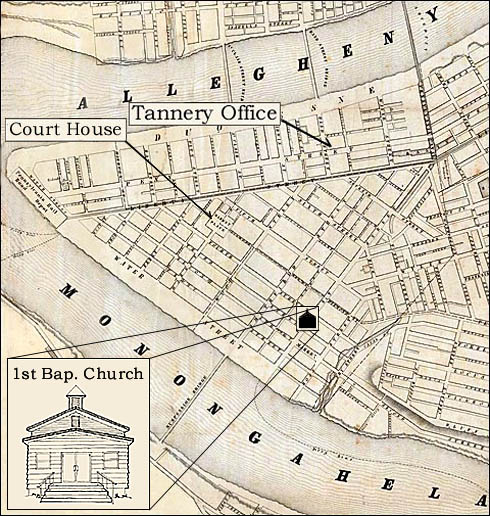
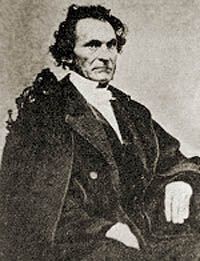
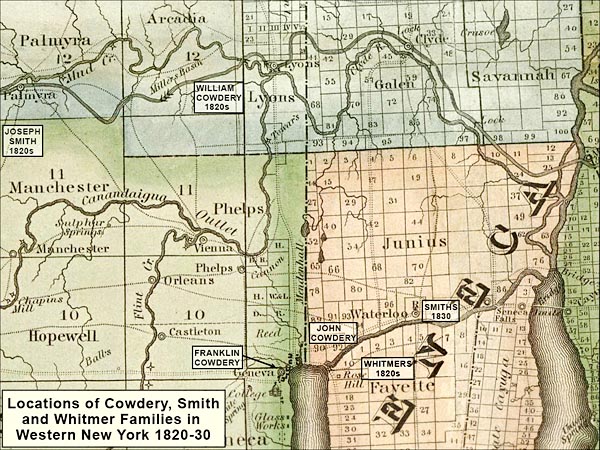
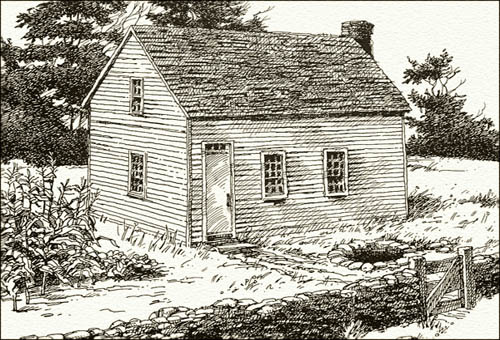
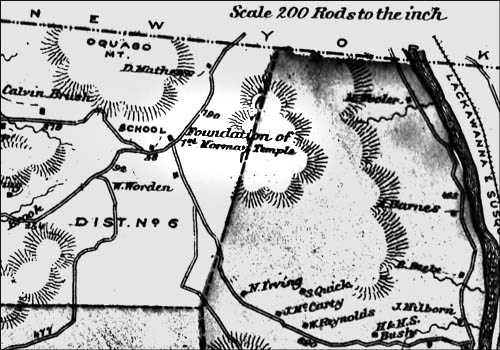
|
Vol. 159. Philadelphia, Sunday, September 13, 1908. No. 75.
JOE SMITH ONCE A PENNSYLVANIAN.
Special to The Inquirer. |
|
Vol. 168. Philadelphia, Wednesday, March 12, 1913. No. 71. Higher Criticism Among the Mormons. The official Mormon theologian and apologete, Brigham H. Roberts, has devised and published in the last edition of the text book for the instruction and guidance of their missionaries, known as the Senior Manual, a new theory of inspiration. |
Back to top of this page.
Articles Home Page | Newspaper Articles Index | History Vault
Oliver's Bookshelf | Spalding Studies Library | Mormon Classics
last updated: Dec. 9, 2014