
Mormon Classics | "Rigdon Revealed" | Spalding Library | Bookshelf | Newspapers | History Vault
Joseph Smith:
Nineteenth Century Con Man?
By Dale R. Broadhurst
Joseph Smith: 19th Century Con Man? | Sidney Rigdon: Creating the Book of Mormon
Tracking Book of Mormon Authorship | Word-print Study | Joseph Smith & Sidney Rigdon
HISTORICAL SOURCES:
1857: M. Harris | 1879: E. Smith | 1881: E. Stevenson | 1887: D. Whitmer | 1903: B.H. Roberts
1904: B.H. Roberts 1 | 1904: B.H. Roberts 2 | 1905: B.H. Roberts | 1906: B.H. Roberts
1907: B.H. Roberts | 1909: B.H.R. 1 | 1909: B.H.R. 2 | 1911: B.H. Roberts | 1912: B.H. Roberts
1938: W. Bean | 1939: F.W. Kirkham | 1945: F. Brodie | 1946: LDS | 1946: J.A. Widtsoe
1947: F.W. Kirkham | 1956: J.F. Smith | 1951-9: F.W. Kirkham | 1961: Hugh Nibley
MODERN SOURCES | HERMAN MELVILLE ITEMS
|
Brigham H. Roberts (1877-1972) Y.M.M.I.A. Manual 7 (1903) Title Page Chapter 7 (excerpt) Transcriber's comments |
|
|
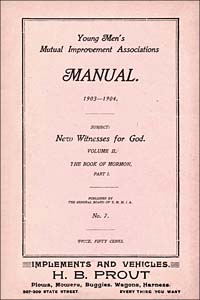
Young Men's Mutual Improvement Associations MANUAL. 1903 - 1904. S U B J E C T: New Witnesses for God. VOLUME II. THE BOOK OF MORMON. PART I. PUBLISHED BY THE GENERAL BOARD OF Y. M. M. I . A. No. 7. |
|
66
Relative to the manner of translating the Book of Mormon the prophet himself has said but little. "Through the medium of the Urim and Thimmim I translated the record by the gift and power of God," [a] is the most extended published statement made by him upon the subject. Of the Urim and Thummim he says: "With the record was found a curious instrument which the ancients called a Urim and Thummim,' which consisted of two transparent stones set in a rim of a bow fastened to a breastplate." [b] Oliver Cowdery, one of the Three Witnesses of the Book of Mormon, and the prophet's chief amanuensis, says of the work of translation in which he assisted: "I wrote with my own pen the entire Book of Mormon (save a few pages), as it fell from the lips of the Prophet Joseph Smith, as he translated by the gift and power of God, by the means of the Urim and Thummim, or, as it is called by that book, 'Holy Interpreters.'" [c] This is all he has left on record on the manner of translating the book. [d] David Whitmer, another of the Three Witnesses, is more specific on this subject. After describing the means the prophet employed to exclude the light from the "Seer Stone," he says: "In the darkness the spiritual light would shine. A piece of something resembling parchment would appear, and under it was the interpretation in English. Brother Joseph would read off the English to Oliver Cowdery, who was his principal scribe, and when it was written down and repeated to Brother Joseph to see if it was correct, then it would disappear, and another character with the interpretation would appear. Thus the Book of Mormon was translated by the gift and power of God and not by any power of man." [e] There will appear between this statement of David Whitmer's and what is said both by Joseph Smith and Oliver Cowdery a seeming contradiction. Joseph and Oliver both say the translation was done by means of the Urim and Thummim, which is described by Joseph as being two transparent stones set in a rim of a bow fastened to a breastplate;" while David Whitmer says that the translation was made by means of a __________ a Wentworth letter, Mill. Star, Vol. XIX., p. 118. b Wentworth letter, Mill. Star, Vol. XIX., p. 118. [see also: History of the Church Vol. IV, Ch. XXXI.] c Book of Mosiah, viii: 13. d The above statement was made by Oliver Cowdery at a special conference held at Kanesville, Iowa, Oct. 21, 1848. It was first published in the Deseret News of April 13, 1859: Bishop Reuben Miller, who was present at the meeting, reported Cowdery's remarks. e From "An Address to all Believers in Christ," by David Whitmer, "A Witness to the Divine Authenticity of the Book of Mormon," published at Richmond, Missouri, 1887, p. 12. 67 "Seer Stone." The apparent contradiction is cleared up, however, by a statement made by Martin Harris, another of the Three Witnesses. He said that the Prophet possessed a "Seer Stone," by which.he was enabled to translate as well as from the Urim and Thummim, and for convenience he then (i. e., at the time Harris was acting as his scribe) used the Seer Stone. * * * * Martin said further that the Seer Stone differed in appearance entirely from the Urim and Thummim that was obtained with the plates, which were two clear stones set in two rims, very much resembling spectacles, only they were larger. [f] The "Seer Stone" referred to here was a chocolate-colored, somewhat egg-shaped stone which the Prophet found while digging a well in company with his brother Hyrum. [g] It possessed the qualities of Urim and Thummim, since by means of it -- as described above -- as well as by means of the "Interpreters" found with the Nephite record, Joseph was able to translate the characters engraven on the plates. [h] Another account of the manner of translating the record, purporting to have been given by David Whitmer, and published in the Kansas City Journal of June 5, 1881, says: "He [meaning Joseph Smith] had two small stones of a chocolate color, nearly egg-shape, and perfectly smooth, but not transparent, called interpreters, which were given him with the plates. He did not see the plates in translation, but would hold the interpreters to his eyes and cover his face with a hat, excluding all light, and before his eyes would appear what seemed to be parchment on which would appear the characters of the plates in a line at the top, and immediately below would appear the translation in English, which Smith would read to his scribe, who wrote it down exactly as it fell from his lips. The scribe would then read the sentence written, and if any mistakes had been made, the characters would remain visible to Smith until corrected, when they would fade from sight to be replaced by another line." It is evident that there are inaccuracies in the above statement, due, doubtless, to the carelessness of the reporter of the Journal, who has confused what Mr. Whitmer said of the Seer Stone and Urim and Thummim. If he meant to describe the Urim and Thummim or "Interpreters" given to Joseph Smith with the plates -- as seems to be the case -- then the reporter is wrong in saying that they were chocolate color and not transparent; for the "Interpreters" given to the Prophet with the plates, as we have seen by his own description, were "two transparent stones." If the reporter meant to describe the "Seer Stone" -- which is not likely -- he would be right in saying it was of a chotolate color, and egg-shaped, but wrong in saying there were two of them. Martin Harris's description of the manner of translating while he was the amanuensis of the Prophet is as follows: By aid of the Seer Stone, sentences would appear and were read by the Prophet and written by Martin, and when finished he would say "written," and if correctly written, that sentence would disappear and another __________ f Harris's Statement to Edward Stevenson, Mill. Star, Vol. XLIV., p. 87. [see also: Deseret News Dec. 28, 1881] g Cannon's Life of Joseph Smith, p. 56. h Nearly all the Anti-Mormon works dealing with the coming forth of the Book of Mormon speak of the "Seer Stone" and reiterate the falsehood that the Prophet stole it from the children of Willard Chase, for whom Joseph and Hyrum were digging a well. 68 appear in its place, but if not written correctly it remained until corrected, so that the translation was just as it was engraven on the plates, precisely in the language then used." [i] On one occasion Harris sought to test the genuineness of the prophet's procedure in the matter of translation, as follows: Martin said that after continued translation they would become weary and would go down to the river and exercise in throwing stones out on the river, etc. While so doing on one occasion, Martin found a stone very much resembling the one used for translating, and on resuming their labors of translation Martin put in place [of the Seer Stone] the stone that he had found. He said that the Prophet remained silent unusually and intently gazing in darkness, no trace of the usual sentence appearing. Much surprised Joseph exclaimed: 'Martin! what is the matter? all is as dark as Egypt.' Martin's countenance betrayed him, and the Prophet asked Martin why he had done so. Martin said, to stop the mouths of fools, who had told him that the Prophet had learned those sentences and was merely repeating them." [j] The sum of the whole matter, then, concerning the manner of translating the sacred record of the Nephites, according to the testimony of the only witnesses competent to testify in the matter is: With the Nephite record was deposited a curious instrument, consisting of two transparent stones, set in the rim of a bow, somewhat resembling spectacles, but larger, called by the ancient Hebrews "Urim and Thummim," but by the Nephites "Interpreters." In addition to these "Interpreters" the Porphet Joseph had a "Seer Stone," which to him was a Urim and Thummim; that the Prophet sometimes used one and sometimes the other of these sacred instruments in the work of translation; that whether the "Interpreters" or the "Seer Stone" was used the Nephite characters with the English interpretation appeared in the sacred instrument; that the prophet would pronounce the English translation to his scribe, which, when correctly written, would disappear and the other characters with their interpretation take their place, and so on until the work was completed. It should not be supposed, however, that this translation, though accomplished by means of the "Interpreters" and "Seer Stone," as stated above, was merely a mechanical procedure; that no faith, or mental or spiritual effort was required on the prophet's part; that the instruments did all, while he who used them did nothing but look and repeat mechanically what he saw there reflected. Much has been written upon this manner of translating the Nephite record, by those who have opposed the Book of Mormon, and chiefly in a sneering way. On the manner of translation they have bottomed much of -- not their argument but their ridicule -- against the record; and as in another part of this volume I am to meet what they consider their argument, and what I know to be their ridicule, I consider here a few other facts connected with the manner of translating the Book of Mormon, which are extremely important, as they furnish a basis upon which can be successfully answered __________ i Statement of Martin Harris, to Edward Stevenson, Mill. Star, Vol. XXIV., pp. 86, 87. j Harris's Statement to Edward Stevenson, Mill. Star, Vol. XLIV., pp. 78, 79; 86, 87. 69 all the objections that are urged, based on the manner in which the translation was accomplished, and also as to errors in grammar, the use of modern words, western New York phrases, and other defects of language which it is admitted are to be found in the Book of Mormon, especially in the first edition. I repeat, then, that the translation of the Book of Mormon by means of the "Interpreters" and "Seer Stone," was not merely a mechanical process, but required the utmost concentration of mental and spiritual force possessed by the prophet, in order to exercise the gift of translation through the means of the sacred instruments provided for that work. Fortunately we have the most perfect evidence of the fact, though it could be inferred from the general truth that God sets no premium upon mental or spiritual laziness; for whatever means God may have provided to assist man to arrive at the truth, He has always made it necessary for man to couple with those means his utmost endeavor of mind and heart. So much in the way of reflection; now as to the facts referred to. In his "Address to All Believers in Christ," David Whitmer says: "At times when Brother Joseph would attempt to translate he would look into the hat in which the stone was placed, he found he was spiritually blind and could not translate. He told us that his mind dwelt too much on earthly things, and various causes would make him incapable of proceeding with the translation. When in this condition he would go out and pray, and when he became sufficiently humble before God, lie could then proceed with the translation. Now we see how very strict the Lord is, and how he requires the heart of man to be just right in his sight before he can receive revelation from him." [k] In a statement to Wm. H. Kelley, G. A. Blakeslee, of Gallen, Michigan, under date of September 15th, 1882, David Whitmer said of Joseph Smith and the necessity of his humility and faithfulness while translating the Book of Mormon: He was a religious and straight-forward man. He had to be; for he was illiterate and he could do nothing himself. He had to trust in God. He could not translate unless He was humble and possessed the right feelings towards everyone. To illustrate so you can see: One morning when he was getting ready to continue the translation, something went wrong about the house and he was put out about it. Something that Emma, his wife, had done. Oliver and I went up stairs and Joseph came up soon after to continue the translation, but he could not do anything. He could not translate a single syllable. He went down stairs, out into the orchard, and made supplication to the Lord; was gone about an hour -- came back to the house, and asked Emma's forgiveness and then came up stairs where we were and then the translation went on all right. He could do nothing save he was humble and faithful." [l] The manner of translation is so far described by David Whitmer and Martin Harris, who received their information necessarily from Joseph Smith, and doubtless it is substantially correct, except in so far as their __________ k Address to All Believers in Christ, p. 30. l Braden and Kelley Debate on Divine Origin of Book of Mormon, p. 186. The above debate took place in 1884, several years before the death of David Whitmer, and the statement from which the above is taken was quoted in full. 70 statements may have created the impression that the translation was a mere mechanical process; and this is certainly corrected in part at least by what David Whitmer has said relative to the frame of mind Joseph must be in before he could translate. But we have more important evidence to consider on this subject of translation than these statements of David Whitmer. In the course of the work of translation Oliver Cowdery desired the gift of translation to be conferred upon him, and God promised to grant it to him in the following terms: "Oliver Cowdery, verily, verily, I say unto you, that assuredly as the Lord liveth, who is your God and your Redeemer, even so surely shall you receive a knowledge of whatsoever things you shall ask with an honest heart believing that you shall receive a knowledge concerning the engravings of old records, which contain those parts of my scripture of which have been spoken by the manifestation of my spirit. Yea, behold, I will tell you in your mind and in your heart, by the Holy Ghost, which shall come upon you and which shall dwell In your heart. Now, behold, this is the Spirit of revelation; behold this is the Spirit by which Moses brought the children of Israel through the Red Sea on dry ground. * * * * Ask that you may know the mysteries of God, and that you may translate a'nd receive knowledge from all those ancient records which have been hid up, that are sacred, and according to your faith shall it be unto you." [m] In attempting to exercise this gift of translation, however, Oliver Cowdery failed; and in a revelation upon the subject the Lord explained the cause of his failure to translate: "Behold, you have not understood; you have supposed that I would give it [i. e. the gift of translation] unto you, when you took no thought save it was to ask me; but, behold I say unto you, that you must study it out in your mind, then you must ask me if it be right, and if it is right I will cause that your bosom shall burn within you; therefore you shall feel that it is right; but if it be not right, you shall have no such feelings, but you shall have a stupor of thought, that shall cause you to forget the thing which is wrong; therefore you cannot write that which is sacred save it be given you from me." [n] While this is not a description of the manner in which Joseph Smith translated the Book of Mormon, it is, nevertheless, the Lord's description of how another man was to exercise the gift of translation; and doubtless it is substantially the manner in which Joseph Smith did exercise it, and the manner in which he translated the Book of Mormon. That is, the Prophet Joseph Smith looked into the "Interpreters" or "Seer Stone," saw there by the power of God and the gift of God to him, the ancient Nephite characters, and by bending every power of his mind to know the meaning thereof, the interpretation wrought out in his mind by this effort -- by studying it out in his mind, to use the Lord's phrase -- was reflected in the sacred instrument, there to remain until correctly written by the scribe.... __________ m Doc. & Cov., Sec. viii. n Doc. & Cov., Sec. ix... Comments: (forthcoming) |
|
Brigham H. Roberts (1877-1972) "Probability of Joseph Smith's Story" Improvement Era March, 1904 Transcriber's comments |
|
|
Brigham H. Roberts (1877-1972) "Translation of the Book of Mormon" Improvement Era April, 1906 Transcriber's comments |
|
|
Francis W. Kirkham (1877-1972) "Manner of Translating the Book of Mormon" The Improvement Era October, 1939 Transcriber's comments |
|
Copyright © 1939, Corporation of the President
Only limited "fair use" excerpts presented here.
|
[Vol. 32. No. 10. October 1939]
"How and where did you obtain the Book of Mormon?" This was one of twenty questions answered by the Prophet Joseph Smith in the Elders' Journal published July, 1838, at Far West, Missouri. "I am answering these questions," wrote the Prophet, "by publication for the reason they are asked me thousands of times." "Moroni," writes the Prophet, "the person who deposited the plates from whence the Book of Mormon was translated, in a hill in Manchester, Ontario County, New York, being dead, and raised again therefrom, appeared unto me, and told me where they were; and gave me directions how to obtain them. I obtained them and the Urim and Thummim with them, by the means of which I translated the plates and thus came the Book of Mormon." Another short statement by the Prophet was published in the Times and Seasons at Nauvoo, May [sic - Mar.] 1, 1842. He was then mayor of the largest and most rapidly growing city in Illinois and the Lieutenant-General of a military organization consisting of all its able-bodied male citizens: Nauvoo, Illinois, March 1, 1842. At the request of Mr. John Wentworth, Editor and Proprietor of the Chicago Democrat, I have written the following sketch of the rise, progress, persecution, and faith of the Latter-day Saints -- of which, I have the honor, under God, of being founder. Mr. Wentworth says that he wishes to furnish Mr. Barstow, a friend of his, who is writing the history of New Hampshire, with this document. As Mr. Barstow has taken the proper steps to obtain correct information, all I shall ask at his hands is that he publish the account entire, ungarnished, and without misrepresentation. ... On the evening of the 21st of September, A. D. 1823, while I was praying unto God and endeavoring to exercise faith in the precious promises of Scripture, on a sudden a light like that of day, only of a far purer and more glorious appearance and brightness, burst into the room; indeed the first sight was as though the house were filled with consuming fire. The appearance produced a shock that affected the whole body. In a moment a personage stood before me surrounded with a glory yet greater than that by which I was already surrounded. The messenger proclaimed himself to be an angel of God, sent to bring the joyful tidings that the covenants which God made with ancient Israel were at hand to be fulfilled; that the preparatory work for the second coming of the Messiah was speedily to commence; that the time was at hand for the Gospel in all its fulness to be preached in power unto all nations, that a people might be prepared for the millennial reign. I was informed that I was chosen to be an instrument in the hands of God to bring about some of His purposes in this glorious dispensation. I was informed also concerning the aboriginal inhabitants of this country, and shown who they were, and from whence they came: a brief sketch of their origin, progress, civilization, laws, governments, of their righteousness and iniquity and the blessings of God being finally withdrawn from them as a people was made known unto me. I was also told where there were deposited some plates, on which was engraved an abridgement of the records of the ancient peoples that had existed on this continent. The angel appeared to me three times the same night and unfolded the same things. After having received many visits from the angels of God, unfolding the majesty and glory of the events that should transpire in the last days, on the morning of the 22nd of September, A. D. 1827, the angel of the Lord delivered the records into my hands.
[graphic - not reproduced]
Early in 1838 the Prophet began the writing of his own life story which with other information has become the Documentary History of the Church. In this remarkable account he tells frankly and honestly the details and circumstances of the divine origin of the Book of Mormon so that these may be traced historically. (See Source Material Concerning Origin of the Book of Mormon, by Francis W. Kirkham.) He declares that Moroni, the immortal messenger from God, entrusted to him gold plates upon which was recorded "the fulness of the everlasting Gospel as delivered to the ancient inhabitants of this continent." With these plates were "two stones in silver bows, fastened to a breastplate, called the Urim and Thummim." "By the use of this instrument" and "by the gift and power of God," he translated part of the plates into the Book of Mormon. In a letter addressed to N. F. Seaton, the Prophet makes the following statement (Times and Seasons, Vol. V, page [sic - no.] 21): The Book of Mormon is a record of the forefathers of our Western tribes of Indians, having been found through the ministrations of an holy angel, and translated into our own language by the gift and power of God, after having been hid up in the earth for the last 1400 years, containing the word of God which was delivered unto them. The earliest printed account of the coming forth of the Book of Mormon is a series of eight letters by Oliver Cowdery published in the Messenger and Advocate, Kirtland, Ohio, beginning October, 1834. In an introductory letter, Oliver Cowdery declares: That our narrative may be correct, and particularly the introduction, it is proper to inform our patrons that our brother Joseph Smith, Jr., has offered to assist us. Indeed, there are many items connected with the fore part of this subject that render his labor indispensable. With his labor and with authentic documents now in our possession, we hope to render this a pleasing and agreeable narrative, well worth the examination and perusal of the Saints. Here is evidence that the person responsible under God for the book which has become a companion book to the Bible, knew the contents of these letters and had the opportunity to edit and correct them. Oliver Cowdery writes: Near the time of the setting of the sun, Sabbath evening, April 5th, 1829, my natural eyes for the first time beheld this brother. He then resided in Harmony, Susquehanna County, Pennsylvania. On Monday, the 6th, I assisted him in arranging some business of a temporal nature and on Tuesday, the 7th, commenced to write the Book of Mormon. These days were never to be forgotten?to sit under the sound of a voice dictated by the inspiration of heaven, awakened the utmost gratitude of this bosom. Day after day I continued, uninterrupted, to write from his mouth as he translated with the Urim and Thummim, or, as the Nephites would have said, "interpreters," the history or record called the "Book of Mormon." Further on his narrative Mr. Cowdery, with the apparent approval of the Prophet, quotes Moroni as declaring: Therefore, remember, that they are to be translated by the gift and power of God. By them will the Lord work a great and a marvelous work: the wisdom of the wise shall come as naught, and the understanding of the prudent shall be hid, and because the power of God shall be displayed, those who profess to know the truth but walk in deceit, shall tremble with anger; but with signs and with wonders, with gifts and with healings, with the manifestations of the power of God, and with the Holy Ghost, shall the hearts of the faithful be comforted. About a year and a half after the publication of this divine record, 44 Elders, 10 Priests, and 10 Teachers were in conference at the home of Brother Sirenes Burnett, at Orange, Cuyahoga County, Ohio (October 25, 1831). In the minutes of this conference the following appears (Far West Record, p. 16): Brother Hyrum Smith said, "That he thought best that the information of the coming forth of the Book of Mormon be related by Joseph himself, to the Elders present, that all might know for themselves." Brother Joseph Smith, Jr., said "That it was not intended to tell the world all the particulars of the coming forth of the Book of Mormon," and also said, "that it was not expedient for him to relate these things, etc."
[graphic - not reproduced]
Explanations have been advanced by students to explain the diction, form, and construction of the language of the book. Reasons for the appearance of quotations from the King James' Bible in the Book of Mormon have also been given. Here it is emphasized that the only information left us by the Prophet Joseph Smith and Oliver Cowdery, his scribe, may be stated in a sentence. "Joseph Smith translated the Book of Mormon by the gift and power of God with the aid of the Urim and Thummim from gold plates entrusted to him by Moroni, who being dead was raised again therefrom." Other witnesses to the writing of the Book of Mormon were Emma Smith, wife of the Prophet, David Whitmer, Martin Harris, and John Whitmer. The writings of all these are claimed to be in the manuscript at Independence, Missouri. The Saints' Advocate, October, 1879, gives the last testimony of Emma Smith Bidamon, wife of the Prophet Joseph Smith. The questions were by her son, Joseph Smith, and were asked in the presence of Bishop Rogers, W. W. Blair, and H. A. Stebbins. A part of the interview follows: Question: When did you first know Sidney Rigdon? Answer: I was residing at Father Whitmer's when I first saw Sidney Rigdon. I think he came there. Q: Was this before or after the publication of the Book of Mormon? A: The Book of Mormon had been translated and published some time before. Parley P. Pratt had united with the Church before I knew Sidney Rigdon, or heard of him. At the time the Book of Mormon was translated there was no Church organized, and Rigdon did not become acquainted with Joseph and me till after the Church was established. ... Q: Had he [Joseph] not a book or manuscript from which he read or dictated to you? A: He had neither manuscript nor book to read from. Q: Could he not have had, and you not know it? A: If he had had anything of the kind he could not have concealed it from me. Q: Are you sure that he had plates at the time you were writing for him? A: The plates often lay on the table without any attempt at concealment, wrapped in a small linen table cloth, which I had given him to fold them in. I once felt of the plates, as they thus lay on the table, tracing their outline and shape. They seemed to be pliable like thick paper, and would rustle with a metallic sound when the edges were moved by the thumb, as one does sometimes thumb the edge of a book... Q: Could not father have dictated the Book of Mormon to you, Oliver Cowdery, and others who wrote for him after having first written it, or having first read it out of some book? A: Joseph Smith could neither write nor dictate a coherent and well worded letter, let alone dictating a book like the Book of Mormon, and though I was an active participant in the scenes that transpired, and was present during the translating of the plates, and had cognizance of things as they transpired, it is marvelous to me, "a marvel and a wonder," as much so as to anyone else. Q: Mother, what is your belief about the authenticity, or origin of the Book of Mormon? A: My belief is that the Book of Mormon is of divine authenticity?I have not the slightest doubt of it. I am satisfied that no man could have dictated the writing of the manuscript unless he was inspired; for, when [I was] acting as his scribe, your father would dictate to me hour after hour; and when returning after meals, or after interruptions, he would at once begin where he had left off, without either seeing the manuscript or having any portion of it read to him. It would have been improbable that a learned man could do this; and, for one so ... unlearned as he was, it was simply impossible. These questions and the answers she had given to them, were read to my mother by me, the day before my leaving Nauvoo for home and were affirmed by her. Major Bidamon stated that he had frequently conversed with her on the subject of the translation of the Book of Mormon, and her present answers were substantially what she had always stated in regard to it. Signed, Joseph Smith. Who is the son of the Prophet Joseph Smith. In the March, 1836, issue of the Messenger and Advocate, John Whitmer writes as follows: It may not be amiss in this place, to give a statement to the world concerning the work of the Lord, as I have been a member of this Church of Latter-day Saints from its beginning. To say that the Book of Mormon is a revelation from God, I have no hesitancy; but with all confidence have signed my name to it as such; and I hope that my patrons will indulge me in speaking freely on this subject, as I am about leaving the editorial department?therefore I desire to testify to all that will come to the knowledge of this address, that I have handled these plates, and know of a surety that Joseph Smith, Jr., has translated the Book of Mormon by the gift and power of God, and in this thing the wisdom of the wise most assuredly has perished: therefore, know ye, O ye inhabitants of the earth, wherever this address may come, that I have in this thing freed my garments of your blood, whether you believe or disbelieve the statements of your unworthy friend and well-wisher. In 1887 David Whitmer writes an address "to all Believers in Christ." This was fifty years after he had separated himself from the Church. He was now past 82 years of age. In this address David Whitmer bears a faithful testimony to the divine origin of the Book of Mormon. He states: I will say once more to all mankind that I have never at any time denied that testimony or any part thereof. I also testify to the world that neither Oliver Cowdery nor Martin Harris at any time denied their testimony; they both died reaffirming the divine authenticity of the truth of the Book of Mormon. I was present at the death bed of Oliver Cowdery and his last words were, "Brother David, be true to your testimony to the Book of Mormon." He also declares: I testify to the world I am an eyewitness to the translation of the greater part of the Book of Mormon. Part of it was translated in my father's house in Fayette. Seneca County, New York. He also wrote as follows: I will now give you a description of the manner in which the Book of Mormon was translated. Joseph Smith would put the seer stone into a hat, and put his face in the hat, drawing it closely around his face to exclude the light; and in the darkness the spiritual light would shine. A piece of something resembling parchment would appear, and on that appeared the writing. One character at a time would appear, and under it was the interpretation in English. Brother Joseph would read off the English to Oliver Cowdery, who was his principal scribe, and when it was written down and repeated to Brother Joseph to see if it was correct, then it would disappear, and another character with the interpretation would appear. Thus the Book of Mormon was translated by the gift and power of God, and not by any power of man. The Deseret Evening News, September 5, 1870, reports in part an address in the Salt Lake Tabernacle as follows: Martin Harris related an incident that occurred during the time that he wrote the portion of the translation of the Book of Mormon which he was favored to write direct from the mouth of the Prophet Joseph Smith. He said that the Prophet possessed a seer stone, by which he was enabled to translate as well as from the Urim and Thummim, and for convenience he then used the seer stone. Martin explained the translation as follows: By aid of the seer stone, sentences would appear and were read by the Prophet and written by Martin, and when finished he would say, "Written," and if correctly written, that sentence would disappear and another appear in its place, but if not written correctly it remained until corrected, so that the translation was just as it was engraven on the plates, precisely in the language then used. Both David Whitmer and Martin Harris knew positively that they had been shown the plates by Moroni and had so declared since the time of the experience, but the Prophet declared in October, 1831, that no one knew the manner of the translation, neither was "it expedient for him to relate these things." (See quotation above.) When both these men were past eighty years of age, and about fifty years after the event, they undertook to describe the manner of translation, which Elder Brigham H. Roberts has clearly shown is not in harmony with the manner indicated in Section 8 of the Doctrine and Covenants. (See New Witness for God, Vol. II, pages 106-133 by B. H. Roberts.) Moreover, they refer to the use of a seer stone by the Prophet. But no publication during his life contains such a statement. A neighbor, Willard Chase, asserted Joseph stole a "singularly appearing stone" which he had found in 1822 when Joseph and his brother Alvin were employed by him in digging a well. "Joseph put it into his hat and then his face into the top of his hat... alleging that he could see in it." -- Mormonism Unveiled, Eber D. Howe, 1834. This is an attempt to explain the alleged power of Joseph Smith to translate the plates by a person who denounced him as a fraud and an ignorant deceiver. In the opinion of the writer, the Prophet used no seer stone in translating the Book of Mormon, neither did he translate in the manner described by David Whitmer and Martin Harris. The statements of both of these men are to be explained by the eagerness of old age to call upon a fading and uncertain memory for the details of events which still remained real and objective to them. Comments: Kirkham makes some mistakes in his references to Martin Harris. The original source for Harris' reported statement, saying "By aid of the seer stone, sentences would appear and were read by the Prophet..." was Elder Edward Stevenson's letter in the Deseret News of Dec. 28, 1881. No details of Martin Harris' public speaking in Utah were published in the News of Sept. 5, 1870 or Oct. 10, 1870. As B. H. Roberts wrote in 1906, "We have no statement at first hand from Martin Harris at all, only the statement of another, Edward Stevenson, as to what he heard Martin Harris say was the manner of translation." Kirkham reproduced most of the contents of his Oct. 1939 article in the 1942 book A New Witness for Christ in America, as its Chapter XVI. However, in the 1942 reprint he removed his 1939 quotations from David Whitmer and Martin Harris, replacing that material (regarding a seer stone, a hat, etc.) with a single paragraph, suggesting that "the Prophet did not tell them the method" of Book of Mormon translation. Obviously Kirkham was uncomfortable, writing about "the use of a seer stone by the Prophet," even though the Deseret News and B. H. Roberts had years earlier reported such unseemly details. In later editions of his A New Witness, Kirkham found himself having to again review the seer-stone in a hat accounts. He seems to have eventually accepted them as an historical possibility. |
|
Fawn McKay Brodie (1915-1981) No Man Knows My History (1945) 1945 Title-page 1976 Title-page Preface (excerpt) Contents Chapter 2 (excerpt) Appendix A (excerpt) Transcriber's comments |
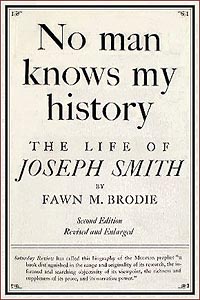
|
Copyright © 1945, Alfred A. Knopf, Inc. Only limited "fair use" excerpts presented here.
|
[ 16 ]
The road that led Joseph Smith into the career of "prophet, seer, and revelator" is overgrown with a tangle of legend and contradiction. Mormon and non-Mormon accounts seem to conflict at every turn. The earliest non-Mormon documents that mention him at all -- an early court record and newspaper accounts -- indicate that Joseph reflected the irreligion and cynicism of his father. The haranguing of the revivalist preachers seems to have filled him only with contempt. But these documents contrast remarkably with Joseph's official biography, begun many years later when he was near the summit of his career. The latter tells the story of a visionary boy caught by revival hysteria and channeled into a life of mysticism and exhortation. The evidence, however, leaves no doubt that, whatever Joseph's inner feelings, his reputation before he organized his church was not that of an adolescent mystic brooding over visions, but of a likable ne'er-do-well who was notorious for tall tales and necromantic arts and who spent his leisure leading a band of idlers in digging for buried treasure. This behavior is confirmed by the most coldly objective description of young Joseph that remains, which historians have hitherto overlooked or ignored. This description seems also to be the earliest public document that mentions him at all. The document, a court record dated March 1826, when Joseph was twenty-one, covers his trial in Bainbridge, New York, on a charge of being "a disorderly person and an impostor." On the basis of the testimony presented, including Joseph's own admissions of indulging in magic arts and organizing hunts for buried gold, the court ruled him guilty of disturbing the peace. Four years after this trial Joseph's Book of Mormon appeared, whereupon the local editors in Palmyra, who had never previously considered him worthy of comment, began to explore the vagaries of his youth. The editor of the Palmyra Reflector, Obadiah Dogberry, wrote during 1830 and 1831 a series of articles describing in exuberant detail Joseph's adolescent years. Later, in 1833, when Joseph's church was rapidly gaining in notoriety and power, a disgruntled ex-Mormon named Hurlbut went about Palmyra and Manchester soliciting affidavits from more than a hundred persons who had known Joseph before he began his religious career. These sworn testimonies, which were published in 1834 by Eber D. Howe in a vitriolic anti-Mormon book called Mormonism Unvailed, may have been colored by the bias of the man who collected them, but they corroborated and supplemented the court record and Dogberry's editorials. * Since the story that they relate of Joseph Smith's adolescent years is further substantiated by certain admissions in his own autobiography and in the naive biography dictated by his mother, it is possible to reconstruct Joseph's youth with a fair degree of accuracy. Significantly, Joseph Smith's first sketch of his early years took the form of an apology for his youthful indiscretions. Shortly after Mormonism Unvailed appeared, he wrote a reply for his church newspaper: At the age of ten my father's family removed to Palmyra, New YorE where, and in the vicinity of which, I lived, or, made it my place of residence. until I was twenty-one; the latter part, in the town of Manchester. During this tune. as is common to most or all youths, I fell into many vices and follies; but as my accusers are, and have been forward to a me of being guilty of gross and outrageous violations of the peace and good order of the community, I take the occasion to remark that, though, as I have said above, "as is common to most or all youths, I fell into many vices and follies," I have not, neither can it be sustained, in truth, been guilty of wronging or injuring any man or society of men; and those imperfections to which I allude, and for which I have often had occasion to lament, were a light, and too often, vain mind, exhibiting a foolish and trifling conversation. †__________ * Since the books and newspapers in which these documents originally appeared are so rare as to be inaccessible to the general reader, the court record, the significant portions of Dogberry's editorials, and the most important affidavits are reproduced in Appendix A. † Latter-Day Saints Messenger and Advocate, Vol. I (Kirtland, Ohio, November 6, [sic - December?] 1834, p. 40. Although fifty-one of Joseph's neighbors signed an affidavit accusing him of being "destitute of moral character and addicted to vicious habits," there is no evidence that viciousness was a part of his nature, and his apology can be accepted at full value. Actually he was a gregarious, cheerful, imaginative youth, born to leadership, but hampered by meager education and grinding poverty. A landlord class was battening on his labor, driving westward helplessly ensnared families like his own. In the Palmyra newspaper he could read of their mortgage sales, six to ten every week on the front page. He lived far enough east to see opulence and parade and not far enough west to escape a crushing burden of debt. His family, having slipped downhill since those early years when his mother's dowry had been the envy of the neighborhood, had lost security and respectability. But the need for deference was strong within him. Talented far beyond his brothers or friends, he was impatient with their modest hopes and humdrum fancies. Nimble-witted, ambitious, and gifted with a boundless imagination, he dreamed of escape into an illustrious and affluent future. For Joseph was not meant to be a plodding farmer, tied to the earth by habit or by love for the recurrent miracle of harvest. He detested the plow as only a farmer's son can, and looked with despair on the fearful mortgage that clouded their future. There is, of course, a gold mine or a buried treasure on every mortgaged homestead. Whether the farmer ever digs for it or not, it is there, haunting his daydreams when the burden of debt is most unbearable. New England was full of treasure hunters -- poor, desperate farmers who, having unwittingly purchased acres of rocks, looked to those same rocks to yield up golden recompense for their back-breaking toil. "We could name, if we pleased," said one Vermont weekly, "at least five hundred respectable men who do in the simplicity and sincerity of their hearts believe that immense treasures lie concealed upon our Green Mountains, many of whom have been for a number of years industriously and perseveringly engaged in digging it up." * When these men migrated west, they brought with them the whole folklore of the money-digger, the spells and incantations, __________ * Reprinted in the Wayne Sentinel (Palmyra, New York), February 16, 1825. the witch-hazel stick and mineral rod. But where the Green Mountains yielded nothing but an occasional cache of counterfeit money, western New York and Ohio were rich in Indian relics. Hundreds of burial mounds dotted the landscape, filled with skeletons and artifacts of stone, copper, and sometimes beaten silver. There were eight such tumuli within twelve miles of the Smith farm. * It would have been a jaded curiosity indeed that would have kept any of the boys in the family from spading at least once into their pitted surfaces, and even the father succumbed to the local enthusiasm and tried his hand with a witch-hazel stick. Young Joseph could not keep away from them. Excitement over the possibilities of Indian treasure, and perhaps buried Spanish gold, reached its height in Palmyra with the coming of what the editor of the Palmyra Reflector called a "vagabond fortune-teller" named Walters, who so won the accedence of several farmers that for some months they paid him three dollars a day to hunt for buried money on their property. In addition to crystals, stuffed toads, and mineral rods, the scryer's usual paraphernalia, Walters claimed to have found an ancient Indian record that described the locations of their hidden treasure. This he would read aloud to his followers in what seemed to be a strange and exotic tongue but was actually, the newspaper editor declared, an old Latin version of Caesar's [Cicero's?] Orations. The press accounts describing Walters's activity, published in 1830-1, stated significantly that when he left the neighborhood, his mantle fell upon young Joseph Smith. † Joseph's neighbors later poured out tales of seer stones, ghosts, magic incantations, and nocturnal excavations. Joseph Capron swore that young Joseph had told him a chest of gold watches was buried on his property, and had given orders to his followers "to stick a parcel of large stakes in the ground, several rods around, in a circular form," directly over the spot. One of the group then marched around the circle with a drawn sword "to __________ * For descriptions and locations of the Indian tumuli in western New York see E. G. Squier: Antiquities of the State of New York (Buffalo, 1851), pp. 31, 66, 97, 99; O. Turner: Pioneer History of the Settlement of Phelps and Gorham's Purchase (1851), p. 216; and History of Ontario County (1876), p. 101. The Palmyra Herald on August 14, 1822 and the Palmyra Register on May 26, 1819 reported discoveries of new mounds. † See Appendix A. guard any assault which his Satanic majesty might be disposed to make," and the others dug furiously, but futilely, for the treasure. Another neighbor, William Stafford, swore that Joseph told him there was buried money on his property, but that it could not be secured until a black sheep was taken to the spot, and "led around a circle" bleeding, with its throat cut. This ritual was necessary to appease the evil spirit guarding the treasure. "To gratify my curiosity," Stafford admitted, "I let them have a large fat sheep. They afterwards informed me that the sheep was killed pursuant to commandment; but as there was some mistake in the process, it did not have the desired effect. This, I believe, is the only time they ever made money-digging a profitable business." * Joseph's money-digging began in earnest with his discovery of a "seer stone" when he was digging a well for Mason Chase. Martin Harris stated that it came from twenty-four feet underground, and Willard Chase testified that Joseph could see wondrous sights in it, "ghosts, infernal spirits, mountains of gold and silver." Joseph's wife once described this stone as "not exactly black but rather dark in color," though she admitted to none of the early uses to which it was put. † In later years Joseph frankly admitted in his church newspaper and also in his journal that he had been a money-digger, although, he wrote, it was not particularly profitable as he got __________ * See Appendix A for texts of all these affidavits. † Emma Smith's description was written in a letter to a Mrs. Pilgrim from Nauvoo, Illinois, March 27, 1871. It is now in the library of the Reorganized Church in Independence, Missouri. Martin Harris's statement was published in Tiffany's Monthly, 1859, pp. 163-70. He said further: "There was a company there in that neighborhood, who were digging for money supposed to have been hidden by the ancients. Of this company were old Mr. Stowel -- I think his name was Josiah -- also old Mr. Beman, also Samuel Lawrence, George Proper, Joseph Smith, jr., and his father, and his brother Hiram Smith. They dug for money in Palmyra, Manchester, also in Pennsylvania and other places." Joseph exhibited his seer stone as late as December 27, 1842. (See Brigham Young's journal in the Millennial Star, Vol. XXVI, p. 119.) After his death it was taken to Utah. According to Hosea Stout, Brigham Young exhibited to the regents of the University of Deseret on February 26, 1856 "the Seer's stone with which The Prophet Joseph discovered the plates of the Book of Mormon." Hosea Stout said it was almost black, with light-colored stripes. (See the typewritten transcript of his journal in the Utah State Historical Society Library, Vol. VI, pp. 117-18.) "only fourteen dollars a month for it." * But that he indulged in all the hocus-pocus attributed to him by his neighbors he vigorously denied. Crystal-gazing is an old profession and has been an honored one. Egyptians stared into a pool of ink, the Greeks into a mirror, the Aztecs into a quartz crystal, and Europeans into a sword blade or glass of sherry -- any translucent surface that made the eyes blur with long gazing. When Joseph Smith first began to use his seer or "peep" stone, he employed the folklore familiar to rural America. The details of his rituals and incantations are unimportant because they were commonplace, and Joseph gave up money-digging when he was twenty-one for a profession far more exciting. When in later years Joseph Smith had become the revered prophet of thousands of Mormons, he began writing an official autobiography, in which his account of his adolescent years differed surprisingly from the brief sketch he had written in 1834 in answer to his critics. Here was no apology but the beginning of an epic. When he was fourteen years old, he wrote, he was troubled by religious revivals in the neighborhood and went into the woods to seek guidance of the Lord. It was the first time in my life that I had made such an attempt, for amidst all my anxieties I had never as yet made the attempt to pray vocally.... I kneeled down and began to offer up the desires of my heart to God. I had scarcely done so, when immediately I was seized upon by some power which entirely overcame me, and had such an astonishing influence over me as to bind my tongue so that I could not speak. Thick darkness gathered around me, and it seemed to me for a time as if I were doomed to sudden destruction. But, exerting all my powers to call upon God to deliver me out of the power of this enemy which had seized upon me, and at the very moment when I was ready to sink into despair and abandon myself to destruction -- not to an imaginary ruin, but to the power of some actual being from the unseen world, who had such marvelous power as I had never__________ * Elder's Journal, Far West, Missouri, Vol. I (1838), pp. 28-9; and Joseph Smith: History of the Church, Vol. III, p. 29. (This history, compiled chiefly from Smith's manuscript journals on file in Salt Lake City, will hereafter be referred to simply as History of the Church.) before felt in any being -- just at this moment of great alarm, I saw a pillar of light exactly over my head, above the brightness of the sun, which descended gradually until it fell upon me.Joseph, it will be seen, was even more favored than Moses, to whom God had said: "Thou shalt see my back parts; but my. face shall not be seen." Lesser visions than this were common in the folklore of the area. Elias Smith, Vermont's famous dissenting preacher, at the age of sixteen had had a strikingly similar experience in the woods near Woodstock, when he saw "the Lamb upon Mt. Sion," and a bright glory in the forest. John Samuel Thompson, who taught in the Palmyra Academy in 1825, had seen Christ descend from the firmament "in a glare of brightness exceeding tenfold the brilliancy of the meridian Sun," and had heard Him say: "I commission you to go and tell mankind that I am come; and bid every man to shout victory!" but Thompson had never described this as anything but a dream. Asa Wild of Amsterdam, New York, had talked with "the awful and glorious majesty of the Great Jehovah," and had learned "that every denomination of professing Christians had become extremely corrupt," that two thirds of the world's inhabitants were about to be destroyed and the remainder ushered into the millennium. "Much more the Lord revealed," Wild had said, "but forbids my relating it in this way. I shall soon publish a cheap pamphlet, my religious experience and travel in the divine life." * But his own vision, as described by Joseph Smith eighteen years after the event, clearly dwarfed all these experiences. One would naturally expect the local press to have given it considerable publicity at the time it allegedly occurred. And Joseph's autobiography would indeed lead one to believe that his vision of God the Father and His Son had created a neighborhood sensation: I soon found, however, that my telling the story had excited a great deal of prejudice against me among professors of religion, and was the cause of great persecution, which continued to increase; and though I was an obscure boy, only between fourteen and fifteen years of age, and my circumstances in life such as to make a boy of no consequence in the world, yet men of high standing would take notice sufficient to excite the public mind against me, and create a bitter persecution; and this was common to all the sects -- all united to persecute me.Oddly, however, the Palmyra newspapers, which in later years gave him plenty of unpleasant publicity, took no notice of Joseph's vision either at the time it was supposed to have occurred or at any other time. † In fact Dogberry insisted in the Palmyra Reflector on February 1, 1831: "It however appears quite certain that the prophet himself never made any serious pretentions to religion until his late pretended revelation [the discovery of the Book of Mormon]." This he reinforced in a later article on February 28: "It is well known that Joe Smith never pretended to have any communion with angels, until a long period after the pretended finding of his book." ‡ And the detailed affidavits __________ * See the Wayne Sentinel, October 22, 1823, for Wild's account. The Elias Smith vision is described in The Life, Conversion, Preaching... of Elias Smith, written by himself (Portsmouth, New Hampshire, 1816), p. 58. He came originally from Lyme, Connecticut, the home town of Solomon Mack, and migrated to Vermont in the same period that Mack did. Thompson's dream is described in his Christian Guide (Utica, New York, 1826), p. 71. † The New York State Library at Albany has complete files of the Palmyra newspapers for the whole period of the Smith family's residence in that neighborhood except for the Reflector, which is in the New York Historical Society Library in New York City. I have examined all these newspapers with care. ‡ See Appendix A. of his neighbors would lead one to believe that the youth had been immune to religious influence of any sort. Moreover, Joseph's first autobiographical sketch of 1834, which we have already noted, contained no whisper of an event that, if it had happened, would have been the most soul-shattering experience of his whole youth. The description of the vision was first published by Orson Pratt in his Remarkable Visions in 1840, twenty years after it was supposed to have occurred. Between 1820 and 1840 Joseph's friends were writing long panegyrics; his enemies were defaming him in an unceasing stream of affidavits and pamphlets, and Joseph himself was dictating several volumes of Bible-flavored prose. But no one in this long period even intimated that he had heard the story of the two gods. At least, no such intimation has survived in print or manuscript. * Joseph's mother, when writing to her brother in 1831 the full details of the Book of Mormon and the founding of the new church, said nothing whatever about the "first vision." And after Joseph's death the members of his own family who mentioned it betrayed a remarkable confusion regarding details. The first published Mormon history, begun with Joseph's collaboration in 1834 by Oliver Cowdery, ignored it altogether, stating that the religious excitement in his neighborhood occurred when he was seventeen (not fourteen). This history began the account of Joseph's religious life with the story of the angel Moroni, who directed him to the golden plates. Joseph's own description of the first vision was not published until, 1842, twenty-two years after the memorable event. † __________ * Under the date of November 15, 1835 in the History of the Church appears the following statement by Joseph Smith: "I gave him [Erastus Holmes] a brief relation of my experience while in my juvenile years, say from six years old up to the time I received my first vision, which was when I was about fourteen years old..." (Vol. II, p. 312). But Joseph admittedly did not begin writing his history until 1838, and the editors of this history do not state from what manuscript source in the Utah Church library this journal entry came. Access to all these manuscripts is denied everyone save authorities of the Mormon Church. † See Times and Seasons (Nauvoo, Illinois) March 15, 1842. Cowdery's history was published in the Latter-Day Saints Messenger and Advocate (Kirtland, Ohio, 1834-5). See especially Letter IV, February 1835, p. 78. The letter of Lucy Smith to Solomon Mack, dated January 6, 1831, was published in full in Ben E. Rich: Scrapbook of Mormon Literature, Vol. I, p. 543. When Lucy wrote her biography of Joseph in 1845, with the collaboration of Martha Knowlton Coray, she quoted directly from Joseph's own history of the first vision rather than describing any of it in her When Joseph began his autobiography, in 1838, he was writing not of his own life but of one who had already become the most celebrated prophet of the nineteenth century. And he was writing for his own people. Memories are always distorted by the wishes, thoughts, and, above all, the obligations of the moment. If something happened that spring morning in 1820, it passed totally unnoticed in Joseph's home town, and apparently did not even fix itself in the minds of members of his own family. The awesome vision he described in later years may have been the elaboration of some half-remembered dream stimulated by the early revival excitement and reinforced by the rich folklore of visions circulating in his neighborhood. Or it may have been sheer invention, created some time after 1834 when the need arose for a magnificent tradition to cancel out the stories of his fortune-telling and money-digging. Dream images came easily to this youth, whose imagination was as untrammeled as the whole West. A few discerning citizens in Joseph's neighborhood were more amused at his followers than alarmed at the moral implications of his money-digging. One native, in writing his impressions of the boy in later years, recognized certain positive talents: "Joseph had a litte ambition, and some very laudable aspirations; the __________ own words. In later years Joseph's relatives constantly confused the first vision with the vision of the angel Moroni. Joseph's brother William said in a sermon in Deloit, Iowa. June 8, 1884: "I will be remembered that just before the angel appeared to Joseph, there was an unusual revival in the neighborhood... Joseph and myself did not join; I had not sown all my wild oats... it was at the suggestion of the Rev. M____, that my brother asked of God. While he was engaged in prayer, he saw a pillar of fire descending. Saw it reach the top of the trees. He was overcome, became unconscious, did not know how long he remained in this condition, but when he came to himself, the great light was about him, and he was told by the personage whom he saw descend with the light, not to join any of the churches. That he should be instrumental in the hands of God in establishing the true church of Christ. That there was a record hidden in the hill Cumorah which contained the fulness of the Gospel. You should remember Joseph was but about eighteen years old at this time, too young to be a deceiver." (Saints Herald, Vol. XXXI, pp. 643-4). Joseph's cousin George A. Smith made the same kind of error in two sermons in Salt Lake City. See Journal of Discourses, Vol. XII, p. 334, and Vol. XIII, p. 78. Edward Stevenson, in his Reminiscences of Joseph the Prophet (Salt Lake City, 1893), p. 4, stated that in Pontiac, Michigan, in 1834 he heard the prophet testify "with great power concerning the vision of the Father and the Son." But the manuscript autobiography upon which these reminiscences are based, written in 1891, when describing the same incident spoke only of the "vision of an Angel." mother's intellect shone out in him feebly, especially when he used to help us solve some portentous questions of moral or political ethics in our juvenile debating club, which we moved down to the old red schoolhouse on Durfee street, to get rid of the critics that used to drop in upon us in the village. And subsequently, after catching a spark of Methodism in the camp meeting, away down in the woods, on the Vienna road, he was a very passable exhorter in the evening meetings." * This is the only non-Mormon account which indicates that Joseph Smith, for all his enthusiasm for necromancy, was not immune to the religious excitement that periodically swept through Palmyra. His mother wrote that from the first he flatly refused to attend the camp meetings, saying: "I can take my Bible, and go into the woods and learn more in two hours than you can learn at meeting in two years, if you should go all the time." † But it is clear that he was keenly alert to the theological differences dividing the sects and was genuinely interested in the controversies. Although contemptuous of sectarianism, he liked preaching because it gave him an audience. And this was as essential to Joseph as food. Daniel Hendrix, who helped set type for the Book of Mormon, once wrote that Joseph had "a jovial, easy, don't-care way about him that made him a lot of warm friends. He was a good talker, and would have made a fine stump speaker if he had had the training. He was known among the young men I associated with as a romancer of the first water. I never knew so ignorant a man as Joe was to have such a fertile imagination. He could never tell a common occurrence in his daily life without embellishing the story with his imagination; yet I remember that he was grieved one day when old Parson Reed told Joe that he was going to hell for his lying habits." ‡ Joseph himself spoke frequently of his "native cheery temperament," and it is evident that from an early age he was a friendly, entertaining youth who delighted in performing before his friends. At seventeen he was lank and powerful, six feet tall and moderately handsome. His hair, turning from tow __________ * O. Turner: History of the Pioneer Settlement of Phelps and Gorham's Purchase, p. 214. † Biographical Sketches, p. 101. ‡ Letter of Hendrix dated February 2, 1897, published in the St. Louis Globe Democrat. color to light brown, swept back luxuriantly from his forehead. Even at this age there was something compelling in his bearing, and older men listened to his stories half-doubting, half-respectful. He never lacked a following. His imagination spilled over like a spring freshet. When he stared into his crystal and saw gold in every odd-shaped hill, he was escaping from the drudgery of farm labor into a glorious opulence. Had he been able to continue his schooling, subjecting his plastic fancy and tremendous dramatic talent to discipline and molding, his life might never have taken the exotic turn it did. His mind was agile and eager, and disciplined study might have caused his creative talents to turn in a more conventionally profitable direction. Stephen A. Douglas, also a great natural leader, was in these same years attending the Canandaigua Academy, some nine miles south, and it was there that he took the measure of his own vigarous talents and proceeded to put them to use. The two probaily did not meet in their youth, but when their paths crossed years later in Illinois the two men had become, each in his own fashion, the most celebrated figures on the Mississippi frontier. But whether Joseph's ebullient spirits could ever have been canalized by any discipline is an open question. He had only limited formal schooling after leaving New England. And since he never gained a true perspective of his own gifts, he probably was inclined in regard them as more abnormal -- or supernatural -- than they actually were. What was really an extraordinary capacity for fantasy, which with proper training might even have turned him to novel-writing, was looked upon by himself and his followers as genuine second sight and by the more pious townspeople as outright lying. When Joseph was eighteen his eldest brother Alvin died in sudden and dreadful agony from what his mother described as an overdose of calomel prescribed by a physician to cure a stomach disorder. Lucy Smith in her narrative mentioned the death briefly and almost philosophically, for twenty years had passed to mitigate her sorrow, but she omitted altogether its curious sequel. Alvin had been no churchgoer, and the minister who preached his funeral sermon "intimated very strongly that he had gone to hell." * The family's rage against the parson had barely cooled when they heard a rumor that Alvin's body had been exhumed and dissected. Fearing it to be true, the elder Smith uncovered the grave on September 25, 1824 and inspected the corpse. That day, and for the two weeks succeeding, he published the following paid advertisement in the Wayne Sentinel: TO THE PUBLIC:It is difficult to explain this cruel practical joke as other than someone's attempt to ridicule the digging activities of the Smith family, which had never seriously been interrupted. In fact, by the time he was nineteen young Joseph was beginning to acquire a reputation for being a necromancer of exceptional talent who numbered even his father and brother Hyrum among his followers. His mother wrote that Josiah Stowel (or Stoal) came all the way from Pennsylvania to see her son "on account of having heard that he possessed certain keys by which he could discern things invisible to the natural eye." † Stowel, an elderly farmer from South Bainbridge (now Afton), New York, had come north to visit relatives and had met Joseph in Palmyra. Simpson Stowel begged him to display his magic talents before the old man, and Joseph, being Simpson's friend, obliged by describing in detail the Stowel "house __________ * Statement of William Smith, young brother of Joseph, in an interview with E. C. Briggs and J. W. Peterson, published in the Deseret News (Salt Lake City, Utah), January 20, 1894. † Biographical Sketches, pp. 91-2. and outhouses" in South Bainbridge. Stowel was so impressed that he begged the youth to go south with him and look for a lost silver mine said to have been worked by the Spaniards in the Susquehanna Valley. He would pay him, he said, fourteen dollars a month and board him free. * Harvest was over, and the prospect of seeing new country probably attracted Joseph as much as the cash salary. Always loyal to his family, he insisted that his father be included in the arrangement, and they set forth with Stowel for the south. They stopped in the Allegheny foothills, staying for a time in Harmony, Pennsylvania, on the banks of the romantic Susquehanna. Here they boarded with a big, bearish Vermonter named Isaac Hale. Their host, a famous hunter, spent most of his time in the forests, leaving his wife and daughters to look after the gardens and cows. Joseph was at once attracted to the twenty-one-year-old Emma, a dark, serious-faced girl with great luminous hazel eyes. She was quiet almost to taciturnity, with an unapproachable air to which Joseph, who at twenty was already accounted "a great favorite with the ladies," responded with more than casual attentiveness. In the beginning Hale helped subsidize Stowel's expeditions into the mountains, but with the first failures he was quickly disillusioned and shortly became contemptuous. Nine years later he wrote of Joseph, who had by then become his son-in-law: "His appearance at this time was that of a careless young man -- not very well educated, and very saucy and insolent to his father.... Young Smith gave the 'money-diggers' great encouragement, at first, but when they arrived in digging to near the place where he had stated an immense treasure would be found -- he said the enchantment was so powerful that he could not see. They then became discouraged, and soon after dispersed. This took place about the 17th of November, 1825." † Eventually Joseph's father went back to Palmyra, but the youth remained on the farm of Josiah Stowel, who seems never to have lost faith in the supernatural talents of his protege. Joseph worked on the farm, attended school in the winter, and __________ * For a complete statement see his testimony in the Bainbridge court trial of 1826, reprinted in Appendix A. See also History of the Church, Vol. III, p. 29. † For Hale's complete affidavit see Appendix A. spent his leisure hunting for treasure and riding into Pennsylvania to see Emma Hale. In March 1826 Joseph's magic arts for the first time brought him into serious trouble. One of Stowel's neighbors, Peter Bridgman, swore out a warrant for the youth's arrest on the charge of being a disorderly person and an impostor. On the witness stand Joseph denied that he spent all his time looking for mines and insisted that for the most part he worked on Stowel's farm or went to school. He admitted, however, that "he had a certain stone, which he had occasionally looked at to determine where hidden treasures in the bowels of the earth were; that he professed to tell in this manner where gold-mines were a distance under ground, and had looked for Mr. Stowel several times, and informed him where he could find those treasures, and Mr. Stowel had been engaged in digging for them; that at Palmyra he pretended to tell, by looking at this stone, where coined money was buried in Pennsylvania, and while at Palmyra he had frequently ascertained in that way where lost property was, of various kinds; that he had occasionally been in the habit of looking through this stone to find lost property for three years, but of late had pretty much given it up on account its injuring his health, especially his eyes -- made them sore; that he did not solicit business of this kind, and had always rather declined having anything to do with this business." * Stowel defended Joseph with great vigor, insisting that he "positively knew" the latter could see valuable treasures through the stone. Once the youth had told him to dig at the roots of an old stump, promising that he would find a chest of money and a tail-feather. At a depth of five feet he had uncovered the tail-feather, only to discover that the money had "moved down." His testimony, however well-intentioned, did the prisoner more harm than good. Stowel's relatives attacked Joseph bitterly, and the court pronounced him guilty, though what sentence was finally passed the record does not say. Oliver Cowdery's history, the only Mormon account that ever mentioned this trial, denied that Joseph had been found guilty. "...some very officious person," Cowdery wrote, "complained of him as a disorderly person, and brought him before the authorities of the __________ * For the complete text of the court record of this trial see Appendix A. county; but there being no cause for action he was honorably acquitted." * It would seem that this trial, the first in a long series of crises in his life, shocked Joseph into a sense of the futility of his avocation, for he now gave up his money-digging altogether, although he retained his peepstone and some of the psychological artifices of the rural diviner. It may be that this renunciation came in part from disillusionment with his own magic. Most bucolic scryers are ignorant, superstitious folk who believe profoundly in their mineral rods and rabbits' feet. Professional magicians, on the other hand, are not naive. The great anthropologist Sir James Frazer sagely pointed out that in primitive tribes the intelligent novitiate studying to be a medicine man is likely to see through the fallacies that impress duller wits. The sorcerer who believes in his own extravagant pretensions is much more likely to be cut short in his career than the deliberate impostor, and the ablest are those who plan and practice their trickery. Where the honest wizard is taken aback when his charms fail conspicuously, the deliberate deceiver always has an excuse. Certainly Joseph's mentor, the conjurer Walters, belonged to the latter class. It is clear that Joseph had no desire to make a life profession of emulating Walters. Perhaps he gave up the trickery and artifice just when their hollowness became most evident to him; perhaps his renunciation was due entirely to Emma Hale. But he could not cast off his unbridled fancy and love of theatricalism, which had attracted him to necromancy in the first place. After the trial he remained for some months with Stowel, for he was now very much in love and reluctant to return to Palmyra without taking with him Emma as his wife. But Isaac Hale, holding Joseph to be a cheap impostor, thundered a refusal when asked for her hand and drove him out of the house. Joseph now made clandestine visits whenever Hale went hunting, and begged the girl to run away with him. Skeptical, unsure of him, and concerned over their future, she hesitated. But there were only about two hundred people in __________ * Latter-Day Saints Messenger and Advocate (Kirtland, Ohio), October 1835. Cowdery states that this trial took place before 1827. It should therefore not be confused with two later trials in the same area, where Joseph actually was acquitted. Harmony, and she scorned the scattering of eligible men in the village. Now approaching twenty-three, she may have felt herself threatened with spinsterhood. Moreover, Joseph had all the ardor of a youth of twenty-one, but none of the usual inarticulateness. She was wildly in love with him. He was big, powerful, and by ordinary standards very handsome, except for his nose, which was aquiline and prominent. His large blue eyes were fringed by fantastically long lashes which made his gaze seem veiled and slightly mysterious. Emma was probably quick to notice what many of his followers later believed had a supernatural cause, that when he was speaking with intense feeling the blood drained from his face, leaving a frightening, almost luminous pallor. However she may have disapproved of his money-digging, she must have had faith in his insight into mysteries that common folk could not fathom; she needed no one to tell her that here was no ordinary man. Stowel, who was fond of the couple and anxious to further their marriage, arranged for Emma to visit Joseph at his home in South Bainbridge, where on January i8, 1827 they were secretly married. After the ceremony they departed for Manchester to live with Joseph's parents. Eight months later they returned to Harmony to brave the wrath of Isaac Hale and to secure some furniture and livestock that Emma owned in her own name. Since Joseph had no wagon, he hired Peter Ingersoll to drive them the distance, and it is to him that we are indebted for a description of the meeting. * Hale met the couple in a flood of tears. "You have stolen my daughter and married her," he cried. "I had much rather have followed her to her grave. You spend your time in digging for money -- pretend to see in a stone, and thus try to deceive people." "Joseph wept," Ingersoll said, "and acknowledged he could not see in a stone now, nor never could; and that his former pretensions in that respect, were all false. He then promised to give up his old habits of digging for money and looking into stones." Somewhat conciliated, Hale told Joseph that if he would move to Pennsylvania and work for a living, he would help him get into business, and to this Joseph agreed. __________ * For the text of Ingersoll's statement see Appendix A. But there was a great impatience in this youth which made grubbing in the soil a hateful labor. In truth he was through with money-digging. But if he had become disillusioned with the profession, he had retained a superb faith in himself. In the next five years Joseph climbed up out of the world of magic into the world of religion. He was transformed from a lowly necromancer into a prophet, surrounded no longer merely by a clientele but by an enthusiastic following with common purposes and ideals.
[405]
People of State of New York vs. Joseph Smith. Warrant issued upon oath of Peter G. Bridgman, who informed that one Joseph Smith of Bainbridge was a disorderly person and an impostor. Prisoner brought into court March 20 (1826). Prisoner examined. Says that he came from town of Palmyra, and had been at the house of Josiah Stowel in Bainbridge most of time since; had small part of time been employed in looking for mines, but the major part had been employed by said Stowel on his farm, and going to school; that he had a certain stone, which he had occasionally looked at to determine where hidden treasures in the bowels of the earth were; that he professed to tell in this manner where gold-mines were a distance under ground, and had looked for Mr. Stowel several times, and informed him where he could find those treasures, and Mr. Stowel had been engaged in digging for them; that at Palmyra he pretended to tell, by looking at this stone, where coined money was buried in Pennsylvania, and while at Palmyra he had frequently ascertained in that way where lost property was, of various kinds; that he had occasionally been in the habit of looking through this stone to find lost property for three years, but of late had pretty much given it up on account its injuring his health, especially his eyes -- made them sore; that he did not solicit business of this kind, and had always rather declined having any thing to do with this business."__________ * (New York, 1883). Vol. II, p. 1576. certain stone; that prisoner had looked for him sometimes, -- once to tell him about money buried on Bend Mountain in Pennsylvania, once for gold on Monument Hill, and once for a salt-spring, -- and that he positively knew that >font color=maroon>the prisoner could tell, and professed the art of seeing those valuable treasures through the medium of said stone: that he found the digging part at Bend and Monument Hill as prisoner represented it; that prisoner had looked through said stone for Deacon Attelon, for a mine -- did not exactly find it, but got a piece of ore, which resembled gold, he thinks; that prisoner had told by means of this stone where a Mr. Bacon had buried money; that he and prisoner had been in search of it; that prisoner said that it was in a certain root of a stump five feet from surface of the earth, and with it would be found a tail-feather; that said Stowel and prisoner thereupon commenced digging, found a tail-feather, but money was gone; that he supposed that money moved down; that prisoner did offer his services; that he never deceived him; that prisoner looked through stone, and described Josiah Stowel's house and out-houses while at Palmyra, at Simpson Stowel's, correctly; that he had told about a painted tree with a man's hand painted upon it, by means of said stone; that he had been in company with prisoner digging for gold, and had the most implicit faith in prisoner's skill. like a board or plank. Prisoner would not look again, pretending that he was alarmed the last time that he looked, on account of the circumstances relating to the trunk being buried came all fresh to his mind; that the last time that he looked, he discovered distinctly the two Indians who buried the trunk; that a quarrel ensued between them, and that one of said Indians was killed by the other, and thrown into the hole beside of the trunk, to guard it, as he supposed. Thompson says that he believes in the prisoner's professed skill; that the board which he struck his spade upon was probably the chest, but, on account of an enchantment, the trunk kept settling away from under them while digging; that, notwithstanding they continued constantly removing the dirt, yet the trunk kept about the same distance from them. Says prisoner said that it appeared to him that salt might be found at Bainbridge; and that he is certain that prisoner can divine things by means of said stone and hat; that, as evidence of fact, prisoner looked into his hat to tell him about some money witness lost sixteen years ago, and that he described the man that witness supposed had taken it, and disposition of money." 2 Between January 6 and March 19, 1831 Obediah Dogberry published in the Palmyra Reflector six articles describing the youthful Joseph Smith and his Book of Mormon...
Brodie reproduces the Reflector articles, as linked below:
Reflector articles:
Reflector articles:
... 3 D. P. Hurlbut in 1833 collected sworn statements from more than a hundred of the early friends and neighbors of Joseph Smith in the vicinities of Palmyra, New York, and Harmony, Pennsylvania. These have been largely ignored by Mormon historians. "It was simply a matter of `muck raking' on Hurlbut's part," wrote B. H. Roberts. "Every idle story, every dark insinuation which at that time could be thought of and unearthed was pressed into service to gratify this man's personal desire. for revenge...." Since, however, Joseph's money-digging is well established by the previous court record and newspaper stories, Hurlbut's affidavits can hardly be dismissed by the objective student, particularly since they throw considerable light on the writing of the Book of Mormon. The following are the most significant extracts...
Hurlbut affidavits:
Hurlbut affidavits:
Hurlbut affidavits:
Hurlbut affidavits:
Hurlbut affidavits:
Hurlbut affidavits:
Hurlbut affidavits:
Hurlbut affidavits:
Comments: (forthcoming) |
|
LDS Apostles (committe head: Albert E. Bowen?) "Appraisal of the So-called Brodie Book" The Deseret News: Church Section May 11, 1946 Transcriber's comments |
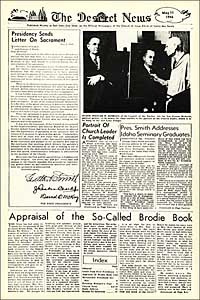
|
Copyright © 1946, Bonneville International. All rights reserved
Only limited "fair use" excerpts presented here.
 Vol. 342. Salt Lake City, Utah, Saturday, May 11, 1946. No. 36.  [p. 1] Appraisal of the So-Called Brodie Book The News has had some requests for its appraisal of the so-called Brodie Book, "No Man Knows My History."It is the custom of authors and publishers to send advance copies of new books to the press for review, thus getting for them the benefit of attendant publicity. Presumably neither the author nor the publisher wanted this book reviewed by the Deseret News since no copy has ever been sent for its perusal. In the circumstances the News has had no occasion to make any review, but it nevertheless is glad to comply with the request of its correspondents and give its estimate of the publication.Indications are that reviews of the book are being much more widely read than the book itself. It is desired accordingly to preface this comment by reference to one of them by a certain high ecclesiast. Mrs. Brodie's work has all the lure for him of an inviting pool on a hot summer's day. He plunges in headlong and splashes around with great glee, because of the assumed embarrassment the story will prove to the Latter-day Saint Church. Only an antagonism born of fear could engender his ill-concealed relish. He predicts that time and research "will vindicate both the method and the findings of Mrs. Brodie" thus putting on both his seal of immortality. Professedly, at least, he is a devout believer in the whole story about Jesus as narrated in the Gospels, including the extremist supernaturalism, for the church whose cloth he wears so proclaims. We must assume his sincerity. Is a professedly Christian Father, in the hope of understanding the faith of another church, willing to help destroy faith in Christ himself? So gushing is his exuberance at a supposed discomfiture to another that he does not have the wit to see that Mrs. Brodie's "method" is to rule out God, the supernatural and the miraculous. The scriptural story about Jesus, to her, is quite as much a fable as she makes the story of Joseph Smith. Yet Father Dwyer gurgles complacently along revelling in the Brodie "method and findings" too dull-witted to perceive that if his prediction shall prove true his own faith must crumble, for she would leave no place for his rituals, pageantry, church or creed. It is all right for him to smirk down to Mrs. Row in mock-pity because she spent time doing temple work for her dead. But one must wonder if at the same time the Good Father in common with others of his faith, was spending money to keep tapers burning and to have the dead prayed out of purgatory! Or perhaps he was on the other end of the deal and for a price paid him by the devout out of their meagre store was saying the prayers for the rescue of their dead from whatever terrible place he thinks they were in. And what should the "stalwart defenders of the faith at Brigham Young University" do? Leave their posts and come to the worthy Father to be trained in the highly intellectual discipline of learning how to count beads or be inducted into the mysterious process by which the bread and wine at the Sacrament of the Lord's Supper are transmuted into the very flesh and blood of the Christ? Before he wastes too many tears on Mrs. Row because of what Mrs. Brodie says about Joseph Smith maybe he had better look at the papal skeletons in his own church closet. Has he forgotten, or did he never know of the Inquisition, or what the history books say about the lapses and the degradations charged against his church and a line of its infallible "Holy Fathers?" Does he know that if the history books are right it was his own brother ecclesiasts of high station who condemned Joan of Arc as a heretic which subjected her to be burned at the stake in 1431 and who by his church was canonized as a saint in 1920? He needn't worry. The Church, beginning a hundred years ago, and continuing at intervals on down through the next half century, met all that Mrs. Brodie has said -- and grew and prospered. There is nothing new in her book [p. 6] and no one is in the least alarmed by it. But Father Dwyer should take note that it will probably be wisest for him to stop his persistent sniping. Now the appraisal. Mrs. Brodie's intense atheism not only colors but actually determines the approach and, almost completely, the content of her book. There is, in her conception, no place in human experience for the transcendental. No supreme being, no divine power intervenes in or influences the course of events or shapes them toward a goal or destiny. God is not regnant in history. Mormonism, therefore, has to be foundationed in a fable, which she at the very beginning declares. That is her fixed predetermined premise. She would say the same thing of all Christian faiths and for the same reason. If her book is anti-Mormon, it is equally anti-Christian. She refers to the "second coming of Christ" and the "resurrection" as being among the "irrationalisms" culled by Joseph out of Isaiah and the Revelation of St. John, and to the primitive Christian Church she describes an "antiquated theology." She declares that "In the New World's freedom the church had disintegrated," and, under the impact of the ideas that had brought about the Revolution, "the path away from Christianity was being beaten out." Telling us that America was ripe for a religious leader speaking God's word with authority, "a prophet of real stature," she at once hastens to add: "His mission should be to those who found religious liberty a burden, who needed determinate ideas and familiar dogmas, and who fled from the solitude of independent thinking." That is to say, religion is only a crutch for the timorous and dull-witted, of no use whatever to the courageous and lonely few capable of independent thought, to the "solitude" of which select company she thus deftly elevates herself. Her husband's "qualities of judgment and perception" she tells us have "affected my whole approach to the book," which likely furnished the key to her attitude, for his tradition and upbringing probably inclined him away from rather than towards acceptance of Christian beliefs. The angel's announcement to Mary, his warning to Joseph to take the child Jesus into Egypt, most of the miracles, the claim to Messiahship, the resurrection, Paul's vision on the way to Damascus, -- the kingdom of God -- all these Mrs. Brodie would chuck as unceremoniously out the window as she does the claims of Joseph Smith to heavenly inspiration and revelation. Indeed, a predecessor, the Jewish Rabbi, Klausner, has already done just that in his book, Jesus of Nazareth, published more than twenty years ago. Dr. Klausner, however, is not disrespectful. He gives Jesus high praise. His treatise, written in the Hebrew for Jews, exhibits a dignity and a maturity so patently wanting in Mrs. Brodie's work. Still he has a thesis: to prove that Jesus was utterly a Jew, a teacher versed in the law, but not the Messiah nor the Son of God, nor even a Prophet. Between his book and Mrs. Brodie's there is a startling similarity of approach and organization. He speaks of the complexity of Jesus' character, his gift of imagination and his daydreaming about the redemption of his people, the sudden flashing through his mind at his baptism of the idea that he is the hoped-for Messiah; avers that there is nothing new in Jesus' ethical teachings; that his spiritual ideal is strongly tinctured by the material and worldly, that he was afraid to let his miracles be publicized, because they were not always successful; tells how failures threw him into despondency lest his disciples lose faith in him; that he revealed his real meanings only to the inner circle while teaching the public in ambiguous parables; sets him up for a study in a background of political, social, and economic conditions; dwells upon the humbleness of his beginnings; selects instances and interprets them in light of the thesis, points out alleged weaknesses of character, failure to live up to his own teachings, inconsistencies and contradictions. Point by point Mrs. Brodie's book runs parallel. It would be revealing to set the two in columns opposite each other. If one wanted to be as reckless as she is in deducing conclusions, it would be easy to draw some. By postulating at the outset that Joseph Smith's claims couldn't be true, Mrs. Brodie greatly simplified her task. His claims being by assumption false, there is left only this question to be resolved: Is the falsity due to an honestly entertained delusion growing out of the superstition of the times, or is it a deliberate imposture? Less wise than Klausner, she chose the second alternative, and having done so pursues it with all the zeal and artifice of the retained advocate, lifting excerpts out of their contexts, wrenching sentences out of their setting, picking one sentence out of a page and skipping over two or three pages to pick another out and coupling the two together without regard to what lies between, calling as witness the hyperbolic railings of disreputable characters whose self-confessed or unknown, and by her admitted, corruption and malicious extravagances render them unworthy of credence, accepting as established fact hearsay gossip--hearsay piled on top of hearsay, attributing motives and assigning purposes with all the license of a novelist and by artful selectivity of episodes and strained correlations of them, bending circumstances, where the exigency of the case requires it, into support of her thesis, even by elliptical quoting, making purported quotations absolutely false. Her book, which she likes to think of as being objective, is really an ardent defense of a predetermined thesis. This estimate seems to call for a bill of particulars, but the specified defects so permeate the whole structure of the book and are so woven into its interpretations and assumptions and deductions throughout, that to sort them out and expose them severally would involve the writing of another book. A few instances must suffice, and attention is first directed to the author's sources. Joseph Smith had to have a youth conformable to her postulated pattern so she makes him the "ne'er-do-well" leader of a "band of idlers" who spent their time "digging for buried treasure," to locate which they indulged all the necromancies, occultisms. incantations, and humbuggery known to the art of the sorcerer. She calls them "gold diggers" or "treasure hunters," which designations she deftly contrives to convert into terms of special approbrium. Where's the evidence? It lies (1) in affidavits, (2) in Dogberry papers (so named for the editor who published them), (3) in Joseph's alleged admissions in his journal and in an alleged court record. It would be an easy task to tear the affidavits in shreds, so far as their evidentiary value is concerned, but space compels skipping over such items as the malevplent and vengeful purpose and vile character of the man who assembled them; the time he did it; the widespread frenzied purpose to discredit Joseph Smith who had become a notable person; the inescapable conclusion that they were all conceived in one brain; the notorious ease with which signatures may always be obtained; the equal ease, by proper prompting, of getting the desired ideas incorporated; the total absence of their having been subjected to any ordinarily accepted test for accuracy or credibility; and their language which is wholly out of character with the station of the affiants. But it will be well to look at some of the less obvious difficulties about the affidavits. These, and the Dogberry papers, too, for good measure, expanded Joseph's alleged "gold digging" humbugs to include the whole Smith family who at the same time were so desperately poor that all had to toil unremittingly merely to live. Yet the author provides Joseph time to be the leader of a band of idlers, and has the entire family digging up the whole countryside, without compensation in their feverish hunt for buried treasure. For no one was found to testify that the Smiths, including Joseph, ever tried to make gain out of their weird magic. Nobody was found to say that he had been solicited for money or had ever been bilked out of a dollar. Neither was anybody found who ever saw the Smiths digging for treasure. Affiants and story writers all rely on rumor, for, as Mrs. Brodie says, it was a "nocturnal" operation. Why couldn't one of Joseph's band of idlers be found to certify their doings, or one of the Smith neighbors to swear that he had seen the treasure hunt in action, or that the desperately poor Smiths had sought to capitalize on their allegedly pretended occult powers or the practice of their necromantic arts? Mrs. Brodie concedes that some parts of the affidavits are not true. By what divination does she know which part of a man's statement is reliable when admittedly some of it is totally false? She has throughout, the convenient habit of leaving out or denying validity to whatever does not fit into the pattern of her thesis. All that is said about the affidavits is equally applicable to the Dogberry papers, plus the fact (omitted by Mrs. Brodie) that in Dogberry's first article announcing his intention to publish facts "having any connection with the origin in question" (Book of Mormon), he offers a free subscription to his paper to postmasters or anybody else who can furnish him interesting notices on the subject, certainly a novel way to conduct research, but one sure to be fruitful, as the event discloses. But these Mrs. Brodie accepts and uses to bolster up the affidavits which she tacitly admits to be untrustworthy. To fortify both she brings forward alleged admissions, citing Joseph's journal where he was answering, usually in crisp single sentences, a whole catalog of assembled questions. To the question whether he had been a money digger he answered, "Yes, but it was never a profitable job for him, as he got only $14.00 a month for it." The very nature of the answer indicates that it related to one single transaction and obviously had reference to his working for Mr. Stowell at the latter's solicitation to explore for an old Spanish mine, reputed to be rich and to lie in the neighborhood, and the quest for which Joseph persuaded his employer to abandon and went to work for him on his farm. That together with a so-called court record presently to be mentioned is the whole sum of the alleged admissions. And that is all the basis there is for Mrs. Brodie's assertion that the years 1823 to 1827, the period of waiting for delivery of the plates, were characterized by his most intensive money-digging activities. There probably is no prospector who has not dug into old caves or abandoned holes probing for rich finds, nor a mining section in America where quest for abandoned Spanish mines has not been prosecuted but never before nor since has that been made a character disqualification. The puerile nature of the evidence attests the desperation of the need. But the author here comes triumphantly forward with evidence thought to impart respectability to the worthless affidavits and Dogberry papers. They must be made acceptable for on them she stakes her whole conclusion that Joseph instead of being a contemplative, pious, truth-seeking youth was an irreligious cynic, contemptuous of revivals and given over to tale-spinning, and playing mischievous pranks upon unsuspecting neighbors, including his own family, going through silly mummeries and weird mysticisms to aid his deceptions. This clinching evidence "which historians have hitherto overlooked or ignored" in the production of which she takes an obviously special pride, is declared unequivocally to be a court record of a trial of Joseph Smith in a justice of the peace court in Bainbridge in March 1826 on a charge of being "a disorderly person and an impostor." But the alleged find is no discovery at all, for the purported record has been included in other books dating back, some of them half a century and derived always from the same source. Neither is it any better than the flimsy documents it is dragged out to support. It is just one more of them, for after all her puffing and promise the author produces no court record at all, though persistently calling it such. She produces an article on Mormonism written by she does not say whom, for the new Schaff-Herzog Encyclopedia of Religious Knowledge published in 1883 wherein is incorporated this purported court record. In a later edition of the same encyclopedia, the reproduced article on Mormonism drops out the alleged court record, obviously having no reliable evidence of its credibility. Mrs. Brodie says the record was "unearthed" by Bishop Tuttle in southern New York. That is a pretty indefinite place. It is to be noted that she carefully avoids saying that it was found among the records of the court, though she clearly intended that the casual reader would assume that it was. Why didn't Bishop Tuttle say something about it in his book? He clearly had the will to use any damaging evidence he thought supportable. Mrs. Brodie knew the court record of this trial was vital to her case for it is because of it that "Hurlbut's affidavits can hardly be dismissed by the objective student." Why didn't she produce it instead of a secondary source, on its face discredited? A justice's court is not what the lawyers call a court of record, the testimony of witness is usually not taken down nor preserved as a part of the record in the case. This alleged record is obviously spurious because it has Joseph testify first, giving the defense before the prosecution has made its case. Indeed there is no record that the prosecuting witness testified at all, nor that any witness was sworn. Joseph didn't have to testify against himself at all, but here he is doing it before there is any proof against him. Then the recital is that the court "finds the defendant guilty." Of what? He was charged with being "a disorderly person and an impostor." Which was he guilty of? Mrs. Brodie says he was found "guilty of disturbing the peace." The record does not say so. She must get that out of the air as she does so much else, for it is hard to think he was found guilty of something with which he was not charged. Then, more wonderful still, the record does not tell what the judgment or sentence of the court was. The really vital things which a true record must contain are not there, though there is a lot of surplus verbiage set out in an impossible order which the court was not required to keep. This record could not possibly have been made at the time as the case proceeded. It is patently a fabrication of unknown authorship and never in the court records at all. Oliver Cowdery's direct assertion that Joseph was acquitted in a case that was brought against him the author rejects for the astonishing reason that Cowdery says the trial occurred before 1827, whereas the trial in question occurred in 1826, and in place of it the wholly unauthenticated, non-existent record is adopted. Such are the fruits of "objective scholarship." The article in the encyclopedia, in which the spurious court record is incorporated relies for its authority upon the same venomous, anti-Mormon authorities as Mrs. Brodie herself admits are not reliable. It is a great system of documentation. One person publishes a falsehood. Later another writer publishes the same falsehood and cites the first as his authority. Then a third can cite both the others and then a fourth all of them, and so on ad infinitum. Thus a formidable array of footnote documentation slaps the reader in the face, who cannot know that all trace back to an original invention. Is that historical scholarship? Perhaps the best commentary on the value of the kind of evidence Mrs. Brodie relies upon throughout comes out of the experience of one seeking his doctorate at one of our oldest and most renowned universities. His dissertation had to do with a certain phase of Mormon history, so he thought he should search out and document the various anti-Mormon writings to attest the thoroughness of his research. The faculty examining committee required him to delete them all as being unworthy of mention in a work of scholarly research. Every argument put forth in the book to sustain the preconceived claim that Joseph fabricated the whole story about the First Vision 18 years after the alleged event rests on evidence as worthless and reasoning as fallacious, and as easily discredited and dispatched as are the affidavits, papers and court record and the arguments based on them. It involves, too, the statements of wholly reliable men speaking out of their own knowledge. A little more about authorities: Mrs. Brodie asserts categorically that Joseph Smith sais: "Whenever I see a pretty woman I have to pray for grace." For support a footnote reference is given to Wyls. Examination discloses that Wyls said that someone had told him that someone had said that remark to an unnamed friend. Similarly she unqualifiedly asserts that Mrs. Buell had admitted that she did not know whether the Prophet or Buell was the father of her son but the assertion, also impressively footnoted, turns out to rest upon the hearsay report of a Mrs. Etta V. Smith whom Mrs. Brodie was reluctant to believe, as well she might have been, until she found an old blurred photograph allegedly of that son which resolved all doubt, though, too indistinct to be of value for any such use. One might just as well and could just as easily open any old photograph album of a hundred years ago and pick out the picture of almost any pioneer with black hair and a beard and say he resembled the Prophet's children. Again Wyls is appealed to as the authority for the unblushing and hilarious admission of Lucinda Harris that she had been the Prophet's mistress for four years, though Wyls' alleged informant told an entirely different story to another interviewer, and isn't it odd that these women should have been free with declarations of illicit relations when Mrs. Brodie tells us that because of the natural delicacy of the subject, "none of the Prophet's wives ever publicly admitted having conceived a child by him?" Wyls' stories were collected a half century after the purported events, and were all ex parte, taken under extremely questionable circumstances. The utter baseness of the man, his malignancy and total lack of veracity or character are too well known to require comment. But who is Mrs. Etta V. Smith who tells the Buell story? Ten minutes spent reading her book would utterly shatter any intelligent person's faith in it. She relates that she was held prisoner in Salt Lake where many other women were likewise so held; that the governor and some of the most prominent men of the territory were so simple as to plot murder and robbery in her presence and to permit her to witness their accomplishment. She tells a lurid and bizarre tale of her attempted escape and of crimes without number, which she quite inexplicably was always permitted to hear planned and so often to see executed. So ridiculous a narrative so full of impossible occurrences and told in such stilted, artificial language and with such fantastic circumstance that an eighth grade pupil could not br deceived into lending it credence, becomes the source of [p. 8] Mrs. Brodie's scholarly learning. One single, undisputed fact, standing alone, is refutation sufficient of all charges of debauchery. Joseph Smith excommunicated, and from the pulpit denounced men, regardless of their station or influence, for adultery. He declared that any man guilty of it would, unless he repented, deny the faith. Then we are asked to believe that he dared do this, knowing himself guilty of the same offense and that his followers knowing his guilt, still believed in him, gave him full and unquestioned allegiance, and followed him when doing so meant only persecution and suffering. Free, independent, strong, intelligent and honorable men do not do that. As well might one give credence to the awful tales of night orgies of the early Christians or the revolting child-eating practices of the Jews as to accept as historic facts the gossip spun about the name of the Prophet. It seems incredible too, that Mrs. Brodie should rely on the Kinderhook plates story. She asks us to believe that three men set a trap for Joseph, he walked into it and was subject to complete exposure as a fraud, which was the purpose of the whole frame up. But not a word of the trick or of his being duped or of the disclosure of his fakery, was said for thirty-six years, after he and all but one of the planners was dead, when one of the perennial affidavit gatherers got the bizarre story which the author adopts as sober history and uses it as a basis for her predetermined conclusion In her treatment of the Prophet it is as if the author had sat down with a thesaurus and called out all the words connoting humbuggery, or insincerity to interlard her whole book with such characterizations as: "disorderly person," "impostor," "nimble-witted dreamer," "magic incantations," "nocturnal excavations," "hocus pocus," "plastic fancy," "necromancy," "fantasy," "deceiver," "cunning," "cabalistic ritual or rural wizardry." At one time Joseph is a man with the courage of a lion, who stalks into and addresses a meeting attended by threatening enemies who the night before had tarred and feathered him, who does not hesitate to toss an offending person out into the street and is "capable of holding his own with any man ob the frontier." But at another time he is a sniveling coward with love of military display but "little stomach for battle," to whom the "carnage of war was abhorrent" and who "had no ambition to be a famous warrior." At one time he is "hampered by meagre education," and is afraid to expose his ignorance to Rigdon, while at another he is learned to the point of erudition. With a riotous imagination that runs away with his undisciplined mind, he is yet so sagacious that he selects Egyptian for the language on the gold plates because he knows there is no key to its translation. He also knows that he must not use names beginning with certain letters because there are no words in the Old Testament so beginning. And he sees so clearly in the far distance the future findings of science that by "instinct" he ignored the "Asiatic theory" of the origin of the American Indians. His talent, when the case so requires is, is "emotional rather than intellectual." but when the demands of the thesis call for it, the intellectual appeal of Mormonism was in the beginning "its greatest strength," appealing as much to reason as to emotion," a quality which drew to it so "many able men." His power lay in his prodigious personal charm" and "his talent for making men see visions," though all but a handful of members joined the Church before they had ever seen Joseph, or come under his hypnotic spell, unless indeed, it jumped continents and leaped the Atlantic. Finally this unlearned, mentally undisciplined impostor promulgated a doctrine and set up a church from which "nothing in universal morals was omitted." One characteristic artifice employed by the author is to quote from two sources (often a Mormon and an anti-Mormon) and use one symbol for reference to a footnote where both are cited together, giving the impression to the uninformed that the Mormon source is authority for, or in agreement with a discrediting non-Mormon statement. Sometimes her citations actually do not support her textual statements at all. The author also by elliptical quotations, particularly from the revelations or statements of Joseph, drops out language which, if quoted, would entirely alter the meaning she strives for and conveys. In one case she actually makes Joseph marvel at the "brilliance and stylistic beauty" of a bit of his earlier writing when the omitted part of the text elliptically quoted shows that he was actually talking about the Biblical scriptures. This device reaches its climax when after boldly asserting the truth of some statements made by the corrupt and venomous Hurlbut, for which she has no credible evidence, the author falsifies a statement made by Brigham Young by lifting out of the body of a paragraph parts of three sentences and using them so as implicitly to say that Brigham admitted that Joseph was habituated to constant drunkenness, gambling and degrading licentiousness, when the full paragraph shows that Brigham then had never met Joseph and the quoted statement was used arguende, in a manner common to debate, where it was sought to pin his opponent down to the subject of discussion, namely: the doctrines Joseph taught which the contender apparently could not successfully refute so resorted to personal abuse. Right in the same discourse, and in others in the same book and in other books known to Mrs. Brodie, Brigham Young's estimate of Joseph Smith is given, based on years of intimate association. He declared that he knew Joseph as intimately as any living person, even as his own parents, and avowed that "no better man ever lived or does live upon this earth." All this is ignored. Indeed, while with a flourish of fairness which she felt necessary to her assumptions of objectivity, Mrs. Brodie says obscurely that her sources are not reliable, yet she uses them profusely, often, after saying that a statement is unreliable, on the next page adopting it as unquestioned truth and building pages of argument and assertion upon that assumption. If sources admitted by her to be unreliable were deleted from the book there would be little of it left, so fully do her interpretations, deductions, narrative and argument depend upon their acceptance. But she almost completely ignores the statements of persons of unimpeachable character intimately associated and acquainted with the Prophet. She ignores, too, the appraisals of non-Mormon writers whose testimonials are abundant and at complete variance from the vituperative assertions of avowed enemies. Thus is violence done throughout to every demand of integrity in objective research. It could be safely assumed that readers would not have at hand nor use as they read, the citations listed but would credit the author with accuracy and fairness. There is no escaping the conclusion that Mrs. Brodie knew the commercial value of sensationalism and wrote with one eye on the box office. It is easy to grant the author the merit of a fine literary style throughout which makes the book altogether enticing reading. But it is the style of the novelist and not of the historian. She has set up a pattern and cuts Joseph to fit it, though to be sure, to give some of her deductions a semblance of rationality she has from time to time, to retailer him till in the end he bears little resemblance to the first cutting. She never hesitates to put into the mind of the fictitious character she has created the ideas she wants him to have nor to supply him with motives. So the book is full of "may have been elaboration of a half-remembered dream," (which no one knows he had), stimulated by "early revival excitement" (which, when the case requires, he held in contempt and never attended), "dreamed of escape into an illustrious and affluent future," "hated farming." "may have felt," "probably quick to notice," "transformed from lowly necromancer into a prophet," "sensed ritual had to be performed with artistry," "each man felt in the pressure of the hands piled on his head the solemn weight of eternity." "had always been fascinated by military lore," "may have" coined "the name Mormon" out of "Morgan and Monroe," "to be authentic, celestial truth must be thrice repeated," "could easily have reasoned," "talent for making men see visions," "stemmed from obscure hunger for power and deference," "Harris hung around... like a begging spaniel," "the summer breeze stirred the leaves above them, and a bird chirped loudly," "must have been overwhelmed by a sense of panic," "he slipped into it (role of prophet) with ease, without inner turmoil..." "success must have stifled any troublesome qualms," "careful not to include in his manuscript" any word beginning with V because there are none in the Old Testament so beginning, (in truth there are several), "felt warm glow of satisfaction at seeing his words in print." These and innumerable other conjectures and flippancies wholly out of character with sincere historical study, and non-existent outside of her own imaginative creation, she splashes around in her narrative for the sake of atmosphere. She simply can't limit herself to facts. In the language of one of her admiring reviewers: "The biography has the pace and sweep, the bizarre incidents, and compelling suspense of the most extravagant historical novel..." "In the interest of narrative sweep, again, Mrs. Brodie selects her thread of fact without always indicating the complexity of the possibilities; there are more difficult problems about both the selection and the assessment of fact than is always clear from the text. And, finally, in summing up the Prophet's life, what he was, what he stood for, what he accomplished, and what his legacy was and is, Mrs. Brodie's judgment may be subject to both a kinder and a far more rangingly objective reinterpretation." Whatever else Mrs. Brodie may be, she is not a historian. Klausner concedes -- insists upon -- the sincerity of Jesus; ["]were it not so he would have been nothing more than a mere deceiver and impostor -- and such men do not make history; they do not found new religions which persist for two thousand years and hold sway over five hundred million civilized people." So relative to the vision the disciples had of the risen Lord he says: "Here again it is impossible to suppose that there is any conscious deception: the nineteen hundred years' faith of millions is not founded in deception." The visions he explains as being purely spiritual and not material. Starting with that conception he escapes the ludicrous absurdity in which Mrs. Brodie involves herself. She disposes of all visions as impostures, mesmerisms worked on the ignorant by a sly knave, and tries to laugh them out of court with her flippancies born of fiction. In no other thing does she more clearly reveal her pathetic immaturity. She was not ready for her essayed task. She hasn't even the most elementary understanding of what Joseph Smith meant when he talked about revelation, nor what it signifies to the Mormon Church. Neither does she show any competency to write about world religions, or their history. But history writing comes easy to her. When facts are lacking she resorts to presumptions which she indulges with amazing liberality. It is no trouble at all for her to assume that the revivals of Kentucky are the same as those in New England, nor that those of 1820 are the same as those of 1798. Saying that it may never be proved that Joseph Smith ever saw "View of the Hebrews" before writing the Book of Mormon, on the next page she declares it "only a basic source book for the Book of Mormon," and for pages proceeds on the assumption that he got from it the legend of a buried Indian book. With admirable complacency she assumes that Joseph was acquainted with another book because years later he possessed a wholly different book by the same author. And so the assumptions multiply on and on to fill the gaps left by an absence of facts, She had, too, the misfortune to get some very bad psychological guidance; for Joseph Smith and the Church, she realizes too late in her story, refuse to slip comfortably into the moulds she fashions for them. Over the century perhaps nearly two million persons, many highly educated, and all as generally intelligent as any other group of like numbers, have believed his doctrine and have adhered to the Church. All this does not rise out of deception. Klausner was right and she senses that somehow her explanations do not explain. She has not made her case. She simply must lift Joseph Smith above the plane of knavery. So under fictional hand Joseph who starts out as an unconscionable tale-spinner, a vainglorious egotist, an unabashed fraud, willing to conjure up and practice any deception howsoever gross, to feed an insatiable appetite for adulation and gain, and who progresses into a licentious debauchee and a plotter of diabolical crimes, somewhere along the line, when or by what process the author does not even try to explain, is metamorphosed into a sincere religious leader, a real prophet in his own esteem, believing in his own divine calling and in the genuineness of the structure he had raised upon his own consciously concocted, fraudulent base. Her story is more fantastic than the one she assails, Regarding her accounting for the Book of Mormon one would best use her own characterization of Rigdon when he read the Book of Enoch, "the scholar in him fled," for having exploded the Spaulding story and the Rigdon authorship she propounds a theory more preposterous than both of them together. Joseph starts out to write a money-making novel based upon an unrelated mess of incidents, including revivalist sermons, legends about Indian derivations, and current political wrangles. Then Martin Harris lost certain pages of the manuscript (which Mrs. Brodie knows the nature of though no one has ever seen them since they disappeared over a hundred years ago). Whereupon without a scintilla of evidence she has Joseph suddenly scuttle the whole idea and decide to bring God in and write a religious book. He was encouraged in this by the credulity of his own family, who believed him when he carried home in his frock some white sand and suddenly without premeditation invented on the spot the story that it was a golden Bible. Then he told an acquaintance (a sure way of keeping the secret), that he had "the damned fools fixed and will carry out the fun." This epithet embraced his parents and brothers and sisters, though they were a family of unusual loyalty and devotion, as the author later, for another later purpose, establishes. The climax comes when Joseph takes three witnesses into the woods, and subsequently eight, and by mesmeric powers makes them see the gold plates and an angel turning them. Later Joseph had no hesitancy in excommunicating these men and vilifying them for "he neither expected nor received reprisals. For he had conjured up a vision they would never forget." Never in all history has there been such an exhibition of mass hypnotism, effective throughout life, even after the spell of the hypnotist was broken by disaffection and finally by death, and the victims went freely about on their own power unconscious of and untrammeled by any mesmeric spell. They never did find out that they had been hypnotized. The author with some show of pride acclaims her book a work of scholarship, and many reviewers join in that appraisal. No doubt copious footnotes with citation of authorities is impressive and is responsible for the characterization. But it takes something besides footnotes to make scholarship. The numerous listing of references show industry, but do not prove historical integrity. As a matter of research the author has produced nothing new. It is essentially all in books so old as not to have been known by this generation to whom the retold stories seem new, but previously printed works told her where to find it all. Her fidelity to the textual matter of vitriolic anti-Mormon writers, and even manner of expression is startling. Little more can be said for the book than it is a composite of all anti-Mormon books that have gone before pieced into a pattern conformable to the author's own particular rationale and bedded in some very bad psychology. Comments: (forthcoming) |
|
John A. Widtsoe (1872-1952) "What Manner of Boy and Youth Was Joseph Smith?" The Improvement Era August, 1946 Transcriber's comments |
|
Copyright © 1946, Corporation of the President
Only limited "fair use" excerpts presented here.
|
What Manner of Boy and Youth
The mother relates that Joseph refused to be bound to the bedstead, as was the custom when such painful operations were to be performed. He also refused to drink the brandy which the doctor thought might help the boy withstand the pain. "No," exclaimed Joseph, "I will not touch one particle of liquor, neither will I be tied down; but I will tell you what I will do -- I will have my father sit on the bed and hold me in his arms, and then I will do whatever is necessary to have the bone taken out." Looking at me, he said, "Mother, I want you to leave the room, for I know you cannot bear to see me suffer so; father can stand it, but you have carried me so much, and watched over me so long, you are almost worn out." [Lucy Smith, History of the Prophet Joseph, pp. 60-63 (1902 edition); p. 57 (1945 edition)] The operation, though intensely painful to the lad, proved to be successful. There is a heroic quality in this story. It seems to foreshadow the courage that led the boy a few years later to seek, independently of the views of others, the true Church of Christ. It revealed also the tender heart, filled with love, which was manifested in his dealings with all men. Such is the earliest record of Joseph's childhood. He grew up in a Christian household. Family prayers were always held in the home. [William Smith, brother of the Prophet, Deseret News, January 20, 1894. p. 11] Honesty and respect for sacred things were part of the family life. Pomeroy Tucker, one who knew the family personally, but did not accept the Prophet's claims, spoke of the honesty of the family: At Palmyra, Mr. Smith, Sr., opened a "cake and beer shop" as described by his signboard, doing business on a small scale, by the profits of which, added to the earnings of an occasional day's work on hire by himself and his elder sons, for the village and farming people, he was understood to secure a scanty but honest living for himself and family. [Pomeroy Tucker, Origin, Rise and Progress of Mormonism, p. 12]Such was the household in which Joseph Smith, Jr., the Prophet, was nurtured. It was a very humble life, of daily, hard work, but of an upward look towards the things of heaven. Joseph Smith, the Prophet, was an intelligent boy. He had little or no formal schooling. Schools were not plentiful in those days; and he was needed at home to help support the family. Nevertheless, as he grew in years, he learned to read very well. He perused the literature of the day, such as it was; and gave special attention to the Bible until he was able to quote large parts of it. [Pomeroy Tucker, Origin, Rise and Progress of Mormonism, p. 12] His friend and disciple of later years, Orson Pratt, speaking of the Prophet as a boy and youth, wrote that as a boy Joseph "could read without much difficulty, and write a very imperfect hand; and had a very limited understanding of the ground rules of arithmetic." [Orson Pratt, Remarkable Visions, p. 1 (1839)] Despite such limited school training, he later gained much learning, and did remarkable work among men. Even the bitterest enemy has had to admit that Joseph Smith was possessed of high mental gifts. The first vision of the lad, when he was between fourteen and fifteen years of age, and perhaps other early visions, influenced notably the years of his adolescence. Otherwise he followed the usual course of growth. He admits of youthful minor indiscretions. No one need suppose me guilty of any great or malignant sins. A disposition to commit such was never in my nature. But I was guilty of levity, and sometimes associated with jovial company, etc., not consistent with that character which ought to be maintained by one who was called of God as I had been. [Pearl of Great Price, p. 50, No. 28] There was no question in the minds of the family -- who knew him best?about Joseph's truthfulness. Mother Smith relates how the Smith family would gather of evenings to hear the coming Prophet tell of the spiritual visitations he had had. She says: We were now confirmed in the opinion that God was about to bring to light something... that would give us a more perfect knowledge of the plan of salvation and the redemption of the human family. This caused us greatly to rejoice, the sweetest union and happiness pervaded our house, and tranquility reigned in our midst. [Lucy Smith, op. cit., p. 84 (1902 edition); pp. 82, 83 (1945 edition)] Joseph's brother, William, confirmed Joseph's truthfulness. He said: We all had the most implicit confidence in what he said. He was a truthful boy. Father and Mother believed him, why should not the children? I suppose if he had told crooked stories about other things we might have doubted his word about the plates, but Joseph was a truthful boy. That Father and Mother believed him, and suffered persecution for that belief shows he was truthful. No, sir, we never doubted his word for one minute. [Deseret News, January 20, 1894, p. 11]The first vision of Joseph Smith held to be merely a lad's fantasy, caused little more than ridicule among the few who knew of it and who paid attention to it. But when later he told of plates actually seen and possessed by him, followed by the publication of the Book of Mormon, the devil broke loose in veritable fury. His kingdom of evil was to be invaded! The resulting mass of anti-Mormon literature did not hesitate to blacken and malign the Prophet's early years. These effusions of hate may be reduced to three charges: 1, The Smith family were unworthy people; 2, Joseph Smith, the Prophet, was a money digger; and 3, he was a user of peepstones. The charge against the character of the Smith family was based upon several affidavits from people in Palmyra and neighborhood. These affidavits were collected by one P. Hurlburt, of unsavory fame, who had been cast out from the Church for adultery. In revenge he proceeded to write a book against the Mormons, in which these affidavits were included. Even a casual examination of them shows that they were written by one hand in opposition to Joseph Smith and his claims. It was easy to secure signatures. It is easy today. The same method employed in our day, might even secure affidavits that white is black. Competent students have refused to accept the value of these affidavits; or have ignored them. [See, for example, J. H. Kennedy, Early Days of Mormonism, p. 17; also most of the books on Joseph Smith, published during his lifetime.] It is also to be noted that Hurlburt's reputation was such that the publisher dared not use the Hurlburt name on the title page, but instead used his own, E. D. Howe, thus leaving an infamous heritage to later generations. The charge that Joseph Smith was a money digger rests first upon the established fact that he once was employed to dig for a "lost" silver mine. One Josiah Stoal so employed the young man. Joseph Smith has fully acknowledged this employment, which did not last long. [Elders Journal, July 1838, p. 43] Scandal has multiplied this fact into a career of digging for money upon the part of Joseph Smith, until the reader of unprincipled anti-Mormon literature is left with the impression that the citizens of Palmyra did little else than dig for piratical gold under the leadership of a half-grown boy. The further fact that the Book of Mormon plates were buried in a hill, helped to spread the money digging stories. The hunting for "lost" treasure was not unique to that time and place. It is going on merrily today. But it has never achieved community proportions. There is no particular blame attaching to Stoal for hunting for the "lost" silver mine, or for employing Joseph Smith to do the digging. The Smiths sought employment, and in the words of Pomeroy Tucker did such labor jobs as were available, including "gardening, harvesting, well-digging, etc." [Tucker, op. cit., p. 12] Honest historians cannot safely make the charge that Joseph Smith was a professional money digger. Likewise, no credence can be placed upon the charge that Joseph was a peepstone user. Anti-Mormon writers are prone to suggest that the Prophet spent his time in leading people into many a fruitless chase for lost money supposed to be revealed by peepstones. Included in these stories are incantations, digging in the full of the moon, sprinkling the chosen spot with blood from a black sheep, and other like absurdities. According to these writers, every form of black art was practiced by this lad. From the age of fourteen on, he must have had the whole community by the ear. It is curious that in the Palmyra newspaper of the day, seldom is a mention made of such affairs! Perhaps the editor was himself a party to these negotiations with Lucifer! The claims that Joseph Smith had had communication with supernatural beings furnished the foundation for the later tales of Mormon-haters about Joseph's peepstone activities. Then, by the usual accretions from many lips, the story grew, and was fed and fostered by those in whose hearts was a hate of the work to which Joseph Smith was called by God. All of the Prophet's history points away from superstition, and towards belief in an unseen world in which God and his associates dwell. Carefully examined, the charges against the Smith family and Joseph Smith, the boy and young man, fail to be proved. There is no acceptable evidence to support them, only gossip, and deliberate misrepresentation. The Smith family were poor but honest, hard-working, and religious people. Joseph Smith was not a money digger, nor did he deceive people with peepstone claims. It is almost beyond belief that writers who value their reputations, would reproduce these silly and untrue charges. It suggests that they may have set out to destroy "Mormonism," rather than to detail true history. The life of Joseph Smith as boy and youth, was normal, and worthy of imitation by all lovers of truth. -- J. A. W. Comments: (forthcoming) |
|
Francis W. Kirkham (1877-1972) "Joseph Smith in Chenango County New York and Its Alleged Court Record" The Improvement Era March, 1947 Transcriber's comments |
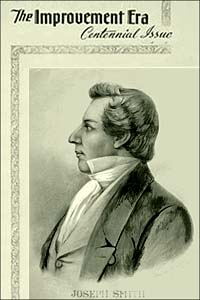
|
Copyright © 1947, Corporation of the President
Only limited "fair use" excerpts presented here.
|
[Vol. 50. No. 3. March 1947]
Where did the Prophet Joseph Smith spend his time after his first vision in May 1820 to about July 1, 1829, when the writing of the manuscript of the Book of Mormon was completed? What did he do? Who were his companions? Where and what did he read and study? Did he attend school? Did he come under the influence of persons or books that can in any way explain the writing or the contents of the Book of Mormon? The Prophet tells us in his story what he did. The Prophet's mother, Oliver Cowdery, John Reid, an attorney, all bear witness to the fact that Joseph Smith went to Chenango County, New York, to work. Undoubtedly, the Prophet had related the account of the visit of Moroni, for Mr. Reid wrote concerning the arrest and trial, and his defense of Joseph Smith in 1830, making this assertion: "This, Mr. Chairman, is a true history of the first persecution that came upon General Smith in his youth among professed Christians. ..." (Italics, author's.) The first reference in the county papers to the Prophet's influence appears to have been in November 1831 and December 1832, when "two or three wretched zealots of Mormonism created much excitement, and made some proselytes in a remote district on the borders of this county and Lazarne. The new converts then propose removing to 'the promised land,' near Painesville, Ohio." (Appendix, History of Susquehanna County, Pennsylvania, Stocker.) The writer thus declares that the first reference in the county papers concerning Joseph Smith came after the Church was organized, and at the time which Joseph Smith in his own records in 1830 states that he was arrested because of his religious activities. No mention is made of an arrest or a court record before this time. In 1883, Daniel S. Tuttle, missionary bishop of Idaho and Utah, wrote an article for the New Schaff-Herzog Encyclopedia of Religious Knowledge regarding the "Mormons." (New York, 1883, Vol. II, pp. 1575-1581.) After describing the contents of the Book of Mormon, and summarizing the early life of Joseph Smith, Bishop Tuttle wrote: This was on September 22, 1823 (the first visit to Joseph Smith of Moroni, the immortal messenger) and from this time on, he avers, his days and nights were filled and his life was guided, by "visions," "voices," and "angels." The Hill Cumorah was about four miles from Palmyra, between that town and Manchester. Here, in the fall of 1827, he claims he exhumed the golden plates. For more than two years, by the aid of the "Urim and Thummim" found with them, he was engaged in translating their contents into English. In March 1830, the translation was given into the printer's hands. This is his history of himself. In what light he appeared to others may be gathered from the following extract, never before published, from the records of the proceedings before a justice of the peace of Bainbridge, Chenango County, New York: "People of state of New York, vs. Joseph Smith. Warrant issued upon oath of Peter G. Bridgman, who informed that one Joseph Smith of Bainbridge was a disorderly person and an impostor. Prisoner brought into court March 20 (1826). Prisoner examined. Says that he came from a town of Palmyra, and had been at the house of Josiah Stowel in Bainbridge most of the time since; had small part of time been employed in looking for mines, but the major part had been employed by said Stowel on his farm, and going to school; that he had a certain stone, which he had occasionally looked at to determine where hidden treasures in the bowels of the earth were; that he professed to tell in this manner where gold mines were a distance under ground, and had looked for Mr. Stowel several times, and informed him where he could find those treasures, and Mr. Stowel had been engaged in digging for them; that at Palmyra he pretended to tell, by looking at this stone, where coined money was buried in Pennsylvania, and while at Palmyra he had frequently ascertained in that way where lost property was, of various kinds; that he had occasionally been in the habit of looking through this stone to find lost property for three years, but of late had pretty much given it up on account of its injuring his health, especially his eyes?made them sore; that he did not solicit business of this kind, and had always rather declined having anything to do with this business." Then follow the statements of Josiah Stowel, Horace Stowel, Arad Stowel and Jonathan Thompson. "...And thereupon the court finds the defendant guilty." THIS alleged record of the court does not conform to the requirements of the law as quoted below. It gives a long confession by the defendant, Joseph Smith, which the law does not require. It gives the testimony of five witnesses, whereas, the testimony of any witness is not recorded in a justice of the peace court. There is no record that any witness was sworn. It is announced he was found guilty, but no sentence is recorded. The record does not conform with the procedure of a trail. A reasonable conclusion is that the alleged record was written by a person totally unfamiliar with court procedure. It appears that this alleged court record is quoted by only three anti-"Mormon" writers since its publication. The first, by Samuel W. Traum, Mormonism Against Itself, 1910, page 43. This writer falsely claims that, "Tullidge, in his Life of Joseph the Prophet, incidentally confirms the record of such a trial having been held, and devotes about eight pages of his volume to Joseph's account of the trial." Tullidge describes the trial of Joseph Smith in 1830, which no historian denies. This is "deliberate misinformation." The second anti-"Mormon" writer, George Bartholomew Arbaugh, Revelations in Mormonism, 1932, page 28, refers very briefly to the account of the trail. He writes: Joseph's fame so spread that he was hired by Josiah Stowell of Chenango County, New York, to dig for money. His father and others were employed with him. About five months later Stowell had him arrested as an impostor. At the trial, March 26, 1826, he said he did locate gold mines and hidden treasure, as well as lost property, by looking in his stone, that he had done this for three years but never solicited business and had of late pretty much given it up because it made his eyes sore. He was held guilty. ... At the trial he showed his seer stone; ... This was clearly not the Belcher stone; it must have been the Chase stone, since it resembled "a child's foot in shape" and was opaque. The alleged court record does not state Stowell had him arrested; it does not state Joseph Smith showed his stone. Such are the misquotations of prejudiced writers. The third writer to quote the alleged justice of the peace record, Fawn M. Brodie, writes: This behavior is confirmed by the most coldly objective description of young Joseph that remains which historians have hitherto overlooked or ignored. This description seems also to be the earliest public document that mentions him at all. The document, a court record dated March 1826, when Joseph was twenty-one covers his trail in Bainbridge, New York, on a charge of being a disorderly person and an impostor. On the basis of the testimony presented, including Joseph's own admissions of indulging in magic arts and organizing hunts for buried gold, the court ruled him guilty of disturbing the peace. A CAREFUL STUDY of all the facts regarding this alleged confession of Joseph Smith in a court of law that he had used a seer stone to find hidden treasure for purposes of fraud, must come to the conclusion that no such record was ever made, and therefore, is not in existence. These are the reasons: (1) The article written for the religious encyclopedia was printed in the same place and with the same sized letters in later editions, 1889 and 1891. (All editions are in the Library of Congress, Washington, D.C.) In the 1910 edition and thereafter a much fairer and more nearly correct account of the "Mormons" appears. It was written by Henry King Carroll, LL.D, Department of Minor Denominations. The alleged court record is not mentioned. Apparently Funk and Wagnalls had found no historical evidence existed to justify its continued publication. (2) The affidavits in Mormonism Unveiled which assert that Joseph Smith had a seer stone which he had found while he was working for Willard Chase at Palmyra, were written for the specific purpose of proving that Joseph Smith by this means practised fraud and claimed to have found the metallic plates of the Book of Mormon. If a court record had been in existence within eighty miles of the residence of the people who signed these affidavits in which Joseph Smith confessed he had used a seer stone, this record would in all probability have been known to the author of Mormonism Unveiled, and would have been printed at the time, and quoted thereafter by all anti-"Mormon" writers. (3) No account of the life of Joseph Smith written either by those who accepted his message as the truth, or those who tried to find a human explanation for the origin of the Book of Mormon, prior to Tuttle in 1883, asserts that Joseph Smith confessed in a court of law that he had used a seer stone for any purpose, and especially that the record of such confession was in existence. (4) It is true that Oliver Cowdery refers to a possible arrest of Joseph Smith prior to 1830, and it is true that one historian of Chenango County refers to this arrest in 1826. In these records which are quoted above, nothing appears which would justify the assertion that Joseph Smith made a confession in a court of law regarding the use of a seer stone, and particularly that such a record was in existence. (5) Thousands of intelligent and devout persons accepted the evidence presented by Joseph Smith during his lifetime. In addition, these believers at that time were able to determine for themselves by personal investigation all the facts that Joseph Smith declared to be true concerning persons, places, events, and conditions which had to do with the writing, translation, the existence of copies of the characters from the plates, and other situations concerning the actual dictation and printing of the Book of Mormon. If any evidence had been in existence that Joseph Smith had used a seer stone for fraud and deception, and especially had he made this confession in a court of law as early as 1826, or four years before the Book of Mormon was printed, and this confession was in a court record, it would have been impossible for him to organize the restored Church. (6) The following facts are important regarding the possible existence of a justice of the peace court record similar to the one quoted in the article written by Bishop Daniel S. Tuttle: a. "The revised statutes of the state of New York printed in 1829, require the recording of certain facts not mentioned in the alleged record. The law does not require the recording of the testimony of the defendant. (Revised Statutes of New York, 1829, Vol.I, p. 638 and 243.) b. "Records as early as 1820-30 of justice of the peace courts of New York state, in the library at Albany, New York, are in the handwriting of the justices and contain only the names of the plaintiff, the defendant, the statement of the case, the date of judgment, the amount of judgment, the cost and fees." (Charles Titus, Book of Judgments 1808-1817, T. Shipherd.) Docket Book, Washington County, 1828, Docket Book, Cairo County, 1829-1833, Bender's Manual for all Counties and Town Officers, 15th edition, 1837, p. 311, describes the powers and duties of justices of the peace, and designates the record that each justice shall keep. It states: Powers & Duties of Justices of the Peace: Each justice shall (a) Keep a criminal docket and a civil docket. The original docket, in all cases, shall contain the name and residence of the defendant, and the complainant; the offense charged; the action of the justice on the complaint, and the name of the constable or other officer to whom any warrant on the complaint was delivered. It shall also show whether the person charged was or was not arrested; the defendant's plea; whether a trial was had or an examination held or waived; the names and addresses of the witnesses sworn thereon, and the final action of the justice in the premises. The civil docket shall show in each case the names of the plaintiff and the defendant and their attorneys, if there be any, the names and addresses of all the witnesses sworn, the names of the persons constituting the jury, if any, and the final disposition of the case, together with an itemization of all costs collected therein. (7) A visit to Norwich, the county seat of Chenango County, New York, and a personal interview with the Mr. Irving D. Tillman, clerk of the county court, revealed that there are no records in this country prior to 1850. Also, there is no knowledge of the destruction of any records. It can be definitely asserted that Daniel S.Tuttle could not have visited this county prior to 1883, and found such a record as he allegedly reports. At this time he was a resident bishop in Idaho and Utah. The anti-"Mormon" writers who quote his article depend entirely upon his statement in the religious encyclopedia. None of them has personal knowledge of the existence of this record. (8) Two of the anti-"Mormon" writers who copy this record, Samuel W. Traum and George Bartholomew Arbaugh, both declare that the origin of the Book of Mormon was Sidney Rigdon who wrote the religious parts, and Solomon Spaulding, who provided the historical basis for the book. These two writers agree with practically all persons who have tried to prove a human origin of the Book of Mormon, namely, that Joseph Smith did not have the ability to write this book of over five hundred pages of history, prophecy, and religious doctrine. The believers in the book also assert that Joseph Smith did not have the ability to produce the book. In other words, for one hundred years, and especially during the lifetime of the Prophet Joseph Smith, it was definitely known by every person who had personal knowledge of the Prophet Joseph Smith, that the Book of Mormon was entirely beyond his ability to write. He asserted that it was an ancient record translated by the gift and power of God. Those who denied his statement asserted that, for purposes of fraud and deception, he had obtained the assistance of others who had the ability to write the book. The conclusion must be: Joseph Smith during the four years of 1823 to 1827 or from the time of the first visit to him of Moroni, the immortal messenger, to the time he received the ancient record of the Book of Mormon spent considerable of his time in Chenango County, New York. Here he worked as a common laborer. He may have attended school. No one claims he associated with or had access to any knowledge that would have assisted him to write the Book of Mormon. It was known to some of the people that he claimed to have been visited by a messenger from God and that a book of great religious importance was to be expected. There exists no evidence to prove he lived other than a normal life. No record exists, and there is no evidence to prove one was ever made in which he confessed in a justice of the peace court that he had used a seer stone to find hidden treasures for purposes of fraud and deception. This information will be more fully treated in a new edition of A New Witness for Christ in America. Comments: (forthcoming) |
|
Joseph Fielding Smith (1876-1972) Doctrines of Salvation III pp. 225-26 Transcriber's comments |
|
Copyright © 1956, Bookcraft
Only limited "fair use" excerpts presented here.
|
Francis W. Kirkham (1877-1972) A New Witness For Christ (2 vols.) Vol. 1 Ch. 9 (excerpt) Vol. 1 Ch. 21 (excerpt) Vol. 1 Supplement (excerpt) Vol. II Ch. 23 (excerpt) Vol. II End Matter (excerpt) Transcriber's comments |
|
Copyright © 1942, '51, '58, '59. '60, Brigham Young University.
Only limited "fair use" excerpts presented here.
|
|
Copyright © 1942, '51, '58, '59. '60, Brigham Young University.
Only limited "fair use" excerpts presented here.
|
[ 281 ]
As noted in the above newspaper articles, the Book of Mormon was advertised and ready for sale the week of March 26, 1830. On April 6th following, or in about one week after the book was printed, the Church was formally organized by six baptized members in conformity with the New York laws. The many newspaper articles published prior to this date and shortly thereafter reveal the attitude and the thinking of the residents of Palmyra and vicinity. These declare that "Joe Smith," a poor, ignorant, lazy, deluded person, had been inspired by Walters, a vagabond magician, to conceive the idea to write a gold bible and to claim the gold record of the book had been given to him by a spirit and that he had translated the gold plates by divine power. In the opinion of the local people a few deluded, superstitious people might believe the story. Again history will repeat itself, the writer declares, "Man from time immemorial has more or less been the dupe of superstitious error and imposition. Where ignorance is found to prevail, superstition and bigotry will abound." The careful reader of the six articles that follow which attempt to tell the origin of the Book of Mormon will be impressed with the utter lack of ability on the part of the writer to make any definite statement as 282 A NEW WITNESS FOR CHRIST IN AMERICA to time or place or persons. He writes of delusions, of superstitions, of ignorance, of dupes. He concedes the book was produced by "Joe Smith" as was the current belief at the time and place of its publication. But like other fanatical imposters, "Joe Smith," and his "Gold Bible" will soon be forgotten. Following is the letter from a correspondent of the Palmyra Reflector to which reference has already been made, who signs himself "Plain Truth." It gave rise to the six articles that follow and was written less than nine months after the Book of Mormon was published. The first article appeared Jan. 7, 1831. The others continued weekly thereafter until completed:
COMMUNICATION
"I observe by the public prints that this most clumsy of all impositions, known among us as Joe Smith's 'Gold Bible,' is beginning to excite curiosity abroad, from the novelty of its appearance, and the assurance of its advocates, who in imitation of too many of our religious sects, who have gone before them, very charitably (at least in this region) threaten all who have the hardihood to refuse to subscribe to their rhapsodies, with 'dire damnation.' "The two papers published in your village, for reasons easily explained, decline at present throwing any light on this subject. To you, and you alone, do we look for an expose of the principal facts and characters, as connected with this singular business: I say singular, because it was hardly to be expected that a mummery like the one in question should have been gotten up at so A NEW WITNESS FOR CHRIST IN AMERICA 283 late a period, and among a people professing to be enlightened. "It is not from a persecuting spirit that I solicit an exposure, for my maxim is that 'error is never dangerous, where truth is free to combat it,' and that liberty of conscience in matters of religion should be allowed to all. Among the bundle of papers herewith sent to you for inspection, you will find little else, than a dry statement of facts, without much reference to time or order; you will perceive that I have attempted to throw all the light I could upon the 'money digging mania,' which formerly pervaded this, and many other countries, which eventuated in the discovery of Joe Smith's 'Golden Treasure.' "From your knowledge of ancient and modern history, by which you will be enabled to relieve the dryness of the subject by bringing before the public parallel cases, there can be no doubt that much useful information may result from your labors. I shall from time to time send you such information as I may collect on this piece of legerdemain. "Yours, etc., "PLAIN TRUTH." Palmyra Reflector, Jan. 6, 1831.
ARTICLE NUMBER ONE
284 A NEW WITNESS FOR CHRIST IN AMERICA under the cognomen of the Book of Mormon, or the Gold Bible. "The few notices heretofore given in the public prints are quite vague and uncertain and throw but a faint light on the subject. While some have evinced a spirit of rancor without giving the whys and wherefores: others have attached an ominous consequence to this transaction, which may have a tendency to mislead the ignorant. "It is our intention, so far as in us lies, to give, in accordance with the wishes of our friend 'Plain Truth,' (whose communication will be found in this day's paper), a plain and unvarnished statement of facts, so far as they may come to our knowledge, which may, in our opinion, be considered as having any connection with the origin, rise, and progress of the Book in question: so that our readers may not only judge of this, but of some other matters for themselves. "By way of introduction, and illustration, we shall introduce brief notices and sketches of the superstitions of the ancients -- the pretended science of alchemy, by which it was vainly supposed that the baser metals might be transmuted into gold -- of Mohamet (properly Ma-hommed) and other ancient impostures -- legends, or traditions respecting hidden treasures, with the spirit, to whom ignorance has formerly given them in charge -- tales of modern "money diggers," and other impostures -- the Morristown Ghost, Rogers, Walters, Joanna Southcote, Jemima Wilkinson, etc. "Our readers will perceive that we have an ample field before us; -- how well we shall execute our task, time will determine -- we shall publish so much weekly as will not interfere with our variety. Postmasters and others, who can furnish us with interesting notices on A NEW WITNESS FOR CHRIST IN AMERICA 285 any of the above subjects, shall receive a copy of our paper gratis."
ARTICLE NUMBER TWO
"Where ignorance is found to prevail, superstition and bigotry will abound: hence we discover among the most rude and barbarous nations, objects the most disgusting and abhorrent, exhibited for the purpose of divine adoration and worship, and certain it is that untutored man has generally attributed to the divinities of his choice, passions and feelings like his own. "The more ferocious and warlike tribes worship deities, whose propensity for blood, is supposed to be in accordance with their own narrow views of the same subject: hence the origin of human sacrifices. The more mild and civilized (the Peruvians for instance) worshipped the sun and other heavenly bodies, believing them to possess the greatest good: their offerings were generally taken from the fruits of the earth, and blood seldom stained their altars. "Man is as prone to be inconsistent, as he is to be superstitious: he will bestow thousands, under the idle pretense of assisting beings, of whom he has no certain knowledge, and with whom he can never be acquainted, while his next door neighbor may perish unheeded for 286 A NEW WITNESS FOR CHRIST IN AMERICA lack of sustenance: and what may yet be considered a still greater anomaly in principle is the conduct of the Hindoos, who believe in the transmigration of the soul, and consequently abstain from animal food, and the destruction of the brute creation, for fear of killing some of their kindred or friends, whose souls may have taken up a temporary abode in some animal: while they immolate human victims on their altars. "Our present business, however, is not to discuss the tenets of the innumerable sects and denominations, of christians or pagans, which now cover the face of the habitable globe, but to throw some light on the "rise and progress" of a sect, (if they may be so called,) who profess to be governed by the pseudo prophet Joe Smith Junior, who in addition to the precepts contained in the "Book of Mormon," issues his inspired commands daily to his devoted followers, and no mandate of Mohamet was ever more implicitly obeyed. "Agreeable to the plan laid down in our last paper we shall commence, or in other words preface our subject by giving brief notices of some of the most notorious imposters that have figured either in ancient or modern times, and connecting such other matters as we may consider applicable to the subject, or interesting to our readers. We shall commence with the imposter of Mecca. "Joe Smith, as a military chieftan, or as a man of natural abilities, can bear no comparison with the author of the Koran, and it is only in their ignorance and impudence that a parallel can be found...." Then follows a description of Mohamet and his work.
ARTICLE NUMBER THREE
A NEW WITNESS FOR CHRIST IN AMERICA 287 we can obtain on this subject, was born in the State of Vermont. His father emigrated to the country (Ontario County, N.Y.) about the year 1815, and located his family in the Village of Palmyra. The age of this modern prophet is supposed to be about twenty-four years. In his person he is tall and slender--thin favored--having but little expression of countenance, other than that than that of dullness; his mental powers appear to be extremely limited, and from the small opportunity he has had at school, he made little or no proficiency, and it is asserted by one of his principle followers, (who also pretends to divine illuminations,) that Joe, even at this day is profoundly ignorant of the meaning of many of the words contained in the Book of Mormon. "Joseph Smith, Senior, the father of the personage of whom we are now writing, had by misfortune or otherwise been reduced to extreme poverty before he migrated to Western New York. His family was large, consisting of nine or ten children, among whom Joe Junior was the third or fourth in succession. We have never been able to learn that any of the family were ever noted for much else than ignorance and stupidity, to which might be added, so far as it may respect the elder branch, a propensity to superstition and a fondness for everything marvelous. "We have been credibly informed that the mother of the prophet had connected herself with several religious societies before her present illumination: this also was the case with other branches of the family, but how far the father of the prophet ever advanced in these particulars we are not precisely informed. It however appears quite certain that the prophet himself never made 288 A NEW WITNESS FOR CHRIST IN AMERICA any serious pretentions to religion until his late pretended revelation. "We are not able to determine whether the elder Smith was ever concerned in money digging transactions previous to his emigration from Vermont, or not, but it is a well authenticated fact that soon after his arrival here, he evinced a firm belief in the existence of hidden treasures, and that this section of country abounded in them. He also revived, or in other words, propagated the vulgar, yet popular belief that these treasures were held in charge by some evil spirit, which was supposed to be either the devil himself, or some one of his most trusty favorites. This opinion, however, did not originate by any means with Smith, for we find that the vulgar and ignorant from time immemorial, both in Europe and America, have entertained the same preposterous opinion." Then follows a description of the "mania for money digging."
ARTICLE NUMBER FOUR
"It is passing strange, that in all ages of the world, gross stupidity in an imposter should be considered among the vulgar, irrefragable proof of his divine mission, __________ The deleted section on money-digging: "It may not be amiss in this place to mention that the mania of money digging soon began rapidly to diffuse itself through many parts of this country; men and women without distinction of age or sex became marvellous wise in the occult sciences, many dreamed, and others saw visions disclosing to them, deep in the bowels of the earth, rich and shining treasures, and to facilitate those mighty mining operations, (money was usually if not always sought after in the night time,) divers devices and implements were invented, and although the spirit was always able to retain his precious charge, these discomfited as well as deluded beings, would on a succeeding night return to their toil, not in the least doubting that success would eventually attend their labors. -- Mineral rods and balls, (as they were called by the imposter who made use of them,) were supposed to be infallible guides to these sources of wealth -- "peep stones" or pebbles, taken promiscuously from the brook or field, were placed in a hat or other situation excluded from the light, when some wizzard or witch (for these performances were not confined to either sex) applied their eyes, and nearly starting their balls from their sockets, declared they saw all the wonders of nature, including of course, ample stores of silver and gold. -- It is more than probable that some of these deluded people, by having their imaginations heated to the highest pitch of excitement, and by straining their eyes until they were suffused with tears, might have, through the medium of some trifling emission of the ray of light, receive imperfect images on the retina, when their fancies could create the rest. Be this however as it may, people busied themselves in consulting these blind oracles, while the ground was nightly opened in various places and men who were too lazy or idle to labor for bread in the day time, displayed a zeal and perseverance in this business worthy of a better cause." A NEW WITNESS FOR CHRIST IN AMERICA 289 and the most bungling piece of legerdemain, will receive from them all the credit of a well attested miracle." (Then follows a long description of Joanna Southcote of London, who proved to be a false prophetess. She claimed she received revelations.) "If an imposture, like the one we have so briefly noticed, could spring up in the great metropolis of England, and spread over a considerable portion of that kingdom, it is not surprising that one equally absurd, should have its origin in this neighborhood, where its dupes are not, or ever will be numerous. "In the commencement, the imposture of the 'Book of Mormon' had no regular plan or features. At a time when the money digging ardor was somewhat abated, the elder Smith declared that his son Joe had seen the spirit, (which he then described as a little old man with a long beard,) and was informed that he (Jo) under certain circumstances, eventually should obtain great treasures, and that in due time he (the spirit) would furnish him (Jo) with a book, which would give an account of the ancient inhabitants (antideluvians) of this country, and where they had deposited their substance, consisting of costly furniture, etc., at the approach of the great deluge, which had ever since that time remained secure in his (the spirit's) charge, in large and spacious chambers, in sundry places in this vicinity, and these tidings corresponded precisely with revelations made to, and predictions made by the elder Smith a number of years before. "The time at length arrived, when young Joe was to receive the book from the hand of the spirit, and he repaired accordingly, alone, and in the night time, to the woods in the rear of his father's house (in the town 290 A NEW WITNESS FOR CHRIST IN AMERICA of Manchester, about two miles south of this village) and met the spirit as had been appointed. This rogue of a spirit who had baffled all the united efforts of the money diggers, (although they had tried many devices to gain his favor, and at one time sacrificed a barn yard fowl,) intended it would seem to play our prophet a similar trick on this occasion, for no sooner had he delivered the book according to promise, than he made a most desperate attempt to regain its possession. Our prophet, however, like a lad of true metal, stuck to his prize, (and attempted to gain his father's dwelling, which it appears, was near at hand. The father being alarmed at the long absence of his son, and probably fearing some trick of the spirit, having known him for many years: sallied forth in quest of the youthful adventurer. He had not, however, proceeded far before he fell in with the object of his kind solicitude who appeared to be in the greatest peril. The spirit had become exasperated at the stubborn conduct of the young prophet, in wishing to keep possession of the book, and out of sheer spite, raised a whirlwind, which at that particular juncture, throwing trunks and limbs of trees about their ears, besides the ground, and bruised him severely in the side. The rescue however, was timely; Joe retained his treasure and returned to the house with his father, much fatigued and injured. This tale in substance, was told at the time the event was said to have happened by both father and son, and is well recollected by many of our citizens. It will be borne in mind that no divine interposition had been dreamed of at the period."
ARTICLE NUMBER FIVE
A NEW WITNESS FOR CHRIST IN AMERICA 291 to the ignorance of the people, and the propensity inherent in their natures, to follow everything absurd or ridiculous. Learning it is said flourished in some parts of Arabia at the time Mohamet made his appearance, and this may sufficiently account for the slow progress that imposter made for the first years of his pretended mission, and had not the Koran been supported by the sword the whole imposition in all probability would have died in embryo, and the disciples and followers of the crescent would never have been able to subjugate the fairest portion of the globe. "It is said Sergius, a Christian Monk, assisted Mohamet in writing the Koran, which is allowed by the best and most candid writers to be written with the utmost elegance and purity, in the language of the Koreighites, the most noble and polite of all the Arabians. Mohamet had a regular plan from the beginning in the commencement of his imposture, and was afterwards allowed, as he declares, numerous conferences with God Himself. He was too cunning to attempt many miracles before his followers, and even the story of the tame pigeon, who had been taught to light upon the shoulder of the prophet, and eat millet from his ear, is denied by many of the Arabian historians. "It is well known that Joe Smith never pretended to have any communion with angels, until a long period after the pretended finding of his book, and that the juggling of himself or father went no further than the pretended faculty of seeing wonders in a 'peep stone,' and the occasional interview with the spirit, supposed to have the custody of hidden treasures: and it is also equally well known that a vagabond fortune-teller by the name of Walters, who then resided in the town of Sodus, and was once committed to the jail of this country 292 A NEW WITNESS FOR CHRIST IN AMERICA for juggling, was the constant companion and bosom friend of these money digging imposters. "There remains but little doubt, in the minds of those at all acquainted with these transactions, that Walters, who was sometimes called the conjurer, and was paid three dollars per day for his service by the money diggers in this neighborhood, first suggested to Smith the idea of finding a book. Walters, the better to carry on his own deception with those ignorant and deluded people who employed him, had procured an old copy of Caesar's Orations, in the Latin language, out of which he read long and loud to his credulous hearers, uttering at the same time an unintelligible jargon, which he would afterwards pretend to interpret and explain, as a record of the former inhabitants of America, and a particular account of the numerous situations where they had deposited their treasures previous to their final extirpation. "So far did this imposter carry this diabolical farce that not long previous to the pretended discovery of the Book of Mormon, Walters assembled his nightly band of money diggers in the town of Manchester, at a point designated in his magical book, and drawing a circle around laborers, with the point of an old rusty sword, and using sundry other incantations, for the purpose of propiating the spirit, absolutely sacrificed a fowl, ('Rooster') in the presence of his awe-stricken wealth; and after digging until daylight, his deluded employers retired to their several habitations fatigued and disappointed. "If the critical reader will examine the Book of Mormon, he will directly perceive, that in many instances the style of the Bible, from which it is chiefly copied, has been entirely altered for the worse. In many instances it has been copied upwards, without reference to chapter A NEW WITNESS FOR CHRIST IN AMERICA 293 (excerpt truncated due to copyright restrictions) |
Copyright © 1942, '51, '58, '59. '60, Brigham Young University.
Only limited "fair use" excerpts presented here.
|
[ 457 ]
In this supplement are printed important documents pertaining to the writing and publication of the "Book of Mormon" and the activities of Joseph Smith before the book was printed in 1830. These include two early publications concerning the witnesses to the "Book of Mormon" probably reprinted here for the first time since their original publication in 1831. Since this book was published in 1942, a considerable part of the original manuscript of the "Book of Mormon" has been presented to President George Albert Smith by Charles C. Richards, son of Apostle Franklin D. Richards, who received the manuscript from Major Bidamon, husband of Emma Smith at Nauvoo on May 21, 1885. The statement published by Apostle Franklin D. Richards, at the time, is reprinted in part in this supplement. It gives the very important information that the manuscript is in the handwriting of Oliver Cowdery and reflects sincere knowledge of its sacred origin. On page 214 of this book, a photograph copy of an earlier part of this manuscript is printed. Evidence is given that both parts of the manuscript are in the handwriting of Oliver Cowdery, thus confirming the conclusions of chapter 18 of this book. The newspaper article concerning Martin Harris is very important evidence that he left Palmyra to go to Kirtland as early as 1831. It is definite proof that he declared openly his knowledge of the divine origin of the "Book of Mormon." 458 A NEW WITNESS FOR CHRIST IN AMERICA (pages 458-466 not transcribed due to copyright restrictions) A NEW WITNESS FOR CHRIST IN AMERICA 467 From THE PAINESVILLE TELEGRAPH, March 15, 1831. Martin Harris, another chief of the Mormon imposters, arrived here last Saturday from the bible quarry in New York. He immediately planted himself in the barroom of the hotel, where he soon commenced reading and explaining the Mormon hoax, and all the dark passages from Genesis to Revelations. He told all about the gold plates, Angels, Spirits, and Jo Smith.--He had seen and handled them all, by the power of God: Curiosity soon drew around thirty or forty spectators; and all who presumed to question his blasphemous pretentions, were pronounced infidels. He was very flippant, talking fast and loud, in order that others could not interpose an opinion counter to his. Every idea that he advanced, he knew to be absolutely true, as he said, by the spirit and power of God. In fine, the bystanders had a fair specimen of the Mormon slang, in this display of one of their head men. The meeting was closed, by a request of the landlord that the prophet should remove his quarters, which he did, and declaring, that all who believed the new bible would see Christ within fifteen years, and all who did not would absolutely be destroyed and dam'd.
NEWSPAPER ARTICLE BY W. D. PURPLE,
This is obvious for the following reasons: One says the complaint was by the sons of Isaiah Stowell. The other by Peter Bridgman. One report, "The prisoner was discharged." The other "the court finds the defendant guilty." One accused, "Joseph Smith was a disorderly 468 A NEW WITNESS FOR CHRIST IN AMERICA person and an imposter." The other caused the arrest of the deluded young man, Joseph Smith, as "being a vagrant without means of a livelihood." One states that only a "small part of Joseph Smith's time had been employed in looking for mines, the major part was work on the farm and going to school." The other infers his time was used entirely to mislead his employers to find hidden treasures by the use of his seer stone, until the sons caused his arrest as a vagrant when in a few weeks he left the town. One says his information is the court record (where the court record was or how he obtained it is not given). The other declares he was invited to attend the court by the Justice and that he took notes. But he does not quote his notes nor assert he kept them. Both accounts appear more than fifty years after the event. Through the courtesy and aid of the staff of Guernsey Memorial Library, Norwich, New York, a letter dated June 4, 1947, written by Helen L. Fairbank, assistant librarian, reported as follows: "This now completes careful perusal of the following volumes: "Anti-Masonic Telegraph, April, 1829 - March, 1835; Norwich Journal, September 10, 1828 - September 1, 1830, for early history of Mormonism. "Chenango Telegraph, March, 1844 - April, 1846, to cover period of Joseph Smith's death. "Chenango Union, June 1, 1876 - September 4, 1879, for further articles by W. D. Purple. "We are sending a photostatic negative of the W. D. Purple article." As a result of this research, twenty-seven double spaced, typewritten sheets (9 X 11 inches) were received and have been deposited with the Church Historian's Library at Salt Lake City. These articles are described briefly in the introductory statement to this supplement. A NEW WITNESS FOR CHRIST IN AMERICA 469 Copies of two of these will be printed in this book in connection with the article by W. D. Purple, originally discovered by Helen L. Fairbank.
THE ORIGIN AND PURPOSE OF THE
The use of a seer stone by Joseph Smith buried in a hat to exclude the light, seemed to have had its origin and emphasis in Mormonism Unveiled, 1834. It appears that the affidavits of the citizens of Palmyra follow a consistent pattern about money digging and the use of a seer stone. One would be led to believe that one person directed their form if he did not write each one personally. Read Chapter 10, page 129, for further explanation. Excerpts from some of the affidavits collected, possibly written by Philastrus [sic] Hurlburt, the man who was excommunicated from the Church for immoral conduct, and published in 1834 in Mormonism Unveiled, are reprinted here. The reader will note that Josiah Stoal is mentioned. This is evidence that they knew that Joseph Smith had, when a young man, worked for him. They do not say in their affidavits that he had confessed in a 470 A NEW WITNESS FOR CHRIST IN AMERICA Justice of the Peace court that he had used a seer stone for fraud and that his confession was made a part of the record. If such a record had been in existence, what a mighty instrument it would have been for Philastrus Hurlburt to destroy the "religious fraud" of Joseph Smith. Apparently no one ever heard of it until 1877 when W. D. Purple decided to tell the story he remembered so well after fifty years. The following is part of the affidavit of Peter Ingersoll: (See another explanation of the seer stone said to have been used by Joseph Smith by J. B. [Buck] in the History of Susquehanna, Pennsylvania, 1887, by Rhamanthus M. Stocker {page 376}.) Then follows a description of a witch hazel bush by Joseph Smith, Sr. "On my return, I picked up a small stone and was carelessly tossing it from one hand to the other. Said he (Joseph Smith Sr.) looking very earnestly 'what are you going to do with that stone?' 'Throw it at the birds,' I replied. 'No,' said the old man, 'it is of great worth,' and upon this, I gave it to him. 'Now,' says he, 'if you only knew the value there is back of my house,' (pointing to a place near). 'There,' exclaimed he, 'is one chest of gold and another of silver.' He then put the stone which I had given him into his hat, and stooping forward, he bowed and made sundry maneuvers, quite similar to those of a stool pigeon. At length he took down his hat and being very much exhausted, said, in a faint voice, "If you knew what I had seen, you would believe.' To see the old man thus try to impose upon me, I confess, rather had a tendency to excite contempt than pity." Mr. Peter Ingersoll further in his affidavit affirms: "In this dilemma, he (Joseph Smith Jr.,) made me his confident and told me what daily transpired in the family of Smiths. One day he came and greeted me with a joyful countenance. A NEW WITNESS FOR CHRIST IN AMERICA 471 Upon asking the cause of his unusual happiness, he replied in the following language. 'As I was passing yesterday, across the woods, after a heavy shower of rain, I found in a hollow, some beautiful white sand, that had been washed up by the water. I took off my frock, and tied up several quarts of it, and then went home. Upon my entering the house, I found the family at the table eating dinner. They were all anxious to know the contents of my frock. At that moment, I happened to think of what I had heard about a history found in Canada, called the Golden Bible; so I very gravely told them it was the golden Bible. To my surprise, they were credulous enough to believe what I said. Accordingly I told them that I had received a commandment to let no one see it, for, says I, no man can see it with the naked eye and live. However, I offered to take out the book and show it to them, but they refused to see it, and left the room. Now,' said Jo, 'I have got the damned fools fixed, and will carry out the fun.' Not withstanding, he told me he had no such book, and believed there never was any such book, yet, he told me that he actually went to Willard Chase, to get him to make a chest, in which he might deposit his golden Bible. But, as Chase would not do it, he made a box himself, of clapboards, and put it into a pillow case, and allowed people only to lift it, and feel it through the case." In another affidavit in this book, Willard Chase uses over eight pages and tells of finding a peculiar stone while Joseph and his brother, Alvin, were employed by him to dig a well. This he said was used by Joseph Smith as a seer stone. "In April, 1830, I again asked him for a stone which he borrowed from me. He told me I should not have it for Joseph had use of it in translating the Bible." (The translation was completed about July, 1829). Willard Chase writes the following concerning Joseph Smith and Isaiah Stowel: "Joseph's next move was to get married.... Now being destitute of money, he set his wits at work, how he could get 472 A NEW WITNESS FOR CHRIST IN AMERICA back to Manchester, his place of residence, he hit upon the following plan, which succeeded very well. He went to an honest old Dutchman, by the name of Stowel, and told him that he had discovered on the bank of Black River, in the village of Watertown, Jefferson County, New York, a cave, in which he had found a bar of gold, as big as his leg, and about three or four feet long; that he could not get it out alone, on account of its being fast at one end; and if he would move him to Manchester, New York, they would go together, and take a chisel and mallet, and get it, and Stowel should share the prize with him. Stowel moved him. A short time after their arrival at Manchester, Stowel reminded Joseph of his promise; but he calmly replied, that he would not go, because his wife was now among strangers, and would be very lonesome if he went away. Mr. Stowel was then obliged to return without any gold, and with less money than he came." Joshua Stafford declares: "A short time after this, they commenced digging for hidden treasures, and soon after they became indolent and told marvelous stories about ghosts, hob-goblins, caverns, and various other mysterious matters." David Stafford in his affidavit states: "It is well-known, that the general employment of the Smith family was money digging and fortune telling." Roswell Nichols in his affidavit relates: "He then stated their digging was not for money but it was for the obtaining of a Gold Bible. This contradicted what he had told me before... that the hills in our neighborhood were all full of gold and silver." Henry Harris in his affidavit states: "Joseph Smith Jr. the pretended prophet, used to pretend to tell fortunes; he had a stone which he used to put in his hat by means of which he professed to tell people's fortunes." An affidavit from Isaac Hale, father-in-law of Joseph Smith is dated, March 20, 1834. "Smith, and his father, with several other "money diggers" A NEW WITNESS FOR CHRIST IN AMERICA 473 boarded at my house while they were employed in digging for a mine that they supposed had been opened and worked by the Spaniards many years since. Young Smith, gave the "money diggers" great encouragement, at first, but when they had arrived in digging to near the place where he had stated an immense treasure could be found--he said the enchantment was so powerful that he could not see. They then became discouraged, and soon after dispersed. This took place about the 17th of November, 1825; and one of the company gave me his note for $12.68 for his board, which is still unpaid. After these occurrences, Young Smith made several visits at my house, and at length asked my consent to his marrying my daughter, Emma. This I refused." Mr. Hale states the time when these men were employed in digging for a mine as being the 17th of November 1825. This corresponds very closely to the date given by Joseph Smith and his mother as the time of employment of Joseph with Josiah Stowel. It also conforms to the statement of Joseph Smith that this digging in a supposed old Spanish mine was only for a short time. Mr. Hale makes no mention of the arrest of Joseph Smith or a trial and particularly, of a confession of Joseph Smith at a trial. This book printed in 1834, was republished in 1840. It became the accepted explanation of Joseph Smith and the origin of the "Book of Mormon." W. D. Purple like other writers for nearly another fifty years let his imagination conform to the wanted and accepted explanation of his time. Note the following: Chenango Telegraph, Norwich, N.Y. Wednesday, April 30, 1845. The Mormons are in a deplorable state. This abject body of deluded creatures now begin to feel their true condition, and are once again brought to a sense of degradation. Passers from the interior of Illinois say their condition has been growing worse and worse ever since the death of the Smiths and at present is truly pitiable. The great mass at Nauvoo is in a state of 474 A NEW WITNESS FOR CHRIST IN AMERICA starvation, -- There is no business going on, and no means of obtaining subsistence only by charitable donations from the richer classes. Subscriptions are passing through the city for the relief of the poor, and every day baskets are carried round to collect provisions for the starving. One article of particular interest follows. It was written by Mrs. Doolittle, a lady seventy-five years old who claims to have been acquainted with Emma Hale, the wife of Joseph Smith. No mention is made of a trial of Joseph Smith. Chenango Union, Norwich, N.Y. Thursday, April 12, 1877. "EARLY DAYS OF MORMONISM." The Binghamton Republican publishes some personal recollections of Mrs. Doolittle, a lady seventy-five years old, who is now visiting with her son-in-law, Chief of Police Johnson of that city. She was personally acquainted with the first wife of Joseph Smith, the Mormon prophet, Miss Emma Hale, whom he married near Susquehanna, Pa.From her statement it appears that Joe came to the neighborhood of Susquehanna to dig for gold, and made several excavations for that purpose, but it never was known that his labors in that direction were rewarded. While thus employed he became acquainted with Miss Hale, whose parents opposed the proposed marriage, and the young people eloped to Windsor, where they were married. They returned and settled down upon a farm adjoining the lands of Mr. Hale and Mr. McKune. There was already a small house upon the farm, a story and a half frame building, and Joe put on a small addition. The farm and the house is now the property of Benjamin McKune, a grandson of Joseph McKune. This same McKune farm is again becoming somewhat famous in consequence of preparations to bore into it for oil a short distance from the prophet's first domicile. While Joe was upon his farm he had the Mormon Bible. Whether he professed to find it before or after marriage Mrs. Doolittle does not remember. Her grandfather was once privileged to take in his hands a pillowcase in which the supposed A NEW WITNESS FOR CHRIST IN AMERICA 475 saintly treasure was wrapped, and to feel through the cloth that it had leaves. From the size and the weight of the book, Mr. McKune supposed that in dimensions it closely resembled an ordinary Bible in the print of those days. Further up the river they have also reminiscences of Joe Smith, which continue Mrs. Doolittle's narrative. In the town Alton, Chenango County, not far from the Broome County line, is a small lake nestled in the hills, and a portion of it is in sight of the Albany and Susquehanna Railroad. It is said that Joe Smith baptized his first Mormon converts there; and it is claimed that the Mormon Church was really begun there, instead of being founded at Manchester, Ontario County, the home of the Smith family, and where the first printed copies of the Mormon or Golden Bible were distributed about ten or twelve years after the prophet's first apearance in Susquehanna County to dig for money. Apparently the first printed account in New York state of an alleged trial of Joseph Smith before the "Book of Mormon" was printed is the article by W. D. Purple in 1877. As already noted, Oliver Cowdery states that Joseph Smith was arrested but mentions no trial. In 1880, James H. Smith wrote a history of Chenango County and copied from this article by W. D. Purple. He used considerable phraseology of the article in describing the character and early life of Isaiah Stowell. He does not repeat in his history the many ludicrous statements of W. D. Purple about Joseph Smith such as looking at a glass enclosed in a hat until the glass became as bright as the sun and then being able to see a stone 150 miles away which he finds after three years and used as a seer stone.
JOSEPH SMITH, THE ORIGINATOR OF MORMONISM
476 A NEW WITNESS FOR CHRIST IN AMERICA liberty is taken to insert comments, explanations, and interpretations.) More than fifty years since, at the commencement of his professional career, the writer spent a year in the present village of Afton, in this County. It was then called South Bainbridge, and was in striking contrast with the present village at the same place. It was a mere hamlet, with one store and one tavern. The scenes and incidents of that early day are vividly engraven upon his memory, by reason of his having written them when they occurred, and by reason of his public and private rehearsals of them in later years. He will now present them as historical reminiscences of old Chenango, and as a precursor of the advent of that wonder of the age, Mormonism. In the year 1825 we often saw in that quiet hamlet, Joseph Smith, Jr., the author of the Golden Bible, or the Book of Mormon. He was an inmate of the family of Deacon Isaiah Stowell, who resided some two miles below the village, on the Susquehanna. Mr. Stowell was a man of much force of character, of indomitable will, and well fitted as a pioneer in the unbroken wilderness that this country possessed at the close of the last century. He was one of the Vermont sufferers, who for defective titles, consequent on the forming a new state from a part of Massachusetts, in 1791, received wild lands in Bainbridge. He had been educated in the spirit of orthodox puritanism, and was officially connected with the first Presbyterian church of the town, organized by Rev. Mr. Chapin. He was a very industrious, exemplary man, and by severe labor and frugality had acquired surroundings that excited the envy of many of his less fortunate neighbors. He had at this time grown up sons and daughters to share his prosperity and the honors of his name. (In this paragraph, the author emphasizes that Mr. Stowell was a man "of indomitable will." A man "of much force of character." He was "officially connected with the first Presbyterian church of the town." He was industrious, an exemplary man who "by severe labor and frugality had acquired considerable property." He also had grown up sons and daughters. Suddenly he changes. "None of his neighbors could make an impression on his wayward spirit.") A NEW WITNESS FOR CHRIST IN AMERICA 477 About this time, he took upon himself a monomaniacal impression to seek for hidden treasures which he believed were buried in the earth. He hired help and repaired to Northern Pennsylvania, in the vicinity of Lanesboro, to prosecute his search for untold wealth which he believed to be buried there. Whether it was the And dollars many fold" What success, if any attended these excursions, is unknown, but his hallucination adhered to him like the fabled shirt of Nesus, and had entire control over his mental character. The admonition of his neighbors, the members of his church, and the importunities of his family, had no impression on his wayward spirit. (The author now turns his story to tell about a poor man named Joseph Smith who lived in the vicinity of the Great Bend -- (Joseph Smith never lived at this place). He lived in squalid poverty. Mr. Stowell heard of the fame of one of his sons who by the aid of the magic stone could find hidden treasures. Suddenly visions of untold wealth appeared to the longing eyes of Mr. Stowell. He immediately went to the humble log cabin of this person and transferred him to the place where he believed great treasures could be found.) There had lived a few years previous to this date, in the vicinity of Great Bend, a poor man named Joseph Smith, who with his family had removed to the western part of the State, and lived in squalid (sic) poverty near Palmyra, in Ontario County. Mr. Stowell, while at Lanesboro, heard of the fame of one of his sons, named Joseph, who, by the aid of a magic stone had become a famous seer of lost or hidden treasures. 478 A NEW WITNESS FOR CHRIST IN AMERICA These stories were fully received into his credulous mind, and kindled into a blaze his cherished hallucination. Visions of untold wealth appeared through this instrumentality, to his longing eyes. He harnessed his team, and filled his wagon with provisions for "man and beast," and started for the residence of the Smith family. In due time he arrived at the humble log-cabin, midway between Canandaigua and Palmyra, and found the sought for treasure in the person of Joseph Smith, Jr., a lad of some eighteen years of age. He, with the magic stone, was at once transferred from his humble abode to the more pretentious mansion of Deacon Stowell. Here, in the estimation of the Deacon, he confirmed his conceded powers as a seer, by means of the stone which he placed in his hat, and by excluding the light from all other terrestrial things, could see whatever he wished, even in the depths of the earth. This omniscient attribute he firmly claimed. Deacon Stowell and others as firmly believed it. Mr. Stowell, with his ward and two hired men, who were, or professed to be, believers, spent much time in mining near the State line on the Susquehanna and many other places. I myself have seen the evidences of their nocturnal depredations on the face of Mother Earth, on the Deacon's farm, with what success "this deponent saith not." (Finally, the sons of Mr. Stowell decided that their father was wasting their money and caused the arrest of this deluded young person, Joseph Smith, as being a vagrant without means of a livelihood. Note carefully, the exaggerated and fairylike story which the author states the young vagrant confessed in court. He relates when he was a lad of hearing about a girl who lived three miles away who could look into a glass and see anything hidden from others. This attracted the vagrant lad. After much effort, he induced his parents to let him visit her. He was permitted to look into the glass and saw but one thing, a small stone a great way off. Before he saw it, the glass dazzled his eyes, the light was as intense as the midday sun. Notwithstanding, he could still A NEW WITNESS FOR CHRIST IN AMERICA 479 see the stone, one hundred and fifty miles away. He thought about this for some years and then left his father's house and traveled west to search for this stone. He had only a few shillings and not sufficient food to eat. He stopped to work on the way for three days and then traveled 150 miles. He did not have the magic glass with him to show him where this stone was hidden, but he remembered the exact place and took an ax and a hoe to the identical tree located 150 miles from his home, a tree he had seen by looking into a glass which shone as bright as the noon-day sun. He took this stone and wiped it dry and sought with weary limbs his long deserted home. He brought this stone with him to the court where he was being tried as a vagrant so that he would be sure to convict himself as a person of the lowest possible type of intelligence, guided by a most ridiculous superstition.) In February, 1826, the sons of Mr. Stowell, who lived with their father, were greatly incensed against Mr. Smith, as they plainly saw their father squandering his property in the fruitless search for hidden treasures, and saw that the youthful seer had unlimited control over the illusions of their sire. They made up their minds that "patience had ceased to be a virtue," and resolved to rid themselves and their family from this incubus, who, as they believed, was eating up their substance, and depriving them of their anticipated patrimony. They caused the arrest of Smith as a vagrant, without visible means of livelihood. The trial came on in the above mentioned month, before Albert Neeley, Esq., the father of Bishop Neeley, of the State of Maine. I was an intimate friend of the Justice, and was invited to take notes of the trial, which I did. There was a large collection of persons in attendance, and the proceedings attracted much attention. The affidavits of the sons were read, and Mr. Smith was fully examined by the Court. It elicited little but a history of his life from early boyhood, but this is so unique in character, and so much of a key-note to his subsequent career in the world, I am tempted to give it somewhat in extenso. He said 480 A NEW WITNESS FOR CHRIST IN AMERICA when he was a lad, he heard of a neighboring girl some three miles from him, who could look into a glass and see anything however hidden from others, that he was seized with a strong desire to see her and her glass, that after much effort he induced his parents to let him visit her. He did so, and was permitted to look in the glass, which was placed in a hat to exclude the light. He was greatly surprised to see but one thing, which was a small stone, a great way off. It soon became luminous, and dazzled his eyes, and after a short way it became as intense as the mid-day sun. He said that the stone was under the roots of a tree or shrub as large as his arm, situated about a mile up a small stream that puts in on the South side of Lake Erie, not far from the New York and Pennsylvania line. He often had an opportunity to look in the glass, and with the same result. The luminous stone alone attracted his attention. This singular circumstance occupied his mind for some years, when he left his father's house, and with his youthful zeal traveled west in search of this luminous stone. He took a few shillings in money and some provisions with him. He stopped on the road with a farmer, and worked three days, and replenished his means of support. After traveling some one hundred and fifty miles he found himself at the mouth of the creek. He did not have the glass with him, but he knew its exact location. He borrowed an old ax and hoe, and repaired to the tree. With some labor and exertion he found the stone, and carried it to the creek, washed and wiped it dry, sat down on the bank, placed it in his hat, and discovered that time, place and distance were annihilated; that all intervening obstacles were removed and that he possessed one of the attributes of Deity, an All-Seeing Eye. He arose with a thankful heart, carried his tools to their owner, turned his feet towards the rising sun, and sought with weary limbs his long deserted home. On the request of the Court, he exhibited the stone. It was about the size of a small hen's egg, in the shape of a high-instepped shoe. It was composed of layers of different colors passing diagonally through it. It was very hard and smooth, perhaps by being carried in the pocket. (As if this fairy tale was not sufficient, the author has his father confess that his son possessed this stone, that he obtained it in the way his son described and that he A NEW WITNESS FOR CHRIST IN AMERICA 481 had wonderful triumphs as a Seer. However, he regretted that he had used it only in search of "filthy lucre." But now he trusted that "the Son of Righteousness would some day illumine the heart of the boy, and enable him to see His will concerning him." In other words, that God would use his poor ignorant, deluded son and a seer stone to bring forth "that mighty delusion of the present century, Mormonism." The author states that the senior Joseph Smith had a lank and haggard visage. He was poorly clad, indicating that he also was a wandering vagabond. No mention is made by any Mormon or anti-Mormon writer and there is no reason to believe that Joseph Smith, Sr., was at Afton when his son was employed by Josiah Stoal. The only mention is a statement by Isaac Hale which states Joseph Smith, Sr., worked a short time near his home which is some distance from Afton. Isaac Hale makes no mention of an arrest or a trial of Joseph Smith, Jr. It is absurd to claim the father would testify at a trial where his son is "accused of being a vagrant without visible means of support," for the purpose to help convict him.) Joseph Smith, Sr., was present, and sworn as a witness. He confirmed at great length all that his son had said in his examination. He delineated his characteristics in his youthful days -- his vision of the luminous stone in the glass -- his visit to Lake Erie in search of the of the stone -- and his wonderful triumphs as a seer. He described very many instances of his finding hidden and stolen goods. He swore that both he and his son were mortified that this wonderful power which God had so miraculously given him should be used only in search of filthy lucre, or its equivalent in earthly treasures, and with a long-faced, sanctimonious seeming, he said his constant prayer to his Heavenly Father was to manifest His will concerning this marvelous power. He trusted that the Son of Righteousness would some day illumine the heart of the boy, and enable him to see His will concerning him. These words have ever had 482 A NEW WITNESS FOR CHRIST IN AMERICA a strong impression on my mind. They seemed to contain a prophetic vision of the future history of that mighty delusion of the present century, Mormonism. The "old man eloquent" with his lank and haggard visage--his form mvery poorly cladindicating a wandering vagabond rather than than an oracle of those future events, has, in view of those events, excited my wonder, if not my admiration. (To reach the climax of this marvelous tale, the writer asserts that this man who only a short time previous was one of the respected citizens of the community of indomitable will and possessing unusual qualities of character, now confessed as true, all the absurd and ridiculous statements that he says Joseph Smith and his father had told the Justice. He writes that the Justice then soberly looked at the witness and said, "Deacon Stowell, do I understand you as swearing before God that you believe this young man who is now being tried as a vagabond can see fifty feet below the surface of the earth by the aid of a stone?" Then the author has Deacon Stowell reply that he does not believe it; he positively knows it to be true.) The next witness called was Deacon Isaiah Stowell. He confirmed all that is said above in relation to himself, and delineated many other circumstances not necessary to record. He swore that the prisoner possessed all the power he claimed, and declared he could see things fifty feet below the surface of the earth, as plain as the witness could see what was on the Justice's table, and described very many circumstances to confirm his words. Justice Neeley soberly looked at the witness, and in a solemn, dignified voice, said, "Deacon Stowell, do I understand you as swearing before God, under the solemn oath you have taken, that you believe the prisoner can see by the aid of the stone fifty feet below the surface of the earth, as plainly as you can see what is on my table?" "Do I believe it?" says Deacon Stowell, "do I believe it? no, it is not a matter of belief. I positively know it to be true." A NEW WITNESS FOR CHRIST IN AMERICA 483 (The writer of this story now asserts that other witnesses tell similar stories about this vagabond youth. He showed the diggers a surface of a box of treasure which was struck by a shovel. They eagerly tried to grasp it, but, behold, the box sank deeper into the hard earth and it was gone. Now the venerable Deacon prayed, and the young vagabond sprinkled flowing blood from a lamb so that the spirit which was forcing the box containing the treasure deep in the earth could be stopped in his wicked effort. Again they dug deep, but the box still receded further into the earth. Such is the story related by this man Purple which is evidence "as evincing the spirit of delusion that characterized those who originated that prince of humbugs, Mormonism.") Mr. Thompson, an employee of Mr. Stowell, was the next witness. He and another man were employed in digging for treasure, and always attended the Deacon and Smith in their nocturnal labors. He could not assert that anything of value was ever obtained by them. The following scene was described by this witness, and carefully noted: Smith had told the Deacon that very many years before a band of robbers had buried on his flat a box of treasure, and as it was very valuable they had by a sacrifice placed a charm over it to protect it, so that it could not be obtained except by faith, accompanied by certain talismanic influences. So, after arming themselves with fasting and prayer, they sallied forth to the spot designated by Smith. Digging was commenced with fear and trembling, in the presence of this imaginary charm. In a few feet from the surface the box of treasure was struck by the shovel, on which they redoubled their energies, but it gradually receded from their grasp. One of the men placed his hand upon the box, but it gradually sunk from his reach. After some five feet in depth had been attained without success, a council of war against this spirit of darkness was called and they resolved that the lack of faith, or of some untoward mental emotion, was the cause of their failure. In this emergency the fruitful mind of Smith was called on to devise a way to obtain the prize. Mr. Stowell went to 484 A NEW WITNESS FOR CHRIST IN AMERICA his flock and selected a fine vigorous lamb, and resolved to sacrifice it to the demon spirit who guarded the coveted treasure. Shortly after the venerable Deacon might be seen on his knees at prayer near the pit, while Smith, with a beacon in one hand to dispel the midnight darkness might be seen making a circuit around the spot, sprinkling the flowing blood from the lamb upon the ground, as a propitiation to the spirit that thwarted them. They then descended the excavation, but the treasure still receded from their grasp, and it was never obtained. What a picture for the pencil of a Hogarth! How difficult to believe it could have been enacted in the nineteenth century of the Christian era! It could have been done only by the hallucination of diseased minds, that drew all their philosophy from the Arabian nights and other kindred literature of that period! But as it was declared under oath, in a Court of Justice, by one of the actors in the scene, and not disputed by his colaborers it is worthy of recital as evincing the spirit of delusion that characterized those who originated that prince of humbugs, Mormonism. (This conclusion of W. D. Purple will forever exclude his article being accepted as a fact by anyone who asserts that Joseph Smith had the ability to write the "Book of Mormon." Joseph Smith's confession in a court record proves what he did and believed; namely, it could have been done only by the "hallucination of diseased minds that drew all their philosophy from the Arabian Nights." So let no one quote this article as giving facts about Joseph Smith, a youth with a diseased mind and then assert within a few years with no change in his way of life, that he had the ability to write a book which is the foundation of America's most rapidly growing church, to which a million intelligent people adhere with a faith and knowledge that have given them leadership in education, culture, and service for mankind, in keeping with the teachings of the Master. Also let it be emphasized, that undoubtedly Mr. Purple accepted the universal A NEW WITNESS FOR CHRIST IN AMERICA 485 belief of the time that Joseph Smith did not have the ability to write the Book of Mormon; it was the joint product of Sidney Rigdon and Solomon Spaulding, otherwise his assertions concerning the ability and character of Joseph Smith would be absurd and ridiculous.) These scenes occurred some four years before Smith, by the aid of his luminous stone, found the Golden Bible, or the Book of Mormon. The writer may at some subsequent day give your readers a chapter on its discovery, and a synopsis of its contents. It is hardly necessary to say that, as the testimony of Deacon Stowell could not be impeached, the prisoner was discharged, and in a few weeks he left the town. Greene, New York, April 28, 1877. On page 59 of this book is printed Joseph Smith's statement regarding his employment with Josiah Stoal. On page 103, Oliver Cowdery tells the same event. On page 141, Mother Smith relates that Josiah Stoal was at their home in company with Joseph Knight at the time Joseph Smith received the plates from Moroni, the immortal messenger. On page 144, a letter dictated by Josiah Stoal is given in part which tells of his experiences and knowledge of the divine origin of the Book of Mormon. He was baptized into the Church, but did not move with the Saints to Ohio. C. H. C. 1:85. John Ried is quoted at length regarding his personal knowledge of Joseph Smith in Chenango County. * * * * * Through the interest and courtesy of Stanley Ivins, a Salt Lake City resident, the following publications concerning Joseph Smith in Chenango County, New York, prior to the appearance of the Book of Mormon in 1830, are now made available for reprinting. Apparently the source of the alleged court record published by Bishop486 A NEW WITNESS FOR CHRIST IN AMERICA D. S. Tuttle in 1883 is now known. It was printed in Fraser's Magazine, London, in February 1873, republished in the Eclectic Magazine, New York, April 1873, and again in the Utah Christian Advocate, January 1886. As previously indicated, Bishop Tuttle did not see such a court record in Chenango County. He is quoted as saying that Miss Emily Pearsoll showed to him pages which she tore from a book, and which were at that time already forty-five years old. These pages, she is quoted as saying, contained this record, but they were not identified at the time as having come from the claimed original court record. The book itself, from which the pages were torn, remained in Chenango County. Pages claimed to be taken from a forty-five year old book are not valid evidence until the book and the pages are identified. Here was a great opportunity to destroy the baneful influence of Mormonism for which Bishop Tuttle and his associates so assiduously labored. Note the following from the pen of Bishop Tuttle: Anyway the dreadful massacre took place and the Mormons cannot clear themselves from the charge that they did it. This cruel butchery of over a hundred, and the dastardly killing of Dr. Robinson, give pith and point to the assertions popularly made that the Mormons had a "Danite Band" of destroyers to put enemies out of the way, and that they practiced "blood atonement," the doing to death of the offending body, for the securing of eternal salvation to the indwelling soul. * If a court record could be identified, and if it contained a confession by Joseph Smith which revealed him to be a poor, ignorant, deluded, and superstitious person -- unable himself to write a book of any consequence, and whose church could not endure because it attracted only similar persons of low mentality -- if such a court __________ * Reminiscences of a Missionary Bishop, D.S. Tuttle, p. 325 A NEW WITNESS FOR CHRIST IN AMERICA 487 record confession could be identified and proved, then it follows that his believers must deny his claimed divine guidance which led them to follow him. Why was this marvelous opportunity disregarded? Why was not the ignorance, the superstition, and the fraud of Joseph Smith and his early followers disclosed forever by his confessed statements in a court record? The life activities of Joseph Smith were known to hundreds of persons in his early life, and by thousands and tens of thousands within five to ten years of the time of this alleged confession. How could he be a prophet of God, the leader of the Restored Church to these tens of thousands, if he had been the superstitious fraud which "the pages from a book" declared he confessed to be? His own record of his activities, and the record of many persons who knew his early life--records accepted as true by those who knew his personally -- give an opposite account of his activities in Chenango County. Here he worked as a common laborer for Josiah Stowell. For a short time only, he assisted in excavating a mine. Mr. Reid, an attorney and a man who never affiliated with the Church, said that Joseph was highly respected and associated with the best citizens of the community. He writes that Joseph's first court trial was in June, 1830, after the Church was organized. The April 23, 1880, issue of the Salt Lake Tribune, printed articles of an agreement between nine persons including Isaiah Stowell, Joseph Smith, Sr., and Joseph Smith, Jr., regarding excavating "at a certain place in Pennsylvania near a William Hales, supposed to be a valuable mine of either gold or silver and also to contain coined money and bars of ingots of gold and silver." This agreement when published was preceded with the usual vitriolic comments made regarding Joseph Smith and his 488 A NEW WITNESS FOR CHRIST IN AMERICA activities. At this time, anti-Mormon literature portrayed Joseph Smith as a fraud, ignorant and superstitious. If the comments are disregarded, the agreement is found to be similar to the statements made by Isaac Hale, (see his quoted affidavit on page 472) Joseph Smith, and Josiah Stowell. All agree that an effort was made to find a place where early Spanish explorers might have hidden "gold or silver bars or ingots." Joseph Smith writes that their activity lasted about one month when he persuaded Mr. Stowell to discontinue his effort. But such employment in a mine is in no way related to the alleged use of a "seer stone" by Joseph Smith to deceive superstitious persons that he had the ability to look into the depths of the earth for hidden treasures. Working by the day in a cave or mine has no connection with an alleged arrest of Joseph Smith on complaint of Peter Bridgman for fraud, or on complaint of the sons of Josiah Stowell that he was a vagrant without visible means of support, as printed by W. D. Purple. Furthermore, there is no relation in this agreement to an alleged confession in a court of law by Joseph Smith to such deceptive superstitious activity which was claimed to have been recorded at the time and the place of the trial. Before copying these articles, it is important to print here from the writings of Bishop Tuttle2 his identification of the person who it is claimed furnished the pages taken from the alleged court record and the time and place of the event. It will be noted that Miss Emily Pearsoll arrived in Utah in 1870 and died in 1872. She was not living when "C. M." furnished the copy of the alleged court record for publication in Fraser's Magazine, February 1873, in Eclectic Magazine, New York, in the same year, A NEW WITNESS FOR CHRIST IN AMERICA 489 in the Religious Encyclopedia in 1883, or in the Utah Christian Advocate, 1886. What her statement might have been at such times when she was quoted as the source of this "alleged court confession by Joseph Smith" of course cannot be known. The only known fact is the claim by the writer, "C. M.," that the pages from the book were shown to him. The copy printed in the Utah Christian Advocate, 1886, claims that Bishop Tuttle made the statement. No such statement or any mention of it is made by Bishop Tuttle in his book, neither does he claim this origin for his own published account of the supposed court record in his article in the Religious Encyclopedia, in 1883. The silence of Bishop Tuttle is most significant. The statement he makes in his book follows, "Smith was up more than once before Justices of the Peace in Central New York for getting money under false pretenses by looking with his peep stone."3 This was written ten years after Funk and Wagnalls no longer published the claimed court record. It would appear that Bishop Tuttle had decided there existed no genuine evidence for this claimed court record. All that exists is a claim by a writer that Miss Pearsoll showed him leaves that contained the record. Another writer claims Bishop Tuttle told him the record was taken from leaves torn from a book. It seems reasonable to assume that Bishop Tuttle did not possess evidence to justify him personally to write that the leaves were a part of a court record. REMINISCENCES OF A MISSIONARY BISHOP Of one good helper at this period, I want to recall490 A NEW WITNESS FOR CHRIST IN AMERICA the memory and record the worth. Miss Emily Pearsoll, cousin of my junior warden in early days at Morris, had come in 1870, from Bainbridge, Chenango County, New York, to help us as "Sister" or "Woman Missionary." Mormonism aimed its fiercest shafts at womanhood. And in helping such sufferers in Utah a woman should accomplish much more than could any man. In my report of 1871, I speak of Miss Pearsoll. Call her "Sister" if you like, or call her "Deaconess" or name her as you wish, the fact is that her help in our pastoral work, especially among the sick and the poor and the children and the ignorant and the strangers, is simply invaluable. She penetrates homes that we cannot so well enter. She reaches hearts that would dose up against us. She hears confessions that would not be made to us. My decision is that she must remain with us to do her good and true woman's work in our parish. I hope year by year to secure part of her support from the parish and part from givers in the East who appreciate how the efficiency of the pastoral work of a clergyman can be more than doubled by the aid of a trained and devoted Christian woman of intelligence and refinement. Miss Pearsoll gave her work to us and her life for us. She died in 1872. When she was buried in "Mount Olivet" overlooking Salt Lake City, hundreds and hundreds of those whom she had loved and served, and who loved her and wept for the loss of her, followed her saved body to the grave. The poor with their pennies gathered the eight dollars which went to provide a decent head stone for her resting place. Few go down to the grave more loved and regretted than did she. THE ORIGINAL PROPHET This article was first published in Fraser's Magazine in London, February 1873, over the signature "C. M." -- apparently Charles Marshall who had contributed articles about Utah and the Mormons to the June and July 1871, issues of the magazine. It was later published in Eclectic Magazine, New York, in April 1873. This article containsA NEW WITNESS FOR CHRIST IN AMERICA 491 the claimed court record of "State of New York vs. Joseph Smith," March 20, 1886, published by Bishop Tuttle in the Religious Encyclopedia in 1883 (see page ?). "C. M." is quoted as follows in the Eclectic Magazine, 1873. "During my stay in Salt Lake City permission was courteously accorded me to copy out a set of such judicial proceedings not hitherto published. I cannot doubt their genuineness. The original papers were lent me by a lady of well-known position, transaction. I reproduce them here, partly to fulfill a duty of assisting to preserve a piece of information about the prophet, and partly because, while the charges are less vehement than some I might have chosen, the proceedings are happily lightened by the touch of the ludicrous." Following the printing of the claimed court record, "C. M." comments as follows: "It was among an ignorant and credulous people of this kind, capable of believing in the necromantic virtues of a big stone held in a hat, and of treasures descending perpetually under the spades of the searchers by enchantment, a people already prepared for any bold superstition by previous indulgence in a variety of religious extravagances that Joseph Smith found his early coadjutors and his first converts." A DOCUMENT DISCOVERED "The document we print below is interesting to those, who desire historic light on the origin of Mormonism. We received the manuscript from Bishop Tuttle, and the following from the good bishop's pen, explains how he came into possession of the manuscript. 'The manuscript was given me by Miss Emily Pearsoll who, some years since, was a woman helper in our mission and lived in my family, and died here. Her father or uncle was a Justice of the Peace in Bainbridge, Chenango Co., New York, in Joseph Smith's time, and before him Smith was tried.Miss Pearsoll tore the leaves out of the record found in her father's house and brought them to me'." On the same page of the magazine which contains 492 A NEW WITNESS FOR CHRIST IN AMERICA what is claimed to be "An exact copy trial and conviction of Joseph Smith author of Book of Mormon, March 20, 1826, Bainbridge, New York," the following few statements are copied. "The baneful influences of Mormonism on the human mind are beyond credence." "There is in the Mormon system itself an almost lack of any moral standard. To spoil their enemies is a divine command; to deceive a Gentile is a virtue, to perjure themselves for the gospel's sake is a religious duty; the blood of an apostate is an offering acceptable to God; the defiling of a home to save the soul of the victim is a moral obligation; the alleged will of God, as interpreted by the priests, is their sole rule of faith and practice.... Priests of righteousness daily visit the saloons to hobnob with the ungodly Gentiles. "The whole structure is based upon materialistic conceptions and scaffolded by animalism. The gospel they preach is a gospel of hate and not liberty and love. Our own Government is their enemy, is tyrannical and unworthy of respect. The true spirit of loyalty to the flag has no place in their conception or utterances and the rankest treason is an every day lesson which must result in a bitter doom."
ARTICLES OF AGREEMENT BETWEEN JOE SMITH,
Yellow Stone Valley, mt
Ed. Tribune: Knowing how interested you are in any matter pertaining to the early history of our church, I enclose
a slip cut from the Susquehanna, P. Journal of March 20, which will throw some light on the subject. The Journal
is published near the scene of our martyred Prophet's early exploits.
April 12, 1880.
Respectfully yours,
B. Wade The following agreement, the original of which is in the possession of a citizen of Thompson township, was discovered by our correspondent, and forwarded to us as a matter of local interest. A NEW WITNESS FOR CHRIST IN AMERICA 493 The existence of the "buried treasures" referred to was "revealed" to Joe Smith, Jr., who with his father the prophet, at that time resided on what is now known as the McCune Farm, about two miles down the river from this place, and upon the strength of which revelation a stock company was organized to dig for the aforesaid treasure. After the company was organized, a second communication was received by Joseph Jr., from the "other world" advising the treasure seekers to suspend operations, as it was necessary for one of the company to die before the treasure could he secured. 494 A NEW WITNESS FOR CHRIST IN AMERICA been at (Johs F. Shepherd, Elijah Stowell and John Grant) to consider them as equal sharers in the mine after all the coined money and bars or ingot are obtained by the undersigned. Their shares to be taken out from each share; and we further agree to remunerate all the three above named persons in a handsome manner for all their time, expense, and labor which they have been or may be at, until the mine is opened, if anything should be obtained; otherwise they are to lose their time, expense and labor. (Brother Wade may have made a mistake in directing his letter to the proper church journal. If he has, Granny has our permission to copy the above by giving the Tribune proper credit.) -- The Daily Tribune, Salt Lake, Friday morning, April 23, 1880. |
Copyright © 1942, '51, '58, '59. '60, Brigham Young University.
Only limited "fair use" excerpts presented here.
|
[ 262 ]
One of the latest anti-Mormon books appeared in 1945. No Man Knows My History, The Life of Joseph Smith, the Mormon Prophet was written by Fawn M. Brodie. In the preface she writes: "The source of his power lay not in his doctrine but in his person, and the rare quality of his genius was due not to his reason but to his imagination. He was a mythmaker of prodigious talent. And after a hundred years the myths he created are still an energizing force in the lives of a million followers. The moving power of Mormonism was a fable -- one that few converts stopped to question, for its meaning seemed profound and its inspiration was contagious." (Preface ix) In the acknowledgments she emphasizes that the "qualities of judgment and preception of her husband, Dr. Bernard Brodie, has affected her whole approach to the book." "Throughout a period of research and writing extending into seven years I have needed and received the constant encouragement of my husband, Dr. Bernard Brodie. His own special perspective on the Mormon society and his enthusiastic interest in my research were of immeasurable value. He read the manuscript many times, each time effecting some improvement in its literary qualities. But all this was secondary to a more intangible kind of assistance which came from his qualities of judgment and perception and which has affected my whole approach to the book." (Acknowledgments) From these two important introductory statements the reader may conclude, that Joseph Smith a person of "prodigous talents" was a mythmaker, that the Book of PRESENT CONFUSION 263 Mormon is "a fable" and that the energizing force in the lives of a million people who accept Joseph Smith as a Prophet are the myths he created. The following is the opening statement of Chapter one entitled, "The Gods are among the People." An old New England gazetteer, singing the charms of Vermont's villages and the glories of her heroes, strikes a discordant note when it comes to Sharon: "This is the birthplace of that infamous impostor, the Mormon prophet Joseph Smith, a dubious honor Sharon would relinquish willingly to another town." The shame that Sharon once felt has faded with time. The church that Joseph founded is imminently respectable, and the dreamy town in the White River Valley where he was born has long since abandoned hope of being noted for anything else. Near by, on one of the lovely hills of which New England is fashioned, stands a shrine that draws Mormon pilgrims from afar and stops many a passer by. Far to the West lie the geographical areas with which Mormonism is generally identified, but one cannot understand the story of its founder without knowing something of Vermont at the turn of the nineteenth century. Joseph Smith was not a mutation, spewed up out of nature's plenty without regard to ancestry or the provincial culture of his state; he was as much a product of New England as Jonathan Edwards. Much about him can be explained only by the sterile soil, the folk magic of the midwives and scryers, and the sober discipline of the schoolmasters. (Chapter 1, page 1.) Then follows the author's interpretations of the lives and characters of the parents and ancestry of Joseph Smith: Joseph and Lucy spent twenty years together in New England, yet neither joined a denomination or professed more than a passing interest in any sect. The Methodist revivals in Vermont in 1810 excited Lucy for a time, but only further convinced Joseph "that there was no order or class of religionists that knew any more concerning the kingdom of God than those of the world." 264 A NEW WITNESS FOR CHRIST IN AMERICA He reflected that irreligion which had permeated the Revolution, which had made the federal government completely secular and was in the end to divorce the church from the government of every state. In the New World's freedom the church had disintegrated, its ceremonies had changed, and its stature had declined. Joseph's father Asael, had frankly gloried in his freedom from ecclesiastical tyranny. The path away from Christianity was being beaten out for the Unitarianism of William Ellery Channing and the more sophisticated heresy of Ralph Waldo Emerson. Lucy, on the other hand, was devoted to the mysticism so common among those suddenly released from the domination and discipline of a church. Like her father she accepted a highly personalized God to whom she would talk as if He were a member of the family circle. Her religion was intimate and homely, with God a ubiquitous presence invading dreams, provoking miracles, and blighting sinners' fields. Her children probably never learned to fear Him. (Page 5.) "Of these and other prophets only one was destined for real glory. Jemima Wilkinson was forgotten with the division of her property; the Noyes Oneida community degenerated from a social and religious experiment into a business enterprise; and Dylks was ridden out of the Leatherwood country astride a rail. William Miller, although his Adventists are still an aggressive minority sect, never regained face after 1845, when after two recalculations Jesus still failed to come. But Joseph Smith a century after his death, had a million followers who held his name sacred and his mission divine." (Page 15.) In Chapter III credit is given Joseph Smith for planning, designing, and writing the Book of Mormon. Some time between 1820 and 1827 it occurred to the youth that he might try to write a history of the Moundbuilders, a book that would answer the questions of every farmer with a mound in his pasture. He would not be content with the cheap trickery of the conjurer Walters, with his fake record of Indian treasure, although he might perhaps pretend to have found an ancient document or metal engraving in his digging expeditions. Somewhere he had heard that a history of the Indians had been found in Canada at the base of a hollow tree. And PRESENT CONFUSION 265 a Palmyra paper in 1821 had reported that diggers on the Erie Canal had unearthed "several brass plates" along with skeletons and fragments of pottery. Perhaps Joseph speculated that since his own family took such pleasure in his stories a greater public might do the same. The dream of somehow recouping the family fortune must have been with him since childhood, and his marriage had doubtless doubled his ambition. Alert to the intellectual currents of his period, though only the backwash swirled through his community, he saw in all the antiquarian speculation an unparalleled opportunity. The plan of Joseph's book was to come directly out of popular theory concerning the Moundbuilders. His "Book of Mormon" was basically the history of two warring races, one "a fair and delightsome people," farmers, stock-raisers, temple-builders, and workers in copper, iron, and steel; the other a "wild and ferocious, and a bloodthirsty people; full of idolatry and filthiness; feeding upon beasts of prey, dwelling in tents, and wandering about in the wilderness, with a short skin girded about their loins, and their heads shaven; and their skill...in the bow, and the cimeter and the axe." (Pages 35 & 36.) ..."Perhaps in the beginning Joseph never intended his stories of the golden plates to be taken so seriously, but once the masquerade had begun, there was no point at which he could call a halt. Since his own family believed him (with the possible exception of his cynical younger brother William), why should not the world? Martin Harris, who not only accepted but freely elaborated upon the story, was talking openly of financing the publication of the translation and had promised to pay Joseph's debts. His sublime faith in the existence of a record he had never seen argued well for the success of the book, which Joseph was now fully determined to write." (Page 41.) ...Sagacious enough to realize that he could not possibly write a history of the Lost Ten Tribes, he chose instead to describe only the peregrinations of two Hebrew families, headed by Lehi and Ishmael, who became the founders of the American race. He began the book by focusing upon a single hero, Nephi, who like himself was peculiarly gifted of the Lord. This device launched him smoothly into his narrative and saved him from having bitten off more than he could chew." (Page 49.) 265 A NEW WITNESS FOR CHRIST IN AMERICA (pages 266-272 not transcribed, due to copyright restrictions) 273 A NEW WITNESS FOR CHRIST IN AMERICA [Alexander Campbell, who knew Rigdon intimately] described his conversion to Mormonism with great regret in the Millennial Harbinger, attributing it to his nervous spasms and swoonings and to his passionate belief in the imminent gathering of Israel. But of the authorship of the Book of Mormon he wrote bluntly: "It is as certainly Smith's fabrication as Satan is the father of lies or darkness is the offspring of night." "Rigdon denied the Spaulding story throughout his life. When his son John questioned him shortly before his death, he replied: "My son, I can swear before high heaven that what I have told you about the origin of that book is true. Your mother and sister, Mrs. Athalia Robinson, were present when that book was handed to me in Mentor, Ohio, and all I ever knew about the origin of that book was what Parley P. Pratt, Oliver Cowdery, Joseph Smith and the witnesses who claimed they saw the plates have told me, and in all my intimacy with Joseph Smith he never told me but one story, and that was that he found it engraved upon gold plates in a hill near Palmyra, New York, and that an angel had appeared to him and directed him where to find it...." (Pages 432, 433.) The writer is forced to conclude that Joseph Smith dictated the contents of the Book of Mormon. She finds no valid evidence that he had any assistance. He alone produced the book by his own peculiar personality. She assumes to tell the time and conditions when he made the decision and how it was possible for him to create myths and write a fable that are today the energizing power in the lives of a million followers in one of the most rapidly growing churches in America. p.274 She also describes Joseph Smith as a ne'er-do-well youth who practised moneydigging. He then changed to a superstitious believer in the supernatural and finally he developed into a "mythmaker of prodigious talents." As proof of "money digging" a claimed confession by Joseph Smith in a Justice of a Peace Court record in 1826 as published in 1883 is quoted. See New Schaff-Herzog Encyclopedia of Religious Knowledge vol. II, p.p. 1575-1581. For reply to this claim see "A New 274 A NEW WITNESS FOR CHRIST IN AMERICA Witness for Christ in America. Volume one, pages 368-394. This author denies the findings and conclusions of scores of anti-Mormon writers who for more than a hundred years have declared that Joseph Smith did not write the Book of Mormon. They declared he was a base deceiver who, by misrepresentation, brought innocent people into lives of deception and disappointment. Today, it is apparent, that Joseph Smith can no longer be declared a deceiver and the Church he organized built upon fraud and deception. Especially is it clear that Joseph Smith was not an ignorant fanatic of low mentality. (pages 275-353 not transcribed, due to copyright restrictions) 354 A NEW WITNESS FOR CHRIST IN AMERICA [Such was the low origin of "The Golden Bible," and "The Book of Mormon" which] have helped more than a quarter of a million souls to feed upon delusion. (Page 19) "Most of the evidence points clearly toward the conclusion that in some way--not yet fully known, and which may never be known -- the Book of Mormon owes its origin to the unpublished Manuscript of Spaulding." (Page 25) In 1896 Bishop Daniel Sylvester Turtle wrote a book, "Reminiscences of a Missionary Bishop." The following quotation from his book regarding his opinion of the origin of the Book of Mormon deserves more than usual attention. He accepts the Rigdon-Spaulding origin of the Book of Mormon and reflects the attitude of anti-Mormon writers regarding Joseph Smith, Brigham Young and the members of the Church. In 1882 Bishop Tuttle wrote an article published at Washington, D.C. in the Schaff-Herzog Religious Encyclopedia which relates a claimed trial of Joseph Smith in March, 1826 before a Justice of the Peace at Bainbridge, Chenango County, New York. In 1945, these writings of Bishop Tuttle are used [by Fawn Brodie] to prove that Joseph Smith did produce the Book of Mormon. According to the book written by Bishop Tuttle in 1906, 24 years after the article was published, as indicated above, he accepts the Rigdon-Spaulding theory of the Book of Mormon. This contradictory situation is discussed at length in the first volume of this series, "New Witness for Christ in America," pages 359-394.
REMINISCENCES OF A MISSIONARY BISHOP
PRESENT CONFUSION 355 Mormon and the reestablishment in the Latter Days of the Church of Christ. The strong probability is that the Book of Mormon is in substance a religious romance written by Rev. Solomon Spaulding of Conneaut, Ohio, an invalid Congregational minister, to while away a time of enforced retirement, and to embody his conviction that the original inhabitants of the Western Continent are descendants of the lost tribes of Israel. Joseph Smith and Sidney Rigdon probably got hold of this manuscript and appropriated it to their use; Sidney, who had been a capable and eloquent "Christian" or "Campbellite" preacher in Ohio, adding to it most of the prophetic, hortatory, and doctrinal ecclesiasticism needed. There is not one word approving the practice of polygamy. On the contrary there is this express prohibition of it (Book of Jacob, Chapter II, v.27), "Wherefore, my brethern, hear me and hearken to the word of the Lord; for there shall not any man among you have save it be one wife; and concubines he shall have none." Pages 309. 310.... This brutal [Mountain Meadows] massacre, and the execrable murder of Dr. Robinson in Salt Lake City, are two stains upon the Mormons, deep and ineradicable. They claim that the massacre was by Indians. But without doubt, Mormons aided and abetted it. Twenty-one years afterwards, in 1878, Bishop John D. Lee was convicted as one of the murderers and was shot to death. He was taken to the very place, Mountain Meadows, to be executed. In 1857 the Mormons were particularly vain, glorious and arrogant. Their "prophet, seer and revelator" had held his own against everybody. He had ordered that bodies of men should not be allowed to enter or pass through Utah without being under surveillance. Perhaps the resentment of the Mormons against their old Missouri enemies thus took occasion to kindle itself into vengeance. Perhaps the Indians, and the baser sort among the Mormons, were greedy for the plunder promised. Perhaps some Mormon leaders, swollen with pride, were ready by a brutal blow to strike terror into intruding outsiders. Perhaps the emigrants themselves, stung by the inhospitality shown them, had given way to some sharp retaliation. Anyway, the dreadful massacre took place; and the Mormons cannot clear themselves from the charge that they did it. This cruel butchery of over a hundred, and the dastardly killing of Dr. Robinson, give pith and point to the assertions popularly made that the 356 A NEW WITNESS FOR CHRIST IN AMERICA Mormons had a "Danite band" of destroyers to put enemies out of the way, and that they practiced constantly "Blood Atonement," -- the doing to death of the offending body, for the securing of eternal salvation to the indwelling soul. Pages 324-325.... On the other hand, one may contemplate what would have been likely to happen if he had lived on, say fourteen years more in addition to the fourteen years he had already spent in the genesis and nurture of his "Church." Nobility of character did not pertain to him, either by inheritance or by acquisiton. The dignity of education was not his. Even with all the care that Sidney Rigdon, who was somewhat of a scholar, gave as co-worker with Joseph, I find in the Book of Mormon such sentences as: -- "They done all these things;" "The people did raise up in rebellion;" "Ye had aught to search these things;" "Cometh on all they that have the law;" "Hath set down on the right hand of God." And the translation of Genesis, and I think of other books of the Bible, which Joseph alleged to have put forth by inspiration, was so full of gross blunders that shame and ridicule worked the suppression of the volume. Smith was up more than once, when a youth, before justices of the peace in Central New York for getting money under false pretenses, by looking with his peep stone. After organizing his "Church" he and his family got into trouble in New York and so removed to Kirtland, Ohio. They got into trouble at Kirtland, and moved to Jackson County Missouri. They got into trouble there, and moved into Clay and Caldwell Counties. They got into trouble there, and moved to Nauvoo, Ill. Nor were they freed from trouble in Nauvoo. The arrogant claims of the Mormons were probably one cause of trouble. "The earth is the Lord's," they said; and they added, or acted as if they added, "and belongs to His saints, and we are His saints." Also, they sank the state in the church. "Revelation" was for direction of things both temporal and spiritual. Political fealty would cut no figure with them. They were ready to throw their votes unitedly in whatever direction would best serve their Church. This practice made them a disturbing element at elections. There was no forecasting which way they would vote. And American voters round about them grew exasperated with their possession of the balance of power and with their use of it in so irritating a fashion. Pages 327-328. PRESENT CONFUSION 357 The only comment made by Bishop Tuttle regarding early trials of Joseph Smith, is the casual observation that "he was up more than once, when a youth... for getting money under false pretences by looking with his peep stone." (The above quoted books are at Church Historian's Library, Salt Lake City, Utah.) The following two articles, concerning an alleged trial of Joseph Smith in 1826 before a Justice of the Peace Court, is copied at the same place in this book for the convenient study of the reader. These copies, with additional related information, are also, printed in part, in the first volume of "A New Witness for Christ in America." (see pages 349-394, 383-384, 475-485.) The description of the alleged trial differs as follows in the two articles. By Bishop Tuttle B. Date of trial, March 26, 1826. C. Warrant issued upon oath of Peter G. Bridgman. D. Accusation -- A disorderly person and an imposter. E. Name of Justice not mentioned. F. Prisoner confessed to use of seer stone. G. Witnesses -- Josiah Stowell, Horace Stowell, Arad Stowell, Mr. McMaster, Jonathan Thompson. H. Defendant found guilty, no fine or punishment mentioned. By W. D. Purple B. Date of trial, February, 1826. C. Arrest caused by sons of Josiah Stowell. D. Accusation -- Joseph Smith was a vagrant without visible means of support. 358 A NEW WITNESS FOR CHRIST IN AMERICA F. Prisoner confessed to use of seer stone, found in a strange and mythical manner. G. Witnesses -- Joseph Stowell, Joseph Smith Senior, M. Thompson. H. Prisoner discharged. No historical reference is made of such a trial, except the W. D. Purple article was copied in part by James H. Smith in History of Chenango and Madison Counties, New York, 1880. The Bishop Tuttle article is mentioned by only two anti-Mormon writers, Samuel U. Traum and George Bartholomew Arbaugh. Both of these writers, accept the Spaulding-Rigdon theory of the origin of the Book of Mormon. The trial is used in 1945, as evidence that Joseph Smith wrote the Book of Mormon. Oliver Cowdery in closing his eight letters published in 1834, in the Messenger and Advocate, Kirtland, Ohio, regarding the "Coming Forth of the Book of Mormon," writes, "On the private character of our brother (Joseph Smith, Jr.), I need add nothing further, at present, previous to the attaining the records of the Nephites, only that while in that country, some very officious person complained of him as a disorderly person, and brought him before the authorities of the county; but there being no cause for action, he was honorably acquitted." (Page 105.) This act of a "very officious person" might have been merely an attempt to bring an action against Joseph Smith before an officer of the law on the petty charge of being a disorderly person. There being no cause of action that could be sustained, nothing came of the complaint. Eight reasons are given in "A New Witness for Christ in America," vol. I, pages 385-390, for the conclusion PRESENT CONFUSION 359 that no court record was ever made that contained a confession by Joseph Smith that he had used a seer stone to find hidden treasures. The following is a carefully checked exact copy of the article written by Bishop Tuttle: (remainder of pages 359-370 not transcribed, due to copyright restrictions) PRESENT CONFUSION 371 ,,, The following two reported interviews, one with Martin Harris and one with the father of Joseph Smith, printed in different magazines, one in 1859 and one in 1870, are important historical documents in the many efforts to give a human origin to the Book of Mormon. 372 A NEW WITNESS FOR CHRIST IN AMERICA Each article claims to be an interview carefully recorded with the person who knew the facts. The overall events in obtaining the ancient record and its final publication are recorded. Thus, it is evident that the coming forth of the Book of Mormon in the manner described by the Prophet Joseph Smith was available and was known. These two articles, with little similarity of events, persons, and procedure, are evidence that it was difficult to explain the coming forth of the Book of Mormon in a manner to satisfy the average reader, that Joseph Smith had the plates, and that he had translated them. One writer, definitely states that Sidney Rigdon did not assist in writing the book. Rather, it was a peculiar spiritual experience through the intervention of evil spirits. The other author relates a grotesque and ridiculous description by the father of Joseph Smith, who later suffered death in the persecutions in Missouri because he knew the recorded history of the coming forth of the Book of Mormon by Joseph Smith was true. At times these claimed interviews with Martin Harris and the Prophet's father are quoted in part to contribute to different efforts to prove the Book of Mormon man-made. It is important, therefore, to reprint the articles in full as originally published. (Original paper at New York City Public Library.)
TIFFANY'S MONTHLY.
PRESENT CONFUSION 373
Vol. V. MAY, 1859.
No. 1.
Mr. Harris says, that pretended church of "Latter Day Saints," are in reality "latter day devils," and that himself and a very few others are the only genuine Mormons left. He is living in the expectation that the time is at hand when his faith will be in the ascendant, and all other modes of faith will be overthrown. Mr. H. is a great expounder of the Bible, especially of all its dark sayings. He is the greatest stickler for its authority as the word of God; and he proves to his own satisfaction, the genuineness of the Mormon Bible from it. "Thus saith the Lord," is, with Mr. H., the highest of all authority; and the end of all further question. He recognizes as of supreme authority, the letter of the Bible, only interpreting it by the Spirit of God that is upon him. His common expression when conversing upon the subject is, "the Lord showed me this," and "the Lord told me that." Observing that he frequently used such expressions, we inquired of him, How we were to understand the Lord showed to him certain things, and in what manner He spake with him. He informed us that these (end of page 50) revelations came by way of impression. That he was "impressed by the Lord." We suppose Mr. Harris speaks by the kind of 374 A NEW WITNESS FOR CHRIST IN AMERICA influence and authority with which individuals since his revealments, have been "impressed to speak" and declare "mighty truths." As to the origin of the Mormon Bible, we have been and still are of the opinion that spirits of a peculiar character had something and perhaps much to do with it. The reasons for this opinion will appear as we progress with its history. But while we thus believe in its spiritual origin, we also believe it to be a romance of a very low order, destitute of philosophical, moral, and literary merit. We do not believe there is any substantial truth in its historical statements. (end of page 51)
(To be continued.)
MORMONISM
Joseph Smith, junr., was one of a company of money-diggers; and we are obliged to suppose that there was some degree of sincerity among them, or they would not have spent so much time, and performed so much labor, in digging for money. It requires faith to become a money-digger; and there must have been to their minds, some evidence upon which such faith was based. Joseph was the seer. He had a stone, in which, when it was placed in his hat, and his face buried therein, so as to exclude the light, he could see as a clairvoyant. In this manner Joseph looked after money, and it was during one of these seasons of examination, that he obtained his first glimpse of the Golden Bible. From our examination of the subject, we have no idea that PRESENT CONFUSION 375 there was any "Golden Bible," or that Joseph Smith, junr., ever found any plates of any kind. But we are of the opinion that he was under a psychological influence, which led him to suppose there was something of the kind, and that psychologically he was made to see, hear, and handle what to him were the "Golden Plates." The whole thing can be accounted for upon purely psychological principles. Joseph Smith, junr., being what is called now-a-days a medium, and being subject to the influence of such a class of spirits, they could present before his vision anything they chose. The whole band of money-diggers were more or less mediative, and could be easily influenced. Had the subject of Mesmerism, Clairvoyance, and Spiritualism been as well understood in 1827, '8, and '9, as they now are, Mormonism would never have obtained a foothold. The wonderful facts which caused the Smiths, Harris, Cowdrey, and others, to believe the Lord was in the work, would then have been explained upon a very different hypothesis. Many suppose the whole thing was a sheer fraud, deliberately planned, and purposely executed. That the entire pretence was a base lie. We have no doubt that there has been much of the spirit of "pious fraud" in the origin and progress of its development. That Joseph and Martin, and others, have strained their conceptions of the truth, in their representations. This spirit of exaggeration seems to be almost inseparable from the minds of those who become earnest advocates of any cause. Indeed, it will always exist in such cases, where it is not excluded by the most perfect integrity of spirit. This was manifested in the early history of Christianity. The myths and fables connected with all religions have this origin. The same spirit now exists in the Catholic and Protestant Churches, and we are sorry to be obliged to say, prevails to an alarming extent among Spiritualists and Mediums. But while this spirit of "fraud" and exaggeration exists, it usually has an excuse in a conviction that the thing certified to is true to a certain extent; and, that although the particular fact asserted or pretended, may be false, yet the thing it is designed to prove is true -- and hence the lie is justifiable to establish a truth. Such was the plea of the Pythagoreans, and early Christians, and we doubt not such has been the silent excuse of Mormons and others when they exaggerated. 376 A NEW WITNESS FOR CHRIST IN AMERICA We are satisfied that Joseph Smith, junr., Martin Harris, Levi Whitmore, Oliver Cowdry, and others of that faith, have been largely guilty of fraud and exaggeration in their statements; (end of page 120) but we are also satisfied that they earnestly believed the leading facts, which their exaggerations were designed to prove to be true, and that they excused themselves to themselves that the falsehoods thus told were only false in form and not in spirit. The conclusion to which we have arrived are, that the Book of Mormon is to a very great extent, a spiritual romance, originating in the spirit world. That Joseph Smith, junr., was the medium, or the principal one, through whom it was given. That there was a mixture of sincerity and fraud, both with the spirits and their agents here, in bringing it forth. That morally and religiously it had a very low origin, and that its influence can only tend to evil. Although Brigham Youngism is no part of the letter of original Mormonism, yet it is a natural and legitimate out-cropping of it in that strata of society. All this we will try to make clear as we progress with our history of its facts. The following narration we took down from the lips of Martin Harris, and read the same to him after it was written, that we might be certain of giving his statement to the world. We made a journey to Ohio for the purpose of obtaining it, in the latter part of January, 1859. We did this that the world might have a connected account of the origin of Mormonism from the lips of one of the original witnesses, upon whose testimony it was first received. For it will be remembered that Martin Harris is one of the three witnesses selected to certify to the facts connected with the origin of that revelation. Mr. Harris says: "Joseph Smith, jr., found at Palmyra, N.Y., on the 22d day of September, 1827, the plates of gold upon which was recorded in Arabic, Chaldaic, Syriac, and Egyptian, the Book of Life, or the Book of Mormon. I was not with him at the time, but I had a revelation the summer before, that God had a work for me to do. These plates were found at the north point of a hill two miles north of Manchester village. Joseph had a stone which was dug from the well of Mason Chase, twenty-four feet from the surface. In this stone he could see PRESENT CONFUSION 377 many things to my certain knowledge. It was by means of this stone he first discovered these plates. (end of page 163) 378 A NEW WITNESS FOR CHRIST IN AMERICA this time at old Mr. Smith's, digging for money. It was reported by these money-diggers, that they had found boxes, but before they could secure them, they would sink into the earth. A candid old Presbyterian told me, that on the Susquehannah flats he dug down to an iron chest, that he scraped the dirt off with his shovel, but had nothing with him to open the chest; that he went away to get help, and when they came to it, it moved away two or three rods into the earth, and they could not get it. There were a great many strange sights. One time the old log schoolhouse south of Palmyra, was suddenly lighted up, and frightened them away. Samuel Lawrence told me that while they were digging, a large man who appeared to be eight or nine feet high, came and sat on the ridge of the barn, and motioned to them that they must leave. They motioned back that they would not; but that they afterwards became frightened and did leave. At another time while they were digging, a company of horsemen came and frightened them away. These things were real to them, I believe, because they were told to me in confidence, and told by different ones, and their stories agreed, and they seemed to be in earnest -- I knew they were in earnest. PRESENT CONFUSION 379 live,' and we could see anything we wished by looking into them; and I could not keep the desire to see God out of my mind. And beside, we had a command to let no man look into them, except by the command of God, lest he should 'look aught and perish.' 380 A NEW WITNESS FOR CHRIST IN AMERICA "The money-diggers claimed that they had as much right to the plates as Joseph had, as they were in company together. They claimed that Joseph had been traitor, and had appropriated to himself that which belonged to them. For this reason Joseph was afraid of them, and continued concealing the plates. After they had been concealed under the floor of the cooper's shop for a short time, Joseph was warned to remove them. He said he was warned by an angel. He took them out and hid them up in the chamber of the cooper's shop among the flags. That night some one came, took up the floor, and dug up the earth, and would have found the plates had they not been removed. PRESENT CONFUSION 381 and if that is of the devil, his kingdom is divided against itself. I said in my heart, this is something besides smoke. There is some fire at the bottom of it. I then determined to go and see Joseph as soon as I could find time. 382 A NEW WITNESS FOR CHRIST IN AMERICA and he would show him the man that would assist him. That he did so, and he saw myself, Martin Harris, standing before him. That struck me with surprise. I told him I wished him to be very careful about these things. 'Well,' said he, 'I saw you standing before me as plainly as I do now.' I said, if it is the devil's work I will have nothing to do with it; but if it is the Lord's, you can have all the money necessary to bring it before the world. He said the angel told him, that the plates must be translated, printed and sent before the world. I said, Joseph, you know my doctrine, that cursed is every one that putteth his trust in man, and maketh flesh his arm; and we know that the devil is to have great power in the latter days to deceive if possible the very elect; and I don't know that you are one of the elect. Now you must not blame me for not taking your word. If the Lord will show me that it is his work, you can have all the money you want. PRESENT CONFUSION 383 I informed Mr. Hale of the matter, and advised them to cut each a good cudgel and put into the wagon with them, which they did. It was understood that they were to start on Monday; but they started on Saturday night and got through safe. This was the last of October, 1827. It might have been the first of November." People sometimes wonder that the Mormon can revere Joseph Smith. That they can by any means make a Saint of him. But they must remember, that the Joseph Smith preached in England, and the one shot at Carthage, Ill., are not the same. The ideal prophet differs widely from the real person. To one, ignorant of his character, he may be idealized and be made the impersonation of every virtue. He may be associated in the mind with all that is pure, true, lovely and divine. Art may make him, indeed, an object of religious veneration. But remember, the Joseph Smith thus venerated, is not the real, actual Joseph Smith (*) known to the world, but one that art has created. There is nothing in common between them but a name. (Original paper at New York City Public Library.)
The
384 A NEW WITNESS FOR CHRIST IN AMERICA (pages 384-419 not transcribed, due to copyright restrictions) 420 A NEW WITNESS FOR CHRIST IN AMERICA Their [non-Mormon] writings reveal the prejudice of the time. Without considering the fact that a great Church has been organized, and thousands of converts declare the divine origin of the Book of Mormon, they repeat the only available contrary explanation. The book is not divine; it is the product of Rigdon and Spaulding. Joseph Smith, the witnesses and others who participated in the writing and printing of the book, are base deceivers. It is very important that both the explanation of the origin of the Book of Mormon accepted by Rev. Daniel Sylvester Tuttle in 1906 and the article he wrote regarding the origin of Mormonism in the Religious Encyclopedia be published at the same time and place. In the book written in 1906, he accepts the Rigdon-Spaulding theory of the origin of the Book of Mormon. His claimed quoted record of a trial of Joseph Smith in 1826 contains a claimed confession by Joseph Smith that he used a seer-stone to deceive people by declaring he could find hidden treasures. It is now claimed that this confession reveals that his activities when 21 years of age were based upon deceit and myticism which finally resulted in his finding the "gold plates" and his ability to write a translation by which he became a prophet, "a mythmaker of prodigious talents," who wrote a fable that is today "the energizing force in the lives of a million believers." A newspaper article concerning the same event is reprinted for comparison and study. The growing claimed use by Joseph Smith of the contents of the book by Ethan Smith, "View of the Hebrews" published in 1823, is answered by the printing of the introduction to the book, its table of contents and two earlier similar books used by the author. This PRESENT CONFUSION 383 information is very important to the earnest student of the Book of Mormon. The reprinted newspaper articles in 1831-1841 serve careful consideration. Here is important evidence of the result of presenting the Gospel message. Can it be true that God in His mercy has revealed again, in its fullness, the way to peace, joy, and eternal progress? These early newspaper articles are definite proof that such a message was declared, that many accepted it as true and that the Book of Mormon is evidence that the power of God has again been made manifest to all men. Joel Tiffany in Tiffany's Monthly magazine in 1859 asserts he is personally acquainted with Martin Harris with whom he reports a long claimed interview. Fayette Lapham in The Historical Magazine reports an interview with the father of Joseph Smith. Today, we ask the question, Is it possible that people once believed such absurd statements regarding the leader of the Church now tested by a century and a quarter of growth? Surely the life long activities of Martin Harris and the Prophet's father are a sufficient answer to such claimed statements. The testimony of William Smith reveals the knowledge of the family and others that the writings of Joseph Smith describing his first vision and the coming forth of the Book of Mormon are true and were accepted by those who had the ability to know all the facts. |
Copyright © 1942, '51, '58, '59. '60, Brigham Young University.
Only limited "fair use" excerpts presented here.
|
[ 423 ]
In the 1957 reprint of No Man Knows My History, Fawn M. Brodie makes this remarkable and challenging statement, an exact copy of which was added at the end of the book. * On May 11, 1946, the L.D.S. Church in Utah published an official review of this book in the Church Section of the Deseret News. It denounced the 1826 court record, published here, pp. 405-7, as "patently a fabrication of unknown author-ship and never in the court records at all." Since then, thanks to the expert detective work of Mr. Stanley Ivins, Mr. Dale L. Morgan, and Miss Helen L. Fairbank, I have collected the following data, which establish the authenticity of this record beyond any doubt. Mr. Ivins unearthed the fact that the original pages of the court record were torn out of the record book of Justice Albert Neely of Bainbridge, N.Y., who presided at the trial, by his niece Miss Emily Pearsall, who was a missionary assistant to Episcopal Bishop Daniel S. Tuttle in Salt Lake City. For Bishop Tuttle's statement on this point see the Utah Christian Advocate, January 1886. For biographical data on Miss Pearsall see Clarence E. Pearsall: History and Genealogy of the Pearsall Family in England and America 1928. The court record was first published by Charles Marshall in Fraser's Magazine, London, February 1873. Marshall had visited Salt Lake City in the spring of 1871. See also his articles on Utah in Fraser's Magazine, June and July 1871. Bishop Tuttle presented the original manuscript pages of the trial to the Utah Christian Advocate, which published them January 1886. At this point the manuscript seems to have disappeared. __________ * Fawn M. Brodie, No Man Knows My History, (New York: Alfred A. Knopf, 1945), pp. 418-418A. 424 A NEW WITNESS FOR CHRIST IN AMERICA There are two newspaper accounts of this trial, published independently, each by a local Bainbridge resident. Mr. Dale L. Morgan discovered the earliest, an article titled "Mormonites," in the Evangelical Magazine and Gospel Advocate, Utica, N.Y., April 9, 1831. This was only five years after the trial. It is signed A.W.B., and Mr. Morgan identifies him from subsequent articles as A.W. Benton. This account will be republished in Mr. Morgan's forthcoming Mormon history. The second and more detailed description, discovered by Miss Helen L. Fairbank, of the Guernsey Memorial Library, Norwich, N.Y., was published in the Chenango Union, Norwich, N.Y., May 3, 1877, p. 3. It is called "Joseph Smith, the Originator of Mormonism, Historical Reminiscences of the Town of Afton," and was written by Dr. W. D. Purple, a local doctor, who had been town clerk, postmaster, and county historian. Purple was an eye-witness to the trial, and took notes. His account has been republished by Mormon historian Francis W. Kirkham in the enlarged 1947 edition of a New Witness for Christ in America, pp. 475ff. Kirkham faces the reality but not the implications of this document." Photostat copies of all of the above quoted magazines are filed in the Church Historian's Office, except History and Genealogy of the Pearsall Family. The above described data obtained by Fawn M. Brodie by the claimed expert detective work of Stanley Ivins and Helen Fairbank were given by both Mr. Ivins and Miss Fairbank to the writer and published by him in A New Witness for Christ in America, Vol. I, 1947 and 1951, p. 485-492. These are reprinted in part in this present study. The newspaper account of 1831 found by Dale L. Morgan of this supposed trial of Joseph Smith in 1826 also follows. The original copy may be seen at the Congressional Library, Washington, D.C. The thesis and purpose of the book No Man Knows My History, namely, to prove that Joseph THE LAST FRANTIC EFFORT 425 Smith was a "myth maker of prodigious talents" and that the "Book of Mormon is a fable" are based almost entirely on the truth and accuracy of this supposed confession in a justice of the peace court record in 1826. It is claimed, for the purpose of fraud and deception, Joseph Smith had used a seer stone claiming to be able to see hidden treasures below the surface of the earth. By this confession of Joseph Smith it is inferred that it is now positively and finally proved that his claims of the restoration of the Gospel of Jesus Christ by divine revelation and the coming forth and translation of the Book of Mormon by divine power are false, designed to deceive the tens of thousands who will declare him a prophet of God. Fawn M. Brodie writes: The road that led Joseph Smith into the career of prophet, seer, and revelator is overgrown with a tangle of legend and contradiction, Mormon and non-Mormon seem to conflict at every turn. The earliest non-Mormon documents that mention him at all, an early court record and newspaper account, insists Joseph reflected the irreligion and cynicism of his father. The haranguing of the revivalist preachers seems to have filled him only with contempt. But these documents contrast remarkably with Joseph's official biography, begun many years later when he was near the summit of his career. The latter tells the story of a visionary boy caught by revival hysteria and channeled into a life of mysticism and exhortation. The evidence, however, leaves no doubt, that, whatever Joseph's inner feelings, his reputation before he organized his church was not that of an adolescent mystic brooding over visions, but of a likeable ne'er-do-well who spent his leisure leading a band of idlers in digging for buried treasure. This behavior is confirmed by the most coldly objective description of young Joseph that remains, which historians 426 A NEW WITNESS FOR CHRIST IN AMERICA have hitherto overlooked or ignored. This description seems also to be the earliest public document that mentions him at all. The document, a court record dated March 1826, when Joseph was twenty-one (twenty, insert by writer), covers his trial in Bainbridge, New York, on a charge of being a disorderly person and an impostor. On the basis of the testimony presented including Joseph's own admissions of indulging in magic arts and organizing hunts for buried gold, the court ruled him guilty of disturbing the peace.... Page 16. She also states... (remainder of pages 426-465 not transcribed, due to copyright restrictions) THE LAST FRANTIC EFFORT 465 ...
Both Accounts of the Alleged Trial and
466 A NEW WITNESS FOR CHRIST IN AMERICA of a Peace court in March 1826. One is claimed to be an exact copy from leaves torn from the record of the justice and one written by a person invited to attend the court and to make notes. The differences together with exact copies of the record were published in this book New Witness for Christ in America, Vol. II, 1951, pp. 357, 354-368, which the reader is urged to study and analyze carefully.
The Discovered Printing of the Alleged Trial of 1826,
In this brief account it is stated the public had Joseph Smith arrested as a disorderly person, tried, and condemned before a Court of Justice. But considering his youth, he then being a minor, he was designedly allowed to escape. The public does not sign a complaint. The name of the Justice is not given. "A. W. B.," later identified, as claimed by Fawn M. Brodie, as A. W. Benton, declares in his article written in 1831, "During the past summer, 1830, he (Joseph Smith) was arrested and arraigned before a bar of Justice." A. W. Benton then gives his own account of the 1830 trial which Joseph Smith also describes. It is not the description of the assumed trial of March, 1826. __________ * It is copied carefully from a photostat obtained by my son, Dr. Grant Kirkham, Washington, D.C., at my request, from the Evengelical Magazine and Gospel Sdvocate, Utica, New York, April 9, 1831. THE LAST FRANTIC EFFORT 467 A photostat copy is deposited at the Church Historian Library together with a microfilm of all issues of this paper, 1828-1832. The original paper is at the Library of Congress, Washington, D.C. The finding and now the printing of this important document was made possible by reference to its publication in the above described paper by Fawn M. Brodie as quoted in the supplement to the reprinting of her book in 1957, No Man Knows My History. This is Mr. Benton's account: Messrs. Editors -- In the sixth number of your paper, I saw a notice of a sect of people called Mormonites; and thinking that fuller history of their founder, Joseph Smith, Jr., might be interesting to community, and particularly to your correspondent in Ohio, where, perhaps, the truth concerning him may be hard to come at, I will take the trouble to make a few remarks on the character of the infamous imposter. For several years preceding the appearance of his book, he was about the country in the character of a glass-looker; pretending, by means of a certain stone, or glass, which he put in a hat, to be able to discover lost goods, hidden treasures, mines of gold and silver, etc. Although he constantly failed in his pretensions, still he had his dupes who put implicit confidence in all his words. In this town a wealthy farmer, named Josiah Stowell, together with others, spent large sums of money in digging for hidden money which this Smith pretended he could see, and told them where to dig; but they never found their treasure. At length the public, becoming wearied with the base imposition which he was palming upon the credulity of the ignorant, for the purpose of sponging his living from their earnings, had him arrested as a disorderly person, tried and condemned before a court of justice. But, considering his youth, (he then being a minor), thinking he might reform his conduct, he was designedly allowed to escape. This is all A. W. Benton records concerning this trial in 1826. He was arrested, appeared before the Justice and was condemned because he was sponging 468 A NEW WITNESS FOR CHRIST IN AMERICA his living from the earnings of the people. The Justice then decides "considering his youth (he then being a minor)" to give him instruction to reform his conduct and thus ends the complaint against him. Smith then left the country except to return occasionally for two or three years. This was four or five years ago. * From this time he absented himself from this place, returning only privately, and holding clandestine intercourse with his credulous dupes, for two or three years. It was during this time, and probably by the help of others more skilled in the way of iniquity than himself, that he formed the blasphemous design of forging a new revelation, which hacked by the terrors of an endless hell, and the testimony of base unprincipled men, he hoped would frighten the ignorant, and open a field of speculation for the vicious, so that he might secure to himself the scandlous [sic.] honor of being the founder of a new sect, which might rival, perhaps the Wilkinsonians, or the French Prophets of the 17th Century. There is not the least suggestion that he confessed to anything at the trial and especially that the confession as claimed by Fawn M. Brodie, was recorded. A.W. Benton now describes what happened after the trial and declares he was arrested last summer (1830) and then describes the same trial concerning which Joseph Smith has made a long record. During the past summer (the article as printed April 9, 1831, insert by author) he was frequently in this vicinity, and others of the baser sort, as Cowdery, Whitmer, etc., holding meetings, and proselyting a few weak and silly women, and still more silly men, whose minds are shrouded in a midst of ignorance which no ray can penetrate, and whose credulity the utmost absurdity cannot equal. __________ * Ibid. THE LAST FRANTIC EFFORT 469 In order to check the progress of delusion, an open the eyes and understanding of those who blindly followed him, and unmask the turpitude and villainy of those who knowingly abetted him in his infamous design; he was again arraigned before a bar of Justice, during last summer (1830, insert by writer) to answer to a charge of misdemeanor. This trial lead to an investigation of his character and conduct, which clearly evinced to the unprejudiced whence the spirit came which dictated his inspirations. During the trial it was shown that the Book of Mormon was brought to light by the same magic power by which he pretended to tell fortunes, discover hidden treasures, etc. Oliver Cowdery, one of the three witnesses to the book, testified under oath, that said Smith found with the plates, from which he translated his book, two transparent stones, resembling glass, set in silver bows. That by looking through these, he was able to read in English, the reformed Egyptian characters, which were engraved on the plates. So much for the gift and power of God, by which Smith says he translated his book. Two transparent stones, undoubtedly of the same properties, and the gift of the same spirit as the one in which he looked to find his neighbor's goods. It is reported, and probably true, that he commenced his juggling by stealing and hiding property belonging to his neighbors, and when injury was made he would look in his stone, (his gift and power) and tell where it was. Josiah Stowell, a Mormonite, being sworn, testified that he positively knew that said Smith never had lied to or deceived him, and did not believe he ever tried to deceive anybody else. The following questions were then asked him, to which he made the replied annexed. Did Smith ever tell you there was money hid in a certain place which he mentioned? Yes. Did he tell you, you could find it by digging? Yes. Did you dig? Yes. Did you find any money? No. Did he not lie to you then, and deceive you? NO, the money was there, but we did not get quite to it! How do you know it was there? Smith said it was. Addison Austin was next called upon, who testified, that at the very same time that Stowell was digging for money, he, Austin, was in company with said Smith alone, and asked him to tell him honestly whether he could see this money or not. Smith hesitated 470 A NEW WITNESS FOR CHRIST IN AMERICA some time, but finally replied, "To be candid, between you and me, I cannot, any more than you or anybody else; but any way to get a living." Here, then, we have his own confession, that he was a vile, dishonest imposter. As regards the testimony of Josiah Stowell, it needs no comment. He swears positively that Smith did not lie to him. So much for a Mormon witness. Paramount to this, in truth and consistency, was the testimony of Joseph Knight, another Mormonite. Newel Knight, son of the farmer and also a Mormonite, testified, under oath, that he positively had a devil cast out of himself by the instrumentality of Joseph Smith, Jr., and that he saw the devil after it was out, but could not tell how it looked! Those who have joined them in his place, are, without exception, children who are frightened into the measure, or ignorant adults, whose love for the marvelous is equalled by nothing but their entire devotedness to the will of their leader; with a few who are as destitute of virtue and moral honesty, as they are of truth and consistency. As for the book, it is only the counter-part of his money-digging plan. Fearing the penalty of the law, and wishing still to amuse his followers, he fled for safety to the sanctuary of pretended religion. A.W.B. This report should be compared with the report of the trial of 1830 made by Joseph Smith. (See page 451.) It is interesting to note the slanderous, vile, and untrue declarations made against the Prophet Joseph Smith and the members of the Restored Church which made possible the two differing, absurd, fanatic claims of Rev. Daniel S. Tuttle and of W. D. Purple and A. W. Benton. The following letters are from the "Editorial Correspondence" section of the Evangelical Magazine and Gospel Advocate, Utica, New York, circa June, 1831. Photostat copy of this magazine 1828-1832 is filed in the Church Historian's Office. THE LAST FRANTIC EFFORT 471 (pages 471-483 not transcribed, due to copyright restrictions) 484 A NEW WITNESS FOR CHRIST IN AMERICA ...
Additional Information Concerning the Claimed
At length the public becoming wearied with the base imposition which he was palming upon the credulity of the ignorant, for the purpose of sponging his living from their earnings, had him arrested as a disorderly person, tried and condemned THE LAST FRANTIC EFFORT 485 before a court of Justice. But, considering his youth, (he then being a minor), and thinking he might reform his conduct, he was designedly allowed to escape. After this statement A. W. Benton refers no longer to the claimed court record of 1826 and shortly describes another trial in 1830 which Joseph Smith also describes but differently in his History of the Church. The following is the statement made by Oliver Cowdery: On the private character of our brother I need add nothing further, at present, previous to his obtaining the records of the Nephites (1827), only that while in that country, some very officious person complained of him as a disorderly person, and brought him before the authorities of the county; but there being no cause for action, he was honorably acquitted. These two quotations are evidence that there was no long court session and no testimony of witnesses, and especially no confession of Joseph Smith, as recorded by Bishop Tuttle in 1883 and by W. D. Purple in 1877. It appears Joseph Smith was interviewed by the Justice and then dismissed. This required no record. In as much as the alleged court record of 1883 and 1877 disagree extensively in content, it is more and more evident that both these records were written by different persons and at different times for the sole purposes of defaming the character of Joseph Smith and members of the Restored Church. As quoted above, Joseph Smith, Jr., wrote in his own story: "The celebrated Dr. Boyington, also a Presbyterian, was another instigator of these deeds of outrage; whilst a young man named 486 A NEW WITNESS FOR CHRIST IN AMERICA Benton, of the same religious faith, swore out the first warrant against me." May the reader be now referred to pages 79-87 of this book. In the February 15, 1831, issue of the Painesville Telegraph, only nine miles from Kirtland, a person signing M.S.C. writes a long detailed description of Sidney Rigdon, his belief and life activities. He states that while Mr. Rigdon was at Palmyra during December of 1830 -- that Mr. Rigdon with great show of good nature, commenced a long detail of his researches after the character of Joseph Smith; he declared that even his enemies had nothing to say against his character; he had brought a transcript from the docket of two magistrates, where Joseph Smith had been tried as a disturber of the peace, which testified he was honorably acquitted. But this was no evidence to us that the Book of Mormon was divine, page 84. If there were in existence a court record confession of Joseph Smith in 1826, M.S.C. would have known and published it. Another very important additional evidence that the claimed court record of March 1826 at which time Joseph Smith was said to have confessed that he had used a seer stone for the purpose of fraud and deception, is not true is the fact that the first explanation of the origin of the Book of Mormon by persons who denied its divine origin does not directly accuse Joseph Smith of using a seer stone for the purpose of fraud and especially that he had made such a confession in a a court of law. This evidence may be found in Volume II of A New Witness for Christ in America, beginning with chapter 2, page 23. THE LAST FRANTIC EFFORT 487 (page not transcribed, due to copyright restrictions) 488 A NEW WITNESS FOR CHRIST IN AMERICA (page not transcribed, due to copyright restrictions) THE LAST FRANTIC EFFORT 489 ... Further additional proof that the claimed trial of 1826 is not a true court record is the fact that some of the witnesses who are quoted as giving evidence in the trial of 1826 are definitely known to have given evidence in the 1830 trial. Following are the witnesses as named by Bishop Tuttle in the 1826 trial: Josiah Stowell, Horace Stowell, Arad Stowell, Mr. McMaster and Jonathan Thompson. The witnesses claimed by W. D. Purple in this same trial are Joseph Stowell, Joseph Smith, Sr., and M. Thompson. Joseph Smith writes, "Cyrus McMaster, a Presbyterian of high standing in his church, was one of the chief instigators of these persecutions." If Joseph Smith (as claimed by W. D. Purple, and claimed to have been confirmed by his father) had made a confession, and it had been recorded in a court record in 1826, in the same county, it would have been known to the prosecutors at the 1830 trial. These same witnesses would have been required to tell again their knowledge of the claimed confession of 490 A NEW WITNESS FOR CHRIST IN AMERICA Joseph Smith in the 1826 trial to be again recorded in the 1830 trial. It must be evident by these facts that because no such testimony against Joseph Smith was made by any witness and no mention is made of the supposed 1826 trial in the 1830 trial, the claim of the 1826 testimonies of these witnesses in the 1826 trial cannot be true, and in all probably were never made. The only claimed action against Joseph Smith in 1826 was a complaint against him that he was a vagrant. As he was a minor, the court dismissed the charge against him with the admonition that he must reform. It definitely appears no record was required by law for such an action and therefore none was made.
This Summary and Additional Conclusions Refer in Part to the
Fawn M. Brodie states that after long research, Mr. Dale L. Morgan now reaches the conclusion that the man who made the complaint against Joseph Smith in 1826 was named Benton. Joseph Smith in his own history quoted above, states that a young man named Benton swore out the first warrant against him (page 457). There is no inference in the statement by Oliver Cowdery or by Joseph Smith, or by A. W. Benton, who wrote the article published in 1831, that Joseph Smith made any confession of any kind in a court of law regarding his life or THE LAST FRANTIC EFFORT 491 character. He was taken before a justice of the peace with a false accusation and dismissed because there was no evidence of wrong doing. Joseph Smith worked for Josiah Stowell in Chenango County beginning October 1825. Mr. Stowell had information which caused him to believe the Spaniards had buried treasures in caves or mines. He employed persons including Joseph Smith, to dig in these caves or mines for this treasure. After a relatively short time -- Joseph Smith said about one month -- he discontinued discontinued the effort. The mother of Joseph Smith said he then returned to work for his father. In September 1826, age 20 years, he conversed again at the Hill Cumorah with Moroni, the resurrected immortal messenger from God, regarding the coming forth of the Book of Mormon. He now worked for Joseph Knight or Josiah Stowell or for both and visited at the home of Isaac Hale father of Emma Hale, whom he married in January 1827, shortly after his 21st birthday. He then returned to work with his father. In this same year on September 23, he received the metal plates of the Book of Mormon. No one living at Palmyra at that time denied the fact that he dictated the contents of the Book of Mormon. While residing in Chenango County, probably March 1826, Joseph Smith may have been arrested and brought before a justice of the peace, either as a disorderly person or as a vagrant. As there was no evidence to convict him, he was discharged being still under 21 years of age, with the hope he would reform. After the Church was organized in 1830, all persons agree that Joseph Smith was arrested and 492 A NEW WITNESS FOR CHRIST IN AMERICA tried both in Chenango County and Broome County, at which time no intimation is made that he testified in that court trial. In all probability a pretended court record of a trial in 1826 was brought to Utah by Miss Emily Pearsall in 1871, who died a few years later. It is claimed she said she tore leaves from a record but does not mention directly the name of the justice as quoted by Fawn M. Brodie. Why did she not bring the book so the evidence would be complete and irrefutable? These leaves of a claimed record were shown to Charles Marshall as early as 1871, published February 1873, and copied in the Eclectic Magazine in April of the same year. This article was later published by Bishop Tuttle in the Encyclopedia of Religious Knowledge in 1883. Why were these leaves torn from a book lost or destroyed? Both Oliver Cowdery and A. W. Benton agree that Joseph Smith was discharged by the justice. There is no mention of Joseph Smith making a confession before the justice of the peace or of any person being a witness against him. It is beyond any reason to assume that either of these two men confirm the ridiculous assumed confession of Joseph Smith on leaves torn from a record brought to Utah by Emily Pearsall in 1871 or the memories written by W. D. Purple, who said he was invited to take notes at the trial, but whose writings were not printed until 50 years after the event. Proofs against the claimed court record are in part as follows: (1) It does not conform to the requirements of the law for a record of a justice of the peace. THE LAST FRANTIC EFFORT 493 (2) The claimed confession of Joseph Smith, not required by law is so ridiculous and fantastic as known to thousands of people, who knew him personally that no one printed such grotesque statements during his lifetime and not until about 30 years after his death. (3) The W. D. Purple long, absurd and, unbelievable descriptions of the claimed confession of Joseph Smith, which was also claimed to have been confirmed by his father, forever eliminates these statements as the truth and especially as a part of a trial before a justice of peace court. (4) The record of the Claimed Court Trial from the leaves of a book brought to Utah by Miss Emily Pearsall and printed later by Charles Marshall and Bishop Tuttle and the account of a trial written by W. D. Purple at some time but not published until 51 years after the event, differ so radically in content including names of witnesses and their asserted statements that it appears both were written by different persons at different times. It is absurd and ridiculous for any one to infer these two printed accounts each prove the fact of the same trial and that the vile character and life purpose described concerning Joseph Smith are true, and that his early followers were ignorant, deluded, fanatic. (5) At the time of the publication of the record taken from the leaves of a book and the notes taken at the trial, it was popular to assert that the Book of Mormon was a product of Sidney Rigdon and Solomon Spaulding, and that Joseph Smith was therefore a vile deceiver. 494 A NEW WITNESS FOR CHRIST IN AMERICA A court record of a supposed trial in which Joseph Smith confessed he was a deceiver, pretending to find lost treasure by means of a stone in a hat would confirm this belief. Therefore, W. D. Purple, A. W. Benton, Charles Marshall, and Bishop Tuttle could with public approval write 45 to 50 years after the claimed event, the lurid and unbelievable assertions to the writer on file at the Church Historian's Library, dated February 7, 1949, Dr. John A. Widtsoe, wrote, "I can easily understand how a person using that (W. D. Purple) trial as a basis would write the famous letter brought to Utah as a ridicule of Joseph Smith himself." (6) The 1831 statement of A. W. Benton regarding an assumed trial in 1826 eliminates the possibility that Joseph Smith made the assumed confession in a court of law in 1826. (7) Oliver Cowdery writes only, "some very officious person complained of him (Joseph Smith) as a disorderly person and brought him before the authorities of the county, but there being no cause of action he was honorably acquitted." Joseph Smith may have appeared only before the sheriff of the county, or a judge, and not in regular court session. It is ludicrous and beyond reason to state Oliver Cowdery in any way confirms the supposed court confession. It seems impossible that he would make such an inference or claim. Oliver Cowdery's statement regarding the life of the Prophet has been quoted in part in this treatise which completely refutes this accusation. THE LAST FRANTIC EFFORT 495 (8) If there were a court record of a confession of Joseph Smith in 1826, it would have been known to the prosecutors of the 1830 trial. It would have been known also to many people who defiled his character and persecuted his followers. No one mentions such an assumed confession at the 1830 trial or in any anti-Mormon books until a person brings sheets torn from a record in 1871, 45 years after the event. She did not bring the original record and even the leaves she brought with her to help defame the life of the Prophet Joseph Smith were lost a few years after they were claimed to have been copied. (9) The people who lived at Palmyra and knew Joseph Smith's life activities personally, call him ignorant, deluded, fanatic. They do not accuse him of possessing or using a seer stone until 1834 when it became necessary to make some such accusations for the reason they could no longer say the Book of Mormon was written by a person who had the ability they claimed. Joseph Smith was now called a base deceiver for he declared he translated the contents of the Book of Mormon from an ancient record by the gift and power of God while he knew it was the work of another person, Sidney Rigdon assisted by Solomon Spaulding. No mention is made by the people of Palmyra of this supposed trial and particularly a supposed confession Joseph Smith had made in a court of law. (10) After 126 years since this claimed confession of Joseph Smith and assertedly confirmed by his father in a justice of a peace court, not required by law with no positive evidence of its validity, it 496 A NEW WITNESS FOR CHRIST IN AMERICA must now be evident to all honest investigators that the Church itself with its marvelous achievements make impossible the purported claim of ignorance, deception and fraud against Joseph Smith, their Prophet-leader, and that original Mormons were ignorant, deluded and deceived fanatics. POSSIBLY NO TRIAL After long and careful study of all the information regarding this assumed trial and confession of Joseph Smith in 1826, my opinion grows that no such trial was ever held. This conclusion is supported by the following:John Reid, a non-Mormon, reporting the 1830 trial states: "This was the first time the Prophet Joseph Smith was brought before a court of law." In a History of Susquehanna County, Pennsylvania 1873, by Emily C. Blackman, "Joe Smith, the Mormon prophet, A madman, or a fool, hath ever set the world agog," states: The first reference in the county papers to Joe's influence appears to have been in November 1831, and December, 1832 when "two or three wretched zealots of Mormonism created much excitement and made some proselytes in a remote district on the borders of this county and Lucerne." The new converts then proposed removing to "the promised land" near Painesville, Ohio. In 1871 Emily Pearsall may have brought to Bishop Daniel Sylvester Tuttle, to help him in his bitter opposition to the Latter-day Saint people, leaves from a book of some kind, written some time, somewhere, by some one. But it was not THE LAST FRANTIC EFFORT 497 a court record. She brought no proof of its validity. C. H. Marshall made a copy. Did he change the contents of the reported leaves from a record? Emily Pearsall had died before the printing and could have made no corrections. Bishop Tuttle published the contents of the leaves torn from a book, either changed and edited or as originally written, but he does not mention this trial in his own book written a number of years afterwards which bitterly denounces the Mormon people. This supposed record, published in 1883, after 10 years is replaced in the Encyclopedia of Religious Knowledge by a much fairer account of the Mormon Church by another writer who does not mention the assumed trial. After Bishop Tuttle has published this assumed confession of Joseph Smith in a claimed court trial, Helen Fairbank in 1947 discovered a long, ludicrous account of an assumed trial at about the same time with not the same witnesses, a different accuser with a claimed confirmation by Joseph Smith's father of his son's wicked deception, etc. All this was written by W. D. Purple who said he was invited to attend and take notes at the trial. But, and may I repeat, but it was not printed until 1877, 33 years after the death of Joseph Smith and 51 years after the supposed trial. Now comes the startling claim. There is irrefutable proof of the validity of the trial of 1826 now found by the expert detective work of three persons. Fawn M. Brodie who made this claim of expert detective work, must have known that the material 498 A NEW WITNESS FOR CHRIST IN AMERICA found by Stanley Ivins and Helen Fairbank, two of the detectives, had been printed ten years previous with their consent by this writer in Vol. 1, A New Witness for Christ in America. "Evidence of divine power in the coming forth of the Book of Mormon." Page 475 (also printed in this book pages 357-368). She refers to the article by saying, "Francis W. Kirkham faces the reality but not the implications of this document." Probably without the consent of the third detective worker, Dale L. Morgan, who had apparently told his confidential friends not to divulge the contents of another account of the assumed trial, published only five years after the event, Fawn M. Brodie names the newspaper where it was printed. Now this last irrefutable evidence is found and is here published. Its contents are additional evidence to the writer that probably no such trial occurred. It quotes in a distorted manner the 1830 trial of Joseph Smith and states only while he was still a minor in 1826 he was brought before a justice of the peace and dismissed after the judge told him, because he was under twenty-one years of age, to reform his conduct. Oliver Cowdery states only, "He was brought before the authorities of that county but there being no cause for action he was honorably acquitted." Joseph Smith, Jr., states, "a young man by the name of Benton swore out the first warrant against me." When it is realized that any defaming incident against the life of Joseph Smith was relished and believed at the time of the printing of this assumed court record, it can be understood why it was printed as a fact. No objective scholar today would originate or believe such a vile and ridiculous accusation against Joseph Smith... (remainder of text not transcribed, due to copyright restrictions) Comments: (forthcoming) |
|
Hugh Nibley (1910-2005) The Myth-Makers (1961) Foreword Part 1 (pgs. 09-87) Part 2 (pgs. 89-190) Part 3 (not transcribed) Transcriber's comments |
|
Copyright © 1961, Bookcraft, Inc. Only limited "fair use" excerpts presented here.
(If copyright holder wishes the on-line excerpts shortened, please contact transcriber)
(Note: 1961 1st edition text transcribed -- footnotes have been updated from later editons)
|
[ 9 ]
Scene i. Everybody knew him when...
[ 11 ]
Scene: The assembly hall of a public school in Palmyra, New York, at the turn of the century. There is a low platform at one end of the hall. At the center table sits the Chairman; at the table to his left the Clerk is taking notes amid a heap of documents; at the table on the right sits E. D. Howe with bulging dossiers. The hall is full of people. The Chairman looks like a combination of Aristophanes, Rabelais, and Rhadamanthus. Too many witnesses Chairman: Let us have a little order, please. This is the time and place fixed by stipulation for the deposition of a number of witnesses in the case of the World versus Joseph Smith, for the purpose of examining parties of record without being bound by the answers. We want it understood that this is not a formal trial. This is merely an inquiry into some phases of the evidence that has been brought against Mr. Smith, who will not be present. E. D. Howe (who has made no effort to conceal his disgust): As counsel for these good people here I object to the whole procedure. The witnesses have already given their sworn affidavits.... Chairman:... and we will do no more than to ask them to repeat those affidavits. We have instructed the Clerk to put their original statements in quotation marks. E. D. Howe: But why is the defendant not present? We can't have a trial without him. Chairman: No one should know that better than you, sir! It was you and all these people here who have insisted on trying and condemning Smith in absentia through the years. Actually it is your claims rather than Smith's that we are examining at this time. Now, we want this to be a very informal investigation. Anyone who has anything relevant to say is invited to speak up at any time. All we 12 THE MYTH MAKERS really want to find out is what you people actually knew about Joseph Smith, since your testimony has convicted him of fraud in the eyes of the world. I warn you that I may be a little rough on some of the witnesses, but I have been directed to get to the bottom of this thing. In 1875 a Jesuit writer sought to discredit the work of Smith by appealing to "a published statement by sixty-two contemporary residents of Palmyra." [01] Are the sixty-two present? J. C. Bennett: (looking very much like Napoleon): It was fifty-one, your honor. Fifty-one reputable citizens of Palmyra, plus eleven prominent citizens of Manchester, make 62 in all. [02] Chairman: The clerk has the record here. How many was it, clerk? Clerk: According to some sixty-four, according to others seventy or seventy-four. There seems to be some disagreement. Lu B. Cake: What difference does it make how many? What is important is that they all said the same thing. "Sixty-four sworn reputables to one reprobate. Now do you believe Joe?" [03] Chairman: That will do. We are here to let the witnesses speak for themselves. Will the clerk please read the primary document -- the one signed by sixty-two male residents of Palmyra on 3 November 1833? Clerk (reads): "We, the undersigned have been acquainted with the Smith family, for a number of years, while they resided near this place, and we have no hesitation in saying that we consider them destitute of that moral character, which ought to entitle them to the confidence of any community. They were particularly famous for visionary projects, spent much of their time in digging for money which they pretended was hid in the earth.... Joseph Smith, Sen., and his son Joseph, were in particular, considered entirely destitute of moral character, and addicted to vicious habits." [04] J. C. Bennett: It was the 51 who said that. Now let him read the testimony of the other eleven. __________ 1. John S. C. Abbott, The History of the State of Ohio (Detroit: New World, 1875), 180. 2. John C. Bennett, The History of the Saints; Or, An Expos? of Joe Smith and Mormonism (Boston: Leland and Whiting, 1842), 79-80. 3. Lu B. Cake, Peepstone Joe and the Peck Manuscript (New York: Cake, 1899), 20. 4. Eber D. Howe, Mormonism Unvailed; Or, a Faithful Account of That Singular Imposition and Delusion (Painesville, OH: the author, 1834), 261-62. THE CRIME OF BEING A PROPHET 13 Clerk (reads): Eleven prominent citizens of Manchester signed the following: "We the undersigned, being personally acquainted with the family of Joseph Smith, Sen., with whom the celebrated Gold Bible, so called, originated, state: -- That they were not only a lazy, indolent set of men, but were also intemperate, and their word was not to be depended upon; and that we are truly glad to dispense with their society." [05] Chairman: Are there any others? P. Chase: Parley Chase speaking. My affidavit was taken separately a month after the others. What I said was that "I was acquainted with the family of Joseph Smith, Sr., both before and since they became Mormons.... They were lazy, intemperate, and worthless men, very much addicted to lying. In this they frequently boasted of their skill." [06] Chairman: "Frequently"? A liar's "skill," sir, consists in not being recognized as a liar. Skillful liars don't boast about it. Your own technique is defective. Next witness. J. Hyde: Mr. Stafford here can tell you how "Joseph Smith, Sen., was a noted drunkard, that most of his family followed his example, especially Joseph Smith, Jun., the Prophet, who was very much addicted to intemperance," and that "he got drunk in my father's field, and that when drunk would talk about his religion." [07] Chairman: Let him speak for himself, Mr. Hyde. You say, Mr. Stafford, that Smith would get drunk in your father's field and in that condition would talk about his religion? B. Stafford: Though Mr. Hyde put my words in quotes, that is not the way I said it. What I said was that "he one day while at work in my father's field, got quite drunk on a composition of cider, molasses and water [and]... fell to scuffling with one of the workmen, who tore his shirt nearly off from him." [08] Chairman: That is quite a different story from Mr. Hyde's, who on your testimony has Smith making a regular __________ 5. Ibid., 262. 6. Ibid., 248. 7. John Hyde, Mormonism, Its Leaders and Designs (New York: Fetridge, 1857), 246. 8. Howe, Mormonism Unvailed, 250-51. 14 THE MYTH MAKERS practice of getting drunk in the Stafford field and giving sermons in that situation. J. Hyde: I didn't say he always gave his drunken sermons in the field. Chairman: No, you merely implied it, so that others could take it up from there. Mr. Weil, I believe you have something to say about Joseph Smith's discourses in the horizontal. C. C. Weil [sic - Robert Richards?]: Indeed I have. While I was on my way to California in the 1840s, I visited Montrose, Iowa, where "looking over a fence I saw Joseph Smith himself lying alone on the grass, with a whiskey bottle by his side, and decidedly far gone in a state of intoxication. He was talking and laughing, and evidently congratulating himself, in a soliloquy, on the success of his devices. 'I am a prophet,' he said, 'a profitable profit.'" [09] Chairman: That will do for now; we shall hear the rest later. You see, gentlemen, how these things grow. Who is next? W. Chase: I am Willard Chase. "I have regarded Joseph Smith Jr. from the time I first became acquainted with him... as a man whose word could not be depended upon.... After they [the Smith family] became thorough Mormons, their conduct was more disgraceful than before." [10] H. Harris: I appended my testimony to Chase's: "The character of Joseph Smith, Jun., for truth and veracity was such that I would not believe him under oath." [11] E. D. Howe: Before we hear from the others I would like to introduce the testimony of a man of impeccable character and cultivated mind, President Fairchild [sic - Fairfield?] of Michigan College. President Fairchild, would you please tell us your story? President Fairchild [sic - Fairfield?]: "It was in August, 1850, that I found myself spending a week in the immediate vicinity of Palmyra and Manchester. Three men were mentioned to me who had been intimately acquainted with Joseph Smith __________ 9. Robert Richards, The California Crusoe (London: Parker, 1854), 84. 10. Howe, Mormonism Unvailed, 247. 11. Ibid., 251. THE CRIME OF BEING A PROPHET 15 from the age of ten years to twenty-five and upwards. The testimony of these men was given under no stress of any kind. It was clear, decided, unequivocal testimony in which they all agreed." [12] Chairman: Since the three men are here in person, and all present have been duly sworn, we would like to hear from them personally what they told Dr. Fairchild. No. 1: "Joseph Smith was simply a notorious liar." No. 2: "We never knew another person so utterly devoid of conscience as he was." No. 3: "The thing for which Joseph was most notorious was his vulgar speech and his low life of unspeakable lewdness." [13] Lu B. Cake: Think of it! "Seventy reputable men who knew, stated under oath that this Smith family was ignorant; that the males were drunkards, blasphemers, liars, thieves; who put in their time digging for hidden treasures of the Captain Kidd kind, and defrauding their neighbors. Reputable citizens aver under oath that these Smiths were a low, wicked household and Joe was the worst of the lot." [14] John Hyde: That about sums up the case. May I call the attention of our worthy Chairman (who as an outsider seems to be somewhat prejudiced in favor of the accused) to the fact that this evidence is irrefutable: "Here are positive statements by men who knew Smith well; who had known him long; who had no motive to exaggerate.... No attempt has been made to meet them." [15] Cake: May I underline that last point. "The Smiths never controverted these affidavits, which is a silent plea of guilty. They left, which is equivalent to -- no defense." [16] Chairman: They left? Lu B. Cake: Yes, they moved right out of Palmyra, bag and baggage. J.Hyde: "The Smiths never could, and did not, oppose to these affidavits anything but a bare denial, but moved out __________ 12. D. H. C. Bartlett, The Mormons or Latter-day Saints, Whence Came They? (Liverpool: Thompson, 1911), 5-6. [The following quotation by Dr. Edmund B. Fairfield, late President of Michigan College, throws light upon the character of Joseph Smith: "It was in August, 1850, that I found myself spending a week in the immediate vicinity of Palmyra and Manchester (U.S.A.). Three men were mentioned to me who had been intimately acquainted with Joseph Smith from the age of ten years to twenty-five and upwards. The testimony of these three men was given under no stress of any kind. It was clear, decided, unequivocal testimony, in which they all agreed. 'Joseph Smith is simply a notorious liar.' 'We never knew another person so utterly destitute of conscience as he was.' 'The thing for which Joseph was most notorious was his vulgar speech and his life of unspeakable lewdness.'" (This quotation is from a booklet, The Mormons or Latter-Day Saints, by Rev. D. H. C. Bartlett) -- see also "THE MYSTERY OF MORMONISM" by Stuart Martin, p. 28] 13. Ibid., 6. 14. Cake, Peepstone Joe and the Peck Manuscript, 9. 15. Hyde, Mormonism, Its Leaders and Designs, 246. 16. Cake, Peepstone Joe and the Peck Manuscript, 20 (emphasis added). 16 THE MYTH MAKERS of that part of the country."... "No attempt has been made to meet them, only to cry persecution and run away.... To run away is to tacitly admit, if not the direct charge, certainly their inability to refute it." [17] Chairman: And by leaving they in effect pled guilty to the charges? Cake: That is what we said. Chairman: When did they leave? Cake: Let me see. I think it was some time early in 1831. Chairman: So they left Palmyra in 1831 because they could not face up to "these affidavits" which were made in 1833? I don't think further comment on that is necessary. Let's see how reliable these witnesses are. Mr. Hyde's statement goes to the root of the matter. If you will recall, he made three unqualified claims: (1) that the affidavit swearers had known Smith well and long, (2) that they made positive statements about him, and (3) that they had no motive to exaggerate. As to the first point, the most specific claims were made by Dr. Fairchild's three witnesses. Will they please come forward? It was stated that you three were "intimately acquainted with Joseph Smith from the age of ten years to twenty-five." Will the clerk please confirm that? Clerk (reads): "...from the age of ten years to twenty-five and upwards." Chairman: So you all knew the defendant intimately for at least fifteen years? The Three: That is right. Chairman: How could you be acquainted with him when he was "twenty-five and upwards" when he left Palmyra for the last time at the age of twenty-five? E. D. Howe: A mere quibble! Chairman: Not when absolute accuracy is the point in question. Since he is posing as the discoverer of perfect and unshakable testimony, Dr. Fairchild at least should have taken the pains to check his facts. But the point we wish to emphasize here is that these men knew Smith very __________ 17. Hyde, Mormonism, Its Leaders and Designs, 243, 247. THE CRIME OF BEING A PROPHET 17 intimately for at least fifteen years. Now why would these three honest and reputable men, and for that matter all the "prominent residents" of Palmyra and Manchester who knew Smith so long and so well, have persisted in associating with this monster for so many long years? No. 2: "Monster" is putting it a bit strong, sir. Chairman: Your actual words were, "notorious liar,... utterly devoid of conscience,... low life of unspeakable lewdness." Is that strong enough for your boon companion? The Three: He wasn't a boon companion. We just knew him. Chairman: Already you are weakening your priceless testimony. The term Dr. Fairchild used was "intimately associated." Did you at any time share in Smith's "low life of unspeakable lewdness?" The Three: (horrified): Of course not! E. D. Howe: I object to these insinuations that blacken the character of my clients. Chairman: Exactly. If they were really Smith's cronies, they must have been pretty low-life themselves. And if they were not his cronies, how could they have discovered the vices they know so much about? Intimate strangers E. D. Howe: I will tell you how: Everybody knew about those vices. You heard all the witnesses say that Smith was notorious for them. Chairman: Indeed I did hear them say it, and it immediately made me very suspicious. The worth of all these testimonies lies entirely in the fact that the witnesses are supposed to have known the accused personally and intimately -- that they are in a position to give concrete and specific information not known to the general public. Yet every last one of them is careful to specify that what he knows about Smith is "notorious" general knowledge. Even so, I wonder just how notorious these things were. 18 THE MYTH MAKERS Take Mr. Harris's notorious "Gold Bible Company," for example. Mr. Harris, what did you say about it in 1833? H. Harris: I said that "a while before the gold plates were found... Joseph Smith, Jun., Martin Harris and others" were "familiarly known by the name of the 'Gold Bible Company.'" [18] Chairman: You see, they were so well known as to be given a familiar, popular moniker. Yet of all the witnesses of the time, racking their brains to remember every scandal, only Mr. Harris remembers this notorious Company. So when I read that the sixty-two signers confine their testimony exclusively to characteristics for which Smith was "particularly famous," I wonder the more. In all those years of intimate association with Smith did these three or any of the others ever see him commit any specific crime? I notice that the most eloquent witnesses of all, Messrs. Stafford, Ingersoll, and Chase, confine their testimony not to what they saw Smith do, but to what they claim other people told them about him, and to secret private conversations between themselves and Smith. The utter viciousness and depravity of the Smith family to which all testify must have expressed itself from time to time in overt acts odious to society and punishable by law. Why was no legal action ever taken against them? Why are none of those acts ever reported? Can it be that our witnesses are holding back from feelings of modesty? Were they in any way reluctant to testify, President Fairchild? Dr. Fairchild: Indeed they were not. They volunteered their testimony frankly, as I said before, and "it was clear, decided, unequivocal testimony in which they all agreed." [19] Chairman: Thank you. Well, it is plain that these men had no intention either of shielding Smith or denying their own association with him. E. D. Howe: Have you considered, sir, that there might have been some youthful peccadillos which the witnesses might not wish to be made public? Chairman: Youthful peccadillos at twenty-five and upwards? We are not talking about youthful peccadillos but __________ 18. Howe, Mormonism Unvailed, 251. 19. Bartlett, Mormons or Latter-day Saints, 6. THE CRIME OF BEING A PROPHET 19 gross immorality. Here three men rush forward, eager to tell all -- after fifteen years of intimate association with the most notorious scoundrel alive! We wait with bated breath for their report -- what stories they can tell! And what do we get? The monotonous repetition of familiar generalities as they lamely fall back on what they insist are matters of common knowledge. This brings us to Mr. Hyde's second point, which is that the witnesses all make positive statements. Positive statements about what? About Smith's "notorious" traits of character. Consider again what these three say about Smith. Will the clerk read from their testimony? Clerk (reads): "We the undersigned have been acquainted with the Smith family for a number of years, while they resided near this place, and we have no hesitation in saying that we consider them destitute of that moral character which ought to -- " Chairman: Thank you, that will do. The key to the whole thing, you will observe, is "we consider" -- the Smiths were not what these people thought they "ought to" be. Much has been made of the claim that "no attempt was made to meet" the charges. Only there were no charges -- only opinions. If you swear that in your opinion I am a scoundrel, you have said nothing at all, and I could only deny it by saying you were another. But if you say I robbed a bank on the 13th then we would have something to go on. Read the testimony of the third witness. Clerk (reads): "The thing for which Joseph was most notorious was his vulgar speech and his low life of unspeakable lewdness." Chairman: Here we have the sort of thing that promises to be most intimate and personal -- yet even here our witness sticks to things "for which Joseph was most notorious," i.e., charges that could not and in the public's mind need not be examined or proved. He is playing it safe. But what did our sixty-two star witnesses say Smith was "most notorious" for? Clerk (reads): The 62 testified "that they were particularly famous for visionary projects." 20 THE MYTH MAKERS Chairman: And what did Mr. Stafford swear to? Clerk (reads): "Joseph Smith, Sen., was a noted drunkard, that most of his family followed his example, especially Joseph Smith, Jr., the Prophet." Chairman: Apparently some of these witnesses who knew Smith so long and so well (as Mr. Hyde assures us they did) overlooked his most conspicuous trait -- his drunkenness, while others failed to comment on his gross licentiousness, and still others failed to make any mention of his visionary propensities, though the sixty-two claimed that the Smiths were "particularly famous" for them. When certain parties diligently trying to recall all the worst traits of the so-well-known Smith fail even to mention characteristics described as "most notorious" and "particularly famous" by others, a person cannot but wonder just how well those people really knew Smith. [Additional dialog inserted into later editions: Cake: Think of it! "Seventy reputable men who knew, stated under oath that this Smith family was ignorant; that the males were drunkards, blasphemers, liars, thieves; who put in their time digging for hidden treasures of the Captain Kidd kind, and defrauding their neighbors. Reputable citizens aver under oath that these Smiths were a low, wicked household and Joe was the worst of the lot." (Cake, L.B., Peepstone Joe and the Peck Manuscript, 9.) Hyde: That about sums up the case. May I call the attention of our worthy Chairman (who as an outsider seems to be somewhat prejudiced in favor of the accused) to the fact that this evidence is irrefutable: "Here are positive statements by men who knew Smith well; who had known him long; who had no motive to exaggerate.... No attempt has been made to meet them." (Hyde, Mormonism, Its Leaders and Designs, 246.) Cake: May I underline that last point. "The Smiths never controverted these affidavits, which is a silent plea of guilty. They left, which is equivalent to -- no defense." (Cake, L.B., Peepstone Joe and the Peck Manuscript, 20.) Chairman: They left? Cake: Yes, they moved right out of Palmyra, bag and baggage. Hyde: "The Smiths never could, and did not, oppose to these affidavits anything but a bare denial, but moved out of that part of the country." "No attempt has been made to meet them, only to cry persecution and run away.... To run away is to tacitly admit, if not the direct charge, certainly their inability to refute it." (Hyde, Mormonism, Its Leaders and Designs, 243, 247.) Chairman: And by leaving they in effect pled guilty to the charges? Cake: That is what we said. Chairman: When did they leave? Cake: Let me see. I think it was some time early in 1831. Chairman: So they left Palmyra in 1831 because they could not face up to "these affidavits" which were made in 1833? I don't think further comment on that is necessary....] Infallible in-laws Howe: But here we have members of the family to testify! I think Mrs. Abigail Harris has something to tell us. A. Harris: Yes, I have plenty to tell! One night I was at the Martin Harris house and Joseph Smith, Sr., and his wife were there; we talked "until about 11 o'clock" about Joseph Smith and his Golden Bible. [20] Chairman: Was Joseph Smith, Jr., present? A. Harris: No. He was away in Pennsylvania. Chairman: Yet your entire affidavit is taken up with what you heard during that one visit to the Harrises, when Joseph Smith was nowhere around. Now the fact that you are introduced as an inside witness speaks well for the defendant. Howe: What do you mean, "speaks well"? Chairman: I mean that whether or not Mrs. Harris has rightly remembered after a lapse of five years what was said in an evening of gossip, all she has to report of Smith's evil doings through all those years of family association is what she remembers of that one night's chin-fest. It is perfectly plain that the lady had never seen or even heard __________ 20. Howe, Mormonism Unvailed, 253-54. THE CRIME OF BEING A PROPHET 21 of Smith doing anything really bad. Her silence, taken with her willingness to tell the worst, is most eloquent in Smith's favor. Howe: Here's something that isn't in his favor! Mrs. Harris, tell us what you heard Martin Harris say to his wife that time at your house. A. Harris: It was in "the second month following." Mrs. Harris "observed, that she wished her husband would quit them [the Mormonites], as she believed it was all false and a delusion. To which I heard Mr. Harris reply: 'What if it is a lie; if you will let me alone I will make money out of it!' I was both an eye and an ear witness... and I give it to the world for the good of mankind." [21] Chairman: Thank you for telling us your motive for embellishing this important report, Mrs. Harris. A. Harris: Motive? Embellishing? Chairman: Yes. Five years after the event you tell this story "for the good of mankind," and in doing so you slip in a damning confession by Martin Harris: "What if it is a lie." It is that remark that makes your tale what you intend it shall be -- a weapon against the Mormons. But what did Mrs. Martin Harris herself report? What is your version, Mrs. Harris? Lucy Harris: "One day, while at Peter Harris' house I told him he had better leave the company of the Smiths, as their religion was false; to which he replied if you would let me alone, I could make money by it." [22] Chairman: Are you sure that is what your husband said? L. Harris: I should know, he said it to me! Chairman: Yet though both you and Abigail Harris swear that you are quoting the man's very words, your speeches are not the same... E. D. Howe: O sir, a mere quibble! Chairman: They are the same except where that all-important "What if it is a lie" comes in. That, you will notice, is underscored by Mr. Howe, yet Mr. Harris' wife __________ 21. Ibid., 254; Bennett, History of the Saints, 75. 22. Howe, Mormonism Unvailed, 256. 22 THE MYTH MAKERS failed to mention it entirely. I am sure she would be the last person in the world to overlook the outright admission by her husband that Smith was a fraud -- she could have taxed him with that the rest of his days. I think it is plain enough that Mrs. Abigail Harris in her zeal "for the good of mankind" has displayed an adequate motive for adding those six little words which have been heavily exploited by anti-Mormon writers. From all accounts, Mrs. Harris, you had some terrible tiffs with your husband. Were his words on the occasion in question calm and considered? L. Harris: What difference does it make? "It is vain for the Mormons to deny these facts; for they are all well known to most of his former neighbors." [23] Chairman: Mrs. Harris, the "facts" contained in your testimony I find to consist exclusively of very private remarks exchanged between you and your husband. How could all of them be "well known" to most of the neighbors? Were the neighbors invited in? L. Harris: It wasn't our neighbors, but Smith's neighbors -- "most of his former neighbors." Chairman: So you appeal to Smith's neighbors to confirm "these facts," namely, what passed secretly between you and your husband? E. D. Howe: We can get a lot closer than that. Smith's own father-in-law has something to say about his character. Could you ask for more reliable evidence than that? Chairman: To be frank, Mr. Howe, the answer is yes -- I can think of more reliable character references than one's in-laws, though I realize that Mr. Hale because of his daughter is generally regarded as the star witness for the case against Joseph Smith. Mr. Isaac Hale, what can you tell us about Joseph Smith's character? I. Hale: He was "very saucy and insolent to his father." [24] Chairman: Indeed, that seems to be a rather common vice in young people -- it hardly suggests unspeakable depravity. But Joseph Smith was always very close to his father, and you are the only person to report any signs of __________ 23. Ibid.; Bennett, History of the Saints, 76. 24. Ibid., 263. THE CRIME OF BEING A PROPHET 23 disrespect. Sauciness and insolence in the young are not usually regarded as criminal. You knew both Smith and his father well? I. Hale: "Smith, and his father, with several other 'money-diggers' boarded at my house while they were employed in digging for a mine." [25] Chairman: Was it their mine? I. Hale: No, they were merely employed by others. Chairman: Well, every mine is a speculation, and every owner hopes to make money; I hardly see how that makes out the Smiths to be money-diggers. They were digging for hire, not for gold. E. D. Howe: So what? Chairman: So it is evident that Mr. Hale is stretching a point to make Smith look as bad as possible. I notice that you don't accuse Smith outright of being a money-digger, gentlemen, but put the words in quotes. Your successors were not so careful. Did they stay long at your place, Mr. Hale? I. Hale: No, "they soon after dispersed. This took place about the 17th of November, 1825; and one of the company gave me his note for $12.68 for his board, which is still unpaid." Chairman: Was it one of the Smiths who did that? I. Hale: No. If that was the case I would have said so. Joseph Smith came back soon after and asked to marry my daughter. Chairman: Before we get to that, may I observe that the peevish and gratuitous little note about the deadbeat gives an unpleasant color to your account, some of which of course rubs off on Smith. It indicates a desire on your part, sir, to put Smith in the worst possible light. Why? I. Hale: He ran off with my daughter. Chairman: Why wouldn't you let him marry your daughter? Why did you refuse? I. Hale: I "gave my reasons for so doing; some of which were, that he was a stranger, and followed a business I could not approve." __________ 25. Ibid. 24 THE MYTH MAKERS Chairman: Is that all? I. Hale: I said those were only some of the reasons. Chairman: And plainly the worst you could think of. But is it a crime for one to be a stranger? Many people don't approve of the mining business -- but that was not Smith's business at all; he was merely in the employ of others, who paid him wages. I will admit that that is not a very promising outlook to a man with ambitions for his daughter, but I find nothing criminal about it. I. Hale: But consider this. "Not long after this, he returned, and while I was absent from home, carried off my daughter, into the state of New York, where they were married without my approbation or consent." Chairman: That must have rankled, but where is the crime? Did your daughter protest? I. Hale: No. She wrote me soon after, asking for her property, which I let her have. Chairman: How old was she at the time? I. Hale: Let's see, Emma was born on 10 July 1804, and this took place in November 1825. That would make her twenty-one. Chairman: So she was of age, and all that was required was her consent. Smith at the time was not yet twenty, incidentally, and from all accounts Emma was a very strong-minded lady. I mention this because many authors play this episode up as a shocking case of bride-stealing. It was nothing of the sort. Didn't the couple soon come back to your house? I. Hale: Oh yes, they lived there a while, though I wouldn't let Smith keep the gold plates in the house. "I... informed him that if there was anything in my house of that description, which I could not be allowed to see, he must take it away; if he did not I was determined to see it. After that, the Plates were said to be hid in the woods." [26] Chairman: So you won't let anybody stay at your place who won't let you examine his personal effects, including his mail. You seem to be a rather bossy and possessive person, sir. __________ 26. Ibid., 264. THE CRIME OF BEING A PROPHET 25 E. D. Howe: Just a minute, here! It is Smith's character we are examining, not Mr. Hale's. Chairman: Well, Mr. Hale, what about Smith's character? So far we have learned that he sassed his father, married your daughter, and worked for a mining company. Haven't you anything worse than that? I. Hale: Well, a short time after, when Smith was living in another house, I dropped in and got a look at a paper which Smith and Harris "were comparing, and some of the words were 'my servant seeketh a greater witness, but no greater witness can be given him.'" There was also something said about "'three that were to see the thing' -- meaning, I supposed, the Book of Plates.... I enquired whose words they were, and was informed by Joseph or Emma (I rather think it was the former), that they were the words of Jesus Christ. I told them, that I considered the whole of it a delusion, and advised them to abandon it." [27] Chairman: So you vaguely recall "something said" about "some of the words" on a paper, whose meaning you merely surmised -- "supposed" -- at the time, and were told by Joseph or Emma -- you don't remember which, but "rather think" it was Joseph, that they were the words of Christ. It is too bad you were never cross-examined, sir. But even if you were clearly and correctly remembering things nine years after the event, instead of groping and guessing as you are, where is the crime in all this? Is this all you have to say about the monster? I. Hale: "I conscientiously believe from the facts I have detailed... that the whole 'Book of Mormon' (so called) is a silly fabrication of falsehood and wickedness, got up for speculation, and with a design to dupe the credulous and unwary -- and in order that its fabricators may live upon the spoils of those who swallow the deception." [28] Chairman: So you don't judge the book on its own merits, but solely from the "facts you have detailed." But we have seen what those facts are, and they prove nothing except that you were a disgruntled and angry father. Your testimony, however, has been heavily exploited for one __________ 27. Ibid., 265. 28. Ibid., 265-66. 26 THE MYTH MAKERS thing -- your positive knowledge of the profit motive involved. But as you have so well expressed it, that is merely your conscientious opinion -- an opinion of the witness and nothing more. But I assure you, sir, that anyone who reads the Book of Mormon as far as the second chapter of the first edition (chapter 6 of the standard edition) will find serious reason for doubting your profit motive. For at the beginning of that chapter we find, "Wherefore the things which are pleasing unto the world, I do not write, but the things which are pleasing unto God and unto them which are not of the world." You see, the author knew he was not writing a popular book. In a society which recognized only one Word of God, the author of the new revelation invariably chose the most dangerous, the most unpopular, and the most laborious imaginable way of making money. Now to get back to the other affidavits -- their remarkable unanimity disturbs me. The open conspiracy Howe: What do you mean, sir, "disturbs"? It is the very unanimity of the affidavits that offers their most striking confirmation. T. Gregg: Exactly. "With great unanimity" all these people report that Smith was "indolent, ignorant, untruthful, and superstitious." [29] Chairman: If there was such perfect unanimity regarding Joseph Smith's depravity, how did he get any followers at all? T. Gregg: Oh, there were many people who thought Smith was wonderful, and some of the neighbors testified that he was a very good boy, but "as this is the testimony of interested witnesses only, we are bound to reject it." Chairman: Do you mean to say that you reject all testimony in a man's favor as prejudiced while you accept everything against him as reliable? T. Gregg: Of course! Those who believed him followed him?they were hopelessly biased, while those who denounced him "could have no reason for falsifying or traducing his character." __________ 29. Thomas Gregg, The Prophet of Palmyra (New York: Alden, 1890), 9. THE CRIME OF BEING A PROPHET 27 Famous Editor: As the editor of the most intellectual American magazine of the mid-nineteenth century I wish to confirm Mr. Gregg's position: "There is the most satisfactory evidence -- that of his enemies -- to show that from an early period he [Smith] was regarded as a visionary and a fanatic." [30] Chairman: So our affidavit-swearers were no friends of the Prophet? Editor: Of course not. I said they were his enemies, didn't I? Chairman: But Mr. Hyde's third point was that all these witnesses "had no motive to exaggerate." Mr. Hyde, if all these people were Smith's enemies, wouldn't they have a very good motive to exaggerate? And you, Mr. Gregg, have discovered a most remarkably useful principle of psychology -- that while one's friends are always, as friends, biased in one's favor, one's enemies, since they are not friends, are free of bias. With equal skill and cunning you parade a specious unanimity of opinion regarding Smith: having declared it your policy to discount all testimony in the defendant's favor, you then triumphantly point to the marvelous unanimity of the testimony that is left. All the testimony admitted tells the same story for the simple reason that you will not admit any that does not. Who collected these affidavits? E. D. Howe: Mr. Hurlburt, Mr. Bennett, and I did nearly all of the work, I believe. Chairman: And did Joseph Smith ever have more openly avowed enemies than you three? Howe: But we did not sign the affidavits. We merely gathered them. Chairman: Rather, you wrote them and asked people to sign them. J. Hyde: What difference does that make? The so-called three witnesses of the Book of Mormon all signed the same statement. [31] Chairman: But they claimed to have been together when they witnessed the phenomena described. The claim made __________ 30. "Mormons," Knowledge, A Weekly Magazine 1/9 (2 August 1890): 175-76. 31. Hyde, Mormonism, Its Leaders and Designs, 250. 28 THE MYTH MAKERS for your 70-odd witnesses is that they are testifying to knowledge acquired individually and separately. The value of these affidavits lies in the claim that each testified independently and that there was absolutely no collusion among them. The fact that we find many signatures on one document shows that we are not dealing with independent testimonies at all. Instead of testifying separately, the witnesses simply say "yes" to suggestive and leading statements. Did any of the affidavit swearers ever go back on their testimony, by the way? Clerk: When nine of them were interviewed years later, some of them spoke very well of Smith, and had nothing bad whatever to say about him. [32] C. M. Shook: But can't you see that such denials, since they are not unanimous, leave Smith's reputation just about where it was before? [33] Chairman: No, sir, I do not see it. C. M. Shook: But surely in a case of a few against many... Chairman: This is not a case of a few against many, but of unanimous as against far from unanimous. Howe: Well, against the eleven witnesses to the Book of Mormon, we place the respectable host which are here offered, we claim that "no credit ought to be given to those witnesses [of the Book of Mormon]." [34] Chairman: But your mighty band have nothing to testify to at all about the Book of Mormon. The eleven said they saw and felt the plates, while your "respectable host" aver that they were aware of certain indications that Smith was a rascal, in which case he cannot have been a prophet, in which case no angel would visit him, in which case there would be no plates, in which case Smith invented the story. [35] We are not interested in syllogisms. No, sir, there are altogether too many witnesses. Will anyone here who has a close personal friend raise his hand -- I mean a friend who is so dear and intimate as to know one's real thoughts and give a true picture of one's character? (Almost all raise their hands.) Splendid. Now think hard. How many have __________ 32. Charles A. Shook, The True Origin of Mormon Polygamy (Mendota, IL: W.A.C.P. Association, 1910), 28-40. 33. Ibid. 34. Howe, Mormonism Unvailed, 95-98. 35. Ibid., 231. THE CRIME OF BEING A PROPHET 29 two such friends? Still impressive. Now think very carefully: is there anyone here who can boast twenty such intimate personal friends? Howe: We see plainly enough what you are getting at. But these persons do not claim ever to have been Smith's friends. They only say they knew him well for a long time. You know how it is in a small town -- everybody knows everybody else pretty well. Chairman: The affidavit signers are regularly designated as "prominent residents," as if that title gave more weight to their testimonies. Wouldn't you say that everyone is prominent in a small town? Howe: No. Not in the sense of being leading citizens. Chairman: Then Joseph Smith was not prominent? Howe: Of course not. He was an utterly contemptible nobody. Chairman: Then how did all the prominent people get to know him so well? Did he seek them out, or did they seek him? If three or four or maybe even five people had said about Joseph Smith what all this cloud of witnesses swore to, their testimony might have borne some weight. But when we get up into the fifties and sixties and seventies -- isn't it just possible that some of those did not really know Joseph Smith very well after all? Howe: Well, you know how it is in a small town -- everybody sees a lot of everybody else. Chairman: Yes, and everybody talks a good deal about everybody else; and people learn to keep pretty much to themselves. Knowing people is a very different thing. I believe your American literature is full of comment on the devastating gossip of the small town -- especially of the rural New England town. Now, according to many reports, the Smiths kept pretty much out of circulation -- shunning and shunned by all. Howe: Yes, indeed. "He spent his days and nights among the rugged fastnesses of the forest, went and came stealthily, wrapping his movements in a mystery.... Vicious 30 THE MYTH MAKERS and vulgar, he was shunned by the boys of his own age, while the girls fled in terror from the 'Money-Digger.'" [36] Chairman: Then when and where did all this intimate contact occur? Howe: You know what we mean. For example, when Joe was a boy he used to come once a week to the printing office to pick up the newspaper for his father. Chairman: And how did he act on those occasions? Howe: He was very shy, and the boys who worked in the shop used to have fun with him -- you know, throw inkballs at him and things like that. [37] Chairman: So you saw him in the printing shop once a week... Howe: Yes, and at the store, and at the mill where he worked sometimes. Chairman: Such were the occasions on which all these people got to know Smith so intimately. Now on these occasions in which Smith appeared in public, just what acts of "unspeakable lewdness" did the shy and awkward fellow commit? Howe: Well, now of course you are speaking of very private affairs... Chairman: On the contrary, those who report these things say Joe was notorious for them. Since all of these people claim to have been close neighbors and intimate acquaintances of Smith for years, I think we have a right to demand some specific instances of criminal behavior on his part, preferably such instances as were witnessed by more than one person. According to testimony given, Joseph Smith's misdemeanors were matters of perpetual public display. What, then, were some of the things he did in the sight of any of these good people to acquire his tremendous reputation for wickedness? As late as the year 1955 the world has been assured that "these accounts are not idle gossip or empty accusations; they are simply a matter of cold hard facts. Joseph Smith was a __________ 36. Orvilla S. Belisle, Mormonism Unveiled: A History of Mormonism from Its Rise to the Present Time (London: Clark, 1855), 18. 37. Ruth Kauffman and Reginald W. Kauffman, The Latter-Day Saints: A Study of the Mormons in the Light of Economic Conditions (London: Williams and Norgate, 1912), 23. THE CRIME OF BEING A PROPHET 31 notoriously immoral man." [38] So naturally we are exceedingly curious to be shown just one cold, hard fact, but so far none of the so-called witnesses has given us any satisfaction. Howe: You must bear in mind, sir, that Smith was very cunning and adroit. Of course he would not let himself get caught at anything. N. C. Lewis: Exactly. When I made my deposition I had admittedly never seen him do anything reprehensible -- but why not? I will tell you: "From my standing in the Methodist Episcopal Church, I suppose he was careful how he conducted or expressed himself before me," so of course I would see nothing wrong. [39] Chairman: But the fact that you saw nothing wrong did not prevent or discourage you from signing an affidavit against Smith? N. C. Lewis: Of course not! I signed an affidavit stating that he was "an imposter, hypocrite and liar." [40] Chairman: How did you know he was, since he never did anything wrong, to your observation? Howe: A character witness need not describe overt actions. These people are all giving a uniform and unbiased account of Smith's character in the community. As Mr. Hyde put it, "they had no motive to exaggerate." Chairman: Unbiased? Will Miss Nancy Towle please come forward? Miss Towle, your activities as a traveling evangelist took place between the years of 1818 and 1831, did they not? Miss Towle: That is correct. Chairman: Did you ever visit western New York during those years? Miss Towle: I did indeed. I preached on the Geneva Road, near Manchester. [41] Chairman: And did you ever meet with any opposition in those parts? Miss Towle: I most certainly did. I was vilely treated. __________ 38. Walter R. Martin, The Rise of the Cults (An Introductory Guide to the Non-Christian Cults) (Grand Rapids, MI: Zondervan, 1955), 50. 39. Bennett, History of the Saints, 83; Howe, Mormonism Unvailed, 266. 40. Howe, Mormonism Unvailed, 267; Bennett, History of the Saints, 83. 41. Nancy Towle, Vicissitudes Illustrated, in the Experience of Nancy Towle, in Europe and America (Charleston: Burges, 1832), 164. 32 THE MYTH MAKERS Chairman: And what would you say was the main source of the opposition? Miss Towle: Corrupt and "rotten-hearted" ministers. [42] Chairman: But what motive could they possibly have had for opposing you? Didn't you preach the same religion they did? Miss Towle: Certainly I preached the gospel. But you, my good man, obviously do not understand the workings of the human heart -- jealousy is a most powerful motive; nor do you seem to be aware how very limited are the views of "unregenerate men!!" [43] In matters of religion "the world abounds with priestcraft and superstition!" [44] That has made me the "butt of envy to all the combined powers of earth and hell, during my stay below." [45] Chairman: Now take the case of Joseph Smith. Would you say his claims were primarily religious ones? Miss Towle: They were utterly abominable. They were blasphemous. When I visited Joseph Smith and his people in Kirtland, Ohio, in 1831, "I viewed the whole, with the utmost indignation and disgust." [46] Chairman: And just what was it that you saw and heard to fill you with indignation and disgust? Miss Towle: Well, as I said in my book, I was only in Kirtland one day, and while there was treated with great kindness and courtesy, and it is only fair to say that during that time "I saw nothing indecorous; nor had I, any apprehension, of any thing of the kind." [47] Chairman: Then I must ask you again -- whence the loathing and disgust? Miss Towle: Young man, don't you realize that this Smith person was misleading "so many men of skill [of whom]... many, had actually intended, forsaking all for Christ, [by his] 'cunningly devised fables'?" Need I say more? [48] Chairman: Thank you, Miss Towle. I think Miss Towle and Mr. Lewis have given us a pretty good idea of the real charges that all these witnesses are bringing against __________ 42. Ibid., 185. 43. Ibid., 229. 44. Ibid., 16. 45. Ibid., 17; cf. 33, 57, 170-71, 185, 212, etc. 46. Towle, Vicissitudes Illustrated, 154. 47. Ibid. 48. Ibid., 143. THE CRIME OF BEING A PROPHET 33 Joseph Smith. Miss Towle has exploded the popular argument that all who were not actually supporting Smith were innocent of any bias, prejudice, or motive for exaggeration. Why was Miss Towle herself so meanly handled by the same ministers who attacked Smith? And why does she boil with indignation when she mentions Smith's name? Combine the ambition and jealousy of small souls with the sanctions of religion and you have the most powerful motivation for persecution and chicanery, however the guilty parties may protest their freedom from bias and their Christian motives. Weak memories and weak heads Howe: May I call the Chairman's attention to the fact that he is overlooking a good deal of the concrete evidence which he says is lacking. Here is a "seceder from the delusion" who can prove Smith a fraud. He was at a meeting once and heard him speak in tongues. Chairman: Your name, sir? J. H. Hunt: He prefers not to tell his name. But listen to his story. Seceder: I was present at a meeting in an upper room in Kirtland, where were assembled from fifteen to twenty elders and high priests. Chairman: When was this? Seceder: On a certain occasion, Joseph Smith gave a sermon and "next arose, and passing round the room, laying his hand upon each one, spoke as follows, as near as the narrator can recollect: -- 'Ak man oh son oh man ah ne commene en holle goste en haben en glai hosanne hosanne en holle goste en esac milkea jeremiah, ezekiel, Nephi, Lehi, St. John,' &c., &c." [49] Chairman: What does the double et cetera stand for? Seceder: Well, it was things like that. Chairman: And why didn't you capitalize jeremiah and ezekiel as you did Nephi and Lehi? Hunt: (indignantly): The question is absurd. The man didn't speak in capitals! __________ 49. James H. Hunt, Mormonism (St. Louis: Ustick and Davies, 1844), 125. 34 THE MYTH MAKERS Chairman: Why did our witness capitalize the other names, then? He is the one who claims a knack for detecting when Smith spoke in capitals or lower case. You assume, sir, that if you put in an etc., etc., any reader will be able to carry on the speech at will? Seceder: Well, you get the idea. Chairman: And once one has the general idea, one is free to compose what one will, and attribute it to Joseph Smith as his actual words -- or deeds? Seceder: It is not as bad as that. Chairman: Are these Smith's actual words? Seceder: As nearly as I can remember. Howe: This is only one of many such experiences. "This gibberish was for several months practiced almost daily" at that time in Kirtland. [50] Chairman: Indeed. Could you describe some other such events? Hunt: No! Please don't! "We will not dwell upon this part of our history. A particular recital of such scenes of fanaticism gives too much pain to the intelligent mind, and excites a contempt for our species." [51] Chairman: Then the reason you people do not give specific details is that the whole business offends your sensibilities? You are afraid of exciting too much contempt? Hunt: That is correct. Chairman: Then why did you write your book at all, Mr. Hunt? Hunt: "It has been our purpose to set Mormonism in such a light before those whose reason cannot perceive the truth, that they may nevertheless see its inherent grossness, and look upon it with utter contempt." [52] Chairman: Yet you expect to achieve that end by avoiding unpleasant details? I think it is plain enough, sir, that you are by no means lacking in the will to publish the worst things about the Mormons, and the worse the better. I believe that the delicacy with which you avoid a recital of particulars is dictated only by the fact that you have none to recite. __________ 50. Ibid., 121-25. 51. Ibid., 125. 52. Ibid., iv. THE CRIME OF BEING A PROPHET 35 Hunt: But we were just considering such particulars, sir, when you changed the subject! Chairman: Forgive me. When did this meeting take place, by the way? Seceder: Early in 1833. Chairman: And when did you report it to Mr. Howe? Seceder: In December of that year. Chairman: And for a year you remembered Smith's nonsense-syllables to the letter? Howe: As near as the narrator can recollect. Chairman: Let us test his recollection again. The clerk has taken the words down -- now would the witness mind repeating them again? Seceder: Well, it was almost a year, and there were lots of other meetings, I can hardly be sure... Chairman: NOT a year, sir; three minutes! It has been barely three minutes since you recited those words. Hunt: This is hardly fair. You are confusing the witness. Chairman: If he is a genius with a phenomenal memory, a little thing like that should not disturb him. Hunt: He makes no claim to be a genius. Chairman: Very well, then, let us spare his feelings, and ask you, Mr. Hunt, or Mr. Howe, or anyone else in the room -- or for that matter, let us ask the reader of this report -- to repeat those words we all heard a few minutes ago without looking at them. Bear in mind that our witness, who claims to be no mnemonic wizard, heard those words just once, and yet from that one hearing he can repeat them almost a year later. Will anyone offer to repeat the thirty nonsense syllables that the witness uttered a few minutes ago? E. D. Howe: But can't you see that the witness is only referring to the general KIND of speech uttered -- the sort of thing that went on? Chairman: I see it only too clearly. Everybody knows the kind of nonsense Joe Smith would utter, so everybody 36 THE MYTH MAKERS can fill in that "&c., &c." And now it is plain enough that that is all the witness himself is doing. Either he is making up the speech attributed to Smith, or else he is remembering it. It is clear that he does not remember it, though he maintains that they are Smith's actual words... Howe: "As near as the narrator can recollect." Please remember that! Chairman: That is the whole point, in fact. If you are going to exploit this man's memory as a deadly weapon, you can hardly ask us to excuse him in case his memory breaks down! It was his idea to tell the story that way, and the strength of his testimony is no more nor less than the strength of his memory. Have you nothing better than this? Howe: Here we have some sayings of Smith that are worse than nonsense syllables! Mr. McKune, tell the people here what you reported in 1834 under oath. H. McKune: Joseph Smith said that "he was nearly equal to Jesus Christ; that he was a prophet sent by God to bring in the Jews." [53] Levi Lewis: That's right. He told me that "he was as good as Jesus Christ." [54] Sophia Lewis: I heard him say it another time. Once when he was having an argument with the Reverend J. B. Roach, I heard Smith call Mr. Roach "a d -- -- d fool. Smith also said in the same conversation that he (Smith) was as good as Jesus Christ." [55] Eminent Editor: As editor of the American Whig Review, I can affirm that Joseph Smith "was often heard during his life to declare himself far superior to our Savior." [56] Chairman: And when did you first affirm that, sir? Eminent Editor: In 1851. Chairman: Well, you see how these things grow. First Mr. McKune in 1834 says that Smith claimed he was "nearly equal" to Jesus; then the Lewises improved on that -- each of them heard Smith say he was "as good as Jesus Christ"; finally in 1851 it is remembered that he "was often __________ 53. Bennett, History of the Saints, 84; Howe, Mormonism Unvailed, 268. 54. Howe, Mormonism Unvailed, 268. 55. Ibid., 269. 56. "The Yankee Mahomet," American Whig Review 7 (June 1851): 559 (emphasis added). THE CRIME OF BEING A PROPHET 37 heard... to declare himself far superior to our Savior." In 1833 Smith's nearest neighbors remember nothing of this great blasphemy, which by 1851 is numbered among his habitual daily vices. Howe: What do you mean, none of his neighbors remembered? We have just heard three separate and independent testimonies? Chairman: Were they separate and independent? Mr. McKune, didn't you and the Lewises go together to make your depositions before the justice? McKune: Yes. But you will notice that we testified to three separate experiences. Chairman: Indeed I did notice it, and it struck me as very significant. Here the only witnesses to a thing Smith is supposed to have done many times are a husband and wife and a close friend of theirs, all testifying together. Isn't it odd that of all the witnesses, Smith told only the companions McKune and Lewis -- separately -- that he was as good as Christ, and that it was Mrs. Lewis who just happened to be listening when he said it to the Reverend Roach, from whom we have no report? Isn't it fairly probable that the three cooked the story up among themselves before they went to the magistrate? Any others? Howe: Here is a man who can tell you a thing or two. Wm. Bryant: I knew the Smiths. Chairman: You seem rather old, sir; how long ago did you know them? Wm. Bryant: Well, let's see. This affidavit was taken in 1880 -- that's more than fifty years after I saw any of them. [57] Chairman: But you remember them? Wm. Bryant: As I was saying, I knew the Smiths, but did not associate with them, for they were too low to associate with. Chairman: You were apparently more fastidious than your respectable and prominent fellow-citizens. What was wrong with the Smiths? __________ 57. Shook, True Origin of Mormon Polygamy, 25. 38 THE MYTH MAKERS Bryant: "There was no truth in them. Their aim was to get in where they could get property. They broke up homes in that way. Smith had no regular business. He had frequent revelations." [58] Chairman: Though you didn't associate with those people, you seem to have known a good deal about the more intimate aspects of their activity. Whose were some of the homes they broke up? The victims must have been your neighbors, too. How does it happen that in fifty years none of them has come forward to testify? Whose homes did the Smiths break up? Howe: I will not have my witness badgered in this way! Mrs. Bryant: Please cease molesting my husband, sir. "For the last few years his mind has been somewhat impaired." [59] Chairman: Yet it was in that state that he made his affidavit against the Smiths. Processed gossip: the laundry legend Howe: If you must have particulars, here is Mrs. Eaton. She can tell you all about the Smiths. Chairman: Can you, Mrs. Eaton? Mrs. Eaton: Indeed I can. My speech on the early life of Joseph Smith has become a classic. Let me say at the outset that "as far as Mormonism was connected with its reputed founder, Joseph Smith, always called 'Joe Smith,' it had its origin in the brain and heart of an ignorant, deceitful mother." [60] Chairman: Indeed, that fact seems to have escaped the early witnesses to the crimes of the Smiths. Perhaps they were just being gallant. When did you make your report on the Smiths, Mrs. Eaton? Mrs. Eaton: My celebrated and much-quoted address was first delivered 27 May 1881, before an important religious body. Chairman: You delivered the speech on other occasions? __________ 58. Ibid. 59. Shook, True Origin of Mormon Polygamy, 29. 60. Ibid., 23; Mrs. Dr. Horace Eaton, "Speech Delivered May 27, 1881," in Handbook of Mormonism (Salt Lake City: Handbook, 1882), 1. THE CRIME OF BEING A PROPHET 39 Mrs. Eaton: I traveled about the country giving authoritative lectures on the Mormons. I was billed as Mrs. Dr. Horace Eaton of Palmyra -- the fact that I actually came from Palmyra puts my authority, you will agree, beyond question. Chairman: Very interesting. How well did you know the Smiths? Mrs. Eaton: Well, I never knew them personally. I first moved to Palmyra in 1850. Chairman: That was twenty years after the Smiths had departed. Where did you get your information about them? Mrs. Eaton: From talks with neighbors, who of course knew and remembered the Smiths very well. Chairman: So your famous report was issued in 1881, that is, thirty years after you had settled in Palmyra and long after anyone who had known the Smiths as an adult was dead. Even so, you do not name a single one of your valued informants. In your report you specialize on the early period of the Smith's residence in Palmyra, that is, at least thirty years before you went there and a good sixty-four years before your report -- and you were paraded and advertised as one (at last) who could give an intimate, firsthand report of the doings of the Smith family! Tell us, please, how the Smiths used to operate. Mrs. Eaton: "Mrs. Smith used to go to the houses of the village and do family washings. But if the articles were left to dry upon the lines and not secured by their owners before midnight, the washer was often the winner -- and in these nocturnal depredations she was assisted by her boys, who favored in like manner poultry yards and grain bins." [61] Chairman: At long last we have the Smiths charged with specific crimes. But do you think it is clever to steal clothing one has been paid to wash? How can you steal a thing which the owner knows is in your possession? Mrs. Eaton: You can say it has been stolen. Chairman: Since the clothes are at your house in the first place do you have to go out after midnight with your __________ 61. Shook, True Origin of Mormon Polygamy, 23-24; Eaton, "Speech," in Handbook on Mormonism, 1. 40 THE MYTH MAKERS boys and steal them? Can't you say they were stolen -- that they simply aren't there -- without having to go through the motions of stealing them yourself? What could Mrs. Smith do with the clothes she stole? The owners would recognize them if anybody wore them. Can you make more selling old clothes than washing them? And what would happen to the laundry business if customers regularly failed to get back their clothes? Mrs. Eaton: Regularly? Chairman: Yes. You said that Mrs. Smith "used to" do this, and that she was "often the winner." She must have made a regular practice of hanging up clothes by day and stealing the same clothes by night. Isn't the woman who washes the clothes expected to be responsible for them and to take them off the line personally when they are dry? Apparently everyone was on to Mrs. Smith and her trick, but went on contributing steadily to her growing collection of used clothing; while she continued to wash and wash without getting paid for it. Howe: Oh, your honor, now you are deliberately attempting to make my client look ridiculous. Chairman: Not at all. It is, I admit, a monstrously ridiculous situation; but that which she herself has depicted as such furnishes proof of malicious slander. J. E. Mahaffey: I think I can clear up this business. What happened was this: "Mrs. Smith did washing by the day, but her employers soon learned that it was not safe for the clothes to remain out after dark. Young Joseph assisted generally and soon had a reputation of being adept at robbing henroosts and orchards. Indeed the reputation of the Smith family is said to have been of the worst kind. 'They avoided honest labor, were intemperate, untruthful and suspected of sheep-stealing and other nefarious practices.' From all accounts they were the terror and torment of the neighborhood." [62] Chairman: From your language, sir, it is obvious either that you have borrowed from Mrs. Eaton (directly or indirectly) __________ 62. J. E. Mahaffey, Found at Last! 'Positive Proof' That Mormonism Is a Fraud and the Book of Mormon a Fable (Augusta, GA: Chronicle Job Office, 1902), 6. THE CRIME OF BEING A PROPHET 41 or she has borrowed from you. When did you make this declaration? Mahaffey: In 1902, and naturally I used Mrs. Eaton's material. Chairman: And you have made changes in it. Who authorized you, for example, to change "poultry yards and grain bins" to "hen-roosts and orchards," and to read "she was assisted by her boys" as meaning "young Joseph assisted generally?" Mahaffey: No fundamental changes: If the first statements are true the others must be. Chairman: And so you take the liberty to improve on your source. You say her employers soon learned of Mrs. Smith's tricks, where Mrs. Eaton says "the washer was often the winner." Mrs. Eaton puts midnight as the deadline for getting in the clothes, but you, with better logic, say they could not remain out after dark. Mahaffey: Thank you for the compliment. I have made a few rational emendations -- to make the thing more plausible, you know. Chairman: In other words, you feel free to correct the obvious inconsistencies and absurdities that prove Mrs. Eaton's story a piece of vicious gossip, so that it can pass muster as reliable testimony. That, I may observe here, is an extremely common practice among the biographers of Joseph Smith. Yet even when you get through, what do you tell us, Mr. Mahaffey? That Smith "had a reputation of being adept at robbing hen-roosts," that the reputation of the Smiths was of the worst kind, that they were suspected of sheep-stealing. Now, I will not ask you to prove that there were any grounds for such a reputation and such suspicions -- Mr. Tucker can tell us about that -- but I would like to know whether you have discovered a scrap of evidence to show that the Smiths had such a reputation before they were Mormons. I know that the affidavits claim to refer to that earlier period, but they were all given in retrospect. If the Smiths really had been "the terror and torment of the neighborhood" for many years 42 THE MYTH MAKERS before the Book of Mormon, there should certainly be some evidence of it. How well known were the Smiths before 1830? Tricks with the calendar J. H. Hunt: I can answer that! "The Smith family... emigrated from... Vermont, about the year 1820, when the Prophet was, as is supposed, about sixteen years of age. From their peculiar habits of life... they became known to a vast number of persons in that portion of the country, and without a single exception, as I am informed, every person knowing them united in representing the general character of the family as unprincipled, idle, ignorant, and superstitious." [63] Chairman: Thank you, sir. So "a vast number of persons" knew the Smiths so well before 1830 that they could later swear oaths as to their character -- though apparently they did not get close enough to Joseph to distinguish a ten-year-old from a sixteen-year-old. But where is the earlier evidence? T. B. H. Stenhouse: I think I can answer that. "After Joseph's announcement of his prophetic mission, the neighbors of his parents who were opposed to his claims remembered, with wonderful facility, that the Smith family had always been 'dreamers and visionary persons,' and applied these terms in their most offensive meaning." [64] Chairman: If I recall, the same sort of thing happened when the Spaulding story came out. During the years before, no one ever so much as mentioned a hint of the Rigdon-Spaulding-Pratt-Cowdery-Harris-Smith, etc., plot; but as soon as the Spaulding theory was proposed, everybody suddenly remembered strange visits by mysterious strangers, and, as Mrs. Fawn M. Brodie so nicely puts it, "Through the years the 'Spaulding theory' collected supporting affidavits as a ship does barnacles." [65] That stirs familiar echoes. One noted affidavit-collector of antiquity was Celsus, who ran down some scandalous stories about Jesus' family. Will Celsus please come forward? __________ 63. Hunt, Mormonism, 5. 64. T. B. H. Stenhouse, The Rocky Mountain Saints: A Full and Complete History of the Mormons (New York: Appleton, 1873), 14. 65. Fawn M. Brodie, No Man Knows My History (New York: Knopf, 1947), 68. THE CRIME OF BEING A PROPHET 43 Celsus: I must say I am here under protest. This is not my show -- I belong in the second century. Chairman: And we are not asking you to leave that century. Tell us where you got your affidavits about the scandalous youth of Jesus. Celsus: The Jewish doctors sent people out to the village to gather them. Chairman: Years after the death of Christ. Celsus: What difference does that make? The neighbors all remembered the clever, ambitious boy who was ashamed of his low parentage and overawed the yokels with the magic tricks he had picked up in Egypt, and how he gave out those wild reports about being the son of God and the rest. Chairman: And did they remember anything about his disciples? Celsus: Of course. "He gathered some ten or eleven notorious men about him, publicans and sailors of the most vicious type, and with these he tramped up and down the country, eking out a miserable existence by questionable means." [66] Chairman: Such as raiding hen-coops? Note the parallels, ladies and gentlemen: Our informant is not even sure of the number of the apostles -- where facts are concerned all is characteristically vague -- but the charges are the very same as those against Smith. But what I want you particularly to note is that our authority insists that the apostles were notorious for their wicked ways before Jesus ever chose them. This is the old trick of building up a case in retrospect. Do you remember what happened after Tom Sawyer found the treasure? "Wherever Tom and Huck appeared they were courted, admired, stared at. The boys were not able to remember that their remarks had possessed weight before; but now their sayings were treasured and repeated; everything they did seemed somehow to be regarded as remarkable.... Moreover, their past history was raked up and discovered to bear marks of conspicuous __________ 66. Origen, Contra Celsum I, 1, 7, in PG 11:652, 668; cf. Hugh W. Nibley, "Early Accounts of Jesus' Childhood," Instructor 100 (January 1965): 35-37; reprinted in CWHN 4:1-9. 44 THE MYTH MAKERS originality. The village paper published biographical sketches of the boys." [67] You see, it works both ways, gentlemen, and Joseph Smith's case is perhaps unique, since from being as obscure a person as ever lived he became in a matter of months one of the most talked-about men in the world. Then, of course "a vast number of persons" suddenly remembered everything the Smiths ever did -- though how they could get away with crimes like theirs for a week, let alone for decades, no one has bothered to explain. E. D. Howe: It is all very well to talk of inventing evidence in retrospect, but we have positive proof that Joseph Smith was a public menace before he ever claimed to have had a vision. Chairman: That is just the sort of thing we are looking for. By all means, sir, produce this evidence. Howe: You must have it here. It is the invaluable Bainbridge Court Record of 26 March 1826. Chairman: Will the clerk please read that record? Clerk: (after much searching and fumbling among his papers) I'm sorry, sir, we don't seem to have such a document. E. D. Howe: What do you mean, you don't have it? Why man, that is the most important if not the only existing piece of evidence to Joseph Smith's early character and activities. You must have it! Clerk: (after much searching): This is all we have, your honor. This is not a court record but a printed article from a religious encyclopedia. The item is reprinted in that encyclopedia in 1889 and 1891, but in subsequent editions thereafter it does not appear. [68] Howe: But Mrs. Brodie specifically says that the document was "first unearthed in southern New York by Daniel S. Tuttle." [69] John Quincy Adams: Mrs. who said it? That's what I wrote in 1916! Eminent Critic: You must be mistaken, sir. Mrs. Brodie's work is the last word in "primary scholarship," [70] and this is one of her finest discoveries. __________ 67. Samuel L. Clemens, The Adventures of Tom Sawyer (New York: Saalfield, 1931), 305. 68. Francis Kirkham, A New Witness for Christ in America: The Book of Mormon, 2 vols. (Salt Lake City: Utah Printing, 1951), 1:386; 2:480. 69. Brodie, No Man Knows My History, 427. 70. Dale L. Morgan, "The 'Peculiar People,'" Saturday Review 40 (28 December 1957): 9. THE CRIME OF BEING A PROPHET 45 Chairman: Let me see what Mrs. Brodie and Mr. Adams have written, clerk. This is what Adams said in 1916: An interesting record of one of these visits was unearthed a few years ago by Bishop Daniel S. Tuttle in the records of a justice's court in Bainbridge, Chenango County. The story is told and documents quoted in the article on Mormonism in the Schaff-Herzog Encyclopedia of Religious Knowledge. [71] And this is how Mrs. Brodie announces her great discovery in 1947 and after: The earliest and most important account of Joseph Smith's money-digging is the following court record, first unearthed in southern New York by Daniel S. Tuttle, Episcopal Bishop of Salt Lake City, and published in the article on "Mormonism" in the New Schaff-Herzog Encyclopedia of Religious Knowledge. The trial was before a justice of the peace in Bainbridge, Chenango County, New York. [72] I find these two statements substantially the same. Does Mrs. Brodie anywhere mention the Adams book in her writing? Clerk: Adams is nowhere mentioned. His book is not even listed in Mrs. Brodie's extensive bibliography. Chairman: In view of the obvious resemblance between the two passages, that may be significant. Of course, the later one is not a literal quotation, but it seems to bear just those marks of retouching which one would expect in case of borrowing; it is to be noted that while nothing essential has been added to the later text, neither has anything essential been omitted. And then there are hints, like that interesting word "unearthed," a little bit unusual, vague, yet colorful -- a clue, I would say. That would seem to me to be a link between the two writings. But let us get back to the court record. It was stated that the vital document was actually found "in the records of the justice's court." In that case, it should be easy to produce today. Where is it? Clerk: If it please the court, a communication just received from the present clerk of the court in question informs __________ 71. John Quincy Adams, The Birth of Mormonism (Boston: Gorham, 1916), 17-18. 72. Brodie, No Man Knows My History, 427. 46 THE MYTH MAKERS us that no court records were ever kept in Chenango County before the year 1850, and that there is no knowledge of the destruction of any records of that court. [73] Chairman: Well, that seems to settle it. The 1826 record was somebody's invention. [74] We shall look further into this matter. But first, is there anyone else who can give personal testimony? The total oaf Peter Cartwright: I can. I was personally acquainted with Joe Smith. Chairman: Your name? Cartwright: I am Peter Cartwright, the Frontier Preacher. "On a certain occasion I fell in with Joe Smith, and was formally and officially introduced to him in Springfield, then our county town. We soon fell into a free conversation on the subject of religion, and Mormonism in particular. I found him a very illiterate and impudent desperado in morals, but, at the same time, he had a vast fund of low cunning." [75] Chairman: How's that again -- "a vast fund of low cunning"? Cartwright: That's what I said. Chairman: Are you trying to tell the investigators that a man who displayed a vast cunning also revealed himself as an impudent desperado in the course of a formal conversation carried on with a total stranger in the presence of witnesses at a county seat? What kind of clowning could he have done to advertise his utter moral depravity to the world? And how could such abandoned behavior possibly be accompanied by the smallest iota of sense, let alone "vast cunning"? It seems that Smith was determined at any price to wreck his chances in Springfield. Did he go up to you and start talking wildly? Cartwright: No, it was a civilized enough conversation, formal and official, as I said. Chairman: Yet in the course of that conversation, carried on in an atmosphere of formality, Smith demonstrated __________ 73. Kirkham, A New Witness for Christ in America, 1:389; 2:482. 74. [Useful research on the 1826 trial includes Marvin S. Hill, "Joseph Smith and the 1826 Trial: New Evidence and New Difficulties," BYU Studies 12 (Winter 1972): 223-33; and Gordon A. Madsen, "Joseph Smith's 1826 Trial: The Legal Setting," BYU Studies 30 (Spring 1990): 91-108.] 75. W. P. Strickland, The Autobiography of Peter Cartwright: The Backwoods Preacher (New York: Carlton and Porter, 1856), 341-42. THE CRIME OF BEING A PROPHET 47 in your presence that he "was an impudent desperado in morals." How? Cartwright: He didn't say very much. I did nearly all the talking. He tried to flatter me, and "upon the whole, he did pretty well for clumsy Joe." [76] Chairman: Cunning but clumsy. In a few words he contrived to make it clear to you that he was an impudent desperado in morals. And you call that doing pretty well. He must have staged quite a pantomime. Since you have given the whole conversation at length, why don't you report any of the things Smith said or did to advertise his depravity? Cartwright: Now you are being facetious, sir. I had other dealings with Smith's people. One old Mormon woman wanted to speak at one of my meetings, but I gave her a sermon, believe me. Her husband tried to interfere. Chairman: How did he interfere? Cartwright: He said I could not speak to his wife that way, but we threw them out. My actual words were, "Now start, and don't show your face here again, nor one of the Mormons. If you do, you will get Lynch's Law." [77] Chairman: Isn't lynching rather harsh treatment for people whose only offense is that they wanted to speak at your meeting? I believe it was common practice at religious revivals to allow many persons to speak. Cartwright: With Mormons it's different. "They should be considered and treated as outlaws in every country and clime." [78] Chairman: I am afraid the American Constitution would not allow that here. Cartwright: No law applies to them: "Any man or set of men that would be mean enough to stoop so low as to connive at the abominations of these reckless Mormons, surely ought to be considered unworthy of public office, honor, or confidence." [79] Chairman: So you would disfranchise not only the Mormons but any who tolerate them? __________ 76. Ibid., 342. 77. Ibid., 345. 78. Ibid., 346. 79. Ibid. 48 THE MYTH MAKERS Cartwright: That's it. Chairman: Yet we search your book in vain for any account of what might be by any stretch of the imagination called an abomination; and you are supposed to have lived close to Joseph Smith and the Mormons. Have we any other witnesses? J. Hendrix: I knew Joseph Smith. "Everyone knew him as Joe Smith. He was the most ragged, lazy fellow in the place, and that is saying a good deal." [80] Chairman: What do you mean, "saying a good deal"? Hendrix: I mean of course, that to be the most ragged and lazy fellow in that place was an achievement! Chairman: Then lots of fellows were ragged and lazy? E. D. Howe: (caustically): Our esteemed chairman begins to get the idea. Chairman: But do you? In a community where the ragged and lazy abound it can hardly be a crime for a boy to be ragged and lazy. Yet by far the commonest charge against Joseph Smith is that he was lazy and slovenly -- a common charge against Jesus Christ also, by the way. Now what is so bad about being lazy? Hendrix: Isn't that a foolish question? Chairman: Not at all. Have you practiced your oboe today? Hendrix: What do you mean, practiced my oboe? I have no oboe. Chairman: Then you are lazy. You have never learned to play the oboe. You have never even tried! Lots of times, perhaps even today, you have done little or nothing at all, while you could have been practicing the oboe. Hendrix: I have plenty of other things to do besides practicing an oboe, sir. Chairman: So the fact that you do not play the oboe does not prove that you are lazy? Hendrix: Of course not. You judge a man's industry not by what he doesn't do but by what he does. There are millions of things that you don't do, for that matter! __________ 80. Bartlett, Mormons or Latter-day Saints, 5. THE CRIME OF BEING A PROPHET 49 Chairman: At last you see my point. Everybody says Joseph Smith was lazy because of the things he didn't do, but what about the things he did do? What good does it do to say that you, with your tiny routine of daily busywork, think another man is lazy if that man happens to accomplish more than ten ordinary men in a short lifetime? Joseph Smith's activities are a matter of record and they are phenomenal. You might as well claim that Horowitz doesn't know how to play the piano to a man who owns a library of Horowitz recordings, or that Van Gogh couldn't paint to the owner of an original Van Gogh, or that Dempsey couldn't fight to a man who had fought him, as to maintain that Joseph Smith was a lazy loafer to the historian who gets dizzy merely trying to follow him through a few short years of his tremendous activity. I think this constantly reiterated unfailing charge that Joseph Smith was a raggle-taggle, down-at-the-heels, sloppy, lazy, good-for-nothing supplies the best possible test for the honesty and reliability of his critics. Some of them reach almost awesome heights of mendacity and effrontery when, like Mrs. Brodie, they solemnly inform us that Joseph Smith, the laziest man on earth, produced in a short time, by his own efforts, the colossally complex and difficult Book of Mormon. Howe: But you can't just brush public opinion aside. A quick check-up Which is just what you do when you discount all but one segment of that opinion. Did anyone, by the way, ever check up on all this public opinion about Smith? An Editor: When I was working for a St. Louis newspaper I attempted to test public opinion about the Mormons. Chairman: Sort of a Gallup poll? Editor: The nearest we could get to it in those days. "What do you think of the Mormons? I asked. I had scarcely spoken before my ears were saluted from all quarters, from high and low, rich and poor.... They would 50 THE MYTH MAKERS rob and plunder,... and after they had stripped the poor stranger of his all, they confined him in a kind of dungeon, underneath the Temple, where he was fed on bread and water, until death put a period to his sufferings." [81] E. D. Howe: There's public opinion, for you! Unanimous -- no "segment" about it! Chairman: Could all, or any, of those people have had firsthand experience of what they declared so emphatically? Editor: It was obvious that they had not, but I was not satisfied with mere rumors -- I went to Nauvoo to see for myself. Chairman: Excellent. And what did you find? Editor: I can only repeat what I wrote at the time: "Joseph Smith the Mormon prophet, is a singular character; he lives at the 'Nauvoo House' which is, I understand, intended to become a home for the stranger and traveler; and I think, from my own personal observation, that it will be deserving of the name. The Prophet is a kind, cheerful sociable companion. I believe he has the good-will of the community at large, and that he is ever ready to stand by and defend them in any extremity." [82] J. C. O'Hanlon: I can confirm that report. Howe: Who are you, sir? O'Hanlon: I was a Roman Catholic priest and missionary in Missouri. Though I came west after Smith's time, I was soon "made aware of the fact... that during the lifetime of their prophet Joe Smith, Catholic bishops and priests were courteously received and hospitably entertained by him, whenever they had occasion to visit his growing city of Nauvoo; and they often spoke in praise of his personal kindness and generosity." [83] Lily Dougall: That reminds me. When I was gathering material for my writings about Joseph Smith in and around Kirtland -- Howe: May we ask this lady to identify herself before she proceeds? __________ 81. Charles McKay, The Mormons; Or, Latter-Day Saints, with Memoirs of the Life and Death of Joseph Smith, the "American Mahomet" (London: Office of the National Illustrated Library, 1852), 127. 82. Ibid., 129. 83. J. C. O'Hanlon, Life and Scenery in Missouri (Dublin: Duffy, 1890), 122. THE CRIME OF BEING A PROPHET 51 L. Dougall: I am Lily Dougall, sir, and if you suspect that I am prejudiced I'll have you know that my stories about Joseph Smith are as scandalous as anything you ever wrote! But as I was saying, "I visited a sweet-faced old lady -- not, however, of the Mormon persuasion -- who as a child had climbed on the prophet's knee. 'My mother always said,' she told us, 'that if she had to die and leave young children, she would rather have left them to Joseph Smith than to anyone else in the world: he was always kind.'" [84] Howe: Then how could you write such scandalous things about Smith, madam? L. Dougall: My stuff was fiction -- and it sold well. Howe: I can give you an editor who tells a very different story. Here, Mr. Editor, tell us about Joe Smith. Editor No. 2: "It was asserted that he inculcated the legality of perjury and other crimes.... It was reported that an establishment existed in Nauvoo for the manufacture of counterfeit money, and that a set of outlaws was maintained for the purpose of putting it in circulation. Statements were circulated to the effect that a reward was offered for the destruction of the Warsaw Signal... and that the Mormons... threatened all persons who offered to assist the constable in the execution of the law, with the destruction of their property and the murder of their families. There were rumors that an alliance had been made with the Western Indians, that in case of war --" [85] Chairman: I think we have heard enough: "It was asserted... it was reported... statements were circulated... there were rumors..." What is the date of this man's report? Howe: 1879. Chairman: Haven't we something more contemporary? Mr. Flagg: Way back in 1838 I made an inquiry something like that of the first editor, but without results. Everybody had strong feelings about the Mormons, but when it came to facts that was a different story: "no one __________ 84. Lily Dougall, The Mormon Prophet (London: Richards, 1899), viii-ix. 85. History of Tazewell County, Illinois (Chicago: Chapman, 1879), 107. 52 THE MYTH MAKERS with whom I met could, for the life of him, give a subsequent expose of Mormonism, though often requested." [86] Chairman: Did anyone else follow the example of our first editor and visit Nauvoo? The Man from Quincy: Yes. I was one of a party from Quincy, Illinois, that went to look into matters there. "We had supposed from the stories and statements we had read of 'Jo Smith,' (as he was termed in the papers) to find him a very illiterate, uncouth sort of man; but from a conversation, we acknowledge an agreeable disappointment. In conversation he appeared intelligent and candid, and divested of all malicious thought and feeling towards his relentless persecutors." [87] Chairman: This is interesting. Public opinion had prepared you, as you describe it, to find one sort of Joseph Smith, while the real Joseph Smith gave you quite a surprise. There was no such surprise in store for Mr. Cartwright. I think we have here irrefutable proof of extreme prejudice. Howe: Yet the same Quincy newspaper that gave this favorable report some years later charged the Mormons with a specific crime, the shooting of Boggs! Chairman: What does the newspaper report say? Will the clerk please read it? Clerk (reads): "A man was suspected, and is probably arrested before this. There are several rumors in circulation in regard to the horrid affair. One of which throws the crime upon the Mormons." [88] Howe: There you have it. Many books charge this crime to the Mormons. Chairman: On such flimsy evidence? That was but one of many rumors -- an inevitable one, I might add. What crimes were they not charged with? Howe: But there is more to it than that. Read on, clerk! Clerk (reads): "Smith... , the Mormon Prophet, as we understand, prophesied a year or so ago, his death by __________ 86. Edmund Flagg, The Far West, 2 vols. (New York: Harper and Brothers, 1838), 2:84. 87. Missouri Republican, 3 May 1839, 88. See subheading, "Assassination of Ex Governor Boggs of Missouri," Quincy Whig, 21 May 1842. THE CRIME OF BEING A PROPHET 53 violent means. Hence, there is plenty of foundation for rumor." [89] Chairman: So instead of proving him a true prophet, the prophecy made him a tactless assassin. That little sophism was often used against the Christians in ancient times: since they prophesied evil, whenever evil came -- in fulfillment of the prophecy -- they, of course, were to blame for it. "Plenty of foundation," indeed! Before we recess let us hear the reports of any others who have tried to get to the bottom of all the mere talk and rumor about Smith. Let's hear from these three who have raised their hands. Don't I know you, sir? J. G. Whittier: Yes, we have met elsewhere. I am John Greenleaf Whittier, once considered something of a poet. I was visited by some Mormon missionaries in the 1840s and made something of a study of Joseph Smith and his background. My conclusion was that "the reports circulated against them [the Mormons, that is] by their unprincipled enemies in the west are in the main destitute of foundation." [90] Chairman: Thank you. And the next gentleman? Editor: I was the editor of the American Whig Review when we undertook a rather ambitious investigation into the early life of Smith. Our finding was that "the knowledge of his early life which has been given to the world is limited; for all that seems to have been desired by those who made researches or gave testimony concerning him, was either to establish the bad character of the Smith family, or to show the real origin of the Book of Mormon." [91] Chairman: And after all these years that still holds true of the critics today. Our next witness seems rather reluctant. Come on up, sir. What have you to report? E. B. Greene: Not very much. We of the Illinois State Historical Society set out to solve the riddle of Joseph Smith, but the documents wouldn't take us through. We found that after 1865 "the life of the prophet... has furnished material for a flood of literature, which has failed to __________ 89. Ibid. 90. William and Mary Howitt, eds., Howitt's Journal (London: Lovett, 1847), 158. 91. "Yankee Mahomet," 556. 54 THE MYTH MAKERS a great extent in establishing the truth or falsity of the story as told by Smith and his followers." [92] Chairman: So it seems that our cloud of witnesses have not succeeded in their purpose. Howe: We are not through yet. Far from it. Since our really powerful testimony is to come, I move we take a recess before hearing from the next witness. __________ 92. Evarts B. Greene and Charles M. Thompson, eds., Illinois State Historical Society Publications Governors' Letter-books, 1840-1853, 2 vols. (Springfield, IL: Illinois State Historical Library, 1911), lxxviii. |
OPENING NEW HORIZONS IN MORMON HISTORY