
READINGS IN EARLY MORMON HISTORY
(Newspapers of Pennsylvania)

Philadelphia Newspapers
1800-1829 Articles
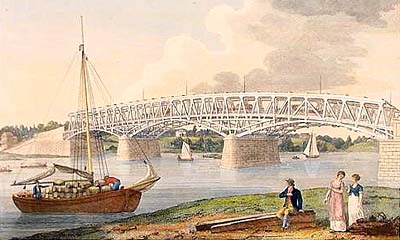
Schuylkill Bridge, High Street, Philadelphia -- 1805
1700-1829 | 1830-39 | 1840-45 | 1846-99
Articles Index | misc PA papers | Adams Co. papers | early PA. magazines | PA Quaker papers
AMERICAN Weekly Mercury.  Vol. ? Philadelphia, Thurs., March 27, 1729. No. 481.
The Busy-Body. No. 8.
One of the greatest Pleasures an Author can have is certainly the Hearing his Works applauded. The hiding from the World our Names while we publish our Thoughts, is so absolutely necessary to this Self-Gratification, that I hope my Well-wishers will congratulate me on my Escape from the many diligent, but fruitless Enquires that have of late been made after me. Every Man will own, That an Author, as such, ought to be try'd by the Merit of his Productions only; but Pride, Party, and Prejudice at this Time run so very high, that Experience shews we form our Notions of a Piece by the Character of the Author. Nay there are some very humble Politicians in and about this City, who will ask on which Side the Writer is, before they presume to give their Opinion of the Thing wrote. This ungenerous Way of Proceeding I was well aware of before I publish'd my first Speculation; and therefore concealed my Name. And I appeal to the more generous Part of the World, if I have since I appear'd in the Character of the Busy-Body given an Instance of my siding with any Party more than another, in the unhappy Divisions of my Country; and I have above all, this Satisfaction in my Self, That neither Affection, Aversion or Interest, have byass'd me to use any Partiality towards any Man, or Sett of Men; but whatsoever I find nonsensically ridiculous, or immorally dishonest, I have, and shall continue openly to attack with the Freedom of an honest Man, and a Lover of my Country. |
BY ELIAS SMITH. No. 78. Philadelphia, Aug. 16, 1811. Vol. III.
Religious Intelligence.
My dear friend and brother in Christ, |
NEW JERUSALEM REPOSITORY. Vol. I. Philadelphia, July, 1817. No. 3.
EXTRACTS FROM THE JOURNAL
In pursuance of a resolution of a number of members of the New Jerusalem Church, from different parts of the United States... a number of members, male and female... convened at the Temple... on Thursday, the 15th day of May... The Manchester and Hawkstone reports, from their first publication to the year 1816... were laid upon the table. |
|
NEW JERUSALEM REPOSITORY. Vol. I. Philadelphia, October, 1817. No. 4. UNKNOWN SECT. The following article is copied from the Salem [sic - Sussex] Register of September 15, last. Respecting the character or doctrines of the people spoken of, we know nothing, but what is therein contained. |
|
NEW JERUSALEM REPOSITORY. Vol. I. Philadelphia, October, 1818. No. 8. THE HALCYONISTS. The Editors of the Intellectual Repository, for April last, having expressed a wish that some account of this Sect should be given for the information of our English brethren, we shall devote a portion of the present number to that subject. The Manchester report for 1815, in the account of the Halcyonists, who were confounded with the New Church, gave some pain to the friends here, and produced a correspondence with our venerable friend of Manchester. The error as to the connexion between that Sect and the New Church, was corrected in a letter under date of January, 1817, which produced his reply of the 30th of April, in the same year. When the convention met at Philadelphia in April, 1817, it was found on inquiring of the New York friends, that the gentleman who had given the account of the New Church in America, together with the Halcyonists, was a Mr. L. from Scotland, the extent of whose journeyings, we understood, was between New York and Albany. He had never been seen or heard of in Philadelphia, and in fact knew little of the state of the New Church, in this country. Nothing gives more pain to the people of the United States, than the hasty accounts of travellers, whose short stay and limited means of knowledge, are calculated rather to mislead than to inform. Since the meeting of the convention, a conversation between the writer of this article and a friend in the western country, has added to our knowledge of the Halcyonists, and the whole is now stated in compliance with the request of the Editors of the Intellectual Repository. |
|
Vol. ? Philadelphia, January 26, 1820. No. ? THE VERMONT PILGRIMS. The article which follows is from the pen of a friend, on whose information we can rely. -- We have seen an article from a Carlisle paper, purporting to be some account of the 'Pilgrims.' who, some time ago attracted so much public attention. That account informs us of their arrival at Pittsburgh -- embarking thence in a boat -- landing on an island somewhere in the Ohio river -- the desertion of their chief or prophet -- and the consequent distresses of his followers. But the person who gave this information was undoubtedly misinformed himself. |
 Vol. II. Philadelphia, Wednesday, March 27, 1822. No. 435. From the Hallowell (Maine) Gazette, March 18. Money Diggers. -- In Pittston, about nine miles below Hallowell, on the eastern bank of Kennebec river, a party of about fourteen men are now engaged in digging for money. This extraordinary enterprise was commenced in 1817 and continued without much interruption for nearly a year, during which time a vast excavation was made, 75 feet deep. The enchanted treasure, however, we understand, completely eluded the search. It was afterwards partially abandoned, but in October last was recommenced with unabated vigor. The leader of this visionary gang is a substantial farmer, an inhabitant of a town not more than twelve miles distant from Hallowell, whose sons hold a reputable rank in society. The old man and his associates maintain an obstinate and mysterious silence upon the subject. As the scene of their labour is a resort for all the mischievous wags in the neighbourhood and of others who come to wonder at the infatuated perseverance of the money diggers, their taciturnity may partly be attributed to the unceasing ridicule which their visitants raise at their expense. |
 Vol. III. Philadelphia, June 1, 1822. No. 30.
(From the 'Columbian Star" printed at Washington.)
A periodical publication, bearing this title, has been commenced in Canandaigua (New York) -- It issues once a fortnight, at one dollar a year, payable in advance. The objects of the editors, as stated in their prospectus, are, to "expose the fallacy of the Missionary plans now in operation, and, if possible, to break the spell which is maintained over the public mind, by designing men, relative to Missions; to tear from Hypocrisy her mask, and expose her in her native deformity; to disseminate correct religious intelligence; to encourage home charities; and to combat error and falsehood, upon these subjects, in whatever form they may encounter them." |
 Vol. I. Philadelphia, October 5, 1822. No. 62.
For the Saturday Evening Post. In 1817, a group of singular people, called Pilgrims, passed through Pennsylvania to the westward. They were composed of men, women and children, clad like a second company of Giveonites, and looked like the fag end of a hurricane. -- Their leader, who was styled a Prophet, it is said was formerly an inhabitant of Lower Canada. Having been afflicted with a long spell of sickness, he betook himself to the practice of frequent prayer; and finding by this exercise his inner man much strengthened, and his health also improved, he began to have, as he thought, very extraordinary illuminations, which he communicated to his neighbours who visited him. Some of them were converted to his persuasion; and when his health was restored, he set out with his followers, to travel in quest of a land flowing with milk and honey, where he assured them, every thing that was necessary for their sustenance and convenience, would be amply provided, without the agency of labour and toil. As they travelled through the country they availed themselves of the charity of the benevolent, and made use of such opportunities as were afforded for the promulgation of their doctrines. Some were converted, joined in the procession, and went with them. At Mount Pleasant [Liberty twp., Clinton Co.?] in the state of Ohio, they tarried several days; a person who had an interview with them there, enquired why they did not wash themselves and their clothing, and make a more decent appearance. Their answer was, that they had been as decent in these respects as other people, but that they were commanded to appear in their present character, for an outward sign of the inward condition of Christian professors. One article of their creed was, a literal acception of that passage in the New Testament which says, "Except ye be as little children, ye cannot inherit the kingdom of heaven." -- In order to fulfil this doctrine, we are told that they harmonized with each other, and some of the men in imitation of little boys, were seen riding corn stalks or sticks for horses; and other childish amusements. The story of the Prophet having borrowed the wife of one of his followers is not so well authenticated as to be mentioned as a fact. |
|
Vol. III. Philadelphia, December 1, 1822. No. 34. PLAIN TRUTH. We are pleasewd to find that "Plain Truth," printed at Canandaigua, (N. Y.) is making its way successfully against its numerous foes and opposers. Its price (one dollar a year,) and tyhe independent stand which it has taken, has already given it an extensive circulation. WAnt of room prevents us from copying several interesting articles from its late numbers. It would be well for those who wish to hear both sides of the question, respecting missionary and other works of the day, to subscribe to this publication. Such as re inclined to do so, by leaving their names with the Agent for the Reformer, shall have them forwarded. |
|
Vol. IV. Philadelphia, November 1, 1823. No. 47.
For the Reformer,
In addition to the various imposing schemes of designing men, that haunt the coffers of industry, we have recently been annoyed with the pressing solicitations of an universal beggar, said to be a converted Jew, the agent and organ of an association "for meliorating (or rather evangelizing) the condition of the Jews," with documented authority to gather in the scattered fractions, if any have escaped the nice calculations and diligent researches of his importunate and successful begging predecessors; who, in order to flatter a hen-pecked and bewildered audience into a munificent mood, pathetically appealed to them as moralists, as philanthropists, as christians refined, to know whether it be not incumbent on us to contribute toward providing an asylum, somewhere in these United States, for the accomodation of poor christianized Jews from any part of the world, coming "well recommended for morals and industry, and without charge to the Society -- whose reception and continuance in the settlement shall be at all times, at the discretion of the directors;" and it seems that instruction and "such employment as shall be assigned them," with other regulations, not mentioned, will be gratuitously and Pharaoh-like administered.... For my part, I see nothing like "melioration" in the scheme -- nothing like relieving "temporal wants," or restoring the long-lost privileges of the house of Israel; but I clearly behold something subversive of the genuine principles of liberty.... |
Vol. I. Philadelphia, Wed., February 18, 1824. No. 7.
THE BOOK OF ENOCH THE PROPHET:
|
GENERAL ADVERTISER. Vol. ? Philadelphia, Fri., April 30, 1824. No. 11,950. NOTICE OF SALE. WEREAS the President and Directors of the Chesapeake and Delaware Canal Company, in conformity with the powers in them vested, have heretofore made and signed orders for the payment at certain times and in certain proportions of the monies payable by the proprietots of stock... NOw therefore notice is hereby given, that said President and Directors will on the first day of June 1824, at 7 o'clock in the evening, at the Merchants Coffee House in the city of Philadelphia, sell at auction and convey to the purchasers the sahre of the said proprietors so refusing or negelecting payment... H. D. Gilpin, Sec'ry. James C. Fisher, President.... |
Vol. V. Philadelphia, May 1, 1824. No. 53.
For The Reformer.
Christ, in relation to his church or disciples, (who then constituted his church) said, "Ye are the salt of the earth: but if the salt have lost his savour, wherewith shall it be salted? It is thenceforth good for nothing." The disciples of Christ were truly the salt of the earth; and as salt possesses the quality of savouring or saving, so they were appointed for salvation or saving. But mark the latter clause of the text, "If the salt have lost his savour, it is thenceforth good for nothing." |
|
Vol. IV. No. 1. Philadelphia, Sat., Jan. 1, 1825. Whole 179.
Jason Treadwell, who was found guilty of murdering Oliver Harper, in May last, in Susquehannah county, is to be executed on Thursday, 12 of January. |
OF Foreign Literature and Science. Vol. I. Philadelphia, Pa., August, 1825. No. 7.
SELECTED FOR THE MUSEUM.
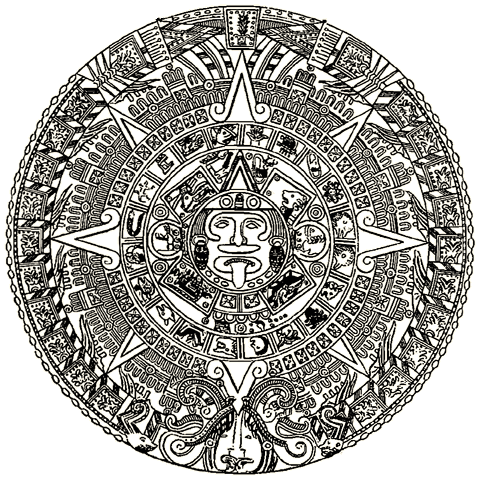
One of the first convictions impressed on the mind by a survey of Mr. Bullock's valuable collection of the ancient monuments of Mexico, is the resemblance which they bear to the monumental records of ancient Egypt. The glance of the antiquarian falls with familiar recognition on the same graduated pyramids; on marks of the same Ophite worship, a picture-writing and symbolic language of a similar description; vestiges of the same tri-une and solar deity, [of] planispheres and temples; and stone idols, which though of ruder workmanship, and chracterized by some distinctions entirely American, exhibit a great analogy, in posture and gesture, to the style of sculpture pre-eminently called Egyptian. The Mexican costume also, as collected from the specimens of paintings which surround the circular altar formerly appertaining to the great temple of the sun -- exhibits the same striking analogy: and the analogy is still further corroborated by other pictural and sculptural representations preserved in Purchas, by Robertson, and by Captain Del Rio, in his Description of the Ruins of an Ancient City, lately discovered in the Kingdom of Guatelamala. |
Vol. VI. Philadelphia, Nov. 1, 1825. No. 71. JEWISH COLONY. Some time ago, Mordecai M. Noah, a Jew, assisted perhaps by other Jews, purchased a large tract of land, called Grand Island, lying in the Niagara River, and State of New York, for the purpose of a Jewish settlement. On this Island a city is to be built, called Ararat, the corner-stone of which has been already laid, as will be seen by the annexed article from a late paper. |
|
Vol. V. Philadelphia, September 23, 1826. No. 38.
(Through the politeness of L. Bezont, Geographer, and member of the society of Geography, Asiatic Society, &c. of Paris, we are enabled to publish the following Rewards, offered by the society of which he is a member, for the prosecution of several important scientific researches. We are not a little flattered by the particular and extensive credit which our journal has obtained at home and abroad, and readily confess our willingness to assist in furthering the designs of the above institution. -- We shall be happy to [find] that the publication of this paper will be attended with the discovery of all or any important facts, in contemplation.) |
 Vol. VI. Philadelphia, January 13, 1827. Whole 285.
FOR THE SATURDAY EVENING POST.
I have the pleasure to announce and communicate to you, that during the course of my present researches into the history of America, I have been successful in discovering the existence of several Alphabetical Glyphic Inscriptions, belonging to this continent. |

QUARTERLY REVIEW. Vol. I. Philadelphia, Pa., March, 1827. No. 1.
Symmes's Theory of Concentric Spheres; demonstrating that the
|
CHRISTIAN ADVOCATE. Vol. V. Philadelphia, Penn., May, 1827. No. 5.
THE SACRED WRITINGS OF THE APOSTLES AND Editor of the Christian Advocate. |
|
Vol. I. Philadelphia, Penn., Nov. 17, 1827. No. 7.
Jacob Cochran who figured rather conspicuously as a false teacher in Maine, a few years since, and underwent a short probation in Massachusetts State Prison for some of his misdeeds, is now living in Hollis, Me. where he has collected around him a number of fanatics, who profess to have every thing in common. Their doctrines admit of a plurality of wives. |
|
Vol. VII. Philadelphia, Sat., June 7, 1828. Whole 358.
FOR THE SATURDAY EVENING POST.
You appear desirous to learn something more of my Researches on the Ancient and Modern History of North and South America. I feel willing and happy to be able to answer your inquiries, and even to suggest perhaps some new facts. |
|
Vol. VII. Philadelphia, Sat., June 28, 1828. Whole 360.
FOR THE SATURDAY EVENING POST.
The materials for a complete history of America, are more ample than is generally supposed. Besides the monuments existing every where, we have many early Spanish writers, nearly forgotten, but who ought to be considered as the fathers of our history. The didactic, philosophical, or colonial histories and annals of Robertson, Raynal, Ogilby, Hulmes, &c. have neglected them altogether, and are therefore partial and defective. There are also many manuscripts in the Mexican, Tzondal, and other American languages, as yet extant, which are valuable documents to be sought for and consulted. |
|
Vol. VII. Philadelphia, Sat., July 19, 1828. Whole 364.
FOR THE SATURDAY EVENING POST.
Languages are now acknowledged, by all learned men, to afford important historical proofs, whenever history or traditions are silent. Philology is now become an appendage to history, as important as geography or chronology. -- The last general work on languages is the Ethnographic Atlas of Balbi, published in Paris, 1826. It contains tables of 16 words and 10 numbers, in about 600 languages or dialects; and it enumerates in all 860 languages, besides 2 or 3000 dialects, whereof 422 languages, and about 1000 dialects, belong to America, which he has not attempted to classify, (except geographically,) as he has done for the Asiatic and European languages. He points out but few affinities, stating that the Maya has some analogies with the Atlantic or Berber languages of Africa, the Guarani with the Sanscrit, (and also with the languages of South Africa, as I find,) the Carib with the Hebrew, and I find also with the Bask, &c. |
|
Vol. VII. Philadelphia, Sat., September 6, 1828. Whole 371.
FOR THE SATURDAY EVENING POST.
Besides the Otolum alphabet already mentioned, there are traces of two or three others in America. 1. The Inscription in Columbia, given partly by Humboldt, the letters of which are evidently Pelagic or Etruscan. 2. The coins found in New England, and elsewhere, which resemble ancient Irish, Arabic, Persian, and Mogul coins and letters. 3. The Inscription of the temple of Secota, in North Carolina, given by Heriot, in 1586, as well as the letters used by the Winginans of North Carolina. These are evidently the ancient alphabet called Ogham in Ireland, Runes in the North, Arrow Letters in Persia, and Cross Letters in India, Arabia, and Italy. That these three kinds of alphabets, totally different from the Otolum, may have been introduced by visitors, appears highly probable, and I can show how in one instance. |
|
Vol. X. Philadelphia, January, 1829. No. 109. (From the National Intelligencer.) Fanaticism. -- A man who calls himself Christ, and who says he has come to judge the world, appeared in Guernsey county, in the State of Ohio, a few weeks ago; and strange as it may seem, has collected a band of deluded followers, who worship him as a God. Some of his disciples are said to be respectable people, and have neglected their business to follow after this fanatic. |
|
Vol. X. Philadelphia, July, 1829. No. 115.
Plain Truth has become united with Priestcraft Exposed, a spirited and interesting work, published monthly at Lockport, N. Y. by E. A. Cooley, at one dollar a year. |
AND CHRISTIAN INDEX. Vol. I. Philadelphia, Pa., August 1, 1829. No. 5. For the Columbian Star and Christian Index.
|
|
Vol. VIII. Philadelphia, September 12, 1829. Whole 424.
Written for the Saturday Evening Post.
REV. SIR: |
Back to top of this page.
Articles Home Page | Newspaper Articles Index | History Vault
Oliver's Bookshelf | Spalding Studies Library | Mormon Classics
last updated: Jan. 22, 2009