
Greatrake Home | Rigdon Revealed | Mormon Classics | Newspapers | History Vault
|
Lawrence Greatrake (1793-c.1840) Dialogue First... (Pittsburgh?, 1827) |
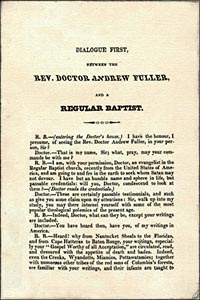
|
"Undercover Campbellite, 1822-25" | Greatrake's 1824 pamphlets | Campbell's first reply (1824)
Greatrake sources 1 | Greatrake sources 2 | Scott's 1824 pamphlet | Campbell's 1825 pamphlet
Greatrake's 1826 pamphlet | Greatrake's 1827 book | Greatrake's 1830 pamphlet
Greatrake's 1836 pamphlet | Greatrake's 1838 pamphlet | Campbell's recollections of 1823
|
DIALOGUE FIRST, BETWEEN THE REV. DOCTOR ANDREW FULLER, AND A REGULAR BAPTIST. R. B. -- (entering the Doctor's house.) I have the honour, I presume, of seeing the Rev. Doctor Andrew Fuller, in your person, Sir? Doctor. -- That is my name, Sir; what, pray, may your commands be with me? R. B. -- I am, with your permission, Doctor, an evangelist in the Regular Baptist church, recently from the United States of America, and am going to and fro in the earth to seek whom Satan may not devour. I have but an humble name and sphere in life, but passable credentials: will you, Doctor, condescend to look at them? -- (Doctor reads the credentials.) Doctor. -- These are certainly passable testimonials, and such as give you some claim upon my attentions: Sir, walk up into my study, you may there interest yourself with some of the most popular theological polemics of the present age. R. B. -- Indeed, Doctor, what can they be, except your writings are included. Doctor. -- You have heard then, have you, of my writings in America. R. B. -- Heard! why from Nantucket Shoals to the Floridas, and from Cape Hatteras to Baton Rouge, your writings, especially your "Gospel Worthy of all Acceptation," are circulated, read, and devoured with the appetite of death and hades. Indeed, even the Creeks, Wyandotts, Miamies, Pottawatamies; together with numerous other tribes of the read sons of Columbia's forests, are familiar with your writings, and their infants are taught to 2 lisp and bless the name of Doctor Fuller: so far, and so wide, are your writings read and the sentiments thereof made known, and hail'd, "Worthy of all Acceptation!" (aside -- albeit I do not say by whom!) Doctor. -- Well, Brother, bless the Lord * that thus irrefragible evidence is given that MY Gospel is worthy of all acceptation: this general sentiment, in favor of my gospel, among professors, is conclusive evidence both of its truth and intelligence. R. B. -- (aside) -- yes, if it did not happen to be written by the Holy Ghost -- that "many are called but few chosen; (a) and that in the last days perilous times shall come (to the truth! and all who cleave to ot) for professors shall have a form of godliness and deny the power thereof;" so that when the Son of man shall come, it will be a matter of question to created intelligence, [(b)] whether or not the faith of God's elect exists. (c) Or if it was not also written that Baal had four hundred and fifty prophets when the Lord had but one, (d) and that when near two millions of PROFESSORS where in Israel, there were only seven thousand worshippers of God; or that when a countless multitude of professors attended at the feast of tabernacles in the day of Christ's personal ministry, not one thirsted as a true worshipper; (e) or, that when a world of professors run after and worshipped the BEAST, a mere remnant continued to serve God: (f) or if, to cap the climax of the absurdly false position, this did not exalt Fuller above Christ himself, (the multitude of whose personal followers abandoned him when he preached his gospel) and represent Fuller as more wise and skilful than Jesus Christ, or the Holy Ghost, the former of whom could not preach, or the latter write a Gospel, only one that the multitude of professors of religion detested and denounced! Or if, argumentum ad hominem, Paganism, Mahometanism, and Gospel Atheism, (i. e. Arminianism) might not with equal evidence, be proved Doctor. -- Brother Rastrum, you appear to be the subject of some abstract musings -- what are your cogitations? R. B. -- I beg pardon, Doctor, for appearances, but assure you, that the weight and wisdom of your previous remark was the subject __________ * This "bless the Lord," is cousin german to that of three of the crown heads of the Holy Alliance, after the battle of Liepsick -- they bless'd the Lord that they had butchered 100,000 men: or like that of the Arminians, when they can make the Scripture appear to contradict itself; or like Luther Rice's, when he used to get a note discounted or shaved, or a sum of money by mortgage, raised and blessed the events as signal interpositions of the Lord's hand, in behalf of the Columbian College! (a) Matthew 20 -16, (b) 2 Tim. 3 - 15, (c) Luke 18 - 8, (d) Rom. 11 - 4, (e) John 7 - 37, (f) Rev. 13 - 8 , (g) John 6 - 60-66. 3 of my musing, while memory was busy in gathering together the varied and numerous illustrations I have seen of the truth of that saying of yours. Doctor. -- Have you been long in the ministry, Brother Rastrum? R. B. -- About five years, sir. Doctor. -- How long a Baptist by profession? R. B. -- Thirteen years, sir. Doctor. -- Allow me to solicit, as I hope you will grant, a brief outline of your life; and, believe me, I do not make this request from any impertinent curiosity; on the contrary, from the fullest conviction that, as Dr. Johnson, (a giant of the pen too,) says, "no man's history however humble, if made public, would prove destitute of advantage even to the most learned and wise!" R. B. -- I feel satisfied, Doctor, that a mind after the order and cast of yours, is equal to the task of making every thing advantageous to itself that comes within the orbit of its comprehensive glance. This conviction may afford me encouragement to comply with your request: at the same time I acknowledge with satisfaction, your kindness in asking of me but a brief outline of my life, for I wish to shun, as I do from my soul abhor, the recollection of MYSELF. I was then, Doctor, as all mortals are, conceived in sin, and brought forth in iniquity; a blind, blind, transgressor from the womb of nature, until the twentieth year of my life, when it pleased God, the Holy Ghost, to bring me through the pangs and throes of a new and spiritual birth, and to lead me, in connexion with the precious Gospel of Christ, into the Regular Baptist Church, as my mother in Israel. For ten years subsequent, I projected largely of earthly enterprise, and with head, and heart, and hands, and all my powers, essayed on a wide and varied arena of human action, to exemplify practically to the world the mental integrity, exemplary uprightness, and general, as well evangelical, benevolence of the Heaven born soul. At the expiration of ten years, I found that I might as well have attempted to make the deaf sensible of the harmony of sounds, or the blind of colours, or the dead conscious of life, as to attempt to make the world acknowledge anything superior to its own nature; that the world and mere professors, will pull down the disciple as they did the master, for daring to appear any thing better than itself. In short, I came to understand, that the mere attempt to get my christianity acknowledged and respected, was not only a vain imagination, but the expectation thereof implied a cruel reflection upon the life of Christ; and was a presumptuous arrogation to myself of more than apostolic wisdom, piety and grace. At the expiration of this time, the Lord brought me from a whirlpool of secular business into the ministry of his Gospel: I have since endeavoured to labour in word and doctrine as God in his providence has given opportunity, and the Holy Ghost hath endued with grace; so that having obtained help of God, I continue unto this day. 4 Doctor. -- You have indeed, brother, compress'd your history into a small space: Were your family Baptists? R. B. -- No, they were Episcopalians -- children of the old "mother church," as she is called. And while from my soul I detest the mere ethic, or gross Arminian ministry of that church at the present day, I yield to no man in reverence and fond affection for the memory of her Charnock's, Flavel's, Romaines, Hervies, Toplady's, Newton's and Hawker's. I shall always feel happy to refer to such men, as an honour and a blessing to the church militant, and essentially of the same order and spirit as the Knoxes, Erskins, the Temples, Davises and Witherspoons, of the Presbyterians, and the Gills, Booths, Stephens, Thomas's and Fristoes of the Baptist church. Doctor. -- I suppose you found it nothing to your temporal advantage to join the Baptist church? R. B. -- I simply found that it was attended with the loss of every earthly relative, and every earthly prospect. Doctor. -- You have, however, the satisfaction of knowing that your profession as a Baptist must be considered sincere, and the answer of a good conscience. R. B. -- That has been my secret satisfaction, though I have lived to hear tinker's and taylor's boys, who had not been baptised twenty-four hours maintain that I was no Baptist. * Doctor. -- Strange! to what did you ascribe such extravagant suspicion or wanton reflection? R. B. -- I have, Doctor, told the Baptists the truth; therefore they became my enemies, especially a numerous tribe of Arian and disguised Arminian Baptists, whom I have denounced as so much hideous and corrupting excrescence upon the body: Knavish flatterers have inflated the society with the pride of Lucifer, as erst these creatures have made individuals and communities their prey, so have they fawned in spaniel like sycophancy at the feet of the Baptist society, and lauded her to the skies, as spotless and perfect, rich, full and having need of nothing, while THEIR very presence even at her feet, (to say nothing about their present, sweeping control of her councils, and magisterial attitudes in her doings,) bespoke her the subject of delusion and moral stench. Had this not been her state she never would have suffered open Arians, disguised Arminians, and selfish historians, confounding truth and error and inculcating universal charity † __________ * In the western country, under the church order of the Arian Campbell and his followers, boys are Baptised one day, and Baptise other boys and girls themselves the next day. Girls join their churches to day, and to morrow act the part of deacons at what they call the Lord's supper -- that is, distribute the bread to, and serve their communicants with wine; these, and such like heresies as these in faith and order the writer has denounced, and, as a consequence has been proclaimed by those creatures, and the Fullerites to be no Baptist. † Robinson, Fuller, Hall and Campbell's writings, together with the "Luminary," "Star" and Benedict's history of the Baptists are what the foregoing remarks. 5 among Sabellian, Arian, Socinian, Free Will, Sandamanian, Baxterian, Seven-day "Christian," Bible and Calvinistic Baptists. These things I have denounced and urged a return to the "good old way," which is the "front and face of my offending," and for which my sincerity as a Baptist has been called in question. Doctor. -- Have you been located, since you have been in the ministry, or have you itinerated? R. B. -- I have itinerated nearly all the time: during seven months however I had the charge of a people calling themselves a Baptist church, who were graciously pleased to allure me to their service at the expence of hundreds of dollars and which they promised to refund me, but which they cheated me out of, allowed their members openly to ridicule the doctrine of the Baptist confession of faith, magnanimously to slander me, charitably to tolerate caluminators, liars and drunkards among themselves, and to plead, in their extenuation, that they "were too small and weak to put away any of their members." * During this period I got quote satisfied with the honour and EMOLUMENTS connected with the pastoral charge of a mere Baptist church. Doctor. -- Have you travelled much among the churches in America? R. B. -- I have travelled, sir, about 20,000 miles in the ministry and as many more out of it, in all of which I have had an eye intensely fixed upon religious society, especially the Baptist church, and to the service of which I believe God hath set apart the little remnant of my days on earth. Doctor. -- You have taken a large "compass" in the ministry, Brother Rastrum; you travelled, I presume, as a missionary under the patronage of the American Baptist board of Missions, and through the means their ever zealous efforts secure for the prosperity of the churches and salvation of souls! R. B. -- Indeed, Doctor, I did not consult with flesh and blood in entering upon the ministry, neither have I prosecuted it under the patronage of saint or sinner; the livery of my horse for six months would equal all the contributions that ever have been made towards meeting my support or travelling expenses. Doctor. -- You have certainly given reasonable evidence of the uprightness of your motives, and sincerity of your labours in the ministry. R. B. -- Yet I have lived, Doctor, to witness both labours and motives impugned: to be denounced as an enemy to missions and all religious enterprise † and that by those who, though professedly __________ apply to. And when we come to take a view of the Practical Insults of Fullerism, the respective part of doing of each of the foregoing writers, together with the character and influence of the Luminary and Star will be duly noticed. * This church was a Fullerite one! acting upon the zig zag theology of Andrew's Gospel. † Numerous, yes, all, of the old fashioned theological ministers in the Baptist 6 ministers themselves, never did aught of service but what they made sure to be paid for; or any thing for missions but beg other people's money. I have been published as an hireling for holding a church responsible for the refunding of me simply the expenses of travelling to serve them, and when I was put off with five cents in the dollar, of those travelling expenses, the same was published as being the intrinsic value of ministerial labours, and representation of my ministerial gifts and qualifications. * In short, Doctor, I have lived to learn that it is enough for the servant to be as his master, and that it is madness to expect to fill faithfully the ministry and escape the obloquy and slander mankind heaped upon him. The world is the same, the gospel is the same; and whosoever preaches this with the smiles and approbation of that are more than Gods' who preach in the truth of that gospel and have the smiles of the world and mere professors, they are false teachers as sure as Satan is the father of lies. But I must now pray to be relieved from this egotism and to that end would request you, Doctor, to divert our colloquy into some other channel. Doctor. -- Well, Brother, to gratify your wishes I will suggest the probability of your having met with some objectors to my gospel even in America. You have travelled largely -- you have made a profession none will dare impugn who have aught to risk of character themselves, you have laboured in the ministry for years for what would scarce keep a church mouse, and you have credentials of no common character. Which all together, I conceive, afford me reasonable ground to believe that your intelligence is equal to the task, and that your veracity may be relied on in giving me information of the most material objections you have heard advanced against my gospel. R. B. -- Indeed, Doctor, you would put me upon the performance of an unenviable task, you must excuse my non-compliance with your request, unless compliance should be found my duty, and which, with due deference to your better judgment, I leave you to determine. Doctor. -- Why you know, Brother, the precept is, "speak the truth in love:" and besides you must be informed, that we authors are vastly benefitted, in a variety of ways, by the severest criticisms __________ church are denounced, covertly or openly, by the Fullerite fraternity, as enemies to missionary enterprize though they spend one third, two thirds, or the whole of their time in itinerating to labour in word and doctrine! But then it is done at their own expense, in their own country and to feed the Church of Christ, all of which is considered by the Fullerites, as so much superfluous doing, while their college scullions have their names blazoned abroad in their publications as every Jehues in zeal, because they have given their penny towards a tract Society. * This nameless piece of calumny Alexander Campbell is the author and publisher of in his "Christian Baptist," -- verily his Christian Baptist is the image of his (Arian) christianity, and the above incident a vivid feature of both. 7 of our opponents: that is, if we be truly wise and, philosophical: they shew us many little errors in language of collocation of words, against the repetition of which we are thus prepared to guard: this is the least of our advantage as they often furnish us with powerful argument against themselves, by writing or speaking with roughness and warmth, which, contrasted with our polish of style and sage-like placidity, is a mighty evidence that they are wrong, and we are right. R. B. -- Doctor, if I inform you of what I have heard against your gospel, I must narrate the while in a grear degree after the language of objectors, or, otherwise, disturb or break the chain of recollections in an attempt to clothe their criticisms in another dress: and to give you their ideas in their uncouth language would be a continued offence to your ear, and, in many instances, wounding to your feelings. Doctor. -- I assure you, I wish you to speak with the utmost freedom, and, if necessary, give me the very spirit as well as language with which those Baptists speak of my gospel. You have already told me, that my writings are circulated from one extremity of the United States to the other, and that they are read and devoured with avidity! Now inform me of all the objections you have heard against them -- especially to my gospel -- that is my master-stroke; for the rest I feel measurably indifferent as to what opinions are entertained or expressed of them. R. B. -- But, Doctor, to be candid, and to furnish out another excuse for my declining the task, I must apprise you of my having heard so many objections to your gospel that I cannot pretend to recollect the half of them -- I am no Cato, Cesar or Scipio in the faculty of recollection. Doctor. -- May we not materially obviate that difficulty by having you read my gospel page by page, and noticing their criticisms on that much at a time? your memory will be thus refreshed with the most, of not all, that you have heard against it. R. B. -- Well, Doctor, I perceive that you will be gratified in this thing, and the course that you propose is the most likely to give you the desired result: I have heard many say that you are a man of Moses' meekness, Job's patience, Paul's fortitude, John's love and Chesterfield's own swaviter in mode. I shall therefore feel encouraged to say "right on" what I may be able to recollect of having heard of objection against your worthy gospel. Doctor. -- Brother proceed to read the first page of my gospel's preface to the conclusion of the 2d paragraph terminating on the 7th page of the book. (R. B. reads.) Doctor. -- Well, brother, in common justice to you, I must acknowledge that you read with singular directness and perspicuity; now then give me the criticism you have heard on that portion of my preface.8 R. B. -- Well, Doctor, I have heard the old fashioned theological Baptists in America say, and in true yankee style, that it was, "nation queer," not to say silly, for a learned D. D. to sit down to write, and there sit till he had written a "Gospel worthy of all Acceptation," without any intention of making its all-worthy tenets public; or, which is to say the same thing, of publishing them. If this, say they, be truth was it redeeming time, or acting for the glory of God, or doing common service to all men, or special service to the household of faith! But they add, we cannot help believing that the Doctor stumbles from the truth here, for in this same portion of his preface he tells us, that he was "led to the throne of grace for resolution to avow the mind (the tenets of his own gospel) of Christ;" that to avow, those Baptists say, is "to declare openly," and to publish is "to make openly known;" these words being synonymy, they conclude that you palpably contradict yourself on the first page of your worthy gospel. I have heard, however, Doctor, some of your friends suggest, that there may have been much time elapsing between your writing your gospel and being the subject of those doubts and supplications, in which case you are relieved from the charge of self-contradiction: To this those Baptists have observed, that such intimations are as reasonable as to say, that effect precedes the cause; for the Doctor tells us plainly that the same doubts, anxieties, scripture-reading, and missionary doings, that led him to a throne of grace, also prompted him to write his Gospel: so that it must be admitted, that Andrew began to write and pray upon the subject at one and the same time, and that when he began to write his gospel, he began to "pray to the Lord for resolution to avow," or to make it public: this is not only the Doctor's own statement of the case, but the most natural and reasonable course to suppose him to have adopted; and was this not the case, then he must have written his gospel before he had any doubts, or fears, or anxieties, about his being the subject of error, and engaged for his mere amusement, in writing a book to disprove the correctness of his own system of theology. Those Baptists further say, Doctor, that if you waited on the Lord for grace and gift, to find out the errors in the old fashioned theology of the Baptist church, tens of thousands were engaged before you were born in strong cries and groans to God, for a faith free from every heresy and that it was hardly modest even in Doctor Fuller, to expect that more confidence would be placed in the efficacy and results of his prayers, than in those of tens of thousands of the best of men, and most pious of believers. I have also heard them say, that your reference to Elliott's and Brainerd's ministry was not in point, no more than reference to John Wesley's would have been, who decided that Calvinism is not true, and that Arminianism is true, by the toss up of a shilling! and who professed to have made multitudes savingly believers in Christ, by his preaching when he taught, that the doctrine of "imputed righteousness," 9 is imputed nonsense;" or when, ministerially, he forged and published what he called a dying recantation of Augustus Toplady's (the latter lived for years afterwards!) and circulated the forgery among his churches for the benefit of his pious brethren. Besides, they say, the Doctor ought to have proved that Elliott or Brainard ever did make (instrumentally we mean) an evangelical believer of any of the American Indians. That they reformed Indians, and garnished them with some degree of civilization none will gainsay; but that they made any Indian savingly a believer is with them a matter of question, and as you have not given any evidence thereof they presume to set this reference down as pure nihility. * Doctor. -- We shall not pause to remark upon the absurd scepticism here expressed by those American Baptists, sic sentis, sic sentiam is the prison house of their souls, and however fatal may be the consequences of this unbelief, they appear to be past recovery. What say they about the scripture which I quote in this part of my preface? R. B. -- They say, Doctor, that you did not know the import of those passages of scripture, or you were jesuitical when you referred unto them as authority for the "doctrines" of your gospel. But as those passages are, in another part of your gospel, noticed more at large, and the use you design to make of them more apparent and definite, I shall waive noticing their remarks, touching those passages, until we come to your repetition thereof; excepting, that they say, admit the Doctor's interpretation of the passages and say unto all, God commands you to "Kiss the Son -- to repent for the kingdom of heaven is at hand -- Repent and be converted that your sins may be blotted out;" and admit that this, when done, amounts to a saving faith in the Lord Jesus Christ, and after all, it does not imply that it is a man's duty to do this, or that his sin and condemnation arises out of his not doing this: neither does it prove that he has any natural ability to do ot: on the contrary, it supposes him in a state of enmity which the carnal heart is proclaimed to be to God throughout the scriptures; in connection with which, we are to remember that it is the prerogative of Jehovah to give repentance through Christ, the exalted Saviour, and that his repentance through Christ the Mediator has been almost universally communicated to the souls of sinners, through the use, or preaching, of such exhortation, and the promulgation of such commandments as are embraced in the passages of scripture referred to. They have been the instrument by, and through which the Holy Ghost has generally wrought salvation in the souls of those "ordained to eternal life:" -- So that what we __________ * If Elliott and Brainerd were so successful in making Indian believers, 'tis strange that a gospel ministry did not arise in the person of some one or more of the native converts, or that none of the saving knowledge which the Indians then received, descended to the children through parental instrumentality! 10 recognize as the sovereignty "ordained instrumentalities of Jehovah an calling in his elect, the learned Doctor writes of as the moral duty of sinners. Further, in putting forth such exhortations and commands as these, God proves that men universally have no will to comply with them, and to his people they sooner or later prove they have no power, though all besides his people will maintain, that men have power at least, if not the will! Doctor. -- Well, Brother, those old-school Baptists in America are certainly bold fellows in assertion, how prudent I do not say, they are certainly not Fall staffs in discretion -- theirs is not the wisdom of the prudent. But read and give their comments on the second page of MY gospel's preface. (R. B. reads) R. B. -- On this portion of your preface, Doctor, I have heard those Baptists remark to the following effect, to wit: The Doctor's "four years doubting, as to whether the sentiment contained in his gospel is true or false can be mentioned, we presume, only as an OVERWHELMING EVIDENCE that his gospel is truth, and demonstratively "Worthy of all Acception!" But this is not doing justice to the argument of the Doctor, for it is not "four years doubting," but four years of INCREASING DOUBTING!" Here, they say, the Doctor becomes an object of our sympathy -- for with us to doubt, even for a day, as to what is truth, is most grievous torment; then what must the poor Doctor have suffered when his doubts, so agonizing even at first, as to drive him to, what he calls, a throne of grace, were four years increasing like Alp heaved on Alp. Here they observe, that peradventure the Doctor unwittingly adverts to this incident in his life to excite his readers sympathies, though by some accident, it appears on the face of his writings as an ARGUMENT for the truth of his gospel! But more seriously, they ask, how was this four years increasing darkness rolled off the Doctor's mind? Was it by the word of God, or the Spirit of God. or at a throne of grace? No. -- How was it then? It was effected by just a baker's dozen of words, uttered by a minister whom the Doctor greatly respected! Here then we learn from the Doctor's own account that as long as he kept to a throne of grace, and the word of God, HIS as to the "doctrines" of his gospel were INCREASING! But that this greatly respected minister's saying became at last the foundation, the SOUL, and substance of the Doctor's gospel. * We may say, "behold what a great matter a little fire kindleth." This is as broad a foundation for faith to rest upon as Wesley's shilling!__________ * When the Doctor got hold of this marvellous saying, his mind became so possessed with the idea of its being infallible, that he felt no hesitancy in judging of, and selecting from, the scriptures, according to the import of that aphorism! Like the yellow jaundice it discoloured, and like the Persian flame it consumed every thing in the Bible but what appeared congenial to its own nature. 11 From the foregoing view of the subject, Doctor, those Baptists are compelled to infer, they say, that had you kept, or been kept, to a throne of grace, and the word of God, your doubtings, as to the truth of your gospel's principles might, yea must, have ended in a full conviction of their erroneousness, and thus have saved you the labour of writing, and the Baptist Society, the pernicious consequences of reading your gospel. But your mighty genius could not be repressed in its instinctive stirrings, after appropriate distinction among the wonders of the world, and took its destined flight of adventure into even theological chaos and old night, to achieve new discoveries, and leave your name among the idols, of what is called christendom. In view, however, of what we have just noticed about your four years doubtings and those Baptists say, that you must have calculated with a D. D.'s sagacity upon the credulity of mankind, when you published your gospel: and that they would The total grist unsifted -- husks and all." Had this not been the case you could hardly have supposed that your gospel would be received without suspicion and, at least, a "four years doubting," too by all professing to be Baptists; or, that they would place, unhesitatingly, confidence in your gospel which, when brought to the word of God and a throne of grace, acquired shade upon shade and cloud upon cloud of darkness. And shrunk from the light, as Satan from the wand of Uriel. * -- And then too, when a mercy seat, and God's own word, had frowned upon it, you brave this and rest the whole upon the saying of a minister whom you respected! † You go on, Doctor, to observe, that this respected minister's remark as to what unbelief is "carried its own evidence in it," and that the opposite of unbelief is "a persuasion of the truth of what God hath said." Those Baptists, Doctor, agree with you in saying, that this remark carries its own evidence in it -- evidence of its being what? UNIVERSALISM! Doctor. -- Universalism! monstrous idea! -- gross absurdity, to suggest such a thing. By what process of reasoning or form of argument do they pretend to make this charge good. R. B. -- By a very simple process if their data be good. Doctor. -- Explain it, Brother, if you can. __________ * Could any one having the fear of God before his eyes, or the bowels of charity for the church, or love for souls, have published and thrust into the world, a volume made up in Egyptian darkness, and which the author himself was increasingly doubting the truth of! † It appears marvellous that what was a subject of so much serious and increasing doubting to the learned Doctor, as to whether it is truth or not, that that book should be hailed with a burst of applause, and that thousands who can scarce put two ideas together, should pretend to understand it at a glance! genius of Arminianism! you can account for all this. 12 R. B. -- The faith that you hold forth, contend for, and so luminously explain in your gospel, is the "one faith," the faith of God's elect, saving faith; in contradistinction to all other faith, is it not? Doctor. -- Certainly -- I must be understood as exclusively treating of, and illustrating that faith. * R. B. -- So those Baptists understand you, Doctor, and then observe, that the faith of God's elect, or saving faith, according to your, and your respected minister's definition thereof, is nothing more or less than believing the word of God to be true: if this be so, say they, then Devils and men, one and all, must and shall at last believe all which God has said is true, for "to Christ every knee shall bow and every tongue confess," and the whole world believe that God sent him according to all the revelation of the Old and New Testaments -- see John 17, 20, 21, where Jesus prays that even the world at last may believe that God sent him! Thus do those Baptists prove, that if your gospel and Christ's both are true, then universal salvation is made out: and the Arminian tribe, should approve and patronize your gospel. Here, they say, your gospel might be thrown aside with sovereign contempt, as positively making some other faith than that of God's elect, saving faith; or that if you mean the faith of God's elect, your definition thereof proves to demonstration your personal destitutions and entire ignorance of that faith. You further remark in this portion of your preface, Doctor, that you had heard and thought that Mr. Sandeman's "notion of faith was a general assent to the doctrines of revelation, unaccompanied with love to them, or a dependence on the Lord Jesus Christ for salvation." From this they conclude you mean to be understood as saying, that your notion of faith is a general assent to the doctrines † of revelation accompanied with love to them, and dependence on Christ for salvation. This being understood, and they observe, that, in your note, on the 9th page of your gospel, you inform us, that you "find upon subsequent readings of Mr. Sandeman's writings that he does not plead for a kind of faith which is not followed with love, or by a dependence alone on Christ for salvation." Now let us hear again Doctor Fuller's account of faith, to wit: "it is a persuasion of the truth of what God hath said." -- This is Doctor Fuller's definition of faith; and this faith will no more compare with Sandeman's (bad as it is) than Pharaoh's lean kind, will compare with the fat and well __________ * It is all-important that the reader should bear this fact in mind, to wit: that Fuller's gospel professedly treats of that faith which is the gift of Sovereign grace to the Elect. † There is no such thing as doctrines in the Gospel of Christ -- it is doctrine! -- doctrines is applied to the suggestions of Devils! 13 favoured. But we will suppose the Doctor's faith to have the concomitants of Sandeman's and then they must be the same! But Fuller says they are not the same! for the faith of Mr. Sandeman (and M'Lean) has nothing CORDIAL about it -- i. e. nothing "heartfelt or sincere," and yet, and yet, according to the learned Doctor Fuller's own statement, it is "attended with love and dependent upon Christ;" then how can it be rationally or in truth said to have nothing cordial about it! We are equally posed, say those Baptists, in our attempts to discriminate, or learn the difference between Mr. Sandeman's and Doctor Duller's faith, unless the Doctor's excludes LOVE and dependence upon Christ for salvation! Thus, Doctor, you see those Baptists are ever learning and never able to come to a knowledge of the truth and harmony of your gospel; and they presume to think and say, that your faith is, at best, not better than Mr. Sandeman's, and it is to be feared much worse, or you would have here given the difference and not have made an appendix, the casket to contain the precious jewels; which appendix they, in order notice, and their remarks thereon, will in due course, become a part of our colloquy. Doctor. -- I shall not interrupt you, Brother, with any reply to such quaint and uncouth criticism -- go on with the next page. (R. B. reads.) R. B. -- To this page, Doctor, they reply, by saying that they do most cordially agree in acknowledging that you speak a volume of truth in saying, or intimating, that the Baptist church in England (and if you please all the rest) "took unconverted sinners too much upon their word, when they told them that they believed the gospel." This declaration of the Doctor's is undoubtedly true, say they, though we doubt whether the Doctor had traced this circumstance to its proper source; or if he had, for some reason known best to himself, though not hard to guess, he left that cause unnoticed.Doctor. -- Do those Baptists in their wisdom pretend to account for the circumstances I mention, and if so, how? R. B. -- Yes, Doctor, they believe and say, that not only have your English Baptists believed the word of unconverted sinners, too much in the case that you advert to, but that your churches had taken shoals of unconverted sinners into their communion upon their mere declaration that they "believed that Jesus is the Christ." That this church-making and professor-making standard of judgment, as to who are believers, originated in the Baptist church from the writings of the Arian Robinson, who was your appropriate pioneer in religious enterprize. This Robinson, they find, taught that whosoever believes that Jesus is the Christ (in any sense) and is Baptised by immersion, is a christian. Upon this doctrine professed Baptists, and Baptist churches, multiplied in England like fish on the banks of New-foundland, 14 so that throughout the society there, an idea generally prevailed, that the whole world was not only about to become christians, but, and what was better, Baptists too! and this idea was encouraged by many good meaning zealous and influential ministers, and also by far more numerous knaves. The case, say those Baptists, has already had a striking parallel in the Western section of the United States of America, where on Campbell and others, are acting out the Arian Robinson's theory and multiplying Baptists faster than the Hebrew woman ever bore children. So that the said Campbell and others are your appropriate pioneers in America, as Robinson was in Great Britain. Already the said Campbell and others have prepared a huge mass of ductile material, and already are your fellow labourers moving forward to the western section of the country to convert that material into churches after your gospel's faith and order. -- A transformation most natural and easy! as easy as to pass from the Quaker to the Pythagorian theology, or vice versa. Indeed, Doctor, those Baptists presume to say, that your gospel and Robinson's writings most harmoniously unite to make converts to the Baptist church with a rapidity that has no precedent in any religious society since the Reformation; and to crown the whole, and that nothing may be lacking, they meet, mingle and unite, to produce a variety in theology equal to the colours of the kaliediscope, and suited to every taste from the swinish Antinomian up to the sublimated, eagle soaring, intellect of the Socinian. Doctor. -- What point, or particular features of resemblance and connexion do they pretend to discover between Robinson's writings and mine? R. B. -- They say, that Robinson represents the simple belief that Jesus is the Christ, and being immersed to constitute a christian; and then Dr. Fuller comes forward and proves it to be the moral duty of all men who hear or can hear the gospel to exercise that faith, (or the Doctor's words, "believe what God says to be true") and be baptized, and the whole backed with this terrible fulmina of the Doctor's, to wit: "God has threatened and inflicted the most awful punishments on sinners for their not believing in the Lord Jesus Christ." * __________ * It is not easy for imagination to conceive of an association of ideas more completely calculated to entice and terrify men and women into the church, than these general notions of Robinson and Fuller's theology afford. The very pride of the human heart (to say nothing of its fears) will prompt men, women, and children to make a profession of faith: for it is not in the nature of man to submit to be looked upon and pointed at as unbelievers and destined to share in a double damnation. It is not, we say, in men to bear this, and a profession is made to SAVE APPEARANCES! -- just as the malefactor going to the gallows, consults appearances to the last, and to that end endeavours to, and is gratified if he can, hide the halter around his neck from the public gaze and appear one of the spectators! Might it not be a great improvement in Fuller's gospel, to introduce the doctrine of triple, quadruple, and higher degrees of damnation -- it would sort so well with the pride of human nature, and the 15 Doctor. -- I wrote against Robinson's Arianism, therefore they have no rational ground for believing me in agreement with the writer. R. B. -- These Baptists admit, Doctor, that you were not wittingly colleagued with Robinson, but they pretend to look further than to you or him in the case, and to regard both of you as mere instruments in the hands of a subtle agent. Doctor. -- Is it possible! and has it come to this, that I am charged with, or even suspected of doing the works of the Devil! I should suppose that there are few who entertain such an idea, and far fewer still, that DARE avow it. R. B. -- Why, Doctor, these Baptists think that your gospel is a false view and interpretation of the faith of God's elect; and if false, they think it must have originated with the father of lies, as they do maintain, that "no lie is of the truth." Thus far they think you did the work of Satan; though at the same time they do not say that you did not mean as well as did Saul of Tarsus, when making havoc of the churches, or as Uzza, when he touched the ark to help the Lord preserve it! They think your gospel was an attempt, on Satan's part, to rob Jehovah of his sovereign grace through your Uzzaizing hands. They know full well, Doctor, that it is made a crime, a kin to blasphemy, to mention even your name irreverently, much less to denounce the theology of your gospel. * And they know, right well too, that to sanctify the memory of the errorist, has ever been one of the Devil's most successful means to circulate and give PERPETUITY to error! The case will be most amply illustrated when we come to notice the comments of those Baptists make on THE PRACTICAL RESULTS OF your gospel; for the present, we proceed with their criticism on the __________ artificial distinctions of this world! Add to which, the charity of the age would soon be gratified in seeing all barriers to open fellowship with the Roman Catholic Church broken down -- we too should soon have our purgatory punishments in all possible variety and countless degrees, as well as a huge store-house full of the works of supererogation. Indeed the theology of the age, among those called Protestants, is little different from that of the Catholics -- as an instance, we have one Joshua Bradley, a flaming Fullerite minister, (and who has made more Fullerite churches than any man in America,) we have him, we say, preaching, that "every man will be judged and rewarded according to his works, and therefore, John Wesley, will have a higher seat in glory than the Apostle Paul, for he did more works than either Paul or any of the Apostles." This same Bradley says, that "Christ was in a state of probation on earth!" These are the scraps of the said Fullerite heresies and lies -- while he himself is a fair specimen of their ministers: What then must be the state of the Baptist church that tolerates thousands of them! * These scenic fulmina -- this mere play-house, thunderings and lightnings begin to lose their effect. Hence the "Columbian Star," instead of having as formerly, a command to aid them in their hair-brained enterprises, and carnal devices, or "suffer the most awful of God's punishments," we now are addressed with, "we most respectfully solicit aid," and we hope the opponents to the cause, will forbear to suggest any thing to our disadvantage and even aid us." Is it the work of God, and yet coming to naught! no -- it is the work of the flesh and *** from first to last, and we say, "down with it." 16 remainder of this portion of your preface. They profess to congratulate you on the satisfaction which you derived from reading "Edwards's Inquiry into the Freedom of the Will." They can readily believe that that volume was to you what the waters of Bethlehem, were to a king of Israel. But as they have never been the subjects of such mountain-like cares and solicitudes to make a line of difference between natural and moral ability in the sinner, and as they have never been overwhelmed with wretchedness and dismay upon the subject, there have been but few among them disposed to wade through the metaphysical labyrinths of "Edwards on the Will." On the contrary, they have thought that the discoveries of the longitude has about as much to do with salvation, as the knowledge of the distinction which the Doctor has, with such immense labour, circumnavigated the mighty deeps of theological polemics to find out. They understand that they are, as men, made up of soul and body; that the soul is not the body, nor the body the soul; that while the body is alive (in a state of nature) after its physical organization, that both soul and body are dead after this moral organization. The soul "chosen in Christ," is quickened while in the body into, not only a moral life, but a spiritual and more exalted life than it had in the first Adam: a life as much superior to its original life, or life in Adam, as the glorified body of Jesus Christ is superior to the body of our first parents in their primeval innocence! * That all this takes place by the eternal Spirit's power, and that we might as well attempt to make it appear, that it was the duty of Adam to make his body like unto Christ's glorified body, as that it was his duty to exercise that faith of God's elect whereby, instrumentally, the soul is changed into the image of Christ's spiritual glory; (See 2 Cor. 3 - 18.) That we are just as much authorized to say from, and can as well prove by the scriptures, that it is all men's duty who hear the gospel or who can hear it, to raise, ultimately, their own bodies from the grave, fashioned like unto Christ's most glorious body, and to give it immortality and eternal life; as we are to say from, or as we can prove by the scriptures that it is the duty of all men, who hear, or may hear, the gospel to transform, or create their souls anew, in that moral and spiritual image of Christ which takes place when the repentance and faith of God's elect are communicated to the heirs of the kingdom! The voice of the arch-angel and the trump of God only can change the body into the glory and immortality of Christ's body, (a) the voice of __________ * Will the admirers of, and advocates for the doctrine of different degrees of glory (the nut shell and the ocean full!) among the saints in heaven prove to us that the bodies of some of the saints will be raised more glorious than others! When that is done they have some evidence that the souls of some believers will have greater glory than others: -- And that some saints will have a body fashioned more glorious, and a soul inheriting more glory than Christ's themselves. intellect of the Socinian (a) John 5 - 25. 17 the Angel of the everlasting covenant, (b) and the trumpet of God in the gospel (c) only, can change the soul into the image of Christ's holy soul! If the foregoing position be legitimately based on Fuller's gospel, then it was the duty of Adam, and it is the duty of all men, to give their souls the glory, immortality, and ETERNAL life of Immanuel's holy soul! -- and their bodies the glory and eternal life of Christ's most glorious body. Not only so, but, according to Fuller's gospel, man has the natural ability, to do the one and the other of those deeds: all that is wanted is the will: Hence, all that is necessary for God to do is, to give us the will, to do our DUTY, and then the salvation is in our own hands both as respects soul and body! Well, suppose God gives the will, then we do our duty, and are saved! If this is not salvation by the deeds of the law, nothing can be. It is not what Christ has done for us, and what God the Holy Ghost does in us, that saves, or makes us meet for heaven, but what God enables us to do; * so that after all we are saved by our works! If such, say those Baptists be not the essential import of Fuller's gospel it has no more meaning -- "than a madman's dreams." And if it be the essential meaning of his gospel no wonder the Arminian ranks shouted at its appearance as the Persians were wont to shout at the rising of the sun. They (the Arminians) could very well allow Fuller to profess himself a Calvinist while he wrote as an Arminian. They would allow him to say, he believed in Election, effectual calling, final perseverance, &c. for they believe in the same doctrine, in their own sense, as Arius believed that Jesus Christ was the son of God, in his own sense! They would allow him to say he believed so, while he was writing to prove, that if sinners did but do their duty, sinners would and must be saved! † But in another part of your gospel, Doctor, those Baptists bestow more particular remark upon the feature of your theology which we have now under notice. I shall therefore simply add, that they say, the Doctor's pretended distinction between natural and moral ability in reference to the soul, amounts in import, to the difference between vital and organic ability in a physical sense. As an instance of illustration, we say -- Doctor Fuller's body is dead! What do we mean by that? -- do we mean to say, that Doctor Fuller's body no longer consists of head, trunk and members, __________ (b) 1 Thess. 4 - 6. (c) 1 Cor. 1 - 24. * It makes no difference, because he (Fuller) admits, that God has to give us the will to believe: the doctrine is the same, i. e. if we believe we do our duty, and if we do that we shall be saved -- If we do what? If we do our duty! If this is not the marrow of Arminianism, what is? † Here, it is presumed, lies the poth of difference between Fullerism and Arminianism, to wit: -- Fullerism says, if sinners did their duty, sinners would be saved, though Christ died not for them! Arminianism says, Christ died for all men that all might be saved if they will but do their duty! Which is preferable? the difference is, as a drivelling fool and rational being! 18 heart, liver, lungs, &c. No! -- we don't mean to say any such thing; for though the Doctor were dead, still, head, trunk, and members, heart, liver, and lungs may exist as individually and tangibly as they did before he died! But we mean by saying that Doctor Fuller is dead, that the vital principle, that put into action and controuled the whole animal economy, is departed from the body: On other words, that the physical, mysterious, and invisible POWER that moved and managed all the springs of the machine is gone! So, when we speak of the soul being dead, we do not mean to say, that the understanding, will, and effections, or the moral faculties thereof, are not in existence, but we mean to say, that the vital principle, the holiness of man's spirit, the POWER that once moved and managed those faculties is extinct: that that (the glory of the moral being as the principle of vitality is of the corporeal being) has departed from the soul and consequently leaves the soul as destitute of POWER and WILL to act morally (in contradistinction to immorality) as the body is destitute of power to act the first moment that the principle of vitality has left it. If it be said the case is not analogous because the soul has power to be immoral and corrupt in its fallen state; we reply, that it may just as well be said of the body, that it has power, when dead, because it decomposes and goes into corruption! by even human means the body may be kept for a season, from that loathsome corruption to which it determines after death; and by God's means are the souls of men kept, for a season, from the hideous moral corruption to which their moral death has given them an unalterable determination; only, as grace, sovereign grace, reigns through righteousness unto eternal life in the elect. Such is the general idea that those Baptists entertain upon the subject: and they amuse themselves at times, Doctor, in proposing to send to you, or the renowned faculty of the Columbian College, the following questions, to wit: -- because a corpse has head, heart, trunk and other members, &c. and appears to be what it ever was in its person, is it therefore evidence that the said corpse has the same power it ever had? again -- What is the difference between the physical power of an Egyptian mummy, preserved in head, trunk and members entire, even to its most natural complexion, and that of the ashes of a Hindoo's body when consumed on the funeral pile? When these questions, say they, are answered and a rational distinction is made out as to the physical power or natural ability in this case, then will we be able to understand, with the learned Doctor, between the natural and moral ability of the soul. They also add -- that which governs and controls a man, physically or morally, (apart from supernatural agency) is HIS POWER! his self-determining ability or power! Doctor Fuller says, it is his WILL that thus governs and controls him * -- his will __________ * It is his WILL that makes him think, speak and act -- must then that not be his natural ability or power, as a moral being? 19 is a natural thing! so that after all, man's natural ability or self-determining power governs him! To which the Doctor adds, that if man's natural ability or power did but influence and controul him then he would do his duty, and doing his duty he would be saved; for he would, by and under the influence of natural ability, believe savingly in Christ! This being the case, and as all men by nature are under the controul of their natural power, then all men will be saved, excepting the elect who renounce and abandon their own power, having no confidence in an arm (power) of flesh. * Doctor. -- Why, Brother, if you report correctly of those Baptists they exhibit, at times, some faint glimmerings of intelligence, reason and argument: What further do they say to this portion of my preface? R. B. -- They further remark, Doctor, that you say, your satisfaction in Edwards's distinction not only arose from its apparent harmony with the scriptures, † but also from its being "calculated to disburden the Calvinistic system of a number of calumnies with which its ENEMIES have loaded it; as well as to afford clear and honourable conceptions of the divine government." That subject which engrossed so much of the solicitudes, and shared so largely of the Doctor's labours, must surely have been a dear and important subject to him -- namely Calvinism! Being thus dear and important to him, he must have (as he elsewhere acknowledges) considered it as embracing the essential truth of the bible. So that Andrew undertakes to disburden the essential truth of the bible of a number of calumnies -- of its enemies too! Well, this eas certainly "attempting great things and expecting great things," more indeed than Jesus Christ or his apostles ever expected or attempted to do, as reference to John 6, 6, 65 -- Rom. 3, 8 -- 1 Cor. 1, 23, will give evidence of: no wonder the Doctor is called the learned, the great, the excellent Doctor Fuller; when he undertakes to convince the "natural man that the things of the spirit are not FOOLISHNESS." But further, the Doctor tells us, that he designs also to "afford clear and honourable conceptions of the divine government;" that is, after it is disburdened of those calumnies! And yet Fuller professes to be a Calvinist, and a defender of Calvinism from the press and the pulpit! He professes, and writes, and preaches according to his declaration in defence of a system of theology, a general interpretation of the bible __________ * Strangely absurd as this reasoning may be, yet Doctor Fuller's gospel embraces it, and much more of the same kind! † What a pity it is that Fuller never thought of giving us even one passage of scripture that says man has the natural ability to believe savingly! 20 which he conceives dies not "afford clear and honourable conceptions of divine government, neither does the ESSENTIAL TRUTH of the gospel afford those conceptions: So that we are irresistibly led to infer, that it is the ESSENTIAL TRUTH of the gospel that the Doctor is dissatisfied with. -- In truth and in fact this appears to us to have been the case, and that Andrew's gospel was written in covert opposition to that essential of the gospel of our Lord Jesus Christ. How "Worthy," then, it must be "of all Acceptation!" So talk these old school Baptists in America, Doctor, and add, that you were truly quixotic to attempt to make the ENEMIES of the essential truth of Christ's gospel drop their calumnies by your gospel; as well might you attempt to charm the serpent to drop its fangs, or the wolf his lamb devouring jaws: and that after the analysis that we have given of this portion of the Doctor's preface, it would be, we conceive, reducing ourselves to infantile credulity, or the drivelling imbecility of idiots, to attach any confidence in his professions of being a Calvinist. On the contrary truth compels us to say, that the same Sejannus face, and jesuitical cunning appears upon the pages of Andrew's gospel, that has ever been the Roman Catholic, and Arminian churches glory to act under, upon the doctrine, that the end SANCTIFIES the means! So audacious, Doctor, are those Baptists in their reflections on your gospel. Doctor. -- Brother Rastrum, you utter forth the rude, crude, language of those Baptists with such a tone of voice and flashing of the eye, that I am afraid you are the subject of feelings which it would be impolitic, if not ruinous to our cause, under its present circumstances, to express. We must bear all this, till we can bear THEM down and tread them under foot with our prosylites; nor will it be long ere we triumph thus gloriously. A thousand engines, and ten thousand instruments are now preparing, or actually engaged, in America, to accomplish our designs. Colleges will arise, theological seminaries multiply, missions be established, associations formed, children be dedicated to the Lord as members of our churches, state conventions created, and a general conversion take place, in all of which we shall find ample instrumentalities to "attempt great things," and to accomplish great things! while numerous religious news-papers, magazines, tracts and circulars will be held up as a rod in terrorem over the heads of those refractory and jacobin Baptists; while faith and order, as well as ministerial character, and personal piety, shall, through these media, be judged of, approved, and condemned, according to the standard which my worthy gospel presents! We must be satisfied, Brother, for the present in having it in our power to laud and extol in due measures, and without controversy, MY gospel, and every one and every thing that looks like it, and that leads to its ascendency! These measures, will attract attention, 21 these things will persuade men, in countless numbers, to rally under our banners. Let these considerations encourage you, Brother, to bear with meekness and in the patience of THE SAINTS, these rude reflections on my gospel. Remember my destiny -- Surgo ut prossim. R. B. -- (aside) Yes -- you will know in the end, Doctor, that I bear not the name of a Regular Baptist, as thousands do, to crawl through and fawn at the feet of Associations and churches, to make Fullerites. Fullerite meekness and patience! Yes, I have seen it most amply exemplified in the persons and societies of your choicest progeny in America; and who are patient as Job when begging money, and meek as Moses, and fawning as spaniels toward every one that they may hope to make subservient to their interest, or the gratification of their vanity; but become very wolves in ferocity, and Persians in assault, when the truth of the gospel of Christ is fearlessly thundered in their ears: Then they can gore and mangle reputation as a feast of fat things: While toward any evangelical Baptist minister, they carry themselves in all supercilious airs and hauteur of a Woolsey. Fullerite meekness and patience! Inquisitorial gentleness, and auto de fe zeal are its counterparts! I know it well; for ten years I have marked it in all its Proteus shapes, and reptile sinuosities at HEAD QUARTERS in America. Doctor. -- Brother, what reverie are you again lost in. R. B. -- I have, Doctor, indulged myself in another momentary musing at the expense of that external deference due to your presence and conversation. My apology is found in the forcible impression made upon my mind from what you last said. The policy and prudence, if those remarks "carried their own evidence with them." If I am not mistaken, Doctor, the Columbian College, theological school, Star, &c. at the city of Washington, in America, are the first ripe fruits of your policy in that hemisphere? I think they have given a lively practical illustration of it so far as I have knowledge of them -- "they are certainly worthy!" Doctor. -- You know my friends, do you, at W.? R. B. -- Right well, Doctor, though they move in such an exalted sphere, and have their eye on such vast objects, that I have necessarily passed by them almost unnoticed and unknown: This I feel to have been so much to my advantage, as it gave me the better opportunity to hear, to see, to marvel, and note down, the very form and body of their mighty mind and great attempts! Doctor. -- You must give me, Brother, a sketch at least of the character and incident connected with that establishment. R. B. -- I will, Doctor, give you in its proper place, not only the sketch that you request, but a full length portrait of all these wonder-working men; for the present I can only assure you, that they have acted out well your policy and prudence; and was it not that they are overwhelmed in debt -- squabbling about the property -- 22 criminating one another -- and suffering young, beardless boys and literary tyros to lead the van in their enterprise, they would, no doubt, achieve great things! Doctor. -- Their pecuniary embarrassments I hope, will soon be removed; as I learn that the New England brethren have promised the College fifty thousand dollars -- this will set them afloat. R. B. -- If the New England brethren's promises are like their theology in value, they are worth just as much as continental money. (aside.) But, Doctor, I must proceed with those old fashioned Baptist's comments on your preface. You next refer to sundry passages of scripture, to shew, in a general way, that it is the duty of unconverted sinners to believe savingly in Christ. Those passages are as follows -- to wit: John 5, 40. "They will not come unto me that they may have life." Pslm. 58, 5. "They will not hearken to the voice of the charmer, charm he ever so wisely." They desire not a knowledge of his ways." Jer. 10, 22. "It is not in man that walketh to direct his steps," Job 14, 4. "Who can bring a clean thing out of an unclean? None! No, not one." John 6, 44. "No man can come unto me except the Father draw him." Ephes. 2, 1. "And you hath he quickened who were dead in trespasses." Phil. 2, 12. "For it is God that works in you, both to will and to do." Rom. 7, 18. "To will is present with me, but how to PERFORM that which is good, I know not." Ephes. 1, 18, 20. "Who believe according to the working of HIS MIGHTY POWER," &c. If the passages the learned Doctor quotes, prove man destitute of will, these latter passages prove him equally destitute of power. And who can tell why Fuller did not refer to the scriptures declaring men to be destitute of power, as he did to those referring to the will? Was it ignorance? None will presume to say so! then let those give a name to such dealing with the word of God, and immortal souls, whose vocabulary furnishes a suitable appellative; for our parts, we call such conduct nameless. We can only 23 say, that it is exactly in harmony with the spirit of Arminianism, which is ever trying to make some part of the scripture support its system, though it contradict the tenor of the word of God. Not only is the Arminian spirit found in it, but this gross argumentative absurdity, to wit: that because the scriptures prove man has no will, that therefore it is proved he has power to believe. Upon this principle, we might prove, that because man has no will to believe, he has power to make an angel or a world. * Doctor. -- Well, brother Rastrum, it is generally believed throughout our country, that the Americans are half savages; and really, to judge them by the rude language of those Baptists, one might conclude that Christianity itself makes little or no alteration in their nature; do they practice or know any thing about tatooing? R. B. -- They profess, Doctor, to know the difference between evangelical theology and theological tatooing! though they do not pretend to the practice of the latter. At the same time, they meet with numerous quacks in the art, who want to practice upon them, but they appear to have a sovereign abhorrence for every thing of that sort, willing that these tatooing M. S. A. &c. should make their experiments on themselves or elsewhere if they can; but they protest against their being tatooed, whether they will or not. Doctor. -- Go on, brother, to read the next page of my preface and give their comments. (R. B. Reads.) R. B. -- On this portion of your preface, Doctor, they remark thus, to wit: The Doctor professes to be desirous of "avoiding the magnifying of the subject matter of his gospel into any undue importance;" if so, say they, it is marvellously strange that the learned Doctor should spend so much of his life, and write about five hundred pages, † to prove that to be the sinner's duty, which, he himself acknowledges, God only can ever perform in and for man. In other words: The Doctor says, I want to prove it to be the duty of the sinner to exercise saving faith, though I know he cannot do it. I want to convince all men that it is their duty to exercise saving faith, though none will ever be benefitted by it but the elect, the rest will only be tormented before their time. I want to prove it to be the duty of all men to exercise saving faith, (or be saved) though they are not interested in the blood and righteousness of Christ. I want to prove that all who hear or can hear the gospel, and are not of the elect, will be doubly damned! For what? For hearing, or having had it in their power to hear, the gospel! and because they are not "ordained into eternal life, and because it is not given to them to believe!" I want to prove that it__________ * This notion affords a key of explanation to the celebrated motto, "attempt great things, expect great things." † These five hundred pages embrace his gospel, and the defence of that gospel. 24 is all men's duty to "eat the flesh and drink the blood of the Lord Jesus Christ, though I know his flesh is met and his blood drink only to the elect:" a passover, designed, prepared for, and given to Israel only! Or, I want to prove, that there is a saving faith that does NOT feed upon the flesh and drink the blood of Christ! though Christ declares to the contrary! In short, the Doctor wants (as the Ketocton association's circular of 1826 nobly says) to make a decent apology for God in the condemnation of an apostate world, and the exercise of sovereign grace toward his elect; and he stumbles at this stumbling stone, as all Arminians do -- he beats the air -- he sows to the wind! To say, therefore, that none can believe or will be saved but the elect of God, that all the world besides are left in their sins, but that their not believing unto salvation doubly damns them, is, indeed, to blend the incoherent dreams of a madman with the delusion and lies of Arminianism. The attempt proclaims a speculating head united with an unregenerate and gross Arminian heart! This is making the gospel the greatest of curses to mankind. If these things were so, Europe and America, Asia and Africa might well curse they day they heard, saw or touched the gospel. And yet those notions of Fuller's are hailed with almost universal and obstreperous acclamations -- Wherefore? Because those notions imply that the gospel is a remedial law; that it offers terms and conditions to the sinner for his salvation! That is the secret of Fuller's popularity, as sure as Fuller had a soul! What a comment on the strength of nature's Arminianism! Mankind can as instinctively find that out as the blind puppy can find its mother's paps; they can scent that out though wrapped up in all the sophistry of Fuller's gospel, and having THEIR IDOL there (in that gospel) they worship and adore, shout over, praise and bless it, though it doubly or trebly damn them! Such is the potency of nature's Arminianism -- alias the "natural ability" of man! If the foregoing is not magnifying a subject beyond its proper bounds, nothing can be. In contradistinction to this, the old fashioned Baptist ministers spend their time in preaching, that faith is the "gift of God" (a) produced by the "operation of God," (b) Who of us acts the wisest part, we leave others to judge. But here we might ask, did ever Fuller's gospel benefit one sinner? Did it ever feed or nourish one saint? Never! It may have amused the speculative brains of a few, and excited the natural fleshy fears and sympathies of many; but no child of grace ever found it to his new man any thing more than a cordial than the breast of an Egyptian mummy could afford nutriment to a suckling child: as in the latter case, however, the child would exhaust and irritate itself in attempting to get some nutriment from the withered paps, so saints have found themselves exhausted and provoked in trying to draw consolation from Fuller's gospel. Fuller would put all the __________ (a) Ephes. 2, 18. (b) Col. 2, 12. 25 Baptist ministers upon preaching his gospel all their lives, though according to his own acknowledgment, it would do no other good than to prove it to be the sinner's duty to exercise saving faith, which faith, after all, God must give him, or he will not be the subject of it. If this is not one means of Satan's to suppress, and, if possible, extinguish an evangelical ministry, there never was one. Too fearfully has that gospel of Fuller's succeeded in this respect; at least it has thrust into the Baptist church in America two preachers after its own genius, where there is one sound orthodox minister. Nor is it to be forgotten, that to the devil it is a matter of no concern what __________ * Perhaps the writer is justified in saying that from twenty to thirty young men have been sent out of the Fullerite college at Washington, as ministers and not one evangelical preacher among them that the writer has ever heard of. Many of them he knew personally, and they were more fit for a Methodist camp meeting, than to be pastors of Baptist churches. † The apostate world will ultimately stand before the judgment seat of Christ, and, according to Fuller's gospel, we may suppose the following dialogue to take place: Christ -- Depart from me ye workers of iniquity into everlasting fire. Apostate World -- For what? Christ -- For not exercising saving faith in me, and thus doing your duty. Apostate World -- Believe in you as what? Christ -- As and atonement and righteousness! 26 ever maintained these two principles: all this is evil is of the creature, and to him belongs the blame of it; and all that is good is of himself, and to him belongs the praise of it. To acquiesce in both these positions, says the Doctor, is too much for the carnal heart. To yield both these points to God, is to fall under the grand controversy with him, and to acquiesce in his revealed will, which acquiescence includes repentance towards God and faith in our Lord Jesus Christ." Here again, if the Doctor speaks true, we have Universal Salvation made out; for devils and men, one and all, must at last yield both these points, acquiesce in both these positions, and become subjects of the Doctor's own repentance and of the Doctor's own faith: and if that repentance and faith: and if that repentance and faith saved the Doctor, it will also save them, unless the same cause produces not the same effect, or salvation should be found an arbitrary act of God! In speaking of the Arminian, the Doctor says, "he (the Arminian) does not conceive his fault to lie in being in a state of alienation and aversion to God; but in not making the best use of the grace of God to get out of it." Such, then, Fuller declares to be the CHARACTERISTIC FEATURE OF ARMINIANISM, and which we will compare with his own darling proposition, to wit: "It is the DUTYMOST AWFUL punishment, because they did not fulfil this duty!" Here then we find the Arminian refers the sinner to the improvement of the grace or power which God hath given him to do his duty, or savingly to believe. Doctor Fuller refers the sinner to his natural ability or power, as being equal to the performance of his duty, or savingly to believe. The former refers to God for power and will to perform the duty, the latter refers to God simply for the will! Which of the two notions is the best theology, let them decide whom it concerns; for our part, we __________ Apostate World -- Was you our atonement and righteousness? Christ -- No! I neither died nor prayed for you: I never knew you! Apostate World -- Was there salvation out of an interest in your blood and righteousness? Christ -- None! For without the shedding of my blood, there was no remission of sins. Apostate World -- What would be the consequence if sinners should be saved without respect to and an interest in your blood? Christ -- Righteousness and truth, the pillars of Jehovah's throne, must fall. Apostate World -- So then, it was our duty to believe such a lie as involves the prostration of Jehovah's throne, and believe this too that we might be saved. Fuller -- Apostate World! Did I not add, that faith was not only a persuasion of the truth of all that God had said, but that it embraced a cordial and loving belief of that truth Apostate World -- We did, and we do, embrace your gospel as the truth, and cordially too; we have your faith; we believe all that God has said to be true, excepting that he would damn us, and that we need not believe because he can save without respect to the blood and righteousness of Christ, or to his own righteousness and truth. Doctor, stand by us, for we shall want all your wisdom to contest our cause here! 27 would prefer to spend our lives in urging the sinner to hope for salvation, by the improvement of the grace or power that he supposes God gives him, than to spend them in teaching the sinner that all he wants of God, is a will, that he has a natural ability or power sufficient. The Doctor couples the Antinomian and Arminian together as being equally destitute of grace! To this sentiment we have no particular objection, though the Doctor, in preparing the second edition of his gospel, (which is the one we criticise upon) ought to have recollected that he was indebted to all the Semi-Arminians and Arminians in Christendom, for the eclat attending his gospel, and have made, if possible, some shade of difference in favour of his friends; but, like the chief butler in the case of Joseph, he forgot the debt of gratitude in his exaltation. The Doctor adds, "the Arminian and the Antinomian are united in supposing that no DUTY can be REQUIRED where no grace is given!" Well, this notion is certainly worthy of, and in entire harmony with, the Doctor's gospel; but the converse of the position is the truth and the fact. The Arminian says, "where no grace is given, no duty can be required." While the Antinomian says, "because grace is given, no duty is required!" The former says, "improve the grace given -- do and live." The latter says, "that grace is given, we therefore have nothing to do! But why did the Doctor allow himself to pen down such a palpable blunder? rather, what could have induced him to venture such a false statement? It was, we presume, that it might be understood, that all who differ from him in the Baptist Church, under the profession of the Calvinistic faith, are Antinomians, because they won't admit that it is the impenitent sinner's duty to exercise a saving faith. He would have his readers believe that because we deny it to be the sinner's duty to save himself, that the sinner owes no duty to God! And to this effect vociferate or insinuate the numerous, noisy, bustling tribe of his prosylites against every old fashioned evangelical minister who may chance to pass through or found their noisy Babel, and to the end that they may, if possible, extinguish such a ministry. Thus blunt and impertinent, Doctor, do those Baptists speak of your worthy gospel's preface, and of that gospel's numerous friends. Doctor. -- Brother Rastrum, you appear to have a tenacity of memory over and above what you conceived yourself to be the possessor of. There only remains now unnoticed of my preface, those "particulars" wherein I profess to agree with the leading sentiments of those Baptists themselves. I suppose they take no exception to those particulars. R. B. -- Yes, Doctor, they even cavil at those particulars: they say the Doctor's profession of agreement is one thing, and the reality or fact is entirely another; but I will read the 'particulars,' and give you their remarks 28 (R. B. reads.) To the foregoing, those Baptists say: -- the Doctor tells us in the first "particular" that there is no dispute about the doctrine of election, &c. From this, we learn that Fuller professes to believe in election as the Baptist church believes, and the Calvinistic faith holds forth. And what does election, or being chosen in Christ Jesus from all eternity mean in its evangelical sense, and according to the Calvinistic and the regular Baptist faith? It means a being chosen to salvation from the condemnation of the law, and a deserved hell, through the blood and righteousness of Christ; and from sin, through the sanctification of the Spirit, and the belief of the truth in the faith of God's operation. This election presupposes what the scriptures abundantly reveal, namely, that all "the world are guilty before God -- the whole human race under the condemnation of the law, and that sentence of death has passed upon all men, for that all are guilty, and have come short of the glory of God: doomed, by law and justice, (for original transgression, and as the subjects therefrom, of a very devil's nature -- being ENMITY itself in their hearts against God!) to death, spiritual and eternal: and that their doom is as irreversibly fixed as that of the fallen angels, excepting the "election of grace," or as many as the Lord our God shall call from darkness to light, and from the kingdom of Satan to the kingdom of his dear Son! This salvation, then, embraces the "redeemed from among men, those chosen out of the world;" and saves them from the condemnation of the law, the pains of hell, and the power and pollution of sin. To this end, and that this great salvation may be accomplished, "the world and all which it inherits" does exist; as, says an apostle, "all things are yours, whether Paul, or Apollos, or the world, or life, or death, all things are yours, and ye are Christ's, and Christ is God's." If these things be so, say those Baptists, then, according to Doctor Fuller's gospel, because Jehovah continues the world in its day and generations (thirty-three years) on the earth, to the end that he may ultimately gather together his elect from the four winds of heaven, through the blood and righteousness of Christ, and by giving to their souls in rich, sovereign grace, that evangelical repentance and faith which makes them vitally members of Christ's mystical body -- new creatures -- children and heirs of God; "therefore," says Fuller's gospel, "it is the duty of all men who hear, or can hear, the gospel, to rescue themselves from their condemnation, and from the pains of hell, and to exercise the same saving faith in the Lord Jesus Christ, as do his elect, though they are not interested at all in the blood and righteousness of Christ!" * Not only is it their duty to do this, but the same world is declared by Fuller to be possessed of the natural ability__________ * 1 Cor. 3, 21, 23. 29 or power to perform it; * and to perform it too out of an interest in the blood and righteousness of Christ! Had the Psalmist lived till this time, he would have had no longer occasion to ask "what is man?" He would have learned from Fuller's gospel that man has natural ability to exercise saving faith in Christ, though Christ never died or prayed for him! and that it is man's duty to exercise that faith. In other words, that man has power to create himself anew, make himself a king and priest unto God -- a holier, higher, nobler being than the loftiest angel that worships before the throne of God and of the Lamb -- or nothing less than a child of God -- bone of Christ's bone, flesh of his flesh, heir of God, and joint heir with Jesus Christ. That all this it is the sinner's duty to perform, and that all that is wanting, is but an item of will thus to put forth his power! Verily, the populace at Herod's judgment seat, when they cried out, saying, that he spake with the voice of a God; or Canute's courtiers, when they told him that he was the God of the stormy seas, to control them at his nod, these, we say, were but school boys in the science if flattery, compared with the learned Doctor Fuller, who makes it appear, that men have not only power or natural ability to get to heaven if they will, but they have power to get there if they will, independent of an interest in the blood and righteousness of Christ -- to get there in despite of the eternal decree of election and trampling on the "righteousness and truth" of Jehovah! And to cap the climax of this wonderful proposition, it is made the DUTY of all men, who hear, or may hear the gospel, to be saved, and get to heaven by trampling on the "righteousness and truth" of Jehovah; or independent of an interest in the blood and righteousness of Christ! What a "worthy gospel" that must be that holds forth such doctrine! What a pity it is that men have not a will to put forth their natural ability! At least, so may the Fullerites say, and give themselves up to lamentation greater than that in Ramah, because sinners will not thus be saved. † But, for our part, we say, if such be the state of the case, thank God that men are destitute of all will to put forth and act out this tremendous natural ability or power. Doctor. -- (aside). These creatures have gathered together some terrible reflections upon the veracity and sincerity of my profession __________ * It is very well that men have no will to put forth this power, or they might make "new creatures" of an order ad infinitum, until heaven itself might tremble. † The editor of the "Columbian Star," (B. Stow,) a Fullerite, is wont to say in his sermonizing, that "the Lord Jesus Christ is weeping in heaven over sinners, because they won't repent and be saved." And one Joshua Bradley, another Fullerite, preaches, that "the very bosom of God is stabbed by sinners, in their rejection of the gospel." The stabbing, we suppose, is to account for the weeping. What a ghastly looking object their God must be by this time. Juggernaut must be a very Apollo himself, compared with their God. This is a sample of the Fullerite ministry. 30 of the Calvinistic faith; nor are they less appalling in the suggestions they have just made against my theology. I shall have to defend, my "defence," at least enlarge upon it, and "argue still." R. B. -- Doctor, are you weary of hearing the critical jargon of those Baptists? You appear to be flagging in your patience. But in a few more minutes we can go through with the preface -- shall I go on? Doctor. -- Go on, Brother, go on, I am abundantly entertained, and, as you may suppose, vastly edified -- go on. R. B. -- You say, Doctor, "It is granted that none ever did or will believe in Christ, but those who are chosen of God from eternity." Here those Baptists ask -- does the Doctor mean those who are chosen to believe? we presume so! but the important question is, what is it they are chosen to believe? According to Fuller's gospel they are chosen to believe that all that God has spoken is the truth -- that those who do or shall believe to this effect are the elect -- ergo, men and devils are the elect! for they, one and all, shall believe that "God is true." let those who will be a liar. Universalism again! If the Doctor attached a pure Calvinistic meaning to the language now under consideration, then we say, it was poor and puerile employment to be all his life time trying to convince men (argumentum ad hominem) that it was their duty to perform that which he knew they never could perform. Why not proclaim the awful truth in their ears, and preach Jesus Christ as he only, who could work in them both to will and to do! as it is, it looks like the Catholic mode of getting ro Christ, o. e. through the intercessions of their numerous saints. Besides, it was but spending his life in preaching the law of works. If it was not practical Arminianism there never was any such thing. The Doctor next tells us, "the question (of difference) does not turn upon what are the causes of salvation, but rather what are the causes of damnation." But stop. Doctor, they say, not quite so fast in round assertions; for we have proved to demonstration that you make the believing of what God has revealed IS truth, to be a saving faith! that you make out the salvation of devils and men upon that doctrine -- that you make out salvation without any interest in the blood and righteousness of Christ -- that you make out salvation by the natural power and supernatural will. These things constitute your causes of salvation! Now there is just as wide a difference between these causes of salvation and ours as the gulph that separates Dives and Lazarus is wide; though we know it answered the Doctor's purpose to make that declaration, that is was designed as a bandage for our eyes, that the Doctor might more successfully play the game of blind man's buff with us. We know not which to marvel at the most, the Doctor's temerity in making, or the credulity and folly of the Baptists in believing, the assertions. The Doctor might just as well have told us what 31 Elias Hicks (the Quaker) and John Wesley, tell their societies respectively (with an occasional interchange of their commodities!) when the former says, that "the blood of a dog is of as much value in the salvation of the soul, as the blood of Christ," and the latter, when he teaches (through his writings and his followers,) that the "imputed righteousness of Christ is imputed nonsense." He might just as well have told us, that the blood and righteousness of Christ are superfluous things, for the Doctor demonstrates that the belief, that what God reveals is truth, would be saving faith, to the final impenitent -- that is, did the final impenitent but believe truly that Christ died not, neither intercedes for him, then the final impenitent would be saved! which, in fact, is saying, that if the final impenitent had only believed that with God, there is yea and nay, and that his word contradicts itself and tells lies, he, the finally impenitent sinner, would have had a saving faith * From the foregoing remarks, Doctor, you will perceive how wide the difference is between your ideas of the causes of salvation, and the idea of those regular Baptists. They add, -- the man who could write and publish such a declaration must have been a theological or polemic desperado, determined to ascend the throne of theological dominion, though he plunged his poniard in the vitals of his unsuspecting and confiding brethren, and made their bodies stepping stones in his ascent. They also say, Doctor, that there is one cause of salvation and one cause of damnation, (and no more) noticed or spoken of in the bible -- the causes of damnation and the causes of salvation are phraseology exclusively belonging to the Arminian school. "Sin is the cause of damnation, and sin is the transgression of the law;" -- "and salvation is of the Lord," he is the cause, the Alpha and Omega in and of it! a pretty bible we should have if it if we were allowed to convert singular nouns, pronouns and verbs into plural ones, and vice versa! But more of this, Doctor, anon, I shall simply add, that they say, if this changing of the cause [to] causes, doctrine to doctrines, &c. is not adding to the scriptures nothing can be. What you quote from Charnock, Doctor, those Baptists say, does but very remotely concern them, neither the multifarious and conflicting notions of different writers which you bring into view, in your gospel in the form of extracts from their writings. They are not ignorant, they say, of the importance of having numerous witnesses brought forward for the support of a bad cause, or a false gospel: neither, say they, are we ignorant of the policy connected with an author's gathering around him a phalanx of the church's worthies, as one with him in sentiment, by embodying extracts from their writings in his own works, and saying highly complimentary things of the sentiment those extracts may contain. In such a case if the author be attacked, defeated and __________ * The writer hopes that the repetition of these wretchedly absurd notions positively implied in Fuller's gospel will not be considered irrelevant -- they cannot be too well remembered against the Heretic's gospel. 32 overthrown, then he falls in noble company; and for defending, ostensibly, the sentiments of those worthies. If he maintains his ground and triumphs over his opponents, then the laurels are all his own. But these Baptists profess also, that they are not ignorant of the fact, that the ever varying energies of the human mind, and more particularly the imperfection of human language, make it extremely absurd and unjust to judge of a writer's sentiments from trifling extracts taken from his writings; that we might as well judge of the character of the sun from the spots discernable on his disk, or of a man's character from some few agreeable or disagreeable expressions dropped in the course of an argument. * These remarks, Doctor, may serve to show you in what estimation those Baptists hold your numerous quotations from the writers noticed in your Gospel. They know it is calculated upon, that whosoever denounces your Gospel will be cried down as the presumptuous opponent and wicked reviler of the learned and eloquent Charnock, the acute, logical, and orthodox Witherspoon, &c. &c.; and that Episcopalians, Presbyterians, Lutherans, Methodists, and other professing societies, will be roused to an inquisitorial dealing with such a denouncer, and his writings be set down as the ravings of a maniac. They pretend to see through this mantle of finesse and authorship trick, and they profess to despise the mental dishonesty that can act such a part, and that they feel sovereign contempt for the mental imbecility of those who have little or nothing more of argument to oppose to the truth than such scraps of quotation. † These considerations, they conceive, warrant them to decline noticing the extracts you make from other authors' writings, and to confine their criticisms to what properly belongs TO YOU and the Scriptures that you quote: at the same time they assert, that Charnock does not say, in the passage which you quote, that man has the natural ability to exercise saving faith, or that it is man's moral duty to exercise saving faith -- he merely says, man will not; and so say the scriptures; and the scriptures equally assert that man's power is perfect weakness, (as we have shown) whether Charnock or you admit it or not. To your "second particular," they objected as follows, to wit -- 1st. If by "sinners," here the Doctor means the world in contradistinction __________ * The foregoing remarks are designed only to apply to the writings of those who are notoriously sound in fundamentals; where writers are notoriously unsound in fundamentals, (as we conceive Fuller to be,) then the converse of that rule is to be acted upon; we are to suspect even what is good in itself, and that upon the same principle that we judge a man to be a rogue, when found in the company of rogues! † To the writer Fuller in his Gospel, propped up and bolstered therein, as he is, with the fair name of numerous worthies in the church of Christ, appears like Henry the 8th, or Louis the 18th, distended with voluptuousness, bloated with lechery, and putrescent with disease, supported and moved about in a go-cart by the hands of virgin innocence and beauty. What Henry and Louis were corporeally, Fuller, in his Gospel, is theologically! They, loathsome as they were, reign'd as Kings -- Fuller also would reign as a King. 33 to the church of God, then what he says is true; for that world has not, nor ever will have any "interest" in the spiritual blessings in Christ Jesus. But if the Doctor includes the elect, as he no doubt does, then he is as radically heterodox and opposite to Calvinism as ever mortal could be -- let the following passages from scripture testify against him, to wit. Tit. 1. 2. "In hope of eternal life which God, that cannot lie, promised before the world began." 2 Tim. 1. 9. "Who hath saved us, and called us with an holy calling, not according to our works, but according to his own purpose and grace, which (the grace) was given us in Christ Jesus, before the world began." Ephes. 1. 3. 4. "Blessed be the God and Father of our Lord Jesus Christ who hath blessed us with all spiritual blessings, &c. -- according as he hath chosen us in him from the foundation of the world, &c." Thus it is most manifest, that because the elect had life, spiritual and eternal life, and grace, and all spiritual blessings given them in Christ from before the foundation of the world, and this life, and this grace, and these spiritual blessings, were secured to them in Christ, by and through their being interested in that one offering of himself, whereby the captain of salvation forever perfected the redemption of them whom the Father had sanctioned or set apart as his elect: and because of their interest in these things they became partakers of an holy calling -- the divine nature, and heirs of the Kingdom. Repentance, and faith, and hope, and every grace, the elect are made recipients of, because they have had an interest in them through Christ Jesus from before the foundation of the world! It having pleased the Father, that in him for them all fulness of grace and truth should dwell; though only when these blessings are communicated to the souls of the elect do they have the consciousness and enjoyment thereof. It would be really ridiculous to say, that an infant, because it is unconscious of an interest in a patrimony that, therefore, it has no interest in it, or none until it becomes conscious of it. Does the sanctification, or setting apart of the chosen ones, by God the Father, give them no interest in Christ, or in the riches of grace in him? Does this preservation by providence in Christ Jesus to the end and until they are called into spiritual life, light, and salvation from sin give them no interest in the unsearchable riches of grace in Christ Jesus? (See Jude 1.) Yes, these things are grand constituents of that grace however much the "vessels of mercy" may be unconscious of them until Jesus be revealed the hope of glory in their souls. What the Holy Ghost reveals Jesus to be to the souls of God's elect, that, in every jot and tittle, Jesus was to them before he was thus revealed -- that is, Jesus Christ, "wisdom, righteousness, sanctification, and redemption," to his people, "yesterday, to-day, and forever!" If such be the true state of the case then we, say those Baptists, can only pity Doctor Fuller's ignorance when he says, or insinuates, 34 that the elect have no interest in the grace which the gospel reveals in Christ Jesus until they believe! whereas their very interest in that grace secures to their souls the gift of faith, and all the consequent joy and peace in believing. You observe, Doctor, that you are "fully convinced that the elect with all men are under the curse whatever may be the secret purpose of God concerning them." But, Doctor, say those Baptists, what if by the secret purpose of God they are positively redeemed from the curse of the law -- can they nevertheless be under the curse though positively redeemed from it? But again, if the elect be under the curse of the law Christ has not redeemed them, he has not been made a curse for them. If such be the case and the elect continue under the curse of the law, to-day they will continue under it to-morrow and forever, unless something is done to redeem them from it more than ever has been done! Christ's dying did not redeem any sinner from under the curse of the law, according to Fuller's gospel, then what under the heavens is to do it? Some secret purpose of God, the Doctor suggests, will accomplish it. * If the Doctor means any thing it must be, that the elect must believe in Christ 'ere they can be redeemed from the curse -- that that believing is the term and condition upon which they are redeemed from the curse. The fact however is, that because Christ has redeemed them from the curse of the law they are "made partakers of the like precious faith" with apostles -- and the gift of that faith to their souls is the evidence that they are redeemed from the curse of the law; hence, says Jehovah, "deliver them from going down to the pit for I have found a ransom." And says Jesus. John 10. 15 -- "I lay down my life for the sheep," that is, to deliver them from the curse. Isaiah 53. 11 -- "By his knowledge (in obedience and suffering,) shall my righteous servant justify (i. e. deliver from the curse) many." Rom. 8. 52, 54 -- "Who shall lay any thing to the charge of God's elect? it is God that justifieth. Who is he that condemneth? it is Christ that died, yea rather, that is risen again," &c. That is, Christ died to redeem his people from the curse, yea rather, is risen again to demonstrate that they are DELIVERED from the curse! And, says the same apostle, "when we were yet sinners Christ died for the ungodly;" that is, for those who live without God and hope in the world until transformed by the renewing of their minds. But believers are not ungodly -- they are partakers of the divine nature -- they are born and begotten of God in the image of his Son; then, if Fuller's and Christ's gospel both be true, Christ did not die for believers for they are godly: neither did he die for the ungodly; __________ * Can any human being tell what the Doctor means by this language, unless by the secret purpose of God he means some arbitrary doing of Jehovah -- a doing irrespective of law and justice? And by which the sinner shall be delivered from the curse! 35 he did not redeem them from the curse of the law, for they are unbelievers, and, according to Fuller's notion, they remain under the curse of God's law! And then Christ died for no one and for nothing. * How immensely different is all this jargon from the word of God already cited; add to which, the same word declares, that "there is no condemnation to them in Christ Jesus." And who are in Christ Jesus?" ALL that the Father hath given" him! When may they be said to have been made interested in him? "Chosen in Christ from the foundation of the world; that they should be holy and without blame before him in love," by walking after the Spirit! the law (or ordained office work) of which Spirit is, to make those in Christ free from the law of sin and death. The elect, then, are not only interested in the redemption that is in Christ, and delivered from the curse of the law, before they are conscious of it, or made believers in Christ, but they are equally interested in "the law," or ordained office work of the Spirit before they are conscious of it -- while their consciousness of both these things is only evidence to them of their previous interest therein; and the fruits of righteousness, which follow, are evidence to others of the said interest. To your third and fourth "particulars," Doctor, they reply thus, to wit -- To the Doctor's question here we answer no! It cannot be the duty of an upright, innocent being to exercise the faith of God's elect, or saving faith, in Christ Jesus. In proof of this they observe -- If an intelligent creature be not a sinner he cannot feel the want of, or desire an interest in, a Saviour. If he be not guilty he cannot desire or feel the want if an atonement -- if not not unrighteous he cannot feel or desire an imputed righteousness" -- if not unholy and unclean he cannot feel the want of sanctification -- if not in spiritual darkness he cannot feel the want of light and wisdom -- of not in bondage he cannot feel the want of redemption. He cannot believe that Jesus Christ is or can be any one of these things to him! To say that it is the duty of an upright, holy being to believe that he wants these things, and that another being is these things to him, would be to represent his duty to consist in believing lies! Now, saving faith must consist in believing Christ to be this to our souls, or in believing him to be this to the souls of others! Of it be in believing the former then the world (in contradistinction to the elect) and devils can never believe: If it consists in believing the latter then the world and devils will, one and all, have saving faith, for they will, one and all, ultimately, see and believe to this effect. In other words, it cannot be the duty of an holy, upright being to believe that another being is its atonement, righteousness, &c. because it would be believing __________ * We would that some of the erudite Fullerites would inform us, how or when God's elect are to be redeemed from the curse of the law, if they are at "present under that curse." For, according to Fuller's gospel, they are not redeemed from the curse before they believe; and after they believe they are not ungodly, and want no redemption! 36 lies -- and yet Fuller's gospel says, that such a being's duly is to give a cordial reception to whatever plan God shall, at any period of time disclose, and that the cordial reception of God's plan and hearty belief of it, as truth, constitutes saving faith. If this be so then the credence of an holy, upright being in what God reveals is saving faith, though that being can never feel a want of, or a desire after, Christ as an atonement, righteousness, &c. If such be the case, then the faith of the holy, upright being must consist in believing Jesus Christ to be an atonement, righteousness, &c. to others -- and this is saving faith -- then devils and men will and must at last be possessors of saving faith. * But, again, in these questions the learned Doctor gives us to understand that the fulfilment of the law is cordially to embrace (as truth) whatever God reveals, and this persuasion of the truth of what God hath said IS FAITH! Well, suppose we fulfill the law, what then? why we exercise saving faith -- ergo, we are saved by fulfilling the law! Again, all who are or shall hereafter be persuaded of the truth of what God hath said, † they will exercise faith, they will have fulfilled the law; all intelligent beings shall ultimately do this -- ergo, all will be saved! If there is not Arminianism and Universalism in these two "particulars," there never was such doctrines taught. Whosoever exercises faith, he says, fulfills the law, and by this faith or fulfilling the law, he shall be saved: as to whether he, the sinner, does it by his own or by God's power, that does not alter the case, as we have elsewhere said, it is still salvation by the deeds of the law -- and what is better, all in the end will fulfill the law by believing that God is no liar, but that all he hath said is true. What a wonder of wonders it would have been if Fuller's gospel had not met with a favorable reception, or a general burst if applause from the world and covert pharisees -- 'tis so natural -- so amply furnished with the savoury venison of Arminianism and Universalism! To your fifth "particular," Doctor, those Baptists observe: We have said as much to the doctrine of "natural ability, and moral indisposition, as we shall say, until we come to notice it in that proposition in which the Doctor presents it in full." The Doctor here represents the sin of man to consist entirely in not believing the gospel, and that their obligation to believe must be "insisted on, that they may be convinced of their sin, and so induced to embrace the gospel remedy." Their moral obligation is to believe! __________ * In these, third and fourth, particulars we see how profoundly dark Fuller's mind was, when he wrote his gospel, as respects the conviction of sin and righteousness, of or that SELF KNOWLEDGE upon which only the faith of God's elect can be grafted, and in the absence of which the most learned are ever learning and never able to come to a knowledge of the truth as it is in Jesus Christ! † It is to be borne in mind that Fuller defines faith to be "a persuasion of the truth of what God hath said," (see page 8 of his gospel,) nor can we admit that his subsequent, "cordial, sincere, hearty," and other adjective expletives make his definition any more evangelical. 37 If they believe then they fulfil their moral obligation! Yes, says Fuller, but God only can enable them to fulfil their moral obligation! admitted! But then it is still salvation by the discharge of their moral obligation! Not only so, but God enables them to save themselves by the fulfilment of their moral obligation; by the deeds of the law, though God himself has declared, that "by the deeds of the law, no flesh living shall be justified;" and that, "not according to our works, but according to his own purpose and grace, which was given us in Christ before the world began," he doth save us and call us, (2 Tim. 1, 9.) The gospel convinces of sin! The Holy Ghost says -- "sin is the transgression of the law by the law is the knowledge of sin;" and an apostle says of himself -- "I had not known sin, except the law had said, thou shalt not covet;" and again -- "the commandment (of the law!) came, sin revived, and I died," that is, the apostle died to all Doctor Fuller's notions about being saved by the fulfilment of moral obligation! Alas! It is to be feared, that when the Doctor wrote his gospel he had not tasted of that death which the apostle died when the commandment came. "Gospel remedy!" say those Baptists -- why the gospel is the remedy, and the remedy is the gospel! We know nothing about the gospel remedy; we know of God's remedy, and that remedy is the gospel revealed to the elect by the Holy Ghost, "from faith to faith." The Doctor tells us, that they that are in the flesh cannot please God; and it is true, for the scriptures declare it so. The question is, what does the Holy Ghost mean in this passage of scripture referred to by the Doctor? That the meaning which the Doctor gives it is not what the Holy Ghost designs we can abundantly prove. The Doctor thinks it means, that God is no more pleased with the elect while in a state of nature, than with the apostate world. On the contrary, it is written, Jer. 31, 3 -- "I have loved thee with an everlasting love." 1 John 3, 1 -- "Behold what manner of love the Father hath bestowed upon us." Prov. 8, 31 -- "My delight (i. e. my elect) was with the sons of men." "Thou hast loved them," (the elect) says the captain of our salvation to the Father, "as thou hast loved me: neither pray I for these sheep (saith the great high priest) alone, but for all whom thou hast given me, that they may be one with us and behold my glory," (John 17, 20, 23.) Now, God the Father, Son, and Holy Ghost, must have been pleased with them even while in a state of nature, or such language could never have been used in reference to them; nor may we omit to notice, that if Jehovah had not been pleased with the elect in Christ, they never could have been made the heirs of the kingdom, or sons of glory. The elect were in Christ before the foundation of the world, and therefore in the world HE must be revealed IN them the "hope of glory;" they are bone of his bone, flesh of his flesh, his body, his jewels, his crown, his glory, and to 38 suppose that Jehovah is not pleased with them, is to suppose that he is not pleased with what is in, and what is essentially of, Christ! On the other hand, those who are in the flesh, or who remain in the first man Adam, who is of the earth, they cannot please God; for God has no where in his revealed word said, that he is pleased with any being but his Son, and the elect in him. The reason is evident, and is to this effect, namely: that only in Christ Jesus, and through the elect in him, do the natural attributes, and entire moral perfections of Jehovah shine forth in the perfection of their glory! Therefore, with man in the flesh, or after the nature and order of the first man Adam, God is not pleased, they cannot please or satisfy him. But we conceive that it may be said that these words apply unto the condition, and not unto the persons, of the elect in a state of nature: and here it is true, that they cannot please God, at the same time God is please with them! He is well pleased with them (the elect) for his (Christ's) righteousness sake, though he is not pleased or satisfied with their condition; and therefore it is his pleasure to give them the kingdom of grace in their hearts. Of his own will, he begets them anew -- he wills their sanctification, and the pleasure of Jehovah thus prospers in the hands of Christ, until all his pleasure is done. Illustrative of all of which, is the language of Jehovah in reference to Ephraim, of whom he says, whatever may be the circumstances of Ephraim in this world, however degraded, polluted, and wretched, and though God has to speak against him, "yet is Ephraim his dear son still, he is his pleasant child," and God commands, and will surely effect the destruction of all sin IN him. And, says an apostle, "we love him because he first loved us." These remarks shew how erroneous is the idea that because men exercise faith, therefore they make God pleased with their persons; on the contrary, it is because he is well pleased with them in Christ, that they are made partakers of faith in his Son. Nor does the language of an apostle, when he says, "for without faith it is impossible to please God," militate against the foregoing remarks; for faith, and the exercise of faith, are secured to the elect in Christ Jesus. Hence, says an apostle, "blessed be the God and Father of our Lord Jesus Christ, who has blessed us with all spiritual blessings in heavenly places in Christ Jesus." From what has been said, we understand, that the elect have faith secured them in Christ, as much and truly as they have atonement secured them, and therefore God must be well pleased with them, as it respects faith, (having an interest in the faith secured them in Christ.) as he is with them in the interest they have in his blood. And if he is pleased with them for the atonement's sake they have in Christ, before it is revealed to their souls, he is equally pleased with them for the faith's sake that they have in Christ before it is revealed to them!. And so of every, and all the gifts and graces that are revealed ultimately to the souls of God's elect. Jesus says "the flesh profiteth nothing;" and the apostle adds, "they that are in the flesh, cannot please 39 God." By the flesh here is meant the nature of Adam: all who remain in that nature (or the flesh) God will never be pleased with, but his elect are in Christ, and have a new nature in Christ; they have every thing that pertains to a spiritual life and godliness; therefore, God must be pleased with them as provision would not be made of these things for them if he was displeased; and God is equally well pleased, in the view of the fruits of these blessings to come, as he is when they take place or are realized. This is made manifest from what God hath said of Abraham, and of Jesus Christ, to wit: "For I know him (Abraham) that he will command his children and his household after him, (Gen. 18, 19.) Behold my servant whom I uphold, mine elect in whom my soul delighteth, I have put my spirit upon him, he shall bring forth judgment to the Gentiles, (Isaiah 42, 1.) This is my beloved Son, in whom I am well pleased, (Math. 3, 17.) As it is written, I have made thee, (Abraham) a father of many nations, before him who he believed, even God, who quickeneth the dead, and called those things which be not as though they were." -- Rom. 4. 16, 17. -- Gen. 17, 5. Thus, while God is equally well pleased with his elect in Christ before their regeneration, yet his declarative glory made known, and the elect's happiness consummated through the communication of those spiritual blessings to their souls; therefore, are they born again, made a holy nation, even that God may be declaratively glorified, and the elect made happy; and not, as Fuller would have it, that God may become pleased with, or reconciled to, their persons. If these things be so, say those Baptists, it appears manifest, that the learned Doctor Fuller was most grievously ignorant of what it is for God to be pleased! and that God is ever well pleased with his people in Christ, and pleased with the prospective fruits of holiness that those gifts and graces shall produce in the hearts and lives of his people, and pleased with the declarative glory that the whole shall secure to Jehovah. In a word, that Jehovah has loved Christ's people as he has loved Christ, and is pleased with the elect "body," as he has been well pleased with the elect head. After the "ministration of death," they were sinners, but after the ministration of life, they were made righteous. That how glorious! This how much more glorious! (2 Cor. 3, 17.) If this, by the purpose, and in the dispensations of Jehovah, supersedes that, then in Christ Jesus the elect have been justified, as long as they have been in Christ Jesus. * And when the apostle says "we are justified by faith," it evidently means that the justification secured us by Jehovah's "righteous servant," (Christ) becomes MANIFESTED to us by, or through faith! __________ * This may be called eternal justification, or any thing else, with a view to make it appear that the doctrine represents Christ's people as never having been sinners. After the flesh, or the economy of nature, they have been children of wrath even as others, but after the economy of grace, they have never been without righteousness and life. 40 Such is the character and relationship that the elect in Christ sustain with Jehovah, while those who are in the flesh cannot please God, because they are not in Christ -- have not faith secured them in Christ -- have not faith communicated to them through Christ. Finally, if by being in the flesh was meant the being in an unregenerated state, then the elect could never be regenerated, unless it is supposed that God could or would make these partakers of the divine nature with whom he is displeased, and with whom he is at enmity! If that be supposed, then may we look for devils and men who are in enmity to God, and with whom God is at enmity, to be regenerated. It is all false theology, say those Baptists, which represents God pleased with the deeds of righteousness of his creatures only as they glorify himself! And as deeds of righteousness after the flesh, or law of works, give all honor and glory to the creature, it must be widely different when they are done in and through Christ, and all glory redounds to God -- even "glory in the highest!" Such comment, Doctor, those Baptists make upon your "fifth particular of explanation," and to your sixth, they reply after the following manner: Faith, they say, is not "a means of salvation," it is a precious fruit of the great salvation! It is God's discriminating mark given to his people's souls; for, as many as are "ordained unto eternal life, believe," and no others. It is the secret of the Lord given to those he hath saved by the death of his Son, and through the regeneration of his Spirit, it is a constituent of, or at least an attendant upon, regeneration. No! the blood and righteousness of Christ, and those only, constitute the means whereby God saves a soul from hell, while the divine energies of the Holy Ghost, through the instrumentality of the scriptures, constitute solely the means of salvation from the power and pollution of sin. It hath pleased Jehovah that his people should have these things revealed, more or less, to their souls while in the body; and these things being revealed to them, produce faith, and that faith is in proportion to the degree of knowledge, or revelation that the Holy Ghost makes to the soul of these things; wherefore, that faith is stronger or weaker, after regeneration, (though never extinct,) according to the working of God the Holy Ghost; who not only worketh all things after the counsel of Jehovah's will, but who divides and gives unto the members of Christ's mystical body severally as he will, while they continue in the church militant. Thus God gives his people their precious faith, and not only as a matter of blessing and enjoyment to them in this life, but as a mark of distinction between them and an unbelieving world in the judgment day. Their profession and exercise of this faith, will be referred to as an evidence that they were of the sheep of Christ, and ordained unto eternal life. Hence, saith the scriptures, "he that believeth shall be saved, he that believeth not shall be damned." In proportion as a man gives evidence that he is the subject of faith, in that proportion does he afford testimony that he is interested in the great salvation, and of the sheep of 41 Christ: while those who manifest no evidence of their being the subjects of this faith, prove, thus far, that they are not of the sheep of Christ -- that they are not ordained to eternal life. So that faith is an evidence of being "chosen to salvation," and not a term and condition, or, as Doctor Fuller says, a means of salvation. Any other faith is pure nihility as respects salvation; and to write or contend for it as a duty, or a means of salvation, is not only absurd, but delusion and lies. Hence, we again repeat it, if it be the duty of all men * to exercise saving faith in Christ, then it is the duty of all men to "reveal the Lord Jesus Christ in their hearts the hope of glory" as their atonement and righteousness, and to believe him precious to their souls as their Prophet, Priest, and King, † (though he be nothing of all this to them!) and to make the Holy Ghost their sacrificer, though Jehovah has never given them part or lot in the great salvation; on the contrary, ordained them to REMAIN in the condemnation and death entailed by original sin! This is indeed to take the kingdom of heaven by violence -- to improve upon the Arminian interpretation of Math. 11, 12, and to demonstrate that the kingdom of heaven suffereth violence, and that the violent take it by force. You next say, Doctor, that "the righteousness of Jesus believed in, is the only ground for justification!" This sentiment, say they, we have already proved to be in entire antipodes to prophets and apostles, as well as to the Calvinistic faith in the Baptist, and all other churches: we shall, therefore, only repeat, that the righteousness of Christ imputed to his people, is the ground of their justification! -- is the ground, the only and sole ground, of their receiving the gift of faith! That whosoever is not interested in that righteousness, they never will receive the gift of faith. But the poor Doctor appears to forget the mighty difference between imputation of righteousness, whereby the soul is justified, and the manifestation of that justification to the souls of the elect through the faith of the operation of God! To this point, the apostle says, "who shall lay any thing to the charge of God's elect?" that is, they are justified freely from all things, by their interest in Jesus, as the "Lord their righteousness;" and then, says the same apostle, "the election hath obtained it (faith,) the rest were blinded;" that is, the "election" have received a manifestation, through the faith of the operation of God, that they had and have an interest in the righteousness of Christ, and that therefore it was "Given unto them to believe." The Doctor again asserts, that "faith in him (Christ,) is necessary to our being interested in it." (i. e. in Christ's righteousness!) Who the Doctor means by the "our," __________ * "All men" is used here and in many other places with Fuller's qualification, i. e. "all men who hear or can hear the gospel." † These things are so, or saving faith does not make Jesus Christ thus precious to the soul. 42 may be a matter of question, but whether he means all men or the elect, the sentiment is equally anti-scriptural, and opposite to pure Calvinism, for it is emphatically declared in the word of God, "that all that are ordained unto eternal life, believe, and that Christ is the end of the law for righteousness to all that believe;" * that is, to all who are ordained to eternal life! so that if the elect are not interested in the righteousness of Christ before they believe, neither are they interested in a fore-ordination unto eternal life. Again, we must observe, that, according to Fuller, believing gives an interest in the righteousness of Christ! believing is an act of the creature, and, as the Doctor says, doing our duty, ergo, we are made interested in Christ's righteousness by our act; or, in other words, we are made interested in Christ's righteousness, by our deeds of righteousness! by doing our duty!! But again, Doctor, those Baptists observe, that you not only say, "faith in Christ is necessary to our being interested in Christ's righteousness; but that faith is simply "a persuasion of the truth of what God hath said." If so, devils and men, one and all, will ultimately be persuaded of the truth of what God hath said -- this will be faith! and this will give them an interest in the righteousness of Christ! Devils and men, one and all, will, in the end, become interested in the righteousness of Christ, for all will believe that what God hath said is truth, consequently, all (men and devils,) must be justified, sanctified, and glorified! Here is not only Universalism made out, but Universalism through Arminianism! Touching the passages of scripture, Doctor, that you quote in this "particular," (Rom. 9, 30-32, and 1 Pet. 2, 3,) and your interpretation and application thereof, those Baptists say -- the apostle Paul, so far as he speaks in Rom. 9, 30-32, declares, that the Gentiles who followed not after righteousness by the deeds of the law, had attained to (by the gift of God!) righteousness, even the righteousness which is of faith: in other words, the Holy Ghost had given to the souls of the Gentiles a revelation of Jesus Christ the hope of glory, as the Lord their righteousness, and that they now believed in and felt him to be this to them; rejoicing at the same time, with joy unspeakable, that, of God, Christ HAD been "made," and was now MANIFESTED to them through faith, their "wisdom, righteousness, sanctification, and redemption!" On the other hand, the apostle represents the Jews as having sought a righteousness by the deeds of the law (ceremonial, perhaps, as well as moral,) and had remained unrighteous! Not, as the learned Doctor suggests, that they were __________ * Yes, say the Fullerites, and other Arminians, but then the term or condition, or the means ARE, that they believe. Now, the truth is, there is no term ir condition express or implied in this passage "to all that believe," is simply referring to the NUMBER to whom Christ is a righteousness, and not expressing the delusive idea that believing is a term or condition upon which ALL are or might be saved. 43 made unrighteous by seeking a righteousness of the law; for, if this had been the case, then, according to the Doctor's darling proposition, they were made unrighteous, by attempting to do their duty -- i. e. to fulfil the law: but the meaning of the apostle is, that, they CONTINUED in their unrighteousness, after all their labors in the law, which, in effect, is informing us by a most imposing example, what he emphatically declares and reiterates, to wit: "that by the deeds of the law no flesh living shall be justified;" and to which Jesus himself testifies, when he declares that those that "believe not in him are condemned already; and die in their sins" -- i. e. remain in their sins! remain condemned! And vast the difference between the apostle telling us, that the elect ("taken from among the Gentiles!") found a righteousness through faith in Christ, and that the unbelieving Jews were MADE unrighteous and damned because they did not find and had no part assigned to them in the righteousness of Christ which is revealed to the elect through that faith which is the gift and operation of God! The Doctor's interpretation of the apostle's language in this passage, as well as his interpretation of scripture generally, would go to represent the sin of impenitent Jews and Gentiles to consist in God's not saving them from sin in the righteousness of Christ, and through the revelation of that righteousness to their souls by faith! Again -- because another apostle (Peter) says, they (the Jews) were "disobedient" to the exhortations and doctrine, of the gospel ministry, which warned them against trusting in the law and invited them to faith for righteousness, (all of which exhortation and invitation constituted that foolishness of preaching by and through which it hath pleased God to give faith to his elect and to save them that believe!) but to which exhortations, and invitations, they were disobedient and, consequently, remained in unrighteousness, and to which continuance in unrighteousness the apostle says "they were afore appointed;" therefore, reasons the Doctor, these Jews were MADE unrighteous! that is, they were made unrighteous, because they REMAINED unrighteous -- condemned because they remained condemned -- sinners because they remained sinners, and children of wrath, because they remained children of wrath! Now if all this be true, and Peter speaks truth when he says, they were "afore appointed" to this disobedience, then they are unrighteous and are finally damned because they REMAIN so; and as they remain so because they were "afore appointed" of God to REMAIN so, God must be the cause of their unrighteousness, and solely chargeable with their damnation! This is affording clear and honorable views of the divine government! This is disburdening Calvinism, (the essential truth!) of the calumnies of its enemies! Well it must be so for Doctor Fuller has said it! Having, Doctor, given this amount of comment on your notable question from the apostle Peter, namely, the entire word "disobedient," they say, let us read the connexion this word stands in! to that end, and they 44 quote the following verses, to wit, 1 Pet. 2. 7. 8 -- "Unto you therefore which believes he is precious: but unto them which be disobedient (to the exhortations and invitations of us, the apostles) the stone which the builders rejected, the same stone is made the head of the corner, and a stone of stumbling and a rock of offence, even to them which stumble at the word, being disobedient (the gospel "coming unto them in word only," they not being of those whom God the Holy Ghost was to make willing!) whereunto also they were appointed." That is, they were appointed of God to REMAIN disobedient to the ministerial calling that they should continue and die in their sins, for they were of the world for whom Christ neither died nor prayed! and to whom the Holy Ghost might not reveal the things of Christ, and to whom the gospel could not be made the power of God unto salvation. Never, sure, say those Baptists, did the devil, or Arminians themselves, garble, twist, or pervert scripture more shamefully, or ignorantly, than the Doctor has done in this ever memorable quotation from Peter. But delenda est Carthago will account for the Doctor's thus using the word of God! The Doctor tells us again, that their (the Jews) SIN, and that by which they fell, (he means to hell) and perished, was in their disobedience, i. e. refusing ir neglecting to exercise saving faith in the Lord Jesus Christ! In other words, they refused obedience to the law (remedial law, as John Fletcher says,) they neglected to improve their chance (as the Methodists say) they sinned away their day of grace -- they fell from their interest in that covenant which is well ordered in all things and sure! Such is the impact of the learned Doctor's language now under notice (or it means nothing!) and to which in all the apparent solemnity of a prophet he challenges his "hearers" (readers he means) to attend or at their peril to "forbear." So, then, because the Jews, in the time of the prophets, sought or trusted for salvation by the deeds of the law, or through their pharasaic self-righteousness, and because they forsook the observance of those ceremonial institutions prefiguring the Lord Jesus Christ, and gave themselves up to the Gentile idolatries, and were therefore visited with signal judgments; and because they thus forsook the ceremonial worship of God, despised, denounced, stoned, and killed his prophets, and thereby became the subjects of numerous judgments, and among the rest to the destruction of twenty-three thousand from among their tribes in one day; or, because they suffered temporal death and were led into captivity, as a nation, or, because they at last "killed the Son and heir" and were nationally annihilated, THEREFORE there is evidence given therein that it is the duty of all men who hear, or can hear, the gospel, to exercise saving faith in the Lord Jesus Christ! Such is Fuller's argument; and it is most truly in the genius of Arminianism, and after the rule of the latter's interpretation of scripture. The real character of the case to which the Doctor refers 45 is this, to wit. The Jews, in the persons of the prophets of God, the Son of God, and his apostles, treated the righteous, and the holy, harmless and undefiled, with the most flagrant INJUSTICE and diabolical CRUELTY, add to which, they neglected those ceremonial and civil institutes which God, as their national law-giver and governor, had given them to observe, and upon the observance of which much of their national prosperity was declared by God to rest; and in the neglect, or violation of which, national calamities were to overtake them: Hence, there fell in one day twenty-three thousand of their numbers; while in another instance they were seventy years captive in Babylon (see Isaiah 1. 1 to 5). Here moral, civil, and ceremonial laws are violated -- temporal judgments follow, for God had promised it should be so upon their transgression; and though the Jews were unbelieving in the veracity of God as it respected infliction of threatened judgments (not unbelievers in Christ! as the Doctor, and all other Arminians suppose is meant,) they found, in the end, "that God was not slack concerning his promise" of judgment, no more than of mercy. Hence, we see the whole case had nothing to do with the soul's salvation, or evengelical faith in Christ. The apostles gave their Jewish brethren to understand, that as God was true to his promise in punishing their nation for its former sins, though that nation would not believe that God would visit them with such awful judgments; so now God would make good his promise to destroy them as a nation though they were awfully unbelieving therein and still claimed God for their national Father! Their very UNBELIEF here was to hide from their eyes the things that belonged unto their peace, i. e. a national reformation. All of which incident Arminians and Fullerites refer to, to prove, that men fall into hell for not exercising the faith of God's elect in Christ! Thus talk those Baptists, Doctor, and profess to think, that there is no point of your gospel at which you may be examined but what you look the very image of Arminius, however luminously labell'd you may be with the appellation of Calvinist! But we proceed to your seventh "particular." Doctor, and note their remarks on that. It is, they say, on all sides, to be the duty of sinners to exercise spiritual duties, i. e. to worship God in spirit and in truth, agreeable to the requisition of the holy law of God -- i. e. "thou shalt lave the Lord thy God with all thy heart, soul, mind, and strength." This the angels of God do -- this Adam did in his primaeval innocence, but angels nor Adam (ere he fell from uprightness) were the subjects of evangelical repentance and faith, therefore there must be an important difference between the requisitions of that law under which Adam and all men are in duty bound to worship God, and the faith of God's elect; and which difference those Baptists give in commenting upon another part of your gospel, and at the same time declare, that they cannot believe that you, or any one writing upon the same subject 46 as you do, ever knew what evangelical repentance and faith are! They also say, that it is their opinion that your remarks in the commencement of your seventh particular were designed to insinuate, that all who shall be found to differ from you in the general sentiment of your gospel, are to be judged of as those who only claim of the sinner, such duty as may be complied with by the carnal heart, destitute of the love of God! and that whether you really designed this or not, they say, full well the tribe of the Doctor's prosylites catch at, and make use of, these remarks as such insinuations against evangelical ministers, and to bring into disrepute the old-fashioned theology of the Baptist church. * They also admit, Doctor, that the scriptures exhort men to read, hear, repent, and pray, † that their sins may be forgiven: and so far as this exhortation goes it is one of the constituents of preaching the gospel; as the illustration of the doctrine, prophecy, and precept of the Bible, together with the administration of gospel ordinances, are, respectively, other constituents of preaching the gospel: the whole of which makes up, and makes out, the "full proof of the gospel ministry!" As it is written, "through the foolishness of preaching" it hath and will please God "to save them that believe:" it hath and it will please God through his word in the ministry to save all that believe therein, and to communicate faith to all who are "ordained unto eternal life." Such being the plainly revealed, the grand design of Jehovah in ordaining and continuing that ministry, it presents us with sufficient authority for our attending to it, and is sufficiently rational for our cordial approbation, without adding thereto the Arminian notion that these exhortations, invitations, &c. are terms and conditions of salvation in and through a remedial law; or with the Fullerites, that they are evidences that man has the ability to save himself, by the exercise of evangelical faith, if he had but the will: or, with them both, to say, or insinuate, that if their notions are not true, then God mocks men and is guilty of hypocrisy; and that God must be solely chargeable with men's sin and damnation. Jehovah's ORDAINED MEANS INSTRUMENTALITIES FOR GIVING EVANGELICAL REPENTANCE AND SAVING FAITH TO HIS ELECT (i. e. to those "chosen out of the world -- taken from among the Gentiles -- redeemed from among men!") and the moral duty of his creature man are two DIFFERENT THINGS; and "strangely warped," __________ * The inveterate hostility, the base calumny, and disgusting ribaldry of these Fullerites against the doctrine of grace were never surpassed by the most fierce of Methodists, all of which will be made manifest hereafter by reference to living Fullerites, and their conduct as witnessed by the writer! † There has been much said and written to prove that it is a part of natural religion to pray. But never one "thus saith the Lord for it." Had Adam natural religion? and did Adam pray? have angels natural religion? and do angels pray? Prayer signifies a state of destitution or want! then God must have made man and angels in that state, if prayer was a duty! more of this anon. 47 say those Baptists, if not totally blind, must that judgment be which apprehends no difference! To which they subjoin, as they do each of their chapters of criticism upon your gospel: LET US EVER BEAR IN MIND, THAT FULLERISM. EVEN AMONG ITS WARMEST ADMIRERS, IS AN INCOMPREHENSIBLE THEOLOGY! THAT IT APPEARS TO REVIVE AND CHARITABLY TOLERATES ANY AMOUNT AND EVERY VARIETY OF HERESY THAT HAS EXISTED IN THE CHURCHES OF CHRIST SINCE THE REFORMATION! THAT IT CLOTHES ITS MINISTERS AND PEOPLE WITH THE APPARENT GENTLENESS OF THE LAMB AND HARMLESSNESS OF THE DOVE TOWARD EVERY THING AND EVERY ONE EXCEPTING THE ESSENTIAL TRUTH of the gospel, and that ministry which proclaims that truth; AGAINST BOTH OF WHICH it alternately manifests the rage of a Julian or the guile of a Jesuit! That in PROPORTION AS FULLERISM PREVAILS A DISGUSTING SCENE OF MERE PROFESSION IS MADE IN THE BAPTIST CHURCH, CLOSELY ALLIED TO, if not MORE CONTEMPTIBLE THAN, THE CONVERSIONS OF METHODIST CAMP-MEETINGS! FINALLY, AS IT PREVAILS, ALL ZEAL FOR OR LOVE TO the church, diminishes among professors, and the world becomes the object of solicitude and regard, and that an EVANGELICAL MINISTRY IS DECRIED, DISCOUNTENANCED AND DENOUNCED!! * There, Doctor, you have now the burthen of those old fashioned American Baptists' comments on your worthy gospel's preface! Doctor. -- Well, Brother, have you given me in full their luminous criticisms? If not already too much exhausted, tax your recollection to its utmost effort and see if you cannot add to, or enlarge, for really, to me, your history of their remarks has been truly amusing. R. B. -- I may have omitted, Doctor, some of their minor comments, that would, no doubt, appear about as pertinent as those given you. I shall not attempt to add any more at this time; my hour of retiring for the night, has come, and I claim to be relieved. To-morrow, I must proceed on my journey for Liverpool, or ere I arrive there, the vessel that I propose embarking in for America, will be gone. Have you any commands, Doctor, for your brethren in the United States? Doctor. -- Why, Brother Rastrum, do you indeed go off so soon, and for America too! If so, I shall have no further opportunity to hear from you what additional comments those old fashioned Baptists make upon my gospel. R. B. -- Make yourself easy upon that point, Doctor, for if life and health are spared me, I shall see you again in two or three months, and gratify you to the extent of your desires. Doctor. -- I will, then, commission you to bear a few hasty communications to my well beloved worthy brethren, Dr. S. L. R. O. B. B. and the venerable President S. of Va. at the same time I pray you to get me from them, and through your personal observations, all the information you can, touching "our bold enterprise." __________ * These things will be made manifest should the author live to exhibit the practical results of Fullerism! 48 R. B. -- I have no doubt, Doctor, but I shall return to you ladened with information of them, and of their success in their "great attempts," far ABOVE and beyond your most sanguine expectations; for the present, I bid you good night. Doctor. -- (Solus.) While that Rastrum's history of those worse than Munster Baprists' comments, is fresh upon my recollection, it behooves me to make suitable memoranda thereof. R. B. -- READER GO, THOU AND DO LIKEWISE! ==> For sufficient reasons there is no title page or preface attached to this introductory number. Should the work be duly patronized a second number will appear in the course of two or three months, attached to which there will be title page and preface, which may readily be transferred to the first number. These dialogues are designed to present an ANALYTICAL REVIEW OF FULLER'S GOSPEL, together with a HISTORY OF ITS PRACTICAL RESULTS IN THE UNITED STATES. The writer feels confident, that it is in his power to furnish such an analysis and such a history thereof as shall largely contribute to convince the Baptist Church, that if they continue to tolerate the notions of that gospel, or to keep up an ostensible fellowship with the Fullerites, that the Baptist church must sink to dust cloth'd with infamy. This we say must take place, or the faith of God's elect is a mere bagatelle, and the church of Christ a mere illusion. In the present number the ground upon which Fuller's gospel rests, together with its outworks, are reconnoitered. In THREE MORE NUMBERS we shall be able to complete the review of his gospel; and in TWO MORE furnish a history of its PRACTICAL RESULTS. This done and it will be manifest that Fuller and his prosylites are as pernicious heretics as have appeared since the Reformation! |
|
Lawrence Greatrake (1793-c.1840) A Miniature Portrait... (Mountsterling, Kentucky, 1831) |

|
|
A MINIATURE PORTRAIT OF URIEL B. CHAMBERS, Editor of the Baptist Chronicle GEORGETOWN, KY. Faber suae Fortune. Ecce Homo! We touch the toad with Ithuriel's wand, and forth he springs a demon. BY A REGULAR BAPTIST. MOUNTSTERLING, KY. 1831. |
|
[ 2 ] READER! Are you professedly a minister of the regular, calvinistic baptist church? O how beautiful are your feet upon the mountains of truth and righteousness while journeying from Dan to Beersheba associated with Fullerite ministers! How radiant too you glow with your loins girded about with the girdle of practical, living LIE, in your professions of fellowship with such ministers! O, your love to the church of God surpasses the love of women, while you visit the scattered sheep of Christ and Associations with herds of those ravening wolves, and when they rend piecemeal one of the flock or an under shepherd, you can not only look on with pious resignation and dove-like harmlessness, but continue to circle in your arms, and pillow on your bosom these ferocious dogs, kiss their lips dyed with the blood of innocence, and still salute them -- brethren: nay, you can make your forbearance in the parcipation of their ruthless deeds an affair of great christian charity, and make hell itself laugh at the baseness of your hypocrisy and extravagance of your religious pride and vanity! Reader! Are you professedly a regular calvinistic baptist, and devoted to the faith and order of that ONLY VISIBLE church of God on earth! Then to manifest your CONSISTENCY become AGENTS for, and encourage such RELIGIOUS periodicals as the Chronicle, and make your contributions to SUCH EDITORS as Uriel B. Chambers; at the same time close your hands as a vice -- prove very Shylocks and Iscariots to really independent, faithful and evangelical ministers -- yea, ride about the country and report, that the religious world is all in arms against him -- and twist, torture, wire draw and pervert every personal, pecuniary, social and family sacrifice that he makes or privation that he endures, in defence of the gospel, as being evidence that he is a bad man! * On all this your sense, your godliness and holy zeal will be made manifest to all men. Pity that your light should be hid under a bushel. And to cap the climax, tell us that it is all for charity, and prudence and peace sake, and not for the sake of TEMPORAL INTERESTS, SOCIAL AND FLESHY INTERCOURSES, FAMILY CONNEXIONS and respectability, and relative enjoyments; and be SILLY enough to believe, that your gossamer disguise is not seen through! There are a greatness and glory in such originality of character that must not only challenge your self esteem, but the admiration of all men! We know its value -- we have felt its refreshing and animating virtues a thousand times told, and from its individual exemplifications, to its august and magnificent displays in an "Association" of thousands! Reader! Are you a non-professor (many of you are better than 99 out of the hundred of professors!) but a lover of your country and your country's political and religious liberties! Then encourage such religious editors as Chambers and the Chronicle, together with the ever multiplying religious inventions and experiments of the day, and as sure as that fire ascends, as water seeks its level, as effect follows cause, and as "Satan appears like an angel of light," so sure will your children's children, if not your children, sing the funeral song of that Country's freedom in groanings and howlings only one remove in horror and agony from the "weepings, wailings, and gnashings of teeth of that torment the smoke whereof ascendeth up forever and ever." Reader! Are you a Fullerite baptist! It is then nineteen chances to one but that your religion and profession, as a member of the regular baptist church, began in carresses, and has ended ir will end in foul treachery. Your eye-balls are seared by the smoke of the bottomless pit, and the more malevolent the hearts, the more guileful and false the lops, the more imbecile or prostituted the minds of those who are your scribes and Pharisees, Chief Priests and rulers, ministers, missionaries, revival-makers, EDITORS, agents, tools, and factotums, the more will they be objects if your complacency and admiration; even as Egyptian or Hindoo gods are venerated and worshipped in proportion to their hideous deformities! -- You will hire your assassins, and shout triumph when they drag to your feet another and another victim that you may swill of the life's-blood of their reputation, but if one or more of the ruffians get a knock down blow in their deeds of violence -- in making havoc of the church of God, in reference to the feelings and reputation of its ministers, O, then you can WHINE and CANT about the rudeness, severity and injustice with which your liars and murderers have been dealt! You no doubt, will have "a feast of fat things" in the contemplation of the following pages. -- Read on. __________ * These things are now, and for the thousandth time, perhaps, transpiring on reference to the author! While your B_______s, C_______s and D_______s, pious leaders, are waiting in holy anxiety to see, what offalls their packs may bring them for their ravening appetites. ==> Read Harrison for Horatio Baskins -- that's our errata -- we have not space for more. [ 3 ] "TO THE GENTLEMEN AND MANY FRIENDS" OF URIEL B. CHAMBERS: -- SIRS -- During the last week in September, a Mr. Wm. Kidd of Lexington. transmitted a note to your fellow-citizen, Mr. Sullivan informing him, that we intended to visit and preach in Georgetown on the evening of the ensuing Lord's day. and requested Mt. Sullivan to make an appointment for us accordingly. -- It was night and meeting time when we reached Mr. Sullivan's on the said Lord's day. While partaking of a morsal of supper, Mr. S. informed us, that there had been objections made on the part of some individual members of the baptist church at Georgetown, to our preaching in their meeting house, until we had submitted our credentials to a certain committee of the Georgetown baptist church, of credential investigating powers. As Mr. Sullivan and ourself were on our way to the meeting-house, a Mr. Thompson was sitting at the door of his house, to whom Mr. S. said, "Are you not going to meeting this evening," or words to that effect: T. replied, "No -- for they won't let your minister preach in the meeting house." These incidents gave us to understand, that the aforesaid committee had determined, in humble immitation of their illustrious prototypes -- Nero and Heliogobalus, to hang us first and try us afterwards: -- they were the "first fruits" of Fullerite baptists' entertainment of strangers, in the character of old fashion'd regular baptist ministers, and a lucious earnest of what was to follow. -- Having reached the meeting house we were introduced to a Mr. Read, one of the members of the aforesaid committee. We sat down by his side and whispered in his ear, that we were given to understand, that the committee expected to have our testimonials submitted to their inspection, or at least to be assured, that we were in possession of testimonials, good and true, ere we occupied their church's pulpit; that we had plenty of testimonials in our trunk at Lexington, but only s general printed one with us. This led the aforesaid Read to step to a side aisle pew and whisper a few moments with another member of the aforesaid committee: that member, we afterwards learned, was no less a personage than Uriel B. Chambers. Mr. Read then returned to us and informed us, that we could or might occupy the pulpit. We then ascended the sacred desk, * and delivered an old fashion's calvinistic sermon. As to the character of that and other sermons that we have preach'd since in Georgetown, the following certificate will testify -- to wit: We, the undersigned, having heard Elder Lawrence Greatrake preach several sermons in Georgetown, Kentucky, within or during a month past, hereby testify: that he preach'd the essential, fundamental truths of the everlasting gospel, or a doctrine in entire harmony with the faith of the Regular Baptist Church: Witness our hands, this 9th Nov. 1831.__________ * It is questionable whether there are not more lies told in the name of the gospel in the pulpit, than in all the market houses in Christendom: still they are call'd sacred desks! 4 Of the many respectable citizens of Georgetown the foregoing named will not suffer from comparison with the best. -- Such, then, is their testimony as to our preaching, and they are solid, long-school'd and judgmatical baptists. It is true, that in the course of our sermon we indulged in an apparent digression or two, for the purpose of maintaining, that all and every old fashion'd baptist church judged, as to the character and capacity of a minister by his preaching, and not by voluminous rolls of testimonials! That testimonials as to moral character are fairly to be demanded by a baptist church, when the moral character of a strange or passing minister is tangibly impugn'd or reasonably suspected. We may also have added to our digression by remarking, that the time has come when, ostensible regular baptist churches -- and hundreds of them too, tolerate and give a "Godspeed" to troops of non-descript or Fullerite and palpably arminian ministers, (ministers who dispense nothing but "old wives' fables, filthy dreams and lying wonders") and that upon the ground of those ministers having testimonials of their being regular baptists: -- in all of which there is about as much sense and consistency manifested, as there would be in estimating a toad's stool as a rose because it might be call'd by the latter name. Not only so, but while such regular baptist churches tolerate and give a "Godspeed" to swarms of ministers, who are heretical as Simon Magus and ignorant as Marcus in reference to the doctrine of the gospel, because they have lying testimonials of their being regular baptists, at the same time those churches denounce the minister who comes among them in the fulness of the blessings of gospel truth because, forsooth, he may not have quantum sufficit of testimonial to countervail their covert and malign, gratuitous and unexpected insults to his feelings, and assaults upon his character! -- That when baptist churches give countenance to heretical ministers because they have numerous testimonials of their being regular baptists, and reject those who preach, without qualification, restriction or reservation, the faith of the regular baptist church, that they thereby proclaim to demonstration, that they are nothing, more or less, than dens of hypocrites and deceivers -- Synagogues of Satan, or bodies of consummate ignoramusses and fools in reference to the gospel or faith that they profess. Some such remarks we may have made, and, perhaps went as far as to say, that a truly evangelistic regular baptist church might as reasonably expect new-born infancy to derive comfort and nourishment from the shrivelled paps of an Egyptian mummy, as for their souls to derive spiritual benefit from the multitude of Fullerite ministers who are now croaking through the land, and busy as mice in tar barrels in getting up revivals. We returned to Mr. Sullivan's after meeting, and in the course of the evening he shew'd us an anonymous note, sent to him from the aforesaid committee, a copy of which follows: to wit. -- "There are SERIOUS objections to Mr. Greatrake preaching in the baptist meeting house until he produces his credentials, as there are unfavourable__________ * I shall take the liberty of italicising or otherwise emphasising words of sentences or extracts that I make as I deem proper. 5 reports against him. The objections seem to be pretty general among the brethren! -- Bryce, Read, Smith and Chambers are a committee appointed by the church to examine credentials in such cases." What that church instrinsically is that appoints such a man as Uriel B. Chambers a constituent of a committee to investigate ministerial character, may be judged of when these pages shall have been read: and then too, every dispassionate and unprejudiced mind -- every mind free from the religious mania of the times, may judge, whether or not the very circumstances of such a man being part of such a committee OUGHT not itself to present an inseparable objection to any minister of conscious integrity being subjected to such censorship! On Monday evening, the 3rd of October, we delivered a lecture in the Court house on the signs of the times. Previous to commencing the lecture we read the note, of which we have already given a copy, and having read it remark'd to the congregation as follows: to wit: -- There is every reason to believe, from the hand writing of the note, that Uriel B. Chambers is the author. If he is present we call upon him to say, whether he did or did not write it, for we have some severe remarks to make respecting it. No answer was given: We then added: This note represents, that there were and are serious objections to our preaching in the baptist meeting house of Georgetown, owing to their being seriously unfavourable reports against, or of us -- for serious objections could only be founded upon seriously unfavourable reports! This is either true or it is FALSE! We believe, and thus believing pronounce the statement to be FALSE!; and now call upon and challenge Uriel B. Chambers to give evidence of those serious objections, and the antecedent seriously unfavourable reports: and if he does not we shall hold him up on the gibbets of infamy as a falsifier and slanderer: -- he shall learn to his cost that he "took the wrong sow by the ear" when, at the expense of our feelings and character, he undertook another of his essays in the art and mystery of lying. We then propounded in reference to the unfavourable reports against us somewhat as follows: -- Has it ever been said or suggested, that on the eastern side of the mountains we were a broad, more than six foot, unblushing Fullerite baptist minister, and cap in hand with all the chief priests and rulers, scribes and Pharises, composing the Fullerite baptist ministry there, and approving and abetting them in creating, multiplying and laying on men's shoulders, heavy burthens and grievous to be borne, under the name of Bible and baby-school, Tract and trowers, Mite and Missionary, Anti-Drunkeness and Dorcas, Magdalene and Sabbath-school, &c. Societies; and that when we came to hunt a home on this side of the mountains, we turned, with the agility of an Arab, a complete somerset, and became, ostensibly, an old fashion'd regular baptist minister, for the purpose of getting the pastoral charge of a regular baptist church, with the soul-animating adjunct of 500 dollars salary per annum; together with the patronage of regular baptists in promoting our influence and interests as an ecclesiastico pettifogger? Or, has it ever been reported, that in the absence of mental faculties adequate to give us business sufficient as a lawyer to furnish our cara sposa 6 and delectable progeny with the means necessary to constitute as, in appearances at least, on the first grade of MOCK GENTILITY, that for that purpose, we say, and that we might loom on the public eye as of the patrician order, we assumed the office and title connected with the editorship of an ostensible Baptist Journal? Or has it ever been said, that we set ourselves up as general custos morum, and talk'd and wrote about our serious objections to and the unfavorable reports of this, that or the other passing, stranger minister by way of glutting our editorial CRAFT from damages; and that too when our own character was known to those who best knew us, to be a fac simile of a poet's wardrobe -- shiveringly threadbare! To the foregoing effect we interrogated, en-passant, and added: That as there appear'd to be a VERY GREAT INTEREST felt on the part of some persons in Georgetown in reference to our character, more especially by the aforesaid investigating committee, therefore, we did then and there invite or challenge Messrs. Bryce, Read, Smith and Chambers, to a thorough INVESTIGATION bout, and comparison of our character with theirs upon legal despositions; and that as respected the man, the christian, and the minister, and that we felt well assured, that our character would compare and weigh with either of theirs -- perhaps with all of theirs, and then, peradventure, prove no great things. Having thus challenged and re-challenged them to an investigation in the premises, and proposed, entire stranger among them as we were, * to select two citizens of Georgetown, and they to select two others as a committee of investigation in the case, we proceeded to lecture on the signs of the times, whispering as our finale to the gentlemen committee, that they who love in glass houses would do well to avoid throwing of stones. THE LECTURE. It was a general analysis of about one half of the 13th chapter of the Apocalypse, in which the inventions, enterprises, experiments and combinations, including "human traditions, old woves' fables, filthy dreams, and lying WONDERS" in the Roman Catholic Church in ages past, and by which she rose into a politico-ecclesiastico beast or monster, were compared with what is going forward in Protestant Christendom at this time, under the imposing names of religious, philanthropic, and "great benevolent institutions." And whatever may have been the degree of intelligence characterising the exposition, the audience were urged and RE-URGED, thrice told, to DISCREDIT, if they possibly could do so, the justice of the application of the subject to Protestant Christendom. This lecture has been noticed and reported on in a religious periodical, being published in Georgetown and titled, "The Baptist Chronicle," as follows -- to wit:"HUMILIATING OCCURRENCE. -- A certain Mr. GREATRAKE (said to be from the upper part of Pennsylvania,) who is at present traversing this state, and professing to be a baptist preacher of the hyper-calvinistic order, has recently visited Georgetown: And as an Editor of a Baptist __________ * That is, entire stranger to the citizens of Georgetown. 7 Journal, we conceive it to be an indispensable duty, to apprise our brethren of the character of his visit here. -- On Sunday night, he was, with much reluctance on the part of the church, until he could produce his credentials (which it seems he had not with him) permitted to preach in the Baptist meeting house. In this discourse his satirical opposition to Fullerites, as he call'd them, and to all the benevolent and moral institutions of the day, satisfied and disgusted many, -- they desired to hear him no more. He, however, made an appointment to "lecture on the times," on the night following, in the Court-house; Which he did. And, shameful to relate, a scene ensued, as WE have been INFORMED by many, not being present ourselves, which would disgrace a theatre itself. Several members of the church in Georgetown, and especially the editor of the Chronicle, together with Andrew Fuller, A. Campbell, Sunday Schools, Bible Societies, Missionary Societies, Revivals, &c. &c. were the subject of his lecture. -- A torrent of billingsgate, the lowest sarcastic wit, and the MOST filthy comparisons, such as WE should be asham'd to repeat on paper, interlarded his lecture in thick successive abundance. The ladies present, soon after he commenced, became disgusted and retired. And the gentlemen, who were fond of amusement, among whom were many of the friends of those he was abusing, would frequently suceed his witty expressions and vulgar comparisons, with peals of laughter and cheers of ironic applause, by clapping of hands and stamping of feet, in a manner perhaps not surpassed in any theatre; while some individual would be heard to curse him and give him the lie direct. All, however, was insufficient to modify his career; nor did he for some time, scarcely seem to understand that the applause was ironical, and was intended to bring his pretentions as a minister of the gospel into derision. The lecture, among those fond of amusement, appears to be the principle topic of humorous conversation -- While christians view the occurrence as a matter requiring of them deep humiliation and grief -- a matter tending to promote infidelity, and bring a heavy reproach on the cause of the Redeemer! Now, Messrs, Gentlemen and many friends, after such a voluminous pouring forth of his outrageous and rampant piety, his religious zeal must want a Laplander's nap -- a good round six months sleep. -- Poor fellow! his epogastric region appears to have been thrown into violent commotion -- his exactations have not only developed the presence of black bile in his moral 8 duodenem, but they may terminate in the olliac passion; in which event the many friends may felicitate him, and all interested in his subsistence, upon his being secure in the possession of quantum sufficit, of aliment for any period of existence, to that of Noah or Methuselah. While the worthy is participating of "nature's sweet restorer, balmy sleep" to that measure necessary to reinvigorate his faculties, exhausted to weariness of themselves in such mighty religious throes, let your orisons be made to a proper source (if you can opine that source) that the LECTURE -- the beast -- the monstrum horrendum, may not fasten upon his imagination as an incubus, "fierce as ten furies, terrible as hell," and cause him to dream that he is following poor Blaney into the hideous jaws of the Sea-serpent, or there, being ground to muciliage soft as his own soft brain, or gulp'd living down to its roaring bowels. Let his slaves fan him while he sleeps, and his "many friends" surround the pillow of his repose, and soothe his febrile head with appropriate lullaby -- Sleep, image of they Father -- sleep his boy. In the meantime we shall proceed to bestow that attention upon the last product of his vasty, teeming brain, that may contribute to embalm it in the grateful, admiring recollections of coming generations; and thus consummate the greatness of his glory by having him to "live in the midst of posterity." -- As appropriate authority for our so doing, we cite a few lines from the volume of inspiration, -- to wit: "Should not the multitude of words be answered? Should a man full of talk be justified? Should his lies make men hold their peace? And when he mocketh should none make him ashamed? A righteous man falling down before the wicked is as a troubled fountain, and a corrupt spring." -- (Job xi 2,3. -- Prov. 25, 26.) "HUMILIATING OCCURRENCE." -- Thus the Georgetown editorial Luminary titles our visit and lecture at that place. -- Yes, we doubt not that HE felt it, and when he wakes again will feel it more deeply, a humiliating occurrence at least to himself: -- We doubt not but from what we will be satisfied that Uriel has cause to be humbled. It is a new situation for him to occupy! the feelings of humility are, no doubt, as strange to him as the feelings of a bride who is about to become the fifth or sixth wife of a widower, or as light and air to new-born infancy. Well, if the humility be not of a bastard sort -- a mock concern, and in keeping with the "even tenor" of his life, it will comfort us with the reflection, that we have not visited and laboured for nought and in vain at Georgetown. But what constituted our visit to and lecture in Georgetown such a humiliating occurrence to this prince of Editors? -- We answer: On the first place, we read his abusive note, in reference to ourselves, publicly -- pronounced his representations concerning us to be FALSE -- challenged him to prove that they had the shadow of a shade of tangible, respectable and responsible authority -- dared him and his committee brethren to an investigation and comparison of their characters with our own upon legal despositions 9 and sworn testimonial, and avowed our intention of holding up the said Chambers on the gibbets of infamy, as a falsifier and slanderer, if he did not prove that there were "serious objections to our preaching in the baptist meeting house at Georgetown an account of seriously unfavourable reports of us." We took occasion also to refer to a few pages of "The Chronicle," to illustrate an item of the signs of the times, in reference to or embracing the "old wives' fables, filthy dreams and lying wonders," that obtain through the media of Tracts, Magazines, News-papers and other religious periodicals and fashionable rubricks of the day. -- Which references we shall now proceed to notice, together with some pages of The first article we shall refer to, is found on the 138th page of the 1831 September Chronicle; and reads as follows: to wit -- "Revival in Georgetown. -- We present this subject to our readers, not because an ingathering of souls has already occurred; but because it appears to be ardently desired by the people of God. The different denominations, and particularly the baptists, seem to be directing their attention, with warm anticipations to the great object of imploring the blessings of heaven on the impenitent. From the foregoing article we learn, among other things, that the Baptist Church at Georgetown sent a special invitation to Peck, Going, Smith and Vaughn, to visit that place and hold a three day's meeting, for the purpose, evidently, of getting up a revival for their Lord. -- But it appears, that the church at Georgetown was seriously mistaken as to her actual situation; and that while she, and the obstetrick editor of the Chronicle, conceived her to be spiritually enciente, and about to bring forth a whole troop, she was only like another heretical, intolerant, persecuting hussy who imagined herself to be in the same situation -- Queen Mary of England, -- abdominaly dropsical. What course of treatment the sapient Doctors Peck, Going, Smith, Vaughn, cum multis ahis, of this faculty or CRAFT observed in the case, the famous Chronicler of such events does not inform us. "Crowded congregations attended, and great solemnity prevailed during the operations connected with the relief of the labouring patient. -- Much of the faetid water, no doubt, was discharged by distillation through the lychramatic vessels, as such doctors are famous for operations of that sort, and therefore the weaker those vessels are and the softer the brain, the more successful and profitable does the practice of those religious Celsusses and Pitcairns become. We have seen the patient since the event took place and found her in all the waspishness and tattle of an obsolete belle upon her return home, after her last effort at Washington City, to catch a Congressman husband -- she had evidently been brought to bed with a disappointment! 10 The revival making parsons are fast becoming a distinct and numerous class in the christian community, and are itenerating from Nantucket shoals to the Floridas, and from Cape Hatteras as far west as the clink of Mammon's box is heard: -- beyond that point their burning, blazing zeal falls instanter many degrees below zero -- they feel a Greenlander's hell, and become torpid as toads in an iceberg. Not only so, but these revival-makers, Tract, Sabbath-school, Temperance, &c &c Societies' agents, together with the whole multifarious tribe of RELIGIOUS EDITORS, play into each others' hands, in reference to the quid pro quo, as a troop of black-legs play into each other's hands on the turf or at a session of Congress. * Welch, Vaughan, Chambers, &c. could tell all about "the mystery of iniquity" -- they are men of great compass of knowledge in the circle of that science. The revival-makers, however, are rapidly advancing into the character of PRIME-ORIGINALS in the operations of the "great benevolent and moral institutions" of the day: -- they make converts or christians, and these christians become patrons of and contributors to the support of those great institutions, including EDITORS OF RELIGIOUS PERIODICALS: And thus too, in the course of a few years more, the mass of the people in the United States will become mere hewers of wood and drawers of water, to worse than Egyptian task-masters. Ye procreative Jesuits! there will, there must, however, ultimately be a tremendous reaction, and you will find then that your "judgment lingereth not, and your damnation slumbereth not." Among other of the very popular and profitable services that these revival-makers render THE CAUSE is that of filling the ranks of those churches (and few are the exceptions) whose members are every now and then deserting to the Reformers or Waterites, or running away after Owenism, Mormonism, &c. or returning to the beggarly elements of the world; such breaches must be repair'd or local pastors could not be supported! Again: Hundreds of the churches are made up, and meeting houses built, to gratify the pride and vanity of a few rich and leading men and women, who have the opportunity thereby to loom on the public eye, and are therefore wafted on the breath of popular applause, as models of poety and religious zeal, but they soon begin to think the tax upon their purses too onerous, and then, peradventure, send a special invitation to a squad of these revival makers to visit their church and make a revival, to the end, that the members of their churches may be multiplied, and the tax of the priest's office with its adjuncts, may be made light by division; and here too their strokes of selfish policy and thread-bare zeal, become in public estimation acts of glowing godliness. But to return to the article, which goes on to state: that since Doctors Going, Peck, Smith and Vaughn's visit there have been a number of the baptist brethren holding a prayer meeting every morning. This prayer meeting -- these devotions, it appears, have, Persian like, commenced with the rising of the sun. -- Two months have passed and the results of these diurnal travailings have been, that one citizen of Georgetown, has been __________ * We have seen, mark'd and know them well from one end of the United States to the other: The Fullerite baptist part of them out-Herod Herod, the prince of foxes. 11 converted or made a profession as a Reformer or Campbellite! These worthies appear to have been pleading on the wrong side of the cause -- to have been getting passengers for the Opposition Line. -- Well, we will call it lapsis lingua, or set it down to the score of that profundity of professional tact by which all that can be pled in behalf of opponents is first advanced, and then our own superior claims made manifest by contrast: so the ablest and most gifted limbs of the law frequently do: -- According, however, to the estimation in which a Campbellite or Reformer is held by the church at Georgetown, and ostensibly by the editor of the Chronicle, and we may emphatically declare, that the church at Georgetown has been fishing for two months and has caught nothing but a tad-pole! -- a forcible illustration of the text that saith, "The prayers of the wicked not only availeth nought, but that they are an abomination to the Lord." Again: In the conclusion of this article it is declared, "that a number of baptist brethren and others appear determined not to abandon a throne of grace until their prayers shall be answered in behalf of languishing Zion." -- Noble fellows -- heroic souls! they are determin'd that sinners shall be saved whether Jesus Christ died or intercedes for them or not! -- Whether or not they are "ordained to eternal life," they shall believe! Whether or not they are ransom'd they "shall come to Zion, with songs and everlasting joy upon their heads!" -- Yes, they are determined not to abandon a throne of grace until their will is accomplished: and if the Almighty does not do their pleasure, they will put him aside, and take the occupancy of the throne of grace to themselves. Then, no doubt, we should have, instanter, the latter day glory dawning upon us: we should soon radiate with the roseate blush of the millennial morn. Shade of the illustrious Fuller! behold in what bold relief thy gospel worthy of all acceptation" is already practically illustrated -- what mighty and rational efforts thy devotees are making to demonstrate, that it is the "moral duty, and paramount obligation of all men who hear or can hear, who read or can read the gospel, to believe savingly in the Lord Jesus Christ." * On the foregoing article we are also told, that Progress of Religion. -- The number of apparent conversions to God in the United States within a few months, is every where spoken of as wonderful. And it is wonderful. The Secretary of the American Education Society has estimated it at 50,000 in six months. But let us not forget that our population is increasing at the rate of more than a thousand a day -- being to the estimated number of conversions about as 183 to 50! As many then are added to our population in fifty days as to our churches, even in this wonderful time, in six months. -- Again: more than 133,000 persons sink into the grave in the United States every six months -- the conquests of Truth in the proportion of 13 to 5! __________ * Vide Fuller's "Gospel worthy of all acceptation," page 6. 12 Religious Prospects. -- We present in this number, an account of a few revivals that are now in progress in the religious world, causing the church of God to "look forth as the morning, fair as the moon, clear as the sun, and terrible as an army with banners." From the foregoing extracts we are given to understand, that the number of conversions are wonderful -- that they amount to 100,000 per annum in the United States * -- that the revivals in progress are causing the church of God (Zion!) to look forth as the sun, &c. Then follows an account in detail of from 25 to 30 transmontane great and glorious revivals which have been consummated or are now being in progress: and then, as a general climacteric, the Editor declares, that the periodicals of the day are crowded with accounts of revivals; while every post-master knows, that the United States' mail is crowded with periodicals: and yet ZION IS LANGUISHING -- drooping -- dying! and must give up the ghost, unless those herculean fellows at Georgetown tug away at their sun-rising prayers, and stick to their determination! -- The editors of these religious periodicals are, for the most part, destitute of brains and theological intelligence necessary to give any thing original, and of an evangelical character, and therefore have to fabricate or copy "old wives' fables and lying wonders" under the title of Revivals, Tract, Sabbath-school, &c. Societies' operations and salvable influences; and heap up great swelling words about the redeeming virtues of the "great benevolent and moral institutions" of the day: -- These things get them patronage and pelf -- gain is their godliness! While their credulous or ignorant readers "Swallow, without pause or choice, The total grist unsifted -- husks and all." ZION LANGUISHES! though the mails are crowded with periodicals, and those periodicals crowded with accounts of revivals, representing a hundred thousand souls converted in the United States per annum! Then how voluminously those periodicals lie! yes, there is no doubt of that, and more lies are published in them than are told in all the jails, penitentiaries and bagnios in the country. -- But say, those periodicals tell the truth, and that the country is full of great and glorious revivals, then how the Chronicle Editor lies when he says, Zion languishes! In sooth he lies both ways in the premises! -- This item, however, is but a mere pimple of the leprous Chronicle. To proceed, and we shall next give an article referring to a revival in Lexington: to wit. "In Lexington some of the brethren named above, held a protracted meeting of several days, on the week previous to the meeting in this place, which has resulted in an interesting work of grace. A CONSIDERABLE number __________ * These hundred thousand converts are for the most part like the Irishman's boat load of fish that we once saw on the sea-shore: He had caught them and brought them in as being black fish, which is a species of the first quality of fish -- but, lo, when he got to market and judges came to examine them, they were found to be toad-fish -- not worth the catching! 13 presented themselves as mourners, and some were expected to be baptised soon afterwards." The Chronicle tells us, that this was "a protracted meeting;" and for once there is truth in the Chronicle; so, it is said, there are, sometimes, pearls found in toad's heads. And what, pray, was the cause of the meeting being a protracted one? The reason was, that at the end of four days the doctors found their revival meeting a pure abortion, and therefore extended it, from one day to another, until it amounted to an eight days' meeting. -- They were, like their brethren at Georgetown, determined to have a revival and not to abandon their throne of grace, until their professional brows were wreath'd in triumph. But, alas! what a waterloo defeat was theirs! -- On the fifth day of this memorable epoch in the history of Lexington, and revival making wonders, the ghostly seers descended from the sacred desk to the ground floor: -- they had made heroic battle from their entrenchments, and with the heavy ordinance of Vatican anathema, and now they descend to try the tug of war in close quarters, and with the small arms of "song tunes to hymns, so broken and uneven, as makes souls dance upon a jig to heaven." They succeeded, in the course of the fifth day, in getting one poor weak woman forward to the anxious seat as a stool-pigeon, to allure and coo other "silly women" and womanish men into the revival making net. In the course of the three subsequent days these theological illuminati succeeded in getting two or three more persons forward to the anxious seat; but finding that the whole was beginning to be view'd, even by the most attic soft, as a piece of sheer theological legerdemain, they struck tents, pull'd up stakes, and departed to Georgetown at the special invitation of the truly old fashion'd and purely calvinistic baptist church there; and to exchange the fraternal hug with the editor of the Chronicle and his brethren, and recreate themselves with religious "chamberings and wantonness." -- So then, the protracted meeting that the truth telling editor of the Chronicle represents, as having resulted in "an interesting work of grace," terminated without the addition of one person to the Church at Lexington * -- or without a single person having thought of joining that Church! Such is the interesting work of grace! This interesting work of grace finds an illustration, in the story of the boy who went a fishing; and who, after spending a whole day in angling, was enquired of upon his return home, if he had caught any thing? He replied -- No: but I had a glorious nibble! So, if the Lexington revival meeting did not furnish any fish, at least the skillful anglers could boast of having had a glorious nibble! Here then is another of the lies of the Chronicle, in reference to the revivals of religion said to be occurring __________ * This church has become the mother of a poor imbecile, rickety ministerial child, that she feels under some sort of obligation to maintain: and the mother and the son are both naturally anxious enough that there should be a revival as soon as possible, for the purpose of providing with greater ease for the hopeful boy. Thousands of ministerial imbeciles are scattered over the country in similar circumstances, and a revival & revival makers are to them like well fill'd corn cribs to Pharoah's lean kine. New-England, that nursery and mart of all that is "notionate" is sending forth such ministers in numbers as countless as Milton's "autumnal leaves, that strew the brook of Vallombrosa." 14 throughout the country, and the Chronicle is but a sample of nearly the whole of the religious periodicals of the day. But all that we have as yet exhibited of U. B. Chambers' editorial falsehoods and profligacy is but as a drop to the bucket -- the dust of the balance. On the 138th page of the September 1831 Chronicle he has an article under the caption of "Sunday Schools" -- Did our limits admit we would transcribe the article at large; but that not being the case we proceed to a passing or brief analysis of it. -- The philosophical Editor says, "we learn from multiplied sources that these institutions, instrumentally, are effecting much good in a moral and religious point of view." And what, pray, are his multiplied sources of information? Doubtless, such lying, old wives' fables, and filthy dream religious periodicals as the Baptist Chronicle, and from the agents of Sabbath-schools who get 4, 6, or 700 dollars per annum for their services in those societies; and who pucker like turkey [arses] and look terrible as a mud puddle in a storm at any one who presumes to lisp a word of reflection on those schools, as being mere sectarian nurseries, and the most diabolical engine by which the rising and coming generations are to be moulded and shap'd from infancy to the use of political-ecclesiastico demagogues and aristocrats. The Chronicle tells us, that thousands of children have been snatch'd from Sabbath-day revellings and gamblings and such like vicious practices, by those Sunday-schools! So, equally veracious periodicals told a past generation that Marie Antionette -- Queen of France, commited incest with her son! We have been almost from one extremity of the country to the other, and that a dozen of times, and we have never seen one instance of children revelling ir gambling [sic - gamboling?] even on week days, much less on Sabbaths: -- We therefore believe this representation of the Chronicle to be unadulterated falsehood, and of a piece with his representations of Sabbath-school teachers and scholars universally "sharing largely in revivals of religion," when those very revivals are mere fac simile of his Georgetown and Lexington revivals -- tad-pole fishing or glorious nibbles at best. What we have referred to this article for is, more particularly, to notice his abuse of two men under the name of Parkerites. The title of Parkerites he has given them by way of insult to the feelings, and contumely upon the character of Elder Daniel Parker of Illinois. -- Elder Daniel Parker is a man of the first order of natural intellect, deep theological or rather, scriprural research, and a commanding, solid preacher: so we have had the ablest baptist ministers, and the most intelligent baptist brethren in Kentucky to testify -- A man altogether as much superior to the Editor of the Chronicle, as the moral majesty of Paul rises towering above the low cunning and avarice of Judas Iscariot! Of the two men that he calls Parkerites in the foregoing article, we will say, that our claim to veracity is readily staked upon their being estimated, by the community generally in Georgetown, as among their most respectable and valued citizens. These men are gratuitously held up to infamy in the Chronicle, and for what? Because they chose, as members of an old fashion'd independent church, to think, speak and act for themselves, in reference to Sabbath-schools. 15 But more particularly: -- This humble imitation of the 7th Gregory tells us in this article: that "one of the 9 or 10 Sunday schools in Scott County met with a singular back-set since its first formation." That this back-set was caused by the Dry Run Church shutting her doors against Sabbath-schools. This, he tells us, was done, "by a solemn act of the Church." -- He then goes on, in the hauteur of a Wolsey, to enquire, what the church at Dry Run has declared by this transaction? And then answers his own interrogatory by saying. -- The sum and substance is this: that they are unwilling that parents holding orthodox sentiments, should meet together on Lord's day with their children, and instead of devoting it to idleness, vanity and vice, should spend a few hours in reading and investigating the scriptures of eternal truth!! shame on the transaction" How this prodigy of piety, philanthropy and benevolence, glows in his zeal for the religious instruction of the rising generation! Nebuchadnezzar's furnace was a mere ice-house in comparison with it! What lovely skins some snakes are allowed to wear." He would have parents of orthodox sentiments, who spend even the Lord's day in idleness, vanity and vice, become Sabbath-school teachers -- parents with orthodox heads, devils' hearts, and profligate lives, introduced into a house of worship -- the house of God, as instructors of youth, and expounders of the scriptures!! Well, his great progenitors in the service of their Father rendered "the house of God a den of thieves," but this lineal descendant of "whited sepulchers" would convert it into a den of incarnate devils. And because the baptist church at Dry Run saw fit to with-hold her meeting-house as a sunday-school room from vain, idle and vicious parents and children, that church is reprobated, and quartered, and hung in the editorial shambles of U. B. Chambers. "Shame on the transaction," says this pink of Editors, "we believe it is unequalled by any other in a free country, within all the range of protestant christendom." We believe! Yes, no doubt, and the sic sentia sic sentiam -- so I believe and so I will believe, has been the prison house of mightier spirits than his! We believe! yes, and some dunghill fowl might, with as much claim to intelligence, perch himself upon his steaming, foetid mound, and looking around the barn yard, flap his wings and crow, I believe no throne is like my throne, no domain like my domain! But admit it, and say the transaction is unequalled in a free country in all protestant christendom! So then, throughout all protestant christendom there is no church but the baptist church at Dry Run, that would refuse to let her meeting-house be used as a Sabbath-school for idle, vain and vicious parents, as teachers, and idle, vain and vicious children, as scholars!! Truly this Dry Run Church is rara avis in terra, nigroque symillima cigno! Well done the Dry Run Church, she at least, appears to know where "the depths of Satan" lie, and that 16 Sabbath-schools are his back bone and sinews. But we know that the Chronicle editor willfully and with malice prepence falsifies in the case, and that he knows, that there are scores upon scores of regular baptist churches who not only refuse their meeting-houses as Sabbath-school rooms to idle, vain and vicious teachers and children, but to Sabbath-schools in any shape and form, and of any and every materiale; knowing as they do, that Sabbath-schools are mere sectarian nurseries -- synagogues of Satan -- baby-schools of the devil. This Editor talks about "a free country." Free country! Father Abraham! as well might thy posterity in Egypt have talked of freedom, when writhing and groaning under the lash of ruthless task-masters, who made them furnish their tale of bricks without giving them straw. -- Free country! when the day has come that a regular baptist church cannot deliberate, and by solemn act determine for herself how to dispose of her meeting-house, without being obnoxious to the falsehood, slander and abuse of swarms of Satan's tip-staffs in the form of Editors of religious, philanthropic and benevolent periodicals, together with similar like slander and abuse from syran like hosts of adjuncts in the persons of agents, tools and factotums of Bible, Sabbath-school &c. &c. Societies: -- Free country! when the most respectable men and solid christians are being published throughout the religious periodicals of the day, as every thing contemptible and vile, because they exercise their inalienable rights, and discharge their solemn duty, as members of a regular baptist church, by advising with their churches, and giving them their best, most affectionate and respectful opinions, touching their temporal interests or faith and order. Free country! when a minister of even the regular baptist church shall not, on the one hand, proclaim the doctrine of that church's faith, and on the other hand, lift up a warning voice of the presence and desolating influence of human traditions and inventions, without having whole kennels of two fold devil prosylites unpacked and urged upon him, as so many Spanish blood-hounds, in all that is vile in falsehood and foul in slander. Free country! when not only ostensible regular baptist churches make human inventions and traditions, in the form of self-styled religious, benevolent and philanthropic societies, standards of judgment superseding the gospel of God, our Saviour, but when even they presume to defame a man and exclude him, as a minister, from their pulpits as an INFIDEL, because he has no fellowship with those traditions and inventions! Free country! when, like bodies thrown into the sea, all that is Israel like, truly patriotic and solid in society is sinking to the bottom, while ecclesiastico demagogueism is diverting to its surface all that is venial and corrupt, and which is bouyant by its very putrescence. -- O Liberty! how art thou caricatured, buffooned and burlesqued! Freedom! Alas! she bids the earth farewell: Her spirit flies before RELIGIOUS hell. The Chronicle Editor represents the closing of the Dry Run church's meeting-house against Sabbath-schools as being a dark affair, and "a wounding the cause of God itself." The editor, seeing objects through the medium of his own light, and then it is no wonder that the brightest appear 17 dark as the smoke of the bottomless pit. As to the wounding of the cause of God, we shall only say, that if he means his God, it is true, and thus the scriptures are fulfilling, which promises, that "The Serpent's head shall be bruised." -- It appears, however, that there were three members of Dry Run Church who were in favour of the meeting-house being used as a Sunday-school room, and who indignantly left the church and took letters of dismission, because the church refused to let the house be used for that purpose! These persons Uriel eulogises. Now, no regular baptist church ought to receive such persons into fellowship, for in what they did they set aside and spurned the faith and order of a baptist church, and made Sabbath-schools their faith and order! And thus this editorial incendiary is throwing fire brands into the baptist churches that must in the nature of things consume them. The three members spoken of, the editor calls brethren -- his brethren! yes, all that are advocates for Sabbath-schools, Tract, &c. &c. societies, and patronize the Chronicle -- blue, black or grey devils, they are his brethren -- those things are his standard of judgment, as to who are and who are not christians -- what is and what is not a church. Those things constitute the cause of HIS God -- the God of this world. But perhaps those three members of the Dry Run Church may decline the sapient editor's fraternal hug -- they may become ashamed of being recognized as his brethren: if they do not they will have an ample evidence that they are worthy of a name and a place in the church that "harbours in her bosom" the Chronicle Editor. In the article under consideration the editor says, that the two Parkerites left the Georgetown Baptist church "under disaffected circumstances not very creditable to them as peaceable and quiet citizens in the household of God." This language in its connexion means, if it means any thing, that these two men were contentious and unruly members of the Georgetown church, and that they left that church in a disorderly manner! They are and they ever have been, if your report, "gentlemen and many friends," and the report of scores of others in the case, may be estimated as evidence, the very antipodes of that character, and they left the Georgetown church in the most orderly and highly creditable manner, and the representation he gives of the three members of the Dry Run Church, who did leave that church "indignantly" (as he states) and in violation of all order governing a regular baptist church! In the former case he falsifies and slanders the most orderly, in the latter case he eulogises the most disorderly! The two Parkerites will not consent to their meeting-house being used as a Sunday school room, and any or every lie must be put into requisition to reprobate them; the three members, who are zealots in behalf of Sunday schools, must have any and every lie put into requisition to exalt them in public estimation!! In this case we have one of hundreds of instances in which the Chronicle Editor manifests his tact in "abusing truth for the support of error, and covering of sin," and in the contemplation of which our pity 18 for him in the imbecility of his mind, can only be exceeded in our abhorrence of the malevolence of his heart! Again: -- He says of those two men, that while they strain at a gnat, in reference to opposition against Sabbath-schools being held in the Dry Run church's meeting-house, they "swallow a camel on vending large quantities of spirituous liquors, without conscious scruple, for the sake of filthy lucre." * -- From this representation the mind of the reader is led to the conclusion, that these two men are in the habit of dealing out every day "large quantities of spirituous liquors" in half pints, gills and half gills, to any and every rogue, vagrant, vagabond, and drunkard that may walk the streets of Georgetown! -- Such is the impression designed to be made, while the fact and the truth are, they retail no liquor, and a drunkard is not, perhaps, in their stores in the course of a year. Hence, the suggestion, that they retail intoxicating liquors, and are caterers for the beastly appetite of any loose, idle sot, or wild wanton, debauchee, for the sake of filthy lucre, is also a vile falsehood and foul slander. In this light, both those men, and you, "Gentlemen and many friends," view his malevolent, abusive, insolent and gratuitous publication of them in his religious periodical. After the article appeared those two men waited upon Chambers and gave him to understand, that he must recall what he had published to the disparagement of their characters, or they would retaliate with a vengeance by publishing his character on stern and uncontrovertible testimony. This brought our editorial knight-errant down from his stellar heights, like Lucifer falling from heaven. -- He found that his editorial magnificence was not to prove the argumentum in terrorem to every body; and he promised to make reparation in his next Chronicle by a sizeable apologetical and explanatory essay. That essay may be seen in the Oct. No. of the Chronicle, and titled -- "Reciprocal Explanation." -- Our limits will only admit of a few remarks in reference to that essay. 1st -- The explanation is considered by the two men, and by you, "gentlemen and many friends," as adding insult to foul injustice! 2nd -- He titles the article, "Reciprocal Explanation" as if those two men had previously had a quarrel with him and had done him some serious injustice, or inflicted upon him some deep injury! than which nothing can be more baseless, and the suggestion is bit the pure gall of Jesuitism. __________ * "For filthy lucre's sake"! -- We wonder if they would become counsel for Devil versus saint -- or pour a torrent of billingsgate and vulgar, filthy epithets upon a brother baptist in a court of law to screen a scoundrel, for filthy lucre's sake!! Filthy lucre! so speak and write the agents of the "great benevolent and moral institutions of the day," and the editors of religious periodicals; at the same time the filthy lucre -- the clink of mammon's box, is music to their ears, a cordial to their hearts, and makes a jubilee in their souls! at the same time the filthy lucre shines just as bright in their eye, and just as sweet to their smell, from the hands of fraudulent merchants, unrighteous judges, or black-legs and Magdalenes themselves, as from any others! -- Filthy lucre! So, some coy prude, half reluctant, half resigned to be wooed and won, slaps her kiss-seeking lover, and says, get out -- be off, you rude, bad man! or, some doating mother, exclaims to her idol boy, I shall never love you again, you nasty, filthy fellow! 19 3rd -- When he says, that "On the 3rd Saturday in August, 1826, one of those brethren submitted to the church the following query: "Is it consistent with the scriptures of truth, for a member of the baptist church of Jesus Christ, being by profession a lawyer, to receive a fee against a brother?" he ought to have added, that the then members of the Georgetown church, concerned in bringing forth that query, had seen a christian lawyer, (Chambers can tell who he is if he will) act as counsel against an old pious member of the baptist church, pouring upon him "a torrent of billingsgate, the most vulgar and filthy epithets," and all in vindication of a ruffian who had committed violence upon the person and robbed that brother -- a meek, infirm old man! Who would not leave a church that would not denounce such acts? 4th -- He says, of these two men: "without being requested, we take much pleasure in stating further, that they are both men of good moral standing." -- Would those two men testify the same of him? We will promise him, gentlemen, &c, in your name, a fifty dollar note if he gets their certificate to that effect! 5th -- He adds -- "That although, as we stated in our last number, they are in the habit of vending quantities of spirituous liquors, yet, as we believe, they do not retail, and are both entirely temperate themselves." Reader mark! this language is explanatory! of course he knows that the former article was designed and calculated to make the impression, that these two men not only retailed liquor to even drunkards, but that these men are drunkards themselves! Now, however, he believes they do not retail liquor, and are both entirely temperate themselves! And did not this lineal descendant of Herod the fox, know all this when he published the former article? He did! 6th -- He tells us, that those two men introduced or sought "the interview in a courteous, brotherly manner, and it has resulted in the restoration of good feeling." What depth of degradation would this editor reduce these two unoffending men to -- to represent them as coming to his feet in the attributes of spaniels, and licking the hand that would assassinate their reputation!! Brother! he acknowledged and estimated as their brother!! No, 'tis false as sin -- the cap-sheaf to his falsification and slander of them: and they have no "good feelings" towards him, further than christian grace may prompt them to forgive "their enemies, persecutors and slanderers." If we speak not truth let him get their testimonials to that effect! -- Our limits forbid or we would exhibit a score of other loathsome moral obliquities in this "Reciprocal Explanation." But to dissect and lay open this Editorial artery of "The Mystery of Iniquity" more fully, and we go on to extract a few lines from the letter of Elder Newport, as published in the 11th No. of the 2nd Volume of "The Church Advocate," -- to wit. "The brethren in this backwoods country have been too long tantalized and abused by these missionary, fleece hunting and well dressed begging gentry to show them any countenance, or to invite them to their houses 20 of worship. -- Error may triumph for a while, but truth and righteousness will ultimately prevail; notwithstanding your scurrillous remarks respecting Elder Parker's stating that "the righteous are as bold as a lion," and that your considering yourself "amply protected and defended by the fact that he" (Parker) "does not write over a fictitious signature;" for I have to say that it would afford the baptist, in this country no small gratification, had your course secured to your name the same confidence which Parker's course has secured to his, and that you, by earnestly contending for the faith which was once delivered to the saints, being tender towards your brethren, and faithful to God; had filled the character as set forth in the last five verses of the fifth chapter of Galatians, equal to that which Parker's undeviating course has secured to his acquaintance, that, he has done. -- We cannot believe that misrepresentations * labouring to destroy the standing of God's ministers, and abusing the truth to the support of error, and covering sin can be the fruit of God's spirit. -- But as the Advocate is about to close, and error has generally demanded more money than truth, you in having the periodical field, can say what you please, and swim in the popular current, shielded in the unblushing † wisdom and wealth of this world, until the arm of the Lord awakes and settles the controversy about Zion. In this extract from R. M. Newport's letter to the Chronicle editor we find that he selects such tantalizing, abusive, fleece-hunting, well dressed, begging gentry missionaries, revival makers, religious societies' agents, and editors, as Going, Peck, Vaughn, Welch and Chambers as being august and comprehensive personification of Error, and illustration of its factitious exaltation and temporary triumph. But with the voice of a true prophet Newport warns the Editor of the Chronicle, that truth and righteousness will ultimately prevail: -- he warns him, that the time must come when his scurrillities, misrepresentations or lies; his labourings to destroy the standing of God's ministers, his abuse of the truth to the support of error, and covering of sin shall be exposed. Perhaps these pages may be estimated by Elder Newport and others as an earnest of the fulfillment of the former's prediction. Elder N. and others may rest assured, that all we shall AT THIS TIME expose of the Chronicle Editor's lies, scurrillities &c. are but as a draggon-fly's eye to a mountain. Yes, Uriel will find to his cost, and it is to be feared to his everlasting confusion and shame, that magnum est veritas et [praevalebit]. Elder Newport cannot believe U. B. Chambers' scurrillities, misrepresentations or lies -- his labors to destroy the standing of God's ministers, his abuse of the truth for the support of error, and his covering of sin, are the fruit of God's spirit! No -- but the Bible, Tract, Missionary, Temperance &c. Societies religious zealots can believe it: -- the thorax of their faith -- credulity or gullability is voluminous and vast __________ * Monosyllabically -- lies. † Elder Newport will be surprised to learn, that Uriel feels ashamed and has been taught to blush! 21 as that of Leviathans! -- they could believe, that Jonah swallowed a whale, or that the Chronicle tells nothing but truth! and altogether they make out that people who are spoken of in the scriptures as follows: to wit -- "There is a generation that is pure in their own eyes; and yet is not washed from their filthiness. There is a generation, O how lofty are their eyes! and their eye-lids are lifted up. There is a generation whose teeth are as swords, and their jaw-teeth * as knives, to devour the poor from off the earth and the needy from among me." -- (Prov. 30 - 12, 13, 14.) Yes, with the ravening of wolves, the infuriated malice of demons, and the web-working venom of spiders, the zealots, for the "great benevolent and moral institutions of the day," assail the feelings and character of those who oppose their inventions, with endless and untiring falsification and slander, and still imagine that they are pious christians and have God for their Father! We will now proceed to show how U. B. Chambers meets those serious charges -- these home thrusts of Elder Newton's [sic]. His notice thereof is found on page 156 of the October Chronicle for 1831. In reference to this article we may remark -- 1st. We find Elder Newport is honored with the title of brother thrice in the article: though Elder N. speaks of Bible, Missionary, Tract &c. &c. agents, tools and factotums, together with those Societies' religious editors, as being, "a generation of tantalizing, abusive, fleece-hunting, well dressed, begging gentry," &c; and yet it is brother, brother, brother Newport; while, because we have said the same things we are represented, by this pink of truth and consistency, as being "a puff of billingsgate vanity" and inflicting deep humiliation and grief upon christians, promoting infidelity and bringing a heavy reproach on the cause of the Redeemer! How comes it, we say, that this keen and lynx-eyed editor makes such a vast difference -- entire antipodes in his estimation of tweedlelum and tweedlelee? We shall resolve the mystery directly. 2nd. The Chronicle editor assures Elder Newport, that he has not intentionally misrepresented the views of Elder Parker &c. May be so, and that what he has done to that point was done unintentionally, unconsciously, and then it is fairly referable to inveterate habit! So we once knew a man of fashion who, whatever dinner party he was invited to, was sure to pocket a silver spoon, or part of the castors or some other similar articles -- it was an inveterate, unconquerable habit with him, and was near swinging him at Tyburn! -- A word to the wise! 3rd The Editor passes by Newton's charges against him of scurrillity, misrepresentations ir lies -- labouring to destroy the standing of God's ministers -- abusing the truth to the support of error, and covering of sin -- these charges, we say, the Chronicle editor passes over as if he was walking in shoes barbed with the quills of the "ruffled porcupine:" still he keeps up the salutation of brother, brother, brother towards the accuser. Well, discretion __________ * These jaw-teeth must be such lying, slandering religious editors as he of the Chronicle. 22 may have been the better part of valour, and the virtue of prudence, * hackned and beggarly a virtue as it has become, may have for once yielded him a temporary benefit. In the beginning of the second paragraph of the article, the ISRAELITE says: "We feel thankful The honest english of the foregoing sentences is. -- Dick Newport, you are a very impudent fellow, to presume me, Uriel (God's light) B. Chambers, Editor of a Baptist Journal, as being a scurrillous writer, and one who is labouring to destroy God's ministers in their standing by misrepresentations or lies, abusing the truth to the support of error, and covering sin, but you have been the friend of and agent for the Chronicle, and I dread your becoming an enemy to and agent against it; I will therefore speak smooth things to you, call you brother, dear and precious brother, and tell you that I feel under deep obligations to you for past kindnesses to and services in behalf of the Chronicle. So shall I allay those ominous suspicions that are rising in your breast as to who or what I am among religious editors, so shall I disarm your wrath against me on account of the little liberties that I have taken with the character and feelings of God's ministers and others. And, peradventure, dear brother Newport, your friendship for the Chronicle, and kind services in my behalf may ere long be restored in pristine vigour! -- At all events dear, dear and precious brother Newport, do not set yourself in array against the Chronicle! You know we are taught to return good for evil -- to bless them that revile us and speak and publish all manner of evil against us falsely! Remember also, Brother N., it is the Chronicle that gives me and my family a moiety or more of our subsistence, and you are taught to feed and clothe your enemies. O spare, then, the Chronicle even as Jesus spared the Gergesenes' swine and departed their country -- don't drive away my subscribers -- the Chronicle swine. Your charges against me, sweet brother, of lying, labouring to destroy the standing of God's ministers &c I can, in the magnanimity of my nature, and plenitude of my christian charity forgive; especially when I know, that not one out of a hundred of the patrons and readers of the Chronicle have ever seen or ever will see "The Church Advocate" in which your charges against me are published. In the meantime I can make an imposing parade of my social amities and christian grace by publishing, how deeply I feel thankful for bro. Newport's friendship for, and how eneffably I am obliged to him for his agency in behalf of the Chronicle! Uriel then says: -- "We regret, however, to discover, as we think we do, that our friendship for Missions, and other benevolent institutions, is the leading feature of our offending. -- If in this we think correctly, we must __________ * PRUDENCE!! It means in the religious world, the best possible use of christianity for the promotion and perpetuation of every carnal, earthly, and sensual interest or gratification! 23 continue to offend. -- We cannot purchase friendship at so grear a sacrifice." -- The honest english of these two sentences is: Elder Newport, you have been pleased to represent me as being a scurrillous fellow, one, who under the garb of Editor of a Baptist Journal, is assassinating and labouring to destroy the character and standing of God's ministers -- one who is abusing truth to the support of error -- one who is covering sin! It is a stroke of my policy to let those charges repose in as much shade and obscurity as possible, and to be as harmless towards them as a dove, while the wisdom of the serpent admonishes me to tell the gullable myriads of Missionary, Tract, Sabbath-school &c societies' zealots, that I lose your personal estimation and brotherly regard, and the Chronicle loses your friendship and agency on its behalf, for and on account of my friendship, and zeal, and labours for the promotion of Missions and other great benevolent institutions! Thus, brother Newport, we religious editors can write scurrillity, indulge in misrepresentations or lies of God's ministers, abuse the truth for the support of error, and covering up sin, and if any one dare to offer any resistance, or attempt vindication of their character, by flinging back upon us our scurrillities, lies &c, we can then write and publish Jeremaids, as long as the 119th psalm, about the persecutions we endure for the cause of Missions, Bible &c. cause: and thus command a greater extent of patronage from those myriads of zealots, whose passions, swelled by the sympathy of millions, are rolling like a torrent to open up a high way -- a royal road, for the gorgeous cars of the "great benevolent and moral institutions" to be wheeled upon, admired, worshipped and extolled even as the Great Goddess Diana. But indeed, brother Newport, if our friendship for Missions, and other great benevolent institutions, gives you and others offence, we must (neassitas non habet legum) continue to offend. The benevolence of these societies is deserving of admiration and lasting gratitude on the part of tens of thousands! Even I, brother Newport, am cherished and nourished by them to the extent of 500 dollars per annum, to say nothing about the official title, "little brief authority" &c. with which they invest me as the Editor of a Baptist Journal. -- And I, brother N., am only one of innumerable troops to whom and for whom the benevolence of those great benevolent institutions flows, as milk and honey in the land of promise: Ah, brother N., how then can I give up or abandon these great religious institutions whose every cent of gain is godliness -- how can I refuse to praise the Gods of silver and gold! I cannot purchase your friendship at so great a sacrifice: -- that sacrifice would prove terrible as the dividing my bones from their sinews, and joints from their marrow. I am wedded to these noble institutions; I feel that I am bone of their bone -- flesh of their flesh -- spirit of their spirit: -- their God is my God -- their way is my way, and where they dwell I will dwell. "A small request, brother Newport, before we part -- We make it from the purest and best of motives." Yes, we say, from the purest and best of motives -- for surely a CORRUPT fountain may send forth PURE streams, and an evil tree may bring forth good fruit. -- Our request is this: -- "That brother Newport will procure the fourth edition of the "Memoirs of Mrs. 24 Ann Judson, late Missionary to Burmah," and read it through attentively; and prayerfully; and after he has done, hand it over to Elder Parker, and get him to read it with the same attention and spirit. If by opposing Bible, Missionary, and other benevolent societies, they should be found fighting against God, how great and awful the responsibility. Is not the truth of this matter worth enquiring after? We hope they will think so and comply with our request." The fourth edition of the "Memoirs of Ann Judson" is to be bought up by Elder Newport for to convert him from the "error of his ways" as an opposer of Missionary and other benevolent societies! -- Should Elder Newport comply with this request, and be converted, we apprehend he will "pay for the whistle," as the fourth edition would cost thousands of dollars. But more particularly, Elders Newport and Parker are to read the Memoirs attentively and prayerfully through. That is, they are to pray to the Lord, that they may have faith in all that is written in the said Memoirs. Would it not be well for them to learn in the first place, what Mr. Judson was as a minister before he went to Burmah -- of he was not a corrupt armenian Presbyterian parson! Would it not be well to ascertain, how his mission to India originated, and how and from what cause he became a baptist? add to this, whether he and Mrs. Judson had not 2000 dollars per annum for their missionary services? then, how far Mrs. Judson's Memoirs correspond in their statements of revivals and conversions, and interesting works of grace" among the Burmanese, with the truth of the accounts of revivals and conversions &c. given in the Chronicle and other kindred religious periodicals of the times? Add to which, who and what the writer or publisher (Knowles) of Mrs. Judson's Memoirs is theologically, and if he is not, at best, a most corrupt and inveterate Fullerite, and among the first in the list of even Bostonian "tantalizing, fleece-hunting missionaries, and well dressed begging gentry. -- Ah, Elders Newport and Parker, try these male and female apostles and see if they are truth tellers! try these spirits and see if they are of God. Should you determine to get prayers, sirs, over the Memoirs of Mrs. Judson, we would advise you to furnish yourselves, respectively, with a pair of leather unmentionables and have them lined with Indian rubber, or your knees will suffer fearful excoriation, and your posteriors become threadbare ere you find the truth; -- it will prove more wearisome than a pilgrimage to Mecca. Pray over Mrs. Judson's Memoirs! What next? Why, Elders Newport and Parker, you will have to go to prayer over Uriel (God's light) B. Chambers' "Baptist Chronicle" to find out the truth of that. There, we presume, you would give up the ghost! you may find the truth there when the quadrature of the circle and the longitude are found. "Wo unto you Scribes and Pharisees, for ye bind heavy burdens on men's shoulders, and grievous to be borne! Wo unto you Scribes and Pharisees, for ye rib even God's ministers of their characters and standing -- ye abuse truth to support error and cover sin, and then exhort them to long prayers over your traditions and inventions -- your old wives' fables, filthy dreams, and lying wonders," under no affectation 25 of zeal for their salvation; verily ye shall receive the greater damnation. This Chronicle editor appears to estimate female influence as all his contemporary fellow zealots in the religious devices of the day do -- an ultima thule -- It is the kite on which all these benevolent projects are carried up in popular estimation. Of yore the vox populi was esteemed as the vox dei: -- in modern times the French, who are a nation of Solomons in reference to their knowledge of female influence, have adopted the adage -- "The will of women is the will of God" -- and the christian world is acting upon it and giving it most glorious illustration: Hence, in the Tract titled "Female influence and obligations (page 7) it is written: "But should the soul of your husband, or your child, or your neighbour, perish for the want of christian influence which you might have exerted -- and who will dare to say that this may not be the case? What guilt would be yours? Think of it -- a soul irrecoverably and eternally lost through your neglect! And instead of one soul it may be many" -- So says the Tract, so suggests Uriel, and so think the myriads of religious maniacs, that are prostrating themselves under the wheels, or, with more than Diana worshipers' shout, tugging in the harness of protestant christendom's religious inventions; than which the blood clutted wheels of Juggernaut's rolling car are innocence and harmless themselves. It is high time we and our children paid our morning and evening orisons to female influence, and prostrate at their feet exclaimed; O ye angels, O ye more than Virgin Marys, your influence individually, can save one or many souls, even though Christ "died not for their sins or rose again for their justification;" and your negligence individually, may cause the souls of many to be eternally lost for whom Christ neither died or intercedes!! So our tracts -- "sweet little heralds," tell us: Wherefore, O ye angels, ye precious Saviouresses, have mercy, have mercy upon us!! Now, "Gentlemen and many friends" such commentary on the Chronicle, and its locomotive Editor, was calculated to make our visit to and lecture at Georgetown a "HUMILIATING OCCURRENCE to him at least. * So that that [sic] the caption of the article is accounted for and disposed of, no doubt, to your satisfaction: and I know that you, sirs, will endorse it, substantially, truth -- the whole truth and nothing but the truth! We shall now proceed to remark on the balance of the article, sentence by sentence. He next says: "A certain Mr. Greatrake (said to be from the upper part of Pennsylvania) who is at present traversing the state, and professing to be a Baptist preacher of the hyper-calvinist order, has recently __________ * There is one constituent more of Uriel's valedictory to Elder Newport worthy of attention: That is -- his admonition to Newport and Parker to submit themselves to his guidance as their Urim and Thummim -- oracular gem, to pray over Mrs. Judson's Memoirs, and abandon their opposition to Missionary and the other great and benevolent institutions of the day; least they be found fighting against God! Now there never has been any Satanic device -- any piece of politico ecclesiastico knavery imposed upon mankind in the name of the gospel without the use of the same pious admonitions, to screen it from investigation and guard it from opposition, -- it is the argumentum in terrorem! Thousands and tens of thousands of good meaning men and women are at this time under its baneful influence as a device of the devil's. How are they to know, whether Missionary &c enterprises are of God? Why go to prayer, says the sapient Uriel, over the Memoirs of Ann Judson! Yes, for they will never find a "Thus saith the Lord" for them in all the scriptures. 26 visited Georgetown: and as an editor of a Baptist Journal, we conceive it to be an indispensable duty, to apprise our brethren of the character of his visit here." Now this ingenious editor affects to have been ignorant of us, and as to where we are from! yet his worthy pastor and brother, and fellow committee man, knew us 13 years ago as a baptist, and nine years ago as a regular baptist minister on the other side of the mountains. Not only so, but this editor -- this religious editor knew, that we had been in Kentucky for months antecedent to our visiting Georgetown -- that we had preached and found cordial welcome in this region of country, and was invited at the last session of the "Licking Association." by an almost unanimous vote, to take part in the preaching on Lord's day during her session, -- an Association as sound in the faith, as intelligent in theology, as cautious, prudent and jealous [sic - zealous?], perhaps, as any other on the Western Country. We are next represented by this editorial sui generis, as "professing to be a Baptist minister of the hyper-calvinistic order." Now we never professed to be hyper-calvinistic, or calvinistic beyond the faith of the regular Baptist church, and therefore he lies once more! Again, he says, "As editor of a Baptist Journal, we conceive it to be an INDESPENSABLE duty, to apprise our brethren of the character of his visit here." Wo unto you scribes and Pharisees, hypocrites, for ye love greetings in the market places, and to be called of men, rabbi, rabbi-president, vice-president, author and editor! Editor of a Baptist Journal! Uriel B. Chambers Editor of a Baptist Journal! A fly in amber -- a Beetle surviving [sic - surveying?] the pass of Thermopyla -- Domitian horse in the senate -- pug in generalissimo's epaulets. -- What a broad and vivid feature of the signs of the times, and circumstances of the Baptist church, when mere ostrich-brained pettiflogging lawyers and quack doctors are elevated to the character and official influence of editors of Baptist Journals, and who are about as competent to the task of illustrating and defending the faith of the regular baptist church as an Egyptian mummy is to uncoil its own bandages; and who in their fantastic efforts to reach the subject with their grasshopper intellects "Unearthly flutterings make, and give abundant short to after days." Nevertheless this editor "conceives" -- wonderful! There are, however, two somewhat parallel cases on record, -- one referring to mother Sarah, (Gen. xviii 11, 12) the other to an exalted personage in the British Parliament, who thrice rose in the House of Lords to say; "My Lords I conceive -- My Lords I conceive -- My Lords I conceive," and he brought forth nothing! But the editor conceives it to be his indespensable duty, to appraise his brethren! alias, his patrons, or the subscribers for the Chronicle; they are his brethren! Well, as many of those brethren as shall read these pages dispassionately may thereafter begin to feel the reflection of fraternal consanguinity to him as an active dose of ippechacuana -- ultimately "spew him and his Chronicle out of their mouths." But he conceives it to be an indispensible duty to publish and blazon abroad THAT 27 visit -- that lecture, which produced shameful scenes, which was characterised by a torrent of billingsgate, the lowest sarcastic wit, and the most vulgar and filthy comparisons, and all in thick successive abundance; accompanied with clapping of hands, stamping of feet, peals of laughter and bursts of ironic applause, and which must cause all christians who know, hear or read of it, deep humiliation and grief and promote infidelity, and bring a heavy reproach on the cause of the Redeemer! This the editor of the Chronicle conceives to be his duty -- his indispensible duty to make known to HIS brethren -- to his christians far and wide. What may not his soaring imagination and comprehensive mind, and moral sensibility lead him to conceive to be his duty! "The tender mercies of the wicked are cruelties" (Prov. 12. 10) -- Again the editor says -- "On Sunday night, he was, with much reluctance on the part of the Church, until he could produce his credentials (which it seems he had not with him) permitted to preach in the Baptist meeting house." "Much reluctance on the part of the church," &c. -- this is another lie for the church was never consulted in the case. -- What transpired in reference to testimonials we have already stated. The printed testimonials to which we alluded when speaking to Mr. Read, and which are published at the end of our ["]Pocket Mirror for Protestant Christendom," you gentlemen and many friends, will find on the cover of this pamphlet, as well as the conclusions of sundry depositions; which depositions we read in your hearing, and which, you will recollect, was taken for the purpose of legally prosecuting one of the lying, slandering tract Sabbath school &c. zealots at Mansfield, Ohio -- y'clept Doctor Allen G. Miller. The editor then goes on to represent our sermon on Sunday evening as a mere tissue of satirical opposition to Fullerites. -- What that sermon really was, as well as others we have preached in Georgetown, Messrs. Sullivan, Rankin and Graves' certificate, already exhibited, will testify: We presume their testimony will be of as much weight in evidence as Chambers' statement -- ah, as the oaths of a score of such men as the editor of the Chronicle. The editor says, that after our discourse on Lord's day evening, "many were SATISFIED and disgusted -- they DESIRED to hear him no more:" these could not have been "the gentlemen and many friends," for they came to hear us again and again afterwards: then those who were satisfied and disgusted were the members of the baptist church at Georgetown, or they and other professors -- the christians of Georgetown (like angels visits, few and far between) they were SATISFIED -- they DESIRED to hear us no more! this imports to moral certainty, that those christians, ir members of the Georgetown baptist church, were not satisfied until they had heard me preach -- they DESIRED to hear me once, or one sermon at least; yet Uriel says elsewhere, that the church -- those very members who desired to hear me preach, and who were not satisfied until they had heard me, that those members -- that church, consented to let me preach in their meeting house with MUCH reluctance! Uriel tells us, he however made an appointment to lecture on the times on the night following, in the court-house; which he did" -- This was certainly a presumptuous and wicked proceeding on our part -- to presume to make another appointment, when already God's light B. Chambers, and many other of HIS brethren and sisters had been satisfied, 28 disgusted and desired to hear us no more! Sure it was maniac like temerity to trifle with their frown! The editorial Nestor goes on to say: "And shameful to relate, a scene ensued, as WE have been INFORMED by many, not being present OURSELVES, which would disgrace a theatre itself," Shameful to relate! Why then did he relate it? Why did he gratuitously publish it far and wide? He did not hear, he did not see the shameful scene! He was informed thereof by many! Who were the many? His brethren -- the Chronicle readers: Who knows that that their tongues keep pace with his pen in lying -- in "laboring to destroy the standing of God's ministers, in abusing truth to the support of error and covering of sin." The cacoethes loquandi and cacoethes scribendi are universally yoke fellows in falsehood and slander! Now Sirs, suppose that he had been told by the many, that we had been an Attorney at Law in Georgetown, and that we prosecuted suit against John A. for A. A. D__ke of Cincinnati (and a member of the baptist church) on a plea of debt; and that having collected the money -- say two or three hundred dollars, retained it for our own use; and when written to by D__ke for that money, we had written back to him declaring, that the miney was in Sheriff W's hands and that we in vain tried to get it from him! and that we thus wrote three times to D__ke, and in answer to as many letters from D__ke, calling upon us for the money! Untill at last D__ke came to Georgetown, at a time that we were absent therefrom, and taxed Sheriff W. with unlawfully withholding from him his dues, Sheriff W. shewed D__ke a receipt of ours for the money, paid over to us nine months before!!! And suppose, that many were to inform this immaculate editor, that we collected money for the Commonwealth's Bank of Kentucky, and withheld it from the bank, and appropriated it to our use in the same manner as in the foregoing case, and made a worthy man and brother baptist a scape-goat for us; and that we had been counsel for a ruffian who had violently, and with personal injury, forced his note of hand from an old infirm man, and pious member of the baptist church, and used our utmost efforts to blast and reprobate the old man's character in a court of law, and to cover the infamous act of that ruffian; and that we had been for years notorious as a "billingsgate," foul mouth'd lawyer; and that under these circumstances we offered ourselves as a trustee to the Georgetown College, and that Doctor E. presented to that college the foregoing acts and numerous kindred ones committed by us, as a protest against our being made a trustee: if we say, these things were told him by the many, do you think that he would publish them in that holy, truth telling Chronicle of his; and if he did publish them, and you sirs, were to believe them true counts, would you laugh and clap hands, and stamp feet about our being editor of a religious periodical? Or do you think, that D__ke or his legal heirs, Sheriff W., Cashier R., Doctor E. &c. of Georgetown would give us a certificate to publish in our religious periodical testifying, that these stories or charges are false, of our salvation depended upon such a certificate! Think, Sirs, of these things! He tells us, the scene would disgrace a theatre itself. Admit 29 it: and is there any thing wrong in disgracing or bringing into disgrace a theatre; for "It is a golden, but fatal circle, Upon whose magic skirts a thousand devils Sit -- tempting innocence, And beckon early virtue from its centre." Well, our visit to, preaching and lecture at Georgetown (God's light B. Chambers being judge) constituted a shameful scene -- a scene that would disgrace any theatre; of course it was calculated to disgrace our vile visit and lecture: and sure, to disgrace such a visit and lecture must be a good work! -- a joyful event. Yet Uriel affects to mourn over the scene as one mourneth for his only son. Further: We are told; "several members of the church in Georgetown, and especially the editor of the Chronicle, together with Andrew Fuller, A. Campbell, Sunday schools, &c. &c. were the subjects of his lecture." The several members here spoken of are, Bryce, Smith, Read and Chambers; and they were spoken of before we began to lecture; they were spoken of as the investigating committee in the manner we have already stated, and, to the best of our recollection, not afterwards, excepting the said Chambers who was necessarily mentioned in common with our strictures upon the Chronicle. But why did not this model of Israelitism state the why and wherefore we mentioned those several members at all? Why did he not tell of their having pounced upon us, an entire stranger, in a strange place, like so many hyenas, in falsehood and slander, and of which Chambers' note is a specimen; and thus reducing us to the alternative of having the gospel, and an old fashioned calvinistic baptist ministry insulted and disgraced in our person, or to turn upon the blood hounds and drive them back into their kennel: we prefered to do the latter, and to teach them a wholesome lesson for the government of their future lives. Among other features of the shameful scene we are represented, as having abused A. Campbell. The Chronicle editor glows with honest indignation at our having spoken irreverently of the Buffalo Bishop. What is sport and profit to Uriel, is to be estimated as very penitentiary crime in us. But we, perhaps, err in the case, and that Achillean jealousy glows and tumultuates in the breast of the mighty editor of the Chronicle when he rebukes us for hurling a shaft at the polemic Hector -- he tells us as Homer's hero tells Patriculus: "Rage uncontrol'd thro' all the hostile crew, But touch not Hector, Hector is my due." After all, Uriel's hostility to Campbell is but like the Turkish battles of the lawyers when engaged as opposing counsel, and they clench their fists in honest indignation, demi-semi quaver their lips in otherwise ineffable contempt, and roll their eyes like dying dicks in profound astonishment at each others' moral obliquity and professional ignorance and chicanery: in sooth, it is but like Lucifer, whip and spur, driving Satan. But what did we say of Campbell? In substance as follows: to wit. That though he 30 has misrepresented and told many falsehoods of us; * falsehoods that his prosylites have at almost every point of the compass conn'd and jabbered over as truths to insult our feelings and slander our character, and though we believe his system of theology might be compress'd into a nut shell and consigned to the ocean without any danger of being lost, or any danger of the church of God sustaining any loss thereby, yet his writings contain much, and very much, of luminous essay and important reflections upon the principles, spirit and influence, of the anti-christian and truly diabolical religious traditions and inventions which now obtain and are worshipped in Protestant Christendom. So we testify, and so we have testified, more or less, from the beginning. At the same time we believe that Mr. C's printing office is his sanctuary -- his writing desk his pulpit, his ledger his bible, his subscription book his psalms and hymns, gold is his God and that he has no living faith in any but his banker. The man, however, who labours physically and intellectually to such an almost herculean extent as we have reason to believe he does, and to such a vast extent of negative good to human society, ought to be well remunerated as far as earthly wealth can do it: there will begin and there, it is to be feared, will end his reward: If heaven should ordain otherwise we feel assured, that we shall have a soul disposed to participate in the attendant joy. The object of the Chronicle editor in publishing us as having abused A. Campbell in our lecture was, no doubt, to put Campbell's press into requisition once more against us! Yes, and if Lucifer was an editor of a religious periodical in propriae personae the Chronicle editor would stroke his beard and claim his fraternal coadjutorship in such a case. We believe, that among other remarks made in our lecture was the following to wit: That it is as natural, as easy, and may be as rapid a transformation for a Fuller baptist to become a Campbellite † as for a fly blow to __________ * At any time or place, before any trinunal civil, ecclesiastical or social, that Campbell may designate, we hold ourselves prepared to proved that he has BELIED us, and not we him, and that he has outraged every principle of honor and violated his most solemn pledge in reference to ourself. -- If his prosylites have a mind to put us to the test at any time or place they will find us prepared to join issue. † We have recently visited Versailles in Kentucky, and take occasion to say, that however little we can speak in commendation of the Reformers or Campbellites' conduct and dispositions towards us elsewhere, yet in that place they proved every thing kind, generous, and hospitable to us that we could even wish a people to be. Versailles, however is one of a thousand communities: It appears to have been conceived, brought forth, nursed, and matured in manly attribute, social amities, and pure republocanism! There are some few leprous-headed, if not leprous-hearted, Fullerite baptists, General Assembly Presbyterians &c. who, in and under the influence of Tract, Sabbath-school, Temperance &c. societies' mania, said that we were half drunk the night we preached, and all drunk the night we lectured: Not only so, but that we have three wives! If the latter were the case, our wives must be something better than what wives generally are, or we, "of all men, must be the most miserable." -- These tract, Temperance &c. zealots have been reporting us drunk every time we have preached or lectured for these two years past; and it brings to our recollection a certain Landlord whom we know, and who is, perhaps President of a temperance society; he never drinks whiskey &c. but is always fuddled with wine or Temperance Society's cider (six barrels boil'd down to one!) Well, if a traveller stops at his house and asks for some spirits and water, this John the baptist like abstinent, 31 become a maggot in dog days -- and this the Fullerite churches demonstrate all over the country. Once more: It is well for the old fashioned calvinistic baptist church that the Reformers or Campbellites have arisen, otherwise the Fullerite baptists would by this time have nearly exterminated the ministry of that church. The Reformers check their insolence, and though they may not crush their intolerance they at least subdue its tones, and render their menace impotent compared to what they would be without that opposition. We perceive, in every direction, that the Fullerites are crying "havoc and letting slip their dogs of war" against the Reformers: now this is a most unnatural and worse than beast like hostility -- it is father and mother against children -- "Devils with devils damn'd, Firm concord hold." But what ought to interest the regular Baptist church the most is, that the Fullerites are making use of her to hunt and exterminate the Reformers, while the former are every day making inroads on the faith and order of the regular baptist church, and bid fair ere long to have her in complete, disgraceful, and infamous vassalage to their endless "old wives' fables," traditions and inventions -- their heretical ministry and religious jugglery!! -- To return once more to God's light Chambers: He next says: "A torrent of billingsgate, the lowest sarcastic wit, and the most filthy comparisons, such as we should be ashamed to repeat on paper, interlarded his lecture in thick successive abundance." * "A torrent of billingsgate, the lowest sarcastic wit, and the most filthy comparisons!" These mental associations are quite natural to a christian pettifogging lawyer, who can plead for devil versus saint! "and make the worse appear the better cause." † __________ will fairly rage with indignation, and tell the traveler that he is tipsy or drunk enough already! the fact in the case is, that my Nazarene Landlord judges by reflection; his wine plays an optical illusion and he sees double: So it is with a multitude of those leprous headed Tract. Temperance &c. zealots. Nevertheless, our best wishes will be associated with every recollection of Versailles, and we feel well assured that they are reciprocated. * We delivered the same lecture at Versailles and as much as possible in the same language, therefore we present the following certificate: We, the undersigned, citizens of Versailles, near Georgetown, Ky. having heard Elder Lawrence Greatrake lecture on the signs of the times, with pleasure testify, that we were not only agreeably interested therewith, but that we cordially join issue with him in reference to his general views touching the subject of his lecture. We also add, that no vulgarity, not the "shadow of shade" of obscenity, in act, word, or manner characterises the said Elder Greatrake's lecturing, so far as it has came under out observation. Witness our hands, this 29th day of Nov. 1831 -- R. H. LONG, DAN'L. DIVINE, R. HERNDON, WM. R. STONE. † This God's light Chambers, this honest lawyer, upright man, pious christian, and prince of editors has certainly treated our lecture in a truly catholic manner: he has wrapped it up in the skins of wild beasts, as the catholics were wont to do with the martyrs, and turned it out on the high ways to be torn in pieces by furious dogs; or as the protestants who have fallen into the hands of the Inquisition, who were clothed with canvass, on which devils and infernal flames were painted, and thus actually committed to the fire! 32 But Uriel tells us, that he would be ashamed to repeat on paper what we said in our lecture: -- may be so, but his declaration to that effect would want two or three good endorsers to pass current as truth with the "gentlemen and many friends," at least: as it stands it is about of as much value as Continental money -- a mere curiosity! Uriel B. Chambers ashamed! this must be something like a the blush on the cheek of one of the frail sisterhood! -- Those things, it appears, that Uriel would be ashamed to repeat on paper, his Gentlemen and many friends sat to hear and feed upon, to applaud and shout delight therewith: -- if this is true, what moral obliquity and mental debasement must characterize Uriel's gentlemen and many friends, and therefore what a reflection upon his own judgment, taste and character! if it be false -- (and false it is as sin -- as will be made manifest directly) what a libel has this puissant editor published concerning those gentlemen and many friends: They, however, heed him not, for they know him -- they heed him not, for they know, that to be dispraised by such is no small praise." A pretty tale! that gentleman and many friends would sit for hours and hear and applaud that torrent of billingsgate &c. which Uriel B. Chambers would be ashamed to lisp! Devotees of the holy maid of Kent! you never had your credulity and faith taxed thus far! Again: We are told, that soon after we commenced our lecture "the ladies present became disgusted and retired." This is true or it is false! it is false, for the ladies retired before we commenced our lecture, and while we were reading and commenting on the lying slandering note that the investigating committee sent to Mr. Sullivan respecting ourself. -- Add to which, the night was very rainy and there were but three ir four females present, and they, perhaps, his relations ir family friends, and who by their withdrawal from the meeting, while we were rebuking his impudence and falsehood, perpetuated their claim to a participation of his tea and tattle, and an occasional opportunity to gratify that love of scandal and that lust for power which so largely prevails among the be-angelized sex in the present day. -- Add to which, it is no uncommon thing for such men as Uriel to pre-arrange with females their withdrawal from our meetings under the lying affectation of having their modesty offended by our remarks, * and thus to illustrate female influence in the hands of theological knaves. -- If those females thus and then withdrew, (and it dare not be denied) what ineffable mental prostitution and moral profligacy characterises the attempt, to represent them as withdrawing on account of the vulgarities, most filthy comparisons and obscene language of our lecture. -- But like all his theological genus or species he was keen as a grey hound on the track of female influence to make use of it, to the "abuse of truth and support of error and to cover sin!" Ye serpents, ye generation of vipers, you will find female influence, as you call it, more terrible to you in the end, than the fire brands of Sampson to your prototypes. -- __________ * We challenge a host of such fellows as he of the Chronicle to prove that we ever made use of a word officially in the presence of females that bare the least impress of obscenity! -- It is true, that when we have had to notice the signs of the times, including such theological jacks as Chambers, that we have used rough or rude language. -- Soft words with such creatures would be like chastising a mule with an ostrich feather. -- But of all the farcical things in this farcical world, that of such persons as the Tract Sabbath school, Temperance society &c. zealots affecting to have their moral sensibilities distressed; their modesty offended is the most farcical! Their mouths glow as a foundry furnace with the falsehood, their lips are rotting with slander! their moral feelings are "twice dead, plucked up by the roots!" 33 Poor, credulous creatures, no one that is their real friends can otherwise feel than stung with mortification in seeing them degraded to the most puerile, paltry and contemptible service of a swarming generation of theological buzzards. * Uriel goes on to say: -- "And the gentlemen, who were fond of amusement, among whom were many of the friends of those whom he was abusing, would frequently succeed his witty expressions and vulgar comparisons, with peals of laughter, and cheers of ironic applause, by clapping of hands and stamping of feet, in a manner, perhaps not surpassed in any theatre; while some individual would be heard to curse him, and give him the lie direct." -- So, then, our hearers were gentlemen! Good! And among them were many friends of the editor and others whom I was abusing! toob, toob, as the Hebrews say -- very Good. Hence, according to this sapient editor's own statement, even gentlemen, and many friends of those whom we were abusing -- alias, the investigating committee, alias, Bryce, Read, Smith and Chambers, even those gentlemen and many friends, laughed, clapped hands, stamped feet &c. in applause of our abuse! What a practical, living commentary upon the estimation in which Bryce, Read, Smith and Chambers are held by their many friends and by gentlemen at Georgetown! Poor Bryce, Read and Smith will involuntarily seize their nasal organs after this terrific blow, to ascertain if this officious editorial Bruin has not smashed them beyond the power of even Professors Dudley's almost unrivalled hand to make them whole. Alas! they will no longer be able to set "Sing tunes to hymns, so broken and uneven As make souls dance upon a jig to heaven" while Doctors Peck, Going, Vaughn can multis aliis are making revivals for them. -- But this Bruin editor, it appears, was, in an especial manner, the object of our abuse! yet the many friends and gentlemen who were present, laughed, clapped hands, stamped feet, and reared with delight at the abuse we gave him! If such be the friendship of Kentuckians we deprecate any participation thereof, as we would deprecate the participation of their hemp on the hands of Jack Ketch! If such be the manner in which the Kentuckians demonstrate practically their friendship, will the learned Bruin Editor inform the country, how they demonstrate practically their special disrespect and contempt! Again: The gentlemen and many friends are fond of amusement; they are represented, de facto, as having come to hear the lecture for the sake of amusement: it appears they were not disappointed, and their peals of laughter, clapping of hands &c. are referred to by the Chronicle editor as being evidence that they were vastly amused: then when the editor represents that laughter and those cheers &c. as ironic applause, and intended to bring our pretentions as a minister of the gospel into derision, he proves himself to lie in the case, for he is found to represent, antecedently, that these things or incidents are evidence that the gentlemen and many friends were furnished with the amusement that they are fond of, and for which they came to hear me lecture; and if they came to hear me for amusement's sake, their laughter, &c. were but its natural adjuncts; and to represent them as derision is a palpable falsehood. The truth -- the whole truth, and nothing but the truth in the case is as follows: __________ * The Revival parsons and Tract &c. agents are already visiting people's houses in demand of the mothers a tete a tete with their blooming daughters; vaunting to and promising those mothers, that if left with them, they will soon convert them! A Mrs. G_____ of Lexington, Ky. informed us that she had lately such a visit and demand from a couple of them. She, however, gave them to understand, that she did not allow her daughters to keep company with apes. 34 to wit: -- While we were lecturing, the gentlemen and many friends were, to a very great degree, emphatic in their attention and serious in their deportment until we remark'd, that we were about to refer to the pages of the Chronicle, as being published at Georgetown, to illustrate and confirm some statements that we had made touching the old wives' fables &c. being in circulation through the media of religious periodicals and fashionable rubricks of the day. -- As we were thus remarking, and taking up a No. or two of the Chronicle to refer to their pages, the gentlemen and many friends for the first time, and almost universally, indulged in an obstreperous laugh, and began to clap hands and stamp feet. -- Well do those gentlemen and many friends know, as they will testify, that we chided them for thus indulging their feelings, and urged and reurged them to abstain from such unexpected, undesirable and irrelevant expressions of approbation! In confirmation of the foregoing and we have to state, that on the night of the 8th November we delivered a second lecture on the signs of the times, when the gentlemen and many friends, as if determined to give the lie to Chambers' statement of their laughter &c. on a previous occasion having been design'd as ironic applause, and intended to bring our pretentions as a minister of the gospel into derision; and with the view of showing emphatically what their former applause was intended for, those gentlemen and many friends, we say, were, during the second lecture, serious and attentive to all desireable extent, until in conclusion we observed, that having given some strictures on the Chronicle, including a passing analysis of the "Humiliating Occurrence," we would publish a Miniature Portrait of Uriel B. Chambers, if the gentlemen and many friends, saw fit to make up a purse for that purpose! No sooner was the foregoing proposition made than, to appearance, an universal laugh, slap of hands, stomp of feet and canes took place. -- The Bruin editor will not dare to deny these things! So, then, that which the leprous headed Chronicler represents as a minister of the gospel into derision by, was emphatically designed to bring his pretensions, as an editor of a religious periodical into derision by; as the finale of evidence in the case, those very gentlemen and many friends freely and voluntarily pay more than a moiety of what this publication is expected to cost!! But Uriel says: That the laughter, clapping of hands &c. has not, perhaps, been surpass'd in any theatre! -- At the British and Foreign Bible Society's Anniversary meeting in May last there were thousands, and, perhaps tens of thousands assembled. In and during that meeting there were boistrous laughings, clapping of hands, stamping of feet, roarings of -- Gordon! -- Gordon! -- Evans! -- Evans! &c. -- Order! -- Order! hissings and groanings, and shoutings, and all this by thousands or tens of thousands! The Chronicle editor notices that meeting as follows -- to wit: "The Anniversary of this great institution of benevolence, was celebrated in Wednesday, May 4th 1831, at Exeter Hall in London: Lord Bexter in the chair. -- The crowd was unprecedented. -- The speaking most eloquent, but rather too hot and contentious to comport well with the character of the society." -- Chronicle -- Sept. No., 1831. ==> Tens of Thousands of Bible society zealots laugh, clap hands, stamp feet -- roar -- Gordon! -- Evans -- Order -- hiss -- groan and shout, and that scene is published by Israelite Chambers as being characterised by most eloquent speaking, but a little too hot and contentious! On the other hand, two or three score 35 of the citizens or gentlemen of Georgetown laugh, clap hands and stamp feet during a lecture on the signs of the times, and that is published as being a most shameful scene -- a scene that would disgrace any theatre! -- Here is Israeliteism in bold relief! -- And it was the Editor's indispensible duty to publish scores of lies to disgrace the latter meeting, and an equally indispensible duty to cover up the deformities of the former! One man in the congregation, it appears, cursed us and gave us the lie direct! That man, of course, must have been a special friend to those persons and great benevolent institutions that we abused so: and as such is to be considered as being introduced into that article as a specimen of the character and manners of the friends generally of the great cause of missions, Tracts &c. &c. -- he is, no doubt, a worthy representative of them, for they are "full of cursing and bitterness." -- Again: The lecture is represented as having been a principal topic of conversation on the part of the gentlemen for days after we had left Georgetown! Well, did Uriel ever write or say any thing that was a principal topic of conversation among gentlemen for even half an hour? Never -- of we except his slander! And did the gentlemen and many friends make the lecture a principal topic of conversation, laughter &c. for days as ironic applause and to make derision of us after we had left Georgetown and knew not any thing thereof! Ah, that humorous conversation proved to Uriel's vanity like a sheet of lead to a gouty foot, or a plaster of cantharides to a fresh wound. -- His Tomtit brains could at last begin to understand, that the ironic laugh and derision were all -- all for himself as the editor of a religious periodical! But such a blushing well earned honors have no attractions for him: -- he would transfer them to even a stranger's brow, and publish in his pious Journal that that stranger is the worthy object: what modesty! "The Father of his Country," whose tongue could not utter a sentence in acknowledgment of the high wrought eulogy of a portion of that Country bestowed upon him, must yield the palm in reference to that peerless virtue to U. B. Chambers. -- O, gentlemen and many friends, ye are of little faith compared with what the signs of the times demand, if ye believe not Uriel to be the quintessence of modesty! "Christians," Uriel says, "view the occurrence as a matter requiring of them deep humiliation and grief -- a matter tending to promote infidelity, and bring a heavy reproach on the cause of the Redeemer," -- Well, Sancho Panza could say, "Blessed be the man that first invented sleep." -- but by what invention Uriel has been invested with a capacity to apprehend any thing of the attributes of a christian may be as mysterious as polar attraction. -- But it was his indispensible duty, as an editor of a Baptist Jiurnal, to publish, far and near, that very shameful scene that must cause deep humiliation and grief to thousands of christians who, otherwise, would have remained ignorant thereof, and exempt from the attendant deep humiliation and grief. Not only so, but he gratuitously publishes that scene which must promote infidelity and bring a heavy reproach on the cause of the Redeemer, wherever it is known! -- His indispensible duty to do all this! What will not the Devil make it the duty of editors of religious periodicals to do? -- The Scriptures say: "The righteous man is merciful even to his beast, (Prov. 12. 10.) What is he or they, then, who are gratuitously inflicting deep humiliation and grief upon christians! As there is an end to all perfection, So Uriel's homogenous article draws to 36 a close: He adds: "We hope he will not suppose that we have been influenced to hand this statement to the public from feelings of resentment, we entertain none." -- Shades of Howard and Wilberforce! how is your benevolence here flung into the back ground. Uriel feels a very St. Vitus's dance throughout his whole nervous system least we, who have abused him and his brethren, poured forth torrents of billingsgate, and low sarcastic wit, and vulgar and filthy comparisons &c., that would disgrace a theatre itself; we who have inflicted deep humiliation and grief upon christians, promoted infidelity, and brought a heavy reproach on the cause of the Redeemer, he thus feels we way, eneffably concerned least we should even suppose that he is the subject of any resentment toward us. The blood of "My Uncle Toby" courses in ebbing tide through his veins, and he would not hurt the hair of the head of a tormenting fly. -- Seriously -- We regard his resentment and value his smiles as the ox did the apologetic gnat that lit upon his horn. -- If his declaration, that he felt or feels no resentment towards us is not a "sticking point" to the faith of even his christians, we are grossly deceived: while the gentlemen and many friends will believe, that he did not writhe with mortification, and choke with resentment all the time he wrote the article, when they believe, that there is a vial of the darkness that covered Egypt in the days of Moses in the hand [of] His Holiness of Rome. Having proven that he knows nothing of resentment -- he declares his commiseration -- he says. -- "We rather commiserate the puff of billingsgate vanity than can thus insensibly degrade himself, and do violence to the cause he professes to espouse." -- Puff of billingsgate vanity! We make our due acknowledgements to him for introducing us within the first circle of the immense sphere of his own merited cognomen! It is long since he rose above the insignificance of a a puff of billingsgate vanity; he is, at least, a Tophetian trade wind -- or a living, bubbling, boiling fountain of insolence and vanity. -- Puff of billingsgate vanity! And did a triffling puff of such vanity set the gentlemen and editor's many friends in Georgetown to laugh and clap hands, and stamp feet for the space of two hours, and afford them matter of humorous conversation for says after it had disappeared! Did this puff of vanity make such serious impression against several members of the church at Georgetown, * especially against the editor of the Chronicle, together with Andrew Fuller, A. Campbell, and all "the great benevolent and moral institutions of the day," as to give cause of deep humiliation and grief to christians, promote infidelity and bring a heavy reproach upon the cause of the Redeemer! What foundation then do the members of the church at Georgetown, together with Fuller, A. Campbell, Sunday schools &c. &c. rest upon when they are shaken by a puff of vanity! -- Eo, Wo, be unto them all if ever the day should come when Uriel B. Chambers -- the very Boreas of vanity, shall blow against them! They may well afford to pay him for blowing to an opposite quarter! But Uriel -- tender hearted man, pities this puff of vanity, because he degrades himself! -- What a Solomon of Solomon! -- Whoever conceived before he of a puff of vanity being degraded! This puff insensibly degrades himself! to do anything insensibly is __________ * This church, in common with all Fullerite ones, is, in one respect, emphatically like "the pillar of cloud;" the greater the light, the more palpable does its darkness appear! 37 to do it inconsciously or in ignorance: -- If this puff of vanity, then, did what he did in lecturing on the signs of the times inconsciously, or in ignorance, where is the commiseration or pity in gratuitously proclaiming from the house tops his infirmities and ignorance, especially when the promulgation thereof becomes food for infidel mirth, and a source of deep humiliation and grief to christians, and a heavy reproach upon the cause of the Redeemer! -- What heart but glows and glowing mounts at thoughts like these -- at thoughts of such surpassing pity! or who can ever look on this illustrious editor as a personification of pity unenraptured -- uninspired! To cap the climax and constitute him the ascendant among men his commiseration or pity is in perfect keeping -- entire harmony with his other moral attributes and altogether constituting him not only sui generis, but a religious and editorial phenomenon in its perihelion -- glowing o'er, radiating and vivifying these western moral wilds, as the monarch of the day, rolling in golden splendors at meridian hour, gives life and animation to the countless offspring of old Mother Earth. Once more, we are told, that we "do violence to the cause we profess to espouse." -- If this means any thing, in its connexion, it means, that we profess to espouse the cause of Bible, Tract, Sabbath school &c. Societies; and then it is a lie, and as a regular baptist, a libel concerning us, for we never professed to espouse any such cause: In proof of this, even he makes our opposition to those "great benevolent and moral institutions" "the front and face of our offending" in our lecture. While he dare not say, that we "do violence" to the faith and order of the regular Baptist Church! While his bowels of commiseration yearn over us, and his eyes become dim as Isaac's, when he knew not Jacob from Esau, by the tears of pity; he feels, "deeply feels for the cause" we have injured. -- What he feels for the cause of the Redeemer is, no doubt, as deep, vast and sincere as his pity for us is: in proof of that he gratuitously publishes the shameful scene &c. &c. that must bring a heavy reproach on the cause of the Redeemer! What mental imbecility -- What jesuitical cunning marks every sentence of this article -- a cunning correspondence with the Iscariot bent of his intellect, and which, from defect of more exalted mental faculties, he has perpetually to employ to extricate himself from the difficulties which his pettifogging mind and malevolent heart involve him. But what is the cause that he feels so deeply for? -- He says, it is the cause of the Redeemer: Suppose, gentlemen and many friends, that we deduct 4 or 500 dollars per annum from his interest in the cause and then how much of deep feeling for that cause would there be remaining in his pious breast! -- We do not say that there would be no feeling for that cause left, but we think it questionable whether it would amount in dimension and weight to more than a globule of blood of those animalculae of which, according to Lewenhok, there are more of in the milt of a single cod fish than there are men, woman and children on the face of the earth; and if the globules of their blood bear the same proportion to their bodies as those of man do to his, then it may be proved, that one grain of sand would contain more of these animalculae's globules of blood, then ten thousand two hundred and fifty six of the largest mountains in the world would contain grains of sand. Poor Uriel, we hope he will not stagger and fall under the huge, ponderous burthen of his feelings for the Redeemer's cause! But here, again, he looms upon our admiring vision as more than the fellow or equal of Lewenhok, for the latter does but astonish, instruct, and delight 38 us with the divisibility of matter in the milt of a cod fish, while the former astonishes, instructs and delights us with the divisibility of morals and that too in propria personae! -- Seriously, Uriel's deep feeling for the cause is like the grief of an Undertaker at the interment of a quack, it may be very sincere and very great, but purely selfish. Finally: Uriel tells us: "We pity the church, if there be any such, that can harbour in her bosom, a man who can thus lose sight of the high character, a minister of the gospel is expected, by the WORLD, to sustain, and transform the labours of a herald of peace at pleasure, on the most sacred subject of the religion of Jesus, into a scene of the lowest ridicule and most vulgar theatrical amusement" -- Pity upon pity, sorrow upon sorrow! No longer shall the afflictions of Petrarch and Laura or "The Sorrows of Werter" be the text book of sentimentalism with the be-angeliz'd ones, but the "Sorrows of Uriel B. Chambers." Truly he may say, "I am the man that hath seen affliction." -- He pities the church that can harbour us in her bosom! And why? Because, according to his own statement, we unintentionally made, by reference to his religious periodical, two or three score of persons laugh, clap hands, and stamp feet! What then must be his poty, his sorrow, his bleeding anguish, on behalf of those churches who harbour in their bosom, the tens of thousands of laughing, clapping, stamping, roaring, shouting, hissing, groaning, christians who made up the assembly at the Anniversary of the British Bible Society in May last! -- Here, sure, his very eyes weep blood, and his soul raves round the walls of her clay tenement in agonies convulsive! He pities the church that can harbour us in her bosom! That is, in a judgement of charity he concludes that the church we belong to is of a character so different and so superior to our own in a religious point of view that we are unworthy of a connexion to her! -- It remains only for us to make, on the behalf of that church, due acknowledgements to him, for the RICH INHERITANCE she enjoys in his good opinion! Would that we could in her name, reciprocate the compliment in reference to the church that harbors him in her bosom: (rather a papless one) but did we say, that she is not worthy of him and he of her, we should lie like Lucifer. -- Uriel informs us that THE WORLD is to judge of ministerial character! -- another ray of his luminous mind -- (See Jn. 15. 18. 19) He also tells us, that the objects of our abuse in our lecture constitute the most sacred subject ' subject of the religion of Jesus. Well, what were those objects? according to his own statement they were "several members of the Georgetown church -- ESPECIALLY the editor of the Chronicle (ah, indeed, he is a special part -- The very Tallyrand -- fons et principium of the most sacred subject of the religion of -- Judas), Andrew Fuller, A. Campbell, Sunday schools, Bible societies, Missionary societies, Revivals of Religion, agents, and editors of religious periodicals: these constitute the objects of our ABUSE, and the MOST SACRED SUBJECT of the RELIGION of JESUS! -- Even so -- and to have and express opinions in hostility to the religious schemes and impositions of the day, is to subject one's self to the lawless falsification and slander of the swarming hosts of ministers, missionaries, agents, editors, and zealots connected with those schemes and impositions and to be branded by them as being, the most diabolical of INFIDELS. 39 A mere figment of which is exhibited in the Chronicle in reference to ourself. -- ==> Apart from U. B. Chambers' official character and standing as an editor of an ostensible Baptist Journal, and at the very head quarters of Fullerism, * and its attendant guile, falsehood, slander, influence and heresy in Kentucky, in noticing him. -- With him we have, perhaps, now and forever done, unless he should give us an opportunity to bring him to Caesar's judgement seat! Should he do that we shall see against whose character serious objections are to be found. -- For the present we recommend to the simpleton the old adage: No sutor ultra Crepidam -- Let the COBBLER stick to his last. And now, Messrs gentlemen and many friends, ere we take our leave of you may we not felicitate you, one and all, upon your dwelling and moving within the sphere of so much commanding intellect, moral greatness, and religious glory as that on which we have been with bashful look commenting in the foregoing pages! Sure, of the laws of sympathy obtain to an extent in the intellectual and moral world, as Professor Caldwell, it is thought by many, has clearly demonstrated them to obtain in the physical world, then may we feel certain that you, luxuriating, and rioting voluptuous on the gave of his eye, must feel yourselves by this time spiritually enciente with all the greatness of glory that makes up the life and character of the exalted personage of whom we herewith present you a minature portrait. -- We hope you will continue to bestow upon him, in unbroken fidelity, all those peculiarly Kentuckian expressions of respect, admiration, and friendship. that he, exultant, has published toi the world through his religious periodical, and which we, as obscure and humble echo, have been reiterating. And should the time ever arrive when he, satiated with editorial glory, shall descend from that proud eminence, we pray you guard his matchless, and adventurous mind from further grapplings with Coke and Lyttleton, Blackstone Commentaries &c. least his fertile brain becomes addled as a frost bitten egg, and his intellect attenuated to pure and abstract surface. To obviate which put into his hands the "Magistrate's Guide" by which he may, perhaps, become capacitated to take the Capias and Fieri facias CHAIR in your community, and "fill the measure of your city's glory." -- And when he shall be "gathered to his fathers," and while your tears bedew his dreamless bed, let your hands trace on his tomb stone -- sit tibi terra levis. -- light lie the earth upon thy grave!
LAWRENCE GREATRAKE.
__________ * This editor, John Bryce, and others, have recently attempted to get up a Baptist State Convention, alias, another Satanic Baptist Sanhedrin! Sirs, it won't do yet in Kentucky! You will find Palafoxian war -- war from the blade of the hilt before you accomplish it; when you ascertain that you will abandon it -- for you are zealous only where no sacrifice is to be made, and the "bravest of the brave" among the vanguard of cowards. A Baptist state Convention, and Bryce and Chambers the Moses and Aaron! O tempora, O mores! 40 RYLAND T. DILLARD -- Sir: -- Judging from the lamentations which some of your prosylites have doled out, and you have months since taxed your credulity with the belief, that I have been persecuting of you. If saying that you are a Fullerite constitutes persecution I have been guilty in the premises from the hour that I first heard the regular baptists in this region of country, comment on your ministry. Further than that I never expressed an opinion of you until after the last session of the Licking Association. Ad interim I have been informed, that you, in common with many others of the Fullerite clan in this part of the country, have been pleased to represent me as being crazy or non compus mentus -- or defectum caput, as you learned limbs of the law wpuld say, while you have referred to my pedestrian * ministerial excursions as evidence of that derangement: and while preaching, I represented the Fullerites as being only baptised infidels, and that subsequently I denied to you that I had said any such thing, and that thefore I am a LIAR. Whether principle or passion, justice or jesuitism has prompted you to the foregoing representations of me, may, for the present, not be worth enquiring into. I shall only say, that I challenge you to prefer your charge or charges of falsehood against me in the case, or of offence in any other case, through the medium of that truly old fashioned baptist church at Bryan's Station, and which is almost within sight of your residence. I will, through that medium attend to your charges in all the courtesy, respect and deference due from a baptist minister to such a church. † If you do not that, hold your peace -- cease to "prate about me with malicious words:" if you do that I will make the affair a file to your teeth. In the meantime allow me to tell you a few important truths, that it is proper for you to hear however unpalatable they may prove. To begin: -- When I first saw your face in the flesh (which was at the Licking Association in September last) I perceived, that like all Fullerite baptist ministers you wrap yourself up in the gravity of a Mussulman and demure of an Armenian for EFFECT among and upon the ignorant, the credulous, and inexperienced; and that to any eye intelligent in a favourite science of Lavater you must appear and be estimated, "as a grave which appears not, and men walk over them and art not aware of them, till they sink into their corruption! ‡ 2nd. Since the last session of the Licking Association I have met with a number of your prosylites or members of your churches, and I find that they have about as much knowledge of the faith of the regular or particular baptist church as a mule has of algebra: not only so, but they are haters of the doctrine __________ * D. and others, consider my travelling on foot as evidence of my being crazy, while the noble Capt. H. and others of the same pious, charitable class of christians, estimate it as evidence of my being a very bad man! Sirs your judgment "lingereth not!" -- mean while read Jude 10 to 18, especially the 15th verse. † We refer to the Bryan's Station church in the case, because of she has not integrity and fidelity enough to constrain her to vindicate the insulted majesty of truth, and slandered gospel of God her Saviour, in the person and ministry of a stranger, then we may despair of finding such a church in this region of country. ‡ When you next visit the fountain head of Fullerism in Kentucky, you and B___ preach from the eight last verses of the XI. Chapter of Luke; and have Chambers to write and publish a commentary on the 46th and 52nd verses thereof. From such a learned, appropriate, and experienced triumvirate, we may expect that the whole subject will be made to appear, "like apples of gold in vessels of silver." 41 of grace, and falsifiers and slanderers of those who preach that doctrine; and you know the general proverb "like priest, like people" all the world over. 3rd. I saw you for the second time in the pulpit of the baptist church at Frankfort in the beginning of November last: and heard your bald, disjointed chat in reference to the import of Rom. 1, 16. The theology of that passage of scripture you understand as much of as you do of Egyptian hieroglyphics, or as a parrot does of the import of "Polly put the kettle on:" one only of your sayings in that discourse will prove it, to wit, "The gospel would have been and would continue to be good news and glad tidings, if there never had been and never was to be a sinner saved!" and then dilating intellectually in all the light and magnificence of the HERO of Paradise Lost -- you, in a voice terrible as the thunder of the spheres, asked, "Where is the logic -- where is the reason in saying it would not be good news?" O fulmina non verba! -- Who can resist such a thunderbolt argument for, and evidence of truth? Who may not say of you "Where Fancy halted, wearied in her flight, In other men, thine, fresh, as morning, rose And soared untrodden heights, and seem'd at home Where angels bashful look'd. -- Others though great, Beneath their argument, seem'd struggling whiles; Thou descending, stoop'd to touch The loftiest thought; and proudly stoop'd as though It scarce deserv'dst an old acquaintance, free to jest Thou seem'st an old acquaintance, free to jest At will with all its glorious majesty." Such is a specimen of your theology -- of your preaching: and it is a match for Going's declaration in a pulpit in Lexington, to wit, "I have yet to learn, any CHEAPER WAY of getting to heaven, than by keeping God's commandments" -- and that is a match for Joshua Bradley's dictum when he said, "that the bosom of God is stabbed by sinners in their rejection of the gospel." I have notes of three sermons as a preacher by you, Peck, and Going, and in view of those notes no firm and faithful regular baptist church would suffer either of you to occupy its pulpit. That you advanced the notion above ascribed to you, a dozen members of the Frankfort church will testify. The man that holds such notions of the gospel never knew any thing more of its salvable import, than "the angels reserved in chains of darkness unto the judgment of the great day." Coke, Lyttleton, Blackstone, &c., it appears, were too weighty for your head, (you did not want it to become waters at that time!) and you undertook to expound the gospel -- a minnow in the ocean -- a lurid exhalation and a treacherous light from the dismal swamp of human nature. Yet you by your profession, and by your connexion with the Licking Association, are a particular baptist minister -- is there no lie -- lying or liarship in all this? It strikes me that "an Israelite indeed" would consider it a sun-rising and sun-setting, a mid-day and a midnight liarship, and that of the vilest grade or character! 4th. There is reason to believe, that you and your prosylites are reporting concerning me, that I have spoken all manner of evil of T. P. Dudley! I have said of him as follows, to wit, I believe him to be a child of grace, a man of God; and that I know him to be a sound and able minister of the New Testament; at the same time he treated me in a very shabby manner at the Licking Association! I have also said, that he acted nobly -- worthy of the best of the Dudleys at the Licking Association, until he was "led astray by your dissimelation," 42 and caught with your guile; when he shrank from the righteous and consistent ground that he had occupied in defence of the Association's Constitution versus the Franklin Association's ineffably contemptible because broad and unblushing Fullerite "Corresponding Letter." Your canting and whining, Sir, about divisions -- your jeremiad of "O that my head were waters, (why not? evaporation!) and mine eyes fountains of tears," appeared to unman Elder Dudley, and to divest the comparative Sampson of those locksof truth and fidelity wherein his strength lieth. Had he known as much of the Fullerites as I do, he would estimate their whinings in such a case as the infant like wailings of a crocidile -- he would have known, that they begin in caresses and end in foul treachery -- that they will be complaisant members of the Licking Association until they get the inafority vote established, and then the Elkhorn, Franklin and Bracken &c. Associations will soon furnish the number of churches necessary to lord it over God's heritage in the former body! -- Thus I have spoken of Elder Dudley -- make the most you can of it. 5th. The Fullerites belonging to the Licking Association, among whom you, Sir, will rate as a Saul, have made use of the shabby manner in which I was treated by that body, as an evidence that I am a suspicious character! Ah, if it was known, how broad and how deep the lying, slandering spirit of Fullerism was at work there, and how vast and varied the influences of intermarriages, family connexions and temporal interests between the Fullerite and regular baptists were in the production of that treatment, and then the wonder would be, that it was no worse. -- I know that "the serpents, the generation of vopers," have somewhat to boast of in the case, for they can glory in their shame. But, Sir, I am independent of that Association -- it is not necessary for me to hang upon the arm of a Rash, a Corbon a Dudley, &c. to pass myself off as a regular baptist minister, as you have to do. I am the thing and not the mere name -- the substance -- not the shadow! and shame and confusion attend the regular baptist minister that allows you to use him as a mere decoy. -- The scriptures, however say, that "seven women shall lay hold of one man, saying, let us be called by thy name," &c. It would be affectation in me, however, to deny, that the treatment was a very Joab's thrust. Several of their ministers and churches allured me there by glowing representations of that Association's firmness, in defence of the faith once delivered to the saints. I therefore visited it fondly, hoping that after a six month's fierce campaign in defence of the very faith it professes, I should realise a season of refreshing -- be comforted and strengthened by them -- but they gave me another evidence that Friends have daggers, sharp and keen; Friends know how to strike them too. I envy them not their feelings in the recollection of that infidelity manifested by them to the cause of God and truth in my person. I know that I, though a stranger, was in act what they are in profession! yes, "though all men forsook me." I envy them not the reflection, that while their silence in reference to me, as belied and slandered by their Fullerites, is passed to their credit as charity, and there mere automation nods of recognition of me, are passed to their credit as gentlemanly civilities under the circumstances, yet that SILENCE and those mere nods were sheer treachery to me and to their own Constitution! Such it was, as there is a Judge of quick and dead! But, Sir, my memory will be blessed in that very Association, when yours will be a stanch; for there are many in that body that are kings and priests unto God, and though they may deny THE TRUTH for a moment under the influence of EARTHLY CONSIDERATIONS yet they will ultimately love and respect the man that was firm when they faltered and [43] faithful when they forsook the truth. Ah, less than a year, many of them, if not all, will be thankful for the very rebuke I am now giving them, for they will profit by it. 6th. You, however, are an ostensible member of the Licking Association, and for you ro be such is a burning shame, for she commits herself to a practical, living LIE in keeping up the appearance of fellowship with you and your churches: You and she are as alien as ever were Jew and Samaritan, or the worshippers of Baal and of God. 7th. You hold yon [sic - your?] connexion to that Association by a very precarious tenure -- you are barely tenant at sufferance: -- FAMILY CONNEXIONS, FLESHY AFFECTIONS, TEMPORAL INTERESTS &c. have secured you and your churches from expulsion thus long! You and they will be wise in with-drawing, and thus make a virtue of necessity. The line of demarcation between Fullerite and particular baptists is as broad as the gulph that seperates Dives from Lazarus -- they can no more have fellowship than the smoke of tophet can mingle with the unborn light of heaven: A literal separation must therefore take place. The Licking Association is destined to act a conspicuous part in that long desired and glorious achievement, for, with all her faults, SHE IS WORTHY! What I have written from no ill will to you as my fellow man; on the contrary, or as ever a pulse of truth beat in my heart, I devoutly wish you well; but good will and imperious duty to the regular baptist church have constrained me to write. The tenor of what I have written to you will apply to scores of Fullerite baptist ministers and churches in this section of the country, and all over the United States. For the present I have done -- you may profit, if you please, by the foregoing hints: If you do not you may hear again, and more largely, from one who "knows no man after the flesh.
LAWRENCE GREATRAKE.
"This is to certify, that Lawrence Greatrake has been known to us for and during five years past as being
an efficient, solid and consistent REGULAR BAPTIST Minister, within the bounds (more or less
of the Redstone Baptist Association. --
Witness our hands, this 30th day of March 1830.
TILLSON FULLER, -- Deacon of the Meritstown Baptist Church. GEORGE WASHINGTON, -- member of the Meritstown Baptist Chrch. ELIAS PARSHALL, -- Member of the Union Town Baptist Church. ISAAC LYNN, -- Redstone, near Brownsville, Pa. ANDREW LYNN, -- Magistrate near Brownsville, Pa. JEREMIAH LONG, -- Deacon of "Little Redstone Church, near Cookstown, Pa. LEVI SEVERANCE, -- Late Deacon of the Pittsburgh Baptist church. The following conclusions of part of the deposition referred to on page 27 -- to wit: "Question Eighth. -- What has been the moral character and standing of the Revd. Lawrence Greatrake in the city of Pittsburgh during the time he resided there? Answer: It has been good -- I never heard any one bring a charge against his moral character; and he has been for some years past, and now is a minister in regular standing in the Red-stone Association of the Regular Baptist Church.
LEVI SEVERANCE."
Sworn and subscribed this 25th September 1830 -- Witness my hand
ROBERT CHRISTY, Alderman of the City of Pittsburgh.
The "gentlemen and many friends" will recollect, that almost a fac simile of Mr. Severence's testimony are those of Mr. Wm. M. Hart -- deacon and clerk of the Pittsburgh 1st Baptist Church, and of Elder JOHN WINTER which we have not space for. -- Again: "In pursuance of the notice and adjournment aforesaid, [----- --- appeared] before me, Levi Haynes, who being duly sworn doth depose [as follows] [44] To the first question: How long have you been acquainted with the plaintiff, the Rev. Lawrence Greatrake? Answer: I have been acquainted with him from in July or August one thousand eight hundred and fifteen. Question second: What character has he borne and maintained during your acquaintance with him? Answer: So far as I know he has, during my acquaintance with him, borne and supported an unblemished moral character, and was esteemed an upright and pious member of the Baptist Church. Further deponent saith not.
LEVI HAYNES.
Sworn and subscribed this 27th September 1830 -- witness my hand.
ROBERT CHRISTY."
It is said of us by the Fullerites in this region of country, that we were an expelled member from a church in Baltimore: The story originated in the person of a fifth or sixth wife of a pettifogging baptist Bishop: We answer it as follows: to wit: "This is to certify, that Lawrence Greatrake, late of the 2nd Baptist Church of Baltimore under the Pastoral care of Elder John Healy, was dismissed from the said church to us in the spring of the year 1824 as a member in full, regular and good standing with said church, and as a >i>then Licentiate minister. Since which dismission to us, he has been duly and regularly ordained by the imposition of hands &c. to the Pastoral charge of this church, and as such entitled to the confidence of the churches in our denomination -- that is, as an ordained minister: he having since relinquished the charge of this church. Done for and signed in behalf of the Regular Church of Pittsburgh, this 29th June, 1825.
WM. H. HART Clerk. *
Add to which, we find Mr. Wm. M'Calla, formerly of Kentucky, and now Pastor of the eighth Presbyterian Church, Philadelphia, says of us, in his book titled "The Unitarian Baptist of the Robinson school exposed" page 73, as follows, to wit: "Mr. Greatrake (is) a highly esteemed, regular Baptist minister, in Mr. Campbell's neighbourhood." The "gentlemen and many friends" know that we have been goaded to make what may appear an ostentatious parade of our testimonials: and they know also, that U. B. Chambers could not get similar testimonials from them of his having sustained an unblemished character for even 15 weeks, no, not of his perdition was to be the consquence of their refusing to give them. -- So much for the editor's mean and base insinuation, that we had no testimonials; particularly after we had challenged and re-challenged him, Bryce, Read, and Smith to enter into an investigation and comparison of their character with our own! -- WE HERE REPEAT THAT challenge, (excluding Chroniclers, with whom we would not degrade ourselves by such a comparison) and extend it to Ryland T. Dillard! daring them to the said investigation -- (including moral, christian and ministerial character) before the Bryan's Station, or Dry Run Regular Baptist church. or before a suitable committee of non-professing gentlemen in Georgetown or Versailles. -- The result of the investigation to be published!
L. G.
__________ * This Mr. Hart, it appears, is an agent for the Chronicle -- it is hoped that he will [----- --- more], after [seeing] these pages! |
|
TRANSCRIBER'S COMMENTS
FILE: “Greatrake-Lawrence BIO.doc” 06-0719; rev. 06-0720; 06-0721;
-LAWRENCE GREATRAKE
(various spellings): Biographical Data (Charles) Lawrence Greatrake,
Sr. was born c.1757 in England. He and his family came to Philadelphia
from Herford around 1799, and lived on Brandywine Creek, in the Christiana
Hundred (Newcastle co.) of nearby Delaware. The name appears to be of
Dutch or Flemish origin, although some sources indicate a French ancestry,
possibly descended from Huguenot refugees who had fled to England.
Shortly after his arrival in
America, Greatrake Sr. became associated with the Second Baptist Church
of Baltimore, and was licensed to preach by that church about 1800 (ref.
Hassell below). This suggests he may have preached in England prior
to his immigration.
From around 1809 (perhaps earlier) until 1812 or ’13, the Greatrakes appear to have been in England, returning around the time the War of 1812 began. In 1815-16, Lawrence, Sr. is known to have gone to England again, this time in connection with Joshua Gilpin’s paper-making enterprise, which had its princpal mill on Brandywine Creek near Wilmington, Delaware. In this endeavor it seems evident that his motives were not entirely above board, for according to Hancock and Wilkinson,* Greatrake, who was then manager of the Gilpin mills, had been sent to England by Gilpins for the express purpose of “paying special attention to papermaking.” During this time, the Gilpins “were endeavoring by every means in their power to obtain models, drawings, and patent specifications of the Fourdrinier and Dickinson [paper-making] machines....” Moreover, when Thomas Gilpin developed an improved paper-making machine in America shortly thereafter (1817), and claimed credit for it as his own invention, Hancock and Wilkinson reveal that Gilpin was then “in possession of a detailed drawing of at least one machine and had probably received patent specifications for both English models which he had discussed with his brother and Greatrake.” Indeed, Greatrake “had once been a fellow apprentice with Dickinson in the firm of Richardson and Harrison, stationers to the East India Company,” and does not seem to have hesitated to use his friendship with the man to gain his confidence in order to obtain the secrets of his invention. * Harold B. Hancock & Norman B. Wilkinson, “The Gilpin Papermaking Machine,” Pennsylvania Magazine of History and Biography, Historical Society of Pennsylvania, LXXXI (1956): 391-405.
Lawrence Greatrake, Sr. and his wife Eliza appear to have had seven children: Eliza, George, Henry, Mary Ann, Lydia, Sarah and (Charles) Lawrence, Jr. (not necessarily in order).* By all appearances, Lawrence, Sr. died prior to 1820 (see following), and his son George seems to have taken over the management of the Gilpin mill. *Mary Ann married a Captain Roberts; Eliza was briefly married to Benjamin Franklin Peale (m.Apr.24, 1815),
the union being later annulled. Lawrence Greatrake, Jr. married Anne Marie Jaquett, probably in 1814,* and the couple had at least four children, [tentatively] girls Elizabeth M.* and one other daughter born before 1819; and boys Charles L. (c.1819, Maryland; living in IN, 1860) and George W. (1824, PA?). There were perhaps others. From at least 1819 until around 1823, Lawrence, Jr. lived in Baltimore where he was connected with (managed?) the Franklin Paper Mill.# * Ref: Biographical Review, Containing the Life Sketches of Leading Citizens of Pittsburgh and Vicinity, (Boston: Biographical Review Pub. Co., 1897), 49: Samuel F. Cole, b. Pittsburgh, June 9, 1845, son of John F. and Elizabeth M. (Greatrake) Cole. Elizabeth was the daughter of Joquett Greatrake, a Baptist minister of
French extraction [sic]. She d.1883. On February 22, 1822, Lawrence Jr.’s brother George suffered serious injury during a flood which destroyed part of the Gilpin mill. Afterwards, he developed a lung ailment, left Delaware to seek treatment in the South, and died there about 1825. It was during this years, perhaps in 1823, that Lawrence, Jr. and his family moved to Pittsburgh, possibly to seek new opportunities as a paper-maker. By this time, he may have already been a licensed minister for the Baptists, apparently having been ordained a Regular Baptist preacher either in or near Pittsburgh, in 1823 or early 1824. Rev. Greatrake then took over leadership of the much diminished First Baptist Church in that city, replacing the Rev. John Winter in that capacity. Rev. Lawrence Greatrake was briefly hired as the church's official pastor, but seems to have relinquished that office by the end of 1825. He was listed in an 1826 Pittsburgh city directory as a minister residing in that city, and remained there until at least 1827. *The record says 1834, but must be in error. #The Franklin Paper Mill was founded by Aaron Levering in 1807-08. It and an associated woollen mill were sold to Lewin Wethered in 1830. ============================== NOTES AND REFERENCES: -Parish records in England provide the following information: Laurence Greatrake / Greatrix / Greatrex / Greatorex -- wife: Eliza _____ ; children: (i) Chas. Laurence Greatrake, b. 08 May 1793; Hemel Hempstead, Hertford, England (ii) George Greatrake b. 27 Oct 1794; Hemel Hempstead, Hertford, England (iii) Henry Joseph Greatrake b. 18 Feb 1798; Hemel Hempstead, Hertford, England ------------------------------ -Ref: Cushing Biggs Hassell,
History of the Church of God from the Creation to 1885, (n.p., c.1885),
Ch.XXVII, in section on Maryland under heading “Reminiscences of some
churches in the original bounds of the Baltimore Association.”
http://www.pbministries.org “The first Baptist Church in Maryland of which we have any account is that of Chesnut Ridge, afterwards Saters, Baltimore County.... Mr. Sater came from England in 1709. The church was constituted in 1742 with fifty-seven members, and bore the name of General Baptists. “The oldest church bearing the name of Particular Baptist in the Baltimore Association was called Winter’s Run, afterwards Harford, Harford County. “It is said that about the year 1747 some of the members of Chesnut Ridge being inclined to the sentiment of the Particular Baptists, invited their ministers to preach amongst them, who continued their visits until fourteen persons had embraced their sentiments, and these were constituted into a church in 1754, by the assistance of Benjamin Griffith and Peter Vanhorn, and the church was that same year received into the Philadelphia Association. In 1772, besides the main establishment at Winter’s Run, the church consisted of three other branches; one near Chesnut Ridge, which met for worship in the house belonging to the General Baptists; the second was at Patapsco; and the third near Winchester; and there was, in all, at this time, a membership of 138. “Elder John Davis [d.1807] continued in the pastorate of the church for more than fifty years; and established the First Baltimore, Taney Town, Gunpowder and Sater’s Churches. The First Baltimore was established in 1795 with eleven members, all of whom except Elder Lewis Richards were dismissed from Harford Church. The second church of Baltimore was constituted by Elder John Healy and a few English Baptists, and their meeting-house built in 1797. This church may be called, in the Baltimore Association, the mother of preachers, as Harford was called the mother of churches. The first licensed in this church was Elder Daniel Dodge, after him was Lawrence Greatrake,* William Brinkers, Joseph Trapnell, W. Curtis, William Reck, Joseph Cone, Bartholomew T. Welch and Joseph H. Jones. *Lawrence Greatrake, Sr. appears to have arrived at Philadelphia with his family in 1799, not long after this church was established. Thus it must have been he who was licensed, as his son, Lawrence, Jr. would have been only a child at this time. Perhaps he had previously preached in England. ------------------------------ -Ref: Scott, Kenneth, compiler, British Aliens in the United States during the War of 1812, (Baltimore: Genealogical Publishing Co., 1979) 254. Year: 1812 Name: Lawrence Greatrake [Sr.] Age: 55 Place: Delaware ------------------------------ -Ref: ibidem Year: 1813 Name: Lawrence Greatrake, Jr. ; Age: 20; Place: Delaware Name: George Greatrake; Age: 18; Place: Delaware Name: Henry Greatrake; Age: 15; Place: Delaware ------------------------------ -Ref: ibidem, 384. Year 1813 Name: Lawrence Greatrake [Sr.?]; Place: Washington, District of Columbia [age not given] ------------------------------ -Ref: Philadelphia 1800-1850 Passenger & Immigration Lists Record Name: Laurence Greatrake Arrival Date: Jul 03, 1816 Port of Arrival: Philadelphia Port of Departure: London Ship Name: Ship William Carlton National Archives' Series Number: 425 Microfilm Number: 22 List Number: 124 ------------------------------ -1790 US census: Nearest matches are Greatreaux in RI and Graytracks in NY. ------------------------------ -1800 census lists: -Delaware, Newcastle, Christiana Hundred, 139 -Laurence Greatrater, head of household Males: 10-15=2 Females: 10-15=3 16-44=4 3 other free persons (not Indians)
------------------------------ -1810 census: Only listing for Greatrake or varient spelling is a family named Greatreakes residing in Providence, RI. Lawrence and his family were probably abroad in England when this census was taken.
------------------------------ -1819: Ref. Jackson, Samuel, compiler, The Baltimore Directory, corrected to June, 1819, (Baltimore: Richard J. Matchett) alphabetical. -Name: Lawrence Greatrake; Baltimore; paper merchant; Address: business: St. Paul's lane near Market street; dwelling: Camden near Hanover.
------------------------------ -1820 census lists: -DELAWARE, Newcastle, Christiana Hundred, 120 (census dated January 13, 1820) -Joshua Gilpin, head of household: Males: 2-1-0-1-1-1 Females: 1-1-4-1-0 Foreigners not naturalized=1, Persons engaged in Manufacture=1 -Eliza Greatrake, head of household: Males: 16-25=1 [Probably George, b.1794, since Henry, b.1798, seems to have Females: 10-15=1 [Sarah] 16-25=3 [Lydia, Mary Ann, Eliza] 26-44=1 [perhaps a servant?] 45+ =1 [Eliza] Free Colored Persons: 1 Female aged 0-14; 1 Female aged 16-45
Number of persons engaged in Manufacture=1 [George] -MARYLAND, Baltimore, First Election District, 336/349 (census dated January 13, 1820) -Laurence Graterick, &c. Franklin Paper Mill [apparently a collective entry]: Males: 10-15=3 [young apprentices?] 26-44=6 [journeymen? or perhaps 5 journeymen and Lawrence, Jr., aged 45+ =1 [mill foreman? or perhaps Lawrence, Sr., then aged about 64?] Females: None Free Colored Persons: 1 Male aged 45+; 1 Female aged 45+ Number of persons engaged in Manufacture=12 -Laurence Graterick, head of household: Males: 0-9=1 Females: 0-9=2 26-44=1
Free Colored Persons: 1 Male aged 0-14; 2 Females aged 0-14 -MARYLAND, Baltimore, 12th ward, 110/179 (census dated October 23, 1820) -Lawrence Graetrake, head of household Males: 0-9=1 [George, b.1818 in England? See 1880 Phila. PA census] 16-25=1 [Henry, b.1798?, appears to have gone to Ohio & Kentucky; sons 26-44=2 [Lawrence, Jr., b.1793; George W., b.1794] Females: 0-9=2 [2 daughters; Elizabeth M. and unk.] 16-26=1 [Anne Marie Jacquett Greatrake, b.1793] Free Colored Persons: 1 Female aged 0-14; 1 Female aged 14-26 Number of persons engaged in Manufacture=1
------------------------------ -Ref: Delaware Marriage Index: 1645-1899: Laurence Greatrake; Married June 1, 1834 [sic - 1814?]* County: New Castle, DE; Spouse name: Maria Jaquett. Given the information in the 1820 census, the 1834 date is certainly incorrect, but DB’s tentative correction to “1824” is questionable given the tombstone inscription of George W. Greatrake, who is thereby identified as the “Second Son of Rev. Lawrence and Ann Maria [Maria Jaquett], ___ 6, 1824 - Feb 9, 1854” (stone worn, birth month illegible). A date of 1814 would seem to be more likely given that in 1820 Lawrence and his wife (b.1793—see below) already had three children, two girls and a boy, all under age 10. The boy, who would have been George W.’s elder brother, appears to have been Charles L. Greatrake III, born in Maryland c.1819. 1860 census, PA, Allegheny, Allegheny, ward 4, lists A. Greatrake, age 67, born in Delaware; 1870 census, PA, Allegheny, Allegheny, ward 1, lists Marie Greatrake, age 77 (b.1793), born in Delaware; 1880 census, PA, Allegheny, Brushton, lists A.M. Greatrake, age 88, widow, born in Delaware (father b. in DE, mother b. in MD), living as a boarder in the family of William H. Marshall, telegrapher, age 28. Also living with the same family was Wm. H.’s brother Laurence G[reatrake?] Marshall, age 38, who worked in c--- [illegible], was unemployed for 5 months during that year, and is listed as disabled due to “rush of blood to the head.” (Perhaps the Marshalls were grandchildren?)
------------------------------ -The assertion that Lawrence
Greatrake, Sr. was already dead by 1820 is also supported in Elizabeth
Montgomery, Reminiscences of Wilmington, in Familiar Village Tales,
Ancient and New, (Philadelphia: T.K. Collins, Jr., 1851) 37-39: [37] “In an elevated and picturesque situation, on an upper part of the lawn, near the top of the hill, but surrounded by a forest grove, stands the very neat cottage of the higher order, built by Joshua Gilpin, Jr., and called Kentmere. It is beautifully situated, with an extensive view over the valley of the Brandywine and the Delaware; with gardens and walks around it tastefully arranged. This mansion is to well known [38] to be further described, where many visitors from the neighborhood and cities have been so hospitably entertained. Mr. Gilpin resided here with his family the latter part of his life; and died there in the year 1841. “In the day of prosperity, the large stone house opposite the mill was occupied by Lawrence Greatrake, who managed the concern of paper-making. Death summoned him suddenly, in the vigor of his life, to leave this extensive business and his large family. A youthful son succeeded him in the management of the establishment for years. It was a beautiful spot, and all around it was kept in the neatest order, shaded by trees, shrubbery and vines. Yet no withered leaves or broken branches marred this rich verdure on this hill. The mistress of the mansion, Mrs. [Eliza] G[reatrake], arranged all within her bounds in good taste.... There are many who remember the civilites tendered to them by this family.... [39] “...Mr. G[eorge] Greatrake, by personal exertion in the freshet of ’22,* impaired his constitution, and became the victim of a disease of the lungs, and in a few years [1825?] died at the south, whither he went to recruit his health. From his knowledge of the business, and popularity with the workmen, his death was a great loss to the establishment. But the business being changed and the estate having fallen into other hands, everything was soon on the wane; and we lament to note the decline and fall of an establishment of which this town could once boast, as unrivaled in its order and pleasant scenery, and the delightful amusement of distant friends in their walk to view the operations at the old paper-mill. “How old things have changed! The buildings are now [1851] cotton mills with additions....” *This flood (Feb. 22nd, 1822) caused severe damage to the papermill, as did a fire which occurred two or three years later. “For all their innovations, the Gilpin papermills did not prosper. The flood and fire in the 1820’s had ruined a part of the mill. Moreover, the Gilpins had sustained financial reverses, losing money in establishing cotton and woolen mills during the War of 1812, and in riding out the depression of 1819.... Beginning in 1825, the Gilpins made repeated efforts to obtain new capital and to secure a charter from the Delaware legislature. These attempts were unsuccessful until 1837....” (Harold B. Hancock & Norman B. Wilkinson, “The Gilpin Papermaking Machine,” Pennsylvania Magazine of History and Biography, Historical Society of Pennsylvania, LXXXI (1956): 405.)
------------------------------ -Ref: J. Thomas Scharf, History of Delaware 1609-1888, (Philadelphia: L.J. Richards & Co., 1888), I, 38:
www.accessible.com/amcnty/DE “Kentmere, near the Riddle Mills on the Brandywine, was the location of some of the first factories and flour-mills. Joshua and Thomas Gilpin had their paper-mills there in 1787, the first to manufacture paper by means of revolving cylinders. They had a foundry near by, at which they constructed their own machinery. The erection of these mills and the improvements to 1838 cost $350,000. In 1821 they provided Matthew Carey & Son, of Philadelphia, with paper for printing a large edition of Lavoisne’s Celebrated Atlas. Their mills soon become widely known and the new process was destined to entirely revolutionize the business of making paper in this country. The difficulties which followed were very discouraging. Others were envious of the probable success of the new invention, and obtained information of the process from some of the employees of these mills. By these means sufficient knowledge was gained to secure a patent and make similar machinery by avoiding infringement of Gilpin’s patent. By the year 1825 the improved machinery was introduced into the paper-mills at Springfield, Massachusetts, and soon thereafter into other paper-mills throughout the country, and the prestige of the invention was never properly credited to Thomas Gilpin. “The great flood of February 22, 1822, when the Brandywine rose twenty feet above its banks, took away the dam, destroyed the races and badly injured much of the machinery and some of the buildings of these mills, and in April, 1825, one of the buildings and its valuable machinery were destroyed by fire. By the freshet of 1838 still greater damage was done and the bridges immediately below were carried away. The Gilpins owned and conducted the paper-mills for half a century, when the business was discontinued and the property sold to a company that spent five hundred thousand dollars in improvements. Large quantities of bank-note paper were also made here. Thomas Gilpin resided most of the year in Philadelphia, but spent part of each summer at the mills in a pleasant cottage. On a more elevated portion, surrounded by a forest, was the house of John Gilpin. He called it Kentmere. In it he entertained his numerous friends who frequently visited him. He died here in 1841. The large stone house opposite the mill was occupied by Lawrence Greatrake, manager of the establishment. The buildings after their sale by the Gilpins were turned into cotton-mills.” ------------------------------ -Ref: Anthony F.C. Wallace,
Rockdale: The Growth of an American Village in the Early Industrial
Revolution, 217-18, 258: [217-18] “...in the 1820s, a steady stream of English and French mechanicians... came to America... in the Philadelphia area, among the best known were the... Greatrake family on the Brandywine.... Lawrence Greatrake [Sr.], technical manager for Thomas Gilipin” (in Delaware Co. near Philadephia) [258] “Franklin Peale (son
of Charles Wilson Peale) married the daughter of the Gilipins’ mechanical
expert, Thomas Greatrake. The Greatrakes were Quakers and the young
woman [Eliza] was a “Quaker Preacher* of extreme religious zeal...
the marriage was annulled....”
*The writer seems to have been misinformed. Gilpins were Quakers, not the Greatrakes. WM
------------------------------ -Ref: Robert Richardson, Memoirs
of Alexander Campbell, Volume II (1869), Chapter III, 98-99: [98] “Another individual, who made himself quite notorious about this time, was Lawrence Greatrake, a regular Baptist preacher, of a restless spirit and strong passions, who occupied himself in itinerating through the country, wherever he could obtain a hearing, either in Baptist or Pædobaptist congregations, breathing forth misrepresentation and abuse of [99] Mr. Campbell and his teachings. The bitter spirit, however, by which he was characterized, rendered his reckless assertions doubtful to thoughtful and impartial hearers, and served rather to further the Reformation by exciting their curiosity to read Mr. Campbell's writings or to hear him for themselves. As to Mr. Greatrake, he continued his itinerant labors for a considerable time, and published a scurrilous pamphlet against Mr. Campbell; but afterward, falling into disgrace, became an apostate, and finally, in passing through a piece of woods on his way to a place of shelter, was suddenly crushed to death by a falling tree.”
------------------------------ -Item: Cannot locate Lawrence
Greatrake in 1830 census. The following derives from an
Ancestry.com
message board: Re: Ky. Baptists; Author: Arva McCabe Date: 28 Jan 2001 In Reply to: Lewis Craig by: Gayle Carson I am trying to connect Lawrence Greatrake, a "regular Baptist" minister who wrote several pamphlets against Alexander Campbell. Does he appear in any of the Kentucky Baptist books? Any help you could give me would be apprecitaed. I live in Miami and do not have access to the Baptist books you mentioned. I am trying to connect him to Henry Fink of Fayette and Scott Co. Ky (1790-1810)whose son later lived in Delaware at the site of the Gilpin papermill. Lawrence Greatrake, Sr. was a papermaker there. Thanks
------------------------------ Re: Rev. Laurence Greatrake Author: Arva McCabe Date: 18 Mar 2001 Rev. Laurence Greatrake died in Paris, Tennessee in 1830. He was a well known Regular Baptist itinerant minister who wrote many books against Alexander Campbell c 1812-30. If anyone can find information on him I would be very grateful. The story goes is that he was in a forest when lightning struck a tree and it fell on him and killed him. I am not related to him but am writing a biography of a man who may be.
------------------------------ Lawrence Greatrake: Bibliography 01. Letters To Alexander Campbell, by A Regular Baptist, 30 p.; 22 cm. (9 in.) Pittsburgh: Eichbaum & Johnston, Aug. 1824 (Princeton Theological Seminary Library) 02. "New Publication," Pittsburgh Recorder, Aug. 31, 1824 03. "Notice," Pittsburgh Recorder, Oct. 5, 1824 04. "New Publication," Western Luminary, Oct. 6, 1824 05. "To the Public," Pittsburgh Recorder, Nov. 2, 1824 06. Letters To Alexander Campbell, by A Regular Baptist, alias Laurence Greatrake, 36 p.; 22 cm. (9 in.) Pittsburgh: Eichbaum & Johnston, Nov. 1824 (Carnegie Public Library; Oliver Room: Oakland - Closed Stacks r 265 R17) (Princeton Theological Seminary Library) 07. "Alexander Campbell," Western Luminary, Jan. 26, 1825 08. Letters on the Religious Notions of A. Campbell and Others, as exhibited in their Writings, Orations &c. Addressed particularly to the Baptists Composing the Mahoning Association, by a Regular Baptist Ravenna, Ohio; Office of the Western Courier, 1826 09. "Just Published," Western Courier, Jan. 26, 1825 10a. Dialogue First, Between the Rev. Dr. Andrew Fuller and a Regular Baptist. (Pittsburgh?: summer 1827) See New Haven The Christian Spectator, new series Vol. 1 No. 12. (Dec. 1827) p. 613, for a brief mention of this publication. See also Boston The North American Review, Vol. 25 No. 57 (Oct. 1827) p. 469, for another brief mention. 10b. The Harp of Zion: to which is added, a brief retrospective and prospective view of the Baptist society / by a Regular Baptist Pittsburgh: Johnston and Stockton, Printers, 1827 (Sewickley Pub Lib 286 REG 1827 HIS -- zaccp2 b22674304) (See also: Classified Catalogue of the Carnegie Library of Pittsburgh Carnegie Library of Pittsburgh: 1903 Page 179: Greatrake, Laurence: Harp of Zion, 1827) (Princeton Theological Seminary Library) 11. The Parallel and Pioneer, or, a Pocket Mirror for Protestant Christendom, by Lawrence Greatrake 100 p.; 23 cm. (9 in.) New Lisbon: Printed at the Office of the Palladium, 1830 (Indiana Historical Society, Indianapolis, IN) 10. A Miniature portrait of Uriel B. Chambers, editor of the Baptist Chronicle, by a Regular Baptist 42 p. Mountsterling, Ky. 1831 (Princeton Theological Seminary Library) 12. Lights and Shades of the Waterite Reformer and One Fact Apostle, alias Alexander Campbell 56 p. Pittsburgh: Printed for the Publisher, 1836 (Rutgers University, also University of Texas at Austin) 13. An Anti-Missionary Dissertation on the Commission in Mark 16, 15... 64 pages Murfreesborough, TN: Johnson & Mabry, Printers, 1838 (Duke University, also Tennessee State Library and Archives) |
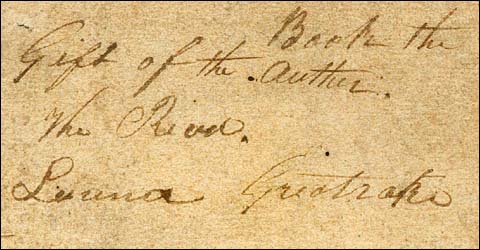
Return to top of the page
Sidney Rigdon "Home" | Rigdon's History | Mormon Classics | Bookshelf
Newspapers | History Vault | New Spalding Library | Old Spalding Library
last revised July 8, 2008