READINGS  IN  EARLY  MORMON  HISTORY
(Newspapers of Ohio)


Misc. Ohio Newspapers
1800-1828 Articles
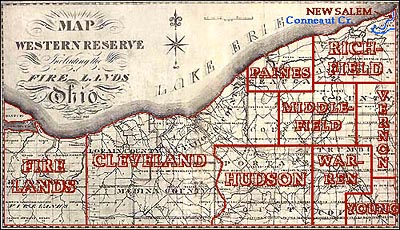

The Western Reserve of Ohio in 1826


1800-28  |  1829-31  |  1832-34  |  1835-39  |  1840-49
1850-59  |  1860-79  |  1880-99  |  1900-09  |  1910-59


WSHG Aug 19 '01  |  Trmp Jul 13 '13  |  WRec Jul 05 '14  |  WRec Oct 18 '14  |  WRec Oct 25 '14
WRec Nov 01 '14  |  WRec Nov 08 '14  |  WRec Dec 13 '14  |  WRec Feb 09 '15  |  WRec Mar 02 '15
ORep Oct 19 '15  |  ORep May 16 '16  |  WRec Jun 28 '16  |  ORep Jul 18 '16  |  WRec Aug 21 '16
ORep Aug 22 '16  |  WRec Feb 05 '17  |  ORep Feb 06 '17  |  WRec Feb 12 '17  |  Farm Oct 10 '17
ORep Oct 16 '17  |  WRec Nov 05 '17  |  WRec Nov 12 '17  |  ZExp Nov 24? '17  |  WRec Nov 26 '17
Phil Jan 02 '18  |  UGaz Jan 28 '18  |  Farm Feb 07 '18  |  Farm Feb 21 '18  |  Farm Feb 28 '18
Farm Mar 07 '18  |  WSpy Apr 15 '18  |  WSpy Apr 18 '18  |  CBee May ? '18  |  CGaz Jul 08 '19
Phil Aug 05 '20  |  OMM Jan '22  |  OMM Feb '22  |  ORep Jan 16 '23  |  ORep Mar 13 '23
CLGz Jan 24 '24  |  CLGz Feb 21 '24  |  CLGz Feb 28 '24  |  CLGz Mar 20 '24  |  CLGz Apr 03 '24
CLGz Apr 10 '24  |  CLGz May 08 '24  |  CLGz May 15 '24  |  CLGz May 29 '24  |  SCl Jun 09 '24
ORep Oct 07 '24  |  ORep Dec 31 '24  |  ORep Jan 07 '25  |  SCl Jan 08 '25  |  ORep Oct 13 '25
OPat Oct 29 '25  |  ORep Aug 03 '26  |  WCour Aug 19 '26  |  WRC Aug 25 '26  |  SCl Dec 02 '26
WCour Jul 07 '27  |  WInt Aug 03 '27  |  WInt Nov 21 '27  |  WRC May 22 '28  |  WInt Jul 12 '28
WInt Oct 15 '28  |  OPat Dec 06 '28  |  WInt Dec 06 '28


Articles Index   |   Painesville Tel.  |   Painesville Rep.  |   Gazette/Spec.


WESTERN  SPY
 and  Hamilton  Gazette.


Vol. ?                          Cincinnati, Ohio, August 19, 1801.                         No. ?


Now in press, and for sale at this office, to-morrow, price 25 cents, a pamphlet entitled, The Little Book: The Arcanum Opened, containing the fundamentals of a pure and most ancient theology -- The Urim, or Halcyon Cabala, containing the platform of the spiritual tabernacle rebuilt, composed of one grand substantive -- and Seven excellent Topics, in opposition to spurious Christianity. A liberal deduction will be made to those who take a quantity. No trust.


Note 1: The above mentioned publication was perhaps the first religious tract published in what is now Ohio -- three years before the region (first known as the Northwestern Territory, with its capital at Concinnati) received statehood.

Note 2: The author of the pamphlet was the Rev. Abel M. Sargent, late of Pike Run, Followfield twp., Washington Co., Pennsylvania, where he had served briefly as the pastor of the Pike Run Universalist church. The only know extant copy of the 24 page tract, Voice of the Midnight Cry. The Little Book: The Arcanum Opened, is preserved in the Beinecke Library, at Yale University, New Haven, Conneticut A companion tract, published in Cincinnatti at about the same time by Rev. Sargent, was entitled: The Urim, or Halcyon Cabala; Containing the Fundamental Principles of the Halcyon Church of Christ in Columbia, survives in multiple copies.


TRUMP  OF  FAME.

Vol. ?                    Warren, Ohio, Tuesday, July 13, 1813.                    No. ?


Nothing new since last week from the North Western Army. Gen. Harrison was at Cleveland when the last express left there.


On Saturday morning, about 8 o'clock, a dead body of a man was found on the beach of lake Erie, at the mouth of the Conneaught creek, in a high state of putrefaction, insomuch that a few hours exposure to the air wasted a considerable part of the muscular part of the body, so as to expose the bones of the legs, arms and head; from which circumstances, it was the general opinion that the body should be immediately interred in the grave-yard, in Salem; and any feeling interested, and wishing for information as to particulars, will receive all that can be given by applying to the subscribers who were a committee chosen for that purpose.

Nahum Howard,
J. Z. Cozens,
Asa Brown,
James Harper,
Henry Lake,
Salem, June 26th, 1813.


Note 1: The above news, regarding the burial of an unidentified body at Salem (later Conneaut) Ohio, it useful in that it documents the presence in that place of two of the "eight witnesses" who later said they read (or heard read) the imaginative fictional history, written by their neighbor, Solomon Spalding. Although Spalding's name does not appear in this 1813 list, he is known to have resided at Salem until the late summer or early fall of 1812 and arguably knew each of the five subscribers of the above notice.

Note 2: It is not unexpected that Nahum Howard's name appears at the top of the list, for he was a medical doctor and probably served in an informal capacity as Salem's coroner at the time. He was one of the eight "Spalding romance" witnesses. Joshua Z. Cozens and Asa Brown are known, from various old records, to have been residents of Salem, but they are not known to have provided any statements relating to the fictional writings of their neighbor, Solomon Spalding. James Harper was a member of the original family of settlers in what is now Ashtabula Co. and his name appears on the 1804 Ohio Tax List as a resident of the "Salem Gore ." Although he left no extant statement concerning Spalding's writings, the name of his brother, Robert Harper, was mentioned in 1873 by a friend, as having been an early Ashtabula Co. resident who knew Spalding.

Note 3: Compared to the other men listed, Henry Lake was a relative newcomer to the Ohio Western Reserve. Like Dr. Nahum Howard, Mr. Lake was one of the eight "Spalding romance" witnesses. According to an 1811 document, he was "of Buffalo in the county of Niagara" and according to his 1833 statement, Henry Lake arrived in New Salem at the beginning of 1811 and soon after that he entered into a business partnership with Solomon Spalding. In Safford E. North's 1899 book, A Descriptive and Biographical Record of Genesee County, New York, Henry Lake is listed as an 1803 pioneer of T. 12, R. 2 of the old Genesee -- the township where the village of Batavia eventually grew up. The 1810 Federal Census shows an "H. Lake" as a head of a household in Niagara County, where Buffalo is located.

Note 4: While in Ohio Henry and his family for many years managed an important inn or hotel in Salem, an establishment called the "Lake House." Whether or not the inn existed under that name as early as 1813 is unknown, but a likely date for Henry's opening the business would have been during the second half of 1812, after he and Solomon Spalding abandoned operation of their failing iron forge, located just east of Salem hamlet on Conneaut Creek. An old citizen of the Buckeye State, Mr. William H. Leffingwell, recalled in 1885 that "Mr. Spalding wrote a drama called 'the Book of Mormon,' in a hotel at Conneaut, Ashtabula county, O., where I had been teaching school." Presumably Leffingwell refers here to the Lake family inn at Salem.

Note 5: In about 1845 Henry Lake moved to Kane Co., Illinois, where he died five years later. His son Zaphna moved to Illinois during the 1830s, then in 1840 he returned to Conneaut for about 16 years, before moving back to Illinois, where he died in 1858. Baker's 1856 Atlas of Ashtabula County lists Zaphna as the operator of the Lake House, although he also engaged in other significant business operations in the area. Henry's youngest son, Hiram Lake, remained in Conneaut and he appears to have continued the family's operation of the Lake House inn after Zaphna moved back to Illinois. An 1908 issue of the Conneaut newspaper describes the appearance of Conneaut's Main Street in 1861 and makes notable mention of the "Lake House," the "Lake Block" and the home of Hiram Lake. Hiram (who also provided a statement regarding the Spalding authorship claims), was born at Salem in 1811 and was only about two years old when the Trump of Fame article was published. In a recollection published in 1901, Mrs. Diadama Chittenden stated that, when a copy of the Book of Mormon was first brought to Conneaut, "Squire Wright... surprised at its contents," summoned "Zaph Lake, into consultation on 'Smith's bible.'" Probably the elderly lady had replaced "Squire" Aaron Wright's old friend, Henry Lake, with his son Zaphna in her memory. She also recalled that a certain person (who was obviously Solomon Spalding) had been a "millwright" and a "sort of overseer or superintendent for Squire Wright of Salem." Although this recollection is also a less than perfect one, it agrees to some extent with statement made in 1878 and in 1879 by Jasper J. Moss, who in his earlier years had conversed with "Squire" or "Judge" Aaron Wright of Conneaut: and remembered that the "ex-Judge" had pointed out to him the "clerk's office" at the old Conneaut iron foundry, where "Spalding’s romance in manuscript" had been written. Also, "that the Furnace Co. employed him [Spalding] more from charity than from need of his services & that he was obliged to be in the office but had many idle hours." All of which indicates that Aaron Wright was probably involved to some extent in the operation of the Spalding-Lake iron forge (or furnace), where Spalding functioned more like a useless employee than like a managing partner in the business.


Righteousness exalteth a nation: but sin is a reproach to any people. -- Solomon.
Vol. I.                             Chillicothe, Ohio, July 5, 1814.                             No. 1.


PROPOSALS
For publishing a literary work,
ENTITLED
WESTERN ANTIQUITIES,
WITH SKETCHES OF THE GEOGRAPHY,
NATURAL HISTORY, MINERAL WATERS,
BOTONY, MATERIA MEDICA,
&c. OF THE WESTERN COUNTRY,
ACCOMPANIED WITH
APPROPRIATE MAPS AND
ENGRAVINGS.


By J. P. CAMPBELL.

The importance of such a work must be obvious to every inquirer, as well as to the antiquarian and the lover of science. Some knowledge of the history and character of the aboriginal inhabitants of our country, however limited or imperfect, is matter or unusal interest to every person in civilized society; but such knowledge can be approached only thro' a regular and correct induction of facts and particulars relating to the antiquities which are yet visible among us. To make this induction is the principal object of the work now offered to the public. A publication of this sort is the more imperatively called for by the cause of science, in as much, as many facts calculated to reflect light on the antiquity of the Western country have already fallen into oblivion, and others, no less fugitive in their nature, must soon be lost forever unless something in this way is done to give them permanence and perpetuity. The time is not remote when it will be in historick description only that the proudest monuments of the labour and ingenuity of that remarkable people, once the tenants of our soil, can at all be recognized. The changes constantly operating, no less by time than by modern improvement, rapidly hasten their destruction and must ere long snatch them alike from the eye of curiosity and the grasp of the historian. The utility and importance of the other subjects proposed to be treated in this work need no comment to the lovers of science, and indeed none to any person who from curiosity or otherwise, feels an interest in the character and resources of our enviable country.

CONDITIONS

This work will be printed on fine paper, in a duodecimo volume of about 200 pages, bound in boards.

The price to subscribers will be one dollar and twenty-five cents per copy.

To Book-sellers, who subscribe for a quantity, a liberal deduction will be made.

AS soon as the engravings are finished (which may exceed twenty in number) the work will be put to press. It will possibly be ready for delivery by the first of December next.
Chillicothe, July, 1814.


THE  WEEKLY  RECORDER
Is published on Tuesday,
BY JOHN ANDREWS.

The following gentlemen are respectfully requested to procure subscriptions, and hereby authorised to receive, and give receipts for, any monies paid for the Weekly Recorder...

Rev. Mr. Patterson -- Pittsburgh...


Note 1: As things turned out, the Rev. John P. Campbell's "Western Antiquities," with 20 engravings and 200 pages of text never made it to the press of Mr. John Andrews in Chillicothe. After several delays (the most serious of which was caused by Rev. Campbell's death in Nov., 1814) an excerpt from Campbell's manuscripts was published in two consecutive 1816 issues of the Philadelphia Port Folio. What happened to the remainder of Rev. Campbell's intended book, history does not seem to recall. Possibly portions of the text were left behind by him at Lexington, Kentucky, when he left that town near the end of 1813. Presumably Campbell could have procured in populous Lexington (more easily than in wild Ohio) the twenty or more engravings he promised his readers.

Note 2: It is not at all strange that Presbyterian editor John Andrews would solicit the Rev. Robert Patterson, Sr., of Pittsburgh, to act as his sales agent in that city. Patterson was an orthodox Presbyterian minister who operated what was then perhaps the largest book store in western Pennsylvania. The fact that it was the same Rev. Robert Patterson (and not his brother, Rev. Joseph Patterson, Jr.) is confirmed in subsequent issues of the Recorder where Robert's first name initial is printed (and where Joseph Patterson is shown as acting as an agent in another part of the state). This means that patrons of the Patterson book shop in Pittsburgh saw copies of the Recorder during the years 1814-15-16-17, at least. After that year Robert Patterson's name disappears from John Andrews' agents' list, but other names are shown as his contacts in that city. All of which strongly suggests that Solomon Spalding (who continued to receive his mail at the Pittsburgh post office, even after he moved several miles out of the city) saw and read copies of the Chillicothe paper, with its continuing mentions of the Rev. John P. Campbell's anticipated book on "mound-builder" artifacts. It is more than probable that Spalding made some attempts to communicate with Campbell, before the latter man's death at the end of 1814. Besides that, the doctor who attended Solomon Spalding in his final days of life, in Oct., 1816, was Cephus Dodd of Amity, Pennsylvania. The same Cephus Dodd is listed as Mr. Andrews' sales agent in Amity, beginning in 1817 -- which indicates the likelihood that issues of the Recorder circulated in the village where Spalding died, even before his demise.


Righteousness exalteth a nation: but sin is a reproach to any people. -- Solomon.
Vol. I.                             Chillicothe, Ohio, October 18, 1814.                             No. 16.


From the Christian Observer

Account of the Dartmouth College in America.

... Mr. Ralph Wheelock... is said to have been "an officer," not of the army, but "of the church of Windham." He was a farmer of respectability, hospotable and pious.

The Doctor, of whom we are principally to speak, was the only son of this agriculturalist. 'A handsome legacy from his grandfather, whose name [Eleazar] we took, supplied the emans of affording to him a publick education at Yale College in Conneticut, where he was the first to receive the interest of a legacy given by the Rev. Dean Berkley, to the best senior classick scholars. He took his American degree in 1733.

The religious impressions so greatly prevalent about this time in many parts of America, in the production of which the Rev. Jonathan Edwards was principally instrumental. served to excite our young pastor... He now became anxious for the conversion of the Indians in the northern and western borders, whom he considered as having been almost criminally neglected... A part of his plan was to persuade Indian parents... to semd him their children; and he wished to make them equal even to English youths in usefulness and virtuous accomplishments....

The province of Massachusetts voted him a temporary allowance for educating six children of the Six Nations; and Mr. Joshua Moor, a farmer in Mansfield, making the first considerable donation to his institution, it obtained the title of Moor's Indian Charity School....

In 1763, Mr. Charles Jeffery Smith was ordained both as a preacher and as a missionary; and Mr. Wheelock on that occasion delivered a sermon... on these words: "And it shall come to pass in the last days, that the mountain pf the Lord's house shall be established in the top of the mountains, &c." In this discourse the wretchedness of the outward condition of the Indians is urged as one motive to compassion... They are said to have sunk into a much more savage state than their ancestors in Asia. That they came from Asia seems to have been generally believed in America ever since the proximity of the Continents at Bjering's Straits has become known. This origin is inferred from the greater population of the western side of North America, from many traditions among the Indians, and from languages...

It is further remarkable, that forts and mounds resembling those in northern Asia, abound in America, and escpecially on the western [sic] side....

(To be Continued.)


Notes: (forthcoming)


Righteousness exalteth a nation: but sin is a reproach to any people. -- Solomon.
Vol. I.                             Chillicothe, Ohio, October 25, 1814.                             No. 17.


From the Christian Observer

Account of the Dartmouth College in America.

(under construction)


Notes: (forthcoming)


Righteousness exalteth a nation: but sin is a reproach to any people. -- Solomon.
Vol. I.                             Chillicothe, Ohio, November 1, 1814.                             No. 18.


From the Christian Observer

Account of the Dartmouth College in America.

(under construction)


Notes: (forthcoming)


Righteousness exalteth a nation: but sin is a reproach to any people. -- Solomon.
Vol. I.                             Chillicothe, Ohio, November 8, 1814.                             No. 18.


From the Christian Observer

Account of the Dartmouth College in America.

(under construction)


Notes: (forthcoming)


Righteousness exalteth a nation: but sin is a reproach to any people. -- Solomon.
Vol. I.                         Chillicothe, Ohio, December 13, 1814.                         No. 24.


We presume that the following Sketch of the Literary
Acquirements & Various Writings of the late

Rev. John P. Campbell
will be gratifying to many of our readers.

He commenced his Literary Course in May 1783, at the age of fifteen. In 1784 he went to Lexington, where he was a student in the first Grammar School ever formed in Kentucky. Having finished the Latin and studied the Greek and French languages he went to Virginia to complete his education. He passed through a course of Science and Belles Letters with the learned and truly estimable Mr. A. Scott, of Augusta County, whose academy produced several useful and highly reputible characters in publick life. Having passed through the usual course of scientifick reading, and not knowing what profession to choose, he went, in the Autumn of 1787, to Williamsborough, Granville County, North Carolina, where he engaged (though not yet twenty years of age) in conducting an academy. There he continued till the Autumn of 1789, devoting his leisure, which was considerable, to general reading, and partially to the study of medicine. Having bad health, he returned to his native County, in the mountains of Virginia, and devoted the succeeding winter to the study of Theology and of the Sacred Scriptures.

In May 1790, he went to Hampden Sydney College, then under the presidency of the great and eloquent John Blair Smith, or precious memory; where he employed six months in study, and graduated in company with Messrs. T. C. Poage, Wm. Williamson, and David Smith, but continued in College until the next May, 1791, pursuing a course of theological reading, under the Rev. Messrs. Graham and Hoge, and was licensed to preach the Gospel of Christ in May, 1792.

In July, 1793, he was ordained and installed, as a collegiate minister with Mr. Graham, in the congregations of Oxford, New-Monmouth, Lexington, and Timber-ridge.

In 1793, he removed to Kentucky, where he continued eighteen years, performing the duties of the ministerial office in various congregations, particularly in the upper counties of that State, where he published a number of theological works, cheifly in defence of the doctrines of the Reformation. He had acquired a knowledge of the Hebrew language, which he found was of great use in the discussion of the subjects on which he wrote. He resumed his medical studies, and pursued them at leisure hours; and, constrained by the necessities of a numerous family, he was for many years engaged in the practice of physick, in which he was very successful; but frequently regretted that he could not devote his whole time to the work of the ministry.

In the Autumn of last year (1813) he moved to Chillicothe in the State of Ohio. He had it in contemplation to publish a history of the Church in the Western Country. He hads also collected materials and issued proposals for publishing by subscription a literary work, to be entitled "Western Antiquities." But it pleased God to remove him from the stage of action before either of these works had been prepared for the press...


Note 1: The above memorial to the Rev. John Poage Campbell (1767- Nov. 1814) is accompanied by a list of twelve of his sermons, dating from 1797 to 1812, which appear to convey his belief in orthodox Presbyterianism, and his aversion to modern reformers like Barton W. Stone. Residing practically in the center of the "Great Kentucky Revival," Rev. Campbell was affored more than ample opportunity to view Presbyterian Calvinist election doctrine melt away in the hearts of the many revival attendees -- who generally expected that an opportunity for Christian salvation might be extended to all repentant believers. This shift in popular opinion was not particularly helpful to the Presbyterian Church, which lost many members in Kentucky and Ohio during Rev. Campbell's final years in the west.

Note 2: The Morgan Bibliography of Ohio Imprints, 1796–1850 lists a book or booklet, written by the Rev. John P. Campbell, and published at Chillicothe, Ohio in 1815, under the title: Antiquities of Kentucky. Rev. Campbell also edited the Evangelical Record and Western Review, while he lived in Lexington, Kentucky, during the years 1812-13.


Righteousness exalteth a nation: but sin is a reproach to any people. -- Solomon.
Vol. I.                         Chillicothe, Ohio, February 9, 1815.                         No. 32.


LITERARY  NOTICE.

The late Dr. John P. Campbell, having spent much time, and taken much pains in collecting facts for a work entitled "Western Antiquities," and having at his decease committed his papers into the hands of his widow, it has been thought proper to proceed in the publication of the work for her benefit. In justice to subscribers, we would observe, that the papers are now in the possession of a gentleman who intends as soon as possible to publish the work according to the original plan & design.

==> The Editors of the Monitor, Lexington, and the Editor of the Weekly Recorder, Chillicothe, are respectfully requested to give this a place in their respective papers.

Advertiser Office. Winchester, Ky. |
            January 28th, 1815.           |


Notes: (forthcoming)


Righteousness exalteth a nation: but sin is a reproach to any people. -- Solomon.
Vol. I.                         Chillicothe, Ohio, March 2, 1815.                         No. 35.


"WESTERN  ANTIQUITIES."

In our number of the 9th inst., we inserted a notice relative to the publication of a work to be entitled

Western  Antiquities.

We understand the materials for this work which were collected by the late Dr. John P. Campbell are in the hands of a gentleman of a liberal education, who designs to publish the Works for the benefit of Dr. Campbell's widow. -- As there appears to be some deficiency in the Doctor's papers under the heads of Biology and Mineralogy. it is thought proper to make some further researches, in order that the work may be as complete as possible. Gentlemen of science are respectfully invited to communicate, free of expense, whatever they may deem and important acuisition, to the Rev. Henry H. Frost, at Richmond, Madison County, Kenrucky, or if more convenient, to the editor of this paper. Gentlemen friendly to the proposed publication, and particularly, those who hold subscription papers, are requested to use their influence to procure a liberal patronage.
          Recorder Office, Chillicothe, (O.)
                   March 2, 1815.


Notes: (forthcoming)


THE  OHIO  REPOSITORY.

Vol. II.                    Canton, Ohio, Thursday, October 19, 1815.                    No. 30.


Indian  Treaty.
_____

From the Buffalo Gazette, Sept. 19.

Cession of the Islands of the Niagara river by the Seneca Nation of Indians, to the State of New-York.

For several days previous to the arrival of gov. Tompkins, the Seneca Indians had been in council with their agent E. Granger, Esq. at which attended the interpreters, Capts. Parish and and Jones. On the arrival of his Excellency, the following treaty was consumed. The islands ceded, are Squaw Island, opposite the mouth of Conjockety Creek. 3/4ths of a mile in breadth, containing some excellent meadow, and but few trees: Strawberry Island, about a mile below. containing wild meadow, and about the size of Squaw Island: -- Grand Island, commences three miles below Black Rock and extends to within a mile of Schlosser, 12 miles long and from 2 to 7 broad, well timbered, level and said to contain an excellent soil; there is, however, on the Island a large cranberry marsh, -- no improvements of any consequence: -- Navy Island lies partly between the lower end of Grand Island and the British shore, is supposed to be within the boundary of Upper Canada, because the branch which passes between Grand island and our shore, united to that which passes between Grand and Navy Islands, are superior to the third branch of the river which passes between the island and the Canada shore; the questions of territory will doubtless be settled by the commissioners of both governments; this island is about 3/4ths of a mile long and 100 rods broad, and has been somewhat cultivated: Goat Island, divides the falls of the Niagara, 1/2 a mile long and some 60 or 80 rods broad, it is rocky and covered with very shabby timber and accessible only at a single point. We consider this to be a good bargain for the people; and if the people would sell such portion of their lands on this frontier as could be advantageously settled, it would have great effect in opening and improving roads on the Niagara river; and which would also greatly relieve the industrious inhabitants on the frontier, whose means of living have been straitened by the devestation of War.

Now for the Treaty.

A  TREATY,

Entered into this 12th day of September, 1815, at Buffalo in the county of Niagara and state of New York, between the chiefs, sachems, and warriors of the Seneca nation of Indians, of the first part and the people of the state of NewYork, on the second part, witnessed as follows:

First. The said chiefs, sachems and warriors of the Seneca nation, in consideration of the sum of one thousand dollars in hand paid by Daniel D. Tompkins, governor of the state of New York, and the covenants and agreements hereinafter contained, do hereby sell grant, convey and confirm, to the people of the state of New York, all the islands in the Niagara river, between Lake Erie and Lake Ontario, and within the jurisdiction of the United States; to have and to hold the same, with the appurtenances unto the said people of the state of New York in free and pure allodium forever -- reserving, however to the said chiefs, sachems and warriors of the Seneca nation of Indians, equal rights and privileges with the citizens of the U. States, in hunting fishing and fowling, in and upon the waters of the Niagara river, and of encamping on any of the said islands for that purpose, whilst the same shall continue to belong to the people of the state of New York.

Secondly. The people of the state of New York, in addition to the sum of one thousand dollars already paid to the said chiefs, sachems and warriors of the Seneca nation, covenant to pay them annually forever, an annuity of five hundred dollars to be paid on or before the first day of June in each year forever hereafter, at Canandaigua, in the county of Ontario, the first payment to be made on the first day of June 1816. In testimony whereof, the aforesaid chiefs, sachems and warriors of the one part, and Daniel D. Tompkins, governor of te state of New York, Peter B. Porter, Henry Crocheron, Samuel Young, Roger Skinner, Esex Cowan, Robert Tillotson, and Lewis Livingston, commisioners in behalf of said state, have hereunto set their hands and seals, at Buffalo in the county of Niagara, the day & year first above written.

(Here follows the signatures of both parties.)


Note 1: An abbreviated version of this same article appeared in the Oct. 30, 1815 issue of the Pennsylvania Washington Reporter.

Note 2: It was the remnant of these same Seneca Indians to whom Oliver Cowdery and Parley P. Pratt first brought the Book of Mormon, at the commencement of their 1830 "mission to the Lamanites." By that time the Seneca had mostly moved to the Cattaraugus Reservation, southwest of Buffalo. Although Solomon Spalding does not mention Grand Island nor the Seneca Indians in his extant writings, he does speak of the Cattaraugus region and Indians living there. Major Mordecai M. Noah made two different attempts to obtain Grand Island and there conduct his "gathering of Israel," including both the scattered Jews and the American Indians (as the remnant of the Ten Lost Tribes), but he failed to bring these Zionic schemes to fruition. In more recent times, some Book of Mormon scholars, like Elder Delbert W. Curtis, have put forth the claim that the Niagara River is the "River Sidon" of ancient Nephite history -- thus implying that Grand Island and the regions round about are important locations in Book of Mormon geography.


THE  OHIO  REPOSITORY.

Vol. II.                    Canton, Ohio, Thursday, May 16, 1816.                    No. 60.


From the Greensburgh Gazette.

SPOTS  ON  THE  SUN.
______

For several days past, a black spot has appeared upon the sun's disk near its centre. While the sun is at the horizon, owing to the smoky state of the atmosphere, it is distinctly visible to the naked eye; while in the meridian, it may be seen by a coloured glass... it is certain that it was more plainly and distinctly visible to the naked eye, than any which has appeared for many years -- or any that have been described by ancient astronomers. -- Whether this was owing to the peculiar state of the atmosphere in this particular place, or to an extension of, or change in, the spot itself, cannot without the aid of astronomical apparatus, be ascertained.... It is presumed this novel appearance on the sun will have attracted the attention of the learned -- from whom we may expect a more satisfactory explanation.
  May 1, 1816.                                   CADMUS.


ZOOLOGICAL  DISQUISITION.
______


Communicated for the Columbian.

The original inhabitants of America shewn to be of the same family and lineage with those of Asia, by a process of reasoning not hitherto advanced. By Samuel L. Mitchell, M. D. Professor of Natural History in the University of New-York; in a communication to De Witt Clinton, Esq. President of the New-York Philosophical Society, dated New-York, March 31, 1816.

The view which I took of the variety of the human race in my course of Natural History, delivered in the University of New-York, differs in so many particulars from that entertained by the great zoologists of this age, that I give you for information, & without delay, a summary of my yesterday's lecture to my class.

I denied, in the beginning, the assertion that the American aborigines were of a peculiar constitution, of a race sui generis, and of a copper colour. All these notions were treated as fanciful

The Indigenes of the two Americas appear to me, to be of the same stock and genealogy with the inhabitants of the northern and southern Asia. The northern tribes were probably more hardy, ferocious and warlike than those of the south. The tribes of the lower latitudes seem to have been greater proficients in the arts, particularly of making clothes, clearing the ground and erecting works of defence.

The parallel between the people of America and Asia, affords this important conclusion, that, on both continents, the hordes dwelling in the higher latitudes have overpowered the more civilized, though feebler inhabitants of the countries situated towards the equator. As the Tartars have overrun China, so the Astecas subdued Mexico. As the Huns and Alans desolated Italy, so the Chippewas and Iroquois prostrated the populous settlements on both banks of the Ohio.

The surviving race in these terrible conflicts between the different nations of the ancient native residents of North Arteries is evidently that of the Tartars. This opinion is founded upon four considerations.

1. The similarity of physiognomy and features. His excellency M. Genet, late minister plenipotentiary from France to the United States, is well acquainted with the faces, hues and figures of our Indians and the Asiatick Tartars; and is perfectly satisfied of their mutual resemblance. -- Mons. Cazeaux, Consol of France to New-York, has drawn the same conclusion from a careful examination of the native men of North America and Northern Asia.

Mr. [Smibert] who has been employed, as Josiah Meigs, Esq, now commissioner of the land office relates, in executing paintings of Tartar visage, for the grand duke of Tuscany, was so struck with the similarity of their features to those of the Naraganset Indians, that he pronounced them members of the same great family of mankind. The anecdote is preserved with all circumstances, in the fourteenth volume of the Medical Repository.

Within a few months I examined over & over again seven or eight Chinese sailors, who assisted in navigating a ship from Macao to New York. The thinness of their beards, the bay complexion, the black lank hair, the aspect of the eyes, the contour of the face, and in short the general external character, induced every person who observed them, to remark, how nearly they resembled the Mohegans and Oneidas of New York.

Sidi Mellimelli, the Tunisian envoy to the United States in 1804, entertained the same opinion on beholding the Cherokees, Osages and Miamies, assembled at the city of Washington, during his residence there. Their Tartar physiognomy struck him in a moment.

2. The affinity of their languages. The late learned and enterprising professor Barton, took the lead in this curious inquiry. -- He collected as many words as he could, from the languages spoken in Asia and America, and he concluded from the numerous coincidences of sound and signification, that there must have been a common origin.

The existence of corresponding customs. I mean to state at present that of shaving away the hair off the scalp, from the fore part and sides of the head, so that nothing is left but a tuft or lock on the crown.

The customs of smoking the pipe on solemn occasions, to the four cardinal points of the compass, to the heavens and to the earth, is reported upon the most credible authority, to distinguish equally the hordes of the Asiatick Tartars and the bands of the American Sioux.

4. The kindred nature of the Indian dogs of America, and the Siberian dogs of Asia.

The animal that lives with the natives of the two continents, as a dog, is very different from the tame and familiar creatures of the same name in Europe. He is either a different species, or a variety of the same species. But the identity of the American and Asiatick curs, is evinced by several considerations. Both are mostly white. They have shaggy coats, sharp noses and erect ears. They are voracious, thievish, and to a considerable degree indomitable. They steal whatever they can. & sometimes turn against their masters. They are prone to snarl and grin, and they have a howl instead of barking. They are employed in both hemispheres for labour; such as carrying burthens, drawing sleds over the snow, and the like; being yoked and harnessed for the purpose like horses.

This coincidence of our Indian dog with the Cana Sibericus, is a very important fact. The dog. the companion, the friend or the slave of man in all his fortunes and migrations, thus reflects great light upon the history of nations and of their genealogy.

II. The exterminated race in the savage intercourse between the nations of North America in ancient days, appear clearly to have been that of the Malaya.

The bodies, and shrouds, and clothing of these individuals, have within these few years been discovered, in the caverns of salt-petre and copperass within the states of Kentucky and Tennessee, their entire and exsiccated condition, has led the intelligent gentlemen who have seen them to call them mummies. They are some of the most memorable of the antiquities that North America contains. The race or nation to which they belonged is extinct; but in preceding ages, occupied the region situated between Lakes Ontario and Erie on the north, and the Gulf of Mexico on the south, and bounded eastwardly by the Allegheny mountains, and westwardly by the Mississippi River.

That they were similar in their origin and character to the present inhabitants of the Pacific Islands & of Austral Asia, is argued from various circumstances.

1. The sameness of texture in the plain cloth or matting that enwraps the mummies, and that which our navigators bring from the Wakash, the Sandwich Islands and the Fegees.

2. The close resemblance there is between the feathery mantles brought now-days from the islands of the South Sea, and those wrappers which surround the mummies lately disinterred in the western states. The plumes of birds are twisted or tied in the threads with peculiar skill, and turn water like the back of a duck.

3. Meshes of nets regularly knotted and tied, and formed of a strong & even twine.

4. Mockasons or coverings for the feet, manufactured with remarkable ability, from the bark or rind of plants worked into a kind of stout matting.

5. Pieces of antique sculpture, especially of human heads, and some other forms, found where the exterminated tribes had dwelt, resembling the carvings of Otaheite, New Zealand, and other places.

6. Works of defence, or fortifications, overspreading the fertile tract of country formerly possessed by these people, who may be supposed capable of constructing works of much greater simplicity than the morajs or burial places, and the hippas or fighting [--ages] of the Society Islands.

7. As far as observations have gone, a belief that the shape of the skull and the angle of the face in the mummies correspond with those of the living Malays.

I reject, therefore, the doctrines taught by the European naturalists, that the man of Western America differs in any material point from the man of Eastern Asia. Had the Robertsons and the Buffons, the Raynols, the De Pauws, and the other specialists upon the American character and the villifiers of the American name, procured the requisite information concerning the hemisphere situated to the west of us, they would have discovered that the inhabitants of vast regions of Asia, to the number of many millions, were of the same blood & lineage with the undervalued and despised population of America. The learned Doctor Williamson has discussed this point with great ability

I forbore to go further than to ascertain by the correspondences already stated, the identity of origin and derivation to the American and Asiatick natives. I avoided the opportunity which this grand conclusion afforded me, of stating that America was the cradle of the human race; of tracing its colonies over the Pacifick Ocean, and beyond the sea of Kamschatka, to new settlements; of following the emigrants by land and by water until they reached Europe and Africa; and lastly the following of the adventurers from the former of these sections of the globe, to the plantations and abodes which they found and occupied in America, I had no inclination to oppose the current opinions relative to the place of man's creation and dispersion. I thought it was not worth while to inform a European that on coming to America he had left the new world behind him for the purpose of visiting the old. It ought nevertheless to be remarked, that there are many important advantages derived to our reasoning from the present manner of considering the subject. The principles being now established, they will be supported by a further induction of the facts & occurrences to an extent and an amount that is impossible, at this moment fairly to estimate. And the conclusion of Jefferson, Lafon, and others favorable to the greater antiquity of American population, will be daily reinforced and confirmed.

Having thus given the history of these races of man spreading so extensively over the globe, I considered the human family under three divisions.

First, The Tawny man comprehending the Tartars, Malays, Chinese, the American Indians of every tribe, Lascars, and other people of the same cast and breed. From these seemed to have proceeded 2 remarkable varieties, to wit:

Secondly, The White man, inhabiting naturally the countries in Asia and Europe, situated north of the Mediterranean sea; & in the course of his adventures, settling all over the world. Among those I reckon the Greenlanders and Esquimaux.

Thirdly, The Black man whose proper residence is in the regions south of the Mediterranean, particularly towards the interior of Africa. The people of Papua and Van Dieman's land, seem to be of this class,

It is generally supposed, and by many able and ingenious men too, that the external physical causes, and the condition of circumstances which they call climate. have wrought all these changes in the human form. I do not, however think them capable of explaining the differences which exist among the nations. There is an internal physical cause of the greatest moment, which has scarcely been mentioned. This is the generative influence. If by the act of modeling the constitution in the foetus, a disposition to gout, madness, scrofula, and consumption, may be engendered, we may rationally conclude, with the sagacious D'Azara, that the procreative power may also shape the features, tinge the skin, and give other peculiarities to man.
                   Yours truly,
                                      SAMUEL L. MITCHILL.


Note 1: The 1816 sunspots were noticed and reported in numerous periodical articles. For example, the Pittsburgh Mercury of May 4, 1816 said: "This phenomenon has, during the past week, been distinctly observed, by most of our citizens, and has excited general conversation. Altho these appearances are not common, still they are not new. The atmosphere being with us very smokey, these spots were, in the morning and evening, quite visible to the naked eye. We do not recollect of a similar circumstance on record." A similar article appeared in the Washington Reporter of May 27, 1816. The smoky sky mentioned in the news report was due to the accumulation of atmospheric dust, world-wide, following the April 5, 1815 volcanic eruption of Mount Tambora on the Indonesian island of Sumbawa. The dust in the sky lowered temperatures worldwide and made 1816 the "year without a summer." The resulting crop failures and economic hard times contributed to the decision of Joseph Smith, Sr. to move his family from Vermont to New York that winter. Solomon Spalding, sleeping out-of-doors one night that fall, reportedly fell victim to the unseasonal temperature ("While traveling he slept in the woods nights, took cold and finally died.") Some early Mormons saw the remarkable 1816 sun spots as betokening divine revelation (see pg. 85 in Elder Charles B. Thompson's 1841 book).

Note 2: Excerpts of Dr. Samuel L. Mitchill's 1816 "Zoological Disquisition," were later (in 1820) reprinted in the initial number of the Archaeology Americana. While it is possible that Solomon Spalding read and considered Dr. Mitchill's published lecture, it seems unlikely that Mitchill's 1816 article was the immediate source of Spalding's fictional explanations for "mound-builder" origins, etc. More probably, most of the arguments made by Mitchill in 1816 were already topics of scholarly discussion a decade or more before, and Spalding carried these ideas on American races and antiquities with him to Ohio, prior to his writing his "Conneaught Creek" story.

Note 3: Some of Mitchill's ideas concerning American prehistory have their parallels in early Mormon religious tenets -- that the "Ten Lost Tribes" of Israel were not the same people as North America's "mound-builders," that humankind originated in the "New World," etc. Richard Stout summarizes the matter in these words: "[Mitchill's] closest friend... J. W. Francis protested, '...when he affirmed as his belief that the American continent was the Old World, and that the Garden of Eden might have originally been located in Onondago Hollow [New York], he imposed a tax on credulity too onerous to bear.'... [Joseph Smith] too claimed an American origin for Adam and Eve... 'said the Garden of Eden was in or near Independence [Missouri], the center stake of Zion.' Numerous testimonies along this line, including second LDS prophet Brigham Young's, led the late LDS Apostle Bruce McConkie to make this admission in his book Mormon Doctrine: 'The early brethren of this dispensation thought the Garden of Eden was located in what is known to us as the land of Zion, an area for which Jackson County, Missouri is the center place."'... [thus] when Joseph sent Martin Harris with the facsimiles and the story of the gold plates to Dr. Mitchill, it was to a man Joseph may have had every reason to believe would be receptive to the Book of Mormon... to verify the Doctor's own pet theories." Joseph Smith's notions concerning the Missouri location for the Garden of Eden probably post-dated his involvement in the production of the Book of Mormon and the "New Translation" of the Bible. Neither of these texts indicate an American origin for humankind.


Righteousness exalteth a nation: but sin is a reproach to any people. -- Solomon.
Vol. II.                         Chillicothe, Ohio, June 28, 1816.                         No. 48.


FROM  THE  PORT  FOLIO.

Of the Aborigines of the Western Country.

The publisher of the Port Folio, some time since, announced his intention of printing a curious and learned work on the antiquities of the Western part of our Country, by Henry Frost, A. M. The proposals had no sooner been submitted to the publick, than a powerful appeal to his kindness and his sense of justice was made by the friends of the Reverend Dr. John P. Campbell. -- They stated that the materials for this work had been collected by this gentleman, and that they had been obtained, under false pretences, from his widow, by Mr. Frost. The MSS. were therefore immediately placed in the hands of one of her friends, who promises to prepare them for the press, and publish them for her benefit. In the mean while we are permitted to make a few extracts. The subject is extremely interesting, as it treats of the ancient inhabitants of a great continent. Dr. Campbell appears, from the manuscript, so far as we have perused it, to have been admirably fitted, both by taste and education, for the task which he commenced; and to which we understand that he devoted several years of toilsome and expensive research. We shall only add, that any subscriptions (1 vol. 8vo. price $2) which may be transmitted to the publisher of the Port Folio, shall be faithfully applied to the benevolent purposes of this publication....

(view original of this article)


Note: See 1815 issues of the Recorder to trace the convoluted writing and publishing history of what ended up as a two-part article in the Philadelphia Port Folio. Several western newspapers, including the Ohio Repository of July 18, 1816 also reprinted the late Dr. Campbell's contribution to young America's knowledge of her "western antiquities."


THE  OHIO  REPOSITORY.

Vol. II.                    Canton, Ohio, Thursday, July 18, 1816.                    No. 63.


From the Port Folio.

Of the Aborigines of the Western Country.

THE publisher of the Port Folio, some time since, announced his intention of printing a curious and learned work on the antiquities of the Western part of our Country, by Henry Frost, A. M. The proposals had no sooner been submitted to the publick, than a powerful appeal to his kindness and his sense of justice was made by the friends of the Reverend Dr. John P. Campbell. -- They stated that the materials for this work had been collected by this gentleman, and that they had been obtained, under false pretences, from his widow, by Mr. Frost. The MSS. were therefore immediately placed in the hands of one of her friends, who promises to prepare them for the press, and publish them for her benefit. In the mean while we are permitted to make a few extracts. The subject is extremely interesting, as it treats of the ancient inhabitants of a great continent. Dr. Campbell appears, from the manuscript, so far as we have perused it, to have been admirably fitted, both by taste and education, for the task which he commenced; and to which we understand that he devoted several years of toilsome and expensive research. We shall only add, that any subscriptions (1 vol. 8vo. price $2) which may be transmitted to the publisher of the Port Folio, shall be faithfully applied to the benevolent purposes of this publication.

'Upon the fairest computation, admitting that the Aborigines came to the western country a thousand or twelve hundred years ago, we have then before us a period of sufficient extent to embrace all that is requisite to support the supposition that the Aborigines were the descendants of a civilized people in Asia; a people who had made great advancements in civilization and the arts, but who were probably devastated, and forced to fly, by the sudden encroachment of a foe. We shall readily perceive, that in this case, such a people would perform a rapid migration, and fly from their enemies as far as their desire of safety should dictate. It is not in any degree surprising, that they should, in like manner, escape to this continent, bringing with them that civilization and that knowledge to which they had arrived. The great antiquity which is manifested by the most striking proofs of art and knowledge, seems to warrant this conclusion, and give it weight.

The successive generations of men who have inhabited the eastern parts of Asia, were distinguished, for centuries, by rapid advancements in civilization and the arts, and on a sudden subjected to a great reverse. By the encroachment of some barbarous foe, or some neighbouring robber, they have been forced to renounce the possession of their privileges, or escape for their lives. "Some of the most desert provinces in Asia," says the historian of Catherine the second, "have been repeatedly the seats of arts, arms, commerce and literature. These potent and civilized nations have repeatedly perished, for want of a union or system of policy. Some Scythian, or other barbarian, has been suffered unnoticed to subdue his neighbouring tribes; each new conquest was made an instrument to the succeeding one; till, at length, become irresistible, he swept whole empires, with their arts and sciences, off the face of the earth." This important truth we consider particularly applicable to the original peopling of the western country. The Aborigines probably constituted a part of some such nation existing in eastern Asia, and were forced to escape to this continent by the encroachment of some powerful, invading foe. I have said that this was probably a fact. I venture to add, that it was most certainly the fact in regard to the Aborigines.

It is a very general opinion, prevailing in the western country, that there is ample proof that the country in general was once inhabited by a civilized and agricultural people. This very general consent, we are disposed to respect, and consider an innocent opinion in itself, but we have not yet obtained satisfactory reasons to believe that the country in general, or to any great extent, has been adorned with the improvements and habitations of men living in a civilized and permanent state of society. The aborigines probably advanced as far, in the improvement of particular portions or districts of the country, as their knowledge of agriculture, their improvements of husbandry and their temporary residence would allow. The face of the country, since it was visited by the Aborigines, and since their demise, has undergone great changes. It is to be remarked, that the oldest trees now standing cannot be pronounced coeval with the extinction of the Aborigines.

It is a an opinion prevailing among some, that the Aborigines crossed the Allegheny, and proceeded down the Ohio river; but nothing is more incredible. Some attention to the ancient works on the river, has led us to notice that the works at different positions, are not more or less perfect. It is vain to suppose that the works lower down are less perfect, and were therefore built by a people who migrated westward, or down the river.

Again, it is the current opinion, that the first inhabitants of the western country were white people, and therefore cannot be denominated Indians. Our readers will recollect, and may have noticed, that there are distinguishing shades of white and black within the extent of our own country; and there are those among us who, by birth, or physical causes, are exceedingly dark. It is hence not indispensible that the Aborigines should be a white people, strictly speaking, in order to account for their improvements, or their knowledge of the arts. The inhabitants of Asia, and of the Asiatic continent in general, are allowed to be darker than the inhabitants of these American states, while at the same time they likewise are denominated a white people. The city of Pekin is nearly upon the same latitude with Philadelphia, and yet the citizens of Pekin are strongly shaded compared with the Philadelphians. The Aborigines, for aught we know, might have sustained a lighter complexion than those Indians who contributed to their destruction, -- or than the ancestors of the present race of Indians; and might, on that account, have been denominated by those Indians a white people. There cannot be a doubt but that the same country, at different, and very distant periods of time, may be inhabited, or produce a race of people differing very materially in colour. The climate, and local or physical causes, may be so changed in the term of a thousand years, as to produce several degrees of shade upon the human countenance.

The northern parts of Asia are supposed by some to be much colder now than they were but a few centuries or years ago; and that but a few centuries have elapsed, since the northern regions were more habitable on this very account. We suspect, however, that the Aborigines were in general, and in no other sense, a white people, than of any of the proper inhabitants of Asia at the present time. We likewise suspect that the Aborigines were denominated a white people by the present race of Indians, solely or principally, in consequence of that distinction which they possessed in the view of the Indians, by their works, or the knowledge and skill displayed in these works. These Indians having been accustomed to pay respect to Americans and Europeans as white people, appropriated naturally the same respect and title to the Aborigines. The Indians universally disclaim these ancient works and monuments, which are attributed to the Aborigines, and allege that they were erected by white people. It may not be improper, therefore, to offer the reader several traditions which relate to this point, and which may at least be found an entertainment.

General Clarke, of Louisville, in conversation with the chief of the Kaskaskias, understood him to say, that a very remarkable fortification, to which they referred, was the house of his fathers. This is understood to signify a reverential and general declaration of the same origin.

Mr. Thomas Bodley was informed by Indians of different tribes north-west of the Ohio, that they had understood from their old men, and that it had been a tradition among their several nations, that Kentucky had been settled by whites, and that they had been exterminated by war. They were of opinion that the old fortifications, now to be seen in Kentucky and Ohio, were the productions of those white inhabitants. Wappockanitta, a Shawnee chief, near a hundred and twenty years old, living on the Auglaze river, confirmed the above tradition.

An old Indian, in conversation with colonel James F. Moore, of Kentucky, informed him that the western country, and particularly Kentucky, had once been inhabited by white people, but that they were exterminated by the Indians. That the last battle was fought at the falls of Ohio, and that the Indians succeeded in driving the Aborigines into a small island below the rapids, where the whole of them were cut to pieces. He said it was an undoubted fact, handed down by tradition, and that the colonel would have ocular proof of it when the waters of the Ohio became low. This was found to be correct, on examining Sandy Island, when the waters of the river had fallen, as a multitude of human bones were discovered. The same Indian expressed his astonishment that white people could live in a country once the scene of blood. The Indian chief called Tobacco, told General Clarke, of Louisville, that the battle of Sandy Island decided finally the fall of Kentucky, with its ancient inhabitants. General Clarke says that Kentucee, in the language of the Indians, signifies "river of blood."

In addition to the proof of a great battle near the falls Ohio, it is said by General Clarke, of Louisville, that there was at Clarkesville a great burying ground, two or three hundred yards in length. -- This is likewise confirmed by major John Harrison, who received the tradition from an Indian woman of great age.

Colonel Joseph Daviess, when at St. Louis in 1800, saw the remains of an ancient tribe of the Sacks, who expressed some astonishment that any person should live in Kentucky. They said the country had been the scene of much blood, and was filled with the manes of its butchered inhabitants. He stated also that the people who inhabited this country were white, and possessed such arts as were unknown by the Indians.

Colonel M'Kee, who commanded on the Kenhawa when Cornstalk was inhumanly murdered, had frequent conversation with that chief, respecting the people who had constructed the ancient forts. He stated that it was a current and assured tradition, that Ohio and Kentucky had been once settled by white people, who were possessed of arts which the Indians did not know. That after many sanguinary contests they were exterminated. -- Colonel M. Inquired why the Indians had not learned these arts of the white people. He replied indefinitely, relating that the great spirit had once given the Indians a book, which taught them all these arts, but that they had lost it, and had never since regained the knowledge of them. -- Col. M. inquired particularly whether he knew what people it was who made so many graves on the Ohio, and at other places. He declared that he did not know, and remarked that it was not his nation, or any he had been acquainted with. Col. M. asked him if he could not tell who made those old forts, which displayed so much skill in fortifying. He answered that he did not know, but that a story had been handed down from a very long ago people, that there had been a nation of white people inhabiting the country who made the graves and forts. He also said, that some Indians, who had travelled very far west or northwest, had found a nation of people, who lived as Indians generally do, although of a different complexion.

John Cushen, an Indian of truth and respectability, having pointed to the large mound in the town of Chillicothe, observed to a gentleman that it was a great curiosity. To this the gentleman accorded, and said, The Indians built that. No, said he, it was made by white folks, for Indians never make forts or mounds -- this country was inhabited by white people once, for none but white people make forts.

In addition to the remarks which we have made on the Asiatic origin of the Aborigines, we add, that such an origin is by far the most natural, and most accordant with the progressive movements of the human family ever since the deluge. This progress in Asia, has been uniformly eastward and northward from the Euphrates. The inhabitants of Asia being the descendants of Shem, did not move to the westward in any numbers. We deem it, therefore, natural and just to conclude that the Aborigines belonged to a stock of those who moved eastward from the Euphrates, crossed at Behring Straits, and came to our western country from the north west. The Mexicans invariably declare that their ancestors came from the north west.

It is an acknowledged fact, that the antediluvians, at the event of the deluge, had arrived to a great improvement and refinement in the arts; and it is also an important fact, that a respectable portion of this knowledge was preserved from the wreck, and communicated by the sons of Noah. The descendants of Shem, the first settlers of Asia, or what is synonymous, the ten tribes, probably retained this knowledge, and transmitted it, until, through the lapse of time, it became extinct. From the descendants of Shem, or the Israelites, we derive the commencement of all that knowledge which served to keep the vast continent of Asia from total barbarism. The Israelites carried captive by Salmanaser, in the time of Hosea, became, in a great measure, incorporated with the neighbouring nations; and from this source, or in this channel, we deduce many of the customs which prevailed, and continue to prevail in Asia, and which have been frequently recognized among the Tartars, the Aborigines of the western country, and the present race of Indians. We may here introduce a striking passage of history from the second book of Esdras. "Those are the ten tribes, which were carried away prisoners, out of their own land in the time of Osea the king, whom Salmanasar, the king of Assyria, led away captive, and he carried them over the waters, and so came they into another land. But they took this counsel among themselves, that they would leave the multitude of the heathen, and go forth into a further country, where never mankind dwelt." We do not pretend to say that this country, where never mankind dwelt extends to America, but we consider the passage of history important, and equally weighty as such, although apocryphal. -- The natural consequence of this determination and progress of the ten tribes, would be a very general diffusion of that knowledge which they possessed, and a general incorporation with neighbouring powers.


Note 1: It seems quite likely that Solomon Spalding had an opportunity to read and reflect upon "Aborigines of the Western Country," since the article first appeared in the widely read Philadelphia Port Folio, and was doubtless reprinted by various American publications, besides the Ohio Repository. However, by the time the article could have been brought to Spalding's attention he was probably already rather sick, in what would become his terminal illness (he died on Oct. 20, 1816). Thus, it seems impossible that the appearance of this article, in the public press during the summer of 1816, could have in any way influenced the text of Spalding's pseudo-historical writings. On the other hand, it is possible that Spalding and Campbell, who both shared a keen interest in American antiquities, were in communication with one another before Campbell's own demise.

Note 2: The article's insistance upon a unique explanation for the ancient mounds and fortifications of the Ohio Valley, (saying that were the products of an extinct, light-skinned race), parallelled Spalding's own fictional answers for the origin of such earthworks and artifacts. Some of the notions expressed in the article were, of course, already in circulation years before its appearance. Solomon Spalding could have derived his imaginative ideas regarding the "extinct" race that constructed the mounds from various different literary and oral sources well before he commenced writing his own "historical romance(s)" about the year 1811. For example, the explanation that the American Indians had previously exhibited a higher state of civilization, light skins, Hebrew heritage, etc. was being published in a Pittsburgh periodical almost exactly when Spalding moved to that city from Ohio. For additional information on this subject, see the on-line feature, "Book of Mormon: Sacred Book of the Indians?"


Righteousness exalteth a nation: but sin is a reproach to any people. -- Solomon.
Vol. III.                         Chillicothe, Ohio, August 21, 1816.                         No. 4.


Of the Aborigines.
From the National Intelligencer.

Interesting extract of a copy of a letter from Col. R. J. Meigs, dated

                                                      "Cherokee Agency, July 16, 1816.
"I received your letter dated the 24th May last, with Mr. Boudinot's book, in which he attempts to prove that the Indians of America are of Hebrew descent. The Cherokees have some laws and customs, both civil and religious, resembling the laws and regulations of the Jews; but how, or when, or from whence they were introduced, will perhaps remain forever undetermined. The feasts of the First Fruits is, undoubtedly, of religious origin. The name of this feast is the "Green Corn Dance." The name gives it the character of the feast of the First Fruits. I have attentively sen this dance performed. Some hundreds of males and females assemble in a square, perfectly levelled and clean, in front of the national council house. They move in circles, Males in one circle, and Females in another; having a leader or master of ceremonies; they move slowly in measured steps, circle within circle -- there is no speaking; no levity of action -- their countenances are impressed, apparently, with religious awe. Their king or head chief, was present, but not in the dance. Those in the circles were generally young people; they might be called singing men and women, for they all chaunted a monotonous plaintive tune, which did not charm the ear, but the ensamble was pleasing. During the dance (perhaps an hour) not a word is spoken, except by the master of ceremonies, who seems well pleased with his honorable station. When the dance is concluded, the circles disperse, and are mixed with the surrounding spectators -- all are merry and apparently happy -- no cares or vexations are permitted to obtrude themselves on that day.

ABLUTIONS.

"Formerally they had practised frequent washings; these were resorted to after going through bodily exercises -- perhaps of dancing; the whole meeting, on such occasions, went to the clear stream and plunged in. This was intended to express that they were cleansed of all moral impurity -- that however they might have before sone wrong, the wrong was now done away, and no more to be considered as any part of their character. This corresponds with my personal observation; for they never reproach each other of former deviations from the right.

CITIES  OF  REFUGE.

"The formerly had cities of refuge, whither a person who had killed a Cherokee might flee. THis was an excellent institution, as it gave time for the passions of the deceased to subside. In some cases, compromises were made for pecuniary compensation, especially in cases of an accidental character. They have since deviated from that wise custom, and in every instance required life for life, as forfeit without any qualification; but they have now returned to a more humane procedure, and, in some instances, make equitable discrimination.

"Although the institution of the "Green Corn Dance, their Ablutions, and Cities of Refuge, bear strong resemblance to Jewish customs, and laws, yet they by no means prove that the American Indians are descended from the Jews; they only prove that the 'religion of nature' corresponds with the religion of the Jews, communicated to them by Moses by divine command.

"I have never seen the distinctive visage of the Jews among all these people; but the visage of the Tartar is every where apparent.


Note 1: Reviews and responses to Elias Boudinot's A Star in the West date to the spring of 1816, so it appears that his book was issued to the public during the early part of that year. This fact strengthens the possibility that Solomon Spalding might have seen the book, or read extracts from it, prior to his death at Amity, Pennsylvania, on Oct. 20, 1816. The modern investigator, however, will probably find no conclusive evidence that any of Spalding's fictional writings drew upon information first published in Mr. Boudinot's book.

Note 2: Non-Indians who lived in close proximity with the American tribes generally seem to have dismissed the various claims professing that the Indians were descended from Israelite ancestors. See, for example, a knowledgeable reader's reaction to Israel Worsley's A view of the American Indians, as published in the Apr. 29, 1829 issue of the Cherokee Phoenix, (a paper edited by Mr. Boudinot's namesake: Chief Elias Boudinot).


THE  OHIO  REPOSITORY.

Vol. II.                    Canton, Ohio, Thursday, Aug. 22, 1816.                    No. 74.


From the New Tork Evening Post.

Discovery of America.

I present such readers who take delight in this sort of subject, with an interesting letter which I received by a late arrival from a correspondent in London, whom I have not the honour of knowing, but who, if this number of the Evening Post should ever chance to meet his eye, will be pleased to accept my best acknowledgements.

                                                               LONDON, Feb. 21, 1816.
To the editor of the N. Y. Evening Post.

Sir -- If the following account of the discovery of America, by the ancient British, at a very early period, should appear sufficiently interesting, the insertion of a few paragraphs in your truly useful, valuable and respectable paper, will greatly oblige many of your friends on this side of the water, who will be happy to give publicity in any of their papers, to such remarks as you may be pleased to express.

'It appears from the very many quotations from various publications, which have been selected by the best British antiquaries, both ancient and modern, that Prince Madoc Ap Owen Guyneth, a Welsh Prince, discovered America, in the year 1170 -- three hundred and twenty-one years before the first voyage made by Columbus; and the same prince planted a colony on the west side of the Mississippi, the descendants of whom are said to subside in or near the same place by above a hundred credible authors, who have particularly expressed it; and the fact is recognized in ancient Welsh poetry, which existed long before the first voyage was performed by Columbus, The last writers on this subject are Dr. Williams, rector of Sydenham, who has issued two publications, & the Rev. George Burder, A. M., late of Coventry, who has issued one -- all of which are replete with interesting intelligence on this point. These three books have been presented by Richard Mackey, chief mate of the Maria, Capt. Miller, bound to New York.

'For further proof, please look into James Howell's letters, vol. 2, p. 71, concerning the ancient Britons, and you will find that Madoc Ap Owen, Prince of Wales, made two voyages to America at the time before mentioned. See also the 3d volume of the Voyages of the English Nation, by Richard Hugluys, student of Christ Church, Oxford, p. 1. Also, Pagett's Christian ography, p. 47. Also, third and last vol. of the Turkish Spy, p. 202. Also, Purchass, Pilgrimage, vol. 8, p. 899. Also, Broughton, who says that the faith of Christ was preached in America by some of our first prelates, who preached in Britain. Also, George Abbott, Lord Archbishop of Canterbury's History of the World, p. 225-56-57, who informs us that King Arthur had some knowledge of America, and that a Prince of Wales first found it out. See also the Welsh Cambria, written by David Powell and Sir John Brice, Knight, p. 225, translated into English by Humphrey Lloyd, gentleman, where you will find the reasons which induced the Prince Madoc Ao Owen Guyneth to travel. See also Sir Walter Raleigh's History of the World; Sir Thomas Herbert's travels into Persia, p. 355, Mona Antigus, by Rowlands, p. 177. Also, the Archeologia, by Edward Lloyd.

'The character and abilities of some of these authors are respectfully mentioned in Guthrie's Geography, p. 295.

  I am, sir, with great respect,
          Your most obedient and
                   Humble servant,
                          JOHN GRIFFITHS,
                         Revenue Officer.
No. 5, Newgate street, London.'


Note 1: Solomon Spalding died on Oct. 20, 1816, following a period of illness. It is unlikely that he ever saw this article in the local newspapers, much less had any opportunity to benefit from its claims, in writing his own fictional tale of ancient visits to American shores. The legend of Prince Madoc's two voyages to America were, however, so well known that Spalding need not have resorted to reading newspaper accounts on that subject. In 1805 the British Poet Laureate, Robert Southey, published a metrical version of the Madoc tale, in two volumes, which would have been easily available to Spalding, prior to 1812, in American reprint editions.

Note 2: Besides telling the story of white-skinned Christians bringing their religion to ancient America, becoming extinct, and passing from the memory of their savage Indian descendants, the Madoc story, as told by Southey, also alludes to the magician Merlin having traveled across the sea, inside a submersible vessel ("perfectly water-tight"), with its interior illuminated by a radiant stone (the biblical "Urim and Thummim"). Southey also made significant use of the writings of Abbe Francesco Saverio Clavigero in constructing his preColumbian American adventure. Among Clavigero's subject matter is the story of the Mayan hero Votan, who also twice crosses the ancient seas between Europe and America.

Note 3: There is a report, of uncertain dependablity, saying that William Morgan, the anti-Masonic martyr, once wrote a pseudo-history of ancient America, based upon the legend of Prince Madoc.


Righteousness exalteth a nation: but sin is a reproach to any people. -- Solomon.
Vol. III.                             Chillicothe, Ohio, February 5, 1817.                             No. 27.


From the Christian Herald.

AMERICAN  SOCIETY  FOR  EVANGELIZING  THE  JEWS.

(under construction)


Notes: (forthcoming)


THE  OHIO  REPOSITORY.

Vol. II.                    Canton, Ohio, Thursday, Feb. 6, 1817.                    No. 97.


LEGISLATURE of OHIO.

                                     COLUMBUS, January 25.
This day an election was held for the following officers, viz.

ASSOCIATE JUDGES.

... Ashtabula -- Nehemiah King....


Note: Dr. Nehemiah King was an "old settler" of what eventually became Ashtabula County, Ohio. He and his brother Nathan settled in New Salem (now Conneaut) in about 1810 and he was well acquainted with that town's iron forge owner, Solomon Spalding. Dr. King's name appears on an 1811 New Salem voter list, along with that of Solomon Spalding and a handful of other residents of the little hamlet. Solomon left New Salem late in 1812 but Nehemiah remained and became involved in Ohio politics, serving as a county judge and being twice elected to the State Legislature. According to an 1833 letter composed by Spalding's friend, Aaron Wright, it was Dr. Nehemiah King who initiated the Spalding authorship claims for the Book of Mormon, in January of 1832. King died in late 1832 or early 1833, however, before he was able to provide any documentation in support of the authorship allegation.


Righteousness exalteth a nation: but sin is a reproach to any people. -- Solomon.
Vol. III.                             Chillicothe, Ohio, February 12, 1817.                             No. 28.


From the Christian Herald.

ADDRESS

OF  THE  AMERICAN  SOCIETY
FOR  EVANGELIZING  THE  JEWS.

(under construction)


Notes: (forthcoming)


THE  FARMER.

    "He is the freeman whom the truth makes free, and all are slaves besides." -- Cowper.    

Vol. I.                         Lebanon, Ohio,  Friday,  October 10, 1817.                         No. ?


The Rev. Abel M. Sargent will preach at the Court House in this town on Sunday next, at 3 o'clock.


Notes: (forthcoming)


THE  OHIO  REPOSITORY.

Vol. III.                    Canton, Ohio, Thursday, Oct. 16, 1817.                    No. ?


UNKNOWN  SECT.

Newton, N. J. Sept. [15], 1817.    
Passed thro' this town on Wednesday last. ten Pilgrims (6 men and 4 women) from Woodstock in Vermont, on their way to the southwestward, possessed of very singular appearance and deportment.

They profess to be the only true followers of Jesus Christ and his gospel, and are in a special manner called of God to go forth into the world to do, and that continually, his will; for which purpose they have forsaken their houses & lands, relatives and friends, and all the world's enjoyments, and after the manner of the Apostles, are traveling from place to place doing good to the children of men.

They have a prophet or leader among them, who occasionally preaches; and most of them exhort in the streets and ways, as they pass by. They seem all devotion and humility, and are continually engaged in the service of Christ -- holding forth the power of his holy spirit, as communicated unto them, saying that the lost tribe of Judah is now beginning to be gathered in, and the way is fast opening, when the four quarters of the world will be gathered into one fold of such as will receive the true spirit of faith: not the faith which is received by Christians of the present day, but such as is accompanied with holy fire. They have no abiding place in view, but travel as the Lord may direct. They say the people of the world are of the devil, for they cannot serve the Lord and be Christ's. They ask no charity; move very slow, with a cart yoke of oxen and one horse, and say that the Lord will provide of them, for where they go, there is he. Their dress is very singular; long beards, close caps, and bear skins tied around them.


Note: See the Chillicothe Weekly Recorder of Nov. 5th for a reprint of another contemporary "Vermont Pilgrims" article.


Righteousness exalteth a nation: but sin is a reproach to any people. -- Solomon.
Vol. IV.                         Chillicothe, Ohio, November 5, 1817.                         No. 14.


THE  VERMONT  PILGRIMS.
From the Albany Daily Advertiser.

A correspondent informs us, that five wagons loaded with the household goods, men, women, and children of this sect, passed through Cherry Valley, Otsego County, on the 25th Sept. on their way to the State of Ohio. The men and women were dressed in the same style as those who passed through Sussex, (N. J.) and were, as they alleged, followers of the same prophet. They call themselves the true followers of Christ. Their pretended prophet came from Canada a few months since, and is a man of austere habits and a great fanatick. His followers are not yet numerous, but it is thought he will increase them. He rejects surnames, and abolishes marriage, and allows his followers to cohabit promiscuously.

The men eat their food in an erect posture, and the women, when they pray, prostrate themselves on the ground with their faces downward. They frequently do pennance for sins, and seem to make uncleanliness a virtue. They allege that their prophet has not changed his clothes for seven years. There was with the party above described a deluded woman, who, it is said, had always sustained a fair character, and who left a husband in affluent circumstances, and a family of children, to follow this prophet. It is probably the object of this leader to draw as many after him as possible and to form in some of the western states a new settlement, similar to the one made by Jemima Wilkinson, in this state.


Note: The Weekly Recorderof Nov. 12, and Nov 26 carried follow-up articles. See also the Oct., 1817 issue of the Philadelphia New Jerusalem Repository for more information on the prophet Isaac Bullard and his "Pilgrims."


Righteousness exalteth a nation: but sin is a reproach to any people. -- Solomon.
Vol. IV.                         Chillicothe, Ohio, November 12, 1817.                         No. 15.


                      From the Virginia Patriot.
MODERN  FANATICKS.

I noticed in one of your late papers some account of several pilgrims who were then in New Jersey, on their way to Woodstock, Vermont, to the South. Their pilgrim, it appears, commenced in Lower Canada, I believe in May or June last; in which province, it is understood, they had just been tried before one of the king's courts, on a charge of murdering one of their children; or, in other words, administering to it a decoction from a poisonous bark, by command of the Lord. Although the proof of the fact was not of that positive character which a conviction for murder demanded, yet so fully convinced were the Canadians of their guilt, that a march became, as it is said, the last resort of this new sect.

At Woodstock in the state of Vermont, they successively arrived, and tarried several weeks -- made some proselytes, and otherwise added to their numbers. Beneath the roof of a Christian preacher, their devout professions procured them a hospitable protection; and so incessant were their professed addresses to and communications with invisible beings, with whom they pretended at times to hold converse, in the most unmeaning gibberish; added to their dirty caps, bearskin girddles, and long beards, their fame went abroad, and not a few visitors, (among whom was the writer of this article) did curiosity lead to their habitation. They observed times of fasting, wore sackcloth and ashes -- frequently denounced woes upon persons and villages, and often fell prostrate to the earth in their devotions. Strange as it may appear, such a sect gained proselytes -- and the worthy man whose hospitable doors had been opened to these strangers, saw numbers of his own family assume the girdle and ape their manners. Whether they also commenced a pilgrimage, I am not informed.

Should these people, in executing their plan, ever be able to visit Virginia, it is hoped that their reception may be such, especially by the guardians of the publick peace, as such pilgrims shall justly deserve.     VIRGINIA.


Note: Some additional details on this sect are provided in the May 26, 1826 issue of the Palmyra Wayne Sentinel and in the June 24, 1831 issue of the Woodstock Vermont Chronicle.


Zanesville Express
and Republican Standard.


Vol. ?                         Zanesville, Ohio, November 24?, 1817.                         No. ?


THE  PROPHET  AND  PILGRIMS.

As this part of the community may feel anxious to know something of a new sect (I will not say a Christian sect) who have made their appearance here from Lower Canada and Vermont, composed of a leader by the name of Ballard [sic], who calls himself a Prophet, a second Moses, a High Priest, &c., and 20 or 30 followers, who call themselves Pilgrims; I have thought proper to forward to you the following, which is about all the information in my possession, respecting them.

On their first arriving in town, a meeting was notified at the Courthouse, in this place, where an exhortation was given by one of their party, Mr. Holmes, the only man of any considerable talents among them, who has been a Methodist preacher about 12 years in Vermont.

Although Mr. Holmes preached (as he called it) without a text, and wandered without system, upon various subjects, yet he made use of many pithy, common-place expressions, which would have been well received by the community at large, had they not visited the Prophet and his group at home. There, it is presumed, no person possessing a mediocrity of talent, could remain five minutes in suspense relative to the sincerity of Bullard, the "Prophet," who wears every feature and gesture of a consummate scroundrel.

He has frequent paroxysms, in which he utters the unmeaning gibberish, which he calls "an unknown tongue," in which he pretends to converse with the Deity, which is composed at most of not more than four sounds, which he will successively repeat from two to five minutes, which length of time he has been more than once known to occupy in the reiteration of "Bab-Yab" alone.

The discerning mind may easily behold in this pretended Prophet, the sum of his wishes; to destroy all civil establishments, disannual marriage under the spurious pretence that Jesus Christ is the bridegroom, and all his followers are the bride, and consequently need no civil restrictions to govern their passions; but that those passions within them, and their gratifications, are without sin, all being conducted with an eye "single to the glory of God" -- that they cannot sin so long as they are followers of the Prophet.

In fact, this wilderness of speculation, this depravity of principle and pursuit, this distruction of every principle of religion and reason, impelled them to leave a section of the country where little was to be expected, from a people generally enlightened, and seek a remoter section, offering less mental light, where they might, with greater certainty of success, execute their designs, enjoy boundless sway and support themselves in idleness, sloth and gratifications of their lusts, under the names of Morality and Religion, upon the ruins of a misguided community.

They say that the Spirit of God has directed them to make a settlement in the town of Pike, on Darby creek [N.W. Madison Co., OH], whither they are bound.

We would advertise the inhabitants of Pike, to beware; in proportion as they value morality and religion, or revere the laws of civilization, and be cautious how they admit an enemy into their houses, "to steal away their brains."

From all we can gather from this slothful, dirty group, we are disposed to say that they practise indiscriminate cohabitation, openly profess the power and gift of Prophecy, pretend to heal the sick by various incantations, and that they are fast progressing to such perfectability, through the instumentality of fasting and prayer, as to be soon able to raise the dead, who (to use their own expressions) die in the Lord.

Some of them have stated, since they have been in this place, that from Scripture, they thought they could draw strong enough proof that they should never die; and went on to quote several texts, which have strict reference to spiritual Death.

The writer of this has spent much time with them, (foolishly) to satisfy his mind, relative to their doctrine, their motives, &c. He has found them generally aloof to conversation; and if at any time they attempted to answer his inquiries, it has been in an evasive way, introducing a different subject, even with the answer.

Never did a young pedagogue command more obsequiousness from his pupils in a country school, than does this "Prophet" from his followers; they groan when he groans, shout when he shouts, and ape him in his every Monkey trick; flying at his command, with such servile agility, that a bystander might well conclude that they verily believed that the keys of heaven and hell were suspended upon his bear-skin girdle.

In this sect we see a striking proof of the awful strides which mankind have made in every age who have left the church of Christ and its canons, handed down by the apostles and their immediate successors, and taught for "doctrines, the commandments of men."


Note: The above communication was doubtless written by one of Zanesville's established Protestant ministers. One report of a later era assigns the date of "Nov. 20, 1817" to the letter. Whether that was the date the communication was written, or when it was published, remains undetermined -- probably Nov. 24th is the correct publication date. From Zanesville the "Prophet" Bullard's Pilgrims moved west to the border of Madison and Champaign counties. Little Darby Creek runs through the village of Mechanicsburg, in Goshen twp., Champaign Co., and then continues through adjacent Pike twp., which is located in the northwest corner of Madison Co. Bullard and his followers evidently planned to at least spend the winter in these "Darby Plains," but the local residents warned them away and the Pilgrims continued on, in the direction of Cincinnati.


Righteousness exalteth a nation: but sin is a reproach to any people. -- Solomon.
Vol. IV.                         Chillicothe, Ohio, November 26, 1817.                         No. 17.


From the Zanesville Express.
THE  PROPHET  AND  PILGRIMS.

As this part of the community may feel anxious to know something of a new sect (I will not say a Christian sect) who have made their appearance here from Lower Canada and Vermont, composed of a leader by the name of Ballard, who calls himself a Prophet, a second Moses, a High Priest, &c., and 20 or 30 followers, who call themselves Pilgrims; I have thought proper to forward to you the following, which is about all the information in my possession, respecting them.

On their first arriving in town, a meeting was notified at the court house, where an exhortation was given by one of their party, Mr. Holmes, the only man of any considerable talents among them, who has been a Methodist preacher about twelve years in Vermont.

Although Mr. Holmes preached (as he called it) without a text, and wandered without system, upon various subjects, yet he made use of many pithy, common-place expressions, which would have been well received by the community at large, had not visited the "Prophet" and his groupe [sic - troupe:?] at home, where, it is presumed, no person possessing a mediocrity of talent, could remain five minutes in suspense relative to the [insincerity] of Bullard, the "Prophet," who wears every feature and gesture of a consummate scroundrel.

He has frequent paroxysms, in which he utters the unmeaning gibberish, which he calls "an unknown tongue," in which he pretends to converse with the Deity, which is composed almost of not more than four sounds, which he will successively repeat from two to five minutes, at which length of time he has more than once been known to occupy in the reiteration of "Bab-Yab" alone.

The discerning mind may easily behold in this pretended Prophet, the sum of his wishes; to destroy all civil establishments, disannual marriage under the spurious pretence that Jesus Christ is the Bridegroom, and all his followers are the Bride, and consequently, need no civil restrictions, to govern their passions; but that those passions, in them, and their gratifications, are without sin, all being conducted with an eye "single to the glory of God." -- That they cannot sin so long as they are followers of the Prophet. In fact, this wilderness os speculation, this depravity of principle and pursuit, this distruction of every principle of religion and reason, impelled them to leave a section of the country where little was to be expected, from a people generally enlightened, and seek a remoter section, offering less mental light, where they might, with greater certainty of success, execute their designs, enjoy boundless sway and support themselves in idleness, sloth and gratifications of their lusts, under the names of Morality and Religion, upon the ruins of a misguided community.

They say that the Spirit of God has directed them to make a settlement in the town of Pike, on Darby creek [N.W. Madison Co., OH], whither they are bound.

We would advertise the inhabitants of Pike, to beware; in proportion as they value morality and religion, or revere the laws of civilization, and be cautious how they admit an enemy into their houses, "to steal away their brains."

From all we can gather from this slothful, dirty troupe, we are disposed to say that they practise indescriminate cohabitation, openly profess the power and gift of prophecy, pretend to heal the sick by various incantations, and that they are not progressing to such perfectability, through the instumentality of fasting and prayer, as to be soon able to raise the dead, who (to use their own expressions) die in the Lord.

Some of them have stated, since they have been in this place, that from Scripture, they thought they could draw strong enough proof that they should never die; and went on to quote several texts, which have strict reference to spiritual death.

The writer of this has spent much time with them, (foolishly) to satisfy his mind, relative to their doctrine, their motives, &c. He has found them generally aloof to conversation; and if at any time they attempted to answer his inquiries, it has been in an evasive way, introducing a different subject, even with the answer.

Never did a young pedagogue command more obsequiousness from his pupils in a country school, than does this "Prophet" from his followers; they groan when he groans, shout when he shouts, and ape him in his every monkey [trick]; flying at his command, with servile agility, that a bystander might well conclude that they verily believed that the keys of heaven and hell were suspended upon his bear-skin girdle.

In this sect we see a striking proof of the awful strides which mankind have made in every age who have left the church of Christ and its canons, handed down by the apostles and their immediate successors, and taught for "doctrines, the commandments of men."     A READER.


Note 1: Dale Morgan called this Canadian pretender, "A club-footed prophet... [who] wandered into Vermont from Lower Canada to gather himself a following of "Pilgrims"... [leading] sixty followers west across the mountains into New York, down through Ohio to Cinnicinnati, and on down the Ohio and Mississippi rivers to the Arkansas, where the prophet died and the remnant of his following scattered." As his references for this summary, Morgan cited Zadock Thompson's 1842 History of Vermont, the Bellows Falls Vermont Intelligencer and Bellows Falls Advertiser, of Nov. 10, 1817, etc. See notes attached to the article in the Newton, NJ Sussex Register of Sept. 15, 1817 for a summary of Thomson's report. David M. Ludlum provides a brief review of the Bullard "Pilgrims" episode in his 1939 Social Ferment in Vermont, pp. 242-244. Ludlum derived part of his information on the "Prophet" Isaac Bullard from the May, 1818 issue of the Boston American Baptist Magazine.

Note 2: During the fall of 1817 the "Vermont Pilgrims" temporarily separated into two westward-moving caravans, one group was led by Bullard himself -- it moved through Cherry Valley and Cooperstown New York, bypassed Ithaca, and at some point in eastern Ohio (presumably in Jefferson Co.), Bullard's caravan rejoined their co-religionists (who had traveled in a second caravan, through northern New Jersey, Pennsylvania, and the [West] Virginia panhandle). In November of 1817, after the two caravans had joined and were moving through the Zanesville region, "Prophet" Bullard announced that his followers would make their holy settlement a little west of Columbus, Ohio. However, upon due consideration, he instead marched them southeastward (passing through Lebanon, Warren Co., Ohio along the way) and reached the Ohio River at or near Cincinnati in the spring of 1818. From that river port, the Pilgrims moved on boats, westward on the Ohio, entering the Mississippi at Cairo, Illinois. Transiting through New Madrid and Little Prairie, Missouri, in the summer of 1818, the dwindling band of starving Pilgrims sought aid at Helena, Phillips Co., Arkansas, and then ended their fateful journey in Desha Co., near the mouth of the Arkansas River, a few miles north of Arkansas City. Not long after this, Bullard evidently died near Pine Bluff, and the remnant of his followers dispersed from the long pilgrimage -- some of them joined the Shaker colony at Union Village, Ohio; a few remained in Arkansas; others eventually made it back to New England.


THE  PHILANTHROPIST.

Vol. I.                             Mt. Pleasant, Ohio, January 2, 1818.                             No. ?


(article on the Vermont Pilgrims
under construction)


Notes: (forthcoming)


The  Urbana  Gazette.

Vol. ?                             Urbana, Ohio, January 28, 1818.                             No. ?


The Prophet & Pilgrims.

It is to be expected, that it will not be unacceptable to the reader, to inform him, that the band of pilgrims, lately mentioned in different newspapers, as proceeding westerly, has arrived in this county, and are now in Mechanicsburg, making it a temporary residence; -- to remove as soon as they conceive that they have an intimation of the Spirit to that purpose. Report at present describes them as very religiously affected or exercised; extremely rigid in their profession; expert in the defence of their tenets proceedings; exceedingly singular in their customs, and as filthy a horde of beings almost, as can be possibly imagined. It is asserted of them, as particulars, that they use no water to wash anything: (the cooks' hands only excepted) use no knives or forks while eating; throw their bedding, uniformly or out of all form, on the floor; wear a girdle of the skins of beasts about their loins; that the males permit their beard to grow unshaven, and that they labor some, and appear not destitute of money. For some reason or other, those that have seen them there, suppose it probable that they will remove to Cincinnati, before long, passing through this place.

In all matters whatever, even concerning the cooking of their food, they profess to wait the immediate direction of the Spirit from above, generally (if I'm not mistaken) thro' the medium of a member or leader, styled "the Prophet," as their oracle. He takes a position with two short staves, and uses strange mutterings, gibberish, and exercises of body by which he Divines -- and professes to receive, sometimes, unutterable communications.

This intelligence is received thro' different concurring channels, and is probably, as far as it goes correct. It is thought their history will be shortly marked, by the gaining of proselytes or a dispersion of themselves.


Note 1: No copy of the above article has yet been located; the text is taken from a reprint published in the Carlisle, PA Spirit of the Times issue of Mar. 9, 1818.

Note 2: According to F. Gerald Ham's