READINGS IN EARLY MORMON HISTORY
(Newspapers of Ohio)

Misc. Ohio Newspapers
1832-1834 Articles
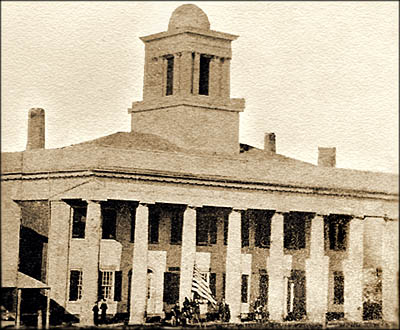
Chardon Court House, Scene of 1834 D. P. Hurlbut Trial
1800-28 |
1829-31 |
1832-34 |
1835-39 |
1840-49
1850-59 |
1860-79 |
1880-99 |
1900-09 |
1910-59
1832-1833
Star Jan 05 '32
Star Jan 12 '32
HudO Jan 12 '32
Star Jan 26 '32
HRef Jan 30 '32
HRef Feb 28 '32
HudO Mar 29 '32
HudO Apr 05 '32
WarNL Apr 10 '32
Star Apr 12 '32
ORep Apr 13 '32
CatTel Apr 14 '32
Auro Apr 19 '32
HRef Apr 24 '32
HRef May 01 '32
HudO Jun 07 '32
Argus Jun 08 '32
ClevH Aug 24 '32
Star Sep 13 '32
Star Sep 27 '32
Atlas Oct 11 '32
Auro Oct 25 '32
HudO Nov 08 '32
Atlas Dec 06 '32
Argus Dec 28 '32
CinJr Jan ?? '33
HudO Jan 31 '33
BWJ Feb ?? '33
WarNL Mar 12 '33
CinJr Mar 22 '33
CTime Mar 30 '33
OEagl Apr 20 '33
ORep Apr 26 '33
OhR Apr 27 '33
Auro May 02 '33
WCour May 09 '33
ORep May 10 '33
GTime May 11 '33
Argus May 17 '33
CinChr May 25 '33
CinGz May 27 '33
Auro May 30 '33
HRef Jun 04 '33
HudO Jun 13 '33
WCour Jul 04 '33
ARep Jul 06 '33
HRef Jul 09 '33
Star Jul 18 '33
OhR Jul 19 '33
Argus Jul 26 '33
CinChr Aug ? '33
WCour Aug 15 '33
WCour Aug 22 '33
OhR Aug 24 '33
ClevH Aug 24 '33
OStJr Aug 24 '33
CTime Aug 24 '33
HRef Aug 27 '33
SCl Aug 28 '33
Star Aug 29 '33
ORep Aug 30 '33
ClevH Aug 31 '33
CTime Aug 31 '33
Advoc Aug 31 '33
Argus Sep 06 '33
CTime Sep 14 '33
GTime Sep 21 '33
ClevH Sep 21 '33
ARep Sep 21 '33
OhR Sep 27 '33
Star Oct 03 '33
Argus Oct 04 '33
CTime Oct 05 '33
WCour Oct 10 '33
AmFd Oct 13 '33
WCour Oct 24 '33
Star Nov 07 '33
HudO Nov 09 '33
Atlas Nov 14 '33
WCour Nov 14 '33
Argus Nov 15 '33
ARep Nov 16 '33
SCl Nov 27 '33
ORep Nov 29 '33
HudO Nov 30 '33
ARep Dec 07 '33
HudO Dec 07 '33
OStJr Dec 11 '33
Star Dec 12 '33
Auro Dec 12 '33
CTime Dec 14 '33
HRef Dec 17 '33
CinJr Dec 20 '33
Advoc Dec 28 '33
HRef Dec 31 '33
1834
WCour Jan 02 '34
Auro Jan 02 '34
DayJ Jan 07 '34
GTime Jan 18 '34
HudO Jan 18 '34
HRef Feb 18 '34
WCour Feb 20 '34
CTime Feb 22 '34
ORep Feb 28 '34
CTime Mar 01 '34
ORep Mar 07 '34
ConGz Mar 15 '34
ClevH Mar 22 '34
HudO Mar 27 '34
HudO Apr 03 '34
DFP Apr 12 '34
Auro Apr 17 '34
HudO Apr 17 '34
ORep Apr 18 '34
WCour Apr 24 '34
ASent May 03 '34
CCol May ? '34
HRef May 20 '34
HudO May 22 '34
Auro May 29 '34
HudO May 29 '34
GTime May 31 '34
HudO Jun 05 '34
Advoc Jun 07 '34
HudO Jun 12 '34
CatTel Jun 13 '34
WCour Jul 03 '34
HudO Jul 03 '34
WCour Jul 10 '34
Atlas Jul 10 '34
Star Jul 17 '34
Auro Jul 17 '34
Atlas Jul 17 '34
HudO Jul 17 '34
ORep Jul 18 '34
HRef Jul 22 '34
WCour Jul 24 '34
Auro Jul 24 '34
HudO Jul 24 '34
Auro Jul 31 '34
HudO Jul 31 '34
ORep Aug 01 '34
GTime Aug 02 '34
Advoc Aug 02 '34
HRef Aug 05 '34
Star Aug 07 '34
Auro Aug 07 '34
HudO Aug 07 '34
HudO Aug 14 '34
CinJr Aug 08 '34
DayRep Aug 12 '34
HRef Aug 12 '34
GTime Aug 16 '34
CinJr Aug 22 '34
HudO Aug 28 '34
HudO Sep 11 '34
CatTel Sep 12 '34
CatTel Sep 26 '34
Articles Index
|
Painesville Tel.
|
Painesville Rep.
|
Gazette/Spec.

L. L. Rice Editor.
Pub. Every Thurs. at Ravenna. $2 per annum.

Vol. III. - No. 1.]
Thursday, January 5, 1832. [Whole No. 105.
MORMONISM.
(The following is the "Commandment," referred to in the communication of Mr.
Ryder, which was published in the Star of last week.)
"A commandment to Joseph and Sidney, Dec. 7th, 1830, saying: Listen to the
voice of the Lord your God, even Alpha and Omega, the beginning and the end,
whose course is an eternal round, the same to-day as yesterday, and forever.
I am Jesus Christ, the Son of God, who was crucified for the sins of the world,
even as many as will believe on my name, that they may become the sons of God,
even one in me as I am in the Father, as the Father is one in me, that we may
be one. Behold, verily, verily I say unto my servant Sidney, I have looked
upon thee and thy works; I have heard thy prayers, and have prepared thee for
a greater work. Thou art blessed, for thou shalt do great things. Behold thou
wast sent forth, even as John, to prepare the way before me, and Elijah, which
should come and thou knew it not. --Thou didst baptize by water, unto repentance,
but they received not the Holy Ghost; but now I give unto you a
commandment, that thou shalt baptize by water, and give the Holy Ghost
by the laying on of hands, even as the Apostles of old: and it shall come
to pass that there shall be a great work in the land, even among the
gentiles, for their folly; their abominations shall be made manifest in
the eyes of all people, for I am God, and mine arm is not shortened: and I
will show miracles, signs, and wonders, unto all those who believe on my name;
and whoso shall ask it in my name, in faith, they shall cast out Devils: they
shall heal the sick; they shall cause the blind to receive their sight, and the
deaf to hear, and the dumb to speak, and the lame to walk; and this speedily cometh,
the great things are to be shown forth unto the children of men; but without faith
shall not any thing be shown forth, except desolation upon Babylon, the same which
has made all nations drink of the wine of the wrath of her fornication; and
there are none that doeth good, except they that are ready to receive the
fulness of my gospel, which I have sent forth to this generation: wherefore, I
have called upon the weak things, they that are unlearned and despised, to thrash
the nations by the power of my spirit, and their arm shall be mine arm, and I will
be their shield and their buckler; I will gird up their loins and they shall fight
manfully for me, and their enemies shall be under their feet, and I will let fall
my sword in their behalf, and by the fire of mine indignation will I pursue them;
and the poor and the meek shall have the gospel preached unto
them, and they shall be looking forth for the time of my coming, for it is
nigh at hand, and they shall learn the parable of the fig tree, for even now
already summer is nigh, and I have sent forth the fulness of my gospel by
the hand of my servant Joseph, and in weakness have I blessed him, and
I have given unto him the keys of the mystery of those things which have
been sealed, even things which were from the foundation of the world, and the
things which shall come from this time to the time of my coming,
if he abide in me, and if not, another will I plant in his stead, wherefore,
watch over him, that his faith fail not, and it shall be given by the comforter,
the Holy Ghost, that knoweth all things. And a commandment I give unto you that
thou shalt write for him, and the scriptures shall be given even
as they are in mine own bosom, to the salvation of mine own elect, for
they will hear my voice and shall see me, and shall not be asleep, and
shall abide the day of my coming, for they shall be purified even as I am
pure. And now I say unto you, tarry with him, and he shall journey with
thee; forsake him not, and surely these things shall be fulfilled. And
inasmuch as ye do not write, behold it shall be given unto him to
prophecy: and thou shalt preach my gospel, and call on the holy prophets
to prove his words as they shall be given him; keep all the
commandments and covenants by which ye are bound, and I will cause
the heavens to shake for your good, and Satan shall tremble, and Zion
shall rejoice upon the hills and flourish, Israel shall be saved in
mine own due time, and by the keys which have been given shall they be led,
and no more be confounded at all. Lift up your hearts and be glad: your
redemption draweth nigh. Fear not, little flock! the kingdom is yours,
until I come. Behold I come quickly; even so -- Amen."
A true copy.
SYMONDS RYDER.
Note 1: The above text differs in places with the 1833 Book of Commandments text. It is possible that,
in some instances, the editor of the Ohio Star may not have followed Ryder's "borrowed" transcript
exactly -- or, that the transcript itself was in some places faulty. See H. Michael Marquardt's The
Joseph Smith Revelations, pages 95-96 for the Book of Commandments version, with paragraphs.
Note 2: Those writers and critics who do not attribute the wording of this document directly to the God
of Israel, generally explain its origin as coming from the mind of Joseph Smith, Jr. If this was indeed
the case, the message of the text becomes somewhat problematical where it reads: "if he [Joseph Smith, Jr.]
abide in me, and if not, another will I plant in his stead, wherefore, watch over him, that his faith fail
not." It must become difficult for any critic to imagine that, at this important juncture in his "prophetic"
career, that Smith would have opened up a divinely authorized means by which he himself could be removed
from the transcendently important office, of the chosen one who holds "the keys of the mystery of those
things which have been sealed." The occurrence of this passage alone should give critics pause who might
otherwise seek to place the text's authorship upon the shoulders of Smith. On the other hand, were it
conceded that the "revelation" was penned by a certain "power behind the throne," who yet maintained some
degree of control over Smith's activities and pronouncements -- then the origin and the purpose of passage
take on a different historical coloration and, perhaps, become more explicable.
|
L. L. Rice Editor.
Pub. Every Thurs. at Ravenna. $2 per annum.
Vol. III. - No. 5.]
Thursday, January 12, 1832. [Whole No. 109.
==> It is a difficult matter, when the columns of a paper have been opened to a controversy, to close them,
and do justice and render satisfaction to both the contending parties. The communication of Mr. Rigdon, in the
paper,
we feel bound to publish, inasmuch as we gave publicity to the preceding
articles to which it refers. We hope that Mr. Ryder will think, with us, that a reply is not called for by
public feeling, and that the matter may here close.
For the Ohio Star.
TO THE PUBLIC.
Having a few weeks since, through the medium of the "Ohio Star," invited SIMONS
RIDER to meet me and investigate the divine authenticity of the book of Mormon, with which
he pretended to have an intimate acquaintance, and which he had pronounced an imposition; willing to
acknowledge every man to be honest, and sincere, till I have evidence to the contrary, so I was willing to
receive Simons Rider in the character which he claimed; but how far myself or the public are bound to receive
him as an honest man, I leave his letter written in reply to my request to testify. If Simons Rider is afraid
to have his assertions put to the test, why make them? If he is certain (as he pretends) that the book of
Mormon is a "base imposition," why be afraid to come forward and prove it? I say -- where is honesty? --
where is candor? surely not in the heart of such a man. Am I to blame for drawing this conclusion? surely
not, for he has forced it upon me. He presented himself before the public as an accusor; he has been called
upon before the same public, to support his accusations; and does he come forward and do it? nay, but seeks
to hide himself behind a battery of reproach and abuse, and low insinuation. He would fain make the public
believe in meeting me to investigate the truth of his accusations, that all the evils of Pandora's box would
be poured out on his head. The words of the Savior of the world are verified in this instance. -- "He that
doeth evil hateth the light, neither cometh to the light, lest his deeds should be made manifest," &c.
Simons, like the worker of iniquity, has sought a hiding place. Let the public remember, when he goes forth
again to proclaim his anathemas against the book of Mormon, that he has been invited upon honorable principles
to investigate its merits, and dare not do it. This is a matter of his own bringing forth; he is at liberty to
believe as he pleases, and I am the last one who would treat him unbecomingly on account of it; but Simons was
not contented with this privilege, but sought to raise himself at the expense of others, (as his conduct
manifests to every man of candor,) he stept forward, and made an attempt to go alone, and thought at the first
step to put his heel upon his neighbor's neck; but I have seen proper to set him back again; and let him now
seek some one to help him until he learns to ponder the path of his feet.
He who is afraid to have his assertions put to the test, let him cease to make them. He who does not defend his
charges gratuitously made against his neighbor's religion when called upon, will do well to set himself down
in his own house, and tell the people, if you will bring your preaching to my house I will do it for you -- I
will investigate privately, but do not bring me before the public. So is Simons conduct; and there I leave him
for the present.
SIDNEY RIGDON.
Hiram, Portage County, Ohio, Jan. 6, 1832.
Notes: (forthcoming)
|
OBSERVER & TELEGRAPH.
NS. - Vol. II.
Hudson, Ohio, January 12, 1832.
No. 46.
SECTARIES AT THE WEST.
The following enumeration of sects in the West is from the Baptist (Illinois)
Pioneer.
Here are Dunkards, known by wearing the beard, by trine [sic - triune?] immersion, universal salvation,
and by receiving all persons of good morals, and who profess belief in Jesus Christ, and agree to obey the rules
of the Society. They are a harmless people, opposed to war, but in other respects submissive to government.
Here are Quakers, or Friends, distinguished by the drab-colored coat, the broad-brimmed hat, and
the plain language of thee and thou, yea and nay. They are also noted for industry, good morals, and a refusal to
bear arms, or perform military duty.
Here are Halcyons, pleading for three
dispensations of religion, as represented by the 'moon,' the 'sun,' and an 'army with banners;'
corresponding to the dispensations of Moses, of Jesus Christ, and the superior dispensation of revelation under
them. In other respects their tenets do not differ materially from those of the sect who call themselves
Christ-ians. At first kneeling down in much water, and having it poured copiously on the head of the
candidate, was their mode of baptising, -- the next was immersion, and finally they now usually dispense with
water baptism altogether.
The next are Dependers, as they were formally called, afterwards Disciples, and finally by the name
of the Church of Christ. They are a species of Newlights, or Christ-ians, and practice immersion on a
profession of faith. In the last particular they are not very strict in examination. A declaration of the candidate
that he believes that Jesus Christ is the son of God, and the savior of men, is generally deemed sufficient. --
Their principle preachers are by the name of Wright.
The Christ-ians, Newlights, or as some call them Schismatics, are the next in order to receive notice.
They are the same heterogeneous class as in other parts, disclaiming all sects in religion, disallowing all creeds
and confessions of faith, except the Bible in its own language, and yet striving to make proselytes to their
opinions. -- In respect to their views of Jesus Christ, much latitude of opinion is allowed and professed, as is the
case respecting other doctrines. Some deny all original sin, and maintain that it is possible for children to be
so trained up as to need no repentance....
Note: The above list of western sects, as compiled by the Rev. Dr. John M. Peck, continues on, including the major
Christian denominations of his day that had members scattered as far west as Peck's field of ministry on the
banks of the Mississippi in Illinois. The Halcyons and New Lights he mentions were more typical of southern Ohio
and northern Kentucky, than of the far western frontier -- so perhaps Peck's definition of "the west" included
all the landscape past Cincinatti, or some similar expanse of territory. He oddly neglects to include the Mormons
in his list; but perhaps Peck had not been to western Missouri and so had not encountered any by the end of 1831.
Within the next two years Peck could not avoid hearing about the new sect in the west, and
in 1839 he informed the readers of the
newspaper he then edited: "In 1833 we wrote a series of articles, which were published [in] a little tract, at
our own expense, and circulated in Illinois to expose the delusions of Mormonism." Peck's "little tract" must have
been one of the very first anti-Mormon publications, but what this lost publication was called and what reflections
it may have contained, are today an historical mystery.
|
L. L. Rice Editor.
Pub. Every Thurs. at Ravenna. $2 per annum.
Vol. III. - No. 4.]
Thursday, January 26, 1832. [Whole No. 108.
MR. BOOTH has sent us for publication a vindication of his character
from the attacks made upon it by Mr. Rigdon, during his late visit to this place. Mr. Booth thinks, very
naturally, that if those who assert the authenticity of the Book of Mormon, are impostors, there would be
no great wisdom in submitting his reputation to the same testimony; as those who are capable of the imposition,
might be corrupt enough to traduce his character, right or wrong. We have already expressed an opinion that
the controversy in our columns may not end without injustice to either party; and as the admission of Mr.
Booth's communication would lay us under obligation to publish a reply, we must respectfully decline its
publication.
Notes: (forthcoming)
|

Vol. ?
Norwalk, Ohio, January 30, 1832.
No. ?
________________
Miscellaneous.
____________
M O R M O N I S M.
From the Ohio Star.
(reprints from Ohio Star of
Dec. 8, 1831)
Notes: (forthcoming)
|
Vol. III.
Norwalk, Ohio, February 28, 1832.
No. 4.
CELEBRATION.
The Centennial Anniversary of the birth day of Washington, was celebrated in this village, on the 22d inst.
[among the toasts given was] ...
By S. Preston, Esq. -- The enlightened citizens of Norwalk -- A strong phalanx against the wiles of
bigoted Priests and Mormon Impostors...
Notes: (forthcoming)
|
OBSERVER & TELEGRAPH.
NS. - Vol. III.
Hudson, Ohio, March 29, 1832.
No. 5.
Origin of the Bible.
Whence came this book? How long has it been in existence? Did it come forth to the world, like the book of
Mormon, in the year of our Lord 1830? Did it emerge from the dark ages? Was it indeed written as Paine has
asserted, "by some monk in a cell?"... (under construction)
Notes: (forthcoming)
|
OBSERVER & TELEGRAPH.
NS. - Vol. III.
Hudson, Ohio, April 5, 1832.
No. 6.
Origin of the Bible.
Again we bring forward the question -- When and where did the Bible originate? --... No impostor, without a
miraculous gift of language, can produce a forgery in a language he does not understand, nor in the peculiar style
of some other age than his own.
The latter attempt has been made by the writer of the book of Mormon, who has lugged into his production all the
haths and dids of King James's day -- but he has made but a sorry business; for his barbarisms and
ungrammaticisms correspond with nothing else that ever was written. The production, instead of bearing internal
evidence of having been written from 1 to 2000 years ago, as is claimed, bears unequivocal marks of having been
written within the past five years -- a miserable attempt at imitation. The writer uses the most ancient English
with which he happens to be acquainted; which, however does not reach back far enough for his purpose by 1500 years...
The scene of Mormon's tale is laid, some of it, in this country; but its geography corresponds with nothing that
was ever known, or heard of...
For the Observer and Telegraph.
TRIUMPHS OF THE MORMON FAITH.
Several verbal statements agree in establishing the following fact.
That on Saturday night March 24th a number of persons, some say 25 or 30, disguised with colored faces, entered
the rooms in Hiram, where the two Mormonite leaders Smith and Rigdon, were sleeping, and took them, together with
the pillows on which they slept, carried them a short distance, and after besmearing their bodies with tar,
applied the contents of the pillows to the same.
Now Mr. Editor, I call this a base transaction, an unlawful act, a work of darkness, a diabolical trick. But bad
as it is, it proves one important truth which every wise man indeed knew before, that is, that Satan has more power
than the pretended prophets of Mormon. It is said that they (Smith & Rigdon) had declared, in anticipation of such
an event, that it could not be done -- that God would not suffer it; that those who should attempt it, would be
miraculously smitten on the spot, and many such like things, which the event proves to be false.
Notes: (forthcoming)
|

Vol. 4. - No. 8.
Tuesday, April 10, 1832.
Whole No. 191.
From the Observer and Telegraph.
TRIUMPHS OF THE MORMON FAITH.
Several verbal statements agree in establishing the following facts.
That on Saturday night, March 24th, a number of persons, some say 25 or 30, disguised with colored faces,
entered the rooms in Hiram, where the two Mormonite leaders, Smith and Rigdon were sleeping, and took them,
together with the pillows on which they slept, carried them a short distance and after besmearing their
bodies with tar, applied the contents of the pillows to the same.
Now Mr. Editor, I call this a base transaction, an unlawful act, a work of darkness, a diabolical trick. But
bad as it is, it proves one important truth which every wise man knew before, that is, that Satan has more
power than the pretended prophets of Mormon. It is said that they (Smith and Rigdon) had declared, in
anticipation of such an event, that it could not be done -- that God would not suffer it; that those who
should attempt it, would be miraculously smitten on the spot, and many such like things, which the event
proves to be false.
Note 1: This story of the tarring and feathering of Joseph Smith and Sidney Rigdon was reprinted from the
April 5th issue of the Hudson, Ohio Observer and Telegraph. The original article
has not yet been located.
Note 2: Although the assault upon Rigdon and Smith was entirely reprehensible, it can be explained as having
been something more than simple "persecution" of the Mormons, for their religious beliefs, by the wicked
"Gentiles." More than likely the midnight mob consisted mostly of LDS apostates, including members of the John
Johnson family, who were enraged at the top Mormon leaders for taking their family farm, etc. into the Church.
The only eye witness account of the actual tarring and feathering was provided by Smith himself -- it is not
necessarily reliable in all its details. As William H. Whitsitt wrote in his biography of Sidney Rigdon, the
attack upon the two Mormon leaders could have a been far worse one, in terms of violence. Its harmful effects
upon Rigdon and Smith have probably been exaggerated in the old LDS faith-promoting literature. Also, the Murdock
twin in the Johnson house, who died shortly after the attack, was probably not exposed that night to the chilling
winter air so long as to have brought on his certain death.
|
L. L. Rice Editor.
Pub. Every Thurs. at Ravenna. $2 per annum.
Vol. III. - No. 15.]
Thursday, April 12, 1832. [Whole No. 119.
DEATH OF A MORMON PREACHER. -- Died in Pomfret, Vt. on
Saturday 7th ult. Joseph H. Brackenbury, a Mormon Preacher. ----- He recently came to this town from Ohio,
in company with one or two individuals of the same society. They preached, exhorted, and with great zeal
and apparent humility, attempted to propagate their doctrines. Two or three embraced their sentiments so far as
to be baptized -- one a Free Will Baptist, the others Presbyterians.
In confirmation of their doctrine and divine mission, they professed to have power to heal the sick, and raise
the dead. It is credibly reported that they attempted twice without effect, to heal a Miss Nancy Johnson, made a
cripple by falling from a horse. She was not healed for lack of faith; but started for Ohio with the Mormons to
obtain more. The company of Brackenbury attempted also to heal him, and since his decease to raise him from the
dead.
Vermont paper.
Note 1: This report was probably copied from the
Mar. 23, 1832 issue of the Burlington
Sentinel. Note: That paper, in turn, took its information from an issue of the New York Fredonia Censor
printed shortly after Elder Brackenbury's death in nearby Pomfret, New York, on Jan. 7, 1831. The
Burlington Sentinel added the faulty information saying that Brackenbury's death occurred in Pomfret,
Vermont. The Palmyra Wayne Sentinel of
Apr. 11, 1832 passed the garbled report
from the Burlington Sentinel, as did Lewis L. Rice's Ohio Star of Apr. 12, 1832. The reprint
by the Wayne Sentinel is particularly unjustifiable -- since the same newspaper had already printed the
correct version of the story on
Feb. 14, 1832.
Note 2: Brackenbury's death was the first known passing of a Mormon missionary in the field. His body was nearly
expropriated by medical students, seeking a cadaver for dissection practice. This event, along with the early
LDS belief in raising faithful members from the dead, led to hushed reports that Elder Brackenbury had been
briefly resuscitated from the jaws of death. The rumors of this miracle remained so strong among the Saints that,
years later, LDS Historian and Apostle George A. Smith questioned the man's surviving relatives as to the
possible truth of the resurrection story.
|

Vol. 17.
Canton, Ohio, Wednesday, April 13, 1832.
No. ?
Mormonism. -- Proposals are issued at Independence, Mo. for
publishing a paper entitled "The Evening and Morning Star," to support the principles of Mormonism.
Notes: (forthcoming)
|
The Catholic Telegraph
Vol. I.
Cincinnati, Ohio, April 14, 1832.
No. 26.
THE ORATORS OF MORMON.
MR. PRINTER— As the press is a medium through which to communicate information for public use, I have sent the
following for that purpose. B. STOKELY.
On Wednesday, the 8th of this month, two strangers called at my house and stated that they were sent by God to preach
the gospel to every creature and said if a number should be convened they would deliver a discourse. On the question,
what is your profession? they answered, the world call us Mormonites: this excited my curiosity, and at early candle
light they commenced an address to the people convened. The substance for which I took down while they were speaking,
and afterwards in conversation.
“We are commanded by the Lord to declare his will to effect his intended purpose. — In 1827 a young man called Joseph
Smith of the state of New York, of no denomination, but under conviction, inquired of the Lord what he should do to be
saved — he went to bed without any reply, but in the night was awakened by an angel, whiter and shining in greater
splendour than the sun at noonday, who gave information where the plates were deposited: - Smith awoke, and after due
preparation and agreeably to the information given by the angel, he went into the township of Manchester, and there,
on the side of a hill, found in a stone box, or a separate space enclosed by stone on every side, the plates on which
the revelation was inscribed. The box in thickness was about 6 inches, and about 7 by 5 otherwise; the plates themselves
were about as thick as window glass, or common tin, pure gold, and well secured by silver rings or loops in the box as
an effectual defence against all weather. Smith, being entirely ignorant of any language but the English, and knowing
that itself in a very imperfect manner was unable to read or decypher a single word — he therefore sent the plates to
the city of New York to be translated by Professor Anthony, who could make nothing of them; — here seemed to be
an insurmountable difficulty.
It was supposed that the language of the plates was Arabic, Chaldean, and Egyptian; but God by his goodness inspired
Smith himself to translate the whole. — Smith, however, not being qualified to write, employed an amanuensis, who wrote
for him — they thus translated about two thirds of what the plates contained, reserving the residue for a future day as
the Lord might hereafter direct. Six hundred years before Christ a certain prophet called Lehi went out to declare
and promulgate the prophecies to come; he came across the water into South America, who with
others, went to Jerusalem [sic - Zarahemla?]: but there they were divided into two parties; one wise, the other foolish;
the latter were therefore cursed with yellow skins; which is supposed to mean the Indians of the Rocky Mountains. —
In 500 years before Christ the wise ones gave a sign, or was to give one, that (there shall be a total darkness two days
and one night, but the people refused to take warning; and when Jerusalem was destroyed, the righteous were saved — all
the teaching of the Mormonites is comprised in this book (their Bible) price one dollar twenty five cents. The greater
part of the people were converted for a time, but were again divided and destroyed 400 years after Christ. The last
battle that was fought among these parties was on the very ground where the plates were found, but it had been
a running battle, for they commenced at the Isthmus of Darien and ended at Manchester. — The
plates state that we shall drive back the Indians to the South and West: with a promise, however, to be brought back in
the fulness of time; and all the unbeliefs existing can never prevent these prophecies from fulfilment. Iniquity will
shortly be swept from the Earth. — Smith, when required by the Lord to translate, read, and publish the plates, excused
himself as being unlearned, and could not even read.
The use of the Mormonite Bible is to connect and fulfil the prophecies of Isaiah; it comes also to fulfil the Scriptures
and to restore the house of Israel to their lawful rights. The servants of this religion will fish and hunt up Israel
and put them into possession of their promised land (The speaker) himself is specially commanded to go forth and warn
the people to flee from the wrath to come — were it not for this injunction he would rather work at the hardest labor.
— They have gone forth like the disciples of old, without money or scrip, taking no thought what they shall say — and
when they are not well received, shake off the dust of their feet as a testimony against the people who thus reject the
Holy Spirit. He has left Father, Mother, Brothers and Sisters, the farm and neighborhood of friends, to declare the will
of God, and the revelation of John who saw the angel flying through Heaven — An angel brought the Mormonite Bible and
laid it before him (the speaker;) he therefore knows these things to be true. Being sent to call on all to repent — he
has come to fulfil the commands of Heaven: he has cleared his skirts of our blood."
I have made some remarks, and given a few particular traits from the Mormon bible "Christ appeared to 3000 and they
all put their hands into his side and believed." (What a host of Thomases.) The books of this Bible are in number 14,
under the following names, viz; 1 Nephi. 2 Nephi, Books of Jacob, Enos, Jarem, Omni, Mormon, Mesiah, Almo, Nephi, jr.,
Mormon, (again,) Ether, and Morni - translated by Joseph Smith, junior, by pure inspiration — certified to be true by
Oliver Cowdry, David Whitmer and Martin Harris, who declare, "That an angel of God came from heaven and brought the
plates and laid them before your eyes and we beheld and saw the plates." — Another certificate is added, signed by eight
more, viz: Christian Whitmer, Jacob Whitmer, Peter Whitmer, jr, John Whitmer, Hiram Page, Joseph Smith, senr. Hiram
Smith, and Saml H. Smith, who declare that J Smith, jr., laid the plates before them, to the truth of which they
certify. — One of the young men called himself Lyman Johnston, from Portage County, Ohio. The other was called Arson
Pratt; no fixed place of abode. They were going North East, intending to preach the gospel to every kindred, tongue and
nation; — They appeared to have little learning, to be sincere in all they said. They had good manners — had been well
raised — were decent and unassuming in every thing I saw, or heard them say. They said what I could hardly believe; "
that John the Revelator was yet alive and about the world." I thought for certain he had been dead for more than fifty
years, and observed that I should be glad to see the old man; to which they made no reply. — Arson Pratt repeating his
reluctance to an initerant life and (but for the mandate of God) he had rather work at any thing else however hard. I
observed perhaps on application he could compromise with Providence get another in his place, and he himself locate —
he made no reply. Mercer Press.
Note 1: According to H. Michael Marquardt,
LDS missionaries: "Lyman E. Johnson and Orson Pratt... were in Franklin,
Pennsylvania. Lyman and Orson started their mission on 3 February 1832 and traveled to Mercer County, Pennsylvania
on 8 February and stopped at the home of Benjamin Stokely in Cool Spring Township. The missionaries then preached
at the courthouse in Franklin, Venango County, northeast of Mercer County, on Saturday, 11 February."
Note 2: Mr. Marquardt cites, in addition to the 1832 report in the Mercer, Pennsylvania Western Press, another
contemporary article, as representative of "1832 Missionary Teachings." The second article came from the pages of the
Franklin, Pennsylvania Venango Democrat of late February, 1832 (as reprinted in the New York
Fredonia Censor of Mar. 7, 1832). Three
other relevant contemporary reports of early 1830s Mormon missionary preaching can be found in the Jacksonville,
Illinois Patriot of Sept. 16, 1831, in
the Hudson, Ohio Observer and Telegraph of
Nov. 18, 1830 and in the Ravenna, Ohio
Western Courier of May 26, 1831. Taken
together, the content of these five newspaper reports to enables the modern student of history reconstruct an outline of
the essential topics covered in very early Mormon proselytizing preaching.
|
THE AURORA.
Vol. I.
Lisbon, Ohio, Tuesday, April 19, 1832.
No. 4.
MORMONISM.
We have received a prospectus of "The Evening and Morning Star," a paper to be published at Independence, Jackson
county, Missouri. It is issued under the name of W. W. Phelps, late editor of the Ontario Phoenix, who left that
paper in consequence of his conversion to the Mormon faith. Mr. Phelps is a man of respectable talents and keen wit;
and we are sorry to see him carried away by this fanatical delusion. We should wish to have his talents engaged in
the cause of truth rather than lost in [furor?] and fanaticism. -- To gratify the curious, we annex a few extracts from
the prospectus before us; they are full of "the sublime and the ridiculous" -- bearing evident marks of madness. --
AntiMasonic Intelligencer.
The Book of Mormon, having already gone to the world, being the fulness of the gospel to the Gentile according
to the promises of the old, we know that the blessing of Joseph is near at hand. For his glory, the firstling
of his bullock, and his horns, the horns of unicorns: with them he shall push the people together from the ends
of the earth, to the place of the name of the Lord of hosts, the mount Zion: For in this mountain shall the
Lord of hosts make unto all people a feast of fat things, a feast of wines on the lees, of fat things full
of marrow, of wines on the lees well refined. And he will destroy in this mountain the face of the covering
cast over all people, and the vail that is spread over all nations; wherefore it is now made known and published
to the world, by the authority of the beloved Saviour, that the gathering of the house of Israel hath commenced
upon the land of Zion, and that the church which is called the church of Christ, is an Ensign to all nations,
that the children of God are returning from their long dispersion, to possess the land of their inheritance, &
reign with Christ a thousand years while Satan is bound. To a man of God, who looks upon the world as it now is,
with nation against nation; kingdom against kingdom; rumor against rumor; revolution against revolution; war
against war; robber against robber; persecutor against persecutor; sharper against sharper; society against
society; sect against sect; and one against another over the face of the earth -- the fear of judgement will
rest upon him, and while he is silent as Heaven, he will hear the groans of eternity over the corruptions of
the world, and with a thrill of compassion which might jar the earth from the sides to the centre, he will watch
the angels receive the great command -- Go reap down the earth!
The Evening and Morning Star, besides the secret of the Lord, which is now with them that fear him, and the
everlasting gospel, which must go to all nations, before the Holy One shall stand upon the Mount of Olivet,
and upon the mighty ocean, even the great deep, and upon the Islands of the sea, and upon the land of Zion,
to destroy the wicked with the brightness of his coming -- will also contain whatever of truth or information
that can benefit the children of God temporally or spiritually in these last days, whether in prose or poetry,
without interfering with politics, broils, or the gainsayings of the world. While some may say this paper is
opposed to all combinations under whatsoever plausible, others will know, that it is for an eternal union whose
maker and supporter is God. Thus all may be as they are, inasmuch as they that plow iniquity, and sow wickedness.
must reap the same -- but wisdom is justified of her children.
==> From this press also, may be expected as soon as wisdom directs, many sacred records, which have
slept for ages.
==> Terms. -- The Star will be issued monthly on a royal sheet quarto, at one $1 a year, till it shall
be deemed proper to publish it oftener. (A supplement will be published weekly, if required, containing the
advertisements of Jackson county, &c.) Letters to the editor must be paid -- and subscriptions, in specie or
United States Bills."
W. W. PHELPS.
February 22, 1832.
Note: The Anti-Masonic Intelligencer was published in Connecticut. It was only one of many anti-Masonic
papers that took notice of W. W. Phelps' publishing venture with the Mormons. Similar reports and/or prospectus
reprints appeared in the Apr. 17, 1832
issue of the Painesville Telegraph and the
May 1, 1832 issue of the Geauga
Gazette.
|
Vol. III.
Norwalk, Ohio, April 24, 1832.
No. 12.
A Mormonite newspaper has been established at Independence, Missouri, by W. W. Phelps, called
"The Evening and Morning Star." In a postscript he says: "From this press may be expected, as soon as wisdom
directs, many sacred records which have slept for ages."
Notes: (forthcoming)
|
Vol. III.
Norwalk, Ohio, May 1, 1832.
No. 13.
Outrage. -- On the night of the 24th ult., 25 or 30 persons in disguise entered the apartments
of Smith and Rigdon, leaders of Mormonism in Geauga county, carried them from their beds and tarred and
feathered them.
Notes: (forthcoming)
|
OBSERVER & TELEGRAPH.
NS. - Vol. III.
Hudson, Ohio, June 7, 1832.
No. 15.
NO. XV. -- TRUTH OF THE BIBLE.
The New Testament witnesses corroborated.
Passing now from the personal character of these writers as witnesses, we advance to the inquiry whether their testimony
is corroborated?... I open a novel or a romance, and I am met by gaudy colorings, fine paintings -- enchanting, high-wrought
descriptions; and I say to myself, this was intended for effect; the writer had an object; he meant to please and
excite the passions.
I open the New Testament. I see nothing like this; all is plain, unadorned statement of facts. There is no effort to make
a plausible story, or finished, forcible, or enchanting description. I am certain they did not aim for effect. It was no
part of their design to sport with human passions. They aimed only to tell the simple tale of truth, and leave it.
I cast a glance at into the pages of the book of Mormon. There, "I Nephi," swells up to view -- the doer and recorder of
some great exploits. There, the great Mormon appears, self-made, and self-praised. I need not say I am disgusted
with such puffing egotism; I will only say the writer had an object to make a hero; or rather to introduce characters who
might make themselves hereos to the best of their ability.
With a pure glow of satisfaction, I turn me back to the New Testament, and trace its wonderful sincerity and simplicity....
Notes: (forthcoming)
|
OHIO ARGUS,
and Franklin Gazette.
Vol. ?
Lebanon, Ohio, Friday, June 8, 1832.
No. ?
Outrage. -- On the night of the 24th ult. twenty-five or thirty persons in disguise,
entered the apartment of Smith and Rigdon, leaders of
Mormonism in Cayuga [sic] county, Ohio, carried them from their beds,
and tarred and feathered them. -- Newark Gazette.
Notes: (forthcoming)
|

Vol. ?
Cleveland, Friday, August 24, 1832.
No. ?
A Mormonite newspaper has been established at Independence, Missouri
by W. W. Phelps, called "The Evening and Morning Star." In a postscript
he says, "From this press may be expected, as soon as wisdom directs,
many sacred records which have slept for ages."
Notes: (forthcoming)
|
L. L. Rice Editor.
Pub. Every Thurs. at Ravenna. $2 per annum.
Vol. III. - No. 37.]
Thursday, September 13, 1832. [Whole No. 141.
PORTAGE COUNTY ANTI-MASONIC CONVENTION.
Pursuant to public notice, the delegates from the several townships assembled at Ravenn, on Wednesday the 12th inst.
The Convention was organized by the election of Col. JOHN E. JACKSON, Chairman, and
EPHRAIM L. WILLIAMS, Esq. and DR. ISAAC SWIFT,
Secretaries -- when the following delegates appeared and took their seats, viz:
Aurora -- John E. Jackson, Chauncey Eggleston, Lamson Hickox.
Charlestown -- A. C. Coe, R. L. Coe, Giles Woodruff.
Edinburgh -- Ebenezer Pierson.
Franklin -- Thomas Earl, T. Wallace, Barber Clark.
Freedom -- M. Barber, G. W. Kneeland, L. Hamilton.
Hudson -- Asahel Kilbiurn, Amos Chamberlin, Owen Brown.
Mantua -- H. Nooney, Caleb Carlton, Horace Ladd.
Nelson -- Richard A. Denison, Elisha Garett.
Northfield -- Henry Wood.
Portage -- Woolsey Welles.
Ravenna -- Daniel W. Jennings, Isaac Swift, C. Prentiss, L. L. Rice.
Rootstown -- Alpheus Gibbons, Solomon Payne,
Randolph -- Elisha Sears, Alpheus Dickinson, Austin Collins.
Stow -- H. W. Butler, Wm. Wetmore, Joy H. Pendleton.
Springfield -- Henry Chittenden.
Suffield -- A. S. Stanley, S. Outcalt.
Shalersville -- David McIntosh, Oliver Crosby, Wm.Thompson.
Streetsborough -- Benajah C. Thomas, Appolos White, J.C. Singletary.
Twinsburgh -- Elisha Loomis, E. B. Vail, Reuben Chamberlin.
Brimfield -- John Andrews, J. V. Gardner, A. C. Andrews.
Tallmadge -- E. R. Sacket, Stephen Upson, Samuel W. Brunson.
Middlebury -- William Slater.
Windham -- Benjamin Higley, John Streator, Ephraim S. Williams.
Whereupon the Convention proceeded by ballot, to make choice of suitable Candidates, to be supported at the ensuing
election. When the following Ticket was chosen, and unanimously adopted:
Congress -- JONATHAN SLOANE.
Senator -- CHAUNCEY EGGLESTON.
Representative -- GREG POWERS, Jun.
Sheriff -- FRED'K WADSWORTH.
Auditor -- SAMUEL FOLJAMBE.
Commissioner -- ELISHA GARRETT.
Coroner -- JOHN V. GARDNER.
The Committee appointed to draft resolutions, reported the following... Resolved, That the end at which we
aim is the prostration of the Institution of Masonry, and that to effect this object it is not only necessary that
men form an opinion of the uselessness and vile tendency of the institution, but that they express this opinion
by the ballot boxes...
Resolved, That Thomas Earl, Woolsey Wells and William Turner, constitute a Committee to prepare an address
to the citizens of this County, appropriate to the ensuing election.
JOHN E. JACKSON, Cj'n.
ISAAC SWIFT,
E. L. WILLIAMS. } Secretaries.
Note 1: The first delegate listed from Nelson, evidently was Dr. Richard A. Dennison of Garrettsville. This is
supposed to be the same Dr. Dennison as was admitted to the Portage Medical Association on
May 26, 1829. It is presumed that this is the same
"Dr. Richard Dennison" listed in Ralph D. Smith's 1877 History of Guilford,
Connecticut, on page 42, where he says: "The following physicians have been settled in North Guilford: ... Richard Dennison,
moved away..." (See also Alvan Talcott and Jacquelyn L. Ricker's 1984 Families of early Guilford, Connecticut, page 1287).
Mark L. Staker, in his 2010 history of Kirtland notes that when a Dr. Richard A. Dennison was admitted as a prisoner to the
Ohio State Penitentiary in 1840, he was "identified as a physician originally from Connecticut."
Note 2: The Ohio Genealogical Society's 1968 Ohio Records and Pioneer Families, (Vol. 9, page 193) mentions a "Richard A.
Dennison" living in Garrettsville, Ohio during the 1830s. Garrettsville's populated area spanned the southern boundary between
Hiram and Nelson townships, in Portage County. The 1830 census tabulation for Nelson shows a "Richard A. Denison" and wife, both
between the ages of 20 and 30. It seems likely that this is the same
Dr. Dennison identified by Luke Johnson in 1858, as
having participated in the 1832 tar and feathering of Joseph Smith and Sidney Rigdon at Hiram. According to LDS Apostle George A.
Smith, speaking in 1864, "Dr. Dennison died in the
Ohio Penitentiary where he was incarcerated for procuring an abortion, which caused death."
Note 3: Although Dennison's name is listed in the 1830 census records, it is missing in the 1840 tabulations. This supports Luke
Johnson's allegation, that Dr. Dennison was tried for a crime, imprisioned, and died (?) in prison. Ohio State Penitentiary lists
show just such an inmate, prior to 1846 (when Johnson first asserted the doctor's early death). The last known mention of
Dennison as a free man occurs in the Lorain Co. Elyria Republican of July 5, 1837. The Ohio State Penitentiary records
indicate that at the time of his pardon, on Sept. 5, 1842, Dennison had "family in Lorraine County, Ohio." Whether he returned
to Lorain County, or truly died near the time of his release date from prison remains undetermined.
Note 4: Dr. Susan E. Black, speaking in 2002, identified the Ohio Dr. Dennison
with Dr. Jo Adam Denison (1774-1855) who was buried in Royalton, Vermont. Although the latter physician may have been present
at the birth of Joseph Smith in Vermont in 1805, he certainly was not the man who participated in the 1832 assault
upon Smith and Rigdon in Ohio.
|
OHIO ATLAS,
and Lorain County Gazette.
Vol. ?
Elyria, Ohio, Thursday, October 11, 1832.
No. ?
Mormonism.. -- We are in receipt of the second number of a Mormonite newspaper, published at
Independence, Missouri, the settlement of that most absurd and singular sect. It is called the 'Evening and
the Morning Star' -- and is handsomely printed in the form [and style] of our largest bibles. The first page
is devoted to the revelations from the Prophet Mormon, and Extracts from the laws for the Government of the
church. -- The second and third contain the pompous vision of 'Joseph and Sidney,' who, 'being in the Spirit
on the 16th of February,' saw the glories of the Celestial, Terrestrial and also the Telestial worlds. This
view, the editor says, is the greatest news that ever was published to man -- showing the economy of God in
preparing mansions for man.' An address to the elders who preach good tidings, cautions them to reason from
the bible. Illustrated by the book of Mormon. Upwards of four hundred have joined the faith, 'since the work
of the gathering commenced.' Fifteen converts were recently made to this strange delusion in Boston. The money
of the members goes into a general fund. The editor advises brethren not to come to 'the land of Zion,' too
fast -- as provisions are scarce, in consequence of the Indians -- 'the remains of Joseph -- being sent to the
west, by the Government, where they must be fed in these last days.' -- Providence Jour.
Notes: (forthcoming).
|
THE AURORA.
Vol. I.
Lisbon, Ohio, Thursday, October 25, 1832.
No. 31.
Mormonism. -- The Boston Traveller says two Mormonite preachers have recently visited this
city, and made about 15 converts to their strange doctrine, who have been baptised and joined to the Mormon
church.
It is stated in one of the papers that these persons contemplated going to the west, and some have already
started for 'the promised land, the place of refuge for the house of Israel and for the Gentile world who
will flee hither for safety," in Jackson county Missouri. Two females who have gone, had acquired by industry,
one 1500, and the other 800 dollars, which they had given up to go into the general stock. The others possess
between 3000 and 4000 dollars, which they are going to put into the general fund, and which they can never
draw out again. "Thus are the people swindled of their property, and drawn from their comfortable homes, by
ignorant fanatics."
The Providence Journal adds, -- We have been told that these strolling fanatics have visited this state and
made some converts to their "damnable heresy."
Note: The first part of this article was previously reported in the Sept. 27, 1832
issue of the Ohio Star. Compare the remainder of the report to what Rev. Joshua V. Himes had to say in
his Aug. 1832 Boston pamphlet,
reprinting Campbell's "Delusions" article: "However strange to relate, about fifteen persons, in this city
have been led away by these false doctrines, have been baptised and joined the Mormon church. And some of these
persons have set out for the promised land, the place of refuge for the house of Israel, and for all the Gentile
world, who will take warning and flee thither for safety (This place is situated in Jackson county, Missouri,
ten miles from the town of Independence). Two individuals who have gone, are defenceless females. They had
acquired by their hard industry $2300, one of them having $800, the other $1500, which they have given up to
go into the general stock. One of these females was in a consumption, and her friends thought she would not
live to reach her destined place. Her afflicted sister told me, that if she had been buried here, before she
had been led away by these errors, and had left satisfactory evidence that she was prepared to die, her grief
would have been far less than it is now. The remaining persons who were baptised and joined the church, and
contemplate going to the west, possess between $3000 and $4000, which they also are going to put with the general
fund, and which they can never draw out again, should they get sick of Mormonism and wish to return home to
their friends."
|
OBSERVER & TELEGRAPH.
NS. - Vol. III.
Hudson, Ohio, November 8, 1832.
No. 37.
ANOTHER ROBERT MATTHIAS.
The Hillsborough (Ohio) gazette says: -- A Mormon preacher, at Marietta, Ohio, has published a pamphlet in which
he asserts, that "he is the great comet which has come to burn up the world" -- "that he is brother to the Emperor of
China," &c. He recommends something which he calls his "Elements of Astrology." to the people, and says they have been
revised by 72 of the most learned men in the United States, that he intends to have them stereotyped, the plates desposited
in every city on earth, in a pyramid, on which is to be kept burning an eternal fire, with a priest and priestess in
continual worship. He signs himself "Edward Postlethart Page, Emperor of the World."
Such superlatively transcendant foolishness propagated at this enlightened day, is sufficient to draw a blush over the
cheeks of those who boast of our national character.
Note 1: The comet referred to in this report was not Halley's Comet, which appeared in 1835. Instead, this was the
"Comet of 1832." The heavenly visitor inspired a French song-writer to pen these words in 1832: "God is sending
a comet against us. -- We shall not escape this great impact. -- I feel our planet crumbling already." There is
no Mormon "pamphlet" known to date from as early as 1832, (with or without a mention of divinely dispatched
comets).
Note 2: See the Nov. 17, 1832 issue of
the NYC Working Man's Advocate for further details on Edward Postlewayt Page, the human "comet" of Marietta, Ohio.
|
OHIO ATLAS,
and Lorain County Gazette.
Vol. ?
Elyria, Ohio, Thursday, December 6, 1832.
No. ?
THE MORMONS.
We have perused a pretty long and probably true account of this singular people, and their location in Mount
Zion, contained in a letter published in the Christian Watchman from B. Pixley, and dated Independence, Jackson
county, Mo. October 12th, 1832, the very seat of the New Jerusalem. His account of their situation and prospects
is not very flattering. About 4 or 500 Mormons -- men, women and children, have collected at Zion. -- Their
possessions are small compared with their numbers, being only about four Sections of land. Twenty acres is the
portion assigned for each family to improve, but they are to hold no property should they leave the community.
Mt. Zion is not elevated, and the settlement resembles "new beginnings" generally in the west. They are
represented as already suffering for the necessities of life, and by [squalid] poverty preparing for the
reception of their expected Saviour. Their creed appears to have undergone but little change. Originally members
of almost every sect, they now cordially unite in detesting all, save Mormons. They all pretend to the gift of
miracles, of tongues, of healing the sick, visions, &c. though, like all other modern miracles, often told, but
never seen. Their Prophet, Smith, is now busy in restoring the present Bible to its primitive purity, and
in adding some lost books of great importance. A new Revelation is also forthcoming. -- Elder Rigdon, pretty well
known in this vicinity as an arch apostate, is now the first, best, and greatest preacher in Mount Zion. The
Mormons still profess to talk with angels, visit the third heaven, and converse with Christ face to face. --
Their form of baptism is changed to "I, John the Messenger, baptize thee" &c. The gift of imparting the Holy Ghost
is yet professed.
They pretend to have discovered where the Ark of the Covenant, Aaron's rod, the pot of Manna, &c., &c., now
remain hid. At no distant period, they expect Christ will re-appear to live and reign on the earth a thousand
years.
Such are the present Mormons, and such is their New Jerusalem. We believe their society numbers something more
than 100 souls in this County, many of whom intend removing to Mount Zion in the Spring. With Mormonism and its
history in this County, we are not strangers. It was introduced by a few illiterate disciples of Joseph Smith,
in the Summer of 1831, a time when religious excitements were the order of the day. A sort of revival enthusiasm
pervaded many neighborhoods, and wherever Mormonism obtained a footing, it spread like wild fire. -- Scores were
awakened, converted, baptized, and endowed with the Holy Ghost in a few hours at a single meeting, in the midst
of shoutings, wailings, fallings, contortions, trances, visions, speaking in unknown tongues, and prophesyings,
that require the pen of a Trollope to describe. The timid were frightened, the credulous believed, and we were
frequently eyewitnesses to scenes of strange and unnatural conduct of Mormons professedly under the influence of
the spirit, that staggered the disbelief of the most stable and incredulous. But the storm passed, a calm followed
-- reason triumphed -- and Mormonism waned.
As a curiosity, we have carefully examined the Golden Bible, and pronounce it not even "a cunningly devised
fable," Every page bears the impress of its human authorship. Though free from vulgar obscenities, it is an
absurd collection of dull, stupid and foolishly improbable stories, which no person, unless under the influence
of powerfully excited feelings can mistake for truth and inspiration. --
With its authors, the Book of Mormon cannot survive this generation. The next will remember it, only to smile
at the credulity of the present.
Note 1: This article contains a mixture of local information from Lorain county, Ohio and other information
derived from the reports of Rev. Benton Pixley of Independence, Missouri, whose first letter on the Mormons
was published in the Boston Christian Watchman of Dec. 12, 1832. A condensed reprint of the
Ohio Atlas article was published in the Newark (Ohio) Advocate of Apr. 13, 1833 and the
Indiana Democrat of May 4, 1833.
Note 2: For more Pixley's letters and news reports derived from his letters, see: the
Missouri Intelligencer of Apr. 13, 1833, the Dayton (Ohio) Journal & Advertiser of Apr. 23, 1833
and the Cincinnati Journal of Dec. 20, 1833.
|
OHIO ARGUS,
and Franklin Gazette.
Vol. ?
Lebanon, Ohio, Friday, December 28, 1832.
No. ?
Ain't he a "H-----r?" -- A Mormon preacher at Marietta, Ohio, has published a pamphlet in which
he announces that he is the Comet!!!
Note 1: The comet referred to in this report was not Halley's Comet, which appeared in 1835. Instead, this was the
"Comet of 1832." The heavenly visitor inspired a French song-writer to pen these words in 1832: "God is sending
a comet against us. -- We shall not escape this great impact. -- I feel our planet crumbling already." There is
no Mormon "pamphlet" known to date from as early as 1832, (with or without a mention of divinely dispatched
comets).
Note 2: See the Nov. 17, 1832 issue of
the NYC Working Man's Advocate for further details on the human "comet" of Marietta, Ohio.
|

Vol. VI.
Concinnati, Ohio, January ??, 1833.
No. ?
MORMONISM.
Many of our readers will be surprised to learn that this fanatical sect is making considerable progress in this city
and its vicinity. -- Their success here shows, conclusively, that we have a class of community, who from their
ignorance and degradation offer an easy prey to those who lie in wait to deceive. We had hoped, when Mormonism first
broke out among us, that its converts would not exceed some half a dozen who might as well be one thing as another.
But our expectations have been disappointed. We have placed too high an estimate on the moral intelligence of the
community. We had not appreciated the influence which a few artful indefatigable men can exert upon the unsuspecting
and credulous. Probably one hundred may now be numbered among the Mormon converts. Almost without exception they are
ignorant and fanatical. Of the sincerity of most we have no doubt. The hypocrites who receive communications
from Heaven -- work miracles -- make laws -- and take charge of all the property of all their members, reside at
Independence, in Missouri. They are the individuals who found and translated the golden plates, from which the Mormon
Bible is constructed. They issue, semi-monthly, a publication, in which may always be found two or three articles
headed visions, revelations, &c. -- These articles are filled with the most blasphemous pretensions. The leaders
keep a steady eye on the success of the money making scheme, and when they give laws, like Mahomet, they do it on the
authority of immediate revelation. -- These pretended revelations, published by their adherents, through the medium
of their periodical, control the faith and practice of all the members of the society. In this most unrighteous manner,
the Mormon prophets hold their adherants in mental and moral slavery -- strip them of their hard earnings -- separate
wives from husbands, and husbands from wives, and tear the honest farmer or mechanic from his comfortable home, that
they might fatten on his labor, when in obedience to their will he shall put himself in their power at Independence.
Note: The exact date and content of the above article have not yet been determined. The text is taken from a reprint
published in the Hartford Christian Secretary of Jan. 26, 1833. A partial reprint (missing the last 2/3 of the text)
was also printed in the Hudson Observer of Jan. 31, 1833.
|
OBSERVER & TELEGRAPH.
NS. - Vol. III.
Hudson, Ohio, January 31, 1833.
No. 49.
MORMONISM.
Many of our readers will be surprised to learn that this fanatical sect is making considerable progress in this
city and its vicinity. Their success here shows, conclusively, that we have a class of community, who from their
ignorance and degradation offer an easy prey to those who lie in wait to deceive. We had hoped, when Mormonism
first broke out among us, that its converts would not exceed some half a dozen who might as well be one thing as
another. But our expectations have been disappointed. We have placed too high an estimate on the moral intelligence
of the community. We had not appreciated the influence which a few artful indefatigable men can exert upon the
unsuspecting and credulous. Probably one hundred may now be numbered among the Mormon converts. Almost without
exception they are ignorant and fanatical.
Notes: (forthcoming)
|
Baptist Weekly Journal
of the Mississippi Valley.
Vol. ?
Cincinnati, Ohio, February ?, 1833.
No. ?
MORMONITES,
IN THEIR PROMISED LAND.
____
SHAWNEE MISSION, INDIAN TERRITORY,
Dec. 20, 1832.
My dear brother [John] Stevens -- I arrived here the first day of last June, soon after which we began our buildings. They are
now completed, and some children have learned the alphabet, with a rapidity not more than equalled by the whites. We are striving
to preach Christ, among them, where he was not before named; we have a small church here, and usually have meetings each Lord's
day. The prospects of our beloved brethren, missionaries in the south, Lewis and Davis, the latter of whom is a Creek Indian and
Baptist preacher, are very flattering. Our Much esteemed brother Wilson has left this [place], about one week since for the
Choctaw nation, of whom we have not since heard, but we pray God, to conduct him safely to the place of his destination.
Among the wonders of the present day, you may record the following. Many of the people called Mormons, have arrived at this place,
and it is said, more are on the way. The condition of those that are here, must be very unpleasant, and their sufferings are,
in no small degree, from the want of comfortable houses, and something on which to subsist. Their settlement extends to the West
line of Missouri State, two miles and a half from this place; they manifest a disposition to, and no doubt soon would, go among
the Indians, were they permitted; which by the way is not the case. They call this place the Mount Zion, or New Jerusalem, so often
spoken of in Scripture; -- though it is not more elevated than the common face of the country, nor yet is there in it any thing
strange or peculiarly prepossessing in its favor, more than any other portion of the West.
Here, they tell us, will be gathered the Gentiles from the east, and the Jews (the Indians) from the west, to their temple, which
shall subsequently be built on the very spot now selected by them, to which, they say, their God will come in person, destroying
all who shall be so daringly wicked, as to reject their Gospel; when Christ comes, which at most will not be more than fifteen years,
he will bring all the Apostles, and old saints, and will reign with them here a thousand years; during this reign, the rest of the
dead, shall not live (that is, all who are not Mormons,) for this is the first resurrection. To support the idea of their Christ
suddenly coming to their temple, to purify and refine them, they read Malachi, 3d chapter to the 6th verse inclusive, with other
Scriptures found in Zephaniah, Zechariah, and elsewhere, all of which refer to the coming of Christ.
They have a revelation of their own, which, they affirm. was given to the people of this continent, (the Indians,) on plates and
deposited in the earth and kept concealed in the earth of the Lord, till the fulfilment of its time, which has now been accomplished;
and to prove that Joseph Smith is that wonderful prophet, to whom these marvelous plates and their profound mysteries should be
revealed, they recite the 29th chapter of Isaiah, saying that the prophet Smith is that unlearned man, to whom the book was given,
to read, and he said I cannot, for I am not learned! But this difficulty was soon removed by the spirit which came upon him, and
blest him with the gift of tongues. The Book then was clearly opened to his understanding, and he translated it to one of the witnesses,
who wrote it in our language. Thus according to the 37th chapter of Ezekiel, say they, the sticks there spoken of, (the Mormon book
and our Bible,) are become one, in the hand of the prophet Smith; or shall, when our Bible shall be rightly translated by him, under
the outpouring of his holy spirit, and its directions. Every person, who tells them that he wishes to forsake sin, is, without further
ceremony, taken by the Elder, and baptized for the remission of his sins; he is now told that he shall soon receive the spirit; this
being accomplished, the Elder lays his hands on him, and imparts to him his holy spirit, which they say they then feel immediately,
and know that it is the truth. The Elder now sings to the new converts, consecrating songs of their own diction, (composing,) and to
them he reads prophecies about giving their possessions to the Lord's store, which if they fail to do, they forfeit the fellowship of
the fraternity, nor will they long be considered worthy members with them. When their property is thus laid at the Bishop's feet, he
places it in the store, and they lose sight of it forever; their store-keeper will not trust them for a single dollar, though he
willingly gives credit to others.
If the brotherhood is once taken, and any should choose to leave them, he must go out empty, however much he had deposited in the
Treasury. Much is said among them about the Holy Ghost being given, by the laying on of the Elder's hand, about prophecying, healing
the sick, and the interpretation of tongues; all this however they carefully avoid, saying that these things can only be done, when
they are in the spirit, which perhaps but seldom happens in this land of pilgrims; since no miracles have been done here at any time
by them, though greatly needed, and they have been abundantly pressed to it. They eat, they drink, are sick, and die, as all others
do. When they are sick, unfortunately, they have not faith to be healed. Of the dying they say, their work is done, they must go:
they also say, it is self-evident that disease is the natural effect of unbelief. If this be true, I am sure, their faith cannot be
as large as a mustard seed, for none are more liable to sickness, and all contagions than themselves, the cholera not excepted, even
among their preachers. Perhaps when their Christ comes, and brings their old Apostles and saints, some of them may profess more power
and faith than these, that are already here; if this should not be so, I shall finally despair of seeing miracles done by them.
Although they have prophesied, the graves have not yet opened: the bones are yet dry, nor are they yet collecting; we have heard
no voice in the valley; we know some have professed, but nothing is moved; if others have spoken to the winds they have not obeyed
them; there are no symptoms of life among the slain, all these things continue, just as they were.
Let none be anxious, or burn with desire, to set their faces for the mount (or rather I would say for the Valley Zion,) of the west,
supposing they will see the Lord in person, for he is not here; nor will they live more holy, more free from temptation, or sin, in
this land of pilgrims, than any other place. Let me say once for all, that if any come hither, whether they expect it or not, they will
be sure to meet all if not more than all, the difficulties that emigrants to other new countries meet. Of these the Mormons have their
share.
Dear brethren, while evil men and seducers are waxing worse and worse, deceiving and being deceived, whose coming is after the workings
of Satan, in all power, signs and lying wonders, whom the Lord will consume, with the breath of his mouth, and destroy by the brightness
of his coming; let us remember the appropriate admonition of the good old apostle of our Lord; Be ye therefore steadfast, unmovable,
always abounding in the work of the Lord. -- Though earth should be removed, and the mountains should melt, let no Christian fear, for
strong is the Lord, in whom we have trusted; and he is yet able to deliver us; to him we may look from the furnace of affliction, from
the lion's den, and from the mountains of the leopards. To us he has also said, as I live, so shall ye live with me, for by his power
we are kept through faith unto salvation; and as we are passing through all the obstructions of the way, the exceeding great and precious
promises are the staff, on top of which we may safely lean; for they will support our fainting souls, while we are confessing, that we
are but strangers and pilgrims, in the earth. How sett the contemplation is, that our toilsome journey will soon end; and while we
are struggling in the dark valley, the Lord's hand will afford us comfort, and will support us. This hope is an anchor to our souls,
both sure and steadfast, entering and taking hold of Jesus within the veil. -- Unto this grace we have access, and here we may stand
and rejoice in the hope of the glory of God.
False Christs and false prophets, our Lord told us, would come, showing signs, and wonders to deceive, if ppossible the very elect;
perhaps they may tell us, he is in their temple or their secret chamber, but let us not believe them; if they say, he is in the desert,
let us not go forth; for our Lord will not come, to dwell in temples, or in secret chambers, or deserts, but as the flash of lightning,
he will come to execute judgment upon all.
Anticipate the happy moment, when your Lord, who is gone to prepare a place for you, will come again, to take you to himself; it is
cheering too, to reflect that death will then be lost in victory; and all our pains and suffering, in pleasures and delight; and our
grief, in everlasting joy. What is so animating and cheering as the Christian's hope? It comforts him through life; by it he triumphs
over death, the grave, and all its terrors; it never leaces its possessor, till he arrives in sight of his long desired home, when
his eyes shall ever gaze upon the dear object of his love, who died for him, and rose again to die no more.
I am, my dear sir, most affectionately yours.
ALEXANDER EVANS.
Note 1: The exact date and content of the above article remain undetermined. The text is taken from a reprint published in the
Hartford Christian Secretary of March 30, 1833. An excerpt (lacking the final five paragraphs) was featured in the Boston
Christian Register of Apr. 6, 1833, under the title of
"Mormonites." The published letter (addressed to John Stevens, editor of the Baptist Weekly Journal) is a very rare and
obscure first-hand report from the Mormon "Zion" of 1832. No additional reprints have yet been located.
Note 2: Missionary Alexander Evans' December 1832 letter originated from the Baptist Shawnee Mission, in what is now a southwestern suburb
of Kansas City, Kansas. In form and content the article much resembles a letter of the Presbyterian missionary, Rev. Benton Pixley, written
at Independence, Missouri, Oct. 12, 1832 and subsequently printed in such eastern papers as the Boston Christian Watchman of
Nov., 1832, the Boston Independent Messenger of Nov. 29, 1832
and the Cincinnati Journal in March of 1833. Because of the similarity in content and style, Evans' letter has occasionally been
attributed to Pixley (in its Christian Register appearance, where no signature or attribution was printed). The Dec. 20, 1832 letter
is not Pixley's and should not be cited as his correspondence.
|
Vol. 5. - No. ?
Warren, Ohio, Tuesday, March 12, 1833.
Whole No. ?
From Col. RAVEN, of Youngstown, we have received the following communication, with a request
to give it publicity. We cheerfully insert it and would suggest to our brother editors the propriety of extending
its circulation as widely as possible.
FREEDOM, Cattaraugus Co., Feb. 23, 1833.
Dear Sir:
There is now in this vicinity with Heman Hyde, Esq., a young woman apparently about 20 years old;
light complexion, light hair, large eyes, coarse, or rather large features, hair short, with a light thin
dress of calico, and no bonnet. She is apparently insane, yet modest and rather taciturn. She conceals or
has forgotten her own name and place of residence, though she often speaks of Youngstown, of Elder Benton,
and has mentioned Rigdon. She is a good reader and has the appearance of having come from a good family,
and having been accustomed to good society. Her friends, if she has any, doubtless are now lamenting her
unpleasant situation and untimely elopement, and would deem it an act of humanity to be notified where she may
be found. She is now in a good family and will meet with no other than humane treatment while she is pleased
to remain under their hospitable roof. I hope, sir, you will make such inquiry as you shall deem most proper.
If you know not the person of whom I write, would it not be well to give the above facts some publicity in your
vicinity, your county, adjoining counties and your State?
Yours Respectfully,
W. A. COWDERY, P. M.
Freedom, Cattaraugus, Co., N. Y.
WM. RAVEN, Esq.
Note 1: This curious communication (also published in the Ohio Star) appears almost inexplicable at
first look. However, the insertion of Elder Bentley, for Elder Benton, helps clear up the mystery.
Adamson Bentley was a Campbellite minister in Warren, near Youngstown and the "apparently insane" "young woman"
was evidently one of his parishioners, neighbors or acquaintances from Trumbull Co., Ohio. The "Rigdon" here
referred to was perhaps the Rev. Sidney Rigdon, one of Elder Bentley's brothers-in-law. Rigdon and Bentley had
not been on speaking terms since Rigdon's defection to the Mormon cause, about 27 months earlier. But the
wandering woman may have recalled Bentley and Rigdon being in close connection from a time before Rigdon's
Mormon baptism on Oct. 8, 1830.
Note 2: The above reproduced communication is evidently one passed between the Postmaster of Freedom, New York
and the Postmaster of Youngstown, Ohio. Warren A. Cowdery, the writer, had a brother, Erastus Cowdery, then
living near Youngstown, but Erastus is not mentioned in the letter. Perhaps Warren sent a separate letter to his
brother and could get no satisfactory answer. It is also worth mentioning that Sidney Rigdon lived near Erastus
Cowdery, just north of Youngstown, 13 years before this notice appeared. The wandering girl may have been one of
Rigdon's (or Bentley's) Baptist parishioners from the 1820s, (but, by 1833 both the Rigdon and Bentley families
were living in Geauga Co., Ohio, rather than in the Warren area).
Note 3: Heman Hyde, Sr. (1788-1869) lived very near
Warren Cowdery (1788–1851) in Freedom twp,
Cattaraugus Co., NY. He was baptized a Mormon on
Mar. 11, 1834 by Parley P. Pratt and Joseph Smith, Jr., about a year after this notice was published. In 1833 his
neighbor, Warren A. Cowdery, was already a Mormon, having been baptized in Nov. 1831 (see Lyndon Cook's 1981 book,
Revelations of Joseph Smith, pp. 214-15). By March of 1832 Warren would have obviously known that Sidney Rigdon
was a high LDS leader, living in Kirtland Ohio. Since Warren does not mention Sidney by name, it is possible that the
"Rigdon" he speaks of in his letter was one of Sidney's cousins -- who, in 1833, were Campbellite ministers in Ohio,
and who were then still on good terms with their co-religionist, Rev. Adamson Bentley.
Note 4: It is unlikely that the term "elopement" in the article refers to anything other than "disappearance."
Civil records show that the Heman Hyde, Jr. ("Heman Tilton Hyde") was married to another woman, Eunice Sawyer,
two years later. His father had long been married to Polly Wyman Tilton Hyde. No other records indicate the mysterious
young woman's identity; evidently she found her way home again.
|
Vol. VI. - No. 12.
Friday, Mar. 22?, 1833.
Whole 245.
(By Request.)
The writer of the following is a clergy man of the Baptist church, and his statements may be relied upon
as certainly correct. We would commend his letter to the special attention of those Mormonites in this city
who expect soon to start for Mount Zion. Before they give up their property, and tear themselves from their
homes, would it not be well to inquire into whose hands they are likely to fall?
From the Christian Watchman.
MORMONISM.
SIR, -- Dwelling as I do among a people called Mormonites,
and on the very land which they sometimes call Mount Zion, at other times the New Jerusalem; and where, at no
distant period, they expect the re-appearing of the Lord Jesus to live and reign with them on earth a thousand
years, -- I have thought that it might be a part of duty, to inform those who may feel interested in relation
of this subject, that although there has, from first to last, four or five hundred Mormonites in all -- men,
women, and children -- arrived at this place, yet there is no appearance here different from that of other
wicked places. The people eat and drink, and some get drunk, suffer pain and disease, live and die like other
people, the Mormons themselves not excepted. They declare there can be no true church, where the gift of
miracles, of tongues, of healing, &c. are not exhibited and continued. -- Several of them, however, have died;
yet none of them have been raised from the dead. And the sick, unhappily, seem not to have faith to be healed
of their diseases. One woman, I am told, declared in her sickness, with much confidence, that she should not
die, but here live and reign with Christ a thousand years; but unfortunately she died, like other people, three
days after. They tell indeed of working miracles, healing the sick, &c. &c. -- These things, however, are not
seen to be done, but only said to be done. People, therefore who set their faces for the Mount Zion of the West,
(which by the by is on a [site] of ground not much elevated,) must calculate on being disappointed, if they
believe all that is said of the place, or expect much above what is common in any new country of the West.
They profess to hold frequent converse with angels; some go, if we may believe what they say, as far as the
third heaven, and converse with the Lord Jesus face to face. They baptize, saying, 'I, John, the Messenger,
baptize thee,' &c.
More secretly, they are said to impart to their converts the gift of the Holy Ghost. They profess to know where
the ark of the covenant, Aaron's rod, the pot of manna, &c. now remain hid. They who can believe all this, will
no doubt expect a Saviour soon, and without hesitation will worship the first object that may be proclaimed and
presented to them for that purpose.
The last preaching I heard of theirs was a most labored discourse; its object was to prove that this place here,
fixed upon by the Mormons as their location, is the very Mount Zion so often mentioned in Scripture. This alone,
it should seem, would be a sufficient index to the head or the heart of the preacher, and the belief of it a
sufficient index to the reading and understanding of the hearers.
Their possessions here are small, very small compared with their numbers; something less, I believe, than four
sections of land, which would cost but little more than three thousand dollars. -- Twenty acres is the portion
assigned for each family to use and improve while they continue members of the society; but if they leave, they
are to go out empty. Some in comfortable circumstances at the East have spent or given to the society their
little all in coming to this land of promise, and now find themselves in no very enviable circumstances, looking
here and there for labor, and women going to wash for their neighbors of the world, to supply themselves with
the necessaries of life.
The idea of equality is held forth; but time will show that some take deeds of property in their own name, and
those too of the most zealous and forward in the cause and prosperity of the society. -- And perhaps they do not
pretend, like Annanias and Sapphira, to have given all to the society; yet it is a point of duty they most
rigidly enjoin on all their proselytes to cast their all into the common stock. Under these circumstances, it
needs no prophetic eye to foresee that there will soon be a murmuring of the Greeks against the Hebrews. Indeed
there already begins to be some feeling and some defection arising from this subject. There is much reason to
believe they cannot hold together long. With Theudas, it is more than probable they will soon be scattered and
brought to naught.
The very materials of which the society is composed must at length produce an explosion. Yet judging from the
past, and from what our Saviour has told us of the future, that there should be false Christs and false Prophets,
showing signs and wonders so as to deceive, if it were possible, the very elect, we may well look on this new
sect as ominous of the latter day approaching, & calling upon all to watch and pray, and to give good heed to
the word of our Saviour, where he says, 'Go ye not after them, nor follow them.' Yours, &c.
B. PIXLEY.
Independence, Jackson co. Mo.
Oct. 12, 1832.
STILL LATER FROM MOUNT ZION.
After the above was in type, we received by mail, the subjoined letter from brother Pixley. -- We thank him
for his communication. It may open the eyes of some worthy, but deluded persons, before they take a step hard
to recall. As it is said some thousands in the United States, have embraced Mormonism, and as 50 or 60 of these
are in our immediate vicinity we shall be excused for paying so much attention to this subject.
Independence, Jackson co., Mo.,
March 4th, 1833.
To the Editor of the Cincinnati Journal.
SIR. -- As I noticed not long since the success of the Mormons in obtaining converts in your
city; it might not perhaps be uninteresting to your readers, and especially to the Brotherhood, to know
how they prosper here. Last Friday we had a novel case. A member of the Mormon communion sued the Bishop in
order to recover certain moneys sent to him, the said Bishop, from Ohio, by the plaintiff, for certain objects,
which the plaintiff said, had not been fulfilled. It appeared in evidence that the plaintiff had subscribed &
paid on a certain subscription paper fifty dollars, 'to purchase an inheritance for himself and for the
saints of God in Zion in these last days.' The Bishop, as evidence in proof that he had faithfully discharged
his trust, produced deeds, and certificates; showing that he had bought lands as had been expected, but
unhappily in his own name, to his heirs and assigns, and to those who had paid their money to buy these lands,
no possession was given, except to occupy some little portion of these grounds, (generally about 20 acres to
the family) while they should behave themselves well and conform to the regulations of their church. But if they
ceased to do this, the poor privilege of living on the lands would be denied them, and they would be ejected
from their tenements, empty and destitute. Such an inheritance the plaintiff seems not to have been well pleased
with, and I scarce need tell you the Jury brought in a verdict in his favor. I understand several others on this
decision stand ready to make similar demands on the Bishop. So you see our Zion is like to be turned to a Babel,
and all their miracles & speaking with tongues, to result in Babel confusion. Tho', by the by, we have no miracles
wrought here. They were all done in Ohio. And in Ohio, I suppose, it is understood they are all done here. But
for those who are determined to join this sect at all hazard, and come to this place, I have only this piece of
advice; that while they give of their property to the Bishop 'to purchase an inheritance for the saints of God
in Zion in these last days,' that they be sure and keep back enough to purchase and possess a little home of
their own, independent of the Bishop, for their own heirs and not for his, and that they receive also enough
to purchase at least one year's provision. By doing this, much suffering and many evils will be avoided, which
others have already experienced.
B. PIXLEY.
Note 1: No original of the above Journal article has been located to confirm its date. The text was taken
primarily from its reprint in the Batavia, Ohio Chronicle of the Times, of Mar. 30, 1833.
The first letter in the article was initially published in the Boston Christian Watchman about the middle of
November, 1832 and reprinted in the Boston Independent Messenger of
Nov. 29, 1832
The Rev. Benton Pixley was a well known Presbyterian missionary who spent several years with the Osage
Indians along the shores of the Missouri. He was living in Jackson Co., Missouri in 1832-34 when the Mormons were
gathering to that area and experiencing various difficulties there. Pixley wrote several informative letters
regarding the Mormons, to various newspapers during the early 1830s. Pixley's two letters (his first and third from
Missouri) were published in the Cincinnati Journal on either March 15th or 22nd -- probably March 22nd is the
correct date.
Note 2: The following section of text (found in some reprints of Pixley's first letter, to the Christian Watchman)
was left out the Cincinnati Journal's reprint (or at least left out of its copy in the Batavia paper):
"Of the Mormons as a sect, I am prepared to say little, except that they seem to be made up of people of every
sect and kind, Shakers, Baptists, Methodists, Presbyterians and Campbellites, and some have been two or three of these
different sects before they became Mormonites. Their best prerequisite for the reception of their expected Saviour, it
should seem for the most part, is their poverty. There is no doubt but that some suffer for want of the necessaries of
life, and in this respect not a little imitate the good Lazarus. But they have no fellowship for Temperance societies,
Bible Societies, Tract Societies, or Sunday school societies. Their first, best, great and celebrated preacher, Elder
Rigdon, tells us the Epistles are not and were not given for our instruction, but for the instruction of people
of another age and country, far removed from ours, of different manners and habits, and needing different
teaching; and that it is altogether inconsistent for us to take the Epistles written for that people, at that
age of the world, as containing suitable instruction for this people, at this age of the world. The gospels, too,
we are given by them to understand, are so mutilated and altered, as to convey little of the instruction which
they should convey. Hence we are told a new revelation is to be sought; is to be expected; indeed is coming
forthwith. Our present Bible is to be altered and restored to its primitive purity, by Smith, the present prophet
of the Lord, and some books to be added of great importance, which have been lost.
Note 3: Some other papers publishing part or all of Pixley's first (Oct. 12, 1832) letter include: the
Boston Independent Messenger of
Nov. 29, 1832 and the Missouri Intelligencer
of Apr. 13, 1833. Shortened versions of Pixley's first letter were published in papers like the
Apr. 23, 1833 issue of the Westfield, NY American
Eagle. Pixley wrote a final letter regarding the Mormons, on Nov. 7, 1833, addressed to the New York Observer, which
published it on Dec. 7, 1833. This last letter was reprinted
in the Christian Register of Dec. 21, 1833.
Note 4: The Bapist missionary, Alexander Evans, wrote a letter in Dec., 1833 to the Baptist Weekly Journal, which
was featured in that paper under the title, "Mormonites." A partial reprint of this letter was published in the Boston
Christian Register of Apr. 6, 1833.
Evans' letter (left unsigned in one reprint) has occasionaly been mistakenly attributed to Pixley.
|
CHRONICLE OF THE TIMES.
Vol. VII. - No. 15.
Batavia, Ohio, March 30, 1833.
Whole 327.
(reprints Cincinnati Journal article (above) with Pixley letters.)
Notes: (forthcoming)
|
Vol. XVIII.
Canton, Ohio, Friday, April 26, 1833.
No. 51.
Another Joe Smith. -- A man named Joseph Wertsner, of Norriton township, Montgomery county,
advertises in the Norristown Herald, that he has had a vision, in which he was made a Free Mason
"by an overruling power," and that he has received divine authority for founding a new society,
the members of which are to be called "Christ Masons." He invites candidates for initiation to come
forward and be entered, passed, and raised, but says not a word about the fee, or about the
cable-tow. -- Telegraph.
Note: See also the Repository of April 26, 1831.
|
OHIO EAGLE.
Vol. ?
Lebanon, Ohio, Saturday, April 20, 1833.
No. ?
From the Saturday Courier.
THE MORMONITES.
The Mormonites, though occupying now less of the public attention then they excited in the earlier stages
of their establishment, are still objects of considerable interest. The gross absurdity of their doctrines, and
the tenacity with which they cling to them, make it [a] matter of curious speculation, whether knavery or folly
is the predominant feeling of their teachers; and the numbers, who have joined their societies furnish conclusive
proof that superstition and fanaticism are even yet powerful agents in influencing human affairs. As this sect is
still increasing, it is gratifying to know that their habits and customs are peaceable and orderly, and that
though bad christians, they are in some places at least good citizens.
The following extracts from a letter, written by an intelligent correspondent, at Liberty, Missouri, will repay
perusal: --
This singular people own a large portion of the land in the adjacent county, (Jackson), and have made thereon
some neat and comfortable improvements. Their conduct, as citizens, appears to be as unexpectionable as that of
any class of our community. They are peaceable, unoffending, industrious, frugal, and honest: always giving a
fair price for what they buy, and asking only a similar price for that which they may have to sell. Their little
buildings and farms exhibit the most systematic neatness and order, and they appear to be accumulating wealth
faster than their neighbors in similar circumstances.
The information I am about to communicate, in relation to the particular tenets which distinguish this singular
sect from others, was derived from two discourses, which I heard delivered in this place, during the last winter,
by two of their most influential members. They were both possessed of a considerable degree of science and
historical information, and advocated their peculiar doctrines with as much zeal and [------uity], as are common
in preachers of other denominations. They commenced by saying that they yielded the most implicit ascent to the
Old and New Testament, and said that their Book of Mormon was, in fact, but a part of those Scriptures.
To sustain this important position they asserted that, at the confusion of tongues, which occurred at the Tower
of Babel, the Deity, by his irresistible [will], dispersed the different nations into [all the] different
habitable parts of the [globe?], and that, after they were so dispersed, they remained ignorant of each other,
as the art of navigation was not then sufficiently known to afford them the means of intercourse. They contended
that in this way alone they could we rationally account for the fact that the New World and all the South Sea
Islands were inhabited by human beings when first discovered by Columbus, Cook, and other navigators. They further
urged that different revelations of the will of God were necessary for different ages; that the revelation made
to Moses on Mount Sinai was sufficient for the generation then existing, but that subsequent revelations were
necessary, in the nature of things, for succeeding generations of men; that the revelations which were made
after the dispersion of the human race were made concurrently to the people of every continent; that, for
instance, when the Angel revealed the birth of Our Saviour to the shepherds in Asia, the same fact was
communicated to the people then inhabiting America. -- They referred to the relics of ancient structures which
are to be found in many parts of our country to prove the fact that this continent was long since inhabited by
a race of men acquainted with many of the arts of civilized life. They said that the pious men of those by-gone
days had made records of the revelations of Jehovah as they occurred, some of which were engraved upon gold
plates and deposited in the earth, and found by Joseph Smith in 1827, who was favoured with a special inspiration
for the purpose of translating the same.
To prove that many of the Books of the Old Testament have been lost, they made quotations from passages
referring to books that could not be found in our present translation; and said that their Book of Mormon was
one of those books which had been lost in the Old World, but preserved in the New. In their mode of using
prophecy, they profess to follow the example of the Apostles, as recorded somewhere in Acts, where they had
all things in common, and appointed some individuals to administer in temporal things. During the delivery of
their sermons, they frequently came over the phrase, "in these last days." If I understood them correctly, they
profess to know more in relation to the particular time, when that date of political and religious amelioration,
called the Millennium, shall arrive, than can be learned from the Old and New Testament.
I have merely given you the principal outlines of the creed of this strange people, as the limits of a letter
would not contain any thing more. Since their settlement in Jackson county, several of our own citizens have
joined them but have subsequently backed out. A suit was, not long since, instituted by an individual to recover
the sum of fifty dollars, which he had paid for the purpose of procuring an interest "in Zion in these last days,"
and the Court, thinking that the recipient of the cash had no interest in Zion of a disposable kind, adjudged
the original contract void, for want of consideration, and consequently the plaintiff recovered. It is said,
that others intend instituting similar sects. -- As yet, however, they get along better than could be
anticipated, from the absurdity of their doctrine.
P. H. B.
Note: This article evidently first appeared in an
early April issue of Philadelphia
Saturday Courier. The identity of Mr. "P. H. B." of Liberty, Missouri remains unknown. This correspondent's
report may be agreeably compared to near contemporary accounts from the Revs. Benton Pixley and Isaac McCoy,
all of whom were residents on the Missouri frontier.
|
OHIO REPUBLICAN.
Vol. ?
Zanesville, Ohio, Saturday, April 27, 1833.
No. ?
Mormonism.
We perceive by a letter from Independence, Missouri, to the editor of the Cincinnati Journal, that difficulties
have already begun in the Mormon community, at Mount Zion, in that quarter; one of the members having sued the
Bishop in a Court of Justice, for fifty dollars, which had been sent by plaintiff to said Bishop, from Ohio,
"to purchase an inheritance for himself in Zion in these last days." This was certainly a most impious act,
but "nevertheless and notwithstanding," the jury found for the plaintiff; it appearing that though the good bishop
had indeed appropriated the money "to the purchase of an inheritance," yet he had, unthoughtedly no doubt, procured
the deed to be drawn in his own name, to his heirs, &c. and no one else in Zion nor out of it. The writer states
that on this decision several other members are ready to make similar demands on the good bishop. Wonder if this
is one of the bishop's miracles? It appears from another letter, that since their settlement at Mount Zion, 4 or
500 have joined them.
Note: This is a summary of Rev. Pixley's letter of March 4th, to the editors of the Cincinnati Journal.
|
THE AURORA.
Vol. II.
New Lisbon, Ohio, May 2, 1833.
No. 6.
From the Christian Advocate and Journal.
MORMONISM.
Messrs. Editors: -- I have not observed in any religious periodical, a notice of the progress of
Mormonism in this quarter. It is now about two years since Joseph Smith, its founder, who, by the by, was an illiterate,
indolent, though artful young man, announced the intelligence, that in the town of Palmyra, Wayne County, New York,
he had discovered a book of golden leaves, written in strange characters, which when interpreted, was a new revelation
to mankind, that he was divinely inspired, or qualified to open the book, and to make interpretation thereof. This being
effected, a book of about three hundred pages, octavo, appeared before the public, written in the style of Chronicles,
consisting of dull stories and senseless discourses between and concerning individuals [of] strange names, among which
was 'Mormon.' On almost every page of the work, the King's English was terribly mangled and murdered, in the hands of
the author, and it was quite apparent to the reader that whatever else Joseph Smith was inspired to do, he was not
qualified to make revelations in his own mother tongue.
Soon after the appearance of the Book, Smith and his associates went to Ohio, where it is well known that some hundreds
of disciples were soon gathered. Among the new revelations which the leader of the body were in the daily habit of
announcing, were certain injunctions to do those deeds, in which the Christian Scriptures were denominated
filthiness and abominable wickedness. In short, their conduct was such that the citizens of the surrounding country
interfered and abated their establishment as a public nuisance.
The good people of western New York flattered themselves that an imposture so ridiculous in itself, and so clumsily got
up, could never gain currency in the prophet's own country. But alas! such oracles will never cease. Within
three months [past], Mormonism has made rapid advances, even in this goodly land, where Providence seems to have set
down his choicest blessings, and where the lights of science and religion have been diffused in every hamlet. Only four
miles from where I now write, a band of forty or fifty has sprung up, within a few weeks. Immersions of converts are
almost daily taking place, and the work, whatever it be, is still progressing.
Among the peculiarities of their creed are the following: --
1. The book of Mormon is a part of divine revelation, agreeing with, confirming, and being confirmed by the bible.
2. There is a land of promise, called Sion, west of the Mississippi, where the faithful will be assembled when God will
destroy the Atlantic and middle states.
3. The miraculous gift of tongues is again restored to the church, with power to communicate the Holy Ghost by laying on
of hands.
4. Most of their leaders are endowed, not only with the gift of prophecy, but have power to work miracles, heal the sick,
&c., &c.
It is indeed, melancholy to reflect, that in the 19th century, and in a land made luminous ny learning and religion,
that so dark a cloud should pass over [us,] refuting our boast of intellectual and moral improvement, and demonstrating
the truth that nothing but the goodness and power of God, can save man from delusion and destruction.
Western Traveller.
March 4, 1833.
Note: This article originally appeared in the NYC Christian Advocate and Journal and Zion's Herald for
March 22, 1833.
|

Vol. VIII
Ravenna, Thursday, May 9, 1833.
No. ?
Mormonism. -- The citizens of this place, for the past two weeks, have had an opportunity of
hearing this new religion fully explained. Curiosity attracted many respectable congregations to hear
them, and the majority were willing to give them a chance to prove their faith, but we have not heard that
they brought conviction to any mind of a single individual. The only effect their preaching has had is, a
tendency to confirm the sceptical, after hearing such glaring absurdities to be proved by the Bible.--
Missouri Rep.
Notes: (forthcoming)
|

ns. No. ?, Vol. 4.]
Cambridge, Ohio, May 11, 1833.
[ Whole No. ?
MORMONISM.
We are in receipt of the second number of a
Mormonite newspaper, published at Independence, Missouri, the settlement of that most [absurd] and singular
sect. It is called 'The Evening and the Morning Star' -- and is handsomely printed, in the form and style of
our largest bibles. The first page is devoted to the revelations of the laws for the Government of the
church. The second and third contain the pompous vision of "Joseph & Sidney," who being in the spirit on
the sixteenth of February," saw the glories of the Celestial, Terrestrial, and also the Telestial worlds.
This vision, the editor says, "Is the greatest news that was ever published to man," showing the economy of
God in preparing mansions for men. An address to the elders who preach good tidings, cautions them to reason
from the bible, illustrated by the book of Mormon. Upwards of four hundred have joined the faith, 'since the
work of the gathering commenced.' Fifteen converts were recently made to this strange delusion in Boston. The
money of the members goes into a general fund. The editor advises brethren not to come to 'the land of Zion,'
too fast -- as provisions are scarce, in consequence of the Indians -- 'the remains of Joseph -- being sent
to the west, by the Government, where they must be fed in these last days.'
Note: This piece was evidently first published in the Providence Journal. The quip about "the remains
of Joseph -- being sent to the west" reflects the Mormons doctrine of the American Indians being the seed of
the biblical patriarch, Joseph the son of Jacob. A couple of years later, at Kirtland, the Mormon leadership
would claim to have recovered Joseph's mummy. As the biblical record has the bones of this patriarch being
carried by the Israelites to the promised land in Canaan, it does not require much imagination to speculate
that the LDS leaders intended to carry his bones to the Missouri promised land -- where they temporarily
relocated their Chandler mummies in 1838.
|
OHIO ARGUS,
and Franklin Gazette.
Vol. ?
Lebanon, Ohio, Friday, May 17, 1833.
No. ?
We perceive by a letter from Independence, Missouri, to the editor of the Cincinnati Journal, that difficulties
have already begun in the Mormon community, at Mount Zion, in that quarter; one of the members having sued the
Bishop in a Court of Justice, for fifty dollars, which had been sent by plaintiff to said Bishop, from Ohio,
"to purchase an inheritance for himself in Zion in these last days." This was certainly a most impious
act, but "nevertheless and notwithstanding," the jury found for the plaintiff; it appearing that though the good
bishop had indeed appropriated the money "to the purchase of an inheritance," yet he had, unthoughtedly no doubt,
procured the deed to be drawn in his own name, to his heirs, &c. and no one else in Zion nor out of it. The
writer states that on this decision several other members are ready to make similar demands on the good bishop.
Wonder if this is one of the bishop's miracles? It appears from another letter, that since their settlement at
Mount Zion, 4 or 500 have joined them.
Note: This article was reprinted from the Ohio Republican of April 27, 1833.
|
CINCINNATI CHRONICLE
AND LITERARY GAZETTE.
Vol. VII.
Cincinnati, May 25, 1833.
No. 21.
MORMONISM IN THE FAR OFF WEST.
The Pioneer, (printed at Rock Spring, Ill.) under date of April 26th, contains a long account of that modern
sect of fanatics, the Mormonites. Making due allowance for the editor of the Pioneer, for it is evident that
he is an alarmist, there is no doubt that Mormonism is rapidly spreading in certain districts. He states that
there are now between 2 and 300 Mormon preachers in the field; that so far as they preach from our Bible, their
doctrine is sound; that they maintain with great force the truth of their new bible, (the book of Mormon,) they
rail against missionaries and preachers of the gospel who work for pay; and positively affirm that the present
generation will not pass away, before all the human family who do not obey God will be destroyed; and that Mount
Zion, in America, (on the western borders of Missouri,) and Jerusalem, in Palestine, are the places for gathering
together. The government of the new ecclesiastical combination, is thoroughly despicable. It assumes to control
property, personal service and the mind. Several thousands in Missouri and Illinois have already adopted the
Mormon creed. In Jackson county, Missouri, there are 1000. -- Cincinnati Chronicle.
Note 1: Dr. John M. Peck's Rock Spring Pioneer later became the Louisville Western Pioneer and
Baptist Standard-Bearer. The issue of April 26, 1833 is not extant, but a series of articles Peck ran
on the Mormons that same year may be partly preserved in reprints in other newspapers. One Pioneer
article on the Mormons (from May 1832)
was preserved in the pages of the Painesville Telegraph; another (from
March 1835) may be found reprinted
in the Exter, NH, Christian Journal.
Note 2: In an early June, 1839 issue of the Western Pioneer and Baptist Standard-Bearer, Dr. Peck
says: "It is evident -- and that we published in 1833, and again in 1835 -- that Solomon Spaulding wrote
the main portion of the Book of Mormon as a wild, historical romance; but portions of that book were written
by Cowdery, or some of Joe Smith's cronies.... In 1833 we wrote a series of articles, which were published
[in] a little tract, at our own expense, and circulated in Illinois to expose the delusions of Mormonism..."
This Peck pamphlet -- which evidently predated E. D. Howe's 1834 anti-Mormon book -- has not survived in any
known collection of early Mormon related publications. See also Peck's
1852 article on the Mormons.
Note 3: The above article remains unknown was copied into the Wayne Sentinel of
Aug. 16, 1833. The same article was
also reprinted in the Albion, New York Orleans American of Aug. 7, 1833.
|

Vol. VI.
Cincinnati, Ohio, May 27, 1833.
No. 1829.
MORMONISM AND THE SMALL POX. -- There having been several
cases of small pox in the village of Jamestown, Chautauqua County, a committee of citizens was appointed to take
measures to prevent its spreading. In their report the committee state that their efforts to prevent the spread
of the disease have been hindered by a sect calling themselves Mormonites, who profess to believe that the
disorder will not attack them, neither would they spread it, although they might come in contact with others not
protected, even if the small pox matter covered them. Notwithstanding their belief, one of the Mormons had been
seized with the disease, and it was feared that this sect would be the means of scattering the infection through
the country.
Rochester Daily Adv.
Notes: (forthcoming)
|
THE AURORA.
Vol. II.
Lisbon, Ohio, Thursday, May 30, 1833.
No. 10.
Mormonism and the small pox. -- There having been several
cases of small-pox in the village of Jamestown, Chautauqua county, a
committee of citizens was appointed to take measures to prevent
its spreading. In their report the committee state that their efforts
to prevent the spread of the disease have been hindered by a sect
calling themselves Mormonites, who profess to believe that the
disorder will not attack them, neither would they spread it, although
they might come in contact with others not protected, even if the
[small pox] matter covered them. Notwithstanding their belief, one of
the Mormons had been seized with the disease, and it was feared
that this sect would be the means of scattering the infection through
the country. -- Rochester Daily Adv.
Note: This article originally appeared in and early May issue of the Rochester Daily Advertiser;
from there it was reproduced in that daily's sister weekly newspaper, the Rochester Republican,
on May 14, 1833. Various
other publications carried the story, including the New York Observer for June 1, 1833 and the
Family Magazine for June 15th.
|
Vol. 4.
Norwalk, Ohio, June 4, 1833.
No. 18.
Mormonism and the Small Pox. -- There having been several cases of small-pox in the village of
Jamestown, Chautauqua county, a committee of citizens was appointed to take measures to prevent its spreading.
In their report the committee state that their efforts to prevent the spread of the disease have been hindered
by a sect calling themselves Mormonites, who profess to believe that the disorder will not attack them, neither
would they spread it, although they might come in contact with others not protected, even if the small pox matter
covered them. Notwithstanding their belief, one of the Mormons had been seized with the disease, and it was
feared that this sect would be the means of scattering the infection through the country. --
Rochester Adv.
Notes: (forthcoming)
|
OBSERVER & TELEGRAPH.
NS. - Vol. IV.
Hudson, Ohio, June 13, 1833.
No. 16.
Mormonism and the Small Pox.
There having been several cases of small pox in the village of Jamestown, Chautauque County, a committee of
citizens was appointed to take measures to prevent its spreading. In their report the committee state that their
efforts to prevent the spread of the disease have been hindered by a sect calling themselves mormonites, who
profess to believe that the disorder will not attack them, neither would they spread it, although they might
come in contact with others not protected, even if the small pox matter covered them. Notwithstanding their
belief, one of the Mormons had been seized with the disease, and it was feared that this sect would be the
means of scattering the infection through the country.
Rochester D. Advertiser.
Notes: (forthcoming)
|
Vol. VIII
Ravenna, Thursday, July 4, 1833.
No. ?
The Mormons. -- We have the last number of the 'Evening and Morning Star,' printed at Mount Zion;
by the Mormons, before us. It [represents] the society as flourishing abundantly 'in these last days.' It gives
several commandments recently revealed to the prophets. Its style is affectedly ancient and scriptural. It
commences pretty exordium: -- 'Lo! there are great things near -- and while one nation rises up to rejoice,
behold another sits down to weep!; -- St. Louis paper.
Notes: (forthcoming)
|
Ashtabula Republican.
Vol. III.
Ashtabula, Ohio, July 6, 1833.
No. 3.
The Mormons. -- We have the last number of the 'Evening and Morning Star,' printed at Mount Zion, by
the Mormons. It represents the society as flourshing abundantly 'in these last days.' It gives several commandments
recently revealed to the prophets. Its style is affectedly ancient and scriptural. It commences a brief notice of
'worldly matters, or foreign news,' with the pretty exordium: 'Lo! there are great things near -- and while one
nation rises to rejoice, behold another sits down to weep.'
Notes: (forthcoming)
|
Vol. 4.
Norwalk, Ohio, July 9, 1833.
No. 23.
Jacksonville, Illinois,
June 8.
THE STORM. -- Last Saturday night many parts of this country were
visited by a tremendous storm... One circumstance which has some connection with this relation, should
not in our humble opinion, be passed by. A company of Mormons -- between 80 and 100 -- arrived at the
east bank of the Illinois, on their way to New Jerusalem, in Missouri, the same evening in which the
storm commenced with the intention of crossing and encamping in the timber on the other side. The place
for their encampment had been judiciously selected -- every necessary preparation made for their removal
-- but, by some apparently accidental cause, they did not procure a conveyance across the river that night,
and were obliged to stay where they then were. It was fortunate that they did so -- almost every tree on
the opposite bank had been prostrated by the storm. Looking across the river and seeing the desolation
that had been wrought in a single night, one of them exclaimed, "what an awful death we have all escaped."
-- Illinois Patriot.
Notes: (forthcoming)
|

L. L. Rice Editor.
Published weekly, at Ravenna, Ohio. $2 per annum.
Vol. IV. - No. ?]
Thursday, July 18, 1833.
[Whole No. ?
MORMONISM.
One of the Mormonites has become dissatisfied with his new faith and brethren, and has denounced them
all in a Westfield (N. Y.) paper, in the words following:
"And now I testify to you, before God, and these witnesses, that I never had any impressions or exercises
different from other times, since I joined the mormons; that the tongues spoken by me are of my own invention,
and that, so far as my knowledge extends, the whole is a farce; and may my fate be like that of Ananias
and Sapphira if I do not speak the truth honestly before God!"
Note: This news report was excerpted from a letter published in the Westfield American Eagle of
June 4, 1833. However, the "dissatisfied
Mormonite" does not disclose his actual identity in that publication.
|
OHIO ARGUS,
and Franklin Gazette.
Vol. ?
Lebanon, Ohio, Friday, July 26, 1833.
No. ?
A Company of between 80 and 100 Mormons, crossed the Illinois on the 7th of June on their way to New Jerusalem,
in Missouri. We understand the Mormons now consider the north part of Ohio the "chosen land," and those residing
here have abandoned the idea of emigrating to the Missouri Mount Sion. -- Ohio Atlas.
Note: The Mormon "company" referred to in this news item was a group of emigrants who were probably unaware of
the impending conflict between the Gentiles and the LDS in Missouri. The original report must have appeared in
the Elyria Ohio Atlas of June 7th, or possibly June 14th.
|
Vol. VIII
Ravenna, Thursday, Aug. 15, 1833.
No. ?
Mormonism. -- We learn by the Manufacturer, that a Mormon Preacher recently expounded the
Golden Bible near the Court House in Pittsburgh. The Manufacturer says his audience [was] composed principally
of 'gentlemen of the bar' and politicians, and that some of the most 'case-hardened; lawyers were deeply
affected with the Rev. Mormonite's discourse!
A company of Mormons passed through Cambridge, O. a few days since, on their way to the New Jerusalem in Missouri.
One of the principal leaders of the Sect in this quarter, has removed to Kirtland. We understand "Jo Smith" is
there, and that considerable additions are now making to the Kirtland Sion. The "unknown tongues" are getting
out of fashion. Their prophecies, like signs of rain, fail in dry weather. -- Atlas.
Note: The original report must have appeared in the Elyria Ohio Atlas of Aug. 1st, or possibly Aug. 8th.
The Atlas copied its first paragraph from a July issue of the Pittsburgh American Manufacturer.
|
Vol. IX.
Ravenna, Thursday, Aug. 22, 1833.
No. 17.
Mormonites. -- One of the preachers of this strange sect returned
a few days ago from their head quarters in Jackson county, Missouri, and
reports that a great riot took place there immediately before his leaving,
in which the inhabitants of that neighborhood attacked the Mormonites,
endeavoring to make some of their leaders recant their faith -- refusing
to do this, the people tarred and feathered them. In consequence of this
outrage, he fled, and came to Kirtland Flats, about seven miles from
this village. At Kirtland, the Mormonites first established themselves,
and proclaimed it the Holy Land. Afterwards, their arch-leaders, Joe
Smith and Sidney Rigdon, located the Holy Land in the far-off West;
and started the greater part of their followers, then congregated at
Kirtland with their families, into Missouri, -- the promised land, --
where they formed quite a settlement, and established a press: -- but
being unwilling entirely to give up their first location, a considerable
number remained at Kirtland, forming a nucleus, around which they
could collect more followers; and Smith and Rigdon, after planting
their colony, have returned, and have spent a considerable proportion
of their time in and about Kirtland. It is to be feared, that the course
taken by the Jackson county people is not calculated to cure the
Mormonites of their delusion, or prevent its affecting others. We, who
live in their immediate neighborhood, have purposely avoided noticing
them, knowing that such absurdities live and flourish by opposition.
After their colony went to Missouri it was understood, they disagreed
among themselves, and the society, without opposition, would have soon
fallen to pieces, and resolved itself into the beggarly elements of which
it was composed.
At Kirtland, they have contemplated erecting a building of stone on a
magnificent plan, to be called, after the one erected by King Solomon,
"The Temple." Doubtless, this would have far exceeded the temple of
Solomon in magnificence and splendor. The workmen, we have
understood, were ready to commence operations, when it was deferred,
and perhaps abandoned, owing to some misunderstanding, as we have
been informed, in relation to its location, or the purchase of the ground
on which it was to stand. -- Chardon Spectator.
Note 1: This article was printed in the
Aug. 17, 1833 issue of the
Chardon Spectator. Compare its news with that in the "Regulating the Mormonites" article published
in the Missouri Republican of
Aug. 9, 1833. There it is stated that
the beleaguered Mormon leaders and the Jackson County citizens entered into a "Memorandum of agreement...
made the 23d day of July, 1833," in which the Mormons agreed to "remove with their families out of this county,
on or before the first day of January next." The bargain was struck, on the part of the LDS, by officials
like Edward Partridge, Oliver Cowdery, W. W. Phelps, Lyman Wight, the Whitmers, etc. But, without the
specific authorization of Joseph Smith, Jr., their "Memorandum of agreement" was essentially worthless.
Notice that the report out of Chardon says nothing of such an agreement.
Note 2: The Aug. 17th report from Chardon does not indicate which of the "preachers of this strange sect
returned a few days ago from their head quarters in Jackson county." Probably the "preacher" here spoken
of was Oliver Cowdery, who left "Zion" and brought the bad news to Kirtland, arriving there on Aug. 9th.
Joseph Smith's initial response to the catastrophe in Jackson Co. is unknown: as late as Aug. 6th, Smith
was "revealing" to the Saints the laws of God concerning peace and war, but nothing was said in the text
about the plight of their brethren in "the land of promise." The modern reader might be forgiven for deducing
that neither Smith nor his God knew anything of the most recent turn of events in Missouri, until Cowdery's
joyless arrival on the 9th.
|
THE OHIO REPUBLICAN.
Vol. ?
Zanesville, Ohio, Saturday, Aug. 24, 1833.
No. ?
MORMONISM.
Our readers have heard of the Mormonites, a new race of fanatics, whose extravagant deeds and doctrines have
hitherto excited the ridicule and wonder of those who have had an opportunity of knowing something about them.
The following extract of a letter received by a gentleman in this city, from St. Louis, dated July 26th,
discloses a new trait in their character, which, in the present instance, has drawn upon them an exercise of
that summary made of doing justice which is rather too common with our fellow citizens in the remote west:
Wilmington State
Journal.
"You have no doubt heard of the Mormonites. A few days since, the people residing in and near their village
on the Missouri, became exasperated at some specimens of their predatory habits, and proceeding in a body
to their village demolished their printing establishment, and the dwellings of the High Priest, and inflicted
considerable injury upon the persons and property of the whole brotherhood. The High Priest was tarred and
feathered and paraded through the village in a cart. The personage who impiously assumed the name of Christ,
and professed to enjoy eternal life, gave the lie to his pretensions by dying last Wednesday, while on
his way up the river to Independence -- the name of their settlement --"
Note: The editor of the Ohio Republican reproduced this news item from the pages of an early August
issue of the Wilmington State Journal. The full letter "from St. Louis, dated July 26th," would be an
interesting historical find. No complete copy of the communication in the State Journal has yet come to
light.
|
Vol. ?
Cleveland, Saturday, August 24, 1833.
No. ?
The JOURNAL OF COMMERCE gives an account of the breaking of the Mormon settlement
in Jackson county, Missouri. Six hundred Mormons had settled in that "promised land." They held out inducements
to free Negroes to settle among them, and infused a spirit of insurrection in the slaves. The inhabitants became
so infuriated that they destroyed the Mormon store, the mechanic shops, and the printing establishment, and the
time for the Mormon departure is set.
This circumstance is to be regretted, inasmuch as it will be the means of eventually building up the delusion.
When anything appears in the form of persecution, a reaction is likely to take place, which, ultimately, gives
that strength and importance to those who become its subjects, which their absurd dogma, without extrinsic aid,
would never obtain for them.
Note: The above report was also published in the Journal of Commerce's semi-weekly sister paper, the
New York Spectator, on Aug. 26, 1833.
|
Ohio State Journal.
Vol. ?
Saturday, August 24, 1833.
No. ?
MORMONISM.
Most of our readers have doubtless heard something of the Mormons -- a sect of modern fanatics which sprung up,
we believe, in Geauga county, in this State, about two years since. They pretend to have received a new
revelation from Heaven -- to hold personal intercourse with God and his Angels -- to possess the power of
working miracles, and the gift of unknown tongues -- and to be the chosen people, whom the Supreme Being designs
to introduce into the New Jerusalem, while the rest of mankind are doomed to certain destruction, &c. After
having labored to promulgate their peculiar tenets, and made a number of proselytes, in the vicinity of their
first location, the principal part of them, in pursuance, as they alledged, of an immediate order from the Deity,
removed, about twelve months ago, to the county of Jackson, in Missouri; and after having purchased a large tract
of land, and laid out a town, they established a newspaper, for the purpose of aiding in the dissemination of their
religious doctrines. To this spot, which was represented as their "land of promise." the disciples continued to
resort, until their numbers amounted to about 1200 souls; when the other inhabitants, alarmed at their increase,
and fearful lest they should obtain the ascendancy, deemed it expedient to adopt efficient measures in order to
check their further progress, and guard against the evils which were apprehended from their location. A public
meeting was accordingly held at the town of Independence, on the 20th of July last, which was attended by between
four and five hundred persons; and sundry resolutions adopted, declaring, in substance, that no Mormon should in
future be permitted to settle in Jackson county -- that those actually residing therein, should be allowed to
dispose of their property, upon giving a definite pledge of their intention to remove within a reasonable time --
that the publication of the newspaper should be discontinued, and the office closed -- that the leaders should be
required to use their influence for the purpose of preventing any of their followers from removing to the county,
and of inducing those already on the spot to comply promptly with the above requisitions -- and that, in case of
necessity, force should be resorted to in order to carry them into full effect. These resolutions were communicated
to the Mormon leaders, by a committee appointed for the purpose; who, after the lapse of two hours, reported that
the former had declined giving any immediate answer, but had required an unreasonable time for consultation, not
only with their brethren in Missouri, but also with those in Ohio. A resolution was therefore offered, and
unanimously agreed to, for razing the printing office to the ground, and securing the press and type, which was,
as is stated, immediately carried into execution without disorder or violence.
The meeting then adjourned to the 23d, when the citizens assembled in greater numbers than before; and a second
conference having been requested by the Mormons, a committee was appointed to wait upon the leaders. A long and
earnest consultation ensued, which resulted in an engagement, on the part of the former, to remove out of the
country -- one half of them on or before the first day of January next: and the remainder by the first day of
April following. Two of their principal men are to have the privilege, after the removal of their families, of
remaining on the ground, as general agents, for the purpose of winding up the business of the society, so long
as it shall be necessary; but the publication of the paper is not to be resumed, nor any new emigrants allowed
to settle in the county. So soon as the removal shall be effected, the loses sustained by the Editor are to be
made good; and the committee pledged themselves that no violence should be offered to any of the brethren so
long as they shall observe the terms of this agreement. Thus stood the matter at the latest dates.
Note: This article was reprinted by a number of Ohio papers, including the Ravenna Ohio Star of
Aug. 29th and the Canton Ohio Repository of Aug. 30th.
|
CHRONICLE OF THE TIMES.
Vol. VII. - No. ?
Batavia, Ohio, August 24, 1833.
Whole ?
From the Cincinnati Republican.
MORMONISM.
At a meeting of the citizens of Jackson County, Missouri, called for the purpose of adopting measures to rid
themselves of the set of fanatics called Mormons, held at Independence on the 20th day of July 1833 --
which meeting was composed of gentlemen from every part of the country, there being present between four and
five hundred persons present.
Col. Richard Simpson was called to the Chair and Jonas H. Flournoy and Col. Samuel D. Lucas appointed Secretaries.
It was resolved that a Committee of seven be appointed to report an address to the public, in relation to the
object of the meeting. The Chair appointed the following gentlemen: -- Russel Hicks, Robert Johnston, Henry
Chiles, Col. James Hambright, Thomas Hudspeth, Joel F. Chiles, and Jas. M. Hunter.
The meeting then adjourned for a time, & convened again, when Robert Johnston, the Chairman of said Committee,
submitted for the consideration of the meeting, the following
ADDRESS.
This meeting, professing to act, not from the excitement of the moment, but under a deep and abiding conviction
that the occasion is one that calls for cool deliberation, as well as energetic action, deem it proper to lay
before the public an expose of our peculiar situation, in regard to this singular sect of pretended christians,
and a solemn declaration of our unalterable determination to amend it.
The evil is one that no one could have foreseen, and is therefore unprovided for by the laws, and the delays
incident to legislation, would put the mischief beyond remedy.
But little more than two years ago, some two or three of this people made their appearance in the Upper Missouri,
and they now number some twelve hundred souls in this county; and each successive autumn and spring pours forth its
swarm among us, with a gradual falling of the character of those who compose them; until it seems that those communities
from which they come, were flooding us with the very dregs of their composition. Elevated as they mostly are, but
little above the condition of our blacks either in regard to property or education; they have become a subject of much
anxiety on that part, serious and well grounded complaints having been already made of their corrupting influence on our
slaves.
We are daily told, and not by the ignorant alone, but by all classes of them, that we, (the Gentiles,) of this county
are to be cut off, and our lands appropriated by them for inheritances. Whether this is to be accomplished by the hand
of the destroying angel, the judgments of God, or the arm of power, they are not fully agreed among themselves.
Some recent remarks in the "Evening and Morning Star," their organ in this place, by their tendency to moderate such
hopes and repress such desires, show plainly that many of this deluded and infatuated people have been taught to
believe that our lands were to be won from us by the sword. From this same Star we learn that for want of more honest
or commendable employment, many of their society are now preaching through the states of New York, Ohio, and Illinois,
and that their numbers are increased beyond every rational calculation; all of whom are required as soon as convenient,
to come up to Zion, which name they have thought proper to confer on our little village. Most of those who have already
come, are characterized by the profoundest ignorance, the grossest superstition, and the most abject poverty. Indeed,
it is a subject of regret by the 'Star' itself, that they have come not only to lay an inheritance, which means some
fifteen acres of wild land for each family, but destitute of the means of procuring bread and meat.
When we reflect on the extensive field in which the sect is operating, and that there exists in every country a leaven
of superstition that embraces with avidity, notions the most extravagant and unheard of, and that whatever can be
gleaned by them from the perils of vice, and the abodes of ignorance, it is to be cast like a Waif into our social
circle, it requires no gift of prophecy to tell that the day is not far distant when the civil government of the country
will be in their hands. When the Sheriff, the Justices, and the County Judges will be Mormons, or persons wishing to
court their favor from motives of interest or ambition.
What would be the fate of our lives and property, in the hands of jurors and witnesses, who do not blush to declare,
and would not upon occasion hesitate to swear that they have wrought miracles, and have been the subjects of miraculous
and supernatural cures; have converse with God and his angels, and possess and exercise the gift of Divination and of
unknown tongues, and fired with the prospect of obtaining inheritances without money and without price, may be better
imagined than described. One of the means resorted to by them, in order to drive us to emigrate, is an indirect
invitation to the free "brethren of color," in Illinois, to come up, like the rest, to the land of Zion: True, they
say this was not intended to invite, but to prevent their emigration; but this weak attempt to quiet our apprehension,
is but a poor compliment to our understandings. The article alluded to, contained an extract from our laws, and all
necessary directions and cautions to be observed by colored brethren, to enable them upon their arrival here, to claim
and exercise the rights of citizenship. Contemporaneous with the appearance of this article, was the expectation among
the brethren here, that a considerable number of this degraded cast were only awaiting this information before they
should set out on their journey. With the corrupting influence of these on our slaves, and the stench both physical
and moral, that their introduction would set afloat in our social atmosphere, and the vexation that would attend the
civil rule of these fanatics, it would require neither a visit from the Destroying Angel, nor the judgments of an offended
God to render our situation here insupportable.
It may be said, and truly no doubt, that the fate that has marked the rise and fall of Joanna Southcote and Ann Lee,
will also attend the progress of Joe Smith; but this is no opiate to our fears, for when the fabric falls, the
rubbish will remain.
Of their pretended revelations from Heaven -- their personal intercourse with God and his Angels -- the maladies
they pretend to heal by the laying on of hands -- and the contemptible gibberish with which they [habitually]
profane the Sabbath, and which they dignify with the appellation of unknown tongues, we have nothing to say,
vengeance belongs to God alone. But as to the other matters set forth in this paper, we feel called on by every
consideration of self preservation, good society, public morals, and the fair prospects, that if not blasted in
the germ, await this young and beautiful county, at once to declare, and we do hereby most solemnly declare --
1st. That no Mormon shall in future move and settle in this county.
2d. That those now here, who shall give a definite pledge of their intention within a reasonable time to remove out of the county, shall be allowed to remain unmolested until they have sufficient time to sell their property and close their business without any material sacrifice.
3d. That the editor of the "Star" be required forthwith to close his office, and discontinue the business of printing in this county; and as to all other stores and shops belonging to the sect, their owners must in every case strictly comply with the terms of the second article of this declaration, and upon failure, prompt and efficient measures will be taken to close the same.
4th. That the Mormon leaders here, are required to use their influence in preventing any further emigration of their distant brethren to this county, and to counsel and advise their brethren here to comply with the above requisition.
5th. That those who fail to comply with these requisitions, be referred to those of their brethren who have the gifts of divination, and of unknown
tongues, to inform them of the lot that awaits them.
Resolved, That a committee of twelve be appointed forthwith to wait on the Mormon leaders, and see that the foregoing requisitions are strictly complied with by them; and upon their refusal, that said Committee do, as the organ of this county, inform them that it is our unwavering purpose and fixed determination, after the fullest considerations of all the consequences and responsibilities under which we act, to use such means as shall ensure their full and complete adoption, and that said committee, so far as may be within their power, report to this present meeting.
The following gentlemen were named as said committee; Robert Johnson, James Campbell, Col. Moses Wilson,
Joel F. Chiles, Hon. Richard Fristoe, Capt. Abner F. Staples, [Gen.] Johnson, Lewis Franklin, Russell Hicks, Esq.,
Col. Samuel D. Lucas, Thomas Wilson, and James M. Hunter, to whom was added Col. Richard Simpson, Chairman.
After an adjournment of two hours, the meeting again convened, and the committee of twelve reported that they had called on Mr. Phelps, the editor of the Star, Edward Pa[r]tridge, the bishop of the sect, and Mr. Gilbert, the keeper of the Lord's store house, and some others, and they declined giving any direct answer to the requisitions made of them, and wished an unreasonable time for consultation, not only with their brethren here, but in Ohio.
Whereupon it was unanimously resolved by the meeting, that the Star printing office should be razed to the ground, the type and press secured. Which resolution was, with the utmost order, and the least noise and disturbance possible, forthwith carried into execution, as also some other steps of a similar tendency; but no blood was spilled nor any blows inflicted.
The meeting then adjourned till the 23d inst., to meet again to know further concerning the determination of the Mormons.
Resolved, That a copy of all these proceedings be posted up at the Post Office in this place, for the information of all concerned, and that the Secretaries of this meeting send copies of the same to the principal Editors in the eastern and middle States for publication, that the Mormon brethren at a distance may know that the gates of Zion are closed against them; that their interests will be best promoted by remaining among those who know and appreciate their merits.
RICHARD SIMPSON, Chairman.
L. D. Lucas,
J. H. Flournoy, Secretaries.
(At a subsequent and more numerous meeting, on the 23d of July, the following agreement was entered into,
and subscribed by a Committee on behalf of the meeting, and certain leaders of the Mormon Society:)
Memorandum of agreement between the undersigned of the Mormon society in Jackson county Missouri, and a committee appointed by a Public Meeting of the citizens of said county, made the 23d day of July, 1833.
It is understood that the undersigned, members of the society, do give their solemn pledges each for himself, as
follows, to wit: That Oliver Cowdery, W. W. Phelps, William McClealand, Edward Partridge, Lyman Wight, Simeon Carter,
Peter and John Whitmer, and Harvey Whitlock, shall remove with their families out of this county, on or before the first
day of January next; and that they, as well as the two hereinafter named, use all their influence to induce all the
brethren now here to remove as soon as possible -- one half, say, by the first of January next, and all by the first
day of April next. To advise and try all means in their power to stop any more of their sect from moving to this county;
and as to those now on the road, they will use their influence to prevent their settling permanently in the county, but
that they shall only make arrangements for temporary shelter, till a new location is agreed on for the Society.
John Carrol & Algernon Gilbert are allowed to remain as general agents to wind up the business of the society,
so long as necessity shall require; and said Gilbert may sell out his merchandise now on hand, but is to make no
new importation.
The Star is not again to be published, nor a press set up by any of the society in this county.
If the said Edward Pa[r]tridge and W. W. Phelps move their families by the 1st of January as aforesaid, that they
themselves will be allowed to go and come in order to transact and wind up their business.
The committee pledge themselves to use all their influence to prevent any violence being used, so long as a compliance
with the foregoing terms is observed by the parties concerned.
Note: The above article generally follows the text of the meetings, as first published in the
Aug. 10, 1833 issue of the Columbia
Missouri Intelligencer. The Cincinnati Republican evidently retained a few lines communicated by
the Secretaries, ("that the Mormon brethren at a distance may know that the gates of Zion are closed against
them." etc.) which were dropped from most other printings of the notices from Missouri. The last line of the
Secretaries' news release is preserved in the New York Spectator, of
Sept. 9, 1833, which adds (after "the
parties concerned"), these final words: "which agreement is subscribed the names of the above named committee,
as also those of the Mormon brethren named in the report as having been present."
|
Vol. 4.
Norwalk, Ohio, August 27, 1833.
No. 30.
Cholera in Missouri -- Headquarters of
Mormonism broken up.
Correspondence of the Journal of Commerce.
Lexington, Missouri, July 25.
The cholera is still marching west, and we have no reasonable hope of escaping it. I do not think the disease
has abated, or appears likely to do so. It is now spreading all over the country. The temperate and intemperate,
careful and careless, good and bad of all classes, appear to be equally subject to the attack and are suddenly
hurried to eternity. We have had one death at the ferry, and another in the neighborhood. Eight deaths occurred
on board the S. B. Yellow Stone, which has been abandoned some miles above this, on her way to the river of the
same name.
You have probably heard of the Mormon establishment in this vicinity. Six hundred, or more of that misguided people
have emigrated within the last two years to Jackson City [sic] in the next county to this, and have rendered
themselves obnoxious to the citizens by holding out inducements for free negroes to settle in the county, and
urging slaves to be unfaithful. Lately the citizens organized themselves for the purpose of breaking up the
establishment. Their (the Mormonite) printing press was torn down, store and machine shop broken up, -- the
leaders tarred and feathered, and a time set for their departure. What course may be pursued towards the
followers, is not yet known.
Notes: (forthcoming)
|

Vol. XII.
Sandusky, Ohio, Wednesday, August 28, 1833.
No. 10.
MORMONITES.
One of the preachers of this strange sect returned a few days ago from their head quarters in Jackson county, Missouri, and
reports that a great riot took place there immediately before his leaving; in which the inhabitants of that neighborhood
attacked the Mormonites, endeavoring to make some of their leaders recant their faith -- refusing to do this, the people
tarred and feathered them. In consequence of this outrage, he fled, and came to Kirtland Flats, about seven miles from this
village. At Kirtland, the Mormonites first established themselves, and proclaimed it the Holy Land. Afterwards, their
arch-leaders, Joe Smith and Sidney Rigdon, located the Holy Land in the far-off West; and started the greater part of their
followers, then congregated at Kirtland with their families, into Missouri, -- the promised land, -- where they formed quite
a settlement, and established a press: -- but being unwilling entirely to give up their first location, a considerable number
remained at Kirtland, forming a nucleus, around which they could collect more followers; and Smith and Rigdon, after planting
their colony, have returned, and have spent a considerable proportion of their time in and about Kirtland. It is to be feared,
that the course taken by the Jackson county people is not calculated to cure the Mormonites of their delusion, or prevent its
affecting others. We, who live in their immediate neighborhood, have purposely avoided noticing them, knowing that such
absurdities live and flourish by opposition. After their colony went to Missouri it was understood, they disagreed among
themselves, and the society, without opposition, would have soon fallen to pieces, and resolved itself into the beggarly
elements of which it was composed.
At Kirtland, they have contemplated erecting a building of stone on a magnificent plan, to be called, after the one erected
by King Solomon, "The Temple." -- Doubtless, this would have far exceeded the temple of Solomon in magnificence and
splendor. The workmen, we have understood, were ready to commence operations, when it was deferred, and perhaps abandoned,
owing to some misunderstanding, as we have been informed, in relation to its location, or the purchase of the ground on which
it was to stand.
Chardon Spectator.
The Cambridge (Ohio) Times says:
"A small band of Mormonites passeed through that place a few days since, on their way to the 'New Jerusalem;' located somewhere
in the state of Missouri. While here they were encamped on the bank of Wills creek, in the rear of the town."
The idle, foolish whim-whams of this sect excite, and very properly, we suppose, the ridicule of the people generally. The only
question is, do they, the Mormonites, believe their own doctrines. They make sacrifices to follow its requirements, they
leave homes and kindred, and many of them wealth. These things denote sincerity, and plead in their behalf. Man has ever been,
and perhaps ever will be, the sport of some delusion.
United States Gazette.
Notes: (forthcoming)
|
L. L. Rice Editor.
Published weekly, at Ravenna, Ohio.
$2 per annum.
Vol. IV. - No. ?]
Thursday, August 29, 1833.
[Whole No. ?
Correspondence of the Journal of Commerce.
Lexington, Missouri, July 25.
The cholera is still marching west, and we have no reasonable hope of escaping it. I do not think the disease
has abated, or appears likely to do so. It is now spreading all over the country. The temperate and intemperate,
careful and careless, good and bad of all classes, appear to be equally subject to the attack and are suddenly
hurried to eternity. We have had one death at [our] ferry, and another in [our] neighborhood. Eight deaths
occurred on board the S. B. Yellow Stone, which has been abandoned some miles above this, on her way to the
river of the same name.
You have probably heard of the Mormon establishment in this vicinity. Six hundred, or more of that misguided
people have emigrated within the last two years to Jackson City [sic] in the next county to this, and have
rendered themselves obnoxious to the citizens by holding out inducements for free negroes to settle in the
county, and urging slaves to be unfaithful. Lately the citizens organized themselves for the purpose of breaking
up the establishment. Their (the Mormonite) printing press was torn down, store and machine shop broken up, --
the leaders tarred and feathered, and a time set for their departure. What course may be pursued towards the
followers, is not yet known.
Note 1: For more on the 1833 and 1834 cholera outbreaks in western Missouri, see Rev. Isaac McCoy's letter in
the Dec. 20, 1833 issue of the
Missouri Republican, along with the
July 12, 1834 issue of the
Missouri Intelligencer and the Republican of
July 25, 1834
Note 2: See the Aug. 24, 1833 issue of the Cleveland Herald for a paraphrase of
the second paragraph of the above Journal of Commerce report. This same second paragraph appeared in
the New York Spectator (the sister paper of the Journal of Commerce) on
Aug. 26, 1833. From the New York papers
the report was copied by numerous other papers -- see, for example, the Aug 31st issue of the
Guernsey Times, where bottom paragraph is dated "Lexington, Missouri, July 25, 1833." This issue of
the Ohio Star also carried the Ohio State Journal's "Mormonism" article of
Aug. 24th.
|
Vol. ?
Cleveland, Saturday, August 31, 1833.
No. ?
THE MORMONITES -- PERSECUTION.
From the St. Louis Republican.
(For text see the Republican of
Aug. 9, 1833)
Note: This lengthy St. Louis Republican article was widely reprinted, in Ohio and elsewhere. See, for
example, the Newark, Ohio Advocate of Aug. 31, 1833.
|
CHRONICLE OF THE TIMES.
Vol. VII. - No. ?
Batavia, Ohio, August 31, 1833.
Whole ?
MORMONISM.
We learn from the Manufacturer, that a Mormon Preacher lately expounded the Golden Bible near the Court House
in Pittsburg. The Manufacturer says the audience was composed principally of gentlemen of the bar and politicians,
and that some of the most 'case hardened' lawyers were deeply affected with the Rev. Mormonite's discourse!
A company of Mormons passed through Cambridge, Ohio, a few days since, on their way to the New Jerusalem,
in Missouri.
One of the principal leaders of the Sect in this quarter has removed to Kirtland. We understand "Jo Smith"
is there, and that considerable additions are now making to the Kirtland Sion. The "unknown tongues" are
getting out of fashion. -- Their prophecies, like signs of rain, fail in dry weather. -- Ohio Atlas.
Notes: (forthcoming)
|
THE ADVOCATE.
Vol. ?
Newark, Ohio, August 31, 1833.
No. ?
THE MORMONITES -- NULLIFICATION.
(For text see the St. Louis Republican of
Aug. 9, 1833)
Notes: (forthcoming)
|
OHIO ARGUS,
and Franklin Gazette.
Vol. ?
Lebanon, Ohio, Friday, Sept. 6, 1833.
No. ?
We have heretofore [ ----- ----ed ] to notice the proceedings of the citizens of Jackson county, Missouri,
in [relation] to this sect of modern fanatics. It appears they had become highly odious to their [neighbors]
residing near Mount Zion, a title which the Mormons have assumed for their [----- ----] and are to be
ousted riot armis [ --- ---lder] measures are not official. A meeting of near 500 citizens was held
in the town of Independence, Jackson co., at which it was resolved that no Mormon [would] in future settle
in that county and [those] who were then residing there, amounting to about 1200 in number, should be required
to leave by the first of April next. Subsequently the printing establishment of the Mormons was torn down and
destroyed by an assemblage of citizens. These outrages, if the term be allowable, have been committed
in consequence of certain depredations said to have been perpetuated by the Mormons, in familiar language
termed [shocking], and also alleged interference on a subject of slavery in that state. Although we wholly
reject the doctrines and the conduct of this deluded sect, we cannot fully justify the proceedings of the citizens
toward them. It seems to be uncongenial with the character of our free institutions, and savors strongly of
persecution. To say (and say authoritatively,) that any class of free white citizens shall be deprived of the
"privileges and immunities" enjoyed by other citizens -- To "prohibit the free exercise" of religion and "abridge
the freedom of speech and of the press" in this manner, is [ ----- --- ---- altogether repugnant] to the
constitution and laws of our country and contrary to the laws of civilized society. The Mormons may have been
troublesome and their doctrines may be obnoxious to community; still this forms no justification for these
violent measures. The great characteristic of the citizens of our free country should be universal toleration.
If the Mormons really did offend the good citizens of Missouri, as represented, there were other and more
legal means of redress than those adopted.
Notes: (forthcoming)
|
CHRONICLE OF THE TIMES.
Vol. VII. - No. ?
Batavia, Ohio, September 14, 1833.
Whole ?
MORMONS.
Forty or fifty members of this singular sect passed through our village during the present week, on their
pilgrimage towards the Mormon Zion. Upon being informed of the late events in Missouri, the expressed an
enthusiastic persuasion that they, as the chosen people of God would ultimately triumph over worldly oppression.
On Saturday evening they encamped without the borders of the town, and did not resume their line of march until
Monday morning -- strictly observing the Sabbath.
We have heard nothing farther from the brethren in Missouri.
-- Springfield (Ohio) Pioneer.
Note 1: Possibly the published citation here is in error -- and should instead be printed as the "Rock Springs
(Ohio) Pioneer."
Note 2: These traveling Mormons' cheerful acceptance of their fellow Saints' hardships at the hands of the
"Gentiles" in Missouri is not surprising. From its beginning, Mormonism has taught that its faithful of the
"latter days" would suffer persecution for their righteousness (?) and that this persecution from the wicked
confirmed their status as God's new "chosen people." The Jewish dispensation having come to an end, and the
"fulness of the Gentiles" being at hand, the earliest LDS looked to their arrival in the "Mormon Zion" as
portending the coming millennial reign at Christ in Jackson Co., Missouri. It is little wonder that these
enthusiastic, would-be Saints were happy to purchase "inheritances" in a promised land beyond their reach of
possessing -- and remained undismayed when "apostates" in their ranks legally forfeited those very inheritances
(see Rev. Pixley's letter of Mar. 4, 1833) in their occasional disobedience to the will
of the "Lord's Anointed."
|
ns. No. ?, Vol. ? ]
Cambridge, Ohio, Sept. 21, 1833.
[ Whole No. ?
From the Chardon Spectator,
Aug. 17th.
MORMONITES.
One of the preachers of this strange sect returned a few days ago from
their head quarters in Jackson county, Missouri, and reports that a
great riot took place there immediately before his leaving, in which
the inhabitants of that neighborhood attacked the Mormonites,
endeavoring to make some of their leaders recant their faith -- refusing
to do this, the people tarred and feathered them. In consequence of this
outrage, he fled, and came to Kirtland Flats, about seven miles from
this village. At Kirtland, the Mormonites first established themselves,
and proclaimed it the Holy Land. Afterwards, their arch-leaders, Joe
Smith and Sidney Rigdon, located the Holy Land in the far-off West;
and started the greater part of their followers, then congregated at
Kirtland with their families, into Missouri, -- the promised land, --
where they formed quite a settlement, and established a press: -- but
being unwilling entirely to give up their first location, a considerable
number remained at Kirtland, forming a nucleus, around which they
could collect more followers; and Smith and Rigdon, after planting
their colony, have returned, and have spent a considerable proportion
of their time in and about Kirtland. It is to be feared, that the course
taken by the Jackson county people is not calculated to cure the
Mormonites of their delusion, or prevent its affecting others. We, who
live in their immediate neighborhood, have purposely avoided noticing
them, knowing that such absurdities live and flourish by opposition. --
After their colony went to Missouri it was understood, they disagreed
among themselves, and the society, without opposition, would have soon
fallen to pieces, and resolved itself into the beggarly elements of which
it was composed.
At Kirtland, they have contemplated erecting a building of stone on a
magnificent plan, to be called, after the one erected by King Solomon,
"The Temple." Doubtless, this would have far exceeded the temple of
Solomon in magnificence and splendor. The workmen, we have
understood, were ready to commence operations, when it was deferred,
and perhaps abandoned, owing to some misunderstanding, as we have
been informed, in relation to its location, or the purchase of the ground
on which it was to stand.
Notes: (forthcoming)
|
Vol. ?
Cleveland, Saturday, September 21, 1833.
No. ?
Mormons. -- Forty or fifty members of this singular sect passed through our village during the
present week, on their pilgrimage towards the Mormon Zion. Upon being informed of the late events in Missouri,
the expressed an enthusiastic persuasion that they, as the chosen people of God would ultimately triumph over
worldly oppression. On Saturday evening they encamped without the borders of the town, and did not resume their
line of march until Monday morning -- strictly observing the Sabbath. Chillicothe Adv.
Note: See the Batavia Chronicle of Sep. 14th for the same report of this group
of traveling Mormons.
|
Ashtabula Republican.
Vol. III.
Ashtabula, Ohio, September 21, 1833.
No. 14.
Married in this borough on Sunday the 15th inst., by the Rev. John Hall, Mr. George Willard, to Miss Julia Frances Mead,
both of Ashtabula.
Married in Monroe, on the 25th ult., by Elder Asa Jacobs, Mr. Hiram Lake, of Conneaut, to
Miss Lois Gifford, of the former place.
Note: This was Hiram Lake's first marriage. He was later married to Fanny Jones (1820-1916) who became the second
Mrs. Lake.
|
OHIO ARGUS,
and Franklin Gazette.
Vol. ?
Lebanon, Ohio, Friday, Oct. 4, 1833.
No. ?
The Mormonite Preachers are holding forth [with] their Bible, in Maine, with some success among the free
will Baptists.
Notes: (forthcoming)
|
CHRONICLE OF THE TIMES.
Vol. ? - No. ?
Batavia, Ohio, October 5, 1833.
Whole ?
MORMONISM. -- We learn that for two Sabbaths past there has been a preacher of this
profession holding forth to large assemblages in Jackson township, in this county, and that upwards of 50
persons have been baptised in the Mormon faith. Ohio Repository.
Notes: (forthcoming)
|
Vol. IX.
Ravenna, Thursday, Oct. 10, 1833.
No. 24.
MORMONS.
Mormonism is making considerable progress in some parts of the country. -- About 60 converts have lately
been made to their doctrines in the township of Norton, the south east corner of Medina county and in the
settlements adjacent. Persecution but adds to their numbers.
Notes: (forthcoming)
|
AMERICAN FRIEND & MARIETTA GAZETTE.
Vol. ?
Marietta, Ohio, October 13, 1833.
No, ?
MORMONISM. -- The Boston Traveller says: -- "Two Mormonite preachers have recently
visited this city, and made fifteen converts to their strange doctrines, who have been baptised and joined
the Mormon church. It is stated in one of the papers that these persons contemplate going to the west and
some have already started for "the promised land, the place of refuge for the house of Israel and for all
the gentile world who will flee thither for safety," in Jackson county, Missouri. -- Two females who have
gone, had acquired by industry, one 1500 and the other 800 dollars, which they gave up to go into the general
stock. The others possess between 3000 and 4000 dollars, which they are going to put into the general fund,
and which they never can draw out again. -- "Thus are people swindled of their property, and drawn from their
comfortable homes by ignorant men."
Note: This was one of the early Mormon news stories that made the national papers. Niles' Weekly Register
of Sept. 8, 1832 summarized the
Oct. 6th report from the Boston
Christian Register, as did several other big eastern papers. The "two preachers" who were spreading
Mormonism in Boston were elders Orson Hyde and Samuel H. Smith, who first arrived in Boston on June 22, 1832.
At the beginning of the missionary tour, in Conneaut in January, they opened the literary can of worms that
became the Solomon Spalding claims for the authorship of the Book of Mormon. Towards the end of their
proselytizing efforts they visited the Saco Valley of Maine and converted a number of former followers of
the polygamist Jacob Cochran.
See also the similar report in the Lisbon Aurora of Oct. 25, 1832.
|
Vol. IX.
Ravenna, Thursday, Oct. 24, 1833.
No. 29.
PERSECUTION.
We have hitherto neglected to mention the unjustifiable outrage committed by the inhabitants of Jackson county, Missouri,
upon the Mormonites, in demolishing their Printing Office, and in driving them by force from their settlement in that
vicinity. We are not the apologists of biogotry or the advocates of fanaticism -- but we love above all things Freedom
of Opinion! We care not what may be the particular faith of any sect or party -- they are, (or ought to be) protected by
the strong arm of the civil law. The constitution of our common country guaranties to each and every individual the
right of thinking -- Freedom of speech -- freedom of conscience. This right has been infringed by the inhabitants of
Missouri, and yet few papers have had the independence to speak of the outrage in language of reprobation. What though
the Mormon religion be a dream -- they have a right to Dream on as well as others -- ay, and to publish their dreams to
their world without being molested. Let error of opinion be tolerated while reason is left free to combat it -- was the
language of the immortal Jefferson. Let heresy be overthrown by reason and argument -- and not by a lawless mob. We
cannot but believe that there is too much patriotism in Missouri to countenance and support such wicked proceedings. --
New Haven Examiner.
Notes: (forthcoming)
|
L. L. Rice Editor.
Published weekly, at Ravenna, Ohio.
$2 per annum.
Vol. IV. - No. ?]
Thursday, November 7, 1833.
[Whole No. ?
From the Ohio Free Press
Mr. White --by publishing the following communication you will oblige a subscriber.
MORMONISM.
Has now taken root in this country, and there has been a church raised up in Norton in this county, in a
short time past, in which there is already about 50 members; and there is an appearance from the present
state of feeling amongst the people in that quarter, that many more will soon be added to that church, as
the work spreads against all opposition, and it is often the case that those who are opposing it strongly
are immediately found preaching it, or declaring in its favor.
Notes: (forthcoming)
|
THE OHIO OBSERVER.
Vol. IV.
Hudson, Ohio, Saturday, November 9, 1833.
No. 37.
THE MORMONITES. -- There is no religion, or rather form of religion, -- no creed
or system of politics, that will not find its advocates. A friend from the upper part of Oxford County informs us, that
one Mormon preacher from Ohio, and another from New Hampshire, reinforced by a pair of preachers from Saco,
have been making a great stir somewhere about Lake Umbagog. Nearly the whole of the Freewill Baptist Church,
numbering thirty persons with their pastor, have gone over to the Mormonites and avowed their faith in the
book of Mormon. They have all been rebaptized in the waters of the lake. In Andover, the preachers have had
some trouble with the citizens and were rather unceremoniously dismissed. --
Portland Advertiser.
Note: The Sandusky Clarion for Nov. 11, 1833 identifies the issue of the Maine Portland Advertiser
in which the above report appeared, as the one for Oct. 6th. One of the Mormon "preachers from Saco" may have been
Elder Sam Brannan, an early convert in that place.
|
OHIO ATLAS,
and Lorain County Gazette.
Vol. ?
Elyria, Ohio, Thursday, November 14, 1833.
No. ?
The Mormonites, -- There is no religion or rather form of religion, -- no creed or system of
politics, that will not find its advocates. A friend from the upper part of Oxford County informs us, that
one Mormon preacher from Ohio, and another from New Hampshire, reinforced by a pair of preachers from Saco,
have been making a great stir somewhere about Lake Umbagog. Nearly the whole of the Freewill Baptist Church,
numbering thirty persons with their pastor, have gone over to the Mormonites and avowed their faith in the
book of Mormon. They have all been rebaptized in the waters of the lake. In Andover, the preachers have had
some trouble with the citizens and were rather unceremoniously dismissed. --
Portland Advertiser.
Notes: (forthcoming)
|
Vol. IX.
Ravenna, Thursday, Nov. 14, 1833.
No. 32.
NEWS FROM ZION.
Information has reached us, that after the people of Jackson county in Missouri had committed the depredations on the
Mormonites, by destroying their Printing Press, and otherwise violating the laws and constitution of their country, the
inhabitants of the adjoining counties have risen in their behalf to enforce the laws against them -- and the offenders
have offered to make satisfaction so far, as to make good to the Mormonites all losses, or damages, which they have
suffered -- but the people of the adjacent counties are determined to have the law enforced to the full extent, that
others may be deterred from committing like abuses. October, 1833. P. A.
From the Ohio Free Press
Mormonism has now taken root in this country, and there has been a Church raised up in Norton in this
county, in a short time past, in which there is already about 50 members; and there is an appearance from the present
state of feeling amongst the people in that quarter, that many more will soon be added to that Church, as the work
spreads against all opposition, and it is often the case that those who are opposing it strongly are immediately
found preaching it, or declaring in its favor.
Notes: (forthcoming)
|
OHIO ARGUS,
and Franklin Gazette.
Vol. ?
Lebanon, Ohio, Friday, November 15, 1833.
No. ?
The reign Mormonism has succeeded to that of Joanna Southcoteism and Jemima Wilkinsonism.
There is no ism, either in religion or politics, however offensive to common sense, or degrading to human
nature that will not find its followers. The annexed paragraph, from the Bangor Courier, furnishes a melancholy
proof of this truth.
The Mormonites have had regular preaching for some weeks past in the upper part of Saco, Maine, during which
time many acquisitions have been made to their church. Some of the most respectable citizens have embraced their
faith, and are active in exerting their influence to extend and advance, they say, "the greatest light that has
ever dawned upon the mysteries of an awful eternity,"
Bangor Courier.
Note: This same article, from Maine, was also reprinted in the Cambridge Guernsey Times of Nov, 15th.
The report given in this article's second paragraph came originally from the Maine Sacco Republican.
|
Ashtabula Republican.
Vol. III.
Ashtabula, Ohio, November 16, 1833.
No. 22.
From the Crawford Messenger.
Count Leon.
In a recent excursion through Beaver county, Pa., the late residence of this imposter, I heard an anecedote very
expressive of his character, but which I believe is not generally known.
The Count, it seems told his followers that God had promised him that he and his disciples should never want bread,
nor money; that in case of want they should be supplied with one or both by miracle. And when his treasury was
exhausted, and the peoples bread failed, they came to him for a suply, and reminded him of his promises of miracles,
etc. He replied, 'I know that I made such promises, and God promised to give me such power; but he has lied, --
he has not fulfilled his promise to me, and therefore, I cannot keep my promises with you.'
Now the difficulty with the Count, I think will be explained in the following circumstance; The
famous Joe Smith, the Mormon imposter, had a disciple by the name of Rigdon, who imagined himself better qualified to
manage their concerns than his Master, and therefore pretended to have a vision, in which the Lord told him that he
should make certain amendments to their scheme and guide their ship hiself. -- But Smith could not broook the
idea of losing the Supreme command, & consequently a warm contest ensued, which resulted in Smith's favor, -- the
multitude of the disciples believing him their rightful head and leader.
Rigdon was therefore divested of his former authority; and finding himself degraded in the sight of his brethren, he lay
three days in sack-cloth and ashes, and then made peace with his master by acknowledging that he was mistaken
in the being who appeared to him; he was now convinced that he was the Devil instead of the Lord who had
deceived him.
Now the difficulty appears to be this: the Mormon's God and the Devil are so much alike, that a Mormon high priest
could not tell difference between them: which appears to be the difficulty with the Count.
A TRAVELLER.
Note: Probably the above account of Sidney Rigdon's repentance reflects a partial recollection of Rigdon's May, 1832
outburst of prophetic independence and his eventual punishment by Joseph Smith, Jr. See Van Wagoner's Sidney
Rigdon, chapter 10.
|
Vol. XII.
Sandusky, Ohio, Wednesday, Nov. 27, 1833.
No. 23.
From the Portland Advertiser, Oct. 6.
The Mormonites.-- There is no religion, or rather form of religion -- no creed or system of politics,
that will not find its advocates. A friend from the upper part of Oxford county informs us, that one Mormon
preacher from Ohio, and another from New Hampshire, reinforced by a pair of preachers from Saco, have been making a
great stir somewhere about Lake Umbagog. In the plantation of letter B, in the vicinity of Lake Umbagog, nearly the
whole of a Free will Baptist church, numbering 30 persons, with their pastor, have gone over to the Mormonites,
and avowed their faith in the book of Mormon. They have all been re-baptized in the waters of the lake. In Andover,
the preachers have had some trouble with the citizens and were rather unceremoniously dismissed.
Notes: (forthcoming)
|
THE OHIO OBSERVER.
Vol. IV.
Hudson, Ohio, Saturday, November 30, 1833.
No. 40.
EARLY INTRODUCTION OF CHRISTIANITY
INTO CHINA.
That christianity was made known in China at a very early period, seems to admit of little doubt. But the date
of any such attempts to plant the gospel have, earlier than the entrance of the jesuits in the 16th century, is
not very well established. Indeed it is deemed uncertain whether any efforts at all reached so far as this country,
during the apostolic age: but it is to this point first we offer such testimonies as can be had, and chiefly from
Yeat's Indian church history....
The Syrian and Chaldean writers, according to Assemannus, relate that "Thaddeus one of the seventy disciples,
went into Mesopotamia, and that he was sent thither by Thomas the Apostle, soon after our Lord's ascension; also
that the same Thaddeus had with him two disciples to assist in the promulgation of the gospel, whose names were Marus
and Agheus, both of the seventy." Barhebrseus writes, that "Marus survived the martyrdom of his fellow laborers,
but was obliged to remove eastward. He preached in Assyria and in all the land of Shinar. He taught in three
hundred and sixty churches, which were built during his time in the east; and having fulfilled his preaching for
33 years, he departed to the Lord, in a city named Badaraja, and was buried in a church which he had built."
These extracts are sufficient for our present purpose -- to show that at an early period of the apostolic age,
churches were not only planted in the chief cities of these several countries, but so founded and governed by the
labors and wisdom of these apostolic men, that they soon became the emporia of the gospel to the remotest regions
of the east.
The eastern or Chaldean Christians "throughout all Asia from Antioch to the walls of China, celebrate Thomas as
their chief and great Apostle. He was the first preacher of christianity among the Hindoos, and founded the churches
of Malabar, where to this day, the ancient monaments, writings, and traditions, afford the most indubitable proofs
of his apostolic labors among them....
The Syrian chronicles relate, that Thomas having gone through Mesopotamia, Chaldea, Persia and Parthia, went to
the utmost confines of the east. Theodoret says, that the Parthians, Medes, Brachmans, the Hindoos and other
bordering nations, received the gospel of Christ from Thomas. The Malaber Christians relate, that St. Thomas went
from Meliapore, where he converted the king and the people to the Christian faith, to China, and preached the
gospel in the city of Cambala (the city of the great khan), and there he built a church. The same is also attested
by the Syrian writers. In the Chaldean ritual there is an office for the celebration of St. Thomas the apostle and
martyr. "By the blessed St. Thomas, the Chinese and Chushiths were converted to the truth. And again; the Persians,
the Hindoos, the Chinese, and other regions, offer memorials of celebration to the sacred name of Thomas."
Antonius Govea relates the apostle's return from China to the coast of Coromandel, where by reason of the innumerable
conversions to the faith of Christ, he exposed himself to the hatred and envy of two brahmins, who having raised
an uproar against the apostle, buried him with stones; but another brahmin perceiving him yet alive, thrust him
through with a lance, and he expired. His sepulchre was hewn out of a rock in the mountain, afterwards called
St. Thomas' mountain. According to the Indian tradition, the martyrdom of the apostle happened in the sixty-eighth
year of the Christian era, and in the reign of their king Salivahan. On the 22d day of August, A. D. 380, the
coffin of St. Thomas the apostle, which had been brought from India at immense expense, was deposited in the great
temple of Edessa, dedicated to him. Even the day of the removal of the body of St. Thomas, is commemorated at this
time with great solemnity in India.
Du Halde says, the famous "Quan-yun-chang" who lived in the beginning of the second century, certainly had a
knowledge of Jesus Christ, as the writings of his hand, subsequently engraven upon stones, plainly prove. These
mention the birth of the Savior in a grotto, his death, his resurrection, his ascension, and the impression of his
holy feet; traditions which are so many riddles to the heathen. The Chinese histories give no date to the
introduction of Christianity, and are silent as to the results of missionary labors. All that appears from them is,
that about that time (the beginning of the 2d century,) an extraordinary person arrived in China, who taught a
doctrine purely spiritual, and drew the admiration of the world upon him, by the fame of his virtues, by the
sanctity of his life, and by the number of his miracles.... -- Chinese Repository.
Note: See also Thomas Yeates' 1818 Indian Church History, pp. 22ff; as well as the full article, in
Bridgman and Williams' The Chinese Repository Vol. I, No. 11 (March, 1833), pp. 447ff.
|
Ashtabula Republican.
Vol. III.
Ashtabula, Ohio, December 7, 1833.
No. 25.
From the Crawford Messenger.
More Nullification.
Mormons vs. Husheroon Guard -- AGAIN -- Despatches have been received from the "seat of
war" in the Mormon encampment in Missouri, at the prophet's head quarters, in Kirtland, Geauga county, by a special
messenger, detailing an account of another grand sortie of the citizens of Jackson county upon the Mormon fanaticks, in
which a resort was had to fire arms. Twenty of the former, and two Mormons were killed; and several wounded. The Mormons
it would seem, not having the fear of their former treaty before their eyes, declined taking up their line march
as they had stipulated, and instead thereof, had erected a temporary bulwark, and supplied themselves with fire
locks for the purpose of nullifying, in accordance with the legal advisement of their prophet, the treaty they
had entered into; when their billegerents, disliking their warlike attitude, gave battle, but were routed. "Don't
meddle with that ere gun,billy'" -- and if your religion requires the force of arms to sustain it, you would
do well to abandon Rigdon-ism, and take up with the purity of the old Revelation. The cod-fish on the old town-house
would be a more safe pilot.
Note: The reporter's substitution of "Rigdon-ism," for "Mormonism," in the above 1833 report in an unusual one. The
editors of northeastern Ohio were acquainted
with Rigdon, from his several years' of preaching in that part of the state. The term "Rigdon-ism" perhaps reflects the
Ashtabula editor's belief that Sidney Rigdon had more than a little to do with the origin and establishment of the sect.
This report was published a full
three weeks before the Palmyra, New York
Wayne Sentinel printed a notice connecting "the notorious Rigdon" with the writing of the Book of Mormon.
|
THE OHIO OBSERVER.
Vol. IV.
Hudson, Ohio, Saturday, Dec. 7, 1833.
No. 41.
THE MORMONITES.
The Missouri Republican of the
12th of November, contains a letter from
Mr. Orsan Hyde, a member of the Mormon sect, giving an account of a distressing occurance which has recently taken
place between the unfortunate and deluded people, and the citizens of Jackson county, Missouri.
From this account, it appears that on Thursday night, Oct. 13th, a mob of forty or fifty persons made an attack in
a small settlement of the Mormons about eight miles west of Independence, and partly demolished 12 of their dwellings,
the inmates being obligated to escape for their lives. In this engagement the mob took two of the Mormon men, whom
they severely beat with clubs & stones, and dispersed.
On the evening of Nov. 1st, the mob broke open the store of Messrs. Gilbert and Whitney, in Independence, and
scattered their goods through the streets, and broke the windows and doors of all the dwellings belonging to the
Mormon people in that place. On the evening of the succeeding day another engagement took place, in which one of
the mob was severely wounded by a shot in the thigh.
Monday Nov. 4th, the mob again collected to the number of three or four hundred, well armed, in Independence, and
made an attack on the Mormonites, who in the mean time had collected and made preparation for self-defence. In
this affair two or three of the mob were killed and several wounded. In Tuesday night, Nov. 5th, another
engagement occurred, in which [several] were killed and wounded on both sides.
Such was the state of things at the last accounts. Mr. Hyde closes his letter by making an urgent appeal to the
public in behalf of his brethren, and calling on the authorities of the state for protection.
It is melancholy to see such violations of [our] civil and religious liberties, as have recently occurred in various
sections of the union. In [our] estimation, the most [imperious?] obligation rests up on the friends of peace and
good order to use every possible means for promoting the public welfare in these times of delusion and revellion. --
Pioneer and Baptist.
More Trouble in the Mormon Camp.
We learn that there has been another fracas in Missouri, between the Mormon fanatics and the citizens,
in which firearms were resorted to; [&] twenty of the latter and two of the former were killed. It is said
that, since the previous affair, the Prophet had sent orders to the brethren there, to "stand by their arms,"
instead of leaving the place as they had agreed. They had accordingly erected some kind of barricade and
supplied themselves with arms. The citizens commenced the attack, and were totally routed, with the loss as
above stated. There were also several wounded. We understood that dispatches have arrived at the head quarters
of the prophet in this county, by a special messenger, from the seat of war. --
Painesville Telegraph
Note: Had the Rev. John M. Peck, the editor of the Pioneer and Baptist, in Rock Spring, Illinois, waited a few
additional days, he might have responded to Orson Hyde's letter with a little less sympathy. See the communication
written on Nov. 7, 1833 by the Rev. Benton
Pixley and extensively republished towards the end of that year. A typical editorial comparison between the Hyde and
Pixley accounts was published in the New York Spectator of
Dec. 19th.
|
Ohio State Journal.
Vol. ?
Friday?, December 11?, 1833.
No. ?
From the St. Louis Times.
MORMONITE DISTURBANCES.
For the honor of the State and respect to the laws, we are happy to state that there is an appearance of the
closing of the disgraceful scenes, lately exhibited in Jackson county. The Mormons have given up armed resistance,
and were removing from the neighborhood, to which they were so obnoxious, to find homes and protection in more
kindly climes. It is also said that they intend prosecuting such persons as they may be able to identify, who
were the actual perpetrators of the wrongs done them.
As is usual the account first published of the matter -- that contained in our paper of last week -- was much
exaggerated, but exact truth leaves the matter sufficiently bad. One account now is that there were six persons
killed, four Mormons and two of their opponents; another, that but one met with death, although many were
severely injured. Probably the whole truth, and only the truth, will not be known until the transaction shall
be investigated in the Courts of Justice.
Notes: (forthcoming)
|
L. L. Rice Editor.
Published weekly, at Ravenna, Ohio. $2 per annum.
Vol. IV. - No. 50.]
Thursday, December 12, 1833.
[Whole 200.
From the
Missouri Republican.
CIVIL WAR.
We lament to say that the following account, in its most essential features, is confirmed by other passengers
in the steam boat Charleston.
On Board Steam Boat Charleston,
ST. LOUIS, 9th Nov. 1833.
MESSERS. EDITORS --
I take this opportunity to give you and your readers a brief sketch of the most flagrant and outrageous
violation of the constitution of our country than has taken place since it was framed.
I am a member of the church of Christ, (reproachfully called Mormons or Mormonites) and am directly from
Independence, the seat of war and bloodshed in the United States.
On Thursday night, Oct. 31, some forty or fifty of the citizens of Jackson county, Mo. assembled above the Blue, (a
river about eight or ten miles west of Independence,) and, in part demolished twelve of the dwelling houses of our
people who occupied them at the time. The inmates were obliged to escape to the woods, women and children running in
every direction, halloing and screaming; and the men, being taken by surprise in the dead hour of the night, were
unprepared to defend themselves if they had been disposed. They took two of our men and beat them with stones and
clubs, leaving only a breath of life in them. After this the mob dispersed, it being about 3 o'clock in the morning.
Friday night, Nov. 1, the mob broke open the store of Gilbert & Whitney, and scattered their goods through the streets.
They demolished Gilbert's brick dwelling house, and broke in the doors and windows of all the dwellings in Independence
belonging to our people. Saturday our people left their dwellings, and took their most valuable articles of furniture,
clothing, &c., that they might be better prepared for self-defence. Night came on, and the mob came along with it, and
commenced their ravages again above the Blue, and after they had fired five or six guns upon our people without effect,
our people fired upon them, and one of their number exclaimed, "O my God! I am shot!" The mob then dispersed, taking
their wounded companion along with them, who was shot through the thigh.
On Monday last the mob collected again, in the town of Independence, to the number of two or three hundred, well armed; they called it "Calling Out The Militia." They undoubtedly thought that the above appellation would sound better than its real and legitimate name, which is MOB; and if they could lessen the magnitude of their crime in the eyes of the community by so doing, -- they, no doubt, would be highly gratified. But this cunning plot to deceive, covers their iniquity no more than the fig leaves covered our first parents in the garden from the piercing eye of Jehovah. At night a part of the number that had collected in town, went above Blue, to drive our people away, and destroy our property; but they were met by a party of our people, and being prepared, they poured a deadly fire upon them. Two or three of their number fell dead on the ground, and a number mortally wounded. Among the former, was Hugh L. Breazeale, Att'y at Law. Tuesday morning, there was a number of the mob missing and could not be accounted for, I was told.
I left Independence and came down the river to Liberty; landing where we stopped to take in freight; and while we were there, (Wednesday 11 o'clock, A. M.) a messenger rode up saying that he had just came from the seat of war, and that the night before, another battle was fought in which Mr. Hicks, Att'y at Law, fell, having three balls and some buck shot through his body; and about twenty more of the mob, shared a similar fate. Mr. H. was one of the heads of the mob. Report says also that one or two of our men were killed and as many wounded. The cannonading in the engagement was heard on board the boat very distinctly.
I was an eye witness to a part of the above statements; but things were in a state of great confusion and agitation at the time, and should there be an error in the above, I hope to find pardon in the eyes of a candid people. One more item I will notice. -- At the time Messrs G. & W.'s store was broken open, Mr. G. with a number of others, succeeded in taking the one who first broke open the door, and brought him forthwith before a magistrate to see if something could not be done with him; but the magistrate refused to do anything about it.
This was an unwise move of Mr. G.; but on seeing his property destroyed in that barbarous manner, and the agitation of mind which he was necessarily laboring under, he was led to do as he did. After they liberated the man, he took them with a warrant immediately for false imprisonment and put them in prison, viz: Mr. Gilbert, Phelps the printer, and one more; and as near as I can learn the mob was determined never to let them escape from prison alive.
I am one, who went to the Governor with a petition for assistance to obtain our rights, or redress of our wrongs and
aggrievances received from the citizens of Jackson county, in July last. But as the circumstances then were, the Governor
said he could do nothing, but advised us to take the regular steps of the law, which, at that time, was our only course,
and this we attempted to do; but instead of peace being promoted by it, it increased their rage and led them to commit
the horrid crimes named above.
I am satisfied that it is useless to undertake to enforce the laws in that county under the present circumstances,
because there is no one to enforce them. Every officer, civil and military, with one or two exceptions, is either
directly or indirectly engaged in the mob.
Under these painful circumstances, what remains to be done? Must we be driven from our homes? Must we leave the soil
for which we have paid our money? -- Most our women and children be turned out of doors with nothing but the clouded
canopy to cover them and the perpetration of the above crimes escape unpunished? Or must we fight our enemies three to
one, or lie down and die and our names be blotted out from among men? Let the Executive of our State and nation consider
these questions; and if they will answer them in the negative, let them signify it by raising the helping hand. Again,
I ask in behalf of my brethren: Will not the Governor or President lend a helping hand in this deadly calamity? Shall
the crisis of the innocent and distressed, salute the ears of the Executive in vain? God forbid! For while the
constitution of the United States, which was given by the inspiration of Almighty God through the instrumentality of our
fathers, shall stand, I trust that those who are honored with the Executive, will see that the laws are magnified and
made honorable. -- Perhaps some of my friends, on reading this letter, will be ready to ask me what I think of my
religion now: I have no reply, other than this: Paul said, "He that will live godly in Christ Jesus shall suffer
persecution."
Editors throughout the United States, are requested to publish this letter, if they are willing to confer a
favour upon those who are journeying through much tribulation
I am, sirs, though a stranger, your friend and humble servant.
ORSAN HYDE.
Notes: (forthcoming)
|
THE AURORA.
Vol. II.
New Lisbon, Ohio, December 12, 1833.
No. 38.
More Troubles in the Mormon camp. -- ...
(see original article in Painesville paper)
Notes: (forthcoming)
|
CHRONICLE OF THE TIMES.
Vol. ? - No. ?
Batavia, Ohio, December 14, 1833.
Whole ?
From the Missouri Republican.
CIVIL WAR.
(Reprints Missouri Republican article)
Notes: (forthcoming)
|
Vol. 4.
Norwalk, Ohio, December 17, 1833.
No. 46.
Civil war and bloodshed. -- The St. Louis (Missouri) Republican of the
12th ult. gives an account of a series
of outrages by the inhabitants of Independence, Jackson co. Missouri, upon the Mormonites, derived from Mr.
Orsan Hyde, an eye-witness and sufferer, and a leader of that sect. From this statement, which is confirmed by
a postscript in the Boonville Herald of the 7th ult. it appears, that on the night of October 31st, some forty
or fifty of the citizens of Jackson county, made an assault upon the Mormonite village, and demolished twelve
houses. Two of the Mormonites were taken and severely beaten and stoned. On the following night, the attack was
renewed by the same mob, who broke open Gilbert and Whitney's store and scattered their goods through the
streets. On Saturday night, another assault was made, but the Mormonites, in the mean time had conveyed their
goods to a place of safety, and prepared themselves for defence. On Monday the mob had increased to between
two and three hundred men, well armed, who called themselves the militia. They again attacked the
settlement, and poured a deadly fire -- says the informant -- upon the settlers, several of whom were killed.
A party of the Mormons returned the fire, with a fatal effect. Some twenty or thirty of the assailants fell,
mortally wounded; among them H. D. Bronzeale and a Mr. Hicks, attorneys at law. The writer, after this battle,
left the settlement to wait upon the governor, to petition for a redress of these grievances. The issue of the
application is not stated. -- Arg.
Notes: (forthcoming)
|
Vol. VI. - No. 51.
Friday, Dec. 20, 1833.
Whole 284.
CIVIL WAR IN MISSOURI.
INDEPENDENCE, (Missouri) Nov. 7, 1833.
To the Editors of the New York Observer.
Gentlemen, -- For several days past this place has exhibited a scene of the utmost excitement, anxiety and
alarm. -- Yesterday and the day before, I suppose there were more than two hundred citizens under arms, the stores
were shut, and business was mostly suspended. You probably already know that a new sect of religionists, called
Mormons, have been emerging in considerable numbers, and settling in this place, and that their preaching --
in which they maintain that they inhabit 'the Mount Zion spoken of in Scripture;' that the present inhabitants would be
driven off unless they sold to the Mormons and went off peaceably, -- that they, the Mormons, should possess the
country, together with their inviting free negroes from all parts of the country to come and join them, and their
pretended power to work miracles and speak with tongues -- all these things taken together, aroused so much indignation
in the minds of the inhabitants, that they assembled last summer, according to appointment, without noise or riot,
or drunkenness, but with deliberate purpose, and pulled down the printing office, (a brick building,) and drew the
roof into the highway. They were about to proceed to the same act of violence against the store, when a parley took
place, and the parties came to terms of accommodation. The Mormons were to close up their business and were all to
move away before another summer, while the other party bound themselves to pay all damages done to the printing
office, &c.
Thus peace was made, and so the matter stood, until a few days since, when it was found not only that the Mormons
did not intend to move according to agreement, but that they were arming themselves, and threatened to kill if they
should be molested. This provided some of the more wild and ungovernable among us to improper acts of violence, such
as breaking open the Mormon houses, tearing off the covering, &c. On this the Mormons began to muster, and exhibit
military preparations. Two gentlemen, passing peaceably through the settlement on Saturday evening, were hailed, and
commanded to advance and give the countersign. But as they could not do this, they were put under arrest in what was
called the guard-house, and kept prisoners until morning.
On Sunday, I believe, some shots were exchanged, the Mormons having given the first fire and wounded one man. -- On
Monday a party of the inhabitants, some of them armed, went towards the Mormon settlement, mostly for purposes of
inquiry and to learn whether the Mormons would attempt to attack them. These were led into an ambuscade, and fired
upon by the Mormons before they arrived at their settlement, and two men were killed upon the spot. This little party
of the inhabitants, said to be eleven in number, retreated before about fifty or sixty Mormons, but, after the Indian
mode, from tree to tree, fired back upon the pursuers till the Mormons had three killed (among whom was one of their
elders) and several wounded. This was about sunset.
The same night the Mormons pretended to have had a revelation from heaven (for you must know that these people regulate
their conduct by revelations direct from heaven) to arise and pursue and destroy their enemies. In obedience to
the mandate from above, (for nothing else, it should seem, but such an extraordinary belief could have led them to such
an extraordinary line of conduct) there were discovered under arms to the number of about one hundred and fifty
advancing on Tuesday morning to the town of Independence. The alarm was given, and mounted horsemen, from all quarters,
flew to the place of conflict, and advanced to meet the Mormons half a mile out of town. It was a serious moment; many
hearts, no doubt, palpitating with fear, and as many more, not looking at the consequences, panting for the onset. But
happily the Mormon courage failed under a view of superior numbers, and they were induced to deliver up their arms and
retire; but I am sorry to add that such was the ungovernable and unmanly conduct of some of our community, that it was
with the utmost difficulty that the civil authorities could protect their prisoners from being massacred on the spot.
Even now the Mormons who are peaceably moving off, are under the necessity of being guarded by the civil authorities,
to protect them from the violence which otherwise they would have the greatest reason to fear. In Justice, however, to a
goodly number of the community I must remark, that the suffering of the Mormonites, and especially that of the women and
children, in being obliged to move off so suddenly at this season of the year, has excited much lively sympathy and
humane feeling, and some have made very liberal contributions for their relief. Although, in the mean time they cannot
but condemn the course of the Mormons, and deprecate the evils which must arise to any community, where such principles
are evolved and designs manifested, by arbitrary means, by blood and violence, to build up the kingdom of the Redeemer.
B. PIXLEY.
Note 1: This letter, from the Baptist Rev. Benton Pixley, is the second of his published, firsthand accounts
of the Mormons in Missouri. It originally appeared in the
Dec. 7, 1833 issue of the New York
Observer. It was reprinted in
Dec. 13, 1833 issue of the Boston
Christian Watchman and in the Boston Christian Register of Dec. 21, 1833. For similar eye witness
reporting see the "Statement of Rev. Isaac McCoy" as published in the Fayette Western Monitor of
Dec. 6[?], 1833 and reprinted in the
Dec. 20, 1833 issue of the
Missouri Republican, as well as Alexander Evans' Dec. 20, 1833 letter to the
Baptist Weekly Journal. The former article was later reprinted in Mulder and Mortensen's 1958 anthology,
Among the Mormons; the latter article was reprinted in the Hartford Christian Secretary of March 30,
1833.
Note 2: Rev. Pixley addressed his first known letter regarding the Mormons in Missouri to the editors of the New
York Christian Watchman. This was dated: "Independence... Oct. 12, 1832" and was reprinted by several
eastern papers, including the Boston Independent Messenger of
Nov. 29, 1832 This article was much later
reprinted in Mulder and Mortensen's 1958 anthology, Among the Mormons.
|
THE ADVOCATE.
Vol. ?
Newark, Ohio, Saturday, Dec. 28, 1833.
No. ?
THE MORMON WAR. -- A letter from the Rev. B. Pixley, to the
Editor of the New York Observer, relative to the civil war in Missouri, between the inhabitants and the Mormons,
gives a somewhat different version of the affair from that published some time ago in this paper, on the authority
of Orson Hyde, one of the Elders. From Mr. Pixley's account, it appears that the sect proclaimed that the spot
they had selected was the Zion spoken of in scripture -- that the present inhabitants would be driven off, and
that they, the Mormons, should inhabit the country. This arrogant pretence, coupled with an invitation to all
the free negroes to come and join them, aroused a spirit of opposition, and induced the citizens, last summer, to
pull down their printing office. They were proceeding to other extremities, when expostulation ensued and a
treaty was made in which it was agreed that the Mormons should move away before another summer, and in
consideration thereof the other party were to make good the loss sustained by destroying their printing office.
Instead, however of making any preparations for departure, the Mormons proceeded to arm themselves, barricaded
portions of their settlement, and threatened to kill any one who should molest them. This provoked a renewal of
hostilities, and the consequences have been that in the skirmishes that have taken place, three of the Mormons
have been killed, and about twenty of the inhabitants.
At the last encounter the citizens proved too powerful for the Mormonites, and would have destroyed them but for
the interposition of the civil authorities. Great exasperation continued to prevail, and no immediate means of
composing the difficulties were as yet perceptible.
Still later accounts represent that a cessation of hostilities had taken place between the Mormonites and the
inhabitants of Jackson county, in consequence of which the former were rapidly leaving their country and their
homes, with the intention of forming another community elsewhere. The extent of loss of lives is said to have
been exaggerated -- and it is now confidently affirmed that only four of the Mormons and two of their opponents
have been killed.
Note: This summary of Rev. Pixley's original
letter to the New York Observer was first published in the
Dec. 19, 1833 issue of the New York
Spectator.
|
Vol. 4.
Norwalk, Ohio, December 31, 1833.
No. 48.
From the St. Louis Missouri Rep., Nov. 12.
CIVIL WAR IN JACKSON COUNTY.
(See original article from Missouri,
Notes: (forthcoming)
|
Vol. IX.
Ravenna, Ohio, January 2, 1834.
No. 38.
From the Chardon Spectator & Gazette.
The Mormonites. -- In the late outrageous attack upon the Mormonites, the St. Louis papers of the
15th November stated, that the houses and property were destroyed, and the elders of the Mormonites severely
whipped; and that one Judge of the Circuit, and several other civil officers, who attempted to quell the riot,
were imprisoned by mob, and that a fearful state of exasperation and disregard of law prevailed; but we are glad
to learn, by the account which we publish below, that there is like to be an end put to the recurrence of such
disgraceful outrages by the removal of the Mormons; and that the 25 or 30 men which were slain, agreeably to
Mr. Hyde's account, bid fair to prove like Falstaff's "eleven men in buckram." --
From the St. Louis Times.
Mormonite Disturbances.-- For the honor of the State and respect to the laws, we are happy to state, there
is an appearance of the closing of the disgraceful scenes, lately exhibited in Jackson county. The Mormons have
given up, and are removing from the neighbourhood to which they were so obnoxious, to find homes and protection
in more kindly climes. It is also said that they intend prosecuting such persons as they may be able to identify,
who were the actual perpetrators of the wrongs done them.
As is usual the accounts first published of the matter, that contained in our paper of last week, was much
exaggerated, but exact truth leaves the matter sufficiently bad. One account now is, that there were six persons
killed, four Mormons and two of their opponents; another, that but one met with death, although many were severely
injured. Probably the whole truth, and only the truth, will not be known until the transaction shall be investigated
in the Courts of Justice.
Notes: (forthcoming)
|
THE AURORA.
Vol. II.
New Lisbon, Ohio, January 2, 1834.
No. 41.
DISTURBANCES IN JACKSON COUNTY.
(see original article in Missouri paper)
Notes: (forthcoming)
|
DAYTON JOURNAL & ADVERTISER.
Vol. ?
Dayton, Ohio, January 7, 1834.
No. ?
THE MORMON WAR.
A letter from the Rev. B. Pixley, to the Editor of the New York Observer, relative to the civil war in Missouri,
between the inhabitants and the Mormons, gives a somewhat different version of the affair from that published some
time ago in this paper, on the authority of Orson Hyde, one of the Elders. From Mr. Pixley's account, it appears
that the sect proclaimed that the spot they had selected was the Zion spoken of in scripture -- that the present
inhabitants would be driven off, and that they, the Mormons, should inhabit the country. This arrogant pretence,
coupled with an invitation to all the free negroes to come and join them, aroused a spirit of opposition, and
induced the citizens, last summer, to pull down their printing office. They were proceeding to other extremities,
when expostulation ensued and a treaty was made in which it was agreed that the Mormons should move away before
another summer, and in consideration thereof the other party were to make good the loss sustained by destroying
their printing office.
Instead, however of making any preparations for departure, the Mormons proceeded to arm themselves, barricaded
portions of their settlement, and threatened to kill any one who should molest them. This provoked a renewal of
hostilities, and the consequences have been that in the skirmishes that have taken place, three of the Mormons
have been killed, and about twenty of the inhabitants.
At the last encounter the citizens proved too powerful for the Mormonites, and would have destroyed them but for
the interposition of the civil authorities. Great exasperation continued to prevail, and no immediate means of
composing the difficulties were as yet perceptible.
Still later accounts represent that a cessation of hostilities had taken place between the Mormonites and the
inhabitants of Jackson county, in consequence of which the former were rapidly leaving their country and their
homes, with the intention of forming another community elsewhere. The extent of loss of lives is said to have
been exaggerated -- and it is now confidently affirmed that only four of the Mormons and two of their opponents
have been killed.
Notes: (forthcoming)
|
ns. No. ?, Vol. ? ]
Cambridge, Ohio, January 18, 1834.
[ Whole No. ?
MORMONISM. -- The Wayne Sentinel states that the mysteries of Mormonism are to be developed
to the world. Dr. P. Hurlbert, of Kirtland, Ohio, who has given the matter a thorough investigation,
intends publishing a history of this new faith. The Sentinel says: "The original manuscript of the Book of
Mormon was written some thirty years since, by a respectable clergyman, now dead. It was designed to be
published as a romance, but the author died soon after it was written; and hence the plan failed. The pretended
religious character of the work has been superadded by some more modern hand -- believed to be the notorious
Rigdon. These particulars have been derived by Dr. Hurlbert from the widow of the author of the original
manuscript."
Note: This extract from D. P. Hurlbut's news release, taken from the
Dec. 20, 1833 issue of the
Wayne Sentinel, was perhaps the first word of his "thorough investigation" to reach the Ohio
reading public. The Jan. 31, 1834 number
of the Painesville Telegraph would further enlighten the public regarding Hurlbut's investigative
findings.
|
THE OHIO OBSERVER.
NS. - Vol. VII.
Hudson, Ohio, January 18, 1834.
No. 47.
RALPH M. WALKER, PROPRIETOR -- BRADSTREET & WALKER, EDITORS --
Miscellaneous Items.
THE MORMON MYSTERY DEVELOPED. -- Dr. P. Hurlbut,
of Kirkland [sic], Ohio, who has been engaged for some time in different parts of this state, but chiefly in this
neighborhood, on behalf of his fellow townsmen, in the pursuit of facts and information concerning the origin and
design of the Book of Mormon, which, to the surprise of all in this [region] who know the character of the leaders
in the bungling imposition, seems already to have gained multitudes of believers in various parts of the country,
requests us to say, that he has succeeded in accomplishing the object of his mission, and that an authentick history
of the whole affair will shortly be given to the public. The original manuscript of the Book was written some 30
years since, by a respectable clergyman, now deceased, whose name we are not permitted to give. It was designed to be
published as a romance, but the author died soon after it was written and hence the plan failed. The pretended
religious character of the work has been added by some more modern hand -- believed to be the notorious Rigdon.
These particulars have been derived by Dr. Hurlburt from the widow of the author of the original manuscript.
Palmyra Sentinel.
Notes: (forthcoming)
|
Vol. 5.
Norwalk, Ohio, Feb. 18, 1834.
No. 5.
THE MORMONITES AGAIN.
Governor Dunklin of Missouri, has issued an executive letter, directed to several leading men of the Mormon
persuasion, directing them to appeal to the courts of law, which are bound to render them satisfaction for
late outrageous assaults upon their rights and liberties as peaceable citizens. The governor says, "in the
event that the laws cannot be executed, and that is officially made known to me, my duty will require me to
take such steps as will enforce a faithful execution of them." -- Danville, Ill. Inquirer.
Notes: (forthcoming)
|
Vol. IX.
Ravenna, Ohio, February 20, 1834.
No. 43.
From the Painesville Telegraph.
TO THE PUBLIC.
(See original article in Painesville paper)
Notes: (forthcoming)
|
CHRONICLE OF THE TIMES.
Vol. ? - No. ?
Batavia, Ohio, February 22, 1834.
Whole ?
The Mormon mystery developed. -- Doct. T. [sic] Hurlbert, of Kirtland, Ohio, who has been engaged
for some time in different parts of this state, but chiefly in this neighborhood, on behalf of his fellow-townsmen,
in the pursuit of facts and information concerning the origin and design of the Book of Mormon, which,
to the surprise of all in this region who know the character of the leaders in the bungling imposition, seems
already to have gained multitudes of believers in various parts of the country, requests us to say, that he has
succeeded in accomplishing the object of his mission, and that an authentic history of the whole affair will
shortly be given to the public. -- The original manuscript of the Book was written some thirty years since, by
a respectable clergyman, now deceased, whose name we are not permitted to give. It was designed to be published
as a romance, but the author died soon after it was written; and hence the plan failed. The pretended religious
character of the work has been superadded by some more modern hand -- believed to be the notorious Rigdon. --
These particulars have been derived by Dr. Hurlbert from the widow of the author of the original manuscript.
-- Wayne Sentinel.
Notes: (forthcoming)
|
Vol. 19.
Canton, Ohio, Wednesday, Feb. 28, 1834.
No. ?
THE MORMON MYSTERY.
We rejoice that the humbug of the Mormon bible is about to be fully exposed. A late number of the Wayne, (Pa.)
Sentinel informs us that Dr. P. Hulbert, of Kirtland, O., has been engaged for some time in different parts of
the state, in pursuit of facts and information relative to the origin and history of the Book of Mormon. The
Sentinel says: -- "Dr. H. has succeeded in accomplishing the object of his mission and an authentic history of
the whole affair will shortly be given to the public. The original manuscript of the Book was written some thirty
years since by a respectable clergyman, now deceased, whose name we are not permitted to give. It was designed
to be published as a romance, but the author died soon after it was written, and hence the plan failed. The
pretended religious character of that work has been superadded by some more modern hand -- believed to be the
notorious Rigdon. These particulars have been derived by Dr. Hulbert from the widow of the author of the original
manuscript." -- Album.
Note: This excerpt from D. P. Hurlbut's "press release" was first published in the
Feb. 1, 1834 issue of the
Philadelphia Album. The latter paper's staff misidentified the report's source as coming from a
Pennsylvania newspaper. The actual source was the
Dec. 20, 1833 issue of the Palmyra
Wayne Sentinel.
|
CHRONICLE OF THE TIMES.
Vol. ? - No. ?
Batavia, Ohio, March 1, 1834.
Whole ?
THE MORMONITES AGAIN. -- Governor Dunklin of Missouri,
has issued an executive letter directed to several leading men of the Mormon persuasion, directing them to
appeal to the Courts of law, which are bound to render them satisfaction for late outrageous assaults upon
their rights and liberties as peaceable citizens. The governor says 'in the event that the laws cannot be
executed, and that is officially made known to me, my duty will require me to take such steps as will enforce
a faithful execution of them.' Danville (Ill.) Inquirer.
GEAUGA BANK. -- This institution has suffered "a run," upon its vaults for
near three weeks, and has thus far met every demand. Its bills have suffered no depreciation in value in this
vicinity; but at a distance we understand that shavers have succeeded, by means of their own falsehoods,
in buying them up at a discount. -- We are well assured that the Bank is perfectly solvent, and has now more
specie on hand than when the run commenced.
Painesville Telegraph.
Notes: (forthcoming)
|
Vol. 19.
Canton, Ohio, Friday, March 7, 1834.
No. 44.
The Mormonites Again. -- Governor Dunklin of Missouri, has issued an executive letter directed
to several leading men of the Mormon persuasion, directing them to appeal to the Courts of law, which are bound
to render them satisfaction for late outrageous assaults upon their rights and liberties as peaceable citizens.
The Governor says, "in the event that the laws cannot be executed, & that is officially made known to me, my duty
will require me to take such steps as will enforce a faithful execution of them." --
Danville (Ill.) Inquirer.
Notes: (forthcoming)
|
CONNEAUT GAZETTE.
Vol. III.
Conneaut, Ohio, March 15, 1834.
No. 16.
From the Painesville Telegraph
TO THE PUBLIC.
(see original article in Painesville paper)
The Mormonites lately ejected from Jackson County, Missouri, accused a clergyman of having headed the mob,
which some time ago disturbed and broke up their settlement. It is said he carried a gun on his shoulder. If these
facts can be proved, we hope for the cause of religion and the spirit of toleration granted by our constitution, a
signal and severe example will be made of him. This matter ought not to be allowed to pass away without close and
proper scrutiny. -- N. Star.
Note 1: See notes appended to a similar version of this article, published in the NYC Working Man's Advocate of
Mar. 15, 1834.
Note 2: The Conneaut Gazette carried other reprints of articles on the Mormons, taken from from Geauga Co. papers
during this period -- May 17, 1834: "The Mormon War" (Painesville Telegraph); July 24, 1834: "A Mormon Battle" (Chardon
Spectator); Aug. 14, 1834: "The Mormon War" (Painesville Telegraph); etc. However, the paper's editor refrained from
publicizing the Spalding-Rigdon Book of Mormon authorship claims, which were then surfacing in that town. No original
articles on that topic, on the anti-Mormon efforts of D. P. Hurlbut, Eber D. Howe, etc. are known to have appeared in
the Ashtabula Co., Ohio newspapers during the 1830s.
|
Vol. XIX.
Cleveland, Sat., March 22, 1834.
No. 3.
From the Painesville Telegraph.
TO THE PUBLIC.
The undersigned Committee appointed by a public meeting held in Kirtland, Geauga co., Ohio, for the purposes of
ascertaining the origin of the Book of MORMON, would say to the Public, that when met as directed by
said meeting, it became a subject of deliberation whether the committee without violating the spirit of that instrument
which declares that "no human authority can in any case whatever control or interfere with the rights of conscience"
could take measures to avert the evils which threaten the Public by the location in this vicinity, of Joseph Smith Jun.
otherwise known as the Mormon Prophet -- and who is now, under pretence of Divine Authority, collecting about him an
impoverished population, alienated in feeling from other portions of the community, thereby threatening us with an
insupportable weight of pauperism. The committee were of opinion that the force of truth ought without delay to be
applied to the Book of Mormon, and the character of Joseph Smith, Jun. With this object in view, the Committee employed
D. P. Hurlbut to ascertain the real origin of the Book of Mormon, and to examine the validity of Joseph Smith's claims
to the character of a Prophet. The result of this enquiry so far as it has proceeded has been partially laid before the
public in this vicinity by Mr. Hurlbut -- and the Committee are now making arrangements for the Publication and
extensive circulation of a work which will prove the "Book, of Mormon" to be a work of fiction and
imagination, and written more than twenty years ago, in Salem, Ashtabula County, Ohio, by Solomon Spalding, Esq.,
and completely divest Joseph Smith of all claims to the character of an honest man, and place him at an immeasurable
distance from the high station which he pretends to occupy.
O. A. Crary,
Amos Daniels,
John F. Morse,
Samuel Wilson,
Josiah Jones,
|
Warren Corning,
James H. Paine,
Jos. H. Wakefield,
Sylvester Cornwell,
T. D. Martindale.
|
Kirtland, Geauga co., Ohio.
Note: This notice first appeared in the
Jan. 31, 1834 issue of the Painesville
Telegraph.
|
THE OHIO OBSERVER.
Vol. VIII.
Hudson, Ohio, March 27, 1834.
No. 4.
RALPH M. WALKER, PROPRIETOR -- BRADSTREET & WALKER, EDITORS --
THE MORMONITES AGAIN. -- Gov. Dunklin of Missouri, has issued an executive
letter, directed to several leading men of the Mormon persuasion, directing them to appeal to the Courts of Law, which are
bound to render them satisfaction for late outrageous assaults upon their rights and liberties as peaceable citizens. The
Governor says, -- "In the event that the laws connot be executed, and that it is officially made known to me, my duty will
require me to take such steps as will enforce a faithful execution of them."
Enquirer, Danville, Il.
Notes: (forthcoming)
|
THE OHIO OBSERVER.
Vol. VIII.
Hudson, Ohio, April 3, 1834.
No. 5.
RALPH M. WALKER, PROPRIETOR -- BRADSTREET & WALKER, EDITORS --
MORMONISM.
We learn that some good people in our vicinity have recently embraced the views of the Mormons, and are quite strong in
the faith. To them we have little to say. We trust that a few nights of quiet sleep will sufficiently compose them for
sober reflections, and scatter the vagaries of a distempered mind. We have been looking, with some degree of interest,
to the region from which it originated for a full disclosure, in detail, of the facts and circumstances connected with
this imposture. Such a disclosure, we learn, is soon to
appear.
About a year since we were somewhat amused by the movements of one of the apostles of this new revelation. He had been
exceedingly anxious to give utterance, in the college chapel, to the burden of prophecy which lay heavy on his spirit;
and being discouraged from this, he was, within our hearing, revealing to a listener the fast-coming doom that awaited
the fair village of Hudson, and bewailing in sadness the hardness of heart which prevenetd its inhabitants from
attending to his timely warning. "Three days," so ran the vision, "and Hudson would be like the cities of the plain."
This had been revealed to him a few hours before; and for aught we certainly know, he is still repining in his boothe
under the shadow of his gourd, watching what may become of the city; for his Ninevah is not yet destroyed.
Note 1: The ownership and editorial offices of the Observer changed with the March 6th issue. Rev. Stephen Ingalls
Bradstreet (the well known pastor at Cleveland's "Old Stone Church") became the nominal editor; while the cousins
(brothers?) Ralph Manning Walker and James Barr Walker were respectively the new publisher and junior editor. The sickly
Bradstreet (a noted anto-slavery advocate) may have assumed ownership of the paper to promote the abolitionist cause,
but he died in 1837 and it appears that James Barr Walker shouldered most of the editorial duties in the interim. See the
issue of May 22, 1834 for the beginning of an interesting four-part article on the Kirtland Mormons.
Note 2: The Mormon "apostle" here referred to may have been Elder Martin Harris -- who was never an ordained apostle, but
who was sometimes wont to act as a latter day revelator and expounder of curses.
|
DEMOCRATIC FREE PRESS.
Vol. I.
Ashtabula, Saturday, April 12, 1834.
No. 11.
Among the trials at Chardon, during the last sitting of the court in Geauga county, which attracted most of the
public attention, was the examination of witnesses upon the complaint of Joseph Smith, the Mormon prophet, against
D. P. Hurlbut, for breach of the peace. It occupied most of the time of the court on Tuesday last, when about
100 witnesses were examined. It resulted in requiring Hurlbut to give bonds in the sum of two hundred dollars,
to keep the peace for the term of six months, and to pay the costs of prosecution.
Note: The count of "100 witnesses" in Hurlbut's April, 1834 trial sounds a little
too high. See also the Chardon Spectator
for April 12, 1834.
|
THE AURORA.
Vol. III.
New Lisbon, Ohio, April 17, 1834.
No. 4.
The Mormon Difficulties. -- ...
(see original article in Missouri paper)
Notes: (forthcoming)
|
THE OHIO OBSERVER.
Vol. VIII.
Hudson, Ohio, April 17, 1834.
No. 7.
RALPH M. WALKER, PROPRIETOR -- BRADSTREET & WALKER, EDITORS --
SUMMARY.
The Circuit Court of Jackson County, Missouri, has commenced. Several companies of Militia, from other counties,
have been ordered by the Governor, to proceed to Independence, for the purpose of escorting the Mormons to and
from that place, and protecting them whilst giving their evidence before the Grand Jury, in relation to the late
outrages in that county. The Attorney General has been ordered to Independence to aid in the investigation.
Notes: (forthcoming)
|
Vol. 19.
Canton, Ohio, Friday, April 18, 1834.
No. ?
Mormon Trial. -- At the late court in Geauga co., O., the case of Joseph Smith, Jr. the prophet,
against Dr. P. Hulbert, formerly a Mormon, but lately exposed the mystery. The complaint was that Hulbert had threatened
Smith, and the court decided that the defendant should give bail for his good behavior for 6 months.
Note: This was evidently the first, and one of the few news reports on the outcome of D. P. Hurlbut's April, 1834 trial,
-- other than the primary article published by the Chardon Spectator on
April 12, 1834.
|
Vol. IX.
Ravenna, Ohio, April 24, 1834.
No. 52.
Mormon Trial. --...
(See original article in Chardon paper)
Notes: (forthcoming)
|

Vol. III.
Ashtabula, Ohio, Saturday, May 3, 1834.
No. 16.
MARRIED.
On the 29th ult. by Elder A. Sanders, Mr. D. P. Hurlbert, of Kirtland, to Miss Maria S. Woodbury, of Kingsville.
Note: After all he had been through, in the way of personal difficulties with the Kirtland Mormons, it seems odd
that D. P. Hurlbut would still give that township as his home when entering into marriage with the daughter of Judge
Wheeler Woodbury of Kingsville. Shortly after their marriage the couple moved to a tiny farm in Gerard, Erie Co.,
Pennsylvania. Their residence on the farm did not last long and the Hurlbuts eventually moved back to Geauga Co.,
Ohio -- then on to Monroe Co., Michigan.
|
Country Collustrator.
Vol. ?
Urbana, Ohio, May ?, 1834.
No. ?
Emigration. -- On Thursday, the 15th inst. about one hundred and fifty persons passed through
this place southward, emigrating to Illinois, or perhaps Missouri. They had their plunder in 22 or 23
wagons, we were informed; had guns (muskets and rifles) in abundance, were roughly clad, & what excited most
curiosity, there were but two or three women with them, and but few children; and a very great disproportion
of old and elderly men. We did not see the main caravan ourselves, but are informed that, by conversation
had with some of them, they were supposed to be of that sect called Mormons or Mormonites. One of the women,
we are told, observed, in answer to some questions propounded to her, that their object, in carrying guns with
them, was not battle; but as they intended a settlement, or to settle, somewhere in the West, they did not
intend to be driven off, as some who had went before them had been. Those of them we happened to see, were
apparently "pretty well Yankeyed over," and "considerable well up to the trade and pedlin."
Note 1: This report was published in the Country Collustrator during the third week of May, 1834
(exact date not yet determined). Urbana is located in Champaigne county, about midway between Columbus and Dayton.
Note 2: Joseph Smith set off from the area south of Kirtland with his military expedition on May 8, 1834. The
troops passed through Urbana on May 15, reached Dayton on May 16, and the following day, Saturday, May 17th,
entered into Indiana.
|
Vol. 5.
Norwalk, Ohio, May 20, 1834.
No. 16.
MORMONISM.
Messrs. Prestons,
Through the medium of your useful paper. I wish to call the attention of the public, and more especially that
part called the editorial corps, to the discussion of a question which is beginning to require, and unless
nipped in the bud, may shortly demand more of the public attention than most of us are aware of. The question is
this: -- Were we citizens of Jackson county, in the state of Missouri possessing slaves, and being on the
borders of the Indian tribes, and should a large body of fanatics, under the absolute control of a pretended
Prophet settle amongst us and publicly declare their determination to raise the slaves and Indians in
sufficient numbers, with themselves, to compel us to yield to one of the two following alternatives,
Mormonism or death; and if they should commence their operations by beginning to excite our slaves
to rebellion, should we feel ourselves justified in compelling them to desist? I am aware that the conduct of the
citizens of Jackson county has been highly reprobated by the press generally; and I am also aware, that the public
have never yet had the subject presented in its true light. I know not how the Mormons conducted themselves in
Missouri, but as I resided in the vicinity of a part of them, previous to their going there, I do know they (some
of them at least) said "the people of Jackson county would not be permitted to remain long after they arrived;
they must turn Mormons or quit the land." In answer to the question, how will you compel them to accept
of such terms? -- They answered "we shall liberate the slaves, and call in the ten tribes to our aid, and not only
possess ourselves of Missouri, but also all the land to the Atlantic -- we shall cut you off and drive you out,
as the Israelites did the Canaanites."
Now all this appears harmless enough to us living here, in the north part of Ohio, and so on east; but not so
with those on the frontiers. Persecution I abhor; I dislike the very sound. I have lived in close contact with
Mormons about two years, and have felt for them as for poor, ignorant, deluded fanatics; more to be pitied than
persecuted. Here they were harmless. To be sure their Prophets told us, that last fall we should fill the measure
of our iniquities, and should be swept from the earth with the besom of destruction, &c. Nevertheless we live,
and I had some hopes that the utter and total falsifications of their prophecies would, ere this time, have
convinced them that their visions were not from the Lord.
However, it appears that their eyes are yet closed; and in obedience to a revelation communicated to their great
Prophet, Joseph Smith, three hundred young men are to "go well armed and equipped to defend the promised land
in Missouri;" and several have already taken up their line of march, with the Book of Mormon in one hand and a
musket in the other, preaching a crusade to recover the holy land.
Now the question is, what shall the people of Jackson county do? Run away and leave their farms, stand to their
arms, embrace Mormonism, or appeal to the laws? And if to the laws, to what laws? For one, I would advise by all
means to avoid the shedding of blood if possible. -- To most people it probably will appear ridiculous to
apprehend any danger from Mormonism. But the Prophet Jo. has ten times the followers Mahomet had, when he laid
aside entreaty for the more potent argument, the sword. The Prophet Jo. and his followers have from the beginning
held forth their expectation of possessing the whole land by conquest. History is full of warnings against
protecting, fostering, or being negligent about providing against seditious, blind, infatuated fanatics. Would it
not be well for the Legislature of Missouri to pass laws which would keep such people within their proper sphere.
I have merely thrown together a few broken hints and facts, that some persons who have more leisure, and are
better qualified than myself, may give the subject a thorough investigation.
Many have imagined, that in this enlightened land such schemes of deception and mad ambition, as those recorded
in history, for instance, such as those of Mahomet, and that which overthrew the city of Munster, could not
obtain credence nor followers; but the experience of a few years past speaks to us in a voice not to be
misunderstood, that "mankind in every clime and every age are essentially the same," viz. -- many knaves and more
dupes and fools.
ANTI-FORCE RELIGION.
May 9th, 1834.
Notes: (forthcoming)
|
THE OHIO OBSERVER.
Vol. VIII.
Hudson, Ohio, Thurs. May 22, 1834.
No. 12.
RALPH M. WALKER, PROPRIETOR -- BRADSTREET & WALKER, EDITORS --
FROM THE JUNIOR EDITOR.
The singular pretensions of the sect of Religionists called Mormonists, are awakening more notice by far in other and
distant sections of the country than in their more immediate vicinity; and it may be expected of those who reside near
them, that they should examine and state the evidence, if any, by which this system is supported. It is with some
reluctance that I say any thing concerning this people, lest I should bring them needlessly into notice. But since
many statements relating to them are constantly making their appearance, with little responsibility, I have visited
Kirtland, their New Jerusalem, made some inquiries about them, and examined some of their 'mighty works' which are said
to have ushered in this new Revelation, and to be still performed for the confirming of the saints, and have
endeavored to ascertain what are some of their distinctive doctrines.
A committe however, in the neighborhood of the
Mormonists, appointed for the purpose of making investigation into the origin and evidences of this religion, have
taken some pains to prepare a full and satisfactory
exposure of this invention, which work will appear, it
is hoped, in a few months; and I deem it unnecessary to say much more at present than to recommend this to the persual
of all who have a curiosity to inform themselves on this subject.
Before communicating the little I have to say in this case, I wish to express my approbation of the course which the
citizens of Kirtland through this committee have taken. No delusion, however gross; no set of doctrines, however absurd,
can be driven away by hostile opposition. If it is true that 'the blood of the martyrs was the seed of the Church,'
equally true is it now, that physical resistance or persecution of any kind gives strength to the associations which
are subjected to it. It is equally plain, that no end can justify mobs as a means of suppressing doctrines,
however absurd; and that the real end of those who employ such means, is the gratification of malice or of bigotry.
However absurd it may be in some cases for the oppressed to claim the blessings of those who are 'persecuted for
righteousness' sake,' it is certain that there is no righteousness in persecution.
Note 1: The "Junior Editor" (James Barr Walker) wrote a short letter from Kirtland, dated May 9, 1834, that was published
in the Observer's issue for May 15th. In that communication Walker mentions that he had been on his way to Cleveland
"a day or two since," -- giving the impression that he had just arrived in the Mormon village. From his letter, it seems
that Walker had gone to Cleveland to report upon the May 8th address of the Rev. H. Cowles before the Western Reserve
Anti-Slavery Society, and had availed himself of the subsequent opportunity to visit and report upon activities at
Kirtland. While in Kirtland the young journalist (he had just graduated from college in 1831) evidently lodged at the
Mormon John Johnson family's hotel in Kirtland Flats for a day or two. Walker's first report on his observations there was
cut short, with a little notice saying that the remainder of the communication was being "deferred" until another issue.
The continuation was published in the paper on May 29th, as "No. 2. Mormonism," with additional installments on
June 5th and June 12th.
Note 2: The anti-Mormon "committee" Walker refers to may have already been in the process of dissolution at the time
his report was filed. The group faded away following Joseph Smith's successful prosecution of D. P. Hurlbut at Chardon,
in April of 1834. Walker could not have missed the fact of the Mormons' victory in that legal battle, but he chose to
avoid mentioning Hurlbut's role in current events in and around Kirtland. See the conclusion of his four-part article,
in the June 12, 1834 issue for some information that must have come from Hurlbut, however.
Note 3: Walker's conclusion -- that mob hostility was no way to deal with the Mormons -- was a generally agreed upon
sentiment in northern Ohio at the time. In contrast to the contemporary, virulent attacks of the Missourians, the
citizens of Ohio reacted to the portentuous Mormon "gathering" with relative restraint. This distinction was seldom
admitted by later Mormon writers, like Apostle George A. Smith, who gave the impression that the Kirtland Mormons' lives
were put in constant danger by their vicious "Gentile" neighbors.
|
THE AURORA.
Vol. III.
New Lisbon, Ohio, May 29, 1834.
No. 10.
The Mormon war in Missouri is about to be renewed. A fanatical leader, styled General Joe Smith, has sent forth, in
the form of a circular, his pretended revelations from on high, requiring the aid of the faithful to "expel the infidel
from the Holy Land." About five hundred are said to be on the move, and they are armed with dirks, pistols, guns and
other hostile weapons. The prophet, it is said, has a sword more than four feet long, and professes an expectation of
sharing the fate of a martyr in the coming contest.
Note: Issues of this newspaper, for part of the year, bore the title "The New-Lisbon Aurora."
|
THE OHIO OBSERVER.
Vol. VIII.
Hudson, Ohio, Thurs. May 29, 1834.
No. 13.
RALPH M. WALKER, PROPRIETOR -- BRADSTREET & WALKER, EDITORS --
FROM THE JUNIOR EDITOR.
NO. 2.
MORMONISM.
The village which I visited is a place called Kirtland Flats, Geauga county, Ohio, and contains from 20 to 30 houses.
It is on a small poece of bottom land at the junction of two littlcreeks and inclosed by three or four hills which rise
quite abruptly from the village. One of these hills is the foundation of the Temple raised to the first tier of windows
and built of stone. It is 80 feet long and 70 braod. My host, the morning after my arrival, took me to this ediface, 'to
show me what manner of stone and what a building was there.' It was stated that the probable cost of the Temple will be
$12,000. Labor upon it has been discintinued for some time past, but they are about to proceed with it again. Should
they find means to finish this house, it will indeed be a splendid monumnet of infatuation.
They have another city in embryo in Jackson county, Missouri, and the cirner stone of a Temple has there been laid. In
that country they have suffered much unholy persecution, and most of them were, a year or two since, compelled to leave
their possessions and return to their former homes. About a hundred of them passed through Hudson within a few weeks
from several different states, on their way back to Missouri, expecting soon to be joined by several hundred more. They
are going on with arms and with few incumbrances to take possession of their lands in that state. They say that the
Governor of Missouri has written to them, with assurances that he will form them into independent companies and leave
them to defend themselves, this being all he can consistently do. I seriously fear that the Gov. has given them no such
encouragement, but that some designing has with villainous intent, assumed his official signature and taken this means
to decoy them into trouble, or that their leaders have some end in view which requires such a feint. However peaceful
the intentions of this people have been, and I have no grounds for charging them with any other than such intentions --
the attitude which they thus assume, will expose them to even worse treatment than at first. It is to be hoped that the
savage [intolerance] of Jackson county will receive a timely and salutary check from proper authority, though I fear this
will not be. Smith their prophet has gone on with this company, but it is surmised by some that he will probably receive
a commandment to return before he gets there.
With regard to the numbers of this sect nothing definite can be stated. Apostles have been sent out two by two in every
direction, and Mormonists are to be found in most of the states.
They are publishing in Kirtland a monthly paper, and are expecting soon to start a weekly print.
What is the precise manner of holding property among them I cannot state. They pretend that commands are given from time
to time relative to this particular; but several different communications have been received varying as their circumstances
seemed to require. I was informed by one of their neighbors that they consign their property to the Bishop, when they
join the fraternity; and receive back for use a certain proportion of it. But in what way they manage this business, or
whether they are now required to give a deed to him as the organ of the church I cannot positively determine.
NO. 3.
It is not in my power, nor do I think it necessary, to state the nicer points of distinction in their doctrines and belief,
and I shall only allude to some few of their leading peculiarities. They do not as some have supposed, show particular
disrespect to the Bible, as the revelation of God; though they maintain that the truth of that book must stand or fall
with Mormonism. They hold that the Lord made a revelation of his will and of the gospel of Christ to the aborigines of
this country, who are the descendants, they say, of the Israelites; that this revelation contains among other things the
early history of the people on this continent, was first inscribed on plates by Nephi, and afterwards abridged from those
[onto] other plates by Mormon; a subsequent translation of which, by the instrumentality of Joseph Smith Jun. is now
called the Book of Mormon. They regard all churches which are called christians, as having no claims to be called such,
and consider all who are not adherents of their system as without exception in a state of ruin. A church to be pure must
be endowed with the same gifts and graces as the apostolic churches; and all pretensions of individuals to being in
favor with God are vain, unless God manifests himself to him in visions or dreams or by his angels, and unless he have
power with God to work miracles, prophesy, and the like. God manifested himself to his children in this manner in Old
Testament times and in the early periods of the gospel dispensation; and their conclusion is that he does so now to his
True followers. "By their works shall ye know them" is a favorite text with them for testing discipleship.
To these gifts they lay claim at all times; but expect to have them enlarged when they shall become settled in Missouri,
as they expected would be the case in Kirtland before moving there. They have had among them, they will tell you, those
who could speak 20 different languages while others can translate the English bible into Hebrew, and very many who can
talk or sing in one or two languages while others can translate without hesitation into our own, and tell what language
it is. These things are done by unlearned and ignorant men.
All error in doctrine is in some measure dangerous; but I regard as particularly so their belief that, if the bible does
not teach Mormonism it is a fiction. This was strenuously maintained by Rigdon in my hearing, and I heard it also
advanced by less prominent members. They have, as it were, thrown themselves upon the ocean in a patched and leaky boat,
and are attempting to tow along a large and sturdy vessel which could ride safely through the tempest; & have resolved
that if their shattered bark should spring a leak, they will scuttle the ship that it may go to the bottom with them.
I regard also their pretensions to the power of working miracles and to various gifts, as calculated to effect injuriously
the moral character of those who embrace Mormonism. Many who are prone to listen to whatever is marvelous attach
themselves to this sect, expecting soon to partake in these gifts themselves and hoping soon to see some great display
of wonder working power. Having gone thus far they are ready to catch at every Semblance of a miracle and call it the
'mighty power of God' displayed in a mysterious way, for without such manifestations their religion must fall, -- as I
have insinuated before in stating their belief, -- & they must be compelled to relinquish their hope. Ignorant of the
true nature of miracles and how far the body is affected by certain states of the mind perfectly in accordance with the
laws of our nature, and withal having so much at stake on the performance or non performance of them, they are
constantly searching for something of this kind among the ordinary, every day occurences of life; the temptation to
exaggeration, and even fabrication is peculiarly strong. In these circumstances we might reasonably expect that some
things would be found which would appear surprising in a degree to reflecting persons, and to ignorant people
unaccountable; and this would embolden them to spread a shade of the marvelous over other cases where there is nothing
peculiar or uncommon. I would not say that the effect of this strong inducement to falsification has been thus far so
great as some would have it. I was told by a respectable man in Kirtland that he did not believe there was a man of
truth among them. I saw nothing which would lead me fully to this conclusion. But it is recorded that, in one age of the
christian church, the belief prevailed that the church could not stand against infidelity without the aid of miracles;
& on the principle that 'the end justifies the means,' many attempts at working them were made and many false pretensions
prevailed. The belief is said to have been a moral canker on the vitals of true religion, wonderfully corrupting the
morals of christians. I believe the result will be precisely the same among the Mormonites. Indeed I was astonished to
find what cool deliberate falsehoods have been circulated by them relative to their pretemdid miracles, and with what
apparent sanctity they would state things to me which with a little examination I found to be totally false.
Another result of their pretensions to miraculous gifts of healing &c. is the injury of health and loss of lives which
may be expected to attend their endeavors to restore the sick and maimed to health. They many times prevail on the
patient to reject all medical assistance and to rely alone on the 'laying on of hands' and prayer by the prophet and
priests, and from this neglect to use the proper means, numbers have died in their hands. They induce those who are feeble
and languid to make exertions to rise and walk, which under the influence of a strong excitement they are sometimes able
to do, and then sink again into a still lower state of debility than before. But I shall have occasion in another number,
in which I intend to give some account of their miracles, to allude to this point more particularly.
Note 1: Evidently the first installment of this four-part article was the short introduction published in the Observer
of May 22, 1834. The reporter must have been the Rev. James Barr Walker (1805-1887), who
graduated from Hudson's Western Reserve College in 1831. Rev. Walker was a trained printer and once served as a clerical
employee to the well known New York City editor, Mordecai M. Noah. Rev. Walker began his Ohio journalism with the purchase
of part interest in the Ravenna Western Courier in about 1829: following a series of subsequent editorial positions
on various newspapers, he became a respected author and notable leader in the Presbyterian Church. Ralph Manning Walker,
Sr. (1808-aft.1860) became the proprietor of the Observer in 1833; he appears to have been a cousin of James. See
pre-1840 "newspapers" sections of various Portage County histories (and the post-1840 sections of Summit and Cuyahoga
county histories) for more on the Observer and the journalists associated with that Presbyterian paper.
Note 2: Rev. Walker was no friend of the Latter Day Saints. On page 91 of his 1869/1877 book, Living Questions of the
Age, he wrote: "faith in falsehood will pervert the conscience, as certainly as truth will rectify it. There are
Mormons that believe in the same time in the divine misison and licentious doctrines of Brigham Young, and consequently
and conscientiously they become almost bestial in their habits." See also Walker's later reminiscences, as given in
his 1881 book, Experiences of Pioneer Life in the Early Settlements and Cities of the West.
|
ns. No. ?, Vol. ? ]
Cambridge, Ohio, May 31, 1834.
[ Whole No. ?
THE MORMONS IN MOTION.
According to a late number of the Painesville Telegraph, General Joe Smith, the leader of the
Mormonites, has, accompanied by about five hundred of his followers, set out for the purpose of
reconquering the "Holy Land," lately taken from them by the infidels of Missouri. Joe, it seems, has
been stirring up his proselytes for some time, stating that it was the command of God that they should
buckle on the armor of their faith, and enrole under the banners of Mormonism; that their church was
in danger; and that they must, if necessary, die the death of martyrdom, -- accordingly, the deluded
fanatics obeyed his summons; a great rise took place in the market for war like implements, as each had
provided himself, with an abundant supply of pistols, dirks, swords, &c. The sword of Smith himself, it
is said, is more than four feet long. The prophet professes the expectation of sharing the fate of a martyr
at the coming contest. We trust that the good people of Missouri will take care of these fanatics, and
see that they do not violate the laws with impunity. -- Philadelphia Inquirer.
Note: The exact date of the above article's appearance in the Philadelphia Inquirer remains
undetermined. It summarizes a report from the
May 9, 1834 issue of the
Painesville Telegraph, and it was subsequently was reprinted in the
May 30, 1834 issue of the New York
Wayne Sentinel and in the Cincinnati Catholic Telegraph on June 13, 1834.
|
THE OHIO OBSERVER.
Vol. VIII.
Hudson, Ohio, Thurs. June 5, 1834.
No. 14.
RALPH M. WALKER, PROPRIETOR -- BRADSTREET & WALKER, EDITORS --
FROM THE JUNIOR EDITOR.
MORMONISM.
NO. 4.
Where persons without a Divine mission, make pretensions to the power of working miracles, they must either be impostors,
or grossly ignorant of the nature of genuine miracles, as well as those who suppose their performances to be such. I
believe that very many among the Mormonites have been led to embrace sentiments solely on the ground of false miracles.
They have seen what they could not conveniently account for, and have without much consideration concluded that it was
a work of God. Others relying on the statements of those coming from a distance, bringing accounts of mysterious
transactions, have either neglected to inquire about them particularly, or have been without the means of ascertaining
the circumstances connected with them and calculated to explain their true character.
I noticed two particulars relative to the miracles said to be performed by the teachers of Mormonism. One is, that all
the cases which would be truly miraculous, are said to have taken place out of the region where they are reported; the
other is that those which are said to have been performed among them prove on examination to be destitute of every
characteristic of a true miracle. One of their leading priests mentioned several miracles which he had performed at a
distance from Kirtland, and it was reported, that a man who had passed through the place a day or two before I arrived,
had been instantaneously healed of the palsy. -- But this was in New York and was unathenticated by testimony from the
place where preformed. I inquired for miracles near by, that I might examine particularly into the nature of them. I was
referred to several which they said were 'genuine,' but according to their own admission, there were instances in which
they failed. Frequent cases of failure do not dishearten them in the least. They are always referred to 'want of faith.'
The Landlard, at the tavern where I staid, had been miraculously cured of a rheumatic shoulder and her daughter, who had
been very sick with the measles, was instantaneously restored to health. -- In the first case the malady was not of long
standing, and the ceremony of healing, as I was told by one who was present, was solemn and impressive[;] the lady was
thrown into a state of violent agitation, and in these circumstances the she was relieved. As respects the young lady
cured of the measles, I was informed by one who boarded in the family, or lived near by at the time, that he saw her three
or four days after 'the laying on of hands,' gradually recovering, as others do of the same disease. In another case a
sick lady in a debilitated state had the ceremony performed over her, and was so excited as to be able to rise and walk
across the room. She however immediately fainted and was carried back worse than before. I called upon a father of two
young people upon whom miracles were said to have been performed, and stated my desire to inquire of him about them. The
almost broken hearted parent pointed me to a new made grave and said 'there lies my son, the deluded victim of
Mormonism.' He told me that he was taken with bleeding at the lungs, and as is common among them, in cases of sickness,
all medical aid was rejected. The sick young man, as the father stated to me, was repeatedly 'paraded around the room,
and pronounced healed,' when in the last stages of the disease. Another child of this man was said to have been healed
of a fractured limb. Though the individual pretends to be relieved, and no longer receives assistance from crutches, as
formerly, it is perfectly clear to all but Mormonites, that these might have been dispensed with equally well before the
'healing,' and that they can with great difficulty be spared now. It is a total failure, though the best record of a
miracle they can produce. It was for a time reported among them, that they had restored to hearing and speech a deaf mute
residing in Kirtland. The individual has never uttered an articulate sound, and I venture to predict, never will.
On these cases, as well as in several others, I took some pains to examine and make inquiries, and you, I think, now
have some idea of the 'ridiculus mus' which Mormonism has brought forth. These are only a few of their pretended
cases of healing, but I have selected the best which were accessible to examination. I will however, while I think of it,
mention one more to show how base a coin will pass among them for genuine currancy. In a riotous affray which took place
two or three years since, one of their number received a wound. It was reported abroad that after prayer and laying on
of hands, he was healed instantly. On more particular inquiry by his neighbors, the individual acknowledged that
the wound did not close up sooner than is usual in such cases, but there was no soreness. This truly, is
healing with a vengeance.
They have even gone so far as to attempt to raise the dead. I have nothing to do with the suspicion of some who suppose
that they are guilty of using stupifying drugs, first to produce a state resembling death, before attempting to raise the
dead to life. It is sufficient to say that they fail in their solemn mockery to accomlish any thing.
If we apply to the Mormonite miracles some of the criteria by which we are to judge of such species of facts, we shall
find that they have no claims whatever to our credence.
1st. The event, to be called a miracle, must be such as could not have taken place independently of supernatural agency.
2d. It must be one of which men can judge and gain notoriety first in the region where it is said to have been preformed,
and at the time of its alleged performance.
It will be readily seen that there are few of the pretended miracles of the sect under consideration, which are not
suspectible of explanation on material principles. No case of renovation has occurred among them more difficult of
explanation than the following authenticated fact.
"Muley Molech was carried upon the field in the last stages of an incurable disease. Upon seeing his army give way, he
leaped from the litter, rallied his panic-stricken troops, rolled back the tide of battle, shouted victory and died." Yet
no one calls this a miracle, because it is only one among innumerable cases in which the influence of the mind on the
physical system has been thus surprisingly illustrated. Among the few cases not disposed of by the first criterion, there
is not one, I believe, which observation by the senses does not prove to be false. In regard to the 2nd criterion I have
already remarked that there are no cases among them of genuine miracles. They are always at a distance, and, as has been
humorously said of something else, -- 'go where they are, and there they are not.' Their pretended existence, so far
from gaining notoriety in the region of their occurrence, is scarcely noticed at all there.
An individual in Pennsylvania, is said to have tried their power of interpretation by uttering a jumbled mess of
incoherent sounds in one of their meetings. One of their number, supposing him to be a disciple, very promptly translated
it into English, as in other cases.
They also have visions. I cannot forbear giving an account of one occurring not many miles from Cleveland. A leading
Mormonite, named R____ predicted, that, at a certain time and place, an angel would appear. Several were awaiting the
vision, at the time mentioned, and a personage appeared in white. A faithless Thomas thought well to handle the white
robed messenger, to see if indeed he were not 'flesh and blood,' and found him to be an acquaintance wrapped in a sheet.
I have the name of the place and the individual who detected the fraud.
Note 1: For a development of the last Mormon "miracle" account given by this reporter, see the notes appended to the
June 5, 1835 "Mormon Angel" article in the
Utica Evangelical Magazine, as well as the
various recollections provided by the Campbellite
elder, J. J. Moss.
Note 2: This fourth installment in the Observer's 1834 "Mormonism" article was concluded in the issue for
June 12th.
|
THE ADVOCATE.
Vol. ?
Newark, Ohio, Saturday, June 7, 1834.
No. ?
Richmond, Wayne Co., Indiana, May 24,
Mormonites. -- On Monday morning last, a caravan of about two hundred Mormonites, with a long
train of wagons, passed through this place, on their way to the "far west." There were but few women among
them, and the men were generally, if not all, supplied with fire arms. A stout, hardy set of looking fellows
they were too, and many of them quite intelligent. From their equipments, it has been suspected that they
intend joining and defending their brethren in Jackson county, Missouri. They professed to be in search of
new lands, whereon to form a settlement, either in Illinois or farther west. We understand they were from
the States of Vermont, New York, and Pennsylvania, and had assembled at some point on their route hither. --
Palladium.
Note: This news report appeared in the Richmond Indiana Palladium, of
May 24th, from which it was copied
into the Washington, D. C. National Intelligencer of
May 31st, and various other newspapers.
Thus, the "Zion's Camp" armed expedition of Joseph Smith, Jr. was well advertised, even though the traveling
Mormons tried to keep their military venture a secret.
|
THE OHIO OBSERVER.
Vol. VIII.
Hudson, Ohio, Thurs. June 12, 1834.
No. 15.
RALPH M. WALKER, PROPRIETOR -- BRADSTREET & WALKER, EDITORS --
FROM THE JUNIOR EDITOR.
MORMONISM.
NO. 4.
[conclusion]
I have gone somewhat into detail in relation to Mormonite miracles and gifts, for without these Mormonism is nothing. It
is only by such peculiar manifestations that they suppose God is distinguishing the "Latter Day Saints" from ' the
heathen that perish.' I shall in this number make some allusion to the Mormon Book. The internal evidences of this
production have been ably considered, I am
informed, by Alexander Campbell, and have not long since been noticed in The Ohio Observer. I shall not perhaps allude
to them, at length. The "Book of Mormon" -- not called Bible by them -- a copy-right of which is granted to Joseph
Smith, Jr. as Author and proprietor, and which, in the language of the title page, is "an account written by the
hand of Mormon upon plates taken from the plates of Nephi," is said by them to have been found by Smith inscribed on
golden plates, the place of the deposite being revealed to him by an angel. It is written in scripture language and
contains copious extracts from the prophets and other sacred writings. It gives an account of the journeyings and voyage
of a remnant of the Israelites to this Continent, and of their settlement, wars and political transactions for a long
period afterwards. The Gospel is also found in it, written, as they say, in a 'plainer and more intelligible style than
by the Evangelists.' It must be conceded, I think, the the scope and plan of the work and of the system built upon it,
exhibit some evident marks of design and forethought, at the same time that there are many and clear manifestations of
human contrivance.
It may not be uninteresting to state a few things in relation to Smith, and glance at some of the circumstances which led
him on to this imposture. All authentic accounts agree in these particulars: -- that Smith was an ignorant, superstitious
and dishonest member of society while at home. He has no reluctance in confessing his former ignorance -- and says that
he has been miraculously assisted in being able to read, having never learned at school. In this, however, he is
contradicted by the sworn testimony of his former instructor. That he is still superstitious, is shown by his keeping a
horse-shoe nailed to the lintel of his door, until quite recently at least -- and by other conduct equally absurd. He
was in the habit of telling people's fortunes, digging for money, and telling persons where treasures were hid. He is
accused of such disgraceful acts as robbing his neighbors' hen-roosts, and other petty acts of theft. But the testimony
in regard to such points will be found in the publication
alluded to in my first number. One incident I will mention, which serves both to show the superstition of his family, and
how much he had to encourage him in the bold measures which he has since adopted. When 15 or 16 years old, he returned
one day from the field with some shining sand, done up in his working frock. He told the family as he passed through the
room, that he had found the golden Bible; referring to a story then in circulation, that such a Bible had been found in
Canada. The family, then at supper, were anxious to see it; but he told them that he had a commandment forbidding it --
and that no one could see the golden Bible and live; and immediately locked up the sand in his chest. After supper he
brought it out, for the purpose of showing how he had 'fooled' them. But all ran out of the house in great fright,
fearing the consequences of seeing the Bible. The next day or two he called on a mechanic, told him how he had deceived
his kinsmen, and requested him to make a box for the sand -- adding, that 'he meant to see what d____d fools he could
make of the folks,' The plan got out, and nothing was done. But it seems that from this time he was satisfied what kind of
materials he had to work upon in the community arround him; and not long after he indeed, as he said, found the bible,
or the golden plates. His pretence passed off well -- and after raising expectations, he must of course bring something
to pass.
To gain time for inventing some scheme, he pretended that he was prevented from getting hold of the plates by Divine
interposirion. In this time accomplices were found, who would help him on his project. The offspring
of their secret consultations, was the Book of Mormon.
A short digression will here be necessary for tracing out more particularly the true origin of this book. -- Some years
ago there was a clergyman by the name of Solomon Spaulding, in the township of Salem in the North-Eastern part of this
State, who wrote much, for his own diversion, about the origin of the Aborigines of this country -- he believed them to
be the Ten Tribes -- adopting fictitious names, and giving his writings the shape of a history. A short time previous
to his death, being in straitened circumstances, he determined to have his manuscripts published, and took them
to Pittsburgh for that purpose, where he died.
The manuscripts fell into the hands of his relatives,
it is supposed, some of whom live near Palmyra, Smith's former residence. Though this cannot now be obtained, there are
several persons in Salem, now Conneaut, who have seen it, and recollect distinctly the character of the fiction. They were
intimate with Mr. Spalding, and used frequently to converse familiarly about his story, and to read it, or hear it read to
them. One man with whom I conversed, said he recollected the names of the characters and places, and that in general they
remained the same in the Book of Mormon, as in the manuscript of Spaulding. He feels not the least
hesitation in testifying to this, and to the identity of the works so far as relates to the narrative, or
historical part. Indeed the resemblance is so striking, that it was
detected the first evening the
Mormonites preached in that place, merely from the passages read in the Book during service. There is all the
certainty on the subject, in the minds of those who have seen the manuscript, that could be felt in any case, unless the
two books could be laid side by side and compared. One man especially, by the
name of Miller, who worked for Mr. Spalding
several weeks, perhaps months, states that the manuscript lay on a shelf in the room where he slept, and that he spent
many of his leisure hours in reading it, so long as he worked at the house.
These particulars will be stated at length, and in the form of written testimony over responsible names, in the work to
which I have already referred, which it is not doubted will contain a full exposure of this gross imposture.
Note 1: The above item evidently represents the second half of the fourth and final installment in James Barr Walker's
1834 report on the Kirtland Mormons. If Walker expanded upon this report in any other source (published or unpublished),
that supplement has yet to be discovered. From the sparse information he provides regarding Solomon Spalding's old
neighbors, it sounds as though Walker made at least a brief excursion to Conneaut, during the first part of May, 1834.
The few details Walker provides on Joseph Smith and the situation at Conneaut were probably mostly derived by him, either
directly or indirectly, from the D. P. Hurlbut documents, then in the hands of Eber D. Howe of Painesville. Possibly
Howe had by then loaned these items out to the brothers Storm and Esak Rosa, who played a major role in the compilation
of Howe's Mormonism Unvailed.
Note 2: Walker's report is noteworthy, as containing some of the earliest published information linking Solomon Spalding to
the origin of the Book of Mormon. Other tidbits of these allegations were first set before the public in items published in
the Palmyra Wayne Sentinel on Dec. 20, 1833
and in the Jan. 31, 1834 issue of the
Painesville Telegraph. See also the Chardon Spectator of
Apr. 12, 1834 for an account roughly
contemporary with Walker's reporting.
Note 3: Walker's remark saying that Solomon Spalding's fictional "history... cannot now be obtained," is frustratingly
cryptic and sheds no light upon local assertions, that D. P. Hurlbut had briefly exhibited a draft of Spalding's
"Manuscript Found" in and around Kirtland at the end of 1833. Walker says nothing at all concerning Hurlbut -- who had
departed the Kirtland area to marry Maria Woodbury in the adjacent county of Ashtabula, on
Apr. 29, 1834. Possibly Walker felt himself under some restraint not to mention the controversial
character and his recent activities, prior to the release of Mormonism Unvailed.
Note 4: Concerning the "Conneaut witnesses," published by Howe in 1834: in her 1945 Joseph Smith biography, Fawn M.
Brodie concluded that "these witnesses had so come
to identify the Book of Mormon with the Spaulding manuscript that they could not concede having made an error without
admitting to a case of memory substitution which they did not themselves recognize." While such an assertion might be
made use of as a working hypothesis for historical investigation, Mrs. Brodie advances this claim, without supporting
evidence, as a means by which to dismiss the witnesses' testimony without subjecting it to critical review. Walker's
1834 report adds nothing that might be used in support of Brodie's daring conclusion, but it might have supplied the
Mormon leaders with an incentive to investigate and expose fraudulent, hesitant or "doctored" testimony, well before
Howe's book appeared. The fact that they did no such thing, can only be viewed by the modern reader as a confirmation
that some (or all) of these witnesses had "not the least hesitation in testifying" as they did -- whether their testimony
of the plagiarism being "detected the first evening the Mormonites preached in that place," or that Spalding's
"manuscripts fell into the hands of his
relatives...
near Palmyra" was
fully accurate or not. Although Walker's sketchy report does not establish the Spalding authorship claims beyond a
reasonable doubt, it does put to rest the old Mormon belief that D. P. Hurlbut invented those claims and that he
subsequently somehow convinced the Conneaut witnesses to testify of things they previously had known nothing about.
|
The Catholic Telegraph
Vol. ?
Cincinnati, Ohio, June 13, 1834.
No. ?
The Mormonites in Motion. -- According to a late number of the Painesville Telegraph,
General Joe Smith, the leader of the Mormonites, has, accompanied by about five hundred of his
followers, set off for the proposed reconquering [of] the "Holy Land," lately taken from them by the
infidels of Missouri. -- Joe, it seems, has been stirring up his proselytes for some time, stating that
it was the command of God that they should buckle on the armor of their truth and enrole under the banners
of Mormonism; that their church was in danger; and that they must, if necessary, die the death of martyrdom,
-- accordingly the deluded fanatics obeyed his summons; a great rise took place in the market for war like
implements, each had provided himself, with an abundant supply of pistols, dirks, swords, &c. The sword of
Smith himself, it is said, is more than four feet long. The prophet professes the expectation of sharing
the fate of a martyr at the coming contest. We trust that the good people of Missouri will take care of
these fanatics, and see that they do not violate the laws with impunity. --
Philadelphia Inquirer.
Notes: (forthcoming)
|
Vol. X.
Ravenna, Thursday, July 3, 1834.
No. 10.
THE MORMONS.
==>THE LATTER DAY SAINTS, as they style themselves, seem determined by every means to
come and take possession of their ZION, Jackson co. A company of 500 in number, well armed, crossed
the Wabash river a few days ago. Another is coming through Michigan Ty., and a third one has taken another
direction. -- It is reported that these Saints of the latter days are all well provided with guns and
ammunition. St. Louis Paper, June 13.
Notes: (forthcoming)
|
THE OHIO OBSERVER.
Vol. VIII.
Hudson, Ohio, Thurs. July 3, 1834.
No. 18.
RALPH M. WALKER, PROPRIETOR -- BRADSTREET & WALKER, EDITORS --
For the Ohio Observer.
CAMPBELLISM.
Messrs. Editors. --
That sort of people who call themselves disciples, and who truly are the disciples of Alexander Campbell,
profess to reject all creeds and confessions of faith, and to believe simply in the Bible, without note, comment
or explanation. This position is very plausible, and at the present day, very popular.
But nothing can be more evident than that those who imbibe such a sentiment, are either blindly or willfully
deceived. Every person who believes the Bible at all, believes it as he understands it, and the manner in which
he understands and believes the Bible, is his religious creed, whether it be written or only float in the
imagination. It is as evident that the class of people known by the name of Campbellites have a creed, as
it is that they have a belief. And although the articles of this creed, are not written or printed, as is
common with other denominations, yet with respect to some of the articles of their creed, it is no mire difficult
to determine what they are, than if they were tattooed in capital letters on the foreheads of every Campbellite
in the land. It is perfectly ridiculous for them to pretend that they have no confession of faith, and attempt
to strike a popular chord by this deceptive trick, when the prominent articles of their faith are so notoriously
obvious to the most superficial observer.
The first article of their confession of Faith is, 'Baptism by immersion for the remission of sins.' The candidate
for immersion is not indeed formally required to assent to this article, but in all their proceedings before the
administration of the ordinance at the time, and afterwards, go to show, that it is a conceded point with them,
that every one who is baptized, believes in baptism by immersion for the remission of sins. I suppose that they
will not hesitate to admit, that it is an article of their confession of faith, in which they all agree.
J. S.
Let the people of Missouri make it appear if they can, that the Mormonites are giving them any just grounds for
alarm; or else frankly own that it is the shameless spirit of mobbing among the citizens of Jackson County, to
which past difficulties are to be attrivuted, and from which danger in future is to be apprehended. We have not
learned that the Mormonites have ever claimed right to possession of "Promised Land" or any other land without a
legal title; -- and have yet to be informed of it, if they have in any case unprovoked, offered damage to any man's
property, so as to make "artillery" necessary for its protection. We have no sympathy for Mormonism, but we do
detest the lawless proceedings which have been taken in Missouri to put it down. Such notices as the following,
unaccompanied by explanation, we believe, are calculated to encourage and hasten the disturbances which are
apprehended.
(From the St. Louis Republican, of
June 2.)
"Difficulties are again anticipated between the Mormons and the citizens of Jackson county. A letter from
Independence, under date of 21st May, says, -- 'The people here are in fearful expectation of a return of
the Mormons to their old homes. They have heard that a reinforcement is coming from Ohio, and that as soon as
the Santa Fe Company of Traders leaves, the Mormons will recross the river from their temporary residence in
Clay county -- in which event much blood will be shed. It is not to be wondered at, that they have chosen this
as the "Promised land," for it is decidedly the richest in the State. A merchant of Independence has, we
understand, given orders for a piece of artillery to be sent to be used in defence of his property. The
Mormonites are now on their way from Ohio."
Notes: (forthcoming)
|
Vol. 10.
Ravenna, Thursday, July 10, 1834.
No. 12.
THE MORMON WAR.
We learn by the following article and others in other papers corroborating it, that violence and bloodshed
may be expected in Missouri between those fanatics the Mormonites and those, almost equally fanatic, who
seek to put down their superstitions and delusions by force of arms: -- Telegraph.
Liberty, (Mo.) June 11.
THE MORMONS. -- Our friends at a distance may feel desirous to hear something
respecting the "Mormons," so called, and knowing that the larger portion of them are in this county, may
look to us to give them the wanted information.
We have heretofore been almost silent on this subject, hoping that the difficulties which occurred in Jackson
co., between the citizens and the Mormons, would be soon settled in an amicable way, at least without the
shedding of blood; and, in fact, we have felt very little interest in the matter, farther than it affected
the general good of the country. But as this thing has arrived at a crisis which is really appealing to the
feelings of good men, we feel it a duty to inform our readers of the movements of this people, at the same
time we do not wish to be understood as trying to exasperate the minds of the people against this deluded
& unfortunate sect.
For the last six or eight weeks, the Mormons have been actively engaged in making preparations to return to
Jackson county, "the land of promise," by providing themselves with implements of war, such as guns, pistols,
swords, &c. &c. They expect a reinforcement from the State of Ohio, and we are informed that small parties
are arriving almost every day. So soon as they all arrive, they intend to call upon the Governor to reinstate
them upon their lands in Jackson, and then, if molested, they are determined to protect themselves, sword in
hand. We are told they will be able to muster 700 strong.
A gentleman from Jackson informs us that the citizens of that county are no less engaged in making preparation
for their reception. On Monday last they held a meeting, for the purpose of electing officers, and Samuel
C. Owens, a gentleman known to many citizens of the state, was unanimously elected commander-in-chief of all
their forces. Our informant states that they have received a letter from the Governor, advising them to
effect a compromise, if possible by purchasing the land of the Mormons, and paying them for injuries which
they have sustained. For this purpose ten persons were appointed, invested with full power to settle the
whole matter, and will meet the Mormons in this place, on Monday next, for that purpose. Should the Mormons
refuse to accede to an honorable and fair adjustment of these difficulties, the Governor will not restore
any to that county, but such as hold lands. The following gentlemen compose the above named Committee: Thomas
Stayton, sen., Samuel Erwin, Smallwood V. Noland, Smallwood Noland, Robert Rickman, James Campbell, Richard
Fristoe, Thomas Jeffries, and John Davis.
We have our fears as to the final issue of this matter, but hope for the best.
-- Enquirer.
Note: The above article apparently appeared in the Painesville Telegraph of
July 11, 1834 and was from there
copied into the pages of the Courier. Either the pre-published Telegraph article was rushed to
Ravenna, for inclusion in a late edition the Courier of July 10th, or the Telegraph date may be
incorrect. See also the Ohio Star for July 17th for the same article. The original news report came
from the Missouri Enquirer.
|
OHIO ATLAS,
and Lorain County Gazette.
Vol. III.
Elyria, Ohio, Thursday, July 10, 1834.
No. 1.
THE MORMONS.
There is likely to be trouble among the Mormons in Missouri. They are returning to Jackson county from
different parts of the country well provided with implements of war. A large number are from this state,
and many from this immediate vicinity. It is said they can muster 700 at least, well armed. It is expected
they will apply to the Governor, to reinstate them on their lands, and then if molested they are determined
to resist, sword in hand. The Governor has sent a letter to the citizens, advising them to effect a compromise
if possible, by purchasing the lands of the Mormons and paying them for their injuries. And should they refuse
to accede to this, the Governor will not restore any to the county except such as hold lands. The Mormons
express a fixed determination, to protect themselves in their supposed rights, and we fear that much blood will
yet be shed. The excitement is great among the people of Jackson county.
The Mormons. -- The Springfield, Ill., Journal
announces the passage through that
place of a company of Mormons, 250 or 300 strong -- composed of able bodied men, with the single exception of
one woman and a few children. They appeared to be generally armed. They did not state their destination,
although frequent enquiries were made upon the subject. One of the leaders claimed to have performed more
miracles than are mentioned in the Old and New Testament.
Notes: (forthcoming)
|
L. L. Rice Editor.
Published weekly, at Ravenna, Ohio.
$2 per annum.
Vol. V. - No. 29.]
Thursday, July 17, 1834.
[Whole No. 237.
THE MORMON WAR.
We learn by the following article, and others in other papers corroborating it, that violence and bloodshed
may be expected in Missouri between those fanatics the Mormonites and those, almost equally fanatic, who seek
to put down their superstitions and delusions by force of arms:
LIBERTY, (Mo.) June 11.
THE MORMONS. -- Our friends at a distance may feel desirous to hear
something respecting the "Mormons," so called, and knowing that the larger portion of them are in this county,
may look to us to give them the wanted information.
We have heretofore been almost silent on this subject, hoping that the difficulties which occurred in Jackson
co., between the citizens and the Mormons, would be soon settled in an amicable way, at least without the
shedding of blood; and, in fact, we have felt very little interest in the matter, farther than it affected the
general good of the country. But as this thing has arrived at a crisis which is really appealing to the
feelings of good men, we feel it a duty to inform our readers of the movements of this people, at the same
time we do not wish to be understood as trying to exasperate the minds of the people against this deluded &
unfortunate sect.
For the last six or eight weeks, the Mormons have been actively engaged in making preparations to return to
Jackson county, "the land of promise," by providing themselves with implements of war, such as guns, pistols,
swords, &c. &c. They expect a reinforcement from the State of Ohio, and we are informed that small parties
are arriving almost every day. So soon as they all arrive, they intend to call upon the Governor to reinstate
them upon their lands in Jackson, and then, if molested, they are determined to protect themselves, sword in
hand. We are told they will be able to muster 700 strong.
A gentleman from Jackson informs us that the citizens of that county are no less engaged in making preparation
for their reception. On Monday last they held a meeting, for the purpose of electing officers, and Samuel C.
Owens, a gentleman known to many citizens of the state, was unanimously elected commander-in-chief of all
their forces. Our informant states that they have received a letter from the Governor, advising them to effect
a compromise, if possible by purchasing the land of the Mormons, and paying them for injuries which they have
sustained. For this purpose ten persons were appointed, invested with full power to settle the whole matter,
and will meet the Mormons in this place, on Monday next, for that purpose. Should the Mormons refuse to accede
to an honorable and fair adjustment of these difficulties, the Governor will not restore any to that county,
but such as hold lands. The following gentlemen compose the above named Committee: Thomas Stayton, sen., Samuel
Erwin, Smallwood V. Noland, Smallwood Noland, Robert Rickman, James Campbell, Richard Fristoe, Thomas Jeffries,
and John Davis.
We have our fears as to the final issue of this matter, but hope for the best.
-- Enquirer.
Note: This same Enquirer article was also apparently reprinted in the
July 11, 1834 issue of the
Painesville Telegraph.
|
THE AURORA.
Vol. III.
Lisbon, Ohio, Thursday, July 17, 1834.
No. 17.
THE MORMONS IN MISSOURI.
Current information from Missouri confirms the apprehensions entertained of the breaking out of a furious
Civil War between the Mormons and the residents of Jackson county, in the State of Missouri. The Fayette
Monitor, of the 21st, says "By our next number we anticipate something (on the Mormon controversy) in an
authentic form. The people may look for the worst."
The Missouri Enquirer (printed at Liberty) of the 18th June says, that on the Monday preceding, a Committee
on the part of the citizens of Jackson county, and one in behalf of the Mormon people, met at Liberty, to
take into consideration the subject of compromising the difficulties which occurred in Jackson county last
Autumn. No compromise was effected, however, notwithstanding the exertions of the people of Clay county,
(in which Liberty is situated,) a committee of whom were appointed to act as mediators. On the contrary, the
excitement among the People was such, that the conference was, in consequence of it, obliged to be adjourned.
The proposition made by the People of Jackson county to the Mormons, who were driven out of the county last
Autumn, and are about to re-enter it with additional numbers, in arms, is, to buy all the lands and
improvements of the Mormons, at a valuation by disinterested arbitrators, to which valuation one hundred
per cent. shall be added, to be paid within thirty days thereafter; the Mormons thereupon to leave the
county, and not hereafter to attempt to enter it, individually, or collectively. Or, the citizens of Jackson
county to sell their lands to the Mormons on exactly reciprocal terms. To neither of these propositions
were the committee of the Mormons authorized to assent, nor does there appear any probability that either of
them will be assented to. The Enquirer, after narrating these facts, gives utterance to the following
melancholy foreboding: "It is a lamentable fact, that the matter is about to involve the whole upper country
in civil war and bloodshed. We cannot (if a compromise is not agreed to before Saturday next) tell how long
it will be before we shall have the painful task of recording the awful realities of an exterminating war."
The citizens of Jackson, it appears, though inferior in numbers to the Mormons, are resolved to dispute over
every inch of ground and the Chairman of their Committee declared, at the Meeting in the Court House of Clay
county, appealing to heaven for the truth of his assertion, that "they would dispute every inch of ground,
burn every blade of grass, and suffer their bones to bleach on their hills, rather than the Mormons should
return to Jackson county."
The following account of a fatal accident, which occurred on the evening after the conference, evidently
refers the disaster to the enmity existing between these exasperated parties:
FROM THE MISSOURI ENQUIRER OF JUNE 18.
INDEPENDENCE, Mo., June 17th, 1834.
Messrs. Kelley & Davis: Having understood that you have received intelligence of the sinking of the ferry boat
at Everett's ferry, on the Missouri, last evening, together with a statement of the sufferings of those who
happened to be on board, we, a part of those who escaped, have thought proper, for the correct information of
yourselves and others, to give a statement of the facts as they actually occurred.
Eight of the citizens of this county, a majority of whom was a part of the committee that waited on the
Mormons, in your town, on yesterday, embarked on board of the boat at about nine o'clock, it being perfectly
clear, and the moon shining as bright as we ever saw it. Upon our embarking, the boat appeared to be in as
good order as we ever saw it -- the false floor was tight and good. After our having left the shore some two
hundred yards, in an instant, as it were, the boat was filled with water. We are confident the boat struck
nothing. Our impressions at the time were, and still are, that something had been done to the boat to sink
her, as it was known that the committee from this county would cross at that point last night.
The names of the persons lost are -- James Campbell, William Everett, David Linch, Jefferson Cary, and a
Mr. Bradbury -- the two last were the ferrymen.
Those escaping -- Smallwood Noland, Richard Fristoe, Smallwood V. Noland, Samuel C. Owens, Thomas Harrington,
and a Mr. Frost -- the last being the third ferryman. Those who escaped, we assure you, suffered much.
Respectfully, your obedient servants,
Samuel C. Owens,
S. V. Nolland,
Thomas Harrington.
Note: This article was composed of reports from the Fayette Monitor and Missouri Enquirer,
and was published in the July 9, 1834
issue of the National Intelligencer. The same article was also reprinted by the Newark, Ohio
Advocate of July 19th, by the Connecticut Courant of July 14th, the Cambridge, Ohio
Guernsey Times of Aug. 2nd, and by various other papers.
|
OHIO ATLAS,
and Lorain County Gazette.
Vol. III.
Elyria, Ohio, Thursday, July 17, 1834.
No. 2.
THE MORMONS.
The Chardon Spectator says, that a letter has been received by a gentleman in that neighborhood from Missouri,
stating that a body of Mormons well armed, headed by Joe Smith, in attempting to cross a river, were met by a
portion of the citizens of Jackson co. and a battle ensued. Joe Smith was wounded in the leg -- the Mormons were
driven back. Smith had his leg amputated, and died in three days after. Other accounts state the proposition
made by the citizens of Jackson county to buy the lands of the Mormons on fair terms, or to sell theirs to the
Mormons, has been rejected by the latter. The citizens are determined to dispute every inch of ground. The
Chairman of the Committee appointed to wait upon the Mormons, declared at a meeting in the Court House, with
an appeal to Heaven for the truth of his assertion, that "they would dispute every inch of ground, burn every
blade of grass, and suffer their bones to bleach on the hills, rather than the Mormons should return to Jackson
county."
Note: This erroneous death notice for Joseph Smith, Jr. was paraphrased from the
July 12, 1834 issue of the
Chardon Spectator. The same reprint appeared in the July 24th issue of the Western Courier.
|
THE OHIO OBSERVER.
Vol. VIII.
Hudson, Ohio, Thurs. July 17, 1834.
No. 20.
RALPH M. WALKER, PROPRIETOR -- BRADSTREET & WALKER, EDITORS --
SUMMARY.
THE MORMONS. -- The latter day Saints, as they style themselves,
seem to be determined by every means to come and take possession of their ZION, Jackson co. A company of 300
in number, well armed, crossed the Wabash river a few days ago. Another is coming through Michigan Territory,
and a third one has taken another direction. It is reported that these Saints of the latter days are all well
provided with guns and ammunition. St. Louis Paper, June 13.
A Mormon Battle. -- A letter has been received, says the
Chardon Spectator, by a gentleman in
this neighbourhood, direct from Missouri; stating that a body of well armed Mormons, led on by their great
prophet, Joe Smith, lately attempted to cross the river into Jackson county. A party of the citizens of Jackson
county opposed their crossing, and a battle ensued, in which, Joe Smith was wounded in the leg, and the Mormons
obliged to retreat: that Joe Smith's limb was amputated, but he died three days after the operation.
Notes: (forthcoming)
|
Vol. XX.
Canton, Ohio, Friday, July 18, 1834.
No. 11.
THE MORMONS.
There is likely to be trouble among the Mormons in Missouri. They are returning to Jackson county from different
parts of the country well provided with implements of war. A large number are from this state, and many from
this immediate vicinity. It is said they can muster 700 at least, well armed. It is expected they will apply
to the Governor, to reinstate them on their lands, and then if molested they are determined to resist, sword
in hand. The Governor has sent a letter to the citizens, advising them to effect a compromise if possible, by
purchasing the lands of the Mormons and paying them for their injuries. And should they refuse to accede to this,
the Governor will not restore any to the county except such as hold lands. The Mormons express a fixed
determination, to protect themselves in their supposed rights, and we fear that much blood will yet be shed.
The excitement is great among the people of Jackson county.
A Mormon battle. -- A letter has been received by a gentleman of this neighborhood, (says the
Chardon Spectator of July 12) direct
from Missouri, which states that a body of well-armed Mormons, led on by their great prophet, Joe Smith,
lately attempted to cross the river into Jackson county. -- A party of the citizens of Jackson county opposed
their crossing, and a battle ensued, in which Joe Smith was wounded in the leg and the Mormons obliged to
retreat; that Joe Smith's limb was amputated, but he died three days after the operation.
The Fayette Monitor of the 21st June, says 'By our next number we anticipate something on the Mormon controversy
in an authentic form. The People may look for the worst.'
Note: The "Mormon Battle" story was reprinted from a false report in the Chardon Spectator. The untrue
news of Smith's death was quickly reprinted in several other papers, including the Western Courier of
July 24th, etc.
|
Vol. 5.
Norwalk, Ohio, July 22, 1834.
No. 25.
THE MORMONS OF MISSOURI.
Current information from Missouri confirms the apprehensions entertained of the breaking out of a furious Civil
War between the Mormons and the residents of Jackson county, in the State of Missouri. -- The Fayette Monitor, of
the 21st, says, "By our next number we anticipate something (on the Mormon controversy) in an authentic form.
The People may look for the worst."
The Missouri Enquirer (printed at Liberty) of the 18th June says, that on the Monday preceding, a committee on
the part of the citizens of Jackson county, and one in behalf of the Mormon people, met at Liberty, to take into
consideration the subject of compromising the difficulties which occurred in Jackson county last autumn. No
compromise was effected, however, notwithstanding the exertions of the people of Clay county, (in which Liberty
is situated) a committee of whom were appointed to act as mediators. On the contrary, the excitement among the
people was such, that the conference was, in consequence of it, obliged to be adjourned. The proposition made
by the People of Jackson county to the Mormons, who were driven out of the county last autumn, and are about to
re-enter it with additional numbers, in arms, is, to buy all the lands and improvements of the Mormons, at a
valuation by disinterested arbitrators, to which valuation one hundred per cent. shall be added, to be
paid within thirty days thereafter; the Mormons thereupon to leave the county, and not hereafter to attempt to
enter it, individually, or collectively. -- Or, the citizens of Jackson county to sell their lands to the
Mormons on exactly reciprocal terms. To neither of these propositions were the committee of the Mormons authorized
to assent, nor does there appear any probability that either of them will be assented to.
The Enquirer, after narrating these facts, gives utterance to the following melancholy foreboding: "It is a
lamentable fact, that the matter is about to involve the whole upper country in civil war and bloodshed. We
cannot (if a compromise is not agreed to before Saturday next) tell how long it will be before we shall have
the painful task of recording the awful realities of an exterminating war." The citizens of Jackson, it appears,
though inferior in numbers to the Mormons, are resolved to dispute over every inch of ground and the chairman
of their committee declared, at the meeting in the court house of Clay county, (appealing to Heaven for the
truth of his assertion,) that "they would dispute every inch of ground, burn every blade of grass, and suffer
their bones to bleach on their hills, rather than the Mormons should return to Jackson county." --
National Intelligencer,
July [9].
Notes: (forthcoming)
|
Vol. X.
Ravenna, Thursday, July 24, 1834.
No. 14.
A MORMON BATTLE. -- A letter received, by a gentleman in this
neighbourhood, direct from Missouri, stating that a body of well armed Mormons, lead on by their great
prophet, Joe Smith, lately attempted to cross the river into Jackson county. A party of the citizens of
Jackson county opposed their crossing, and a battle ensued, in which, Joe Smith was wounded in the leg,
and the Mormons obliged to retreat: that Joe Smith's limb was amputated, but he died three days after the
operation.
-- Chardon Spectator.
Note: The above report, though entirely erroneous, was reprinted by many newspapers throughout the country.
|
THE AURORA.
Vol. III.
New Lisbon, Ohio, Thursday, July 24, 1834.
No. 18.
It is stated that the Mormonites have had a battle with the people of Jackson county, Mo. and that Joe Smith was
wpunded in the leg, had it amputated, and died three days thereafter.
Notes: (forthcoming)
|
THE OHIO OBSERVER.
Vol. VIII.
Hudson, Ohio, Thurs. July 24, 1834.
No. 21.
RALPH M. WALKER, PROPRIETOR -- BRADSTREET & WALKER, EDITORS --
For the Ohio Observer.
CAMPBELLISM. -- No. II.
In a previous communication it was shown, that the first article in the Campbellite Creed and one to which they all
pertinaciously cling, is the following -- viz:
'I believe that every perosn must be immersed in water, before he, or she, can receive the pardon of sin.'
I shall now present a few additional articles of their faith, as recently exhibited by a certain popular
speaker of that sect, in his public discourses, in this region.
'I believe that no man of learning who administers baptism by sprinkling, and especially the sprinkling of infants,
can be an honest man.'
This sentiment he declared, while preaching a very charitable discourse, from the text, 'Judge not that ye be not
judged.'
Another article of his creed would be the following -- viz:
'I believe that the man who first quoted the passage, Suffer little children to come unto me and forbid them not,
for of such is the kingdom of heaven -- for the purpose of supporting infant baptism, was a madman; and that every
one who has quoted it for a similar purpose since, is equally mad.'
Again --
'I believe that the children of parents living together in lawful wedlock are holy, and therefore have no need of
baptism, because it could bot make them anything more than holy.' In his explanation of 1 Cor. 7.14.
It is not my present object, to expose the foundation of these sentiments, but merely to show that the Campbellites
have a Creed or Confession of Faith -- and to bring out to public view, some of the prominent points in their Creed.
In my opinion, they are deceiving the public very scandalously, by trumpeting abroad, that they have no creed --
that they take the Bible for their Confession of Faith, in its plain literal import -- when it is as evident as
day-light, that they have a peculiar mode of understanding the Scriptures, and to this mode they are firmly riveted.
This peculiar mode of understanding the scriptures, when applied to all other denominations, is called their
Confession of Faith or Creed; and so it must be when applied to the Campbellites. If we can find out
how they understand -- in other words, how they believe the Scriptures, then we shall know what
their Creed is. My object is to ascertain, and with your concurrence to publish, their articles of faith.
J. S.
Notes: (forthcoming)
|
THE AURORA.
Vol. III.
New Lisbon, Ohio, Thursday, July 31, 1834.
No. 19.
THE MORMON CONTROVERSY.
The report which reached us some time ago, in the shape of a private letter published in an Ohio paper, of a
battle between the Mormons and the inhabitants of Jackson county, in Missouri, turns out to be untrue. How near
they have been to a Battle, and a very bloody one, will appear from the following information (which, as to the
facts, may be relied upon) copied from a Kentucky paper:
FROM THE MAYSVILLE (KY.) EAGLE.
The following extracts of letters, from a young gentleman of Missouri, to his father, in Mason county, have been
politely furnished us for publication. They contain the latest and most authentic intelligence from the seat of
the Mormon operations:
"LEXINGTON, Mo., June 20, 1834.
"In a former letter I wrote at some length about the Mormons, and promised to write again on the subject. They
have just received a large reinforcement from the East, which makes their numbers amount to 800 or 1000 men all
well armed, with guns, tomahawks, knives, and from two to four braces of pistols [etc.] They went through the
county on the North of the river, yesterday. We understand that the people of that county intended to stop them,
and for the purposes of assisting them, we raised about forty men, but could not overtake them, (the Mormons,)
as they raised a dog trot, and kept it up most of the day.
"Next Monday is supposed to be the day they intend crossing the river, to take Jackson county. The whole county
is in an uproar. Volunteers are preparing to go to the scene of action. Should they cross the river, there will
be a battle, and probably much blood shed. Among others, I shall start on Saturday next, at eight o'clock."
"Lexington, June 28.
"From my last letter, you may possibly be expecting to hear of a severe battle between the Mormons and
Jacksonians -- but you will not. We went up to Jackson county, armed with guns, knives, &c., in full expectation
of meeting an enemy determined [for] victory or death. Nothing less could have been anticipated, for Smith,
their prophet, had promised to raise all of them that should be slain in fighting the Lord's
battles.
"You may recollect that, some months ago, the people of Jackson drove all the Mormons out of the county, on
account, as they alleged, of improper conduct, such as stirring up a seditious feeling in the slaves and Indians,
steeling hogs, cattle, &c., and, worst of all, threatening to take possession of the whole of this upper country,
either (according to Smith's revelation) by purchase or by blood. Some of them had even predicted that
Independence, the county seat of Jackson, would flow with blood -- the men should be slain, and the women
become their slaves. In Jackson, they took refuge in the adjoining counties, principally in Clay county, where
they remained in peace and inaction. Some time in May, there was a great bustle among them -- selling off their
little patches of corn for guns, buying gun-locks, power and lead, manufacturing pistols and swords, and
collecting themselves into a body in Clay county, from which place they threatened to cross over and attack
their old neighbors, to recover the New Jerusalem from the infidels.
"About the same time, letters were written from the State of Ohio, informing the people of Jackson of the party
that were starting from that place to join the brethren in Missouri. At first we thought it was all a hoax, not
believing it possible that so many knaves and fools could be mustered in that State, nor could we believe it,
until they had actually arrived. The arrival of such a body of armed troops, whose object was to butcher a portion
of our citizens, aroused the whole county against them.
"The Jackson people offered them twice the valuation of all their possessions, which was refused. They had
collected in Clay county, and built a number of boats, to cross their forces over. Last Monday was, no doubt,
the time they intended to cross, and would most probably have done so, had it not been for the numbers who went
from this county to oppose them. Jackson county could raise about 900 men, and 400 went from Lafayette; about
300 more would have marched in a day or two, if they had been required. I know we had neither law nor gospel on
our side, but self-preservation urged us to pursue that course, for we knew that our county would be the next to
suffer from their presence. If they had crossed the river, I very much question if one would have been left
to tell the tale. No quarter would have been given. We could have killed most of them before they got across the
river.
"Smith now tells them, (the Mormons,) that it does not matter about building the temple yet -- that they may
wait 80 or 100 years longer. Meanwhile, they will locate somewhere else. I am told there are a goodly number
about to leave the country."
The following papers, which we find in the Fayette Monitor of July 8th, will be acceptable to all such as desire
to understand more particularly the nature of the Western feud:
From the Missouri Enquirer.
Being a citizen of Clay county, and knowing that there is considerable excitement among the people thereof: and
also knowing that different reports are arriving almost hourly, and being requested by the Hon. J. F. Ryland to
meet the Mormons under arms, and obtain from the leaders thereof the correctness of the various reports in
circulation, the true intent and meaning of their present movements, and their views generally regarding the
difficulties existing between them and the citizens of Jackson county; I did, in company with the other gentlemen,
call upon the said leaders of the Mormons at their camp, in Clay county -- and now give to the people of Clay co.
their written statement, containing the substance of what passed between us. CORNELIUS GILLIAM.
PROPOSITIONS OF THE MORMONS.
Being called upon by the above named gentlemen, at our camp, in Clay county, to ascertain from the leaders of
our men, our intentions, views, and designs, in approaching this county in the manner that we have; we therefore,
the more cheerfully comply with their request, because we are called upon by gentlemen of good feelings, and who
are disposed for peace and on amicable adjustment of the difficulties existing between us and the people of
Jackson county. The reports of our intentions are various, and have gone abroad in a light calculated to arouse
the feelings of almost every man. For instance, one report is, that we intend crossing the Missouri River on
saturday next, and falling upon women and children, & slaying them; another is, that our men were employed to
perform this expedition, being taken from manufacturing establishments in the East that had closed business; also,
that we carried a flag, bearing PEACE on one side and war or blood on the other; and various others too numerous
to mention. All of which, a plain declaration of our intentions, from under our own hands, will show are not
correct. In the first place, it is not our intention to commit hostilities against any man or body of men. It
is not our intention to injure any man's person or property, except in defending ourselves. Our flag has been
exhibited to the above gentlemen, who will be able to describe it. Our men were not taken from any manufacturing
establishment. It is our intention to go back upon our lands in Jackson, by order of the Executive of the State,
if possible. We have brought our arms with us for the purpose of self defense, as it is well known to almost
every man of the State that we have every reason to put ourselves in an attitude of defence, considering the
abuse we have suffered in Jackson County. We are anxious for a settlement of the difficulties existing between
us, upon honorable and constitutional principles. We are willing for 12 disinterested men, six to be chosen by
each party, and these men shall say what the possessions of those men are worth who cannot live with us in the
county; and they shall have their money in one year; and none of the Mormons shall enter that county to reside
until the money is paid. The damages that we have sustained in consequence of being driven away, shall also be
left to the above twelve men. Or they may all live in the county, if they choose, and we will never molest them
if they will let us alone and permit us to enjoy our rights. We want to live in peace with all men, and equal
rights is all we ask. We wish to become permanent citizens of this State, and wish to bear our proportion in
support of the Government, and to be protected by its laws. If the above proposals are complied with, we are
willing to give security on our part; and we shall want the same of the people of Jackson county for the
performance of this agreement. We do not wish to settle down in a body, except where we can purchase the lands
with money: for to take possession by conquest or the shedding of blood, is entirely foreign to our feelings.
The shedding of blood we shall not be guilty of, until all just and honorable means among men prove insufficient
to restore peace. Amen
Joseph Smith, Jr.
F. G. Williams,
Lyman Wight,
Roger Orton,
Orson Hyde,
John S. Carter.
|
John Lincoln,
C. R. Morehead,
John Scorce,
James H. Long,
James Collins.
|
Clay County, June 21, 1834.
__________
from the same paper:
MESSRS. KELLY & DAVIS:
Gentlemen: Having understood that a communication from the Mormons, addressed to the people of
Clay County, a copy of which was also forwarded to us, dated 21st inst. has been left, with you for publication,
we have thought proper to give said communication a passing notice, especially as it bears the signatures of
Joseph Smith, jr., F. G. Williams, Lyman Wight, Roger Orton, Orson Hyde, and John S. Carter. We are unable to
say with precision, who of the Mormons hold land in Jackson county, by any earthly title; but, so far as we can
obtain any information from the Register's office at Lexington, so far as the sales of Seminary lands, of the
16th sections Township Schools lands, inform us, and so far as the Recorder's office furnishes any information of
lands transferred by deeds recorded, neither of the above gentlemen Mormons own any land in Jackson county;
although, throughout their whole communication, they hold out the idea, that their only wish and desire is to
return to their lands in Jackson. From the above, it would seem that if those who signed the communication above
alluded to, have titles to any lands in Jackson county, they are titles unknown to the laws of the State, and of
a character not known to the common conveyances. Why men, who do not, so far as we can learn, own any lands in
Jackson, should promulgate to the world that they have been expelled from them, appears to us to be inexplicable;
unless, indeed, it is done with a view to deceive. Why men, living in the State of Ohio, should there raise an
armed force, and march the distance of 6 or 800 miles, under the pretence of taking possession of their lands in
Jackson, when, in fact, they have no earthly title to any, that would be to us also inexplicable, had we not the
best possible reasons to know and believe their true intent and purpose. Joseph Smith, jr., whose name is first
to the paper of which we speak, we confidently believe, does not, neither did he ever, own a foot of land in
Jackson co. Said Smith, two years or more ago, was in Jackson co. some two or three weeks; since which time, he
has not been, or at least known publicly to have been, in Jackson co. F. G. Williams, the second signer, we are
informed, on competent authority, has never been a resident of Jackson co. But, if here at all, his stay was
short, (our informant was, if not yet, a Mormon.) Lyman Wight had been for some time a resident of this county,
but had no title to any land, as we believe, from the facts above stated. Roger Orton is unknown to any of the
citizens of the county, as far as we have been able to make inquiry, and is unknown to some of the Mormon faith.
Orson Hyde is known, and of famous memory to most of the people of this county, not by any personal acquaintance,
for, as we are informed, he had been but a short time here; but, by his communications, which appeared in the
St. Louis Republican last November, (with what truth we will not here discuss.) John S. Carter is unknown to any
person in this county, so far as we can learn.
Thus it would seem, that the signers of the above paper, or a majority of them, have no interest whatever in
this county, any further than the Mormon church is concerned; and yet, they avow to the citizens of Clay, that
their sole object in arming and marching to this county was, and is, to take possession of their lands, when in
fact they have no lands to take possession of; that the abuse they received here last Fall is sufficient to
warrant them in coming armed. What abuse, we ask, did the Prophet Jo. Smith, jr., receive in this county last
Fall, and he not in the State? None indeed to his person. Again, they say that they never intended to get
possession of Zion, (that is Jackson,) by the shedding of blood! But, in Revelation No. 51, given in Kirtland,
Ohio, August, 1831, near three years since, which we find in a Book of Revelations, printed by the Mormons, we
discover the following in the 13th verse, to wit: "Wherefore, the land of Zion shall be obtained but by
PURCHASE or by BLOOD, otherwise there is none inheritance for you." Thus it would seem, that
either the Revelation is false, or the statement made by Joseph Smith and others to the people of Clay county
is false. And we cannot but conclude, that the statement was got up for the sole purpose of allaying public
excitement against them, & without much regard to their real object in coming here. The fact is, that an armed
force coming from another State, many, and indeed most of whom have never, as we are informed and believe, been
here before, produces the strongest conviction to our minds, that the Mormons do not intend to rely upon the arm
of the civil law for protection, and redress of grievances; but that, under the pretence of getting back their
lands in Jackson county, a pretence which, applied to 19 out of 20 of them, is false, they intend to redress of
themselves their real as well as imaginary wrongs. We have already offered them two prices for their lands; they
will not sell -- neither will they buy ours on the same terms. All this pertinacity and infatuation of theirs,
show that they are determined, at all hazards, and regardless of all consequences, to shake and convulse not only
Jackson, but the surrounding counties, to their very centre, and to imbrue the whole upper Missouri in blood and
carnage. We will here observe, in conclusion, that our proposition to the Mormons to sell their lands to us on
the same terms on which we offer ours to them, must be regarded as a proof of our desire to do them justice, and
thus put a final termination to the controversy.
SAM'L C. OWENS,
Chairman of Jackson county Committee.
Independence, (Mo.) June 23, 1834.
Note: This article was first published in the Washington, D. C.
National Intelligencer
of July 23, 1834. It was reprinted by
the Newark, Ohio Advocate of Aug. 2nd, and some of this same material was also published in the
Aug. 8, 1834 issue of the
Painesville Telegraph.
|
THE OHIO OBSERVER.
Vol. VIII.
Hudson, Ohio, Thurs. July 31, 1834.
No. 22.
RALPH M. WALKER, PROPRIETOR -- BRADSTREET & WALKER, EDITORS --
For the Ohio Observer.
CAMPBELLISM. -- No. III.
As the Campbellites do not allow that they have any Creed or Confession of Faith, it is probable that they will be
somewhat discomposed by an attempt to expose their peculiar sentiments to public view. It would not be strange if
they should cry out, as they often do, Persecution -- abuse -- misrepresentation -- and many such things.
In giving a statement of their belief, I intend to assert nothing which is not fully expressed or clearly implied,
in the writings or speeches of their leading men.
Mr. Campbell, in the preface to the Hymn Book which he has prepared for his denomination, quotes the first three
verses for the 337th hymn of the Village Hymns, with the exception of an alteration of the 4th line of the first
verse, and the omission of the last line of the 2d verse. After thus quoting these verses he says: 'I know nothing
more anto evangelical than the above verses; but they suit one of our law-convincing sermons.' In other words --
I know of nothing more contrary to the Gospel than these verses, but they are well adapted to that kind of preaching
which is designed to convince men of sin, by an exhibition of the divine Law.
In this declaration, taken in connection with the verses quoted, we may fairly deduce, at least the two following
articles of faith.
1. We believe that all preaching of the Law of God, under the present dispensation, is contrary to the Gospel,
and wrong.
2. We believe that all this noise about conviction of sin by the Law, is nonsense and wickedness, got up to frighten
and delude mankind.
In another part of the same preface, speaking of his selection of Psalms, Hymns and Spiritual Songs, he says --
'Nothing us introduced of a sectarian character.' But in looking through the Book, it will be seen that the doctrine
of Baptism by immersion for the remission of sins, is repeatedly introduced. In view of this fact and the
above declaration in the preface, I deduce the following article of the Campbellite Creed:
We believe that, to hold and sing and preach, the doctrine of immersion for the remission of sins, does not partake
of a sectarian character. J. S.
We have received a letter from a discople of Mr. Campbell, mailed at Mantua, accusing J. S. with unfairness and
inconsistency, in inserting that the manner in which a man understands the bible is his creed; and that the first
article of the Campbellite creed is baptism by immersion for the remission of sin. The disciple supposes that
here is a plain contradiction; and that if to believe the bible as we understand it, is to have a creed, that the
first article of a disciple's creed would relate to creation, the second to man; and so on in
the order in which the facts and truths are recorded in the bible. But, as we do not very forcibly feel the power of
this disciple's logic, we decline wasting our pages, and the time of our readers, by its publication.
CHOLERA. -- The Cholera continues its ravages along the Mississippi and Ohio rivers, from
New Orleans as far up as Wheeling. It has also ascended as far up as Rushville, Pekin, and Dillon's settlement on
the Illinois river.
The St. Louis Republican, of the 15th inst.
says -- "We learn from the last Missouri Enquirer, printed at Liberty, Clay county, that Cholera exists to an
alarming degree among the Mormons who recently emigrated to that country, and that it had spread to those who
previously resided there. In three or four days after it appeared, eighteen cases happened, thirteen of which
were fatal; and little hope was entertained of the recovery of any of the others. The disease, it is said, was
confined to the Mormons.
Notes: (forthcoming)
|
Vol. XX.
Canton, Ohio, Friday, August 1, 1834.
No. 20.
THE MORMON CONTROVERSY.
The report of a battle between the Mormons and the inhabitants of Jackson county, Missouri, and the death of
Joe Smith, proved to be incorrect. It appears that the Mormons, after being driven from Jackson county
last fall, mostly located themselves in Clay county, the balance returned to Ohio, and made arrangements for
uniting, arming themselves and on the 28th of June to take possession of Jackson county, peaceably if they
could, but forcibly if they must. They had collected from 800 to 1000 men, armed with guns, tomahawks, knives
and pistols. They approached the place of crossing the river into Jackson co., but finding a force ready to
meet them, the Mormons concluded it best not to proceed, A council was held between the two parties: the Mormons
declaring that it was only their intention to get possession of their property and live in peace, that their
arms were only intended to be used in self defence; and that if any of the citizens of Jackson county could
not live in peace with them, they would amicably ascertain the value of their property, buy and pay for it in
one year, and no Mormon should reside in the county until the money was paid. The damages they sustained by
their expulsion also to be ascertained and paid them. Samuel C. Owens, who signs himself chairman of
the Jackson county committee, has published an article, in which he denies that the Mormons have any legal title
to land in Jackson county. But admits afterwards, that they have offered to buy the Mormon property, or sell
out their own, but the Mormons will do neither. That was the state of this difficulty up to the 28th of June.
Note: This article first appeared in an early August issue of the Cincinnati Gazette. From there it was
copied into the Ohio Repository and into the Wooster, Ohio, Republican Advocate of Aug. 9th.
|
ns. No. ?, Vol. ? ]
Cambridge, August 2, 1834.
[ Whole No. ?
[Opening paragraph illegible]
... [The Missouri Enquirer of the 18th June says] that on the Monday preceding, a Committee on the part of the
citizens of Jackson county, and one in behalf of the Mormon people, met at Liberty, to take into consideration
the subject of compromising the difficulties which occurred in Jackson county last Autumn. No compromise was
effected, however, notwithstanding the exertions of the people of Clay county, (in which Liberty is situated,) a
committee of whom were appointed to act as mediators. On the contrary, the excitement among the People was such,
that the conference was, in consequence of it, obliged to be adjourned. The proposition made by the People of
Jackson county to the Mormons, who were driven out of the county last Autumn, and are about to re-enter it with
additional numbers, in arms, is, to buy all the lands and improvements of the Mormons, at a valuation by
disinterested arbitrators, to which valuation one hundred per cent. shall be added, to be paid within
thirty days thereafter; the Mormons thereupon to leave the county, and not hereafter to attempt to enter it,
individually, or collectively. Or, the citizens of Jackson county to sell their lands to the Mormons on
exactly reciprocal terms. To neither of these propositions were the committee of the Mormons authorized to
assent, nor does there appear any probability that either of them will be assented to. The Enquirer, after
narrating these facts, gives utterance to the following melancholy foreboding: "It is a lamentable fact, that
the matter is about to involve the whole upper country in civil war and bloodshed. We cannot (if a compromise
is not agreed to before Saturday next) tell how long it will be before we shall have the painful task of
recording the awful realities of an exterminating war." The citizens of Jackson, it appears, though inferior
in numbers to the Mormons, are resolved to dispute over every inch of ground and the Chairman of their
Committee declared, at the Meeting in the Court House of Clay county, appealing to heaven for the truth of his
assertion, that "they would dispute every inch of ground, burn every blade of grass, and suffer their bones to
bleach on their hills, rather than the Mormons should return to Jackson county."
SUSPENSION OF HOSTILITIES. -- By an article in
the last Republican we learn that
the Mormons have declined a personal combat with the citizens of Jackson county, for the possession
of the disputed territory, which they call the Holy Land, and left for time to determine -- they still maintain
that that portion of the country is the true Zion, and that it may not be established for one hundred years
to come. They have taken time enough for the accomplishment of their designs, if that is the only requisite.
Notes: (forthcoming)
|
THE ADVOCATE.
Vol. ?
Newark, Ohio, August 2, 1834.
No. ?
THE MORMON CONTROVERSY.
From the Maysville (Ky) Eagle.
The following extracts of letters from a young gentleman of Missouri to his father, in Mason county, have been
politely furnished us for publication. They contain the latest and most authentic intelligence from the seat of
the Mormon operations:
(See the July 23, 1834 issue of the
Daily National Intelligencer)
Note: The above set of letters and articles are an exact reprint from the Daily National Intelligencer.
|
Vol. 5.
Norwalk, Ohio, August 5, 1834.
No. ?
The Mormons. -- The report of a battle between the citizens of Jackson county, Missouri, in which
it was said that the Mormonite leader was slain, is not confirmed. The accounts from St. Louis make it probable
that no such collision has taken place, but that, on the contrary, the Mormons have abandoned the attempt to use
force in order to regain possession.
Jackson county, the disputed lands in which are the object of Mormon zeal, is the Holy Land of their religion,
where the millennium of their faith is to be accomplished. They still adhere to the persuasion that they will
be put in possession, and establish their doctrines triumphantly on that spot. Their prophets who have taught
them these notions, have, however, with a shrewd regard to their present credit given them warning that their
triumph may not be completed in a hundred years. It is to be hoped that their faith if it be strong enough to
induce them to wait patiently for the accomplishment, without crusading, sword in hand, against the infidels,
whose stay in the land is thus reduced to lease for years.
Notes: (forthcoming)
|
L. L. Rice Editor.
Published weekly, at Ravenna, Ohio.
$2 per annum.
Vol. V. - No. 32.]
Thursday, August 7, 1834.
[Whole No. 240.
RICHMOND, Wayne Co. Indiana,
July 26, 1834.
Mormons. -- A number of Mormons whose passage westward through this place we noticed in May last,
have returned this week, and look indeed like the remnant of a scattered army. They say they are returning to
the east for their families, some to settle business, &c. -- They were not communicative, but they speak of a
battle having taken place between some of their people and the citizens of Jackson county, Missouri. They say
the Governor ordered them to give up their arms, which they did peaceably. Their persons and equipage denote
hard service, and make a contrast to their outward bound appearance.
Note: The above news item came from the Richmond Palladium, which had earlier reported the transit of
Joseph Smith's military expedition through Wayne Co. Indiana,
|
THE AURORA.
Vol. III.
New Lisbon, Ohio, August 7, 1834.
No. 20.
AUTHOR OF THE BOOK OF MORMON.
In a western paper now before us, we find a large number of affidavits setting forth the character and conduct of
Joseph Smith, jr., author of the Book of Mormon... We copy the following statement by Mr. Hale, the father-in-law
of Smith. Zion's Advocate
(view original statement from PA newspaper
Notes: (forthcoming)
|
THE OHIO OBSERVER.
Vol. VIII.
Hudson, Ohio, Thurs. August 7, 1834.
No. 23.
RALPH M. WALKER, PROPRIETOR -- BRADSTREET & WALKER, EDITORS --
For the Ohio Observer.
CAMPBELLISM. -- No. IV.
As the disciples of Campbell discover some uneasiness at the position, that Immersion is the first article of their
creed, let me remark, that by the word first, I do not wish them to understand simplythe first numerically,
but the first in importance, and the first which they reduce to practice. They may number their articles as they
please; or if on account of their refusal to exhibit a definite creed, and their deceptive course on the subject, we
are laid under the necessity of exhiting their sentiments in the form of a Creed, then we shall take the liberty to
number the articles of this creed, as we please.
That 'immersion for the remission of sins' is the first artucle of their creed which they reduce to practice, I suppose
would be admitted as an incontrovertible fact. Immersion is the first thing. Till this is done nothing is done.
That this article, in their view, is the first in importance, is equally evident. Without practical
evidence that a person believes in the doctrine of immersion for the remission of sins, they will not admit him to
their communion. He must believe this article, and so believe it as to reduce it to practice, or he is excluded from
the blessings of pardon -- from the hope of heaven.
They certainly do not appear to attach so much importance to any other sentiment as this. Let a person say by practice;
that he believes in this article, and they admit him to their communion, and embrace him as a brother, although they
have no evidence, but that he is a Socinian, an Arian, a Universalist, or a Roman Catholic. On these and many other
points of votal importance, they ask no questions; they seek no evidence. But they must have occular proof -- they
must see the evidence that a man believes in the doctrine of immersion, or they will do with him as the Roman Catholics
do with all heretics; leave him to the uncovenanted mercies of the Lord -- leave him in the broad and certain road to
hell, and that because he has not entered by their strait and narrow way into the water.
The article then, may be the first or last in number, according to the choice of those who arrange the items of the
creed; but I think it is clearly the first which the followers of Campbell reduce to practice, and according to their
sentiments and conduct, the very first in importance. J. S.
From the Missouri Inquirer, June 18.
Independence, Mo., June 17, 1834.
Messrs. Kelley & Davis: -- Having understood that you have received intelligence of the sinking of the ferry Boat
at Everett's ferry, on the Missouri, last evening, together with a statement of the sufferings of those who happened
to be on board, we, a part of those who escaped, have thought proper, for the correct information of yourselves
and others, to give a statement of the facts as they actually occurred.
Eight of the citizens of this county, a majority of whom was a part of the committee that waited on the Mormons,
in your town, on yesterday, embarked on board at about nine o'clock, it being perfectly clear, and the moon shining
as bright as we ever saw it. Upon our embarking, the boat appeared to be in as good order as we ever saw it --
the false floor was tight and good. After our having left the shore some two hundred yards, in an instant, as it were,
the boat was filled with water. We are confident the boat struck nothing. -- Our impressions at the time were,
and still are, that something had been done to the boat to sink her, as it was known that the committee from this
county would cross at that point last night.
The names of the persons lost are -- James Campbell, William Everett, David Linch, Jefferson Cary, and a Mr. Bradbury
-- the two last were the ferrymen.
Those escaping -- Smallwood Noland, Richard Fristoe, Smallwood V. Noland, Samuel C. Owens, Thomas Harrington,
and a Mr. Frost, -- the last being the third ferryman. Those who escaped, we assure you, suffered much.
Respectfully, your obedient servants, Samuel C. Owens, S. V. Nolland, Thos. Harrington.
Notes: (forthcoming)
|
Vol. VII. - No. 32.
Friday, Aug. 8, 1834.
Whole 317.
A Mormon Battle. -- A letter has been received at Chardon, Ohio, direct from Missouri, which
states that a body of well-armed Mormons, led on by their great prophet, Joseph Smith, lately attempted to
cross the river into Jackson County. A party of the citizens of Jackson county opposed their crossing, and a
battle ensued, in which Joe Smith was wounded in the leg and the Mormons obliged to retreat; that Joe Smith's
limb was amputated, but he died three days after the operation.
Note: This erroneous death notice for Joseph Smith, Jr. was taken from the
July 12, 1834 issue of the
Chardon Spectator from whence it was copied into papers like the Cincinnati Gazette, the
Republican Advocate, etc.
|
Dayton Republican.
Vol. ?
Dayton, Ohio, Aug. 12, 1834.
No. ?
THE MORMONITES. -- These egregious fanatics have produced quite an
excitement in Missouri, and several of the western papers speak of them and their movements, as if Joe Smith,
the Mormonite leader, were a modern Mahomet. The Tappanites have not excited more attention in the eastern cities.
A letter from Lexington, (Mo.) under date of June 20th says:
"In a former letter, I wrote at some length about the Mormons, and promised to write again on the subject. They
had just received a large reinforcement from the East, which makes their numbers among to 800 or 1000 men; all
armed with guns, tomahawks, knives, and from two to four braces of pistols each. They went through the county on
the north of the river yesterday. We understood that the people of that county intended to stop them; and for the
purpose of assisting them we raised about forty men, but could not overtake them, (the Mormons,) as they raised a
dog trot, and kept it up most of the day."
A letter of a later date says:
"From my last letter, you may possibly be expecting of a severe battle between the Mormons and Jacksonians --
but you will not. -- We went up to Jackson county, armed with guns, knives &c. in full expectation of meeting an
enemy determined on victory or death. Nothing less could have been anticipated; for Smith, their prophet, had
promised to raise all of them that should be slain in fighting the Lord's battles.
"The Jackson people offered them twice the valuation of their possessions, which was refused. They had collected
in Clay county, and built a number of boats, to cross their forces over. Last Monday was, no doubt, the time they
intended to cross and would, most probably have done so, had it not been for the numbers who went from this county
to oppose them. Jackson county could raise about 900 men, and 400 went from Lafayette: about 300 more would have
marched in a day or two, if they had been required. I know we had neither law nor gospel on our side, but
self-preservation urged us to pursue that course, for we knew that our county would be the next to suffer from
their presence. If they had
crossed the river, I very much question if any would have been left to tell the tale. No quarter would have been
given. We could have killed most of them before they got across the river.
"Smith now tells them, (the Mormons,) that it does not matter about building the temple yet that they may wait
50 or 100 years longer. Meanwhile, they will locate somewhere else. I am told there are a goodly number about
to leave the country."
Note: This article originally appeared in the Philadelphia Saturday Courier of
Aug. 2, 1834.
|
Vol. 5.
Norwalk, Ohio, August 12, 1834.
No. ?
THE MORMONITES.
The Maysville (Ky) Eagle contains the following information concerning the Mormonites, which, it will be
understood, is from one of their opponents, as have been all the late accounts respecting these modern
superstitionists; yet, even from these accounts, it appears evident that the Mormonites have been unjustly
expelled from their lands, in consequence of an apprehension (real or affected) that they (the Mormons)
contemplated some encroachment upon the rights of their Christian brethren. We presume that if the story
of the Mormons were heard, it would appear that so far they are the injured party. The rapid increase of these
fanatics is astonishing; though, unfortunately, not without precedent in the history of the world.
Working Man's Advocate.
The following extracts of letters from a young gentleman of Missouri to his father, in Mason county, have been
politely furnished us for publication. They contain the latest and most authentic intelligence from the seat of
the Mormon operations... (see The Aurora of July 31, 1834
for the full letter extracts text)
Notes: (forthcoming)
|
THE OHIO OBSERVER.
Vol. VIII.
Hudson, Ohio, Thurs. August 14, 1834.
No. 24.
RALPH M. WALKER, PROPRIETOR -- BRADSTREET & WALKER, EDITORS --
For the Ohio Observer.
CAMPBELLISM. -- No. V.
That 'Immersion' is an article of the Creed of the Campbellites, the very first in importance in their estimation,
is conclusively evident from the following facts.
Alexander Campbell, the founder and leader of the sect which bears his name, has published a book, labelled on the
cover, 'New Testament.' The book is extensively circulated and used among his followers; and although sold at the
enormous price of Two Dollars a copy, yet many of his disciples prefer to purchase that instead of the whole Bible,
which might be obtained at much less expense, printed with fairer type and on better paper.
On the title page of this New Testament, we find the following sentence, in the usual form, printed in large capital
letters. 'The Sacred writings of the Apostles and Evangelists of Jesus Christ, commonly styled the New Testament,
translated from the original Greek, by Doctors George Campbell, James Macknight and Philip Doderidge.'
Any person on reading this title page would expect that this Testament would be an accurate copy of the translations
of George Campbell, Macknight and Doderidge. In general, this is found to be the fact. But in one class of words, he
takes the liberty to depart from the translation which in his title page, he professes to give.
His translators, I believe in every case, where the words refer to water baptism, make use of the same terms that
are used in our common Bibles, that is baptize, baptized, baptism; but I believe in every case of this description,
Alexander Campbell, in his Testament, has immerse, immersed or immersion. I think that he has not taken such liberty
with his translations on any other subject. But of such vast importance did he regard this article of his Creed, and
so anxious was he to have it incorporated into his Bible, that he made the alterations; and has thus set his book
afloat, sailing under false colors, by its title page, beguiling thousands of unstable souls. Does he not regard
immersion as an article of first importance? J. S.
Gen. Joe Smith, the leader of the Mormons, with his army of deluded followers, we learn from the Painesville Telegraph,
arrived at his head quarters in Geauga county, last Saturday, from the "promised land" in Missouri, after an absence
of three months, without accomplishing the object of his expedition.
THE MORMON WAR.
Gen. Joe Smith, with his army of fanatics returned to his old head quarters in this county on Saturday last,
after an absence of three months, during the most of which time they have been on the march to and from Missouri.
This expedition may be considered as one of the veriest "wild goose chases" to be found upon record. They profess
to act at all times by command of the Lord, thro' the mouth of Smith. By these means several hundred armed men
have been dragged nearly [800] miles, in the heat of the Summer, for the express purpose of "taking Zion." On
their arrival there, they found the governor of the state had made a communication on the subject of their
difficulty, in which it was discovered that they would 'levy war' even in the taking possession of their rights.
They therefore had nothing to do but to march "back again." We understand that a revelation was fitted out to
suit the case, which declared that the Lord was satisfied with their sacrifice, as he was with Abraham when he
offered up his son Isaac. To get along with this last act of folly, the impostors have evidently been put to their
wit's ends. Several of the dupes had declared they would quit the concern if 'Joseph did not take Zion.' New and
contradictory revelations have no doubt settled all doubts. Smith says he had no object in marching his army to
Missouri, but to carry supplies of money and clothing to the brethren there!!
No settlement of the difficulties had been effected at the latest accounts. --
Painesville Telegraph.
Notes: (forthcoming)
|
ns. No. ?, Vol. ? ]
Cambridge, Ohio, Aug. 16, 1834.
[ Whole No. ?
THE MORMONS. -- The poor Mormons are beginning to discover the
imposture -- have pierced through the veil that has covered the deformities of their Mokarra. A number of
them residing in Bowling Green, Mo., have determined to renounce the doctrine of Mormonism for the [present],
or, in other words, to remain silent or neutral, until something shall have been revealed to them from heaven.
A paper published at Bowling Green says: -- "Numbers of those who some time since went to Jackson, are returning
on their way back to the place from whence they started. It is said that the cholera had broken out in their
camps, and that many had died. Some of those returning express themselves much dissatisfied with their prophet,
Gen. J. Smith. -- They say he has failed in all his attempts to cure the cholera, or to bring the dead to life."
Notes: (forthcoming)
|
Vol. VII. - No. 34.
Friday, Aug. 22, 1834.
Whole 319.
THE MORMONS.
A particular account of the last Mormon campaign in Missouri, is given in the Western papers. The belligerents
seem to have been mutually exasperated, and to have approached very near to a general and bloody battle. The
numbers engaged in the contest on both sides are much larger than we had supposed, before seeing these authentic
details. The Mormons assembled late in June in Clay county, (Mo.) and were reinforced by parties principally
from Ohio, until they mustered from 800 to 1000 men armed with "guns, tomahawks, knives, and from two to four
braces of pistols each.' There design was to cross the river and take possession of Jackson county -- the 'Zion,'
as they term it, of their faith. Their leader, the profit [sic] Joe Smith, promised them to "raise again, all who
should be slain in fighting the battles of his Holy Land. The Jackson county people were equally determined to
resist the passage of the river, at all hazards. A letter from a person on the spot, published in Maysville, Ky.
says that Jackson county raised 900, and Lafayette 400, and that several hundred more were ready to come at a
moment's warning. The feeling of the people may be conjectured from the expression if opinion in the letters
quoted, that if the Mormons attempted to cross the river, not one of them would have been 'left to tell the tale.'
'No quarter would have been given, and we could have killed most of them before they got across the river.'
There were some attempts at negotiation. -- The Jackson county people offered to buy all the lands of the
Mormons at a double price; which was refused. The invaders professed peaceable intentions, and a desire only
to take quiet possession of their own lands; professions which appear to have got no credit.
In the end, however, they desisted from the enterprise of their 'Zion,' for fifty or a hundred years.-- They
will take up their immediate residence somewhere else; and thus the battle, which must have been obstinate and
very bloody, was avoided.
It is to be hoped for the sake of ordinary justice, that means will be found, for making compensation to these
deluded men for the property they are forced to abandon, as well as for the damages they have sustained by being
driven out.
Notes: (forthcoming)
|
THE OHIO OBSERVER.
Vol. VIII.
Hudson, Ohio, Thurs. August 28, 1834.
No. 26.
RALPH M. WALKER, PROPRIETOR -- BRADSTREET & WALKER, EDITORS --
For the Ohio Observer.
CAMPBELLISM. -- No. VI.
To establish the fact beyond dispute, that immersion is, in importance, the very first article in the Campbellite Creed,
according to their view of the subject, take the following testimony of Alexander Campbell himself. "For my part," says
he, "I have, for many years regarded the controversy about baptism, apart from the meaning of the institution, as
incomparably surpassing in its consequences, upon the destinies of christianity, every other discussion in Prostestant
Christendom." Thus dies he magnify the doctrine of baptism. The dispute whether the hearts of men are renewed by the
Holy Spirit -- whether Christ is God -- whetehr all men will be saved -- whether the book of
Mormon is true, and many others of equal importance, are mere trifles compared with the dispute respecting
baptism. And why? Because he believes and teaches that immersion, conversion, and regeneration, are substantially one
and the same thing. He puts those who have been immersed for the remission of sins, in a state of pardon, justification,
reconciliation, adoption and salvation. All others he puts in a state of condemnation. No wonder then that he and his
disciples regard the article respecting immersion as of the utmost importance. For, according to their view of things,
without a practical belief in this article, there is no pardon, no justification, no adoption, no salvation, no hope.
Let it no more be said that this sort of people have no creed except the Bible, in its plain literal import. They
certainly have a creed, consisting of at least one article, in which they appear to be agreed; and this one article
stamps them as deeply with a sectarian character, as any creed does any other denomination.
As the Mormonite believes that there is no salvation without submission to the Book of Mormon;
as the Roman Catholic believes there is no salvation without faith in the Pope; as the Shaker believes there is no
salvation without disregarding the social propensities which God has sanctioned by the marriage institution; so likewise
the Campbellite believes that there is no salvation without being plunged into the water. This one article of their
creed, is probably as well calculated to foster narrowness, rigidity, and bigotry of soul, as any other creed existing
in Protestant or Papal Christendom. J. S.
Note: The above writer's tangential linking of Mormonism with Campbellism appears to be based upon the faulty
assumption that the "Mormonite" is compelled to "submission to the Book of Mormon" in his newly emerging sect. The
writer might have rendered his readers a greater service, by his comparing and contrasting the Campbellite and LDS
precepts regarding baptism. Had he done so, he might have discovered many points of doctrinal identity, along with
some subtle differences between Mormon and Campbellite teachings regarding the adminstration of "confirmation" after
baptism, etc. The writer might have also uncovered some points of theological connection between the two sects, had
he investigated why numerous Campbellites were drawn to the Book of Mormon, as a sort of restoration of (or
replacement for) the Old Testament (which testament Campbell had effectively abandoned in the wake of his "Sermon on
the Law, and the 1826 release of his own bible, without the Hebrew scriptures).
|
THE OHIO OBSERVER.
Vol. VIII.
Hudson, Ohio, Thurs. September 11, 1834.
No. 28.
RALPH M. WALKER, PROPRIETOR -- BRADSTREET & WALKER, EDITORS --
For the Ohio Observer.
CAMPBELLISM. -- No. VII.
One leading Campbellite proclaimer affirmed in a public discourse, 'That the Spirit of God never did make a man a
christian, and never would."
This corresponds perfectly with the sentiment often repeated by A. Campbell in his writings -- 'That all the converting
power, which the Father, the Son or the Holy Spirit, now exercises upon the human mind, is in the word.'
Here then is another definite article of the Campbellite Creed, which distinguishes them from almost every other
denomination in Protestant or Papal Christendom.
'We believe that men are converted from sin to holiness, not by the Spirit, but by the word of God.'
I leave this article to be contemplated distinctly and alone, as a fundamental article in the Campbellite Creed.
J. S.
CAMPBELLISM. -- No. VIII.
One distinguished Campbellite preacher delivered a long sophistical argument against numbering the churches, converts,
&c.; and one of his strong reasons against the practice was, that the ancient Israelites were absolutely forbidden to
be numbered -- when I suppose that every school boy in the assembly might have informed him, that in more instances
than one, God positively commanded them to be numbered. In view of his preaching, as I concluded he preached according
to his creed, I was prepared to exhibit the following as one article of their Confession of Faith -- viz:
'We believe it is wrong to make any particular statement respecting the numbers of our churches, or the numbers of
those who are converted or immersed for the remission of sins.'
On looking into the Millennial Harbinger, the standard periodical of that denomination, edited by the Bishop of Bethany
himself, I find in one single number of that work, the following statements respecting numbers.
Says one preacher, in writing to Mr. Campbell --
'The church of Christ in this place is composed of more than 40 disciples, about 15 of whom have been introduced into
the kingdom by immersion since the first of March'... [similar quotes follow]
These are only a part of the numbers stated in a single number of the Millennial Harbinger -- and they are here
exhibited as a specimen of that work in relation to this subject.
In view of these notorious facts, connected with the sentiment advocated by the distinguished leader, alluded to at
the commencement of this article, I see an evident propriety in applying to this class of people a passage of inspired
truth, found in Proverbs, 5th chapter, 6th verse: 'Lest thou shouldest ponder the path of life, her ways are moveable,
that thou canst not know them.'
J. S.
Notes: (forthcoming)
|
The Catholic Telegraph
Vol. ?
Cincinnati, Ohio, Sept. 12, 1834.
No. ?
From the Connersville, Ind., Watchman.
THE MORMON WAR,
IN MISSOURI.
It will be recollected by some that about September last, a disturbance took place between the Mormons and
the citizens of Jackson county, Missouri. The former numbering about 1200, had selected that place as the
land of Zion, and each successive spring and autumn poured forth its swarms of them, with a gradual falling
off in the character of the people, was too manifest. The citizens had been old they were to be cut off, and
their lands appropriated to the Mormons for inheritances; but whether this was to be done by the destroying
angel -- by the judgement of God, or the arm of power, was not disclosed to them. They however plainly saw,
that if this population continued to increase, they would soon have all the offices in their hands; and the
lives and property of the citizens be insecure.
The citizens called a meeting and passed resolutions that no Mormon should, in future, be allowed to settle
in that county; and that those in it should be compelled to pledge themselves to remove from it. It was also
resolved that the "Star" a paper printed by the Mormons, should be suppressed. The Mormons refusing to accede
to the terms of the meeting, the citizens marched en masse to the printing office and secured the type and
press riot armis; taking, also, some other similar steps, but no blood was shed or blows inflicted.
The meeting and mob then adjourned until the 23d, same month, when they met and forced the principal men to
pledge themselves to remove out of the county by the first of January, and the remainder by the first of April
following; leaving two, however, to act as agents and dispose of the property and wind up the concerns of the
Society.
They, it appears, did not regard their solemn pledge, but remained until several small skirmishes took place
between them and the citizens in which a few lives were lost; they then yielded submission and removed: but
have recently manifested a disposition to return to their Holy Land of Zion. The following, from the
National Intelligencer, will give a
clue to the matter as it stands.
"The Missouri Enquirer -- printed at Liberty -- of the 18th June says, that on the Monday preceding, a Committee
on the part of the citizens of Jackson county, and one in behalf of the Mormon people, met at Liberty, to take
into consideration the subject of compromising the difficulties which occurred in Jackson county last Autumn.
No compromise was effected, however, notwithstanding the exertions of the people of Clay county, -- in which
Liberty is situated -- a committee of whom were appointed to act as mediators. On the contrary, the excitement
among the People was such, that the conference was, in consequence of it, obliged to be adjourned. -- The
proposition made by the People of Jackson county to the Mormons, who were driven out of the county last Autumn,
and are about to re-enter it with additional numbers, in arms, is, to buy all the lands and improvements of the
Mormons, at a valuation by disinterested arbitrators, to which valuation 100 per cent shall be added, to be paid
within thirty days thereafter; the Mormons thereupon to leave the county, and not hereafter to attempt to enter
it, individually, or collectively. Or, the citizens of Jackson county to sell their lands to the Mormons
on exactly reciprocal terms. To neither of these propositions were the committee of the Mormons authorized to
assent, nor does there appear any probability that either of them will be assented to. The Enquirer, after
narrating these facts, gives utterance to the following melancholy foreboding: "It is a lamentable fact, that
the matter is about to involve the whole upper country in civil war and bloodshed. We cannot -- if a compromise
is not agreed to before Saturday next -- tell how long it will be before we shall have the painful task of
recording the awful realities of an exterminating war."
The citizens of Jackson, it appears, though inferior in numbers to the Mormons, are resolved to dispute over
every inch of ground and the Chairman of their Committee declared, at the Meeting in the Court House of Clay
county, appealing to heaven for the truth of his assertion, that "they would dispute every inch of ground, burn
every blade of grass, and suffer their bones to bleach on their hills, rather than the Mormons should return to
Jackson county."
Notes: (forthcoming)
|
The Catholic Telegraph
Vol. ?
Cincinnati, Ohio, Sept. 26, 1834.
No. ?
LATTER DAY SAINTS.
Whereas the church of Christ, recently styled the church of the Latter day Saints, contumeliously called
"Mormons," or "Mormonites," has suffered many privations, afflictions, persecutions and losses on account of
the religious belief and faith of its members, which belief and faith are founded in the revealed word of God,
as recorded in the holy bible, or the book of Mormon-the revelations and commandments of our Savior, Jesus
Christ; and whereas the said church, by revelation, commenced removing to the western boundaries of the State
of Missouri, where lands were purchased of the Government, and where it was calculated to purchase of those who
were unwilling to reside with the church as a society, all lands that could be bought, for the purpose of
building up a holy city unto God, a New Jerusalem, a place which we were desirous to call ZION, as we believe,
a place of refuge from the scourges and plagues, which are so often mentioned in the bible, by the prophets and
apostles, that should be poured out upon the earth in the last days; and whereas the inhabitants of Jackson
county, Missouri, have leagued and combined against the said church, and have driven the saints from their
lands, and took their arms from them, and burned down many of their houses, without any provocation; and whereas
we have petitioned the Governor of this State, and the President of the United States, for redress of wrongs,
(the law being put to defiance in Jackson county,) and for redemption of rights, that we might be legally
re-possessed of our lands and property; and whereas the said inhabitants of Jackson county, have not only bound
themselves to keep us out of that county, but have armed themselves, "cap a pic," and even with
cannon, for war; and whereas our people, residing in the Upper Missouri, have recently armed themselves
for military duty and self defence, seeing their arms taken from them by the inhabitants of Jackson county, were
purposely kept from them; and whereas a number of the members of the church in the east, have emigrated to this
region of country, to settle and join their brethren, with arms to answer the military law; which has created
some excitement among the inhabitants of the upper counties of this State: whereupon, to show that our object
was only the peaceable possession of our rights and property, and to purchase more land in the regions round
about, we met a committee from Jackson county for a compromise; and our emigrating brethren met some gentlemen
from Clay and other counties to satisfy them that their motives were good, and their object peace, which they
did; and whereas the propositions of the Jackson committee could not be accepted on our part, because they
proposed to "buy or sell," and to sell our land would amount to a denial of our faith, as that land is the place
where the Zion of God shall stand, according to our faith and belief in the revelations of God, and upon which
Israel shall be gathered according to the prophets.
Now, therefore, as citizens of the United States, and leading elders in the church of the Latter Day Saints, residing
in the State of Missouri, in behalf of the church, we, the undersigned, do make this solemn APPEAL to the people and
constituted authorities of this nation, and to the ends of the earth, FOR PEACE: that we may have the privilege of
enjoying our religious rights and immunities and worship God according to the dictates of our own consciences, as
guaranteed to every citizen by the constitutions of the National and State governments. That, although the laws have
been broken, and are defied in Jackson county, we may be enabled to regain and enjoy our rights and property, agreeable
to law in this boasted land of liberty.
Since the disgraceful combination of the inhabitants of Jackson county, has set the law at defiance, and put all hopes
of criminal prosecution, against them, in that vicinage, beyond the reach of Judge and Jury, and left us but a distant
expectation of civil remuneration, for the great amount of damage we have sustained, necessity compels us to complain
to the world. And if our case and calamity are not sufficient to excite the commiseration of the humane, and open the
hearts of the generous, and fire the spirits of the patriotic, then has sympathy lost herself in the wilderness, and
justice fled from power; then has the dignity of the ermine shrunk at the gigantic front of a mob, and the sacred
mantle of freedom been caught up to heaven where the weary are at rest, and the wicked cannot come....
A cloud of bad omens seems to hang over this generation. Men start up at the impulse of the moment and defy and
outstrip all law, while the destroyer is also abroad in the earth wasting flesh without measure, and one can stay
his course: In the midst of such portentous times, we feel an anxious desire to prepare, and help others prepare,
for coming events; and we candidly believe that no honest man, will put forth his hand to stop the work of the Lord,
or persecute the saints. In the name of Jesus we intreat the people of this nation to pause before they reject the
words of the Lord, or his servants: These, like all flesh may be imperfect, but God is pure -- hear ye him!
While we ask peace and protection for the saints, wherever they may be, we also solicit the charity and benevolence
of all the worthy on earth, to purchase the righteous a holy home, a place of rest, and a land of peace, believing
that no man who knows he has a soul, will keep back his mite, but cast it in for the benefit of Zion; thus, when time
is no longer, he, with all the ransomed of the Lord, may stand, in the fullness of joy, and view the grand pillar of
heaven, which was built by the faith and charity of the saints, beginning at Adam, with this motto in the base:
"Repent and live;" surrounded with a beautiful circle sign, supported by a cross, about midway up its lofty column,
staring the world in letters of blood: "The kingdom of heaven is at hand," and finished with a plain top, towering
up in the midst of the celestial world, around which is written, by the finger of Jehovah: "Eternal life is the
greatest gift of God."
Although we may fail to show all men the truth of the fulness [fullness] of the gospel, yet we hope to be able to
convince some, that we are neither deluded, nor fanatics, but, like other men, have a claim on the world for land,
and for a living, as good and as great as our venerable fathers had for Independence and liberty: That though the
world has been made to believe, by false reports and vague stories, that the saints, (called Mormons,) were meaner
than the savages, still God has been our help in time of trouble, and has provided for us in due season; and to use
the language of Pope, he has let the work "Spread undivided," and "operate unspent."
For the honor of our beloved country, and the continuation of its free Government, we APPEAL for peace; for an
example of forbearance, and the diffusion of the everlasting gospel, we appeal to the humanity of all nations; and
for the glory of God, before whom we must all answer for the deeds done in life, and for the hope of holiness
hereafter, we mean to remain faithful to the end, continuing to pray to the Lord to spare us, and the people, from
whatever is evil, and not calculated to humble us, and prepare us for his presence and glory: at the same time
beseeching him, in the name of Jesus, to extend his blessings to whom he will, and his mercy to all, till, by
righteousness the kingdoms of this world become fair as the sun and clear as the moon.
W. W. PHELPS,
D. WHITMER,
J. WHITMER,
E. PARTRIDGE,
J. CORRILL,
I. MORLEY,
|
P. P. PRATT,
L. WIGHT,
N. KNIGHT,
T. B. MARSH,
S. CARTER,
C. BEEBE.
|
Missouri, (United States.) July, 1834.
Notes: (forthcoming)
|
Back to top of this page.
Articles Home Page
|
Newspaper Articles Index
|
History Vault
Oliver's Bookshelf
|
Spalding Studies Library
|
Mormon Classics
last updated: May 28, 2011