
READINGS IN EARLY MORMON HISTORY
(Newspapers of New York)

New York State east of Palmyra
East New York Newspapers
1832-39 Articles
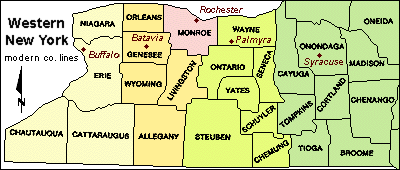
Counties Colored Dark Green = East NY Area
1795-1825 | 1826-28 | 1829-31 | 1832-39 | 1840-46 | 1847-69 | 1870-99 | 1900-99
1832-3 West NY | 1832-39 Batavia Area | 1832-3 Rochester | 1832-3 Palmyra Area
EvM Mar 03 '32 | EvM Mar 17 '32 | EvM May 19 '32 | AEJ Aug 31 '32 | EvM Dec 01 '32
EvM Jan 05 '33 | AEJ Jan 30 '33 | EvM Feb 09 '33 | EvM Mar 23 '33 | EvM Apr 13 '33
EvM Jul 13 '33 | AAr Aug 27 '33 | USen Sep 03 '33 | EvM Oct 19 '33 | AEJ Nov 30 '33
AAr Dec 02 '33 | USen Dec 03 '33 | ATel Dec 18 '33 | BRep Dec 19 '33 | FJor Dec 23 '33
News Articles Index | New York City Papers | Otsego Co. Papers

 Vol. III. Utica, N.Y., March 3, 1832. No. 9. REV. ALEXANDER CAMPBELL. This gentleman, who has rendered himself somewhat conspicuous, both by his debate with Robert Owen, at Cincinnari, Ohio, in defending Christianity from the attacks of a noted opponent of the Gospel, and by introducing a new sort of theology into the middle and western States, resides at Bethany, Va., and publishes a monthly periodical entitled, "The Millennial Harbinger." His system of theology is a peculiar system, about as unintelligible, visionary and untangible, as that of Emanuel Swedenborg. For as none can understand the system of Swedenborg except by the science of correspondences and the admission of a new and special revelation through him to the world, so none can understand or be benefitted by the transcendent glories of Campbellism, except by the doctrine of baptism and the admission of Mr. C.'s divine appointment "to restore the ancient order of things," (which by the bye proves to be an entirely new orderof things unknown to the primitive church,) making Christianity and salvation itself to consist in the rite of baptism. The latter, as was also the former, is a man of some talent and indenuity, and has something of a number of followers at the west. In a late number of the "Harbinger," Mr. C. was led to speak of Universalism, and like his Limitarian brethren in general, undertook to caricature the doctrine. Upon this caricature, the Editors of the "Sentinel and Star in the West," made some strictures, and offered Mr. C. the use of their columns to overthrow the doctrine of Universalism if he was able. He replied to the "Sentinel," that he would accept their offer, provided the Editors in their replies to him would abstain from all "scurility," &c. and yet, in the same article, makes use of no small share of that ingredient himself; and closes by saying he is "forthcoming" upon Universalism, to show that "it has no foundation in Scripture, nor in the reason and nature of things, and that its inevitable tendency is to Deism or something worse." ... |
|
Vol. III. Utica, N.Y., March 17, 1832. No. 11. CHANGES OF MORMONISM. In a postscript to a letter recently received from Chagrin River, Ohio, the writer says: |
|
Vol. III. Utica, N.Y., May 19, 1832. No. 20. FANATICISM. ... In the western part of this State a Baptist church, after going through revival operations, is turning Mormonite -- the next improvement we may expect them to make, will probably be into Skepticism. |
|
Vol. ? Albany, N.Y., Friday, August 31, 1832. No. ?
Mormonism in New England. -- It is stated in the Boston Christian Register, that two Mormonite preachers have recently visited that city, and made about 15 converts to their strange doctrines, who had been baptized and joined the Mormon church. Some of them are said to be respectable persons. All contemplate going to the west, and some have already started for "the promised land, the place of refuge for the house of Israel and for the Gentile world who will flee thither for safety," in Jackson county Missouri. Two females who have gone, had acquired by industry, one 1500, and the other 800 dollars, which they have given up to go into the general stock. The others possess between 3 or $4,000 which they are going to put into the general fund, and which they can never draw out again. "Thus (says the Register) are people swindled out of their property, and drawn from their comfortable homes, by ignorant fanatics." One of the preachers has been at Lynn, where four or five persons have embraced Mormonism and been immersed. The preachers intend visiting the cities and principal towns in New England. -- |
|
Vol. III. Utica, N.Y., December 1, 1832. No. 48. BENEVOLENCE OF DR. ELY'S PRAYERS. Dr. Ely has lately taken a jaunt to Huntingdon and other places in the interior of Pennsylvania, to attend protracted meetings and see that all his subalterns are faithful and true. He passed through and stopped at Reading on his way. In a late number of the "Philadelphian" he gives us a sketch of his journey, and among other things describes a Mormon prophet now imposing on the ignorant and credulous part of the Reading community. He says this impostor pretends to predict future events, and declares that "when he can find two other persons as perfect as himself, he intends to raise the dead." After some further remarks on the absurdity and wickedness of his pretensions, the Doctor very charitably adds, "The Mormon prophet of Reading will have his day, and then will come his night. God grant that it may be the blackness of darkness forever!"... |
|
Vol. IV. Utica, N.Y., January 5, 1833. No. 1. BENEVOLENCE OF DR. ELY'S PRAYERS. Our readers will recollect that we publishd an article a few weeks since, with the above caption, in which we noticed a certain prayer of the Doctor (as printed in the Philadelphian) concerning the Mormon prophet of Reading, Pa., beseeching God that his night might "be the blackness of darkness for ever." The Dr. has copied our article and comments on his prayer, and then appended the following |
|
Vol. ? Albany, N.Y., Thurs., January 30, 1833. No. ?
NEW BOOKS, received by land from New-York... |
|
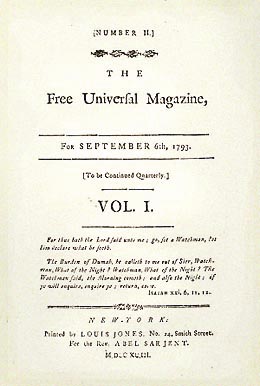
Vol. IV. Utica, N.Y., February 9, 1833. No. 6. "FREE UNIVERSAL MAGAZINE." For six months past I have had in my possession, a book of 200 pages, entitled "The Free Universal Magazine, being a display of the mind of Jesus as manifested to his servants, the members of the New and Free Church." It was published quarterly for the space of one year, in numbers from 40 to 60 pages each, 12mo. The imprint of the first two numbers, is as follows: "New-York, printed by Louis Jones, No. 24 Smith-street for Rev. Abel Sargent, 1793." The third and fourth numbers were printed in Baltimore, for the same Editor. |
|
Vol. IV. Utica, N.Y., March 23, 1833. No. 12. REV. ABEL SARGENT. We are happy in the opportunity of laying the following communication before the public, and hope it may be the means of eliciting further valuable information from Br. Sargent, the subject of the letter, both in relation to himself and the cause of Universalism in its early stages in those parts of the country where he labored. There are two facts developed in this letter, of which we were not before aware, viz. 1. That Br. Sargent was the first defender of the strict unity of God in America, and 2. that the first organized body of Universalists in Ohio, took to themselves and long bore the name of "Free Church." This is certainly not an inappropriate name. We received ten numbers of the "Lamp of Liberty," mentioned in this letter, and have them now in our possession; though we did not know by whom the work was edited, the name of the Editor not being appended to it. The EDitors of the Sentinel and Star will confer a favor by re-publishing this letter, and the article that elicited it; and we hope to hear more on the subject soon from Br. Sargent. The writer of this letter has our thanks for this favor. Our readers will learn who Br. Sweet is by refering to the Modern History of Universalism, p. 420. S. |
|
Vol. IV. Utica, N.Y., April 13, 1833. No. 15. MORMONISM. Br. J. B. Prosser, of Bolton, Warren county, writes in a late letter, as follows: -- |
|
Vol. IV. Utica, N.Y., July 13, 1833. No. 28. UNIVERSALISM. There is no doctrine or sentiment which is so well calculated to give unalloyed joy to the truly devoted Christian, as that of the cheering doctrine of universal emancipation from sin and misery of all the intelligent offspring of our heavenly Father. |
 Vol. VIII. Albany, N.Y., August 27, 1833. No. 4242. "REGULATING" THE MORMONITES. Some days since we announced to our readers by means of a letter from Missouri, that the Mormonite head quarters in Jackson county, in that state, had been broken up. The St. Louis Republican of the 9th inst., just received, gives the annexed particulars of the transaction. We can easily conceive that such an establishment would be quite a nuisance any where, but we must say, notwithstanding, that such a mode of breaking it up is illegal and riotous, however respectable may have been the individuals concerned. What avail our toleration principles, if no sect is to be endured but such as are free from extravagance and fanaticism? -- |
|
NS Vol. IX Utica, N.Y., Sept. 3, 1833. No. 36.
Not long since a Mormon preacher in Vermont, by way of establishing his infalibility, asserted that his flesh could not be hurt, upon which a by-stander gave him a blow that brought him sprawling to the ground. As soon as he recovered himself, he found that the argument made use of by the Vermonter was too strong, and he made off. |
|
Vol. IV. Utica, N.Y., October 19, 1833. No. 42. THE MORMONITES. I much like the spirit of the following article by one of the Editors of the Sentinel and Star in the West. I say "DITTO" to Br. Tizzard. However deluded -- however wrong -- however fanatical, the followers of Jo Smith may be -- however deserving of either reprobation or ridicule -- contempt or commiseration -- they are still citizens -- their erroneous faith cannot disenfranchise them. |
|
Vol. IV. Albany, N.Y., Nov. 30, 1833. No. 1154.
Civil War in Missouri. -- The people of Jackson county are using the torch, the sword, and the musket, against the Mormonites. On the 31st of October, a mob of fifty persons attacked and demolished 12 of the Mormon dwellings, beat the inmates, and drove women and children into the woods. On the 1st Nov. the war recommenced, both [arties using fire arms. On the 5th, the mob recommenced the assault about 300 strong. Several of the assailants were badly wounded and three of them killed. Among the latter was an Attorney named H. L. Breazeleale. Subsequently, there was another battle, in which several were killed on both sides. One of the Mormon worshippers gives an account of the affair in a St. Louis paper, concluding as follows: -- |
|
Vol. IX. Albany, N.Y., December 2, 1833. No. 4326.
CIVIL WAR AND BLOODSHED. The St. Louis Republican of the 12th ult. gives an account of a series of outrages by the inhabitants of Independence, Jackson co., (Missouri) upon the Mormonites, derived from Mr. Orsan [sic] Hyde, an eye-witness and sufferer, and a leader of the sect. From his statement, which is confirmed by a postscript in the Boonville Herald of the 7th ult., it appears, that on the night of October 31st, some forty or fifty of the citizens of Jackson county, made an assault upon the Mormonite village, and demolished twelve dwelling houses. Two of the Mormonites were taken and severely beaten and stoned. On the following night, the attack was renewed by the same mob, who broke open Gilbert and Whitney's store and scattered their goods through the streets. On Saturday night, another assault was made, but the Mormons, in the mean time, had conveyed their goods to a place of safety, and prepared themselves for defence. They were fired upon by the mob, and returned the fire, by which two men were wounded. On Monday, the mob had increased to between two and three hundred men, well armed, who called themselves the Militia. -- They again attacked the settlement, and poured a deadly fire -- says the informant -- upon the settlers, several of whom were killed. A party of the Mormons returned the fire, with a fatal effect. Some twenty or thirty of the assailants fell, mortally wounded, among them Hugh L. Bronseale and a Mr. Hicks, attorneys at law. The writer, after this battle, left the settlement to wait upon the governor, to petition for a redress of these grievances. The issue of the application is not stated. |
|
NS Vol. IX Utica, N.Y., Dec. 3, 1833. No. 49.
Trouble in Missouri. -- The New York Commercial of Friday contains a letter from a Mr. Hyde, a Mormonite, giving an account of several conflicts, in which blood was shed, between a body of Mormons, living at the town of Independence, Missouri, and some of the inhabitants by whom they were attacked. He states that on the 31st October last, some forty or fifty men came and demolished twelve dwelling houses of the Mormonites. The inmates were obliged to escape to the woods. On the 1st of November they were attacked again, and broke open the doors and windows of all the dwellings in the town belonging to the Mormonites. The next day the Mormonites gathered their property together, to be better prepared for defence, and at night they were attacked and fired upon with guns, and returned the fire, and shot one of the assailants. A day or two afterwards, the people collected together to the number of three hundred, well armed, and made another assault. The Mormonites were prepared and poured back a deadly fire upon them. Three of the assailants were killed, and a number mortally wounded. -- The writer then left the place; after he had descended the river (Blue) and landing to receive freight, a man rode up and stated that there had been another battle, and about twenty of the assailants killed. The cannonading was distinctly heard from the boat. This is indeed extraordinary. These men are fanatics, it is true -- but harmless ones. This account is almost incredible, but seems to have been generally believed. Who could credit it, that a people, only from a difference in creed and worship, would in this country, be hunted down like wild beasts! |
Vol. ? Norwich, N.Y., December 18, 1833. No. 38.
PAINFUL INTELLIGENCE. THE MORMONS AND THE ANTI MORMONS. -- Our intelligence from the West by the mail is not so late as that brought by the steamboat Charleston. The Fayette Monitor corroborates the statement of Mr. Hyde, in relation to the violent proceedings of the Anti-Mormons, so far as the accounts of that paper extend. Houses and property were destroyed, and the elders of the church severely whipped by the mob, under cover of the night. -- It is impossible to forsee what is to be the result of this singular and outrageous violation of the laws. We fear that the party opposed to the Mormons will think themselves placed so far beyind the pale of the law as to continue utterly regardless of it, and eventually, by the power of numbers, be enabled to cut off the offending sect. The loss of their relatives and partizans will stimulate them to these acts, and fearful acts of bloodshed may have already been witnessed. As yet, our intelligence is not very accurate, or full, in regard to the measures taken by the officers of the county to surpass the rebellion as it may properly be called. -- The entire county is probably arrayed on one side or on the other; and in this state of things the power of the sheriff, and other officers, to suppress the riot, is perfectly futile. It is reported besides, that the judge of the circuit, who attempted to interfere to stop the proceedings, as well as some of the officers, were captured by the mob, and placed in durance, either in jail, or in charge of some of their number, for a good many hours; and the lieut. governor, who resided in that county, was driven from it. In this state of things, we appregend the proper course would have been for the authorities to have represented the case to the Executive, for his interposition; but we have not learned whether they have done so. The facts are, nevertheless, notorious; and the governor should, without delay, if he has not already done it, act upon them. He is bound to see that the laws are executed against all offenders. The power of the county not being available in this case -- for almost all are concerned in the insurrection -- the governor should issue his proclamation, calling out the militia of the neighboring counties, to enforce the laws, and to quell the riot. He should give the requisite orders to the officers for that purpose; and do it with all alacrity. It is very evident, that unless some effective measures are adopted by him in this emergency, the lives of many valuable citizens will be sacrificed, and the state suffer an irretrievable injury. A rancorous, deadly hostility, has long existed between the parties, and unless the firmness and prudence of the governor should be equal to the crisis, and the offending party be severely punished, we must expect to hear of the continual recurrence of such disgraceful proceedings. |
 Vol. XI. Binghampton N.Y., Dec. 19, 1833. No. 34.
MORMONS. -- Companies of Mormons continue to pass through this State for "Mount Zion." One would suppose that the late events at Zion would cool the zeal of the new converts. But it is not so. It is given out that one of the prophets, some two years since, foretold the destruction of Zion, and the fulfilment of his rediction is regarded as conclusive evidence of the Divine Character of the new religion. One of the Mormons on being required to point out another prophecy and its fulfilment, stated that about one year ago a Mormon prophet visited Cincinnati, and foretold the destruction of that city; and he had lately seen a person direct from Cincinnati, who informed him that the cholera and small pox had carried off nearly all the inhabitants of that city! -- |
|
Vol. 26. Cooperstown, N.Y., Dec. 23, 1833. No. 15.
THE WAR AGAINST THE MORMONITES. -- We are glad to receive, says the St. Louis Republican, more pacific accounts from the county of Jackson... The Mormonites have determined to oppose no further armed resistance to the dominent party, and they were rapidly leaving the county and their homes, with intention of forming another community elsewhere. They are determined, however, to prosecute the citizens engaged in hostilities towards them, and for the depredations committed upon their property. They have undoubtedly adopted the best course which was left to them; and all alarm has subsided in that county. |
|
Vol. XI. Binghampton, N.Y., Dec. 26, 1833. No. 35.
THE MORMON WAR. -- A letter from the Rev. B. Pixley, to the editor of the New-York Observer, relative to the civil war in Missouri, between the inhabitants and the Mormons, gives a somewhat different version of the affair from that published some time ago, by Orson Hyde, one of the Elders. From Mr. Pixley's account, it appears that the sect proclaimed that the spot they had selected was the Zion spoken of in scripture -- that the present inhabitants would be driven off, and that they, the Mormons, should inhabit the country. This arrogant pretence, coupled with an invitation to all the free negroes to come and join them, aroused a spirit of opposition, and induced the citizens, last summer, to pull down their printing office. They were proceeding to other extremities, when expostulation ensued and a treaty was made in which it was agreed that the Mormons should move away before another summer, and in consideration thereof the other party were to make good the loss sustained by destroying their printing office. Instead, however, of making any preparations for departure, the Mormons proceeded to arm themselves, barricaded portions of their settlement, and threatened to kill any one who should molest them. This provoked a renewal of hostilities, and the consequences have been that in the skirmishes that have taken place, 3 of the Mormons have been killed, and about 20 of the inhabitants. At the last encounter the citizens proved too powerful for the Mormonites, and would have destroyed them but for the interposition of the civil authorities. Great exasperation continued to prevail, and no immediate means of composing the difficulties were as yet perceptible. |
|
Vol. 5 Norwich, N.Y., Jan. 1, 1834. No. 40.
THE MORMON WAR. -- A letter from the Rev. B. Pixley, to the editor of the New-York Observer, relative to the civil war in Missouri, between the inhabotants and the Mormons, gives a somewhat different version of the affair from that published some time ago. From Mr. Pixley's account, it appears that the spot they had selected was the Zion spoken of in scripture -- that the present inhabitants would be driven off, and that they, the Mormons, should inhabit the country. -- This arrogant pretence, coupled with an invitation to all the free negroes to come and join them, aroused a spirit of opposition, and induced the citizens, last summer, to pull down their printing office. They were proceeding to other extremities, when expostulation ensued and a treaty was made, in which it was agreed that the Mormons should move away before another summer, and in consideration thereof the other party were to make up the loss sustained by destroying their printing office. Instead, however, of making any preparations for departure, the Mormons proceeded to arm themselves, barricaded portions of their settlement, and threatened to kill any one who should molest them. This provoked a renewal of hostilities. At the last encounter the citizens proved too powerful for the Mormonites, and would have destroyed them but for the interposition of the civil authorities. Great exasperation continued to prevail, and no immediate means of composing the difficulties were as yet perceptible. |
|
Vol. XI. Binghampton, N.Y., Jan. 16, 1834. No. 38.
THE MORMONS AGAIN. -- Governor Dunklin of Missouri, has issued an Executive Letter directed to several leading men of the Mormon persuasion, directing them to appeal to the courts of law, which are bound to render them satisfaction for the late outrageous assaults upon their rights and liberties as peaceable citizens. The Governor says. "in the event that the laws cannot be executed, and that fact is officially made known to me, my duty will require me to take such steps as will enforce a faithful execution of them." |
|
G O S P E L M E S S E N G E R. Vol. VII. Auburn, N.Y., Saturday, January 25, 1834. No. 51. MORMONISM. The following is given as we find it. -- We make no remarks, except that the Clergyman whoever he may have been, who could have spent his time in forming so miserable a romance of God's word, had been better employed in carrying that word to the hearts of his people. |
|
Vol. V. Utica, N.Y., Sat., April 5, 1834. No. 14.
(For the Magazine and Advocate.)
Messers. EDITORS. -- Yesterday I attended a Mormon meeting in Geneseo, at which was present, for the first time in that place, the foundation, main pillar, and corner stone of Mormonism, the doughty Jo. Smith, Jun. |
|
Vol. XII. Binghampton N.Y., Thurs., May 29, 1834. No. 5.
The Mormon War in Missouri is about to be renewed. A fanatical leader, styled Goneral Joe Smith, has sent forth, in the form of a circular, his pretended revelations from on high, requiring the aid of the faithful to "expel the infidels from tho Holy Land." About 500 are said to be on the move, and they are armed with dirks, swords, pistols, guns, and other hostile weapons. The prophet, it is said, has a sword more than four feet long, and professes an expectation of sharing the fall [sic - fate?] of a martyr in the coming contest. |
|
Vol. ? Albany, N.Y., Tuesday, June 10, 1834. No. ? (report from Richmond, Indiana) Mormonites.-- [On Monday last] a caravan of about two hundred Mormonites, with a [large] train of wagons, passed through this place, on their way to the 'far west.' There were but few women among them, and the men were generally, if not all, supplied with fire arms. A stout, hardy set of looking fellows they were too, and many of them quite intelligent. From their equipments, it has been suspected that they intend joining and defending their brethren in Jackson county, Missouri. They professed to be in search of new lands, whereon to form a settlement, either in Illinois or farther west. We understand they were from the states of Vermont, New York, and Pennsylvania, and had assembled at some point on their route hither. |
|
Vol. ? Utica, NY, June 13, 1834. No. ?
MISCELLANY. THE MORMON IMPOSTURE is fully laid open in the following expose from the Susquehannah Register, printed at Montrose, Pa. We give it publicity, that it may meet the eyes of some who have given it their credence, and to secure others in the neighborhood of its advocates from being entangled in its shocking folly. We give it too, with the most perfect confidence in its correctness, from the fact that one of the Judges of Susquehannah county, Eld. Davis Dimock, who certifies to the "moral character and veracity" of ISAAC HALE, the principal witness, we are well acquainted with, and know him to be a man distinquished as a citizen and a Christian. Many of our readers also know him to be a Baptist minister of great worth and consideration. Where his name is known, the certificate of Isaac Hale will need no further support. Had we not fallen in with one of the followers of Smith, within eighty miles of Utica, and found their papers circulating even in Oneida county, (a file of which we have now before us, entitled "The Evening & The Morning Star,") we should hardly have given so much space in our paper to the following statement. This journal of the Mormons we have given a sufficient glance at to see that it is of the same character with all those things which are thrown out to beguile the hearts of the simple and the ignorant. It is jumbled up with the scriptures to obtain attention, and the misapplication of them, though glaring to the eye of most readers, may not at all times be discovered by those but partially acquainted with their Bibles. Here is the danger... |
|
Vol. XII. Binghampton N.Y., July 3, 1834. No. 10.
MORMONITES. -- On the 17th of May, a caravan a caravan of about two hundred Mormonites, with a long train of wagons, passed through this place, on their way to the "far west." There were but few women among them, and the men were generally, if not all, supplied with fire arms. A stout, hardy set of looking fellows they were too, and many of them quite intelligent. From their equipment, it has been suspected that they intend joining and defending their brethren in Jackson county, Missouri. They professed to be in search of new lands, whereon to form a settlement, either in Illinois or farther west. We understand they were from the states of Vermont, New York, and Pennsylvania, and had assembled at some point on their route hither. -- Richmond (Ind.) Palladium. |
|
Vol. XII. Binghampton N.Y., July 24, 1834. No. 13.
A MORMON BATTLE. -- A letter has been received at Chardon, (Ohio) direct from Missouri, which states that a body of well armed Mormons. led on by their Prophet Joe Smith, lately attempted to cross the river into Jackson county. A party of the citizens of Jackson county opposed their crossing -- a battle ensued, in which Joe Smith was wounded in the leg, and the Mormons retreated. Smith's limb was amputated, but he died three days after the operation. |
Vol. ? Watertown, NY, August ?, 1834. No. ? MORMONISM. A lazy fellow who was formerly a county pauper, has lately attempted to raise recruits for "Joe Smith," on Pillar Point, near this place. He pretended that he had a withered arm miraculously cured. From a knowledge of this bold attempt at imposition, and with a view of getting correct information an this subject of Mormonism, a person in this village addressed a letter to a gentleman of the first respectability in Palmyra and received the following answer: |
|
Vol. V. Utica, NY, Nov. 15, 1834. No. 46.
(For the Magazine and Advocate.)
Brs. SKINNER and GROSH -- If you think the following tour would be interesting to your numerous readers, you are at liberty to publish it. |
|
Vol. VI. Utica, N.Y., February 7, 1835. No. 6.
Will Joshua Spooner, of Conneaut, Ohio, who has lately turned Mormon preacher, have so much religion as to send us the amount ($2.50) he is owing us for this paper? |
Vol. ? Troy, NY, March 17, 1835. No. ?
MORMONISM, strange as it may appear, has found votaries even in New England and in three or four neighboring towns they have regular exercises. The society in South Hadley is partially Perfectionists and partially Mormon, exhortations, dancing and all sorts of strange delusions and vagaries of the brain and contortions of the body being practised. This is the land of liberty, and we sometimes are disposed to think that the wildest extravagances and grossest absurdities spontaneously come up under its broad banner. No other country on earth can boast of such varied forms of religious sects and such palpable departures from the primitive simplicity and purity of the Gospel, as this country. We would not forge chains nor bind fetters around any human mind, but we would gladly see public sentiment frown upon those mental hallucinations which disgrace christian lands, and shun communion with those preposterous forms of worship, which are merely mockeries of religion. |
|
Vol. VI. Utica, N.Y., April 18, 1835. No. 16. STATISTICS. -- MORMONISM. To Correspondents. -- An esteemed brother in Steuben county requests us to publish a statistical table, giving at one view the whole number of Universalist Conventions... |
|
Vol. VI. Utica, N.Y., April 25, 1835. No. 17.
Mr. Joshua Spooner, late of Conneaut, now of Kirtland, Ohio, on whom we called in number six, for the payment of his arrers, and stated that we heard he had turned Mormon preacher, has written a letter subjecting us to nineteen cents postage, saying he has paid Mr. G. Leavitt for the paper he took. But who is G. Leavitt? We know not. We have no such subscriber to our knowledge; and certainly no such agent who is authorized to receipt for this paper. We have neevr received the pay. Again, Mr. Spooner says he supposes we made that an excuse for writing against the people called Mormonites, of whom he thinks we know nothing. -- But we certainly said nothing against the Mormonites in the article alluded to. We will, however, now say so much of them as this: that they are a poor, deluded set of dupes to the vile impositions and jugglery of the mountebank Jo. Smith. D. S. |
|
Vol. VI. Utica, N.Y., June 6, 1835. No. 23. THE MORMON ANGEL. Soon after the notorious impostor, Jo. Smith, of golden Bible memory, reached "the promised land" in Ohio, with his deluded followers, and was getting along with such "swimming success" in making proselytes and baptising them in Grand River, near Painesville, ("though he himself baptised not, but his disciples" in the instance at least which we are about to relate,) word was given out that an angel would uniformly appear, dressed in white, standing in the edge of the water on the opposite side of the river whenever the baptismal rite was administered, to witness and approve the ordinance. To give the celestial messenger a more imposing appearance, and withal, not to dazzle the eyes of weak mortals with too much glory for their feeble organs to behold, the rite was always very prudently administered in the night. The angel was uniformly sen as above described on such occasions. At length three young men of the place, resolved one night, when notice was given that a baptism was to be administered and the angel was to appear, that they would see the ghost nearer at hand than across the river, ah! and feel him too, if tangible, and ascertain whether he were material or immaterial substance. Accordingly these ghost-daring mortals secreted themselves in the bushes on the side where the angel would appear, opposite the baptismal administration. The ordinance proceeded, and behold!the angel was there, clothed in white, with a luminous appearance, the wonder and admiration of the Mormon host. Our triune guard now made a plunge -- the angel sprang to elude their grasp -- splash, splash goes the water -- deeper and deeper plunge the pursued and the pursuers, till behold! they had him fast -- it was surely material substance -- clear up to the neck, chin, and eyes of the ghost, dragging him directly through the river to the place of the ceremony, crying out, "we've got your angel -- his wings are wet and dripping." And behold! on examination by the light, it was the veritable Jo. Smith himself, with a sheet wrapped around him and a dark lantern concealed underneath! |
|
Vol. VI. Albany, N.Y., Tues., Aug. 25, 1835. No. 1691.
|
|
Vol. VI. Utica, N.Y., September 5, 1835. No. 36.
(For the Magazine and Advocate.
Messrs. Editors -- It is for the love I bear the truth, and a desire to obtain information. that I venture to trouble you with a communication at this time. But I pledge myself to be short, and my questions shall be to the point. |
|
Vol. VI. Utica, N.Y., September 12, 1835. No. 37.
(For the Magazine and Advocate.
Brs. Skinner and Grosh -- Will you give me leave, through the medium of your paper, to add my mite to the good news occasionally contained in its columns, relative to the prosperity of our cause in Ohio... [news of Universalism in Ohio follows] |
NS Vol. I. Oswego, New York, Wed., March 22, 1836. No. 12.
CURIOUS DISCOVERY. -- The American Monthly Magazine contains a very interesting article on the subject of the antiquities of North America, in which is detailed an account of an exceedingly interesting discovery of a human skeleton in the town of Fall River, Mass., about eighteen months since. The skeleton was armed with a breast plate, a species of mail, and arrows of brass, and is supposed to have been either one of the race, who inhabited this country for a time anterior to the so called aborigines, and afterwards settled in Mexico, or Guatimalia, or to one of the crew of a Phoenecian vessel, that blown out of her course, thus discovered the Western world long; before the christian era. -- The following is the account given of the discovery of the interesting relic of antiquity. |
|
Vol. XIV. Binghampton N.Y., Thurs., Aug. 11, 1836. No. 16.
THE MORMONS. -- Scarcely a day passes (says the Salt River Journal) that we do not see our roads strewed with these deluded people, marching like Pilgrims to their promised rest, under the influence of their leader, Joe Smith, who we learn promises to be with them next fall. The real object of their concentrating their force in the neighborhood of Jackson county, cannot be learned from them, so well are they instructed. But few of the families seem to have much property to retard their march onward, unless women and children may be styled property -- each wagon seems to be filled with those latter articles. Some of these people pretend, that at or before next fall, the citizens of Jackson county will he glad to sell out their lands and go off; others say that they will be permitted to occupy Jackson county by the special interposition of Providence, and that those who now oppose them will be converted to the religion of Joe Smith. |
|
Vol. ? Albany, N.Y., Thurs., July 6, 1837. No. ? (From the N. Y. Evening Star.) Mormons. -- These crazy fanatics have their their grand tabernacle at a place they call Kirtland, 5 miles from the shore of Lake Erie, and 20 miles from Cleveland, and count no less than 4000 persons under their leader, Joe Smith. They have been lately joined by a shrewd literary person, named Sydney Rigdon, formerly a preacher of the doctrine of Campbell. He is the Grand Vizer to Smith; and under their decision a banking house has been established, of which Smith is president and Rigdom cashier. The issues have been about $150,000. The Bank failed. They have several mills on their property. The houses are small, including the Prophet Joe's. The temple is a beautiful building of rough stone, three stories high, and 70 to 75 feet square. Each of the two principal apartments holds twelve hundred persons. The joists of the interior are supported by six fluted columns. Each apartment contains six pulpits, arranged, gradatum, three at each end for the "Aaronic priesthood," and [three] at the other end for the "priesthood of Melchisidec." The slips are so constructed, that the audience can face either pulpit, as may be required. In the highest seat for the "Aaronic priesthood," sits the reverend father of the prophet; the next below is occupied by Joe, and his prime minister, Rigdon. The attic story is occupied as school rooms, five in number, where the various branches of English, Latin, Greek and Hebrew languages are taught to a great number of students. The actual cost of the temple is not known, but it is estimated to have cost not less than $60,000. |
Vol. ? Utica, N. Y., Tuesday, July 11, 1837. No. ?
MORMONS. -- These crazy fanatics have their grand tabernacle at a place they call Kirtland, 5 miles from the shore of Lake Erie, and 20 miles from Cleveland, and count no less than 4000 persons under their leader, Joe Smith. -- They have been lately joined by a shrewd literary person, named Sydney Rigdon, formerly a preacher of the doctrine of Campbell. He is the Grand Vizier to Smith; and under their decision a banking house has been established, of which Smith is President and Rigdom cashier. The issues have been about $150,000. The bank failed. They have several mills on their property. The houses are small, including the Prophet Joe's. The temple is a beautiful building of rough stone, three stories high, and 70 to 75 feet square. Each of the two principal apartments holds 1200 persons. The joists of the interior are supported by six fluted columns. Each apartment contains six pulpits, arranged, gradatim, three at each end of the "Aaronic priesthood," and [three] at the other end for the "priesthood of Melchisidec." The slips are so constructed, that the audience can face either pulpit, as may be required. In the highest seat for the "Aaronic priesthood," sits the reverend father of the prophet; the next below is occupied by 'Joe,' and his prime minister, Rigdon. The attic story is occupied as school rooms, five in number, where the various branches of English, Latin, Greek and Hebrew languages are taught to a great number of students. The actual cost of the temple is not known, but it is estimated to have cost not less than $60,000. |
HUDSON RIVER CHRONICLE. Vol. I. Sing-Sing, Westchester Co., Feb. 13, 1838. No. 17. ANOTHER TESTIMONY.
|
HUDSON RIVER CHRONICLE. Vol. I. Sing-Sing, Westchester Co., Feb. 20, 1838. No. 18. To the Editor of the Berkshire Advocate: Dear Sir: -- In your paper of January 22d, I observed a short notice of the sect called Mormons. I have thought that a sketch of the history of Mormonism would not be uninteresting to your readers. |
Vol. 10. Norwich, N.Y., August 8, 1838. No. 20.
THE MORMONS. It is stated in the Canton, Ohio, Repository, that this people to the number of about 200 with 57 wagons, filled with furniture, cattle, &c. have left Geauga county, on their way to the "promised land" in Missouri. They pitch their tent in the open field at night, after the manner of the ancient Israelites. |
|
Vol. 10. Norwich, NY, August 29, 1838. No. 23.
THE MORMONS. -- The Canton (Ohio) Repository says that "about 500 Mormons, with their wagons, filled with furniture, have left Geauga county, on their way to the promised land in Missouri. It is understood that they have selected Col. Humbug Benton as their High Priest and Oracle! |
|
Vol. VI. Auburn, NY, September 5, 1838. No. 17.
MR. VAN BUREN'S SUPPORTERS. -- From Fanny Wright, the she apostle of Loco Focoism, to Jo Smith, the blasphemous pretender, the 'odds and ends' of society have been gathered under the mantle of the great Loco Foco. In Caldwell county, Missouri, the Whig candidates for Congress received but 2 votes out of 353 polled, the entire population with a few exceptions being followers of Jo Smith, and obeyed his pretended revelation from Heaven that all the 'Latter Day Saints' should vote the Loco Foco ticket. Jo Smith should have his reward. A sub-treasuryship or else his Bank of Kirtland should be made a Deposite bank. Van Buren will remember him. -- |
|
Vol. VI. Auburn, N.Y., October 31, 1838. No. 25.
The Mormons appear to be full of trouble at the West. The last St. Louis papers speak of the difficulties existing between this sect and their neighbors as having created much feeling, and not a little fighting. Some 200 or 300 of the inhabitants of the neighboring towns and counties had assembled near the Mormon settlement, for the purpose of giving battle; and it was believed that a fight between them could not be prevented. |
|
Vol. 10. Norwich, N.Y., November 7, 1838. No. 33.
St. Louis, Oct. 18, 1838. |
|
Vol. VI. Auburn, N.Y., November 7, 1838. No. 26.
FURTHER FROM THE MORMONS. -- We learn by the Pirate which arrived at noon to-day, that on Tuesday night, the Anti-Mormons were still in force near Dewit. The Pirate lay at Greenville, seven miles above Dewit, on Tuesday night. At that time, information had come in, that the Anti-Mormons had given their opponents notice that they must take up their line of march next morning, at 8 o'clock. This the Mormons refused to do. It was reported, also, that the Anti-Mormons had sent word to the Mormons that, if they would collect their women and children in one house -- that house should not be fired on. As the Pirate passed down on Wednesday morning, by Dewit, a flag was seen flying over one of the largest houses there. From all appearances, there is reason to believe that a conflict took place on Wednesday.-- |
|
Vol. VI. Auburn, N.Y., November 21, 1838. No. 28.
From the St. Louis Gazette, Nov. 1.
From the Missourian and Republican, as well as our own private advices, we are satisfied that the very worst anticipations in regard to the Mormon difficulties have been realized. A letter to the Governor from an officer in Davies County, makes the following statements: |
|
Vol. 2. S. Courtland, N.Y., November 22, 1838. No. 18.
Further from the Mormons. -- We learn by the Pirate, which arrived at noon to-day, that, on Tuesday night, the Anti-Mormons were still in force near Dewit. The Pirate lay at Greenville, seven miles above Dewit, on Tuesday night. At that time, information had come in, that the Anti-Mormons had given their opponents notice that they must take up their line of march next morning, at 8 o'clock. This the Mormons refused to do. It was reported, also, that the Anti-Mormons had sent word to the Mormons that, if they would collect their women and children in one house -- that house should not be fired on. As the Pirate passed down on Wednesday morning, by Dewit, a flag was seen flying over one of the largest houses there. From all appearances, there is reason to believe that a conflict took place on Wednesday. -- |
|
Vol. VI. Auburn, N.Y., November 28, 1838. No. 29. From the St. Louis Republican, Nov. 12. SAD NEWS FROM THE MORMONS. -- The account of a bloody butchery of thirty two Mormons, on Splawn's Creek, is fully confirmed. Two children were killed, we presume, by accident. Considerable plunder -- such as beds, hats, &c. were taken from the slaughtered. Not one of the assailants was killed or hurt. About the time of the surrender, several Mormon houses were burnt in Chariton; and one Mormon who refused to leave, killed. At Far West, after the surrender, a Mormon had his brains dashed out, by a man who accused the Mormons of burning his house in Daviess. |
|
Vol. VI. Auburn, NY, December 26, 1838. No. 33.
The Mormon War. -- The militia under Gen. Grant have been disbanded, and all apprehensions of further trouble are now at an end. There had been no additional bloodshed since the date of the surrender. |
|
Vol. 2. S. Courtland, NY, December 27, 1838. No. 23.
The Mormons. -- We perceive from the proceedings of the Missouri Legislature, that a memorial, asking pecuniary aid for the Mormon women and children of Caldwell county, was laid before that body on the 31st inst. "It appears," observes the Louisville Journal,"that the homes of many of the Mormons in that county have been burned down; that about 600 Mormon men, all of them married, have been arrested and imprisoned, 40 killed, and 100 compelled to fly to escape the vengeance of the citizens, and that 200 women, most of whom had small children, are thus left destitute, with no food to keep them from starvation, and no shelter to protect them from the winter storms. -- We trust that the State, through her Legislature will promptly do what she can to repair the foul and cruel wrongs perpetrated by her citizens." |
|
Vol. VI. Auburn, NY, January 9, 1839. No. 35.
THE MORMON PRISONERS. -- Jo Smith, Jr., Sidney Rigdon, and four others of the Mormon leaders have been held to trial in Ray County, Missouri, for treason. About 30 are also committed for trial on charges of arson, burglary, robbery and larceny, and something like a dozen stand charged with being principals and accessories in the murder. |
|
HUDSON RIVER CHRONICLE. Vol. II. Sing-Sing, Westchester Co., NY, January 16, 1839. No. 13. From the Cleveland Herald, Dec. 29. THE MORMON PRISONERS. -- The Court of Enquiry held in Ray Co. has ordered the following persons to trial, for the offences named. |
|
Vol. VI. Auburn, NY, January 16, 1839. No. 36.
The Governor of Missouri, in a statement to the legislature of that state, estimates the expense of the Mormon was at $80,000, and coolly suggests that the United States ought to foot the bill. |
|
Vol. XXVI. Albany, N.Y., February 26, 1839. No. 2723.
MISSOURI. The Missouri Legislature has appropriated $150,000 for paying certain militia of the state against the Mormons. The bill to provide for the establishment and support of common schools passed the lower house of the legislature on the 21st by an overwhelming majority. |
|
Vol. VI. Auburn, NY, April 3, 1839. No. 47.
THE MORMON WAR. -- The paymaster in Missouri, engaged in making out the pay tolls of the forces employed in suppressing the Mormon War, estimates the number of [men] at not less than 12,000, and the pay and expenses of each man at $20 -- making $240,000 for the privates alone, and the whole expense not less than half a million dollars. |
|
Vol. ? Binghampton N.Y., Thursday, April 11, 1839. No. ?
THE MORMONS. -- This persecuted people are emigrating from Missouri to Illinois, settling on the Mississippi, near Quincy. Sidney Rigdon is delivering addresses, and locating his disciples there. They appear to be well received by the people. Rigdon's eloquent account of the cold-blooded murder, by the Missouri mob, of Mormon men and children, the violation of females, the destroying of property, the burning of houses, &c. is awakening much pity and commiseration. The refusal of the Legislature of Missouri to enquire into and publish to the world a true history of the disgraceful and barbarous war on the Mormons, has placed Rigdon and his followers on a vantage ground they will not fail to occupy in exciting the sympathies of the humane and benevolent. The infamy of the persecuting war can never be wiped from the escutcheon of Missouri. Time will only darken its coloring. -- |
|
Vol. X. Utica, N.Y., April 26, 1839. No. 17.
(For the Magazine and Advocate.
... I make the following remarks for two reasons -- 1st. To correct an error which some entertain respecting the belief of the "Mormons," or as they term themselves, "The latter day Saints," (See Br. Sawyer's remarks on Mr. Sunderland's book entitled, "Mormonism Exposed and refuted," Universalist Union, volume 3, page 205.) 2. To give my views, in short, of the apostle's meaning. The Mormons are strenuous advocates for the literal meaning of the passage at the head of this article, and instead of believing in the eternal damnation of all sects but their own, as the book and remarks above alluded to state, they believe that all mankind will eventually be made perfectly happy, according to their capacities for bliss, in one of the "three heavens." That your readers may know I am correct in my statements respecting their belief, I will simply state, that J. Smith, Jr., their leader and prophet, was brought up in the saem town that I was; that I have been acquainted with the advocates of Mormonism, and that I have kept up a correspondence with one of the most distinguished men among them in Missouri, whose learning and talents I respect, and I have to lament that they are not employed in the promotion of a better cause. In a letter of his reply to one of mine, he speaks of their views respecting man's future destiny, in language too plain to be misunderstood. He says, "But what is for man beyond the grave? What may we understand by your question, 'God will have all men to be saved and come unto the knowledge of the truth?' Can we prove this to be equivalent to an assertion, that all men shall be saved from eternal punishment, which the sectarians contend is the doom of all who die impenitent? The language is less positive, but from the hypothesis, that the will of God must be done in the world to come, as regards the salvation of those for whom Christ died, this may be incontrovertibly established; for God wills that all men be saved; and to those who repent and are baptized in the name of Christ, for the remission of sins, shall be given power 'to become heirs of God and joint heirs with Jesus Christ,' and to sit down in the kingdom of celestial glory. Those who obey not the Gospel by being baptized, must be rewarded according to their transgressions, after which they are made partakers of a degree of happiness and glory, but one inferior to that enjoyed by such as 'wash their robes and make them white in the blood of the Lamb.' 'The unbeliever and murderer, etc., shall have their part in the lake which burneth with fire and brimstone,' and then be permitted to take their seats in heaven, but not around the throne of God, for where he is, they can not come. |
|
Vol. ? Monticello, Sullivan Co., N.Y., May 2, 1839. No. ?
THE BOOK OF MORMON. -- According to a statement published in the Boston Recorder by Mrs. Davidson, (formerly the wife of the Rev. Solomon Spaulding, of the Presbyterian church,) it seems that the Book of Mormon, or "Golden Bible," generally supposed to be the joint production of Joe Smith and Sidney Rigdon, was written by her deceased husband, which incapacitated by ill-health for active service in the church. It was written with no other object in view than the amusement of himself and his neighbors; but having fallen into the hands of wicked men, it has been used for the worst of purposes... |
|
Vol. VI. Auburn, N.Y., May 8, 1839. No. 52.
THE MORMONS. -- The Peoria (Illinois) Register says: "Great numbers of this unfortunate sect, men, women and children, are encamped near Quincy, in a state of destitution of the necessaries of life. The sufferings they endured in Missouri are heart-rending. A public meeting has been held in Quincy to devise means for their relief. The audience was deeply affected at the relation given by the Mormons and effective measures were adopted for their relief." |
|
NORTHERN JOURNAL. Vol. II. Lowville, N.Y., Thursday, May 9, 1839. No. 12.
The Mormons' Bible. -- The origin of this work which it has puzzled many to account for, being evidently the production of a cultivated mind, yet found in the hands of exceedingly ignorant and illiterate persons, is at length explained. It was written in 1812, for amusement as a historical romance of the lost race, the remains of whose numerous mounds and forts are found on the Ohio. The author was Rev. Solomon Spaulding, a graduate of Dartmouth College, who resided at New Salem, Ohio; and on the appearance of a Mormon preacher there, many of the friends of the deceased clergyman recollected passages which he had read to them during the time he was engaged in composing it. On enquiry, the original manuscript was among his papers. -- It also appeared that at one time he had some thoughts in relation to printing the work, and that it remained at a printing office for a long time. Sidney [Rigdon], who has figured so largely in the history of the Mormons, was at that time employed in this printing office, and it was no doubt copied by him. |
|
Vol. 11. Norwich, N.Y., May 22, 1839. No. 9.
THE MORMON PRISONERS ESCAPED. -- The Columbia Patriot of the 27th ult., a paper printed in Boone county, has the following important paragraphs: |
|
Vol. 2. Fayetteville, N.Y., May 23, 1839. No. 43.
The Mormon Prisoners Escaped. -- The Columbia Patriot of the 27th, a paper printed in Boone county, has the following important paragraphs: -- |
|
Vol. VII. Auburn, NY, May 29, 1839. No. 3.
The Mormon Bible. -- The origin of this work which it has puzzled so many to account for, being evidently the production of a cultivated mind, yet found in the hands of exceedingly ignorant and illiterate persons, is at length explained. It was written in 1812, for amusement as a historical romance of the lost race, the remains of whose numerous mounds and forts are found on the Ohio. The author was Rev. Solomon Spaulding, a graduate of Dartmouth College, who resided at New Salem, Ohio; and on the appearance of a Mormon preacher there, many of the friends of the deceased clergyman recollected passages which he had read to them during the time he was engaged in composing it. On inquiry, the original manuscript was among his papers. -- It also appeared that at one time he had some thoughts in relation to printing the work, and that it remained at a printing office for a long time. Sidney Rigdon, who has figured so largely in the history of the Mormons, was at that time employed in this printing office, and it was no doubt copied by him. |
|
OSWEGO COUNTY WHIG. Vol. II. Oswego, N.Y., Tuesday, June 4, 1839. No. 23. ORIGIN OF MORMONISM. The Book of Mormon, or 'Golden Bible,' it would seem, is the production of the Rev. Solomon Spaulding, a graduate of Dartmouth College, and formerly pastor of a Presbyterian church on the Western Reserve of Ohio. While suffering under disease, to amuse himself and his friends, he wrote an imaginary history of the mysterious race of men who built the ancient mounds and other works of art, which are scattered so profusely over the valley of the Mississippi. His manuscript falling into the hands of wicked and designing men, has been perverted into the means of building up a new seat of fanatics who are making so much noise in the West. The Rev. John Storrs, of Holliston, Mass., learning that the widow of Mr. Spaulding, (now Mrs. Davison, having since Mr. S.'s death, married a second husband) was still living at Monson, Mass., and could testify to this fact, addressed her a letter, and obtained the following narrative, which we copy from the Boston Recorder of last week. |
|
Vol. 11. Norwich, N.Y., June 5, 1839. No. 11.
THE MORMON BIBLE. -- The origin of this work which it has puzzled so many to account for, being evidently the production of a cultivated mind, yet found in the hands of exceedingly ignorant and illiterate persons, is at length explained. It was written in 1812, for amusement as a historical romance of the lost race, the remains of whose numerous mounds and forts are found on the Ohio. The author was Rev. Solomon Spaulding, a graduate of Dartmouth College, who resided at New Salem, Ohio; and on the appearance of a Mormon preacher there, many of the deceased clergymen [sic] recollected passages which he had read to them during the time he was engaged in composing it. -- On inquiry, the original manuscript was among his papers. It also appeared that at one time he had some thoughts in relation to printing the work, and that it remained at a printing office for a long time; Sidney Rigdon, who has figured so largely in the history of the Mormons, was at that time employed in this printing office, and it was no doubt copied by him. |
|
Vol. 2. Fayetteville, N.Y., June 6, 1839. No. 45. ORIGIN OF THE MORMON BIBLE Though we have before exposed the wicked imposition of Mormonism, and shown how the book which the Mormons have substituted for the Bible, was originated, yet, the following may not be out of place at the present time. As will be seen, it is from the woman whose husband wrote the book or the manuscript out of which Rigdon and Smith concocted what they call the book of Mormon. |
|
Vol. X. Utica, N.Y., June 7, 1839. No. 17.
For the Magazine and Advocate.
To Rev. S. P. Landers: -- |
Vol. 2. Fayetteville, N.Y., June 20, 1839. No. 47.
The Mormons -- The Book of Mormon. -- The fate of this people has been that of similar deluded sects that have gone before them. They have been hunted and persecuted and in some instances even unto death; but still it is quite probable that some of them will ultimately stand among the redeemed before the throne of God; not however on account of their Mormonism, but for the sake of the great sacrifice made for the sins of the world. Our opinion on this point is drawn from a personal knowledge of some of them. But what may be hoped of a few cannot be expected of them as a community or of their leaders, who by "lying wonders" and feigned revelations have deceived many of their adherents. But regarding them in the darkest shade that has ever been thrown over them, which we doubt not is not much exaggerated, it is obvious that they have been much abused, and that the right course has not been in many cases, taken to reclaim them and stop their delusions. -- The fact that a person is persecuted, is considered by a certain class of men decisive proof that he is right. We shall not attempt to explain the philosophical principles by which the mind is brought to such conclusions; perhaps they are the character of those by which the sceptic is brought to deny the Bible because popery is wrong; but certain it is that anything that is new and persecuted possesses with them a peculiar charm. Mormonism possesses both of these qualities to an eminent degree. It claims to be a new revelation from God, and holds out new things to its votaries; it has shared not only the odium justly attached to it, but its adherents have been treated not as American citizens but as another race of men; which has no doubt served to strengthen their cause. It has enlisted the sympathies of the disinterested, in their favor, and many have therefore been induced firstly to plead for their rights, secondly, to espouse their cause who otherwise had remained unmoved. Such has been the aid that persecution and mobocracy have afforded to the cause of truth as well as error. |
Vol. 2. Fayetteville, N.Y., July 4, 1839. No. 49.
From the Cincinnati Daily News, June 15.
Agreeably to public notice, a meeting was held in the College Chapel last evening, which was opened by a few remarks from a gentleman accompanying Mr. Greene; after which Mr. Greene gave a statement of the early settlement of the Mormons in Missouri, and a history of their persecution, which has hardly a parallel even in the persecution of the primitive christians. They were ruthlessly driven from their homes, their property destroyed, the women and children forced into the woods, without any shelter from the inclemency of the weather, (it being in the month of January) where they roamed about till their feet became so sore that their enemies tracked them by the foot-prints of blood. The men were in many instances cruelly murdered. On one occasion the mob attacked a smith shop, into which nine of the Mormons and two boys had taken refuge; it being a log house, the mob fired between the logs and killed every individual of the nine men; they then entered and dragged the two boys from under the bellows who begged for mercy in most piteous tones; one of the miscreants applying his rifle to the ear of the youngest, (who was but nine years old,) said, "My lad we have no time to quarter you, but we will halve you," and immediately shot away the whole upper part of his head. The other boy was severely wounded in the hip, but had the presence of mind to fall and remain quiet, and so escaped; he is still living, and is at Quincy, Ill. Speaking of the massacre, he said, "they had killed my father and brother, and I was afraid if I moved they would kill me too." -- To cap the climax, the villains plundered the dead bodies of their clothes, &c. In another instance; part of the mob pursued an aged man, who, finding he could not escape, turned and raising his hands to Heaven begged for mercy: the reply he received was a shot from a rifle, and he fell mortally wounded; he still besought them to save him, when one of the party picked up a scythe, or sickle, and literally hacked him to pieces as he lay on the ground. |
|
Vol. X. Utica, N.Y., September 6, 1839. No. 36.
For the Magazine and Advocate.
Br. Grosh -- As some of your readers desire to know what are the religious opinions of the "latter day Saints," I will attempt to give you a part of the information, derived from an attentive perusal of some of their publications; and more especially from a several days' protracted and very friendly conversation with one of their Elders, (Hiram J. Brown,) who, though not a literary man, seems to be very well acquainted with our Bible, and with latter day Saints literature in general. |
|
Vol. X. Utica, N.Y., September 13, 1839. No. 37. THE MORMONS AND THE INDIANS. I feel some delicacy in introducing this subject -- because I believe the Mormons to have been grievously injured and persecuted by the State of Missouri, and to be quite sufficiently unpopular among all denominations, without my adding to the amount of public disfavor by my remarks; and also, because the subject is not altogether one becoming our columns as a wholly religious paper. But if my fears are well founded, the subject is so all-important to the union at large, and to the western frontier in particular, that it demands some notice at my hands. |
Vol. 3. Fayetteville, N.Y., September 26, 1839. No. 9.
Mormonism. -- As we anticipated, the troubles in which the Mormons have involved themselves at the West, have contributed much to their advantage. In the pity which the story about their persecutions has excited, many have been led to look with favor upon their tenets; and, it cannot be doubted that some will, from the same cause, be carried away with that strange delusion. |
Vol. 3. Fayetteville, NY, November 14, 1839. No. 21.
The Mormons. -- The West Chester Village Record says -- "The Mormons are holding a protracted meeting at the National Seminary, in this county. We understand that about forty members have been baptized in all." |
|
Vol. X. Utica, N.Y., November 15, 1839. No. 46.
For the Magazine and Advocate.
Under this head an article appeared in the Magazine of the 6th ult., written by H. R. Schetterly, of Utica, Mich. The author's design is to give an explanation of "the religious opinions" of the Mormons, or as they now very modestly designate themselves, "the Latter day Saints." His information was derived, we are informed, "from an attentive perusal of some of their publications, and more especially, from a protracted and friendly conversation with one of their Elders." |
Back to top of this page.
Articles Page | Articles Index | History Vault
Oliver's Bookshelf | Spalding Library | Mormon Classics
last updated: Apr. 14, 2011