
READINGS IN EARLY MORMON HISTORY
(Newspapers of Illinois & Indiana)

Peoria, Peoria County, Illinois
Misc. Peoria Newspapers
1838-42 Articles
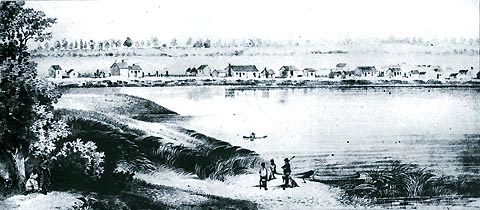
An Early View of Peoria, with the Illinois River in foreground (c. 1831)
1838-42 | 1843-45 | 1846-99
PR Sep 15 '38 | PR Oct 06 '38 | PR Oct 13 '38 | PR Nov 10 '38 | PR Nov 17 '38
PR Nov 24 '38 | PR Jun 15? '39 | PR Jun 29 '39 | PR Jul 27 '39 | PR Nov 02 '39
misc. Ill. papers | Alton Telegraph | Sangamo Journal
Quincy papers | Warsaw Signal | Nauvoo Wasp, etc.
Return to: Old Newspapers Articles Index
 Vol. II. Friday, September 15, 1838. No. 24.  THE MORMONS. "A few days since I witnessed the emigration of 95 families, consisting of near 600 souls, gathered from different parts, going to the extreme west of Missouri. They call themselves "Latter Day Saints," commonly called Mormons. This latter name they do not acknowledge, but say it is only a 'nick name.' They travel in wagons, and make about 15 miles a day, and expect to be 12 weeks upon their journey; they encamp at night and pitch their tents in the form of a hollow square, in which they perform their cooking and other necessary duties, their wagons and horses being ranged on the outside; they also place sentinels at different posts around the camp, as in military encampments. |
|
Vol. II. Friday, October 6, 1838. No. 27. THE MORMONS. It appears from the following article for which we are indebted to the last number of the Western Star published at Liberty, Clay Co., Missouri -- that serious difficulties have arisen between the people of Daviess County and the Mormons, which may result in a civil war: and as the latter are very determined, and receiving frequent reinforcements from other parts of the country, it seems probable that they will not be easily reduced to submission. We know little or nothing of the origin of differences beyond what is given in the Star. -- Alton Telegraph. |
|
Vol. II. Friday, October 13, 1838. No. 28. The Mormon War. This war which has kept a large portion of our citizens in excitement for the last thirty days, is now at an end in everything, except paying the piper, which the people have yet to do |
|
Vol. II. Friday, November 10, 1838. No. 32. THE MORMONS. It seems by the following, which we extract from the Missourian, and confirmed by the St. Louis papers, that the disturbances between the Mormons and other citizens of Caldwell and Daviess counties, Mo., has terminated in a civil war -- a state of things brought about by persecution and intolerance on the one hand and fanaticism on the other: |
|
Vol. II. Friday, November 17, 1838. No. 33. FURTHER FROM THE MORMONS. The account of a bloody butchery of thirty-two Mormons, in Splowns Creek, is fully confirmed. Two children were killed, we presume by accident, considerable plunder -- such as beds, hats, &c., were taken from the slaughtered. -- Not one of the assailants was killed or hurt. |
|
Vol. II. Friday, November 24, 1838. No. 34.
THE MORMON WAR.
In addition to the foregoing, which appeared in the Republican of this morning, [copied from Nov. 17th MO paper] we cut from the Far West, the following statement without pretending to vouch for its authenticity. |
Vol. 3. Peoria, Illinois, Friday, June 15?, 1839. No. 11. ORIGIN OF THE MORMON BIBLE. The Boston Recorder of last week contains the following singular development of the origin and history of the Mormon Bible. It accounts most satisfactorily for the existence of the book , a fact which heretofore it has been difficult to explain. It was difficult to imagine how a work, containing so many indications of being the production of a cultivated mind, should be connected with a knavery so impudent, and a superstition so gross, as that which must have characterized the founders of this pretended religious sect. The present narrative, which, independently of the attestations annexed, appears to be by no means improbable, was procured from the writer by the Rev. Mr. Stow, of Holliston, who remarks that he has "had occasion to come in contact with Mormonism in its grossest forms." It was communicated by him for publication in the Recorder. |
Vol. 3. Peoria, Illinois, Friday, June 29, 1839. No. 13. Origin of the book of Mormon. Mr. Davis -- knowing that it is the wish of every honest and candid person to hear both sides of a question before they come to a conclusion, I believe it necessary to notice to the public a few of the errors contained in a publication signed Matilda Davis. [sic] |
Vol. III. Peoria, Illinois, Friday, July 27, 1839. No. 17.
The Mormons.
|
Vol. III. Peoria, Illinois, Friday, August 17, 1839. No. 20. THE MORMONS. Since the dispersion of these people in Missouri last fall, they have settled in small groups in various parts of Iowa and Wisconsin territories; and some have renounced the faith and returned to their firmer homes and friends in other states. |
Vol. 3. Peoria, Illinois, Friday, November 2, 1839. No. 31. THE MORMONS. A spirited meeting was held in New-York for the relief of this unfortunate and persecuted sect. Mr. Green, deputed by his people to make known their cause, and introduced by a letter of credit signed by governor Carlin, senator Young, and other residents of this state, addressed the meeting. The result was a contribution on the spot of over fifty dollars, and the appointment of a committee to obtain subscriptions in aid of the women and children of the Mormons -- to be applied, after due investigation, by the committee themselves. The narrative of these unfortunate people is full of interest. They first settled in the state of Missouri -- after a series of cruel persecutions were expelled by force from the state, and obliged to surrender, without compensation, the lands and houses which they acquired by their own money or built with their own hands. In the year 1831 about a hundred families of the "Latter Day Saints" came from some of the eastern states and settled in Jackson county, Missouri. They purchased land, erected houses, and cultivated the soil for a livelihood, and maintained aÊpeaceable relation with the other inhabitants of the county. In the year 1833, on the 20th of July, an armed mob of three or four hundred were assembled at Independence, in that county. They appointed a delegation to wait upon the "Latter Day Saints" and inform them that they must leave the country without delay. In consequence of their refusal to go, a two story brick building, which cost seven or eight hundred dollars, occupied as a dwelling and printing office, was attacked, the women and children roughly cast from the premises, the type thrown promiscuously together or into pi, the press broken, and the building torn down -- the publisher of the paper violently dragged into the public square, and together with another individual, stripped tarred and feathered. Four days after the mob again assembled and its force had increased to seven or eight hundred men. About nine o'clock they came marching along, bearing a blood red flag in token of their unmerciful designs. They were all armed with guns, bayonets or clubs. The violently took several leaders into custody, and drove them to the public square, where they were stripped, tarred and feathered. Mr. Pitcher the commanding officer, then called a dozen of his men, ordered them to cock their pieces, present them at the prisoner's hearts, and fire at his command. He then addressed the prisoners, and told them that if they would adjure the Book of Mormon and acknowledge it as an imposture, they should be set at liberty -- if not they should die. But they declared themselves willing to lay [down] their lives rather than thus to pronounce a lie what they believed true. They were afterwards, however, set at liberty upon entering into a written agreement that one-half of the society should leave the country by the first of January, and the other half by the first of April ensuing. All, after this, was quiet until in the succeeding October, the mob, believing that the Mormons would not remove in accordance with their stipulations, again commenced their persecutions. They burned their houses, destroyed their property, and sent negroes to abuse their helpless women. Such treatment roused up a part of the sufferers to arms -- about 33 in number met with a mob of 70 persons, and a battle ensued -- which resulted in the death of one Mormon, two or three of their antagonists, and the wounding of several. This movement aroused the whole country, and in two or three days the number amounted to seven or eight hundred -- under the command of lieutenant governor Boggs. A treaty was entered into between some of the principle men of the Mormons in the one part, and Governor Boggs and Mr. Pitcher on the other, and in pursuance of its stipulations, the Mormons gave up their arms on the assurance that they should be protected from molestation, and should be allowed to remain peaceably in their possessions, until the stipulated time of removal in January and April. The next day after this covenant, the mob, then composed of three or four hundred persons, was divided into bands and proceeded at attack their three settlements, situated from ten to twenty miles apart. They drove the people from their homes, and that too during the most inclement season of the year, on the 13th of November. Two hundred and forty houses were burned or destroyed and the inhabitants driven into the forest on the prairie to seek for shelter. Before noon the next day after their flight, their course could be traced by blood from their feet. The whole number of persons who were expelled from Jackson County amounted to about 1200. After suffering great hardships, they crossed the Missouri into Clay county, where the people hospitably gave them a shelter for the winter. They petitioned that a county should be set apart for them by the Missouri legislature. It was done, and they commenced purchasing the preemption rights for the land. They built themselves houses, tilled and improved the land, and pursued their peaceful avocations until the August of 1838. |
Vol. IV. Peoria, Illinois, Friday, April 17, 1840. No. 4. LATEST FROM THE MORMONS. It is known that these people, since their dispersion in Missouri, have collected in great numbers in and around Commerce, in this state, on the Mississippi river. The name of Commerce, as we have heretofore stated, they have changed to Nauvoo, from the Hebrew or Egyptian, though of the signification of the term we are ignorant. They hold two great conferences every year, -- in the spring and fall, and that appointed for the present spring took place last week, commencing on the 6th and ending on the 9th inst. We learn that between 2000 and 3000 persons were present, and that considerable accessions were made to the church from the surrounding neighborhood. Our informant states that the number was 74, all received by baptism, and that at the same time thirty of the ablest men were ordained to preach the gospel. |
Vol. IV. Peoria, Illinois, Friday, April 24, 1840. No. 5. THE MORMONS. In our article last week upon the affect on the Mormons of Joseph Smith's relation of his interview with Mr. Van Buren, we said: |
Vol. 4. Peoria, Illinois, Friday, July 31, 1840. No. 18. Illinois We notice the following paragraph in our exchange papers, and think it very probable that the statements will turn out to be correct. Hancock county is the great point of gathering of the Mormons who have come into the state since 1838, and who will go almost to a man against him who said, according to Joseph Smith their prophet, that he could do nothing for them, lest it should injure his election: |
Vol. IV. Peoria, Illinois, Friday, August 28, 1840. No. 22. MORMONS LYNCHED. The Quincy Whig of the 18th states that the citizens of Tully, Mo., have recently missed several articles, and laid the theft to the Mormons living at Nauvoo, Ill., immediately opposite. At length a number of the citizens of Tully crossed the river, in the vicinity of the Mormon settlement, where after some searching they found several of the stolen articles. Shortly after falling in with a party of three or four Mormons, they were charged with the theft and forcibly taken across the river and severely lynched. One of them escaped, and running to the river, seized a canoe and reached the other shore, where he fell exhausted. |
Vol. IV. Peoria, Illinois, Friday, September 18, 1840. No. 25. THE MORMONS. We learn that the agent of officer dispatched by Gov. Carlin ro the Gov. of Mo., for the purpose of demanding the authors of the outrage committed upon certain Mormon citizens of this state at Tully, in July last, has returned, and that the demand was successful. The authors of the outrage will be given up, to be dealt with according to our laws. |
Vol. 4. Peoria, Illinois, Friday, October 30, 1840. No. 31.
For THE REGISTER. MR. EDITOR: I was at the semi-annual conference of the Latter Day Saints, held at Nauvoo, in Hancock county, Ill., which was to have commenced on the 2d day of this month, but owing to the inclemency of the weather, did not commence till Saturday the 3d. Notwithstanding the previous bad weather the congregation was very large. I was supposed to be about five thousand, with a great many preachers and elders present. A few of the names I will mention, viz: Joseph Smith, Jr., Hiram Smith, Mr. J. B. Grant, Mr. Babbit, Mr. Wright, and many others. About one hundred were baptized during the conference. The church seems to be in a much more prosperous condition than at any former time. Several families have arrived from England, belonging to the church. |
Vol. IV. Peoria, Illinois, Friday, December 4, 1840. No. 36. MORMONS. An English paper has the following paragraphs about a new shipment to this country. Its location of Quincy, "on the Mississippi. in Michigan." is amusing, and shows a wonderful precision in the knowledge of transatlantic geography:-- |
Vol. II. Wednesday, April 28, 1841. No. 11.
The St. Louis Pennant of Thursday notices the arrival at that part of 237 English Mormons on their way to Nauvoo, the Mormon city in this state. That paper does not speak of them in the most complimentary terms. |
Vol. V. Peoria, Illinois, Friday, June 18, 1841. No. 12. JOE SMITH ARRESTED. It is doubtless known to most of our readers that Joe Smith, the Mormon prophet, was arrested on Saturday last, in Quincy, on the warrant of Gov. Carlin, under the requisition of the governor of Missouri. He was, however, brought up on a habeas corpus before Calvin A. Warren, master in chancery for Adams county, and Judge Douglass having arrived in the city just at the time, he ordered the prophet to be taken to Monmouth, to be examined before him. The judge arrived in this place on Sunday morning last on his way to Monmouth, where the court is now sitting. We understand that a question has been raised as to the legality of the arrest, and the object of the examination is to decide the point. |
Vol. V. Peoria, Illinois, Friday, July 2, 1841. No. 14. MORMON PREACHING. A person (says the Boston Courier of a late date) calling himself "Elder Freeman Nickerson," a preacher of the sect of Mormons, held forth to a large audience in this city on Monday morning. The Daily Mail of the 6th inst. contains a report of his discourse, which is nothing but an outpouring of incoherent dogmatism, fanaticism and cant. Perhaps the prayer which the elder offered, in the course of his remarks, should be excepted from this censure, for that was simple, devotional, and apparently sincere. That the man is a hypocritical Knave, or, if honest, but little removed from an idiot, is manifest from the boastful claims he makes to the power of working miracles. The following conversation took place, as reported in the Mail: |
Vol. V. Peoria, Illinois, Friday, July 16, 1841. No. 16. THE MORMONS. We have for some time observed that a part of the western newspapers of this state have manifested a little sensitiveness in regard to the movements of this new sect of religionists, the center of whose operations is now located in Hancock county, with all the preparations and appearance of a permanent establishment. They are daily receiving accessions to their number, not only by immigration from other states and from Europe, but by process of proselyting at home. |
Vol. V. Peoria, Illinois, Friday, August 6, 1841. No. 19. JOE SMITH THE PROPHET. His holiness, if we may believe his own declarations, has, like Emanuel Swedenborg, a direct communication with Heaven, and walks through the "everlasting gate" just as familiarly as one neighbor would walk in at the door of another's house. According to a late revelation he happened to be there on Gen. Harrison's arrival, and was a witness to the manner of his reception, The old hero was received as an honored guest, but still there was a balance in the books against him, and he was directed to turn to the left, where a big arm-chair, nicely cushioned, had been prepared for accommodation. This was not exactly a place of punishment, though it appeared he had, on account of some unexpiated sin, forfeited the more effulgent glories on the right hand. The prophet does not say so, but leaves us to infer that the general had incurred some slight degree of punishment for not embracing Mormonism before he died. Another big arm-chair, in close vicinity to the general's, was in reserve for Old Hickory, when he shall have "shuffled off this mortal soil." No seat was left for Mr. Van Buren, and the prophet learned upon inquiry, or knew it without, that a dark corner of the nether regions was awaiting his arrival. On earth he could tread in "the footsteps of his illustrious predecessor," but it appears their paths diverge very much after entering the other world. If Jo Smith himself be half as great an impostor as we think he is, a temporary residence in Pandemonium would be but a fit punishment for his hypocrisy. |
Vol. V. Peoria, Illinois, Friday, August 13, 1841. No. 20. THE MORMONS. The last Mormon paper ("Times and Seasons") mentions the return to Nauvoo, with one exception, of "the twelve," who went to England about two years ago to disciple that nation. According to the paper before us they were highly successful and we suppose it is to their agency that we may attribute the numerous reported arrivals of Mormon immigrants from that country within the last year. An extract from the journal of one o the twelve, records the conversion of "about thirty in one family and its connections, six of whom were ordained to be fellow laborers in the vineyard." |
Vol. V. Peoria, Illinois, Friday, August 20, 1841. No. 21. THE MORMONS. We find in the New York Log Cabin a letter from Lewiston, Fulton county, to the editor, dated July 11, over the initials " H. W. W." which we take to mean Henry W. Weed, Seq., the very popular Van Buren stump orator of the late presidential campaign in this region. And aside from the paternity, which is creditable to the second paragraph, doubtless, was not intended for publication; and being written in the freedom of private friendship, must be supposed to express the real desire of the writer. This we trust he will be induced to change. If Fulton county must continue to be governed by locofocoism, let it furnish men who know something, since it has them. If Mr. Weed had been the candidate for congress, in the election just passed, the party hereabout would have supported him far more cordially than they did Ralston. |
Vol. V. Peoria, Illinois, Friday, September 3, 1841. No. 23. ORIGIN OF THE MORMONS. The statements contained in the following article were given to the Rev. Dr. Murdock, of New Haven, by a minister of the Mormons, as they were pursuing their way as fellow-passengers on board a steam-boat on the Ohio river, and communication by Dr. M. to the Hartford Observer. They present briefly one of the most remarkable exhibitions of the obliquities and follies of the human mind in its religious speculations which the history of this age records. |
Vol. V. Peoria, Illinois, Friday, September 10, 1841. No. 24. Mormons in New Jersey. -- The Trenton State Gazette states that the Mormons have two societies in Monmouth county, one at Hornorstown and the other at Tom's River. About 100 belong to the former and 70 or 80 to the latter. They have meetings regularly once a week at New Egypt, besides occasional meetings at other places. |
Vol. V. Peoria, Illinois, Friday, September 17, 1841. No. 25. The Mormons, strange as it may seem, are organizing societies in this region (Pennsylvania), having had, for some time, one or two in this city. It is said that a camp meeting has been in session for some days past, near Taylorsville, Bucke county, where their preachers have been making extraordinary efforts to increase their proselytes. Large numbers of people have visited their camp, and doubtless the delirium has seized upon many an unfortunate and superficial mind. -- Philadelphia North American. |
Vol. V. Peoria, Illinois, December 10, 1841. No. 37. From the Missouri Republican.
We are indebted to a pious and intelligent gentleman of this city, for the following description of Mormonism, as it is to be found at Nauvoo, and of Jo Smith, its leader. The intelligent reader will scarcely believe that such humbuggery could be successfully practiced, at this day, upon the most credulous or ignorant of the community, yet it is so in this instance. |
Vol. II. Peoria, Wednesday, Jan. 19, 1842. No. 49. The Mormons and the Sangamo Journal. The last Sangamo Journal is in a great ferment on the subj. of a letter from Joseph Smith to his "friends in Ill." The letter appears in the city of Nauvoo, and declares the intentions of the writer to vote for Snyder and Moore, at the next election. This is a terrible thing in the estimation of the Journal, and we suppose it is not so agreeable to the feelings of the print and its friends as a contrary announcement of Mr. Smith would have been. When the Mormons voted the Whig ticket, it was all right with that party; now, when there is a probability that they will support the other side of the question, the Journal is dreadfully alarmed, and says it will set "the people to thinking!" More likely it will set the whig candidates to "thinking." But Smith calmly says: -- |
Vol. V. Peoria, Illinois, January 21, 1842. No. 43. THE MORMONS RELIGION AND POLITICS. The last number of the "Times and Seasons," the Mormon paper published under the direction of this sect at Nauvoo, contains the following extraordinary document: |
Vol. II. Peoria, Wednesday, Jan. 26, 1842. No. 50. The last last Sangamo Journal devotes a column and a half of its editorial matter to the address of Joseph Smith to his friends in Illinois, in which Smith states that he and his friends will vote for Snyder and Moore at the next August election. The Journal breaks forth in a solemn warning to the "citizens of Illinois," and calls upon them to "read and consider." He tells the story of the Farmer and Asp; that when the farmer had warmed the poisonous reptile in hos bosom, so that returning life appeared, the asp began hissing and curling itself up preparatory to a deadly attack upon the farmer, who seeing its intent and aim, destroyed it. The Journal then adds, "the moral is perceptible, and needs no words of explanation." We must confess we read these remarks of the Journal with amazement and alarm. That paper was mute so long as the Mormons, or "latter day saints," voted for Harrison and sleepy John; but when there is an indication that they, like thousands of other citizens, are becoming disgusted with Whig rule, or rather misrule, then they are treated with scorn and ignominy, and there is a giving out in no unmeaning terms, that if they act the part of freemen and vote as they think right, a terrible vengeance awaits them: "The moral is perceptible, and needs no words of explanation." Truly the meaning of the Journal is plain and cannot be misunderstood -- it means this: The whigs have been courting and fawning about the Mormons, but now "seeing their intent and aim," to vote for Snyder and Moore, they must be destroyed; yes, "DESTROYED!" Indeed, this is the moral the Journal inculcates. We are no apologists of the Mormons; we are almost wholly unacquainted with the principles of their religious faith; they may have embraced much error, for aught we know, but whether they have or not is no business of ours. The law throws its mantle of protection all around every citizen and no man is to be disfranchised or molested on account of his religious belief. All have their political rights and privileges. Does the editor of the Journal want another Missouri war? Does he wish our state disgraced? It is from such a course as that paper pursues that mobs are excited to acts of violence and encouraged to trample all laws, human and divine, all rights of individuals and the community under foot. We sincerely hope that the Journal will find no sympathy or support from other whig presses for the blood-thirsty sentiments it has uttered. |
Vol. VI. Peoria, Illinois, May 27, 1842. No. 8. "IS SAUL ALSO AMONG THE PROPHETS?" The last Rock Island Mississippian has the following notice: |
Vol. VI. Peoria, Illinois, June 24, 1842. No. 13. A GREAT MORMON SPOKE GONE. The last Times and Seasons contains the following bull of excommunication. Gen. Bennett, it will be remembered, was the head of the "Nauvoo Legion," and one of the main pillars of the Mormon ediface:Notice. -- The subscribers, members of the first presidency of the church of Jesus Christ of Latter Day Saints, withdraw the hand of fellowship from Gen. John C. Bennett, as a christian, he having been labored with from time to time, to persuade him to amend his conduct, apparently to no good effect. HYRUM SMITH, WM. LAW. Lyman Wight, William Smith, John E. Page, John Taylor, Wilford Woodruff, George A. Smith, Willard Richards. V. KNIGHT, GEORGE MILLER. Nauvoo, May 11th, 1842. Notes: (forthcoming) |
Vol. III. Peoria, Wednesday, July 13, 1842. No. 22. THE JOURNAL -- MORMONS -- CATHOLICS. The Sangamo Journal is becoming perfectly furious against the poor Mormons. Their great offence it seems, is, that they have determined to pursue an independent course at the ensuing election. When they voted the whig ticket they were considered a rather clever sort of people by the Journal. But no sooner did that paper understand that there was a probability of the Mormons voting the democratic nominations, than the Journal became rampant against them. He and Jo Duncan at once discovered that Joseph Smith was an impostor -- his followers were fools and knaves -- and he intimated in no very unintelligible terms, that they ought to be DESTROYED. He also a few weeks ago, dragged the Catholics before the public in his paper, and gave them and Van Buren a foretaste of what they might expect if they should persist in going counter to his sovereign will and pleasure. From some cause the Journal suddenly dropped the Catholics; perhaps Gov. Duncan found that it would not be a very profitable game, to traduce in rapid succession too many religious denominations, simply because some of them could not conscientiously vote to elect him governor. Still the whig Journal thinks Van Buren committed an unpardonable offence in expressing a willingness to shew respect to the subject of the Pope. That was certainly very naughty in the man of Kinderhook! Now, if Van Buren has told the Pope in plain terms, that his subjects, here ought to be DESTROYED, as the Journal gave Jo Smith to understand his people ought to be treated, then we suppose that whig papers would have no fault to find, and probably he would not say anything prejudicial to the Catholics, especially if they should all go headlong for Jo Duncan. The whig leaders at Springfield may yet learn that opposition to the freedom of conscience is not the most speedy steed for them to mount who wish to ride rough shod into power. |
Vol. III. Peoria, Wednesday, July 20, 1842. No. 25. THE SUPPRESSED LETTER. The Sangamon Journal has of late been most assiduously engaged in making disclosures, and publishing letters against his old friends, the Mormons. But there is one letter which he has not found it convenient to admit into his columns. Why is this so? Is Mr. Francis afraid to tell the whole truth? We suspect this is the case. And to show that there is reasonable ground for his suspicion, the reader shall see what Mr. Francis has suppressed. Here it is: |
Vol. VI. Peoria, Illinois, July 22, 1842. No. 17. THE MORMON DISCLOSURES! Gen. Bennett was at St, Louis last week, on his way to New-York to publish his threatened expose of the Mormons. While there he caused the following letter to be published in The Bulletin: |
Vol. VI. Peoria, Illinois, July 29, 1842. No. 18. ILLINOIS. ... More Mormon atrocities!! -- The Warsaw Signal of the 16th says: -- |
Vol. III. Peoria, Wednesday, Aug. 3, 1842. No. 27. The Sangamo Journal, a Mormon paper, published by Mr. Francis, in Springfield, is making some strange disclosures in relation to the religious sect called Mormons. We call the Journal a Mormon paper, and we are sure no one, who has seen the "Looking Glass" held up for it by the last State Register, can doubt at least its past claims to that distinction. But it seems that a difficulty has recently occurred between some of the leaders of that sect at Nauvoo, and they have fallen to abusing each other at a sound rate; and this peculiar people will probably soon be divided into two parties, the one headed by Joe Smith the Mormon prophet and the other by Bennett and the editor of the Sangamon Journal, he having formerly been a staunch advocate and defender of this religious people. Whether he has renounced Mormonism or not, or whether he intends to do so, he does not inform us. We infer, however, that while he denounces Smith as an impostor, he yet clings to the doctrines of the sect, and he will doubtless fall in with that portion of them who follow Bennett, and we shall probably hereafter see him the adherent of Bennett as he once was the apologist and defender of Joe Smith. We hope after the election and its excitement are over, Mr. Francis will give the people a full statement of the doctrines and practices of the Mormon sect; his long adherence to which, and his close connections with the denomination will enable him to do it better than any person we know of. |
Vol. III. Peoria, Wednesday, Aug. 10, 1842. No. 28. More Obscene Disclosures Coming. The Sangamo Journal says Joe Smith got up a large meeting some days ago at Nauvoo, for the purpose of whitewashing himself; and that a resolution was there proposed making out Joe to be all sorts of a moral and pious man. There were three or four persons who voted against the resolution -- Orson Pratt was one of them, and he gave the reasons for it which "related to the attempted outrages upon his wife by the impostor." The Journal says he hopes Pratt "will furnish a copy of it for the public eye." In default of that he may publish F---y H---. How many of those who copied former "disclosures" from the Journal would insert this in their columns it is difficult to tell, as some of them might not deem it of interest without the plates. Truly, there is no disputing of tastes, at least when coon editors are in question. The more obscene and disgusting the "disclosure" the greater their industry in parading it before the public. No sense of delicacy restrains them. |
Vol. VI. Peoria, Illinois, August 19, 1842. No. 21. After the election. -- According to "common street talk," the governor of Missouri has demanded of the governor of this state, the person of JOSEPH SMITH, the Mormon prophet, and one of his disciples, named O. P. Rockwell, for the purpose of having them tried in Missouri, for certain crimes alleged to have been committed by them in that state. Gov. Carlin, as the story goes, in obedience to the demand of Gov. Reynolds of Mo., issued a writ one day last week, for the apprehension of Smith and Rockwell, and the execution of the same was entrusted to one or two constables of this city. In accordance with the requirements of the writ, these officers proceeded to Nauvoo, and apprehended Smith and Rockwell; but before leaving the city, a process was issued by the municipal authorities of Nauvoo, to bring the arrested persons before a city court convened for the purpose, where, after an examination of the executive writ, it was pronounced insufficient, and the prisoners set at liberty. This is the substance of the reports in circulation, and it may be correct or incorrect. It is further stated, that the governor's "dander is up," and that he is determined to take "Joseph," any how, and that another writ has been dispatched for the purpose. Alas! the poor Mormons! Even the 1000 majority for Ford does not avail them in this emergency. The locos have used Smith -- now we suppose they will hang him! Quincy Whig, August 13. |
Vol. VI. Peoria, Illinois, August 26, 1842. No. 22.
It turns out that rumor of a battle at Nauvoo was a hoax. The latest accurate information we have from Nauvoo is from the Quincy Whig of last Sat: |
Vol. VI. Peoria, Illinois, September 2, 1842. No. 23. "Back again." -- Forty Mormons reached here this morning in the Roselie, leaving Mormonism and its absurdities behind them. -- |
Vol. VI. Peoria, Illinois, October 7, 1842. No. 28.
We received a note this week requesting us to publish some affidavits "against the writings of Dr. J. C. Bennett," alluding, we suppose, to [the] Bennett expose of Mormonism, or rather of the Mormon prophet, published in the paper some time ago. We have never seen the affidavits alluded to, nor do we think there would be any use in publishing them, for the public already [know and] appreciate Bennett's character, and give, in this instance, "the devil his due." |
Vol. VI. Peoria, Illinois, October 21, 1842. No. 30. Arrest of Jo Smith. We understand the Governor has received information, that Jo Smith is in custody at Carthage, and that he is being brought before Judge Douglass, who is there holding court, on a writ of habeas corpus, for the purpose of trying the validity of the Governor's writ of arrest. From the course the thing is taking, it is not impossible that the same farce played off two years ago, in which the same parties were interested, will be re-acted again in the present instance. -- Quincy Whig. |
Vol. VI. Peoria, Illinois, November 11, 1842. No. 33.
Since the publication of Bennett's letters on the Mormons last summer, we have been frequently importuned to publish something by way of fact. As the Register was not then under our control, we felt under no obligation to devote any part of our space to this purpose; but to gratify those concerned we now give two documents, selected by a Mormon from a mass of the same kind, with the understanding that no more will be asked of us. While referring to Bennett we may say we this week received through the post office his promised "book," marked 84 cents postage. Deeming this sum to be more than it is worth, we have declined taking it, and it accordingly remains in the office, free, we suppose, for any person who will pay the postage. |
Vol. VI. Peoria, Illinois, December 16, 1842. No. 38. O H I O. Mormonism revived. -- The Cleveland Plain Dealer says: "The Mormon temple at Kirtland, has lately been dedicated anew. On Saturday, the 29th ult., three of Joe Smith's specially commissioned and faithful followers arrived at the temple from Nauvoo, and commenced preaching faith and repentance. The Sunday morning following, they commenced baptizing in a branch of the Chagrin river, and continued at intervals for three days -- baptizing in all two hundred and six persons, at two shillings a head! Old converts were rebaptized, and their sins washed away for the same price as the young ones, making no distinction between old sheep and the lambs of the flock. |
Vol. III. Peoria, Wednesday, Dec. 28, 1842. No. 46. Mormons. Twenty persons professing Mormonism were baptized in the Delaware river, at Philadelphia, on Sunday the 11th inst. |
Back to top of this page.
News Articles Page | News Articles Index | History Vault
Bookshelf | Spalding Studies Library | Mormon Classics
last updated: Mar. 8, 2006