READINGS  IN  EARLY  MORMON  HISTORY
(Newspapers of New York)


New York State west of Syracuse

Rochester Papers
1834-39 Articles
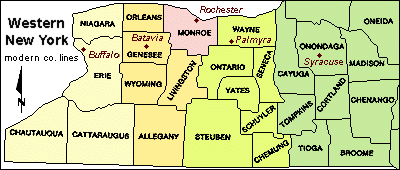


Monroe County: Pink = Rochester Area


1795-1825  |  1826-28  |  1829-31  |  1832-33  |  1834-39  |  1840-46  |  1847-99  |  1900-49

1834-9 West NY  |  1832-9 Batavia Area  |  1834-9 Palmyra Area  |  1832-9 East NY


RDD Mar 06 '34  |  RDD May ? '34  |  LibA Jul 26 '34
LibA Sep 12 '34  |  RDD Feb 09 '35  |  RRp May 12 '35
RRp Jun 15 '35  |  RRp Nov 10 '35  |  Wrld Jul 16 '36
RRp Jun 13 '37  |  RRp Jun 27 '37  |  RRp Jul 25 '37
RRp Oct 23 '38  |  RRp Nov 27 '38  |  RRp Dec 04 '38
RDD Dec 07 '38  |  MonD Dec 11 '38  |  RDD Dec 26 '38
RDD Dec 29 '38  |  RDD Jan 09 '39  |  RDD Feb 09 '39
RDD Feb 27 '39  |  RDD May 28 '39  |  RRp Jun 11 '39
RRp Jul 09 '39


News Articles Index  |  NY Chronological List  |  New York City Papers

 

ROCHESTER  DAILY  DEMOCRAT.
Vol. II.                              Rochester, NY, March 6, 1834.                             No. 54.


The Mormonites again Gov. Dunklin of Missouri, has issued an executive letter, directed to several leading men of the Mormon persuasion, [entreating] them to appeal to the courts of law, which are bound to render them satisfaction for the late outrageous assaults upon their rights and liberties as peaceable citizens. The Governor says, "in the event that the laws cannot be executed, and that it is officially made known to me, my duty will require me to take such steps as will enforce a faithful execution of them." -- Danville (Ill.) Inquirer.


Notes: (forthcoming)


ROCHESTER  DAILY  DEMOCRAT.

Vol. II.                              Rochester, NY, May 20?, 1834.                             No. ?


MORMONITES  IN  MOTION.

According to a late number of the Painesville Telegraph, General Joe Smith, the leader of the Mormonites, has, accompanied by about five hundred of his followers, set out for the purpose of re-conquering the "Holy Land," lately taken from them by the infidels of Missouri. Joe, it seems, had been stirring up his proselytes for some time, stating that it was the command of God that they should buckle on the armor of their faith, and enrol under the banners of Mormonism; that their church was in danger; and that they must, if necessary, die the death of martyrdom. Accordingly, the deluded fanatics obeyed his summons, a great rise took place in the market for warlike implements, as each provided himself with an abundant supply of pistols, dirks, swords, &c. The sword of Smith himself, it is said, is more than four feet long. The prophet professes the expectation of sharing the fate of a martyr at the coming contest. We trust that the good people of Missouri will take care of these fanatics, and see that they do not violate the laws with impunity.


Note: The exact date of the above article remains undetermined. It summarizes the May 9, 1834 issue of the Painesville Telegraph, and it was subsequently was reprinted in the May 30, 1834 issue of the Wayne Sentinel. The editor of the Sentinel followed the progress of Smith's "Zion's Camp" military expedition with some evident interest. On July 18th he reported that the Mormon prophet "was wounded in the leg" and had died "three days" later. There is no evidence that the Sentinel editor ever retracted this erroneous rumor and it was probably widely believed in the vicenity of Palmyra and Rochester for several weeks.


Volume IV.]                         Rochester, July 26, 1834.                           [Series 1. No. 8.


JOE  SMITH.

This "child of chance" is no longer numbered among the living. He was about thirty years old, and no man since the days of the Apostles, was ever more accidentally bro't into notoriety. Like other religious fanatics and hypocrites, his intellect was small and his mind uncultivated. He was not versed in "the lore of ages," and being extremely [timid] by nature, it is "passing strange," that he should have bared his breast to the shafts of battle. As in olden times -- his ignorance was urged as a plea in favor of his divine mission. He was doubtless a catspaw in the hands of knaves, more cunning than himself. -- Peace to his ashes!


For the Liberal Advocate.

MR. EDITOR: -- The Christians seem to be getting into quite a dilemma as to the complexion of Christ; the Jews rejected him as an impostor; the Christians seem to be disputing now, whether he was a white or a black man. Go on gentlemen, you have always been in a quarrel whether he was the very God, or whether he was part God, or a good man only. It might perhaps be well for him to come again and settle the question and stop the dispute. As for infidels, it is of no consequence; we depend upon our own resources; governed as we are by the great laws of nature, to her we submit, but to no other, except our State laws, and it might be as well for Religionists to stop paying priests for making beings about whom they quarrel.

AN INFIDEL.    

P.S. It is supposed the great riots in New York, grew out of Religion. -- Look at the state of things in Missouri; see how that country is threatened with a holy war; the Mormons must be exterminated. Why not let them alone? their religion is just as true as any, for they mostly appear to be phantoms of a distempered brain, goaded on by designing men who get pay for making people fools.


Note 1 (by Rich Troll): No doubt this false information was carried over from the Wayne Sentinel of July 18, 1834. From the next edition of the Liberal Advocate to the final surviving copy of November 22nd 1834, there is no mention or retraction of this error. It should be noted Abner Cole always used "Jo" when referring to him, even going back to his days editing The Reflector. Is the use of "Joe" a typo, or out of respect for a man he supposed to be dead? This paper rarely published obituaries, which is most likely why this report was presented as a news item.

Note 2 (DRB): Joseph Smith, Jr.'s 1834 death report was simply a rumor arising out of the confusion of his Zion's Camp military expedition to Jackson County, Missouri. Some members of the Mormon troop did die, but Smith was not among their number. Compare the New York papers' death report articles with those of other 1834 newspapers published in the mid-West -- such as the July 12th issue of the Chardon Spectator (probably the original purveyor of this false report).


Volume IV.]                         Rochester, Sept. 12, 1834.                           [Series 1. No. 10.


ITEMS.

The Dover, N. H. Globe, states that in a few weeks a Mormon minister formed a growing and respectable church in that village.

Notes: (forthcoming)


ROCHESTER  DAILY  DEMOCRAT.

Vol. III.                              Rochester, NY, Feb. 9, 1835.                             No. 33.


D I E D.

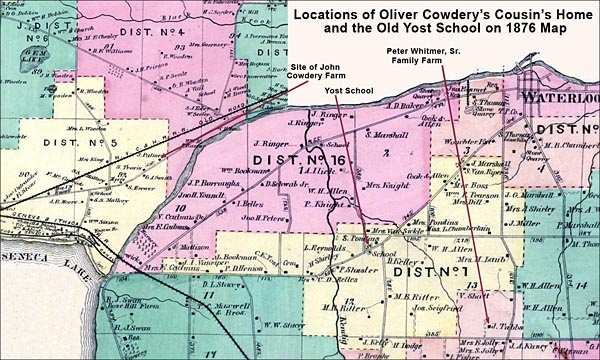
In New York, on the 27th ult., Col. John Cowdery, aged 76 years; at an early day a resident of Geneva, and subsequently of the town of Waterloo. While a youth he assisted in throwing the tea overboard in Boston Harbor: he afterwards joined the American army and served through the revolutionary war: subsequently he became an instructor in the military science. He was a gentleman of great private wealth, and lived and died a sincere Christian.


Mormonites. -- This sect have petitioned to the Legislature of Missouri to restore to them the property and lands, from which they were recently driven by their religious opponents.


Note: John Cowdery (1757-1835) was appointed Colonel of a militia regiment at Geneva, Ontatio Co., NY in 1791. By 1797 he had left Ontario and was living in Steuben Co. He retired from his military career and moved to Seneca Co. during the 1820s. His home at Waterloo was in close proximity to the Peter Whitmer, Sr. farm in the adjacent township of Waterloo. John was a senior relative of the young Oliver Cowdery and it goes without saying that Oliver would have been aware of this "gentleman of great private wealth" living near the Whitmers when Oliver was living with them and preparing the Book of Mormon text for publication. John left Waterloo about 1830, and spent his final years in New York City.


Vol. XIX.                              Rochester, NY, May 12, 1835.                             No. 19.


Joe Smith, the Mormon Prophet, was recently brought before the powers that be, at Painesville, (O.) charged with an assault and battery on his brother-in-law. The result of the investigation was a recognizance for his appearance at the next Court of Quarter Sessions, to answer to the charge made against him. This conflict between the law and the prophets, will no doubt be advantageous to the lawyers.


Notes: (forthcoming)


Vol. XIX.                              Rochester, NY, June 15, 1835.                             No. 24.


An  Angel  Caught.

The Magazine and Advocate says, that while the Mormon Prophet, Jo Smith, was in Ohio, engaged in proselying people to the faith of the "Golden Bible," he sought to give additional solemnity to the baptismal rite, by affirming that on each occasion an angel would appear on the opposite side of the stream, and there remain till the conclusion of the ceremony. The rite was administered in the evening in Grand River, near Painesville, not by the Prophet in person, but by his disciples. In agreement with the prediction of the Prophet, on each occasion a figure in white was seen on the opposite bank, and the faith of the faithful was thereby greatly increased. Suspicions, as to the incorporeal nature of the reputed angel, at length induced a company of young men (unbelievers of course) to examine the quality of the ghost, and having secreted themselves, they awaited its arrival. Their expectations were soon realized, by its appearance in its customary position, and rushing from their lair, they succeeded in forcing it into the stream, and although its efforts at escape were powerful, they succeeded in bearing it in triumph to the opposite side of the stream, when who should this supposed inhabitant of the upper world be, but the Mormon Prophet himself!


Note: The original, more detailed, version of this report appeared in in the Utica, New York Evangelical Magazine and Gospel Advocate of June 6, 1835. Neither of these reports appears to be reliable -- however, the events they relate may have some foundation in fact -- see the 1938 autobiography of the Disciples of Christ minister, J. J. Moss, for the possible genesis of the tale. The Mormons responded to the Republican's paraphrase of this article in their LDS Messenger & Advocate of July 1835.


Vol. XIX.                              Rochester, NY, Nov. 10, 1835.                             No. 45.


MORMONS. -- A correspondent of the "Miami of the Lakes" gives a short description of the Temple of Mormon, or, as it is called, the 'Temple of the Lord,' in Kirtland, eleven miles south east of Painesville, Geauga county. It is a stone ediface, 58 feet 8 inches by 78 feet 8 inches, two full stories high, with dormer windows in the roof, which give it a singular appearance. For the size and peculiar construction of the 'Temple,' and the addition of the extra eight inches each way, the leaders of this infatuated people give no other reason, but, as they tell their following, that the Lord gave his direction. The house is rather an expensive one, the writer adds, built by the labor of the poor people, who, in their delusion, follow Joe Smith and Rigdon.


Note: For a similar, later article from the Perrysburg Miami of the Lake, see its reprint in the Daily National Intelligencer of July 4, 1837.


Vol. I.                              Rochester, NY, July 16, 1836.                             No. 47.


ANOTHER WAR BREWING. -- The Far West, published at Independence, Missouri, says information has been received from Kirkland, [sic] Ohio, through various channels of another movement among the Mormons to obtain possession of the "promised land," and to establish their Zion in Jackson county' the scene of their former disastrous defeat. They are said to be armed to the number of 1500 or 2000, and to be making way in [detached] parties to the "debatable ground." The Far West also states that the people of Jackson and their friends in the surrounding counties are taking affective measure for resistance.

We presume that the Mormons go with arms only for the purpose of self-defence; and will the people of Missouri, christians or fanatics, have the madness to resist them with an armed force? Do not the Mormons own the ground they mean to take possession of? If they do not, it is madness on their part. If they do, it is madness to resist them. As long as they behave peaceably, they have as good a wright [sic] to be there as any other people, or to be any where else.


Note: Dr. Luke Shepard's Rochester World, was something like a successor to Abner Cole's Liberal Advocate. Cole died in Rochester on July 13, 1835 and the World began publication at about that same time, though on a different press and at a different printing office. The new paper apparently died out near the end of 1836.


Vol. XXI.                              Rochester, NY, June 13, 1837.                             No. 24.


MORMONISM. -- We are somewhat fearful that our old neighbor the Mormon Prophet -- better known by the unscriptural name of Jo Smith -- will have to form an era in the history of his sect like that of the Hegira or flight of Mahomet. Indeed he had hardly become known as a prophet beyond his immediate circle in Wayne county, before he manifested belligerent propensities towards our editorial selves for audaciously doubting the authenticity of his then newly-published Mormon Bible. He exhibited, as we were told, a degree of rage at sceptics like us, which spirit has at last got himself into a scrape from which he can probably only escape by flight or punishment. The Cleveland Herald says --

"The Mormon Prophet Jo Smith, has lately been arrested in Geauga county, as an accessory to an attempt to murder an unbeliever in his golden humbug. It seems Jo had a revelation that a certain sceptic in the neighborhood of the "Holy Land" deserved martyrdom, and soon found a couple of his followers stupid and wicked enough to obey his ministrations. They were foiled in the attempt to shoot the individual; quarrelled with the Prophet, and are now exhibiting this fiend in the garb of a Latter day Saint," in his true character."


Notes: (forthcoming)


Vol. XXI.                              Rochester, NY, June 27, 1837.                             No. 26.


Joe Smith, the Mormon prophet, is held to bail in Ohio, on a charge of instigating some of his deluded votaries to attempt the assassination of an "unbeliever."


Joe Smith, the Mormon "Prophet," has been tried and acquitted of the charge of inciting some of his followers to murder an "infidel." Joe is literally a "tried man." as this the 13th time he has been arraigned since his advent as a "prophet." It is said that some of these prosecutions arise partly from political hostility.


Note: The second news report is slightly in error. Joseph Smith was not "acquitted," rather, the court dismissed the charges against him when a necessary witness could not be found to give testimony in the case against Smith. See the Ohio Painesville Telegraph of June 9, 1837.


Vol. XXI.                              Rochester, NY, July 25, 1837.                             No. 30.


MORMONS. --These crazy fanatics have their grand Tabernacle at a place they call Kirtland, 5 miles from the shore of Lake Erie, and 20 miles from Cleveland, and count no less than 4000 persons under their leader, Joe Smith. They have been lately joined by a shrewd literary person, named Sydney Rigdon, formerly a preacher of the doctrine of Campbell. He is the Grand Vizer to Smith; and under their decision a banking house has been established, of which Smith is president and Rigdom cashier. The issues have been about $150,000. -- The bank failed. They have several mills on their property. The houses are small, including the Prophet Joe's. The temple is a beautiful building of rough stone, three stories high, and 70 to 75 feet square. Each of the two principal apartments holds twelve hundred persons. The joists of the interior are supported by six fluted columns. Each apartment contains six pulpits, arranged, gradatim, three at each end of the "Aaronic priesthood," and [three] at the other end for the "priesthood of Melchisidec." The slips are so constructed, that the audience can face either pulpit, as may be required. In the highest seat for the "Aaronic priesthood," sits the reverend father of the prophet; the next below is occupied by Joe, and his prime minister, Rigdon. The attic story is occupied as school rooms, five in number, where the various branches of English, Latin, Greek and Hebrew languages are taught to a great number of students. The actual cost of the temple is not known, but it is estimated to have cost not less than $60,000.

Smith is reported as a placid looking knave, with passionless features, and perfectly composed in the midst of the hetrogenous multitude who have become the victimized dupes of his imposture. -- Rigdon is described as the reverse, with a face full of fire, a tenor voice and of eloquent speech; The subject of his sermon was the pressure; his discourse was mild and persuasive. Rigdon is the wire puller or screen of Joe's inspirations. The followers are, many of them, upright men and tolerant towards other sects. -- N. Y. Star.


Note 1: The original for this article was a letter published the Perrysburg, Ohio Miami on the Lake newspaper near the end of June, 1837. It was reprinted in the Washington National Intelligencer of July 4, 1837 and in Major Mordecai M. Noah's New York Evening Star, also in July.

Note 2: In a letter from W. W. Phelps to John Whitmer (editor of the LDS newspaper), Phelps quotes the previous M. M. Noah "Heathen Temple" article from Noah's Evening Star of 1835. The 1837 follow-up piece brands the LDS as "crazy fanatics," but avoids presenting the Mormons as "heathens." See the LDS Messenger & Advocate for Dec. 1835.


Vol. XXII.                              Rochester, Tuesday, October 23, 1838.                             No. 43.


THE MORMONS -- LATEST. -- The St. Louis Republican of the 1st inst., states that General Atchison had easily arranged the war with about two hubdred men. A full investigation by General A. of the whole matter, satisfied him that the Mormons were the injured party, and that the statements of Justice Black and others, of the Mormons' threats and attempts to force persons to sign a paper, and to swear allegiance to Joe Smith, were entirely false and groundless. General A. easily succeeded, after learning the whole facts, in restoring peace and quiet to the country, and in dispersing all armed forces in the neighborhood.


Note: This edited news report fails to convey the details in the St. Louis Republican story -- and neither paper makes clear the fact that Atchison and Doniphan were also worked as part-time lawyers for the Mormon leaders and were, at this point in time, on Joseph Smith's payroll.


Vol. XXII.                              Rochester, Tuesday, November 27, 1838.                             No. 48.


THE  MORMONS

From the St. Louis Republican of Nov. 5.

                    RICHMOND, RAY COUNTY, Mo.
                    October 29, 1838.
To the Editors of the Missouri Republican:
    Gentlemen: -- The Mormons commenced, on the 18th inst., to burn and ravage the plantations, houses, &c. of the people of Davies county. -- They have laid waste the whole county, burning store houses, farm houses; destroyed the property of the citizens, driving off the hogs and cattle of the inhabitants of that county, taking the plunder to the Mormon hold, Far West, leaving the county of Daviess one wide extended ruin. Bands of the Mormons go out, followed by waggons, and take live stock and property, sweeping every thing before them, and haul the spoils into Far West. They have burnt the town of Gallatin, the county seat of Davies. On last Wednesday night, a body of some hundred and fifty or two hundred Mormons, attacked a small body of the militia of Ray county, some fifteen miles north of Richmond, under Capt. Bogart, some two or three of Bogart's men were killed, and several wounded. Some four or five Mormons were killed and many wounded. The Ray men retreated. The alarm has spread through the whole upper counties, and the militia have been called out forthwith.

Last night I was in the camp of the militia from Lafayette, Jackson, and Ray. There was about the number of seven hundred men, and, as the people were flooding in from all quarters, I suppose this morning the number exceeded eight hundred.

From the exasperated feeling manifested plainly by the forces last night, I apprehended the most serious consequences. Every body is excited; the public mind is resolutely bent on putting it beyond the power of the Mormons to again disturb the peace of the citizens, and more especially their plunderings and burnings. It was rumored that the Mormons were to burn Richmond on last Tuesday night, and the women and children all fled across the river to Lexington. I saw on the bank of the river in the night a large number of women and children, without a shelter or food, who had fled early on Thursday morning, to Lafayette county, for safety. It was after sunset on Thursday before I heard of the alarm of the women of Ray, and I immediately hastened to Lexington, and then to the river, to offer shelter, protection, and food to those suffering people. No man, without seeing the objects, can properly estimate my feelings on that night.

You may expect to hear, in three or four days, more news of the most fatal character.
                I am your most ob't serv't,
                JOHN S. RYLAND.


From the New York Express.

THE  MORMON  WAR  ENDED.

The St. Louis papers of the 8th inst., state that the Mormon War had ended, by the surrender of the leaders of the Mormons. On the 28th ult. about three thousand men. commanded by Gen. Atchison, of Clay County, made their appearance before the town of Far West, the county seat of Caldwell county, where the Mormons were entrenched. Upon their approach the Mormons hoisted a white flag, which was shot down by Capt. Bogard, but was immediately re-placed. Gen. Atchison then sent in a message, with a view to learn their wishes and intentions, when six of the leaders avowed their willingness to surrender, in the expectation that the Mormons should be unharmed. The surrender was accepted, and the individuals put under guard. Their names are Joseph Smith, Sidney Rigdon, George Hinkle, Lyman Wight, Parley P. Pratt, and Mr. Knight. The Mormons assembled at Far West, comprized 700 men under arms. Of this number, a small body of 150, retreated and pursued their way to the northern frontier.

On the day after, the order of Gov. Boggs, directing the expulsion or extermination of the Mormons, was received by Gen. Atchison, disgusted with such a command, he immediately resigned his office and retired. Subsequent to this, it is reported that a number of the Mormons were set upon and murdered.


Note: The Ryland letter from the St. Louis Republican and the article from the St. Louis Evening Gazette were edited and shortened in this Rochester reprint.


Vol. XXII.                              Rochester, Tuesday, December 4, 1838.                             No. 49.


From the St. Louis Republican.

THE  MORMON  WAR.

The Western mail, yesterday, brought us some additional particulars in regard to the disturbances in Caldwell county. The Far West, published at Liberty, states that Gen. Clark still remained at the town of Far West, having under his command 1300 men, who were employed in guarding the captured Mormons. The General had despatched an order to Gen. Lucas, commanding him to return Jo and Hiram Smith, Rigdon, Wright, Robinson and Hunt, for trial in Richmond, Ray county. Gen. Lucas was on his way to Jackson county, and, it is said, refused to obey this order. A great many of the Mormons had made their escape from Caldwell county, leaving their families.

The Far West also says:

"Just as our paper was going to press, we received a communication from Gen. Lucas, giving the stipulations of the treaty made by him and the Mormons. It will be recollected that we stated that General Atchison and his staff returned home, having considered himself virtually ordered from the field by Governor Boggs; who assigned the command to Gen. Clarke of Howard county. Gen. Lucas was in command of the troops previous to and at the time of the surrender of the Mormons. The matter was entirely settled before the arrival of General Clarke. What motive could have operated on Gov. Boggs for excluding Gen. Atchison from any command, we do not pretend to know, but this we do know, that he has done himself very little credit, by so illiberal a course of procedure.

Gen. Lucas states that the officers and men under his command conducted themselves in a manner that will ever recommend them to his highest approbation. We are sorry our space and time will not permit us to make any further remarks. The following are the stipulations between the parties: 1st. To give up their leaders to be tried and punished.
2nd. To make an appropriation of the peoperty of all who had taken up arms, for the payment of the debts, and as indemnity for damages done by them.
3d. That the Mormons should all leave the State and be protected out by the militia; but to remain under protection, until further orders from the Commander-in-Chief.
4th. To give up all arms of every discription, to be receipted for.

Notes: (forthcoming)


ROCHESTER  DAILY  DEMOCRAT.

Vol. VI.                              Rochester, NY, December 7, 1838.                             No. 277.


The Mormons. -- From the Boonesville Emigrant of the 15th, we extract the following"

Joe Smith and the other leaders are to be put on theri trial at Richmond, Ray county, and 47 other Mormons are to be tried at the same place. It is not true that the Mormons are to be sent out of the State forthwith, but are allowed to remain at present with the distinct understanding that they are not to make another crop in Missouri, but to leave it between this and next summer. The forces are all disbanded and sent home except one troop of cavalry from Cole county, which will be retained until the Mormon trials are over.

The Circuit Court for Ray county commenced its session on Monday the 11th instant, at which term it is expected the trial of Joe Smith and the other Mormons will come on.


Note: This news report was reprinted in the Democrat's sister newspaper, the weekly Monroe Democrat, of Dec. 11th.


THE   MONROE   DEMOCRAT.

Vol. VI.                              Rochester, NY, December 11, 1838.                             No. 277.


The Mormons. -- From the Boonesville Emigrant of the 15th, we extract the following"

Joe Smith and the other leaders are to be put on theri trial at Richmond, Ray county, and 47 other Mormons are to be tried at the same place. It is not true that the Mormons are to be sent out of the State forthwith, but are allowed to remain at present with the distinct understanding that they are not to make another crop in Missouri, but to leave it between this and next summer. The forces are all disbanded and sent home except one troop of cavalry from Cole county, which will be retained until the Mormon trials are over.

The Circuit Court for Ray county commenced its session on Monday the 11th instant, at which term it is expected the trial of Joe Smith and the other Mormons will come on.


Notes (forthcoming)


ROCHESTER  DAILY  DEMOCRAT.

Vol. VI.                              Rochester, NY, December 26, 1838.                             No. 290.


The Mormons. -- We perceive from the proceedings of the Missouri Legislature, that a memorial, asking pecuniary aid for the Mormon women and children of Caldwell county, was laid before that body on the third inst. "It appears that the houses of many of the Mormons in that country have been burned down; that about 600 [sic, 60?] Mormon men, all of them married, have been arrested and imprisoned, 40 killed, and 100 compelled to fly to escape the vengeance of the citizens, and that 200 women, most of whom had small children are thus left destitute, with no food to keep them from starvation and no shelter to protect them from the winter storms. -- We trusr that the State, through her Legislature, will promptly do what she can to repair the foul and creul wrongs perpetrated by her citizens."


Notes: (forthcoming)


ROCHESTER  DAILY  DEMOCRAT.

Vol. VI.                              Rochester, NY, December 29, 1838.                             No. 292.


Correspondence of the Journal of Commerce.  

                            Missouri, Nov. 30.

Our Mormon war from the beginning to end has been so disgraceful to our citizens, that I am ashamed to speak of it. There were three Yankees, part of whom you know, who offered their services as spies and took fourteen prisoners, which was more than were taken by the whole army besides on their march out. One of these prisoners was killed after he was brought into camp before our eyes. The Yankee who brought him in reported the matter to the General, but nothing was done about it. -- Joe Smith and all the leaders will probably be sacrificed.


Notes: (forthcoming)


ROCHESTER  DAILY  DEMOCRAT.

Vol. VII.                              Rochester, NY, Jan. 9, 1839.                             No. 7.


Mormons. -- About 30 of these fanatics have been examined by the Court at Richmond, Missouri, and have been discharged. There are yet in custody about 35 who are detained for indictment and trial, some for arson, burglary, robbery and larceny.


Notes: (forthcoming)


ROCHESTER  DAILY  DEMOCRAT.

< Vol. VII.                              Rochester, NY, Feb. 9, 1839.                             No. 34.


The Mormons. -- A letter from S. Rigdon, one of the Mormon Chiefs, confined in the jail at Liberty, Missouri, gives the following affecting picture of the persecutions of this deluded class of fanatics. --

"The sufferings, the calamities, the woe and wretchedness of the Mormons is, at this time unknown to the public generally, and not only since the Governor's order, but before. For a length of time before the Governor's order, the Mormons had been scouraged by a company of mobbers, who were constantly wasting their property -- gathering together and threatening them and their property with destruction and extermination. The mob which collected in Daviess, immediately subsequent to the election, commenced a general destruction of Mormon property and destroyed before the authorities could disperse it, -- or, rather, before they did disperse it, one hundred head of cattle; and of this number, was the last cow that some poor families possessed. And, while Generals Atchison, Donaphan, and Parks were there, the mob boasted that they lived on Mormon beef and Mormon corn. The mob amounted to four or five hundred; and you may judge of the destruction that must have been made of the property of a poor people, who had, but a short time before come into the country. It was the cause of much suffering and distress among the Mormons.

When the mobbers were dispersed at Daviess, they went directly to Carroll county and commenced an attack on the Mormons there, where they obtained a cannon for that purpose. A body of seventy families was closely invested; consisted of men, women and children; living in wagons and tents, not having had time to build houses. A great many sickened and died for want of attention. In this wretched situation they were driven from Dewitt. The same evening, a lady who was sick, died in consequence of moving her, and was buried by the way side, without a coffin,; thus was a family of children, left without a mother. A multitude of children died, because their parents could not take proper care of them. Application was made to the Governor for assistance, but he utterly refused to give the least aid.


Note: This open letter was apparently written by Sidney Rigdon between Nov. 30, 1838, when he was first confined at Liberty Jail, and Feb. 5, 1839, when he managed to escape. The wording sounds as if it may have been derived from his Jan. 25th plea for a writ of habeas corpus, as presented before the Clay County Court at the beginning of 1839.


ROCHESTER  DAILY  DEMOCRAT.

Vol. VII.                              Rochester, NY, Feb. 27, 1839.                             No. 49.


Extract of a letter from a gentleman in Missouri:

"The Mormons are all moving to Illinois. -- They have made more improvements in Caldwell county in this State, where they were mostly settled, within the three years of their residence there, than ever has been made in any other county in the State in fifteen years. Some of their fields contained a thousand acres or more, under fine cultivation." --  Jour. Com.


Notes: (forthcoming)


ROCHESTER  DAILY  DEMOCRAT.

Vol. VII.                              Rochester, NY, May 28, 1839.                             No. 124.


From the New York Observer.

ORIGIN  OF  MORMONISM.

(view original article from Boston Recorder)  


Notes: (forthcoming)


Vol. XXIII.                              Rochester, Tuesday, June 11, 1839.                             No. 24.


The Mormons. -- Great numbers of these people are collcting in the neighborhood of Fort Madison, Iowa Territory, where they design to establish a permanent settlement. About five hundred have already arrived and commenced their labors.


Notes: (forthcoming)


Vol. XXIII.                              Rochester, Tuesday, July 9, 1839.                             No. 28.


==> The details of the atrocities committed upon the Mormons in Missouri, as contained in the paragraphs below, are of the most sickening nature. We can only wonder that such monstrous crimes have been committed in the open day at this age of the world, in the United States of America, and are suffered to go unpunished. That the Mormons are infatuated wretches furnishes not the shadow of a justification for the murderous treatment which they have received.

                                  From the Cincinnati Daily News, June 18.
MORMON MEETING. -- Agreeably to public notice, a meeting was held in the College Chapel last evening, which was opened by a few remarks from a gentleman accompanying Mr. Greene; after which Mr. Greene gave a statement of the early settlement of the Mormons in Missouri, and a history of their persecution, which has hardly a parallel even in the persecution of the primitive christians. They were ruthlessly driven from their homes, their property destroyed, the women and children forced into the woods, without any shelter from the inclemency of the weather, (it being in the month of January) where they roamed about till their feet became so sore that their enemies tracked them by the foot-prints of blood. The men were in many instances cruelly murdered. On one occasion the mob attacked a smith shop, into which nine of the Mormons and two boys had taken refuge; it being a log house, the mob fired between the logs and killed every individual of the nine men; they then entered and dragged the two boys from under the bellows who begged for mercy in most piteous tones; one of the miscreants applying his rifle to the ear of the youngest, (who was but nine years old,) said, "My lad we have no time to quarter you, but we will halve you," and immediately shot away the whole upper part of his head. The other boy was severely wounded in the hip, but had the presence of mind to fall and remain quiet, and so escaped; he is still living, and is at Quincy, Ill. Speaking of the massacre, he said, "they had killed my father and brother, and I was afraid if I moved they would kill me too." To cap the climax, the villains plundered the dead bodies of their clothes, &c. In another instance; part of the mob pursued an aged man, who, finding he could not escape, turned and raising his hands to Heaven begged for mercy: the reply he received was a shot from a rifle, and he fell mortally wounded; he still besought them to save him, when one of the party picked up a scythe, or sickle, and literally hacked him to pieces as he lay on the ground.

This man assisted in the achievement of our liberties in the revolutionary war. Mr. Greene's narrative contained many such instances, and was indeed a tale of woe and suffering at which the heart sickens.

Hon. Thomas Morris then addressed the meeting. He said he had been in the vicinity of these transactions, and had taken some pains to acquaint himself with the facts, and from all he could learn, the Mormons were an industrious and harmless people, that no specific charges had been brought against them by the executive of Missouri, but that their religion gave offence to a mob -- for causes which may at any time induce the same persecution of any religious sect in our land, -- He said he believed the statements made by the gentleman to be true, and that they were corroborated by those who resided in the vicinity of their occurrence.

On motion, a chairman and secretary were appointed, and resolutions passed condemning the conduct of the executive of Missouri; appointing a committee to prepare a statement of the treatment received by this distressed people, and recommending them to the favorable notice of the people of Cincinnati.

The meeting then adjourned, to meet next Monday evening at the same place.


Notes: (forthcoming)


Back to top of this page.


Articles Page    |    Articles Index    |    History Vault
Oliver's Bookshelf    |    Spalding Library    |    Mormon Classics

last updated: Jan. 2, 2006