READINGS  IN  EARLY  MORMON  HISTORY
(Newspapers of New York)


New York City

New York Spectator,
& N. Y. Commercial Advertiser

1830-1849 Articles


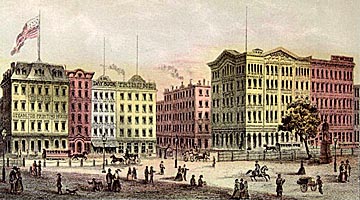
Printing House Square, New York City


Spec Feb 03 '29  |  Spec Aug 28 '29  |  Spec Aug 19 '33  |  Spec Aug 26 '33
Spec Sep 02 '33  |  Spec Sep 09 '33  |  Spec Sep 30 '33  |  CAdv Nov 16? '33
Spec Nov 28 '33  |  Spec Dec 02 '33  |  Spec Dec 19 '33  |  Spec May 19 '34
Spec Jun 05 '34  |  Spec Jul 07 '34  |  Spec Jul 14 '34  |  Spec Jul 28 '34
Spec Aug 04 '34  |  Spec Oct 23 '34  |  Spec Nov 03 '34  |  CAdv Jul 25? '36
Spec Jul 28 '36  |  Spec Jul 23 '42  |  Spec Sep 24 '42  |  Spec Aug 3 '42
Spec Aug 10 '42  |  Spec Oct 26 '42  |  Spec Dec 28 '42  |  Spec Aug 23 '43
Spec Oct 11 '43  |  Spec Jul 10 '44  |  CAdv Mar 17 '48

(Note: originals of 20 of the above "Spectators" (full issues) are for sale
at $50 and up. Contact the host of this web-site for purchasing details)


News Articles Index  |  Misc. NYC papers  |  M. M. Noah's NYC papers



Vol. XXXII.                          Tuesday, February 3, 1829.                      No. 46 Pine St.


                                                St. Louis, January 4.

The Indian War. -- Some time since we published an extract from a letter written by Major Dougherty. U. S. Indian Agent, giving information of the hostile designs of a part of the Pawnee nation of Indians. -- We now learn from Major Hamtramek, who has arrived in this city from his Agency in the Osage nation, that the news of the successful operations of the Comanches and Pawnee Picks, on the Santa Fe road, has spread through the neighboring tribes, and aroused the whole to some daring action. Runners had been passing between the Comanches, Arapahoes, Pawnee Picks, and Kiamechis, for the purpose of spreading the excitement, maturing plans and forming a concentration of forces. It is supposed they will watch the Santa Fe Road, and in the event of finding nothing on it, our frontier may suffer. Major Hamtramek is of opinion, from evidence in his possession, that Mr. Means, of Franklin, was killed, and his companions robbed, by the Pawnee Picks. A party of this tribe attacked the Osages in October last, when he was with the latter; but being repulsed and driven from their camp and reserve, the victims found a great many horses and mules, which must have belonged to Means' party and other indications tending to fix the robbery upon them.

Gen. Atkinson has, we understand, received orders to afford protection to our frontiers. The Osages have volunteered the services of from 300 to 1000 warriors which the Government have accepted, in the event of the General's requiring an auxiliary force of Osages. The Osages are disciplined in the Pawnee mode of warfare, and intimately acquainted with the topography of their country. If a movement should be made upon the Pawnee towns, much might be expected from them. -- Missouri Republican.


Note 1: John Dougherty (1791-1860) was an explorer, fur trapper, Indian agent to the Ottawas, Omahas, and Pawnees, government interpreter, Major in the U. S. Army, and Missouri Congressman. During the Mexican War Dougherty was chosen Colonel and ordered to command a Missouri regiment, but soon after the requisition was withdrawn. Although he lived in Clay Co., Missouri during the time of the "Mormon difficulties" in that state, Dougherty does not seem to have been involved in any hostile interaction with the Saints. His name appears as a signatory on a Sept. 22, 1838 petition to Lilburn W. Boggs, Governor of Missouri, asking the Governor to "put a stop to all lawless proceeding" among the Mormons and Gentiles in and around the town of De Witt, but that appears to have been the extent of his involvement in the affair.

Note 2: Major J. F. Hamtramck was dismissed from service as an Indian agent in 1830, following a longstanding conflict with Baptist minister Benton Pixley (who later supplied eye witness reports on the Mormons in Missouri). The General Henry Atkinson mentioned in the above news report, should not be confused with Major-General David R. Atchison, who was a state militia commander during the 1838 "Mormon War" and who occasionally served as legal counsel to Joseph Smith, jr.

Note 3: The above article presents a sample of the kind of news Oliver Cowdery and Parley P. Pratt might have read in the newspapers, a year before their arrival on the Missouri frontier, as the lead elders in the ill-fated "Mission to the Lamanites." In pressing forward in that mission the Mormons neglected to first consult with General William Clark, the Superintendent of Indian Affairs at St. Louis, and so were soon expelled from their missionizing among the Indian tribes west of the Missouri. It appears that the Mormon missionaries hoped to make massive conversions among those Indians and to form an alliance with them in establishing the center-place of the Kingdom of God near what is now Kansas City. If they expected the militant plains Indians or the deported "civilized nations" to unite with them in an armed "Israelite" rebellion on the Missouri frontier, the missionaries were quickly discomfited in that hopeless scheme.


Vol. XXXII.                          Friday, August 28, 1829.                      No. 46 Pine St.


Great Sodus Bay. -- The Wayne County (Lyons) Patriot, of Wednesday, says: -- "Several salt springs were discovered in the vicinity of this bay the last week. -- The water is about as salt as ocean water, winin two feet of the surface, and increases in strength and saltiness down to the depth of eight feet; which is as low as has yet been dug in any place. Salt of a good quality was made from the water on Saturday evening. The water is in great abundance, eight feet below the surface, and a well is now opening to go deeper if practicable without a pump. Some of the water and salt may be examined, at any time, by applying ro Wm. N. Lammis, Maxwell Mills, Sodus.


Note: A dependable salt spring in the west could provide a source of substantial income for its owner. Some hopeful saline entrepreneurs of that region went so far as to employ practitioners of the art of underground divination (by hazel rods or seer stones) to locate such valuable mineral wealth. The Wayne County Patriot evidently made no mention of how the Sodus salt springs were first discovered -- or if they turned out to be real suppliers of wealth after all.


Vol. XXXVI.                          Monday, August 19, 1833.                      No. 46 Pine St.


CHOLERA. -- Cincinnati. -- By official report of interments for the week ending Wednesday the 7th inst., the whole number of deaths was 71; of which 32 were cholera cases. It is rapidly disappearing from the city, but appears to extend in the interior.

Missouri. -- The St. Louis Republican of the 2d. inst. contains the following details... The Boonville paper states that seven cases had occured in that place, three of which were fatal... the disease also prevailed at Rocheport, about 14 miles from Columbia on the Missouri...


note 1: The western cholera epidemic of 1833 was followed by a far smaller, localized outbreak, at the same time of the year, in 1834. It is probable that members of Joseph Smith's Zion's Camp military expeditionary force carried the disease from Indiana or Illinois, into western Missouri, when they traveled through that region in 1834.

note 2: At about this same time the Spectator's sister paper, the N. Y. Commercial Advertiser, published a letter from Missouri, reporting an outbreak of cholera on the steamboat Yellow Stone. The Advertiser printed this letter immediately above the Spectator's report on the Mormons, of Aug. 26th. See the Aug. 29, 1833 issue of the Ohio Star for a reprint of these two paragraphs, apparently both from the same July 15th letter.


Vol. XXXVI.                          Monday, August 26, 1833.                      No. 46 Pine St.


MORMONISM.

Six hundred or more of the Mormonites have emigrated within the last two years to Jackson city, in Missouri, and have rendered themselves obnoxious to the citizens by holding out inducements for free negroes to settle in the county, and urging slaves to be unfaithful. Lately the citizens organized themselves for the purpose of breaking up the establishment. The Mormonite printing press was torn down, -- store and machine shop broken up. -- the leaders tarred and feathered, and a time set for their departure. What course may be pursued towards the followers, is not yet known.


FROM OUR CORRESPONDENT.
                Buffalo, August 12, 1833.

Counterfeiting on a large scale. -- I think that under this head I wrote an account of certain counterfeit bills, purporting to be of the City Bank of New York, which were in circulation in Quebec and Montreal. They have not, I believe, offered any here, but at Niagara, they were successful in putting off about $400...


notes: (forthcoming)


Vol. XXXVI.                         Monday, September 2, 1833.                      No. 46 Pine St.


KEY TO THE REVELATION.

The Harpers have just published a series of Thirty-six Lectures, entitled, "A Key to the Revelation," and in which the whole of the Mysterious Book of which it treats, is discussed in course. The work is from the pen of the Rev. Ethan Smith, author of a "Dissertation on the Prophecies;" "View of the Trinity," "View of the Hebrews," "Key to Figurative Language," &c. Treatises are fast multiplying upon the sublime and difficult portion of the Scriptures, but whether the true 'Key' to the mysteries therein contained, has yet been discovered, we have our doubts. -- Twenty years ago, Faber was the most commentator. But the Battle of Waterloo, and the overthrow of the French Empire, extinguished his exposition; and Robert Hall remarked that those events had destroyed his confidence in all expositions which he had consulted. It has been said by some distinguished writer, that every commentator upon this mystical book is either crazy before he commences, or before he has finished. This sweeping observation is unjust, taken in its literal meaning; but its author probably intended no more than to show the absurdity of mental efforts to disclose, until the time comes, the hidden meanings of things, which for wise purposes, the Almighty himself has rendered too deep for human understanding. The author of the work before us, has devoted, as he states, about twenty years of study to this subject; and whether he has arrived at the true meaning of the book or not, we feel pleasure in commending the result of his investigations to the attention of the Christian public, inasmuch as "it does not consist merely of dry dissertations on different passages, but has a pleasing and edifying spirit of piety pervading throughout." It is recommended by several clergymen of this city, and also of Massachusetts.


notes: (forthcoming)


Vol. XXXVI.                         Monday, September 9, 1833.                     No. 46 Pine St.


THE  MORMONITES.

The company of Mormonites, occupying a location in Jackson county, Mo., have been completely routed by the citizens of that county. The course pursued by these ill-advised people -- their ridiculous mummery and impiety, seems to have thoroughly disgusted their neighbors, and late in July, a meeting of citizens, to the number of from four to five hundred, was held at Independence, with the avowed object of taking measures to rid themselves of the nuisance. A committee from this body reported at length to a subsequent meeting, upon the annoyance of the Mormonites to their neighborhood; the evils they were inflicting upon the society by their profanity; and upon the probability, that from their rapid increase, they would soon exercise entire control over the destinies of the county. The committee submitted these propositions, which were unanimously adopted:

"1. That no Mormon shall in future move and settle in this county.

"2. That those now there, who shall give a definite pledge of their intention within a reasonable time to remove out of the county, shall be allowed to remain unmolested until they have sufficient time to sell their property and close their business without any material sacrifice.

"3. That the editor of the 'Star' be required forthwith to close his office, and discontinue the business of printing in this county; and as to all other stores and shops belonging to the sect, their owner must in every case strictly comply with the terms of the second article of this declaration, and upon failure, prompt and efficient measures will be taken to close the same.

"4. That the Mormon leaders here, are required to use their influence in preventing any further emigration of their distant brethren to this county, and to counsel and advise their brethren here to comply with the above requisitions.

"5. That those who fail to comply with these requisitions, be referred to those of their brethren who have the gifts of divination, and unknown tongues, to inform them of the lot that awaits them.

A conference was then held with the leaders of the Mormonites, during which these determinations were made known. As no satisfactory reply could be obtained, the persons assembled at the meeting, immediately proceeded to the Star office, and razed it to the ground, after taking into their possession the press and types of the establishment. This summary proceeding, which was accomplished without spilling blood, or exchanging blows, caused much alarm among the fanatics, and in a few days after they entered into a negotiation with a committee from the meeting of citizens, by which they agreed to remove out of the country.

"It is understood that the undersigned, members of the society, do give their solemn pledges each for himself, as follows, to wit:

"That Oliver Cowdery, W. W. Phelps, Wm. McClealand, Edward Partridge, Lyman White, Simeon Carter, Peter and John Whitmer, and Harvey Whitlock, shall remove with their families out of this county, on or before the first day of January next; and that they, as well as the two hereinafter named, use all their influence to induce all the brethren now here to remove as soon as possible -- one half, say, by the first of January next, and all by the first day of April next; to advise and try all means in their power to stop any more of their sect from moving to this county; and as to those now on the road, they will use their influence to prevent their settling permanently in the county, but that they shall only make arrangements for temporary shelter, till a new location is agreed on for the society. John Correl and Algernon Gilbert are allowed to remain as general agents to wind up the business of the society, so long as necessity shall require; and said Gilbert may sell out his merchandise now on hand, but is to make no new importation.

"The 'Star' is not again to be published, nor a press set up by any of the society in this county.

"If the said Edward Partridge and W. W. Phelps move their families by the first day of January, as aforesaid, that they themselves will be allowed to go and come in order to transact and wind up their business.

"The committee pledge themselves to use all their influence to prevent any violence being used so as long as a compliance with the foregoing terms is observed by the parties concerned; which agreement is subscribed the names of the above named committee, as also those of the Mormon brethren named in the report as having been present."

In any other county, it is probable, these illegal measures, would have involved those concerned, no matter how respectable, in some trouble. There, we presume, the Mormonites obtain no redress, the feeling of the whole community being against them, from an entire conviction of their demoralising influence upon society. We speak not in justification of the fanatics, nor against the proceedings of the citizens, which were no doubt regarded as justifiable under circumstances. It strikes us, however, that in our country, w[h]ere all religious opinions are tolerated, it is not a little singular in any number of citizens, to judge of the degree of superstition and fanaticism, which may or may not be mixed in religious ceremonies of their neighbours. If this principle be regarded as legal and righteous, in its practice it may be carried to an extent entirely subversive of all liberty of conscience.


notes: (forthcoming)


Vol. XXXVI.                         Monday, September 30, 1833.                     No. 46 Pine St.


THE  EVENING  STAR.

Maj. Noah issued the first number of his new paper -- the STAR -- last evening. It has been brought out and in very handsome style, and commences with fair prospects of patronage. The editor has intimated an intention of yielding a temperate support to the administration of Gen. Jackson, and an unyielding opposition to the Albany junto of dictators. -- But the conduct of the President in regard to the Bank of the United States, has placed him in a difficult position. Being friendly to the Bank, he cannot approve of the removal of the public deposits from its keeping. -- Being, moreover, a republican, he cannot brook the dictatorial doctrines of the President's manifesto. His democratic spirit was also stirred within him, at being obliged to record, on the first day of his resumed editorship, the removal of an old fashioned democrat from the office of Secretary of the Treasury, and the appointment of an old fashioned federalist. Touching this incident, the editor seems not to have kept up with the "march of mind." He commences hostilities with his old political associates of the Albany Regency, in very pretty style; and we anticipate much public edification from the battle that is to ensue. On the whole, therefore, we greet the new comer with the best feelings -- feelings not the less cordial from the fact that at least one of the Stars is not propitious to the present powers that be. May it continue a Star of good promise, and never "shoot madly from its sphere."


notes: (forthcoming)


Vol. ?                          New York November 16?, 1833.                      No. ?


To the Editors of the Commericial Advertiser

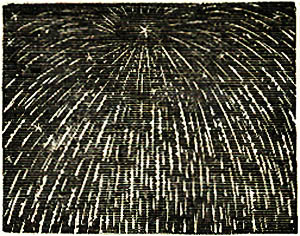
The Meteoric Shower of the 13th instant was a rare phenomenon. At half past 4 o'clock, A. M., I first observed it, and continued to notice it until its termination at 6 o'clock A. M.

From a point in the heavens, about fifteen degrees south easterly from our Zenith, the meteors darted to the horizon in every point of the compass. Their paths were described in curved lines, similar to those of the parallels of longitude on an artificial globe. They were generally short in their course, resembling much an interrupted line...They ceased to appear when within about ten degrees of the horizon.

I did not see a single meteor pass the meteoric pole which I have described -- nor one pass in a horizontal direction.

Several of them afforded as much light as faint lightning. One in the northeast was heard to explode with a sound like that of the rush of a distant skyrocket. The time from the explosion to the hearing was about twenty seconds -- which gives a distance of about five miles. It left a serpentine cloud of bright glowing color, which remained visible for about fifteen or twenty minutes. Millions of these meteors must have been darted in the shower.

I was not able to remark a single one whose proximity to me was greater or less than any other == by being intercepted between my vision and any distant object -- such as trees, houses, or the high shore of New Jersey west of me.

The singularity of this Meteoric Shower consists in the countless numbers of the celestial rockets, and more especially in their constantly uniform divergence from the point fifteen degrees south easterly from our zenith.

These meteors are supposed to be gaseous, and when inflamed by some cause not explained, appear darting through the heavens, generally in various directions. It is certain that they are generated at a miderate distance from the earth -- probably from two to five miles.

The exhibition I have partly described, was the most splendid pyrotechny I ever saw, and I do not recollect to have met with anything comparable to it in description.

I am, respectfully yours.               H. M.


Note 1: This news article was reprinted in the New York Spectator of Monday, Sept. 18, 1833. The Commercial Advertiser and the Spectator were sister papers that often shared aticles and editorials. Colonel William Leete Stone (1792 -1844) was a proprietor and the editor of the New York Commercial Advertiser from 1821-44. See the Sept. 9, 1836 issue of the St. Louis Daily Commercial Bulletin for a reprint of one especially interesting1836 article on the Book of Mormon, from the Commercial Advertiser.

Note 2: For the Missouri Mormons, just then being ejected from Jackson Co., this spectacular heavenly display offered encouragement and justification of their religious cause. Previously the LDS leaders had predicted that the stars would fall from the sky as the eastern parts of the United States were being destroyed by a wrathful God. Most Mormons of that era were too ignorant of astronomy to understand what annual meteor showers really were.


Vol. XXXVI.                          Thursday, November 28, 1833.                      No. 46 Pine St.


Letters from beyond the Rocky Mountains.
OREGON EXPEDITION.

Several letters have been received from John Ball, Esq. (late of Lansingburgh,) since he left St. Louis for the Pacific Ocean, across the Rocky Mountains. His first letter is addressed to Dr. Brinsmade, of Troy, dated at Lexington, (Missouri.) His second hails from the "Head Waters of the Lewis River," west of the Rocky Mountains: this addressed to Dr. Brinsmade also, and so is his third letter, written after he had had arrived at the termination of his journey -- dated at Fort Van Couver, Jan. 1, 1833...

Lexington, Missouri, April 29th, 1832.
My Dear Friend -- I arrived at this place to-day. It is about 100 miles on the Missouri River, above Franklin...

As to towns, I can give you but little information. -- Lexington, where I now am. is as large as Balestown. It is six years old. There is the town of Freedom, in Jackson, and Liberty in Clay, counties, about 50 miles above. These are frontier counties. The Mormonites are located in Jackson county. This the upper part of the state of Missouri, and is considerably settled. It has excellant land, mostly prairie, , and is inhabited by emigrants from Kentucky, Tennessee, and Virginia. They have many slaves...


notes: (forthcoming)


Vol. XXXVI.                          Monday, December 2, 1833.                      No. 46 Pine St.


CIVIL  WAR  IN  MISSOURI.

The deluded fanatics, calling themselves Mormonites, left the western part of this state about three years ago, and established themselves in Jackson county, Missouri; where they have received very considerable accessions to their numbers. -- They have been regarded as an inoffensive people -- and although their faith and doctrines were absurd and ridiculous in the extreme, we have known nothing in their character or conduct to deserve legal punishment, much less to draw down upon them the lawless violence of a mob. It appears, however, that the same spirit of injustice which impelled the borderers to destroy the property and seize upon the possessions of the Sac Indians, has now induced a series of attacks upon the unoffending Mormonites. The following recital is extracted from a detailed narrative by Orson Hyde, one of the Mormons, and is dated St. Louis, the 5th instant, on board the steam-boat Charleston. The account here given, we regret to add, is fully confirmed by other accounts, in all its material points. It will appear from this relation, that the Mormonites have withstood their assailants with no little bravery and effect:--

I am a member of the church of Christ (reproachfully called Mormons or Mormonites,) and am directly from Independence, the seat of war, and bloodshed in the United States.

On Thursday night, Oct. 31, some forty or fifty of the citizens of Jackson county, Mo. assembled above the Blue, (a river, about eight or ten miles west of Independence,) and in part demolished twelve of the dwelling houses of our people who occupied them at the time. -- The inmates were obliged to escape to the woods; women and children running in every direction, hallooing and screaming, and the men, being taken at surprise at the dead hour of the night, were unprepared to defend themselves if they had been disposed. They took two of our men and beat them with stones and clubs, leaving only a breath of life in them. After this, the mob dispersed, it being about 3 o'clock in the morning.

Friday night, November 1 -- the mob broke open the store of Gilbert & Whitney, and scattered their goods through the streets. They demolished Mr. Gilbert's brick dwelling house, and broke in the door and windows off all the dwellings in Independence belonging to our people. Saturday our people left their dwellings and took their most valuable articles of furniture, clothing, &c. and gathered together that they might be better prepared for self-defence. Night came on, and the mob came along with it, and commenced their ravages again above the Blue, and after they had fired five or six guns upon our people without effect, our people fired upon them, and one of their number exclaimed, "O my God! I am shot!" The mob then dispersed, taking their wounded companion along with them, who was shot through the thigh.

On Monday last the mob collected again, in the town of Independence, to the number of two or three hundred, well armed; they called it, CALLING OUT THE MILITIA. -- The immediately thought that the above appellation would sound better than its real and legitimate name, which is MOB, and if they could lessen the magnitude of their crime in the eyes of the community by so doing, they, no doubt, would be highly gratified. But this cunning plot to deceive, covers their iniquity no more than the fig leaves covered our first parents in the garden from the piercing eye of Jehovah. All night, a part of the number that had collected in town, went above Blue, to drive our people away, and destroy our property; but they were met by a party of our people, and being prepared, they poured a deadly fire upon them. Two or three of their number fell dead on the ground, and a number mortally wounded. Among the former, was Hugh L. Breazeale, Attorney at Law. Tuesday morning there was a number of the mob missing and could not be accounted for, I was told.

Left Independence and came down the river to Liberty Landing where we stopped to take in freight, and while we were there, (Wednesday 11 o'clock, A. M.) a messenger rode up saying that he had just came from the seat of war, and that the night before another battle was fought in which Mr. Hicks, Att'y at Law, fell, having three balls and some buck shot through his body, and about twenty more of the mob shared a similar fate. Mr. H. was one of the heads of the mob. Report says also that one or two of our men were killed and as many wounded. The cannonading in the last engagement was heard on board the boat very distinctly.

I was an eye witness to a part of the above statements, but things were in a state of great confusion and agitation at the time, and should there be an error in the above, I hope to find pardon in the eyes of a candid people.

I am satisfied that it is useless to undertake to enforce the laws in that country under the present circumstances, because there is no one to enforce them. Every officer, civil and military, with one or two exceptions, is either directly or indirectly engaged in the mob.

Under these painful circumstances, what remains to be done? Must we be driven from our homes? Must we leave the soil for which we have paid our money? -- Most our women and children be turned out of doors with nothing but the clouded canopy to cover them, and the perpetration of the above crimes escape unpunished? Or must we fight our enemies three to one, or lie down and die and our names be blotted out from among men? -- Let the Executive of our state and Nation consider these questions, and if they will answer them in the negative, let them signify it by raising the helping hand.


notes: (forthcoming)


Vol. XXXVI.                         Thursday, December 19, 1833.                      No. 46 Pine St.


THE  MORMON  WAR.

A letter from the Rev'd. B. Pixley, to the editor of the New-York Observer, relative to the civil war in Missouri, between the inhabitants and the Mormons. gives a somewhat different version of the affair, from that published some time ago, in this paper, on the authority of Orson Hyde, one of the Elders. From Mr. P.'s account, it appears that the sect proclaimed that the spot they had selected was the Zion spoken of in scripture -- that the present inhabitants would be driven off, and that they, the Mormons, should inhabit the country. This arrogant pretence, coupled with an invitation to all the free negroes to come and join them, aroused a spirit of opposition, and induced the citizens, last summer, to pull down their printing office. They were proceeding to other extremities, when expostulation ensued and a treaty was made in which it was agreed that the Mormons should move away before another summer, and in consideration thereof the other party were to make good the loss sustained by destroying their printing office.

Instead, however of making any preparations for departure, the Mormons proceeded to arm themselves, barricaded portions of their settlement, and threatened to kill any one who should molest them. This provoked a renewal of hostilities, and the consequences have been that in the skirmishes that have taken place, three of the Mormons have been killed, and about twenty of the inhabitants.

At the last encounter the citizens proved too powerful for the Mormonites, and would have destroyed them but for the interposition of the civil authorities. Great exasperation continued to prevail, and no immediate means of composing the difficulties were as yet perceptible.

Still later accounts represent that a cessation of hostilities had taken place between the Mormonites and the inhabitants of Jackson county, in consequence of which the former were rapidly leaving their country and their homes, with the intention of forming another community elsewhere. The extent of loss of lives is said to have been exaggerated -- and it is now confidently affirmed that only four of the Mormons and two of their opponents have been killed.


Notes: (forthcoming)


Vol. XXXVII.                       Monday, May 19, 1834.                   No. 46 Pine Street.


THE MORMON WAR in Missouri is about to be renewed. A fanatical leader, styled General Joe Smith has sent forth. in the form of a circular, his pretended revelations from on high, requiring the aid of the faithful to 'expel the infidels from the Holy Land.' About 500 are said to be on the move, and they are armed with dirks, swords, pistols, guns, and other hostile weapons. The prophet, it is said, has a sword more than four feet long, and professes an expectation of sharing the fate of a martyr in the coming contest.

We really hope there will be found enough good sense on the part of the people, and of official firmness on the part of the state authorities, to prevent the shedding of blood. Greatly as we deplore the delusion under which these madcaps labor, it is not more absurd, nor half so dangerous as that which is fostered within the bosom of our own community by men who profess to think that in excitng a servile war and sundering the bands of political union they are, like the persecutors of old, 'doing God's service.'


Note 1: The above article was evidently paraphrased from a mid-May issue of the Rochester Daily Democrat, which summarized a report from the May 9, 1834 issue of the Painesville Telegraph, subsequently reprinted in the May 30, 1834 issue of the Wayne Sentinel.

Note 2: It is interesting to see that the editors of the Rochester and Palmyra papers were sufficiently informed on the progress of Mormonism to recognize who Joseph Smith was. However, in New York City, the would-be head of the "War Department" in the "Kingdom of God" did not yet bear an unequivocal identification as the great prophet of the Latter Day Saints. The Spectator's remarks regarding the "sundering the bands of political union" in a civil war were prescient -- not only for the future situation in "Bleeding Kansas," but also in the case of the abortive "Mormon Wars" in Missouri (1838), Illinois (1844-46), and Utah (1857-58).


Vol. XXXVII.                       Thursday, June 5, 1834.                   No. 46 Pine Street.


RICHMOND, (Wayne co., Indiana,) May 24. -- Mormonites. -- On monday morning last, a caravan of about two hundred Mormonites, with a long train of wagons, passed through this place, on their way to the "far west." There were but few women among them, and the men were generally, if not all, supplied with fire-arms. A stout, hardy set of looking fellows they were too, and many of them quite intelligent. From their equipments, it has been suspected that they intend joining and defending their brethren in Jackson county, Missouri. -- They professed to be in search of new lands, whereon to form a settlement, either in Illinois or farther west. -- We understand they were from the States of Vermont, New York, and Pennsylvania, and had assembled at some point on their route hither.


Note: The Spectator probably lifted this item from the May 31, 1834 issue of the Daily National Intelligencer, which reprinted it from the May 24th number of the Richmond Palladium. This is the first known report of Joseph Smith's "Zion's Camp" military expedition, published in a New York City paper.


Vol. XXXVII.                       Monday, July 7, 1834.                   No. 46 Pine Street.


THE FOURTH OF JULY. -- The fifty-eighth anniversary of American Independence was celebrated yesterday with the usual accompaniments of noise and jollity by one part of the community...

Generally speaking, the day passed off, so far as we can learn, with unusual quiet, jilarity, and peace. The only disturbance, if disturbance it can be called, was at the Chatham street Chapel. We have been at some pains to ascertain the facts, and we give them as they were, from the relation of a respectable gentleman who was present during the whole of the performance. The Fanatics, it seems, have been holding meetings for several successive nights, of the past and present week, preparatory to a factitious phrenzy, adapted to the heats of the season, and their own excited zeal... of the Anti-Slavery Society.

In the meantime the fanatics had sent a message to City Hall, requesting the interference of the Mayor and a body of the Police. His Honor repaired to the scene but found no occasion for his service. He had been told there was a mob -- but there was no violence whatever... These proceedings, so clearly intended to outrage public taste and feeling, produced the results which the projectors of the excitement probably intended. It conduced to the notoriety for which they seek. But it is a notoriety not to be envied. They are less justifiable and more mischievous than the Mormons of the West. They are the Black Mormons of the East...


THE MORMON WAR.

We learn from the following article, and others in other papers corroborating it, that violence and bloodshed may be expected in Missouri between those fanatics the Mormonites and those, almost equally fanatic, who seek to put down their superstitions and delusions by force of arms:

                                              Liberty, (Mo.) June 11.


THE MORMONS. -- Our friends at a distance may feel desirious to hear something respecting the "Mormons," so called, and knowing that the larger portion of them are in this county, may look to us to give them the wanted information.

We have heretofore been almost silent on this subject, hoping that the difficulties which occurred in Jackson county, between the citizens and the Mormons, would be soon settled in an amicable way, at least without shedding of blood; and in fact, we have felt very little interest in the matter, farther than it affected the general good of the country. But as this thing has arrived at a crisis which is really appalling to the feelings of good men, we feel it a duty to inform our readers of the movements of this people, at the same time we do not wish to be understood as trying to exasperate the minds of the people against this deluded and unfortunate sect.

For the last six or eight weeks, the Mormons have been actively engaged in making preparations to return to Jackson county, "the land of promise," by providing themselves with implements of war, such as guns, pistols, swords, &c. &c. They expect a reinforcement from the State of Ohio, and we are informed that small parties are arriving almost every day. So soon as they all arrive, they intend to call upon the Governor to reinstate them upon their lands in Jackson, and then, if molested, they are determined to protect themselves, sword in hand. We are told they will be able to muster 700 strong.

A gentleman from Jackson informs us that the citizens of that county are no less engaged in making preparation for their reception. On Monday last they held a meeting, for the purpose of electing officers, and Samuel C. Owens, a gentleman known to many citizens of the state, was unanimously elected commander-in-chief of all their forces. Our informant states that they have received a letter from the Governor, advising them to effect a compromise, if possible by purchasing the lands of the Mormons, and paying them for the injuries which they have sustained. For this purpose ten persons were appointed, invested with full power to settle the whole matter, and will meet the Mormons in this place, on Monday next, for that purpose. Should the Mormons refuse to accede to an honorable and fair adjustment of these difficulties, the Governor will not restore any to that county, but such as hold lands. The following gentlemen compose the above named Committee: Thomas Stayton, sen., Samuel Erwin, Smallwood V. Noland, Smallwood Noland, Henry Reuby, Samuel C. Owens, Robert Rickman, James Campbell, Richard Fristoe, Thomas Jeffries, and John Davis.

We have our fears as to the final issue of this matter, but hope for the best. -- Enquirer.


Note: The exact same article was also published in an early July issue of the Pittsburgh Advertiser, and from there was reprinted in the July 23, 1834 issue of the Buffalo Whig. The original article came from the June 11 1834 issue of the Liberty Missouri Enquirer.


Vol. XXXVII.                       Monday, July 14, 1834.                   No. 46 Pine Street.


From the National Intelligencer, of yesterday:

THE  MORMONS  OF  MISSOURI.

Current information from Missouri confirms the apprehensions entertained of the breaking out of a furious Civil War between the Mormons and the residents of Jackson county, in the State of Missouri. The Fayette Monitor, of the 21st, says "By our next number we anticipate something (on the Mormon controversy) in an authentic form. The people may look for the worst."

The Missouri Enquirer (printed at Liberty) of the 18th June says, that on the Monday preceding, a committee on the part of the citizens of Jackson county, and one in behalf of the Mormon people, met at Liberty, to take into consideration the subject of compromising the difficulties which occurred in Jackson county last Autumn. No compromise was effected, however, notwithstanding the exertions of the people of Clay county, (in which Liberty is situated,) a committee of whom were appointed to act as mediators. On the contrary, the excitement among the people was such, that the conference was, in consequence of it, obliged to be adjourned. The proposition made by the People of Jackson county to the Mormons, who were driven out of the county last Autumn, and are about to re-enter it with additional numbers, in arms, is, to buy all the lands and improvements of the Mormons, at a valuation by disinterested arbitrators, to which valuation one hundred per cent. shall be added, to be paid within thirty days thereafter; the Mormons thereupon to leave the county, and not hereafter to attempt to enter it, individually, or collectively. -- Or, the citizens of Jackson county to sell their lands to the Mormons on exactly reciprocal terms. To neither of these propositions were the committee of the Mormons authorized to assent, nor does there appear any probability that either of them will be assented to.

The Enquirer, after narrating these facts, gives utterance to the following melancholy foreboding: "It is a lamentable fact, that the matter is about to involve the whole upper country in civil war and bloodshed. We cannot (if a compromise is not agreed to before Saturday next) tell how long it will be before we shall have the painful task of recording the awful realities of an exterminating war." The citizens of Jackson, it appears, though inferior in numbers to the Mormons, are resolved to dispute over every inch of ground and the chairman of their committee declared, at the meeting in the court house of Clay county, (appealing to Heaven for the truth of his assertion,) that "they would dispute every inch of ground, burn every blade of grass, and suffer their bones to bleach on their hills, rather than the Mormons should return to Jackson county."

The following account of a fatal accident, which occurred on the evening after the conference, evidently refers the disaster to the enmity existing between these exasperated parties:

From the Missouri Enquirer of June 18.

INDEPENDENCE, Mo., June 17. -- Messrs. Kelley & Davis: Having understood that you have received intelligence of the sinking of the Ferry Boat at Everett's Ferry, on the Missouri, last evening, together with a statement of the sufferings of those who happened to be on board, we, a part of those who escaped, have thought proper, for the correct information of yourselves and others, to give a statement of the facts as they actually occurred.

Eight of the citizens of this county, a majority of whom was a part of the committee that waited on the Mormons, in your town, on yesterday, embarked on board of the boat at about nine o'clock, it being perfectly clear, and the moon shining as bright as we ever saw it. Upon our embarking, the boat appeared to be in as good order as we ever saw it -- the false floor was tight and good. After our having left the shore some two hundred yards, in an instant, as it were, the boat was filled with water. We are confident the boat struck nothing. Our impressions at the time were, and still are, that something had been done to the boat to sink her, as it was known that the committee from this county would cross at that point last night.

The names of the persons lost are -- James Campbell, William Everett, David Linch, Jefferson Cary, and a Mr. Bradbury -- the two last were the ferrymen.

Those escaping -- Smallwood Noland, Richard Fristoe, Smallwood V. Noland, Samuel C. Owens, Thomas Harrington, and a Mr. Frost -- the last being the third ferryman. Those who escaped, we assure you, suffered much.

Respectfully, your obedient servants,

Samuel C. Owens, S. V. Nolland, Thomas Harrington.

Note: The above article evidently appeared in the July 10, 1834 issue of the New York Commercial Advertiser, from which it and its heading were transferred to the Advertiser'sweekly sister paper, the Spectator.


Vol. XXXVII.                     New York, July 28, 1834.                 No. 46 Pine Street.


From the Baltimore American of yesterday.

A particular account of the last Mormon campaign in Missouri, is given in the Western papers. The belligerents seem to have been mutually exasperated, and to have approached very near to a general and bloody battle. The numbers engaged in the contest on both sides are much larger than we had supposed, before seeing these authentic details. The Mormons assembled late in June in Clay county, (Mo.) and were reinforced by parties principally from Ohio, until they mustered from 800 to 1000 men, armed with "guns, tomahawks, knives, and from two to four braces of pistols each." Their design was to cross the river and take possession of Jackson county -- the 'Zion,' as they term it, of their faith. Their leader, the prophet Jo. Smith, promised them to "raise again" all who should be slain in fighting the battles for the possession of this Holy Land. The Jackson county people were equally determined to resist the passage of the river, at all hazards. A letter from a person on the spot, published at Maysville. Ky., says that Jackson county raised 900 and Lafayette 400, and that several hundred more were ready to come at a moment's warning. The feeling of the people may be conjectured from the expression of opinion in the letters quoted, that had the Mormons attempted to cross the river, not one of them would have been "left to tell the tale." "No quarter would have been given, and we could have killed most of them before they got across the river."

There were some attempts at negotiation. The Jackson county people offered to buy all the lands of the Mormons at a double price -- which was refused. The invaders professed reasonable intentions, and a desire only to take quiet possession of their own lands -- professions which appear to have got no credit.

In the end, however, they desisted from the enterprise, and postponed the crusade for the possession of their "Zion" for fifty or a hundred years. They will take up their intermediate residence somewhere else; and thus the battle, which must have been obstinate and very bloody, was avoided.

It is to be hoped, for the sake of ordinary justice, that means will be found for making compensation to these deluded men for the property they are forced to abandon, as well as for the damages they have sustained by being driven out.


Notes: (forthcoming)


Vol. XXXVII.                     New York, August 4, 1834.                 No. 46 Pine Street.


CHOLERA. -- The cholera has broken out among the Mormons. At latest dates there had been eighteen cases and thirteen deaths. At Rushton, and several of the neighboring towns in Missouri, a number of deaths had occurred

Notes: (forthcoming)


Vol. XXXVII.                     New York, October 23, 1834.                 No. 46 Pine Street.


A D V I C E.

One Gladdon Bishop, a Mormonite preacher, in an account of the fanatic sect, says it commenced in Manchester, Ontario county, New York, in April l830, with only 6 members, and now numbers 20,000, and 800 preachers, with two printing offices, two stores, and a large stone edifice for a house of worship. These facts, if true, which we doubt, are a sad commentary on the conservative power of human reason against the inroads of one of the most audacious impostures that ever disgraced the annals of mankind.

The foregoing paragraph we copy from the Times of Friday; but can perceive no greater cause for surprise at the commentary alluded to, upon "the conservative of power of human reason" against imposture, than of that which might be made upon the "audacious imposture" of Jacksonism. The credulity of the people, and their fanatical madness is as palpable in the latter case as in the former. When General Jackson reprobated the appointment of members of Congress to office, the people applauded him. When he appoints more members of Congress to office than all his predecessors put together, they continue. to applaud. When he recognizes the constitutionality of the United States Bank, they justify the recognition; when he turns about and calls it a monster, they also turn tail to, and echo, 'the monster.' -- When he praises nullification to Col. Hayne, they also praise nullification -- but when he gets mad and denounces it, they get mad and denounce it. When he is in favor of one term of the Presidential office, they are in favor of one term also. When he despatches letters to Harrisburg with instructions to secure a second nomination, they not only sanction the indelicacy but vote in his favor for a second term -- and would continue do so to the end of the chapter.

The blind and perverse man-worship exhibited by our people, is one of the most alarming signs of the premature decay of our institutions, and of the silent approach of despotism. No matter who the object of that idolatry may be. It may as well be Andrew Jackson as any other man. Others may be even worse. But the principle of personal and party devotion, is the certain precursor of ruin to political institutions. It is a madness every whit as preposterous as Mormonism, and incomparably more dangerous. They "follow their leader, and fear no harm," hoodwinked and haltered, and then prate about "the conservative power of human reason! !"


Note 1: Too little research has so far been conducted into the parallels between Jacksonian politics and the rise of Mormonism. The religion developed within the context of Jackson's coming to power, echoed his demagoguery about "equal rights," and adapted to religion the near worship of a leader figure whose powers and actions made him a legend in his own time. It is no coincidence that most of the early Mormons were block-voting Democrats and it was predictable that, after a brief fling with anti-Masonry in 1829-33, that the LDS should have followed their fellow Jacksonians into Freemasonry, frontier boosterism and soliciting the blind allegiance of new European emigrants.

Note 2: Francis Gladden Bishop (1809-1878) joined the Mormons in 1832 at Olean, New York and in 1833 served briefly as the President of the LDS branch at Westfield, New York. Elder Bishop was disfellowshiped in 1835 for "teaching false doctrine," but repented and was reinstated in his office. Durng the Nauvoo period Bishop again went into apostasy and formed his own non-polygamous splinter group. The Gladdenites organized themselves in Iowa, relocated to what is now Platte County, Nebraska, and eventually tried to gain a foothold in Utah in 1852-54, but they were easily ejected by Brigham Young's loyalists. Elder Bishop's "account of the fanatic sect" was also mentioned in the Nov. 8, 1834 issue of the Monroe Michigan Sentinel and other papers of the period. The LDS history referenced in the article was apparently a precursor of his 1839 Brief History of the Church -- perhaps something published in an obscure 1834 periodical.


Vol. XXXVII.                     New York, November 3, 1834.                 No. 46 Pine Street.


INDIAN ADVOCATE. -- This is the title of a new paper, about to be published in the Indian territory, three hundred miles west of St. Louis, a short distance beyond the setting of the sun. It is to be conducted by a clergyman of the name of Isaac McKay [sic].


THE WEST. -- A gentleman who lately traveled from Paoli, Indiana, to Vincenes, a distance of 65 miles, counted, in that distance, no less than four hundred wagons, moving emigrant families to Illinois and Missouri.


Note 1: The Rev. Isaac McCoy (1784-1846) was a Baptist frontier clergyman who ministered to the Indians on the western border of Missouri. His Indian Advocate project did not get into operation until several years after the above announcement appeared in the Spectator. Upon McCoy's death the Indian Advocate printed an obituary which began: "The death of our late Corresponding Secretary, Elder I. McCoy, having left his venerable companion in her old age among us, a bereaved and afflicted monument of the sacrifices to missionary life common among missionaries, especially of those who have labored to the red man's welfare." For more on Isaac McCoy and his significant interaction with the Mormons in Missouri, see Warren A. Jennings' "Isaac McCoy and the Mormons," Missouri Historical Review 61:62-82 (Oct. 1966).

Note 2: The Mormons anticipated McCoy's plans to publish a paper in the trans-Missouri Indian Territory by three years; however they were unable to set up operations there and the LDS Evening and Morning Star was published at Independence, on "the borders of the Lamanites," rather than "among the Lamanites" as originally prophesied.

Note 3: The Louisville Indian Advocate should not be confused with the Cherokee Phoenix and Indian Advocate, an entirely different newspaper.


Vol. ?                          New York, July 25?, 1836.                      No. ?


                  To the Editor of the Commericial Advertiser:

HISTORY  OF  MORMONISM.

(see reprint in the NY Spectator of the 28th)


Note 1: The exact date of the above article has not yet been determined. Its text is derived from a reprint in the Commericial Advertiser's weekly sister paper, the New York Spectator. The Spectator article is a lengthy one, taking up several columns of the four page paper -- it is possible that the "History of Mormonism" section of the text (which begins with "it appears that Mormonism owes its origin to an individual named Solomon Spalding") was just one section of a multi-part article, spread out over two or more issues in the Commericial Advertiser.

Note 2: The information the Mormons came in the form of a letter "from the pen of a correspondent of Col. Stone" (i. e. William Leete Stone, 1792 -1844), who was a proprietor and the editor of the New York Commercial Advertiser from 1821 to 1844. The "History of Mormonism" section of the letter was soon republished by such papers as the Philadelphia Mirror and the Wyoming Republican of Aug. 17, 1836. See also the Sept. 9, 1836 issue of the St. Louis Daily Commercial Bulletin for a somewhat edited version of this report.

Note 3: The "History of Mormonism" section of the 1836 article stands in time about mid-way between the appearance of Eber D. Howe's Mormonism Unvailed, (published in Ohio at the end of 1834) and LeRoy Sunderland's influencial series of articles on Mormonism, (printed in the Zion's Watchman newspaper in New York City in 1838). From 1838-39 forward lengthy newspaper articles (along with tracts and pamphlets) on Mormon origins become increasingly common. In the mid-1830s such reporting was still relatively rare (see the 1835-36 issues of the Christian Palladium and a very few other obscure contemporary journals for some articles on the Mormons). The "correspondent" who wrote Editor Stone this interesting letter admittedly made use of Howe's book, but he wrote in a tone sympathetic to the Mormons, avoiding comment on the more scandalous accusations regarding the conduct of the Mormon Smith family at Palmyra, NY and the reportedly nefarious designs of the Mormons in Missouri. And, while he substantially paraphrased Howe concerning the Spalding authorship claims for the Book of Mormon, the unknown writer's reporting is relatively restrained in this matter as well. He sticks to the main points of the Spalding-Rigdon scenario without engaging in personal speculation or elaboration. The entire article is generally straight forward, economical in its verbiage, and disinterested in its overall style and manner of presenting information and allegations.

Note 4: Col. Stone appears to have considered writing a lengthy exposure of the Mormons. At about this same time he wrote and published exposures of the "prophet" Matthais and Maria Monk. What became of Stone's research materials regarding fraud in 19th century American religion is unknown -- possibly they rest in some archival collection of his personal papers.


Vol. ?                     New York, July 28, 1836.                 No. 46 Pine Street.


MORE  OF  IMPOSTURE.

The recent movement of the Mormons in Ohio -- the new detachments of emigrants which they have again sent forth farther into the great west -- and the opposition which is again kindling into active excitement against them -- have brought them once more before the public, and furnished a fitting occasion for the following article, which has been in our desk several months, and to which we command the attention of our readers. It is long, but contains a large store of curious if not valuable information, on a subject of great and increasing interest. Impositions of all kinds, when combining magnitude and success, afford materials for useful inquiry and reflexion, and almost invariably command deep and general attention. With regard to the Mormon humbug, treated of in the succeeding columns, we have not paid that regard to it, editorially, which we have for some time had it in our ourpose, as well as in our power to give.

We have from time to time shown up many impostures of various qualities, political, medical, moral, physical and religious, but Mr. Joseph Smith and his worthy associate Sidney Rigdon have as yet nit fallen within the sweep of our pen. We are tolerably au fait, however, of them and their doings, and can vouch for the general correctness of the narrative furnished us by our correspondent. We take leave to protest totis viribus against his latitudinarian comparisons of the different theocracies, and his scarcely veiled insinuations against the majesty, and truth, and excellence of christianity; and we also dissent from his viewa of the wrongs and injuries sustained by the Mormons and their claims to sympathy as men persecuted for opinion's sake. They have not been more sinned against than sinning.

In the matter of the Golden or Mormon Bible, too, we are at issue with our correspondent. We have read it, and certainly more stupid, senseless, incoherant and ill-contrived nonsense we never read. It is in truth a singularly felicitous illustration of the perfection which may be attained in transmuting good into bad -- truth into error -- wisdom into absurdity. -- Large portions of it are garbled extracts from the Scriptures, but so mixed up with the vapid and nonsensical platitudes of Joseph Smith and Sidney Rigdon as to be absolutely melancholy. As for the miracles, they are just so well attested, as the pretended "peepstone" faculty of the soi disant prophet -- and no better. These people have a great establishment at Kirtland, and strange as it may seem, have become so numerous that they talk of controlling the elections -- which we have been credibly informed they are quite able to do in some of the towns.

The following is a description of their temple in Kirtland (Ohio.) It is a large edifice, built of sand-stone, sixty feet by eighty on the ground, and forty-four feet high. It has a steeple, and makes quite an imposing appearance. It has two stories; the first is their place of worship; the second their school-room. In the lower story are eight pulpits, each calculated to seat three persons. Four of these pulpits are between the doors, as you enter the front of the house, and the other four are directly opposite. They are designed for the twelve apostles, as they term their teachers. The slips are so constructed that they can change their position, facing, as occasion requires, the opposite sides of the house where the pulpits are situated. This is done by removing the seat from one side of the slip to the other -- the occupants stepping out into a narrow aisle made for the purpose, while the seats [are] changed. The centre of the house, between the pulpits, is to be divided by a large veil, made of canvas, to extend from the top to the bottom of the room. This is to divide the congregation; the reason why we have not been told. But enough of introduction.

MORMONISM.

Messrs. Editors -- You will perhaps be surprised at the reception of an article on Mormonism, for the New-York Commercial Advertiser. But if you consider that a war has been waged in one of the states of this Union, against an inoffensive people, who have been driven vi et armis from their houses and lands, you will perceive the propriety of recording something for the information of your curious readers -- and it appears to me, moreover, that we are bound in duty to say something to commisserate the sufferings of an unfortunate people, who are thus forced to abandon home and wander as exiles in distant lands.

I have been accustomed, from my youth upward, to hear our country extolled as the asylum of religious liberty; and I have joined with my whole heart and soul in the shouts of joy and hymns of praise which on public occasions have been poured forth by the multitudes in honor of the liberty we enjoy. I have always read the history of our puritan fathers with feelings of the highest veneration, on account of the courage they displayed, and the sufferings and privations they endured, in securing religious freedom to themselves and to their posterity; -- and it has ever been a matter of pride that I could trace my ancestors to that band of noble spirits who determined, despite of every danger and privation, to cast off the claims with which the tyrant had endeavored to fetter their consciences and their minds. But alas! as youthful enthusiasm is cooled by additional experience, the illusion is dispelled, and I discover, with pain and mortification, that we are yet very far from the liberty of which we boast.

Our ancestors believed, when they forsook the abodes of civilized men and sought seclusion in the desert wilds of a new world, not only that they should obtain for each individual the liberty of "worshipping the Deity under his own vine and fig-tree, without any one to molest or make them afraid," but also that they should found an empire which would secure the same blessing to their posterity for ages to come. How far the results have corresponded with the expectations, we have but to look about us to discover. It is true that the majority of the people are at liberty to do as they please in matters of religion. They may go to church, or stay at home -- they may worship the Deity or let it alone -- and all this in any way they please, provided they no not encroach upon the rights of their neighbors. -- But the minority are in a very different situation. -- They are permitted to exercise their faith and perform their acts of devotion, only so long as they continue in accordance with public opinion, and escape the notice of the ignorant and prejudiced mob. Many instances might be cited to show the insecurity, not only of religious freedom, but also of property, and even life, to those sects that are not sufficiently numerous to command respect. The case of the Mormons, however, will suffice for this time.

It will be recollected that a portion of these people commenced a settlement, a few years since, in Missouri. They went, like other well-disposed citizens of this free and happy country, into Jackson county, where they purchased lands, effected a settlement, and commenced the cultivation of their farms. Their numbers increasing, they laid the foundation of a city, to be called the City of Zion, established a printing press, and also a depot for trade, called the "Lord's Store-House." They were orderly and industrious, and meddled not in the affairs of their neighbors, except by sending a few missionaries to convert the Gentiles of the forest, and the infidels of Missouri. But this was of no avail. The enthusiasm displayed in their religious assemblies, the zeal of their preachers, and their new and extravagant pretensions, soon excited the intolerant spirit of their ignorant and prejudiced neighbors. A meeting was accordingly held by the citizens of the county, at which it was resolved that the Mormons should be expelled. An attack was accordingly made upon them, the printing press destroyed, the Lord's Store House closed, and, as report goes, several of the leaders were decked out in extra suits of tar and feathers. The histilities thus commenced were prosecuted at intervals with increasing animosity, until several lives were lost on both sides by a resort to arms. The Mormons applied to the government for protection, and to the laws for redress; but not being able to obtain either they were finally obliged to leave the country. The Missourians, in the meantime, were especially careful to secure their [fame?]; and according to the account of the Mormons, they took effectual measures to prevent its being said thereafter that their deeds had not reached the ears of posterity, by falling upon them before their retreat, whipping their wives, and cutting off the ears of their children.

In consequence of this persecution, my sympathies have been ever since strongly excited, and it was with no common interest that I seized upon an opportunity which lately presented itself, to inquire into the history and condition of these people. I have been very much assisted in my inquiries by a work entitled Mormonism Unveiled, which was written by a gentleman who resided in a village of Ohio very near the centre of Mormon operations. -- The case here presented is one admirably fitted to exhibit the workings of the human passions, and the tendencies of the human mind. It shows what monstrous results may be obtained on the moral and religious natures of mankind, without cultivating at the same time the reasoning powers. -- It is true that no new principles are developed; but the same curiosity, marvelousness, and veneration, which in all ages have led men to the formation of religious systems of belief and worship, are seen uniting with other principles of the mind in forming a system suited to the state of science, learning and civilization, of the country in which it appears. -- They are the same principles indeed which impel the untutored savage, who, ashe stands an ignorant spectator of the operations of nature, "sees God in clouds, and hears him in the wind." The same also which enabled the Greeks and Romans to see Jupiter hurl the bolts of the tempest -- Mars lead their armies to battle -- and Neptune heave the troubled ocean, and ingulf the offending mariner. -- And even the same as those which enabled the Jews to see the Deity direct the raging storm, shake the earth in his anger, lead their armies to conquest, and direct the sword in the extermination of nations. -- But the case of the Mormons presents advantages to the philosopher who makes mankind his study, which cannot be presented by all cases of a similar nature. It occurs in our own times, and is within reach of all our inquiries.

It appears that Mormonism owes its origin to an individual named Solomon Spalding, who wrote the historical part of the Book of Mormon, or, as it is sometimes called, the Mormon Bible. But it was done more than twenty years ago and without the least intention, on the part of the author, of framing a system of delusion for his fellow men. This Solomon Spalding was a native of Ashford in Connecticut, where he was distinguished, at an early age, for his devotion to study, and for the superiority of his success over that of his schoolmates. At a proper age, he received an academic education at Plainfield, and afterward commenced the study of law at Windham. But his mind becoming inclined to religious subjects, he abandoned the study of law, and went to Dartmouth college for the purpose of preparing himself for the ministry. After receiving the degree of A. M., he was regularly ordained, and continued in the ministry for about three years; but for some reason not known, he abandoned that profession and established himself as a merchant at Cherry Valley, in the state of New York. Failing in trade, he removed to Conneaut, in the state of Ohio, where he built a forge; but again failed, and was reduced to great poverty. While in this condition he endeavored to turn his education to account, by writing a book, the sale of which he hoped would enable him to pay his debts and support his family.

The subject selected for this purpose was one well suited to his education. The work was to be a historical novel, containing a history of the aborigines of America, who, according to the notion of those who refer all questions of history, science, and morals to the scriptures, were supposed to be descended from the Jews.

The title adopted was "The Manuscript Found;" and the history commenced with one Lehi, who lived in the reign of Zedekiah, King of Judea, six hundred years before the Christian era. Lehi, being warned by God of the dreadful calamities that were impending over Jerusalem, abandoned his possessions and fled with his family to the wilderness. After wandering about the desert for a considerable time, they arrived upon the border of the Red Sea and embarked on board a vessel. In this they floated about a long time on the ocean, but at last reached America and landed upon the shores of Darien. From the different branches of this family were made to spring up the various aboriginal nations of the continent. From time to time they rose to high degrees of civilization; but desolating wars arose in turn, by which nations were overthrown and reduced again to barbarism. -- In this way the condition of the Indians, at the time of Columbus's discovery, was accounted for; and the ancient mounds, fortifications, temples, and other vestiges of former civilization, found in North and South America, were explained. The governments of these nations were represented to be theocratic, like that of the Jews from whom they descended, and their national transactions were consequently regulated by their prophets and priests, who received their commands directly from the deity. In order, therefore, that the style of the romance might be suited to the subject, and to the popular notions of the people, the author of The Manuscript Found, adopted that of the Bible -- the old English style of James the First.

When the work was ready for the press, Spalding endeavored to get the pecuniary assistance necessary for its publication; but his affairs were in so low a condition that he could not succeed. He then removed to Pittsburgh, and afterward to Amity in Pennsylvania, where he died. The widow of Spalding, states that while at Pittsburgh, she believes the manuscript was carried to the printing house of Peterson [sic] and Lambdin; but how it afterwards fell into the hands of Joseph Smith, Junr., by whom the Golden Bible was published, cannot be positively proved. Circumstances, however, have been traced, sufficiently strong to convince any one that this occurred through the agency of one Sidney Rigdon, who was one of the first preachers of Mormon faith. The manner, however, in which this occurred is of little importance. It has been positively proved, since the Mormon Bible began to attract attention, that the historical part, which is the frame work of the whole scheme, is the same as that contained in The Manuscript Found of Solomon Spalding. Among the many respectable witnesses who have certified to this fact, are a brother and also a sister-in-law of the author.

The next principal character in the humbug of Mormonism, is Joseph Smith, Junr., the great high priest, prophet and founder of the religion. -- Joseph Smith, the father of the prophet, emigrated from Royalton in Vermont with his family, about the year 1820, and settled in Manchester in the state of New York. Young Joseph was at this time 16 years of age. The family appears to have been very little respected by its neighbours, and superstitious. They believed firmly in the appearance of ghosts, the power of witches, and telling of fortunes. -- And from time to time they were engaged, in conformity with dreams and other signs and wonders, in digging in solitary places for treasures, supposed to have been hidden by Kidd or the Spaniards. -- Young Joseph became by degrees very much skilled in the arts of necromancy and juggling. He had the power of using the diving rod and of discovering wonders in a peep-stone; and having had the address to collect about him a gang of idle and credulous young men, he employed them in digging for hidden treasures. It was afterward pretended that in one of the excavations thus made, the mysterious plates, from which the Golden Bible were copied were found. About the year 1825, it was said by the family that Joseph began to have communication with angels and spirits by which he learned many things which were hidden to the senses and understandings of ordinary men. Among other things, he was informed by an angel of certain plates of unspeakable value, and of the manner in which they might be obtained. But, as is usual in such cases, he was opposed and thwarted for a long time by an evil spirit, and it was not until 1827 that they were finally obtained. The discovery was then noised about the neighborhood by the family, who said that the plates contained a history of the aborigines of this country, written in "reformed Egyptian characters," which could not be read by any one of the present day except by the power of God. Many proselytes were made among the credulous; but none of them were permitted at that time, to see the plates, for it was said by the prophet that no one could look upon them and live. The translation was commenced by the prophet himself, who was enabled to read the "reformed Egyptian" by the aid of the "peep-stone." This was done by putting the stone in a hat or box, and then by applying his face the prophet was enabled to read one word at a time, which he pronounced aloud to an amanuensis. After continuing in this manner for some time, said he was commanded by God to remove into Pennsylvania, for the purpose of escaping from certain evil minded men who were instigated by the devil to destroy him. There the translation was completed. and the plates were buried again in the earth, by the command of the Lord, in some place unknown to all.

In 1830, the Golden Bible, containing about 600 pages, appeared in print, having appended to it the testimony of eleven witnesses to prove its divine origin. The three most important of these witnesses are Martin Harris, Oliver Cowdery, and David Whitman [sic]; the first two of whom acted as amanuenses of Smith. These men declare upon oath that the golden plates from which the Mormon Bible has been translated, were shown to them by an angel and that they know the translation to have been made by the power of God, because it was so declared to them by the deity himself. Of the eight remaining witnesses, four were brothers of Whitman and three of the family of Smith.

The Mormon Bible, as has been already stated, professes to furnish a history of part of the Jewish nation. It is pretended that Lehi, who escaped from Jerusalem 600 years before the Christian era, took with him the plates which contained an engraved record of his tribe; and that these plates being transmitted from father to son, the records of the people were continued, until the fifth century, when the tribe being nearly exterminated, the plates were sealed up and hidden in the earth, where they were afterward found by Joseph the prophet.

According to these records, prophets and generals arose from time to time of great renown among the people; and the various events which commonly took place in the progress of nations occurred in their regular order. By the prophets the most prominent coming events were foretold, especially the coming and crucifixion of Christ, the early condition of the Christian church, the reformation, and the coming of the prophet Joseph in later times. A great many miracles were wrought, of course, to prove the divine authority of the prophecies. The generals had occupation enough in the various wars which arose among the nations descended from the family of Lehi. In one of their military expeditions an army was led into a distant country, which they found entirely desolated by the ravages of war, and filled with the bones of men and beasts. Here, among the ruins, they found some golden plates, containing a record of the people of Jared, who had escaped the confusion at Babel, and had been conducted by the Lord through Asia to the sea, and finally to America. These people having been entirely exterminated in wars, their records were preserved and sealed up with the records of the people of Lehi.

Before the publication of the Mormon Bible, many ignorant and credulous persons had been prepared to receive it, by the wonderful stories related by Smith. It was accordingly received as soon as it issued from the press, by a sufficient number to form the nucleus of a new community of devotees. The arguments principally relied upon at first to increase the number of proselytes, were the internal evidence of the book itself, and the striking exhibitions of the will and power of God through Joseph Smith. In addition to the extraordinary condescension of the deity in sending angels and spirits to hold communication with him, it seemed marvelous in the eyes of the people, that a man who could not read or write, and who was consequently unacquainted with the science and literature of the world, should be able to produce such a work -- a work wonderful in itself, and still more so for having been translated from a language no longer understood by the world, and found engraved on plates which had been buried for centuries in the earth. Smith is represented as a man exceedingly well fitted for the task he had to perform. For, although ignorant, he possessed strong natural powers of mind, an inventive genius, easy address, fascinating manners, a mild and sober exterior, and was withal an excellent judge of human feelings and passions. Soon after the Mormon Bible was published, a member of the congregation of fanatics in Ohio, called Campbellites, happened to be travelling in the State of New York, where he heard of the golden plates. Urged by curiosity he called upon Smith to make inquires, and was converted to the new faith. On his return he was accompanied by missionaries who had been commissioned by Smith to convert the Indians. And on arriving in Ohio, the new religion, its missionaries, and its wonders, were presented to the Campbellites. These people having been for a long time under the dominion of enthusiasm, and having fancied that the millenium or some other grand event was about to happen, were in the right condition to receive the new revelation. A great many of them were converted, and with them, Sidney Rigdon, their preacher -- a man of powerful eloquence and of great popularity among them.

Mormonism was thus successfully introduced and spread like wild fire in Geauga county. The impulse given by the eloquence of Rigdon soon led to scenes of the most wild, frantic, horrible fanaticism. The Holy Ghost was communicated to the to the converts by the laying on of hands, the effect of which was at first, to cause a prostration of mind and body by which many fell upon the floor, and remained apparently lifeless for a long time. Occasionally they were taken with fits of rolling about, making ridiculous grimaces and contortions of body, creeping upon their hands and feet, and exhibiting the various feats of Indian warfare, such as knocking down, scalping, ripping open, and tearing out the bowels. Sometimes they would run through the fields, get upon stumps, and preach to imaginary congregations; entering at the same time into the water, and baptising their imaginary converts. Some were seized with fits of speaking the different Indian dialects, which, though not understood, were believed to be genuine. Some of the young men were seen, even at midnight, running through the fields in pursuit of lights and balls of fire, which they saw floating in the atmosphere.

On the arrival of Smith at Kirtland, the principal scene of these excesses, he was astonished at the extent to which they had been carried; and having as he pretended, inquired of the Lord, he was informed that they were the works of the devil. The ravings ceased, but enthusiasm still prevailed. Most of the males who became converted were called to preach, received their commissions directly from heaven, attended by signs and wonders, and spread themselves through the country to extend the new faith and reclaim the people from their sins. These never exercised, or pretended to exercise the power of healing the sick, discovering spirits, or casting out devils. And notwithstanding that the prophet had previously declared that such excesses were the work of the devil, their enthusiasm soon carried them so far that the gift of tongues was again received. On this occasion they were countenanced by the example and permission of the prophet. Astonishing effects were produced by these exhibitions, and hundreds were converted by what they believed to be manifestations of divine power. The process was this: -- An elder would call upon one of his brethren to rise and speak with tongues, telling him at the same time that if his faith was sufficiently strong he might receive the gift. The brother would rise, but if, in consequence of weakness of faith, he hesitated or faltered, the elder would tell him to proceed by making such sounds as he listed, and that the Lord would make them a language. The language thus produced, though beyond the power of men to understand, would be interpreted by the elder, or some other brother especially inspired for that purpose. In this way wonderful revelations were made, and prophecies given to the people. It was through the prophet, however, that revelations were principally made. By him all controversies were settled, and all difficult questions in matters of faith explained. In a case of importance, the decision was made by revelation,

Some of the missionaries who had been sent to convert the Indians having returned with flattering accounts from the western part of Missouri, a revelation was soon promulgated, which required a great many of the elders and principal men to repair to that country. Many of them left their families and their fields covered with crops behind, and proceeding two by two, as they were commanded, by different routes, they advanced toward Missouri and preached the new faith by the way. When they reached the country of their destination they all assembled at Independence, in Jackson county, where they purchased lands, and laid the foundation of a city, which they named the city of Zion. This city, according to the revelations which were made on the occasion, was soon to arise to astonishing magnificence. It was to be adorned with temples, its streets were to be paved with gold, and it was to be an eternal inheritance of the true believers. The prophet, having directed some to remain at Zion and others to preach in the region round about, returned to Ohio, where he caused many to sell their possessions and remove. The new settlement, however, did not flourish. The difficulties to be overcome in building up a city in the wilderness, were greater than their heated imaginations had allowed them to anticipate. And moreover, as has been already related, the people of the adjoining country became incensed against them, and were concerting measures for the purpose of effecting their ejection. The Mormons in the new settlement, amounting to not more than 1200 in number, felt themselves unable to cope with their enemies, and sent forthwith to the prophet at Kirtland a despatch, containing an account of their exposed condition.

This was a state of things requiring extraordinary measures. Accordingly a revelation came forth, calling upon the true believers to rescue Zion from the oppressions of the infidels. A crusade was instituted, the young and brave volunteered their services, the old and infirm contributed their funds, and even poor females gave their mites toward the prosecution of a vigorous and holy war. Arms, provisions, and baggage wagons, having been prepared, the prophet assembled his forces, opened to them the brilliant prospects of the faithful, expatiated upon the rewards which awaited those who were willing to lay down their lives in the cause of Zion, and harangued them to deeds of valor. The march was finally commenced, and the little army was found to amount to two hundred and twenty men.

Various opportunities occurred on the route for the prophet to test the faith of his followers, and on several occasions, his ingenuity was not a little puzzled to find means to keep things in order. He seems, however, to have acted the Moses with astonishing success. They marched rapidly onward, believing they were led by the spirit, and receiving from time to time a revelation from heaven through the prophet. On one occasion, however, after they had crossed the Mississippi, and were marching in the enemy's country, they arrived, just before sunset, on the border of a prairie; and it became a question, whether they should proceed and thus expose themselves to an attack and to the necessity of encamping without wood and water for the night, or whether they should encamp where they were. -- Opinions were divided, and a warm contest arose among the leaders, which detained the army a considerable time. At last the prophet exclaimed -- "Thus saith the Lord God -- March on!" The whole body moved onward without farther hesitation or complaint.

I doubt whether the history of any theocracy that ever existed, can furnish a better instance than this, to show the despotism to which the human mind may be subjected when reason is dethroned.

On arriving within twelve miles of Liberty, the principal seat of Mormonism in Clay county, the army was met by a deputation from the citizens of an adjoining county, which had been sent for the purpose of ascertaining the objects of the expedition. -- The Mormons denied the intention of disturbing the peace, which had been attributed to them, but professed a determination to defend their brethren in Jackson county against any attempt to divest them of their rights. The deputation advised them to leave the affairs of the county to be settled by the inhabitants themselves; and notified them of the determination of the people in all the adjoining counties to suffer no interference from abroad. The Mormons, in the mean time, had been expelled from Jackson county, and had settled in the country round about. Under such circumstances, it would have been madness to proceed. The prophet yielded, accordingly, to the necessities of the case, and entered into stipulations, by which he agreed to disband his army; and abandon the project of establishing Zion in Jackson county. The little band of crusaders was accordingly dispersed. Some settled in Clay county; but the greater part of them found their way back to Ohio, preaching and begging by the way.

It should be said, in justice to the people of Missouri, that at the same time that they expelled the Mormons from their settlement at Zion, they offered to make them a very liberal compensation: even proposing to pay them twice the amount of a valuation to be made by disinterested persons. They did not think fit to accept, however, but made a proposition, in their turn, to purchase all the lands in the county which they did not already possess. Neither proposition was accepted. Nor does it appear that the Mormons ever received any compensation. They first applied to the governor to protect them against the citizens, who had risen in arms against them. But the governor did not see fit to do his duty, at the risk of losing his popularity. They then appealed to the laws, for the purpose of obtaining indemnification for the losses they had borne; but no courts or juries could be properly constituted for the purpose of hearing their cause, because the whole population was implicated in the proceedings against them.

The ill success which attended the establishment of Zion, checked, for a time, the progress of the new religion, The faith of many converts was staggered at the failure of so many prophecies which related to its prosperity. But the effect was momentary. The prophet extricated himself very dexterously from this dilemma, by having a new revelation, by which, it appeared, that in consequence of their manifold sins and wickedness, and for the purpose of trying their faith, the Lord had determined to bring these afflictions upon them; but being satisfied with their constancy and devotion to his cause, he had stayed his anger.

Thus were the hopes and energy of the Mormons restored, and they have continued to increase and prosper to the present time. I have no data by which to estimate their number, but according to the best authority that can be obtained they appear to be numerous. They have a printing press at Kirtland in Ohio where the prophet has established his head quarters; and it is said in the counties of Geauga and Ashtabula in the north eastern part of that state, their number is great. They have societies also in Illinois, Missouri, and the western part of New York. It is even said that a society has been formed at Northampton, Massachusetts. So much for the boasted intelligence and education of eastern people. But after all, I don't know that we have any thing to fear from their increase. The unkind expressions indulged in by the newspaper editors and the intolerant spirit excited against them appear to me not only uncharitable but undeserved. I have lately had an opportunity of conversing with persons of undoubted integrity who resided in the midst of them in Ohio. They agreed in representing them to be an honest and industrious people, regularly organized into religious societies, by which churches were built and preachers established. Their mode of worship was represented as not differing very much from that observed by some of the more enthusiastic denominations of christians. -- Their Bible, it is true, contains many things that would be rejected by other people, but it contains at the same time the whole code of morals, interwoven with their religious system. And in addition to the excellent precepts of the christian religion, it contains a few others, which correspond to the more enlightened views and greater civilization of modern times. As for instance, the precept against the use of intoxicating liquors; and also the one against the holding of slaves

The Mormon system, like that of the Mahometans, embraces the christian religion; and is the last branch which has sprung from the religion of the ancient Jews. So long as the Mormons continue to conduct themselves as good citizens, they are not only entitled to the protection of the laws but to our respect. If they are weak enough to believe that the moon is made of green cheese, or that Joe Smith is the channel through which the deity makes known his law to his creatures, it is a matter of their own concern, and of little importance to society.
                                                    HABITATOR MONTIUM.
West Point, N. Y., 1836.


Note 1: The above article first appeared in one or moe issues of the Spectator' daily sister paper, the New York Commercial Advertiser. Although excerpts from the lengthy article were reprinted by a few other newspapers, the entire Advertiser text seems to have not been otherwise republished.

Note 2: "Habitator Montium" apepars to have taken practically all of his information from contemporary publications. These he seemingly read and accepted with an uncritical eye. The paraphrase of E. D. Howe's book on the Mormons, as offered by "Habitator Montium," was almost certainly the first exposure most New Yorkers had to the report saying that the Book of Mormon was derived from the writings of Solomon Spalding. It is not known whether this article induced any other readers to write in with their own reports on Mormon activities. For more notes on this article see the Advertiser for a few days previous.


Vol. XLV.                          Saturday, July 23, 1842.                      No. 46 Pine St.


THE MORMONS AGAIN. -- The Sangamo Journal of the 15th is filled to overflowing with exposures of Mormon villanies. It contains, among other things, two more letters from J. C. Bennett, giving farther details of Joseph Smith's licentiousness and rascality, and charging him distinctly with having instigated and caused the attempted assassination of Governor Boggs. Bennett says that the man who shot Governor Boggs is a Mormon named Rockwell, and that he was sent by Smith to do it.

The Journal also gives, from the Laskaskia Republican, a long account of a murder committed on the 2nd of June, upon John Stephenson -- a Mormon -- and supposed to have been committed by two Mormons who had called upon him for contributions to build the temple at Nauvoo and been refused.

Another article in the Journal we quote verbatim.

We have late information from Nauvoo. Joe Smith anticipates a requisition upon Gov. Carlin from Gov. Reynolds of Missouri, for his person; and is determined not to be given up.

He has all the state arms, -- some twenty or thirty cannon -- a large number of muskets, yagers, pistols, and cutlasses -- all belonging to the state, which he is prepared to use against the state authorities if they shall attempt to deliver him to Gov. Reynolds. Joe reiterates that he will not be given up -- and the Mormons say that the Prophet shall not be taken while any of them are left to defend him!


notes: (forthcoming)


Vol. XLV.                           Wednesday, August 10, 1842.                      No. 46 Pine St.


From the Sangamo (Illinois) Journal of July 29.

Orson  Pratt.

We learn from the Warsaw Signal, that this gentlemen has gone from Nauvoo. He left a communication with his friends, which stated that he had been induced to take this course on account of the treatment of his wife by Smith, and of the general management of the affairs of the church by him.

We further learn from other sources that Smith, finding his attempts on Mr. Pratt were matters of notoriety, went to her husband with a manufactured story, that his wife was a base woman, and that the fact was well known to him. This communication had such an effect upon Mr. Pratt -- at once blasting his happiness and the reputation of a virtuous woman -- that the wretched husband left the city.

It will be recollected that Mrs. Schindle, in her affidavit detailing the attempt of Smith upon her, said, "He told her she must never tell his propositions to her, for he had all influence in that place, and if she told, he would ruin her character, and she would be under the necessity of leaving."

This same scheme has been carried out in reference to Mrs. Pratt. She "told" on the impostor, and was marked by him for destruction. In a public speech in Nauvoo on the 14th, Joe spoke of this lady -- a woman whose reputation had been as fair as virtue could make it until she came in contact with him -- in a manner only befitting the lowest and most degraded vagabond in existence.


Note: This report was taken from the Sangamo Journal of  July 29, 1842, which, in turn took the news from the Warsaw Signal, an acknowledged anti-Mormon paper. While the basic story about Orson Pratt, his wife, etc. may be true, details and commentary offered by the editor of the Signal should be read with a grain of skepticism.


Vol. XLV.                           Wednesday, August 3, 1842.                      No. 46 Pine St.


DISAPPEARANCE  OF  ELDER  ORSON  PRATT.

Information received at Warsaw of the sudden disappearance of Elder Orson Pratt, a prominent Mormon. He left a paper stating that his disappearance was caused by Joe Smith's treatment of his wife, and by some wrong doing in the church. He confirms General Benett's statement, relative to Joe Smith's attempt to seduce Mrs. Pratt. It was supposed by some in Nauvoo, that he had committed suicide, and about 500 were out in search of him.


Notes: (forthcoming)


Vol. XLV.                           Wednesday, September 24, 1842.                      No. 46 Pine St.


JOE  SMITH'S  WHEREABOUTS.

It is now reduced to a certainity that Smith is in Nauvoo. On Monday last, he addressed a large crowd of his followers in that city, on the subject of the late attempt to arrest him. He stated that he would not be taken -- that King and Pittman (the officers charged with the arrest) were cowards, and could not take him. He was very profuse of oaths --Cursing every thing that did not smell of Mormonism. At the conclusion of his speech he commissioned two hundred and fifty minutes to travel throughout the country, and preach the gospel -- instructing them to exhort all converts to migrate to Nauvoo.


Notes: (forthcoming)


Vol. XLV.                           Wednesday, October 26, 1842.                      No. 46 Pine St.


THE MORMONS. -- It seems to be verified that Joe Smith has actually been arrested, or has surrendered himself into custody. The Springfield (Illinois) Journal, however, suspects that his surrender was not made until he was tolerably well assured of a speedy release by habeas corpus or some other trickery.

The same paper contains a formal renunciation of Mormonism, signed by ten late members of the Mormon Church, who declare that they have been "most scandalously imposed upon in matters and things of a divine character." Oliver H. Olney, late a preacher of the Mormon doctrines, has also renounced all connexion with the "Latter Day Saints," as they call themselves, having been a witness to the corruptions and debaucheries of their leaders.


Notes: (forthcoming)


Vol. XLV.                           Wednesday, December 28, 1842.                       No. 46 Pine St.


FROZEN TO DEATH. -- We learn from the Southport (Wisconsin Territory) Telegraph that Alpheus Harmon, a Mormon preacher -- one of the three hundred commissioned by Joe Smith to spread the doctrines of Mormonism -- and his nephew, Orsey Harmon, were frozen to death on Thursday, the 17th ult., on the open prairie between Carthage and Nauvoo, about seven miles from the latter place. They were travelling across the prairie toward Nauvoo with an ox team and wagon, and it is supposed they became bewildered in the storm. Mr. Alpheus Harmon was found on the Saturday following, a few rods from the wagon, and his nephew, a young man, was not found until the following Monday. It appears he had wandered some two miles from the wagon before he perished.

The older Harmon had just made the tour on Indiana, and was returning to the city of the latter day saints, where he had a wife and nine children anxiously awaiting his return; but while yet a short space intervened between him and his domestic fireside, death arrested him on his homeward journey.


Notes: (forthcoming)


Vol. XLVI.                           Wednesday, Aug. 23, 1843.                       No. 46 Pine St.


NAUVOO. -- We spent a Sunday with the Mormons, at their city of Nauvoo, and attending their service in a grove both morning and evening. The great prophet of these "Latter Day Saints," Joe Smith, addressed the meeting in the morning for about two hours, much of which related to his late arrest and release under a habeas corpus, as an accessory, we believe, in the attempt on the life of ex-Governor Boggs. He then, for the first time in his life as he said, and as for our especial information, ran his parallel of the Mormon faith with other denominations of Christians; and, to near the conclusion, you could not say but they were good orthodox Baptists, but in some of their forms they run close into Catholicism. He is a bad speaker, and appears to be very imperfectly educated.

In the afternoon service, his 'vicegerent,' Mr. Rigdon, addressed the numerous multitude. He took no text, but proceeded at once, in a historical discourse, commencing with the early prophets, and brought us eloquently down to the reign of Charlemagne, and to the Latter Day Saints, as they call themselves. -- He described the different kingdoms that have passed from the earth, corresponding to the image of gold, silver, brass, iron and clay, revealed to the King of Babylon by the prophet Daniel, which was broken to pieces by "a stone cut without hands, and became a great mountain that filled the whole earth."

We could not follow him in all his conclusions, as he spoke so rapidly, but inferred that the fulfillment of this prophecy was intended to apply to the Mormons who are to fill the whole earth. After the discourse was concluded, the choir sang a hymn with much sweetness, accompanied with instrumental music; the ceremonies were then concluded by a solemn prayer from one of the saints; at the end of which, he notified the congregation that he had lost a valuable sorrel horse, about sixteen hands high, and requested to be informed if any person present should discover him!

The evening was then closed by a public baptism in the Mississippi, of one or two hundred, and some of the disciples were immersed perhaps twenty times, first for themselves, and then for some deceased relative or friend. After leaving the water, they take seats on the shore and are confirmed by another set of priests in waiting; this is repeated as often as they are immersed. In all this ceremony there appeared but little solemnity, and indeed in some cases quite a levity of behavior.

The city of Nauvoo contains 12 to 15,000 inhabitants, all Mormons, we believe, and new converts are fast flocking to their standard. They have many missionaries traveling throughout the country and in Europe, and they are now fitting out one for Russia. We believe they have no community of interest, as some suppose, but each man works for his own living; they are compelled to work one day out of ten, however, on the temple, which will be a magnificent building when finished. The dwellings are generally small frames, thrown up in a few days. The people are industrious and sober; no spirituous liquors are allowed in the city, or persons to be out after 9 o'clock at night. We received much kindness from Smith and others, and the day was very agreeably spent. -- Correspondence Baltimore Patriot.


Notes: (forthcoming)


Vol. XLVI.                           Wednesday, October 11, 1843.                       No. 46 Pine St.


THE MORMONS, it appears, have been sending missionaries among several of the tribes, but for what purpose is not clearly ascertained, though measures have been taken to have them closely watched, and promptly apprehended, if necessary.


Note: The Oct. 10, 1843 number of the New York Tribune provides the same report of LDS missionaries working among the Indians -- but with some additional details.


Vol. XLVII.                           Wednesday, July 10, 1844.                       No. 46 Pine St.


The  Mormons.

The following letter from the Governor of Illinois to the editor of the Warsaw Signal embodies the latest intelligence from Nauvoo:

                                   CARTHAGE, June 24, 1844.
Dear Sir: Some misunderstanding between the constable and persons accused in Nauvoo, as to the time of departure, caused the constable to return yesterday without prisoners. In the evening four of the prisoners came in and surrendered themselves. A request was made for another escort for Smith, and the others accused, for to-morrow, which upon due deliberation was refused.

Early this morning I despatched Capt. Dunn with his troop, to demand the artillery and public arms in Nauvoo. On the prairie, four miles on the way to Nauvoo, Capt. Dunn met Smith and the others coming out to Carthage. The order for arms was endorsed by Smith, who returned to Nauvoo to deliver the arms as requested. I am assured that the arms and artillery will return with Capt. Dunn to this place.
                                       I am most respectfully, &c.
                                                                  THOMAS FORD.
To the editor of the Warsaw Signal.

N.B. A large portion of the militia will be discharged this evening. I have the most satisfactory information that the Nauvoo Legion has been discharged, and that the Mormons from the country, assembled under arms in the city, have returned to their homes.     THOMAS FORD.


Note: This report, from the June 26, 1844 issue of the Warsaw Signal, reached New York after Smith was already dead. Between the time of the events detailed in the Governor's letter, Smith came to Carthage, was arrested and released on the charge of having destroyed the Nauvoo Expositor. Smith was then re-arrested on a charge of treason against the State of Illinois -- for his having called out the same Nauvoo troops that Ford here says had then "returned to their homes." While awaiting a hearing on the treason charge, Smith and his brother were assassinated at Carthage Jail.