READINGS  IN  EARLY  MORMON  HISTORY
(Newspapers of Illinois -- other LDS)


Hancock County, Illinois

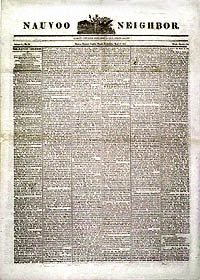
Nauvoo Neighbor (a.k.a., Wasp)
1843-46 Articles


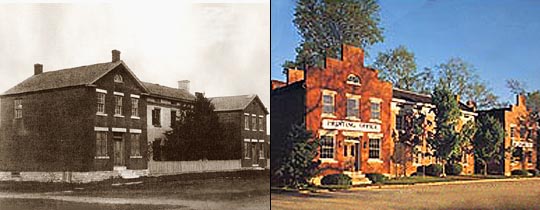
Printing Office, Taylor House, & Post Office, Nauvoo (before & after restoration)


1842 - 1843  |  1843 - 1846


May 10 '43   |   Jan 31 '44   |   Apr 17 '44
May 29 '44   |   Jun 05 '44   |   Jun 10 '44
Aug 28 '44   |   Sep 04 '44   |   Sep 11 '44
Sep 25 '44   |   Dec 04 '44   |   May 14 '45
May 28 '45   |   Jun 11 '45   |   Jun 18 '45
Jun 25 '45   |   Jul 16 '45   |   Jul 23 '45
Jul 30 '45

(under const.)


Peoria Register   |  Sangamo Journal   |  Misc. Ill. papers
Quincy papers   |  Warsaw Signal   |  Alton Telegraph
Return to: Old Newspapers Articles Index


Our  Moto: -- The  Saints'  Singularity -- is  Unity, Liberty, Charity.

Vol. II. - No. 2.           Nauvoo, Hancock Co., Wed., May 10, 1843.           Whole No. 54.


ANCIENT  RECORDS.

Circumstances are daily transpiring which give additional testimony to the authenticity of the Book of Mormon. A few years ago, although supported by indubitable, unimpeachable testimony, it was looked upon in the same light by the world in general, and by the religious world in particular, as the expedition of Columbus to this continent was by the different courts that he visited, and laid his project before. The literati looked upon his expedition as wild and visionary, they suspected very much the integrity of his pretensions, and looked upon him-to say the least-as a feel, for entertaining such wild and visionary views. The royal courts aided by geographers, thought it was impossible that another continent should or could exist; and they were assisted in their views by the learned clergy, who, to put the matter beyond all doubt, stated that it was contrary to Scripture; that the apostles preached to all the world, and that as they did not come to America, it was impossible that there should be any such place. Thus at variance with the opinions of the great, in opposition to science and religion, he set sail, and actually came to America; it was no dream, no fiction; but a solid reality; and however unphilosophical and infidel the notion might be. men had to believe it; and it was soon found out that it would agree both with religion and philosophy. So when the Book of Mormon first made its appearance among men, it was looked upon by many as a wild speculation, and that it was dangerous to the interest and happiness of the religious world. But when it was found to teach virtue, honesty, integrity, and pure religion, this objection was laid aside as being untenable.

We were then told that the inhabitants of this continent were and always had been a rude, barbarous race, uncouth, unlettered, and without civilization. But when they were told of the various relics that have been found indicative of civilization, intelligence, and learning, when they were told of the wealth, architecture, and splendor of ancient Mexico,- when recent developments proved beyond a doubt that there are ancient ruins in Central America, which, in point of magnificence, beauty, strength, and architectural design, vie with any of the most splendid ruins on the Asiatic Continent,-when they could trace the fine delineations of the sculptor's chisel on the beautiful statue, the mysterious hieroglyphic, and the unknown character, they began to believe that a wise, powerful, intelligent, and scientific race had inhabited this continent; but still it was improbable-nay almost impossible, notwithstanding the testimony of history to the contrary, that anything like plates could have been used anciently, particularly among this people.

The following letter and certificate will perhaps have a tendency to convince the sceptical that such things have been used and that even the obnoxious Book of Mormon may be true. And as the people in Columbus' day were obliged to believe that there was such a place as America, so will the people in this day be obliged to believe, however reluctantly, that there may have been such plates as those from which the Book of Mormon was translated.

Mr. Smith has had those plates, what his opinion concerning them is, we have not yet ascertained. The gentleman that owns them has taken them away, or we should have given a fac-simile of the plates and characters in this number. We are informed however, that he purposes returning with them for translation, if so, we may be able yet to furnish our readers with it.

It will be seen by the annexed statement of the Quincy Whig, that there are more dreamers and money-diggers than Joseph Smith in the world; and the worthy editor is obliged to acknowledge that this circumstance will go a good way to prove the authenticity of the Book of Mormon. He further states that "if Joseph Smith can decipher the hieroglyphics on the plates, he will do more towards throwing light on the early history of this continent than any man living." We think that he has done that already in translating and publishing the Book of Mormon, and would advise the gentleman and all interested to read for themselves and understand. We have no doubt, however, but Mr. Smith will be able to translate them.


TO THE EDITOR OF THE NEIGHBOR.

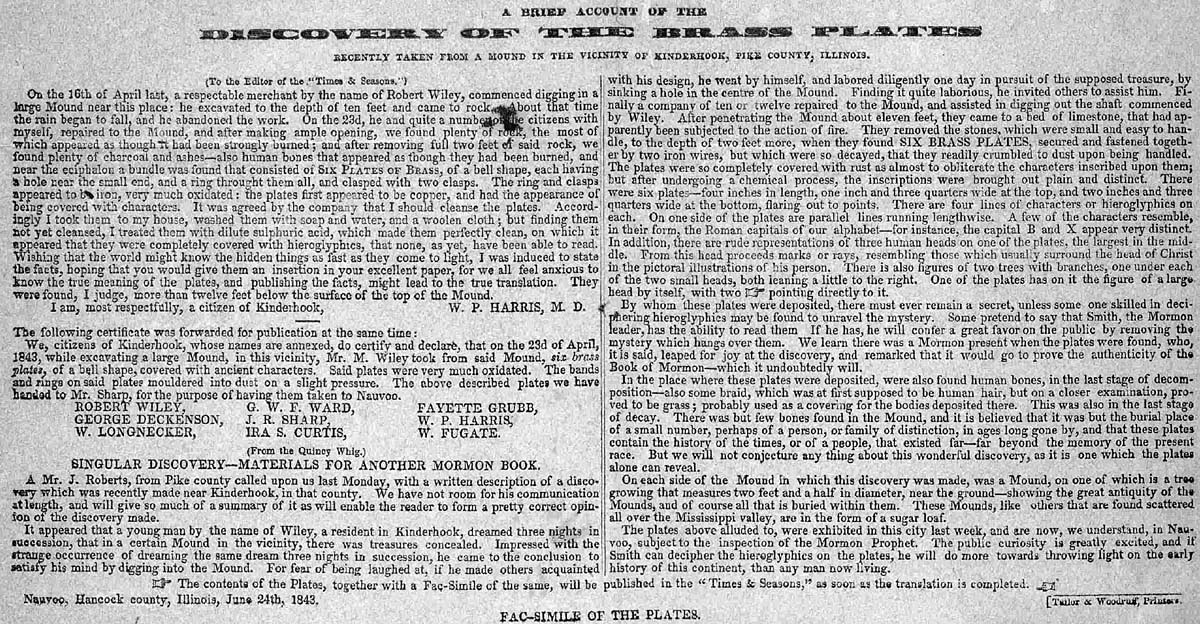
On the 16th of April last, a respectable merchant, by the name of Robert Wiley, commenced digging in a large mound near this place; he excavated to the depth of ten feet and came to rock. About that time the rain began to fall, and he abandoned the work.

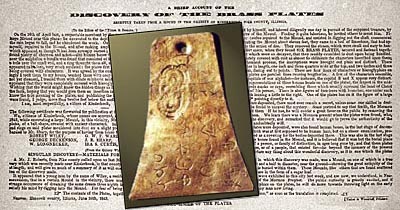
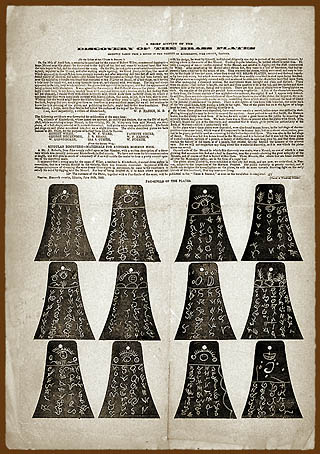
On the 23rd, he and quite a number of the citizens, with myself, repaired to the mound; and after making ample opening, we found plenty of rock, the most of which appeared as though it had been strongly burned; and after removing full two feet of said rock, we found plenty of charcoal and ashes; also human bones that appeared as though they had been burned; and near the encephalon a bundle was found that consisted of six plates of brass of a bell shape, each having a hole near the small end, and a ring through them all, and clasped with two clasps. The rings and clasps appeared to be iron very much oxydated.

The plates appeared first to be copper, and had the appearance of being covered with characters.

It was agreed by the company that I should cleanse the plates. Accordingly I took them to my house, washed them with soap and water and a woolen cloth; but, finding them not yet cleansed, I treated them with dilute sulphuric acid, which made them perfectly clean, on which it appeared that they were completely covered with hieroglyphics that none as yet have been able to read.

Wishing that the world might know the hidden things as fast as they come to light, I was induced to state the facts, hoping that you would give it an insertion in your excellent paper; for we all feel anxious to know the true meaning of the plates, and publishing the facts might lead to the true translation.

They were found, I judged, more than twelve feet below the surface of the top of the mound.

I am, most respectfully, a citizen of Kinderhook,

W. P. HARRIS, M.D.

The following certificate was forwarded for publication, at the same time.

We the citizens of Kinderhook, whose names are annexed do certify and declare that on the 23d April, 1843, while excavating a large mound, in this vicinity, Mr. R. Wiley took from said mound, six brass plates of a bell shape, covered with ancient characters. Said plates were very much oxidated -- the bands and rings on said plates mouldered into dust on a slight pressure. The above described plates we have handed to Mr. Sharp for the purpose of taking them to Nauvoo.

ROB'T WILEY,
W. P. HARRIS,
G. W. F. WARD,
W. LONGNECKER,
FAYETTE GRUBB,
IRA S. CURTIS,
GEO. DECKENSON,
W. FUGATE,
J. R. SHARP.


(From the Quincy Whig.)

SINGULAR DISCOVERY -- MATERIAL
FOR ANOTHER MORMON BOOK.

A Mr. J. ROBERTS, from Pike county, called upon us last Monday, with a written description of a discovery which was recently made near Kinderhook, in that county. We have not room for his communication at length, and will give so much of a summary of it, as will enable the reader to form a pretty correct opinion of the discovery made.

It appeared that a young man by the name of Wiley, a resident in Kinderhook, dreamed three nights in succession, that in a certain mound in the vicinity, there was treasures concealed. -- Impressed with the strange occurrence of dreaming the same dream three nights in succession, he came to the conclusion, to satisfy his mind by digging into the mound. For fear of being laughed at, if he made others acquainted with his design, he went by himself, and labored diligently one day in pursuit of the supposed treasure, by sinking a hole in the centre of the mound. Finding it quite laborous, he invited others to assist him. Finally, a company of ten or twelve repaired to the mound, and assisted in digging out the shaft commenced by Wiley. After penetrating the mound about 11 feet, they came to a bed of limestone, that had apparently been subjected to the action of fire, they removed the stone, which were small and easy to handle, to the depth of two feet more, when they found SIX BRASS PLATES, secured and fastened together by two iron wires, but which were so decayed, that they readily crumbled to dust upon being handled. The plates were so completely covered with rust as almost to obliterate the characters inscribed upon them; but after undergoing a chemical process, the inscriptions were brought out plain and distinct. There were six plates -- four inches in length, one inch and three quarters wide at the top, and two inches and three quarters wide at the bottom, flaring out to points. There are four lines of characters or hieroglyphics on each; on one side of the plates are parallel lines running lengthwise. A few of the characters resemble, in their form, the Roman capitals of our alphabet -- for instance, the capital B and X appear very distinct. In addition, there are rude representations of three human heads on one of the plates, the largest in the middle; from this head proceeds marks or rays, resembling those which usually surround the head of Christ, in the pictorial representations of his person. There is also figures of two trees with branches, one under each of the two small heads, both leaning a little to the right. One of the plates, has on it the figure of a large head by itself, with two ==> pointing directly to it.

By whom these plates were deposited there, must ever remain a secret, unless some one skilled in deciphering hieroglyphics, may be found to unravel the mystery. Some pretend to say, that Smith the Mormon leader, has the ability to read them. If he has, he will confer a great favor on the public by removing the mystery which hangs over them. We learn there was a Mormon present when the plates were found, who it is said, leaped for joy at the discovery, and remarked that it would go to prove the authenticity of the Book of Mormon -- which it undoubtedly will.

In the place where these plates were deposited, were also found human bones in the last stage of decomposition; also some braid, which was at first supposed to be human hair, but on a closer examination proved to be grass; probably used as a covering for the bodies deposited there; this was also in the last stage of decay. There were but few bones found in the mound; and it is believed, that it was but the burial place of a small number, perhaps of a person, or a family of distinction, in ages long gone by, and that these plates contain the history of the times, or of a people, that existed far -- far -- beyond the memory of the present race. But we will not conjecture any thing about this wonderful discovery, as it is one which the plates alone can reveal.

On each side of this mound in which this discovery was made, was a mound, on one of which is a tree growing that measures two feet and a half in diameter, near the ground. -- Showing the great antiquity of the mounds, and of course, all that is buried within them. These mounds like others, that are found scattered all over the Mississippi valley, are in the form of a sugar loaf.

The plates above alluded to, were exhibited in this city last week, and are now, we understand, in Nauvoo, subject to the inspection of the Mormon Prophet. The public curiosity is greatly excited, and if Smith can decipher the hieroglyphics on the plates, he will do more towards throwing light on the early history of this continent, than any man now living.


Note 1: The report was, that on April 23, 1843, some residents dug into a large Indian mound near Kinderhook, Pike, Co., about 65 miles south of Nauvoo, Illinois. They allegedly discovered human bones, traces of ancient fires, and six small, bell-shaped plates, made of bress. These plates (only one of which survives) were covered with strange pictographic or glyphic writing, that had never before been seen in the Americas or elsewhere.

Note 2: View the text accompanying the plate facsimiles in the June, 1843 broadside published on the press of the Nauvoo Neighbor. See also Rev. R. B. Neal's "The Champion Hoaxer Hoaxed," in the June, 1909 number of his Sword of Laban.

Note 3: On Sept. 3, 1856, the Salt Lake City Deseret News published the following sentences, as a part of its serialization of "The History of Joseph Smith": "I insert fac similes of the six brass plates found near Kinderhook, in Pike county, Illinois, on April 23, by Mr. R. Wiley and others, while excavating a large mound. They found a skeleton about six feet from the surface of the earth, which must have stood nine feet high. The plates were found on the breast of the skeleton, and were covered on both sides by ancient characters.... I have translated a portion of them, and find they contain a history of the person with whom they were found. He was a descendant of Ham,through the loins of Pharaoh, king of Egypt, and that he received his kingdom from the ruler of heaven and earth" (cf. LDS HC 5:374-375). Smith wrote very litte of his published history and this entry was evidently copied by its editors from the Nauvoo Journal of William Clayton.


Our  Moto: -- The  Saints'  Singularity -- is  Unity, Liberty, Charity.
Vol. I. - No. 40.        Nauvoo, Hancock Co., Wed., Jan. 31, 1844.        Whole No. 92.


TO  THE  HONORABLE,  THE  SENATE  AND
HOUSE  OF  REPRESENTATIVES  OF  PENNSYLVANIA,
IN  LEGISLATIVE  CAPACITY  ASSEMBLED.

Your memoralist, a member of the Church of Jesus Christ of Latter Day Saints, and now an exile in the state of Illinois, begs leave, most respectfully to represent to your honorable body, that he was born in the state of Pennsylvania, on the 19th of February, A. D. 1793, in Alleghany county, and township of St. Clair, that he continued his permanent residence in said state until the year 1826, when he moved to the state of Ohio. In 1831, he went into the state of Missouri, and in connexion with other members of said Church of Jesus Christ of Latter Day Saints, became the owner of real estate in the county of Jackson, in said state: but by reason of the violence of a formidable mob, and the unwillingness of the authorities of Missouri to protect your memorialist, and those connected with him, in the possession of their rights, they were forbidden the privilege of enjoying their property, or receiving any benefit therefrom; that in the month of April, 1838, your memorialist moved with his family into the state of Missouri, into Caldwell county, and became owner of real estate in the said county of Caldwell, without however being privileged to enjoy the benefit of his lands in Jackson county. All the lands owned by your memorialist and his brethren, in Jackson county, were purchased from the United States, for which payment had been made in full; the benefits of which payment the United States now enjoy, and has ever since the purchase. There had large numbers of the Church of Jesus Christ of Latter Day Saints settled in Caldwell county, at the time your memorialist went into that county, as also in Davies county, in said state. We commenced building houses, and improving our lands; building mills and other machinery, for our mutual benefit; quietly and peaceably enjoying our new homes, and using much industry and economy, to render the desolate waste, whither we had been driven, a pleasant habitation for man. The toils of the day, were followed by the sound of the hammer, the noise of the plane, and the hum of the wheel, at night. Day and night all was bustle, all was stir; every hour of the day, and many of the night, brought forth the fruits of industry, for the benefit of the settlers, and added additional improvement, beauty and comfort to our new homes. Our social circles, however, were not unfrequently disturbed by the tears and sobbings of some disconsolate widow, or the weeping of some bereaved orphan, bewailing the loss of a husband or a father, who had fallen a victim to the violence of the Jackson and Clay county mobs. Jackson county was the place of our choice, and nothing but violence could have caused our people to leave it. Their hearts were set upon it, and all their feelings associated with that place, as the future home of themselves and their posterity. The location in Caldwell and Davies counties, was only made by our people, by reason of violence and lawless outrages committed upon them. It was always received by us as a place of exile, and not of choice, and in dispite [sic - spite?] of all our efforts at cheerfulness, at times, the mind would be almost overwhelmed with melancholy, and we would say in our hearts, and often with our lips, 'what availeth us that our ancestors bled. and our fathers fought for liberty, while we are as captives in a strange land?' and like Israel along the streams of Babylon, we would be almost ready to hang our harps on the willows, and refuse to sing the song of Zion. O where is the patrimony our fathers bequeathed to us? Where is the liberty they purchased with their blood? Fled! alas fled!! but we hope not forever.

But the wants of our families would dissipate our feelings; we would engage in the labors of the day, and the toils of the night, with untiring perseverance, and struggle with all the powers of both mind and body, to render our families comfortable, and make our homes pleasant. But alas! this privilege was not allowed us. Our quiet industry, and untiring perseverance soon awakened the jealousy of our enemies, and the cry went forth, that if the Mormons (as they called us) were let alone. Caldwell county would, in five years, be the most wealthy and populous county in the state. This our enemies could not endure; and a regular system of mobocracy, of violence, and plunder, was formed to check us in our course to wealth and greatness, as our enemies supposed: and, indeed, they had some reason to think so; for an extent of improvement had been made in this remote and wild region, in the space of a few months, which had no parallel in the history of our western settlements, and I strongly doubt whether any where else.

This banditti of marauders increased in numbers and violence, until by device and stratagem, duplicity and falsehood, they got the authorities of the state to interfere, and aid them in their diabolical purposes; and the then Governor of the state, Lilburn W. Boggs, actually sent a large military force into the county, with orders to exterminate us and confiscate our property; or such was the authority the commanders of the military array claimed, by virtue of the order received from the governor. -- Suffice it to say, that our settlements were broken up, our towns plundered, our farms laid waste, our crops ruined, our flocks and herds either killed or driven away, our houses rifled, our goods, money. clothing, provisions and all we had, carried away; men were shot down like wild beasts, or had their brains dashed out: women were insulted and ravished, until they died in the hands of their destroyers. Children were killed, while pleading for their lives. All intreaties were vain and fruitless; men, women and children, alike, fell victims to the violence and cruelty of these ruffians. Men moving into the county with their families, were shot down; their waggons,teams and loading, taken by the plunderers as booty, and their wives, with their little ones, ordered out of the state forthwith, or suffer death, as had their husbands; leaving them no means of conveyance but their feet, and no means of subsistence but begging. Soldiers of the revolution were slain in the most brutal manner while pleading for their lives, in the name of American citizens. Many were thrown into prison to endure the insults of a mock trial, that would have disgraced an inquisition. This last part of the scene, was doubtless designed to make the distant public believe, that there was some excuse for all this outrage and violence. Among the number of those cast into prison, was your young memorialist, who had to endure four months imprisonment, part of the time in chains.

To give your honorable body a correct idea of the origin of these scenes of cruelty and woe, we will here transcribe the preamble to a set of resolutions passed by these plunderers, at their first meeting held in Jackson county, for the purpose of taking measures for the expulsion of our people from that county. It is as follows:

"We the undersigned, citizens of Jackson county, believing that an important crisis is at hand, as regards our civil society, in consequence of a pretended religious society of people that have settled and are still settling in our county, styling themselves Mormons; and intending as we do, to rid our society, peaceably if we can, forcibly if we must, and believing as we do, that the arm of the civil law does not afford us a guarantee, or at least, a sufficient one against the evils which are now inflicted on us, and seem to be increasing by the said religious sect, deem it expedient and if the highest importance to form ourselves into a company for the better and easier accomplishment of our purpose, which we deem it almost superfluous to say, is justified as well by the law of nature, as by the law of self defence."

Your honorable body will see by the above, that the reason assigned for the formation of the company (and this was the first that was formed,) was the want of power in the civil law to enable them to effect their object. Hear their own words-'And believing as we do, that the arm of civil law does not afford us a guarantee, or at least a sufficient one against the evils which are now inflicted upon us.' What were the evils complained of? Strange must be the answer, themselves being judges; the existence of a religious society among them; a society too against which even envy and malice themselves could not find an accusation, or ferret out a lawless impropriety, or one act which the lawless recognized as crime. For, says the complainants, we form ourselves into a company, because the laws do not provide for the evils which afflict us; or this in effect is what they say. If any individual or individuals of said society, or the society as a body, had transgressed the laws, had not the state power to lawfully inflict the punishment due to said offence? The sequel shows they had. What are the facts of the case, our enemies being the judges themselves? They are, that our people had so deported themselves, as to be justified by the laws; claiming no right but such as the laws guaranteed; exercising no power beyond the limits set for them by the laws of the country; and this was the reason why our enemies formed themselves into a company for our expulsion, or at least, they so say. If our people had been transgressors of the laws, no need then for the people of Jackson county to form themselves into a company to drive us from our homes; they could have done this lawfully; no need of a companys' being formed, all could have been done without, that humanity could have demanded.

By virtue then of the unholy determination, as stated above, our people were attacked, indiscriminately, men women and children: their houses were rifled; the inmates driven out into open fields or wild prairies; their farms desolated; their crops all destroyed; their goods, and chattels carried off or otherwise destroyed; men were caught, tied up, whipped, until some died in their hands, others had to tie handkerchiefs round their bodies to keep their bowels from falling out: others were shot down; their wives and little ones driven from their habitation! and this often in the night, having nothing but their night clothes on; their houses would be set on fire, and all consumed, leaving hundreds of women and little children thus destitute and naked. wandering bare-footed and nearly naked, in the darkness of the night and dead of winter, in the fields and open prairies, without any covering but the heavens, or any bed but the earth; and their condition so terrible that they might be followed by their blood, which flowed from their lacerated and bleeding feet. Females in this heart rending condition, gave birth to children, in the open air, and exposed to the inclemencies [inclemency's] of the winter. The consequences were that many sickened and many died. And if we ask, why all this abuse? the answer must be, because the people had not transgressed the laws; if they had, their persecutors would have punished them by the laws: but they had not done it, and for this cause they must suffer all the cruelties which the most inhuman barbarity could invent. The lands which your memorialist and his brethren had purchased from the general government, and on which large improvements were made, were thus taken possession of by our persecutors, and the same are held by them till this day, and we are forbid the privilege of enjoying them or any benefit arising from them, I mean the lands in Jackson County.

After wandering about for a length of time, those that were thus unlawfully deprived of their earthly all and cruelly driven from their homes, got into Clay county in said state of Missouri; and again began to get homes; but in a short time, the same scenes began to be acted in Clay, as had been in Jackson county, and the people were again driven, and got into Caldwell or what was afterwards Caldwell county, and into Davies county, or a large majority of them, and here again purchased lands from the general government.

To give your honourable body a correct idea of how those who had been thus driven and stripped of their all, were enabled again to purchase, it is only necessary to say, that there was a constant emigration into the country of the members of the Church of Jesus Christ of Latter Day Saints; many of those had money, and they loaned part of what they had to those who had none, and enabled them to purchase homes. The land soon began to rise in value, and the first purchasers were enabled to sell part of what they had purchased for enough to pay for the whole, and save themselves a home: some more and some less. There were few, if any who did not in this way get homes, but were privileged only a very short time to enjoy them. We were followed into Caldwell and Davies counties, by the same relentless spirit, and by the same persecutors who had desolated our people in Jackson county, under the command of Major General Lucas, of Independence, Jackson county seat of the first mob, and the place where the first company was formed for our destruction. He was joined on his way hither by many of other counties, and invaded our towns and settlements, laid all waste and drove us into exile.

Lilburn W. Boggs, who was Lieutenant Governor of the state, when the persecution first commenced, and one of the principal actors in the persecution, was now (l838) Governor of the state, and used his executive influence to have us all massacred or driven into exile; again taking all we had, and holds it till this day; and all this because we were not lawless and disobedient. For if the laws had given them a sufficient guarantee against the evils complained of by the existence of our religious society among them, then would they have had recourse to the laws. If we had been transgressors of law, our houses would not have been rifled, our women ravished, our farms desolated, and our goods and chattels destroyed; our men killed, our wives and children driven into the the prairies, and made to suffer the indignities that the most brutal barbarity could inflict, but would only have had to suffer that which the laws would inflict, which were founded in justice, framed in righteousness and administered in humanity. But scourged by this banditti, without the forms of law, and according to their own declaration, in violation of all law, or the principles of humanity, we were doomed to suffer all kinds of cruelty which barbarity or inhumanity could invent. And they have gravely told the world that they deem it almost superfluous to say that their cause was justified, as well by the law of nature as by the law of self defence. Now, in the name of all humanity, what law of nature justified, or law of self defence required the infliction of such shameless cruelties? In so saying they show most assuredly but very little respect to the intelligence of humanity of American citizens, and in the eyes of the civilized world have cast a shade, and a dark one too, on the character of the sons of a noble ancestry, for they have virtually said that Americans look upon such cruelties as the acts of virtue and the fatherly chastisements of humanity.

During the whole progress of those scenes of cruelty, from the beginning, we petitioned the authorities of Missouri for protection and redress. In the name of American citizens, we appealed to their patriotism, to their justice, to their humanity, and to their sacred honors; but they were deaf to our entreaties, and lent a listless ear to our petitions. All attempts at redress or protection were vain, and they heeded us not, until we were exiles in a strange land, though one (and to its honor be it spoken) where we found both friends and a home. But since our residence in Illinois, Missouri has followed us with the same relentless spirit of persecution. Warrants have been sent by the governor of Missouri to the governor of Illinois, demanding the body of your memorialist, and a number of others; for that of Joseph Smith three several warrants have been sent, all of which have been set aside by the legal authorities of Illinois; and yet they cease not their persecution. Our people are kidnapped, and carried into Missouri, and there are insulted and whipped (as many have been) and cast into prison, and left to get out as they could. All this without the forms of trial. Missouri is by these brutal means endeavouring to make the public think that they have cause for this barbarity. But, let me ask your honorable body, what excuse can be pled for such inhuman barbarity and brutal recklessness? Let me further ask the attention of your honorable body to the fact, that all the before described outrages were committed by a body of men calling themselves militia, called out by order of the governor for the professed object of seeing that the laws were kept, and their supremacy maintained. Such was their pretended object, and under this cover they put at defiance the laws of both God and man; of nature, humanity, and decency; and in these unhallowed abuses of all the laws of civilized society in the world, they were upheld by the authorities of the state, and actually paid by the state, for committing theft, robbery, rapine, violence rape, and murder, with innumerable cruelties, painful to mention. And when we made application to the authorities for redress, we were insulted instead of receiving common civilities. The constitution of the United States provides, that the United States shall give to each state a republican form of government. Is it a republican form of government where such outrages can be committed in the face of the authorities, and yet no redress can be had; where all law is suspended to give place to cruelty, barbarity, and inhumanity? Let your honorable body answer.

Her statesmen in the national councils may attempt to plead excuses for these diabolical outrages, but all they can do is stamp infamy on their own characters, and engrave disgrace on the urn that contains their ashes after they sleep. What, I ask your honorable body, can be pled in extenuation of crimes so barbarous, cruelties so infamous, and outrages so violent. What crime can any man commit, it matters not how flagrant, which can, according to the laws of the civilized world, subject his wife to insult, his daughters to rape, his property to public plunder, his children to starvation, and himself and family to exile. The very character of the outrage is all the testimony I think your honorable body can ask-that it was without provocation on the part of the sufferers; for if there had been provocation then would the transgressors have had to suffer the penalty of broken laws, but their punishment -- if such it can be called -- was not the penalty inflicted for the breach of any law, for no law in existence knows such a penalty or penalties. Why then all this cruelty? Answer, because the people had violated no law; nor prevented from exercising the rights, which they, (according to the laws,) enjoyed, and had a right to be protected in, in any state in the union.

Being refused redress by the authorities of Missouri, to whom shall your memorialist look? He answers, to the people of his native state, and through them to the general government, and where can he look with more confidence, than to the patriots of Pennsylvania, the state of his nativity, and the place of the sepulchers of his fathers. Yes, your memorialist says in his heart, "I will tell you my wrongs and grievances and that of my brethren, in Pennsylvania; I will publish them in the streets, high ways and high places of the 'Key Stone State,' that her statesmen may plead the cause of suffering innocence in the halls of the National Legislature; her matrons may arise in the strength of patriotism; her fair ones in virtuous indignation, and their united voices cease not, until the cause of the innocent shall be heard, and their most sacred rights restored." To your honorable body then, the representatives of the people of his native state, your memorialist utters his complaining voice; to you he tells the tale of his wrongs, and his woes, and that of his brethren, and appeals to your honorable body, as one of Pennsylvania's native sons, and asks you in the name of all that is patriotic, republican and honorable, to instruct the whole delegation of Pennsylvania in congress, to use all lawful and constitutional means to obtain for us redress for our wrongs and losses. Believing as your memorialist does, that the general government has not only the power to act in the premises, but are bound by every sacred obligation by which American citizens are bound to one another, in our national compact, to see that no injury is inflicted without redress being made.

Weak indeed must be our republican institutions, and as contemptible our national capacity, if it is a fact, that American citizens, after having purchased lands from the government, and received the government guarantee to be protected in the enjoyment of them, they can be lawlessly and causelessly driven off by violence and cruelty, and yet the government have no power to protect them, or redress their wrongs. Tell not this in Pennsylvania, publish it not in the streets of Harrisburg, for surely, the sons of the 'Key Stone State' will feel themselves insulted.

Well may the nations of the old world ridicule the weakness, and impotency of our free institutions, a government not able to protect its own citizens! A government, it must be famous indeed in the annals of history, and a pattern to the world, which is so governed as to admit the most flagrant abuses known to the civilized world, and acknowledged by all to be such; and yet no power to redress them. Hear it O ye barbarians! Listen to it O ye savages!! and hasten, yea hasten all of you to America; there you can glut your avarice by plunder, and riot in the blood of innocence, till you are satisfied, and the government has no power to restrain, nor strength to punish, nor yet ability to redress the sufferers at your hands.

From the acquaintance which your memorialist has with the history of his native state, he has been induced to make his appeal to your honored body-a state whose people are noted for their civic virtues and zealous attachment to the principles of civil and religious liberty; a people venerable from the beginning of our national existence; whose virtuous efforts to the sacred principles of freedom, religious, civil, and political, have obtained for themselves imperishable laurels in the history of our country's glory; a people whose colonial organization was based upon the holy principles of equal rights and equal privileges; a people whose national escutcheon has never been stained with the martyrs blood; a state whose statesmen, divines and heroes, labored in the cabinet, the desk and the field, to secure, and hand down to their posterity, in all succeeding ages, the boon of heaven, the sacred rights of freemen.

It was in the honored metropolis of Pennsylvania, the seat of the first colonial congress, when the principles of liberty were matured, from whence emanated the voice of independence, whose echoes rolled and reverberated, till it reached the circumference of the colonial settlements, and inspired the sons of freedom, until there was but one voice heard: "Freedom or death." It was there when the leaders and heroes of the revolution, pledged their lives, their fortunes and their sacred honors, to each other, to be scourged by a tyrant's scepter no longer, until all they had, and all they were, were offered on the altar of freedom.

Not only were the principles of equal rights inscribed in legible characters on the flags which floated on her towers, in the incipient stages of our national existence, but they were engraven on the hearts of the people, with an impression which could not be obliterated. All who collected in her towers, or fought under her banners, could contend and fight for freedom only. Her teachers of religion, whose influence in the pulpit, and eloquence in public assemblies, wielded an overwhelming influence in the pulpit, and eloquence in public assemblies, wielded an overwhelming influence in forwarding the cause of liberty; did they use this influence in securing to themselves governmental patronage, or religious preferences? All acquainted with the history of the times answer no. They were citizens of Pennsylvania, and the immortal Penn had inscribed on every pot and bell in the colony, 'Civil and Religious liberty.' The patriotism of Pennsylvania's religious teachers was pure. They threw in their whole weight of character and influence to promote a cause which made others equal with themselves; for the glorious privilege of seeing a people free. Her heroes bore the horrors of war, not to sway the tyrant's scepter, or enjoy a lordling's wealth, but to found an assylum [asylum] for the oppressed, and prepare a land of freedom for the tyrant's slave. --- Her statesmen, while in the councils of the nation, devoted all their wisdom and talents to establish a government where every man should be free; the slave liberated from bondage, and the colored African enjoy the rights of citizenship; all enjoying equal rights to speak, to act, to worship, peculiar privileges to none. Such were Pennsylvania's sons at the beginning; and surely their sons and successors must have degenerated, lamentably degenerated, from the purity and patriotism of their fathers and predecessors, if crimes and cruelties, such as your memorialist complains of, go unheeded and unregarded. Honorable regard for the people of my native state forbids the thought.

In confidence of the purity and patriotism of the representatives of the people of his native state, your memorialist comes to your honorable body, through this his winged messenger, to tell you that the altar which was erected by the blood of your ancestors, to civil and religious liberty, from whence ascended up the holy incense of pure patriotism and universal good will to man, into the presence of Jehovah, a savior of life, is thrown down and the worshipers thereat, have been driven away, or else they are laying slain at the place of the altar. --

He comes to tell your honorable body, that the temple your fathers erected to freedom, whither their sons assembled to hear her precepts and cherish her doctrines in their hearts, has been desecrated; its portals closed, so that those that go up hither, are forbidden to enter.

He comes to tell your honorable body, that the blood of the heroes and patriots of the revolution, who have been slain by wicked hands for enjoying their religious rights, the boon of heaven to man, has cried, and is crying in the ears of the Lord of Sabaoth, saying, 'redress, redress our wrongs, O Lord God of the whole earth.

He comes to tell your honorable body, that the dying groans of infant innocence, and the shrieks of insulted and abused females-and many of them widows of revolutionary patriots have ascended up into the ears of Omnipotence, and are registered in the archives of eternity, to be had in the day of retribution, as a testimony against the whole nation, unless their cries and groans are heard by the representatives of the people, and ample redress made, as far as the nation can make it, or else the wrath of the Almighty will come down in fury against the whole nation.

Under all these circumstances, your memorialist prays to be heard by your honorable body, touching all the matters of his memorial; and as a memorial will be presented to congress this session, for redress of our grievances, he prays your honorable body will instruct the whole delegation of Pennsylvania, in both houses, to use all their influence in the national counsels, to have redress granted.

And, as in duty bound, your memorialist will ever pray.

            SIDNEY RIGDON, P. M.


Notes: (forthcoming)


Our  Moto: -- The  Saints'  Singularity -- is  Unity, Liberty, Charity.
Vol. I. - No. 51.        Nauvoo, Hancock Co., Wed., April 17, 1844.        Whole No. 103.


From the Sangamo Journal.

THE  GLOBE  AND  JOE  SMITH.

The Globe of the 14th has a long article, attacking Joe Smith's "views of government," as lately published by him in the Nauvoo paper. -- The real cause for this attack, we presume, may be found in the fact, that Smith does not choose to buckle on his armor, and support Martin Van Buren for President. Smith has done pretty well for the Globe party, by electing one member to Congress for them; and as it is an object for the Globe to keep him there, we presume, the editors were satisfied, that however much they might abuse Smith, he would be compelled to go for Hoge again. The Globe evidently believes in the potency of the rod held over Joe by Gov. Ford.

The following paragraph and quotation from Smith's "views," we copy from the Globe. If Joe never misses the truth more than in the quotation here made, he will get along quite well.


(From the Globe.)

"We cannot refrain from treating our readers to the following glowing passage in which our friend Joseph so eloquently describes the defeat of Mr. Van Buren. We have read nearly all the whig slants on this same subject; and we have met with nothing equal to the gloomy grandeur of this portentous paragraph:

At the age, then, of sixty years, our blooming republic began to decline, under the withering touch of Martin Van Buren. Disappointed ambition, thirst for power, pride, corruption, party spirit, faction, patronage, perquisites, fame, tangling alliances, priestcraft and spiritual wickedness in high places, struck hands, and revelled in midnight splendor. Trouble, vexation, perplexity and contention, mingled with hope, fear, and murmuring, rumbled through the Union, and agitated the whole nation, as would an earthquake at the centre of the earth, heaving the sea beyond its bounds, and shaking the everlasting hills. So, in hopes of better times, while jealousy, hypocritical pretesions, and pompous ambition were luxuriating on the ill-gotten spoils of the people, they rose in their majesty, like a tornado, and swept through the land, till Gen. Harrison appeared as a star among the storm-clouds, for better weather.


THE  GLOBE.

In the daily Globe of March 14th, Mr. Blair notices my 'Views on the Power and Policy of our Government,' under the head of 'A new advocate for a National Bank,' with remarks and extracts. As it does not bespeak a gentleman to tell all he knows, nor indicate wisdom to murmur at the oddities of men, I rarely reply to the many remarks, sayings and speculations upon me and my plans, which seem to agitate the world, for like the showers upon the verdure of the earth, they give me vigor, beauty and expansion -- but when a man occupies a station in his country, which ought to be honored as an exaltation; which ought to be sustained with dignity; and which should be filled by a friend and a patriot of the nation, too wise to be cozened by counterfeit principles; too great to blur his frame with sophistry; too proud to stoop to the vanity that is [momentarily] wasting the virtue of the Government; -- and too good to act the hypocrite to accumulate wealth-or to frustrate the ends and aims of justice; I feel it my duty to bring forth the truth, that the man and his measures, if right may be sustained; and if wrong, may be rebuked.

Without reference to men, parties, or precedents, the plan of banking, suggested in my 'Views,' is assumed upon the all-commanding, and worthily considered, omnipotent petition of the people, and whether, as a 'fiscal agent,' 'great financier, prophet, priest or king,' I act wisely and righteously, so as to answer their virtuous prayers, without fear, favor, or partiality; and produce union; give satisfaction to twenty millions of freemen, rather than sport with their holy supplications to boost a few hungry, crafty, hypocritical demagogues into office to gamble for the 'loaves and fishes' -- no matter whether the game is played "upon the tables of the living or the coffins of the dead, -- or whether I raise the honor and credit of the nation above the little, picayune, cramped, narrow minded schemes of the dominant, undominant, and would be dominant parties, cliques, knots and factions; or whether, like the venerable fathers, I launch my new ship into the great ocean of existence, and, like them, luckily bring relief to the oppressed is all the same, so long as the people are honored as noble in their patriotism; and almighty in their majesty: vox populi -- vox Dei!

But it is extraneous, irrelevant and kick shawing to connect me or any part of my 'Views on the Powers and Policy of the government,' with Mr. Clay, or Mr. Webster, Mr. Adams, Mr. Benton, Mr. Calhoun, Mr. Van Buren, or any of their galvanic cronies. -- what have they done to benefit the people? The simple answer is -- nothing but draw money from the Treasury. It is entirely too late in the age of this Republic, to clarify a Harry of the west; deify a Daniel of the east; quidify a Quincy of the Whigs, or bigify a Benton of the democrats; leaving Mr. Calhoun and Mr. Van Buren such fair samples of bogus-democracy, that he that runs may read.

As the beautiful excellence of a => head <= may be a desideratum only remedied by the 'Excelsior,' of the brain, so a great man ought to exhibit his wisdom by his liberality to the unfortunate among men as a token of philanthropy, unbounded by party lines, unfettered by chain-cable opinions, and untrammeled by cast-iron rules. Why slur the noble project of letting the prisoners go free by petition? It is sanctioned by ancient custom; it is the counsel of God, and would be the only visible testimony to the world that this realm is what it professes to be, a Government of Liberty! Heaven, earth, and hell know that the penitentiaries of the several states are a disgrace to the United States, and a stink in the nostrils of the Almighty. And the county and city prisons are still worse. Unfortunate men, and in nine cases out of ten, innocent, are hurled into prison by corrupted Judges, suborned witnesses, or ungodly men who gamble themselves into Congress, into Legislatures, into courts, into churches, and into notice and power, and thus damn their friends and fellow beings to prison, wretchedness and ruin. And in ninety and nine cases out of a hundred, the prisoners are treated meaner than dogs; half starved to put money into the pockets of speculators; fed upon unwholesome provisions; whipped without mercy and even murdered with impunity. Look at the beastly conduct of * * * * to the female in Auburn State Prison, N. Y. Remember a man was whipped to death, not long since in Alton penitentiary, Illinois; and it is not uncommon to lacerate with the 'rope's end' thirty men at once, in the parish prisons of New Orleans, so that the voice of reason now cries from the vast number of prisons and the multiplying number of prisoners in the United State for relief; and the death like groans from cells, bastiles [bastilles] castles, and cursed holes throughout the whole earth, is ascending up into the ears of the Lord Sabaoth to be avenged of such cruelty. And when great men, in high places, see a Governor Reynolds shoot out his own brains with a rifle; or gaze upon the havoc made by the bursting of a 'great gun' among the 'Executives' of the nation, then know ye, the hour of his judgment is come!

The United States is the boasted land of 'Liberty,' where 'these truths are held self evident' -- that ALL men are created equal; and endowed by their Creator with certain unalienable rights, that among these are life LIBERTY and the pursuit of happiness: but at the same time, in the face of these truths, slavery is tolerated by law: imprisonment is tolerated by law: and murder is tolerated by law: and even fifteen thousand free citizens are exiled from one State to another -- and the General Government has no power, (according to the opinions of Van Buren and Benton) to redress the wrong. O, Queen Victoria, and ye lords and commons of Great Britain, what think ye of a Republican Government? and how do you imagine your daughter will come out in her attempt at equal rights and reigning in righteousness? Pshaw! (will they answer,) your coffers are robbed with impunity; your citizens are mobbed, and driven like chaff from the threshing floor, and the government controlled by a set of money gambling, chicken hearted, public fed cowards, cannot redress you! Ask the reigning sovereigns of Europe, Africa and Asia, what they think of the boasted Republic in America! and they will not laugh in the face of the whole world, and taunt the United States, by exclaiming: Ah! hah! ah! hah! If there is any power in a Republican Government, in a real case of necessity, you have failed to find just men to exercise it. Party spirit cuts the cords of union; patronage veils the face of justice, and bribery closes the lips of honor, and when the wicked rule the people mourn.

Perhaps it may be said, the government has been adequate to the calls of justice; and I answer, if it has, it was because the officers in authority considered their honor and the rights of the people, paramount to patronage, pelf and popularity!

They were patriots who carried out the poet's explanation of true greatness:

"A wit's a feather, and a chief's a rod,
  But an honest man's the noblest work of God"
It is said that 'out of the abundance of the heart the mouth speaketh,' and when men are called 'quadrupeds,' and ridicule occupies the place of reason, and the virtue, dignity, honor, power, and majesty of the people seem to be buried in rubbish; covered with dust; mildewed with fog; tainted with treachery; burlesqued by blackguards; or humbled by debauchees; it is high time for humanity to exclaim: "how has the gold become dim, and where has the glory departed?"

The only suggestion worthy of commendation relative to a National Bank, in Mr. Blair's remarks, is, that the mother bank should be located at Nauvoo.

This is correct, for Nauvoo as a city, collectively or individually, cannot be reproached with dishonor, crime, corruption or bribery. -- Neither has a Swartcout or Price mingled his millions with the majesty of monarchs by walking out of the unwalled and ungated Nauvoo. The blood of Commodores and Congressmen, shed by the heaven-daring, hell-begotten, earth disgracing practice of dueling, has never stained the soil or city of Nauvoo. Nor does a slave raise his rusting fetters and chains, and exclaim, O liberty where are thy charms? Wisdom, freedom, religion, and virtue, like light, love water and air, "spread undivided, and operate unspent," in the beloved Nauvoo; while the gay world, and great politicians may sing, and even the "great Globe" itself may chime the melodious sounds: --

Hail Columbia, "free and equal"--
  Lo, the saints, the Mormons, bless ye!
Felt thy glory most severely,
  When Missouri gave them jesse.

Hail Columbia, "free and equal"--
  Negro slaves, like common cattle,
Bought and sold at common auction;
  Prayers and chains together rattle!

Hail Columbia, "free and equal"--
  "Gold and silver" is thy tender;"
Treasury notes (aside from Biddle,)
  Foreign loans, and fallen splendor!
As the "world is governed too much" and as there is not a nation or dynasty, now occupying the earth, which acknowledges Almighty God as their law giver, and as "crowns won by blood, by blood must be maintained," I go emphatically, virtuously, and humanely, for a THEODEMOCRACY, where God and the people hold the power to conduct the affairs of men in righteousness. And where liberty, free trade, and sailor's rights, and the protection of life and property shall be maintained inviolate, for the benefit of ALL. To exalt mankind is nobly acting the part of a God; to degrade them, is meanly doing the drudgery of the devil. Unitas, libertas, caritas -- esto perpetua!

With the highest sentiments of regard for all men, I am an advocate of unadulterated freedom.
                                    JOSEPH SMITH.
  Nauvoo, Ill., April 15, 1844.


Notes: (forthcoming)


Our  Moto: -- The  Saints'  Singularity -- is  Unity, Liberty, Charity.
Vol. II. - No. 4.        Nauvoo, Hancock Co., Wed., May 29, 1844.        Whole No. 109?.


[JOSEPH  SMITH'S  REPLY  TO  HENRY  CLAY.]

                                                    NAUVOO, Illinois,
                                                    May 13th, 1844.

Sir:-- Your answer to my inquiry, "What would be your rule of action towards the Latter-day Saints, should you be elected President of the United States?" has been under consideration since last November, in the fond expectation that you would give (for every honest citizen has a right to demand it,) to the country a manifesto of your views of the best method and means which would secure to the people, the whole people, the most freedom, the most happiness, the most union, the most wealth, the most fame, the most glory at home, and the most honor abroad, at the least expense. But I have waited in vain. So far as you have made public declarations, they have made, like your answer to the above, soft to flatter, rather than solid to feed the people. You seem to abandon all former policy which may have actuated you in the discharge of a statesman's duty, when the vigor of intellect and the force of virtue should have sought out an everlasting habitation for liberty; when, as a wise man, a true patriot, and a friend to mankind, you should have resolved to ameliorate the lawful condition of our bleeding country by a mighty plan of wisdom, righteousness, justice, goodness, and mercy, that would have brought back the golden days of our nation's youth, vigor, and vivacity, when prosperity crowned the efforts of a youthful republic, when the gentle aspirations of the sons of liberty were, "We are one!"

In your answer to my questions last fall, that peculiar tact of modern politicians declaring, "If you ever enter into that high office, you must go into it free and unfettered, with no guarantees but such as are to be drawn from your whole life, character, and conduct," so much resembles a lottery-vendor's sign, with the goddess of good luck sitting on the car of fortune, a-straddle of the horns of plenty, and driving the merry steeds of beatitude, without reins or bridle, that I cannot help exclaiming -- O frail man, what have you done that will exalt you? Can anything be drawn from your life, character, or conduct, that is worthy of being held up to the gaze of this nation as a model of virtue, charity and wisdom? Are you not a lottery picture, with more than two blanks to a prize? Leaving many things prior to your Ghent treaty, let the world look at that, and see where is the wisdom, honor, and patriotism, which ought to have characterized the plenipotentiary of the only free nation upon the earth? A quarter of a century's negotiation to obtain our rights on the north-eastern boundary, and the motley manner in which Oregon tries to shine as American territory, coupled with your presidential race and come-by-chance secretaryship, in 1825, all go to convince the friends of freedom, the golden patriots of Jeffersonian Democracy, free trade and sailor's rights, and the protectors of persons and property, that an honorable war is better than a dishonorable peace.

But had you really wanted to have exhibited the wisdom, clemency, benevolence, and dignity of a great man in this boasted republic, when fifteen thousand free citizens were exiled from their own homes, lands, and property, in the wonderful patriotic State of Missouri, and you then upon your oath and honor occupying the exalted station of a Senator of Congress from the noble-hearted State of Kentucky why did you not show the world your loyalty to law and order, by using all honorable means to restore the innocent to their rights and property? Why, sir, the more we search into your character and conduct, the more we must exclaim from holy writ, The tree is known by its fruit.

Again: this is not all. Rather than show yourself an honest man, by guaranteeing to the people what you will do in case you should be elected President, "you can enter into no engagement, make no promises, and give no pledges" as to what you will do. Well, it may be that some hot-headed partisan would take such nothingarianism upon trust; but sensible men and even ladies would think themselves insulted by such an evasion of coming events! If a tempest is expected, why not prepare to meet it, and, in the language of the poet, exclaim --

"Then let the trial come, and witness thou
If terror be upon me, if I shrink
Or falter in my strength to meet the storm,
When hardest it besets me."

True greatness never wavers; but when the Missouri compromise was entered into by you, for the benefit of slavery, there was a mighty shrinkage of western honor; and from that day, sir, the sterling Yankee, the struggling Abolitionist, and the staunch Democrat, with a large number of the liberal-minded Whigs, have marked you as a blackleg in politics, begging for a chance to shuffle yourself into the presidential chair, where you might deal out the destinies of our beloved country for a game of brag, that would end in "Hark, from the tombs a doeful sound." Start not at this picture, for your "whole life, character, and conduct," have been spotted with deeds that cause a blush upon the face of a virtuous patriot. So you must be contented in your lot, while crime, cowardice, cupidity, or low cunning, have handed you down from the high tower of a statesman to the black hole of a gambler.

A man that accepts a challenge, or fights a duel, is nothing more nor less than a murderer, for the holy writ declares that "whoso sheds man's blood, by man shall his blood be shed;" and when, in the renowned city of Washington, the notorious Henry Clay dropped from the summit of a senator to the sink of a scoundrel, to shoot at that chalk line of a Randolph, he not only disgraced his own fame, family, and friends, but he polluted the sanctum sanctorum of American glory; and the kingly backguards throughout the whole world are pointing the finger of scorn at the boasted "asylum of the oppressed," and hissing at American statesmen, as gentlemen vagabonds and murderers, holding the olive branch of peace in one hand and a pistol for death in the other! Well might the Savior rebuke the heads of this nation with Wo unto you Scribes, Pharisees, Hypocrites, for the United States Government and Congress, with a few honorable exceptions, have gone the way of Cain, and must perish in their gainsayings, like Korah and his wicked host. And honest men of every clime, and the innocent, poor, and oppressed, as well as Heathens, Pagans and Indians, everywhere, who could but hope that the tree of liberty would yield some precious fruit for the hungry human race, and shed some balmy leaves for the healing of nations, have long since given up all hopes of equal rights, of justice, and judgment, and of truth and virtue, when such polluted, vain, heaven-daring, bogus patriots, are forced or flung into the front rank of government, to guide the destinies of millions. Crape the heavens with weeds of woe, gird the earth with sackcloth, and let hell mutter one melody in commemoration of fallen splendor! For the glory of America has departed, and God will set a flaming sword to guard the tree of liberty, while such mint-tithing Herods as Van Buren, Boggs, Benton, Calhoun, and Clay, are thrust out of the realms of virtue, as fit subjects for the kingdom of fallen greatness; vox reprobi, vox Diaboli!

In your late addresses to the people of South Carolina, where rebellion budded, but could not blossom, you "renounced ultraism," "high tariff," and almost banished your "banking systems" for the more certain standard of "public opinion." This is all very well, and marks the intention of a politician, the calculations of a demagogue, and the allowance for [leeings] of a shrewd manager, just as truly as the weathercock does the wind when it turns upon the spire. [Hustings] for the south, barbacues for the west, confidential letters for the north, and "American system" for the east.

"Lull-a-by baby upon the tree top,
And when the wind blows the cradle will rock."

Suppose you should also, taking your "whole life, character, and conduct," into consideration, and, as many hands make light work, stir up the old "Clay party," the "National Republican party," the "High Protective Tariff party," and the late "Coon Skin party," with all their paraphernalia, ultraism, ne plus ultraism, sine qua non, which have grown with your growth, strengthened with your strength, and shrunk with your shrinkage, and ask the people of this enlightened Republic, what they think of your powers and policy as a statesman; for verily it would seem, from all past remains of parties, politics, projects, and pictures, that you are the Clay, and the people the potter; and as some vessels are marred in the hands of the potter, the natural conclusion is, that you are a vessel of dishonor.

You may complain that a close examination of your "whole life, character, and conduct" places you, as a Kentuckian would pleasantly term it, "in a bad fix." But, sir, when the nation has sunk deeper and deeper in the mud at every turn of the great wheels of the Union, while you have acted as one of the principal drivers, it becomes the bounden duty of the whole community, as one man, to whisper you on every point of government, to uncover every act of your life, and inquire what mighty acts you have done to benefit the nation, how much you have tithed the mint to gratify your lust, and why the fragments of your raiment hang upon the thorns by the path as signals to beware!

But your shrinkage is truly wonderful! Not only your banking system and high tariff project, have vanished from your mind, "like the baseless fabric of a vision," but the "annexation of Texas" has touched your pathetic sensibilities of national pride so acutely, that the poor Texans, your own brethren, may fall back into the ferocity of Mexico, or be sold at auction to British stock-jobbers, and all is well, for "I" the old senator from Kentucky, am fearful it would militate against my interest in the north, to enlarge the borders of the Union in the south. Truly, "a poor wise child is better than an old foolish king, who will be no longer admonished." Who ever heard of a nation that had too much territory? Was it ever bad policy to make friends? Has any people ever become too good to do good! No, never; but the ambition and vanity of some men have flown away with their wisdom and judgment, and left a croaking skeleton to occupy the place of a noble soul.

Why, sir, the condition of the whole earth is lamentable. Texas dreads the teeth and toe nails of Mexico. Oregon has the rheumatism, brought on by a horrid exposure to the heat and cold of British and American trappers; Canada has caught a bad cold from extreme fatigue in the patriot war; South America has the headache, caused by bumps against the beams of Catholicity and Spanish sovereignty. Spain has the gripes from age and inquisition. France trembles and wastes under the effects of contagious diseases. England groans with the gout, and wiggles with wine. Italy and the German States are pale with consumption. Prussia, Poland, and the little contiguous dynasties, duchies, and domains, have the mumps so severely, that "the whole head is sick, and the whole heart is faint." Russia has the cramp by lineage. Turkey has the numb palsy. Africa, from the curse of God, has lost the use of her limbs. China is ruined by the Queen's evil, and the rest of Asia fearfully exposed to the small-pox, the natural way, from British peddlers. The islands of the sea are almost dead with the scurvy. The Indians are blind and lame and the United States, which ought to be the good physician with "balm from Gilead" and an "asylum for the oppressed," has boosted and is boosting up into the council chamber of the Government a clique of political gamblers, to play for the old clothes and old shoes of a sick world, and "no pledge, no promise to any particular portion of the people" that the rightful heirs will ever receive a cent of their father's legacy! Away with such self-important, self-aggrandizing and self-willed demagogues! Their friendship is colder than polar ice, and their profession meaner than the damnation of hell. O man! when such a great dilemma of the globe, such a tremendous convulsion of kingdoms shakes the earth from centre to circumference; when castles, prison-houses, and cells raise a cry to God against the cruelty of man; when the mourning of the fatherless and the widow causes anguish in heaven; when the poor among all nations cry day and night for bread, and a shelter from the heat and storm; and when the degraded black slave holds up his manacled hands to the great statesmen of the United States, and sings--

"O liberty, where are thy charms,
That sages have told me were sweet?"

And when fifteen thousand free citizens of the high-blooded republic of North America are robbed and driven from one State to another without redress or redemption, it is not only time for a candidate for the Presidency to pledge himself to execute judgment and justice in righteousness, law or no law; but it is his bounden duty as a man, for the honor of a disgraced country, and for the salvation of a once virtuous people to call for a union of all honest men, and appease the wrath of God by acts of wisdom, holiness, and virtue! "The fervent prayer of a righteous man availeth much."

Perhaps you may think I go too far with my strictures and innuendos, because in your concluding paragraph you say: -- "It is not inconsistent with your declarations to say, that you have viewed with a lively interest the progress of the Latter-day Saints, that you have sympathized in their sufferings, under injustice, as it appeared to you, which has been inflicted upon them; and that you think, in common with all other religious communities, they ought to enjoy the security and protection of the Constitution and the laws." If words were not wind, and imagination not a vapor, such "views" "with a lively interest" might coax out a few "Mormon" votes; such "sympathy" for their suffering under injustice might heal some of the sick, yet lingering amongst them; raise some of the dead, and recover some of their property, from Missouri; and finally, if thought was not a phantom, we might, in common with other religious communities, "you think," enjoy the security and protection of the Constitution and laws. But during ten years, while the Latter-day Saints have bled, been robbed, driven from their own lands, paid oceans of money into the Treasury to pay your renowned self and others for legislating and dealing out equal rights and privileges to those in common with all other religious communities, they have waited and expected in vain! If you have possessed any patriotism, it has been veiled by your popularity for fear the Saints would fall in love with its charms. Blind charity and dumb justice never to much towards alleviating the wants of the needy, but straws show which way the wind blows. It is currently rumored that your dernier resort for the Latter-day Saint is to emigrate to Oregon or California. Such cruel humanity, such noble injustice, such honorable cowardice, such foolish wisdom, and such vicious virtue, could only emanate from Clay. After the Saints have been plundered of three or four millions of land and property, by the people and powers of the sovereign State of Missouri -- after they have sought for redress and redemption from the county court to Congress, and been denied through religious prejudice and sacerdotal dignity -- after they have builded a city and two temples at an immense expense of labor and treasure -- after they have increased from hundreds to hundreds of thousands -- and after they have sent missionaries to the various nations of the earth, to gather Israel, according to the predictions of all the holy prophets since the world began -- that great plenipotentiary, the renowned Secretary of State, the ignoble duellist, the gambling senator, and Whig candidate for the presidency, Henry Clay, the wise Kentucky lawyer, advises the Latter-day Saints to go to Oregon, to obtain justice, and set up a government of their own. O ye crowned heads among all nations, is not Mr. Clay a wise man, and very patriotic! Why, great God! to transport 200,000 people through a vast prairie, over the Rocky Mountains, to Oregon, a distance of nearly 2,000 miles, would cost more than four millions, or should they go by Cape Horn, in ships to California, the cost would be more than twenty millions! and all this to save the United States from inheriting the disgrace of Missouri, for murdering and robbing the Saints with impunity! Benton and Van Buren, who make no secret to say, if they get into power they will carry out Boggs' exterminating plan, to rid the country of the Latter-day Saints, are "Little nipperkins of milk," compared to "Clay's" great aquafortis jars. Why, he is a real giant inhumanity! "Send the Mormons to Oregon and free Missouri from debt and disgrace!" Ah! sir, let this doctrine go to-and-fro throughout the whole earth -- that we, as Van Buren said, know your cause is just, but the United States Government can do nothing for you, because it has no power. "You must go to Oregon, and get justice from the Indians!"

I mourn for the depravity of the world; I despise the hypocrisy of Christendom; I hate the imbecility of American statesmen; I detest the shrinkage of candidates for office, from pledges and responsibility: I long for a day of righteousness, when He "whose right it is to reign, shall judge the poor, and reprove with equity for the meek of the earth," and I pray God, who hath given our fathers a promise of a perfect government in the last days, to purify the hearts of the people, and hasten the welcome day.

With the highest considerations for virtue and unadulterated freedom, I have the honor to be,
                        Your obedient servant,
                                          JOSEPH SMITH.

HON. H. CLAY,
Ashland, Ky.


Note: The Nauvoo Expositor, on June 7th, reported: "We find in the Nauvoo Neighbor of May 29th, a lengthy letter from Joseph Smith a candidate for the Presidency on his own hook, to Henry Clay, the Whig... Smith charges Clay with shrinking from the responsibility of promising to grant whatever the Mormons might ask, if elected to the Presidency." Dr. B. W. Richmond, writing in the Chicago Times of Nov. 20, 1885, attributes the letter's rhetoric to the pen of Elder William W. Phelps, who, along with Elder G. J. Adams, served as Smith's chief political advisor at Nauvoo,


Our  Moto: -- The  Saints'  Singularity -- is  Unity, Liberty, Charity.
Vol. II. - No. 5.        Nauvoo, Hancock Co., Wed., June 5, 1844.        Whole No. 110?.


    'If I'd as many wives as there's stars in the skies...'

This old verse puts us in mind of the Presidential campaign... there is one honest man in the field, who is not afraid of every thing. Gen Smith is in favor of men, rights and Jehovah. He is a saint, -- huzza for Saint Joseph!


SOME OF THE REMARKS OF JOHN S. REED, ESQ.,
AS DELIVERED BEFORE THE STATE CONVENTION.

The following is part of the speech of Mr. Reed, esq., as delivered at the State Convention, in Nauvoo. We expected according to a resolution passed, to have had the whole; but as Mr. Reed was in a hurry, he was unable to furnish us with any more than the following, which refers more particularly to Gen. Smith's early history,

Mr. Chairman: -- I cannot leave this subject and do justice to my own feelings, and the character of Gen. Smith, without giving a short history of the first persecution that came upon him in the counties of Chenango and Broome, in the State of New York, commenced by that class of people calling themselves Christians.

The first acquaintance I had with Gen. Smith, was about the year 1823. He came into my neighborhood, being then about eighteen years of age, and resided there two years; during which time I became intimately acquainted with him. I do know that his character was irreproachable; that he was well known for truth and uprightness; that he moved in the first circles of community, and he was often spoken of as a young man of intelligence, and good morals, and possessing a mind susceptible of the highest intellectual attainments.

I early discovered that his mind was constantly in search of truth, expressing an anxious desire to know the will of God concerning his children here below, often speaking of those things which professed christians believe in. -- I have observed to my best informed friends, (those that were free from superstition and bigotry) that I thought Joseph was predestinated by his God from all eternity to be an instrument in the hands of the great dispenser of all good, to do a great work; what it was I knew not. After living in that neighborhood about three years, enjoying the good feelings of his acquaintances, as a worthy youth, he told his particular friends that he had had a revelation from God to go to the west about eighty miles, to his father's, in which neighborhood he should find hid in the earth, an old history written on golden plates, which would give great light and knowledge concerning the will of God towards his people in this generation; unfolding the destiny of all nations, kindreds, and tongues; he said that he distinctly heard the voice of him that spake. Joseph Knight, one of the fathers of your church, a worthy man, and my intimate friend, went with him.

When I reflect upon our former friendship, Mr. Chairman, and upon the scenes that he has passed through in consequence of mal-administration, mobocracy, and cruelty, I feel to lift up my voice to high heaven, and pray God to bless the aged veteran, and that his silver locks may go down to the grave in peace, like a shock of corn fully ripe. In a few days his friends returned with the glad news that Joseph had found the plates and had gone down to his father-in-laws' for the purpose of translating them. I believe he remained there until he finished the translation. After the book was published, he came to live in the neighborhood of father Knights', about four miles from me, and began to preach the gospel, and many were pricked in their hearts, believed and were baptized in the name of the Lord Jesus. He soon formed a church at Colesville, his meetings were numerously attended; the eyes of all people were upon him with astonishment. O Mr. Chairman, the world was turned upside down at once, and the devil always ready to assist and help along in all difficulties that arise among men, personified in some of the religionists, begun to prick up his ears, and jump, and kick, and run about, like Jim Crow, calling for rotton eggs to help in the wake; you would have thought sir, that Gog and Magog was let loose on the young man. He called upon the world's people, (as they are called) but got no help; he then flew about in the sectarian churches, like lightening, and they immediately came to his aid, and uniting their efforts roared against him like the thunders of Mount Sinai. When those fiery bigots were let loose, they united in pouring the red hot vials of their wrath upon his head. The cry of "false prophet! false prophet!!" was sounded from village to village, and every foul epithet that malice and wicked ingenuity could invent, was heaped upon him. Yes sir, the same spirit that influenced the Presbyterians of Massachusetts, about one hundred and fifty years ago, in their persecution of the Quakers, when they first began to preach their doctrines in that State, was fully manifested by those religious bigots who were afraid if they let them alone, their doctrines would come to naught. What was the result of the persecution in Massachusetts? -- Why, Sir, warrants were made out by those churches having authority, and the Quakers were tried for heresy. But what was the result of those trials? The sentence of death was passed upon the Quakers for heresy, by those religious fanatics, and three of them were hung by the neck on Bloody Hill, in Boston, to make expiation for that unpardonable crime. "Tell it not in Gath" nor publish it on the tops of the mountains in this boasted land of freedom, that the Puritans of New England, who had fled from the Old World in consequence of religious intolerance, that they might enjoy the sweets of liberty, so soon became persecutors themselves and shed innocent blood, which still cries aloud from the dust for vengeance upon their heads. Let shame cover our faces when we mention the name of freedom in our grand Republic.

O my God! when in one portion of our country blood is flowing for the crime of worshipping our Creator according to the dictates of conscience, or as the spirit directs, and in the other are great rejoicings in consequence thereof; where, I ask, is that boasted freedom for which our fathers fought and bled? O thou who holds the destinies of all things in thine hands here below, return these blessings unto us, that we may keep them as precious jewels, till time is no more. But, Mr. Chairman, I am wandering too far from the subject. I will return to the persecutions which followed Gen. Smith, when his cheeks blossomed with the beauty of youth, and his eyes sparkled with innocence.

Those bigots soon made up a false accusation against him and had him arraigned before Joseph Chamberlain, a justice of the peace, a man that was always ready to deal out justice to all, and a man of great discernment of mind. The case came on about 10 o'clock, A. M. I was called upon to defend the prisoner. The prosecutors employed the best counsel they could get, and ransacked the town of Bainbridge and county of Chenango for witnesses that would swear hard enough to convict the prisoner; but they entirely failed. Yes Sir, let me say to you that not one blemish nor spot was found against his character; he came from that trial, notwithstanding the mighty efforts that were made to convict him of crime by his vigilant persecutors, with his character unstained by even the appearance of guilt. The trial closed about 12 o'clock at night. After a few moments of deliberation, the court pronounced the words 'not guilty,' and the prisoner was discharged. But alas! the devil not satisfied with his defeat, stirred up a man not unlike himself, who was more fit to dwell among the fiends of hell than to belong to the human family, to go to Colesville and get another writ, and take him to Broome county for another trial. They were sure they could send that boy to hell, or to Texas, they did not care which; and in half an hour after he was discharged by the court, he was arrested again, and on the way to Colesville for another trial. I was again called upon by his friends to defend him against malignant persecutors, and clear him from the false charges they had preferred against him. I made every reasonable excuse I could, as I was nearly worn down through fatigue and want of sleep; as I had been engaged in law suits for two days and nearly the whole of two nights. But I saw persecution was great against him; and here let me say, Mr. Chairman, singular as it may seem, while Mr. Knight was pleading with me to go, a peculiar impression or thought struck my mind, that I must go and defend him, for he was the Lord's annointed. I did not know what it meant, but thought I must go and clear the Lord's annointed I said I would go; and started with as much faith as the apostles had when they could remove mountains, accompanied by father Knight, who was like the old patriarchs that followed the ark of God to the city of David. We rode on till we came to the house of Hezekiah Peck, where a number of Mormon women had assembled, as I was informed, for the purpose of praying for the deliverance of the prophet of the Lord. The women came out to our waggon and Mrs. Smith among the rest. O my God, Sir, what were my feelings, when I saw that woman who had but a few days before given herself, heart and hand, to be a consort for life, and that so soon her crimson cheeks must be wet with tears that came streaming from her eyes; yes Sir, it seemed that her very heart strings would be broken with grief. My feelings Sir, were moved with pity and sorrow, for the afflicted; and on the other hand they were wrought up to the highest pitch of indignation against those fiends of hell who had thus caused the innocent to suffer.

The next morning about 10 o'clock the court was organized. The prisoner was to be tried by three justices of the peace, that his departure out of the county might be made sure.-Neither talents nor money were wanting to ensure them success. They employed the ablest lawyer in that county, and introduced twenty or thirty witnesses before dark, but proved nothing. They then sent out runners and ransacked the hills and vales, grog shops and ditches, and gathered together a company that looked as if they had come from hell, and had been whipped by the soot boy thereof; which they brought foreward to testify one after another, but with no better success than before, although they wrung and twisted into every shape, in trying to tell something that would criminate [incriminate] the prisoner. Nothing was proven against him whatever. Having got through with the examination of their witnesses about 2 o'clock in the morning, the case was argued about two hours. There was not one particle of testimony against the prisoner. No Sir, he came out like the three children from the fiery furnace, without the smell of fire upon his garments. The court deliberated upon the case for half an hour with closed doors, and then we were called in. The court arraigned the prisoner and said: "Mr. Smith, we have had your case under consideration, examined the testimony and find nothing to condemn you, and therefore you are discharged." They then proceeded to reprimand him severely; not because anything derogatory to his character in any shape had been proven against him by the host of witnesses that had testified during the trial, but merely to please those fiends in human shape, who were engaged in the unhallowed persecution of an innocent man, sheerly on account of his religious opinions.

After they had got through, I arose and said: 'This court puts me in mind of a certain trial held before Felix of old, when the enemies of Paul arraigned him before that venerable judge for some alleged crime, and nothing was found in him worthy of death or of bonds. Yet, to please the Jews, who were his accusers, he was left bound contrary to law; and this court has served Mr. Smith in the same way, by their unlawful and uncalled for reprimand after his discharge, to please his accusers.' We got him away that night from the midst of three hundred people without his receiving any injury; but I am well aware that we were assisted by some power higher than man; for to look back on the scene, I cannot tell how we succeeded in getting him away. I take no glory to myself, it was the Lord's work, and marvelous in our eyes.

This Mr. Chairman, is a true history of the first persecution that came upon Gen. Smith in his youth among professed christians, and in a county [country?] heralded to the ends of the earth, as a land of freedom; where all men have the constitutional right to worship as they please, and believe what they please without molestation, so long as they do not interfere with the rights and privileges of others. Yes Sir, a persecution got up through the influence of religious bigotry by as vile a set of men as ever disgraced the family of man. But their devices against him were brought to naught by that overruling power that controls all things and brings to naught the councils of the wicked. -- Mr. Chairman, little did I think, that I was defending a boy that would rise to eminence like this man; a man who God delights to honor as a prophet and leader of his people;-one to whom he has given the keys of heaven and earth, and the power of David, and said to him whatsoever you bind on earth shall be bound in heaven, and the gates of hell shall not prevail against you. And may he live to put his foot upon the neck of his enemies in love and meekness. I know, Sir, that God has made him a leader of many thousands of people, and may he teach them in meekness, and with that wisdom and judgement that God shall direct.

I add no more.


Notes: (forthcoming)


Monday Morning, June 10, 1844.


RETRIBUTIVE  JUSTICE.

A knot of base men, to further their wicked and malicious designs towards the Church of Jesus Christ of Latter-day Saints and to bolster up the intents of blacklegs and bogus-makers, and advocate the characters of murderers, established a press in this city last week, and issued a paper entitled the Nauvoo Expositor. The prospectus showed an intention to destroy the charter, and the paper was filled with libels and slanderous articles upon the citizens and City Council from one end to the other.

"A burnt child dreads the fire." The Church as a body and individually has suffered till "forbearance has ceased to be a virtue." The cries and pleadings of men, women and children, with the authorities were, "Will you suffer that servile, murderous paper to go on and vilify and slander the innocent inhabitants of this city, and raise another mob to drive and plunder us again as they did in Missouri?" Under these pressing cries and supplications of afflicted innocence, and in the character, dignity, and honor of the corporate powers of the charter, as granted to the city of Springfield, and made and provided as a part of our charter for legislative purposes -- viz.. "to declare what shall be a nuisance and to prevent and remove the same." The City Council of Nauvoo on Monday, the 10th instant, declared the establishment and Expositor a nuisance; and the city marshal, at the head of the police, in the evening, took the press, materials and paper into the street and burned them.

And in the name of freemen, and in the name of God, we beseech all men who have the spirit of honor in them to cease from persecuting us, collectively or individually. Let us enjoy our religion, rights and peace like the rest of mankind. Why start presses to destroy rights and privileges, and bring upon us mobs to plunder and murder? We ask no more than what belongs to us -- the rights of Americans.


Note 1: This same proclamation was reprinted in the next regular Wednesday issue of the Neighbor, on June 12, 1844.

Note 2: The Neighbor's condemnation of the Nauvoo Expositor, and its justification for Joseph Smith's destruction of that newspaper and its printing press presents the reader with a glaring irony. The "mob" who sought to "drive and plunder" the Mormons in Jackson County, "in Missouri," first destroyed their printing press and newspaper in 1833. Both the 1833 and the 1844 acts were blatantly in conflict with the Constitution of the United States, of course. Whether or not the Missourians, in 1833, had first declared the Saints' Evening and Morning Star, a "nuisance," their action against the right of freedom of the press would have been just as abhorrent. Joseph Smith and the City Council of Nauvoo appear to have forgotten the illegalities of 1833 -- and only recalled the fact that the press-destroying Missourians had never been brought to justice. If Smith expected the same nonchalant outcome in this instance of press destruction, he was making a fatal mistake.


Our  Moto: -- The  Saints'  Singularity -- is  Unity, Liberty, Charity.
Vol. II. - No. 18.        Nauvoo, Hancock Co., Wed., August 28, 1844.        Whole No. 122.


THE  NEXT  PRESIDENT.

A laudable respect for the wise course pointed out to us, as a church and people, by our late venerable and distinguished fellow-servant, and president of said church, Joseph Smith, who was our candidate for the Presidential chair of the United States, but who was inhumanly murdered by a portion of the powers that exist in this land, would say to us, if nothing more, beware how you vote for a Chief Magistrate of this Government! As a people we have exercised the elective franchise, heretofore, as far as we could, for our own good, and the best interest of the nation, but what have we gained? Nothing is the simple answer, as touching any redress or redemption in consequence of our banishment without just cause or provocation, from the "Independent Republic of Missouri," at an immense sacrifice of land and property, and the land purchased of the general government.

It would seem from all past experience in our case, that partizans and politicians, while they love our votes, they hate our influence and prosperity, and therefore, after they have obtained their aims and ends, leave us among the missing; perfectly contented to chuckle over the subterfuge of having used us as a passport to honor, profit, fame and wealth for their own gracious benefit, and then shove us aside to guess our way to respectability, competency, privilege, and even a moderate share of morality -- clandestinely acting the "Levite," that we may drag out and draw along a scrimptexistence in exile, among what is highly lauded to the nations of the earth, as a great, mighty free people, -- THE ASYLUM OF THE OPPRESSED!!

Such conduct manifested to us as a people, is cruel, unjust, and oppressive; and, as not one of the candidates now before the nation for the high office of Chief Magistrate, has given us a pledge, that if he be elected to that exalted station, he will use all honorable means, constitutionally, lawfully, physically and forcibly to grant us redress and redemption for all wrongs -- and as our candidate for this high office, has been butchered in cold blood, for aught we know to the contrary, to prevent him from being elected, and the murderers running at large with impunity -- and as we are not Abolitionists, and will not go against one half the interest of the nation -- what shall we do as honest and consistent men? Shall we honor the "views of the powers and policy of the Government," as published by the now martyred Gen. Joseph Smith? WE WILL. Therefore let every man of our faith be left free to choose and act for himself, but as a people we will honor the opinions and wisdom of our martyred General; and as a matter of propriety, we cannot vote for, or support a candidate for the Presidency, till we find a man who will pledge himself to carry out Gen. Smith's views of the powers and policy of the Government, as he published them. Patriotism and integrity demand this course from the true Latter day Saint. Unus pro omnium.


Notes: (forthcoming)


Our  Moto: -- The  Saints'  Singularity -- is  Unity, Liberty, Charity.
Vol. II. - No. 19.        Nauvoo, Hancock Co., Wed., Sept. 4, 1844.        Whole No. 123.


Elder Lyman Wight last week, removed up the river, with a company of about 150 saints, to settle on government lands in Wisconsin Territory. He calculated to locate 60 or 80 miles above Prairie du chien.


==> Notice. -- Fellowship was last evening withdrawn from Elders Rigdon, James Emmet, and Zachariah Wilson, by the Counsel of the Twelve, and on Sunday next the matter will be laid before the church for their action.


Note: As events worked out, Apostle Lyman Wight and his followers did not settle a permanent colony "up the river," but instead moved to Texas and organized a church in opposition to Brigham Young and the other leaders in Nauvoo. For more on Rigdon's fate, see the next issue of the Neighbor.


Our  Moto: -- The  Saints'  Singularity -- is  Unity, Liberty, Charity.
Vol. II. - No. 20.        Nauvoo, Hancock Co., Wed., Sept. 11, 1844.        Whole No. 124.


TRIAL  OF  ELDER  RIGDON.

On Sunday the 8th inst. Elder Sidney Rigdon was tried for unchristian-like conduct. -- Fellowship had been previously withdrawn from him by the quorum of the Twelve and he notified to attend and make his defence on the above day. The oldest bishop of the church at the head of twelve high priests according to the Doctrine and Covenants of said church, acted as the tribunal, while the other quorums in order, and between six and seven thousand members, with the Twelve presiding, patiently investigated the matter for five or six hours. Elder Rigdon and his party held a private meeting in the morning, and sent word to the stand that he should not attend the trial or pay any attention to it.

After the meeting was opened by singing and prayer, Elder Young proceeded to lay the specifications against Elder Rigdon before the church both verbally and written, which plainly exposed a secret plan to divide the church, by false prophecy and false pretences; blessing the church and people while on the stand before them. but secretly cursing the authorities, and the present course of the church, and many other matters derogatory to men of God. ELDER HYDE followed as testimony and fully substantiated the charges, and made some very excellent remarks, quoting the trial of the two women for the child before King Solomon, wherein Rigdon said divide the child; but the "Twelve" like the true mother, exclaimed don't divide the child: -- let it live.

He was followed by ELDER P. P. PRATT as testimony confirmatory of the same facts, and adding some new items. He was very pointed and plain giving a detailed account of Elder Rigdon's course since he came from Pittsburg and before, having known him before he was a Mormon. ELDER AMASA LYMAN supported the previous witnesses and gave some new items, and closed by saying that Sidney Rigdon has prophesied falsely in Kirtland, in 1832, lost his license, and was suspended three months.

ELDER PHELPS made a few remarks and read a revelation concerning Sidney Rigdon, given in 1833, in which it seems he was "to bow down under the yoke like unto an ass that croucheth under his burthen, but would yet rejoice on account of him that putteth forth his hand and lifteth him up out of deep mire," &c.

ELDER KIMBALL continued the testimony, setting his face against Sidney Rigdon's impunity and false revelations declaring them par with Gladden Bishop's, adding that Joseph Smith shook him off last fall, but through the mercy of brother Hyrum, the saints agreed to try him a spell longer.

ELDER YOUNG again proceeded and summed up the testimony and refered the matter to the council.

ELDER MARKS rose and said he felt it his duty to speak in favor of Elder Rigdon; he was patiently listened to some time, but he produced nothing to prove him clear of the charges or show his innocence.

ELDER YOUNG replied with great force and spirit.

ELDER TAYLOR (the editor of this paper) laid the matter open in a masterly manner, and was listened to with great attention. After a few remarks from some others, Bishop Whitney, in a very candid manner gave his decision that Elder Sidney Rigdon be cut off from the church of Jesus Christ of Latter day Saints, and the twelve high priests, sanctioned the decision by a unanimous vote. The congregation, also (excepting some few whom Sidney had ordained to be prophets, priests, and kings among the Gentiles) sanctioned these proceedings by a unanimous vote.

Fellowship was then withdrawn from his followers, especially Samuel James, Jared Carter, Samuel Bennett, Leonard Soby, George Morey, Joseph H. Newton, and John A. Forgeus, were cut off from the church.

Elder Marks was called upon for his views, &c., and he said he was willing to go by the decision of the church.

==> The proceedings will be published in full hereafter.


Note: The prominent role played by Bishop N. K. Whitney and elders Pratt and Hyde in these proceedings indicates the sentiment among the Mormon leaders that Rigdon's apostasy had begun long before his reaction to the tragic events of 1844. All three men were faithful early Rigdonites, prior to their becoming Mormons. If men such as these early associates of his could truthfully testify to Sidney Rigdon's religious perfidy, then Rigdon must have demonstrated substantial moral flaws throughout his ten year career as the second highest leader of the LDS Church. This sobering thought does little to reinforce certain LDS claims, alleging that Rigdon was fully honest and sincere in his 1830 profession of a wonderful spiritual experience, leading to conversion and baptism into the Mormon movement -- let alone to his claim that of knowing nothing of Joseph Smith, the "golden plates," or the "Mormonites," prior to that 1830 conversion.


Our  Moto: -- The  Saints'  Singularity -- is  Unity, Liberty, Charity.
Vol. II. - No. 22.        Nauvoo, Hancock Co., Wed., Sept. 25, 1844.        Whole No. 126.


Sidney Rigdon, Esq. -- We ask pardon for again obtruding the name of Sidney Rigdon before the public. A letter of his, in the "Peoples Organ" of the 16th inst. merits a passing notice. He states in that that he and others, "were cut off from the church, -- all for the crime of wishing to go to Pittsburgh and live."

As Elder Hyde said in his reply, in the same paper of the 18th, this statement, with the rest of the letter, "is false."

If any person wishes to know what Sidney Rigdon was cut off for, let him read the Neighbor of September 11th and the Times and Seasons of Sept. 16th, and the coming number of October 1st., where the facts of his spiritual wickedness, and ordaining men to fight a great and bloody battle near Pittsburgh, among the Gentiles, will show the old man as he is! We are really sorry for any man who is so short-sighted and decayed in virtue, as to try to palm off a tissue of lies for the truth, when 6 or 7000 witnesses were within 200 miles to prove that they all voted for Rigdon to go to Pittsburg in peace. The old man never learnt Christ that way, and his right hand had better forget its cunning than for him to belie the saints.


Note 1: Just prior to the publication of Rigdon's letter in the St. Louis Peoples Organ, Elder Orson Hyde wrote the following to the Twelve at Nauvoo, the following: "St. Louis, Sept. 12, 1844.   Dear Brethren, We arrived here yesterday all well. Elder Rigdon said that he never felt happier, but his happiness appeared to me like the blaze from shavings lively and brilliant, but of short duration. I do not think he intends to publish so much as he talked of.... I shall write to the "Prophet," N. Y. soon.... (Journal History of the Church, Thursday, Sept. 12, 1844.)

Note 2: In another letter to the Twelve, Orson Hyde reportedly said: "...as a friend... I indulged the hope that he [i, e., Sidney Rigdon] would see the error into which he had fallen, and erelong retrace his steps... 'be careful how you put pen to paper in this time of your excitement... wait a few months and then see how you will feel'..." [but Rigdon replied that] "his course was marked out before him and that he should pursue it... that he never felt happier. [However, according to Hyde, the man's] "happiness appeared to me like the blaze from shavings -- lively and brilliant, but of short duration..." This quotation is taken from Richard Van Wagoner's 1994 Sidney Rigdon A Portrait of Religious Excess, p. 359. Mr. Van Wagoner cites as the original source, Orson Hyde's Sep. 12, 1844, letter to "Dear Brethren," [i. e., Brigham Young and the Council of 12 Apostles] in the Brigham Young Collection, Box 39, folder 18, at the LDS Church Archives. However, only the final clause is from that source. Van Wagoner prefaces his Sep. 12th quotation with some uncited words actually taken from Hyde's Sep. 17 letter to the St. Louis People's Organ

Note 3: In a subsequent letter (original also in Brigham Young Collection, Box 39, folder 18) Orson Hyde wrote to Brigham Young from St. Louis on Sept. 16th, saying that Rigdon claimed in St. Louis to be "in possession of facts and power [sufficient] to have hurled Joseph from his station long ago." It is doubtful that Rigdon was speaking merely of Mormon secrets regarding polygamy, the Council of Fifty, or recent political intrigues in Illinois. His reference to "long ago" appears to place the "facts" he claimed to possess against Smith among the early days of the Church. Perhaps Rigdon was making a subtle reference to long-held secrets concerning Book of Mormon authorship.

Note 4: On page 324 of his 1994 book, Van Wagoner accuses Apostle Orson Hyde of being the Twelve's "de facto agent of disinformation" and of taking "particular pleasure in attacking Rigdon's reputation." According to Van Wagoner, much of the top LDS leaders' portrayal of Rigdon's last years within the Church consisted of highly distorted or downright falsified "disinformation." This pattern of portraying known falsehood as unmitigated truth, in the case of Elder Sidney Rigdon, was apparently merely part of a larger effort by those same leaders to hide the practice of Mormon polygamy and to discredit Rigdon's early exposure of that secret religious practice at Nauvoo. For more on this, see Hyde's letter of Sept. 19, 1844, published in the The Return of April, 1890 and Hyde's letter of Oct. 21, 1844, published in the New York Prophet of Nov. 9, 1844, (reprinted in the Dec. 4, 1844 issue of the Nauvoo Neighbor.)


Our  Moto: -- The  Saints'  Singularity -- is  Unity, Liberty, Charity.
Vol. II. - No. 31.        Nauvoo, Hancock Co., Wed., Dec. 4, 1844.        Whole No. 135.


From the New York Prophet,

SIDNEY  RIGDON.

Cincinnatti, Oct. 21, 1844.    

Dear Brother:

To-morrow is the great and awful day on which, the Lord shall ride forth in view of all nations upon his burning throne, wrapped in the garments of vengeance, environed with fleecy clouds, with streams of burning fire issuing from his mouth, whilst the shrill blast from Gabriel's trump shall wreck nature in her onward passage, and summon her guilty sons to appear in judgement, according to Mr. Miller's system of computation; but all the believers in these notions will undoubtedly learn one thing by the stand which they have taken, and that is, that they understand but little of God, of his ways, or of his word.

I have just heard from Nauvoo. They are going on at a firm and steady pace, since the expulsion of the Laws, Higbees, Fosters, and Elder Rigdon and his followers; the people there are now settling down in a strong and heavenly union; everything moves on like clock-work, and I will now venture a prediction, that since Nauvoo has thrown off so much bile from its stomach it will be more healthy, and less complaints and noise about spiritual wives, adultery, bogus making, &c. &c. Eder Rigdon has been associated with Joseph and Hiram Smith as a counsellor to the Church, and he told me in the city of Far West that it was the imperative duty of the Church to obey the word of Joseph Smith, or the presidency, without question or inquiry, and that if there were any that would not, they should have their throats cut from ear to ear. I did not believe this -- said I to myself, can the spirit of God dwell in that man's heart? -- I answer, no! This, together with some other transactions of his and his son-in-law, was the cause of my taking the course I did in Missouri; let my offence, then, be charged to their account in the day of Judgement, for I do declare before God and man, that they were the cause of it. Such kind of language I never heard from Joseph and Hiram Smith; neither did they ever preach a "salt sermon," nor tell a 'granny parish story,' nor boast of throwing any one aside into the hazel brush.

Now, Elder Rigdon, admitting all your charges against the church and the Twelve to be correct for the sake of argument, I would ask by whom have they been led? By Joseph Smith, Hiram Smith, and your humble self.

Why, then, do you turn traitor, to bring distress and reproach upon a people, for crimes with which you charge them, when you have had the honor, according to your present position, of leading and conducting us into them? You may say that you have taken little or no part with the Church for the last five year[s] -- very well. Then as you have not been faithful over a few things, how could you expect to be made ruler over many? But you may say that you have been ignorant of the wickedness and crime carried on in our church for several years; what! and stood next to the head too!! If your vision was not clear enough to discover such glaring wickedness before, you are not a seer keen enough to be entrusted with the care of this Church. You may say that these crime[s] were committed in secret, and unknown to you; if you possess the spirit of God you would have known them if they had existed, for that searches all things; but if any man have not the spirit of Christ, he is none of of his. The Church knew you came to them, not with the spirit of Christ but with a lying spirit, and therefore, they would not hear you; "my sheep," says Christ, "hear my voice, but a stranger they will not follow." This is the reason they would not follow you. Then they were the sheep of the bad shepherd, and you said you were the shepherd to lead. You may say that we are all goats; well -- who built us up and taught us? your humble self claims this; can a stream rise above its fountain? No. You claim to have stood at the head, and if we are goats, you are a goat, and possibly, Daniel's the goat whose horn was broken.

Elder Rigdon, if you knew the people of Nauvoo were so basely wicked as you now represent them; why did you use the following language to them on the sabbath before you were expelled from the church in a public address to some five or six thousand people. 'Brethren, the time of your affliction and trouble is almost at an end, you shall prosper, and go forward, and not backward. You shall rise up and not be put down; you shall prevail against your enemies, and not be prevailed against; you sha;; have prosperity, and not adversity. You shall be blest with all blessings in heavenly places in Christ Jesus.' (Balaam could not curse Israel, but bless.)

'Glory, hallelujah to God and the Lamb!' You may say that you did not know then that the Church would reject you; but they had rejected you from being a leader two or three weeks before that, by a unanimous vote. But you may say that you blest us upon the condition that we did not take away your license, and reject you altogether as a minister; why, then, did you use this language to us when we demanded your license? -- 'I have set here and laughed at your proceedings all the evening, to see you fulfil the vision which the Lord gave me in Pittsburgh. I saw you demand my license, and cut me off.' Oh shame! shame!! on a man that will suffer himself to be drawn away in the gulf stream of inconsistency, and wrecked upon the fatal reefs of falsehood and treachery.

Now, Elder Rigdon, if you had the vision in Pittsburgh that you would be rejected by the Church in Nauvoo, as you declared to us you did, after we really cut you off; why did you declare to a public audience in Pittsburgh just before you left for Nauvoo the last time, that you were to be the leader, and that the matter was known and understood by the Church?

And again, if you had the same vision in Pittsburgh concerning Joseph and Hyram's death, that Cole said he, and Joseph, and Hyram had in Nauvoo, and on examination of the date of your vision, found it to have taken place at the same time that the vision was shown to them in Pittsburgh on hearing of the death of Joseph and Hyrum through the newspapers, that such a thing could not be true, that you did not believe it. When the vision was that they saw Joseph and Hyram in Carthage jail -- saw a great number of men running towards it, armed -- saw them point their guns at the jail -- saw the flash and smoke arise -- heard the report of guns, and saw Joseph fall out of the window dead; and you claimed that the very same was shown you in Pittsburgh before the scene really took place; and yet, when the report came to you in the paper you told a large audience in that place that it could not be true -- did not believe it. Wait! -- did not believe your own vision? then how can you blame others for not believing it? You may say that you never made any such statements in Pittsburgh; but I stand ready to prove that you did.

Now, Elder Rigdon, I [will] ask a few plain and serious questions for you to answer if you please. If you had known for a long time that we had not been led by the Lord, as you said you had when we demanded your license, why did you wait till that last hour before you apprised us of our condition? Why did you remain silent while the prophet lived? Why did you not find out your duty towards us before we cut you off from the Church? If the Twelve were such bad men you now represent them why did you not come into our councils when we respectfully solicited you to do so, and there lift up your voice and try to reclaim us from those damning sins of which you say we are guilty? If sin we have committed, we have committed it in following your instructions too far, and you have been one of our leaders. -- Your declaration was, in Far West, that, "if any would not tamely listen to the dictations of their leaders, they should have their throats cut from ear to ear;" and you have evidence that they have ever since looked upon you as a base and wicked tyrant. And in that character do I so regard you.

Now, sir, you have taken a stand against a virtueous and innocent people, and because your lying, hypocritical spirit was detected in Nauvoo, as it was once before in Kirtland, Ohio, by Joseph Smith, when you lied to the Church in the name of the Lord, and afterwards confessed to the people your black and wicked design; you now try to cover your inglorious retreat by throwing dust and smoke into the eyes of your pursuers, but, sir, the Spirit of God will clear our way. And now I will speak a word of thy brethren, John C. Bennet, Higbees, Fosters, and Laws. They are beasts, or cattle made to be taken and destroyed in their own nets. But thou art cursed above all cattle, on thy belly shalt thou go until thou lick up the dust of the feet of those persons whose characters thou hast so vilely and wickedly traduced. If this people had received you as their leader, they would have been, in your mouth, a good people; but now they rejected you, they are very bad, and guilty of all manner of crime. We tell you plainly, sir, that we have suffered enough by your extravagancies. We will try to get out of the difficulties into which you have brought us, and when we want your labors or assistance hereafter we will call on you.

One week before Elder Rigdon was expelled from the church, he told us in his sermon that he was going to fight a great many battles in this country, and then carry his victorious arms over to Old England, encounter the Queen's forces and subdue them. Then he would enter the palace of Her Majesty, and demand of her a portion of her wealth and dominions; "and if," said he "she will not do it, I will take the little madam by the nose, and lead her out, and she shall have no power to help herself. The Lord has declared this to me from heaven, and if I do not do it, the Lord never spoke by a mortal." Elder Rigdon will never do this unless he is born again. But he went on to tell us that his army was to be composed of Saints, worldlings, black-legs, counterfeiters, bogus-makers, &c., &c. 'Yet' said he 'these are all to be honorable-minded men, and lovers of liberty.' The people of Nauvoo thought if such characters were to compose his conquering army, they would not enlist; for they did not believe that the God of heaven ever suggested any such thing; yet the god of this world might. This company were to rendezvous at, or near Pittsburgh, and also commence their fighting near that place. I left Nauvoo in the same boat with Elder Rigdon, several of his adherants went with him, and also three or four men who had been pointed out to me as suspicious characters, supposed to be counterfeiters, came on board in his company, and with whom he appeared intimate and friendly.

Well, with this force, perhaps Elder Rigdon will go forth, conquering and to conquer, and gather together the nations and kings to the battle of the great God.

He is going his whole length in lies and slander, and his satellites in Pittsburgh are charging the Saints in Nauvoo with the things that eye hath not seen, nor ear heard; neither hath it entered into the heart of man, except his own and those who are of their spirit. Let not the Saints in the East be insulted by such a tirade of abuse and slang, the spirt of which they possess is a lying spirit, and as an evidence of this, Ebenezer Robinson came down to this city the other day to get a printing press, and reported here that Elder Page had been on his knees to Elder Rigdon and acknowledged his authority. Wonderful! wonderful! -- all excitement and confusion! But Elder Page came the very day that Robinson left, and he says that he told Elder Rigdon if he would present the same amount of evidence that he held the keys of the kingdom that Joseph Smith had, that he held them, he would confess his authority on his knees; and bent his knees to the floor in