
READINGS IN EARLY MORMON HISTORY
(Newspapers of Utah)

SALT LAKE CITY
The Salt Lake Tribune
1890-1919 Articles
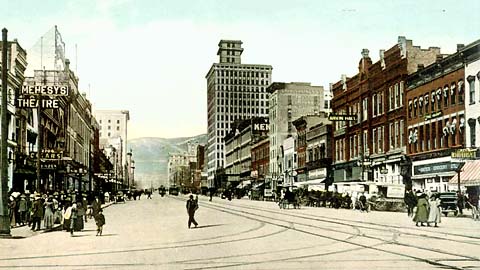
Main Street, Salt Lake City, about 1900
1870-1879 | 1880-1889 | 1890-1919
1890-1899
Jun 01 '90 | Jan 25 '91 | Jun 24 '94 | Apr 21 '96 | Sep 05 '96 | May 11 '99
Jul 23 '99
1900-1909
May 20 '00 | Apr 04 '01 | Jul 20 '03 | Nov 22 '03 | Nov 29 '03 | Dec 06 '03
Dec 13 '03 | Oct 21 '04 | Nov 07 '04 | Dec 04 '04 | Mar 12 '05 | Aug 27 '05
Feb 11 '07 | Dec 01 '07 | Dec 03 '07 | Apr 03 '08 | Sep 21 '09 | Oct 10 '09
Dec 02 '09 | Dec 06 '09 | Dec 09 '09 | Dec 12 '09 | Dec 19 '09 | Dec 20 '09
Dec 22 '09
1910-1919
Jan 22 '10 | Jan 24 '10 | Jan 26 '10 | Jan 30 '10 | Feb 01 '10 | Feb 05 '10
Feb 11 '10 | Feb 12 '10 | Feb 27 '10 | Mar 05 '10 | Apr 03 '10 | Apr 11 '10
Apr 14 '10 | Apr 23 '10 | Apr 24 '10 | May 10 '10 | May 17 '10 | May 23 '10
May 28 '10 | May 31 '10 | Aug 21 '10 | Aug 31 '10 | Sep 25 '10 | Nov 25 '10
Dec 04 '10 | Dec 07 '10 | Dec 11 '10 | Dec 16 '10 | Dec 18 '10 | Dec 19 '10
Dec 28 '10 | Apr 07 '12
Old Newspaper Articles Index | Misc. Utah Newspapers
 Vol. XXXIX. Salt Lake City, Utah, Sunday, June 1, 1890. No. 205. 
Editor Tribune -- In the light of some recent works on the origin and growth of the Mormon Church, notably Bancroft's "History of Utah," and Brother Jenson's most excellent and suggestive "Historical Record," vols. 5-8, called also "Church Encyclopedia, Book One," whereby much new light (and some darkness) has been thrown on an obscure subject, I feel tremendously moved to give to your readers a plain, unvarnished resume of that portion of the Saints' history covered by the period of their sojourn upon Ohio soil. Those seven years, 1831-8, were chock-full of great events; so much so that though Kirtland stands second in chronological order among the six localities which, one after another, furnished a halting place before a final settlement was made in the Great Basin, for important bearings upon the character and growth of the doctrinal and ecclesiastical system it easily stands first and foremost. It was even while on the banks of the east fork of the raging Chagrin river that the late Joseph Smith with at least one eye began to squint. |
|
Vol. XL. Salt Lake City, Utah, Sunday, January 25, 1891. No. 276.
The Illustrated American of New York City is publishing a series of articles on Mormonism. The articles in the main are fair. From some authority the Illustrated American has received its information, and naturally it reaches the conclusion that the Saints have not, in any honest sense, abandoned polygamy. This is offensive to the Saints, but why it should be we cannot see. With them polygamy is a command from God, and all the change that the most enthusiastic Saint pretends has been made, is that the president of the church, as a man, not as God's vicegerent, advises against its present practice. We all know that it was only political pressure that brought around the advice, and when we come to analyse the words they do not advise much. |
|
Vol. XLIV. Salt Lake City, Utah, Sunday, June 26, 1894. No. 57.
|
|
Vol. XLV. Salt Lake City, Utah, Tuesday, April 21, 1896. No. 331.
SUSTAINED AGAIN. Richfield, Utah, April 19. -- Joseph S. Horne, one of the members of the City Council of Richmond and one of the counselors of the president of the Mormon stake, William H. Clark, lately returned from his post as sergeant-at-arms of the State House of Representatives, and another counselor of the Sevier stake presidency; and William H. Seegmiller, who was a candidate on the Democratic ticket for Representative last fall and is the president of the Sevier stake of Zion, occupied the pulpit at the Latter-Day Saints meeting-house in this city this afternoon.... |
|
Vol. XLVI. Salt Lake City, Utah, Saturday, Sept. 5, 1896. No. 114.
MALMSTROM'S CURIOUS WILL. Correspondence Tribune. |
|
Vol. LVIV. Salt Lake City, Utah, Thursday, May 11, 1899. No. 27.
PLAIN TALK! Dr. B. D. Pierce of this city read an interesting paper last night before the Anthropological society. It was entitled "The Original Book of Mormon, the Mormon Congressman and a Brief History of the Church." |
|
Vol. LIX. Salt Lake City, Utah, Sunday, July 23, 1899. No. 108.
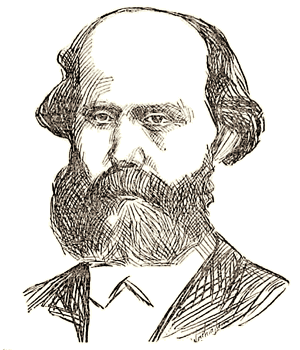
A REMINISCENCE Springville, Utah, July 25. -- There is living quietly in the pretty little town of Springville an old lady, who was at one time the fourth wife of James J. Strang, prophet and leader of the Strangites, a branch of the Mormon church, which left the mother church under the leadership of Strang after the death of Joseph Smith. The lady in question, who is known here as Mrs. Wing, having married a man by that name after the death of Strang, was called on by your correspondent and asked for an interview about the early days of the Strangite church, its teachings and its prophet, James J. Strang. She very graciously granted the request and gave the following interesting facts about the church and its leader. |
|
Vol. XLI. Salt Lake City, Utah, Sunday, May 20, 1900. No. 36.
John W. Rigdon of New York City, the only surviving son of Sidney Rigdon, first counselor of the Prophet Joseph Smith, is visiting friends in this city. He recently arrived from the East and is at present stopping with his friend Ethan Burrows 528 East Second South. |
|
Vol. XLI. Salt Lake City, Utah, Thursday, April 4, 1901. No. 356.
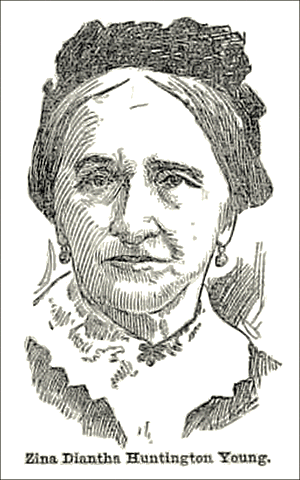
The news that "Aunt Zina" Young as she is familiarly known by the people of Utah is critically ill, will be received with the deepest regret throughout the State, for perhaps no woman in Utah Iong been more loved than has she. Until yesterday Mrs. Young was in the best of health and was preparing to attend the birthday festivities at the residence of President Snow when she was suddenly attacked with what was apparently heart failure, and last night while she was resting easy the attending physician gave little, if any encouragement of her recovery. He said she might rally and live a short time but her advanced years were decidedly against the probability, and the members of her immediate family felt little hope of her recovery. Shortly after 10 oclock yesterday morning Mrs. Young took a bath and was partially dressed when her daughter-in-Iaw, Mrs. H. C. Jacobs, was startled to hear Mrs. Young scream. |
|
Vol. XLVI. Salt Lake City, Utah, Monday, July 20, 1903. No. 97.
Two missionaries of the Mormon church, Elders Jesse L. Smith of Magrath, Canada, and Joseph Glover of Lehi, Utah, are at work building a Mormon church, 40x26 feet in size, near the Fairview schoolhouse, in Quincy township, says the Green Castle, Pa., Echo Pilot. |
|
Vol. XLVI. Salt Lake City, Utah, Sunday, November 22, 1903. No. 220.
Editor Tribune: -- According to the newspaper reports, Elder B. H. Roberts, in his Tabernacle address Sunday, November 5th, threw out a sweeping challenge to the world to show that the Book of Mormon is not of divine origin and authority. |
|
Vol. XLVI. Salt Lake City, Utah, Sunday, November 29, 1903. No. 227
Editor Tribune: -- If any words of mine in the remarks made in the Tabernacle on the 8th of November could be construed into a "challenge" to a public discussion of the Book of Mormon -- as the writers of headlines on some of the morning papers seem to think they could be -- when the challenge was accepted, the courtesy of debate would certainly require that the acceptance of the challenge should be otherwise than from ambush. I mean that I am entitled to know the name of my opponent, that I may judge somewhat of his character and standing. And why should the gentleman remain in cog? Is he ashamed to be known as engaging in such a discussion? Or is it a precaution he takes so that if his argument does not rise to the expectation of his friends, he may remain unknown behind the mystery of a single initial. If the first supposition be true, it is a difficulty he could easily have avoided; if the second suggestion be the true reason for his remaining unknown, he is to be commended for his cunning. I need say nothing of his courage. |
|
Vol. XLVI. Salt Lake City, Utah, Sunday, December 6, 1903. No. 234.
Editor Tribune: -- In reply to my article in The Tribune of November 22nd, pointing out, in response to his public challenge, some of the great difficulties in the way of accepting Nephi as an ancient prophet of God, and the Book of Mormon as an ancient revelation from God, Elder Roberts begins by finding fault with me for not writing over my full signature. But the reasons he intimates for my not doing so prove altogether too much, and hence, by a logical maxim, prove nothing. For they would prove that those great and high-minded statesmen, Alexander Hamilton, Chief Justice John Jay, and James Madison, acted an unworthy part, and were lacking in courage because, for wise reasons, they conducted those masterly discussions which made up The Federalist, over an assumed name. |
|
Vol. XLVI. Salt Lake City, Utah, Sunday, December 13, 1903. No. 241.
Editor Tribune: -- The most impressive thing in the second communication of the Unknown "M" is its very striking difference of spirit as compared with the first. His arrogance, if not his confidence, seems to have left him, and he writes in a spirit more in harmony with the nature of the subject. I congratulate him upon the improvement. When a book which is sacred to tens of thousands of intelligent people, and which is accepted by them as a revelation from God, is to be criticised, a decent regard for propriety requires that it should be discussed in a respectful manner, and all the more so if the critic regards those who accept the book as deceived, and would lead them from their delusion. |
|
Vol. LXX. Salt Lake City, Utah, Friday, October 21, 1904. No. 149.
A Columbia, Mo. dispatch to the St. Louis Globe-Democrat says an old moth-eaten volume, unearthed in the library of the State Historical society, throws new light upon the Mormon troubles in Missouri sixty-six years ago. The book is a record of evidence taken before Hon. Austin A. King, Judge of the Fifth Judicial circuit, at the courthouse in Richmond, on the trial of Joseph Smith. Jr.,and forty other persons charged with high treason and other crimes against the State. Two thousand copies were ordered printed by the Legislature in 1841, and it is believed that only one copy besides the one in Columbia is now in existence. |
|
Vol. LXX. Salt Lake City, Utah, Monday, November 7, 1904. No. 24.
When Joseph Smith, founder of the Mormon church, was an unsuccessful young man back in New York State, he made the mistake of confiding to his chum his scheme of establishing a new religion for the sake of personal success, and yesterday that chum's son, A. H. Petty, told the story to a Tribune reporter. He told it simply, as his father had given it to him, and it was all the more interesting for that reason. |
|
Vol. LXX. Salt Lake City, Utah, Sunday, December 4, 1904. No. 51.
Baker City, Nov. 30. -- When the religion formerly received is rent by discords, and when the holiness of the professors of religion is decayed and full of scandal, and withal the times be stupid, ignorant and barbarous, you may doubt the springing up of a new sect; if then also there should arise any extravagant and strange spirit to make himself author thereof; all which points held when Mahomet published his law. If a new sect have not two properties, fear it not, for it will not spread; the one is the supplanting or the opposing of authority established; for nothing is more popular than that; the other is the giving license to pleasure and a voluptuous life; for as for speculative heresies * * * though they work mightily upon men's wits, yet they do not produce any great altercations in states; except it be by the help of civil occasions. -- Francis Bacon. |
|
Vol. LXX. Salt Lake City, Utah, Sunday, March 12, 1905. No. 149.
Mr. Lyman: ...Sydney Rigdon was the councilor to the Prophet Joseph -- |
|
Vol. LXXI. Salt Lake City, Utah, Sunday, August 27, 1905. No. 135.
The vigor of the Deseret News these days is about on a par with its timeliness. It is now dealing with the Solomon Spaulding story as related to the alleged origin of the Book of Mormon. This is supposed to be satisfactory to the average Mormon who wants to know what has become of his tithes. When a member of the Mormon church distresses his mind with the remote and useless questions as to why Smoot was elected to the Senate to disturb, the peace of Utah; why Joseph F. Smith is upheld as a prophet when he breaks the laws of God and defies the revelations; why the poor tithe-payer is left to public charity in his old age; the Deseret News answers all these impertinent questions by a conclusive argumentation concerning the "Spaulding Myth." |
|
Vol. LXXIV. Salt Lake City, Utah, Monday, February 11, 1907. No. 119.
From three States come reports of the proposed return of the Mormons to the Missouri valley, where they held forth sixty years and more ago. |
|
Vol. LXXVI. Salt Lake City, Utah, Sunday, December 1, 1907. No. 48.
Every complete, critical discussion of the divine origin of the Book of Mormon naturally divides itself into three parts: first, an examination as to the sufficiency of the evidence adduced in support of its miraculous and divine origin; second, an examination of the internal evidences of its origin (1), such as its verbiage, its alleged history, chronology, archaeology, etc.; third, an accounting for its existence by purely human agency and upon a rational basis, remembering that Joseph Smith, the nominal founder and first prophet of Mormonism, was probably too ignorant to have produced the volume unaided. Under the last head, two theories have been advocated by non-Mormons. By one of these, conscious fraud has been imputed to Smith, and by the other, psychic mysteries have been explored (2) in an effort to supplant the conscious fraud by an unconscious self-deception.... |
|
Vol. LXXVI. Salt Lake City, Utah, Tuesday, December 3, 1907. No. 50.
Editor of The Tribune -- I had the honor of being for several years most intimately acquainted with Solomon Spalding's daughter, Mrs. McKinstry. I do not know what light my statements may throw on the authenticity of the Spalding manuscript, but I would beg leave to state that in the year 1881, at which time Mrs. McKinstry related to me the story of the so-called "Book of Mormon," she was in full and perfect possession of her faculties, the memory was unusually good, and she could recall events of years long passed and of dates when the events occurred, with perfect accuracy, |
|
Vol. LXXVI. Salt Lake City, Utah, Friday, April 3, 1908. No. 172.
"The Spaulding Myth" Again
Editor The Tribune: |
|
Vol. LXXIX. Salt Lake City, Utah, Tuesday, September 21, 1909. No. 160.
At the tabernacle on Sunday Apostle Orson F. Whitney took occasion to dispute a statement made in a recent issue of The Tribune. Said he: "I read in a recent paper that Joseph and Hyrum Smith were murdered by their own people, and that the latter had blackened their faces to conceal their identity from the prophet and his brother. This is not true." To which denial we desire to except, with proof. |
|
Vol. LXXIX. Salt Lake City, Utah, Sunday, October 10, 1909. No. 179.
The entire fabric of Mormonism rests on the important question of whether or not the Book of Mormon was divinely inspired. If it was divinely inspired, it must, as is alleged in the book itself, and which is "testified" to by all devout Latter-day Saints, have been "translated by the gift and power of God." |
|
Vol. LXXX. Salt Lake City, Utah, Thursday, December 2, 1909. No. 49.
Speaking still further upon the murder of Joseph and Hyrum Smith, The Tribune again takes pleasure in making reference to the witness that the Deseret News presented, namely, "Something of Men I Have Known," written by Hon. Adlai E. Stevenson. It is a significant paragraph to Latter-day Saints -- meaning those of them who can read between the lines. |
|
Vol. LXXX. Salt Lake City, Utah, Monday, December 6, 1909. No. 53.
For the purpose of showing one of the causes for the trouble which ever took the Mormon people at Nauvoo, we will again go to the book of Hon. Adlai E. Stevenson, "Something of Men I Have Known," which the Deseret News brought into this controversy. Mr. Stevenson quotes the late Governor Ford as follows: |
|
Vol. LXXX. Salt Lake City, Utah, Thursday, December 9, 1909. No. 56.
As going further to show the imperialistic defiance of the Mormon leaders at Nauvoo, we present another quotation from the book, "Something of Men I Have Known," by Hon. Adlai E. Stevenson, which authority has been brought forward by the Deseret News in a comparison of positions as between that paper and The Tribune. We find the following on page 207 of Mr. Stevenson's work: |
|
Vol. LXXX. Salt Lake City, Utah, Sunday, December 12, 1909. No. 59.
It is gratifying to note that some newspapers, like some people, never become too old to learn. In the Deseret News editorial columns of last Wednesday evening we find the following: |
|
Vol. LXXX. Salt Lake City, Utah, Sunday, December 19, 1909. No. 66.
"We have written for further particulars," said the Deseret News on December 8, 1909, when making editorial comment upon a "Danite" story which had previously appeared in the columns of a Pittsburg newspaper. |
|
Vol. LXXX. Salt Lake City, Utah, Monday, December 20, 1909. No. 67.
Paxton, Neb., Nov. 29. -- To the Editor of the State Journal: It was with much surprise that I read in the Lincoln papers the defense made by Mr. Huff, state prison chaplain, and comments thereon by the one sending the same. That a man pretending to be the expounder of the tenets of any sect should show such ignorance of its real history is strange, to say the least, though of course it may be wilful. At the time the first Joe Smith pretended to have found the plates of gold (not brass) my mother lived in Manchester, N. Y., and was well acquainted with that branch of the Smith family to which Joe belonged. |
|
Vol. LXXX. Salt Lake City, Utah, Wednesday, December 22, 1909. No. 69.
The late Governor Ford of Illinois, whom the Deseret News brought forward as a witness in the controversy as to the causes for the troubles which fell upon the Mormon people at Nauvoo, is quoted by Hon. Adlai E. Stevenson as follows: |
|
Vol. LXXX. Salt Lake City, Utah, Wednesday, December 29, 1909. No. 76.
"Lest we forgot." About a month ago the Deseret News made mention of the fact that a writer had printed a story in "a Pittsburg paper" concerning the Danites. In making comment thereon the church organ stated that while there was such an organization as the Danite band in Missouri and Illinois, it had been in no wise attached to the Mormon church. It also announced that it had written for particulars and information upon that subject, and that it would advise the public as to its findings in the matter. |
|
Vol. LXXX. Salt Lake City, Utah, Saturday, January 22, 1910. No. 100.
With reference to that Danite story with which the Deseret News some time ago promised, to interest the public, but which it has not not produced, The Tribune is of the opinion that sufficient time has been allowed to the church organ and that it is simply afraid to produce the evidence which it pretended to be searching for, and which it really may have obtained. |
|
Vol. LXXX. Salt Lake City, Utah, Monday, January 24, 1910. No. 102.
There was a line of conduct mapped out for the Danites of the Mormon church in Missouri, which exhibits the desperate character of the band; and in the meantime we have from Mr. Justus Morse, under oath, a designation of the parties who outlined that conduct and delivered the instructions. Mr. Morse says: |
|
Vol. LXXX. Salt Lake City, Utah, Wednesday, January 26, 1910. No. 104.
As to that investigation of the Danite band which was promised by the Deseret News about two months ago, we have so far had no evidence of activity. It is not pleasant to The Tribune to take up the burdens of the church organ; but duty must always precede pleasure. |
|
Vol. LXXX. Salt Lake City, Utah, Sunday, January 30, 1910. No. 108.
In his recent sermon, delivered in the tabernacle, Mr. Brigham H. Roberts made reference to Sidney Rigdon. His remarks concerning Mr. Rigdon were intended to refute the idea that he had anything to do with the authorship of the Book of Mormon. Mr. Roberts says: |
|
Vol. LXXX. Salt Lake City, Utah, Tuesday, February 1, 1910. No. 110.
In the death of Mr. James T. Cobb in this city yesterday, the old-timers will feel a throb of awakening interest, and will experience a stir of memory. Mr. Cobb many years ago was a prominent figure in this city, personally and intellectually. He had the repute of being one of the finest Shakespearean scholars in the western country. His personality was attractive; he was a fine talker; and a good many people swore by him and his opinions. For a score of years past, however, he has been obscured, seeming to age more in character and disposition than in years. His final end was peaceful, and though he was a man well calculated to take a high position in the community he had stepped down from that position, and was practically unremembered by the mass of the people here. To his friends he was very dear, and with those friends and his near of kin the public of Salt Lake will extend the most heartfelt sympathy. |
|
Vol. LXXX. Salt Lake City, Utah, Saturday, February 5, 1910. No. 114.
There are some very interesting things snid in the letter of Reed Peck, written in 1839, concerning the "Danites" of Missouri days. Mr. Peck was once a lieutenant in the band, but upon becoming disgusted with the outfit he left them and later exposed some of their doings. |
|
Vol. LXXX. Salt Lake City, Utah, Friday, February 11, 1910. No. 120.
The Tribune is in possession of a copy of a letter written by Mr. Reed Peck, under date, "Quincy, Adams Co., Ill., Sept. 18, 1839." Reed Peck was adjutant in the band that was known in Far West, Missouri, as "The Daughter of Zion," whose members individually called themselves "Danites." We shall call attention to part of the contents of this letter, because the Deseret News has failed to keep its promise to inform the public with respect to the facts as they concern the organization commonly called "Danites." |
|
Vol. LXXX. Salt Lake City, Utah, Saturday, February 12, 1910. No. 121.
Further dealing with the investigation into the "Danites" and their connections, we give the following from the affidavit of Reed Peck, who was a member of the gang and an officer in the organization. In speaking of the trial of .Jnred Carter, a "Danite" leader who had dared to utter criticism of one of the first presidency of the church, Mr. Peck says: |
|
Vol. LXXX. Salt Lake City, Utah, Sunday, February 27, 1910. No. 136.
We here present another very brief but exceedingly effective bit of testimony by an eye witness and a personal participator in the scenes and doings of practically the earliest days of the Mormon church. It is as follows: |
|
Vol. LXXX. Salt Lake City, Utah, Saturday, March 5, 1910. No. 142.
The Tribune confesses that there is no pleasure in the performance of this duty. But it is a duty. |
|
Vol. LXXX. Salt Lake City, Utah, Sunday, April 3, 1910. No. 171.
During the latter months of 1909 we were favored with some attention from the Deseret News because of our assertion that in the early days of the Mormon church there was within that organization a sceret body of men known as "Danites," and that the activities this gang of marauders and murderers were directed by the highest officials in the church at that time. |
|
Vol. LXXX. Salt Lake City, Utah, Monday, April 11, 1910. No. 179.
We have still another, bit of documentary evidence to present in the matter of the Mormon "Danite" organization, about which the Deseret News promised to do so much and then did nothing at all. Here is a copy of the oath by which the members of that gang were bound together: |
|
Vol. LXXX. Salt Lake City, Utah, Thursday, April 14, 1910. No. 182.
The following matter is taken from a written statement by Thomas B. Marsh, uttered at Richmond, Missouri, under date of October 24, 1838: |
|
Vol. LXXXI. Salt Lake City, Utah, Saturday, April 23, 1910. No. 9.
On Thursday evening the Deseret News quoted from a speech that it said was made by "the prophet Joseph, when fleeing from the persecutors at Kirtland." |
|
Vol. LXXXI. Salt Lake City, Utah, Sunday, April 24, 1910. No. 10.
The story of Nancy Rigdon, daughter of Sidney Rigdon, is another one of those recitals that expose the utter depravity of the bogus prophets at Nauvoo. We will give it in brief form. |
|
Vol. LXXXI. Salt Lake City, Utah, Tuesday, May 10, 1910. No. 26.
While it has been the object of the Deseret News and every pulpiteer of the Mormon church to attempt to show that "outsiders" were responsible for the killing of Joseph and Hyrum Smith at Carthage, Illinois, on June 27, 1844, The Tribune has truthfully contended that Mormons brought about the "martyrdom." As with the proposal (voluntarily made and never carried out by the church organ) to investigate and make a showing concerning the old Mormon church Danite gang, it appears to be the duty of The Tribune to give the truth that is withheld by the Deseret News. |
|
Vol. LXXXI. Salt Lake City, Utah, Tuesday, May 17, 1910. No. 33.
Under date of May 7, 1910, the Cleveland Plain Dealer printed a dispatch from Tiffin, Ohio, one paragraph of which reads as follows: |
|
Vol. LXXXI. Salt Lake City, Utah, Tuesday, May 23, 1910. No. 39.
It appears that the Deseret News, upon many counts, has abandoned the fight. At one time and it was no longer ago than last November it made faithful promise to its readers that it would explode the whole Mormon Danite theory by producing the proofs after having made exhaustive investigation, the which it declared it had on hand at that time. |
|
Vol. LXXXI. Salt Lake City, Utah, Saturday, May 28, 1910. No. 44.
The church organ is a skillful evader and artful dodger. It never wants to squarely face the music on any proposition. A few instances in point will illustrate the course of that organ of strife, lawlessness, robbery, and lasciviousness. |
|
Vol. LXXXI. Salt Lake City, Utah, Tuesday, May 31, 1910. No. 47.
In order to make illustration of the flimsy ground upon which the Mormon leaders will proceed to work out their plans in suppression of their "enemies," we give the following brief extract from the charter of the city of Nauvoo, Illinois: |
|
Vol. LXXXI. Salt Lake City, Utah, Sunday, August 21, 1910. No. 129.
The Tribune feels that it has a right now to again admonish the Deseret News with respect to the promise it made in the latter part of last year to thoroughly investigate the "Danite" matter and report its findings to its readers. |
|
Vol. LXXXI. Salt Lake City, Utah, Wednesday, August 31, 1910. No. 139.
Concerning that old and worn-out story to the effect that there was no just cause for the drivings of the Mormon people in the early days of their church, there is an interesting and authoritative witness in the late David Whitmer. In his pamphlet, "An Address to All Believers in Christ," on page 28, he says: |
|
Vol. LXXXI. Salt Lake City, Utah, Sunday, September 25, 1910. No. 164.
Reviewing a magazine article written upon the early history of the Mormon church by President Brigham H. Roberts, the Deseret News says that "pride and worldly mindedness proceded the temporal troubles, and when these came the people accused each other of sin and folly, and there were bickerings, fault-finding and bitterness 'until the spirit of the gospel in Kirtland was well nigh eclipsed.' Apostasy was rife." |
|
Vol. LXXXII. Salt Lake City, Utah, Friday, November 25, 1910. No. 42.
Why is it that we have heard nothing from the Deseret News concerning the promise that it made months ago to investigate the "Danite" question, and report its findings to the public? |
|
Vol. LXXXII. Salt Lake City, Utah, Sunday, December 4, 1910. No. 51.
The late Reed Peck was once induced to attend a meeting of the Mormon Danites at Far West, Missouri. Although he never became actively engaged with the murderous gang, he saw and heard enough at that meeting to give value to his testimony upon this matter. |
|
Vol. LXXXII. Salt Lake City, Utah, Wednesdayday, December 7, 1910. No. 54.
In view of the fact that the Deseret News, about a year ago, promised to make investigation of the Mormon Danite matter, and to report according to its findings, we have wondered if it happened to run across the subjoined matter, and thought it best to hush the thing up if possible. Reed Peck, who was one of the men invited to attend the first meeting of the embryo Danite organization, is an authority. He speaks of one of the methods employed of "spotting" dissenters from the theory of personal liberty as practiced by the first presidency of the church. On this point he says: |
|
Vol. LXXXII. Salt Lake City, Utah, Sunday, December 11, 1910. No. 58.
By this time it has been observed by all that tho Deseret News has ignominiously fled from its position with respect to the controversy it proposed to maintain with The Tribune concerning the Danite gang which was organized by the first presidency of the Mormon church at Far West, Missouri, in the year 1837. But there are some other facts that should be brought forth, merely for information's sake, which have large bearing upon the objects and purposes of that pillaging and murderous outfit. In the historical matter written upon this subject by Reed Peck (who attended the meeting at which the lawless gang was instituted, but who withdrew upon learning its purposes), it is stated: |
|
Vol. LXXXII. Salt Lake City, Utah, Friday, December 16, 1910. No. 63.
Hon. B. H. Roberts has brought out another of his series of articles on Mormon church history, which is running in a certain magazine. One of the chief items treated is that of the Danites. Of this portion of the article the Deseret News says, in part: |
|
Vol. LXXXII. Salt Lake City, Utah, Sunday, December 18, 1910. No. 65.
Hon. Brigham H. Roberts has written to The Tribune a letter, in which he takes exception to a statement made by this paper on the morning of Friday, December 16, 1910. This statement was made in an article entitled "Elder Roberts on the Danites." |
|
Vol. LXXXII. Salt Lake City, Utah, Monday, December 19, 1910. No. 66.
Editor Salt Lake Tribune: Under the above caption, in one of your editorials, as it appeared In the columns of The Tribune for Sunday, December 4, 1910. I was interested in reading the following: |
|
Vol. LXXXII. Salt Lake City, Utah, Wednesday, December 28, 1910. No. 75.
David Whitmer, in his pamphlet, "An Address to All Believers in Christ," pages 57 and 58, calls attention to one certain change that has been made by the "revisers of the Lord" in an alleged revelation printed both in the old Book of Commandments and the later book of Doctrine and Covenants. Mr. Whitmer says: |
|
Vol. LXXXIV. Salt Lake City, Utah, Sunday, April 7, 1912. No. 176.
John Wycliff Rigdon, aged 82 years, son of Sidney Rigdon, one of the first men to be associated with Mormonism, died early yesterday morning at the L. D. S. hospital of the infirmities of age. He had been confined since early in March and his death had been expected for some time. |
Back to top of this page.
Articles Page | Articles Index | History Vault
Oliver's Bookshelf | Spalding Library | Mormon Classics
last updated: Dec. 19, 2013