READINGS  IN  EARLY  MORMON  HISTORY
(Newspapers of   Ohio   Missouri   Illinois   England   Utah)


Misc. LDS Newspapers
1900-1999 Articles
(Rigdon, Spalding, Hurlbut, &c.)


1833-1869   |   1870-1899   |   1900-1999


Improvement Era
1900:  Feb  Mar  Apr
1901:  Jun  Jul

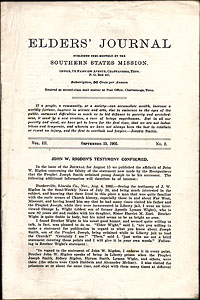
Elders Journal
1905:  Aug 15 Sep 15

Liahona
1908:  June 6 Jun 13 Oct 17
1910:  Apr 9
1911:  Mar 7
1921:  Mar 29

Millennial Star
1908:  June 4   July 9
Juvenile Instructor
Oct. 1915

Deseret News
May 26 '00   July 19 '00
Mar 23 '01   Apr 10 '01
May 14 '01   June 19 '01
Feb 24 '02   May 24 '02
Apr 05 '04   Aug 25 '05
Mar 28 '08   Aug 25 '34
Nov 14 '36   Jun 12 '37


Return to: Old Newspaper Articles Index


[ 241 ]


IMPROVEMENT  ERA.


Vol. III.                                   FEBRUARY, 1900.                                   No. 4.


"THE  MANUSCRIPT  FOUND."

BY  PRESIDENT  JOSEPH  F.  SMITH.


I.
In January, 1885, under the somewhat peculiar circumstances of the times, I was sent on a mission to the Sandwich Islands. I sailed from San Francisco on the steamship Mariposa on the 2nd day of February following, remaining upon this mission until July, 1887. Not long after my arrival on the islands, I received a communication from Elder George Reynolds, enclosing the following letter over the signature of James H. Fairchild, at that time President of the Oberlin College, Ohio, the same being a clipping from the New York Observer of February 5, 1885, which had also been copied into Frank Leslie's Illustrated Sunday Magazine. Brother Reynolds suggested that I call upon Mr. L. L. Rice, of Honolulu, with the view of inquiring more particularly into this matter, which I did at the first opportunity. I subsequently narrated the circumstances of my interviews with that gentleman in a communication which was published in the Deseret News, over the nom de plume "Islander," which gives a detailed account of a


242                                 IMPROVEMENT  ERA.                                 .


subject which I think still possesses sufficient interest to be presented to the readers of the ERA.

The following is Mr. Fairchild's letter:


SOLOMON  SPAULDING  AND  THE  BOOK  OF  MORMON.

The theory of the origin of the Book of Mormon in the traditional manuscript of Solomon Spaulding will probably have to be relinquished. That manuscript is doubtless now in the possession of Mr. L. L. Rice, of Honolulu, Hawaiian Islands, formerly an anti-slavery editor in Ohio, and for many years state printer of Columbus. During a recent visit to Honolulu, I suggested to Mr. Rice that he might have valuable anti-slavery documents in his possession which he would be willing to contribute to the rich collection already in the Oberlin College Library. In pursuance of this suggestion, Mr. Rice began looking over his old pamphlets and papers, and at length came upon an old, worn and faded manuscript of about 175 pages, small quarto, purporting to be a history of the migration and conflicts of the ancient Indian tribes which occupied the territory now belonging to the States of New York, Ohio and Kentucky. On the last page of this manuscript is a certificate and signature giving the names of several persons known to the signer, who have assured him that to their personal knowledge the manuscript was the writing of Solomon Spaulding. Mr. Rice has no recollection how or when this manuscript came into his possession. It was enveloped in a coarse piece of wrapping paper, and endorsed in Mr. Rice's handwriting, "A manuscript story."

There seems no reason to doubt that this is the long lost story. Mr. Rice, myself and others compared it with the Book of Mormon, and could detect no resemblance between the two, in general or detail. There seems to be no name nor incident common to the two. The solemn style of the Book of Mormon, in imitation of the English scriptures, does not appear in the manuscript. The only resemblance is in the fact that both profess to set forth the history of the lost tribes. Some other explanation of the origin of the Book of Mormon must be found, if any explanation is required.

JAMES  H.  FAIRCHILD.      


The letter to the News, under date of Honolulu, Sandwich Islands, June 24, 1885, follows:

On the morning of the 16th of April, my companion and I made our way to Punahou, about two miles from Honolulu, to the residence of Mr.


                          THE  MANUSCRIPT  FOUND.                           243


J. M. Whitney, son-in-law of Mr. L. L. Rice, with whom the latter is at present living.

On going to the house we met a very aged, but intelligent-looking man at the rear of the dwelling, whom we found to be Mr. Rice. After introducing ourselves, I informed him that I had seen an article, published in the paper by Mr. James H. Fairchild, relative to Mr. Spaulding's romance, from which it was alleged the Book of Mormon was derived, and that interest and curiosity had led us to call on him, in the hopes of seeing it, and of having some conversation with him on the subject. He invited us into the parlor, and when we were seated he asked,

"Are you Mormons?"

Of course to this we had but one unequivocal answer. He then enquired how long we had been in the country, our business, etc., to all of which we gave appropriate answers, so that he seemed satisfied that we had come no great distance for the special object of our visit. He then began to talk about as follows, to the best of my recollection:

"I have no objection to showing you the manuscript; you shall see it, but it is of no value to anybody. I have, with others, compared it with the Book of Mormon, and I undertook to copy it, but ran out of paper before I got it finished and so discontinued it. There is not one word or sentence in it in common with the Book of Mormon. The only possible resemblance is: they both purpose to give an account of American Indians. This manuscript is nothing but a simple story about the tribes of Indians supposed to have inhabited the country in the vicinity of Conneaut, Ohio, where some ancient mounds existed, and it is a very poor story at that. It came into my possession in 183--, when Mr. Winchester and I bought out the printing establishment formerly owned by Mr. E. D. Howe in Painsville, Ohio, in connection with a large number of old papers found in the place and turned over to us with it. I have had it ever since in my possession. I have looked at it scores of times, and often thought I would look into it to see what it was, but never did until a year ago, on the occasion of President Fairchild's visit. Since then I have often wondered that I did not long ago destroy it with other worthless papers. I have recently had letters from several parties making inquiries about this manuscript, and all desiring to obtain possession of it. Mr. Howe thinks he has a claim upon it, but I have told them all they cannot have it. When I get through with it, I shall most likely deposit it in the Oberlin College Library, as I have promised President Fairchild."

I remarked: "There is no use disguising the fact that we would like to obtain it, or a copy of it," to which he very emphatically replied: "Well, sir, you can't have it."


244                                 IMPROVEMENT  ERA.                                 .


He went into another part of the house and soon returned with a parcel wrapped in a piece of old, brown wrapping paper, and fastened with an old, tow string. I judge the manuscript to be six and a half inches wide and eight inches long, and about an inch in thickness. Holding the parcel before my eyes, he said: "This is just as I received it, and as it has been in my possession for over forty years, tied with that same string. You see that pencil writing? That was written there before it came into my hands."

This writing in pencil, quite legible, was "Manuscript Story." "But," continued he, "this writing in ink I foolishly wrote there myself very recently; I suppose I ought not to have done it, but with that exception it is just as it came into my hands, and as it has remained for over forty years."

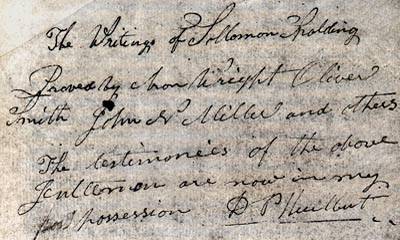
This writing in ink was as follows: "Writings of Solomon Spaulding," and was inscribed partly over the "Manuscript Story" written in pencil. Mr. Rice then untied the tow string and took off the wrapper, when we saw a time-worn, dingy, somewhat dilapidated old manuscript. I glanced over a portion of the preface, which set forth that in consequence of the existence of large mounds in the vicinity of Conneaut, indicating the former occupation of the country by a numerous people, etc., the author had been induced to write, etc., etc. I do not pretend to give the text, but merely the sense as I gathered it from a hasty glance. Mr. Rice called our attention to the certificate on the last page, which was referred to by Mr. Fairchild in his article published in the New York Observer of February 5, 1885. This certificate gave the names of several persons, known to the writer and signer of the same, who had made affidavits, which the certificate says were "on file in this office," to the effect that they "personally know this manuscript to be the writing of Solomon Spaulding." The certificate and the signature are in the same handwriting, and are those of Doctor Philastus Hurlburt, or rather, the signature is plain, "D. P. Hurlburt."

Mr. Rice is now about 84 years of age, but he is in good mental and physical condition. He chatted freely relative to his early recollections and acquaintances, not forgetting to give us his mind respecting plural marriage. He said: "I was well acquainted with Sidney Rigdon, both before and after he became a 'Mormon,' and I have heard him preach as a Campbellite and as a 'Mormon.' He was a very smart man, but I never knew the cause of his leaving your Church, or whether he ever denounced 'Mormonism' and the Book of Mormon or not."

I said: "One cause of his leaving the Church was that he assumed to be the guardian and leader of the Church after the death of the


                          THE  MANUSCRIPT  FOUND.                           245


Prophet Joseph, while that authority had been conferred through Joseph Smith upon the Twelve Apostles; and that to my knowledge, Mr. Rigdon had never at any time denied or denounced either 'Mormonism' or the Book of Mormon."

He said: "I was very well acquainted with Joseph Smith in Kirtland, and I saw him once in Nauvoo." He was also quite well acquainted with Sister E. R. Snow Smith: he said she used to write poetry for his paper, and he always thought her "a very nice, intelligent young lady," and wanted to know if she was still living. As he had refused so emphatically to part with the manuscript or allow it to be copied, I asked him if he would part with the copy he had made, so far as he had gone, for reasonable compensation for his time and labor. At first he refused, but after some talk on the subject, he promised to write Mr. Fairchild by the next mail, and if he made no objection he would perhaps do so.

There is no doubt that this is the identical, much-talked-of, long-lost, much-believed, but very innocent "Manuscript Found." The facts already demonstrated beyond contradiction stamp its identity with unmistakable certainty. In 1834, it was obtained by Hurlburt from Jerome Clark, at Hardwicks, New York, upon an order from Mrs. Davidson, the widow of Solomon Spaulding, certified to as being the writing of Solomon Spaulding by several persons personally knowing the fact, and subscribed to by D. P. Hurlburt himself, by whom it was taken to the printing establishment of Mr. E. D. Howe, the reputed author of "Mormonism Unveiled," and transferred to Mr. L. L. Rice on his purchasing the printing establishment, and by Mr. Rice preserved until now, without even knowing what it was, for some forty years. It seems that the hand of Providence is plainly visible, for some wise purpose, in the whole affair. And now it has been carefully examined and compared with the Book of Mormon by Mr. L. L. Rice, Mr.James H. Fairchild, President of the Oberlin College Library, Ohio, and by others, and by them declared without similarity in name, incident, purpose or fact with the Book of Mormon. Mr. L. L. Rice declared to Brother Farr and myself that he "believed it to be the only romance of the kind ever written by Mr. Spaulding; and", said he, "somehow I feel that this is a fact.

From this remark we inferred that it was his belief that the reason it was not published by Mr. Spaulding himself was because it was not worth publishing, "For," said he, "it is only a very simple story, and a very poor one at that."

Taking this statement as the unreserved judgment of an old editor and a newspaper man, who has not only carefully read it and compared it with the Book of Mormon, but with his own hand copied about two-thirds


246                                 IMPROVEMENT  ERA.                                 .


of it, his opinion must be accepted as of great weight; and it corresponds with the alleged message sent by Mr. Patterson with the Manuscript, when it is said he returned it to Spaulding, "declining to print it," and said, "Polish it up, finish it, and you will make money out of it." It no doubt needed, and still needs, a great deal of "polish."

On the first instant, (May 1st, 1885,) Brother Farr and I called again on Mr. Rice, when he allowed us to examine the "Manuscript Found." We read the preface and two chapters of the manuscript, which we found what I would call rather a far-fetched story about the discovery of some "twenty-eight sheets of parchment" in an "artificial cave" about "eight feet deep," situated in a mound on the "west side of the Conneaut River." With this parchment, which was "plainly written upon with Roman letters in the Latin language," was a "roll of parchment containing the biography of the writer."

The first two chapters which we read purport to be a translation of this biography, which sets forth that the writer's name was Fabias, that he was "born in Rome, and received his education under the tuition of a very learned master, at the time that Constantine entered Rome, and was firmly seated as Emperor," to whom Fabias was introduced and was appointed by him one of his secretaries.

Soon after this, Fabias was sent by Constantine "with an important message to a certain general in England." On the voyage the heavens gathered blackness, obscuring the sun and stars, and a terrific storm arose which continued unabated for five days, when it lulled, but the darkness continued. They were lost at sea. They began to pray "with great lamentations," etc., when a voice came telling them not to be afraid, and they would be taken to a "safe harbor." For five days more they were swiftly driven before the wind and found themselves in the mouth of a very "large river" up which they sailed "for many days," when they came to a village and cast anchor. The natives were alarmed, held a council, and finally extended towards them the hand of friendship, made a great feast for them, sold them a large tract of land for "fifty pieces of scarlet calico and fifty knives," and established with them a covenant of perpetual peace.

Not daring to venture the dangers and uncertainties of the unknown deep over which they had been so mysteriously driven, they concluded it better to remain than attempt to return to Rome, etc., etc. The ship's company consisted of twenty souls, seven of whom were young women who had embarked at Rome to visit their relatives in England. Luian or Lucian was the name of the captain of the vessel, and Trojenous was the name of his first mate; one of the sailors is called Droll Tom


                          THE  MANUSCRIPT  FOUND.                           247


another Crito. There were three ladies of rank among the women. On motion of one of the sailors the women chose their husbands; Lucian, Fabias and Trojenous were of course selected by the three ladies of rank, but six poor fellows had to go without wives, or marry the natives, etc.

This is about the thread of the story so far as we have read.

Among those who had written to Mr. Rice for the manuscript were Eber D. Howe, of Painsville, Ohio, (since which Mr. Rice informs me he had a stroke, and was supposed to be on his death-bed); Mr. A. B. Demming, also of Painsville; Albert D. Hagar, librarian of the Chicago Historical Society, Chicago; and Mrs. Ellen S. Dickenson of Boston, grandniece of Solomon Spaulding. Mrs. Dickenson demanded that the manuscript be sent forthwith to her or to Mrs. McInstry, from whose mother it had been "stolen by D. P. Hurlburt." She also asserted that she is writing a book against the "Mormons," and desired the manuscript from which to make extracts, provided it is the one that Hurlburt stole "which she scarcely thinks is the one." Mr. Demming says he does "not think it is the Manuscript Found," for it is rumored that Hurlburt sold it to the "Mormons," and they destroyed it, which he says, "I believe to be true." He was nevertheless clamorous to have this manuscript sent to him immediately, for, writes he, "I desire to make extracts from it as I am writing a book, to be entitled "The Death-blow to Mormonism."' Joseph Smith of the Reorganized church did not ask for the manuscript for himself, but that it might be sent to the Chicago Historical Society, 140 and 142 Dearborn St., Chicago, for preservation. Mr. Hagar, secretary or librarian of said society, desired it also sent there, and promised to defray the postage or expressage, and to have it neatly bound, etc., etc. But Mr. E. D. Howe laid claim to it on the ground that when he sold his printing establishment to his brother, from whom it was turned over to Messrs. Rice & Winchester, in 1839, the manuscript was inadvertently turned over to them with the office. He further states in his letter that the manuscript was left in his office by D. P. Hurlburt, pending efforts to obtain evidence against the Book of Mormon. Mr. Rice showed all these letters which we carefully read and noted. Mr. Demming, who is a reverend gentleman, wrote two letters, both of which seemed to savor of a spirit smarting under the sting of conscious imbecility, and reeking with venom and the bitterness of gall.

Mr. Rice informed us that his friends, among them the Rev. Sereno E. Bishop, of Honolulu, had advised him not to allow the "Mormons" to get hold of a copy of the manuscript. When I asked them for what reason, he replied, "What, indeed?" The old gentleman had a son in the States who is a minister, (to whom Mr. Demming's letters were addressed,) and


248                                 IMPROVEMENT  ERA.                                 .


he wrote him to make enquiry respecting the existence of Messrs. Aaron Wright, Oliver Smith and John N. Miller, who testified to the identity of the manuscript as Spaulding's writings, and he found them to have been "veritable persons, but they are now all dead." This was the statement which Mr. Rice made to us. Here is a copy of the certificate:
"The writings of Solomon Spaulding, proved by Aaron Wright, Oliver Smith, John N. Miller and others. The testimonies of the above gentlemen are now in my possession. D. P. Hurlburt." (The signature is written as here given.)
I made another visit to Mr. Rice a few weeks ago, and read several more chapters of the manuscript.

We again took a good look at the manuscript, which had been returned to him by Mr. Hide, a minister to whom it had been loaned for a time, and by whom I suspect it was copied, although I do not know. We counted the pages and found 169 numbered pages and one and two-thirds pages not numbered, and two loose sheets not apparently belonging to the manuscript, which made in all 175; less pages 133 and 134 which are missing.

Mr. Rice said that when he was publishing a newspaper, the Republican Monitor, at Cazenovia, New York, he published a very interesting story entitled, "Manuscript Found," and some ten or fifteen years later, while editing the Ohio Star, at Ravenna, Ohio, he republished this story, which was a romance predicated upon some incidents of the Revolutionary War. He was of the opinion that the name of this story by some means had been confounded with Spaulding's manuscript or writings, and that this is the only novel that Spaulding ever wrote.

I also read another letter from Mr. A. B. Demming, fairly clamoring for the possession of the manuscript. He said he had called on E. D. Howe and D. P. Hurlburt, and spent several days with one and the other of them on the subject of the manuscript, and urged that it be sent at once to Mr. Rice's son, in Painesville, Ohio, with instructions to let no one know of the fact but Mr. Demming.

On June 15th, 1885, I called upon Mr. Rice again in company with a couple of the brethren, to read a little more of the manuscript. He informed us that he had that day forwarded the original to the Oberlin College Library in care of a lady who was going there, and then made us the following proposition: to let me have the copy he had now finished provided I would have it printed verbatim, complete with erasures, or crossed out parts in italics, and explanation in preface: and after printing, to send fifty copies to Oberlin, twenty-five copies and the manuscript back


                          THE  MANUSCRIPT  FOUND.                           249


to him. I accepted the proposition, and he was to draw up a paper setting forth these terms, and he would deliver the copy of the manuscript and a copy of the agreement into my hands at 6 p. m.

When I returned at the appointed hour, he took me to his room and said: "Mrs. and Mr. Whitney (his daughter and son-in-law) have protested against my letting you have the manuscript until I get the consent of President Fairchild. Now, in view of my promise to you, this places me in a very embarrassing position, for I want to please them, and I regret having to fail in my promise to you; but I think it best to postpone the matter for two or three weeks until I can hear from President Fairchild."

"What reason," I asked, "do they give for their objection? We agree to your proposition; it is all your own way. The original is beyond our reach, and we could have no other than the most honest motives, with all the expense on our part, in carrying out your proposition."

The only answer was: "They are not as liberal as I am." I do not know whether this meant that they wanted something more for it, or that they were not as liberal in their sentiments or feelings towards us. I took the last meaning.

I then said, "Well, Mr. Rice, my curiosity leads me to desire to read it, and I would be pleased if you would lend it to me to read." To this he consented, provided I would return it when I got through. So I brought it home with me, and had it from the evening of the 15th to the morning of the 21st, when I sent it back. I got home with the manuscript on the evening of the 16th.

We read it. It is a shallow, unfinished story, but withall somewhat interesting in parts, as containing some ideas which the author must have gathered from the traditions of the Indians.  *  *  *  Mr. Rice claims that his copy is verbatim et literatim copy, with scratches, crosses and bad spelling all thrown in. The names "Sambol," "Hamboon," "Labaska," "Labona," "Lamesa," "Mammoona," occur in the story, which might easily be changed. Mammoths were the author's beasts of burden. The two principal tribes of Indians were "Ohions" and "Kentucks," with numerous adjacent tribes --"Sciotams," "Ohons," etc.


Notes: see April issue notes


[ 377 ]


IMPROVEMENT  ERA.


Vol. III.                                       MARCH, 1900.                                       No. 5.


"THE  MANUSCRIPT  FOUND."

BY  PRESIDENT  JOSEPH  F.  SMITH.


II.
When I obtained Mr. Rice's verbatim copy of the "Manuscript Found," I had only little faith that he would receive the consent of either Mr. Fairchild or of his daughter and son-in-law, Mr. Whitney, to allow me to publish it. Mr. Whitney was a son of one of the early Calvinist missionaries who, in an early day, was sent by the American Missionary Board to the Sandwich Islands to convert the heathens. He was deeply imbued with strong prejudices against the Latter-day Saints, such as his pious missionary father possessed. His wife entertained similar bias, and I had reason to believe that they would do all in their power to prevent me from obtaining possession of the manuscript for publication, as I desired. Mr. Rice himself was also very determined in his spirit of opposition to The Church, when I first met him, but this feeling gradually softened, and was greatly modified by my repeated interviews with him, and by means of a correspondence which sprang up between us by letter, and continued, at short intervals, up to the time of his last sickness. I was so strongly impressed with this idea as expressed above, or that they would not consent for me to publish it, that I determined to make a copy of the manuscript while it was in my hands. On reaching Laie, I laid the matter before my fellow-missionaries and associates who unanimously concurred with me. We therefore set to work, and in a few days completed an exact copy.

Contrary, however, to my expectations, when I returned the original manuscript to Mr. Rice, I found his feelings considerably changed. He had received word from Mr. Fairchild, giving his


378                                 IMPROVEMENT  ERA.                                 .


consent to my proposition of publishing the work, which had also caused the reconciliation of his son-in-law and daughter to the idea of letting me publish it. We, therefore, concluded our arrangements, and each signed the agreement, in accordance with the terms first mentioned by him; and so, the manuscript was committed into my hands. I immediately forwarded the same to the Deseret News in Salt Lake City, together with the terms of the agreement, to have the same published and issued in book form. After considerable delay on the part of the News in completing the work, the manuscript was published, and ready for distribution to the world. In strict accord with the agreement between myself and Mr. Rice, his manuscript, together with twenty-five copies of the printed pamphlet, were sent to me. Meanwhile, Mr. Rice had passed suddenly to the great beyond, and I surrendered the manuscript, with the printed copies accompanying it, to his son-in-law, Mr. Whitney, thereby fulfilling to the letter the agreement which I had entered into with Mr. Rice.

Thus the Spaulding Story, variously called "The Manuscript Found," "Manuscript Story," etc., was at length brought to light from its long hiding place and made public! What a disappointment the discovery and publication of this long lost manuscript must have been, and is, to all those who have predicated the authorship of the Book of Mormon upon it!. It is now made to appear, in a way that can never be denied, that all such claims, statements and representations of authorship are false. They are brought to nought, and it is definitely, openly and irrevocably determined that such claims of authorship are without even the shadow of a foundation.

It will now be interesting to review, as briefly as possible, some of the desperate efforts which have been made by anti-"Mormons" to connect the origin of the Book of Mormon with this now found, printed and exposed, Solomon Spaulding's manuscript.

In a book entitled, "Who Wrote the Book of Mormon?" by Robert Patterson, of Pittsburg, which is perhaps the strongest effort ever put forth with such end in view, we find the following statement:


                          THE  MANUSCRIPT  FOUND.                           379


In this discussion there are manifestly but two points to be considered. The first is to establish the fact that the historical portions of the Book of Mormon are certainly derived from Spaulding's Manuscript Found; and the second, to show, if practicable, in what way and by whom the plagiarism was probably effected. Of these, the first is the only vitally important one. If the identity can be determined, imposture will be proved, even though it may not be possible to demonstrate absolutely how the fraud was perpetrated.
I have conclusively proved -- the printed book itself is the proof, -- that the first and only point is not established or sustained, and that the historical portions of the Book of Mormon, are not derived from Spaulding's "Manuscript Found." Hence, there should be nothing further required in this discussion. But the author proceeds to quote the statements of various witnesses, to some of whom I desire to refer, because, notwithstanding the truth is told irrevocably exposing them as falsehoods, they are constantly being used and quoted against the divine authenticity of the Book of Mormon. The testimonies are taken from his book:

John Spaulding, a brother of Solomon, visited the latter at Conneaut just before his removal, and states as follows:

"He then told me he had been writing a book, which he intended to have printed, the avails of which he thought would enable him to pay all his debts. The book was entitled the 'Manuscript Found,' of which he read to me many passages. It was an historical romance of the first settlers of America, endeavoring to show that the American Indians are the descendants of the Jews, or the lost tribes. It gave a detailed account of their journey from Jerusalem, by land and sea, till they arrived in America, under the command of Nephi and Lehi. They afterwards had quarrels and contentions, and separated into two distinct nations, one of which he denominated Nephites and the other Lamanites. Cruel and bloody wars ensued, in which great multitudes were slain. They buried their dead in large heaps, which caused the mounds so common in this country.  *  *  *  I have recently read the Book of Mormon, and, to my great surprise, I find nearly the same historical matter, names, etc., as they were in my brother's writings. I well remember that he wrote in the old style, and commenced about every sentence with 'And it came to pass,' or 'Now it came to pass,' the same as in the Book of Mormon, and according to the best of my recollection and belief, it is the same as my brother Solomon wrote, with the the exception of the religious matter."


380                                 IMPROVEMENT  ERA.                                


Mrs. Martha Spaulding, wife of John Spaulding, states in regard to Solomon Spaulding and his writings as follows:

"I was personally acquainted with Solomon Spaulding about twenty years ago. The lapse of time which has intervened prevents my recollecting but few of the incidents of his writings, but the names of Lehi and Nephi are yet fresh in my memory as being the principal heroes of his tale. They were officers of the company which first came off from Jerusalem. He gave a particular account of their journey by land and sea till they arrived in America, after which disputes arose between the chiefs, which caused them to separate into different bands, one of which was called Lamanites and the other Nephites. Between these were recounted tremendous battles, which frequently covered the ground with the slain; and these being buried in large heaps was the cause of the numerous mounds in the country.  *  *  *  I have read the Book of Mormon, which has brought fresh to my recollection the writings of Solomon Spaulding; and I have no manner of doubt that the historical part of it is the same that I read and heard read more than twenty years ago. The old, obsolete style, and the phrases of 'And it came to pass,' are the same."
Henry Lake, the partner of Spaulding in building the forge, writes from Conneaut, in September, 1833, as follows:

"He (Spaulding) very frequently read to me from a manuscript which he was writing, which he entitled the 'Manuscript Found,' and which he represented as being found in this town. I spent many hours in hearing him read said writings, and became well acquainted with their contents. He wished me to assist him in getting his production printed, alleging that a book of that kind would meet with rapid sale. I designed doing so, but the forge not meeting our anticipations, we failed in business, when I declined having anything to do with the publication of the book. This book represented the American Indians as the descendants of the lost tribes, gave an account of their leaving Jerusalem, their contentions and wars, which were many and great. One time when he was reading to me the tragic account of Laban I pointed out to him what I considered an inconsistency, which he promised to correct; but by referring to the Book of Mormon I find, to my surprise, that it stands there just as he read it to me then. Some months ago I borrowed the Golden Bible, put it into my pocket, carried it home, and thought no more of it. About a week after, my wife found the book in my coat pocket as it hung up, and commenced reading it aloud as I lay upon the bed. She had not read twenty minutes till I was astonished to find the same passages in it that Spaulding had read to me more than


                          THE  MANUSCRIPT  FOUND.                           381


twenty years before from his 'Manuscript Found.' Since that I have more fully examined the said Golden Bible, and have no hesitation in saying that the historical part of it is principally if not wholly taken from the 'Manuscript Found.' I well recollect telling Mr. Spaulding that the so frequent use of the words 'And it came to pass,' 'Now it came to pass,' rendered it ridiculous."


The author of the book in question comments on the above testimony as follows:

It should be stated in explanation of the above that the Book of Mormon, at the time of its publication, was frequently spoken of as the "Golden Bible." Also that an incongruity occurs in the story of Laban, in the First Book of Nephi, where Nephi says they "did speak many hard words unto us, their younger brothers, and they did smite us even with a rod." Whereupon an angel appears and says, "Why do you smite your younger brother with a rod?" Consistency would require that the number, whether singular or plural should be the same in both sentences. The oversight is in itself a trifle, but it's occurrence in both the Spaulding Manuscript and the Book of Mormon is an unanswerable proof of identity.

John N. Miller testifies as follows:

"In the year 1811, I was in the employ of Henry Lake and Solomon Spaulding, at Conneaut, engaged in rebuilding a forge. While there I boarded and lodged in the family of said Spaulding for several months. I was soon introduced to the Manuscript of Spaulding, and perused it as often as I had leisure. He had written two or three books or pamphlets on different subjects, but that which more particularly drew my attention was one which he called the 'Manuscript Found.'  *  *  *  It purported to be the history of the first settlement of America before discovered by Columbus. He brought them off from Jerusalem under their leaders, detailing their travels by land and water, their manners, customs, laws, wars, etc. He said that he designed it as an historical novel, and that in after years it would be believed by many people as much as the history of England.  *  *  *  I have recently examined the Book of Mormon and find in it the writings of Solomon Spaulding from beginning to end, but mixed up with Scripture and other religious matter which I did not meet with in the 'Manuscript Found.' Many of the passages of the Mormon book are verbatim from Spaulding, and others in part. The names of Nephi, Lehi, Moroni, and in fact all the principal names are brought fresh to my recollection by the Golden Bible. When Spaulding divested his history of its fabulous names by a


382                                 IMPROVEMENT  ERA.                                 .


verbal explanation, he landed his people near the straits of Darien, which I am very confident he called Zarahemla. They were marched about that country for a length of time, in which wars and great bloodshed ensued. He brought them across North America in a north-east direction."

Aaron Wright, a former neighbor of Spaulding, writes at Conneaut, Aug., 1833, as follows:

"I first became acquainted with Solomon Spaulding in 1808 or 1809 when he commenced building a forge on Conneaut Creek. When at his house one day he showed and read a history he was writing of the lost tribes of Israel, purporting that they were the first settlers of America, and that the Indians were their descendants, as it is given in the Book of Mormon, excepting the religious matter. The historical part of the Book of Mormon I knew to be the same as I read and heard read from the writings of Spaulding more than twenty years ago: the names more especially are the same without any alteration. He told me his object was to account for all the fortifications, etc., to be found in this country, and said that in time it would be fully believed by all except learned men and historians. I once anticipated reading his writings in print, but little expected to see them in a new Bible.  *  *  *  In conclusion, I will observe that the names and most of the historical part of the Book of Mormon were as familiar to me before I read it as most modern history.

Oliver Smith, another old neighbor of Spaulding wrote at Conneaut, Aug., 1833:

"When Solomon Spaulding first came to this place, he purchased a tract of land, surveyed it out, and commenced selling it. While engaged in this business he boarded at my house, in all nearly six months. All his leisure hours were occupied in writing an historical novel founded upon the first settlers of this country. He said he intended to trace their journey from Jerusalem, by land and sea, till their arrival in America; give an account of their arts, sciences, civilization, wars and contentions. In this way he would give a satisfactory account of all the old mounds so common to this country. During the time he was at my house I read and heard read one hundred pages or more. Nephi and Lehi were by him represented as leading characters when they first started for America.  *  *  *  

(Mr. Smith narrates his last interview with Spaulding, when the latter was about starting for Pittsburg and solicited Smith's leniency, as one of his creditors, not to prevent his going. Mr. Smith then closes as follows:)


                          THE  MANUSCRIPT  FOUND.                           383


This was the last I heard of Spaulding or his book until the Book of Mormon came into the neighborhood. When I heard the historical part of it related, I at once said it was the writing of old Solomon Spaulding. Soon after I obtained the book, and on reading it found much of it the same as Spaulding had written more than twenty years before."


In another paper, I will present a few comments on these cunningly devised, and seemingly explicit statements, and briefly review some of the unscrupulous falsehoods in the testimony of these and other witnesses who conspired to deceive the world, and to destroy the Book of Mormon.


Notes: see April issue notes


[ 451 ]


IMPROVEMENT  ERA.


Vol. III.                                       APRIL, 1900.                                       No. 6.


"THE  MANUSCRIPT  FOUND."

BY  PRESIDENT  JOSEPH  F.  SMITH.


III.
Note how carefully the foregoing statements are drawn; see how minute and explicit they are in every particular to prove that the Book of Mormon is identical with the "Manuscript Found." It will readily be seen how forceful and weighty such statements must of necessity be, coming as they do (supposedly) from so-called credible witnesses, and especially from the brother of Solomon Spaulding the author of the very innocent, but much magnified "Manuscript Found." How difficult it would be to disprove such positive and detailed statements, coming from such apparently authentic sources! Had the "Manuscript Found" remained unfound, had it been destroyed, so that the truth or falsity of these statements never could have been proven by comparison with the Book of Mormon itself, one could scarcely blame the unthinking, uninspired world of mankind for their unbelief in, and rejection of, that sacred book.

But, in the merciful providence of God, it was not ordained that the world should be left in such ignorance; and now that the long-lost "Manuscript Story" has come to light, there is no longer the least shadow of excuse for such unbelief, on the grounds so strongly set forth by the relentless opponents of the Book of Mormon.

The long concealment of this silly "Manuscript Story" seems to have been designed by Providence for the express purpose of emphasizing this point; and for the further purpose of permitting the more perfect development of the deep-laid schemes of wicked


452                                 IMPROVEMENT  ERA.                                


men, inspired by the great enemy of all truth, in their vain attempts to overthrow the work of God and if possible to destroy it; and at last, to reveal to the world the true character of those who have engaged in the despicable undertaking of deceiving mankind, together with their slanderous and villainous methods of compassing their pernicious ends.

There are other statements of other persons, but all are of the same purport and almost the same language. If one of these statements could be proven true, then all would be so proven. On the contrary, if one were shown to be false, then all must fall, for they all testify, almost word for word, to the same alleged facts.

Nothing further should be necessary to prove the falsity of the affidavits than to refer the reader to the published "Manuscript Found," but as many may not have access to the "Story," it will be in order to point out a few inaccuracies, misstatements, errors and downright falsehoods contained in the foregoing affidavits. This will be done by the statement of facts, and by quoting witnesses that cannot be impeached.

No sooner did Mr. Fairchild publish his letter, announcing the discovery of the "Spaulding Manuscript," and make the startling declaration that "some other explanation of the origin of the Book of Mormon must be found, if any explanation is required," than the friends of the "Spaulding Story," and the determined enemies of the Book of Mormon, cried out: "Oh, he is mistaken -- it is not 'The Manuscript Found."' In this way they sought to bolster up their pet theories and deep-laid schemes to deceive the world. But their craft was doomed.

Mr. Fairchild himself was thoroughly convinced that it was the veritable Spaulding romance which had been made to do such duty in the herculean effort to destroy the Book of Mormon, and "Mormonism." He says: "There seems no reason to doubt that this is the long-lost story. Mr. Rice and myself and others compared it with the Book of Mormon and could detect no resemblance between the two, in general or detail. There seems to be no name nor incident common to the two. The solemn style of the Book of Mormon in imitation of the English scriptures does not appear in the 'Manuscript."'

The foregoing shows that Mr. James H. Fairchild, president of


                          THE  MANUSCRIPT  FOUND.                           453


the Oberlin College, had originally been convinced that the "Manuscript Story" was indeed the origin of the Book of Mormon, and while, perhaps, as eager as anybody to demonstrate that fact, was greatly , as was also Mr. L. L. Rice (and the others referred to as having compared it with the Book of Mormon,) to find that there was "no resemblance between the two in general or detail."

It also shows how little foundation there is, or ever has been, for the presumption or claim that it was the foundation or source of the Book of Mormon. Mr. L. L. Rice, himself an old editor, literary man and well-read in the history of the Latter-day Saints, and possessor of the "Manuscript Story," as he repeatedly told me, firmly believed it to be the only writings of Solomon Spaulding, and the veritable "Manuscript Found" from which it had been (and surprising to say, still is,) claimed the Book of Mormon was derived. The manner in which this "Manuscript" came into Mr. Rice's hands has been related in the fore-part of this sketch. D. P. Hurlburt obtained the "Manuscript" in 1834, from Mr. Jerome Clark, then residing at Hardwicks, New York, in whose care the "Manuscript" had been left by Mrs. Davison, the widow of Solomon Spaulding, upon an order given by her to Hurlburt for that purpose. At this time, there was no other manuscript writings of Solomon Spaulding in existence.

When D. P. Hurlburt obtained the "Manuscript," he very naturally proceeded to have it identified by living witnesses, and in his handwriting the following inscription is found thereon:
"The writings of Solomon Spaulding, proved by Aaron Wright, Oliver Smith, John Miller and others. The testimonies of the above gentlemen are now in my possession. D. P. Hurlburt."
Hurlburt delivered the "Manuscript" to E. D. Howe & Co., printers, in Painesville, Ohio.

Mr. L. L. Rice made the following statement to me in the presence of Elder Enoch Farr, in Honolulu, in 1885:

"This manuscript came into my possession when Mr. Winchester and I bought out the printing establishment of Mr. E. D. Howe, in Painesville, Ohio, in connection with a large amount of old papers found in the place and turned over to us with it. I have had it ever since in my possession."

It is curious to note that the names of Aaron Wright, Oliver


454                                 IMPROVEMENT  ERA.                                


Smith and John N. Miller, who, with others, identified the "Manuscript Story" delivered to D. P. Hurlburt, as the veritable "writings of Solomon Spaulding," are atttached to some of the foregoing statements, taken from the work entitled, "Who Wrote the Book of Mormon?" and said to be copied from "Mormonism Unveiled," which purports to have been written by E. D. Howe, but is really the production of that corrupt apostate D. P. Hurlburt.

In the light of facts developed by the discovery of the "Spaulding Story," it would be charitable to believe those statements had been forged, and their names attached to them after they were dead, by some unscrupulous fanatic whose conscienceless soul would shrink from no crime in order to accomplish his purpose.

Those men, "and others," as stated by Hurlburt, without doubt knew, in 1834, when they gave their testimony respecting the writings of Solomon Spaulding, what they were doing -- simply this, and nothing more: -- That the "Manuscript Story," delivered to D. P. Hurlburt by Jerome Clark, on the order of Mrs Davison, Spaulding's widow, was nothing more or less than the "writtings of Solomon Spaulding." This is sufficient to identify the same for all time. The history of the "Manuscript" and the endorsements upon it, with the opinions of such men as Mr. L. L. Rice, President James H. Fairchild and others attest that fact.

Mr. R. Patterson, author of "Who Wrote the Book of Mormon," sets forth that Messrs. Wright, Smith and Miller made the statements over their names, in 1833. If this were true, then those men could never have heard Spaulding read his "Manuscript Story," which they certify as being his writings, for there is not one word in the "Manuscript," bearing any similarity or likeness to the Book of Mormon; nor could they have read the "Manuscript Story" themselves and then have made such statements, without knowing they were deliberately lying. The affidavits themselves, as proven by the now open contents of the "Manuscript Story," are deliberate, unqualified falsehoods, without a scintilla of truth in them. It is scarcely possible to think that a number of otherwise reputable men would combine to put forth such base statements. It is more probable that some fanatical opponent of The Church, an enemy to the truth, without conscience or scruple, concocted those statements,


                          THE  MANUSCRIPT  FOUND.                           455


after those men were dead, and put the falsehoods into their speechless mouths.

Mr. Robert Patterson, author of "Who Wrote the Book of Mormon," in the outset of his attempt to prove it to have been a plagiarism from "Spaulding's Story," says:

In our enquiries upon the first point, a merited tribute should be paid to the value of Mr. E. D. Howe's "Mormonism Unveiled," issued by its author at Painesville, Ohio, in 1835, only five years after the publication at Palmyra, New York, of the Book of Mormon by Joseph Smith. Mr. Howe's was the pioneer upon this subject, and, though long out of print, the few copies extant are still the storehouse from which successive investigators derive their most important facts. It contains the statement of eight witnesses whose testimonials were obtained in 1833, twenty-one years after Mr. Spaulding left Connecticut, seventeen years after his death, and three years after the appearance of the Book of Mormon. Their authenticity has never been impeached.

It will readily be seen what credence may be placed in these "eight testimonials" when the fact is known that D. P. Hurlburt, a corrupt and malignant apostate, cut off from The Church for immoral conduct, is the real author of E. D. Howe's "Mormonism Unveiled," and that while he was concocting the "testimonials" and by and with the aid of Mr. E. D. Howe, was preparing his infamous book, "Mormonism Unveiled" for publication, the "Manuscript Found," the "Manuscript Story," "the writings of Solomon Spaulding," were all in their hands in Mr. E. D. Howe's printing establishment at Painesville; and were brought there about one year before this book was published, by D. P. Hurlburt, for the express purpose of being used, if possible, to prove the plagiarism which Mr. Patterson in his work was so anxious to prove. But it was found that the only way the "Spaulding Story" could be made available was to suppress it, to treat it as lost, as "sold to the Mormons and destroyed by them," as the story runs; then draw upon the cunning resources of the author or authors of "Mormonism Unveiled," and conjure up the "testimonials" of "old neighbors of Spaulding" to prove that Solomon Spaulding wrote the Book of Mormon, intending to destroy the "writings of Solomon Spaulding" which were in their hands, thereby obliterating all possible evidence which


456                                 IMPROVEMENT  ERA.                                


those writing might contain, of their deep-laid schemes to deceive the world and escape exposure.

But Cowper is right. "God moves in a mysterious way his wonders to perform," and so "Spaulding's writings" escaped the destruction intended for them by Hurlburt, Howe & Co., and by all other schemers, in this cunningly-devised plot to defeat the divine purpose, and in due time they were again brought forth to show how crafty, how vile, how unscrupulous, desperate and damnable are the ways of those who oppose the truth.

Let us review the statement of one of these pretended witnesses. We will take the testimony of John Spaulding, brother of Solomon. He says:

It was a historical romance of the first settlers of America, endeaving to show that the American Indians are the descendants of the Jews or the lost tribes.
The fact is, there is not one word in the "Manuscript Story" about the Indians having descended from the Jews. Indeed, after having read it, and copied a large part of it with my own hand, I cannot recall a single reference to the Jews in the whole story. Again:

It gave a detailed account of their journey from Jerusalem by land and sea, till they arrived in America, under the command of Nephi and Lehi.
This is made out of whole cloth. "Spaulding's Story" begins at Rome, not at Jerusalem. The words Nephi, Lehi, Nephites and Lamanites do not occur at all in "Spaulding's Story," nor are there any names remotely resembling them, as the "Manuscript" itself attests. Then Mr. John Spaulding is made to say:

I have recently read the Book of Mormon, and to my surprise, I find nearly the same historical matter, names, etc., as they were in my brother's writings.
How very differently Messrs. Fairchild and Rice viewed this same matter when they compared his "brother's writings" with the Book of Mormon! They saw "no resemblance between the two, in general or detail." Again, Mr. J. Spaulding is made to say:

I well remember that he (Solomon) wrote in the old style, and commenced about every sentence with, "And it came to pass," or, "Now it came to pass,' the same as in the Book of Mormon, etc."


                          THE  MANUSCRIPT  FOUND.                           457


How very unfortunate it is for the author of the foregoing, whether he was John Spaulding or Robert Patterson, or some other person who may have put such cunning words into his mouth, that the phrases, "And it came to pass," or, "Now it came to pass" do not occur anywhere in the "Manuscript Found," much less "commencing about every sentence."

And thus every testimony of these alleged credible witnesses might be controverted, but this one is enough to show the falsity of all, owing to their similarity. The example suffices to disprove the great point which Mr. Patterson desired to establish; namely, that the historical portions of the Book of Mormon were certainly derived from the Spaulding manuscript. The foregoing clearly and forever proves that his point is not sustained, and that the historical portions of the Book of Mormon are not derived from Spaulding's writings.

I have proved that the story in possession of Mr. Rice was the self-same document that Mr. Spaulding wrote; that this story is now in print and may be read by all; that it contains neither names nor subject matter that resemble anything within the pages of the Book of Mormon; that the testimonies given in the book of Mr. Patterson are self-evidently false and contradictory, being based not upon what the witnesses themselves knew, but rather upon the cunningly devised conspiracy and lies of men who combined to destroy the value of the Book of Mormon, but who were thwarted in their designs by the mysterious providences of God.

There remains nothing further to do than to add my testimony, which I do, that the Book of Mormon is of divine origin; that it was revealed to Joseph the Prophet by an angel of God; and translated from the plates by the power of God, and is given to the world for the benefit and salvation of mankind.
 

Notes: As mentioned in his first article (above) Elder Joseph F. Smith was the first LDS leader to learn of the 1884 Honolulu manuscript discovery. He quickly afterwards reported the happy news to the Saints in Utah that the only extant Solomon Spalding manuscript story had been "carefully examined and compared with the Book of Mormon... declared without similarity in name, incident, purpose or fact with the Book of Mormon... The only possible resemblance is: they both purport to give an account of American Indians."

Fifteen years later this nephew of Joseph Smith, jr. was an even more honored and respected member of the Salt Lake City Mormon establishment. It is safe to say that once the LDS members read his 1900 articles on Spalding in the official church magazine, all debate upon the subject among the Saints immediately ceased. At that point there would have no doubt in any loyal Mormon's mind that the bothersome "Spalding issue" had finally been fully solved and that whatever fiction the old clergyman might have once scripted, it certainly had nothing to do with the coming forth of the "Nephite record."

When Joseph F. Smith wrote and published his 1900 articles in the official LDS Improvement Era, he had already long been both the leading member of the Quorum of Twelve Apostles and a Counselor to then aged and infirm Lorenzo Snow, President of the Church. Having been for so many years in the top leadership of the LDS Church -- and having more recently greatly assisted George Q. Cannon in taking over many of the duties of its President (who would die within a few months, making Smith himself the new LDS top leader) -- all faithful Mormons would have naturally expected that Elder Joseph F. Smith would have possessed a much greater measure of spiritual discernment and divine inspiration than the lesser-ranked Mormon apologists of his day. So, when Smith made it his task to deal directly with the old testimony of the eight "Conneaut witnesses" (as given in 1833 and published in 1834), the LDS readers no doubt accepted his pronouncements on these matters with a much higher degree of trust and respect than they would have, say perhaps, the opinions expressed on the topic by contemporary Mormon writers like George Reynolds and Brigham H. Roberts. In fact, Elder George Reynolds had broached the subject of the "Conneaut witnesses" in the pages of an official LDS publication in 1882, saying: "the story that certain old inhabitants of New Salem, who, it is said, recognized the Book of Mormon, either never made such a statement, or they let their imagination run away with their memory into the endorsement of an impossible falsehood. Either way there is a lie... the falsehood is with those who, in their hatred to modern revelations, have invented their testimony." Joseph F. Smith's 1900 articles expand and elucidate the assertions Reynolds first made for the Church in 1882.

President Joseph F. Smith's declarations regarding the character and truthfulness of the eight "Conneaut witnesses," building upon the previous assertions published by Reynolds, still stand as the ultimate authoritative LDS statement on this matter. In a nutshell, Smith's 1900 statement says that either those witnesses fabricated their testimony wholesale, or that they allowed D. Philastus Hurlbut to do the same for them. In either case, they could have been nothing more than the tools of Satan in a great "conspiracy" to attack the LDS Church and its sacred scriptures. Their respective statements, then, could hold no truth whatsoever, at least insomuch as the origin of the Book of Mormon was concerned.

Following Joseph F. Smith's elevation to the LDS Presidency in 1901, there is no record of his revising or expanding his 1900 pronouncements regarding the Spalding authorship claims and the character of the eight witnesses. Assuming that Smith's continuing service thereafter, as the top-most Mormon leader, would have brought him into even higher realms of spiritual discernment and divine inspiration, it is perhaps especially significant that he never subsequently altered the content of his 1900 declarations regarding Book of Mormon authorship claims. Short of a "living prophet-president" of the Church prefixing his announcement on this subject with a "Thus saith the Lord...", Smith's 1900 statments probably stand as the highest and most definitive LDS response to those claims yet offered within Mormonism.


T R U T H   A N D   L I B E R T Y.
Vol. LI.                     Salt Lake City,  Saturday,  May 26, 1900.                     No. 161.


SOLOMON  SPAULDING  MANUSCRIPT.
____________________________________________

(WRITTEN FOR THE "NEWS" BY  LE ROI C. SNOW.)

A few months ago, while traveling on the train, I entered into a conversation with a professional minister of the Gospel. At first only general topics were the subjects of our conversation, but it was not long until we were talking about the faith of the Latter-day Saints. He did not ask me my religious belief, neither did I ask him what church he represented: so each of us was ignorant as to the faith of the other. The gentleman referred to the Book of Mormon, whereupon I immediately asked him what he knew of that book? He then told me the following story:

THE SPAULDING NOVEL.

"A man by the name of Spaulding wrote a novel concerning the origin and history of the Americans. It was known as the Spaulding writings or the Spaulding Manuscript. He was not able to have his story published, and it fell into the hands of Sidney Rigdon, who became acquainted with Joseph Smith, and they conceived the idea of passing the story off onto the public as a sacred record that had been revealed unto them in a heavenly vision. Subsequently they had the book published and called it the Book of Mormon. Naturally, to conceal from the public this gross deception, they either destroyed the original Spaulding manuscript, or else it is still carefully hidden away by the Mormon people, but it has never been heard of since its publication by Joseph Smith and Sidney Rigdon."

THE MINISTER'S STORY.

This minister told his story so nicely that I must admit I was somewhat confused to know just how to answer him. All I knew about the Spaulding writings was what I had learned from others. I had heard that these writings were found several years ago in Honolulu and had been deposited in the Oberlin College, but I had no positive proofs, and I made a firm resolution to investigate the matter at once.

I submit this article to the readers of the Deseret News with the hope that it may benefit some young man who may be brought to face this lie that has been so cunningly devised and resorted to by those who oppose the sacred Book of Mormon.

I do not wish to say that the minister who related the above to me is dishonest, for he may be ignorant concerning the subject, but I do say, and that most emphatically, that his well-told story is a falsehood from beginning to end.

THE BOOK OF MORMON.

First I wish to say a few words concerning the latter part of his story. The Book of Mormon was published early in the spring of the year 1830, and it was not until the December following that Sidney Rigdon became acquainted with Joseph Smith, hence the utter impossibility for Sidney Rigdon and Joseph Smith to have "conceived the idea of passing the Spaulding writings upon the public as a sacred record," even if Mr. Rigdon had gained possession of these writings, which, however, is not true. Before he met Joseph Smith five thousand copies of the Book of Mormon had been already distributed among the people.

As to the history of the Spaulding manuscript, its disappearance from the public, and its unexpected discovery again, let me persuade every one who has followed me this far, to carefully read President Joseph F. Smith's excellent articles on the subject that have lately appeared in the Mutual Improvement Era. (See "The Manuscript Found," Era Nos. 4, 5 and 6 of the current volume).

I shall not here attempt to give a detailed history of the manuscript, but only a few important points, and then I shall speak more fully concerning its present condition and whereabouts.

SPAULDING'S DEATH.

In the first decade of 1800 Solomon Spaulding endeavored to have his story published. He died before accomplishing this desire.

His manuscript passed through the hands of several publishers, none of them deeming it worth the printing. About the year 1830 Mr. L. L. Rice and Mr. Winchester bought the publishing establishment of Mr. E. B. Howe, in Painesville, Ohio. The Spaulding Manuscript was among the books and papers and with them was taken by Mr. Rice to Honolulu, where it lay lost to the world until the year 1885, when Mr. Rice unexpectedly found it. Later he presented it to James H. Fairchild, then president of the Oberlin college, to be kept in the library of that institution, and there it is today, open to the investigation of the public.

THE CITY OF OBERLIN.

Onerlin, the county seat of Lorain county, Ohio, is a beautiful village with a population of about five thousand inhabitants. Very few towns in the East so much resemble our beautiful garden cities in Utah as does Oberlin. The streets are wide, cross at right angles, and are well shaded by trees. The town is clean and quiet and it is an ideal students' home. Many retired business people have taken up their homes in this town of handsome residences. The college authorities are somewhat opposed to the students living together in large boarding houses, they are therefore distributed among the residents of the town, which makes their surroundings more like those of real home life. There is a very good railway and street car service between Cleveland and Oberlin, a distance of about thirty-five miles. Trains on the Lake Shore and Michegan Southern railway make very quick time, but the electric railway has an hour service between Cleveland and Oberlin and is much more convenient. The cars go direct to the college grounds.

OBERLIN COLLEGE.

The college campus is a fifteen acre square immediately in the center of the town. Grass plots, flower beds, and well shaded walks make the grounds indeed beautiful. Most of the college buildings, about fifteen in number, are located here. Oberlin college is now one of the leading educational institutions in the country. It has a membership of over fourteen hundred students. I do not know of another school that has such an interesting history connected with its founding as has this one.

In the year 1832 two young men, Philo P. Stewart and John J. Shipard, neither of them having any money, determined to unite their efforts in doing something to benefit the world. They were not satisfied with the prospect of spending their lives for their own welfare alone, but desired to do something for the benefit of others. One day they went several miles into the dense forest that then covered almost entire northern Ohio; they knelt down under the historic elm that still stands on the college grounds, and in humility prayed God to assist them in their most praiseworthy determination. It was then, that they chose for their motto: "The colony and the college." They named the place Oberlin after John Frederick Oberlin, a German, who had devoted his entire life for the benefit of mankind. Though their object was a most noble one, yet how were they to accomplish it? J. J. England, the younger of the colonists, rode on horseback to New England, and there was successful in making arrangements to buy a portion of the land they had chosen for their colony and college, and soon returned with a few hardy New Englanders as colonists who cleared the ground, built a small log cabin, and there, April 19, 1833, founded the Oberlin College. The college grew with remarkable rapidity. In 1835, through a somewhat peculiar circumstance, the theological department of the Lane Seminary in Cincinnati left that institution in a body and joined the Oberlin College which had already grown to large proportions, and was now attracting attention from all the surrounding country. It was during this and the following year that my father, President Lorenzo Snow, was a student at the Oberlin College, his studies being theology and the dead languages.

FIRST TWO PRESIDENTS.

Rev. Asa Mahan and Rev. Chas G. Finney were the first two presidents of Oberlin College, and then, in the year 1866, Prof. Jas. H. Fairchild became president, which office he held until his resignation in 1889. However, he is still closely connected with the college. It is President Fairchild to whom the world is partially indebted for the discovery of the Spaulding Manuscript, and into whose charge it was given by Mr. Rice. Wm. C. Ballantine, next filled the high office, and just last year Rev. John Henry Barrows, D. D., whose picture accompanies this article, was made president. After a rehearsal of these names it is not surprising that the Oberlin College has had such a wonderful growth. Not only is the college distinguished because of the high entrance requirements and the thoroughness of the instruction given in its several departments, but also because of the broad scope of its courses. There are ninety members, both men and women, in the general faculty. The institution comprises: the college, the theological seminary, the academy, the conservatory of music, the normal course in physical training for women, and the school of drawing and painting.

The buildings and equipment are very fine. There are two large buildings now in course of erection that are to be used for the chemical and physical laboratories. The museum space is entirely inadequate for the large collection of rare specimens. A large building will soon be erected for that purpose. No college possesses a more beautiful concert hall. But one of the most handsome edifices connected with the college is the library building. The library has about fifty thousand bound volumes and over half as many pamphlets. As can be seen from the accompanying cut, it is an imposing stone building.


THE  OBERLIN  LIBRARY.
The Cross Between the Front Corner Windows Indicates the Office of Librarian
A. S. Root, in Whose Safe Reposes the Spaulding Manuscript.


OBERLIN COLLEGE LIBRARY.

While in the East a few weeks ago I spent two days in Oberlin, accompanied by my sister. Most of the time was devoted to the college. After visiting several of the buildings I went to the library. The librarian's office is on the second floor. On entering the room I was received with a hearty welcome -- he had already been informed by the secretary of the college that I was to visit the library. The man who occupies the important position of librarian of the Oberlin college library is Professor Azariah Smith Root, he is also professor of bibliography. He has a fine presence and is one of the most congenial gentlemen I have ever met. As soon as I entered his office he put aside his work and kindly offered to spend as much time with me as I desired. He at once asked about my father and said he had read and heard so much of him that he was deeply interested in the present President of the "Mormon" Church.

"AN OLD MANUSCRIPT."

After taking me through the building and showing me the extent of the large library, several well equipped private offices, and the commodious reading room. Professor Root took me back to his office.

"I have an old manuscript here," said Mr. Root, "which will, no doubt, interest you very much."

He then stepped to the library safe and took out a book which was carefully wrapped up in tissue paper. As he unwrapped it he said:

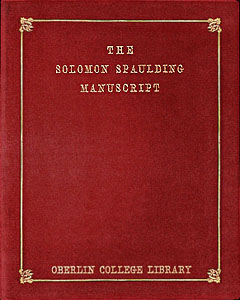
"This is the Spaulding Manuscript. I think a great deal of it, and as some of the leaves were pretty badly worn, I have lately had it carefully bound to preserve it, and these leaves as you see," continued the professor, turning to the first pages of the book, "I have had pasted between silk and the entire book is now in bery good condition."

BEAUTIFULLY BOUND.

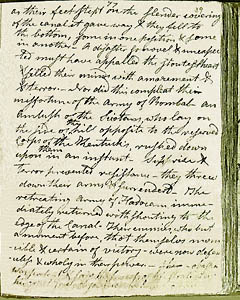
Professor Root then handed me the book and told me I might sit down and spend as much time looking it over as I might wish. It is now beautifully bound in red morocco, the title is in gilt lettering. Inside this beautiful cover is the faded old manuscript of less than two hundred pages. I turned over the leaves one after the other, reading a little here and there as I glanced over the pages. There is hardly a line without a misspelled word, a correction, or an erasure. After a short time Professor Root returned and I could see he was desirous that I should say something about the manuscript, for I had not even shown the least interest in it, which perhaps surprised him. But I still remained silent, as I was even more eager that he should speak first. Finally he did so, and these were his words.

PROFESSOR ROOT'S STATEMENT.

"Mr. Snow, it is all humbug to say that the Book of Mormon has any connection whatever with the Spaulding Manuscript. I have read and compared them both very carefully and am fully convinced that they are not in any way connected with each other. There is not a proper name or an incident in one that resembles a name or incident in the other, and not only is there no resemblance in the reading matter, but the styles used in the two books are also entirely different."

This, as might be supposed, afforded me much satisfaction. It is as strong a testimony as any one could wish for, and it came from an honest man, and that too from one who is not in any way in sympathy with our people or our faith. Yet it is not at all surprising that he should make such a statement. We have an exact copy of the Manuscript, it is known as the Manuscript Story and can be had at the Deseret News. Anyone who will read the beautiful teachings and interesting history in the Book of Mormon and compare the same with the silly contents of the Spaulding Story will not hesitate to make a like statement.

LETTERS OF INQUIRY.

Professor Root told me that he received several letters every week inquiring about the manuscript. In fact, he read two letters to me that he had just received. The writer of one of them asked about the owner of the manuscript and how much the writings could be purchased for. In the other letter was an inquiry as to the genuineness of the manuscript. To such questions the professor said he always answered emphatically that no price would buy the manuscript, that there was no doubt whatever about it being the original Spaulding writings, and that it bears no resemblance to the Book of Mormon. He said to me further:

"Now, Mr. Snow, I don't suppose you people would care to possess this manuscript, for it certainly will do you more good where it is now than if one of your institutions or any institution connected with your people possessed it."

And he is right, for where would be a more proper place for it than the great educational institution in Oberlin, and whose statement would be accepted more readilly or with more confidence then that of the librarian of that institution? This is surely the best place for it. And then Professor Root is so pleasant that it is a pleasure to ralk with him, and I know he would only be too glad to show the manuscript to anyone who might be interested in seeing it.

MANUSCRIPT   PECULIARITIES.

In conclusion, I wish to give just a very brief synopsis of the contents of the Spaulding writings: this is not done in the spirit of ridicule, for simple and ridiculous as the story is, I do not wish [------ ----- -----] ever. My object, therefore, in refering directly to the contents of the manuscript, is to point out more clearly the subject with which it deals, the names that are used, and a few of the incidents therein contained, that those who do not read the manuscript themselves may not be entirely ignorant as to the matter it contains, and thus better understand the endless between the Spaulding writings and the Book of Mormon.

I here give all the important proper names that occur in the manuscript:

Fabius, a Roman; Captain Luian; Sailors Tom, Crito and Trojanus; Emperors Labarmack and Rambock; Kings Brombal, Hadokam, Bambo, Sambal, Chiango, Ulipoon, Numapon and Ramuck; Pribces Moonrod and Elseon; Princess Lamesa and her friend, Helicon; Drafolick, a prophet; Hamack the seer; High Priests Lambon, Kato, and Lakoon; the wise man, Baska, or, Lobaska; the emperor's counselors, Hamul and Taboon. There are also the names Ramoff, Thelford, Hamkien, Boakim, and Labanko.

The following rivers are mentioned: Suscowah, Deliwah, Sciota and the Ohio. Three large cities are given names: Owhahon, Tolonga and Gamba. The principal nations of American natives are: The Deliwares, or Deliwans, the Michegans, the Siotans, or Sciotans, and the Kentucks.

HAS THREE PARTS.

The manuscript contains 172 pages and the narrative, though in no wise a continued story, may be divided into three parts. First, an account of the arrival in America of a crew of twenty Roman citizens. This account occupies the first half dozen pages of the Manuscript. Second, an amusing and ridiculous description of the rites, ceremonies, manners and customs, and amusements of the natives of America. This completes the first half of the Manuscript, or about eighty-five pages. The third part, which occupies the entire second half of the manuscript, relates a romantic love affair, with which the story ends.

After giving an account of himself, the writer tells of one Fabius, a learned Roman, who was on his way to England. The vessel was lost at sea, and after several weeks landed in America. The passengers and crew, about twenty in number, were kindly received by the natives, who are described as having a brown complexion, with one half the face painted red and the other half black. Their traditions told that their ancestors had come from the west. They used as a domestic animal the mammoon, or mommouth, a huge creature much larger than an elephant. It [------ ------- ---- -----] wolly hair, from which rough cloth was made. The people lived in frame buildings with shingled roofs, their writing was from tp to bottom and from right to left.

VERY LITTLE RELIGION.

Very little is said of their religion; enough, however, to confuse the reader, for it would be difficult to understand how the natives could be so far advanced in some lines and yet so unreasonable in their religious belief. One instance will suffice: The remission of sins was obtained by gazing intently upon the carcasses of two black dogs while they were being sacrificed by burning. The eighth day was held sacred for rest and worship. Baska, afterwards spelled Lobaska, was their wise man. He introduced a system of writing. It seems that he taught disbelief in miracles.

We have now finished one-half of the book. The remainder deals with an interesting love affair.

TWO GREAT NATIONS.

There were two great nations, the Kentucks, with Hamboon as their emperor, and the Sciotans, their emperor was Rambock, who had a beautiful daughter, Lamesa. According to the constitution of government, the princess could not marry outside her father's empire. Her father's house was visited by Prince Elseon, son of the emperor of the Kentucks. It was Emperor Rambock's wish that his daughter should marry King Sambal, against whom she entertained the must repulsive feelings, and further, a deep love had grown up between her and the visiting prince, Elseon, who, not being able to obtain from Lamesa's father the permission of marriage, eloped with her to his father's empire. Here they were happily wedded. Emperor Rambock and his subjects became so angry that nothing but bloodshed would satisfy their revenge. Great preparations were made on both sides, a terrible conflict followed, known as the "great battle of Geheno," in which over three hundred thousand soldiers took part, nearly one-half of whom were killed. During the battle young Prince Elseon met his savage opponent, King Sambal. A terrible hand to hand combat followed, the king was slain, the happy prince returned to his young wife, and peace was declared. Thus ends the story of the Spaulding Manuscript.

What sane person would believe that the beautiful teachings in the Book of Mormon could have found their origin in this ridiculous story? I answer no one. It is only those who are ignorant who will continue to [------] this [story ----- ----- ----- ---].


Note 1: Exactly what events incited the conspicuous 1900 LDS media blitz against the Spalding claims remains a mystery. Mormon President Snow apparently set both his First Counselor in the LDS First Presidency (Joseph F. Smith) and his own son (La Roi Snow) to work investigating the problem and producing faith-promoting polemics in support of the Church's position on the origin of the Book of Mormon. The renewed LDS interest in refuting the Solomon Spalding claims for Book of Mormon authorship continued through 1901 and into 1902, with representatives of the Church producing at least enine different articles, featured in the Church's main publications, during this period. The prominence the topic was given in the LDS media was probably a major factor in A. Theodore Schroeder's decision to produce an important non-Mormon recital of the Spalding claims in 1901.

Note 2: Elder Snow errs in making several statements concerning the Oberlin Spalding manuscript and the Spalding authorship claims. 1. He unjustifiably asserts that Sidney Rigdon and Joseph Smith could not possibly have been acquainted and worked together before December of 1830. In fact, Rigdon almost certainly knew who Smith was, well before that date. 2. He assumes that it is the same "Manuscript Found" as was spoken of by Solomon Spalding's old neighbors and relatives -- the same as does President Joseph F. Smith in his Era series of articles bearing that same name. In fact, the Oberlin story is not the Spalding manuscript claimed by early witnesses as bearing a similarity to the text of the Book of Mormon. 3. Elder Snow may have quoted Oberlin professor Root correctly, in having him say that the Book of Mormon and the Spaulding manuscript at that college were "not in any way connected with each other," but that is a practically meaningless assertion. Supporters of the Spalding authorship claims were not then saying that the Oberlin document was closely "connected" with the Book of Mormon, nor that it was the basis for the latter book. 4. Snow is mistaken in referring to the Spalding story's ancient civilizations saying that "Very little is said of their religion." In fact, the example he gives is not even taken from the account of the civilized people in that story. Spalding's entire plot hinges on a religious reformation gone wrong. His primary character, the religious reformer Lobaska may not have personally believed in "miracles," but he was happy to palm off his oracles as divine revelations and found a religion well infused with the miraculous. 5. Finally, Snow misstates the facts in saying that the Oberlin story comes to a peaceful conclusion. This we might indeed expect of an account made ready for the printer -- but the Oberlin story ends in the middle of a war, with no conclusion, and obviously was and is unfit for publication as a complete story.


T R U T H   A N D   L I B E R T Y.
Vol. LI.                     Salt Lake City,  Thursday,  July 19, 1900.                     No. ?


REPEATING  OLD  FABLES.
_______

The Pioneer Press, published at St. Paul, Minnesota, is in many respects a good paper. But it has on its editorial staff a pronounced anti-"Mormon" of the old, bigoted brand, impervious to the force of the most palpable facts of history, and oblivious to the developments and evidences of later times. The shattered remnants of early romances about "Mormon" leaders are gathered up occasionally and revamped for editorials in the Pioneer Press, and the silliest stories and most absurd burlesques of "Mormon" doctrine find a place in its columns, stamping it as a back number in the lists of modern journalism.

The latest effort of that paper to give "information" to its readers on "Mormonism" is put forth in some answers to correspondents in reply to the question, "How did the Book of Mormon originate?" The Press proceeds to relate in detail, the particulars of the defunct and decayed old Spaulding story, so familiar to a former generation, and which found its way into all the terrible tales about the "Mormons" for half a century.

It is not surprising that certain sectarian preachers repeat the absurd story, to account for a book which puzzles them because they will not yield to the evidences of its authenticity. But we confess to some amazement that a newspaper claiming to be up to date, will persist in publishing so palpable a falsehood as that the Spaulding myth was the origin of the Book of Mormon.

It was always a matter of conjecture, suspicion and contradictory assertion, refuted by well known facts and without [anything substantial for] a basis. But the discovery of the manuscript written by Mr. Spaulding and its deposit in the library at Oberlin College, Ohio, particulars of which ought to be known to editors who read and are acquainted with the news of the world, has so completely demolished the theory once relied upon by superficial minds that the Book of Mormon was concocted from that manuscript that it has been entirely abandoned by all opponents of "Mormonism" except the densely ignorant or unscrupulously dishonest.

For the benefit of the Pioneer Press, supposing it [retains] its reputation for ordinary sense if not for extraordinary veracity, we will briefly state the facts about "The Mabuscript." That was the title of a story purporting to give an account of the landing in America of a shipwrecked party of Romans, who found here [hospitable] barbarians whose origin is not stated. Early in the first part of the nineteenth century Spaulding endeavored to have his story published. He died before accomplishing this desire.

An apostate "Mormon" named Hurlburt, who had been expelled from the church for unchastity, hearing about the manuscript, sought out Mr. Spaulding's widow and by promises of reward if it suited his purpose, obtained it for publication by E. D. Howe, who issued an anti-"Mormon" pamphlet; but the manuscript, not being what was expected. was lost sight of, and Mrs. Davidson, Spaulding's widow, never received anything, not even the return of the manuscript.

Some time after this Mr. L. L. Rice and Mr. Winchester bought the publishing establishment of E. B. Howe in Painesville, Ohio. The Spalding Manuscript was among the books and papers and with them was taken by Mr. Rice to Honolulu, where it lay lost to the world until the year 1885, when Mr. Rice came across it when looking over old papers. Later he presented it to James H. Fairchild, then president of the Oberlin College, who was on a visit to Honolulu, to be kept in the library of that institution, and there it is today, open to the investigation of the public.

In a recent visit to that college, Mr. Le Roi Snow of this city was shown the manuscript by President John Henry Borrows, D. D., who said to him:

"Mr. Snow, it is all humbug to say that the Book of Mormon has any connection whatever with the Spaulding Manuscript. I have read and compared them both very carefully and am fully convinced that they are not in any way connected with each other. There is not a proper name or an incident in one that resembles a name or incident in the other, and not only is there no resemblance in the reading matter, but the styles used in the two books are also entirely different."

"The manuscript contains 172 pages and the narrative, though in no wise a continued story, may be divided into three parts. First, an account of the arrival in America of a crew of twenty Roman citizens. This account occupies the first half dozen pages of the Manuscript. Second, an amusing and ridiculous description of the rites, ceremonies, manners and customs, and amusements of the natives of America. This completes the first half of the Manuscript, or about eighty-five pages. The third part, which occupies the entire second half of the manuscript, relates a romantic love affair, with which the story ends."

It was alleged when the story was first started, that neighbors of Mr. Spaulding who heard his work read and afterwards learned about the coming forth of the Book of Mormon, recognized the same names in both. They were mistaken. Here are the important proper names that appear in the manuscript, none of which are found in the Book of Mormon:

Fabius, a Roman; Captain Luian; Sailors Tom, Crito and Trojanus; Emperors Labarmack and Rambock; Kings Brombal, Hadokam, Bambo, Sambal, Chiango, Ulipoon, Numapon and Ramuck; Pribces Moonrod and Elseon; Princess Lamesa and her friend, Helicon; Drafolick, a prophet; Hamack the seer; High Priests Lambon, Kato, and Lakoon; the wise man, Baska, or, Lobaska; the emperor's counselors, Hamul and Taboon. There are also the names Ramoff, Thelford, Hamkien, Boakim, and Labanko.

The following rivers are mentioned: Suscowah, Deliwah, Sciota and the Ohio. Three large cities are given names: Owhahon, Tolonga and Gamba. The principal nations of American natives are: The Deliwares, or Deliwans, the Michegans, the Siotans, or Sciotans, and the Kentucks.

If the editor of the Pioneer Press wants to satisfy himself on this subject, and to give real information to inquirers, he can obtain a printed verbatium copy of The Manuscript Found by sending twenty-five cents to the Deseret News office. He ca then compare it with the Book of Mormon, and he will find no resemblance whatever, but will learn the fact that it would be as reasonable to believe that the Bible was made up from Gulliver's Travels as that the Book of Mormon was concocted from The Manuscript Found.

People who desire to arrive at the truth concerning the only accurate account of the origin of the American Indians, and the builders of the cities and temples and mounds that amaze the archaeologists and explorers of the present day, will have to give attention and credence to the testimony of witnesses to the divine origin of the Book of Mormon, and its translation into the English language by the gift and power of God.

But if they cannot bring their minds to accept modern revelation and inspiration, they can at least yield to the force of the indisputable evidence, that demolishes entirely the stupid Spaulding story to account for the origin of that remarkable book. And just writers for the public, when they perceive their error, will acknowledge it frankly, if not for the public good at least for the sake of their own reputation.


Note: Both A. Theodore Schroeder and James E. Mahaffey were quick to seize upon the Deseret News assrtion, saying that "the discovery of the manuscript written by Mr. Spaulding and its deposit in the library at Oberlin College, Ohio, particulars of which ought to be known to editors who read and are acquainted with the news of the world, has so completely demolished the theory once relied upon by superficial minds that the Book of Mormon was concocted from that manuscript that it has been entirely abandoned by all opponents of 'Mormonism' except the densely ignorant or unscrupulously dishonest." Schroeder reprinted an excerpt from that daring allegation on the front cover of his 1901 pamphlet and Mahaffey took the News reporter to task on page 52 of his 1902 booklet, for the same reason.


T R U T H   A N D   L I B E R T Y.
Vol. LI.                     Salt Lake City,  Saturday,  March 23, 1901.                     No. ?


BEHIND  HIS  TIME.
_______

The Kalamazoo Daily Telegraph of the 8th of this month, gives a report of the opening remarks of a prayer meeting by Rev. S. F. Porter, who is in that city, it seems, to take up "missionary" work in the northwest. The remarks were made on "Origin of the Book of Mormon," and the gentleman told his hearers that that much discussed volume is but another version of the Spaulding manuscript.

Elder Hyrum Stevenson, in a later issue of the Telegraph, refutes this statement. He tells of the discovery of that manuscript by President James H. Fairchild of the Oberlin College, Ohio, and quotes what this impartial witness has to say in the New York Observer of February 5, 1885, as follows

"The theory of the origin of the Book of Mormon in the traditional manuscript of Solomon Spaulding will probably have to be relinquished. * * * Mr. Rice, myself and others compared it (the Spaulding manuscript) with the Book of Mormon, and could detect no resemblance between the two, * * * Some other explanation of the origin of the Book of Mormon must be found, if any explanation is required. "

The Spaulding myth did service, as long as the manuscript was hidden, but to use it now, is to display ignorance or a willful misrepresentation of facts. Rev. Porter is welcome to either of these horns of a dilemma. He cannot escape one or the other. He is too far behind his time.

It is remarkable that "Mormonism" cannot be assailed except by falsehoods and misrepresentation. Those who have most experience in the inglorious crusade against that religious system, are best aware of that fact. As long as they keep within truth, they are in full harmony with that which they would fain destroy; hence their skill is exercised in inventing stories about the origin of "Mormonism" and the character of its originators; in misrepresenting the teachings and the acts of the "Mormon" people, and in impugning their motives. It all comes from one source -- hatred of the light that has been sent to the world. "Mormonism," however, is no more affected by such means, than is the sun by the passing clouds that temporarily darken the valley. Storms come and go, but the heavenly luminary continues to send out his effulgent rays to the furthermost parts of the universe.


Note: xxx


T R U T H   A N D   L I B E R T Y.
Vol. LI.                     Salt Lake City,  Wednesday,  April 10, 1901.                     No. ?


THE  SPAULDING  STORY  AGAIN.
_______

It seems surprising to people who know anything of the history of "Mormonism," that the old fables concerning it which obtained credence at its inception, although thoroughly exploded by the force of irresistible facts, are still held and clung to by preachers and editors, who ought to be susceptable to the influence of reason and to the light of recent events and developments. Their failure to perceive palpable truth, so easy of access, and their readiness to repeat refuted errors for indisputed verities, would be comical if they were not so pitiful.

A few weeks ago we made some comments on the efforts of the Troy, N. Y. Press to enlighten the world, by the publication of a lot of stories told in a book made up of absurd anti-"Mormon" fabrications, printed half a century ago, but mixd with a few quotations from authentic works. That paper imagined it was giving to the public something choice and novel about an unpopular faith, but in reality was simply repeating ancient gossip and dead romances. Among them was the stupid Spaulding story, which every well-informed journalist ought to know has been completely exposed and settled.

Now comes the same fiction, copied into many country newspapers, from no less an authority than the New York Tribune. In an article headed "The Mormon Bible," that paper has once more told the tale of the "Manuscript Found," which was the chief reliance of the religious opponents of "Mormonism" for many years, and found its way into encyclopedias and historical narratives, and was the only way by which the preachers and editors could account for the production of the Book of Mormon. Here is the way the New York Tribune, at this late date, related the story:

"According to the opponents of Mormonism, from investigations made soon after the Book of Mormon appeared, the fact is fully established that the real author of the work was Solomon Spaulding, who was born at Ashford, Conn., in 1761, and after engaging in business in various States, died at Cherry Valley, N. Y., in 1816. During his residence in Ohio in 1810-12, he wrote a romance to account for the peopling of America by deriving the American Indians from the Hebrews, in accordance with a prevalent notion that the Indians were descended from the lost tribes of Israel. The book, under the title of "Manuscript Found," was, as early as 1813, announced in the newspapers as forthcoming, and to contain a translation of the 'Book of Mormon.' His widow published a statement in the Boston Journal in May, 1839, declaring that in 1812 he placed his manuscript in a printing office in Pittsburgh, where it was copied by Sidney Rigdon, who, about 1829, became associated with Mr. Joseph Smith. Immediately after the publication of the 'Book of Mormon'in 1830, it was recognized not only by Spaulding's widow, but by many of his friends, as his long lost work."

There are a few inaccuracies in this version, deviations from the original narration, but they are not very important. The so-called "fact" was NOT "fully established," but was merely a groundless suspicion. The "Manuscript Found" was not "announced as early as 1813," or at any time previous to the concoction of the charge against Joseph Smith, as that it was "a translation of the Book of Mormon." The widow of Solomon Spalding did not state that it was "copied by Sidney Rigdon," nor did she recognize the Book of Mormon as her husband's long lost work." Nor did Sidney Rigdon become associated with Joseph Smith in 1829; he never saw him till long after the Book of Mormon was published.

The first notion that the Spaulding manuscript might have had something to do with the Book of Mormon, was put forward by an apostate "Mormon" named Hurlburt, who was cut off the Church for unvirtuous conduct. In 1836 he wrote a book called "Mormonism Unveiled," which was published by E. D. Howe, a printer, of Painesville, Ohio. Hurlbut obtained the "Manuscript Found," bt false representations, from Solomon Spaulding's widow, but did not publish it because it did not answer his purpose, being found totally unlike the Book of Mormon, nor did he return the manuscript to the owner. For many years it was a manuscript lost.

But the main story: The alleged connection between Spaulding's manuscript and the Book of Mormon, continued to serve a purpose of its inventors and repeators for many years, notwithstanding the mass of evidence against it. But in 1884, President James H. Fairchild of Oberlin college, Ohio, was visiting his friend, Mr. L. L. Rice, then residing at Honolulu, Hawaiian Islands, who was formerly associated in business with E. D. Howe in Ohio. He had in his possession a number of old papers received from his partner when he purchased the business. Searching among them for some anti-slavery documents, a package was discovered marked "Manuscript Story -- Conneaut, Ohio." Examination showed that it was the long lost Spaulding story, obtained from the clergyman's widow by Hurlburt forty-eight years before.

Here was the opportunity to explode the Book of Mormon, if the account given by its opponents concerning its origin was correct. Mr. Rice presented the manuscript to Oberlin College, first copying it verbatim with all the original blunders in spelling, punctuation and composition intact. It is there now. The copy has been published. It can be had at this office for twenty-five cents. It is no more like the Book of Mormon than Jules Verne's journey to the moon is like the Hebrew Bible. This discovery put an end to the Spaulding story as accounting for the Book of Mormon in the mind of every honest person informed as to these facts. They are placed beyond intelligent question.

We have repeated this matter of recent history, once more for the benefit of some of our contemporaries who still linger in the darkness of the past, and in response to the request of some of our friends who want the particulars for their own use. We do not expect to stop the mouths of those very pious preachers who hate to acknowledge the truth, and want to account for the Book of Mormon in some way different to its claims as a divine record.

It is not the "Mormon Bible," as so often asserted by anti-Mormon writers. The "Mormon" Bible is the regularly accepted King James version of the Holy Scriptures. The Book of Mormon, though in harmony with the Bible, is a record of the dealings of the Almighty with the former inhabitants of the American hemisphere, and was revealed to Joseph Smith and translated by him through the gift and power of God. It is true and of inestimable value both as a disclosure of the origin of the American Indians, and of the building of the cities and temples, the ruins of which are found upon this land, and as a revelation of the word and will of the Lord and of the manifestations of Jesus Christ on this continent after His resurrection from the dead.

The editors of the religious and secular papers of the country may disbelieve the divine character and worth of the book, but they have no right or excuse to continue in deceiving the public as to its alleged connection with Solomon Spaulding or his legendary story. By persisting in this course they either expose their ignorance to well informed people, or exhibit their unreliability as authorities on maters of present information. Why not tell the truth, no matter if it does upset old theories and popular fiction?


Note: xxx


T R U T H   A N D   L I B E R T Y.
Vol. LI.                     Salt Lake City,  Tuesday,  May 14, 1901.                     No. ?


OBJECTIONS  OF  CRITICS.
_______

Ever since the Book of Mormon was published to the world, there have been strenuous efforts on the part of disbelievers in its divine origin to account for its production. Numerous theories have been invented for the purpose of discrediting its authenticity. The most popular of these fictions is the Solomon Spaulding story, which has found its way into nearly all the anti-"Mormon" works that have been circulated, and also in a number of encyclopedias.

The story has been completely overturned by the discovery of the Spaulding production entitled "The Manuscript Found." This has been in print for several years, and the original writing is deposited in the library of Oberlin College, Ohio, where it was placed by Prof. Fairchild, who obtained it from Mr. Rice, the former partner of E. D. Howe, an Ohio printer and publisher, who came into its possession in 1835, when it was hoped some similarity could be found between it and the "Book of Mormon." That there is nothing in common between them, that they are totally unlike in every particular, and that one could not be evolved out of the other, must be admitted by every person who has compared them. It is only the densely ignorant, the totally depraved, and the clergymen of different denominations afflicted with anti-"Mormon" rabies who still use the Spaulding story to account for the origin of the Book of Mormon.

There are, however, many honest disbelievers in the Book of Mormon, some of them because of deeply seated prejudice, others from an imperfect acquaintance with the volume, and still others because of the style and language and other peculiarities which do not comport with their ideas of divine record. Their objections are such as may be overcome by a closer acquaintance with the work, calm investigation and a sincere desire to find out the facts concerning its origin and the purpose and spirit of the [book]. Many earnest inquirers have obtained for themselves a divine testimony of the truth by inquiring of the Lord [--- --- --} expecting that their prayers would be answered.

One objection raised [against the] Book of Mormon by a [----- ----- ---] which has been expressed by [those] who have given some attention to the work is that [it] [----- ---- ---] of being the [production of a] [------] and not a person of very great literary ability. The [diff----- ---- of] the volume called the Bible [though] bearing a similar spirit [---- --- ---tions] that they were written by different individuals at different periods. The conclusion jumped at is that the Book of Mormon cannot be a collection of writings by different persons and therefore must be rejected.

Those critics who use this argument seem to forget that the book is an abridgment of the writings of several persons by one compiler, namely "Mormon," by whose name the book is called. The title page states that it is "An account written by the hand of Mormon upon plates taken from the plates of Nephi." And further that it is "An abridgment of the record of the people of Nephi and also of the Lamanites." Also, "An abridgment taken from the book of Ether." These announcements at the very beginning of the volume should be a guide to all who read it and should furnish a sufficient answer to the criticism which we here notice. The compiler also admits the imperfection of his language and deplores it.

But a careful critic who closely examines the Book of Ether, and compares it with the writings of the first Nephi, will discover a great difference between them in diction and will see that the former bears marks of greater antiquity than the latter. And taking into consideration the fact that in each case an abridgement only is given, the objection we have noticed is really a bit of clear evidence in favor of the authenticity of the volume.

Another objection from the same source, or sources, is that the book contains modern expressions and language peculiar to latter times, and also passages exavtly identical with some Bible texts. This is easily explained by the fact that the translation was made by one individual whose English would naturally be that of the period in which he wrote, and who may have been permitted to convey the ideas of the original writers in phrases and sentences which would be familiar to the ordinary readers of the translation.

Believers in the Bible must be aware that the same ideas were conveyed by inspiration, to different Prophets very frequently and were sometimes couched in the same words. The spirit of the Lord is one and does not change. Truth is also immutable. "The word of the Lord endureth forever." The lapse of ages does not affect it and the difference in language does not impair it. The idea is more than the verbage which conveys it. The mind which is eager for truth does not halt or stumble over verbal imperfections of such little straws as those which seem to trip up some of the professedly learned and hypercritical of the present age.

Take the Book of Mormon for what it purports to be, and study it with a sincere desire to learn the divine truths which it contains and obtain the knowledge which it imparts concerning the ancient history and inhabitants of this continent and the small difficulties will entirely disappear in the flood of light which is shed by that invaluable record for the benefit of mankind and the glory of God.


Notes: (forthcoming)


[ 608 ]


IMPROVEMENT  ERA.


Vol. IV.                                       JUNE, 1901.                                       No. 8.


THE  STORY  OF  "MORMONISM." *

BY DR. JAMES E. TALMAGE, OF THE UNIVERSITY OF UTAH.

* A lecture delivered by invitation at the University of Michigan, at Cornell University, and elsewhere.


First, permit me to express the mingled satisfaction, pleasure, and encouragement, which the present opportunity affords. I rejoice in the thought that a people, who, because notoriously unpopular, have been so generally maligned that even the passing vagrant has considered it his privilege to throw a stone or hurl a clod at them, may now be heard at the nation's seats of learning, and by those whose profession it is to seek, because they love, the truth.

To me, an assembly of students, as pupils and professors alike are, is a distinguished gathering, before which any speaker may feel honored in appearing. Students are philosophers-lovers of wisdom by profession and in fact. In this august brotherhood, I am proud to claim some rights of fellowship, however unworthy a member I may be; and whenever I meet others of the fraternity, I feel within my soul the swelling impulses that tell of kinship. Before such a gathering the speaker is bound, by more than ordinary obligations, to present his best and most mature thought as to the truth on which he treats. Our present theme is fitting to such an assembly, dealing, as it does, with living topics of profound importance.

In the minds of many, perhaps of the majority of people, the scene of the "Mormon" drama is laid almost entirely in Utah; indeed, the terms "Mormon' question," and "Utah question" are often used interchangeably. True it is, that the development of "Mormonism" is closely associated with the history of the long-time Territory and present State of Utah; but the origin of the system must be sought in regions far distant from the present gathering-place of the Latter-day Saints, and at a period ante-dating the acquisition of Utah as a part of our national domain.

I have here used the term "origin" in its commonest application,-that of the first stages apparent to ordinary observation,-the visible birth of the system. But a long, long period of preparation led to this physical coming forth of the "Mormon" religion,-a period marked by a multitude of historical events, some of them preceding by centuries the earthly establishment of this modern system of prophetic trust. The "Mormon" people regard the establishment of their Church as the culmination of a long series of notable events. To them it is the result of causes unnumbered that have been operating through ages of human history, and they see in it the cause of many developments yet to appear. This to them establishes an intimate relationship between the events of their own history, and the prophecies of ancient times.

In reading the earliest pages of "Mormon" history, we are introduced to a man whose name will ever be prominent in the story of The Church-the founder of the organization by a common usage of the term; the head of the system as an earthly establishment;-one who is accepted by The Church as an embassador specially commissioned of God, to be the first prophet of the latter-day dispensation-Joseph Smith. Rarely indeed does history present an organization, religious, social, or political, in which an individual holds as conspicuous and in all ways as important a place as does this man in the development of "Mormonism." The earnest investigator, the sincere truth-seeker, can ignore neither the man nor his work; for The Church under consideration has risen from the testimony solemnly set forth, and the startling declarations made by this person, who, at the time of his earliest announcements, was a farmer's boy in the first half of his teens. If his claims to ordination under the hands of divinely commissioned messengers be fallacious