
READINGS IN EARLY MORMON HISTORY
(Newspapers of Illinois & Indiana)

Adams County, Illinois
Quincy Newspapers
1870 - 1899 Articles
1838 | 1839 | 1840 | 1841 | 1842 | 1843
1844 | 1845 | 1846 | 1847-9 | 1850-69 | post 1869
Alton papers | Illinois Journal | Misc. Illinois papers | Chicago papers
Return to: Old Newspapers Articles Index
 Vol. XIX. Quincy Illinois Wednesday, August 17, 1870. No. 117. 
"LIFE IN UTAH: or the Mysteries and Crimes of Mormonism, being an expose of their secret rites and ceremonies, with a full an authentic history of Polygamy and the Mormon sect, from its origin to the present time;" by J. H. Beadle, editor of the Salt Lake Reporter. Published by the National Publishing Company, St. Louis, Mo. |
|
Vol. XXII. Quincy Illinois Thursday, July 17, 1873. No. 82. Trouble in the Young Family. Salt Lake, July 16 -- Announcement is made in the Journal that Ann Eliza Webb Young, the seventeenth wife of Brigham Young, has forever left him, carrying off some furniture and her personal effects. Brigham will endeavor to replevin the goods. Mrs. Young is at the Walker House, and three leading lawyers are about to institute a suit for divorce and alimony. Great revelations are expected concerning the domestic life of the prophet. Mrs. Young is enjoying the sympathies of Gentile ladies, and polygamous Mormons are a great deal disturbed about it. |
|
Vol. XXVI. Quincy Illinois Tuesday, January 11, 1876. No. 240.
JOE SMITH.
Half a century ago there lived in New York State, in the vicinity of Palmyra, where Joseph Smith first became known to fame, a young man named B. W. Richmond, who afterward studied medicine and acquired the title of doctor. He formed Joseph's acquaintance there, and was familiar with the circumstances attending his self-announcement as a prophet. In later years he saw him in Ohio, and observed his course with interest. Still later he met him in Nauvoo, and was an accidental witness to the scenes incident to and consequent upon his tragic death at the hands of the Illinois mob. Ten years afterward, partly in compliance with a request of the Prophet, made just prior to his assassination, Richmond wrote a full account of the affair, intending to publish it in book form. Various causes delayed the publication, and in 1864, twenty years after the occurrence of the events which he had committed to writing, Dr. Richmond died, leaving the manuscript in the hands of his widow, Mrs. Lucinda Richmond, now residing in McGregor, Ia., by whom it has been carefully treasured until the present time. The manuscript is not only interesting as a novel, and thrilling as a tragedy, but it is a reliable chronicle of one of the most singular and startling events in the history of the nation. |
|
Vol. XXIX. Quincy Illinois Tuesday, February 11, 1879. No. 305. SHIELDS TELLS A STORY OF DOUGLAS. In speaking of the early days in Illinois, Gen. Shields said the Mormons gave Douglas a great deal of trouble at the time that Nauvoo was their headquarters. Just at this time Joe Smith had a revelation commanding the Mormons to vote the Whig ticket; and, as they were a formidable element in the vote of the State, Douglas and himself called upon Smith to talk the matter over. Douglas was so convincing in his arguments that Smith was converted to his views, but said as he had one revelation it would not do to have another. He said, however, that if they would call upon Rigney [sic - Hyrum?] Smith, his brother, he could probably accomplish what they wanted. Rigney Smith was accordingly consulted, and at the next convocation of the temple he had a later revelation, which directed the Mormons to vote the Democratic ticket. When Joe Smith was questioned on the subject, he replied that, as Rigney's revelation was later than his, they must follow that. The result was a sweeping Democratic victory in that portion of the State. -- Washington Dispatch to St. Louis Globe-Democrat. |
|
Vol. XXX. Quincy, Illinois, Tuesday, July 26, 1881. No. 184.
THE FOUNDER OF MORMONISM.
Joe Smith was born in Rutland, Vt., about the time that Wingate, the combined forger and religious charlatan, made a sensation there. He removed, when a youth, to Palmyra, N. Y., and there Rigdon found him. |
|
Vol. XXXI. Quincy Illinois Tuesday, September 26, 1882. No. 160. MORMON RELICS. About a week ago the eastern wing of the old Nauvoo House was torn down. The building was commenced by the prophet Smith, who laid the corner stone. It was built in 1841. The Nauvoo Independent says the corner stone was in the foundation in the southeast corner and in the center of it was a square cut chest, about 10x14 inches and eight inches deep, covered with a stone lid, which fitted closely in a groove or shoulder at teh top, and cemented around the edge with lead that had been melted and poured in the seam. On removing the lid, which was done with some difficulty, the chest was found to be filled witha number of written and printed documents, most of them mouldy and more or less decayed. There was one pamphlet, however, written by some saint, narrating his worldly and spiritual experience, as near as we could glean it at a glance, which was in a good state of preservation. There were also a bible and a book of Mormon, which, when dried, will be in a condition to be read, as are also some of the written documents that were resurrected. There were also found several American coins -- a half-dollar, quarter, dime, two half-dimes and a copper cent; nearly all of them bearing the date of 1840. |
|
Vol. XXXIII. Quincy Illinois Tuesday, May 25, 1883. No. 31.
CITY OF THE SAINTS.
Nauvoo, which at one time claimed 26,000 inhabitants, now barely reaches 1,400. So far as advancement is considered, there has been little since the days of the Mormons. It is here that Smith and his followers sought to be free from what they deemed persecution. |
|
Vol. XXXIII. Quincy Illinois Sunday, November 11, 1883. No. 176.
SKETCHES AND ANECDOTES OF ... [During the early 1840s] a most singular strife and result occured in the Galena district. This district ran like a tape string all along the western border of the State from Hancock County down to Joe Daviess, taking in all the river counties, and generally the one county that lay immediately back. Leaving out the large Mormon vote of Hancock County, which had always gone solid, just as Joe Smith, the Mormon prophet directed, the district was undoubtedly Whig. With the idea of securing this very insecure factor, the Whigs nominated Cyrus Walker, of McDonough county, who had been for some years Joe Smith's lawyer in all important matters, and they naturally supposed that this made their candidate's "calling and election sure." Walker was also perfectly commendable to the regular Whigs. He had high character, eminent ability as a lawyer, and was extensively acquainted. His qualities were solid, not shining; his appearance was unimposing, and as a speaker very unattractive. His nomination was cordially made and acquiesced in by his party, and his election was expected. The democratic party experienced some difficulty in making their nomination, but it finally fell upon Josdeph P. Hoge, of Galena.... He was quite an accomplished lawyer, fastidious, almost "dandyfied" in his habits... The district was effectually canvassed, but the result was produced by a dream. Joe Smith, who held the scales, shortly before the election called together his disciples and announced to them that he had received a revelation from Heaven in a dream, which directed that he should support Walker for Congress. So much Joe was compelled to do from personal and professional considerations, and this gave a very roseate tinge to Me. Walker's political sky. But Joe and others well knew that it was much more important, as a matter of permanent business, to keep on the warm side of the Democratic party, which then dominated the State, than it was to be personally grateful, even if under Divine orders so to be. Therefore, immediately afterward Hiram Smith, the brother of Joe... had his dream, which revealed the "very latest" news from Heaven -- this being an order to have the vote of the "Latter day Saints," as the Mormons styled themselves, given to Hoge. This last special order was obeyed almost to a man. The result was that while Walker came down to Hancock county, nearly 800 votes ahead, there the entire Mormon vote was "plumped" against him, electing Hoge by about 600 majority. Joe Smith almost alone of the "Saints" voting for Walker.... |
|
Vol. XXXIII. Quincy Illinois Saturday, August 30, 1884. No. 132.
THE BOOK OF MORMON.
How many people know anything about the origin of the Mormon religion, or rather, of the Book of Mormon, which is its authority? I knew precious little about it until this week, when I accidently fell in with Mr. Clark Braden, who has recently given the subject a most searching investigation. His story shows of what stuff a religion may be made. The Mormons number probably 800,000. They are divided into many sects, but the principal are the polygamous Brighamites in Utah and the non-polygamous Josephites scattered in various places. The story may be given in a few words. The Book of Mormon was written by an old broken down Presbyterian clergyman named Solomon Spaulding. Spaulding was born in Connecticut in 1761. He graduated at Dartmouth college, and settled as minister for a Congregational church. He made a sad failure at preaching, and went into business with his brother in New York state, did not succeed, and started up an iron foundry in a town in northern Ohio. He soon failed in that venture and became very much discouraged. His wife supported the family by taking boarders, and he spent his time writing, though what did not then appear. He afterwards rewrote the entire book, adding a third part. This is the origin of the manuscript. |
|
Vol. XLIX. Quincy, Illinois, Thursday, April 15, 1886 No. 4.
ANOTHER LANDMARK GONE.
Carthage, Ill., April 9. -- During the past few days, the citizens of Carthage have witnessed the partial destruction of an old land-mark. Within almost a stone's throw of the principal business part of the city stands the wreck of the once-famous wayside inn. The workman's axe has played sad havoc with the old pile, and now its aged and crumbling walls stand bare and helpless to public view, telling in their mute informity of happier days, -- yeat days of sadness, and of stirring events in the country's history.... |
|
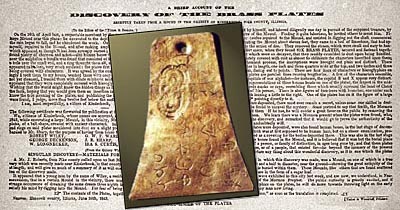
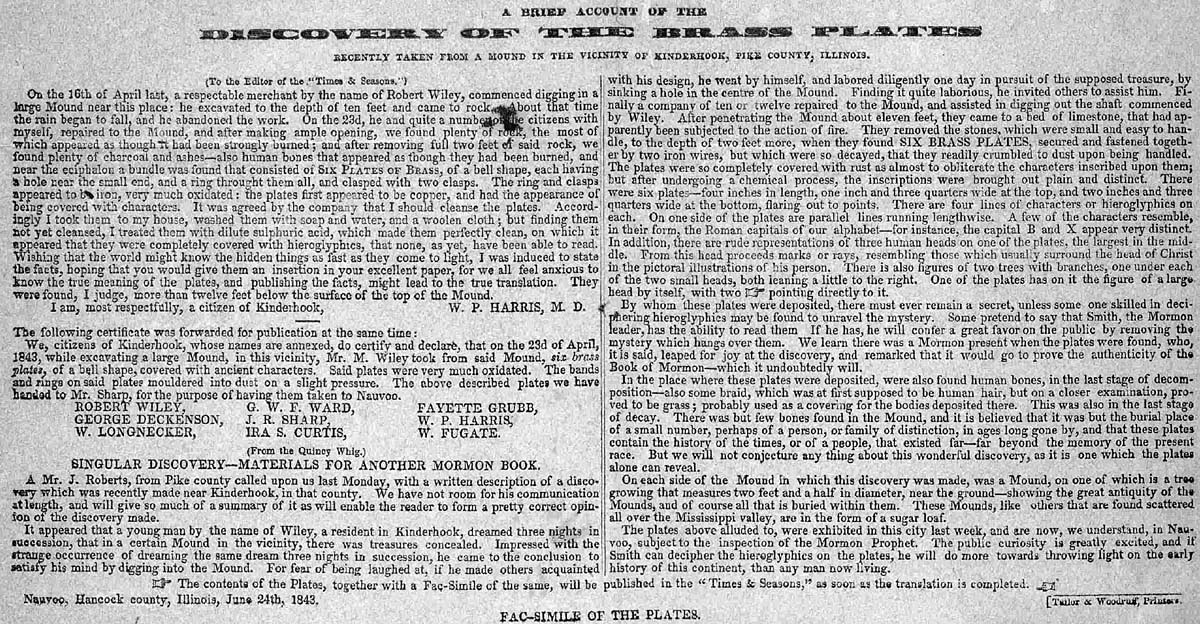
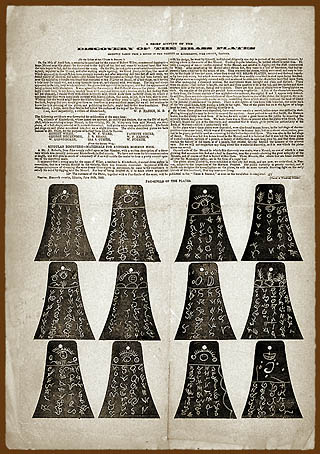
Vol. XXXVI. Quincy Illinois Wednesday, February 1, 1888. No. 273. "SECOND BOOK OF MORMON." A citizen of Metamora, Ill., writes to the Chicago Inter-Ocean to correct an accepted account of the origin of the "Second Book of Mormon." The writer shows that the discovery of the tablets was a huge hoax. In his own words, the facts are as follows: |
|
Vol. XXXVI. Quincy Illinois Wednesday, January 18, 1888. No. 261.
THE KIRTLAND MORMONS.
After several attempts to settle in various parts of the state of New York. The first real colony of the Mormons drifted into Kirtland They were guided thither by Sidney Rigdon, who was the most wonderful preacher of their early days. The arrival of several hundred Mormons in this little village was an event of no mean importance, even in the days when immigration was so rapidly seeking the favored spot of the west -- the northern part of Ohio. And yet, in those days of rapid development, the building of such a temple as that of the Mormons was a wonder. Even at this day a building of such size would be a severe tax upon villages that are tenfold the size of Kirtland. But the Mormons who built it gave cheerfully each one his tenth to the labor, materials, or money for the four years from 1832 to 1836, the entire cost being estimated at $40,000. |
|
Vol. XL. Quincy Illinois Friday, November 8, 1889. No. 138. The Adventists of 1844. It is painful to think of the jeers and sneers endured by the poor, sad eyed Adventists when they returned to their homes. Hundreds of them lost all heart and hope, law suits multiplied, and not a few found their way to the poorhouse and insane asylum. It is equally painful and more surprising to learn that even in New England their later meetings were in danger of brickbats and ancient eggs. And yet believers grew and multiplied, the regular Adventists looking on the "Millerite" performance as a mere fiasco with which they had nothing to do. Alexander Campbell, the eminent reformer, was deeply imbued with Adventist ideas, and named his new journal the Millennial Harbinger, indicating his faith that the last days were at hand. Joe Smith and Sidney Rigdon began their new church as Millenarians, and that of Brigham Young and the Pratts retranslated Smith's prophecies to make them mean that the end, not of the world but of the United States government, was at hand. -- |
|
Vol. VII. Quincy, Illinois, Monday, September 8, 1890. No. 208.
MORMONS AT NAUVOO.
It is doubtless true that Joseph Smith was born in Sharon, Windsor County, Vt., December 23, 1805. He was called the founder of Mormonism, yet he had able assistance in the creation of this new religion. History says that Smith was of illiterate parentage; that he himself grew up to an ignorant and vicious manhood, spending his days in idleness. He was regarded as a "dreamer." Much of his time was devoted to roaming the woods seeking for buried treasure. Doubtless his mind had been early poisoned by the vile literature that even to this day has not become extinct. But other minds, less ignorant, but no more active, conceived a plot to give the world a new religion -- one that was destined to find many supporters -- a religion that exists to-day in spite of fully three-score years of persecution. Sidney Rlgdon was a man of good education. A Presbyterian minister named Spaulding, who now lies buried at Decatur, Illinois, [sic!], is said to have written an ingenious religious romance, the original manuscript of which fell into Rigdon's hands. This worthy resolved to make good use of the story. Taking Smith and possibly a few others into his confidence, Rigdon revealed his plan to found a new religion. |
|
Vol. VIII. Quincy, Illinois, Saturday, September 13, 1890. No. 3.
[Mendenhall's] Version of the Tragedy of
"Whoop--ee, -- what a whopper!" |
|
Vol. XLI. Quincy Illinois Sunday, October 5, 1890. No. 107.
NEWS FROM MORMONDOM. Salt Lake, October 4. -- The Mormon semi-annual conference was opened today by George Q. Cannon. |
|
Vol. IX. Quincy, Illinois, Saturday, September 12, 1891. No. 2.
CARTHAGE.
"We have three things that stand out in Carthage," said Editor Davidson to your humble servent Thursday; "three important things or institutions that we like to show to those who visit Carthage. They are the old Carthage jail, the Carthage college and the Carthage Republican. |
|
Vol. IX. Quincy, Illinois, Friday, November 20, 1891. No. 71.
AN AGED EDITOR
The following letter to the editor of the Keokuk Gate City is very interesting. |
|
Vol. IX. Quincy, Illinois, Friday, July 8, 1892. No. 271.
Some Curious Doctrines and
EDITOR JOURNAL: There was a very remakable trait in the members of the Mormon church. I speak more particularly of the common masses of that peculiar organization. It was this: whenever a new doctrine -- or most generally it was called a revelation -- was promulgated by the heads of the church, it was received with great avidity by members and stored up in their minds as facts beyond contradiction. |
|
Vol. X. Quincy, Illinois, Thursday, August 17, 1893. No. 217.
A SISTER OF
Mrs. Katherine Salisbury, the eldest sister of Joseph Smith, the Mormon prophet, lives on her own farm three miles from the village of Fountain Green, in Hancock county, Illinois. |
|
Vol. LV. Quincy Illinois Wednesday, April 11, 1894. No. 319.
OLD PIONEER GONE.
Carthage, Ill., April 10. -- Judge Thomas Coke Sharp, editor and proprietor of The Carthage Gazette, died at his home in this city last night from paralysis, from which he has suffered for the past three years. Judge Sharp, next to the late Thomas Gregg, of Hamilton, was the pioneer journalist of Hancock county, and one of the oldest newspaper men in the west. He was born in Mt. Holly, N. Y., Sept. 25, 1818, and was therefore 76 years old. His father was the noted Methodist minister, Rev. Solomon Sharp, of the Philadelphia conference. Thomas, after a term in Dickinson college, entered a law school at Carlisle, Pa., and was admitted to the Cumberland county bar, April 14, 1840. He came to Quincy, Ill., Aug. 11, 1810, and opened a law office, but located at Warsaw, in this county, in September of that year. In May, 1840, Judge Sharp purchased The Western World, then published at Warsaw by D. N. White, formerly of The Pittsburg Gazette, and in May, 1841, changed the name to The Warsaw Signal. The Mormons having come to Nauvoo and Hancock county, and some of their methods being objectionable to Judge Sharp, he opposed Joseph Smith and other Mormon leaders through his paper, the controversy between The Signal, Sharp's paper, and The Times & Seasons, Joseph Smith's organ, becoming violently bitter and attracting wide attention. After a brief suspension of The Warsaw Signal, Judge Sharp again revived the paper, and was prominently identified with Mormon affairs until after that people had left Illinois in 1846. Judge Sharp was one of several men indicted and tried for the murder of Joseph and Hyrum Smith at the old stone jail in Carthage on June 27, 1844, but the jury promptly returned a verdict of acquittal. Judge Sharp was a member of the constitutional convention of 1847; was elected mayor of Warsaw in 1852, 1858 and 1859. He started The New Era, a union paper at Warsaw in 18[54]. Judge Sharp left the democratic party in 1854, and in 1856 made the congressional race in the old Fifth district to succeed Col. Richardson, but was defeated, the district being heavily democratic. In 1865 Judge Sharp was elected county judge of Hancock county. He removed his family to Carthage. After holding that office four years he formed a law partnership with the late Henry W. Draper. In 1869 he purchased The Carthage Gazette, and with the exception of possibly a year, has been its editor and proprietor ever since. The paper is now conducted by his son, Will O. Sharp, who, with the widow, his second wife, an adopted daughter, and two other children, survive. The funeral services will be held to-day. |
|
Vol. LV. Quincy Illinois Sunday, June 24, 1894. No. 382.
WAS FIFTY YEARS AGO.
NAUVOO, Ill., June 23. -- The train leaves you standing on the depot platform at Montrose, Ia, and presently a friendly skiff, or mayhap the ferry in due, provides a means of crossing the broad Mississippi river to this ancient and certainly historic town. You land at the riverside where begin the "flats," that stretch of low, sandy ground at the foot of Nauvoo proper, where the major portion of the mormons resided in the palmy days now more than a half century ago. A hack takes the traveler up the winding and steep hillto the business center of Nauvoo. As you approach this city from, the opposite shore the imposing spire of St. Paul and Peter Catholic church rise against the sky of the high bluff, and as the building stands not far from the spot that marked the Mormon temple. Many visitors forget that tbe templehas long since been destroyed, and wonder if this really large structure not the famous temple. |
|
Vol. LVIII. Quincy, Illinois, Thursday, January 30, 1896 No. 31.
THE STATE OF UTAH.
Salt Lake City, Jan 1. -- Utah is one of us. After the longest territorial childhood in our history, 45 years, the commonwealth founded by the exiles from Nauvoo by presidential proclamation becomes the forty-flfth state in the sisterhood. Nine times have the denizens in the vale of Deseret knocked at Uncle Sam's door before hearing the welcome ''Come in!" and in the meantime 18 states have entered, every one of which was behind Utah at the start. Salt Lake City had 5,000 inhabitants when Yerba Buena was startled by the gold discovery and began its rapid transformation into San Francisco; the site of Denver was a sagebrush desert 11 years after Brigham Young and the 148 Mormon pioneers located Temple block; the Indians owned all of Kansas, save the military reserves, when the gray granite foundations of the great Mormon temple were just obovd ground, while settled Iowa was but 40 miles wide, Minnesota was a Sioux hunting ground, all west of it and north of the Kaw was unorganized territory, Arizona was but a narrow desert strip, and Oklahoma had not been dreamed of. Children born of English parents in Salt Lake City have long been grandmothers, and a native of that city, son of a Manxman and Mormon president, is soon to be Utah's first senator. But what a strange, wild history lies between, and in those 45 years how many blunders and follies wore committed as well as acts of her oism and sublime self sacrifice! |
|
Vol. XIV. Quincy, Illinois, Friday, September 10, 1897. No. 311. "Book of Mormon." The "Book of Mormon" has been proved to be a literary plagiarism, being a feree paraphrase of a romance written by the Rev. Solomon Spalding, in 1816, the manuscript of which came into the possession of Joseph Smith, and he, sitting behind a curtain, dictated it to Oliver Cowdery, who seated out of sight of the reader, wrote the matter as it was given him. Smith pretended that the book was discovered by him by revelation and dug up from the side of a hill not far from Palmyra, in the county of Ontario, N. Y. The claim was made by Smith that the writing on the plates was engraved in "reformed Egyptian," which he was unable to read until magic spectacles, which he called his Urim and Thummim, were given to him, enabling him to read and translate into English. The spectacles and the metal plates have disappeared, and the story of the dictation makes tolerably clear the manner in which the "Book of Mormon" had its origin. |
|
Vol. XV. Quincy, Illinois, Friday, September 9, 1898. No. 306.
CARTHAGE.
What a day was yesterday! From nature's marvelous workshop can come no day more perfect, no day more charming. For several days nature had been at work preparing the conditions for yesterday. The recent electrical storms had purified the air and cooled it. The rains had laid the dust, so that yesterday we had no dust, but fresh, bracing air, a comfortable temperature, a friendly sunshine.'Twas a perfect day for work for rest, or recreation -- for living. Such a day was yesterday. |
|
Vol. LXI. Quincy Illinois Sunday, August 13, 1899. No. 337.
A SISTER OF THE PROPHET.
Mrs. Catherine Salisbury, a sister of the Mormon prophet, Joe Smith, who was killed at Carthage more than half a century ago, celebrated her 86th birthday at the home of her son near Fountain Green, Hancock county, last week. The Colchester Independent says of this venerable lady: |
|
Vol. LXVI. Quincy Illinois Sunday, February 24, 1901 No. 23.
SOME STORIES FROM THE
Plymouth, Ill., Feb. 23. -- This town was laid out in January, 1836. The work was done by four men. Two of them were from Plymouth, Comm., and this explains the origin of the town's name. The first building was erected by Sevier Tadlock and it was quickly followed by others, and in two of three years Plymouth was one of the most important trading points in all this part of the country. Like all country towns, Plymouth has a history, but there are few communities in the west that have gone through as many exciting sensational periods as this. It was almost in the heart of the Mormon settlement that caused so much terror and bloodshed in the early forties. It has passed through temperance crusades as interesting as those that have resulted in circumventing the joint keepers in southwestern Kansas, and there was a time in its very early history when the country hereabouts was the greatest producer of rattlesnakes of any in the United States. The town has passed through all of those experiences and thrived, and today it is one of the best little stations on the great Burlington system of railways. |
|
Vol. XXV. Quincy, Illinois, Monday, October 14, 1907 No. 29.
JUDGE EWING'S ADDRESS AT
The writer, who had never seen or heard Judge Ewing, went to the court house last Sunday afternoon to hear the celebrated exponent of Christian Science present his views to a Quncy audience.... |
Back to top of this page.
Articles Home Page | Newspaper Articles Index | History Vault
Oliver's Bookshelf | Spalding Studies Library | Mormon Classics
last updated: July 7, 2012