Dixon Telegraph

Vol. ?
Dixon, Illinois, Monday, October 25, 1948
No. ?
Rocky Ford and
Binghampton Built
Up Before Amboy
_____
Frenchman 1st Settler in
Amboy Township, Lee
History Shows
_____
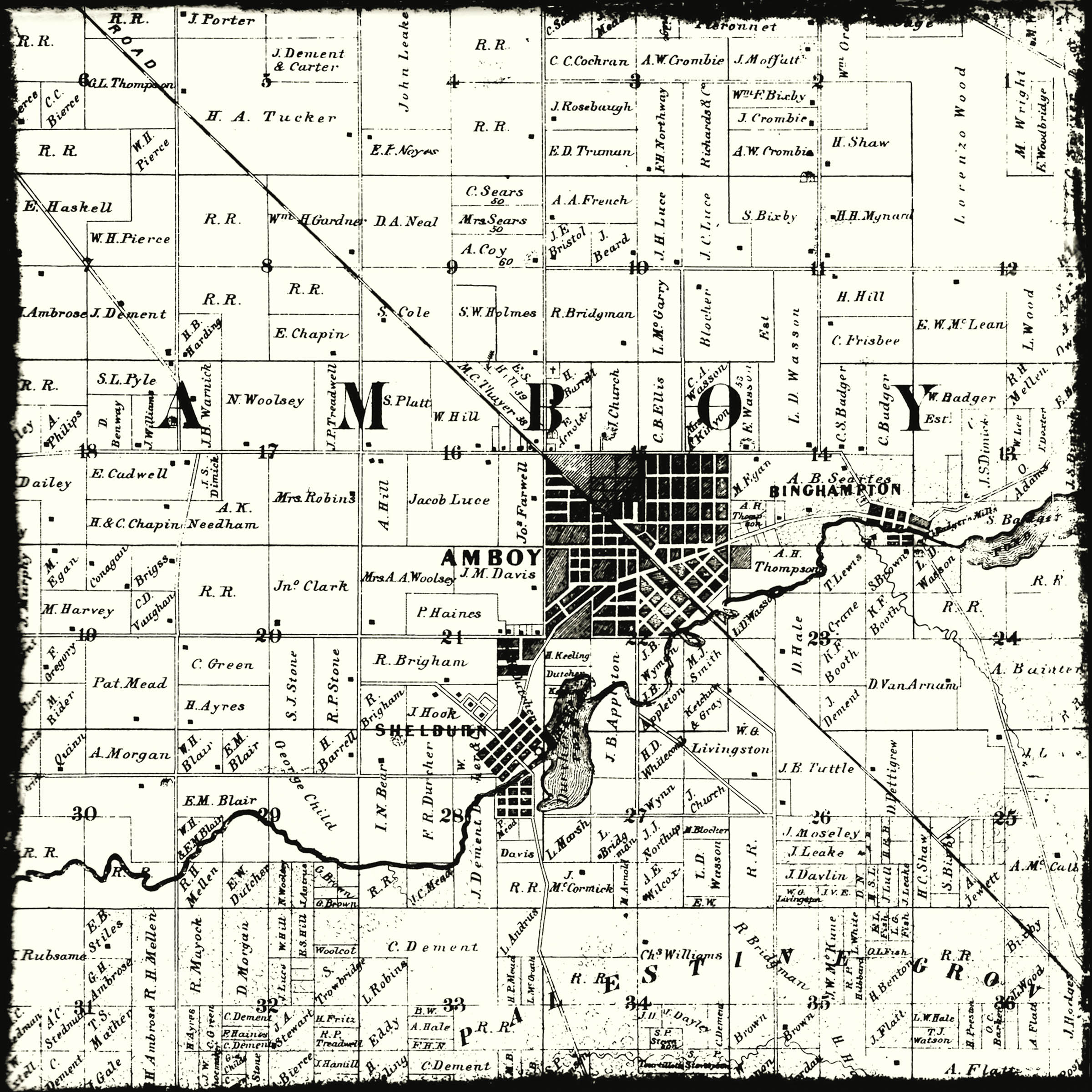
'Tis claimed for a Frenchman named Filamalee, that he was the first settler of Amboy township and that he lived in Palestine Grove about a mile south of
Rocky Ford. It has been said that in a burr oak stump, he placed mortar and therein he pounded grain into meal and flour for bread. He left the country as
soon as settlers began reaching the country, and John Dexter in 1835 became the first settler. He came here from Canada and made his claim on the
northwest quarter of section 13. The cabin which he built immediately, was 12 feet square.
In the spring of 1836, Mr. and Mrs. James Doan came into what now is the township of Amboy. With them came John Doan the father and Jemima sister
of James. In the spring of 1837, Andrew Bainter, brother-in-law to James Doan came in and took a claim on the Sublette road. In October, 1837, Asa B.
Searls came up the Peoria road with a team of horses, bringing with him Benjamin Wasson, from Peoria. Both were New York people.
Searls located on south half of section 14 and Wasson on sections 14 and 15. Later Searls laid out Binghampton, a mile east of the present city of Amboy.
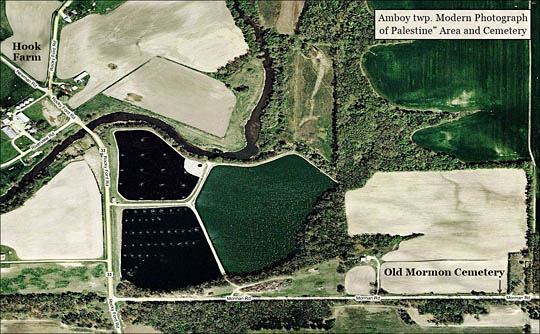
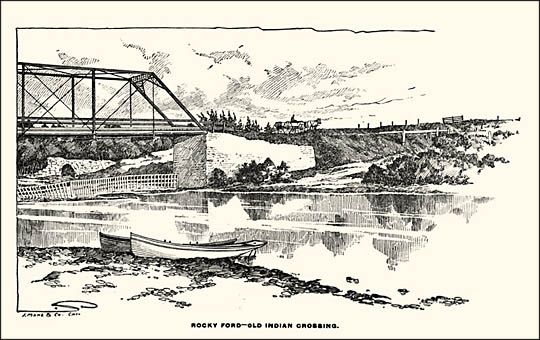
Nathan Meek settled near Rocky Ford about 1837. Rocky Ford was so named from the ford over Green river to the southwest of Amboy where
Frederick R. Dutcher afterwards established a store, a mill and a distillery and where for a time a village of respectable proportions flourished.
* * *
Meek was not reputed to be a desirable citizen during the days of the banditti. Three miles down stream he built his corn cracker mill and ground corn. He
tried to make flour, but failed. A sawmill had been built in this township much earlier than in other sections of the county. When Mr. Searls first came here
Timothy Perkins and Horace Bowen operated one at Rocky Ford, but later in the year, it was transferred to a man named Lee. After a brief career, Lee sold
to Mason. The latter died and John Von Arnam (or Van Norman)* secured it. In 1848, Frederick R. Dutcher purchased it.
In 1837, James Blair, and his sons, William, Winthrop and Edwin came here, and settled on section 29. The same year, John S. Sawyer and his four sons
erected a cabin south of the Illinois Central shops. In 1841, Sawyer sold part of his claim to Joseph Farwell and the remainder to Joseph Appleton.
Alexander Janes came in about 1837, but in a year or so sold his claim to Chester S. Badger, and moved to Bureau county. In 1838, Mr. Badger and his
son, Simon, settled in this township, and in 1839 Warren, another son, came out with the mother and her two daughters, Sarah and Rowena (or Roena).
But Warren returned and remained in the East until 1842 only, when he came back to Illinois and settled permanently here. Henry Badger came in 1849.
In the summer of 1838, John C. Church, Curtis Bridgeman, the latter's sons, Curtis and Urial, and William Hunt arrived.
In 1841, Jacob Doan came out from Ohio and bought the claim made by Mr. Church, one mile south of Amboy. Martin Wright also came in 1838, from
Massachusetts. John Fosdick, the Lee Center or Inlet blacksmith moved his smithy over to Doan's place and that become the first in the township. Later
Fosdick returned to Lee Center, and Doan and Frederick Bainter became proprietors and continued the business. Doan invented a scouring plow and many
were made by the firm.
* * *
In 1839, Cyrus Davis and his son, Cyrus A. Davis, came here from Massachusetts and claimed a home on the southeast quarter of section 15, later
Wyman's addition to Amboy. John and William Hook, brothers, located at Rocky Ford in 1840. Aaron Hook came two years before. The Joseph Farwell
claim on the northeast quarter of section 22 subsequently was platted into the original town of Amboy. Jesse Hale came in 1841, and Samuel and Lyman
Bixby came here in 1844.
The first public land sales were held at the Dixon Land Office in the autumn of 1844. Prior to this time of course, every person was a squatter. But as noticed
already, every community had its code under which lines were regulated, settlers were protected in the peaceable enjoyment of their claims and in the right
to buy the same from the government when offered for sale, unhampered by speculators. The Amboy association about 1837, centered around Inlet, of which
Amboy was a part at that time.
Later, the settlers around Palestine Grove, organized and held meetings at the homes of Sherman Hatch and William Dolan. In 1847, all need for this latter
association having vanished it was discontinued. While individual associations existed everywhere, they all were confederated together for any emergencies
which may have arisen.
On the 16th of March, 1839, George E. Haskell, was chosen president of the claim association for Inlet and Martin Wright, clerk. The committee elected
consisted of Ransom Barnes, D. H. Birdsall, Ozro C. Wright, Daniel M. Dewey and Benjamin Whiteaker. March 20, 1841, Haskell and Wright were reelected,
and D. H. Birdsall, David Tripp, Daniel M. Dewey, Charles Starks and Sherman Shaw were made the committee.
* * *
In the spring of 1850, April 2d, the first annual town meeting was held in Amboy, Joseph Farwell acted as moderator and Joseph B. Appleton as clerk.
Miles Lewis suggested that the new township be named Amboy and the name was adopted. David Searls was made supervisor; J. B. Appleton, town clerk;
Martin Wright, assessor and A. H. Thompson, collector.
The old road from Peru to Grand Detour, mentioned already was the first to run through Amboy township. The second ran from Inlet to Prophetstown,
taking in Binghamton, and Rocky Ford. Main street today is that very road and the old cottonwoods along the edges to mark its course, were planted
by Joseph Farwell.
In 1855, the Illinois Central railroad was finished through Amboy to Freeport, and on February 1, it was thrown open for traffic. The first train to reach Amboy
was in November, 1854.
During the session 1868-69 of the Illinois Legislature, Alonzo Kinyon of Amboy was a member of the lower House. During this session, he procured a charter
for the Chicago & Rock River Railroad Company to run from Rock Falls to Calumet. In 1869, Kinyon was elected president and on July 26, 1869, Amboy voted
by 517 for, to 92 against, to issue township bonds in aid of the road to the extent of $100,000. January 4, 1872, the road between Rock Falls and Amboy was
finished and June 19 it was finished to Paw Paw
* * *
Under Kinyon, shops and all manner of good things for Amboy were promised, but when the C. B. & Q. Ry. Co. obtained possession of the road, and connected it with the Chicago & Iowa road at Shabbona, Amboy was doomed. The bonds were fought
bitterly for years. All sorts of subterfuges were resorted to in the efforts made to escape service of process; but to no purpose. Their payment had to come
sometime. A settlement was made at last, and every dollar was paid off. Many times the burden became intolerable but with
a sublime courage the citizens stuck to it until every cent was paid.
Amboy always has been fortunate with her school system. The same intelligence which pervaded Inlet, while Amboy was a part of that precinct, has
pervaded Amboy; teachers and ministers and physicians, all men of rare intelligence, came early to Amboy and they saw to it that the Amboy schools
were built on subtantial foundations and presided over by good teachers.
Lucy Ann Church was the first teacher to teach in this township. The schoolhouse, built of logs, was located on the Sublette road just south of the railroad
crossing. Leonard Pratt, John Carey, Ira [sic] Hale, David Hale and Charlotte Doan followed Miss Church. The second school in the township was the
famous Wasson School, a frame building erected over towards Lee Center, in 1845. In this school Misses Rowena (or Roena) Badger and Roxy Wasson
taught for a long while. John Scott, an able teacher, H. E. Badger and Lyman C. Wheat also taught there.
Later, the first school was moved further south and located near the Lewis place.
* * *
Private schools never were attempted to any great extent. At Rocky Ford, a few irregular terms were ventured, but in the face of failure, they were not continued.
Church services were furnished first by Father Gorbus, a Methodist, who came over from the Indian Creek country.
The next minister to appear so far as known, was a German Baptist named Father Hetchler. Rev. Curtis Lathrop came along third.
Father White, a Methodist was next to appear.
In 1843, the Rev. Donaldson, assisted in organizing a Congregational society, said to be the first in the county. This was done at the house of Moses Crombie,
and the name adapted was "The Congregational Church of Palestine Grove." Services were held for many years in the Wasson schoolhouse. Rev. John Morrel
was the first regular pastor. He in turn was followed by Rev. Ingersoll, father of Robert G. Ingersoll. Revs. Joseph Gardner and a Mr. Pierson followed Ingersoll.
Later this church moved to Lee Center. Many stories are related of Rev. Ingersoll especially by Rev. Haney, the Methodist circuit rider. From all, we can learn
the gentleman was rather opinionated and considerably belligerent.
The Palestine Grove Baptist church was another early church. In 1847, Rev. Charles Cross became its pastor.
* * *
The Mormon church attempted to secure a foothold in this township and what is more, it was actually secured. The first preacher, William Anderson,
held his services in John Hook's house. Both Joseph and Hyrum Smith came up here often from Nauvoo. Joseph, the prophet, married a Miss Emma Hale,
sister to Alva Hale of Sublette, and David Hale and Mrs. Benjamin Wasson of Amboy. Asa Searls was a boyhood acquaintance of Smith, and had been
a schoolmate. Smith visited his friends and relatives here often. He made it a point always to preach when here, using the log schoolhouse on the Sublette
road. When in the famous litigation of June, 1843, the Governor of Missouri, sent a requisition over into Illinois for Smith's arrest, the latter was visiting those
relatives and friends in Palestine Grove. An Illinois constable and the Missouri agent came up here and arrested him. Smith fought desperately, but after
receiving many bruises, he was overpowered.
The crowd believed the proceedings were entirely illegal and many followed Smith and his captors to Dixon. It was agreed, however, that Smith was to return
to Nauvoo. But upon the discovery of the Missouri agent's design to take the prisoner over to Missouri direct, a party of Mormons collected and rescued
the prophet. Immediately he was brought triumphantly into Nauvoo. A writ of habeas corpus was issued and Smith was released by Judge Stephen A. Douglas.
Aaron Hook who had gone to Nauvoo and who had been ordained an elder, returned now, to Rocky Ford. William Smith, another brother of the prophet came
over to Lee county from Nauvoo about this time and a very considerable Mormon following was obtained in Lee county.
Among the number were the Hooks, Edwin Cadwell, Wentworth Blair, Stephen Stone and David L. Doan.
It was a deplorable circumstance, however, that none of the Smiths could get along with his neighbors. This William Smith was no exception. He was
arrested here for bigamy, released and then he left the country.
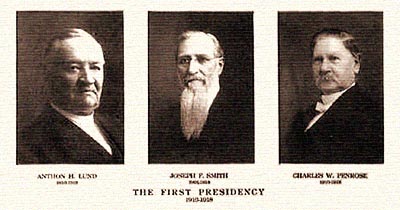
In 1860, April 6th, the anniversary of the founding of the church, the annual conference was held in Amboy. Joseph Smith, Jr., was installed prophet and
high priest in the old Mechanics Hall, where the meeting was held.
Amboy township was peopled early by enterprising people. So soon as the settlers got their bearings, they proceeded at once to build their homes and
schools and churches and then to establish villages for trading and manufacturing purposes.
Binghamton was laid out by Asa B. Searls and named in honor of Binghamton, New York. The
date was April, 1848. Warren Badger laid off some lots contiguous. Here Mr. Searls opened and maintained the Binghamton House. He erected a store as
well and took into partnership Edward Waters. Later Henry Potter bought the store and he in turn sold it to the Union Company, a cooperative company,
conducted by James H. Preston. Robert G. Ingersoll was Mr. Searls' "hired man," for a considerable period.
Binghamton became a flouring mill center, John Dexter in 1844: built one on Green river and the Badger brothers, Warren and Palmer, built another. The
latter was killed by a bank of earth falling on him and Chester Badger took his place in the partnership. In 1858, Chester and Henry Badger took over the
property and introduced steam power instead of water power. On Thursday night, July 18, 1872, the mill was burned and a loss of $6,000 was sustained.
The mill was rebuilt and H. E. Badger and son took it over and operated it until the evening of July 21, 1881. when it was struck by lightning and burned.
Loss $16,000: insurance $6,000.
John Doan started a plow factory which he ran for a year and then sold it to Frederick Bainter. In 1846 another was started by the Shaws and Churches.
One of the factories, a quaint little limestone building testifies to the business thrift of Binghamton, to this very day.
Note 1: The Telegraph reprinted the above article from pages 275-6 of Vol. I of Frank E. Stevens' 1914 History of Lee County, Illinois. Stevens
borrowed partly from the
1893 local history, Recollections of the Pioneers of Lee Co.,
and partly from sources such as A. C. Bardwell's 1904 Encyclopedia of Illinois and the History of Lee County. For example, Bardwell reported:
"One branch of the Mormon church secured a considerable foothold in the neighborhood of Rocky Ford, near which they were instrumental
in having the town of Palestine laid out. At one time there were sixty members. The founder, Joseph Smith, visited friends at Palestine Grove,
where he was arrested in 1843 on requistion of the Governor of the State, issued at the instance of the Governor of Missouri. In 1860 the
annual conference of the branch referred to convened in Amboy....
A plat of "Palestine" was made May 10, 1854, and serves to mark the probable center of the Palestine Grove settlement. The plat was
located about a quarter of a mile northwest of Rocky Ford, and consisted of three blocks of ground, two of which were on the Dixon and
Peoria road. It was laid out for Rhoda E. Hook who, it is to be presumed, owned the ground. It was here on one of the Palestine lots that
those of the Mormon faith laid the corner stone of a temple which never rose higher than this foundation stone."
Note 2: For more on William Smith, the "Rocky Ford" Hook family and the mid-19th century Mormons of Lee County, see the
Palestine Stake of Zion.
|