
READINGS IN EARLY MORMON HISTORY
(Newspapers of Missouri)

Misc. St. Louis Newspapers
1844-1849 Articles
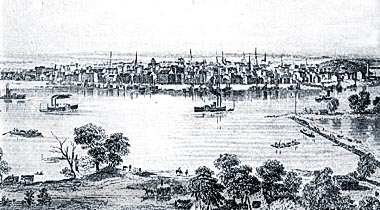
View of Saint Louis, Missouri in the 1850s
1831-1840 | 1841-1843 | 1844-1849 | 1850-1899
NEra Jan 29 '44 | Rev May ? '44 | EGaz Jun 12 '44 | Rev Jun 14? '44 | NEra Jun 16 '44
Rev Jun 19 '44 | Rev Jun 22 '44 | NEra Jun 24 '44 | EGaz Jun 28 '44 | Rev Jun 29 '44
Rev Jun 30 '44 | Rev Jul 06 '44 | POrg Aug ?? '44 | NEra Aug 29 '44 | POrg Sep 10 '44
Repb Sep 11 '44 | NEra Sep 12 '44 | POrg Sep 17 '44 | Rev Sep 18 '44 | NEra Sep 18 '44
POrg Sep 18 '44 | POrg Sep 23 '44 | NEra Sep 25 '44 | NEra Sep 26 '44 | NEra Sep 27 '44
POrg Sep 30 '44 | NEra Sep 19 '44 | MRp Oct 03 '44 | Rev Oct 06 '44 | POrg Oct 23 '44
NEra Oct 24 '44 | POrg Nov 01 '44 | NEra Dec 12 '44 | MRp Mar 28 '45 | MRp Apr 04 '45
MRp Apr 14 '45 | NEra Apr 17 '45 | Repb May 19 '45 | MRp May 26 '45 | MRp July 04 '45
Rev Sep ? '45 | DAm Sep 12 '45 | DAm Sep 28 '45 | DAm Oct 03 '45 | POrg Oct 03 '45
DAm Oct 04 '45 | MRp Oct 21 '45 | MRp Oct 23 '45 | MRp Oct 25 '45 | MRp Oct 27 '45
MRp Oct 28 '45 | DAm Nov 01 '45 | MRp Nov 01 '45 | MRp Nov 03 '45 | Rev Nov 03 '45
DAm Nov 11 '45 | DAm Nov 17 '45 | Rev Nov 20 '45 | POrg Nov 21 '45 | MRp Jan 12 '46
MRp Jan 17 '46 | MRp Feb 05 '46 | NEra Feb 28 '46 | NEra Mar 07 '46 | DAm Mar 21 '46
DAm May 05 '46 | DAm May 16 '46 | DAm Jun 10 '46 | DAm Jun 17 '46 | DAm Aug 16 '46
NEra Aug 22 '46 | DAm Sep 22 '46 | DAm Oct 01 '46 | Rev May 27 '47 | Union Oct 08 '47
POrg Nov 10 '49
Articles Index | St. Louis Missouri Republican 1830s 1840s
 Vol. III. St. Louis, January 29, 1844. No. ? 
... A meeting was recently held at Nauvoo, to express the sentiments of the Mormons in relation to the repeated demands by the state of Missouri for the body of General Joseph Smith, ;as well as the common cruel practice of kidnapping citizens of Illinois and forcing them across the Mississippi river, and then incarcerating them in the dungeons or prisons in Missouri. |
Vol. I. St. Louis, Mo., May ?, 1844. No. ?
COUNTERFEITORS. -- Mormon Certificates. Yesterday morning, a boy named Theron Terrill was arrested, having in his possession twelve American half and eight Spanish quarter dollars, all counterfeited in some sort of base metal. On examination by the Marshal, he stated that many had been given to him by one George Reader, with whom he had lived in former years, but who he had only recently seen again. For a long time the boy maintained secrecy, but, eventually, he yielded, and so told his story, Reader was caught and arrested on board the Ospery, having taken passage for himself and the boy to Nauvoo. The man had given the money to the boy, either to buy articles, or to sell to somebody else, as the statement was made. |
 Vol. ? St. Louis, Wednesday, June 12, 1844. No. ? Tremendous Excitement -- Unparalled Outrage On Board Steamer Osprey, June 12, 1844. |
Vol. I. St. Louis, Mo., June 14?, 1844. No. ?
|
Vol. III. St. Louis, June 16, 1844. No. ?
Mormon War. We have received a slip from Warsaw, Illinois, containing the proceedings of the citizens of that place in a meeting on the twelfth. The preamble alludes to the violent destruction of the press of the Nauvoo Expositor, and the threats made by the Mormons to destroy the press of the Warsaw Signal, and to assassinate the editor. Among the resolutions adopted were the following: |
Vol. I. St. Louis, Wed., June 19, 1844. No. ?
... several pieces of cannon have been taken from that place by the Steamboat Die Vernon, for Warsaw the headquarters of the Anti-Mormons.... |
Vol. I. St. Louis, Saturday, June 22, 1844. No. ?
THE MORMONS. -- The Waverley, down last night, brings intelligence that the allies march to-day on Nauvoo. They are reported to be three or four thousand strong, while the Mormons are said to be already short of provisions. |
Vol. III. St. Louis, June 24, 1844. No. ?
The Ohio and Hibernia passed Nauvoo yesterday morning, and it was then currently reported that Joe Smith and the members of the Nauvoo City Council had eloped during the night previous. It was stated that they had crossed into Iowa at Montrose. The leaders had thus deserted and left their deluded followers as victims to the fury of the indignant citizens of the surrounding country. Joe had declared his determination not to go to Carthage or Missouri, for he could not get justice at either place, but he would surrender himself at any other place. He, however, concluded that discretion was the better part of valor, and escaped. The people of Warsaw were under arms; they searched the Osprey to see if she carried any arms for the use of the Mormons. Nothing unusual appeared to be going on at Nauvoo yesterday morning. |
Extra.] St. Louis, Friday, June 28, 1844. [Extra. [ title unknown ] ... on the evening of the 26th, not long after Smith had given himself up, a party of about two hundred men surrounded the Carthage jail and demanded admittance. The guard (consisting of but seven men armed) refused. The guard were then overpowered, and, when the mob were about to enter the prison, Smith appeared in the window above and it was probably supposed, intended to leap out. While in this position, a shot was fired at him; he then leaped, and before he reached the ground he was pierced by three or four balls more. Hiram Smith and Richards were shot in prison... |
Vol. I. St. Louis, Saturday, June 29, 1844. No. ?
From the Quincy Whig Extra.
On Friday morning last, just before sunrise, our citizens were aroused from their slumbers, by the ringing of the bells of the city. The cause of the commotion was the astounding news that had just come down from Hancock, viz: of the attempt on the part of the Mormons to rescue Joe Smith from Jail in Carthage and of the killing of Joe Smith, Hyrum Smith, and Joe's Secretary, William Richards! and of the great peril of Governor Ford, and the handful of troops now in Nauvoo! An immense crowd had collected at the court house, with Dr. Ralston in the chair. Wm. H. Roosevelt, Esq. being present, was called upon to give a statement of recent occurrences in Hancock. The gentleman seemed to be laboring under great excitement, but gave a tolerable well connected account of the events of the last few days in Carthage and vicinity. |
Vol. I. St. Louis, Sunday, June 30, 1844. No. ?
By the clerk of the steamer Gen. Brooks, which came down yesterday evening, we are informed that Gov. Ford had arrived at Carthage, approved of present operations, to further which he had ordered out 2,500 men. By this time, it is supposed, that active operations have been commenced. |
Vol. I. St. Louis, Mo., July 6, 1844. No. ? THE NAUVOO AFFAIRS. Having visited Nauvoo and its vicinity in person, for the purpose of getting at the true state of affairs among the Mormons and their neighbors, we are enabled to give the latest as well as the most correct intelligence. |
 Vol. V. St. Louis, Mo., August ?, 1844. No. ?
We have intelligence from Nauvoo to the 5th inst. All was quiet. It appears that the reports of the appearance of Joe Smith and the appointment of his son are false, and originated in a desire to injure the Mormons abroad. Sidney Rigdon has retired to Nauvoo from Pittsburg, and preached to the people on the 4th inst. In consequence of the death of Samuel Smith, Joe's brother, since the death of the prophet, Sidney Rigdon will be chosen Patriarch of the Mormon flock. He is their master spirit, and will make a shrewd and energetic leader. There are five widows of the Smith family now living in Nauvoo, the mother of all, and the late wives of Joe, Hiram, and their two brothers. Accessions to the Mormon strength continue to be quite large; in Nauvoo, the usual activity is apparent and the Temple is steadily going up in its unique form and shape. Its style of architecture is of the pure Mormon order. |
Vol. IV. St. Louis, Thursday, August 29, 1844. No. 9.
SIDNEY RIGDON. -- A gentleman from Nauvoo informs us that Sidney Rigdon is now filling the office of first President of the Mormon Church, having received a revelation from Heaven that he was selected to act in that capacity. This is said to be doubted by some of the brethren. -- Transcript. |
Vol. V. St. Louis, Tuesday, September 10, 1844. No. 190.
Some of the Mormons are scattering off and they are considerably divided in their movements. Sidney Rigdon has been among them, but his claims were not recognized. Lyman Wight withdraws from Nauvoo. The infamous Bennett has gone up to try his hand among them. -- Era. |
 Vol. ? St. Louis, Wednesday, September 11, 1844. No. ?
Mormonism. -- Sidney Rigdon and Elder Hyde arrived in the city on yesterday evening. We learn that Rigdon, who professed to have a revelation, and returned a few weeks since from Pittsburgh, to be the successor of Smith, has been regularly unchurched by the Twelve Apostles. He returns to Pittsburgh to establish a paper. His views of Mormonism remain unchanged, although they will not have him rule over them. The administration of the affairs of the church for the oresent is to remain in the hands of the Twelve Apostles. |
Vol. IV. St. Louis, Thursday, September 12, 1844. No. 11.
Mormonism. -- Sidney Rigdon and Elder Hyde arrived in the city on yesterday evening. We learn that Rigdon, who professed to have a revelation, and returned a few weeks since from Pittsburgh, to be the successor of Smith, has been regularly unchurched by the Twelve Apostles. He returns to Pittsburgh to establish a paper. His views of Mormonism remain unchanged, although they will not have him rule over them. The administration of the affairs of the church for the oresent is to remain in the hands of the Twelve Apostles. -- Republican |
Vol. V. St. Louis, Tuesday, September 17, 1844. No. 196. LETTER OF SIDNEY RIGDON, ESQ. To the Editor of the People's Organ: |
 Vol. I. St. Louis, Monday, September 18?, 1844. No. 10.
Mormonism. -- We learn, from the Republican, that Sidney Rigdon and Elder Hyde arrived in the city on Wednesday evening. Rigdon, who professed to have had a revelation, and returned a few weeks since from Pittsburgh, to be the successor of Smith, has been regularly unchurched by the Twelve Apostles. He returns to Pittsburgh to establish a paper. His views of Mormonism remain unchanged, although they will not have him rule over them. The administration of the affairs of the church at the present, is to remain in the hands of the Twelve Apostles. |
Vol. IV. St. Louis, Wednesday, September 18, 1844. No. ?
Sidney Rigdon's Letter. -- in the Organ, gives more light respecting the deep rooted fanaticism and lawless spirit that prevails among the Mormons at Nauvoo. He, himself, has been a principal leader in their systemof imposture and priestcraft, and now he finds that he is unable to lead them; that there are others who are even more unprincipled and lawless than himself. He is excommunicated from the very synagogue of imposture which he assisted in raising. These discussions of the Mormon leaders should open the eyes of their duped followers, and induce them to abandon all such impostors and deceivers. |
Vol. V. St. Louis, Wednesday, September 18, 1844. No. 197. LETTER FROM ORSON HYDE, ESQ. MR. EDITOR: -- I observed, in your paper of this morning. a letter written by Sidney Rigdon, Esq., in which my name was called [in] question quite unceremoniously. I would say, however, that the most of his statements are untrue, which I am prepared to prove; and others are deeply shaded with misrepresentation. The statement that he, with some others, was cut off from the Church, is true; but not for the crime of going to Pittsburgh to live, as Mr. Rigdon very well knows. He has not touched on a single point on which the difficulty with him arose. But as the minutes of the Conference before which his case was investigated on Sunday, (a week ago) will appear in the "Neighbor" and the "Times and Seasons," it will be unnecessary for me to trouble you, at this time, with their recital. |
Vol. IV. St. Louis, Wednesday, September 19, 1844. No. ?
Orson Hyde, one of the Mormon imposters, has written a letter denying all the material statements made in the recent letter of Sidney Rigdon. He charges that Rigdon was expelled from the Mormon Church for offences entirely different from those alleged in his letter. Those Mormon leaders will soon satisfy all the world that they are just that description of [-----s] that they have been represented to be by those citizens of Missouri and Illinois, who have had the best opportunity of knowing them. |
Vol. V. St. Louis, Monday, September 23, 1844. No. 206.
Gov. Ford, it appears, has ordered out 2,500 of the State militia of Illinois, with an eye, perhaps, to approaching difficulties between the Warsaw citizens and the Nauvoo boys. The Signal most signally denies the necessity of such a movement, and declares that "order reigns in Warsaw." |
Vol. IV. St. Louis, Tuesday, September 25, 1844. No. ?
RUMORS OF A MORMON WAR. -- By the steamer Lebanon which arrived this morning from the Illinois river, we learn that when she left Beardstown yesterday, the military ordered out by Governor Ford were still there, waiting his arrival and reinforcements under his command from the vicinity of Jacksonville. As the Lebanon passed down, a number of soldiers had assembled at Well's Landing, who were also waiting for further orders. The movements of this great Commander-in-Chief appear to be characterized by the same tardiness for which they were so peculiarly distinguished during the first Mormon Punic war. Nauvoo would be ransacked and pillaged before this renowned military chieftain could get his army together and in motion. His proclamation, we understand, called for a general rendezvous of all the forces destined for the protection of the Mormons on the 24th inst. Yesterday was the 24th, but we find his army scattered along the banks of the Illinois, not knowing whether he would come or whether they are to look for another. This grand war and protection demonstration has not been equaled since the days of the Crusades. It is indeed a campaign of surprise if not of reprisal, for it has taken the citizens of Warsaw by surprise, and we opine that the Mormons are equally as much confounded to know what all this fuss about fighting means. Our last accounts by a boat which arrived this morning, state things in the two belligerent cities, to be in a state of the utmost peace and quietude. Gov. Ford will run his State further into debt, and then retire covered with laurels gained in planning and conducting one of the smallest military campaigns, for a little political effect, which has distinguished this or any other age. |
Vol. IV. St. Louis, Wednesday, September 26, 1844. No. ?
MORMON NEWS. -- A correspondent writes us from Nauvoo, that there was no design to reject Sidney Rigdon, as first President of the church, until he declared his settled determination to purge it of its abominations -- such as the spiritual wife doctrine, false swearing, bogus making, thieving, &c. This declaration aroused the ire of the Twelve, who were too strongly attached to their idols, to consent to give them up. Our correspondent further says, that all the most respectable of the Mormon Church, and all those who have any regard for decency and virtue, are secretly, if not openly, the friends of Rigdon. |
Vol. IV. St. Louis, Thursday, September 27, 1844. No. ?
MORMON WAR. -- A gentleman who came down the river informs us that the Deputy Sheriff of Hancock county came to Warsaw with a writ to arrest Mr. Sharpe and Col. Williams; the writ commanded him to take them to Nauvoo for examination. They told him that they would go before any Justice of the Peace in Carthage or Warsaw, or any Justice of Hancock county, who was not a Mormon, but that they would die before they would go in Nauvoo, or put themselves in the power of the Mormons. The Sheriff returned to Nauvoo, and came back with positive directions to seize them and take them to Nauvoo, but before he returned, Sharpe and Williams had disappeared and could not be found. He also informs us that it was reported that Gov. Ford was in Nauvoo with troops. This is probably not the case. On the same day a letter was received from Carthage informing the people that Gov. Ford had ordered three hundred troops to be at Warsaw that night for the purpose of aiding in arresting citizens of that place. It is probable that the military movement of Governor Ford will give rise to many unfounded rumors, and that it may precipitate a bloody collision between the Mormons and the citizens of Hancock county. Gov. Ford's great love for the Mormons may yet be the means of their expulsion and extermination. |
Vol. V. St. Louis, Monday, September 30, 1844. No. 207.
==> In the last Nauvoo Neighbor we find enclosed an Address to the Members of the Church of Latter Day Saints, signed by twenty persons, in which they express the opinion that our correspondent at one particular time, Sidney Rigdon, is, since the death of Joseph Smith, the heaven-ordained "Prophet, Seer and Revelator for the Church." They are decidedly opposed to the administration of the spiritual affairs by the Twelve, who have laid violent hands on rights of the church, and, according to these signers, are opposing the revelation of Heaven, given, as they say, to Rigdon, which enabled him to repair to from Pittsburgh, his residence, to Nauvoo, to present himself as a candidate for the leadership of the church. He was rejected, and the signers of the Address say that they believe this rejection to be "a vital departure from the order of Heaven." They give Rigdon a character of which any one might be proud; and moreover assert that it is their sincere belief that without Sidney Rigdon, there is no Mormon Church. They draw their inferences from the Book of Mormon, the rules and regulations therein laid down respecting the regulation of the church, and the revelations given to Sidney Rigdon. It is uncharitable to express opinions on these subjects -- so we state facts, and leave our readers to form such opinions as to them seems most fit. |
 Vol. ? St. Louis, October 3, 1844. No. ?
Governor Ford disbanded his troops at Warsaw last Monday. Sharp and Williams. who fled on his approach, were subsequently arrested. Seventy writs were issued against those concerned in the murder of the Smiths, but most of the accused fled to the Missouri side of the river. All was quiet at Nauvoo and Warsaw at the latest dates. The Governor has been enabled at last to vindicate the laws of Illinois by arresting a portion of the offenders, and we trust all of them will yet be secured and punished. |
|
Vol. I. St. Louis, Otober 6, 1844. No. ?
THE MORMON WAR. -- The following letter was received yesterday, but too late for insertion: -- |
Vol. V. St. Louis, Wednesday, October 23, 1844. No. 224.
Sidney Rigdon, it appears, has waked up a few in Pittsburgh. A latter-day Saint has published the fact that Sidney no longer considered one of the faithful, whereupon Sidney "riles up" considerably, and swears, "'taint no such a thing." Well, today, according to the Millerites, settles the question in this world, and of course we'll find it all out in forty-eight hours. |
Vol. IV. St. Louis, Thursday, October 24, 1844. No. ?
By the Die Vernon we learn that more trouble was brewing in the Mormon country. This was the week of the Circuit Court of Hancock Co., Illinois. -- Williams and Sharp went up to stand their trial. Two hundred armed Mormons appeared at Carthage and stated that they came by authority of Gov. Ford. There were also between one and two hundred persons present, armed and disguised as Indians, and it was anticipated that they would come in collision, and if so, much murder and bloodshed would ensue. It is scarcely credible that Governor Ford should authorize an armed body of Mormons to attend Court at Carthage -- for he might have been sure that such a proceeding would lead to violence. But his course in relation to the Mormons has been that no act can now create much surprise. |
Vol. V. St. Louis, Friday, November 1, 1844. No. 235.
==> The Mormons who have formed in Pittsburgh under the guidance of Sidney Rigdon, abjure, in the most decided terms, the doctrine of the Nauvoo Saints respecting spiritual wives. |
Vol. V. St. Louis, Monday, Decmber 2, 1844. No. 261.
==> Elder S. Rigdon, the great Mormon orator, is lecturing at Boston. |
Vol. ? St. Louis, Thursday, December 12, 1844. No. ?
==> Two of the Twelve persons who rule the spiritual destinies of Nauvoo and who constitute the head of the Mormon church since the death of the Smiths, arrived here on Saturday last; they are on their way to visit some of the eastern branches of the church, where Rigdon or seceding doctrines are said to be getting too strong a hold upon the meek and lowly followers of the Holy Joseph. -- These missionaries are going on for the purpose of enlightening and preaching to them the true faith. Last evening they addressed the Mormon congregation in this city, which consists of something near one hundred and fifty persons. Their place of worship is opposite the North Market |
Vol. ? St. Louis, Friday, March 28, 1845. No. ?
THE MORMONS. -- We learn from the Warsaw Signal that most of the friends of Rigdon, who still remain in Nauvoo, have been despoiled of their property, and live in constant fear of their lives. One of these, Elder Marks, a man of wealth, fled from that city last week, in the night! Others are are anxious to go, but are afraid to avow it. |
Vol. ? St. Louis, Friday, April 4, 1845. No. ?
The Warsaw Signal says: We learn by a gentleman, direct from Nauvoo, that a new revelation has been received in relation to the Temple. The work, on that structure, is to be almost entirely suspended for the present, and the whole energy of the Saints is to be devoted to the building of a wall or rampart around the ediface. This wall is to enclose six acres; the Temple in the centre. It is to be fourteen feet high, six feet thick, composed of solid stone masonry. The work, on this new monument of folly, has already commenced and hundreds of hands are employed in carrying it forward. |
Vol. ? St. Louis, Monday, April 14, 1845. No. ?
It is said that Orson Hyde has assumed the post of prophet and head of the Mormon Church. That we believe is the station to which Sidney Rigdon aspired; but which was pronounced Anti-Mormon by the Apostles. We have not learned by what process Orson Hyde has silenced the Twelve. The division among Mormons will probably cause this delusion soon to pass away, as the thousand others which preceeded it, have done. |
Vol. IV. St. Louis, Thursday, April 17, 1845. No. 42.
ORSON HYDE, it is rumored, is about to become the prophet and successor of Joe Smith. The death of the principal impostor does not seem to stop the villainy of the other leaders of that fanatical sect. It does not yet appear whether Orson Hyde claims by divine right, by a revelation from Heaven, by pretended miracles, or by what system of humbuggery, or what devices of priestcraft and pious fraud, he sustains his religious pretensions. The gullibility of ignorant and fanatical people renders them so utterly destitute of reason and discrimination, that they can be persuaded by fraudulent priests and religious impostors to believe any absurdity, no matter how contrary it may be to their reason, the evidence of their senses, or the dictates of common sense. If people will not think for themselves freely and independently of the dictation of crafty religious impostors and fanatical leaders, they will always be priest ridden slaves, and unfit to be citizens of a free republic. There is no slavery so degrading as that of the conscience -- the want of liberty and independence in matters of opinion. |
Vol. ? St. Louis, Monday, May 19?, 1845. No. ?
|
Vol. ? St. Louis, Monday, May 26, 1845. No. ?
By a letter from Nauvoo in the Springfield (Ill.) Register of Friday last, it appears that the two Hodges and Brown, charged with the murder of Messrs. Miller and Leisel, two Germans residing ten miles west of Fort Madison, Iowa, have been arrested in Nauvoo and committed. At the suggestion of their counsel the have voluntarily gone to Iowa to await a trial there for the offence charged against them. The prisoners are not [sic] Mormons, and never were. Brown has been in the penitentiary and is about 25 years of age. The letter in the Register says: |
Vol. ? St. Louis, Friday, July 4, 1845. No. ? The Lee County (Iowa) Democrat of last Saturday says: -- One of the Hodges attempted to destroy himself on Tuesday last by strangulation. The jailor hearing a noise in his cell went to ascertain the cause when he discovered the prisoner endeavoring to strangle himself by clasping his throat with his hands. Means were taken of course to prevent him. |
|
Vol. II. St. Louis, Monday, Sept. 1?, 1845. No. 17.
... [Luck Mack Smith's] story in regard to the mummies, (learned from Joe,) is about as follows: It seems that, for the express purpose of corroborating the 'brass plates' which were one day to be dug up, and translated as the 'Book of Mormon' the angel of the Lord, three thousand years ago, appeared to Joseph in Egypt and delivered to him a wooden case, containing a roll of papyrus, which was to be buried by him with the family of one of the patriarchs; that Joseph did so, despositing the case on the Queen's breast, where it lay until the discovery of the 'brass plates,' the Lord then causing the bodies to be discovered also and conveyed with the identical deposit of Joseph into the hands of 'Joe.' Joe 'never had six months' schoolin' in his born days, but as soon as 'the was g'in him,' he could 'translate any thing;' accordingly having already deciphered the plates, he made short work of the hieroglyphics, and his interpretation which, while it fully proves the Book of Mormon, would enlighten even unto amazement, the Champollions of the Bibliotheque du Roi and the British Museum! Of all the bare-faced jargon that ever was uttered, the grave relation of the poor old woman was the most ridiculous; and while her pitiable conviction of its entire truth really gladdened the heart, it would be impossible to repress one's regret that the impudent impostor had left the world, without at least one especial good kicking for having so deceived his own mother. Not a circle, serpent, altar, ibis, or any of the familiar and now understood idiographic character of the Egyptian, but this shrewd yet ignorant knave had given his own interpretation to, and so committed the latter to his followers, not only braving but confidently defying inevitable exposure. The whole thing is too gross to bear patiently, too painful to laugh at; somehow or other the delusion of this bent and white headed old creature has more in it to disgust one with the memory of Smith than all his other humbug and even crime... |
Vol. I. St. Louis, Saturday, September 12, 1845. No. 236. Bill Smith, so says the Warsaw Signal, has avowed from the stand in Nauvoo, that he is not ashamed to teach the spiritual wife system -- and that it has long been taught secretly by the leaders of that city. The Signal further states, that the Saintly William has so far practised the doctrine with an English girl in his family, that his newly married wife left him. |
Vol. I. St. Louis, Tuesday, September 28, 1845. No. ? WILLIAM SMITH, brother of the Mormon Prophet, will lecture this evening at Mechanic's Institute. |
Vol. I. St. Louis, Friday, October 3, 1845. No. 254. Some of Col. Davenport's Murderers Taken.-- At last, information has been received which fixes the murder of Col. Davenport upon two individuals, and they have been arrested. They were captured at the mouth of Devil's Creek, in Lee county, Iowa, and prove to be Mormons. They were taken on Sunday night last, under the following circumstances: About two weeks since a gun was accidentally discovered in a pool near the house of a Mormon by the name of Redmon [sic, Redden?]. A pistol was subsequently discovered in the same place. The arms were taken to Fort Madison, where the gun was identified as having belonged to Col. Davenport. Col. D.'s son was sent for, and identified the gun, and also produced the mate to the pistol. -- On this evidence writs were issued against the Redmons, two brothers, who, hearing that the Sheriff was on his way to arrest them, collected ten of their gang to resist the service of the process. The Sheriff then ordered out the Fort Madison Volunteer Company and proceeded to the house of the Redmons, where they surrounded the premises and took them prisoner. It is said of those men, that they harbored the Hodges, convicted and hung for a most outrageous murder, a few weeks since -- the night before the commission of the murder. Other circumstances than those which led to the identification of the Redmons, exist to make out a strong case against them. and also another of the party. Repub. |
|
Vol. ? St. Louis, Friday, October 3, 1845. No. ?
==> The Warsaw Signal, extra of the 20th ult., contains a confirmation of the general features of the account given by us yesterday of the arrest of some persons suspected to have been the perpetrators of the murder of Col. Davenport on the 4th of July last. It seems, however, that the arms recognized as those of the murdered man were not found in the possession of the accused, but in a pond in the vicinity. There is said to be a very strong chain of circumstantial evidence against the accused. |
Vol. I. St. Louis, Saturday, October 4, 1845. No. 255. Col. Davenport's Murderers.-- The Chigago Journal, of the 25th ult., contains a paragraph announcing the apprehension of two others of Col. Davenport's murderers. Their names are Burch and Long. They were in custody of officer Bonny, and were arrested at Lower Sandusky, Ohio. The Journal adds the following particulars: -- "The suspected individuals were traced by officer in pursuit, who had followed them with praiseworthy perseverance through Iowa and the western part of Missouri to St. Louis, and thence through the southern part of this State, and Indiana to the place where they were taken. Upon Burch was found the watch, chain and seals of Col. Davenport, which circumstance leaves but little room to doubt that he was engaged in the murder. In crossing the lake last night, Burch, who, no doubt, supposed the evidence of his guilt was contained therein, stole the officer's portmanteaus and threw them overboard. Fortunately, Mr. Bonney had the chain and seals about his person. |
|
Vol. IV. St. Louis, Tuesday, October 21, 1845. No. 233. MORMONDOM. -- A circular has been addressed by the "Council of Twelve" to the Mormons throughout the United States, relative to the contemplated removal from Nauvoo to some point west of the Rocky Mountains. It is urged on the saints to sell their property for horses, mules, &c., -- such articles as will be serviceable on the journey and in their distant homes. |
|
Vol. IV. St. Louis, Thursday, October 23, 1845. No. 235. Birch, one of the persons arrested for the Murder of Col. Davenport, says Jack Redmon (or Redding) murdered Arvine Hodges. This agrees with the information given us a few days ago by Wm. Smith, "The Mormon Patriarch," from whose statements it is evident that Brigham Young was privy to the crime, and probably instigated it. |
|
Vol. IV. St. Louis, Saturday, October 25, 1845. No. 237. MORMONISM. -- We publish a communication from the Mormon Patriarch, addressed to the Mormons and intended to dissuade them from listening to the counsel of Brigham Young and his associates at Nauvoo. The Patriarch expresses the opinion that Young and those acting with him, have been privy to all of the crimes which have been perpetrated at Nauvoo, and that their object in collecting at that place, this winter, all of the Mormons in the United States for the purpose of moving to California in the Spring, is merely to enrich themselves and perpetuate their power. When the Mormons gather at Nauvoo, they will be required to surrender all of their property into the hands of the Twelve, and if their expedition to California should prove dangerous, the Twelve will desert their followers. If, however, they should reach their destined homes west of the Rocky Mountains, the power of the leaders, through their secret organizations, will be made despotic, and be exercised for the benefit of the few to the degradation and ruin of their followers. |
|
Vol. IV. St. Louis, Monday, October 27, 1845. No. 238.
MORMONISM. William Smith, the Mormon Patriarch,has addressed a long letter to his brethren, in which he dissuades them from listening to the counsel of Brigham Young, and his associates at Nauvoo. The Patriarch expresses the opinion that Young and those acting with him, have been privy to all of the crimes which have been perpetrated at Nauvoo, and that their object in collecting at that place this winter all of the Mormons in the United States, for the purpose of moving to California in the Spring, is merely to enrich themselves and perpetuate their power. When the Mormons gather at Nauvoo, they will be required to surrender all their property into the hands of the Twelve, and, if their expedition to California should prove dangerous, the Twelve will desert their followers; if, however, they should reach their destined home, West of the Rocky Mountains, the power of the leaders, through their secret organizations, will be made despotic, and be exercised for the benefit of the few, to the degradation and ruin of their followers. |
|
Vol. IV. St. Louis, Tuesday, October 28, 1845. No. 239.
WILLIAM SMITH, brother of the Mormon Prophet, will lecture this evening at the Mechanic's Institute. See card in another column. |
Vol. I St. Louis, Saturday, November 1, 1845. No. 288. THE MORMONS. There is more trouble brewing among the Mormons. We gave yesterday, some details of the resistance offered in Nauvoo, to the arrest by the proper officer, of a man named Reding, indicted as an accomplice in the murder of Col. Davenport. This man was rescued, and is now secured in Nauvoo -- the officers were stoned, and otherwise injured. We now learn from the Quincy Whig, and other sources, that the [Mormons] in Nauvoo have actually defied the power of the State, and declared that no more arrests shall be made in Nauvoo. On Saturday last, the Whig says: |
Vol. IV. St. Louis, Saturday, November 1, 1845. No. 243.
MORE TROUBLES. -- The Gazette of last evening contains the following additional information from Nauvoo. This new outbreak in that region will probably lead to a renewal of the late exciting scenes in that quarter; although it is hoped that the proper officers will discharge their duties fearlessly against all offenders, Mormon or Anti-Mormon: |
Vol. IV. St. Louis, Monday, November 3, 1845. No. 244.
MORMON DIFFICULTIES. -- (under construction) |
|
Vol. II. St. Louis, Monday, November 3, 1845. No. 17. THE MORMONS -- OREGON. William Smith, brother of the Mormon "Prophet," is in this city, lecturing against Brigham Young, the "Twelve," and the proposed removal to Oregon. With regard to his opposition, he would be entitled to more attention, did not the most generous defenders of the Mormons feel that it is now too late, and did he not, at the same time, bring his denouncement of Brigham Young & Co. into ridicule, by coolly declaring that there existed no abuses in the church during the lives of his brothers! It certainly does seem to be a "struggle for power" among these Mormon leaders; but inasmuch as that Young is supported in his ascendancy by a "unanimous vote," and that this "patriarch," Smith, renders his statements suspicious by evident exaggeration -- above all, in that the Mormons have publicly pledged themselves to remove, and that the pledge cannot now be violated without the renewal of fearful scenes, we deliberately think that the agitation of an opposition on the part of Smith should not be encouraged for a moment. Nor do we fear that the consenting Mormons may have been betrayed by their head men, since unanimity, and openly expressed confidence in their leader, were the striking features of the conference. Again, Mr. Smith is entirely wrong in his idea that the Mormons, who have not been able to defend themselves in a mass, would be tolerated by their enemies when scattered among them. The tree cut down, the next thing would be to burn out the roots. |
Vol. I St. Louis, Tuesday, November 11, 1845. No. 296.
COUNTERFEITERS. -- It would seem that Bonny, the man who ferreted out the murderers of Col. Davenport, is himself a great scamp -- intimations of which we had long ago. He has been indicted in Lee County, Iowa, for counterfeiting, and a requisition made on the Governor of Illinois for the surrender of his person. -- Organ. |
Vol. I St. Louis, Monday, November 17, 1845. No. 301.
We learn by a gentleman who arrived from Burlington, by a boat last evening, that Mr. Bonny, who made the arrest of the Davenport murderers, has surrendered himself to the proper authorities, to answer the three several indictments found against him, by the last grand jury of Lee county, viz: Being accessory to the murder of the Germans, perjury and counterfeiting. |
|
Vol. II. St. Louis, Thursday, November 20, 1845. No. ?
TRUTH IS STRANGER THAN FICTION.
At the new and splendid Lyceum Hall, northwest corner of Third and Pine streets, on Thursday evening November 28, at 7 o'clock. |
|
Vol. ? St. Louis, Friday, November 21, 1845. No. ? For the Organ. Grand Flare-up in the Mormon Church in St. Louis. -- As the proceedings of the Church of the "Latter Day Saints" are creating some excitement and interest in this city, an account of one of the meetings of the "Stake" in St. Louis, will not, I presume, be uninteresting. |
Vol. III. St. Louis, Monday, January 12, 1846. No. 18.
The Illinois State Register mentions the arrest of Mr. Bonney. Its editor says he has been shown by Mr. Bonney, letters addressed to him by many respectable gentlemen in Iowa and neighboring States. Mr. B. authorizes the Register to refer to Mr. Joseph Knox, Rock Island, Judge Mitchel, Davenport, Dr. Reuben Knox, St. Louis, and the President and Cashier of the Missouri Bank, for evidence of his character. |
Vol. ? St. Louis, Saturday, January 17, 1846. No. ?
We stated a few days ago, that [Mr.] Bonney, arrested at Springfield, Illinois had authorized the Register to refer to Dr. Reuben Knox, of this city, and the President of the Missouri Bank, for evidence of his good character. We learn from Dr. Knox that his acquaintance with Bonney extends no farther than assisting him some time ago to procure the means for detecting the murderers of Col. Davenport, and the members of the gang of counterfeiters scattered along western rivers. Bonney showed at the time a list of persons, numbering about 400, said to be implicated in different crimes perpetrated in the West, and stated that he would find the murderers of Davenport, where he subsequently caused them to be arrested. |
Vol. ? St. Louis, Friday, February 5, 1846. No. ?
On the 17th inst., Baxter, Kingsbury and Burch, confined in the jail at Rock Island, for participation in the murder of Col. Davenport, made an effort to escape, which was nearly successful. They had sawed an opening through the floor of their cells, and nearly finished a subterranean outlet, when their operations were discovered. |
|
Vol. VI. St. Louis, Saturday, February 28, 1846. No. 285.
The trials of Baxter and Birch, for the murder of Col. Davenport, have, by a change of venue, been removed from Rock Island to the counties of Warren and Knox. |
|
Vol. VI. St. Louis, Saturday, March 7, 1846. No. 291.
The younger brother of Holy Joe, the late Mormon leader, is fulminating his decrees and prophetic proclamations from Cincinnati. He cuts off the unholy Twelve because they have been indicted for counterfeiting U. S. coin, and a brother Turley, an elder of the church, also catches it because he has been confined in Atlas [sic - Alton?] Penitentiary. |
Vol. ? St. Louis, Saturday, March 21, 1846. No. ? MORMON ITEMS. -- The last number of the Warsaw Signal contains the following items in regard to the Mormons: "Some of the Mormons who left with the expedition have returned to Nauvoo. On the day previous to the departure of the Saints, from their encampment on Devil Creek, Brigham Young gave a feast to the head men of the church, while the poor followers were compelled to eat parched corn. This so incensed some of the latter that they broke up his carriage and cut his harness. William Smith, the patriarch, is flourishing in Nauvoo. Apostle Page, who was cut off from his brethren, has joined the Strangites; his place among the twelve has been supplied by the appointment of Luke Johnson. The Strang-ites are making great headway in Nauvoo. It is estimated that they will start nearly as large a company for Wisconsin, in May, as the twelve-ites will for California. |
Vol. ? St. Louis, Tuesday, May 5, 1846. No. ? ORIGIN OF MORMONISM.. -- The Albany Evening Journal gives the following account of Joe Smith's early operations: |
Vol. ? St. Louis, Saturday, May 16, 1846. No. ? MORMON EPISTLE. -- The would-be succesor of Joe Smith, Jas. J. Strang, has issued an epistle to the saints remaining in Hancock County, advising them to remove to the City of Voree, with their moveable effects, except guns and watches -- to sell their lands cheap, but by no means to give them away -- to avoid all litigation, and make haste to settle at Voree. "Come," he says, "as soon as you are able; but, until then, neither fight nor run." Voree, under the direction of Strang, is destined to be a place of considerable note. |
Vol. II. St. Louis, Wednesday, June 10, 1846. No. 158. We learn that the two REDDINGS, who have been for some time in prison at Rock Island, charged with being concerned in the murder of Col. Davenport, had their trials last week. The old man was acquitted; the [son?] was convicted as being an accessary after the fact, and sentenced to confinement in the Penitentiary for one year. |
Vol. II. St. Louis, Wednesday, June 17, 1846. No. 164. A Mormon settlement, it is said, has been commenced by the influence of Sidney Rigdon, near Green Castle, Franklin County, Pennsylvania. They have purchased a large tract of land from a Mr. [Lanaham], for which they have paid some $15,000. Upon this tract is a very valuable water power, and it is stated that they intend erecting extensive manafactories, among them a cotton factory. A considerable number of the faithful have taken up their abode at the place, Sidney being present and directing their movements. |
Vol. ? St. Louis, Monday, August 16, 1846. No. ? MORMONS. -- A number of families of Mormons from Nauvoo, not long since, purchased a large tract of land, with a fine water power, in the neighbothood of Greencastle, Pa. [and have gone] and settled there with the view of [farming] and carrying on some kind of a manufactory. Several of them have taken a house in that town (Greencastle) and commenced merchandising, with only a tolerable show of success. |
|
Vol. VII. St. Louis, August 22, 1846. No. 123.
MORE SUPERSTITION. -- Wm. Smith, the brother of Joe Smith, and who styles himself as the Patriarch, has published a silly letter, in which he takes ground in favor of Strang and the church at Voree, and in opposition to Brigham Young and the twelve impostor leaders. It has some absurd statements about visions and revelations. His testimony in favor of the impostor Strang, is endorsed and confirmed by several members of the Smith family. It is humiliating to think that persons of ordinary sense, can be imposed on, or induced to lend any credit to such [ridiculous] affusions. Such lying impostors should be treated with universal contempt, instead of obtaining credit in any quarter whatever. |
Vol. ? St. Louis, Tuesday, September 22, 1846. No. ? A Preacher in Trouble. -- A Mormon Preacher was brought before Mayor Kerr yesterday morning, having been found in a hay loft at 2 o'clock, during the preceding night. He had regular credentials from Sidney Rigdon, and it did not appear that he had been guilty of any other impropriety than sleeping in a hay mow. He was not drunk -- he was not a vagrant, for he had $26 in his pocket, yet he was fined 67 cents. |
Vol. ? St. Louis, Thursday, October 1, 1846. No. ?
MORMONISM IN NEW YORK. -- Strang, the prophet, who calls himself the successor of Joe Smith, is holding forth, in New York, every Sunday, on Mormonism. Headquarters, the Temperance Hall, Grand street, next [to] "Jack Martins." There are preaching, and an odd kind of praying, and the Ceacovienne, and Yankee Doodle, and book and tract selling, and all sorts of things going on upon these occasions, one of which we happened to witness, a few evenings since. -- [New York Express. |
|
Vol. IV. St. Louis, Monday, May 27, 1847. No. ?
STARTLING RUMOR -- MORMON MURDERS. A gentleman from Burlington, Iowa, brings news of the return of two men who left that place some time since with a company of Oregon emigrants, who report that they were forced to return by a band of Mormons who left Nauvoo last fall. They report that one of the emigrants being sick, was forced to stop at Council Bluffs, that a number of his friends, including the two that have returned, remained with him, designing, as soon as he should recover, to hasten forward and overtake their companions. After resuming the march, and being far behind the white settlements, they were attacked by the Mormons, robbed, and all murdered except the two who bring the sad intelligence, and who barely escaped with their lives. Nothing is known of the fate of those in advance. Several of the persons murdered were taking out considerable sums of money, which was made known to the Mormons by a brace of worthies, now under guard at Burlington, who have acted as runners for the Mormons during the past winter. |
Vol. ? St. Louis, Friday, October 8, 1847. No. ?
The Mormon Prophet Strang has ordered all his followers to Beaver Island in Lake Michigan. He has bought up that spot containing 40 sq. miles, and expects to gather the Mormons there this fall |
Vol. ? St. Louis, Mo., November 10, 1849. No. ?
The Schism in the Mormon Church. Day before yesterday we received a visit from William Smith, brother of "Joe Smith," the founder of the Mormon church, who came to inform us that he felt aggrieved by some recent publications in the Organ -- among which, besides an editorial article, was a communication of Mr. N. H. Felt. |
Back to top of this page.
Newspaper Articles | Articles Index | History Vault
Oliver's Bookshelf | Spalding Library | Mormon Classics
last updated: July 24, 2008