
Mormon Classics | Spalding Library | Bookshelf | Newspapers | History Vault
|
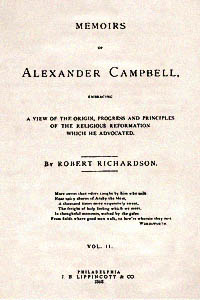
Robert Richardson (1806-1876) Memoirs of Alexander Campbell (1st ed. Philadelphia: J.B. Lippincott, 1868) (2nd ed. Cincinnati: R.W. Carrol & Co., 1872) |
|
"What is Mormonism?" | Hist. of Disciples on West. Res. (1875) | Life of Walter Scott (1874)
|
MEMOIRS OF ALEXANDER CAMPBELL EMBRACING A VIEW OF THE ORIGIN, PROGRESS AND PRINCIPLES OF THE RELIGIOUS REFORMATION WHICH HE ADVOCATED. BY ROBERT RICHARDSON. Near spicy shores of Araby the blest. A thousand times more exquisitely sweet, The freight of holy feelings which we meet, In thoughtful moments, wafted by the gales From fields where good men walk, or bow'rs wherein they rest. WORDSWORTH. VOL. II. P H I L A D E L P H I A J. B. LIPPINCOTT & CO. 1868. |
|
[Vol. 1, p. 480]
"Met agreeably to adjournment. "5. The meeting was opened by singing and prayer, by brother John Patton. "6. Appointed brother Luce, moderator, and brother Wheeler, clerk. "7. A letter was presented by brother T. Campbell, from a number of baptized professors in the city of Pittsburg, requesting union as a church to this Association. "8. Voted, that as this letter is not presented according to the constitution of this Association, the request cannot be granted. "9. Voted, that brother T. Campbell be invited to take a seat in this Association. "10. Voted, that a committee be appointed to wait on the persons mentioned in the seventh article, to investigate the subject of their letter. Brethren D. Philips, Luce and Pritchard are the committee to attend in Pittsburg, on the Saturday preceding the first Lord's day in November. "11. The circular letter prepared by brother T. Campbell was read and accepted without amendment." Thus it appears that the few members who had been gathered together in Pittsburg by Thomas Campbell, and who were accustomed to meet regularly for worship in his school-room on Liberty street, were denied admission as a church because their letter was "not presented according to the constitution of the Association," CIRCULAR LETTER BY T. CAMPBELL. 481 which required a creed or statement of articles of belief from every church, and could not accept in place of it a simple declaration of adherence to the Scriptures. Nevertheless, a committee was appointed to investigate the subject of their letter, or, as was doubtless intended, to bring these simple disciples into regular Baptist "order." From the table of names of churches, etc., composing the Association, it seems that besides those associated with Thomas Campbell in Pittsburg, there was at this time a little society of eight members there, represented by B. B. Newton, as messenger, who, having furnished the required written statement of belief, had been received without difficulty. It appears, further, that Thomas Campbell presented, on this occasion, the circular letter which he had been appointed to prepare at the meeting the year before. The subject given to him was the "TRINITY," upon which the Baptist preachers were very anxious to elicit the views entertained by the reformers. This circular letter, it seems, was so entirely satisfactory that even the keen vision of the most orthodox enemies in the Association could find no ground of objection, and it was accordingly accepted, we are told, "without amendment," and printed at the close of the minutes as the letter of the Association. In it, this profound subject is treated in a highly interesting manner, and mainly in the simple and express terms of Scripture. In condescension, however; probably to the modes of thought and speech current amongst the party with which he was now associated, the author employs some of the terms of scholastic divinity, such as essence, triune and person, but the word "Trinity" does not once occur in the document. The use of such terms was not in harmony with the principle of the Reformation, which 482 MEMOIRS OF ALEXANDER CAMPBELL. required that Bible things should be spoken of in Bible words -- not in "the words that man's wisdom teacheth," but in those which the Holy Spirit has employed. Under the circumstances, however, it gives evidence of a remarkable advance toward soundness of speech on the part of one long accustomed to the language of the schools, and who now addressed a people to whom its terms would have been much more familiar, and doubtless much more acceptable, than those employed in Holy Writ. This letter, also, in its general style and tone, furnishes a marked contrast with the spirit of the "Sermon on the Law" -- a contrast indicative of that which existed in the characters of their respective authors. The father, full of affectionate sympathy and over-sensitive in regard to the feelings of others, could not bear to inflict the slightest pain, and would rather withhold than confer a benefit which could be imparted only by wounding the recipient. The son, with more mastery of his emotional nature, could calmly contemplate the entire case, and, for the accomplishment of higher good, could resolutely inflict a temporary suffering. The former was cautious, forbearing, apologetic; the latter, decided, prompt and critical. The one displayed the gentle spirit of Melancthon, the other the adventurous boldness of Farel and the uncompromising spirit of Knox. Both were alike anxious to promote the great interests of humanity; but while the father relied perhaps too much upon emollients to remedy the spreading cancer of sectarianism, the son, with less reverence for consecrated errors, but equal love for men and greater sagacity and skill, preferred the knife of the surgeon. Both were equally desirous of winning men away from the idols of religious bigotry, but while the one sought SUBJECT OF THE TRINITY. 483 to persuade with gentle words, the other would seize with powerful grasp the image at the shrine, and break it in pieces before the eyes of its worshipers. The different methods which each thus employed had doubtless their advantages, and their union tended to effect greater good than could have been produced by either singly. It is certain, however, as formerly intimated, that had it not been for the bold assaults, the incisive logic and the determined spirit of the son, the reformatory movement initiated by the father would speedily have disappeared from view, as the wave created in the river by the passing steamer quickly subsides into the general current. As the circular letter above referred to presents the views of both upon the most profound subject in the Bible, as it forms a part of the history of the times and of the persons described, and illustrates how entirely sufficient the Scriptures themselves are for the elucidation of the most difficult questions, so far as these can be at all comprehended by the human mind, it deserves to be rescued from the oblivion which would soon engulf the few remaining copies. It will therefore be found in the Appendix to the present volume. (pages 482-538 not copied)
[ 539 ]
The Redstone Baptist Association, held at Cross Creek, Brooke county (Virginia), August 30, 31, and September 1, 1816, to the Churches they represent, with grace, mercy, and peace: BRETHREN: The revelation of himself, with which God has been graciously pleased to favor any portion of his rational creatures, must necessarily constitute the leading and all-important subject of their attention, a true knowledge of God being the only foundation of all true religion and morality, and, of course, of all rational perfection and blessedness. Now, the means by which this fundamental and all-important knowledge is communicated are his works and word. "The heavens declare the glory of the Lord;" the earth also with its various productions and inhabitants: but especially that inestimable treasury, his word, in which not only the most glorious and important of all his works is recorded, but that which of all others is the most interesting to us; in this respect, "he has magnified his word above all his name," or above every other revelation which he has made of himself to us. It not only furnishes us with an instructive comment upon the visible creation, in calling our attention to the various and manifold glories of God therein displayed; but also acquaints us with the superior and invisible glories of the sublimer parts of the creation, of which otherwise we should have had no information at all. Moreover, it acquaints us with his moral character as the great King, Lawgiver and Judge of his rational creatures, by exhibiting the statutes of his kingdom, the principles of his government, and of his judicial proceedings both toward angels and men: and which, in the whole compass of what it presents to our thoughts, upon those very interesting, and important subjects, suggests nothing but what is perfectly consistent with the impressions which the august and glorious works of the visible creation are calculated to produce; and leads us still farther into the 540 APPENDIX. deep things of the unsearchable God, by declaring unto us his great name, Jehovah Alehim, which no work, attribute or perfection, known or knowable to us, by any other external means could have possibly revealed. This revelation, therefore, of the unsearchable nature of God, is peculiar to that express declaration, which God has been graciously pleased to make of himself to us in the Holy Scriptures, when the occasion required: that is, when it became necessary to our relief, and to the display of the divine glory in our salvation, so to do. For when the fullness of time was come, God sent forth his Son into the world, made of a woman, made under the law, to redeem the guilty from the curse of the law. For God so loved the world, that he gave his only begotten Son for the life of the world. But what is his name; or what is his Son's name, if thou canst tell?--Who by searching can find out God? Who can find out the Almighty unto perfection, is a divine challenge addressed to the vain pride, the presumptuous inquisitiveness of self-ignorant, self-conceited, haughty, aspiring man. Vain man would be wise, "above what is written:" but the sublime and absolute declaration which God makes of himself to his most distinguished servant Moses, when authorizing him to become the deliverer of his chosen people, saying, "I am that I am," prostrates for ever all presumptuous inquiry, removes to an infinite distance all created comprehension, as utterly incompetent to the subject, and intensely prohibits the vain presumption of comprehending the Almighty. What his word and works declare of his being and perfections, it is our province and our privilege to know and acknowledge, to his glory and our own edification and comfort. By his word, then, we learn that the divine name comprehends in it a plurality. "Alehim said, let us make man in our image, after our likeness." Again, "Jehovah Alehim said, behold the man is become like one of us." Yet he speaks of himself as one: "In the image of God created he him; male and female created he them." Also, where he assumes a plural name, he at the same time uses a singular verb and pronoun; suggesting in the very same phrase the idea of plurality in unity: "Hear, O Israel, Jehovah Alehim is one Jehovah." And, indeed, were not this the very thing intended in the forms of speech alluded to, which are very numerous, they would be quite unmeaning; and the forecited declaration, Deut. vi. 4, would be absolutely unintelligible. But the clear, blissful and satisfactory revelation of this great mystery is reserved for the New Testament dispensation: For "no man hath seen God at any time (so as to have an immediate or intuitive knowledge of him): the only begotten Son, who is in the bosom (or into the secrets) of the Father, he hath revealed him;" so that "No man knoweth the Father, but the Son, and he to whomsoever the Son will reveal him." It is only in those last APPENDIX. 541 days that God hath spoken unto us by his Son, in a clear, distinct and certain manifestation of him to the world; "declared to be the Son of God, with power according to the Spirit of holiness, by his resurrection from the dead;" who is the image of the invisible God, the Father, the brightness of his glory, the express image of his person, or character of his subsistence; by whom also he made the worlds, or all the various orders of rational intelligences that anywhere exist; "for without him was not anything made that was made; all things were created by him and for him; and he is before all things, and by him all things consist, or stand forth together; who upholdeth all things by the word of his power." Now, most surely, he that made, erected, or built and upholdeth all things, is God--is a distinct intelligent agent or subsistence in Jehovah Alehim, which is one Jehovah. But moreover, from the same authentic source of divine information, we also learn that there exists another distinct intelligent agent or subsistence in the One Jehovah, who is distinguished to us by the name Spirit of God; Spirit of Jehovah, or the Spirit Jehovah; the Holy Spirit, or Spirit of Holiness; the Eternal Spirit; which was also in the beginning, or when time and things began to exist; who was also an agent in the creation; who with a preparatory energetic influence, as the author of life and motion, acted upon the original chaos brooded or hovered upon the face of the waters; who also garnished the heavens; who formed the human nature of Christ in the womb of the Virgin; who perfectly comprehends all the deep things of God. The author of all holy inspiration, who spake by the prophets, and who in the Old Testament is called Jehovah, a name peculiar to the Alehim, whose name alone is Jehovah; and who is therefore properly called God, as comprehended in the Alehim, to whose immediate agency is peculiarly ascribed all miraculous powers and effects, even to the resurrection of the dead; as also all spiritual and intellectual endowments; hence he is called the Spirit of Wisdom and Revelation, of knowledge and of the fear of the Lord, the Spirit of counsel and of might, of power, and of love, and of a sound mind. The one Spirit who distributeth to every one severally as he will. In fine, all divine works, whether of creation, sustentation, gubernation, resurrection or judgment, are ascribed to the Father, Son, and Holy Spirit; neither is there any other divine agent revealed to us in the Holy Scriptures, as comprehended in the One Jehovah; or to whom any part of the works or worship peculiar to God is ascribed, but only to the sacred three above mentioned; even our Alehim, whose name alone is Jehovah; and into whose name alone we are baptized. Therefore we believe, and are sure, that these three are the one only living and true God. 542 APPENDIX. To us, then, who hold the Christian faith, there is but one God; the Father, of whom are all things and we to him; and one Lord Jesus Christ, by whom are all things and we by him; and one Spirit who worketh all things, who inspires, animates and replenishes the whole body of Christ; dividing to every man severally as he will. And these three are one; even the one Jehovah Alehim, who claims all religious worship and obedience as his proper due, to the exclusion of all other claimants or pretenders whatsoever; who will not give his glory to another, nor his praise to graven images--the infinitely holy, just and jealous God. It appears to be a query with some who profess to hold this doctrine, whether it be correct to use the term person when speaking of the above distinct characters in the divine essence. As to this, let every man be fully persuaded in his own mind. In the mean time, all that we pretend to say in favor of this application of the term is, that although the term person (which, in relation to men, signifies a distinct intelligent agency or rational being, coexisting with others in the same common nature), is not manifestly applied in the Holy Scriptures to any of the Sacred Three: nor indeed can be so applied in strict propriety, according to its literal and obvious acceptation; for when applied to God, instead of meaning a distinct intelligent being coexisting with others in the same common nature, we must mean by it, if we think and speak correctly, one and the self-same individual being so existing as to constitute in and to itself so many distinct or different, real and relative characters, or subsistences, each of which is but another name for the self-same individual essence or being considered as existing in the specified relation of Father, Son and Holy Spirit. Yet seeing the Scriptures manifestly declare that the one Jehovah exists in three distinct intelligent agents, each of which is the one Jehovah so existing, for there is but one such being; and seeing that the personal pronouns, I, thou, he, we, us, are assumed and used in the Holy Scriptures, by, or in relation to, each or all of the divine characters; therefore, keeping in view the essential and indivisible unity of the divine nature, we think that we speak intelligibly and consistently with sacred truth, when we thus use the term person; and we presume, when taken in this sense, it will apply to the divine characters with as strict propriety as almost any other term in human language that is applied to God; for it must be granted, that in but few instances, if [in] any, human language will strictly and properly apply to the divine nature; therefore, when so applied, it must, for the most part, be used in a figurative and analogous sense. Again, it is a query with others, who profess to hold this doctrine, whether the relative terms Father, Son and Spirit, be real or economical. To this we would reply, that if we allow the Holy Scriptures to APPENDIX. 543 speak at all intelligibly upon this most profound and sacred subject, we must understand the above appellation as declarative of real internal essential relations, independent of any external work or economy whatever. For if the terms Father, Son and Spirit, be not declarative of real or essential relations, that is, of relations that have their foundation in the divine nature, and essentially or necessarily belong to it as such, the Scriptures do not reveal to us three distinct characters so related; but three distinct independent divinities or Gods, necessarily self-existent, and absolutely independent of each other; each and every one of them possessing the self-same properties, and of course, each of them so exactly the same in all respects, as to be absolutely undistinguishable one from another, by any means, property or attribute whatsoever; and, of course, three eternal self-existent independent coexistent Gods; each of them infinitely complete or perfect in and of himself, as possessing every possible perfection of being. A supposition this, not less repugnant to our reason than to the most express and unequivocal declarations of Holy Scripture, for the divine characters are constantly represented as coexisting in the most intimate and inseparable unity of essential relationship one with another, and as having the most entire, inexclusive and all-comprehensive interest in each other, as their correlative names most evidently and incontestably declare. Accordingly the Father saith, "This is my well-beloved Son, in whom I am well pleased." The Son saith, "I am in the Father and the Father in me;" "I and my Father are one;" "My Father worketh hitherto and I work;" "Whatsoever things the Father doth, the same also doth the Son likewise;" "All that the Father hath are mine." And of the Spirit he saith, "Who proceedeth from the Father;" "Whom I will send unto you;" "He shall take of the things that are mine, and shall show them unto you;" "He shall not speak of himself, but whatsoever he shall hear, that shall he speak, and he will show you things to come;" "For the Spirit searcheth all things, yea the deep things of God. For as no man knoweth the things of a man, save the Spirit of a man which is in him, even so the things of God knoweth no man, but the Spirit of God;" "He hath revealed them unto us by his Spirit;" "They that are after the Spirit do mind the things of the Spirit." Again, "There are diversities of gifts, but the same Spirit; and there are diversities of administrations, but the same Lord; and there are diversities of operations, but it is the same God which worketh all in all." From these, and a multiplicity of declarations that might be educed from the Holy Scriptures, it evidently appears, that so far from being separate independent beings, the sacred three are intimately united amongst themselves in an order and manner of subsistence and 544 APPENDIX. operation of which we can form no distinct, much less adequate idea; but so it is revealed to us by him, whose sole prerogative it is to know and reveal himself. Moreover, if the above doctrine were not really true, there could be no such thing, as the economy of salvation, wherein one divine character is sent by and from another to redeem, and another divine character sent by and from both, to apply that redemption; for where there is no mutual essential relation, there can be no relative subordination; such as naturally and necessarily subsists between Father and Son, and of course no mission of the one from and by the other, as is manifestly the case in the economy of salvation; "For the Father sent his Son to be the Saviour of the world. He so loved the world that he gave his only begotten Son for the life of the world." Again, if the person sent, however highly exalted in relative dignity, were not more than a creature, there would still remain an infinite distance between him and the Deity, so that he could neither bring himself, nor any one else, nearer to God than his or their nature and circumstances had already placed them; for he could properly or in strict justice merit nothing at the hand of his Creator, Preserver and Proprietor, either for himself or others; everything that he could possibly do in obedience to the divine will, being in strict justice due by him, on his own account, to the sovereign Lord of all, in whom it is an act of condescension to accept or acknowledge the service or worship of men or angels. Therefore, upon principles of reason and justice, as well as according to the most obvious declarations of Holy Scripture, the Redeemer of a lost world can be no other than the Creator and Proprietor of it; of whom it can be truly said, that all things were created by him and for him; that he is before all things, and that by him all things consist. "God is known by his works." "Among the gods there is none like unto thee, O Lord; neither are there any works like unto thy works," Ps. lxxxvi. 8. "He that built all things is God." The work of redemption, therefore, manifests the Author to be a divine character, as being manifestly a divine work. But if this same divine character did not really stand related to another divine character, who had not only an equal property with him in all things, but at the same time such an interest in him as that he also should be, in a certain sense, his property, though not his creature, he could neither be sent by him as the greatest possible instance of his love to a guilty world; nor yet would there be another, who by virtue of absolute independent dignity and supremacy possessed such an entire, original, independent right and property in all things, as to be justly qualified and entitled to support the dignity of the supreme claimant; to whom every act of obedience or worship might justly and properly revert, to the glory of the divine nature, and to APPENDIX. 545 the entire satisfaction of all concerned, that is to say, of the Son and Spirit, and of the whole rational creation. So that while the Son actually submitted to a state infinitely beneath his essential dignity, that he might become like one of us, both as to our state and nature (the pollution of sin only excepted), and of course, resigned for a time, and in consequence of this relation, things equal to his essential dignity; there was another into whose hands and to whose glory he could make the surrender; who, as was said above, by virtue of his supreme dignity and dominion, as also of paternal superiority, was duly qualified with every essential qualification to claim and support all the honors of Deity, and ultimately to do justice to all concerned; namely, to himself and to his Son, to his redeemed, and to the obsequious angels, who worshiped their Lord Creator in the manger, in the wilderness, in the garden, and in the tomb. Thus we see that God is not only known by his works; but also in this last great work of redemption, the deep things of God are so clearly manifested, that every rational, intelligent mind that receives the discovery of it is necessarily gratified and delighted with the rationality and beautiful consistency of this work, with the revelation which God has been graciously pleased to make of himself in relation to it. Upon the whole, by means of this revelation, we clearly and evidently perceive, 1st. That there are three distinct intelligent agents, subsistencies, or personal characters, in one Jehovah our Alehim--the Father, the Word or Son, and the Holy Spirit, mutually, reciprocally, essentially and inseparably related; so that the one naturally and necessarily infers and supposes the other, as Father and Son; and as the Spirit of the Father and the Son, or as the Spirit of Alehim, which latter word being the plural in the Hebrew (a language that has a dual number) must necessarily imply three at least; and we know certainly by subsequent revelation, that it implies no more; wherefore the Spirit Alehim or of Alehim, must necessarily be the Spirit of the Father and the Son. The same thing also is necessarily implied when he is called the Spirit of Jehovah. 2. That in the exercise of one and the same divine energy or efficient will, they are inseparable operators in every work; for the Father created all things by his Son, but not without the influence and operation of the Spirit; for God said, that is Alehim said, "Let us make man in our own image, after our likeness;" "the Spirit of Jehovah hath made me," said Job, "and the breath or spiration of the Almighty hath given me life"--"by his Spirit he garnished the heavens." Again, "The Father that dwelleth in me, he doeth the works." "My Father worketh hitherto and I work." "If I by the Spirit of God cast out devils," etc. Thus the Father worketh in and by the Son, and the Son by the Spirit; so that there is one operation 546 APPENDIX. of Father, Son and Spirit, in every work; not indeed a co-operation as of conjoint and coequal workers; but rather a succession, or process of successive and subordinate operation, not in respect of time but of order; for the Son can do nothing of himself but from the Father; also the Spirit can do nothing of himself but from the Son; for whatsoever things the Spirit doth, the Father and the Son do by him. Wherefore the Spirit works from the Father by the Son; for every purpose, act or volition is, primarily and originally, in the Father; derivatively and by essential participation, the same in the Son; next and mediately by or through the Son, the same in the Spirit, and at the very same instant, being one and the self-same act or volition in each of the divine characters; but, as to the external effect, brought forth or accomplished by the immediate efficiency of the Spirit; who is therefore called the Power of the Highest, and the Finger of God. "If I with the Finger of God cast out devils," etc. 3. That the divine characters, the Father, the Son and the Holy Spirit coexist under such relations as not only necessarily suppose and declare their essential unity, but also, with equal evidence and perspicuity, demonstrate a relative subordination according to the manner and order of their subsistence and operation. For the Son saith, "My Father is greater than I" -- greater than all. "Neither is he that is sent greater than he that sent him." Which necessarily implies that in some respect he is inferior to him. And of the Father only it is said, that he is "the only true God," as possessing absolutely and independently, in and of himself, all the perfections of Deity, of which also the Son and Spirit necessarily partake in and with him, because they are his Son and Spirit, and therefore necessarily partake with him in the self-same individual nature or essence; though inferior to him in the manner and order of their subsistence and operation; as deriving their subsistence from him, and subordinate in their operations to him; for the Son can do nothing of himself; neither doth the Spirit speak of himself, as the prime original and originating principle of the counsels and work which he reveals and exhibits. But the Father, by his only-begotten Son, the brightness of his glory and the character of his subsistence, or express image of his person, made the worlds; and by his Spirit he garnished the heavens, or replenished the visible creation with glory and beauty; also by his Spirit, the Son reveals to us from the Father the purposes and counsels of his unsearchable wisdom and will, even the deep things of God. "The revelation of Jesus Christ which God gave unto him, to show unto his servants the things that must shortly come to pass: and he sent and signified it by his angel unto his servant John," and immediately, saith he, "I was in the Spirit." Thus we conceive, the Father to be the first and leading distinction, subsistence APPENDIX. 547 or character in the divine nature, the very origin of all will, purpose and operation, which are in and by the Son determined to an actual execution; and in due order and succession, according to the divine purpose, actually accomplished by the Holy Spirit; so that the same will, power and purpose of the Father is in the Son, and in the Holy Ghost, who divideth to every one severally as he will; or who communicates and dispenses to all created beings, whatever degree, excellency or perfection of being they possess. So that, while according to the manner and order of subsistence and operation, the Son is of the Father, and the Holy Ghost of both, by an essential physical influence peculiar to the divine nature, which we pretend not to comprehend, much less to explain, they remain simply and essentially one in nature, will and operation; so that there is but one simple, indivisible and undivided nature, will and operation of God throughout the vast immensity of his works. "Hear, O Israel, Jehovah our Alehim is one Jehovah." 4. Furthermore, from the same source it is evident that each of the divine characters has a power and a glory peculiar to himself, by which they are distinguishable both amongst themselves and to the creatures. It is the glory of the Father to be the first or leading character in the divine nature, the very source and origin of the subordinate distinctions in that nature, and of every external work; it is the glory of the Son to be the second character or distinction in the divine nature, even the express character of the Father's subsistence, in whom every purpose and work comes to be determined to an actual execution, ready to be exhibited or brought forth into actual accomplishment: thus it is written, "According to the eternal purpose which he purposed in Christ Jesus our Lord, that in the dispensation of the fullness of times he might gather together in one head all things in Christ." It is the glory of the Holy Spirit to be essentially conscious of all those designs, counsels and purposes, perfectly to comprehend them all, and to exhibit them in their proper times by an actual accomplishment. Again, it is the peculiar glory of the Father to have such a Son: it is the glory of the Son to be the very essential and only-begotten Son of such a Father; to be the brightness of his glory, the very or express image of his subsistence: it is the glory of the Holy Spirit to be the Spirit of Jehovah; the animating principle of creation. "The Spirit or Spiration of the Almighty hath given me life." "It is the Spirit that quickeneth;" yea, it is his peculiar glory to be the immediate efficient of all divine counsels and purposes, so as to give actual birth and being to all the mighty and wonderful works of God. Lastly, it is the glory of the Father to be the ultimate object of all rational worship and adoration; it is the glory of the Son to reveal the Father, and to be the instructive and glorious 548 APPENDIX. medium of all rational worship and adoration addressed to the only true God; it is the glory of the Holy Spirit to prepare, capacitate and qualify rational subjects for these exalted blissful exercises, by filling them with the light of the knowledge of the glory of God in the face of Jesus Christ, thus exciting and leading them to all holy adoration. So we see, that there is one glory of the Father, another glory of the Son, and another of the Holy Ghost: also that to worship acceptably, we must worship the Father through the Son by the Spirit, to whose immediate agency we are directed to look for all holy dispositions and intellectual abilities, to know, to love and adore both the Father and the Son, according to their proper character; also, to love, reverence and adore himself as the immediate author of life and light in us. Wherefore we cheerfully and heartily, gratefully and gladly say, "Glory be to the Father, and to the Son, and to the Holy Ghost." To the one Jehovah our Alehim, our Creator, who in the beginning said, "Let us make man in our image, after our likeness;" and who also said, let us redeem and restore guilty, apostate, rebellious man, to the enjoyment of our justly lost and forfeited image, favor and fellowship; in consequence of which grace, when all things shall be restored to their original state of due subordination and dutiful subjection to their Almighty Author, the three-one God in Christ, who will thenceforth be the fixed centre and adequate medium of the exhibition and fruition of the divine glory, will be the ultimate object of the undivided praises of the whole rational creation of holy intelligences, world without end; "For the Lord God and the Lamb will be the temple and light thereof." Thus, in the direct and refulgent light of that special revelation which God has been graciously pleased to make of himself to us, we clearly and evidently perceive, not only what God is in and to his creatures; but also what he is in and to himself, as the self-existent, self-sufficient, independent God, infinitely, eternally and unchangeably sufficient to himself; as being the centre, the foundation and fruition of all blessedness and glory in and of himself; perfectly known, comprehended and enjoyed by himself, in the mutual and reciprocal loves, delights and complacencies of a triune Jehovah. The Father delighting in the Son, and the Son in the Father, and the Holy Spirit equally delighting in, and delighted in, by both. "The Lord or Jehovah possessed me," says the Logos (or Wisdom)" in the beginning of his ways, before his works of old. I was set up from everlasting, from the beginning, or ever the earth was. Then was I by him, as one brought up with him. I was daily his delight, rejoicing always before him, rejoicing in the habitable parts of his earth, and my delights were with the sons of men." "And now, O Father, glorify thou me with thine ownself, with the glory that I had with thee APPENDIX. 549 before the world was." "Known unto God are all his works from the foundation of the world." By this light of the knowledge of the being, blessedness and glory of God, with which he has favored us, we are enabled to detect and avoid the many dangerous errors which are afloat in the world. In opposition to which, we state and infer as follows: 1st. That it is demonstrably evident from what the Holy Scriptures declare concerning Jehovah our Alehim, that those who maintain, that as there is but one divine being or essence, so there is but one divine agent or active intelligence existing in that essence, not only reject the testimony which God has given of himself; but that they do also at the same time reject the very foundation of the Christian religion which depends upon the truth of that testimony. And the same holding the foresaid opinion, seem willing to be thought Christians by accommodating their notion of the Supreme Being to the Christian phraseology, supposing the names Father, Son and Spirit only to mean so many distinct official attributes in relation to the different capacities in which God is pleased to act toward his creatures in the economy of salvation; yet nothing can be more inconsistent with the most express testimony of the Holy Scriptures; for it is most expressly declared that the Father sent the Son; that he came forth from the Father; that he returned to the Father, and that when he should depart, he would send, and actually did send his disciples another Comforter from the Father, even the Spirit of Truth, to instruct and lead them into all truth; and to "convince the world of sin, of righteousness, and of judgment" by their ministry. 2d. That those who deny the essential sonship of the Word or Logos, as not being the essential and only-begotten Son of the Father; or the essential derivation of the Spirit from both, as to his subsistence and official character; though they profess to believe, and do acknowledge that there are three distinct intelligent agents, or subsistencies in the one Jehovah; yet they do, nevertheless, virtually and necessarily acknowledge three Gods. 3d. So likewise do all those, who, though they profess to believe the doctrine of the essential relations of the sacred three, declared in the Holy Scriptures, yet deny the relative and necessary subordination of the Son and Spirit, as therein revealed; declaring that, distinctly and separately considered, they are equal to the Father in underived and independent power and glory. Whereas, according to the expressions of a very ancient creed, it appears from the Holy Scriptures, "that the Father is of none, neither made nor created, nor begotten; the Son is of the Father alone, neither made nor created but begotten; the Holy Ghost is of the Father and the Son, neither made, nor created, nor begotten, but proceeding." So that, 550 APPENDIX. distinctly considered, they are not equal in respect of underived subsistence, power and glory. Thus they are essentially one, even the one Jehovah, and essentially equal in that respect. Wherefore, it is evident that there is one glory of, or peculiar to the Father, another peculiar to the Son, and another to the Holy Ghost, as above declared. Indeed, were not this evidently the case, there would most certainly be, not three relative subsistencies in the one Jehovah characteristically distinct, but three Jehovahs; or three self-existent, independent and eternal Gods. 4th. That he that receiveth not this doctrine, as it is now revealed, hath not the true God. For whosoever denieth the Son, the same hath not the Father; and consequently he that denieth the Holy Spirit, rejecteth both the Father and the Son; for he is essentially the Spirit of them both; the one Spirit that is and works by and from them both, in all external operations; Jehovah working by his Spirit in the hearts of his people, both to will and to do of his good pleasure, according to his promise, Ezek. xxxvi. 27. Now, as the sacred name Jehovah manifestly includes the Father, Son and Spirit, when Jehovah says, "I will put my Spirit within you;" it is manifestly declared, that the Father and the Son send the Spirit, and work by him in the hearts of this people intended in the promise. As for the objections and difficulties that have been suggested in opposition to the above doctrine, or the attempts that have been made to obviate them by illustrations and explanations of what is not revealed concerning it, Christians have nothing to do with such things. "The secret things belong unto the Lord our God; but those things which are revealed, belong unto us and to our children for ever, that we may do all the words of this Law," Deut. xxix. 29. That we may "honor the Son even as we honor the Father." That we may believe, worship and obey a three-one God, into whose blessed and glorious Name we have been baptized. Wherefore, we conceive that we have nothing to do with the definitions and disputes which have originated about the eternal generation of the Son, and procession of the Holy Ghost; nor yet with that semi-Arian doctrine about the pre-existence of the human soul of the Redeemer, before the creation of the world; nor with any such vain speculations. We believe that, whatever God is, the same he always was and ever will be during all duration, world without end, as his peculiar and incommunicable name, Jehovah, manifestly declares. To all those, then, that object to the above doctrine, as unintelligible, irrational, and the like, our only reply is, has God so revealed himself to us in the Holy Scriptures? If so, let God be true; but, in our estimation, every man that opposes his word, a liar. In the mean time, as a solid reply to all such cavils, we assert with the evidence of demonstration, that the APPENDIX. 551 divine essence is as incomprehensible as the manner of the divine existence, or that the natural and essential attributes of Jehovah are as much above, or, if you will admit the expression, as contrary to our reason, as anything contained in the above doctrine. Is it asked, how can one and the self-same indivisible and undivided essence exist in three distinct personal characters? We might as justly ask in reply, how can the divine essence exist at all? or how can there be any such thing as an eternal self-existent being? Again, is it asked how the Divine Being can exist in and to itself, under a threefold relation; or, how one and the self-same being can exist in three distinct intelligent subsistencies or personal characters, each of them still continuing to be the self-same individual Being, actually three, yet severally one? We might, with equal propriety, ask, how something can be produced from nothing? how dead matter can be animated? or how the Almighty could produce, out of mere nonentity, empty nothing, a universe of animate, sensitive and rational beings of the multitude and magnitude of which we can form no conception at all? Is it farther queried, how could the Father bring forth or exhibit his Son in human nature, or how could divinity and humanity be so united as to constitute but one individual person? We might as rationally query, how can soul and body, matter and mind be so united as to make but one individual being or person? Again, if it be asked, how can the Father, Son and Spirit be distinct intelligent agents, and yet be so united in every work, that one and the self-same work should, in every instance, be equally the work of each? We might as reasonably ask, how can Jehovah fill heaven and earth; yea, the vast immensity of the universe, so as to be really and actually present in every place, or with every creature at all times; and yet have no relation either to time or place? or, how he could so perfectly know every thought, word and action; every state, condition and circumstance of the countless millions of his rational creatures, before they had a being, that he can receive no new information from or concerning them for ever? Yet, all those things we must certainly believe concerning the Divine Being, existence, operations, knowledge, etc., etc., upon the evidence which God has afforded us, without being able to account for any of them, or at all to show how they are or can be. Now, when these and a thousand other queries respecting God and his works, which might be suggested, are satisfactorily solved, we suppose there will then remain no difficulty in relation to the doctrine under consideration. In the mean time, let us reason, believe and act consistently. Let us not reject anything that is revealed because we cannot comprehend it or conceive how it is, while we profess to hold other things, which we must acknowledge to be equally incomprehensible. 552 APPENDIX. Upon the whole, we conclude, that as Christians and rational creatures, we have to do with the divine testimony and works; that what these clearly exhibit to our understandings concerning God, it is our duty and privilege to know and acknowledge; and that for the most part, these resolve themselves into certain truths or facts; which, when perceived and admitted, become to us principles of rational, moral and religious action; and, as such, influence our conduct, in relation both to God, ourselves and our neighbors; and thus designate our characters. That, therefore, it is not so much, if at all, with the HOW that we have to do, as with the WHAT. Thus, what is God; or what has he declared concerning himself? and not how can he be such? Again -- What has God done? What is he doing? What will he do? What would he have us to do? What is our actual condition before him? Must we be born of water and of the Spirit, in order to become the subjects of his kingdom. Will there indeed be a resurrection of the dead, both of the just and unjust; and hath God in very deed, appointed a day in which he will judge the world in righteousness, by that man whom he hath ordained? These, and such like inquiries concerning all that we should know, believe and practice, are highly interesting to us. Not so the inquiry, How can these things, be? as was said by some, "How shall the dead be raised, and with what body shall they come?" "How can a man be born when he is old?" etc., etc. The curious would do well to read, for their reproof and instruction in righteousness, the answers originally given to those foolish and impertinent inquiries. We conclude with observing, in reference to the subject of this letter, that the discovery which God has made of himself to us in the economy of salvation is quite consistent with our natural notion of the divine blessedness. It is the common impression of mankind, that God is the happiest of all beings; yea, that he is superlatively so. Accordingly, he is revealed to us, not as a solitary, unknown and unknowable being, destitute of the enjoyment of equal and adequate society--a privilege this, which seems so essential to rational satisfaction and blessedness, that, comparatively, we can conceive of but little or no satisfaction or happiness where this is not the case; and that the more perfect the being, the greater the privation; as was evidently the case with Adam, in his paradisiacal state, before God provided a companion, an help meet for him. But according to the revelation which we have of God, he never existed in such a desolate solitary condition; and we are sure that if he had, creation could never have furnished him with a suitable companion. Is he not infinitely more exalted above the most exalted creature than that creature is above nothing? If so, he must find his society in himself: APPENDIX. 553 accordingly, it is written, "In the beginning, God said, Let us make man in our image." "Then was I by him as one brought up with him," saith the Logos, "I was daily his delight, rejoicing always before him." "And now, O Father, glorify thou me with thine own self, with the glory I had with thee before the world was." Again, "Awake, O sword, against my shepherd, against the man that is my fellow, saith the Lord of Hosts." "No man knoweth who the Son is, but the Father; neither knoweth any man who the Father is, but the Son;" also "the things of God knoweth no man but the Spirit of God; for the Spirit searcheth all things, yea the deep things of God." Thus the Divinity is revealed to us as possessing in itself such a plenitude of self-sufficiency -- such a perfection of blessedness as to admit of no accession, no addition, as eternally existing in the reciprocation of infinite and ineffable delights. Now, does not this appear to be the peculiar glory, yea, the consummative perfection of the divine nature, to contain within itself such a fullness and blessedness -- by virtue of which, God was essentially, independently and eternally glorified and enjoyed in and by himself before the world was; comprehending and comprehended, loving and beloved in a degree and manner suitable to himself, that is, to an infinite degree, adequate to his infinite perfection; which he can never be by any nature inferior to himself, how exalted soever it may be in its intellectual faculties; nor indeed by all the creatures collectively considered? "Glory be to the Father," etc., etc. "This is the true God and Eternal Life." "And these three are one." "Hear, O Israel Jehovah," etc. "Little children, keep yourselves from idols." Amen.
MATHIAS LUCE, Moderator.
CHARLES WHEELER, Clerk.
NOTE. -- Near the close of the fourth inference we have observed, that to worship God acceptably, that is, according to the spirit and tenor of the gospel dispensation, under which we live, we must worship the Father through the Son, by the Spirit. In relation to this we should further observe, that although this way of approaching God affords us the most complete view of the principle, the manner, and ultimate object of gospel worship, which is the Father, through the Son, by the Spirit: yet, it is abundantly evident. that we are by no means restricted to this precise form of address in every act of religious worship; for sometimes the Son himself is the only specified object of address, as in the case of Stephen, whose departing prayer was, "Lord Jesus, receive my spirit:" so that as Christians we not only worship the Father through the Son by the Spirit. but also the Son himself through the Spirit; for without the Spirit, we can worship neither the Father nor the Son. Moreover, the Father and the Son, in his mediatory character, are sometimes presented to us as 554 APPENDIX. conjoint objects of religious worship. "To him that sitteth upon the throne, and unto the Lamb," etc. Whereas the Spirit in his distinct official capacity, is nowhere presented to us as the immediate and specified object of address, though we are everywhere taught to believe in him as a divine character, and to ascribe to him immediate agency -- the entire glory of our immediate and actual salvation, as "God that dwelleth and worketh in us both to will and to do of his own good pleasure." The reason of this distinction in our worship, in relation to the divine Spirit, we humbly presume, is founded in the following considerations. 1st. That he himself being the prime efficient, the immediate exciting cause and principle of all acceptable worship and adoration in us, it would appear inconsistent with this state of the case, to call upon him to perform any part of his office in or toward us; as if we, by virtue of some inherent principle, of which he was not the immediate author, could desire his influence, or act toward him for the obtaining of that, without the possession of which we could not be supposed capable of acting at all in a spiritual manner. 2d. That supposing us excited by his influence to desire farther and higher degrees of his gracious communications, it would appear, nevertheless, inconsistent with his office and the relation in which he stands to the Father and to the Son, to suppose that he would excite and lead us to terminate our worship in himself, as if he sought his own distinct personal glory, and not the glory of those who sent him; even as the Son did not seek his own glory, but the glory of the Father which sent him--and who has also assured us, that the Spirit would act in like manner, and from the same principle from which he himself acted. "When he the Spirit of Truth is come, he will guide you into all truth; for he will not speak of himself; but whatsoever he shall hear, that will he speak. He will glorify me, for he will receive of mine and will show it unto you. All things that the Father hath are mine; therefore, said I, he will take of mine, and will show it unto you." Hence it is evident, that the proper and immediate office and work of the Holy Spirit, in the economy of salvation, is to glorify the Father and the Son; even as it is of the Son to glorify the Father and the Spirit; and of the Father to glorify the Son and Spirit; that we, through his grace, might be duly instructed, and ultimately led, to glorify and enjoy distinctly and unitedly a three-one God in a participation of the mutual, reciprocal and ineffable delights of Father, Son and Spirit, which they had in relation to our salvation before the world was. Wherefore, we conclude (that whatever invocations or forms of address, whether hymns or prayers, wherewith men have thought proper to address the Holy Spirit, not expressly contained in the Holy Scriptures, are not of the Spirit, but are innovations in the APPENDIX. 555 worship of God, and therefore ought not to be adopted) that we rightly worship the Holy Spirit, when we ascribe to him whatever the Scriptures declare concerning his character, office and work, and earnestly supplicate the Father, through the Son, or the Son himself, to send forth his Holy Spirit, to abide with us and dwell in us for ever; that we may thus be builded together for an habitation of God through the Spirit; and finally, by ascribing to him, together with the Father and the Son, the entire and undivided glory of our salvation. And that, therefore, in the mean time, we ought to reject as unscriptural, all invocations or forms of address immediately directed to the Holy Spirit, as innovations in the worship of God, who alone has a right to prescribe both the matter and manner of his own worship, even of that worship which he will be graciously pleased to accept as right and pleasing in his sight. |
|
[ 184 ]
REPUBLICAN METHODISTS. 185 (pages 185-204 not transcribed) PROVIDENTIAL GUIDINGS. 205 deed the great success of the Christian preachers in gaining converts that had awakened the churches of the Association to the importance of making an effort in that direction; for, having largely imbibed the spirit of the movement directed by Mr. Campbell, and being much occupied with their own improvement in Scripture knowledge and with questions of church order, they had neglected for some time to make proper evangelizing efforts, and were receiving, consequently, very few additions. One of the two Christian preachers present at the Association, John Secrest, was particularly noted for the large number of converts he was in the habit of reporting. The other, Joseph Gaston, was distinguished for his piety and his mild and unassuming disposition. He was a young man, tall in stature, with dark hair, a large head, broad shoulders and agreeable features, and possessed a deep, sonorous voice and great powers of exhortation. He was full of affection for men and zeal for the cause of Christ, and devoted himself with great energy to the promotion of Christian union upon the Bible. As soon as he and Walter Scott became acquainted, they formed a warm attachment for each other, and their intercourse tended to modify each other's views and modes of proceeding. Mr. Scott admired Mr. Gaston's powerful appeals to sinners. The latter, on the other hand, was attracted by Mr. Scott's warm feelings and amiable qualities, as well as profoundly impressed by his thorough knowledge of the Scriptures; and being a sincere lover of truth, he listened with interest to the clearer views of the gospel and its institutions which were presented to him. The providence which had led to the appointment of Walter Scott as an itinerant was not long in developing its meaning. Brought into immediate communication 206 MEMOIRS OF ALEXANDER CAMPBELL. with the Christian preachers, who, as remarked, were laboring with much success, he imbibed somewhat of their spirit, but he was still far from approving all their views or modes of procedure. At the same time he perceived the ineffectiveness of the course heretofore pursued by the Haldanean and other churches in the Reformation in presenting the gospel theoretically, so to speak, without making a direct and practical application of its requirements to the unconverted. There seemed to be a link wanting to connect an avowed faith in Christ with an immediate realization of the promises of the gospel. These seemed placed at an almost infinite distance from the penitent, bowed down under a sense of guilt, and longing for some certain evidence of acceptance, which he often vainly sought in the special spiritual illuminations upon which men were taught to rely. The Mahoning Association, being itself in a transition state, had prescribed to Mr. Scott no particular course whatever, simply appointing him as an evangelist "to travel and teach among the churches" partly with a view of bringing them more fully upon Reformation ground, but chiefly in order that, by means of itinerant labor and the quarterly meetings designated, their numbers might be augmented. It was his duty, therefore, to consider how the proclamation of the gospel could be rendered most effective for the conversion of sinners. This was, in view of all the circumstances, a very difficult and perplexing question. Calvinistic views still lingered to a large extent among the Mahoning churches. Election, effectual calling, theories of regeneration, still occupied the minds of many. Various satisfactory evidences of a true faith were still required before admission to baptism, which was looked upon as a means of admission into the Church -- a command to be BAPTISM FOR REMISSION OF SINS. 207 obeyed by those who were already converted. No special promises were recognized as connected with it, and it was very unusual to hear this subject presented at all, except when some one was about to be baptized. Mr. Scott, Elder Bentley and some others of the prominent preachers, were indeed aware that Mr. Campbell had spoken of it at the McCalla debate as a pledge of pardon, but in this point of view it was, as yet, contemplated only theoretically, none of them having so understood it when they were themselves baptized, and being yet unable properly and practically to realize or appreciate its importance in this respect. Hence, almost from the first moment of his appointment, Mr. Scott's mind was thrown into a state of great perplexity amidst the discordant and confused views relating to conversion. Baptism still seemed to present itself as in some way intimately connected with the personal enjoyment of the blessings of the gospel, but he was unable as yet to perceive the exact position which it occupied in relation to other requirements. About this time, Adamson Bentley went down to Braceville, with Jacob Osborne, to hold a meeting. In a discourse which he delivered on the occasion he was led to speak of baptism, and gave the views which Mr. Campbell had presented in the McCalla debate, affirming that it was designed to be a pledge of remission of sins. While they were on their way back to Warren, after meeting, Jacob Osborne said, "Well, Brother Bentley, you have christened baptism to-day." "How so?" said Mr. Bentley. "You termed it a remitting institution" "Well," rejoined Mr. Bentley, "I do not see how this conclusion is to be avoided with the Scriptures before us." "It is the truth," said Mr. Osborne, who was a great student of the Bible; "and I have for 208 MEMOIRS OF ALEXANDER CAMPBELL. some time thought that the waters of baptism must stand in the same position to us that the blood of sacrifices did to the Jews. 'The blood of bulls and of goats could never take away sins,' as Paul declares, yet when offered at the altar by the sinner he had the divine assurance that his sin was forgiven him. This blood was merely typical of the blood of Christ, the true sin-offering to which it pointed prospectively, and it seems to me that the water in baptism, which has no power in itself to wash away sins, now refers retrospectively to the purifying power of the blood of the Lamb of God." Soon afterward, meeting with Mr. Scott, they all three went down to Howland, and the discourse at Braceville and subsequent conversation being brought up, Mr. Scott fully coincided in the views expressed. In one of his discourses at Howland, Mr. Osborne again introduced the subject, and proceeded to say further that no one had the promise of the Holy Spirit until after baptism. This remark seemed to strike Mr. Scott with surprise, and after meeting he said to Mr. Osborne, "You are a man of great courage;" and turning to Mr. Bentley, he added: "Do you not think so, Brother Bentley." "Why?" said Mr. Bentley. "Because," said he, "he ventured to assert to-day that no one had a right to expect the Holy Spirit until after baptism." From this moment, Mr. Scott's mind seemed to be engrossed with the consideration of the consecutive order appropriate to the various items in the gospel, and being greatly given to analysis and arrangement, he proceeded to place them thus: 1, faith; 2, repentance; 3, baptism; 4, remission of sins; 5, Holy Spirit. This view relieved at once his previous perplexities, and the gospel, with its items thus regularly disposed, seemed to him almost like a new revelation. He felt DISCOURAGEMENTS. 209 that he had now obtained a clue which would extricate men's minds from the labyrinth in which they were involved in relation to conversion, and enable him to present the gospel in all its original simplicity. While meditating on these things, and debating with his own irresolution in regard to their presentation to the public, he met with Joseph Gaston, to whom he freely communicated his thoughts, and who, delighted with the new view of the gospel thus given, at once declared it to be the truth, and that it ought to be preached to the world. Thus encouraged, Mr. Scott determined to make the experiment; but fearing to give cause of offence to the churches who had employed him, he sent an appointment outside of the Association ground, and with considerable trepidation, but in an earnest and interesting manner, laid before the audience his analysis of the gospel, and at the close gave a formal invitation to any so disposed to come forward and be baptized for the remission of sins. No one, however, came. The effort was a failure. This, indeed, might have been anticipated. The whole community were filled with the notion that some special spiritual influence was to be exerted upon men's hearts -- that some supernatural visitation must occur before any one could be a fit subject for baptism. This spiritual operation, too, all had been taught to regard as the evidence of acceptance and pardon, and hence when they were simply invited to come directly forward and be baptized for the remission of sins, they were filled with amazement that any one should thus propose to dispense with all the usual processes to which " mourners" and penitents were subjected. Like the Syrian noble, they were offended because the usual ceremonies were not observed, and because they were 210 MEMOIRS OF ALEXANDER CAMPBELL. merely directed to "wash and be clean." None of them had ever witnessed or.heard of such a proceeding. They could find no precedent for it among all the rites and ceremonies of the religious parties, and hence, being without the authority conferred by usage, they could regard it only as an innovation. It was not therefore strange that no one ventured to comply with the invitation, and that the discourse seemed to have been preached in vain. With regard to Mr. Scott himself, however, it was by no means fruitless. He had now broken through the restraints imposed by a general but false religious sentiment. He had assumed a position which required to be maintained, and as he had now overcome the difficulties connected with the first step, he felt encouraged to proceed. More especially had his effort awakened in his own mind new trains of thought and given him wider and better views of the whole subject, so that he felt himself prepared to present it in a much more full and forcible manner. He determined, therefore, to assume the whole responsibility, and to preach boldly in the very place where he had received his appointment the sacred truths which burned within his own heart. He accordingly gave notice that he would deliver in New Lisbon a series of discourses upon the Ancient Gospel. At the time appointed there was a considerable audience, and the novel manner in which the speaker introduced his theme, along with his own obvious, intense engagedness and excitement, created no little interest and expectation. His discourse was based upon Peter's confession, Matt. xvi. 16, in connection with the same apostle's answer to the inquiry, "What shall we do?" given to the penitents on the day of Pentecost. Acts ii. 38. As the lordship and glory of Christ, the Son of MYSTERIOUS SUCCESS. 211 God, was his favorite theme, and he was, on this occasion, animated with more than usual fervor, he became most eloquent, and held the audience in a state of rapt attention as he gradually developed the power of the simple but comprehensive Christian creed -- the rock which Christ announced as the foundation on which he would build his Church; the grand proposition proved by the miracles of fulfilled prophecy, supernatural wisdom, divine love, healing power and victory over the grave, detailed by the evangelists, that men might believe, and, "believing, have life through his name." And when he went on to show how this gospel was administered in the beginning, and that believers were baptized into the name and into the death of Christ, and being thus buried with him and raised again to a new life, received in this symbolic act the remission of sins and the promised Holy Spirit, which was the seal of the Christian covenant and the earnest of an eternal inheritance, his hearers, while charmed with such a novel view of the simplicity and completeness of the gospel, were, as on the former occasion, filled with doubt and wonder and were ready to ask each other, "How can these things be?" Just as he was about closing his long discourse, and while he was exhorting the people to trust in the word of God in preference to all human systems of religion, a stranger entered the assembly, and when, a few moments afterward, the speaker closed by again quoting Peter's words and inviting any present to come forward and be baptized for the remission of sins, this stranger, to the surprise of all, at once stepped forward and presented himself. Here was a singular circumstance. This person had not been enlightened and convinced by the preacher, for he had heard only his few closing 212 MEMOIRS OF ALEXANDER CAMPBELL. remarks. Yet he came forward with all the firmness of an assured purpose, and all the tokens of intelligent apprehension, to request baptism for the remission of sins! Mr. Scott knew not what to think of it. The individual, when carefully questioned, seemed perfectly to understand the matter, just as did the preacher himself. There being, therefore, no ground for objection and no reason for delay, Mr. Scott, taking the confession of the candidate, baptized him in presence of a large concourse "for the remission of sins," thus annexing to the usual formula the words of Peter, Acts ii. 38, explanatory of the purpose of the institution. The people were filled with bewilderment at the strange truths brought to their ears, and now exemplified before their eyes in the baptism of a penitent for a purpose which now, on the 18th of November, 1827, for the first time since the primitive ages was fully and practically realized. A great excitement at once ensued; the subject was discussed everywhere through the town, and Mr. Scott, continuing daily to address increasing audiences and developing his views of the gospel in all its parts, succeeded, before the close of the meeting, in inducing in all seventeen persons to accept the primitive faith and baptism. Thus the charm was broken; the word of God had triumphed, and the veil which theology had cast over men's hearts was removed. Henceforth the Reformation, which had already restored to the Church the ancient order of things and the simplicity of the primitive faith, was enabled to make a practical application of the gospel to the conversion of the world. In reflecting upon the circumstances connected with his appointment, and the suggestions and encouragements he had providentially received, Mr. Scott could easily perceive how he had himself been led to decisions KEYS OF THE KINGDOM. 213 so important. It remained, however, still a mystery that his first two discourses should have failed to convince any one, and that at the close of the second an individual who had heard neither of them should have come forward intelligently with little more than a simple invitation. In order to clear up the matter, he thought best after some time to address a letter to the individual in question, requesting him to explain the reasons which had induced him to present himself. To this he replied as follows: "In order to show these things aright, I must go back a piece. I was at that time a member of that strait sect called Presbyterians, taught many curious things, as election, foreordination, etc.; that belief in these things was necessary ; that this faith resulted from some secret impulse ; and worse, that I could not believe; and finally, that I must hope and pray that God would have mercy upon me. In this wilderness I became wearied, turned about and came home to the book of God, took it up as if it had dropped from heaven, and read it for myself just one year. "This inquiry led me to see that God so loved the world as to give his only begotten Son, that whosoever believed on him might not perish, but have eternal life. I then inquired how I must believe. Paul said, 'Faith cometh by hearing, and hearing by the word of God.' Also, that faith was; the substance of things hoped for, the evidence of things not seen.' Peter spoke of election, saying, 'Save yourselves.' Paul said, 'I must be dead to sin and buried, and raised with Christ Jesus to newness of life.' The Saviour said, 'I must be born again if I would enter the kingdom of God.' "Now, here it was I discovered myself to stand in the garden of nature and not in the kingdom of heaven, but I learnt that of this kingdom Peter received the keys, and I was anxious to see what he would do with them. Jesus said, 'Proclaim the gospel to all nations; he that believeth and is baptized shall be saved,' etc. I then moved a little forward 214 MEMOIRS OF ALEXANDER CAMPBELL. till I found these words, 'And they were all pricked to the heart, and said to Peter and to the other apostles, Men and brethren, what shall we do? Peter said, Repent and be baptized every one of you, in the name of Jesus Christ, for the remission of sins,' etc. To this Scripture I often resorted; I saw how Peter had opened the kingdom and the door into it, but to my great disappointment I saw no man to introduce me, though I prayed much and often for it. "Now, my brother, I will answer your questions. I was baptized on the 18th of November, 1827, and will relate to you a circumstance which occurred a few days before that date. I had read the second chapter of Acts, when I expressed myself to my wife as follows: Oh this is the gospel; this is the thing we wish -- the remission of our sins ! Oh that I could hear the gospel in these same words as Peter preached it! I hope I shall some day hear it, and the first man I meet who will preach the gospel thus, with him will I go.' So, my brother, on the day you saw me come into the meeting-house my heart was open to receive the word of God, and when you cried, 'The Scripture shall no longer be a sealed book. God means what he says. Is there any man present who will take God at his word and be baptized for the remission of sins?' -- at that moment my feelings were such that I could have cried out, 'Glory to God! I have found the man whom I have long sought for.' So I entered the kingdom when I readily laid hold of the hope set before me. "Let us, then, dear brother, strive so to live as to obtain an abundant entrance into the everlasting kingdom of our Lord Jesus Christ at his coming, there to join with the heavenly throng in a song of praise to God and to the Lamb for ever and ever. Wm. Amend." The enigma was thus satisfactorily solved. So great a matter as the practical restoration of the design of baptism was not to be the result of the private studies or public efforts merely of the preacher. Had persons been convinced and induced to present themselves for RESPONSIBILITIES AND TRIALS. 215 baptism at his iirst or second discourse, he might have supposed that by his own power or superior intelligence in the Scripture he had caused them to obey. But it was ordered otherwise, that "the excellency of the power" might be seen to be of God and not of man. Mr. Scott's heart and mind had indeed been providentially prepared and strengthened to deliver faithfully the divine message, but it was equally necessary that the hearts of the hearers should be prepared to receive it. Unfitted by false theories of conversion to accept the simple truth, and without one modern precedent to encourage obedience to it, a special adaptation was required on their part, which, under the circumstances, the preacher was unable to supply, and he therefore cast the good seed of the kingdom in vain until it happened to fall upon the good soil which had been prepared by God alone. The onerous nature of the task assigned to Mr. Scott on this occasion should, however, by no means be underrated. It is impossible for those who have now become familiarized with the primitive method, to conceive adequately of the anxieties and fears and responsibilities which attended its restoration. The sanctions of custom and the complete establishment of the truth before the bar of public sentiment have now taken away the reproach and discredit which attached to the first administration of baptism for the remission of sins. Then, the introduction of such a practice demanded that all the cherished interests which belong to position, character and life should be imperiled, and that all the odium and hostility which exasperated sectarian feeling could excite should be directly and personally encountered. To have been willing to brave such consequences for the love he bore to truth, and from his deep sense of 216 MEMOIRS OF ALEXANDER CAMPBELL. religious obligation, must for ever redound to the honor of Walter Scott, and the more when the obstacles arising from his own somewhat vacillating and timid nature are considered. It is true that, as to the import of the ordinance, he had before him the public declarations of Thomas and Alexander Campbell, which had become a part of the teachings of the reformatory movement. But it is equally true that as yet no direct and practical application had been made of these teachings, and that even those who had delivered them were far from having a just sense of their importance. The strange power which the human mind possesses of contemplating things abstractly, and of separating matters which in reality are or should be indissolubly united, had here interposed and had arrested progress at the brink of the chasm which it had itself created between theory and practice. The same illicit severance, indeed, and in reference to the very same question, existed already in the case of the popular religious parties, whose creeds, almost without exception, assigned to baptism the same position and declared it to be for the remission of sins, and who, nevertheless, in point of fact, utterly neglected and denied the legitimate application of their own doctrine. Thus the Presbyterian Confession declared, chap, xxviii., sec. I: "Baptism is a sacrament of the New Testament, ordained by Jesus Christ, not only for the solemn admission of the party baptized into the visible Church, but also to be to him a sign and seal of the covenant of grace, of his engrafting into Christ, of regeneration, of remission of sins, and of his giving upv unto God, through Jesus Christ, to walk in newness of life." Calvin himself had made remission the principal thing in baptism. ASSURANCE OF PARDON. 217 "Baptism," said he (Inst., c. xvi., p. 327), " resembles a legal instrument properly attested, by which he assures us. that all our sins are canceled, effaced and obliterated so that they will never appear in his sight, or come into his remembrance, or be imputed to us. For he commands all who believe to be baptized for the remission of their sins." John Wesley too had declared, in his "Commentary on the New Testament" (p. 350), that "Baptism administered to penitents is both a means and a seal of pardon. Nor did God ordinarily," he adds, "in the primitive Church, bestow this upon any unless through this means." The same truth was equally attested by Baptist and Episcopal creeds; but all these theoretic concessions to Scripture teaching remained alike perfectly meaningless and inoperative in a practical point of view; and even the more emphatic averments of the Campbells as to the purport of baptism would probably, like the recorded declaration of Peter himself on Pentecost, have remained fruitless, had not a guiding Providence unexpectedly verified the correctness of the doctrine by a direct and practical application. "We can sympathize" said Mr. Campbell afterward, in reference to this matter, "with those who have this doctrine in their own creeds unregarded and unheeded in its import and utility; for we exhibited it fully in our debate with Mr. McCalla in 1823, without feeling its great importance and without beginning to practice upon its tendencies for some time afterward." It is, hence, proper to estimate aright the agency through which a blessing of such inestimable value as the personal assurance of pardon was placed once more within the reach of believing penitents. The occurrences at New Lisbon were soon noised abroad, and occasioned a great commotion. From the meeting there, Mr. Scott went at once to Warren and 218 MEMOIRS OF ALEXANDER CAMPBELL. held a successful one there with Elder Bentley. Joseph Gaston, entering at once into the spirit of the movement, co-operated earnestly with Mr. Scott at subsequent meetings. All the leading preachers of the Association, as well as others of the Christian Connection, hastened to adopt that primitive order of the different parts of the gospel which was then no less a novelty, and no less important in certain points of view, than the discovery of the practical relations of baptism, to which it had indeed directly contributed. Everywhere the confusion which had involved the subject of conversion was removed; the mourning bench was abandoned; an intelligent obedience was substituted for visionary theories, and a divine assurance replaced delusive frames and feelings. As a great many converts were now made to the primitive faith and received into the churches, those members who were still wedded to Regular Baptist usages, displeased at seeing these wholly disregarded, began to manifest an active opposition, which subsequently, in the case of two or three churches, resulted in division. Mr. Scott, meanwhile, fully conscious of the momentous nature of the issues he had evoked, but confident in the power of the gospel and all aflame with zeal, passed rapidly, like a meteor, throughout the Western Reserve, startling the people by the abruptness and directness of his appeals, but exciting many to inquiry and obedience. As usual under such circumstances, the country was filled with exaggerated rumors and with the grossest misrepresentations of both his doings and his doctrines. Some of these reports coming to the ears of Mr. Campbell, he began to fear that Mr. Scott's precipitancy had betrayed him into indiscretions which might be prejudicial to the cause; and upon counseling with his father, it was concluded that the latter should visit the THEORY AND PRACTICE. 219 Western Reserve and examine for himself the progress of affairs. Upon arriving early in the spring, he heard Mr. Scott's presentations of the gospel and witnessed his direct method of procedure in the reception of converts with surprise and pleasure. He saw at once that what he and his son Alexander had plainly taught was now reduced to practice; that the simple primitive method of administering the gospel was really restored, and that the rumors which had reached Bethany were untrue. He therefore concluded to remain for some time in this inviting field, and by his earnest and efficient labors gave additional impetus to the work. From New Lisbon he wrote to his son Alexander on April 9th, giving his impressions as follows: "I perceive that theory and practice in religion, as well as in other things, are matters of distinct consideration.... We have spoken and published many things correctly concerning the ancient gospel, its simplicity and perfect adaptation to the present state of mankind, for the benign and gracious purposes of its immediate relief and complete salvation; but I must confess that, in respect of the direct exhibition and application of it for that blessed purpose, I am at present, for the first time, upon the ground where the thing has appeared to be practically exhibited to the proper purpose. 'Compel them to come in,' saith the Lord, 'that my house may be filled.' "Mr. Scott has made a bold push to accomplish this object, by simply and boldly stating the ancient gospel and insisting upon it; and then by putting the question generally and particularly to males and females, old and young -- Will you come to Christ and be baptized for the remission of your sins and the gift of the Holy Spirit? Don't you believe this blessed gospel? Then come away, etc., etc. This elicits a personal conversation; some confess faith in the testimony -- beg time to think; others consent -- give their hands to be 220 MEMOIRS OF ALEXANDER CAMPBELL. baptized as soon as convenient; others debate the matter friendly; some go straight to the water, be it day or night; and, upon the whole, none appear offended." About this time, the Restorationists were making great efforts on the Western Reserve. One of their itinerants was Aylett Raines, a young preacher of much more than ordinary abilities; in stature, five feet ten inches, with light hair, penetrating eyes and features expressive of intelligence. Having heard many strange reports about Mr. Scott's doctrines and occasional eccentricities, he became filled with an irrepressible desire to hear him; and learning that he was to preach on a certain night at Samuel Robbins', in Windham, he resolved to attend. Mr. Raines was somewhat fond of controversy, and as he did not believe in water baptism, but in the baptism of fire and the Holy Ghost, and had been informed that Mr. Scott was in the habit of calling upon the audience for any objections to his doctrine, he expected to have a discussion with him, as he stated at the time to some of his brethren who accompanied him. Mr. Scott spoke from the first chapter of First Corinthians, and presented the points of the gospel in the order in which he had arranged them. Mr. Raines was so impressed with the correctness of what he heard, and so unable to find any fault with it, that he felt quite confounded, knowing that his friends expected him to reply when Mr. Scott paused for objections. Being unwilling to oppose what seemed to be the truth, he kept his seat, and when called upon to close the meeting, made an excellent prayer, desiring that all might have a spirit of obedience, etc., but taking care to introduce his favorite petition that they might have a Pentecostean season and be baptized with the Holy Ghost and with fire. Next day Mr. Raines went to hear Mr. Scott again, hoping that he would now be POWER OF TRUTH. 221 more successful in detecting errors. The subject of the discourse was the resurrection, and Mr. Scott read the fifteenth chapter of First Corinthians. For this chapter Restorationist preachers had but little use, with the exception of a single sentence in it -- "As in Adam all die, even so in Christ shall all be made alive" -- and were generally ignorant of its general scope and purport. In the hands, however, of Walter Scott, who was accustomed to take the Scriptures connectedly, this chapter soon presented itself to Mr. Raines as a thing of life, and made to him a revelation of such lofty trains of thought and unspeakable glories that his heart was touched, and he found his prejudices and his opposition fast melting away. Two days afterward he heard Mr. Scott deliver a discourse upon the two covenants, when he discovered, for the first time, that he had heretofore been unacquainted with the differences between them, and in making "a chaos of them," as he afterward stated, "had been preaching the darkness that was upon the face of the deep." Soon after this he heard Mr. Scott preach on the subject of faith, and the brilliant and happy manner in which he handled the eleventh chapter of Hebrews and expounded the nature and the power of faith, completely swept away from the mind of Mr. Raines every thought of opposition, and fully convinced him of the truth. He concluded, however, not to be precipitate in making a public profession. Having a preaching tour of several weeks before him, he resolved that he would fill his appointments and preach the truth as he now understood it, openly and candidly, giving to his brethren the opportunity of convincing him of any error. Their arguments, however, were so feeble that he became only the more convinced that what he had heard, and now read with 222 MEMOIRS OF ALEXANDER CAMPBELL. enlarged vision in the New Testament, was indeed the gospel of Christ and worthy of all acceptation. At the end of his tour, he called upon another Restorationist preacher of high standing, E. Williams, and after a friendly discussion of four days' duration, convinced him also of the truth, and both of them going down to a beautiful little lake in Portage county, and officiating in turn, immediately submitted to immersion for the remission of sins. In the course of five weeks from this time, Mr. Raines baptized fifty persons, and among the number there were, including Mr. Williams, no less than three Restorationist preachers. Soon afterward he met with Thomas Campbell, whose intelligence and Christian graces he greatly admired, and as neither of them had any special engagements, they agreed to travel in company. Thomas Campbell took the deepest interest in his young friend, who gave the highest proofs of sincerity and ability, while the latter was happy to avail himself of the profound scriptural knowledge and enlarged experience of his venerated companion. While these things were taking place upon the Western Reserve, Mr. Campbell was pursuing his editorial and other labors with his accustomed activity. He had in hand a new edition of the Testament, with sundry improvements suggested by scholars from among even the Pasdobaptists, some of whom were much pleased with the work. New editions also of the earlier volumes of the "Christian Baptist" were called for and put to press. Meanwhile, his ministerial duties were regularly fulfilled at Bethany and Wellsburg, with occasional visits to other points, and he continued to direct and superintend the management of his farm, in which he constantly took a lively interest. Ardently devoted to every species of improvement, he had already brought CHURCH CORRESPONDENCE. 223 from a distance the fine-wooled Merino and Saxony sheep, to which he thought the grasses and climate of West Virginia well adapted. The experiment proving decidedly successful, he soon had a large flock, and by his representations and example greatly contributed to the introduction of that sheep-husbandry which in a few years replaced, to a large extent, wasteful methods of agriculture and promoted in an eminent degree the prosperity of the entire region. These attentions to material interests, however, though sufficiently extended to have occupied almost the entire time and thoughts of many a one, were with Mr. Campbell mere relaxations from those earnest religious and reformatory labors to which his life was devoted. During the past year, as a sort of sequel to his essays on the "Ancient Order of Things," he had published some church letters, which, at the time, created much interest. These were occasioned by a circular from the church at New York, transmitted in 1818, to various independent churches in Great Britain and Ireland, giving a sketch of its own order of public worship, along with its views in brief of Christian duty, and requesting in return a similar statement from each of the churches addressed. This circular, with the letters it elicited from the churches at Glasgow and Edinburgh, in Scotland; Tubermore and Dublin, in Ireland, and Manchester, in England, presented a very clear and interesting view of the relative progress of these different churches. The general agreement and the Christian spirit which the letters exhibited served to confirm in a very high degree the advantages of the apostolic order, and tended greatly to promote its adoption among the reforming churches in America. They revealed, however, some differences, which were candidly 224 MEMOIRS OF ALEXANDER CAMPBELL. and kindly presented for consideration, each church professing its desire, as well as its entire liberty, to conform still more closely to the apostolic pattern. In speaking of the views presented in these letters, Mr. Campbell highly commended the manifest agreement in all the essential matters of the primitive faith and practice. As the New York letter, however, revealed a disposition to adhere to a fixed routine in the order of worship, based upon a narrow and textuary method of construing the Scriptures, and to insist upon a unity of opinion, he took occasion to express his dissent from such rules as being relics of popery. "When men," said he, " make communion in religious worship dependent on uniformity of opinion, they make selflove, instead of the love of God, the bond of union, and elevate matters of mere speculation above the one faith, the one Lord and the one immersion." As to a rigid observance of a particular order of worship, after remarking that "the patriarchal age was the infancy, the Jewish age the minority and the Christian age the manhood of the religious world, and that in the latter condition persons are allowed to have a judgment of their own and to exercise it," he deprecates any attempt to prescribe positive rules in matters of mere expediency. During this year he published a series of essays upon the "Ancient Gospel," which, as he said, consisted in the simple facts connected with the work of Christ in the redemption of man. These facts, as he endeavored to show, again appeared in the symbolic ordinances of the gospel. In the Lord's supper, the Lord's day, and especially in the immersion of a believer, the death, burial and resurrection of Christ were pointed out as the grounds of justification and of hope. Baptized MILLENNIAL HOPES. 225 into the death of Christ, buried with him in baptism, and therein raised again to walk in a new life, the penitent believer thus "put on Christ," and of necessity entered into the enjoyment of his salvation. Having thus "put on Christ," it now became his duty and his happiness to "walk in him," and to bring forth in life and conduct the fruits of that Holy Spirit of promise which he received upon the obedience of faith. Thus the gospel was discovered to be of so simple a nature as to be perfectly adapted to the understanding of every creature, and yet so effective in its direct and practical application, through its expressive ordinances, as to secure to the penitent the divine assurance of pardon, the renewing power of the Holy Spirit and the indwelling earnest of an eternal inheritance. The wonderful success which everywhere attended the primitive gospel thus presented by its advocates filled them with the most ardent hopes that the perplexed and erroneous religious systems of the day would be speedily overthrown, and that happy millennial period be ushered in when the gospel would triumph and Christ's people be united. These fond expectations were especially cherished by Walter Scott and some others of a like excitable and ardent temperament. Mr. Campbell, however, while he shared in them to some extent, was too well aware of the nature of the obstacles in the way to anticipate an easy victory. The restoration of the simple gospel and its institutions to the world was by no means all that was to be accomplished. As for himself, there was yet another part of the work for which Providence had destined and peculiarly fitted him, to which he was now about to be called, and which will be considered in the following chapter. |
|
[ 344 ]
It appears that, while living in Pittsburg, he was connected with one of the printing-offices, and obtained access to the manuscript of a romance written by a former Presbyterian preacher -- a Solomon Spaulding -- PRECONCERTED IMPOSTURE. 345 who, adopting the style of the Bible history, had, for his amusement, given a fanciful account of the nations inhabiting Canaan before the time of Joshua, and described, with great minuteness, their modes of life, wars, migrations, etc. He attributed also in it the settling of North America to the ten lost tribes, and, giving to his work the title of" Lost Manuscript Found," was wont to read portions of it frequently to his friends. Having copied or obtained possession of this manuscript, Rigdon seems to have secretly occupied himself during several years in altering and arranging it to suit his purposes; and discovering, at Palmyra, New York, as early as 1827, a suitable coadjutor in the person of Joseph Smith, a pretended fortune-teller and discoverer of hidden treasure, noted for his idleness and love of everything marvelous and mysterious, he arranged with him the plan of future operations. Accordingly, in 1830, it was duly announced that Smith had by an express revelation disinterred certain golden plates, on which were inscribed, in the "reformed Egyptian character," important divine communications, giving an account of the ten lost tribes, the origin of the North American Indians and revelations designed to usher in "the latter days." These plates Smith professed to have the power to decipher and translate by means of translucent pebbles which had been provided for the purpose, and by the aid of polygraphic angels; and a book in manuscript was speedily produced, called the "Book of Mormon," an edition of which was at once printed at the expense of a Martin Harris, who was so credulous as to believe in Smith's pretensions, and who alone, of those concerned, was able to defray the expense of publication. Meanwhile, Rigdon had been for some time diligently engaged in endeavoring, by obscure hints and glowing 346 MEMOIRS OF ALEXANDER CAMPBELL. millennial theories, to excite the imaginations of his hearers, and in seeking by fanciful interpretations of Scripture to prepare the minds of the churches of Northern Ohio for something extraordinary in the near future. He sought especially in private to convince certain influential persons that, along with the primitive gospel, supernatural gifts and miracles ought to be restored, and that, as at the beginning, all things should be held in common. From his want of personal influence, however, he failed in disseminating his views, except to a very limited extent. In Mentor, where he resided, he was quite unsuccessful, but was more fortunate in Kirtland, the adjoining town, where a flourishing church became much disturbed and unsettled by his plausible theories and brilliant declamations. Immediately upon the publication of the "Book of Mormon," Smith organized his dupes and abettors at Palmyra into the "Church of Latter-Day Saints," and sent forth his "apostles" to convert the people. Two of these, Cowdery and Pratt, soon made their appearance in Mentor, and were received as old acquaintances by Rigdon, who at once publicly endorsed their claims, and, with several others, was immersed into the new faith, which he immediately endeavored to propagate at Palmyra. The people there, however, knowing too well the character of Smith to believe that he could be charged with a heavenly message, treated the whole affair with contempt and ridicule. It became necessary, therefore, to change the basis of operations to some region where Smith was unknown, and the point selected was Kirtland, where the minds of the people had already become to some extent prepared by Rigdon, and where about one-half of the members of the church were soon led away into the delusion and filled with the FORTUNES OF MORMONISM. 347 wildest fanaticism. Mormon "elders" and "apostles" were speedily sent forth, who traversed Northern Ohio and gained many proselytes among the ignorant and superstitious, and some even among persons of intelligence, who had been filled with vague expectations of a speedy millennium. It is unnecessary to relate particularly the progress of this gross delusion or the history of its leaders, who, after erecting a temple and establishing a bank at Kirtland, found it necessary to emigrate to Independence, Missouri, from whence, largely increased in numbers, they were soon driven to Illinois, where they erected another temple and built the city of Nauvoo. Nor is it necessary to detail their introduction of polygamy, their establishment of a grand and successful system of missions throughout the world, their fortunes in Illinois, where open war with the citizens was prevented only by the voluntary surrender of Smith and others to the civil authorities at the instance of the governor; or the subsequent death of Smith at the hands of a mob in the prison to which he had been committed for safe-keeping. Suffice it to say, that upon his death Rigdon and Brigham Young disputed the right to the succession, and Young prevailing, Rigdon was expelled from the community and retired into the interior of New York, where he has since lived in obscurity. Meanwhile, under the guidance of their new and far more competent leader, the Mormons sought an almost inaccessible region amidst the mountains of Utah, beyond the boundaries of civilization, where, by incredible industry and the marvelous power of communism in promoting material interests, they have created, as if by magic, in the midst of an arid waste sown with salt, a magnificent city, through whose streets streams of pure water 348 MEMOIRS OF ALEXANDER CAMPBELL. conveyed from the mountains impart freshness and verdure to rows of beautiful shade-trees, and irrigate extensive orchards and fruitful gardens, and where on every side are seen commodious residences and vast public edifices reared by the hands of skillful artisans decoyed from the Old World by the wiles of no less skillful emissaries. Here is presented the strange spectacle of a social, political and religious absolutism in the midst of a free republic, and of an open, legalized licentiousness in the bosom of a Christian nation, which, extending itself around this corrupt community, gradually encircles it as a rapidly-growing tree encloses with its young wood a cureless canker in its heart. From the first moment of its appearance, Mr. Campbell endeavored to stay the progress of this imposture and to expose the villainy of those concerned in it. Having obtained a copy of the "Book of Mormon," he published both in the Harbinger and in a separate tract of twelve pages a brief analysis of its contents and character, laying bare its flagrant falsehoods and its contemptible absurdities. The timely appearance of this tract, the active opposition of the intelligent preachers on the Reserve, and a visit which Mr. Campbell paid in June to Northern Ohio, where he spent twenty-two days, delivered eighteen discourses and baptized twenty-seven persons, greatly contributed to expose this shameless imposition soon after its first appearance, and to put a stop to its progress in the reforming churches, among which, indeed, with the exception of the one at Kirtland, it was far less successful than with the Methodists and other popular denominations, with whose views of special spiritual operations and communications it possessed a greater affinity. The schismatic and partisan spirit which in Kentucky FALSE ACCUSATIONS. 349 and elsewhere had induced the Baptists to exclude the Reformers from their communion, was still steadily extending itself through the denomination. In Eastern Virginia, a conference of eight churches belonging to the Dover Association had been called in December, 1830, at which a report of a committee of nine was adopted, setting forth the alleged errors of "Campbellism," and recommending a declaration of non-fellowship with all who should persist in them. As both R. B. Semple and A. Broaddus were on the committee, it is to be presumed that this report presents as clear and intelligible a statement of the supposed differences between Mr. Campbell's views and those of the Baptists as could be given, and it is interesting as showing how strangely party-spirit can blind the eyes and warp the judgment of good men, and lead them to misconceive and misrepresent the plainest matters. "In principles," the report says, "the errors alluded to may be classed under four heads -- viz., the denial of the influence of the Holy Spirit in the salvation of man -- the substitution of reformation for repentance -- the substitution of baptism for conversion, regeneration or the new birth -- and the Pelagian doctrine of the sufficiency of man's natural powers to effect his own salvation." "This," said Mr. Campbell, in his notice of the report, "is the bill of indictment, to every item of which we plead not guilty.... The four obnoxious 'principles'" he afterward remarks, "are reducible to two. The whole matter in brief is the denial of their mystic influences of the Holy Spirit and immersion for the remission of sins.... That God has 'his own time' for converting every person is a favorite point with many.... And because we differ from them in this one opinion, they have, if we do not repent of it, assigned us our portion with infidels and hypocrites. I say one opinion, for none of the other charges will at all, in 350 MEMOIRS OF ALEXANDER CAMPBELL. any conceivable latitude of interpretation, apply to us. We do not substitute reformation for repentance, except they mean the term and not the thing. But we prefer the term 'reformation' to their distinction between 'legal and evangelical repentance.' Neither do we substitute baptism for conversion. And as for the Pelagian notion of 'man's natural powers to effect his own salvation,' it is a chimera of their own heads. We never said nor thought such a thing." As Mr. Campbell had the highest respect for Messrs. Semple and Broaddus, and could make all due allowance for their prejudices, he did not entertain or express the least unkindness on account of their misrepresenting him as above and thus holding him up to public odium. On the contrary, he said: "I sympathize with you, believing you to be the most honorable of my opponents, and to be conscientious as far as any men can be who appeal to proscriptive decrees. I know you appear to fear that vital religion is endangered by our representations of the ancient gospel. We know that the reverse is the fact. Our greatest objection to your philosophy is, that it substitutes an imaginary work of grace upon the heart for that love and peace and joy and purity which a clear perception of, and an unfeigned submission to, the ancient gospel can alone produce and maintain. "We plead for faith, repentance, reformation, a new heart and universal obedience; and ascribe to grace and the blood of Jesus, to the Father, Son and Holy Spirit, everything which the Scriptures teach, in their own words and sentences, in the fullest import and meaning of them, but each in its proper place." When the report above referred to was submitted to the church at Bruington, to which Bishop Semple ministered, Dr. Duval, in the presence of an unusually large assembly convened upon the occasion, exhibited so forcibly and eloquently the injustice done by it to CO-OPERATION OF CHURCHES. 351 Mr. Campbell and his friends, that although Messrs. Todd, Semple, Broaddus and others used all their talents and authority to induce the church to receive it and enter its "resolutions" upon their church book, they were unable to prevail. Bishop Semple then insisted that those who would not vote with him should take letters of dismission and join some other church. This the majority declined to do. He then proposed a postponement, and finally a modification of the resolutions, but the meeting closed without any final action. Next day Bishop Semple and A. Broaddus preached, after which Reformers and anti-Reformers broke the loaf together, when the good old bishop's heart relented; he shed many tears and they had quite "a fine time." Such were the conflicts engendered in the hearts of many between the expansive Christian love which the gospel itself inspired and the narrow aims and policies of the spirit of sectarianism -- the former prompting to union with all who trusted in Christ, the latter inducing those possessed by it to recoil from every one who questioned the authority of those human opinions and theories which were the boast and the reliance of orthodoxy. While these matters were in progress, Mr. Campbell was discussing in the "Harbinger" various subjects of interest having an immediate relation to the existing state of affairs. Among these the co-operation of churches in sustaining preachers of the gospel occupied much attention. As the few overtasked preachers already engaged were poorly supported and wholly unable to supply the demands of the cause, Mr. Campbell strongly urged that the churches should be arranged in districts, as he endeavored to show was the case in primitive times, in order that, by mutual aid, they might sustain a sufficient number of evangelists in the field. 352 MEMOIRS OF ALEXANDER CAMPBELL. It was some time, however, before such arrangements could be properly carried out, as but few preachers could be obtained who were able to devote themselves wholly to the work, and vague notions of the "freeness" of the gospel, as well as a misapplication of his remarks on "hirelings" in the "Christian Baptist," and of his example in preaching without charge, still repressed the exercise of the liberality needed to sustain an effective ministry. The subject being brought to the attention of the annual meeting at New Lisbon, in August, 1831, a plan of co-operation by counties was devised and suggested to the churches, care being taken to distinguish it as a matter of mere expediency, "to be adopted, continued or discontinued, as experience might dictate." Mr. Campbell, indeed, in his recommendations to the churches, never presumed in the slightest degree upon his personal influence or authority. He was well aware of the existence among the churches of a spirit of independency and a jealous regard for their liberties, which his own writings had created, and which would not brook even the appearance of dictation; and while he sought on various occasions to guard against an extreme in this direction, he rejoiced to see the churches so much on their guard against that oppressive religious thraldom from which they had been released, and which he never betrayed the slightest desire to re-establish. In the absence of specific directions in Scripture respecting the appointment and regulation of evangelists or preachers of the gospel, Mr. Campbell regarded these matters as left to the dictates of human prudence. Recognizing the Church as the authorized tribunal in such cases, he thought no one justified in assuming the office of a public laborer without the sanction of a congregation, and esteemed it proper, where several DEFENCE OF THE GOSPEL. 353 churches existed in the district, that these should, as far as practicable, participate in the selection, recommendation and ordination of preachers whose field of labor necessarily included many churches, and whose conduct and standing might seriously affect the interests of the cause at large. Each evangelist, also, was required to have his membership in some particular congregation, to which he was amenable for the faithful performance of his duties, official or unofficial. During this period Mr. Campbell continued his able defences of the gospel against the cavils of infidelity, in a series of letters to Humphrey Marshall, a bold and self-sufficient infidel of Kentucky, who had published some animadversions on the debate with Owen, and whose imaginary "Bible Contradictions" Mr. Campbell disposed of with great skill and point. He also defended with great power the divine mission of Jesus of Nazareth against the objections of L. H. Cohen, a rabbi of the synagogue in Richmond, Virginia.* ------------------- * This Mr.Cohen was a man of considerable ability, very zealous for the Jews' religion, and supposed to be a descendant of Aaron, his father having acted as high-priest and being succeeded in this office by his son. In youth he had conceived a sudden and violent passion for the granddaughter of Sir Charles Burdette, of London, an orphan, whom he met accidentally in Philadelphia. Her father, Malcolm Campbell, a Scotchman, had been a member of the Presbyterian Church, while her mother was an Episcopalian. Mr. Cohen's father, hearing of the engagement was much distressed, and exacted from his son, in presence of the elders, a binding oath that he would marry none but a Jewess. Perceiving the difficulties which surrounded her affianced husband, Miss Campbell was induced to become a proselyte to Judaism, but after her marriage experienced great depression of mind in consequence, and finally returned to the Christian profession, on account of which her husband separated from her. She was a lady of literary tastes, and published a number of fugitive pieces of poetry in a little volume, which furnished also a touching history of her life and trials, and of the religious transports and death of her son, Henry Luria, who, as well as several others of her children, embraced the faith of Christ. Her sad narrative affords a striking illustration of the unhappy effects resulting from religious disagreements, especially 354 MEMOIRS OF ALEXANDER CAMPBELL. As the work of the Holy Spirit in the salvation of man continued to be one of the chief matters of controversy with the Baptists, he, about this time, wrote his "Dialogue on the Holy Spirit," in which he proposed to develop the subject with special reference to the systems of the sects. In this he was led to employ abstractions and philosophical distinctions in relation to ------------------- in the marriage relation. Among other matters, the volume contains two letters, addressed to her by Mr. Campbell, from one of which the following is an extract: "MY DEAR MRS. COHEN: Your letters to Mrs. Campbell and myself were duly received. I am glad to learn that you are about to publish a narrative of your son's conversion from Judaism to Christianity. It will be no doubt a very interesting work. It will afford me pleasure to notice and commend it in the "Harbinger." I have heard my wife often speak with much pleasure of her having met you on the Ohio river and forming a very agreeable and interesting acquaintance with you, such as I once enjoyed in forming the acquaintance of your husband in Richmond.... "Unfortunately, sects and schisms, and consequently controversies, strifes and alienations, have, more or less, through all Christendom, paralyzed the Church of Jesus Christ and greatly prevented the spread and power of the gospel of the great Messiah. As did the Jew, so do the Gentiles, more or less, render ineffectual the word and teachings of the Holy Spirit by their traditions. Christ's gospel is no theory, no philosophy, no mere dogmata, no opinionisms. It is a glorious and yet a simple development of the most significant, splendid and grace-abounding facts, precepts and promises that ever were or ever can be submitted to the human understanding, the conscience and the affections of men. Paul, the great apostle to the Gentiles, as did Peter, the great apostle to the Jews, on the first Pentecost after Christ's ascension and glorification as Lord of all, Jew, Gentile and Samaritan, presented the facts of Christ's death as the only sin-offering; together with his burial, resurrection, ascension and coronation as Lord of the universe, as the foundation alone sufficient and all-sufficient for the salvation of Jew and Greek and Samaritan; and whosoever desires pardon, peace and eternal life may indeed enjoy all the blessings which the largest heart and the most ardent soul in the world can enjoy or entertain. But upon these glorious facts and realities I need not enlarge. You doubtless appreciate them. It is a personal, living faith in a Divine Redeemer; and it is this alone which can meet the essential wants and cravings of enlightened reason. Mrs. Campbell unites with me in kindest regards to you. In all benevolence, "Yours Most Respectfully. "ALEXANDER CAMPBELL." THE WORD-ALONE THEORY. 355 "moral and physical power," etc., with a view, as he said, to make himself understood, but which only opened the way to new misunderstandings. As these distinctions were unknown to Scripture, and some of the conclusions built upon them seemed peculiarly liable to misconception, Thomas Campbell quite disapproved of the Dialogue as a full and just presentation of the subject, and it was from respect to his judgment that Mr. Campbell subsequently omitted it from a volume labeled "Christianity Restored," in the first edition of which it had been inserted, along with some of the Extras of the "Harbinger." In this Dialogue he had, indeed, applied his reasonings specially to the case of conversion, and had clearly stated in it that while the Holy Spirit operated upon sinners by the demonstrations and evidences of the gospel, he took up his abode in the saints. "The Spirit of God," said he, "the author of these proofs, by them opens men's minds to hear, to obey the gospel. Those who obey the gospel are in that gospel declared to be sons of God, and as such receive the Holy Spirit, promised through faith." The principles from which he reasoned had, however, a much more extensive application than to the case of conversion, and, like all human philosophy in religious matters, were calculated to create difficulties rather than to remove them. Hence, while his opponents raised a clamor against him as denying "the operations of the Holy Spirit," some of those who were professed advocates of the Reformation were led to construct a word-alone theory which virtually dispensed with the great promise of the gospel -- the gift of the Holy Spirit to believers. These persons were found chiefly among those who had been previously skeptical, and who were habitually disposed to rely upon reason rather than to walk by faith; and their 356 MEMOIRS OF ALEXANDER CAMPBELL. crude and erroneous doctrines were well calculated to bring a reproach upon the Reformation. They were disposed to resolve religion entirely into a system of moral motivity; to disbelieve the actual indwelling of the Holy Spirit in believers; to deny special providence and guidings, and, by consequence, the efficacy of prayer. Taking Locke's philosophy as the basis of their system, and carrying his "Essay on the Human Understanding" along with the Bible in their saddle-bags, they denied even to its Creator any access to the human soul except by "words and arguments," while they conceded to the Author of evil a direct approach, and had more to say in their discourses about "the laws of human nature" than about the gospel of Christ. It was to check the effects of such speculations, wholly inconsistent with the reformatory principles, but well suited to a superficial and unspiritual religionism, that Walter Scott at this period wrote and published his "Discourse on the Holy Spirit." In this he endeavored to show that "Christianity as developed in the Sacred Oracles is sustained by three divine missions -- the mission of the Lord Jesus, the mission of the apostles and the mission of the Holy Spirit;" and furthermore that as the personal mission of Christ was to the Jews, and that of the apostles to the world, that of the Holy Spirit was to the Church. Dwelling upon these points, he showed that in each case, as propriety required, the mission terminated upon its proper object; Christ confining his ministry to "the lost sheep of the house of Israel," the apostles going out into the world to disciple the nations, and the Holy Spirit, sent on the day of Pentecost, remaining in the Church or body of Christ, dwelling in all its members, and acting through them in comforting the saints and convincing the world DISCOURSE ON THE HOLY SPIRIT. 357 of sin, righteousness and judgment. Exposing the incorrectness of the popular notion that the Spirit was sent to the world, as being in direct contravention of Christ's declaration that the world could not receive him, he insisted upon the absolute need of the indwelling of the Holy Spirit in every believer in order to real and permanent union with Christ, and to the production of those fruits through which Christ was glorified among men. Finally, he showed that while the personal mission of Christ to the Jews and that of the apostles to the world were limited in duration, the mission of the Holy Spirit to the Church was permanent in its nature, since the Comforter was to abide with it for ever. "There is no member of the body of Christ," said he, "in whom the Holy Spirit dwelleth not; for it will hold as good at the end of the world and in eternity as it does now, and it holds as good now as it did on the day of Pentecost and afterward -- that 'if any man have not the Spirit of Christ, he is none of his.'" This discourse, being widely circulated in pamphlet form, had a powerful effect in imparting clearness and definiteness to the views of the Reformers upon this important subject. It was the first time it had been publicly brought forward in so particular a manner, and the clear scriptural evidence presented in the discourse was generally received as decisive of the questions involved. This result was much aided by Mr. Campbell's warm commendation of the sentiments which it contained. "Brother Walter Scott," said he -- "who in the fall of 1827, arranged the several items of faith, repentance, baptism, remission of sins, the Holy Spirit and eternal life, restored them in this order to the Church under the title of Ancient Gospel, and successfully preached it for the conversion of the 358 MEMOIRS OF ALEXANDER CAMPBELL. world -- has written a discourse on the fifth point (viz., the Holy Spirit), which presents the subject in such an attitude as cannot fail to make all who read it understand the views entertained by us, and, as we think, taught by the apostles in their writings. We can recommend to all the disciples this discourse as most worthy of a place in their families, because it perspicuously, forcibly and with a brevity favorable to an easy apprehension of its meaning, presents the subject to the mind of the reader. Our opponents, too, who are continually misrepresenting, and many of them no doubt misconceiving, our views on this subject, if they would be advised by us, we would request to furnish themselves with a copy, that they may be better informed on this topic, and, if they should still be conscientiously opposed, that they may oppose what we teach, and not a phantom of their own creation." It was because Mr. Campbell opposed the popular notions of special illuminations and mystic influences of the Holy Spirit upon the heart, that he became obnoxious to the charge of undervaluing the exercises of the heart. In a very courteous review, published this year, of the Extra on remission, Andrew Broaddus remarked: "The great error which lies at the bottom of Mr. Campbell's theory, of the actual forgiveness of sins in baptism, appears to consist in an undervaluing of the exercises of the heart, and attaching to external conduct or action the importance which really belongs to those exercises." "I doubt not," said Mr. Campbell, in reply, "that Mr. Broaddus thinks this is all correct, and yet a more unjust representation of my views was never penned. O cannot blame Mr. Broaddus for censuring in strong terms a view of Christianity against which such a charge could fairly lie. I would join with him and denounce such a representation of Christianity as leaves the heart of man not only out of view, but in the background. How often have we said that the greatest objection we have against the whole system we PHILOSOPHY OF RELIGION. 359 oppose is because of its impotency on the heart? But Mr. Broaddus thinks that his system is the only one which takes the heart of man into good keeping, and consequently he that dissents from him leaves the heart out of view." "Once for all," said he again, "let it be distinctly noted that we appreciate nothing in religion which tends not directly and immediately, proximately and remotely, to the purification and perfection of the heart. Paul acts the philosopher fully once, and if we recollect but once, in all his writings upon this subject. It is in his first Epistle to Timothy: 'Now the end of the commandment, or gospel, is love out of a pure heart and of a good conscience and of faith unfeigned.'... We proceed upon these as our axiomata in all our writings, reasonings, preachings: first, unfeigned faith; second, a good conscience; third, a pure heart; fourth, love. The testimony of God apprehended, produces unfeigned or genuine faith; faith obeyed, produces a good conscience. This Peter defines to be the use of baptism, the answer of a good conscience. This produces a pure heart, and then the consummation is love -- love to God and man." Mr. Campbell believed that as in nature the position of the earth in reference to the sun is changed in order to the production of summer fruits, so in religion the internal state of the sinner in reference to God is changed through the faith and obedience of the gospel, so that the heavenly influences might produce their proper effects. "Jesus," said he, "gives us the philosophy of his scheme in an address to a sinner of that time: 'Your sins,' says he, 'are forgiven you; go, and sin no more.' He first changes the sinner's state, not 'external but internal,' and then says, 'Go, and sin no more.' He frankly forgave the debt. The sinner loved him." These remarks were elicited chiefly by the course pursued by Mr. Broaddus in his review. This was 360 MEMOIRS OF ALEXANDER CAMPBELL. largely composed of disquisitions upon "real" and "relative" change, upon "state," "quality," etc., and was permeated throughout by that entire misconception of Mr. Campbell's teaching already adverted to, as neglecting the heart and having nothing in view but external and formal changes. Mr. Campbell showed in his reply that no changes are more real than such as are relative, and that the term "state" was as applicable to internal as to external conditions, to the latter of which Mr. Broaddus erroneously supposed Mr. Campbell to confine it. In his overweening estimate of religious "experiences," and his effort to represent Mr. Campbell as advocating a mere outward work or opus operatum in religion, Mr. Broaddus was led to speak of baptism as "an external or bodily act," and to controvert the view taken by Mr. Campbell that through it the "state" of the sinner was changed. In reply, Mr. C. expresses his surprise that the Baptists should have so long contended with Paedobaptists and broken fellowship with them about a matter which in their view was of so little importance. Entering then into the heart of the subject, he thus ably exposes the shallowness of the philosophy opposed to him: "1. There are no acts of worship or of religion ordained by Jesus Christ that are at all to be regarded as outward or external bodily acts. 'God is a Spirit, and they who worship him must worship him in spirit and in truth.' Vocal prayer and praise, though they are exercises of the larynx, the tongue and the lips; the bending of the knee, or the standing erect or falling upon the ground; the eating of bread, the drinking of wine, or any other exertion of one or more or all of our organs, mental or corporeal, are not to he regarded as acts of religion except they are exercises of the understanding and the heart; and no man of any sense pleads for these, as bodily acts, as of any importance whatever. REVISION OF NEW TESTAMENT. 361 "2. But the spirit of man cannot think at all without the body; it cannot think if the brain be not exercised; it cannot speak unless the tongue be moved; it cannot feel but by the nerves; it cannot move but by the organs of the body. How unreasonable, then, to separate or to regard human action in reference to the particular organ which operates! Immersion is as spiritual an act when proceeding from faith in God's promise as any act in which a person is either active or passive. FAITH IS AS MUCH A BODILY ACT AS IMMERSION. No man without the exercise of his senses can believe anything. 'Faith comes by hearing,' says a master in Israel." Thus ever, upon his stronger pinions, Mr. Campbell rose above the highest altitude of his ablest opponents, and from his loftier point of observation was enabled to take wider and better views of truth and duty. His confutation of Mr. Broaddus' "Extra Examined" was throughout triumphant, and became the means of convincing many of the truth of the positions he advocated. In October of the year 1831 his family was increased by the birth of a son, who was named Alexander. His domestic happiness continued uninterrupted, and at no period were his public labors more incessant. During the year he had been about half the time from home, laboring in word and doctrine, and had immersed about two hundred persons. Everywhere the principles he taught were undergoing the most active scrutiny, and gaining the confidence and the support of unsectarian and intelligent minds. His various publications were constantly gaining a wider circulation, and his incessant activity was still adding to their number. A pocket edition of the New Version of the Testament was about this time projected. Being subjected to a careful revision, in which he received important aid from F. W. Emmons, who had then taken up his abode in Wellsburg. 362 MEMOIRS OF ALEXANDER CAMPBELL. It was subsequently stereotyped and published in a small and portable form. The intolerance with which, in many cases, the Reformers were treated by the Baptists served to illustrate more fully the tendencies and spirit of the sectarianism which Mr. Campbell sought to overthrow, and tended to justify more fully his efforts in the estimation of the people. It was impossible to explain satisfactorily, on Christian principles, the necessity of division where there were so many points of agreement, and the unprejudiced were unable to recognize as just reasons those distinctions which appeared so vast as seen through the magnifying glass of sectarian bigotry, but so minute and trivial in the eyes of Christian love. Mr. Campbell, however, by no means attached the blame to the Baptists as a people, but attributed the whole difficulty to a few individuals, who were bent on maintaining the supremacy of their own favorite theories, rather than the freedom and the clemency which the Baptists were wont to cherish. These ancient characteristics, however, were at times still exhibited among them, even by Mr. Campbell's opponents, as may be seen in the following instance: Toward the close of this year (1831), Thomas Campbell had set out upon a visit to the churches in Eastern Virginia. Upon arriving at Fredericksburg on a Friday, he was invited by Elder G. F. Adams, the pastor of the Baptist church there, to preach on the following Lord's day. Bishop R. B. Semple, coming into town on Saturday, was introduced to him, and next morning had another interview with him and accompanied him to meeting. Here the bishop listened to his discourse, and at its close added a few remarks. In the afternoon also he gave a short exhortation when the Lord's JEALOUSIES AND DIVISIONS. 363 Supper was administered, and afterward returned home, bestowing his parting benediction on Thomas Campbell, who was to preach again at night. In the kind and courteous recognition thus granted by Bishop Semple to Thomas Campbell it is not to be supposed that he intended to compromise in any degree his cherished religious sentiments, or to sanction what he still honestly thought to be defects in Mr. Campbell's teaching. After so much religious disputation, however, it was, under the circumstances, a very pleasing incident, showing that the supposed differences were not such, after all, in the estimation of Bishop Semple, as to preclude fraternal communion. Providence, too, seemed to give to this incident a peculiar significance, for in a few days Bishop Semple was seized with pleurisy, which terminated, on Christmas day, 1831, his long and useful life; and it hence so happened that the last discourse he ever heard was from the lips of the godly man to whom the Reformation owed its origin, and that it was likewise with Thomas Campbell he enjoyed his last communion upon earth -- an antepast, it is to be hoped, of that higher Eucharistic feast where the pious, redeemed from all their prejudices and errors, shall sit down together with Abraham, Isaac and Jacob in the kingdom of God. The jealousies and misconceptions created by Mr. Campbell's opponents among the Baptists continued nevertheless to produce their natural effects, and soon after Thomas Campbell's arrival at Richmond the pastor of the Baptist church there, and those with him, requested all favorable to the Reformation to withdraw and become a separate people. To this sixty-eight members finally assented and formed a distinct church, which met first in the Capitol on the fourth of March, 1832, 364 MEMOIRS OF ALEXANDER CAMPBELL. on which occasion Thomas Campbell preached to a large assemblage with great acceptance. He continued for some time successfully his labors in Richmond, where he was at length confined by a serious and protracted illness, during which he received the kindest attentions from his friends and the medical visits of the eminent Dr. Cullen, who conceived a warm attachment for his patient, and would receive nothing for his valuable services. Separations between the Baptists and the Reformers occurred in various other portions of the State, and these were still farther extended by the action of the Dover Association in the fall, excluding six of the most prominent Reform preachers in their body, and recommending the churches to separate all "Reformers" from their communion. The preamble and resolutions adopted on this occasion, couched in terms to which Andrew Broaddus himself objected, contained so many incorrect and unjust statements that they occasioned no little bitterness of feeling between the parties, and tended to increase public sympathy for the worthy individuals, as well as for the cause they were designed to discredit. The consequence was a general division between the Baptists and Reformers, and a rapid increase on the part of the latter, who now met regularly without hindrance to keep the ordinances, and enjoyed the labors of a number of excellent and devoted preachers. A meeting-house was soon erected in Richmond, as well as one in Bowling Green, in Essex and at other points. These were plain, substantial buildings, conveniently arranged, and without any of those expensive and unnecessary ornaments in which vanity and pride so often expend the wealth which ought to be devoted to charitable and religious uses. Such, indeed, has in general been the character of the CHURCH EDIFICES. 365 meeting-houses built by the Reformers. Mr. Campbell himself, who was extremely simple in all his tastes and habits, was decidedly opposed to everything which savored of show or ostentation in houses, dress or equipage. On the character of church edifices he about this time made the following remarks: "It is most devoutly to be wished that all who plead for reformation would carry out their principles in the plainness, convenience and cheapness of the buildings which they erect for the assemblies of Christians. No greater satire could be inscribed on marble against the religion of Jesus Christ than are many of the houses called churches, wherever the people have the means of gratifying the spirit which is in them. There is no difference between the Baptists and other sects in this particular. Opulent communities amongst them have stately edifices, with lofty steeples and ponderous bells. There were some Baptist cathedrals on which more than forty thousand dollars have been expended for the sake of showing that the Baptists would be as respectable as any other sect if they had it in their power. The spirit of baptized and sprinkled Calvinism, whether in the Presbyterian or Congregational form, is one and the same, if a thousand arguments could prove such a proposition. Large, convenient and permanent houses may be built for generally half the sum usually expended on the same number of square feet. The Quakers are more exemplary in this respect than any other sect. But even their plan could still be improved. Let there only be a regard to convenience and durability; let all that is merely to gratify the lusts of the eye and the pride of life be left to them who seek to gain influence over the children of the flesh by reducing Christianity to the taste and fashion of this world, and we can build two, three and sometimes four meeting-houses for the price of one of the same dimensions. "Under the present political influences which govern society it is necessary to have synagogues or meeting-houses large enough for the accommodation of the disciples who can 366 MEMOIRS OF ALEXANDER CAMPBELL. meet in any one place, and such of the community as may desire to attend their meetings. But for the sake of the humble Founder of this our religion and the Author of our hope before God, let not the walls of the house nor anything in it reproach our profession." Similarly, he loved to see the utmost simplicity in the order and worship of the house of God. He delighted in the public reading of the Scriptures, the plain and earnest exhortations of the brotherhood, and in solemn psalms and hymns of praise. He had no relish for anything formal or artificial, such as the repetitions in fugue tunes or the establishment of singing choirs. As to the use of musical instruments in worship, he was utterly opposed to it, and took occasion at a later period to remark in regard to it that it was well adapted to churches "founded on the Jewish pattern of things" and practicing infant sprinkling. "That all persons," said he, "who have no spiritual discernment, taste or relish for spiritual meditation, consolations and sympathies of renewed hearts, should call for such aid is but natural. Pure water from the flinty rock has no attractions for the mere toper or wine-bibber. A little alcohol, or genuine Cogniac brandy, or good old Madeira is essential to the beverage to make it truly refreshing. So to those who have no real devotion or spirituality in them, and whose animal nature flags under the oppression of church service, I think that instrumental music would be not only a desideratum, but an essential prerequisite to fire up their souls to even animal devotion. But I presume to all spiritually-minded Christians such aids would be as a cow-bell in a concert." M. H., Series iv., vol. i., p. 581. Shortly before the time of Thomas Campbell's visit to Richmond a slave insurrection in Southampton county, attended with the brutal slaughter of more than sixty persons, nearly half of whom were mothers and EMANCIPATION OF SLAVES. 367 children, had spread a feeling of alarm and insecurity through that portion of the State exposed to a similar calamity, and every one seemed anxious that something should be at once done to avert impending dangers. The subject of slavery, previously referred to only in the most guarded manner, was now everywhere freely and unreservedly canvassed, and various plans were proposed for its removal, its injurious effects upon the political and social interests of the State being strongly urged in the Richmond papers and in the Legislature. Although far removed from the troubled district and free from the immediate evils of the slavery institution, Mr. Campbell thought it his duty as a citizen to use his influence in favor of emancipation, and to express his sentiments upon the institution itself. "Slavery," said he, "that largest and blackest blot upon our national escutcheon, that many-headed monster, that Pandora's box, that bitter root, that blighting and blasting curse under which so fair and so large a portion of our beloved country groans -- that deadly Upas, whose breath pollutes and poisons everything within its influence -- is now evoking the attention of this ancient and venerable commonwealth in a manner as unexpected as it is irresistible and cheering to every philanthropist--to every one who has a heart to feel, a tear to shed over human wretchedness, or a tongue to speak for degraded humanity.... We have always thought, and frequently said, since we became acquainted with the general views and character of the people of Virginia, that there was as much republicanism in Virginia, even in the slaveholding districts, as could be found among the same number of inhabitants in any State in the Union. And, moreover, we have thought that if the abolition of slavery was legitimately to be laid before the people of this commonwealth, as it now is, there would be found even among slaveholders a majority to concur in a national system of emancipation. 368 MEMOIRS OF ALEXANDER CAMPBELL. "Under this conviction we had digested a plan for the final abolition of slavery in this State, which we intended to submit in the Convention which framed the present constitution; and indeed this was a chief inducement to reconcile us to a seat in that body. But in the more matured judgment of many members of that convention with whom we conferred, and who were as alive to the subject as we could be, it was thought impolitic and inexpedient at that time to urge this subject farther than to guard against the insertion of a single word in the constitution recognizing the existence of this evil. The subject is then constitutionally within the power of the Legislature to take any measures, at any time, which in its wisdom it may think expedient." As the plan recommended by Mr. Jefferson, which was to colonize beyond the limits of the United States all slaves born after a certain period, was then under discussion, along with other methods of getting rid of the evil, Mr. Campbell on his part proposed this plan: That the ten millions of dollars previously appropriated annually to the payment of the national debt then just extinguished, should thenceforth be applied to the colonization of the colored race, as stated in these terms: "Be it enacted, That from and after the first day of January, one thousand eight hundred and thirty-four, the sum of ten millions of dollars shall be annually appropriated to the colonization of all people of color, either slaves or free persons, in _____, until the soil of our free and happy country shall not be trod by the foot of a slave, nor enriched by a drop of his sweat or blood; that all the world may not believe that we are a nation of hypocrites, asserting all men to have certain natural and inherent rights, which in our practice we deny; and shedding crocodile tears over the fall of Warsaw, and illuminating for the revolution of the Parisians, while we have millions of miserable human beings at home held in involuntary bondage, in ignorance, degradation and vice, by a republican system of free slaveholding." He adds: "Virginia can, and she will, rid herself of this THE PUBLIC INTERESTS. 369 curse; and we say the sooner she does it, the better for herself, morally, politically, religiously and every other way, But should the nation take it up, how gloriously would the cause triumph! And as sure as the Ohio winds its way to the Gulf of Mexico, will slavery desolate and blast our political existence, unless effectual measures be adopted to bring it to a close while it is in the power of the nation." Thus it was that Mr. Campbell, ever mindful of the best and highest interests of society, omitted no opportunity of employing his abilities and his influence in behalf of every measure likely to promote them. Prompt but not rash, conservative but not stationary, his plans were usually characterized no less by novelty than by prudence, and his thoughts upon political as well as upon religious and other subjects were marked by that breadth of view, that truthful simplicity and practical sagacity which ever distinguish superior minds. (the remainder of this text has not been transcribed) |
|
In his 1907 booklet, Three Important Movements, Baptist preacher and author, William A. Stanton, offers this useful clarification of Richardson's reporting: In Richardson's "Memoirs of Alexander Campbell," Vol. II., p. 99, he says: "A greater degree of intimacy took place between Walter Scott and Rigdon and their respective congregations, so that in 1824 a union was consummated between them. A few members of the Baptist church who refused to unite were then recognized by the committee of the Association as the only legitimate Baptist church in Pittsburgh." This statement is misrepresenting. That there was a union between Scott's church and Rigdon's followers is not to be denied. But if it took place in 1824, as Richardson says it did, it was after, and not before the official recognition of the minority. It was also after the exclusion of Rigdon from the Baptist church. The simple fact was that after their exclusion Rigdon and his followers joined the church of which Walter Scott was pastor. On the other hand, if Doctor Richardson has made a mistake in his date of 1824 and is correct in the rest of his statement, we know that the minority, who protested and did not unite with Walter Scott's congregation, were officially recognized as the Baptist church. Whichever the mistake Richardson made, there never was a union between Walter Scott's church and the First Baptist Church of Pittsburgh. This settles the historic continuity of a Baptist church in Pittsburgh from 1812 until now. Since Richardson's family were Pittsburgh residents when Alexander Campbell's "reformation" first began to have an effect in that town (primarily among the congregations of the Rev. Walter Scott and the Rev. Sidney Rigdon), it seems more than likely that he could have written a great deal more than he did about Sidney Rigdon and the Baptists. But Richardson kept his reporting in line with the unspoken Campbellite policy to practically erase Rigdon from their historical writings -- thus, he only offers a few crumbs of information concerning this important figure in the "Restoration of the Ancinet Order of Things." Another Baptist preacher and author, the Rev. William H. Whitsitt, also devotes a few lines in his Rigdon biography to emending Richardson's reporting: Richardson declares (II:128) that he [Rigdon] returned to Ohio during the year 1825. These different dates can be reconciled with the conclusion that Sidney was engaged at the tannery until near the close of the year 1825, and then made his way towards the west. Walter Scott was left in charge of the church in the court-house (Rich. II:129.) Possibly the position of Rigdon as his fellow-elder had been rendered uncomfortable by the circumstance that, despite his excellent literalistic craze, the "Scotch Baptists" of the community went beyond him in struggling after the "ancient order of things." He might have found it an uncomfortable observance to exchange the kiss of charity as often as the vogue of this fantastic organization demanded (Rich. II:129). They also enjoyed the primitive custom of feet-washing (Rich. II:128) and there is no proof that up to this date Mr. Rigdon had acquired any fancy for that part of the "ancient order." (under construction) Dr. Robert Richardson (Professor, Bethany College) Robert Richardson was born at Pittsburgh, Penn., September 27, 1806. His education was carried on principally at his father's house under tutors, but he also attended the schools of the city. When about eighteen years of age he began the study of medicine under Dr. Plummer, finishing his course in Philadelphia. He began a country practice about thirteen miles from Pittsburgh about the year 1828. He was married at the age of twenty-five to Rebecca Encell, of Wheeling, and subsequently lived and practiced medicine in Carthage, Ohio, and in Wellsburg, Va. When in 1841, Bethany college was founded by Alexander Campbell, Dr. Richardson was elected as one of the professors. He filled this position for over twenty years, teaching the various branches of natural science. He also filled the position of vice president and professor of natural science in Kentucky university for four years, being called to that institution in 1858. At the breaking out of the war he removed his family back to "Bethphage," his country home, near Bethany, but continued for one year longer to teach in the Kentucky university, near Bethany; he spent the remainder of his life in writing and in agricultural pursuits.He was a pioneer in scientific farming in this part of the country, and taught his neighbors the value of a small farm well tilled, as compared with larger ones cultivated by old and unscientific methods. He was also an author of note in the Disciples church. He published "Memoirs of A1exander Campbell," in two volumes; "Principles of the Reformation Urged by A. Campbell and Others," in 1853; "Communing's in the Sanctuary," in 1872; "The Office of the Holy Spirit," in 1873. He also contributed numerous articles to different religious journals. For many years he suffered with his eyes, and was compelled to call upon one of his daughters to act as his amanuensis. Dr. Richardson was a most accomplished and scholarly man, and in all respects a model Christian gentleman. No citizen of Brooke county was more sincerely mourned in his death than was this wise and good physician. (From: History of the Upper Ohio Valley, Vol. I. 1890) See also: Richardson Bibliography: 1828-1984 |
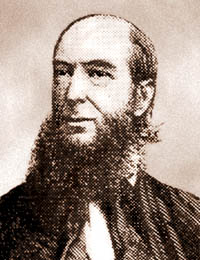
Return to top of the page
Sidney Rigdon "Home" | Rigdon's History | Mormon Classics | Bookshelf
Newspapers | History Vault | New Spalding Library | Old Spalding Library
last revised Jan. 2, 2010