
Mormon Classics | Spalding Library | Bookshelf | Newspapers | History Vault
|
Alexander Campbell (1788-1866) Debate on Christian Baptism (Buffaloe, Virginia: 1825) day1 day2 day3 day4 day5 day6 day7 |
|
The Unitarian Baptist 1826 | Campbell's 1828 reply | Discussion of Christian Baptism (1831)
|
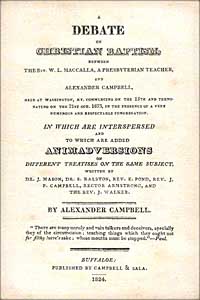
A DEBATE, ON CHRISTIAN BAPTISM, BETWEEN THE Rev. W. L. MACCALLA, A PRESBYTERIAN TEACHER, AND ALEXANDER CAMPBELL, HELD AT WASHINGTON, KY. COMMENCING ON THE 15TH AND TERMININATING ON THE 21ST OCT. 1823, IN THE PRESENCE OF A VERY NUMEROUS AND RESPECTABLE CONGREGATION. IN WHICH ARE INTERSPERSED A N I M A D V E R S I O N S ON DIFFERENT TREATISES ON THE SAME SUBJECT, WRITTEN BY DR. J. MASON, DR. S. RALSTON, REV. E. POND, REV. J. P. CAMPBELL, RECTOR ARMSTRONG, AND THE REV. J. WALKER. BY ALEXANDER CAMPBELL. "There are many unruly and vain talkers and deceivers, specially they of the circumcision; teaching things which they ought not for filthy lucre's sake; whose mouths must be stopped." -- Paul. BUFFALOE: PUBLISHED BY CAMPBELL & SALA. - - - - - 1824. |
|
( 72 )
But he should remember that I have opened the debate in due form, and submitted, from the New Testament, the law of baptism. I have also read the practice of the original witnesses in Judea, Samaria, and in the Uttermost parts of the earth; which clearly shows in what manner they understood the law of baptism," which law authorizes the baptism of disciples only. I have called, and called, upon my opponent to read his authorities from the New Testament for infant baptism, and will again sit down, before my time Expires, to hear him read those records in favor of his practice. I sat down. Mr. M. arose: -- I believe the Old Testament to be the word of God as well as the New. And a command of God by Moses, and a command by Paul, are equally the commands of God and entitled to obedience. But as nothing will suit my opponent but what comes from the New Testament, and as he has read the commission to baptize disciples, it might suffice to tell him, that infants as well as adults are disciples, at least, I am able to prove from the fifteenth chapter of the Acts of the Apostles, that infants are called disciples. "Why," says the Apostle, "tempt ye God to put a yoke upon the neck of the disciples?" -- Now we know that this yoke was circumcision, and that infants were equally, to say the least, under this law with their parents. Again, the Saviour saith, "suffer little children to come unto me, and forbid them not, for of such is the kingdom of God." -- And Paul says that some infants are holy, consequently fit subjects of baptism. But as I have opened the debate and proposed the plan on which to proceed, I will go on to establish my first proposition: viz. Abraham and his seed were Divinely constituted a true visible church of God. Mr. C.
( 73 )
I answered forthwith, that a part of the Seed of Abraham was Divinely constituted a true visible church of God, but not all his seed. Will you, said Mr. M. admit that a part of the seed of Abraham, as I have defined that part, was constituted a visible church of God? I answered -- Read your definition of that part of his seed again, and I will give you an explicit answer. Mr. M. then read, that all the seed of Abraham, with the exception of such as were afterwards excommunicated, was constituted a true visible church of God. I objected to the term excommunicated as not being applicable to the Jews in Abraham's time, as being a modern ecclesiastical term too vague in its meaning, and of doubtful disputation, when used in such a connexion of ideas; but I observed that if Mr. M. would alter his proposition so far, as to insert the word part, before the seed of Abraham, that, I would, in order to save time and to avoid unnecessary disputation, without hesitation, say, that a part of the seed of Abraham was Divinely constituted a true church of God. Mr. M. observed, that unless I would answer the question with an unequivocal yes, in the terms he had
( 74 )
I replied, prove it then, but it is altogether unnecessary, inasmuch, as I have admitted every thing that could affect the argument. Mr. M. went on with his proof: -- There are certain peculiarities necessary to a church state. It is not every assembly that may or can exist that is a church of God. No indeed, for then a mob, a riotous assembly, a political convention, a civil court, or any ordinary meeting, might be called a church of God. The first thing necessary to the existence of a visible church of God is, that the oracles of God be possessed by those who unite together in a church state. Without this acquisition, let a society possess what advantage it may, it cannot be called a church. For all knowledge of God, faith in him, and devotion to him grow out of the possession of the oracles, of God. That the seed of Abraham had these oracles committed to them we will prove both from the Old Testament and the New, Psalm lxxviii. 5-8. "He," said David the prophet, "established a testimony in Jacob, and appointed a law in Israel which he commanded our Fathers, that they should make them known to their children. That the generation to come might know them, even the children which should be born, who should arise and declare them to their children; that they might set their hope in God, and not forget the works of God but keep his commandments: and might not be as their Fathers, a stubborn and rebellious generation, that set not their heart aright, and whose spirit was not stedfast with God." -- You will observe, my hearers, that it is expressly said, by David the prophet, that a testimony was established in Jacob, and a law appointed in Israel which was to be perpetuated from generation to generation, and to be taught by parents to their children in every age. To the same purpose speaketh Moses, Deut. xxx. 19. "I call heaven and earth to record this day against
( 75 )
A more explicit testimony to this effect we have in Neh. ix. 13, 14. "Thou camest down also upon mount Sinai and speakest with them from heaven, and gavest them right judgments, and true laws, (or laws of truth) good statutes and commandments; and madest known unto them thy holy sabbath, and commandest them precepts, statutes and laws, by the hand of Moses thy servant." -- This is so plain that no comment is necessary. In the same clear definite style sings David. Ps. cxlvii. 19, 20. "He sheweth his words unto Jacob, his statutes and his judgments unto Israel. He hath not dealt so with any other nation: and as for his judgments they have not known them." This sheweth, not only that God committed his oracles to the seed of Abraham, but to them exclusively; and that no other nation could Worship the true God without his oracles, consequently no other nation but that of Israel could be a church of God. The New Testament is equally, if not more explicit in proof of this proposition. Acts vii. 38. "This is he that was in the church in the wilderness with the angel
( 76 )
Stephen also, the proto-martyr, in the same speech, Acts vii. 53, tells Israel, "that they had received the law by the disposition of angels and had not kept it." But Paul in his epistle to the Romans, chap. iii. settles the point at once. He asks the question, "what advantage then hath the Jew? or, what profit is there in circumcision -- much every way: chiefly, because that unto them were committed the oracles of God. And in the ninth chapter of the same epistle, he saith "that the giving of the law pertaineth unto Israel." Thus, my friends, we have proved the first point necessary to show that Abraham and his seed were Divinely constituted a true visible church; -- because they had the oracles of a church committed to them. In the second place, I proceed to show that they had the second thing necessary to a church state, namely, the ordinances of a church. To say nothing of the ordinance of circumcision, which, though not a social ordinance of worship, was, nevertheless, an ordinance Divinely appointed to the seed of Abraham; we shall proceed to the social ordinances that belong to, and require a church state. Of these the first is the ordinance of the passover. Ex. xii. 1-14." And the Lord spake unto Moses, and Aaron in the land of Egypt, saying, this month shall be unto you the beginning of months: it shall be the first month of the year to you. Speak ye unto all the congregation of Israel, saying, in the tenth day of this month they shall take to them every man a lamb, according to the house of their fathers, a lamb for an house: and if the household be too little for a lamb, let him and his neighbour next unto his house take it according to the number of souls: every man according to his eating shall make your count for the lamb.
( 77 )
The next ordinance enjoined upon the seed of Abraham was the feast of unleavened bread -- a social ordinance, and an holy convocation. "Seven days shall ye eat unleavened bread; even the first day ye shall put away leaven out of your houses: for whosoever eateth leavened bread from the first day until
( 78 )
We shall notice next the ordinance of the Sabbath, for it is given to Israel not only in the Jaw, with other precepts, but it was given as an ordinance. We shall read to this effect. "Ye shall keep the sabbath therefore; for it is holy unto you: every one that defileth it shall surely be put to death: for whosoever doeth any work therein, that soul shall be cut off from among his people. It is a sign between me and the children of Israel for ever: for in six days the Lord made heaven and earth, and on the seventh day he rested, and was refreshed." Ex. xxxi. 12-17. "And remember that thou wast a servant an the land of Egypt, and that the Lord thy God brought thee out thence, through a mighty hand and by a stretched out arm. Therefore the Lord thy God commanded thee to keep the sabbath day." To the same purpose Ezekiel the prophet, xx. and 12th, in addition to the statutes and judgments given them the Lord saith, "Moreover also I gave them my sabbaths, to be a sign between
( 79 )
The next religious festival or ordinance appointed the Jews, of which we shall take notice, is the "Feast of Weeks," or as it is sometimes called, the "Feast of Pentecost." "And ye shall count unto you from the morrow after the sabbath, from the day that ye brought the sheaf of the wave-offering: seven sabbaths shall be complete: even unto the morrow after the seventh sabbath shall ye number fifty days; and ye shall offer anew meat offering unto the Lord. -- Ye shall bring out of your habitations two wave-loaves of two tenth deals: they shall be of fine flour; they shall be baken with leaven; they are the first fruits unto the Lord. And ye shall offer with the bread seven lambs without blemish of the first year, and one young bullock, and two rams: they shall be for a burnt-offering unto the Lord, with their meat-offering, and their drink-offerings, even an offering made by fire, of sweet savour unto the Lord. Then ye shall sacrifice one kid of the goats for a sin-offering, and two lambs of the first year for a sacrifice of peace-offering. And 'the priest shall wave, them with the bread of the first fruits for a wave-offering before the Lord, with the two lambs: they shall be holy to the Lord for the priest. And ye shall proclaim on the self-same day, that it may be an holy convocation unto you; ye shall do no servile work therein; it shall be a statute for ever in all your dwellings throughout your generations." -- Lev. xxiii. 15-21. Next the Feast of Tabernacles. "And the Lord spake unto Moses, saying, speak unto the children of Israel, saying, the fifteenth day of this seventh month shall be the feast of tabernacles for seven days unto the Lord. On the first day shall be an holy convocation: ye shall do no servile work therein. Seven days ye shall offer an offering made by "fire unto the Lord: on the eighth day shall be an holy convocation unto you; and ye shall offer an offering made by fire unto the Lord: it is a solemn assembly; and ye shall do no
( 80 )
Of the many solemnities ordained amongst the seed of Abraham we shall only particularly mention another, which belongs to, and takes the highest station of sacrificial ordinances. It is the great least of expiation. "And this shall be a statute for ever unto you: that in the seventh month, on the tenth day of the month, ye shall afflict your souls, and do no work at all, whether it be one of your own country, or a stranger, that sojourneth among you; for on that day shall the priest make an atonement for you, to cleanse you, that ye may be clean from all your sins before the Lord. -- It shall be a sabbath of rest unto you, and ye shall afflict your souls, by a statute for ever," -- Lev. xvi. 29-31. As a summary of religious ordinances of this character, hear Moses recapitulate, "Unto his habitation shall ye seek, and thither thou shall come: and thither ye shall bring your burnt-offerings, and your sacrifices, and your tithes, and heave-offerings of your hand, and your vows, and your free-will-offerings, and the firstlings of your herds and of your flocks." -- Deut. xii. 5, 6. To these solemn ordinances might be added the Feast of Trumpets -- of New Moons -- of Purim -- of the dedication of the Temple -- but these will suffice to shew that the Jews had the
( 81 )
I now proceed to exhibit a third requisite of a church which we find the Jews possessed, and this is a very essential one indeed -- they had the officers of a church -- But my time has expired. I thus spoke: -- Mr. M. was so condescending as to give us his New Testament authority for infant baptism, or to read us those passages that, he thinks, refer to infant baptism, although he made no reply to any evidence urged by me from that source. It must he admitted, however, that his remarks on the baptizing of disciples, importing that infants were called disciples, had some reference to my reading the law of baptism from the commission, recorded Matt, xxviii. 18, 19. But is it possible, that the sagacious, the learned, the wise, the shrewd Mr. M. affirms that a sucking infant can, with any reference to the correct meaning of words, be called a disciple or a scholar of Christ!! -- An infant a disciple! It is a contradiction in terms. But did Mr. M. prove that infants were called disciples? No, he asserted it. He said that they were so called in the xv. chapter of the Acts. Did he state the circumstances of ithe case, did he allude to the occasion, or refer to the context in which those words appear? No. Were infants mentioned in the chapter? No. A singular way of affording New Testament authority for infant baptism, to allude to a chapter, where neither infants nor baptism is mentioned!! His second New Testament reference was to the words of the Saviour, saying, "suffer little children to come unto me, and forbid them not, for of such, is the kingdom of God." This, though a more usual reference than the former, is just as irrelevant, for two substantial reasons; besides many others. The first is, this was spoken a considerable time before Christian baptism was appointed, consequently could have no reference to it whatever. In the next place, these infants were brought to Christ for one particular purpose, which is specified, consequently, as the Confession of Faith says, "the sense of Scripture is not manifold but One," can have no reference to infant sprinkling.
( 82 )
I complained, in my last address, that Mr. M. read his arguments from his manuscript and neglected to respond to mine, which he is bound to do, according to all established usage; or else, to yield the point at issue. But to excuse his constant attention to this little book, which causes him to neglect me, he has told you that I too, have got a manuscript. Yes my friends, here it is -- a few hundred references to the original scriptures, and a few extracts from ecclesiastical history, from authors which I could not bring hither, owing to the stage of the river, and (turning it round to the people) it is chiefly blank for the purpose of making notes of Mr. M's arguments. But I am glad of the opportunity now afforded me, of proposing to Mr. M. to give up all his papers and I will give up mine, and let our debate be viva voce as it was proposed. Mr. M. still goes on to prove a point that I have not denied. He is determined to take his own course; whether his arguments are denied or affirmed. I told him, in the outset, that I admitted the proposition, that "a part of the seed of Abraham was Divinely constituted a true church of God" -- And this is all he contends for, in fact, though he would represent it in such a form as that there might appear to be a difference, worthy of contention.
( 83 )
Having now paid much more respect to his arguments than he has done to mine, I will, my friends, for the
( 84 )
The calling of us Gentiles to be fellow citizens with the saints, and to be a part of the household of God, was an event, unexpected by all the Apostles, for several years after the day of Pentecost. 'Tis true that the ancient prophets spake of it in the most elevated style. -- Yes, David's and Isaiah's hallowed lips foretold it. They pourtrayed it in such glowing colors, in such enraptured strains, in such extatic perspecuity, that we almost tremble to affirm that it was an event unknown to, and unexpected by all the holy Twelve. But when we reflect that Messiah's death, and resurrection from the dead were events of superlative importanct to the whole family of man; and that these events were not only revealed by the spirit of prophecy, in language of purer, of more perspicuous, of more sublime expression than mortals speak, than mortals, filled with enthusiastic ardor, utter; and that those events, though the subject of Messiah's parables, lectures, and familiar conversation with his pupils of the senior class, with the Apostolic school, were not understood by the wisest in that school, but that he banished them from his thoughts by saying, "that be far from thee Master, it shall not be so done unto thee, and that another of his class-mates said, with respoct to his resurrection from the dead, "Except I see in his hand the print of the nails, and put my finger to the print of the nails, and my hand to his side I will not believe." -- These considerations somewhat diminish our surprise at finding other subjects of luminous prophecy unknown to the Apostles; even after the enjoyment of clearer visions of Messiah's reign -- But, perhaps, all these reflections would not justify us in affirming, that these events Were unknown to the ancient prophets themselves that spake of them, and concealed from the Apostles, until they became the subject of new spiritual illumination; had not Peter, by the Spirit, said of the ancient prophets, that they searched after the meaning of the oracles which they delivered; and that they did not
( 85 )
"The mystery of Christ in other generations, was not made known to the sons of men, as it is now revealed to his holy Apostles and prophets by the Spirit -- that the Gentiles should be joint heirs, and joint body and joint partakers of his promise concerning Christ through the Gospel," Eph. iii. 5, 6. and Col i. 26. "The mystery which was kept hid from the ages and from the generations, but now is made manifest to his saints, to whom God was pleased to make known what is the riches of the glory of this mystery, concerning the Gentiles, which is Christ to you (Gentiles) the HOPE OF GLORY." These oracles justify the declaration, that the calling of the Gentiles, to the full fruition of the blessings of the Gospel of Christ, was an event unknown to, and unexpected by, the prophets of antiquity, as well as by the Apostles, until revealed to them by a new revelation of the Spirit. Peter to whom the Messiah committed the keys of kingdom of heaven; those keys for which priests have been so long contending; those keys which Peter took to heaven with him, and left not to a successor; no, not to Rome's haughty pontiff; neither to England's lord archbishops; nor to Scotland's high and dignified Sanhedrim of the elders of the land; lords in the state, and nobles in the church. I say, this same Peter, the ambassador of Heaven's eternal throne, having flung wide open to the Jews, the door of faith, having, to
( 86 )
( 87 )
Their decision respecting these disciples, these infants of my opponent, was, that no yoke, no greater burthen than these necessary things, should be laid upon those infants! That ye (infants!) abstain from meats offered unto idols, -- and from blood, -- and from things strangled, -- and from fornication, -- from which, if ye, (infants!) keep yourselves, ye will do well. Fare ye well, (infants.)!! This view of the calling of the Gentiles, an event so interesting to us -- which we are sure cannot be set aside, at one glance, shows, the absurdity, the perfect absurdity, of Mr. M's hypothesis. -- But I shall give place to him to read farther on his Jewish church. Mr. M. observed: -- As my opponent has proposed we should give up all our papers and debate viva voce. I will refer the matter to the board of moderators, and have their opinion on this proposal. Major Roper, the president of the bench, observed, that it was optional with the disputants themselves,
( 88 )
Mr. M. spoke to this effect: -- I feel satisfied with the decision of the bench. My opponent's proposal reminds me of a debate between Eckius and Carolostadius. The former being a more flippant and better practised disputant than the latter, proposed to Carolostadius to give up his notes, Carolostadius objected, and assigned as a reason the circumstance already mentioned. For the same reason, I feel disposed to avail myself of my notes, my opponent may act as he pleases, or say what he pleases about them. I was about proving when I sat down that the seed of Abraham possessed the third requisite to a church, viz. the officers of a church. By the officers of a church, I mean those who rule, and officiate in the worship of a church. -- Of this sort were the elders of Israel, the Levites, the Priests, and Prophets of the Israelites. The elders of Israel were to be men of experience, of wisdom, and gravity. Their constitution into an ecclesiastical court, though first advised by Jethro, was afterwards sanctioned by the God of Israel. The commission given to these elders is recorded Deut. i. 15-17. "So I took the chief of your tribes, wise men, and known, and made them heads over you, captains over thousands, and captains over hundreds, and captains over fifties, and captains over tens, and officers among your tribes. And I charged your judges at that time, saying, hear the causes between your brethren, and judge righteously between every man and his brother, and the stranger that is with him. Ye shall not respect persons in judgment; but ye shall hear the small as well as the great; ye shall not be afraid of the face of man; for the judgment is God's, and the cause that is too hard for you, bring it unto me, and I will hear it."
( 89 )
The elders of Israel were, divided into two classes, viz. the elders of the whole congregation, and the elders of particular cities. The latter had particular or special duties assigned them, bath of a religious and civil nature. These can be learned to the best advantage by a reference to particular passages, such as the following: "But if any man hate his neighbour, and lie in wait for him, and rise up against him, and smite him mortally that he die, and fleeth into one of these cities: Then the elders of his city shall send and fetch him thence, and deliver him into the hand of the avenger of blood that he may die." -- Deut. xix. 11, 12. "If one be found slain in the land which the Lord thy God giveth thee to possess it, lying in the field, and it be not known who hath slain him: then thy elders and thy judges shall come forth, and they shall measure unto the cities, which are round about him that is slain: and it shall be, that the city which is next unto the slain man, even the elders of that city shall take an heifer, which hath not been wrought with, and which hath not drawn in the yoke; and the elders of that city shall bring down the heifer unto a rough valley,
( 90 )
These elders existed in every city, as may be seen Ezra x. 14. "Let now our rulers of all the congregation stand, and let all them which have taken strange wives in our cities come at appointed times, and with them the elders of every city, aad the judges thereof, until the fierce wrath of our God for this matter be turned from us." But the duties of the elders of the congregation; are so mingled with the duties of the priests and the Levites, that it will be necessary to take a view of them together. They may be seen in the following passages: "If there arise a matter too hard for thee in judgment, between blood and blood, between plea and plea, and between stroke and stroke, being matters of controversy within thy gates: then shall thou
( 91 )
With respect to the ordination services and duties of the Levites we learn the whole compendiously in Num. viii. 5-16. And the Lord spake unto Moses, saying, take the Levites from among the children of Israel, and cleanse them. And thus shalt thou do unto them, to cleanse them: sprinkle water of purifying upon them, and let them shave all their flesh, and, let them wash their clothes, and so make themselves clean. Then let them take a young bullock with his meat-offering, even fine flour mingled with oil, and another young bullock shalt thou take for a sin-offering. And thou shalt bring the Levites before the tarbernacle
( 92 )
The priests were consecrated and ordained of God, not only to teach the people, but also to pray for them, and to offer sacrifices for them. The scriptures showing the duties of the priests are so numerous and familiar, that it is unnecessary to make a selection. -- Everyone that reads the Bible knows that the priests' __________ * Not having minuted the precise number of verses read in each reference, we have, in order to give full satisfaction, given the whole of each reference.
( 93 )
With regard to the scribes of Israel, though the term was at first more general, it came at last to describe those who are sometimes called Doctors of the Law, expounders of Scripture, such as Ezra vii. 6, "This Ezra went up from Babylon; and he was a ready scribe in the law of Moses, which the Lord God of Israel had given: and the king granted him all his request, according to the hand of the Lord his God upon him." 10. "For Ezra had prepared his heart to seek the law of the Lord, and to do it, and to teach in Israel statutes and judgments." The scribes in our Saviour's time, were the most reputable expounders of the law. -- "Why then say the scribes, said the disciples, that Elias must first come?" -- Thus we see that the Jewish church had regularly ordained officers -- Levites, Priests, Elders, Scribes, -- whose duties embraced every thing necessary to the prosperity of a church. Teaching, ruling, admonishing, exhorting, praying for, and blessing Israel, -- the church, were comprehended under the general and special duties enjoined upon them. I now proceed to show that the church of Israel not only had the oracles of a church, the ordinances of a church, the officers of a church, but they also had the fourth requisite of a church, the religious worship of a church. The ordinances of a church comprise in a great measure the worship of a church; for the observance of the ordinances of a church is the essential part of the worship of a church. In the ordinances of a church, God meets with the worshippers, and they of course meet with him. Hence we find that God says "Wheresoever I record my name, there will I meet with you, and there will I bless you." But before the peculiar ordinances of worship were commanded Israel, they are said to have worshipped
( 94 )
David distinguishes certain acts of devotion as peculiarly the worship of God. -- In these the worship of Israel emphatically consisted. -- Ps. xc. 1-6. They had a book of Psalms -- they had their courses of singers, -- they had their musical instruments, they had their social prayers and social praises. They had the reverential attitudes of worship, they had the solemnities of the house of God enjoined on them -- They were severely reprimanded for their departure from this worship, for apostatizing to the worship of the nations around them, as Stephen tells them Acts vii. 39-43. The discipline of a church, inseparably connected with its worship, was also established among them. -- Thus we find certain persons stoned to death, and otherwise cut off by Divine authority for either corrupting the worship, transgressing the commandments, or departing from the ordinances of God. In the next place, they had the members of a church. Persons professing the worship of the one only living and true God, and their offspring are the constituent members of a church. -- I need scarcely cite any scripture to prove this point. For who does not know that, in the very worst of times, there was a remnant according to the election of grace; not only of professors, but of possessors of the true religion? Thus saith God, in one of the darkest periods of the Jewish church, "I have reserved unto myself seven thousand men who have not bowed the knee to the image of Baal." But as this point requires no farther proof I will proceed to notice the last proof of this proposition -- which will be to show, that the seed of Abraham, was, by the Spirit of inspiration, called a church. But my time forbids me now to adduce the proof. I then arose: -- As my opponent continues to prove points altogether irrelevant to this proposed discussion,
( 95 )
It is the reign of Messiah the Prince, as appearing, as dawning upon the astonished eyes of Jewish prophets, through the long vista of many centuries. -- It is the developement, the gradual developement, of that glorious kingdom which many prophets, and righteous men, members of the church of Moses, desired to see, but did not see -- Its very intimation tothe Jews exposed the penury and meanness of their church state, and raised to the skies the expectations of the glorious felicities of Messiah's realm. It pleased the Governor of the nations to give the king of Babylon a representation, in a vision of the night, of the mighty empires which should in succession rise; each upon the ruins of its predecessor. The image he had of these empires, these great heads of imperial- power; none of the wise men, none of the religious men, none of the scientific men in Nebuchadnezzar's court could unfold. Daniel alone, a prophet of the God of Israel, by the visions of the Almighty, by the inspiration of the Holy Spirit could unfold it, could explain the significant emblems. It reads thus: "Thou, O king, sawest, and behold a great image. This great image, whose brightness was excellent, stood before thee; and the form thereof was terrible. This image's head was of fine gold, his breast and his arms of silver, his belly and his thighs Of brass. His legs of iron, his feet part of iron and part of clay. Thou sawest till that a stone
( 96 )
( 97 )
The term Basileia in Greek, and regnum in Latin, signifies either the reign of a prince, or the people over whoom he reigns. The regnum of Great Britain signifies the kingdom of Great Britain. The regnum of king George signifies the reign of king George. The Greeks and Romans used one word, for which we use two. -- Hence the best translators of the New-Testament, amongst whom are Drs. Campbell and Macknight, translate the term Basileia both reign and kingdom, according to the context. When Basileia implies approximation
( 98 )
The kingdom of Messiah transcends the Golden, the Silver, the Brazen, the Iron, and the Sacerdotal or Jewish kingdom, in glory and excellence; as far as the excellence and glory of Messiah the Prince excels all the kings of the earth, as far as Emmanuel excels Moses, as far as the blaze of noon excels the twinkling of a Star. None of the ancient prophets saw this reign commence. They wished to see it but they could not. Its glory charmed their eyes, and ravished their hearts. -- The New Testament opens with the annunciation of its near approach. John, the Dipper, began to proclaim, in the deserts of Judea, that men should reform, for the reign of God was at hand or nigh. The Messiah began to preach its approximation -- He sent the chosen twelve and the select seventy to announce to every village in the holy land that it was approaching. John the Baptist, however, died without seeing it come. Like Moses who came near the borders of Canaan and described it to the ransomed Jews, but entered not into it himself; so John, the second Elias, pointed to the Lamb of God, hailed the approach of his reign, informed his countrymen of it, but he was beheaded before Messiah the king was crowned. Well spake John, "he must increase, but I must decrease.["] John not only preached its near approach, but he baptized into the faith of him that was to come. Jesus not only proclaimed that it was nigh, but taught his disciples to pray "THY REIGN COME." Many through ignorance or unbelief still pray "thy reign come," not knowing that this petition is out of season. It was for
( 99 )
The king, after he rose from the dead, and was perfected to reign over his ransomed subjects, because he had been made like unto them in life, in temptation, in affliction, in corporal weakness, in privation, and sorrow; had tasted death in the bitterest "form ever presented to any of the human race, and had been a tenant of the house appointed for all the living, I say, after he arose from the dead, he frequently appeared unto his disciples, and during his various interviews discoursed with them concerning his kingdom. That kingdom and that glorious reign of which they had heard him so often speak, that kingdom and reign which had been likened to so many things on earth in parables, and comparisons; the inspired Eleven did not yet understand. The scribes and the elders, the clergy of the Jewish Church, had, like their children in modern times, so often extolled the excellence of the Mosaic church, the church of God constituted at Sinai, the church of which my opponent has the most inadequate ideas, -- that the Jews never could admit the idea of any thing else but the continuance of the same church, under a form of additional glory. They interpreted all the prophecies of the Old Testament; and the Eleven understood all the discourses of Christ in the New, as my opponent understands them as referring to a continuation
( 100 )
How fully does this illustrate Messiah's discourse with Nicodemus, "Except a man be born again, he cannot see or understand the reign of God, and except a man be born of water and of the Spirit, he cannot enter into the kingdom of God." The Day of Pentecost is therefore called the regeneration, "Verily I say unto you, ye which have followed me, shall, in the regeneration, when Messiah shall be placed on his glorious throne, and crowned Lord of all, ye also shall be placed on twelve thrones, judging, pronouncing statutes and judgments to, the twelve tribes of Israel." Matthias now filled the place of him who by transgression fell from the apostolic office. Now they are about ascending the apostolic thrones. Now the day of Pentecost is fully come. Now Messiah has ascended up far above all heavens. Now he is exalted a Prince and a Saviour to send the regenerating spirit, and fo give repentance unto Israel. When entering the portals of the highest heaven, his attendant angels say, "Lift up your heads, O ye gates -- be lifted up ye everlasting doors, and the King of Glory shall come in! -- Angels and the spirits of the just around heaven's eternal throne exclaim, "Who is the king of Glory?" -- Messiah's attendant angels respond, "The Lord (Messiah) strong and mighty: The Lord mighty in battle." Messiah who vanquished sin, death, hades, and the devil by his victorious arm. All in heaven with one voice exclaim -- "Lift up your heads O ye gates, even lift them up, ye everlasting doors,
( 101 )
( 102 )
Such was the attendant circumstances of the exaltation of our victorious king. Therefore on the day of the regeneration, when the noise of a mighty rushing wind was heard, blowing where it listed; no one in Jerusalem able to tell whence it came, nor whither it went, Peter declared that this power from on high came from Messiah. -- "Therefore," said he, "being by the right hand of God exalted, and having received of the Father the promise of the Holy Spirit, he hath shed forth this which ye now see and hear. Let all the house of Israel know assuredly that God hath made that same Jesus whom ye have crucified both the anointed King and Governor of all." Having opened the reign of God to the Jews, three thousand were born of water and of the spirit on that self-same day, and thus entered into the new kingdom; as volunteers put themselves under the reign of Messiah the Prince and Saviour. In the days of the Cesars, then, the God of heaven SET UP or constituted this new reign, this new kingdom, of which Daniel spake. Hence, the kingdom that required regeneration of the Spirit and of the water did not commence till this day. The king being crowned, his reign necessarily commenced. These few hints, my friends, will prepare your minds for the demolition of the Paido-baptist views of the kingdom of God when my opponent shall have brought his argument to a close. Mr. M. thus spake: -- Mr. C. has given you scraps of sermons which he has committed to memory; and thus endeavours to entertain you by exhibiting his skill in interpreting scripture. His interpretations, however, appear more ingenious than solid, more flippant and light than substantial. Many of them indeed are altogether novel, and not only novel, but contrary to the generally received sense of scripture by most divines of solid learning and real piety. I am not going to follow him in the warm flights of his imagination, in the fervid meandrings of his fancy from Genesis to Revelation. Solid argument and conclusive reasoning is all that I aim at, I choose rather to
( 103 )
Mr. C. has eulogized Campbell and Macknight as translators, more than once to day. Because, I presume, they favor him, in his fanciful interpretation of scripture, more than the common translation of the scriptures. I cannot agree with him in his encomiums on these men. They were men too similar to himself. They treated the scripture too lightly, and did not treat men of superior standing with becoming respect. I venerate them not. The one, I consider was a hypocrite, and the other an unbeliever. They were men of talents and erudition, but they lacked, what was of much greater value, true piety. But I was, when I last sat down, commencing the last item in proof of my first position, which was to show that not only did the seed of Abraham possess the necessary requisites of a church state, but they had been actually called a church; they had received by the spirit of inspiration the very name church. They are called the church of the Lord, of Jehovaty both in the Old Testament and the New. Let us now attend to the application of this name to the seed of Abraham, 'It first occurs in the book of Deuteronomy. I mean the word ekklesia which is the word used by the writers of the New Testament and which is usually translated church. Deut. ix. 10. "And the Lord delivered unto me two tables of stone, written with the finger of God; and in them was written according to all the words which the Lord spake unto you in the mount in the day of the assembly or in the day of the church. In the Septuagint greek it reads "hemera ekklesias" -- in
( 104 )
Again, Deut. xviii. 16. "The Lord thy God wilfc raise up unto thee a prophet from the midst of thee, of thy brethren, like unto me, unto him ye shall hearken: according to all that thou desiredst of the Lord thy God in Horeb in the day of the assembly." Here the words are the same as in the ix. 10. of the same book -- "te hemera tes ekklesias." In the day of the church. -- In both these passages the writer has the same event in view. He refers in both to the day in which all Israel was assembled at the base of mount Sinai in Arabia; the day in which the first written oracles of God were committed unto the Jews. On this occasion, then, they received by the Jewish prophet Moses the inspired name of the church. The term ekklesia occurs in Judges xxt. 5 and is; there rendered congregation, and in the eighth verse of the same chapter it is rendered assembly. Verse fifth. "And the children of Israel said" who is there among all the tribes of Israel that come not up with the congregation unto the Lord? for they had made a great oath concerning him that came not up to the Lord to Mizpeh, saying, he shall surely be put to death," Verse eighth. "And they said, what one is there of the tribes of Israel that came not up to Mizpeh to the Lord? And behold, there came none to the camp from, Jabesh-gilead to the assembly." In the fifth verse it is en te ekklesia, and in the eighth it is eis ten ekklesion. Joshua viii. 35. It occurs again, "there was not
( 105 )
Ekklesia occurs three times in 2 Chron. xxix. 28-32. "And all the congregation (ekklesia) worshipped, and the singers sang, and the trumpeters sounded: and all this continued until the burnt offering was finished. And when they had made an end of offering, the king and all that were present with him bowed themselves, and worshipped. Moreover Hezekiah the king and the princes commanded the Levites to sing praise unto the Lord with the words of David, and of Asaph the seer. And they sang praises with gladness, and they bowed their heads and worshipped. Then Hezekiah answered and said, now ye have consecrated yourselves unto the Lord, come near and bring sacrifices and thank offerings into the house of the Lord. And the congregation brought in sacrifices and thank offerings: and as many as were of a free heart burnt offerings. And the number of the burnt offerings, which the congregation brought, was threescore and ten bullocks, an hundred rams, and two hundred lambs: all these were for a burnt offering to the Lord." Nehemiah xiii. 1, 2. saith, using the same word, "On that day they read the book of Moses in the audience of the people; and therein was found written, that the Ammonite and the Moabite should come into the congregation of God forever; because they met not trie children of Israel with bread and with water, but hired Balaam against them, that he should curse them, howbeit our God turned the curse into a blessing." In the book of Psalms it frequently occurs -- Ps. xxii. 22. 25. xxvi. 5. 12. xxxv. 18. xl. 9. lxviii. 26. lxxxix 5. cvii. 32;
( 106 )
In Hebrews ii. 12. Paul cites Ps. xxii. 22, and our translators render the word ekklesia in the Hebrews, church, and in the Psalms, congregation. -- Thus Paul says, quoting the words of Christ, "I will declare thy name unto my brethren in the midst of the church. will I sing praises to thee." -- And David speaking of the same person, Ps. xxii. 22. saith, "I will declare thy name unto my brethren. in the midst of the congregation will I praise thee." The original Greek is the same in both. Thus I have shown that the seed of Abraham in the Old and New Testament, in their
( 107 )
( 108 )
So then the church of God in the wilderness is called an assembly only, without respect to its character, and Mr. C. will have it, or leave others to make it, a mob or a synagogue of Satan; for if it was not the church of God it must have been a mob, or a synagogue of Satan. But I have proved that this assembly, this church in the wilderness was Divinely constituted a true visible church of God from the fact of its having possessed 1. The oracles of a church, 2. The ordinances of a church, 3. The officers of a church, 4. The members of a church, 5. The worship and discipline of a church, 6. And because it had the inspired name of a church. consequently no mob, no synagogue of Satan. To-morrow, my friends, I will prove that the Jewish society, before Christ, and the Christian society, after Christ, are ONE and the SAME church in different dispensations. Mr. M. ceased, and a motion was made to adjourn. I begged leave to remark that my opponent, in the conclusion of his address, had endeavoured to make a very uncandid, and a very incorrect impression on the mind of the congregation respecting the quotation |
|
( 109 )
So stood the discussion at the close of the first day. It was adjourned till 11 o'clock next day. Met in the same place on the 16th, at 11 o'clock, A. M: I thus began: -- My friends and brethren; -- Mr. Maccalla occupied your attention yesterday, in proving one position, which we did not controvert. This was done, as he said, for securing his future conclusions from assault. These impregnable fortresses in his rear, which he has engaged in erecting will appear, in the detail, as either useless, or worse than useless. The position to be proved to-day we boldly deny. And when he shall have proved it, in his way, we pledge ourselves to present facts and documents subversive of it, and irrefragible by Mr. M. In the mean time we shall make a few remarks on the word ekklesia, the design of which will be to show, that in the New Testament it is appropriated to represent an assembly, essentially distinct from that which it represented in the Old. Many words have an appropriated and an unappropriated meaning. This we shall illustrate by a few plain instances. The word congress in its common or unappropriated meaning signifies any kind of meeting together. -- Such as the congress of streams, of lakes, of seas, of roads, of people. This no scholar will deny. This term, like the lands of the country, was once unappropriated; it denoted any kind of meeting of fluids or solids, of things animate or inanimate, of beings rational or irrational. But A few years since it was appropriated, as some of our lands are, for a certain purpose -- to denote the great national
( 110 )
But, to come nearer to the term in dispute, I will select a few kindred terms from the Old Testament, which have been appropriated in the New, to represent something essentially different from their common, or unappropriated signification. A few of note will suffice. -- We shall begin with the word Episcopos, literally signifying over-seer, sometimes translated bishop. This word in its unappropriated meaning signifies any kind of an over-seer, or bishop. Thus in the Old Testament, it is used, Num. xxxi 14, to denote the captains of the Jewish army, called bishops of the host. Judges ix. 28. Zebul, a military officer, is called a bishop. It is used in the same sense, 2 Kings xi. 15. Three times in the Old Testament military officers are called bishops. Those who superintended the repairs of the temple, 2 Chron. xxxiv. 12. 17. are called bishops of artificers. Those who had the management of the temple, keeping it safe and in order, are called "bishops of the Lord's house. Those whom Nehemiah placed over the city are called, chap. xi. 9, bishops of the city. Eleazar, the son of Aaron, is called bishop, from over-seeing the tabernacle and its furniture. Num. iv. 6. In all these passages, and in some others, the word episkopos occurs in the Septuagint, which is the word rendered bishop in the New Testament. It is plain from the instances given, that the term bishop, in its unappropriated sense applies to any kind of over-seer. Now, in the New Testament it is appropriated to denote the over-seer of a church. One that teaches, and rules, or keeps order in the church of Christ, who is himself the only Archbishop of souls. As well, then might Mr. M. affirm, that because captains of thousands, chief artificers,
( 111 )
Of the same kind of unappropriated terms in the Old Testament are presbuteros, and diakonos. The one translated an elder, the other a deacon, minister, or servant. Each of these terms, in their unappropriated sense, are applied in the Old Testament to officers very different from those designated by them, in their appropriated sense, in the New. This we are assured our opponent will not deny. Now the term ekklesia, in its unappropriated sense, in both Testaments signifies ANY KIND OF AN ASSEMBLY; but in its appropriated sense, it signifies a society of disciples of Christ meeting in one place. But to bring forward an authority which Mr. M. we presume, will not contradict, asserting the same things, in substance, with those we have asserted, we will cite Dr. John Mason. As he is a violent Paido-baptist, his concessions on this topic are the more worthy of regard. -- See his Essay on the Church of God, pp. 8, 9 "The Hebrew words (cahal and gheda) in the Old Testament; and the corresponding one, (ecclesia) in the New, all signify an assembly, especially one convened by invitation or appointment. That this is their generic sense, no scholar will deny; nor that their particular applications are ultimately resolvable into it. Hence it is evident, that from the terms themselves nothing can be concluded as to the nature or extent of the assembly which they denote. Whenever either of the two former occurs in the Old Testament, or the other in the New, you are sure of an assembly, but of nothing more. What that assembly is, and whom it comprehends, you must learn from the connexion of the term, and the subject of the writer. A few instances will exemplfy the remark. In the Old Testament (cahal) is applied to the whole mass of the people. Ex. xii. 6. To a portion of the people, who came upon Hezekiah's invitation to keep the passover. 2 Chron. xxx. 24. To the army of Pharaoh. Ezek. xvii. 17. To an indefinite multitude. Gen. xxviii. 3. To the society of Simeon and Levi. xlix. 6. So also (gheda) is applied to the whole nation of Israel. Ex. xvi. 22. xxxv. 1. To the particular company of
( 112 )
In the mean time, however, we must redeem the pledge we have given to the public, let my opponent pursue what course he may. From this we shall not be diverted. We stand pledged to prove first, that infant sprinkling is a human tradition. This, we have already said, requires us to do two things, first, to prove that believers only are the legitimate subjects of baptism. In the next place, that immersion is the only baptism. These are both affirmative propositions, and require, in a regular debate, to be oppugned by my opponent But this he appears determined not to attempt. He has his own affirmative propositions to prove, which I am not bound to oppugn, according to our agreement. I was pledged to __________ * See Animadversions, No. I.
( 113 )
I have, in the proof of my first proposition, according to my text, in Mr. M's Confession of Faith which saith, "that baptism is an ordinance of the New Testament ordained by Jesus Christ," submitted, from the New Testament, first the law of Christian baptism, and secondly, the execution of this law by the apostles. On these two points I design to be more particular, than in my first reference to them. The law of Christian baptism as expressed in the commission, is, baptize the disciples, or the believers of the gospel. It thus reads, "Go ye, therefore and teach all nations, baptizing them in the name, &c. Now math eteusate, the word here rendered teach, is conceded by all intelligent Paido-baptists to signify, make disciples or disciple. This is, unquestionably, the proper rendering of the term matheteusate. The verb matheteuo, when governing an accusative, Parkhurst, the Paido-baptist lexicographer says, signifies "to make a disciple," p. 412.
( 114 )
Again, the phrase, "teaching them to observe all things which I have commanded you," respects the disciples exclusively. For Christ did never command nations, indiscriminately, to observe his ordinances; but only his disciples. He commanded all nations to repent and believe the gospel, and then, as his disciples, he commanded them to keep his commandments. Hence, the word rendered teach, in the 20th verse of Matt, xxviii. is not the same as the word rendered teach, in the 19th verse. It is didaskontes, a word importing the office of a preceptor to those who had been put under his tuition. It is expressive of that tuition, which teachers owe to their disciples or pupils. Two things, or two classes of duties, were enjoined on the apostles, in this commission. -- The first was the work of discipling or making disciples. -- The second was the education of those disciples, collected into churches or schools. Now, inasmuch, as the apostles were authorized by the law of Christ, to baptize disciples only. This law. in fact, amounts to a prohibition of the baptism of those who are not disciples. This I cannot now illustrate better than by a reference to the Appendix of Debate with Mr. Walker, to which Mr. M. so often refers, p. 209. "A limited commission implies a prohibition of such things as are not contained in it; and positive laws imply their NEGATIVE. The commission under which the apostles acted was limited, as every Christian will confess. The duties of those who act under it are pointed out: and indeed every creature must act under a limited commission, for the very term itself imports something committed from a superior, or from the supreme. The items contained in any commission, are all the things which the commissioned are authorised to perform. If this were not the case, a formal commission is quite an unmeaning thing. Hence, the commission of a magistrate points out, and circumscribes the duties of his office; if this were not the case, he might attend to
( 115 )
That "a believer or a disciple, is the only subject of baptism is proven from the law of baptism, which authorizes the baptism of such only, and virtually prohibits the baptism of such as are not the professiag disciples of Christ. This is our first argument submitted yesterday to be impugned by Mr. M. It is now illustrated and enforced by the above criticisms and remarks, and if not impugned by M. M. we shall consider it unanswerable. My second argument in support of this position, is, that the apostles who received this commission and law of baptism, must have understood it perfectly, and that they, neither in Judea, Samaria, nor to the uttermost parts of the earth ever baptized any but the professed disciples of Christ. I need not again read over those Scriptures, as my opponent did not oppugn this argument when presented. I shall merely illustrate and enforce it by a remark or two. In the first place, we are positively told, in so many words, that all baptized on the Day of Pentecost, first gladly received the word preached, i. e. believed the gospel, before they were baptized. We are positively told that "when the Samaritans believed Philip preaching the gospel, they were baptized both men and women." -- We are also informed, that Philip refused to baptize the eunuch until he professed faith. We are moreover informed, in the most positive language, that the first Gentile congregation all
( 116 )
Now, being so formally, so minutely, so circumstantially, informed of the apostolic practice, in so many places, it was not necessary to tell us, in every instance, that every individual first heard, then believed, and lastly was baptized This would have been altogether unnecessary. For illustration, the laws of our country require that no man be put to death, or deprived of his liberty, unless he has been regularly convicted according to law: that is, there must be a jury, a judge, witnesses, &c. Now, we are not always informed, when we read of a person being hung, or sent to the penitentiary, that he was tried in a court legally established; that there was a judge regularly sworn into office, sitting upon the bench; that there was a jury of twelve men, lawfully empanneled; that witnesses were sworn in open court; that the jury brought in a verdict of guilty; and that the judge pronounced the sentence, &c. &c. Yet we know, as soon as we hear that a man was hung, or sent to the penitentiary, that all these things must have first existed, because the law so requires. -- In like manner, when we read of any person being baptized, after we understand the law and the practice of the apostles, we are sure that be first professed the faith, that there was water, and an administrator present. And why? because the law required it. In the next place, on this topic, when the historian Luke was so very minute in detailing all the circumstances of the baptized, such as their sex, and condition of life, in no one place, does he mention the baptism of infants. He mentions men and women, and when he speaks more summarily of households, such circumstances are stated, as preclude the supposition of any infants being included. From these premises, we deduce our second argument which is, that the apostles baptized believers or professed disciples only. Our third argument is deduced from the design or import of baptism. On this topic of argument we shall be as full as possible, because of its great importance, and because, perhaps, neither Baptists nor Paido-baptists sufficiently appreciate, it. I will first merely refer to the oracles of God which shew, that baptism is an
( 117 )
Mr. M. rejoined: -- I agree that baptism is an important institution, but I am not going to waste my time, nor my strength, in refuting every thing that may be said about it, inconsistent with scripture and sound reason. I will not labor for nought. To refute all Mr. C. may say is not necessary to support the side I have espoused. In saying so much upon the subject, it would
( 118 )
With respect to the passage, read from Dr. Mason, I know that the Doctor has said such things as my opponent has read, but in this instance, I think the Doctor has gone too far. But I do not like this way of quoting authors. If Mr. C. will quote from Dr. Mason, in this instance, why not take his word or his criticism in others? Besides, my opponent would draw other conclusions from these remarks of the Doctor's than are legitimate: for he will draw conclusions from them subversive, intentionally at least, of the subsequent views of the Doctor. But as my opponent is talking of proving certain points, I will tell you what he has to prove -- or else he will fail to do what he has proposed. He must prove, I. That infant baptism is a human tradition. II. That any thing short of immersion, is not baptism. III. That sprinkling an infant is injurious to religious and political society. IV. That anything short of immersion is injurious to the well being of both church and state. All these points he must prove, else he fails to redeem his pledge. I have proposed to prove the contrary of these propositions -- I have laid down my plan, which you recollect was,
( 119 )
II. To afford probable evidence of apostolic practice 0f infant baptism. These points established, and the proper subject of baptism is determined. Our attention, then, will necessarily be called to the mode of baptism -- or, in honor of my oponent, perhaps, we should call it, the action of baptism. In producing a Divine command for infant baptism, five things, I told you, yesterday, were to be done: 1. To prove that Abraham and his seed were Divinely constituted a true visible church of God. 2. That the Jewish society, before Christ, and the Christian society, after Christ, are ONE and the SAME church in different dispensations. Or, that the Christian church is a BRANCH of the Abrahamic church. 3. That Jewish circumcision, before Christ, and Christian baptism, after Christ are ONE and the SAME SEAL, though, in different forms. 4. That the administration of this seal to infants rvas dice enjoined by Divine authority. 5. That it not having been prohibited, by the same authority, that ordained it, it consequently remains in full force. -- These five points established, and a Divine command for infant baptism is adduced. The first of these five points was proven yesterday, viz. that Abraham and his seed were Divinely constituted a true visible church of God. While I was engaged in proving this fundamental position, my opponent was, a part of his time, delivering patches of old sermons which he memorized several years ago, which had nothing to do with this position; at least, their bearing upon the points at issue, was so faint as not to be very perceivable. For what is it to the truth, or falsehood of the position under consideration, to tell us of the calling of the Gentiles, the history of the Chaldean, the Persian, the Grecian, and Roman empires -- the meaning of a petition of the Lord's prayer -- the exaltation of Christ, and many other points, which, how true soever, leave the grand question where it was.
( 120 )
You would think from the number of scriptures my opponent has referred to, that all the scriptures, were in favor of his views, and that there were no passages
( 121 )
Mr. C. will tell you no doubt again, as he has done already, that because baptism is not mentioned in those passages, they ought not to be referred to in this controversy. -- Yes, and from the same principle he has told you that you ought not to use the Lord's prayer, because it was taught in the early part of Christ's ministry. In this way of proceeding, a great proportion of the scriptures is useless, as respects Christians now. Indeed, according to him, but very little of the New Testament belongs to Christians -- I understand
( 122 )
I now proceed, after this formal recapitulation and reference to the arguments of yesterday, to prove the identity of the church under the old and new dispensations. The proposition now before us, is, "that the Jewish society, before Christ, and the Christian society, after Christ, are one and the same church in different dispensations. -- In fact, that the Christian church is a branch of the Abrahamic." As a visible society they are one and the same. As there has never been but one real church so there has never been but one visible church. A visible saint is one who appears to human eye to be a real saint; in the same manner, the visible church is a body visible to the human eye appearing to be an assembly of real saints. Now since the time that there appeared on earth a visible body of worshippers of the true God, there has been but one such at one time. The body of real saints on earth, has always been one and the same body, and was never distinguishable from the body of visible saints. The visible body of saints has always comprehended within it all such as were known as real saints -- and as there has been but one real church in the world in all ages, so there has been but one visible church. This is as evident as that there cannot be two bodies visibly distinct, which yet appear the same. As the real church, then, has always been the same, so the visible church has always been the same. Many Baptists have been obliged to admit the identity and perpetuity of the real church, who, very inconsistently, deny that the visible church has always
( 123 )
Again, the human body is continually changing, yet it is the same human body. New blood, new flesh, and new fluids of every kind, are forming every minute, so that in a little time all the blood, flesh, and even solids in the human body are changed; and not a particle existing of what composed it a few months or years ago; yet, who will not say, that it is still the same body, distinguished by the same general characteristics, the same properties, and that it is the same temple, of the same immortal soul! Also in the body politic, the same constitution and government may continue to exist, and yet changes may be introduced of considerable variety, and to a considerable extent, yet it is the same state, constitution, and government. The British constitution and government which, since the year 1689, although administered
( 124 )
I then addressed the assembly: -- My opponent represents my late address as fragments of old sermons which I memorized some years ago. How, think ye, does he know this? Perhaps my opponent judges of others by himself. We must, however, inform him that we never write our sermons or memorize them. For seven years we have not written seven pages for public addresses. And, never but once did we attempt to memorize a sermon. Written sermons, and premeditated prayers, are the meanest commodities in the world. Mr. M. will have infants, disciples, yes, speechless babes disciples of Christ, inferred from Acts xv. Although we yesterday demonstrated that the disciples mentioned in that chapter, to whom he referred, were Gentile converts, capable of the actions of manhood. But as Mr. M. has not impugned my criticism on the commission, but endeavours to shelter himself under the assertion, that although none but disciples are to bs baptized, yet infants of eight days old are called disciples, in this passage to which he has twice referred; I say, seeing he has not impugned the aforesaid criticism, and rests his escape from its truth on the assertion that "infants are called disciples in the fifteenth chapter of the Acts, I now propose to him, in the presence of you all, that if he will prove that infants are called disciples in that chapter, I will give up the cause which I have espoused. Let him then lay aside every other topic, and open this chapter. I will pledge, my erudition, my critical acumen, my respectability as a scholar, that he cannot, upon the investigation of that reference -- nay, I will rest the whole controversy upon it. If he proves this one point we shall say all is proved, and his cause, triumphant. The conditions are assuredly most easy, and this "brings us to a speedy issue." His references to "suffer little children," and to the "holy children," are condemned by his own confession of faith, according to the rules of interpretation prescribed in that confession. He has not, in his late address, adverted
( 125 )
I am not a little surprised at his remarks on a criticism mentioned yesterday, on a petition of the prayer taught by the Lord to his disciples. Indeed the whole ministry of John appears to be very indistinctly apprehended by Mr. M. The different ages or dispensations, as they are called, are, by Paido-baptists in general, very slightly noticed. The patriarchal age, the Jewish age, the ministry of John, and the Christian age, are marked in the volumes of inspiration with very striking characters. The patriarchal, with propriety, may be assimulated to star-light; the Jewish, to moon-light; the era of John the Baptist to twilight; and the Christian age to Sun-light. Light encreased from the first promise made to Adam until the ministration of the Spirit was completed. Different forms of worship existed under all these ages by Divine authority. What would have been acceptable worship in the days of the priesthood of Melchisideck, would not have been acceptable in the age of the priesthood of Aaron; and what was acceptable in the days of Aaron, would not be acceptable in the days of our Great High Priest. It is a maxim of great significance, and of universal application pronounced by the Prince of commentators. "The priesthood been changed there is of neccesity a change also in the law." The worship of the Patriarchs, Jews and Christians, though addressed to the same God, was notwithstanding very dissimilar. This, we presume, needs no proof. But with regard to the ministry of John we would be more particular. His light was neither Star-light, Moon-light, nor Sunlight; it was twilight, or a mixture of the three. -- The burthen of his preaching was, "Reformation, for the reign of God approached." His doctrine, manner of life, baptism, and exhortations, were all in many respects novel. He even taught his disciples to pray in a way suited to his teaching. Great, however, as this prophet was, the least prophet under the new reign of God was to be a greater prophet than he; better instructed in the nature of the reign of Messiah,
( 126 )
The first commission given to the Twelve and the baptism annexed thereunto, was of the same nature as that of John. The same doctrine of reformation was taught by our Lord, the Twelve, and the Seventy; and the same motive urged -- viz: -- "The reign of heaven approached. The geographical lines that bounded the tribes of Israel, bounded their labors. The prayers taught, and the religious worship enjoined, were adapted to this state of things as exclusively as Solomon's prayer, 1 Kings viii. was exclusively adapted to the dedication of the temple. Mr. M. might as rationally, as scripturally, as consistently, teach his people to pray, in the words of Solomon's dedication, as in the words of the prayer in question. They were both Divinely inspired too, and both perfectly adapted to a precise object. Dull is the apprehension, and prejudiced the mind, that cannot see a distinction so plain, so palpable, so important too, as the distinction now offered. Let my opponent consider how he would reason with one who would now worship God according to the priesthood of Aaron, and he will find arguments forme to put him to silence when advocating that Christians should now pray for the "reign of God to come," when it has come; and for addressing God without the name of Jesus when he is placed a priest upon his throne, an intercessor within the true holy place. The design of John's baptism and the design of the baptism instituted by Christ is very different. John's baptism, like his preaching, was, the "Baptism of reformation." His errand into the world was to prepare a people for the Lord. His preaching, his baptism, and
( 127 )
( 128 )
Mr. M. proceeds: -- When I last addressed you, my friends, I was going on with the demonstration of the identity of the Jews and Christian churches. I had observed that many things may be said to be one and the same, which yet differ in some circumstantial matters. Even the Baptists themselves, who pride themselves so much in the peculiarity of the constitution of their churches and discipline, have existing among them, in their church covenants, a very considerable diversity, yet they contend that the constitution of their churches is one and the same. And although in their discipline they may widely differ in some points, yet they say that their discipline is essentially one and the same, because executed on the same general principles. Some of them, indeed, would represent their church as being the same with those mentioned in the New Testament, and as having been always one and the same, in regular descent from John the Baptist until now, although they are unable to trace their existence for some hundreds of years up to John. The church at Augusta over which I preside, it is known, has undergone considerable change since I was placed over it. -- It has been new modified in some respects, and alterations to a considerable extent
( 129 )
The people also that compose a state may be one and the sanae people, though living under different constitutions. The constitution, of Virginia and that of Kentucky are different constitutions, yet the people who have lived under both are still the same people. Their privileges may be diversified and magnified to a great extent, there may be very material alterations in their circumstances living under different constitutions and laws, yet they are still the same people. In fine, many things may be identically the same in the common conceptions of mankind, and yet different from each other in some respects. And if we were to allow that no two things are the same, which do not coincide in every instance, in all their essential and accidental properties, in all their primary and secondary qualities, we should be constrained to banish from our dictionaries, and from our mouths, the word identity; and to affirm that no two things are, or can be the same. These things premised, I proceed to observe that the Jewish society, before Christ, and the Christian society, after Chirst, are one and the same church, though in different dispensations, insomuch, that the latter is merely a branch of the former. In proving the truth of this proposition I will observe the following method. I will prove, 1. That they had the same religion. 2. That they had the same inspired names. 3. That they had the same covenant. These we conceive to be the grand essential properties which constitute religious societies one and the same, in all primary points. Any two religious societies that possess the same theology and morality, that are called by all the same names and appellations, and that exist under the same grand constitution or covenant, form but one and the same social compact
( 130 )
1. They had the same religion. It must he admitted that the Jews and Christians were both professors of religion. Now the Jews professed the true religion as Divinely revealed and instituted. I presume it will be allowed that the visible church under the present dispensation professes the true religion. As there is but one true religion, and as both the Jewish society and the Christian society have professed, the true religion, it is, we think, evident that they both professed the same religion. If any person should deny that the Jews professed the true religion, we have recorded truths to produce for their conviction. Deut. xxvi. 17. Moses saith, "Thou hast avouched the Lord this day to be thy God, to walk in his ways, to keep his commandments and to hearken to his voice." This is not only a solemn, but a formal avowal or profession of the religion appointed of God. Moses was a witness, and a credible witness of this formal profession of all Israel, to walk in the ways, and to obey the commandmtnts of the Lord. Now as there is but one God, and one heaven, and only one way from this world to the heavenly world, ever since the fall of Adam, there has been but one true religion. And we have already seen that the seed of Abraham professed this one true religion; but Christians profess or avow the Lord to be their God, and promise to walk in all his ways, consequently profess the same religion with the Jews. In the next place they not only professed the bame religion, as respected the object of religious fear, reverence, and respect, but they had substantially the same ordinances of religious worship. Circumcision, the passover, and the sabbath, were primary ordinances amongst the Jews, and these were substantially the same as baptism, the supper, and the Christian sabbath. Circumcision was to them a mark of separation, a sign of regeneration, the token of putting off the sins of the flesh. Infants and adults were both
( 131 )
The passover was a commemorative ordinance substantially the same as the Lord's supper. The former commemorated the redemption of Israel from Egyptian darkness and bondage, by means of the shedding and sprinkling of blood. The latter commemorates our redemption from ignorance and the bondage of guilt, by the shedding of the blood of the Lamb of God, that taketh away sin. -- The former was eaten with every sign of repentance and with all holy preparation of heart, with sojemn convocations, and religious self-denial, the latter is observed by all true Christians in a similar manner. Days of solemn preparation, fasting and thanksgiving accompanied the eating of the paschal lamb, and similar days of preparation, fasting, and thanks-giving, do accompany the celebration, of the holy supper. The sabbath also amongst the Jews and Christians is a day of holy rest, of holy convocation: a day set apart for profound contemplation, worship and edification, in which no manner of servile labor is to be performed, no part of the time appropriated to our own works, except so much as is taken up in the works of necessity and mercy. In the third place, the Jewish society before Christ, and the Christian society after Christ, have adopted
( 132 )
The same injunctions have been laid upon the visible church in all ages, and uniformly she has been subject to the same requirements. God now requires his people to be holy, holy in all manner of deportment, for, "without holiness no man shall see the Lord." Now the same injunctions were laid upon the Jewish society before Christ. See Lev. xix. 2. "Speak unto all the congregation of Israel and say unto them, ye shall be holy for I the Lord your God am holy." Love to God also, with all their souls, might and strength, was required from the Jewish society as well as from the Christian. And, with respect to our neighbors, the good Samaritan does not remind us more fully or forcibly of our duty, than the injunctions laid on Israel by an ancient prophet. -- "Do justly, love mercy, and walk humbly with thy God." I arose: -- The identity of the Jewish society before Christ, and the Presbyterian society or Episcopalian society, after Christ, may be rendered very plain and striking; by Mr. M.; but that the Christian church, and the Jewish, are one and the same, is another question. The very assertion that any two societies can be one and the
( 133 )
The first fact is, that Nicodemus an honorable member of the Jewish society, yea a teacher of Israel, AN OFFICER of the Jewish church could not be admitted unto the Christian church, though a LAWFUL MEMBER of the Jewish, and a REGULAR OFFICER of the church of Israel, unless born again, of water, and of the spirit. If the two churches are one and the same, Mr. M. -- How could this be!! A second fact is, that NOT ONE of all the members of this Jewish society before Christ, how pious, and holy soever; NOT ONE of the members of the church of Israel was admitted into the Christian church, after its exhibition on the day of Pentecost, until born again, of water and of the spirit: until repentance and a new faith was professed. If the two churches are one and the same Mr. M. how could this be!! Unless Mr. M. my friends, can disprove what I have now said, unless he can set aside these facts, it is of no consequence to tell us about the identity of two societies that withal he admits to be different in come respucts!! These facts you will please keep in mind as a sufficient refutation of the misapplication of many things proposed on the subject of "identity," until more formally exposed. But I have something to say on my opponent's plan and design in introducing the identity of the two churches that may, and ought to claim a place in your attention. It is this. Mr. M. theologically considered is digging his own grave. He is, in fact, about to defeat his own cause, and to subvert his own theses; for as soon as he has proved the identity of the two societies so soon will he have destroyed his whole scheme. This we now assert, and we pledge ourselves to make it manifest as soon as, he says, he has proved the point. The case will stand thus, if Mr. M. does not prove the "identity" of the Jewish and Christian societies, being fundamental in his schemes he is, on his own |
|
( 134 )
While I am noticing this position of my opponent, it way not be amiss to express my astonishment not only at the boldness of my antagonist, but at his imprudence in calling the Christian church a "branch" of the Abrahamic church. He should not have laid himself open to be discredited, or to be put to silence by every stripping who could ask the following question: Is not a branch inferior to the stem or trunk from which it grows? Look at these trees around us, shew us a branch that is not inferior to the trunk from which it receivs its nourishment. And is, Mr. M. the Christian church but a branch of the Abrahamic, inferior to the Jewish!!! Tell it not to those who admire the superlative glory, and dignity of the Christian religion, and Christian church, in comparison of the commonwealth of Israel, and the weak and beggarly elements that Mr. M. has proved it to be only A BRANCH of the Abrahamic!!! I now proceed to finish, if possible, my third argument in proof of my first proposition, viz: that a believer is the only subject of baptism. You will recollect that my third argument is drawn from the import and design of Christian baptism. I have in my two last addresses, paid some attention to this consideration, in my first address this morning, I read sundry portions of the New Testament expressive of the important place that baptism occupies in the Christian religion, and of its great significance. In my last address I contradistinguished its design from that of John's baptism. In exalting baptism to its proper place, I did not exaggerate its import, as Mr. M. would have it. Nor did I elevate it so as to displace hope and charity. These are graces, the fruits of true faith, and true baptism. I know it will be said that I have affirmed that baptism "saves us," that it "washes away sins." Well, Peter and Paul have said so before me. If it was not criminal in them to say so, it cannot be criminal in me. When Ananias said unto Paul, "arise, and be baptized, and wash away thy sins, calling on the name of the Lord," I suppose Paul believed him, and arose, was baptized,
( 135 )
To every believer therefore, baptism is a formal and personal remission, or purgation of sins. The believer never has his sins formally washed away or remitted until he is baptized. The water has no efficacy but what God's appointment gives it, and he has made it sufficient for this purpose. The value and importance of baptism appears from this view of it. It also accounts for baptism being called the WASHING OF REGENERATION. It shews us a good, and valid reason for the despatch with which this ordinance was administered in the primitive church. The believers did not lose a moment in obtaining the remission of their sins. Paul tarried three days after he believed, which was the longest delay recorded in the New Testament. The reason of this delay was the wonderful accompaniments of his conversion and preparation for the apostolic office. He was blind three days, scales fell from his eyes, he arose then forthwith and was baptized. The three thousand who first believed, on the selfsame day were baptized for the remission, of their sins. Yea, even the Jailer and his house would not wait till day-light, but the "same, hour of the night, in which he believed, he and all his were baptised." I say, ihis view of baptism accounts for all these otherwise unaccountable
( 136 )
Faith in Christ is necessary to forgiveness of sins, therefore baptism, without faith, is an unmeaning ceremony. Even the confession of faith, or at least the Larger Catechism, Quest. 185. says that baptism is a sign of remission of sins. How then can it be administered to those without faith. Is it to them "a sign and seal of engrafting into Christ, of remission of sins by his blood, and regeneration by his spirit," as the answer to this question declares! Our argument from this topic is, that baptism, being ordained to be to a believer a formal and personal remission of all his sins, cannot be administered unto an infant without the greatest perversion and abuse of the nature and import of this ordinance. Indeed why should an infant that never sinned, that, as Calvanists say is guilty only of "original sin," which is an unit, be baptized for the remission of sins!! We have heard some Baptists reduce this significant ordinance to the level of a moral example, or a moral precept. Says one, "I was baptized to follow the example of Christ who was baptized in a river." When you are baptized to follow the example of Christ. You are honest too, and speak the truth. In these respects you follow the example of Christ. You place honesty and baptism on the same footing, as alike moral duties. But, says another, "I was baptized in obedience to a divine command." I presume you "don't steal" for the same reason. You then make baptism and honestly alike moral duties. The intelligent and well instructed Christian, however, is baptized to obtain the formal remission of his sins. He is baptized. "TO WASH AWAY HIS SINS" calling upon the name of the Lord. Here let us pause and admire the Divine philanthropy
( 137 )
Before I sit down I wish to remind the congregation of the challenge given my opponent to investigate the 15th. chapter of the Acts, and that in his last address he did not so much as name it. He has then given up that point. Mr. M. arose: -- Mr. C. reminds you of his challenging me to a disquisition on a part of the xv. of the Acts; and because I will not leave my course to meet him there, he proclaims me vanquished. He resembles
( 138 )
In proving the identity of the Jewish and Christian, church I have first proposed to prove that they had the same religion, or theology and morality. They both professed the true religion -- had substantially the same ordinances -- were under the same requirements -- and had the same forms of religion. Again, the same doctrines were taught in the Old Testament and in the New, and the same promises were given. Luke x. 27. "A certain lawyer stood up and tempted Christ saying. Master, what shall I do to inherit eternal life? He said unto him what is written in the law? How readest thou? And he, answering, said, Thou shalt love the Lord thy God with all thy heart, and with all thy soul, and with all thy strength, and with all thy mind, and thy neighbour as thyself. And he said unto him thou hast answered right. This do and thou shalt live." Thus we see on a point of saving importance, the same doctrine was taught in the New Testament that was taught in the Old. This also shows us that the way of salvation was the same in all ages. This was something very like making baptism a saving ordinance, or ascribing to it the power of washing away all sins, as my opponent has lately done. The promises made to the Jews and Christians are also the same. The Lord promised temporal blessings, to his followers Matt. vi. 33. "Seek ye first the kingdom of God, and all those things shall be added
( 139 )
( 140 )
The church under the former and the present dispensation has been under the same discipline at least under similar discipline. Under the Old the law was, "thou shalt not hate thy brother in thy heart, thou shall in any wise rebuke thy neighbour" and "not suffer sin upon him," Lev. xix. 17. Christ now says "if thy brother trespass against this go and tell him his fault between thee and him alone." Under the Old Testament it was, when the offender shall bring his sin offering, and in token of repentance lay his hand upon its head, the victim shall be slain and he shall be forgiven Lev. iv. Christ now says "if thy brother repent forgive him." Under the law, "The soul that doeth aught presumptuously, and will not hearken to the priest, nor to the judge, the same hath reproached the Lord, and that soul shall be cut off from his people." And under the gospel dispensation, the rule is, "If the offender will not hear the church, let him be cut off from her communion, and become to you as an heathen man or a publican." Assurdly the similarity of discipline in the congregation of the Lord, under Moses, and in the church of Christ, must strike every person with force, and prove the identity of the two churches. The government of both churches is the same. It was by presbyters or elderS, it was in this sense presbyterian. See Acts xiv. 13. "And when they had ordained them elders in every church, and had prayed with fasting, they commended them to the Lord on whom they believed." "For this cause left I thee in Crete," said Paul to Titus, chap. i. 5." that thou shouldest set in order the things that are wanting and ordain elders in every city as I had appointed thee." Here we read of the elders of the city, and of the elders of the congregation in the New Testament, and you all remember my friends, in speaking of the officers
( 141 )
Thus we have seen that the Jewish society, before Christ, and the Christian society after Christ, have had the same religion, in profession, in ordinances, in forms of worship, in requirements, in doctrine, in promises, in discipline, in government, and in members. I now proceed to shew, in the second place, that they had the same "inspired names." Names are signs of things, they are the representations of things -- words are the representations of ideas, and ideas are the images of things. When names are different, the things are different; and, when names are the same, things are the same. It may happen that fallible beings may affix the same names to things that differ and thus mislead the judgment of others, but when God has affixed the same names to things we are sure that there is no mistake: the things are really the same. Now the Jewish society and the Christian are called by the same inspired names. I then addressed the assembly: -- My friends, this is the most singular discussion I have either seen or
( 142 )
Gentlemen, I know your powers in moderating this controversy are very limited. This is not my fault. I was willing to lodge all necessary power in your hands. To this Mr. M would not agree. Yet still, I think, you have the power of deciding whether we ought to procede this way. One of those items in your hand, says, that you are "to keep order," in this discussion. The question then is -- Is it order, in controversy, for the respondent to introduce affirmative propositions on any subject he pleases; and, instead of responding in the negative to his opponent, to spend his time in proving his own affirmations on other topics? This question I respectfully submit to your decision. [Bishop Verdeman, after a number of remarks and references, (which we are sorry cannot be correctly stated, as there were no minutes taken of the speeches of the moderators on such occasions) gave it as his conviction, "that it was out of order for Mr. M. to proceed in this way." The rev. Birch replied to the bishop that his opinion was different; that he knew from
( 143 )
Major Roper apologized that he was not skilled in such questions, that in deliberative bodies he knew that etiquette required the respondent to speak to the question submitted, in reference to which he spake. But that he knew of no rules obliging him so to do, and that, therefore, the parties, he presumed, in consequence of the limited nature of the rules authorizing their interference, would have to pursue, each his own course.] I then proceeded: -- We must then, it seems, just proceed in this way. To this course I must submit; yes, I will cheerfully submit, although I differ in opinion with the decision of the bench. On these principles we shall have no debate unless I formally attack Mr. M. This I will do from necessity, when ever he brings his second argument to a close In the meantime I return to the baptism of believers. Mr. M. in his last speech, incidentally remarked, that I had ascribed a saving power to baptism. Why then did he not accuse Paul and Peter of the same, for they spake as ungardedly on this topic as we? Or, rather, why did he not tell us the meaning of those scriptures that were adduced, on this item? So long as we affirm that baptism ACCOMPANIED WITH FAITH IN THE SUBJECT, washes away all sins, and that baptism, WITHOUT faith, is an insignificant ceremony; so long we feel ourselves invulnerable on every side, from every attack, from every arm. Let Mr. M. refute my views now if he can, and not hereafter say, that I said so and so. Here I am to defend them and to illustrate them still farther. On this topic I would rally again. Its grand importance to all disciples will excuse me for being diffuse on this subject; also its aspect to paido-baptism is such as to frown it out of the world. This Mr. M. sees, and therefore he frowns contemptuously at it. Peter promised to three thousand Jews forgiveness on repentance and baptism. "What shall we do." said they, in an agony of despair? Repent and be baptized every one of you in the name of the Lord Jesus, for the remission of sins. The preposition "eis" here means, in order to --
( 144 )
My baptist brethren, as well as the Paido-baptist brotherhood, I humbly conceive, require to be admonished on this point. You have been, some of you no doubt, too diffident in asserting this grand import of baptism, in orgin; an immediate submission to this sacred and gracious ordinance, lest your brethren should say that you make every thing of baptism; that you make it essential to salvation. Tell them you make nothing essential to salvation but the blood of Christ, but that God has made baptism essential to their formal forgiveness in this life, to their admissicn into his kingdom on earth. Tell them, that God has made it essential to their happiness, that they should have a pledge on his part, in this life, an assurance in the name of the Father, and of the Son, and of the Holy Spirit, of their actual pardon, of the remission of all their sins, and that this assurance is baptism. Tell the disciples to rise, in haste and be baptized and wash away their sins calling on the name of the Lord." * __________ * This paragraph was spoken in the third person, it is here changed into the second person, for the purpose of giving it greater emphasis.
( 145 )
In the last place, under this head, all the actions said to have been performed by such as were baptized, are of such a character as preclude the idea of any other than believers having been baptized. The baptized are said to have gladly received the word -- to hear the word, to rejoice -- to be added to the church on the day of their baptism, to continue in the Apostles' doctrine, in breaking of bread, in prayers, praising God. They are said to have put on Christ, to have put off the old man; to have crucified the flesh, and to have men with, Christ, &c. I have, I humbly conceive, my friends and brethren, fully established my first proposition on scripture premises, viz. "that a believer is the only subject of baptism." You will recollect that out of the many topics of proof, I only selected the five following as evidence: I. That the law of baptism authorises the baptism of believers only, and, in fact, forbids virtually the baptism, of any others. II. That the Apostles, in the execution of their commission in. Jerusalem, Judea, Samaria, and to the uttermost parts of the earth never baptized any other than a professed believer or a disciple.
( 146 )
IV. That the promises connected with baptism are addressed to believers only. V. That the actions of the baptized at the time, and immediately subsequent to their baptism, mentioned in all the New Testament, are such as infants could not perform. These topics of argument we deem sufficient to prove the above proposition. And you will have the goodness to bear in mind that not one of them has been formally impugned by Mr. M. We consider them then, as far as respects him, unanswerable. Mr. M. read as follows: -- I am now to show that the Jewish and Christian societies are called by the same inspired names. The Jewish society are called a bride, or married wife, Jer. iii. 14. "Turn O backsliding children, saith the Lord, for I am married unto you; and I will take you one of a city and two of a family, and I will bring you to Zion; I will give you pastors according to mine heart, which shall feed you with knowledge and understanding." We plainly see who is here recognized as a bride. And in Revelation xxi. 9. The church of Jesus Christ is called by the same spirit of Revelation, "the bride, the Lamb's wife" one espoused to Christ as a chaste virgin. Says Solomon, "my love my undefiled is one," speaking of the church, as all agree. They are both called a house. Heb. iii. 2-6 "The high priest of our profession Christ Jesus was faithful to him that appointed him, as also Moses was faithful in all his house. For this man was counted worthy of more glory than Moses in as much, as he who hath builded the house hath more honor than the house; for every house is builded by some man; but he that built all things is God. And Moses, verily, was faithful in all his house, as a servant for a testimony of those things which were to be spoken after, but Christ as a son over his own house, whose house are we, If we hold fast the confidence and the rejoicing of the
( 147 )
The visible church under both dispensations is also exhibited as the flock of Christ, Psalm. lxxx. 1. "Give ear O Shepherd of Israel, thou that leadest Joseph as a flock; thou that dwellest between the cherubims shine forth. This same person whom David calls the Lord his Shepherd; the shepherd of the flock of Israel, is called by Paul, Heb. xiii. 20. the Great Shepherd of the sheep: -- and these sheep are Christ's flock. The Jewish and Christian societies are called a barn and the same threshing floor. -- Matt. xiii. 30. "gather the wheat into my barn." John the Baptist saith, he will throughly purge his floor and gather his wheat into his garner. Now this was the Jewish floor that he was to cleanse -- and the wheat was to be put into his barn or garner. They are both called a nation and kingdom. Ex. xix. 5, 6. M If ye obey my voice, and keep my covenant then ye shall be unto me a peculiar treasure above all people. And ye shall be unto me a kingdom of priests and an holy nation." Thus he spake to the Jews. Now hear him address the Christians 1. Pet. ii. 9. Ye are a chosen generation, a royal priesthood, a holy nation, a peculiar people." The Jews and Christians are called the people of God. "I will walk among you, and will be your God, and ye shall be my people." He says of the Christians too, "I will dwell in them and walk in them, and I will be their God and they shall be my people." Lev. xxvi. 12. 2 Cor, vi. 16. here they are both called by the same inspired names. The visible church under both dispensations is also called an "olive tree." Jeremiah addressing the Old Testament church, says, (xi. 16.) "the Lord called
( 148 )
( 149 )
They are both called the kingdom of heaven. "Many," said the Saviour," shall come from the east and from the west and sit down with Abraham, Isaac, and Jacob in the kingdom of heaven; but the children of the kingdom shall be cast out into outer darkness; there shall be weeping and gnashing of teeth." By the words "kingdom of heaven" we cannot here understand the kingdom of glory, the mansions of future bliss, for none of the members of that kingdom shall be cast out into outer darkness. Those "coming from the east and west," must mean the Gentiles; "Sitting down with Abraham, Isaac, and Jacob", must mean, entering into the Jewish church, becoming one with it. -- The children of the kingdom must mean, the then members of the Jewish church, to whom belonged first of all the blessings of membership, in that kingdom: their being "cast out" is equivalent to their being "cut off" from the good olive tree; and the Gentiles sitting down with Abraham, Isaac, and Jacob is precisely equivalent to the branches of the wild olive, being grafted in among the natural branches. How remarkably coincident are those portions of the oracle of God in expressing one grand fact, one important truth, of deep interest to all the church to know, else it would not have been [so] often repeated, and inculcated
( 150 )
I then rejoined: -- As this discussion is likely to be long protracted, I will now address you, my respected friends, on the word religion. As Mr. M. has spent much of this day in asserting the identity of the Jewish and Christian religion, I may be allowed to make some remarks on a topic that engrosses so much of his attention. You are not, however, to consider me as formally attacking his argument. Yet my remarks will have some bearing upon it. A complete refutation of it we promise you when it is closed. Religion is a word of very common occurrence, yet Tike many others in common usage, it is not on that account the better understood. Some people are said "to have got religion," and others are exhorted "to get it." This religion is something that is supposed to dwell in the heart, and is sometimes called "heart religion." -- We have never seen any person who had not some kind of religion. Indeed, religion has been supposed to be so common an endowment that some logicians have made it the differential quality, or attribute of man. Hence said they, -- "man is a religious animal." Religion considered in this light, is simply "respect for a Supreme Being;" and, as the poet sings, it makes little matter what he is called. His infidel verse thus read, In every clime ador'd By saint, by savage, and by sage, Jehovah, Jove, or Lord." This illustrates that religion of which we now speak. --
( 151 )
The affixing of one epithet to religion, if there were not another, implies two kinds at least. The epithets true, pure, sound applied to religion, imply that there may be false religion, an impure, and unsound religion. Saul of Tarsus, when a Christian, said "You have heard of my conversation in the Jews' religion," and how I profited in the Jews' religion above many of my equals, Gal. i. 13, 14. Now this fairly implied that he was not at the time of writing this, of the Jews' religion; he was of another religion, a religion now called the Christian. But Mr. M. would have told Paul that his former religion and his present religion were "one and the same religion." For "the Jewish society and the Christian society are
( 152 )
But lest we should encroach too close upon this argument for "identity" with differences attached to it, we would observe that all the human race that have entered life, have been saved by virtue of the sacrifce of Christ; whether patriarchs, Jews, or Christians; whether adults, infants, or idiots. But that they all understood the mature, design, and meaning of the Messiah's death, I presume, not Mr. M. himself will affirm. If this be admitted, as we know it must, on principles already stated, then it will follow that there was a very important difference betwixt the religion of Patriarchs, Jews, and Christians, on a very fundamental point. Our views of the nature and design of Christ's death, affects our whole religion. But I fearlessly affirm, though this controversy does not require it, for it can be maintained on other ground; I say, I affirm that the nature and design of Christ's death, although prophesied of, and typified in the Patriarchal, and Jews' religion, was not understood by the Jews or patriarchs. They all, who died in faith, expected the Messiah and anticipated glorious things in his reign, but they had no distinct apprehension of them. Nor was it necessary they should, in order to [--] their salvation, any more than it is necessary for infants to understand the sacrifice of Christ in order to their salvation. The righteous ancients were saved by implicitly believing what God revealed to them -- Thus Abraham, the father of the faithful, Was justified by believing the promise," So shall thy seed be." Noah's faith is described by Paul as a belief that God would save him, and destroy his cotemporaries by a deluge. -- By faith was the harlot Rahab justified in receiving the spies in peace. By faith Moses when he was come to years of maturity, refused to he called the son of Pharaoh's daughter. For "faith" in general terms, "is the substance of things hoped for, and the conviction of things
( 153 )
Before we affirm or deny any thing concerning religion, we must first determine what the thing is. If religion means the acknowledgment of one God, then all who have acknowledged one God have the same religion. -- Jews, ancient and modern, Mahomedans, and Christians, on this principle, have one and the same religion. -- For these all acknowledge one God. Again, if being saved in one way constitutes religion, then Patriarchs, Jews, Christians, infants whether of Pagans, Mahomedans, or Christians, and idiots, if any such are saved, had all one and the same religion. For all that are saved, are saved by the death of Christ. If offering to heaven prayers and thanksgivings constitute one religion, then Pagans, Mahomedans, Jews, and Christians have one religion. If offering sacrifices to a Supreme Being constitutes religion, then all Pagans as well as Jews have had one and the same religjon. Again, if coincidence in one, or two, or a number of religious opinions and ptactices, notwithstanding many differences, constitutes one and the same religion, then all religious nations and individuals, from Noah to the present day, have had one and the same religion. For all nations and individuals have agreed in one, two, or a number of religious opinions and practices, notwithstanding many differences. But if even a belief of the same leading doctrines, and a coincidence in the same leading religious practices are all that is necessary to constitute one and the same religion, then there never were two forms of religion one and the same. No, on this principle, the Jewish and Christian religions are essentially different. One of the essential constituents of the Christian religion is,
( 154 )
Again, if baptizing a person in the name of the Father, and of the Son, and of the Holy Spirit be necessary to the constitution of a person a disciple of Christ, or, if the celebration of the Lord's death be a practice essential to a professed Christian, none of the Jews having participated in these ordinances, from Moses to the death of Messiah, can be considered as professing one and the same religion with Christians. To affirm that the Jewish and Christian religions are one and the same religion is not only a logical error, for no two things are one and the same, but it is a theological error that shocks all common sense. To say that the Jewish circumcision, altars, priests, sacrifices, oblations, tabernacle, festivals, holy days, new-moons, jubilees, tythes, lents, temples, timbrels, harps, cornels, vestments, views, feelings, prayers, praises, &c. &c. constitute one and the same religion with Christian faith,
( 155 )
And to affirm, as Mr. M. does, that they were different in some respects destroys his whole argument, for if different in some respects, we then say they were different in this, that baptism and circumcision were different in their nature, manner of operation, subjects, and design, and so at last the whole argument is lost, and comes down to a controversy on this one point. For if I should admit they were similar in all other respects, but different in this, then he has lost all his pains and is obliged to dispute this one point. So that his plan is as injudicious as his arguments are inconclusive. In the last place on this topic, to say that they are the same in substance, helps the matter nothing, for a house, a table, a chair, may be all of wood; that is made of the same substance. To say that the Jews and Christian religion because substantially the same, are one and the same, is as absurd as to say, that because a house, a table, and a chair, are subitantially the same, therefore a table, a chair, and a house, are one and the same thing. Mr. M. argues the identity of the two churches from the circumstance of their being both called the olive tree. As he has laid so much stress on this circumstance, we shall just advert to it at present. The scope and meaning of this paragraph so often attended to, and which is so fully examined in my Debate with Mr. Walker, pages 27-30, begining with the 16th verse of Rom xi. is well given by Macknight, in his paraphrase of the first clause of this verse "For if the first Jewish believers have been accepted of God, the whole nation will be sowhen they believe." [On the stage we read and commented on the whole passage in Macknight's translation, which is too tedious
( 156 )
Mr. M. should remember that the Jews and Gentiles now stand by faith, not by natural relationship, and this would correct his views of the whole passage. Mr. M. again resumed his notes: -- "Thou standest by faith." Mr. C. would have to be a refutation of my argument from Rom. xi. But if there he but one faith, as well as one Lord, the Jews, before Christ possessed this one faith and stood by it, as well as the Jews or Gentiles since the Christian epoch. This may be safely said of all the faithful of the seed of Abraham: they stood by faith and were saved by faith. By faith too in the great gospel facts exhibited to them in type. Mr. C. would represent that there have been almost as many different faiths as saints in the Old Testament. Abraham had one faith, Noah another, Enoch another, Moses another. Strange indeed! But Paul said these all died in faith: in what faith? In that faith which is the substance of things hoped and the evidence of things not seen. But to proceed. The term vineyard is a term applied to the Jewish and Christian states of the church. In Isaiah the house of Israel is called a vineyard. "Now will I sing to my well-beloved a song of my beloved touching his vineyard. My well-beloved hath a vineyard in a very fruitful field: and he fenced it, and gathered out the stones thereof, and planted it with the choicest vine, and built a tower in the midst of it, and also made a winepress therein; and he looked that it should bring forth grapes, and it brought forth wild grapes. And now, O inhabitants of Jerusalem, and men of Judah, judge, I pray you, betwixt me and my vineyard. What could have been done more to my vineyard, that I have not done in it? wherefore, when I looked that it should bring forth grapes, brought it forth wild grapes? And now go to; I will tell you what I will do to my vineyard: I will take away the hedge thereof, and it shall be eaten up; and break down the wall thereof, and it shall be trodden down: and I will lay it waste: it shall
( 157 )
( 158 )
The prophecy connected with this parable has been precisely accomplished. The kingdom of God shall be taken from you and given to a nation bringing forth the fruits thereof. So the fact is. The visible church state enjoyed by the Jews has been taken from them and given to the Gentiles. The term commonwealth is virtually applied to both the Jewish and Christian societies. "Wherefore remember, that ye being in time past Gentiles in the
( 159 )
Again they are both called brethren, Ps. xxii. 22. "I will declare thy name unto my brethren: in the midst of the congregation will I sing praises unto thee." Now Paul, Heb. ii. 11, 12, quotes the same words and applies them to the Christian church -- thus, "I will declare thy name unto my brethren in the midst of the church will I sing praise unto thee." And, indeed, in the next verse the Christians are called children: this same one saith, "Behold I and the children whom God hath given me." And the Lord by Jeremiah, (iii. 4.) says to the Jews, "Wilt thou not from this time cry unto me, my Father, thou art the guide of my youth." This is, in effect the same as calling them children. Thus the members of the visible church under both dispensations, have been called the same brethren, and the same children. They are both called Zion, Is. xlix. 14-23. In this beautiful passage, observe particularly verse 20th, two classes of children are spoken of. The one class are represented as being lost to Zion, and the other class are represented as having been placed in their stead.
( 160 )
Mr. C. read you Macknight's translation of the passage quoted from Rom. xi. and would represent it as differing from my views, but I see nothing gained from him; fanciful as he is, he agrees with me on this topic. On this part of the subject we shall merely state a fact, and a very forcible one. The disciples of Christ, whom he called to be his attendants, his eye and ear witnesses, and whom he afterwards called Apostles, were all Jews and members of the Jewish church. In this church they continued their membership during his whole life time. In it they ate the Lord's Supper after they had eaten the Jewish passover. After his ascension into heaven, we find them in the temple mingling with the Jews; and on the day of Pentecost they appear in the same church, acting as ministers. No man can show when, or by whom, they were cut off from this church. And if not, doubtless the Christian church is a mere continuation of the Jewish. We hope to resume this position in the morning. Thus ended the second day. -- Adjourned to meet next morning at 10 o'clock. |
|
( 161 )
I then proceeded: -- My friends; Having proved my first position, "that a believer is the only subject of baptism," I now proceed to the second, viz. "that immersion is the only baptism." Mr. M. and I both agree that the element to be used in this ordinance is water. But whether the subject is to be brought to the water, or water to the subject; or whether the subject is to be immersed in water, or water sprinkled, or poured upon the subject, is the question to be controverted. The scriptures either afford us the means of determining this point, or they do not. If they do, then there is only one way of administering this ordinance acceptable unto God and profitable unto men. If they do not, it is a matter of perfect indifference, and of equal import, whether water be sprinkled upon the face, or poured into the mouth, or applied to the hands, the feet, or the whole body. If the scriptures do not determine this point, it is either because the Instituton of baptism could not, or would not determine it. If he could not determine it, it could only be in consequence of the impossibility of finding a word in the language in which he spake, of sufficient precision, of fixed meaning, of definite import to express the action he designed to have performed. -- This might have been the case in some languages which are exceedingly barren. But it is admitted on all hands that the Greek language, which was the language chosen by the Founder of Christianity, in which to reveal the way of life to all nations, was the most copious and the most definite language ever spoken. The reason of this is found in the people that spake it. For the language of every people is similar to themselves. Nations uncultivated, like individuals, have but few ideas, and consequently few words. But the Greeks, were the most philosophical,
( 162 )
With respect to the various uses of that most useful element water, they had a variety of terms corresponding to those uses. The following words and their compounds were in common usage amongst the people, and, indeed, most of them in common usage in the Septuagint of the Old Testament, and in the Greek of the New. Raino, Rantizo, Cheo, Echeo, Nipto, Louo, Pluno, Bapto, and Baptizo, Agnize, Kathairo, and some others of less note. Now all these words are used with a reference to the application of water for various purposes. Some of these words express different actions, and others the same action with regard to different objects. Now, in so many words used in reference to water, is there not one of them of such definite import as to determine one particular application or use of water? This would be an unparalleled circumstance. We shall take the English Bible and its translators for evidence in this case. I have here written down three hundred and seventy six references to the original scriptures. After a most minute investigation of every portion from Genesis to Revelation in the original scriptures, and the common version, I think I may safely affirm, that not one place has been overlooked. In the English Old, and New Testament the word sprinkle occurs sixty-two times. The word pour, and its derivatives, one hundred and fifty-two times. To wash and its derivatives, one hundred and thirty-nine times. To dip with its derivatives, twenty-two times. To plunge, once. Now the question that determines the point is, did the translators, in one instance translate the same word, to sprinkle, and to dip. We positively say no. Another question may be asked as conclusive as the former, viz. Did they ever, in one instance, translate the same word as signifying to dip and to pour? We positively answer No. Bapto and Baptizo are never translated either to sprinkle, or to pour. Again, Raino and Rantizo are never once translated to dip, immerse, or
( 163 )
In the judgment, therefore, of the translators of the scriptures, our Saviour could have got a word so definite in its meaning as to express one action to the exclusion of two others at least: that is, he could have got the word baptizo which never was translated and never signified to sprinkle or to pour, and therefore sufficiently definite for this purpose. Again, if he had fixed upon sprinkling or pouring, he could have got words that never were translated, and never signified to dip, or immerse, and thus forever have debarred dipping or immersing. Remember, my friends, that we said, if the Saviour has not determined whether believers are to be sprinkled or immersed, it must have been either because he could not, from the ambiguity of that language in which he spake, or because he would not. We have shown that he could if he had pleased: if then it is not determined it is because he would not. Let us also test this principle. If he would not, then his wisdom and philanthropy would have led him to have found a word that could not be understood as referring to any particular use of water. He would have adopted not cheo, lest pouring should be thought to be the action he intended; not raino, lest sprinkling should have been practised; not baptizo, lest dipping should have been supposed to be his desire; but he would have adopted a word that respected no action in particular, such as agnizo to purify, or kathairo to cleanse, in any method of applying water. The inevitable conclusion from these plain considerations and facts is, that as he did not adopt an indefinite term, he did not command an indefinite action to be performed; and as he did not use a word definitely signified to sprinkle or pour, he did not
( 164 )
The term wash and its derivatives washed and washing, are as frequently in our language, and in Greek, the name of the effect of an action performed, as they are of the action itself. Accordingly we find the word wash an ambiguous term in our language, as far as the manner of washing is regarded. The term wash and its derivatives occur one hundred and thirty nine times in the scriptures. In our translation it is found in connexion with the hands, feet, face, body, clothes, garments, and a variety of other articles which make its occurrence frequent and indefinite. Not so however in Greek. -- Of these one hundred and thirty nine times wash in English, it is nipto thirty-eight times, louo forty-nine times, pluno forty-four times, and bapto five times. So that the Greek is much more definite in the use of this term than the English. Nipto is generally applied to the hands, feet, or face; pluno, to polluted clothes or garments, or other polluted substances; louo to the whole body, and of the five times which bapto is translated wash or washing, it is as the effect of dipping. -- Such as when Paul was commanded to be baptized or immersed, to wash away his sins -- here washing is an effect ascribed to immersion or baptism. That Mr. M. may have the fairest opportunity of detecting me, if imposing on you false criticisms, I would inform him that I have the above mentioned three hundred and seventy-six references in this manuscript, with the words in construction with those mentioned. I will therefore lay myself completely open to detection in the following specifications. I. Sprinkle and its derivatives, occur 62 times in the Old and New Testament: 31 times it is raino, 23 times the compounds of cheo; 8 times other words but not once bapto or baptizo. II. To pour with its derivatives occurs 152 times. 94 times it is cheo and its compounds, 53 times other words and phrases. Of these there are 27 varieties, but not once bapto or baptizo. III. To wash occurs 139 times -- 19 times nipto, face,
( 165 )
IV. To dip, occurs with its derivalives, 22 times. -- Once it is moluno, properly to stain, as when Joseph's coat was stained, our translation, dipped in the blood of a kid. It is 21 times bapto and baptizo. Never once raino, cheo, nipto, louo, pluno, or any of their compounds, or derivatives. V. To plunge, occurs but once, and there it is bapto. VI. Tebel in the Hebrew Old Testament occurs 17 times. In the Septuagint it is 16 times translated by bapto or baptizo, once by moluno, to dye. Junius and Tremmelius translate it 16 times by tingo, immergo, and demergo; and it is translated 16 times in English by dip and plunge, once by dyed. The result of the above investigation is briefly this, that as the Institutor of baptism selected a word the most definite in the language to express his will, and that word signifying literally to dip or immerse, his will is, that a disciple should be immersed in water and not sprinkled with water. If Mr. M. impugns this criticism we have a great variety of documents to present in suppjrt of it; but in the meantime shall only read a criticism or two from Drs. Campbell and Macknight, and Father Simon, a Jesuit. Campbell and Macknight, whom my opponent without any ceremony sent to the infernal regions, were distinguished brethren of his own church. But because they were honest men, in this instance, in acknowledging that bapto and baptiso ought to have been translated immerse, and that baptism, is immersion, Mr. M. would place them amongst hypocrites and unbelievers as you have heard. [Here I read from Campbell's preface a large extract, too long for insertion, indicative of the excellence of his character.] The following extract from Campbell's preliminary dissertations confirms the remarks we have made: "The word baptizein, both in sacred authors and in classical, signifies, to dip, to plunge, to immerse, and was rendered by Tertullian, the oldest of the Latin Fathers,
( 166 )
Dr. Macknight declares, vol. i p. 81. "Castalio has misrepresented the meaning of scripture, in translating baptizo by lavo to wash, and baptisma by lotto, a trashing." In his notes he frequently declares that baptism is immersion, and that it ought so to be administered. -- Rom. vi. 4-6, on which he remarks, "Christ submitted to be baptized -- i. e. to be buried under the water by John, and to be raised out of it again, as an emblem of his future death and resurrection." Other extracts to the same effect were read.
( 167 )
Mr. M. again began: -- Mr. C. has got far a-head of me. He is already done with the subject of baptism and has introduced the mode. We travel slowly; but I hope surely. His last address will be noticed in its proper place. I wish you to keep in mind one assertion he made in his last speech, viz. That Calvin and Beza were the first who taught that baptism was called circumcision. This we shall disprove in its proper place. I came here my friends, to defend the Paido-baptist world from the charges of our opponent. In defending them from his imputations, I proposed first to give you a Divine command for infant baptism. [Here was a long recapitulation of his method and progress.] I have been lately engaged in proving that the two societies were one and the same church. First, because they had the same religion and morality. Secondly, because they had the same inspired names. For instance, they were called the same bride, house, flock, barn, floor, vineyard, kingdom, commonwealth, olive tree, brethren, treasure, Zion, and by other names equally applicable to both societies, and indicative of their identity. I come now, in the last place under this head to
( 168 )
A covenant is essential to a church state. A people cannot be associated into a visible form or society, but upon some grounds, or upon some associating principle, and for some proposed end. This is as true in the state as in the church. In the state there is a certain instrument adopted and recognized as formative of the social compact. This is called the constitution, in which the grand principles are asserted on which the people unite, and in subordination to which, they profess a willingness to be regulated or governed. The end proposed, if not always expressed, is always understood: it is the welfare of the people. Now a covenant bears the same relation to the church, as a constitution does to the state. Indeed we may very consistently, both with the nature of things, and also with the import of the original word translated covenant, call it the constitution of the church. As the body politic, called the state, is inseparably and essentially connected with, nay, built upon, its constitution, so the church is indissolubly and necessarily connected with, or built upon its constitution. A number of persons united under a constitution promising temporal benefits, prescribing certain rules, enforcing certain duties necc ssary to the present welfare of society, is called a state, a nation, cr a kingdom. In like manner a number of persons united under a constitution, promising spiritual benefits, prescribing certain rules, and enforcing certain duties necessary to the spiritual and eternal welfare of the society thus associated, is called the church or kingdom of Jesus Christ. Destroy the constitution and the state is destroyed; the bond of union is severed, the union is dissolved. Change the constitution and the state is changed, it is new modified, and cemented upon new principles. If then we change the covenant or constitution, we change the church. This is, we presume admitted on all sides. These things premised, and it is evident that if the covenant on which
( 169 )
Now let us enquire what was the covenant which the church of Israel had, which constituted them a visible church of God. In ascertaining this I will unhesitatingly say, that it was not the Sinaitic covenant, for God had before that time promised to be a God to the seed of Abraham, and that they should become his people. The Sinaitic covenant we admit at once was done away, but in admitting this, we are prepared to prove that this was not the covenant which united Israel as a church. Mr. C. in his Debate with Mr. Walker, labored to show that the Sinaitic covenant was done away. If Mr. W. viewed the Sinaitic covenant as the covenant on which the Jewish church was founded, he was doubtless mistaken, and the triumph gained over him by my opponent, on that view of the matter, does not affect our argument in the least. For instance, the following passage from the Debate at Mount-Pleasant represents Mr. W. as holding the covenant at Sinai to be the constitution of that church. [Here Mr. M. read extracts, pp. 38, 39, too long for insertion here.] The covenant which is done away, and with which, the new covenant is contrasted is the Sinaitic covenant. Let us hear the Apostle, "But now hath he obtained a more excellent ministry, by how much also he is the mediator of a better covenant, which was established upon better promises. For if that first covenant had been faultless, then should no place have been sought for the second. For finding fault with, them, he saith, behold, the days come, saith the Lord, when I will make a new covenant with the house of Israel and with the house of Judah: not according to the covenant that I made with their fathers in the day when I took them by the hand to lead them out of the land of Egypt; because they continued not in
( 170 )
The Apostle also, in his Epistle to the Galatians, thus speaks: (iv. 22-31.) "For it is written, that Abraham had two sons, the one by a bondmaid, the other by a free woman. But he who was of the bond woman was born after the flesh; but he of the free woman was by promise. Which things are an allegory; for these are the two covenants; the one from the mount Sinai, which gendereth to bondage, which is Agar. For this Agar is mount Sinai in Arabu and answereth to Jerusalem which now is, and is in bondage with her children. But Jerusalem which is above is free, which is the mother of us all. For it is written, rejoice, thou barren that bearest not; break forth and cry, thou that travailest not: for the desolate hath many more children than she which hath an husband. Now we, brethren, as Isaac was, are the children of promise. But as then he that was born after the flesh persecuted him that was born after the Spirit, even so it is now. Nevertheless what saith the scripture? Cast out the bondwoman and her son: for the son of the bondwoman shall not be heir with the son of the freewoman. So then, brethren, we are not
( 171 )
The covenant made with Abraham is, then, the covenant on which the Christian church is founded, and on this the Jews were constituted a peculiar people, "made the people of God. The Abrahamic covenant may therefore, with the greatest propriety, be called an ecclesiastical covenant. That this covenant still exists, and that it is an ecclesiastical covenant is capable of the fullest proof. That it never has been abolished might be sufficient to prove that it still exists, and if any person affirms that it is abolished, let the proof be adduced. This is
( 172 )
Not only the calling of this covenant an everlasting covenant is positive proof of its perpetuity, but the very nature of the covenant demonstrates that it is perpetual. Let me ask what is the nature of a covenant. I answer, promises and requirements. These are essential to a covenant. What then were the promises of the Abrahamic covenant. I answer, in general terms, they were both temporal and spiritual. "I will be a God to thee and thy seed after thee," is a most comprehensive promise, including things temporal and spiritual. Jesus Christ was promised in it. "In thee shall all families of the earth be blessed." Thus, the gospel was preached unto Abraham, the same gospel which is preached unto us. The requirements also of this covenant are invariably the same. When God promised to be a God to Abraham, it was required that he would receive the Lord as his God. -- When a Redeemer was promised, it was required that he would believe in him. When circumcision was enjoined upon him, that of which it was emblematical was required viz. the circumcision of the heart. These requirements continue to exist, consequently the covenant which originated them still continues to exist. That this covenant was ecclesiastical in its very nature appears from the fact that it necessarily separated the seed of Abraham into a church, and also even under another dispensation has necessarily formed a church not of Jews only but of Gentiles. Hence Zacharias saith Luke, i. 72, 73. that the blessings of the New Testament were a performance of the mercy promised to Abraham. His words are, "To perform the mercy promised unto our fathers, and to remember his holy covenant; the oath which he sware unto our father Abraham." I then arose: -- As Mr. M. is now coming to the of the proof of his second position, and as there is some
( 173 )
There is one disadvantage I wish to apprise you of, inseparable from the predicament in which I am placed. My subsequent addresses, for a time, must often be distributed into three parts, One part will always be a reply to the speech of my opponent immediately preceding; another part will be a review of such parts of his argument, yet behind; in consequence of my having till now, as far as possible, gone on with the proof of the positions which he was obliged to impugn. I hope, however, soon to surmount this difficulty. The third part of my addresses will, as far as practicable, be devoted to the full establishment of the points yet remaining to be proven, and for the proof of which I stand pledged, I shall only add, on this occasion, that I am very much mistaken if my opponent's course in this discussion will not manifest that he was conscious in his own breast before it commenced, that he could not act the part of a respondent; that he was not able to refute the arguments to be adduced, and therefore projected this easy course of reading, and commenting on, the gleanings of his leisure hours; and thus, on the cheapest terms, acquire the fame of having so many days defended the Paido-baptist world. Mr. M. has asserted that the covenant, or constitution of both churches is one and the same; that this covenant is the Abrahamic, and that this Abrahamic covenant was an "ecclesiastical covenant." Circuitous and intricate are the paths of error. What a labor, what a toil to establish infant membership! The rev. Samuel Ralston it seems borrowed this ecclesiastical covenant from
( 174 )
The law given at Sinai is called a covenant by Moses and by Paul, the two tables on which that law was written are called by Paul (Heb. ix. 4) the tables of the covenant; and the ark in which these two tables were deposited is called the ark of the covenant. That there
( 175 )
But there was no church constituted on the former or first covenant with Abraham: nor indeed on the second. Israel were never constituted into a church state until the covenant at Sinai, nor were the people ever called a church until that covenant was given. Now if Mr. M. calls the covenant recorded Gen. xii. an ecclesiastical covenant, when Paul called it the covenant of God in reference to Christ, he disparages the wisdom of the Spirit of God; and if he build the Jewish church upon it, he destroys the grand peculiarity of it, which exhibits it as bearing an equal aspect to all families of the earth, Gentiles as well as Jews. If he build his Jewish church upon the covenant recorded Gen. xvii. then he cannot agree that the Christian church and Jewish are the same; for the promises contained in that covenant belong not to the Christian church. But if he should still adhere to that covenant, we shall shew that it shared the same fate with the Sinaitic. In the meantime, that we may come to close and definite terms, let
( 176 )
Of Mr. M's. address this is the sum: -- That the covenant made with Abraham is one and undivided, though consisting of different promises will appear obvious from many testimonies of holy scripture. Deut, v. 31, "The Lord thy God will not forget the covenant of the fathers." Here all the promises made to Abraham are comprised in one covenant. Indeed the same singular form of expression is not peculiar to the Old Testament, we find it in the New, (Luke i. 72.) -- To remember his holy covenant, the oath which he sware to Abraham, (Acts, iii. 25.) "Ye are the children of the covenant which God made with our fathers." In these and many other passages the coveant is represented under the idea of unity. For although God often appeared to Abraham and frequently renewed and enlarged the promises made to him, he ultimately, when he offered up his son Isaac, consolidated them into one covenant and confirmed the whole by an oath. Circumcision was attached to this covenant as a seal and token; and this was a confirmation of it to every one who became a subject of circumcision. For in the affixing of circumcision to this covenant there was a renewal of all the promises to Abraham, and the specifications were so definite and so comprehensive as to preclude mistake. If we should suppose that because God appeared at sundry times to Abraham, and spake to him at every interview of these promises, he always made a distinct covenant with him, the number of covenants would he agumented to seven or eight, for he appeared to him so often. -- The promise of a numerous posterity was made to him seven different times; the land of Canaan four times, the promise that all nations should be blessed in him was three times explicitly declared. But reason and scripture concur in viewing these as parts of one grand covenant, and this was the covenant on which the Jewish church was built.
( 177 )
( 178 )
But to Show that it is not only plain from the nature of the covenant that it was ecclesiastical, but also from concurrent testimonies of scripture we shall refer to a few, Dan. ix. 27. "Messiah shall confirm the covenant with many for one week." This prophetic week or seven years had respect to the introduction of the Christian church, and therefore the confirmation of his covenant with many, must have respect to those multitudes that then, and for sometime after, the day of pentecost believed and were added to the church. Now observe, with these the covenant with Abraham was confirmed, not disannuled, but established; consequently both churches were established upon the same covenant. The same truth is established in Acts iii. 25, where Peter addresses the Jews, affirming, "Ye are the children of the prophets and of the covenant which God made with our fathers, saying unto Abraham, and in thy seed shall all the kindreds of the earth be blessed." Now, if this covenant, like the Sinaitic, had waxed old, and had vanished away, why should the Apostle here refer to it as yet standing, and exhort the Jews on this ground to turn unto the Lord? This quotation of the covenant with Abraham shows, that it continued without decay, and that both Jews and Christians stood upon it as a church. A still more striking proof that the covenant with Abraham was the covenant on which the Jews stood as a church, we have in Ex. xxxii. 12, 13, "Wherefore should the Egyptians speak, and say, for mischief did he bring them out, to slay them in the mountains, and to consume them from the face of the earth? Turn from thy fierce wrath, and repent of this evil against thy people. Remember Abraham, Isaac, and Israel, thy servants, to whom thou swarest by thine own self, and saidst unto them, I will multiply your
( 179 )
To the same effect we read 2 Kings xiii. 22, 23, "But Hazael king of Syria oppressed Israel all the days of Jehoahaz. And the Lord was gracious unto them, and had compassion on them, and had respect unto them, because of his covenant with Abraham, Isaac, and Jacob, and would not destroy them, neither cast he them from his presence as yet." Here we see the same gracious covenant is plead as the reason why the Lord did not cast off Israel from his presence as yet. Not the covenant at Sinai, but the covenant with Abraham, is adduced as the reason of their continuance to exist as a church. The covenant of grace was made between the Father and the Son. The covenant of works between God and Adam. The ecclesiastic covenant which embraces the covenant of grace was made with Abraham in relation to his natural seed, and also in relation to the Gentiles. On it the Jews were formed into a church, and on the same covenant were the Gentiles, when called, associated together with the Jews as a church. Various prophetic declarations intimate the continuance of this covenant for ever, and show its inseparable connection with the church of God in every age: as "Incline your ear, and come unto me: hear, and your soul shall live; and I will make an everlasting covenant with you, even the sure mercies of David. Behold, I have given him for a witness to the people, a leader and commander to the people. Behold, thou shall call a nation that thou knowest not,
( 180 )
( 181 )
( 182 )
I replied: -- Mr. M. has sat down without telling us where this ecclesiastical covenant may be found. He appears studiously to avoid definite and precise terms on this subject; being, I presume, aware how easy it would be to entrammel him if he should distinctly refer to any one passage as containing this ecclesiastic covenant. It has always been the custom of those who have a good cause, and wish to be understood distinctively; to be very definite and minute in their references. If my opponent is determined to gratify me in no instance, by being definite, his respect to your edification, my friends, requires him to mention where this covenant may be found. He has, as far as possible, prevented me from exposing his sophistry, by the indistinct and confused references to scripture which you have now heard I will, however, endeavor to bring order out of the confused mass and heterogeneous association of discordant matter thrown before you. He sometimes speaks as though there was but one covenant made with Abraham. For the sake of argument, then, let us suppose there was but one. How many promises were there in it? First, I will make of thee a great nation. Second, I will bless thee. Third, I will bless all the families of the earth in thy seed. Fourth, Unto thy seed have I given this land from the river of Egypt unto the great river, the river Euphrates. Fifth, I will make thee the father of many nations. Sixth, I will be a God unto thee and thy seed after thee. Seventh, I will make kings come out of thee. Eighth, Thy seed shall possess the gate of its enemies. Ninth, My covenant shall be IN YOUR FLESH, for an everlasting covenant. These are blessings or promises given to Abraham, in Gen. xii. xv. xvii and xxii. chapters. This is the Abrahamic covenant, the ecclesiastic covenant of Mr. M. Yes, this is the covenant of the Christian church! Then the Christian church is warranted to expect all these blessings!! In fact, they must be made to every member of it on this principle. This "covenant" was made with Abraham respecting
( 183 )
But we have shown that there were different covenants made with Abraham, distinct in their nature, time, place, and circumstances. One was made with him, Gen. xii. when 75 years old, in Haran. * this was 450 years before the covenant at Sinai. This is called by the Apostle, Gal. iii. 17. The covenant confirmed concerning Christ, as Macknight renders it. This covenant was afterwards confirmed by an oath, Gen. xxii. when Abraham offered up his son upon the altar. Eight years after this covenant, Gen. xv. God "MADE A COVENANT" with Abraham in the most formal manner, concerning Canaan. Sixteen years after this time (Gen. xviii) he makes another covenant, called by Stephen the "covenant of circumcision." Yet you were gravely told that there was but one covenant made with Abraham; and this an ecclesiastic covenant. Yet there is no church, no ekklesia mentioned in it, nor for hundreds of years afterwards. What a daring spirit does infant sprinkling inspire! Covenants made in different countries, and at the intervals of eight, sixteen, and twenty-four years, it calls one. Yea, though the Apostle Paul, Eph. ii. 12, calls them the "covenants of promise," and Rom. ix. 4. calls them the "covenants" contradistinguished from the Sinaitic covenant; this daring genius of infant baptism boldly says, "Paul THERE IS BUT ONE COVENANT, YOU ARE MISTAKEN." Paul, you and Stephen both erred not knowing the scriptures, you called Gen. xii. 3, the covenant "confirmed of God concerning Christ." Stephen you erred, though full of the Holy Spirit, in calling the covenant, Gen. xvii. "the covenant of circumcision," you ought to have identified every thing, religion, __________ * The 430 years are thus computed. -- "To the birth of Isaac 25 years, Gen. xxi. 5. To the birth of Jacob 60 years, for Isaac was 60 years old when Jacob was born, Gen, xxv. 26. Jacob went down to Egypt when 130, and according to the Septuagint, the Israelites sojourned in Egypt 215 years. For thus they translate Exod. xii. 40. Now the sojourning'of the children of Israel in the land of Egypt, and in the land of Canaan was 430 years. -- Macknight.
( 184 )
But, my friends, let Mr. M. meet me on any one of these covenants, or on any one of these passages, telling me on which passage he rests his theory, and then you will see how those scriptures you have heard him cite have been perverted from their proper scope and design. There is, however, as respects this controversy, nothing gained, should it be clearly proven that there is but one covenant, (which indeed you must see is impossible) so long as it is confessed there were different promises made to Abraham. And this every Paido-baptist does confess. Some of the most profound Paido-baptist commentators say that there were at least six different promises made to Abraham. At all events there were two. One respecting his natural seed, descended from his own body, and one respecting a people that were in another sense to be called his seed. This is admitted on all sides. Now that which concerned his natural seed is found in Genesis xv. and xvii. chapters. And on these covenants respecting his natural seed was the Sinaitic covenant predicated. The covenant of circumcision, and the covenant made with all Israel at Sinai, are so closely related that circumcision is attached to the law or Sinaitic covenant, and shared the same fate with it. If Mr. M. calls the covenant of circumcision an ecclesiastic covenant, and at the same time says, that the Sinaitic covenant was not an ecclesiastic covenant, but was done away; he should remember that he destroys the foundation which he himself has laid, inasmuch as circumcision and the law, or Sinaitic covenant were united by the Jews, and viewed as liable to the same fate. We told him, in our last address, that we would show that the Sinaitic covenant and circumcision were viewed as alike temporary and carnal, and that they ultimately shared the same fate. Perhaps the authority of Christ will be admitted by my opponent on this topic, John vii. 22. 23. "Moses therefore gave you circumcision (not because it is of Moses but of the fathers) and ye on the sabbath day circumcise a man. If a man. on the sabbath day receive circumcision
( 185 )
We have observed that if there be but two promises made to Abraham, one respecting his natural seed, and one concerning his spiritual seed, it is all that is necessary to overthrow the Paido-baptist hypothesis. Now this is admitted without controversy. His spiritual seed are all those who have obtained the same blessing of being justified by faith as Abraham was. He is therefore the father of all them that believe, though they be not of his natural seed. Now he was constituted their father by a gracious appointment on account of his faith; and ONE PERSON called his seed, to be descended from him, is promised to be the One Seed in whom all the families of the earth should be blessed. "If ye be Christ's (brethren or people) then," says the Apostle, "ye are Abraham's seed." -- Believers in Christ are the ONLY SONS of Abraham in this sense. His natural descendants are his sons in the common sense of all mankind. This is plain matter of fact argument; and it is all that is necessary to demolish the visionary fabric of my opponent. None but the sons of Abraham were ever interested in any covenant made with him or promise given to him. He has but two sorts of sons or children, his natural or literal descendants, of whom we are not. -- Now as we are not his natural descendants, we are not concerned personally in any promise belonging unto them, as such: and as we cannot be ranked among his faithful children until we are Christ's brethren, we are not interested in any promise made to his spiritual seed, until we are manifested to be such, by an avowal of that same kind of faith which he had. This settles the point Mr. M. and we know you cannot refute one item of it. This brings the question out of the clouds and thick darkness in which your mysterious fancy hath enveloped it, and presents it in a tangible form, to persons of the weakest faculties.
( 186 )
Mr. M. (for we must now look back a little) yesterday entertained you for a long time, by telling you of the different names applied to the Jewish society, and also to the Christian, as expressive of their identity; as their being equally called the house, bride, people, vineyard, kingdom &c. of God. To all this argument we would in the mass reply. That, suppose I might be so fortunate as to have a house in Washington and one in Lexington, each of them might with the greatest propriety be called my house; the same might be said concerning barn, vineyard, floor, kingdom, &c. but who would argue thence that because they were both called my house, vineyard, barn, &c. they were one and the same house, vineyard, barn, &c.? This would shock common sense. But it may be objected that the Lord metaphorically speaking, had but one bride, that he could not be said to have had two. To such an objection I would reply by saying that he always had but one bride, one house, one vineyard, one kingdom, &c. at one time; but that Israel having broken the marriage covenant was divorced and ceased to be his married wife, in the metaphorical style; and that in their stead another bride was chosen, another house was built, another vineyard was planted, another kingdom was constituted, to which the same figurative names were applied. And after all that Mr. M. has said on this subject it amounts to precisely the game thing, for he will not say with all his fortitude and zeal he cannot say, that the Jewish and Christian societies are identically the very same -- no, he will say, he has said, they are under different dispensations, and this is saying a great deal, if he is aware of the import of it, for, in fact, a different dispensation is tantamount to a different covenant. At all events he makes the two societies different in some respects, and thus establishes my views and saps the very basis of his own system. The nature and design of the Jews' religion rightly understood, would preclude the formation of such a system as that of the presbyterian. When God made Adam, he not only made him rational, but taught him to speak. Speech, we conceive to have been a Divine revelation
( 187 )
The instituted signs of all the ideas requisite to man in a state of innocence, were entirely inadequate, when he became a transgressor, to afford him one idea, or to communicate any satisfactory information to his mind of spiritual and heavenly things. If it was necessary to teach him to affix signs to the objects around him, and to form significant signs of his own ideas in a state of innocence, it became infinitely more necessary to put him in possession of a new vocabulary, relative to his new and awfully reversed circumstances. Assuming these principles, not entering into their proof at present, we proceed to observe that both the patriarchal and Jewish forms of religion were, among other things, designed to furnish the world with a vocabulary adequate to all the sublime and salutary ends, to be accomplished in the clear revelation of the Father, Son, and Holy Spirit, in reference to life and immortality, the first writings ever given to the world furnished just such a vocabulary. They resembled, in this respect, the elementary books put into the hands of children; full of pictures and representations calculated to engage the attention, and to inform the judgment. Thus the picture of a bleeding animal, of an altar, of a priest, of a sacred edifice, and of a thousand things connected with it, open, in the first pages of the first writing to our view, and thus imperceptibly introduce us into an acquaintance with significant signs, types, or words, adapted to give us correct ideas of the great salvation. So that the supernatural signs, types, or names, exhibited in the Jews' religion, were, owing to their fixed meaning
( 188 )
Mr. M. proceeds: -- What Mr. C. has advanced concerning the same inspired names being applied equally to the Jewish and Christian societies is nothing to the purpose. His remarks do not prove that they are not one and the same. I did not merely say that they were both called a bride, a vineyard, a kingdom, a house; but I proved that they were called the same bride, the same vineyard, the same kingdom, and the same house, the same olive tree, and the same brethren. When I sat down I was about to proceed to obviate a difficulty that appeared to present itself, in calling the Abrahamic covenant, the covenant, on which the Christian church is founded; viz, how it can with propriety be called a new covenant, if as old as Abraham. For as I have shewn that the covenant at Sinai was the old covenant, and as the Abrahamic covenant was prior to that, so it would appear that the new covenant was older than the old one. * I do not view the term new when applied to this covenant as referring to the time of its promulgation, but as referring to the clearness of the light, and the fulness of the light which it exhibits. It is owing to the brighter effulgence of grace and glory that shines in the gospel, as unfolded by the preaching of the Lord and his Apostles, compared with the light that appeared in the annunciations of the holy seers of Israel under the legal __________ * An objection to this effect had been made by me in a former address.
( 189 )
That the covenant made with Abraham is the covenant on which the New Testament church is constituted, will be still farther established, from what the writer of the epistle to Heb. saith (chap. vi. 13, 18.) "When God made promise to Abraham, because he could swear by no greater, he sware by himself; saying, surely, blessing I will bless thee, and multiplying I will multiply thee, and so after he had patiently endured he obtained the promise; wherein God willing more abundantly to show unto the heirs of salvation the immutability of his counsel, confirmed it by an oath, that by two immutable things in which it was impossible for God to lie we might have strong consolation, who have fled for refuge to lay hold upon the hope set before us." In this passage we have plainly cited one of the promises of the Abrahamic covenant. These promses being now confirmed by an oath are the covenant in which Christians stand. Indeed we are informed that it was confirmed for this purpose, that we Christians might have strong consolation who have fled for refuge to lay hold upon the hope set before us in this covenant. We have now, my friends, come to the close of our second position, which you remember was, "that the Jewish society, before Christ, and the Christian society after Christ, are one and the same church under different dispensations." This we have proved by showing, that they had, I. The same theology, II. The same inspired names, III. The same everlasting and immutable covenant. The two societies agreeing in the grand essentials
( 190 )
In the illustration and proof of this position we shall first attend to the nature and use of seals. A seal and a covenant have been associated from the remotest antiquity. The ancient Hebrews wore their seals or signets sometimes in rings upon their fingers, sometimes in bracelets upon their arms. We are informed that Jezebel wrote letters to the elders of Israel to condemn Naboth, and sealed them with king Ahab's seal (1 Kings xxi. 8.) Haman also sealed the decree of king Ahasuerus against the Jews with the king's seal. But seals are yet of much greater antiquity than the times to which we have referred. Judah the son of Jacob left his seal, his bracelets, and his staff, as a pledge with Tamar. In civil contracts seals were used from time immemorial. Amongst the Jews they generally wrote two originals of every important contract, one was kept open by him especially interested in the contract. The other was sealed up and deposited in some public office. This was to prevent fraud. Jeremiah, the prophet, bought a field in his country of Anathoth from Hananeel, he wrote the contract, called witnesses and sealed it up, and then put it into the hands of Baruch and said to him, "Take these evidences, this evidence of the purchase, both which is sealed, and this evidence which is open, and put them in an earthen vessel, that they may continue many days. Jer. xxxii 10-14. There are considerable varieties in the instruments with which a seal is made and the devices, engraven on them. Before the time of William the conqueror, the makers of all deeds only subscribed their names, adding the sign of the cross, and a great number of witnesses; but that monarch
( 192 )
A seal is sometimes the mark of property, sometimes a confirmative mark in evidence of a contract, sometimes an emblem of secrecy, sometimes an emblem of security. It is a mark of property; thus (Rev. vii. 8.) the servants of God are represented as sealed in their foreheads, marked as the property of the Lord. It is a confirmative mark of a covenant, in evidence of its confirmation; thus Abraham received the seal of circumcision. It is an emblem of secrecy; thus the book of God's decrees concerning the church is sealed with seven seals. It is an emblem of security; thus when the Devil was cast into the bottomless pit, he was shut up and a seal set upon him. It is also used figuratively as denoting mere attestation, in whatever way it is given. Thus Jesus Christ is said to be sealed by God the Father, i. e. authorised with sufficient evidence. Again, he that believeth the record that God has given of his Son, sets to his seal that God is true, i. e. avoucheth and attesteth the truth or veracity of God. From this general view of a seal and its use, we select that particular meaning and use which accords with the connexion of ideas in which it is presented unto us, as affixed to the covenant. Paul called circumcision, the seal of the righteousness of faith, which Abraham had whilst in uncircumcision. Indeed the Apostle calls circumcision both a sign and a seal: and we know that it was attached to a covenant which was never to be done away; to a covenant that embraced the covenant of circumcision was once a seal of this gracious
( 193 )
|
|
( 193 )
He still tells you that the same inspired names, are, in scripture, applied to both societies, as one and the same church. That they are not only equally called the Lord's house, kingdom, vineyard, &c. but one and the same house, vineyard, and kingdom, &c. Now he has frequently declared that they are not in every respect the same, for they are under different dispensations, and why so pertinaciously insist upon the name when he has given up the thing? But I deny that they are called the same house, kingdom, &c. in any passage of scripture. This we shall prove immediately. The same names are applied to both in many respects: yet not all the same names For the Jewish society is nowhere called the body of Christ, the church of Christ, a new man, the temple of the Holy Ghost, the pillar and the support of the truth, the kingdom of heaven, &c. &c. Mr. M. sometimes talks of the church militant, and the church triumphant; now many of the same names are applied to the "church triumphant," that are applied to the "church militant;" as, for instance, "kingdom of heaven," "kingdom of God," "Mount Zion," "My Father's house," or "the house of God," "Jerusalem," &c. &c. Now Mr. M. might as convincingly argue that the "church triumphant" and the "church militant" are one and the same church because they are called by the same inspired names, as that, for the same reason, the Jewish and the Christian societies are one and the same! Here let it be observed, once for all, that the Jewish nation stood once in a highly privileged relation to God, that he reigned over them as his people above all other people. This dignified state, this privileged relationship, (typical it is true of another people) was called by many names, expressive of its advantages; such as "olive tree," "kingdom of God," "house of God," "holy nation," "peculiar people," "congregation of the Lord," &c. Now in consequence of their unbelief, rebellion,
( 194 )
Mr. M's new covenant or testament, is not new in consequence of the first being made old, but in consequence of its superior light! Marvellous light! It defies criticism! We shall leave Mr. M. in the quiet enjoyment of this impregnable refuge! Mr. M. has now, at length, after so long a time, informed us that he has proved his second position. We shall have need of patience to hear nineteen more proved in a similar manner. You will no doubt, my friends, be expecting that I should now think about redeeming my pledge. I confess the time has come when it becomes my duty. What was I to do? I think this was my promise: That so soon as Mr. M. had finished the second position, I would show, that in proving it to be true, he was digging a pit for his own interment: that if he proved it to be true, he would thereby confute himself. He says he has proved the Jewish societies to be one and the same society or church. Well, to redeem our pledge, we shall say he has proved it. This being admitted, we have only to remark that the infant seed of Abraham were born members of this Jewish church, and were to be circumcised because THEY WERE MEMBERS, of that church, not for admission into it, for they were circumcised because they were born within in the covenant, as Dr. Mason, and my opponent say. Well then, the infant seed of believers under the same covenant are born members of the church -- consequently they are not to be baptized for admission into it, for as was said, they are members of it as soon as born. If so, then, they are not to be baptized at all, for one reason worth a thousand, viz. -- that baptism was never designed
( 195 )
The identity of churches, covenants, and seals is an absurd identity, and ruinous to infant baptism. I preferred to save Mr. M the labor of these two days by answering one question, but his clemency would not, could not, extend so very far. You will, however, no doubt consider, my friends, that according to my promise something more is due. For I said if Mr. M. proved the identity of the two churches he was confuted, on the plainest principles; and I also said if he did not, he would be confuted on his own principles. Upon the supposition, then, of his having proved his first position, we have seen he is theologically dead and buried. But now I proceed to show, that he has not proved the identity of the two churches -- consequently, on his own principles, confuted. Here I request you to watch me closely, as this is a point of no little moment. Perhaps some of you think that I ought to pay some attention first to his remarks on seals. No, my friends, let him first shew that baptism is called a seal, and then we shall attend to that point also. Till this is done, his remarks on seals and circumcision are as inapplicable as the tales of other times. My first argument, for affirming that the Christian religion and Christian church differ essentially From the Jewish, is drawn from Daniel ii. 44, 45, "And in the days of these kings shall the God of heaven set up a kingdom which shall never be destroyed, and the kingdom shall not be left to other people, and it shall break in pieces and consume all these kingdoms, and it shall stand forever. The great God has made known to the
( 196 )
( 197 )
Our second argument is deduced from a notorious fact, that the Four Gospels, or new covenant, opens with the annunciation of the approximation of this new reign and kingdom. John the Baptist, the Messiah, the twelve Apostles, the Seventy disciples, to all Judea announced its approach, saying, "reform for the reign of heaven or of the heavens approacheth." This is proof positive that, at this time, the new kingdom was not yet set up, and that the old Jewish was yet standing. Deceitful and false were the preachings and prayers of this era for this reign to come, if it had already come; if the Jewish kingdom were all that was intended. All the Jews that expected the new kingdom to be a continuation of the old one, rejected the ccunse) of God against themselves, and perished in, and through, their mistake. Our third reason, for asserting the essential difference betwixt the two kingdoms, is drawn from a plain and decisive declaration of the Saviour, (Luke xvi. 16.) "The law and the prophets preached until John: since that time the kingdom of God is preached and every man presseth into it." Observe, the law and the prophets contained all the old religion, and continued to teach the Jews until John preached repentance and reformation. But since John came, the new religion or kingdom of God is preached; something, this, assuredly, different from the law and the prophets; else this saying was deceptions and pernicious. And, take notice, that into this kingdom all that feared God were pressing with ardor. They continued not in their former church state, under the law and the prophets; but were pressing into the new, or received the doctrine of it. A fourth reason, for asserting this, radical difference between the two religious and the two churches, is found, in the terms of admission into this new kingdom. John the Dipper, intimated this difference to some that applied
( 198 )
Mr. M. rejoins: -- I think there is something like reasoning in my opponent's last address, but it is misapplied. I had, I think, very clearly proved that the Jews are represented in Math. (viii. 11, 12.) as being members of the kingdom of heaven or evangelical dispensation. The words are "I say unto you that many shall come from the east and from the west, and
( 199 )
But to return to circumcision, the seal of the ecclesiastic covenant. I suppose if, in answer to the numerous demands of my opponent respecting the place where this covenant may be found, I should tell him that it is found in Genesis, it would suffice to prevent the frequent repetition- of such a question. In his debate with Mr. Walker p. 17, he says that "circumcision was to Abraham what it never was, nor could be to any of his posterity." And in page 18th, he says "that it was only provisionally a seal to any of the seed of Abraham when they received it." Yet in his appendix p. 168, he represents a seal as a confirmative mark, sign, or token, which may be seen and adduced as an evidence in perpetuam rei memortam, by which the validity of the deed, record, or transaction may be ascertained or evinced in all time coming, for the security and satisfaction of all concerned, during the stipulated continuance of said deed or charter." Now you see at one time circumcision is with him, a fixed and confirmative mark or seal of some stipulated blessing, and at another time
( 200 )
But as I was proving when I last addressed you that baptism came in the room of circumcision, and as I was demonstrating the similarity of import and use in these seals of one and the same covenant, I will, as further explanatory and confirmatory of my remarks, read you an extract from Dr. John Mason's work already referred to in this discussion, pp. 85, 86. "But," says the doctor, "as this conclusion may be thought too strong for the general argument preceding it, let us submit it to a more direct proof, by inquiring into the scriptural account of both circumcision and baptism. And, First, let us see how this account stands with regard to them separately. It will be seen in the following contrast. CIRCUMCISION. 1. Was an initiatory rite, by which the circumcised were owned as of the covenanted seed, and of the people of God.2. Was a seal of the righteousness of faith, Rom. iv. 11: i. e. of the Justification of a sinner through the righteousness of the surety embraced by faith. 3. Was an emblem and a means of internal sanctity. The Lord thy God will circumcise thine heart, and the heart of thy seed, to love the Lord thy God with all thine heart, and with all thy soul, that thou mayest live. Deut. xxx. 6. See also ch. x. id. BAPTISM. 1. Is an initiatory rite, by which, the baptized are numbered among the disciples of Christ, and the members of the church of God2. The person is baptized in the name of Jesus Christ for the remission of sins, (Act. ii. 38.) which is through faith in his blood; so that God is just and the justifier of him that believeth in Jesus. 3. Is a sign and means of our sanctification in virtue, of our communion with Christ. -- Buried with him by baptism into death; that like as Christ was raised up from the dead by the glory of the Father, even so we also should walk in newness of life, Rom. vi. 4. See also 1 Pet. iii. 21.
( 201 )
This extract which fully expresses our views on the similarity existing between circumcision and baptism points out three notable coincidents between these two seals. I. They are both initiatory rites, by which the subjects are owned and acknowledged as belonging to the church. II. They are both seals of the righteousness of faith. III. They are both emblematical of sanctification, See Rom. vi. 4. 1 Pet. iii, 21. Now, that an analogy so striking should exist between
( 202 )
( 203 )
In reply to which I spoke: -- Mr. M. appears as reluctant to defend his favorite position of the identity of the two churches as he was to reply to me. When I have become his respondent, and attacked those bulwarks he was fortifying in his rear, reason suggests that he ought to defend them, if defensible from demolition. But all the defence last made of the capital position, is, a reference to the Gentiles coming from the east and west, and sitting down with Abraham, Isaac, and Jacob in the kingdom of heaven; while the sons of the kingdom are cast out. By the "kingdom of heaven" he would understand the Christian churnh, and by "the kingdom," he understands the same. Now let us test the principle, by reading the substitute for the principal. Many shall come from the east and from the west and shall sit down in the Christian church with Abraham, Isaac, and Jacob, but the sons of the Christian church shall be cast out into outer darkness!! &c. The absurdity, I presume, is apparent to all. The kingdom of heaven and the kingdom do not refer to the same state. They do express the full sense of the explanation I have already given. The favorite hypothesis of Mr. M. then, evidently fails in one important respect, viz. in having no scripture proof. But recollect, my friends, he has not made one struggle to get out of the pit into which he has fallen. He is buried under the ruins of one of his bulwarks. Better try to got out of the present catastrophe than to add to the mass of materials already too heavy to bear. But the seal of the covenant is now his darling topic. He argues the covenant (which we are now politely and minutely informed is somewhere in Genesis!) is unchangeable, but the seal has been changed. This is assuredly a "rara avis in terris." A perpetual covenant with a temporary seal! An unchangeable covenant with a changeable seal! This is a Phoenix covenant without a mate in all the creation. It renews its existence by death! The bloody seal is now changed
( 204 )
Must I review an argument, and by serious argumentation too, unlike to any thing in the universe. -- Let us have one archetype: we ask for only one of a covenant remaining when the seal was taken away! Was not circumcision significant of something; could it not be seen and examined by every body; and what did it say? It said, "I am a Jew of the seed of Abraham, entitled to every thing promised my father, when God told him to make this mark upon me." Deface this mark in the flesh, and sprinkle a few drops of water upon the face, and then say, it is the same seal significant of the same thing -- that is, this watery stal can be seen on the flesh, examined by every body, and says, what? -- just what circumcision said, -- "I am a Jew, of the seed of Abraham, entitled to every thing promised my father, when God told him to make this mark upon me!!" It surely lies, if it tell such a tale. A seal, Mr. M. says, is a confirmative mark. Now who ever thought that water left a confirmative mark on the forehead of a child. But remember, my friends, I called upon my opponent to tell us where baptism is called a seal. No where, I say, in the Bible. To presume that baptism is a seal, and to presume that it is substituted in the place of circumcision, and that the seal is changed, is taking too much liberty in an argument. One presumption might, in some instances, be tolerated, but it is too presumptuous to demand three, nay to adopt them without any ceremony, and place them as the basis of an argument I deny that circumcision was ever changed into anything -- that baptism is a seal of any covenant in the legitimate use of language: -- and, consequently, that baptism came in the room of circumcision. And, I positively say, that Mr. M. cannot produce one text in the Bible in proof of the contrary. -- I say again, it is quite too presumptuous, to presume so far, as to take three suppositions
( 205 )
But there is an analogy betwixt circumcision and baptism. This is plead by the Paido-baptists. Suppose we should grant them this analogy -- what then? There is an analogy between Adam and Christ in many points; between Adam and Noah, between Hagar and the old covenant; between Ishmael and the Jews; between Jonah in the whale's belly and Christ in the grave; and a thousand other things in scripture, and shall we say that the one came in room of the other, and is a substitute in its stead!! And after all that has been said of circumcision as a seal, it is only called a seal once, and in relation to one circumstance, in the life of one individual. It never was a seal to one of Adam's race, in the same sense, and for the same purpose, as it was to Abraham. Mark the Apostle's style -- He received the SIGN of circumcision, this was its common import to all the Jews -- he received the sign, its common name; to him in particular a seal; of what: -- of his interest in the covenant. -- No, this he had guaranteed by the veracity of God. -- A seal of what? -- Of the righteousness of that faith -- what faith? of the faith which he should afterwards have? -- No, no: but of the faith he had. -- When? SIXTEEN years before this time: when his faith was counted unto him for righteousness: and TWENTY-FOUR years before this time he believed the promise of God, and left his own country and his father's house, in the obedience of faith. The whole mystery dissolves at the touch of cunmon sense when it is simply known, that Abraham received the usual sign of circumcision, which to him was a pledge or mark of the Divine acceptance of his faith. We challenge Mr. M. to the fourth of the Romans -- if he can prove any thing else from it, by the most rigid criticism, we will give up to him the whole argument. -- Do, Mr. M. meet me on this topic, if you please. The terms are easy. But he found a contradiction in the Debate at Mount Pleasant. -- Eagle eyed and far-sighted critic. In this instance, however, he has not looked through a proper medium. He has been often alluding to that Debate,
( 206 )
He gave you a quotation from Dr. John Mason. We shall treat you to another. This unfolds the golden reason for advocating infant baptism. O how conclusive his reasons -- hear him plead the cause of a mixed church. To which infant sprinkling mightily conduces, his words are, p. 156-159, "The mixed character of the church contributes directly to her prosperity. It does so, By increasing her numbers: By affording protection. It is evident, that all those means by which the gospel is supported and propagated, are not furnished by real Christians; and equally evident that the whole supply is very scanty. If you should deduct the part which comes from the pockets of unconverted men, the balance would not preserve Christianity from being starved out of the world. Indeed from the wretched provision which is commonly made for her maintenance, one might conclude, with little offence against charity, that the great majority of professed Christians, are not unwilling to try how far this experiment of starving may prove successful. That is their sin, and it shall be their punishment. Let them think of it in those moments
( 207 )
But small as the encouragement is for any, who by following another honest calling, can precure a tolerable livlihood, and lay up even a little for their families, to devote themselves to the religious welfare of society, it would be much smaller were none to be accounted Christians here, who shall not be accounted such hereafter. Go, with the power of detecting hypocrisy; cast out of the church, all whose fellowship is not "with the Father, and with his Son, Jesus Christ." And your next step must be to nail up the doors of our places of worship. We are in the habit of praying that the Lord, who has declared that "the silver is his, and the gold is his," would influence the hearts of the opulent to bring their offerings into his courts: We thank him, when, in a manner somewhat uncommon, he hears our prayers, and sends the bounty; and yet we overlook the daily occurrence of this very thing which is the object of our petitions and of our gratitude; He has incorporated the principle in the frame of his visible church, and it operates with regular, though silent, efficacy. But if all who appear to be Christians, and are not, were excluded, the effect must be to diminish, in a most distressing degree, the actual pecuniary resources of the church. For men who are marked as enemies, will never lend her the same aid as men who are supposed to be friends. And thus the absolute purification of the church upon earth, would overthrow the plan which the wisdom of God has devised, to cause his very foes to assess their own purses in carrying on that dispensation of grace which, at heart, they do not love; and which, if left to themselves, they would resist with all their might." Observe first: The baptism of infants affords much more revenue to the church than the baptism of believers. What comes from "the pockets of those baptized infidels is what keeps Christianity from being starved out of the world!" What hireling priest would not contend
( 208 )
But Mr. Booth conceded that baptism came in room of circumcision: Mr. Pond says so, and Mr. M. agrees with him. Sagacious critics -- Mr. Booth tells Paido-baptists, that, on their principles, unbaptized persons cannot be admitted to the supper; for on their hypothesis, uncircumcised persons did not eat the passover. Thus I understand Mr. Booth; and sorely pressed for argument must that genius be, who, can extract from his words any thing else. But I came not hither to defend Mr. Booth, I came to defend the truth. Having now circumstantially noticed every item, of
( 209 )
Mr. M. then arose: -- I know not whether it will be expected, or necessary for me to reply to Mr. C's remarks upon the quotation from Dr. Mason. You would think from the remarks that have been made that the Dr's sole object in defending infant baptism was the love of money. What a contemptible figure does the Dr. exhibit viewed through the light of the preceding drubbing that my opponent has given him. Who would appear in the defence of such a man. Or who would vindicate his sentiments on any topic; a man; so much under the influence of the love of mammon as to model the church into what form would contribute most, to the enriching, of himself. Yet, notwithstanding this terrible lampooning, has the Doctor, in the smallest degree, overstepped the bounds of truth. Has he said anything, more than what is promised, or foretold in the New Testament? Is it not there said that the earth helped the woman. Now what does this mean but that the children of this world do help the church of God. By the earth is commonly understood the men of this world who are unregenerated. By the woman, the church is meant.
( 210 )
I resume the argument in which I was engaged in my last address -- viz. that circumcision and baptism are seals of the same covenant, and that the latter is substituted instead of the former. Mr. C reviles the idea of a change of seals, but may not the form of any thing undergo a change while the substance continues the same? Upon his principles the formal of dispensation through which the covenant of grace has passed, must have changed the substance of it; for it is evident it has passed through different forms. But as that, same Dr. Mason, whom you have heard so reviled, has very ably removed this objection, we shall read you an extract from the work already referred to, p. 78-81. "The substance of the ordinance, that which properly constituted the seal, was the certification to the person sealed, of his interest in God's covenant. The rite of circumcision was no more than the form in which the seal was applied. These two things must not be confounded. For, on the one hand, the rite may be, and was, and is yet, performed without any sealing whatever. The sons of Ishmael where circumcised, but they belonged not to the covenanted seed, and therefore circumcision sealed nothing to them. The Jews are circumcised still, but being cut off from the olive-tree, being cast out ot the church of God, and suspended from the privileges of the covenanted seeds, their circumcision is nothing. On the other hand, the seal had been the same, although administered by a different rite. The amputation of a toe, the perforation of an ear, the sprinkling of blood, or the anointing with oil, would have answered the purpose as well as circumcision. The essence of the seal lying not in the rite, but in the divine sanction which is given by that rite to claims on God's covenant. Now as it is self-evident, that this sanction may be conveyed
( 211 )
( 212 )
I come now to shew that baptism is actually called the Christian circumcision, Col. ii. 12. -- "Ye are circumcised with the circumcision made without hands, in putting off the body of the sins of the flesh, by the circumcision of Christ; buried with him in baptism. Now the phrase, the circumcision of Christ, is an hebraism, similar to the Christian circumcision, which is in the next words, defined to be baptism. The scope and import of the whole passage is, Ye Colossians are all circumcised being baptized, for baptism is the Christian circumcision. This important evidence of the similarity of the import and design of circumcision and baptism is weil argued by Dr. Mason, page 89-92. "This is a very extensive proposition, made up of a number of subordinate ones which it is necessary distinctly to weigh. 1st. Both circumcision and baptism are to be viewed as signs of spiritual mercies. It is for this reason alone, that they are or can be employed as terms to convey the idea of such mercies, 2d. Circumcision was a sign of regeneration, and of communion with Christ, as the fountain of spiritual life. The Apostle is treating of a believer's completeness in Christ -- of circumcision in Christ. That his meaning might not be mistaken, he explains himself of the inward grace, calling it, "the circumcision made without hands" and to cut off all misconception he explains his explanation, declaring this "circumcision without hands," to be, the putting off the body
( 213 )
3d. Baptism, too, is a sign of regeneration, and of communion with Christ, as the fountain of spiritual life. In baptism, saith Paul, ye are "buried with Christ" -- ye are risen with him," through a divine faith, "the faith of the operation of God" -- Whereas ye were "dead in sins, and the uncircumcision of your flesh," (uncircumcision put for the state irregeneracy,) God hath quickened you together with Christ. Collect now the result. A believer's sanctification, in virtue of union with Christ, Paul declares to be represented by both circumcision and baptism: for he expresses his doctrine by these terms indifferently; and annexes to them both, the same spiritual signification. He has, therefore, identified the two ordinances: and thus, by demonstrating that they have one and the same use and meaning, he has exhibited to our view the very same seal of God's covenant under the forms of circumcision and baptism respectively. But as the same thing cannot subsist in different forms at the same time: and as the first form, viz. circumcision, is laid aside; it follows, that the seal of God's covenant is perpetuated under the second form, viz. baptism: and that it signifies and seals in a manner suited to the evangelical dispensation, whatever was previously signified and sealed by the rite of circumcision. If we again inspect the Apostle's proposition, we shall find, that he directs us to this conclusion, as well by the structure of his phraseology, as by the force of his argument. For, on the one hand, by the indiscriminate use of the terms circumcision and baptism, he appears to assume, as an indisputable fact, the substitution of the latter in place of the former; nor is it easy to conceive why he should discourse in this allusive manner, if the exchange were not perfectly understood among Christians: and, on the other hand, his language is so framed, as to assert that exchange. "Circumcised -- in putting off the body
( 214 )
There are a number of objections to this doctrine we own, but what doctrine is there to which there are not some objections? It has been objected to this doctrine, that if baptism came in the room of circumcision, that, doubtless it would have been mentioned
( 215 )
There are in the volume of redemption, as well as in the volume of nature, many inexplicable things. I suppose my opponent will admit that there are even many words in the Bible, the precise ideas attached to which, he could not ascertain. At least, we are assured that some as wise as he, have confessed their inability. Can he explain to us satisfactorily what is meant by Selah -- Urim and Thummim -- Leviathian -- the Unicorn. -- I know some conjecture may be given, but can he determine with certainty their import? I think not. I think it would be as difficult for him to do this, as to explain why large pumpkins grow on slender vines, and small acorns on mighty oaks, -- and a thousand other things as inexplicable. I would therefore conclude that there maybe many things connected with any lawful practice which things we may not be able to explain satisfactorily, yet such things should form no real, nor formidable objection to a practice otherwise plain and commendable. Though there are many things in the dark connected
( 216 )
I then arose: -- Mr. M. justifies Dr. Mason's grand reason for advocating a mixed church on the hypothesis that it is a fulfilment of ancient prophecy, which saith, "That the earth helped the woman." This will not justify any attempt to make the earth help the woman. As correctly might Christianity be established by civil law, and every citizen compelled to support the church on this principle, that the earth was to help the woman, as to recommend the baptism of infants for this purpose. But it is all a forced interpretation of a plain prophetic oracle, for a pretext to justify an unwarrantable practice. It is generally understood by the ablest interpreters of prophecy, to refer to the establishment of such forms of civil government as that of the United States, or to such an improvement in monarchical governments as in that of England; as would preclude persecution for conscience sake. In this way, indeed, the men of this world, philosophers and statesmen, civilians and legislators, have shielded the true professors of the Christian religion from the flood of persecution which tyrannical governors, infuriated by blinded, biggotted, blood thirsty priests, have issued forth against the disciples of the primitive faith. To what was it owing, my fellow citizens, that we have a constitution so favorable to the utmost liberty of conscience, so congenial to that spirit of enquiry which is essential to our knowing and enjoying the true substantial bliss; a constitution the wonder and the admiration of the virtuous -- the fear and the dread of the tyrant, and the oppressor in all nations; a constitution, the brightest ornament, the most illustrious feature, of which, is, that benign aspect which it bears -- that humane spirit which it breathes, generous philanthropy which it expresses in these
( 217 )
But to circumcision once more -- Mr. M. has read you another extract from Dr. Mason, in vindication of that most singular of all principles; the changing of a seal while the covenant remains unchanged. Why, in the name of common sense, change the seal? Circumcision is as suitable yet as ever it was, if the covenant be the same. But how does the Doctor explain this mystery? By telling us "that the rite of circumcision was no more than the form in which the seal was applied." What sophistry! What disregard to common sense! What an insult to the human understanding! The rite of circumcision. What was that? the making of a mark in the flesh. The rite was the form of the seal! The making of the mark, was the mark, of the "confirmative mark!!!" When the varnish is washed off this sophistry, such is its meaning -- such is its naked deformity. The rite of circumcision was circumcision itself, according to every body's view of rites. The form of circumcision was the form of the rite. Take away the form of a mark or of a seal, and then show it to us. It is invisible. Hence the whole distinction is absurd. But Mr. M. has proved that baptism is Christian circumcision. From Col. ii. we shall read from the 8th to the 12th verse. Now see the Apostle's design. He first exhorts the Colossians to beware of such philosophy
( 218 )
My opponent was ingeniously preparing the way of his retreat from the difficulties he saw coming upon his substitute for circumcision, by informing us that many inexplicable difficulties being attached to any opinion, must not constitute an objection to it. This he enforced
( 219 )
Notwithstanding this ingenious fortress, prudently erected by Mr. M. we must propose a few difficulties attached to his theory, which we do not suppose entitled to that exemption from solution, with which those difficulties he has introduced might, perhaps, in some cases be indulged. They are the following: I. Circumcision was administered to males only: & substitute then should be confined to males only. II. Circumcision required not faith in its subject. -- Baptism therefore ought not to require faith in its subject. III. Circumcision was administered according to law on the eighth day. Its substitute then should be administered on the eighth day. IV. Circumcision was administered by parents, not by priests ex officio. Baptism, its substitute, ought likewise to be, administered by parents, not by priests, of clergy, ex officio. V. Circumcision was a mark made upon, not the face of the subject. Baptism, its substitute, ought not to be performed on the face. VI. Circumcision was not a duty binding upon the child, but upon the parents; it was an act of the parent, the subject was passive. Baptism, therefore, is not a duty of the subject, but of the parent: it is the parent's act, the subject is passive. __________ * A philosopher told me that evening, that he could have removed the difficulty about the pumpkins and the acorns on this principle; that if pumpkins grew on oak trees, the falling of them would kill the hogs.
( 220 )
VIII. Circumcision required no piety in the parent to entitle his child to this ordinance; neither faith nor piety were ever required of a parent to entitle his child to circumcision. Piety or faith ought not then to be demanded as necessary in parents to the baptism of their children. IX. Circumcision imported that its subject was entitled to all the promises made to Abraham concerning his natural seed. Baptism, its substitute, therefore, imports that its subject is entitled to a share in all the temporal blessings promised to the seed of Abraham X. Circumcision was a token or sign in the flesh of the covenant made in the seventeenth chapter of Genesis; baptism is, therefore, a token, or sign in the flesh, of the covenant made with Abraham in the seventeenth chapter of Genesis. XI. Circumcision was not to be performed in the name of the Father, Son, and Holy Spirit. Baptism, its substitute, is, therefore, not to be performed in these names. XII. Circumcision was identified with the law of Moses, (John vii. 23.) and shared the same fate. Baptism is, therefore, identified with the law of Moses, and must share the same fate. XIII. Circumcision has come to such a crisis, that whosoever is circumcised, Christ shall profit him nothing; therefore baptism, its substitute, will also come, or has now come, to such a crisis, that whosoever is baptized, Christ shall profit him nothing. XIV. Circumcision did not exempt one of the Jews from baptism, when they believed in Christ; therefore its substitute, baptism, ought not to exempt a believer from being baptized again and again. * Here are a few differences between circumcision and baptism which it will be as hard to remove, on satisfactory __________ * All of these differences betwixt circumcision were not pronounced in one speech, but it was thought most conducive to brevity to place them altogether. |
|
( 221 )
The day being far advanced the discussion here closed. Adjourned till to-morrow at 10 o'clock. Saturday morning, 4th day of the discussion, met at 11 o'clock, A. M. Bishop Warder commenced with prayer. Mr. Macalla then began: -- The subject on which we last addressed you was that of the seals of the covenant. Circumcision was once a seal of the Abrahamic covenant. This seal has given place to baptism. This we have proved, first, from three, important points of resemblance. -- 1st, Circumcision and baptism, at its first institution, were ordinances in which the subjects were recognized as members of the church. -- 2d, Circumcision and baptism, at its first institution, were both seals of the righteousnes of faith. -- 3d, Circumcision and baptism, at its first institution, were both emblematical of sanctification. The former was an emblem of the circumcision of the heart, which is equivalent to sanctification; and the latter is an emblem of file, washing of regeneration or renewal of the Holy Ghost. In the second place we have shown from the New Testament that baptism is called Christian circumcision. To this it has been objected that there are many points in which baptism and circumcision differ. The Baptists differ from one another in many respects, especially in their forms of worship, and yet they consider
( 222 )
The whole of those points of difference which Mr. C. mentioned yesterday evening I do not remember, and you all see I do not take notes as my opponent'doth. -- But, indeed, I do not wish to remember them all, as they are so trifling and unimportant I do not wish to incumber my memory with matters of so small significance. Nor do I think it necessary to enter into such minutise. I maintain the grand principle, that baptism came in the room of circumcision. The extention of this seal to females does not impair its validity.
( 223 )
Seeing there is no weight in those differences which Mr. C. has mentioned, I proceed to notice a new evidence in favor of my sentiments on this subject. Philip, iii. 3. "Beware of the concision; for we. (Christians) are the true circumcision, which worship God in the spirit, rejoice in Christ Jesus, and have no- confidence in the flesh." -- The concision were those Jews that placed an unlawful emphasis upon circumcision in the flesh. In cautioning the Christians against their arguments in favor of the circumcision of the flesh, the Apostle informed them that they were the True Circumcision. Those baptized Christians at Philppi were now accounted for the circumcision, having received the substitute, baptism. The old rite was vacated, and they who still adhered to it were eoncisionjzz but those who were baptized were "the true circumcision" So that Abraham is no longer the father of the old circumcision only, but he is the father of the true circumcision also. If Mr. C. will deny that the circumcision made without hands afterwards called the circumcision of Christ, or the Christian circumcision, is baptism; it is: of little consequence for me to try to maintain any point with him. If the plain testimony of the Apostle
( 224 )
I then replied: -- My opponent has not removed one objection to his substitute for circumcision. He would not burthen his memory with such trifling matters! So let it be! If ever this discussion should meet the public eye, I am wofully mistaken, if his whole course in this controversy will not appear in the highest degree evasive. Assertion and evasion are the two most prominent features in the polemical character of Mr. M. His allusion to certain points of essential difference between circumcision and baptism, only show that he has nothing, even plausible, to say of those unnoticed "trifling" points: for if he had, he would have alluded to them, tas readily as to the two or three at which he glanced, with an air of seeming indifference. With regard to the time of administering, he has found the usual refuge in those Jews that could not, without preferring sacrifice to mercy, be circujncised, while peregrinating the wilderness. A noble refuge indeed, and sound logical conclusion! What was once done in an extraordinary circumstance, becomes a precedent for ordinary practice. * Because David and his associates once, dared, in a case of extreme necessity, to eat the loaves of the presence -- the shew bread; this must be explained into a precedent for every person to do so with impunity!! -- Such is the logic of Mr. M. He draws a general conclusion from one particular proposition. This is not more marvellous than his accounting for the extension of privilege to females under the New Testament. In __________ * A delay of circumcision, in the family of Moses was likely, on one occasion, to prove a matter of serious consequence.
( 225 )
But let us again look back at his evasive course. He asserts that both circumcision and baptism are seals of the same covenant. I asked him to produce one testimony of holy scripture, to show that baptism was ever called a seal of any covenant Did he attempt it? No. I then pledged myself to rest the whole controversy, as far as I was concerned in it, upon his proving from Rom. iv. 11, that circumcision was to any, or every Jew, what it was to Abraham. Did he meet me on this topic? No. And yet he goes on asserting these points, as though he had proved every thing!! And, again, I gave him a similar challenge to discuss Col. ii. 11, 13, Has he met me on that point either? No, no. In no one instance, from the commencement of this discussion, dare he encounter me on any definite terms -- he does best at a great distance. He keeps off at sea, fearing to be land bound. But he asserted in his last address, that the circumcision made without hands was baptism. -- Ves, and that the circumcision of Christ is equivalent to Christian circumcision, which he says is in the next verse called baptism, Now it is an universal rule, that the correct definition of a word, will always make good sense, when substituted in lieu of the term defined. This will not be denied. Let us then say with Mr. M. that "the circumcision made without hands" is properly defined baptism, and that the "circumcision of Christ," is also properly defined baptism. Then let us read the verses with the definition, instead of the terms thus defined, -- "In whom also ye are circumcised with baptism, in putting off the body of the sins of the flesh by baptism, buried with him in baptism, in baptism also you are risen with him!!" This is no tautology --
( 226 )
Once more, on the subject of assertion. Mr. M. has agaiu and again asserted that circumcision was a sign of spiritual blessings -- of the circumcision of the heart. Query, Was circumcision a sign of the circumcision of the heart to the whole Jewish nation that fell in the wilderness? Was it the sign of the circumcision of the heart of one of Abraham's descendants? No; not one. Do, Mr. M. stop and prove this assertion if you can that circumcision was a sign of the circumcision of the heart. Don't assume every thing, don't beg every question. Have some respect to your hearers, and to the reputation of your own intellect. That circumcision had nothing to do, directly nor indirectly with the salvation of the child, is evident from this one fact as well as from many other considerations; viz. that if a child was about to die on the seventh day, or sixth day, or on the second day of its life, the parents would not circumcise it. No, if it was about to die one hour before it was eight days old, the Jews would not circumcise it. If baptism came in the room of circumcision why then do many seem so anxious to have their infants sprinkled before they die!! This is a fifteenth contradiction of the doctrine of substitution, in which the practice of the Paido-baptists differs from their principles. But here I would ask, for the sake of msny halting between two opinions, was there, since the begining of the world, any religious ordinance enjoined upon infants in order to their salvation? W ere parents ever commanded to perform any rite, ceremony, or ordinance on, upon, or for, a child, in order to its salvation? I boldly answer JV0. Twenty hundred years and more, passed, without one syllable on record of any such appointment for infants. This is confessed on all hands. Was not the Divine philanthropy the same during thia long period of the world as it is now? Most assuredly it was, and is the same always. From Adam to Abraham millions of children were born, and no seals of the "covenant of grace" for them. Explain this on your own principles, Mr. M. That circumcision had no connexion
( 227 )
But to those parents that are concerned for the salvation of their children we have a few things to observe, I. Your parental affection for your children, great as it may be, falls infinitely short of the tender sympathy of their Heavenly Father. They are his, in a higher sense than they are yow's. The feeble representations that human language is able to give of his tender compassion are borrowed from the tenderness of parental and maternal feelings "Such pity as a father hath unto his children dear. Like pity shows the Lord to such as worship him in fear." David. "Can a woman forget her sucking babe; yea she may forget, but I, saith the Lord, cannot forget thee." -- Isaiah. They are in his hands, and, "shall not the Judge of all the earth do right" II. Remember that the Son of God took infants into his arms and blessed them, before Christian baptism was instituted. Tes, be said, "their angels do always behold the face of my father which is in heaven." III. The sacrifice of Christ is sufficient for their salration, independent of any deed or thought on the part of man. In the last place, here, consider that neither circumcision nor its substitute, infant baptism, has availed any thing to the salvation ot the subjects. There are none more graceless, nor abandoned youths, than some of those baptized infidels that in infancy received "this seal of the Ahrahamic covenant." Be careful Christian parents, as soon as possible, to bring up your children in the education and admonition of the Lord. But don't think that you can facilitate their salvation, by sprinkling them with holy water, or by the sign of the Cross. In disproving Mr. M's second position we progressed so far yesterday as to adduce five evidences of its
( 228 )
That the kingdom of Christ was to be given to his disciples exclusively -- Luke. xii. 32. "Fear not my little flock, for it hath pleased your Father to give you the kingdom." Here the kingdom is represented as being given to Christ's disciples, by the good pleasure of the Father. Numerous as the Jewish nation was, and small as the number of his disciples was, at this time, the new kingdom is promised to them, to the exclusion of the whole nation. So it came to pass in the commencement of this kingdom Acts. ii. A seventh evidence ofthe same fact is found in the declaration of Messiah to his Apostles. Math. xx. 28. Verily said the king, M I say unto you that at the Rennovation, when the Son of man shall be seated on his glorious throne ye my followers, sitting upon twelve thrones, shall judge the twelve tribes of Israel." -- (Campbell's Translation) Observe here the erection of this new kingdom is called emphatically THE RENNOVATION; in the common translation THE REGENERATION not the continuation of the Jewish church. Again observe.
( 229 )
An eighth evidence, of the essential difference of the Jewish and Christian churches, is deduced front the Good Confession the King of Israel made before Pontius Pilate, John xviii. 36, "My kingdom is not of this world: if my kingdom were of this world my adherents would have fought, to prevent my falling into the hands of the Jews; but my kingdom is not hence." Had his kingdom been like the Jewish, he informs the Roman governor, his adherents, like the adherents of the ancient kings of Israel, (for, for sometime past the Jews had no king) would have fought, and ten would have put a thousand to flight. The ancient kingdom embraced all born into the world, good and bad, as its subjects, consequently was of ihis world, but said the King of Israel to Pontius Pilate, it is only every one that obeyeth my voice that will be a subject of my kingdom. How great the difference between a kingdom of this world and one nut of this world. The former was the character of the Jewish, the iatter the character of Christ's kingdom. Mr. M. resumes his course: -- Mr. C. has laid no little stress upon those numerous points of differences which he sees between our practice of infant baptism,
( 230 )
I proceed to shew that the primitive fathers viewed baptism as a substitute for circumcision, contrary to what Mr. C. affirmed yesterday, that Calvin and Beza were the first who taught that baptism came in the room of cifcumcision. [Mr. M. read from Wall's history of infant baptism sundry extracts too long for insertion, but of those we shall give afair specimen. This may reasonably be expected, as it does not affect our views, nor our argument, though they were ten times more numerous, and ten times more pointed.] Chrysostom quoted by Dr. Wall, p. 96, says "our circumcision, I mean the grace of baptism gives cure without pain, and procures to us a thousand benefits. And it has no determinate time as the ancient circumcision had; but one that is in the beginning of his age,
( 231 )
Basil as quoted p. 83, saith "a Jew does not delay circumcision, because of the threatening, that every soul that is not circumcised the eighth day shall be cut off from his people, and dost thou put off the circumcision made without hands, which is performed; zzn baptism, when thbu hearest our Lord himself say; "Verily, verily I say unto you, except one be born of water and the spirit, he cannot enter into the kingdom of God." Here you must observe a most striking resemblance between the style of Basil and Chrysostom on the anology between the two seals. Basil was a cotemporary writer of Chrysostom's age. Austin saith, who was also a cotemporary with the two preceding, "we may make an estimate how much baptism avails infants, by the circumcision which God's people formerly received." Cyprian who lived 120 years nearer the apostolic age. Dr. Wall's His. p. 39. says, "Christ has given us baptism, the spiritual circumcision." But Justin Martyr who wrote within about forty years of the apostolic age saith, p. 10," we have not received this carnal circumcision, but the spiritual circumcision, and we have received it by baptism. It is allowed to all persons to receive it in the same way." I have produced testimonies in evidence of the antiquity of the views I have advanced on the subject of baptism, and circumcision, as seals of the covenant; or particularly in proof of the assertion that the primitive fathers considered baptism as the circumcision made without hands, and this, I conceive, is fully proved. To conclude this topic I would only add that the
( 232 )
I proceed to my fourth position viz. "that the administration of this seal ivas once enjoined by Divine authority. This will occupy but very little time. A positive command for the administration of circumcision we have Gen. xvii. 10-14. "This is my covenant, which ye shall keep, between me and you and thy seed after thee; every man child among you shall be circumcised. And ye shall circumcise the flesh of your foreskin; and it shall be a token of the covenant betwixt me and you. And he that is eight days old shall be circumcised among you, every man child in your generations, he that is born in the house, or bought with money of any stranger, which is not of thy seed. He that is born in thy house and he that is bought with thy money, must needs be circumcised: and my covenant shall be in your flesh for an everlasting covenant. And the uncircumcised man child whose flesh of his foreskin is not circumcised, that soul shall be cut off from his people; he hath broken my covenant." This ordinance was once enjoined by divine authority. Infants were once taken into the covenant and sealed. This seal was stamped upon their flesh. The servants of God are now sealed in their foreheads, as they are represented by John in the Revelations. And what place could be more suitable for baptism? The part affected in the administration, it is true, is of subordinate importance, yet we see a peculiar suitableness in selecting the forehead for the part to be sealed with the seal of God. "No
( 233 )
I observe too many smiling countenances in this congregation, I hope, my Paido-baptist friends, zzyoir v, ill not imitate that unbecoming levity so often apparent in the faces of many present. While the Baptists fcre smiling I hope you will be praying. Yes, my Paido-baptist friends, pray for me. Pray for the qjuise o: truth to triumph, and pray that when our Cause triumphs we may bear it with humility. That wi rzz.:i, give God the glory. O think of the solemnity of this occasion. I stand here in the defence of the whole Paido-baptist world; in their defence from imputations the most false and foul. Do then, I beseech you, pray that I may defend it with wisdom and prudence, that it may manifestly triumph. Having produced a Divine command for the administration of thistfeal to infants. I come now to my fifth position viz. "The administration of this'seal to infants being once enjoined by Divine authority, was never prohibited by the same authority" This is a point, to the consideration of which, the attention of the'Baptists has been often called. Infants, they are sometimes constrained to admit, were once taken into the church as members, and were once the subjects of an initiatory rite declarative of their membership, but when as>=ked to produce a warrant for their rejection they have hitherto declined producing any. This becomes their duty: we having proved that they were once taken into the church, it is fairly presumed that they still retain the place which was Divinely given them, until it is taken away by the same authority that gave it. It lies then upon my opponent to produce scriptural evidence that this command has been abrogated, and this privilege taken away from them, if he do not, our proposition is in fact proven. But if he produce such a command we will confess that all our labor has been lost for we know it will avail nothing to have proven that infants
( 234 )
I then replied: -- Before adverting to the last speech I proceed, for the sake of connexion, to finish, if possible, the induction of particular evidences of the falsehood of Mr. M's second position. I have already submitted eight arguments, or evidence of the plainest character, all declarative of an essential difference between the Jewish church and the Christian kingdom. -- Mark it well, my friends, Mr. M. has not replied to one of them. A ninth evidence, that the Christian kingdom and the Jewish are essentially different, appears, from the erection of the first Christian congregation in the metropolis of the Jewish nation, as detailed Acts ii. Observe this congregation was composed of Jews exclusively. -- The three thousand converted that day, and the one hundred and twenty disciples already converted, then in the metropolis Jerusalem, had all been once members of the Jewish church, in "full communion" with Anna; and Caiphas, with the Scribes and Pharisees; in short with the whole Jewish church. But now mark the difference. The three thousand Jews pierced to the heart, with the evidences of their guilt, and with the miraculous evidence before them of Messiah's ascension and coronation are brought to repentance, are now born of the Spirit, and of water, and thus added to the one hundred and twenty which here after are called THE CHURCH. Repentance, faith in the Messiah, and immersion, or baptism into the sacred name, were prerequisites, essential prerequisites, to admission into this church. Circumcision, that famous seal, "that sign of the circumcision of the heart," "that seal of the righteousness of faith." "that initiatory rite, declarative of church membership," does not signify any thing to one of its possessors, to admission into this kingdom. It will not serve as a passport
( 235 )
We shall suppose that one of the members of the Jewish church made application for admission, into this church formed in Jerusalem, we shall suppose that he was of the sentiments of my opponent. He comes forward and presents his plea. 'I am a son of Abraham, a child of the covenant that God made with our fathers. I was circumcised the eighth day. I received the seal of the gracious ecclesiastical covenant zzpa sign of the circumcision of the heart, a seal of the righteousness of faith, a sign of sanctification. I am a member of the church of God, of good standing, touching the righteousness that is in the law I am blameless. Now as the covenant of the church is still the same, unchangeable; as the seal is still the same, as religion is still the same, and as God never had but one church, I pray for admission into this church, and I hope, you Apostles, and the whole church which are Jews, of the stock of Abraham, will not reject me from your communion of which I desire to be a participant." Such would have been Mr. M.'s plea, at that (irne, if a Jew, and possessed of his present sentiments. Now let us hear Peter. "All this will not do. You must repent and be baptized for the remission of your sina, in the name of the Lord Jesus zz'i otherwise, we cannot receive you, according to the commandment of our King." He is rejected. And Mr. M's theory is cast out with him. The practices of this church differ essentially from:he practices of the Jewish church. When baptized they continued stedfastly, not in the laws and statutes of Israel, but in the Apostles' doctrine; not in the support of the priesthood, but in the communicating to the necessities of saints, called the fellowship; not in the Jewish festivals, but in breaking the emblematical loaf; not in the devotion of the priests, but in prayers taught them by the Apostles; not in praising God with timbrels, and psaltries, and the dance; but praising God, viva voce, with songs of gratitude and praise. A tenth evidence of the falsehood of Mr. M's theory we have, Eph. ii. 14, 15. "For he is our peace who hath made both (Jews and Gentiles) one, and hath broken down the middle wall of partition between us,
( 236 )
An eleventh evidence in support of our views and subversive of those of my opponent, we have Heb. xii. 18-28. Christian Jews, (for such are addressed in this epistle) are here said to have come to a slate of things essentially different from that to which the church in the wilderness came. Sundry points of difference are here stated by the Apostle in the state of Jews and Christians. A tangible mount burning with fire, blackness, darkness, tempest, sound of a trumpet, and zzvoioa of words; each of which was emblematical. T2ieszz were the characteristics of the Jewish state. The state to which Christians came, is characterised by sundry properties also. Mount Zion or the city of the living God, viz. the Heavenly Jerusalem, myriads of angels, 'general assembly of the first born enrolled in heaven. God the judge of all, spirits of just men perfected. -- Jesus the Mediator of the New Testament, and the blood of sprinkling. Of these we cannot now speak particularly. On the first reading an essential difference in the two states appears. The exhortation predicated upon this representation in the 28th verse is
( 237 )
As we discover it will not be possible to finish this topic at this time, we shall advert to my opponent's last address. Sophistry, says one of the finest writers on rhetoric, is not to be used except where the most clear and convincing arguments are to be opposed; in such cases it is useful, when to attempt a rational refutation would only endanger the whole cause. This maxim, Mr. M. seems to have learned. For, in finding, the points of difference between circumcision and baptism so numerous and so glaring, he despaired of being able by a reference to them to reconcile matters, he wisely then lets them alone; forgets them, and introduces sophistry) not, indeed, the most difficult to detect. He introduces a military substitute, instead of a theological one. And this is not all, nor the worst of it; he draws his conclusion from the personal differences between the substitute and his principal, and not from any difference in the performance of the offices or duties, which the substitute is obliged to perform for his principal. Had we made objection to baptism as a substitute for circumcision, because the one was a watery rite and the other a bloody one, there would have been something more specious in his sophistry. But we objected to the substitute as differing from the principal on the ground of its not performing the offices or duties of the principal. If a_j tary substitute performs all the duties zziafnWQgh his perprinr;ran, ejs_ compj tft{fngre(f respects from him. Now ?i°Daptfsm performed all the offices and duties of circumcision, neither more nor less, we would not object to it, as a substitute, because of its personal or characteristic differences already mentioned under the idea of blood and water. If Mr. M. introduces this sophism of comparison not knowing it to be such, he deserves our pity, if otherwise, we will not say what he deserves. The quotations read from Dr. Wall's History does not disprove our assertion that Calvin and Beza were true
( 238 )
( 239 )
Mr. M's. address upon laughing is the best refutation of his own scheme of sealing in the forehead. We think there is as little evil in a smile, as there is of virtue in a sigh, whether it be from Baptist or Paido-baptist. Mr. M. is travelling with much greater rapidity to day than usual because, perhaps, his "matter," is not so weighty. He asks for a Divine command to cast infants out of the church, upon the supposition of their having been once members of it. He makes this demand with an air of confidence of our inability to furnish it, which would lead you to think it is impossible. Our present opportunity forbids our making an experiment, but we shall try it in our next. Mr. M. then arose: -- The passage quoted from Eph. ii. 14, 15, was urged by Pond as a proof of the identity of the two churches, and I fully intended to have brought it forward as such, but I happened to overlook it, in the proper place for its appearance. -- I will only remark on it now that the Apostle here represents the Jews, and the Gentiles when concerted, as making but one church. The twain denotes the Jews and the Gentiles as now forming but one church, one visible professing people. This certainly is more accordant with the Apostle's object, than to show that the Jews were one church, and the Christians another "essentially" different from it. Having now come to the close of my first item of method, which was to produce a Divine command for infant baptism, before introducing the second topic, I will bring together in one view the different parts of
( 240 )
I now proceed to the second head of method proposed, viz. To show that there is Probable evrdcnct of Apostolic practice of infant baptism. The baptism of proselytes amongst the Jews was evidently a practice of the greatest antiquity, and the baptism of John appears to have been derived from this baptism. Indeed, it appears to be nothing more than what every Jewish prophet was expected to perform. Thus when John the Baptist denied being that prophet, nor Elias, nor the Messiah, he was asked, "why then baptizest thou if so?" &c. The only wonder expressed by the Pharisees was, not at his baptizing, but at his baptizing, and at the same time declaring himself not to be a character such as they
( 241 )
The baptism of proselytes is supposed, and with great probability too, to have taken its rise from the baptism of the Jews when passing through, the Red Sea, to which Paul refers, 1 Cor. x. 1, 2, "Moreover, brethren, I would not that ye should be ignorant, how that all our fathers were under the cloud, and all passed through the sea; and were all-baptized unto Moses in die cloud and in the sea." Thus all the Jews zzn after ages conceived it necessary for those to be baptized who renounced idolatry, seeing the whole nation was thus baptized when renouncing the idolatry of the Kgytians. But as some moderns, such as the Socuuan Robertson, have denied this proselyte baptism, we shall produce a number of respectable testimonies in support of it. We shall begin with Calmet, who, in his dictionary, under the article Proselyte says, "The Jews require three things in a complete proselyte; baptism, circumcision, and sacrifice; but for women only baptism and sacrifice. Brown. After the Jews had circumcised their proselytes, they washed them in water. Witsius. When a Gentile became a proselyte of righteousness, three ceremonies were used, viz. circumcision, baptism, and sacrifice. Reiskius. Jewish baptism is a solemn rite, instituted by God, in which proselytes of both sexes, in the presence of three credible witnesses, are dipped in water, that being legally cleansed and regenerated, they may enter on the profession of a new religion. |
|
( 242 )
Stackhouse. The custom of the Jews, in all ages, has been to receive their heathen proselytes by baptism, as well as by sacrifice and circumcision. Dr. Wall. Whenever Gentiles were proselyted to the Jewish religion, they were initiated by circumcision, the offering of sacrifice, and baptism. They were all baptized, males and females, adults and infants. This was their constant practice, from the time of Moses to that of our Saviour, and from that period to the present day. Dr. Adam Clarke. The Apostles knew well, that the Jews not only circumcised the children of proselytes, but also baptized them. -- The children and even infants of proselytes were baptized among the Jews. They were in consequence reputed clean, and partakers of the blessings of the covenant." Maimonides, as quoted by Dr. Wall, "Isuri Bia c. 13. and 14. And so in all ages, when a heathen is willing to enter into covenant, and gather himself under the wings of the majesty of God, and take upon him the yoke of the law; he must be circumcised, and baptized, and bring a sacrifice: or if a woman, she must he baptized and bring a sacrifice. As it is written, as you are so shall the stranger be. How are you? by circumcision and baptism and bringing a sacrifice; so likewise, the stranger or proselyte through all generations, by circumcision and baptism and bringing a sacrifice. And at this time, when there is no sacrificing, they must be circumcised and baptized, and when the temple shall be built they are to bring the sacrifice. A stranger that is circumcised and not baptized, or baptized and not circumcised, is not a proselyte until he be both baptized and circumcised, And he must be baptized in the presence of three persons, &c. Even as they circumcise and baptize strangers, so
( 243 )
Again -- In all ages, as often as a Gentile will enter into the covenant, and receive the yoke of the law upon him, it was necessary that circumcision and baptism should be used for him, besides sprinkling of the sacrifice, and if it were a women, baptism and sacrifice, according to Numb. xv. 15, as to you, so also to the proselyte." [Other extracts more lengthy, but to the same import were at this time read, the above are both a fair and full specimen.] I then addressed the people: -- When Mr. M. shall have got through with his proselyte baptism, we shall make a few remarks on it. But one of the testimonies adduced against the identity of the two churches, has been noticed by Mr. M. His noticing it implies he would have noticed them all, if he had any thing to notice against them. His noticing this one only suggests, that the others are to him unanswerable. His friend Pond, for whom he seems to have too much respect, tells him that this passage in Eph. ii. 14, 15, proves the identity of the two churches. This is another evidence that neither Mr. Pond nor Mr. M. are the most sagacious critics, nor the ablest scriptureans. To have favored the theory of messrs. Pond and Macallst, the word twain should have denoted the Jewish church, and the Christian church -- and the on?, new man then would have had to mean a church distinct from both!! To suppose that the twain denoted the Jewish church and a Gentile church, and the one new man the Christian church makes the matter worse: for where was this ancient Gentile church!! But the twain means simply Jewish people and Gentile people, and the one new man denotes a new body, a new association, never existing before. Mr. Pond ought not to be Mr. M's magnus Appollo. Mr. M. tells us what he has proved. He has proved that there was a Divine command to circumcise children, and this is his Divine command to baptize children! Be it known unto all men, that Mr. M. in four days proved
( 244 )
We proceed to adduce our last evidence, pro tempore, of the essential difference between the Jewish and Christian kingdoms And in the first place, we assert, that the constitution of the Jewish kingdom, and that of the Christian are essentially different. Or, in other words, that the covenant on which the Jews were erected into "a holy nation" and "a peculiar people," is essentially different from that covenant on which Jews and Gentiles are erected into the kingdom of our Lord and King Jesus Christ. Now for the proof. When Israel came out of Egypt under the guidance of Moses, they were brought to Mount Sinai in the deserts of Arabia. Hitherto they formed no nation, no church. -- They could not hitherto be a church, or an ecclesia, for they had never been called out. And hitherto they wanted every thing that Mr. M. deemed essential to a church state. They had no oracles, no social ordinances, no officers, nothing essential to a church. They were never called a church, until in the wilderness. -- They were slaves and idolaters in Egypt. The preface to the constitution which erected them into a church or holy nation, we have in these words, "And Moses went up unto God, and the Lord called unto him out of the mountain, saying, thus shalt thou say to the house of Jacob, and tell the children of Israel; ye have seen what I did unto the Egyptians, and how I bare you on eagles' wings, and brought you unto myself. Now therefore, if ye will obey my voice indeed, and keep my covenant, then ye shall he a peculiar treasure unto me above all people: for all the earth is mine: and ye shall
( 245 )
( 246 )
Now let us hear Paul, Heb. viii. 7-13, "For if that first covenant had been faultless, then should no zzphce bare been sought for the second. For finding fault with them, be saith, behold, the days come, saith the Lord, when I will make a new covenant with the house of Israel and with the house of Judah: not according to the covenant that I made with their fathers in the day when I took them by the hand to lead them out of the land of Egypt, because they continued not in my covenant, and I regarded them not, saith the Lord. For this is the covenant that I will make with the house of Israel after those days, saith the Lord; I will put my laws into their mind, and write them in their hearts: and I will be to them a God, and they shall be to me a people: and they shall not teach, every man his neighbor, and every man his brother, saying, know the Lord: for all shall know me, from the least to the greatest. For I will, be merciful to their unrighteousness, and their sins and their iniquities will I remember no more. In that he saith, a new covenant, he hath made the first old. Now that which decayeth and waxeth old is ready to vanish away." Thus a new covenant distinct, essentially distinct, from the old is declared to be the covenant lender which the Christian church eaists. That Israel, as a church national existed under, and was constituted by, the Sinaitic covenant has been shewn to be a fact irrefragible; and that the spiritual seed of
( 247 )
We now come to a paragraph in Paul's Epistle to the Galatians of great momentum in this controversy. We deferred our remarks on it until now This being the proper place for its consideration we shall bestow upon it a little attention we shall first read the paragraph. Gal. iv. 21-31. "Tell me, ye that desire to be under the law, do ye not hear the law? For it is written, that Abraham had two sons, the one by a bond-maid, the other by a free-woman. But he who was of the bond-woman was born after the flesh; but he of the free-woman was by promise. Which things are an allegory: for these are the two covenants; the one from the mount Sinai, which gendereth to bondage, which is Agar. For this Agar is mount Sinai in Arabia and answereih to Jerusalem which now is, and is in bondage with her children. But Jerusalem which is above is free, which is the mother of us all. For it is written, rejoice, thou barren that bearest not; break forth and cry, thou that travailest not: for the desolate hatn many more children than she which hath an husband. Now we, brethren, as Isaac was, are the children of promise. But as then he that was born after the flesh persecuted him that was born after the Spirit, even so it is now. Nevertheless what saith the scripture? Cast out the bond-woman and hi-rson: for the Sob of the bond-woman shall not be heir with the son of the free-woman. So then, brethren, we are not children of the bond-woman, but of the free." On this observe 1st that the law and the covenant at Sinai are considered one and the same. Being under the law zzverse!!, and being under the covenant in the allegory are considered by the Apostle, as the same circumstance. 2d. Abraham's two wives, Hagar and Sarah, represent the two covenants, the old and the new "for these are the two covenants'" 3d. Ishmael and Isaac resemble the people under the two covenants Ishmael, the son of the bond-maid, was born a slave; for a slave gendereth or bringeth forth slaves, not freemen. So did the Old Testament or covenant,
( 248 )
4th, As Ishmael was brought forlh in the natural or ordinary means, he fitly denotes the natural decendants or fleshly seed of Abraham, who lived under the old covenant, and constituted the Jewish "visible" church?" The members of which were such by natural birth. -- Again, as Isaac was brought forth by supernatural means, by faith in God's promise, when the bodies of his parents were, as to his production, as good as dead, by the supernatural agency of Divine power, he fitly denotes the members of the Christian church which are such not by natural generation, as the Jewish or Paido-baptist members are, but by being born as Isaac was, by faith in God's promise, zzorb_v supernatural means. 5th, As the children of the deserted woman Sarah, whose husband deserted her and associated with Hagar, are declared to be more numerous than the child born of Hagar, who possessed the husband of the deserted Sarah; so the Apostle argues that the spiritual seed or children of Abraham by faith, born like Isaac, would be more numerous than his natural or literal dest endants. 6th, That as Ishmael the child of the flesh, persrcuted, by railing and reviling, Isaac the child of promise, so the Jews, the natural descendants of Abraham, and those who plead for church membership on the same ground of natural birth then, and since, and now persecute, sometimes by railing and reviling, and Jn time past, by sword and fagot, those who have been born of the free-woman or the children of faith, the sons of the new covenant. 7th, But what saith the scripture? Aye, this is the question: what did Sarah say? Mark it well my friends. Mark it well ye Paido-baptists! O 'tis an oracle you should never forget! What did Sarah say, as the scripture records? "CAST OUT" tremendous words
( 249 )
Mr. M. has exultingly demanded a Divine command for casting out the natural seed of believers out of the church or for debarring them from the privileges of the spiritual seed, as inheritors with them of the privilege* of members of a church state. Assuredly here is a Divine command prohibitory of the admission of the fleshly seed into the society of the children of promise. -- Whence was Ishmael, the figurative representative of the natural seed of believers, cast out? Out of the house of Abraham; out of a participation of the inheritance of Sarah's son Isaac. He was once a member of that house, once a partaker with Isaac in the blessings of Abraham's house. But now he must be cast out forever. And that merely fora type or figure of the casting off of the old covenant, and the casting out of the natural seed from a church or family state. If ever there was an explicit oracle most certainly this is one. If ever there was an express Divine command circumstanced and restricted by adjuncts which forbid misapplication, here it is. And were it not for that vail of prejudice and tradition, upon the hearts and eyes of Paido-baptists, in reading both the Old Testament and the New, we should not have been asked for such a command as Mr. M. has demanded. We have given it. And we hope Mr. M. will try to refute it, or explain it away, if he will not obey it, that we may have an opportunity of exhibiting and enforcing it to greater advantage. We believe it is not in the power of any Paido-baptist to set aside its force, or to explain it away, on
( 250 )
The last item in this paragraph we shall notice is this glorious truth, last verse, "So then brethren we are not childrea of the bond-maid, but of the free-woman." Consequently heirs with Isaac. Heirs with Christ of an inheritance incorruptible, and unfading. -- We believers are all children of promise, sons and daughters of the Jerusalem which is above, not of her in bondage with her children. Rejoice Christians, the children of the promise are counted for the seed. Jerusalem above is the city of our nativity, and that Canaan, where the tree of life immortal blooms, is our inheritance. [Mr. M resumed the subject of reading extracts in support of the antiquity of proselyte baptism. Of which we will give a fair specimen.] He adds: I have, my friends, presented you with a few historical evidences of great respectability demonstrative of the great antiquity of baptism amongst the Jews -- The writers referred to clearly shew that the Jews were wont from time immemorial to receive proselyte! to their religion by three ceremonies circumcision, baptism, and sacrifice. It is highly probable that John the Baptist derived his baptism from this Jewish custom. We, in this opinion, concur with the judgment of the most learned writers ancient and modern. I will now furnish a few evidences shewing that infant proselytes as well as adult proselytes were baptized; i. e. the infants of proselytes together with their parents were baptized. "Gemara Babylon (ad lit. cherith, c. 2.) The proselytes entered not into covenant, but by circumcision, baptism, and sprinkling of blood. And (ad lit. Jabinoth, c. 4.) He is no proselyte, except he be baptized and circumcised; and if he be not baptized, he remains a Gentile.
( 251 )
It remains now to be enquired, whether not only adult but infant proselytes were baptized by the Jews. Gemara Babylon (Chebeboth, c. 11.) If with a proselyte, his sons and his daughters be made proselytes, that which is done by their father, redounds to their good. The Jerusalem Misna says -- If a girl born of heathen parents be made a proselyte after she is three years and a day old, then she is not to have certain privileges, there mentioned. And the Misna of Babylon says, fhat if she be made a proselyte before that age, she shall be entitled to the said privileges. Both agreeing in this, that a child however young, might, according to their custom, be made a proselyte. And the Gemara says, they are wont to baptize such a proselyte in infancy, upon the profession of the house of judgment, for this is for his good. In the Gloss, it is also stated, that if the father of the child be present, the child is baptized at his request; but if not, on the profession of the court. They are wont to baptize, says the Gloss, because none is made a proselyte without circumcision and baptism upon the profession of the house of judgment. That is, three men have the care of his baptism, according to the Icna of the baptism of proselytes, who do thus become to him a father, and he is by them made a proselyte." Maimonides also, in the same chapter already quoted, says, a proselyte that is under age, they are wont to baptize upon the knowledge of the house of judgment, for this is for his good. Talmud. Babylon. Mass. Javamoth. Jab. xlvii. -- When a proselyte is received, then he must be circumcised,
( 252 )
Again -- the Israelites do not enter into covenant, but by those three things; by circumcision, by baptism, and by a peace-offering, and the proselytes like- wise. And the same continues to be the practice of the modern Jews. For Leo Modena, in his history of them, speaking of the admission of proselytes, says -- part v. c. 2, They take and circumcise him, and as soon as he is well, he is to wash himself all over in water; and this is to be done in the presence of three Rabbins."* We know that some learned men have denied, that proselyte baptism existed at all among the Jews, until some centuries after the Christian era: Such as Dr. Gill, Dr. Owen, and Dr. Lardner. We shall let the arguments of Dr. Gill against it pass for what they are worth. As for the others, they only argue against it from the silence of some Jewish writers upon the subject. And because some writers have said nothing about it, this is no proof, that what others have said about it is false. And again, what avails the weight of three or four names, opposing the testimony of such an host of learned and pious antiquarians and divines! The conclusion from the preceding testimonies and considerations is, that it is highly probable that John's baptism, and afterwards Christian baptism was derived from the Jewish baptisms existing for ages amongst the Jews. The institution of baptism by Christ was no more than approving of an established usage, and that, perhaps, too, of Divine authority, and recommending a continuance of this practice in the work of proselytism, or of converting the nations to Christianity. __________ * The above extracts we have copied verbatim from John T. Campbell's Sermon on Baptism, pp. 41, 42; because the condemned view of the evidence in favor of the hypothesis, given above, is in miniature, the purport and authorities produced by Mr. M. Of this work of Mr. J. P. Campbell, Mr. M. boasted as an unanswered and unanswerable performance.
( 253 )
Our objections to his "probable evidence?" in favor of his hypothesis are the following: I. This proselyte baptism, if it existed before the Christian era, is itself a human tradition. Neither Moses nor any Divine prophet ever recorded one word about it. Mr. M. has not even hinted that it had any Divine authority. li'it did exist among the Jews, before he Christian era, it existed amongst them as infant, baptism exists amongst us, i. e. upon the authority of Kabljijs and not upon any Divine warrant, express or implied. And however congenial it may be with the Paido-baptist system to maintain one tradition by another, zzt>r to found one human institute upon another human institute is it altogether repugnant to the spirit and views of the cause which we have espoused. No probabilities will satisfy our consciences in any item of the Christian institution. We can only regard explicit or express Divine authority. II. This prosleyte baptism when plead as the foundation of John's baptism, flatly subverts Use argument of Christ against those who rejected the baptism of John. Those who rejected John's baptism rejected the counsel of God against themselves, not merely the counsel of men, or a iracli(to;iary proselyte baptism, such as Mr. M. and lii? Paido-baptist host would make it. Tn« i4a- viour taught that John's baptism was from KftHvert, not i\c-m iT: 5M. It was vifcwed by his disciples at Ibn Gjuu.- bel oi Gud. If Mr. "ftl iizd bton amongst those Jen'J v horn the McfsiaL iuU recgaic'd af tq tl:c -ij;in os" JtshnVs I) 'ism, whffhLv't was from heaven or /Vom lit?,-; voi!, ntfrnii'!>:>!>, j>:
( 254 )
III. The Paido-baptist writers are themselves the chief, if not the sole polemics, who plead the high antiquity of proselyte baptism; and even of themselves some of the most learned, as Drs. Owen, Lardner, Benson, Jennings, oppose the existence of any such practice, till long after the Christian era. [Here were read extracts from Dr. Gill in proof of the comparatively modern origin of proselyte baptism, too long for insertion.] The Mishna, say some of the most learned antiquarians, written 150 years after the destruction of the temple at Jerusalem, makes no mention of proselyte baptism. In the Jerusalem Talmud written one century after the Mishna; and in the Babylonish Talmud, written A. D. 500, mention is made of immersion for ceremonial purposes, but their authority is not of sufficient antiquity to affect the question. And here it is worthy to be noted, that these Jewish immersions for ceremonial purposes had no administrators, for the subject was himself the agent, or administrator. Hence those ceremonial purifications are unworthy of comparison with the Christian institution of baptism. It appears to me much more probable that the proselyte washings or immersions were borrowed from John the Baptist, or derived from his baptism, than that John borrowed from the Jews an ordinance which, very probably, did not exist among them till after his decease. But it matters not to us though proselyte baptism came out of Egypt, or from the Red Sea, it was a human institution first and last. IV. Our fourth objection to proselyte baptism as the origin of Christian baptism, is, that if Christian baptism was derived from it, then we sbould all be obliged to become Quakers, for it is notorious that so soon as a proselyte and his children were once baptized, and thus added to the Jewish church, their desendants through all generations were not to be baptized. Baptism ceased for ever, as a proselyting institution. My opponent's system ends here. If it begins with, or from, proselyte immersion, it ends with it. Consequently, on this hypothesis,
( 255 )
But this is not the only incongruity in Mr. Maccalla's scheme for the Jews, he has read to us from Paido-baptist authorities, made proselytes by circumcision and baptism too: first circumcising, then requiring baptism. Assuredly, then, they did not, like Mr. M'Calla, consider circumcision and baptism of similar import, as the same seals!! &c. One part of Mr. M'Calla's theory defeats another by its "vis inertiae." Christian baptism one while came in the room of circumcision. Now it is derived from Jewish proselyte immersion, which was so little akin to circumcision as to be married to it in making a proselyte!!! Mr. M'Calla too ought to use god-fathers on the principles of proselyte immersion, as he has read to us from Dr. Wall. The fatherless child baptized as Maimonides says, at the request of his mother -- "but the court professed for him!" When Mr. M. shall have obviated these difficulties, and removed these objections to his scheme and that of the learned "host" of Paido-baptists who preach up proselyte baptism, we shall propose others. Until then these will suffice. Having now replied to every thing advanced by Mr. M. from the commerceinent of this discussion, bearing directly or indirectly against purviews; and having also Advanced sundry arguments both as respects the subject and action of baptism, which he has not so much as ventured to impugn, I think I am entitled to say, that I am not only, as respondent, got up with him, but in the proof of the propositions' which I was pledged to prove, I have got considerably ahead of him, in' the natural stages of this debate, i now proceed (o enforce the criticisms presented yesterday on the import of the term baptize, by showing that eminent Paido-baptists themselves have conceded that for which we have already contended, viz. that the primary and natural meaning of baptisma is immersion, and of bapto and Ijnliso 1 immerse or dip. As we have not carried hitl;«v t'ae original works to which we refer, we shall "read extracts' from them, from our Strictures on Dr. Ralstons Ref., pp. 85 frzz M7. If Mr. M. calls in question the correctness of those extracts, we are prepared to defend them.
( 256 )
Dr. Hammond says, "Baptismos signifies an immersion or washing the whole body" Annot. John xiii. 10. Bishop Taylor: "if you attend to the proper signification of the word baptism, it signifies plunging into water, or dipping with washing." Rule of Conscience #d, c. 4. Chambers says, "The word baptism is formed from the Greek baptizo or bapto, I dip or plunge. That in the primitive times this ceremony was performed by immersion, as it is to this day in the oriental churches, according to the original signification of the word." -- Quoted by Junius, p. 81. Casaubon says, "The manner of baptizing was to plunge or dip into the water, as even the word baptizo itself plainly enough shows." -- On Matt. iii. 6. Zanchius: -- "It signifies properly to plunge, dip. So the ancient church used to dip those that were baptized." -- Vol. 2. p. 217. Beza on Matt. iii. 11, says, "The word baptizo signifies to dye by dipping or washing, and differs from the word dunai, signifying to drown, or go down to the bottom as a stone."
( 257 )
Dr. Macknight every where in his critical notes affirms the same. Mr. M. arose: -- My opponent has got far ahead of me, I confess. We travel slow, but I hope we travel on safe ground, and will safely arrive at our destined point in due time. I am, my friends, pledged to prove us clear of those charges which Mr. Campbell has preferred against us. I am sorry to observe some of you laughing when you should be praying. Do, my Paido-baptist friends, pray for the victory of truth, and fall not in with those jubilees of laughter, which, I am sorry to say, are too much countenanced by Mr. Campbell's manner of handling this serious subject. When I come forward to the mode of baptism I will show you how many lies there are in those quotations read by Mr. Campbell. Mr. Campbell says that the baptism of John was from heaven. I suppose he will say that Christian baptism was from heaven also. But did not Jesus Christ institute a baptism similar to John's in some respects? and do not many Baptists say that John's baptism and Christian baptism are the same? If so, then it will not be considered by the Baptists that Christian baptism was not from heaven, because borrowed from John. Nor can they, on their own principles, condemn us for saying that John's baptism was from heaven, though borrowed from the proselyte Baptism of the Jews, which, indeed, probably was of divine origin at first, since they argue the same way themselves. But you know that I only said that the argument deduced from proselyte baptism was probable evidence of apostolic practice of infant baptism, for if John's baptism was borrowed in part from Jewish proselyte baptism, and if Christian baptism was taken in part from John's baptism, and if the Jews baptized the infants of proselytes, as we have seen they did, --
( 258 )
If, indeed, we do not produce positive evidence of the apostles baptizing infants, we will give up our cause. In producing this sort of evidence, we shall have only to advert to the families baptized by the apostles; of which there are four on record. Previous to taking into consideration the particulars recorded concerning those families, we shall first show that the word oikos, translated house, necessarily implies infants as a part of the family. To do this, I shall read you, from Rice's Pamphleteer, page 36, an extract shewing that in the Septuagint of the Old Testament, and also in the Greek of the New, as well as in the writings of Aristotle and Plato, there are two words translated house and household, viz. oikos and oikia, but of very different meaning; the former denoting literally the house in which the master lived; and the latter, the house in which the servants lived; the former metaphorically signifying a man's children; the latter, his household of servants. So that when we read of an oikos, a house baptized, we know there were infants in it, and when oikia is said to be baptized, we know that it was a family of servants. [We are sorry that we cannot give the extracts read from Rice in full. Mr. M. read, perhaps at two intervals, three quarters of an hour from this work in support of the above position. We searched every book-store in Pittsburgh for this work, but could not get a copy of it. But we can give a condensed view of the extracts, taken from Dr. Samuel Ralston, who made out this argument against me in his "Brief Review," pp. 19, 20. He had Rice before him, and made as judicious a use of it as Mr. M. Indeed more so, for without the obscene expositions of Mr. Rice, read by Mr. M., he has given us the cream of the argument. It will also be unnecessary to state that I presented Mr. Ralston's Review at the same time, and replied to Messrs.
( 259 )
"I would therefore observe that the Greek worde Oikos and Oikia, which literally signify a house or dwelling place, are used metaphorically both tn the Septuagint of the Old, and in the Greek New Testament to denote the inhabitants, with this difference, that Oikia signifies a man's household or servants, but Oikos is confined to the children separate from the parents, examples of which shall he adduced in the proper place. There may be an instance where These words are used interchangeably, perhaps through the carelessneas of transcribers, but every person who will take the trouble of examining the matter will further, the distinction is accurately observed, partitfvarly 5-; the New Testament. 'Jl'rr; reason why Oikis is used to denote the ;:ld- ra rr ib-i owner of a household seems to be his -- ;:{*.'.'.'":. «a.'s;* or dwelling place is built up by degrees, r:ri--5 fcr ";c;-::;2ivcacts, so a iivm's family to build up tv/ r r:;; V children ii irr to him in succession.'" ,:;' -* u ii usfd irpen'rc1-: \:-. 2 '-m,\, v: c;' '. ' '-' ' 5 /vv'X> Lord God, the word w';i-h t'c
( 260 )
That the word House is used in the Old Testament to designate children separate from their parent or parents, is evident not only from the foregoing, but the following examples. "Then went king David in, and sat before the Lord, and he said, who am I, O Lord, and what is my house (6Mos) that thou has hast brought me hitherto?" 2 Sam. vii. 18. -- "And thus saith the Lord, behold I will raise up evil against thee [David] out of thine own house" (Oz/iott.) 2 Sana', xiii. 11. "The same phraseology is used in the New Testament. Hence then we read of Cornelius and his house, of Lydia and her house, of the Jailer and his house, and of Stephanas and his house, in all of which Oiios and not Gikia is used. It is true indeed, that the English translators have sometimes rendered zzbct'i words house, and sometimes household; but as I have already observed, the distinction is generally observed with accuracy; and certainly it would have bctri be'i v to have uniformly rendered Oikos, house, a:J Oiiia, household, as they have done in Phil. iv. £C, ' All the saints salute you, chiefly those that are at Caesar's household" (Oikias) and every one krzz -,:i thn1 it must have been Caesar's servants, and not;.:s children that are meant in that passage." I arose: -- I will, my friends, as I have been reading
( 261 )
I am glad my opponent is now abowt to furnish us with positive evidence of apostolic practice of infant baptism. That he is now come to the New Testament zzdtiii assumed a tone that indicates something like coming to the point. We will give up his cause! He cannot give a positive evidence of infant baptism. * His remarks upon your levity appear to me as ill-deserved as his exhortations to groans and sighs and Pharisaic faces are incongenial with Christianity. If Mr. M. subjects himself to your smiles and prove lifts your visibility, I cannot see why he should blame you; nor do I see any propriety in his exhorting you to assume a sanctified appearance, and a prajerful countenance, while he manages this discussion in this singular way. We know there is a canting tone and a sorrowful countenance much practised by those who are not ignorant of the genius of Christianity. We __________ * Mr. M. in his next speech denied his having said that he would rest any thing upon his proving this point, or that he would give up his cause upon his not proving of any one point, but when asked what he did say, he made no reply.
( 262 )
Mr. M. has arfo;-tH ths crit'asto of Rice and Taylor on the words oiL>i amloikia; and is
( 263 )
With respect to Lydia's family, of the circumstances of which there is the least said, and therefore the more room for conjectures we see in all the references toitzz by the Paido-baptists; we will just mention that stS things must be proved, before it can be proved from & that we have positive evidence of Apostolic practice zzon infant baptism. * 1. That Lydia ever had a husband, 2. That she had a husband lately, 3. That she ever had children. 4. That sue had brought her children with her from Thyatira to Philippi, a j&uvae/ of 200 miles, mostly by sea. 5. That her children were t'oen i 6. That they were actually baptized. All this must be done Letoi'3 i;-r ii".,;osiiire >; can be adduced. 'Ji'oit «';;.' ns o~k, ca;u?r jlf v:) ofTE of these circumstances? I positively ausrte~- not ont. Where then L hi- positive c;ii/-ica t> i«tained from Lydia's house! tudes'l t era w "s bublc evidence, much less positive etwlesico of baptism in this family. While mentioning probable evidence it may not be out of place to remark, that the highest degree of probable evidence falls something short of positive evidence.
( 264 )
( 265 )
'Ti hr ttO'fC i"""'r.::l.'i"iMi iv:-':< lfi.": tl* is Ik t il-f -; vo-;-> t iti".'i *'m ' ' 'il'-nt i'l it**'* if-" I1 it ' \ \i ,',.*> T' t i J- u ii:* '.> it «
( 266 )
Mr. M. procedes: -- Well my friends, we shall have to accomplish cMr u!';ctt by our sighs and groans, and leaving those to smile who please. I have never heard so much of tW >'!£* Mr. C. although I have heard a critic -.'1 of * ivu, as I have now heard trc i himself. >J:s prod':'jus k -wie;"' of Greek! It was pre- HU'-V piaous ii!!.!ec'j, for any person of ordinary atUuu- Mtuu fo dare to contend with this great man. Aristotle and Plato are his playthings, and as for Rice, Ralston and myself we are poor puny creatures in his hand, 'ie will te--r ur, to pieces. -- Well, well, we think Dr. Rice was at least as good and as honest a critic as he. We shall let you hear a little more of his erh:'jm, p.'lOtK. You will see my friends, that in cs'aI":h' % -e oi-Tuhig ol oikos and oikia, I shall overuir ,.' 5. my opponent's reasoning on the holies of Lvi'u'. As soon as it becomes manifest to yp-i that er.'rs uasviv t? iiniiy of children all his proba fcliltits vrijl.'Usf'.-v;:. M;. Efil',-.Uis.\ cjilensed view of this argument y;o;i.'tr:*s isi;,; '"iying thas> hbewn that the word JiVi.-1. Is i--5u i'-i' J-'HSii Old, and the New Testament - "not-vti m)"ca separate from their parents; I r,.;r'. "i'V
( 267 )
( 268 )
Now to apply the metaphorical use of the house, not only as an argument for, but rather as a proof of infant baptism. We read in the New Testament of the baptism of Lydia, and of her house, of the jailor, and of his house, and of Stephanas, and of his house, or household, as it is translated. The question now is, what did the inspired penmen mean by the word "house," in the record they have left us of these, and of other "family baptisms"? They were well acquainted with the meaning of the term in the Old Testament, as sometimes signifying children separate from their parents, and little children, and infants exclusively. The Jews to whom they wrote had the same understanding of the word; and if it is necessary, it can be proved that the Greeks attached the same idea to it, when used metaphorically. -- When the Jews then read that Lydia and her house (oikos); the jailer and his house (oikos); and the house (oikos) of Stephanas were baptized, what would they, or what could they understand by the word in in those several passages? Would they not attach the same idea which they had been accustomed to affix to it in the Old Testament, namely, as man's or woman's children by immediate descent or adoption, infants included? If, according to the Baptist system, infants are not to be baptized, then the inspired penmen have used a word calculated to deceive both Jews and Greeks -- but this not to be admitted. I cannot conceive of any possible way of evading the argument; but by alleging that they used it in a new and limited sense, as embracing only children arrived to maturity to the exclusion of infants. But where is the proof of this? An instance or two, if such can be found of their using it in this sense cannot overturn the argument; for to overturn it, it must be proved
( 269 )
But that the soundness and force of ;hir> r I have extracted and condensed the foregoing argument from a pamphlet by a Mr. Taylor, the editor of Calmet's Dictionary, It would seem that Mr. C. has either seen that pamphlet, or extracts from it also, in Dr. Ely's quarterly review, or in toe first number of the PAMPHLEJlTER, edited ut I mond by Dr. Rice: and is the only possible -wrn evaUiu" the frKe of this a gatneqt, he r< F, d that me lir puaetl-len 16th chap. of the Acts of th.c, were "'I cthillB, and l-::_ " On Monday we will call your attention, my friends |
|
( 270 )
So stood the controversy at the end of the fourth day. -- Adjourned to meet on Monday morning at 10 'clock. _ Monday morning met at 11 o'clock. There was a pretty general recapitulation of all the arguments adduced during the last week, which we omit for the sake of brevity; and as we shall minutely give the last grand recapitulation which closed the debate, we think it unnecessary in writing, however useful it might be in speaking, to make a recapitulation on the commencement of every day, or of every new topic. We shall, then, omitting our own recapitulation and that of our opponent, and proceed to state our second argument for immersion as the only baptism. My friends and brethren, the singular come pursued by Mr. M. obliges me to introduce the different arguments in proof of the positions I am pledged to prove at considerable intervals; but, if after you attention has been engaged upon a variety of topics, tending, no doubt, to the same grand issue, but not so forcibly as if in one grand phalanx, under proper heads, they presented themselves to your view; if, I say, in this detached way they appear to carry conviction of the truth to your understandinggs, it is easy to conceive how much more clear and forcible the impression, if they came forward in succession. My second argument in proof of the proposition that immersion is the only baptism, is drawn from the design of baptism. Either baptism has a design or it has not. It has a design, Paido-baptists themlselves say, and we need not push the proof farther. Now the design of baptism and the action are analagous, Paido-baptists themselves being judges. But whether they say so or
( 271 )
( 272 )
__________ * That baptimos literally signifies immersion, and that its literal import is the meaning that it must have in relation to the ordinance, is supported by a very singular and convincing evidence. All learned Baptists, and amongst them doubtless there are some honest men, declare it, and deny its signifying sprinkling or pouring. In the second place, hundreds of the most learned Paido-baptists say the same. In the third place, almost all ecclesiastical historians declare that immersion was the primitive practice. And what is opposed to all this evidence? Only the cavils of a few modern Paido-baptists, who have written on set purpose of proving their own practice to be right. And of them some have so much honesty and modesty as to avow that it most frequently signifies immersion.
( 273 )
The design of baptism requires that the action should fcear a resemblance to a burial and resurrection. Hrft epriukJins bears no such resemblance, -- therefore pjci tit ling is not baptism. Bread and wine are not more suitable, emblems of Christ's body and blood, jjsed in thin ordinance of the Supper, h Iik baptism, in its primitive admmistrution, is of the burial and restw- tacti-in. Christ, and of our burial and resurrection wjth him by faith, and ql|n of our literal burial and resurrection unto eternal life. The answer of a good conscience arising from baptism not only implies, that the subject of baptism should be a believer, but also has reference to the action of baptism. This answer of a good conscience arises from a knowledge of forgiveness and acceptance __________ But not one has been able to furnish one instauce of its necessarily signifying sprinkling or pouring. Nor, indeed, can any man produce one such instance. The force of such concurring testimony on any subject is, we would think, irresistible, and were it not for prejudice, and bigotry, and interest, it would be in every instance triumphant. In many instances it is so in spite of opposition.
( 274 )
Mr. M. arose: -- [Omitting his recapitulation Up we have done our own, the subsequent part of this address was as follows:] My friends, when we adduced probable evidence of Apostolic practice of infant baptism, from the history of proselyte baptism, as practised among the __________ * As we always prefer, when it is practicable, to refute the glosses of Paido-bapists by Paido-baptists themselves, we shall transcribe Macknight notes on this passage. It thus readst "The water of baptism, is here called (Ac antitype zo the mater if tit food, because the flood was a type or rmbirn of baptism, in tin hr e following priJeulfcT£ 1. As by building ilir ark and by tt-tering into it, Noah shewed a strong faith in the promise of God, concerning his preservation by the reiy water which Hm to destroy the antedeluvians for their sins, so, ky pring1 ourselves to be buried in the water of baptism, we shew a like faith in God's plfr nice, that though we die and are buried, he will save us from death, the punishment of sin, by raising Hb from the dead at the lzst i>] 3. As the preserving of Noah alive, during the nine months he M* in the flood, is an emblem of the preservation of the soulo of tz Hev*rs, while in the state of the dtad, sn, the preserving bdicTcff alive, while buried in the water of baptism, is a prefiguration of the same event. -- 3. As the water of the deluge destroyed the wicked antediluvians, but preserved Noah, by bearing up the vi in which he was shut up, till the waters were assuagcu a:ul he went ziit of it to live again on the earth, ez baptism may be said to destroy the wicked, and to save the righteous, as it prefigures both these events: the death of the sinner it prefigures by the burying of the baptized person in the water; and the salvation of the righteous, by raising the baptized person out ef the water to live a new life. These things considered, may not our Lord's words to Nicodemus, except a man be born again of water, be an allusion to the history of the deluge, and a confirmation of its typical tnczVr ing1. >"or Nv aVs coming forth from the water to lire again on lit the water of baptism, may have been called by our Lord, his fr#77; i*«vmi ef Wfli'CT. Thus is a solid refutation of Mr. Ralston's remarks, p. 95, on the mode of baptism as deducible from 1 Pet. iii. 21.
( 275 )
In confirmation of this we shall attend to the circumstances of the houses baptized by the Apostles. On the family of Lydia we have heard much said, and much that ought not to have been said, as about her not having a husband, her not having children, and if she had, the improbability of her having them at Philippi, so far from home, and that, if she had them with her, still there is want of proof that they were baptized. But there is no weight in such conjectures. We are told that herself and all her house were baptized, and we have seen that oikos implies children. She might have been a widow, or she might not, for any thing I know; but one thing I know, she had a family, and that her family was baptized. And upon the ground of conjecture, I do not think it a fair conjecture to suppose that she was an unmarried woman and a family of men and women with her. Who were these men and women? It is presumed they were her Gervnnrs and relations. But this is all conjecture, and rather than admit such conjtwtnres I would prefer to rest upon the meaning of the word translated house, and necessarily implviug children. "The
( 276 )
The jailer and his oikas were baptized. That there were infants in this house is very evident, not only fjoru the import'of the word which we have proved to be decisive, but from the circumstances narrated by Luke, Acts xvi. 1st None but the jailer was com-li:ti'.Uil to believe, which shows his house was ipca- pablt; ol believing. Mr. C. knows that the verb fit- teufjii is in the singular number, and addressed to the jailer only. 2d None but the jailer is said to have believed. The participle is;ilso singular prpis- ftuKoos, he having believed. This form of address, and this form of narrative plainly teach us that none" but the jailer was commanded to believe, and thatnore But he actually believed, consequently, his chiklre* were baptized upon his faith. 3d He was a young man and could not have adult children, for the Roman law prohibited old men from being jailers; and this also appears from his activity, he sprang in, and moved about with the agility of youth, and not as one bowed down with the infirmities of old age. Cornelius' house was also baptized. It is admitted that the Holy Ghost fell on the kinsmen and neighbours who met in this family, but it by no means follows that the family of Cornelills, his oikos believed. The message of the angel who visited him presents him in the same relation to his house as the jailer occupied. "Send for Simon Peter, and he will tell thee, not thy children, words by which thou and thy house will be saved." His children, like those of the jailer, were put under the means of salvation by baptism,
( 277 )
__________ * As we have promised animadversions on the K£v. Samuel Ralston's Review of the Debate at Mount-Pleasant, and as the remarks of Mr. M. on the households baptized were kindred to those of Mr. E. upon this topic, it will be an act of justice on all sides to fzve the following extract from p. 23. "That the real meaning of the Apostle may be seen in this passage, it may be necessary to observe that the word salvation, like many other words in the scriptures, is used by the sacred penmen in two or three different meanings or acceptations. Sometimes it is used to signify a deliverance from temporal danger only. This is its meaning in Exod. xiv. 13, where Moses speaking of that deliverance which Jehovah was pboutto vouchsafe to the Israelites, in the destruction of their enemies, the Egyptians, says to the former, "stand still, and see the salvation of the Lord which he will shew to you to-day." As it respects spiritual objects and interests, it is sometimes used to signify the ordinances of the true religion. This, I apprehend, is i*s meaning' in John iv. 22, where Christ tells the woman of Samaria, e< That edh'utiun is of the Jews." And it sometimes means that pardon of sin, sanctification of heart, and eternal life, which is promised to all true believers in Christ. This is its meaning in Rom. i. 16, where the Apostle says. "I am not ashamed of the gospel of Christ, for it is the power of God unto salvation, to every one that believeth, to the Jew first and also to the Greek." "That it is salvation in this full and unlimited sense that Mr. C. intends in this proposition) will I expect be admitted: indeed no other kind of salvation, nor any salvation less than this, would answer his purpose, as he contends that a profession of this salvation is what alone can entitle an adult to baptism. This salvation as it regards adults is promised to believers only; "He that believeth and is baptized shall be saved, but he that believeth not, shall be damned." Now every tyro in the Greek language knows, that the verb "pis'fitsofi," leUtve, in this verse, is in the singular number, and was addressed to the jailer only, and not to Ins house or family. -- As they were all adults, according to Mr. C.'s inference, then Paul did not preach this full salvation to them, unless he preached a salvation that may be obtained without believing, or that the children can he saved by the faith of the parent. But as neither of these can be admitted, the question now is, what did he mean by thf; word "saw.F" in that verse, as it had reference to the jailer's t'ami-y.' The apostle Peter answers the question in the 3d chapter of his 1st epistle, 23d verse; where he tells us that baptism is: zz figure, or rather in; antitype (" «wft'{Mpon") of the deliverance of Noah and his house "by water, and not surely by being immersed in it, (for that was the case virti the jmtediiimans) but by being borne up by it in the ark, the type of the church -- "the like figure whereunto baptism riit'.'i also now save us." Not that we are to understand the apostle as teaching that baptism is nffcneratiim, dr yet a seal of sir ijilcivst i;i 'i.e. salvation purchased b\ Khvi.3*, to either adults *oc
( 278 )
I then arose: -- The time has fully come when it becomes my duty, from a promise already given you, my friends, to prove that this new discovery made on purpose to aid the falling cause of infant baptism is a refuge of lies. I have said that it is a refuge of Iks. Many seek shelter in such refuges without knowing them to be such; peihaps, this was the case with Mr. Ralston and my opponent Be this as it may, we are sure it is a refuge of lies, and that the alledged difference between oikos and oikia is not only an erroneous __________ infants, until they bring forth "the answer of a good conscience toward God," as the fruit of a living faith in a risen Saviour; but as one of the means appointed by the Head of the church, for interesting in that salvation, and foj1 communicating those renewing influences of the Holy Spirit, without which no one can behold his face in glory. That this is his meaning is apparent from his advice to the Jews on the day of Pentecost. "Be baptized every one of you in the name of Jesus Christ, for the remission of sins, and ye shall receive the gift of the Holy Ghost: for the promise is to you and to your children, and to nil who are at'nr ofF, even as many as the Lord our God shall call." by thus bringing Peter and Paul together, we learn what the latter meant by the word saved, Si it respected the jailer's family, in the verse now under consideration. -- That by his believing on the Lord Jesus Christ," they would be brought under baptism as a mean of salvation, together with the other means connected with it, and which we ara afiervorSs toU was the case. Thus a due attention to, the true import of the words "believe." and "saved," in that verse, shews the fallaciousness of Mr. C.'s proposition, "that Paul preached salvation in its filll extent to the jailer and his house;" and the inference deduced from it, that they were adult believers, and baptized on thetr own profession of faith, consequently falls to the ground."
( 279 )
__________ * Messrs. R. and M. will, it seems, advocate the baptism of a believer's servants and children on the profession of the master of the house, for both agree that, the household of Stephanas was baptized on his profession, and Mr. R. explicitly declares, p. 26, that the apostle had, in the xvi. chapter, reference to the servants of Stephanas.
( 280 )
But that olkos anl ojfcia are applied in the B'D zze u self-same family, and to the self-same house, wi.I aPPe from a few references. I would only premise cue r- marJt, viz, that the difference betwixt the families cu- led oikos and those called oikia, is plead upon the a' gallon that otfcos literally denotes the dwelling place the master or father of the house; and that oikia d«»o« the house, cabbin, or hut, in which the serves slaves lived. It is said that in their figurative aPP"j-*e tion the same difference exists. As mhos signifc<- 's master's dwelling house it figuratively denotes children: and as oikia denotes the servant's opus* figuratively denotes the servants that lived in the jailer's house is called v. 31. ot/fcos; in v. 32 -- called oikia, and in v. 31. it is again called °oi\oU here it appears evidently to refer to the family) ln, shall be saved and thy house." "They spake the word of the Lord to all that were in his house (oikos) this evidently refers to the house literally considered. And 34 "he lead them into his house" (oikos) the place of abode. Put whatever meaning we may "S liw word it affects not the point for which we contend, or the fact still remains, and it is undeniable, that jailer's house is called both an oifeos and an oikia. Mr. M. or rather Mr. R. from whom the criticism is taken, aware that oikia is applied to the jailer's house as well as oikos will have it, contrary to appearance of probability, used metaphorically, and says that it means the jailer's servants to whom he spake the word of the Lord. This is an evident assertion to suit the hypothesis. But suppose we should admit it for the sake of __________ * Mr. Pond and Mr. Ralston are at variance here. Mr. PoniV' ;avo it, that the children of Stephanas had, at the time of wrlTMf the Epistle, grown up to manhood, and had obtained grace i0"" diet themselves to the ministry of the saints. "When," says he "the apostle wrote this they had been baptized a number of years. Messrs. R. and M. will make servants of Stephanas' household!!
( 281 )
__________ * During the discussion we referred indefinitely to many instances of the application and use of oikos and oikia expressly subversive of the recent discovery. We shall, for the sake of giving sufficient data to explode this absurd criticism, here register more circumstantially and methodically a number of plain evidences or proofs of its falsehood. We shall first zzslitiw that oikos and oikia are used by the inspired penmen of the New Testament as completely synonimous. The Centurion's house, whose faith was so famed, and whose servant the Messiah cured, is by Luke, in the vi. chapter, called, verse 6th, oikia, and in verse 10th it is called oikos. 'zz the same house is by Matthew called oikia, chap. viii. 6. Jairus, the ruler bf the Synagogue, whose daughter the Messiah brought to life, had a house which Luke calls oikcs, chap. viii. 41; and in the same chapter, v. 51, he calls the same house oikiu. Mark calls the same house oikos, chap. v. 38, and Matt, calls it oikia, chap, v, 23. In the parable concerning1 the house divided against itself, which is recorded by Matthew, Mark, and Luke, it is called oikia, Matt, xii, 25, also Mia, Mark, iii. 25, but it is called oikos epi ei£en, Luke xi. 17. In the parable concerning the house being attacked by thieves, recorded by Matthew and Luke, Matthew calls it oikia, chap. xxiv. 43, and Luke calls the same house oikos, chap, xii. 39. The same house is called both oik-os and oikia in the same verse, Luke x. 5. Into whatever house (oikia') ye enter, say peace be to this house (oikos.) The Messiah calls his Father's house, both oi7cs and oikia, John ii; 16, Sc xiv. 2. The house of Martha and Mary is called oikos, John xi. 20, and, in the same chapter it is called oikia, v. 31. These few instances selected from the four Gospels only, will show how much dcpendance ought to he placed on such critics, the very foundation of whose criticisms is laid in a falsehood, viz. that oz'i-os and oikia literally signify a house, but not the same kind of a house. We have produced from the very portion of the Bible where they say this distinction is observed with the greatest accuracy, unequivocal evidences that hoth words are used to denote the same kind of an house. Many instances more can be produced. We shall expose the fallacy of this new discovery a little farther. These spacious Doctors of Divinity say, that oikia literally signifies the servants' house, and metaphorically signifies the servants themselves. Thus Dr. Ralston, "oikia signifies a man's household or servants." Let us test the correctness of this assertion, Matt. x. 12. Salute the house 'when ye enter it (oiriit,') i. e. salute the servants only. Matt. x. 13, Iftbe Iwase (»/.«'«) be worthy, i. e, the servants. Matt. xii. 25, Every house divided (oikia,') i.e. servants divided come to clesu'uthr. "The Centurion whose son Jesus
( 282 )
__________ healed, John iv. 50, believed with all his house (oikia olc,) i. e. &il" is sen ants only believed. Matt. xiii. 57, A prophet hath no honor i his own house (uikia) i. e. among his slaves or servants. Jcsh'ja;iid, as for me and my house (»j'itj(z) we will serve the Lord, i.e. my self and my servants. Receive him not into your house (eikia) f into your kitchen among your servants. In every great Louse uikiu") there are vessels of gold and silver, &c. zz. e, in every great hut or cabbin. In my Father's house (oikia) are many mansions. -- forbear to expose this criticism further. Hundreds of instances similar to those adduced can be given. But we must not pass by the most important point, viz. that mka* ipiiiies, sometimes children, and even infants, apart from their parents. And what of this, ye sagacious critics! The v/onlftauily in English, very often signifies the same thing! But does that prove any thing favorable to your hypothesis! So long as the word unity, which you say is the meaning of oikos, frequently denotes that live under cue father, mother, master or mistress, whether infants or adults, so long it remains to be determined, from the circumstances of the case, who are the constitutents or members of the family; and thus after all your boasted discovery you have to confess yourselves to be just where you were; unable to prove ut there ever was an infant in any house, oikia, or family that was baptized. But you intended to cam; some point by the d'.s- nvery, and we know of nothing you could propose, except to;ad captive the ignorant and unwary admirers of the patented nesthood. For, gentlemen, you must know, that oikos and oikia re used interchangeably in all books, and by all Greek writers, you know any thing of Greek; and you must know, if you have sad the Septuagint of the Old Testament that oikoe hundreds of mes is applied to denote every kind of house or family. The very rst time it occurs is Gen. vii. 1, where Noah is commanded to take II his house into the ark, oikos. Now we afi know that Noah's oikos was composed of three other oikoi, and that each of these oikos as composed of adults: four oikoi composed (fas o oikos) all the ouse of Noah. The youngest child or infant in this house (o?"jco,<) as about 98 years old. This same oikos occurs 14 times in the rst chapter of Numbers, and includes under 12 occurrences 03,550 adults from 20 years and upwards. And so extremely far- om truth and correctness is this criticism, that we can furnish instances where eikot signifies a man's servants. Thus Gen. xvii. 27, il the men of Abraham's house oixox, of which there wore 318 ervants born in his oixos were circumcised when Abraham's eldest on was 13 years old. Observe not oixia household bu to;'roshou£a! But observe; God gxid of Abraham, he will order his chlen f/sa.
( 283 )
__________ Antai'i) and his household oikos -- yes, oikos, his servants, not oikia. Joseph was placed over the house of Pharaoh (oi'yhw,)i. e. over all his servants, noble and ignoble, Gen. xli. 40. Solomon gave Hiram 20,000 measures of wheat, and 2(J measures of pure oil every year for the use, for the annual consumption of his oixot. Assuredly Hiram must have had many infants to consume all this!! -- Again, the whole house of Jacob is sometimes called oixoi, and pan trihia, Gen. I. 22. xlvi. 31, &c. &c. To round off this bold period of learned criticism, Mr. Ralston adds, "It is true indeed, that the English translators have sometimes Tendered both words house, and sometimes household, but the distinction is generally observed with accuracy," (mark this) and, adds he, "certainly it would have been better to have uniformly rendered oikos house and oikia household, as they have done (once) Phil. iv. 22. Now courteous reader, don't be startled when I tell you that it is a fact that our translators, in the New Testament, have only once translated oikia household, and oikos three times; and that of forty-three times household in the English Old Testament forty-one times it is oikos, in the Septuagint, and only twice oikia!! When this is denied we shall give chapter and verse. So speaks the Paido-baptist, and so speaks fact. Now judge ye -- Thus I have shewn that the whole of this criticism is a mere fabrication of un overweening imagination, say the best of it. -- Were it necessary I could fill from classical authority a respectable pamphlet of refutations of this miserable refuge. But as the Old and New Testament were only referred to on this point, I confined uivself exclusively to them. I have embodied in this note some of my remarks in the speech under which it stands, and have added several instances to those then introduced, and design it to stand here as a refutation of Taylor's, Rice's, Hazzston's and Maccalla's new theory of positive proof. I should except Mr. Ralston, for he only calls the argument derived from the family baptism's "pre-aaniflive evidence" of apostolic practice. Mr. M. presumes a liwi CiYther and calls it positive proof -- we will call it positive pr-jof K' j»o=itive prorumptiou
( 284 )
( 285 )
Mr. M. proceeds: -- So then rar;"G. has proved Mr. Rice's criticism and Mr. Ralston's remarks upon it to be false. Who is this Mr. C. and who is Dr. Rice? I suppose you know pretty well who, the former is, and as to the latter I will tell you. Dr. Rice is so respectable as a scholar and as a Christian that he Mfes once elected to be president of Princeton College, and declined accepting the honorable appointment. Yet you would suppose him to be some novice who was ignorant of the first principles of'grammar, from the unmerciful castigation he has just now received. Notwithstanding all you have heard about his palpable blunders, we will yet prefer him zz a critic, to the great Mr. C. And as for father Ralston, for so I must still call him, although so destitute of moral principle, while Mr. C. has laboured to fasten down upon him false criticism and false assertion, I think he has fixed upon my opponent's book, not only one,' but sundry falsehoods. This you will see by and by.
( 286 )
[Mr. M. read also from Dr. Rice to the same effect.] The whole difficulty on this passage, and also on the oikia mentioned in relation to the jailer vanishes upon the principle here stated viz. that the oikos only is said to have been baptized upon the faith of the father. But my friends, I have not founded my argument for Apostolic practice of infant baptism simply upon this criticism. Nor do I as Mr. C. has said rest my whole cause upon it. No; no more than when I use the words father Ralston, do I mean to call any man father or master on earth, and submit with deference to his opinions. But I will honour the aged men as fathers, and I will just rest so much of my cause upon the
( 287 )
"But," as Mr. Ralston says, p. 27, "after all, deep-rooted prejudice may say, that we are not told that there were any little children or infants in those houses. In reply to this I would ask the most prejudiced and prepossessed, if they can possibly suppose that the inspired penman would use a word that not only embraces little children as a part of a family, but is used to denote infants exclusively, if he knew that there were no infants in those houses, or if he knew that infants were not to be baptized. On the contrary, is not his using such a word a proof that he knew that there wer« infants in those houses; and ot the houses of Lydia and the jailer he had a personal knowledge, for, as we have shewn he was at Phillippi when they were baptized. But besides this, I will state a plain case, which has indeed been stated by others, and which I think will, decide the question to every person who will be at the trouble of making the experiment. We are told that Cornelius, Lydia, the jailer, and Stephanas were themselves baptized, and their families also. Now let a list of all the families in any given district be taken. Let that list he presented to a person entirely unacquainted with them; and let him select four families promiscuously out of that list; and thea lei the inquiry be made whether there is, or is not, a little child or infant in any of those families. I have no hesitation insnyinj, that out of a hundred selecions
( 288 )
Mr. C. thinks he has proved his point, I think I have proved mine: we shall then leave you to judge betwixt us and proceed to the mode of baptism. In discussing the node or manner of administering baptism, I will observe the following method. 1. I will attend to the words used in relation to this rite. 2. I will advert to the cases of baptism recorded. 3. I will consider the spiritual allusions to this ordinance, contained in the apostolic epistles. 1. As to the meaning of the words used in relation to this ordinance, we shall first read from Debate at Mount-Pleasant, p. 253, "The Greek language was the most finished language ever spoken on earth } the most copious, the most definite, tne most musical. It was happily over-ruled in infinite wisdom and goodness, that it should be the language in which the Gosple or New Testament should be written and handed to the church. With respect to its copiousness and precision'in regard to the use of water for cleansing, we have to observe, that it had no less than four distinct verbs, with their compounds, in common use. There is louo to wash, in general, the sure-mum genus; nipto properly to wash the hands, raino and rcntizo to sprinkle or asperse, and hup*.' I or batptizo to dip, plunge or immerse. New, as in English, we never use "to dip" to signify the same as "to sprinkle," so never does raino in Greek signify baltto, nor bapto raino." Now we shall admit the copiousness of the Greek language without reserve, "but at the same time we contend that baptize, the principle word of controversy, whatever may have been, its general or more common meaning amongst the
( 289 )
And first, the priests had their hands and feet before they entered the tabernacle, or apdiedthj fhar, Ex. xxx. 18-21, "Thou shall make a laver of brass, and his foot also of brass, to wash withal: and thezz shall put it between the tabernacle of the congregation and the altar, and thtnt flu-lt put water therein. For Aaron and his sons shall wash their hands and their feet thereat r when they go into the tabernacle of the congregation, they shall wash with water, that they dae not; for when they crniv "iar to the aluir to minister,"to burn fiffcr- in;; auiiiu- by fire unto the Lord: so they shall wash their hands and their feet, that they die not: and it:-.'.::t be a \tu;t~ ioi e\ el to them, even to him an' u [n v 'l through UL tivi' p;eheration»." 'xl. 31. 33 ".\"rl l>os;-o aid Ai.-r;' and his sr-i waabed';-.:,.as ri:d i':c-ir '<: liii-itat: when they went ii - it o( i::e we"'r;, 'i:;:Mi r\ snu'whtn -they came
( 290 )
In the next place, the "diverse baptisms" mentioned by Paul include the numerous aspersions under the Levitical law; for of these he takes notice Heb zx. 13, 14, "For if the blood of bulls and of goats and the ashes of an heifer sprinkling the unclean, sanc- *;»«htp the purifying of the flesh; how much more shall the blood of Christ, who through the eternal bpint offered hunseii without spot to God, owe your conscience from dead works to serve the living In the third place, to the "diverse baptisms" amongst the Jews we must add that kind of religious washing which though not ordained of God is vc-t by Mark the Evangelis t?)?;Mled baptism. I allude to their washing their hands before meals, Mark vii, 3, 4 For the Pharisees and all the Jews except they wash their hands oft (nipsoiitai) eat not." "And when they come from the market except they wash, or Greek baptize they eat not: many other things there be which they have received to hold, as the washing (bplus baptisms of cups, and pots, and brazen vessels, and tables." Mark here informs us that the universal custom of washing the hands before eating had been derived from the tradition of the elders. It was therefore a religious washing, and is enpressed by nipto and baptizo both of which you must perceive describe one and the same kind of washing. Again, on one occasion we are told that the Pharisees were astonished because that Jesus Christ had
( 291 )
I again replied: -- The application of oikia to Stephanas' oikos, it is acknowledged by those, critics Messrs. M., ll., and I1, to be a perplexing matter. Mr. R. would inckp it vanish in a moment as respects the point in debate. This indeed he does, by telling us that the cikos meant Stephanas' children, infants I suppose, and that oikia meant his servants! This is cutting the knot that he cannot unloose. But even yet it is not cut; for if the oikia meant the servants of Stephanas, how could they be praised for addicting themselves to the service of the saints at their master's expense! The knot cannot be unloosed, nor can it be cut by such instruments: so the critics may repose in the noose. But, after all, the last appeal of these csitics is to a conjectural rase. As Mr. M. says; "Let aliit of all the families in any given district be taken. Let that list be presented to a person entirely unacquainted with them, and let him select four families promiscuously, (how promiscuously!) out of that list, and then let the inquiry be made whether there is, or is not a little child or infant in these families. I have no hesitation in Saying, that out of a hundred selections or trials there would be found a minor child (under twenty-one, 'tis always best in supposing to take good latitude) or in- i'jnt, for one selection where no such child would be
( 292 )
__________ * I suppose he means he would Civl a hundred for one. As he }ias expressed it, it means he would find one in a hundred that had an infant, for one that had not. Although we would not fear such an experiment, for in taking my own immediate vicinity as a district for experiment, Mind about half the families destitute of infants, yet this would be a very unfair case; for in all tht labours, in all the cities, provinces, and districts in the Apostles' labors on record, but four families are found on the historic page -- one at Cesaria, two at Philippi, and one at Corinth. But Mr. U. would allow us but one district for four families. Generous man! We (rive him the history of 60 years, and Europe, Asia and Africa, and he cannot Hud one infant baptized.
( 293 )
Thus we have seen an end to infint baptism. My opponent has tried circumcision and the, l;tw, the Abrahamic covenants; he has tried commands and precedents of the Old and New Testament; he has tried "proselyte baptism," and "household baptism." He has travelled from Genesis to Revelation. -- He has gone from Jerusalem to the uttermost parts of the earth -- he has examined the aarais of the world for fifteen hundred years, and has not found a syllable about infant baptism III fated cause. It deserves to be abandoned for ever! Amen! The modus operand! he has at length introduced. -- Mode of baptism, curious phraze! Mode of immersion is immersion itself, and mode of sprinkling, is sprinkling itself. Two modes of immersion, and one of them sprinkling is somewhat dissonant Sprinkling a mode c\ immersion, or immersion a mode of sprinkling is a ru;W mode in logic!! But we must bow with deference to established modes, and it is vulgar to call it action, its proper name. Mr. M. commences his mode of baptism ingeniously, instead of referring to any clear and difinite medium of proof, instead of so much as adverting to my disquisition on the import of the term baptising and baptizo, instead of referring io any authority or translation as a standard of appeal; hrttad of recurring to any plain case in the New Testament, he lays his foundation $a- one of the most vague applications of the term in the whole volumes of inspiration, 'f his is wisely done, u/r ojie who wiihea to speak vaguely, and to involve attain zzsubjprt in obscurity. As the owe baptism is a \ pry p.'aki i-uhji'ct and does not afford mudi room for sophistry «* ijiG'i'Mi-ty, it was gooil policy to go to the dwlrLe £*'
( 294 )
But the whole marrow and pith of Mr. M.'s argument is this, that amongst the Jews sundry sprinklings practised, and that the apostle Paul called /sa sprinklings baptisms, therefore sprinkling is bapti and a legitimate meaning of the term. We shall meet it in all its imaginary strength. In the first grasp this argument loses half its strength, for it is undeniably plain that various immersions were practised by the Jews, and the apostle Paul may have referred to these. And Paido-baptists, the most learned, amongst whom are Grotius, Whitby, and Macknight, interpret this verse as exclusively referring to immersion. In fact they translate it thus -- "and diverse immersions and ordinances concerning the flesh, imposed until the time of i e formation." Observe there are here three distinct classes of injunctions: The Jews were to worship God by meats and drinks -- In the second place, by different immersions -- In the third place, by ordinances concerninng the flesh, imposed until the Christian aj;p Now the "diverse immersions' * are stated in the law of Moses, c Lcv, t. xi. 3J, "And upon whatsoever" a dead weazel.
( 295 )
__________ * The above investigation applies equally to Pond, John P. Campbell, Mr. Ralston, and other Paido-baptists who have sought
( 296 )
But we do not found our argument for sprinkling on this passage alone, we are able to prove that submersion is not essential to baptism, from various applications of the word baptize: and recollect, if we can only produce one instance of the application of this word where it necessarily signifies any thing else than to dip or to immerse, the point for which \n contend is gained. That ccc the word from which baptize is derived, and consequently of stronger import than its derivative signifies to wet, either by affusion or sprinkling, appears |rom the application of it to the case of Nebuchadnezzar being wet with the dew. Thus the Seventy use the word twice, Dan. iv. 33, "His body was wet (ebaphe) with the dew of heaven. The dews in eastern regions were very profuse, yet they fell gently to the ground and wet the earth, and the things upon it, by a very gradual affusion, not by dipping; thus the monarch's body was baptized. __________ for refuge in the diverse baptisms or immersions. Dr. Ralston, indeed, defeats himself, for he says, p. 94, that "the baptisms prescribed by the Levitical ritual are referred to," and "that although some of these washings required the immersion of the whole body, yet others of them prescribed only the sprinkling of water on the persons to be washed, whether priests or people." It is conceded that some of them required immersion of the whole body; now this, from a jealous advocate of infant sprinkling, shows that the evidence is very strong for immersion in those Jewish baptisms, and we have proved that in none of them called baptisms was sprinkling used. The sprinklings and baptisms of the Jews are contradistinguished by the apostle.
( 297 )
* As we have added some notes at the bottom of the page to enforce our remarks, we shall add a few to aid Mr. M. from his friend J. P. Campbell, of whose performance he boasted as unanswerable, p. 65, "In Rev. xix. 13. The Messiah is represented, after treading the symbolical vintage, and being wet with the slaughter of his enemies, as clothed in a vesture dipped in blood." Isaiah sublimely describes the same event. "I have trodden the wine press alone, and of the people there was none with me: for I will tread them in mine anger, and trample them in my fury, and their blood shall be sprinkled upon my garments, and I will stain all my raiment." Compare these prophecies, and you will see that St. John has copied Isaiah, and that both predictions relate to the same event in prophetic history, the immense carnage of the anti-christian armies in the plain of Megiddo. The circumstances thrown into the description make it manifest that the passage in St. John, Jiebcemrafnon zn haimate, should have been rendered sprinkled or Tttiined ir.VA bhcd; since it is a palpable violation of every thing like truth or fact to suppose that the treadc? of the wine press slimild have dipped himseif or his garment in The blood of the vintage." Hear the same critic on Revelations again, p. 64, "The sealing, therefore, of the servants of God in their forehead at this juncture, can imply no less than that many converts should be baptized." The same thing is implied in anuther prophecy of St. John. "And I beheld, and lo! a lamb stood on the Mount Sion, and with him 144,'JOO, having his Father's mime written in their foreheads." Rev. xiv, 1. Here the allusion holds not only with respect to the seal or mark of God in the forehead, but to the very formula of Christian baptism, which is performed in the name of God. What was the mark of the beast on the foreheads of his votaries, but the sign of the cross and a corrupt baptism? And this being set in contrast with God's seal and written name in the foreheads of his true worshipers, nothing else can be intended by the latter, but the true unadulterated baptism of Christ. Thus definitely we see is the seal of baptism fixed by inspiration, and even the mode itself intimated, because plunging persons in water cannot be so properly
( 298 )
__________ called the sealing of God in the forehead." -- Ser. on baptism, published 1811, at Lexington, Kentucky. Dr. Ralston, p. 100, "Because the primary meaning of the word is washing by immersion in some Greek writings, they have thence drawn the conclusion that it should be so understood when denoting the initiating ordinance into the church, without reflecting that it is not used in a literal but figarative sense."
( 299 )
"There is yet another method of determining the tz question, as to the mode of baptism, greatly superior to that of rummaging lexicographers and grammarians; and that is by attending to the manner in which the sacred writers use the word baptizo, when they describe the baptism of fire and of the Holy Ghost, which are as much facts as the baptism of water. John had foretold that Christ should "baptize with the Holy Ghost and with fire;" and on the day of Pentecost the prediction was gloriously fulfilled, Acts ii. The conceit of Mr. Booth that the words, "it filled all the house," necessarily imply that the disciples were immersed, is worthy of himself; r';d m:?ht for me, take an endless repose in the vaunting p--ig--s of that knight-errant of anabaptism did I not see it revived by others in our day. You say "they were immersed" -- I ask, immersed in what? Every one must answer, "a sound from heaven." Be it so; the disciples were immersed in sounJ, and so was the house and every thing in it, as well as thej. But this was not the baptism predicted by John or narrated by Luke. The appearance of lambent flame, the: 'visS-Hi; form assumed by the Holy Ghost, which "sat upon each disciple, as the baptism of fire; the invisible influence of the spirit which was "shed forth" "upon, and filled thin c Luminous forms like fire "appeared; and sat upon \'--'.\ of them." -- This was a literal baptism,;rJ hii;- They were all filled with the Holy Ghost. -- This h?':'::M'i, t.'iough invisible', was lesl, (:.' thctu'i ~i.; t'jue mod-; of its appli'nt': -.1, perfectly
( 300 )
From the application of the word liaftiza and Irp- ti.::ii;S in the scriptures, you see, my fritnds, that it is not used to signify buhpiersion, but washing, in whatever manner performed. Even a partial washing is etiir es spoken (if, as all that is necessary to a com- e washing, u Thou shalt iiiver wash my feet," said JT to the Lord. zzIt" I wash thee not" iiid the Lord to Peter, "thou hast no part with luc." Peter exclaims, O Lord! not my feet only, but; v!i h'b and my head." Peter desired a complete irV.*]rpr.£, n.-t a partial washing. He supposed that in order to complete washing he s'i-ijtibe all v/ashocl. His _':: tor corrected this error by assunr.:j i:;:u that a part' washing was all that was necessary, "he that washed, needeth not, save to * xh his feet, Lux;. clean every whit." ' Hence we icarn, «that to Tv 'i 3 saill part of the person,;;s the face or feet,;-?; J;\ a religious sense, to wash the whole man. Aiivl this proves the error of those grammarians, who affirm th'it hui always signifies to wash the whole body. It is applied once to the stripes inflicted oa the apusil,'\ Acts xvi. 53, and once to the eves, Song, v. 12. So that it does not necessarily signify the washing of the whole person. I rejoined: -- You remember, my friends, that I proposed to my opponent that I would agree to take up any translation of the scriptures ever made, to which we
( 301 )
Like Dr. Ralston, he argues that the word baptizo and baptismos "are ntot used in a literal but figurative sense" in relation to baptism. So say the Socininns with respect to the tide of Messiah. It is the refuge of all errorists to hide themselves in mystery, in allegory, in figurative representations. In this way nothing is certain. Dr. Doddridge says, "I am more and more convinced that the vulgar (common) sense of the New Testament, that is, the sense in which an honest man of plain sense would take it, on his first reading the original, or any good translation, is almost every where the true and the general sense of the passage. I choose to follow the plainest, and the most obvious and common interpretation, which, indeed, I generally think the best." -- Notes on Matt, xvlii. 17. & 2 Cor. viii. I. That every word of any note has both a figurative and a literal meaning, I presume all grammarians, lexicographers, and critics will confess. There are but two questions necessary on this topic of debate; the one is, whether the word baptismos is to be taken literally or figuratively; the other is, if literally, what is its literal import. Messrs Ralston J. Campbell, and my opponent, and many modern writers on baptism, say it should be taken figuratively; and therefore at once recur to Nebuchadnezzar's baptism with dew, the baptism of the Holy Spirit, Israel's baptism unto Moses at the Red Sea, &c. We argue that it is to be taken, in its most common or literal import, and in this we agree with the concurrent declarations of all critics of eminence* wjho say with Blackstone, "that the words of a law are generally to be understood in their usual or most known signification, not so much regarding the propriety of grammar, as their general and popular use." -- Com. vol. 1. Sect 2. In this we also agree with the dictates of common sense. For who that was not under
( 302 )
I come now to refute those false glosses which you have heard in the last speech. But first of the carnal ordinances, or carnal commandments. I have been told that it is impossible to show that this is to be understood of sprinkling. Let us try. Heb. vii. 16. The Jewish priests were made after, or according to, the law of a carnal commandment, our High Priest was not made after such a law. The consecrating of a priest required, according to the law, sprinkling shaving, washing the clothes, and cleansing the flesh; consequently the "ordinances concerning the flesh" included the sprinkling, and then its being distinguished from the diverse baptisms confirms the matter still more. But on this we lay but little stress, as it is plainly shown in the ix. chapter that the diverse baptisms, and the diverse sprinklings, are divine things. As for the Israelites being baptized unto Moses, although it was a figure only, we see the allusion so plain; in the cloud and in the sea that we cannot mistake. -- They walked on the bottom of the Red Sea, the water stood like a wall on both sides, and the cloud Cot ere". their heads. Recollect, my friends, they were not baptized only in the sea, but in the cloud and sea taken together. The two, the cloud above, and the water each side, completely overwhelmed them. Mr. M. zzffi. have them sprinkled here with the spray. He £"a poses there was a wind blowing at the time, and tu spray dashing upon them, so that they came out of ti.1 sea dripping wet, completely rantized. This is > guessing to suit the case. I don't think that a drop X the water fell on them: no, they travelled as on iir land, and the mere circumstance of their being si;: rounded with water and covered with a cloudWs ca!' their baptism. As to Nebuchadnezzar's being baptized in the dew, it is evident to all, that the word is here used figuratively. Even the Paido-baptists must admit it on their own
( 303 )
The same may be said of the baptism in the Holy Spirit, of which the Jews on the day of Pentecost, and the Gentiles in the house of Cornelius, were subjects. The word is used figuratively. This also the Paido-baptists must admit, for they will not say that the subjects of this baptism were sprinkled, or poured, or immersed into the Holy Spirit. You have, however, heard that "this was a literal baptism, and baptism by affusion," and that it was "invisible;" and as to the mode of its application perfectly "inconceivable to us mortals." I ask then, in the name of common sense, why bring it forward as an evidence of the mode, if "the mode of its application is perfectly inconceivable!!" -- But the imposing mistake in this reference is the alledging that the pouring out, the coming upon, the sheding forth, and falling upon, is called the baptism. This is a petitio principii, a begging of the question. Let this first be proved. But it cannot. It is remarkable, in this instance, as in many others, how easily we impose upon ourselves from our fondness to maintain certain tenets. The descending, nor the pouring out, nor the coming upon, is, what is, on any occasion, called baptism, or the baptism of the Holy Spirit. But their being put under its influence, and not its coming upon them, is called baptism. Hence their being put under the external emblems, the fiery tongues, and their being filled with its internal influence, is called their baptism in fire and in the Holy Spirit. Their bodies were under the "lambent flame," and their souls under the influence of the Holy Spirit; thus they were figuratively baptized in the fire, and in the Holy Spirit. Whatsoever is dyed is figuratively baptized, because dying is an effect of immersion in certain cases. But how absurd would it be to say that the fuller's process
( 304 )
You have heard it represented as though the quantity of water was the bone of contention, as though there was a peculiar efficacy in the "more water" that is not in the "less water." And to expose "the fallacy and weakness" of the Baptist's view's on this principle, °t rather the views which Mr. M. imputes to them, you are told of the import of the words eating 'and drinking in common use, and the differrnee of their imp'" iii the holy supper. This is all an imposition on your understandings For who does not know that the action of eating and drinking is the same, whatever be the quantity eaten or drank. And again, the controversy's not a question about quantities, but about a certain action j for as Tertullian says, "It is all one whether we are washed in the sea, or in a pond, in a fountain, or in a river; in a standing, or in a running water, for is there any difference between those that John immersed in Jordan, and those that Peter immersed in the Tiber." And it is not a fact, that the argument for eating more is the tame, or as good, as that of to Baptists for immersion. They are essentially different; for immersion is one action, and sprinkling is another i but 4he act of eating is the same, whether the quantity eaten be much or little. As to the remarks offered upon "he that is wasted needeth not save to wash his feet, but is clean every whit," they are of a piece with the preceding. They are an imposition on credulity itself. * We have nothing __________ * Thompson translates the verse thus, "He who hath bathed' needeth only to wash the feet, the rest of the body being clean." This does not favor the idea that the washing of the feet cleanses the whole body. Father Simon, the French translator of the Vulgate, and Webster's translation of Simon give it thus, "He who hath been washed, hath no need but to wash his feet, being entirely clean." Dr. Campbell translates it thus, "He who hath been bathing needeth only to wash his feet, the rest of his body being clean." Hammond and Scott agree with the above and so explain, the passage
( 305 )
As to the verb loue being used to signify a partial washing, no instance can be given in the sacred dialect, as John P. Campbell said he had found one, in Song v. <':: li. But he was too sanguine here. He writes it thus,:i p. 63. his eyes washed (lelottmenoi) with milk and fitly s set" Now judge of my surprise, when turning over to the Serptuagint I find no such thing. He makes j Jeloumcnoi to agree with ophthalmoi, but it is not in the __________ * I shall write the whole verse as it stands in the Septuagint, -- "Oplithalmoi aijtou hos peiistcrat epi pleromata Intilaton, lelousinenai- en gnlnkti kathemetiai fpi plerttmata" Thompson translates it thus, and we know his translation will not be caviled at, as mine would be, "His eyes are like doves by streams of water -- milk -- white doves sitting by streams." -- So that in fact lulnusmenai does not apply to eyes at all, it does not agree with it in gender. He might as well have applied kathemenai to eyes, and represented the eyes as sitting by the streams of water!! Such monstrous errors and misrepresentations of the Paido-baptist writers contributed much to making me a Baptist. I have frequently complimented the talents of the late nir. Campbell of Kentucky, but as I esteem the truth more than any man, I must say either his erudition or his candor failed him often when writing on infant baptism. I shall put two Paido-baptists against each other, of the same __________ Dr. Campbell supports his translation by unanswerable criticism. See his Notes on John ix. 7. & xiii. 10. So translate the honest Paido-baptists. |
|
( 306 )
__________ literally or metaphorically, the coroplete»cleansing of the body or person is meant. There is only one passage about which there can be any doubt. It is in Acts xvi. 33. where the jailor, upon his conversion by Paul and Silas, prisoners committed to his custody, is said in the E. T. to have washed their stripes. The verb is elonsea. But let it be observed, that this is not an accurate version of the Gr. phrase ela-usen ajm ton plegon, which, in my opinion, implies bathing the whole body, for the sake both of cleansing uler wounds, and administering some relief to their persons. The accusative to the active verb cl J. P. Campbell's assertion that" bebammenon en haimati' should be translated sprinkled in blood merits no reply. It is a mere assertion contrary to all evidence, and to all critics worthy the name. Thompson translates it, Rev. xix. 13. "he was clothed with a mantle dipped in blood." The common translation is the same in substance. Father Simon's, "he was clothed in a robe dipt in blood," and so all translators, but Mr. J. P. Campbell who wished to make it so. I shall conclude this note by an extract from Dr. G. Campbell, on the washing of hands, as a refutation of Mr. J. P. C. and the modern Paido-baptists. Camp. Gos. Sect. iv. p. 71. "For illustrating this passage, let it be observed, 1st -- That the two verbs rendered wash in the common Testament are different in the original. The first is, nipsontai, properly translated wash; the second is "baptisontai" which limits us to a particular mode of washing, for baptizo denotes to plunge, to dip." -- "Baptises thai, says the excellent critic Wetstein, with whom I concur (as also bishop Pearce), 'est manus aquce immergere, niptesthai manibus affundere.' The former signifies to dip the hands in water, the latter to sprinkle them with water. This is more especially the import when the words are, as here, opposed to each other, otherwise niptein, like the general word to wush in English, may be used for baptizein to dip, because the genus comprehends the species; but not conversely baptizein for niptein, the species for the genus. By this interpretation, the words, which, as rendered in the common version, are unmeaning, appear both significant and emphatical; and the contrast in the Greek is preserved in the translation."
( 307 )
Mr. M. arose: -- It is estimated that the population of Judea at the time of John's baptizing amounted to about 3,000,000. Of these great numbers were baptized, and according; to some. Baptist writers ahnosc all Judea were baptized by John. Now had John immersed all these multitudes it would have required him to have spent eight hours every day in the water for the space of three years. But we are told that he baptized in Jordan and that is thought by some to be positive proof of immersion. Here it is evident that the whole matter rests upon the word in, for if we should translate it at instead of in, the positive proof vanishes. In the New Testament alone the preposition en, has no less than sixteen meanings. This you will see by looking into Parkhurst's Lexicon. He defines it as follows: I. Governing a dative, it signifies, 1. in, of place, 2. among, 3. with, together with, 4 with, by, 5. by, denoting the agent, 6. by, through, 7. for, an account of, 8. of, concerning, 9. to, unto, 10. towards 11. nigh to, 12. into 13. consisting of. 14. according to. II. With an infinitive preceded by the neuter article to it retains its primary signification of iv, but may be rendered whereas, 2. that, because. These meanings Parkhurst well supports by quotations and references to numerous portions of the New Testament. Now in many places; we have en translated in where it aught to have been translated either at or nigh to. Take a few specimens from my friend J P. Campbell's Remarks on the great David Jones' performance, p. 49. "John xix. 41. "Nov/z'w tfa- place where he was crucified there was a garden. In
( 308 )
Schleusner, a man no less famous for the herculean lore*; of his genius than for the extent of his erudition, expounds the word as we do, thus, "7 nigh ty, at near" and refers to the following very appropriate examples of the propriety of such rendering. Matt. xxiv. 15. "When ye therefore shall see the abomination of desolation -- stand (en typo affio) in the holy place; then let them that be in Judea flee to the mountains." This warning was given to instruct the Christians to flee as soon as the first evident indications of danger should occur in Jerusalem; of which one should be "the abomination of desolation standing near the holy place:" for fact demonstrates that the abomination of desolation, namely, the Roman army (Comp. Luke xxi. 2O, 21,) did not stand in the holy place, but on the outside of the city, when the Christians were directed to make their escape. Luke xiii. 4. -- "The tower (en to Siloam) in Siloam fell;" -- the translation should have been the tower at Siloam for none will pretend that the tower stood in the pool of Siloam. John x. 23. "Jesus walked (en to Hiero) in the temple, in Solomon's porch;" -- the rendering should have been near the temple, because every one knows Solomon's porch was not in the temple but near to it. These were Schleusner's examples. -- I will add a few others. John i. 28. "These things were done (en) in Bethabara beyond Jordan, where John was baptizing" -- Mr. Jones will not believe, I presume, that John baptized in the house or village railed Bethabara when Jordan was near it; all parties, therefore, must conspire to translate it, "These things were done at or nigh to Bethabara," &c. John, x. 20. "Who leaned on Jesus' bosom (en to dnpno) at supper.'1 Heb. ix. 4. "The ark of the covenant overlaid round about with gold, (en he) wherein (it should be nigh iouhicli) v/an the golden pot." -- 1 Thess.\i.
( 309 )
Judges xviii. 12. "And they went up and pitched (LXX. en kartuthiarim) in Kirjath-jearim in Judah, wherefore they called the name of the place Mahannehdan unto this day: behold it is behind Kirjath-jcarim." Here the scite of the encampment, which was behind Kirjath-jearim, was nigh to, not ih it. 1 Kings ii. 34. "He was buried (LXX. en to oiko autoif) in his own house in the wilderness." The grave was near to, or at, not in the house. Josh. x. 10. "And slew them with great slaughter (LXX. en Gaboon) at Gibeon." Josh. iii. 8. (Comp. v. 13, 15.) "When ye are come to the brink of the water ye shall stand still (LXX. en to fordane) in Jordan." Here coming to the'brink of the water is called standing en lo Jordatie (the very words used in Matthew and 3Mark) and cannot mean any thing else than at Jordan, or by the edge of its waters. This example is decisive, and in conjunction with preceding ones settles the question as to the proper rendering of the passages in dispute." You now see, my friends, how little ground there is for that vaunting confidence of the Baptists in the plainness and certainty of immersion. I think you will agree with me that it is by no means certain that John the Baptist or any of the apostles ever immersed any person. As the whole matter depends upon th'- import of the word baptizo and baptisma, and the prepositions en, eis, ek, and apo, you will no doubt, although this part of the subject is dry, and must necessarily be so, patiently hear a few remarks on the preposition eis. For you must know that eis is a word of great importance in this controversy, as the Baptists say, it is the word that takes them into the water: Parkhurst gives no less than eighteen different meanings for this preposition. "I. In governing an accusative 1. into, 2. to, into, 3. among, 4. on, upon, 5. at, on, 6. towards, with respect ty, 7. before, in
( 310 )
10. against, 11. through or by, 12. in order to, 13. of time, for, 14. it is used for en, in, at, 15. for, as. II. With an infinitive verb and the neuter article to, it may be rendered 1. for, for to -- 2. that, to the end that -- 3. so that." That eis very often signifies eit, near to, towards, will appear from the following references, Campbell's remarks p. 51. "Matt. ii. 21 And went (eis) towards the land of Israel.' -- viii. 18. Gave commandment to depart (eis) to the other side' -- xiv.22. "Go before him (eis) unto the other shore' -- xxviii. 1. ' As it began to dawn (eis] toward the first day of the week. See Matt. xv. 24. xxii. 4 xxiv. 14. Other sacred writers use it in the same manner. Mark v. 1. Came over (eis) unto the other side, Luke viii. 26. Arrived (eis) at the country of the Gadarenes.' -- xxiv. 50. ' He led them out as far as (eis) *o Bethany.' John iv. 5. 'Then cometh he {eis') to a city.' Christ had not yet entered the city- v. 6, 8. xi. 31, 32, 38. ' She fell down (eis) at te feet -- She goeth (eis) unto the grave -- Jesus cometh {eis) to the grave.' -- xxiv. 4, 9. ' Jesus stood («*) on, (i. e. nigh to), the shore -- As soon as they were See also John xiii. 1. Phil. iii. 11. Eph. iv. 13. 1 Pet. iv. 9. The Septuagint also furnishes a great variety os such examples. Jud. iv. 13. ' From Harosheth of the Gentiles (m) to the river Kishon.' -- & Sam. v. 6 * And the king and his men went (eis) to Jerusalem, that is in order to attack and take it before they could enter into it. xii. 29. 'David went (eis) to Rabbah and fought against and took it, 1 Kings i. 38. 'Am caused Solomon to ride upon king David's mule and brought him (els) to Gihon. No body will be weak enough to think that Solomon on the occasion of his
( 311 )
I then replied: -- You must observe, my friends, the essential difference betwixt the course pursued by me, and that pursued by my opponent; not only in reference to one part, but in reference to the whole of this controversy. This difference is, however, no where more conspicuous than in the present instance. I have proposed to be guided in ascertaining the import of the original words by the verdict of the translators of the common version, trammelled as they were by king James' authority. For although they were prohibited by the king from translating bapto and baptize into English, when they had reference to this ordinance; ypt in no one instance did they translate these words by to pourt. ' to pour out, or to sprinkle; nor ever did they in one instance, translate raino or rantizo by to dip, immerse, or plunge. Has Mr. M. controverted these facts J No. I also proposed to take any modern translation whatever, and from it alone prove that immersion is the only baptism. Has Mr. M. acceded to this overture? No. I have also proposed to take the common or literal meaning' of the terms in dispute as given by Greek Lexicographers and as used by Greek writers sacred and classical and to abide by their decision. Has Mr. M. acceded to this proposal? No. Now what is his course? It is simply this: first, to adopt no standard zzff£ appeal, to fix upon no definite terms. Cut it is, secondly, to throw every thing into uncertainty, by representing these terms as ajnbiguous, by vague allusions to their figurative use, and by one or the grossest sophisms
( 312 )
Mr. M.'s method of ascertaining the true meaiunzct the terms in dispute, may be illustrated very clearly Ly * very slight reference to the most common occurrences in figurative style. Cataline was called "the kii'i of the faction; Emmet the Lcy-stMe of the conpha.-v, Tallyrand the eye of France. Here the words Afui I ty stone, and fi/c, are used figuratively. Suppose Uiuufcand years hence a controversy should arise ab:; the imanhie; of these terms. A scholar would say l: ' head literally denoted the most important member of animal; but a sophist would, on my opponent's principles, say, by no means, for instances can be product of great antiquity and respectability, which shew that it signified a whole man; and then comes the argumesu the sophistical argument; Cataline was called a Aead k: Cataline was a man; therefore, the term head denoted man. Just so, of the terms eye and key-stone, &c. A scholar affirms that the term melt signifies to liquify, to dissolve, commonly by means of heat. No, says zzz sophist for I once read of a whole congregation tiiJiing into tears, but they did not become liquid. Therefore the term tome/ cannot signify to convert into i liquid state, by means of heat! A thousand instance might be adduced to expose the sophistry of Mr. M. criticisms. These suffice to show Low easily the sophistry may be detected. His, and J P. Campbell's disquisitions upon the prepositions en, eis, ek, and apo reniitid one of the JJvvr sioiis of Parley by John Horntook. £?i, says Mr. Parkhurst, has sixteen different meanings; yet be ncv gives at as 9110, as these gentlemen would have it tr.-v latcd Eis, says Mr. Parkhurst, has eighteen cLi!{'=, meanings. Now, says Mr. M. it is in vain to detei n «a-jtc aU»r,!pt to detcraiiae vhat
( 313 )
But after all this parade of diversity of meaning ascribed to those prepositions; what, if all these meanings were reducible to one? Or what, if it could be proved that the first meaning is the only meaning, in the abstract principles of language, that properly belongs to each of these prepositions? Dr. Samuel Johnson gives twenty different meanings for the Eng. preposition from, and twenty-two u other manners" of using it: in all forty-two uses of from. These the learned Dr. supports by more than seventy quotations. Yet the celebrated Horne Thoke, vol. i. p. 282, explodes the metaphysics of the Doctor, and shews that it was all conceit, that jfroui has just one meaning, and that is the meaning which every body usually affixes to it.* ' __________ * A certain Mr. Greenwood gives 17 meanings to the English preposition for, and Dr. Johnsco gives no less than 46 meanings to it, supported by npwaH* of 2'J'j instances of actual usage. But the celebrated Horne Thoke demonstrates that it has but one meaning1, and tlat«M ir-e p'ct'-n'lwt Pifnninrs of. Dr. S. Johnson, are resolvable into it. Jiim. &n, of the 10 meanings of en, and of the 1B of eit given by "if. Parkhurst. Evefy meininff ascribed to e:i <-:in he resolved into /,:, i!id every one ascribed to «'« can bs. d to Hto, As'llonic "Ko-.-Ju: represses JiiluseU; vol. i. p. 324,
( 314 )
__________ concerning lord Monboddo and his theory, so would ice sav of r M. and his theory. His words are, "But his lordship and his lav tors will do well to contend stoutly and obstinately tor their do' trine of language, for they are menaced with a greater danger tlzz they will at first apprehend: for if they give up their doctrine of language, they will not be able toin;vke even a battle tbr their metaphysics: the very term metaphysics being nonsense; and all zzt)' systems of it, and controversies concerning it, tlifit are or lia- been in the world, being founded on the grossest ignorance "words and of the nature of speech." For metaphysics substitute infant sprinkling, and Horne Tooke's words are -- how appropos
( 315 )
Mr. M. gave us a similar specimen, from the sairfe fountain, of eis necessarily signifying towards, to, at, or unto. All interpreters, give the primary and literal meaning of eis by into, and it is declared by the most acute and philosophical critics as being always capable of being resolved into this primary meaning. Take a specimen from these examples read by Mr. M. The first is from Matt. ii. 21. And went (eis) towards, Mr. C. says the land of Israel; but why not into the land of Israel? His second example is from Matt. viii. 18, "Gave commandment to depart (eis) to, says Mr. C., but why not into the other side, this is surely the meaning; the uncouthness of the expression is no offence against propriety of meaning. His third example, Matt. xii. 22. "Go before him (eis) unto, but why not Into the other shore." This is most certainly the sense. And so on, in the other instances he has given. Let us, however, say with Mr. M. and his coadjutors that at, near, towards, or unto ought to be generally adopted (for this is the pith of the argument) an4 then let us test the correctness of the sense. It will, indeed, introduce some new doctrines. Daniel was cast (eis) towards, near to, or unto, but not into the lion's den. The mariners cast Jonah (eis) towards, ntar to, unto, but not into the sea. All the rivers run (eis) towards, near to, unto, but not into the sea. The herd of sjvine ran down (eis) towards, near to, ir'- '
( 316 )
But the fair and impartial way of examining this subject is to take two or three chapters any where in the Greek Old or New Testament, and read them offj pausing at every occurrence of these prepositions, and enquiring into their necessary meaning. I invite Mr. M. to do this. We have got the original scriptures here, he may choose the chapters, and either he or I will read them. Mr. M. proceeds: -- You need not think it strange, my friends, that there, should be so much diversity of opinions now existing about baptism. Amongst the Baptists themselves there have been many differences of opinion upon this subject. Some have affirmed that John's baptism and Christian baptism are one and the same. Others deny it. Some have immersed three times. Others once. Some have plunged the canndidate face foremost, and others backwards into the water. Quakers deny water baptism altogether, and contend for the baptism of the spirit as the only baptism. Much has been said of the literal and figurative, the primary and secondary meaning of words by the Baptists in general, and by my opponent in particular. zzz1 This suits very well on some occasions, but zzbn other objects we find that Baptists will take any meaning whether literal, or figurative; whether primary, or Secondary; that happens to suit their schemes. My opponent leaps over those examples I have given
( 317 )
Robinson deserves some praise for his description of AEnon, for his candor in one instance, especially where it takes so much from the argument of the Baptists drawn from the places of "much water" where it was administered. His description is in the following words, p. 27. "Salim was at least fifty miles north up the river Jordan from the place where John had begun to baptize. AEnon, near it, was either a natural spring, an artifical reservoir, or a cavernous temple of the sun, prepared by the Canaanites, the ancient idolatrous inhabitants of the land. The eastern versions, that is, the Syriac, Ethiopic, Persick, and Arabick of the gospel of John as well as the Hebrew and Chaldean Ain-yon, or Gnain-yon, suggest these opinions, and it is difficult to say which is the precise meaning of the Evangelist's word AEnon, and it is not certain whether the plain meaning be, John was baptizing at the Dove-spring near Salim, or John was baptizing at the Sun-fountain near Salim." From this departure from the Baptists should we not charge him with witchcraft. But the fact of there being much water at /Enon is very dubious, to say the least of it, and therefore it is by no means probable that John immersed them in a fountain. Maundrel's description of the country, and his complaint of thirst, and the difficulty of getting a drink in that vicinity, do not much favor the idea of much water being there. It would seem as if the Baptists laid great stress upon the circumstance of persons being baptized at rivers, or where much water is spoken of, as affording indubitable evidence of immersion. Yet we sometimes baptize, at rivers or streams and do not immerse. An instance of this kind occurred not long sJnce in my own congregation. A disciple not of the
( 318 )
Indeed a person may often go down into a river and come up from, or out of, a river, and never wet his foot. How often have I and others in travelling gone down into a river and come up from it without wetting a toe or a finger. In describing our journies we do not mention every little circumstance, but in general terms say, we went down into such a place, a creek or a river and came up from it, not saying whether on foot or on horseback, whether we forded, or were ferried across the stream; whether we were in the water, or only upon, or at it? But the Baptists lay great stress upon the prepositions apo, and ek as well as upon eis, and en. Parkhurst gives 15 meanings for apo, and 7 for ek. Apo signifies 1. from, 2. from out of, 3. from after, 4. from -since, 5. from, for, by reason of, 6. from of, 7. from, by, by means of, 8. of, by, 9. through, 10. at, at the distance of, 11. of time, at, on, at the distance of zzz of some, of, 13. before in presence of, 14. of, belonging to, 15. redundant, apo makrothen. Ek signifies 1. motion from a place out of, 2. out of, of, from, 3- from or by, 4. of time, from ever since, 5. of price,/") 6. of place, at 7. in. In so great variety of meaning you see, my friends, we must always select such a one as suits the context, and as my opponent insists so much upon the primary meaning of all words in this contfoversy, we hope he will take the primary meaning of apo and always translate hfrom and not out of, and then we shall see that it will not be quite so plain that they came up out
( 319 )
Of the import of baptlzo we may say with Mr. Ralston, p. 64, "that from the definitions of it given by Parkhurst and Schleusner, confessedly the ablest lexicographers of modern times, it fully appears, that although it was used frequently by Greek writers to denote immersion, yet it is never used in this sense in the New Testament: and I boldly affirm that there is not a good Greek linguist who has read, or will read, Mr. J. P. Campbell's book but will be fully convinced that this is the case. Nor is it strange that the writers of the New Testament should affix a meaning to it different from the Greek writers of the day. The Greek writers, says Schleusner, used it not frequently, though, not always, to denote washing by immersion; but the writers of the New Testament use it in a figurative sense, denoting the application of water to the body as a religious rite, and a divine ordinance appointed for the purpose of initiating into the church, and for obtaining the remission of sins, and the purifying influences of the Holy Spirit. Hence said Peter on the day of Pentecost, 'Be baptized every one of you for the remission of sins, and ye shall receive the gift of the Holy Ghost.' It follows then, that unless other words and circumstances connected with baptism determine the mode of applying water to the subject, the word baptize cannot." And p. 56, "That nothing perfecttly decisive respecting the mode of administering baptism, can be legitimately inferred from the word baptize; nor from the prepositions connected with it. That although that word is used by Greek writers to signify ' to wash by immersion,' yet they use it also to signify to wash by other means: that although there have been, and are men distinguished for literature, who understand it in its first and literal sense when used to denote the mode of initiation into the church; yet there have been, and are men of as great critical acumen and literary attainments, who contend,
( 320 )
We now proceed to consider different cases 01 baptism or different baptisms where they could not have been performed by immersion. Of John's baptism we have already spoken. We have seen it would have been impossible for him to have baptized by immersion so many as are said to have been baptized by him.* __________ * Mr. Ralston says, p. 57, "Both Matthew and Mart tell us, that Jerusalem, and all Judea, and the region round about Jordan went out to John's baptism, and were baptized of him.' What the exact population of Judea was at that time, I will not precisely say- But Josephus, their own historian, tells us, that seventy years afterwards, 1,350,000 of them were cut off in their wars with the Romans, as many more led captive, besides those that escaped, which probably amounted to more than one third of the whole population. We may therefore say, that there were four or five millions of inhabitants in Judea, in the days of John the Baptist. We will also suppose that only one million of them were baptized by \f\rn, although the words of the evangelists intimate that the greater number were. It is the opinion of the best chronologists, that John did not exercise his ministry longer than eighteen months, ami at farthest not longer than two years. I would now ask any thinking persons if it was possible for him to baptize one million, or near one million of persons, in that space of time, by immersion. But it was practicable by affusion, and upon the supposition that a number of them stood before him in ranks, and that he poured the water upon them from his hand, or from some suitable vessel." To this most absurd hypothesis of a wholesale baptism, or a baptism of crowds in the mass, by means of some suitable squirt or
( 321 )
"The baptism of Saul of Tarsus, recorded in the 8th, and of Cornelius and his friends, mentioned in the following chapter of the Acts, were administered, __________ vessel which might extend to fifty or one hundred at one discharge, we know not what to say. It appears to be an act of degradation to notice such puerilities. I had really thought that no man in tha 19th century could have demeaned himself so far as to introduce such a miserable salvo. Did we ever hear of two, ten, or twenty persons being baptized by one discharge of water '. I Oh Paido-baptism how art thou fallen!!
( 322 )
Of the baptism of the eunuch we shall present our views in the words of the acute and profound J. P. Campbell, p. 74. "And they went down both into the water, both Philip and the eunuch? And Philip 'immersed him you say? The words assert no such Blatter, but only that they went into the water. The dipping is mere conjecture. If the words 'went down into the water, describe or imply the eunuchs immersion, they imply no less the immersion of Philip; "they went down both into the water, both Philip and the eunuch.' And he baptized him: here, » any where, we ought to find immersion, butvfehav already proved that the word baptizo (to baptize) does not, when used to describe a religious washing, signify to dip in a single instance; and of course the expression ' he baptized him' does not mean that Philip dipped him, but the reverse. Again; 'wAf they were come up out of the water -- Still it is not said that the eunuch was plunged, while in the water You conjecture he was; and that is the most you can do: so that after distinctly reviewing the whole circumstances we see nothing but conjecture at last, and all those potent proofs for dipping, of which we hear so much, leave us just where they found us, without proof. The translation I shall now give of the passage (and I am fearless to say it shall be literally exact)
( 323 )
I then arose: -- I resume the subject of Greek prepositions, I invited my opponent to select two or three chapters, and examine the import of the prepositions as they occur. This would have been candid and honest on his part, and would have afforded us the same means of modern lexicographers of fixing their certain import. On the principles of Harris, the etymologist, prepo- c it ions have no meaning but what arises from the context; and on the principles of Horne Tooke, the most aeute and profound etymologist, they hare but one rrteanine;. On either principle we could not fad in this method of tt:a! To nuke a selection such as Paido
( 324 )
__________ ==> It will be necessary here to observe that during the course of this day some arguments were offered by myself in proof of proposition, "that infant sprinkling is injurious to the re!l-briic society, religious and political." As Mr. M. made no reply totfur and as they came forward in my different speeches, as opporUn ' served, I did not think it expedient to derange the chain of connexion of the principal topics of the day, alrendy too much trmp'lpd hv C:1USII1P' thf-m tn ntirpr in present a brief abstract of the evidences brought for wur port of this proposition. I. That infant sprinkling is an nctvrl et-i! of a vert' i>yh -r argued from an anal} sis and brief exposition of mjVdrV Iv-jt-i- - Scriptures, particularly from 1 Sam. xvr 1;he argunici t I'l-'-i- from this chapter was as follows: Paul had received a command from the Lord by the mouth of zzz wiohet s
( 325 )
Chap. II. en occurs 6 times viz., in the seventh day, in it he rested, he planted a garden in Eden, in the midst of the garden, in the garden, eis occurs 7 times, viz. into his nostrils, into a living soul, for food, for sight, into four heads, made into a woman, made int one flesh. FJe occurs 7 times, viz. out of the earth, out of the ground, a river went out of Eden, and out of Ihfj grourui, iierie out of my bone, flesh out of my flesh, because laken out oj'man. Jlpo occurs G times viz. from his work, from his work, out of the dust, out of every tree or cut of, or from the tree. He took a rib out of Aaam. Chapters VII. and VIII. en occurs 13 times, viz. in this generation, in the GOO year, in the second month,:;i the same day in which there is life in the ark, in the ark, in the seventh ninth, in the tenth month, leaf in its mouth, in the tiOl year, in the nr-t month, in the second month. Eis occurs 8 times viz. 7 times signifying __________ "go and smite Amalck and utterly destroy all that they had, to slay both nun and woman, infant and suckling', oi ami sheep, camel and sss." The command was clear and precise. Saul, however, lear,- iiijf to his own understanding, views of expediency, and feelings, Uil not precisely obey it, but "spared Agag the king, the best of the sheep, oxen, fatlings, and lambs; and destroyed ever(f thing "!'.- was vile and ref'iLsc." Samuel visited Saul, Sanlsa'ines him thus; "Blessed be thou of the Lord; I have performed the commandment of the Lord." Saul seems to have thought that he iijJ j.'i substance beyond it, that he had accomplished the Divine in eniio; , and therefore appears quite cheerful in the presence of the prophet. Samuel, without returning any compliment, says, «- lii liion nmaneia this bleating iT ill -- sheep -- this lowing of the oxen in ninocar:,?." Saul replies They have brought from tim A:nik-ki us the btst of the s' cf:p and oxen to sacrifice unto I ic JLorUlU but the rrtst we have utterly destroyed." -- Ofe- , ,.-\ c '.--ji'.! appears litre in the character of a devout man, concerned
( 326 )
Ex. XIV. ana XI. chaps. En occurs 27 times, viz. in the land, in his army, % a lofty hand, in the land of Egypt, in this desert, in Pharaoh, in all his host, ib his chariots, in all his horses, in his chariots. in a strong east wind, in the morning, in the pillar of ire, in the midst of the sea, in that day, drowned in the sea, in power, in the midst of the sea, in the mip'J waters, in or among the gods, in holiness, in praises, in the midst of the sea, in her hand, in the wilderness, in the desert in Egypt. Eis occurs 18 times, viz, in eternity or forever, into the midst of the sea, in the midst of the sea, into the sea, into the midst, the sea, into the sea, into the sea, into salvation, into the bottom, into thy resting place, or habitation, into the mount, into the place, into the sea, into the sea, into the wilderness, into Marah, threw a stick into the water, into Elim. Ek occurs 9 times, viz, out fl/EP j, out on them, out on their right, out on their left, WMj them not one, out on their right, and out on their left hand, out of their hand, out of Marah. Jlpo occurs 3 times, out of their presence, out of or from their presence out from the Red Sea. __________ for the glory of God, anxious to provide for the worship of God by splendid sacrifices, is confident that he has obeyed the ina'n port of the command; and, with an apparently good conscience takes the liberty of departing from the letter, while he suppose he has regarded the spirit of it. But Samuel sees no obediew> in Saul's conduct, and asks him, "Why didst thou not obey W voice of the Lord?" He receives no thanks for what he has doiM it is not considered as obedience. Kaul, full of his own suppo* obedience, contends that he did obey "substantially" the command, and insists that the intention was good in departing from a literal compliance with every minutiae for an object of so much importance. Samuel decidedly declares his conduct to be "rebellion and stubbornness," and compares these to witchcraft, profanity, and idolatry, in malignity of guilt. "To obey;" says he, "is better than sacrifice; to hearken is better than the fat of rams." He avers that the Lord has more delight in obedience than in all sacrifice. Saul is at length convicted, and exclaims, "I have transgressed
( 327 )
[The reader will see that we have examined six chapters in the preceding investigation. We also read some portions of the New Testament and made remarks upon them, too long for insertion. We have only given the mere occurrences of the words and phrases from which the reader may judge for himself.] Now, my friends, from these unselected examples of the use and application of these prepositions, you may easily judge of their import. We have read you a a part of 3 of the plainest and mostinterestingr narratives, zziv here we might expect to land words used in their most appropriate meanings, the history of the creation, of the Deluge, and of the deliverance of the Israelites out of Egypt. We have not knowingly omitted one single occurrence of one of them in their uncompound- eil state: and had we noticed them as they occur in Composition, we would find their simple meaning greatly confirmed. Upon the whole you will easily discover that if in zzzdoes not, in respect of place, most definitely and certainly denote ifi, Adam never was in Eden, never was in innocence; that if ek does not denote out of, Eve was not made out of a rib taken out of Adam, nor were Adam and Eve driven out of the __________ the commandment of the Lord." The Lord rejects him utterly as king of Israel. From this narrative we learn a good deal of the nature of obedience, and also how God the Judge of all views it. It may be said by some, to heighten the malignity of Saul's crime, and to lessen the guilt of others who substitute a something called obedience in lieu of that which is properly so, that Saul deliberately and wittingly transgressed, and that others are sincere and pious in substituting a supposed obedience for that which is zzne obedience. We do not assume the office of a casuist, and I herefore merely submit the facts stated as illustrative of the nature i,t' religious obedience, and particularly with a design of exhibiting the evil of departing from the commands of God either intentionally or unintentionally. Uzzah beemed to have had a good intention in putting forth his hand to stay the ark of the Lord to prevent its being damaged; yet it cost him his life. For are we to suppose i toaf under the eittistian religion disobedience, innovation, Op *
( 328 )
While so explicit in the department of prepositions, we shall once more call your attention to the verbs baptof vaino, cheo, phmo, and /owo, and from a few examples shew, that they are as certainly and as definitely expressive of different actions as en, eis, and ek, are different in application and meaning. Lev. xiv. 6-8. "Then he shall take the living bird, and the cedar wood and the scarlet yarn and the hyssop and (perform one action viz.) bapsei dip them, then be shall (perform another action viz.) ptri ranei sprinkle of the blood. Then he who is cleansed shall (perform another action viz. plunei la imatia, wash his garments, and be must yet perform another action viz. louselai wash his body __________ transgression of even positive institutes, are less criminal, or less liable to the frowns of heaven than under former ages. Many of the Corinthians were chastened with sickness/ and some with death, for departing from the primitive design of the Lord's supper. But in relation to Paido-baptists it may be asked, Why produce the case of Saul? -- "We do not, on your own principles, transgress, add to, or diminish from, a Divine command when we baptize our children; for, you say, we have no command for the of yielding to zzzz1 for the remission of your own sins." You substitute the sprinkling or baptism of your infants in lieu of your own obedience to the commandment which requires your own baptism. When thus viewed, infant baptism is no small evil, and is worthy of at least being compared with the scriptural facts adduced. You save yourselves
( 329 )
__________ from personal obedience by what you call "offering up" your children. The only allusion which Mr. M. made to the preceding, was when commencing his next speech. -- He said -- "Well, my Paido-baptist friends, are ye not ready to be hanged for a crime equal to witchcraft," II. Will worship is a worship founded upon the will of man, and not on the will of God. It is designated by the Saviour as vain. -- "In vain do they worship me, teaching for doctrines the commandments of men." Will worship has ever been obnoxious to the wrath of heaven, because it is casting contempt on the authority of God, and has sometimes been marked with evident frowns of his displeasure, as in the case of Naidab and Abihu who offered "strange fire," that was uncommanded fire, upon the altar of God. Now as the sprinkling of an infant is not founded upon any declaration of the will of God, but practised according to the will of men, it must necessarily be considered as uriH-ioorship; and as such; And has it not been marked with his
( 330 )
The same marked difference between these three terms occurs, Lev. iv. 6, 7. "And the priest shall (dup- ftl) dip his finger, then he shall perform another action, he shall (pra ranei) sprinkle before, then he shall, v. T, perform a third action, (ek cheei) he shall pour out the blood at the base of the altar. Is it not most remarkable that we should so often find these three words occurring so close together; and so completely contra-distinguished from each other, as if to put to silence the cavils of mistaken men! Take another instance or two of these words as given above, Lev. xvi. 24. lousdai to soma, he shall wash his body, v. 19. (ranei) sprinkle blood with his finger seven times. Num. viii. 7. he shall (peri ranei) sprinkle; and in the same verse (phtnousl) they shall wash, la imatia, their clothes. Once more on this point. Num. six. 13,19, (Bapsei) he shall dip (ei») Jnto the water, and (peri ranei) he shall sprinkle it upon the house, and they shall pour out, (tk chtei) and he Cshall (peri ranei} sprinkle, and he shall (phmei) wash his garments, (te imatia) and lastly, he shall (lousetm) wash himself in water. In three verses here we have chto to pour, raino to sprinkle, bapio to dip, pluno to wash garments, and louo to wash the body. I presume there never was a disquisition upon the meaning of any set of words, capable of so clear and convincing proof, as that __________ disapprobation? Read the history of the Paido-baptist churca, begining with the Romanists, and descending to the latest branch of this defection, and what appears to have been, and to be the state of those societies? Spoiled and plundered by an insat'»K priesthood, torn by one division after another, and in many instances sharing the fate of Ephraim joined to his idols, suffered to degenerate into a cold and lifeless formality; and worse than all) " the people love to have it so." Innovation or departure from tot revealed will of heaven is always marked with similar frowns; W" Baptist churches may, as well as Paido-baptist societies, suit" much from other departures from the will of heaven, while iealp"s for the one baptism. While any society professing Christians zz is not walking in the comfort of the holy scriptures, it is owing to their departure from them in some respect. III. But that infant sprinkling is injurious to the church, appears, we think, almost, if not altogether self-evident from the fact, that its actual operation and effect is to introduce the world into the church. In illustration of this we read a paragraph from the Appendix
( 331 )
__________ of our Debate in Ohio, and other illustrations were added but we shall content ourselves with the following extract, page 479-181. "It has carnalized and secularized the church more than any other innovation since the first defection in Christianity. The jietual tendency of infant sprinkling, is to open the gates of the church as wide as the gates of the world, and to receive into its bosom; all that is born of women. That this may appear as obvious as the light of the sun, the reader has only to reflect, that if the Paido-baptist system prevailed, so that all the fathers and mothers in any country, or in all countries, were determined to have their infant offspring "initiated into the church" as soon as born, by the rite of sprinkling, then, in that country, or in all countrie's so acting, the discrimination between the world and the church would be lost; its gates would be as capacious as those of the world, and without the necessity of regeneration, every member of the human family in that region or country, would have a place in the church. About 100 years ago, the whole kingdom of Scotland, with the exception
( 332 )
As to those puerililies you have heard about John's baptizing with a squirt, or some such thing in order to despatch the business, about the impossibility of the three thousand being immersed in one piece of a day; ibout Paul's standing up to be baptized; about the ailer's not being able to find water sufficient for immersion, and a number of other such boyisms, they art lot half so feasible as the arguments in favour of transub- itantiation, of purgatory, of socinianism, of arianism, of Braying to the virgin Mary, of doing penances by astings and long pilgrimages. They are all put out of countenance by adverting to the fact that one person can immerse as many as another can sprinkle in »;iren tine. There are well attested facts of 60 persons __________ of, say two or three thousand individuals, was one great 'aido-baptist society. In those days the church engrossed all that ere born, and initiated them into it. Of course, all the enomu-ies committed in the realm were committed by members of the church; so that none of the apostolic admonitions in which the lifference betwixt the church and the world is pointed out, would apply to them. In the year 1300, and for several centuries before, all the citizens if Germany, France, Spain, England, and indeed all the we|tcw Roman Empire, with the exception of a few Baptists, were initiated into, what was then called, the church, as soon as the psvrcrts ould have the rite performed. In those days, and while those 'rinciples prevailed, the church was secularized, the church and lute completely amalgamated, and all the follies and vices of childhood, manhood, and old age, were engrafted upon the stock of Christianity. In those days Paido-baptist principles triumphed and there never was a period in which the church was so completely
( 333 )
__________ * Hear Robinson that same writer, whose words you have heard distorted from the context, p. 26. "JEnon, near it, was chosen for a place of baptism toy John, because there was much water. __________ and universally carnalized and secularized. Let it not be said, that this was owing more to other traditions than to infant baptism or sprinkling; tor when we grant that there were many other innovations and traditions besides this, we must insist that this contributed more than they all, to introduce that awfully corrupt system called anti-christ; to nurture, to mature, and to perfect it -- It introduced all, good and bad, into the church, and as bad men invented errors, and propagated heresies in the church, we have only to ask how they got in, and then the true cause of the enormous mass of error of those days appears. It is a fact evident from church history, that the prevalence of corruption in the church borp pace with the prevalence of infant baptism, and that the triumphant days of the one, were the triumphant days of the other. The description we have of the church, in the sacred scriptures, loads us to consider all the members of it as 'a peculiar people,' as born from above, as being all taught of God. Hence we read -- 'a willing people in the day of thy pa-jief will come to they' -- 'All
( 334 )
__________ Since sprinkling came into fashion, criticism, unheard of mall former ages, hath endeavoured to derive evidence for scarcity of water, from the Greek text of the Evangelist John, ami to render f:olla hiidata not much water, but many waters, and then by an ingenious supposition, to infer that many waters signifies, not many waters collected into one, but vt.'ers parted into n»n)' little ril'ls, which might all serve for sprinkling, but could not any one of them be used for dipping: as if one man could possibly want many brooks for the purpose of sprinkling one person at a time. It is observable that the rivers Euphrates at Babylon, Tiber s, Rome, and Jordan in Palestine, are all described hyfolla kudata. Jeremiah speaks of the first, and addressing Babylon says, O thou that duwellest upon many waters, thine end is come; for Babylon was situated on what the Jews called the river, the great river Euphrates, the Evangelist John describes Rome, which was built on the Tiber, by saying, The great harlot, the great city zzz men, she was fruitful by reason of many waters; an evident allusion to the lions that lay in the thickets of Jordan. The thunder which agitates clouds, charged with floods, is called the voice of the Lord upon many waters, and the attachment that no mortifications can annihilate, is a love which many scoters cannot quench, neither can the Jloutls drown. How it ccmes to pass that a mode of speaking, which on every other occasion signifies nnich, should in the case of baptism signify little, is a question easy to answer. The meaning of doubtful words is best fixed by ascertaining 'ne facts which they were intended to represent." John P. Campbell ailcws three minutes a-piece for hearing the experience and baptizing each of the candidates and confining it to twelve persons, he calculates more than twelve bouB would be requisite. But he forgot that the apostles were notsUCB dreamers, and talkers about experience as some of his contemporaries. Query. How long did it take the eunuch to give in lus experience? __________ thy children shall be taught of God, and great shall be the peace of thy children' -- 'Every one that hath heard, and hath le; rned t* the Father, cometh unto me' -- ' To as many as received him, to them gave he power to become the sons of God: even to them that believe 071 his name; which were born, not of blood, nor is the will of the flesh, nor of the will of man but of Gi>d. Power pr privilege to become the sons of God, was given to such only
( 335 )
__________ * In my remarks on some quotations made by Mr. M. I had said that he did not correctly quote from memory in almost any instance, and that he appeared not to have any one paragraph of a few verses so familiar as to refer to it without material alterations or deviations from the text. __________ as were born of God. -- How unlike this to the practice of Paido-baptists, who endeavor to crowd all into the church, which are born, not of God, but of the will of the flesh, and of the will of man! -- Again, when we read the descriptions given of the churches of the saints in the epistles, they will not apply to a church that admits to membership all the infants born of the members. The majority of any such church must be of a character essentially dissimilar to the following descriptions of the church of Jesus Christ -- 1st Cor. vi. 11, "Ye are washed, ye are sanctified, ye are justified, in the name of the Lord Jesus, and by the spirit of our God." 2d. Thess. ir. 13, 'Brethren beloved of the Lord, God hath from offer up spiritual sacrifices acceptable to God -- by Jesus Christ. 9th verse -- 'But ye are a chosen generation, a royal priesthood, an holy nation, a peculiar penple; that ye should show forth the praises of him, who hath called you out of darkness into his marvellous light: which in time past were not a people, but are now the people of God; which had not obtained mercy, but now have obtained mercy. These and a hundred other addresses to the Christian church are totally inapplicable to any Paulo-baptist church, composed of a great many members incapable of distinguishing their right hand from the left. When the question is proposed, what has rendered the Paido-baptist churches unworthy to be addressed in this way, the answer is because they have
( 336 )
I had, my friends, called your attention to the accounts we have of particular cases of baptism. -- What has my opponent said of them? He passes them by without ever adverting to the evidences they furnish, that there was no immersion there. He is not so ingenious, nor so accommodating as Mr. Judson in this instance. Mr. Judson evidently ft It the force of the evidence drawn from those cases against immersion, particularly in the case of the jailer, and set about finding a snlvo for it. This he did by telling us, p. 7. of a tank of water that was in the prison of sufficient capacity for a bathing place. He tells us that the prison yard in Calcutta is furnished with such a bath, and "that all the prison yards in the east; as well as the yards and gardens of private houses, are generally furnished with tanks of water," and then gravely infers that it was so 1800 years ago. Mr. C.'s dexterity in getting rid of all the difficulties __________ received so many members, very many, that were merely children of the ftcsli, ray, the nine-tenths of all Paido-baptist churches became member* by natural birth, and as the children of therVesh were constituted members. Infant Sprinkling' has then carnalized and secularized the church, and hence all Paido-baptist sects have become national churches, when they had it in their power; for their views of the church are cnrnaKxed as w ell as the members; hence Papacy is the established reTigion of Italy, Spain, France. &c. Episcopacy of England and Ireland, and Presbyteriamsny of Scotland, In the United States, the principles of civil policy being' better understood, than in any other country in the world, not any form of religion has obtained the exclusive patronage of the State; and may it continue so, till all sects shall be abolished and all the children of God, united in faith, and hope, and love.- shall know no bond of union but Christ: when party names, j>;xr v lave, and party zeal, shall all be buried in one common grave, to rise no more for ever!"
( 337 )
__________ IV. It deceives the child. It leads the stripling, as soon as he reflects, to think that there is some difference betwixt him and other unbaptized youths. That he is in a better state than they. That he is within some covenant from which they are excluded, merely by the circumstance of his being sprinkled. That he is some sort of a member of the church, and more peculiarly favored by the influence of the church with heaven, than if he had not been sprinkled. If he think at all, or if he believe what his parents, the church, and the catechism teach him, such must be his reflections. He cannot consider himself as called to repent in order to be baptized, but must view himself as having been washed from his sins in some sense without repentance. The 94th question of his Catechism explains to him the nature of baptism. He repeats it thus, "Baptism is a sacrament, wherein the washing (sprinkling) with water in the name, &c. doth signify and seal our engrafting into Christ, and partaking of the benefits of the covenant of grace, and our engagements to be the Lord's." Assuredly the stripling
( 338 )
__________ that views his infant sprinkling in this light, is awfully deceived. -- "I was," says he, "engrafted into Christ, and made a partaker of the benefits of the covenant of grace" when my papa had me baptized zzz V. A fifth evil, necessarily an attendant on this tradition, is that it encourages superstition in the parent. He comes forward to the sacred basin with his tender infant in his arms, supposing that he zzU now to dedicate his child to the Lord. He thinks he is performing an acceptable service t'ut were he peremptorily asked, H"Ac has required this at tour hanih? What answer could he erive? Like the man in the parable he must hang his head, and remain speechless; or say, it was his priest. But this is not all. upon him solemn vows, and obliges himself, by what lie to be as solemn as an oath, to do certain things which God required him to do; he avows his sincere belief in creeds and formulas which he is to teach his child so soon as capable: wh'clijy* the result, all ajncuat to this, that he wll endeuvor to make K
( 339 )
__________ child a true son of that sect or persuasion amongst whom he is a member at the time of taking upon him these engagements. He goes home, feels himself under obligations that neither arose from the authority of God, nor found any where, but in his Confession of Faith j and he goes on in one dull round of superstitious observances, or he violates the vows he has taken upon him. Such is the fact, and such is the effect of this tradition in its Presbyterian form. In the Episcopalian form it assumes other characteristics. A new species of beings, unheard of in the Bible, unknown amongst all the creatures of God, surround the priest. These are called by a new name, not found in the nomenclature of Heaven. They are god-fathers! None of this spepies entered the ark with Noah; and none of them were found in the family of Abraham. The same soil that produced infant baptism produced them. These too are engaging to perform that which they never do, and never can perform. But superstition makes the vow, and feels the obligation.
( 340 )
I shall now request you to attend to the spiritual allusion of baptism. Baptism alludes to something. The question is to what does it allude? I answer, without fear of refutation, that it alludes to the gracious influences of the Holy Ghost. The allusion of baptism to the baptism of the Holy Spirit is so plain, that we cannot think that any person who has attentively read the numerous references to the baptism of the Holy Spirit, where water baptism is spoken of, can reasonably hesitate in assenting to the proposition, that water baptism is an emblem of spiritual baptism, Indeed when water baptism was first preached by John, __________ But the superstition does not e*l here, it Is transmitted to the child, and debases his mind. The parent says, "I had you engrafted into Christ; I had you sealed into the covenant of grace; I engaged lliut you should be the Lord's." The child believes it, and questions neither the power of his father to do this, nor his veracity in saying he has done it. He tries to feel himself under some sort of an obligation arising from his father's conduct, which sir Isaac Newton could not explain. Yea, some children consider that they "became children of God, heirs of Christ, and inheritors of the kingdom of glory," in their baptism. Little hope can be reasonably entertained, that those whose infant minds are thus biassed can ever rise to that noble independence of mind, which is enjoined upon all the freemen of Christ in these words, "Call no man on arth master or father, for one is your Father in Heaven, and jkll yc are brethren." Another consequence, if it can be called another, arising from this superstition, is, that it imposes, by the weightiest of all authority
( 341 )
__________ known on earth, viz. parental authority, a religion upon the conscience of the ehild, which it is taught never afterwards to call in question. This is the most cruel despotism. Hence we see many of those who are strictly brought up under their baptismal obligations, the veriest bigots, the most superstitious beings in the world. One dare not eat flesh upon Friday, another shudders at the idea of acting as a magistrate in a commonwealth that dtics not recognize the solemn league; a third fears the violation of a fast appointed by the church; a fourth dare not go to any other meeting than that of which he was made a member in -ftil'ancy; a fifth must "go to the sacramental "table" to fulfil his baptismal obligations; and a sixth, when come to manhood, must support his priest at the peril of "robbing God." VI. In the sixth place, this tradition was the zzz and means of introducing an ungodly priesthood into the church, and of giving that priesthood an unhallowed dominion over the people. The transition from making a Christian to making a Christian teacher by |
|
( 342 )
What Mr. C. has been telling you of the evils of infant sprinkling, as he calls it, will be noticed in their proper place, perhaps to-morrow. So closed the fifth day. Adjourned to meet next morning at 10 o'clock. Sixth day. Commenced at 11 o'clock, A. M. I commenced as usual: -- After a brief retrospect, I proceeded to Acts viii. 39-40. I will read you from the original a translation of this important passage of whir!: you have already heard, and I stand here ready to defend it against all objections. "And as they went along the road they came to (ept (i udtt','}." Efii leads them to, but not into; ii not some w?!er, as J. P. Campbell translates it. Tis may be sometimes translated some when applied to persons, and also ti will make sense when translated some in some places, but not always, as for instance -- he was in some city, for a certain city; but one in some place testified, for a certain place. He limited a some or some day, for a certain day, a some looking for of judgment, for a certain looking for -- These and a hundred other instances shew that the general meaning of the term is properly certain, or a certain __________ means of infant baptism is short and easy. Or to speak less ex- ceptionably it is very easy for him who thinks he can dedicate all his children to the Lord in infancy by baptism, to think he can dedicate one for the "service of the sanctuary." And it is very easy for such a person to persuade himself, that if the Lord will accept of all his household as members of his church because of his dedicating them, he will surely accept of one "to minister in things divine" because of his offering him up to the Lord. So it came to pass in the natural course of things, that while infant baptism filled the pews with members, it also filled the pulpit with priests; and while thousands were introduced into the church by baptism, tens were brought into the priesthood by the same grand means. But infant baptism had a greater tendency to fill the pulpit with ungodly teachers, than to fill the church with ungodly members, for this reason, that of the number destined for holy orders, fewer apostatize than of those who are merely miule members by baptism. Let us suppose a plain case, for illustration. A and B
( 343 )
To aid the sprinkling "mode," Mr. M. calls forward the "allusive meaning" of baptism, and makes it out to be an emblem of the baptism of the Holy Spirit. This is passing strange. Must every thing be perverted to favor the darling rite! Now we utterly deny that baptism was at all designed to be emblematic of the Spirit's operations. So far is it from fact, that baptism refers to the forgiveness of sins, and was administered for this purpose as already proved, and many after having been subjects of gifts of the Holy Spirit were immersed in water. So that they must have received the emblem and the tiling signified by it in one and the same day; perhaps, in one and the same hour, as the Gentile congregation in Cornelius' house. For as soon as the Holy __________ were both baptized in infancy. A was destined for a clergyman, and B was not. At an early age A was instructed in the knowledge of those languages and sciences essential to making a Paido-baptist minister, (for it requires Latin, Greek, and Algebra to enable a man to officiate as a Paido-baptist priest, because of the many dark things he has to explain and prove.) At the age of twenty they are both alike ungodly; but the temptation to induce B to join the church in the Paido-baptist way, is very weak in comparison of that of A, whose future destiny and prospects in life depend upon it. According to the natural course of things, then, there is a much likelier chance to have a larger proportion of un- p-ocUy teachers than of ungodly members in the same number of baptized infants. By members here, we mean members in full communion. Of the Paido-baptist youths, many are training for the pulpit before they are convinced that Jesus is the Christ, and the inducements to mount the rostrum are much greater to those than to others to sit down at the "communion table." The laUet
( 344 )
But we have already shewn that the baptism of zz Holy Spirit had a reference to the confirmation __________ * The whole argument, from the baptism of the Holy Spirit "water baptism," is predicated upon the following suppositsm.: suppose a controversy should :u-ise about the present" rnrite" {.' riage a thousand years hence -- and he that espoused the mib - side should argue thus: "A man in those days was said to be »z.- ed to virtue; now this was an emblem of a literal wedding, thr fore, as we all understand how a man is wedded to virtue, we i only to enquire into this mode of wedding to virtue, and thenv< shall understand a literal wedding. Now we know that a ma;: said to be wedded to virtue who simply chooses virtue and pui a virtuous course, without any formality; -- therefore he that c es a wife and lives with her, is wedded without any formality, j was a thousand years ago said to be married." This is prcti- the Paido-baptist sophism; with this small difference which m-'- the sophism more gross -- that the Paido-baplists confess the\ - not understand the mode of the baptism of the Holy Spirit, i- yet argue from it as though they did. __________ if unrenewed by the truth, have only their reputation at s:-' the former have, as an inducement, besides their reputation, honorable calling a decent living at stake as an inducement to:.' what they don't feel. This being the natural course of things, us now examine its practical effects. The pulpits being fiiltd\ an ungodly priesthood gave rise to confederations called ecclesiastical courts. These courts enacted canons, these canons ii.: zzz1 fered in many instances with men's civil rights, and generr.!--zz sued in inquisitions and persecutions. The Jewish priesthood,' the papal priesthood are both proof of this. An hereditary membership, and an hereditary priesthood were carried to the u;r perfection among the Jews. And how did they result? In hypocrisy, fraud, insolence, proscription, and persecution. zzz1 ht- zzz1 torv of the Messiah's life and death, and that of his apostles exhibit the spirit, temper, and character of a clerical fratcrj't trcduttd;o cffsco by the silent efficacy of infant
( 345 )
His application of the words, "so shall he sprint many nations" is availing himself of a mistaken rendering which Junius and Trrmmclius have corrected, it reads "So shall he astonish many nations." Mr. M. deals much in general inuendos. I would be glad he would come to specifications. He has told you Mr. Ralston has proved me guilty of misrepresenting and misquoting the words oT Paido baptists. But where is the proof. He has only specified one instance, the words of Dr. Owen. Now what if it should appear that Mr. R. and Mr. M. have actually misrepresented me in this one instance! Let us see. Mr. Ralston, p. 98. says Mr. C. quotes Mr. Owen as saying "that no honest man who understands the Greek can deny the word to signify to dip: whereas the Dr. says to wash as *¥*'! as to dip." Now let us examine the Strictures p. Sitf, my words are, "Let us next hear Dr. Owen -- for the original and natural meaning of baptiso it srpiifes to __________ hereditary right. And one, at least, of the designs of the Jewish religion, was, to be an ensample to us of the necessary tendency of such an institution under the best possible circumstances. Tha€ rest Haido-baptist society called the Catholic church, under whose uspices infant membership came to maturity, exhibits on a large i;tle the pernicious efficacy of infant sprinkling in these respects, infant baptism, first of all, brought all the world into the pale of ills church, with the exception of a few faithful ones who would not worship the beast. Over this worldly combination an avarici- 13, insolent, ambitious, blood-thirsty priesthood reigned. These invented the torturing wheel, the red hot pincers, the boiling lead, and all the engines of persecuting cruelty. To throw open to view ic dungeons of the inquisition, to bring to open day the various )]jarMusof death, ami to array all the ministers of torture in their i propriate dress on the solemn Auto-defe, would be a task at hich all our feelings revolt, for which our capacity fails, and to e accomplishment of which, language, copious as it is, is totally
( 346 )
But because J have quoted Calvin, Luther, and many other Paido-baptists as declaring that baplito signifies to immerse, to dip, to plunge literally, Mr. M. and Mr. R. are exceedingly exasperated and would have such concessions construed into insignificant words, steins those men practised sprinkling. But why did they practise sprinkling? most certainly not because they supposed this to be either the meaning of the term, nor the ancient pratice. Why then? I will let Calvin declare. Hear him. Hear him my friends -- "The church did front liberty to herself, since the begining TO CHANGE THE RITES SOMEWHAT, excepting the zz8u6s __________ inadequate. Was there CTer hatred like unto thy hatred j was there ever cruelty like unto thy cruelty, O thou spirit of an established triumphant creed -- of an ambitious and aspiring priesthood! But, my friends, unless it appears to be a fact that infant baptism necessarily tends, and has always tended to this stale of thing*. why introduce these painful reflections. I admit that it would M altogether idle, and worse than beating the air. But that such is its Actual tendency evidently appears from one fact, as well as from a hundred, viz. that every Paido-baptist thinks it his duty to introduce all his seed into the church as soon as born into the world -- "if, then, every member of any nation or state was a Paulo-bapWzz all the children born members of the state would be members of the church, consequently all the wicked, profane, cruel, and tyrannical, in that region, would be members of the church, »r.-l »1»3>' prepared to act any scene, to adopt any means, to cfl'ectuate their own designs. -- In this sense, then, we are prepared to say, that: VII. A seventh evil resulting from this tradition, is, that it has
( 347 )
Mr. M. has more than once represented me as very ostentatious of my acquaintance with the original scriptures, and as merely displaying jsy erudition for the sake of gratifying my vanity I can appeal to this whole assembly if any such thing has appeared in my address. That I have not in one instance made one such effort, is, I presume, evident to every impartial observer. Indeed this is neither the subject nor the occasion for any such display A person who has devoted his whole life to study could gain very little applause __________ very generally, if not uniformly, in all sects produced a persecuting spirit. Not that every member of such sects is necessarily a persecutor, for such is are saints will not, cannot, put men to death for their opinions, or ever hate a man for his creed; but as the sect embraces as much of the world as it can, by the means of taking them in as soon as born, so it must necessarily happen that every Paido-baptist sect in proportion to its power and opportunity, must be a persecuting sect. I hope it will not be necessary for nie to bring forward documents in proof that such has been the fact; as it is the farthest from our designs to call to remembrance the deeds of former times, or to excite your feelings at the recapitulation of the misdeeds of many whose names are enrolled on the CVikndcr of saints. We only wish to warn you, my Paido-baptist friends, of the tendency, of your principles. We know that mnny of you deprecate persecution as much as we do, but you must see upon reflection, that so long as you crowd into the church all that is born into the world, and into the pulpit as many As you can raise so high,
( 348 )
__________ by all means natural and mechanical; so long as here are zzairbr and designing men born into the world, and of these some ri to power, so iontc your sect, as such, must necessarily contain vu it the elements of jKTs(cutiun, and these elements will be sh |V acted upon according to times, opportunities, and a variety of circumstances. Sometimes this persecution will be confined to tongue, as was the case in the famous Allegory -- "He that w:i;v alter the i!csh persecuted iviii ll;ui v/ys boni (4 the Spirit." i" »t> it is new." Sometimes it rises to fines and imprisonment, a- soie of those free states. And sometimes it leads to the st as now in Spain, as lately in France, and, from the signs r times, it may not be (at distant from some o-ers of the turj states. VIII. Not to he too tedious on this most painful part of the subject, we would only add that infant baptism, or as it is now, infant sprinkling, has thrown the greatent obstacle in the world to the union of saints, and is, of all traditions, the most necessarily schismatical.
( 349 )
Mr. M. commenced: -- I can go down into the water and talk Greek all the time, and come up out of the water and not be immersed either. How often do we say such a person went down into the river and came up from it, or out of it, whtn no body thinks he was immersed. I have rode down into, and through aj}' river, and came up out of it, and not a drop touched me. I have heard the quotation from Calvin which my opponent lays so much stress prs, as affordingpa reason why he should declare, that to immerse is the meaning of baptizo, and at the same time practise affusion; but I believe Calvin used those words not to account for his practice of infant affusion, but to reprove the Roman "Catholics for having changed the forms of religious worship. If so, then, this application of his words is a gross perversion, and reflects no honor on the honesty of Mr. C. in adducing them as a proof, of what was very far from the sentiments of that eminent reformer. __________ While a Baptist is willing to embrace in the bosom of christian fellowship every one that evinces his belief of the gospel, this tradition lies in the way, inasmuch as it prevents the subjects of it from obeying that command of Christ, without winch none werft admitted intift the Christian church. Whele otbtr fvrors anl, jiiis'iilces could be surmounted, after the parties were united, tliig Ik-s in the very door, and at once precludes union, nc that this is to be charged to infantt sprinkling is evident from this consideration, viz. that the Paido-baptists must, and do acknowledge oi:f baptism to be valid, an ordinance of Jesus Christ, and would th»rc«- fnrc g only receive Baptists into their communion, 'tnft we l(-tii(i\vle j <: rfc«!V observance to be any thing mor traciit^v -is 5cUm:;;i.-.:i!^ the comrrand of G«J, ar fjiii subit-Tt t'roui tiu- tt-stjinon; of agoc4-fD]icT;n\c,«rlsJ!)i; fro j._ s T\vii tibei'ieftcc. It is no no!ttti«fi_ol principle, it is no -ountf iu»i'-i"? o;"Ii'iiiin tvjd!ti':n, ftisno scitii'. ^aside ":f the Divine civ jae-vtl^erPajJo-i^l'*""^ to j-ropose to receive Jiinii ,« iroc tliii
( 350 )
He has told you that Junius and Tremmellius have proved the translation, "So shall he sprinkle many nations" to be a false one. You shall hear Junius and Tremmellius speak for themselves. i pcrsperget (fti'pori) (rente* multas propicr turn rcgcs os suuni) c/uanjj ouod ny/i narratumjuerat' tis viitebunt, et quod not: anJierant anirnKM-ertent." It is admitted that they and the Sep. translate it as equivalent to astonish. But this astonishment was effected by sprinkling them. See Burder's Oriental customs. -- pp. 198, 199. He has declared more than onr^ that there is now HO baptism of the Holy Spirit. So did Mr. Judson, and some other Baptists. But Paul declares, 1 Cor. xii. 13. "By one spirit are we all baptized into one __________ communion: but it is all this and more, for a Baptist to propose to receive a person into the communion of saints, who has never obeyed the Divine command, who has never been washed to obtain the formal forgiveness of his sins; who has but the testimony of men that he was sprinkled in his infancy; and who would be always deprived of the privileges of baptism, if we should admit him into the church in an unbaptized suite. While we would not impose any item of human invention; while we would not demand subscription to any human creed, formula, or covenant, as terms, of admission into the church; while we would bear and forbeir -'with a very great diversity of opinion upon many topics, provided the one faith, in the one saving fact, that Jesus is the Christ, *as clearly, and explicitly, and intelligibly expressed; we have to reject this anti-christian tradition as a manifold evil, and to call upon all those that teach, or practise, or receive it, to repent, and put away this evil from among them; as making void the columun '.- fent of God, as imposing' upon the conscience of the young av i uiwuspir/gus, as introducing the world into the church, as pKirii;» an ungodly priesthood over the people, as issuing in persecution unto death, and as throwing an insuperable barrier in the way of those who e!s« ":ikv kindred Iropj Uimr-^U'd into w.'*
( 351 )
But we proceed to shew you, my friends, that out practice of infant baptism is capable of being traced back from the present day to the age of the apostles. Our opponents say that we depend upon the fathers alone for our authority, such as Augustine and his contemporaries, but this is only one of their slanders unworthy of belief. I can shew you by undeniable documents that infant baptism has been practised in every age since the apostolic. Indeed we never refer to the fathers as unexceptionable authorities, but they are proof of the antiquity of the practice, and afford evidence of its continuance after the apostolic age in the primitive church. For this practice which commenced with the apostles did not cease with their lives, but continued and spread with the increase of Christianity in all countries and has descended down to our times notwithstanding the opposition of the ancient Ana-Baptists and the modern. The Papists have endeavored to throw their influence into the scale with the Baptists and have asserted that infant baptism is a human tradition, or a tradition of the church, and very much please the Baptists when they tell the protestants that they have borrowed infant baptism from them, and that they ought to borrow from them a great many other traditions which they pretend to be of equal importance, and to depend upon the authority of their church alone, which they hold infallible in these respects. Like the fox, the bear, and the lion, in the fable, they would, in this way, come in and bear off he prey. But avaunt such policy. We do not borrow infant baptism from the papists, we borrow it from the apostles, and from Moses, and from the prophets. Nay, we go back to Abraham the father of the faithful, and we find the same grand principle developed by the apostles in their writings and handed down to us. It is true indeed that Mr. C. shews that the
( 352 )
It is really astonishing that Mr. Campbell would hold out the idea that the views or opinions of the administrators should change the nature or mode of baptism. Their having even wrong views of the design or meaning of baptism does not impair the evidence of the fact, that Christian baptism was administered to infants. * I then arose: -- And so it appears that Mr. j&onv with the "mode" of baptism, and is a zzzing the history of the church to prove the air infant baptism. And has it all come to this that "Mr. M. with Mr. Ralston, and others can only figurative meaning of baptize against the literal filers of ike Acic1 Testament use it in a figurative '"")' Unparalleled circumstance! The only :e since Revelation began that the word whir joins a religious action is to be taken figurath. But Mr. R. long since concluded that nothing p ly decisive respecting the mode, can be legi:ed from the word baptiso, nor from the r: connectfi! v; We must then hke the fc/t/ infer that Fprinldine, is a 'viufifj llj I expected from n1.; c than this, to jiroposo a n sion upon old exploded irii»n:i.' He has: ced a new idea. He has net even been so i'i Mr. K. who discovered, p. 5") that the prep- will take a man into heaven or into hell but not water, for this astonishing reason, "That the zzzcis does Dignity into before heaven not before Jordan, for that would lead u? It was not, says he, the me anir. __________ * On the same principle Mr. Robinson, being a S<::npair the evidence he autUiccj, in proof; of a human tradition. † Ralston, p. 54;n- quoted by mr, M.
( 353 )
We have a great deal yet to say about this modus oporanndi, and shall therefore say a little in the way of Additional evidence. But first to Calvin again. Mr. M. as I expected, fairly committed himself on the quotation already read from Calvin I did not tell you where this quotation was to be found, that I might see whether Mr. M. would fall into such an explication as he gave you of it. He has done what I anticipated, I will therefore read you the whole concession of Calvin. He was not, as Mr. M. supposed or believed, writing against the Romanists but he was commenting on that, memorable passage, Acts viii. 38. on the baptism of the eunuch. His words, Com. on Acts viii. 38. "We see from this instance what was the baptismal rite amongst the ancients; for they phunged the whole body in the water. JVoio ' 'tis Ike Custom for the minister to sprinkle only the body or head. He adds by way of explanation, "It is certain that we want nothing whicR maketh to THE SUBSTANCE of baptism. Wherefore the church did grant liberty to herself since the begining, to change the rites somewhat, excepting the substance." Where now is Mr. M's excuse for Calvin!! Mr. M. gave you a list of Paido-baptist names testifying the meaning of baptism. Three or four of them say that baptism signifies sprinkling as well as dipping -r but not one of them says, that the Greek word baptizo signifies to sprinkle; and but few of them say what the meaning of baptism is, but only tell their opinion of what will suffice -- Take Lighffoot for a specimen, l' The application of water is of the essence of baptism; buS-iive application of it in this or that manner speaks but a circumstance." This is merely an opinion of the man carried his opinion at Westminster, in making the
( 354 )
__________ * In the Helvetic confession of faith for the Protestant churches of Switzerland, drawn up by the direction of Bucer in 1536, and ten years before the death of Luther, and re-published in 1566, by the pastors of Zurich, we have the following declaration in favor of immersion: "Baptism was instituted and consecrated by God; and the first that baptized was John, who dipped Christ in the water, in Jordan. From him it came to the apostles, who also did baptize with, water." "The confession of faith adopted by the Saxon churches, and written by Melancthon in 1551, perfectly agrees with the above, -- It says, "baptism is an entire action, to-wit, a dipping and a pronouncing' of these word, I baptize thee," &c. See Dr. Baldwin's Letters to N. Worcester, p. 87." "These two confesbians are not to be considered as the testimony of two men or of two churches, but as the united belief of a number of churches in two large districts." "The Assembly of divines, that body of men who composed the atechism, in their annotations on Col. ii. 12, "buried with'hiu )'i baptism," say, "In this phrase the apostle seemeth to tillmle to the ancient manner of baptism, which was to dip the putties baptized; and, as it were, to bury them under the water a whiU1, and then to draw them out of it, and lift them up, to represent the turial of our old m:m, und our resurrection to newness of life." "Rogers says, 'None of old were wont to be sprinkled; and I confess myself unconvinced by demonstrations from scripture for
( 355 )
__________ infant sprinkling. It ought to be the churches' part to cleave to the institution, which is dipping1, and he betrays the church, whose officer he is, to a disorderly error, if he cleave not to the institution, which is to dip. That the minister is to dip in water is the 'fleetest act, the word baptizo notes it. For the Greeks wanted not other words to express any other act besides dipping, if the institution could bear it. What resemblance of the burial or of the resurrection of Christ is therein sprinkling1.' All antiquity ami scripture confirm, that way (to immerse). To dip, therefore, it is exceeding material to the ordinance, which was the usage of old, V'ithout exception of countries, hot or cold." "Says Stackhouse, "Several authors have shewn that we no where read in scripture of any one's being1 baptized but by immersion, and from acts of councils and ancient rituals (they) have proved that this manner of immersion continued as much as possible to be used for thirteen hundred years after Christ.' (His Hist. of the Bible, Book 8, chap. i. pp. 291, 292.) "Says Dr. Whitby; 'It being so expressly declared here, (Rom. vi. 4, Col. ii. 121) that we are buried with Christ in baptism, by being buried under water, and the argument to oblige us to a conformity to his death, by dying to sin, being taken hence; and this immersion being religiously observed by all churches for thirteen centuries, and approved by our church, (church of England) and the change of it into sprinkling, even without any allowance from the author of the institution, or any license from any council of the church, being that which the Romanist still urgeth to justify his refusal of the cup to the laity; it were to be wished that this custom might be again of general use, and aspersion only permitted, as of old, in cases of the clinici, or in present danger of death." "Nor was Dr. Whitby alone in his desire for the return of immersion. Many of the most learned, pious and eminent divines, yea, the clergy of England in general, expressed a desire for the return of this ancient practice. These eminent men, in arguing for the restoration of immersion, plead the sense of this word; they plead the ancient usage of the church, and even the practice of the church in their own time. To the advocates of sprinkling they said: "Divide the Christian world into three parts, and you will find that all Asia, all Africa, and one third part of Europe, do at this day baptize by immersion." (See Stackhouse's body of Divinity.) -- Chapin, pp. 27-29.
( 356 )
His quotation from Junius and Tremmelius is of the same character, why did he not t»ive their criticism in their own words thus. Ita, nimirum ex comparatiore tantae objectionis et gioriae Christi, et bonorum, quae hoc pacto nobis afieruntur adnmatione. Obdent, id est, non obloquuntur sed silentium praestabunt deciles ad praedicationem Evangelii. Mr. M. pleads 1 Cor. xii. IS, as evidence of the present baptism of the Holy Spirit. According to Macknight "this had a reference to the miraculous baptism John Baptist foretold" He translates "for indeed (en) in one spirit we all have been baptized (eis) into one body whether Jens or Greeks. Upon the whole, this passage evidently refers to the spiritual gifts conferred upon the primitive church, as the apostle declared in'the first verse; that, he was, on set purpose, treating of those gifts now called miraculous, then called spiritual; such as gifts of tongues, of prophecy, of healing, of interpretation of tongues, and which were equally conferred upon Jews and Gentiles "in the days of the Spirit." Consequently it is a gross perversion to apply it to what are now culled the ordinary operations of the Spirit. __________ * Mr. M. commenced by alleging that the word baptism and the word infant were variously understood __________ * We shall be under the necessity of comprising the argument on the antnuity of infant baptism, within narrower limits than at
( 357 )
__________ * In the commencement of my next speech I observed: Seeing my opponent has spoken in such high terms of the literary reputation and honesty of Dr. Wall, it is unnecessary for roe to pronounce encomiums upon him, though I feel disposed to honor him for his candor. But what seems to me very unfair, and very singular too in my opponent and other Paido-baptists, is, that while they compliment and extol Dr. Wall as an honest historian, as a faithful witness, they will only receive half his testimony, and will reject the other half. If I call upon a witness and compliment"his honesty, fidelity, and capacity, it is treating him very ill to tell him 'hat I only believe the half of what he says. But as Mr. M. has __________ first intended. I Had written out the argument on both sides iu full length; but finding it impossible to be inserted in the proposed limits of this volume, notwithstanding' we have thrown much matter in small type into the margin, I have been compelled to condense it, and to present in one view, what was spoken at three intervals by my opponent and myself. We have given all the documents in the'present abstract, and have only abbreviated our remarks.
( 358 )
__________ eulogized Dr. Wait so highly, I hope he will receive his whole testimony. We shall then read'you an important item of his testimony, 1 p. 462. "That immersion was the practice of the ancient church u so plain, and clear by an infinite number of passages, that as one cannot but pity the weak endeavours or such Paido-baptists as would maintain the negative of it, so also we ought to disown and show a dislike of the profane scon's which some people give to the English Antipaido-baptists, merely fortheir use of dipping, it was in all probability the way in which our blessed Saviour, and for certain, was the most usual and ordinary way, by which the ancient Christians did receive their baptism. It is a great want of prudence as well as of honesty, to refuse to grant to an adversary, what is certainly true, and may be proved so. It creates a jealousy of all the rest thai one says, -- As for sprinkling', I say as Mr. Blake at its first coining up in England, let them defend it, who use it. They who are inclined to Presbyterianism are hardly prevailed on to leave off that scandalous custom of having thrir children, though never so well, baptized out of a basin or porringer, in a bed chamber; hardly persuaded to bring1 them to church; much farther from having them dipped, though never so able to bear it." This is a just reproof to which my opponent should attend and from which he should be admonished to abandon those scoifs as Dr. Wall calls them, against the Baptists. But hear the Dr. again, part 2. c. 9. "France seems to have been the first country in the world where baptism by affusion was used ordinarily to persons in health, and in the public way of administering it. it being allowed *o weak children (in the reign of Elizabeth) to be baptized by aspersion, many fond ludies and gentlewomen first, and then by degrees, the common people would obtain the favour of the priest to have their children pass for weak children, too tender to endure dipping in the water. Asfor sprinkling, properly so called, it seems it was at sixteen hundred and forty-five, just then beginning and Used by very few. It must have begun in the disorderly times after forty-one. They (the assembly of divines in Westminster) reformed the font into a basin. This learned assembly could not remember that fonts to baptize in, had been always used by 'the primitive Christians, long before the beginning of popery, and ever since churches were built: but that sprinkling, for the common use of baptizing, was really introduced (in France first and then in other popish countries) in times of popery. And that accordingly ail those countries in which the usurped power of the pope is or has been formerly owned, have left oiF dipping of children in the font; but that Sl! other countries in the world, which had never regarded his authority do still use it, and that basins, except in cases of necessity,
( 359 )
__________ * Mr. Milner says, vol. iii. p. 427. "I lay no great stress on the subject (whether they were Baptists) for they might have iic'cna faithful, humble, and spiritual people, as I believe they were, if they had differed from the general body of Christians on fiis article." It is well proven by Wm. Jones, and other ecclesiastic writers that they were Baptists in judgment and practice. Mr. M. also quoted Cassander as affirming that Menno acknowledged that the apostles baptized infants. Now Menno himself was a Baptist!! This Cassander had two debates with the Baptists in lis time, he declared that the Albigenses were the first that denied infant baptism. That Peter de Bruis, A. D. 1110, and his disciple f enry had taught that infants ought not to be baptized. They made many converts. Du 1'in, vol. iii. p. 702. fol. ed. __________ were never used by papists or any other Christians whatever, till by themselves. The way that is now ordinarily used we cannot deny to have been a novelty, brought into this church by those that had learned it in Germany, or at Geneva. And they were not content to follow the example of pouring a quantity of water, which had there been introduced, instead of sprinkling) but hii- roved it, if I may fo abuse that word, from pouring to sprinkling, that it might have as little resemblance of the ancient way of bsp-/-iii^ss possible." On this quotation Mr. M. remarked, that this is only the opinion of Dr. Wall. -- We replied, that it was his ;nvicti<:n tit.m the facts he had stated in his book, and b"cai';e iw _'J fej nothing- in aa'iqui*' tcccuntena; ce spirnkling.
( 360 )
'r'tty. Again; The question between them and us is not whether infants ate to be baptized; for that infants should be baptized nobody doubts; and although Bicv contradict us on the question which relates to its benefit, yet of this, they entertain no ihvlt" In his famous controversy with the Pelagians, vr? liare these remaiks: "Doth Christ profit infants thai are baptized, or doth he not? He must needs say, that he doth profit; because he is pressed with the authority of the church our mother. -- If they say that Christ doth not profit infants baptized, they, of necessity, affirm that infants are superfluously baptized, butt'"'5 these very heretics dare not zzK, for they fly to this evasion, that they are not baptized for salvation, but for the kingdom of heaven. Epist. 89. The baptism of infants is not superfluous, in order that by regeneration they may be freed from the condemnation received from Adam. Enchiricf. c. 42: From the new-born infant to decrepit old age, none are to the prohibited from baptism." He next adduces the decree of the Councils of Cur jthage, and Miletus. Council of Carthage decree "Whosoever denies that infants are by the baptist of Christ freed from perdition, and made parwktT^ of eternal life, let him be urtatrtema." CmTni >- Miletus decrees, "The Catholic church every yW diffused, always understood, and asserted r'vt t- was an apostolic j rnclico." 'J"ifth'cet1tu~\
( 361 )
Chrysostom, who died 407, says in a homily, "For ^his cause we baptize infants though they have no sin." In another homily on Gen. he says, "It hath no determined time, but is lawful in childhood, middle life, and old age." Ambrose, A. D. 374, declares, "That the baptism of infants had been the practice of the apostles and of the church, till that time." Gregory Nazianzen, in the middle of the 4th cent, declares, If thou hast an infant, let not iniquity get tiine, but let it be sanctified; let it be consecrated in «b; spirit; and whereas the heathens use charms and amulets to secure their children, do you bestow On them the Trinity, that great and good phylactery or preservative." "What shall we say concerning those - that are yet children, and neither know the loss, nor are sensible of the grace of baptism I Shall we also baptize them? -- Yes, by all means, if any danger press, they should be sanctified, when they have no sense of it, that they may not die unsealed and uninitiated." Cyprian and the CS. Bishops A. D. 257, decree as follows, "As for the matter of infants, whom you said, were not to be baptized within the second or third day of their nativity, -- it hath appeared to us, in our council quite contrary; no one maintained your opinion, but we all judged, that the mercy and grace of God was to be denied to no man. -- But if any thing can hinder men from baptism, it will be heinous sins that will debar the adult and mature therefrom; and if those who have sinned extremely against God, yet, afterwards believe, and are baptized, and no man is prohibited from this grace; how nuie'h more ought not an infant to be prohibited, who being but just born, is guilty of no sin, but of original which he Contracted in Adam? Wherefore, dearly beloved, it is our opinion, that from baptism none ought to *tx? prohibited by us, which, zzas it it to be obitrvsd
( 362 )
We shall next introduce the celebrated Origen vriioir, his homily on Luke xiv. says, "little ones urebaptizi, for the remmission of sins. And again, in the sonic discourse, he has these words: by the sacrament of baptism, the polutions of our birth are put off, are therefore infants are baptized. -- What reason can be given for the practice of baptizing infants, except this, that none is free from pollution -- no, not if In be but a day old? In his 8th sermon on Leviticus we have these words: Let it be enquired, zzshe baptism is given for the remission of sins, why, according to the usage of the church, that baptism is given to infants. The last quotation I shall make,: the famous one in his Commentary on the RoMr.-- it is this: The church hath received a tradition j the apostles, tv (five baptism to infants." Some Baptists have said that in Origen'a gcr; works there is no mention of baptism, and that in Latin works that do speak of it are full ot" interpolations, and in fact spurious. And that because he held the pre-existence of souls, and that some sen before their coming into the world were united tot: body and had been taught of God. Rob. p. t. Therefore his testimony ought not to lie rece'm It is enough to observe, that the Latin works of 0rigen are received as genuine by the whole learn workld if we except a few Baptist writers such Gale, Boothe, and some others. TertuUian's testimony must now be heard as he represented by Mr. C. as opposing infant baptism. He thus speaks "Jesus Christ says, indeed, kin not little children from coming tOf tnet but tf»at i'r should come to him as soon as they are ndvanctt! years, as soon as they have learned their relic: when they may be taught whither they are go when they are become Christians, when they beg t>e able to know Jesus Christ. What is {}k ix-
( 363 )
We admit that Tertullian opposes infant baptism), but he opposes the baptism of unmarried persons from the same erroneous views. -- He opposes it from his own whim. Irenseus who died before the end of the second century says, Christ came to save all persons by himself; all, I mean, who are regenerated unto God, infants and little ones, and children, and youths, and elder persons. The word regenerated in this age denoted baptized. Indeed, Irenaeus uses this word for baptism in many places, so Gregory Nazianzer; says of baptism. "There is not another regeneration to be had though it be sought with never so much crying and tears." Irenseus is said tu have been the disciple of Polycarp, and Polycarp was the disciple of John. In the last place I will give the words of Justin jYLirtysgj I will read also from the Debate in Mount- Pleasant p. 103. "Several persons among us of 60 or 70 years old, and of both sexes, who were discipled to Christ in their childhood, do continue uncorrupted-" Now as Justin flourished A. D. 140, GO or 70 years from his time brings us back into the yud^clle of the
( 364 )
The heretics as well as orthodox of the fourth and fi£th centuries are equally agreed and express on this subject. Even Pelagius and Celestius concur with the orthodox in this point. The late Mr. Campbell has these cogent remarks upon their testimony -- pp. 113, 114. "A short abstract of the evidence in favour of infant baptism, which is accessible at this period, is all the limits assigned this work allows me to introduce. Yet what can he more interesting than the testimony of five of the greatest men of that age, Chrysostom, Augustin and Jeron?e on one side of a great controversy; Pelagius and Celestius Oti the other; the former asserting it to be the general usage of the church originally delivered to it and ever since practised; the latter promptly and cordially confessing the tact: one of them (and he a heretic) saying Nunquarn se vel impi-etm atiquem hcereticitm audisse -- 'That he had never heard of any, not even the most impious sectary, who ventured to deny it; the other, that it was performed according to the rule of the church universal, and the decisive law of the gospel. At any rate, the evidence is quite sufficient to enable the candid inquirer to appreciate the historical accuracy of Robinson, when he asserts that it is impossible to say how infant baptism found its way into the Catholic church, and that there can be no hazard in affirming z£ xuas near the close of the fourth century that it was fn>t brought into public by Greg-ori/ N&zianzen! From the testimonies just reviewed, as well as from that which has been previously recited, it is as satisfactorily proved as any ancient fact need be, that infant baptism was publicly known and commonly practised from the very times of the apostles to those of Augustin and Jerome. What fact of Christian antiquity, I ask, reaches us recommended with stronger, or with more variegated evidence, than this very one? The concessions of Celestius and Pelagi _:»
( 365 )
I rejoined: -- That infant baptism is of great antiquity, while infant sprinkling is of modern origin, we cheerfully admit. We have no objection to admit that infant baptism is 1500 years old, or perhaps a few years older; though it was not a general practice for centuries later, but infant communion is quite as ancient and as rational too. Yes, and many of those fathers, of whom you have heard, are produced by the Catholics in proof of the antiquity of the doctrine of purgatory, and as evidences of its being a tradition of the apostles. Yes, and as evidences of the antiquity of praying to saints and angels. Although the bold assertions and vaunting-prehensions of some advocates of human tradition, would }'c-u to suppose that they bad explicit tU cume»t«
( 366 )
I wish it to be noted, that Mr. M. has quoted the most of his Paido-baptist authorities from my Debate ia Ohjo, and acknowledged that in every instance they are Correctly given in that volume. We shall then present you our remarks on Irenaeus' words, that you may see kotv my opponent has, when he read his testimony, neglected to notice my remarks upon it p. )04. ' Christ came to save all persons by himself; all, I say, who are regenerated unto God, infants, and little ones, and ' and youths, and elder persons." Does this
( 367 )
The words of Justin, which show the injustice of the attempt made by Mr. M. to make him speak in favor of infant baptism, is given from the same book, p. 265, "Justin Martyr, second Apol. Ant. Pius, Emperor -- "I will declare unto you how we offer up ourselves to God, after that we are received through Christ: Those among us instructed in the faith, are brought to the water, then they are baptized therein, in the name of the Father, and of the Son, and of the Holy Ghost. Then we bring the person thus baptized or washed to the brethren, where the assemblies are, that we may pray both for ourselves, and the newly illuminated person; that we may be found by doctrine and good works, worthy observers and keepers of the commandments. Then bread and wine being brought to the chief brother, he taketh it and offereth praise and thanksgiving to the Father, in the name of the Sob and the Holy Ghost. After prayer and thanksgiving the whole assembly saith Amen. When thanksgiving is ended by the chief guide and the consent __________ * That the ancients sometimes used the word regenerate for baptize, I admit, but this was far from being common or general. For Tertullian, Origen, and indeed all "the fathers" used the word baptize as we do. When it does signify baptize in the idiom, the circumstances appended make it evident. And to substitute the word baptize, as I have done above, shews when it is not used for baptism, as jn the words of Irenscus.
( 368 )
Tertullian, we have always said, has the honor of 6rst mentioning infant baptism. But you h ive heard that he opposed it. It is alleged he was whimsical. 3- » Campbell and other Paido-baptists have plead this azz an extenuation of his crime, and as a reason why he ought to be disregarded. I have said they were all full of whimsies. Irenaeus, Justin, Tertullian, Ongen, Jerome, Agustine, held, and taught wild and extravagant opinions. Some of these contended that Paul's epistle to Sineca, and Smeca's epistle to Paul were genuine. Some of them quoted the Shepherd of Hernias as a part of holy scripture, Du Pin, vol i. pp. 41-49. Some of them taught that some parts of scripture had no literal meaning at all, that they were mystic?!, fcome of them approbate the anointing with oil the baptized catechumens, the celebration of Good Friday, Easter, Whitsuntide, auricular confession, and the fundamental dogmas of popery. Indeed, all those writers mentioned by Mr. M. are enumerated by the Romanists as defenders of their faith; and are quoted by them as authorities on such points, as, the succession of popes, the different grades of the clergy, the doctrine of penances, transubstantiation, lent, and religious festivals, &c. &c. Now if the Paido-baptists rebut the testimony of Tertullian, the first writer who mentions infant baptism, by alleging his other errors; and Robinson because he was a Socinian; then, on their own principles, we reject every ancient writer they adduce in this controversy; for they were, to a man, erroneous and whimsical to an extreme, in the estimation of W protestant Paido-baptists. Mr. M. has told you that none but Baptists reject
( 369 )
We care not, however, if Origen had mentioned infant baptism in every line in all his Greek and Litin works. He was the patron of error. He was well called Origen, for he originated more errors than any man named in history. Even the Catholics are ashamed of his notions, on many points, and say, "that all his errors arose from his efforts to accommodate the truths of the Christian religion to the Platonic principles." Tertullian remonstrates against infant baptism, as ex-, nosing god-fathers to a risque; and speaks as one who would address some weak minded being, who would predicate his plea on these words of Christ's, "suffer little children to come unto me," he goes on to tell them when they ought to come, and reasons as one opposing an innovation arising from superstition. And as to the testimony of these fathers, what is it?* They testify, (some of them only) that the usage of the church was to give baptism to infants -- that they knew no one that denied it -- that they had a tradition from the apostles to baptize -- Such things were said in the third, fourth or fifth centuries. Some honest men now say, that infant baptism has come from Jewish proselyte baptism -- that it came too in the room of circumcision -- that the apostles baptized infants -- that there were infants in the households baptized. That the Baptists are a modern sect of errorists -- formerly a wild, fanatical, revolutionizing, feverish sect of mortals, and that they are not much better yet. That before the Munster insurrection there were no such people in the world, but, like Jonah's gourd, they sprang up in one night. Now all these things are testified by many as wise, as honest, and as faithful, as the fathers. But what does their, testimony prove? Just as much as that of the famous Pelagius and Celcstiu?; who at one time were acccused of having denied baptism to infants, and at another time recast it, and, for fear of the orthodox,
( 370 )
Mr. M. has told us nothing of the catechumens, ttz children of believers, of whom so much is said in history. These were so numerous, that ecclesiastical cv ons were passed concerning their education and ts tism. The church appointed teachers to instruct the children of the members, to qualify them, for baptists Easter and Whitsuntide were the great baptizing seasons for those children of believers that had been catechised and prepared for baptism. Now the question is, if infant baptism was common in those days, tif 4th, and 5th centuries, why were the children of L members of the church suffered to grow up without'^ tism. No Paido-baptist ever notices this histor zz fact in the dispute about baptism; and another t. equally express, when infant baptism became genezz the whole catechumen system vanished. From trt two facts we argue, that the existence of such classes the ancient churches tintil such baptism became gem- and then the tvlal disappearance of such classes, u infant baptism became general, is an historic monuj-'-- expressive of a third fact that infant baptism icas p's ally introduced, as men's minds became more dark, an- Christianity wan corrupted with pagan ceremonies. * rejoice that the boards which enclose the New Testament circumscribe our faith and practice as OhrUt and that we are not left to wander in the reveri paganized Christians, or Christianized pagans j but
( 371 )
As we have nearly run this race, I will take the liberty of repromulgating what has been called my general challenge, under the following' circumstances: J trust it is satisfactorily proved to you all that this controversy did not originate with mft. But now that it has commenced and been continued, I conceive it to be my duty to give every opportunity for the fullest discussion. I have met Mr. Walker and Mr. Maccalla in public debate, and, certainly, I must be very dull of apprehension, if I should not now be convinced, that the latter gentleman has fallen as far short of having proved the ground which he assumed, as did the former. I would consider it then very inde< orous, and contrai y to correct principle to retire from this discussion under the triumphant banner of truth, without iUlording another opportunity to some distinguished ecclesiastic of still further contesting the subject. But as I have learued something from experience, having been unreasonably detained in the proof of the positions which I defend, and having seen, in the excentricity of the course of my opponent, the bad effects of a want of a controlling system of rules, I wish to have it distinctly understood, that whosoever may agree to debate this question, or any other with me, must submit to be governed by a system of rules adopted by three moderators, chosen as the present have been. And to prevent the intrusion of any person, or of every person, who may conceit that he has either the information or ability requisite to such a discussion, from putting us to unnecessary trouble, it must be distinctly understood, that, if he should be of the Presbyterian order, he must either be the president of some respectable college, or a person appointed zzUb a presbytery or Synod to debate the points at issue. If, of the Episcopalian order, he must be appointed either by a convention of that order, or he must be a Bishop, Ilactor, or other dignitary, according to the popular calendar. With any such gentleman, of good moral character, zzz1 again to prove, viva voce, or in any other reed upon-* Ihal infant sprinkling is a human
( 372 )
To the preceding Invitation, I now add a new one, viz. If any Paido-baptist clergyman think that he can prove that the Paido-baptist clergy are an order of men authorized of Leaden, 1nil! tillage to prove in a debate with him, either viva voce, or with the pen, that they are not, but that they are self-created, and injurious to the we!) being of society religious and political. I must have an equal vote in determining the time and place, and should such a discussion take place, jr must be moderated as above specified. Luther and Calvin only questioned the divine authority of the pope. We think the whole Paido-baptist are as unauthorized of heaven as his Mr. M closed the day by alleging that there were different kinds of quotations, perverted quotations, quotations of construction; also different kinds of authorities, ancient and modern, diligent kinds of writers, didactic, controversial, practical, &c. And after a brief disquisition upon these distinctions he concluded by libelling the Baptist writers, historians, and others, he devided them into eleven classes: 1. the irrelevant, 2. dissemblers, 3. reeanters, 4. dogmatists, 5. the ambiguous, 6. the incapable 7. the credulous, 8. the unfair, 9. heretics, 10. liars, 11. the anomalous. After having closed this chapter of reproaches and slanders, he next introduced the Transylvania University f Dr. Holly its president, and represented it as under the influence of infidel principles and Socinian morality. After having goae through these items in a most masterly manmr, in doing which he seemed quite at home, he closed by requesting the indulgence of the moderators another day, promising to ask their attendance but one day more. Seventh day, met according to adjourment. I observed, that Mr. M. had afforded a more striking instance of the persecuting spirit of Paido-baptism |
|
( 373 )
* * * * "Ever prompt true merit to defame, To blot the brightest worth, and blast the fairest name." they were pushing their schemes to the utmost. I concluded by observing, in reference to the slanders pronounced by Mr. M. on the living and dead who have dared to oppose infant baptism; not even those of his own denominaton such as the learned and candid Campbell and Macknight, who had made concessions subversive of infant sprinkling, were exempted from his invectives, -- that it afforded us some consolation his testimony, as to things of this nature, was harmless, inasmuch as it was reported, that he had lately been convicted by the laws of his own state, and by a jury of his own country, of having libelled a neighboring preacher. * I then moved, that our correspondence *>hoi;'d 'op read that as Mr. M. had requested to have it read on the first day of the discussion, and the moderators not hiving __________ * The Synod of Kentucky still hold Mr. M. in good standing, and therefore he came within the purlieu of my general invitation. Had I known, howevwr, that such had been the fact, I should have preferred another disputant.
( 374 )
Mr. M. opposed the reading of the correspondence, alleging that he wished to appropriate the day for other purposes. The president of the bench said, "that if I wished to read any part of it as evidence it might be brought forward by me as such, but as Mr. M. did not wish now to appropriate his time in this way, they did not wish to order it to be read," Mr. M. again affirmed that the Transylvania University was under the superintendence of one that denied all baptisms, and that it was upon the eve of destruction under Socinian morality, and in consequence of the state of its funds, was in worse circumstances than when under the management of the presbyterians; under some of them, he admited, that it languished, but under others of them it flourished even more than since Dr. Holly presided over it. That his opponent had now proved himself to be a Socinian by advocating the cause of Dr. Holly; and that father Ralston had proved him guilty of falsehoods, when endeavoring to prove that he had misrepresented him. That I had affirmed in my Strictures that the Baptist church descended from the first church in Jerusalem, but that no evidence can be produced in proof of it. That the Baptists have to depend upon the Waldenses To help them Out of total obscurity for many ages, but that they would not help them out of their difficulties. That he had proved, and could still farther prove, that they were descended from the Mennonites of Holland, and that the Mennonites had descended from the Anabaptists at Munster. Then reads from Milner, how Munzer took advantages of the enthusiasm of the times, of the political wars, "and of the horrid deeds of the furious madmen of Munster. Then draws a comparison between the leader of the rnact-iren, of Minister and his present opponent, and concludes
( 375 )
I replied; that I knew of no bearing these topics had upon the subject of our discussion, that my opponent had doubtless departed from all rule and precedent, and that he seemed to degrade both himself and the cause which he had espoused. That I did not come hither to defend Dr. Holly and the Transylvania University from the aspersions of Mr. M. That I was sorry to sec $uch a spirit of persecution and proscription manifesting itself. That because I had stated the well known cause of the opposition of Mr. M. to that university and its principal, which, with all that he has said of its former splendor, was scarcely heard of, out of its own state, until the'change before mentioned, that to infer from hence that I am a Socinian, is paying a handsome compliment to his own intellect, and to the common civilities among men. That I knew not what Ur. Holly's religious sentiments are, but that I did know from my own experience, that little or no faith was to be put in the charges brought by the clergy against the man whom they envy. All men who are likely to be useful in any way, not compatible with their honor, or in opposition to their views, are either liars, Socinians, or some infamous heretics. Might not I have charged Mr. M. with Pelagianism, or Sabellianism, or any obnoxious ism, for having quoted Pelagius, and other heretics, and Catholics, in proof of infant baptism!! On the very principle on which he deals condemnation, to others, he is himself condemned as an heretic. Robinson and Dr. Holly, were they as great heretics as Mr. M. represents them, are very far from being such errorists as Dr. Origen or saint Augustine. But what has this to do with our controversy i* __________ * In the mean time I observed, that it then occurred to my mind, that one objection usually brought by the Paido-baptists against the Baptists had not been brought forward by Mr. M., and that as great stress had been laid upon it by Mason, Ralston, Walker, Armstrong, and others, would advert to it instead of those cannon
( 376 )
__________ balls and grape shot mentioned by Mr. M. The objection is this, that we have, no express command nor precedent for admitting a u-om:m to the Lord's table: and therefore, while we admit such to that ordinance, without such express authority, we ought to adroit infants to baptism without either an express command, or an express precedent. This objection, I think, I i'u removed in my Strictures on Mr. Ralston. KM: Now for the express precedent. It is in Acts ii. 42. "And they continued stedfasllY in fellowship, and in breaking bread." We are expressly told that the they, whoever they were, continued stedfastly "in breaking the loaf." The only question here is, for what noun does the pronoun stand? Let us review the context -- chap. i. 14. These all continued in prayer and supplication with the women and Mary the mother of Jesus, &c. The number of the whole was about 120. Chap. ii. 1. On the day of Pentecost they (the 120) were all with one accord in one place, (read the chap.) after Peter's sermon, 3900 were added unto them, the 129. The
( 377 )
__________ they, the men and women, even they, the 3120, continued stedfastly in breaking the loaf. Here again, the pronoun they has the nouns men and women for its antecedent, and as it stands for the nouns in the plural number, we shall read the nouns in its stead. And the three thousand one hundred and twenty, men and women, continued in breaking the Inaf. Here again is express precedent. I mist if any objection can he made we shall now hear it, or never after hear that miserable excuse for infant sprinkling.
( 378 )
I replied; that if Mr. M. would enter irito (be fa- cushion, I would engage to shew, that baptism as vinvtil and practised by the Baptists, had its advocates in every century up to the Christian era. That communities of Christians practised it in every age since its institution. That the first FORTY FOUR WRITERS after the apostles new called orthodox, never once mentioned any other baptism than that for which * contend. That all the writers of the first and second centuries, inspired and uninspired, speak of a believe as the only subject, and of immersion as the only baptism. In the third century infant baptism was introduced but only in ceitaia cases; that Jerome, A'hanatiuSi Epiphanius, the Council, of Laodicea, of Niocesan»i in the fourth century; Chrysostom, Faustus, Regiensis, and Evegrius in the fifth; Gregory and the Council of Agatha in the sixth. The Bracaren's Council, wo that of Toletanus, Paulinus, and his associates in England, in the seventh; Bede, Haime, the Council of Paris, and that of Laodicea, in the eighth; Rabanus and Albinus in the ninth: Smaragdo in the tenth) Anslem, the Waldenses and Albigenses, Peter de Brui« and his aumeious associates in the eleventh; Alburtus Magnus, Thomas Aquinas in the' twelveth; Jacob Merningus records that many in Poland, Lombardy, Germany, and Holland, in the thirteenth; Carious bishop of Meyland, the Thaborites, and many Bohemians in the fouiteenth; The Hungarians and Walden-esin their confession of faith, A. D. 15-Jl, au'J hosts in the 16th century have advocated, the Baptists sentiments and practice. And we might more reasonably tell of the bloody deeds of the Catholics, Calvinists, Lutherans, &c. and impute them to their followers, than Mr. M. to tell us of the German Anabaptist whom we disclaim; and independent of whose existence, clouds of witnesses attest the fact, that before the Reformation from papery, and from the apostolic fig?, to the present time, the tenthneiits of Baptists, and w3
( 379 )
Mr. M. proceeds: -- He affirms that all the evils which have been ascribed to infant baptism can be ascribed to the Baptist system. That nearly all the good in Christendom is attributable to the Paido-baptists; that the mode of baptism, popular among the Baptists, was really injurious to society. He demands, how can sprinkling be injurious to society? Descants upon the delicacy of the subjects of baptism in many instances -- upon John Floyer's views of cold bathing -- Mentions a friend that had got the ague by being baptized; a woman in N. Carolina died in the act of baptism; tells of two men who were immersed in Woodford County Ky. one was drowned, and the baptizer was told by the other, when solicited to come forward, that he preferred going to heaven by land to a journey by water.* That a Baptist __________ * As a sample of the method in which Mr. M. and others pick up documents to oppose this institution, and as an evidence of how much regard is due to such calumnies, I will relate a circumstance well authenticated to me. During the discussion at Washington, Mr. M. spent an evening with a gentleman iuthe vicinity of Washington, whose son had lived in Woodford County, Ky. The young man, on the evening alluded to, finding his father somewhat indisposed and low spirited, for the sake of imparting a little cheerfulness, and of gratifying Mr. M. and his friends, relates the above tale provided for the occassion. It had the desired effect, it was well relished by Mr. M. and when the occasion demanded, it was produced as a true fact, and as a sound argument against inunev- skm.
( 380 )
I observed, that Benjamin Franklin, when minister in Paris, dined with a number of French and American gentlemen. A learned French Abbe at dinner entertained the company with a very learned disquisition on the deteriorating influence of the American climate on the bodies of all animals. That the human body diminished in size and energy, and that even the mind itself shared in the general deterioration. Dr. Franklin made no reply; but after dinner told the company with what pleasure he had heard the learned disquisition? of the philosopher: he moved that the company be divided, observing, that the fairest way of testing the correctness of the learned Abbe's theory, was to place all tfea Americans on one side the room and the French on the other. The motion was carried: and behold a company of little, swarthy, insignificant Frenchmen on tha one side, and a row of little pants on the other. Aye, says the Dr. see here is a striking proof of the correctness of your theory!! Now let us take the philosopher's
( 381 )
Evidences of the tendency of the Baptist views of the church to civil liberty; a reference to the constitution and laws of Rhode Island, a state founded and settled by Baptists. Ancient and modern proofs of the pacific benevolent, and humane dispositions of the Baptists were adduced. That while Mr. M. endeavored to accuse the Baptists with the deeds of German fanatics, which the Baptists ever disclaimed, they had good ground to assert the persecuting tendency of Paido-baptism by reference to the history and biography of those whom they claimed as the founders of their sect. Read sundry extracts in proof, one from Strictures on Ralston, p. 260. Of the persecutions of the Quakers and Baptists in New England and Virginia, under the reign of Paido-baptism. Of the fining and imprisoning of non-conformists in Pennsylvania, Ohio, and Massachusetts -- that is, of the proceedings of those little confederations called moral associations, for fining travelling teamsters for not reverencing the institutes of the clergy, &c. &c. Gave a brief address on the nature, design, and import of the Sabbath, and of the first day, to obviate misapprehensions; and concluded by remarking, that Mr. M. had indicated, not only during the preceding discussion at sundry times, but in his last address, the same spirit of proscription, by alleging that Baptist ministers should be held responsible for any injuries __________ * Bishop Verdeman exhibits the finest appearance, tall and well proportioned, weighing 3zzJO lbs. of a remarkably florid and healthy ;pect, possessing uncommon energies of constitution, and, though zz the borders of 50J says he feels no abatement of his constitutional zr. The Rev. Mr. Birch is rather below mediocrity in his person, his countenance doe^not indicate the most healthy constitution.
( 382 )
Mr. M. proceeds by observing that other instances of drowning could be adduced besides those mentioned, and affirms that immersion is dangerous to the lives of the subjects and administrators. He complains that the Baptist principles not only unchurch myriads of Christians, but actually destroy the idea of a regular Paido-baptist ministry. That Paido-baptist societies were not churches nor their pastors ministers of Christ. He then calls for evidence that the Baptist churches and ministers have descended by regular succession from the church at Jerusalem, and that their baptism is administered by persons deriving their right by uninterrupted succession from John the Baptist or from the apostles. He then commences his recapitulation which we will present in due form. My friends, In rebut ung the charges brougM against us by my opponent! took the following ground, and pursued the following method: In the first gtai I. I proposed to adduce a Divine commandfor infant baptism, II. To produce probable evidence of apostolic practice of infant baptism, t III. To exhibit positive evidence of apostolic practice of infant baptism. In accomplishing the first object I submitted 4* live following positions: 1. That Abraham and his seed were divinely constituted a true visible church of God. 2. That the Jewish society, before Christ, and the Christian society, after Christ, are one and the same church, indifferent dispensations. 3. That Jewish circumcision, before Christ, zz8» Christian baptism, after Christ, are one and the same seal, though in different forms. 4. That the administration of this seal to infant' Vas once enjoined by Divine authority
( 383 )
In proving the first position I demonstrated that there were certain things essential to a church state and that Abraham and his seed possessed them. These are 1. the oracles of a church, 2. the ordinances of a church, 3. the officers of a church, 4. the members of a church, 5. the worship and discipline of a church, and 6. the inspired name church. In proving the second position, I shewed the nature of identity in general, and of ecclesiastical identity in particular, and that the two societies had the three grand items essential to ecclesiastic identity, viz. 1. They had the same religion, 2. They had the same inspired names, 3. They had the same immutable covenant. In proving the third position, I shewed that circumcision and baptism were both initiatory rites, by which the subjects were owned and acknowledged as belonging to the church; 2. that they were both seals of the righteousness of faith; 3. that they were both emblematical of sanctification. In proving the 4th position, it wt»s only necessary to shew that circumcision was positively commanded, Gen. 17., and that it was the ground and reason acted upon in giving a commision to baptize. In the proof of my 5th position, it was only necessary to call for a command prohibitory of the administration of this seal to infants; for being once recognized as having a right to the seal of this ecclesiastic covenant, that right must remain until withdrawn by the same authority, and no satisfactory evidence has been produced to shew that this right has been withdrawn, consequently infants are commanded to be baptized. The second head of method was to afford probable evidence of apostolic practice of infant baptism. -- This we did by investigating Jewish proselyte baptism as practised at the Christian era, from which it
( 384 )
In proving the third topic of my method, I shewed that oikos denoted children in its biblical import, and from a minute analysis of the text and a close examination of the circumstances of the houses baptized, that there were certainly infants in them. Thus I gave you an express command and an express precedent for infant baptism. In discussing the mode of baptism my method was, 1. To attend to the words used in relation to this rite, 2. To advert to the cases of baptism recorded, 3. To consider the spiritual allusions to this ordinance. Under the first item, I demonstrated that sprinkling or affusion was the import of the Greek won' baptismos in religious ordinances, and that the preposition eis must be translated Zc, e;?, af, or near!:- tk and afo, from, in this ordinance. Under the second item I demonstrated, from a reference to all the cases of baptism on record, that sprinkling and not dipping was the primitive practice. Under the third and last item I proved, from reference to the spiritual allusion of baptism, tto' pouring or sprinkling was the true and signified mode of administering this ordinance. By a reference to ecclesiastical history I have proved, that infant baptism has been practised in every century from the present day up to the apostolic age. And that the Baptists are descended from the German Anabaptists, a turbulent set of fanatics in the 16th century. I have also, while engaged in proving those positions, shewn that infant baptism so far from being injurious to society is a blessing to it, and that immersion is a real injury to many. Upon a careful
( 385 )
I arose, -- Observing that no well authenticated fact could be adduced showing, that immersion had been z real injury to smy -- that it had been practiced in every latitude with safety, from the frozen regions of Siberia the equator. '1 Lut it was as reasonable, and as accordant with fact to say, that sprinkling infants was the ause of spasms and convuisiuits, because these sometimes succeeded zz the ceremony of sprinkling, as that ever and ague, &c. were the effects of immersion, because the person immersed had sometime afterwards iud such an attach. That Mr. M.'s demand for a regular succession in the ministry from the apostles till now, was merely a reiteration of the old popish cry against »ro'r' slants, which, by the bye, neither Catholics nor Protestants of any grade
( 386 )
But Mr. M. has commenced a recapitulation, I must follow his example or rather improve upon it. He has given you, my friends, an account of what he did; we shall attend to what he did, and what he did not; and also recapitulate our own arguments. In the first place, then, Mr. M. has proved by t'ne method he has taken,- that he was conscious in his own breast that he could not maintain his views of bajilisiu in a fair discussion. My reason for so alleging is taken from the fact, that he wrote down at home all that he has advanced as argument, in this discussion and knowing that he had all that he could or would say in writing, he at the same time, insisted that I should open the debate, whereas he was determined to keep to his notes, let me take what course I migkt. This then, I conceive to be decisive evidence of his conscious incompetency. His marked out course required, in the nature of things, that he should open, and I respond -- but he wished to have the place of the respondent, and at the same time to intreduce, the matter to be discussed. This was good policy, but bad logic. His first position was not contested, because irrelevant, and because it would defeat his good intention -- We always admitted that the Jews when called out of Egypt, became a church, or a religious assembly in some sense. While he proved that they "were Divinely constituted a true visible church of God," he proved from his essentials of a church state, that they were not such an assembly, till called out of Egypt, and thus confuted himseif, upon the assumption that the covenaut with Abraham was an ecclesiastic covenant, and that .:«ioa XVftg a seal of an ecclesiastic covenant.
( 387 )
1. Daniel, during the existence of the Jewinh kingdom, foretold that in the days of the Cesar* a new kjngdom would be constituted or set up. 2. The New Testament opens with the annunciation of the immediate approach and appearance of the new kingdom. 3. The Saviour declared that the law and the prophets were preached till John's time, Imtainc* that time the kingdom of heaven Was announced, and pizz were pressing into it 4. The terms of admission, op the way of entrance into this kingdom was essentially different from the wuj of introduction to the Jewish. Natural birth introduo- ed to the Jewish, supernatural into the Christian kingdom. 5. The Saviour declared that he would, in a futufa period, build his church upon a foundation on which it would be triumphant. This argues it was not then founded. 6. That the new kingdom -was promised by Christ to be given to his disciples, and not to the Jewish nation. 7. That at the Rennovation, or setting up of this kingdom, the King promised thrones of judgment or legislature to his apostles, and gave them this privilege^ to the exclusion of all former prophets or legislators. 8. The good confession of the King beiore Pontius Pilate, declared his kingdom to be of a character essentially
( 388 )
10. the apostle declares, Eph. ii. 14, 15. That Jesus Christ zzraaJe a new man, or a new ecclesiastic body, composed of Jews and Gentiles. 11. The apostle Paul positively declares that Jews and Christians were brought to two states essentially different, ilob. xii. 18-28. Another evideace was adduced, but for a twofold purpose, and at another time. It is well kno»vn to you all, my friends, that these arguments have never been attacked by my opponent, aad tbat they are directly subversive of his whole theory. His third position was disproved by a reference to the essential points of difference between circumcision and baptism, most of which he passed over in silence, and noc one of which he removed. It was also shewn that he begged every question connected with his views of baptism. He took it for granted that baptism was a seal; and a seal of the same covenant to which circumcision was attached, without the formality of an attempt to prove it. His fourth position we admitted, in so far as it alleged, that circumcision was once enjoined upon infants, but we exposed the absurdity-wf calling a Divine command for circumcision, a Divine command for baptism. His fifth position we effectually set aside, by producing the great desideratum, a Divine command for casting out the natural seed of believers from a participation with the children of promise; believers in Christ, Gal. iv. You will also remember that in every instance when I invited Mr. M. to the discussion of any particular portion of scripture, pledging myself to rest the whole controversy upon it, such as Acts Xi. Rom. iv. Gal. iv. Col. ii. Gen. xvii. &c. &c. he manfully declined and resolutely refused to do so. His probable evidence in favor of apostolic practicly of infant baptism we shewed to be subversive of his own practice altogether, and that it reduced the baptism of John and that of Christ to a Jewish tradition.
( 389 )
His doctrine of the "mode of baptism," old and antiquated as it was, we minutely attended tft, and I leave it with yon to say whether the rules of interpretation submitted by hicu or me were such as comport with reason, the nature of the case, and with the plain matters of fact recorded in the New Testament. You will also remember that he uniformly declined coming to any decisive criticisms, or standards, or rules of derision, on that part of the subject. As to his disquisitions upon ecclesiastical history, we conceived them altogether irrelevant to the points at issue; and it also appeared, we presume, to the satisfaction of the disinterested, that so far from receiving any additional countenance to his views from that source, it evidently appeared that infant baptism was not to be met with till the third century, in any record or history on earth. That Terfullian is the most ancient author that mentions the rite, and that he mentioned it as one opposing an innovation. As to his favorite point the German Anabaptists, we have shewn that his slanders from that source fall to the ground. We disclaimed that people in word and deed. But yet I would rather plead kindred with them, wild and fanatical as they were, than with the mother kirk, that crimsoned harlot, drunken with the blood of the saints; from which sprang the modern Paido-baptist sects; and if they plead reformation, so do we. It is however a boyish slander to say, "Sir, with all your pride of birth, know that your blood, Has run through scoundrels ever since the flood." for, in so saying, hi reproaches himself. We have however proved that ages before those fanatics arose there were bold asserters of our views, and peaceful, via'tuous, devout communities of Christians walking in our practice. Thus I have briefly shewn what Mr. M. has done, and what he has not done, Now of your clemency hear
( 390 )
Fn 1he first pWp I took "my tost" from Mr. M.'s Confession of Faith which saith baptism is a sacrament of the New Testament ordained by Jesus Christ "31y rules of interpreting scripture xvcie also taken from the same confession. I therefore opened the New Testament and rrad the law of baptism, and the practice of the Apostles, in Judea, Samaria, and to the uttermost parts of the earth. I called upon Mr. M. to read from the same volume his authority for infant baptism, but he couM find nothing to read, and withdrew to Robinson. My method was, I. To shew that a believer was the only subject of baptism, II. That immersion is the only baptism, III. That hi fan t sprinkling is injurous to the welF beiD-g of society, re)is;iou» and political 1. In proof of the first position I demonstrated that the late of baptism authorises the baptism of believers only, and, in fact, virtually forbids the baptism of any others. 2. That the Apostles in the execution of their commission in Jerusalem, Judea, Samaria, and to the uttermost parts of the earth, never baptized any other than a professed believer or a disciple. 3. That the nature and design of baptism is suited to believers only. 4. That the promises, connected with baptism, are addressed" to believers only. 5. That tLe actions of the baptized, at the time, and immediately subsequent to their baptism, mentiouedio all the New Testament, were such as Infants could not perform. In the illustration and proof of my second position, I demonstrated 1. That the Greek verbs and verbal nouns employed by the founder of Christianity, to express the action he designed to have performed, were of precise and definite import, and that they naturally or literally denoted the act of immersion, and were so understood by all translators, critics, and lexicographers of candor and eminence.
( 391 )
3. That the doctrinal references to the action of baptism imply immersion, and represent the 'person as immersed 4. That the places where this ordinance was administered, and the circumstances connected therewith, shew it to have been immersion. 5. That all ecclesiastical historians, ancient writers, and the most learned Paido-baptisls declare that immersion was the primitive practice. In the proof of my third position I demonstrated, J. From analogy, that infant baptism was evil in itself, 2. That it was an act of will worship, 3. That it carnalized and secularized the church, 4. It deceived the child, 5. It encourages superstition in the parents, 6. It is an effectual means of introducing an ungodly priesthood into the church, 7. That it has generally produced persecution, and thus brought curses upon the state, 8. That of all human traditions it is the most schis- roatical, and presents the greatest obstacle to the union of Christians. Such was the method pursued, and such the items adduced in the proof of the grand topic which I stood pledged to illustrate and maintain. Whether I have redeemed my pledge; whether I have established every point introduced, and fairly met and combatted every objection, remains with you, my friends, individually to determine. To the testimony of heaven we would exhort you to bring this and every question; to bring all religious opinions and practices to this test; whatever is taught in it, praclise, and hold fast, whatever is not, reject as unprofitable and vain. And although we have remonstrated against that ostentatious and Pharisaic devotion, which I thought sometimes apparent in my opponent, and which is very current in this age, do not think that, because such ought to be discountenanced, exposed, and contemned, there
( 392 )
Mr. M. then proposed to the moderators that te should have the right of closing the debate, in other words, that he might be assured that I would not be permitted to reply to what he was going to say. The presiding moderator read the rules and declared that I had a right to reply, if I thought it necessary. I observed that I felt no disposition to contend for the last word, that Mr. M. might conclude, provided there should be no mis-statement of facts; in that only I would reply. Mr. M. then cautioned the people against receiving
( 393 )
I then just observed: -- That Mr. M., in stipulating before he began to speak, that I should not reply, appeared to have been actuated by good policy but bad motives. His last effort was to blast my reputation as the only expedient left to heal the wound inflicted on his pride and on his cause, and thus to weaken the convictions of truth on the minds & the audience. I said that I was no enemy to morals, but that I had remonstrated against those little, persecuting, fining, con- lining, anti-republican confederations, called moral a&* sociations. That I advocated the best means, as I conceived, of sending the gospel to the heathen, and was conscientiously opposed to the present popular, monied, speculating schemes of hiring missionaries. That I religiously regarded the first day of the week to the Lord, not as a Jewish Sabbath, but according to the spirit and scope of the religion of our Lord But, said I, if any present wish to be belter acquainted with my views on all these topics, as I make no secret of them, they can be made fully acquainted with them by perusing a monthly publication, estttled the CMfi«tian Baptist, which I had lately commenced editing. I hoped the congregation would know how to appreciate the last accusations of Mr. M. who had now descended to that vile slander which was the dernier resort of those who neither possessed, nor could wield the sword of truth. SO ENDED THE DISCUSSION.
( 394 )
|
|
( 395 )
( 396 )
Dr. Mason in his first Essay contends for a "visible church Catholic," composed of "all that profess the true religion." But what this "true religion" is, or whether he includes the "Mother of Harlots" as a part, or as once the whole, of this "visible church catholic" is left to the conjectures of the reader. In his second essay he treats on "the first organization" of this church visible and universal. This he fixes in the year of the world 2106, or in the days of the father of the faithful. His words are, p. 37, "people of God there were; premises of God there were; gracious revelations and acceptable worship of God there were: but a church of God, originated upon the principle of visible unity and standing in such relation to him as it did in after ages; such a church, before the vocation of Abram, there was not, nor any thing which bore the semblance of it." He adds, -- "For its original organization, we must look among the transactions of that memorable period which elapsed between the call of Abraham in Ur, of the Chaldees, and the birth of his son Isaac." He moreover says, That in tracing the existence of a visible church, "here the clew runs out. No ingenuity can follow it farther." Stop Dr. and know that my benevolent and learned friend, and quondam opponent, John Walker, who has lately published a very learned "treatise on baptism" not the "substance of a debute," but a perfect original, a standard work, as to orthography, punctuation, grammatical construction, logic, rhetoric and divinity, has, by an uncommon strength of intellectual penetration, discovered that a church was established on earth, some six or seven weeks after the fall. His words are p. 2111. "God did immediately after the fall of man, establish a church upon earth, which has continued ever since, and will remain an everlasting kingdom." So Dr. I will put you between myself and the edge of th
( 397 )
If, in cenformity to the Paido-baptists, we should call the Jews a "visible church catholic," we would enquire when did this visible church begin to exist? Facts forbid us from dating its origin before the year of the world 2513, or the year in which the Jews encompassed mount Sinai. Our reasons are, 1. If, as Mr. Maccalla supposes, certain things ar'e essential to a church state, such as Divine oracles, social ordinances, officers, &c. then it follows that there was no church till after the receiving of the holy oracles, and social ordinances, and the appointment of otnctrs in the wilderness; which was 400 years after the covenant of circumcision. 2. Again, if the term church signifies "the call^ out" it could not apply to Israel when in Egypt, for they lived among the Kgv( tians, and were not "cat- Jtdciit" tiil Moses wasst-utto cuU and bring thtm out of Egypt.
( 398 )
4. The occurrences at Sinai are ever afterwards referred to by Jewish and Christian prophets, as the commencement of their ecclesiastic existence. The covenant at Sinai, therefore, is the only national or ecclesiastic covenant from Adam to the Messiah, recorded in the Bible. An assembly called out was one party, and that assembly agreed to all the items proposed, in consequence of which they and their constitution were both sprinkled with blood, and thus (iod established, in part, the covenant made vrt Abraham. Circumcision then, did not initiate the subject into a church state. For 40O years after its appointment it introduced not one into a called oitt^ or church state. The history of the Jews in Egypt confirms this assertion. It is therefore absurd to call it the seal of an ecclesiastic covenant. Dr. Mason conceived it to be more reasonable to argue the right of infants to the seals of circumcision and baptism from their church membershipi than their right to membership from their baptism. -- He avows his persuasion, p. 99, that infants are "'« virtue of their birth, members of the church of God/' Query, Of what called out state were Moses and his contemporaries born members? On the Doctor's principles the people of God were not members of a "visible church state" for mQi* than 200O years. We are, op his principles, authorised to say, that there was no "visible churtf state" before the constitution of Israel at Sinai; consequently, circumcision had nothing to do with J church state; and infant sprinkling, its substitute, n~ nothing to do with a church state. This is fact, ar- cannot, we think, be disproved; it therefore places tr controversy on new ground. And, indeed, the ba "sm of a believer, and his reception into a churelr*
( 399 )
But that all our readers may be convinced that we have done no violence to the presbyterian host of advocates of infant baptism, we shall give the whole ground claimed by their chiefs in their own words: " If; as has been already demonstrated, the covenant with Abraham and his seed was a covenant with the visible church -- if this covenant has never been abrogated -- if its relations and privileges, with an exception in favour of adults who desire to come in on the profession of their faith, were to be propagated in the line of natural generation, Thes, it follows, that the infant seed ef persons who are under this covenant, are themselves parties to it; are themselves members of the church; and whatever pririleges that infant-seed had at any given period in the history of the church, it must retain so long as the covenant is in force. But the covenant is in force at this moment; therefore, at this moment, the covenant privileges of the infant-seed are in force. Visible membership is one of those privileges; therefore the infant seed of church- members are also members of the church. This, then, is the ground on which w« take our stand in pleading the cause of the children whom God has given us. We account them members of his church, not because tradition has called them so; not because the practice of the church has treated them as such; but because lie constituted them such by his own commandment and covenant which he has never revoked until this day." -- Dr. Mason, p. 100. " If the Christian church is the same with the church of Israel, in which children were visibly dedicated to God, then it must be concluded that they are to be dedicated still. If the covenant with Abraham, the token of which belonged to the offspring of those interested in it, is still the covenant of the visible church, then the members of this church are still under solemn obligations to apply thin token to their infant children, If the children of believing parents are still members of thft visible church, as they were members of the church of Israel, then they must tie proper subjects of that rite which is an instituted fire-requisite to regular membership. Above all; if baptism is now substituted in the place of circumcision, which was applied by a Divine command to the seed of covenanting parents, then the same Divine command binds the covenanting parent to apply baptismal water to his infant offspring.
( 400 )
So then according to Dr. M. the foundation of in- fent baptism rests upon three T/a-, and according to Mr. Pond, on four tfs. Give me only three such //?, and what can't I prove. Let me try. If the Christian and Jewish church be the same. -- IJ "church privileges are still hereditary, -- propagated in the line of natural generation." -- //"the Christian clergy and the Jewish Levites are ministers of the same church; then it follows, by undeniable consequence, that the Christian clergy have a divine right to th(j tenth of all!!! The Episcopalian clergy, and some of the Presbyterian, in this country, claim this as their divine fight. So we go. And so ends the controversy about identity. The Dr.'s 3d Essay is on "the mode of perpetuating the visible church," or of "transmitting the covenant character, and privilege. The means are two. "Those born out of the covenant are to be received en their personal faith." But, p. 72, "the second and principal channel of conveyance is hereditary descent" "The benefits of the covenant are the birth right of every child born of parents who are themselves the seed." This is candid. So then the children of the flesh are counted for the seed!!! The Dr.'s 4th Essay on the seals of the covenant has all been reviewed. But here I would remark that there are two seals of the same covenant acknowledged by the Paido-baptists: one of them water, the other bread and wine. The one to be used once, the other often. Now if the one seal is confirmatory, why the other? And if the other seal is confirmatory in one application; why repeat it? We want light on this point. Such seals and such confirmatory rites attached to a covenant have nothing analogous in all creation. Till better informed we must place these assertions under Dr. George Campbell's head of "learned nonsense."
( 401 )
His 6th, 7th and 8th Essays are on the uses and results of baptism, or rather of a "mixed church." The
( 402 )
An extending of her resources, An encreasing of her members, An affording of protection, all of which it does: for an increase of stipend, of members, and of civil protection, do grow out of a mixed church, of which the baptism of infants is one unfailing fountain; but, I say, after having excepted these, all his other uses and results spring not from this ceremony, but from Christian education which is as accessible to the unsprinkled as to the sprinkled. Infant baptism 1. "reduces the quantity of actual sin." 2. "It diminishes the misery of human life. And 3. it gives a title to certain rights and immunities. -- So reasons the Doctor. But if we substitute Christian education in lieu of infant baptism, then the Dr.'s words will be more correctly applied than they are. It is a great deception to ascribe to this tradition what belongs to an institution of heaven. I trust the Dr. did this unintentionally, but it is the grand error of his last efforts in these essays. The child of a Baptist who practices his duty can sing the verse of Dr. Watts, which Dr. Mason appropriates to his Paido-baptist child, " Lord I ascribe it to thy grace, And not to chance as others do. That I was born of Christian race. And not a heathen or a Jew." NO. II. When I last took up my pen to write strictures on Mr. Ralston's Review he was only the Rev. Samuel Ralstan; but since the publication of his letters in a pamphlet form
( 403 )
The history of England tells us that king Henry the VIII. wrote a pamphlet against the monk Luther, which so exceedingly pleased the pope that he dubbed the king "Defender of the Faith." The king, however, having formed a greater attachment to Miss- Bolcn than to "the faith," abjured his allegiance to the pope, but retained the title of, "defender of the faith," and being a Paido-baptist his children, as they successively mount the throne, claim the privelege of being defenders of the faith. And, according to Dr. Mason's "second?' grand means of transmitting the covenant character and privilege, by "hereditary descent" every first born of the kings of England is born "Defender of the faith." As Mr. Ralston is now a more sacred character than before, I must approach him with greater reverence, and treat his opinions, now more weighty, with greater deference. I would therefore respectfully inform the Dr. that previous to my going to converse with his
( 404 )
I took with me to Kentucky his Review and intend to have given it to Mr. Maccalla, to have- availnl himself of any advantages he could derive from it, *: that I might have the easy task of replying to the Review and Mr. Maccalla at one and the same time. Soon as Mr. M.'s books were opened I saw he was in possession of the pamphlet, and therefore had no c.-' to present him mine. And as he made every use of the "letters" which he thought they deserved, in reply ing to him, I have, I conceive, replied to Mr. Ralston. But besides what was taken up irt the course of the Debate, I have tin-own considerable matter into tl notes in the preceding work, and have animadvcrU on every important point in the whole ' fterieW." A far greater proportion of what Mr. Ralston zz>; written has appeared and been animadverted on in the preceding pages than has appeared in his Review < what I have written. "With the greatest regard ' truth, I think, I may say that his fourth letter on w hie' he laid so much stress as something new, his views i' the identity of the two churches, of the covenants, <- circumcision, f the seals, "the pivot On which the wli'.1 controversy turns," his views and reasonings oncxprr* precedent and precept, on female communion, on t'" nature of that salvation preached to houses, on all i remarks on the households baptized, on his greek civcisms
( 405 )
In the first letter of his new scries he says, "that with a single exception" I had substantially complied with his conditions, prescribed in the conclusion of his old series of letters, the first of which conditions was, that his "argments must be met and combatted by the word of God, or sound logical reasoning." His single exception according to his specification respects not this grand condition. Now if he wrote a second time after all the conditions which he dictated at the end of his first three letters were complied with, (as he declares p. 67.) with a single exception, he may write a third time, or a fourth time, after all his arguments have been met and combatted by the word of God or sound logical reasoning, and always find some excuse for violating his own conditions, by coming off as he does, p. 67, saying, that "he is induced by other considerations to reply." These other considerations, may be as numerous as the number of members he is likely to loose by his gigantic efforts to keep his people blinded, by his imbecile efforts to prove that the sprinkling of an infant's face is a command of God. Of all the misrepresentations with which I charged iimhe only succeeded in clearing himself of one, which lappened by a mistake of the printer in referring to;he page. He could not find the reference in p. 157, zr 169, and thus came out by a typographical error. But it is found in p. 158, 2d ed. and so he must try it igahi. I had hopes that the exposition I had given of lis misrepresentations would have put him somewhat >n his guard against similar aberrations from moral ".'ctitudc, but,
( 406 )
Laughed at, he laugh's again, and stricken hard, Turns to the stroke his adamantine scales, That fear no discipline of human hands." In the second sentence of the first paragraph there are three falsehoods p. 67. "After much threatening, and a lapse and labor of twelve months Mr. C. has at length published strictures on three of the foregoing letters, and called to his aid another writer "with the signature of Philathes." Where was this "ranch threatening," this labor of 12 months, and where the proof of calling to my aid another writer? Not one of those is fact, they are all Mr. R.'s fabrication. His first sentence, second paragraph, lett 1st, of his new series, or the 5th, of the whole series, has two manifest falsehoods in it It reads thus, "Mr. C. commences his attack by saying that I have apostrophized as much in my letters as he has done in his book, and that I have misrepresented him in no less than eight different instances." Now, courteous reader, you will find no such a thing in the commencement, middle, or end of my strictures. I have never said Mr. R. apostrophised as much as I did or that I apostrophised as much as he did; no such an assertion can be produced. In the second instance it is a falsehood to say that Mr. R. misrepresented me in no less than eight different instances for this represents eight instances as containing the whole amount But my words are. "The preceding instances of misrepresentation are but a few selected from Mr. R.'s FIRST LETTER, were I formally, to notice all the misrepresentations in the three letters it would swell my strictures far beyond their intended limits." 2d ed. p. 227. Now reader if such be the number of falsehoods in the first 29 lines of his new correspondence, what do you suppose might be the number found in the compass of 60 pages. I will pledge myself, if it becomes necessary, to produce 117 instances. I conceive it would be using my readers very ill to go on to specify all such occurrences in every other 30 lines of his performance, as it would be only a personal controversy, little
( 407 )
( 408 )
NO. III. Rector Armstrong's pamphlet of 24 pages cornes next in review. Though the Episcopalian differs from his Patdo-baptist brethren in his views of the kirk and its government, he fraternizes most cordially with them on "the subject and mode of baptism." After blaming the noisy Baptists for not keeping their opinions to themselves, and for disturbing his peaceful subjects, and his tranquil reign, he begins by shewing them the inconsistency of pleading for express commands and express precedents when they depend upon an inference for the admission of a woman to the holy supper. This express command and express precedent are given in the preceding Debate und we rtiVr the Rtttor to p. 376.But the Rector really produces an argument against the Baptists that none of my Calvinistic opponents have thought of. He says we have neither precept nor example for cur practice at nil, and that, forsooth, because we baptize the adult children of those who were themselves baptized. He declares we have no precept nor example from scripture for baptizing the adult child of a believer; because "all the adults whose baptism we read of were the first of their families who embraced the Christian religion;" But Baptists baptize all adults promiscuously, whether descended from Christian parents or Heathens, or Jews. Therefore they have neither precept nor example for their practice. Strange, indeed! I think there is a command somewhere authorizing to baptize whoso«?«f believeth. "Disciple all nations" "baptizing them, the disciples" Now we are not commanded to ask whether the disciple is white or black, bond or free; or whether his father, or grandfather, was a disciple; but baptize the disciples without farther enquiry. I did not think that a Rector would have overlooked this express command. But how does he reconcile nis mind to baptize the- children of believers upon fcia °wn principles? For if we have no express command nor express precedent for baptising the believing
( 409 )
He next finds a refuge in oikos and oikia taken from the same fountains, and just glances at the same topics o'f circumcision, proselyte baptism, the testimony of the fathers, as his Presbyterian brethren, an'd concludes without furnishing any authority for his practice other than the tradition of the church. NO. IV. It will soon be four years since the debate at Mount-Pleasant. Four days ago there came to my hands a "Treatise on Baptism" published by my former opponent Mr. Walker. Why this publication made its appearance at this time is best known to the writers. It does not pretend to give the substance of that Debate, nor does it afford any documents of such a character as to disprove the substance of that Debate, as already before the public. Way, that part of the work professing to be argumentative fully confirms my statement of that discussion, by adopting the same arguments, taking the same views of scripture, and using the same method of illustration. A very great desire is, however, manifested to redeem the character of its author from the general charge by his brethren of incompetency; and by the assistance of his former coadjutor, Mr. Findley, some efforts are made, in the way of asterlion, to impeach my honesty in that publication. To the numerous and respectable congregation that heard that Debate it is quite unnecessary to expose either the conduct of Mr. Findley or the worth of Mr. Walker, or to use any means as confnn-iatory of the account of that dispute which they have heard and read. To those at a distancw, and in respect of whom the late treatise, we presume, was published, the testimony of the senior jnoWator, and of the di'infeie^fed Clerk may not be inacceptable. They will therefore ajifrar in this article.
( 410 )
In this selfish and deceiving world when a person engages in the support of any scheme or opinion, or comes forward to give testimony relathe to any fact connected with religious opinion or practice, we are naturally apt to cast an eye to his interest or reputation, and examine on which side of the question these lie. If we discover that either his fortune, or his reputation, or both, lie on the side of the question he has espoused, it deservedly, in this evil world, detracts somewhat from his testimony, or the weight of the arguments he advances. But if, on the other hand, his sentiments and views are at variance with his fortune and reputation, it at least removes the suspicion of his honesty. A person who espouses an unpopular truth or practice, detached from any temporal reward; and who refuses to subscribe a popular dogma connected with a handsome per annum, from the love and fear of HIM, in whom we live, and move, and have our being, is not likely to tell a lie, or act the part of dishonesty in contending for that very item, which, in the first instance, be espoustd zt so dear a rate, and which has no worldly temptation to offer to induce him to attach himself to it. Now this is precisely the case as respects the writer o! these remarks. When he began to know that the kingdom of the Saviour was not of this world, and that he only acknowledged as his children those that were born such, not of blood, nor of flesh, nor of the will of man, BUT OF GOD; and was enabled to obey the truth from the heart; he knew not two Baptists within 10 miles of where he was located; and every worldly advantage which he could at that time propose to himself, as connected with ecclesiastic office, was connected with the very tradition he was about to renounce. This is not urged as a proof of the proposition, but only of sincerity aad honesty, Ail that we plead at
( 411 )
But we must notice this treatise on baptism as a distinct work from our Debate. zz assumes five fundamental propositions, from which thte right of infants to baptism is inferred The first is; "That God did immediately after the fall of man establish a church, upon the earth, which has continued ever since, and will remain an everlasting kingdom." His essentials of a church state tire, 1. "They must be a body separated from the world. The Greek word ekklesia very well expresses this -- Called out of the world by the ordinances appointed by God for this purpose." 2. "That the body thus called be considered as purchased by Christ." 3. "That they be recognized by Christ as his people." 4. "That he stands related to them by a marriage covenant." See pp. 21. '.'.3. Jtntl strange to tell, he says, p. 48, "The church of Christ received its first gospel address in the garden in the cool of the day -- that by this Divine sermon, and those which immediately followed, a church was formed -- that Noah, Aaron, and Paul were preachers of the same church, existed in a church state, held communion with Christ and with the saints of their age." After having thus originated the church of Christ in fhe garden of Eden, and at another time dating its origin with "the first person that believed," he goes on to the 60th page in proof of its perpetual identity; repeatedly urging his former proof "my love my undefiled is one." His arguments, if such they may be called, are tried and found wanting in the 3d and 4th days of the Kentucky Debate. His four essentials of a church destroy his whole theory; and like Mr. Maccalla's essentials, shew that there was no "visible church Catholic," before the calling out of Egypt, and the "marriage covenant" at Sinai. His 2d prop. p. 50. is, " That God never did enter in"to any covenant with fallen man but the covenant of grace; which is now, and ever was the alone security and hope of the believer." "This covenant is defined to be a contract made from eternity between God the Father and God the Son; wherein God the Son did, as the fcederal head and representative of all whom the Father gave him, agree to satisfy all the claims of the law, and thereby fulfil the condition of the covenant of works, and bring in an everlasting righteousness." p. 50.
( 412 )
Under this "covenant of grace, this contract between God the Father and God the Son," Mr. W. takes up, in the 50 following pages, nine of the questions I proposed him on the stage and gives them another "answering;" never once alleging that the answers published in the Debate are not genuine. These he knew were all written down by the clerks, and attested on the stage. His new answers, which in some respects differ, and in some respects agree, with his former answers, may ferhaps establish his character amongst his Seceder rethren as having become more orthodox than formerly, but affect not the issue of that discussion any more than "the Arabian tales." His disquisitions on these covenants and questions brought to my recollection Goldsmith's beautiful picture of the Village Schoolmaster, "In arguing, too, the parson owned his skill, "For e'en though vanquished he could argue still." When I had read the new "Treatise" on the covenants I called to miud another distich of the same poem, "I read and gsvzed, and still the wonder grew, "That one small head could carry all he knew." He excepts out of my "spurious list" the "covenant of works," though, in fact, it is not in it, and recommends it as a genuine covenant. Of this he tells us some things of which he must have got a new revelation, for in the Bible they are not. Then he proceeds to the covenant with Noah, which the Holy Spirit, Jer. xxxiii. 20, calls the "covenant of day and night" which cannot be broken. This is my l'-neiely invented covenant," of which I had said it was "all promise and no
( 413 )
" That all the commands ever revealed to man were fairly implied and revealed,"yes, "fairly revealed in that covenant." Thought I, my chance is very poor, in the hands of such a genius, who could find all the eomrnandb ever given to man "fstirly revealed" in the promise that there should not be another delude. Ves, th» command, "build thee an ark," "be baptized," "keep the Sabbath," "don't steal," "shew forth his death" &c. &c are fairly revealed in this promise. His third remark on this covenant is, __________ * It was absolute, unconditional, and yet might be broken." Tell me reader, for I assure you I don't understand, how that which has no condition can be brokpn. Language is of no meaning with this writer. The covenant of Circumcision, he tells us. "was unconditional," and yet "the enjoyment of all its blessings" "depended upon the obedience of Christ alone!! Tes whether the Jews should ever enter Canaan "depended upon the obedfence of Christ alone!!!" Of the covenant at Sinai, he saith p. 109, It was, perhaps, the fullest revelation of the covenant of grace ever made, at any one time to the church." My fifth spurious covenant is doubtless very important, when it was the fullest revelation of the covenant of grace ever given to the church!!! The remaining two he also renders very important, being, he says, "revelations of the covenant of grace." In p. 113, he asserts that, "there was but one covenant under both dispensations." -- "That the church is in all ages one, and the covenant one." Paul said "these are the two covenants," when speaking of the two churches; but Mr. W. says, there was b it one. Paul your ficaare a'"flew invention,'" They are spurious: Mr. W. says they are but one, and his word is genuine.; and both are the one "covenant of grace." -- zzz1 His third proposition, p. In, is, "that circumcision was a sacramental seal of the covenant of grace as administered under the Old Testament dispensation; and to the
( 414 )
This is all genuine, not spurious, nor forged; the very words of Mr. W. "Circumcision, then, was a seal of the covenant of grace." The cutting off of the foreskin of Isaac, of the generation that fell in the wilderness, of those that worshipped the golden calf, of those that crucified the Lord of glory was the seal of "a contract made from eternity between God the Father, and God the Son"!!! So then more than 2000 years after the world began, a contract made between God the Father, and God the Son from all eternity was sealed, by cutting off, not the foreskin, as Mr. W. says, but the flesh of the foreskin of every Jewish infant or adult!! He thus defines a seal, p. 123, A sign affixed to a bond, contract, or covenant, as a confirmation of the things contained in the instrument," The conclusion is still worse. The cutting off of the flesh of the foreskin of every Jewish infant was a new confirmation of "the things contained in the instrument of contract between God the Father and God the Son from all eternity, never before confirmed!! I dare not say anything more of this, lest Mr. W. should again tell me of profane jests. Women, Mr. W. tells us, are now permitted to affix a visible seal to this covenant." Women, adds he, p. 139, "were never excluded, in consequence of sex, from enjoying the benefits of this covenant (of grace.) They were only excluded from affixing a visible seal, they are now admitted." Moses' mother once affixed the visible seal on him, not on herself, but now they are admitted to affix the visible seal of a few drops of water upon their own faces. To say any thing more of this would be profane!! His 4th prop, is, p. 135, "That baptism came in the room of circumcision." After a fruitless effort to revive, by a new attempt, the differences between circumcision
( 415 )
"We mean that baptism occupies the same place in the present dispensation of grace that circumcision occupied under the former." That is, my dwelling-house occupies the same place on my farm that my predecessor's barn did. Therefore a, tlivelling-house and a barn are both the same king of a house, and for the same purpose!! But this is profane. Mr. W. believes that a person might not only profess but possess an indisputable claim to circumcision; might be in every sense a fit subject of circumcision, and yet be a son of perdition, be actually a cast away. Query for Mr. W. Baptism being in the room of circumcision, may not a person not only profess but possess an indisputable claim to baptism; be in every sense a fit subject of baptism, and yet be a son of perdition, be actually a cast away? His 5th prop, is, p. 166, "That infants of professing parents are fit members of the visible church, and may be acknowledged such by administering to them baptism, an initiating seal of the covenant of grace." According to Mr. W.'s definition of this covenant and seal, an infant born 6000 years after the creation of the world may, by having a few drops of water sprinkled on its face, "affix a sign, as a confirmation of a contract made from all eternity between the Father and Son. Astonishing and admirable is the power of a new born infant, and miraculous the efficacy of water sprinkled, in affixing a "visible sign" an irrevocable confirmation of things done before the foundation of the world!! Such are the "five grand points" from which Mr. W. in his new Treatise establishes the right of infants to tmptism or sprinkling. And such is his peculiar ipod? of ratiocination. His former doctrine of bonds and contracts, deeds and wills, are brought forward as topics of illustration and proof. If the Father is pdor the child is poor, if the father is rich the child is rich, &c. are his grand analogies; and so if the father is sealed the child should be sealed, if he is member uf the state, his child is, and if a member of the church, his child is so also, &c. &c. His remarks upon "the mode" fill ten small pages,
( 416 )
"If the mode of baptism be distinct from its being, then it is not necessary to plunge the person entirely under water in the administration of this covenant. But the former is true. And therefore the latter." This furnishes a good reason why we reject the sophism "mode"and adopt the word action. On t'.-iis convincing syllogism we offer no comment. It would be an insvAt to the reader. He adds his honest advice, "It is in vain for you, reader, to listen to a great and tedious process of Greek investigation, to prove that baptizing meant plunging," "seeing that a drop of water is as truly a sign as a river would be." He lays great stress upon "the administrator being duly authorized," though his Confession of Faith says> u Sacraments become effectual means of salvation, not from any virtue in them, or in Him That Doth AdminisTer THBM." As to his general information, style of address, regard to truth, and discriminating faculties, a few specimens will suffice. Page 38, When the Jews are reclaimed, he observes, "we will have a new nation recorded on our maps, that hate been Wotted out for more than 1800 years." Who ever heard of a nation recorded on a map, countries, not nations are laid down on maps. P. 100, of me, he says, "After the Debate, he invented four new covenants (in my Appendix) for fear of being confined to two." This was at least hazarding a falsehood; for how did he know that it was "for fear" of being confined to two! p 111, "In the laws regulating the ordination and duties of the high priest
( 417 )
I did not know that Independents took unfo themselves the office of the high priest, or that self created ministers did. Nor did! before know that Mr. W. plead that he was called unto the office of an high priest as was Aaron!! In p. 112, he says, I "evidently supposed that every distinct revelation was a distinct covenant:" This is evident to Mr. W. but I presume to no one else. p. 95, "His library when earned to the stage in pomp, presented nearly a cart load of "books." A very small part of my library was carried to the stage, but it appears Mr. W. has not got over the panick yet; for he repeatedly talks of that" vast pile of Greek, and huge dictionaries ferried over the sea." In p. 8, he speaks for himsejf and me as equally acquainted with my motives1 and his own, "Those observations were alone noted by them (myself and him) to which they intended to reply." This denotes a strict regard to truth. As to the letter I wrote him, to the care of Mr. Miller, requesting him to furnish a certain number of pages for the Appendix, it is stated that it did not come to hand, till after the time specified. This might have been a sufficient apology without telling us that if he had sent any remarks they would not have appeared. The letter was posted in sufficient time, and directed to Mr. Miller for two reasons, first, because I did not know of any office nearer to Mr. W. and secondly, to prevent its being denied that such a letter was sent. That the latter precaution was necessary appears from Mr. W.'s attempt to insinuate that I never received the letter signed "Philo-Justitiae" published in the preface to said Debate. The"letter can yet be produced and it can be legally proven to be genuine and correct. Mr. W. makes a great deal ado about a typographical mistake where by is used instead of unto, and father instead of fathers, this he calls forging scripture. And yet there are many inaccuracies in his quotations which I would not deign to mention. See his quotations sfthexvii. Gen. and various others. In a word, if all
( 418 )
On the whole performance we would deliberately remnik, that, whttLer we take into view the vulgarity of the abuse, the maliciousness of the insinuations, the manifest disregard of truth, the unfounded assersions, the uncommon inaccuracy of style, the innumerable errors in orthography, punctuation, and in every department of grammar, which exhibit themselves to the dullest apprehension in this little Treatise, it stands, in these respects, prominently distinguished amongst the ephemeral productions of this age. In a literary and theological point of view, it might perhaps, have found a mate in the dark ages of popish domination. It has however, by the contrast of light and shade, of good and evil, which every where appear in the natural and moral world, been the happy means of furnishing a new evidence of the excellency of truth and the corruption of error; by giving to the volume which it attacks an additional splendor It confirms the truth by the A ery means which it adopts to establish error. The spirit which it breathes, as well as the language which it inters, alike evince the awful deformity of a zeal impelled by worldly objects, and unchecked by the fear of the Judge of all. MR. FINDLEY'S LETTER. Great events often arise from small beginnings, and men and things on many accounts unworthy of notice, from their connexion with some important occurrences come to occupy » conspicuous place. And so it came to pass that the preceding- letter is at all alluded to. The writer of it was chosen by Mr. Walker as V>is moderator, from his known hostility to me, or as Mr. W. says, "because he had publicly defended the moral association, (that is, ark association for fating men for transgressing some ecclesiastical canons now recognized by the laws of Pennsylvania,) of "West Middletown, against the attacks of Mr. C." who proved it to t>e as sinful to take four dollars from a man for travelling on the Sabbath of Presbyterians, as it was for the man to travel. This was one reason, Mr. W. says, he had for choosing him. And his
( 419 )
Though it has been generally said, that Mr. Findlcy represented Mr. W.'s failure in supporting the tradition as proceeding from his want of preparation; yet he comes forward, by some: gveement withjnr. W. in his late Treatise, as a sort of auxiliary in the defamatory part. This letter is one continued epistle of defamation and misrepresentation. The following are facts that will not be denied, at all events they are notorious in this vicinity. 1. Mr. Findley acted as a moderator at the discussion at Mount-Pleasant. 2. He was chosen, as Mr. Walker says in his letter to me, p. 43, "not to give judgment, but to preside." 3. He did, after the Debate was over, give his judgment on the stage, in the presence of the congregation. 4. After he had done speaking, in order to prevent a person from speaking who was requested to speak to the congregation, he told the congregation to depart, that he was the moderator, and now dismissed them. 5. He then took his hat, and departed through the crowd amidst the "hissings" of the congregation and cries of "clear out" accompanied, some affirmed, by two, others, by three persons. 6. The congregation kept their place until addressed and dismissed by Mr. Thomas Campbell, 7. After that Debate was published, Mr.Findley said their was "a lie" in the first, or "frontal page" of it, that I had not applied to him for a copy of the rules for publication as I had there said. After some time this "lie" became a subject of general defamation. I published a letter in the Washington Reporter to Mr. Findley demanding the reasons why he had said so, and calling to his remembrance t-wi persons who had called at his house for said copy of thfi rules, and also for the letter I had sent him to be submitted to three persons of respectability in that vicinity. Instead of submitting the letter to inspection as requested, he published in the next, or a succeeding paper, a most defamatory and scurrilous piece in which he published what he called the letter I sent him, signs my name to it, and represents me as demanding the original and not a copy of said rules. I then published the copy of the letter I sent him, which I had on file, and told him, now was the time to convict irr of falsehood and exonerate himself, by producing my letter to him and comparing it with that published. If it did not correspond with that which I had published, then I was guilty of a crime worthy of being exposed; if it did, I was clear. So the matter closet). The letter was never produced, and it was reported that Mr. Findley had lost it some months before, and published it from memory j but Mr. Findley became so unpopular about West Midtlletown, that he emigrated down into Virginia, and now lives in the adjoining county. This is that Mr. Findley who writes a letter in justification of himself, and in favor of his friend Mr. Walker. -- This letter is still worse than the aforesaid treatise as respects style, matter, and manner. No less than 24 blunders, and most of them of the most palpable kind, are in the first page. So much is necessary to explain the following testimonies --
( 420 )
JUDGE MARTIN'S TESTIMONY. Having presided as, moderator in conjunction with Mr. Fimlley, at the debate at Mount-Pleasant, between Alexander Campbell and John Walker, and having read the substance of that Debate published by Alex. and zzc» Campbell, shortly after its publication, I ill) certify that his representation of it is afaT, impartial, and correct statement of it,:u>d as such I can conscientiously recommend it to the public.I would also inform the public that I was interrupted from expressing my disapprobation of the inlerference of Mr. Findley after the Debate, in giving his judgment of it, from which I conceived dim precluded, according to the rules by which we were to have fo^cn governed; and because Mr. Findley, in his address, endeavored to represent me as concurring' with him in that speech; whereas, I en'inly d srpprohated it, and believed the contrary of his reprsentations to be zztact. .*;/* J2, 1824. JACOB MARTIN. THE TESTMONY OF SALATHIEL CURTIS, ESQ. The crlij clerk on the ground that belongfd to neither party, I do certify that I was present at the Debate between Messrs. Campbell and Walter in Mount-Pleasant, Ohio. June, 1820. That I took the fullest notes, (except Greek criticisms, which I did not understand) on comparison with others, that were taken, and that I gave those notes to A. Campbell. That having read the Debate, as published by A Campbell, immediately after its publication, I can conscientiously recommend it as a full, fair, and impartial representation of that discussion, according to the notes taken by myself, and according to my recollections, which, at the time of its tirst appearance, were very distinct.JUui' 4, 1824. S. CURTIS. __________ Mr. W. has published what he calls the rules, whether they are or not I cannot say, as I never obtained a copy of them. Those published from my recollection differ from them in no one essential point, taking in Mr. W.'s letter to me. Mr. W. makes a very unjust remark upon these. He says, I must have remembered them better than any other part of the Debate. The reverse is fact. For having; heard them but once read at the opening, and having no notes of them, how could I be supposed to remember them so well as the Debate, of which I had the notes taken by three persons, and in which my judgment was so much occupied. ==> As I conceive myself on clear ground with the Paido-baptist world, as having explored all the systems of infant baptism hitherto exhibited; I would inform the public, that, unless some new ground is takern, I will promise to review annually all the new works published on this question, and sell the annual Review for 12 1/2 cts. ** CHRISTIAN BAPTIST, of 12 numbers, each 24 pages, making a handsome volume per annum, edited by A. Campbell is published monthly at this office, and sold at $1 a volume. |
|
Transcriber's Comments
Excerpt from: W. E. Garrison and A. T. DeGroot's 1948 The Disciples of Christ: A History, pp. 171-174:
From the The Encyclopedia of the Stone-Campbell Movement, pp. 142-143: Campbell-Maccalla Debate Debate between Alexander Campbell and Presbyterian minister William L. Maccalla in Washington, Kentucky, beginning October 15, 1823. The debate, Campbell's second public debate, focused on the subjects and action of baptism. Maccalla argued that the Old Testament church and New Testament church were identical and that each had its distinctive seal -- circumcision in the Old Testament and infant baptism in the New Testament. though Maccalla was in the negative, he persisted in reading a lengthy manuscript he had prepared before the debate and ignored Campbell's arguments. Campbell argued that in the New Testament baptism was always for believers, never infants. He affirmed that immersion was the only valid baptism and argued from the meaning of the Greek baptizein, the doctrinal import of baptism as a burial, and the testimony of certain early church fathers. Campbell also presented a new and significant view of the design of baptism, namely that it is for the remission of sins and essential to "formal" forgiveness and admission to Christ's kingdom. Campbell had hinted at these views in debate with John Walker (1820), and now this was a publicly proclaimed conviction he shared with Walter Scott. This was Campbell's first trip to Kentucky, and it opened the door for him to spread his reform views among Kentucky Baptists. But for them, the debate was a mixed blessing. They thought he had bested Maccalla but were disturbed at his non-Baptist views on the two covenants and the purpose of baptism. Campbell distributed copies of the Christian Baptist, and within a year he had 1,000 subscribers in Kentucky. He made a preaching tour of Kentucky in 1824, visited Georgetown, and met Barton W. Stone, and eight years later the Stone and Campbell movements came together.... Bibliography ... John Mark Hicks, "The Recovery of the Ancient Gospel: Alexander Campbell and the Design of Baptism," in Baptism and the Remission of Sins, ed. David Fletcher (1990), pp. 11-170; Bill J. Humble, Campbell and Controversy: The Story of Alexander Campbell's Great Debates with Skepticism, Catholicism, and Presbyterianism (1952)... See also: Richard J. Cherok, Debating for God: Alexander Campbell's Challenge to Skepticism in Antebellum America (2008); Robert Richardson, Memoirs of Alexander Campbell (1868) II:71-91; John T. Christian, A History of the Baptists (1922) II. Ch. 8; "Debate on Baptism," Christian Baptist May 3, 1824 pp. 245-248. (under construction) |
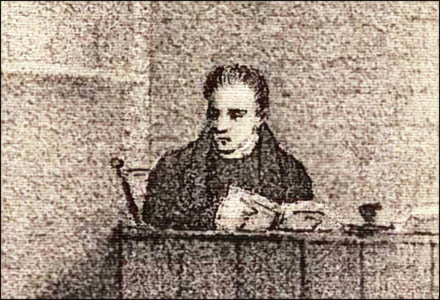
Return to top of the page
Sidney Rigdon "Home" | Rigdon's History | Mormon Classics | Bookshelf
Newspapers | History Vault | New Spalding Library | Old Spalding Library
last revised Sept. 4, 2009