
Mormon Classics | Spalding Library | Cowdery's Bookshelf | Newspapers | History Vault
|
William Baxter (1824-1886) Life of Elder Walter Scott (Cincinnati: Bosworth, Chase, & Hall, 1874) |

|
1926 ed. | Millennial Harbinger | Evangelist | re: Rigdon #1 | re: Rigdon #2
|
LIFE OF ELDER WALTER SCOTT WITH SKETCHES OF HIS FELLOW-LABORERS, WILLIAM HAYDEN, ADAMSON BENTLEY, JOHN HENRY, AND OTHERS. BY WILLIAM BAXTER. C I N C I N N A T I : BOSWORTH, CHASE & HALL, PUBLISHERS, 180 ELM STREET. 1874. |
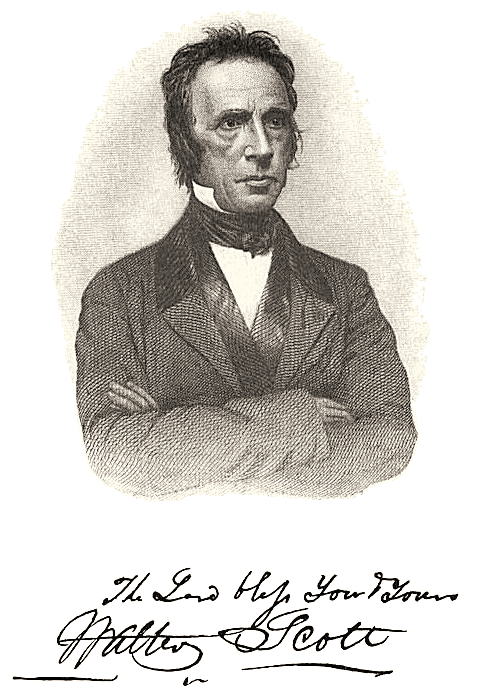
|
[ v ]
11 INTRODUCTION CHAPTER I. 29 Birth -- Ancestry -- Education -- Singing in the street at midnight -- Emigrates to the United States -- Goes westward on foot -- Employed as teacher -- Is baptizedCHAPTER II. 41 Becomes Principal of an Academy -- Sudden death of Mr. Forrester -- An important document -- Gives up his school -- Visits New York -- Disappointment,CHAPTER III. 56 Returns to Pittsburg -- And resumes teaching -- Sketch of Pittsburg Church -- Meets with Alexander Campbell and his father,CHAPTER IV. 69 Conversion of Samuel Church -- Marriage -- Extracts from his essays in the Christian Baptist -- Need of the Ancient Gospel perceived,vi CONTENTS. CHAPTER V. 82 Removal to Steubenville--Visits the Mahoning Baptist Association -- Mr. Scott chosen as Evangelist -- His field of labor -- Religious experiences -- The three brothers,CHAPTER VI. 95 Favorable omens -- Articles of faith of the New Lisbon church -- Scott begins his work -- Preaches at New Lisbon -- The gospel offer accepted -- Baptism for the remission of sins restored,CHAPTER VII. 109 Great Excitement -- Mr. Amend's letter -- Assailed by preachers -- Wesley's experience -- Testimony of the church standardsCHAPTER VIII. 127 Visits Warren -- Cold reception -- John Tait's conversion -- Sketch of Elder Bentley,CHAPTER IX. 140 Meeting at Austintown -- A. S. Hayden a convert--Church organized -- John Henry -- Death of Joseph Gaston, . .CHAPTER X. 155 Scott's views misunderstood -- Bishop Hobart's views of baptism -- Thomas Campbell visits the scene of Scott's labors -- Meeting at Sharon, and results,CONTENTS. vii CHAPTER XI. 168 Deerfield -- Scott's visit -- Amos Allerton the skeptic -- Conversion of Aylette Raines,CHAPTER XII. 181 Changes wrought -- Anecdotes -- Toad sky-high -- Neither for God nor devil -- Meeting of the Association -- Scott re-appointed -- William Hayden given as a fellow-laborer,CHAPTER XIII. 194 Sketch of William Hayden -- Early doubts -- Meets with Scott -- Musical talent -- Education in the saddle -- Specimen of his style -- Extent of his labors,CHAPTER XIV. 211 A pleasing incident -- Bentley and Bosworth appointed as helpers -- Dissolution of the Mahoning Association -- Scott's inflexibility of purpose -- Campbell moved by his eloquence -- Death in his family -- Replies to Robert Dale Owen,CHAPTER XV. 232 Removes to Carthage -- The little Sunday-school girl -- The village reprobate -- Great success -- A remarkable meeting,CHAPTER XVI. 246 Abundant labors -- Hospitality -- Liberality -- Teaching the Scriptures in his family -- Washes a brother's feet -- Tribute to B. W. Stone -- Thomas Campbell and Alexander Campbell -- Treatment of young preachers -- Good news from other fields,viii CONTENTS. CHAPTER XVII. 260 Discourse on the Holy Spirit -- Extracts from the Discourse -- Opinions with regard to its merits -- Review of the Rev. S. W. Lynd's pamphlet,CHAPTER XVIII. 281 Crooked things made straight -- The prominence he gave to human responsibility -- In what respects his work differed from that of other reformers -- Apostrophe to the Bible,CHAPTER XIX. 294 Social qualities of Elder Scott -- Trip up the Ohio River, and pleasing incidents connected with it -- Letter from one of the ministers whose acquaintance he made on the voyage,CHAPTER XX. 308 Visit to Kentucky -- Effects of first and second sermon -- Visits Henry Clay and Col. R. M. Johnson -- Meets the widow of Alexander Hamilton -- Visit to Bethany, Va., Pittsburg, Pa., and Warren, Ohio -- Letter from Elder Bentley,CHAPTER XXI. 323 His ideal of a preacher -- Exordiums -- Themes for the ministry -- Success attending his preaching -- His labors at threescore,CHAPTER XXII. 338 Scott and Campbell compared as preachers -- Dr. Humphrey's estimate of Campbell -- Scott's description of the second coming of Christ -- of the transfiguration -- Sermon at Georgetown, Kentucky,CONTENTS. ix CHAPTER XXIII. 352 His views on the great questions of the day -- Opposed to the position of Soame Jenyns, M. P. -- Position on the temperance and slavery questions -- Views on education -- Address before the College of Teachers at Cincinnati,CHAPTER XXIV. 370 Discussions growing out of Scott's plea -- His own distaste for controversy -- Debate between Hayden and Hubbard -- A short controversy -- The crawfish hole argument -- Hartzell and Waldo's discussion -- The farmer and scholar meet,CHAPTER XXV. 388 His plea for the name Christian -- Visit to the East -- Views on Millerism -- Removal to Pittsburg -- Labors as a colporteur -- Description of the great fire,CHAPTER XXVI. 404 Chosen Elder of the Allegheny Church -- Extracts from his diary at this period -- Marriage of two of his children -- Death of his wife,CHAPTER XXVII. 417 Admirable essay on Christian Union -- Encomiums bestowed upon it -- Visits Bethany -- Death of Samuel Church -- Letters,x CONTENTS. CHAPTER XXVIII. 431 Deeply concerned at the prospect of disunion -- His argument for union -- His great grief at the prevailing troubles,CHAPTER XXIX. 443 The end at hand -- The news of the fall of Fort Sumpter -- Taken suddenly ill -- Visited by Elders Rogers and Streator -- Death -- A. Campbell's tribute to his memory, |
|
FAVORABLE OMENS.
95
In view of the state of things set forth in the preceding chapter, the field of labor for the newly-chosen evangelist was rather an unpromising one; but it must be remembered that he himself had for years been perplexed by the doctrinal difficulties prevailing among the people to whom he was sent, and therefore the better prepared to show the evils of a partisan theology, and to point out a more excellent way. Here and there, however, in the various churches of the Association, were to be found individuals dissatisfied with the popular orthodoxy of the tomes, who needed only a leader in order to throw off the yoke of human creeds and to unite upon the one foundation on which the followers of Christ first stood. These were mainly the readers of the "Christian Baptist," by whose bold and startling articles a spirit of deep and earnest inquiry had been aroused. They were, though few in number, the thinkers, the earnest and honest-hearted of the various communities in which they were found, and their views, like leaven, were slowly and silently making their way. Indications of this appeared as early as the year 1823. In that year the church at Hubbard sent to 96 LIFE OF ELDER WALTER SCOTT. the Association the following question: "Is it the opinion of this Association that any church has the privilege, according to Scripture, of holding communion without an ordained elder, or to administer other gospel ordinances?" This was answered in the negative. In the same year the following was submitted by the Nelson church: "Is it an apostolic practice for churches to have confessions of faith, constitutions, or any thing of the like nature, except the Scriptures?" This was a blow aimed at the practice of every church in the Association. To answer the question in the affirmative would have made it necessary to prove what did not admit of proof; to have given a negative answer would have condemned what was universally practiced. Action upon it was, therefore, postponed until the next year, and even then it was deemed most politic to pass it by in silence. In 1824 the Nelson church had two more questions to propose for the consideration of the Association. They were: 1. "Will this Association hold in its connection a church which acknowledges no other rule of faith and practice than the Scriptures?" 2. "In what manner were members received into the churches that were set in order by the apostles?" Plain as these questions were, it was deemed best to postpone the answers until the next year, at which time the following replies were made. To the first: "Yes; on satisfactory evidence that they walk according to this rule." To the second: "Those who believed and were baptized were added to the church." These answers were condemnatory of the almost universal practice of the Baptist Churches at that time, as they did not recognize any THE OF LEAVEN WORKING. 97 church unless it had articles of faith corresponding to their own; and such was the universal demand for an "experience," that persons who had been baptized on a simple profession of faith in the Lord Jesus were denied membership with them. In the same year, from the New Lisbon church came the query: "Is it scriptural to license a brother to administer the Word and not the ordinances?" to which the answer was: "We have no such custom taught in the Scriptures." Also the following from the Nelson church: "Can Associations, in their present modifications, find their model in the New Testament?" to which the answer was: "Not exactly." In 1825 the Youngstown church sent up to the Association the following: "Was the practice of the primitive church an exact pattern to succeeding ages; and is every practice to be receded from which was not the practice of the primitive saints in their peculiar circumstances?" The reply was; "It is the duty and privilege of every Christian church to aim at an exact conformity to the example of the churches set in order by the apostles, and to endeavor to imitate them in all things inimitable by them." From the occurrences just related it will be perceived that light was increasing, and the questions from the Nelson church especially indicate that there were within it the elements of reform; and that those who held the sentiments set forth in the queries noticed were desirous of throwing off the creed which they regarded as a yoke of bondage. But of all the churches in the Association, that at Hiram, Portage County, had taken the roost advanced ground. This congregation at one time had its church covenant, 98 LIFE OF ELDER WALTER SCOTT. church articles, church constitution, and in addition to these held to the Philadelphia Confession of Faith; and it was not unusual to have all the three former read at a single church meeting. Of this dreary repetition the church clerk grew weary, and thought that the time could be better employed in reading the Scriptures. In this view several others shared; the matter was canvassed in nearly every family, and at length, at their monthly meeting, in August, 1824, it was proposed to renounce all--covenant, articles, constitution, and the Philadelphia Confession -- and take the Word of God as the only rule of faith and practice. A few objected, on the ground that without their articles and church covenant they would be like a barrel without hoops, with nothing to keep them together, as without them they could neither receive nor exclude members. Two recent occurrences, however, favored those who advocated the rejection of the offensive documents in a practical way. A short time before, two members had been received without the laying on of hands after baptism, which had previously been regarded by some as much a gospel ordinance as baptism or the Lord's Supper; this was done in consequence of their minister, Rufus Freeman, refusing to lay hands on the converts, as he did not regard it as enjoined by the Scriptures; and so the articles of faith which made it necessary had the effect of making trouble instead of keeping it away. A refractory member had also been brought up for trial, but as the offense was one not specified in the church articles, and she beyond all question guilty and yet unwilling to confess her fault, she was excluded on scriptural ground. CREEDS REJECTED. 99 An aged German brother, highly esteemed for his godly life, but who had never spoken in a church meeting before, arose, and after alluding to the above case, said: "Brethren, that trial was conducted without the use of the church articles; we have found that we can exclude disorderly members without them; if the Bible is a good rule by which to exclude evil-doers, it ought to be a good rule for right-doers to live by. I think we can do without the articles." The longer the discussion continued the stronger grew the party which stood up for the Bible alone, and when the motion was put that all their church rules and standards save the Bible alone should be renounced, all save three voted in its favor. One of the three, a lady, rose and said she had not voted on the motion from the fact that she had never accepted the documents which had been rejected, and for that reason could not renounce them; another gave a similar reason, leaving only one in the opposition. But this was a rare case in those days; most of the churches stood by the creed, articles, and covenant, and their opposers were generally regarded as troublers of Israel. As the articles of faith so often referred to expressed the views entertained at that time, and were given up with reluctance after a severe struggle, those held by the church at New Lisbon are given below, as generally expressive of the sentiments of the churches in the Mahoning Association: ARTICLES OF FAITH held by the Baptist church at New Lisbon. Constituted May 31, 1806: ARTICLE I. We believe in one God, the Creator of all the worlds, the only living and true God; a being of infinite 100 LIFE OF ELDER WALTER SCOTT. perfections, whose essence can not be comprehended by any but himself; a most pure Spirit, invisible, without body, parts, or passions, who only hath immortality, dwelling in the light which no man can approach unto, who is infinite in all his perfections, and most holy in and of himself. II. We believe that in this being of infinite perfections there are three subsistences or persons, the Father, Son, and Holy Spirit, of one substance, power, and eternity; each having the whole divine essence, yet the essence or nature undivided. The Father is of none neither begotten nor proceeding. The Son is eternally begotten of the Father. The Holy Spirit proceeding from the Father and Son, all infinite and without beginning, therefore but one God, who is not to be divided in nature and being, but distinguished by several particular relative properties and personal relations; which doctrine of the Trinity is the foundation of all our communion with God and comfortable dependence on him. III. We believe the Old and New Testaments to be the Word of God, and the only infallible rule of faith and practice in religious things. IV. We believe in the eternal and particular election of men and angels to eternal glory. V. We believe man to be a fallen creature and in a fallen state, and in his present state he is not able in and of himself to recover himself to a state of happiness. VI. We believe in a particular redemption of a definite number of persons to eternal life by the death of Christ. VII. We believe in a free justification by the righteousness of Christ imputed, and efficacious grace in regeneration, and the final perseverance of the saints in grace to the end. VIII. We believe in the resurrection of the dead, both of the righteous and ungodly, and the general judgment THE ARTICLES ABANDONED. 101 to come, and that the saints shall forever enjoy the glory of heaven, and that the unrighteous shall be sent to eternal misery to remain forever without hope or deliverance. IX. We believe that baptism is an ordinance of the New Testament; and that believers are the only subjects of it, and that this ordinance ought to be administered by dipping the body all over in water. X. We believe that laying on of the hands (on baptized believers as such) is an ordinance of the gospel. XI. We believe that the Lord's Supper is an ordinance of the gospel church. Some of the churches had more and some fewer articles than the above, but these will serve as a fair specimen of what all the Baptist churches in that region regarded as a necessity; and their fate was one which finally overtook them all. When the principles of the Reformation had been imbibed by some members of that congregation; at one of their monthly meetings, after the reading of the articles, one of the brethren asked that the third article be read again, which was done; it reads as follows: "We believe the Old and New Testaments to be the Word of God, and the only infallible rule of faith and practice in religious things." He then asked: "Brethren, do we believe that article?" "Certainly, most certainly," was the reply from several. "What, then," he continued, "is the use of the rest if the article just read be true, and the Word of God is the only infallible rule of faith and practice?" Another brother who saw the point, rose and moved that the articles of faith be abandoned; some, however, insisted that time for reflection was needed, and were in favor of delaying the vote until the next 102 LIFE OF ELDER WALTER SCOTT. monthly meeting. The next meeting came, but the articles were not read as usual, nor was the matter called up then or ever after. From this somewhat long but necessary digression it will be seen that, while there were, many things calculated to discourage the most sanguine, there were at the same time some hopeful indications; the light was dawning, which soon brightened into a glorious day. But to return to the newly-appointed evangelist. No one, perhaps, was as much surprised at his appointment as himself. He was at that time engaged in teaching an academy, and was making an arrangement to publish a new paper, to be called "The Millennial Herald;" he was preaching also for a small congregation in Steubenville; and wife and children demanded his care; but the call to the new field of labor so unexpected and providential he regarded as imperative, and dropping the bitterest tears he ever shed over his infant household, and abandoning all his other employments and projects, he threw himself heart and soul into the work before him. And now we come to the most eventful period in the life of Walter Scott. He had studied the Word of God long, earnestly, faithfully, and prayerfully. He had drunk into its spirit, and had become so fully convinced of the weakness and inefficiency of modern systems, so sick of sectarian bigotry and party strife, that he resolved to try the bold and novel experiment of preaching the gospel according to the New Testament model, as set forth in the labors of the holy men to whom Jesus had given the message of salvation to be heralded to a perishing world. He PREACHING THE PRIMITIVE GOSPEL. 103 made his first efforts beyond the bounds of the Association, and though a nobler purpose was never formed, the very novelty of his course almost created, in his own mind, a doubt of its propriety; and the great issue at stake, and anxiety as to the result created at times misgivings and fears. To his hearers his preaching was like the proclamation of a new religion; so different did it seem from the orthodoxy of the day, that they regarded the preacher as an amiable, but deluded, enthusiast, and he excited wonder, pity, and even scorn. His efforts, however, were not wholly fruitless; with every discourse his own convictions became stronger, and he felt assured that he had found the true path; and instead of yielding to discouragement under what seemed to be failures, he said to himself, this way is of God, and ought to succeed, and with his help it shall; and his courage and zeal rose with the difficulties he encountered until his labors were crowned with success. The scene of his first practical and successful exhibition of the gospel, as preached in primitive times, was at New Lisbon, Columbiana County, Ohio, the place at which he was appointed as traveling evangelist a few months before. The Baptist Church at that place had become acquainted with him at the Association, and received with pleasure an appointment from him for a series of discourses on the ancient gospel; and the citizens were glad to have a visit from the eloquent stranger. On the first Sunday after his arrival every seat in the meeting-house was filled at an early hour; soon every foot of standing room was occupied, and the doorway blocked up by an eager throng; and, inspired by the interest which 104 LIFE OF ELDER WALTER SCOTT. prevailed, the preacher began. His theme was the confession of Peter, Matt. xvi: 16: "Thou art the Christ, the Son of the living God," and the promise which grew out of it, that he should have intrusted to him the keys of the kingdom of heaven. The declaration of Peter was a theme upon which he had thought for years; it was a fact which he regarded the four gospels as written to establish; to which type and prophecy had pointed in all the ages gone by; which the Eternal Father had announced from heaven when Jesus came up from the waters of Jordan and the Spirit descended and abode upon him, and which was repeated again amid the awful grandeur and solemnity of the transfiguration scene. He then proceeded to show that the foundation truth of Christianity was the divine nature of the Lord Jesus -- the central truth around which all others revolved, and from which they derived their efficacy and importance -- and that the belief of it was calculated to produce such love in the heart of him who believed it as would lead him to true obedience to the object of his faith and love. To show how that faith and love were to be manifested, he quoted the language of the great commission, and called attention to the fact that Jesus had taught his apostles "that repentance and remission of sins should be preached in his name among all nations, beginning at Jerusalem." He then led his hearers to Jerusalem on the memorable Pentecost, and bade them listen to an authoritative announcement of the law of Christ, now to be made known fur the first time, by the same Peter to whom Christ had promised to give the keys of the kingdom of heaven, which he represented as meaning THE BIBLE MEANS WHAT IT SAYS. 105 the conditions upon which the guilty might find pardon at the hands of the risen, ascended, and glorified Son of God, and enter his kingdom. After a rapid yet graphic review of Peter's discourse, he pointed out its effect on those that heard him, and bade them mark the inquiry which a deep conviction of the truth they had heard forced from the lips of the heart-pierced multitudes, who, in their agony at the discovery that they had put to death the Son of God, their own long-expected Messiah, "cried out, Men and brethren, what shall we do?" and then, with flashing eye and impassioned manner, as if he fully realized that he was but re-echoing the words of one who spake as the Spirit gave him utterance, he gave the reply, "Repent, and be baptized, every one of you, in the name of Jesus Christ, for the remission of sins, and ye shall receive the gift of the Holy Spirit." He then, with great force and power, made his application; he insisted that the conditions were unchanged, that the Word of God meant what it said, and that to receive and obey it was to obey God and to imitate the example of those who, under the preaching of the apostles, gladly accepted the gospel message. His discourse was long, but his hearers marked not the flight of time; the Baptists forgot, in admiration of its scriptural beauty and simplicity, that it was contrary to much in their own teaching and practice; some of them who had been, in a measure, enlightened before, rejoiced in the truth the moment they perceived it; and to others, who had long been perplexed by the difficulties and contradictions of the discordant views of the day, it was like light to weary travelers long benighted and lost. 106 LIFE OF ELDER WALTER SCOTT. The man of all others, however, in that community who would most have delighted in and gladly accepted those views, so old and yet so new, was not there, although almost in hearing of the preacher, who, with such eloquence and power, was setting forth the primitive gospel. This was Wm. Amend, a pious, God-fearing man, a member of the Presbyterian Church, and regarded by his neighbors as an "Israelite indeed." He had for some time entertained the same views as those Mr. Scott was then preaching in that place for the first time, but was not aware that any one agreed with him. He was under the impression that all the churches -- his own among the number -- had departed from the plain teachings of the Word of God. He had discovered, some time before, that infant baptism was not taught in the Bible, and, consequently, that he was not a baptized man; the mode of baptism seemed also to him to have been changed, and he sought his pastor, and asked to be immersed. He endeavored to convince him that he was wrong, but finding that he could not be turned from his purpose, he proposed to immerse him privately, lest others of his flock might be unsettled in their minds by his doing so, and closed by saying that baptism was not essential to salvation. Mr. Amend regarded every thing that Christ had ordained as being essential, and replied that he should not immerse him at all; that he would wait until he found a man who believed the gospel, and who could, without any scruple, administer the ordinance as he conceived it to be taught in the New Testament. He was invited a day or two before to hear Mr. Scott, but knowing nothing of his views, he supposed that THE GOSPEL OFFER ACCEPTED. 107 he preached much as others did, but agreed to go and hear him. It was near the close of the services when he reached the Baptist church and joined the crowd at the door, who were unable to get into the house. The first sentence he heard aroused and excited him; it sounded like that gospel which he had read with such interest at home, but never had heard from the pulpit before. He now felt a great anxiety to see the man who was speaking so much like the oracles of God, and pressed through the throng into the house. Mr. Dibble, the clerk of the church, saw him enter, and knowing that he had been seeking and longing to find a man who would preach as the Word of God read, thought within himself, "Had Mr. Amend been here during all this discourse I feel sure he would have found what he has so long sought in vain. I wish the preacher would repeat what he said before he came in." Greatly to his surprise the preacher did give a brief review of the various points of his discourse, insisting that the Word of God meant what it said, and urging his hearers to trust that Word implicitly. He rehearsed again the Jerusalem scene, called attention to the earnest, anxious cry of the multitude, and the comforting reply of the apostle, "Repent, and be baptized, every one of you, in the name of Jesus Christ, for the remission of sins, and ye shall receive the gift of the Holy Ghost." He invited any one present who believed with all his heart, to yield to the terms proposed in the words of the apostle, and show by a willing obedience his trust in the Lord of life and glory. Mr. Amend pressed his way through the crowd to the preacher and made known his purpose; made a public declaration of his 108 LIFE OF ELDER WALTER SCOTT. belief in the Lord Jesus Christ and his willingness to obey him, and, on the same day, in a beautiful, clear stream which flows on the southern border of the town, in the presence of a great multitude, he was baptized in the name of Jesus Christ for the remission of sins. This event, which forms an era in the religious history of the times, took place on the 18th of November, 1827, and Mr. Amend was, beyond all question, the first person in modern times who received the ordinance of baptism in perfect accordance with apostolic teaching and usage. |
|
GREAT EXCITEMENT.
109
The baptism of Mr. Amend occasioned no small stir in the community. No one had ever seen any thing in all respects like it, and yet it seemed to correspond so perfectly with the teachings and practice of the apostles that few could fail to see the resemblance. Mr. Scott continued his labors during the following week, and many others who had been unable to accept the popular teaching of the day had their attention arrested by a gospel which they could understand, and with the conditions of which they could comply, and the result was, that by the next Lord's day fifteen others followed the example of Mr. Amend by publicly confessing their faith in Jesus as the Son of God and being immersed. Of course, much opposition was aroused. One man went so far as to threaten to shoot Mr. Scott if he should baptize his mother, who had sought baptism at his hands; but threats and scoffs only served to increase the zeal of the preacher; and it was found, moreover, that all the converts were able to give such reasons for the course they had taken, that no one that admitted the Bible to be true could gainsay. Another very happy result was, that nearly the whole community began to search the Scriptures, many in 110 LIFE OF ELDER WALTER SCOTT. the spirit of the Bereans, to see whether these things were so; others with no higher object than to find objections to the new doctrine, and many of these were forced to the conclusion that if it were false the Bible could not be true, as the chief feature of the new doctrine was that the preacher could tell every honest inquirer his duty in the very language of Holy Writ. It was a most fortunate circumstance, too, that the first one to come out in favor of the new teaching was a man of undoubted integrity, and of more than ordinary intelligence and remarkable for his scriptural knowledge, which was far beyond that of most men in his condition of life. He had not hastily adopted the views of the preacher as soon as presented, but, on the contrary, he had reached the same conclusions before hearing him, from a careful study of the Word of God; and he knew not until he heard Mr. Scott that there was another man on earth who held views similar to his own. Indeed, he could not strictly be called a convert to the views of Mr. Scott; he had long held them, and was prepared for immediate obedience to the law of Christ as soon as the opportunity was given. With this humble, God-fearing man there is now connected an interest that is historic; he was the first to afford an example of strict conformity to the design of an ordinance of the church of Jesus, which had so long been lost sight of as to become almost meaningless. In him we see that ordinance restored to the place designed for it by its divine Author -- restored, we can not doubt, beyond the possibility of ever being perverted or forgotten again. MR. AMEND'S LETTER. 111 Some years after this event, Mr. Scott was called upon to give the circumstances which attended this restoration of the ordinance of baptism to its primitive place; with rare wisdom he called upon Mr. Amend to relate the circumstances which led to his baptism. He introduces Mr. Amend's letter with the following remarks: "Dear Sir: The republication of the gospel in the style and terms of the apostles was attended with so extraordinary an excitement as to cause us to forget and sometimes overlook matters and things, which, on common occasions, would have been accounted very singular. "It was thought, sir, it might minister to your pleasure to read a letter from a person who first obeyed the faith as now preached in the Reformation. It is inserted here accordingly. After vexations not to be mentioned, it was resolved to make a draft upon the audience, that it might be known why the preacher spoke and wherefore they came to hear. Accordingly, bursting away from prejudices and feelings almost as strong as death, and thinking of nothing but the restoration of the gospel, it was proposed to ascertain immediately who would obey God and who would not. The confusion of all, the preacher not excepted, was indescribable. A person whom I had seen come into the meeting-house about fifteen minutes before the end of the discourse came forward. This, as often as I thought of it, had always appeared to me wholly unaccountable, for it was most certain the man could not have been converted to Christianity by any thing which he heard during the few minutes he was present. His letter explains the matter, and will enable you, sir, to judge whether this whole business, as well on the side of the hearer as on the side of the preacher, is not resolvable into the good providence 112 LIFE OF ELDER WALTER SCOTT. of our Heavenly Father, to whom be the glory through Jesus Christ: "BELOVED BRO. SCOTT: I received your letter of the 21st, and was happy to hear you were well; myself and family are in good health at present, our youngest child excepted. I should be very happy to see you. You request me to write the time of my baptism, my feelings, and the causes why I accepted the invitation. In order to show these things aright, I must go back a piece. I was at that time a member of that strait sect called Presbyterians; taught many curious things, as election, fore-ordination, etc.; that belief in these matters was necessary; that this faith resulted from some secret impulse; and worse, that I could not believe; and finally, that I must hope and pray that God would have mercy upon me! In this wilderness I became wearied, turned about and came home to the Book of God; took it up as if it had dropped down from heaven, and read it for myself just one year. "This inquiry led me to see that God so loved the world as to give his only begotten Son, that whosoever believed on him might not perish but have eternal life. I then inquired how I must believe. Paul said faith cometh by hearing, and hearing by the Word of God; also that faith was the substance of things hoped for -- the evidence of things not seen. Peter spoke of election, saying, Save yourselves. Paul said I must be dead to sin and buried, and raised with Christ Jesus to newness of life. The Savior said I must be born again if I would enter the kingdom of God. "Now, here it was I discovered myself to stand in the garden of nature and not in the kingdom of heaven, but I learned that of this kingdom Peter received the keys, and I was anxious to see what he would do with them. Jesus said proclaim the gospel to all the nations; he that believeth and is baptized shall be saved, etc. I then moved a little forward till I found these words: 'Now when they heard this they were pricked to the heart, and said to MR. AMEND'S LETTER. 113 Peter and to the other apostles, Men and brethren, what shall we do? Peter said, Repent and be baptized every one of you in the name of Jesus Christ for the remission of sins,' etc. To this scripture I often resorted; I saw how Peter had opened the kingdom, and the door into it, but, to my great disappointment, I saw no man to introduce me, though I prayed much and often for it. "Now, my brother, I will answer your questions. I was baptized on the 18th of Nov., 1827, and I will relate to you a circumstance which occurred a few days before that date. I had read the 2d of the Acts when I expressed myself to my wife as follows: 'Oh, this is the gospel -- this is the thing we wish -- the remission of our sins! Oh, that I could hear the gospel in these same words -- as Peter preached it! I hope I shall some day hear it; and the first man I meet who will preach the gospel thus, with him will I go.' So, my brother, on the day you saw me come into the meeting-house, my heart was open to receive the Word of God, and when you cried, 'The Scriptures no longer shall be a sealed book. God means what he says. Is there any man present who will take God at his word, and be baptized for remission of sins?' -- at that moment my feelings were such that I could have cried out, 'Glory to God! I have found the man whom I have long sought for.' So I entered the kingdom where I readily laid hold of the hope set before me. "Let us, then, dear brother, strive so to live as to obtain an abundant entrance into the everlasting kingdom of our Lord Jesus Christ at his coming -- there to join with the heavenly throng in a song of praise to God and to the Lamb forever and ever. Amen. "I remain yours, etc. WILLIAM AMEND." It may interest the reader to know that Mr. Amend is still living at Hiawatha, Kansas, at the age of nearly fourscore; his mind is still clear and vigorous, and he 114 LIFE OF ELDER WALTER SCOTT. can read ordinary print without the aid of glasses. He has never for a moment swerved from the faith he professed some forty-five years ago, and in patience and hope he is waiting the Master's call. Mr. Scott, after the events narrated above, paid a visit to several points on the Western Reserve, and in three weeks again returned to New Lisbon. He found the interest awakened by his first visit undiminished, and seven more were added to the number already baptized. His labors were now in great demand, calls from various quarters poured in upon him, and night and day found him engaged, wherever opportunity afforded, in the Master's work. He soon visited New Lisbon again, and over thirty more joyful and willing converts were made. The members of the Baptist Church received the Word gladly, and almost to a man accepted the truth which he presented with such force and clearness, and resolved that thenceforth the Word of God should be their only rule and guide. In this visit Elder Scott was accompanied by Joseph Gaston, a minister of the Christian connection, who had heartily embraced the truth, and who by his tender and pathetic exhortations greatly aided in promoting the success of the gospel. The excitement consequent upon the great religious changes in New Lisbon soon spread through the county, and Scott and Gaston were urged to visit East Fairfield, a village some eight miles distant. The community was composed mainly of Quakers and Bible Christians, many of whom accepted the gospel as presented by the new preachers, and the result was, that after a meeting of three or four days a large congregation, including several of the most ASSAILED BY PREACHERS. 115 influential people in that locality, was established upon the foundation of the apostles and prophets. Returning to New Lisbon, Elder Scott found the truth to be advancing, but as of old, also, some contradicting and almost blaspheming; the ordinance of baptism was ridiculed; opprobious names were given to those who accepted the new doctrine, which was stigmatized as heresy, a Water Salvation, as worse than Romanism -- the opposers, in their zeal, forgetting that faith, repentance, and a new life were as much insisted on by the Reformers as those who differed from them in other respects. Chief in the opposition were the Methodist and Presbyterian ministers who, during his absence at Fairfield, assailed both Scott and his teaching from their respective pulpits. Of this he was informed, and on the first evening after his return a large audience gathered to hear him. Just as he was beginning his discourse the two ministers came in, and as soon as they were seated Scott said: "There are two gentlemen in the house who, in my absence, made a man of straw and called it Scott; this they bitterly assailed; now if they have any thing to say the veritable Scott is here, and the opportunity is now theirs to make good what they have said elsewhere. Let us lay our views before the people and they shall decide who is right; for my part, I am willing at any time to exchange two errors for one truth. Come out, gentlemen, like men, and let us discuss the matters at issue." His reverend assailants showing no signs of accepting his invitation, he called them by name, and, addressing some young persons on the front seat, said: "Boys, make room there. Now, gentlemen, come forward." The 116 LIFE OF ELDER WALTER SCOTT. ministers, however, felt that the man and his teachings could be more safely assailed in his absence than in his presence; they therefore rose, and arm in arm left the house, leaving behind them the impression that they felt unable to make good their charges of heresy and false doctrine. A report was also set on foot derogatory to the moral standing of Mr. Scott. This attack on his character called forth much sympathy in his behalf. A number of the citizens undertook the investigation of the matter, which resulted in covering his revilers with shame, and adding to his already great influence in the community. A handsome purse was also made up and presented to him by those who were indignant at the base and unfounded charges which had been made against him. Not long after, another Methodist minister announced that he would review and expose the new doctrine. A large audience assembled to hear him, and among them Scott himself. The preacher addressed himself to his task in an unlovely spirit; introducing the services by reading the hymn: To thee for help we fly; Thy little flock in safety keep, For oh! the Wolf is nigh;" THE WOLF IS NIGH. 117 manner so kind and gentlemanly that the audience were as deeply impressed with the Christian spirit he exhibited as they had been disgusted with the coarseness and rudeness of his assailant, to whom they thought the epithet wolf belonged more properly, than to him it was intended to apply. Such were some of the circumstances which attended the restoration of the ordinance of baptism to its proper place in the gospel scheme; and it is somewhat difficult in this day to realize how it could have caused such excitement and aroused such bitter opposition. The ordinance, beyond all doubt, had a design, and the setting forth that design in the language of Scripture, and making practical that which was misunderstood and useless before, constituted the great peculiarity of Mr. Scott's teaching upon this subject. In connecting it with the remission of sins, no thought of its possessing any merit or cleansing power entered into his mind. Christ was the Savior, and in him all saving power was centered, and baptism was but one of the conditions necessary to the enjoyment of the salvation which his death had made possible. On the part of the sinner believing on the Lord Jesus with all his heart, feeling his sinfulness and need of pardon, baptism was the open and public avowal of his state of mind and heart, and an acceptance of the offer made in the gospel to those who truly believe and heartily repent; and on the part of Christ it was a solemn assurance that his submission was accepted; that his past sins were forgiven; that he was received into the divine favor and adopted into the family of God. Mr. Scott's opposers regarded him as substituting 118 LIFE OF ELDER WALTER SCOTT. baptism for faith in the Lord Jesus, and a change of heart; while he ever taught that faith in Christ and a changed heart brought the believing penitent to baptism as a solemn act of obedience, which proved the sincerity of his faith, and the reality of the change in his heart and affections. He regarded it as the instrument by which Christ gave assurance of pardon to those who by obedience entered into covenant with him; the act by which the transition was made from the kingdom of Satan into the kingdom of God's dear Son; the marriage ceremony, by which the believer was united to Christ; the law of naturalization, by which those who had been aliens and foreigners were made citizens of the kingdom of God. With him it was the point at which forgiveness was realized by actual submission to the law of Christ; for as forgiveness must be realized before peace and joy could take possession of the heart, and as forgiveness could take place only before obedience, or after obedience, or in obedience, it seemed more reasonable, as well as scriptural, that it should be found in obedience, rather than before it, or be delayed after obedience was rendered. This view alone rendered the Scriptures intelligible. In the commission, as given by Mark, "He that believeth and is baptized shall be saved," in some way connected being "saved" with the conditions of belief and baptism. Christ had said before that, "Except a man be born of water and of the Spirit he can not enter into the kingdom of God." The language of Peter, Acts ii: 38, "Repent and be baptized, every one of you, in the name of Jesus Christ, for the remission of sins," indicated HIS VIEWS OF BAPTISM. 119 some connection between baptism and pardon. The language of Ananias to Saul, "Arise and be baptized, and wash away thy sins," seemed to point to the same thing. "As many of you as have been baptized into Christ have put on Christ," seemed to mark the entering into a new relation to Christ by baptism; and the language of 1 Peter iii: 21, "The like figure whereunto even baptism doth also now save us (not the putting away of the filth of the flesh, but the answer of a good conscience toward God), by the resurrection of Jesus Christ," was in some way associated with being "saved" in some sense, and also with the obtaining a "good conscience." These he felt it neither safe to ignore nor possible to explain away; to teach them was the only course that remained. This he did, but not to the neglect of any thing else enjoined in the word of God; and yet this was the head and front of his heresy. In teaching this he restored one of the long-neglected conditions of pardon to its proper place, and thus brought order out of confusion, and substituted light for the darkness upon this subject, which long had reigned. Before the restoration of this neglected element of gospel obedience -- this missing link -- assurance of pardon was, by the great majority, made to depend upon the simple exercise of faith; that is, the proof or evidence that an individual was pardoned depended on his faith that such really was the case. But here was the difficulty; if an individual, who was conscious of being in an unpardoned state, was required to believe that he was pardoned in order that he might be, he was likely to reason as follows: "If 120 LIFE OF ELDER WALTER SCOTT. I believe I am pardoned now, am I not believing that which is not true? the pardon must be granted before I can believe it." It seems like teaching that all men are in a pardoned state, but all do not enjoy it because they do not believe it; it is like telling the sick man you are well if you only believe it, while he would feel like replying, "I can not believe I am well until such is really the case." Very many made their feelings the test of their standing in the sight of God, and, in striving after what they deemed the proper state of feeling for pardoned persons, fell into many extravagancies. Dreams and visions and any unusual occurrences were regarded as tokens of God's favor; not a few could be found ready to testify that they had heard from above the words, "Thy sins be forgiven thee;" others, after having their minds filled with terror, and being brought very near to the pit of despair, would regard the calm which followed as the smiling of God's face; and still others would for years realize all the alternations of hope and despair, at times feeling assured of God's favor, at other times writhing under his frown. No fixed and definite way of coming to God and receiving an assurance of his favor seemed to be known; each effort to that end was an experiment, and none knew whether it would result in joy or despair. Penitents earnest and sincere, for long periods sought pardon, but their prayers and tears seemed of no avail; in sorrow and anguish of spirit they were compelled to give up the search without finding heaven disposed to be gracious to their souls. We know not how to better illustrate this state of things WESLEY'S EXPERIENCE. 121 than by giving the experience of John Wesley upon this very point of assurance of acceptance with God. One of his biographers thus writes: "John Wesley is now thirty-five years of age. Thirteen years have passed since he began to seek the salvation of his soul by trying to keep the law of God. These years have been spent in such earnest work as few men ever perform. His eye has been steadfastly fixed on the grand object of his pursuit. He has, with rare force of will, made every thing in and about him subserve his high purpose. Though uncertain of divine favor, he has heroically persisted in doing the divine will, so far as he has understood it. He meets with a good Moravian brother, named Peter Bohler. They talk of religion with burning hearts. Peter soon discovers that his learned friend is prevented from enjoying peace of mind, because of certain errors of opinion; and looking very tenderly into his serious face, he says, feelingly: "My brother! my brother! that philosophy of yours must be purged away.' "They part. Wesley thinks deeply on the questions raised by Peter, until going to Oxford some days later to see his brother Charles, who was supposed to be dying, he meets Peter Bohler again. Their conversation is renewed, until Wesley, with genuine humility, confesses: 'I am clearly convinced of unbelief, of the want of that faith whereby alone we are saved.' Then his highly-sensitive conscience smites him, and presses this question upon him: 'You must leave off preaching. How can you preach to others, who, like you, have not faith?' This inquiry troubled him, and, with his wonted openness, he stated it to Peter, and asks: 'Should I leave off preaching or not?' With sound good sense, Peter rejoins: 'By no means.' 'But what can I preach?' urges the distressed Wesley. 'Preach faith till you have it, and then because you have it, you will preach faith.' 122 LIFE OF ELDER WALTER SCOTT. "They separate. But meeting Bohler again, he is told that 'Dominion over sin, and constant peace from a sense of forgiveness, attend the exercise of saving faith.' He is amazed at this statement. He has never supposed that a sense of forgiveness was his privilege. But he promises to search for the doctrine in his Greek Testament. He does this with much prayer. Light breaks in upon his mind, and when he meets Peter, a month later, he confesses to have found the blessed doctrine in the sacred Word, very much to his friend's satisfaction, and to the increase of his own hopes. And now Peter renews his astonishment, by declaring that the blessing of pardon and of a new heart is graciously given to a penitent the moment he trusts in Christ! 'Impossible!' cries the still incredulous Wesley. 'Search the Scriptures and see,' replies Bohler. Again is our scholar confounded by the simple word of God. He finds scarcely any other than instantaneous conversions recorded in the sacred page. It is now the 24th of May, 1738. At five in the morning he opens his Greek Testament, and these words meet his eye: 'There are given unto us exceeding great and precious promises, even that ye should be partakers of the divine nature.' BR> "This encourages him. On going out he opens his Testament again, and is comforted by the words, 'Thou art not far from the kingdom of God.' In the afternoon he attends divine service at St. Paul's, where the anthem encourages his hopes. In the evening he goes to a little society meeting, in Aldersgate Street. Behold him seated, with sad expression, among a few poor, earnest seekers of his Lord, listening to a man reading Luther's preface to the Epistle to the Romans! About a quarter before nine, the speaker describes the change which God works in the heart through faith. In a moment his heart is 'strangely warmed,' and sends up a spontaneous prayer for his WESLEY'S EXPERIENCE. 123 enemies -- the first gush of the love begotten in him by the Holy Spirit. "Very soon the speaker stops. Wesley rises, his face radiant with heavenly light, and says: 'I now, for the first time, feel in my heart that I trust in Christ, Christ alone, for salvation. I have an assurance that he has taken away my sins; even mine, and saved me from the law of sin and death!'" This is, doubtless, a true but a sad picture of an earnest soul seeking after God -- willing to be saved, yet seeking God's favor in vain for thirteen long years. Was Wesley insincere or God unwilling to save? Neither; Wesley was seeking without any clear apprehension of the plan of salvation, at one time seeking the advice of a friend who was a blind leader of the blind, learning after years of mental suffering that a "sense of forgiveness was his privilege." Opening his Testament at random; looking for what he needs now in an anthem; again at a little society meeting; and when the assurance does come, it is a marvelous if not miraculous affair, and totally unlike any of the cases reported in the Word of God. Has God taught then to seek thus without telling them where they may find? did the gospel offer point out no path by which peace and pardon might be found? Every case of conversion after the gospel was first proclaimed on Pentecost shows that obedience was always followed by the joy of pardon. One of the great elements restored by Scott was, that all who felt as did the multitude who on Pentecost cried out, "Men and brethren, what shall we do?" by 124 LIFE OF ELDER WALTER SCOTT. obedience to the instructions there given in the words "Repent and be baptized every one of you in the name of Jesus Christ for the remission of sins, and ye shall receive the gift of the Holy Spirit," might, like them, "gladly receive the Word," and feel an assurance that the promise was fulfilled to the joy of their hearts. It is true that Wesley's case was before the times of which we write, but myriads of cases, more or less like his, were to be found at that time, and to them it was the greatest jay their hearts had ever known to be pointed to Pentecost as the model for all time. It is worthy of note that Wesley himself afterwards, whether he perceived the precise relation of baptism to the forgiveness of sins or not, expressed himself as if he both understood and believed it. His language is: "Baptism, administered to real penitents, is both a means and a seal of pardon. Nor did God ordinarily in the primitive church bestow this (pardon) on any unless through this means." Indeed, it is a somewhat remarkable fact, that nearly all the creeds of the various religious parties at that time associated the remission of sins with baptism, and yet they all united in casting Scott's name out as evil because he taught and practiced in accordance with their own creeds, which in this instance were not at variance with the Word of God. As proof of this, we give quotations from the creeds of some of the largest and most popular denominations. The Episcopal Prayer-book uses the words "washing away of sins," and teaches that "God will grant them remission of their sins" who come to the ordinance of baptism in faith, truly CALVIN'S VIEWS. 125 repenting. The Methodist Discipline uses similar language. The Presbyterian Confession says: "Baptism is a sacrament of the New Testament, ordained by Jesus Christ, not only for the solemn admission of the party baptized into the visible church, but also to be unto him a sign and seal of the covenant of grace, of his ingrafting into Christ, of regeneration, of remission of sins, and of his giving up unto God, through Jesus Christ, to walk in newness of life; which sacrament is, by Christ's own appointment, to be continued in his church until the end of the world." The Baptist creed says: "Baptism is an ordinance of the New Testament, ordained by Jesus Christ, to be unto the party baptized a sign of his fellowship with him in his death and resurrection, of his being ingrafted into him, of remission of sins, and of his giving up unto God, through Jesus Christ, to live and walk in newness of life." The Roman Catholic and Greek Church say: "We believe in one baptism for the remission of sins." Calvin, the great Reformer, says "Baptism resembles a legal instrument, properly attested, by which he assures us that all our sins are canceled, effaced, and obliterated, so that they will never appear in his sight or come into his remembrance, or be imputed to us. For he commands all who believe to be baptized for the remission of sins." "Therefore, those who have imagined that baptism is nothing more than a mark or sign by which we profess our religion before men, as soldiers wear the insignia of their sovereign as a mark of their profession, have not considered that which was the principal thing in baptism, which is that we 126 LIFE OF ELDER WALTER SCOTT. ought to receive it with this promise:" "He that believeth and is baptized shall be saved;" and, indeed, there is no single item of religious faith and practice in regard to which the various church standards give such a united and uniform testimony as baptism for the remission of sins, yet with almost equal unanimity the various parties deny and discard what those standards so unequivocally affirm. Scott's plea, then, was a strong one, and one, moreover, that could not be treated as a new and unheard of view of the case, and one which he could present in the very words of Holy Scripture. |
|
VISITS WARREN.
127
In order to be nearer the field of his labors, Mr. Scott now removed to Canfield, on the Reserve; and, elated by the remarkable success which had attended his labors at New Lisbon, and not doubting but that the divine blessing would accompany the Word when faithfully proclaimed, he paid a visit to Warren, on the Western Reserve, at which place was the largest and strongest church within the bounds of the Association. This congregation had enjoyed for many years the labors of Adamson Bentley, to whose ministry, in a great measure, its prosperity was due. No Baptist minister was better known or more highly esteemed than he in all that region. He sympathized with Mr. Campbell in his views as set forth in the "Christian Baptist," and had, in a great measure, under these enlarged views of Bible truth, outgrown the limits of the narrow creed of the religious body with which he was identified, and had, moreover, expressed in public the same views in regard to the design of baptism as had recently been turned to such practical account by Mr. Scott. Some months before this time, in company with Jacob Osborne, a minister of great promise, he had 128 LIFE OF ELDER WALTER SCOTT. gone to Braceville to hold a meeting, and during its progress, while speaking with regard to baptism, he stated that it was designed to be a pledge of the remission of sins. After meeting, on their way home, Mr. Osborne said: "Well, Bro. Bentley, you have christened baptism to-day." "How so?" said Mr. Bentley. "You termed it a remitting institution." "Well," rejoined Mr. Bentley, "I do not see how this conclusion is to be avoided with the Scriptures before us." "It is the truth," said Mr. Osborne, who was a great student of the Bible, "and I have for some time thought that the waters of baptism must stand in the same position to us that the blood of sacrifices did to the Jews. The blood of bulls and of goats could never take away sins, as Paul declares, yet when offered at the altar by the sinner, he had the divine assurance that his sins were forgiven him. This blood was merely typical of the blood of Christ, the true sin-offering to which it pointed prospectively; and it seems to me that the water in baptism, which has no power in itself to wash away sins, now refers retrospectively to the purifying power of the blood of the Lamb of God." Mr. Scott, not long after, fell in with them, and all three went to Howland together; the discourse of Bentley at Braceville came up, in course of conversation, and Scott expressed his agreement with the view he had taken of the subject. Mr. Osborne preached at Howland, and in his remarks advanced the idea that no one had the promise of the Holy Spirit until after baptism. The remark seemed to strike Mr. Scott with surprise, and after meeting he said to Mr. Osborne: "You are a man of great ELDER BENTLEY FEARFUL. 129 courage;" and, turning to Mr. Bentley, he added: "Do you not think so, Bro. Bentley?" "Why?" said Mr. Bentley. "Because," said he, "he ventured to assert to-day that no one had a right to expect the Holy Spirit until after baptism." These events took place before the occurrences at New Lisbon, and, doubtless, being fresh in the mind of Scott, he naturally expected not only a warm welcome from the church in Warren, but also the earnest co-operation of its pastor, Elder Bentley, and Mr. Osborne, who was teaching an academy there, as they both held the views which he had been so ably and successfully advocating. In this, as far as Elder Bentley was concerned, he was at first disappointed; the views which he had expressed at Braceville, with regard to the design of baptism, were his views still, but he never had thought of making them practical or operative, as they recently had been made by Mr. Scott, the report of whose doings at New Lisbon had preceded him to Warren, and had made the impression on the mind of Bentley that his course was one differing widely and dangerously from Baptist usage, and indeed from the practice of all other churches, and in consequence he could not but regard him with suspicion. Immediately after his arrival, having met with Elder Bentley, Scott asked concerning the condition of the church, and was told in reply that it was getting on much as usual; whereupon Scott intimated that he was pursuing a course very different from that usually taken, but, as he thought, in perfect accordance with the teaching of the New Testament and the practice of the apostles. He, moreover, 130 LIFE OF ELDER WALTER SCOTT. frankly told him that the views he entertained were such as would unsettle the minds of the brethren, and if adopted would lead to the giving up of many things which they as Baptists held dear, but that the result would be a purer and more useful church. "I have," said he, "got the saw by the handle, and I expect to saw you all asunder" -- meaning by this, that their creed and church articles must give way before the truth of God, which he proposed to insist upon as the only rule and guide for the church. Bentley did not enter into the spirit nor catch the enthusiasm of the ardent evangelist; the course proposed seemed to him revolutionary -- one in which there might be great danger, and for which he did not feel prepared, and when Scott urged that an appointment be given out for him to preach that evening in the Baptist church, he intimated that he thought it best for him not to begin his labors just then--wishing, no doubt, to learn more of the course he expected to pursue before he gave it his help and approval. Scott felt, however, that the King's business required haste, and insisted that an appointment should be made, and, after they parted, sent a note to Jacob Osborne, then engaged in teaching, requesting him to give notice through his pupils that there would be preaching that night at the Baptist church, which was done. On learning this, Elder Bentley gave orders that the meeting-house should not be opened that night, in consequence of which Scott procured the use of the court-house, and had the people notified that he would address them there. An audience, mainly of young people, assembled, and he addressed them in such a manner as to make a BENTLEY YIELDS. 131 most favorable impression, and at the close of his discourse he requested them to make it known that on the next night he would tell all who might favor him with their presence something they had never heard before. This, of course, was the means of letting every one in the town and vicinity know that something out of the usual order might be expected. The next day Scott met with Bentley and Osborne, and Bentley withdrew his opposition, and agreed that the meeting should be held that night in the church instead of the court-house. A large audience gathered, and the zeal and eloquence of the preacher carried his hearers by storm. He presented Christianity in virgin robes of truth and purity, as when she descended from her native skies -- and sectarianism in every form suffered by the contrast. The religion of the New Testament, in all its beauty and simplicity, stripped of the difficulties with which human teaching had encumbered and disfigured it, was shown to be perfectly adapted to human wants and woes, and the fullness and freeness of the salvation which it offered, contrasted with the narrow partialism of the prevailing Calvinism of the times, made it seem like a gospel indeed -- glad tidings of great joy to all people. The next night brought a still larger audience and an increased interest. The prejudices of Bentley gave way under the luminous exhibitions of the gospel, and he soon embraced heartily the truth which Scott presented with fidelity and power. With some of these views, as we have seen, he had for some time been familiar, but until now he had never realized their practical significance, nor had they ever brought 132 LIFE OF ELDER WALTER SCOTT. such joy to his heart before. Soon, too, the unconverted portion of the audience began to yield to the claims of the gospel; and as they inquired anxiously, "Men and brethren, what shall we do?" they were met with the same answer which was given to the same question in the days of old. Baptism on a simple confession of faith in Jesus as the Son of God speedily followed, the newly baptized were added to the church, and what was said of Samaria after the preaching of Philip was true of Warren -- "there was great joy in that city." Scott spent eight days in all at that visit, during which time twenty-nine persons were baptized, and the entire Baptist Church, with one or two exceptions, accepted the new order of things, which had so long been forgotten. The work, however, did not stop on the departure of the preacher -- the truth wrought mightily in the community, the Bible was read and searched as never before, members of other churches were led to examine the new doctrine, as it was called, and this led them to see the weakness of partyism, and resulted in the conviction that it was true, and led them to abandon their old and long-cherished associations and unite with those who had taken the Word of God alone as their guide. Among the converts during the first visit of Scott, was John Tait, a man of great stature and strong will; he was a Presbyterian, warmly attached to the faith of his fathers, and when his wife, who had attended on Scott's preaching, resolved to confess Christ and be baptized, he opposed her bitterly, and even went so far as to threaten violence to the preacher if he should baptize her. AN ANGRY HUSBAND. 133 The preacher, not in the least intimidated, gave him to understand that, if his wife wished, to be baptized, he would baptize her even if he, her husband, should stand with a drawn sword to prevent it. The wife, fully convinced that it was her duty to render this act of obedience to her Lord, notwithstanding the violent opposition of her husband, was determined to be baptized. Almost frantic with excitement, he called on Scott, and found him in company with several preachers who were attending the meeting, and forbade the baptism of his wife. Scott and Bentley attempted, but in vain, for a time to reason with him, urging that his wife was acting in accordance with her convictions of duty as set forth in the Word of God, and that in a matter of such moment she ought to be allowed to decide for herself. It was long before he could be calmed sufficiently to reason upon the subject, but the mildness and gentleness with which Scott treated him caused him in a measure to relent and listen to what the Word of God, for which he professed a deep reverence, had to say upon the matter. As the examination of the Scriptures proceeded, and the light began to dawn upon his mind, his manner and feelings underwent a great change, and, deeply moved, he said to Mr. Scott, "Will you pray for me?" "No, sir," said he, "I will not pray for a man who will so rudely oppose his wife in her desire to do the will of God, but perhaps this brother will pray for you." The brother named did so, with great earnestness and fervor, and Tait was so melted during the prayer that, when they rose from their knees, he, in a very humble manner, asked to be baptized. His request was granted, and among the new 134 LIFE OF ELDER WALTER SCOTT. converts there was none happier or more earnest than John Tait. Not long after his baptism Mr. Tait met with his former pastor, and entered into conversation with him with regard to the change in his views and church relationship. The Scriptures were appealed to, and Tait urged upon him that he should, in accordance with their teaching, be baptized for the remission of sins. "What!" said the minister, "would you have me to be baptized contrary to my conscience?" "Yes," said Tait. "Were you, Mr. Tait," he replied, "baptized contrary to your conscience?" "Yes," was the reply, "I was. My conscience told me that sprinkling in infancy would do, but the Word of God said: 'Be baptized for the remission of sins,' and I thought it better to tear my conscience than to tear a leaf out of the Bible." This interview made a deep impression upon the minister. The more he looked at the Bible in regard to the matter, the more he doubted his former teaching on the subject, and he soon abandoned his pulpit; he felt that he could no longer preach as before, but he lacked the courage to say that he had been preaching a human theory, and to preach thenceforth only what was taught in the Word of God. The interest awakened by Scott's first visit did not prove to be a short-lived one; on the contrary, it continued to deepen and widen; the entire community was stirred and aroused. Many of the congregations in the adjacent towns partook of the prevalent spirit, and the entire winter was characterized by a religious zeal and success such as never had been known in that region before. All the new converts had to defend the faith they had embraced. And, with BENTLEY'S LIFE AND LABERS. 135 the Bible in their hands, they fully proved their ability to do so, and numerous additions were made to the church at Warren. Bentley and Osborne followed up the work which Scott had begun with great zeal and success. The return of Scott on several occasions within a brief period, added to the prevailing interest, and in five months the membership at Warren was doubled, the additions amounting to one hundred and seventeen. The most important result of Mr. Scott's visit to Warren was the enlistment of Elder Bentley in the adoption and advocacy of his views of the ancient gospel. His untiring and successful labors rendered him one of the most useful men of the time, and no one contributed more than he to the spread of the Reformation over the Western Reserve, and also by means of his numerous converts through the Great West. No permanent record with regard to him has been given to the world, and this seems a fitting place to give some connected account of his life and labors. Adamson Bentley was born on the 4th of July, 1785, in Allegheny County, Pennsylvania, and early in life removed to the Western Reserve, at that time almost an unbroken forest. Of course his advantages were but limited, as is the case in all new settlements; yet he, in a measure, made up for the lack of schools and teachers by private study, and thus qualified himself for the useful and honorable positions which he occupied so long and so well. When but a youth his thoughts were attracted to the subject of religion, and he was not slow to carry out his convictions of duty. He became a member of the Baptist Church, 136 LIFE OF ELDER WALTER SCOTT. and his zeal and piety, as well as his gifts, soon marked him out as one well fitted for the responsible position of a preacher of the faith which his life adorned. He began to speak in public when about nineteen years of age, and some five years after was ordained to the ministry of the Word. In about one year after this he was called to the pastoral care of the church at Warren, which, under his labors, soon became the strongest church in that portion of the State. To an easy and polished delivery was added a fine personal appearance and most engaging manners; he was by nature a gentleman -- manly, graceful and dignified, the peer of the best, and yet so affable and kind as to win the esteem of the very humblest. The religious system which he adopted was that of rigid Calvinism, as taught in the Philadelphia Confession of Faith, which, at that time, was the generally received symbol of the Baptist body. It was hard for a frank, generous, benevolent nature like his to accommodate itself to such a harsh and narrow creed; nay, it was impossible for him to be thus cramped; hence, though he held in theory the doctrine of particular election and a limited atonement in practice, his heart full of the love of Christ and perishing sinners, led him often so to present the mercy of Christ through the gospel as to bring many to repentance. At that period of his life he did not doubt the doctrine of his creeds and often made the common yet unsuccessful effort to reconcile the "decrees" with free agency; yet he loved to make the offers of mercy to lost men in the terms he found in the Bible, his feelings and practice thus often getting the better of his theology. FEARS FOR HIS CHILDREN. 137 Some of his mental exercises at this time were of a most painful character; and years after, when describing how he came to be emancipated from his chilling creed, he thus refers to them: "I used," said he, "to take my little children on my knee, and to look upon them as they played in harmless innocence about me, and wonder which of them was to be finally and forever lost!" "It can not be," he continued, "that God has been so good to me as to elect all my children, before time began, to be saved, and to dwell with him in love forever! No, no! I am myself a miracle of mercy, and it can not be that God has been kinder to me than to all other parents. Some of these little ones are, then, of the non-elect, and to be finally banished from God and all good. And now (and his paternal heart swelling with unutterable emotions), if I only knew which of my children were to dwell in everlasting burnings, Oh how kind and tender would I be to them, knowing that all the comfort they would ever experience would be herein this world! But now I see the gospel admits all to salvation! Now I can have hope of every one for eternal happiness! Now I can pray and labor for them in hope!" His prayers were heard, his labors blessed. Years before his departure he enjoyed that greatest bliss of a pious parent's heart -- he saw all his children walking in the truth. He was present at the formation of the Mahoning Association, and his ability as a preacher, and tact and dignity as a presiding officer, rendered him one of its most prominent members during its entire existence. His name appears on the records of every meeting; he was often chosen Moderator, and 138 LIFE OF ELDER WALTER SCOTT. delivered the opening sermon at its meeting at New Lisbon, in August, 1827, when Walter Scott was chosen and sent out on what proved to be such an important mission. Owing to the fact that he soon came to have clearer views of the plan of salvation than most of the Baptist preachers in that region, as a consequence his public labors were attended with greater success. At one of the meetings one hundred and three conversions were reported in the bounds of the Association, and of these, fifty-six, or more than half the entire number, were reported by the Concord church at Warren, of which he was at that time pastor. When perfectly free from the shackles of a gloomy and depressing system, he labored with far greater freedom and more abundant success. It was to him a great deliverance to be able to offer, without any misgiving, the gospel of life and peace to all; and how earnestly and effectually he did so thousands can tell. He waited not for opportunities to preach this now no longer terrible but glad gospel; but burning with zeal, sought and made them -- in school-houses, barns, and private dwellings; or, as was frequently the case, in the forest shades, with a wagon-bed for a pulpit, and an audience swelling at times to thousands, with all the simplicity and earnestness of the men of Galilee, he preached the same message which they first heralded to the world. "As a preacher, like all men who leave their impression on society, he was like no one else, and no one resembled him. He usually began slowly, with simple and plain statements of his subject, rambling not unfrequently, till, warming in his subject, he broke the shackles of logic, and swept on like a swelling tide, bearing his BENTLEY AS A PREACHER. 139 audience away with the pathos and vehemence of his earnest and commanding oratory. On such occasions his voice became full, sonorous, and powerful. When the shower was passed, the people not caring to analyze the sermon, or to trace their emotions to logical sources, were delighted and edified, and departed with marked and decided respect for the preacher, and a far higher reverence for the adorable Son of God, whom he preached and whom he served. He never trifled in the pulpit. His message was solemn, and seriously and earnestly did he urge it." But it was not in the pulpit alone that his influence was felt; his spotless integrity and pure walk in life gave force to his public ministrations, for his audience knew that they were listening to an upright and good man. We need not here mention the various places at which he labored, nor the results by which those labors were attended, as these will appear in the course of the narrative. His powers suffered no sad eclipse, but his sun came to a golden setting; his erect form bent but slightly when on the verge of fourscore, and to the same extreme old age he was able to preach with clearness and vigor. Nearly his last words were, "I rely not on myself; my full and only hope and trust is in the Rock, Christ Jesus, which was cleft for me!" |
|
140
LIFE OF ELDER WALTER SCOTT.
The year 1827-28 proved to be a year of battle and of victory. Great success in one field was the harbinger of triumph in the next, and after the successful issue of the meeting at Warren, Scott was so well assured of the power of the primitive gospel to subdue the heart, that wherever he went he now preached without the least misgiving, and boldly called on his hearers to submit to the claims of Christ the Lord. He had by this time also several true and earnest fellow-laborers, who entered into the work with all the zeal of new converts, and wherever these preachers of the ancient faith appeared, the truth ran through the community like fire through dry stubble. Chief among these helpers was Elder Bentley, of whom an extended notice was given in the preceding chapter. He was a tower of strength to the infant cause; the weight of his character, in addition to his fine pulpit talent, rendered his presence greatly desirable wherever the leaven of the new doctrine was beginning to work, especially in Baptist communities, where he was well and favorably known, and who were anxious to learn from his own lips the reasons which had led him to give up the cherished convictions of a lifetime. JOHN HENRY BAPTIZED. 141 Scott was a stranger; his fiery zeal to some seemed wild enthusiasm, and his entire absorption in his theme made him at times eccentric; but the Baptists had ever looked on Bentley as their safest and best man; no one imagined that he could be turned hither and thither by every wind of doctrine: and hence, from his known integrity and soundness of judgment, he was heard without that prejudice with which Scott, as a stranger, had every-where to contend. The visits of Bentley would most admirably prepare for the coming of Scott; and when the former had disarmed them of all prejudice, the latter would join him and take entire communities by storm. Thus it was at Austintown. Bentley sent an appointment in the latter part of February to preach at a school-house there, in which Wm. Hayden, who afterwards became so famous, was then teaching. At the close of his first discourse a young man presented himself for baptism, which created quite a stir. As the school-house was occupied during the day, preaching was announced for the next day at a private house in the neighborhood. A large number assembled, and nine converts were made, among whom was one who soon became a successful advocate of the truth which he that day received. This was John Henry. His wife was baptized at the same time. Such a favorable opening having been made, it was thought best to follow it up, and Scott therefore sent an appointment for March the 19th -- which was about the middle of the week. The preacher came, and was greeted by a fine audience; and at the close of the discourse--which was in the day-time -- five persons came forward for baptism, among them the now 142 LIFE OF ELDER WALTER SCOTT. well-known and much beloved A. S. Hayden, and an elder brother. The discourse, as yet well remembered by Bro. Hayden, was a highly practical one; the speaker knew that he had some fine material before him, and he drove right at the hearts of his hearers. His chief points were, that God was ready to receive sinners; that he had ever been willing, and that this willingness was made known through the gospel, which was fully proclaimed on the day of Pentecost, and that the door was there opened which none can shut. He urged instant obedience, declaring that God was ready and willing to meet and receive the sinner the moment he was ready to accept his offered grace. He preached again at night, and the house was densely crowded; he called the young converts -- five in number -- to the front seat, and addressed them earnestly and tenderly with reference to the obligations they were about to assume in making a profession of religion and entering upon the duties of a new life. The next day, with heart all aflame, he again preached, if possible, with increased zeal and energy, invited others to obedience, and immersed twelve persons. The interest grew and increased; many converts were made; some opposition was excited, but the meetings were continued for a week or more, and the results of those days and nights of faithful and earnest toil no tongue can tell. The youthful Hayden, who was one of its first-fruits, soon began to point others to the Savior. Scores and hundreds have been won to Christ by his earnest and faithful labor; and though more than forty years have fled since then, he is still effectively pointing sinners to the Lamb of God. A PRIMITIVE SCENE. 143 About the middle of June of the same year, Elders Scott and Bentley returned, and from the material gatherer in by their previous labors, and the Baptists who were willing to take the Bible as the only guide, they constituted the church at Austintown. The whole number was one hundred and ten, of whom about two-thirds were new converts. The exercises at the organization were marked by great impressiveness and primitive simplicity. Under the bright June skies, with the green of earth under them, and the blue of heaven above, this company of true and happy believers, taking each other by the hand, formed a large circle, in an opening of which of about ten feet stood the preachers, under whose labors they had been brought to the knowledge and obedience of the truth, who counseled and exhorted them, as they had received Christ to walk in him; and while the converts gave themselves to the Lord and to one another, with prayers and tears, the preachers commended the infant church to God and to the word of his grace. Sweet were the songs of that day; earnest and tender the exhortations; fervent and soul-moving the prayers: and dear memories of it yet linger in the minds of those who formed that company, and their hearts were never more glad than then. Under the teaching of Wm. Hayden the congregation grew and prospered, and in a short time one of the early converts developed powers which soon ripened into a life of glorious toil and usefulness. This was John Henry, whose name is to this day a household word all over the Western Reserve. He was a Pennsylvanian by birth, having been born in 144 LIFE OF ELDER WALTER SCOTT. Washington County, in that State, in 1797. He was brought up under Presbyterian training, but never realized the power and beauty of Christ's gospel until he heard it presented by Elder Bentley; his heart was won by it at once, and it never ceased to exercise its power over him until his end came in peace. He was at the time of his conversion a plain, industrious farmer; distinguished, however, by a ready natural wit and a musical talent, which was truly wonderful. On wind and stringed instruments he was a ready player, and sang with fine taste and feeling; and even composed music with ease. When the Bible was substituted for creed and catechism, he eagerly devoted himself to its study, and with such success that few men ever became more familiar with its language. His knowledge of it was so full and accurate that he was said to have committed the whole inspired volume to memory, and was commonly spoken of as the Bible with a tongue in it, or the Walking Bible; one thing, however, is certain, he could quote, without the least hesitancy or mistake, all the passages upon any given subject, at the same time giving chapter and verse, and could recite at will chapters from the Old or New Testament, from the Gospels, Epistles, Prophets, or Psalms, with the greatest facility; and, in addition to this, he seemed to have a clear conception of the scope and meaning of the whole. He was quick at repartee, and the object of it had never to weary himself to find the point of the retort -- that was always felt. On one occasion some rude fellows made a disturbance at a baptism when he was present, and he THE FARMER PREACHER. 145 felt impelled to reprove them, which he did with such force and vigor, that many who were present discovered in him the elements of a successful public speaker; the result was, that he was called upon to speak at the meetings of the church, and in a short time his success exceeded the most sanguine hopes of his friends. He did not seem to have thought himself possessed of any such ability; but as soon as it became evident, he lost no opportunity of usefulness. He supported himself by the labor of his hands; and when his labors were demanded in the gospel field, he only required that a man should be put in his place to do the customary work on the farm, and he, in the meantime, would labor quite as faithfully in the pulpit and from house to house. His utterance was exceeding rapid, and yet at the same time perfectly distinct; and the great power of his oratory was the clearness with which he set forth his views, and the deep and unaffected earnestness of his manners. He was well acquainted with the various religious systems of the day, and in his exposure of departures from the Word of God and the substitution of human inventions, he often reminded his hearers of the prophets who reproved the Israelites for their departures from the law of their God. His powers rapidly developed with exercise, and his services were demanded to an extent beyond his utmost exertions -- he was obliged, in a measure, to give up his farm life and devote himself to sowing the food seed of the Kingdom, which he did so successfully that many in whose hearts the good seed fell, to this day thank God for his faithful and earnest labors. 146 LIFE OF ELDER WALTER SCOTT. In person he was tall, spare of flesh, and angular, but possessed of wonderful powers of endurance; his garb was always of the very plainest, suggestive, indeed, of apostolic simplicity; he was untiring in his labors, quick to decide, and prompt to act; his influence on the church and community was very decided; and even now, though he has gone to his rest nearly thirty years ago, the surviving members of the church at Austintown still say, when special counsel and action are needed, "Oh! how we miss John Henry!" He showed eminent ability in his conduct of the big meetings over which he at times was called to preside; under his management an audience of from five to eight thousand would be kept in perfect order: a general could not have held his forces better in hand than he did the masses that would gather on those occasions. Nothing was omitted, nothing was forgotten: preserving order, singing, preaching, exhorting, filling appointments in every available place in a circle of ten or fifteen miles -- all was dispatched with ease. He spoke, and it was a word of command, and seldom failed in eliciting cheerful obedience. Time was precious; no opportunity was given for apology or excuse. At one of these meetings, when thirty or forty preachers were present, and it was desirable to have a few words from as many as possible, one who was called on began by saying, "Well, brethren, I do not know that I have any thing to say." "Very well," said Henry, "take your seat, brother," and called out for another, who was careful to avoid the rock of apology on which the other was wrecked. In preaching, he had a rare and happy command HENRY'S MENTAL AND MORAL TRAITS. 147 of his resources; he could generalize rapidly; and this power, with his astonishing memory, enabled him to bring together from the various parts of Scripture, all that was said on a particular topic: and, indeed, his discourses often consisted almost exclusively of Scripture, in which the various passages were brought together in such a way as to produce a very striking effect. He made the Bible its own interpreter; and if he needed an illustration, the same volume furnished him with one admirably suited to the case in hand. On several occasions he took part in public debates, in which he was very skillful and successful -- his success was doubtless brought about by the fact that he arrayed before his hearers all the Scripture evidence on the point in dispute -- leaving nothing more to be said; as to dispute his positions, would be to deny the sacred record. His mental and moral traits were all positive; the sincerity of his profession was proved by his sterling integrity and purity of life. Among the common people, of whom he always regarded himself as one, he was held in the highest esteem; they delighted to hear a man from their own ranks speak to them of the soul's interests in a manner plain, simple, and earnest, and which was the more powerful from the fact that he lived continually under the influence of those truths which he so earnestly urged upon them. He died in his prime, in the midst of his usefulness, there being but an interval of a few days between his active and efficient labors in the cause of his Master on earth and his rest and reward above. From this period for some time to come, it will be impossible to preserve the strict order of time in 148 LIFE OF ELDER WALTER SCOTT. consequence of the many changes in fields of labor, which were often as varied as the passing day. Morning often found the tireless Scott at one point, and evening at another, miles away. It was not uncommon for him to occupy the court-house or school-house in the morning at the county seat, address a large assembly in some great grove in the afternoon, and have the private dwelling, which gave him shelter, crowded with neighbors at night, to hear him before he sought his needed rest. Sometimes the interest would be continued until midnight; and in those stirring times it was not unusual for those who, on such occasions, felt the power of the truth, to be baptized before the morning dawned. For months together nearly every day witnessed new converts to the truth; several ministers of various denominations fell in with the views which he presented with such force and clearness, and these in turn exerted their influence over their former flocks, and led them to embrace the views which had brought such comfort and peace to their own souls. While preaching at Hiram, Portage County, a Revolutionary colonel, eighty-four years of age, rose up in the midst of the congregation, and pointing with his finger to the parable of the laborers in the vineyard, said to Mr. Scott: "Sir, shall I receive a penny? it is the eleventh hour." "Yes," was the reply, "the Lord commands it, and you shall receive a penny." The audience was greatly affected, and the venerable soldier was forthwith enrolled in the army of the faith.a Another gentleman, still living, whom the writer met but a short time since, says, that though a A MEETING IN THE WOODS. 149 Bible-reader, he had sought in vain for a church that taught as his Bible read. But riding along the public road one day, he saw a number of horses tied in the woods, a great crowd gathered and some one addressing them. Without being aware of the character of the meeting, curiosity led him to turn aside and see; when he came nearer he found that it was a religious meeting, and that the preacher was setting forth the gospel just as it had ever seemed to him in his readings; and before the speaker, who was none other than Walter Scott, had closed, he determined that that people should be his people, and their God his God, and to that resolve he has been true more than forty years. In several of his meetings about this time, Scott was helped by the presence and labors of Joseph Gaston, a preacher of the Christian connection, who was present at the Association the previous summer, and gave his voice in favor of the appointment of Scott as general evangelist. He was a young man, quite tall, with dark hair and eyes, and agreeable features, with a heart full of sympathy and a voice of great power. He and Scott were mutually attracted to each other, and their acquaintance resulted in a deep and strong attachment, which was only broken too soon by his early death. He was gentle and retiring in his manners, yet bold and earnest in setting forth the claims of his Master. He was highly gifted in exhortation, and his prayers seemed to be the natural outpouring of a warm and pious heart. Differing in his religious views from Scott when they first met, he soon learned to regard the teaching of the Scriptures in the same light as his gifted friend, 150 LIFE OF ELDER WALTER SCOTT. who excelled most men of his time in a knowledge of and reverence for the sacred record. The beauty and order of the arrangement of its truths were made clearer than ever before; and this new light he gladly accepted and rejoiced in the truth. Scott's acquaintance with Gaston often brought him into contact with the religious body of which he was a member; and great numbers of them, sometimes nearly entire congregations, at once accepted his views, for which they were already prepared by an abandonment of creeds, the rejection of all party names, and the adoption of the name Christian as expressive of their allegiance to Christ. This religious body, it may be well to state, was not an offshoot of any one of the various religious parties of the day, but one composed, originally, of those who had broken off from the Methodists, Presbyterians, and Baptists, and united under the one name Christians, by which the followers of Jesus were anciently known. The acquaintance of these two men proved a great blessing and furtherance to the cause, but it was not of long continuance; the career of Gaston proved to be a short one, but the end was in great peace. Elder Scott, after hearing of his death, thus wrote of him: "Joseph Gaston was a very remarkable man on several accounts. His innocence and sweet disposition endeared him to all his acquaintances; and his strong faith and excellent talents made him a most acceptable minister in the church when his health permitted the exercise of his various gifts, for he had the gifts of teaching and exhorting in an eminent degree; and was, until he was seized with hemorrhage at the lungs, a very good singer. "When he opened the Evangelists or Epistles and SCOTT'S ESTIMATE OF GASTON. 151 poured himself out on their sacred pages, no man of equal education excelled him; but exhortation was his forte, and in this I never knew any man who equaled him. He exercised the most powerful influence over the congregation when he remonstrated, and with much variety of thought his exhortations were distinguished for unity in their subject. "He accompanied me in 1827, soon after the restoration of the true gospel, and shared with me for about three weeks in the labors and difficulties of the onerous business of introducing to public notice the gospel of Christ as now held by this Reformation. "The circumstances which made him acquainted with the ancient gospel at chat time are a little singular and worth relating. He visited Carthage about two years ago, and entertained Bro. Rogers' family one evening with a recital of his conversion to it, and brought again to mind things that had almost escaped recollection. "I had appointed a certain day in which to break bread with the Baptist Church at Salem. Bro. Gaston was a resident of Columbiana County, and was at that time in the vicinity of Salem. The Baptist brethren regarded him as a good than and a true disciple; but he was a Christian or Newlight, and contended for open communion -- things which they greatly disliked. Before meeting, the principal brethren requested me to converse with him on the subject, saying they were sure I could convert him. "Accordingly I took him out in presence of them all; but he gave me no time, being as impatient and undoubting on open communion as they were then on close communion. I told him, however, that the brethren had commissioned me to convert him to their opinions, and smiled. He said he had come to convert me to his. "I then set before him the terms of the ancient gospel as I had arranged teem, and told him that their dispute about communion was silly and unprofitable. He heard 152 LIFE OF ELDER WALTER SCOTT. me with delight. I appealed to the Scriptures, and he smiled; and soon, with a laugh, he exclaimed, 'It is all true! and I believe every word of it, and will take you to a Christian brother who will receive it in a moment!' "After meeting I accompanied him to the house of said brother, living a mile and a half from the village; and the man and his wife hearing it, and examining the Scriptures, received it with all readiness that same night; so that on that day were brought over to the side of the gospel two excellent men, both laborers among the 'Christians.' "Bro. Gaston accompanied me to New Lisbon, and two or three other places; but his health failed him at the end of about three weeks, and his place was supplied by James Mitchel, who accompanied me to Warren, where the gospel greatly succeeded. "Thus Bro. Gaston was the very first Christian minister who received the gospel after its restoration, and who argued for the remission of sins by baptism. His enfeebled health, however, never permitted him to labor much. He was immersed for remission at a general meeting held at Austintown two years after. He now rests with all the just until the resurrection. His life was righteous; his death was glorious." The closing scene of this good man is thus described by one who was present: "BELOVED BRO. SCOTT: Few persons will hear the circumstance which I am about to relate with emotions such as you must feel. I grieve for a departed brother in the Lord; you for a companion and fellow-laborer in the gospel, one who stood by yon under circumstances the most trying and impressive, at a time when you alone, amidst all opposition, faced a frowning world. I allude to Bro. Joseph Gaston -- he sleeps in peace -- his sorrows are no more! DEATH OF JOSEPH GASTON. 153 "Being aware of his approaching dissolution, he requested me to inform you of it. The sensations which his departure produced in me and all present can not be imparted to others, nor can they ever be forgotten. It was, indeed, singularly impressive. "He was, as you know, predisposed to hemorrhage from the lungs; his last illness commenced in this way. I was with him from Thursday, 4th, until his death, which occurred on Saturday. "Before day I was called to his bedside. His glazed eye, cold extremities, laborious breathing, and feeble pulse, assured me that the lamp of life was nearly extinguished. He lay in this situation a length of time unable to speak, or lift his hands. While we expected every breath to be his last, suddenly, to the astonishment of all present, his countenance lighted up by a placid smile; he began to raise his cold and lifeless hands to heaven, and exclaimed 'Glory to God! O my Savior, thou hast delivered me!' His eyes, which were set in death, sparkled with joy, and beamed with an expression which language can not describe. After continuing these exclamations a few minutes his breathing became free, and his voice shrill and loud. He then addressed us thus: 'My friends, a dying man could not do as I am doing; this strength is not my own; the hand of the Lord is in this matter: he has enabled me in this last extremity to bear testimony to the truth. The devil tempted me and tried me, but the Lord vanquished him and gave me the victory. This night I'll be with Jesus. Some people have called me a mud-dabbler, but that matters not to me; judgment belongs to the Lord: he will recompense them. I plead for baptism -- for the remission of sins in my lifetime, and I plead for it in death. "'O sinners! tremble for that which awaits you if you do not obey the Lord ! Let not tradition deceive you. I 154 LIFE OF ELDER WALTER SCOTT. tried it, but found it to be a delusion. My eyes were opened by reading the Word of God. It means what it says; believe and obey it, for nothing else will save you. Repent and be immersed in the name of Jesus Christ for the remission of sins, or God will sweep you off with the besom of destruction. Young people, tell your parents these things, and parents tell them to your children; tell the neighborhood; tell the territory.' He then exhorted us to try, by some means, to get the people out to hear the gospel. He continued his speech in a loud and clear voice, during twenty minutes, using his hands with freedom, and speaking with more animation than ever I heard him do in his usual state of health. When he ceased, his children were brought to him, whom he embraced affectionately. His hands fell powerless by his side, his breathing became laborious as before, and he expired in ten minutes." |
|
SCOTT'S VIEWS MISUNDERSTOOD.
155
As might have been expected, the labors and success of Scott aroused great inquiry and opposition, and the wildest rumors were circulated with regard to the course he pursued, the great peculiarity of which was, that it differed widely from that which had hitherto been the rule in all attempts at conversion. Many supposed that, in connecting baptism in some way with the remission of sins, that he attributed to water a virtue kindred to the blood of Christ, and therefore concluded that all the sinner had to do was to be immersed, while he really regarded it as an act of obedience expressive of perfect trust in Christ for pardon, as an acceptance of the offer made in the gospel to all who truly believed and turned away from their sins. The Anxious-seat of the Presbyterians, the Mourning-bench of the Methodists, and the Experience of the Baptists, all had the same object in view, and had usurped the place, in a great measure, of Christian baptism. This was admitted very near the times of which we write, by the Rev. Dr. Finney, an eminent Congregationalist, in urging the necessity of the anxious-seat to bring the mind up to the acting point, in the following language: "The Church has always 156 LIFE OF ELDER WALTER SCOTT. felt it necessary to have something of this kind to answer this purpose. In the days of the apostles baptism answered this purpose. The gospel was preached to the people, and then all who were willing to be on the side of Christ were called on to be baptized. It held the precise place that the anxious-seat does now, as a public manifestation of their determination to be Christians." The Rev. Doctor, with singular unconsciousness of the destructive nature of his argument, condemns those who would stand up, or lean their heads on the pew before them, to signify their willingness to be Christians, as attempting to evade their duty by substituting these acts for that of coming to the anxious-seat, forgetting that he had made the admission, virtually, that coming to the anxious-seat was an evasion of baptism, which was required under the teachings of the apostles. Elder Scott, some time after this, explained his views of the nature of baptism in some remarks made on the following extract from Bishop Hobart, of New York, in regard to this matter. The words of the Bishop are: "In this church the body which derives life, strength, and salvation from Christ its head, baptism was instituted as the sacred rite of admission. In this regenerating ordinance, fallen man is born again from a state of condemnation to a state of grace. He obtains a title to the presence of the Holy Spirit; to the forgiveness of sins; to all those precious and immortal blessings which the blood of Christ purchased. "Wherever the gospel is promulgated, the only mode which we can be admitted into covenant with God; BISHOP HOBART'S VIEWS. 157 the only mode through which we can obtain a title to those blessings and privileges which Christ has purchased for his mystical body, the church, is the sacrament of baptism. Repentance, faith, and obedience, will not of themselves be effectual to our salvation. We may sincerely repent of our sins, heartily believe the gospel; we may walk in the path of holy obedience, but until we enter into covenant with God by baptism, and ratify our vows of allegiance and duty at the holy sacrament of the Supper -- commemorate the mysterious sacrifice of Christ -- we can not assert any claim to salvation." Upon which Scott comments as follows: "The excellent Bishop makes baptism the rite of admission to the Christian church, regeneration, a title to remission and the Holy Spirit, and to all the precious things of Christ. He says it is the only mode of covenanting with God; the only mode of obtaining Christian blessings and privileges, without which we can not assert any claim to salvation. Now, in all this where is it that the Bishop is at fault? Is not baptism the rite of admission? Or are men in the Christian church antecedently to their baptism? Does not the Son of the Eternal protest that, unless we are 'born of water and spirit' we can not enter into his kingdom? And is this regeneration which the Bishop speaks of a higher and more sacred mystery in the Christian institute than 'being born again?' Or are they not the same thing? Surely they are the very same thing. Does any one know any other mode appointed for poor sinful, fallen man, to covenant with his God, and obtain a right to the privileges of Christianity? We know none; and believe that, when preceded by faith and repentance, baptism is all that the Bishop says it is; and with the bishop we also believe, that without it faith and repentance do not warrant a man in the presence of God 'to assert 158 LIFE OF ELDER WALTER SCOTT. any claim to salvation.' Moreover, we believe that baptism without faith and repentance is just as unavailing and useless as faith and repentance are without it. These three things God has joined together, and no man may put asunder or disorder them." And yet for teaching what the great majority of the Christian world admit, in theory at least, and what is taught in the Word of God most clearly, he was represented as the author of an hitherto unheard-of and soul-destroying heresy. These rumors reached the ears of his friend and fellow-laborer in the cause of religious reform, Alexander Campbell, who fearing that Mr. Scott might have been carried by his enthusiastic nature beyond the bounds of prudence, sent his father, a man of rare wisdom and judgment, to find out the true state of the case. This venerable and pious man visited the scene of Scott's labors in the spring of 1828, and, after carefully observing the course he pursued, sent the following account of it to his son: "I perceive that theory and practice in religion, as well as in other things, are matters of distinct consideration. It is one thing to know concerning the art of fishing -- for instance, the rod, the line, the hook, and the bait, too; and quite another thing to handle them dextrously when thrown into the water, so as to make it take. We have long known the former (the theory), and have spoken and published many things correctly concerning the ancient gospel, its simplicity and perfect adaptation to the present state of mankind, for the benign and gracious purposes of his immediate relief and complete salvation; but I must confess that, in respect to the direct exhibition and application of it for that blessed purpose, I am at present for the THE FARMER PREACHER. 159 first time upon the ground where the thing has appeared to be practically exhibited to the proper purpose. 'Compel them to come in,' saith our Lord, 'that my house may be filled.'" With regard to Scott's mode of obtaining and separating disciples, he added: "Mr. Scott has made a bold push to accomplish this object, by simply and boldly stating the ancient gospel, and insisting upon it; and then by putting the question generally and particularly to males and females, old and young. Will you come to Christ and be baptized for the remission of your sins and the gift of the Holy Spirit? Don't you believe this blessed gospel? Then come away. This elicits a personal conversation; some confess faith in the testimony, beg time to think; others consent, give their hands to be baptized as soon as convenient; others debate the matter friendly; some go straight to the water, be it day or night, and upon the whole none appear offended." Fully approving all that he heard and saw, the elder Campbell spent several months in Scott's field of labor, and most heartily co-operated with him, and contributed much to his success, as will appear in the sequel. The next scene of the evangelical labors of Elder Scott was at Sharon, a small village in Mercer County, Pennsylvania, situated on the Shenango River, and almost on the line between that State and the portion of Ohio in which the principles of the Reformation had lately spread so rapidly. The Baptist Churches at Warren and Hubbard, only a few miles distant, had embraced the new views almost in 160 LIFE OF ELDER WALTER SCOTT. a body, so generally, indeed, that both houses of worship passed quietly into the hands of the Disciples; and in the case of Warren, as previously noted, not only the greater part of the congregation, but the preacher also accepted the truth so ably and eloquently urged by Scott, and became himself an earnest and successful advocate of the same. Some of the Sharon Baptists had heard of the great change which had taken place in the two sister churches; some of the members had even gone so far as to visit them, and could find no well-founded objections to what they had heard stigmatized as heresy; nay, it seemed to them strangely like gospel truth; and some of them went so far as to sit down at the Lord's Table with those self-same heretics. Prominent among these was John McCleary, at that time verging upon three-score and ten. He had been a member of the church at Tubermore, Ireland, which so long had enjoyed the labors of the widely-known Alexander Carson, as was also his son George, who was accustomed to teach the Scriptures publicly. His son Hugh, a clear-headed and honest thinker, had united with the Baptists in this country, but held views greatly in advance of theirs. Such an element in the church of course soon made itself felt. The Scriptures were closely searched, and the light began to spread. Suspicion was aroused -- was the hated heresy about to break out among them and destroy their peace? The McClearys, father and son, with several others, were soon marked men; the views they held were assailed and loudly condemned under the odious name of Campbellism, when some one suggested that, as it was not the custom to SCOTT AND BENTLEY INVITED TO PREACH. 161 condemn without a hearing in ancient times, they had better send for the public advocates of the new doctrine and learn the best or worst at once. This counsel prevailed. It was decided to invite Scott and Bentley to preach at Sharon, and as soon as it was decided, Hugh McCleary mounted his horse and rode to Warren to deliver the invitation and to urge its acceptance. The preachers came; in a day or two Bentley returned, leaving Scott to continue the meeting, who preached every night for three weeks. Curiosity was aroused, but soon a deeper interest began to prevail. Some of his hearers having the Word of God presented more clearly than they had ever heard it before, began to inquire, "Men and brethren, what shall we do?" The inspired answer was given, and, in response to the gospel invitation faithfully and affectionately given, several persons presented themselves and were immediately, on the simple profession of their faith in Jesus as the Son of God, immersed in the Shenango River. This was a new and unprecedented course for that place and time;, and yet the preaching, which was mainly from the Acts of the Apostles, seemed so much like the reading of that book, and the practice of Elder Scott in immersing forthwith those who confessed their faith in the Savior, was so accordant with the examples found in the inspired volume, that no one seemed to think strange of what the Word of God seemed so clearly to warrant. After Elder Scott had left, the church made the discovery that the converts immersed by him, although they had obeyed the express teachings of Scripture, had failed to conform to the usages of the Baptist 162 LIFE OF ELDER WALTER SCOTT. Church; they had not appeared before a church-meeting; they had given in no experience, and it was decided that they could not be received into the church. But there was another serious trouble that could not be so easily disposed of. They could keep out the new converts, who had never been formally admitted to the church; but what was to be done with those already in the church, who had received with gladness the preaching of Bro. Scott as the truth of God. Some of these were the most influential members, and, moreover, were tolerant of the views held by the church. As they had formerly held the same, they desired, of course, that the rest should see as they did; but they did not attempt to force their views upon the church; they desired to be permitted to hold them in peace, however, but at the same time did not want to be bound by the creed and church articles. The truth had made them free, and it was impossible to submit to such yokes of bondage. All this class sympathized with the new converts, who had been refused admission into the church. In their view, if the Lord, as they believed, had received them, why should the church reject whom be had accepted? Those who were still attached to Baptist views were of a different spirit; those who had embraced the new views, which, in their esteem, were rank heresy, must either yield them or depart: the same church could not be the home of those who differed so widely. This seemed to them a better alternative; and while they were in doubt what course they were to pursue, measures were taken to drive them to the ELDER CAMPBELL SENT FOR. 163 course they were anxious to avoid. As a last resort, it was determined to send for Elder Thomas Campbell, whose age, experience, and truly Christian spirit, it was hoped, would be of great service in allaying the troubles by which the church was distracted. He came a week or two before the meeting of the Association, or the June meeting, as it was called. With apostolic zeal, tenderness, and affection, this godly man labored for peace, urging the reception of the new converts, who had deemed they were obeying God when they had yielded to his truth, and pleading with the church to let the Word of God, and not the Articles of Faith, be the bond of union. For three weeks he expostulated, besought, and prayed them to be reconciled, but all in vain. On the Thursday on which the June meeting began, a number of preachers, mostly opposed to the views held by Scott and his fellow-laborers, were present, at a church-meeting, for the purpose of deciding all the matters at issue. The case of the new converts was brought up, and it was decided not to receive them; and then followed the case of those who had favored the new teaching. Among these, George Bentley, brother of the pastor of the Baptist Church at Warren, who, with most of his flock, had discarded the creed and church articles and come over to the Bible ground, and the younger McCleary, were most prominent, and the propriety of excluding them was discussed. The elder McCleary was mentioned as having identified himself with the obnoxious party, but it was concluded to spare him on account of his age and the influence he possessed in the community, as all 164 LIFE OF ELDER WALTER SCOTT. parties regarded him as a good man. They said: "Father McCleary, we regard you as a good Christian man; and though you have, in a measure, adopted the views, and even broken bread with those who have departed from the Baptist faith, we regard you as having been led away by your son and some younger men; but we want you to stay with us: we have confidence in you yet." The old man arose, and said, with great emotion: "Brethren, I can not accept your offer; if you reject my brethren I must go with them, for they are better men than I am." On Friday they met again, the venerable Thomas Campbell urging them to bury their differences and live together in peace, but the breach could not be healed; and on the next morning all who went to the church saw over the door the inscription, "Let no Campbellite put his foot over this threshold!" and all felt now that the crisis had come. Those for whom the notice was intended wisely forbore to enter, as that would only be to inflame those who were already too much excited; and yet to be thus rudely thrust out of the house in which they had worshiped for years, was hard to bear; but they remembered that it was all because they had stood up meekly, yet firmly, for the Word of God in its purity, and they were comforted. In the meantime Elders Scott and Bentley had arrived, and, as their friends had been virtually excluded from the house of worship, they felt that it would be imprudent for them to intrude. The matter soon was noised abroad in the community, the greater portion of which sympathized PREACHING IN A BARN. 165 with those who had been so rudely treated; and this sympathy soon assumed a definite form. Mr. Daniel Budd, not a member of any church, had a large barn which he fitted up and seated on Saturday, and offered for the use of Scott and Bentley. On the following day a large concourse of people gathered to hear them, and the circumstances by which they were surrounded inspired the preachers with even more than wonted zeal and earnestness. They met again on the following day, and a new congregation was organized, consisting of seventeen or eighteen persons, who had been members of the Baptist Church, and of the new converts who had been baptized by Scott at his first visit -- in all, making nearly thirty. To these, additions were made rapidly, so that in a very short time the new church had a membership of one hundred; so that the persecution which they had endured turned out to the advancement of the gospel. No sooner, however, had they effected an organization than the Baptist Church formally excluded all who, from among them, had entered into the new interest. After the separation the bitterness of the Baptists increased, and they exercised a jealous watchfulness over their members lest any of them should become tainted with the new doctrine. They were not long in finding occasion for the exhibition of their intolerant and persecuting spirit. Benjamin Reno and James Morford were among the most prominent members they had left, the former a deacon, the latter the clerk of the church. The wives of both of these had met with the Disciples at Hubbard, and had participated with them in the 166 LIFE OF ELDER WALTER SCOTT. Lord's Supper. This was too grievous to be borne, and at the next church-meeting the case of the offending parties was brought up. Such a flagrant departure from Baptist usages and views admitted of no excuse, and a resolution was passed to exclude from their fellowship all who should commune with the Disciples. James Morford, the clerk of the church, threw down his pen and declared that he would make record of no such ungodly act; and the deacon, Benjamin Reno, arose and declared that he could no longer remain with them after such a wicked and unchristian course, and left them and united with the Disciples, who received him on the ground of his well-known character and well-ordered life. James Morford, however, remained, determined, if possible, to obtain a letter of dismission from the church; but when they found that he, too, was resolved to leave them, they not only refused him a letter, but excluded him from their fellowship. This threw him into great trouble, as he regarded it as a great disgrace to be excluded from the church, and feared, moreover, that his exclusion would prove a barrier to his uniting with the Disciples. As he was on his way home, greatly dejected at the turn which matters had taken, he was passing the farm of James McCleary, one of the Disciples, who was at work near the road, and hailed him, and desired to know what had been done at the church-meeting. He told his story, and the injurious treatment he had received at the hands of his former brethren; but as soon as he came to his exclusion, McCleary cried out, "James Morford, fall down on your knees and give thanks to God that you are set free from such a THE NEW CHURCH PROSPERS. 167 people!" He found his exclusion to be no barrier in the way of his reception by the Disciples, as his character was known to be blameless, and his exclusion to be the result of religious bigotry. The new church continued to grow in the favor of God and the people, who knew that they had been called to suffer for the truth's sake. They continued to meet for some time, like the ancient church, from house to house, the Lord adding frequently to their number. Elder Scott, who had been with them in the day of their trouble, visited them in their prosperity, and greatly strengthened them by his earnest and efficient labors, and was himself greatly encouraged to see their growth in numbers and the fear of the Lord, so that he could adopt the saying of the beloved apostle, "I have no greater joy than to see my children walk in truth!" Nor was the effect of his labors a transient one, for though his voice has long ceased to be heard on the banks of the Shenango, and many of those whom he called into the kingdom of Christ have departed in glorious hope, the cause he pleaded is still alive and flourishing. Before his death a commodious and substantial brick chapel was erected by the congregation which he aided to organize in the barn of a non-professor. Very many of its members have removed to the West, as many as fifty having left in a single season; but they have carried with them the truth and planted it wherever they have gone: and even now some of its members are faithfully and successfully advocating the claims of the religion of Jesus, and bringing many into the fold of the Good Shepherd! |
|
168
LIFE OF ELDER WALTER SCOTT.
Deerfield, Portage County, was noted for the spirit of earnest religious inquiry which prevailed there for years before Scott visited that place and gathered so rich a harvest. This was the home of Jonas Hartzell and many others, who afterwards aided so much to spread the truth in that region. As the result of the investigation of religious matters in that community, a little society was formed for the express purpose of examining the Scriptures, and, if possible, arriving at something like common ground. This little band was composed of Cornelius P. Finch, who was a Methodist preacher, and his wife; Ephraim P. Hubbard, an active Methodist, and his wife, who was a Baptist; Samuel McGowan, a Baptist, and his wife, who was a Presbyterian; Peter Hartzell, a Presbyterian, and his wife, a Baptist; Jonas Hartzell, a Presbyterian, and his wife, a Methodist; and Gideon Hoadly, an active and venerable member of the Methodist Church, and a few others. Differing, as they did, scarcely any two of the same family being of the same religious faith, they all agreed that the New Testament was right, and that it was safe to receive whatever was recorded there. The sadly divided state in which they at first found themselves was soon discovered to be the effect of partyism, and SEARCHING THE SCRIPTURES. 169 the measurable unity which they soon attained from an honest examination of the Word of God, they attributed rightly to the power of the truth. The questions examined by this little company were of vital importance -- such as the intelligibility of the Scriptures, their all-sufficiency for the purposes of enlightenment, the government of the church, the conversion of the sinner, and the perfection of the saint. They soon reached the conclusion that the Scriptures were intelligible, for they could not conceive how they could be a revelation from God unless they were adapted to the common intelligence of mankind; and, if thus adapted to man's wants and capabilities, they felt that in them they had an infallible and all-sufficient guide. Having settled upon this, they were soon able rightly to decide other questions of importance growing out of the divided state of the religious world, such as, "How does faith come?" "Which is first in order, faith or repentance?" "Can the sinner believe and obey the gospel without supernatural aid?" "Is the Mosaic dispensation still in force?" "Who is a proper subject, and what the mode and design of baptism?" "Should the sinner be baptized on a confession of his faith in Christ, or an approved experience?" These were questions of grave import, when the different and conflicting teachings under which they had severally been brought up, are taken into the account; but the old chart led them to a safe, quiet harbor. In the various families composing this little band, Finch and his wife were the only ones who agreed; but when the "old paths" were found, it was easy for all to walk and dwell together in peace and unity. 170 LIFE OF ELDER WALTER SCOTT. One of the members -- Ephraim Hubbard -- had stipulated, on uniting with the Methodist Church years before, that he should not be bound by the Book of Discipline; but baptism by immersion had been denied him by several ministers, on the ground that it would amount to a denial of sprinkling, to which he had been subjected in infancy. Hearing that a baptism was to take place some miles distant by what he deemed to be the only scriptural mode, he took a change of clothing and started for the appointed place; on reaching it he found his brother, who was a Methodist preacher, there, and informed him of his purpose; his brother said, "You can not be more dissatisfied with your baptism than I am with mine; and if I had a change of clothing I would go with you." That want was soon supplied, and when the invitation was given for the candidates to present themselves, the two brothers were the first to do so. He still retained his membership in the Methodist Church, but the change which was continually going on in his mind in consequence of increasing light, soon led the preacher who was over the small charge of which he was a member, to declare that Hubbard and all those who agreed with him were not Methodists, as they acknowledged no other rule of faith and practice save the Holy Scriptures; and when his congregation -- about eighteen in number -- were present, he drew the line between those who sympathized with him and the church and those who had adopted the views entertained by Hubbard by asking all who were Methodists to rise; five did so, and thirteen stood up for the Word of God. VISIT OF BENTLEY AND BOSWORTH. 171 These, of course, had the sympathy of all in the community who had become dissatisfied with the teaching of the various religious parties with which they were associated; and the way having been prepared by the meetings previously described, and the discussions and investigations which had taken place among them, they met to see if some way could not be devised by which they all could be united in a New Testament church. The chief difficulty was that they had no model among them that they could safely imitate; but having heard that there was a church at Braceville on a strictly Bible foundation, Hubbard and Finch paid a visit to the church there, and, to their great joy, found that it was true. They invited Marcus Bosworth, who was the teacher of the congregation, to visit and preach to them; he came, bringing with him Adamson Bentley, who, with his congregation at Warren, had but a short time before accepted New Testament views, and abandoned all human creeds; and, under the teaching of these godly men, all who had not been immersed received that ordinance and were organized into a gospel church; and Finch, who had preached among the Methodists, was formally set apart to the work of the ministry. This little band grew and prospered rapidly. Nearly all the men became public speakers; among them was Jonas Hartzell, who became a most zealous and efficient public laborer both with tongue and pen; and it was a current saying through the Western Reserve that all the male members of the Deerfield church were preachers. The visit of Elders Bentley and Bosworth opened 172 LIFE OF ELDER WALTER SCOTT. the way for a visit from Scott, which was attended with great success and permanent results. More than forty years after that visit these lines were penned at the scene of these labors amid those who never will forget him, who threw so much light on their pathway, and who expect, at no distant day, to meet him in the better land. A sister Allerton had been at Canton, Stark County, for some time for medical treatment, and on her return home was informed by her sister of the religious changes which had taken place during her absence. She told of the few disciples who had begun to meet there, and said: "I have been to hear them, and O sister! they reminded me of the twelve who followed our Lord when on earth; they are plain, pious men; they talk just as the Bible reads: they surely are the people of God!" One of the most prominent persons in the community was Amos Allerton, a natural ruler of men, tall, erect, sinewy, of strong mind and clear judgment, which, in a measure, compensated for lack of educational advantages; a man of noble impulses, kind and helpful, yet severely just. In religious matters he was skeptical, rendered so by the discords and conflicting views of the various religious bodies; he could not imagine how a system could be divine which abounded in contradictions; how God could send men, as was then claimed, to preach doctrines subversive of each other: he supposed that the Bible must teach what the preachers of various denominations claimed that it did, and hence rejected the Bible the had attempted to be religious according to the popular theories of the day, but they did not AN INFIDEL CONVERTED. 173 satisfy either his mind or heart; he could not endure to walk in doubt or darkness, or rest his hopes upon transient feeling or a peradventure; he desired to feel the rock under his feet; but the human theories to which he was directed were as uncertain and unsafe as the desert sands. It was noised abroad that Walter Scott would preach at a private house in the vicinity, and, as his fame had preceded him, a large concourse assembled to hear him; among the throng was Amos Allerton, not at all favorably impressed by what he heard of the preacher and his new doctrine, but on the contrary, disposed to criticise and cavil. He had been told that Scott preached a water salvation (as his views of baptism for the remission of sins were termed), and on that bright morning on his way to hear the strange preacher, he had stopped at a clear brook to quench his thirst, and as he did so, he said in scorn and disdain: "Can this element wash away sins?" Reaching the appointed place, he found in the preacher not a glib and noisy religious polemic, but a meek, earnest, and gifted advocate of the pure and simple gospel of Jesus Christ, which he unfolded with a clearness, tenderness, and earnestness that he had never witnessed before. His skepticism yielded before the array of truth which was presented, and his heart was touched with the love of Him who came to save a lost world. He saw that the gospel call was not to baptism only, but to an abandonment of sin to an earnest, true, and pure life. He listened for hours, which scarcely seemed more than minute, every sentence convincing his judgment and appealing to his heart. The preacher closed with an appeal to those 174 LIFE OF ELDER WALTER SCOTT. who believed the truth to avow their faith publicly in the Son of God. Allerton started forward; Ephraim Hubbard, a faithful and earnest disciple, saw the movement and trembled, thinking that he was advancing to make some disturbance; but as he came nearer, he saw eyes not flashing with the light of rebuke and controversy, but melted to tenderness and tears, and with a shout of joy he welcomed him gladly. With profound earnestness he confessed his faith in the Savior of mankind, and was the same day buried with Christ by baptism; and the sun on that day set on few happier men than Amos Allerton. Nor was this change a transient one, but a change of the entire current of his thoughts and life; he soon began to teach others to walk in the way upon which he himself had entered. His rare, clear sense and spotless integrity soon made his influence felt, and a little practice sufficed to enable him to present his thoughts with a vigorous, common sense, and an earnestness that it was difficult to resist. Grateful for his own escape from the dominion of doubt and chilling unbelief, he began to point out the way of emancipation to others. The cross and its bleeding Victim to move the heart, and the teachings of Jesus to direct the life, were used with wonderful power. His fame spread; large audiences gathered to hear the plain farmer, so suddenly transformed into a preacher of righteousness; and the curiosity which brought them to hear was, in many cases, changed into a deep and abiding interest in the great themes he presented; and scores and hundreds were, through his labors, brought to a knowledge of the PREJUDICE DISARMED. 175 way of life. Though destitute of the aids of learning, he was a vigorous and original thinker. His Bible was his theological library; and from nature and society he drew illustrations which all could understand; while his zeal, his earnestness, and his life, all rendered his teaching searching, impressive, and convincing. Living yet in a vigorous old age, the moisture will gather in his eye, and his voice tremble with emotion as he speaks of Scott, who, nearly half a century since, helped him out of the perils of infidelity, and pointed out the true pathway on which the true light shineth, even the light of God. Another incident connected with Scott's first visit to Deerfield is worthy of a place here. He presented himself first at the residence of E. Hubbard and offered to preach if a suitable place could be procured. He immediately went to consult Finch, who was not in favor of Scott's preaching, saying it would ruin them. This was in consequence of the rumors that were afloat with regard to his eccentricities and the misrepresentations of his teachings. Hubbard insisted, however, that Scott must preach, and the Methodist church was procured. Finch was present, and Scott had not completed his discourse before he was convinced that he could sit at his feet in matters pertaining to a knowledge of New Testament Christianity. Hubbard himself soon became a public teacher; and so prudent and careful was he, that a Lutheran minister of fine abilities and education, after listening to him, said, "Mr. Hubbard, I came here to criticise you and point out your errors." "Why do you not do so then?" he asked. 176 LIFE OF ELDER WALTER SCOTT. "Because," he replied, "you have said nothing but that which I feel compelled warmly to approve." And it was not very long after that this same minister gave up his place as pastor of a large congregation, his salary, reputation, and all that could bind a man to a powerful and influential religious party, to receive baptism at the hands of a plain farmer who, with the Bible in his hands, could teach Christianity as it came from the apostles of the Lamb. Hubbard, after a long, honorable, and useful career, still lives at the age of fourscore, the days of his active usefulness past, but waiting patiently for his change in glorious hope, trusting to say with his latest breath, "Thanks be to God that giveth us the victory!" Daniel Hayden, now living at Deerfield, traveled much with Scott in those stirring times, retains many vivid and pleasant recollections of him. When he first saw him, though entirely ignorant as to who he was, he set him down as one who could make good a claim to greatness. Scott was a rapid rider, and when remonstrated with on the matter justified himself by the plea that the King's business required haste. As they rode along one day, he said: "Bro. Hayden, I was a grown man before I ever saw a full-grown forest tree. I was brought up in the great city of Edinburgh and knew nothing of the country and forest, and the various kinds of trees; and now, brother, I want you to tell me the name of that noble tree by the roadside." "That," said Hayden, "is a white-oak." "Hold my horse," said Scott -- and, leaping to the ground, ran to the tree, and in a little while marked all its peculiarities, plucked one of its leaves, PROFUSE BENEVOLENCE. 177 imprinted its form on his memory, and that species was known forever after. This was frequently repeated when he saw a tree with the name of which he was unacquainted, and as Hayden was an expert woodsman he made rapid progress, and was soon as able to distinguish and name the different growths as his instructor. In the freedom of their social intercourse, Hayden once ventured the remark that his charity was too profuse for one of his limited means, and that it should never be carried to the extent of causing inconvenience to his own household. At this he winced a little, for it was true--his kindness of heart was apt to make him forget all considerations of prudence; for, though no man could love his family more tenderly than did he, yet he could not help giving whatever he had to the nearest needy object, leaving himself often in as great need as the object of his benevolence lately had been. In a word, the needs of others ever seemed to him greater than his own. It was not in his nature to say no when he had a dollar in his purse or a garment beyond what he had on, when others needed one or the other or both. Well knowing this weakness, if weakness it were, Hayden said: "Bro. Scott, you ought not to handle a dollar; whatever means you have ought to be in the hands of some one with less sympathy and more judgment than yourself, to manage for you, and see that your own are well cared for before others are helped." Instead of becoming offended, he replied pleasantly: "Bro. Hayden, I believe you are right; you are a good manager, a man of thrift and prudence -- will you do me this service?" "I will," was 178 LIFE OF ELDER WALTER SCOTT. the reply. "You are the very man for the work," said Scott, "and I will hold you to it." While Scott was on a visit to Father Hayden's, near Youngstown, it was announced that Lawrence Greatrake, a Baptist preacher, notorious for his opposition to the Disciples, would preach in the vicinity. Scott determined to go and hear him, but fearing that he might be provoked to a reply by a man who was coarse and rude in his assaults, the family persuaded him not to go. He started off, but at parting told them to be sure to go and hear the Great Rake. After going some distance he changed his mind, rode to the place of meeting, and instead of going in went to an open window in the rear of the building, close to the pulpit. The preacher took the pulpit, and in his prayer, as preparatory to his meditated onslaught on the Disciples, said: "O Lord, do thou restrain or remove those wolves who are going about in sheep's clothing, scattering, the flock and destroying the lambs." At this point Scott, in a voice that could be heard by all present, uttered a hearty "amen," which so disconcerted the preacher that it was with difficulty that he could finish his prayer. It was in the early part of the year 1828 that Aylette Raines, a Universalist preacher, a young man of fine abilities, formed an acquaintance with Scott, the result of which was the abandonment of his former views and embracing and successfully advocating those set forth by his new and gifted friend. Raines had heard of the new preacher, and also the current but distorted rumors with regard to his teaching, and his curiosity being aroused he sought an opportunity of hearing him, intending, if possible, to draw A UNIVERSALIST CONVINCED. 179 him into a discussion, supposing the views of Scott to be as vulnerable as those of other religious bodies, which, on account of their partial, one-sided, and even contradictory nature, he found but little difficulty in overthrowing. The first discourse he heard from Scott was in his best vein, clear, convincing, scriptural -- so much so that Raines saw in it much to admire and nothing to condemn; and when at the close, as was his custom, he invited any one present to make any remarks he might think proper, Raines arose and expressed his great pleasure and warm approval of all that he had heard. After this he went to hear Scott frequently, not to cavil but to learn, for he soon perceived that he had no particular system of religious philosophy to advance, but set forth Bible truth with a vigor and simplicity that was entirely new. The system advocated by Raines did not deny the future punishment of the wicked, but set forth that it would be limited in duration, and that the subjects of it would finally be made holy and happy. This view Scott described as a gospel to get people out of hell, and that which he preached as designed to prevent them from going there -- the one adapted to this world; the other, even if true, adapted only to the world to come, and consequently that it was useless to preach it here. Soon the views of Raines underwent a marked change, and he sought his friend Ebenezer Williams, the ablest advocate of Universalism in that region, and laid before him the change which had taken place in his mind and the reasons for it. These 178 LIFE OF ELDER WALTER SCOTT. were heard and carefully canvassed. The two friends spent many of the hours usually devoted to sleep in an earnest and candid examination of the Scriptures, and the result was that Williams was soon as firmly convinced of the truth of the views held by his amiable and gifted young friend, which he had learned from the lips of Scott, as he was himself; and together they went down to a small lake near at hand and mutually baptized each other in its clear waters. They then threw themselves with the utmost energy into the work of preaching the gospel as distinguished from human systems, and with great success. The first fruits of the labors of Raines alone, within a few weeks after his baptism, was the conversion of about fifty persons, including three Universalist preachers. Hundreds have been turned from their sins by their united and earnest labors, and Universalism has never received heavier or deadlier blows than those dealt with the sword of the Spirit in the hands of Ebenezer Williams and Aylette Raines. Nearly half a century has passed, and each succeeding year has only proved that they abandoned destructive error for saving truth. Williams not long ago departed to his rest; Raines still lingers on the shores of time, his work nearly done, his reward not distant. |
|
CHANGES WROUGHT.
181
For months the scenes at New Lisbon, Warren, Deerfield, and other points already noted, were repeated with but slight variation at various other places. Such a change as took place within the bounds of the Mahoning Association under the labors of Scott has seldom been equaled. Apathy and indifference vanished, the dry bones in the Mahoning Valley were clothed with flesh and blood and stood upright, professors were roused to a new and unwonted zeal, and every-where sinners became deeply concerned. The Bible was read with new interest, for the people had learned that it was not a dead letter, but the living word of the living God. The new views were canvassed in every village and almost every dwelling. Men from forest, field, and workshop gladly heard and willingly obeyed a gospel which was but a republication of that first preached in Judea; and many of these, in turn, told to others the story that had won their hearts by its sweetness and simplicity. The beautiful Mahoning became a second Jordan, and Scott another John calling on the people to prepare the way of the Lord. Every-where among the 182 LIFE OF ELDER WALTER SCOTT. new converts arose men earnest and bold as the Galilean fishermen, telling, too, the same story, calling their neighbors to repentance, and baptizing them in its clear waters. The small lakes within the same district became distinguished for baptismal scenes; and frequently by the blaze of torches or the moon's pale beams individuals and families, like that of the Philippian jailer, were baptized at the same hour of the night. Those scenes had a strange significance, and looked so much like those described in the Word of God, that the simple administration was more powerful than argument to convince bystanders that this was the true gospel baptism. The changed lives of the converts, their love for each other, their zeal for the welfare of their neighbors, and the signal ability with which ignorant and unlearned men, armed with the truth of God alone, could silence opposers who had all the advantages of libraries and learning, made upon those who saw and heard a deep and lasting impression. The strange captivating eloquence of Scott drew crowds whenever it was known that he would preach, and he was not slow to make, as well as to embrace, opportunities. In the groves, which have been well called God's first temples, he would discourse with rare eloquence and power during the day, and at night in barn, school-house, or private dwelling he would discourse to smaller but still more deeply interested audiences, consisting not of those who were drawn together from mere curiosity or from admiration of his wonderful powers, but of those upon whose hearts the truth had made an impression, earnest HELPERS FOUND. 183 searchers after the right ways of God, who followed and listened, and sought not in vain. Alone at first he labored, but soon he found earnest and faithful helpers, not only among those who had been teaching the way of the Lord yet imperfectly, and who gladly accepted the truth as he presented it; but, in addition to these, many of his converts to whom the popular theories were contradictory and distasteful, as soon as the truth, harmony, and consistency of the gospel was presented, received it gladly, and with great plainness and power urged upon their neighbors that which had brought such comfort and blessing to their own souls. Nor were instances rare of skeptics abandoning their skepticism and becoming the advocates, not of modern but New Testament Christianity. Men eminent in various professions saw a truth and beauty in the simple gospel and yielded to its charms, and even many who had publicly opposed it from the pulpit not only ceased their opposition but became its advocates. Nearly every convert became a preacher either in public or private; the New Testament was studied by day and meditated upon by night; scarcely a Disciple could be found without a small copy of the Sacred Oracles in his pocket as his daily companion; numbers had their minds so stored with its truths that they could readily quote from memory whatever the occasion demanded--so much so that they were known as book men, the men of one book, and in a few cases as "walking Bibles." Wholly absorbed, as Elder Scott was, in making known the truths which to him and thousands who heard him possessed the charm almost of a new 184 LIFE OF ELDER WALTER SCOTT. revelation, it is not a matter of wonder that such unwonted zeal and devotion should lead him into what to cold and undemonstrative natures seemed as enthusiasm and eccentricity. This, indeed, took place in many instances when the preacher could say with truth, "I speak the words of truth and soberness"--and his fire, and zeal, and earnestness were regarded as eccentricity only because they were so unusual. He realized the danger of his fellow-men more vividly than they did themselves, and the torpor and indifference of professed Christians led him often to such a course as was well calculated to alarm and arouse those that were at ease in Zion. His enthusiasm was always an enlightened one, and his frequent singularity of manner never led into extravagancies that involved the substitution of mere human appliances for the teaching of the Word of God; indeed, his eccentricities arose from the fact that he possessed a deeper sense of the importance of the truth he had in charge than most men of his time. Many instances illustrative of this peculiarity are current. One of the most notable is the following: Riding into a village near the close of the day, he addressed himself to the school children who were returning home from school, in such a way that he soon had quite a circle of them gathered round him. He then said to them: "Children, hold up your left hands." They all did so, anticipating some sport. "Now," said he, "beginning with your thumb repeat what I say to you: Faith, repentance, baptism, remission of sins, gift of the Holy Spirit -- that takes up all your fingers. Now, again: Faith, repentance, baptism, remission of sins, gift of the Holy Spirit. THE SLEEPERS ROUSED. 185 Now, again, faster, altogether: Faith, repentance, baptism, remission of sins, gift of the Holy Spirit" -- and thus he continued until they all could repeat it in concert, like a column of the multiplication table. They were, all intensely amused, thinking that he was a harmless, crazy man. He then said: "Children, now run home -- don't forget what is on your fingers, and tell your parents that a man will preach the gospel to-night at the school-house, as you have it on the five fingers of your hands." Away went the children, in great glee, repeating as they went, "Faith, repentance, baptism, remission of sins, gift of the Holy Spirit" -- and soon the story was rehearsed in nearly every house of the village and neighborhood; and long before the hour of meeting the house was thronged, and, of course, not a few of the children were there, all expecting to have great sport with the crazy man. The preacher rose, opened his meeting, and entered upon a plain and simple presentation of the gospel. But, alas! most of his hearers were Baptists of the ultra Calvinistic school, who would much rather have heard a discourse upon total depravity or unconditional election than the theme in which the speaker was endeavoring to interest them. They, perhaps, like the children, had anticipated some sport, but, whether it was from indifference or disappointment, they paid but little attention, and many of them fell asleep. Sad, too, was the disappointment of the little people who had crowded to the front seats to enjoy the anticipated sport, for they discovered that he was not a crazy man after all. They were getting tired, too, and, like the older ones who were awake, wished that the speaker would close. 186 LIFE OF ELDER WALTER SCOTT. But soon the scene changed. Addressing himself abruptly to the little boys, who were getting restless, he said: "Boys, did you ever play toad sky-high?" They all brightened up in a moment. Now, they thought, the fun is coming at last. "Well, boys," he proceeded, "I'll tell you how we used to play it in Scotland. First, we caught a toad, and went out into a clear open place, and got a log or a big stone, and across this we laid a plank or board, one end of which rested on the ground and the other stuck up in the air. We then placed the toad on the lower end, and took a big stick and struck the upper part of the board with all our might. The other end flew up, and away went the toad sky-high." At this the boys all laughed, and the sleepers rubbed their eyes and looked round to see what was the matter -- and the speaker went on: "But, boys, that was not right; that toad was one of God's creatures, and could feel pain as well as any of you. It was a poor, harmless thing, and it was wicked for us boys to send it thus flying through the air, for in most cases, when the toad came down the poor thing would be dead -- and, boys, we felt very badly when we saw the blood staining its brown skin and its body bruised and its limbs broken, and lying motionless upon the grass through which it had hopped so merrily a few minutes before." The boys began to feel very serious at this; but when he went on and described the enormity of such thoughtless wickedness, which ended in taking a life which could not be restored, many of them were moved to tears at the sad fate of the poor toad. Then turning to his audience, who had become aroused and A STRANGE AUDIENCE. 187 interested, he burst upon them with words of bitter and scorching rebuke, asking what they, professed Christians, thought of themselves, going to sleep under the story of a Savior's death and a Savior's love, while the hearts of the children were melted, and their tears flowing at the recital of the sufferings of a poor toad. Soon his hearers were as much interested as the children lately had been; and though the preacher remained for quite a season in their midst, he never again addressed a listless and sleepy audience; the interest increased with every evening, and many had reason to be grateful to God that they had ever heard the preacher, who made the children circulate his appointment by sending them home with the gospel on their fingers. On another occasion he was requested to preach one evening in a school-house near Warren, and, judging from the nature of the invitation, he fully expected to meet a good audience; but on reaching the place he found but few assembled, and concluded that he would not preach. After waiting until it was evident that no more would come, he rose and remarked that being a stranger to them, and they strangers to him, he had not sufficient knowledge of their views, feelings, and wants, to adapt his address to them without some further information. He then asked all who were present who were on the Lord's side to arise. As he anticipated, no one got up. He then asked all who were in favor of the devil to rise, but no one responded to the invitation. After looking at them for a few moments, he said that he had never seen such an audience before; if they had stood up 188 LIFE OF ELDER WALTER SCOTT. either for God or the devil he would have known how to address them: as the matter stood, he would have to study their case, and try, if possible, to meet it, and that he would be back the next evening at the same hour to give them the result of his reflections. He then took his hat and departed. The next evening, as might have been expected, the house was not large enough for the audience, for all who were present on the previous evening spread abroad the appointment, and thus excited the curiosity of the entire community; nor did the meeting close until curiosity yielded to a deeper feeling, and the truth achieved a victory. In such labors as these the months went by until August, the appointed time for the meeting of the Association, which this year met at Warren, and proved to be a most interesting and joyful occasion. For years before the attendance had not been large, and chilling reports of the want of success had saddened the hearts of its members. The increase of numbers by conversion scarcely replaced the ravages by death and vacancies by reason of apostasy and exclusion; but now a great and delightful change had taken place -- the number of converts far exceeded that of the entire membership of the Association at the beginning of the year when Scott entered upon his labors; some of the churches had doubled their numbers; new churches had been formed; the converts were distinguished by unusual zeal and activity, and many of them were present to add to the gladness which prevailed and to partake of the joy. Not far from one thousand new converts had been made, and a new life had been infused into the churches, A HAPPY MEETING. 189 and, as a consequence, great joy prevailed, and the routine of business for a season gave way to mutual congratulations on the success of the gospel, to prayer and praise. Among the converts were those from different religious bodies, and also several preachers who had abandoned their various creeds, and it now became a serious question whether all those various elements could be harmonized and unite upon the common basis of the Word of God. It was well known that Aylette Raines, who had heretofore been a zealous Universalist, still retained his opinions with regard to the final restoration of the entire race to the favor of God, and it was feared that it would work injuriously were he not required to make a public recantation of the obnoxious sentiments, and quite a number of the members of the Association were unwilling to receive him unless he should do so. When it is remembered that nearly all present had been reared under one or the other of the various party creeds, and that the Association had been long committed to the doctrines set forth in the Philadelphia Confession of Faith, this will not be wondered at -- the wonder will be rather that they were able to rise above the influences of early teaching and long-confirmed habits of thought, and to take the advanced scriptural ground which they finally did. When the case of Raines was formally brought before the Association, the Campbells -- father and son -- both advocated his reception as a Christian brother; the former, on the ground that Mr. Raines' Restorationism, like his own Calvinism, was a 190 LIFE OF ELDER WALTER SCOTT. religious speculation or theory; the latter, on the ground that Mr. Raines' view on the final restoration of the wicked, was merely an opinion or inference which was nowhere set forth in the Word of God, and insisted that unity in matters of faith, plainly taught in the Scriptures, was necessary, and not perfect agreement in matters of mere opinion concerning which they were silent. All he thought to be necessary in the matter was for Mr. Raines to preach the gospel as it was delivered to us by the apostles, and retain his opinions on the subject in question as private property, and not attempt to make them binding upon others. Were he to pursue this course he did not doubt but that the truth would soon deliver him from his philosophy, by making him see that, to base salvation on acceptance of the gospel offer was the safer ground, and that his theory would be useless to all that did so. With the sentiments advanced by these brethren, Walter Scott, who had struggled long and hard with difficulties growing out of his own early religious education, perfectly agreed, as matters derived from creed and catechism, once held dear, had faded from his own mind under the increasing light of truth, so he doubted pat it would be with Mr. Raines, his son in the gospel. As views and opinions cherished for years can not be renounced by an effort of the will, Mr. Raines could not in a moment abjure what he had long cherished, yet he cheerfully pledged himself to preach nothing beyond what he found clearly set forth in the Word of God, and, as he had for some time preached no doubtful matters or opinions, but the gospel in its A GREAT PRINCIPLE SETTLED. 191 ancient simplicity, by a large majority he was accepted as a Christian brother. This course demonstrated the feasibility of Christian union, on the broad ground of agreement with regard to matters universally held to be clearly revealed, and mutual toleration in regard to those things for which there was no scriptural authority. The principle thus settled was one of immense importance and of great practical value, as it led to the abandonment of all the human elements in the conflicting party creeds, and brought thousands together upon the foundation of the apostles and prophets, and united and harmonized them as the truth only can. The result in the case of Mr. Raines was such as was foreseen, and in about two years after he thus wrote to Mr. Campbell in regard to the change which had taken place: "I wish to inform you that my 'restorationist' sentiments have been slowly and imperceptibly erased from my mind by the ministry of Paul and Peter; and some other illustrious preachers, with whose discourses and writings, I need not tell you, you seem to be intimately acquainted. After my immersion I brought my mind, as much as I possibly could, like a blank surface, to the ministry of the New Institution, and by this means, I think, many characters of truth have been imprinted in my mind which did not formerly exist there. * * * I hope, during the remainder of my days, to devote my energies, not to the building up of sectarian systems, but to the teaching of the Word." This purpose Mr. Raines has fully accomplished in a faithful and most efficient ministry of more than 192 LIFE OF ELDER WALTER SCOTT. forty years, and recently he thus refers to the cherished remembrance of "the great kindness and magnanimity with which," says he, "the Campbells and Walter Scott treated me after my baptism, and before I was convinced of the erroneousness of my restorationist philosophy. They used to say to me: 'It is a mere philosophy, like Calvinism and Arminianism, and no part of the gospel.' They made these isms of but little value; and therefore not worth contending for, and they did not put themselves in conflict with my philosophy, but rather urged me to preach the gospel in matter and form as did the apostles. This all appeared to me to be reasonable, and I did it, and one of the consequences was, that the philosophy within me became extinct, having no longer the coals of contention by which to warm, or the crumbs of sectarian righteousness upon which to feed." The result of Elder Scott's labors did not leave the matter of his re-appointment in the least doubtful. The judgment of all was that he should be continued in the position for which he had shown such admirable fitness. The work, however, had become too great for the labors of any one man, and he therefore requested that a helper should be appointed for the succeeding year, and, as William Hayden had shown great zeal and ability for some months past, he asked that he should be his companion in toil. This proposal met with general approval, and was followed by some discussion as to the bounds of their labors, some thinking that they should be confined within the bounds of the Association, and others, that the evangelists should be free to go wherever a favorable opening should present itself. HAYDEN'S APPOINTMENT. 193 Scott's spirit was stirred within him, and with that grace and earnestness by which he was distinguished, he rose and said: "Brethren, give me my Bible, my head, and Bro. William Hayden, and we will go forth and convert the world!" A minister rose and moved that his request be granted, and the motion was passed with enthusiasm, and forth they went into a field white for the harvest, ready for the reaper's gathering hand. Well and faithfully did they toil, rich and abundant were the sheaves which rewarded their labors; nor shall they be forgotten when the Lord of the harvest shall come! |
|
194
LIFE OF ELDER WALTER SCOTT.
Very fortunate was Scott in having such a man as William Hayden for a fellow-laborer; companionship in his work he long had needed, and in him he found one ready to share in his toils and worthy to share his success. Their lives were long blended in sweetest unison, their abundant labors created no jealousy, but mutually endeared them to each other; a nd, though, in after years, Scott had other helpers amid other scenes--men whose talents, virtues, zeal, and sacrifices will never be forgotten -- yet none of them ever reached that degree of intimacy, or found a place so near his heart as did William Hayden. He was born in Westmoreland County, Pennsylvania, on the 30th of June, 1799. Four years after, his father, Samuel Hayden, removed to Youngstown, Ohio, then almost an unbroken wilderness, and William grew up among the hardships and privations of a frontier life. He was an unusually reflective boy, grappling, even in childhood, with the highest problems of human duty and destiny. Before reaching his twelfth year he had passed through the various phases of unbelief, from the mildest form of skepticism to absolute atheism. Having reached the deepest THE YOUNG SKEPTIC. 195 darkness a reaction took place -- the struggle back to light. He came to the conclusion: "That if nothing had eternally, or rather, primarily existed, nothing could have arisen, or been originated; hence, a cause uncaused is self-evident." He then reasoned that if God made us we are not too insignificant for him to govern and judge, and he became a believer in Divine Revelation. In his seventeenth year he made a public profession of religion, being baptized by Elder Joshua Woodworth, and united with the Baptist church, of which his parents were members, on the 19th of May, 1816. For one of his original and independent turn of mind the limits of the creed of the Baptist church were too narrow, the deep and broad foundations of the Bible alone satisfying the craving of his mind and heart; hence, when the plea for a return to the Word of God was advocated in the "Christian Baptist," he accepted it as the expression of the conviction he had long cherished. As yet, however, he had only admitted it as a principle by which it was safe to be guided, not knowing whither it would lead; but that principle became the pole star of his life, which increased in lustre until its close. He was mot quick and impulsive, but rather bold, and yet cautious -- cautious in examining any thing new that was offered, but bold to adopt and advocate it when satisfied that it was true. Up to the year 1827 he was greatly cramped by the prevalent Calvinistic views which were every-where taught among the Baptists, and when he first heard Walter Scott calling sinners to repentance and instant obedience, it was so contrary to the teaching and practice in which he had been educated, that he 196 LIFE OF ELDER WALTER SCOTT. was disposed to regard it as a modern innovation, and as such, to be opposed, rather than a return to the purity and simplicity of the primitive age. Hearing that Walter Scott was to preach near Canfield, he rode eight miles to hear him; the school-house where the appointment had been made was thronged when he reached there, and the first words which fell from the lips of the preacher had a most startling effect. The words were: "There is not a man in this house who believes that God means what he says." To a Bible man like Hayden, this had the air of arrogance, and he felt like rising up and saying, as he truly felt, "there is, sir, at least one man here who does believe that God means what he says," but there was something in the manner of the speaker which lead him to retain his seat and listen to the proof of the daring statement. Scott then proceeded to show that various and conflicting theories of religion were taught, as all present well knew, and that the advocates of each made the Bible bend to their own peculiar system; that they could not express their views in the language of Holy Scripture without submitting it to some unseemly mutilation; and that men really believed their own version or interpretation of the Scriptures which was different from and even contradictory to the Word of God. He maintained that Bible questions admitted of Bible answers, and showed that modern preachers gave answers to Bible questions greatly differing from those given to the same questions by the apostles of Jesus Christ, and that if men believed that God meant what he said they would believe and act upon what they admitted to be the Word of God. This admitted THE BIBLE MEANS WHAT IT SAYS. 197 neither of doubt nor reply, and the sincere and honest hearted Hayden felt that he had not heretofore believed "that God meant what he said," but he resolved that he would do so from that hour. He realized now, for the first time, that the human theory which he had been preaching was not only useless but dangerous; that it made those who believed it feel that their lot was fixed for weal or woe before they ever came into the world, and, therefore, if true, useless, as no change was possible; and if false, dangerous in the extreme by leading men to inaction when life and salvation depended on action. He felt that the gospel he had been preaching was a false alarm, trying to make the elect feel in danger when there was no danger, and that the offer to the non-elect was a mockery, as no provision had been made for their rescue. He saw now that the gospel was no false alarm, that men were in danger of perishing; he saw, too, that the gospel offer was not a pretense but a reality, made in good faith to all who would obey the glad message and live. The scales fell from his eyes, he understood the Bible no longer by the light of tradition and usage, but as its own interpreter, bidding all to come and take of the water of life freely. From that day his spiritual horizon was greatly enlarged, and though he had not learned all the truth, he had learned that the Word of God was the great treasure-house of saving truth, and from its rich stores he largely and freely drew. An offer of salvation to all, now meant all, and when a trembling sinner or believing penitent came with the earnest cry "What shall I do?" he directed them not to a church committee, or the judgment of their fellow-men, but 198 LIFE OF ELDER WALTER SCOTT. to the answer which was given to the Philippian jailer, or that which Peter on Pentecost gave to the heart-stricken Jews. With great point and simplicity he gives an account of his spiritual growth both before and after the period to which we have alluded above, and we give it in his own words. "At a meeting of the preachers of the Mahoning Baptist Association, got up for mutual improvement, I was quite startled by the following saying: 'The true disciple of Christ is he who will follow the truth wheresoever it leads.' Thought I, a bold idea. Is it a safe one? Where will it lead? Shall I adopt it? It might make me something else than a Baptist, and thought it would not be my choice. But, thought I again, follow the truth; where can it lead but to God in heaven? Dare I follow any thing else? In a moment it was resolved to subscribe the principle with all my heart. Now, said I to myself, what is truth? During the same meeting, the same individual, who uttered the former sentiment, expressed the following: 'You will find, by reading the Apostles' preaching, as contained in the book of 'The Acts,' that in preaching the gospel, they never preached the doctrine of Election.' From this point the affair progressed until I became alarmed for my old Calvinistic creed, and my own salvation too. I concluded, however, not to abandon Christ nor the Bible. But our old-fashioned, sectarian way of reading the Bible was now found a great hindrance to our progress in search of truth. At New Lisbon, at a similar meeting, the chief subject up was, the true principles of interpretation of the Scriptures. It was easily perceived the book was to be read like other books, i. e., first, find who speaks, who it is spoken to, what is the subject, what is the object, and what is the context. Then every passage and every word in it has but one meaning, and the classical HAYDEN'S VIEWS. 199 meaning is the theological meaning. We thus found the Bible was a self-interpreter, and every diligent student of it could be a self-taught disciple. From that time the Bible was studied as a new book, and oh, what a change it made! It is better remembered and felt than told. "Having learned the distinction between the Old Testament and the New -- that Judaism and Christianity are not identical; that while the Jewish scriptures contained the religion of symbols and types, and the prophecies, the Christian Scriptures contained the facts, the substance, the fulfillment -- the gospel. We set about learning what the gospel is, and its efficacy. It was, by and by, found that the 'gospel' is the power of God unto salvation to every one that believes it; that it is the word or ministry of reconciliation, the ministration of righteous men. It was found that the Holy Spirit is not to be expected to convert nor sanctify any person but by the gospel. This led to inquire what the gospel is, and what it is not. It was discovered that the clergy were in the habit of preaching the traditions, speculations, and opinions of former times, contained in creeds and bodies of so-called divinity, for the gospel of Christ. These things, sometimes by themselves, sometimes mingled with more or less of the facts, precepts, and promises of the gospel, or, perchance, of the Jewish religion, were taught as Christianity; not relied on, however, to convert men, but invoking the Divine Spirit to enter the sinner's heart, to change it and give him a new motive, that he might understand the heterogeneous mass of sectarian and blind theology. Thus, it was not uncommon to find thousands of honest people bewildered and in painful suspense, waiting for they knew not what -- some mystic power that they might be converted, not knowing where to go, whom to believe, or what to do. Thousands, discouraged, disgusted, and turned into infidelity, and perishing for lack of knowledge; while the Christian 200 LIFE OF ELDER WALTER SCOTT. community was divided into factions and full of strife and fierce contentions and rivalries. Oh, sad sight indeed! "The need of reform was manifest to all who had eyes to see and a heart to feel for a guilty and perishing world for whom the Savior died and rose again. "Arduous was the work in which the brethren had engaged, and wind and tide against them. Misrepresentations and unkindness in a thousand forms, and from those who ought to have been friends and fellow-helpers; together with much self-denial and sacrifice, had to be endured. "Still the work went on. God had put them on the trace. They had the infallible directory of Heaven, and the true key of knowledge, and an immortal crown to cheer them on." In choosing Hayden as his fellow-laborer Scott was influenced not only by his preaching ability but also by his fine musical powers; said he, "there is not a man in the Association that can sing like him." He had a voice of great depth and compass, at one time sweet and melodious as the south wind's sigh, at another, swelling out into tempest tones. He instructed his hearers by his speech, but he melted and moved them by his songs, and all who knew him remembered him as the sweet singer. Thrown into the field of labor with such a gifted spirit as Scott, he made rapid improvement in preaching, which became his life work. His educational opportunities had been limited; books were then comparatively rare, and he found it of immense advantage to be in the society and enjoy the instruction of Scott, who was at that time one of the most accomplished scholars in the West, and who was delighted with a pupil of such parts and promise. Except TEACHING ON HORSEBACK. 201 when preaching, almost all the time in the saddle, visiting the various points at which their labors were needed, they enjoyed fine opportunities for conversation in those rides which else had been long and tedious; and when the place of labor was reached the pupil had a fine opportunity for studying the rich and admirable style of the tutor, while he in turn, with equal pleasure, had the opportunity to mark the improvement of his beloved pupil. Their intercourse was respectful, tender, and affectionate, and at the same time free and unrestrained. Scott's learning and genius was not chilling and awe-inspiring, but as a father instructing a son who delighted to learn, so he instructed his younger companion, whom he affectionately called "Willy." Hayden would sometimes spend so much time on his introduction as to shorten his discourse so much as to throw it out of proportion and symmetry, which Scott would correct the next day as they rode together to another appointment, by saying, "Willy, did you ever know a fish to be all head?" followed by instructions that were never forgotten. Occasionally, too, he would be impelled by his feelings to exhort his hearers at the opening of his discourse, and the result would be that the sermon would all run to exhortation, of which Scott would playfully remind him, on the first suitable occasion, by saying, "Willy, did you ever see a fish all tail?" Hayden was an apt pupil, seldom were the same instructions needed twice, and his admirable good sense, and strong, though somewhat uncultivated, powers, soon gave him a mastery over an audience which but few have been able to attain. Being in almost constant 202 LIFE OF ELDER WALTER SCOTT. communion they exchanged thoughts on all matters connected with their work. The inquisitive turn of Hayden, his quick insight and profound penetration, was a fine stimulus to the richly-stored mind and glowing fancy of Scott, while he in turn was benefitted by the solid judgment and keen native good sense of his younger companion. Together they traversed the Reserve, performing an amount of labor that now seems incredible, often, too, amid reproach and opposition, but always with most cheering success; and, though, in after years, welcome and glad greetings hailed them in the scenes of their early and arduous labors, the days of toil and conflict were sweet to remember. After two or three years of such intercourse as we have attempted to describe, Scott left the Reserve for other fields of labor, but Hayden, who had become by that time a man of acknowledged power, remained and carried on to greater perfection the work which they together had begun. Each year for more than twenty found him a stronger man than the year before, and he never visited a place in which he could not find a warm welcome whenever he returned. No preacher was ever more widely or favorably known within the bounds of the Western Reserve than he; for thirty-five years he there labored zealously and faithfully for the glory of God and the welfare of his fellow-men, and many, very many, will be the stars in his crown of rejoicing. After their separation they seldom met, but no estrangement grew out of long absence; the teacher never forgot his beloved pupil, and the pupil never ceased to cherish the warmest affection for his HAYDEN'S APPERANCE. 203 teacher. In different parts of the vineyard they labored for the same Lord, bearing the same burden and heat of the day; partners in toil here, they are partners now in the rest that remaineth for the people of God. In stature, Hayden was not over medium height, but well knit and capable of great labor and endurance. His eyes were gray, complexion dark, and rendered more so than was natural by almost constant exposure; a warm heart within gave a kindly expression to his features, and when before his audience there was that in his face that impressed his hearers with the thought that they were in the presence of an earnest, honest man; and his faithfulness in pointing out their duty and danger only served to deepen the conviction which his appearance suggested. His discourses were severely thought out; he was a safe preacher, never speaking at random; his views were reached by careful examination and seldom needed a change; he was, moreover, a natural logician, with the rare power of moving to action, by his exhortations, those whom his arguments had convinced. He seldom committed his thoughts to paper, and when he did so, much of the inspiration of his spoken discourses was wanting; the sentiment, however, was always pure; and the following, we doubt not, will be prized by those who knew and loved him. "'And there was a strife also among them, which of them should be accounted the greatest.' Luke xxii: 24. "False ambition has, perhaps, been productive of more 204 LIFE OF ELDER WALTER SCOTT. evil to the human race, than any other cause. It is nothing else than supreme selfishness. It sometimes assumes very specious names and appearances. When it strives for the mastery in the political world, it styles itself patriotism. Then you hear the demagogue eloquently pleading the interests of the 'dear people,' the honor of his country, while denouncing his competitors as enemies to both. When it seeks for pre-eminence in the church, it shows itself in zeal for orthodoxy, for long established usages. Or, perchance, it grows dissatisfied with all these, and would throw society into a ferment and proclaim 'reform,' 'progress with the spirit of the age,' placing itself at the head of parties, armies, and nations, or if disappointed in this, turning misanthrope, finds fault with every thing and complains of the ingratitude of mankind. In the church, the individual no longer able to endure, or fellowship the corruption and hypocrisy of brethren, leaves the church and concludes he can best serve his God (i. e.), his own pride and envy alone. Such persons are very zealous Christians so long as they can be put forward and have things in their own way. If an individual is suspected of possessing more of the confidence and esteem of the brethren than himself, he can never hear without pain, such brother commended; but to ease his mind with as good a grace as may be, he will admit there are some good qualities in the brother, 'but' he has certain faults, which ought to be known in order to form a just estimate of his character. "Doubtless many deceive themselves into a notion that their motives are pure, that it is the glory of God, and the interest of his cause they have at heart, when pride, envy, and jealousy lie at the bottom of all they say and do. Even the pure in heart will have enough to do to keep themselves pure. The religion and morals of Paganism were quite consistent with, nay encouraged and patronized this love of pre-eminence, insomuch that 'a strife for the mastery,' in all their games and pursuits in peace and war, was SERMON ON HUMILITY. 205 most manifest. Their historians and poets, their painters and sculptors, published and extolled, celebrated and gave a sort of immortality to the successful aspirant, which in turn inflamed the ardor and fired the ambition of others. The consequences were, that pride and all the warring passions of their nature were let loose and stimulated to the utmost; the very gods were, indeed, supposed to be delighted with the contest, insomuch that envy, rage, malevolence, with all their consequences, filled the world. "The world could not possibly be reformed without a religion essentially different, which should cut off the very root of all those principles of action and institute others, which should implant, cherish, and cultivate to perfection the opposite of the lust of the flesh, and the lust of the eye, and the pride or ambition of the world. "Christianity is the only system of religion and morals that can bless the human race. Instead of pride, humility; instead of envy, esteem for others; instead of hatred and revenge, gentleness, brotherly kindness, and benevolence. The gospel reveals to us the true state and condition of mankind, all guilty before God. With all their boasted attainments, discoveries, and improvements, their wisdom, learning, arts, pleasures, and religion, all wrong, ignorant, false, vain, destructive to man, offensive to God, without God, without hope, lost. At the same time, the compassion of the everlasting God, his truth, justice, and mercy revealed in the sacrificing for our sins his only begotten Son, the humbling, repenting, and submitting of ourselves to him, the infallible assurance of forgiveness, of resurrection and eternal life, and the eternal condemnation of all who neglect the gospel, the whole sustained by miracles, signs, wonders, and prophecies, addressed to the senses and reason of mankind, calling for immediate submission. Such a proclamation honestly heeded, could not fail to reform the human race. Nothing else could do it. Hence the gospel, and nothing but the gospel, is 'the power of 206 LIFE OF ELDER WALTER SCOTT. God to the salvation of all who really believe it.' 'Tis this and only this that makes man to know himself -- his origin, destiny, nature, relation, wants, wounds, sorrows, and remedies. The value his Maker sets upon him, the variety of the world and all its ambition and pomp, how empty and foolish its pleasures, how good and gracious is the Lord, how kind and gentle the Savior, how dignified, majestic, powerful, rich, and glorious, till his heart delighted, and his soul enraptured with the love and philanthropy of the God and Father of our Lord Jesus Christ, he is reconciled in feeling, and obeys from the heart the gospel; being then free from sin, he is a child of God, an heir of glory; his spirit is full of joy, abounding in all compassion to man his fellow. "True Christianity makes true Christians, corrupt Christianity makes at best imperfect Christians. In the latter case, however sincere, partyism and all its attendant evils, will more or less prevail; in the former, union, humility, love, peace, and good will, and all moral excellence, must be the fruit. "The first thing Christ said, in his sermon on the mount, was, 'Blessed are the poor in spirit, for theirs is the kingdom of Heaven.' Instead of extolling pride, ambition, and turbulence, which have filled the earth with carnage, crimes, and tears, he condemns them all, and inculcates those principles which, however, despised by heroes, poets, orators, statesmen, are the only principles, that can promote 'Glory to God in the highest, peace on earth, and good will among men.' "But alas! How slow to learn, how slow to practice the pure religion, the Holy Gospel of the Redeemer! And the disciples making their boasts of the Bible alone, how far from appreciating, honoring, and exhibiting pure Christianity. Have we not seen envy and strife, insubordination, jealousy, rivalry, and recklessness? 'Which of us shall be accounted the greatest.' I am not sure that SERMON ON HUMILITY. 207 this demon has not pursued at times persons of all stations, the most obscure and private disciples, deacons, overseers, preachers, exhorters, editors. 'My sacred honor' is too often mistaken for the honor of Christ and his cause. It is true, while we are clothed with mortality we shall be liable to faults and imperfections of character. We see such things every-where, even in 'the twelve,' before they received power from on high. It is also to be lamented that men of the world choose rather to look at the imperfections of Christians, than at the perfections of Christianity and its glorious author. But we can not prevent it; they will not look at the religion of Christ, but through its advocates; and, therefore, the Savior said, 'Let your light so shine before men, that others seeing your good works shall glorify your Father which is in heaven.' And an apostle said, 'So is the will of God that with well doing you put to silence the ignorance of foolish men.' And in no other way can we open the way to the human heart. Therefore, how pertinent all the exhortations of the apostles to purity, humility, peace, and love. "I would not be understood, however, to say there is no ambition to be cherished by the gospel, or that there is no true greatness to be aimed at by the Christian. Far from it. But the ambition and greatness here is free from envy, and is compatible with the most pure and sincere esteem for all, even those who excel us. Christ said whoever wishes to be great must be servant. Now suppose a brother superior for talent, education, or property. That brother is not haughty nor over-bearing; but gentle, kind, condescending, full of liberality, and all goodness; affects no superiority in apparel, style, or manners; seeks not applause; rather diffident than assuming; delighting in the happiness of others; taking pleasure in doing all he can to happify all around him, in his family, neighborhood, the church, and the world abroad. Who can envy him? A man whose only superiority 208 LIFE OF ELDER WALTER SCOTT. consists in goodness, can not be envied by any man, saint or sinner, scarcely by a hypocrite. "Goodness, supreme goodness, no man can hate. No matter how much worth, talent, learning, or fame be connected with it, if these be subordinate to goodness, and directed by wisdom, they will command the admiration and affection of the human heart. Therefore, it is that we love God. Therefore, it is that certain men will have an influence in society beyond others and are not envied but beloved. "So, also, the good man can not envy any one. He can not envy the rich brother while himself is poor, if the rich one is governed by goodness. And if the rich, or learned, or talented be he not a good man, though he be famed and admired, and have an influence beyond what moral worth gives him, still his fame and influence must have an end, and his pride will have a fall; consequently, he is not to be envied. "The greatest man in the world, then, is he who is most like the Savior of men; who lays all his honors, gifts, or attainments at the feet of Jesus, and gives him all the glory. It is he who abounds in all goodness, purity, and godly fear. It is he whose soul is moved at the wretchedness of mankind, and is only concerned to see men redeemed and God glorified through Jesus Christ. It is he who has the least taste, and is least attracted by the things admired and pursued by the giddy, gay, ungodly world of mankind, while he glories in the Lord." As already stated, he was chosen by Scott himself as a fellow-laborer, and the choice was confirmed by the unanimous vote of the Association, in August, 1828, and in October, of the same year, he was formally ordained to the gospel ministry by Elders Scott and Bentley. "From the time of his selection and HAYDEN'S ABUNDANT LABORS. 209 ordination, preaching the gospel was his chief business. During his ministry of near thirty-five years, he traveled nearly ninety thousand miles, full sixty thousand of which he made on horseback; that is, by this latter mode of travel, more than twice around the world! These travels extended from Syracuse, New York, on the east, to the Mississippi River on the west, and from the Provinces of Canada to Virginia. Yet his labors were mostly performed on the Western Reserve and its borders, in north-eastern Ohio, where he planted many churches. The baptisms by his own hands were twelve hundred and seven, about seven hundred of whom were females. He preached over nine thousand sermons, which is two hundred and sixty-one discourses per annum for every year of his public life. He once preached fifty sermons in the month of November alone. Besides all these pulpit services his private labors were abundant and incessant. The people gathered about him for the instruction and edification of his conversation; few excelled him in this kind of power. He had a peculiar turn for winning attention, and imparting instruction in the social circle, mingling the humor that charms with the experience that imparts information. Few could relate or relish an anecdote better, or apply one mare appropriately for the purpose of illustration. Yet he never indulged in recitals of any in which the adorable Name, or any of the titles of the Most High, were even playfully, much less irreverently, introduced; a practice against which he bore frequent and forcible testimony. The mental powers of William Hayden were most rapid and energetic in action. His method of 210 LIFE OF ELDER WALTER SCOTT. reasoning tended to generalization, embracing great variety in subject and method. Though not favored in early life with an extensive education, his taste, discernment, and industry very fully supplied this lack of opportunity, and stored his mind with much general information and critical historic learning. The master quality of his mind was his almost matchless memory--memory of history, incident, event, and chronology. In all his temporal business, of which he transacted considerable all life-long, he kept no book account. He made no memorandum of his sermons, and he could report at any time, promptly and accurately, the number of his sermons, baptisms, miles of travel, and multitudes of incidents connected with all these matters, and all without pen or pencil to aid him! It were vanity, perhaps, to assign him in this behalf a place with Macaulay or Johnson; but all who knew him, wondered at his power -- a power which was at his command, with undiminished force, up to the hour of his death. In his character were chiefly discernible firmness, inflexibility, affection, and qualities eminently social and hospitable. His religion was conscience and reverence; his humanity, a tender and systematic benevolence." He gave largely for humane, religious, and educational purposes, and left behind him an example worthy of imitation. |
|
A PLEASING INCIDENT.
211
The year 1829 was very fruitful in results; wherever Scott and Hayden went large crowds assembled, and hundreds yielded to the truth and were gathered into the fold. Among the places visited were Palmyra, Deerfield, Windham, Mantua, Braceville, Bazetta, and, indeed, nearly every place of importance on the Reserve. During this, the first year of the joint labors of himself and William Hayden, an incident of great interest to Bro. Scott, and one deeply and intimately associated with the interests and success of the work in which he was engaged, occurred. The reader will, doubtless, recall a favorite pupil of Mr. Scott's, while engaged in teaching in Pittsburg many years before, named Richardson, under the roof of whose father the teacher found a home. This pupil had now become a man, and was fulfilling the promise of his early youth; in addition to fine literary training, he added a course of medical study, and was now engaged in the practice of medicine near Pittsburg. He was, moreover, a deeply religious man, a member of the Episcopal church, and was confirmed by the Rev. William White, the venerable 212 LIFE OF ELDER WALTER SCOTT. Bishop of Pennsylvania; his pastor was the Rev. J. H. Hopkins, afterward Bishop of Vermont; and such were his attainments and piety that he was urged to enter the ministry of the church of which he was a member. It was a pleasant surprise to him when his old teacher, then living at Canfield, Ohio, who had never ceased to feel a deep interest in him, most unexpectedly paid him a visit. Mr. Scott, full of the theme which had for the last year or two fully occupied his mind, gave the doctor an account his labors on the Western Reserve, and the excitement which had been aroused and the success which had attended them; the doctor felt that he was a pupil still, and, with the deepest interest, listened to what he considered one of the most important matters that had ever engaged his attention. The following is a full account of the interview and its results, from the Memoirs of Alexander Campbell: "During the interview he related many interesting incidents connected with his labors on the Reserve, which excited much surprise on the part of the doctor, who had as yet remained quite uninformed in respect to the character of the religious movement in which Mr. Scott was now engaged, and was still a member of the Episcopal church, though at the time in communion with the Presbyterian church in his immediate neighborhood. The statement that the Christian institution was quite distinct from the Jewish, and had a definite origin on the day of Pentecost (Acts ii.), and that penitent believers were their commanded to be baptized for the remission of sins: seemed to him as a new revelation, accustomed as he had been RICHARDSON IS BAPTIZED. 213 to the confused ideas of the different parties on these subjects. "Upon searching out the import of the word baptism, after Mr. Scott's departure, he soon found it to be immersion, and perceived that, from trusting to human teachers, he had been previously deceived in regard to it. Resolving, therefore, from thenceforth to be directed by the Bible alone, he began a careful re-examination of it. Reflecting that whatever might be urged about 'apostolic succession,' there could be no flaw in the credentials of the apostles themselves, and that they at least knew how to preach the gospel, he was convinced that had he and the whole world been present when Peter said, 'Repent and be baptized, every one of you, in the name of Jesus Christ, for the remission of sins,' all would have been equally bound to obey, and that the case was in nowise different now with those to whom this word of salvation came. There could be no danger of deception or mistake in trusting to the words of one who 'spake as the Holy Spirit gave him utterance,' and he therefore felt it to be his duty to submit to the divine requirements. Setting out accordingly, he, after a three days' journey, found Mr. Scott holding a meeting at a barn in Shalersville, on the Reserve, which he reached about two o'clock on the Lord's day, just after the audience had been dismissed. Six persons had come forward, and were preparing for baptism at the farm-house, and the doctor, pressing through the crowd, greatly surprised and delighted Mr. Scott by informing him that he had come to be baptized. After the immersion the meeting was resumed, and William Hayden addressed the people, his 214 LIFE OF ELDER WALTER SCOTT. discourse being the first the doctor heard from any preacher in the Reformation; nor had he, before going down that day to the banks of the softly-flowing Cuyahoga, ever witnessed an immersion, having been led by the Word of God alone to take a solitary journey of one hundred and twenty miles in order to render the obedience which it demanded, and to find in that obedience the fulfillment of the Divine promises, and a happy relief from the illusive hopes and fears, based on frames and feelings, which for several years had constituted his religious experience." The adoption of his views by one so capable of judging of their truth, and so able to defend them was, of course, highly gratifying to Mr. Scott, and the zeal and ability of the new convert soon showed that he was a more valuable accession than even his partial friend and tutor had supposed. Soon after his baptism, his pastor, the Rev. Dr. Hopkins, addressed him a letter of remonstrance and regret at the course he had taken, which called forth a reply, which, in a striking manner, set forth the weakness of a religion with much of a human admixture, and the power of the simple and unadulterated truth; or the weakness of a creed in comparison with the plain teachings of the Word of God. It was a happy circumstance that Mr. Richardson was so soon called upon to defend his faith, as it opened the way to a career of great usefulness; for, since that time his pen has been almost constantly engaged upon many of the most important religious questions of the day; and among all the writers who have used their pens in the advocacy of the "Reformation" he is not only the most voluminous, but the BENTLEY AND BOSWORTH APPOINTED. 215 most polished and graceful. He has been more closely identified with the movement set on foot by the joint labors of Campbell and Scott than any other man in our ranks, and will go down to posterity as the historian of one of the greatest religious movements of modern times. His whole life has been spent in literary, religious, and scientific research. For eighteen years he was Professor of Chemistry in Bethany College, and at the same time co-editor of the "Millennial Harbinger," one of the ablest exponents of modern religious thought. The doctor also aided in the organization of the University of Kentucky from 1859 to 1863, and now, in the retirement of Bethphage, over-looking Bethany, he is still actively and usefully employed, ever and anon giving to the religious world, through the press, his best thoughts on the best of themes. May he be spared yet many years, and may his sun come to a golden setting. The report of Scott and Hayden to the Association of their labors during the year was highly encouraging; and, as the work was constantly growing, and demands for preaching far above their ability to meet, Adamson Bentley and Marcus Bosworth were appointed to aid in the work. The latter had been led into the truth by hearing Scott at Braceville in 1827 or 1828, and proved to be a very successful preacher. He was a man of true piety and deep feeling; the condition of lost sinners and the love of the Savior were themes that he could seldom touch without weeping, and, as a natural consequence, his unaffected tenderness would move his audience to tears. Of Elder Bentley we have already spoken at length 216 LIFE OF ELDER WALTER SCOTT. as a pure man and an able minister, and certainly, in modern times, no four men ever produced such a revolution in public sentiment as did these in the field of their labors. The year passed by and the Association met, as it proved, for the last time as an ecclesiastical body, at Austintown. Over one thousand converts were reported; a wide-spread and earnest religious interest had been awakened; many of the new converts, full of love and zeal, were present, and all were full of joy and hope. Several Associations, especially those of Redstone and Beaver, had pursued a very arbitrary course, with regard to churches and individuals who could not accept fully all that was required by the Creed and Articles of Faith; and the members of the Mahoning Association, fearing that such bodies might work much evil, brought up the question as to the scripturality of such organizations. Mr. Campbell thought such meetings under proper limitations might be useful, although opposed to them as church tribunals, and as the churches of which the Mahoning Association was composed had been enlightened so far as to lay aside all human standards of faith and practice, he thought they were in no such danger as those who still retained them. A large majority, however, were opposed to the continuance of the Association; so much tyranny had been exercised recently by bodies bearing that name, that it was felt necessary to have some decisive action on the matter. John Henry, who had been among the first to enter the ranks of reform, and was already quite influential, moved "that the Mahoning Association, as an advisory council, or an ecclesiastical tribunal, should THE MAHONING ASSOCIATION CEASES. 217 cease to exist." This was in accordance with the general feeling, but Mr. Campbell thinking the course proposed too precipitate, was on the point of rising to oppose the motion, when Walter Scott, seeing the strong current in favor of it, went up to him, and, placing a hand on each of his shoulders, begged him not to oppose the motion. He yielded; the motion passed unanimously; and it was then determined that, in the place of the Association, there should be an annual meeting for praise and worship, and to hear reports from laborers in the field of the progress of the good work. The first of these meetings was held at New Lisbon in the following year, and proved to be both pleasant and profitable, and they still continue with a like result. The action taken at Austintown may be regarded as the formal separation from the Baptists; up to this time the Association was a Baptist body, and the members of it Baptists, although many of their peculiarities had been abandoned in consequence of a better understanding of the Scriptures. Those Baptists who had embraced the new views, together with the new converts made, were called Campbellites, and by many Scottites; but after the dissolution of the Association which was really brought about by the efforts of Scott, they were called Disciples. The wisdom of the course pursued in this has been questioned by some since then; who thought, no doubt, that it would have been better to have remained with the Baptists, and leavened that body with their views; but Scott ever regarded it as the wisest course, and assumed whatever responsibility there might be in the matter, claiming that it was at 218 LIFE OF ELDER WALTER SCOTT. his instance that John Henry introduced the motion, and that his own personal appeal to Alexander Campbell, prevented him from using his influence in opposition to the action, which really made those who had accepted the primitive gospel a new and distinct people. This was one of the marked eras in Elder Scott's career. His first step was to fix upon the divinity of Christ as the central and controlling thought of the New Testament, and which he afterwards demonstrated and illustrated with a strength and felicity that has never been surpassed. Next, he arranged the elements of the gospel in the simple and natural order of Faith, Repentance, Baptism, Remission of Sins, and Gift of the Holy Spirit; then made Baptism the practical acceptance of the gospel on the part of the penitent believer, as well as the pledge or assurance of pardon on the part of its author; and, in the course pursued at the last meeting of the Association at Austintown, freed the Disciples from the last vestige of human authority, and placed them under Christ, with his Word for their guide. In this we see one of the most remarkable traits of Elder Scott's character, namely, his inflexibility of purpose. In minor matters affecting only some passing interest he often seemed wavering and weak of purpose, but in matters involving the truth of God, the salvation of the sinner, or the perfection of the saint, he knew not what it was to yield his convictions, but pressed on to his purpose with a determination and perseverance that has seldom been equaled. One who knew him well -- the amiable Challen -- thus notices this peculiarity, to which the attention of the reader has SCOTT'S FIRMNESS OF PURPOSE. 219 been directed: "In some things he was a perfect child, and again there was a loftiness and grandeur about him that struck the beholder with awe. He had, with a high-strung nervous temperament, as much moral courage as any man I have ever known; and, therefore, he often did what other men would not dare to do, and was rarely defeated or successfully baffled in his purposes. He had in him the spirit of the ancient prophets, and felt as if he had some great work to do in these latter times." The assaults of Luther upon the errors and corruptions of Rome were not more startling and bold than those of Scott upon the errors and evils of modern sectarianism; the opposition aroused was as wide-spread in the latter case as the former, and a few centuries earlier would have exposed him to no less danger than that which threatened the German monk. As it was, there was much with which he had to contend, the most unscrupulous misrepresentation and distortion both of his preaching and character. Communities were warned against him by ministers of all denominations, as if he were spreading the most destructive heresies, or madly endeavoring to destroy all faith in God and his Word, while really he was making Christ and him crucified his theme, and presenting to dying men not a dry, mouldy, and unsatisfying theology, but the bread of life as offered to men in the very terms used by those whom the Savior commissioned to bear his glad gospel to the world. This opposition, however, awakened no anger in his breast; it only served to increase his zeal and influence, and fire his tongue with a warmer and diviner eloquence. He remembered how the Master had 220 LIFE OF ELDER WALTER SCOTT. suffered at the hands of those whom he came to enlighten and bless, and he felt sorrow and shed tears over those who were treating the servant as others had treated his Lord. Never was man more thoroughly absorbed in his work than he at this period of his history; stimulated alike by wonderful success as well as by bitter and unrelenting opposition, he at times seemed almost transported to the heaven to which he was pointing his hearers. Not long since, the writer met an able and useful preacher, and asked him if he had ever seen and heard Walter Scott; with a shade of sadness in his manner, he said, "Yes." "What did you think of him?" I pursued. "Ah," said he, "for one hour and a half, I was nearer heaven than ever before or since." R. R. Sloan, who was present at the time, relates the following: "Walter Scott, about 1829 or 1830, paid a visit to Western Virginia, and on one occasion preached in the woods between Wellsburg and Wheeling; the audience was large, the preacher more than usually animated by his theme; near him sat Alexander Campbell, usually calm and self-contained, but in this case more fully under the influence of the preacher's eloquence than he had ever been of mortal man before; his eye flashed and his face glowed as he heard him unfold the glories of redemption, the dignity and compassion of its author, and the honors that awaited those who would submit to his reign, until so filled with rapture and an admiration, not of the speaker, but of him who was his theme, that he cried out, 'Glory to God in the highest,' as the only way to relieve the intensity of his joy." Mr. DEATH IN HIS FAMILY. 221 Campbell was naturally not very demonstrative, and this was perhaps the only case in which his feelings so completely carried him away. Early in the next year, 1831, Elder Scott returned to Pittsburg, and, soon after his arrival there, death, for the first time, entered into his family and bore one of the little flock -- now five in number -- away. This was his fourth child, and second daughter, Sarah Jane, then in her fourth year; her loss was a great grief to her father, who was passionately fond of his children; but he was consoled by the thought that she was in the keeping of him who, when on earth, loved and blessed little children, and, though now seated on his throne of glory, loves them still. In May of the same year he visited Cincinnati for the first time, and remained there three months, preaching to the congregation which up to that time had enjoyed the labors of Elder James Challen, under whose ministry it had greatly prospered. Although at this time in the prime of life, Elder Scott, in consequence of his severe and unremitting labors for the previous four years, almost broke down, being greatly afflicted with dyspepsia and its attendant, great depression of spirits. His pulpit efforts during his stay were very unequal and generally far below those with which he had stirred the multitudes all over the Western Reserve; the fame of these efforts had preceded him, and he failed in a great measure to meet the expectations which had been awakened; he lacked, too, the inspiration of the presence and songs of the hundreds of converts that were often at his meetings on the Reserve, and audiences which often swelled to thousands, and more than all; the success 222 LIFE OF ELDER WALTER SCOTT. which heretofore had attended his labors. Sometimes, when but few were present, he would give a discourse of startling and overwhelming power. This would lead those who were present to use such efforts as would bring the elite of the city to hear him, but, on such occasions, greatly to the mortification of those who had exerted themselves to get such an audience together, he would disappoint expectation, or wholly fail to do justice to himself or subject. Strange, however, as it may seem, these failures did not seem greatly to affect him. On one occasion an Elder of the church said to him, "How is it, Bro. Scott, that when we don't expect any thing from you, you go beyond yourself, but when our hopes and wishes are the highest, you fall so low?" "Oh," said he, "I don't know how it happens, but I feel that if I can not get it out of me at times, it is in me nevertheless." And this perfect consciousness of power seemed to satisfy him. Elder Challen was then engaged in preaching in Louisiana, and up to that time had never met with his successor in the pulpit, and he was deeply affected on receiving from him an urgent and affectionate letter desiring him to return. "The flock," said he, "are sighing and pining for their former shepherd; you must come back, you alone can satisfy them. I can not and will not consent to remain with them as long as there is any hope or prospect of your return." Such courteous, Christian, and unselfish treatment won Challen back, and gained for Scott a firm and life-long friend. The evidences of power which he now and then gave were not without results, and in the following REPLIES TO ROBERT DALE OWEN. 223 year he removed to Cincinnati, and remained there and in its immediate neighborhood for about fourteen years, and amply confirmed all the hopes that his most ardent friends had indulged with regard to him. Being aware that the state of his health rendered his public ministrations quite variable, he determined to speak to the public through the medium of the press, knowing that in this way he could render permanently useful the great thoughts by which his heart was stirred, but which, when before an audience he could not always utter. Accordingly, he began the publication of his renowned monthly, the "Evangelist," in which was discussed and settled many of the religious questions of the day; many of the essays which appeared in its pages were republished, not only in this country, but also in the old world; and few writers have had the satisfaction of seeing their views so widely spread and so generally adopted as did he. Soon after the issue of his first number of the "Evangelist," the celebrated socialist, philosopher, and skeptic, Robert Dale Owen, visited Cincinnati, and delivered two lectures, both of which Mr. Scott attended, and though he had but a few hours in which to prepare a reply to the carefully prepared addresses of Mr. Owen; he succeeded not only in rebuking his scoffs and sneers, but in a most masterly manner turned the tables upon him by directing his own arguments against himself. Mr. Campbell, but a short time before, had met Mr. Owen, Sen., in public debate, with signal success, and Mr. Scott now met the son, not, it is true, in a long-contested battle like that to which we have alluded, but it was, 224 LIFE OF ELDER WALTER SCOTT. nevertheless, a short and brilliant passage at arms, in which the Knight of Unbelief and Unreason went down at the first onset under the well-directed lance of the Red Cross Knight. We give Mr. Scott's account of this meeting, which is as remarkable for the fair statement of his antagonist's views, as for the vigor of his own exposure of their fallacy. "On the evenings of the 5th and 6th of March, Robert Dale Owen read two discourses in the Court-house of this place to crowded audiences. The first on 'Free Inquiry,' the last on 'Religion.' We attended in the hope of hearing the great objects of human research, nature, society, and religion, set forth, separated, and defined after a manner suited to the title of his discourses; in this, however, we were completely disappointed. The second lecture was, in our estimation, at least, devoid of dignity, and consisted chiefly in vulgar raillery concerning those whom he styled the 'Reverend Clergy.' No line of demarkation at all was drawn between simple Christianity, as it came from the hands of its author, and the enormous corruptions to which, in the lapse of time, it has been subjected. Paul and the Pope were equally the objects of his rebuke, innuendo, and scorn. The excellent Watson, of Landaff, says, 'That a philosopher or inquirer after truth forfeits all reputation with me when he introduces railing for reason, and vulgar and illiberal sarcasm in the room of argument.' As it was the season of 'Free Inquiry,' we could not help standing up, and reading a few things relative to the logic of some points of his first discourse; we intended to give a review of the whole of it, but lacked both time and opportunity of REPLIES TO ROBERT DALE OWEN. 225 doing so, the manuscript being left but a few hours in our hands. We read as follows: Mr. Owen, I was present last evening when you spoke on 'Free Enquiry.' I had then some observations in preparation, and should, perhaps, have spoken them, but such was the bustle excited by the draft you made on the national and religious feelings of certain individuals present that I deemed it most proper to be silent; I thought I perceived, too, an unwillingness among the 'Free Inquirers' to admit of free inquiry into the merits of what had been spoken. After you had finished, I took the liberty to introduce myself, and requested the favor of your manuscript; you very politely acceded to my wishes and gave me the discourse. I have written strictures on certain portions of it, which with your liberty and that of the audience, I shall now read. 'All inquiry, whether fettered or free, must terminate ultimately on Nature, Society, and Religion; but who are the great masters here? who have inquired most freely into Nature, into Society, into Religion? who are the great fathers of the philosophy of Matter -- the philosophy of Mind -- the philosophy of Religion? were they men who despised Religion, who sneered at the believer? Mr. Owen would have us believe there is virtue in great names. I ask again, then, who are those that have inquired most freely into Nature, Society, and Religion? Natural science claims as her peculiar ornaments, Sir Isaac Newton, Ferguson, Bacon, Boyle; Moral Science is adorned, by the talents of Locke, Berkley, Reid, Stewart, and Brown; Religious Science chimes the homage of all these, 226 LIFE OF ELDER WALTER SCOTT. and more, too: Milton, Young, Cowper, Spencer, Johnson, Rush, Berkley, Mead, and Warburton.' "The following, in the conclusion of Mr. Owen's speech, was peculiarly emphasized: 'And be one thing remembered, when men talk of the heartlessness and demoralizing tendency of skepticism; when they cry out about the licentious influence of unbelief; when, in sweeping phrase, they denounce all heretics as profligates, mischief-makers, disorganizers, and wicked men; then, then, in the hour of assault and abuse, be it boldly said, be it faithfully remembered, that Jefferson, that Franklin, that Adams, that Monroe, that Washington, were all skeptics, heretics, infidels, whichever of the meaningless terms Orthodoxy may be pleased to select; and that when honest dissenters from popular creeds are thus denounced as the children of the Devil, Americans, the Revolutionary Fathers! her best, her bravest, her noblest, are expressly included in the denunciation!' It is a poor rule that does not work both ways. In humble imitation of the rhetoric of Mr. Owen, then, allow me, of your clemency, my fellow-countrymen, to say, Be one thing remembered, when men, as he does, talk of the heartlessness and demoralizing tendency of religion; when they cry out about the licentious influence of belief; when, in sweeping phrase, they denounce all such as profligates, mischief-makers, enemies to free inquiry, and wicked men! then, then, in the hour of assault and abuse, be it boldly said, be it faithfully remembered, that Newton, that Locke, that Boyle, that Bacon, were believers, Christians, orthodox priests, or whatever of the meaningless terms skepticism may be pleased to select; and that when honest AN INFIDEL ANSWERED. 227 dissenters from the skeptic's creed are thus denounced as the children of the devil; that is, the skeptic's devil, Americans, the fathers of mankind, the fathers of all true light in Nature, Society, and Religion, are expressly included in the denunciation. "Mr. Owen observes, 'That simple argument is the means, and the only means, which one man ever ought or ever need to use, to correct the sentiments of another. Truth disclaims every support.' "Now, Mr. Owen's discourse is entitled 'FREE INQUIRY;' I would ask, then, what simple argument calculated to correct the sentiment of a believer who knows any thing of proof and proposition; what argument related even to his own proposition is there in his dastardly appeals from all manhood to manlessness; from the great and honorable virtues of reverence and veneration for the Maker of the heavens and earth, to a blind, bending, beggarly oblation of all reason and common sense, which he would insinuate is the indissoluble concomitant of religious belief? To be led by some one is to man perfectly natural, and skeptics know it, too; it is a part of the constitution of things under which man makes his entrance upon the stage of time. We first have fathers and mothers, sisters and brothers, relatives, friends, acquaintances, fellow-citizens, and fellow-men; then come our school teachers, also, for skepticism has led some of them as far away from his works, as it has led others from his word; then come the remoter and higher relations of general government for the full-grown man; so that there is nothing in our natural and social constitution of things to render the idea of a guide or instructor abhorrent to 228 LIFE OF ELDER WALTER SCOTT. us. It never startled me to hear of instructors in Nature, Society, and Religion. Nature led me strongly to desire such aids, and I sought them greedily; but, mark me, fellow-citizens, the man who solicits my attention now; the personage to whom I shall now give my hand, or head, or heart, for tutorage, must be of grave consideration; not a boy, not a raw youth -- a true man, who, by his labors in nature, society, and religion, has demonstrated to my fellow-men, and to me, that he understands himself what he affects to teach others; not one neither, who shall anticipate with a sneer my 'free inquiries' into any of these high matters; not one who shall take for granted what he ought first to prove, and follow me, like the man with the birch in his hand, brandishing over my unenlightened reason the terrors of a contemptible petitio principio. Listen to what follows: "'And it (inquiry) must be fearless. The disciple of free inquiry works not out his salvation in fear and trembling, but in boldness and self possession. Fear may be the friend of orthodoxy; it is the foe of truth. Before the throne of heaven we may kneel, our eyes closed and our reason prostrated; before the throne of truth we must stand erect, our eyes open and our judgments awake. As believers, we may tremble and submit; as inquirers, we must arise and examine!' "What a worse than trembling, what a painful and oppressive apprehension is communicated here of that religion whose very first essay on the heart is to fill it with that love of God and man which casteth out fear! truly the interpretation is one of a thousand! And so Locke, and Bacon, and Newton, did but bow AN INFIDEL ANSWERED. 229 to God in the absence of light, and reason, and boldness, and self-possession, and all other virtues which attach to man! The apostle censuring some of the believers for entertaining too little respect for their fellows, and for a confident and, perhaps, pharisaical feeling (for believers, like unbelievers, can be pharisaical), tells such to work out their salvation with reverence and trembling; gentlemen, ought we not to reverence the rights and characters of one another; ought we untremblingly to arrogate superiority over our fellow-men and despise them? I think not; surely you think not; and the Bible says not! and the weak and unworthy attitude which is here given to the apostle's words only demonstrate how nearly a prejudiced heart is associated with an unbelieving head. "Mr. Owen says: 'It boots not curiously to inquire when and how man first sprung into being, or why he is destined thus faithfully, and gradually, to emerge from the night of error and ignorance; enough that he now exists.' Enough, indeed. What means this term enough? Enough of inquiry! This is strange, 'tis passing strange to me! Does Mr. Owen recollect Mount Athos; does he recollect the anecdote of Xerxes and the Hellespont; the story of Canute, his courtiers, and the ocean? if he does, then let him also remember, that the mind is a Mount Athos, which no despot can hew down and cast into the sea, be it ever so audacious; it is a Hellespont, whose waves may be scourged, but can not be shackled or confined by chains; it is an ocean, whose tides rise irresistibly, whether the sovereign set his chair on the beach or not!' Christianity knows 230 LIFE OF ELDER WALTER SCOTT. nothing about 'enough' of inquiry. In this life man presents himself as a centre-point to all the relations of the past and future, and his very life and happiness lies in the contemplation of things that are behind and things that are before; the present is with him a mere stepping-stone from the first to the last, and from the last to the first, of these regions of thought. He likes not always to look before, he likes not always to look behind; but to both of them he will look, and to dare to cut him off from either is to do violence to human nature; it is to make a schism in the mind, and, in folly, can be equaled only by him who, by dividing and subdividing a board, would hope, finally, to obtain a rectangular figure, with one side, with one surface, What! prevent man from inquiring into the past with a reference to his origin? as well might you forbid him to look ahead to his final destiny. 'It boots not curiously to inquire when and how man first sprang into being, etc.;' be it so; but as well may Mr. Owen tell the lovers of science, 'It boots not curiously to inquire into the sources of the Nile; and with as fair prospects may he hope to see the time when men will sit down and take no care for the future, as to hope the time is at hand when men will forget to inquire, and to believe, and to rejoice, in the past as respects their own origin.'" He then carried the war into the enemy's country, by showing what skepticism had done for the world in ancient times by filling it with false gods, and pointed to its results in infidel France, when the guillotine did its fearful work, until the gutters of Paris ran red with the blood of its best citizens. He vindicated Christianity from the charge of persecution, AN IMPORTANT ADMISSION. 231 showing that the religion of Jesus taught its followers to suffer, and not inflict suffering -- to be martyrs, and not to make them -- and that it was free from the blood of all men. After the discussion, Mr. Scott addressed a letter to Mr. Owen, asking the question, "Are not the maxims of our blessed Redeemer wholly at variance with the absurdities and abuses which you rebuked in your lectures?" To which he made the manly and honest reply: "To your question regarding Jesus' approval of priestly encroachment, I answer, without hesitation, that I conceive him to be as much opposed to it as any Reformer of the present day;" in substance, admitting that it was not Christianity, but its abuses that he was attacking; and to these abuses Mr. Scott was not less hostile than himself. continue reading on page 232 |
|
In his 1999 contribution to Mark G. Toulouse's Walter Scott, A Nineteenth-Century Evangelical, essayist David Edwin Harrell, Jr. offers this insightful observation: Scott's restored gospel was a distinctly left-brained alternative offered to a population enthralled by the blossoming of science and rational thought. In 1827 he was the right man in the right place with the right message. It may well be true, that Elder Walter Scott "was particularly upset by defections to Mormonism," but if that was the case, it is rather remarkable that his biographer has nothing at all to say about the 1830-31 appearance of Mormonism among the ranks of Scott's co-religionists in Ohio. A close reading of early "Reformed Baptidt" and "Disciple" literature confirms the suspicion that William Baxter and other writers of past history have all but totally excised Elder Sidney Rigdon from memory in the Campbell Reformation Movement. When and where he is mentioned, the references are generally superficial ones, which do little to flesh out Rigdon's role amongst such 1820s worthies as Walter Scott, the Campbells, Adamson Bentley, etc. Elder Scott supplies a rare mention of Rigdon and Mormonism in the July, 1839 issue of his Evangelist, where he reports: When "Mormonism" made its appearance in Ohio, we threw ourself into our saddle, and in company with our son in the common faith Dr. Richardson, rode 100 miles in the dead of winter to examine it, and to defend the churches which groaned under or lay in the immediate vicinity of its baleful, blighting influence. Rigdon the shameless impostor, spoken of in the above letter, had anterior to this been a Baptist minister, but hearing by his relative Mr. B[entley], of the true gospel of Christ, he visited our field of labor, and voraciously seized upon my reasonings of the gospel of Christ, and engrafted them on the abominable imposition to which soon after he joined himself. This accounts for the success of the ministers of Mormonism, for the Golden Bible, the book in question, is never once spoken of till the very statement of the gospel for which our own Reformation is now remarkable, is first submitted. The converts being thus made by a veritable proclamation of the gospel, are then taken and declaratively immersed for the remission of their sins and the spirit of Christ; that these people first state the gospel in its original terms, and afterwards introduce their imposition of the Book of Mormon, is known to every one who has attended with care to their procedure, and that Rigdon filched from us that elementary method of stating the gospel, I will cite for witnesses Rigdon's Brother-in-Law, the excellent Mr. Bentley, also Wm. Hayden, Dr. Thomas Wright, and the brethren of Warren, Trumbull Co., Ohio, who probably will as long as they live recollect Rigdon's visit to their town. Sidney Rigdon paid numerous visits to Warren, Ohio during his career as a Baptist preacher, but no doubt the particular visit Elder Scott here refers to occurred in March of 1828, after Rigdon had become the settled "Reformed Baptist" pastor in Mentor, Ohio. Rigdon's recent biographer, Richard S. Van Wagoner, provides the following depiction of that event: Rigdon visited Scott on a trip to Warren in March 1828. Although Rigdon had been with Scott on former occasions and had fully adopted his method of calling awakened and penitent believers to an immediate obedience of their faith for the remission of sins, he held to the Calvinist assertion that baptism, a symbol of acceptance of Christ, did not remit sins: such remission was connected to faith alone. Scott accepted converts on a simple confession of repentance to God and faith in the Lord Jesus after which they were baptized for an immediate acquittal from sins through the blood of Christ and for the Holy Spirit. His baptismal formula was: "For the remission of your sins and the gift of the Holy Spirit, I immerse you in the name of the Father, and of the Son, and of the Holy Spirit!" "The missing link between Christ and convicted sinners seemed now happily supplied," Hayden added, "Rigdon was transported with this discovery." Elder Scott published one additional commentary regarding Sidney Rigdon's having "filched" from the Campbellites their "elementary method of stating the gospel," and that was in the Evangelist of Sept. 1843: "It is well known that the Mormons preach the true gospel and plead for immediate obedience to it on the part of the hearers, as the advocates of original Christianity do.... A few of their leaders took it from Rigdon, at Euclid, on the Western Reserve... Rigdon, we were perfectly aware, had possessed himself of our analysis of the gospel and the plea for obedience raised thereupon..." Scott, whose study of the Book of Mormon must have been somewhat prefunctory, was under the impression that Rigdn, as a Mormonite convert, preaching from the first Mormon scriptures, made no reference to the Campbellites core tenet, baptism for the remission of sins. He says: "This was not an original measure of Mormonism; for, indeed, baptism for the remission of sins is a phrase not found in their book." To this Scott adds: "Sidney Rigdon accompanied brother Campbell to the M'Calla debate in 1823 and must have heard what was said on baptism on that occasion, and forgot it.... But neither Rigdon nor any other person who has seen me baptize for remission, could possibly forget the import of the ordinance." Walter Scott was wrong about the Book of Mormon and Rigdon's earliest Mormon preaching not including baptismal remission: it was key doctrine of both the book and the man. On the other hand, Scott may not be far off in his guess, that Sidney Rigdon first contemplated baptism for the remission of sins "in 1823." Shortly before accompanying Alexander Campbell to Kentucky, to participate in "the M'Calla debate in 1823," Sidney Rigdon's status as a supposedly orthodox, regular Baptist minister at Pittsburgh, was assailed by a group of his parishoners there, who charged him with heresy. The Rev. Samuel Williams, a later replacement is Rigdon's pastor's office at the First Baptist Church of Pittsburgh, supplies the following enlightening information: During the interim, between his exclusion from the Regular Baptist Denomination and the time of his avowal of Mormonism, he propagated the doctrines of Alexander Campbell, and circulated his books and periodicals. In fact, he was the first leading man, converted, from Baptist doctrines to those of Mr. Campbell. The doctrine of baptismal regeneration, or baptism for (to procure) the remission of sins was the leading error of Mr. Rigdon. -- (Mormonism Exposed, 1842, page 3.) From Rev. Williams' recollections, it appears that Sidney Rigdon was out in advance of both Alexander Campbell and Walter Scott, in the Campbellites' preaching of baptismal regeneration. Rather than forgetting this innovative doctrine during his 1826-27 tenure in Ohio, Sideny Rigdon may have simply downplayed the importance of the biblical tenet, much as most Christian preachers had down for centuries -- then, with Elder Walter Scott's prominent articulation of the regeneration principle in 1827-28, Rigdon was inspired to incorporate Scott's successful gospel "restoration" into his own preaching at Mentor and elsewhere on the Western Reserve. Obviously Scott, who was present both at Rigdon's dismissal by the regular baptists in 1823, and again during Rigdon's Campbellite preaching in Ohio, knew much about the man that he might have disclosed to the public, had Scott cared to publish such an exposure of the Mormon convert. As thing worked out, however, it appears that Elder Walter Scott was inclined to forget most of he knew about the erratic Sidney Rigdon, and to take what secrets he yet recalled, locked inside of his own mind, quietly with him to the grave. 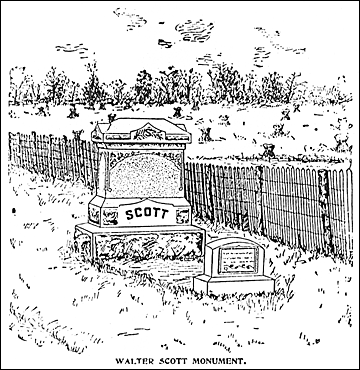
(under construction) |
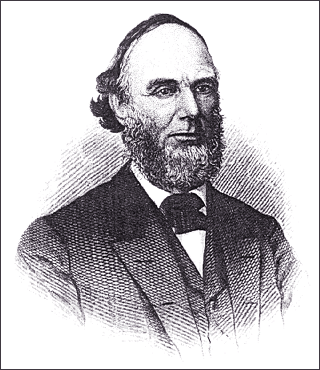
Return to top of the page
Sidney Rigdon "Home" | Rigdon's History | Mormon Classics | Bookshelf
Newspapers | History Vault | New Spalding Library | Old Spalding Library
last revised Feb. 8, 2006