
READINGS IN EARLY MORMON HISTORY
(Newspapers of Ohio)

Misc. Ohio Newspapers
1850-1859 Articles
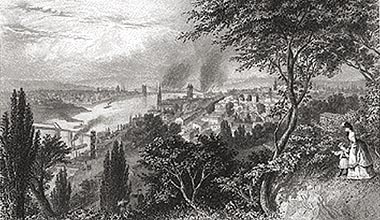
Early View of Cincinnati, Ohio.
1800-28 | 1829-31 | 1832-34 | 1835-39 | 1840-49
1850-59 | 1860-79 | 1880-99 | 1900-09 | 1910-99
1850-1851
HRef Jan 01 '50 | ORep Jan 02 '50 | CPD Jan 04 '50 | DDem Jan 12 '50 | GRep Jan 15 '50 | DSan Jan 17 '50
CPD Jan 17 '50 | ORep Jan 23 '50 | DDem Feb 02 '50 | CPD Feb 06 '50 | DDem Feb 09 '50 | HRef Feb 12 '50
ORep Mar 06 '50 | DDem Mar 09 '50 | HRef Mar 19 '50 | CPD Mar 30 '50 | DOS Apr 11 '50 | GRep Apr 16 '50
HRef Apr 23 '50 | CCom May 20 '50 | NonP May 21? '50 | CCom May 22 '50 | CPD Jun 04 '50 | HRef Jul 02 '50
DDem Jul 06 '50 | SCl Jul 18 '50 | CCom Jul 20 '50 | DDem Aug 03 '50 | CPD Aug 05 '50 | DSan Oct 10 '50
HRef Oct 22 '50 | CPD Nov 04 '50 | DSan Dec 18 '50 | CRep Jan 30 '51 | CPD Feb 04 '51 | CRep Mar 27 '51
CRep Apr 03 '51 | SCl Apr 21 '51 | CRep Apr 24 '51 | CPD Apr 25 '51 | CPD Apr 26 '51 | CHrld May 02 '51
CRep Jun 05 '51 | CPD Jun 11 '51 | CRep Jun 12 '51 | CPD Jun 13 '51 | DCR Jun 16 '51 | CPD Jul 09 '51
DCR Nov 13 '51 | CCom Nov 25 '51
1852-1854
ORep Feb 18 '52 | CPD Jun 05 '52 | OSJ Jun 22 '52 | CPD Jul 02 '52 | DCR Sep 01 '52 | DCR Sep 13 '52
ORep Oct 20 '52 | CPD Dec 07 '52 | DCR Dec 30 '52 | NonP Jan 26 '53 | CPD Apr 25 '53 | CPD May 31 '53
DCR Sep 28 '53 | ConRp Nov 17 '53 | CPD Jan 13 '54 | CPD May 13 '54 | ORep Jun 21 '54 | PCD Jun 28 '54
PCD Jul 19 '54 | OSJ Aug 02 '54 | PCD Aug 23 '54 | OSJ Sep 13 '54 | PTel Oct 11 '54 | CPD Oct 12 '54
PTel Oct 18 '54 | PTel Oct 25 '54 | ORep Nov 01 '54 | ORep Nov 08 '54 | CPD Nov 22 '54 | CPD Dec 08 '54
1855-1856
DCol Jan 06 '55 | OStat Jan 26 '55 | PCD Feb 21 '55 | PTel Apr 30 '55 | CPD May 03 '55 | DCR May 22 '55
DCR May 23 '55 | DCR May 25 '55 | CPD Jun 07 '55 | ORep Aug 01 '55 | DCR Aug 07 '55 | OStat Oct 06 '55
ORep Oct 24 '55 | ORep Oct 31 '55 | ORep Nov 07 '55 | DOS Nov 14 '55 | CPD Mar 22 '56 | ORep Mar 26 '56
DCR Apr 23 '56 | DCR Apr 28 '56 | OSJ Jun 04 '56 | CPD Jun 20 '56 | OSJ Jul 09 '56 | CPD Jul 15 '56
ORep Aug 20 '56 | ORep Oct 22 '56 | DDem Nov 22 '56 | CPD Dec 13 '56 | CPD Dec 31 '56 | OStat Dec 23 '56
1857-1859
CPD Jan 02 '57 | ORep Jan 28 '57 | ORep Mar 04 '57 | ORep Mar 25 '57 | CPD Apr 02 '57 | ORep Apr 22 '57
CPD May 04 '57 | ORep May 06 '57 | OSJ May 06 '57 | BelChr May 07 '57 | OStat May 20 '57 | OStat May 21 '57
CPD May 23 '57 | OStat May 27 '57 | CPD Jun 01 '57 | DCR Jun 03 '57 | DCR Jun 04 '57 | OStat Jun 17 '57
ORep Jun 24 '57 | CPD Jun 26 '57 | CPD Jul 06 '57 | ORep Jul 15 '57 | DCR Jul 22 '57 | DDem Aug 08 '57
DCR Aug 15 '57 | CPD Aug 22 '57 | DCR Aug 27 '57 | CPD Sep 19 '57 | CPD Sep 25 '57 | DCR Oct 02 '57
OStat Oct 08 '57 | DCR Oct 20 '57 | CPD Nov 09 '57 | ORep Nov 25 '57 | ORep Dec 02 '57 | PAge Dec 23 '57
DDem Feb 06 '58 | CCom Apr ?? '58 | DCR May 05 '58 | CCom Jun 17 '58 | CLdr Jun 21 '58 | CPD Jul 07 '58
OSJ Nov 10 '58 | CLdr Mar 05 '59 | CDP Mar 15 '59 | CPD May 14 '59 | CPD May 17 '59 | CPD May 18 '59
CDG May 23 '59 | CPD Jun 20 '59 | CCom Oct 15 '59 | WHT Nov 03 '59
Articles Index | Painesville Tel. | Painesville Rep. | Chardon Spectator
 Vol. XX. Norwalk, Ohio, Tues., Jan. 1, 1850. No. 51.  Mormon State. William Smith, brother to the founder and Prophet, now the self-styled head of the church of Latter Day Saints, asserts in a communication to the Cincinnati Commercial, that the Salt Lake Mormons will not be content with anything less than a free and independent government. He in addition states that the men named as officers for this government, are men who have taken the following oath, with others equally treasonable: |
|
THE OHIO REPOSITORY. Vol. 35. Canton, Ohio, Jan. 2, 1850. No. 37.
St. Louis, Nov. 29, 1849. |
|
CLEVELAND DAILY PLAIN DEALER. Vol. V. Cleveland, Ohio, Friday, January 4, 1850. No. 234. BY TELEGRAPH.
|
 Vol. VI. Defiance, Ohio, Saturday, January 12, 1850. No. 20. Salt Lake Basin. MORMONS. -- The St. Louis Republican, of the 4th instant, has some late information from the Great Salt Lake, derived from a Mr. Forsyth, who had just arrived at St. Louis from the Lake, which he left about the last of September. |
Vol. VIII. Chardon, Ohio, January 15, 1850. No. 10.
From the Washington Republic.
The readers of this paper have doubtless noticed, in the Congressional proceedings, the presentation in the Senate on Monday last, of a memorial of Wm. Smith and Isaac Sheen, claiming to be the legitimate presidents of the Church of Latter-Day Saints, and twelve other individuals of that community, now settled in the valley of the Salt Lake, with having taken an oath to avenge on the people and Government of this country, the murder of Joseph Smith, and with a determination now to carry that oath in[to] effect; and further accusing them of grossly immoral conduct, by adopting the doctrine of polygamy, &c. |
|
The Daily Sanduskian. Vol. II. Sandusky, Ohio, Thursday, January 17, 1850. No. 228.
From the St. Louis Republican, Dec. 28.
Mr. J. H. Kinkead, of this city, arrived here a day or two since from the Salt Lake Valley. He left that Valley, in company with thirty-five others, on the 19th October. Of this number some twenty-five were Mormon preachers, sent out by the Church to preach their faith in various quarters of the world. We learn from Mr. Kinkead, that the Mormon colony at the Valley of the Salt Lake was in a prosperous and happy condition. The crops had been abundant, and they had carried on an excellent traffic with the emigrants, receiving from them many articles of which they stood in need, and supplying them with various articles of produce. The Mormons uniformly treated the emigrants in a hospitable manner. Mr. Kinkead contradicts, as we supposed would be the case, the report of difficulties between the Mormons and Mr. Pomeroy, of Lexington, and Gen. Wilson, growing out of old feuds between the Missourians and Mormons. It is probable that the report had its origin in difficulties between Mr. Pomeroy and his teamsters, who were discharged from his employ at Salt Lake City. They made charges against him, and he demanded an investigation. A complete examination was had before the Court in the Mormon Church, and the result was a full acquittal of all charges against him. * * * |
|
CLEVELAND DAILY PLAIN DEALER. Vol. V. Cleveland, Ohio, Thursday, January 17, 1850. No. 245.
JAMES ARLINGTON BENNETT.
The New York Tribune gives the following notice of Bennett, and summary of the offence charged against him: -- |
|
THE OHIO REPOSITORY. Vol. 35. Canton, Ohio, Jan. 23, 1850. No. 39. Reported for the Ohio Repository. St. Louis, January 18. |
Vol. VI. Defiance, Ohio, Saturday, February 2, 1850. No. 23. MORMON COINS. The monetary notions of the Mormons at their Great Salt Lake settlement, are no less peculiar, it appears, than their ideas of society and religion. We have a verious curious coin in our possession, which is manufactured and extensively circulated among that remarkable people, and quite to the disparagement, travelers tell us, of every other species of gold currency. Of all the fanciful forms into which our golden wealth is wrought, this sainted shape excells in singularity. Its weight is about 15 pwts. Troy, its current worth, among the Mormons, twenty dollars. Its circumference is that of a Spanish half doubloon. One side bears the inscription 'Holiness to the Lord,' with the All-seeing Eye, surmounted by the prophet's cap; on the reverse appear the initials C. S. L. C. P. C., the grasp of fellowship, with the date (1849) and the value of the piece. It is clumsy, and in execution without merit. |

|
CLEVELAND DAILY PLAIN DEALER. Vol. V. Cleveland, Ohio, Thursday, February 6, 1850. No. 262. Polygamy at the Salt Lake. The New Orleans Delta publishes a letter from the Salt Lake, the capital of the Mormons of Deseret, in which the writer confirms the statement previously made, that under the Mormon narital law, a man may have as many wives as he can support. He says: |
Vol. VI. Defiance, Ohio, Saturday, February 9, 1850. No. 24.
Gen. James Arlington Bennett, formerly connected with the Mormons, has been arrested for forgery in New York. Several others are implicated. The morals of New York must be in a precious condition, as would appear from the following. |
|
Vol. XXI. Norwalk, Ohio, Feb. 12, 1850. No. 5.
==> The new territory of Deseret which is anxiously waiting to become a Sovereign State of the Union, appears to possess a very liberal minded population; the Mormon creed permitting a plurality of wives. The President of that interesting Republic is said to have thirty. Elder Pratt, from Boston, more moderate in his matrimonial notions has only seven, and even one of them has run away with a California soldier. |
|
THE OHIO REPOSITORY. Vol. 35. Canton, Ohio, March 6, 1850. No. 46. THE MORMONS. A Mr. Snow, brother of Z. Snow, Esq. of this place, arrived here on Friday last, on his was to [Denmark?], in Europe as a Missionary. The Mormons appear to be prosperous in their new home at the Salt Lake. |
Vol. VI. Defiance, Ohio, Saturday, March 9, 1850. No. 28.
==> The report circulating in the newspapers, that the Mormons at Deseret allow polygamy, and permit the most licentious and depraving practices, is pronounced by the Washington papers as totally false, and without the slightest foundation. |
|
Vol. XXI. Norwalk, Ohio, Tuesday, March 19, 1850. No. 10. From Deseret. Late accounts have been received from the Mormon Country. Numerous deputies started upon their missions to England, France, Italy, Denmark and Sweden. They speak confidently of their success in these countries and where they place before the laboring population, such as that in England, pressed down to the earth by both Church and State, the prospect of a home, a portion of the soil to cultivate, and of a sufficiency of the common wants of humanity, it is not wonderful that they should be ready to embrace the doctrines of faith even as extravagant as that of the Mormons and be numbered among the "Latter Day Saints." To them any belief that will rescue them from starvation must be acceptable. The estimate of the Mormons is, that their number in England is now 50,000. |
Vol. ? Cincinnati, Ohio, Saturday, March 30, 1850. No. ? Opposition to Deseret There was some difficulty in the way of just legalizing the Mormon government of Deseret. -- Deseret is a Mormon word, and there is a strong prejudice against Mormonism in all the Northwestern States, which would compel many Northwestern members to vote against it. The Mormons, soon after the death of Joe Smith, divided; the Mormons remaining in the States of the Union being violently opposed to the Mormons of Salt Lake, and charging the Salt Lake Mormons with having taken an oath of eternal hostility to the Government of the United States; pledging themselves to overthrow this Government whenever they shall have the power to do so. There are many patriotic Mormons in the States of Wisconsin, Iowa, Illinois, Kentucky, Indiana, Ohio, and Pennsylvania, who who have formed many churches, and who are all firmly believing that the Salt Lake Mormons have taken the oath of hostility to the United States. -- A vote, therefore, approving the acts of the Mormons on the Salt Lake, by adopting their government and its name, would be deemed an approval of this doctrine; and for this reason the name (Deseret) as well as the government itself must be discarded. |
|
THE DAILY OHIO STATESMAN. ns. Vol. II. Columbus, Ohio, Thurs., April 11, 1850. No. 736.
From the Daily Alta California of Feb. 9.
When the memorial from the delegates of the Salt Lake settlement was road on the floor of the Senate of California, accompanied as it was, most mal apropos, by a verbal message from Gov. Burnett, a member of that honorable body quickly arose and offered a resolution to lay both documents on the table, which was adoptod with a proper show of resentment. In the House the petition and message fared no better, and although we suffered this action to pass uncommented upon at the time, we cordially approved the spirit of our Legislature, and now applaud the prompt, decisive and dignified measures by which its indignation was made manifest. |
Vol. VIII. Chardon, Ohio, April 16, 1850. No. 23. Deseret. The Washington correspondent of the Journal of Commerce writes: |
|
Vol. XXI. Norwalk, Ohio, Tuesday, April 23, 1850. No. ? California News. Deseret and California. -- Gov. Burnett sent a message to the California Legislature in February, that caused some talk. It appears that the Mormons in the Valley of the Salt Lake elected two delegates to the California State Convention, but they did not arrive until after the convention had adjourned. They then petitioned the Legislature to take steps for the calling of a new Convention to frame a constitution which shall include within the boundaries of the State, the basin of the Salt Lake, &c. |
Vol. ? Cincinnati, Ohio, Monday, May 20, 1850. No. ?
(Notice of William Smith's excommunication of Isaac Sheen
|
Vol. ? Cincinnati, Ohio, May 21? 1850. No. ? Wm. Smith -- The Imposter. Eds. Nonpareil: The subjoined letter will show that the statements which the imposter, Wm. Smith, is now circulating concerning me are false, and will in some degree explain the cause of my renunciation of him and his Church. The iniquity spoken of in the letter is a vindication of adultery and fornication by Wm. Smith. He claims that he has authority from God to raise up posterity from other men's wives, and says it will exalt them and their husbands in the eternal world. His repentance is base hypocrisy, which he proves by his late conduct. |
Vol. ? Cincinnati, Ohio, Wednesday, May 22, 1850. No. ?
For the
Cincinnati Commercial.
MR. EDITOR: The statement of the Commercial this morning, concerning me are incorrect. Wm. Smith has not cut me off from his church. I have cut myself off, and intend to remain cut off eternally from such a hypocritical libertine. He has professed the greatest hostility to the plurality wife doctrine, but on the 18th ult., he told me that he had a right to raise up posterity from other men's wives. He said it would be an honor conferred upon them and their husbands, to allow him that privilege, and that they would thereby be exalted to a high degree of glory in eternity. He said that the Salt Lake Mormons had no authority to do such things, but that the authority belonged to him, and that I might have the same privilege. He offered me his wife on the same terms that he claimed a partnership in other men's wives. I told him instantly that I would have no more connection with him, and that such damnable iniquity, I never had, and never would participate in. I did not wait for him to cut me off, and he has no church in Covington to cut any one off. There is no person that acknowledges him in Covington except Mrs. ________, a married woman. Wm. Smith says that I have become a Salt Lake Mormon. This statement is false. I acknowledge allegiance to no church, neither Mormon nor anti-Mormon. I have witnesses to prove that Smith's statements concerning the Church Records are totally false; his wife, who has left him, in consequence of his licentiousness, has either taken them with her, or has disposed of them. I can prove that A. W. Babbitt was an enemy to me at the time that I renounced my connection with Wm. Smith. I find that Smith has caused me, by false representations, to misrepresent Mr. Babbitt and the Salt Lake Mormons, but I have no connection with their church, and never intend to have. I have in my possession a letter written by Mr. Smith, in which he advocates the plurality wife doctrine. I have another letter written by him on the 29th ult., in which he asks my forgiveness for his participation in such iniquity, and has determined to forsake it. Recent events show that this pretended repentance was base hypocrisy. Subjoined to this communication may be found an extract of his Fornication Letter. |
|
CLEVELAND DAILY PLAIN DEALER. Vol. VI. Cleveland, Ohio, Tuesday, June 4, 1850. No. 55.
Interesting from California Emigrants.
|
|
Vol. XXI. Norwalk, Ohio, Tuesday, July 2, 1850. No. 25. Great Salt Lake. Capt. Stansbury of the U. S. corps of Topographical Engineers employed in an examination of the region of the Great Salt Lake, in the Mormon Territory, reports the following interesting facts: |
Vol. VI. Defiance, Ohio, Saturday, July 6, 1850. No. 45.
THE NAUVOO TEMPLE AGAIN DESTROYED. -- A fatality seems to attend the temple at Nauvoo. It was finished by the Mormons in 1845, was nearly destroyed by fire in 1848, and on the 27th of May a tremendous hurricane demolished the walls. The Icarian community of socialists, under Cabet, had purchased it, and were engaged in repairing it, with a view to fitting it up for schools, studying and meeting halls, and a great refectory for a thousand persons. The workmen were engaged on it, when the storm burst forth with such violence that the walls came tumbling down, and the workmen had to fly for their lives. Those walls that remained standing had to be pulled down. -- The surrounding buildings were also demolished, and in the wash-house, where sic Icarian women were washing, there was so sudden an inundation from the rising creek, that the women had to escape through the windows. The community are going to undertake the erection of another large and fine building. |
 Vol. ? Sandusky, Ohio, Thursday, July 18, 1850. No. ? THE DESERET MORMONS. The Pennsylvania Historical Society have just published a discourse by T. L. Kane giving an interesting account of his visit to the Mormon encampment in the western deserets. -- They were outcasts from Missouri and Illinois, who have founded the territory of Deseret. -- The following is an extract from the pamphlet: |
Vol. ? Cincinnati, Ohio, July 20?, 1850. No. ?
ARREST OF A PROPHET. -- Yesterday Wm. Smith, the Mormon Prophet (brother of Joseph,) was arraigned before Esq. Snellbaker at the instance of Isaac Sheen, who alleged that the Prophet was a dangerous man, and it was feared that complainant's life would be taken, ere long, by said Prophet! An anonymous letter, supposed to have been written by Smith, was presented by Sheen and read; the letter warned Sheen that he should "die with the cholera, or some other loathsome disease," and further stated that if said Sheen interfered again with the writer's family affairs, he, the writer, would shoot said Sheen and no mistake! The lawyer for complainant made a speech, after which the Prophet rose to reply but the weather being hot, the Court cut the matter short by informing Mr. Smith that there was no need of his saying a single word, as the complainant had not adduced evidence that could by any possibly justify binding over to keep the peace; so the prophet walked forth again free as air. |
Vol. VI. Defiance, Ohio, Saturday, August 3, 1850. No. 49. Salt Lake City. We have been furnished, says the St. Louis Intelligencer, with leave to publish a letter from an intelligent gentleman now in Deseret to his family in St. Charles.... The writer dates his letter April, 1850. We extract only his description of the Mormon city. |
|
CLEVELAND DAILY PLAIN DEALER. Vol. VI. Cleveland, Ohio, Monday, August 5, 1850. No. 106.
THE MORMON COLONY, BEAVER ISLAND. -- We have just conversed with a gentleman who has just returned from a visit to Beaver Island, at the head of Lake Michigan, upon which the Mormon Colony is located, headed by their prophet, Jas. Strang. They number about six hundred, and have a farm on the island, which is cultivated by them. They have also engaged to a limited extent in taking white fish and trout which constitutes their chief means of subsistence. |
|
The Daily Sanduskian. Vol. III. Sandusky, Ohio, Thursday, October 10, 1850. No. 145. Correspondence of the Advertiser.
|
|
Vol. XXI. Norwalk, Ohio, October 22, 1850. No. 41. Interesting Sketches of the Mormon Settlements. BEAVER ISLANDS. -- The Beaver Islands, situated at the foot of Lake Michigan, is the present location of the "Peace party" Mormons, (or, as they love to call themselves, Latter Day Saints) under the administration of James J. Strong [sic -Strang?], whom they claim to be "Joseph Smith's lawful successor in the prophetical office. |
|
CLEVELAND DAILY PLAIN DEALER. Vol. VI. Cleveland, Ohio, Monday, November 4, 1850. No. 185.
Mormonism at the Salt Lake.
A California emigrant, who writes in the St. Louis Intelligencer, in the course of his overland journey, sojourns some days among the Mormons of the Salt Lake. Though evidently imbued with prejudices, he is a keen observer, and writes readily and agreeably of the truly wonderful improvements which the Mormons have built upon their Isle -- if we may so speak of their isolation -- in the Desert. For indomitable industry, the "Latter-Day Saints" will hold a marked place in the world's history. When they were driven from Illinois, starvation seemed inevitable, but three years have elapsed, and they are already as prosperous a community as there is in the whole Union. Such are the fruits of unwearied industry: |
|
The Daily Sanduskian. Vol. III. Sandusky, Ohio, Wednesday, December 18, 1850. No. 203.
From the Detroit Advertiser.
Beaver Island, which is the largest of a collection or group of that same name, lies in Lake Michigan, about twenty-five miles above the Straits of Mackinac. It contains about twenty-eight thousand acres of land, (a large portion of which is still in the hands of Government,) and forms one organized township. -- There is, upon this island, a population of about five hundred, the larger proportion of which are Mormons. Those not professing this belief, are styled Gentiles. |
CONNEAUT REPORTER. Vol. VIII. Conneaut, Ohio, January 30, 1851. No. 1.
"THE PROMISED LAND." -- The Frontier Guardian of the 25th ult. just came to hand, states that Bishop Holiday, residing in Utah Territory, on South Cottonwood Creek, about ten miles south of the Great Salt Lake City, raised, from one bushel sowing, one hundred and eighty bushels of the choicest and cleanest wheat, measured up and it weighed plump sixty pounds to the bushel.... |
|
CLEVELAND DAILY PLAIN DEALER. Vol. VI. Cleveland, Ohio, Tuesday, February 4, 1851. No. 257.
Slavery Among the Mormons.
We feel it to be our duty to define our position in relation to the subject of Slavery. There are several men in the Valley of the Salt Lake from the Southern States, who have their slaves with them. There is no law in Utah to authorize slavery, neither any to prohibit it. If the slave is disposed to leave his master, no power exists there, either legal or moral, that will prevent him. But if the slave choose to remain with his master, none are allowed to interfere between the master and the slave. All the slaves that are there appear to be perfectly contented and satisfied. When a man in the Southern States embraces our faith, and is the owner of slaves, the church says to him, if your slaves wish to remain with you, and to go with you, put them not away; but if they choose to leave you, or are not satisfied to remain with you, it is for you to sell them or let them go free, as your own conscience may direct you. The church on this point assumes not the responsibility to direct. The laws of the land recognize slavery; we do not wish to oppose the laws of the country. If there is sin in selling a slave, let the individual who sells him bear that sin, and not the church. Wisdom and prudence dictate to us this position, and we trust that our position will henceforth be understood. -- |
CONNEAUT REPORTER. Vol. VIII. Conneaut, Ohio, March 27, 1851. No. 9
Mr. Lake at Home. Our friend and townsman Zaphna Lake, Esq., reached home on Thursday morning, having been about fourteen months, sojourning in California. We are under many obligations to him for the series of letters published in the Reporter, and much other information respecting California... We had anticipated an article from his pen of the country and the prospects of the "boys" from our vicinity; but his calls have been numerous, and a host of friends congratulating on his return, that opportunity has not been afforded him for that purpose... |
CONNEAUT REPORTER. Vol. VIII. Conneaut, Ohio, April 3, 1851. No. 10.
Correspondence from Mr. Lake.
|
Vol. ? Sandusky, Ohio, Friday, April 21, 1851. No. ? THE KINGDOM OF BEAVER ISLAND. We have reveived letters from Beaver Island -- the kingdom of Strang the first -- which state that a state of disturbance has continued there during the entire winter. Strang, at the commencement of cold weather, and after the season of navigation was over, drew more tightly the reins of government, well knowing that whatever might occur, there was no probability of interference from abroad. A whipping post was erected, and is chiefly devoted to the punishment of those who spoke lightly of the king, or cast aspersions upon his "divine right" to reign. Several persons were cruelly whipped with fifty lashes upon the bare back, with beach and hickory rods. Terror was then spread among those remaining upon the Island, and implicit obedience enforced. A man by the name of Moore, a Mormon, becoming disaffected, left the Island, whereupon his property real and personal, was declared confiscated, and was given to another by virtue of a royal edict. During the winter, Moore returned upon the ice, and attempted to regain possession of his house and goods, but was compelled to flee for his life. He was pursued by Strang, but was rescued and defended by a small tribe of Indians with whom he remained and passed the winter. Upon the opening of navigation, Moore obtained process at Mackinaw against Strang, and taking the Sheriff, with a poste of fifty well armed Indian warriors, went to the Beaver to make arrests. Strang, however, spied out their approach, and suspecting their object, and with the royal examples of Charles II and Louis Phillippe before his eye, fled amain, and took refuge on a small island, some ten miles distant. From this place be was driven by the Sheriff and his aboriginal forces, who at our latest advices, (April 11th,) were still in full pursuit, having captured a large yawl, several stands of arms, and a quantity of military stores beloning to his majesty. |
CONNEAUT REPORTER. Vol. VIII. Conneaut, Ohio, April 24, 1851. No. 13.
THE MORMONS AT BEAVER ISLAND. -- We have before us the Northern Islander, a weekly newspaper, hailing from "St. James, Beaver Island, Lake Michigan." It is conducted by Cooper & Chidester, the former a graduate of the Sentinel office. It is devoted to the peculiar tenets of the Mormonites, and very respectably conducted. The editors say they have been without a mail for three months; and delayed the number for March 21st for intelligence from "foreign parts," without being gratified. -- Last fall reports were circulated of rebellion on the Island, and not a very flattering state of society existing, which is dispelled by the announcement of the Islander, that peace and good order is established there. Bower, the only colored man on the island, held the office of township clerk; and on a recent election held, refused to sign the returns, which the Islander terms "characteristic ingratitude of his race." It would [appear that] speaking disrespectfully of the Mormons is no longer to be tolerated. "A practice has been adopted here," says that paper, "of flogging every one who spoke reproachfully of them;" and recommends its practice on a larger scale. They are real advocates of the "Hyer" law -- while one of the faithful pronounces the following curse upon the Nation: |
|
CLEVELAND DAILY PLAIN DEALER. Vol. VII. Cleveland, Ohio, Friday, April 25, 1851. No. 22.
Mormonism.
We have just received a copy of the "Northern Islander," a weekly paper, published at St. James, Beaver Island, Lake Michigan. It is quite a spruce little sheet, and offers unquestionable proofs of the enterprise and prosperity of the Mormon settlement. Its principal object is, of course, to disseminate the peculiar views of the sect, and this it does -- if not with ability and perspicuity -- at least with a candor and zeal that might well be imitated by many who profess to be disciples of a better faith. Among other interesting matters contained in this number, we find a tolerably well written appeal, in three columns, "To the Saints scattered abroad, greeting," in which are set forth the great mission of the "Prophet," the final union of different creeds in the common bonds of Mormonism, and the manifold advantages which are offered to proselytes by the beauty and fertility of the Island. Then comes a poem in which the same ideas are again enforced. We give the first two verses. |
|
CLEVELAND DAILY PLAIN DEALER. Vol. VII. Cleveland, Ohio, Saturday, April 26, 1851. No. 23.
The Kingdom of Beaver Island.
We have received letters frpm Beaver Island -- the kingdom of Strang the First -- which state that a state of disturbance has continued there during the entire winter. Strang, at the commencement of cold weather, and after the season of navigation was over, drew more tightly the reins of government, well knowing that whatever might occur, there was no probability of interference from abroad. A whipping post was erected, and chiefly devoted to the punishment of those who spoke lightly of the king, or cast aspersions upon his "divine right" to reign. Several persons were cruelly whipped with fifty lashes upon the bare back, with beech and hickory rods. Terror was then spread among those remaining upon the island and obedience strictly enforced. A man by the name of Moore, a Mormon, becoming disaffected, left the island, whereupon his property real and personal, was declared confiscated, and was given to another by royal edict. |
 Vol. ? Cleveland, Ohio, May 2, 1851. No. ?
The Mormon Colony on Beaver Island.
We have a community of Robinson Crusoes much nearer us than most people think for. Two days' sail lands the adventurer on Beaver Island, in Lake Michigan, as completely cut off from the world during nearly half the year, as was Crusoe. There he will find a branch of the Mormon church, under the prophet Strang, who claims to be the true successor of the murdered Joseph Smith. Jesse has gathered quite a community in that isolated spot, and, judging from the tone of his organ, the Northern Islander, he intends his people shall enter upon and occupy the adjacent islands of the inland sea, on the principle that "might makes right." Beaver Island and the group are described as fertile and desireable, well adapted to the wood and lumber trade, and agricultural purposes, and in the midst of the best fisheries of the lake. The Northern Islander states that 15,000 barrels of fish were shipped from them the past season. Saint James is the name of the Mormon town, and a large emigration to it is looked for this season. Warren Post invites the "gathering" in Mormon poetry. The first verse reads: -- |
CONNEAUT REPORTER. Vol. VIII. Conneaut, Ohio, June 5, 1851. No. 19.
THE MORMON ARRESTS. -- The Setroit Free Press declares that the reported arrests of James J. Strang, and all other Mormon leaders was no arrest at all. They all went voluntarily on board the U. S. Steamer, and were only taken into the custody of the Marshal at their own request. They expressed themselves not only willing, but anxious for an investigation by the proper authorities -- and have asserted from the beginning that no violation of the laws has taken place on their part, or on the part of the Mormons on Beaver Island. They are in Detroit voluntarily and intend to remain there until the authorities are satisfied of their innocence.... |
|
CLEVELAND DAILY PLAIN DEALER. Vol. VII. Cleveland, Ohio, Wednesday, June 11, 1851. No. 62.
Salt Lake Valley.
Late news from this section, the stronghold of the Mormons, is not very important. An Epistle of the Saints has been issued, which rejoices over the extension of Mormonism all over the Earth -- and from its unusual progress draws a portent of Christ's speedy coming, as well as from quarrels among Christian sects, cholera, whirlwinds, &c., &c. |
CONNEAUT REPORTER. Vol. VIII. Conneaut, Ohio, June 12, 1851. No. 20.
Interesting News from Utah. The Territory of Utah has become the half-way house to the Pacific, and the Deseret News of April 8th, gives a flattering picture of the progress of events in the Salt Lake Valley. The Mormons are making great preparations to receive their brethren from abroad, and are establishing manufactures of the main articles necessary for comfort in this isolated country. The winter had been mild, and several grain and lumber mills had been erected... |
|
CLEVELAND DAILY PLAIN DEALER. Vol. VII. Cleveland, Ohio, Friday, June 13, 1851. No. 64.
Mormons.
We have said that we believe the great body of Mormons to be sincere in their belief, and have, therefore, always deprecated any general war upon the sect, for crimes that may have been committed by a few desperadoes whom a prospect of greater license in crimes might have induced to join it. |
Vol. IV. Sandusky, Ohio, Monday, June 16, 1851. No. 41. Beaver Island. The following letter from the Detroit Advertiser, gives a detailed account of the outrage committed by the Mormons at Beaver Island, news of which was communicated by telegraph a few days since. It is hoped the murderers will be brought to justice by the Michigan Authorities. |
|
CLEVELAND DAILY PLAIN DEALER. Vol. VII. Cleveland, Ohio, Wednesday, July 9, 1851. No. 86.
TREATMENT OF THE EMIGRATION.
Yesterday we gave an account of the arrival of the first party of immigrants across the Sierra Nevada. There are over one hundred and fifty wagons in the Carson valley, waiting an opportunity to get through the snow now lying on the summit, and come into California. |
|
DAILY COMMERCIAL REGISTER. ns. Vol. I. Sandusky, Thursday, November 13, 1851. No. 147. Troubles in Utah. The experiment of making good and law-abiding citizens of the Mormons in Utah is likely to prove a failure. It was supposed that the appointment of one of their chief men and apostles among them, Brigham Young, to the office of Territorial Governor would conciliate the minor saints towards the Government at Washington and keep them within bounds. -- Such, however, does not seem to be the case. Gov. Young and his whole community of hopeful saints are represented as being in a state of open rebellion against the Government. He has stopped the mails, driven the officers of the Government out of the country, and plundered them of the money with which they were entrusted by Congress for the erection of public buildings. Twenty thousand dollars appropriated for that purpose, have been seized to pay off the debts of the church, and $24,000 more was about to be grabbed in the same way, when the agent, in whose hands it was, saved it only by flight from Gov. Young's dominions. It is understood that all U.S. officers, except those who are themselves saints, in the Mormon acceptation of the term, have been forced to leave. Congress is denounced in their religious meetings as a "pack of corrupt swindlers," and the church seems to be the supreme authority. The treasonable acts of Young seem to be a proper subject for Executive attention, and if the accounts that have been received are true, it is hoped a fitting example may be made of his apostleship. |
|
CINCINNATI DAILY COMMERCIAL. Vol. ? Cincinnati, Wednesday, November 25, 1851. No. ? Troubles in Utah. Our readers are aware that United States officers have been driven by the Mormons from Utah, and that the fanatics in the valley of the Salt lakes assert independence. It will doubtless be necessary to send troops to quell the rebellious spirit now manifested. The following extracts show the feelings of BRIGHAM YOUNG and his dupes, or, more properly speaking, his accomplices. It may yet become necessary to drive them from their present location; indeed it appears that rule and ruin is their motto. |
|
THE OHIO REPOSITORY. Vol. 37. Canton, Ohio, Feb. 18, 1852. No. 44. Uath -- Polygamy, etc. The wife of a U. S. Judge in Utah, an intelligent and pure minded woman, lately wrote a letter to a friend in Canton, Ohio, which confirms the statements made by others, that Polygamy is openly taught and practiced by the Mormons in that territory; that it is so interwoven with the very threads of society, that it is impossible to mix in social life at all without encountering it at every turn! |
|
CLEVELAND DAILY PLAIN DEALER. Vol. VIII. Cleveland, Ohio, Saturday, June 5, 1852. No. 57.
Mormons of the Great Salt Lake -- Polygamy.
The New York Herald of the 27th ult. has a letter from the Great Salt Lake, which makes some strange expositions of life among that set of wretched fanatics; also a defence of Elder Grant, against Fillmore's fugitive officers. The following gives some account of the depraved system of polygamy which prevails among the "latter day saints." |
Vol. ? Columbus, Ohio, Tuesday, June 22, 1852. No. ?
The widow of the late Joe Smith, the founder of Mormonism, is now said to be the wife of a tavern keeper in Nauvoo, and makes quite a respectable land lady. She was always more respectable than Joe. |
|
CLEVELAND DAILY PLAIN DEALER. Vol. VIII. Cleveland, Ohio, Friday, July 2, 1852. No. 81.
Nauvoo.
This city of the Mormons once had 20,000 inhabitants; there are now about 2,000. One half the houses the Mormons left have been removed or pulled down, and the other half are tenantless. Each lot contained an acre. -- In walking through its deserted streets I startled several quails, in the midst of the once populous city. The mansion of Joe Smith is kept by his wife, (once his widow but now again a wife, of another and a live man,) as a tavern. Between this mansion and the river are the remains of a famous hotel, which was abandoned after its walls had reached the second story; the walls are of fine pressed brick, with marble doorsills and caps. Joe's store-house is also standing. The Masonic Hall is a fine brick building three stories high. I am told that all the Mormons were Masons. Their lodge was under the jurisdiction of the Grand Lodge of the State of Illinois. Smith, I am told, initiated some of the "mothers in the church," then the charter was taken from them and the lodge closed. The front wall and the one next to it, which formed the vestibule, are all that is left standing of the achievements of fanaticism called 'the temple.' |
|
Daily Commercial Register. ns. Vol. II. Sandusky, Wednesday, September 1, 1852. No. 79. Utah. The Washington correspondent of the New York Courier furnishes the following information in relation to the judicial appointments for this territory: |
|
Daily Commercial Register. ns. Vol. II. Sandusky, Monday, September 13, 1852. No. 97. Utah. POLYGAMY AMONG THE MORMONS. -- It is undenied by those high in authority in the Mormon Church, that polygamy is not only tolerated, but advocated, within its jurisdiction. Brother Pratt, "Apostle of the Latter Day Saints," has replied in a printed handbill, to an inquiry made a short time since by the San Francisco Herald, as to the extent it is practised in the Church and by its leader, Brigham Young. Respecting the latter, he says, "his morality is above all suspicion;" and he presumes "the number of his family does not exceed the estimates which have been going the rounds of the American press." As it was reported that Mr. Young had sixteen wives, more or less, (a majority of them rearing young prophets, it is thus tacitly admitted that this is the correct number. |
Vol. 38. Canton, Ohio, Wednesday, October 20, 1852. No. 27.
==> Perry E. Brocchus, one of the Judges who fled Utah some time since, and refused to go to his post, is out in the Washington Union with a long letter, condemning the action of the Administration, and denying its power to remove him. |
|
CLEVELAND DAILY PLAIN DEALER. Vol. VIII. Cleveland, Ohio, Tuesday, December 7, 1852. No. 217.
The Mormons -- Their Polygamy --
Whether the Mormons do or do not allow polygamy has been a mooted question. The following letter from a Wisconson overland traveller, the Milwaukie News says, is addressed to the mother of the writer, and has been furnished for publication to that paper. |
|
Daily Commercial Register. ns. Vol. II. Sandusky, Thursday, December 30, 1852. No. 188. Utah. THEOLOGY OF THE MORMONS. -- The Mormons believe in the authenticity of the Old Testament, and in the divine character, mission and revelation of Jesus Christ. But they further believe that similar revelations of the Divine will were made to Joseph Smith, and are now being made as circumstances require, to Brigham Young, and the other patriarchs of the church. The Mormons believe in polytheism as well as polygamy. The two go hand in hand. The one creates and proves the necessity of the other. According to the original ideas of their theology they are themselves all gods, and progenitors of gods, varying in power, intelligence and dignity, who have humiliated themselves for awhile by appearing upon the earth and assuming a human form. One of their greatest duties in this, their humiliated character, is to propogate their species and people, of not only this, but also worlds unnumbered and uncreated, with their descendants -- gods like themselves. Hence the great necessity and reason for the adoption of the system of the plurality of wives, for the more speedy accomplishment of this, the great object of their being. After death they will ascend to heaven resume their former godship, and there live in a state of perpetual beautific enjoyment, surrounded by their numerous wives and posterity. In their belief there is no such place as a separate distinct hell. -- Hell consists simply in the deprivation of those who are unworthy, from the joys and pleasures of Heaven. |
Vol. ? Cincinnati, Ohio, January 26 1853. No. ?
For the Cincinnati Nonpareil.
Messrs. Editors: The recent discoveries of Arctic navigators have demonstrated the fact that an open sea surrounds the North Pole, instead of mountains of ice and a frozen ocean. The ancient and popular delusion that mountains of ice and a frozen sea extended to the North Pole, in now becoming obsolete. A new theory has suddenly supplanted the old delusion. A great, change has been produced on this subject in the minds of men of intelligence. Tnere have, heretofore, been limits set to Gentile locomotion in that region; but when we understand the geography of the Polar regions, we may possibly discover that there are entrances into the interior of the earth at the North and South Poles, and that the interior of the earth is inhabited by the ten tribes of Israel. In defence of these ideas, I will notice the statements of Lieutenant Osborne, Commander of the Pioneer in the English expedition which was sent in search of Sir John Franklin in 1850 and 1851. Capt. Penny, of the same expedition, confirms the truth of these statements. They state that, beyond the icy sea which they visited, they saw open water as far as the eye could penetrate, to the North. They also state that they "saw long flights of birds retreating from their summer breeding places somewhere beyond the broad fields of ice." On the 5th of September, whilst they were seeking deliverance from a mass of ice off Point Innis, Lieut. Osborne states, "we had abundant amusement and occupation in observing the movements of shoals of white whales. They were what the fishermen on board called " running South" a term used to express the steady and rapid passage of the fish from one feeding ground to the other. From the masthead, the water about us appeared filled with them, whilst they constantly rose and blew, and hurried on like the birds we had lately seen, to better regions in the South. That they had been North to breed was undoubted, by the num- ber of young "calves" in every shoal, The affection between mother and young was very evident, for occasionally some stately white whale would loiter on her course, as if to scrutinize the new and strange objects now floating in these unplougbed waters, whilst the calf, all gambols, rubbed against the mother's side, or played about her. * * * It was a subject of deep interest and wonder to sea this migration, and I determined to search the numerous books with which we were well stored, to endeavor to satisfy my mind with some reasonable theory, founded upon the movements of bird and fish, as to the existence of a Polar Ocean or Polar Continent." This article is an extraction and revision from one that I commenced writing about five months since and competed about three months since. My design was, to show that an open sea and an undiscovered and inhabited land are situated beyond the icy sea. Since I penned these arguments that open sea has been entered. The two steam vessels that accompanied the former expedition from England have again been sent into the Arctic regions, and have penetrated into the open sea. Their names are the Isabella and the Pioneer. The former returned after making a short exploration in the open sea, leaving the latter to make further explorations. The report brought by the Isabella obviates the necessity of any arguments from me to prove that there is an open sea North of the icy regions. That fact is established by the return of the Isabella. I shall, therefore, confine myself to those arguments which, I imagine will prove, (as far as argument can prove any fact) that a "Polar Continent" is located North of the "Polar Sea." The existence of an open sea, north of the icy region and the migration of birds and fishes with their young, show that there is a more genial climate around the North Pole, and there must be land there, otherwise these birds could not raise there young there. Now, it is a well known fact, that the heat of the Sun becomes weaker and weaker as we proceed to the North. It is, therefore, contrary to the laws of nature for the Sun to produce more heat at the North Pole than it does 16 degrees South of it. There is, therefore, an undiscovered source of heat more powerful than the Sun, which prevents an incessant accumulation of mountains of ice in that part of the world. If the cold is so intense in the 74th degree of North Latitude that the sea is covered with a mass of ice during ten months of every year, surely 16 degrees further North would exhibit cold of far greater magnitude. Is it not, therefore, a correct inference, that if the Sun was the only source of heat at the North Pole there would be a solid mass of ice instead of open water, from Wellington Channel to the Pole? The invisibility to us of the source of heat at the Pole, may be accounted for on the supposition that it is located in the interior of the earth and communicated through an opening at the Pole. |
|
CLEVELAND DAILY PLAIN DEALER. Vol. IX. Cleveland, Ohio, Monday, April 25, 1853. No. 21.
MORMONISM IN ILLINOIS. -- Bill Smith, the only surviving brother of Joe Smith, the celebrated Mormon prophet, has formed a settlement in Lee county, Illinois, where he preaches and practices all the doctrines of that peculiar sect. According to his statement he is persecuted by the Gentiles. A short time ago he was brought before the Circuit Court, at Dixon, at the instigation of a "spiritual wife." We copy the following from the Dixon Telegraph: |
|
CLEVELAND DAILY PLAIN DEALER. Vol. IX. Cleveland, Ohio, Tuesday, May 31, 1853. No. 50.
INTERESTING NEWS FROM
We have received from an intelligent and well informed resident of Mackinac, the following account of Mormon customs and policy, and a full statement of the cause of the quarrel which now threatens war in that region. |
|
Daily Commercial Register. ns. Vol. III. Sandusky, Wednesday, September 28, 1853. No. 108. Ruins of the Mormon Temple and the Icarians. A correspondent of the Morning Star, at Dover, in this State [N.H.], under the date of June 17th, gives some interesting facts in relation to the city of Nauvoo, Mormonism, &c. |
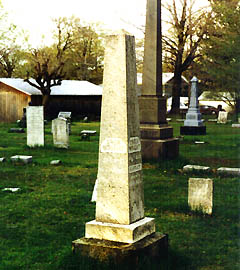
Vol. 10. Conneaut, Ohio, Thursday, November 17, 1853. No. ? Death of Aaron Wright It becomes our painful duty to chronicle the death of this pioneer, a long-honored and worthy citizen. He died at 12 o'clock on Thursday last, in the 79th year of his age, after a very brief illness. Mr. Wright settled here in 1798, and at the time of his death was the oldest resident of the township. In an early day he was an active and prominent citizen, and enjoyed largely the esteem and confidence of his neighbors, and among the early pioneers was distinguished for his public efforts and acts of benevolence. For many years entrusted with the office of magistrate, it gave him an opportunity for an extensive acquaintance, and his counsel and advice was not unfrequently sought. In all the relations of life he sustained an unblemished character, and his home was always the welcome home of the pioneer, many of whom survive him, and deeply mourn his decease. And although he was not a professed follower of Christ, his assistance was never withheld in promoting the cause of the Church, and Ministers and laymen always met a cheerful reception and a hospitable entertainment at his board. When the country was new and an almost unbroken wilderness, his house was opened for religious meetings, and as often his services and time was tendered in inviting his far distant neighbors to assemble under his roof to listen to the Gospel from some Missionary who then visited this section at regular intervals. As a citizen he enjoyed the esteem of all, and his labors and pecuniary means were generously contributed in promoting the interests of our village, entitling him to regard as a public benefactor. He lived a long life of usefulness and his sun has gone down dimmed with age, leaving behind him to mourn his loss a widow and two children, and a large and numerous connection and acquaintances. |
|
CLEVELAND DAILY PLAIN DEALER. Vol. IX. Cleveland, Ohio, Friday, January 13, 1854. No. 245.
THE MORMON SETTLEMENTS AT GREAT SALT LAKE CITY -- THE SPIRITUAL-WIFE SYSTEM. -- A correspondent with the Oregonian, who has just made the trip from Oregon to Utah, gives the following description of the Mormon settlement at Great Salt Lake City: |
|
CLEVELAND DAILY PLAIN DEALER. Vol. IX. Cleveland, Ohio, Saturday, May 13, 1854. No. ? Elder McKnight Married. We have received the Deseret News, with the following marriage notice marked to us, no doubt by the Rev. Groom: -- |
THE OHIO REPOSITORY. Vol. 40. Canton, Ohio, June 21, 1854. No. 10.
MORMON CHILDREN. -- Of all the children that come under our observation, we must in candor say, that those of the Mormons are the most profane. Circumstances connected with travel, with occupations in a new house, and desultory life, may in part account for this; but when a people make pretensions to raising up a "holy generation," and are commanded to take wives for the purpose, we naturally look at the quality of the fruit produced by the doctrines; and surely, they should not complain of the Scripture rule, "By their fruits ye shall know them." -- |
ns Vol. I. Ravenna, Ohio, Wednesday, June 28, 1854. No. 13.
THE MORMONS AND POLYGAMY.
A new question is likely to arise in politics. "Shall the Mormons, with their polygamy, be admitted into the Union?" We wish to commit ourselves in advance, and say yes, certainly, to be sure, why not? We have thirteen States now, in which polygamy is practiced and provided for by law. We have an administration whose chief business it is to defend, spread, and perpetuate the institution. Now, we like variety, and as these thirteen States have all one kind of polygamy, and the Mormons another, we want the Salt Lake folks, to make up a collection. We have long been in national communion with a set of men who keep concubines and sell their children. We should like a specimen of those who educate and support all their offspring. |
ns Vol. I. Ravenna, Ohio, Wednesday, July 19, 1854. No. 16.
THE "ANGEL GABRIEL."
The biography of the "Angel Gabriel" has been published in New York, from which we make the following extract of this eccentric character: |
Vol. XLIV. Columbus, Ohio, Wednesday, August 2, 1854. No. 51.
Effects of Polygamy among the
As the Saints in Utah will shortly be applying for admission into the Uniom -- when the question whether they can be admitted with their "peculiar institution," will come up for decision -- we give an extract from a late work, to show how polygamy operates. It is from a work entitled "Utah and the Mormons," by Benj. G. Ferris, late Secretary of the Territory. Mr. Ferris is spoken of as a gentleman of strict veracity, and having resided a year in Utah, mixing with the people, his means of information are of the first order: |
ns Vol. I. Ravenna, Ohio, Wednesday, August 23, 1854. No. 21.
RECENT PROGRESS OF THE MORMONS.
Among the news brought by the Pacific steamers, was the eleventh General Epistle of the Saints, Young, Kimball and Grant, Presidents of the Latter Day Church, to the Saints of the Earth -- the encyclical bull of the apostolic college at the head of that strange and formidable delusion, Mormonism. |
Vol. XLV. Columbus, Ohio, Wednesday, September 13, 1854. No. 5. Mormonism: The Mormons. The future historian, in writing the history of the 19th century, will have a curious chapter if he attempts to give the world the facts in relation to the rise, progress and destiny of the Mormons. We have no parallel to it for centuries. In this matter, truth, it may be safely said, is strange, stranger than fiction. Nothing in the line of romance is more strange, wild, and improbable, than the career of this deluded people. An ignorant, illiterate man in Western New York, with motives that are difficult, at this day, of solution, claimed to have found certain gold plates containing records of lost books of the Bible. By special grace, it was given to him to read and transcribe them. He published them to the world,and at once became the preacher of a new faith. The Mormon Bible was the light that guided his feet. he went abroad in the land. He soon found devotd followers, and in a short time Joe Smith became the founder of a new sect, the head of a new church. Rapidly increasing, they gathered together at Kirtland in the north part of Ohio, but soon after departed for the beautiful site of Nauvoo, on the east bank of the Mississippi, and about twelve miles above the city of Keokuk. This is one of the most charming places we have seen in the West; and the site of their famous Temple, on the high grounds, overlooking the Mississippi valley, for miles, is particularly beautiful. |
Vol. XXXII. Painesville, Ohio, Wednesday, October 11, 1854. No. 43.
DR. D. HULBURT,
Would respectfully inform the public that he has located at Kirtland, for the purpose of practicing his profession. He has for a long period enjoyed the benefit of a large practice, and has bestowed much attention upon chronic and nervous maladies, and for the last seven years has been laboring zealously in the field of Medical Reform. He has become satisfied from experience that the Eclectic plan of Medication (with the organic remedies) has many and great advantages over all other systems. He invites all who are sufferers from any disease that has resisted the ordinary means, to try his rational and scientific method of treating the sick. |
|
CLEVELAND DAILY PLAIN DEALER. Vol. X. Cleveland, Ohio, Thursday, October 12, 1854. No. 164.
UTAH CORRESPONDENCE.
|
Vol. XXXII. Painesville, Ohio, Wednesday, October 18, 1854. No. 44. MARRIED On the 15th at Kirtland, by mutual consent, PHILETUS S. BLACKMON, of Painesville, and Miss JULIA HULBURT, of the former place. |
Vol. XXXII. Painesville, Ohio, Wednesday, October 25, 1854. No. 45.
MELANCHOLY. -- Mr. Joseph Coe, of Kirtland, was killed on Tuesday of last week, in the following shocking manner. He went into his field in the afternoon for the purpose of catching his Bull, which he had frequently done, and being absent unusually long, search was made for him, when his body was found mangled in a shocking manner. It appeared that the animal had thrown Mr. Coe to the ground and jumped upon his breast, which doubtless caused his death almost instantly. His clothes were nearly stripped from his body, and his flesh, in many places, torn off. |
THE OHIO REPOSITORY. Vol. 40. Canton, Ohio, Nov. 1, 1854. No. 29.
UTAH. -- The Utah News congratulates the Mormons upon the passage of the Kansas-Nebraska bill, for it indicates that the majority in Congress are willing to allow inhabitants of Territories the same privilege in regulating their internal policy as are allowed to those who live in the States. |
|
THE OHIO REPOSITORY. Vol. 40. Canton, Ohio, Nov. 8, 1854. No. 30.
The famous Brigham Young, the Governor of Utah, and Grand High Priest of the Mormons, came near having an inglorious end put to his career, in August last. He went down into his well to recover a lost bucket, when the kerbing tumbled in, the earth followed, and Brigham Young became, for the once, a subterranean Saint. But the zeal of his followers would not permit any such finish to the life of their most faithful shepherd. Spades and shovels were brought into requisition; the harem of the buried Governor assembled in force to aid the saving efforts of the male members of the flock, and, in about two hours, they had the gratification of pulling him out, like a forked radish, from his sub-soil bed. He preached that night from the text -- "It is well with me." |
|
CLEVELAND DAILY PLAIN DEALER. Vol. X. Cleveland, Ohio, Wednesday, Nov. 22, 1854. No. 198.
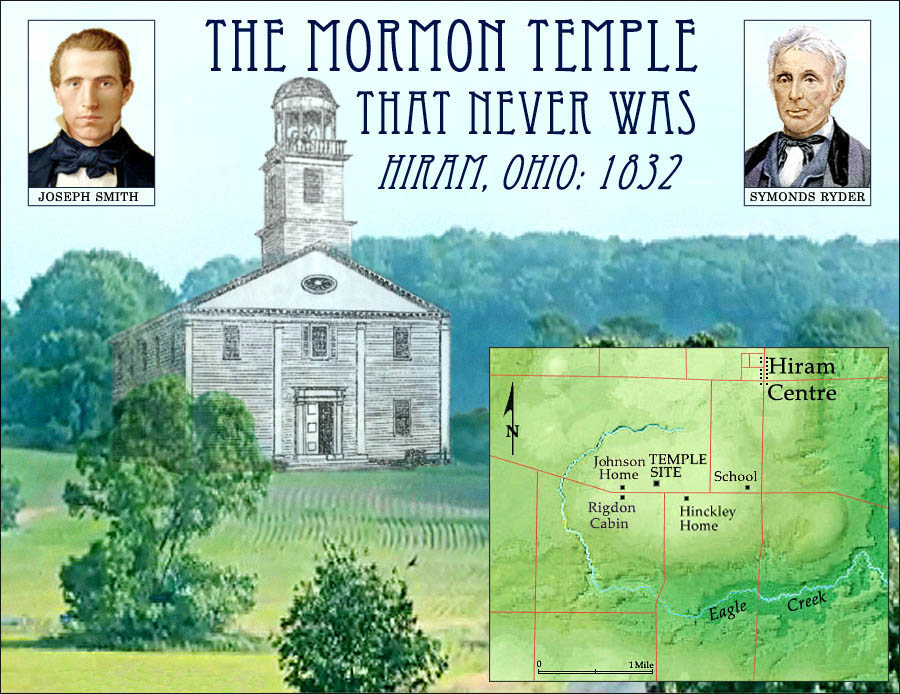
THE BEGINNING OF MORMONISM.
FROM OUR REGULAR CORRESPONDENT. |
|
CLEVELAND DAILY PLAIN DEALER. Vol. X. Cleveland, Ohio, Friday, Dec. 8, 1854. No. 112.
The Mormons and the Plain Dealer --
We have received a letter from James J. Strang, the acknowledged head of the Mormon community on Beaver Island, complaining of the Dealer's course generally towards his people, and particularly in reference to an article extracted from the Buffalo Republic, published as a rumor, charging the Mormons of that Island with massacreing a vessel's crew, &c. Now if in anything we pride ourselves, it is in letting people's religious opinions alone and persecuting no sect for a belief which we are bound in charity to suppose they cannot help. We do, however, when the Church, or any portion of it, assume to dabble in our trade -- i.e. politics -- make no bones of telling them, they are not only wrong, but very much out of place. When we saw a political party, like the Whigs in 1852, courting and cajoling the Catholics as such, we denounced the attempted collusion and did what we could to counteract it... It is only against the immorality of such that we war. Governed by no creed, belonging to no church and bound to swear in the words of no man, we are at liberty to denounce the fault of all when they come within our legitimate reach. |
Vol. ? Cincinnati, Ohio, January 6, 1855. No. ? MORMONISM AGAIN. Mr. Editor: I have just noticed in the Columbian an article headed "Mormonism Villified," -- and signed by Orson Spencer, in which the writer seems much annoyed at an article as previously published in your paper, designed, mainly, as a hint and timely warning to the Salt Lake Mormons, who are preaching polygamy among us. Now, sir, as you, in answer to this Mormon prelate's inquisitorial demands, have DRAGGED me out of my hiding place by informing this refined apostle of polygamy that the NAME of the "man whose heart is steeped in the gall of fiendish calumny," has not been withheld, as he supposed, from the above-mentioned article, I deem anything more on this head unnecessary. However, as he seems to think that the article in question is aimed at himself, whether from a sense of guilt, or whatever cause, I would inform him that the paragraph he has quoted, does not particularize the Salt Lake Delegation in this city any more than that in any other. |
ns. Vol. I. Columbus, Ohio, Friday, January 26, 1855. No. 211.
Exposure of the Mormons -- Letter from
|
ns. Vol. I. Ravenna, Ohio, Wednesday, February 21, 1855. No. 47.
Another Letter from one of
The Boston Times, Feb. 12th, says, by the following letter, it will be seen that we are soon to have the startling disclosure of Mormonism, referred to in a letter lately published in the Times. The lecturer (one of Brigham Young's wives,) has left Chicago, and, it will be seen from the date of her letter, she is expected to arrive here as soon as the neccssary arrangements for the delivery of her lectures are made. |
Vol. XXX. Painesville, Ohio, April 30, 1855. No. ?
Elder Martin Harris, of the Latter Day Saints, on Friday last, baptized a happy convert in the river, near the Geauga Mills. |
|
CLEVELAND DAILY PLAIN DEALER. Vol. XI. Cleveland, Ohio, Thursday, May 3, 1855. No. 28. Brigham Young's Manifesto. Intrinsically the sayings and doings of the Mormons are of no great account, only as showing the length to which human credulity can go, when strong appeals are made to the faith, rather than to the reason of mankind. But the political bearings of the extraordinary sentiments of that peculiar people, are matters of great and continually increasing interest, inasmuch as they present for public consideration questions which have never, as yet, been definitely settled, and to settle which may require a profounder wisdom than is often put in requisitlon to meet the exigencies of human governments. Their government is neither more nor less than a Theocracy -- a government professedly derived from God himself; and Brigham Young is the Prophet, the vicegerent of God. He combines in himself all the prerogatives of Prophet, Priest, and King. He is a Law-giver more potant than Moses; a Priest at least equal to Aaron, and a King equal to David or Solomon. And besides, as a Patriarch he places himself on the platform with Abraham, Isaac, and Jacob, setting aside the teachings of Christ and the Apostles, who greatly insinuated that one wife was sufficent, and in the face of civilization asserting that polygamy, though a diabolical thing for the men and women of the world, is a capital thing for the Latter Day Saints. And here is a sect more thoroughly imbued with the spirit of proselytism than any other under heaven -- more assuming as regards politlcal matters than any other class of men, and more bold in the declaration of their assumptions. And it is one of the questions of the day, how are the people of this country to manage and dispose of this matter? |
|
Daily Commercial Register. ns. Vol. IV. Sandusky, Tuesday May 22, 1855. No. 303. The Trail of the Serpent. Late advices from Utah bring information which will convince the people of the States that the bogus prophet at the head of the Mormons is acting in bad faith towards the government. In October, 1853, Capt. J. W. Gunnison, with a detachment of a surveying party, seven in number, was massacred by a band of Ute Indians. Col. Steptoe was despatched in the spring of 1854 with a strong force to bring the perpetrators of the brutal murder to justice. Upon the advice of Brigham Young, instead of giving them battle, he visited the Chief of the band, Kenoshe, and induced him to surrender six of the warriors engaged in the massacre, into the hands of the civil authorities, to be dealt with according to law. -- Three of these were indicted by the Grand Jury of Juab county, and the remainder discharged. Ankle-Joint, Sandy-Hair, and White Tree were put on trial for the murder; and here commenced the diabolical agency of Young. The notorious Col. Babitt, a tool of Brigham's, volunteered for their defence and commenced a system of tampering with the witnesses, intended to work an acquittal. Not satisfied with this, the jury were instructed by Young to find a verdict of manslaughter only, whereas the testimony overwhelmingly justified one of murder in the first degree, The court told the jury in plain terms, that it could only convict of murder in the first degree or aquit, that the crime of manslaughter could not be inferred from the testimony. Yet the Mormon jury chose to obey the behest of their false prophet, rather than the oath they had taken, or the dictates of their own conscience. If the blood-thirsty savages are thus assured of the sympathy of the Mormons, and are allowed to get off with a paltry [few] years' imprisonment [when they ---- --- ---] surveying parties, it is easy to see that nobody will be safe in their vicinity unless they are under an escort of the Mormon allies of these savages. It is evident that Brigham Young is no friend to the country or its authorities, however much hypocritical pretension he may make that he will submit to its legally appointed officers. -- Trouble is surely brewing in that quarter of our territory. |
Vol. IV. Sandusky, Ohio, Wednesday, May 23, 1855. No. 304.
==> Bill Smith, brother of Joe, has written a letter, in which he says that the system of polygamy, got up by Brigham Young, and the other evils which grew out of it, are a libel and a slander upon the character of the prophet, whose bones now lie mouldering in a martyr's grave; and were Joseph Smith to come forth from his lowly bed, and view the condition of things in Salt Lake country, he would spurn from his presence Brigham Young, and denounce his doctrine. |
Vol. IV. Sandusky, Ohio, Friday, May 25, 1855. No. 306.
CONDITION OF MORMON WOMEN. -- An officer belonging to Col. Steptoe's command now stationed at Salt Lake City, in a letter to the Providence Journal, thus speaks of the condition of the Mormon women: |
|
CLEVELAND DAILY PLAIN DEALER. Vol. XI. Cleveland, Ohio, Thursday, June 7, 1855. No. 58.
(From our Traveling Correspondent.)
|
|
THE OHIO REPOSITORY. Vol. 41. Canton, Ohio, Aug. 1, 1855. No. 16.
==> Accounts from the Sacramento Valley, Cal. say, that the Grasshoppers are destroying the crops there, as well as in Utah. Accounts also state that they are finding gold and silver on Sweet Water river, on the plains, and that the Mormons were at work damming and turning that stream from its bed. |
Vol. V. Sandusky, Ohio, Tuesday, August 7, 1855. No. 61.
==> The Mormons, as is well known, have a large colony on Beaver Island, Lake Michigan. This is a fragment of the main body, having left it before the emigration to the Salt Lake. Its members do not recognize the supremacy of Brigham Young, but have a prophet of their own. Lately this division of the Saints held, at Holy Island, a conference, in which they listened to a recital of their persecutions, and especially of the efforts to dispossess them of the Island. Then followed a solemn thanksgiving and praise to God for their happy deliverance from civil war and other persecutions, after which the sacraments were administered and the camp broke up. Next day the party proceeded to the mouth of Pine river, where they errected a gallows and hung in effigy the men who made the attack on two boat loads of unarmed Mormons, at that place, two years since. -- The following day they erected a new church building. Recent accounts from Salt Lake say that the Mormons in Utah are openly defying the United States Government. They even have a flag of their own, embellished with the device of a bee hive, and discard the Union National flag. They are said to have a factory where they make fire arms. This, however, is only by directions of the rulers, for many of the Mormon people are dissatisfied, and desire to emigrate to California. Times are dull, money scarce, and labor not in demand. A number of families with wagons and cattle have arrived in California from the Salt Lake, and others were desirous of leaving, but were prevented by Brigham Young, who had them closely watched to prevent their departure after night. This is somewhat remarkable, as being the first symptom of discontent yet manifested by Young's subjects. It will, doubtless, be hailed all over the Union as a favorable indication, and as showing the likelihood of a change in the condition of affairs in Utah. |
ns. Vol. II. Columbus, Ohio, Saturday, October 6, 1855. No. 109.
==> The news from Utah is, that there are no hopes of a famine to scatter the Mormons. The grasshoppers have yielded up the ghost in the vain attempt to devour the vegetation in the valley of the Great Salt Lake. The country must hereafter depend upon the gallantry of its soldiers for the subjection of Mormonism. The few who were quartered in Great Salt Lake City last winter were very successful. The Mormon ladies were captivated in scores by the "fascinating dogs." Each "bold soldier boy," when they took up their march for California, who would consent to have a female companion du voyage, and had the ability to provide for her transportation, was supplied, and there were few but left some loving girls behind them. Prophet Brigham is red hot with wrath, and swears vengeance, but we do not think he will hurt anybody -- N. Y. Sun. |
|
THE OHIO REPOSITORY. Vol. 41. Canton, Ohio, Oct. 24, 1855. No. 28. Mormon Principles Appear to be extending to New York. We notice by telegraphic despatches, and other sources, the Fourierites, having failed in their plan of new modelling society by forming Communities, have started a new sect, calling themselves "Free Lovers."... The details of their acts are horrible. Its beastiality comes up to the worst accounts we have had from the Mormons at Salt Lake. |
|
THE OHIO REPOSITORY. Vol. 41. Canton, Ohio, Oct. 31, 1855. No. 29.
THE PUBLIC LANDS. -- We have nominally 1,400,000 square miles of territory, say 8 or ten hundred millions of acres, but 5/6th of it valueless. The government cannot now -- is unable to supply the demand to actual settlers, at $1.25: this is owing to the grants made to States, companies, and soldiers. In Utah there are 34,000 Mormons occupying land without a title, and there is no likelihood that for 5 years to come it can be surveyed and sold. |
|
THE OHIO REPOSITORY. Vol. 41. Canton, Ohio, Nov. 7, 1855. No. 30.
==> The Mormons of Utah have founded a new settlement on Salmon river, near the Rocky mountains. -- Salmon river is nowhere near Utah. In fact, it is a long distance from their territory in the heart of Oregon, and thus the new Mormon settlement is a new movement, and not a mere branch of any of the Mormon settlements near the border. |
|
THE DAILY OHIO STATESMAN. ns. Vol. II. Columbus, Ohio, Wed., November 14, 1855. No. 142.
==> GEO. A. SMITH, "Historian of the Church of Jesus Christ of Latter Day Saints, is engaged in his work, and extracts appear in the Deseret News. Some items will be of interest to our readers hereabout. |
|
CLEVELAND DAILY PLAIN DEALER. Vol. XII. Cleveland, Ohio, Saturday, March 22, 1856. No. 71.
History of Kirtland Mormon.
The Church of Jesus Christ of Latter Day Saints was organized in Manchester, New York, on the 6th of April, 1830, and was then composed of six members, who were baptised by immersion, under the hands of Joseph Smith and Oliver Cowdery, who received the apostleship by commandment of, God, and the administration of heavenly messengers, and were the first elders of the church. |
|
THE OHIO REPOSITORY. Vol. 41. Canton, Ohio, March 26, 1856. No. 50.
==> The Mormons are taking the incipient steps for applying for admission into the Union as a State. Can they be admitted with Polygamy; never. |
Vol. V. Sandusky, Ohio, Wednesday, April 23, 1856. No. 280. A Mormon State. The consideration of the important question of the admission of Utah as a State will not be much longer deferred, if we may judge by the recent political movements in that Territory. The late mails bring the proceedings of a district Convention held not long since in Cove, in Beaver county, to take into consideration the propriety of holding a general Convention during the present Spring, to form a constitution and plan of State government for the Territory. There was a very large attendance, some of the delegates having come over a hundred and fifty miles. The speeches on the occasion were full of enthusiasm, and unanimously favored the immediate formation of a State government, and application for admission to the Union. The population of the Territory is stated to be one hundred thousand. |
Vol. V. Sandusky, Ohio, Monday, April 28, 1856. No. 285.
UTAH. -- As the Mormons expect some difficulty in working their way into the Union, on account of their doctrines of Polygamy, they mean to be right on the slavery question. Some of their principal men there, Judge Drummond, Judge Kinny, and some others, have lately made an ostentatious display of the sale and purchase of negroes. |
Vol. XLVI. Columbus, Ohio, Wednesday, June 4, 1856. No. 10.
The Deseret News (Mormon) is "down on" the practice of young men who have a piece of looking-glass fixed in the inside of their hat, and who, pretending to be praying with their face in their hat, are quietly and slyly looking at the faces of the girls [seated] behind them reflected in the glass. |
|
CLEVELAND DAILY PLAIN DEALER. Vol. XII. Cleveland, Ohio, Friday, June 20, 1856. No. 148.
DETROIT, June 19. -- At Beaver Island, on the 16th inst., James J. Strang, Mormon leader, was shot by two of his former followers, receiving three balls in his body. One of his assailants afterwards struck him a severe blow on the head with a pistol. At the last advices, at noon on the 17th, Strang was alive, but his state was considered critical. The assailants were arrested. |
Vol. XLVI. Columbus, Ohio, Wednesday, July 9, 1856. No. 15.
Assassination of Strang,
Before this time, in all human probability, James J. Strang, the leader of the Mormon settlement on Beaver Island, is among the dead. On Monday afternoon, between six and seven o'clock, Captain McBride of the United States steamer Michigan, (which was lying at the pier at Beaver island,) sent his pilot, Alex St. Aubin, a steerage hand, a short distance off, with a request for Strang to come on board the steamer upon some business. Strang returned with St. Aubin, and when about half way down the dock two men stepped out from behind the woodpiles, with which both sides of the dock are lined, there being only a passage way between the wood, and one of the men fired a revolver, the ball striking Strang in the back of the head, passing around under the skin, coming out near the temporal bones. |
|
CLEVELAND DAILY PLAIN DEALER. Vol. XII. Cleveland, Ohio, Tuesday, July 15, 1856. No. 167. From the Beaver Islands -- The Mormon Settlement Broken up.
|
 Vol. 42. Canton, Ohio, Wednesday, August 20, 1856. No. 19. The Mormons against Fremont. The Mormon of Saturday last, rallies the forces of Joe Smith and polygamy against the people's candidate for the Presidency in the following terms: |
|
Vol. 42. Canton, Ohio, Wednesday, October 22, 1856. No. 28.
The Delaware Free Press, Wilmington, of Oct. 4, says that the Supreme Court of Utah has decided that the organic act extends the common law over Utah, and the act being in the nature of a constitution, the common law therefore overrides all the statutes of the Mormon Legislature. This renders illegal polygamy and the statutes made by order of Brigham Young. How would that decision apply to Kansas and the infamous Shawnee Missouri laws? The common law in Kansas is all that freedom asks. -- Leader. |
Vol. XIII. Defiance, Ohio, Saturday, November 22, 1856. No. 18.
Murder of A. W. Babbitt. -- Rumors reached the States some weeks since that Col. Babbitt, a prominent Mormon, and Secretary of Utah Territory, had been murdered by the Indians. An arrival of a Salt Lake train on Sunday, October 26th, at Council Bluffs, confirms the report. Capt. Hawley, who had charge of this train, got the facts at "Sweet Water." which is a station about 200 miles west of Fort Laramie. The Indians had come to the Fort and reported that 12 of them had attacked Col. Babbitt, while one of his men was away, and after the Col. had fired his double-barreled gun and revolvers, one of the Indians crept behind the wagon and tomahawked the Colonel. -- Frank Rowland and Sunderland were killed. -- The Indians said the Colonel fought like a grizzly bear. When at Fort Kearney, Capt. Hawley learned that Major Wharton had in his possession the papers (including a draft of $8,000) and some of his hair. His watch was obtained by a Frenchman from the Indians. Altogether about 18 whites have been killed. Col. Babbitt was formerly a resident of Amherst, Lorain county. His father was a blacksmith in that town, and one of its early settlers. The son was an untutored, active, smart boy -- to use a familiar, was very tounguey -- and when a young man became a convert to Mormon doctrines through the influence of a protracted Mormon meeting, held in Amherst. Mr. Babbitt became a Mormon preacher, having joined the sect at Kirtland, Lake county, and has followed the destiny of this strange people to its present habitation at Salt Lake. Col. Babbitt by his native talent, industry and perseverance had risen to distinction in Utah and was Secretary of the Territory. -- |
|
CLEVELAND DAILY PLAIN DEALER. Vol. XII. Cleveland, Ohio, Saturday, Dec. 13, 1856. No. 291.
==> HON. JOSIAH QUINCY, JR.'s LECTURE -- THE MORMONS. -- The Hon. Josiah Quincy, Jr., delivered before the Young Men's Library Association last evening at Chapin's Hall, one of the most interesting discourses which have ever been listened to by a Cleveland audience. The hall was crowded to excess, in spite of the irregularities and indifferent success which has heretofore lately attended the management of the course. |
|
THE DAILY OHIO STATESMAN. ns. Vol. III. Columbus, Ohio, Tuesday, December 23, 1856. No. 176. Polygamy in Utah. Judge Drummond, of the 1st District in Utah, has charged the Grand Jury against polygamy. It clearly comes within the provisions of the United States statute against lewdness, and is punishable with imprisonment for from ten years down to six months, and a fine of a thousand dollars. -- Journal. |
|
CLEVELAND DAILY PLAIN DEALER. Vol. XII. Cleveland, Ohio, Wednesday, Dec. 31, 1856. No. 305. News from the Sandwich Islands. ...We read in the Advertiser... A lecture on "Mormonism" was lately delivered at the Bethel [Chapel], Honolulu, by Mr. J. Hyde, Jr., who had recently arrived from Utah Territory. There has rarely been such a crowded audience in Honolulu. What gave additional interest to the lecture was the fact that the lecturer has, till recently, been an officer in the Mormon church, but has renounced the faith altogether, having been fully convinced of its absurdity. At the close of the lecture, a member of the Mormon community had the impudence to get up before the assembly and charge the lecturer with horse-stealing, which, whether the charge was true or not, was deemed altogether out of place. The lecturer, however, explained the charge to the satisfaction of his audience. |
|
CLEVELAND DAILY PLAIN DEALER. Vol. XIII. Cleveland, Ohio, Friday, Jan. 2, 1857. No. 1. Judge Drummond and the Mormons. We published the othor day an extract from a charge alleged to have been delivered lately by Judge Drummond, of Utah, before a grand jury of that territory. Its authenticity has been since questioned, and some argument has been advanced to prove that such a charge could not have been made, as it was inconsistent with the general law of the United States. However that may be, we received yesterday from Judge Drummond himself, via California, a communication furnishing us with an extract from his charge precisely the same as that we published. He asks the favor of its publication in our columns, as he desires to set himself right on the vexed question of polygamy, which he apprehends will one day cause this nation more trouble than any other. Without coinciding in this opinion, we have merely to say that Judge Drummond's wish having been anticipated, we do not republish the extract. We take the opportunity, however, to commend his firmness, decision and honesty in the performance of his duty, and hope that it will prove of some service hereatfter. As to the difficulties attending this matter of polygamy, we think if they are not unwisely agitated the evil will eventually cure itself in less time than it can be cured by outward pressure. Already we find that its effects are painfully deprecated by those who sulffer from them. And it is certain that multitudes of the miserable women would gladly escape if they could. |
|
Vol. 42. Canton, Ohio, Jan. 28, 1857. No. 42.
SCHISM AMONG THE MORMONS. -- Elder John Hyde, hitherto one of the leading spirits among the Latter Day Saints, who was sent to the Sandwich Islands to convert the heathen to the many wife system, has renounced the Mormon faith, and is engaged in exposing its fallacies. Among other charges, that of falsifying the census of the Territory is made. The ex-elder says that there are not much over half as many inhabitants in Utah as the census returns would indicate. Names of deceased persons, names of disciples who never came there, and those who have long since gone away, have been retained to swell the aggregate to the required seventy thousand. |
|
Vol. 42. Canton, Ohio, March 4, 1857. No. 47.
A correspondent of the Chicago Tribune denies that statement that slavery does not exist among the Mormons. He says their laws sanction it, and their religion inculcates the idea that the Africans are an inferior race of beings. They do not own many negroes, but hold in bondage not less than four hundred Indian children under the pretence of apprenticeship. |
|
CLEVELAND DAILY PLAIN DEALER. Vol. XIII. Cleveland, Ohio, Wednesday, March 25, 1857. No. 71. Interesting State of Affairs in Utah. A letter has been received at Washington from W. W .Drummond, United States Supreme Judge in Utah Territory, by the Administration. It gives a sad and deplorable history of matters in that Territory. The following is taken from the letter: |
|
CLEVELAND DAILY PLAIN DEALER. Vol. XIII. Cleveland, Ohio, Thursday, April 2, 1857. No. 78. The Inhabitants of Great Salt Lake City. Dorby and Jackson, of New York, have recently published a work by Austin N. Ward entitled "The Husband in Utah, or Sights and Scenes among the Mormons." The history appears to be authentic, and, affords the plainest account of the blasphemies, adulteries, and other abominations of Mormonism. Mr. Ward gives the following sketch of the inhabitants of the Great Salt Lake City: |
|
Vol. 43. Canton, Ohio, April 22, 1857. No. 2. Resignation of a United States Judge. The Hon. W. W. Drummond, one of the Justices of the supreme court of Utah Territory, has forwarded his resignation to Washington. He thus sets forth his reasons for resigning: |
Vol. XLVII. Columbus, Ohio, Wednesday, April 29, 1857. No. 5.
The Saints in Utah.
To the Hon. Jer. S. Black, Att'y Gen. of the U. States, Washington City, D. C. |
|
CLEVELAND DAILY PLAIN DEALER. Vol. XIII. Cleveland, Ohio, Monday, May 4, 1857. No. 105. Mormonism vs. Democracy. Mormonism seems now to be a subject, that at this or some day not far distant, will agitate the minds of our American people. How far this agitation may extend, or what division the great minds of our country may make, remains yet to be revealed. From the peculiar relation existing between these "Latter Day Saints," and the heads of government on the Eastern continent, we could not expect this agitation to remain entirely with us at home. Upon the Western continent exists a republic, whose free institutions, and mighty power have been felt across the Atlantic -- while America progresses Europe trembles and each revolving event is scanned with eagerness to find some hand to point our road to ruin. Thus their sympathies were placed in the contest of '56 which resulted in the election of James Buchanan. If their sympathy was enlisted in this issue, what else could be expected in one in which would be involved their favorite institution of "barbarism" -- favorite, not because in accordance with their religious belief, but because of the adversity of interest between Mormonism and our Republic. Already it seems this Mormon question has been raised in the House of Representatives by Mr. Morrill, of Vermont, in a speech delivered Feb. 27, 1857, in which he gives a brief of the laws and customs of Utah: together with a broadside upon the Democratic party -- and administration, standing as they do, upon the "Cincinnati Platform," we quote the following, and also the Territorial law. The President and rulers of the Mormon Church have already sought shelter in the bosom of the Democratic party, by their proclamation of Aug. 14th 1856, They declare "The Democratic party in Cincinnati which nominated James Buchanan, published the following resolution: |
|
Vol. 43. Canton, Ohio, Wednesday, May 6, 1857. No. 4. Iniquity always finds a Hard Road to Travel in the End. The Democratic party have rested all their arguments on "Squatter Sovereignty." What can be fairer, than to "let the people of Kansas choose for themselves what kind og government they shall have. Congress has no right to legislate for the Territories." All this was so plausible, that many of our voters gulped it down as a glorious Democratic principle -- together with Buchanan and Free Kansas. |
Vol. XLVII. Columbus, Ohio, Wednesday, May 6, 1857. No. 6. "Manifest Destiny." Gen. Cass used to be regarded as the High Priest of the Manifest Destiny doctrine; but since his appointment to the State Department, the late Attorney General, Caleb Cushing, has entered the lists as its defender. On the occasion of his recent public reception at his old home, Mr. Cushing delivered a highly finished and eloquent oration upon the destiny of the United States. In the whole of his discourse there is not a word said about the canker at the root, the worm at the core of our Republican institutions -- Slavery. Heretofore our growth has been, in spite of our local disease, but which recent events have made a national one.... |
|
BELMONT CHRONICLE. ns. Vol. I. St. Clairsville, Ohio, Thursday, May 07, 1857. No. 19.
A Sketch of Jo Smith.
Thirty years ago there lived near Palmyra, Wayne Co, New York, an obscure individual, whose name since become familiar to the world. That individual was Jo Smith, the Mormon Prophet. A sketch of this person's life is interesting, not because we find anything in his character to admire, but because it presents to our view the origin of Mormonism -- one of the most extravagant humbugs that the world ever witnessed. The idea of a new religion originating in a person possessing less than ordinary abilities, and rapidly increasing in number till both the Old and the New World contain multitudes of proselytes is a subject of much interest. To give the reader an idea of the origin of this singular sect is the object of the present essay. |
|
THE DAILY OHIO STATESMAN. ns. Vol. III. Columbus, Ohio, Wednesday, May 20, 1857. No. 304.
From the Journal of Commerce.
The insolent defiance of the laws of the United States, and the authority of Congress -- the assumption of power superior to and distinct from that of the Federal Government -- the destruction of the records of the Supreme Court, and the ill-treatment of the Territorial officers, by the Mormon settlers in Utah, acting under the orders of Brigham Young, as detailed by Judge Drummond, have given fresh importance and prominence to the Mormon question, and caused it to occupy the serious attention of the Government at Washington. The picture drawn by Judge Drummond in his letter resigning his office as Judge of the Supreme Court in Utah, exposes a deplorable condition of affairs in that Territory, and shows that Brigham Young, the Mormon Chief, is the instigator and director of the murder, rapine and violence, which are of daily occurrence, against the persons and property of those who are not Mormons or who refuse to subscribe to the loathsome doctrines which they profess. Bad and intolerable as is this state of things, we are persuaded that it will soon be remedied, and that the Government will employ speedy and efficient means to compel the Mormons to obey the federal authority and acknowledge the supremacy of the law of the United States. |
|
THE DAILY OHIO STATESMAN. ns. Vol. III. Columbus, Ohio, Thursday, May 21, 1857. No. 305.
From the St. Louis Evening News of the 19th.
About two months ago, we published an account of the kidnapping of several children by the Mormons at New Orleans. The father was absent at the time, in California, and the mother, who had been deluded by the Saints, lent herself to the infamous scheme by which her own children were to be ruined. The kidnappers started with the children from New Orleans to go through Texas, Arkansas and the Indian Nation to the Salt Lake trail, but were fortunately intercepted by the father, who, having heard of the affair, had returned, and started in pursuit of them. The following letter is from him to his friends in this city and gives some of the particulars of the arrest. |
|
CLEVELAND DAILY PLAIN DEALER. Vol. XIII. Cleveland, Ohio, Saturday, May 23, 1857. No. 122.
Letter from Utah Territory. --
We have dates from Salt Lake City to April 1st, with accounts of more violence and even bloodshed by the Mormons. It appears that a man named Parrish, a seceding Mormon, left the walled town of Springville, to come to the States on foot, his wagon and horses having been stolen by Mormons the night previous to the departure. He was accompanied by his two sons, and two men named Potter and Darger. They had not left the place more than a few hundred yards behind when they were attacked by a number of men armed and disguised. Potter was shot dead, five balls having entered his body; Parrish fell wounded, when one of the assailants rushed upon him, and, in his disabled condition, cut his throat from ear to ear, and ripped up his abdomen. One of Parrish's sons ran about eighty yards, when he was struck down, his throat cut, and his abdomen ripped up. The other young Parrish and Darger contrived to escape. The only notice taken of the matter by the Mormon authorities was the summoning of a coroner's jury, who sat upon the case and returned a verdict of "assassination by some persons unknown." |
Vol. XLVII. Columbus, Ohio, Wednesday, May 27, 1857. No. 9.
Interesting Letter from Judge Drummond --
|
|
CLEVELAND DAILY PLAIN DEALER. Vol. XIII. Cleveland, Ohio, Monday, June 1, 1857. No. 129.
Card from Mr. Isaac Sheen -- The Murder
Editors Commercial: Your paper of the 27th inst. contained an erroneous statement concerning myself. I am not a brother-in-law of Mr. H. H. McLean, who is reported to have killed Parley P. Pratt, a polygamous Mormon apostle. The mistake originated out of the fact that Mr. A. W. Babbit, late Secretary of Utah, who was murdered, as is believed, by B. Young's Danite band, was my brother-in-law. The information that I communicated to Mr. McComb, (the father of the deluded victim of P. P. Pratt,) was solely intended to enable him to recover the children, and to enter into legal measures against Pratt. The fatal termination of this affair was altogether unexpected and unsought for by me, and it was with pungent grief that I contemplate the fact that P. P. Pratt, who was once an exalted apostle of the Lord Jesus Christ, should thus fall by the judgment of God for having "given heed to seducing spirits and doctrines of devils." |
Vol. VII. Sandusky, Ohio, Wednesday, June 3, 1857. No. 5. The News. It is announced that orders have been issued from the War Department for sending to Utah the second regiment of dragoons, the Fifth and Tenth regiments of infantry, and Capt. Phelps' battery of light artillery, numbering in all some 2000 men under the command of Gen. Harney. This is said to be only the beginning of the movement. |
Vol. VII. Sandusky, Ohio, Thursday, June 4, 1857. No. 6. The News. We yesterday received a telegraphic dispatch from St. Louis, which was inadvertently omitted in our issue of last evening, containing important news from the Mormon country. The Leavenworth Herald learns from Mr. Williams, who left Salt Lake on April 15th, that there was great excitement at that place. Brigham Young was carrying things with a high hand, and driving the Gentiles out. Judge Stiles, the U. S. Marshal, and the Surveyor General with his family and a large number of emigrants had been obliged to leave the Territory. This outrageous conduct of the Utah Governor accounts for the movement on the part of the General Government in sending out a large force of troops, to which we yesterday referred. |
|
THE DAILY OHIO STATESMAN. ns. Vol. IV. Columbus, Ohio, Wednesday, June 17, 1857. No. 15.
ANOTHER MORMON MASSACRE. -- The mail from Salt Lake arrived here this week, says the Los Angeles Star of the 9th, bringing intelligence of another horrible massacre having been committed in Utah Territory. The circumstances are as follows: |
|
Vol. ? Canton, Ohio, Wednesday, June 24, 1857. No. ? Squatter Soverignty coming home to roost. The Locofoco government has taken great pains to build up the new principle of Squatter Sovereignty, in order to shirk the direct responsibility of making Kansas a slave state -- leaving the dirty work for the Atchisons, Stringfellows and Border Ruffians in general, backed by the United States troops and Judge Lecompte. |
|
CLEVELAND DAILY PLAIN DEALER. Vol. XIII. Cleveland, Ohio, Friday, June 26, 1857. No. 151.
(Correspondence of the Baltimore Sun.)
The administration have completed territorial appointments for Utah. The Governor, Judges, Marshal, &c., will proceed forthwith to the Territory. The body of troops detailed for their support cannot be sent out there before the middle of July, and some say will not reach their destination -- to wit, the government reserve, forty miles south of Salt Lake City -- before the end of August. |
|
CLEVELAND DAILY PLAIN DEALER. Vol. XIII. Cleveland, Ohio, Monday, July 6, 1857. No. 158.
(Correspondence of the Baltimore Sun.)
Advices from Utah by way of California confirm the reports of dissension among the Mormons, and the supposition that a large number of them will gladly exchange Brigham Young's tyranny for the protection of life and property which the authorities and the laws of the United States will afford them. “Apostacy“ from Mormonism will become very common, if not almost universal, after Brigham Young shall be deprived of the prestige and the authority which the federal government has too long afforded him, by suffering him to hold the office of Governor for seven years -- and three years after the expiration of his term. The Mormons might well have been induced to believe that the power of Brigham Young would be as permanent as his audacity, and that the federal government would not presume to interfere with or control him. |
|
Vol. 43. Canton, Ohio, Wednesday, July 15, 1857. No. 14. Salt Lake Mail. One of the best things yet done by the administration of President Buchanan has just come to light in a western paper. It appears that the Postmaster at Independence, Mo., has received an official notice from the Postmaster General that the contract for carrying the mails from thence to the Salt Lake has been set aside; and he is therefore ordered to withhold the mails until further orders. -- This is done by virtue of a right always reserved by the department, to rescind mail contracts on giving due notice and a month's pay to contractors. In this case the contract was taken by a company of Mormons at Salt Lake city, who have already made several trips under it. -- So general were the complaints of the mails having been violated and letters opened, especially the correspondence of the government officials, that it became quite evident these Mormon contractors were mere tools of Brigham Young. The administration has also taken another step toward insuring the faithful performance of the mail service in Utah; a Postmaster had, it seems, been appointed for Salt Lake City, who was not a Mormon. His commission was forwarded to him, but never reached its destination, and duplicate copies failed likewise. -- In fact, he was not recognized by Nrigham Young. He has now received his comission in person at Washington, together with full instructions as to his course, and will be sent out supported by a protecting military force. |
Vol. VII. Sandusky, Ohio, Wednesday, July 22, 1857. No. 46.
From the Plattsmouth (Nebraska) Jeffersonian.
A train consisting of about one hundred persons, with twenty wagons, passed through this place on Friday last on their return from Utah to the States. They formed part of a company of two hundred persons and forty teams; but some distance back the remainder took the road for Leavenworth. They left Salt Lake about the 20th of April, and were on the road a little over two months They bore the appearance of persons who had seen much trouble and privation -- being reduced in body and dejected in mind. A more pitiable set of persons we never beheld. They rejoice! that they had at last reached a land where they could once more live at ease. |
Vol. XIII. Defiance, Ohio, Saturday, August 8, 1857. No. 50.
Brigham Young and his Wives. Let us pay Brother Brigham a visit. It is four o'clock in the afternoon, and Brigham is most probably at his office, and will receive us affably. We pass the Tithing Office; notice that it is a large adobe building, with several offices attached where the workmen obtain their flour and provisions. We observe a group of women, with generally common and pale faces, who are waiting for their "men's pay," which they have to almost beg from the surly fellows who attend them. These small houses we pass next are the mansions in which D. W. Wells' wives reside. They are almost mud hovels. Mr. Wells is a "prophet, seer, and revelator," as well as second counselor to Brigham. He has some six ladies in his sanctified harem; two of them are sisters, and report says they often manage to get up anything but the heavenly scenes befitting such a paradise begun. We next come to Brigham's orchard. He is a great lover of fruit, and has a great family who are great lovers of fruit too. They, however are carefully excluded from the orchard; peach trees and apple trees would soon be desolate else. Here is the "Lion House." This is a long house, with the first stiry of stone. In front, on top of this first story, is a very well sculptured lion, with his head dropped onto his stretched paw. -- This is intended to represent Brigham Young -- "quite but watchful." In this house some seventeen or eighteen of the prophet's wives reside.... |
Vol. VII. Sandusky, Ohio, Saturday, August 15, 1857. No. 67. Revolution Among the Mormons. Important intelligence reaches us from Utah. The infatuated inhabitants of that Territory are engaged in intestinal broils that promise to eventually become a matter of very serious import. Brigham Young -- as has been before reported -- has gone North with an expedition, fully equipped, with three months' provisions and a train of eighty wagons. Various rumors as to its object are afloat, but the most conclusive is, that he has gone in search of a location to defend his people from the expected attack of the U. S. troops. He exhorts the Saints in the event of an assault to kill each his man and thus secure each his own salvation. But all this pretended regard for the laity on the part of their ruler does not quiet their rebellious and dissatisfied spirit. A large portion of them are disgusted with the enormities of Mormonism, and would gladly return to their peaceful and civilized homes in the States if opportunity offered. But those who are suspected of apostacy are strictly guarded by the more faithful, and the least overt act of rebellion or note of dissension is visited with the most terrible penalties, the murder and robbery of the unfortunate apostates. Yet under all these unfavorable circumstances great numbers are almost daily forsaking the Saints and seeking an asylum either in California or the States. A train of one hundred wagons belonging to apostates, had left the country just previous to the leaving of the last mail. It is stated by a gentleman fresh from Utah, and one on whose judgment reliance can be placed, that one-half the Mormon population would leave, and will do so, if the General Government will but send a sufficient force to protect them. New dimensions are continually arising. That which causes the most ill-feeling is Brigham sealing young girls to old men. This the girls, as a matter of course, and their relatives, protest against. Several heads of families have been put out of the way, as they call it, on suspicion of being apostates, by which means they prevent the family from leaving. Several who heretofore have been in the confidence of the high priests are known to have been murdered. |
|
CLEVELAND DAILY PLAIN DEALER. Vol. XIII. Cleveland, Ohio, Saturday, August 22, 1857. No. 199.
WASHINGTON, August 21. The interior department received intelligence from a reliable gentleman and fugitive Mormon, that Brigham Young is preparing to resist General Harney: that he has [relapsed] into the grossest infidelity and that he continues to hold up the government of the U. S. to the supreme contempt of the Mormons. |
Vol. VII. Sandusky, Ohio, Saturday, August 27, 1857. No. 67.
The Utah Expedition.
Gen. Scott has been busy all day with Gen. Jessup, in making out a programme for the movement of troops for Utah. They have finally decided that the expedition to Utah shall proceed. It is not decided yet whether Gen. Harney or Col. Johnson will command the expedition. Gov. Walker is very anxious to retain Harney in Kansas. A messenger will be dispatched to Kansas to-morrow to settle the matter. |
|
CLEVELAND DAILY PLAIN DEALER. Vol. XIII. Cleveland, Ohio, Saturday, September 19, 1857. No. 224.
THE MORMONS.
It is a little more thon twenty-seven years since I commenced reading the Book Mormon and defending the cause we are engaged in. My mind was open to conviction, and I knew that the Christian world had not the religion that Jesus and his Apostles taught. I knew that there was not a Bible Christian on the earth within my knowledge. A few years previous to that time Joseph had obtained the plates and began translating the Book of Mormon; and from the time he found those plates in the hill Cumorah, there has been just that tirade of abuse, lying, slandering, defaming the name and character of the Prophet and his associates, that there is at this day. It is no hotter a time now than it was then; there is no more persecution now than there was then. |
|
CLEVELAND DAILY PLAIN DEALER. Vol. XIII. Cleveland, Ohio, Friday, September 25, 1857. No. 229. From Fort Laramie. We have advices from Fort Laramie to the 22d of August. Capt. Van Vleit, of the Q. M. Department, who has been sent forward to Utah, in advance of the troops, arrived in Laramie in ten days from Fort Kearney. It was expected that the Tenth Infantry would arrive at that post by the 5th of the present month, and the remainder of the command soon after. Our apprehensions in regard to the expedition are, we are sorry to hear, likely to be realized. The troops will be so late that it is feared by old sojourners at Fort Laramie, that the entire command cannot get to Utah this season. |
Vol. VII. Sandusky, Ohio, Friday, October 2, 1857. No. 10. Enormities of Mormonism. As each additional seceder escapes from the clutches of their former Mormon brethren, are the enormities of these modern Ishmaelites not only confirmed, but heightened in revoltingness of character. A young Welchman, who emigrated to Salt Lake with his family two years ago from Maesteg, South Wales, recently made his escape from the bondage of the Saints, and in a private letter dated Council Bluffs, June 29, gives a horrid picture of the condition of affairs in Utah. He says it is next to impossible to escape from the ruffians who do the bidding of the prophet, and that hubdreds who make the attempt are overtaken and sumarrily despatched. The party to which he belonged were pursued over one hundred miles and fired upon repeatedly by the exasperated saints. To be a faithful Mormon, he says, a man must give himself, his family, and all his possessions over to Brigham Young, and then he will have to give the tenth of all his income and keep from two to ten wives in addition. This he must do without flinching; and if he does not, he had better quit the country. But the latter resort is rendered almost wholly impracticable from the fact that rather than have one of their number escape from their midst and report their atrocious doings, they will shoot him down like a dog. Brigham Young has got men for this purpose -- four hundred in number, called "Destroying Angels." The young Welchman above referred to says he has seen dozens shot down in the street; and three days before he left he saw three persons killed merely because they intended to escape. |
|
THE DAILY OHIO STATESMAN. ns. Vol. IV. Columbus, Ohio, Thursday, October 8, 1857. No. 111.
(From the Washington Union, Oct. 1st.)
A letter dated Fort Kearney, September 5, received in this city, states that a party of returning Californians, who passed through Salt Lake on the 25th of July, report that the evening before they left that city the Mormons arrested Mr. Wilson, whom the late Surveyor General Burr left in charge of the office, and, with a rope around his neck and a pistol at his breast, compelled him to answer several questions which they propounded about Bell, Mogo, and others. Mogo was connected with the Surveyor General's office. The Mormons made Wilson promise to bring Mogo to them during the next day before they released him. Mogo obtained information of these proceedings, and immediately quitted the city, leaving his wife behind, so precipitate was his retreat. They went in pursuit of Landon and the other clerk, but Landon escaped by jumping out of a second story window. He went that night somewhere South, and the report is that he was overtaken and killed. As these Californians made but a brief stay, they were unable to ascertain what became of Wilson. |
Vol. VII. Sandusky, Ohio, Tuesday, October 20, 1857. No. 198.
Mormon Outrages on United States Officials.
A letter has been received in this city from W. P. Landon, one of the clerks whom the late Surveyor General Burr left in charge of the office when he, for his own safety, left the Territory of Utah last spring. He was, on the 18th Sept., in Placerville, California. In giving an account of his escape from Salt Lake City, he says that while engaged in conversation with a party of emigrants, he was assaulted by a gang of Mormons led by a fellow named Dick Pettit, and a ruffian associate, who, without cause, severely beat him with stones and clubs. He was scarcely able to reach home in consequence of his wounds. The same afternoon they attacked the Deputy Surveyor Mogo with stones. Landon was driven from his home at night, leaving his wife and child at Salt Lake City. After adriotly eluding his armed pursuers, he reached Placerville in the most distressing condition. -- On the road, he says, he met the Indian Peter, who used to frequent the Surveyor General's office. Peter informed him that Brigham Young had sent him out to get horses and carbines -- The Indian spared his life because he had on several occasions given him red paint. Landon had not long parted from him before he (the Indian) shot a man with four balls. The man escaped, though much injured. Another clerk in the Surveyor General's office, Mr. Wilson, was also attacked by the Mormons. They roughly served him, tearing him away from his family, commanded him to go along with them and make no fuss, or they would d____d soon show him what they were going to do with him. Mr. Landon's letter gives the particulars of these circumstances. It concludes by saying that all the Mormons have left Placerville and Carson Valley for the purpose of defending Zion. |
|
CLEVELAND DAILY PLAIN DEALER. Vol. XIII. Cleveland, Ohio, Monday, November 9, 1857. No. 267.
FROM CALIFORNIA.
J. Ward Christian writes to the Los Angeles Star as follows: |
|
Vol. 43. Canton, Ohio, Nov. 25, 1857. No. 33. The Prospect of a Mormon War. From present appearances the danger of a war with the Mormons is imminent. Despatches have been received by the government, confirming the destruction of a supply train [belonging] to the United States Expedition to Utah. |
|
Vol. 43. Canton, Ohio, Dec. 2, 1857. No. 34. Latest from California. New Orleans, Nov. 28. |
THE PROGRESSIVE AGE. AND COSHOCTON COUNTY LOCAL RECORD. Vol. V. Coshocton, Ohio, Dec. 23, 1857. No. 11. The Mormons and their War. A letter from Mrs. Huddleson, of the overland company to California, gives an account of the frequent attacks they suffered from the bands of Indians and Mormons, who were ranged about, pillaging and murdering unprotected trains. A Mr. Holloway, from Illinois, had his wife and child killed before his eyes, and was robbed of $1,600, escaping only with his life, severely wounded. They found a woman belonging to another train, dead by the wayside, with her scalp taken off. |
Vol. XIV. Defiance, Ohio, Saturday, February 6, 1858. No. 24. Mormonism. As this disgusting compound of sensuality, despotism and ferociousness is continually thrusting itself upon public attention, it may interest some of our readers to recall the circumstances in which it originated. The calamity has come upon us as one of the results of that excessive freedom in the exercise of which we throw [open] our empire to all manner of immigrants from the old world; for this anomalous population is chiefly recruited from Europe. |
Vol. ? Cincinnati, Ohio, April ?, 1858. No. ? An Object of Mormon Vengeance. Eds. Com. -- It will be remembered by many of your readers that Parley P. Pratt (one of the twelve apostles of the Salt Lake Mormon Church,) was killed by Mr. McLain [sic] after he had taken the wife of McLain unto himself. The children of Mr. and Mrs. McLain were secretly taken away from the guardianship of their grandparents, (the father and mother of Mrs. McLain,) for the purpose of taking them to Utah. To prevent these children from being carried off to Utah, I communicated a knowledge of the facts in my possession to their grandfather. I neither expected or advocated the killing of Pratt, but I have obtained indisputable evidence that the Danites of Brigham Young's church have decreed that I shall share in the fate of P. P. Pratt. |
Vol. VII. Sandusky, Ohio, Wednesday, May 5, 1858. No. ?
THE LEGITIMATE MORMON SUCCESSOR. -- The widow of Joe Smith, the Mormon, still resides at Nauvoo, but she cares nothing for the Saints, and has married a tavern-keeper, who thinks all prophets humbugs. Young Joe, who should by right have been head of the Mormons, is said to be a stout gawky of 22, who hates Brigham Young and curses the Salt-Lakers. Nauvoo was once a place of 20,000 inhabitants, but is now a place of ruins. |
Vol. ? Cincinnati, Ohio, Thursday, June 17, 1858. No. ?
The Mormon Hegira.
There can be no spectacle so well calculated to excite feelings of the deepest pity as that of a whole people leaving their homes, the places where they have resided for years, the houses, the gardens and the fire-sides, endeared to them by a thousand fond recollections, and wandering off into the wilderness in search of places to begin anew. Whatever may be the motive for such an emigration, the act itself is one that cannot be contemplated without emotion. Men do not readily leave their possessions, the comforts which years of labor have gathered around them, the thousand sources of innocent pleasure which they have constructed and cultivated, and with wives and children seek new homes in a desert, without some powerful and controlling motive that relates to the very foundation of their moral being. |
|
Cleveland Morning Leader. Vol. XXII. Cleveland, Ohio, Monday, June 21, 1858. No. 148.
Mormonism -- The Golden Bible --
The grain of Mormon mustard seed was planted by its Prophet, Joseph Smith, in 1829. In that year he employed Oliver Cowdery as his amanuensis to write out the Book of Mormon, as the Prophet read the records from the Golden Plates alleged to have been discovered underground in Western New York. Martin Harris, of Palmyra, a farmer of means, became security to Mr. Grandin, then publisher of the Wayne Sentinal, to print and bind 5,000 copies of the Bible, for $3,000. The publication was completed in 1830. The manuscripts were written by Cowdery from translations verbally given by Smith, who alone was able to read the hieroglyphics of the sacred Plates, by means of a wonderful stone and magic spectacles, said to have been found in tbe earth with the records. When translating Smith occupied a dark room, and by special revelation neither Cowdery nor any other person except the Prophet, was permitted to see the Golden Plates, on penalty of instant death. The Plates were said by Smith to resemble plates of gold, and the hieroglyphics, of great antiquity, were "written by the hand of Mormon upon Plates taken from the Plates of Nephi. |
|
CLEVELAND DAILY PLAIN DEALER. Vol. XIV. Cleveland, Ohio, Wednesday, July 7, 1858. No. 158.
The First Mormon Settlement -- A correspondent of an Eastern paper, from Kirtland, O., gives the following. His letter dats from a small township situated in Lake County, about twenty miles east of Cleveland. The town is somewhat celebrated for being the first settlement to any extent of Joe Smith and his followers in the United States. the population about the year 1834-5 was nearly five thousand; now it has not far from fifteen hundred, very few of whom claim allegiance to believe in the doctrines of the "Latter Day Saints," as promulgated by Brigham Young. He says: |
Vol. XLVIII. Columbus, Ohio, Wednesday, November 10, 1858. No. 33. Origin of Polygamy in the Mormon Church. A correspondent of the Louisville Journal, who professes to be well informed in regard to the practices of Mormonism, thus corrects a statement made in the Journal that Brigham Young was the author of the institution of polygamy now existing in the Mormon Church: |
|
Cleveland Morning Leader. Vol. ? Cleveland, Ohio, Saturday, March 5, 1859. No. ? Relief of Grandison Newell -- Singular Case. The General Assembly has passed a bill for the relief of Grandison Newell. Though of a private character, it is not without some public interest When Jo. Smith located the Promised Land in Kirtland, and with Sidney Rigdon built the Temple and undertook to regulate the currency of the Saints and the world by an issue of Kirtland Bank shinplasters, Mr. Newell lacking faith in the legitimacy of such proceedings commenced prosecutions against them; and obtained judgments against each in favor of the State. Smith and Rigdon went to Missouri before collection could be made. Mr. Newell expended several hundred dollars in the prosecution for which he has never been reimbursed, and the object of the bill is to assign to him the judgments in favor of the State in order that he may levy on and sell the rickety old Mormon Temple on Kirtland hill. This is the substance the claim as stated by the correspondent of the Sandusky Register. |
|
Vol. ? Cincinnati, Ohio, Tuesday, March 15, 1859. No. ?
The Ohio Legislature has passed an act to revive the persecution of the Saints. A Mr. Grandison Newell petitioned the honorable body of law makers for the renewal and transfer of a judgment, held against Sidney Rigdon and Joseph Smith, Jr., obtained through due process of law while the said Rigdon and Smith had a shinplaster banking concern at Kirtland, once the head-quarters ot Mormonism. The judgment is for $1,000 on each of the men mentioned, and if Mr. Newell pursues the Latter-day Saints as he did many years ago while at Kirtland, he will drive them out of Salt Lake City and the country. Who knows but that the Legislature had in view the fact of Newell's powers of pitching into Mormons generally, and hoped thus to rid the world of this troublesome sect. State Journal. |
|
CLEVELAND DAILY PLAIN DEALER. Vol. XV. Cleveland, Ohio, Saturday, May 14, 1859. No. 112. The Last Days of Oliver Cowdery. Well known in these parts was Oliver Cowdery, Joe Smith's chief scribe and transcriber of the Book of Mormon. He flourished in Kirtland, Lake Co., as one of the Chief Elders, and was a conspicuous, though a deluded man. He died several years since, but left on record the following historical scrap, which has just come to light through the last Deseret News, from which we copy: |
|
CLEVELAND DAILY PLAIN DEALER. Vol. XV. Cleveland, Ohio, Tuesday, May 17, 1859. No. 114.
MORMON TIMES IN KIRTLAND.
At this time almost everything pertaining to the Mormons and Mormonism is of interest. On a recent visit to Kirtland we took some notes which we have written out, and trust our readers are too well bred to go to sleep over them. The memorable journey was performed with a horse that will not permit grass to grow under his feet, and before sunrise (for we took an early start) we were half way there. Pausing on a romantic spot for a moment to gaze in raptures upon the novel and brilliant spectacle (we allude to sunrise) and to allow our fellow-voyager to re-light his Meerschaum, we again put our fiery steed in motion and arrived in the pleasant village of Willoughby at "a good old fashioned" breakfast hour. Willoughby, as our readers know, is where the (now) Cleveland Medical University used to be. A great many Saw-bones, as Mr. Samuel Weller aptly termed doctors, graduated in Willoughby and are now pedling physic and sawing bones with honor and profit in various parts of the country. A ride of three miles over an uneven road brings us to Kirtland, where the Mormons used to live, where the Mormon Temple now stands, and where the first attempt at a general Mormon organization was made in the world. |
|
CLEVELAND DAILY PLAIN DEALER. Vol. XV. Cleveland, Ohio, Wednesday, May 18, 1859. No. 115.
MORMON TIMES IN KIRTLAND.
The land on which the Temple is built was donated by John Johnson, a once zealous Mormon. He bolted before his death and became a scoffer at the Latter-Day faith. There are quite a number of backsliders from Mormonism in Kirtland. They joined the peculiar institution under a high press of excitement and back-slid as soon as they had let their steam off. It is barely safe to say "Mormon" to one or two of the first citizens. It causes them to wax exceeding wroth. |
Vol. ? Cincinnati, Monday, May 23, 1859. No. ?
MORMON CRUELTIES. -- The Salt Lake Valley Tan of April 19th says: |
|
CLEVELAND DAILY PLAIN DEALER. Vol. XV. Cleveland, Ohio, Monday, June 20, 1859. No. 143?.
==> ONE OF THE ORIGINAL MORMONS. -- Leonard Rich, one of the original Mormons at Kirtland, was in this city Saturday. He was President of the Seventies, Elder, &c., under Jo. Smith's regime at that place. When spiritual wifeism was introduced he bolted. He claims to be an original, unadulterated Mormon. He is a candid man, and will probably lecture in this city before long. he is personally familiar with the rise, progress and fall of Mormonism in Kirtland, and could no doubt give an entertaining lecture. |
Vol. ? Cincinnati, Ohio, Saturday, October 15, 1859. No. ?
(Communicated.)
Eds. Com.: -- A new organization of Latter Day Saints is springing up, which will do more to check the licentiousness and high-handed wickedness of the Salt Lake Mormon Church, than all the plans that have been proposed. A Conference, which continued [four] days, commenced on the 6th inst., near Sandwich, De Kalb County, Ill., and although it was held at a retired farm-house, about 500 persons were in attendance. Delegates and members from nearly all parts of Illinois, and from Ohio, Michigan, Wisconsin and Iowa, were there. This organization will not be completed until a son of Joseph Smith presides over it, but it is now sending forth elders to proclaim against the iniquities of the Salt Lake Church, as an apostacy from the faith of the Latter Day Saints, and to preach the original doctrines of the Church. A monthly periodical will be published in this city forthwith, to be called the True Latter-Day Saints' and Anti-Polygamists' Organ. -- Elders are to be sent to Utah to reclaim those backsliders, and if these elders are cut down while engaged in the work, "the blood of the martyrs will be the seed of the church." The speakers at the Conference expressed an abhorrence of the evils which had overthrown the church, and a determination to expel such persons from the church in the future. They spoke with extraordinary energy and Divine influence, and with unbounded love for the faithful, and also for the backsliders, and for all mankind. We hope that all good citizens will cast no obstacle in our way, while we labor for the eradication of this foul stain, and that the conductors of newspapers will make known the remedy which God hath provided for this great wickedness. ISAAC SHEEN. |
Vol. 33. Hamilton, Ohio, Thirsday, November 3, 1859. No. 1.
The family of the great Mormon prophet, Joe Smith, still dwells in Nauvoo. No persuasions can prevail on them to remove to Utah. His widow has married again, and with her husband keeps the mansion House, the only house that the city affords. The oldest son, who bears his father's name of Joseph, is a Justice of the Peace, and a useful and much respected citizen. Great inducements have been offered him to remove to Great Salt Lake City, but he steadily resists all such importunities. |
Back to top of this page.
Articles Home Page | Newspaper Articles Index | History Vault
Oliver's Bookshelf | Spalding Studies Library | Mormon Classics
last updated: May 18, 2013