
READINGS IN EARLY MORMON HISTORY
(Newspapers of New York)

Misc. New York City Papers
1850-1879 Articles
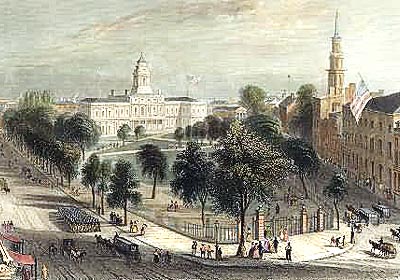
New York City Hall and The Park, (c. 1854)
1820-1839 | 1840-1849 | 1850-1879 | 1880-1899 | 1900-1999
1850-1854
Org Oct 19 '50 | Trib Nov 19 '50 | Trib Dec 06 '50 | Trib Jun 14 '51 | Trib Jul 04 '51 | Trib Aug 11 '51 | Trib Aug 30 '51 | Trib Sep 09 '51
Trib Dec 04 '51 | Tms Jan 06 '52 | Tms Feb 15 '52 | Tms Mar 19 '52 | Tms Oct 18 '52 | Trib Nov 27 '52 | NYN Jan 08 '53 | Tms Mar 10 '53
Trib May 27 '53 | Trib Jul 02 '53 | Tms Jul 15 '53 | Tms Oct 26 '53 | Tms May 24 '54 | Tms Jun 06 '54 | Trib Aug 02 '54 | Tim Aug 03 '54
Trib Aug 18 '54 | Ind Aug 24 '54 | Trib Dec 02 '54
1855-1859
Trib Apr 09 '55 | Tms Jul 10 '56 | Mor Jul 12 '56 | Mor Sep 20 '56 | Tms Nov 13 '56 | Trib Feb 27 '57 | Tms Apr 14 '57 | Tms Apr 21 '57
Trib May 19 '57 | Tms May 20 '57 | Tms May 28 '57 | Trib May 28 '57 | Life May 30 '57 | Mor May 30 '57 | Mor Jun 06 '57 | Trib Jun 10 '57
Mor Jun 20 '57 | Trib Jun 23 '57 | Tms Jun 23 '57 | Alb Nov 21 '57 | Trib Dec 15 '57 | Trib Jan 14 '58 | Tms Mar 12 '58 | Tms Apr 27 '58
Trib Jun 18 '58 | Trib Jun 19 '58 | Tms Jun 25 '58 | Tms Jul 08 '58 | Tms Jul 13 '58 | Tms Aug 03 '58 | Tms Aug 10 '58 | Tms Aug 23 '58
Tms Aug 24 '58 | Trib Sep 18 '58 | Tms Feb 12 '59 | Trib Mar 21 '59 | Tms Apr 27 '59 | Tms May 06 '59 | Trib Jun 03 '59 | Tms Jul 07 '59
Tms Jul 27 '59 | Trib Jul 27 '59 | Trib Aug 20 '59 | Sun Oct 01 '59
1860-1869
Tms Mar 10 '60 | Tms Apr 11 '60 | Trib Apr 14 '60 | Trib Jul 20 '60 | Wor Jul 17 '66 | Tms Oct 06 '67 | Trib Jan 22 '68 | Wor Feb 08? '69
Wor Feb 10? '69 | Wor Aug 02 '69 | Trib Sep 10 '69 | Wor Sep 17 '69 | Wor Oct 19? '69 | Wor Oct 20? '69 | Wor Nov 04 '69 | Tms Nov 08 '69
Wor Nov 08 '69 | Wor Nov 17 '69 | BDE Nov 20 '69 | Wor Nov 23 '69 | Wor Nov 25 '69
1870-1871
Wor Feb 08 '70 | Wor Feb 25 '70 | Wor Mar 01 '70 | Wor Mar 25 '70 | Wor Apr 05 '70 | Wor Jun 21 '70 | Wor Aug 12 '70 | Wor Aug 16 '70
Wor Aug 19 '70 | Wor Aug 23 '70 | Wor Sep 04 '70 | Wor Sep 24 '70 | Wor Sep 25 '70 | Wor Dec 12? '70 | Wor Dec 17 '70 | Wor May 02 '71
PomD Sep 02 '71 | Wor Sep 22 '71 | Trib Oct 07 '71 | Wor Oct 09? '71 | Wor Oct 10 '71 | PomD Oct 15 '71 | Wor Oct 16? '71 | Wor Oct 24 '71
Wor Oct 27 '71 | Wor Oct 31 '71 | Wor Nov 03 '71 | Wor Nov 07 '71 | Wor Nov 14 '71 | Wor Nov 25 '71
1872-1879
Trib Jan 22 '72 | EPost Jan 23 '72 | Wor Mar 12 '72 | Tms Apr 14 '72 | Wor May 17 '72 | Wor Jul 24 '72 | Wor Jul 30 '72 | Wor Oct 01 '72
Wor Nov 14 '72 | Wor Feb 03 '73 | Tms Jul 27 '75 | Tms Sep 01 '75 | EPost Sep 03 '75 | DGr Sep 10 '75 | Tms Jul 24 '76 | EPost Aug 01 '76
DGr Oct 25 '76 | Trib Mar 27 '77 | Tms May ?? '77 | Sun Jun 25 '77 | Tms Jul 13 '77 | Trib Aug 30 '77 | Sun Aug 30 '77 | Trib Aug 31 '77
Sun Aug 31 '77 | Sun Sep 02 '77 | Tms Sep 03 '77 | Sun Sep 04 '77 | NYClp Sep 08 '77 | Tms Sep 09 '77 | DGr Sep 19 '77 | Sun Nov 30 '77
Sun Jul 29 '78 | Tms Sep 27 '78 | Sun Oct 20 '78 | Tms Mar 15 '79
New York Observer articles have been moved to a new file
Index | N. Y. Herald | N. Y. Com. Adv. | M. M. Noah's papers
 Vol. ? New York City, Saturday, October 19, 1850. No. ? AUTHOR OF THE MORMON BIBLE. [At a public meeting lately held in Cherry Valley Judge Campbell said:] ... "Rev. Solomon Spaulding, one of the earliest preceptors of the Academy of Cherry Valley, was the actual composer of most of what is known as the Mormon Bible. He wrote it during a period of delicate health to beguile some of his weary hours, and also with a design to offer it for publication as a romance. Dr. Robert Campbell, late of Cherry Valley, and foster father of the first Mrs. Grant, of the Nestorian mission, calling some years since upon Mr. Spaulding, had the manuscript of this notable book to be shown to him, and was also informed by Mr. Spaulding that he had hopes of reaping some pecuniary advantage from it for himself and family. Mr. Spaulding has been dead for some years, though it is believed that his wife is still living in the United States. How it passed from the possession of his family into the hands of Joe Smith it is probable that Mrs. Spaulding could tell." -- |
 Vol. X. New York City, Tuesday, November 19, 1850. No. 2993. AUTHOR OF THE MORMON BIBLE. -- The New England Puritan states that [at] a public meeting lately held in Cherry Valley Judge Campbell said: |
|
Vol. X. New York City, Friday, December 6, 1850. No. 3008. Authorship of the Book of Mormon. SCHENECTADY, Monday, Nov. 25, 1850. |
|
Vol. XI. New York City, Saturday, June 14, 1851. No. 3170. Tragical Occurrence.
|
|
Vol. XI. New York City, Friday, July 4, 1851. No. ?
NEW REVELATIONS AMONG
The disciples of Joe Smith enjoy a remarkable advantage in the constant accessions to the spirit of their faith, through renewed celestial communications; two new revelations having occurred within the past month. On Friday night, May 30, it appears that the chamber of Orson Hyde, the Editor of the Frontier Guardian, published at Kanesville, Iowa, received a sudden illumination, and a manuscript book was presented to him, which proved to be a translation from that portion of the golden plates which Joe Smith was forbidden to disturb. This book is a warning against false teachers, pseudo-prophets and wolves in sheep's clothing. It tells of counterfeit revelations and prophetical impostures, and is particularly explicit in directing the Saints not to let go of the "IRON ROD," meaning thereby the true priesthood. Another revelation has been made to Bishop Gladden of Ohio, containing much of what had been communicated to the Editor of the Guardian, together with several addenda, proclaiming the duty of reverencing the teachings of the Bishop above all other prophets, seers, high-priests and apostles, and announcing his duty to form an alliance with Queen Victoria. Elder Hyde denounces the Bishop for 'false revelations' and 'unfounded pretensions,' and adds some pungent observations upon the conduct of certain new converts, closing with the following exhortation: |
|
Vol. XI. New York City, Monday, August 11, 1851. No. ? From Utah Territory. The last mail from the West brought us a letter and some papers from the Great Salt Lake City, up to July 1. The news is not of remarkable interest. No rain had fallen for the six weeks previous to the 1st July; and still, the gardens, and crops in general. looked fine, and promised an abundant harvest. There were some exceptions in fields of wheat, which had been burned, or perished for want of irrigation, as the streams were so low that a sufficient quantity of water could not be obtained to supply all. |
|
Vol. XI. New York City, Saturday, August 30, 1851. No. 3235.
Later News from the Plains.
By the Steamer Duroc, from the Missouri River yesterday, we received an extra from the office of The Kanesville Guardian, containing later and interesting news from the Plains. Mr. Thomas Bateman and ten others arrived at Kanesville on the 13th, from the Great Salt Lake City. As they traveled with ox-teams, and were nearly two months on the route, the news from the city itself is no later than we received two weeks ago. |
|
Vol. XI. New York City, Tuesday, September 9, 1851. No. 3243. The Mormons in Utah. Messrs. Booth and Denniston arrived at Terre Haute a few days since, having come from California by way of the plains. From these gentlemen, who tarried some time at the Salt Lake City, The Terre Haute Express obtains considerable information in regard to the movements and progress of the Mormons. |
|
Vol. XI. New York City, Thursday, December 4, 1851. No. 3317.
==> THE MORMON COUNTRY in Iowa is announced for sale, and the "Saints" of that locality are adjured to repair to the great Valley. The Sixth Epistle from the President of the Mormons, is published. It contains, among a vast number of religious matters, the following terrestrial facts: |
 No. ? New York City, Tuesday, January 6, 1852. Vol. I. The Mormons in Utah. The Official Report of the United States Judges in the Territory of Utah, as made to the President has been published. It is a document of three columns, signed by Chief Justice Brandeburg, Judge Brocchus and Secretary Harris. -- The hostile and seditious sentiments manifested by Governor Brigham Young, are assigned as reasons for the withdrawal of the Judicial officers of the Terrirory. The report explains at great length the religious organization and powers of the Mormons; and enters into detail of sundry malpractices of Governor Young and his followers. The Government of the United States is, according to the Report, shamefully spoken of and ill-treated; the officers sent out for the Governor of the Territory were refused a hearing; and Gov. Young indulged in sundry maledictions upon the memory of Gen. Taylor. These statements have already been published, unofficially. It is not necessary to repeat them. The Report proceeds to comment upon the prevalence of polygamy in the territory. Plurality of wives is openly avowed and practiced under the sanction and in obedience to the direct command of the Church. So universal is this practice that very few, if any, leading men in the community can be found who have not more than one wife each. -- The evil can never be made a statutary offense by a Mormon legislature; and if a crime at common law, the Court would be powerless, with Mormon juries. |
|
No. ? New York City, Sunday, February 15, 1852. Vol. I. Mormonism Exposed, by an Ex-Mormon. To the Editor of the Boston Transcript: |
|
No. ? New York City, Friday, March 19, 1852. Vol. ?
CALIFORNIA.
...By the late acquirement of the Rancho of San Bernardino, the Saline brotherhood are gate-keepers to Southern California; and by the last advices from points still further south, we are aware they are only awaiting the reestablishment of a military post, some time since abandoned, to take possession of all the arable lands in the valley of the Gila. For laudable purposes, such exhibitions of enterprize and perseverance would be admirable, but such as suppose the interesrs or the power of he United States are intended to be strengthened by them, reckon "without their host." Absurd as it may seem, Mormon supremacy is the sole object of these arrangements and the dispositions themselves are so judicious and skillful, that it is a marvel the judgment which orders them, can contemplate so silly a use of them. |
|
No. ? New York City, Monday, October 18, 1852. Vol. ?
The Mormons of the Salt Lake.
|
 Vol. ? New York City, Saturday, Nov. 27, 1852. No. 585.
UTAH.
|
 No. ? New York City, Saturday, January 8, 1853. Vol. ?
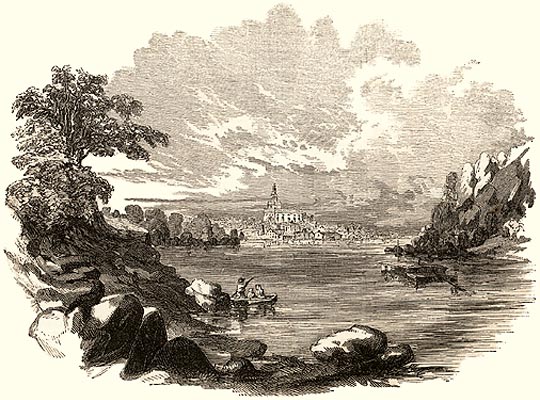
Nauvoo, From the Mississippi, Looking Down the River. NAUVOO CITY. This is the site of the celebrated Mormon city founded by Joe Smith and his followers in 1840. It is located on elevated ground, gradually rising from the river to an unusual height, and presenting a smooth and regular surface, which, with the plain at its summit, might amply suffice for the erection of a large city. Upon this ground Nauvoo was laid out on a very magnificent scale, and many of the houses were handsome structures. The streets are of ample width, crossing each other at right angles. Three years after the settlement was begun, the city contained 1000 houses, a large part of which were log cabins, whitewashed. The great Mormon Temple, which stood in fair view from the river, was 128 feet long, 88 feet wide, and 65 feet high to the top of the cornice. The top of the cupola was 163 feet from the ground. It was built of compact, polished limestone, quarried near the spot. It was calculated to contain 3000 people, and was built at a supposed cost of about half a million of dollars. On the 9th of October, 1848, this temple was destroyed by fire, and now presents only a blackened pile of ruins. Four years previous the Mormon leader had been arrested and put in prison, where, soon afterwards, he came to his end by the violence of a mob. The Mormons have since left the place, and are now established in Utah. |
|
Vol. II. New York City, Thursday, March 10, 1853. No. ? The Mormons. A problem of singular difficulty, and every day growing more and more portentous -- than which, if we except African Slavery, none is more difficult of solution -- is rising in the distant West, before the American Government and people. Ere long they will have to grapple with it. Whether it can be peacefully solved, the future alone will tell. |
|
Vol. ? New York City, Friday, May 27, 1853. No. 585. The Pseudo Mormons near Mackinaw. The Beaver Island Mormon Settlement has for sometime past stood in rather bad repute, and it would seem, if the following be true, with good reason. The article is a communication from The Detroit Free Press, and is accompanied in that paper, by a report of the proceedings of public meeting at Mackinaw, relating to the matter. We give the communication, for this matter of the fisheries on the upper Lakes is becoming very important. |
|
Vol. ? New York City, Saturday, July 2, 1853. No. 585.
THE BEAVER ISLAND MORMONS.
|
|
Vol. II. New-York City, Friday, July 15, 1853. No. 569.
THE MORMONS.
|
|
Vol. ? New-York City, Wednesday, October 26, 1853. No. ?
The Tribune on Polygamy. The Times surely apprehends the wide moral difference between the cases of bigamy under our laws, (where the bigamist can only accomplish his purpose through a gross fraud,) and the Mormon polity on that subject. We would uphold and enforce our marriage laws as they are; but we are not in favor of imposing them by violence on the Mormons in the territory which they sought out and settled before any other civilized men had made it their home. This was the spitit and drift of our former article -- the twist that the Times seeks to give it is entirely at variance with our intent. Does that paper counsel or desire the subversion, by extreme force, of Mormon Polygamy in Utah? Yea or Nay?The Times is opposed to polygamy and to bigamy in Utah, as well as in New-York, -- in a new country as well as in an old one, -- and upon the same ground in both cases; -- and it is in favor of "subverting" both by law, in all parts of this civilized and Christian nation. We do not appreciate the nice moral distinctions by which the Tribune would excuse polygamy in a new territory, and condemn it in an old one; -- nor can we understand why the Mormons should be any more entitled to the benefit of such a plea, than the inhabitants of Nebraska or Oregon. |
|
Vol. III. NewYork City, Wednesday, May 24, 1854. No. 837.
Bill Smith, the Mormon prophet, and brother of Joe Smith, the renowned founder of the Mormon church, is now closely confined in the jail at Dixon, Illinois. He has escaped once, but was retaken at St. Louis, on his way to Salt Lake City. |
|
Vol. III. NewYork City, Tuesday, June 6, 1854. No. ? From Great Salt Lake City. A number of gentlemen from Great Salt Lake City, Utah Territory, were passengers in the Sam Cloon, on Tuesday night, from the Missouri River. They arrived at Fort Leavenworth on the 26th ult. by mail stage. Among them were the following gentlemen: W. C. Dunbar, Milo Andrews, C. H. Wheelock, J. M. Barlow, W. Frost, R. W. Wolcott, Seth M. Blair, Esq., U. S. District Attorney for Utah Territory, and Gen. James Ferguson. These gentlemen are all members of the Mormon Church, and have been sent on missions to portions of the United States, Europe and Ireland. |
 Vol. XIV. NewYork City, Wednesday, August 2, 1854. No. 4,146 THE MORMONS. -- Twenty-eight years ago, "Jo Smith," the founder of this sect, and "Harris," his first convert, applied to the senior editor of The Journal, then residing at Rochester, to print his "Book of Mormon," then just transcribed from the "Golden Bible" which "Jo" had found in the cleft of a rock to which he had been guided by a vision. We attempted to read the first chapter, but it seemed such unintelligible jargon that it was thrown aside. "Jo" was a tavern-idler in the Village of Palmyra. Harris, who offered to pay for the printing, was a substantial farmer. Disgusted with what we deemed a "weak invention" of an impostor, and not caring to strip Harris of his hard earnings, the proposition was declined. The manuscript was then taken to another printing office across the street, whence, in due time, the original "Mormon Bible" made its advent. |
|
Vol. III. New-York, Thursday, August 3, 1854. No. 397.
The Beginning of Mormonism.
Twenty-eight years ago, Joe Smith, the founder of this sect, and Harris, his first convert, applied to the senior editor of the Journal, then residing at Rochester, to print his "Book of Mormon," then just transcribed from the "Golden Bible" which Joe had found in the cleft of a rock to which he had been guided by a vision. |
|
Vol. IV. New York City, Friday, August 18, 1854. No. 4,160. THE FOUNDER OF MORMONISM. -- The Sandusky (O.) Mirror notices the rejection by Thurlow Weed of the job of printing the Mormon Bible many years ago, which was published in The Tribune, and says: |
 Vol. VI. New York City, Thursday, Aug. 24, 1854. No. 299. ORIGIN OF THE BOOK OF MORMON. The following account of the origin of the Book of Mormon was given to the writer of this article by the widow of the writer of the said book. She was a native of Pomfret, Conn., of respectable family and connections, and her statement is entitled to full credit, which is in substance as follows: |
|
Vol. ? New York City, Saturday, December 2, 1854. No. ?
THINGS IN UTAH.
Through the kindness of a friend who resides in this city, we are permitted to publish the following letter from one of the "Saints" of Salt Lake City, concerning his experiences in religion, the character of Deseret, its climate and society, and that "peculiar institution" of Deseret, Polygamy. It is the clearest exposition and boldest defense of Polygamy that we have yet seen, and coming from a person who possesses three wives, with a prospect of more, its arguments, and the facts stated, demand attention. We especially invito a perusal of it by Judge Douglas and his friends, whose "Popular Sovereignty" doctrine is to legalize Polygamy in Deseret and Utah, and, it may be, in Illinois also. |
|
Vol. XIV. New York City, Monday, April 9, 1855. No. 4,359. U T A H. We have dates from Great Salt Lake City to Feb. 7. |
|
Vol. ? NewYork City, Thursday, July 10, 1856. No. ?
THE BEAVER ISLAND MORMONS. -- The Cleveland Plain-dealer states that the Mormons are leaving Beaver Island, in Lake Michigan, en masse, and are selling their property for the most they can get the prophet Strang has left for Wisconsin. The Mormons do not appear to have lost anything of their religious peculiarity, as they have taken all their young wives and left the old women and babies. It seems to be the universal opinion of the lake navigators that Strang and his followers deserve the treatment they have received. |
 Vol. II. New York City, Saturday, July 12, 1856. No. 21. Mother Lucy Smith. WASHINGTON, D. C., July 5, 1856. |
|
Vol. II. New York City, Saturday, September, 1856. No. 31. Mother Lucy Smith. At the time that Col. Geo. A. Smith wrote the brief biography of this honored lady he was not in possession of the date of her demise. He has handed us a letter from Elder Sameul H. B. Smith, dated Nauvoo, Sept. 6th, by which we learn that she died on the 5th of May, and was buried beside the grave of her much loved and venerated husband patriarch Joseph Smith. |
 No. ? New York City, Thursday, November 13, 1856. Vol. ?
Polygamy in Utah. -- The Progress of
The following is published in some of the Utah papers and copied by the Tribune, as an extract from a sermon preached by Brigham Young, Sept. 21, 1858: |
|
Vol. ? New York City, Friday, February 27, 1857. No. 4948.
THE ESOTERIC DOCTRINES
|
|
Vol. IV. New York City, Tuesday, April 14, 1857. No. 1737. Resignation of Judge Drummond. To the Hon. Jeremiah S. Black, Attorney-General of the United States, Washington City, D. C.: |
|
Vol. VI. New York City, Tuesday, April 21, 1857. No. 1743. What Shall we Do with the Mormons? We cannot do a worse thing with a difficulty than to dodge it, and never was this practical truth more pointedly illustrated than in the actual position of affairs in Utah. When that Territory was organized the acting President of the United States, Mr. Fillmore, was called upon to decide whether the authority of the Republic should be extended over its inhabitants as of right or by sufferance. He found the Mormons boldly claiming to be considered an independent Israel in the midst of the Philistines, denying his right to nominate a Governor for them, and professing to hold their lands not of the American Government, but of the Almighty. Instead of meeting these insolent assumptions and frustrating them forever, Mr. Fillmore evaded the issue by conferring the Executive appointment upon the High Priest of the sect, who condescended to accept it as a compromise solicited by the United States, and of slight importance to his people and himself. |
|
Vol. XVII. New York City, Tuesday, May 19 1857. No. 5,017.
THE CONDITION OF UTAH.
To the Editor of The N. Y. Tribune. |
|
Vol. VI. New York City, Wednesday, May 20, 1857. No. 1768. The Salt Lake Infamy -- What Should Be Done. In addition to still later intelligence from Utah received by last night's mail, we publish this morning a letter from Judge Drummond, late of that Territory, which fully corroborates the tale of Mormon wrong and oppression presented in our Salt Lake correspondence. The startling facts detailed in these communications can hardly fail to take deep hold upon public sentiment, and through it reach the heart and nerve the hands of the National Administration to speedy and decisive action. Already the tide begins to swell towards Washington, bearing upon its bosom a stern demand for needed succor to our fellow-citizens now writhing beneath the heel of Mormon theocracy; and we cannot but hope, despite Judge Drummond's gloomy forebodings, that Mr. Buchannan will give immediate and practical attention to this subject in preference to the distribution of foreign spoils. |
|
Vol. ? New York City, Thursday, May 28, 1857. No. ?
ANOTHER STARTLING TRAGEDY. We have to record to-day another painful narrative of Mormon iniquity, seduction and villainy, followed up in this instance, however, as it will be seen, by a summary vengeance from the injured husband. The account which we publish below is taken from the Van Buren (Ark.) Intelligencer, and gives in brief the facts of the case pretty much as they have occurred. From the Fort Smith Herald and the New-Orleans Bulletin we also have confirmation of the whole story, up to the last act in the drama, the tragic death of Elder Pratt, the mormon apostle. Thus it will be seen what utter ruin and devastation have been wrought in a virtuous family by the designing arts of a saintly scoundrel and the lures of a false and licentious faith. Here is what the Van Buren Intelligencer records of the termination of this affair: |
|
Vol. ? New York City, Thursday, May 28 1857. No. ?
MORMONISM.
|
No. ? New York City, Saturday, May 30, 1857. Vol. ? AN EX-MORMON ON MORMONISM. Mr. John Hyde, late an elder of the Mormon sect, has been discoursing to the Californians in exposition of the evils and depravity of Mormonism. At Oakland City his address elicited the warm approbation of large audiences. The San Francisco Daily Globe publishes several resolutions commendatory of the sayings and suggestions of Mr. Hyde, one of which strikes us as peculiarly pertinent and philosophical. |
|
Vol. III. New York City, Saturday, May 30, 1857. No. 15. ASSASSINATION OF PRESIDENT P. P. PRATT. Our readers will doubtless be startled with the above announcement; our heart is deeply pained to say it, but we have no reason for doubting the sad intelligence that has reached us, though, as yet, only by the way of the public press. A few days ago we were advised of his apprehension near Fort Gibson; and, close upon the receipt of that information, we learned, by telegraphic despatch, that he had been assassinated near Van Buren, Arkansas, May 13.... |
|
Vol. III. New York City, Saturday, June 6, 1857. No. 16.
A Wicked Charge Exposed. Among the many who have rushed into print recently against Mormonism is one -- whom we would, for the sake of others, fain never name -- William Smith. He has [sent] a lengthy letter to the New York Tribune to help Drummond through the mess he has got into. As he only mentions one thing that has some claim to novelty and a notice of it from a proper person has been handed to us for publication, we bring him before our readers. |
|
Vol. ? New York City, Wednesday, June 10, 1857. No. ?
Mrs. McLean, the miserable woman whose husband recently avenged her seduction by taking the life of Pratt, the Mormon Elder, has written a letter to The Van Buren (Ark.) Intelligencer, which only proves the depth of her delusion and the hopeless nature of her insanity. She still persists in her adherence to a foolish faith; which has destroyed her domestic peace, and in regarding the worthless imposter who has been sent to his account as a prophet and a martyr. The letter is evidently the production of a lunatic who should once be sent for medical treatment to a hospital. Nor are we able to see why other unfortunate victims of this astonishing mania might not legally and humanely be treated as acknowledged madmen and mad women are treated. Certamly, there could be no objection to combatting promptly and stringently such a hideous hallucination. The case of Mrs. McLean, although it is not by any means a singular one, affords a striking illustration of the pernicious and demoralizing effect of fanaticism. She fancied that she was converted by the gospel of Joseph Smith. She immediately commenced a series of attempts to worry her husband into the same faith. She managed to have her children clandestinely baptized by P. P. Pratt. She taught their young lips to utter blasphemous nonsense, which she called prayer. She absconded from her husband's house, and finally stole her offspring, that she might take them to Utah. Her insanity is perfect and absolute. She writes incoherently and absurdly. She compares Elder Pratt with our Savior, and admits that she washed his feet and combed his hair. She hardly seeks to disguise the fact that she had been for some time living, with him adulterously. |
|
Vol. III. New York City, Saturday, June 20, 1857. No. 18.
Crescent City Oracle. This lively little paper, established only a few months ago, is out in a bigger dress already -- it keeps pace with the growth of that young city, which, according to the Oracle, is destined to be a mighty grand place. Mr. L. O. Littlefield who has heretofore been editor and proprietor has vacated the editorial chair and made his retiring bow to the sanctum, "yielding to our voluntary inclination of entering into other pursuits." Mr. J. E. Johnson. of Council Bluffs Bugle, hoists his penant -- Editor and Proprietor. Hoping that the "other pursuits" of Mr. K. will not force his pen to the shelf, and wishing prosperity to his successor, we introduce to our readers an article of interest at the present moment. |
|
Vol. XVII. New York City, Tuesday, June 23, 1857. No. 5,047.
THE MORMONS.
Correspondence of the N. Y. Tribune. |
|
Vol. ? New York City, Tuesday, June 23, 1857. No. ?
KANSAS -- THE MORMONS -- SLAVERY.
MR. PRESIDENT, LADIES AND GENTLEMEN: -- I appear before you to-night, at the request of the grand jury in attendance upon the United States Court, for the purpose of submitting my views upon certain topics upon which they have expressed a desire to hear my opinion. It was not my purpose when I arrived among you, to have engaged in any public or political discussion; but when called upon by a body of gentlemen so intelligent and respectable, coming from all parts of the State, and connected with the administration of public justice, I do not feel at liberty to withhold a full and frank expression of my opinion upon the subjects to which they have referred, and which now engrosses so large a share of the public attention. |
{ ALBION } BRITISH, COLONIAL AND FOREIGN WEEKLY GAZETTE. No. ? New-York City, Saturday, November 21, 1857. Vol. ? The Mormons Defiant. We were in the right of it last week, in discrediting the rumour that a portion of the U. S. Utah expedition, five hundred strong, had been cut off by Indians or Mormons. So far no blood has been shed. It is true however that the unclean tribe has commenced open war upon the national forces, and that a train of seventy-five waggons, loaded with supplies and provisions, was captured and destroyed, on the 5th of last month, at a point which it is needless to specify, but which may be set down as distant from Great Salt Lake City about one hundred and eighty miles. Why this train had no military escort -- being midway between two detachments, and some thirty or forty miles from each, it is none of our business to enquire. And a score of similar questions, presenting themselves on the arrival of successive mails, may be left to the military critics of this country, who organize themselves into gratuitous and permanent courts-marshalls whenever and wherever they find food for their in genious comments. |
|
Vol. ? New York City, December 15, 1857. No. ?
IMPORTANT FROM THE MORMON WAR. From Our Special Correspondent. |
|
Vol. ? New York City, January 14, 1858. No. ? Army for Utah. The latest advices from the army, which has been sent to pass the Winter amid the snows of Wahsatch Mountains, are anything but encouraging. In fact, they tend to confirm the worst fears which have been entertained as to the result of this ill-starred expedition. There the troops are, a thousand miles and more from the frontier, isolated amid the snows and among mountains of which the Mormons, and they alone, know all the passes. Already, at the commencement of Winter, their animals were perishing at the rate of a hundred a day. The grass is all burnt, and their supply of provisions, notwithstanding the vast sums of money spent on the commissariat and transportation departments, is so short that a very strict economy, if not, in facts, putting the troops on short allowance, will be necessary to carry them through the Winter. With inaction and short allowance will come disease and discontent, and it is but reasonable to expect that by the Spring the effective force of the troops will be very greatly diminished. -- Without draft cattle or means of transportation it will be impossible for them to move; and instead of marching against the Mormons, they will be exceedingly lucky if the Mormons do not march against them. |
|
No. ? New-York, Thursday, March 12, 1858. Vol. ?
THE MORMONS. In the time of Joe Smith, the Mormon Prophet, that personage found considerable difficulty in managing his most influential disciples. But, when they refused to believe new theories, or go on certain missions, or to give adequate pecuniary aid to the cause, he would manage to attain his object, and retain their support, by being delivered of a new revelation. These revelations, were, generally, little webs of argument interwoven with arbitrary assertions, wherein the individual, or individuals, offending, flattered to gladness by the Lord's special attention, were ensnared like so many flies. Some of these, along with those of a more spiritual cast, and others that Smith allowed his head disciples to be delivered of, have been gathered into a printed volume, called the "Book of Doctrines and Covenants," which is more perused than the Mormon Bible. In it one gets a glimpse of the foundation doctrines of the present Church, but a perusal of the outside revelations is necessary before one fully sees Mormonism, glaring with the Yankee signet of dollars and cents," and the stains of low desires. Since Smith's death, the occasions upon which Brigham Young has attempted to enunciate direct revelations have been few, and unlike the Prophet's half-persuasive inspirations, his are mere commands, ungarnished with rhetoric or argument. About the last of the kind, directing the present location of the Mormons, was given forth the morning after the encampment of the first company of pioneers upon the present site of Great Salt Lake City. By abstaining from the direct assertion of revelations, Young has rather increased than diminished his power over the Mormons. He possesses considerable caution and judgment, and not even such unfortunate events as the ravages of the crickets and grasshoppers caused him to make any unqualified assertions to quiet the voices of hunger, while, at the same time, he triumphantly pointed to his former exhortations to have the surplus grain hoarded instead of trafficked to the Gentiles. |
|
Vol. VII. New-York City, Tuesday, April 27, 1858. No. 2060.
FROM UTAH AND THE WEST.
|
|
Vol. XVIII. New York City, Friday, June 18, 1858. No. 5354.
The line of Mormon settlements which are represented in our last accounts from Utah as being abandoned by the inhabitants, commences near the northern boundary of the Territory, about seventy miles distant from Salt Lake City, in the valleys of Cache and Malade, which are used, however, chiefly for the pasturage of the stock belonging to the church. There are also two small settlements on the Bear River, but the first place approaching Salt Lake City from the north, which can be called, a town, is Box Elder or Brigham's City, about eight miles south of Bear River and fifty-seven from Salt Lake City. This town, which is inhabited principally by Danes and Swiss, is very handsomely situated on a plain about two hundred feet above the level of Bear River. The houses are well built and handsomely arranged. Five miles south is Willow Creek, in the vicinity of which is much good land, producing the heaviest crops of wheat raised in the Territory. Twelve miles south of Willow Creek Fort is Ogden's Hole, a fine valley surrounded on all sides by mountains, except the narrow pass at its entrance. It contains five hundred inhabitants. Three miles southwest of the "Hole" is Bingham's Fort, containing seven hundred inhabitants. Two miles from Bingham's Fort, and thirty-five from Salt Lake City, is Ogden City, on Weber River, one of the largest towns in the Territory, and containing many handsome buildings. The population is four or five thousand. East and West Weber Forts, on the opposite banks of the river, about eight miles above Ogden City, contain about five hundred inhabitants. Eight miles farther south is Keysville, containing about a thousand inhabitants. It has some good arable land, and a fine stock range. Farmington City, the county seat of Davis County, contains about the game number of inhabitants. Three or four miles further south is Sessions, a straggling settlement, scattered some five miles along the road, but with many fine houses, and including the best lands in the Territory. Eight miles from Sessions is Salt Lake City, which is supposed to contain about a third part of the entire population of the Territory, or from fifteen to eighteen thousand people. It was originally laid out eleven years ago -- in July, 1847 -- in two hundred and sixty blocks of ten acres each, separated by streets a hundred and twenty-eight feet , wide, and irrigated by canals from the River Jordan. There are eight houses in each Mock, so arranged that no two houses front each other. It has many fine and some elegant buildings, the principal of which are the Tabernacle, in which all religious and other public meetings are held, the Council-House, the Endowment-House, the unfinished Temple, the Court-House, nineteen school-houses, and many costly houses erected by the leaders, among which are two belonging to Brigham Young. |
|
Vol. ? New York City, Saturday, June 19, 1858. No. 5355.
IMPORTANT FROM UTAH. St. Louis, Tuesday, June 15, 1858. |
|
Vol. VII. New-York City, Friday, June 25, 1858. No. 2111.
THE MORMONS.
Correspondence of the New-York Times. |
|
Vol. VII. New York City, Thursday, July 8, 1858. No. 2121.
INTERESTING FROM UTAH.
|
|
Vol. VII. New York City, Tuesday, July 13, 1858. No. 2125.
IMPORTANT FROM UTAH.
|
|
No. ? New York City, Tuesday, August 3, 1858. Vol. ?
U T A H.
|
|
Vol. VII. New-York City, Tuesday, August 10, 1858. No. 2149.
THE MORMONS:
|
|
No. ? New-York, Monday, August 23, 1858. Vol. ?
INTERESTING FROM UTAH.
|
|
No. ? New York City, Tuesday, August 24, 1858. Vol. ?
UTAH.
|
|
Vol. ? New York City, Saturday, Sept. 18, 1858. No. ?
U T A H. By the arrival of a young man named Herbert Brandon, we have been furnished with the following information from Salt Lake: |
|
Vol. ? New-York City, Saturday, February 12, 1859. No. ?
CALIFORNIA...
...As an event of no little importance in the field of California journalism, I would mention that Thos. S. King, editor of the Bulletin, retires from the editorial chair of that paper, to make room from Mr. Jas. W. Simonton, so long and well known as the able and energetic Washington correspondent of the New-York Times. The retiring Editor has excited much ill-feelimg here by his frequent bitter personal assaults upon private character, betraying too much malignity of purpose to be mistaken for zeal, in behalf of the public welfare. Nevertheless, the Bulletin, which attained its position among the leading journals of San Francisco under the management of the lamented Jas. King of William, has been highly successful pecuniarily. That its success will be greatly agumented under the direction of Mr. Simonton, none who knows him or his pen will question. Mr. S. is already familiar to California readers through many a graphic contribution to the columns of the Bulletin from Washington and Salt Lake. All his friends at the East will be gald to learn that his new connection insures him a speedy fortune. He is expected here with his family in March. A hearty welcome awaits him.... |
|
Vol. XVIII. New York City, Monday, March 21, 1859. No. 5,589.
A GENTILE AND HIS MORMON BRIDE
|
|
No. ? New-York City, Wednesday, April 27, 1859. Vol. ?
IMPORTANT NEWS FROM UTAH --
|
|
Vol. ? New-York City, Friday, May 6, 1859. No. ?
THE UTAH MASSACRES. -- The Commissioner of Indian Affairs is in receipt of a letter dated at Provo City, March 18, 1859, from Superintendent Forney, having charge of Indian affairs in Utah. The Superintendent reports that he left Salt Lake City to visit the southern Indians, and bring back 17 children saved from the massacre of September, 1857. He was detained at Provo City to give testimony before the United States Courts concerning the murders of last June and October, and the Mountain Meadow affair. He says that he has reliable information in regard to the butchery at Mountain Meadows, by means of which he hopes to recover some of the property. The facts warrant the belief that a few days after the massacre there was distributed among the church dignitaries property worth $30,000, besides, it is presumed, a considerable amount of ready money. The Superintendent will make such investigation as circumstances admit. He thinks that it has proved exceedingly convenient to implicate the Indians in all such cases, that an investigation may involve other parties into the crimes. -- Constitution. |
|
Vol. ? New York City, Friday, June 3, 1859. No. ?
LATER FROM SALT LAKE.
From The Valley Tan of May 3 we learn that Dr. Forney, the Superintendent of Indian Affairs, arrived in that city from his visit to the southern portion of the Territory. The Doctor reports the Indians in that vicinity as peaceable. He brought with him three of the children, survivors of the Mountain Meadows massacre; the others, thirteen in number, are at the Indian farm at the Spanish Fork, where they will remain until the Commissioners arrive, who have been appointed to receive and restore them to their friends. The children are very intelligent and have a Iively recollection of the bloody deeds that consigned their parents and friends to death. |
|
Vol. ? New York City, Thursday, July 7, 1859. No. ?
FROM UTAH.
Correspondence of the New-York Times. |
|
Vol. ? New York City, Wednesday, July 27, 1859. No. ?
FROM UTAH.
We have received files of the Deseret News and the Valley Tan to the 29th June, The news from Salt Lake City is interesting. The official instructions to the Federal officers in the Territory, (published some weeks ago in the Times,) had been received with great glee by the Mormons. The Deseret News (Brigham's organ) prints Attornery General Black's two letters in full, accompanied by the following editorial comment. |
|
Vol. XIX. New York City, Wednesday, July 27, 1859. No. 5,697.
INTERESTING FROM UTAH.
|
|
Vol. ? New York City, Saturday, August 20, 1859. No. 5718.
AN OVERLAND JOURNEY.
|
 Vol. ? New York City, Saturday, October 1, 1859. No. 8499.
MAIL ITEMS.
The first trial of any note, says a Utah correspondent of the 3d ult., that has taken place since the extraordinary and ill-advised pardon of the President, where this Church has prose cuted one of their own faith, or that the Mormon U. S. District Attorney, Gen. Wilson, has exhibited any degree of energv, came off last week. The party (a Mormon) was accused of robbing a brother saint of $1,400. Brigham advised him to plead guilty, as there was a large number of Gentiles on the traverse jury, and therefore a certainty of his being found guilty. He did, and in his defence, stated that he took the money only as a joke, intending to return it; but the Judge could not appreciate that class of Mormon jokes, and therefore sentenced the disciple of Latter Day Saints to ten years at hard labor in the State Prison. |
|
Vol. ? New York City, Saturday, March 10, 1860. No. ?
THE CONDITION OF UTAH. Correspondence of the New-York Times. |
|
Vol. IX. New York City, Wednesday, April 11, 1860. No. 2670.
THE MORMONS.
Correspondence of the New-York Times. |
|
Vol. ? New York City, Saturday, April 14, 1860. No. ?
THE MORMONS.
The "New Organization" of the Mormons convened at Amboy, Ill., on the 6th inst., the meeting being only an adjourned session of a conference held last October at Sandwich, Ill. The "New Organization" was ordered in 1850, by a revelation given to Zenas H. Gurley which he did not obey; later revelations pointed to the Young Joe as the man who should be the head of the movement, and to the 6th of April, 1860, as the day "when he should take upon himself the oaths of office, for this day was the thirtieth anniversary of the original organization under the elder and original Joe. |
|
Vol. XX. New York City, Friday, July 20, 1860. No. 6,002. "UTAH AND THE MORMONS. A pleasant hour with Capt. Walter M. Gibson, just returned from a Winter's sojourn with the Latter Day Saints ar Salt Lake, has supplied us with some additional items of interest respecting that singular people and their fortunes. |
 Vol. VI. New York City, Tuesday, July 17, 1866. No. 611.
THE MORMONS.
|
|
Vol. XVII. New York City, Sunday, October 6, 1867. No. 5001.
MORMONISM. In the Rochester Union & Advertiser we find the following account of the peculiarities which marked Joseph Smith, the founder of Mormonism, previous to the publication of his Revelations: |
 Vol. XXVII. New York City, Wednesday, January 22, 1868. No. 8,357.
AN INDIO-MORMONITE
In 1847 the Pringle family, consisting of husband, wife, two sons, and four daughters, having adopted Mormonism, left their home in Oneida County, N. Y., en route for Salt Lake City. They had accomplished but half their journey, in company with other converts whom they had encountered, when they were desperately attacked by mounted Indians, whom, however, they finally discomfitted. But the safety of five of the Pringle family was dearly purchased by the loss of one of its number -- the youngest child, John, a beloved and interesting lad, only ten years of age. The more the members of his family mourned his loss the more they became convinced of the hopelessness of rescuing him. Broken-heartedly they proceeded on their way; were received into the Mormon Church, of which William, who was two years John's senior, became, in time, a pillar; and, with the passage of years, same to look upon their lost, beloved relative as dead. William Pringle became, at last, so enthusiastic a leader in Mormonism, that about six weeks ago he left Utah for Liverpool, there to promulgate its doctrines, and, on his way thither, stopped, on the 13th of last December, at Cleveland Ohio. Throughout all John Pringle's captivity, although he had adopted many of the manners and customs of the Indians, he had constantly pined for his family and home. In 1859, while accom-panying his captors on a horse-stealing foray into Texas, he escaped to New-Orleans, gradually civilized himself, joined the Rebel army, and became one of Beauregard's most skillful scouts. At length, with early remembrances still throbbing, he resolved to revisit his boyhood's home in Oneida County. On his way thither he arrived in Cleveland on the 13th of December, and entered a saloon on Seneca st., drank a glass of ale, and seated himself by the fire. He had not long sat thus, when a stranger entered, and not only drank himself, but also invited the bystanders to join him. They complied, invitations became mutual, the company grew joyous, songs were sung and stories were told, until John Pringle, in a burst of convivial confidence, commenced the tale of his capture and captivity. The first few words had hardly been spoken when a change was visible on the stranger's face. His cheeks flushed, and then grew pale; his eyes filled and glistened; his lips quivered, his breast heaved. "My God! it's John" he cried; "It's little, little John;" and, in another moment, he was sobbing and panting on the bosom of his new-found brother. William abandoned his trip to Liverpool, and the two brothers started next day for Utah. |
 Vol. X. New York City, February 8?, 1869. No. ?
The Cincinnati Gazette has unearthed a bill by James M. Ashley, of Ohio, Chairman of the House Committee on Territories, which proposes to extend the boundaries of the States and Territories which surround Utah, so as to absorb Utah and wipe out the 100,000 Mormons as a distinctive community. Against this proceeding the Gazette protests. It is shown that for twenty-three years the Mormons have made their own laws; have created their own civilization; have made a wilderness generally unattractive to American emigrants to blossom as the rose; have built up and bound together a people numbering to-day more than the population of any of the surrounding Territories, and larger than most of the adjacent States; while by all accounts the moral state of the Mormon community is in all respects, excepting one, far above that of any of the States or Territories which, if Mr. Ashley has his way, are each to take a bite out of Utah, swallowing both Territory and people. |
|
Vol. X. New York City, February 10?, 1869. No. ?
TROUBLESOME TWINS.
We have quite forgotten which one of the pugilistic platforms of the "Peace" party it is that declares open war against the "the twin relics of barbarism, slavery and polygamy." Nor have we discovered why these two were twinned in one barbarous birth. No record public or private informs us who was the father of the dreadful duo, though the putative paternity is charged upon Senator Sumner, rumor thus crediting to his "loilty" what is lacking in his loins. With these difficulties of paternity and birth, equally inexplicable is it how polygamy and slavery should be Siamesed together, and how one of the ligature-joined should have been summarily slaughtered full five years ago, while the other lives to-day. Is still strong polygamy carrying a corpse fastened to its own frame? What Mr. Sumner called "the barbarism of slavery" is pretty well buried out of sight, if Radicalism will only let it rest, but radicalism won't. There has been an anti-slavery pow-wow in Boston this very week, and now Radicalism is beginning a fresh raid against the other terrible twin, polygamy. |
|
Vol. X. New York City, Monday, August 2, 1869. No. ?
Mormonism Going to Pieces --
A few days ago we mentioned the fact that William Alexander and David Hyrum, the younger sons of Joseph Smith, the Mormon Prophet, were on their way to Salt Lake City to set up the standard of the reorganized or anti-polygamy church. A singular interest attaches to the name of David Hyrum. A few months before Joseph's death, he stated that "the man was not born who was to lead this people, but of Emma Smith should be born a son who would succeed in the presidency, after a season of disturbance." Joseph Smith was killed June 27, 1844, and the son, named from his father's direction David Hyrum, was born at the Mansion House, in Nauvoo, on the seventeenth of the succeeding November. This prophecy is secretly dear to thousands of Mormons who are weary of the tyranny of Brigham Young, and yet hold to their faith in Joseph Smith. A few days ago the young men reached Salt Lake City, and soon called upon Brigham Young and announced their attention to organize their church at once, asking permission to defend their faith in the Tabernacle, proposing to argue with the Brighamites from the original Mormon books. We nave but scant reports of the interview, but it is said to have been very warm. Brigham was very angry at their presumption and denied them the use of the Tabernacle, sending word at the same time to the Bishops to shut them out of the ward meeting-houses. The brothers, at one point of their, denied that their father ever practised polygamy, citing their mother's testimony which Brigham retorted that their mother "was a liar, and had been proven a thief" with much more of the sort. Be it remembered that the lady thus spoken of is the Electa Cyria or "Elect Lady of God" in Mormon theology, who was the glory of their early history. Like Pope Pagan, of the "Pilgrim's Progress" Brigham doubtless gnaws his nails in vain rage that he can not, as informer times, let loose the vengeance of his Nauvoo legion upon these sectarians, and crush the rebellion in blood. If his power were now equal to his feelings we should have repeated the story of the Morrisites, when a high civil functionary of Utah led the legion in broad day to slaughter the men and women who had surrendered themselves prisoners. But nothing more than petty persecution will be attempted at this late day, and we earnestly hope the young men will succeed in their enterprise. Of their religious principles as opposed to Brighamism we know but little, but recognize in them tolerant men, good citizens and loyal subjects of the United States. |
|
Vol. XXIX. New York City, Friday, September 10, 1869. No. 8,869.
POLYGAMY IN SALT LAKE CITY.
A correspondent of The San Francisco Bulletin gives the following account of the recent contest in Salt Lake City on the subject of polygamy. |
|
Vol. X. New York City, Monday, September 17, 1869. No. ?
ANNA AMONG THE MORMONS.
|
|
Vol. X. New York City, October 19?, 1869. No. ?
Marriage a Mockery in Utah.
The marriages as now existing in the Church of the Latter-day Saints, are a vile mockery. For instance, an elder in the church, or one of the apostles desires to many, and one of his neighbors has a daughter. He informs the neighbor that God had directed him to take her for a wife and, although she may at the same time be engaged to a man of her own choice, she is compelled to submit. This is not often the case, but there are six instances now in my mind where elders in the Mormon Church have married young girls under these circumstances, the marriage ceremony being performed by the elders themselves. In other cases the marriage ceremony is performed by an elder or bishop in whatever parish the party may live. Often marriages are performed by means of a spiritual letter from Brigham Young, said by him to be specially endowed with power from God. This, very naturally, seems impossible; but when one has occular evidence of the truth of it, he is compelled to believe. A young man, a personal friend of mine -- a Mormon -- was to be married last spring, but when the day came Brigham was away in the lower part of the Territory, attending to matters pertaining to his mills. Not wishing to wait until his return, my friend wrote to one of Brigham's counselors, requesting permission to marry and also to be married. Brigham replied, through the medium of his secretary, that it was not necessary for him (Brigham) to be present, but that as the prophet of Jesus Christ of Latter-Day Saints, he pronounced them man and wife. My friend -- poor, ignorant fellow that he was -- so firmly believed in his religion, that he imagined what Brigham said was the word of God, and went to housekeeping. |
|
Vol. X. New York City, October 20?, 1869. No. ?
THE SALT LAKE SAINTS.
|
|
Vol. X. New York City, Wednesday, November 4, 1869. No. 2301.
MISS DICKINSON AND MORMONISM.
|
|
Vol. ? New York City, Monday, November 8, 1869. No. ?
MORE ABOUT THE MORMONS.
|
|
Vol. X. New York City, Monday, November 8, 1869. No. 2305.
AMONG THE MORMONS.
|
|
Vol. X. New York City, Wednesday, November 17, 1869. No. 2314.
U T A H U N V E I L E D.
|
 Vol. XXIX. New York City, Saturday, November 20, 1869. No. 275.
"WHITED SEPULCHRES."
It was an attentive and deeply appreciative, though not numerically strong audience which gathered last night at our Academy of Music to listen to that powerful and popular oratoress, Miss Anna E. Dickinson. Her lecture with the concealed horror suggesting title, opened with a vivid and beautifully worded description of Mormondom, its fair outward appearance and its inward loathsomeness, sin and misery. These were depicted in strong, uncompromising language, and wrought deep impressions upon the audience. |
|
Vol. X. New York City, Tuesday, November 23, 1869. No. 2320.
P O L Y G A M Y A G A I N.
|
|
Vol. X. New York City, Thursday, November 25, 1869. No. 2323.
AMONG THE MORMONS.
|
|
Vol. X. New York City, Monday, December 20, 1869. No. ?
A MORMON MUTINY.
Mormonism has managed to subsist for nearly fifty years. This fact may well surprise those who remember that its founder was a sheep-thief, that its present prophet is a bloated tyrant, that its Bible is a proved imposture, that its pulpit eloquence is a mess of blackguard blasphemy, and that its practice begins by encouraging those appetites which every system deserving to be called a religion has begun by denying, and every successful social polity has found itself forced to restrain. For the latter half of this period, moreover, it has been steadily growing in numbers and in wealth, so that it has been able to defy the military force of the United States, and that it now survives an unanimously hostile opinion. |
|
Vol. X. New York City, Tuesday, February 8, 1870. No. 983. THE DANGER OF WAR IN UTAH. The excitement in Utah over Mr. Cullom's bill for the suppression of polygamy will be greatly intensified when the Mormons discover the actual provisions of the bill, as it has been amended by the Committee on Territories. After describing and declaring polygamy to be a crime, the amended bill provides that, for the enforcement of this law, the President shall send a sufficient body of troops to Utah; and, to this end, he is authorized to employ the regular army, and also to raise 25,000 militia in the Territory. It further provides that the property of any Mormons who may leave Utah on account of this law, or who may be imprisoned for resistance thereto, shall be taken and used for the benefit of the families of such Mormons. |
|
Vol. X. New York City, Friday, February 25, 1870. No. 988.
FORTY-FIRST CONGRESS.
|
|
Vol. X. New York City, Tuesday, March 1, 1870. No. 989.
MR. FITCH, OF NEVADA, in the course of an able speech in the House on the subject of the bill abolishing polygamy in Utah, Friday, asked the very pertinent question, What should we gain by exterminating the Mormons? What, indeed? Of course, we all disapprove of polygamy in Utah where it exists without the sanction of Messrs. Beecher and Frothingham; but is it worthwhile to incur the enormous expense of a war for the sake of its violent abolition? Shall we really gain anything by driving out an industrious though polygamous community, and giving up Salt Lake City to the savage and polygamous Indians? Is a community of civilized polygamists so very much worse than a nation of barbarous pagans? The proposal to carry out this great moral idea is especially ill-timed just at present, when female suffrage has been established in the Territory. Suppose we wait until the Mormon women have had an opportunity to vote on the question of the abolition of polygamy. If the institution is as hateful to the women as the Tribune correspondent asserts, they will soon suppress it without the aid of the army. |
|
Vol. X. New York City, Friday, March 25, 1870. No. 996.
FORTY-FIRST CONGRESS.
|
|
Vol. X. New York City, Tuesday, April 5, 1870. No. 999.
CONGRESS AND THE MORMONS.
|
|
Vol. X. New York City, Tuesday, June 21, 1870. No. 1021.
The Corinne Reporter posts the name of J. H. Beadle for Gentile delegate to Congress from Utah. |
|
Vol. XI. New York City, Tuesday, August 12, 1870. No. 1037.
AMONG THE MORMONS. Salt Lake City, August 11. --Yesterday Dr. Newman challenged Brigham Young to discuss the question: "Does the Bible sanction Polygamy?" Brigham declined for himself, but designated Orson Pratt to represent him in the debate. |
|
Vol. XI. New York City, Tuesday, August 16, 1870. No. 1037.
SAINT OR SINNER?
|
|
Vol. XI. New York City, Friday, August 19, 1870. No. 1038.
BRIGHAM AND NEWMAN.
|
|
Vol. XI. New York City, Tuesday, August 23, 1870. No. 1039.
Corinne, Utah, was recently startled into a state of alarm and scientific speculation by a rain -- the first it had seen in three months -- which, descending upon it, flooded it with water and lizards. Throughout the western part of the town they were found in countless numbers, and varying in length from two to eight inches. They seemed to be little else than the ghosts of lizards, however, for those which remained on the ground died and dried up in a short time, leaving little more than skin and skeleton. A local paper describes them as boneless -- in which case they could not have been lizards -- as having soft and "mushy" bodies, and being quite lively when placed in water, but dull and listless when on the ground. In color they were dull brown, with bright spots. The same paper says that the usual theory of such showers -- vis., that the rain brings the lizards from the ground -- will not apply in this instance, for they died in a few minutes when left on dry ground; the ground has been baked too hard by the recent heat and drought to let them live in it: and some of them were found in "Judge Spicer's" rain-barrel, into which they could not have crawled. Singularly enough, the savans of the town have no theory of their production and appearance. |
|
Vol. XI. New York City, Sunday, September 4, 1870. No. 3305.
P O L Y G A M Y.
Notwithstanding all that has been written upon the subject of Mormon polygamy, only a very few of its cardinal points have been touched, and scarcely a practical view of the solution given. The reason of this is evidently because "Gentile" correspondents and magazine writers have aimed chiefly at sensational exposes, and, moreover, knew but little of the inner views of the "celestial order" as the Saints understand it in the integrity of their faith. Even Dr. Newman's essays and discussions will amount to nothing, and explain nothing in the case of practical value, either to the Mormons or the Gentiles. Nor do our apostolic theologians, such as Orson Pratt and John Taylor, much better render their subject to the popular understanding; for they deal almost exclusively with patriarchal disputations, which none but the disciples of the ''peculiar institution" can appreciate. I therefore design a compendium of the chief views and points of Mormon polygamy, in strict harmony with Mormon conceptions, but rendered by the author rather than by the enthusiastic disciple. |
|
Vol. XI. New York City, Saturday, September 24, 1870. No. 3325.
AN ORIGINAL SAINT.
Considerable interest has been felt by our people in the arrival in this city of Martin Harris, one of three witnesses of the Book of Mormon. He arrived here at 7:30 P. M. yesterday, in the company of Elder Edward Stevenson, who left this city on the 19th of last July, for the purpose of bringing him out of Kirtland, Ohio, where he has been living since the Saints first moved there -- 1831 -- thirty-nine years ago. Brother Stevenson has had a strong desire to have Martin Harris brought here. But he himself has thought for years that his mission was in Kirkland, he feeling that the Lord required him to stay there and bear testimony to the Book of Mormon and the first principles, which he has been earnest in doing, and he has felt reluctant to leave. But when Brother Stevenson corresponded with him about coming out to the Valley, he replied that the spirit testified to him that he should come there, and in every letter that he afterward received from him he expressed a still stronger desire to come. Brother Stevenson made a collection, and after raising sufficient means, went to Kirtland and brought him on. Martin Harris is in his 88th year. He is remarkably vigorous for one of his years, and still retains the use of his faculties, his memory being good, and his sight, though his eyes appear to have failed, being so acute that he can see to pick a pin off the ground. He has experienced many changes and vicissitudes; but on one point, so far as we have heard, he has never changed; he has never failed to bear testimony to the divine authenticity of the Book of Mormon. He says it is not a matter of belief on his part, but of knowledge. He, with the other two witnesses, declared -- and their testimony has accompanied every copy of the book -- "that an angel of God came down from heaven, and he brought and laid before our eyes, that we beheld and saw the plates and the engravings thereon." This declaration he has not varied from in forty-one years; and it is a remarkable fact that, though away from the church, and not maintaining their connection with the prophet Joseph Smith, not one of the three witnesses has ever failed, so far as known, to bear testimony to the truth of their united declaration contained in the Book of Mormon! Deny whatever they might of other points of doctrine of Joseph's authority, or of his management, they have never denied the testimony which they have given to the world concerning the Book of Mormon! We are glad to see Martin Harris once more in the midst of the Saints. He feels that this people are led by God, that they are a happy and a blessed people, and have the appearance of enjoying God's favor. They are doing the very work which the Book of Mormon said should be done, and are the only people who, as a people, believe in that book. The history of the veteran member of the Mormon Church would no doubt be interesting, if written, as his course since the severance of his connection with the Prophet Joseph, at the early rise of the church, has been singular. One of the original witnesses of the Book of Mormon, he saw the angel, and handled the plates from which that book was translated. In relation to this his testimony has never wavered, yet he, for some cause or other, has kept himself aloof from the church for many years, and has taken no part in carrying on the great work of which he, in connection with Joseph and others, laid the foundation. No greater proof could be given than the history and course of this man that the work of God is not dependent upon any man, however great, talented, illustrious, or favored he may be. Martin Harris having seen that which few in the flesh are favored to behold, and having received a testimony of the divinity of this work and of the divine authenticity of the Book of Mormon that it was utterly impossible to destroy, one might have supposed, viewing things from a merely human standpoint, that the progress and prosperity of the work would have depended to some considerable extent on his co-operation, and that lacking that it would have been retarded. But such is not the case, and in this fact human pride, vanity, and talent may learn a salutary lesson, if it will. Mr. Harris saw fit to withdraw from the cause, but its course, owing to the workings of Divinity through faithful agents, has been onward to a re-markable degree. The Saints, by thousands, have been gathered from the nations, a territory has been peopled, and the foundation of a kingdom laid which will never again be uprooted from the earth; and Martin Harris, no longer able to resist the conviction that God still guides and controls the destinies of his kingdom and people, gladly returns to share in the blessings and privileges of that kingdom. There is still one other of the "original witnesses" living, namely, Mr. David Whitmer. He now resides in Missouri. We would not be surprised if the yearning of his heart should yet lead him to follow the course of Mr. Harris, and again throw in his lot with the Saints and close his earthly career in their midst. |
|
Vol. XI. New York City, Sunday, September 25, 1870. No. 3326.
AFTER BRIGHAM, WHAT?
Here we have a subject which will interest all Mormondom, and it is the very subject which the editors, commercial men, and legislators of America are constantly suggesting for answer. It involves the future of Mormondom, and is the unsolved problem in the minds of all the ''Latter-Day Saints," both in America and Europe. It grows in importance every year, for every year Brigham Young travels fast towards the grave. But the ''faithful" only whisper upon the subject in the family circle, or conceal it in their closets to commune with it in secrecy. The orthodox dare not ask themselves aloud, When will Brigham die, and after him "what," or "who?" And the nearer the subject touches the men most concerned in the successorship, the more secret and reticent they are. They know that it troubles the heart of hearts of the Mormon people, up to Brigham himself, but they pretend to be utterly oblivious of the fact. The Utah Protestants and the ''Josephites" are the only ones who speak freely upon the matter. They, in fact, exult in the question: "After Brigham, what?" But George Q. Cannon, the most ambitious man in the church, and the man most like Brigham Young, is sublime in his pretended unconsciousness of Brigham's mortality, of his seventieth year, and the great issues which await his death. This number of The World Brigham will read, and George Q. and the rest of the apostles will read, for it will unfold themselves and the theme of their thoughts; but so characteristic will Brother George be that, unless I forestall him, he will write thus in the Deseret News: ''The apostates and the Gentiles, in the evil intents of their hearts, are with a devilish wickedness speculating upon the death of God's prophet; but they, to their shame and confusion, will find that the Lord will preserve his servant until he has accomplished his purposes through him and frustrated all the malicious designs of the apostates and the Gentiles to overthrow his kingdom." But this simply means that Brother George Q. Cannon, the man most like Brigham Young in his ambitions and capacity, but not his equal in potency of will, desires Brigham to live long enough to secure Mormondom, but wishes to hide from all eyes how much he dwells upon the future and himself as one of the successors of Brigham Young. Nor is the subject under consideration less prevailing in the mind of the Mormon President. Indeed, I believe it is constant there, and painful in its burden, but he also hides it deep down in his own thoughts, though he tries to throw off the burden by a vigorous conceit of youthfulness, which his appearance justifies. The question, "How shall I match the United States?" troubles him infinitely less than the question, ''After Brigham, what?" So much does the man believe in himself and his mission that, could he keep himself as he is to-day for another quarter of a century, the "After to-day, what?" he could readily answer. His answer would be simply, "Brigham." And he has been for the last seven years aiming to give this something like a literal construction, by bringing on his son Brigham to succeed him. Yet the Mormon President is only certain in himself, and hence he gives to his life another fifty years. I was remarkably struck with this two years ago, on my return from a mission East. Visiting him, after a cordial reception, I congratulated him with evident pleasure on his appearance, saying, "You look, brother Brigham, as though you would live another twenty-five years." "More than that, Edward; more than that," he replied. "I shall live, Edward, as long as I can." That is exactly the case. Brigham Young will live as long as he can, and if it is as long as he hopes, the question, “Who will succeed him?" which writers so often put, will amount to nothing as a present subject, but to all human seeming it is the question of to-day. Heber, his life-long companion, is gone, and his brother, John Young, passed away a few months ago; and the end of Brigham is also near. It would be wise for him to think so, for then he could better prepare, for the prevailing opinion is that he will die suddenly of apoplexy. Any hour may startle us with a telegraphic announcement of the death of Brigham Young; and then the question, ''After Brigham, what?" would terrify Mormondom, for there would be exultation among thousands who in his lifetime dared not vent their thought; while in every house of the orthodox brethren and sisters the question would buzz around, ''Who will succeed Brigham?" I will aim in this paper to reveal all that can be revealed upon the matter before the issue, and perhaps give Brigham himself some new views of what is and what will be. |
|
Vol. XI. New York City, November 25?, 1870. No. ? A GENTILE IN UTAH. Salt Lake City, Utah, November 9. -- In travelling through the chain of valleys known as the Great Salt Lake Valley, there is much to interest one in a first trip -- many things new and novel, some wild and strange, few that are beautiful or even charmingly picturesque at this season of the year, and thousands of things to remind one of the years of toil spent in these desert wilds by the pioneer religions enthusiasts who people this section of the "Great American Desert." In journeying from the extreme southern portion of Nevada into the southernmost boundaries of Utah and then travelling northward, it was necessary that my way should be through the entire southern and middle portion of the Salt Lake Valley, thus in my trip traversing almost the entire chain of settlements that constitute the inhabitable southern portion of Mormondom. I passed through about sixty towns and villages on my route, ranging in population from three hundred to ten thousand persons, and in each and every one of them there was evidence of thrift and prosperity, and the peace and contentment that follows a large and bountiful harvest. This has been the case with the people of Utah du ring the past season; their harvests have been abundant, and their orchards and vineyards fruitful beyond anything in times past, and the citizens are joyful that their labors have been so blessed. |
|
Vol. XI. New York City, December 12?, 1870. No. ?
A bill will probably soon be presented the House changing the territorial capital of Utah from Salt Lake city to Corinne, the object of the bill is to remove U. S. officers from a city where there are so few Gentiles, to a rapidly growing town in which there are few Mormons. All the citizens of Corinne, and in fact most of the Gentiles in the territory, favor the change, and sufficient land and other inducements will be offered to protect the govemment from loss by the removal. |
|
Vol. XI. New York City, Saturday, December 17, 1870. No. 3409.
THE MORMON MUTINY.
Salt Lake City, December 6. -- A year ago this city was ''as dull as a New England village;" it is now busy and prosperous. The change has been almost magical. A larger amount of commercial business is done here than in any city of the Union with the same population. It has been a common expression in the West that railroads have ruined more countries than they have made -- except the termini, and the Pacific Railroad is probably nothing exceptional in that experience. This city, from being in a sense the terminal point of both the Union and Central Pacific Railroads, profits from them both, and foreshadows a future of greatness that will astonish older countries. |
|
Vol. XI. New York City, Tuesday, December 27, 1870. No. 1075.
Congressmen Preparing for the Settlement of
Washington, D. C. December 22. -- It will be learned with pleasure by the people in the West that after the holidays the Utah question will be brought up in Congress and finally disposed of. There need, however, be no terror, nor apprehension even, of any great commotion. The temporizing policy of past administrations will not be indulged in, and there is no doubt that Brigham Young, seeing the inevitable march of destiny, will accept his fate and quietly lay aside the indulgences that characterize his reign in the centre of the Rocky Mountains. |
|
Vol. XI. New York City, Tuesday, May 2, 1871. No. 1111.
THE NEW SILVERADO.
Ogden, Utah, April 15. -- Everybody out in these territories seems scrambling towards Utah. The men who have sunk fortunes at Sweetwater and been picking and scraping the last two years to get them out again; miners who have passed through all the successive excitements in Colorado, from Cherry Creek to Cariboo; prospectors who have fought their way from White Pine to Tucson and thence to Silver City: old-timers who have "struck it rich" in California, all and everybody seem flocking towards Salt Lake. The Mormon city is full. It is claimed that there are over two thousand strangers there. Ogden and Corinne are also filling up; and now that everybody has got here the enthusiasm quiets down. The capitalist, looking towards the Wasatch range where the snows lie deeper than for twenty years, curses the bad judgment that brought him here so soon, when mining operations will be delayed till June. The laborer, out of work and out of pocket, sees the Mormon community monopolizing work at $1.50 per day, the cost of living high, business overdone, rents enormous, stores on the main street cannot be bought at any price, and the rent of a building twenty-five feet front and one hundred feet deep, poorly finished, is put at $10,000 a year, with a bonus of $2,000 cash down. Here is a saloon with nine billiard tables in a second story renting for $800 a month. |
|
Pomeroy's Democrat. Vol. III. New York City, Saturday, September 2, 1871. No. ?
RAMBLING FOR RECREATION.
|
|
Vol. XII. New York City, Tuesday, September 22, 1871. No. 1152. THE MORMON WAR. There is every prospect of a renewal of the Mormon war, the conduct of which in former years formed so comic a chapter of American history. A judge of the United States Court in Utah has been scrutinizing the claims of Mormons to be jurors in criminal cases. One Mormon avowed that polygamy, entered into under a revelation, was not a criminal proceeding, and that he would be free to maintain its propriety in a jury-box. Thereupon the jury set him aside, as well as two partakers of his sentiments, in favor of jurors who were prepared to find a man guilty if he had broken the laws of the United States, whatever higher law he adduced to justify himself. If this judicial attitude be maintained all the Mormons who are living in fragrant violation of the law will be indicted. Nobody supposes that the Mormon community will submit without a struggle to their punishment, and the Government must be prepared either to support the decisions of courts and the verdicts of juries by arms or to see itself put in a ridiculous and degrading posture. The chances of Mormondom in such a contest are by no means what they were under the Presidency of Pierce or of Buchanan, When Johnston's expedition was sent out Salt Lake City was fortified by its isolation. It was almost inaccessible, and the invaders of it had the bulk of their task to do in reaching it, and not in subduing it after it was reached. The Pacific Railway has changed all that. It is impossible that Young should now defy a serious attempt to bring him into submission to the laws of the land. Even if no armed force is sent against the Mormons the fact that they are now exposed to all the influences of other American communities will prevent them from sustaining for many years the peculiar form of civilization which they have succeeded in establishing. It is rather curious that, so far as is known to the non-Mormon public, the undeniable intelligence which has managed Mormonism hitherto appears to have deserted it. No effort has been made to adapt it to these new conditions. And the "judicial blindness" of its leaders has gone so far as to secure their co-operation in the completion of the thoroughfare which threatens their whole social system, and even to stimulate them in the building of a supererogatory road to connect them with that thoroughfare. It is clear to distant and disinterested observers that Mormonism must either migrate or perish. |
|
Vol. XXXI. New York City, Saturday, October 7, 1871. No. 9,518. THE DOOM OF DESERET. The frantic outcries of the Mormon leaders at Salt Lake City show only the desperation of their case. After fourteen years of temporizing and experimenting, the National Government has at last obtained such a foothold in the Territory of Utah that we see before us the doom of that imperium in imperio, the so-called State of Deseret. In considering the Mormon problem superficial, people have too commonly allowed their attention to be fixed only on the institution of polygamy, which is but one of the chief characteristics of Mormonism. The truth is, polygamy is not so much the strength as the weakness of the great hierarchy which the United States Government it now trying to break down. If the destruction of this fraudulent, insolent, and foreign power is to follow the present commotion in Utah, it will be through polygamy, but not because of that unnatural practice. |
|
Vol. XI. New York City, October 9?, 1871. No. ?
THE RAID UPON THE MORMONS.
Washington, September 29. -- There can be little doubt that serious trouble is impending in Utah. It will be remembered that at the last session of Congress a most stringent bill was passed by the House to punish polygamy in that Territory, but failed to be acted on in the Senate. It was an administration measure, and the policy it sought to enforce is assumed now to exist in other statutes. The course of the United States judicial officers in Utah meets, therefore, with the fullest Executive approval, and it is learned from the proper quarter that it will be vigorously sustained even at the point of the bayonet. The administration is evidently determined to break up polygamy, peaceably if possible, forcibly if necessary. |
|
Vol. XII. New York City, Tuesday, October 10, 1871. No. 1157.
ANOTHER MORMON WAR.
Salt Lake, Utah, October 4. -- Judge McKean has just adjourned the Grand Jury till November 13 next, in doing so his Honor made the following remarks: |
|
Pomeroy's Democrat. Vol. III. New York City, Sunday, October 15, 1871. No. ? Polygamy in Utah. The late crusade of the United States government against polygamy, is not in the interest of law, order, virtue, morality, religion, or tolerance. It is simply a put-up job, intended to benefit United States officials, loafers, and those who hang on to the government train wagons, its object being the incurring of bills of cost, employment of witnesses, paying somebody for the protection of troops, adding to the expenses of the nation, and making plunder easy for those who are ever willing to engage in such work. When pure water can be drawn from a barrel filled with filth, then will we believe that the cruside against polygamy springs from laudable motives. Of those in Federal authority in Salt Lake City, there is not one man in any capacity whose life is pure, moral, virtuous, temperate, or in any way characteristic of the upright citizen. |
|
Vol. ? New York City, October 16?, 1871. No. ?
THE MORMON WAR.
The prosecution of the Mormons seems to be conducted in earnest. The prosecution of course proceeds not upon the presumption that polygamy, or any other social practice of Mormondom is morally wrong or scandalous to civilization, but simply upon the fact that it is contrary to the statute in such case made and provided. That is the lawyer's province. But the legislator's is wider. To justify the prosecution of so large and prosperous a community as that of Utah, which is admitted to be orderly, industrious and in all other respects but that of its social organization inoffensive, so as to save the prosecution from the charge of being a persecution, it must either be shown that the obnoxious practices of the Mormons are injurious to public order, or else it must be maintained that they are moral abominations which it is our duty to extinguish. It would be difficult to maintain the first of these theses, and the Mormon war, if we are to have one, must be waged upon the second. This will make it a crusade. We do not say that our government ought not under any circumstances to wage a religious war, though we may safely say that the present administration of our government furnishes very questionable auspices for a religious war to be waged under. But we ought to be certified, as assuredly the Bible does not certify us, in the case of polygamy, that the thing we attack is an accursed thing. It is not a question of the inferiority of polygamy to monogamy on historical grounds or on grounds of abstract expediency That is a question for the community affected by polygamy to settle for itself. If Congress interferes to put down polygamy it can only logically be because polygamy is morally intolerable to the sensitive souls of Congressmen. The only case at all parallel in our history was the abolition of slavery. And the abolition of slavery was ostensibly effected as a war measure in the first instance and afterwards confirmed as a matter or public policy. It was not because slavery was the sum of all villainies, but because it was a support to the confederacy that President Lincoln issued his proclamations, and because it was a political nuisance that Congress and the States afterwards incorporated those proclamations in the Constitution. No such case can be made out against polygamy. A war against it would be purely a religious war. Such a war, even if it were otherwise justifiable, ought to be deprecated upon the ground that it is useless. As we have shown heretofore Mormonism owes its survival to the isolation. We have stood it without much detriment to our peace of mind for twenty-five years. Can we not stand it a little longer? Is it wise to anticipate its inevitable fate by an onslaught which will now cost much blood and much treasure, and which unless Mormonism is much more firmly rooted in the nature of things than anybody out of Utah imagines it to be, the lapse of another decade will dispense us from making. |
|
Vol. XII. New York City, Tuesday, October 24, 1871. No. 1161.
THE MORMON TRIALS.
Salt Lake, Utah, October 20. -- The court was occupied all day with the Hawkins adultery case. The cross-examination of Mrs. Hawkins elicited nothing materially new. She testified that Hawkins gave no reason for taking other women for wives except that she had had her day, and it was proper he should have some one else. She said she had borne him seven children at the time he took another wife. The defence offered no testimony, except to prove the marriage of Hawkins with his second and third wives. General Maxwell spoke for the prosecution, and assuming that the defence would rest upon plural marriage as being part of a religious faith argued that polygamy was a direct violation of both the ecclesaistical and common law. Fitch concluded at a late hour for the defence. He contended that Hawkins, being a Mormon, had no intention of committing a crime, and that intention was essential to conviction; that there was no law (Romans v., 13) against polygamy when he took his second wife; and he could not be guilty of adultery, because he was legally married to the woman, according to the usages and customs of the Mormon Church. |
|
Vol. XII. New York City, Friday, October 27, 1871. No. 1162.
Wonders of the Ogden Tin Mines.
Salt Lake, Utah, October 23. -- The tin mines at Ogden are attracting increased attention. The Governor and a large party of capitalists went today to visit them. An experienced miner and expert from Cornwall, England, reports them wonderful, and that the vast quantities of ore in sight of the Star of the West -- the pioneer discovery -- will average 20 per cent. of fine tin. He says these discoveries are destined to work a revolution in the tin trade of the world New discoveries are being made daily, and another claim has been bonded for $200,000. The receipts of silver for the past week by Wells, Fargo & Co. were greater than ever nefore, being within a fraction of $200,000. The discovery of gold quartz in Bingham Canyon is assaying over $1,900 per ton. |
|
Vol. XII. New York City, Tuesday, October 31, 1871. No. 1163.
THE MORMON TROUBLES.
Salt Lake City, October 30. -- The United States District Court was occupied the whole of this morning in the argument of a motion to admit Daniel H. Wells, one of the party arrested on Saturday upon the charge of murder, to bail. Upon the conclusion of counsel. Chief-Justice McKean said: |
|
Vol. XII. New York City, Friday, November 3, 1871. No. 1164. WASHINGTON NEWS. Washington, October 31. -- ... |
|
Vol. XII. New York City, Tuesday, November 7, 1871. No. 1165.
THE MORMON MUSS.
Omaha, November 2. -- Standing here at Omaha, in the gateway to what lies beyond, we hear some echoes of these Utah mutterings that are not lisped in the press despatches of a subsidized operator. |
|
Vol. XII. New York City, Tuesday, November 14, 1871. No. 1167.
POLYGAMY'S FUTURE.
Mr. F. T. Perris, business manager of the Salt Lake Tribune, left Salt Lake one week ago, and is now in this city. As his position in Utah has given him unusual opportunity for familiarity with the present condition and feeling of the people there, a reporter waited upon him and sought such information as he might feel free to give, and also his views as to the probable results of the present exciting occurrences there. The following is a report of the interview: |
|
Vol. ? New York City, Saturday, November 25, 1871. No. ?
BRIGHAM YOUNG'S JANISSARY.
Salt Lake City, November 18. -- Let the disbelievers in total depravity prepare to renounce that negative faith. Salt Lake is very quiet on the surface, but there is an undercurrent in this social stream equally turbid and fetid. There is, among both Mormons and Gentiles, a hall-concealed restlessness that augurs ill. The issue of the approaching trials for murder here is the text for table talk, for street corner comment, for secret closetings, and the first question asked by new comers and interested miners. |
|
Vol. XXXI. New York City, Monday, January 22, 1872. No. 9,609.
It has been so often stated without contradiction, that we suppose it may be considered a fact that the so-called "Mormon Bible" was written for his own amusement by a clergyman named Spaulding. This gentleman is dead, and buried in Washington County, Pa., and it is now proposed to erect a monument over his grave. Why this should be made a public affair, we do not know; for certainly the country has no special reason for being obliged to the author of "The Mormon Bible," a farrago of nonsense which has occasioned greater mischief than ever such nonsense did before. The MS. was given, according to tho story, by Spaulding to the Rev. Mr. Pattersen, and was copied by Sidney Rigdon, who gave his transcription to Jo Smith. Possibly we might have been spared all the Utah botheration if the Rev. Mr. Spaulding had pleased amuse himself in a more sensible way. On the other hand, Jo, having a passion for getting up new religions, might have started his new faith upon some other basis. It is a great comfort to us to feel that Mormonism hasn't enough of solid truth in it to save it from ultimate oblivion; and we are surprised, considering how well the leaders have managed secular matters, that they should have constructed such a shabby ecclesiastical scheme, by the side of which the Moslem faith seems not merely respectable but venerable. |
|
Vol. LXXI. New York City, Tuesday, January 23, 1872. No. ?
BRIGHAM'S
|
|
Vol. XII. New York City, Tuesday, March 12, 1872. No. 1,201.
THE MORMONS AND THEIR MASTERS.
Salt Lake City, February 26. -- The imbroglio in which judicial affairs are involved in this Territory has been intensified within the last few weeks by the action of public meetings called to indorse Judge McKean and censure Attorney Bates, and to protest against the admission of Utah as a State. The significance of these meetings is of less importance than strangers to the condition of affairs existing here would be likely to suppose, judging from the highly-colored accounts of them telegraphed to the Eastern and Western press. The ringleaders in getting them up are Messrs. Sawyer and Gould. Sawyer was until recently the editor and part proprietor of the Tribune of this city, the organ of the so-called apostates, who, as Tom Fitch observes, reject all of Mormonism except polygamy, the worst part of it. Gould is ambitious and active, believes in the applicability of a law of limitation in all questions of consistency of opinion that releases the obligation of past professions and authorizes a change of base while clinking glasses, and is the head and front of the McKean faction, having beaten all competitors for that high position. He has gone to Washington in company with Judge McKean as bearer of the petition indorsing that gentleman and denouncing Bates. |
|
Vol. XXI. New York City, Sunday, April 14, 1872. No. 6417.
THE MORMONS.
A Times reporter recently had an interview with one of the prominent Gentiles residing at Salt Lake City, in which the gentleman gave some interesting and important information relative to the Mormons. The following is the conversation. |
|
Vol. XII. New York City, Friday, May 17, 1872. No. 1220. Utah Union Republican Convention. Corinne, Utah, May 16. -- The Union Republican Convention to-day elected O. J. Hollister, of this city, and A. S. Gould, of Salt Lake City, delegates to the Philadelphia Convention, with Dennis J. Toohey and O. J. Sawyer as alternates. The delegates were instructed to vote for Grant and Colfax. An enthusiastic mass-meeting was held to-night to ratify the action of the convention. |
|
Vol. XIII. New York City, Wednesday, July 24, 1872. No. 3,994.
A VISIT TO THE MINES OF UTAH.
Salt Lake City, Utah, July 13. -- I left this city on the 9th, and set out with the party from Bingham Canyon on the morning of the 10th, it consisted of two mining experts, a gentleman from New York, and your correspondent. Our route ran due south -- across a sage-brush plain, with snow-capped mountains on each side and shining Lake Utah in the distance. About noon we had a fine view of old Camp Floyd from the summit of the Oquirrh Mountains. This spot was selected by General Johnston, who commanded the army sent out against the Mormons in 1857 by President Buchanan. There is a fine spring of water which bubbles up from the sand in its vicinity; otherwise it looks like an Arabian encampment upon the Sahara. A vast sage-brush covered plain surrounds it, with the two ranges of mountains on each side forming a bold and beautiful background. We dined at the camp, and rested our tired horses. For more than thirty miles we had not seen a single habitation or any water excepting the waters of Lake Utah, which served only to tantalize us, as we could not reach them. At this camp I encountered the famous Bill Hickman and the "Destroying Angel," Porter Rockwell. The former was loafing around with a few companions, whilst the latter was travelling in his carriage, drawn by a fine span of horses. Hickman, it will be remembered, was confined in Camp Douglas during last winter on a charge of murder, but was released by the decision of the Supreme Court in the "Englebrecht case." It was on his testimony that Brigham Young, Mayor Wells, and others were arrested and confined on the charge of murder. Bill published his biography last winter, in which he has written a great many things which renders Salt Lake City an unpleasant residence for him. He is therefore rusticating for the present. Our drive to Lewiston, eight miles distant, was exceedingly pleasant. The road is excellent, having been made by a one-eyed minor who now enjoys the royalty of a toll-gate. The scenery as you wind up to the summit of the Oquirrh Mountains is magnificent beyond description. The range, unlike those in the East, is made up of a succession of snow-capped hills, of every conceivable shape and formation. Home are cone-shaped, others of pyramidal form, whilst others resemble gigantic ant-hills. Indeed, I Imagined, as we drove past their grotesque forms, that a race of giants in an early age must have been "playing ball" with them, and thus left them in their present glorious and beautiful confusion. From the summit we could see Lewiston in the ravine below, surrounded by the same towering, fantastic mountains. Here has been recently erected a twenty-stamp mill, which belongs to the owners of the Sparrow Hawk mine. This is a rich mine, and as they have everything now in fine working order the proprietors will soon be reimbursed for their expenditure of labor, money, and patience. There are many other rich and valuable mines in this vicinity, most of which are now undergoing the process of development. |
|
Vol. XIII. New York City, Tuesday, July 30, 1872. No. 4,000.
The Appletons have in press and will shortly publish, by subscription we believe, a work which cannot fail to be interesting, and which will undoubtedly be very widely read. We refer to ''The Rocky Mountain Saints: A Full and Complete History of the Mormons from the First Visit of Joseph Smith to the Last Courtship of Brigham Young," by T. B. H. Stenhouse. Mr. Stenhouse was for twenty-five years a Mormon elder. He was also for a number of years a missionary of the Latter-day Saints in foreign lands, and, if we mistake not, visited England, Switzerland, Sweden, Norway, and France in the prosecution of his work of proselytism. It will thus be seen that he has had ample means of knowing at least the practical workings of this peculiar system. Mr. Stenhouse has also been a journalist. He has studied in the great practical school lucidity and compression. He has brought all his experience, both as a missionary and a writer, together with fresh researches in Mormon history, to bear upon the production of this volume. The author treats of Mormonism as it is. He endeavors not to exaggerate on either side. He sketches the domestic, social, and theological lives of the saints, and their influences upon each other. He paints a graphic picture of the "origins" of this curious revelation, and the migrations to which this worship of the golden tables gave rise. This remarkable volume closes very appropriately with an account of the development of the mineral wealth of the Territory of Utah. |
|
Vol. XIII. New York City, Tuesday, October 1, 1872. No. 1259.
Preparing for the Mormon Conference --
Salt Lake City, September 28. -- Great preparations are being made here for the Mormon semi-annual conference on the 6th of October next. |
|
Vol. XIII. New York City, Thursday, November 14, 1872. No. 4,107.
THE COMING CONGRESS.
Washington, November 11. -- ... |
|
Vol. XIII. New York City, Monday, February 3, 1873. No. No. 4,188.
LATTER-DAY SAINTS.
Elder Stenhouse, of the Church of Latter-Day Saints, has written what purports to be "a full and complete history of the Mormons, from the first vision of Joseph Smith to the last courtship of Brigham Young." It is sufficient to show the bias with which the book is written to quote the Elder's remark that he has "outgrown the past," and consequently is no longer in communion with the Church. The story is well told, though the writer often handles his quondam associates severely. |
|
Vol. XXXIV. New York City, Monday, May 4, 1874. No. 10,322.
THE HORSE IN AMERICA.
New-Haven, April 18 -- Few facts in the history of the race have been the occasion of wider generalizations than the circumstance of that the horse -- the most important of all the animals which man has pressed into his service -- was utterly unknown on the continent of America at the time of the discoveries of Columbus. Not only the horse, but all the related family -- the ass, the zebra, and the quagga -- were equally wanting. The Western hemisphere, in this total deficiency of both its divisions, presents a marked contrast to the Old World, since Europe, Asia, and Africa are each the native habitat of one or more members of this large family. |
|
Vol. XXIV. New York City, Wednesday, July 27, 1875. No. ?
MOUNTAIN MEADOWS.
The Salt Lake Herald, a paper sympathizing with the Mormon authorities, publishes the substance of the confession made by John D. Lee, as furnished to it by W. W. Bishop, Lee's attorney. The Herald says, the statements being contained in its correspondence from Beaver, Utah: |
|
Vol. ? New York City, Wednesday, September 1, 1875. No. ?
A DEPARTED MORMON SAINT
Martin Harris, of the Church of Jesus Christ of Latter Day Saints, has just departed life at Clarkson, Utah, at the advanced age of 92 years. Mr. Harris first appeared in print in the year 1830, at which time, in company with Oliver Coudery and David Whitmer, he subscribed to the solemn affidavit which appears on the title-page of the Mormon Bible. |
|
Vol. ? New York City, Friday, September 3, 1875. No. ?
THE MORMON POLITY. To the Editors of the Evening Post: |
 Vol. VIII. New York City, Friday, September 10, 1875. No. 781.
WILLIAM C. RALSTON.
New York, September 9. -- The chief point of the attack upon the late William C. Ralston, California's Re galantuomo, is that he wanted to monopolize everything. Is not this desire to monopolize a reality in the case of Mr. Simonton's telegraph news association? |
Vol. XXV. New York City, Monday, July 24, 1876. No. 7756.
A FOUNDER OF MORMONISM. From the Pittsburg (Penn.) Telegraph, July 18. |
|
Vol. LXXV. New York City, Tuesday, August 1, 1876. No. ?
The Founder of Mormonism.
Sidney Rigdon, once the champion of the faith as delivered to the Saints by Palmyra Joseph, died at the residence of his son-in-law, Earl Wingate, July 14, in the eighty-fourth year of his age, at Friendship, Allegany county, New York. Sidney Rigdon was born in the year 1793 near Pittsburgh, Pa. He was fond of books and book men, and at an early age showed his predilections for religious studies and an ambition in the direction of pulpit oratory. Controlled by this ambition, he applied himself to Scripture study, never failing to improve his opportunities to accept invitations which would give him the chance to achieve a reputation as a speaker. In 1819 he visited Ohio, where, by a Presbytery consisting of the Revs. Clark, West, Bentley and Otis, he was ordained as preacher of the Gospel. Soon after, in 1822-3, Mr. Rigdon became pastor of a Baptist church in Pittsburgh, from which, in a few months, he was removed on account of his advocating certain principles held to be incompatible with membership in that denomination. |
|
Vol. XI. New York City, Wednesday, October 25, 1876. No. 1128.
"Mormonism Unveiled,"
Public attention was first called to the Book of Mormon and to the organization of the church of that name at Kirtland, Lake County, O., in the year 1834. Sidney Rigdon was at that time the recognized organizer and leader of the new order. The writer lived within a few miles of Kirtland at the time, and although quite young he has a distinct recollection of the public sentiment and feeling as to the new religion. |
|
Vol. ? New York City, Tuesday, March 27, 1877. No. ?
THE MORMON MASSACRE.
San Francisco, March 25. -- The Call publishes an interesting interview with Capt. John Morse concerning the Mountain Meadows massacre. The gentleman referred to has figured during many years of an eventful life as a frontiersman, prospector, trapper, and trader, and was in Utah prior to the Mormon settlement, and for many years after it. At the time of the massacre he was living with some bands of Indians not more than thirty miles from Mountain Meadows, and two days after the tragedy, he visited the scene, and saw the mangled bodies, of the slaughtered emigrants lying on the ground as they had been left by the destroying horde of Mormon fanatics and their allies, the Indians. Capt. Morse was an intimate acquaintance of Lee, and this departed saint, in a conversation occurring years before the trial, admitted to Morse his complicity in the atrocities, but, as to his confession, so consistently in his off-hand declarations, threw the responsibility of the butchery upon the leaders of the Mormon Church, and directly implicated as accessory before and after the fact Brigham Young; Morse disputes Lee's statement that there were 500 Indians present, claiming that there were not more than 300 in that whole section of the country. The butchery was planned by Mormons, and almost entirely done by them, the Indians not killing over half a dozen. He says plunder was the chief incentive to the massacre. At that time the Mormons were excessively poor, having no money and scarcely anything else. They would trade their produce with the Indians even for old clothes.The train was a very rich one, and excited their cupidity. Morse was very much with Lee during his residence in Southern Utah, and the latter unbosomed himself freely on the subject of the massacre, which seemed to so dwell on his mind that he constantly reverted to it.Concerning the implication of Brigham Young with the massacre, Morse relates an interview with Lee: |
Vol. ? New York City?, May 15?, 1877. No. ?
JOE SMITH, THE MORMON Special Correspondence of The Times. |
|
Vol. XLIV. New York City, Monday, June 25, 1877. No. ?
..."I see you differ with the Herald correspondent about peace in Utah?" |
Vol. XXVI. New York City, Friday, July 13, 1877. No. ?
BRIGHAM YOUNG'S CRIMES. Springfield, Ill., July 12. -- Capt. John Tobin, formerly a resident of California, later of St. Louis, and still later of Springfield, will be one of District Attorney Howard's principal witnesses to prove Brigham Young's personal connection with the massacre of the Gentiles. His name is mentioned in Lee's confession. He tells a long story, which is, in substance, that having gained the confidence of Young by aiding Mormon emigrants, he was appointed instructor of the Territorial Militia, which position he resigned because the cavalry were used as avengers. Subsequently he undertook to guide a party of three strong, outspoken anti-Mormons to California, but the party was overtaken by a band of mounted Mormons led by Brigham Young, Jr., and compelled to stop under the pretense that they were going to California to misrepresent Mormonism. They finally proceeded, but were continually dogged by Mormons, who at length fired upon them as they were encamping at night. The party were left for dead, and the Mormons, taking their horses, rode away. Sixty hours afterward the United States mail-wagon and a party en route to San Bernardino took them up, but two of their number died soon after. Tobin received a shot in the right eye, which made him nearly blind. He claims to have important documentary evidence of plottings against the Government and the Gentiles on the part of Brigham Young. |
|
Vol. 37. New York City, Thursday, August 30, 1877. No. 11,364.
OBITUARY.
Salt Lake City, Utah, Aug. 29. -- Brigham Young died this afternoon at 4 o'clock. He was attacked by cholera morbus last Thursday night, which was followed by inflammation of the bowels, which prevented from the first all passage through them, and by continued swelling toward the throat finally stopped respiration. He was conscious as long as failing breath permitted him to speak, but only briefly answered questions during the last forty-eight hours. |
|
Vol. XLIV. New York City, Thursday, August 30, 1877. No. 364.
BRIGHAM YOUNG IS DEAD.
Brigham Young, the head of the Mormon Church, died yesterday afternoon at Salt Lake. He was born at Whittenham, Vt., on the 1st of June, 1801. His father was a farmer, and had served in the Revolutionary war. Of Brigham's early life but little is known. His youth and his early manhood were passed on his father's farm in healthful toil, and it was not until he was thirty-one years old that he first heard preached the doctrines which were to shape his future. The preacher was Samuel H. Smith, a brother of the prophet, a man of rough and honely eloquence, and of much of that animal magnetism which attracts uncultured audiences. Many years afterward, when Mormonism was an established fact, and Brigham had made his way almost to the supreme power, Elder Samuel H. [sic - William?] Smith apostatized, not so much, perhaps, because the faith was not suited to him as because he was jealous of the growing power and popularity of Brigham. |
|
Vol. 37. New York City, Friday, August 31, 1877. No. 11,365. DEATH'S DIVORCES. The death of the Mormon Patriarch will discussed everywhere, and in all Christian countries men will have their little jests at his peculiar domestic relations. Very few people will think to be worth considering that hotchpotch of notions, of assertions, and of prophet pretensions, which he called religion, and which depended mainly upon the cunning of its priests and the ignorance of its neophytes. The origin of the whole delusion is too well known to give occasion for much difference opinion among sensible people, and the cheat in which the Church (so-called) of the Latter Day Saints originated, has been exposed over and over again, in courts of justice and by the depositions of Joseph Smith's confederates. Whether the Book of Mormon was written by Solomon Spaulding or by somebody else, it a piece of clumsy and ridiculous fiction which has had very little influence in shaping the characteristics of modern Mormonism. Indeed, it lacks the revelation with which Joseph Smith supplemented its dreary narrative -- the divine authorization of polygamy. Unquestionably the doctrine had its origin in the vulgar lust of the early leaders of Mormonism. While the new lights were at Nauvoo, the theory was reduced to practice with a caution to which the laws against it lent force; but Brigham Young inherited it with other hierarchical follies and crimes, and maintained it against the egress protest of the more decent or timid members of the congregation. It was one of the provocations which brought upon the Mormon confessors the weight of popular violence, and ultimately drove them to the wilderness of the Salt Lake Valley. It is but justice to the memory of Young to say that he did not originate it, though the thin and silly corollary may have been his that the heavenly status of a saint; will be fixed by the number of his terrestrial wives and children. He made it part of the polity of his province, and established it as a general practice, himself, setting the example so audaciously that he gave two of his own daughters, on the same day to the same husband. |
|
Vol. ? New York City, Friday, August 31, 1877. No. ?
TALK WITH BRIGHAM YOUNG.
While in Salt Lake, in June, I spent four afternoons with Brigham Young. As I had written the life of Artemus Ward and had reproduced engravings of his old Mormon panorama, the prophet took a great deal of interest in me, and talked to me without reserve for hours. The last afternoon John W. Young, Brigham's favorite son and successor, called with a carriage and took myself and wife to the Lion House, where we saw the inner life of the prophet, and talked with his wives and children. |
|
Vol. ? New York City, Sunday, September 2, 1877. No. ?
A TALK WITH BRIGHAM YOUNG.
It is generally believed In Utah that polygamy will cease among the Mormons as soon as possible after the death of Brigham Young. The descendants of Joseph Smith are all opposed to polygamy. They denounce it openly, and say the revelation claimed to have been received by the founder of Mormonism sanctioning polygamy was a fraud and a delusion. |
|
Vol. XXVI. New York City, Monday, September 3, 1877. No. 8104.
THE ORIGIN OF MORMONISM. Remarkable local testimony has been discovered by the Republican sustaining the charge that the religion of Joe Smith and Brigham Young had its origin in a romance written by Rev. Solomon Spaulding of Ohio of half a century or more ago. the story is furnished by Mr. J. A. McKinstry of Longmeadow, a son of the late Dr. McKinstry of Monson, and grandson of Rev. Mr. Spaulding. Mr. McKinstry is employed in the Main street store of Newsdealer Brace. Rev. Mr. Spaulding's widow, who afterward became Mrs. Davison, came east from Ohio to live with her daughter at Monson many years ago, bringing the manuscript of his romance with her. She died some twenty-five years ago, but before her death a plausible young man from Boston came to Monson to see and get the Spaulding writing. It was a time of considerable excitement concerning the Mormons, and he claimed to represent some Christian people who wanted to expose Mormonism, He therefore begged the loan of the manuscript for publication. Much against the wishes of Mrs. Dr. McKinstry, Mrs. Davison consented to let her husband's unpublished romance go. Nothing was ever heard from it again, and the family have always considered that the bland young gentleman was an agent of Brigham Young's to destroy the convicting evidence that Joe Smith's Mormon Bible was of earthly origin. |
|
Vol. ? New York City, Tuesday, September 4, 1877. No. ?
The Policy by which Brigham Young
One day I was riding with Brigham Young around the suburbs of Salt Lake. As we came in from tho Hot Sulphur Springs, which run like a little river from the rocky base of the Wasatch mountains, about a mile north of the city, we passed a dilapidated adobe wall, a wall made from unbaked clay. The wall had been eight or nine feet high, but it is now little more than a ruin. |
|
Vol. ? New York City, Saturday, September 8, 1877. No. ?
DEATH DOINGS.
YOUNG, Brigham -- Mormon prophet, his father, the son of an army surgeon, was a farmer, who had ten children, of whom Brigham was the ninth. He was born in Whittingham, Vt., on June 1, 1811, and in early life labored on his father's farm in Sherburne, Chenango Co., N. Y. Afterwards he became a painter and glazier, and at that trade he worked until 1832. In the following year he was converted by Mormonism by Samuel H. Smith, brother of the famous Joe Smith, who, like Samuel, was about 1844 murdered by a mob in Nauvoo, Ill. Joe Smith was the founder of Mormonism and the expounder of the "Mormon Bible." which purported to have had an ancient and more than earthly origin, but which there a reason to believe was nothing more than a romance written in Ohio by the Rev. Solomon Spaulding, then out of the ministry and running a small iron foundry. He wrote it for his amusement, and in the Biblical strain. It was at a time when so many mounds were discovered at the West, and Dr. Spauldlng, taking this fact as a cue to the title, called his romance "Manuscript Found." It professed to be a history or ancient America. It was never published, but Dr. Spauldlng frequently read it to his neighbors, among whom were Joe Smith and Sidney Rigdon, and Smith on one occasion. It is alleged, borrowed it for a week or so. About thirty years ago the Doctor's widow loaned it to a stranger whose professed object was to expose Mormonism, and she never saw the MS. again. Those who had compared it with the then published Mormon Bible assort that the two are substantially the same. Going In 1833 to Kirtland, O., then a Mormon headquarters, Brigham Young was chosen an Elder of the "Church of the Latter-day Saints of Jesus Christ," and on Feb. 14, 1835 he was ordained one of the Twelve Apostles of that Church, of which apostolic body he in the next year became president. From Kirtland the Saints moved to Independence, Mo., and from there they went to Nauvoo. From Nauvoo Brigham himself went to England to make converts, arriving at Liverpool on April 6, 1840. While in England he reprinted the Book of Mormon, established a newspaper called The Millennial Star, which is still in existence, and gathered together seven hundred and sixty-nine proselytes to Mormonism, at the head of whom he sailed for America. While he was temporariIy In Boston, the Nauvoo Riot occurred, and Sidney Rlgdon proclaimed himself president after the murder of Smith. Returning to Nauvoo, Brigham deposed and cursed Rigdon, and eventually led the band in search of new quarters, which, after related hardships and many deaths by the wayside, they found in Salt Lake, where in 1848 he proclaimed himself "Prophet, Seer, Revelator and President of the Mormon People." In September of 1850 the territorial government of Utah was established by the United States authorities, and President Fillmore appointed Brigham its Governor for four years, to which, after a brief interregnum, he was reappointed by President Pierce. In the Spring of 1857 occurred the Mormon War, which, so far as concerns the chief object of it, which was to assert the national supremacy, may be regarded as still in abeyance. The Mountain Meadow massacre, in which Brigham Young was implicated, is fresh in the public mind because of the recent execution of John D. Lee. Under Brigham, polygamy was the salient feature of Mormonism in 1866 he had twenty-nine wives. How many he had when he died is not known outside of Mormon circles. To ascertain how many he had during his lifetime would be extremely difficult even in Mormondom. -- Salt Lake, Aug. 29, aged 76. |
|
Vol. XXVI. New York City, Sunday, September 9, 1877. No. 8109.
INCIDENTS OF MORMONISM.
|
|
Vol. ? New York City, Wednesday, September 19, 1877. No. ?
The luxury of "revelation" is not often indulged in by the Mormon Church in these latter days. Brigham Young never had more than two or three of these revelations during the entire period of his incumbency of the Presidency of the Church, though he always claimed to be on intimate personal relations with the Deity. And this revelation was uttered over thirty years ago, and had reference solely to the settlement in New York City. Joseph Smith, his predecessor, was an ecstatic seer, having visions every week, and describing them effusively to his church, chiefly concerning his passions, wants and personal ambition, and realizing the dream of his parents that a prophet and great man would arise in their family. Brigham Young was much more practical, and followed few phantoms. The Twelve Apostles of the Mormon Church, consisting of the most eminent elders, especially ardent for the apostleship, have always been very abstemious in this matter of revelations. Whether delusion or imposture, it seems that a dozen men working together, looking into each other's eyes, and hearing each other's voices, are far less liable to feel the divine afflatus than one dreaming in secret. |
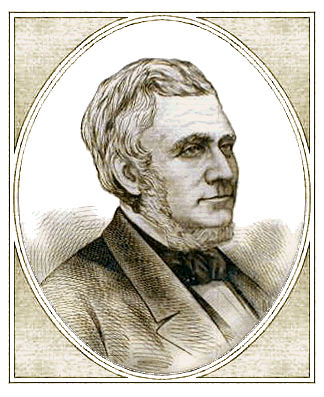
|
Vol. ? New York City, Friday, November 30, 1877. No. ?
JOE SMITH'S IMPOSTURE.
The recent Baptist Minister's Conference of New York, investigated the Mormon Bible, and the Rev. Dr. P. B. Spear, of Madison University, told stories about the boyhood of Joe Smith. He was personally acquainted with the twelve apostles of Joe Smith. The entire gang of apostles had been expelled from Christian churches. On general training days in Palmyra, N. Y., Joe Smith's father sold cake; and cider to the crowd. Joe was a white-headed, tall gawky, who never said a thing as any one else would. The old man was a fortune-teller in a rough way. He used the palm and lines in the hand to read character. From him Joe acquired the fortune-telling habit. When a mere boy Joe got hold of a stone that one of the neighbor's children had found. It was shaped like a small child's foot and had veins running through it. Putting this stone into his hat and thrusting his face into the hat so as to exclude all light, Joe declared that he saw visions. The price Joe usually received for his exercise of the gift of second sight was ten or fifteen cents. Joe learned to read without a teacher, and was delighted with the history of Mohammedanism. |
|
Vol. XLV. New York City, Monday, July 29, 1878. No. 332.
A $5,000 HOLE.
Susquehanna, Pa., July 26. -- There is a $5,000 hole on a farm two miles from this borough. It is about as big around as a baby's arm and nearly 1,500 feet deep. A remakable hole on a remarkable farm. It has a remarkable history. |
|
Vol. XXVII. New York City, Friday, September 27, 1878. No. ?
THE BOOK OF MORMON. A couple of weeks ago Elders Orson Pratt and J. F. Smith, of the Mormon Church, arrived in the town of Richmond, Mo., and sought out the residence of one David Whitmer, who is said to be the only living witness of the translation of the Book of Mormon, and the custodian of the original manuscript as taken down by Oliver Cowdry. The object of the Elders; visit was to secure the manuscript for deposit in the archives of the Mormon Church, but Whitmer declined to surrender it. It has been in his custody nearly 50 years, and he declared his intention of holding it until the proper time arrives for its surrender to those entitled to receive it. The Richmond Conservator says that while refusing to surrender the manuscript he willingly produced and exhibited it to his visitors. They unhesitatingly pronounced it the original copy of the Book of Mormon, Elder Pratt being familiar with the handwriting of Oliver Cowdry, the writer. The offered Whitmer any price he might ask for the volume, but, finding him resolute, left him, with the request that he continue to take good care of it, so that the Church might receive it at the proper time. The Conservator states that "the book is in a splendid state of preservation, the ink as bright as if written yesterday, and it is inscribed on large paper, unruled, in a small hand, clearly written close to the edges, top, and bottom, making over 500 pages. |
|
Vol. ? New York City, Sunday, October 20, 1878. No. ?
THE MORMON CHURCH.
Salt Lake. Oct. 12. -- Judging from the proceedings of the Forty-eighth Semi-Annual Conference of the Church of Jesus Christ of Latter Day Saints, the Mormon system is in no danger of an immediate collapse. A large number of missionaries were appointed to various parts of the world, including about twenty-five to the United States. Pennsylvania is apparently regarded as a field ripe for the harvest, for it is specially set down as the point of destination of two evangelists, direct from headquarters. Finland and New Zealand are among the distant countries to which missionaries are sent, and Scandinavia has the largest share, next to the United States. The impression that the Mormons are wholly recruited from Europe must be erroneous, as it is not reasonable to suppose that the Latter Day Saints would devote so much money and so many missionaries to North America if they did not reap proselytes, many of the converts are assisted to Utah by a perpetual emigration fund, and about $1,000,000 is now due for principal alone by those who have been helped in this way. Elder Carrington appealed to all such debtors to pay up promptly, in order make way for thousands of others who were anxiously awaiting an opportunity to emigrate. He adds, that, by the kindness of the trustee in trust, as the perpetual emigration fund owed the church about $100,000, persons indebted to the fund might discharge their indebtedness by labor on the temple or wherever the church would accept it. Elder Lorenzo Snow advocated that people confine themselves to goods of home manufacture, "and it would not be a great while until, in every town in the Territory, would be heard the busy sound of industry." He added that "if the people will patronize and demand goods made by ourselves, the importations from abroad will cease before the general breaking up of Babylon and the time when we can no longer get goods from them." |
|
Vol. XXVIII. New York City, Saturday, March 15, 1879. No. ?
One B. F. CUMMINGS, a Mormon missionary, having written to the Boston Daily Advertiser a statement that Joseph Smith published in 1843 a book of discipline for the Mormon Church, a son of the deceased prophet writes a flat contradiction. He says that the book in question was first published by his father in Ohio, in 1835, was republished in 1845, and in 1852, in Liverpool, England, and that in neither of these editions does the so-called revelation concerning plural marriage appear. "Nor was it introduced into any edition of that book till 1876," says the son of the prophet, "when an edition was put out in Utah concerning it." Joseph Smith, who thus claps an extinguisher on the pretensions of the Mormon missionary, sharply adds that he (the said Cummings) must have known that he was not telling the truth. It has always been understood among the "Gentiles" that polygamy was an invention of the late Brigham Young. |
Back to top of this page.
Newspaper Articles | Newspaper Articles Index | History Vault
Oliver's Bookshelf | Spalding Library | Mormon Classics
last updated: Oct. 27, 2014