
READINGS IN EARLY MORMON HISTORY
(Newspapers of United Kingdom)

Miscellaneous United Kingdom Papers
1850-1899 Articles
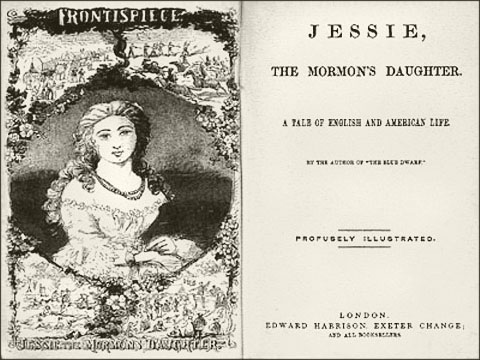
An example of 1860s British "Mormonism" popular fiction
1800-1849 | 1850-1899 | 1900-1999
(please submit old U. K. articles on the Mormons to the web-host, for posting on this page)
Return to Old Newspaper Articles Index
 Vol. ? Monday, London, April 15, 1850. No. 26,013. 
LABOUR AND THE POOR
A memorable event in the abbals of Merthyr was the visit of the cholera to the town last summer. It was a four months' reign of terror and desolation. Go where you will -- but especially amongst the labouring classes and the poor -- the people still speak of it as of a heavy trial, and a frightening calamity... |

He that hath an ear let him hear what the Spirit saith unto the churches. -- Rev. ii. 7. Vol. XII. Liverpool, Lancs., July 1, 1850. No. 13. OBITUARY. Elder Wallace informs us that Oliver Cowdery died last February of consumption. Brother Cowdery is one of the THREE WITNESSES to the BOOK OF MORMON. For rebellious conduct he was expelled from the church some years since. Although he stood aloof from the Church for several years he, never in a single instance cast the least doubt on the truth of his former testimony. Sometime in 1847 or 1848 he sought to be admitted to the fellowship of the Saints. His return to the fold was hailed with great joy by the Saints, who still remembered him with a kindly recollection as one who had suffered much in the first rise of the Church. He has now gone the way of all the earth. May he rest in peace, to come forth in the morning of the first resurrection unto eternal life, is the earnest desire of all Saints. |
|
Vol. ? London, Monday, July 29, 1850. No. 26,101.
LABOUR AND THE POOR
During the course of my inquiry into the extent of emigration from the port of Liverpool, I learned that the followers of Joseph Smith, the Mormon Prophet, who are known by the names of Mormons, Mormonites, and Latter-Day Saints, had many years ago established an emigrational agency in the town, having ramifications in all parts of England, Wales, and Scotland. I learned that the number of Mormon emigrants sailing from the port of Liverpool to New Orleans, on their way to Deseret and Upper California, during the year 1849, was no less than 2,600 -- chiefly farmers and mechanics of a superior class, from Wales, Lancashire and Yorkshire, and the southern counties of Scotland; and that since 1840 the total emigration of the sect from Great Britain has been between 13,000 and 14,000. The progress and present position of this remarkable sect both in the United States and in Great Britain, will put the reader in possession of the facts necessary to the due comprehension of the subject. They unfold one of the most curious episodes in the modern history of the world, and certainly the most singular story in the recent annals of fanaticism |
|
Vol. ? London, Monday, August 5, 1850. No. 26,107.
LABOUR AND THE POOR
The truth that no absurdity of fanaticism is too outrageous to attract believers, finds continual corroboration. The learned and the unlearned, the rich and the poor, the gentle and the simple, alike break through the trammels of reason, and become the dupes of religious impostors, or of persons who are still more dangerous -- the religious maniacs, who strengthen their cause by their own conscientious belief in it. To whichever of these two classes Joseph Smith is most properly consignable, it is certain that his doctrine was no sooner preached than he began to make converts of the people around him. The idea of the "Latter Days," or days immediately prior to the second coming of Christ to establish the Millennium, is one that has a great hold upon the imagination of large classes of persons. Joseph Smith worked upon this idea, and every earthquake recorded in the newspapers -- every new comet discovered -- every falling meteor that was observed -- every war and rumour of a war in Europe or America -- every monstrous birth among inferior animals -- every great public calamity, tempest, fire, or explosion -- was skilfully and pertinaciously adduced as a proof and a warning of the "Latter Days." He had two great elements of success in his favour -- sufficient novelty and unconquerable perseverance. His doctrine was both old and new. It had sufficient of the old to attract those who would have been repelled by a creed entirely new, and it had sufficient of the new to rivet the attention and inflame the imagination of those on whose minds an old creed, however ably preached, would have fallen and taken no root. Basing his doctrine upon isolated passages of the Bible -- claiming direct inspiration from the Almighty, promising to true believers possession of the earth, temporal power and glory, and the blessing of Heaven -- and being gifted with a courage and audacity that despised difficulty and danger, Joseph Smith soon found himself the recognised head of a small but increasing body of ardent disciples. On the 1st of June, 1830, the first conference of the sect, as an organised church, was held at Fayette, which place was for some time the "prophet's" residence, and the head-quarters of the sect. The numbers of the believers, including the whole family of the Smiths, was thirty. Even at this early period in the history of the sect, they met considerable opposition from the people. Joseph ordered the construction of a dam across a stream of water, for the purpose of baptizing his disciples. A mob collected, and broke it down, and used language towards Joseph that was anything but flattering to him or his followers, threatening him with violence and assassination. He was nothing daunted, however. With a rare skill he broke the keen edge of detraction, by confessing boldly that he had once led an improper and immoral life; but, unworthy as he was, "the Lord had chosen him -- had forgiven him all his sins, and intended, in his own inscrutable purposes, to make him -- weak and erring as he might have been -- the instrument of his glory." |
|
Vol. ? London, Monday, August 12, 1850. No. 26,113. ?
LABOUR AND THE POOR
My last Letter brought down the history of Joseph Smith to his establishment in Nauvoo, as mayor of that city, and his self-appointment to the rank of General of the Nauyoo Militia. For time, the "prophet" and his foliowers were warned by sad experience, and "were less hanghty, less overbearing, and, less presumptuos in their intercourse with the "Gentiles," as they called all who were not Mormons, But the prosperity which attended them in Illinois; and the rapid sfrowth of Nauvoo, soon filled them again with insolence and spiritual pride. The dissensions, which had subsided in adversity, were renewed in prosperity. The power and influence of Joseph were too great not to excite envy, and Sidney Rigdon did great mischief by introducing a novelty called the "spiritual wife" doctrine. This caused great scandal, both among the Mormons and among the Gentiles. Joseph himself appears, unless he has been grievously maligned, and unless the affidavits published by his opponents were forgeries, to have had as great a jicncAont for a ploralify of wives as Mahomet himself. Sidney Rigdon, according to the same authority, outdid hiin in this respect, and had "revelations" of his own, which he made subservient to the gratification of his passions. There was possibly some exaggeration in these stories, but they do not appear to have been wholly unfounded. A public lecturer of the name of Newhall published, in the Salem (Massachusetts) Advertiser, an account of a visit made to Nauvoo, in 1843. He described the Temple as a very "magnificent structure, different from anything in ancient or modern history," and "General" Smith?s legion as a very fine body of men. He was present at a grand review of the corps by Joseph himself, accompanied by "six ladies on horseback -- who were dressed in black velvet, and wore waving plumes of white feathers, and rode up and down in front of the regiment." He described Joseph himself as "very sociable, easy, cheerful, obliging and kind, and very hospitable -- in a word -- a jolly fellow -- and one of the last persons whom he would have supposed God would have raised up as a prophet or a priest." Another account of Joseph was published about the same time by a Methodist preacher of the name of Prior. This gentleman says: -- "I will not attempt to describe th e various feelings of my bosom as I took my seat in a conspicuous place in the congregation, who were waiting in breathless silence for his appearance. While he ts rrira I had plenty of time to revolve in my mind the character and common report of that truly singular personage. I fancied that I should behold a countenance sad and sorrowful, yet containing the fiery marks of rage and exasperation. I supposed that I should be enabled to discover in him some of those thoughtful and reserved features, those mystic and sarcastic glances, which I had fancied the ancient sages to possess. I expected to see that fearful, faltering look of conscious shame which, from what I had heard of him, he might be expected to evince. He appeared at last; but how was I disappointed when, instead of the heads and horns of the beast and false prophet, I beheld only the appearance of a common man, of tolerably large proportions. I was sadly disappointed, and thought that, ?? though his appearance could not be wrested to indicate anything against him, yet he would manifest all had heard of lum when he began to preach. I sat uneasy, and watched him closely. He commenced preaching, not from the book of Mormon, however, but from the Bible; the first chapter of the first of Peter was his text. He commenced, calmly and continued dispassionately to pursue his subject, while I sat in breathless silence, waiting to hear that foul aspersion of the other sects, that diabolical disposition of reV en?, and to hear that rancorous denunciation of every individual bnt a Mormon. I waited in vain; I listened with surprise; I sat uneasy in my seat, and could hardly persuade myself but that he had been apprised of my presence, and so ordered his discourse on my account, that I might not be able to find fault with it, for instead of a jumbled jargon of half connected sentences, and a volley of imprecations, and diabolical and malignant denunciations heaped upon the heads of all who differed from him, and the dreadful twisting and wresting of the Scriptures to suit his own peculiar views, and attempts to weaiie a ireb of dark and mystic sophis t^ around the Gospel truths, which I had anticipated, he glided along, through a very interesting and elaborate discourse with all the care and happy facility of one who was well aware of his important station and his duty to God and man." The same writer thus describes Nauvoo: -- "A t length the city burst upon my sight. Instead of seeing a few miserable log cabins and mud hovels, which I had expected to find, I was surprised to see, one of the most romantic places th at I had visited in the west. The buildings, though many of them were small, and of wood, yet bore the marks of neatness which I have not seen equalled in this country. The far-spread plain at the bottom of the hill was dotted over with the habitations of men, with such majestic profusion, that I was almost willing to believe myself mistaken, and instead of being in Nauvoo of Illinois, among Mormons, that I was in Italy at the city of Leghorn (which the location of Nauvoo resembles very much), and among the eccentric Italians. I gazed for some time with fond admiration upon the plain below. Here and there arose a tall m?estic brick house, speaking loudly of the genius and untiring labour of the inhabitants, who have snatched the place from th e clutches of obscurity, and wrested it from the bonds of disease; and in two or three short years rescued it from a dreary waste to transform it into one of the first cities in the west. The hill upon which stood was covered over with the dwellings of men, and amid them was seen to rise the hewn stone and already accomplished work of the Temple, which is now raised fifteen or twenty feet above the ground. The few trees th at were permitted to stand are now in full foliage, and are scattered with a sort of fantastic irregularity over the slope of the hill. "But there was one object which was far more noble to behold, and far more majestic than any other yet presented to my sight, and that was the wide-spread and unrivalled father of waters, the Mississippi river, whose mirror-bedded waters lay in majestic extension before the city, and in one general cnrve seemed to sweep gallantly by the beautiful place. On the farther side was seen the dark-green woodland, bending under its deep foliage, with here and there an interstice bearing the marks of cultivation. A few houses could be seen through the trees on the other side of the river, directly opposite to which is spread a fairy isle, covered with beautiful timber. The isle and the rom antic swell of the river soon brought my mind back to days of yore, and to the bright em erald isles of the far-famed fairy land, The bold and prominent rise of the hill, fitting to the plain with exact regularity, and the plain pushing itself info the river, forcing it to bend arouiid its obstacle with becoming grandeur, - and fondly to cling around it to Id to the heightened and refined lustre of this sequestered land. "I passed on into the more active parts of the city, looking into every street and. lane to observe all' that was passing'. I found all the people engaged in some ''n se M 'ra d healthy employment. The place was alive with business -- much 'parare. ?? than any place I have visited since the hard times commenced. I sought in vain for anything th at bore the marks of immorality, but was both astonished and highly pleased at bay in success. I could see no loungers about the streets, nor any drunkards about the taverns; I did not meet with those distorted features of ruffians, or with the ill-bred and impudent. I heard not r a o ath ip the place, I saw not a gloomy coontenrace; all were cheerful, polite, and industrious." From this time until 1844, the wealth and power of the sect continued to increase; their numbers being augmented from time to time by the English immigration from Liverpool. The "Times and Seasons," of the 15th of May in that year, announced to the Saints "that Nauvoo was becoming a large city, and, that a number of splendid houses were erected. Three ships? companies had arrived in the spriim from England, and the Prophet was in good health and spirits." In 1844, they carried their heads so high that they put Joseph forward as a candidate, for the Presidentship of; the United Stotes, and his still faithful Sidney. Rigdon as a [candidate for the Vice-Presidentship., Joseph was of course aware that his canditure was an act which had no other, meaning than please hip di^ipiesf [and he wrote to, Mr. CKV; who? was supposed to have a good chance, pi being elected to that office, to know what course Jx?.wbald ^rshe^ towards the Mormons? As Joseph Smith (hnffir the ansnjer oif Mr. CSaytw sfec^ojisly courteons. "I have viewed," said he, with a hyely, interest the progress of the Latter-Day Saints. I have sympathized in their suffering dez.. in jo si^ , and I think in common with an other ^?g?otM communities they ought to enjoy the jecmyty and the protection of the constitution and the laws." Joseph was at the cliinax of hie efirthl^p gi?rni and might have been comparatively happy even amid the persecutions of his neighbours the "Gentiles," had it not been for secessions from his church, and the annoyances springing out of the ? spiritual wife ? doctrine of his indiscreet friend Rigdon. The population of Nauvoo was almost wholly composed of Mormons. The corporation over which the "Prophet" presided as "mayor" assumed a jurisdiction independent of, and sometimes hostile to, that of the state of Illinois. They denied validity to the legal documents of the state, unlessconntersigned by the mayor of Nauvoo, and they passed a law to punish any stranger in the city who should ure disrespectful language about Smith. As time wore on, hostility against the sect increased. They waged a constant warfare with the nine counties that adjoin Handcock county, m which Nauvoo is situated, and their old feud with Missouri was kept up by legal proceedings which, in a somewhat vexatious manner, here instituted against Smith. Lieut.-Governor Boggs, of Missouri, was fired at through a window by a Mormon, and narrowly escaped assassination. He swore that to the best of his belief Joseph Smith was a party to this attempt to murder him. The legal proceedings consequent upon this charge, tended to excite and maintain the bitterest animosity between the "Saints" and the "Gentiles." But the "spiritual-wife" doctrine of Sidney Rigdon was the cause of the greatest scandal, and ultimately produced an unloeked for catastrophe -- the murder of Joseph Smith and his brother Hiram, by an exasperated mob in the gaol of Carthage. It appears from many conflicting stories which have been published, that one Dr. Foster, a Mormon, aud member of the Banite Band, or society of the "Destroying Angels," having been absent from home, suddenly returned without giving notice to his wife. He found the carriage of the prophet at the door. Being the leader of a recession from the Mormon church, and having, it b alleged, had previous suspicions of an improper intercourse, he questioned his wife as soon as Simth took his departure. Tbe enemies of the "prophet" assert that she confessed that he had been endeavouring to prevail upon her to become his "spiritual wife." Dr. Foster brooded over th b grievance for some time, and finding ^ o n g the rec?dera that many were inclined to support him in attacking the characters of Joreph Smith and Sidney Rigdon, he, and another person named Law, commenced the publication, in the city of Nauvoo itself, of a newspaper, called the Expositor. In the first number they published the affidavits of sixteen women, to the effect that Smith, Rigdon, and others, had endeavoured to convert them to the spiritual wife doctrine, and to seduce them under the plea of having had especial permission from Heaven. This was somewhat 'too daring, and Joseph Smith in his capacity of Mayor of Nauvoo immediately summoned the corporation to consider the publication. They unanimously declared it to be a public nuisance, and ordered the city marshal to "abate it forthwith." A body of the ? prophet?s?? adherents, to the number of two hundred and upwards, sallied forth in obedience to this order, and, proceeding to the office of the Expositor, speedily razed it to the ground. They then destroyed the presses, and made bonfire of the papers and furniture. Foster and Law fled for their lives, and took refuge in Carthage. The Mormons, it must not be forgotten, indignantly deny the charges brought against Joseph Smith Upon this subject of "spiritual wives," and especially the story of Mrs. Poster, which they treat as a hare and utterly unfounded calumny. As regards Sidney Rigdon they are not so emphatic in their denial. "Whatever the truth may have been, the consequences to the sect were momentous. Foster and Law applied for a warrant against Joseph and Hiram Smith, in the County Court at Carthage. The warrant was granted and served upon the Mayor of Nauvoo. He refused to acknowledge its validity, and the constable who served it was marched out of Nauvoo by the city marshal. The authorities of the county could not suffer thb affront to the law; and the militia were ordered out to support the county officer in arresting the Smiths. The Mormons in Nauvoo fortified the city, and determined to fight to the last extremity insupport ofthe "Prophet." The "brethren" from all parts of the country hastened to give assistance. Illinois, like Missouri, divided itself into two great camps, the Mormons and the Anti- Mormons, and the circumstances were so menacing that the governor took the field in person. In a proclamation to the people of Illinois, he stated that he had discovered that nothing but the utter destruction of the city of Nauvoo would satisfy the troops under hb command, and that if he marched into the city pretexts would not be wanting oa their part for the commencement of slaughter. Anxious to spare the effusion of blood, he called upon the two Smiths to surrender peaceably, pledging his word and the honour of the State that they should be protected. He also called upon the Mormons to surrender their public arms, and upon the Nauvoo legion to submit to the command of a state officer. The Mormons agreed to the terms, and Joseph and his brother surrendered to take their trial for the riot, and for the destruction of the office of the "Expositor." The prophet had a presentiment of evil, and said as he surrendered, "I am going like a lamb to the slaughter, but I have a conscience void of offence, and shall die innocent." While in prison at Carthage, another writ was served upon him and his brother for high treason against the state of Illinois. As the mob breathed vengeance against both prisoners, and as the militia of the country very indecently sided with them, and were not to be depended on in case of any violence being offered to the two Smiths by the people, the Governor was requested by the Mormons to set a guard over the gaol. On the morning of the 26th of June, 1844, the Governor visited the prisoners in gaol, and pledged his word to protect them against the threatened violence. It now began to be rumoured among the mob that there would be no case against the Smiths on either of the charges brought against them, and that the Governor was anxious that they should escape. A band of ruffians accordingly resolved that as "law could not reach them, powder and shot should." About six o?clock in the evening of the 27th the small guard stationed at the gaol was overpowered by a band of nearly two hundred men, with blackened faces, who rushed into the prison where the unfortunate men were confined. They were at the time in consultation with two of their friends. The mob fired upon the whole four. Hiram was shot first, and fell immediately, exclaiming "I am a dead man." Joseph endeavoured to leap from the window, and was shot in the attempt, exclaiming "Oh Lord, my God." They were both shot after they were dead, receiving four balls. John Taylor, one of the two Mormons in the room, was seriously wounded, but afterwards recovered. Thus died this remarkable man. "In the short space of twenty years," says the account of his "Martyrdom," appended to the Book of Doctrines and Covenants, "he brought forth the Book of Mormon, which he translated by the gift and power of God, and was the means of publishing in two continents. He sent the fulness of the everlasting Gospel which it contained to the four quarters of the earth. He brought forth the revelations and commandments which compose the Book of Doctrines and Covenants, and many other wise documents and instructions for the benefit of the children of men. He gathered many thousands of the Latter-day'? Saints, founded a great city, and left a fame and a. name thht cannot be slain. He lived great, and. died great in the eyes of God and his people; and like most of the Lord?s anointed in ancient times, sealed his mission and his works with his own blood; and so did his own brother Hiram. In life, they were not divided, and in death they were not separated." -- The "Christian Reflector," a less friendly critic of his character and actions, thus spoke of his life and death "It is but a few weeks since the death of Joe Smith was announced. His body now sleeps, and his spirit has gone, to its reward. "Various are the opinions of men concerning this singular personage; but whatevar may be the views of ra y in reference to his principles, objects, or moral character, all ' raree that he was one of the most remarkable men of the age. Not fifteen years have elapsed since a J ^ d , composed of six letsoiisV- was formed in Palmyra, New York, of which Joseph i im itb. jn n .; was the presiding genius. Most of these were connected with the family of Smith the senior. They were notorious for breach o f contracts, and the repudiation of their honest debts. All of them were addicted to vice. They obtained their living not by honourable labour, but by deceiving their neighbours with their marvellous tales of money digging. Notwithstrading the low origin, poverty, and profligacy of the members of that land of rao ? n teb rak s, the? have augmented their ?? numbers-til) more than 100,000 persons are now. numbered among the followers of the Mormon prophet, and never were ?ncreasing so rapiqly as at, th? ? to? of his death. From ih the very lowest w ^ 'l i te, reared in poverty,, educated in vice, baring r a claim s Ao e ^ ^ common intelligence, ?3aise!tuid vulgaxin.'dq)0rt?n en t, ih s. Prophet Smith succeeded in establishing w refigfeps irree^ > the tenets of which ia.y? been ta s^ h t throa ^ o p t the length and breadth of America. The prophet's virtues have been rehearsed and admired in Europe; the ministers of Nauvoo have ever found a welcome in A sia; and A f n c a has h s t e ^ t o t h e ^ ^ sayings nttheaeen of P a l i ^ -The ^ day Saints has been r e a r ^ on the j ^ ^ ef even the Holy Land has been entered by the ettissanes of this wicked impostor. "He founded a city in one of the most America. Its walls are o f'sohd f ^ ?n Owckne ?! supported by thirty stone ptilaraj That building u a monument pointing the traveller to the genius of its founder. "The acts of his life exhibit a charactor as incongruous as it is remarkable. If we can credit his own w n ^ , w d j i e testimony of eye-witnesses, he was at toe ?m e time the vicegerent of God -- a tavern-keeper and prophet of Jehovah, fnd a base libertine -- a minister of the religion of peara, auda lieutenant-generel -- a rider of tens of thousands, and a slave to all his own base, unbndled passions -- a prober of righteousness, and a profane swearer -- a worshipper of Bacchus, mayor of a city, and a miserable bar-room fiddler; a judge upon the judicial bench, and an the c iw . spciaf; and moral relations of men; these inconsistencies of character. and, notwithstanding _____________ there are not wanting thousands who are willing to stake their souls? etem?d salvation upon his veracity. For aught we know, time and distance will embellish his life with some new and rare virtues which, his most intimate friends fmled_ to discover while living with him. "Reasoning from effect to cause, we must conclude that the Mormon Prophet was of no common genius ? few are able to commence and carry out an imposition like his, so. long, and to such an extent. And we see, in the bistow of his success, most striking proofs of the gullibility of a large portion of the human family. What may not men be inri need to believe?" The perpetrators of the shameful murder of the two brothers were never discovered. Several persons Were arrested on suspicion; but there was not fluffidient proof to Convict them. The event ww greatly deplored. The sincerest opponents of Mormonism were those who were most grieve at it. Joseph Smith murdered was a greater prophet than Joseph Smith alive j and it was predicted, both by friends and foes, that, however rapid the progress the sect might have been in past tunes, it would be still more rapid when fanaticism might point to the martyrs of the faith -- when the faults of Smith would be buried in the oblivion of the tomb, and when his virtues would be enhanced by the remembrance of his fate. The prediction was apeeduy verified, but not however until the Mormons ted passed through another long period of persecution and suffering. No sooner had the Smitbs 'been removed from the way of his long-cdijcealed .but violent ambition, than Sidney Rigdon strove to vault into the varant place of the deceased "prophet." Sidney, however, miscalculated his power and influence. Joseph had long been mistrustfol of him. Sidney knew too much, and Joseph, without quarrelling with him, had kept him at arm's length. The mistrust of the prophet was sh?redhy the principal Mormons, and his "spiritual wife" doctrine had alienated from him the confidence of many who had once looked upon him as a founder of the faith, and a pillar of the church. After the death of Joseph, Sidney Rigdon had a "revelation," commauding the saints to withdraw from their enemies, and leave Nauvoo, and establish themselves in Pittsburg. This "revelation" contradicted the "revelations" of Joseph; and the Saints under the guidance of Brigham Young, who ba,d his own ambitious views to serve, treajiea Sidney's "revelations" as the unwarrantable innovations of a man who "lied before the Lord," and sought the destruction of his Saints. He was summoned to answer for his misdeeds before the high quorums of the priesthood. He refused to appear, and, evidence having been given in his absence, he was expelled from the church, and, to use the words of his sentence, "handed over to the buffetings of Satan." The Missourians and anti-Mormons relaxed in their hostility after the death of the prophet and his brother, and for a twelvemonth affairs went on more. quietly in the city of Nauvoo. Brigh^ Young succeeded to .the chief presidency of the churte, and the Saints, carried on with vigour the building of the temple and the Nauvoo House, in order, as- they said, .,to fulfil the ? revelation,? and prove to the Hent?es, not' only the divinity of their mission, but their power, wealth, and perseverance. Qumr?ls occasionally took place. The Mormons, when insulted, or opr pressed, had not always the patience to forbear from retaliation; and among men who habitually bore arms to protect themselves it is not surprising that the conflicts should not in all cases have been confined to words. Skirmish succeeded ,8kirm?6h,unt? it became once more necessary to call out the militia for the preservation of the peace. Regular battles ensued, blood was shed, lives were lost, and the exasperation of both parties was raised even beyond its former height. The Governor was called upon to interfere actively, and a meeting of delegates from the nine counties surrounding Nauvoo was convened, at which it was asserted ? by all the speakers that there ?would be no peace for Illinois as long as the. Mormons remained within its boundaries. The delegates pledged themselves to support each other to the last extremity in expelling them forcibly, if they could not otherwise be induced to go. After a series of struggles and negotiations, and -a regular siege of the city of Nauvoo by tbe Anti-Mormons, the Saints agreed to leave Illinois in the spring of ?18?, or as ? soon as grass grew and. water rani? provided that in the interval they should not be molested, and that they should be. allowed time and opportunity to sell their farms and properties, and remove beyond the limits of civilization. The first companies of the Mormons commenced crossing the Mississippi on the 3d February, 1846. They amounted to 1,600, men, women, ana children, and passed the river on the ?ce. They continued to leave^ in detachments or companies of similar magnitude until July aud August, travelling by ox-teamsntowards California, then almost unknown, and quite unpeopled by the Anglo-Saxon race. The Anti-Mormons asserted that the intention of the Saints was to exoite the Indians against the commonwealth, and that they would return at the head of a multitude of the red skins to take vengeance upon the white people for the indignities they had suffered. Noching appears to have been further from the intentions of the Mormons. Their sole object was to plant their church iu some fertile and hitherto undiscovered spot, where they might worship God in their own fashion, unmolested by any other sect of Christians. The war against Mexico was then raging, and, to test the loyalty of the Mormons, it was suggested by their foes that a demand shomd be made upon them to raise 600 men for the service of the country. The Mormons obeyed, and 500 of their best men enrolled themselves under the command of General Kearney, and marched 2,400 miles with the armies of the United States. At the conclusion of the Mexican war they were disbanded in Upper California. The Mormons allege that it was one of this hand who, in working at a mill, first discovered the golden treasures of California, and the Saints are said to have succeeded in amassing large quantities of the precious metal before the secret was made generally nowu to the "Gentiles." The "Great Salt Lake Valley" was ultimately fi^ed upon as the halting-place and future home of the sect; and thither large detachments of Mormons have since directed their steps. In 1846, whilst one party went overland to Upper California another party chartered the ship Brooklyn at New York, and sailed round in the Pacific, by Cape Horn. This party was amongst the earliest of the arrivals in Oalifornia, and its members are said to have been exceedingly fortunate at the "diggings," and to have am assi large quantilies of gold. The courage of the sect reviv?a, ,(md th?y'were never more eh^^ at any period of ih?ir ?ustory'Ih??'now. The Salt Lake Valley, in Deseret, is about eighty miles in length by twenty or thirty in breadth. Through the middle runs a beautiful stream , to which they have given the name of the ? Western Jordan.? They uiid out a large city in 1847, and commenced the building of a new Temple. The climate is said to be excellent aud the soil highly fertile. Fifteen thousand Mormons, exclusive of Indians, already inhabit the valley; About 6,000, in detachments of 400 and 500 each, are iiUi- present on theiir road overland from New Orleane, by St. Louis and Council Bluflfe, the whole: of whom. are expected to reach their dest?uation in August, September, and October the br???bt year. - At .their half-way station at Council Blufs there ia a Mormon population of about 20;000 people, who have squatted ^ a vast plain or praine extending for abont 100 m d^ by 6Dor 60 in breadth. Here they raise p ro to n s and buy cattle, make and taeni fr^ o n s, and sa^ money to establish themselves nltunately in the Great Salt Lake City. Many of them remain a year or two hdore they move o n w ^ , te that these settlements are always filling with the new, and thinning of the old immigration. The principal town in this district is Kanesville, where there are said to be about 1,000 Mormons. Several emissaries, or "Apostles" of the sect were despatched to TEuroj^^d the commencement of the present year, to ? gather ? the European Saints to the New Zion. Some have proceeded to Germany, to France, to Norway, and to Russia, but the strongholds of tbe sect are in England, Wal?s^ and Scotland. Their eldere ' stete that neariy 30,000 people m Great Britain are , mepihers of .their church, and that there ? not a consid?rable town in which they have hot A congr^ation. The number of Mormons ih London is about 1,200 ; m laverpool, 600 ; in Manch?ster, 700 ; in B in g h a m , 1,100 ; in Glasgow; 600; in R d i n h u i g b , ; m Sheffield, 400; in Macclesfield, 200 ; m P ^ley, 100 ; in Dundee, lOO^yrh?e ? branches ^of from ^ to 50 membera are to be found in te the minor towns. The Mormon emigration ?from Liverj^i, By mean? of an agency establisbed there^m has amCnpted, accot^hg. to a statement furnished by a principal Mormon, "Apostle" now in Liverpool on an emigrational mission, to about 13,600. For the two ?eaw prior to the death of Joseph Smito, thirteen vessels wholly engaged by the Mormons for the emigration of their people quitted Liverpool for New Orleans; the largest number p r o c ^ ^ vessel being 314, and the smallest W, the last year the Mormon emigrahon amounted to neariy 2,600. Being desirous to know something of the class of persons. Who emigrate under Mormon auspices, to establish themselves in the Salt of the Pilkmgt^'*ted "Wilsdn, ' the h i# ?y respeot^^^ Shipping agents for the New Orleans packets. The gentleman .who is the principal manager of this branch of their business, and who is thus thrown into frequent intercourse with the Mormons, vwas kind enough to frirmsh 'me with the following statement: -- ? With regard to * Mormon ? emigration and the class of persons of which it is composed, they are ipriucipaliy farmers and mechanics, with some few clerks, siirgeons, &c. They are generally intelligent and well-behaved, and many of them are highly respectable.. Since the 1st of October, whep, : apcordiUg to' the new act, a n?te of the trades, pr?fessions, and avocations of emigrants was firat req??red to be taken by the emigration officer,- until March in the present year, the following seems to be the numbers of each who have gone out in our ships as far as I can ascertain. I find in oiir books the names of 16 miners, 20 engineers, 19 farmers, 108 labourers, 10 joiners, 25 power-Ioom weavers, 15 shoemakers, 12 smiths; 19 tauors, 8 watchmakers, 25 stone-masons,' 6 butchers, 4 bakers, 4 potters, 10 painters, 7 shipwrights, 4 ironmoulders, ?3 basketmakers, 6 fiyersi Siropeirs, 4 papermakers, 4 glasscutters, 6 naUors, 6 saddlers, 6 sawyers, 4 guumakers, dfo. These;emigrants generally take with them .the implements necessary to pursue their occupation in the Salt Lake Valley, and it is no nnusual thing to ^?rceive (previous to the ship leaving the dock) a watchmaker with his tools spread out upon his box, busy examining and repairing the watches of the ? brethren,? or a cutler displaying to his fellow-passengers sarnies of his handicraft which he is bringing out with him. Of course the stock thus taken out is sinall when placed in the scale with the sp?culations of commercial men ; but judging from the enormous quantity of b.oxe's generally taken by these people, in the aggregate it is large indeeq. Many of these families haye four, five, or six boxes, bound aud hooped with iron, marked ? Not wanted on the passage,? and which are stowed .down in the ship?s hold ; these all contain implements of ; husband^ or trade. I have seen with Mormons on hoard ship a piano placed before one berth, and opposite the very - next a travelling-cutler?s machine for grinding knives, &c. ; indeed it is a general complaint with captains that the quantity ofluggage put on board with Mormons quite takes them by surprise, and Often; sinks ?? ships upwards of an inch deeper in the water than they would otherwise have allowed her to go. Their provisions are always supplied by their agent here, of the venr best description, and more than ample ; for while the law requires that a certain qumitit? shall be put on board for eaeh passenger, the Mormon superior puts in all cases twenty pounds per head above this quantity, and in addition a supply of butter and cheese. Everything is good. The bread always is good, frequently better than that used by the ship. The surplus provisions are given to the passengers on their arrival at New Orleans, and distributed by their superiors to each family in proportion to its numbers. As to the localities from which they come?the majority are from , the manufacturing districts, -Birmingham, Sheffield, the Potteries, &c. Scotland and Wales have also despatched a large quantity. When the Scotch or Welsh determine on going, it is generally in large companies. It may perhaps be worthy of remark, that no Irish - ? Saints ? have yet made their appearance. The Mormons have the greatest objection against going in any ship carrying other passengers than themselves, and when such is the case, they invariably stipulate that a partition shall be erected across the ship?s lower decks, so as separate them from all other passengers. "The means taken by these people for the preservation of order and cleanliness on board are admirable, and worthy of imitation. Their first act, on arrival here, is to hold a general meeting, at which they appoint a 'president of the company,' and ? six committee-men.? The president exercises a complete superintendenceover everything connected with the passengers ; he allots the berths, settles disputes, attends to all wants, complaints, or inquiries, whether for or by the passengers ; advises each how to proceed the most economically whether in purchasing provisions, bedding, or other articles, and he being in constant communication with the superiors here, the people are thus safely guarded from the hands of ? Man-catchers ? and all others of the many who frequent our quays, and whose profession it is to entrap and prey upon the unwary stranger. The duty of the committee-men is to assist in getting the luggage on board, and to make a proper arrangement in the ship, ?he. They also stand sentinel alternately at the hatchway day and night during the period the ship remains in dock, to prevent the intrusion of strangers To show how effectually this is done, I may just mention that while in every ship taking the general class of emigrants, persons are found concealed on board, or ? stow aways,? in no instance has*such been the case in a ship wholly laden with Mormons. To those acquainted with the slovenly and dirty arrangements of emigrants on shipboard, those of the Mormons, for the preservation of decency and moralityj are deserving of the highest commendation. Each berth, or at least a great majority of the berths, have their little cortalss spread before them so as to prevent the inmates from being seen, and also to dress and undress behind. In allotting the berths, each family or r?tives are all placed in the berths nekt each other ; and in case the passengers are from different parts?say from England ted Scotland?tbe Scotch are berthed on one side of the ship, the ]l^1is1i on the other. The duties of the president ana committee do not cease after the ship leavte dock, but are ?ont?nued during the entire voyage. The president still exercises his Buperinttedenee over the general conduct of the oMsengers, the delivery of provisions, water, &c. The committee act at sea as police. Three of them take each side of the between decks, and see that every person is in bed by eight o?clock in the evening, and in the moriiing that every passenger is up, the beds made, and the rubbish swept together, hauled up in teckets, and thrown overboard l^ore seven o?clock. It is remarkable the implicit obedience paid by the passengers to those whom they thus elect over tn?m ; their slightest word is lawj always respected, and cheerfully obeyed; in their steim mtercourse they address each other as 'brother and sister' and with regard to their care of the entrusted to their charge, I have bteU toldte an American captain who carried them, that having delivered to their committee a quantity of [^t?r which he told them was to serve for three days he found at the end of the third day a fourth day?s supply left; whereas had he jrivte it into th? char^ of one of his sailors for distribut??ii, it ^ m d not have lasted the three days. From mj teow lte^ of the emigrarion at present going on from Inveirteli,; I can trufy. ^ that fr' would, indeed; ^ conducive to the comfort and health, Irat would absolutely save the lives of many who?^ ?ow ffie on shipboard, could the same rules for chMBil??Bt?, order, dr?., be introduced amon^tkh? gte?ihl ?l?ss of emigrants who leave this port for 'AS?iic^^ . The Mormons have, it is said, put aside 3 1/2 tons, or 94,000 ounces, of gold, gathered in California for the purpose of "gathering" the poor Saints from England and other parts of Europe, as well as from the remote disfricts of the Ainericau union, into the gfcat Salt Lake Valley. ' At | ?4 m o^c?^ this would amount to ?37f^3S^. It is possible that they may have exaggerated their resouccea in this respect, but the fact is presented nn Mormon authority. I was showp at Liverpool some pf the gold coinage of their new state.pf Deseret. ? The five-dollar pieces are of pure Califprii^n gold, withte t alloyyted.Bomewhat smaller; but muchheavier, than a sovereign. The reverse h e ^ th e.inscription ? Holiness to the Lord,? surmounting the eye of Jehorah; ?nd a cap somewhat like a mitre, both' very rudefy executed.. The obverse bears two hands _ pined, and the words ? Five dollars.? The Mormons have established a perpetoa! emigration fand, th? nature and objects pf which are stated, iu the feUowing epistle from, the present h e ^ . of the church, the successor of Jteeph Smith, to their emigration agent in Livereool "Great Salt Lake City, Oct. 14,1849. ?? Grert iPke Oity, Oct. 14,1849. ? To Elder Orson Pratt?Dear Brother-^Yqu will jearh from dur General Epistle, toe prinoifArevents oecurrinffwith us, but we have totfught proper to write you; inoro particulanyin relation to .some matters of general interest, in an espeeiat manner, the perp?tuai emigration fund for the poor saints. This fund, we wish all to understand, is perpetual, and in order to be kept good, will'need constant accessions: To farther this end, we expect all who are beuefited by ite oi^rktfonr will?die willing to reimburse that amount as soon As they are able, facilities for which will very soon after their arrival herd present themselves in tlm shape of public works; donations will also continue to be taken from all parts of the world, and expended for the gathering uf the poor saints. This is no Jomt-Stock Company arrangement, but free donations. ? Your office in Liid the place of deposit foi^.aU funds received, eito?r (or this or the tithing fands, tor all Enrop^ and you will not pay out only upon our order, and to such persons, as we ahall; direct. We wish to have machinery of all kinds introduced in these valleys aa soon as practicable. If you commence operations now^ before you can get men to engage in toe business, the material for cotton and woollen factories wjll be produced. Our settlements another season will extend over toe rim of the basin, where we can raise the cotton, tbe sugar cane, rice, &c. Therefore, if you can find those who will engage in ipanufacturiDg cloth for this market in the Valley, we want you should let these cotton factory proprietore, operatives, and all, with all the necessary fixtures. Come to this place. 'We have a carrying company started. Who will accommodate all *emig#ants to this placo Wii^ nassagq and freight from M ji^pri nver ; they not bo obliged under this arrahg?ment to buy oxen and ?wag'^ gons wnen they arrive there, and can be immediately transpoifted torongh the entire route. We have considered it policy for us to collect tithing in money, instead of labour, as heretofore, therefore we employ constant hands upon our public works, and pay them the money, dr such thin^ as they need for themselves and families. We therefore have appointed Joseph L. Heywood and Edwin D. Wooley our agents to go east, and purchase such things as we need to supply our public works with, such as are nec?ssaiy, such as glass, hails, paint, &c., and furnish workmen ; these agents will probably call upon you from Boston for funds, if they should, yon will send them accordingly. I t is distinctly understood that these arrangements are entirely disconnected with the Perpetual Emigrating Fund ; that is, sacred to its proper use in gathering th? poor saints. Our true policy is^ to do our own work, make our owu goods as soon as possible ; therefore do all you can to further the emigration of artisans and mechanics of all kinds : also continue to collect tithing. ** Our beloved brother Franklin D. Richards, who is appointed to go on a mission to England, will co-operate with you, and give you more particular items, policy, sc. ? With sentiments of the highest esteem, love, and kindness, we reihEdn your brothren in the new and everlasting covenant, "Brigham Young. "P.S. -- We want a company of woollen manufacturers to come with machinery, and take our wool from the sheep, and convert it into the best clothes?and the wool is ready. We want a company of cotton manufacturers, who will convert cotton into cloth and calico, &c., and we will raise the cotton before the machinery can be ready. We want a company Of potters. We heed them. The. clay is ready, and dishes wanted. Send a company of each; if possible, next spring. Silk manufacturers and all otoers will follow in rapid succession. We want some, men to sUirt a furnace forthwith ; the coal, iron, and moulders arc waiting. B. Y." It will be seen, from the foregoing statements, that the Mormons have made a great movement in advance since the death of Joseph Smith. California has been their golden land, and the source of their present prosperity and hope in the future. ? When the saints were aW it leaving Nauvoo,? says an epistle in top AfiUenntoiiSter, ? HeberC. Kimball proph^ sied that in five years they would be better off than at this time. Little more than three yeai?8 have elapsed when we behold the poor exiled Mormons in flourishingcircumstances, counting amongst their rielies a thousand hills and valleys, situate in the most remarkable, interesting, and auspicious portion of the globe ; having the fountains of rivers that must sp?edily command toe commerce of the worid, in tbe midst of their territories. Thus the banishment of the church has become her freedom, the greatest boon her opponents could confer, and the glad signal for her to arise and shine. Forcibly ejected from the mother countiy on her arrival at the age of puberty, and thrown back iroon her own unaided resources, the development of her wonuerful constitution, capabilities, and organization,. strikes the whole world with astoniebment and admiration. They who have plundered, rubbed, and driven her into the wilderness, and thought she was dead, now turn their eyes, and discover to their great surprise that she lives, and nobly aspires to power, honour, might, mtoesty, glory, and dominion. She nas triumphed over every form of persecution and every species of cruelty. Under circumstances the most extraordinary and discouraging, she has proved herself not a whit behind Hie very first and foremost in all the characteristics necessary to constitute a great people. She has earned a title to a fair name and place amongst the nations. Yes, Zion is firmly established in the strongholds of the land. Riches unknown are at her disposal. And it is to be hoped that her oppressors will rejoice over her no more ; and that no weapon formed against her shall prpsper. Every one is aware of 'the impracticability of subduing a brave people, entrenched in the. fastnesses of the mounteins, A nation of mountaineers is not easily subjected. Even our enemies begin to acknowledge the manifest natural advantages and rising importance of the peculiar locality of the city ?sought out,? and are not teckward in foretelling the proud and enviable station we must shortly occupy. They look co her for support, and think of calculating on her assistance, whom they have driven to the last extremity. "All things work together for good. 'When an iron highway shall be cast np in the desert, not only will the flight of the righteous be greatly facilitated, but the kings, nobles, and rulers of the earth, with the great men, will flock to the city of refuge, painfully aware that in Zion alone will be found peace and safety. The signs of the times augur an unparalleled growth for the city in the midst of the everlasting hills." The following particulars, with reference to the Great Salt Lake Gity, are of interest: -- ? The Nauvoo L ^ o n ,? says a general epistle to the saints signed by the new Premier, Bingham Joy, and dated on the 12th of October last, ? has been re-organised in the valley, and it would have been a source of joy to the saints throughout the earth, could they have witnessed its movements on the day of its great parade ; to see a whole anny of mighty men in martial array, ground their arms, not; by command, but simply by request, repair to the temple block, and with pick and spade open the foundation for a place of worship, and erect the pilasters, beams, and roof, so that we now have a commodious edifice, 100 ny 60 feet, with brick walls, where we assemble with the saints from Sabbath to Sabbath, and almost every evening iu the week, to teach, counsel, and devise ways and means for the prosperity of toe kingdom of God ; and we feel thankful that we have a better house or bowery for public worship the coming winter, than we have heretofore had any winter in' this dispensation. " The 24th of July last was a daylong to 1? remembered by all prekent in this valley, and all saints who shall learn of our celebration, as the anniversary of the arrival of the Pioneers two years previous. To behold 1,200 or 1.500 feet of tables, ffiling the boW?ty and ?1 adjoinii^ grounds, loaded with all luxuries of the field and garaens, and nearly all the varieties toat any vegetable maricet in the world conld produce, and to see to e seats around those tables filled and re-filled by a people who bad been deprived of those luxuries for years by toe cruel hand of oppression, and freely offering seats to every stranger within their borders, and this, too, in the valley of the monntains, a thousand miles from civilization, woere two year? before, nought \ras to be found save the wild root of the oraine, and the mountain cricket, was a theme of nnhonndea thanksgiving and praise to the Giver of ail good, as the dawning of a day when toe children of the Kingdom, can sit under their own vines and fi^recs, and in l^ it their own houses, having none to make them afraid. May the time be hastened when the scattered Israel may partake of such like bimquets from the gardens of Joseph. " Thourands of emigrants from the States to the gold mines have passed torongh onr city this season, leaving large >f dom md mi blessing to both parties. quantities for horses of domestic and mules, which lothing, waggons, &c., in exchange exchange hasI b? een a mutual The direct emigration of the saints to this place will be some five or six hnndred waggons this season, besides many who came in search of gold, have heard toe Gospel for the first time and will go no further, having believed aud been "On the 28th September, fourteen or fifteen of toe brethren arrived from the gold country, some of whom were very comfortably snpphedwith the precious metal, and others, who had been sick, came as destitute as they went on the ship Brooklyn in 1846. Tluit there is plenty of gdd in ?Western California is beyond doubt, but the valley of toe Sacramento is an unhealt^ place, and the smnts can be better employed in raising grmn, and bnilding houses in this vicini^, than digging for gold in the Sacramento, unless they are counselled so t o ^ . The true use of gold is for I housra, and making culmary diskes, and when itbe saints shall have preached the gospel, raised grain, and .fanilt up mties enongfa, the Lord will open m the way for a supply of gold to toe perfect satisfaction of His people ; nntil thbn, let fbeni not be over-anxiona, for toe tieatores Of the earth are 'in the lord?s store-house, and he wiliopen toedoorstbereof, when and where He pleases* , . . . "The gain crops in the vaDey have been good tois season; wheto, barley, oats, rye, and peas, more p ^cu larly . The late com and buckwheat, and some lesser grains and vegetables, have been materially hunred by the recent frosts; and some early com at Brownsville, forty miles north, a Bumtb since ; and the buckwheat was severely damaged by Rail at toe Utah settlement, sixty miles sonth, about three weeks sinee ; but we have great occasion for thank^ving to pim who pveto the increase, that He has blest ourlabours. so th a t with pm dence we shall have a comfortable,suj^ilw for ourselves, and onr brethren oh the w ^ , who niay be m need, until another harvest; but^ we, feef the .need iff'm ore labourers, for m ore effici?nt help, and multiplied means of farming imd building a t this place. We want men. Brethren, come from toe' States, from toe nations, home ! and help us to build and ^ w , until we can say, enough?the valleys of Ephraim are full." The following letter from a Mormon to his father in England, gives some additional particulars of the city, and the joarney overland from New Yorh :? ? City of toe G reat Salt Lake, ? B otoy Mountains, October 6,1849. ? My dear F a th e i^ I scwre?ly know how to commence the chequered history of my journey from New York; b n t m il endeavour to give you a very abbreviated account, reserving my jonm ai until we again meef, which happiness will, I trust, yet be perm itted to us. We started 24 n numbOT, on lOUi of March, a m e d and equipped for a long and toilsome journey. During toe first part, having the ^ v a n ta g e of hotels, we were very merry, and eqjbyed ourselves amassinriy. but this was not to last long, as we had yet to experience the toils of a camp life. Wertravelled some 1,000 mfles upon the Mississippi and Ohio rivers in American steamers, a mode of transit I am by no means partial to, as I was in a fever of apprehension the whole tim e, th e accidents on these rivers being innumerable. They?arise from ' snags? ( p i e ^ of timber sticking up in the muddy. waters), from fire, coUij sion. and bursting of the thin boilers, which are placed under the saloon. This part of our travel was, however, ^ complished,with only the loss of a few goods; and m the eariy part of May our mules were purchased, aud we were ready for a start across the prairie. Our party h ^ four waggons, each drawn by eight mules, and, in E d itio n , we rod? upon these coxnbiiiations of all that is stupid, spiteful, and obstinate. For some little time I enjoyed the chaMe? the novelty of this predatory mode of life. A t day-te?eak wo left onr tents, and were soon busy around the camp fire, preparing breakfast. Our stores did not admit of much variety ; coffee, bacoDi and hard biscuit, forming the staple of our provisions. The weajher soOn became oppressively hot, tbe thermometer rising to 100 and 110. This was re n d e r^ very trying by the entire absence of shade upon this ocean of land ; indeed these vast? plains closely res?mble in atmospbr?io phenomena and in the appearance of the ground, the dry bed of some mighty sea. . . . . The heat, with the quality of our food, soon produced bilious fever, and before our journey thus far was accomplished, half our number had suffered from this complaint. We were much mistaken in believing the route a healthy one, the r o ^ being marked with the graves of victims to the California fever. About the middle of June I was taken ill, and with slight interruptions continued so till we reached this ? city.? You wUl perhaps i m ^ n e th at being so styled, it resembles a a English city, bnt it is only in prospect. The housra are either of logs, or built of mud bncks, called ' dobies, and but in ? few instances are not larger th?n one or two rooms ; but time will accomplish much for this enereetic and faithful people. Each house stands in H acre o f garden ground, eight lots in a block, forming squares. The streets, which are wide, are to be lined with trees, with a canal, for the purpose of irrigation, running through the centre. As our waggon entered this beautiful valley, with the long absent comforts of a home in prospect, I experienced a considerable ctan M for the better ; and when, to my surprise and gratitude, I met a pious, kind, and intelligent artist, and a countryman also, who took me, emaciated, sick, and dirty, to his humble Lome, my happiness seemed completed............................... You must, from their own works, read the history of the Mormpnites, aud you will then learn Low this despised people have been persecuted and driven from place to place, until they have at length found a haven in the all but inaccessible valley of the Rocky Mountains, where are gathered together, almost from every nation, some 10,000 of those who felt happy in sacrificing all that the world holds dear for the sake of their faith ; M d after struggling with innumerable difficulties and hardships, are building their temple in the wilderness, and are rapidly increasing Both in spiritual and temporal wealth, having a church organised according to the New Testament pattern, and endeavouring to live by every word that proceedeth from the mouth of the Lord. The land here is most fruitful?I am told it produces 80 bushels of wheat to the acre ; and vines, delicious melons, with other fruits and vegetables, grow in profusion. A city lot?that is, 1)4 mire?may be purchased a t $1 50c., and would produce food sufficient for my wants the whole year. No man wdlh ordinary intelligence can be poor in such a place ; and then, glorious privilege, he can be free from the harassments and perplexities which continually destroy the peace of those who live in an artificial state of society . . . . . ? . ? ? . ? When recruited, in order to accomplish the remaining 600 miles, the distance that still intervened between the city and California, the waggons were sold, and ten of our number startec^^r their original destination, through mountains covered with snow, with a prospect of being slain by Indians, or of feeding either upon their mules or each other. The other thirteen remained, earned their living in different ways, until later in the season ; and have since started upon a southern route of 1,600 miles, for the gold mines, leaving me still too unwell to accompany them." * * * The constitution of the New State of Deseret has already beeu drawn up and promulgated. It does not differ materially from the constitution of the other states of the Union. The preamble, which is as follows, shows its geographical position and limits;? ? THE CONSTITUTION OF THE NEW STATE OF DESEBET. ? Whereas a large number of the citizens of the United States, before and since the treaty of peace with the R epublic of Mexico, emigrated to and settled in that portion of the territory of the United States lying west of the R o c k y Mountains, and in the great interior basin of Upper California ; and ? Whereas, by reason of said treaty, all civil organization, originating from the republic of Mexico became abrogated and ? Whereas, the Congrras of the United States hra failed to provide a form of civil government for the territory so acquired, or any portion thereof ; and " Whereas, civil government and laws are necessary, for the security, peace, and prosperity of society ; and ? Whereas, it is a fundamental principle in all the republican governments, that all political power is_ inherent in the people ; and governments instituted for their protection, security, and benefit, should emanate from the same ?? Therefore, your committee beg leave to recommend the adoption of the following constitution, until the Congress of the United States shall otherwise provide for the government of the territory hereinafter named and described. ? We, the people, grateful to the Supreme Beitig for the blessings hitherto eiyoyed, and feeling our dependence on Him for a continuation of those blessings, do ordain and establish a free and independent government, by the name of the State of D eseret; including all the territory of the United Stotes within the following boundaries, to w it: commencing at the S3d degree of north latitude, where it crosses the 108th degree of longitude, west of Greenwich; thence running south and west to the northern boundary of Mexico ; thence west to, and down the main channel of the Gila river, on the northern line of Mexico, and on the northern boundary of Lower California to the Pacific Ocean ; thence along the coast north-westerly to 118 deg. 30 rain, of west longitude; thence north to where said line intersects the dividing ridge of the Sierra Nevada m ountains; thence north along the summit of the Sierra Nevada mountains to the dividing rMge of mountains that separates the waters flowing into the Columbia river ? from the waters running into the Great B asin ; thence easterly, along the dividing range of mountains that separates said watera flowing into the Columbia river on the north from the waters flowing into the Great Basin on the south, to the summit of the Wind river chain of mountains ; thence south-east and south, by the dividing range of mountains that separate the waters flowing into the Gulf of Mexico from the waters flowing into the Gulf of California; to the place of beginning, as set forth in a map drawn by Charles Preuss, and published by order of the Senate of the United States' in 1848,? &c. The following particulars respecting the route of the emigrants after their arrival at New Orleans will conclude this part of the subject. After remaining a few days in New Orleans, the emigrants start in companies, sometimes of two or three hundred or more, to St. Louis, by steamboat on the Mississippi. The distance is 1,300 miles. The next stage, also by steamboat, is a distance of 800 miles from St. Louis, to the settlements of Council Bluffs, already mentioned. Here they either remain to fatten their young cattle on the prairies, or sauat upon the rich lands, until they are ready to go forward to the Great Salt Lake City. The distance from Council Bluffs to their final destination is 1,030 miles. The emigrants travel in ox teams, and their large caravans present a singular spectacle. Each waggon is drawn generally by six or eight oxen, and there are sometimes as many as 600 waggons in the procession. Each contains a bed-room and sittingroom. They cook on the road side while they give their cattle an hour?s grazing in the prairies. They take three months to complete the journey, from Council Bluffs to tbe Salt Lake City, and being supplied with provisions purchased at St. Louis, they want nothing but the occasional proceeds of the chase, in pursuing which the male emigrants amuse themselves on the way. They trade with the Indians as they go for bufiialo robes and peltries, which the Indians exchange for fire-arms and ammunition. I might extend the history of these remarkable fanatics to a much greater length. Enongh, however, has been said, to prove the greatness of the work in which their leaders are engaged, and to which the discovery of the treasures of California has given a strong impetus. ?When their formal claim for admission into the American Union shall be made, some important debates will doubtless take place in Congress, and the old sore of slavery will once more te laid bare. Deseret is to be a free, and not a slave state; and the whole question wRl have again to be, aigued. It is probable that it will lose none of Us bitterness when the once despised but now powerful Mormons shall he the means of bringing it forward. It only remaius to add, that the Mormons believe in the approaching destruction of all the kingdoms ?f the earth, and the immediate establishment of Christ?s kingdom, nnder Mormon auspi |
|
He that hath an ear let him hear what the Spirit saith unto the churches. -- Rev. ii. 7. Vol. XII. Liverpool, Friday, November 1, 1850. No. 21. ARRIVAL OF THE GREAT SALT LAKE VALLEY MAIL. -- We have just received despatches from "Utah Territory," containing news up to July 31st. The Saints there are prospering in a most wonderful manner; crops of every kind are very abundant; universal health prevails: many thousands of emigrants for the gold mines were passing through the valley, many of whom were being baptized with a desire of locating themselves in the territory. A newspaper entitled "Deseret News ," is being published weekly. We have received No. 7, and hope to receive a complete file soon. We shall publish the general news from that quarter in our next. |
 No. ? London, Friday, June 13, 1851. 5.5 pence.
GREAT SALT LAKE -- THE MORMONS. ... Mormons had sent out two new colonies, one to Lower-end Basin, the other to Lower California. The General Assembly of the Church for the State of Deseret had transferred all their powers to the territorial government. Governor Young was awaiting the arrival of the Territorial officers to organize the government... |
|
No. ? London, Tuesday, January 20, 1852. 5.5 pence.
The report of the Judges of the Utah territory relative to the proceedings of the Mormons is full of disgusting details of the debauchery carried on by the leading members of that sect. It should be perused by the numerous persons who, even at the present time, are emigrating from Great Britain to join them. The following is an extract from the report: -- |
|
Vol. ? London, Wednesday, January 28, 1852. No. 26,549.
The writers and speakers -- no longer assuming to be merely speculative, but claiming to be eminently practical -- who attribute all animosity between communities to the ineffaceable distinctions of Race, are nowhere more strikingly confuted than in the relations between the great divisions of the United States. The American republic assimilates differences of blood by a process so rapid that the narrowest scrutiny can scarcely detect any one of its stages beyond the beginning and the end; but, on the other hand, it comprises two populations which, as far as habits, sentiments, and political leanings can make them, are two self-contained nationalities, and of these the diversity is entirely referable to an institution artificial in its character, removable by positive law, and introduced within a period so recent as to be distinctly cognizable by history. The bondage of the negroes makes two nations of North and South; circumstances equally fortuitous, though not equally homogeneous, are setting up an impregnable barrier of manners between East and West; and now one of the deepest and most hopeless incompatibilities of which people living under the same sky are capable seems to have been created by a creed not too old for the youngest of us to remember its origin in the self-convicting impostures of a profligate vagabond. The early success, the subsequent sufferings, and the eventual exodus of the Mormons, were first laid before the English reader, in a consecutive narrative, by one of the special correspondents of The Morning Chronicle. His account left them settled on the borders of the Great Salt Lake, under the shadow of the Rocky Mountains, governed by their own hierarchy, practising the rites of their faith and the peculiar social institutions which it sanctions, recruited in numbers by plentiful accessions from the Eastern States and from England, turning the wilderness into a garden by assiduous culture, and affecting a lofty disdain for the gold of California, which they were the first to detect among the glittering sands of their water-courses. Since then, we have heard of them, at intervals, as claimants for a place within the broad pale of the Republican Government, and as recipients of the provisional organization which they had demanded. And now at last -- four years from the break in their history -- they re-appear, in the report of the United States Judges to the President of the Republic, as indulging in the license of Oriental manners under the laws of an Anglo-Saxon democracy, as utterly alienated in feeling from the American Government, obedient to a rule of conduct completely inconsistent with its principle, pillaging its public funds, outraging its officers, and cursing the memory of its immortal founder. |
|
No. ? London, Tuesday, February 3, 1852. 5.5 pence.
FATAL RESULT OF MORMON FANATICISM. -- During several successive days a number of men have been engaged in searching the Trent between Nottingham and Beeston for the purpose of finding the body of a young man named William Barnes, recently a resident of the last named place. Barnes having latterly distinguished himself as a zealous partisan among the Mormonites, who unhappily are becoming rather numerous in and around the county of Nottingham, had been elevated to the rank of a priest or prophet. In this capacity he was about to receive a couple of converts into the bosom of "the church" on Wednesday night at ten o'clock. The "priest," the candidates, and a number of "brethren" approached the left bank of the Trent at the time named, the spot selected being in a place known as the Rye-fields, near Beeston. The converts, both young women, hesitated about going into the water, being fearful of danger, but Barnes bravely led the way, assuring them that no harm could befal the faithful. He had scarcely uttered some expression to this effect, and was stepping into the stream, which was unusually high and the current very strong, when in a moment he was carried off his legs and sank directly. One of the "brethren" with him, who could swim will, plunged after the unfortunate man, but was unable to reach him, and his body has never been seen since. The enthusiasm of these wretched fanatics is astonishing. They are constantly engaged in making proselytes, and many families have already been induced by their agency to leave this neighborhood for the Mormon settlement in California. |
|
No. ? London, Thursday, February 5, 1852. 5.5 pence.
The recent Mormon revelations [have] created considerable discussion in Congress. The New York Herald describes a scene which occurred in the House: -- |
|
No. ? London, Monday, February 9, 1852. 5.5 pence.
The New York Herald has the following extraordinary statement: -- |
|
He that hath an ear let him hear what the Spirit saith unto the churches. -- Rev. ii. 7. No. 16. April 16, 1853. Vol. XV.
ARRIVAL OF THE ELLEN MARIA New Orleans, March 7th 1853. |
|
He that hath an ear let him hear what the Spirit saith unto the churches. -- Rev. ii. 7. No. 46. November 12, 1853. Vol. XV.
ARRIVAL OF ELDER I. C. HAIGHT Great Salt Lake City, Aug. 31st, 1853. |

He that hath an ear, let him hear what the Spirit saith unto the churches. -- Jesus Christ. Come out of her, my people, that ye be not partakers of her sins, and that ye receive not of her plagues. -- A Voice from Heaven. No. 24. June 13, 1857. Vol. XIX.
INCONSISTENCY OF ANTI-MORMONS.
Reader, did you ever see a locomotive upon a railway attached to a heavy train puffing and snorting, emitting volumes of steam and smoke its, wheels revolving with great rapidity, but withal making no headway, while every effort began and ended in noise? If so, you have seen a picture to my conception of the efforts of a man who has pledged his support to a bad cause... |
|
He that hath an ear, let him hear what the Spirit saith unto the churches. -- Jesus Christ. Come out of her, my people, that ye be not partakers of her sins, and that ye receive not of her plagues. -- A Voice from Heaven. No. 26. June 27, 1857. Vol. XIX.
ASSASSINATION OF PRESIDENT P. P. PRATT.
Our readers will doubtless be startled with the above announcement; our heart is deeply pained to say it, but we have no reason for doubting the sad intelligence that has reached us, though, as yet, only by the way of the public press. A few days ago we were advised of his apprehension near Fort Gibson; and, close upon the receipt of that information, we learned, by telegraphic despatch, that he had been assassinated near Van Buren, Arkansas, May 14. Many of our contemporaries are rejoicing over the bloody deed, justifying the murderer, and spitting out their vengeance with the fury of hell that nestles in their corrupt hearts. |
|
He that hath an ear, let him hear what the Spirit saith unto the churches. -- Jesus Christ. Come out of her, my people, that ye be not partakers of her sins, and that ye receive not of her plagues. -- A Voice from Heaven. No. 27. July 4, 1857. Vol. XIX.
MURDER OF PARLEY P. PRATT
Another martyr has fallen -- another faithful servant of God sealed his pure and heavenly testimony to the truth of the Book of Mormon, with his blood. Though our own dear brother according to the flesh, yet we weep not. He fell in a righteous cause -- he be fell in the defence of suffering innocence, while endeavouring to aid by his letters a helpless female with her little children, to escape the fury of her savage persecutors. He had been made acquainted, from the most respectable and reliable sources, with the sad and most heart-rending description of her sufferings. Years ago the poor woman had been turned into the streets of San Francisco, in a dark, dismal night, houseless and unprotected, by an unfeeling, brutal monster of a husband. For years her life had been threatened and deadly weapons brandished about her head; and to cap the climax of brutality, he tore the children from their fond mother's embrace, stealing them without her knowledge, and smuggled them on board a Pacific steamer, to traverse thousands of miles of water and land, unpitied and uncared for, to the distant port of New Orleans. This inhuman, fiendish act, added to the long catalogue of her sufferings, made her resolve to renounce for ever the society of one whom she could no longer look upon as a husband, but as a tyrannical, unfeeling, inhuman monster. The final separation took place at San Francisco about two years ago. |
|
He that hath an ear, let him hear what the Spirit saith unto the churches. -- Jesus Christ. Come out of her, my people, that ye be not partakers of her sins, and that ye receive not of her plagues. -- A Voice from Heaven. No. 28. Liverpool, July 11, 1857. Vol. XIX.
ANTI-MORMON LIES CONTRADICTED BY ANTI-MORMONS. -- The good people of the United States and Great Britain. not long since, were deardfully excited by the reports of one Mr. Drummond, concerning the "Mormons" in Utah... [he] wickedly accuses the Mormons of Utah with sending men some seven hundred miles to murder COLONEL BABBITT. The editor of the Crescent City Oracle, and brother-in-law to Colonel Babbitt, most pointedly proves this accusation of the ex-judge to be maliciously false. The editor's statement of May 22nd is as follows: -- |
|
He that hath an ear, let him hear what the Spirit saith unto the churches. -- Jesus Christ. Come out of her, my people, that ye be not partakers of her sins, and that ye receive not of her plagues. -- A Voice from Heaven. No. 9. Liverpool February 27, 1858. Vol. XX.
A DEFENCE OF THE MORMONS __ THE OTHER SIDE
I have read with some attention what accounts we have received from Mormondom and what has been written upon the subject. I have not made it a question of my special study, feeling no interest in the subject itself; but what little attention I have given to it has not enabled me to concur with the opinions generally expressed in newspapers. Yet I do not find myself singular on this subject. On conversation with other gentlemen I find the majority of the well-educated in a similar predicament. I am not willing to see my country plunged into an unjust war, nor am I willing to see any injustice done, or to see the established principles of our government violated for any temporary advantage.... |
|
No. 23,005 London, Friday, May 28, 1858. 5.5 pence.
A M E R I C A. The New York Herald of the 15th says: -- |
|
He that hath an ear, let him hear what the Spirit saith unto the churches. -- Jesus Christ. Come out of her, my people, that ye be not partakers of her sins, and that ye receive not of her plagues. -- A Voice from Heaven. No. 30. Liverpool July 23, 1859. Vol. XXI.
CORRESPONDENCE. AMERICA. -- DESERET. |
|
He that hath an ear, let him hear what the Spirit saith unto the churches. -- Jesus Christ. Come out of her, my people, that ye be not partakers of her sins, and that ye receive not of her plagues. -- A Voice from Heaven. No. 31. Liverpool July 30, 1859. Vol. XXI.
CORRESPONDENCE. AMERICA. -- DESERET. |
|
He that hath an ear, let him hear what the Spirit saith unto the churches. -- Jesus Christ. Come out of her, my people, that ye be not partakers of her sins, and that ye receive not of her plagues. -- A Voice from Heaven. No. ? August 20, 1859. Vol. XXI.
Additional Testimony of Martin Harris....
|
|
Surely the Lord God will do nothing, but he revealeth his secret unto the Prophets... The Lord God has spoken, but who can but prophesy?" -- AMOS. No. 21. May 23, 1863. Vol. XXV.
HISTORY OF BRIGHAM YOUNG. My Brother, Phinehas Howe, gives his history as follows: -- |
|
Surely the Lord God will do nothing, but he revealeth his secret unto the Prophets... The Lord God has spoken, but who can but prophesy?" -- AMOS. No. 23. June 6, 1863. Vol. XXV.
HISTORY OF BRIGHAM YOUNG.
In April, 1830, having received the Book of Mormon, as I was on my way home from the town of Lima, where I had been to preach... |
|
Surely the Lord God will do nothing, but he revealeth his secret unto the Prophets... The Lord God has spoken, but who can but prophesy?" -- AMOS. No. 24. June 13, 1863. Vol. XXV.
HISTORY OF BRIGHAM YOUNG.
In August following, my brother Joseph Young came from Canada to see me. He had been there preaching, and having a desire to have me in this field of labor for a season, he came over to the States with the intention of getting me to go back with him 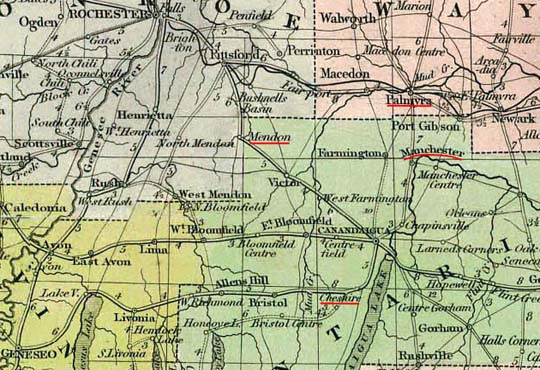
Vicinity of Mendon, New York in the 1830s (view larger map image) (view area to the west) |
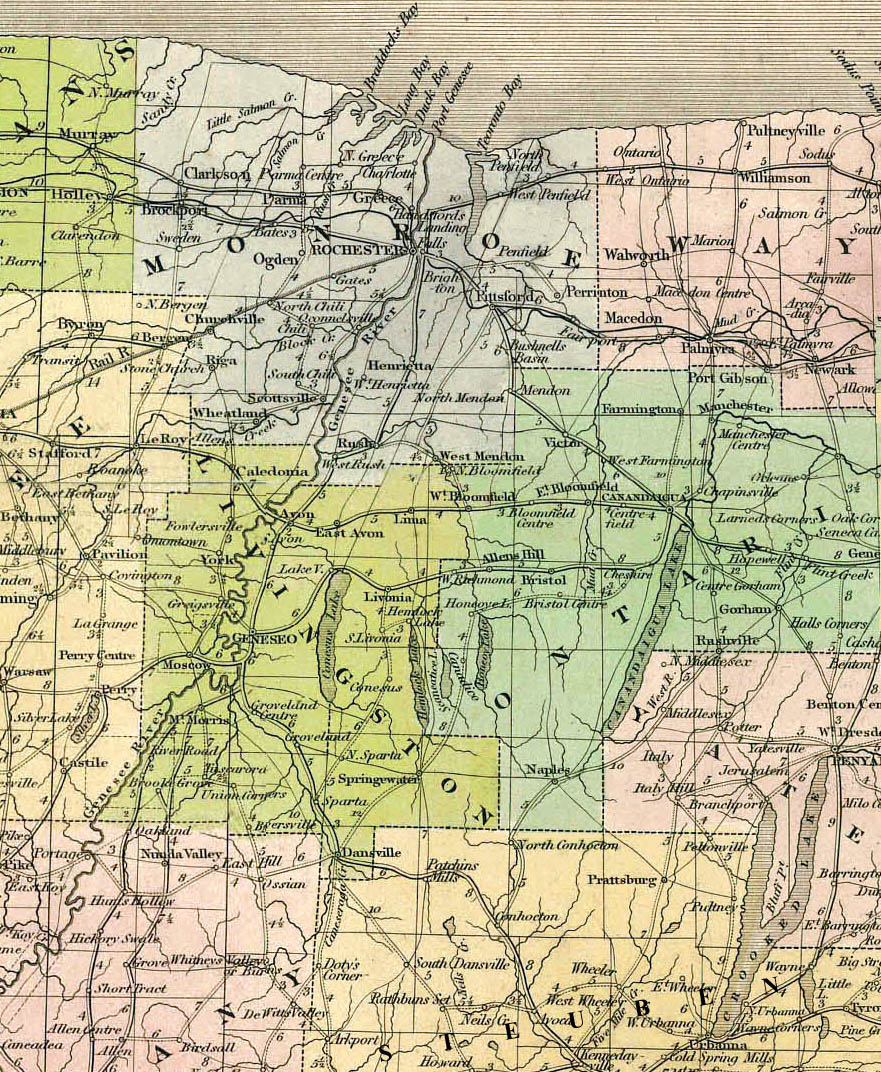
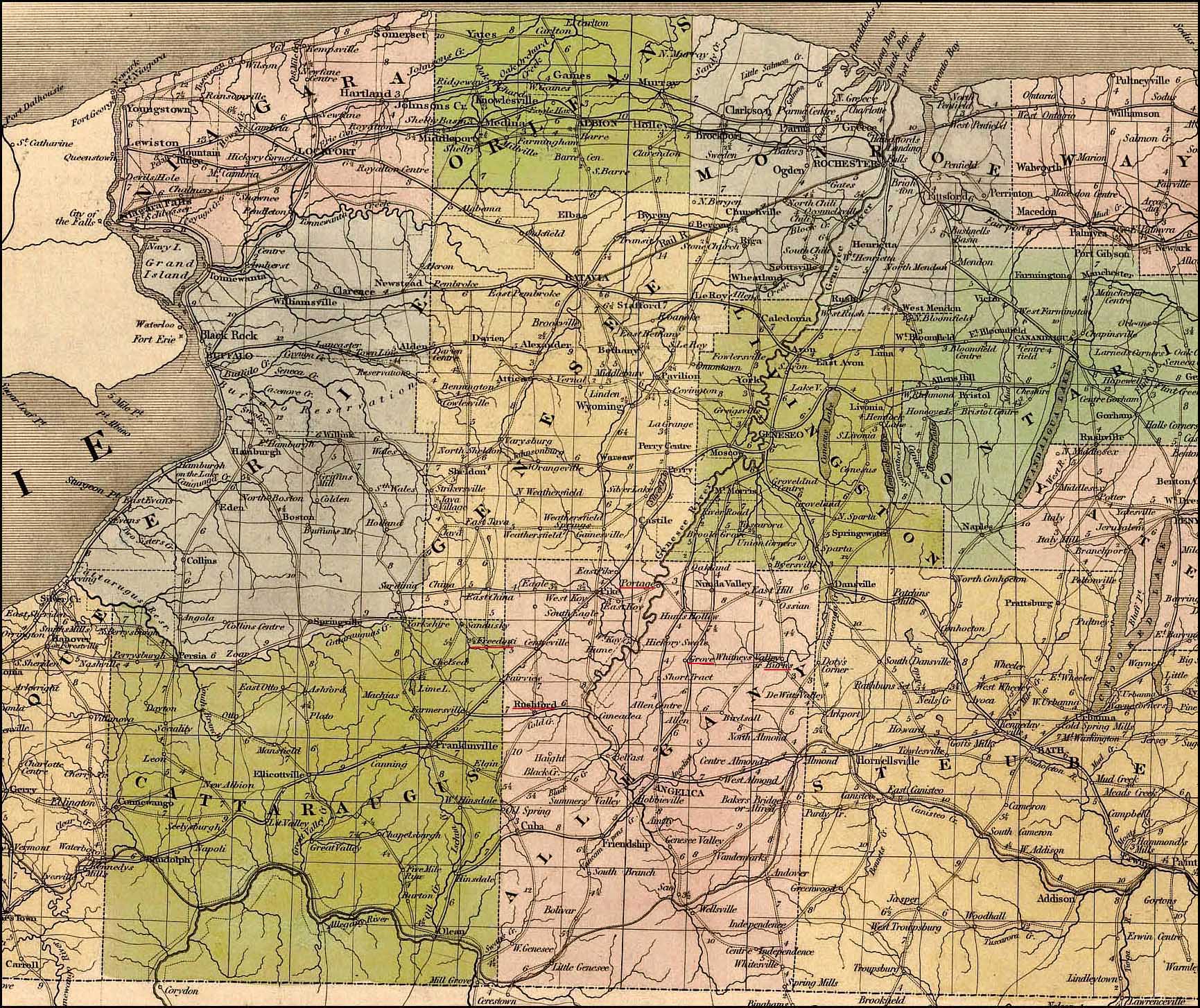
|
Surely the Lord God will do nothing, but he revealeth his secret unto the Prophets... The Lord God has spoken, but who can but prophesy?" -- AMOS. No. 23. June 4, 1864. Vol. XXVI.
HISTORY OF BRIGHAM YOUNG.
I was born in the town of Acton, Middlesex County, Massachusetts, November 1, 1799. |
|
Surely the Lord God will do nothing, but he revealeth his secret unto the Prophets... The Lord God has spoken, but who can but prophesy?" -- AMOS. No. 24. June 11, 1864. Vol. XXVI.
HISTORY OF BRIGHAM YOUNG.
I believed the Spirit of God dictated me to make a journey west. I started in company with one Benjamin Hall, who was also led by the Spirit. I went to Lima, Livingston County, New York, where I staid some three months [late 1829], and then left for home. I called on my return at Lyonstown, on a family, whose names I do not recollect. On leaving there next morning the lady enquired if I had heard of the Golden Book found by a youth named Joseph Smith. I informed her I never heard anything about it, and became very anxious to know concerning the matter. On enquiring, she told me I could learn more about it from Martin Harris, in Palmyra. |
|
Surely the Lord God will do nothing, but he revealeth his secret unto the Prophets... The Lord God has spoken, but who can but prophesy?" -- AMOS. No. 25. June 18, 1864. Vol. XXVI.
HISTORY OF BRIGHAM YOUNG.
On the arrival of the other part of the company, I was sent for by them about midnight, to doctor them, but the messenger being unable to pilot me, I had to return to my house until morning, when I was sent for again, and soon found Brother Blackslee, but too late to do him any good. He died the next day. |
|
Surely the Lord God will do nothing, but he revealeth his secret unto the Prophets... The Lord God has spoken, but who can but prophesy?" -- AMOS. No. 26. June 25, 1864. Vol. XXVI.
HISTORY OF BRIGHAM YOUNG.
In August the mob recommenced their depredations against the Saints. |
|
Surely the Lord God will do nothing, but he revealeth his secret unto the Prophets... The Lord God has spoken, but who can but prophesy?" -- AMOS. No. 27. July 2, 1864. Vol. XXVI.
HISTORY OF BRIGHAM YOUNG.
I labored continually through the months of May, June, July and August, during which time by the blessing of God, I raised some other branches, in all eighty members. Now the Lord did work with me wonderfully in signs and wonders following them that did believe in the fullness of the Gospel of Jesus Christ; insomuch that the deaf were made to hear, the blind to see, and the lame were made whole; fevers, palsies, crooked limbs and withered limbs, and in fine all manner of diseases common to the country, were healed by the power of God that was manifested through his servants. |
|
Surely the Lord God will do nothing, but he revealeth his secret unto the Prophets... The Lord God has spoken, but who can but prophesy?" -- AMOS. No. 28. July 9, 1864. Vol. XXVI.
HISTORY OF BRIGHAM YOUNG.
June 19th. About forty men armed with deadly weapons, led by Sheriff Robert C. Petty, and a Colonel and Major, with some other officers, and a Methodist priest with a gun on his shoulder; the Sheriff informed the brethren that he had a States' warrant for D. W. Patten, W. Parrish and W. Woodruff, issued on complaint of Mathew Williams the Methodist priest, who swore that those brethren had put forth the following false and pretended prophecy: 'That Christ would come the second time before this generation passed away,' and 'That four individuals should receive the Holy Ghost within twenty-four hours.' After examination brothers Patten and Parrish were bound over to appear on June 22nd under $2000 bonds. |
|
Surely the Lord God will do nothing, but he revealeth his secret unto the Prophets... The Lord God has spoken, but who can but prophesy?" -- AMOS. No. 29. July 16, 1864. Vol. XXVI.
HISTORY OF BRIGHAM YOUNG.
Elder Kimball's journal has the following: -- |
|
Surely the Lord God will do nothing, but he revealeth his secret unto the Prophets... The Lord God has spoken, but who can but prophesy?" -- AMOS. No. ? January 28, 1865. Vol. XXVII.
LAST DAYS OF OLIVER COWDERY We publish the tho following testimony thinking it may prove interesting and useful to the Elders and Saints in this Mission: -- |
|
Surely the Lord God will do nothing, but he revealeth his secret unto the Prophets... The Lord God has spoken, but who can but prophesy?" -- AMOS. No. 32. July 15, 1865. Vol. XXVII.
HISTORY OF BRIGHAM YOUNG.
Sept. 10, 1832. I was baptized by Elder Joseph H. Wakefield, and confirmed by Elder Solomon Humphrey, in the presence of my father and mother, and many of our neighbors. |
|
Surely the Lord God will do nothing, but he revealeth his secret unto the Prophets... The Lord God has spoken, but who can but prophesy?" -- AMOS. No. ? March 30, 1867. Vol. XXIX.
WHERE ARE THE TEN TRIBES OF ISRAEL?
About seven hundred and twenty years before Christ the nine and one half tribes generally called the ten tribes were taken captive by the Assyrians and led away from their own lands into Assyria. The sacred historian records this event in the following language: -- "Then the king of Assyria came up throughout all the land and went up to Samaria. and beseiged it three years. In the ninth year of Hoshea, the king of Assyria took Samaria and carried Israel away into Assyria and placed them in Halah and in Habor by the river of Gozan and in the cities of the Medes." (II Kings 17: 5, 6.) |
|
Surely the Lord God will do nothing, but he revealeth his secret unto the Prophets... The Lord God has spoken, but who can but prophesy?" -- AMOS. No. 33. August 19, 1878. Vol. XL.
ARE WE OF ISRAEL?
The belief that the Latter-day Saints hold, that the great majority of their number are of the house of Israel, and heirs to the promises made to Abraham, to Isaac and to Jacob, like many other portions of their falth, has received the ridicule of the shallow-minded and the contempt of the ungodly. However, it is not our present intention to answer such, but to seek to adduce evidence outside of the sure word of modern revelation, to prove that the Latter-day Saints have good reasons drawn from history and analogy, for believing the words of their Patriarchs who, in blessing them pronounce bounce them of the house of Abraham and of the promised seed of Jacob. |
|
Surely the Lord God will do nothing, but he revealeth his secret unto the Prophets... The Lord God has spoken, but who can but prophesy?" -- AMOS. No. 34. August 26, 1878. Vol. XL.
ARE WE OF ISRAEL?
We contend that where Israel is not under the ban of God's displeasure through its sins and follies, it leads the world. Its sons are princes among men and the ministers of God's law to all people, indeed that in it, according to the oft repeated promise, all the families of the earth will be blessed. Here we may be interrupted by our readers (for it is Latter-day Saints we are addressing) with the question if we have forgotten the ten tribes hidden by Divine Providence in the far off frozen regions of the north, and environed by a belt of snow and ice so unpenetrable that no man in modern days has reached them. Now, we have not forgotten them, and through them, we believe, as through Lehi and others, have the promises of God to Jacob and Joseph been partially fulfilled. But we ask further, is it altogether improbable that in that long journey of one and a half years, Esdras states it, from Media, the land of their captivity, to the frozen north, some of backsliding Israel rebelled, turned aside from the main body, forgot their God, by and by mingled with the Gentiles and became the leaven to leaven with the promised seed all the nations of the earth? The account given in the Book of Mormon of a single family of this same house, in its waywardness, its stiff-neckedness before God, its internal quarrels and family feuds are, we fear, an example on a small scale of what most probably happened in the vast bodies of Israelites who for so many months wended their tedious way northward. Laman and Lemuel had "no doubt" many counterparts in the journeying ten tribes. And who so likely to rebel as stubborn, impetuous, proud and warlike Ephraim. Rebellion and backsliding have been so characteristically the story of Ephraim's career that we can scarcely conceive that it could be otherwise and yet preserve the unities of that people's history. Can it be any wonder then that so much of the blood of Ephraim has been found hidden and unknown in the midst of the nations of northern Europe and other parts until the spirit of prophecy revealed its existence? But before proceeding further in our research, it may be well to insert the words of one having authority, to the effect that the Latter-day Saints are of Ephraim; to adduce ideas and reasons to substantiate this statement will be our pleasure as we proceed along. |
|
Surely the Lord God will do nothing, but he revealeth his secret unto the Prophets... The Lord God has spoken, but who can but prophesy?" -- AMOS. No. 35. September 2, 1878. Vol. XL.
ARE WE OF ISRAEL?
The idea, though widely diffused, that many of the races inhabiting Europe are impregnated with the blood of Israel, is by no means a new one. Many writers in their researches into the early history of that continent have been forcibly struck with the similarity that existed between the laws, manners, customs, etc., of the ancient inhabitants of its northern and northwestern portions and those of ancient Israel. These writers have endeavored to account for this peculiarity in two ways. First, by the supposition that Israelitish colonies, for various causes, left the land of their inheritance and gradually worked themselves north and north-westward over Europe; and second by the argument that remnants or branches of the lost ten tribes had emigrated emigran from Media into Europe, and through the ignorancee of historians, disguised under other names, they had remained unknown until the present, their habits, customs, traditions, etc., having in the meanwhile become so greatly changed by time and circumstance as to render them unrecognizable at this late day. |
|
Surely the Lord God will do nothing, but he revealeth his secret unto the Prophets... The Lord God has spoken, but who can but prophesy?" -- AMOS. No. 36. September 9, 1878. Vol. XL.
ARE WE OF ISRAEL?
It being thus admitted that the people of one Grecian state were of the family of Abraham, students of history have endeavored to trace Israel to other parts. The inhabitants of the Ionian Commonwealth, one of the most enterprising communities of Ancient Greece are claimed to have been of Israelitish... |
|
Surely the Lord God will do nothing, but he revealeth his secret unto the Prophets... The Lord God has spoken, but who can but prophesy?" -- AMOS. No. 37. September 16, 1878. Vol. XL.
ARE WE OF ISRAEL?
Having traced the ten tribes to Media, the next question is, what has become of them for they are not to be found in that land to-day. Many attempts have at various times been made to discover the ten tribes of Israel as a distinct community, but all have failed. Josephus (Antiquities xi,) believed that in his day they dwelt in large multitudes somewhere beyond the Euphrates, in Asareth, but Asareth was an unknown land to him. Rabbinical traditions and fables, committed to writing in the middle ages, assert the same fact, with many wonderful amplifications. The imaginations of certain Christian writers have sought them in the neighborhood of their last recorded habitation. Jewish features have been traced in the Afghan tribes; rumors are heard occasionally of Jewish colonies in China, Thibet and Hindostan (the Beni-Israel,) whilst the black Jews of Malabar claim affinity with Israel. But none of these people would in any but the slightest degree, fill the place accorded in the prophecies to Ephraim and his fellows. |
|
Surely the Lord God will do nothing, but he revealeth his secret unto the Prophets... The Lord God has spoken, but who can but prophesy?" -- AMOS. No. 38. September 23, 1878. Vol. XL.
ARE WE OF ISRAEL?
Hence they determined to go to a country "where never man dwelt," that they might be free from all contaminating influences. That country could only be found in the north. Southern Asia was already the seat of a comparatively ancient civilization. Egypt flourished in Northern Africa, and Southern Europe was rapidly filling with the future rulers of the world. They had, therefore, no choice but to turn their faces northward. The first portion of their journey was not however north; according to the account of Esdras, they appear to have at first moved in the direction of their old homes, and it is possible that they originally started with the intention of returning thereto, or probably in order to deceive the Assyrians they started as if to return to Canaan, and when they had crossed the Euphrates, and were out of danger from the hosts of the Medes and Persians, then they turned their journeying feet toward the polar star. Esdras states that they entered in at the narrow passage of the river Euphrates, the Lord staying the "springs of the flood" until they were passed over. The point on the River Euphrates at which they crossed would necessarily be in its upper portion, as lower down would be too far south for their purpose. |
|
Surely the Lord God will do nothing, but he revealeth his secret unto the Prophets... The Lord God has spoken, but who can but prophesy?" -- AMOS. No. 39. September 30, 1878. Vol. XL.
ARE WE OF ISRAEL?
Having considered the cause that led the outcasts of Israel to determine to seek a home in a new and uninhabited land, we may be excused if we endeavor to follow them in fancy in their journey northward. We have no way of accurately estimating their numbers, but if the posterity of all those who were carried into captivity started on this perilous journey, they must have formed a mighty host. Necessarily they moved slowly. They were encumbered with the aged and infirm, the young and the helpless, with flocks and herds, and weighed down with provisions and household utensils. Roads had to be made, bridges built, and the course marked out and decided by their leaders. (Jesus distinctly states to the Nephites, that these tribes were led "by the Father out of the land.") Inasmuch as they had turned to the Lord and were seeking a new home wherein they could the better serve nim, they were doubtless guided by inspired leaders, who, by Urim and Thummim, or through dreams and visions, pointed out the paths ahead. Perhaps, as in the days of the deliverance from Egypt, a pillar of cloud by day and of fire by night guided their footsteps; no matter the means, the end was accomplished, and slowly and gradually they neared the frozen regions of the Arctic zone. The distance in a direct line from the conjectured crossing of the Euphrates to the coasts of the Arctic Ocean, would be about 2,800 miles, or a seven months' journey, averaging 15 miles a day. But according to Esdras, one year and a half was consumed in the journey, which is an evidence that they were encumbered with families and cattle, who could only travel slowly and for whom many resting places had to be found where they could recuperate. It is highly probable that, like modern Israel in its journey westward to the valleys of Ephraim, they planted temporary colonies by the way, where the weary rested, and crops were raised for future use. |
|
Surely the Lord God will do nothing, but he revealeth his secret unto the Prophets... The Lord God has spoken, but who can but prophesy?" -- AMOS. No. 40. October 7, 1878. Vol. XL.
ARE WE OF ISRAEL?
It is very evident from the above quotation that Ephraim or at least a large portion of that tribe, had at some period of his history, separated from the rest of the tribes of Israel, and at the time of this restitution was to dwell in a land far from the north country in which the residue were hidden. These tribes are to have the frozen barriers of the north melted, so that they shall flow down, then a highway is to be cast up for them, in the midst of the great deep, next they cross barren deserts and a thirsty land and eventually arrive with their rich treasures at the home of Ephraim, the first born of God of the house of Israel, to be crowned with glory at his hands. |
|
Surely the Lord God will do nothing, but he revealeth his secret unto the Prophets... The Lord God has spoken, but who can but prophesy?" -- AMOS. No. 41. October 14, 1878. Vol. XL.
ARE WE OF ISRAEL?
As the question "hat became of the ten tribes?" still remains to the world an unanswered historical enigma so also is the question unanswered "whence originated origined the vast hosts of so called barbarians who, descending from the frigid regions of Scandinavia filled Europe with new races, new laws, new ideas, new languages, and new institutions!" Some have traced a connection between the loss of the one people and the advent of the other, and one author of repute -- Mr. Searon Turner -- extensively quoted in this connection, claims that the original home of the Anglo-Saxons was in the very country where Israel is historically lost, and further states that these people commenced their migration therefrom about the same time as the tribes of Jacob must have taken their journey northward. |
|
Surely the Lord God will do nothing, but he revealeth his secret unto the Prophets... The Lord God has spoken, but who can but prophesy?" -- AMOS. No. 42. October 21, 1878. Vol. XL.
ARE WE OF ISRAEL?
it would be almost impossible to enumerate the multitude of likenessesthat have been found by authors predisposed in that direction, between the habits, manners, customs, personal appearance, etc., of the israelites and Anglo-Saxons. To give even a cursory glance at these identifications would occupy more space than we feel would be desirable. We will simply mention a few that have been advanced by various writers and then proceed to a short consideration of their laws. It may be observed however that some of their identifications are very remarkable, whilst others in our opinion are puerile, and would be advanced by none but zealots. Great similarity has been claimed between the form of the Jewish and Saxon heads and the great beauty of both races has been advanced as a proof of common ancestry. The style of dress of the early northern European nations has also been claimed to be distinctively Israelitish. The care with which both people kept their records or chronicles has also been largely commented upon. One author claims connection between the two in the manner that they mustered their forces in battle and their love of distinctive or tribal banners... (under construction) |
|
Surely the Lord God will do nothing, but he revealeth his secret unto the Prophets... The Lord God has spoken, but who can but prophesy?" -- AMOS. No. 44. November 4, 1878. Vol. XL.
ARE WE OF ISRAEL?
Among the Anglo-Saxons the theory of their constitution seems to have been that every ten men or heads of families, should chose one from among them to act for them in the council of their little community, consisting generally of ten such compartments or wards. Ten of these wards formed a tything or parish. And ten of these tythings formed a hundred, the elders of which thus chosen were supposed to meet for the management of matters belonging to the ten tythings in general; whilst each tything took charge of the affairs that especially belonged to itself. The country which was still more extensive corresponded to the tribe in Israel. The word, county, or compte, seems to be derived from the Hebrew word signifying, to rise up, to stand -- and refers to the rod or ensign. of the tribe to which they congregated themselves, in the larger assemblies of the people * * * The nation of Israel we have seen, were, at an earlier period of their history given proper rules for their association, such as were equally adapted for a small society or for a large one. The people were given to have a mutual oversight of each other in tens; each ten had one who represented and acted for them. See 1st chap. Deuteronomy... (under construction) |
|
Surely the Lord God will do nothing, but he revealeth his secret unto the Prophets... The Lord God has spoken, but who can but prophesy?" -- AMOS. No. 45. November 11, 1878. Vol. XL.
ARE WE OF ISRAEL?
Before proceeding further we wish to remark, that we trust no one will imagine from reading these chapters, that we believe that the literal descendants of Abraham will be the only ones saved in the kingdom of God. To the contrary we are fully aware that God has made of one blood all the nations of the earth and realize that all men of every clime and age may be partakers of the priceless blessings resulting to fallen humanity from the glorious sacrifice on Calvary. We also firmly believe that within the scope of the Gospel covenant are provisions, and ways and means, by which the obedient of all races become the recognized children of Abraham, and heirs by adoption to all the God-given promises to that patriarch. John the Baptist told the degenerate Jews of his day who were boasting of their Abrahamic descent, that of the very stones in the roadway, if it so pleased him, God could raise up children unto Abraham. All we claim for Israel, no more no less, is is the fulfilment of God's covenant with the father of the faithful which covenant. modern revelation lays before us in the following language: |
Back to top of this page.
Articles Page | Articles Index | History Vault
Oliver's Bookshelf | Spalding Library | Mormon Classics
last updated: Oct. 2, 2007