READINGS  IN  EARLY  MORMON  HISTORY
(Newspapers of United Kingdom)


Misc. United Kingdom Papers
1800-1849 Articles


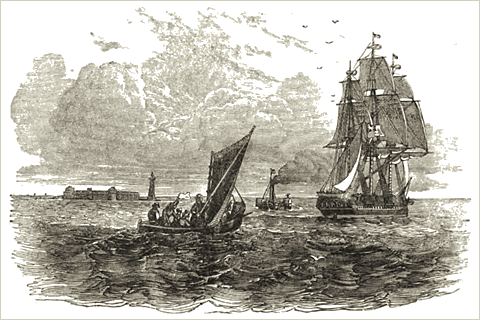
An Emigrant Ship Leaving Liverpool Harbor
("Route From Liverpool..." -- F. Piercy, 1855)


1800-1849   |   1850-1899   |   1900-1999

(please submit old U. K. articles on the Mormons to the web-host, for posting on this page)


MxLib Oct 03 '40  |  NSMer Aug ? '41  |  SJChr Aug 26 '41
MS Aug '42  |  ILNews Aug 31 '44  |  MS May 01 '46
MS May 15 '46  |  MS Oct 15 '46  |  MS Nov 01 '46
MS Nov 15 '46  |  MS Nov 29 '46  |  MS Mar 15 '47
MS Nov 29 '47  |  MS Jan 01 '49


Return to Old Newspaper Articles Index


MANX  LIBERAL.
Vol. ?                          Douglass, Isle of Man, October 31, 1840.                           No. ?


FRIENDLY CAUTION -- Mormonism!

To the Editor of the Manx Liberal. ---

Sir,

I feel rather surprised and chagrined that that modern delusion, viz: "Mormonism," should have made such rapid strides in this town, hitherto considered exempt from the many systems of irreligious creeds which abound in England, America, and elsewhere. I had thought that the powerful and argumentative addresses of the dissenting ministers would have checked such a gross piece of imposition in its infancy, and thus prevented the great mass of our towns people from becoming the dupes of designing knaves, "and being led away by every wind of doctrine;" Above all, I imagined the two pamphlets issued by that holy, religious and devout man of God, Mr. Hays, Wesleyan minister, (to which connection I have the happiness and honor to belong,) would have been quite sufficient to prove the fallacy of such a system, and prevent its further spread -- but sir, alas! alas! the case is quite the reverse, numbers continually flock to the Wellington room and listen with eagerness to the principles there advocated; the members of our society (Methodist) seem to be most conspicuous in sanctioning and promoting this vile and abominable doctrine.

Oh, sir, the results to our connection will be dreadful! the havoc tremendous! just think of the majority of our leading and intelligent men aiding and abetting a cause of this description! Oh sir! lamentable and heart rending to witness the beaming countenances and smiles of approbation displayed recently at Taylor's meeting! I could innumerate a host of our members who regularly attend those anti-christian meetings -- but I will just mention with your permission the names of a few who attended one of the last meetings. (Here followed a list of names) O Mr. Editor! I quake for the consequences -- such a wholesale conversion to Mormonism was never before witnessed in any town or country: what will become of our society? what will become of our class meetings? what will become of our brethren in the faith? and above all, what will become of poor Mr. Hays, that nice and humble man, who so nobly stood forward to expose the errors of the Mormon system -- God bless him, and preserve him from want! but Mr. Editor, what makes the case worse, is, that a rumor is prevalent that all these pious men are to be BAPTIZED! that is duly Immersed the salt water of Douglas Bay, by that abominable creature, Taylor.!! surely, there must be something enchanting about the vile man -- IMMERSION!! (my hand shakes while I write) and in winter too, Oh sir! the thought chills my very soul, -- surely this American dipper intends to drown them -- he can have no other object in view, therefore, brethren of the Methodist society, beware!! drowning is not to be envied and that too in your sins-besides what would the venerable John Wesley (if he were alive) say to such conduct? what will the Conference say? and what will the world say? I leave these questions to yourselves to answer, -- in conclusion brethren, I recommend you to read much, learn and inwardly digest the things which belong to your eternal peace, and listen no longer to the follies of men.
                                                   A STANCH WESLEYAN.


Note 1: In the Feb. 1. 1841 issue of the Nauvoo Times & Seasons, Elder George A. Smith (then on a mission in the United Kingdom) says: "Elder Taylor and Clark are on the Isle of Man-the work is prospering there, they have met with a great deal of opposition with the Wesleyans and Ranters. The Editor of the Manx's Liberal has published several lengthy communications for Elder Taylor in defence of the truth..." On or about Oct. 7, 1840 the Liberal published John Taylor's apologetic pamphlet An Answer, &c., in which Taylor responded to Rev. Robert Heys' Address to the members of the Wesleyan Societies and Congregations in Douglas and its vicinity, on the subject of Mormonism.

Note 2: The Liberal appears to have been less than enthusiastically supportive of the Wesleyan Methodist Society and thus provided Taylor a public forum for his Mormon preaching. Several letters written to the Liberal by Mr. J. Curran, and published in that paper in Oct. 1840, were replied to by Elder John Taylor. Taylor's rebuttal to various contemporary anti-Mormon statements was printed in the Liberal and then reissued in some LDS tracts. See, for example, Taylor's 1840 pamphlet, An Answer to Some False Statements (printed by the LIberal), for an early LDS defense against the Spalding claims for Book of Mormon authorship, etc.


North  Staffordshire  Mercury.
Vol. ?                          Newcastle, England, February ?, 1841.                           No. ?


DIFFERENCE BETWEEN THE BAPTISTS
& LATTER-DAY SAINTS.

SIR, -- In a late publication, you reported the case of some persons who were taken before T. B. Rose, Esq. for disturbing a congregation of "Latter-Day Saints," or believers in the "Book of Mormon." A teacher of that sect, on being asked by the magistrate wherein they differed from the Baptists, replied, "In the laying on of hands" but declined making an honest confession of those peculiarities which separate them as widely from the Baptists, as from every other denomination of the christian church. -- This was certainly prudent; but as the Baptists feel themselves dishonoured by such an alliance, they would be unjust to themselves were they to leave unanswered such a libel upon their denomination. The following very prominent marks of difference will enable your readers to judge for themselves.

I. -- The Saints admit all persons indiscriminately to baptism, encouraging them to pass through that rite, with the promise that great spiritual improvement will follow. They baptize for remission of sins, without waiting for credible evidence of repentance for sin. But the Baptists admit none to that ordinance who do not exhibit this qualification in the most satisfactory manner; and if they found a candidate looking to the water of baptism as having virtue to cleanse him from sin, he would be put back until better instructed.

II. -- After baptism the Saints kneel down, and their priest laying on his hands, professes to give them the Holy Ghost. If effects similar to those produced by the laying on of the Apostles' hands were seen to follow, skepticism must yield to the force of such evidence; but in their case no such effects are produced; the baptized sinner is a sinner still, though flattered and deluded with the epithet "Latter-day Saint." The Baptists regard such mummery with as much disgust as all Christians do.

III. -- Having, as they suppose, the extraordinary gifts of the Spirit, the Saints consistently pretend to have the power of working wonders, and profess to heal the sick with Holy Oil; also to the power of prophecy. As most moral evils bring with them their own remedy, these lofty pretensions will ruin them in due time, by opening the eyes of the most deluded, as in the case of the countless sects of imposters who have appeared upon the stage before them. It need not be added, that the Baptists stand far removed from such conceits, and have no part in them.

IV. -- Not satisfied with the Bible, as complete revelation from God, the "Latter-day Saints" have adopted a romance written in America, as a fresh revelation, and have added a trashy volume of 600 pages to the Book, which we are forbidden to add to, or take from, under the most awful penalties! But even this is not enough for their impious presumption. They have published a monthly magazine, in which "new revelations" are served up fresh as they arrive, for the use of all who can swallow them. -- The disgust with which the Baptists regard such a melancholy exhibition of human folly and wickedness, separates them to an impassable distance from such people.

V. -- In order to carry on this order of things, the Latter-day Saints have appointed two Priesthoods. "The lesser, or Aaronic Priesthood, is to hold the keys of the Ministering of Angels, and to administer in outward ordinances." "The power and authority of the higher, or Melchisedeck Priesthood, is to hold the keys of all the Spiritual Blessings of the Church -- to have the privilege of receiving the mysteries of the Kingdom of Heaven -- to have the Heavens opened to them-to commune with the general assembly and Church of the Firstborn; and to enjoy the communion and presence of God the Father, and of Jesus the Mediator of the New Covenant." So that in this wonderful priesthood, they have provided for an ample supply of new things in endless variety, and without end, from the hands of wretched men, who blasphemously aspire to a dignity which belongs alone to Him who is the only "Priest for ever after the order of Melchizedeck."

The fear of trespassing upon your valuable columns, Mr. Editor, prevents my enlarging upon these and very many other points of difference; but enough has been done to shew [show] your readers, that no two sects can differ more widely from each other, than the Baptists and Latter-day Saints; and that to confound them in any way together is not only unjust to the former, but involves them in the disgrace of being partakers in a bold imposition, or a pitiable delusion, which they regard with equal abhorrence and disgust.
                                                   A BAPTIST.
Hanley, Feb. 16, 1841.


Note: The exact date for the publication of the above letter in uncertain; presumably it was printed in mid February. The text comes from its reprint in the Oct. 1, 1842 issue of the Times & Seasons.


ST.  JAMES'  CHRONICLE.
Vol. ?                                London, August 26, 1841.                                 No. ?


THE  MORMONS.

(A disgruntled British Mormon -- under construction)


Note: This article gives a lengthy account of an English farmer who joins the Mormons, moves to Nauvoo in America, becomes disillusioned with the sect and returns to Liverpool.


EDITED AND PUBLISHED BY P. P. PRATT AND T. WARD.
36 CHAPEL STREET, LIVERPOOL.
No. 4.                                     Liverpool, August, 1842.                                     Vol. III.


[p. 73]
APOSTACY. -- The spirit of apostacy has been quite prevalent of late, principally among those who have emigrated from England to America. They are first seized with a murmering and fault-finding spirit towards those who have suffered perils and privations, by sea and land, for them and for the cause of truth. These they seek to injure by all manner of evil speaking and railing accusation. Next they find fault with their sea voyage and the provisions and sea stores, as being either too scarce or not fitted to their appetite. Next they find fault with the country; because it does not produce furnished houses and paved streets, and all manner of riches and luxuries spontaneously, without their labour or their pains; and, last of all, they find fault with the servants of God, who have spent a dozen or twenty years in the service of the people, and suffered the loss of all things, time and again, for Christ's sake and the gospel's, because they have a house, a home, a farm, a horse and carriage, or suit of clothes, and will not give it to them, or lay it aside to work and build them houses and feed them. These they pronounce the wickedest men in the world, and they write back to this country all manner of evil concerning them.

Among the most conspicuous of these apostates, we would notice a young female who emigrated from Manchester in September last, and who, after conducting herself in a manner unworthy the character of one professing godliness, at length conceived the plan of gaining friendship and extraordinary notoriety with the world, or rather with the enemies of truth, by striking a blow at the character of some of its worthiest champions. She well knew that this would be received as a sweet morsel by her old friends, the Methodists, and other enemies of the Saints. She accordingly selected president J. Smith, and elder B. Young for her victims, and wrote to England that these men had been trying to seduce her, by making her believe that God had given a revelation that men might have two wives; by these disreputable means she thought to overthrow the Saints here, or at least to bring a storm of persecution on them; but in this thing she was completely deceived by Satan. Her proceedings have had no other effect upon the Saints, than to fill them with mingled feelings of pity and contempt towards her, and to make them more diligent and faithful to the cause of God. Their meetings are well attended with crowded and attentive audiences -- the power and spirit of God is in their midst -- they are filled with the testimony of Jesus, and with a desire to emigrate and settle among the Saints in America. Many are coming forward for baptism from week to week, both in Manchester and in Liverpool. However, we will do her the justice to say, that her letters had had some effect upon several of her relatives and three or four persons have left the church, perhaps, partly through the influence of these and other reports from apostates and murmurers; and if any such thing can tuen any others from the faith, we shall be very happy to part with them, as

"We want no cowards in our band,
  That will their colours fly;
We call for valiant-hearted men,
  Who're not afraid to die."
But, for the information of those who may be assailed by those foolish tales about the two wives, we would say that no such principle ever existed among the Latter-day Saints, and never will; this is well known to all who are acquainted with our books and actions, the Book of Mormon, Doctrine and Covenants; and also all our periodicals are very strict and explicit on that subject, indeed far more so than the bible.

The following is an extract from a letter written by the sister of the female before mentioned, which will enable the Saints to judge of the confidence to be placed in her slanderous statements.

                                                              Nauvoo, April 20th. 1842.
"Dear ______, We arrived here three weeks ago; I thought I would not write until I had seen the prophet, and attended the meeting in Nauvoo. I have now been at the meetings three sabbaths, and have had the pleasure of attending the conference which continued for three days; and I have had the pleasure of hearing brother Joseph speak, and I consider that one hour's speech rewarded me for all the afflictions I endured while on the mighty deep. I have no doubt but you have heard I was sick almost all the passage, but I have reason to thank God that I was afflicted, for in the night season when sleep was taken from me, the Lord manifested himself to me in a manner I cannot express; it might have been that if the Lord had not shewn me these things I might have stumbled with the lying reports that are in circulation. I suppose, by this time, you will have heard that my parents and sister have aspstatized. I know not what they have written to England, as they would not let me see their letters, but I can prove that my sister has told some of the greatest lies [that President Joseph Smith secretly practices polygamy, etc.] that ever were circulated."


"Dear ______, these are trying times for us all, but I know this is the work of the living God, and though earth and hell should combine to stop its progress, they cannot prevail. I beg of you not to listen to reports, but know for yourself, for I believe it is your privilege. O! how I long to see you and enjoy your society, and unbosom all my care to you. My parents have turned their backs upon me, because I would not leave the Saints, and have told my elder sister not to own them until she abandoned 'Mormonism;' but with all this she is unmoved, and is still contending for the faith once delivered to the Saints, for she and many other of the English Saints have proved that the statements made by my sister [that Brigham Young asked her to be his plural wife, etc.] are falsehoods of the basest kind.


Correspondence
__________

LETTERS  FROM  NAUVOO.

We have seen many interesting letters from Nauvoo of late, which would, no doubt, be interesting to our readers, but we have only room for the following extracts --

Elder William Clayton writes to William Hardmen, dated Nauvoo, March 30th, as follows: --

Dear William, -- My heart rejoices while I write to inform you that, on Sunday evening last, the steamer Ariel landed at Nauvoo, loaded with Saints from England... I soon recognized sister Davies, from Cookston-street, Manchester, and a sister Martha who lived with them; also James Burgess and family, Rbt. Williams and wife, and several others whom I knew...

You say you are almost wearied with the lies, &c. This is what we must expect in these days, for this is a lying and wicked generation; and many, in whom we may have great confidence, when we see them brought into trial, give way to an evil spirit. Old Mr. B______ [Thomas W. Brotherton (1783-1858)] and daughter, like many others, were assailed by the apostate crews, who lay scattered on the banks of the river; and all manner of evil reports were sounded in their ears, until they became discouraged; and, finally, almost denied the faith before they came near Nauvoo.

People coming here with their minds thus prejudiced, will naturally construe every thing they see and hear into evil, and will imagine evil where there is none. In this state the B_____ton family came, and were something like spies, afraid to be spoken to by any one, lest they should be ensnared, and especially afraid to meet Joseph Smith, lest he should want their money. After remaining a short time here, they went back to Warsaw, where some of the greatest enemies reside, and, I am sorry to say, have joined in the general clamour and business of circulating evil reports, some of which [that Joseph Smith secretly practices polygamy, etc.] I, MYSELF. KNOW POSITIVELY TO BE FALSE.

For me to write anything concerning the character of president Joseph Smith would be superfluous. All evil reports concerning him I treat with utter contempt...


Note 1: If Thomas W. Brotherton's family sailed from England, in 1842, on the same LDS immigrant ship as did James Burgess and Robert Williams, then that would have been the U. S. S. Chaos, which departed Liverpool on Nov. 8, 1841 and arrived at New Orleans on Jan. 14, 1842. It frequently took the English immigrants two to three weeks to obtain transportation up the river to St. Louis and then on to Nauvoo. But a Mar. 27, 1842 arrival date in Nauvoo (on the Ariel) for the Brotherton family sounds rather late. The Brothertons are not listed among the Mormon passengers on the U. S. S. Chaos.It appears that one son of Thomas W. Brotherton, a "Joseph Brotherton," came over from England on the next ship after the Chaos -- the Hanover, which landed at New Orleans on May 2, 1842. Like his sisters Elisabeth and Sarah, Joseph remained a Mormon.

Note 2: Thomas W. Brotherton was born in England in 1783; in 1812 he married Sarah Hamilton and their family resided in Manchester until they left England for Nauvoo in 1841. Their son Joseph may have been the first family member to join the Mormons -- he was baptized in Manchester on Oct. 11, 1840. Another son, Edward Brotherton (1814-1866) probably never joined; he was the author of the 1845 anti-Mormon booklet, Mormonism, its Rise and Progress. Elisabeth Brotherton (1816-1897) was the writer of the two letter extracts published by the Star. Although she testifies that her sister Martha lied about spiritual wifery at Nauvoo, Elisabeth herself become the second plural wife of Apostle Parley P. Pratt in June or July of 1843 at Nauvoo -- this was six months after his arrival back in America, after leaving his editor's post at the Star. Like her parents, Martha H. Brotherton soon returned (reportedly via Boston) to England, where she passed away in 1864. After he heard of her death, Brigham Young quietly had the deceased Martha sealed to him, on August 1, 1870, "for eternity" -- "beyond the veil."

Note 3: In several months that followed, before his departure from England, the Star's editor appears to have overlooked his fellow Apostle's reporting on Martha H. Brotherton, as published in the Aug. 27, 1842 issue of The Wasp. There William Smith reports that "in these United States... John C. Bennett, the pimp and file leader of such mean harlots as Martha H. Brotherton and her predecessors... flourish with impunity!" Apostle Smith neglects to indicate exactly when it was that Sister Brotherton became a prostitute, with John C. Bennett as her pimp, however. In her July 13, 1842 affidavit, Miss Brotherton states "I had been at Nauvoo near three weeks, during which time my father's family received frequent visits from elders Brigham Young and Heber C. Kimball, two of the Mormon apostles; when early one [Saturday] morning [Young said] ..."brother Joseph has had a revelation from God that it is lawful and right for a man to have two wives." According to the Apr. 15, 1842 issue of the Times and Seasons, on Thursday, Apr. 7, 1842, at the spring conference in Nauvoo, Hyrum Smith "spoke concerning the elders who went forth to preach from Kirtland... [and] then spoke in contradiction of a report in circulation about Elder Kimball, B. Young, himself, and others of the Twelve, alledging that a sister had been shut in a room for several days, and that they had endeavored to induce her to believe in having two wives." It appears likely that the Saturday on which Miss Brotherton places the attempted seduction was Mar. 26, 1842. It must have taken a couple of days for "the report" Hyrum repudiates to have been "in circulation," before William Clayton was inspired to write to the Saints back in England, reporting the apostasy of the Brotherton family on Mar. 30, 1842 -- then Hyrum Smith gave an official public response for the LDS Church on Apr. 7th. Since Miss Brotherton says that the attempted seduction occurred "near three weeks" after the family's advent in Nauvoo, their arrival in that place may have been about the first week of March -- thus, they did not arrive with the Chaos Saints, on the Ariel on Mar. 27, 1842, and probably never were a part of that LDS immigrant group. Thus, the time range during which Martha H. Brotherton could have been a prostitute under the pimping of John C. Bennett seems to have been about early March, 1842 (when she arrived in the region of Nauvoo) and August, 1842, when the Apostle of the Church of Jesus Christ of Latter Day Saints so identified ---- that is, unless the Apostle was not telling the truth in this matter.

Note 4: See also the testimony of John McIlwrick, Mary Brotherton McIlwrick, and We Elizabeth Brotherton in the Nauvoo Wasp broadside "extra" of Aug. 31, 1842, where Martha's two LDS sisters and her brother-in-law denounce her as "a deliberate liar;" as "a wilful inventor of lies;" and a circulator of "lies of a base kind, concerning those whom she knew to be innocent." These family members also accuse Martha as acting outside of "common decency," by "lying on the top of a young man when he was in bed," etc.

Note 5: The editors of the Latter Day Saints' Millennial Star were still insisting that there was nothing remotely similar to polygamy, plural marriage, spiritual wifery, or the patriarchal order of marriage being practiced in the LDS Church, nor among its leaders, nor within its priesthood, as late as its issue for Jan. 15, 1850, wherein Elder Thomas Smith professed: "...12th LIE: Joseph Smith taught a system of polygamy... 13th LIE: That Joseph Smith tried to seduce Martha Brotherton... Martha Brotherton's sister sent a letter, stating that Martha was a liar; William Clayton did the same. Both are published in the Millennial Star, Vol. 3, pages 73, 74." The top leadership of the RLDS Church (Community of Christ) still refuse to make any official admission of Joseph Smith's secret polygamy. Neither the LDS Church nor the RLDS Church have ever retracted the officially issued statements of 1842, claiming that Sister Martha H. Brotherton was a liar and a whore.


No. ?                      For the Week Ending, Saturday, August 31, 1844.                       Vol. III.


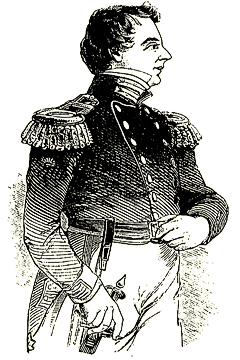
"JOE SMITH," THE MORMON PROPHET.

The murder of this popular fanatic has been already recorded in our journal.
The numbers who adhered to him, a few months ago, amounted to twenty


THE LATE "JOE SMITH," THE MORMON PROPHET.

thousand, and formed themselves into a town, called the City of Nauvoo. A code of Mormon laws was drawn up for its government. Joe Smith was Mayor, or Theocrat; and the influence of the prophet prevailed so widely that he commanded a majority of votes in the state of Illinois, and started for the office and dignity of President of the United States, with no mean prospects of success. In the spring-tide of his popularity he indulged in the most sensual excesses: he justified his licentiousness on each occasion of its notoriety by pretending to a new revelation from heaven; and twenty thousand Americans believed his lies and defended his conduct. The Nauvoo Expositor was got up by a knot of seceders, and, owing to its representations and other evidences, the fanatic Smith had to seek refuge in a prison from an infuriated mob. In prison, however, he was murdered in cold blood.

Joe Smith, according to his own statement, was born in the town of Sharon, Vermont, on the 23rd of December, 1805, so that at the time of his death he must have nearly entered his fortieth year. His parents, when he was ten years of age, emigrated to Palmyra, where he resided until he was twenty-one years old. Joe Smith, being probably the son of poor parents, of quick natural powers and sagacity, but of limited education, must have been thrown upon his own resources for means of existence at an early period: for we find him pretending to have discovered the Book of Mormon in Ontario County, in 1827. General Bennett, an influential Mormon, published a work in 1842, in which he exposed the iniquities of Joe Smith, in connection with Mormonism. From an affidavit of Peter Ingersoll in 1833, we learn that he lived in the neighborhood of Joe Smith, senior, from 1822 to 1830, and represents that the general employment of the family was digging for money. Joe had found a miraculous stone, which he averred by looking into he could discover hidden treasures.

With such a character and such a family and such pursuits, Joe Smith began his great scheme of trickery and delusion in Mormonism; the book itself is a mass of absurdities, written in imitation of the style of the Bible, in which Joe was proclaimed a prophet and priest of the Most High, and thus he drew around him a vast body of uneducated enthusiasts, who journeyed west to commence their operations on a grand scale. The history of Mormonism since its establishment in the Western States, the bussing of the city of Nauvoo, the increase of the deluded followers of Joe Smith, his conflicts with the authorities of the States of Missouri and Illinois, his indomitable spirit of intrigue and mischief, his loose morals, violence, and chicanery, have been the subject of newspaper discussion for the last seven years.

It is evident that Joe Smith contemplated, whenever he had sufficient force, to conquer several of the Western States, and erect there a Mormon empire; and he organized his Nauvoo legion, amounting to several thousand men, with this object. He was a source of constant inquietude to the State of Missouri.

The immediate cause of Joe Smith's recent difficulties was the destruction of a press in Nauvoo, to which he was opposed; he was compelled to take refuge for safety in the gaol, guarded by a body of troops which had been placed there by the Governor of Illinois to protect him; but a band of men broke into the prison and murdered him and his brother.


Notes: (forthcoming)


No. 9.                               Liverpool, May 1, 1846.                               Vol. VII.


[p. 134]

CORRESPONDENCE  BY  JAMES  KAY.

                                                Saint Louis, Missouri, U. S. A., November 22nd 1845.
Dear Brother Ward, -- The summer is past and the harvest is ended and I am still about two hundred two hundred miles from my destination, or rather the one I pointed to when I left the shores of my native land; how far I may roam, when and where I shall permanently settle, who my companions are things which future time must tell; Abraham like, I feel myself a pilgrim and stranger seeking a city which hath foundations whose architect is God. What varied scenes of untried being must we pass! Compare the anticipations of the morning with the reflections of the evening and what a contrast! What animating pictures we paint of home with all its pleasing associations surrounded by a circle of happy friends, plenty crowning the table, and cheerfulness smiling on the hearth -- no tyrant hand to rob us of our comforts -- no incendiary torch to destroy our peaceful habitation -- no infuriated mob to drive us from our firesides -- no blood-thirsty banditti to hunt us like the chased roe. Our home is sacred and secure. The proud eagle spreading his broad pinions in the lofty air -- the spangled banner floating in the breeze, the gallant steamer stemming the furious stream, the dense forest covering the plain. the verdant vallies stretching to the setting sun, the limpid lakes reflecting the blue arch of heaven, the towering hills showing their snowy tops -- tells us this is the land of LIBERTY. Nature's bounteous hand has rich provision made for all our wants; "but man's inhumanity to man makes countless thousands mourn." Blood fire and smoke have again evinced the power of the prince of darkness and patriotic "suckers," with blackened hearts and bloody hands, have shewn their readiness to fulfill his "high behests." Illinois has again been the scene of strife -- mobocracy has reigned supreme, and law, the boast of civilized nations, rendered powerless. "Land of the free and home of the brave!" Were this my native land I would blush to hear its name. Why mobs should rule in Illinois or Missouri I cannot determine; the people in this city are law abiding and peaceable, every moral institution is well supported, and charitable ones are not lacking in diffusing the benefits both to native and stranger; few cities will surpass St. Louis in benevolence and humanity. Why the executive of a state or nation should wink at such glaring and disgraceful outrages as those lately committed in Illinois is strange, and why the perpetrators cannot be punished and wrong redressed is passing strange? That thousands of honest industrious people should be compelled to abandon their homes and altars at the bidding of a ruthless banditti is "pitiful," that hundreds should see their habitations in smoke and ruins, and they without comment in the legislative halls of a civilised republic, is a shame no excuse can cover. We need not look for equity and justice until he shall reign "whose sceptre shall protect the meek, and crush the wicked pride."

Dear brother let me talk to you concerning the church and my experience here, this is the object of my present epistle. Dissensions have not ceased any more than persecutions, nor can it be said with propriety that both are for righteousness' sake, some men make a garb of their profession 'to hide the black corruption of a putrid heart," it is to such we owe the benefits of all our persecutions, they are necessary evils, ministers of the bitter dregs of life, that when we taste the sweets we may realize the difference. Doubtless you will have heard of Wm. Smith's apostacy, he is endeavouring to "make a raise" in this city. After he left Nauvoo he went to Galena, when [sic -where?] he published a "proclamation" to the church, calling upon them upon them to renounce the twelve as an unauthorised, tyrannical, abominable, blood-thirsty set of scoundrels. I suppose you have his pamphlet, I did think to send one the day he landed here, but felt inclined to hear and see his course little while. Reports were daily coming from east to west of William's unmanly conduct; sorry I was to hear them, they seemed so well authenticated. He contends the church is disorganized, having no head, that the twelve are not, nor ever were, ordained to be head of the church, that Joseph's priesthood was to be conferred on his posterity to all future generations, and that young Joseph is the only legal successor to the presidency of this church &c. G. J. Adams is William's right hand man and comes out as little Joseph's spokesman; they intend holding a conference here this week and organizing the church on the old original plan, according to the Book of Doctrine and Covenants, Book of Mormon and New Testament. Discussions are to take place between the Rigdonites and Josephites on the claims of each to the "Mormon Throne. Two high priests have been disfellowshipped, one seventy and a number of other officers and members from this branch I suppose will join the Smith party. Amongst them is our late president, H. P. James Riley, H. P. Robert Reid, men who have contended more strenuously than all others for the twelve, who would fellowship no man unless he publicly protested to obey and uphold the twelve as the rightful authorities of this church; and now these very men are trying every scheme a wicked heart could invent to destroy the character and influence of the twelve, seeking every opportunity to draw away the honest and simple after them; their disposition seems to be to destroy us at all events. William declares if the constitution deemed it necessary to drive from their borders the "Mormon church under Brigham Young," he would be amongst the first to raise his musket against the insurgents. When I witness the spirit of these men, I cannot follow them, my heart revolts at the thought. Whatever sympathy I may feel for William Smith as being a last brother of our martyred prophet, I cannot sanction the conduct I have witnessed of him and some others who comprise his party; they appear to hate the church as former apostates hated Joseph, and like them, seek to destroy us. And why do I cling to the church? Because it evinces a spirit of meekness and love, philanthropy and enterprise, wisdom and truth .I have not seen the evils in the twelve they complain of, in them I have seen enough to prevent my following them.

My experience teaches the doctrine of Pope, "whatever is, is right," but it requires a wide mind to grasp it, if so what can sin, crime, wrong, inconsistency, &c., mean; of course they mean what they are and answer their purpose; sin answers its purpose, namely to show what righteousness is, truly it is difficult at times to determine the amount of right or wrong; truth is said to be self-evident, and is not error as much self-evident? Can we know truth without its contrast or opposite, or can we discriminate error by any other means -- one is requisite to manifest the other, therefore if wrong does exist, it answers a good end, it makes mortals like Gods in one respect, "knowing good and evil;" it enables those who are willing to pursue the right to know how far they have progressed. Wrong is not right, nor right wrong. They both ARE, say you; and if so, how can they both be right, only as far as they are requisite to manifest each other. Is it not right we should know both right and wrong? Then if it is right to know both right and wrong, then it is right that wrong should exist in order that we may know it. Can we know these two principles without experience? No. Can we know any thing except by experience? Not without a certain amount of experience; for instance, we see a man with arm amputated, we possess arms and we know how sensible they are of pain, we therefore conceive the situation of the maimed man; if we existed not in certain capacities we could not judge of things in that capacity. How impossible it would be for a country clown to realize the situation of an emperor, or a mortal a God. We may therefore account for or improve ourselves from the many evils around us. When we know others to go wrong, we know better than to follow them; wrong inflicts pain, right produces pleasure; so while we know the effects of both it is rational we should pursue the latter. I know it is needless to write thus to you, but since we cannot talk only through this medium, excuse me indulging in a few reflections.
                                                JAMES KAY.


Note 1: Three days before Elder Kay wrote the above report, a "flare-up" occurred at the Mormons' regular Wednesday night meeting in St. Louis -- with part of the members supporting the Twelve at Nauvoo, and part of them supporting William Smith, against the Twelve. High Priest James Riley, the former branch president of the St. Louis Mormons, seems to have made a convincing case for the Smithite cause, and a portion of the members in St. Louis no doubt attended the Nov. 22, 1845 meeting called by Riley and others, to discuss the matter. Perhaps this meeting was the "conference here this week" which Mr. Kay mentions.

Note 2: Published sources indicate that William Smith remained in St. Louis at least as late as Nov. 12, 1845 (see his letter to Orson Hyde, bearing that date) and probably until about the end of that month. The last known dated source, placing William in the city, is a letter he wrote to Elder Sam Brannan, from there on Nov. 14, 1845. By late November or early December, William Smith and G. J. Adams had achieved something of a success in St. Louis and decided to move their preaching efforts to Cincinnati. The Dec. 31, 1845 issue of the Warsaw Signal reported: "The St. Louis Branch of the Mormon church, it appears, have revolted and joined the standard of the patriarch Bill Smith... Bill Smith and Elder Adams were in Cincinnati, at the last dates, lecturing on the corruptions and practices of the Mormon church. We have not seen any notice of the success attending them." The St. Louis LDS branch evidently continued on in a disorderly state until the spring of 1846, when Elder Joseph A. Stratton returned to Nauvoo from a mission in England. Apostle Orson Hyde married Stratton to William Smith's estranged wife, Mary Ann Covington Sheffield Smith (see her manuscript autobiography at BYU HBL Library Special Collections) and sent the couple to St. Louis, where Stratton became the presiding elder. Probably he relied upon the personal testimony of his new bride to convince the St. Louis Mormons that William Smith was not to be trusted.


No. 10.                               Liverpool, May 15, 1846.                               Vol. VII.


[p. 156]

COMMUNICATION  FROM  ORSON  HYDE.

                                                                Nauvoo, April 5th, 1846.
Dear brother Ward, -- I send you a few lines in addition to the revelation given through me. I am the only one left in charge here, the rest of the Twelve having to the west. Elder John E. Page is gone from the church; you will remember that he be did not perform his mission to Jerusalem with me. This is the reason of his apostacy, and also violating the law of the church and incurring that penalty which says, "He shall deny the faith and shall not have the Spirit."

These followers of Mr. Strang tell the most horrid lies that men ever did tell in creation. When they are here, in our city, they will say that many hundreds have joined them in some other parts, and when they go to some other parts, they will say that many thousands have fallen in with Mr. Strang in Nauvoo, when the plain fact is, that I do not know of ten persons in Nauvoo that have joined Mr. Strang. There are none who join him except a few Rigdonites, and some few others who are restless and unruly spirits that would disgrace almost any society. Strangism is but a second and revised edition of Rigdonism.

After Mr. Page was disfellowshipped, he left Nauvoo and went away about 120 miles, and met a company of saints coming from Canada. He told them that he was one of the Twelve sent by the council to inform them that they must turn about and go to Voree, (Mr. Strang's place of gathering) in the territory of Wisconsin. They could not believe this, but sent a messenger to us to know the truth of the matter, yet some were deceived by him. I only relate this to you to give a specimen of their low and wicked course.

Every thing in relation to this church goes well; many are coming to Nauvoo and being baptized daily. The Saints are selling out and removing west; hundreds of families are coming coining here from other States, and fitting out for a campaign in the wilderness. It is a great work, God can only tell when it will end, if any end it has. It will gather all things in one. Some of the old mobocrats in Mo. have come to the camp as they passed along, and have given satisfaction, and multitudes are joining the camp of Israel. May the great God enlarge your borders, roll the wheels of his empire through the confused ranks of Babel's broken legions, and exalt on high the golden sceptre of truth, that every eye may see. and every honest heart be glad. Be faithful, dear friends, over a few things, and God will make you rulers over many.

May heaven bless you in old England and soon bless you in California, is the earnest wish of your brother in Christ Jesus our Lord.  Amen.
                                                                ORSON HYDE

P. S. -- Brother Stratton has arrived here and brother Woodruff, his family, and friends, are daily expected.


Note: The disfellowshipping of Apostle John E. Page was carried out across the river from Nauvoo, at the camp of the Twelve on Mar. 1, 1846, on charges brought by Apostle Orson Hyde. Page had already indicated his Strangite sentiments to the Mormons at Nauvoo and was effectively separated from them by Feb. 9, 1846. On March 10th John E. Page, William Smith and the Strangite missionary, Hiram Stratton conferred in Nauvoo, and about that same time William Smith decided to also join Strang's group. Hiram Stratton was not a close relative of the Elder Joseph Albert Stratton (1821-1850), whom Apostle Hyde mentions as having just arrived at Nauvoo. Hyde sent the latter Stratton to St. Louis, in the spring to 1846, to revive the struggling Twelveite members there, and to counter the effects of William Smith's recent efforts in that city.


No. 6.                               Liverpool, October 15, 1846.                               Vol. VIII.


[p. 93]

LETTER  FROM  ELDER  DUNN  TO  ELDER  APPLEBY,
OF  PHILADELPHIA.

The following is the copy of a letter written by elder Dunn, then in New York to elder Appleby, of Philadelphia, who published the same in a circular with some appropriate remarks of his own, together with a brief statement from elder John Taylor.

                                                                  New York, August 4th, 1846.
Dear Brother Appleby, -- I address you a few lines this morning which may be for your benefit, as I understand that Strangism is making a division in the branch at Philadelphia. I shall state the facts which I am knowing to, as I was presiding over the western part of the State of Michigan at the time J. J. Strang presented himself as a prophet to the Church of Jesus Christ of Latter Day Saints, appointed, as he said, by brother Smith. He came to the town of Florence, St. Joseph's County, Michigan, on the 5th of August, 1844, and presented a letter to me purporting to come from brother J. Smith. I read its contents and saw that it did not correspond with the Revelation that is in the Book of Covenants, for it says if go he (Joseph) transgress he shall not have power except to appoint another." And the revelation to J. J. Strang purporting to come from brother Smith, appointed Strang's counsellor and gathering place, &c., which the Book of Covenants said he should not do, for if he transgress he should only have power to appoint. and go no further.

And furthermore, Strang's revelation commands the apostles, through J. Smith, to proclaim this my doctrine abroad -- the gathering at Voree in Wisconsin. I asked Mr. Strang if the twelve were the apostles? Yes he said, they were. I asked him if they knew anything about this revelation? He said they did not. I then asked him if he had been ordained a prophet? He replied he had not. I then asked him how he was going to receive an ordination? He replied he did not know. I then said to him, if you have not been ordained you have no authority to act as a prophet, no more than a justice of the peace has before be has been authorized, although he has been elected by the people. He acknowledged to me he had no authority to act as a prophet, and said he must receive an ordination by those who held the authority and agreed not to say any more about the gathering at Voree until the revelation was sanctioned by the twelve, and that he would return home. But he knew very well that he would not meet with good success at Nauvoo with his letter, and refused to obey counsel after he had agreed to. I then called a conference, and after hearing his side of the question, I arose and told him what I was charged to do.

If any elder came along with a revelation or taught doctrine contrary to the Bible, Book of Covenants and Book of Mormon, to counsel them to return home; and you said you would do it, but you have caught yourself, seeing you have refused to do so. I then told him that they had two letter stamps at the post office in Nauvoo, or else his was a forged one, as I had three letters from the office about the same time his was mailed, which gave me a few chances to test his. His was stamped with black ink, and the letters (or type) were one size larger than the three which I had, and they were stamped with red ink. I called him to the stand , he saw the difference, and his head dropped as if he had been knocked down. I then demanded his license, but he had none to give, for he had never received any. I sent the proceedings of the meeting to Nauvoo, informing them that he was cut off from the church and it was published. And no more of Strangism was heard of until last fall.

He knowing the movement of the church, and the persecution, took another position, and said he was ordained by an angel at the time brother Joseph was killed and he has caught some of the uneasy spirits to follow him, and by their little cunning have deceived some honest ones. His last position is no better than the first, for he admits Joseph holds the keys of the kingdom in this world, and in the world to come. Well how did brother Joseph get the keys conferred upon him? By Peter, James and John, because they held them last on the earth. Well if Joseph had the keys conferred upon him by Peter, James, and John, and he (Strang) admits that Joseph holds them in the world to come, I ask how can Strang get the keys, or receive them from any other personage? He cannot, no more than Joseph could from any other than Peter, James, and John, for they held that authority. And I would say to all of the Saints who have not heard of the foundation of Strangism, that the above is verily true, and as a servant of God my prayer is that you may not be deceived by him, for he can no more live than a limb of an oak tree when severed from the body. I do not write this to you as instructing you in the order of God, but to inform you of the course Strang took, that you, by the spirit of God may, be able to put down every false spirit. I remain your brother in Christ,
                                                                  CRANDELL DUNN.


The preceding letter is conclusive evidence of the base and wicked designs of James J. Strang, and it will redeem all who may have been ensnared by his deceptions, except such as possess a spirit similar to his own.

The saints well remember that one John C. Bennett, whose known corruption and wickedness relieves me from the necessity of commenting upon his character, once warmly espoused the Mormon cause, but for his crimes was disfellowshipped by that people, and afterwards wrote a book exposing their corruptions, as he said. In this book he states that he did not join the Mormons because he believed in them but for the purpose of finding out their iniquity. This same Bennett, after the martyrdom of Joseph Smith, professed to have received from him a sealed document while he was in good standing in the church, with a solemn charge from Mr. Smith that he should not break the seal until lifter after his (Mr. Smith's) death. Accordingly, after Mr. Smith's death, the sealed document was forthcoming, and it claimed to be a revelation from Joseph Smith appointing Sidney Rigdon his successor in office. Mr. Bennett contended that this was as it should be, and this revelation was swallowed so greedily by Mr. Rigdon's party that they published it in an extra.

This same Bennett has now joined Mr. Strang as the successor of Joseph Smith, and become his right hand man. We wonder what the renowned doctor has done with his sealed revelation that he said was from God, or if he has embraced Mormonism under Mr. Strang for the same purpose that he said he be embraced it before? But "birds of a feather will flock together."

Having had some conversation with elder John Taylor, one of the twelve apostles of the church, who is now in this city, I solicited his certificate to certain things with which he was personally acquainted.

        W. J. APPLEBY, presiding elder of the church in Philadelphia.


For the satisfaction of all whom it may concern, I here state that at the time of Mr. Strang's letter of appointment to the presidency of the church purports to have been written him by Joseph Smith, which was according to the date of said letter, only about ten days before he was killed, I was with him nearly all the time, and am a member of the only council that could legally act in cases which that letter refers to -- that I attended every council that was called in which Joseph Smith presided, after that time -- that I did not forsake him -- I was with him and Hyrum in prison and in death -- that when they fell as martyrs, my blood mingled with theirs, having received four balls in my body. And I do know that Joseph Smith never wrote, nor caused to be written the letter that Strang exhibits containing his appointment, and I also know that he is an impostor, a false and wicked man. His letter of appointment is a near relative of John C. Bennett's famous revelation. It was brought into being through some such process, and I warn all the Saints to beware of that base and wicked man,
                                                    JOHN TAYLOR.
Philadelphia, August 29th, 1846.


COPY  OF  A  LETTER  FROM  JAMES J. STRANG
TO  ORSON HYDE  AND  JOHN TAYLOR.

                                                    Philadelphia, August 30th 1846.
Messrs J. Taylor and Orson Hyde, -- Knowing from your public proceedings, as well as otherwise, that you and others associated with you, claim the right and are attempting to use the power of dictating all the affairs of the church of Jesus Christ in all the world, not under the directions of the first presidency thereof, but independently; I suggest to you the propriety of publicly shewing by what means you are authorized to act as leaders to said church, and offer to publicly discuss that question with you in this city, or any other proper place that will suit your convenience.

Your answer to this left at the house of Jacob Gibson on the N. E. corner of Third and Dock Streets, near the post-office, will receive immediate attention.
                                          Yours respectfully,     JAMES J. STRANG.


ANSWER  TO  THE  ABOVE.

Sir. -- After Lucifer was cut off and thrust down to hell, we have no knowledge that God ever condescended to investigate the subject or right of authority with him.

Your case has been disposed of by the authorities of the church, and being satisfied with our own power and calling, we have no disposition to ask from whence yours came.

                         Yours respectfully,    ORSON HYDE,
                                                        JOHN TAYLOR.


Notes: (forthcoming)


No. 7.                               Liverpool, November 1, 1846.                               Vol. VIII.


[p. 107]

TO  ELDERS  HYDE  AND  TAYLOR.

(The following letter is from our worthy and much-esteemed brother, Elder Stratton who presides over the Saints at St. Louis. He gives a statement of the troubles in Nauvoo that may be relied on. His well known in England, having been a successful labourer in the gospel here between one and two years.

Were this inglorious triumph of mobocracy to end the scene, its votaries might congratulate themselves, after being driven from the field on three successive days by one-fourth of their numbers, upon the splendor of their achievements. But as all these matters have to undergo a future examination before the Chief Executive of heaven and earth, I envy not the honours that will clothe them at that day.

Governor Ford's most disgraceful and dishonourable letters, written to A. W. Babbitt, Esq., and to the Warsaw Signal, last spring indirectly gave license to all this trouble, and be has a bloody account to meet at some time, whenever the voice of justice can be fully heard. If the eye of justice does not also discover his official robes stained with the blood of the murdered Smiths, I must confess that truth does not guide my vision.) ED.

                                                      St. Louis September 23, 1846.
Beloved brethren, -- I have delayed writing to you up to the present time on account of the renewal of difficulties in Nauvoo and vicinity, Illinois; and wishing to be able to communicate to you the result of those troubles, which, in a measure, I am now prepared to do; and as you have, doubtless, had no account of the proceedings there, except what may have reached you through the public press, I think it will not be amiss in me to present you to a brief outline, as I may be in a position to communicate some items that have not otherwise reached you.

I will commence with the appointment of Mr. Carlin to the office of constable, which was effected by a magistrate in Green Plains. It seems strange that such an appointment should have been made when we consider that there were two duly elected constables in the precinct, who were more than sufficient to execute all the business, but, I conclude they were not willing to act the cats-paw for the mob party; or if willing, were not considered qualified for the business that was to be entered into -- perhaps not thoroughly versed in mobocratic principles. Carlin was first sent to Nauvoo with writs for three of the new citizens, namely Clifford, Furness, and Pickett. The men were found and the writs served; but before leaving the city, Pickett was informed by one of the party who had accompanied the constable, that there was a plot laid to destroy him, and that he was sent by one of the leaders of the mob to acquaint him with it. Pickett, on learning this, asked the officer if he was willing to guarantee his safety, when he replied in the negative; consequently he refused to accompany him. I am not informed that any force was exerted to compel him, but Carlin with the other two prisoners left immediately. While on their way to the magistrate, they were met by a large body of armed men, who were lying in wait for them. They called out loudly for Pickett, but finding themselves disappointed in their expected prey, they turned upon Clifford and Furness, and it was with the greatest difficulty their lives were preserved. As to the charge against them, it was a miserable farce, something about an old gun. They were, of course, discharged and returned to Nauvoo. Carlin then immediately set about collecting a posse of men to go and arrest Pickett. When the people of Nauvoo learned what was going on, they sent Pickett, accompanied by a few friends, to the magistrate by whom the writs were issued, but that dignitary at once refused to take him into custody.

The inhabitants of Nauvoo, considering that they had done all that could in justice be required at their hands, and seeing it clearly evinced that the object of Carlin and his posse was not to take Pickett only, but a pretext to enter the city with a body of armed men to commit violence on persons and property therein, determined to offer resistance and prevent their entering. In the course of a few days Carlin, at Carthage, collected a force of about seven hundred men, who were placed under the command of Col. Singleton, of Brown county, Chittenden of Adams, and others. While these proceedings were taking place, a deputation was sent from Nauvoo to the governor, to lay before him the nature of the difficulties and to solicit assistance. The governor ordered Major Parker of Fulton county, to repair to Nauvoo immediately, and to take command and defend the place against the mob -- for such the governor and Parker both declared them to be. As soon as Major Parker arrived in Nauvoo, he issued a proclamation, commanding the mob to disperse, stating that he was ready to assist in executing any writ that might be required in Nauvoo, and that such could easily be effected by four men; but no! the mob did not disperse, and their numbers were daily augmenting. A treaty of peace was next attempted, which ended in Col. Singleton and Chittenden agreeing to the proposals of the people of Nauvoo, which were that the Mormons should leave Nauvoo in sixty days; and when the mob refused to accept it, Col. Singleton and Chittenden both withdrew, declaring in a letter, that they considered the people of Nauvoo had done all that could in justice be required of them. Major Parker and the citizens of Nauvoo fearing they would not be able to defend the place without a reinforcement, dispatched another deputation to the governor, who ordered Major Lloyd of Quincy to call out a supplemental force to put an end to the troubles in Hancock county. But the Major, instead of doing as ordered, took only two individuals with him from Quincy to Nauvoo, thinking they would be able to bring about a compromise. They visited the mob camp, and on their return to Nauvoo, told the people that they were in the right and that the proceedings of the mob were illegal. "But," says Major Lloyd, that high high-minded officer of the state, "you had better surrender -- they are too strong for you; but if you will fight, I will appoint Mr. Clifford to command. I will go to Quincy." Major Parker left at the same time for Fulton county to try to raise more aid; but the time had come when the force of arms must be tried. On the afternoon of the 10th instant, the mob drew up within about three quarters of a mile from where the Nauvoo forces were stationed, when a few cannon shots were exchanged, but with little effect, after which the mob withdrew.

From the last information that I have received I conclude that the mob number about eight hundred and the Nauvoo party about three hundred. The mob had six pieces of cannon, and the other party five things which they had made out of some old steamboat shafts. On the 11th the fight was renewed, and the mob compelled to retreat. Report says there were fifteen of the mob killed this day -- one being Capt. Smith of the Carthage Greys. Of the Nauvoo party only one was wounded, and but slightly in the foot. On the 12th all the forces of the mob were drawn out, amounting to about 1000 and marched up to the front of about two hundred and fifty of our party (it is asserted by those engaged this day, that there were not more than this number in the field in defence of Nauvoo) and commenced firing. The engagement lasted an hour and a half, when the mob retreated and left the field. All acknowledge that the Nauvoo party fought valiantly, repulsing the enemy at every point. I have not been able to learn what the loss of the mob was on this day; but it must have been considerable. The Nauvoo party lost three of their brave boys, namely, William Anderson and his little son, fifteen years of age, and a brother Norris, a blacksmith. A few wounded, but none mortally. On the 13th, a few shots were fired into the mob camp.

On the 14th, a company of men arrived from Quincy. They came to settle the matter without the shedding of any more blood. A treaty was finally entered into; the stipulations of which were that the Mormons and all the citizens who had taken part in favour of Nauvoo should lay down their arms and leave the state in five days, their arms to be restored to them as soon as they crossed the river. A committee of five would be allowed to stay in Nauvoo to settle the business. The mob were to be allowed to enter the city and see that this treaty was complied with on the part of the people of Nauvoo.

On the 17th this victorious army, amounting in all to 1625, entered the subdued city in all the pride, pomp, splendour, GREATNESS AND GLORY OF A MOB. Most of our brethren left the same day. They have had to leave most of their things behind. Some have gone up the river and some have gone down, while others go into Iowa, but they are not allowed to stop in Lee county. The governor has sent a company to see them safely through it. The sufferings of our brethren through this difficulty have been almost insupportable; and what it may yet be, time must determine. But my heart is sick at the contemplation of the subject that I have been writing about -- the triumph of mobocracy and the distress brought upon an innocent people. But let us rejoice there is a day of righteous retribution which I pray God to hasten on.

We have news from the camp up to the 12th instant, but nothing of any great importance. Those in and about Council Bluffs have enjoyed tolerably good health; but there has been considerable sickness in the Pisgah Settlement, though I have heard of but few deaths. There has been quite a number of teams sent from the Bluffs to Nauvoo. It is about time for their arrival. We, St. Louis folks, are getting along just about as when you left. Good order and good feeling prevail. I never saw a branch so large in which there was so to little trouble. We are longing for spring. But I must conclude. My kind love to all the Saints.

I am as ever, dear brethren, your humble servant friend and brother,
                                                      JOSEPH ALBERT STRATTON.

P. S. -- A MIRACLE. -- In the very midst of these troubles, Esq. Wells came forward, publicly declared his faith in Mormonism, and was baptized by elder Babbitt and has now gone west.

Esqr. Wells, the gentleman referred to, in elder Stratton's letter, is an old acquaintance of ours, has resided in Nauvoo and in its immediate vicinity ever since the place was settled; was the original owner of the land on which the temple stands, together with that on which a considerable part of the town was reared. He has been an eye and ear witness to all the scenes that have been enacted there, is acquainted with our difficulties and with the causes thereof, has been an acting magistrate ever since, and before, a latter day Saint resided in Hancock county. He is a gentleman of wealth influence and respectability in the midst of our hottest troubles. He has publicly confessed his faith in the everlasting gospel, received baptism, and been confirmed a member of the church of Jesus Christ of Latter Day Saints. We send unto him our best compliments and tender him our cordial congratulations upon his union with us and although his religious career began in a storm, God grant that it may end in calm.


Note: Elder Joseph A. Stratton arrived at Nauvoo from England on Apr. 5, 1846, and soon after that was assigned to be the presiding elder of the Twelveite Mormons residing at St. Louis. Accompanied by his wife, Mary Ann Covington Sheffield Smith (1815-1908), the former wife of William Smith, it is probably true that Stratton, by September 23, 1846, was able to subdue the Smithites in that place, and see "Good order and good feeling prevail." The following year, in March, Joseph and Mary Ann Stratton departed from the city and by April 1, 1847, the had arrived at Winter Quarters, Nebraska. From there, the couple journeyed west in the LDS Sessions Company of 75 wagons (among the ten led by Capt. Elijah F. Sheets, an old missionary companion of Stratton's). A couple of years after arriving in the Valley, Joseph A. Stratton died and Mary Ann -- along with her sister Sarah Elizabeth (1835-1914) -- married Chauncey Walker West. It was under the name of Mary Ann West that she later testified (in the Temple Lot Case) to having been a plural wife of William Smith.


No. 8.                               Liverpool, November 15, 1846.                               Vol. VIII.


[p. 123]

SKETCHES  OF  NOTORIOUS  CHARACTERS.

JAMES J. STRANG,

Successor of Sidney Rigdon, Judas Iscariot, Cain * & Co. Envoy Extraordinary and Minister Plenipotentiary of His Most Gracious Majesty, Lucifer the I., assisted by his allied cotemporary advisers, John C. Bennett, William Smith, G. J. Adams, and John E. Page, Secretaries of Legation.   * The brother and murderer of Abel.

Have all acknowledged taught and declared that the plates said to be found in the earth b by Strang, in a supernatural way, were so very rusty and defaced by time, that they could not be deciphered without first undergoing some chemical process, being scoured up &c., as we have been credibly informed. They have resorted to those statements to prove the great antiquity of their pretended record. Since the rust has is been well scoured off from them by much labour and care, Strang, the prophet, seer, and revelator unto all his apostate brethren, translates some very holy and sacred things from them, as he pretends, and in this way he has not only proven the great antiquity of his plates, but immortalized his own character for truth and inspiration, in the eyes of him whom he has the superlative honour to represent, and also in the eyes of a portion of his most loyal subjects. He has plucked the laurels of victory and placed them on his brow, yet, unfortunately for him, the sting of truth was found lodged in the wreath, and pierced him with a deadly thrust while basking in the splendor and glory of his achievements. The following extract from the Book of Mormon is the sting. English Edition, page 349; or the 17th chapter of the Book of Alma. The old prophet must have seen Strang in an open vision in all his old rusty plate operations, and by so small a thing as just mentioning that plates, containing sacred things should retain their brightness, blasts for ever the prospects of that arch deceiver's prosperity, and stamps upon him all the infamy of his ignoble predecessors.

"And now my son Helaman, I command you that ye take the records which have been entrusted with me; and I also command you that ye keep a record of this people according as I have done. upon the plates of Nephi, and keep all these things sacred which I have kept, even as I have kept them; for it is for a wise purpose that they are kept; and these plates of brass which contain these engravings, which have the records of the holy scriptures upon them. which have the genealogy of our forefathers, even from the beginning. And behold, it has been prophesied by our fathers that they should be kept and handed down from one generation to another, and be kept and preserved by the hand of the Lord until they should go forth unto every nation, kindred, tongue, and people, that they shall know of the mysteries contained thereon. And now behold, if they are kept they must retain their brightness; yea and they will retain their brightness; yea and also shall all the plates which do contain that which is holy writ. Now ye may suppose that this is foolishness in me; but behold I say unto you, that by small and simple things, are great things brought to pass; and small things in many instances doth confound the wise, and the Lord God doth work by means to bring about his great and eternal purposes; and by very small means the Lord doth confound the wise and bringeth about the salvation of many souls."


SKETCHES  OF  NOTORIOUS  CHARACTERS.

LEICESTER  BROOKS.

This celebrated Strangte apostle has just arrived in England to do tho the work of his master. This said Leicester Brooks was one who attached himself to a notorious speculator in the state of Ohio near where there were a number of branches of the church. Brooks at that time was an Elder in our church, in good standing for ought the Saints knew. This speculator, by the name of Nelson Millet, professed to have great tracts of lands in Illinois, and as the branches of the church in Ohio wished to remove to that state, Millet offered to exchange lands with them and take their fine farms in Ohio, and give them a greater number of acres of wild land in Illinois; but Millet being a stranger to the Saints in Ohio, they would not deal with him unless he be would get Brooks to recommend him to them. So Millet goes to Brooks, and, as we confidently believed, offered him a share in the speculation if he would lend him his influence to trade with the Saints. Brooks goes with Millet to the branches of the church, and recommends him as an honest good man. The Saints, having confidence in Brooks, traded with Millet on his testimony; gave Millet deeds of their farms and took his obligations for lands in Illinois, When these men came to Illinois, they found that they had been completely hoaxed by Millet and that Millet had no such lands as he professed to have, and they lost their farms completely. Brooks thus has the honour of betraying the interests of his best friends into the bands of a consummate enemy. Brooks was brought up for it, and was cursed before God and man for it, in our presence -- and he cannot deny it. Under that censure he went away from Nauvoo into a remote part of the county and was silent. We have heard nothing from him from that time until now. He has come here (as a Strangite Apostle) to preach purity, reformation and good things to the Saints in England. Brethren, do we need the services of such men men? Men who will barter the purest confidence of their friends for paltry gold? It is our opinion that the services of such men are not particularly needed among us.    EDITOR.


SKETCHES  OF  NOTORIOUS  CHARACTERS.

MARTIN  HARRIS.

One of the witnesses to the Book of Mormon, yielded to the spirit and temptation of the Devil a number of years ago -- turned against Joseph Smtth and became his bitter enemy. He was filled with the rage and madness of a demon. One day he would be one thing and another day another thing. He soon became partially deranged or shattered, as many believed, flying from one thing to another, as if reason and common sense were thrown off their balance. In one of his fits of monomania he went and joined the "Shakers" or followers of Anne Lee. He tarried with them a year or two, or perhaps longer, having had some flare ups while among them; but since Strang has made his entry into the apostate ranks, and hoisted his standard for the rebellious to flock to, Martin leaves the "Shakers," whom he knows to be right, and has known it for many years, as he said, and joins Strang in gathering out the tares of the field. We understand that he is appointed a mission to this country, but we do not feel to warn the Saints against him, for his own unbridled tongue will soon show out specimens of folly enough b to give any person a true indox to the character of the man; but if the Saints wish to know what the Lord hath said of him, they may turn to the 178th page of the Book of Doctrine and Covenants, and the person there called a "wicked man" is no other than Martin Harris, and he owned to it then, but probably might not now. It is not the first time the Lord chose a wicked man man as a witness. Also on page 193, read the whole revelation given to him, and ask yourselves if the Lord ever talked in that way to a good man. Every one can see that he must have been a wicked man and the Lord said that that revelation was the last he should receive; and no wonder that a man without revelation should join Anne Lee, Strang, or any other imposition or strong delusion, having rejected the truth.

The fate of such as turn away from this church and remain apostates, is truly awful. See Book of Doctrine and Covenants, page 213: -- "Hearken and hear, O ye my people, saith the Lord and your God, ye whom I delight to bless with the greatest blessings, ye that hear me; and ye that hear me not will I curse, that have professed my name with the heaviest of all cursings." Let all the Saints beware that they keep in their own bosoms the spirit of our Lord and Saviour, Jesus Christ. Give no place to the Devil, nor to those who have gone out from us, that it might be made manifest that they are not of us. Receive them not into your houses, neither bid them God speed, lest you be partakers of their evil deeds; but pray to be delivered from evil, and pray pray for the spreading forth of the work of God, and for men to repent, and seek to act accordingly.


As many of the readers of the STAR have not the Book of Doctrine and Covenants, we insert the revelation to Martin Harris, that all may see how the Lord spoke to him, through Joseph Smith years ago. His instructions are therein plainly laid down, what he shall preach and what he shall not preach, so that every person to whom he speaks, or with whom he converses can be able to call him to order, if he exceeds his limits and require him to stick to the text which the Lord has given him, which was to last him to the end of his life. -- If the Lord had not foreseen that he would fall away he never would have refused to give him more revelations; but he foresaw what has already happened and told him that the following revelation should suffice, even to the end of his life: --


A Commandment of God and not of man to Martin Harris given (Manchester, New York, 1830,) by Him who if is eternal,

1. I am Alpha and Omega, Christ the Lord; yea, even I am He, the beginning and the end, the Redemer of the world; I having accomplished and finished the the will of him whose I am, even the Father concerning me -- having done this that I might subdue all things unto myself -- retaining all power. even to the the destroying of Satan and his works at the end of the world, and the last great day of judgment, which I shall pass upon the inhabitants thereof, judging every man according to his works and the deeds which lie he hath done. And surely every man must repent or suffer, for I God am endless; wherefore, I revoke not the judgments which I shall pass, but woes shall go forth, weeping, wailing and gnashing of teeth, yea to those who are found on my left hand; nevertheless, it is not written that there shall be no end to this torment, but it is written endless torment.

2. Again, it is written eternal damnation; wherefore it is more express than other scriptures, that it might work upon the hearts of the children of men, altogether for my name's glory; wherefore I will explain unto you this mystery, for it is meet unto you to know even as mine apostles. I speak unto you that are chosen in this thing, even as one, that you may enter into my rest; for behold, the mystery of Godliness, how great is it? for, behold I am endless, and the punishment blikh which is given from my hand is endless punishment, for endless is my name: wherefore --

Eternal punishment is God's punishment,
Endless punishment is God's punishment.
Wherefore I command you to repent, and keep the commandments which you have received by the hand of my servant Joseph Smith, jun., in my name; and it is by my almighty power that you have received them; therefore I command you to repent -- repent lest I smite you by the rod of my mouth, and by my wrath, and by my anger, and your sufferings be sore -- how sore you know not! how exquisite you know not! yea, how hard to bear you know not! For, behold, I God have suffered the things for all, that they might not suffer if they would repent, but if they would not repent, they mut must suffer even as I; which suffering caused myself, even God, the greatest of all to tremble because of pain, and to bleed at every pore, and to suffer both body and spirit; and would that I might not drink the bitter cup and shrink -- nevertheless, glory be to the Father and I partook and finished my preparations unto the children of men; wherefore I command you again to repent, lest I humble you with my almighty power, and that you confess your sins, lest you suffer these punishments of which in the smallest, yea even in the least degree you have tasted at the time I withdrew my Spirit. And I command you that you preach nought but repentance, and show not these things unto the world until it is wisdom in me, for they cannot bear meat now, but milk they must receive; wherefore, they must not know these things let lest they perish; learn of me and listen to my words; walk in the meekness of my Spirit and you shall have peace in me; I am Jesus Christ; I came by the will of the Father, and I do his will.

3. And again I command thee that thou shalt not covet thy neighbour's wife nor seek thy neighbour's life. And again I command thee that thou shalt not covet thine own property, but impart it freely to the printing of the Book of Mormon, which contains the truth and the word of God -- Which is my word to the Gentile, that soon it may go to the Jew, of whom the Lamanites are a remnant, that they may believe the gospel, and look not for a Messiah to come who has already come.

4. And again, I command thee that thou shalt pray vocally as well as in thy heart; yea, before the world as well as in secret, in public as well as in private. And thou shalt declare glad tidings, yea, publish it upon the mountains, and upon every high place, and amongevery people that thou shalt be permitted to see. And thou shalt do it with all humility, trusting in me, reviling not against revilers. And of tenets thou shalt not talk, but thou shalt declare repentance and faith on the Savior, and remission of sins by baptism, and by fire, yea, even the Holy Ghost.

5. Behold, this is a great and the last commandment which I shall give unto you concerning this matter; for this shall suffice for thy daily walk, even unto the end of thy life. And misery thou shalt receive if thou wilt slight these counsels, yea, even the destruction of thyself and property. mpart a portion of thy property, yea, even part of thy lands, and all save the support of thy family. Pay the debt thou hast contracted with the printer. Release thyself from bondage. Leave thy house and home, except when thou shalt desire to see thy family; And speak freely to all; yea, preach, exhort, declare the truth, even with a loud voice, with a sound of rejoicing, crying -- Hosanna, hosanna, blessed be the name of the Lord God!

6. Pray always, and I will pour out my Spirit upon you, and great shall be your blessing -- yea, even more than if you should obtain treasures of earth and corruptibleness to the extent thereof. Behold, canst thou read this without rejoicing and lifting up thy heart for gladness? Or canst thou run about longer as a blind guide? Or canst thou be humble and meek, and conduct thyself wisely before me? Yea, come unto me thy Savior. Amen.


Notes: (forthcoming)


No. 9.                               Liverpool, November 29, 1846.                               Vol. VIII.


[p. 137]

STRANGISM, -- INVITATION  TO  IMPOSTORS.

The Strangite delegation, namely, Harris, Brooks and their companion, on arriving in Liverpool, complained very much that they could not get an opportunity to do the work which the Lord sent them to perform. Elder Marsden, of this town, handled them so effectually in Birkenhead, and made Strangism look so contemptibly mean that Martin publicly denied being sent by Strang, or being in way, connected with him. This he did in presence of many witnesses, and not in some remote region where nobody could ascertain the fact, but here in Birkenhead, where we all know it. But being an American ourself, and having some little feeling of respect for our fellow countrymen, we thought proper to send them an invitation to meet with us, as their operations had been mostly limited to one or two persons who had been excommunicated from our church for some time. We thought that if the Lord had sent them they might accept our invitation and come, but if the devil had sent them, we were confident they would not come to the light. We knew that God had not sent them, yet we could not tell whether Mr. Strang or the devil had sent them, or whether they had come themselves; but it was our opinion that His Satanic Majesty, Strang, Brooks and Harris concocted the mission in company.

The following note was sent to their lodging place, by Elder Brown, a gentlemanly and responsible man, but they were not in. Elder Brown read the note to the family, named Styles, where here they made their home, and Mrs. Styles said that if they did not come in by six o'clock she would send it to them. But lest they might say that they were unwell, or that they did not get the note in time, or that they were going a journey, we sent Elder Brockbank, some time before the hour of meeting, a man of character and standing in society, to ascertain if they had got the note. He found that they had received it in due time, but declined improving the admirable opportunity which we offered them on this occasion. They said that the eighth number of the STAR contained falsehoods which they were sorry to see. Elder Brown observed to the people of the house that if they would attend our meeting, according to the following invitation, they should have the privilege of showing what was false, and if any thing was found to be untrue in that paper it should be corrected in the next. He also re-assured them upon the honour of a gentleman and a christian, that they should not be harmed or molested in any improper manner if they would attend. But they did not come, and our garments are clean.

We have washed our hands and our feet, -- we have shaken the dust of our garments against them, and borne testimony of the same to our Father in heaven. And let this dust cleave to them as a witness of condemnation, and let it cleave to that house that knowingly receives them, or harbours them, or that bids them God speed, either directly or indirectly, or that shall knowingly receive, harbour, or entertain any others that may come after them on the same or on a similar errand. The following is a copy of the invitation: --


                                                        Liverpool, 5th November, 1846.
TO MESSRS. HARRIS, BROOKS, AND COMPANION.

Gentlemen: -- Tomorrow evening Friday, the 6th, will be our council meeting in the Vaccine Institution, Back Colquitt Street, at which most of the priesthood belonging to this conference will be assembled, and as you wish for an opportunity to break out of your private and limited circle of operation, and get before the public, you may then and there have the opportunity to speak, if you will attend.

You say that the Lord hath sent you, and if so you ought to have the chance of speaking, but if he has not sent you and you are working privately to turn away the people from the truth, it is our duty to try those who say they are Apostles, lest, perhaps, they might not be and thus be found liars as of old.

You may advocate the claims of Mr. Strang or yourselves, which[ever] you like. You shall have a reasonable time to speak without molestation in any way, and if you have superior wisdom and intelligence, with the spirit and power of God, the weight of your Apostleship will be fully appreciated. So now our garments are clear of your blood. Elder Taylor will probably be present.
        As ever a friend to the virtuous and good.
                          For ORSON HYDE.
At Mr. Style's.                     T. D. BROWN


Notes: (forthcoming)


No. 6.                               Liverpool, March 15, 1847.                               Vol. IX.


[pp. 85-89]

RELIGIOUS   IMPOSTORS.

In the second volume of a neat, cheap but, flimsy and ephemeral compilation or periodical, published among the hundreds of similar and better works by W. and R. Chambers of Edinburgh, which they are now throwing off by steam as our bakers throw off sea biscuits, I find an article under the above caption or title; and after giving us an account of the vagaries, knavery, and monomania of "Munzer and Rockholt" -- "Richard Brothers" -- "Jeremiah [sic] Wilkinson" -- "Ann Lea" -- "Mr.s Buchan" and "Joanna Southcott" -- also of "Mathews" [sic - Mathias] and "Thom" of recent date -- then comes a dissertation on Mormonism last and not least! Wonder it was not headed "Joe Smith, the Impostor!" No, "Mormonism."

I am the more anxious to examine this article on "Mormonism," because I see see great exertions are being made to circulate it. -- After having immersed eight of my fellow men "for the remission of their sins," I called at a public bathing establishment to enjoy more completely at leisure an aquatic purification of my own body, and experience that "cleanliness is next to godliness," and found it on the table in the public room amongst other tracts which had been neatly stitched and left there by some holy lady -- a unitarian --for the salvation of men.

I expect the whole of this "Miscellany" of the Messrs. Chambers, Edinburgh, are got up in the way of trade for of the "making of books there is no end," and it is much easier to copy from those already printed than to make new and original matter on the various subjects so heterogenously commingled. Messrs Chambers are old enough in book compiling not to lose the benefits arising from this knowledge. Their scanty compilations in this instance and on this subject are acknowledged, (I know not whether they are equally honourable on all others; if not, let plundered authors complain); in this they quote only from the "Rise, Progress and Causes of Mormonism, by Professor J. B. Turner, New York, 1844," and "little" work by a Rev. Mr. Caswall, A.M., Professor of Divinity, Kemper College, Missouri, &c., &c., who visited the city of the Mormons -- Nauvoo -- in the year 1842.

The former work I have never seen, but of the latter I have a copy and read it before I received or obeyed the truth. It is the drivelling production of a neighbouring reverend divine whose craft was in danger and contains self evident marks of fabrication, falsehood, and credulity; four fifths of its statements being the narrations of "somebody who said so and so!" This would not be received in a court of equity but let us examine some of the statements in this article. In the first paragraph Messrs. Chambers or their compiler, speaking of the Book of Mormon, say "they assume it as the fruit of inspiration, and take it as their Bible!" To correct this, I reply we KNOW that it was translated by the power of God, but do not take it as our Bible; we have only one book received, believed in, and known, by this name. The Book of Mormon is a record or ancient history translated from a foreign, ancient, and unknown language, by the power of God and in it is revealed the history of the American Continent, and of its enlightened, industrious, and ancient inhabitants, also the fulness of the everlasting gospel, and a more enlarged acquaintance with the acts of Jesus Christ the Son of God.

Again, the article before us reads -- "Joseph Smith, the youthful imposter! followed the profession of a money digger," which being corrected should be read as follows: -- "He was for a time a farmer's assistant; his employer requested him on some occasions to dig in certain portions of his estate where money was supposed to have been concealed" -- and while he thus did what his master required, he followed the profession of a money digger!

That money has been concealed in this continent, before and during the times of the late wars in America, as well as aforetime by the ancient inhabitants, is generally believed, and I doubt not this is the fact; and were I an owner of the soil, to get good crops and perhaps money, I might probably induce my posterity to believe I had hid some in my fields; thus would I secure for them, ample irrigation and an abundant reward to satisfy their money digging propensities. Oh! covetous generation, how will ye escape if you dig for silver ore, iron, lead, or copper; or cull and dig for such miserable scraps of falsehood which ye publish for money. Know ye not that thus ye are sealing you own condemnation?

I shall now proceed, and shortly give a few negations to what is affirmed by these cullers of "simples," and compounded extracts of falsehoods. Joseph Smith did NOT discover treasures by incantations -- NOR was he ever received up into a bright light, when the heavenly messengers ministered unto him -- he be did not say so, it is not so written. He was not required to learn the Egyptian language before these plates could be delivered to him, that he be might translate their engravings. Where could he get instruction in either the ancient or modern Egyptian? but perhaps the heavenly messengers were ignorant that professors of these could not be found in that locality! The withholding of these plates was for a nobler purpose -- that he might put covetousness away from him and be taught by heaven how to use their noblest gifts.

"This work has made a considerable impression among the poorer classes." The poor have always been the first to receive truth and to have have the gospel preached unto them. This, at least, is not new. Jesus, the Son of God, said "How hard it is for a rich man to enter into the kingdom."

Now to the affidavit made by fifty GENTLEMEN, citizens of Palmyra and Manchester. I wonder how many of these were hireling priests whose craft was in danger from the "considerable impressions made on the poorer classes!" Will they inform us may we not discover who these fifty were, to a certain extent, from their own scribblings? "At first little attention was paid to the imposture (by the learned) but when it appeared to be undermining the religious belief and habits of the less instructed portion of the community -- the laity -- the respectable citizens (the better instructed -- the college made-priests 'who preach for hire and divine for money') felt it their duty (interest!) to expose the real character of the Smiths!"

"They were particularly infamous for visionary projects" -- that is they were not so; for I feel by putting a negation upon, or denying all their affirmations, I am nearest the truth. Judge ye: "Joseph and his father were entirely destitute of moral character and addicted to vicious habits." They were not so, and if SO, what were those vicious habits? Notwithstanding the notorious conduct of those visionary men -- the Smiths -- "they so far influenced a business man" (a class of men the most calculating and the least easy to be imposed upon), "whose word was considered good, and who had acquired a considerable property" -- that he joined this church, and is one of the witnesses that the Book of Mormon is a record of truth." This was made known by revelation, or from Heaven, unto this man -- Martin Harris. And now that he be is not numbered among us, and has since been in this country, has any one ever heard him say that Joseph Smith -- a prophet of God -- was a bad man, or addicted to visionary habits? or that the Book of Mormon was not true? or that this work was not of God? No! and he is miserable until he again be numbered with us. I pray my Father that he may do what is right, and again be numbered and saved in the kingdom of God.

But a short time ago, our fifty learned gentlemen stated, that this work took hold only of the less instructed; now they say, "ALL whom we know, that have embraced this system, are visionary, destitute of moral character, and without influence (wealth?) in the community!" Sad accident! to be without money, or to be poor!and consequently without influence!! and this, too in the locality where fifty learned GENTLEMEN reside, whose learning no doubt would enable them to appreciate sterling worth, though clad in humble garb; in passing, I would enquire, May not this difference in circumstances, more frequently arise from the cunning and cupidity of the rich in making unjust laws which locally and in kingdoms oppress the weak, overtax over tax and burden the poor, and lighten those who are most able to bear the burdens and expenses of governments? Who generally make the laws; the rich or the poor? and who are in general favoured favoured therein? Philanthrophy would reply -- the poor; because they are the least able, in money, to support government; but without their labour a kingdom would be poor indeed.

We proceed to expose the ignorance and wickedness of these those fifty gentlemen. After they have informed us all about the less instructed, the poorer classes whom they knew, and Martin Harris, having received this gospel -- of whom, and his circumstances, they seem to have had also a minute knowledge -- they add, WE KNOW NOT A SINGLE INDIVIDUAL in this vicinity, who puts the least confidence in these pretended revelations!" What! not know Martin Harris; not know one of the poorer classes! the less instructed, whose religious belief and habits were being undermined by this visionary delusion? Shame upon you, ye fifty and one respectable gentlemen, who have thus done your utmost to injure private character, of whose worth you know not the value. Ye know not the poorer classes? Ye know not a single follower of Joseph Smith? Ye know nothing of this matter as ye ought to know. God reward you and give you a more perfect knowledge of what you must inevitably become acquainted with -- the reward of bearing false witness

Before I leave this affidavit, one remark more. "Of ALL who have embraced Mormonism, whom we know, they are without influence, &c. This is the reason why they were permitted to go on undisturbed." Oh! shame upon you again; because these men were the less instructed -- the poorer classes -- and you know them, did you? and their circumstances? because of their poverty, and being without influence among you, they might embrace delusion, run into visionary projects, and damning errors undisturbed by you! You permitted them because they were poor!! How shall you answer for this at a just bar?

Again these same "gentlemen" speak equally dishonourably of "another assistant in the fraud" -- Oliver Cowdery, known to them only as "a worthless fellow, and not to be trusted;" also "Mr. Whitmer, another member of this impious (!) confederacy is spoken of with equal disrespect" by these fifty-one pious gentlemen, who "know not a single individual who puts the least confidence in these revelations!!"

Another remark in passing. How is it, when there have been so many assistants in getting up this visionary and delusive fraud -- Sidney Rigdon and the Spaulding Novel not excepted -- and seeing that some of these men have withdrawn and been cut off, we have not had an exposure of the whole fraud, and the manner in which it was got up? for "when rogues fall out honest men get their own" -- the truth. Have any of these men, who have been much more highly honoured of Heaven, than many of their fellows, ever once, in their weaker state, through disappointment or chagrin, charged Joseph Smith as an impostor; or spoke of the work otherwise than as from Heaven and of God? No! Even while through the weakness of the flesh, they have given way to seducing spirits and errors; they have ever maintained, whatever their follies and errors were -- "that this work was not of men but from Heaven and of God." ...

Have the Messrs. Chambers convinced the world that Mormonism is a delusion, and Joseph Smith a religious impostor? "Judge ye" -- the wise will understand. They may have added a few more pence to their gains by the sale of an additional sheet. Will this reward endure forever? If judgment begin at the house of God, where will the ungodly and the sinner appear? and what will be the reward and eternal inheritance of him who maketh, and of them who love a lie? The truth is not in such, nor are such in the truth, neither are they numbered as yet among the saved in the kingdom of God.     DELTA.
Liverpool, 6th March, 1847.


Note 1: The "compilation" above referred to was Chambers' Miscellany of Useful & Entertaining Tracts #6. This appears to have been an early printing of the same publication that captured the attention of William Smith during the 1870s. See Dan Vogel's Early Mormon Documents I, pp. 481-89, for William Smith's written responses to some of the allegations made in the Chambers' publication. Much of the information of Chambers' "Religious Impostors" article was previously covered by by Prof. J. B. Turner, in Ch. III of his 1842 Mormonism in all Ages. As the Millennial Star writer suggests, some of the Chambers' text was copied directly from Turner's book.

Note 2: The Millennial Star writer accuses the 51 residents of Palmyra and Manchester who, in 1833, signed a prepared statement for D. P. Hurlbut, of "bearing false witness," beacuse of one assertion in that statement. The 51 signers affirmed that they knew "not a single individual in this vicinity, who puts the least confidence in these pretended revelations." In 1831 the followers of Joseph Smith left New York, and by 1833 very little Mormon missionary work had subsequently been conducted anywhere near Manchester and Palmyra. It follows, therefore, that it was indeed highly unlikely that the 51 signers knew of any "individual" in that "vicinity" who then accepted Joseph Smith's claims of divine revelation.


No. ?                               Liverpool, November 29, 1847.                               Vol. IX.


[p. 275]

LETTER  FROM  ELDER  APPLEBY.

                                  Recklesstown, Burlington Co., N. J., U. S. A., July 31st, 1847.
Dear Brother Orson Spencer, -- Your letter of June 5th came to hand to-day, together with the twelfth number of the STAR, with which I was much pleased, especially your letters to the Rev. Mr. Crewel, which I consider invulnerable. It makes my heart rejoice always to hear from my brethren, and the prosperity of the work of God, especially those who labour "in word and doctrine." Although you are not personally known to me, "yet not having seen I love" because of the gospel; for those who have embraced that, and walk therein, whenever they hear from each other, they hear from a brother, and when they meet, they meet a friend.

I shall endeavour to attend to your requests, as stated in your letter, immediately (or within a few days), and derive all the information in regard to the same that I can, and whatever intelligence I receive, I will duly inform you by the earliest opportunity.

As it regards the STARS, we would be much pleased to have them regularly sent here; indeed, there has been quite an inquiry by the churches for them where I have travelled. I was about writing to you, to have you send them to me. While Elder Hyde edited it, he sent them over regularly to me. I sold about twenty dollars worth for him in a short time in Philadelphia, &c. If you would send over in future about two hundred of each number as they are published, I think I could dispose of them to good advantage -- perhaps better for you than a regular subscription. I can remit the returns to you in Liverpool or deposit the same with some trusty and worthy one here, (provided I should go to the camp the coming fall, which is not improbable), which will be optional with you. You will please direct the STARS, (one half to Elder Rogers the other half to me), care of Mr. David's, No. 142 Spring Street, New York. Elder Rogers is the Presiding Elder of the church there, and perhaps I might be in New York when they arrived, or if in Philadelphia, they could be sent on by express to me; if directed to this place, it might be weeks, perhaps, before I received them.

I have at present the charge of all the churches in the Eastern and Middle States committed to my care. I returned a few days ago, from a tour of near two thousand miles, since last April, through the different states, visiting. counselling, organizing, &c., and setting the churches in order to the best of my abilities. I can truly say that my heart was made glad, and my soul to praise my God, for I do not believe that ever the churches in the East here, were in a better, or as good, a situation as at present; peace, love and union reigns as a general thing throughout; to hearken to counsel, and to emigrate as fast as they can command the means. Several have already disposed of their farms for emigrating in the spring; others are preparing.

Strangism is dead and buried, and I think it will take more of the power of the priesthood than Strang or all his followers are in possession of to resurrect it. J. C. Bennett, I understand, has left him and W. Smith also. William wants to return to the church again. But why should I waste time and paper, and exhaust your patience to write about such a man as J. Strang, he will do his work, (which is a short one) gather out the tares and as the revelation says concerning him, "his spirit and ambition will soon fail him, and then he be shall be called to judgment." It must needs be that evil and ambitious men will rise to lead away the flock, if they possibly can, but all those who have been faithful, and retained the Spirit of God, after having received it, know the voice of the good shepherd, but a "Strang-er" they will not follow.

I have heard from the Camp some few weeks ago; they were getting along very well, considering all things, and in good spirits, as also the pioneer company, which left in April; likewise our brethren in California. Thus we see the work of God is rolling onward, every moment accelerates its speed. Zion is rising and spreading in power, and ere long will be the terror of kings. Wisdom, light, and truth are hers; under the direction of her God has she been established, and events are rolling onward that an ungodly generation will yet have to acknowledge, and that by compulsion, that such is the case. But the world knew not Jesus -- neither did it know his prophet Joseph -- neither does it know the "Twelve at present on the earth; and especially their president, the "Lion of the Lord." But, dear brother, there is a day coming when they shall be known, and what Saint of God is there that cannot rejoice in what they have embraced. Praise him for the past -- thank and adore him for the present -- and press forward with an eye single to his glory for the future -- to crowns, thrones, principalities and powers -- to eternal life. Oh joyful sound; although perplexities, grief, persecution, privations and exile be our lot, yet n the strength of Joseph's God let us persevere until the race is over -- the battle fought and the victory won; and while the destroying angel is making the stormy clouds his rumbling chariot, scattering death and pestilence on sea and land, and stirs up nation against nation, to bathe their swords in each others blood; let us consider this is but a prelude to that dreadful time, when "men shall seek death and shall not find it." But there remaineth a "rest" for the people of God, and while distress and perplexity of nations are moving onward, the star of hope is bursting through the parting storm-clouds, and shedding its beams of glory and heavenly rays around a despised but chosen people.

My unfeigned respects to brothers F. D. Richards and Samuel, Martin, Sirrine, and indeed, to all, and receive the same to yourself. May God, our Heavenly Father, bless you, and all his servants and people, forever and ever. Amen.
           In haste I remain,
                 Your brother and fellow-labourer in Christ,
                       W. I. APPLEBY.


Note: Given the fact that William Smith, during the late 1840s and into the 1850s, seems to have written about a half dozen letters to high officials of the Brighamite church, investigating the possibility of his rejoining them, it does not come as a surprise that Elder Appleby writes: "William wants to return to the church again." In the fall of 1847 William evidently made use of Elder Reuben Miller, as an intermediary in his communications with Brighamite apostles, sinking even to the level of contacting Willard Richards (whom William despised) on his prospects of rejoining the Utah Mormons. When nothing substantial resulted from William's feelers in this regard, he issued his 1847 William Smith the Prophet and President of the Church broadside, in which he declared for himself the "right of authority" which he professed to have received "by revelation from God, and by the ordination which I received from under the hands of Joseph Smith, which was to be a Prophet, Seer and Revelator."


No. 9.                               Liverpool, January 1, 1849.                               Vol. XI.


LETTERS  TO  THE  EDITOR.

                            Carbonca, Council Bluffs, N. J., October 29th, 1848.
Bro. Orson Pratt, -- Business and cares have prevented me from writing to you since conference, which was the last day, well attended; previous to this, the weather was too unfavourable for a large assembly to turn out in the woods. Perfect unity and good order prevailed and we had an excellent meeting. Lyman White [sic - Wight] was dis-fellowshipped by a unanimous vote; as also George Miller; all the rest of the authorities was sustained...

Elder Orson Hyde arrived home from his eastern mission on Sunday the 15th inst., in fine health and spirits having been absent ever since the ist of July. He will start a printing press in full operation in the course of a month a semi-monthly sheet entitled "Frontier Guardian."  You will then probably get news from us occasionally through its columns. Winter Quarters looks pretty much as it did, except the roofs and floors which have been brought this side of the river...

President Asahel Smith, brother to the aged patriarch, Joseph Smith died at Iowaville, Wappelo Co., iowa on the 22nd July 1848 aged 75 years and two months. He was a strong advocate for the Book of Mormon in 1830, and has been a firm supporter of the cause of zion ever since...

October 31st. -- Brother Pratt, coming to the post office, Ifind my letter which I left for Brother Green to finish, had been overlooked and not sent by the last mail and so I give you a few more items of news which have transpired since I wrote the above. We had a meeting on Saturday and Sunday which we designed as a kind of finish to our conference; although the weather was very unfavourable we had nearly 2000 people on the Sabbath. Brother Hyde gave a great deal of instruction. Brother Reuben Miller and Brother Baxter made a confession that they had bad been mired in Strangism, and wished to be received into full fellowship by the Saints, which was responded to by a unanimous vote at the conference. Elder Hyde made several remarks relative to the sale and use of ardent spirits among us, after which a resolution passed unanimously against its use and also recommending the county commissioners to prohibit its sale... Peter Hawes and the "Pagan prophet" having returned from Texas reported very unfavourably of Lyman White's prospects; they say he was drunk nearly all the time they were there. George Miller had left him and is intending to return here.

Oliver Cowdery who had just arrived from Wisconsin with his family, on being invited, addressed the meeting. He bore testimony in the most positive terms of the truth of the Book of Mormon -- the restoration of the priesthood to the earth, and the mission of Joseph Smith as the prophet of the last days; and told the people if they wanted to follow the right path, to keep [to] the main channel of the stream -- where the body of the Church goes there is the authority; and all these lo here's and lo there's, have no authority; but this people have the true and holy priesthood; "for the angel said unto Joseph Smith, jun., in my hearing that this priesthood shall remain on the earth unto the end." His testimony produced quite a sensation among the gentlemen present who not belong to the church and it was gratefully received by all the Saints. Last evening President Hyde and myself spent the evening with Brother Cowdery. He told us he had come to listen to our counsel and would do as we told him. He had been cut off from the Church by a council had withdrawn himself from it; staid away eleven years and now came back not expecting to be a leader but wished to be a member and have a part among us. He considered that he ought to be baptized and did not expect to return without it. He said that Joseph Smith had fulfilled his mission faithfully before God until death. He was determined to rise with the Church, and if it went down he was willing to go down with it. I saw him to-day, told him I was going to write to you. He sends his respects to you; he says, "tell brother Orson I am advised by the brethren to remain here this winter and assist brother Hyde in the printing office, and as soon as I get settled I will write him a letter." -- I remain as ever, your brother in the kingdom of patience.
                  &n