
READINGS IN EARLY MORMON HISTORY
(Newspapers of Early Washington, D. C.)

Daily National Intelligencer
1850-1899 Articles
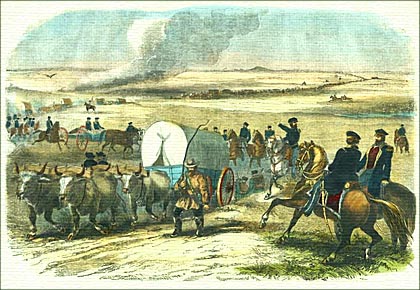
-- Johnston's Army Crossing the Plains on its Way to Utah --
(Harper's Weekly, April 24, 1858)
1830-1839 | 1840-1849 | 1850-1899
Sep 15 '51 | Apr 20 '57 | Jun 30 '57 | Nov 20 '57 | Dec 02 '57
Dec 03 '57 | Dec 09 '57 | Dec 11 '57 | Dec 15 '57 | Mar 10 '58
Mar 19 '58 | Mar 20 '58 | Mar 31 '58 | Apr 30 '59 | Jun 08 '59
Jun 30 '59 | Jul 07 '59 | Jul 29 '59 | Aug 17 '59 | Sep 03 '59
Articles Index | mid-Atlantic papers | Niles Register
 Vol. ? Washington: September 15, 1851. No. ?  TERRITORY OF UTAH. From the "Deseret News" of July 20 we copy the following acts of organization of the Government of the new United States Territory of Utah: |
Vol. XLV. Washington, D. C., Tues., April 20, 1857. No. 13,951.
THE MODERN SODOM.
The publication of the recent order from the Department of War putting in motion a large body of troops on our western border, under the command of General Harney, has created a general impression that their ultimate destination is the Utah Territory, and that it indicates an intention on the part of the Government to put down, by a strong hand, the criminal and disgraceful outrages which have so long been committed by Brigham Young and his band in the Utah Valley, and establish in that sink of iniquity (by force, if need be) the authority of the Government and laws of the United States. Among those whose attention has been arrested by the Army order, is a respectable citizen, who lately spent twelve months in the Salt Lake Valley, engaged in business connected with the transit of the mails through the Territory to and from the Pacific. While thus residing in the Mormon community, he studied attentively the character and government of Brigham Young, the supreme head, as well as the customs, habits, morals and laws of the community, if laws they may be called, which consist principally in the will of a despot. This gentleman, corroborating fully all that Judge Drummond has lately stated on the subject, has deemed it his duty to make known to the country the result of his own observations on the condition of things in the Territory. In executing this task, however, he has not touched upon the domestic enormities and depraved social system of the community, but has confined himself to the political aspect of Mormonism -- to ail exposition of the polity, power, evil purposes, operations, and character of Young and his coadjutors or tools. His statements are startling, and we concur entirely in the remark of a Richmond contemporary that it is high time that the Government of the United States was directing its serious attention to the condition of things in Utah. And, if the revelations of our correspondent be true, as we do not doubt they are, it is apparent that the day is rapidly approaching, if it be not already come, when the Government will find it no easy task to subdue the rebellious legions of Brigham and quell the power of the modern Mahomet in his stronghold. The communication of our correspondent is appended. |
Vol. XLV. Washington, D. C., Tues., June 30, 1857. No. 14,013.
SPEECH OF SENATOR DOUGLAS.
The papers of Illinois bring to us the report of a speech delivered by Mr. Senator Douglas at Springfield, the capital of that State, on the 12th instant, in reply to an invitation addressed to him by a large number of distinguished citizens, requesting him to favor them with his views on cerrain topics which now engross so large a share of the public's attention... the remarks of Mr. D. were as follows: |
Vol. XLV. Washington, D. C., Fri., November 20, 1857. No. 14,136
THE MORMON TREASON. Subjoined is the Letter and Proclamation of Brigham Young, alluded to in the last number of our paper: |
Vol. XLV. Washington, D. C., Wed., December 2, 1857. No. 14,145
THE MASSACRE ON THE PLAINS.
We have dates from Los Angeles to the 24th of October, and from San Diego to the 17th of the same month. The news is exceedingly important. |
Vol. XLV. Washington, D. C., Thur., December 3, 1857. No. 14,146
THE LATE MASSACRE IN THE An officer of the army who was stationed nearly a year in Utah, and who passed over the Spanish trail -- from Salt Lake City to Los Angeles, in command of a detachment of United States troops, in 1855 -- informs us that he camped for several days at the Mountain Meadows, the scene of the late horrible massacre of over one hundred emigrants, and that there was no room for the shadow of a doubt but that the Mormons were cognizant of and instigated this horrible butchery. The Indians in the vicinity of Fillmore, Parowan, and all the southern settlements, extending to the Virgin river, are entirely under the control of the Mormons; the chiefs are recognised members of the Mormon Church, and missionaries are constantly residing with them. He further informs us that it would be impossible for the Indians to plan an attack upon even a single wagon train without the knowledge of the Mormons, and that for years no small party of Americans has ever been safe in traveling this route. As a matter of necessity all small trains have assumed the name of Mormons to travel safely. These Indians are well armed with rifles, and supplied with ammunition by the Mormons, and at the time of the passage of the United States troops through their country, in 1855, every effort was made by the Mormons to induce the Indians to attack them, and they were only prevented from so doing by the superior strength and great precaution shown by the troops. This fact was communicated to the War Department, at the time, in an official report. -- |
Vol. XLV. Washington, D. C., Wed., December 9, 1857. No. 14,151
THE PRESIDENT'S MESSAGE. The Annual Message of the President of the United States, of which the following is a copy, was laod before both Houses of Congress yesterday:but I feel confident of the support of Congress, cost what it may, in suppressing the insurrection and in restoring and maintaining the sovereignty of the Constitution and laws over the Territory of Utah. Notes: (forthcoming) |
Vol. XLV. Washington, D. C., Fri., December 11, 1857. No. 14,153.
THE LATE EMIGRANT MASSACRE EXAGGERATED. The Memphis Bulletin of December 3d publishes a new version of the recent massacre of emigrants by Indians in Utah, which, if correct, shows that the accounts of that tragedy heretofore received were much exaggerated. The Bulletin's authority is a letter received by a citizen of New Madrid from a relative who was in the company alleged to have been massacred. According to this the train was attacked by a very large body of Indians, but the watter were repulsed with the loss of only a few lives. The Journal of Commerce remarks: |
Vol. XLV. Washington, D. C., Tues., December 15, 1857. No. 14,156.
REPORT OF THE SECRETARY OF WAR.
|
Vol. XLVI. Washington, D. C., Thurs., March 10, 1858. No. 14,538.
LAWS OF THE UNITED STATES.
AN ACT making appropriations for the support of the army for the year ending the thirtieth of June, eighteen hundred and sixty. |
Vol. XLVI. Washington, D. C., Fri., March 19, 1858. No. 14,235.
THIRTY-FIFTH CONGRESS.
|
Vol. XLVI. Washington, D. C., Sat., March 20, 1858. No. 14,236.
THIRTY-FIFTH CONGRESS.
|
Vol. XLVI. Washington, D. C., Wed., March 31, 1858. No. 14,245.
THIRTY-FIFTH CONGRESS. The President of the Senate laid before the body... a communication from the Secretary of War... in answer to a resolution of the 19th instant calling for information as to what steps have been taken for the punishment of the parties implicated in the massacre of 118 emigrants to California at the Mountain Meadows; which was read and ordered to lie on the table. |
Vol. XLVI. Washington, D. C., Sat., April 30, 1859. No. 14,583.
CONFLICT OF AUTHORITY IN UTAH.
|
Vol. XLVI. Washington, D. C., Wed., June 8, 1859. No. 14,667.
WHITE CHILDREN RECOVERED FROM INDIANS.
The Commissioner of Indian Affairs has recieved the following interesting letter from the Superindendent of Indian Affairs in Utah: |
Vol. XLVI. Washington, D. C., Thurs., June 30, 1859. No. 14,636.
FROM UTAH.
|
Vol. XLVI. Washington, D. C., Thurs., July 7, 1859. No. 14,641.
LATER FROM UTAH TERRITORY. -- The Salt Lake correspondent of the Republican says that Judge Cradlebaugh has returned from his tour through his crrcuit. He issued warrants during his trip for the arrest of nearly one hundred persons engaged in the massacre at Mountain Meadows. Various other murders had occurred. He saw no church officials along the route. He reports that, for thorty miles before reaching the Santa Clara borders, his company found human skeletons at almost every camping ground, many being probably murdered by the Indians last winter. He says that upwards of eighty white men assisted in the massacre at Mountain Meadows. |
Vol. XLVI. Washington, D. C., Fri., July 29, 1859. No. 14,660.
FROM THE TERRITORY OF UTAH.
We have received a copy of the "Valley Tan" of the 29th ultimo, containing some items of interest, which we extract as follows: |
Vol. XLVI. Washington, D. C., Wed., August 17, 1859. No. 14,676.
The Mountain Meadows Children -- Special Agent Jarvis, who came eastward with the children saved from the Mountain Meadows massacre, has arrived in this city and reported himself to the Commissioner of Indian Affairs. He left the children at Fort Laramie, and reports that they will not arrive at Leavenworth before the 6th of September. |
Vol. XLVI. Washington, D. C., Sat., Sept. 3, 1859. No. 14,691.
The "Mountain Meadows" Children. From the Leavenworth (Kansas) Herald of August 27. |
Back to top of this page.
Newspaper Articles | Articles Index | History Vault
Oliver's Bookshelf | Spalding Library | Mormon Classics
last updated: Mar. 10, 2009