
READINGS IN EARLY MORMON HISTORY
(Newspapers of MD, NJ, & DE - plus early DC)

Mid-Atlantic States
Miscellaneous Newspapers
1817-1844 Articles
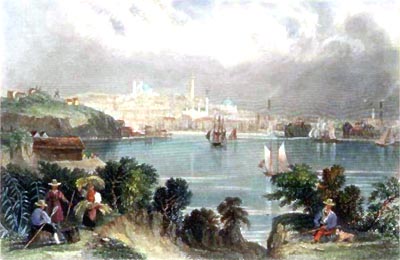
View of Baltimore, Maryland -- 1839
1817-1844 | 1845-1905
Articles Index | National Intelligencer | Niles Register
 Vol. ? Newton, New Jersey, September 15, 1817. No. ? UNKNOWN SECT. Passed through this town, on Wednesday last, ten pilgrims (six men and four women) from Woodstock, in the state of Vermont, on their way to the southward, possessed of very singular appearance and deportment. |
Vol. III. Bridgeton, New Jersey, September 22, 1817. No. 114. UNKNOWN SECT.
|
Vol. XXXIII. Elizabeth-Town, N. J., October 28, 1817. No. 1774. MODERN FANATICS.
|
Vol. III. Bridgeton, New Jersey, November 3, 1817. No. 120. MORE OF THE VERMONT PILGRIMS. A correspondent informs us, that five waggons loaded with the household goods, men, women, and children of this sect, passed through Cherry Valley, Otsego Co., on the 25th ult. on their way to the state of Ohio. The men and women were dressed in the same style as those who passed through Sussex, (N. J.) and were, as they alleged, followers of the same prophet. They call themselves the true followers of Christ. Their pretended prophet came from Canada a few months since, and is a man of "austere habits," and a great fanatic. His followers are not yet numerous, but it is thought he will increase them. He rejects sirnames, and abolishes marriage, and allows his followers to cohabit promiscuously. |
Vol. III. Bridgeton, New Jersey, December 22, 1817. No. 127.
Mammoths. -- The St. Louis Emigrant states that living Mammoths have lately been seen near the Shining Mountains! |
Vol. XXII. Newark, New Jersey, May 12, 1818. No. 35. Domestic News.
|
Vol. XIII. Baltimore, Md., June 14, 1819. No. 139. ABOMINABLE DEPRAVITY.
|
Vol. II. Georgetown, D.C., October 27, 1819. No. 139.
The Rev. Jacob Cochran, the teacher of a new code of ethics and soctrine in this part of our country, and who excaped from the persecuting arm of justice last spring, after conviction before the S. J. Court in York county for adultery and gross lewdness; or in other words, for the propagation of his new and enlightened system of morals; was seized at Saco on Friday last, after a long and obstinate struggle with the constable, and marched to Alfred jail. Jacob, it seems, can handle physical tools with so much power as he has pretended to spiritual ones. The officers of Saco, having intimation that he was [lurking in] that place, waylaid him as [he] was coming [out of] once of his orgies, with Hill, his High [Priest?] and attempted to seize him, but he ran [away and] leaped from a precipice twenty feet [above] and brandishing a cudgel, threatened [to] murder the first man who approached [him]. One constable, nothing fearing, advanced [----] but received a severe blow upon his [arm]; another grappled with him and they succeeded in confining him without further injury. |
Vol. XVII. Baltimore, Md., May 4, 1821. No. 105.
|
Vol. ? Washington, D. C., April 23, 1823. No. ? ANCIENT MANUSCRIPT. To the Editor of the Washington Republican. |
Vol. III. Washington, D. C., Sat., April 17, 1824. No. 16.
From the Boston Telegraph.
M. Champollion, jr. has made such discoveries in relation to these memorials of antiquity, that he is able not only to decypher inscriptions of the Greek and Roman epochs, but also to go back as far as the age of the Pharaohs. The age of all inscriptions bearing royal names has been determined by him; he has obtained more than forty names of Pharaohs, included brtween the 30th and 40th dynasty; and has also fixed the extreme limit of all known Egyptian monuments at the 19th century before the Christian era. The same alphabet is applicable to the hieroglyphical inscriptions on the temples of Nubia and Ethiopia. |
Vol. III. Washington, D. C., Sat., July 31, 1824. No. 31. ORDINATIONS. ...On the 13th of June, Elder Lawrence Greatrake was ordained pastor over the Baptist church on Pittsburgh, Pennsylvania. Elder John Winter, of Bull Creek, introduced the service of the day, by singing and prayer, and by delivering an introductory discourse. Elder David Phillips, of Peter's Creek, put the usual questions, and received suitable and appropriate answers from the candidate, and then offered up the ordination prayer, accompanied with the imposition of hands. Elder Wheeler, of Washington, (Pa.) delivered the charge to the candidate, and Elder D. Phillips, of Peter's Creek, addressed an appropriate charge to the church, and then closed the interesting service. |
Vol. IV. Washington, D. C., Sat., July 30, 1825. No. 31. SENECA MISSION. Commenced by the New-York Missionary Society, in 1811, and transferred to the United Foreign Missionary Society in Jan. 1821. Situated about four or five miles from Buffalo, near the outlet of Lake Erie. |
Vol. V. Washington, D. C., Sat., January 29, 1826. No. 4. RE-ASSEMBLAGE OF THE JEWS. The following letter has been addressed to the Editor of the Paris Journal des Debats, by the Grand Rabbi de Cologne, relative to the proclamation of the new self-constituted Judge and Regenerator of Israel, Mr. Noah, of New-York, calling upon his Jewish brethren throughout the world, to assemble under his standard at the intended city of refuge, Ararat, on Grand Island; and imposing upon such as do not choose; or are not able, to obey his call, a certain annual trobute per head for leave of absence: |
Vol. V. Washington, D. C., Sat., March 11, 1826. No. 10. CAPTAIN SYMMES. ... We have at length had the [opportunity?] of hearing the "long-suffering Captain Symmes" explain his "hollow theory" of the earth. He lectured on Thursday evening, to the officers and students of the Columbian College, in the hall of the Enosinian Society. He has evidently been very industrious in collecting facts, many of which are of an interesting character. But how these facts can be adduced necessarily to prove his theory of a terrestrial concavity, we were unable to conceive. Another individual, with half his ingenuity, might employ them in demonstrating almost any other theory, equally wild and unsupported. Most of the arguments in favour of the old system, he left untouched. If he be not ignorant of them, we have reason to conclude that he finds them too powerful for his mastery -- "too mighty" to be shaken by his "facts" however "imposing." We give no opinion upon the subject. Indeed, we do not understand the gentleman. Perhaps we shall be considered by him and a few others as ineffably stupid, not to feel the power of his "eloquent facts," but we really do not understand the gentleman. |
Vol. ? Baltimore, Maryland, Friday, November 10, 1826. No. ?
THE DIVINING ROD. -- It has been supposed, during many years, that a forked branch from any tree of the forest, the orchard or garden, having smooth bark and elastic fibres, in the hands of some favoured individuals, had the power of indicating the beds of ores or the springs of water, flowing beneath the surface of the earth. Many who have witnessed the action of the rod when held by the water-finders, and seen it crawling down and pointing to some spot otherwise indistinguishable from the surrounding field, where the fountain gushed out on digging, have been convinced of the reality of the art, and fallen into great doubt of the laws by which it is regulated. Were there no evidence from our own senses of the existence of the attraction supposed to affect the twigs when managed by the skilful, we should still be satisfied by the declarations of men in all stations in society, of irreproachable integrity, sound judgment, and quick penetration; those whose words we could believe as firmly as our own knowledge, and whose uprightness we could safely trust unaccounted treasures. When such persons confidently assert that they possess the art of discovering hidden waters, and when they know that the [goal] is actually found beneath the places pointed out, we may believe that they have deceived themselves, but never that they could impose on the credulity of others. The motives to fraud are few, the possessors of the skill have seldom exerted it for more than a [trifling monatary] reward. It has never been made the means of extortion or excessive gain by any of its professors. Reputation, there is little given to those holding the mysterious wand. |
AND WASHINGTON COUNTY REPUBLICAN ADVERTISER. Vol. III. Hagerstown, MD., Friday, Feb. 4, 1831. No. 32.
From the Philadelphia U. S. Gazette.
We mentioned nearly a year since, the appearance of a person in the upper part of New York State, who was preaching a new religion, founded upon a new bible given to him by an angel. The revelation then was engraven on metal plates. We thought that the matter would rest with the simple souls with whom it began, but we find that the new doctrine is gaining many believers; societies have been formed, and leaders established. We have not heard that any candidate for president has been nominated. We find the following account in the Zanesville [sic - Painesville?], Ohio Gazette: |
Vol. XXXVII. Baltimore, Md., March 10, 1831. No. 59.
A clergyman of Painesville, Ohio, has given, in the Telegraph of that place, a history of the "Mormonites, or proselytes of the Golden Bible." He speaks of them as fanatics and impostors, and gives the following as a specimen of their power to work miracles: -- |
 City of Washington Vol. ? - No. ? November 29, 1832. THE UNION Let us look Nullification in the face. What is it? Mr. Calhoon and his disciples tell us, IT IS MAKING VOID A LAW OF CONGRESS WITHIN A STATE, DECLARING IT AS UNCONSTITUTIONAL, AND PROHIBITING ITS EXECUTION. |
Vol. 79. Baltimore, Md., Monday, April 13, 1833. No. 13,168.
THE MORMONS. -- A writer in the Christian Watchman thinks that their system of religion is rather frail, and tending to dissolution. Respecting the "Golden Bible" he says that it is not even a cunningly devised fable. Every page bears the impress of its human authorship. Though free from vulgar obscenities, it is an absurd collection of dull, stupid, and foolishly improbable stories, which no person, unless under the influence of powerfully excited feelings, can mistake for truth and inspiration. With its authors, the Book of Mormon cannot survive this generation. The next will remember it only to smile at the credulity of the present. |
 Vol. ? Baltimore, Md., September ?, 1833. No. ?
Some extraordinary proceedings in reference to the deluded sect of the Mormonites, took place recently in Jackson county, Missouri, where is the principal settlement of that people. -- A public meeting of the citizens was held, in which they passed resolutions that no Mormon should hereafter settle in or move into that county, and that those now there should remove within a reasonable time, after they shall have settled up their business. They required the editor of the Star, a paper published for the purpose of advocating Mormon doctrines, to discontinue his paper forthwith. For the alternative, in case of any failure to comply with any of these requisitions, the Mormonites were "referred to those of their brethren, who have the gift of divination, & unknown tongues, to inform them of the lot which awaits them." These significant resolutions were read and adopted, and a committee appointed to wait on the leaders of the sect, and provide for the strict performance of the order of the meeting. The order was not complied with -- no answer being given by the editor of the Mormonite press and the keeper of "the Lord's store-house," to whom the communication was particularly addressed -- and therefore the meeting resolved to raze the printing office to the ground, but provided by resolution for the preservation of the materials of the establishment -- the Missouri Times asks, if for their own use? Subsequently another meeting was had, the result of which was an agreement between the citizens attending the meeting and the Mormonites. By this agreement a number of the Mormonites undertook to remove with their families, before the first of January, and to induce all their brethren to remove, 1 half by the first of January, and one half by the first of April -- to discourage any further settlement and to discontinue the press. On these conditions the meeting undertook to protect them and their property from violence. |
|
Vol. ? Baltimore, Md., December ?, 1833. No. ?
The Governor of Missouri lately exercised his constitutional power of pardoning a person convicted of murder, under the belief of the insanity of the perpetrator of it. The act occasioned no little excitement at St. Louis, where the effigy of the Governor was paraded through the streets, and afterwards burnt. |
|
Vol. ? Baltimore, Md., July ?, 1834. No. ?
The report of a battle between the citizens of Jackson county, Missouri, in which it was said that the Mormon leader was slain, is not confirmed. The accounts from St. Louis, make it probable that no such collision has taken place but that on the contrary, the Mormons have abandoned the attempt to use force in order to regain possession |
 Vol. ? Newark, N. J., May 2, 1836. No. ?
THE MORMONS. -- A gentleman living in Loraine County, Ohio, writes that a more extraordinary sect has not sprung up since the says of Mahomet. In the town of Kirtland they have erected a stone temple at an expense of $40,000. It has two rows of Gothic windows. The first floor is the place of worship, with four rows of pulpits at each end, having three pulpits in a row. These 12 pulpits rise behind and above one another, and are designed, the uppermost row, for the bishop and his councellors, the third for the teachers, and the fourth or lowermost for the deacons. Over the division between each of the rows of pulpits is a painted canvass, rolled up [to] the ceiling; and to be let down at pleasure, so as to conceal the dignitaries from the audience. The area can be divided into four apartments at pleasure to carry on the objects of imposture. The second and attic stories are for a theological and literary seminary, which is expected to have the manual labour system attached to it. The Mormons are very eager to acquire an education. Men, Women, and children are studying Hebrew. Some of the men in middle age pursue their Hebrew till 12 o'clock at night and attend to nothing else. They pretend to have remarkable revelations, work miracles, heal the sick, &c. |
|
Vol. ? Baltimore, Md., November ?, 1838. No. ?
MORMON TROUBLES. -- A slip from the Missouri Watchman, of the 29th October, contains the proceedings of a meeting of the citizens of Ray county, convened for the purpose of considering the difficulties existing between the people of Missouri and the Mormons. At this meeting a report was made by three persons, who had visited certain places in Davies County, where the Mormons were reported to have committed excesses. They found numerous ruins of dwellings, stores, mills, &c., which were laid in ashes, and were informed that their contents had previously been pillaged by the Mormons and carried off. It was also stated to them that the Mormons had driven away large numbers of cattle. -- They were represented to be about 600 strong. These persons were deterred from prosecuting their inquiries further, from the fact of their meeting families removing into Ray County for safety, who stated that the country on the north side of Grand River was devastated and entirely deserted, except by the Mormons. |
|
Vol. VIII. City of Washington, April 26, 1839. No. 270.
THE MORMONS. Extract from a letter, dated |
|
Vol. 8. Newark, N. J., January 28, 1840. No. 177.
The Mormons seem to be flourishing in Philadelphia, no less than fourteen persons -- ten men and two women -- having been baptized by a preacher of that faith! on Monday of last week. We agree entirely with the editor of the NewHaven Herald that, when such an absurdity as this Mormon faith prevails in the religious world, we may cease to wonder that Locofocoism is tolerated in the political. -- |
|
Vol. 8. Newark, N. J., January 30, 1840. No. 179.
The Mormons before the Senate.
Mr. Young, of Illinois, presented a memorial from certain Mormons, (Smith, Rigdon and Hicks,) praying the intervention of Congress to preserve them in their rights as citizens of the United States. The petition sets forth, in glowing terms, that the Mormons have been harshly dealt with by Missouri, and that it would be unsafe for them to return to Missouri, to obtain legally a redress of grievances. Mr. Young moved the reference to the Judiciary Committee, and stated that they bring 300 receipts for land bought of the Missouri Land Agents, from which they have been driven, and forbid to return. Mr. Y. condemned such treatment. |
|
City of Washington Vol. IX. - No. 200. Feb. 4, 1840.
(letters waiting in the Washington, D. C. Post Office Ramsay Miss Mary |
|
Vol. 8. Newark, N. J., May 11, 1840. No. ? LATEST FROM THE MORMONS. It is known that these people, since their dispersion in Missouri, have collected in great numbers in and around Commerce, in this (Ill.) State, on the Mississippi. The name of Commerce, as we have heretofore stated, they have changed to Nauvoo, from the Hebrew or Egyptian, though of the signification of the term we are ignorant. They hold two great conferences every year, -- in the spring and fall, and that appointed for the present spring took place last week, commencing on the 6th and ending on the 9th inst. We learn that between 2000 and 3000 persons were present, and that considerable accessions were made to the church from the surrounding neighborhood. Our informant states that the number was 74, all received by baptism, and that at the same time thirty of the ablest men were ordained to preach the gospel. |
|
Vol. 8. Newark, N. J., May 27, 1840. No. ?
A CONVENTION OF MORMONS. Montrose, Upper Mississippi, Iowa Territory, |
|
Vol. ? Baltimore, Maryland, December 2, 1840. No. ?
MORMONS ARRIVED FROM ENGLAND. -- The packet ship North America, which arrived at New York last week, brought in her steerage 200 passengers, the whole of whom were "Latter Day Saints" or Mormons, bound for the Mormon settlement at Quincy. The Liverpool Chroncile states that upward of 2000 are entreating to embark early next spring for the same locality. A great portion of those who sailed in the North America, are members of the abstinence society, and are from Leicestershire and Herefordshire. |
|
Vol. 10. Newark, N. J., August 6, 1841. No. 31.
The Mormons. -- Joe Smith's disciples celebrated the 4th at Nauvoo with great pomp. It was a kind of military celebration, accompanied with an oration and feasting. Mr. Rigdon delivered the oration, and a table one thousand feet long was provided for the faithful. -- Joe Smith, it seems, wore "flaming regimentals," as commander-in-chief of the 'Nauvoo Legion.' |
|
Vol. 10. Newark, N. J., September 1, 1841. No. ?
The Mormons are holding a meeting in the woods a few miles from Taylorsville, on the Pennsylvania side of the Delaware -- a great many of the citizens from Bucks county visit their camp. |
|
Vol. 10. Newark, N. J., September 21, 1841. No. 70.
Meeting of the Magnates Keokuck, Chief of the Sacs and Foxes, accompanied by fifty of his followers, lately made a visit of ceremony to Joe Smith, Monarch of the Mormons, at his capital city, Nauvoo. Joe received his brother savage with distinguished politeness. The "Nauvoo Legion" was called out and escorted Keokuck and his squaws to the magnificent temple of the Twelve Apostles and Twelve Oxen. In this sacred spot the two great men entertained each other and their followers, by making speeches at each other; both the royal orations being clothed in uniform -- the Mormon in the brilliant burlesque of the "Legion," and the Indian in the dirty blanket and tattered moccasins of his court, Joe made what the newspapers call a "thrilling speech" to to Keokuck, describing to him the wonders of the great temple, the mysteries of the Mormon Bible, and the glorious good times that the Latter Day Saints should have when they get to New Jerusalem. |
|
Vol. 10. Newark, N. J., Monday, November 29, 1841. No. 129.
(fragmentary letter from Iowa to the New York Sun describing Mormon doctrine): |
|
Vol. ? Newark, N. J., January 11, 1842. No. ? LATEST FROM THE MORMONS. NAUVOO: -- The Mormon Elders have issued an epistle from the city of Nauvoo, on the Mississippi, requiring the "Saints of the Last Days" to contribute one tenth of all their substance, and one tenth of their earnings, to help forward the Temple of The Lord. Their city now numbers 10,000 inhabitants. |
|
Vol. ? Washington, D. C., June 9, 1842. No. ?
Translation. -- Two Mormon Priests, Smith and Rigdon, lately rode out together, and only Smith returned. He said Rigdon had been "translated to heaven!" Such is the story. |
|
Vol. ? Balrimore, Maryland, November ?, 1842. No. ? MORMONS, OR LATTER DAY SAINTS. This sect has excited considerable attention through the Union, in consequence of various publications by Bennett and others who had belonged to the society, in which the members were charged with blasphemy, immorality and other offences. It is not to be wondered at that opinions, formed upon such representations, should have been entirely adverse to the Mormons. We acknowledge that we looked upon them as a mixture of interested and heartless knaves and deluded enthusiasts. The perusal of the Mormon paper lately published in this city confirmed us in this opinion; but on Tuesday evening last we attended the Lecture or Sermon delivered by Mr. Winchester, a professor and preacher of the Mormon faith. He opened the services with a prayer, unexceptionable in language and spirit, and such as might well have been delivered from any pulpit in the city. He then commenced his discourse, in which he took occasion to give a brief outline of the Mormon faith. He said that they had been charged with substituting the Book of Mormon for the bible: this was not so; it was considered only as an historical account of a people, communicated, (we think we understood him to say) supernaturally -- it neither added to nor subtracted from the Bible, which the Mormons fully recognized and believed in. He said that he had nothing to disguise as to his religious principles, but on the contrary desired to make them generally known that they might be correctly judged of. The Mormons were Christians in belief, and looked for the second Advent of Christ -- when he shall come, surrounded by the angels of Heaven to dwell in person upon the earth -- that he will be met by the spirits of those who are justified, and by the saints who may then dwell on earth -- that the earth shall be then purified by fire so as to be made a fit residence for the heavenly host during the term of the Millennium, which will at that time commence -- that the signs which are to precede that event are now transpiring, and that, although he did not pretend to determine the precise period of the Millenium, he believed that it was at hand, &c. He quoted various passages from scripture to sustain his opinions -- and thought the creation of the heavens and the earth in six days and the hallowing of the seventh as a day of rest, indicated that at the termination of six thousand years, the Sabbath or Millenium of a thousand years shall commence. |
|
Vol. ? Newark, N. J., January 10, 1843. No. ?
MORMONS: -- The ship Emerald, from Liverpool, brought a batch of 148 Mormon emigrants to [New Orleans]. We wish them a safe arrival at Nauvoo... |
|
City of Washington Vol. IX. - No. ? March 14, 1844. A NEW ADVOCATE FOR A NATIONAL BANK. We have cast our eyes hastily over General Smith's (Mormon Joe) "Views of the Powers and Policy of the Government of the United States, Nauvoo, 1844." This illustrious individual "goes the whole figure' with Messrs. Clay, Webster, Sargeant, and the Whig party in general, for a national bank. After this, who can doubt the propriety of such an institution? Here is Joe's plan for a "fiscal agent," which is quite as sensible, both in nature and object, as the famous fiscalities; |
|
City of Washington Vol. ? - No. ? June 29, 1844.
LATEST FROM THE MORMONS. -- By the last accounts from Nauvoo, we learn that Joe Smith had issued a proclamation declaring martial law. The greatest excitement prevailed in the neighborhood, and the whole upper country was under arms. The streets of Warsaw were patrolled by armed men, and sanguinary results were anticipated. The governor had been called on for assistance, and in the mean time active preparations were making to march against Nauvoo on the 19th inst. The authorities of Warsaw had arrested all persons concerned in the destruction of the printing office, but the Prophet had interfered and given them an honorable discharge. The population of Nauvoo numbers 10,000 souls, and it is estimated that a force of 2,000 men will place themselves under the direction of the sheriff to compel the execution of his writs. All the Mormons opposed to Smith, numbering about 200, had left Nauvoo. A serious conflict seems to be inevitable. -- Balt. Sun. |
City of Washington Vol. ? - No. ? July 1, 1844.
From the Alton Telegraph,
June 22.
Our latest intelligence from Nauvoo is down to Tuesday evening. It is reported that about 1,000 persons were assembled in arms, at Carthage and Warsaw, and designed making an attack upon Nauvoo on Wednesday last. A mass meeting of the citizens of Hancock county was convened at Carthage on the 13th inst., at which great indignation was¾expressed on account of the recent destruction of the printing office of the Nauvoo Expositor. At this meeting inflammatory resolutions were passed, in which we were sorry to see the mob spirit so strongly predominate. Nauvoo was under martial law, and preparations making for a vigorous defense in case of attack. Great numbers are deserting the Prophet in his hour of need. Notwithstanding all the warlike demonstrations that have been making, we are inclined to believe that no attack was made on Wednesday by the citizens of the adjoining counties, as contemplated. |
City of Washington Vol. I? - No. ? July 12, 1844.
STILL LATER -- SATURDAY MORNING.
|
Vol. XV. Baltimore, Maryland, Wednesday, November 6, 1844. No. 149.
INTELLIGENCE FROM PHILADELPHIA.
|
Back to top of this page.
Newspaper Articles | Articles Index | History Vault
Oliver's Bookshelf | Spalding Library | Mormon Classics
last updated: Oct. 2, 2010