READINGS  IN  EARLY  MORMON  HISTORY
(Newspapers of New York)


New York City Papers of James G. Bennett

New York Herald
1844-1849 Articles
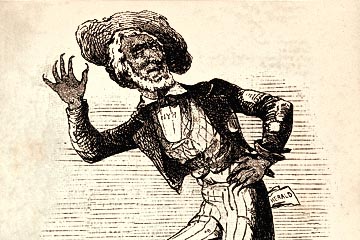

James Gordon Bennett as "Jim Crow" -- Vanity Fair


1835-1843   |   1844-1849   |   1850-1879


May ? '44  |  May 17 '44  |  May 23 '44  |  Jun 09 '44  |  Jun 12 '44
Jun 19 '44  |  Jun 26 '44  |  Jun 27 '44  |  Jul 01 '44  |  Jul 06 '44
Jul 7 '44  |  Jul 08 '44  |  Jul 10 '44  |  Jul 12 '44  |  Jul 13 '44
Jul 13 '44 wk  |  Jul 16 '44  |  Jul 17 '44  |  Sep 02 '44  |  Sep 05 '44
Sep 07 '44  |  Sep 12 '44  |  Sep 15 '44  |  Sep 16 '44  |  Sep 21 '44
Sep 27 '44  |  Sep 30 '44  |  Oct 07 '44  |  Oct 08 '44  |  Oct 11 '44
Oct 12 '44  |  Oct 13 '44  |  Oct 14 '44  |  Oct 16 '44  |  Oct 17 '44
Nov 08 '44  |  Nov 18 '44  |  May 28 '45  |  Jun ? '45  |  Sep ? '45
Oct ? '45  |  Dec 09 '45


Articles Index  |  Spectator/Com. Adv.  |  M. M. Noah's papers  |  misc. NYC papers



Vol. ? - No. ?                             N. Y. C., May ?, 1844.                             ?


Joe Smith and the Devil.

(Enter Devil with a bundle of hand bills, which he is in the act of pasting up)

WANTED IMMEDIATELY!

All the liars, swindlers, thieves, robbers, incendiaries, murderers, cheats, adulterers, harlots, blackguards, gamblers, bogus makers, idlers, busy bodies, pickpockets, vagabonds, filthy persons, hireling clergy, and their followers, and all other infidels and rebellious, disorderly persons, for a crusade against Joe Smith and the Mormons. Be quick, be quick, I say or our cause will be ruined and our kingdom overthrown by that d----d fool of an imposter and his associates, for even now all earth and hell is in a stew.

(Joseph Smith happens to be passing and hails his Majesty.)

Good morning, Mr. Devil. How now, you seem to be much engaged; what news have you got there?

Devil (slipping his bills into his pocket with a low bow) -- O! good morning Mr. Smith; hope you are well sir. Why -- I -- I was just out on a little business in my line; or, finally, to be candid I was contriving a fair and honorable warfare against you and your imposition, wherein piety is outraged and religion greatly hindered in its useful course. For, to be bold, sir, (and I despise anything underhanded,) I must tell you to your face that you have made more trouble than all the ministers or people of my whole dominion have for ages past.

Smith. -- Trouble! what trouble have I caused your Majesty? I certainly have endeavored to treat you and all other persons in a friendly manner, even my worst enemies, and I always aim to fulfil the Mormon Creed, and that is, to mind my own business exclusively. Why should this trouble you, Mr. Devil?

Devil. -- Ah, your own business, indeed! I know not what you may consider your business, it is so very complicated; but I know what you have done and what you are aiming to do. You have disturbed the quiet of Christendom, overthrown churches and societies, you have dared to call into question the truth and usefulness of old and established creeds, which have stood the test of ages, and have even caused tens of thousands to come out in open rebellion, not only against wholesome creeds, established forms and doctrines, well approved and orthodox, but against some of the most pious, learned, exemplary and honorable clergy whom both myself and all the world love, honor and esteem, and this is not all. But you are causing many persons to think who never thought before and you would fain put the whole world a thinking and then where will true religion and piety be? Alas! They will have no place among men, for if men keep such a terrible thinking and reasoning as they begin to do, since you commenced your business, as you call it, they never will continue to uphold the good old way in which they have jogged along in peace for so many ages, and thus, Mr. Smith, you will overthrow my kingdom and leave me not a foot of ground on earth, and this is the very thing you aim at. But I, sir, have the boldness to oppose you by all the lawful means which I have in my power.

Smith. -- Really, Mr. Devil, your majesty has of late become very pious. I think some of your Christian brethren have greatly misrepresented you. It is generally reported by them that you are opposed to religion. But --

Devil. -- It is false; there is not a more religious and pious being in the world than myself, nor a being more liberal minded. I am decidedly in favor of all creeds, systems and forms of Christianity, of whatever name and nature; so long as they leave out that abominable doctrine which caused me so much trouble in former times, and which, after slumbering for ages, you have again revived; I mean the doctrine of direct communication with God, by new revelation. This is hateful, it is impious, it is directly opposed to all the divisions and branches of the Christian church; I never could bear it. And for this very cause, I helped to bring to condign punishment all the prophets and apostles of old, for while they were suffered to live with this gift of revelation, they were always exposing and slandering me, and all other good pious men in exposing our deeds and purposes, which they called wicked, but we considered as the height of zeal and piety; and when we killed them for these crimes of dreaming, prophesying, and vision-seeing they raised the cry of persecution, and so with you miserable, deluded Mormons.

Smith. -- Then, your most Christian Majesty is in favor of all other religions but this one, are you?

Devil. -- Certainly, I am fond of praying, singing, church-building, bell ringing, going to meeting, preaching, and withal, I have quite a missionary zeal. I like, also, long faces, long prayers, long robes, and learned sermons; nothing suits me better than to see people who have been for a whole week opposing their neighbor, grinding the face of the poor, walking in pride and folly, and serving me with all their heart. I say nothing suits me better, Mr. Smith, than to see these people go to meeting on Sunday with a long religious face on, and to see them pay a portion of their ill-gotten gains for the support of a priest, while he and his hearers with doleful groans and awful faces, saying: "Lord, we have left undone the things we ought to have done, and done the things we ought not"; and then when service is ended see them turn to their wickedness and pursue it greedily all the week and the next Sabbath repeat the same things. Now, be candid, Mr. Smith, do you not see that these and all others, who have a form and deny the power, are my good Christian children, and that their religion is a help to my cause?

Smith. -- Certainly, your reasoning is clear and obvious as to these hypocrites, but you would not be pleased with people getting converted either at camp meeting or somewhere else, and then putting their trust in that conversion and in free grace to save them -- would you not be opposed to this?

Devil. -- Why should I have any objections to that kind of religion, Mr. Smith? I care not how much they get converted, nor how much they cry Lord, Lord; nor how much they trust to free grace to save them, so long as they do not do the works that their God has commanded them. I am sure of them, at last, for you know all men are to be judged according to their deeds. What does their good old Bible say? Does it not say, "not every one that saith Lord, Lord, shall enter into my kingdom, but he that doeth the will of my father which is in heaven." No, no, Mr. Smith, I am not an enemy to religion, and especially to the modern forms of Christianity, so long as they deny the power, they are to help to my cause; see how much discord, division, hatred, envy, strife, lying, contention, blindness, and even error and bloodshed has been produced as the effect of these very systems. By these means I gain millions to my dominion while at the same time we enjoy the credit of being pious christians; but you, Mr. Smith, you are my enemy, my open and avowed enemy; you have dared, in a sacriligious manner, to tear the veil from all these fine systems, and to commence an open attack upon my kingdom, and this even when I had almost all christendom together with the clergy and gentlemen of the press in my favor. How dare you venture thus to commence a revolution, without reserve and without aid or succor, and in the midst of innumerable hosts of my subjects?

Smith. -- Why sir, in the first place, I knew that I had the truth on my side, and that your systems and forms of christianity were so manifestly corrupt that one had only to lift the veil from your fooleries on one side and to present plain and reasonable truth on the other, and the eyes of the people could at once distinguish the difference so clearly that, except they chose darkness rather than light, they would leave your ranks and come over to truth. For instance, what is easier than to show from the history of the past, that a religion of direct revelation was the only system ever instituted by the Lord, and the only one calculated to benefit mankind? -- What is easier than to show that this system saved the church from flood, famine, flames, war, division, bondage, doubt and darkness, many times, and that it is the legitimate way and manner of God's government of his own peculiar people in all ages and dispensations.

Devil. -- To be candid with you, Mr. Smith, I must own that what you have now said, neither myself nor my most able ministers have been able to gainsay by any argument or fact. But then you must recollect that tradition and custom, together with fashion and popular clamor, have in all ages had more effect than plain fact, and sound reason. Hence, you see we are yet safe so long as we continue to cry from press and pulpit, and in Sunday Schools, that all these things are done away and no longer needed. In this way, though God may speak, they will not hear; angels may minister and they will not believe, visions may reveal, and they will not be enlightened; prophets may lift their voice, and their warnings pass unheeded; so you see we still have them as safe as we had the people in olden times. God can communicate no message to them which will be examined or heard with any degree of credence or candor. So for all the good they get from God, all communication being cut off, they might as well be without a God. Thus you see I have full influence and control of the multitude by a means far more effectual than argument or reason, and I even teach them that it is a sin to reason, think or investigate, as it would disturb the even tenor of their pious breathings and devout groans and responses. Smith, you must be extremely ignorant of human nature, as well as of the history of the past to presume that reason and truth would have much effect with the multitude. Why, sir, look how effectually we warded off the truth at Ephesus when Paul attempted to address them in the theatre. Strange that with all these examples before you, you should venture to raise the hue and cry which has so oft been defeated and this with no better weapons on your side than reason and truth. Indeed, you touch my christian spirit of forbearance that you have escaped so far without a grid-iron; but take care for the future, I may not always be so mild.

Smith. -- But why is your majesty so highly excited against me and my plans of operation, seeing that you consider that you have the multitude perfectly safe; and why so enraged and so fearful of the consequences of my course and the effect of my weapons, while at the same time you profess to despise them as weak and powerless. Alas, it is too true that you have the multitude safe to all appearance at present, and that truth can seldom reach them; why not then be content and leave me to pursue my calling in peace? I can hardly hope to win to the cause of truth any but the few who think, and these have ever been troublesome to your cause.

Devil. -- True, but then you are in spite of all my efforts, and that of my fellows, daily thinning our ranks by adding to the number of those who think, and such a thinking is kept up that we are often exposed in some of our most prominent places, and are placed in an awkward predicament, and who knows what defeat, disgrace and dishonor may befall the pious cause if you are suffered to continue your rebellious course.

Smith. -- But, Mr. Devil, why, with all these other advantages on your side do you resort to such mean, weak and silly fabrications as the Spaulding Story. You profess to be a gentlemen, a christian and a clergyman, and you ought, for your own sake, and for the sake of your cause, to keep up outward appearances of honor and fairness. And now, Mr. Devil, tell the truth for once; you know perfectly well that your Spaulding story, in which you represent me as an impostor, in connection with Sidney Rigdon, and that we were engaged in palming Solomon Spaulding's romance upon the world as the Book of Mormon, is a lie, a base fabrication, without a shadow of truth and you know that I found the Original Records of the Nephites, and I translated and published the Book of Mormon from them, without ever having heard of the existence of Spaulding, or his romance, or of Sidney Rigdon either. Now, Mr. Devil, this was a mean, disgraceful and underhanded trick in you, and one of which you have reason to be ashamed.

Devil. -- Well, Mr. Smith, to be candid, I acknowledge that what you say is true, and that it was not the most honorable cause in the world. But it was you who commenced the war, by publishing that terrible book which we readily recognized as a complete expose of all our false and corrupt christianity not even keeping back that fact that we had continued during the dark ages to rob the Scriptures of their plainness, and we feel the utmost alarm and excitement, and without much reflection, in the height of passion, we called a hasty council of the Clergy and Editors, and other rascals in Painesville, Ohio, and thinking that almost any means was lawful in war, we invented the Spaulding Story, and fathered it upon the poor printer, Howe of Painesville, although Dr. Hulbert (thanks to my aid) was its real author. But Mr. Smith, mark one thing; we had not a face so hard nor a conscience so abandoned as to publish this Spaulding story at the first as a positive fact; we only published it as a conjecture, a mere probability, and this you know we had a right to do; without once thinking of the amount of evil it would eventually accomplish. But, Sir, it was some of my unfortunate clergymen, who more reckless, hardened, and unprincipled than myself, have ventured to add to each edition of this story, till at last, without my aid or consent, they have set it down for a positive fact that Solomon Spaulding, Sidney Rigdon, and yourself, have made up the Book of Mormon out of a romance. Now, Mr. Smith, I am glad of this interview with you, as it gives me the opportunity of clearing up my character. I acknowledge with shame that I was guilty of a mean act in helping to hatch up and publish the Spaulding Story as a probability, and that I associated with rascals far beneath my dignity either as a sovereign prince or a religious minister, or even as an old honorable and experienced Devil, and for this I beg your pardon. But really I must deny the charge of having assisted in making the addition which has appeared in the later editions of that story, in which my power probabilities and mean conjectures are set down for positive facts. No. Mr. Smith, I had no hand in a trick so low and mean; I despise it as the work of priests and editors alone, without my aid or suggestion, and I don't believe that even the meanest young devils in our dominion would have stooped to such an act.

Smith. -- Well I must give your majesty some credit for once at least, if what you say is true, but how can you justify your conduct in dishonoring yourself so far as to stoop to the level of the hireling clergy and their followers, in still making use of this humbug story (which you affect to despise), in order to still blind the eyes of the people in regard to the origin of the Book of Mormon?

Devil. -- O! Mr. Smith, it does take so readily among the pious of all sects that it seems a pity to spoil the fun, and I cannot resist the temptation of carrying out the joke, now it is so well rooted in their minds. And you can't think how we devils shake our sides with laughter when we get up in the gallery in some fine church, put on our long face, and assist in singing and in the devout responses; this done, the Spaulding Story is gravely told from the pulpit, while the pious old clergyman wears a face as long as that of Balaam's beast. All is swallowed down for solid truth by the gaping multitude, while we hang our heads behind the screen and laugh and wink at each other in silence, as anything overheard would disturb their worship, and as bad as I am, I never wish to disturb those popular modes of worship, which decency requires us to respect. So, you see, Mr. Smith, we have our fun to ourselves at your expense; but after all we do not mean any hurt by it, although I must acknowledge, upon the whole, it serves our purpose.

Smith. -- Well, we will drop this subject, as I want to inquire about some of your other stories which have had an extensive circulation by means of your editors and priests. For instance, there is the story of my attempting to walk on the water and getting drowned, the numerous stories of my attempting to raise the dead, as a mere trick of imposition, and getting detected in it; and the stories of my attempting to appear as an angel, and getting caught and exposed in the same; and, besides this, you have me killed by some means every little while. Now, you old hypocrite, you know that none of these things ever happened, or any circumstance out of which to make them; and that so far from this I deny the principle of man's working miracles, either real or pretended as a proof of his mission and contend that miracles if wrought at all, were wrought for benevolent purposes, and without being designed to convince the unbeliever. Why, then, do you resort to such silly stories in your opposition to me, seeing that you have many other advantages? Not that I would complain of such weak opposition, as if it were calculated to hinder my progress, but rather to mention it as something well calculated to injure your own cause, by betraying your weakness, folly and meanness.

Devil. -- (laughing) -- Hah, hah, hah, eh, eh, O! Mr. Smith, I just put out these stories for a joke, in order to have my own fun, and without the more distant idea that any being on earth would be so silly as to give any credence to them; but judge my surprise and joy when I found priests, editors, and people so ready to catch at everything against their common enemy, as they call you, that these jocose stories of ours actually took in their credulous cranium for grave truths, and were passed about by them and sought after and swallowed by the multitude as greedily as a young robin swallows a worm when it is dropped into its mouth, which is stretched at full width, while its eyes are closed. So you see Mr. Smith, that without meaning any particular harm to you, I have my fun, and am, besides, so unexpectedly fortunate as to reap great advantage from circumstances where I had neither expected nor calculated. So I hope you will at least bear my folly, nor set down aught in malice where no malice was intended. -- You know we devils are poor, miserable creatures at best, and were it not for our fun, and our gambling, and our religious experiences, we would have nothing to kill time.

Smith. -- Well I see plainly you will have to creep out some how or other, rather than hear the disgrace and stigma which your conduct would seem to deserve. But forgetting the past, let me inquire what course you intend to pursue in future, and whether this warfare between you and me will still be prosecuted? And if so, what course do you intend to pursue hereafter? You know my course. I have long since taken the field at the head of a mere handful of brave patriots, who are true as the pole stars, and firm as the rock of Gibralter. They laugh at and despise your silly stories, and with nothing but a few plain, simple weapons of truth and reason, aided by revelation, we boldly make war upon your whole dominion, and will never quit the field, dead or alive, till we win the battle, and deprive you of every foot of ground you possess. This is our purpose, and although your enemy, I am bold and generous enough to declare it. So you see, I am not, for taking any unwary advantage, notwithstanding all your pious tricks upon me and the public.

Devil. -- Mr. Smith, I am too much of the gentleman not to admire your generous frankness and your boldness, and too much of a christian not to appreciate your honesty; but, as you commenced this war, and I only acted at first on the defensive, with the pure motive of defending my kingdom, I think this ought in some degree at least to excuse the means I have made use of. And, that you may have no reason to complain in future, I will now fully open to you the place of my future campaign. Here (pulling out his bundle of hand bills) is what I was doing this morning when by chance we met; and by the reading of which you will see my course. Heretofore I have endeavored to throw contempt upon your course in hopes to smother it and to keep it under, as something beneath the notice of us well informed christians. For this cause I have generally caused it to be represented that you were a very ignorant, silly man, and that your followers were made up of the unthinking and vulgar, and not worthy of notice. But the fact is, you have made such rapid strides and have poured forth such a torrent of intelligence and gathered such a host of talented and thinking men around you, that I can no longer conceal these facts under a bushel of burning lies, and therefore I now change my purpose and my manner of attack. I shall endeavor to magnify you and your success from this time forward and to make you appear as much larger than the reality, as you have heretofore fallen short. If my former course has excited contempt, and caused you to be despised, and thus kept you out of notice, my future course will be to excite jealousy, fear and alarm, till all the world is ready to arise and crush you as though you were a legion of Sampsons commanded by Bonaparte. This I think, will be more successful in putting you down, than the ignoble course I have heretofore taken -- so prepare for the worst.

Smith. -- I care as little for your magnifying powers as I have heretofore done for you contempt; in fact, I will endeavor to go ahead to that degree that what you will say in regard to my great influence and power, though intended by you for falsehood, shall prove to be true, and by so doing I shall be prepared to receive those whom you may excite against me, and to give them so warm a reception, that they will never discover your intended falsehood, but will find all your representations of my greatness to be a reality -- so do your worst. I defy you.

Devil. -- Well time will determine whether the earth is to be governed by a prophet and under the sway of truth, or whether myself and my christian friends will still prevail; but remember, Smith, remember, I beseech you, for your own good, beware what you are doing. I have the Priests and Editors with a few exceptions, under my control, together with wealth, popularity and honor. Count well the cost before you again plunge into this warfare. Goodbye, Mr. Smith, I must be away to raise my recruits and prepare for a campaign.

Smith. -- Goodbye to your Majesty.

(They both touch hats and turn away)

Devil. -- Recollecting himself and suddenly turning back.) O! say, Mr. Smith, one word more if you please, (in low and confidential tone, with his mouth to his ear,) after all, what is the use of parting enemies, the fact is, you go in for the wheat and I for the tares. Both must be harvested; are we not fellow laborers? I can make no use of the wheat, nor you of the tares even if we had them; we each claim our own, I for the burning, you for the barn. Come then, give the poor old Devil his due, and let's be friends.

Smith. -- Agreed; I neither want yours, nor you mine--a man free from prejudice will give the Devil his due. Come, here is the right hand of fellowship, you to the tares, and I to the wheat. -- (they shake hands cordially.)

Devil. -- Well, Mr. Smith, we have talked a long while, and are agreed at last--you are a noble and generous fellow, and would not bring a railing accusation against even a poor old Devil, nor cheat him one cent. Come, it is a warm day, and I feel as though it is my treat. Let us go down to Mammy Brewer's cellar and take something to drink.

Smith. -- Agreed, Mr. Devil, you appear very generous now.

(They enter the cellar together.)

Devil. -- Good morning, Mrs. Brewer, I make you acquainted with my good friend, Mr. Smith, the prophet. (The land lady smiling and looking a little surprised,) why Mr. Devil, is that you; sit down, you're tired; but you don't say that this is Mr. Smith, your mortal enemy? -- I am quite surprised; what will you have, gentlemen, for if you can drink together, I think all the world ought to be friends.

Devil. -- As we are both temperance men and ministers, I think perhaps a glass of spruce beer apiece will be all right -- what say you Mr. Smith?

Smith. -- As you please, your Majesty.

(They now take the beer.)

Devil. -- (Holding up glass,) Come, Mr. Smith, your good health, I propose we offer a toast.

Smith. -- Well proceed.

Devil. -- Here's to my good friend, Joe Smith, may all sorts of ill-luck befall him, and may he never be suffered to enter my kingdom, either in time or eternity, for he would almost make me forget that I am a devil, and make a gentleman of me, while he gently overthrows my government at the same time that he wins my friendship.

Smith. -- Here to his Satanic Majesty; may he be driven from the earth and be forced to put to sea in a stone canoe with an iron paddle, and may the canoe sink, and a shark swallow the canoe and its royal freight and an alligator swallow the shark and may the alligator be bound in the northwest corner of hell, the door be locked, key lost, and a blind man hunting for it.

(Exit Devil, Prophet, and all.)


Note 1: The issue containing the above satirical dialog has not yet been located. Presumably it appeared in May of 1844. The text was taken from a reprint in the Aug. 31, 1844 issue of the New York City LDS paper, The Prophet.

Note 2: In Chapter 42 of his posthumously published Autobiography, Apostle Parley P. Pratt writes: "In the spring [of 1844] I went to Boston as a missionary... Visiting North Bridge, a short distance from Boston, and having a day's leisure, I wrote a dialogue entitled 'Joe Smith and the Devil,' which was afterwards published in the New York Herald, and in various papers in America and Europe. It was finally published and republished in pamphlet form, and had a wide circulation; few persons knowing or mistrusting who was the author." Thus it appears that Pratt wrote his "Joe Smith and the Devil" satire in April or may of 1844 and saw it published in the New York Herald prior to his hearing of Smith's death at Nauvoo a few weeks later.

Note 3: By having this fictional piece published, Apostle Pratt furnished the Mormon leader, Joseph Smith, with an opportunity to deny the truthfulness of the Solomon Spalding claims for Book of Mormon authorship. Although Smith reportedly denied these authorship claims in public, on one or more occasions, no published text of any such denial has survived. In fact, the topic appears to have been one that Smith avoided addressing in his public speeches and private correspondence.


Vol. X. - No. 138                         N. Y. C., May 17, 1844.                         3708



JOE SMITH'S POSITION. -- Joe Smith, the great Mormon Prophet, has also come out with a very remarkable and original document, defining his position in the approaching presidential contest. We give it in our paper of to-day, and a more curious and unique thing has probably not been published since the time of Mohamet, who used to issue his bullitins in something of the same style.


Joseph  Smith's  Position.

Born in a land of liberty, and breathing an air uncorrupted with the sirocco of barbarous climes, I ever feel a double anxiety for the happiness of all men, both in time and in eternity.

My cogitations, like Daniel's, have for a long time troubled me; when I viewed the condition of men throughout the world, and more especially in this boasted realm, where the Declaration of Independence "holds these truths to be self-evident, that all men are created equal; that they are endowed by their Creator with certain unalienable rights; that among these are life, liberty, and pursuit of happiness;" but at the same time some two or three millions of people are held as slaves for life, because the spirit in them is covered with a darker skin than ours; and hundreds of our kindred for an infraction, or supposed infraction, of some over-wise statute, have to be incarcerated in dungeons of gloom, or penitentiaries, while the dualist, the debauchee, and the defaulter for millions, and other criminals, take the uppermost rooms at feasts, or, like the bird of passage, find a more congenial clime by flight.

The wisdom which ought to characterize the freest, wisest, and most noble nation of the nineteenth century, should, like the sun in his meridian splendor, warm every object beneath its rays; and the main efforts of her officers, who are nothing more nor less than the servants of the people, ought to be directed to ameliorate the condition of all, black or white, bond or free; for the best of books says, "God hath made of one blood all nations of men for to dwell on the face of the earth."

Our common country presents to all men the same advantages, the same facilities, the same prospects, the same honors, and the same rewards; and without hypocrisy, the Constitution, when it says, "WE THE PEOPLE of the United States, in order to form a more perfect union, establish justice, ensure the domestic tranquillity, provide for the common defense, promote the general welfare, and secure the blessings of liberty to ourselves and our posterity, do ordain and establish this Constitution for the United States of America," meant just what it said without reference to color or condition, ad infinitum.

The aspirations and expectations of a virtuous people, environed with so wise, so liberal, so deep, so broad, and so high a charter of equal rights as appears in said Constitution, ought to be treated by those to whom the administration of the laws is entrusted with as much sanctity as the prayers of the Saints are treated in heaven, that love, confidence, and union, like the sun, moon, and stars, should bear witness,

(For ever singing as they shine,)
"The hand that made us is divine!"
Unity is power; and when I reflect on the importance of it to the stability of all governments, I am astounded at the silly moves of persons and parties to foment discord in order to ride into power on the current of popular excitement; nor am I less surprised at the stretches of power or restrictions of right which too often appear as acts of legislators to pave the way to some favorite political scheme as destitute of intrinsic merit as a wolf's heart is of the milk of human kindness. A Frenchman would say, "Prosque tout aimer richesses et pouvoir." (Almost all men like wealth and power.)

I must dwell on this subject longer than others; for nearly one hundred years ago that golden patriot, Benjamin Franklin, drew up a plan of union for the then colonies of Great Britain, that now are such an independent nation, which, among many wise provisions for obedient children under their father's more rugged hand, said this: -- "They have power to make laws, and lay and levy such general duties, imposts, or taxes as to them shall appear most equal and just, (considering the ability and other circumstances of the inhabitants in the several colonies,) and such as may be collected with the least inconvenience to the people, rather discouraging luxury than loading industry with unnecessary burdens." Great Britain surely lacked the laudable humanity and fostering clemency to grant such a just plan of union: but the sentiment remains, like the land that honored its birth, as a pattern for wise men to study the convenience of the people more than the comfort of the cabinet.

And one of the most noble fathers of our freedom and country's glory, great in peace, great in the estimation of the world, and great in the hearts of his countrymen, (the illustrious Washington,) said in his first inaugural address to Congress -- "I behold the surest pledges that as, on one side, no local prejudices or attachments, no separate views or party animosities will misdirect the comprehensive and equal eye which ought to watch over this great assemblage of communities and interests so, on another, that the foundation of our national policy will be laid in pure and immutable principles of private morality, and the pre-eminence of free government be exemplified by all the attributes which can win the affections of its citizens and command the respect of the world."

Verily, here shine the virtue and wisdom of a statesman in such lucid rays, that had every succeeding Congress followed the rich instruction in all their deliberations and enactments, for the benefit and convenience of the whole community and the communities of which it is composed, no sound of a rebellion in South Carolina, nor rupture in Rhode Island, no mob in Missouri expelling her citizens by Executive authority, corruption in the ballot-boxes, a border warfare between Ohio and Michigan, hard times and distress, outbreak upon outbreak in the principal cities, murder, robbery, and defalcation, scarcity of money, and a thousand other difficulties, would have torn asunder the bonds of the Union, destroyed the confidence of man with man, and left the great body of the people to mourn over misfortunes in poverty brought on by corrupt legislation in an hour of proud vanity for self-aggrandizement.

The great Washington, soon after the foregoing faithful admonition to the common welfare of this nation, further advised Congress that "among the many interesting objects which will engage your attention, that of providing for the common defense will merit particular regard. To be prepared for war is one of the most effectual means of preserving peace." As the Italian would say -- "Buono aviso." (Good advice.)

The elder Adams, in his inaugural address, gives national pride such a grand turn of justification, that every honest citizen must look back upon the infancy of the United States with an approving smile, and rejoice that patriotism in their rulers, virtue in the people, and prosperity in the Union once crowded the expectations of hope, unveiled the sophistry of the hypocrite, and silenced the folly of foes. Mr. Adams said, "If national pride is ever justifiable or excusable, it is when it springs not from power or riches, grandeur or glory, but from conviction of national innocence, information, and benevolence."

There is no doubt such was actually the case with our young realm at the close of the last century. Peace, prosperity, and union filled the country with religious toleration, temporal enjoyment, and virtuous enterprise; and grandly, too, when the deadly winter of the "Stamp Act," the "Tea Act," and other close communion acts of Royalty had choked the growth of freedom of speech, liberty of the press, and liberty of conscience -- did light, liberty, and loyalty flourish like the cedars of God.

The respected and venerable Thomas Jefferson, in his inaugural address, made more than forty years ago, shows what a beautiful prospect an innocent, virtuous nation presents to the sage's eye, where there is space for enterprise, hands for industry, heads for heroes, and hearts for moral greatness. He said, "A rising nation spread over a wide and fruitful land, traversing all the seas with the rich productions of their industry, engaged in commerce with nations who feel power and forget right, advancing rapidly to destinies beyond the reach of mortal eye, -- when I contemplate these transcendent objects, and see the honor, the happiness, and the hopes of this beloved country committed to the issue and the auspices of this day, I shrink from the contemplation, and humble myself before the magnitude of the undertaking."

Such a prospect was truly soul-stirring to a good man. But "since the fathers have fallen asleep," wicked and designing men have unrobed the Government of its glory; and the people, if not in dust and ashes, or in sackcloth, have to lament in poverty her departed greatness, while demagogues build fires in the north and south, east and west, to keep up their spirits till it is better times. But year after year has left the people to hope, till the very name of Congress or State Legislature is as horrible to the sensitive friend of his country as the house of "Bluebeard" is to children, or "Crockford's" Hell of London to meek men.

When the people are secure and their rights properly respected, then the four main pillars of prosperity -- vis., agriculture, manufactures, navigation, and commerce, need the fostering care of Government, and in so goodly a country as ours, where the soil, the climate, the rivers, the lakes, and the sea coast, the productions, the timber, the minerals, and the inhabitants are so diversified, that a pleasing variety accommodates all tastes, trades, and calculations, it certainly is the highest point of supervision to protect the whole northern and southern, eastern and western, center and circumference of the realm, by a judicious tariff. It is an old saying and a true one, "If you wish to be respected, respect yourselves."

I will adopt in part the language of Mr. Madison's inaugural address, -- "To cherish peace and friendly intercourse with all nations, having correspondent dispositions; to maintain sincere neutrality towards belligerent nations; to prefer in all cases amicable discussion and reasonable accommodation of differences to a decision of them by an appeal to arms; to exclude foreign intrigues and foreign partialities, so degrading to all countries, and so baneful to free ones; to foster a spirit of independence too just to invade the rights of others, too proud to surrender our own, too liberal to indulge unworthy prejudices ourselves, and too elevated not to look down upon them in others; to hold the union of the States as the basis of their peace and happiness; to support the Constitution, which is the cement of the union, as well in its limitations as in its authorities; to respect the rights and authorities reserved to the States and to the people as equally incorporated with and essential to the success of the general system; to avoid the slightest interference with the rights of conscience or the functions of religion, so wisely exempted from civil jurisdiction; to preserve in their full energy the other salutary provisions in behalf of private and personal rights, and of the freedom of the press, -- so far as intention aids in the fulfillment of duty, are consummations too big with benefits not to captivate the energies of all honest men to achieve them, when they can be brought to pass by reciprocation, friendly alliances, wise legislation, and honorable treaties."

The Government has once flourished under the guidance of trusty servants; and the Hon. Mr. Monroe, in his day, while speaking of the Constitution, says, "Our commerce has been wisely regulated with foreign nations and between the States. New States have been admitted into our Union. Our Territory has been enlarged by fair and honorable treaty, and with great advantage to the original States; the States respectively protected by the national Government, under a mild paternal system against foreign dangers, and enjoying within their separate spheres, by a wise partition of power, a just proportion of the sovereignty, have improved their police, extended their settlements, and attained a strength and maturity which are the best proofs of wholesome laws well administered. And if we look to the conditions of individuals, what a proud spectacle does it exhibit! On whom has oppression fallen in any quarter of our Union? Who has been deprived of any right of person or property? -- Who restrained from offering his vows in the mode which he prefers to the Divine Author of his being? It is well known that all these blessings have been enjoyed in their fullest extent; and I add, with peculiar satisfaction, that there has been no example of a capital punishment being inflicted on any one for the crime of high treason." What a delightful picture of power, policy, and prosperity! Truly the wise man's proverb is just -- "Sedaukauh teromain goy, veh-kasade le-u-meem khah-maut." (Righteousness exalteth a nation, but sin is a reproach to any people.)

But this is not all. The same honorable statesman, after having had about forty years' experience in the Government, under the full tide of successful experiment, gives the following commendatory assurance of the efficiency of the Magna Charta to answer its great end and aim -- to protect the people in their rights. "Such, then, is the happy Government under which we live; a Government adequate to every purpose for which the social compact is formed; a Government elective in all its branches, under which every citizen may by his merit obtain the highest trust recognized by the Constitution, which contains within it no cause of discord, none to put at variance one portion of the community with another; a Government which protects every citizen in the full enjoyment of his rights, and is able to protect the nation against injustice from foreign powers."

Again, the younger Adams, in the silver age of our country's advancement to fame, in his inaugural address (1825), thus candidly declares the majesty of the youthful republic in its increasing greatness; -- "The year of jubilee, since the first formation of our union, has just elapsed; that of the Declaration of Independence is at hand. The consummation of both was effected by this Constitution. Since that period, a population of four millions has multiplied to twelve. A territory, bounded by the Mississippi, has been extended from sea to sea. New States have been admitted to the Union, in numbers nearly equal to those of the first confederation. Treaties of peace, amity, and commerce have been concluded with the principal dominions of the earth. The people of other nations, the inhabitants of regions acquired, not by conquest, but by compact, have been united with us in the participation of our rights and duties, of our burdens and blessings. The forest has fallen by the ax of our woodsman. The soil has been made to teem by the tillage of our farmers. Our commerce has whitened every ocean. The dominion of man over physical nature has been extended by the invention of our artists. Liberty and law have marched hand in hand. All the purposes of human association have been accomplished as effectively as under any other Government on the globe, and at a cost little exceeding, in a whole generation, the expenditures of other nations in a single year."

In continuation of such noble sentiments, General Jackson, upon his ascension to the great chair of the chief magistracy, said, "As long as our Government is administered for the good of the people, and is regulated by their will, as long as it secures to us the rights of person and property, liberty of conscience, and of the press, it will be worth defending; and so long as it is worth defending, a patriotic militia will cover it with an impenetrable aegis."

General Jackson's administration may be denominated the acme of American glory, liberty, and prosperity; for the national debt, which in 1815, on account of the late war, was $125,000,000, and being lessened gradually, was paid up in his golden day, and preparations were made to distribute the surplus revenue among the several States; and that august patriot, to use his own words in his farewell address, retired, leaving "a great people prosperous and happy, in the full enjoyment of liberty and peace, honored and respected by every nation in the world."

At the age, then, of sixty years, our blooming Republic began to decline under the withering touch of Martin Van Buren! Disappointed ambition, thirst for power, pride, corruption, party spirit, faction, patronage, perquisites, fame, tangling alliances, priestcraft, and spiritual wickedness in high places, struck hands and revelled in midnight splendor.

Trouble, vexation, perplexity, and contention, mingled with hope, fear, and murmuring, rumbled through the Union and agitated the whole nation, as would an earthquake at the center of the earth, the world heaving the sea beyond the bounds and shaking the everlasting hills; so, in hopes of better times, while jealousy, hypocritical pretensions, and pompous ambition were luxuriating on the ill-gotten spoils of the people, they rose in their majesty like a tornado, and swept through the land, till General Harrison appeared as a star among the storm-clouds for better weather.

The calm came and the language of that venerable patriot, in his inaugural address, while descanting upon the merits of the Constitution and its framers, thus expressed himself; -- "There were in it features which appeared not to be in harmony with their ideas of a simple representative Democracy or Republic. And knowing the tendency of power to increase itself, particularly when executed by a single individual, predictions were made that, at no very remote period, the Government would terminate in virtual monarchy."

It would not become me to say that the fears of these patriots have been already realized. But as I sincerely believe that the tendency of measures and of men's opinions for some years past has been in that direction, it is, I conceive, strictly proper that I should take this occasion to repeat the assurances I have heretofore given of my determination to arrest the progress of that tendency, if it really exists, and restore the Government to its pristine health and vigor.

This good man died before he had the opportunity of applying one balm to ease the pain of our groaning country, and I am willing the nation should be the judge, whether General Harrison, in his exalted station, upon the eve of his entrance into the world of spirits, told the truth, or not, with acting President Tyler's three years of perplexity, and pseudo-Whig-Democrat reign to heal the breaches or show the wounds, secundum artem (according to art).

Subsequent events, all things considered, Van Buren's downfall, Harrison's exit, and Tyler's self-sufficient turn to the whole, go to show, as a Chaldean might exclaim -- "Beram etai elauh beshmayauh gauhah rauzeen." (Certainly there is a God in heaven to reveal secrets.)

No honest man can doubt for a moment but the glory of American Liberty is on the wane, and that calamity and confusion will sooner or later destroy the peace of the people. Speculators will urge a national bank as a savior of credit and comfort. A hireling pseudo-priesthood will plausibly push abolition doctrines and doings and "human rights" into Congress, and into every other place where conquest smells of fame, or opposition swells to popularity. Democracy, Whiggery, and cliquery will attract their elements and foment divisions among the people, to accomplish fancied schemes and accumulate power, while poverty, driven to despair, like hunger forcing its way through a wall, will break through the statutes of men to save life, and mend the breach of prison glooms.

A still higher grade of what the "nobility of nations" call "great men" will dally with all rights, in order to smuggle a fortune at "one fell swoop," mortgage Texas, possess Oregon, and claim all the unsettled regions of the world for hunting and trapping; and should an humble, honest man, red, black, or white, exhibit a better title, these gentry have only to clothe the judge with richer ermine, and spangle the lawyer's finger with finer rings, to have the judgment of his peers and the honor of his lords as a pattern of honesty, virtue, and humanity, while the motto hangs on his nation's escutcheon -- "Every man has his price!"

Now, O people! people! turn unto the Lord and live, and reform this nation. Frustrate the designs of wicked men. Reduce Congress at least two-thirds. Two Senators from a State and two members to a million of population will do more business than the army that now occupy the halls of the national Legislature. Pay them two dollars and their board per diem (except Sundays.) That is more than the farmer gets, and he lives honestly. Curtail the officers of Government in pay, number, and power; for the Philistine lords have shorn our nation of its goodly locks in the lap of Delilah.

Petition your State Legislatures to pardon every convict in their several penitentiaries, blessing them as they go, and saying to them, in the name of the Lord, Go thy way and sin no more.

Advise your legislators, when they make laws for larceny, burglary, or any felony, to make the penalty applicable to work upon roads, public works, or any place where the culprit can be taught more wisdom and more virtue, and become more enlightened. Rigor and seclusion will never do as much to reform the propensities of men as reason and friendship. Murder only can claim confinement or death. Let the penitentiaries be turned into seminaries of learning, where intelligence, like the angels of heaven, would banish such fragments of barbarism. Imprisonment for debt is a meaner practice than the savage tolerates, with all his ferocity. "Amor vincit emnia." (Love conquers all.)

Petition, also, ye goodly inhabitants of the slave States, your legislators to abolish slavery by the year 1850, or now, and save the abolitionist from reproach and ruin, infamy and shame.

Pray Congress to pay every man a reasonable price for his slaves out of the surplus revenue arising from the sale of public lands, and from the deduction of pay from the members of Congress.

Break off the shackles from the poor black man, and hire him to labor like other human beings; for "an hour of virtuous liberty on earth is worth a whole eternity of bondage." Abolish the practice in the army and navy of trying men by court-martial for desertion. If a soldier or marine runs away, send him his wages, with this instruction, that his country will never trust him again; he has forfeited his honor.

Make HONOR the standard with all men. Be sure that good is rendered for evil in all cases; and the whole nation, like a kingdom of kings and priests, will rise up in righteousness, and be respected as wise and worthy on earth, and as just and holy for heaven, by Jehovah, the author of perfection.

More economy in the national and state governments would make less taxes among the people; more equality through the cities, towns, and country, would make less distinction among the people; and more honesty and familiarity in societies would make less hypocrisy and flattery in all branches of the community; and open, frank, candid decorum to all men, in this boasted land of liberty, would beget esteem, confidence, union, and love; and the neighbor from any state or from any country, of whatever color, clime or tongue, could rejoice when he put his foot on the sacred soil of freedom, and exclaim, The very name of "American" is fraught with friendship. Oh, then, create confidence, restore freedom, break down slavery, banish imprisonment for debt, and be in love, fellowship and peace with all the world! Remember that honesty is not subject to law. The law was made for transgressors. Wherefore, a Dutchman might exclaim -- "Ein ehrlicher name ist besser als Reichthum." (A good name is better than riches.)

For the accommodation of the people of every state and territory, let Congress show their wisdom by granting a national bank, with branches in each State and Territory, where the capital stock shall be held by the nation for the Central Bank, and by the states and territories for the branches; and whose officers and directors shall be elected yearly by the people, with wages at the rate of two dollars per day for services; which several banks shall never issue any more bills than the amount of capital stock in her vaults and the interest.

The net gain of the Central bank shall be applied to the national revenue, and that of the branches to the state and territories' revenues. And the bills shall be par throughout the nation, which will mercifully cure that fatal disorder known in cities as brokerage, and leave the people's money in their own pockets.

Give every man his constitutional freedom and the president full power to send an army to suppress mobs, and the States authority to repeal and impugn that relic of folly which makes it necessary for the governor of a state to make the demand of the President for troops, in case of invasion or rebellion.

The governor himself may be a mobber; and instead of being punished, as he should be, for murder or treason, he may destroy the very lives, rights, and property he should protect. Like the good Samaritan, send every lawyer as soon as he repents and obeys the ordinances of heaven, to preach the Gospel to the destitute, without purse or scrip, pouring in the oil and the wine. A learned Priesthood is certainly more honorable than "an hireling clergy."

As to the contiguous territories to the United States, wisdom would direct no tangling alliance. Oregon belongs to this government honorably; and when we have the red man's consent, let the Union spread from the east to the west sea; and if Texas petitions Congress to be adopted among the sons of liberty, give her the right hand of fellowship, and refuse not the same friendly grip to Canada and Mexico. And when the right arm of freemen is stretched out in the character of a navy for the protection of rights, commerce, and honor, let the iron eyes of power watch from Maine to Mexico, and from California to Columbia. Thus may union be strengthened, and foreign speculation prevented from opposing broadside to broadside.

Seventy years have done much for this goodly land. They have burst the chains of oppression and monarchy, and multiplied its inhabitants from two to twenty millions, with a proportionate share of knowledge keen enough to circumnavigate the globe, draw the lightning from the clouds, and cope with all the crowned heads of the world.

Then why -- Oh, why will a once flourishing people not arise, phoenix-like over the cinders of Martin Van Buren's power, and over the sinking fragments and smoking ruins of other catamount politicians, and over the windfalls of Benton, Calhoun, Clay, Wright, and a caravan of other equally unfortunate law doctors, and cheerfully help to spread a plaster and bind up the burnt, bleeding wounds, of a sore but blessed country?

The southern people are hospitable and noble. They will help to rid so free a country of every vestige of slavery, whenever they are assured of an equivalent for their property. The country will be full of money and confidence when a National Bank of twenty millions, and a State Bank in every state, with a million or more, gives a tone to monetary matters, and makes a circulating medium as valuable in the purses of the whole community as in the coffers of a speculating banker or broker.

The people may have faults, but they should never be trifled with. I think Mr. Pitt's quotation in the British Parliament of Mr. Prior's couplet for the husband and wife, to apply to the course which the King and ministry of England should pursue to the then colonies of the now United States, might be a genuine rule of action for some of the breath-made men in high places to use towards the posterity of this noble, daring people; --

"Be to her faults a little blind;
Be to her virtues very kind."
We have had Democratic Presidents, Whig Presidents, a pseudo-Democratic Whig President, and now it is time to have a President of the United States; and let the people of the whole Union, like the inflexible Romans, whenever they find a promise made by a candidate that is not practised as an officer, hurl the miserable sycophant from his exaltation, as God did Nebuchadnezzar, to crop the grass of the field with a beast's heart among the cattle.

Mr. Van Buren said, in his inaugural address, that he went "into the Presidential chair the inflexible and uncompromising opponent of every attempt, on the part of Congress, to abolish slavery in the District of Columbia, against the wishes of the slave-holding States, and also with a determination equally decided to resist the slightest interference with it in the States where it exists."

Poor little Matty made this rhapsodical sweep with the fact before his eyes, that the State of New York, his native State, had abolished slavery without a struggle or a groan. Great God, how independent! From hence-forth slavery is tolerated where it exists, constitution or no constitution, people or no people, right or wrong: Vox Matti -- vox Diaboli ("the voice of Matty -- the voice of the Devil)." And peradventure, his great "sub-treasury" scheme was a piece of the same mind. But the man and his measures have such a striking resemblance to the anecdote of the Welshman and his cart-tongue, that when the Constitution was so long that it allowed slavery at the capitol of a free people, it could not be cut off; but when it was so short that it needed a sub-treasury to save the funds of the nation, it could be spliced! Oh, granny, granny, what a long tail our puss has got! As a Greek might say, Hysteron proteron, (the cart before the horse). But his mighty whisk through the great national fire, for the presidential chestnuts, burnt the locks of his glory with the blaze of his folly!

In the United States the people are the government, and their united voice is the only sovereign that should rule, the only power that should be obeyed, and the only gentlemen that should be honored at home and abroad, on the land and the sea. Wherefore, were I president of the United States, by the voice of a virtuous people, I would honor the old paths of the venerated fathers of freedom; I would walk in the tracks of the illustrious patriots who carried the ark of the Government upon their shoulders with an eye single to the glory of the people, and when that people petitioned to abolish slavery in the slave states, I would use all honorable means to have their prayers granted, and, give liberty to the captive by paying the Southern gentlemen a reasonable equivalent for his property, that the whole nation might be free indeed!

When the people petitioned for a National Bank, I would use my best endeavors to have their prayers answered, and establish one on national principles to save taxes, and make them the controllers of the ways and means. And when the people petitioned to possess the territory of Oregon or any other contiguous territory, I would lend the influence of a Chief Magistrate to grant so reasonable a request, that they might extend the mighty efforts and enterprise of a free people from the east to the west sea, and make the wilderness blossom as the rose. And when a neighboring realm petitioned to join the union of liberty's sons, my voice would be, Come -- yea, come, Texas; come Mexico, come Canada; and come all the world; let us be brethren, let us be one great family, and let there be a universal peace.

Abolish the cruel custom of prisons (except in certain cases), penitentiaries, court-martials for desertion; and let reason and friendship reign over the ruins of ignorance and barbarity; yea, I would, as the universal friend of man, open the prisons, open the eyes, open the ears, and open the hearts of all people, to behold and enjoy freedom -- unadulterated freedom; and God who once cleansed the violence of the earth with flood, whose Son laid down His life for the salvation of all His Father gave him out of the world, and who has promised that He will come and purify the world again with fire in the last days, should be supplicated by me for the good of all people.

With the highest esteem, I am a friend of virtue and the people,
                       JOSEPH SMITH.
NAUVOO, ILLINOIS, Feb. 7, 1844.


Notes: (forthcoming)


Vol. X. - No. 144                         N. Y. C., May 23, 1844.                         3714


MORMON MOVEMENTS -- We have received an extra containing the latest intelligence from Nauvoo. It seems that the "blessed city" is growing rapidly and daily receiving great accessions to its population. The other day seventy souls were added to the number of inhabitants -- many of them having a good deal of property, and all fleeing from a sinful world.


Notes: (forthcoming)


Vol. X. - No. 160                         N. Y. C., June 9, 1844.                         3730.


GREAT ANTI-MORMON MOVEMENT IN THE HOLY CITY OF NAUVOO -- The great Prophet Joe Smith with all his tremendous power, finds it impossible to repress the spirit of rebellion. A portion of his subjects have clubbed together to oppose the "monarchy," and repeal the charter of the holy city. For this purpose they have started a newspaper and view all sorts of vengeance on Joe, who appears to take the matter very colly.

In the meantime the Prophet is hard at work, oreparing for a fierce struggle for the Presidency, with Captain Tyler. Indeed this fight promises to be as bitterly contested as that between Polk and Dallas. But there is a difference. Polk and Dallas are fighting for the largest vote -- the Prophet and the Captain are fighting for the purpose of seeing which will get the smallest vote. The victor in this funny contest is to be rewarded with a leather medal.


Notes: (forthcoming)


Vol. X. - No. 163                         N. Y. C., June 12, 1844.                         3733


Great Mass Meeting of the Mormons at Military Hall -- Response of the Mormonites to the Nomination of Joe Smith -- Curious Prophecy of one of the Apostles, consigning Washington, the Capital and White House to the Lower Regions -- Awful Murders in Missouri -- Van Buren -- Henry Clay -- Polk and Tyler rag-tag and bobtail annihilated.

We have had a considerable share of excitement during the past six weeks in relation to the Presidential contest. The Whigs, the Democrats, the Tylerites, have all had their turn on the arena. We have had the Annual Conventions of Fourierites, Methodists, Episcopalians, Bible Societies, Tract Societies, Millerites, and a Meeting of "Darkies" in Leonard street -- all have come out in due course, but the greatest event of the season took place last evening at "Military Hall," Bowery, which throws all the Meetings and Conventions of the last month far into shade: and bids fair completely to eclipse even the famous "Tylerite dinner."

At 2 o'clock, pursuant to requisition, a meeting of the Mormonites of New York took place at the above hall for the purpose of responding to the "Nauvoo" nomination of their great Prophet, Joe Smith. Some twenty-seven men and seven Mormonesses were assembled at the hour appointed. The ladies had all passed the Rubicon, but seemed to take a lively interest in the proceedings. The Apostles looked grave as mustard pots, but resolute in their purpose of carrying their candidate through. There were placed in the centre of the room one three legged table, with the four chairs, one pulpit, and six gas lights. A brother Mormon stood conspicuously in the front seat, and wore a long beard, being an attested copy of the Prophet's. He was dressed in a military frock coat, and seemed the presiding spirit at the meeting. At half past 8 o'clock, another Mormoness arrived, with a grown girl about six years of age, and took her place near our reporter. On seeing him taking his stenographic notes, she remarked that she know it was the "sacred writing," and asked him "where he had learned?" Our reporter replied he had taken instructions from the great Prophet at Nauvoo; to which she replied "she knew it from the 'sacred characters' in which he had been writing," and was on the point of giving him a sisterly embrace, from which he ungallantly made his escape. A number of copies of the "PROPHET," published by the board of Control of the Society for the Diffusion of Truth, every Saturday morning at No. 7 Spruce street, New York, at one dollar per annum -- E. J. Bevin, printer," were distributed on the table. The articles in it discuss forcibly the Prophet's pretensions to the Presidential chair, and continues: --

"Would to God that our citizens, one and all, would take the same stand, and we would then select officers for the good of the country, and not for the especial advancement of a faction. Would we could invoke the spirit that animated those who bled for the privilege which our citizens as a body seem not to appreciate and let it rest on their descendants -- we would then have no occasion to record the delinquency of men high in authority, as it is very often our painful duty now -- but men would be selected with a view to the best interests of the country.

At 9 o'clock a small accession to the numbers present located themselves on the vacant seats, when

George T. Leach was nominated chairman pro tem., and W. H. Myers was appointed secretary.

Garret D. Newell was nominated president pro tem., upon which,

The Rev. Barney [sic] Pratt, one of the twelve apostles of Nauvoo, came forward and said that the meeting was convened for political purposes, and such a purpose as would be acceptable to God. It was high time that the people of the Union and the land awoke from their lethargy -- as the people had been living in slavery for the last ten years. They had seen negroes hung without judge or jury -- white men hung without trial -- Catholic churches sacked and burned down -- convents demolished, and 15,000 latter day saints driven from their homes and murdered -- and this done under the highest authority in the land at Missouri -- the Governor of Missouri was a murderer -- so was the Legislature -- so was their military, who plundered them of $240,000 worth of horses, cattle, and property. Van Buren refused to aid them, and so did the country -- and all had failed; in this state of things they should look to themselves. The halls of Congress were dripping with blood, and the whole national legislature were a pack of murderers, for they connived at the foul murders committed at Missouri, and gave no redress -- they had all been guilty of shedding innocent blood. The constitution guaranteed the free exercise of religion; but it was a mockery, as the State of Missouri was backed up by a pack of robbers -- murder, treason, rebellion, robbery, and plunder could be laid at their door. He charged these upon them and upon the editors of the press who also connived at the murder. Harry Clay was also a murderer, as well as Van Buren, for he too, in 1839, denied them any assistance. Joe Smith had even addressed a letter to Harry Clay and his reply was that he would not pledge himself. The Constitution was trampled under foot and they were governed worse than in the days of Nero, by the political jugglers of the country. He would sooner be a Quaker, and not vote at all, than vote for such men as Clay or Van Buren. He proposed then that General Joe Smith be the candidate for the next presidency -- (Tremendous cheers, mingled with hisses and cries of "shut up.") He would vote for any candidate that is in favor of the free exercise of religious principles. He would even go in for perfect liberty to the man that would worship a toad. -- (Loud, vociferous, tremendous applause, and cheers.) He prophesied that Washington would soon be a place of security for the cormorant, the bittern, the owl and the bat -- that it would soon be dripping with blood and that the words, "Mene mene, teke Iupharsin" would be written on the ruin. The mummery of the 4th July in America was a mere farce -- a name, as liberty was dead, and he felt proud that there was left a monument at Boston -- to tell the passing stranger that liberty once dwelt in the land; but its name had only survived -- the grave stone was upon it, as it was dead. (Loud, vociferous, and tremendous applause.) Harry Clay was in favor of slavery, and was an enemy to the free exercise of religious principles. He was tooth and nail against any species of religious oppression, whether against the Catholic, the Mormon, the Heathen, or the Jew, and to remedy these grievances, he would vote for and nominate Joe Smith, the "Mormon Prophet," as a candidate for the next Presidency. (Loud and prolonged cheers.)

The following delegation were then nominated to represent the twelve Apostles, and meet at Utica for further action, on the 23d August next: --

Dr. Doremns, F. J. Bevens, John Leech, Leeler Lane, Nathaniel B. James. _____ Watkins, John Swakum, and Samuel Leaver.

Rev. Orson Pratt, another Apostle, then came forward and addressed the meeting detailing the course of action pursued by Congress towards the Mormonites in relation to their application for redress, on the subject of what he termed the Missouri Murders.

A Mr. J. B. Meynell then rose and spoke at some length on the claims of his Excellency General Smith to the Presidency.

After Mr. Meynell concluded, a motion was made to adjourn, but the Chairman begged before the motion was put to say a few words on the subject of the meeting. Just as he commenced, however, some evil disposed loafer began to play tricks on the gas pipe leading to the room, and the meeting broke up in a very unceremonious manner, obliging the worthy chairman to postpone his speech till a more favorable opportunity. And thus terminated the first great mass meeting for the elevation of the great Prophet of the West to the Presidency. It is very evident that the contest between the Mormons and the Tylerites will be a tough one, and it is hard to say who will gain the leather medal.


Notes: (forthcoming)


Vol. X. - No. 170                         N. Y. C., June 19, 1844.                         3770.


GEN. JOE-SMITH AND HIS ENEMIES -- Doings in the Holy City. -- But a short time since the rumors that were afloat concerning this part of creation, represented Gen. Joe Smith as having got into trouble, as beleaguered on all sides by a combination of the disaffected, determined on eclipsing the glory and fair fame of the Prophet. Joe is a match for them yet; his star is still in the ascendant, for instead of being a convicted culprit, he has with great dexterity turned the tables upon his accusers -- obtained his discharge -- returned in triumph to his functions, and procured an order of the High Council of the city of Nauvoo, cutting off for apostacy, Blakesley, Higbee, Ivans, and Cowles, the principals in the late flare up.

The Prophet's case came before the Municipal Court of Nauvoo, upon a return to a writ of habeas corpus, upon petition of Smith, setting forth that he was in custody by virtue of a writ of capeas ad respondendum, issued at the instance of one Francis M. Higbee; that the proceedings against him are illegal; the warrant informal; that the plea is deficient because based upon a charge unknown to law. Joe further states that the whole case was originated in spite and malice , and a desire to place him on the hands of his enemies, and concludes with praying for the benefit of the writ, that the whole matter may be investigated according to law and justice.

The result of the whole is, that Higbee not appearing to show cause against the petition, and numerous witnesses being examined, all corroborating the allegation set forth by defendant, and numerous learned discourses from Joe and his counsel, wherein he flagellates with the weapons of invective and retaliation the aforesaid apostates and renegades -- the result is, that the Prophet is discharged "to go thence without delay," and T. M. Higbee sentenced to pay the cost.

"The Times and Seasons," the Mormon organ published at Nauvoo, is crowing lustily over the brightening prospects of the faithful. It says the saints continue to swell the goodly company in flocks from the uttermost parts of the earth; the temple is being built with admirable celerity; that the Prophet's face is set as a flint against all forms of iniquity, and that the Lord has trapped his enemies in their own pit, and that the glad tidings of salvation are going forth to all the earth, beginning at (not Jerusalem,) but Nauvoo.

The same paper contains "Joe's last," in the form of an epistle to all the world and part of the next, on the government and policy of the United States. It seems as intended to "define his position," after the manner of the great men, more especially candidates for the Presidency, of which he is one. It is pretty long and has many curious and racy passages, of which the following is a fair specimen.

"We have had democratic Presidents; whig Presidents, a pseudo democratic whig President, and now it is time to have a President of the United States; and let the people of the whole Union, like the inflexible Romans, whenever they find a promise made by a candidate that is not practised as an officer, hurl the miserable sycophant from his exalted station, as God did Nebuchadnezzar, to crop the grass of the field with a beast's heart among the cattle."

The idea of transforming Presidents into quadrupeds is original; we fear that power would be dangerous in the hands of either whig or democrat, and we opine that all respectable horses would kick out the bill, every judicious ass bray for a repeal of the naturalization laws, and that oxen in general would not swallow such an invasion of their constitutional rights -- if Presidents are as bad as Joe says they are.


Notes: (forthcoming)


Vol. X. - No. 177                         N. Y. C., June 26, 1844.                         3777.


NEWS  FROM  NAUVOO

Great Excitement at Nauvoo -- Destruction of the
Printing Establishment of the Nauvoo Expositor.

                             On Board Steamer "Osprey,"
                                         June 12, 1844.
Mr. Editor: -- In behalf of the Publishers of the "Nauvoo Expositor," and for the purpose of informing the public, I hasten to lay before your readers and the community generally, the particulars of one of the most unparalleled outrages ever perpetrated in the country.

On Monday evening, last, a company consisting of some two or three hundred of the Nauvoo Legion, assisted by as many volunteers, armed with muskets, swords, pistols, Bowie-knives, &c., marched up in the front of the office of the "Expositor" -- entered the building by opening the door with a sledge-hammer, and destroyed the press and all the materials, by throwing them into the street and setting the whole on fire.

This took place between the hours of 7 and 10 P. M. The particulars are as follows: -- A large and respectable portion of the citizens having become fully convinced by the most conclusive testimony, and their own observation, that the character of Joe Smith, in connection with many of the Mormon leaders had become so base and corrupt, that longer countenance would be crime, They early in April last, resolved themselves into a new Society, styled the "Reformed Mormon Church," and appointed William Law their President. The old church party felt very uneasy about the establishment of this new party, and commenced a tirade of abuse and slander against the characters and persons of those who had heretofore stood in high estimation, simply because they dared to think for themselves, and express their honest opinions.

The new party, having no organ through which to speak, being denied the privilege of publishing any thing against Joe (however true it might be) had the only alternative left, to establish a Press of their own, or else, quietly submit to the foul and false assertions which were heaped upon them by wholesale, as often as the "Nauvoo Neighbor" made its appearance.

For the purpose, then, of establishing a free and independent press in Nauvoo, through which they might advocate equal rights to every citizen, and whereby all might speak for themselves, a company of several gentlemen (some of whom were members of the new church, and some of no church,) formed themselves into a committee to publish the "Nauvoo Expositor," the first number of which appeared on the 7th inst., as proposed by the prospectus. The next day an extra session of the City Council was called for the purpose of adopting means and measures to bring our youthful paper to an immediate and untimely fate. The "Expositor" was eagerly sought on all hands -- some had the audacity to read it in the public street, while others, -- poor, pitiable creatures, would conceal it in their pocket, and repair to some private corner, and there peruse it. In the Council various opinions were expressed as to the modus operandi of suppressing our odious paper, whose only offence was, telling the truth, and exposing to public gaze the iniquities of those who were governing us with a heart of steel and a rod of iron. Some suggested the propriety of passing an ordinance in relation to libels, but Joe and Hiram (Joe's brother) raved and swore away with a vengeance, declaring it a nuisance, which should be demolished on the spot, together with the property of all concerned with its publication, if they made any resistance or defence. One liberal councilman thought they should notify, but this was objected to, the ordinance was passed, the orders given, and troops presented themselves, as full of fight as old Joe is of folly.

The excitement here became tremendous. Surrounded on all sides by a ruthless and merciless gang of ruffians, and being few in number ourselves, we knew not what to do. Our feelings were too deeply wounded for utterance -- already insulted beyond endurance, we must now submit to the forfeiture of our rights to the mercy of a mob, and that under sanction of law. We concluded to make no resistance. When they marshaled their troops before the office, F. M. Higbee and myself, in behalf of the publishers forbade their entering the premises or laying hands on the press. They paid no regard to his commands, but marched up stairs, broke open the door, entered the office, and demolished the press -- threw out the tables, stands, desks, &c., and scattered the type in all directions. After clearing out of the office, they piled up the combustible materials, and set fire and burnt them to ashes, while the multitude made the air ring with their hideous yells.

This constitutes the history of this disgraceful and most outrageous affair. We have given a simple statement of the facts as they took place, without the aid of fancy or fiction, and shall conclude this sketch by stating to the public that this is but a specimen of the unjustice that is meted out to those whose ambition soars higher than to obey the dictum of such a tyrannical wretch as Joe Smith -- a man notorious for villainy -- a man whose crimes are too dark to be recorded, whose character is stained with deeds that would blacken the bottomless pit. We mean all we say, in relation to this monster. Facts have recently been developed which fully substantiate the position. It is a fact too well known to be disputed or denied, that Joe did employ Rockwell and others to shoot ex-Governor Boggs, of Missouri, and by J. H. Jackson's statement, tried to hire him to go to Missouri and rescue Rockwell and perpetrate the same diabolical deed, if he had an opportunity. Dr. R. D. Foster has made affidavit also, which is now on file, that he offered him $300 to pay his expenses in going to Missouri and shooting Boggs, stating, "it was the will of God, and must be done," and would reward him handsomely.

It is a lamentable fact, that he has ensnared scores of credulous and superstitious females (both married and single,) in his seductive met, under pretence of Divine authority, thereby involving families and individuals in disgrace and infamy, and after gratifying his most hellish lust, has, to clear himself, thrown down the lie upon them, adding the blackest insult to the foulest injury.

It is a fact, generally known, that he has been prominently engaged in the manufacture of bogus money and counterfeiting.

It is a fact, he now stands indicted before the Hancock Circuit Court, for perjury, fornication and adultery.

It is a fact that he has used his office and assumed power of the City Charter, in protecting and shielding fugitives from justice, charged with high misdemeanors.

It is a fact that he lives upon the spoils of his dupes in splendor, while thousands are in a state of starvation. And last, though not least, it is an act that has capped the climax of his outrages by authorizing the destruction of a public press. Not satisfied with personal injury, he resorts to open contempt and violation of one of the most sacred features of American institutions -- the liberty of the press.

We repeat it, history affords no parallel to the iniquities and enormities of this tyrant who, dressed in a little brief authority, perpetrates deeds at which Heaven weeps and human nature falls back ashamed of her own depravity.

In this our situation -- robbed of our property -- stripped of our rights, and outraged on every hand, we present our case before a free and enlightened public, leaving it with them to say how long we shall be subjected to a sacrifice of our nearest and dearest rights at the shrine of unhallowed ambition.     Respectfully, &c.,
                                      CHARLES A. FOSTER.


MORMON DISCLOSURES. -- Another of Joe Smith's tools has been "confessing," in the Warsaw Signal. He signs himself J. H. Jackson, and we give below a part of his published epistle: --

By degrees, I entwined myself completely into his (Joe's) confidence. I seemed ready to perform whatever I was commanded, and to the world, kept up the appearance that I was in reality what I seemed to be. I succeeded in my object -- every plot, every plan, every secret movement of the villainous system by which Joe deludes and strips his followers, was made known to me; and before God I say, that a more detestable miscreant treads not the earth. Steeped in blood and crime, guilty, by his own admission, of almost every act of wickedness that the machinations of hell can suggest to mortal man, he stands before the world, not only as the vicegerent of the Devil, but even as the rival of his Satantic Majesty.

But the limits of this communication will not allow me to particularize; suffice it to say, that Joe disclosed to me, while in his confidence, that he did send O. P Rockwell to Missouri, to assassinate Governor Biggs. He stated, too, the particulars. I was sent on the mission to liberate him, after he had been taken. I know all the facts in relation to this affair, and will soon disclose them to the world. After Rockwell had returned, Joe offered me $3000, if I would do what Rockwell had failed to do, to wit: take the life of Boggs; I consented; I visited Missouri, for the purpose of keeping up appearances with him, and on my return excused myself for not having done, what I would have shrunk with horror from doing, by telling him that Boggs was not at home.

A RUNAWAY SAINT. -- We copy from the defunct, at present Nauvoo Expositor, the following advertisement. The Right Reverend gentleman spoken of is one of Joe Smith's bosom companions and confidential counsellors -- no less a personage the he who was sometime since detected in passing counterfeit money in the Holy City, after having brightened it with an application of salaratus:

One Cent Reward. -- Whereas, my husband the Right Reverend W. H. Harrison Sagers, Esq., has left my bed and board without cause or provocation. This is to notify the public not to harbor or trust him on my account, as I will pay no debts of his contracting. More anon.
                         Lucinda Sagers.


The following is from the Warsaw Signal of Wednesday: --

FURTHER PARTICULARS FROM NAUVOO. -- We have conversed with a gentleman of undoubted veracity, who was in Nauvoo and present in the council room, at the time the ordinance to destroy the Expositor press was under consideration; and from him we received the following items from the speeches of Joe and Hyrum Smith.

Joe became very much excited in the course of his speech, and appeared wrathy at his own followers, because of their not entering into his schemes with sufficient zeal. In giving vent to his feelings he used the following language: "If you (the people of Nauvoo,) will not stick by me, and wade to your knees in blood for my sale, you may go to hell and be damned, I will go and build another City!!!"

Hyrum directed his fireagainst the Press, and in relation to the editor of this paper, he made use of the following language: "We had better send a message to long-nosed Sharp, that if he does not look out he might be visited with a pinch of snuff, that will make him sneeze." At this burst of oratory, the Council were convulsed with laughter.

In relation to our press, he said, "If any person would go to Warsaw boldly, in daylight, and break the press of the Signal Office with a sledge hammer, he would bear him out in it, if it cost him his farm. He could only be taken with a warrant at any rate, and what good will that do?"

These extracts will show, the Rulers of Nauvoo, have doffed their saintly robes, and have come out in their true characters of hellish fiends. Yes! Hiram, Joe, &c., are as truly Devils, as though they had served an apprenticeship of half eternity in the Infernal Pit.


Note: Charles A. Foster evidently sent out multiple copies of his June 12, 1844 "letter to the editor," addressing each copy to a different newspaper known to give in-depth coverage to news of the Mormons. The same correspondence (slightly edited and shortened) may be found in the June 27, 1844 issue of the Sangamo Journal. Thomas Sharp, editor of the Warsaw Signal, to whom the original of this communication was first handed, used the news as a pretext for his infamous call to arms of June 12, 1844: "Citizens ARISE, ONE AND ALL!!! -- Can you stand by, and suffer such INFERNAL DEVILS!! to ROB men of their property and RIGHTS, without avenging them. We have no time for comment, every man will make his own. Let it be made with POWDER AND BALL!!"


Vol. X. - No. 178                       N. Y. C., Thurs., June 27, 1844.                       3778.


INTERESTING  FROM  NAUVOO

                               City of Nauvoo, May 15, 1844.

We take pleasure in an announcing to the saints abroad that Nauvoo continues to flourish, and the little one has become a thousand. Quite a number of splendid houses are being erected, and the Temple is rapidly progressing; insomuch that there is one expectation, that before next winter closes in upon us, the topstone will have been raised, and the building inclosed.

The saints continue to flock together from all parts of this wide spread continent, and from the islands of the sea. Three ships' company have arrived this spring from England, and are now rejoicing in the truths of the everlasting gospel. -- The prophet is in good health and spirits, and unwearied in his anxiety and labors to instruct the saints in the things of God and the mysteries of the kingdom of Jesus Christ. Indeed, we may truly say that those who come to scoff, remain to pray. Many have come here filled with prejudice and strange anticipations, but have been convinced that report is false with her thousand tongues, and have almost invariably left a testimony behind them. Instead of finding Mr. Smith the cunning, crafty and illiterate character that he had been represented to be, they have found in him the gentleman and scholar; frank, open, generous, and brave. But it is his immediate connexions and associates alone, that can appreciate his virtues and his talents. While his face is set as a flint against iniquity from every quarter, while the cries of the oppressed ever reaches his heart, and his hand is ever ready to alleviate the suffering of the needy.

A few artless villains can always be found who are watching for his downfall or death, but the Lord has generally caused them to fall into their own pit, and no weapon formed against him has prospered. One or two disaffected individuals have made an attempt to spread dissension, but it is like a tale that is nearly told, and will soon be forgotten. It was first represented as a monster calculated to scatter desolation around, but we are credibly informed by a person who attended their first meeting that there was much difficulty in raising a committee of seven, for there was some objection to Father _____, but as none could be found to fill the vacuum, he constituted one of the seven stars.


MUNICIPAL COURT.

                        City of Nauvoo, Illinois.
                        Third day, Regular Term, May 8, 1844.

Before Alderman N. K. Whitney, acting Chief Justice; and Aldermen Daniel H. Wells, William Marks, Orson Spencer, George W. Harris, Gustavus Hills, George A. Smith and Samuel Bennet, associate justices, presiding.

Ex-Parte, Joseph Smith, Sen., On Habeas Corpus. Messrs. Siles & Rigdon, counsel for Smith.

This case came before the Court upon a return to a writ of habeas corpus, which was issued by this court on the 6th of May, instant, upon petition of Joseph Smith, Sen. as follows:

STATE OF ILLINOIS, CITY OF NAUVOO -- Sct

To the Honorable Municipal Court in and for the city of Nauvoo: --


The undersigned, your petitioner, most respectfully represents that he is an inhabitant of the said city; your petitioner further represents that he is under arrest in said city, and is now in the custody of one John D. Parker, deputy sheriff of the county of Hancock, and the state of Illinois; that the said Parker holds your petitioner by virtue of a writ of "capias ad respondendom," issued by the clerk of the circuit court, of the county of Hancock, and the state of Illinois, at the instance of one Francis M. Higbee, of said county, requiring your petitioner to answer the said Francis M. Higbee, "of a plea of the case," damage five thousand dollars; your petitioner further represents that the proceedings against him are illegal; that the said warrant of arrest is unformal, and not of that character which the law recognises [recognizes] as valid, that the said writ is wanting and deficient in the plea therein contained; that the charge or complaint which your petitioner is therein required to answer, is not known to the law.

Your petitioner further avers that the said writ does not disclose in any way or manner whatever, any cause of action, which matter your petitioner most respectfully submits for your consideration; together with a copy of the said warrant of arrest which is hereunto attached.

Your petitioner further states that this proceeding has been instituted against him without any just or legal cause; and further that the said Francis M. Higbee, is actuated by no other motive than a desire to persecute and harass your petitioner, for the base purpose of gratifying feelings of revenge, which, without any cause, the said Francis M. Higbee has for a long time been fostering and cherishing.

Your petitioner further states that he is not guilty of the charge preferred against him, or of any act against him, by which the said Francis M. Higbee could have any charge, claim or demand, whatever against your petitioner.

Your petitioner further states, that he verily believes that another object the said F. M. Higbee had in instituting the proceeding, was, and is, to throw your petitioner into the hands of his enemies, that he might the better carry out a conspiracy which has for some time been brewing against the life of your petitioner.

Your petitioner further states that the suit which has been instituted against him has been instituted through malice, private pique, and corruption.

Your petitioner would therefore most respectfully ask your honorable body, to grant him the benefit of the writ of habeas corpus, that the whole matter may be thoroughly investigated, and such order made, as the law and justice demands in the same premises, and your petitioner will ever pray.
                                  JOSEPH SMITH, Sen.
Nauvoo May, 6, 1844.


State of Illinois, City of Nauvoo, Sct. --
The people of the state of Illinois: To the Marshal of said city -- Greeting.


Whereas, application has been made before the Municipal Court of said city, that the body of one Joseph Smith, Senior, of the said city of Nauvoo, is in the custody of John D. Parker, Deputy sheriff of Hancock county, state aforesaid:

These are therefore to command the said John D. Parker, of the county aforesaid, to safely have the body of said Joseph Smith, Senior, of the city aforesaid, in his custody detained, as it is said, together with the day and cause of his caption and detention, by whatsoever name the said Joseph Smith, Senior may be known or called before the Municipal court, of said city forthwith, to abide such order as the said court shall make in this behalf, and further, if the said John D. Parker, or other person or persons, having said Joseph Smith, Senior, of said city of Nauvoo, in custody, shall refuse or neglect to comply with the provisions of this writ, you the marshall of said city, or other person, authorized to serve the same, are hereby required to arrest the person or persons refusing or neglecting to comply as aforesaid, and bring him or them together with the person or persons in his or their custody, forthwith before the Municipal court, aforesaid, to be dealt with according to law; and herein fail not and bring this writ with you.

Witness, Willard Richards, Clerk of the Municipal court at Nauvoo, this 6th day of May, in the year of our Lord, one thousand eight hundred and forty-four.
                                  WILLARD RICHARDS,
                                        Clerk, M. C., C. N.

I hold the within named Joseph Smith, Senior, under arrest, by virtue of a capias ad respondendum.

Hancock Circuit Court, To May Term, A. D.. 1844. -- Francis M. Higbee, vs. Joseph Smith. -- The day of his caption, May 6th, 1844. To damage, five thousand dollars.
                                  WM. BACKENSTOS, S. H. C.
                                  By J. D. Parker, D. S.

State of Illinois, Hancock County, ss. -- The People of the State of Illinois: To the sheriff of said county -- Greeting.

We command you that you take Joseph Smith, if he be found within your county, and him safely keep, so that you have his body before the circuit court of said county of Hancock, on the first day of the next term thereof, to be holden at the court house in Carthage on the third Monday in the month of May, instant, to answer Francis M. Higbee, of a plea of the case; damage, the sum of five thousand dollars as he says; and you have then there this writ, and make due return thereon, in what manner you execute the same.

Witness, J. B. Backenstos, Clerk of said circuit court, at Carthage, this first day of May, in the year of our Lord one thousand eight hundred and forty-four.
    {Seal.}     J. B. BACKENSTOS, Clerk,
               By D. E. Head, Deputy.

The sheriff is directed to hold the within named defendant to bail in the sum of five thousand dollars.         J. B. BACKENSTOS, Clerk,
                       By D. E. Head, Deputy.

This is a true copy of the original, now in the possession of William B. Backenstos, sheriff of Hancock county.       By J. D. PARKER, Deputy.

STATE OF ILLINOIS, Hancock County,
      City of Nauvoo.
To Mr. Francis M. Higbee --

Sir -- You will please take notice that Joseph Smith, Senior, has petitioned for a writ of habeas corpus, from the Municipal Court of said city, praying that he may be liberated from the custody of John D. Parker, Deputy sheriff of Hancock county, by whom he is held in custody on a capias ad respondendum, issued by the circuit court of Hancock county, on the first day of May, instant, to answer Francis M. Higbee, on a plea of the case, &c.; which writ is granted, and you will have the opportunity to appear before the Municipal court, at 10 o'clock, A. M., on the 7th of May, instant, at the Mayor's Council Chamber, in said city, and show cause why said Joseph Smith, Senior, should not be liberated on said habeas corpus.

Witness my hand and seal of Court, this sixth day of May, 1844.
{Seal}       WILLARD RICHARDS, Clerk, M. C., C. N.

The above trial is deferred until Wednesday, the 8th instant, 10 o'clock, A. M.
                  W. RICHARDS, Clerk.

I have served the within, by reading to the named Francis M. Higbee.
                  John D. Parker, Constable.

Mr. Higbee did not appear either by himself or counsel.

Mr. J. P. Stiles then said that the petition and papers have been read in your hearing; it is a petition for an habeas corpus on the grounds-lst; the insufficiency of the writ, and other causes assigned. The insufficiency of the writ is sufficient to discharge the prisoner, it is the privilege and option of this court, if the writ is invalid. It is the privilege of the prisoner to have all the matters investigated, in order to prove that the prosecutor is joined with other persons in a conspiracy to take away Mr. Smith's life. Although it is competent for the court to discharge on account of the insufficiency of the writ, yet we want an examination into the matters, in order that all may be understood. All warrants should disclose the crimes known to the court, so that the prisoner might know what answer to make; the prisoner might have had to lay in jail six months, because he knows nothing what he is charged with in the writ; it might be that he is charged with debt; that he had to pay Francis M. Higbee the sum of five thousand dollars, or any thing: there is no action specified; is it meant for trespass, for mal-treating, beating, or slander, or what other crime, so that the damage of five thousand dollars might be known for what it is. The, writ is void for want of substance and form, all who are familiar with law; common sense, or justice, must know that it is indefinite; no charge defined. If we are not released here, we shall be released in circuit court, on account of the insufficiency, but we are now willing to investigate the merits of the case. We know nothing but from information from other sources, and we want this court to determine whether we are held to any charge to Francis M. Higbee; we have given him notice to attend here; if he has any cause to keep him here, I propose to bring in the testimony of the prisoner, he has averred certain facts; he is ready to make oath of it if your honor require it; there is no ordinance against the prisoner taking his oath; it is within the province of the court to do so, it is the privilege of the court in any case to hear the plaintiff in any cause; law is founded on justice; there can no iniquity arise from any thing in this matter.

Sidney Rigdon said, it has been truly stated that this court has nothing before it on which it can act, there is a prisoner brought into court who was in custody within the province of your honor; those papers have been read but they disclose no crime, no guilt; there are no merits to try, they present no meritorious cause of action, they do not present the prisoner's guilt in any form whatever; what are the merits? Shall we try him for horse stealing, burglary, arson or what? You shall hear the merits if you can find them out, then the court has power to try; is it burglary, arson or something else? What is the point to try? Those papers know no crime, there is no merits, no existence of anything, it is an ignus fatuus, a will-o'wisp; to arrest somebody for doing nothing; to have the privilege of trying a law suit about nothing; the court never says Francis M. Higbee ever preferred any thing, if there can any merits be hatched up, we will try it.

J. Smith was satisfied that this thing can be brought to trial it appears I am a prisoner, and by the authority of the circuit court. I petitioned this court for a hearing I am a prisoner, and aver that it is a malicious prosecution, and a wicked conspiracy, got up by men for the purpose of harassing me, and decoying me into their hands. I want to show that this man has joined a set of men, who have entered into a conspiracy to take away my life. After hearing the case, you have power to punish, imprison, or fine, or anything you please, you have the right to punish the offender, if I am a criminal you have a right to punish me, and send me to the circuit court, but if I am as innocent as the angels of heaven, you have power to send the prosecutor to trial if crime is proved against him. They have no merit in their cause, I want to show up their conspiracy, that these men are working their basest corruption, they have lifted up their hands against innocence; you have power to hear the petitioner on his oath. I will show you a precedent. Look at the federal court of this district; the case was made out by affidavit, which I swore to before the court. The habeas corpus is granted on the testimony of the petitioner, it is the law in Blackstone, that where no other matter is in existence, and the prisoner swears he is innocent, and his character for truth is supported by good testimony he must be discharged, and then goes away as free as the proud eagle. If I have the privilege of testimony under oath, to the facts that they make slander of, then they cannot do anything with it. Suppose that I am an eye witness to the crime of adultery, or any other crime, and know verily for myself, that the man is guilty of adultry [adultery], or other crime, and I speak of it, the man may sue me for damages although I know the man to be guilty, but if I swear in a court, he cannot hurt me. If I have the privilege of giving testimony under oath, they can never do any thing with me, but if you discharge me on the insufficiency of the writ; they can prosecute me again and again, but if you give me a fair hearing they cannot prosecute me again; I want the oath to go to the world; I must make statements of facts in order to defend myself. I must tell the story in its true light, under oath; then I can be forever set free; may I not have the privilege of being protected by the law? The peace of myself, my family, my happiness, and the happiness of this city depend upon it.

The court allowed him to proceed with the case.

Mr. Stiles said -- This is a malicious prosecution, and we have averred that it is malicious, and have a right to prove it. There is an insufficiency in the writ, the writ did not show that any crime had been committed, and we can show that we are not guilty of any plea in the case; there is no charge or case against us; the whole matter is corrupt, and malicious and wicked.

Joseph Smith sworn -- Said, I must commence when Francis M. Higbee was foaming against me, and the Municipal Court, in my house.-Francis M. Higbee said he was grieved at me, and I was grieved at him. I was willing on my part to settle all difficulties, and he promised if I would go before the City Council and tell them he would drop every thing against me forever. I have never mentioned the name of Francis M. Higbee disrespectfully from that time to this; but have been entirely silent about him; If any one has said that I have spoken disrespectfully since then, they have lied: and he cannot have any cause whatever. I want to testify to this court of what occurred a long time before John C. Bennet left this city. I was called on to visit Francis M. Higbee; I went and found him on a bed on the floor.

(Here follows testimony which is too indelicate for the public eye or ear; and we would here remark, that so revolting, corrupt, and disgusting has been the conduct of most of this clique, that we feel to dread having any thing to do with the publication of their trials; we will not however offend the public eye or ear with a repetition of the foulness of their crimes any more.)

Bennet said Higbee pointed out the spot where he had seduced a girl, and that he had seduced another. I did not believe it, I felt hurt, and labored with Higbee about it; he swore with uplifted hands, that he had lied about the matter. I went and told the girl's parents, when Higbee and Bennet made affidavits and both perjured themselves, they swore false about me so as to blind the family. I brought Francis M. Higbee before Brigham Young, Hyrum Smith and others; Bennet was present, when they both acknowledged that they had done these things, and asked us to forgive them. I got vexed, my feelings had been hurt; Higbee has been guilty of adulterous communication, perjury, &c.; which I am able to prove by men who heard them confess it. I also preferred charges against Bennet, the same charges which I am now telling; and he got up and told them it was the truth, when he pleaded for his life, and begged to be forgiven; this was his own statement before sixty or seventy men; he said the charges were true against him and Higbee. I have been endeavoring to throw out shafts to defend myself, because they were corrupt, and I knew they were determined to ruin me; he has told the public that he was determined to ruin me; he has told the public that he was determined to prosecute me, because I slandered him, although I tell nothing but the truth. Since the settlement of our difficulties, I have not mentioned his name disrespectfully; he wants to bind up my hands in the circuit court, and make me pay heavy damages for telling the truth. In relation to the conspiracy, I have not heard Francis M. Higbee say he would take away my life; but Chauncy Higbee, Charles A. Foster and Dr. Foster said they would shoot me; and the only offence [offense] against me is telling the truth. I did say that Dr. Foster did steal a raw hide, I have seen him steal a number of times; these are the things that they now want to ruin me for; for telling the truth. When riding in the stage, I have seen him put his hand in a woman's bosom, and he also lifted up her clothes. I know that they are wicked, malicious, adulterous, bad characters; I say it under oath; I can tell all the particulars from first to last.

Brigham Young, sworn, With regard to Francis M. Higbee, at the time that is spoken of, I stopped opposite Mr. Laws' store, we had been conversing with Dr. Bennet when I came into the room, Francis Higbee rather recoiled and wished to withdraw; he went out and sat upon a pile of wood. He said it is all true, I am sorry for it, I wish it had never happened. I understood Bennet who related some of the circumstances, he cried and begged of us to forgive him, and said if he could be permitted to stay in the city as a private individual he should be happy; that was about what he said; its true, I am sorry for it I wish it had never been so; as we came up, Dr. Bennet, Mr. Higbee, and Mr. Smith, had been talking about it, I have not mentioned it before, I knew of the whole affair, it was on the 4th of July, or a few days after-it was shortly after I came from England. I was in the City Council when Mr. Higbee said all was settled.

Cross-examined. -- I have heard Dr. Bennet say all these things were facts; he acknowledged that Higbee has the _____ and that he had doctored him, he acknowledged that, and a great deal more. I will make one statement in our conversation with Dr. Bennet. I told Dr. Bennet that one charge was seducing young women, and leading young men into difficulty -- he admitted it -- if he had let young men and women alone it would have been better for him.

Sidney Rigdon, sworn, In relation to the matters before the court I am unacquainted with I was sick at the time but I have heard it talked of back and fro.

Cross-examined. -- I recollect Joseph Smith came to me with a complaint against Higbee and Bennet, and made affidavit that it was true; I have the affidavit in my house. I went to see Higbee on last Saturday, I found him at Mr. Morrisons-he was waiting for a steam boat-I endeavored to prevail on him to relinquish his undertaking; he said I have no character in Nauvoo, for I have none to lose, I tried to convince him that he had character and might be looked upon with respect, but he flatly contradicted me, and said he had none, and that was the reason why he persecuted Joseph Smith-as he had no character, he did not care what he did-he had nothing to loose by it-that is the substance of our conversation.

Hyrum Smith sworn. -- I recollect a settlement of difficulties between Francis M. Higbee and my brother Joseph, about which some of the court may recollect. I recollect Dr. Bennet asking forgiveness of the lodge when there was about sixty present-Francis M. Higbee acknowledged that it was the truth, that he was sorry, and had been a thousand times; he acknowledged his connection with the woman on the hill; I did think he was with Dr. Bennet at the time, the statement of Bennet was, that he was guilty, he was sorry and asked forgiveness, he said he had seduced six or seven, he acknowledged it, and said if he was forgiven, he would not be guilty any more. Francis said he knew it was true, he was sorry and had been a hundred times; the very things we had challenged him with, he acknowledged. I told Francis that it had better be settled he said, Joseph had accused him-if his character was gone all was gone, he said he would settle it and they went into the room, he did not deny any charge, he said he was sorry, that he wanted it buried, and it was agreed to do so. Francis did not say any thing about his sickness, but Dr. Bennet made those observations to him that he had doctored him in the time of his sickness.

Cross-examined. -- I asked Francis if he did not tell Dr. Bennet that he had seduced a girl, he replied, I told Dr. Bennet that I did seduce her, but I tell you that I never did it; I told him so for my own notion of things; I do not recollect of him saying [that he had got a bad disorder with the French Girl] he said he should not have been seduced, if it had not been by Dr. Bennet, when charged with them, Francis said they were true; that they were alledged [alleged] a hundred times; he said "I will alter, I will save my character." I have never heard from brother Joseph any thing about his character, Joseph did not accuse him of any thing before the police; he said Francis had better take care, Francis was a little dissatisfied, but that difference was settled; I was present; he said he would not receive any thing again from abroad; he would not take any steps by hearsay, he would come to him and tell him, there were several present when this took place.

Porter Rockwell sworn-he recollected the conversation but not very distinctly, but he did recollect that Francis M. Higbee acknowledged to Joseph Smith that he was guilty of the charges preferred against him.

Court adjourned for one hour and a half. Court met.

Mr. Wheelock, sworn: -- with regard to this case I know nothing, but through a circumstance occurring at Nashville. Elder Blakesly came to my house to preach, he preached and was upholding the authorities of the Church very much, he came over here and apostatized the same day; I then came over and went to see him, I asked him why he had changed his mind so quick? he said he had seen affidavits of the guilt of Mr. Smith, he told me Mr. Higbee was going about to the different conferences. I told him I thought he had better send some one else, his conduct was not the best and I know of circumstances that were not right. Once I was a mate on a Steam Boat, and Higbee was clerk, we had not much cabin; we had some females on board; I and another had given up our room to some ladies for the night; it was my watch, and I went into the cabin for my Buffalo Robe, about one o'clock in the night, when I saw him leaning over the berth where one of the ladies slept; this was in the night-and he had no business there, no gentleman had any right there; I gave up my berth to the ladies; I felt indignant at such conduct, his conduct towards the lady passengers was unbecoming, and particularly in one who professes so much virtue as he now does.

Joel S. Miles, sworn: -- I have seen Francis M. Higbee go into rooms with females, but what their intentions were I did not know, I might have seen him two or three times; I think he has done that which is not right, I should judge from conversations with him, that was the case: I might recollect twenty times, he has frequently told me things of that kind, it is a private case to be sure-he has told me, that he had commenced an action against Joseph Smith for slander; I met Francis today, I asked him about the fuss, when he said that he had got Mr. Smith up for slander; he said he should not come here-but did not say why, I recollect the time that he was sick, when Dr. Bennet attended him, I went to see him nearly every day, I understood Mr. Higbee to say that he was prosecuting Mr. Smith for slander; that he was up before the Municipal Court, he told me he supposed I was wanted to prove that he was a thief, whoremaster, and every thing else.

H. J. Sherwood, sworn;-I have several times had conversations with Higbee; I recollect that near two years ago there was a fuss about John C. Bennet's spiritual wife system before the High Council. I recollect a French woman coming up from Warsaw, and that Francis M. Higbee had medical assistance * * * * * Dr. Bennet attended him, Joseph Smith administered unto him but it was irksome; Higbee assented that it was so, he did not contradict it, he promised to reform -- he would do better, he would do so no more.

Heber C. Kimball, sworn -- I think it is near two years: I had some conversation with Francis M. Higbee, he expressed himself indignant at some things; he expressed himself that he was sorry, he would live a new life, he never would say a word against President Joseph Smith; he had an inclination to write that what he published was false. I exhorted him to go and recall what he had said. I afterwards saw him in Cincinnati, when he promised by every thing sacred that he would come home, reform, and then go and publish this doctrine, for it was true; he said he had taken a course that was wrong towards President Smith, and was sorry for it. He said he would study at Cincinnati, for his character was ruined here. When we were in Quincy, we went over to Missouri, and exhorted him to alter his conduct. The last time I conversed with him, he said, "if I had taken your council, I should now have been a man looked on with respect; he said he was not connected with the people that opposed President Smith and never would." -- he much regretted the course he had taken.

After hearing the foregoing evidence in support of said petition, it is considered and ordained by the court; 1st, That the said Joseph Smith, Senior, be discharged from the said arrest and imprisonment, complained of in said petition, on the illegality of the writ, upon which he was arrested, as well as upon the writ of the case, and that he go hence without day. Secondly, Francis M. Higbee's character having been so fully shown, as infamous, the court is convinced that this suit was instituted through malice, private pique and corruption; and ought not to be countenanced; and it is ordained by the court that said Francis M. Higbee pay the costs...


Postscript.

By yesterday's western mail we received the following additional particulars from Nauvoo and vicinity.

(From the St. Louis Reporter, June 17.)

At the latest dates from the Upper Mississippi, it appears that the people of Northern Illinois were arming against the Mormons, and that there would probably be a serious collision between the two parties.

(From the St. Louis Democrat, June 17.)

We have received a communication from F. M. Higbee, one of the publishers of the Expositor, in relation to the recent outrage at Nauvoo, from which we extract the following paragraphs: --

With regard to the press: immediately after its destruction, I was three different times advised to make my escape, or I would be scalped. I still persisted, when one of my friends stated they would come the Lovejoy game over me, and to clear forthwith -- a gentleman, I think from New York, who introduced himself to me upon that occasion. I complied with the request, secreted myself, and remained hid until the 11th instant, 12 o'clock [P. M.], when I escaped, by dressing in disguise, unhurt.

It is expected Joe will, after tearing Foster's barn down, which he declared a nuisance, tear down Law's mill, which cost some $15,000, and from thence they anticipate going to Warsaw, 18 miles below, and tearing down the press from which the Signal issues. We think if Joe does not look out