READINGS  IN  EARLY  MORMON  HISTORY
(Newspapers of Utah)


Misc. Utah Newspapers
1900-2010 Articles
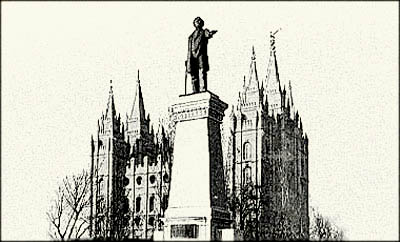

"There stands Brigham like a bird on a perch.
With his hand to the bank, his back to the church"
  (old Utah/Idaho "jack Mormon" folk rhyme)


1850-1856   |   1857-1865   |   1866-1899   |   1900-2010


DEN Sep 27 1902   |  DNs Jul 31 1905
DEN Aug 12 1905   |  DEN Mar 16 1907   |  HerRp Feb 01 1910
ProgR Apr 12 1912   |  HerRp Dec 30 1912   |  BEN Jun 20 1925
DEN Aug 31 1935   |  DEN Jun 12 1937   |  DEN Aug 02 1941
DEN Mar 16 1949   |  DN Jul 07 1956   |  DN Sep 11 1965
DN Oct 16 2008   |  DN Jun 04 2009   |  DN Mar 03 2010

Some off-site Deseret News articles:

May 26 '00   |  July 19 '00   |  Mar 23 '01   |  Apr 10 '01
May 14 '01   |  June 19 '01   |  Feb 24 '02   |  May 24 '02
Apr 05 '04   |  Aug 25 '05   |  Mar 28 '08   |  Aug 25 '34
Nov 14 '36   |  Jun 12 '37   |  May 11 '46


Old Newspaper Articles Index   |   Salt Lake Tribune



T R U T H   A N D   L I B E R T Y.

Vol. 52.                   Salt Lake City, Utah, Saturday, September 27, 1902.                   No. 268.


FIGURES  IN  EARLY  CHURCH  HISTORY.
_______

Something of Hiram, the Beautiful, Where Lived the Prophet Joseph Smith During one if the Most Eventful Periods in His Career -- In this Northern Ohio Hamlet He Revised the Bible, Received Glorious Revelations and Was Brutally Persecuted by a Mob.
Hiram, Sept. 18. -- Beautiful for situation is Hiram, one of the many incorporated hamlets of northern Ohio. I was about to say that "she," meaning Hiram, sits a queen of hamlets in the beautiful hill country of Portage county, when I happened to remember that a feminine pronoun could not consistently stand for the word "Hiram." And yet one can never get his own consent to speak of a town as "he," any more than one can get a sailor to speak of a ship as "he;" though why, no philosopher nor sailor, nor the present writer can say; but so it is. Barred then by consistency on one hand, from alluding to Hiram as "she," and on the other hand barred by custom from referring to a town as "he," I can only say, in commonest prose, that the "hamlet" of Hiram is beautifully situated in the rolling hill country of northern Ohio. And it is beautiful, that hill country! I know the mountains -- and I love them! I know the plains -- and I marvel at their extent -- but could never love them -- I hate dead levels! Give me change, cries out my soul -- give me change! The valleys may have their shadows -- deep, gloomy, perhaps awful; but the hill tops have their sunshine, their commanding views, their sun-lit inspirations; and I'll endure the shadows, however deep, if only as reward I may have the hill-tops and the sunshine now and then. Well, in this rolling country you get diversity of landscape; alternating hills and valleys; alternating farms and woodlands, thriving cities and prosperous country -- here in the grand old state of Ohio.

AN  HISTORICAL  CENTER.

But this hamlet of Hiram, sitting on a hill commanding a splendid view of a grand country, what of it? Why, in the first place, after its beauty for situation is noted, and its general heathfulness conceded -- a point upon which its inhabitants seem to insist -- its importance as an historical center claims attention, though its inhabitants little suspect it. Their pride centers mainly in the fact of its importance as an educational center, and the associations with the place of the lamented James A. Garfield, late president of the United States. You must know that the chief center of interest in Hiram now is the Hiram college, a denominational institution of learning founded by and under the control of the "Christian," that is to say the "Campbellite" church. Hiram College, like Bethany college in Virginia, grew out of the "Reform" movement led by Alexander Campbell, Walter Scott and Sidney Rigdon, in the first half of the nineteenth century. Hiram was selected as the most suitable place for a college, moreover, in response to that sentiment which demanded that such educational institutions should be isolated from the busy marts of men -- aside from the city and its allurements. Hiram's chief claim for consideration as a suitable place for the "Disciples" college was this asidedness from the world, and its healthiness. These considerations won, and the college was established there as an "eclectic institute," in 1850. To this place James A. Garfield came first as student, afterwards to remain as teacher and president of the "board of instruction" from 1857 to 1863; and he remained a member of the board of trustees from 1866 to the time of his death.

HIRAM'S  COLLEGE.

After the local pride of Hiram in Garfield comes its pride in the college and its foreign missionary work. It boasts that the "Disciples" interested in Hiram college spend more money in foreign missionary work than in home church work. Twelve missionaries it has sent to Ibdia since 1894; six to China; two to Japan, and one to Puerto Rico.

But to the "News" readers there is an interest associated with Hiram that far surpasses irs "Disciple's" college, or the memory of the lamented Garfield's association with it. Hiram was the abode, for a time, of one who, if he bequeathed to Hiram not a name, at least left to it a recollection that will be remembered when its college shall have crumbled to ruins and people forget James A. Garfield. This "one" was Joseph Smith, the Prophet.

WHERE  THE  PROPHET  LIVED.

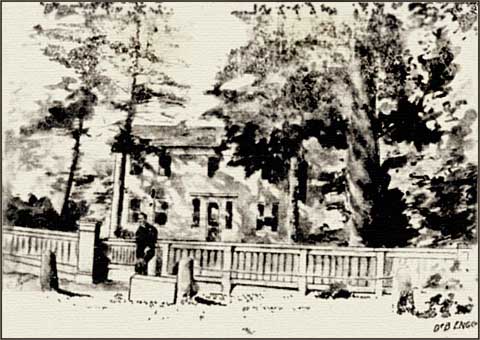
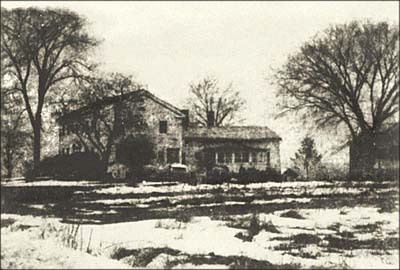
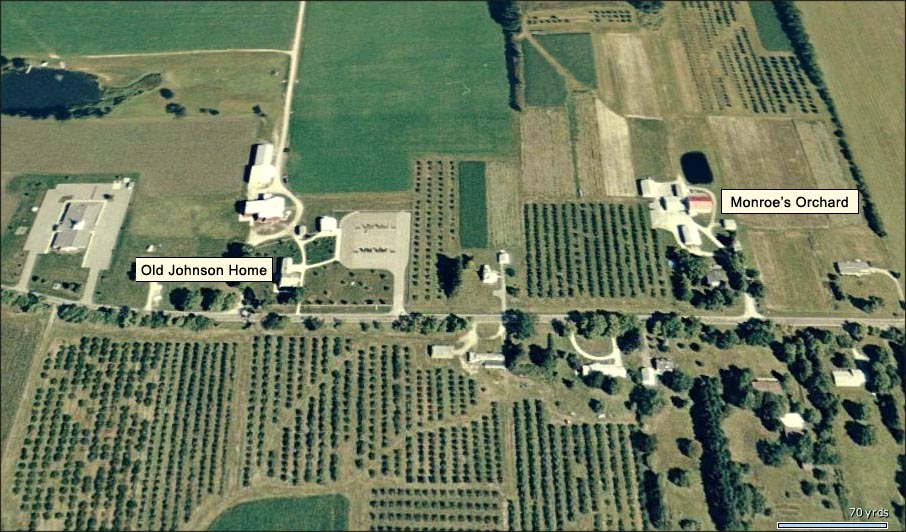
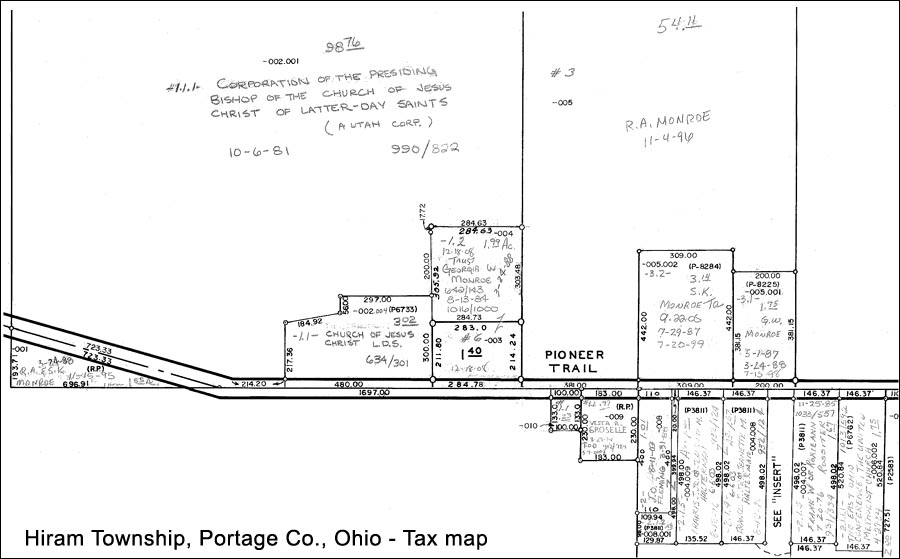
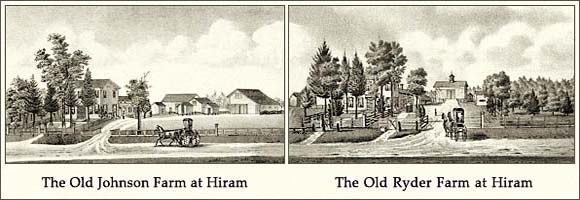
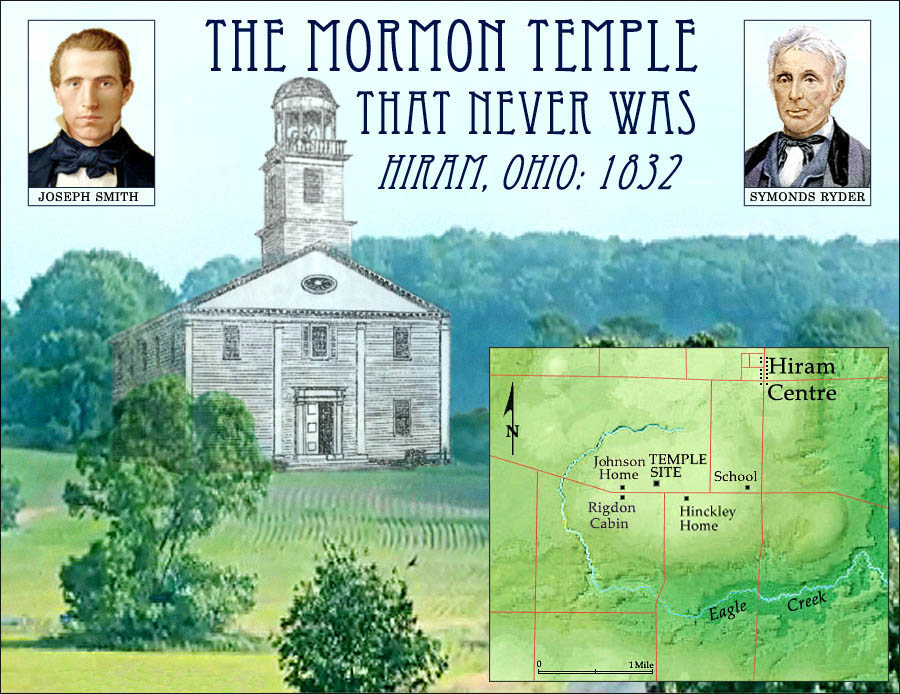
A mile and a half westward from what Hiramites call the "center," meaning by that the college campus and the neat modern cottage homes that face it as a public square, is the old "Johnson homestead," where the Prophet Joseph Smith lived for some months during the eventful years of 1831 and 1832. Here in the east upper room he, with Sidney Rigdon as scribe, "translated" or what would be more appropriate to say "revised" the King James' translation of the Bible. Here, on the front steps of the Johnson residence, the Prophet frequently preached to the multitudes that came from the surrounding country to hear him. Here several revelations were received, including what will doubtless be regarded as the grandest revelation of all, that God has given in this dispensation of the fulness of times -- namely, the vision of the future glories to which men may attain. That revelation which upsets the theology of modern christendom, and makes it clear that God is indeed just, and that men can be, and will be judged according to the deeds done in the body whether they be good or evil.


THE  JOHNSON  RESIDENCE.
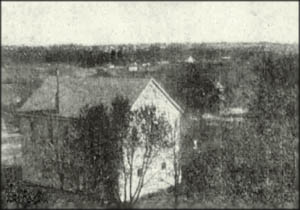
The old "Father Johnson Homestead" at Hiram, unaltered, but just as it stood in 1830-31, when the home of the Johnson family, and some of its rooms were occupied by the Prophet and his family. It was the right hand upper room (east end) that was used by the Prophet Joseph as a translation room, and where he, with Sidney Rigdon as scribe, revised the English translation of the Bible. It is at present occupied by a Mr. James H. Stephens, whose grandfather, Judge [sic - Jude] Stephens, purchased it of Father Johnson many years ago.

PERSECUTED  BY  A  MOB.

Here, too, the Prophet suffered one of the most painful and brutal persecutions that overtook him in his eventful career. On the night of the 25th of March, 1832, the Johnson residence was quietly surrounded by a mob of the Prophet's enemies, determined to kill him, or do him great bodily injury. Worn out with watching over the sick children of John Murdock, whom the prophet's wife Emma, had taken to rear as her own, Joseph did not hear the tapping on the window pane, which was doubtless made by the mob to ascertain if all were asleep in the household. The first thing the Prophet was conscious of was the screams of his wife and the fact that he was being carried bodily from the house into the field.

He struggled with his captors and succeeded in knocking one of them headlong by a kick; but all was vain. They bore him from the house, stripped him of his clothing, and one man fell upon him and scratched his body with his nails like a mad cat. After trying to force a vial of aque fortis into his mouth, beating him and besmearing him with tar and feathers, they left him. "I attempted to rise," he says in his own account of the affair, "but fell again. I pulled the tar from my lips, so that I could breathe more freely, and after a while I began to recover, and raised myself up, whereupon I saw two lights. I made my way toward one of them, and found it was Father Johnson's. When I had come to the door I was naked, and the tar made me look as if I were covered with blood, and when my wife saw me she thought I was all smashed to pieces, and fainted. During the affray abroad, the sisters collected at my room. I called for a blanket: they threw me one and shut the door; I wrapped it around me and went in. My friends spent the night in scraping and removing the tar from my body, so that by morning I was ready to be clothed again. With my flesh all scarified and defaced, I preached that morning to the congregation as usual, and in the afternoon of the same day baptized three individuals."

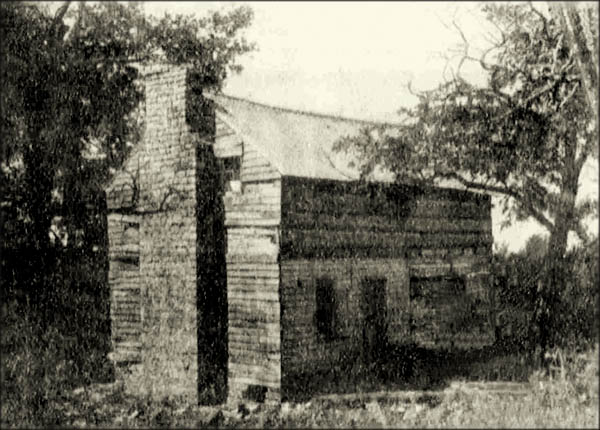
The treatment of Sidney Rigdon on the same occasion was even more severe. He was dragged by the heels over the hard frozen ground for a distance of some 30 rods, beaten into insensibility, covered with tar and feathers, and left for dead. He was living just across the road from Father Johnson's, in a log house, at the time of the outrage, and for several days was delirious. The villagers point out to this day the oak tree under which he was tarred and feathered. "Why did the mob abuse these men," I asked Hartwell Rider, to whom I had been recommended as the "wise man" of the village, well versed in the history and folklore of the neighborhood. "Well, the people did not want Hiram to be a Mormon center; and there was a man down at Shallersville whose wife had joined the Mormon Church and was a-going with the Mormons to Missouri -- that was their Zion then, you know." By the way, this Hartwell Rider, with whom I talked for the better part of half a day, is the son of Simonds Rider, a noted Campbellite preacher, who joined the Church at Hiram in 1831. From remarks made by the different members of the mob who assaulted the Prophet on that night of the 25th of March, 1832, Simonds Rider was the leader of the mob; but his son Hartwell denies it, and asks that it be erased from the "Mormon" books. "Well," I replied, "that may be somewhat difficult, but I am happy to know that you denounce the mobbing, and are anxious to sever the association of your father's name with such an infamy."

THE  FIRST  APOSTATES.

It may be of interest to remark also that Simonds Rider and Ezra Booth were among the first apostates of the Church. The thing which took Rider out of the Church is rather humorous. It is claimed by his son, Hartwell, who seems a little ashamed that his father ever was a "Mormon," that a revelation was received by Joseph to the effect that Rider was to be an Elder in the Church, and preach the Gospel, "but unfortunately," says the son, "both in the revelation and in the Elder's certificate the name Rider was spelled R-y-d-e-r instead of R-i-d-e-r." This led the former Campbellite preacher to "suspect" the inspiration that could make a mistake in orthography, and so he left the Church! Ezra Booth generally, though erroneously supposed to be the first apostate from the Church, also lived at Hiram for a time, and here wrote the anti-"Mormon" letters which will be his chief claim to fame. "What became of Booth after he left the Mormon Church?" I asked Hartwell Rider. "Did he prosper, was he a successful man?" The old man shook his head. "No; if you mean in a business way. Nor in any other way, for matter of that. You see, he was not a strong man. He tried to please everybody to whom he preached. He was not a man to take a stand and draw people to him. He preached for the Methodists for a while, after he left the Mormons, and then he went to spiritualism, then became an infidel and died here a few years ago at Garretsville without any faith in God or man." "Alas!" I mentally exclaimed, "how alike is the fate of those who turn from the faith in the restored Gospel of Jesus Christ! What a sad repetition it is -- this wrecking of faith in 'God and man' when men who have received the light turn from it to darkness! It was promised in the very inception of the work that it should be a saver of life unto life or of death unto death, and truly the experience of the Church proves the declaration true. Anti-Mormon writers cite the fact here alluded to as an evidence of the soul-destroying power of Mormonism, saying that it leaves a trail of infidelity wherever it has been received. That is true, however, only in so far as men having once given to it their allegiance, then turn away from it. The beggarly elements from which it called them could never seem quite the same to them after they had once tasted the good word of God and the powers of the world to come." But those who have remained true to "Mormonism" and the obligations it enjoins, have not lost faith either in God or man; but have died happy in the hope, and may I not say, knowledge, of the reality of that eternal life which God, who cannot lie, promised before the world began.

AN  OBJECT  LESSON.

Thoughtful men will look deeper for the meaning of what all admit is a singular fact, viz.: that those who accept "Mormonism" and then turn from it end in believing in nothing: and they will see in that fact the evidence that these men have touched in their lives some very vital truth, and proving recreant to it has left them truth-stranded, by which I mean stripped of the truth or the power to comprehend it or hold to it. In them the word of God is verified: "For it is impossible for those who were once enlightened, and have tasted of the heavenly gift and were made partakers of the Holy Ghost... if they shall fall away to renew them again to repentance; seeing they crucify to themselves the Son of God afresh and put Him to an open shame."

This mention of Booth and Rider, the fact of their apostasy, and the loss of all religious faith which attends upon apostacy, has led me into a moralizing mood, in which I merely wanted to call up in this communication the memories that are awakened by a visit to Hiram.
B. H. ROBERTS.     


Note: For more information on this subject see "A Hill of Zion" in the Sept. 10, 1877 New York Herald and "The Mormons are Only a Memory but 'Hiram Hill' is Still Unchanged," in the Feb. 21, 1909 Cleveland Plain Dealer Magazine.


DESERET SEMI-WEEKLY NEWS.
No. ?                       Salt Lake City, Utah,  Monday, July 31, 1905.                       Vol. ?


AFFIDAVIT  OF  JOHN  W.  RIGDON.
_______

We publish today in another part of this paper a statement made under oath by John W. Rigdon, the son of Sidney Rigdon, who was at one time a counselor to the Prophet Joseph Smith, and was held in high esteem as a theological speaker and writer of great ability. He was falsely charged with being a party to the manipulation of The Manuscript Found of Solomon Spaulding, and its fabrication into the Book of Mormon. The stupid story found its way into numerous anti-'Mormon' publications, and notwithstanding its complete refutation, leaving not a shadow of doubt as to its falsehood, is still proclaimed from numerous sectarian pulpits and repeated in newspaper articles and religious pamphlets. The affidavit which we publish bears directly on this matter, and also on a story which has about as much foundation as the Spaulding romance, to the effect that Joseph Smith, the Prophet, ordained and appointed his son Joseph to succeed him as President and Prophet of the Church of Jesus Christ of Latter-day Saints. When the promulgators of this idle tale are pressed for proofs, and also for a statement of the time and place when the alleged incident occurred, the answer is that it was at the time when the Prophet Joseph was incarcerated in Liberty jail, Missouri. There were other "Mormon" prisoners with him, and none of them has ever confirmed the story, but all have denied it so far as their knowledge extended. Now comes John W. Rigdon and gives most positive evidence explosive of the tale that has been told, and clears away the smoke and fog of the falsehood that surrounded it on its inception. Read Mr. Rigdon's statement. It will be found thorough, direct and satisfactory. This gives occasion for some remarks on the principle involved in the succession to the President of the Church, as revealed through the Prophet Joseph and established in the Church of Jesus Christ of Latter-day Saints.


WHENCE  COMES  ITS  AUTHORITY?
_______

The claim of the Reorganized Church for recognition as the rightful successor in the presidency of the Church of Jesus Christ of Latter-day Saints has received quite a set-back. It may be remembered that about the end of last month the news was flashed from Salt Lake City that Frederick M. Smith, a grandson of the Prophet Joseph Smith, was in Utah and had issued an appeal to the members of the Church of Jesus Christ of Latter-day Saints to leave that religious body and get into the fold of the Reorganizers, asserting that the Prophet, before his death, blessed to become as his successor his eldest son, father to Frederick M. Smith; further asserting that "after years of waiting, the Prophet's son, the present Joseph Smith (father to Frederick) went to the church, being called thereto by a revelation commanding him, and as prophet, seer and revelator of the Reorganized Church of Jesus Christ of Latter-day Saints he has administered in his office, obeying the revelation, and fulfilling the destiny pronounced upon his head by his father, which succession has been unbroken."

In the following affidavit of John W. Rigdon, it will be seen that this claim of the Reorganizers is entirely shattered, and that no such ceremony as the Prophet Joseph Smith ordaining the present head of the Reorganizers to succeed him ever took place:
   State of Utah. }
   County of Salt Lake. } ss.

John W. Rigdon, being duly sworn, says; I am the son of Sidney Rigdon, deceased. Was born at Mentor, in the State of Ohio, in the year 1830, and am now over seventy-five years of age. My father, Sidney Rigdon, joined the Church of Jesus Christ of Latter-day Saints that year, and was in 1833 ordained to be Joseph Smith's first counselor which position he held up to the time Joseph the Prophet was killed, at Carthage jail, in 1844. That Joseph Smith and Sidney Rigdon moved from Kirtland, with their famihes, to the State of Missouri, during the winter of 1837, but Rigdon did not reach Far West, in the State of Missouri, until the last of April, 1838. That during the troubles in Missouri, in the year 1838, Joseph Smith, Hyrum Smith, his brother, Sidney Rigdon, Lyman Wight and others, whose names I do not now remember, were arrested and imprisoned in Liberty jail, about forty miles from the village of Far West, in Caldwell county, Missouri, where they all remained incarcerated for several months. That while said Joseph Smith, Hyrum Smith, Sidney Rigdon, Lyman Wight and others were prisoners in said Liberty jail, as aforesaid, I, with my mother, wife of Sidney Rigdon, Emma Smith, wife of said Joseph Smith, and Joseph Smith, son of Joseph and Emma Smith, went to see the said prisoners during the latter part of the winter of 1838. We all went together in the same carriage and came home together. We stayed at Liberty jail with the prisoners three days and then left for home. The story that is being told by some of the members of the Reorganized Church, at Lamoni, that young Joseph Smith, now president of the said Reorganized Church, was ordained by his father, Joseph Smith, to be the leader of the Church of Jesus Christ of Latter-day Saints after his father's death, is not true, for I know that no such ordination took place while we were at Liberty jail; that if any such ordination had taken place I most certainly should have known it and remembered it, as I was with young Joseph, the Prophet's son, all the time we were there. If Joseph Smith had ordained his son Joseph to be the leader of the Church at his death, he would have done so in a manner that there could have been no doubt about it. Both of his counselors were then in prison with him, namely, Sidney Rigdon and Hyrum Smith, and it would have been in order for the Prophet to have called upon them to assist him in such an ordination had it taken place, and a record of the same made in the Church books, so that all members of the Church might have known that such an ordination had taken place. But nothing of the kind appears in the Church books. My father and mother lived a good many years after the incarceration at Liberty jail, and I, who lived near my father, never heard my father or my mother mention that such an ordination ever took place in Liberty jail; and as I know myself that no such ordination took place in Liberty jail, and inasmuch as it is not claimed that an ordination of this character was bestowed at any other place, therefore I deny it as an untruth and a story gotten up by the Reorganized Church for effect.

Besides all this, if Joseph Smith, the President of the Reorganized Church was ordained while in Liberty jail, why did he, sixteen years after his father's death, receive an ordination under the hands of William Marks, William W. Blair, and Zenas H. Gurley? Would it not seem that one ordination (and that too, said to have been by his own father, the President of the Church) should have been sufficient? But further, Wm. Marks, Wm. W. Blair and Zenas H. Gurley had all been excommunicated from the Church of Jesus Christ of Latter-day Saints (excepting William W. Blair, who never belonged to it) before they "ordained" young Joseph to be President of the Reorganized Church, and therefore they did not have the authority to ordain him. The whole story of his being ordained by anyone having authority to do so is too preposterous to be entertained for a single moment, and should be rejected by all who hear such a story mentioned.

As to the truth of the doctrine of polygamy being introduced by the Prophet Joseph Smith, deponent further says: Joseph Smith was absolute so far as spiritual matters were concerned, and no man would have dared to introduce the doctrine of polygamy or any other new doctrine into the "Mormon" Church at the city of Nauvoo during the years 1843 and 1844, or at any other place or time, without first obtaining Joseph Smith's consent. If anyone had dared to have done such a thing he would have been brought before the High Council and tried, and if proven against him, he would have been excommunicated from the Church, and that would have ended polygamy forever, and would also have ended the man who had dared to introduce such a doctrine without the consent of the Prophet Joseph.

And deponent further says: Joseph the Prophet, at the City of Nauvoo, Illinois, some time in the latter part of the year 1843, or the first part of the year 1844, made a proposition to my sister, Nancy Rigdon, to become his wife. It happened in this way: Nancy had gone to Church, meeting being held in a grove near the temple lot on which the "Mormons" were then erecting a temple, an old lady friend who lived alone invited her to go home with her, which Nancy did. When they got to the house and had taken their bonnets off, the old lady began to talk to her about the new doctrine of polygamy which was then being taught, telling Nancy, during the conversation, that it was a surprise to her when she first heard it, but that she had since come to believe it to be true. While they were talking Joseph Smith the Prophet came into the house, and joined them, and the old lady immediately left the room. It was then that Joseph made the proposal of marriage to my sister. Nancy flatly refused him, saying if she ever got married she would marry a single man or none at all, and thereupon took her bonnet and went home, leaving Joseph at the old lady's house. Nancy told father and mother of it. The story got out and it became the talk of the town that Joseph had made a proposition to Nancy Rigdon to become his wife, and that she refused him. A few days after the occurrence Joseph Smith came to my father's house and talked the matter over with the family, my sister, Mrs. Athalia Robinson also being present, who is now alive. The feelings manifested by our family on this occasion were anything but brotherly or sisterly, more especially on the part of Nancy, as she felt that she had been insulted. A day or two later Joseph Smith returned to my father's house, when matters were satisfactorily adjusted between them, and there the matter ended. After that Joseph Smith sent my father to Pittsburg, Pa., to take charge of a little church that was there, and Ebenezer Robinson, who was then the Church printer, or at least had been such, as he was the printer of the paper in Kirtland, Ohio, and a printer by trade, was to go with him to print a paper there, and nine days before Joseph Smith was shot at Carthage we started, reaching Pittsburg the day before he was killed.

Deponent further says: I have in my possession a paper called the Nauvoo Expositor, bearing date, Nauvoo, Illinois, Friday, June 7th, 1844, which said paper's printing plant was destroyed by the City Council at Nauvoo a night or two after this issue. There never was but one issue of this paper. Joseph Smith the Prophet was then Mayor of the City of Nauvoo. In the afternoon of the day on which the printing plant was destroyed, Henry Phelps, a son of W. W. Phelps, came down Main Street selling this paper, the Nauvoo Expositor, and everyone who could raise five cents bought a copy. In that paper the three following affidavits appeared, which I reproduce herewith. ...
JOHN W. RIGDON.      
Sworn to before me this 28th day of July, 1905.
  {ss}                                            JAMES JACK, Notary Public.


Note 1: The exact title, along with the precise editor's introduction, for the above affidavit remains unknown. The article presumably first appeared in the Deseret News of July 29, 1905 and from there was reprinted in the Semi-Weekly of July 31st. The text is taken from subsequent reprints.

Note 2: For the text of a lengthy interview with John W.Rigdon, see the Salt Lake Tribune of May 20, 1905.


T R U T H   A N D   L I B E R T Y.

Vol. 56.                   Salt Lake City, Utah, Saturday, August 12, 1905.                   No. ?


FURTHER  TESTIMONY.
_______

The Evidence of John W. Rigdon Corroborated and Confirmed.
_______

Bunkerville, Lincoln County, Nev.,      
August 4, 1905.      
Editor Deseret News:
    Dear Sir -- Seeing the testimony of J. W. Rigdon in the Semi-weekly News of July 31, and being much interested in the subject, and knowing that there lived in this place a man that was quite familar with the early scenes of Church history, especially those in and about Far West, Missouri, and having heard him say that he had many times visited his father and the Prophet Joseph, while they were incarcerated in Liberty jail, I went and interviewed Orange L. Wight (eldest son of former Apostle Lyman Wight), who is now 82 years old and resides with his daughter, Sister Harriet M. Earl. Brother Wight is quite feeble in body, but his mind seems to be as bright as ever.

I found Brother Wight in his usual good humor, and seemed quite willing to talk, in fact, was pleased to do so. "Elder Wight," said I, "are you willing to make a statement for publication in regard to what you know about Joseph Smith, son of the Prophet Joseph, being ordained while in Liberty jail to lead the Church?" "Certainly I am." "Then," said I, "just write me out a brief statement covering those points, and I will give it in your own words." Following is Brother Wight's statement:
"In regard to the statement of John W. Rigdon, I endorse it in every point. Brother John W. Rigdon speaks of being in Liberty prison when the Prophet Joseph Smith, Sidney Rigdon, Hyrum Smith, Lyman Wight, and others were there (the others were Caleb Baldwin and Alexander McRae). I also visited the prisoners at or about the same time, and slept with them many times at different periods, and I cannot recollect of ever hearing the subject of an ordination mentioned.

"My father, Lyman Wight, nor my mother, never alluded to it during their life time in my presence, so I take it for granted that Joseph, the son of the Prophet Joseph Smith, was not ordained to fill the place of his father, in the Liberty jail. I was born in the State of New York, Nov. 29, 1823, hence am about seven years older than Brother John W. Rigdon. And if an ordination of young Joseph had occurred in the prison, I would likely have heard of it, and would certainly recollect it.

"Previous to this, while I was several years younger, the Twelve Apostles were organized and commissioned to assist in leading and governing the Church. I can recollect every detail distinctly. My acquaintance with the Prophet was from the year 1830 to his martyrdom, and I can truly say he was a Prophet of God, and was appointed to the divine mission to organize the Church of Jesus Christ of Latter-day Saints in this last dispensation.

"As to the Prophet's believing and practicing polygamy, I have as near a certain knowledge of the fact, I may say, as any man living; I was well acquainted with most or all of his wives, and talked with them on the subject, at the same time my wife also talked with them.

"If there is anything further that is necessary for me to communicate in regard to my recollection, I will willingly do so.
           "Respectfully,
                                   "ORANGE L. WIGHT."
Further talk with Brother Wight brought out the following facts: He was baptized into the Church in the spring of 1832; was with the Church through all their troubles in the State of Missouri. Brother Wight filled a thirteen months' mission in the State of Virginia in company with Jedediah M. Grant and others; was in Nauvoo at the time the Prophet was captured at Dixon, Ill., and was one of those who went up the Illinois river on the steamer Maid of Iowa to assist in rescuing the Prophet.
                                   "JOSEPH I. EARL."


Notes: (forthcoming)


T R U T H   A N D   L I B E R T Y.

Vol. 56.                   Salt Lake City, Utah, Saturday, March 16, 1907.                   No. ?


The  Fate  of  Many  Mobocrats.
_______

Historian's Office, Salt Lake City, March, 1907. -- Editor Deseret Evening News:

I was much interested in reading the editorial under the caption "Retribution" in your issue of the 6th inst., in which you refer to the fate of several mobocrats who in times past lifted their puny arms against the cause of right to persecute and slay the innocent.

We are making some efforts at the Historian's Office to gather information concerning the fate of the mobbers who have persecuted the Latter-day Saints, and when we are through with our compilation, I think we shall have one of the most interesting chapters of Church history ever written, sad as it may be.

In an old document lying before me this morning I find a statement concerning the fate of some of those who tarred and feathered the Prophet Joseph Smith in Hiram, Portage county, Ohio, March 25, 1832. The notorious Carnot Mason, who during the mobbing on that occasion pulled brutally out of bed by the hair and proposed other cruelties to the prophet, while in the hands of the mob, was soon afterwards attacked with a spinal complaint of which he died after severe suffering. Mr. Hamilton, another mobber who carried Joseph on the occasion, was buried alive by the caving in of a well. Warren Waste, another participant in the cruel attack upon the Prophet, who was known as the strongest man in the "Western Reserve," was killed by the falling of a log at the raising of a log house. Miles T. Norton, a conspicuous mobocrat, who furnished poison to kill Father John Johnson's favorite watch dog, preparatory to the attack on Joseph, was killed soon afterwards by a ram, which in attempting to run past him thrust him, thrust his horn into his bowels, which produced inflammation and caused death. A Mr. Fuller, another conspicuous mobocrat on the same occasion, died of cholera. John Ural, a merchant in Hiram, in affluent circumstances at the time of the mobbing, said, when it was proposed to steal a feather pillow from Joseph's bed, that he always had money to buy feathers to feather such men as Joseph Smith. This man was soon reduced to poverty.

In 1888 the writer, accompanied by two other brethren, visited the waste places of Zion in Missouri and Illinois, and learned from old settlers the fate of a number of the mobocrats who so cruelly persecuted the Saints in early days in these states. In Jackson county, Missouri, an old gentleman (Mr. Mason), who himself had helped to drive the Mormons out of that county in 1833, told us that Colonel Thomas Pitcher died about a year previous to our visit as a pauper, and that he not only died poor, but, during his last days he was shunned and deserted by all; even his own children neglected to care for him. It went so far that some of the neighbors proposed to take up a subscription in order to raise sufficient means to hire a negro from Kansas City to wait on him till he died, his disease being of a low and loathsome nature; but before the negro came Mr. Pitcher, breathed his last in the midst of filth and misery.

All readers of Church history will remember Col. Thomas Pitcher, who treacherously, under the cover of law, disarmed the brethren, when they were endeavoring to defend themselves and their rights, and who after he had done this, and the brethren had thus become defenseless, permitted the mob to fall upon them and drive them out of the country. Col. Pitcher was once a wealthy man, but during the late civil war his property was burned by the enemy and he was consequently reduced to poverty. I may add in this connection that during the Civil war, referred to nearly every house on both sides of the Big Blue (the very section of country where about 200 houses belonging to the Saints were burned in the beginning of 1834) were destroyed during the guerrilla and bushwhackers' campaign of terror in the time of the Civil war. It was a war between neighbors and neighborhoods, and the whole section of country was laid waste, so Mr. Mason informed us, his own house being burned with the rest.

To the Latter-day Saints who believe in the prophetic calling of Joseph Smith, it is well known that all this happened in fulfillment of predictions made by him.

In answer to our further inquiry, Mr. Mason also told us that Moses Wilson, the old mobocratic general, notoriously known as such in the Missouri persecutions, died many years ago in Texas as a drunkard, gambler and genuine vagabond, despised by all who knew him.

"What became of Samuel C. Owens, who had so narrow an escape from drowning in the Missouri river while fighting the Mormons in 1834?" was asked. "Sam Owens,' replied Mr. Mason, "why, he was the only man killed in a battle with the Mexicans, near the city of Chihuahua in 1846. He had just received bad news from home, informing him that his son-in-law had committed the crime of murder, and Mr. Owens felt so bad about it, that he immediately filled himself with brandy, plunged heedlessly into a hand-to-hand combat with the Mexicans, during which he was killed, according to his own wish; for he said before starting that he wanted to go to hell at once, knowing, as he did, that he would have to go there some day anyway." Such was the fate of this old mobocrat, who persecuted the Saints so unmercifully during the Jackson and Clay county troubles.

A few days later the writer visited the region around Shoal creek in Caldwell county, Missouri, where the cruel tragedy known in Church history as the Haun's Hill massacre took place, October 30, 1838. From the old settlers living in that neighborhood it was learned that nearly all the mobbers and murderers who participated in the massacre were dead or had moved away, so that their whereabouts, if alive, were not known. Some of the murderers had died in disgrace and shame, haunted by their consciences until the last hour; others had boasted of their dastardly deeds until they were smitten with sickness, and misery in the midst of which they cursed God and died. One man made the statement that not one of those miserable creatures who imbued their hands with the blood of the Saints ever amounted to anything afterwards. A great many of them died with their boots on, and not a single one was remembered as a respectable member of society afterwards.

The notorious Colonel Wm. O, Jennings, who commanded the mob at the time of the massacre, was assassinated in Chillicothe, Livingston county, Missouri, in the evening of January 30, 1882, by an unknown person who shot him on the street with a revolver or musket, as the colonel was going home after dark. He died the next day in great agony. The shooting occurred on Calhoun street a little northwest of the county jail in Chillicothe. Nehemiah Comstock, another leader of the mob who murdered the Saints at Haun's Mill, expired many years ago in Livingston county, Missouri, as a good-for-nothing drunkard. His mother was also a drunkard, and died a pauper in the midst of misery in a Kentucky poor-house.

The notorious Samuel Bogart, who commanded the mob that killed David W. Patten and others of our brethren on Crooked river, Ray county, Missouri, October 25, 1838, soon afterwards (at a special election held in Far West) willfully killed a man by the name of Beaty. In order to avoid arrest and the hangman, he made his way to Texas, where he subsequently died as a vagabond and outcast.

In a subsequent visit to Nauvoo and Carthage, Ill., it was learned the murderers of the Prophet Joseph and his brother Hyrum, and the persecutors of the saints in that county generally became subject to a similar experience to the mobbers of Missouri, but I shall only mention one of them, namely, a Mr. Townsend, one of the mobbers, who assaulted and forced in the doors of the Carthage jail June 27, 1844. He lived at that time near Fort Madison; Ia. The pistol discharged by Joseph Smith at the time of the martyrdom wounded him in the arm near the shoulder, and the wound continued to rot without healing, until the arm was amputated, and even then the wound would not heal. This man was afterwards known to have said, "I know Joseph Smith was a prophet of God, and, Oh, that I had stayed at home and minded my own business! Then I would not have lost my life in being tormented with a guilty conscience and this dreadful wound which none can heal!" He died two or three months afterwards, having literally rotted alive.

Elder Parley P. Pratt, while on a mission to California in 1854, obtained some interesting information in regard to some of the assassins connected with the martyrdom of Joseph Smith. One of the mobbers on that occasion, James Head of McComb. Ill., was heard by a certain Captain Lawn and others to boast of the killing afterwards. But he was always gloomy and troubled from the time he helped to murder the brothers, and frequently declared that he always saw the two martyrs before him.

A colonel of the Missouri mob who helped to plunder and drive the Mormons, died in a hospital in Sacramento in 1849, where a Mr. Beckwith had the last care of him. He was eaten with worms -- a large, black-headed kind of maggot -- which passed through him by myriads, seemingly half a pint at a time! Before he died these maggots were crawling out of his mouth and nose. He literally rotted alive! Even the flesh on his legs burst open and fell from the bones! They gathered up the rotten mass in a blanket and buried him without awaiting a coffin. Another Missouri mobber died in the same hospital about the same time and under the care of the same Mr. Beckwith. His face and jaw on one side literally rotted and half of his face literally fell off! One eye rotted out, and all of his nose, mouth and jaw fell from the bones. The doctors scraped the bones, and locked and took out his jaw from the joint around to the center of the chin. The rot and maggots continued to eat until they ate through the large and jugular vein of his neck and he bled to death.

Scores of other instances might be mentioned where men, who have persecuted and murdered the Latter-day Saints have met with the retribution of God, who says, "Vengeance is mine; I will repay." But my communication is already longer than I intended to make It, so I will conclude by merely mentioning Governor Thomas Ford of Illinois, who in a treacherous manner broke his pledge in regard to protecting the lives of Joseph and Hyrum Smith while they were incarcerated in Carthage jail, and who died as a pauper a few years afterwards, and William W. Drummond, the ex-judge of Utah, who, by his falsehood, influenced the government of the United States to send an army against the saints in Utah, and who died as a pauper, drunkard and vagabond in Chicago, Ill., having previously been arrested for stealing postage stamps.

I could write a lengthy chapter on the fate of the murderers of Elder Joseph Standing in Georgia in 1879, and of those who killed Elders Berry and Gibbs in Tennessee in 1884, and include, also, the fate of some of the United States deputy marshals who, during the anti-polygamy crusade of 1884 to 1890, exceeded the legitimate authority of their offices in prosecuting and persecuting the brethren who were suspected of being criminals under the Edmunds law; but these details must be given some other time.
ANDREW JENSON.      


Note: Strangely enough, the list of assailants in the March 24, 1832 tar and feathering of Joseph Smith and Sidney Rigdon, as supplied by Elder Andrew Jenson, does not include the name of Symonds Ryder, whom Mormons frequently have accused of being the "leader of the mob." Nor did the "old document" consulted by Jenson evidently include the names of Richard A. Dennison, Pelatiah Allyn, Silas Raymond and other Hiram residents supposed to have participated in the attack.


 HERALD - REPUBLICAN.

Vol. ?                    Salt Lake City, Utah,  Tuesday, February 1, 1910.                    No. ?


UTAH  PIONEER  CALLED  BY  DEATH.
________

The death of James Thornton Cobb, who died at the family residence, 250 Canyon road, early yesterday morning, removed from Utah one of its leading pioneer citizens. His death is generally regretted throughout the literary circles of Utah. Death was due to kidney trouble.

Mr. Cobb was born in Beverley, Mass., December 15, 1833. He graduated from Dartmouth college with high honors, and in 1858 came west, where he engaged in newspaper work. His literary work won for him the acquaintance and intimacy of such men as Phillips Brooks and Oliver Wendell Holmes. In one of his letters the poet said,

"Your mind has gone to depths and reached heights which no human mind since the days of Shakespeare has, and you have almost converted me."

The funeral arrangements have not been made, owing to the absence of several members of the family. The interment will be in the City cemetary.

The deceased is survived by his wife, Mrs. Camilla C. Cobb, and the following children: Mrs. Nat M. Brigham, Ives E., Henry Ives, Rufus K. and James Kent Cobb.


Note: For more information on James T. Cobb, see Part 10 of the Spalding Saga.


The  Progress-Review.

Vol. XVIIII                    Filmore, Utah,  Friday, April 12, 1912.                    No. 15.


John W. Rigdon  Dies.
________

The name Rigdon, as all who are acquainted with church history will remember, is one of the most prominent in early church history.

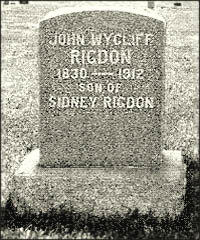
John Wycliffe Rigdon who died Friday night was the second son of Sidney Rigdon, who from the time of the organization of the first presidency of the church until the Carthage Jail tragedy, June 27, 1844, was first counselor to President Joseph Smith.

John W. was baptised in the City of New York, Sept. 8, 1904, and immediately came to Utah, where he has since resided, a faithful member of the church. Prior to his coming to Utah he had been following the legal profession and since his arrival in Utah has devoted much of his time to the lecture platform and was generally recognized as an able writer and speaker.

The testimony of John W. Rigdon concerning his father's relationship to the Book of Mormon was of peculiar interest. Pres. Seymour B. Young of the first council of seventies, knew the deceased well and three weeks ago interviewed him as to his knowledge regarding the truth or falsity of a statement made by some parties as to alleged help given by his father, Sidney Rigdon in assisting the Prophet in writing the Book of Mormon, and as to his knowledge of the Spaulding story in connection therewith. Pres. Young said of this interview:

"John W. Rigdon testified to me very earnestly as to this matter as follows: I asked my father Sidney Rigdon, when on his death bed, the following question: Were you acquainted with the Solomon Spaulding manuscript and was this manuscript in any way connected with the translation of the Book of Mormon or were you connected with the Prophet Joseph Smith during the translation of that book? Sidney Rigdon replied: 'I never knew anything about the Book of Mormon, nor its translation until I received a bound volume of the book from the hands of Parley P. Pratt. Up to this time I had never before heard of the Book of Mormon nor had I ever seen the Prophet Joseph Smith."

John W. Rigdon has left in writing the following testimony regarding his interview with his father, Sidney Rigdon concerning the Book of Mormon.

"I took occasion one day, being alone with my father in his room, to ask him some questions concerning the Book of Mormon. I said to him, 'Your sands of life have nearly run and it was due to his family to tell all he knew about the Book of Mormon and that he should not go down in his grave with that testimony locked in his breast. He looked at me a moment and got up from the lounge upon which he was reclining and said to me.

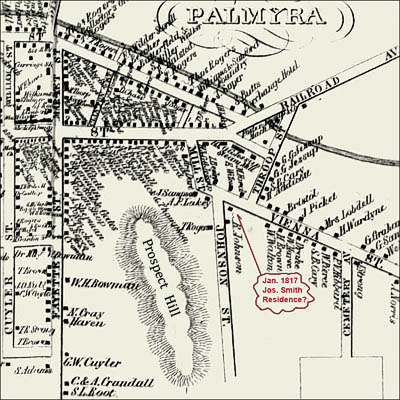
'My son, I will swear before God that what I have told you about the Book of Mormon is true and that I did not write it or have anything to do with its production; that Joseph Smith testified to me that an angel appeared to him and told him where to go and find the plates upon which the Book of Mormon was engraved. They were hidden in a hill near Palmyra, New York and I believe he did find them as he said. And I believe that Joseph Smith was a prophet and this world will find it out some day.'"


Note: The "testimony regarding his interview with his father," which John W. Rigdon was purported to have given to Elder Seymour B. Young (or which Elder Young obtained following's John's death) is not known to exist, other than in posthumous newspaper article publication. See also John's testimony of 1891, of 1900, and from 1905.


 HERALD - REPUBLICAN.

Vol. ?                    Salt Lake City, Utah,  Monday, December 30, 1912.                    No. ?


Founder of Church Known by Visitor
________

Peter S. Morrison Tells of Joseph Smith
as Friend and Schoolmate.
________

"I was a schoolmate of Joseph Smith, the founder of the Mormon church, as well as of his brother Hyrum," was the introductory statement made to a representative of The Herald-Republican last night by Peter S. Morrison, who is here on his way from New York state to his home near Marysvale, Cal.

"I was born nearly a hundred years ago," continued Mr. Morrison. "While I do not remember the event, very naturally my parents told me, and it is so written in our family records, that I was born on a sailing vessel twenty days out from Glasgow, Scotland, and bound for America, March 11, 1813. I was two months old when my parents landed with me at what was then Manhattan and New York port, the voyage requiring two months and twenty days.

Mr. Morrison yesterday called upon Joseph F. Smith, president of the Mormon church, and had a long talk with him. Mr. Smith invited the aged man into the Beehive house, where he was served with an afternoon meal.

"My parents lived at Barrington, Yates county, N. Y.," said Mr. Morrison in telling his story, "and my father was killed by a horse there when I was very young. This left my mother with thirteen children to care for. In order to help her bear her heavy burden, families in that vicinity took a child each from among the older ones, and I fell to the family of Joseph Smith Sr., at Palmyra N. Y. I went to school in school season with Joseph and Hyrum Smith. I well remember that Joseph was considered somewhat of a dull pupil -- that is, whenever he took up a book to study he would soon forget all about it and go off into absent-mindedness.


His First Visions.

"I shall never forget what his father said to him when Joseph announced his first vision. His father said that he had only been dreaming; and I thought so too, knowing his peculiarity of apparently day-dreaming. But he persisted in his assertions and after a bit we all began to think seriously of the matter.

"From New York I moved to Elyria, Lorain county, Ohio, where I lived until I was 33 years old, or up to the year 1846, when I enlisted for the war with Mexico and fought under Gen. Zachary Taylor. But while living in Ohio I heard of Joseph and Hyrum and their followers being at Nauvoo, Ill., and having been told so much about their wonderful religion, my wife and myself determined to visit them. This we did in June, 1844. We had been there only a day or two when Joseph was arrested and taken to Carthage. One night in that June I became so uneasy on account of the trouble that I left the house and went to Carthage. The next day I was leaning against a fence near the jail when the mob came up. It was in the afternoon, and with me was the man who afterwards drove the team which carried Joseph Smith's body to Nauvoo. When the mob approached the jail the guards opened a space for them to pass through, and the assault began.


Scene at Jail.

"I saw Joseph Smith as he rushed to the window apparently to leap out, and saw him fall to the ground when shot while in the act of leaping.

"No I did not become a member id the Mormon church, although I had that idea in my mind when I went to visit the boys at Nauvoo. Since that time I have been thrown apart from the Mormon people and probably that in part accounts for my still remaining a nonmember.

"I was in all of Gen. Zachary Taylor's battles -- fought with him in two engagements in Texas, crossing the Rio Grande with him and afterwards going to Monterey, Mexico, where we captured the fort by storm. Inside that fort were so many prisoners that we could not care for them. The only thing to be done was to parole them and turn them loose.


Experience in Mexico..

"While we were at Monterey town, Gen. Winfield Scott came along on his march to the City of Mexico. Thinking that General Taylor had done all the fighting he had to do, General Scott took all of Taylor's regulars, leaving him with only 4000 green volunteers. When General Santa Ana discovered how Taylor had been left, he swung away from his intended course and fell upon the green volunteers. This was at Buena Vista, and Taylor with his 4000 raw men whipped Santa Ana in open battle out on the open ground, the Mexican general having 21,000 of the flower of the Mexican army. Santa Ana afterwards said that he had Taylor licked twice, but that the stubborn American didn't know it.

"After I had served my time I took 136 comrads of that war and went with them to California. It was in September, 1849, that we camped out near the lake where there was a spring of water." (From Mr. Morrison's description it must have been somewhere near where the Garfield smelter now is.) "We rested here for a day or two and Brigham Young paid us a visit or two. He and the remainder of the Mormons who came to us at the camp treated us very kindly.

"Toward the end of that year we reached California. It was when the gold excitement was at its height. I have lived there since that time, my home now being near Marysvale. I have just been to New York state to visit some of my children and I am now on my way back home. I will be 100 years old March 11, 1813."


Note: Mr. Morrison was about seven years younger than Joseph Smith, Jr., so it seems unlikely that the two boys would have had much interaction when they attended school in New York. Perhaps this is why he provides so few details concerning that experience. Interestingly enough, Morrison says nothing about any possibly associated religious claims when he recalls what he terms Joseph Smith, Jr.'s "first vision." If the time-frame for this "first vision" was in 1820, then Morrison would have been about seven years old -- if in 1824-25, Morrison would have been eleven or twelve and perhaps more likely to have taken an interest in Smith's announcement. William Smith, younger brother of Joseph, in 1884 dated the "first vision" to the period soon after his "mother, one sister," and "brothers Samuel and Hyrum became Presbyterians." Also, in 1883 William said that during this "first vision," an "angel then appeared to him [Joseph] and conversed with him upon many things. He told him that none of the sects were right." In neither of his descriptions of this "first vision" does William say that his brother was visited by God the Father and Jesus Christ. However, it appears that by Feb. 14, 1831, at least, Joseph Smith, Jr. was claiming to have "seen God frequently and personally."


BOX  ELDER  NEWS.

Vol. XXXI.                         Brigham City, Utah,  Tuesday, June 20, 1925.                         No. 24.


TO  MEMORY  OF  MARTIN  HARRIS.
________


Church Erects Splendid Monument In Honor of
this Noted Pioneer and Churchman.
________

Fifty years ago on Friday July 10, Martin Harris one of the three witnesses of the Book of Mormon, died at Clarkston, Cache County Utah. In honor of his memory the Church of Jesus Christ of Latter-day Saints has erected a beautiful marble shaft at that place, and on July 10th this year, this monument will be dedicated and appropriate services held in honor of the occasion.

The bottom base of this monument, which was furnished by Jos. Parry & Sons Co. of Ogden, is 4 feet four inches square and two feet high, and of Utah granite. The second base is 3 feet 3 inches square, one foot high, and the die is 2 feet four inches square and 2 feet four inches high, upon which rests the shaft, one foot eight inches square, 10 feet high to the cap, all of Rock of Ages granite. A space was cut in the center of the bottom base, in which was placed a sealed copper box containing a copy of the testimony of Martin Harris. These records were inclosed and sealed in the base for preservation. The setting of the monument was completed Saturday by Messrs. James H. Martin and John Parry of Ogden, who passed through Brigham Sunday on their return from completing the work.

On the face of the die is the following wording: "Martin Harris, one of the three witnesses to the divine authenticity of the Book of Mormon. Born Eastown, Saratoga County, New York, May 18, 1783. Died Clarkston, Cache County, Utah. July 10, 1875.

Following is the last testimony by Martin Harris:

"It was in Clarkston, Utah, July 1875.

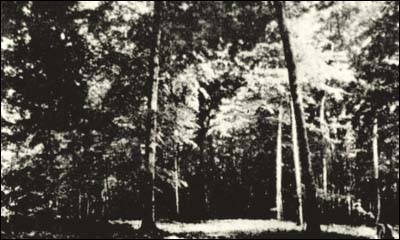
"Early in the morning a thought come to my mind that I would go and see how Brother Harris was feeling. It was only three blocks from my home. I heard he was not feeling well. People came from other towns to see Brother Harris, and hear him bear his testimony on the Book of Mormon. But when I arrived, there were two men present. Brother Harris lay on his bed leaning on his elbow. I said, "How are you?" Brother Harris answered slowly, "Pretty well." "We came to hear your testimony on the Book of Mormon." "Yes," he said in a loud voice, as he sat up in bed, "I wish that I could speak loud enough that the whole world could hear my testimony. Brother stand over so I can see you." Then he stretched out his hand and said, "Brother I believe there is an angel to hear what I shall tell you, and you shall never forget what I shall say. The Prophet, Oliver Cowdery, David Whitmer and myself went into a little grove to pray to obtain a promise that we should behold it with our own eyes. That we could testify of it to the world. We prayed two or three times and a length the Angel stood before Oliver and David, and showed them the plates. But behold I had gone by myself to pray and in my desperation I asked the Prophet to kneel down with me, and pray for me, that I may also see the plates. And we did so and immediately the Angel stood before me and said, "look" and when I glanced at him I fell; but I stood on my feet and saw the Angel turn the golden leaves over, and I said, "It is enough my Lord and my God!" Then I heard the voice of God say the Book is true, and translate correctly." He then turned himself as tho he had no more to say; and we made ready to go. But he spoke again and said, "I will tell you a wonderful thing that happened after Joseph had found the plates. Three of us took some tools to go to the hill and hunt for some more boxes, of gold or something, and indeed we found a stone box. We got quite excited about it and dug quite carefully around it, and we were ready to take it up, but behold by some unseen power the box slipped back into the hill. We stood there and looked at it and one of us took a crow bar and tried to drive it through the lid and hold it, but the bar glanced off and broke off one corner of the box. Some time that box will be found and you will see the corner broken off and then you will know I have told the truth. Again, Brother, as sure as you are standing here and see me, just so sure did I see the golden plates in his hand; and he showed them to me. I have promised that I will bear witness of this truth, both here and hereafter!" His lips trembled and tears came into his eyes. I should liked to have asked one more question, but I failed to do so. But I refrained myself and shook hands and thanked him and left.

"When I think of the day I stood before Martin Harris, and saw him stretch forth his hand and raise his voice and bear his testimony the feeling that thrilled my whole being, I can never forget, nor can I express the joy that filled my soul. This is a true statement."
                        "Signed Ola A. Jensen."
"The two other brethren are John Godfrey and James Keep."


Note: According to Dan Vogel's EMD2, p. 374, the Martin Harris statement was previously published in the Fairview, Wyoming Star Valley Independent, on Dec. 13, 1918.


Vol. ?                         Salt Lake City, Utah,  Saturday, August 31, 1935.                        No. ?


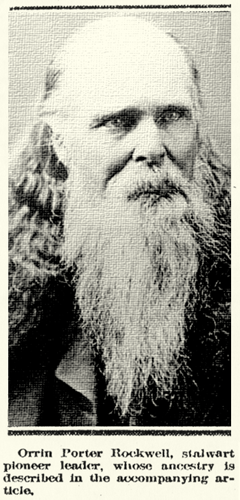
Ancestry of Orrin Porter Rockwell

EPISODES IN GENEALOGICAL RESEARCH

It is a difficult task today to penetrate the veil obscuring the ancestral back-ground of the early founders of this Church. Unless families have well preserved records of these earlier generations, a great amount of searching must be done before success can be attained in finding the progenitors of these Church founders.

In each issue of the Genealogical and Historical Magazine appears an article entitled Early Church Families. Pedigrees of Church members are being compiled for publication in this series...


In the October issue an account will be given, among others, of the ancestry of Orrin Porter Rockwell, a picturesque and daring character of early church history. Nothing has apparently been published in our histories as to the parentage of this man, yet he was one of the earliest converts to the Church. Even before its organization, the Prophet Joseph and his father and mother were frequent visitors in the home of Porter's parents and at such times the boy listened with delight to all that was said. He even begged his mother to allow him to sit up and keep the pine torch burning, their only source of light in the evening. Orrin Porter Rockwell and Martin Harris, as well as his own father and mother, were baptized shortly after the Church was organized on April 6, 1830. Even before this he had been so interested that he picked berries by moonlight and sold them, giving the money to the Prophet to help print the Book of Mormon. He also gathered and sold wood for the same purpose.

Associate of Prophet

Much has been said and written of the career of Orrin Porter Rockwell, a great deal of which is untrue and much of the rest highly exaggerated from distorted facts. For a time in Nauvoo the Prophet was very closely associated with him and when he was recording in "The Book of the Law of the Lord" the names of those who had proved "most faithful" he entered there the name of Orrin Porter Rockwell with this comment: "He is an innocent and noble boy; he was an innocent and noble child, and my soul loves him. Let this be recorded for ever and ever. Let a blessing of salvation and honor be his portion."

Many years after Porter Rockwell's death, a patriarch in bestowing a blessing on his third wife, Christina Olsen Rockwell, stated that she had one of God's noble sons for her husband, and added, "The Lord has been merciful unto him in doing the good deeds that he did, in protecting the life of the Prophet Joseph. The Lord will pass by all his weaknesses, and all is right with him." Another patriarch in blessing his daughter made this significant statement: "Thou are favored of the Lord in thy parentage, and blessings of the Lord through thy fathers will rest upon thee."

Porter Rockwell loved the Prophet Joseph Smith with all his heart and soul, and would willingly have laid down his life at any time in his defense. The family traveled from Fayette, New York to Jackson County, Missouri, in 1831 and located in the Big Blue river district and here the Rockwell home was a gathering place where many important meetings were held.

Imprisoned

After the attempted assassination of ex-Governor Boggs, Joseph Smith and Porter Rockwell were accused of the deed, and warrants for their arrest were issued. Realizing the impossibility of a fair trial in Missouri, Porter Rockwell went east and when he returned was arrested in St. Louis, March 4, 1845 [sic], and without even the pretense of a fair trial, was clapped into irons and incarcerated in a vile dungeon for nine months. At one time his feet were manacled together and his arm chained to his feet, forcing him to remain for a long period in this cramped condition unable to sit up straight. He was permitted a little dirty straw for a bed, but no bedding and no fire in very cold weather. For eighteen days at a time he states he shook with cold. After he made an attempt to escape, his treatment was still more severe. His food was of the coarsest, and if he failed to eat any of it, it was served to him at the next meal.

On one occasion Sheriff Reynolds said: "We know the Prophet has great confidence in you. Allure him to a place where we can arrest him and you shall have your freedom and any pile of money you name." Porter Rockwell, weak and so emaciated that he could hardly stand, never faltered in his fidelity to his Prophet friend. His eagle eyes flashed and he blurted out in defiance, "I'll see you all damned first, and then I won't."

Secures Freedom

Eventually Porter Rockwell's mother found where he was imprisoned and brought him one hundred dollars which he used as a fee to retain a lawyer, who was the noted Alexander W. Doniphan, later a general and hero of the Mexican War. After all this inhuman treatment the prisoner was at last brought to trial, but the charge of attempted assassination of Gov. Boggs was dismissed, there being an utter lack of evidence. He was found guilty of breaking jail and sentenced to five months imprisonment in the county jail. He was kept several hours and then released. Mr. Doniphan warned him to keep off frequented roads, for attempts would be made to waylay and kill him. After perilous adventures he rejoined the Prophet at Nauvoo and it was a most happy reunion as the Prophet indicates in his journal.

When the Prophet planned to leave for the west, just prior to his martyrdom, Porter Rockwell rowed him across the Mississippi river. In the encounters with the mob in Nauvoo, Sheriff Backenstos ordered him to fire upon the mob, and one of the mobocrats was killed.

A Pioneer Scout

He was a skillful and valued scout with the first company of pioneers to cross the plains in 1847, and he became "one of the most picturesque figures the intermountain west ever knew. He was a scout, guide, pioneer, and frontiersman of the most approved type -- hardy, adventurous and fearless." He was an intrepid mail carrier, and his home in the extreme south end of the Salt Lake Valley was one of the stations of the Pony Express. On March 29, 1849 he was appointed a deputy marshall, and he acted as a peace officer for the remainder of his life, his name bringing terror to evil-doers and marauding Indians. He studied the art of woodcraft, emulating and far excelling the Indians themselves in his almost unbelievable skill in sign-tracking. He was brave, quick-witted and always prepared. In the course of his duties he captured a large number of dangerous criminals and delivered them to the proper authorities to receive their punishment through the law. As a peace officer he was occasionally under the necessity of killing criminals who defied his authority. Several cases of this nature are recorded. But no instance was ever proved that he ever took a life wantonly and except as a deputy sheriff and in defense.

Of him Israel Bennion wrote: "There was a something about Orrin Porter Rockwell that so unmanned his opponents that they would not, could not, and did not outface him, even if it were possible to escape his lightning wit, eye and hand. Was it the word of the Prophet of the Lord that he should not be harmed?"

When Porter Rockwell in later years dictated the story of his life he said that some years after 1847 he was in California and met there the widow and daughter of Don Carlos Smith, the brother of the Prophet Joseph. When he saw her, she was just recovering from typhoid fever, in consequence of which her hair had fallen out. Porter wore his hair long, as he said that the Prophet told him if he wore his hair long, his enemies should not have power over him, neither should he be overcome by evil. When he met Sister Smith he had no gold dust nor money to give her, so he had his hair cut to make her a wig, and from that time he said that he could not control his desire for strong drinks, nor his habit of swearing.

He was of large and powerful physique, and his appearance was rendered more striking by his long and flowing hair. This he worse always, states his daughter, Mrs. Reid, in two great braids, one back of each ear, and folded four times across the back and tied. "No woman," she says, "ever had more beautiful hair than my father, and we were all proud of it."

Despite his rough and rude exterior, he was big-hearted and generous in his instincts, and true as steel to his friends. His devotion to the Prophet Joseph Smith and later to Brigham Young is proverbial. It is said that a gentler and more faithful father and husband is seldom seen, and one commentator on his life makes this satisfactory conclusion: "A righteous judge will not with-hold from him the reward due to those who have been true and valiant to the end."

His Family

He married three times. His first wife was Juana Beebe, daughter of Isaac and Olive Beebe, born in the town of Lebanon, Madison county, New York, Oct. 3, 1814: three daughters and one son were born of this marriage. He married second to Mary Ann Neff, to whom seven children were born. His third wife was Christina Olsen, who became the mother of four children.

The numerous descendants of Orrin Porter Rockwell will be interested in these items regarding his ancestry.

In the Church Genealogical archive is being deposited a pedigree of fifteen pages containing the names of 180 of his progenitors. A glance over this shows him to be a close relative of many leading families of the Church. His father was Orin Rockwell, an early convert of the Church, who died in Nauvoo, Sept. 22, 1839. He was the son of Jabez Rockwell, one of the well-known Rockwell family of Windsor, Connecticut, descended from Deacon William Rockwell of Dorchester, England, the emigrant to America. Through the Norton line he is connected with President Wilford Woodruff, and through the Wells, with President Daniel H. Wells. On the Alford line he becomes a distant relative of President Rudger Clawson, and through the Lathrop with the Prophet Joseph, Wilford Woodruff, and many others.

His father's mother was Irene Porter and from her he inherited the name by which he was commonly known. She was descended from John Porter and Ann White, progenitors of the Prophet; Thomas Stanley, ancestor of President Woodruff; and from the Babcock, Curtis, Gay, Richards, Raymond, Ladd, Knowlton, Harris and Abbott lines. As you read this, many of you will find your ancestors are also those of Porter Rockwell. He was a distant cousin of Abraham Lincoln through the Gilman line which they had in common: with President U. S. Grant and Grover Cleveland through the Porter line; Senator William H. King and Porter Rockwell are both descended from good old Deacon Edmund Rice and Thomas King. The Prophet, Brigham Young, and he were all descended from the self-same Merriam line.

The mother of Porter Rockwell was Sarah Witt. In Nauvoo she was baptized for 45 of her own and her husband's close relatives. This is probably a record for that day. She was born Sept. 9, 1781, at Belchertown, Hampshire county, Massachusetts, the daughter of Ivory Witt and Abigail Montague. Ivory Witt was descended from four generations of John Witts. His mother was Sarah Ivory, whose pedigree is probably traced seven generations back to about the year 1475 in Offley, Hertfordshire, England. An excellent record of the Montague family has been searched out and printed. Abigail Montague, wife of Ivory Witt and grandmother of Orrin Porter Rockwell, was the daughter of Josiah Montague and Abigail Montahue, both descended from John Montague and his wife, Hannah Smith. Other families on the line are the Church, Churchill, Cowles and Dickinson lines.

As stated above, the family record of Orrin Porter Rockwell and his parents will be printed in the October Genealogical Magazine. Still more important, the fifteen pages of his lineage will be placed in the Church Genealogical archive for the benefit of all who connect with these families. With the modern sources available for tracing genealogical records, similar results may be obtained on the lines of your ancestors who were early members of the Church. Do not fail to send in, at once, all the information of them that you have in your possession in order that a proper beginning may be made.


Note 1: The Utah Genealogical and Historical Magazine for Oct. 1935, provides the following additional information on Orrin Porter Rockwell's siblings:

     Children of Orin Rockwell and Sarah Witt.
1. Orrin Porter, b. 28 June, 1813, Belchertown, Hampshire Co., Mass;
   d. 9 June, 1878, Salt Lake City, Utah; md. 1st, Luana Beebe; md. 2nd,
   Mary Ann Neff; md. 3rd, Christine Olsen.
2. Peter Rockwell, baptized shortly after 9 June, 1830.
3. Carolione Rockwell, baptized shortly after 9 June, 1830.
4. Electa Rockwell, baptized shortly after 9 June, 1830.
5. Alvira M. Rockwell, b. 7 Oct., 1820; living 5 Jan., 1846.
6. Merit Rockwell, b. 26 July, 1821; living 3 Feb., 1846
7. Horace Rockwell, b. 30 April, 1825; living 3 Feb., 1846.
8. Mary Rockwell, b. 27 July, 1826; living 27 Jan., 1846.

Note 2: In his 1966/1983 book Orrin Porter Rockwell: Man of God..., Harold Schindler says: "In Porter's fourth year the Rockwells mover from Belcher to Manchester, New York. Two years later, in 1819, Joseph Smith, Sr., gathered his family and left Palmyra, New York; he too resettled in Manchester, just a mile from the Rockwells." Schlinder relies upon the affidavits of one of Orrin Porter Rockwell's sisters (Caroline Rockwell Smith) and one of his brother-in-laws (C. M. Stafford, husband of Emily Rockwell Stafford) to fill in several gaps in the Rockwell family's early history. See comments attached to the on-line transcript of Dr. Carl M. Brewster's "Did Sidney Rigdon write the Book of Mormon?" for more information on these siblings' families.


Vol. ?                         Salt Lake City, Utah,  Saturday, June 12, 1937.                        No. ?


A  MEMORIAL  TO  OLIVER  COWDERY
________

By Archibald F. Bennett
Secretary, Genealogical Society of Utah
TABERNACLE ADDRESS
Sunday, May 30, 1937

________

The whole nation today pays tribute to its honored dead... It is altogether appropriate today that we who are assembled should pay tribute to Oliver Cowdery, because he is one of our honored dead, and he is, to a very real extent, a relative of many of us.

On such a rainy day as this, on Nov. 22, 1911, there met in the opera house in Richmond, Mo., a great gathering of the townspeople of that city to pay honor to Oliver Cowdery, who died in their midst, March 3, 1850. The Salt Lake Tabernacle Choir, just returning from an extended tour of the East and New York, was there and sang at these ceremonies. Elder Heber J. Grant, then a member of the Council of the Twelve, was present, representing the general authorities of the Church, and offered the dedicatory prayer.

The ocasion for this gathering was to unveil and dedicate a monument to Oliver Cowdery to perpetuate his memory. Upon this granite shaft was inscribed a beautiful message telling the world of the life and ministry of this man. The Testimony of the Three Witnesses of the Book of Mormon was given in full, and this tribute was added: "Over a million converts throughout the world have accepted their testimony and Rejoice in their Fidelity." "A happy and prosperous commonwealth of half that number," it was said at the services, "have taken this occasion to testify of their love and respect for his memory."

More Enduring Memorial

Today we place in the archives of the Church, to the memory of Oliver Cowdery, a far more enduring memorial, one that shall bear to the children of men throughout the everlasting ages, a message more eloquent than was inscribed in the firm face of thar granite monument.

Through the united and devoted efforts of the Saints in all the temple districts, and especially the workers of Ensign Stake, there have been performed thousands of baptisms and endowments for the kindred of Oliver Cowdery...


Type of Man

It may be of interest to recall the manner of man Oliver Cowdery was...

(under construction)


Cowdery Records Presented to Genealogical Society Officials
Elder Joseph Christenson... Elder John F. Parish...

The work named by Bishop Christenson was an outgrowth of the lesson given by Brother Bennett, of the Genealogical Society of Utah, some two and a half or three years ago. In discussing the founders of the faith the name of this second Elder of the Church was there considered, and it was found, upon investigation and research, that the temple work pertaining to him and his predecessors, had not been performed in the temples. As a result, the Ensign Stake organization offered its services, which were accepted by the Church authorities, that we should proceed with this work, and accordingly a member of our Board, Sister Gertrude Baird, was assigned to direct this work, being associated with the Genealogical Society Library.

As a result of that research there have been some nine thousand, one hundred and and ten names sought out from the records of the Genealogical Office of this Church, and placed upon the records as belonging to this family. There were, of this number some two thousand and thirty-three families; family group sheets that entered into this work and became a part of this record. Thirty-six pedigree charts were included in the findings of Sister Baird and her associates in respect to this founder of the faith.

There has been recorded, in one of the volumes forty-one pages of history relating to the hand-dealings of the Lord to the Prophet of Lord and his associate, Oliver Cowdery.

You will recall that Oliver Cowdery was closely associated with the early history of the Church. It was his pen and his hand that recorded most of the Book of Mormon. He was associated with the Prophet Joseph Smith when the Testimony of the Three Witnesses of the Book of Mormon was given to the world. He has always been first among them...

In this research work we have discovered this great truth, which is very gratifying, that Oliver Cowdery was related to the Prophet Joseph Smith, a fact not known to themselves in their day...


Notes: (forthcoming)


Vol. 363.                         Salt Lake City, Utah,  Wednesday, August 2, 1941.                        No. 29.


David  Whitmer's  Testimony

By James H. Moyle

I was always deeply interested in the Book of Mormon, and had been on a mission to the Southern States before I entered the University of Michigan. During my three years' residence at the University, I learned that David Whitmer was still living and in good health. I concluded to visit him on the way home to Salt Lake City. I graduated the latter part of June, 1885, and arrived in Richmond, Missouri, early in July.

Richmond is a small, rural town. I talked with the hack driver (that is what they called them) who took me to the hotel, and learned from him that David Whitmer was a highly-respected citizen of the city. I likewise questioned the clerk of the hotel, with the same results. I made such inquiry as I could concerning him during my visit of part of a day.

I found David Whitmer seated under a fruit tree in front of his home, which was located near the street and surrounded by an orchard. I understood that he had been bothered a good deal by curiosity seekers, and to make him feel more at home with me, I presented him with an appropriate book. I said that I had just graduated as a law student and was on my way home, and was extremely anxious to obtain from him whatever he would be good enough to tell me about the Book of Mormon, the plates from which it was translated and his testimony concerning the same which he had given to the world.

I entered in a little diary which I kept the mere fact that I had visited David Whitmer and that he had verified all that had been published to the world concerning the Book of Mormon by him in his testimony, and that was about all. In making that visit I had no thought of anything but my personal knowledge and did not contemplate publishing anything concerning it -- it was purely an individual matter with me at the time. I told my friends about it and spoke of it in the ward, but at that time it seemed to be common knowledge. David Whitmer died about three years after I saw him. My memory of the main facts is perfectly clear. I have always enjoyed good health, never better than at the present.

David Whitmer was a man above medium height, slender rather than stout and was in his shirt-sleeves. His hair was white, as was his long, patriarchal beard. As I remember, he was a man offairly intellectual appearance, for the plain citizen that he was, and of good countenance. I am quite sure he was a serious-minded man.

I told him that I had been born in the Church, my mother also; that my father had joined the Church when he was a boy in his teens; that I had grown up believing implicitly in the Book of Mormon; that I was about to commence life's activities as he was getting ready to lay them down, and pleaded with him to tell me the truth -- not to permit me to go through life believing in a falsehood -- that meant so much to me. I told him that he knew the facts and urged him to tell me just what had happened in connection with the introduction of the Book of Mormon. I seemed to gain his confidence and felt free to ask him questions, and in fact did everything that I could think of that would bring out the facts, particularly all of the circumstances and details of his seeing the Angel, seeing and handling the plates and where the interview with the Angel Moroni took place and the conditions and circumstances surrounding the same.

He said that they (Joseph Smith, Oliver Cowdery, David Whitmer and Martin Harris) were out in the primitive woods in Western New York; that there was nothing between them and the Angel except a log that had fallen in the forest; that it was in the broad daylight with nothing to prevent either hearing or seeing all that took place. He then repeated to me that he did see and handle the plates; that he did see and hear the Angel and heard the declaration that the plates had been correctly translated; that there was absolutely nothing to prevent his having a full, clear view of it all. I remember very distinctly asking him if there was anything unnatural or unusual about the suroundings or the atmosphere. He answered that question. I do not remember exactly the words he used, but he indicated that there was something of a haze or peculiarity about the atmosphere that surrounded them but nothing that would prevent his having a clear vision and knowledge of all that took place. He declared to me that the testimony which he had published to the world was true and that he had never denied any part of it.

I asked him why he had left the Church. He replied that he had never left the Church, that he had continued with the branch of the Church that was originally organized in Richmond and still presided over it. In answer to my questions, he said, in an unqualified, emphatic way, that Joseph Smith was a Prophet of God, but had become a fallen prophet through the influence which Sidney Rigdon exercised over him; that he accepted everything that was revealed to the Prophet down to the year 1835, but rejected everything thereafter because he did not know whether it came from the Lord or from Sidney Rigdon. He manifestly had become embittered against Sidney Rigdon, due to his promotion to second place in the Church over men like himself who had been with the Prophet from the beginning and who had done so much for the Church. I then concluded, as I now believe, that jealousy and disappointment had soured his soul, but nothing could obliterate his testimony of the divinity of the Book of Mormon.

I asked him about the manuscript from which the Book of Mormon was published. He said that he had the original of the three copies that were made before the Book of Mormon was printed. I asked him if he would sell the manuscript. He said no. I then asked him if he wouldn't sell it at any price. He said no, that he would not part with it. He also said, pointing to his home, that when a cyclone struck Richmond a few years before every room in his house was destroyed except the one in which that manuscript was kept. He seemed to regard the manuscript sacredly. As he appeared to be a poor man, at least in very ordinary circumstances, I was greatly impressed by the fact that he would not even talk about selling it and with the fact that he seemed to regard the care of the manuscript as being something of a sacred trust. Neither did he seek a reconciliation with the Church, although that would have inevitably increased his worldly comfort, and made him a highly honored personage among Latter-day Saints.

President Joseph F. Smith had previously interviewed him and had seen the manuscript. He said to me that it was not the original but one of the other two copies.


Notes: (forthcoming)


Vol. 326.                         Salt Lake City, Utah,  Wednesday, March 16, 1949.                        No. 74.


Joseph Smith, Prophet of God

Did Joseph Smith Write the Book of Mormon?


By ELDER JOHN A. WIDSTOE
Of the Council of Twelve

(Address delivered Sunday, March 13, 1949,
at 9 p.m., over Radio Station KSL)

Dear Radio Friends:

To ask if Joseph Smith produced the Book of Mormon seems unnecessary. Of course, he was the translator unaided by mortal man. Yet, it may be worth while to examine into the wide-spread theory of anti-Mormon writers that Joseph had helpers in the production of the Book.

When the Book of Mormon was first published, no question was raised about its authorship or authenticity. Over several years Joseph Smith had told the story of the visitation of Moroni, the promise of the golden plates, when he received them, and how he devoted time to their translation.

The earliest writers in opposition to the Church accepted Joseph Smith as the author of the book. In their opinion its language and contents proved it to be the product of an unlearned and untaught person, such as Joseph Smith was held to be. For example, Alexander Campbell, the leader of the Church of Disciples, who had lost to Joseph Smith some capable followers, wrote in 1831 that Joseph Smith was the author and that the Book of Mormon contained only the gossip of the neighborhood, in which every religious problem of the day was discussed in crude language. (1)

However, after people had had time to give the book more careful examination, and thousands had joined the Church, doubts began to arise in the minds of many as to whether Joseph Smith, the plow-boy, was indeed the author of the book. Its language was found not to be crude, but generally beautiful and inspiring. The book was found to present religious ideas in full harmony with the doctrine of the Lord Jesus Christ. Important religious problems were given a simple, understandable explanation. It was, in its own words, a witness for Christ. The book seemed to be beyond the power of Joseph Smith to produce.

So the theory was advanced that Joseph must have had help to produce the book. Some enemies went so far as to suggest that it was wholly written by someone else! This was just what the unbelievers wanted, apparently without recognizing that such a theory would be a powerful evidence of the truth of Joseph's story. He had help, but from divine sources! Careless writers in their enmity of Joseph Smith have built upon such a theory for a century or more.

The first book to put the theory that Joseph Smith had helped in writing the Book of Mormon, into wide circulation was the book "Mormonism Unvailed," written by Philastrus Hurlburt, an acknowledged enemy. From this book, published in 1834, nearly all anti-Mormon books have drawn their material.

The theory was there advanced that Joseph Smith had had a silent partner in his work. It was inferred that this person was Sidney Rigdon, a close friend and colleague of Alexander Campbell, who had joined the Church in November 1831, after a careful and searching inquiry into the truth of Mormonism. He was an eloquent preacher of some learning, and an outstanding man wherever he went.

It was suggested that this man had written the theological, or religious portion of the Book of Mormon; and that the historical setting of the book was also furnished by him by plagiarizing an unpublished novel called "The Manuscript Found," written nearly twenty years earlier by one Solomon Spaulding, declared Atheist, about the ancient peoples of America. Rigdon was supposed to have purloined the manuscript from the printer with whom it had been deposited.

The Book of Mormon, according to this theory, was nothing more than this Spaulding Story, ornamented with Rigdon's religious emanations. This theory was as a raft at sea for the helpless enemies of Joseph Smith, and it has been peddled industriously by anti-Mormon writers for the delectation of unwary readers.

The tale called "The Manuscript Found" is a story of a party of Romans who came to America, and an account of their life there. The story was read by Mr. Spaulding to his family and some friends. Several persons who had heard the story read fifteen or twenty years earlier were induced to sign a statement that the languages and the characters in the story fitted in with the contents of the Book of Mormon. This was enough to set up and circulate the theory that the Book of Mormon was based upon it.

Unfortunately for the Rigdon-Spaulding theory, the manuscript of the Spaulding story was discovered in 1884 among the possessions of Mr. L. L. Rice of Honolulu, who had secured the literary remains of Spaulding. (2) The Spaulding story has since been published in two editions. It bears no resemblance in language, style, names, or subject matter to the Book of Mormon.

In utter despair, the enemies of the Church fled for cover. A few proceeded to set up another theory, that Spaulding had written more than one story, and that the one found was not the one that resembled the Book of Mormon. This discovered Spaulding manuscript was identified with the one set up in the book, "Mormonism Unvailed."

Moreover, destructive to the theory, the names of the people who thought that the Spaulding story as read by them many years before and the Book of Mormon story were similar, were found endorsed on the discovered manuscript as those who knew it in Spaulding's day. The Spaulding theory of the origin of the Book of Mormon has been thoroughly demolished. Anyone who peddles this theory today betrays deliberate dishonesty, or pitiful lack of knowledge concerning the whole matter.

That Sidney Rigdon ever saw the Prophet Joseph Smith before the Book of Mormon was published has been disproved. His activities and

His first visit to Palmyra, so far as can be learned, was after the organization of the Church. At that time he had his first meeting with the Prophet Joseph Smith. Printed non-Mormon contemporaneous reports of Rigdon's acceptance of the gospel do not mention or hint of any previous meeting of Joseph Smith and Rigdon. Historical evidence fails to prove any earlier connection between Sidney Rigdon and Joseph Smith.

Therefore, diehard anti-Mormon writers have suggested that to help produce the Book of Mormon Sidney Rigdon traveled long distances met Joseph Smith as a mysterious stranger unknown to the community. That theory is not only unlikely, and unproved, but absurd, lodged only in the minds of those who refuse any evidence that Joseph Smith told the truth.

Sidney Rigdon himself testified time and again that the first time he saw the Book of Mormon was in Mentor, Ohio, near Kirtland, after the Book of Mormon was published and the Church organized. Then, Parley P. Pratt, a former colleague in the Disciples Church gave him a copy. Elder Pratt was one of four Mormon elders traveling through the Kirtland territory to do missionary work among the Indians.

They stopped for some time in and near Kirtland to preach and bear witness of the restored gospel. They held long conferences with Sidney Rigdon. Rigdon declared this to be the first time that he had ever seen the Book of Mormon or known of its contents. His son, John W. Rigdon, who joined the Church, testified that when his father, Sidney Rigdon, lay upon his deathbed, he, John W. Rigdon, put the question of the origin of the Book of Mormon to his father. The result is best told in his own words:

"You have been charged with writing that Book of Mormon and giving it to Joseph Smith to introduce to the world. You have always told me one story, that you never saw the book until it was presented to you by Parley P. Pratt and Oliver Cowdery. That all you ever knew of the origin of that book was what they told you, and what Joseph Smith and the witnesses who have claimed to have seen the plates have told you.

"Is this true? If so, all right. If it is not, you owe it to me and to your family to tell it. You are an old man, and you will soon pass away, and I wish to know if Joseph Smith in your intimacy with him for fourteen years has not said something to you that led you to believe he obtained that book in some other way than that which he has told you. Give me all you know about it that I may know the truth,

"My Father looked at me a moment and raised his hand above his head and slowly said with tears glistening in his eyes, 'My son, I can swear before high heaven, that what I have told you about the origin of that book is true. Your mother and sister, Mrs. Obega [sic - Athea or Athalia] Robinson, were present when that book was handed to me in Mentor, Ohio, and all I ever knew about the origin of that book was what Parley P. Pratt, Oliver Cowdery, Joseph Smith, and the witnesses who claimed they saw the plates have told me.

"'And with all my intimacy with Joseph Smith he never told me but one story, and that was that he found it engraved on gold plates in a hill near Palmyra, New York, and that an angel had appeared to him and had directed him where to find it and I have never to you nor to anyone else told but the one story and that I now repeat to you.' I believed him and now believe he told me the truth. He also said to me after that, 'Mormonism is true, that Joseph Smith was a Prophet, and this world would find it out some day.;" (4)

The Rigdon-Spaulding explanation of the Book of Mormon, now thoroughly disproved, has no historical foundation, but was clearly manufactured by a dishonest writer in hate of Joseph Smith. It remains an evidence of the ugly dishonesty that may enter the mind of hate. (5)

In the face of intense, long continued research, the theory has been thoroughly discredited by competent historians. It is now used only by those who love their prejudices more than truth, but often enough to disturb the uninformed.

After a century of fruitless hunting, Sidney Rigdon is really the only person who has been charged with being a helper to Joseph Smith in the writing of the Book of Mormon. In view of the proof that Rigdon did not help him, Joseph Smith remains the sole producer of the book, unaided by any mortal person.

Those who cannot or will not believe that Joseph Smith wrote the Book of Mormon have then had only one other theory to fall back upon. I. W. Riley in his book, "The Founder of Mormonism," a "psychological" study of Joseph Smith, accepts the Book of Mormon as a product of Joseph Smith's mind, but believes that it was written by him while he was in an epileptic state.

If that be accepted, Joseph Smith must have been seized by such fits, regularly, forenoon and afternoon, possibly during meals, during the ninety days in which the Book of Mormon was translated and then was free from such fits the remainder of his life. That theory, smacking of Arabian Nights fables, is so strained as to be an insult to the credulity of intelligent people.

It is merely an admission that students of Joseph Smith stand helpless before the interpretation of the work he did, unless they accept the statements of Joseph Smith himself. His own frank admission is that the Book of Mormon was produced by the "gift and power of God."

A variation of these theories has recently appeared. Gasping for breath, the opponents of Joseph Smith now assert that he possessed tremendous mental power which enabled him to write the Book of Mormon, but also that he was so deficient in moral sense as to palm off his work as coming from God. That's old stuff. Joseph's life of rectitude is a sufficient answer. The theory is probably the death rattle of the defeated critics of Joseph Smith.

After examining the long shelves of books on Mormonism, a wearisome and thankless task, there is but one conclusion: Joseph Smith wrote the Book of Mormon unaided by mortal man. That is also the verdict of history.

Next week we shall discuss the Dilemma of Authority.

1 Alexander Campbell, "Delusions."

2 F. W. Kirkham, "A New Witness for Christ in America," p. 344.

3 Charles A. Shook, "The True Origin of the Book of Mormon." p. 71.

4 Rigdon, John W., "Life of Sidney Rigdon;" History of the Church; F. W. Kirkham, "A New Witness for Christ in America," pp. 327-329

5 See Daryl Chase, "Sidney Rigdon, Early Mormon," unpublished thesis, University of Chicago.


Note 1: A revised, expanded version of the above article later appeared as in the writer's book Joseph Smith:Seeker after Truth.

Note 2: Elder Widstoe says that "The earliest writers in opposition to the Church accepted Joseph Smith as the author of the book." This was a natural, uninformed assumption, since the 1830 title page listed him as being the "author;" -- or, at least Smith was sometimes viewd as the "reputed author." See John St. John's use of that term, in his Cleveland Herald "Golden Bible" article of
Nov. 25, 1830. St. John, who knew Oliver, blamed him for at least part of the book's composition: "the only opinion we have of the origin of this Golden Bible, is that Mr. Cowdry and Mr. Smith the reputed author, have taken the old Bible to keep up a train of circumstances, and by altering names and language have produced the string of Jargon called the 'Book of Mormon.'" Several near-contemporary published accounts point to Oliver Cowdery as being a knowing partner in religious deception with Joseph Smith. See, for example, Ezra Booth's letter of Sept. 12, 1831, where he says: "I have had several interviews with Messrs. Smith, Rigdon and Cowdery, and the various shifts and turns, to which they resorted... produced in my mind additional evidence, that their's is nothing else than a deeply laid plan of craft and deception." The Nov. 16, 1830 issue of the Painesville Telegraph also paints Cowdery as a "person here, who pretends to have a divine mission, and to have seen and conversed with Angels;" -- thus linking him closely with the pretensions of Joseph Smith, to have received "instruction from Angels." Orsamus Turner's "The Golden Bible" article of May 1, 1831 also links Smith and Cowdery as the "principal" and "second" personages in "a scheme...of imposition, a cheat... based upon entire fallacy and delusion." Turner calls Smith and Cowdery the "projectors of the scheme" who tried to make the Book of Mormon "story, historically consistent." Several other early assertions, pointing to Oliver Cowdery as a co-writer of the Book of Mormon might also be easily tabulated.

Note 3: Elder Widstoe's view, of how Sidney Rigdon's name became connected with Book of Mormon authorship assertions, is also in error. Rigdon was singled out as the probable author as early as the Feb. 2, 1831 article published in the Cleveland Advertiser, which reads: "Rigdon was formerly a disciple of Campbell's and who it is said was sent out to make proselytes, but is probable he thought he should find it more advantageous to operate on his own capital, and therefore wrote, as it is believed the Book of Mormon." As Rigdon's assistant, Elder Parley P. Pratt said, in 1838: "Early in 1831, Mr. Rigdon having been ordained, under our hands, visited elder J. Smith, Jr., in the state of New-York, for the first time; and from that time forth, rumor began to circulate, that he (Rigdon) was the author of the Book of Mormon." While such charges of clandestine pseudo-scriptural authorship are understandable in a partisan religious newspaper, like the Hudson Observer, they are less expected to appear in the pages of secular papers, such as the Cleveland Advertiser The Nov. 18, 1830 Observer called the religion Rigdon embraced "Campbellism Improved;" but it was the Advertiser's editor who went a step beyond that, in speaking of "a noted mountebank by the name of Elder Rigdon."


Vol. 346.                         Salt Lake City, Utah,  Saturday, July 7, 1956.                        No. 32.


CHURCH  SECTION

          Where The Prophet Lived                        

Church Purchases
Historic Farm Home

Another historic spot connected with early Church history was secured by the Church recently when the old John Johnson farm and home in Hiram, Ohio, was purchased by the Church Historic Sites Committee which includes Elder George Q. Morris, of the Council of the Twelve, chairman; Elder Adam S. Bennion, of the Council of the Twelve; Bishop Thorpe B. Isaacson, of the Presiding Bishopric and Elder Wilford Wood.

The home with 160 acres of farm land was purchased from the recent owner, Mrs. Joyce Monroe in order to secure the old home which has been somewhat remodled since the Prophet Joseph Smith's day. Approximately 10 acres of ground with the home will be retained and the remainder sold, according to a spokesman for the committee.


HISTORIC SITE -- Old Johnson Home at Hiram, Ohio, purchased by the Church. It was
made of historic value to the Church by the fact that the Prophet Joseph Smith spent
several years there while completing early organization of the Church.

According to Church history, it was at this home where the Prophet Joseph Smith lived for three [sic 1 1/2?] years during the early rise of the Church. There he received 15 revelations which are recorded in the Doctrine & Covenants. It was there that he was tarred and feathered by a mob, being dragged across the street, according to the report.

The old home is located in a beautiful countryside setting named Pioneer Trail and is lined with a row of sugar maples according to Elder Wood, who recently returned from making a survey of the property.

It is expected that a missionary couple will be installed in the newly purchased homestead and that it will be maintained as an information center where both members, friends and investigators will be welcomed.


Note 1: View modern air-photo of the property.

Note 2: View modern tax map of the property.


Vol. 364.                         Salt Lake City, Utah,  Saturday, September 11, 1965.                        No. 63.


Spotlight on Sidney Rigdon

Some illuminating flashes of Church history appear in an extensive article entitled, "Sidney Rigdon and the Early History of the Mormon Church," published in July in the Friendship, N.Y., "Sesqui-Centennial Times."

The "Times" is a souvenir newspaper published during the town's sesqui-centennial celebration in July. Nearly two full pages are devoted to the Rigdon article. Friendship being the place where he spent his last years. The article was originally written years ago by his son, John Wyckliff Rigdon, and was republished in the souvenir paper.

John W. Rigdon was associated with the Prophet Joseph Smith from his infancy. He was a participant in several Church history events, but his memory is not entirely accurate. His knowledge of many happenings came entirely through hearsay, but there is much of value to the student of history in his narrative.

He gives some interesting facts about the mobbing of the Prophet and Sidney at Hiram, Ohio; the flight from Kirtland; a visit to Richmond, Mo., to see the Prophet and Sidney while they were in prison, and about a visit he had with Brigham Young in Salt Lake City.

He makes a significant statement about the sustaining of Brigham Young as the successor to Joseph Smith: "I do not think the church made any mistake in placing leadership in Brigham Young. He in my opinion was the best man the church could have selected. Sidney Rigdon had no executive ability, was broken down with sickness, and could not have taken charge of the church at that time."

He also quotes his father's testimony about the Book of Mormon as he (John W.) heard his father declare it: "My son I will always swear before God that what I have told you about the Book of Mormon is true. I did not write or have anything to do with its production and if Joseph Smith ever got that other from which he always told me -- that an angel appeared and told him where to go to find the plates upon which the Book of Mormon was engraved in a hill near Palmyra -- Smith guarded his secret well, for he never let me know by word or action that he got them differently and I believe he did find them as he said and that Joseph Smith was a Prophet and this world will find out someday."

He also records his mother's corroboration of his father's statement.

Copies of the "Sesqui-Centennial Times" are available at the paper's office, Friendship, N.Y., at a cost of 30 cents each.


Notes: (forthcoming)


DESERET  NEWS
Vol. ?                         Salt Lake City, Utah,  Thursday, Oct. 16, 2008.                        No. ?


Joseph's  Nightmare
Tarring and Feathering Taught Prophet
He was Vulnerable to Violence

Robert Walsh

Their adopted twin babies were sick with the measles, and the Prophet Joseph Smith and his wife, Emma, hadn't been able to get much rest.

During the night, Emma told him to lie down on a trundle bed near the front door and try to get some sleep. He took the sicker twin and lay down, but his rest wouldn't last long.

Suddenly, Joseph heard Emma scream, and a mob of about a dozen angry men burst in and began dragging him out of the house.

As the Prophet recounted, "I made a desperate struggle, as I was forced out, to extricate myself, but only cleared one leg, with which I made a pass at one man, and he fell on the door steps. I was immediately overpowered again; and they swore ... they would kill me if I did not be still, which quieted me. ... They then seized me by the throat and held on till I lost my breath" (Joseph Smith, "History of The Church of Jesus Christ of Latter-day Saints").

That was only the beginning of the living nightmare that Joseph endured the night of March 24, 1832, at the John Johnson farm in Hiram, Ohio, about 30 miles southeast of Kirtland. He would be stripped of his clothes except for his shirt collar, have hot tar poured over his body followed by a layer of feathers and beaten to the extent that one of his teeth was knocked out.

The plan may have been to kill him. A Dr. Dennison, who was a member of the mob, had brought vials of nitric acid to force down the Prophet's throat. A vial broke in his teeth, and he didn't swallow the acid.

He recounted, "One man fell on me and scratched my body with his nails like a mad cat, and then muttered out: 'G-d--ye, that's the way the Holy Ghost falls on folks.'

"They then left me, and I attempted to rise, but fell again; I pulled the tar away from my lips, so that I could breathe more freely, and after a while I began to recover, and raised myself up ... When I came to the door I was naked, and the tar made me look as if I were covered with blood, and when my wife saw me she thought I was all crushed to pieces, and fainted."

Mark Staker, senior researcher for the historic sites group of The Church of Jesus Christ of Latter-day Saints' history department in Salt Lake City, says tarring and feathering was a sign of disgrace. Eli Johnson, one of John Johnson's brothers, apparently provided the tar and heated it up.

"It would have been painful," Staker said, although "it wasn't as life-threatening as the acid and the physical abuse when they beat him unmercifully. Tarring and feathering is mostly humiliation."

Staker, who worked as a historian for the LDS Church's Kirtland restoration project, which was dedicated in 2003, says part of that project was restoring the John Johnson home in Hiram.

"It had suffered some structural damage and we had to close the home," he said. "We tried to understand what took place in each room of the home."

Staker's research has become part of the Joseph Smith Papers project, a scholarly effort to collect, transcribe and publish all available documents produced or owned by the Prophet. The first volume is expected to be published later this year.

"The Joseph Smith Papers project has come to view the historic sites as documents as well," Staker said. "The physical evidence of Joseph's ministry is by large the documents he produced, but also the physical culture around him, and so these buildings are actually tangible evidence of his life and his ministry. So while they're not papers, they are documentary evidence of Joseph."

The Prophet continued: "My friends spent the night in scraping and removing the tar, and washing and cleansing my body; so that by morning I was ready to be clothed again. This being the Sabbath morning, the people assembled for meeting at the usual hour of worship, and among them came also the mobbers; viz.: Simonds Ryder, a Campbellite preacher and leader of the mob; one McClentic, who had his hands in my hair; one Streeter, son of a Campbellite minister; and Felatiah Allen, Esq., who gave the mob a barrel of whiskey to raise their spirits. Besides these named, there were many others in the mob. With my flesh all scarified and defaced, I preached to the congregation as usual, and in the afternoon of the same day baptized three individuals."

Staker says that the Prophet's account holds up well.

"Joseph actually downplays the whole thing -- because it ends up being a really brutal experience for him," he said. "Most Latter-day Saints would tell you, 'Oh, his tooth was chipped.' But accounts are clear that it was knocked out. And he had a permanent bald spot (where a patch of hair was torn out) that he combed to hide that spot. ... As a result of the mobbing he had an injury in his side. Those are things that if it were me, I would have whined about."

Staker says the mobbing happened early Sunday morning, not Saturday night. "All accounts suggest the moon was up, and that didn't happen until after 3 a.m. ... They took him to the kitchen and cleaned him up early Sunday morning. It would have taken a lot of work. They have to reheat the tar because it hardens once it gets cold. They (would have used) fat and grease to get it off. It would have taken a lot of time. ... He may not have had time to sleep before his sermon."

The Prophet recognized after the incident that he was vulnerable to people who wanted to harm him, Staker says.

"He's withstood persecution already for a decade in some form or another, but this is the first time that people come close to actually killing him." If the doctor had been able to get Joseph to drink one of the vials of nitric acid, "it would have killed him," Staker said. "It would have burned out his throat and esophagus. He would have died."

Staker says from that time on, armed guards protected the Prophet. "Joseph knew this was serious business. Yet he continues on the course he was following."

Joseph Smith wasn't the only one harmed that night.

The mob was in two groups, Staker says. One group had gone to Sidney Rigdon's cabin, where his six children all had the measles, too. The mob took Rigdon down the road to attack him, and historians have theorized that head injuries he suffered as he was being dragged along the frozen ground explain erratic behavior that Rigdon exhibited after the mobbing. For example, the day after the mobbing, he threatened his family, as well as the Prophet.

Joseph also blamed the mobbing for the death of baby Joseph Murdock, who died later that week of a cold.

Staker says that blame is natural, because the Prophet was a follower of Thompsonian medicine, which called for people who were sick to be kept out of cold weather. It's hard to say whether the baby would have died anyway, Staker says.

It was common in that era for people to meet political or religious differences with violence, Staker says. Members of the mob were mostly community leaders. Ryder, who purportedly led the mob, was captain of the local militia, and many of the others were militia members.

"These were respectable people ... not riffraff," Staker said. "In terms of a mob, they were a respectable mob."

Mob members' children didn't know their parents had been involved, Staker says. It wasn't until grandchildren came along that the stories began to be told. "They kept it secret," Staker said. "Even though they were respectable people, it was not a respectable thing to do."

Why did they participate?

Staker says a number of them wanted to stop family members from going to Missouri -- Zion -- and thought that harming the Prophet would somehow prevent the gathering, which was to take place in a couple of weeks. Others apparently were upset about the vision now contained in Section 76 of the Doctrine and Covenants about seeing God and Jesus Christ and the new doctrine that there are many kingdoms in the hereafter.

Those who had been present were supposed to keep it secret at the time, but some did not. Staker says there was a Brother Haskell who was told about the vision and went around telling people about it even before he had a written copy.

After the mobbing, there was some pestering of Latter-day Saints that happened, but no direct attacks, Staker says. They couldn't stop what was happening with the church, even by resorting to violence.

"It says a lot about Joseph that he knows he could have been killed for the things he was teaching."


Note 1: Contents copyright © 2008 Deseret News

Note 2: See also Mark L. Staker's Ensign article of Oct., 2002, "Remembering Hiram, Ohio," in which he says: "By March 1832, more than a hundred Latter-day Saints were preparing to gather with the Saints in Missouri. This planned migration as well as differences in religious doctrine clearly troubled some local residents, who formed a mob... attacked Joseph and Sidney and dragged them into a nearby field, where they were beaten, tarred, and feathered." Particularly interesting here is Staker's tying the March 24, 1832 attack upon the Mormon leaders, to plans for "more than a hundred Latter-day Saints" from around Hiram, to move away to the Mormons' Missouri Zion. Such a mass movement would have entailed liquidation of the members' property and assets, in the days when total consecration was still the practice in the church. Had this occurred, the Mormon leaders would have been left in possession of a substantial amount of property in northern Portage County -- or, at least they would have maintained considerable influence over the eventual disposal of migrating members' farms, homes, etc. Hiram families such as the Johnsons, the Pitkins, and others, whose members were partly loyal Mormons and partly non-Mormons, would no doubt have experienced considerable internal tensions in such a scenario. -- A local resident (probably Charles H. Ryder) writing in Hiram on 1877 stated: "In less than six months after Joseph Smith first came here more than sixty persons had united with his church and accepted him as the Prophet of the Lord. There was hardly a family in the township which was not wholly or in part converted. Taking all the members who entered here they numbered over two hundred." In 1902 Hartwell Ryder (son of Symonds and father of Charles H.) informed the visiting B. H. Roberts, that "the people did not want Hiram to be a Mormon center; and there was a man down at Shallersville whose wife had joined the Mormon Church and was a-going with the Mormons to Missouri -- that was their Zion then, you know."

Note 3: Staker's attributing provision of the tar used on that March night to "Eli Johnson, one of John Johnson's brothers," is probably a mistake. John Johnson, Sr. did have a brother named "Eliphaz" Johnson (1782-1859), but there is no evidence that the brother ever left New England. John Johnson, Sr. and Alice (Elsa/Elsie) Jacobs Johnson had no son named "Eli;" so said "Eli" could not have been "one of John Johnson's brothers," in the case of John John, Jr. either. Whomever this "Eli Johnson" may have been, he was evidently not a member of Hiram's Mormon Johnson family. Various sources identify the supplier of the tar bucket and paddle used in the attack, as Silas Raymond, an in-law of the Mormon Pitkins at Hiram.

Note 4: The ostensible use of nitric acid as a murder weapon makes little sense, given the context and probable motivations of the March 24th assault upon the Mormon leaders. No known Ohio historical source credits any of the gang of attackers as having been either a would-be or a successful murderer. Had the participants in the tarring and feathering intended to kill Smith and Rigdon, a simple razor slash to the neck (or a bullet to the head) would have abruptly ended the night's activity, without any necessity of heating up tar, or pulling feathers from the Mormons' pillows. Since the nitric acid was reportedly also applied to Sidney Rigdon's mouth, the more reasonable explanation of things, is that the attackers meant to impair the speaking (preaching) capabilities of the two men. After the attack, Sidney Rigdon almost immediately disappeared from Hiram -- never to return. Joseph Smith, after a brief getaway to Missouri, returned to Hiram and remained there, unmolested, until the last part of September. Possibily the application of the acid in Rigdon's case was partly successful, and his much vaunted preaching eloquence was temporarily disabled.


DESERET  NEWS
Vol. ?                         Salt Lake City, Utah,  Thursday, June 4, 2009.                        No. ?


Portraits of the Past:
Disciples of Christ Old Church

The attractive church seen in this image is the oldest house of worship of the Disciples of Christ, or Campbellite, tradition in Ohio.


Once led by Alexander Campbell, it is the denomination that Sidney Rigdon came from when he joined the Latter-day Saints. Members of this faith still worship in the structure and graciously allow interested visitors to see the inside of this historic building. The fallen headstone... is that of Perlea Moore.


While not noted on the headstone itself, cemetery records indicate that, while alive, this young woman "provided the pillow when Joe Smith was tarred and feathered." BYU professor Alex Baugh and Kirtland historian Karl Anderson have provided documentation of this detail.

The attractive church seen in this image is the oldest house of worship of the Disciples of Christ, or Campbellite, tradition in Ohio. Once led by Alexander Campbell, it is the denomination Sidney Rigdon came from when he joined the Latter-day Saints. Members of this faith still worship in the structure and graciously allow interested visitors to see the inside of this historic building.


Note 1: Contents copyright © 2009 Deseret News

Note 2: Perlea Moore (1806-1843) was the youngest child of Samuel and Eunice Moore, who settled on Lot 24 of Mantua township, Portage Co., Ohio in 1806. She evidently never married: her niece-namesake, Perlea Moore Derthick, was an early graduate of Hiram College. Perlea Moore was probably still living with her parents in March of 1832, when Smith and Rigdon were tarred and feathered in the adjacent township of Hiram. It is unlikely that the assailants carried feathers all the way from Mantua, to the scene of their night-time attack. Other accounts report that the feathers were appropriated from the Rigdon cabin.

Note 3: Volume Two of Harriet T. Upton's 1910 History of the Western Reserve briefly mentions this lady, saying on page 1099: "Perley [sic] Moore, one of the daughters of this family, is recorded in the annals of the early history of this community as furnishing the pillow of feathers with which Joseph Smith was tarred and feathered in this state." Upton probably took her information from pp. 46-47 of Horace L. Moore's 1903 Andrew Moore of Poquonock and Windsor Connecticut and His Descendants, which provides the same information.


DESERET  NEWS
Vol. ?                         Salt Lake City, Utah,  Wednesday, March 3, 2010.                        No. ?


Team  Solving  LDS  Mysteries
By Christine Rappleye

PROVO -- The questions usually start simply enough....

As the full-time editors of each volume of the Joseph Smith Papers program comb through the journals, histories and other documents of Joseph Smith, questions will pop up from the history of a reference to a meeting's minutes, mail or weather at a particular time. Their questions could involve a book from special collections or scriptural allusions in newspaper editorials. They may need to explore the different laws of the Prophet's time period or chronicle Joseph's role at meetings in a time period, said Kay Darowski, supervisor of the research team and a volume editor....

Then there was the question that came up about a reference in one of the Prophet's journals about the John Johnson farm in Hyrum [sic - Hiram], Ohio, that Kirksey was trying to sort out.

In digging through microfilmed land records, he found that Johnson had been assigned a steward over the land in order to redo the deed so that he was the owner....


Note 1: The above text is abbreviated to comply with copyright regulations. The full article is available here and also here. Unfortunately the research on the John Johnson family's real estate transfers was mis-reported, and there is no record of Johnson having deeded his Hiram property over to the Bishop in Kirtland.

Note 2: John Johnson's next door neighbor in Hiram, Ohio, was Symonds Ryder, who was baptized a Mormon in the late spring or early summer of 1831. Ryder's family opposed his joining the Mormons -- his son Hartwell recalled that his "mother cried all day and the children whispered in the corners, of the dreadful thing that had happened.... Not long afterward Joseph Smith read upon the plates which the Lord wrote his revelations to him that 'Simons Ryder' with a number others should go farther west and there establish another church." Gerald V. Stamm, writing in 1939, reported that Symonds Ryder soon reconciled his religious sympathies with those of his family, opening a "rift" between himself and the Mormon leadership (then ensconced at the adjacent Johnson farm). Stamm wrote: "The rift first appeared when Smith, through a 'revelation' commanded Ryder to go to Missouri on a mission. As proof he showed Ryder the commission. Ryder looked at it carefully, and then replied, 'I will not go.'" Part of Ryder's disinclination to remain obedient to his Mormon leaders may have stemmed from his having been called to "go to Missouri on a mission," or to "go farther west and there establish another church," while at the same time being asked to donate his Hiram property to the Mormons. Any report that his neighbors at that time (Mr. and Mrs. Johnson) were consecrating their farm to the Church, would naturally strengthen the likelihood that Ryder would being called upon to do the same thing. Had the Johnsons made such a donation, they evidently would have remained upon their donated property for several months, looking after it as stewards, under the Mormon consecration scheme then in place. If the Ryders, on the other hand, were being asked to donate and vacate their farm, in preparation for a "gathering to Zion" in Missouri, their growing opposition to the Mormons may well be imagined. The actual 1831-32 events, however, remain unclear.

Note 3: There may have been an additional complication to Symonds Ryders' difficulties with the Mormons at Hiram in 1831-32, and that was the rumor that a permanent Church headquarters in the town was being contemplated, along with a temple, to be erected atop Hiram Hill, where the Johnsons and Ryders were then living. Symonds' grandson, Charles H. Ryder alluded to this possibility in his 1877 article, "A Hill of Zion" -- "In less than six months after Joseph Smith first came here more than sixty persons had united with his church and accepted him as the Prophet of the Lord. There was hardly a family in the township [of Hiram] which was not wholly or in part converted. Taking all the members who entered here they numbered over two hundred. The Prophet now began to have revelations almost every night. The site of the contemplated temple was pointed out -- a spot on the 'Hinckley farm,' as it is called." The original Benjamin Hinckley farm of the 1820s consisted of most of lots 38 and 39 in Hiram township: an expanse of land which bordered the Ryder family's property, along the Old State Road. However, an earlier report, by Lucius V. Bierce, simply said: "Smith and family took up their abode with Johnson; Rigdon in a log cabin opposite, and others in the vicinity. Here they had a revelation that the Temple was to be located, and the site was pointed out on a hill near the 'Hinckley farm.'" The southeast corner of Symonds Ryder's farm was a stone's throw from the Hinckley farm, and was situated upon slightly higher ground than Hinckley's, offering a better location for a great structure on Hiram Hill. Abram Garfield, writing in 1934 made the Ryder location an exact one, with this fictional pronouncement: "'Well, Symonds, go on' said Charlie Raymond 'You haven't told us yet.We hear that Smith told you he had a message that his temple was to go up on your hill.'" Whether a temple was planned for the Ryder property, the adjacent Hinckley property, or was merely a rumor, the prospect of the Mormons establishing a permanent presence in Hiram (while at the same time "gathering" Hiram converts to far off Missouri), must have disturbed numerous local residents.

Note 4: The notion that John Johnson "had been assigned a steward over the land" of his own farm in Hiram, has a certain amount of believability, in light of an accusation made by his son-in-law, against Sidney Rigdon, in 1845. Speaking of events during the Mormons' tenture at Nauvoo, LDS Apostle Orson Hyde says: "Mr. Rigdon also thought this was a good time to crush a member of the Johnson family, against which he had an old grudge, because Father Johnson, after giving him and his family a living for a long time, building a house for them to live in &c., would not give him his farm and all his property; for he once demanded of Father Johnson a deed of all his property without offering one dollar as an equivalent." Apparently Rigdon's demands were not fully complied with, but the possible consecration angered members of John Johnson's own family. Richard S. Van Wagoner, on page 114 of his 1994 Sidney Rigdon biography, says: "Brothers Olmstead and John Johnson, Jr., viewed Rigdon and Smith as grafters intent on defrauding them of their future inheritance. Samuel F. Whitney, brother of prominent Mormon Newel K. Whitney, reported that the Johnson boys were angry because Joseph and Sidney continually urged their father to 'let them have his property.'" Gerald V. Stamm addresses the same historical issue in his 1939 essay: "Probably the greatest opposition came from those who disliked intensely the plan whereby the Mormon Church, represented by Smith and his chief lieutenants, acquired possession of the property of the members. At that early date, it should be remembered, that polygamy had not yet been introduced. Aside from fanatical zeal, the introduction of a supplement to the Bible, and Smith's claims of being a prophet with miraculous powers, the sect can be said to differ little from the orthodox denominations. In a way it was a communistic scheme. -- Johnson's farm was one of the sect's possessions, and was bought by James Stevens grandfather from either the Mormon church about the time they abandoned Hiram, or some member."


Back to top of this page.


Articles Page    |    Articles Index    |    History Vault
Oliver's Bookshelf    |    Spalding Library    |    Mormon Classics


last updated: Mar. 14, 2010