
RECENT SOURCES
Elder Sidney Rigdon's ‘Hiram Period’
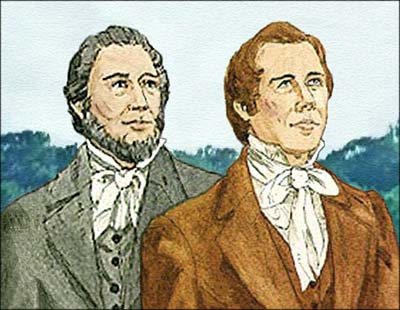
(Adapted from LDS Instructional Media, copyright © 2008 Intellectual Reserve, Inc.)
Feature Article | Early Historical Sources | Ryder Family and Campbellites at Hiram | Maps
Shaw 1952 | Thornton (1954) | Deseret News (1956) | J. B. Holm (1957) | Smith (1960)
Smith (1966) | Parkin (1966) | McKiernan (1971) | K. Perkins (1979) | Rollmann (1981)
M. V. Backman (1983) | S. E. Black (1988) | Van Wagoner (1989) | S. E. Black (1990)
Newell & Avery (1984/94) | Yorgason (1994) | Van Wagoner (1994) | T. Compton (1997)
W. D. Morain (1998) | L. A. Knowles (2000) | M. Staker (2002) | R. McClellan (2003)
S. Kenney (2005) | R. L. Bushman (2005) | DiPaolo (2007) | R. Walsh / M. Staker (2008)
Broadhurst (2010) | C. Rappleye (2010) | Mark L. Staker (2010) | Transcriber's Comments
|
Willis Thornton
"Gentile and Saint at Kirtland" in Ohio State Arch. & Hist. Quarterly 63:1 Columbus: O.S.A.&H.S., Jan. 1954 Introduction Rigdon at Hiram Transcriber's Comments Copyright © 1954 by Ohio Historical Society All rights reserved; only limited, "fair use" excerpts are presented here. full text |
|
[ 8 ]
Kirtland, or Kirtland's Mills (the official post-office designation), was a small town in the rolling hills of northeastern Ohio which had a population of 1,018 in 1830. [1] As a center for farmers to drive into and trade, get their grain milled or sold, and the like, it was comparable to the nearby towns of Painesville, Hiram, and Warren. The people of the community were nearly all farmers or closely tied to the soil. The area had been settled by westward movement along the lake shore or on the newly opened Erie Canal, by people from Connecticut, then later from all New England, New York, and Pennsylvania. Northeast Ohioans were not only like those people, they were those people in most cases, for not enough time had passed to permit the rearing of a native generation. Most of the people were pure Yankee. The era of "The Awakening" was in full cry, and the camp meeting, the "protracted meeting," the gospel crusades, the fiery preaching of the "Burnt-Over Area" of Pennsylvania, were all reflected in northeastern Ohio. The excesses, in fact, were even greater. Nowhere, even in the "Burnt-Over Area," had they __________ 1 Warren Jenkins, Ohio Gazetteer and Travelers' Guide (Columbus, 1837), 248. Gentile and Saint at Kirtland 9 proclaimed a Joseph Dylks as actually God, but Salesville, Ohio, achieved this extravagant frenzy. [2] The Free-Will Baptists, the Church of God (Winebrennerian), and the Disciples, or Campbellites, vied with the Millerites in vibrant and clamorous expectation of events which would momentarily establish the visible Kingdom of God in their midst. Cases of "the jerks" were not unusual at revivals, nor "speaking in tongues," and the earlier Methodist and Campbellite preaching was often accompanied by what would today seem scenes of the wildest emotionalism, not to say hysteria. It was so in and around Kirtland, a Disciple stronghold. Though well settled and under cultivation, the neighborhood offered almost nothing of a cultural or entertainment value. Activities centering around the churches were to the community what lyceums, libraries, theaters, movies, radio, and television were to be later on. An occasional traveling show, lecturer, or medicine faker, was about all that relieved what must have been almost intolerable boredom. The only generally circulated book was the Bible; the only outlet for forensic and extrovert tendencies was personal revelation or testimony at camp meetings. Every man was his own interpreter of the Bible, the result of which was a constant division and sub-division of sects in a maze of doctrinal differences of detail which are almost unintelligible to the American of one hundred years later. The ground at Kirtland, therefore, was thoroughly prepared for planting of the Mormon seed. It was no accident that led to the choosing of Kirtland as a "stake of Zion," and whether Prophet Smith did or did not receive a divine revelation directing him thither, it was certainly a move dictated by practical wisdom. When the Mormons arrived in numbers, there was at the outset nothing especially alien or strange about them or their ways; nothing about their doctrines more outre to outsiders than about those of numerous other sects; nothing in their practices more outrageous to outsiders than they had already seen and tolerated. After all, the Harmonists of Pennsylvania were communist and celibate; the Shakers were __________ 2 R. H. Taneyhill, The Leatherwood God (Cincinnati, 1870). 10 Ohio State Archaeological and Historical Quarterly (pages 10-15 not transcribed, due to copyright restrictions) 16 Ohio State Archaeological and Historical Quarterly them. Notwithstanding their belief, one of the Mormons had been seized with the disease, and it is feared that this would be the means of scattering the infection through the country. [11]Whether similar resistance to public health measures was met at Kirtland, can not be learned, but it is evident that publication of such stories must have led to a general belief that such would be the case in an emergency. Thus another point of friction appears -- the eternal conflict between the believers in standard medical practice and the believers in faith healing. In this case as in others, the Mormons persisted in putting themselves before the community as a people specially set aside and favored by God -- a proclamation that has always and everywhere irritated those presumbably less favored. In the spring of 1831 the inflow of people either from the New York state headwaters or from other sections in which missionaries had made converts and then directed them to Kirtland, was beginning to look like a flood. A. G. Riddle says: One almost wondered if the whole world were centering at Kirtland. They came, men, women, and children, in every conceivable manner, some with horses, oxen, and vehicles rough and rude, while others had walked all or part of the distance. The future "City of the Saints" appeared like one beseiged. Every available house, shop, hut, or barn was filled to its utmost capacity. Even boxes were roughly extemporized and used for shelter until something more permanent could be secured. [12]Some were people of high purpose and character. But others were less admirable. A short time later Smith had to order his apostles to stop sending people to Kirtland, as they were unable properly to accommodate the flood of converts. The system ordained of God at the moment was that all converts made over all their property to the church, that is, to Smith, and then all were to receive back a "social stake" of land and housing with a guarantee of communal support. It would be strange if this did not appeal more to those without property than to those more heavily endowed, __________ 11 Cleveland Herald, May 25, 1833. 12 Williams Brothers, pub., History of Geauga and Lake Counties (Philadelphia, 1878), 248. Gentile and Saint at Kirtland 17 and if among those who had nothing to put into the common pot at the outset there were not some with an eye to the endowment they had been promised. On Sunday the roads leading to Kirtland were crowded with farm wagons bringing whole families to see and hear the new prophet. To those already inclined to the more emotional and spectacular phases of the religious life, it seemed to offer a new experience. To the skeptical, it was certainly the best show in northern Ohio, and Smith himself was apparently not unconscious of theatrical values. He bought from a traveling showman, Michael H. Chandler, four Egyptian mummies and several papyri, and began to translate the latter as the works of Abraham and Joseph. [13] The mummies were almost certainly exhibited to visitors at Kirtland, [14] and it is definitely known that they were so exhibited later at Nauvoo, at twenty-five cents admission charge. [15] The Mormon Church is notable today for its missionary zeal, and it was even more so in its early days. Practically every convert was immediately sent out to bring more people into the fold, and this aggressive, this militant evangelism immediately aroused opposition of the clergy and devout laymen of existing and rival denominations. In Kirtland itself, what with Rigdon's wholesale conversion of his whole congregation and the constant arrival of converts at the "place of gathering" from New York and other communities where the hard work of the missionaries bore fruit, there was more trouble within the church than there was from the Gentiles. But when the church reached out into other small communities trouble began. Smith opened a small general store in Hiram [sic - Kirtland?], and set about planting a "stake of Zion" there. The conversion of the Rev. Ezra Booth, a Methodist, and Symonds Ryder, a Disciple elder, seemed to offer as good a chance as that of Rigdon had presented at Kirtland. But both these men, after investigating the Mormon organization from within, apostatized and became bitter opponents. The progress made at Hiram was suddenly halted when on the night of March 25, 1832, __________ 13 M. R. Werner, Brigham Young (New York, 1925), 77-79. 14 Linn, Story of the Mormons, 141. Linn says that for fifty cents people were later taken up into the attic of the Mormon temple and shown the mummies. 15 Josiah Quincy, Figures of the Past from the Leaves of Old Journals (Boston, 1883), 387. 18 Ohio State Archaeological and Historical Quarterly both Smith and Rigdon were dragged from their beds by a lynch mob, and coated with tar and feathers. The exact makeup of such a lynch mob is always difficult to ascertain. Ryder said it was made up of "citizens from Shalersville, Garrettsville, and Hiram," and blamed the bitter feeling on the fact that certain converts had learned "the horrid fact that a plot was laid to take their property from them and place it under the control of Smith the prophet." [16] It seems hard to credit in full Ryder's alleged horror at the communistic phase of the Kirtland "gathering-place," but it seems to be grounded in a feeling that converts were not told the full implications of this phase until it was too late. Smith later said that Ryder himself was of the mob. Smith was, fortunately, neither injured nor intimidated sufficiently to prevent his preaching the next day, but it is clear that thus early the Mormon movement had roused violent enough opposition, centered in rival denominations, to provoke mob violence. Though this was six years before the Mormons left Kirtland, and was the only instance in which violence was offered them there, it shows that from the very first, friction of the most bitter kind had been engendered. Another tiny spot of light is shed on the antipathies leading to this disgraceful affair by a letter to the editor of the Geauga Gazette, Painesville, printed in the issue of April 17, 1832. The writer skeletonized the facts of the incident, and then commented: Now, Mr. Editor, I call this a base transaction, an unlawful act, a work of darkness, a diabolical trick. But bad as it is, it proves one important truth which every wise man knew before, that is, that Satan hath more power than the pretended prophets of Mormon. It is said that they (Smith & Rigdon) had declared, in anticipation of such an event, that it could not be done -- that God would not suffer it; that those who should attempt it, would be miraculously smitten on the spot, and many such like things, which the event proves to be false.The letter is unsigned. But it might well be from one of the mob itself, by its smack of village atheist bravado. Still, it does contain __________ 16 Letter from Ryder to A. S. Hayden, February 1, 1868, in Hayden, Early History of the Disciples, 220-221. Gentile and Saint at Kirtland 19 one more suggestion of an irritating attitude on the part of Smith and Rigdon. Despite the constant sending of key men to Independence, Missouri, to set up the true Zion (which was established almost contemporaneously with, and not much later than the Kirtland "stake"), the Kirtland settlement continued to grow and prosper. By 1837 it was a community of 3,000 people, tripled in population in six years, and boasted 300 homes... (remainder of text not transcribed, due to copyright restrictions) |
|
Agnes M. Smith
"Mormonism on the Western Reserve 1830-1840" unpublished paper, 1960 Title page Ch. 5 excerpt Transcriber's Comments Paper not copyrighted, but author reserves all rights; only limited, "fair use" excerpts are presented here. |
|
MORMONISM ON THE WESTERN RESERVE 1930-1840 Seminar Paper, History 561; Western Reserve University; January, 1960 Agnes M. Smith |
Only limited "fair use" excerpts are presented here.
|
[ 56 ]
The Mormon experiment on the Western Reserve draw to an ignominious close in 1838 with the disappearance of the prophet from this area. The financial collapse was the final blow to a system which already suffered from attack on all sides for its unorthodox religious convictions. While Joseph could fool some of the people all of the time there were not many that he could fool for long, and there was a vast majority that had nothing but contempt for him and his "Mormonite" ideas. Kennedy summarizes the situation in this way: "The feeling of the outer world was such that continuance in Kirtland would have been impossible. Thousands held the worthless promises to pay, and the feeling everywhere was that of anger, distrust and hatred. It was, indeed, time that the Prophet was going since prestige, business success, and the last remnant of public confidence had already gone." 1 Within the church itself the hitter disappointment in a leader who had brought failure and disgrace on them came out in a rebellious scene within the Temple. It was described by L. E. Miller, an aged resident of Painesville in 1888 as he recounted his memory of the final public appearance of Smith and Rigdon in the Temple the Sunday before they left Ohio: __________ 1. Kennedy, op. cit., p. 164. [ 57 ] Rigdon had been sick, and was aided to his seat by the steadying arms of friends. A long and stormy debate ensued. Pleas an denunciations issued by Rigdon and Smith in the effort to bring the flock into the line of their thinking did not have their customary effect partly because some of the ever-loyal members had left for the West and a larger proportion of those who remained were hostile and in revolt against Smith's authority. His efforts to excommunicate revolting members were not upheld by the votes of the church membership as had been the case in the past. One man was even so bold as to call the Prophet a liar "and fire from heaven did not consume him, nor the earth open to receive him." 1 Facing this tempest together Joseph and Sidney Rigdon saw the end of their dream of a Stake of Zion in Kirtland manifested unmistakably. It seems entirely proper that Joseph's mainstay and faithful companion throughout the period of the Kirtland phase of Mormonism should accompany him in his exit as he had escorted him in his entrance into Kirtland. The part played by Sidney Rigdon in the development of Mormonism seems to have received the wrong emphasis by most historians. He has been charged with complicity in the origination of the Book of Mormon which thesis based on mere conjecture has always been dubious and is not currently accepted by the outstanding writers in the field. His attempt to assume the leadership of the church at the death of Joseph Smith has been universally recounted and his rejection and consequent apostasy noted in the attitude of retributive justice. But his part in helping Joseph strengthen Mormonism by calling for the consecration of properties to the church should receive the greater emphasis. The facts of Sidney Rigdon's life are available in a manuscript The Life of Sidney Rigdon by his son John W. Rigdon who is not [sic] a Mormon, and they are set forth in Joseph Smith's History of the Church. __________ 1. Kennedy, op. cit., p. 167. 2. Brodie, op. cit., pp. 419-33; Joseph [sic] H. Fairchild, "Solomon Spaulding and the Book of Mormon," Western Reserve Historical Society Tract No. 77, March 23, 1886, pp. 197-98; Ray B. West, Jr., Kingdom of the Saints (New York: The Viking Press, 1957) , p. 23. [ 58 ] but here the main influence exerted by Rigdon on Mormonism is obscured. In this case it would seem that Joseph's desire to eradicate the experiment in the direction of communal living from the history of Mormon life is the reason. Sidney Rigdon was almost solely responsible for the incorporation of that principle into Mormon practice. He had evolved the theory himself and had broken with Alexander Campbell, the leader of the Baptist Association in which they were both working, over the idea of instituting a communal life in the church. Turning to Mormonism after leaving the Campbellite Baptists, he found Joseph more amenable to the idea. Re absorbed Rigdon's communal "family" group at Kirtland 1 and their property -- and tried the scheme of getting others to consecrate on a similar basis. It was of limited effect and was eventually abandoned. Perhaps one of his reasons for wishing to erase the entire episode from the recorded history of Mormonism lay in the feeling that it was not his idea in the first place. There is certainly much truth in the assertion that "It would not be too much to say that Rigdon was the intellect of Mormonism in its cradle days, even as Smith was its bodily force." 2 His power and __________ 1. The origin of the "Family" is explained in a discussion of the Disciple church at Mentor: "The membership were much pleased with Rigdon, and he was employed as their regular pastor, beginning in the fall of 1826. He gradually brought nearly the entire church over to Campbellism. In connection with the charge at Mentor, Rigdon sometimes preached at Kirtland. Measuring his ground carefully he occasionally branched off on common stock. The idea was met with coldness at Mentor, but at Kirtland it soon kindled to a blaze. Isaac Morley being the first converted.... Morley was enthusiastic, and threw open his doors in welcome to all who chose to enter and make his their common home. A large number of ignorant and profligate people, together with other more intelligent but equally fanatical at once assembled there. Within a short time the "family" numbered one hundred members." History of Kirtland Twp. in History of Geauga and Lake Counties (Philadelphia: Williams Bros., 1878), p. 247. 2. Kennedy, op. cit., pp. 60-61. [ 59 ] influence were equaled by few on the Western Reserve in those days. The education be had acquired by reading and constant moving about among men was of a character that made him valuable ally to the new religion, and because of his great success among the Campbellite Baptist churches of the Mahoning Baptist Association he secured for Mormonism a welcome in Ohio that few other men could have commanded. His power as a preacher is attested by A. S. Hayden in his excellent Early History of the Disciples in the Western Reserve, 1 by Campbell, and by many others. But a certain peculiarity of his genius made him much more suited to the religion of Joseph Smith than to the more intellectual approach of the church established by Alexander Campbell. His brother Dr. L. Rigdon acknowledged Sidney's "wild and visionary views" and excused them on the basis of an early accident. His account reads as follows: His mental powers did net seem to be impaired but the equilibrium of his intellectual exertions seems thereby have been sadly affected. He still manifested great mental activity and power, but was to an equal degree inclined to run into wild and visionary views on almost every question; hence he was subject for any new movement in the religious world. 2 On the basis of seven years of close association with Sidney in religious affairs Alexander Campbell analyzed his attitudes as follows: His instability I was induced to ascribe to a peculiar mental and corporeal malady, to which he has been subject for some years. Fits of melancholy succeeded by fits of enthusiasm accompanied by some kind of nervous spasms and swoonings which he has, {since leaving the Campbellite Baptists for the Mormons} interpreted into the agency of the Holy Spirit, or the recovery of spiritual gifts, produced a versatility in his genius and deportment which has been increasing for some time. {Smith promised the Holy Spirit in its special gifts to all who have faith in his mission}__________ 1. Amos Sutton Hayden, Early History of the Disciples in the Western Reserve, (Cincinnati: Chase and Hall, 1876), pp. 191-192. 2. Dr. L. Rigdon in "Baptist Witness;" March 1, 1875 cited in Kennedy, op. cit., p. 63. [ 60 ] ... {Sidney} yielded to the suggestion to pray. Whereupon one of his fits of swooning and sighing came upon him, he saw an angel and was converted. Because Rigdon left the Campbellite Baptist faith for the Mormon persuasion and took some of his earlier converts with him, the Campbellites (now coming to be called Disciples) were at the forefront in their attempts to meet him with a discussion of theological matters. In bringing forth a review of the Book of Mormon which demolished it in the eyes of the intellectuals on the Western Reserve, Alexander Campbell led that phase of the attack on Joseph Smith's new religion. The analysis of the Book of Mormon which first appeared in his Millennial Harbinger in February was reprinted in the Painesville Telegraph March 8 and March 15, 1831. The examination of the "internal evidence" in the second issue is a damaging attack. Campbell, an expert student of the Bible, himself, compares the Book of Mormon with the Bible in statements of Jewish history. Since the Mormons accept the Bible as a part of their holy scripture, that seems fair. He points out numerous fallacies which show Smith's ignorance of "New Testament matters and things." His summary statement is as follows: This prophet Smith, through his stone spectacles, wrote on the plates of Nephi, in his Book of Mormon, every error and almost every truth discussed in New York for the last ten years. He decides all the great controversies -- infant baptism, ordination, the trinity... resurrection, eternal punishment, who may baptize, and even the question of free-masonry, republican government, and the rights of man.... He prophesied of all these topics, and of the apostacy, and infallibly decided, by his authority, every question. How easy to prophecy of the past or of the present time. But he is__________ 1. Alexander Campbell, Millennial Harbinger (Bethany {West} Virginia, 1831), Vol. 2, No. 1, pp. 100-101. [ 61 ] better skilled in the controversies in New York than in the geography or history of Judea. He makes John baptise in the village of Bethabara, (p. 22) and says Jesus was born in Jerusalem, (p. 240). Great must be the faith of the Mormonites in this new Bible! The mariners' compass was only known in Europe about 300 years ago; but Nephi knew all about steam boats and the compass 2,400 years ago.... The book professes to be written at intervals and by different persons during the long period of 1200 years. And yet for uniformity of style, there never was a book more evidently written by one set of fingers... And as Joseph Smith is a very ignorant man and is called the author on the title page, 1 I cannot doubt for a single moment that he is the sole author and proprietor of it. As a specimen of his style the reader will take the following samples -- Page 4th. on his own preface -- "The plates of which hath been spoken." ...In the certificate signed by Cowdery and his two witnesses, he has the same idiom, "which came from the tower of which hath been spoken;" Campbell continues with a column of "smithisms" and says: These are but as one drop out of a bucket compared with the amount... in this book. It is patched up and cemented with "And it came to pass" -- "I sayeth unto you" -- "Ye saith unto him" -- and all the King James' haths, didsts and doths; in the lowest imitations of the common version; and is, without exaggeration, the meanest book in the English language. But it is a translation made through stone spectacles, in a dark room, and in the hat of the prophet Smith, from the reformed Egyptian!!! It has not one good sentence in it, save the profanation of those sentences quoted from the oracles of the Living God. Campbell did not stop with that Review in his effort to save the people of the Reserve from the error of espousing Mormonism. A notice appeared in the issues of the Telegraph of May 24 and 31 and June 7 as follows: "We are requested to mention that Mr. Alexander Campbell, of Virginia, will preach in Kirtland on the 14th of June -- in Chagrin on the 15th, in Chardon on the 16th, in Painesville on the 17th, and in Mentor on the 18th and 19th -- Commencing each day at 10 o'clock a. m." [ 62 ] Other Disciple ministers of lesser note also took up the cause. The Mormon Elders Journal of October, 1837 has a letter from William Hayden to Stephen Burnet which shows his eagerness to discuss theological issues and the Mormons' reluctance to meet him in debate. If there was any instance of Mormon discussion of this type, which was common between the other religious bodies, none has come to light. Hayden wrote: I have been wishing for some time past, to have an opportunity for a fair investigation of these {religious} matters with some competent person... I hoped a few weeks ago, I should have the privilege as a Mr. Olney, formerly of Shalersville, invited me to visit Kirtland, and finally promised me two men to discuss with me in public, the subject of miracles, etc. But whether J. Smith forbade the measure, or whether he could obtain no persons to meet me, or whether he forgot his promise, I know not, but at all events the time has passed by a number of weeks since I was to have heard from him. The Disciple church at Hiram, Ohio was one of the groups hardest hit by the Mormon cause and some members of that church assisted by men from surrounding communities resisted Joseph's inroads into their domain with the characteristic frontier answer of a tar and feather party. The Hiram episode is noteworthy in many respects. It began with a seemingly miraculous and unquestionably established miracle of healing and it ended in the only actual violence done the Mormons while they were on the Reserve. And involved was the rumor of one of Joseph Smith's eyebrow-lifting escapades with the fairer sex, Although it occurred early in the Mormon sojourn in Ohio and was not connected with their departure from the Reserve, it was an early expression of an attitude which eventually became a more universal feeling of antagonism toward Smith and his philosophy. The story is best told by B. A. Hinsdale, President of Hiram College in his funeral sermon for Symonds Ryder: [ 63 ] Joseph Smith was a man of remarkable power -- over others. Added to the stupendous claim of supernatural power, conferred by the direct gift of God, he exercised an almost magnetic power -- an irresistible fascination -- over those with whom he came in contact. Ezra Booth, of Mantua, a Methodist preacher of much more than ordinary culture, and with strong natural abilities, in company with his wife, Mr. and Mrs. Johnson, and some other citizens of this place, visited Smith at his home in Kirtland, in 1831. Mrs. Johnson had been afflicted for some time with a lame arm, and was not at the time of the visit able to lift her hand to her head. The party visited Smith partly out of curiosity, and partly to see for themselves what there might be in the new doctrine. During the interview, the conversation turned on the subject of supernatural gifts, such as were conferred in the days of the apostles. Some one said, "Here is Mrs. Johnson with a lame arm; has God given any power to men now on the earth to cure her?" A few moments later, when the conversation had turned in another direction, Smith rose, and walking across the room, taking Mrs. Johnson by the hand, said in the most solemn and impressive manner: "Woman, in the name of the Lord Jesus Christ, I command thee to be whole," and immediately left the room. Ezra Booth soon became a convert and an Elder of the Mormon Church. The Johnsons invited Joseph to come to Hiram and stay at their home which he did and he preached in the south school house of Hiram township about a mile from the Johnson residence. Sidney Rigdon came with him as they were working together on an inspired translation of the Bible which Sidney wrote down as Joseph dictated. Thirteen of the revelations in the book of Doctrine and Covenants are dated at Hiram. A neighbor, Symonds Ryder, who had been a leader in the Disciple church there became a convert to Mormonism -- but only briefly. He wrote concerning this episode: During the next spring and summer several converts were made, and their success seemed to indicate an immediate__________ 1. The entire funeral sermon is cited in Hayden, op cit, p. 250. [ 64 ] triumph in Hiram. But when they went to Missouri to lay the foundation of the splendid city of Zion, and also of the temple, they left their papers behind. This gave their new converts an opportunity to become acquainted with the internal arrangement of their church, which revealed to them the horrid fact that a plot was laid to take their property from them and place it under the control of Joseph Smith the prophet. This was too much for the Hiramites... But some who had been the dupes of this deception, determined not to let it pass with impunity; and, accordingly, a company was formed of citizens from Shalersville, Garrettsville, and Hiram, in March, 1832, and proceeded to headquarters in the darkness of night, and took Smith and Rigdon from their beds, and tarred and feathered them both, and let them go. This had the desired effect, which was to get rid of them. They soon left for Kirtland. 1 It is believed, and would seem to be borne out by Joseph Smith's account of the affair, that Eli Johnson was responsible for the tar bucket. Brodie says that his suspicion of Joe's intimacy with his sister Nancy Marinda was at least one cause of his antagonism. 2 The elder Johnson stayed with the, church, however, sold their Hiram farm, moved to Kirtland and later went to Missouri [sic]. At about this same time Ezra Booth became disillusioned, left the church, and wrote a series nine letters to the Ohio Star at Ravenna (also reproduced in the Painesville Telegraph) exposing Mormonism and causing widespread indignation against Joseph. To Booth, as to the Hiram Disciples and many others, Joseph Smith, the man did not bear out his assumptions and their faith in Joseph Smith, the prophet. The high indignation felt by the people when they became acquainted with the real Joseph is well explained by Linn in the following passage: When a man of his character and previous history assumes the right to baptize and administer the sacrament, he is certain to arouse the animosity, not only of orthodox church members, but of members of the community who are lax in their__________ 1. This letter to A. S. Hayden cited in his Early History, p. 221. 2. Brodie, op. cit., p. 119. [ 65 ] church duties.... The Anti-Mormon feeling was intensified and broadened by the aggressiveness with which the Mormons sought for converts in the orthodox flocks. 1 Given the situation thus pictured of Mormonism on the Western Reserve 1830-1840, what accounts for the eventual success of the faith? Growing out of the Book of Mormon and Joseph's efforts are three church bodies -- The Church of Jesus Christ of Latter Day Saints (Mormon) with headquarters at Salt Lake City; The Reorganized Church of Jesus Christ of Latter Day Saints centering in Independence, Missouri; and the considerably smaller Church of Christ. The faith established by by Joseph Smith was based on the fascination with the marvelous. There is a certain class of mind that is inclined to accept rather than doubt and to be intrigued rather than repelled by pretentions that will carry one farther than what is actually known to man. It was such a deep-rooted propensity that prepared men to receive such people as Ann Lee, Jemima Wilkinson, Joseph Smith, and a host of others in the early nineteenth century. It also explains the popularity of Katherine Kuhlman today among a certain class of people. The fact that Joseph accepted the Bible as a basis of faith and practice saved him from immediate rejection, and the fact that the Book of Mormon is not widely or critically read makes it much more capable of acceptance. It has been the custom of Mormon missionaries to emphasize those factors which their belief has in common with others rather than the differences. And the fact of persecution can hardly be too greatly emphasized as a contributing factor to success. The martyr has three strikes in his favor; and especially in America, where we cherish the notion that religious beliefs are to be tolerated so long as they do not interfere __________ 1. Linn, op. cit. p. 135. [ 66 ] with the enforcement of our laws (and sometimes even when they do), the one who is persecuted for religious belief draws supporters on that basis alone. The Mormons succeeded in promoting the dubious idea that the attacks against them were of the nature of religious persecution. A closer look at the facts in the case leads one to quite another conclusion, but it is not the habit of most men to take a close look at the facts in many cases.Perhaps the most valuable accomplishment of Joseph Smith on the Western Reserve -- from the point of view of the survival of his faith -- was the addition of Brigham Young to his following. What Joseph lacked in astuteness and organizational ability, Br1gham had in adequate measure; and when it was desperately needed he was available. But that is another story. -- (remainder of text not transcribed) |
|
Milton V. Backman, Jr.
The Heavens Resound SLC: Deseret Books, 1983 Title page Ch. 6 excerpt Transcriber's Comments Contents Copyright © 1983 by Deseret Book Company All rights reserved; only limited, "fair use" excerpts are presented here. |
|
The HEAVENS RESOUND A History of the Latter-day Saints in Ohio 1830-1838 Milton V. Backman, Jr. Deseret Book Company Salt Lake City, Utah |
Because of copyright law restrictions,
only limited "fair use" excerpts are presented here.
|
[ 82 ]
Revelations and Confrontations __________________________ For six and a half months -- between mid-September 1831 and the end of March 1832 -- Hiram, Portage County, Ohio, approximately thirty miles south of Kirtland, served as a temporary headquarters of the Church. During this period, Joseph Smith and his family lived in the large frame home of John Johnson, an early convert who was one of the prosperous farmers of that community. Many Latter-day Saints traveled there to meet him, to seek his counsel, and to attend meetings held in the Johnson home. There the Prophet worked on a translation of the Bible and received some of his most profound visions and revelations. However, he also encountered serious opposition, as apostates joined forces with other settlers in an attempt to interrupt the growth of the Church in Portage County. The organized resistance led to the mobbing of Joseph Smith and Sidney Rigdon, and they fled from Hiram. Upon their return to Geauga County, many of the central developments in the history of the Church again focused on Kirtland. Although the Prophet's stay in Hiram was brief, this six-month period was one of the significant eras in the early history of the restored Church. Joseph Smith had become acquainted with John and Elsa Johnson early in 1831 when they had gone to Kirtland to investigate reports circulating in their community concerning a restoration REVELATIONS AND CONFRONTATIONS 83 of the everlasting gospel. [1] Others from that region, including Ezra Booth, a Methodist minister from Mantua, accompanied the Johnson to Kirtland. Prior to this trip, Elsa Johnson had been afflicted with what was believed to be chronic rheumatism. For several years she had been unable to lift her hand to her head, a handicap that interfered with many of her activities. As the party from Portage County discussed the restoration with Joseph Smith in the Newel K. Whitney home, including the manifestations of supernatural gifts during the apostolic era, one of the inquirers said, "Here is Mrs. Johnson with a lame arm. Has God given any power to man now on the earth to cure her?" Before the question was answered, the conversation shifted to another theme. Then Joseph Smith rose, walked across the room, grasped the hand of Elsa Johnson, and, in a "solemn and impressive manner," said, "Woman, in the name of the Lord Jesus Christ I command thee to be whole." Immediately thereafter, he went from the room, leaving the group stunned. Then, according to several contemporary accounts, Elsa Johnson lifted her arm in the air. When she returned home the next day, she was able to wash her clothes without difficulty or pain. [2] Joseph Smith's "Translation" of the Bible On September 12, 1831, shortly after returning from his first trip to Missouri, Joseph Smith moved with his family from Kirtland to Hiram, establishing his new residence in the John Johnson home. There he concentrated on making corrections in the King James Version of the Bible. Sidney Rigdon, who served at this time as his principal scribe, also moved to Hiram and probably lived in a log cabin located near the Johnson home. [3] Producing a new version of the Bible was not a unique idea among religious leaders and scholars of early America. Between 1777 and 1833, more than five hundred separate editions of the Bible or the New Testament were published in the United States. Many of these were revisions of the King James Version, containing "modernizations' of the language, paraphrases, and alternate readings based on comparisons with Greek and Hebrew manuscripts." While many of the translators attempted to "clarify obsolete __________ 1 Although the wife of John Johnson is referred to in some contemporary records as Elsa or Elsey, she was also called Alice in a family Bible. A tombstone located in the cemetery next to the Kirtland Temple includes the following inscription: "In Manory of Mary E., daughter of John and Alice Johnson, who died March 30, 1833, in the fifteenth year of her age." Geauga Deed Records, Book 18, pp. 478-79; Book 24, p. 100; Book 25, pp. 15, 409, 440. For additional information on the John Johnson family, see Keith Perkins, "A House Divided: The John Johnson Family," Ensign 9 (February 1979): 54-59. 2 Hayden, Early History of the Disciples, p. 250. The account of the healing of Elsa Johnson was included in a funeral sermon delivered by B. A. Hinsdale on August 3, 1870, entitled "Life and Character of Symonds Ryder." See also Luke Johnson, "History of Luke Johnson," Deseret News, May 19, 1858, p. 53; "Philo Dibble's Narrative," in Early Scenes in Church History, p. 79; and HC 1:215n-16n. 3 HC 1:215; Hartwell Ryder, "A Short History of the Foundation of the Mormon Church," typescript, Hiram College, p. 3. 84 THE HEAVENS RESOUND (pages 84-92 not transcribed, due to copyright restrictions) REVELATIONS AND CONFRONTATIONS 93 Although the destruction of the printing establishment in Missouri interrupted the publication of the Book of Commandments, copies of the galley sheets that had been preserved were later cut, bound, and distributed. When Joseph Smith secured and read a copy, he noted a few printing errors. By that time, he had also received many new revelations. Therefore, instead of recommending to the Church that the Book of Commandments be reprinted, he began in 1834 to prepare a more complete collection of the revelations; this book was printed in 1835 under the title Doctrine and Covenants. [48] Apostasy and Mobocracy Despite a temporary tranquillity that prevailed while Joseph Smith was studying, praying, and recording revelations, intense opposition to the Church erupted in Ohio. Criticizing the beliefs of the Latter-day Saints regarding visions, revelations, and other manifestations of God's power, critics denounced the zeal of the converts, exposed the failures of members, and complained that the Church created divisions in families. Not understanding the law of consecration and stewardship, some believed that Joseph Smith was attempting to establish a communistic society in Portage County. They argued that if the Church continued to grow there, some of the settlers might be deceived into surrendering all their property to the leaders of this new religious movement. [49] Some of the most vocal opponents of the restoration were early converts who, after leaving the Church, persuaded others to oppose Mormonism. Two of these early dissidents were Ezra Booth and Symonds Ryder. Booth joined the Church in May 1831 and subsequently served a short-term mission in Portage County; while preaching in Hiram, he convinced Ryder that he should investigate the new religion. Impressed by Booth's testimony, Ryder traveled to Kirtland, where he heard a convert predict a destructive earthquake in China. Six weeks later, after reading about a calamity in China, he decided that a miraculous prophecy had been fulfilled, and so he joined the Church. [50] Shortly after Ezra Booth and Symonds Ryder united with the Latter-day Saints, Joseph Smith received a revelation that referred __________ 48 HC 2:165, 243-5 1; Kirtland Council Minute Book, p. 76. Howard, Restoration Scriptures, p. 200; Evening and Morning Star (Kirtland reprint), 1 (June 1833): 16. 49 Charles H. Ryder, "History of Hiram," 1864, typescript, Hiram College, Hiram, Ohio. 50 Hayden, Early History of the Disciples, p. 251. In addition to Ezra Booth and Symonds Ryder, Joseph Smith noted that Eli Johnson, Edward Johnson, and John Johnson, Jr., apostatized during that early period in the history of the Church. HC 1:260. 94 THE HEAVENS RESOUND to both of these men. Booth was commanded in June 1831 to travel to Missouri with Isaac Morley and twenty-six other missionaries, [51] and Ryder was informed that because of the transgression of Heman Basset, he was to receive the blessing previously bestowed upon Basset. [52] On June 6, 1831, Ryder was ordained a elder by Joseph Smith. After reading the revelation that pertained to him and receiving the commission as an elder in the Church, he was perplexed: his name had been spelled "Rider" it stead of "Ryder." Apparently unaware that Joseph Smith often dictated revelations to scribes or recorded in his own language and spelling information he received from God, Ryder was bewildered. How could his own name be misspelled in a communication that was dictated by the Holy Spirit? [53] When Booth returned from his mission in Missouri, he discussed with Ryder his own disenchantment with Mormonism. About the time that Joseph Smith moved to Hiram, the two dissidents decided to leave the Church. In an attempt to persuade others that Mormonism was false, Ezra Booth wrote a series of anti-Mormon articles for the Ohio Star in Ravenna; these were reprinted in other Ohio papers and reproduced in E. D. Howe's Mormonism Unvailed. In these articles, the first produced by an apostate, Ezra Booth vividly described his "justification" for leaving the Church. [54] His complaints stemmed initially from what he regarded as a false prophecy by Joseph Smith. Prior to his leaving for Missouri he stated, the Prophet claimed to have learned through a vision that Oliver Cowdery had established a large church in Missouri. Upon arriving in that western wilderness, Booth counted on three or four converts, all females. He further insisted that Edward Partridge was also concerned because of the size of the congregation in Missouri. When the bishop complained, the Prophet supposedly reprimanded him and said, "I see it, and it will be so." [55] From that time on, Booth said, he examined other events in the history of the Church that seemed to indicate inconsistencies. He argued, for example, that while Church leaders instructed others not to contract debts, they themselves attempted to purchase land on credit. Another of his arguments was that it seemed inconsistent __________ 51 D&C 52:23. 52 D&C 52:37. 53 Far West Record, p. 4; HC 1:260-61; Hayden, Early History of the Disciples, p. 252. Although Ryder's name was spelled "Simonds Rider" in the Far West Record, his name was spelled "Symonds Rider" in minutes of the church in which he served as pastor. In other records, including a newspaper article he wrote, his name was spelled "Symonds Ryder." Ohio Star, December 29, 1831, p. 3. Hartwell Ryder, "Short History of the Mormon Church," p. 4. 54 Hayden, Early History of the Disciples, p. 252. 55 Ohio Star, November 10, 1831, p. 3; November 24, 1831, p. 1. Joseph Smith learned through revelation that one of Booth's problems was that he lost the Spirit of the Lord because he did not keep the commandments of God. D&C 64:15-16. REVELATIONS AND CONFRONTATIONS 95 consistent for the Lord to instruct members to travel home from Missouri by water and then at Mclllwaine's Bend inform them that they should proceed by land. [56] Joseph Smith insisted that Booth had misinterpreted his teachings and church procedures. The Prophet was not disturbed when he received revelations that changed man's course of action. On a number of occasions, as in the case of Heman Basset, the blessings bestowed on one member were given to another because of transgression. When Ezra Thayer failed to accept a call to serve as a missionary in Missouri, the Prophet received a revelation commissioning Thomas B. Marsh to fulfill this responsibility. This latter alteration of an original commandment of the Lord was followed by an important revelatory statement: "Wherefore I, the Lord, command and revoke, as it seemeth me good; and all this to be answered upon the heads of the rebellious." [57] Ezra Booth complained not only because of what he regarded as inconsistencies in the revelations and in the instructions and actions of Church leaders, but also because of the authoritarian nature of the Church polity, especially Joseph Smith's insistence that he had the sole right to receive revelation for the entire Church. Booth objected to the principle that members should pattern their conduct after the revelations that one man received. Such a tendency, he maintained, would eventually lead men into "a state of servitude," a "despotism" that would result in "unqualified vassalage." [58] A third source of discontent stemmed from what Booth regarded as imperfections in the conduct of the latter-day prophet. He maintained that there were occasions when Joseph Smith behaved inappropriately, such as when he joked with others. This spirit of levity, Booth contended, indicated a lack of "sobriety, prudence, and stability" -- qualities that should always characterize the action of God's anointed prophets. [59] Finally, Booth was disturbed because of conflicts that divided members of the Church. During his journey to Missouri, he claimed, he had witnessed among the elders fear, selfishness, and discontent. [60] Whereas Ezra Booth claimed that inconsistencies, authoritarianism, __________ 56 Ohio Star, November 24, 1831, p. 1. 57 HC 1:241; D&C 56:4. 58 Ohio Star, November 10, 1831, p. 3; November 17, 1831, p. 3. 59 Ibid., November 24, 1831, p. 1. 60 Ibid. 96 THE HEAVENS RESOUND and the imperfections of the Prophet and other members precipitated his defection from the Church, Joseph Smith concluded that these were merely excuses that masked the real reasons for his apostasy. According to the Prophet, Booth failed to realize that "faith, humility, patience, and tribulation" precede the blessings of God and that "God brings low before He exalts." Quoting a statement from the Gospel of John (John 6:26), the Prophet remarked that men should not seek the Lord because they saw miracles, but because they partook of the gospel and were filled. Miracles were not to become the foundation for faith; rather, they were to confirm that faith that had been built upon the word of God. It was Booth's "own evil heart," Joseph concluded, that led to his apostasy; and his attempt to "overthrow the work of the Lord" exposed his "weakness, wickedness and folly" to all the world. [61] Ezra Booth's letters indicate that his enthusiasm for the gospel dissipated as he experienced the rigors and disappointments of missionary work. As a settled Methodist preacher, he had not encountered such challenges. Not accustomed to walking long distances, he admitted that he hesitated to accept the call to travel to the promised land but went because he thought it was the will of God. After returning to Ohio, he complained that while a few leaders of the Church traveled by stage and river vessels, he had to accompany those who walked "with packs on their backs" and "subsisted by begging" until they arrived in Missouri. His problems were compounded because, as he admitted, he did not feel the Spirit of the Lord and failed to receive the gifts of the spirit that he anticipated would be manifest during his mission. [62] In an attempt to answer the charges leveled against the Church by Ezra Booth, Church leaders called a number of missionaries to preach in Ohio and explain to others the position of the Church on various misunderstood principles. Joseph Smith, Sidney Rigdon, Reynolds Cahoon, David Whitmer, and Thomas B. Marsh were among those who campaigned against the issues introduced by this critic. [63] Sidney Rigdon challenged Ezra Booth to meet him in a debate to be held in Ravenna on Sunday, December 25, 1831. When Booth failed to appear, Elder Rigdon __________ 61 HC 1:216-17; Hyrum M. Smith and Janne M. Sjodahl, Doctrine and Covenants Commentary, p. 165. 62 Ohio Star, November 10, 1831, p. 3. 63 HC 1:241; Parkin, "Conflict at Kirtland," p. 117; Messenger and Advocate 1 (January 1835): 62. REVELATIONS AND CONFRONTATIONS 97 preached to those who gathered, assailing what he sometimes referred to as the "bundle of falsehoods." Although this public encounter did not materialize, the two continued to publicize their positions in newspaper articles and polemic sermons. [64] Meanwhile, from early December until the second week of January 1832, Joseph Smith himself preached in Shalersville, Ravenna, and other communities of northeastern Ohio. Summarizing the purpose of this mission, he wrote that while he was "setting forth the truth," he sought to allay "the excited feelings which were growing out of the scandalous letters then being published in the Ohio Star." He concluded that "prejudice, blindness and darkness filled the minds of many and caused them to persecute the true Church, and reject the true light." [65] The apostasy of Ezra Booth and Symonds Ryder helped arouse organized opposition against the Saints in Hiram. The prejudices, the misunderstandings, and the fears that were fanned concerning the possible creation of an autocratic and communistic society in that section of Ohio combined to create an ugly force. When emotions had reached a high pitch, some settlers planned a violent attack on leaders of the Church. By removing the heart of the organization, they probably thought that they could crush the expansion of Mormonism in Portage County. [66] On March 24, 1832, an angry crowd of about fifty men attacked Joseph Smith and Sidney Rigdon. [67] Describing the turbulence of that black night, the Prophet recalled that the mob broke first into the residence of Elder Rigdon, carried him from his home, and dragged him by his heels so that his head was pulled along the rough, frozen ground. Then they covered his body with tar. One man seized a feather pillow from the Rigdon home, and the crowd tore the pillow, removed the feathers, and sprinkled them over the Church leader's tarred body. [68] The Prophet also described his own ordeal: "As I was forced out,... I made a desperate struggle... to extricate myself, but only cleared one leg," and kicked one of the men. After this man fell on the door step, the angry crowd swore that "they would kill me if I did not" remain still. [69] Joseph was then carried into the stark darkness of a lonely __________ 64 Ohio Star, December 15, 1831, p. 3; December 29, 1831, p. 3. 65 HC 1:241. 66 Charles H. Ryder, "History of Hiram," p. 16; George A. Smith in JD 2:5. 67 Luke Johnson estimated that the mob consisted of about forty or fifty men, while Hartwell Ryder estimated that the band consisted of about sixty men who divided into two groups, one attacking Joseph Smith and the other Sidney Rigdon. Meanwhile, Charles Ryder wrote that the men who tarred and feathered Joseph Smith and Sidney Rigdon lived in Shalersville, Garrettsville, and Hiram. Luke Johnson, "History of Luke Johnson," Millennial Star 26 (1864): 834; Hartwell Ryder, "History of the Mormon Church," p. 4; Charles Ryder, "History of Hiram," p. 16. 68 Joseph Smith's recording of the mobbing in Hiram appears in Book A-1, pp. 205-9, Church Archives, and was initially printed in "History of Joseph Smith," Times and Seasons 5 (August 1844): 611-12. See also HC 1:265. 69 HC 1:261. 98 THE HEAVENS RESOUND 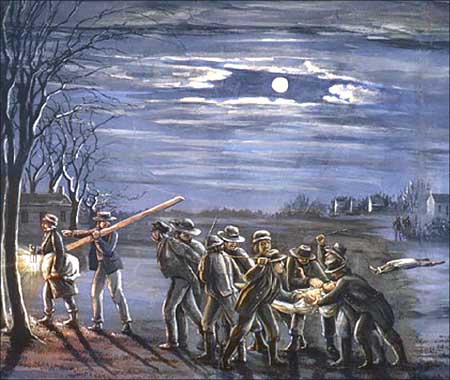
Mobbing of Joseph Smith, 1832 (painting by C. C. A. Christensen) larger image meadow, where he was beaten by the aroused men. As he was being carried around the corner of the Johnson home, he recounted, the man whom he had kicked caught up with the group and thrust his blood-covered hand into Joseph's face and swore, "I'll fix ye." While being carried into the field, the Prophet was choked until he became unconscious. When he awoke, he saw the tarred and bloody body of Sidney Rigdon stretched on the ground and assumed that Elder Rigdon was dead. The Prophet pleaded for mercy, after which one man cursed and said, "Call on yer God for help, we'll show ye no mercy." [70] Joseph was then carried another thirty rods or so from the Johnson home, where someone cried, "Simonds, Simonds," calling, as Joseph Smith assumed, Symonds Ryder. The Prophet said that the man replied, "Don't allow him to touch the ground, lest he should escape." [71] __________ 70 HC 1:261-62. Luke Johnson identified Warren Waste as the man Joseph Smith kicked as he left the home. Waste, Johnson added, was one of the strongest individuals living in the Western Reserve and boasted that he alone could take the Prophet out of the house. But after struggling with the Prophet and being knocked off the steps, he cried, "Do not let him touch the ground, or he will run over the whole of us." He is reported to have said afterwards that Joseph Smith was "the most powerful man" he had ever held in his life. Luke Johnson, "History," Millennial Star 26 (1864): 835. 71 HC 1:262. This is not a direct quotation from the Prophet's history. Hartwell Ryder later wrote that while his father, Symonds Ryder, had been accused of being one of the leaders of the mob who tarred and feathered Josehp Smith, he did not believe the accusation was correct, for he remembered that his father had been sick that night. He believed that his father remained home throughout the night, not leaving until late the next morning. Hartwell Ryder, "History of the Mormon Church," p. 4. REVELATIONS AND CONFRONTATIONS 99 Meanwhile, some members of the mob held a council. Joseph Smith thought they were trying to decide whether or not to kill him. The group decided against such action, but determined to beat him instead. They tore off all of his clothes, leaving only a shirt collar around his neck. One man fell on him like a "mad cat" and, while scratching his body with sharp nails, muttered, "That's the way the Holy Ghost falls on folks!" The mob also attempted to force into his mouth a vial of what the Prophet thought was poison, but he broke the vial with his teeth, and it fell to the ground, leaving him with a chipped tooth. [72] After being scratched and beaten, Joseph Smith was covered with a coat of tar and feathers. Some of the men tried to close his lips with the tar, and others sought to force the tar-paddle into his mouth. [73] Eventually the mob disappeared, leaving Joseph Smith in the meadow. When he attempted to rise, he fell, but after removing some of the tar from his lips, he breathed more easily. After a while he saw two lights in the distance. He arose and made his way toward one of the lights, which was coming from the Johnson home. At the door, his wife saw his body darkened with tar, which she thought was blood, and, thinking that he had been severely crushed, she fainted. A blanket was thrown around the Prophet, and a number of friends who had gathered in the Johnson home spent the night removing the tar and washing his body. [74] During this mobbing, two of the Saints, thinking they had encountered the enemy, fought with each other. One of them, John Poorman, ran into a cornfield to investigate a noise. At the same time, John Johnson, who had earlier been locked into his home by the mob, managed to free himself. Carrying a heavy club, he ran into the same cornfield, and when the two men met, they each supposed the other to be the foe. Poorman struck Johnson on the shoulder; then, frightened because he thought he had killed someone, he fled to the Johnson home. "Father Johnson," as he was called, recovered and struggled back to his home. Later the two men reported the incident and learned of their mistake. [75] The next day was a Sunday, and the Latter-day Saints gathered to worship at the usual hour. During the night Joseph __________ 72 HC 1:262-63. Luke Johnson reported that after Joseph Smith was taken from his father's home, the mob stretched him on a board and "tantalized him in a most insulting and brutal manner." He further stated that the mob planned to emasculate him, and Dr. Dennison was to perform the operation; but when the doctor saw the Prophet stretched on the plank, he changed his mind and refused to perform the operation. Johnson then substantiated Joseph Smith's account that after the Prophet was beaten and scratched, the mobsters attempted to "pour some vial of some obnoxious drug into his mouth," which broke one of his front teeth. Luke Johnson, "History," p. 835. 73 HC 1:263. 74 HC 1:264; Luke Johnson, "History," p. 835; autobiography of Lucy Walker Kimball, March 25, 1832. 75 HC 1:263-64; Luke Johnson, "History," p. 835. 100 THE HEAVENS RESOUND Smith had been cleansed, and he was prepared to preach. "With my flesh all scarified and defaced," he wrote, he preached to the congregation as usual and noted that some of the men who had participated in the mobbing of the previous night were in attendance. During the afternoon he baptized three converts. [76] Although Joseph Smith recovered quickly from this ordeal, others were not so fortunate. For several days Sidney Rigdon was delirious, but he eventually recovered. During the mobbing, one of the Smith twins, Joseph Smith Murdock, contracted a severe cold, and on March 29, 1832, he died. He was the first person to die as a consequence of persecution aimed at Latter-day Saints. [77] Because of continued threats on their lives, Joseph Smith, Sidney Rigdon, and their families left Hiram in the spring of 1832. On March 31, Sidney returned to Kirtland, and on April 1, Joseph left for a mission to Missouri. Since another mob had been organized in Kirtland and "the spirit of mobocracy was very prevalent through that whole region of country," the Prophet avoided returning to Kirtland prior to this mission. He instructed his wife, for her safety, to leave Hiram, return to the Whitney home, and await his return. [78] Following his departure from Hiram, Joseph was not reunited with his family until June 1832. __________ 76 HC 1:264; "Katherine Hulet Winget," in Kate B. Carter, comp., Our Pioneer Heritage 13:489; autobiography of Lucy Walker Kimball, March 25, 1832. In addition to the references cited above, a few other contemporary accounts refer to this mobbing. See Geauga Gazette, April 17, 1832, p. 1: Ohio Argus and Franklin Gazette (Lebanon, Ohio), June 8, 1832, p. 1; Amasa Lyman, "History," Deseret News, September 8, 1858, p. 2; Portage County Democrat (Ravenna, Ohio), February 15, 1860, p. 1. The Geauga Gazette stated: "On Saturday night, March 24, a number of persons, some say 25 or 30, disguised with coloured faces, entered the rooms in Hiram, where the two Mormonite leaders, Smith and Rigdon, were sleeping, and took them together with the pillows on which they slept, carried them a short distance and after besmearing their bodies with tar, applied the contents of the pillows to the same." 77 HC 1:265. 78 HC 1:265-66. Since there was another visitor in the Whitney home when Emma Smith arrived in Kirtland during Joseph's second trip to Missouri, Emma stayed at the homes of Reynolds Cahoon, Joseph Smith, Sr., and Frederick G. Williams. Book A-1, p. 209, Church Archives; "History of Joseph Smith," Times and Seasons 5 (September 2, 1844): 624. (remainder of text not transcribed, due to copyright) Notes: (forthcoming) |
|
Susan E. Black
in: The Prophet Joseph SLC: Deseret Books, 1988 Ch. 9 excerpt Transcriber's Comments Contents Copyright © 1988 by Deseret Books All rights reserved; only limited, "fair use" excerpts are presented here. |
|
[ 161 ]
Twenty-five-year-old Joseph Smith was well accustomed to verbal threats and abuse. He wrote, "They were persecuting me, reviling me, and speaking all manner of evil against me falsely." (Joseph Smith -- History 1:25.) But it was not until 1832, in Hiram, Ohio, that the abuse escalated from verbal to physical brutality. Hiram mobs introduced to Joseph a new depth of hostile fury, anger, and rage. Joseph's hope of Hiram's becoming a continuing refuge for pondering the scriptures and translating the Bible ended abruptly when a violent mob sought to do him bodily harm or even take his life on 24 March 1832. It is ironic that this barbaric scene occurred in an avowed Christian farming community. [1] Yet one night the inhabitants of this town formed a vicious mob bent on savagery. This seeming contradiction between upright and vicious prevailed in the town because Hiram shared with other societies the English tradition of "appropriate" mob rule. Although not legal, the practice of tarring and feathering was considered a right and even a responsibility of Hiram's citizens under "specified" mob circumstances. Southern abolitionists, wife beaters, harsh government __________ 1. Hiram was the third township settled in Portage County. It included the highest elevation in the Western Reserve, thirteen hundred feet above sea level. The town was once composed of the territory known as Mantua, Shalersville, Freedom, Windham, and Nelson. The first settlers of Hiram moved from Pennsylvania in 1799. They had a reputation of being "poor but law abiding." They had been attracted to Hiram by land prices from seventy-two cents to three dollars an acre and rumors of fertile soil. Their success on this highest plateau in the Western Reserve attracted stable families, who expanded farm living to include publishing newspapers and building schools and churches. Portage Heritage, ed. James B. Holm (Portage, Ohio: The Portage County Historical Society, 1957), pp. 372-80; see also History of Portage County, Ohio: Warner, Beers, and Co., 1885), pp. 466-75. 162 Susan Easton Black agents, scandalously immoral persons, and a prophet were its victims. [2] The instigators of this cruelty had once been followers of Joseph. These erstwhile followers had accepted Church membership, been blessed with fellowship, received callings from God, and witnessed miracles. Yet they rejected their blessings, denounced Joseph as a deceiver, and chose to destroy him. They themselves became the deceived, for they lost their heritage with the Saints of God; Joseph became the blessed, because he endured, with undiminished love and trust in God, the persecution of tar and feathers. Let us analyze the setting, the people, and the events that led to the brutal attack on the young prophet. Entree to Hiram Events leading to Joseph Smith's brief yet highly significant experience in Hiram, Ohio, began in the nearby community of Kirtland. In 1831, the people of Kirtland experienced an unusual eruption of excitement over spiritual manifestations. (D&C 50:2.) This excitement was heightened by the arrival of Joseph Smith, who professed to be a prophet of God. Many church-going citizens of Kirtland and the neighboring vicinity, most out of curiosity and a few out of a sincere desire to know if Joseph had a prophetic calling, visited him. Among those who came were fifty-three-year-old John Johnson [3] and his wife, Elsa, from Hiram, and Ezra Booth, [4] a Methodist minister from nearby Mantua. During their visit with Joseph, a miracle occurred. As they conversed on the godly gifts that had been conferred during Christ's ministry, one of the visitors exclaimed, "Here is Mrs. Johnson with a lame arm; has God given any power to man on earth to cure her?" Joseph, taking Elsa's hand, proclaimed, "Woman, in the name of the Lord Jesus Christ I command thee to be whole." [5] Immediately Elsa raised her arm, even though she had been afflicted by chronic rheumatism in her shoulder. By accounts of both believers and nonbelievers, she was thereafter __________ 2. Pouring molton tar over the body and covering it with feathers was an official punishment in England as early as the twelfth century. This practice continued in the United States until the late nineteenth century, even though it was never legal. H. E. Barnes, "The Story of Punishment," Dictionary of American History (New York: Charles Scribner's Sons, 1976), 6:461-62. 3. John Johnson, the son of Israel Johnson and Abigail Higgins, was born 11 April 1778 in Chesterfield, Cheshire, New Hampshire. He married Elsa Jacobs on 22 June 1800 in Chesterfield, Cheshire, New Hampshire. Susan Easton Black, Membership of The Church of Jesus Christ of Latter-day Saints, 1830-1848 (Salt Lake City, Utah: Corporation of the President, 1988), 25:580-83. 4. Ezra Booth was born in 1792 in Connecticut. He married Dorcas Taylor on 10 March 1819 in Nelsonville, Athens, Ohio. Ibid., 6:168-69. 5. Joseph Smith, History of The Church of Jesus Christ of Latter-day Saints, 7 vols., 2d ed. rev., ed. B. H. Roberts (Salt Lake City, Utah: The Church of Jesus Christ of Latter-day Saints, 1932-51), 1:215-16. Hiram, Ohio: Tribulation 163 able to do even heavy scrubbing without difficulty or pain. [6] A later critic discounted the possibility of a divine miracle: "The company were awe-stricken at the infinite presumption of the man, and the calm assurance with which he spoke. The sudden mental and moral shock -- I know not how better to explain the well attested fact -- electrified the rheumatic arm." [7] Despite this skeptical view of the event, the result was an impressive healing followed by the baptism of John Johnson and his wife and the Methodist minister in the spring of 1831. After baptism, John and Elsa returned to their farmhouse in Hiram. Ezra Booth accompanied them; he had been called to serve a mission there. Ezra's brief mission included a visit to Hiram's Campbellite minister, Symonds Ryder. [8] At this visit, Booth requested an opportunity to speak to Ryder's congregation. This request was granted. Booth's remarks concerning Joseph so impressed Ryder that he sought audience with the Prophet in Kirtland. Little is known of the particulars of Ryder's visit to Joseph in Kirtland, except that Ryder read a newspaper describing great destruction caused by an earthquake in Peking, China. When he read the account, he recalled having heard a young Mormon girl predicting the event. A skeptical account continues: "This appeal to the superstitious part of his nature was the final weight in the balance and he threw the whole power of his influence upon the side of Mormonism." [9] He accepted baptism in early June 1831, was ordained an elder on 6 June by Joseph Smith, Sr., and on 8 June was called to the ministry. (See D&C 52:37.) [10] When he received communication of his ministerial call signed by the Prophet Joseph Smith and Sidney Rigdon, "both in the letter he received and in the official commission to preach, however, his name was spelled R-i-d-e-r, instead of R-y-d-e-r... he thought if the 'Spirit' through which he had been called to preach could err in the matter of spelling his name, it might have erred in calling him to the ministry __________ 6. Ibid. (Smith, History of The Church 1:215-16). 7. Ibid.; A. S. Hayden, "Life and Character of Symonds Ryder," Early History of the Disciples in the Western Reserve, Ohio (Cincinnati: Chase and Hall Publishers, 1876), pp. 250-51. 8. Symonds Ryder was born on 20 November 1792 in Hartford, Washington, Vermont. He married Mahitable Loomis in November 1818. Black, Membership of the Church, 38:70-71. 9. J. H. Kennedy, Early Days of Mormonism (Scribner's and Sons, 1888), as cited in Smith, History of the Church, 1:158. 10. In Doctrine and Covenants 52:37, Simonds is directed to receive that which Heman Bassett had lost. Heman was a participant in the abnormal spiritual activities in 1831 and was one of the earliest converts to withdraw in Ohio. Painesville Telegraph, vol. 2, no. 50 (24 May 1831), stated that he "declared it all a miserable hoax." Max H. Parkin, Conflict at Kirtland: A Study of the Nature and Causes of External and Internal Conflict of the Mormons in Ohio between 1830 and 1838 (Salt Lake City, Utah: Max Parkin, 1966), p. 91. 164 Susan Easton Black as well; or, in other words, he was led to doubt if he were called at all by the Spirit of God, because of the error in spelling his name!" [11] Another historian indicated that Ryder's later apostasy was influenced by more than the misspelling of his name. He concluded that the reason was that Joseph "advocated communism of goods." [12] Ryder confirmed this conclusion by writing of his misunderstanding of the law of consecration and stewardship: "When they went to Missouri to lay the foundation of the splendid city of Zion, and also of the temple, they left their papers behind. This gave their new converts an opportunity to become acquainted with the internal arrangement of their church, which revealed to them the horrid fact that a plot was laid to take their property from them and place it under the control of Joseph Smith the prophet." [13] Whatever his reasons, he not only left the Church but carried an intense determination to eradicate from all residents in Hiram what he saw as the seducing error of Mormonism. As Ryder shifted the whole power of his influence, first toward and then against the Mormons, his mentor, Booth, was following the same course. At the June conference that yielded the orthographic turning point for Symonds Ryder, his gospel teacher, Ezra Booth, became a high priest. He immediately began serving as a missionary with Isaac Morley, traveling through Ohio, Indiana, and Illinois to Missouri. (See D&C 52:23.) His mission was a disappointment to him and became the impetus for his determination to immediately leave the Church and denounce Joseph. In a series of nine letters that appeared in the Ohio Star, he elaborated on experienced deception and the "Mormon menace."[14] This action led to his censure at a conference held on 6 September 1831. In the minutes of the conference, Oliver Cowdery recorded, "Upon testimony satisfactory to this conference, it was voted that Ezra Booth be silenced from preaching as an Elder in this Church." [15] Obviously this silencing did not deter him and in fact may have encouraged __________ 11. Another historian claimed that when Joseph Smith "misspelled" Ryder's first name Si-m-o-n instead of Symonds, Ryder lost faith in him, feeling that if the Lord really did speak to Smith, he would spell his name "correctly." Holm, Portage Heritage, p. 171; see also Smith, History of the Church, 1:261. 12. This historian explains his conclusion by stating, "After a time something leaked out in regard to the Saints having an eye on their neighbor's property, that it was their design to get into their possession all the lands of those whom they converted." Holm, Portage Heritage, p. 171; see also History of Portage County, Ohio, p. 474. 13. Symonds Ryder to A. S. Hayden, 1 Feb. 1868, as cited in Parkin, Conflict at Kirtland, p. 254. 14. The letters have also been published in E. D. Howe, Mormonism Unvailed (Painesville, Ohio: E. D. Howe, 1834), pp. 175-221. 15. Smith, History of the Church, 1:217. Hiram, Ohio: Tribulation 165 him to preach and write further against Joseph Smith and Mormonism. In late summer of 1831, Booth united with Ryder in planting the seeds of hatred toward Joseph and Mormonism in Hiram. This action annulled their previous effective missionary influence, noted by a community historian, AS Hayden: "Perhaps in no other place, except Kirtland, did the 'Latter-day Saints' gain a more permanent footing than in Hiram." [16] The seeds of hatred found fertile soil, since most "Hiramites left the Mormonites faster than they had ever joined them." [17] Even as Booth and Ryder were trying to rid Hiram of the "Mormon menace," John Johnson was extending a cordial invitation to Joseph and his family to be his guests there. John had been a resident of Hiram since 1818. By September 1831, he could be referred to as a prosperous resident, owning a new farmhouse located on his 304-acre estate. [18] Joseph and Sidney Rigdon viewed Johnson's invitation as the answer to the Lord's directive to "seek them a home, as they are taught through prayer by the Spirit." (D&C 63:65.) Thus, Joseph accepted his hospitality. He wrote, "On the 12th of September, I removed with my family to the township of Hiram, and commenced living with John Johnson." [19] Joseph's family then consisted of his wife, Emma, and the six-month-old twins of John Murdock, whom Joseph and Emma were rearing as their own. [20] When Joseph removed to Hiram, so did several faithful followers, including Sidney Rigdon. Sidney had been aware of the efforts of Booth and Ryder to ignite hatred in the community. He challenged Ryder in the Ohio Star to a debate on the authenticity of the Book of Mormon. Ryder published his refusal to meet Sidney in a public forum, citing as his excuse Rigdon's "irascible temper, loquacious extravagance, impaired state of mind, and want of due respect to his superiors." [21] Sidney responded to this indictment by claiming that Ryder "presented himself before the public as an accuser; he has been called upon before the same public, to support his accusations; and __________ 16. Hayden, Early History of the Disciples, p. 220; see also Parkin, Conflict at Kirtland, p. 248. 17. Symonds Ryder to A. S. Hayden, as cited in Parkin, Conflict at Kirtland, p. 254. 18. John Johnson first purchased 100 acres of land in Hiram, Ohio, on 19 March 1818, from Amos Spicer and A. Norton. On 4 April 1820, he purchased 60 acres from John Whipple. On 14 March 1823, he purchased 100 acres from Mary Hutchinson, et al. On 20 December 1827, he purchased 54 acres from Clarissa Eggleston. When Joseph Smith arrived in Hiram, John owned 304 acres. Salt Lake Genealogical Library, Film 899057, "Locality of Record, Recorders Office, Portage County Courthouse, State of Ohio, Index to Deeds, 1795-1917." --- The Johnson farmhouse was purchased by the Church in 1956. It was dedicated by Elder James A. Cullimore, Assistant to the Quorum of the Twelve Apostles. Church News, 17 May 1969, p. 3. 19. Smith, History of the Church, 1:215. 20. Emma Smith had given birth to twins, Louisa and Thaddeus, on 30 April 1831. These twins lived for approximately three hours. On the same day, John Murdock's wife gave birth to twins, named Joseph Smith Murdock and Julia Murdock. John's wife died in childbirth. John gave his motherless twins to Joseph and Emma "in the fond hope that they would fill the void in [Emma's life] occasioned by the loss of her own." Smith, History of the Church, 1:260. 21. Ohio Star, vol. 2, no. 52 (29 Dec. 1831), n. p., as cited in Parkin, Conflict at Kirtland, p. 118. 166 Susan Easton Black does he come forward and do it? nay, but seeks to hide himself behind a battery of reproach, and abuse, and low insinuations." [22] This name-calling and haranguing furthered sparked the smoldering fuels of mobocracy, but in the interim it did not prevent Joseph's stay in the Johnson farmhouse from being productive. The seven months in the home proved vital to the spiritual growth and definition of the Church. Joseph received at the home sixteen of the most important revelations on the development of the Church. [23] Among these revelations was section 76 on the three degrees of glory. Other significant events included a decision to compile and publish the Book of Commandments, five Church conferences, and the translation of portions of the Bible. These months of uninterrupted spiritual outpourings came to an abrupt end on the night of 24 March, when violence displaced peace and crushed the sense of haven for Joseph, Sidney, and their families. Although Mormon and anti-Mormon sources disagree on the details, all agree that the local citizens tarred and feathered Joseph and Sidney. The local history praises "the good people of Hiram and some others," saying that they "went to the house of Smith and Rigdon, took them out, stripped them to the buff, and treated them to a coat of tar and feathers and a rail ride, which induced them to leave." [24] The Night of 24 March 1832 On 24 March 1832, Joseph and Emma were taking turns caring for the eleven-month-old twins, who were seriously ill with measles. As the evening began, Emma nursed the children while Joseph rested. His rest was violently interrupted when a dozen men with blackened faces burst into the room. Emma's screams of "Murder!" were too late. The men grabbed Joseph with vengeance. An example of their fury was provided by Carnot Mason, who jerked a handful of hair, including a patch of scalp, from Joseph's head, during the ruckus in the room. The men had their "hands ... in my hair, [25] and some __________ 22. Ohio Star, vol. 3, no. 2 (12 Jan. 1832), n. p., as cited in Parkin, Conflict at Kirtland, p. 119. 23. See Doctrine and Covenants 1; 65; 67; 68; 69; 71; 73; 74; 76; 77; 78; 79; 80; 81; 99; 133. 24. History of Portage County, Ohio, p. 474. 25. Carnot Mason is reported to be the man who dragged Joseph by the hair. Later, Joseph showed Levi Hancock a patch of his hair that had been pulled out by the roots, leaving his scalp bare. Levi Hancock, Levi Hancock Journal, p. 73; a copy is located at Brigham Young University, Provo, Utah; see also Luke Johnson, "History of Luke Johnson," Millennial Star, vol. 26, no. 53 (31 Dec. 1864): 834-35. Hiram, Ohio: Tribulation 167 had hold of my shirt, drawers and limbs." [26] Joseph struggled to free himself. In this attempt, he cleared one leg, "with which I made a pass at one [Warren Waste who] fell on the door steps." [27] The mob threatened him with death if he continued his resistance. They swore "by G___, they would kill me if I did not be still, which quieted me." [28] The threat was punctuated by further threats by Waste, who returned to the fray with a bloody hand, which he thrust in Joseph's face, muttering with a hoarse laugh, "Ge, gee, G___ d___ ye, I'll fix ye." [29] True to his threat, he seized Joseph by his throat and choked him until he lost consciousness. In this state, Joseph was carried by the mobbers some thirty yards from the farmhouse.As consciousness returned, he saw men "disguised with colored faces and stimulated by whiskey" coming from every direction. Symonds Ryder later described them more favorably as "a company formed of citizens from Shalersville, Garrettsville, and Hiram." [30] These men were known to be Campbellites, Methodists, and Baptists. More ominous to Joseph than the growing mob was his recognition of the bloodied body of Sidney Rigdon lying on the frozen ground. Sidney had been attacked, tarred and feathered, and mercilessly dragged toward the farmhouse. His head was repeatedly lacerated as it struck icy protrusions. He became unconscious from loss of blood. At the sight of Sidney, Joseph fully understood his own peril. He pled with his captors, "You will have mercy and spare my life, I hope," to which they replied with harsh profanities, "Call on yer God for help, we'll show ye no mercy." [31] The mob proceeded thirty rods past Sidney Rigdon to the meadow. There they held ccouncil. Joseph assumed the topic in question was whether to kill him or not. Joseph reported their decision was "not to kill me, but to beat and scratch me well, tear off my shirt and drawers, and leave me naked." [32] It appears this decision was not accepted by all. __________ 26. Smith, History of the Church, 1:261. 27. Waste reportedly regarded himself as the "strongest man in the Western Reserve, and had boasted that he could take the Prophet out of the house alone." Waste later observed, however, "the Prophet was the most powerful man he ever had hold of in his life." Luke Johnson, "History of Luke Johnson," p. 835. 28. Smith, History of the Church, 1:261. 29. Ibid., p. 262. 30. Symonds Ryder to A. S. Hayden, 1 Feb. 1868, as cited in Parkin, Conflict at Kirtland, p. 254. 31. Smith, History of the Church, 1:262. 32. Ibid. 168 Susan Easton Black A mobber named Dr. Dennison tried to force a vial of poi sonous nitric acid into Joseph's mouth. He then proposed to emasculate Joseph. In this attempt Joseph's clothes were torn off. His naked body was then attacked by the finger-nails of an unknown mobber, who "like a mad cat, (fell on Joseph) and muttered G__ d__ ye, that's the way the Holy Ghost falls on folks!" [33] Dennison, however, seeing Joseph's body stretched on a plank, weakened in his resolve and refused to operate. The refusal seemed to spur on the shouts and assaults by other mobbers, "Simmonds, Simmonds, where's the tar bucket? I don't know, answered one, where 'tis. Eli's left it," [34] When the tar was fetched the mob tried to force the tar paddle into Joseph's mouth. Joseph twisted his head so they could not. An angry mobber cried, "G___ d___ ye, hold up yer head and let us giv ye some tar." [35] They forced tar into his mouth, which all but smothered him. They covered his scratched and beaten body with the loathsome substance. Joseph lost consciousness again. As the final touch to this barbarity, in mockery they feathered a prophet of God. As quickly as they had entered the quietude of Joseph's world, the mob fled to the old brickyard of Hiram to wash themselves and bury their filthy clothes, hoping that their participation in the deed would be hidden. Joseph was left alone. When he regained consciousness, he struggled to rid the tar from his mouth in order to breathe more freely. He attempted to rise but failed, due to his weakened condition. In a second effort to rise, he saw two lights in the distance. "I made my way towards one of them, and found it was Father Johnson's." [36] When Joseph neared the farmhouse, he called from the shadows to Emma. With her emotions highly stressed, Emma saw Joseph covered with what she assumed was blood, rather than tar. She concluded that he was "all crushed to pieces." [37] She fainted. It was not until further pleas by Joseph to neighbors now ministering to Emma that a blanket was extended to him. Wrapping it around himself, he staggered into the farmhouse. __________ 33. Ibid. (Smith, History of the Church, p. 263). 34. Ibid. 35. Ibid. 36. Ibid. 37. Ibid. Hiram, Ohio: Tribulation 169 Throughout the night his friends scraped, washed, and attempted to lubricate the tar from his wounded body. The After-effects of the Mobbing The local press publicly decried the vicious attack as "a base transaction, an unlawful act, a work of darkness, a diabolical trick." [38] Nevertheless, even the press hinted at the widespread sympathy by the condoning comment, "but bad as it is, it proves... that Satan hath more power than pretended prophets of Mormonism." [39] It is obvious from the attitude of the local press and the local sympathy for "appropriate" mob rule that Joseph was not safe in Hiram. Still, he remained at the Johnson farm for about a week. His activities during that week tell much about his character. On the following morning, 25 March, Joseph appeared in a public church service "all scarified and defaced." In this setting were some of Joseph's avowed enemies who had participated in the mob. His response to them illustrates his greatness. He wrote, "I preached to the congregation as usual." [40] In other words, despite the vicious attack of the previous night and the reality of continuing death threats, Joseph fulfilled his responsibilities as directed by the Lord. In the afternoon Joseph baptized three people. On Monday morning, 26 March, Joseph went to the log cabin across the street from the farmhouse to comfort his friend and brother in the gospel, Sidney. He reported, "I found him crazy." [41] The abusive mobbing of Sidney had rendered him seriously ill. He was suffering from a concussion and delirium. Instead of an exchange of consoling words to each other, Joseph listened to Sidney's delirious harangue, punctuated by abusive language: he wanted a razor to use as a weapon to kill Joseph. Yet never once did Joseph reprimand his friend. On Thursday of that week, 29 March, Joseph buried his eleven-month-old son, Joseph Murdock Smith. The mobocrats at the farmhouse had caused doors to gape open and the seriously ill babies to be exposed to the __________ 38. Warren News-Letter and Trumbull County Republican, vol. 4, no. 8 (10 Apr. 1832), n. p., as cited in Parkin, Conflict at Kirtland, p. 252. 39. Ibid. 40. Smith, History of the Church, 1:264. 41. Ibid., p. 265. 170 Susan Easton Black cold. Young baby Joseph, the first martyr of mobocracy in this dispensation, developed a severe cold, which, added to his measles, caused his death. The sorrowing father left Hiram on 1 April, leaving Emma and the other baby, Julia, behind. His destination was Missouri. As he traveled toward Missouri, he was threatened by mobbers, who pursued him from Hiram to Cincinnati. Seeing that the mob was not yet satiated, he now feared for the immediate safety of Emma and his child. He instructed Emma by letter that she quickly move back to Kirtland to stay with Newel K. Whitney's family. A prophet and his family were not safe in Hiram. But were the mobbers who had attacked him? Did they need to hide from the law or prosecution because of their villainous deed? Symonds Ryder, the apostate leader of the mob, was safe in Hiram. McClentic, who had his hands in Joseph's hair; Streeter, son of a Campbellite minister; Felatiah Allen, Esq., who supplied the mob a barrel of whiskey -- all were safe in Hiram. Even Mason, Fullars, Cleveland, and Dr. Dennison found in Hiram a haven of peace. None of these known mobbers or the estimated fifty unknown mobbers experienced any repercussions from their attempt on Joseph's life. An example of the fellowship they enjoyed in Hiram was the eulogy preached by B. A. Hinsdale in the Hiram Church for Symonds Ryder: "God grant that we may do our work as well as he did his; then we may go to our graves in equal peace." [42] After the event, if anyone inquired of the whereabouts of any of the mobbers of 24 March, an appropriate alibi was ready. These alibis were even passed to the next generation. For example, according to Ryder's son, Hartwell, Ryder was not involved in the tarring and feathering of Joseph Smith. Nor did he preach on the following Sunday in the south schoolhouse on Ryder Road and glory that he had been an instrument of the Lord in driving the Mormons out of Hiram. Instead, Hartwell wrote, Ryder was "ill in bed at the time." [43] __________ 42. Doris Messenger Ryder, "A History of Symonds Ryder," The Report [Ohio Genealogical Society], vol. 9, no. 2 (Apr. 1969), pp. 1-2. 43. Ibid. Hiram, Ohio: Tribulation 171 Conclusion Hiram, Ohio, was Joseph's introductory experience to physical brutality. This brief introduction to fury was a prologue to what was to continue throughout his life. It culminated on 27 June 1844 in Carthage, Illinois. Despite his efforts to "preach to the congregation as usual," "appropriate" mob rule seemed to have triumphed momentarily. The martyr's crown was forged in Hiram on 24 March 1832, but thanks to the council's decision not to kill him and Dr. Dennison's quivering personal refusal, Joseph lived. For twelve years the forged crown waited to be worn, despite the plots of a host of false brethren, lies, reviling, and continual persecution. Joseph escaped death from 1832 to 1844 only because his work was not complete. Hiram was a preparatory ground for Joseph. In this community he saw former friends plotting his destruction, faithful friends murmuring, and the effects of unleashed vengeance. Yet in Hiram, he learned of the glories of heaven that await those who endure the suffering and vicissitudes when one "could not deny, neither dared I do it; at least I knew that by so doing I would offend God, and come under condemnation." (Joseph Smith -- History 1:25.) Joseph knew of the truth he professed, that like Paul of old, "though they should persecute [me] unto death, yet [I] knew, and would know to [my] latest breath." (Joseph Smith -- History 2:24.) His testimony was tested by severe physical suffering in Hiram. Joseph left the community that had turned on him. The reputedly upright citizens viewed Joseph as a deceiver. They embraced Symonds Ryder and Ezra Booth while mocking a prophet of God. They reviled the Lord's anointed, leaving him "scarified and defaced." Yet Joseph did not abandon his divine calling: "Behold, thou art Joseph, and thou wast chosen to do the work of the Lord.... and thou art still chosen." (D&C 3:9-10.) (remainder of text not transcribed, due to copyright restrictions) Note 1: In the on-line entry for "Symonds Ryder - D&C 52:37," in her 1997 Who's Who in the Doctrine and Covenants, Susan Easton Black provides the following additional information: "Birth: 20 November 1792, Hartford, Windsor County, Vermont. Son of Joshua and Marilla Ryder. -- Death: 1 August 1870, Hiram, Portage County, Ohio. -- Symonds Ryder's father was a man of considerable influence and property for several years. However, when his fortunes were reversed, young Symonds obtained work with Elijah Mason in Hartford, Vermont. After accruing $133 during his six years of employment Symonds left Vermont, bound for the wilderness of Ohio. He arrived on horseback in January 1814 in Hiram, Ohio. He purchased 115 acres, which left him, as Charles H. Ryder wrote, "rather short of funds so he boarded with Orrin Pitkin and gave him two days work out of a week for his board and worked the other four days on his own land." Symonds returned to Vermont and in the spring of 1816 brought his father's family to Hiram. The family prospered in Ohio and increased the size of their farm to over four hundred acres. -- Symonds's name appears prominently on Hiram historical records. He was elected to the board of trustees of the Western Reserve Eclectic Institute and was the fourth corporal in the militia company in Garrettsville, a small community near Hiram. For several years he was the treasurer of Hiram College and for fifty-one years was an overseer or elder of the Nelson-Hiram branch of the Campbellites." Note 2: In the same entry, Dr. Black adds these comments: "Whatever his reasons, Symonds not only left the Church but carried an intense determination to eradicate Mormonism. In late summer of 1831 he united with his mentor Ezra Booth in planting the seeds of hatred toward Joseph and Mormonism in Hiram. -- Even as Symonds and Ezra were trying to rid Hiram of Mormonism, John Johnson was extending hospitality to the Prophet, Sidney Rigdon, and others. Soon after his arrival at the Johnson farm, Rigdon challenged Symonds in the Ohio Star to a debate on the authenticity of the Book of Mormon. Symonds published his refusal, citing as his excuse Rigdon's 'irascible temper, loquacious extravagance, impaired state of mind, and want of due respect to his superiors.' -- Sidney reacted to this indictment by claiming that Symonds "presented himself before the public as an accuser; he has been called upon before the same public, to support his accusations; and does he come forward and do it? nay, but seeks to hide himself behind a battery of reproach, and abuse, and low insinuations. He could blow like a porpoise when there was no person to oppose him.'" Note 3: Dr. Black ends Ryder's biographical sketch with the following: "According to Symonds's son, Hartwell, his father was not involved in the tarring and feathering, nor did he preach on the following Sunday in the south schoolhouse on Ryder road and glory in the belief that he had been an instrument of the Lord in driving the Mormons out of Hiram. Instead, Hartwell wrote, his father was 'ill in bed at the time' [As cited in Doris Messenger Ryder, 'A History of Simonds Ryder,' Ohio Genealogical Society Report 9 (April 1969), pp. 1-2]." |
|
Richard S. Van Wagoner Mormon Polygamy SLC: Signature Books, 1989 (2nd) Title page Introduction excerpt Ch. 1 excerpt Tarred & feathered Transcriber's Comments Contents © 1986, 1989 by Richard S. Van Wagoner All rights reserved; only limited, "fair use" excerpts are presented here. |
|
MORMON POLYGAMY: A HISTORY BY RICHARD S. VAN WAGONER SIGNATURE BOOKS SALT LAKE CITY 1989 |
|
[ 1 ]
Into this light came Joseph Smith, the twenty-four-year-old New York farmer who founded a religion based on his translation of a set of gold plates delivered by an angel. The Book of Mormon, a record of God's dealings with the pre-Columbian ancestors of the American Indian, not only explained the Hebrew origins of the Indian but established America as a chosen land destined to receive the fullness of the everlasting gospel. Written in King James English, Smith's translation sounded biblical, but its location and conceptual framework were American. The Book of Mormon gave America a sacred past and a millennial future. It became the keystone of a new American religion. God could not have chosen a better place, a better time, or a better people than early nineteenth-century Americans for the "restoration of all things." After a decade of religious revivalism, the blossoming economy of the 1830s had ripened millennial expectations. Word of angelic visitations was greeted enthusiastically. The heavens were being rolled back. Old men were dreaming dreams and young men prophesying. Women were speaking in tongues and children conversing with angels. New faiths mushroomed. Western New York, where Joseph Smith grew up, was so frequently swept by the fires of religious enthusiasm that it came to be known as the "burned-over district." It was in this milieu that Smith organized the Church of Christ on 6 April 1830, later renamed the Church of Jesus Christ of Latter-day Saints. Like other dynamic movements of the day, the foundling church was influenced not only by restoration Protestant sectarianism but by flourishing contemporary social experiments. Smith's ability to blend current ideas with his own visionary experiences is evident in the growth of his communal [ 2 ] vision. His earliest exposure to utopian thought and practices may have stemmed from a religious sect called the Believers in Christ's Second Appearing. Popularly known as Shakers, the group established a community a few miles from Smith's birthplace in Vermont (Arrington, Fox, and May 1976, 20). Mother Ann Lee's celibate society was one of the first communitarian organizations of this kind in the United States. Joseph Smith was probably also familiar with the Harmonists, who claimed that George Rapp, a Lutheran minister and social reformer, was responding to a vision from the angel Gabriel when in 1804 he brought his followers from Germany to Harmony, Pennsylvania, twenty-five miles north of Pittsburg. The Harmonists, who migrated to Indiana to found New Harmony in 1815 before returning to Ambridge, Pennsylvania, in 1825, experimented, like the Shakers, with shared property and celibacy. [1] Robert Owen, a wealthy Scottish reformer and industrialist, may have also indirectly shaped Joseph Smith's utopian ideas through one of his most influential American followers. Arriving in the United States in the mid-1820s, Owen promised a "new Eden in the far west" and began establishing communities based on common ownership and equality of work and profit. After purchasing New Harmony from the Harmonists in 1825, he established several other communitarian societies in Ohio, at Kendal and Yellow Springs. Sidney Rigdon, a prominent Protestant minister in the Western Reserve area of Ohio and a follower of Alexander Campbell's Disciples of Christ, attended a debate between Owen and Campbell in 1829. Taken with Owen's system of "family commonwealths," he tried to implement such a communal order within the Disciples of Christ (Ericksen 1922, 17). Campbell's objections caused Rigdon to leave the Disciples and, with other dissenters, to set up "common-stock" societies at Mentor and Kirtland, Ohio. By the fall of 1830 Rigdon and more than one hundred members of "the family," as they were known, had converted to Mormonism, which, by then, numbered nearly one thousand. After arriving in Ohio from New York in February 1831, Joseph Smith convinced Rigdon's communal group to abandon the common-stock principle in favor of the "more perfect law of the Lord." On 9 February 1831 Smith announced God's "Law of Consecration and Stewardship." Members were advised that "all things belong to the Lord" and were directed to deed all personal property to the bishop of the church. The bishop then returned a "stewardship" to each head of a household, who was expected to turn over any accrued surplus to the church. Known as the "Order of Enoch," "the Lord's Law," and the "United Order," the Mormon principle of stewardship was intended as a pattern of social and economic reorganization for all mankind. The dream was to unify "a people fragmented by their individualistic search for economic well-being." The Saints, as a group, divested of personal selfishness and greed, were to be prepared by this communal discipline to __________ 1 Rapp's Harmony is not the community where Joseph Smith lived intermittently from 1825 to 1827. Smith's Harmony, now Oakland, was located three hundred miles to the east in the northeastern section of the state. [ 3 ] usher in the millennial reign of Jesus Christ (Arrington, Fox, and May 1976, 2-3). Smith's ideas derived much from the New Testament Christian Primitivism of the day. But the deeper roots of his theology lay in his interpretation of the Old Testament. His concept of the Kingdom of God paralleled Israelite theocracy. The idea of a temple, as well as accompanying ordinances of washings, anointings, and covenants, was central to Hebrew worship. Smith's theology of marriage and family too may have drawn on ancient Israelite traditions. Like the biblical patriarchs of old, Mormon males empowered with priesthood were entitled to receive divine guidance in family matters. Women, on the other hand, were denied both priesthood and hierarchic position. This Old Testament focus evidently also drew Smith to the idea of biblical polygamy as part of the "restitution of all things." According to a close friend, Joseph B. Noble, Smith became convinced of the theological necessity of polygamy "while he was engaged in the work of translation of the Scriptures" ("Plural Marriage," 454), evidently a reference to Smith's and Rigdon's early 1830 revision of the Bible published later as The Inspired Version. Though polygamy is strongly denounced in several Book of Mormon passages (Jac. 1:15; 2:23-27; 3:5; Mos. 11:2-4, 14; Eth. 10:5), a reading of the Old Testament provides ample evidence that it was acceptable in ancient Israel. Abraham was not the only husband of multiple wives. Jacob had two wives and two concubines (Gen. 29-30); Elkanah had two wives (1 Sam. 1:2); Rehoboam had eighteen wives and sixty concubines (2 Chron. 11:21); Abijah married fourteen women (2 Chron. 13:21); David had a large harem (1 Chron. 14:3); and Solomon managed seven hundred wives and more than three hundred concubines (1 Kings 11:3). It is difficult to determine exactly when Joseph Smith first felt compelled to practice polygamy. W. W. Phelps recollected three decades after the fact in an 1861 letter to Brigham Young that on 17 July 1831, when he and five others had gathered in Jackson County, Missouri, Smith stated: "It is my will, that in time, ye should take unto you wives of the Lamanites and Nephites [Indians], that their posterity may become white, delightsome and just." Phelps added in a postscript that "about three years after this was given, I asked brother Joseph, privately, how 'we,' that were mentioned in the revelation could take wives of the 'natives' as we were all married men?" He claimed that Smith replied, "In the same manner that Abraham took Hagar and Keturah; and Jacob took Rachel, Bilhah and Zilpha, by Revelation." [2] In 1869 Mormon apostle Orson Pratt added another perspective, remembering that in early 1832 "Joseph told individuals, then in the Church, that he had inquired of the Lord concerning the principle of plurality of wives, and he received for answer that the principle of taking more wives than one is a true principle, but the time had not yet come for it to be practiced" __________ 2 Though the Phelps letter has been widely touted as the earliest source documenting the advocacy of Mormon polygamy, it is not without its problems. For example, Phelps himself, in a 16 September 1835 letter to his wife, Sally, demonstrated no knowledge of church-sanctioned polygamy: "I have no right to any other woman in this world nor in the world to come according to the law of the celestial kingdom." Other contemporary evidence suggests, however, that Smith's revelation was not intended to foreshadow polygamy but rather to remove obstacles to missionary work which Indian agents in Kansas-Missouri had created. Ezra Booth, a prominent ex-Protestant minister turned Mormon apostate, was also in Missouri in 1831 and published an account of the revelation in the 8 December 1831 Ohio Star. According to Booth, "it has been made known by revelation," that it would be "pleasing to the Lord if the elders formed a matrimonial alliance with the natives," whereby Mormons might "gain a residence" in Indian territory, despite the opposition of government agents. (See also Whittaker 1985, 35.) Oliver Cowdery and Parley P. Pratt had led a team of missionaries to Kansas-Missouri in the spring of 1831. Though the group had high hopes of success among the Indian tribes in the area, Cowdery wrote that the Indian agent was a "difficult man and we think some what strenuous respecting our having liberty to visit our brethren the Lamanites" (Messenger and Advocate, Oct. 1835). Pratt added that the men "were soon ordered out of the Indian country as disturbers of the peace" (Pratt 1874, 57). Phelps could also have mistaken the "we" in his recollection. Smith may have intended miscegenation as a general Mormon rule rather than a specific directive to the seven men on the trip. Though intermarriage between Mormon males and Indian women became an accepted Mormon custom, none of the seven men married an Indian woman. Mormons of Brigham Young's day, however, commonly taught that the Indians would become a "white and delightsome people" through intermarriage. As early as 1852 William Hall noted that Young taught "the curse of their color shall be removed" through intermarriage (p. 59). And Elder James S. Brown, an 1853 missionary to the Shoshone, recalled instructions from church leaders "to identify our interests with theirs, even to marrying among them, if we would be permitted to take young daughters of the chief and leading men.… It was thought that by forming that kind of an alliance we could have more power to do them good and keep the peace among the adjacent tribes" (Brown 1900, 320). The concept of Indians becoming a "white and delightsome people" is based on such Book of Mormon passages as 2 Nephi 30:6: "The scales of darkness shall begin to fall from their eyes; and many generations shall not pass away among them, save they shall be a white and delightsome people." Though the printer's copy and the 1830 and 1837 editions of the Book of Mormon all read "white and delightsome," Mormon church leaders in 1981 changed the verse to read "pure and delightsome," paralleling the 1840 edition. [ 4 ] (JD 13 [7 Oct. 1869]: 192). [3] Polygamy would not be a public practice of Mormonism until 1852, eight years after Smith's death. Smith never publicly advocated polygamy. New Testament monogamy, the official church position throughout his lifetime, was clearly outlined in Smith's 1831 revelations: "Thou shalt love thy wife with all thy heart, and shall cleave unto her and none else" (D&C 42:22); "It is lawful that [a man] should have one wife, and they twain shall be one flesh" (49:16). But from the early days of the church rumors hinted that Smith maintained a private position different from his public posture. His abrupt 1830 departure with his wife, Emma, from Harmony, Pennsylvania, may have been precipitated in part by Levi and Hiel Lewis's accusations that Smith had acted improperly towards a local girl. Five years later Levi Lewis, Emma's cousin, repeated stories that Smith attempted to "seduce Eliza Winters &c.," and that both Smith and his friend Martin Harris had claimed "adultery was no crime" (Susquehanna Register, 1 May 1834, reprinted in Howe 1834, 268; see also Newell and Avery 1984, 64). Similar allegations in Hiram, Ohio, reportedly caused problems for Smith in 1832. One account related that on 24 March a mob of men pulled Smith from his bed, beat him, and then covered him with a coat of tar and feathers. Eli Johnson, who allegedly participated in the attack "because he suspected Joseph of being intimate with his sister, Nancy Marinda Johnson,... was screaming for Joseph's castration" (Brodie 1975, 119). [4] Rumors about Smith multiplied. Benjamin F. Winchester, Smith's close friend and leader of Philadelphia Mormons in the early 1840s, later recalled Kirtland accusations of scandal and "licentious conduct" hurled against Smith, "this more especially among the women. Joseph's name was connected with scandalous relations with two or three families" (Winchester 1889). [5] One of the women whose name was linked to Smith in Kirtland was Vienna Jacques. A second-hand story remembered many years after the event by a "Mrs. Alexander" contended that Polly Beswick, a colorful two-hundred-pound Smith domestic, told her friends that "Jo Smith said he had a revelation to lie with Vienna Jacques, who lived in his family" and that Emma Smith told her "Joseph would get up in the night and go to Vienna's bed." Furthermore, she added, "Emma would get out of humor, fret and scold and flounce in the harness," then Smith would "shut himself up in a room and pray for a revalation... state it to her, and bring her around all right." [6] During an 1873 interview Martin Harris, Book of Mormon benefactor and close friend of Smith, recalled another such incident from the early Kirtland period. "In or about the year 1833," Harris remembered, Joseph Smith's "servant girl" claimed that the prophet had made "improper proposals to her, which created quite a talk amongst the people." When Smith came __________ 3 Pratt made essentially the same comments before an 1878 audience of RLDS Mormons in Plano, Illinois. He recalled that his 1832 missionary companion, Lyman Johnson, told him that "Joseph had made known to him as early as 1831, that plural marriage was a correct principle. Joseph declared to Lyman that God had revealed it to him, but that the time had not come to teach or practice it in the Church, but that the time would come" (MS 40 [16 Dec. 1878]: 788). 4 That an incident between Smith and Nancy Johnson precipitated the mobbing is unlikely. Sidney Rigdon was attacked just as viciously by the group as was Smith. And the leader of the mob, Simonds Ryder, later said that the attack occurred because members of the mob had found some documents that led them to believe "the horrid fact that a plot was laid to take their property from them and place it under the control of Smith" (Hill 1977, 146). Besides, John Johnson had no son Eli. His only sons were John, Jr., Luke, Olmstead, and Lyman (Newell and Avery 1984, 41). Nancy Johnson, who married Orson Hyde in 1834, became one of Smith's plural wives in February 1842 while Hyde was on a mission to Palestine (Quinn, "Prayer Circles," 88). Mrs. Hyde evidently first became linked with Smith's secretary, Apostle Willard Richards, whose wife was in Massachusetts. Ebenezer Robinson, who lost his job as editor of the Times and Seasons because of his wife Angeline's support of Emma Smith's anti-polygamy stance, noted in The Return 2 (Oct. 1890): 346-47 that in late January 1842, after his family vacated the printing office, "Willard Richards nailed down the windows, and fired off his revolver in the street after dark, and commenced living with Mrs. Nancy Marinda Hyde." John C. Bennett made the same accusations in his book (1842, 241-43). Sidney Rigdan's Latter Day Saint's Messenger and Advocate in a 15 March 1845 letter "TO THE SISTERS OF THE CHURCH OF JESUS CHRIST OF LATTER DAY SAINTS" commented: "If R[ichards] should take a notion to H[yde]'s wife in his absence, all that is necessary to be done is to be sealed. No harm done, no adultery committed; only taking a little advantage of rights of priesthood. And after R[ichards] has gone the round of dissipation with H[yde]'s wife, she is afterwards turned over to S[mith] and thus the poor silly woman becomes the actual dupe to two designing men, under the sanctimonious garb of rights of the royal priesthood. H[yde] by and by finds out the trick which was played off upon him in his absence, by his two faithless friends. His dignity becomes offended, (and well it might) refuses to live with his wife, but to be even with his companions in iniquity, takes to himself three more wives." Orson and Nancy Hyde continued to live together for a short time after arriving in the Salt Lake Valley. But their relationship was unsteady, ending in divorce in 1870 (Quinn, "Prayer Circles," 98). Ann Eliza Young commented in her 1876 book that when Hyde returned from his mission "it was hinted to him that Smith had had his first wife sealed to himself in his absence, as a wife for eternity." She added that years later Brigham Young "informed his apostle that [Nancy] was his wife only for time, but Joseph's for eternity" (1876, 324-26). 5 When Winchester was excommunicated after Smith's death for "disobeying counsel," he alleged that the real reason for church action was because he was a "deadly enemy of the spiritual wife system and for this opposition he had received all manner of abuse from all who believe in that hellish system" (Grant to Young, 7 Sept. 1844). 6 Vienna Jacques was eighteen years older than Joseph Smith. She lived to be more than ninety, and was sealed to Smith by proxy on 28 March 1858 (Jessee 1984, 293-94). [ 5 ] to him for advice, Harris, supposing that there was nothing to the story, told him to "take no notice of the girl, that she was full of the devil, and wanted to destroy the prophet of god." But according to Harris, Smith "acknowledged that there was more truth than poetry in what the girl said." Harris then said he would have nothing to do with the matter; Smith could get out of the trouble "the best way he knew how" (Metcalf n.d., 72). William E. McLellin, a Mormon apostle who was excommunicated in 1838, further detailed this situation with the unnamed "servant girl" in an 1872 letter to the Smith's eldest son, Joseph III: "I visited your Mother and family in 1847, and held a lengthy conversation with her, retired in the Mansion house in Nauvoo. I did not ask her to tell, but I told her some stories I had heard. And she told me whether I was properly informed. Dr. F[rederick] G. Williams practiced with me in Clay Co. Mo. during the latter part of 1838. And he told me that at your birth [6 November 1832] your father committed an act with a Miss Hill -- a hired girl. Emma saw him, and spoke to him. He desisted, but Mrs. Smith refused to be satisfied. He called in Dr. Williams, O. Cowdery, and S. Rigdon to reconcile Emma. But she told them just as the circumstances took place. He found he was caught. He confessed humbly, and begged forgiveness. Emma and all forgave him. She told me this story was true!!" Accounts such as these have led some historians to conclude that Joseph Smith was licentious. But others have countered that these stories merely indicate his involvement in a heaven-sanctioned system of polygamy, influenced by Old Testament models (Bachman 1975; Hill 1968; Foster 1981). If Smith did take a plural wife in Kirtland during the early 1830s under such a system, the woman was likely Fanny Alger. McLellin's 1872 letter described Alger's relationship with Smith. "Again I told [your mother]," the former apostle wrote, that "I heard that one night she missed Joseph and Fanny Alger. She went to the barn and saw him and Fanny in the barn together alone. She looked through a crack and saw the transaction!!! She told me this story too was verily true." McLellin also detailed the Alger incident to a newspaper reporter for the 6 October 1875 Salt Lake Tribune. The reporter stated that McLellin informed him of the exact place "where the first well authenticated case of polygamy took place." According to the article, the marriage occurred "in a barn on the hay mow, and was witnessed by Mrs. Smith through a crack in the door!" [7] Fanny Ward Alger, one of ten children born to Mormons Samuel Alger and Clarissa Hancock, was nineteen years old when she became a maidservant in the Smith home in 1835. Benjamin F. Johnson, a long-time friend of Smith, described Fanny as "a varry nice & Comly young woman... it was whispered eaven then that Joseph Loved her." Warren Parrish, Smith's personal secretary, told Johnson that he and Oliver Cowdery both knew that __________ 7 Newell and Avery have surmised that McLellin in his "old age" perhaps confused Fanny Alger with the Fanny Hill of John Cleland's 1749 novel and "came up with the hired girl, Miss Hill" (1984, 66). But McLellin's wording implies two separate situations. After telling young Joseph the Miss Hill story he then wrote, "Again I told [your mother].... She told me this story too was verily true" (italics mine). Also Martin Harris's account of the servant girl noted "In or about the year 1833," while McLellin's account says at the time of Joseph III's birth -- 6 November 1832. Alger did not live in Smith's home until 1835. [ 6 ] "Joseph had Fanny Alger as a wife for They were Spied upon & found together" (Zimmerman 1976, 38). Rumors of Smith's relationship with Alger, whispered about Kirtland during the summer of 1835, may have been the catalyst for the church's announcement of its official position on marriage as well as motivation for Smith's frequent addresses on marital relationships that fall. While Smith was in Michigan his secretary, W. W. Phelps, presented to the church's 17 August 1835 General Assembly a "Chapter of Rules for Marriage among the Saints." This declaration stipulated in part: "Inasmuch as this church of Christ has been reproached with the crime of fornication, and polygamy; we declare that we believe, that one man should have one wife; and one woman, but one husband, except in the case of death, when either is at liberty to marry again." The assembled Saints voted to accept the statement as part of "the faith and principle of this society as a body" by canonizing it in the official Doctrine and Covenants of the church. [8] This important document, probably introduced by Phelps at Joseph Smith's own request, [9] includes a marriage ceremony and what may be the first scriptural reference to the concept of eternal marriage. Evidently alluding to this, Phelps wrote to his wife Sally on 9 September 1835: "I have it in my heart to give you a little instruction, so that you may know your place, and stand in it, believed, admired, and rewarded, in time and in eternity." One week later he noted that "Br[other] Joseph has preached some of the greatest sermons on the duty of wives to their husbands and the role of all Women, I ever heard." Phelps then expounded on his newly gained understanding of eternal marriage, "Sally... you closed your 4th letter to me... after the manner of the Gentiles: says Sally 'I remain your till death.'" But, Phelps explained, "you will be mine, in this world and in the world to come... you may as well use the word 'forever,' as 'till death.'" Phelps's letters make clear that "eternal marriage" was distinct from polygamy, at least in his mind: "I have no right to any other woman in this world nor in the world to come according to the law of the celestial Kingdom." Despite these 1835 indications of an understanding of the principle of eternal marriage, which would subsequently become synonymous with plural marriage, a distinctly polygamous marriage ceremony was apparently not performed until Joseph Smith was "sealed" to plural wife Louisa Beaman on 5 or 6 April 1841. [10] Smith evidently viewed all marriages prior to this time, including his own to Emma, as valid for "time" only. As late as 1840 he occasionally signed letters to Emma with the benediction "your husband till death." [11] It was not until a 28 May 1843 meeting of the Endowment Council [12] in Nauvoo, Illinois, that the Joseph and Emma Smith were finally sealed for time and eternity in the "new and everlasting covenant of marriage" (Ehat 1982, 2). __________ 8 Mormons have not given the 1835 marriage statement the attention deserved by its pivotal historical significance. The neglect is understandable: the section is no longer in Mormon scripture. When the church officially announced its polygamy in 1852, the 1835 statement seemed obsolete. It was removed in 1876, replaced with a revelation on "celestial marriage" (D&C 132) which had been revealed to Smith on 12 July 1843 but not accepted by the Saints until 1852. An additional reason the 1835 marriage statement receives little attention despite its status as the present law of the church is that Smith was not present during the 17 August general assembly which voted on the measure. He had planned a brief missionary venture to Michigan to coincide with the 17 August meeting. Cowdery remained behind not only to conduct the conference but to be with his wife, Elizabeth, who gave birth to a daughter, Maria, on 21 August. Rumors circulated years later that Cowdery authored the marriage statement against Joseph Smith's wishes (see Brigham Young, in Joseph F. Smith Journal, 9 Oct. 1869). If true, Smith would have had ample opportunity to modify or delete the statement before publication. A "Notes To The Reader" addendum in the 1835 edition, detailed changes in the statement after it had been canonized but prior to publication. No changes were made to the section detailing the opposition to fornication and polygamy. Moreover Smith later authorized the second printing of the edition after proofreading the text. Statements that Smith and other church leaders subsequently made, as well as the fact that Smith performed marriages using the ceremony canonized in the 1835 declaration, argue for his approval of the statement. In 1842 Smith declared the 1835 marriage statement the only "rule of marriage... practiced in this Church" (TS 3 [1 Oct. 1842]: 939). President Wilford Woodruff added in court testimony in 1893 that before the revelation on plural marriage was given in 1843, "there could not have been any rule of marriage or any order of marriage in existence at that time except that prescribed by the Book of Doctrine and Covenants" (Complainants, 304). Woodruff further testified at the same hearing that this was "all the law on the question" of marriage that was given "to the body of the people" (p. 309). Lorenzo Snow, president of the Quorum of the Twelve Apostles, added that the section on marriage was the "doctrine and law of the church upon marriage at that time [early Nauvoo]" (p. 317). In addition, the ceremony outlined in the marriage statement was evidently used by Smith in performing marriages -- even plural marriages. Mercy Fielding testified in 1893 that on 4 June 1837 Smith married her to Robert Blashel Thompson using the "ceremony prescribed by the Church and set forth in the Book of Doctrine and Covenants." She added that the ceremony was also used when she became the plural wife of Hyrum Smith in 1843 (Complainants, 344-45). 9 An examination of the W. W. Phelps papers at LDS Archives reveals that Phelps was Smith's ghostwriter on several occasions. In 1844, for example, after Phelps had written Smith's U.S. presidential platform position entitled "Views of the Powers and Policy of the General Government," Smith directed Phelps to read the paper at many private and public settings (HC 6:210, 214, 221). 10 Louisa Beaman (also spelled Beeman or Beman), daughter of Alva and Betsy Beaman, was born in Livonia, New York, 7 February 1815. She was sealed to Smith for eternity and to Brigham Young for time on 14 January 1846. She died in Salt Lake City four years later on 15 May 1850. 11 Joseph Smith to Emma Smith, 20 Jan. 1840 (Jessee 1984, 454). See also Joseph Smith to Emma Smith, 9 Nov. 1839 (Smith and Smith 1952, 2:376-77). Jessee (1984, 448-49) cites the latter letter but explains that the closing benediction and Smith's signature have been cut away. Interestingly, in a 16 August 1842 letter to Emma, Smith closes "your affectionate husband until death, through all eternity for evermore" (Jessee 1984, 527). This letter precedes by more than nine months the Smith's eternal sealing on 28 May 1843. 12 This secret organization was also called the "Endowment Quorum," the "Holy Order," the "Quorum of the Anointed," "Joseph Smith's Prayer Circle," or simply the "Quorum." Its primary function was to introduce a select group of men and women to instructions that would help them obtain full salvation with God. A secondary function was to "test" initiates' ability to keep a secret prior to their introduction to plural marriage. The introduction of Masonry to Mormonism in 1842 also apparently served this purpose· See Quinn, "Prayer Circles." [ 7 ] But as early as 1835 Smith wanted Mormon couples married by Mormon elders rather than by civil authorities or leaders of other religions. Ohio law refused to recognize Mormon elders as ministers. In a bold display of civil disobedience on 14 November 1835, Smith married Lydia Goldthwait Bailey to Newel Knight. Initially Seymour Brunson, who held a valid minister's license, was to perform the marriage. But as Hyrum Smith began the introductory comments, Joseph Smith stepped forward, stopped his brother, and declared his intent to officiate. The bride later recalled his saying, "Our Elders have been wronged and prosecuted for marrying without a license. The Lord God of Israel has given me authority to unite the people in the holy bonds of matrimony. And from this time forth I shall use that privilege and marry whomsoever I see fit" (Homespun 1893, 31). Smith's performance of this marriage was one of his earliest efforts to apply heavenly guidelines on earth despite legal technicalities. Not only was Smith not a lawfully recognized minister, but Lydia Bailey, whose non-Mormon husband had deserted her, was never formally divorced. Obviously, Smith saw marriage not as a secular contract but as a sacramental covenant to be sealed by priesthood rather than by civil authority. He commented at the conclusion of the Knight ceremony "that marriage was an institution of heaven, instituted in the garden of Eden; that it was necessary it should be solemnized by the authority of the everlasting Priesthood" (HC 2:320). During the next few weeks Smith officiated at numerous other weddings. At the January 1836 wedding of Mormon apostle John F. Boynton and Susan Lowell, he read aloud a license granting any "Minister of the gospel the privilege of solemnizing the rights of matrimony." He then alluded to an "ancient order of marriage" and pronounced upon the bride and groom "the blessings of Abraham, Isaac and Jacob." The next day he signed a certificate of marriage for William F. Calhoon and Nancy M. Gibbs affirming that the ceremony had been performed "agreeable to the rules and regulations of the Church of Jesus Christ of Latter-day Saints on Matrimony" (ibid., 377). Smith's plans for Mormon utopia in Ohio and Missouri failed. A national recession devastated his economic plans in Kirtland. And non-Mormons in both places became increasingly nervous about the growing political clout of Mormons. Ohio and Missouri natives were suspicious of the close-knit Mormon lifestyle so contrary to mainstream American life. Disaffected Mormons vied with non-Mormons in hurling accusations against the church. Speculations that the Saints were practicing polygamy compounded such problems. Within such an environment of suspicion, detractors suspected that the Mormon "Law of Consecration" included a "community of wives." If churchmen could share their property, why not their wives, too? Similar communitarian groups advocating a "community of wives" and other marital variations may have become confused with Smith's followers in the public [ 8 ] mind. Parallels were compelling. In the early 1830s another group of "Saints" emerged from the social upheaval in New York. Disciples of revivalist preachers Erasmus Stone, Hiram Sheldon, and Jarvis Rider claimed they were perfect and could no longer sin. They became known as "Perfectionists." As a part of their doctrine, adherents advocated "spiritual wifery," a concept nearly identical to Mormon eternal marriage, wherein "all arrangements for a life in heaven may be made on earth... spiritual friendships may be formed, and spiritual bonds contracted, valid for eternity" (Ellis 1870). In 1832 Mormon missionary Orson Hyde, a former member of Sidney Rigdon's "family," visited a group he called "Cochranites" and disdainfully described in his 11 October 1832 journal the group's "Wonderful lustful spirit, because they believe in a 'plurality of wives' which they call spiritual wives, knowing them not after the flesh but after the spirit, but by the appearance they know one another after the flesh." Another practitioner of spiritual wifery was Robert Matthews, alias "Matthias the Prophet." Matthews announced that "all marriages not made by himself, and according to his doctrine, were of the devil, and that he had come to establish a community of property, and of wives" ("Memoirs"). In 1833 Matthews convinced two of his followers that, as sinners, they were not properly united in wedlock. He claimed power to dissolve the marriage, married the woman himself, prophesied that she was to "become the mother of a spiritual generation," and promised to father her first "spiritual child" himself. After a brief prison sentence, Matthews turned up on Joseph Smith's doorstep in Kirtland as "Joshua, the Jewish Minister" (Ms History, 8 Nov. 1835). Smith's account of the two-day meeting is sketchy, but apparently Matthews was sent on his way after a disagreement on the "transmigration of the soul." Linked in the public mind with such colorful religionists as Matthias, Shakers, Harmonists, Perfectionists, Rappites, and Cochranites, Joseph Smith was viewed skeptically by many outsiders. But the real problems in Ohio were caused by insiders. The instability created by disastrous financial decisions involving Smith's Kirtland Safety Anti-Banking Society was compounded by stories about Smith's 1835 relationship with Fanny Alger. Benjamin Johnson years later noted that the Alger incident was "one of the Causes of Apostacy & disruption at Kirtland altho at the time there was little Said publickly upon the subject" (Zimmerman 1976, 39). At least one account indicated that Fanny became pregnant. Chauncy G. Webb, Smith's grammar teacher, later reported that when the pregnancy became evident, Emma Smith drove Fanny from her home (Wyl 1886, 57). Webb's daughter, Ann Eliza Webb Young, a divorced wife of Brigham Young, remembered that Fanny was taken into the Webb home on a temporary basis (Young 1876, 66-67). In fact Joseph Smith's journal entry for 17 October 1835 may contain a cryptic reference to this event: [ 9 ] "Called my family together arranged my domestick concerns and dismissed my boarders." [13] Fanny left Kirtland in September 1836 with her family. Though she married non-Mormon Solomon Custer on 16 November 1836 [14] and was living in Dublin City, Indiana, far from Kirtland, her name still raised eyebrows. Fanny Brewer, a Mormon visitor to Kirtland in 1837, observed "much excitement against the Prophet... [involving] an unlawful intercourse between himself and a young orphan girl residing in his family and under his protection" (Parkin 1966, 174). Much of the excitement was evidently caused by the strong reaction of Smith's close counselor and friend Oliver Cowdery to Smith's presumed liaison with Alger. Apostle David W. Patten, visiting from Missouri in the summer of 1837, went to Cowdery in Kirtland to "enquire of him if a certain story was true respecting J[oseph] Smith's committing adultery with a certain girl." Patten later said that Cowdery "turned on his heel and insinuated as though [Smith] was guilty, he then went on and gave a history of some circumstances respecting the adultery scrape stating that no doubt it was true. Also said that Joseph had told him, he had confessed to Emma" (Cannon and Cook 1983, 167). Church leaders in Missouri questioned Cowdery regarding the Alger incident when he arrived in Far West in the fall of 1837. Thomas B. Marsh, president of the Quorum of Twelve Apostles, stated that when Cowdery was asked "if Joseph Smith jr had confessed to his wife that he was guilty of adultery with a certain girl," Cowdery "cocked up his eye very knowingly and hesitated to answer the question saying he did not know as he was bound to answer the question, yet conveyed the idea that it was true." [15] Later that fall, during a discussion at the Far West home of George W. Harris, Marsh reported a conversation "between Joseph Smith and Oliver Cowdery when J. Smith asked him if he had ever confessed to him that he was guilty of adultery, when after a considerable winking &c, he said No." Smith then gave an apologetic history of the "girl business," adding that "Oliver Cowdery had been his bosom friend, therefore he intrusted him with many things" (ibid., 167-68). After Smith returned to Ohio from Missouri in late 1837 rumors circulated that Cowdery had spread scandalous lies about the prophet and had been chastened by him. The "Second Elder" was furious. He dashed off a 21 January 1838 letter to Smith complaining, "I hear from Kirtland, by the last letters, that you have publickly said, that when you were here I confessed to you that I had willfully lied about you -- this compels me to ask you to correct that statement, and give me an explanation -- until then you and myself are two" (in Cowdery to Cowdery). Apparently the word from Kirtland had come from Warren Cowdery, Oliver's brother, because Oliver included a copy of the letter to Smith in a separate letter to Warren. "I can assure you and bro. __________ 13 If Alger did become pregnant in 1835, the baby either died or was raised by someone else. Her first known child, listed on the 1850 census of Dublin City, Indiana, was a daughter born in 1840. 14 Wayne County, Indiana, marriage license, copy in author's possession. Fanny and Solomon, the parents of nine children, lived in Dublin City their entire married life and were members of the Universalist church (Richmond Telegraph, 1 April 1885)· For additional background information on Fanny Alger Custer, see Samuel Alger/Clarissa Hancock Alger Family Group Sheet, LDS Genealogical Archives; Samuel Alger Obituary, Deseret News, 6 Oct. 1874; Wayne Co., Indiana, census records 1850, 1860, 1880 (Dublin City). The 1850 and the 1860 census list the Custer's children: Mary A. (b. 1840), Lewis A. (b. 1844), Benjamin Franklin (b. 1850), and Lafayette (b. 1854). 15 See further details in Thomas B. Marsh's letter in Elder's Journal, July 1838, 45-46. Marsh worried "that such foul and false reports" were being circulated, but he assured Smith that "none but those who wish your overthrow, will believe them, and we presume that the above testimonies will be sufficient to stay the tongue of the slanderer." [ 10 ] Lyman [Cowdery]," Oliver angrily wrote to his brother, "I never confessed insinuated or admitted that I ever willfully lied about him. When he was there we had some conversation in which in every instance, I did not fail to affirm that what I had said was strictly true" in the matter of "a dirty, nasty, filthy affair of his and Fanny Algers." Smith did not respond to Cowdery's letter. He was embroiled in trying to hold the church together in Kirtland. Prominent church leaders Luke Johnson, John Boynton, Warren Parrish, and others had united to denounce Smith as a heretic and "fallen prophet." They urged church members to rally around them in re-establishing the "old standards." After a clamor of accusations from both sides, leaders of the Johnson faction were excommunicated. But then one of the dissidents obtained a warrant for Smith's arrest on a charge of fraud. Under cover of darkness on 12 January 1838 he and first counselor Sidney Rigdon decided to "escape mob violence, which was about to burst upon us under the color of legal process" (HC 3:1). They fled to Far West, Missouri. While Smith was en route to Missouri, charges against Oliver Cowdery's church membership were initiated in Far West. Prominent on the list of nine charges was "seeking to destroy the character of President Joseph Smith jr by falsly insinuating that he was guilty of adultry &c." [16] Though Smith arrived at Far West on 14 March 1838, he evidently would not grant Cowdery a requested interview. The Second Elder was excommunicated 12 April 1838, effectively disarming his accusations against the prophet. Confusion over the exact nature and extent of Joseph Smith's involvement with Fanny Alger has remained to this day. That there was a sexual relationship seems probable. But was Smith's association with his house servant adulterous, as Cowdery charged? Or was she Smith's first plural wife? Apostle Heber C Kimball, many years later, introduced Fanny's brother John Alger in the Saint George Temple as "brother of the Prophet Josephs first Plural Wife" (Zimmerman 1976, 45). And in 1899 church leaders performed a proxy marriage for the couple. "The sealings of those named," a temple recorder noted of Alger and the ten other women listed, "were performed during the life of the Prophet Joseph but there is no record thereof. President Lorenzo Snow decided that they be repeated in order that a record might exist; and that this explanation be made" (Tinney 1973, 41). If Smith and Alger were sealed in a plural marriage as 1899 church leaders were persuaded, who stood as witness for the ordinance? Who performed the ceremony? In the absence of an officiator or witness, did God himself seal the couple, or did Smith, as God's only legitimate earthly agent, marry himself to Alger? Smith did not claim publicly the power to "bind on earth and seal eternally in the heavens" until 3 April 1836, perhaps one year after the Alger incident (D&C 110:13-16). Could he have viewed her as his __________ 16 The following list of charges is from the "Far West Record": "1st, For stirring up the enemy to persecute the brethren by urging on vexatious Lawsuits and thus distressing the innocent. 2nd, For seeking to destroy the character of President Joseph Smith Jr by falsly insinuating that he was guilty of adultry &c. 3rd, For treating the Church with contempt by not attending meetings. 4th, For virtually denying the faith by declaring that he would not be governed by any ecclesiastical authority nor Revelation whatever in his temporal affairs. 5th, For selling his lands in Jackson county contrary to the Revelations. 6th, For writing and sending an insulting letter to President T. B. Marsh while on the High Council, attending to the duties of his office, as President of the council and by insulting the whole Council with the contents of said letter. 7th, For leaving the calling, in which God had appointed him, by Revelation, for the sake of filthy lucre, and turning to the practice of the Law. 8th, For disgracing the Church by being connected in the "Bogus business" as common report says. 9th, For dishonestly retaining notes after they had been paid and finally for leaving or forsaking the cause of God, and betaking himself to the beggerly elements of the world and neglecting his high and Holy Calling contrary to his profession." [ 11 ] common-law wife, married by connubial relationship rather than by wedding ceremony? [17] Unfortunately, Smith himself provided no help in clarifying his relationship with Alger. His public denouncements of polygamy during this period compounded the confusion. Only three weeks after Cowdery's excommunication, Smith published a statement in the July 1838 Elder's Journal answering several questions about Mormonism. To the question, "Do the Mormons believe in having more wives than one?" he responded emphatically, "No, not at the same time." Several months later, in mid-December, while incarcerated in Liberty, Missouri, he wrote a "Letter to the Church" which reflected his personal difficulties. Perhaps alluding to the Alger rumors, he asked, "Was it for committing adultery that we were assailed?" He then denied the charge as the "false slander" of "renegade 'Mormon dissenters'... running through the world and spreading various foul and libelous reports against us." He dismissed the persistent allegation that the Mormons had "not only dedicated our property, but our families also to the Lord; and Satan, taking advantage of this, has perverted it into licentiousness, such as a community of wives, which is an abomination in the sight of God" (HC 3:230). The difficulties between Smith and Cowdery could probably have been resolved if Smith had admitted, at least to Cowdery, that he was introducing plural marriage into the church. But Cowdery, who left viewing Smith's behavior as adulterous, never became reconciled to Mormon polygamy. Church leaders much later unfairly accused Cowdery of taking a plural wife himself. Brigham Young is recorded in 1872 as having said that "while Joseph and Oliver were translating the Book of Mormon, they had a revelation that the order of Patriarchal Marriag and the Sealing was right." Cowdery, according to Young, proposed to Smith, "Why dont we go into the Order of Polygamy, and practice it as the ancients did? We know it is true, then why delay?" Smith warned that "the time has not yet come." Ignoring the prophet's counsel, "Oliver Cowdery took to wife Miss Annie Lyman, cousin to Geo A. Smith. From that time he went into darknes and lost the spirit. Annie Lyman is still alive, a witnes to these things" (Larson and Larson 1980, 1:349). [18] This second-hand statement of Young, who may not have even been a Mormon at the time of the purported incident, lacks credibility. The Book of Mormon not only consistently denounces polygamy, but it would have been impossible for Cowdery to have been living polygamously during the period charged by Young (1827-30). Cowdery's marriage to his only wife, Elizabeth Ann Whitmer, occurred in 1832, three years after the translation of the Book of Mormon. [19] Furthermore no charges of sexual misconduct were made against Cowdery during his 1838 excommunication trial when there would have been ample opportunity and strong incentive for such retaliation. __________ 17 Apostle Willard Richards in December 1845 entered into such a plural marriage with Alice Longstroth. His 23 December diary entry reads: "At 10 P.M. took Alice L[ongstrot]h by the [hand] of our own free will and avow mutually acknowledge each other husband & wife, in a covenant not to be broken in time or Eternity for time & for all Eternity, to all intents & purposes as though the seal of the covenant had been placed upon us. for time & all Eternity & called upon God. & all the Holy angels -- & Sarah Long[stro]th. to witness the same." Apostle Abraham H. Cannon noted in his 5 April 1894 diary that both George Q. Cannon and Wilford Woodruff approved of such arrangements. "I believe in concubinage," George Q. is recorded as saying, "or some plan whereby men and women can live together under sacred ordinances and vows until they can be married." Woodruff responded to Cannon's suggestion, "If men enter into some practice of this character to raise a righteous posterity, they will be justified in it." 18 See also George Q. Cannon's second-hand account in the Juvenile Instructor 16 (15 Sept. 1881): 206; and Joseph F. Smith's account in JD 20 (7 July 1878): 29. 19 In addition, Cowdery was ordained an "Associate President" of the church on 5 December 1834 -- a position superior to counselors in the First Presidency. He also helped to supervise the selection of the original Quorum of Twelve Apostles in 1835, administered the first endowments in the Kirtland Temple in 1836, and on 3 April 1836 shared with Smith a temple vision of Jesus, Moses, Elias, and Elijah. It is unlikely that Cowdery would have been allowed to participate in any of these events had the "Associate President" been involved in an unsanctioned polygamous relationship. [ 12 ] Cowdery returned to Mormonism for a short time before his death in 1850 and was shocked when his sister and her husband, Daniel and Phebe Jackson, wrote to him from Illinois in 1846 confirming that polygamy was being practiced by church leaders. "I can hardly think it possible," he wrote, "that though there may be individuals who are guilty of the iniquities spoken of -- yet no such practice can be preached or adhered to as a public doctrine." Cowdery viewed polygamy as morally and culturally unthinkable: "Such may do for the followers of Mohamet, it may have done some thousands of years ago, but no people professing to be governed by the pure and holy principles of the Lord Jesus, can hold up their heads before the world at this distance of time, and be guilty of such folly -- such wrong -- such abomination." [20] Neither Oliver Cowdery's dim view of polygamy nor the difficulties the Fanny Alger situation caused seriously hampered Joseph Smith's apparent enthusiasm for plural marriage. But shortly after Cowdery's excommunication, events in Far West reached such crisis proportions that the church was again forced to uproot and move. __________ 20 Another example of Cowdery's opposition to polygamy is found in his 25 January 1836 "sketchbook" entry: "Settled with James M. Carrel who left the office. I gave him a reproof for urging himself into the society of a young female while he yet had a wife living, but he disliked my admonition: he however confessed his impropriety." A third example is in an 1884 reminiscence of Cowdery's former law partner, W. Lang, who said, "Cowdery never gave me a full history of the troubles of the Mormons in Missouri and Illinois but I am sure that the doctrine of polygamy was advocated by Smith and opposed by Cowdery" (Ivins Collection, Notebook 2:33-34). Notes: (forthcoming) |
|
Susan Easton Black "Joseph's Experience in Hiram, Ohio: A Time of Contrasts" in: Regional Studies in LDS History: Ohio Provo: BYU, 1990 Ch. 2 excerpt Transcriber's Comments Contents © 1990, 2006 by Brigham Young University All rights reserved; only limited, "fair use" excerpts are presented here. |
|
[ 27 ]
Contrast between divine light and satanic darkness is evident in the history of Hiram, Ohio. This contrasting theme began with the conception of Hiram and continued until Joseph fled from there in 1832. Light revealed from God to Joseph was not dulled by the murderous plotting and revelry of Hiram's residents. For Joseph beheld "the glory of the Son, on the right hand of the Father and received of his fulness" and would not deny these truths when he faced eminent danger from mobs in Hiram (D&C 76:20).... (remainder of page not transcribed, due to copyright restrictions) 28 Regional Studies in Latter-day Saint History Early Beginnings in Hiram An original proprietor of land in the Western Reserve was Colonel Daniel Tilden, of Connecticut. In 1799 he and fellow proprietors met at their Masonic lodge to name their land holdings. Colonel Tilden proposed the acreage be known as Hiram, in commemoration of the ancient King of Tyre, a benevolent friend of King David and King Solomon (2 Samuel 5:11; 1 Kings 5:10). The name was unanimously accepted by the Masonic proprietors.However, attempts to settle Hiram in 1803 were marred by tragedy when two of the proprietors, Joseph Metcalf and Levi Case, in separate incidents, died on their way there. Case was found frozen to death while standing against a tree in New York. Quickened by fear, at this ominous turn of events the remaining proprietors sold their land to poor, law-abiding citizens from Pennsylvania who, unaware of the tragic circumstances, were attracted to the financially appealing advertisements of seventy-two cents to three dollars an acre for rich, fertile soil. Thus, in 1804, Hiram began as a rural township in Portage County with a handful of would-be farmers. Hiram in the 1830s By 1831, only twenty-seven years after the first settlers struck a hoe to the soil, Hiram was known for its stable, New England and Pennsylvania families, who had helped the township progress from a primitive, frontier wilderness to a community with newspapers, schools, and churches. 2Earlier fears associated with Hiram had been quelled by hard work, determination, and rural prosperity. Among Hiram's most prosperous citizens in the 1830s were John Johnson 3 and Symonds Ryder. 4 __________ 1 1874-1978, Bicentennial Atlas of Portage County, Ohio, Portage Historical Association, 1978, p. A27. 2 James B. Holm, ed. Portage Heritage (Portage, Ohio: The Portage County Historical Society, 1957), pp. 372-380. History of Portage County, Ohio (Chicago: Warner, Beers, and Co., 1885), pp. 466-475. 3 John Johnson, the son of Israel Johnson and Abigail Higgins, was born 11 April 1778 in Chesterfield, Cheshire, New Hampshire. He married Elsa Jacobs on 22 June 1800 in Chesterfield, Cheshire, New Hampshire. Susan Easton Black, Membership of the Church of Jesus Christ of Latter-day Saints, 1830-1848 (Salt Lake City, Utah: Corporation of the President, 1989), 25:580-583. 4 Symonds Ryder was born on 20 November 1792 in Hartford, Washington, Vermont. He married Mahitable Loomis in November 1818. Black, Membership of the Church, 38:70-71. Joseph's Experience in Hiram, Ohio 29 Both men owned approximately three hundred acres of land, 5 were patrons of the Hiram School District No. 1, and were respected leaders in the community. Their opinions and actions were highly esteemed and when they both embraced Mormonism, it began to appear that the community of Hiram would be prepared to receive a prophet of God. In fact, John Johnson extended a cordial invitation of hospitality to the Prophet Joseph Smith, and when Joseph arrived the light of revealed truth shone brightly on the little town for a short time. While translating the Bible in Hiram, Joseph learned truths of biblical concepts. While visiting with the Saints, he rejoiced in their desire "to obtain the word of the Lord upon every subject that in any way concerned our salvation" (HC 1:207). Church meetings and five conferences were held in the Johnson farmhouse, enabling Joseph to inform the Saints of the translation, doctrinal issues, and revelations. Soon the community of Hiram had a strong branch of the Church. If the story of Joseph in Hiram were only to recount these positive themes, there would be no dark side -- for Hiram was a town of contrast. Here, an angry mob would introduce to Joseph a depth of hostile fury which he had not known before. Joseph's hope that Hiram would become a refuge for pondering the scriptures, translating the Bible, meeting with believers, and obtaining the word of the Lord "upon every subject that in anyway concerned our salvation," ended abruptly on 24 March 1832 when a violent mob sought to do him bodily harm (HC 1:207).... __________ 5 John Johnson first purchased 100 acres of land in Hiram, Ohio, on 19 March 1818, from Amos Spicer and A. Norton. On 4 April 1820, he purchased 60 acres from John Whipple. On 14 March 1823, he purchased 100 acres from Mary Hutchinson, et al. On 20 December 1827, he purchased 54 acres from Clarissa Eggleston. When Joseph Smith arrived in Hiram, John owned 304 acres. Salt Lake Genealogical Library, Film #899057, "Locality of Record," Recorders Office, Portage County Courthouse, State of Ohio, Index to Deeds, 1795-1917. -- The Johnson farm house was purchased by the Church in 1956. It was dedicated by Elder James A. Cullimore, Assistant to the Twelve. Church News, May 17, 1969, p. 3. 30 Regional Studies in Latter-day Saint History
(beginning of page not transcribed, due to copyright restrictions)
Many church-going citizens of Kirtland and the neigh boring vicinity visited him. Among those who came were John Johnson, his wife Elsa, and Ezra Booth, 6 a Methodist minister from nearby Mantua. During their visit with Joseph, a miracle occurred. As they conversed on the godly gifts that had been conferred during Christ's ministry, one of the visitors exclaimed, "Here is Mrs. Johnson with a lame arm; has God given any power to man now on the earth to cure her?" Joseph, taking Elsa's hand proclaimed, "Woman, in the name of the Lord Jesus Christ I command thee to be whole" (HC 1:215216). Immediately Elsa raised her arm, even though she had been chronically afflicted by disabling rheumatism in her shoulder. 7 This miraculous healing was followed by the baptism of John Johnson and his wife, and Ezra Booth in the spring of 1831. After baptism, John and Elsa returned to their farmhouse in Hiram. Booth accompanied them, for he had been called to serve a mission there. __________ 6 Ezra Booth was born in 1792 in Connecticut. He married Dorcas Taylor on 10 March 1819 in Nelsonville, Athens, Ohio. Black, Membership of the Church, 6:168-169. 7 A later critic discounted the possibility of a divine miracle: "The company were awe-stricken at the infinite presumption of the man, and the calm assurance with which he spoke. The sudden mental and moral shock -- I know not how better to explain the well attested fact -- electrified the rheumatic arm." A. S. Hayden, "Life and Character of Symonds Ryder," Early History of the Disciples in the Western Reserve, Ohio (Cincinnati: Chase and Hall Publishers, 1876), pp. 250-251. Joseph's Experience in Hiram, Ohio 31 Booth's brief mission included a visit to a Campbellite minister, Symonds Ryder. His remarks concerning Joseph so impressed Ryder that he sought audience with the Prophet in Kirtland. Little is known of the particulars of Ryder's first visit with Joseph, except that afterwards he, like John Johnson, "Threw the whole power of his influence upon the side of Mormonism." 8 He accepted baptism in early June of 1831, was ordained an elder on June 6th by Joseph Smith, Sr., and on June 8th was called to the proselyting ministry (D&C 52:37). However, because Ryder did not believe that he was called by the Spirit of God; he did not serve a mission. 9 He left the Church with an intense determination to eradicate from Hiram what he saw as the seducing error of Mormonism. As Ryder shifted the power of his influence, first toward and then against the Mormons, Booth, his mentor, was following the same course. 10 In late summer of 1831, Booth joined with Ryder in igniting and fanning the flames of hatred and fear toward Joseph and Mormonism in Hiram, thereby annulling their previous missionary influence in support of Joseph. A noted community historian A. S. Hayden, records that most "Hiramites left the Mormonites faster than they had ever joined them." 11 As Booth and Ryder were trying to rid Hiram of the "Mormon menace," John Johnson, in contrast, was extending an cordial invitation to Joseph and his family to be his guests there. 12 ... (remainder of page not transcribed, due to copyright restrictions) __________ 8 Ryder read a newspaper describing great destruction caused by an earthquake in Peking, China. When he read the account, he recalled having heard a young Mormon girl predicting the event. "This appeal to the superstitious part of his nature was the final weight in the balance and he threw the whole power of his influence upon the side of Mormonism." J. H. Kennedy, Early Days of Mormonism (Scribner's and Sons, 1888), as cited in HC 1:158. 9 When he received communication of his ministerial call signed by the Prophet Joseph Smith and Sidney Rigdon, Both in the letter he received and in the official commission to preach, however, his name was spelled R-i-d-e-r, instead of R-y-d-e-r .... He thought if the "Spirit" through which he had been called to preach could err in the matter of spelling his name, it might have erred in calling him to the ministry as well; or, in other words, he was led to doubt if he were called at all by the Spirit of God, because of the error in spelling his name! Holm, Portage Heritage, p. 171. -- Allegedly, Ryder's later apostasy was influenced by more than the misspelling of his name. Ryder confirmed this conclusion by writing of his misunderstanding of the law of consecration and stewardship: When they went to Missouri to lay the foundation of the splendid city of Zion, and also of the temple, they left their papers behind. This gave their new converts an opportunity to become acquainted with the internal arrangement of their church, which revealed to them the horrid fact that a plot was laid to take their property from them and place it under the control of Joseph Smith the prophet. - Symonds Ryder, "Letter to A. S. Hayden," February 1, 1868 as cited in Parkin, Conflict at Kirtland, p. 254. 10 At the June Conference that yielded the orthographic turning point for Symonds Ryder, his gospel teacher, Ezra, became a high priest. He immediately began serving as a missionary with Isaac Morley, traveling through Ohio, Indiana, and Illinois to Missouri (D&C 52:23). His mission was a disappointment to him, and became the impetus for his determination to immediately leave the Church and denounce Joseph. In a series of nine letters that appeared in the Ohio Star, he elaborated on his experienced deception and the "Mormon menace." (The letters have also been published in E. D. Howe, Mormonism Unvailed (Painesville, Ohio: E. D. Howe, 1834), pp. 175-221. 11 Ryder, "Letter to A. S. Hayden," as cited in Parkin, Conflict at Kirtland, p. 254. 12 Joseph's family then consisted of his wife, Emma, and two six-month old twins of John Murdock, whom Joseph and Emma were rearing as their own. Emma Smith had given birth to twins, Louisa and Thaddeus, on 30 April 1831. These twins lived for approximately three hours. On the same day, John Murdock's wife gave birth to twins, named Joseph Smith Murdock and Julia Murdock. John's wife died in childbirth. John gave his motherless twins to Joseph and Emma "in the fond hope that they would fill the void in [Emma's life] occasioned by the loss of her own" (HC 1:260). 32 Regional Studies in Latter-day Saint History
Enlightenment in Hiram, Ohio
(remainder of page not transcribed, due to copyright restrictions) __________ 13 Ohio Star, III, No. 2 (January 12, 1832), n.p. as cited in Parkin, Conflict at Kirtland, p. 119. 14 Ohio Star, II, No. 52 (December 29, 1831), n.p. as cited in Parkin, Conflict at Kirtland, p. 118. Joseph's Experience in Hiram, Ohio 33 (pp. 33-36 not transcribed, due to copyright restrictions) Joseph's Experience in Hiram, Ohio 37 Murderous Plotting and Revelry These months of uninterrupted spiritual outpourings came to an abrupt end on the night of March 24th, when violence displaced peace and crushed any sense of haven for Joseph, Sidney and their families. Although Mormon and anti-Mormon sources disagree on the details, all agree that the local citizens tarred and feathered Joseph and Sidney. The local history praises "the good people of Hiram and some others," saying that they "went to the house of Smith and Rigdon, took them out, stripped them to the buff, and treated them to a coat of tar and feathers and a rail ride, which induced them to leave." 20This light-hearted, self-righteous recounting is in stark contrast to the account of God's Prophet and his loyal friends. The Night of March 24, 1832 On 24 March 1832, Joseph and Emma were alternating turns caring for their eleven-month-old twins, who were seriously ill with measles. As the evening ensued, Emma nursed and Joseph rested. His rest was violently interrupted when a dozen men with blackened faces burst into their room. Emma's screams of "Murder!" were too late as the men grabbed Joseph with vengeance. Joseph later recalled that the men had their "hands... in my hair, 21 and some had hold of my shirt, drawers and limbs." Joseph struggled to free himself. In this attempt, he cleared one leg, "with which I made a pass at one [Warren Waste who] fell on the door steps." The mob threatened him with death if he continued his resistance: 'They swore by G-, they would kill me if I did not be still, which quieted me" (HC 1:261). The threat was punctuated by further death threats from Waste, who returned to the fray with a bloody hand, which he thrust in Joseph's face, muttering with a hoarse laugh, "Ge, gee, G- d- ye, I'll fix ye" (HC 1:262).True to his threat, he seized Joseph by the throat and choked him until Joseph lost consciousness. In this state, he was carried by the mobbers some thirty yards from the farmhouse. As consciousness returned, he saw men "disguised with colored faces and stimulated by whiskey" coming from every direction. 22 __________ 20 History of Portage County, Ohio, p. 474. [full quote: "In the winter of 1831 Joseph Smith and Sidney Rigdon came to Hiram, held meetings and made many converts to the then new faith of Latter Day Saints, or Mormonism, but after a time something leaked out in regard to the Saints having an eye on their neighbors' property, that it was their design to get into their possession all the lands of those whom they converted. Whether the charge was true or not cannot now be affirmed, but at any rate the good people of Hiram and some others went to the houses of Smith and Rigdon, took them out, stripped them to the buff, and treated them to a coat of tar and feathers and a rail ride, which induced them to leave."] 21 Carnot Mason is reported to be the man who dragged Joseph by the hair. Later, Joseph showed Levi Hancock a patch of his hair that had been pulled out by the roots, leaving his scalp bare. Levi Hancock, Levi Hancock Journal, p. 73. (A copy is located at the Harold B. Lee Library, Brigham Young University.) Luke Johnson, "History of Luke Johnson," Millennial Star (December 31, 1864), XXVI, No. 53, pp. 834-835. 22 Symonds Ryder later described them more favorably as "a company formed of citizens from Shalersville, Garrettsville, and Hiram." These men were known to be Campbellites, Methodists, and Baptists. Symonds Ryder letter to A. S. Hayden, February 1, 1868 as cited in Parkin, Conflict at Kirtland, p. 254. 38 Regional Studies in Latter-day Saint History Even more ominous to the wounded Prophet than the growing mob was the bloody and seemingly lifeless body of Sidney Rigdon lying on the frozen ground. Upon seeing Sidney, Joseph more fully understood his own peril. He pled with his captors, "You will have mercy and spare my life, I hope," to which they replied with harsh profanities, "Call on yer God for help, we'll show ye no mercy" (HC 1:262). The mob proceeded thirty rods past Sidney Rigdon to the meadow, where they held council. Joseph assumed the topic in question was whether to kill him or not. He reported their decision was "not to kill me, but to beat and scratch me well, tear off my shirt and drawers, and leave me naked" (HC 1:263). It appears this decision was not accepted by all as one mobber, Dr. Dennison, tried to force a vial of poisonous nitric acid into Joseph's mouth. Failing, the doctor then proposed to emasculate Joseph. In this attempt Joseph had his clothes torn off. His naked body was then attacked by the fingernails of an unknown mobber, who "like a mad cat, [fell on Joseph] and muttered: G- d- ye, that's the way the Holy Ghost falls on folks!" (HC 1:263). Dennison, however, upon seeing Joseph's body stretched on a plank, weakened in his resolve and refused to operate. The refusal seemed to spur on the shouts and assaults by other mobbers, "Simonds, Simonds, where's the tar bucket?" Another replied, "I don't know, where 'tis Eli's left it." When the tar was fetched, the mob forced the tar paddle into Joseph's mouth, nearly smothering him. They covered his scratched and beaten body with the loathsome substance, and Joseph lost consciousness again. As the final touch to this barbaric scene, they further mocked the Prophet of God by covering the tar with feathers. As quickly as they had entered the quietude of Joseph's room, the mob fled to the brickyard of Hiram to wash themselves and bury their filthy clothes, hoping Joseph's Experience in Hiram, Ohio 39 that their participation in the barbaric deed would be hidden. Joseph was left alone. When he regained consciousness, he struggled to pull the tar from his mouth in order to breath more freely. He attempted to rise but failed, because of his weakened condition. In a second effort to rise, he saw two lights in the distance. "I made my way towards one of them, and found it was Father Johnson's" (HC 1:263).When Joseph neared the farmhouse, he called from the shadows to Emma, who, when she saw him, thought that he was covered with blood. Concluding that he was "all crushed to pieces" (HC 1:263), she fainted. It was not until after further pleas by Joseph to neighbors now ministering to Emma, that a blanket was extended to him. Wrapping it around himself, he staggered into the farmhouse. Throughout the night his friends scraped, washed and attempted to lubricate the tar from his wounded body. The After Effects of the Mobbing The local press politely decried the vicious attack as "a base transaction, an unlawful act, a work of darkness, a diabolical trick." However, even the press hinted at the widespread sympathy by the condoning comment, "but bad as it is, it proves... that Satan hath more power than pretended prophets of Mormonism." 23It is obvious from the attitude of the press and the local sympathy for "appropriate mob rule" that Joseph was not safe in Hiram. Still he remained at the Johnson farm for about a week. His activities during that week express much about his character. On the following morning, March 25, Joseph appeared in a public church service "all scarified and defaced" and "preached to the congregation as usual" (HC 1:264). __________ 23 Warren News-letter and Trumbull County Republican, vol. 4, no. 8 (10 April 1832), n.p., as cited in Parkin, Conflict at Kirtland, p. 252. 40 Regional Studies in Latter-day Saint History In the afternoon he baptized three people. On Monday morning, March 26, the Prophet comforted Sidney Rigdon. He reported that he "found him crazy" (HC 1:265), suffering from a concussion and delirium. Instead of an exchange of consoling words to each other, Joseph listened to Sidney's delirious harangue, punctuated by abusive language. Yet never once did Joseph reprimand his friend. On Thursday of that week, March 29, Joseph buried his eleven-month-old son, Joseph Murdock Smith, and two days later on April 1st, the sorrowing father fled from Hiram. Threatened by mobbers who pursued him from Hiram to Cincinnati and seeing that the mob was not yet satiated, he now feared for the immediate safety of Emma and his child, Julia. He instructed Emma by letter that she quickly move back to Kirtland to stay with Newel K. Whitney's family. (remainder of text not transcribed, due to copyright restrictions) Note 1: Transcription taken from digital media -- actual published formatting may vary from this html reproduction. Note 2: In an address given at BYU-Hawaii on Nov. 21, 2002 Dr. Black stated that "Joseph Smith... inadvertently incurred the ill will of Simonds Rider, the wealthiest man in the area when he called him to serve a mission that a 17-year-old boy had turned down. -- 'He couldn’t imagine this was all the Lord had in store for him,'... Later, in a local newspaper, Ryder challenged the Prophet to a debate on the 'falseness of the Book of Mormon and Mormonism in general.' Smith wrote back, suggesting he challenge Rigdon, a former Campbellite preacher like Ryder." Black evidently provided no citation for this alleged 1831 (1832?) journalistic challenge to Joseph Smith. Perhaps the challenge recalled by Black can be attributed to her misreading of some article or letter published by "a local newspaper" such as the Ravenna Western Courier or Ohio Star. Note 3: In her Nov. 21, 2002 address, Dr. Black also said "that by March 1832 Ryder was so upset he decided 'the only way to get rid of Mormonism was to kill Joseph Smith; but how?'" Again Black evidently provided no citation for this alleged threat, reportedly voiced by Elder Ryder (who is not otherwise known to have murdered or threatened to murder anyone during his life). According to Black, it was Symonds Ryder who "organized a mob of about 60 men from the surrounding communities," with the intent of carrying out this planned assassination. However, in the midst of the March 24, 1832 assault upon Smith, Black reports that "one man choked him [Smith] unconscious," but then "The other mobbers stopped him because they didn’t plan to strangle him." This is a striking statement, but one seemingly unsupported by any particular evidence. Dr. Black is quoted as saying that the attackers took the unconscious Joseph Smith and "put him on a rail." Smith himself, writing in 1839, speaking of these assailants, said "one coming from the orchard had a plank, and I expected they would kill me, and carry me off on the plank." How an unconscious person might be ridden about on a narrow "rail," Dr. Black fails to explain. Note 4: In her Nov. 21, 2002 address, Dr. Black also said, "A Dr. Dennison, who had attended Joseph’s birth years earlier in Vermont and since moved west, planned to castrate the Prophet. 'His hand began to shake, and he dropped the knife.'" This is also a striking statement, but also one unsupported with any clear evidence. Black has evidently conflated allegations made by Luke S. Johnson in 1846 and 1858 with some of the information presented by Larry C. Porter, in his 1971 PhD dissertation, "A Study of the Origins of the Church," in which (on page 13 of the 2000 published edition) Porter documents the possibility that "Dr. Joseph Denison of South Royalton, Vermont... delivered Joseph Smith, the founder of the Latter Day Saints," in 1805. Since this particular physician died in Vermont and was buried at Royalton in 1855, he could not have been the same Ohio physician cited by Dr. Black. See Mary E. W. Lovejoy's 1911 History of Royalton, Vermont..., Vol. 2. p. 749ff, as well as the Hudson, Ohio Western Intelligencer of July 21, 1829, (which reported that a "Dr. Richard A. Dennison" had recently been admitted to the regional medical society -- his name also appears in the 1830 Census tabulation for Nelson Township, Portage Co., Ohio). |
|
Linda K. Newell & Valeen T. Avery
Mormon Enigma: Emma Hale Smith Urbana: University of Illinois Press, 1984, 94 (all excerpts given below are from the 1994 edition) Title page Ch. 3 excerpt Transcriber's Comments Contents Copyright © 1994 by Newell & Avery All rights reserved; only limited, "fair use" excerpts are presented here. |
|
Mormon Enigma Emma Hale Smith ________________ '*' Linda King Newell and Valeen Tippetts Avery Second Edition University of Illinois Press Urbana and Chicago |
|
3 Gathering in Ohio 1830-1834 The winter of 1830-1831 was one of the most severe recorded in the eastern United States. The December snows were soft and deep; what little melting occurred was soon covered over by storms that maintained a four-foot level through February. Freezing rains in January enabled the wolves to run on the crust while heavier game sank through helplessly. Deer and elk could not find browse of twigs and shrubs. That winter the elk disappeared from the plains of Illinois and Missouri -- never to return. A storm covered the breadth of the United States, blizzards whirled snow until familiar landmarks disappeared, and streams could be recognized only by breaks in the forests. Newspapers suspended publication when the mails could not go out. Human life maintained a precarious balance. On January 2 of that winter, Joseph announced at a church conference that he had received new revelations commanding the entire group to sell or rent their farms and move three hundred miles to Kirtland, Ohio. The revelations promised them "power from on high... great riches, a land of milk and honey, and an inheritance for them and their children forever." [1] The village of Kirtland, which lay northeast of Cleveland, boasted a gristmill, a sawmill, a hotel, and the Gilbert and Whitney Mercantile store. Most of the thousand or so settlers were of New England stock. Before long Emma sat with Joseph, Sidney Rigdon, and Edward Partridge in a crowded sleigh, gliding over the frozen roads toward Kirtland. She was now twenty-six years old, uncomfortable from her pregnancy, and still weak from an extended illness in December. They rested briefly at the home of her sister-in-law, Sophronia Smith Stoddard, but for the remainder of the month-long __________ 1. LDS D&C 38:18, 32-42; RLDS D&C 38:4d-f, 7-10. 38 MORMON ENIGMA: EMMA HALE SMITH journey the travelers sought public houses or relied on the hospitality of farmers. On February 1, 1831, the sleigh came to a stop in front of the Gilbert and Whitney store in Kirtland. Joseph jumped out, strode into the store, and thrust his hand out to the proprietor. "Newel K. Whitney, thou art the man!" he boomed. The astonished Whitney parried for time. "You have the advantage of me," he replied. "I could not call you by name as you have me." "I am Joseph, the prophet," came the response. "You have prayed me here, now what do you want of me?" A few evenings earlier Newel and Elizabeth Whitney had prayed fervently for religious instructions. Elizabeth said a voice told them to "prepare to receive the word of the Lord, for it is coming." [2] They accepted Joseph as the embodiment of the Lord's instruction. Whitney's partner, Algernon Sidney Gilbert, invited the Smiths to stay with his family and, while new friends helped transfer the travelers' belongings to a wagon, Joseph went ahead with him. Emma's driver started the horses down the hill toward the Gilberts' house. Suddenly the wagon slid sideways, lurched, and overturned, throwing Emma in the snow. Her scream brought Joseph bolting from Gilbert's home to help. She was not hurt and when the wagon was righted she and Joseph went to the house to choose a room. Emma could see that the family was already crowded. Henry Rollins, his mother, and his sister Mary Elizabeth also lived there. Emma declined the Gilberts' offer, and Elizabeth Whitney took the Smiths into her own home for several weeks. Di§appointed that Emma and Joseph found other lodging, Henry Rollins reported that none of "our rooms suited her." [3] A generous warmhearted woman, Elizabeth Ann Whitney became Emma's first friend in Kirtland. Six-year-old Sarah Ann Whitney and young Mary Elizabeth Rollins came to regard their "Prophet Joseph" with awe and wonderment. Emma, not suspecting the role the two young girls would eventually play in her life, watched as Joseph gave eleven-year-old Mary Elizabeth Rollins his appreciative attention when he discovered she had eagerly read a Book of Mormon and. had begun to memorize part of it. [4] Newel and Elizabeth Whitney felt pleased and honored to have Emma and Joseph in their home, but Elizabeth's elderly Aunt Sarah pursed her lips at the thought of a self-appointed preacher under her roof. After a month Joseph became increasingly conscious of Emma's impending confinement and he announced a revelation. It stated, "It is meet that my servant Joseph Smith, Jun. should have a house built, in which to live and translate." [5] In obedience to the commandment, Isaac Morley began building a cabin on his land about a mile north of Kirtland. Emma and Joseph moved into it in early spring. Though small, the single room was private, and it was Emma's. She began housekeeping __________ 2. Elizabeth Ann Whitney, "A Leaf from an Autobiography," Woman's Exponent 7, Nos. 7-15 (June-December 1878): 51. [Sept. 1, 1878] This is a lengthy article that ran over several issues of the Exponent and was written after the Mormons immigrated to Utah. 3. Reminiscences of James Henry Rollins, 1888, LDS Archives. 4. Statement of Mary Elizabeth Rollins Lightner, 8 February 1902, original in Mary Lightner collection, BYU. 5. LDS D&C 41:8; RLDS D&C 41:3a. GATHERING IN OHIO 39 with few provisions and little furniture, for they had abandoned almost everything in New York. On April 30, 1831, Emma gave birth to twins in the cabin. The "gentle Morley girls" assisted with the delivery and helped with the housework. The lifants, a boy and a girl, were probably premature and lived only three hours. Emma and Joseph named the twins Thaddeus and Louisa, then buried them. In a six-month period Emma had made the difficult break with her parents, endured a strenuous trip, adjusted to a new town, and established her own home. After only four years of marriage, all three of her children lay in graves. The day after Emma's twins died, Julia Clapp Murdock died in child-bath, leaving her newborn twins and three other young children motherless. John Murdock considered the grim difficulties of caring for his five small children alone and concluded that he must divide his family among his friends. [6] The survival of his newborn twins, named Joseph and Julia, depended an a woman who could nurse them. When they were nine days old Emma took them as her own. This adoption did not separate the natural father from his children, as John Murdock boarded at Emma's home periodically over the years. Nevertheless, Emma and Joseph did not tell the children they were adopted and the community recognized and accepted the children as Smiths. The same evening that Emma received her new twins, she greeted her mother-in-law with surprise and relief, for she had thought that Lucy was dead. Local newspapers had reported a boat loaded with immigrating members of the church from Waterloo, New York, had sunk in Lake Erie with all drowned. [7] Lucy led this group in much the same way as she had led her family to New York when Joseph was still a child. He had often seen his mother in this role, and Emma would learn that he expected her to exercise similar responsibility -- much to the chagrin of some of his associates, who would bristle to see Emma make decisions on her own. Lucy's Waterloo immigrants arrived in Kirtland almost penniless. The influx of destitute Saints taxed the resources of those with property. Economically, no room existed for a large group of displaced people. Pressure to find another place to settle mounted against the Mormons in Kirtland until Joseph finally found a solution: Zion. Emma had frequently heard Joseph discuss an unknown gathering place he called "Zion." Parley P. Pratt and Oliver Cowdery described Missouri in glowing terms. Joseph mulled over the reports, decided to investigate the area himself, and told the Colesville Saints to leave immediately for the eight-hundred-mile trek to Missouri. They prepared to move again on faith and little else. Joseph, Sidney Rigdon, Martin Harris, Edward Partridge, and Sidney Gilbert and family also left. Gilbert expected to establish a new store for dry goods and groceries in Missouri, while his partner Newel Whitney continued with the store in Kirtland. William W. Phelps, who would become Emma's associate in a publishing venture, also joined the group. __________ 6. Journal of John Murdock, 1792-1851, LDS Archives. 7. Lucy Smith, Joseph the Prophet, pp. 172-84, gives the full account of this voyage to Ohio. 40 MORMON ENIGMA: EMMA HALE SMITH In Missouri Joseph saw space for a Mormon community in the midst of the rough frontier settlements. By revelation he announced that this area was Zion and that the Mormons who came there should purchase property, build homes, and prepare to stay. He dedicated a site for a temple near the small town of Independence and laid the cornerstone for the future building. The designation of the area as Zion and the temple site induced Mormons to immigrate to Missouri. The Colesville Saints arrived in July, and for the next eight years the Mormon settlements and interests would be separated by the eight hundred miles between Ohio and Missouri. Emma remained in the cabin at the Morley settlement throughout the summer. Certainly the twins demanded care, but this may have been her first opportunity to work on the hymnbook mentioned as her responsibility in the Elect Lady revelation. When her husband returned from Missouri in September 1831, much of the social life in Kirtland again revolved around Emma and Joseph. A stream of visitors -- the skeptics, the curious, the seekers, and the believers -- came to see Joseph. He gradually developed a strong style of oratory that could hold audiences captive for hours. They sometimes laughed, sometimes cried, and often accepted his message. Word spread that spiritual phenomena, including miraculous healings, were part of this new religion. Curiosity about this brought John and Elsa Johnson to Emma and Joseph. At a meeting someone drew attention to Elsa's withered arm, long rendered useless by rheumatism. "Here is Mrs. Johnson with a lame arm; has God given any power to man now on the earth to cure her?" Joseph rose and walked to her. Taking her arm gently in his hands, he said, "Woman, in the name of the Lord Jesus Christ I command thee to be whole." Elsa raised her arm above her head and moved it around with no pain. The next day she washed clothes with full use of the arm. As a result, the Johnson family, as well as a Methodist minister, Ezra Booth, joined the church. [8] By the time Emma and Joseph met the Johnsons, Joseph had begun compiling his revelations. He believed that some sections of the Bible had either been lost or misinterpreted over the centuries of translations. He labored over revisions in the biblical text while Sidney Rigdon wrote the corrections in the margins and between the lines. But people frequently interrupted Joseph's work in the crowded cabin at the Morley settlement. Dissatisfied with living the revealed Law of Consecration, a communal system designed to care for the destitute who straggled into Kirtland with no means of support, church members came to Joseph to complain. Members of the church signed over their assets to a group represented by a lay bishop. Each had promised to labor faithfully and was promised in return the receipt of supplies according to. need. With increasing frequency, Joseph was called on to arbitrate disputes. When __________ 8. HC 1:215-17. GATHERING IN OHIO 41 John and Elsa Johnson offered Emma and Joseph quarters in their large farmhouse thirty-six miles south of Kirtland near a settlement called Hiram, the Smiths accepted. John Johnson had built the large New England colonial-style house five years earlier, but instead of chimneys at either end he had built a central complex of fireplaces. Johnson's acreage and buildings showed evidence of hard work and good care from his four grown sons, John, Jr., Luke, Olmstead, and Lyman, and one daughter, Nancy Marinda, age sixteen. Only Olmstead had refused to join the church. Emma, Joseph, and the twins moved in with the Johnson family on September 2, 1831. They lived in two rooms, one on either side of the giant kitchen on the main floor. Emma and Joseph slept in the south room,.. and the twins occupied the room to the north. Emma soon cleaned, cooked, and mended alongside Elsa and Nancy Marinda. Emma baked in the brick bustle oven built in the fireplace wall. She shoveled hot coals into the oven, then stoked them to a flame. Once the fire was roaring, she shoved the door forward against the lintel, forcing the smoke and fumes up the flue. To test the temperature she held her hand in the oven and counted slowly. If her hand felt uncomfortably hot in twelve seconds, the oven was "hot," it was "quick" in eighteen seconds, "moderate" at twenty-four seconds, and "warm" at thirty seconds. [9] When the oven was hot Emma removed the coals and placed her bread dough on the bricks inside. Then she pushed the door in as far as possible, closing the oven and shutting off the flue. Although cooking required effort, one ate well at the Johnsons'. But the quiet peace of the Johnson farm was an illusion. In November Ezra Booth charged Joseph with "a want of sobriety, prudence, and stability a spirit of lightness and levity, and temper of mind easily irritated, and an habitual proneness to jesting and joking." [10] To Booth, these actions were unbecoming in a prophet. He accused Joseph of having revelations too conveniently for them to originate from God. Booth's friend Simonds Ryder, misunderstanding the Law of Consecration, claimed to have found papers outlining a plot to take people's property from them and place it under Joseph's control. When the Johnson boys saw farmers sell their holdings and consecrate their profits to the church, they feared that their expected inheritance would go the same way. John Johnson was respected in the community, but the neighbors grew bold and devised a way to circumvent Johnson and reach Joseph Smith in Johnson's own house. A barrel of whiskey fortified their courage one night as winter's hold began to break. In the big white farmhouse Emma and Joseph tended the eleven-monthold twins, who had been feverish for days with a hard case of measles. Neither parent had slept much and on the night of March 24, 1832, Emma insisted that Joseph take their son to the children's room and rest with him on the trundle bed. Emma stayed in her own bed with Julia beside her. Exhausted, __________ 9. Sue Foster, "How the Baking Heat Was Determined on up into the Mid-1800's," Western Reserve Magazine, November-December 1976. Thanks to Mr: and Mrs. O. Glen Chapman for this article. 10. Ezra Booth to Rev. I. Eddy, 21 November 1831, LDS Archives. 42 MORMON ENIGMA: EMMA HALE SMITH she fell into a heavy sleep, undisturbed by a light tapping at the window. She did not hear the front door open nor did she hear the Johnson boys creep upstairs to bar the entrance to their father's room so he could not get out. [11] Suddenly the door burst open. Emma woke with a start, then screamed when she saw a mob of men with blackened faces attempting to carry her husband out of the house. The group, led by Ezra Booth and Simonds Ryder, numbered about fifty or sixty. They overpowered the struggling, kicking Joseph and staggered into the yard with him. An undocumented account says the terrified Emma grabbed both babies and ran to the barn to hide, perhaps fearing rape by the violent, drunken men. Whether she remained in the house or hid in the barn, Emma could hear oaths and heavy grunts as Joseph fought to free himself in the yard. One man held a flickering lantern fashioned from a gallon can. The light bobbed and swung as it lit up portions of the men's faces. The delicate diamond-, heart-, and crescent-shaped perforations in the tin glowed softly in contrast to the ugly brutality silhouetted by the lantern. [12] Joseph managed to get one leg free and kicked so hard he sent a strong man sprawling. The man picked himself up and shook a bloody fist in Joseph's face. "God damn ye, I'll fix ye!" He grabbed Joseph by the throat and choked him into unconsciousness. The mob moved out of the yard until the light flickered in a field and the curses were muffled by the distance. Joseph regained consciousness to see Sidney Rigdon on the ground where the men had dragged him by his heels over the frozen earth. Joseph assumed he was dead. Fearing the same fate, he pleaded for his own life. "God damn ye, call on yer God for help, we'll show ye no mercy!" was the reply. The violent men carried him farther into the field, never letting his feet touch the ground for fear he would have leverage to free himself. They tore his clothes from his body, leaving only his collar, then laid him out on the frozen ground and called for a Dr. Dennison. Dennison, a respected physician, had been induced to come along for the purpose of castrating Joseph, but when he saw the helpless man stretched out before him he refused to perform the mutilation. Joseph overheard snatches of the conversation and concluded they were deciding whether of not to kill him. One man dug at Joseph's flesh with his fingernails, muttering, "God damn ye, that's the way the Holy Ghost falls on folks." Another cried, "Simonds, Simonds, where's the tar bucket?" "I don't know where 'tis, Eli's left it," came the answer. They sent someone to fetch the crude bucket made from a hollowed-out log with a rope handle. "Let's tar up his mouth." Joseph wrenched his head away when they attempted to jam the tar paddle into his mouth. Someone tried to force a vial between his lips, but it __________ 11. Roberts, CHC 1:280-82; HC 1:261-65; Luke Johnson, "Autobiography of Luke Johnson," Latter-day Saints' Millennial Star 26:835; John Wycliff Rigdon, "The Life and Testimony of Sidney Rigdon," Karl Keller, ed., Dialogue 1, No. 4:24-25; and "History of Luke Johnson," Deseret News (Salt Lake City), vol. 8. See also HC 1:261-65 for an account of the tar and feathering. Additional information regarding Emma and also the role of Dr. Dennison comes from Luke Johnson. 12. Statement of John D. Barber, 21 March 1902, LDS Archives. Two Mormon missionaries met a Mr. Silas Raymond in Grand Rapids, Michigan, 24 March 1902, who "stated that his father was one of the leaders of the mob" and produced the tar bucket and lantern which had been handed down in his family. [transcriber's note: See entry for "Glenn Hyde Raymond" in Vol. 3, p. 1729 of Harriet T. Upton's 1902 History of the Western Reserve, where she reports: "Silas Raymond, [Sr.]... was expecially positive regarding the harmful workings of the Mormon doctrines, and always spoke with pride of his participation in the tarring and feathering of Joe Smith and his right-hand prophet, Rigdon, which occurred on the old Stevens farm. Mr. Raymond being one of those who furnished the tar pot... died at Hiram, November 11, 1881... his wife [Rebecca Pitkin Raymond]... March 9, 1878." GATHERING IN OHIO 43 shattered, breaking one of Joseph's teeth. They poured tar over his head, smeared it down his body, rolled him in an open feather tick, and then left him lying on the frozen ground. Joseph later said that "his spirit seemed to leave his body, and during the period of insensibility he consciously stood over his own body, feeling no pain, but seeing and hearing all that transpired." [13] Joseph clawed the tar from his nose and mouth until he could breathe better, then lay motionless until the vertigo diminished. In the distance he discerned two lights and stumbled toward them. In the house Elsa and John Johnson freed themselves from the bedroom. John was too late to help Joseph; Elsa calmed Emma and helped with the feverish babies. When Joseph appeared at the dimly lit doorway the tar looked like blood to Emma. Thinking he had been "torn to pieces," she fainted. Joseph called for a blanket, wrapped it around himself, and went inside. Throughout the night friends softened the tar with lard and scraped it from Joseph's battered body. The next morning Emma watched as he calmly delivered his usual Sunday sermon from the front steps of the Johnson home, the broken tooth adding a sibilant lisp to his words. Among the crowd gathered in the yard were several men who had raided the house the night before, including one who had supplied the mob with a barrel of whiskey to "raise their spirits." That afternoon Joseph baptized three people. Several of the mob would eventually be baptized. When Joseph visited Sidney Rigdon the next day he found him delirious and calling for his razor, threatening to kill his wife and Joseph. Rigdon did not regain his strength for some time, and there were those who believed that the blows he received on his head affected him for the rest of his life. The victim who suffered most, however, was not Joseph with his bruises and scratches, or the delirious Sidney Rigdon. It was the adopted baby, Joseph. Already weakened by a difficult case of measles and the accompanying high fever, the cold night air aggravated the child's condition. Through the next six days and nights Emma hovered over her baby with growing apprehension. On Friday, March 29, 1832, Emma realized her worst fears as she watched life ebb from his tiny body. She and Joseph buried the fourth of their first five children. Emma grieved alone for the dead child. Joseph had delayed his departure for church conference in Missouri and now, three days after the baby's death, he left with Newel K. Whitney and Sidney Rigdon. The Johnson home was still in turmoil over the violence of March 24; Joseph and Newel assured Emma that she should stay at the Whitney home while they were gone. Unfortunately, Newel neglected to tell his wife. When Emma arrived, Elizabeth Ann Whitney was ill in a bed at the back of the house. Her elderly Aunt Sarah answered the door and turned Emma away. Elizabeth's aunt had always lived with them, and she assumed by right of years that she had a say in the family affairs. While the Whitneys regarded Emma's and Joseph's presence in their home as the fulfillment of a vision, __________ 13. Inez A. Kennedy, Recollection of the Pioneers of Lee County, p. 98; [transcriber's note: the revelent excerpt reads: "...in March, 1832, the most violent persecution followed. Mr Smith was dragged from his bed, beaten into insensibility, tarred and feathered and left for dead. A strange part of this experience was, that his spirit seemed to leave his body, and that during the period of insensibility he consciously stood over his own body, feeling no pain, but seeing and hearing all that transpired. When, after returning to consciousness, he managed to drag himself back to his home, Mrs. Smith fainted at the sight..."] see also journal of Aroet L. Hale, p. 3 of small tablet titled "First Book or Journal of the life and Travels of Aroet L. Hale," LDS Archives. 44 MORMON ENIGMA: EMMA HALE SMITH Aunt Sarah looked with skepticism at all preachers and did not want Joseph to make her family the dupes of "priestcraft." When Elizabeth Ann learned what her aunt had done she was chagrined. "I would have shared the last morsel with either of them," she said. [14] Humiliated, Emma found another place to stay and said nothing for fear it would "injure feelings." She told Lucy thirteen years later, and even then she was not able to conceal her mortification. [15] Emma spent the summer of 1832 shuttling between the homes of Frederick G. Williams, Reynolds Cahoon, and the senior Smiths. Oblivious to Emma's circumstances, Joseph chided her in a letter: "Sister Whitney wrote a letter to her husband which was very Chearing and being unwell [myself] at that time and filled with much anxiety it would have been very Consoling to me to have received a few lines from you but as you did not take the trouble, I will try to be contented with my lot knowing that God is my friend in him I shall find Comfort." [16] But Lucy commented, "During Joseph's absence [Emma] was not idle for she labored faithfully for the interest of those with whom she staid cheering them by her lively and spirited conversation... her whole heart was in the work of the Lord and she felt no interest except for the church and the cause of truth. Whatever Her hands found to do she did with her might and did not aske the selfish question shall I be benefited any more than anyone else?... Her countenance always wore a happy expression of zeal and let her own privations be what they might." [17] What Emma may not have revealed until it became obvious was that she was pregnant again. When Martin Harris carried word to Missouri that the families in Kirtland were well, Joseph wrote to Emma that the news "greately Cheared our hearts and revived our Spirits we thank our heavenly Father for his Goodness unto all of you." [18] Hyrum's family was not so fortunate. Jerusha had followed Hyrum to Kirtland with the Colesville Saints. Late in May her daughter Mary, not yet three, became ill and her health steadily failed. She died in Hyrum's arms on May 29, 1832. Joseph wrote to Emma, "I was grieved to hear that Hiram had lost his little Child. I think we can in Some degree Simpathise with him but we all must be reconsiled to our lots and Say the will of the Son be done." Four years later, in January 1836, he would receive a comforting revelation for parents who lost children in death: "And I also beheld that all children who die before they arrive at the years of accountability, are saved in the celestial kingdom of heaven." [19] While in Missouri, Joseph called a meeting to discuss publishing efforts of the church. His revelations would appear in a Book of Commandments, supplementary scripture to the Book of Mormon and the Bible. He assigned W. W. Phelps to correct and print hymns that Emma had selected. After the meeting Joseph started home to Kirtland with Newel Whitney and Sidney Rigdon. Part way through Ohio the stagecoach horses bolted and Whitney leaped from the door. His leg caught in the wheel spokes and broke __________ 14. Elizabeth Ann Whitney, "A Leaf from an Autobiography," Woman's Exponent 7, No. 7:51. 15. Lucy Smith, Prelim. Ms. 16. JS to ES, 6 June 1832, original in Beinecke Rare Book and Manuscript Library, Yale University, New Haven, Conn. 17. Lucy Smith, Prelim. Ms. 18. JS to ES, 6 June 1832. 19. Ibid. For the revelation, see HC 1:381. GATHERING IN OHIO 45 in several places. Rigdon went on ahead while Joseph remained with Newel in an inn and cared for him until the leg mended. At some time during their four-week stay Joseph became very sick and vomited so hard he dislocated his jaw. He believed he had been poisoned and that Newel healed him by laying hands on his head in the name of the Lord. Joseph would suspect poisoning again in his life, but this may have been food poisoning or the beginning of a chronic illness. On his return Joseph and Emma again lived briefly at the Johnson farm, but they needed a place of their own. Newel Whitney offered them three storage rooms above his store. This arrangement left Emma space enough to take in boarders and, except for infrequent intervals, she would earn money in this way for the remaining forty-seven years of her life.... (remainder of text not transcribed, due to copyright) Note 1: On page 42 Newell and Avery make a passing reference to "a flickering lantern" carried by one of the assailants of march 24, 1832. In the accompanying footnote, the authors explain that the lantern and a tar buncket used in the incident had been preserved by Silas Raymond, one of the tarring and feathering participants. Sials Raymond, Sr., the father of the Silas who preserved these two artifacts, made it known that he was one of the attackers of Smith and Rigdon that night. His self-confessed role in the 1832 episode is made all the more interesting, by the fact that he ws the brother-in-law of George W. Pitkin, a Hiram Mormon and an associate of Joseph Smith. The following is taken from Clara Seager McRae and Kara Seager-Segalla's on-line article, "Harriet Vilate Pitkin" -- "The Pitkin family left the east and traveled to Hiram, Portage County, Ohio... [where] George White Pitkin met and married his first wife, Amanda Eggleston.... George White [was] baptized... May 17, 1831, by the Prophet Joseph Smith.... His sisters, Abigail and Laura, also joined the Church and later became the wives of Heber C. Kimball. The rest of the Pitkin family was anti-Mormon, especially his brother-in-law, Silas Raymond, who had married his sister, Rebecca.... According to Church history some of the townspeople dragged Joseph Smith out in the night and tarred his month and body. Silas Raymond was among these townspeople and it was his tar bucket and paddle that was used. -- George White Pitkin was Sheriff of Portage County and was one of those who helped to clean the tar from the Prophet's body and to clean and dress his wounds. A few days later, George Pitkin hauled the Prophet and his party in his wagon a distance of seventy-five miles." Note 2: See also "Autobiography of Sister Laura L. Kimball," Deseret News Weekly, XV, No. 52 (November 28, 1866), p. 413, where Laura says she is the daughter of Paul Pitkin of Hiram, and that, "In the summer of '31, br. Joseph Smith and Sidney Rigdon removed their families from Kirtland to Hiram, Portage county, where [I] was then living. Persecution against the Saints was very strong and a mob led by some apostates tarred and feathered br. Joseph and Sidney, and left br. Joseph, as they supposed, dead upon the ground. They had flattered themselves that by that act they should destroy the faith of the church; but an acquaintance of mine told me she was disappointed, that it had increased the faith and union of that people. -- On the last day of April, 1832, I left my home in Portage county, Ohio, my brother George, his wife and my sister Abigail, together with a large company of Saints, and journeyed to Missouri..." Laura became a plural wife of Heber C. Kimball. Her half-brother George White Pitkin transported Joseph Smith to Warren after the tarring and feathering incident. Note 3: On page 45 Newell and Avery state that "On his return Joseph and Emma again lived briefly at the Johnson farm," but do not provide the relevant dates. Mark L. Staker, in his "Remembering Hiram, Ohio," (Ensign, Oct 2002, p. 32) says of Smith: "He returned in July and spent the summer working on the translation of the Bible. On 12 September 1832, exactly one year from the day they first arrived, the Smiths moved back to Kirtland." |
|
Todd Compton
In Sacred Loneliness... Salt Lake City: Signature Books, 1997 Title page Ch. 9 excerpt Transcriber's Comments Contents Copyright © 1997 by Signature Books All rights reserved; only limited, "fair use" excerpts are presented here. additional excerpts |
|
In Sacred Loneliness _________ The Plural Wives of Joseph Smith T O D D C O M P T O N SIGNATURE BOOKS - SALT LAKE CITY |
Because of copyright law restrictions,
only limited "fair use" excerpts are presented here.
|
[ 228 ]
According to a family history, Marinda Johnson first met Joseph Smith in early 1831 when she was fifteen. She and her sister Emily had been attending boarding school in a town near Hiram, Ohio, their home, and she had heard stories about this so-called prophet -- all of them disparaging -- and little imagined that anyone she knew might become associated with him. Then a letter arrived requesting the sisters' presence at home. When they reached the family farm, they found, to their chagrin, that their parents had invited none other than Joseph Smith himself to a cottage worship meeting in their house, and that they had converted to Mormonism. Marinda remembers that she felt only "indignation and shame" at her parents' belief in such a "ridiculous fake." She did not want to attend the meeting, but her parents prevailed upon her, and she agreed reluctantly. That night, as she walked into the meeting room, "The Prophet, raising his head, looked her full in the eye. With the greatest feeling of shame ever experienced, she felt her very soul laid bare before this man as she realized her thoughts concerning him. He smiled and her anger melted as snow before the sunshine. She knew he was what he claimed to be and never doubted him thereafter." So once again we see Smith's enormous psychic presence. Mary Rollins Lightner had almost precisely the same experience when she first met him: a feeling that he understood her every thought. Marinda Hyde was an extraordinarily important woman who lived in the maelstrom of nineteenth-century Mormon history in most of its important periods, Kirtland, Missouri, Nauvoo, and Utah. Two of her brothers were early Latter-day Saint apostles, though they eventually turned against Joseph Smith and Mormonism (one returned). She married Orson Hyde, soon another early apostle, who remained an important church figure until his death. So she had a first-hand view of church administration throughout most of her life. In addition, she was a polyandrous plural wife of Joseph Smith, a relationship that still has many MARINDA NANCY JOHNSON 229 puzzling aspects. She married Smith when Hyde was on a mission, and it is uncertain how much the apostle knew of the marriage. Antagonistic evidence is ambiguous on the subject and sympathetic witnesses are silent. Marinda left no known reference to the marriage, beyond signing an affidavit attesting that it happened. After Smith's death, she presents a classic case study of a plural wife. When Orson Hyde became a full-blown polygamist, Marinda, unlike some first wives, such as Vilate Kimball, did not reign supreme in her husband's emotional life, and she and Orson eventually divorced. Unfortunately, for such a complex, significant figure, not a single holograph from her pen survives, though Edward Tullidge's Women of Mormondom includes a brief interview with her and some letters written to her are extant. I. On the Johnson Farm Marinda Nancy Johnson was born on June 28, 1815, in Pomfret, Windsor County, Vermont, to John Johnson, a thirty-seven-year-old farmer from New Hampshire, and Alice (Elsa) Jacobs, thirty-four, a native of Massachusetts. John was known for his scrupulousness in paying debts and "living independently," according to family traditions. Maririda was the seventh of fifteen children. The first, Alice (Elsa), was born in Chesterfield, Cheshire, New Hampshire in 1800, and Robert was born there in 1802. The next seven Johnson children were born in Pomfret, Windsor, Vermont -- Fanny (1803), John Jr. (1805), Luke (1807), Olmstead G. (1809), Lyman Eugene (1811), Emily H. (1813), and Marinda. Marinda's religious upbringing was probably Methodist, for her father became a Methodist in approximately 1824.The Johnsons moved to Hiram, Portage County, Ohio, thirty miles southeast of Kirtland, in February 1818. There John farmed, reportedly, "on a large scale." More children were soon added to the Johnson family: Mary the same year, Justin Jacob in 1820, Edwin and Charlotte, twins, in 1821, Albert G. in 1823, and finally Joseph in 1827. II. "They Were Convinced and Baptized" In the winter of 1830 Ezra Booth, a Methodist minister friendly to the Johnsons, obtained a Book of Mormon and, wrote Marinda, "brought it to my father's house. They sat up all night reading it and were very much exercised over it." As often happened, the Book of Mormon made the first initial impact on the new investigator, if not the complete conversion. When the Johnsons heard that Joseph Smith had arrived in Kirtland, they and the Booth family traveled to meet him. "They were convinced and baptized before they returned," wrote Marinda. An important aspect of that conversion was a healing that became well known in Mormon tradition. According to Marinda's brother Luke, Elsa had been suffering from230 APOSTLE'S WIFE chronic rheumatism for two years and could not even raise her hand to her head. But "the prophet laid hands upon her, and she was healed immediately." Remarkably, a non-Mormon source gives an even fuller account. The Johnson were visiting at Joseph Smith's home when conversation turned to "supernatural gifts" in the apostolic church: Some one said, "Here is Mrs. Johnson with a lame arm; has God given any power to men now on the earth to cure her?" A few moments later, when the conversation had turned in another direction, Smith rose, and walking across the room, taking Mrs. Johnson by the hand, said in the most solemn and impressive manner: "Woman, in the name of the Lord Jesus Christ, I command thee to be whole," and immediately left the room.It was at this point that Marinda was called home from school, reluctantly met Joseph Smith, and soon converted. Smith and Sidney Rigdon stayed at the large Johnson farmhouse as they preached in the Pomfret area, so Marinda became closely acquainted with the young prophet at this time. Soon other Johnson were converted. In February 1831 Lyman was baptized by Rigdon, and two months later, on April 31, Marinda was baptized at the age of fifteen. A week and a half after that, on May 10, Joseph Smith baptized Luke Johnson. Marinda later wrote, "The next fall [after her baptism] Joseph came with his family to live at my father's house. He was at that time translating the Bible, and Elder Rigdon was acting as scribe." Joseph Smith wrote, "On the 12th of September I removed with my family to the township of Hiram, and commenced living with John Johnson... from this time until the fore part of October I did little more than to prepare to recomence the translation of the bible." III. Night Mobbing When Joseph and Emma Smith had stayed with the Johnson for some seven months, they went to bed one night, on March 24, 1832, and fell into a peaceful sleep. Then, with no warning, a mob of some forty or fifty men broke into the Johnson house in search of the prophet. Marinda described the event:A mob, disguising themselves as black men, gathered and burst into his MARINDA NANCY JOHNSON 231 [Smith's] sleeping apartment one night, and dragged him from the bed where he was nursing a sick child. They also went to the house of Elder Rigdon, and took him out with Joseph into an orchard, where, after choking and beating them, they tarred and feathered them, and left them nearly dead. My father, at the first onset, started to the rescue, but was knocked down, and lay senseless for some time.According to Luke Johnson, Smith was stretched on a board, then "they tore off the few night clothes that he had on, for the purpose of emasculating him, and had Dr. Dennison there to perform the operation. But when the Dr. saw the prophet stripped and stretched on the plank, his heart failed him, and he refused to operate." The motivation for this mobbing has been debated. Clark Braden, a late, antagonistic, secondhand witness. alleged in a polemic public debate that Marinda's brother Eli led a mob against Smith because the prophet had been too intimate with Marinda. This tradition suggests that Smith may have married Marinda at this early time, and some circumstantial factors support such a possibility. The castration attempt might be taken as evidence that the mob felt that Joseph had committed a sexual impropriety; since the attempt is reported by Luke Johnson, there is no good reason to doubt it. Also, they had planned the operation in advance, as they brought along a doctor to perform it. The first revelations on polygamy had been received in 1831, by historian Danel Bachman's dating. Also, Joseph Smith did tend to marry women who had stayed at his house or in whose house he had stayed. Many other factors, however, argue against this theory. First, Marinda had no brother named Eli, which suggests that Braden's accusation, late as it is, is garbled and unreliable. In addition, two antagonistic accounts by Hayden and S. F. Whitney give an entirely different reason for the mobbing, with an entirely different leader, Simonds Ryder, an ex-Mormon, though the Johnson brothers are still participants. In these accounts the reason for the violence is economic: the Johnson boys were in the mob because of "the horrid fact that a plot was laid to take their property from them and place it under the control of Smith." The castration, in this scenario, may have only been a threat, meant to intimidate Smith and cause him to leave Hiram [where the Johnsons lived]. After describing the event, Marinda wrote only, "Here I feel like bearing my testimony that during the whole year that Joseph was an inmate of my father's house I never saw aught in his daily life or conversation to make me doubt his divine mission." While it is not impossible that Marinda became Smith's first plural wife in 1831, the evidence for such a marriage, resting chiefly on the late, unreliable Braden, is not compelling. Unless more credible evidence is found, it is best to proceed under the assumption 232 APOSTLE'S WIFE that Joseph and Marinda did not marry or have a relationship in 1831. [25] (remainder of page not transcribed, due to copyright) ABBREVIATIONS, BIBLIOGRAPHIES, AND REFERENCES 691
REFERENCES TO CHAPTER 9.
I. Birth date: Johnson Family Bible, which is also the source for other birth dates in this section, as cited by Myrtle Hyde, personal communication.... John Johnson: Luke Johnson, "History." Cook, RP 199. He was born on April 11, 1779 in Chesterfield, Cheshire, New Hampshire. Alice (Elsa): was born on April 17, 1781, in Dixglitou (Dighton), Bristol, Massachusetts. Elsa the younger: married Oliver Olney, an early Mormon who eventually left Mormonism and wrote an idiosyncratic anti-Mormon book, The Absurdities of Mormonism (Hancock Co., IL: [Oliver Olney], 1843). She died on July 16, 1841. There are some Oliver Olney papers at Yale. Oliver viewed himself as a prophet and headed a minor Mormon splinter group, see Steven Shields, Divergent Paths of the Restoration (Nauvoo, IL: New Nauvoo Neighbor, 1975), 227; Faulring 301. Interestingly, Olney's book deals with Nauvoo polygamy -- he regarded the Relief Society as a quasi-Masonic group developed by Joseph Smith to foster polygamy, p. 11. For another quasi-masonic view of Joseph's polygamy, see Bennett, HS220-25. There is no solid documentary evidence to substantiate these claims, though in Nauvoo there were always connections between Masonry, the temple endowment (sharing many elements with Masonry), and polygamy. Compare the Kinsman's degree in the Zina Young journal, June 5-9, 1844 (discussed in the Zina Huntington chapter). Also the Relief Society first met at the "Nauvoo Lodge Room" (RS Min., p. 1), the upper room of Joseph's "Red Brick Store," on March 17, 1842, only two days after Joseph had received the first degree of Masonry in the same place, see The Founding Minutes of Nauvoo Lodge, ed. Mervin Hogan (Des Moines, IA: Research Lodge No. 2, Feb. 1971), p. 12. Kenneth Godfrey, "Joseph Smith and the Masons," Journal of the Illinois State Historical Society 64 (Spring 1971): 79-90; Launius, Red Brick Store 21; Robert Cole, Masonic Gleanings ([Chicago]: Kable Printing, 692 ABBREVIATIONS, BIBLIOGRAPHIES, AND REFERENCES 1956, 2nd ed.), 190-92. Bathsheba Smith, in Temple Lot Case 358-60, testified that when endowed, she was washed and anointed "for the purpose of initiating me in the secret society and order of endowments." Then she went to the "lodge room over Joseph's store" for the rest of the endowment in company with her husband, George A. Then (as she discusses the endowment) she states that she had "one or two degrees" of a "side degree" of Masonry, the Order of Rebecca, "in that lodge." However, her statement is somewhat confused. Finally, the Nauvoo charter was revoked in part because of charges that Joseph was inducting women into the lodge (Launius 21). Robert: was born on January 13, 1802 at Chesterfield, Cheshire, New Hampshire. Fanny: was born on March 3, 1803 and died in 1879. [transcriber's note: Fanny was born in Pomfret, Windsor Co., Vermont and on Jan. 21, 1822 she married Jason Ryder (1798-1897) in Hiram, Portage Co., Ohio. Jason was the brother of the Johnsons' next-door neighbor, Symonds Ryder. Fanny Johnson Ryder died on Nov. 17, 1879 at Hiram] John Jr.: was born on March 20, 1805, and married Eliza Ann Marcy in 1830, and in 1887. Luke: was born on November 3, 1807 (or 1808, FGS) and was baptized a Mormon in 1831. He married Susan Armilda Poteet in 1832/33 and had ten children with her. He fulfilled a number of missions and in 1834 joined Joseph Smith in Zion's Camp. He was ordained an apostle in 1835, only to be excommunicated from the church three years later. He was rebaptized in Nauvoo. Susan died in September 1846 and Luke married America Morgan Clark in 1847 at Council Bluffs. With America he had eight children. After arriving in Salt Lake in July 1847 he moved to Tooele County and served as a bishop there before his death in 1861 in Salt Lake City. See his "History"; BE 1:85-86; Quinn, MHOP 554-55; Cook, RP 110. Olmstead G.: was born on November 12 (or October 8), 1809, in Pomfret, and died on February 24, 1834. Lyman Eugene: was born on October 24, 1811, in Pomfret and married Sarah Long. After his baptism in 1831 he served missions, was a member of Zion's Camp in 1834, then was called to be an apostle in 1835. He was excommunicated in 1838 and was drowned in the Mississippi River on December 20, 1859, at Prairie du Chien, Wisconsin. See BE 1:91-92; Quinn, MHOP 555; Cook, RP 111; Jessee 2:560. Emily H.: was born on August 30 (or 13), 1813, in Pomfret. She married Christopher Quinn, and died in 1855. move to Ohio: Cook, RP 199, compare Luke Johnson, "History." John Johnson, Methodist: Luke Johnson, "History." Mary: was born on May 24, 1818, and died in 1833. Justin Jacob: was born on November 13, 1820, and married Mary Ann Ivins in 1846. Edwin and Charlotte: were born on December 18, 1821. Albert G.: was born on February 6, 1823. Joseph: was born on December 26, 1827. II. Marinda on the Book of Mormon's arrival: Tullidge, WM 403-404. Booth would later apostatize and write early anti-Mormon newspaper letters, see Jessee 1:363-64. healing of Mrs. Johnson: Luke Johnson, "History"; Hayden, EH 250-51 [transcriber's note: see also Philo Dibble, in Early Scenes of Church History (1882) p. 79]. Lyman's baptism: Cook, RP 111. Marinda's baptism: WM 403-6 † ; AF. Luke's baptism: Luke Johnson, "History." family traditions of first meeting with Joseph: Stone, "Life," 1. "the next fall": WM 404 †. September 12: Jessee 1:363. III. Mobbing: WM 404 †. Compare Hill, JS 146; ME 42-43; HC 1:261-65; Van Wagoner, SR 108-18. For an extralegal castration of a man seen as sexually immoral, see HStj, Feb. 27, 1858, OMF 2:653. Luke quote: "History." Braden: Clark Braden and E. L. [Edmund Levi] Kelley, Public Discussion of the Issues between the Reorganized Church... and the Church of Christ, Disciples (St. Louis, MO: C. Braden, 1884), 202. Clark Braden was a member of the Church of Christ, the "Disciples." Compare ME 41. Simonds Ryder: Hayden, EH 221. The other account is by S. F. Whitney, Newell Whitney's brother, who said that the Johnson boys were angry because Joseph and Sidney were trying to convince the father to "let them have his property." "Several of Johnson's sons were of the party." Again this evidence is quite late, and the Johnson boys are nowhere else characterized as antagonistic to Joseph Smith at this time. "Statement of Rev. S.F. Whitney on Mormonism," Naked Truths About Mormonism, ed. Arthur B. Deming, 1 (Jan. 1888): 3-4, 4. Sidney Rigdon biographer Richard Van Wagoner, Sidney Rigdon 108-18, believes that Rigdon was the main focus of the mobbing, and Orson Hyde later charged Rigdon with trying to gain control of the Johnson farm. Compare Van Wagoner, MP 224 n. 4. Bachman's dating: See Fanny Alger chapter. "horrid fact": Hayden, EH 221. Marinda on Joseph's visit: WM 404 †. __________ † ...Her maiden name was Marinda M. Johnson, she being the daughter of John and Elsa Johnson... "In February of 1818," she says, "my father, in company with several families from the same place, emigrated to Hiram, Portage county, Ohio. In the winter of 1831, Ezra Booth, a Methodist minister, procured a copy of the Book of Mormon and brought it to my father's house. They sat up all night reading it, and were very much exercised over it. As soon as they heard that Joseph Smith had arrived in Kirtland, Mr. Booth and wife and my father and mother went immediately to see him. They were convinced and baptized before they returned. They invited the prophet and Elder Rigdon to accompany them home, which they did, and preached several times to crowded congregations, baptizing quite a number. I was baptized in April following. The next fall Joseph came with his family to live at my father’s house. He was at that time translating the Bible, and Elder Rigdon was acting as scribe. The following spring, a mob, disguising themselves as black men, gathered and burst into his sleeping apartment one night, and dragged him from the bed where he was nursing a sick child. They also went to the house of Elder Rigdon, and took him out with Joseph into an orchard, where, after choking and beating them, they tarred and feathered them, and left them nearly dead. My father, at the first onset, started to the rescue, but was knocked down, and lay senseless for some time. Here I feel like bearing my testimony that during the whole year that Joseph was an inmate of my father’s house I never saw aught in his daily life or conversation to make me doubt his divine mission." (Edward Tullige's 1877 Women of Mormondom, pp. 403-04). (remainder of text not transcribed, due to copyright) Notes: (forthcoming) |
|
Blaine & Brent Yorgason Joseph Smith Tarred & Feathered (Orem: Grandin Books, 1994) |
|
Copyright © 1994 Grandin Book Company. Only limited, "fair use" excerpts presented here.
|
JOSEPH SMITH: TARRED & FEATHERED BLAINE AND BRENTON YORGASON GRANDIN BOOK COMPANY, OREM, UTAH |
|
[ 49 ]
Chapter VII After midnight with the mob "Waste, get his chin! Get it... Get it..." "Now, d___ ye, Joe Smith, I've got a drink for ye. Ye'll lead no more good citizens of Hiram to hell with your flatterin' words and heathen doctrines." One of the ruffians then put his filthy hand down over my face, and I felt a vial of glass forced against my lips. With determination made strong by the power of God, I held my lips closed against the vile corruption they were trying to force into my mouth. Harder they tried, cursing and yelling as I gritted my teeth and twisted my head back and forth against them. And then somehow the odor of the fluid got past the man's hand and into my nostrils; and in a frenzy of fear I renewed my resistance. It was nitric acid, [1] and I knew that if I let even a single drop of it past my lips, it would do a great deal of damage. "D___, but he's a strong one," someone panted. "I can hardly hold him." __________ 1. McKiernan, 55; Johnson, 834. Roberts identifies the liquid as aqua-fortis, which is merely another name for nitric acid. According to Luke Johnson, Doctor Dennison had prepared this liquid for use by the mob. Later that night the vial was dropped in the brickyard where the mob had gone to clean up. There the liquid ran out and killed the grass. 50 JOSEPH SMITH: TARRED AND FEATHERED "You;" someone shouted at Carnot Mason, "hold his head tighter!" "Carnot, take a better grip on his hair!" "I can't, d___ ye. I've already pulled out two handfuls, [2] and I can't get a good grip." "Well, do something! I can't get this vial past his teeth." "Push it harder! No man can hold his teeth against --" A sudden sound of cracking glass whispered though the cursing mob, and for an instant all movement ceased. "What was that?" "Oh, h___, the mouth of the vial broke against his teeth!" [3] "Well, be careful, d___ ye. I don't want any of that on me." "Nor I! Give it up, man. That acid could get on all of us." "He's right! Get back, before --" "No!" the man with the acid cried with anger. "Dennison fixed this for me, and I'll force it into Smith's mouth if it's the last thing I ever do. Now, back off and give me room. I've almost --" "Warren," somebody called out, his voice filled with fear, "get at man with the acid away from us before we all get burned." "Yeah, get him out of here." There was a further chorus of agreement, a brief scuffle, and suddenly the man's hand was gone from my face; I found myself spitting out fragments of glass and broken tooth. "Now what?" someone panted. "Now I'll show ye!" another voice cried out. And then I felt the tremendous blow of a big man landing astride my body. Instantly I felt a fiery pain starting near my neck and tearing like ribbons of me down across my chest, stomach, and groin. __________ 2. Hancock, 73. According to Mosiah Hancock, the prophet Joseph showed his father, Levi Hancock, a patch of his hair that had been pulled out by the roots, leaving the scalp bare. 3. History, 1:263. YORGASON AND YORGASON 51 "G___ d___ ye," he seethed, "that's the way the Holy Ghost falls on folks! [4] Do ye like it, Joe? Do ye like feelin' what ye cause others to feel, good folks who were doin' fine until ye came along?" And then over and over, exactly as though he were a mad cat destroying its prey, the man raked my body with his sharp nails. Someone then dumped the bucket of tar down upon my head. [5] Others took the paddle and several sticks and smeared it about my body in a most abusive and shameful manner, and then I was thrown off the board and rolled in feather tick that someone had torn open. [6] And strangely, while all this was happening, my spirit seemed to leave my body; and for some time I stood above myself, feeling no pain, but seeing and hearing all that transpired. [7] Most of the black-faced men were scurrying here and there in the dark, trying to gather up what evidence of them remained. A few of them still beat upon my body with sticks and fists, but their efforts were futile. Already they had spent their fury, and I saw quite clearly how soon their satanic actions would turn to shame, heaped by themselves upon their own heads. I saw, too, their fear and suddenly realized that they feared me more than any other single thing. Or rather, though they did not understand it, they feared the power of God which was in me. "Hurry," someone gasped while I watched, "let's be done and get back to the brickyard [8] and get changed." "He's right," another agreed. "Someone's certain to come looking..." "Or Joe's liable to come to..." "I wouldn't want to be around when that happens!" __________ 4. Ibid. (History, 1:263). See also Johnson, 834-35. 5. Newell and Avery, 43. 6. History 1:265. These feathers came from one of Sidney Rigdon's pillows, stolen earlier. Joseph says that when one of the mob returned to Rigdon's to get another pillow, the women closed the door upon him and held him prisoner for some time. 7. Inez A. Kennedy, Recollection of the Pioneers of Lee County, 98. See also journal of Aroet L. Hale, 3 of small tablet titled "First Book or Journal of the Life and Travels of Aroet L. Hale," Church Historian's Office Archives. 8. Johnson, 835. 52 JOSEPH SMITH: TARRED AND FEATHERED "Me either! I wish..." "Hurry! I think I heard something:" "Good G___, men, let's get away from here! Hurry, before Joe wakes up." "Or they come after us." When at last I came to my senses, I was alone, naked, lying upon the frozen earth in Father Johnson's meadow. I attempted to rise, fell back in a swoon, and nearly gave up. [9] Moments later I ought of the tar about my nose and mouth and realized that I was not breathing very well. With my aching hand I pulled the tar away from my lips so that I could breathe more fully. [10] Then I again rested. The mob had beaten me even after the man had scratched me so terribly. While they were tarring me and rolling me in the feathers, the cowards had pounded and pummeled me with their fists so that my entire body ached like one great bruise. [11] Still, much as I felt like remaining where I was, I knew that I would freeze to death if I did. Accordingly I pulled myself to my feet. Off in the distance I saw two lights. I made my way toward one of them and soon found that it was Father Johnson's home. [12] Staggering to the door, I called out, giving no heed to the fact that I was naked. Emma opened the door, and when she saw the tar glistening in the darkness, she supposed it was blood and fell into swoon. [13] Behind her stood other brothers and sisters who had come from various houses in the neighborhood when they heard the noise of the mob. [14] "One of you, please throw me a blanket," I called to the hushed room of people. __________ 9. History, 1:263. 10. Ibid 11. Roberts, 281. 12. History, 1:263. 13. Ibid. 14. Ibid. Joseph says that the sisters had collected, but there is much evidence that several men had also gathered. It is not known just who helped remove the tar from his body, except that Luke Johnson declares that his mother helped. YORGASON AND YORGASON 53 A blanket was quickly procured and tossed to me, and the door was shut against my nakedness. Carefully I wrapped it about myself. I directed that someone go out and find Brother Sidney and ascertain if, in fact, he were dead. Next, I looked around and saw that Emma was up and seemed to be doing better. Mother Johnson was comforting our two feverish babies. Father Johnson sat next to her, and I could see that he was in a great deal of pain. "What happened?" I asked him as a few of the brethren and sisters took lard and began to smear it over my body, preparing to remove the tar. [15] "It is nothing, Brother Joseph. Let us take care of you." "I am being well cared for," I assured him, doing my best to smile. "Joseph," Emma cried, "What have they done to you?" "I have had a little encounter with Satan's miserable hosts, my dear, but with the Lord's help I have come off the victor." "But your body is so torn and scratched. And look! they have broken your tooth." [16] "They have?" I asked. And for the first time I realized that one of my front teeth was broken and that the cold air was causing me quite a bit of pain. Later the pain diminished, but from then on I spoke with a peculiar whistle whenever I addressed the people. I gritted my teeth as someone carefully scraped the tar from one of the long scratches that had been administered to me. And then while more of it was being removed, I turned again to Father Johnson. "I see, my dear friend, that you are in pain. Has one of them wounded you as well?" __________ 15. Newell and Avery, 43. 16. Johnson, 835. The broken tooth is mentioned in many places, and caused a distinctive whistle that continued until Nauvoo, when Joseph had it repaired. in a letter to George F. Gibbs, declared that at the August 1844 conference in Nauvoo, when Brigham Young arose to speak, said "...and I heard the real and perfect voice of the Prophet, even to the whistle..." 54 JOSEPH SMITH: TARRED AND FEATHERED "Joseph," the elderly man declared weakly, "they locked me in my room. My own sons locked me in my room." "I know," I said, sensing his shame and aching for him. "I saw them." "They only left when I said to Mother that I was getting my gun. [17] Once out of the room I picked up a club and ran into the cornfield, where I came upon one of the party that had taken Brother Rigdon. I knocked him down and went after another, exclaiming, 'What are you doing here?' The mob then left Brother Rigdon and started after me. I turned and fled back through he cornfield." "That is correct," John Poorman declared from where he stood sear Father Johnson's side. "I, too, had gone into that cornfield, looking for the mobocrats. When Father Johnson and I came upon each other, we each thought the other was a foe. I struck Father Johnson quite heavily upon his shoulder; and when he fell vith a cry to the earth, I thought surely I had killed a man and came running back here to see what I should do." [18] "I was not dead," Father Johnson declared, "but I do feel certain that my shoulder is broken." "Can you bear it?" "Of course. When I see what they have done to you, Brother Joseph, then I feel to say --" "Dear brother, you need not suffer on my account. Brother David, place your hands upon his head and give him a blessing." I watched as David Whitmer gave Father Johnson a blessing and felt to rejoice when at its conclusion the elderly gentleman was immediately healed. [19] __________ 17. Ibid. (Benjamin F. Johnson). 18. History, 1:263-64. 19. Johnson, 835. YORGASON AND YORGASON 55 Sometime later I noticed that little Joseph seemed to be doing even more poorly than before. Upon inquiry I learned that after I had been dragged from the house, Emma had taken the two children and fled, fearing not only for her own safety but for the safety of the children as well. For some time she had hidden in the bitterly cold barn with no adequate clothing or blankets for the children. Julia seemed not to have been troubled, but little Joseph was racked with fits of coughing, and I feared for his health. [20] The rest of the night passed slowly, the only excitement coming when word came that Brother Rigdon was not dead. He had apparently regained consciousness and had wandered about for some time in a dazed condition, somehow eluding those I had sent out to find him and offer assistance. Finally he had happened to reel past his own home, where his wife was out watching for him. She gathered him in, did her best to clean the tar from his body, and finally got him into bed. [21] He was not at all well, however; apparently the mob had dragged him by his heels across the rough and frozen ground, severely injuring his head. The word that came to us was that he was delirious and was calling out over and over for a knife that he might do away with his wife and myself. [22] My heart ached when I heard of that, and I determined that in the morning, first off, I would venture out to see him. The next day, the Sabbath, passed without notice. I went to see Elder Rigdon, who was still out of his head. Then, although my flesh was all scarred and defaced, [23] I attended meeting and preached as usual, noting with interest that several members of the mob were in attendance, including Simonds Ryder and Felatiah Allen, __________ 20. Newell and Avery, 42. See also page 66, Chapter I, note 7, this volume. 21. Rigdon, 26. 22. Ibid. See also Roberts, 281-82. 23. History, 1:264 56 JOSEPH SMITH: TARRED AND FEATHERED who had provided the attackers with a barrel of whiskey to goad their actions. [24] I suppose they expected to hear that I would not speak that day, but to their chagrin and eternal shame I arose and spoke upon the first principles of the gospel, making no allusion to the events of the night before. [25] I will say, however, that if those men do not repent of the evil they did last night, then I fear greatly for their future. They will have no happiness in this life, and they will suffer greatly when it is done and they stand to be judged. [26] In the afternoon after I had seen to the needs of my poor, sick little boy, and after I had once again visited the home of Elder Rigdon, I went out and baptized three people into The Church of Jesus Christ of Latter-day Saints. [27] Truly the Lord continued to bless his people. And just as truly, no matter how the hounds of Satan rage, am I blessed. For that, forever and ever will I give praise to my God. __________ 24. Ibid. (History, 1:264). Apparent reasons for the mobbing have been reduced to three: (1) objections to the economic order of the Church, the law of consecration and stewardship, which some thought would interfere with the private ownership of property of the new converts in Hiram; (2) desire to prevent Hiram from becoming a major Mormon center; and (3) resentment for breaking up family solidarity. 25. Ibid. Though Joseph didn't speak of the mobbing, apparently he allowed others to do so. 26. Johnson, 835. "Soon after this persecution, Mason had an attack of the spinal affection. Fullars, one of the mobocrats, died of the cholera in Cleveland. Dr. Dennison was sent to the penitentiary for ten years, and died before the term expired." What happened to any of the other attackers is unknown. 27. History, 1:264. |
|
[ 57 ]
APPENDIX A Joseph Smith, History of The Church of Jesus Christ of Latter-day Saints (Salt Lake City: Deseret Book, 1974), 1:261-265. (page not transcribed, due to copyright restrictions) 58 JOSEPH SMITH: TARRED AND FEATHERED (page not transcribed, due to copyright restrictions) YORGASON AND YORGASON 59 (page not transcribed, due to copyright restrictions) 60 JOSEPH SMITH: TARRED AND FEATHERED (page not transcribed, due to copyright restrictions) YORGASON AND YORGASON 61 (page not transcribed, due to copyright restrictions) |
|
William D. Morain
The Sword of Laban Wash. DC: Am. Psychiatric Press, 1998 Title page Ch. 7 excerpt Transcriber's Comments Contents Copyright © 1998 by American Psychiatric Press. All rights reserved; only limited "fair use" excerpts are presented here. |
|
The Sword of Laban: Joseph Smith, Jr. and the Dissociated Mind ==|============== William D. Morain, M.D. [ American ] [Psychiatric] [Press, Inc.] Washington, DC London, England |
|
[167]
The Arrows
Something new has been introduced in this passage. Heretofore, in his own description of events, Joseph had alleged finding only the gold _________ 1. Doctrine and Covenants, Section 17, v. 1. Salt Lake City, Deseret News Company, 1880, p. 111. 168 The Sword of Laban plates, at least one pair of magic stones, and the breastplate in the box at Hill Cumorah, as cited in Chapter 4. His mother, in her recollection (2), however, and Joseph Knight, in his (3), both refer to Joseph, Jr.'s accounts to them of his setting aside the plates in search of "something else" of great value in the box. Oliver Cowdery recalled Joseph's perusal of the contents of the box for something that "would still add to his store of wealth" (4). A significant unanswered question remained in Chapter 4 concerning the identity of this unfound object in the box at Hill Cumorah -- the object of greater worth than the engraved record of the ancients and the magic translator-stones and the object toward which Joseph's greed was so great that his avarice caused forfeiture of the right to acquire the plates. That object of inestimable worth -- the sword of Laban -- is now placed by Joseph into his contemporary world for the first time. The central talisman of The Book of Mormon, the dissociated image of Nathan Smith's fearsome amputation knife, was for Joseph the ultimate power symbol. He would introduce the sword of Laban into the opening pages of The Book of Mormon, carry it through the chapters of the book to a climactic burial, resurrect it through the sexual symbolism of a treasure search, and, finally, brandish it triumphantly before witnesses. And nine years later, one of Joseph's armed band of defenders in Missouri would write to a fellow Mormon in a letter, "Come to Zion and fight for the religion of Jesus. Many a hoary head is engaged here, the Prophet goes out to the battle as in days of old. He has the sword that Nephi took from Laban. Is not this marvellous?" (5) By possessing this object himself in fantasy, Joseph gained the omnipotence and invincibility that it symbolized. Like a boy dreaming of his surgery, he now held the horrible scalpel and all the awesome power that had once confronted him. Regardless of the mechanism by which the witnessing took place (for the historical record is muddied with disparate recollections), Joseph was able to obtain the signatures of eleven men to two separate statements supporting his claim to the ancient treasures. The statements were published on the final two pages of The Book of Mormon. That Joseph himself wrote the statements is strongly suggested by his characteristic phrasing, the use of the imagery of blood on garments, and the fact that the text _________ 2. Smith LM: Biographical Sketches ofJoseph Smith the Prophet and His Progenitors for Many Generations. Liverpool, S. W. Richards, 1853 [reprinted New York, Arno Press, 1969], pp. 85-86. 3. Jessee DC: "Joseph Knight's Recollection of Early Mormon History." Brigham Young University Studies 17:29-39, 1976; see p. 31. 4. Cowdery O: Letters to W W. Phelps (1835). Cited in Quinn M: Early Mormonism and the Magic World View. Salt Lake City, Signature Books, 1987, p. 124. 5. "Brother Winchester" letter, November 19, 1838. Quoted in Brodie F: No Man Knows My History: The Life of Joseph Smith, the Mormon Prophet, 2nd Edition. New York, Alfred A. Knopf, 1989, p. 237. The Arrows of Eros 169 agreed completely with his own accounts rather than those given later by at least one of the signatories. The first statement describes a mystical event, the second a sort of exhibition. But publishing The Book of Mormon was one thing; distributing it would be quite another. By making the book more means than end, Joseph may have used the book as a marketing tool to sell himself and not vice versa. As the text of The Book of Mormon presupposed a new religious movement, Joseph founded his church eleven days following publication, proclaiming himself a "Seer, a Translator, a Prophet, an Apostle of Jesus Christ, and Elder of the Church through the will of God the Father, and the grace of your Lord Jesus Christ" (6). The tiny cult of Smith family members and believing friends stirred angry passions among skeptical neighbors and townsfolk, who were only too familiar with the necromantic activities of The Book of Mormon's author. The first weeks and months of the tiny new church were precarious for the life and limb of the founders, even as abundant door-to-door sales and distribution of the book swelled the membership among those in towns and villages where Joseph's tainted reputation was not so appreciated. But soon the struggling group would be given a quantum boost in strength when the charismatic Campbellite preacher Sidney Rigdon professed his belief in the divinity of The Book of Mormon and brought his own Ohio followers into the fold. Joseph left New York State for Ohio in January 1831, together with his devoted band of sixty disciples, in the first westward leg of one of the most unusual institutional odysseys in the history of the United States. Since this phase of frontier history has been thoroughly chronicled by historians, it is not necessary here to detail the eventful economic and social interactions of this burgeoning society other than to allude to the brief narrative provided in Chapter 1. Suffice it to say that Joseph Smith, Jr. maintained, by dint of his personal resourcefulness and growing charisma, firm control of the dynamic organization despite recurring crises from within and without. Borrowing concepts of communal property sharing from his Campbellite associates, Joseph established islands of socialistic theocracy on the frontier, with himself as both spiritual and fiduciary leader, and with nearly every faithful adult male _________ 6. Doctrine and Covenants, Section 21, v 1, p. 130. 170 The Sword of Laban appointed to some form of priesthood office. Always financially undercapitalized, the rapidly growing organization coaxed away the personal assets of new converts in futile efforts to catch its inaccessible tail of collective indebtedness. From Kirtland, Ohio, to western Missouri and back to the Mississippi River at Nauvoo, Illinois, the group fled from creditors, political enemies, and social and religious detractors, all the while swelling in numbers and in fealty to its undaunted prophet. But Joseph's inner turmoil would be no less with him in triumph than in poverty. The torment in his mind continued to vent itself in ways that can be glimpsed at many notable intervals throughout the narrative. Although many are of no more than passing consequence, some of these nuances in behavior appear to have become entombed in lasting effigy within the structure, ritual, and tradition of the church he founded. One such important behavioral pattern may be introduced with an event known to nearly all Latter-day Saints. In March of 1832, Joseph and Emma were living near Kirtland, Ohio, with the Johnson family, one of whose members Joseph had apparenty healed of a lame arm. Emma had recently lost both of a set of twins in childbirth for the second successive natal tragedy the couple had had to bear. Shortly thereafter, when another set of twins was born in Kirtland to a mother who had died in the course of delivery, the infants were given to Joseph and Emma to raise. With both twins shortly contracting measles, Joseph was conducting a post-midnight vigil with the more ill of the two when a drunken mob smashed into the Johnson home, bent on tarring and feathering the Mormon prophet. One might well imagine that Joseph experienced more than a little sense of déjà vu on this occasion. Occupying the bedside of a suffering small boy should by itself have aroused some uncomfortable lingering memories. The unwelcome and unanticipated entry of an assault force of men at this moment must have evoked as much sheer terror as he had experienced during the original awful events of nineteen years before. Although an eyewitness account placed the number of attackers at "forty or fifty" (7), it is significant that Joseph, in his own recollection, described a more familiar number: "I found myself going out of the door, in the _________ 7. Johnson L: "History of Luke Johnson (by himself)." Millennial Star xxvi, 1865, pp. 834-836. The Arrows of Eros 171 hands of about a dozen men" (8), the same number burned into his mind from the earlier assault and indeed the number central to much of his life's ritual. Had there been two hundred on this occasion, one suspects he would still have imagined there were "about a dozen men." (A famous mural in Salt Lake City shows the twelve assailants of Joseph's own account.) What is known of Joseph's behavior on this occasion further suggests that the event represented something more than its face value to the prophet. One William Waste, widely regarded as "the strongest man on the Western Reserve," had boasted he could take Joseph out of the Johnson house by himself. Mormon accounts of the episode proudly describe Joseph's flattening of Waste with one kick in terms that suggest a tribute to the prophet's personal strength and virility (9, 10). Luke Johnson quotes Waste as saying later that Joseph was "the most powerful man he ever had hold of in his life" (11). Although such a statement is undoubtedly true, the strength displayed on that occasion must not be regarded as Joseph's customary power but rather as resulting from the severest kind of adrenaline rush. Waste and his comrades had found themselves facing a thrice-traumatized seven-year-old fending off a fourth mortal assault on his manhood. Joseph screamed for mercy as he was stretched out on a large board and stripped of his clothes. Nitric acid was forced into his mouth, and a tooth was chipped. He was scratched, beaten, taunted, and tarred and feathered. But these insults, painful and humiliating though they were, paled before the real threat. It seems that a physician was part of the mob. A Dr. Dennison had been persuaded to join the assault and to bring along his set of surgical instruments to perform the unthinkable act. The oaths shouted at Joseph while he was restrained on the board were prelude to the literal emasculation that was planned as the climax to the event. He saw the doctor approach with his surgical instruments in what must have been the single most terrifying moment of his adult life. On encountering the prostrate man, however, Dr. Dennison was unable or unwilling to proceed and withdrew, leaving Joseph's manhood physically intact. The prophet was merely beaten unconscious and deserted on the cold March ground (12, 13, 14). _________ 8. Smith J: History of the Church of Jesus Christ of Latter-day Saints, Vol. I. Annotated by Roberts BH. Salt Lake City, Deseret Book Company, 1927, pp. 263. 9. Johnson L: "History of Luke Johnson (by himself)," pp. 834-836. 10. Young B: Journal of Discourses, Vol. 11. Liverpool, Albert Carington and others, 1864, p. 5. 11. Johnson L: "History of Luke Johnson (by himself)," p. 835. 12. Ibid., pp. 834-836. 13. Smith J: History of the Church of Jesus Christ of Latter-day Saints, Vol. I, pp. 261-265. 14. Young B: Journal of Discourses, Vol. 11, 1864, p. 5. 172 The Sword of Laban Joseph's own description of his experience, as related through a friend, is most revealing: "...his [Joseph's] spirit seemed to leave his body, and during the period of insensibility he consciously stood over his own body, feeling no pain, but seeing and hearing all that transpired" (15). This statement is a textbook description of dissociation. Joseph retreats wholly into the split-off world of his mind, able to induce a self-hypnotic trance that separates him completely from the pain of reality. In Terr's words, "Dissociation is a mechanism that enables a person to quit a place where bad thoughts or events are happening" (16). Such experiences are seen very frequently as learned responses among victims of repetitive childhood trauma as protective reactions. Such individuals, Terr states, "tend to separate themselves from these attacks as they happen, creating spontaneous self-hypnosis and massive denial" (17). The parallels for Joseph between this adult event and the childhood trauma he experienced do not end with his dissociative self-hypnosis and the physical similarities of the two assaults. It seems that the mob's motive for selecting emasculation as the proper punishment had little to do with Joseph's religious views. Eli Johnson, an older brother in the host family, appears to have arranged for the surgical dismemberment because of his anger over Joseph's intimacies with his sixteen-year-old sister, Nancy Marinda Johnson. It is likely that Eli and his friends conveyed this fact to Joseph in the clearest of terms in the moments before Dr. Dennison's arrival. Joseph's screams for mercy must therefore be seen in the context in which he uttered them: not as the plaint of an innocent victim of religious persecution, but as the guilt-laden pleas of one who had engaged in forbidden sexuality and had been discovered -- precisely the predicament in fantasy under which he had faced the assault nearly two decades before. This time, Eli Johnson played the jealous, rivalrous father role, and Dr. Dennison stood in for the evil paternal accomplice, Dr. Nathan Smith; the rest of the mob played medical students -- the "Council of Surgeons." On emerging from unconsciousness, Joseph stumbled home to spend the rest of the night undergoing removal of the tar by his wife and her friends. As he was scheduled to preach the next _________ 15. Quoted in Kennedy IA: Recollections of the Pioneers of Lee County, Dixon, Illinois, 1893, p. 98. See also Newell LK, Avery VT: Mormon Enigma: Emma Hale Smith. Garden City, NY, Doubleday & Co., 1984, p. 43. 16. Terr L: Unchained Memories: True Stories of Traumatic Memories, Lost and Found. New York, Basic Books, 1994 pp. 77-78. 17. Terr L: Too Scared to Cry: Psychic Trauma in Childhood. New York, Harper & Row, 1990, p. 299. The Arrows of Eros 173 morning, many of his assailants waited gleefully in the congregation. Joseph reportedly arrived on schedule and delivered a dignified sermon to the astonishment of those who had anticipated a different kind of spectacle. It is said that this so impressed a sizable number on this occasion that many were inspired to join ranks with this remarkable man. Knowing, however, of the childhood precursor to this particular event, one might wonder if the sermon wasn't more likely a benumbed, shame-inspired act of contrite redemption than a manifestation of the serene strength of an innocent martyr. The point was emphasized in Chapter 3 that repetition of a stressful stimulus is a powerful force in strengthening the development of abnormal mind functions. It is therefore likely that this violent event, so closely paralleling the circumstances of the nightmarish incident of Joseph's childhood, strongly reinforced the fantasies and dissociative forces still actively churning just outside of conscious memory from that already thrice-repeated event of fantasied dismemberment. Eroticism and the threat of violence would be yet more tightly fused in Joseph's mind. Nancy Marinda Johnson had indeed been an object of Joseph's passion. So, with little doubt, had others before her, and so would there be many, many more. The pattern of expression of this passion, so consistent, repetitive, and almost ritualistic from woman to woman, was sufficiently bizarre in the aggregate that it merits closest scrutiny. To understand the origin of this aberrant behavior would be to understand a root cause of much of the Mormon conflict on the American frontier. Indeed, if there is one feature of Mormon history that is popularly recognized as most distinctive, it is undoubtedly the practice of polygamy. The responsibility for the conception and introduction of this practice belongs squarely with Joseph Smith, Jr. The historical record on this point is clear and unambiguous. But to dismiss Joseph's sexual behavior as mere rakish promiscuity, as some Mormon detractors have done, is to miss the central feature of a complex structure of ego defenses built to deal with some very troublesome conflicts. The record of Joseph's adolescent and early adult years is understandably scanty concerning his private sexual behavior. Notes: (forthcoming) |
|
Lloyd Alan Knowles
Appeal and Course of... Sidney Rigdon East Lansing: Michigan State Ph.D. dis., 2000 Title page Contents Ch. 12 excerpt Transcriber's Comments Contents Copyright © 2000 by Lloyd A. Knowles all rights reserved; only limited "fair use" excerpts are presented here. |
|
THE APPEAL AND COURSE OF CHRISTIAN RESTORATIONISM ON THE EARLY NINETEENTH CENTURY AMERICAN FRONTIER -- WITH A FOCUS ON SIDNEY RIGDON AS A CASE STUDY VOLUME 2 By Lloyd Alan Knowles A DISSERTATION Submitted to Michigan State University in partial fulfillment of the requirements for the degree of DOCTOR OF PHILOSOPHY Department of History Spring Semester 2000 |
Because of copyright law restrictions,
only limited "fair use" excerpts are presented here.
|
TABLE OF CONTENTS
LIST OF FIGURES xix

INTRODUCTION: Restorationism -- The Concept

1. Elements of Restorationism In Church History 16

2. A Fertile Soil for Restorationism: The New American Republic 33
     I. The Post-Revolutionary Era 34
     II. The New Frontier 44
     III. The Western Reserve 52

The Inception of Pristine Ecumenical Restorationism On The Frontier 59
     I. Barton Stone and Holy Spirit Restorationism. 60

4. The Inception of Pristine Ecumenical Restorationism On The Frontier 77
     II. Thomas Campbell and Minimalist Doctrinal Restorationism 77

5 Alexander Campbell and the Demarcation and Organization of Restorationism 99

6. Sidney Rigdon and The Attraction of Restorationism 121

7. Walter Scott and the Development of Evangelistic Restorationism 139

8. The Evolution To Isolated Sectarian Restorationism 165

9. The Birth of An Alternative Exclusivistic Restorationism 186

10. Sidney Rigdon and The Attraction of Authoritarian Restorationism 210

11. Quarrelsome Restorationism: Contentions Between The Two Movements 233
     The Spaulding Controversy 249

12. Persecuting Restorationism: Violence Between The Two Movements 266

13. Disenchanted Restorationism - Disillusionment and Internal Dissensions 288

14. Dissipating Restorationism - Divisions and Subdivisions 323
     I. Other Mormon Divisions and Subdivisions 338
     II. Dissension and Division Within The Stone-Campbell Movement 340
[xviii]
15. Conclusion 357
     I. An Evaluation of Rigdon 357
     II. An Evaluation of Restorationism 362


ADDENDUM: On Alexander Campbell 379


BIBLIOGRAPHY 381
     I. Background Readings 381
     II. Readings on the Concept of Restorationism 385
     III. Readings on The Stone-Campbell Movement 386
     IV. Readings on Mormonism 389
     V. Readings on Sidney Rigdon 392
     VI. Other Works Cited 394
|
Because of copyright law restrictions,
only limited "fair use" excerpts are presented here.
|
Chapter 12 Persecuting Restorationism: Violence Between The Two Movements Quarrels over religious opinions are one thing, but threats to one's political, social, or material condition are quite another. Somehow the latter seem to pose a more personal, or at least a more immediate, menace to one's welfare, and he or she is more apt to respond forcefully to the perceived danger. As the Mormon influence grew, and as its rather radical message spread amongst ever-widening circles, a correspondent reaction paralleled its growth. When Mormonism was first introduced into the Western Reserve, many regarded it as a curiosity. Some scorned it as an amusement, while a few considered it to be a nuisance, a con, or even a heresy. But once established in the Kirtland area, Mormonism began to grow and be perceived as a threat to the established society and denominations. in 1831 church membership quadrupled. [1] By 1832, in some places, like Portage County for instance, "the Mormons seemed to be engulfing the Campbellites and other religious groups." [2] The incumbent Protestant denominations and the dominant Anglo-Saxon culture resisted various incursions into their "Righteous Empire," even though at the core ____________________ 1 Roger D. Launius. "The Latter Day Saints And The 'House of the Lord' At Kirtland, Ohio," The Lake County Historical Society Quarterly (Mentor, Ohio), Vol. XXI No. 4 December, 1979), p. 2. 2 H. F. Lupold, The Latch String is Out -- A Pioneer History of Lake County, Ohio (Mentor, Ohio: Lakeland Community College Press, 1974), p. 108. [ 267 ] of its democratic philosophical foundation "America was a pluralistic society.... Her charter did not permit religious monopolies, did not establish hosts to welcome (or shun) guests, did not license empires within the republic." [3] Without doubt many Mormons contributed to, rather than alleviated, the natural tensions produced by unknown or misunderstood newcomers invading someone else's territory. Some of the first missionary elders, in boldness and lack of tact, had a knack for stirring up beehives of resentment. Joel Johnson, for example, audaciously informed his Amherst, Ohio, audience that, since the Roman Catholic Church was widely regarded as the "Mother of Harlots," the Protestant denominations must be her daughters. [4] James Caroll, graciously invited by a Baptist preacher to preach in his pulpit, began his sermon with the terse remark, "You have a pretty meeting-house and good buildings and farms; but do you know that the 'Mormons' are coming here to posses the whole of them?" [5] And Joseph Smith himself when he was once asked, "Will everybody be damned but Mormons?" answered, "Yes, and a great portion of them, unless they repent and work righteousness." [6] Fears intensified whenever evidence would be produced that designs on personal property, for instance, were not just the ravings of a few maverick preachers but official Mormon policy instead. In 1832, when many of the Hiram Latter-day Saints traveled to Missouri to lay the foundation of the temple of Zion, they apparently left some papers ____________________ 3 Martin Marty, Righteous Empire: The Protestant Experience in America, p. 123. 4 Parkin, p. 158, quoting the personal journal of Joel Hills Johnson (June, 1831), a copy of which may be found in the Special Collections Library at Brigham Young University. 5 Ibid., p. 160, quoting The Journal of Discourses, IV, p. 306. 6 Joseph Smith, ed., The Elders Journal (Far West, MO.), Vol. I, No. 3 (July, 1838). p. 42. [ 268 ] behind "which revealed to [the townfolk] the horrid fact that a plot was laid to take their property from them and place it under the control of Joseph Smith the prophet." [7] Max Parkin, after citing numerous instances of such abrasive agitations, marveled and proclaimed, 'Perhaps, the real wonder is that the message of the Mormon elders continued to find interested hearers in [the] face of all of their problems." [8] Feelings were also injured whenever a prominent Disciple, Baptist, or Methodist was converted to Mormonism, but animosities increased whenever one of them would "apostacize" back out of the movement. Whitmer's history of the Latter-day Saints states, "There was much trouble and unbelief among those who call themselves disciples of Christ. Some apostacized and became enemies to the cause of God, and persecuted the Saints." [9] One of these was Simonds Ryder, a prominent Hiram Disciple who was "the most important accession that the Hiram Church has ever had," and "perhaps the most influential man in the township." [10] At first exposure, Ryder rejected Mormon Restorationism because he did not believe that the gifts of the Holy Spirit were legitimately manifested in the modern day. [11] But after reading about a devastating earthquake that hit Peking in China, and remembering that a young Mormon girl had predicted the event just six weeks earlier, he converted and became an ordained Mormon ____________________ 7 Hayden p. 221. 8 Parkin p. 162. See chapter VII in Parkin's "Conflict at Kirtland for a listing and analysis of the political and economic factors which contributed to the Mormon conflicts there. 9 Whitmer, p. 6. 10 Hinsdale, p. 17. For a brief background on Simonds Ryder see Richardson Vol. II, pp. 257-258. 11 Pancoast, p. 40. [ 269 ] elder in June of 1831. [12] However, Ryder quickly recanted his conversion after a special revelation to Joseph Smith erroneously spelled Ryder's name "Rider," because Ryder had the conviction that God would not misspell any name in a true revelation. [13] From that time forward Ryder became one of the Western Reserve's most avid persecutors of the Mormons. The conflict began verbally, with Ryder and Ezra Booth preaching and writing attacks upon the Saints. Rigdon finally challenged both to public debates, but Ryder declined and Booth didn't show up as scheduled. Inflammatory words led to militant action on a dark night in March (24th) of 1832. A mob of infuriated -- and apparently somewhat inebriated -- Disciples, Baptists, and Methodists, [14] allegedly led by Simonds Ryder, stormed the homes of Rigdon and Smith and pulled them outside. Rigdon's head was beating on the floor as they dragged him out of the house, and someone tried to throw nitric acid in his face, but missed as he turned his head. [15] Due to a concussion he lost consciousness. He was then stripped naked, tarred and feathered, and left on the ground. Smith, who had been babysitting with his twins, both sick with the measles, put up more of a fight then Rigdon. Dragged from his bed by the hair, clothes and limbs, Smith -- with Emma screaming in the background -- managed to free one leg and kick one of the ____________________ 12 See Hayden, p. 251; Joseph Smith's History of the Church. Vol. I, p. 158 (including the footnote); McKiernan, p. 52; and Van Wagoner, p. 109. 13 McKiernan. p. 52. See Joseph Smith, Doctrine And Covenants. Section 52:8c, for misspelling. 14 Ivan Barrett (Joseph Smith and the Restoration, 1973 - p. 205) numbers the mob at forty men, While Dean Hughes (The Mormon Church,: A Basic History, 1986 - p. 46) tallies it at fifty. Joseph Smith's History of the Church (Vol. I, p. 264) tells of a man "who gave the mob a barrel whiskey to raise their spirits," which Fawn Brodie (p. 119) and Van Wagoner (p. 115) then reiterate. M. R. Werner (p. 77) constitutes the mob as being from the Disciples, Baptists, and Methodists. 15 Van Wagoner, p. 115. Many sources tell of this event, but Van Wagoner gained access to the "Manuscript Minutes" of April 6, 1844, which gave more specific details of the occasion. [ 270 ] men in the face, sending him sprawling to the ground. This man, Warren Waste, reputed to be the strongest man in the Western Reserve, had previously bragged to his compatriots that he could handle Joseph Smith all by himself, and in a fury he got back up and, shouting "God damn ye, I'll fix ye," choked Smith into unconsciousness. [16] He soon revived, however, and as the mob dragged him past Rigdon, he thought Sidney was dead. Smith began to beg for his life, and someone in the mob responded, "God damn ye, call on yer God for help, we'll show ye no mercy." But after conferring together, the mob determined to tar and feather Joseph as well. When they attempted to push the tar paddle into Smith's mouth, Smith turned his head and again they shouted, "God damn ye, hold up yer head and let us giv ye some tar." Someone else tried to force a glass vial allegedly containing poison into his mouth, but the vial broke in his teeth. Another man clawed his naked body with his fingernails "like a mad cat" muttering while he did so, "God damn ye, that's the way the Holy Ghost falls on folks!" [17] Eli Johnson attempted to then have Smith castrated for supposed indiscretions with his sister, but the mob apparently lost its resolve when it beheld the pitiful condition of the two men. [18] The mob left both men lying on the ground-naked, bleeding, dazed, and in Rigdon's case, still unconscious. Smith arose, pulled the tar away from his lips so he could breathe better, and made his way to "Father Johnson's." "When I came to the door I was naked, and the tar made me look as if I were covered with blood," he reported, "and ____________________ 16 Joseph Smith, History of the Church. Vol. I, pp. 261-262; and Barrett, p. 205. 17 Ibid., p. 262-263. 18 Brodie, p. 119. [ 271 ] when my wife saw me she thought I was all crushed to pieces, and fainted." [19] His friends spent most of the night scraping and peeling the tar off his body, and the next morning being Sunday, incredibly he still preached to his congregation -- which that morning also included Simonds Ryder and other members of the mob! [20] Rigdon was not so durable. His son Wickliffe described the events that followed [errors not mine]: My father must have lain on the ground when the mob left him for some time. At last he got up in a dozed condition did not know where he was nor where to go but at last got his face turned toward his home more by accident than design and went realing along the road not knowing where he was and would have past his house but my mother was out the door watching for him and went out as he came along and got him in the house. She got the tar and feathers off from him as best she could and got him to bed. In the morning J. Smith came over to see him but he was crazy. He wanted him to get him his razor. J. Smith wanted to know what he wanted it for he said he wanted to kill his wife. J. Smith sooth him as best he could and left him. In a few days my father regained his mind. [21]Max Parkin has listed three factors as motivating the violent events of March 24, 1832: (1) the Mormon Law of Consecration, which some feared would interfere with private property rights; (2) the increase in Mormon converts in the Hiram area, leading to anxieties of becoming a major Mormon center, (3) resentment due to the conversion of family members. [22] But from the Mormon perspective the reason was simpler. Eva Pancoast has contended that "All Mormon accounts of this tarring and feathering, as well as of later persecutions, attempt to make the ground of attack the hostility to the ____________________ 19 Joseph Smith, History of the Church. Vol. I, p. 263. 20 Ibid., p. 264. 21 John Wickliffe Rigdon typescript, p. 9. See also Joseph Smith's description in his History of the Church. Vol. I, p. 265. 22 Parkin, p. 255. [ 272 ] Mormon’s religious beliefs, presenting them entirely in the light of outrages on liberty of opinions." [23] Reflecting back on the episode at Hiram four years later, as well as problems in the meantime, Sidney Rigdon charged that men like Simonds Ryder "as well as others, of the smaller animals of this species (I mean the Campbellites)...," were simply puppets "held in bondage, whose minds are too limited to exercise one independent thought for themselves, and only think as they are permitted by their masters." Portraying Disciple leaders as theological tyrants, he complained about their stooges: They are not at liberty to believe what the bible says, unless they first find it in the Evangelist or Harbinger, and then, and not till then dare they believe it, but if they find it in the Evangelist, or Harbinger, it matters not whether it is in the bible or whether it is not in it, of course, in their estimation it is true; because brother Campbell or brother Scott, has said it, that is enough: bible or no bible.A year later he attempted to identify the root of the Saints' persecution problems. As Pancoast has suggested, the cause was said to be intolerance. In an article entitled "Persecution," Rigdon wrote: There is no country, perhaps, in the world, which boasts more of its liberties, than our own;... and yet, wonderful to tell, after all our pretensions, a man is not at liberty to worship according to the dictates of his own conscience.Included in the article was his forecast of doom: ...millions and tens of millions of the human race will make their____________________ 23 Pancoast, p. 45. 24 Sidney Rigdon, "For The Messenger And Advocate" (a letter to "Br. O Cowdery"), The Messenger And Advocate. Vol. II, No. 7 (April, 1836), pp. 297-298. [ 273 ] bed in hell for persecuting and reviling men on account of their religion. [25]... (remainder of text not transcribed) Notes: (forthcoming) |
|
Richard McClellan
"Sidney Rigdon's 1820 Ministry..." Dialogue - A Journal of Mormon Thought Volume 36, Number 4: Winter 2003 Introduction pp. 152-153 excerpt Transcriber's Comments Contents Copyright © 2003 by Dialogue Foundation All rights reserved; only limited, "fair use" excerpts are presented here. Full text available on-line |
|
[Page 151]
Sidney Rigdon's 1820 Ministry:
|
|
Richard L. Bushman
Joseph Smith... NYC: Alfred A. knopf, 2005 Title page Ch. 9 excerpt Ch. 10 excerpt Transcriber's Comments Contents Copyright © 2005 by Richard L. Bushman All rights reserved; only limited, "fair use" excerpts are presented here. |
|
JOSEPH SMITH _______ ROUGH STONE ROLLING RICHARD LYMAN BUSHMAN with the assistance of JED WOODWORTH ALFRED A. KNOPF [ ] NEW YORK 2005 |
|
NINE
JOSEPH SMITH to WILLIAM W. PHELPS, July 31, 1832 Bearing the Sheaf of Revelations, on November 20, 1831, Oliver Cowdery and John Whitmer left Kirtland for Independence, where William Phelps was setting up a press for printing the Book of Commandments. Joseph and Sidney returned to the translation of the Bible, until a revelation on December 1 sent them on a preaching tour to counteract Ezra Booth's letters in the Ohio Star Some readers considered Booth's letters devastating. [1] Sidney Rigdon replied to Booth in the Star and invited him to meet in public debate. Not until early 1832 did Joseph and Sidney feel they had allayed the "excited feelings." [2] Booth then dropped from sight. Only his letters, republished in Eber D. Howe's 1834 expose of Mormonism, remained to mark his trail across Joseph's life. Booth thought Joseph was "highly imperious and quite dictatorial." When criticized, he gave way to "violent passions, bordering on madness, rather than the meek and gentle spirit which the Gospel inculcates." [3] Booth thought God would never honor a man like Joseph with revelations. Unruffled, Joseph dismissed Booth's fumings as the outpourings of an evil heart. The letters, Joseph thought, "exposed his weakness, wickedness and folly rid left him a monument of his own shame." The criticisms were dismissed baseless. Booth's observation, however, was not entirely unjustified. Bitter and disillusioned though he was, Booth was right about Joseph's strong reactions. He lashed back at critics and could be a bulldog when contradicted. As his response to Booth showed, he brushed off the jibes of his enemies. "Their shame shall be made manifest," he would say of opponents, sure he was in the right. Incongruous as it seemed to Booth, that kind of strength may have been a requirement of Joseph's position. He had to be tough. A weaker, gentler soul could scarcely have survived the incessant hammering __________ 1 Whitmer, Book of John Whitmer, 102; D&C [1835], 90 (D&C, 71). Ambrose Palmer, a recent convert, said the letters gave Mormonism "such a coloring, or appearance of falsehood, that the public feeling was, that 'Mormonism' was overthrown." Quoted in Van Wagoner, Sidney Rigdon, 110. See also Rowley, "Ezra Booth Letters," 133-37. 2 Van Wagoner, Sidney Rigdon, 111; ManH A-1, in PJS, 1:370. 3 ManH A-1, in PJS, 1:364; MoU, 205, 202. 178 1832 he endured as head of the Church. By 1832, Joseph led an organization of a thousand members, with multiple problems, and huge projects under way, and he was just a twenty-six-year-old, learning on the job. Only by shrugging off criticism and maintaining rock-hard resolve could he keep going. Even then, strong as he was, the burdens of office were sometimes too much. [4] TAR AND FEATHERS In early 1832, opposition took a violent turn. On Saturday, March 24, Joseph was dragged from his bedroom in the dead of night. His attackers strangled him until he blacked out, tore off his shirt and drawers, beat and scratched him, and jammed a vial of poison against his teeth until it broke. After tarring and feathering his body, they left him for dead. Joseph limped back to the Johnsons' house and cried out for a blanket. Through the night, his friends scraped off the tar until his flesh was raw. [5]Accounts differ on how many men were involved. Joseph said about a dozen hauled him from the room where he was sleeping in a trundle bed with one of the twins. Someone tapped gently on the window, perhaps to see if anyone was awake, and then the men burst through the door. Outside there may have been fifty others. [6] About 150 yards from the house, Joseph saw Sidney Rigdon lying on the ground apparently dead, dragged there by his heels. Joseph said "one McClintic" clutched his hair and Felatiah Allen, Esq., gave the mob "whiskey to lift their spirits." Joseph heard calls of "Simonds, Simonds," presumably meaning Symonds Ryder, the former Mormon and custodian of a Campbellite congregation in Hiram. [7] The attack came as the culmination of a number of petty harassments over the preceding weeks. Booth's letters in the Ohio Star brought the opposition to the boiling point. Booth claimed that Joseph Smith was an insidious fraud. Behind Joseph's plans for Zion, Booth saw a plot to trap the unsuspecting "in an unguarded hour [as] they listen to its fatal insinuations. The plan is so ingeniously contrived, having for its aim one principal point, viz: the establishment of a society in Missouri, over which the contrivers of this delusive system, are to possess unlimited and despotic sway." Booth thought Joseph's doctrines were "designed to allure the credulous and the unsuspecting, into a state of unqualified vassalage." [8] Booth's friend Symonds Ryder shared the fears. Like Booth, Ryder had been a Mormon for only a few months before becoming disillusioned. Writing thirty years later, Ryder could remember only evil of the Mormons. Naive converts soon learned "the horrid fact that a plot was laid to take their property from them and place it under the disposal of Joseph Smith the prophet." Ryder wrote without embarrassment that __________ 4 D&C [1835], 90:2 (D&C, 71:7). Milton Backman estimates 600 members by the spring of 1831. Heavens Resound, Sr. William W. Phelps counted 810 members in Missouri in November 1832. E&MS, Nov 1832, [45]. 5 Joseph himself gives the best account of the attack in ManH A-1, in PJS, 2:374-78. The story has been given numerous retellings. Two of the best are Newell and Avery, Mormon Enigma, 41 -- 44, and Van Wagoner, Sidney Rigdon, 114-18. 6 A newspaper account said twenty-five or thirty men were involved. Geauga Gazette, Apr. 17, 1832. Luke Johnson estimated between forty and fifty. Latter-day Saints' Millennial Star, Dec. 31, 1864, 834. 7 ManH A-1, in PJS, 1:375,377-78. 8 Van Wagoner, Sidney Rigdon, 115; MoU, 178, 195. THE BURDEN OF ZION 179 some who had been the dupes of this deception, determined not to let it pass with impunity; and, accordingly, a company was formed of citizens from Shalersville, Garrettsville, and Hiram, in March, 1832, and proceeded to headquarters in the darkness of night, and took Smith and Rigdon from their beds, and tarred and feathered them both, and let them go. This had the desired effect, which was to get rid of them. [9]Ryder felt the mob "cleansed" the community of a dangerous element. In a later memoir, Luke Johnson, one of John Johnson's sons, said that during the attack Joseph was stretched on a board, and tantalized in the most insulting and brutal manner; they tore off the few night clothes that he had on, for the purpose of emasculating him, and had Dr. Dennison there to perform the operation; but when the Dr. saw the Prophet stripped and stretched on the plank, his heart failed him, and he refused to operate. [10]The mob apparently meant to castrate Joseph. The historian Fawn Brodie speculated that one of John Johnson's sons, Eli, meant to punish Joseph for an intimacy with his sister Nancy Marinda, but that hypothesis fell for lack of evidence. [11] Whatever the reason for the punishment, a kind'of primitive terror took control. The mob did not take him to court or attack him in pamphlets or sermons; they inscribed their anger on his body. In a strange conflation of cultural impulses, one of the mobbers fell on the naked Joseph, and "scratched my body with his nails like a mad cat," muttering, "God dam ye, that's the way the Holy Ghost falls on folks." [12] Luke Johnson saw a battle of manhoods in the encounter that night. He said, "Waste, who was the strongest man on the Western Reserve, had boasted that he could take Joseph out alone." Waste had hold of one foot as Joseph was hauled from the house when "Joseph drew up his leg and gave him a kick, which sent him sprawling in the street. He afterwards said that the Prophet was the most powerful man he ever had hold of in his life." Johnson liked to think that Joseph had bested his opponent. Joseph was not so assertive. When he thought they had killed Rigdon and would execute him next, he pled, "You will have mercy and spare my life, I hope." He did acknowledge that before making his plea, "I made a desperate struggle, as I was forced out, to extricate myself, but only cleared one leg, with which I made a pass at one man, and he fell on the door steps." He was proud the next day when members of the mob found him at his pulpit. "With my flesh all scarfied and defaced, I preached to the congregation as usual, and on the afternoon of the same day baptized three individuals." [13] The morning after, Joseph found Sidney suffering from the thumping __________ 9 Ryder, quoted in Hayden, History of the Disciples, 221. 10 Latter-day Saints' Millennial Star, Dec. 31, 1864, 834. 11 Brodie, No Man Knows, 119; Van Wagoner, Sidney Rigdon, 120, n. 28; ManH A-1, in PJS, 1:374. 12 Quoted in ManH A-1, in PJS, 1:376. Cf. Latter-day Saints' Millennial Star, Dec. 31, 1864, 834-35. 13 Latter-day Saints' Millennial Star, Dec. 31, 1864, 835; ManH A-1, in PJS, 1:373-74, 378. 180 1832 his head had taken as he was dragged along the frozen ground. Delirious, Sidney asked his wife, Phebe, to bring him a razor to kill Joseph; when she refused, he asked Joseph for a razor to kill her. The trauma of the mobbing may have deepened Sidney's tendency to manic-depression. [14] Closer to home, little Joseph Murdock Smith, weakened by the measles, caught cold from the exposure and died after five days, the fourth child the Smiths had lost. The fallout from the attack lasted for months. The mobbers continued to menace the Johnson farm until they drove Sidney and Joseph away. In early April, they left for Missouri. Joseph advised Emma to leave the Johnson farm for the Whitneys' house in Kirtland, where the Smiths had stayed the previous year. Unfortunately, Elizabeth Ann Whitney's hostile aunt Sarah turned Emma away at the door, a crushing humiliation for that proud woman. Emma moved from house to house that summer, no more settled than when she had married Joseph Smith five years before. [15] TROUBLE IN ZION For a time, no place around Kirtland was safe. Sidney Rigdon tried moving to town, but a second mob forced him out. The tar-and-feather episode required Joseph to accelerate a Missouri trip he had been planning for a month in order to administer the Zion he had so exuberantly created in the summer of 1831. Managing two centers -- Independence and Kirtland separated by hundreds of miles -- added inordinately to the burden of his leadership. Rigdon and Joseph met a few miles away in Warren, and along with Newel Whitney, Peter Whitmer, and Jesse Gause, left for the West. To be sure Joseph was gone, the mob followed him to Cincinnati. [16]Gause, a new face among the Church leaders, had impressed Joseph after converting from the Shakers. At forty-seven, Gause was eight years older than Rigdon and an experienced Quaker schoolteacher. He later held responsible positions in Shaker communities in Pennsylvania and Ohio. Not long after Gause was baptized, Joseph ordained him a high priest and called him and Rigdon as counselors in the newly organized Presidency of the High Priesthood. [17] In Missouri, Gause was one of the handful of men appointed to oversee Mormon economic affairs. He remained in Independence until he left on a mission later in the summer. Then he disappeared. In December 1832, Gause was dropped from the Church and faded from sight. His was not an exceptional case. In his need for talent and experience, Joseph frequently placed unjustified confidence in untried converts. [18] With Gause in the company, the five men left their wagon at Steubenville on the Ohio River and went upstream by boat to Wheeling, Virginia, where they purchased paper for William Phelps's press. Backtracking, they __________ 14 ManH A-1, in PJS, 1:378. Van Wagoner looks at the medical implications in Sidney Rigdon, 117-18. 15 ManH A-1, in PJS,, 1:378; Hill, Joseph Smith, 146; Newell and Avery, Mormon Enigma, 43-44; PreM, 565. 16 ManH A-1, in PJS,, 1:378-80. Sidney Rigdon's version of the trip is reprinted in Cook, Revelations, 316. 17 In the printed version, Frederick G. Williams replaced Gause in the revelation. D&C [1835], 79:1 (D&C, 81:1). Woodford, "Historical Development," 2:1017, 1Q23. 18 Woodford, "Jesse Gause," 362-64; Quinn, "Jesse Gause," 487-93; Cook, Revelations, 171-72; PJS, 2:547. THE BURDEN OF ZION 181 (pages 181-185 not transcrbed, due to copyright restrictions) 186 1832 of this moment, "I often times wandered alone in the lonely places seeking consolation of him who is alone able to console me." [37] The words "lonely" and "consolation" would appear again in Joseph's writings at times when separation from friends brought thoughts of death. Joseph concluded the letter with observations about friends in Kirtland. He was disappointed that the mercurial William McLellin had left his mission to marry. Joseph remembered his parents and his brother Hyrum and sister Sophronia. He missed his family. "I Should Like [to] See little Julia and once more take her on my knee." And he wanted time with Emma, to "converse with you on all the subjects which concerns us things ... [it] is not prudent for me to write." The letter suggests a marriage where everything was talked over -- the family, the gossip, Church problems, and Joseph's inward battles. The letter ended: "I subscribe myself your Husband the Lord bless you peace be with [you] so Farewell untill I return." [38] Four weeks after his accident, Newel Whitney was still bedridden. Joseph walked into Whitney's room one day and told him that if they started for home the next morning, the way would be opened. Joseph predicted they would take a wagon to the Ohio River, ferry across, take a hackney to the landing, find a boat, and be on their way. Taking courage, Whitney agreed, and events came about as predicted. Sometime in June, Joseph was back in Kirtland. [39] IRRITATIONS When he later wrote his history, Joseph passed rapidly over the summer of 1832. He said he spent most of the time translating the Bible, his regular occupation, and filled the space in the history with articles from the Evening and Morning Star. The unmentioned events may have been too painful to reiterate. While Joseph was in the West for two months, Emma moved from house to house. Still unsettled after his return, they moved back to the Johnsons' in Hiram for a while and finally took three rooms in the storage area over Newel Whitney's Kirtland store. In these cramped quarters, the Smiths found space for boarders, a hired girl, and Joseph's "translation" room. Through the moves and summer heat, Emma was pregnant with a baby due the next November. [40]Nothing was said in the history of a small tempest in the Church a few weeks after Joseph's return. On July 5, Sidney Rigdon burst into a Kirtland prayer meeting crying that the "keys of the kingdom are rent from the church." He forbade the group to pray and proclaimed the keys gone "untill you build me a new house." [41] Rigdon had long been deprived of a home for his large family and perhaps was suffering mentally, but Hyrum __________ 37 JS to Emma Smith, June 6, 1832, in PWJS, 264-65; JS to William W. Phelps, July 31, 1832, in PWJS, 272. 38 JS to Emma Smith, June 6, 1832, in PWJS, 239. 39 ManH A-1, in PJS, 1:383-84. 40 BioS, 196-97; Newell and Avery, Mormon Enigma, 44-45. 41 PreM, 561-62; Cahoon, Diary, July 5, 1832. THE BURDEN OF ZION 187 Smith took the disturbance seriously enough to ride horseback to Hiram, awaken Joseph in the middle of the night, and get him to Kirtland immediately. The Saints were assured that the keys had not been removed, and a council was called to deal with Rigdon. Sensing his counselor's instability after the mobbing, Joseph suspended his license and dressed him down. Not cast aside, as perhaps he should have been, Rigdon was restored to fellowship in three weeks. Joseph stuck by his friend for ten more years. [42] While dealing with Kirtland troubles, Joseph worried about the spirit of the Saints in faraway Missouri. His anxieties were set off by a letter from Phelps written in a "cold and indifferent manner." Worse, John Whitmer said a few Missouri Saints were "raking up evry fault." Joseph had admitted to an error while he was there and chafed when it was dredged up again. He was further annoyed by William McLellin's disregard of a mission assignment to the South, and a party of Mormon migrants refusing to get recommendations from their congregations before departing from Kirtland [43] A lot of little things added up to a sense of something being wrong. Joseph was frustrated when he wrote a long reply to Phelps in late July. The burden of Zion was wearing him down. He thought he was in good standing with God -- "my heart is naked before his eyes continually" -- but his devotion went unrecognized among the Saints. "I am a lover of the cause of Christ and of virtue chastity and an upright steady course of conduct & a holy walk." And yet he was criticized. If only he could convey his true feelings, but "neither can toungue, or language paint them to you." He seemed to long for some elusive communion of hearts. He wished that his "feelings... might for once be laid open before [you], as plain as your own natural face is to you by looking in a mirror," as if perfect transparency would bring them together. He thought of himself as "your unworthy yet affectionate brother in the Lord travling through affliction and great tribulation." If only the Missouri Saints would return "that fellowship and brotherly love." They had to know he loved them. He had labored "with tender and prayerful hearts continually for there salvation." "I have ever been filled with the greatest anxiety for them, & have taken the greatest intrest for there welfare." He wanted their love in return. When harmony eluded him, he lashed out. In the Phelps letter, he reproved "evil surmisings" and promised the "buffitings of the adversary" for "eniquitous person and rebelious." The response may reflect the pressure on an overburdened young man. As he said, "I have much care and tribulation calculated to weigh down and distroy the mind." Instead of being blessed with experienced people to assist in the work, he had to make do with the "weak things of the world," people of limited means and little learning. Sometimes they were "u[n]stable unbeleiving, unmerciful & unkind."' How could he help but worry when he saw them faltering? He needed their __________ 42 Van Wagoner, Sidney Rigdon, 126-27. The evidence for the event occurring in July -- not April, the date Lucy Smith gives -- is found in Arrington, Charles C. Rich, 332, n. 15 That Rigdon was back in the good standing by July 31, 1832, is shown by a comment in Joseph Smith's letter to William W. Phelps on that date. PWJS, 272-73. Hyrum wrote that "28th [Jul.] 1832 Brother Sidney was ordaind to the high priesthood the second time." H. Smith, Diary, July 28, 1832. 43 JS to William W. Phelps, July 31, 1832, in PWJS, 270-71. Cahoon, Diary, Apr. 1832. 44 JS to William W. Phelps, July 31, 1832, in PWJS, 269-73; BofC, 1:4 (D&C, 1:19). 188 1832 (pages 188-194 not transcribed, due to copyright restrictions) |
|
TEN
The glory of God is intelligence, or, in other words, light and truth. Doctrine and Covenants (1835), 82:6 In the middle of February 1832, Joseph received a revelation that introduced a new understanding of what he called "the economy of God." [1] During the previous years, the revelations had dealt primarily with establishing the Church and building the City of Zion. They established policy, made assignments, or dealt with current Church problems. The emphasis was on this world. Gathering to Zion received more attention than preparing for the afterlife. The revelations promised an inheritance on earth with little mention of a reward in heaven. A long February revelation, called "The Vision," returned to the questions of human destiny initially addressed in the 1830 revelation of the Book of Moses. "The Vision" dealt with life after death for the first time since the Book of Mormon. It was the first of four revelations over the next fifteen months introducing the theme of exaltation. [2] To the fundamentals of sin and atonement, the exaltation revelations added visions of life after salvation. After redemption by Christ, after death, after entry into heaven, what then? With "The Vision," exaltation took its place alongside the Zion project as a second pillar of Mormon belief. Until 1832, an apocalyptic message of sin and ruin had run through the revealed texts. In the Book of Mormon, two civilizations collapse. In the Book of Moses, the earth weeps for the world's sins. The Zion revelations described devastating catastrophes in the world's immediate future. All had a somber cast. The four exaltation revelations looked beyond the sorrows of this world to the serene expanse of "eternal wisdom." They were more promising than threatening, more light than dark. Out of the exaltation revelations came a new idea of salvation. Protestant evangelicals were preoccupied with the Fall, sin, grace, faith, and redemption; they said little about heaven. Salvation consisted of bridging the abyss between humans and the divine. To be accepted by God was heaven enough. Mormonism too bridged the abyss. Salvation through Christ appeared on __________ 1 Joseph and Rigdon were preaching against Booth until January 10, 1832, when a revelation commanded them to return to translation. ManH A-1, in PJS, 1:370; D&C [1835], 29:2 (D&C, 73:3-4). On the "economy of God," see Woodford, "Historical Development," 2:935. 2 D&C [1835] 91, 4, 7, 82 (D&C, 76, 84, 88, 93). 196 1832-33 page after page of the Book of Mormon and again in the summary of beliefs prepared at the organization of the Church. [3] "The Vision" went on From there, dwelling less on reconciliation with God than on achieving the highest realms of God's glory. Heaven contained degrees of glory. The aini was to be exalted to the highest degree, to receive what the revelations called "the fulness," meaning the fulness of God's glory. [4] By the standards of systematic theology, all of Joseph's exaltation revelaions are undisciplined and oracular, like the Bible itself. He did not address a set of outstanding issues, as Jonathan Edwards did in combating eighteenth-century Deism and Arminianism. The exaltation revelations never reply to other texts, give reasons, or make arguments. They are tangled and spontaneous, connecting here and there with other writings like the Swedish theologian Emanuel Swedenborg's discourses on heaven or the Universalists' doctrine of universal salvation, but without engaging in debate. They stand alone, energetic and illuminating, disorderly. Interpretation involves piecing together the parts into a coherent whole and must be undertaken provisionally with no assurance that even believing Mormons will concur. "THE VISION" The degrees of glory revelation came in answer to a question about a New Testament passage. As he and Rigdon revised the Bible, Joseph puzzled out the plain meaning of the text. When stumped, he would ask for a revelation. [5] In January 1832, Joseph inquired about 1 Corinthians 7:14, concerning the marriage of believers and unbelievers. In reply to his inquiry, a brief revelation about the effects of mixed marriages on children was received. A month later, John 5:29 posed another problem: where was the justice of God in dealing out rewards and punishments? The passage said the dead "shall come forth; they that have done good, unto the resurrection of life; and they that have done evil, unto the resurrection of damnation." The scripture raised the question of how God could divide people into stark categories of saved and damned when individuals were so obviously a mix in ordinary life. "It appeared self-evident," Joseph wrote, "that if God rewarded every one according to the deeds done in the body, the term 'heaven,' as intended for the Saints eternal home, must include more kingdoms than one." [6]The question Joseph posed was a classic post-Calvinist puzzle. For over a century Anglo-American culture had struggled to explain the arbitrary judgments of the Calvinist God who saved and damned according to his own good pleasure with little regard for human effort. In severe Calvinism, striving made no difference until God bestowed grace on an aspiring soul. Moral __________ 3 The summary stated that "by the transgression of these holy laws, man became sensual and devilish, and became fallen man. Wherefore, the Almighty God gave his only begotten Son." BofC, 24:14-15 (D&C, 20:20-21). 4 Ostler, "Mormon Concept of Grace," 57-84, esp. 70-71. 5 Grant Underwood, an editor of The Papers of Joseph Smith, hypothesizes that possibly Joseph first revised John 5:29, then received the revelation, then revised the passage further. Personal communication with the author. 6 ManH A-1, in PJS, 1:37-72; D&C [1835], 91:3 (D&C, 76:15-17). EXALTATION 197 behavior was the product of God's redeeming grace, not the reason for His forgiveness and acceptance. Human effort alone accounted for nothing. During the preceding century, the Calvinist notion of arbitrary sovereignty had come to seem incongruous and offensive. In politics, the requirement of reasonable authority, respectful of human rights, underlay the revolutionary movements of the eighteenth century. In religion, theogians and preachers worked to make God appear just, loving, and reasonable, while preserving the semblance of traditional Calvinist doctrines. Calvinism still flourished in sophisticated forrms in theological circles, but people were asking questions much like Smith's. [7] Is God's judgment of humanity consistent with His benevolent charutcter? The resulting revelation was received in the usual way: in plain sight, with others looking on. More surprising, Sidney Rigdon and Joseph, according to the text, viewed the vision together. Sitting on chairs with perhaps a dozen men watching, they spoke in a plural voice: We, Joseph Smith, jr. and Sidney Rigdon, being in the Spirit on the sixteenth of February, in the year of our Lord, one thousand eight hundred and thirty two, by the power of the Spirit our eyes were opened, and our understandings were enlightened, so as to see and understand the things of God.Together they saw the "glory of the Son, on the right hand of the Father," and jointly bore witness. And now, after the many testimonies which have been given of him, this is the testimony, last of all, which we give of him, that he lives; for we saw him, even on the right hand of God; and we heard the voice bearing record that he is the only begotten of the Father; that by him, and through him, and of him, the worlds are and were created; and the inhabitants thereof are begotten sons and daughters unto God. [8]Rigdon never commented on the experience, though an eyewitness writing in 1892 said Rigdon was drooping by the end while Joseph was still fresh. "Brother Sidney is not as used to it as I am," Joseph is reputed to have said. [9] The words "economy of God in his vast creation through out all eternity," written in a note on the manuscript, referred to the state of human spirits after the resurrection. "The Vision" divided the spirits into four broad categories: three "kingdoms" of glory and one of no glory. The realm of no glory was the destination of the "sons of perdition," those who had once partaken of the glory of the Lord and rebelled against it. These rebel were worse than bad. They were souls who knew God's power, like Satan, who once "was in the bosom of the Father" and rebelled against Him. The __________ 7 The strains in Calvinist theology and in attitudes toward authority are analyzed in Wright, Unitarianism in America; Foster, New England Theology; and Fliegelman, Prodigals and Pilgrims. 8 D&C [1835], 91:3 (D&C, 76:11, 20, 22-24). 9 Philo Dibble said about twelve men were in the room when the vision was given. Joseph and Rigdon seemed to be looking out a window and describing what they saw. "Recollections of the Prophet," 303-304. For a question about the authenticity of Dibble's story, see Van Wagoner, Sidney Rigdon, 119, n. 17. 198 1832-33 (remainder of text not transcribed, due to copyright restrictions) Notes: (forthcoming) |
|
Mark L. Staker
Hearken, O Ye People... Salt Lake City: Greg Kofford Books, 2010 Title page Contents Ch. 27 map Ch. 27 excerpt Transcriber's Comments Contents Copyright © 2009 by Mark L. Staker All rights reserved; only limited, "fair use" excerpts are presented here. |
|
Hearken, O Ye People ________________________ The Historical Setting for Joseph Smith's Ohio Revelations Mark Lyman Staker GREG KOFFORD BOOKS SALT LAKE CITY, 2009
Forward
Preface and Acknowledgements

A Selective Chronology of Significant Events in Ohio's LDS History

Prologue

Part One: Ohio's "Mormonites"
Introduction
Chapter 1 Black Pete
Chapter 2 The Shout Tradition and Speaking in Tongues in the Black Community
Chapter 3 Barton Stone, Alexander Campbell, and the Foundations of
          Black Pete's Religious Involvement in Ohio
Chapter 4 Freedom and Authority
Chapter 5 Owenites and the Morley Community
Chapter 6 The Morley Family in Kirtland
Chapter 7 The Book of Mormon Comes to Ohio
Chapter 8 Black Pete and Early Mormonite Religious Enthusiasm
Chapter 9 Dissension in Ohio's Mormonite Family
Chapter 10 The Law of the Church
Chapter 11 Joseph Smith and the Gifts of the Spirit
Chapter 12 The June Conference and Authority to Discern Religious Ecstasy
Chapter 13 A New Understanding of the Gift of Tongues in Kirtland and Missouri

Part Two: Consecration
Introduction
Chapter 14 "To Manage the Affairs of the Poor": N. K. Whitney and Company
Chapter 15 Sidney Gilbert as an Independent Entrepreneur
Chapter 16 N. K. Whitney & Co.
Chapter 17 The Whitneys and the Latter-day Saints
Chapter 18 Whitney's Role as Bishop
Chapter 19 At the Whitney Store

Part Three: "It Came from God": The Johnson Family, Joseph Smith,
           and Mormonism in Hiram, Ohio
Introduction
Chapter 20 From Vermont to Ohio
Chapter 21 Hiram Township in Portage County
Chapter 22 Ezra Booth and the Johnson Family
Chapter 23 The Apostasy of Ezra Booth and Symonds Ryder
Chapter 24 Joseph Smith at the Johnson Home
Chapter 25 Continuing Revelation and the Seeds of Violence
Chapter 26 Reactions to "The Vision"
Chapter 27 The Mobbing of Joseph Smith and Sidney Rigdon
Chapter 28 Last Days in Hiram
Chapter 29 The Johnson Family's Epilogue

Part Four: Kirtland's Economy and the Rise and Fall of the Kirtland
           Safety Society
Introduction
Chapter 30 The Foundation of Kirtland's Economy
Chapter 31 The Lyman and Loud Mills, Arnold Mason's Tannery,
           and the Means to Build a House of God
Chapter 32 A Plan to Get out of Debt
Chapter 33 The Kirtland Safety Society
Chapter 34 The End of Kirtland's Banking Experiment
Chapter 35 Epilogue

Appendix: Sermons
Introduction
George A. Smith      November 12, 1864
Brigham Young        November 12, 1864
Brigham Young        Two Sermons, November 13, 1864
George A. Smith      November 13, 1864
George A. Smith      November 14, 1864
Brigham Young        November 15, 1864
George A. Smith      November 15, 1864
|
Contents Copyright © 2009 by Mark L. Staker
All rights reserved; only limited,
"fair use" excerpts are presented here.
|
[ 261 ]

Chapter 20 FROM VERMONT TO OHIO "They had a jovial journey..." 1 Johnson Roots and Their Move to Hiram A critic once characterized Joseph Smith as owning the commonest of names. What was true for him was equally true for his friend John Johnson. Over the years, this commonness has hampered an understanding of John, since he shared his name with one of his sons and with others living nearby. The Latter-day Saints knew John Johnson Sr. as "Father Johnson," an honorific title given in part due to his mature years in relation to a young membership but due also to his nurturing role in the fledgling community of faithful and to the Smith family in particular. Born on April 11, 1778, John turned fifty-three within weeks of his baptism as a Latter-day Saint. He joined the Church with his wife, Elsa Jacob Johnson, a short, dark-haired, plump woman, who became affectionately known as "Mother Johnson." 2 An understanding of the Johnson experience in Ohio begins with their roots in New England. John was born in Chesterfield, New Hampshire, the son of IsraelJohnson and Abial Higgins Johnson. 3 His parents descended from English families that had settled originally in Sudbury, Massachusetts. John's grandfather, Zebediah Johnson, split with the local religious community in Shrewsbury, Massachusetts, leaving his family a legacy of antagonism toward religious orthodoxy. Zebediah's concerns about church government and discipline led him to formally submit an affidavit to local officials declaring he had separated from them "because the word of God is not preached in truth." 4 His wife, Esther, wrote an even more pointed denunciation five years later in 1749 when she declared that the First Church of Shrewsbury was not "built upon a living Christ by a living faith" but consisted of a "dead faith" that taught words "having a form of godliness, but denying the power thereof." 5 Caught in the throes of a great religious awakening, these two shared their pious views with their family, including Zebediah and Esther's son Israel. Israel Johnson purchased land in Chesterfield, New Hampshire, in 1773 and moved there with his wife, Abial, and their __________ 1 Gertrude Van Rensselaer Wickham, Memorial to the Pioneer Women of the Western Reserve, 157. 2 Strangely, although the Johnson family Bible now in the possession of descendants of Fanny Johnson Ryder includes John's birth and the births of the fifteen Johnson children, John's wife's name and birth date are not listed. In property records her name appears as 'Alice," "Alise," "Elsa," and "Elisa." Portage County, Ohio, Deed Records, John Johnson to John Johnson Jr., May 10, 1827, 9:10-11; John Johnson to Jude Stevens, May 10, 1834, 18:393-94; Geauga County, Ohio, Deeds, John Johnson to Miranda [sic] N. Hyde, March 20, 1837, 23:451. Although "Alice" appears on a few early property records, "Elsa" or variations appear on almost all property transactions and other records. The first official document listing her name is the notice of intention to marry which identifies John Johnson's intended as 'Alsa Jacobs." Orson Hyde, a son-in-law, used "Elsa" in his personal history; and in a special father's blessing that John Johnson gave his wife and each of his children, he refers to both his wife and eldest daughter as "Elsa." John Johnson, Blessings, 1836. Daughter Elsa in this blessing is listed as "Alice Johnson" in the family Bible. While "Elsa" was Mother Johnson's name of choice, "Alice" appears to be her formal name. The tombstone for their daughter Mary in the cemetery next to the Kirtland Temple reads "Mary B. Johnson, died March 30, 1833 in her 15th year, daughter of John and Alice." Photograph in my collection. See also Nancy P. Turo, South Kirtland Cemetery, 1969, 93. Although both daughter and mother went by both "Elsa" and "Alice," for the sake of clarity, I refer to the mother as "Elsa" -- the name by which she was known to her family, friends, and early Saints -- and to the daughter as "Alice." Elsa's birth name, "Jacob," appears in some records as "Jacobs." However, since "Jacob" is used more frequently and appears more often in official records, I use it consistently in this narrative. 3 Oran E. Randall, History of Chesterfield, 370. 4 Zebediah Johnson, Affidavit, Shrewsbury, April 25, 1744, "History of the Town of Shrewsbury, Massachusetts," n.d., 170. 5 Esther Johnson, Affidavit, Shrewsbury, June 27, 1749, in ibid., 170. 262 Hearken, O Ye People (contents not transcribed - due to copyright restrictions) From Vermont to Ohio 263 Putney. 12 John remained apart from organized religion but did not go so far as to enter a refusal to pay church taxes in town records. The couple settled initially in Dummerston near John's brother, Edward, and built a home on land Edward sold them. 13 John and Elsa were listed in the 1800 Dummerston census early in the year; but a little later in the same year, they were listed along with baby Alice (also nicknamed "Elsa"), in the Chesterfield census. Perhaps the couple had moved to Chesterfield or perhaps they were simply visiting to introduce their newborn daughter, born on June 22, to John's aging parents. 14 By fall, they were back in Vermont where John signed a deed for eighty-two and a half acres of land in Pomfret. John began farming this land. 15 The young couple's second child, Robert, was born January 13, 1802, but died soon afterward. On May 16, 1802, and John's father, Israel, also died. Over the next fourteen years, Else's gave birth to eight children, and John continued trying to make a living by farming. Then a volcanic eruption on the other side of the world caused a late snow on June 8, 1816, that killed the efforts of many Vermonters. Weather problems throughout the summer ruined acres of crops. During the next two years, thousands of Vermonters left for cheap, fertile land promising a new start out west. On January 23, 1818, more than forty settlers left Pomfret and Hartford, Vermont, to settle in Ohio. Samuel Udall, Charles Loomis, Martin Miller, Thomas Cowen, and John Johnson -- a large family unit -- took their families to Portage County in the southern part of Ohio's Western Reserve. Martin Miller and Thomas Cowen were married to Elsa Johnson's sisters. The Udall and Loomis families were probably related, too. An unmarried sister, Nancy Jacob, also traveled with the group. This group of extended Johnson family members formed a company of about forty men, women, and children [which] started from Vermont with ox and horse teams and sleds. The snow was deep. The horse teams would go ahead about as far as the slow oxen could travel, then locate for the night in cabins by the way, tumble the bedding from the sleds on to the floor, and sleep almost any way. In the morning the ox teamsters had their breakfast first and were started on their way. Those remaining did up the work and perhaps some baking, then followed on with the horses, past the oxen, and find [sic] a place again for the night. There were many young people among them and they had a jovial journey. They reached Hiram in March. The snow began to thaw the day after they reached their destination. 16The children in this group remembered traveling in deep snow, herding dozens of oxen, cows, and horses until they arrived in Portage County, Ohio, on March 4, 1818. 17 Elsa arrived in Ohio five months pregnant with her tenth child, giving the family little time to establish a home before the birth of Mary Beal Johnson. Elsa's sisters traveling with the group helped her along the way. So did her older children, seventeen-year-old Alice, fourteen-year-old Fanny, and twelve-year-old John Jr. Alice and Fanny, as the older daughters, doubtless cared for the younger children as was traditional: Luke, age ten; Olmstead, eight; Lyman, six; Emily, four; and two-year-old Marinda. 18 __________ 12 The notice identified them as John Johnson of Dummerston and Alsa Jacobs of Putney. Putney, Windham County, Vermont Town Records, 1796-1833, 2:451; source courtesy Elaine Speakman. 13 Edward F. later sold his land, all but the "piece John Johnson's house stands on which I deeded to him." Dummerston (Windham County), Vermont, Deeds, November 4, 1801, 3:401. 14 U.S. Bureau of the Census, 1800, Dummerston, Windham County, Vermont shows John and Elsa living in Dummerston. They purchased two acres from John's brother, Edward Flint Johnson, on June 18, 1800. Dummerston, Vermont, Deeds, 3:36.A family Bible in the possession of Vesta Ryder Clark gives daughter Alice Johnson's birthdate as June 22, 1800. Vesta Ryder Clark, Family Papers, Hiram, Ohio. U.S. Bureau of the Census, 1800, New Hampshire, Cheshire County, Chesterfield shows John Johnson living with two unnamed male adults (both between ages sixteen and twenty-six) a female adult (aged sixteen to twenty-six) and a female under age ten. The age and marital status of the other male adult fits John's brother, Eli, who may have been living briefly with John and Elsa. 15 Pomfret, Windsor County, Vermont, Deeds, 3:391. The sale took place on October 7, 1800, and was recorded June 1, 1802. 16 Wickham, Memorial to the Pioneer Women of the Western Reserve, 157. 17 History of Portage County, Ohio, 470-71. Marinda Johnson Hyde recalled that her family emigrated to Hiram in February of 1818, meaning that they did their traveling in that month. She did not supply either the departure date from Vermont or their arrival date in Portage County. Edward W. Tullidge, The Women of Mormondom, 403-6. 18 The family Bible records the children as Alice, Robert, Fanny, John Jr., Luke, Olmstead G., Lyman E., Emily H., Marinda N., Mary B., Justin J., Edwin and Charlotte, Albert G., and Joseph. Luke was not given an middle initial in the Bible and neither were his four older siblings. No primary documents give a middle initial or middle name for Luke, but after his death, some sources list him as Luke S. The initial was not, however, an original part of his name but was a convenient way to differentiate him from other Luke Johnsons. Olmstead was apparently the first to receive a middle name. Marinda's middle name, Nancy, was mistakenly given by some historians after her death as her first name, although she never went by it in life. The Bible is in the possession of Vesta Ryder Clark, Family Papers. 264 Hearken, O Ye People (contents not transcribed - due to copyright restrictions) From Vermont to Ohio 265 (pages 265-267 not transcribed - due to copyright restrictions) |
|
[ 269 ]
Chapter 21 HIRAM TOWNSHIP IN PORTAGE COUNTY "The land here... has the appearance of poor country" 1 Hiram bordered Geauga County on its northern line. It was one of Portage County's original townships with Mantua, Nelson, Shalersville, Freedom, Windham, and Garrettsville all created out of portions of it over time. Mantua, west of Hiram, and Nelson, east of Hiram, were like beads strung along the same muddy road. Their citizens interacted closely with Hiram's community. Shalersville, Freedom, and Windham ran from west to east just south of Mantua, Hiram, and Nelson. Garrettsville was a small community carved from portions of Hiram and Nelson. (See Map 6.) The county seat lay fourteen miles south of Hiram in Ravenna where Lewis L. Rice published the leading local newspaper, the Ohio Star. The landscape changed subtly during its descent toward Ravenna. Warren Foote, a traveler in the 1830s described Nelson as "an older town... there being large orchards, and a great many cornfields." As he tramped through Garrettsville and Freedom on his way south to Ravenna, he noted, "The land here is more level and wet and has the appearance of a poor country." 2 Portage County became an agricultural exporter, primarily raising goods for markets in the East and South. The weed species that grew in the area hindered growing wheat, forcing farmers to sow their fields in timothy, clover, or corn. Corn was valuable as a cash crop when turned into whiskey. It was easy to store and ship it in barrels, and there were always ready markets along the eastern seaboard. Mantua's first and primary commercial product was whiskey. Its distilleries were successful and several continued producing well into the 1840s. Locals also consumed whiskey at Jotham Atwater's tavern and hostelry known as the "Big Brick." It had a plow carved on a board that hung from a long pole with "J. Atwater Inn" inscribed on the side of the beam. Hiram had one still and tavern, like most of the other neighboring townships. Thomas Young, also the postmaster, operated the town's tavern, called Young's Exchange, on the __________ 1 Warren Foote, Journal and Autobiography, November 1, 1837. 2 Ibid. 270 Hearken, O Ye People (contents not transcribed - due to copyright restrictions) Hiram Township in Portage County 271
Skeptics and beleivers [sic] alike agreed that Joseph Smith healed Elsa Johnson's arm from an ailment that restricted its motion. However, her ailment may have returned in later years, for she is holding her right arm in position. Her husband and some of her children left the Church, but her own relationship with the Latter-day Saints is unknown. She accompanied her son, John Jr., to Council Bluffs, Iowa, where she died. Photograph courtesy of Vesta Ryder Clark. (remainder not transcribed - due to copyright restrictions) 272 Hearken, O Ye People (section not transcribed - due to copyright restrictions) ...Hiram's Vermont core was a pious group, and the Ryder family stood among its pillars. Symonds Ryder originally rode alone into Hiram on horseback in 1814 when he was twenty-two. He worked on Orrin Pitkin's land two days a week for room and board but spent the rest of his time clearing his own land. He returned to Vermont in the winter of 1814-15 and brought back his parents, Joshua and Marina Ryder, four sisters, and his sixteen-year-old brother Jason. Symonds and Jason shared the same lot as the Johnsons and also owned separate portions just east of them with Jason having the land just east of Symonds. Eight months after the Johnsons arrived in Ohio, Symonds married Mehetable [sic] Loomis, who had traveled with the Johnsons from Vermont and was likely a relative. On__________ Hiram Township in Portage County 273 January 21, 1822, Jason Ryder married Fanny Johnson, John and Elsa's second daughter which strengthened an already close bond between the two families. 13 Jason and Fanny had eight children born between 1823 and 1831. 14 John and Elsa Johnson's Ryder grandchildren could easily gallop stick horses across the Ryder farm without supervision to spend time with their grandparents between chores. Symonds, a tall, lanky apple grower, later described John Johnson as "one of our most worthy men." 15 His friendship is shown by the fact that he lent the Johnsons money and witnessed all of their property transactions before 1832. 16 Although an uneducated farmer, Ryder was competent, successful, and well regarded. The town's militia company elected him captain a few years before the Johnsons arrived in town. In fact, Ryder was so deeply involved in military activities that he also served as fourth corporal in the nearby Garrettsville militia. 17 The Hiram militia gathered weekly in the center of town and drilled among the tree stumps in a large open space. Many of the town's women also gathered to watch the drilling as weekly entertainment. 18 The militia had few real duties although they had driven a handful of Indians out of their town several years before the Johnsons arrived. Ryder later wrote that these Indians "strangely disappeared and but one escaped and he was badly wounded." 19 He did not explain what he meant by this statement. The northeast part of the township had a heap of earth constructed by the area's early mound builders; but even before the Johnsons arrived the town had but few Indians since it had served largely as a hunting reserve for the Cayugas, Seneca, Onondagas, and occasionally Oneida that surrounded the region. Neighbors to the west of the Johnsons were the Masons. Elijah Mason, who owned large tracts of land in Hiram when the Johnsons arrived in 1818, still lived in Hartford, Connecticut. But his thirty-two-year-old son, Roswell Mason, settled west of the Johnson homestead in 1818 where he could act as agent to sell his father's property while studying and practicing law It was an essential function, but his father disparagingly observed, "Ros never loved that creature called work." 20 Roswell's half-brother, Carnot, settled down as a farmer and became integrated into the community. Jason and Fanny Ryder thought enough of Carnot to name one of their sons after him. Two of their children married into the Mason family. Marietta Johnson Ryder married Peleg Mason, and John Johnson Ryder married Emily Mason. 21 Future U.S. President James A. Garfield, Hiram's most illustrious citizen, attended school and worked in Hiram for many years, then married into the Mason family as well -- making him a relative by marriage of the Johnson and Ryder families. (His wife, Lucretia Rudolph, was Carnot Mason's niece, the daughter of his sister, Arabella.) Most of Hiram's citizens lived east of the Johnsons. Benjamin and Susanna Hinkley owned considerable land on the south side of the road where they farmed and operated a brick kiln. Benjamin built a log schoolhouse about three quarters of a mile east of the Johnson home where the neighborhood children learned their three "R's." John and Elsa Johnson had four children in the school, John Jr. had one, and "Lymin Johnson," a nephew of Father Johnson, had one child, The school records list three of the Johnson children in attendance in 1832. 22 __________ 13 Ibid.; Charles H. Ryder, "History of Hiram," 8. 14 Johnson Family Bible, Vesta Ryder Clark, Family Papers. 15 Symonds Ryder, Letter to A. S. Hayden, in Amos Sutton Hayden, Early History of the Disciples in the Western Reserve, 221. 16 Portage County, Ohio, Deed and Mortgage Records, A. Norton and A. Spicer to John Johnson, March 19, 1818, 4:123, and John Whipple to John Johnson, August 4, 1820, 5:345; John Johnson to John Johnson Jr., May 10, 1827, 9:10-11. 17 Charles Ryder, "History of Hiram," 16. 18 Ibid., 16-18. 19 Ibid., 2. 20 Ibid., 8. 21 Vesta Ryder Clark, Family Papers, Hiram, Ohio. According to the Portage County, Ohio, Census, Hiram Township, 1860, three members of the Mason family were also living with the Jason Ryder family, one as a farm hand and two as house servants. 22 William Cumming Johnson, Enumeration of Youth and Partial Census for School Districts in Portage County, Ohio, 1832-38, Hiram School District No. 1, 1832, 19. 274 Hearken, O Ye People This schoolhouse was originally known as the Poplar Ridge schoolhouse and drew children from across the ridge where the Johnson family lived. When ridge residents finished a frame building in 1820, they called it the South Schoolhouse because it stood southwest of the center of town. It was known by this name when Joseph Smith lived in the community and preached in the building. The Johnsons passed the school on their way to town where they bought and sold goods and socialized with their neighbors. (remainder of pages 274-276 not transcribed, due to copyright restrictions) |
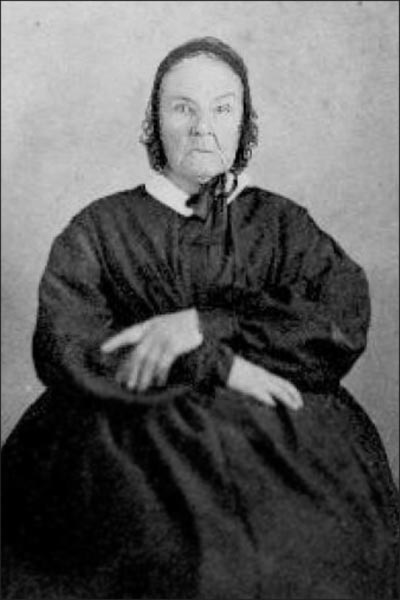
|
[ 277 ]
Chapter 22 EZRA BOOTH AND THE JOHNSON FAMILY'S RELIGIOUS BACKGROUND "A man of considerable culture and eloquence..." 1 Portage County did not have the same strong Universalist sentiment that the Johnsons had left behind in Vermont. In fact, Hiram's citizens were, in general, opposed to the Universalists, stemming from an incident in 1820 when a Mr. Bigelow, a Universalist preacher, came to Hiram. He was apparently popular and successful. The Ryders attended his sermons, and the Johnsons likely did, too. However, there had been no agreement on his pay. At the end of the year, he demanded five dollars a Sunday when the typical salary was less than a dollar a day. This, along with his "meddling" in domestic affairs, according to local historian Charles Ryder, "was a death blow to Universalism in Hiram." 2 Certainly it left a sour taste for Universalism in the Ryder family. After the Bigelow episode, Universalists met briefly in Ravenna; and Reuben Jones, a former traveling Methodist preacher, began preaching "the Universalist doctrine" in neighboring Mantua, as Mantua town historian Orrin Harmon put it, but without much effect. 3 A certain "Reverend Finn" was a Congregational minister in Nelson who preached every other Sunday in Windham, but the Johnsons were apparently not interested in the religious community their family had earlier rejected. 4 Religious activity in Hiram at that time centered on the Methodist and Baptist congregations. Perhaps the most influential Methodist in the county -- and certainly the one most influential in the Johnson family's life -- was Ezra Booth. The well-educated Reverend Booth was "far above the average" in intellectual ability. 5 He sent eleven silver dollars to England and purchased a Greek lexicon, subsequently teaching himself to read biblical Greek which he could do "with ease." 6 He was "a man of considerable culture and eloquence," 7 an omnivorous reader of all subjects. History was his specialty, and some talked of his filling a vacant chair in history at a college. __________ 1 Eliott I. Osgood, "Centennial History of the Hiram Church, 1835-1935," 5. 2 Charles H. Ryder, "History of Hiram," 23. 3 Orrin Harmon, "Historical Facts Appertaining to the Township of Mantua, A.D. 1866," 148. 4 Mrs. Herbert Alford, Windham, Ohio Centennial and Homecoming Celebration, August 9, 1911, n.p. In October 1831, a Reverend Hanford became pastor in Nelson and remained in that position until September 1840. 5 J. N. Fradenburgh, History of Erie Conference, 345. 6 James A. Garfield, "Almeda A. Booth: Her Life and Character, June 22, 1876," 294. 7 Osgood, "Centennial History of the Hiram Church," 5. 278 Hearken, O Ye People His religious connections were with his home state of Connecticut. Born in Newton, Connecticut, Booth grew up in a cosmopolitan environment. 288 Hearken, O Ye People
(pages 278-287 were removed at the request of
the copyright holder on April 26, 2020.)
|
|
[ 293 ]
Chapter 23 THE APOSTASY OF EZRA BOOTH AND SYMONDS RYDER "...they left the Mormonites faster than they ever joined them... " 1 The priesthood blessing that Joseph Smith bestowed on Elsa Johnson, healing her arm, followed his reception of a revelation that became known to members as "The Law of the Church," now LDS Doctrine and Covenants 42. When the Johnsons, the Booths, the Ryders, and Portage County's other citizens joined the Latter-day Saints, "The Law of the Church" had already been revealed and was in place as Church doctrine. Those closely involved in Church affairs strongly supported it although "there were some that would not receive the Law" 2 The "Law" dealt partly with problems already in existence in the Church (see Chapter 10) but also offered new direction to members. For one thing, it spelled out that "every one of you" was responsible for missionary service. Early members evidently understood that this provision for formal service applied only to adult men, all of whom were expected to serve as missionaries. In addition members were directed in the revelation to consecrate their means to the Lord. Missionary work received the strongest emphasis in the revelation and also brought the most immediate response from members. The Lord directed: "I give unto you this first commandment, that ye shall go forth in my name,... preaching my gospel, two by two." 3 Although there had already been a grassroots effort to share the gospel by those who felt so prompted, this revelation was the first specific modern instruction that explained preaching as an obligation of members and also instructed them to go in companionships. Ezra Booth was among those elders ordained in May 1831 to preach. He preached from town to town and dramatically impacted the willingness of Ohioans to listen to the Restoration message. On June 4, he attended the conference to organize missionary work held at the log schoolhouse on the Morley farm. Lyman Wight ordained Booth a high priest at this conference, and Joseph received another revelation calling specific missionaries to serve as companions. Booth __________ 1 Burke Aaron Hinsdale, "Life and Character of Symonds Ryder: A Funeral Sermon Preached in Hiram, Ohio, August 3, 1870," 221. This account has a few changes in wording and an added sentence from the "History of Hiram" that has traditionally been attributed to Charles H. Ryder. The history has been customarily dated to 1864, but Amos Sutton Hayden dates it to 1868. Hayden asked a number of Disciple of Christ ministers to write histories specifically so he could draw on them for his book during this same period of time, and this account was probably one of them. 2 Bruce N. Westergren, ed., From Historian to Dissident: The Book of John Whitmer, 37. 3 Book of Commandments, 44:5-9; see also D&C 42:4-9. 294 Hearken, O Ye People and Isaac Morley were designated as companions and sent to Missouri, a calling they faithfully accepted. Newly baptized Symonds Ryder attended the conference but was not called as a missionary. 4 The principle of consecration was not emphasized with the same urgency as the "first commandment," perhaps because consecrating time and means were naturally a part of keeping the "first commandment" of giving missionary service. However, Symonds Ryder seemed to struggle with both concepts: missionary work and consecration. The Misspelled Name Ryder's participation in the conference marked the beginning of his breach with the Church and its leaders. Reverend Burke A. Hinsdale, Ryder's friend, is the source of the widely held belief among Latter-day Saints that Ryder's doubts stemmed from the form of the call itself: "His commission came, and he found his name misspelled. Was the Holy Spirit so fallible as to fail even in orthography?" 5 If the mission call was not right in every detail, was it really from the Lord? Manuscript versions of the call consistently spelled his name as "Simonds." The Doctrine and Covenants (66:8 in the 1835 edition) added last names to the initial call for clarification and misspelled both names: "Simonds Rider." Later editions corrected the last name to "Ryder" but his first name remains misspelled as "Simonds" to this day (D&C 52:37.)Although this explanation is engaging and is frequently articulated with the implication that Ryder could not have had solid faith in the first place if so trivial a problem could have deflected him, the story is certainly more complex than Hinsdale's description. A copy of the revelation mentioning him exists in Symonds Ryder's handwriting that spells his name in the call as "Simonds." 6 Alexander Campbell and Ryder's own congregation in Hiram often misspelled his name in Disciples of Christ publications and surviving church records as "Simonds Rider." Was this misspelling really the precipitating incident that led Ryder out of the Church? No documentation exists that he found such errors particularly exasperating, especially given the fact that spellings were more frequently phonetic than otherwise in the early nineteenth century. Hinsdale may have incorrectly recalled Ryder's recollection of a later series of misspellings by Sidney Rigdon of his name during published conflict after he left the movement. Rigdon (who did not learn to speak in Vermont like Joseph and Symonds) may not have heard the final "d" in "Symonds." In Vermont the final consonant before an "s" ending was frequently dropped ("workins" instead of "workings" or "nah so" instead of "not so"). Rigdon would have heard "Simons" instead of "Simonds." He misspelled "Symonds Ryder" as "Simons Rider" several times as described at a later point in the narrative. This error was not a typesetter's mistake, since the paper correctly spelled it as "Symonds Ryder" elsewhere. 7 Although Ryder may have later mentioned to Hinsdale Rigdon's misspelling of his name in the newspaper, he did not mention the spelling incident in his own recollections. Instead, he wrote of his slow descent into doubting over the summer as he began to focus, not on a misspelled name, but on the principle of consecration. 8 __________ 4 Book of Commandments, 54:37; see also D&C 52:37. 5 Hinsdale, "Life and Character of Symonds Ryder," 252. 6 Symonds Ryder, "Symonds Ryder Manuscript Copy of the Law of the Church," June 6, 1831. 7 Sidney Rigdon, "To the Public," Ohio Star, December 15, 1831, 3. Rigdon's challenge and his follow-up on January 12 ("To the Public," 3) both spell the name as "Simons Rider." 8 Hinsdale, "Life and Character of Symonds Ryder," 246-47.
The Apostasy of Ezra Booth and Symonds Ryder
295
Ryder was intimately familiar with Sidney Rigdon's earlier teachings on property which must have colored his perceptions since he did not discern the revelation's true intent while reading it. Part of the revelation commanded: "Thou shalt consecrate all thy properties, that which thou hast unto me... and they shall be laid before the bishop of my church." 10 Joseph Smith was not, therefore, the designated recipient although, as one of the poor, he eventually received some assistance while living in Hiram. The 1835 edition of Doctrine and Covenants 44:8 added a clarifying phrase: "And behold, thou wilt remember the poor, and consecrate of thy properties for their support" (D&C 42:30 in the 1981 edition). Ryder, later expressing his concern about his property, inaccurately claimed: "All who continued with the Mormons, and had any property, lost all; among whom was John Johnson, one of our most worthy men; also, Esq. Snow, of Mantua, who lost two or three thousand dollars." 11 Ryder published the text of the "Law of the Church" in the Portage County Ravenna Courier on September 6, 1831, and it was reprinted a week later in the Painesville Telegraph. 12 It has the dubious distinction of being the first published attack by a former member. Rumor circulated that Ryder had first approached Lewis Rice, editor of the Ohio Star, a larger circulation paper also printed in Ravenna, and had been denied publication privilege. Rice, however, later countered: "We have never had the pleasure of seeing Esq. Rider, to our knowledge -- nor has any person at any time requested us to publish the articles in question." 13 Ryder's article consisted of a verbatim copy of the revelation with a brief preface that included the comment: "The Prophets or Preachers, declare it to be a Law revealed to them from heaven, by the Almighty, on the 23d of February 1831, and assert, that they were commanded not to communicate it to the world, nor even to their followers, until they become strong in the faith." 14 Ryder obviously expected the revelation to influence his neighbors as negatively as it had him. Ryder's overreaction became apparent in the context of his earlier involvement with the Campbellites. As a congregational leader, he would have known of the meeting in August 1830 in nearby Austintown, two and a half months before Rigdon became a Mormon, when Alexander Campbell challenged Rigdon for "seeking to introduce his common property scheme." 15 Yet Ryder and the local Disciple congregations continued to accept Rigdon's preaching until at least November 1830, which suggests at least toleration __________ 9 Ibid., 221. 10 Book of Commandments 44:26. 11 Symonds Ryder, quoted in Hinsdale, "Life and Character of Symonds Ryder," 221. 12 "Mormonism, IV, October 31, 1831," Ohio Star 2, no. 44 (November 3, 1831): 3. 13 "Secret Bye Laws of the Mormonites," Painesville Telegraph 3, no. 13 (September 13, 1831): 1. 14 Ibid. 15 Hinsdale, "Life and Character of Symonds Ryder," [sic - "Advent of Mormonism"] 209. Hayden, who printed Hinsdale's account, adds: "This was only two and a half months before he received, in peace, the messengers of delusion." 296 Hearken, O Ye People for Rigdon's communal ideas. "The Law of the Church" was even more flexible, allowing more personal control than the Morley Family had derived from Rigdon's teachings. (remainder not transcribed, due to copyright restrictions) The Apostasy of Ezra Booth and Symonds Ryder 297 (contents not transcribed, due to copyright restrictions) 298 Hearken, O Ye People (contents not transcribed, due to copyright restrictions) The Apostasy of Ezra Booth and Symonds Ryder 299 (contents not transcribed, due to copyright restrictions) 300 Hearken, O Ye People (contents not transcribed, due to copyright restrictions) The Apostasy of Ezra Booth and Symonds Ryder 301 the difficulties connected with Laura Hubbell. (See chap. 10). He ended by asserting that his exposition had "in part accomplished, what I intended when I commenced it." 38 The week after these two final letters, Sidney Rigdon paid the Ohio Star to insert a notice in the newspaper challenging both Booth and Ryder to a public debate. 39 He announced he would preach on "the Christian Religion" on Christmas day at the brick schoolhouse in Ravenna where the Disciples of Christ typically met and where Symonds Ryder occasionally preached. 40 Rigdon invited Booth to join him there for a public discussion. In the same notice, he challenged "Simons Rider" to a debate (characteristically misspelling his name), because Ryder had "publicly declared the book of Mormon to be an imposition." Rigdon requested Ryder to respond publicly through the Ohio Star. Ryder's response, instead of a paid notice, appeared as an article in the regular columns on December 29. Chastising Rigdon for "want of due respect to his superiors," Ryder noted that his and Rigdon's dwellings were only sixty rods apart (990 feet) and that they could easily discuss the matter in private. "But to undertake to correct him of his errors before the public, would be a most arduous task for me." He signed the notice (correctly), "Symonds Ryder." 41 Rigdon was given space in the news column of the Star to respond. "If Simons Rider is afraid to have his assertions put to the test," he challenged, "why make them? If he is certain (as he pretends) that the book of Mormon is a 'base imposition,' why be afraid to come forward and prove it?" 42 Ryder refused to be drawn into a debate. As Rigdon's choice of a date indicates, a religious debate was not considered out of place on Christmas day. In fact, Christmas as a festival was just then becoming popular in the region. The Johnsons still had young children at home, and the Smiths had two small children. They may have celebrated quietly with their guests although little is known about the celebrations of individual families in the region. Mary Ann Stearns, a four-year-old in Kirtland, first heard of Santa Claus in 1837 when traveling with her parents, Parley P. and Mary Ann Pratt, on their mission to New York. 43 However, as early as 1834 the Chardon Spectator and Geauga Gazette (Chardon was between Kirtland and Hiram), published an editorial defending Christmas celebrations. [On Christmas Eve] the stockings have all been hung up, including that of the little one who can just waddle, and been filled by Saint Nicholas, and the hearts of the children made glad and prepared to spend a merry Christmas. To this custom some have objected, as superstitious, and tending to give children wrong impressions; but in our minds, it is associated with the delights of childhood. Children have never seriously believed, that St. Nicholas, with his little car... actually descended the chimney, and deposited gifts in the stockings, but that a mother's or a sister's hand placed them there.... We well remember that sometimes whips would be placed in the stockings to remind us that we had behaved naughtily, but with the bad, the kind hand which placed them, ever mingled good. 44As promised, on Christmas day and the day following, a large group congregated in Ravenna to hear Rigdon preach an "exposition upon Booths letters." The sermons lasted for two days, even in Booth's absence. 45 Rigdon's text has not survived; but Joseph's description of their general preaching in Shalersville, Ravenna, and elsewhere probably captures its gist. __________ 38 Booth, "Mormonism, VIII-IX, November 29, 1831," Ohio Star 2, no. 48 (December 8, 1831): 1. 39 Sidney Rigdon, "To the Public," Ohio Star, December 15, 1831, 3. 40 History of Portage County, 528. 41 Symonds Ryder, "Letter to Mr. Editor," Ohio Star 2, no. 52 (December 29, 1831): 1. 42 Sidney Rigdon, "To the Public," Ohio Star, 3, no. 2 January 12, 1832): 3. 43 Mary Ann Stearns Winters, "Reminiscences," 6-7. 44 "Christmas," Chardon Spectator and Geauga Gazette, December 27, 1834, 3. 45 Hyrum Smith, Diary, December 25-26, 1831; Journal History, November 16, 1831, 2. 302 Hearken, O Ye People They went about "setting forth the truth, vindicating the cause of our Redeemer; showing that the day of vengeance was coming upon this generation like a thief in the night; that prejudice, blindness and darkness filled the minds of many, and caused them to persecute the true Church, and reject the true light." 46 Lewis Rice, even though he lived and worked in Ravenna, did not cover the sermon in the Star. Significantly, neither Booth nor Ryder added anything after the sermons. Joseph Smith and Sidney Rigdon traveled around the region and continued to preach briefly while other missionaries also vigorously preached. Four years later in the Mormon Messenger and Advocate, Rigdon characterized Ryder's backing down as showing "more honesty than some [sic - some others of] of his brethren" but had nothing else good to say about him. According to him, "Simonds Rider... could blow like a porpoise when there was no person to oppose him; but when called upon to be as bold in the presence of those whom he envied, as in their absence, he had recourse to... slander and abuse." 47 Ryder did not remain silent at this second thrust and threatened to sue Rigdon for slander. Rigdon retorted mockingly: I have just received the desperate information, that Simons Rider [sic], in consequence of the notice which I have taken of him, is going to prosecute me.... O! I do not want to be sued for the terrible crime of telling the truth about a man. I know that the truth is a tight fit upon Simons, and I think it is likely that it hurts him some too; as no chastisement for the present is joyous but grievous, nevertheless afterward it yields the peaceable fruits of righteousness to them who are exercised therewith. And could Simons avoid suing me, for a little season, perhaps it might have that effect upon him. 48Apparently, Ryder did not respond to this allusion to Hebrews 12:11. As he had done four years earlier, he withdrew from the public exchange. Effects of the Ryder/Booth Defections How accurate is Amos S. Hayden's retrospective claim that the defection of Symonds Ryder and Ezra Booth reversed the attractiveness of Mormonism in Hiram, leaving it "a very lean concern?" 49 Hinsdale, speaking at Ryder's funeral in 1870, stated that, although "a large number" of the residents of Hiram had joined the Latter-day Saints, Ryder and Booth did much to influence those "who had been swept away on its current." 50 Unquestionably, the public arguments, published in the press, against Mormonism had an effect. Some of that effect was actually positive, by increasing people's exposure to Mormonism. Ira Ames, living in New York, recalled: "When reading his [Booth's] letters, I felt an impression that there was something to Mormonism. There was considerable talk about it in the neighborhood." 51 Ames joined the Church when missionaries came to his village in June 1832.Ambrose Palmer of Norton, Ohio, listened to Booth promote the Book of Mormon and then read his negative letters in the Ohio Star. Ultimately, he ignored the letters. Palmer recalled: __________ 46 History of the Church, 1:241. 47 Sidney Rigdon, "Brother Whitmer," Messenger and Advocate 2, no. 4 January 1836): 243. 48 Rigdon, "Br. O. Cowdery," Messenger and Advocate 2, no. 9 (June 1836): 334. 49 Amos S. Hayden, Early History of the Disciples in the Western Reserve, 221. 50 Hinsdale, "Life and Character of Symonds Ryder," 221. 51 Ira Ames, Autobiography and Journal, 6. The Apostasy of Ezra Booth and Symonds Ryder 303 Ezra Booth preached at the "Bates Corners" in Norton, to a numerous assembly, where I for the first time, saw the Book of Mormon, and was taught from it. Not long after, we read Booth's letters as published in the "Ohio Star" and although he did not prove that the Book of Mormon was not true, yet he gave the whole work such a coloring, or appearance of falsehood, that the public feeling was, that "Mormonism" was overthrown. However, we afterwards received preaching from Brother Reynolds Cahoon, David Whitmer and Lyman E. Johnson, and later also listened to Brother Thomas B. Marsh and others, which left an impression on the minds of many, that was not easily eradicated; and the way being thus prepared, the Lord, in his providence, sent Brother Milton Stow among us, who baptized a number of persons. 52Although it is impossible to quantify defections with any precision, one indication the two men had limited influence is the new conversions that continued as Symonds Ryder began to struggle during the summer of 1831 and Ezra Booth published his letters during that same fall. For example, Harvey Whitlock, whose hometown was Hiram, left on a mission after the June 1831 conference where Ryder was also called. He and his mission companion, David Whitmer, preached in Hiram a few days, then continued on to Paris, Ohio, less than twenty miles south of Hiram where they were on July 18. They baptized twenty-seven converts before going to Missouri, and twelve -- almost half -- came from Hiram: Pelatiah Allyn, Osias Allyn, James Green, Charles Raymond, Carnot Mason, Sylvester Smith, Albert Jackman, Francis Hulet, Eber Hinkley, Sapia Smith, Lucyan Smith, and Callista Rathbone. 53 An additional ten names were listed for neighboring Shalersville. The remaining converts likely joined in Paris and the surrounding areas in Portage County. Zebedee Coltrin and Levi Hancock, who were also called on regional missions at the June conference, baptized Salmon Gee and his extended family in Shalersville during July. 54 Most of these individuals remained active members until the following spring. A second indication that missionary success continued during the summer is found in Baptist congregation records. The Baptist congregation that included Hiram and the neighboring villages voted to send a letter of admonition on July 9 to a Brother Packer's family, which was associating with Mormon missionaries. The letter has not survived, but it failed to pull the Packers back in line. On August 15 the congregation met in Nelson, "considered the case of Bro. and Sister Packer and an account of their departing from the Faith and joining the people called Mormonites." 55 The Baptists then voted to exclude the Packers as former members of their congregation from their religious community. There does appear to be a shift in attitudes within the Portage County community after the Ezra Booth letters were published but responses were mixed. Samuel Smith and William McLellin arrived as missionaries in Nelson, just east of Hiram, on November 16, after half of the Booth letters had been published. They preached one day in Ezra Booth's hometown of Nelson and another day in neighboring Garrettsville. These missionaries did not experience the same large numbers of baptisms recorded during the summer and found that some of those they talked with seemed "hard hearted." Nevertheless, they found enough interest that they spent an entire day "conversing with those who came to __________ 52 Ambrose Palmer, Letter, in Journal History, December 31, 1831. 53 Zebedee Coltrin, Diary, 1832-34. Although officially catalogued as Zebedee Coltrin's diary, the first eight pages are titled "Harvy Whitlock Book" and are Whitlock's diary of his June 1831 mission with David Whitmer. Whitlock subsequently gave the diary to Coltrin who then used it to record his own missionary activities. Whitlock's account begins: "Hiram left house and started in obedience to the comds of God June 11 1831." He then provides an undated list of residents in Hiram and Mantua that were baptized through his efforts and those of his companion David Whitmer. Because William McLellin's name appears as the last baptism on this journey (August 1831) the baptisms in Hiram must have occurred in June as the companionship left on their mission. 54 Franklin D. Richards, Journal, June 6, 1844. 55 Garrettsville [Ohio] Baptist Church Records, 1808-60, July 9 and August 15, 1831. 304 Hearken, O Ye People enquire." 56 McLellin recorded preaching success despite the attempts by a few to disrupt their meetings: "We had a very attentive congregation," he noted on November 17. "I opened meeting and spoke about and [sic] hour and some wicked wretch or wret[c]hes interupted the congregation by burning some odious smeling thing so that raised confusion in all the house and broke up our meeting." During the next few weeks as the last Booth letters came out, the missionaries continued to see success. They baptized "Reuben Field's wife" on November 27, Mother C Reed and Sarah St. John were baptized December 12, and on December 14 Elizabeth Everhart and Samuel Burwell were baptized. 57 Despite Booth's attacks in his letters that the Mormonites were not able to heal anyone, McLellin recorded in his journal three days after the St. John baptism that "Sister Sarah St John's child was scalded badly and Br Saml was there and laid his hands upo it and healed it in so much that it did not even so much as blister." The next day they laid hands upon Mrs. Smith, who was sick, and restored her to health. That evening the missionaries "prayed for and laid our hands upon a Mr Campbell's child who had a most remarkable sore face and next morning it was almost well." 58 Others found success in the same neighborhoods surrounding Booth's hometown of Nelson. Peter Whitmer served a mission to Shalersville just as the last Booth letter came off the printing press and baptized "Nancy Flet" [Follett] and John Follett on December 4. Before the year's end, John's brother King and others also joined. 59 Hyrum Smith and Reynolds Cahoon served a mission briefly during December 1831, preaching in towns surrounding Hiram on their way to Sidney Rigdon's Christmas sermon in Ravenna. They reported some missionary success and reached Hiram on December 24 -- in time to accompany Joseph Smith and Sidney Rigdon to the sermon. However, after the sermon they encountered "doubting members" north in Geauga County, including in Painesville near Kirtland, which led to some individuals being cut off from the Church January 2 and January 17, 1832. 60 In short, whatever the total damage, the response to Ryder and Booth's defections was mixed; but Latter-day Saints did not lose as much ground as the two men obviously hoped and as Hinsdale claimed for them. Ezra Booth and Joseph's Prophetic Warning While Symonds and Mehitable Ryder continued to play a role in the history of the Latter-day Saints, after December 1831, Ezra and Dorcas Booth, now former Mormons, settled back into their home where Ezra preached briefly. Although he had mocked Joseph's prophetic warning that he would fmd no satisfaction if he left Mormonism, it turned out that Booth found no satisfaction in any religion. After only a few years, he left Methodism to follow William Miller and Millerism or Second Adventism. The appointed time came for Jesus Christ to appear (first announced for March or April 1844 and second for October 22, 1844) -- and went. So did Booth. "He ceased to pray, abandoned Christianity and became an agnostic." 61When B. H. Roberts visited Portage County in 1902 to gather historical details, he asked about Ezra Booth. Although local citizens had some of the details wrong, they knew Booth's general history. Roberts asked Hartwell Ryder: "What became of Booth after he __________ 56 Samuel Smith, quoted in Journal History, November 16, 1831, 1. 57 Jan Shipps and John W. Welch, eds., The Journals of William E McLellin, 1831-1836, 63-66. 58 Ibid., 66. 59 Peter Whitmer, Journal, December 13, 1831. 60 Hyrum Smith, Diary, December 12-25, 1831; Reynolds Cahoon, Diary, January 2 and January 17, 1832. 61 J N. Fradenburgh, History of Erie Conference, 346. The Apostasy of Ezra Booth and Symonds Ryder 305 (pages 305-308 not transcribed, due to copyright restrictions) |
|
[ 309 ]
Chapter 24 JOSEPH SMITH AT THE JOHNSON HOME "...both palace and temple to Smith..." 1 Joseph was in Nelson on Tuesday, September 6, 1831, presiding over the meeting that removed Ezra Booth's license to preach. It was apparently during this brief trip into Portage County that Joseph made arrangements to stay at the Johnson home in Hiram. He had visited the Johnsons in April while preaching with Sidney Rigdon in Hiram. Emma was expecting twins, and it is not known if she accompanied Joseph on that April trip to Portage County. After Joseph's return to Kirtland in early April, he and Emma moved into a newly built, small frame home on the Morley farm. Here Emma delivered twins on April 30, 1831. Samuel Whitney, who confused numerous events in his later recollections, mistakenly thought that Joseph Smith III was born on the Morley farm but may have captured some accurate memories of the earlier delivery of the twins when he described a delivery "on Isaac Morley's farm" where Emma "had hard labor and the blood went to her head which became black. The prophet became frightened and sent to Willoughby for Dr. Card, and told the messenger to run his horse. The doctor came and bled her." 2 The infants died in a few hours. The dangers during delivery and Joseph's genuine concern about Emma's wellbeing were justified since deliveries were a life-threatening experience for every mother during that period. Emma's friend, Julia Clapp Murdock, died six hours after delivering twins that same day. John Murdock wrote in his journal: "I quit other business & left my own house and moved my family in with Bro. C[aleb] Baldwin & gave my full time to the ministry. And April 30th my wife died leaving me 5 small living children two but six hours old. June 6th 1831 a conference was held in Kirtland & some ordained as to be High Priests myself one with the rest under the hand of Joseph Smith the Prophet. 3 Murdock left his three oldest children with other members and left for Detroit with Hyrum Smith as commanded (D&C 52:8). He had likely already placed his infant twins, Joseph and Julia, who would have needed a wet nurse immediately, in Emma's care. Bereaved of her own children, she could __________ 1 Gertrude Van Rensselaer Wickham, Memorial to the Pioneer Women of the Western Reserve, 157. 2 Samuel F. Whitney, "Statement of Rev. S. F. Whitney on Mormonism," 3. According to Whitney, the doctor claimed that Joseph preached members were not to employ the services of the doctor, but he panicked and did so anyway. If Whitney's recollection is accurate, the fact that Dr. Card bled Emma during her delivery, a dangerous and counterintuitive practice, suggests that discouraging the use of his services was sound advice. Whitney's description of black blood may have meant the presence of meconium, a sign of stress on the infants. 3 John Murdock, Journal, 2. 310 Hearken, O Ye People have given little Joseph and Julia Murdock her full attention while Joseph left to serve his mission after the June conference. Emma remained at the Morley farm all summer in the small, new house, while Joseph journeyed to Missouri as commanded in revelation. When Morley returned from his mission with Ezra Booth on September 1, he promptly sold his farm, preparing to return to Missouri with his family. Joseph spent several days after his own return from Missouri dealing with Ezra Booth and in a brief conference. When Morley sold his farm, Joseph and Emma obviously no longer had a place to stay in Kirtland. According to Philo Dibble, "on invitation of Father Johnson," Joseph agreed to move Emma and the twins to Hiram. 4 He and Emma spent the next week making preparations, and Joseph undoubtedly had several conversations with the unrepentant Ezra Booth. On September 12, they attended a conference at Kirtland. On the same day that the conference adjourned, they traveled thirty-one miles south to Hiram. Although the road was a good mail route that ran all the way to Deerfield in southern Portage County, their wagons traveled slowly. Much of the road that passed in front of the Johnson home was lined with evenly spaced twelve-year-old maples that Benjamin Hinkley had planted. They entered this rustling canopy, the sun set just after 7:30 P.M., and night sounds rose and fell as the Smiths drew into the Johnson farmyard. Fireflies were still actively mating that evening. In addition to his family's need for shelter, Joseph also wanted to work in peace and quiet on the translation of the Bible. Portage County, in addition to providing a geographic buffer from Kirtland, still had the largest congregation of Latter-day Saints anywhere. They would provide support while Joseph worked, and he could simultaneously teach the gospel more effectively to the growing congregations in Hiram, Nelson, Mantua, and Shalersville, along with the many scattered members in surrounding communities. In a sense, neighbors were right when they noted that the Johnson home "was both palace and temple to Smith." 5 The Johnson family willingly made their home available, and Joseph and Emma "set up house on the main floor." Space was tight. John's older brothers were staying at the home for a time, and others also shared rooms. The Smiths slept in "the back room" on the main level rather than moving into one of the aging cabins across the street where the Rigdons and others assisting Joseph settled. 6 John Johnson rebuilt a log cabin "just across the street" from his home specifically for Sidney and Phoebe Rigdon and their six children. He had Gersham Judson, a handyman in neighboring Mantua, add a frame second story on the top of the hewn-log main level, creating an odd piece of frontier architecture. 7 (Judson also built the first frame house in Mantua; but when he finished it, according to a local historian, the structure "had but little of the shape, form, and finish of an ordinary dwelling house." 8) Vashti Higley, who would soon marry Peter Whitmer, stayed with the Rigdons and helped with their children. David Whitmer and Julia Jolley Whitmer, who had married nine months earlier on January 9 were living in another of the cabins. Oliver Cowdery, then single, lived briefly, on the Johnson farm, probably in one of these cabins, but left for Missouri with John Whitmer before the end of 1831. Another Mormonite family, John Poorman and wife, possibly with children, lived across from the Johnson home as well, probably in a third cabin. 9 __________ 4 Philo Dibble, "Philo Dibble's Narrative," 79. 5 Wickham, Memorial to the Pioneer Women of the Western Reserve, 157. 6 Hartwell Ryder, "A Short History of the Foundation of the Mormon Church," not paginated. Ryder does not say in which "back" rooms the Smiths stayed in the house, but the work kitchen was the only back living space on the main level. Additional possible meeting places during Joseph and Emma's residence were the kitchen, formal parlor, and a day room, typically used for reading and sewing. Several additional bedrooms were created upstairs after the Smiths arrived. 7 Ibid.; Robert Charles Brown, History of Portage County Ohio, [sic - Everts Combination Atlas] 16 1/2; Orson Hyde, Speech of Elder Orson Hyde (Delivered to High Priests' Quorum [April 27] 1845, 28; B. H. Roberts, "Figures in Early Church History," 1. Ryder, "A Short History of the Foundation of the Mormon Church," described the home as "a small log house." But when Joseph Smith was in the cabin after the mobbing, he wrote: "Sister Rigdon left the room," suggesting a second room that, according to later residents, Gersham Judson had added. History of the Church 1:265; Edward Morgan, "Guide to the Edward Morgan 1857 Map of Hiram"; Brown, History of Portage County, Ohio, 527 [???]. A visual examination of possible foundation remains confirms that the cabin was modest in size and must have had a second story or a loft. 8 Orrin Harmon, "Historical Facts Appertaining to the Township of Mantua, A.D. 1866," 104. 9 Aerial photographs taken by Jim Walker in 1998 and 1999 reveal the footprint of at least two structures across the street from the Johnson home with indications of what may be a third site. No archeology has been done at these locations, likely all that remain of the Johnson cabins. These photographs are in the possession of T. Michael Smith, LDS Church History Museum, Salt Lake City. Joseph Smith at the Johnson Home 311 (contents not transcribed, due to copyright restrictions) 312 Hearken, O Ye People hiram to fulfill my mission to the churches which was given to Br. David [Whitmer] and myself to obtain mony or property for Brs Joseph and others to finish the translation." 13 Cahoon's efforts were successful; and the following month, he and Hyrum Smith were appointed counselors to Bishop N. K. Whitney in helping the poor. Church members in Portage County made the translation effort possible. Sidney Rigdon later recalled their translating as "the beginning of good days" but also remembered that they were "shut up in a room eating nothing but dry Johnny cake and buttermilk. Every man who had a little farm, or clothes, sold and distributed it." Isaac Decker, was a prosperous middle-aged farmer in the south end of Portage County who had gathered moderate resources over the years. When the missionaries came requesting assistance "he freely placed everything upon the altar to relieve the financial distress of the Church." 14 In addition to these fund-raising missionaries, other missionaries continued to preach the gospel in the area with success. On October 25, 1831, Joseph received a revelation commanding William McLellin and Samuel Smith to preach (D&C 66:5-8). Samuel had not completed his preparations for this mission when "he heard a voice in the night which called to him, saying, 'Samuel, arise immediately and go forth on the mission which thou wast commanded to take to Hiram.' He arose and took what clothing he had in readiness and set out without eating" Samuel and William McLellin traveled different routes, preaching along the way, and Samuel arrived in Hiram the next day. When the two met in Hiram, they preached together and were "tolerably well received." 15 The revelation calling the two men instructed them: "Lay your hands upon the sick, and they shall recover" (D&C 66:9). Despite Booth's attacks and false claims that the elders failed to heal believers, villagers knew about Elsa Johnson's experience and other healings. They expected and hoped for similar miracles in behalf of themselves or their loved ones. Samuel's mother recalled: "They had not been in this place long untill they were sent for by a woman who had been sick many months and had prayed much that the Lord would send some of the Mormon[s] into that country that she might have hands laid on her for the recovery of her health. Samuel went immediately to her and administered to her by the laying on of hands in the name of the Lord, and she was healed and was also baptized." 16 Levi Jackman, a thirty-four-year-old hunter and farmer in Hiram who had recently joined the Church (May 7, 1831) after hearing the preaching of Harvey Whitlock, testified: "Many of the sick were healed and signs followed the preaching of the word. Among others, my daughter Aurilla was healed of a lame arm that it was supposed never could be healed or restored, but it was through the laying on of hands in the name of Jesus Christ." 17 The defections of Booth and Ryder apparently had little permanent impact, for interest in the new religion continued to grow in Portage County. Seventeen-year-old Lorenzo Snow, then living in Mantua immediately west of Hiram, described a general meeting held at the John and Elsa Johnson home: It was rumored that the Prophet was going to hold a meeting in Hiram, Portage county, Ohio, about two miles from my father's home. Having heard many stories about him, my curiosity was considerably aroused and I thought I would take advantage of this opportunity to see and hear him. Accordingly, in company with some of the members of my father's__________ 13 Reynolds Cahoon, Diary, November 9, 1831. 14 "Harriet Page Wheeler Young," in Andrew Jenson, ed., LDS Biographical Encyclopedia, 3:743. Terminal punctuation and initial capitals added. 15 Lavina Fielding Anderson, ed., Lucy's Book: A Critical Edition of Lucy Mack Smith's Family Memoir, 555-56. 16 Ibid., 556. 17 Levi Jackman, "Sketch of Life," not paginated. Joseph Smith at the Johnson Home 313 (contents not transcribed, due to copyright restrictions) 314 Hearken, O Ye People (contents not transcribed, due to copyright restrictions) Joseph Smith at the Johnson Home 315 (pages 315-318 not transcribed, due to copyright restrictions) |
|
[ 319 ]
Chapter 25 THE VISION "...every honest man is constrained to exclaim 'It came from God.'" 1 Oliver Cowdery and John Whitmer left for Missouri after the conference at the Johnson home, taking with them manuscripts of the revelations to begin preparation for publishing them to the world. Joseph stayed in Hiram, later noting, "I resumed the translation of the Scriptures, and continued to labor in this branch of my calling with Elder Sidney Rigdon as my scribe." 2 After the conferences, Joseph and Sydney also spent some time under commandment responding to Ezra Booth's letters by preaching in northern Ohio until January 10, 1832, when Joseph received another revelation. It encouraged the two to keep preaching as opportunity offered, but mainly they were "to continue the work of translation until it be finished" (D&C 73:4). Along with that work, Joseph continued to give part of his time to administration; and fifteen days after receiving the revelation, on January 25 he briefly attended another conference in Amherst where he was ordained president of the High Priesthood. At this conference, he called Luke Johnson on a mission to the South and Lyman Johnson on a mission to the East. Both left their parents' home in early February. Since Marinda and Emily Johnson attended school away from home (probably in Ravenna), only thirteen-year-old Mary and eleven-year-old Justin remained as children in the home. The exodus of men leaving to Missouri and on missions also left fewer laborers (and defenders) at the household. Luke and his companion, William McLellin, visited Johnson relatives in Ohio. One of them was Emeline Miller, whose mother, Elsa Johnson's sister, had traveled with the family from Vermont. McLellin abandoned his mission and took a position as store clerk so he could court and marry Emeline. Luke returned home briefly during the last week in February to find a new companion, then joined Seymour Brunson and the two followed the cheese shipping routes south. He would not return until the following year. __________ 1 History of the Church, 1:252. 2 Ibid., 1:238. 320 Hearken, O Ye People After the conference at Amherst, Joseph returned to the Johnson home to continue his translation work in earnest. Emma helped Elsa Johnson with the household chores and became pregnant with Joseph III in early February. That February was particularly cold. Local newspapers even commented on the temperature, something rare for the time. Sixteen inches of snow fell in Portage County during January's last ten days, adding to an already unusually wet year. 3 Piqua, a town a little west of Hiram with the same weather, had rain, hail, and sleet almost every day for the first two weeks of February. On February 15, sleet fell, with temperatures hovering around 31 to 32 degrees all day. The next day was cloudy, and temperatures in Piqua stood at 20 at sunrise and 22 at sunset. 4 Although temperatures and inches of moisture may have varied slightly, it was a cold day in Hiram with deep and cumbersome snow It absorbed the constant sound of lowing cattle as the landscape fell into a hushed silence. Cows would calve soon and the heavy load of dairying would begin again in earnest, but during early February the workload fell to bare maintenance levels which gave more time for contemplation. As Joseph and Sidney carefully studied the Bible, Sidney naturally considered the doctrines he had been preaching across the Western Reserve. One non-Mormon observer captured the state of the Church up to then: "Even after Rigdon became known as a Mormon, his sermons were filled with as sound Disciple doctrines as they had been before he joined up with Joseph Smith." 5 He was not the only one who brought his old beliefs along with him. Other Latter-day Saints who were former preachers or had played other significant roles among the Disciples included Parley P. Pratt, Orson Hyde, John Murdock, Isaac Morley, and Lyman Wight. Numerous converts to Mormonism were former Disciples of Christ who brought most of their old beliefs with them. Many of the ideas they continued teaching originated with Disciple of Christ theologians Walter Scott and Alexander Campbell. As some measure of their influence, Hyde was teaching some of Scott's speculative ideas to Latter-day Saint congregations as late as 1854, using words and concepts drawn from Scott's early writings on the subject. 6 With Joseph Smith, the gospel of Jesus. Christ was restored as new wine in a new bottle, yet his followers in Ohio were essentially hundreds of the old bottles already filled with traditional beliefs. They had been exposed to some new ideas, however, that turned their thinking in different directions. The Disciples of Christ drew their religious inspiration from Great Britain, and their modified theology would return to their homeland with great success. Born in northern Ireland of a Scottish family, Thomas Campbell immigrated to America with his son, Alexander, where they met Scottish-born Walter Scott in 1820. 7 Near the same time, American-born Sidney Rigdon moved to Warren, Ohio, as a Baptist preacher, and lived with his brother-in-law Adamson Bentley (both men married half-sisters), who was preaching in the region with Charles Rigdon, Sidney's cousin. Records of the Baptist congregation in Mantua and Hiram confirm that Charles Rigdon had preached with Bentley to their community numerous times. Sidney accompanied Bentley on a brief visit to Buffaloe [sic], Virginia (later Bethany, West Virginia) to see Campbell in the summer of 1821. There Sidney __________ 3 Daniel J. Ryan, A History of Ohio with Biographical Sketches of Her Governors and the Ordinance of 1787, 118. 4 James H. Rodebaugh, ed., "From England to Ohio, 1830-1832: The journal of Thomas K. Wharton," 127. 5 Eliott I. Osgood, "Centennial History of the Hiram Church, 1835-1935," 6. 6 Scott saw this entire plan of salvation playing itself out on this earth. Although Scott acknowledged that God created orbs, suns, moons, planets, and even comets, in "Concerning a Plurality of Worlds," he located that plurality on this earth. Humans existed from Adam to Noah as they did from Noah to the present. But even before Adam, Scott surmised, "Animals formerly existed on the globe, being unknown varieties of species still known; [while] species existed and even genera, wholly unknown for the last five thousand years." These species included "flying reptiles" described in the geologic literature of the day and the giant sloth whose skeletal remains Thomas Jefferson discovered. None of these previous "worlds," however, included God's children. Humans were limited to a narrow time and place beginning with the Book of Genesis. Scott, The Gospel Restored: A Discourse of the True Gospel of Jesus Christ, 71-75. Orson Hyde, October 6, 1854, Journal of Discourses, 2:79, followed Scott's original conception that Adam had played a role similar to Noah's, but Scott had nothing to say about humans before Adam while Hyde expounded on that conception: "The world was peopled before the days of Adam, as much so as it was before the days of Noah. It was said that Noah became the father of a new world, but it was the same old world still, and will continue to be, though it may pass through many changes." Hyde further argued that Adam and Eve could not "replenish" the earth if God's children had not already lived on it. These later teachings clearly built on Scott's earlier writings. 7 Walter Scott, "Letter 3d," 268. The Vision 321 (contents not transcribed, due to copyright restrictions) 322 Hearken, O Ye People (contents not transcribed, due to copyright restrictions) The Vision 323 (contents not transcribed, due to copyright restrictions) 324 Hearken, O Ye People Disciples who accepted the Book of Mormon and joined the early Ohio Mormonite congregations still had these teachings fresh on their minds. The ideas and beliefs that several hundred Latter-day Saints brought to their new faith in Ohio were poured from the Disciples' bottle of beliefs; and these ideas quickly filled in the empty places where God had not revealed explicit information. Former Disciples were justified in many ways in continuing to believe much of what they had always believed. An early revelation described Sidney Rigdon as being "sent forth, even as John, to prepare the way" for the Restoration of the gospel. The Lord confirmed that it was He who had "prepared [Rigdon] for a greater work." The revelation implied that Rigdon was teaching some or many of the right doctrines but lacked proper authority. "Thou didst baptize by water unto repentance," the Lord instructed, "but they received not the Holy Ghost" (D&C 35:4-5). Some of Scott's and Campbell's teachings were also confirmed by revelation. It was easy for former Disciples to assume that much of what their former preachers taught was correct interpretation of scripture until revelation dictated otherwise. Sidney Rigdon had indeed been sent forth to prepare the way, and Walter Scott had been an instrument in preparing his companion for that role. Rigdon brought this preparation with him as he joined Joseph Smith in deep study of the Bible while they searched out doctrine. Sidney Rigdon later recalled that he and Joseph Smith spent "weeks seeking God with prayer and fasting." 23 Rigdon's former beliefs helped influence the focus of their study, and the questions that came to their minds. In fundamental ways, Disciple writers framed the debate and started discussion on central issues, the answers for which Joseph and Sidney would subsequently seek in the scriptures. "From sundry revelations which had been received" and through intensive study and prayer, they concluded that "many important points touching the salvation of man" were not clearly articulated in the Bible. 24 This initial perception did not bring them into disagreement with the Disciples who were still muddling through the issues. Joseph's additional revelations did provide some clues, however. It was clear from a revelation received almost two years earlier in April 1830 that God "at the end of the world" would be "judging every man according to his works and the deeds which he hath done" (D&C 19:3). 25 The Book of Mormon also affirmed that "men must be judged of their works" (2 Ne. 9:44; see also 1 Ne. 15:32). Careful consideration of the words in revelation and comparison with other scriptures in the Bible and Book of Mormon, led the two translators to conclude that "God rewarded everyone according to the deeds done in the body." Joseph and Sidney realized that, if this were the case, then "the term 'Heaven,' as intended for the Saints' eternal home must include more kingdoms than one." 26 While Joseph and Sidney studied in the Johnsons' upstairs bedroom, they became convinced of a scriptural interpretation that good works would follow true faith. With these quiet stirrings intimating a still-grander conception, they continued their translation in the New Testament until they came to John 5:29 on February 16, a cold Thursday morning. "And while we meditated upon these things, the Lord touched the eyes of our understandings __________ 23 Thomas Bullock, Minutes of April Conference, Nauvoo, Illinois, April 6, 1844, 5. See also D&C 74 on 1 Cor. 7:14; Section 76 responding to John 5:29; and Section 77 dealing with the book of Revelation. 24 History of the Church, 1:245. 25 Richard L. Bushman, Joseph Smith and the Beginnings of Mormonism, 155. 26 History of the Church, 1:245. The Vision 325 (contents not transcribed, due to copyright restrictions) 326 Hearken, O Ye People (contents not transcribed, due to copyright restrictions) The Vision 327 (section not transcribed, due to copyright restrictions) Not only was the concept new but the word to describe them was new: "telestial." It is not clear if this term came from the verbal instructions the two men received during the vision or if Sidney Rigdon created it from his modest experience with Latin and Greek to refer to a place they had seen in vision. When Joseph Smith later cited the biblical source of the words, he favored English over the Latin and wrote of "earthy" and "heavenly" kingdoms (D&C 128:13-14). Celestial was of the heavens; terrestrial was of the earth; and telestial reflected the idea of being far off or reaching the end -- suggesting both distance from God and a damning or stopping of development. It was the lowest place of the three. The inhabitants of the "telestial world," it was understood, would eventually all "bow the knee, and every tongue shall confess to him who sits upon the throne forever and ever; For they shall be judged according to their works, and every man shall receive according to his own works" (vv. 110-111).It was the concept of the "telestial world" and the difference between the Latter-day Saints and the Disciples in their conception of the fate of the wicked that proved critical. In his condemnation of "modern preaching," Scott included "Mormonites" in a list of religions guilty of numerous doctrinal "crimes" including preaching "general atonement" and "universal salvation." The promised redemption of liars, adulterers, and murderers bothered him the most. The Disciples of Christ had made the Universalists targets of scorn for years, and Alexander Campbell had ridiculed them for their "immensely powerful telescopes" that were able to see divine things beyond what was in the scriptures. 36 Disciple ministers had long scoffed at Universalists as being as bad as infidels. They later made similar accusations of "Mormonites" as obtaining knowledge that was outside the closed scriptural canon and, hence, unknowable. A Disciple minister wrote in 1836: "Like the tempter of Eve, they have proffered godlike knowledge.... Thus the Mormonites, in our own day, have labored assiduously to keep up the delusions by claims of miraculous power, and mysterious visions... [which] reveal the secret cause of Satan's expulsion from heaven. -- Reader, would you like to know it? -- I shall not tell it you -- such knowledge might be of use to devils, but it cannot profit man." He asserted that the Bible contains nothing to whose purpose is merely to gratify human curiosity, specifying: __________ 36 Alexander Campbell, "Queries, From Baltimore and Richmond, Touching Universalism," 312. 328 Hearken, O Ye People It gives us no useless history of devils or angels -- the secret counsels of eternity remain undisclosed -- the peculiar condition of departed spirits is not detailed -- nor are the inhabitants of the sun, moon, and stars described. It is intended for man during his abode upon this earth. It begins therefore with the creation of the world and ends with its destruction.... The history of future events is concealed in symbols and enigmas which are only to be understood when these events are accomplished. And finally, even the glories of heaven, the nature, laws, inhabitants, and enjoyments of that eternal world which it presents as an object of hope, are dimly sketched, or vested in mysterious and allusive pictures. 37Later, Campbell cited from the Vision (D&C 76:11-13) adding italics to emphasize his point: "We, Joseph Smith, Jun., and Sidney Rigdon... By the power of the Spirit our eyes were opened and our understandings were enlightened, so as to see and understand the things of God -- Even those things which were from the beginning, before the world was." 38 Campbell condemned them as pursuing illicit knowledge, citing as evidence Joseph Smith and Sidney Rigdon's allusion to Adam and Eve's state after partaking of the forbidden fruit when the "eyes of them both were opened" (Gen. 3:7). Commenting on the italicized portion, he mocked: "From the following it seems Smith and Rigdon have become wiser than any of the Prophets and Apostles of God." 39 The expansive knowledge revealed in the Vision about the afterlife was precisely the kind of information Campbell, Scott, and their colleagues saw as illicit knowledge, forbidden fruit. __________ 37 R[obert] R[ichardson], "Inspiration of the Scriptures," 346-48. 38 Alexander Campbell, "Mormonism," 347; emphasis his [sic - Sunderland's]. 39 Ibid. (remainder of pages 328-330 not transcribed, due to copyright restrictions) |
|
[ 331 ]
Chapter 26 REACTIONS TO "THE VISION" "The Spirit descended and some were offended..." 1 Until February 1832 much of the doctrine believed by the growing Mormon membership came with them from their previous congregations -- principally from the Disciples of Christ. A revelation in December 1830 acknowledges the importance of this preparatory preaching by Disciples when Sidney Rigdon learned he was "sent for even as John, to prepare the way before me" and he baptized "by water unto repentance, but they received not the Holy Ghost" (D&C 35:4-5). Sidney Rigdon's exposure to Alexander Campbell and Walter Scott's teachings prepared his mind to search out the insightful questions and seek for understanding on the most fruitful issues while he and Joseph obeyed the commandment to work on the translation of the Bible. If Rigdon had been as John the Baptist to this Restoration, then Campbell and Scott were as Zacharias, John's father. The Disciples recognized their relationship to this new movement but resented being cast in the role of "John the Harbinger" or a forerunner preparing the way for others to follow. Although Disciples fought against attempts to connect them with the Latter-day Saints, their preparatory role was obvious to outsiders. "In order to understand the theological character of Mormonism," notes a British observer, "the reader needs recollect that Rigdon and several of his associates had been followers of Alexander Campbell. They had been drilled thoroughly as coadjutors of that self-styled reformer. Immersion for the remission of sins had been their favorite theme, nor did it cease to be so when they embraced Mormonism.... Campbellism has proved the harbinger to Mormonism, both in America and England." 2 Disciples made such comparisons themselves. Walter Scott lashed out: "Rigdon filched from us that elementary method of stating the gospel which has so completely brought it within the grasp of every one who hears it." 3 The Mormon elders never denied Scott's role in laying the foundation or Rigdon's role in introducing theology to them; however,Joseph Smith also recognized that this preparation to receive an expansive view of the __________ 1 Benjamin Lyon Smith, ed., "The Jesse B. Ferguson Case," 532. 2 "Methodistic Candor and Consistency," 554. 3 Walter Scott, "The Mormon Bible," 160-161. 332 Hearken, O Ye People afterlife as presented in the Vision was still limited. Later, he acknowledged: "I could explain a hundred fold more than I ever have of the glories of the kingdoms manifested to me in the vision, were I permitted, and were the people prepared to receive them." 4 In other words, although Disciple teachings may have prompted the asking of significant questions, they were still insufficient preparation for everything Joseph and Sidney saw on February 16, 1832. What they received in vision at the Johnson home went well beyond what was already being preached to prepare the hearts and minds of believers on the Western Reserve. Despite strict commands to keep their work from the world until the revelations were published, someone leaked the contents of the Vision to the community. It may have been one of the Church leaders. They were enthusiastic about the new revelation. Joseph believed, "The sublimity of the ideas... are so much beyond the narrow-mindedness of men, that every honest man is constrained to exclaim: "It came from God." 5 However, the unauthorized source of information was most likely Eli Johnson, who was living in the home at the time. Although it is not known who first shared the vision, Samuel H. Smith and Orson Hyde were proselytizing in New England when, on March 21, they "came across a man by the name of haskin he told us that he had been to kirtland & to Hyram (for he was a Brother)... he told us that he had Seen Joseph & Sidney & that they had had a vision & that they had seen great & marveilous things & that they had got a long wonderful well in translating." 6 By the beginning of March the word was out. The next week Seth and Joel Johnson showed up, and Samuel rejoiced for "they had the Vision with them which Joseph & Sidney had seen & we had the privilidge of Reading it." 7 When local members received a printed copy of the revelation in August former Disciple minister Orson Hyde "Explained it unto them." 8 With Haskin and others traveling about the country sharing oral and manuscript versions of the Vision, making printed copies of the revelation became important. In July 1832, as soon as Joseph arrived in Independence, Missouri, where the Mormon paper, the Evening and Morning Star was being published, he had the revelation published for general distribution. Joseph's haste to publish a revelation after receiving a strict command to keep it secret may have been an attempt to set the record straight in the light of misinformation distributed in Hiram. But nothing in documents of which I am aware sheds additional light on motives for his decision. Members in Hiram, however, knew at least as much about the Vision in March as Brother Haskin and members in New England. Not everyone was prepared to receive the revelation with rejoicing. Those who did not come out of the Disciples of Christ movement particularly seemed to question. Even such stalwarts as Brigham Young struggled a little when they first read it: My traditions were such, that when the Vision came first to me, it was so directly contrary and opposed to my former education, I said, wait a little; I did not reject it, but I could not understand it. I then could feel what incorrect traditions had done for me. Suppose all that I have ever heard from my priest and parents -- the way they taught me to read the Bible, had been true; -- my understanding would be diametrically opposed to the doctrine__________ 4 History of the Church, 2:380. 5 Ibid., 1:252. 6 Samuel Harrison Smith, Diary, March 21, 1832. 7 Ibid., March 27, 1832. 8 Ibid., August 13, 1832. Reaction to "The Vision" 333 revealed in the Vision.... I never could believe like the mass of the Christian world around me; but I did not know how nigh I believed as they did. I found, however, that I was so nigh, I could shake hands with them any time I wished. 9And later he added, "[The revelation] was a great trial to many, and some apostatized.... It was new doctrine to this generation, and many stumbled at it." 10 As John Murdock, a former Disciple of Christ preacher, served a mission in Ohio, he traveled with his companion from Cleveland to Warrenville and from there to Orange "& the brethren had just received the Revilation called the vision & were stumbling at it I called them togather & confirmed them in the truth." 11 An entire branch in New York balked at the revelation. The branch president particularly had trouble with it and "Said the vision was of the Devil came from hel & would go there again." 12 Orson Pratt helped explain the teachings to the congregation. The disruptions caused by the vision apparently continued for some time. As late as the fall of 1833, the presiding elder in Livingston County, New York, and about twenty-five other members, were excommunicated "for rejecting the vision concerning the three glories." Murdock presided as the branch was brought back in order. 13 Although it was consistently former Disciples of Christ leaders among the membership who explained the revelation to others and helped with the transition in theology that took place in the Church at that time, in at least one case a Latter-day Saint who had no connection with the Disciples of Christ comfortably embraced the revelation, including portions Disciples found difficult. Wilford Woodruff recalled: "I was taught from my childhood that there was one heaven and one hell, and was told that the wicked all had one punishment, and the righteous one glory.... I never did believe a word of this doctrine a day since I was born, and I am sure that I never did before; and when I read the vision... it enlightened my mind and gave me great joy." 14 The one element that seemed particularly difficult for most members to accept was the concept that, roughly paraphrased, "the Lord was going to save everybody." It had not been preached in Latter-day Saint congregations up to this point and was new doctrine for everyone, even former Disciples. Some members, like the branch president in New York, concluded that it was knowledge plucked from that old tree of knowledge of good and evil. The tension between the search for scriptural knowledge and the possibility of tempting God by seeking forbidden knowledge was a real one for many Disciples of Christ. These fears about seeking after prohibited mysteries showed themselves fully several years later in the published speculations of Jesse B. Ferguson. He wrote an article touting a "new discovery" he developed in theology titled "Spirits in Prison" expressing his belief that the Savior had preached to the spirits in prison (1 Pet. 3:18-20) before His resurrection so that they could repent and be redeemed from the fall. "Infants, idiots, and pagans, who have never heard, will hear the gospel before they are condemned by it." 15 Such thinking brought a sharp rebuttal from many Disciples who insisted hell was a place of "everlasting burning" and assumed that "Spirit Prison" was the same place. Ferguson's ideas were labeled "heresy." Campbell criticized: "We should think, indeed, that it must needs be a short mission and a universal conversion.... For, who in a place of torment, or in any uncomfortable __________ 9 Brigham Young, "Minutes of Conference," 52. In 1857 Joseph Young expressed his feelings when he first heard of the revelation: "When I came to read the vision of the different glories of the eternal world, and of the sufferings of the wicked, I could not believe it at first. Why the Lord was going to save everybody!"Joseph Young, Sermon, 11. 10 Brigham Young, "Discourse by President Brigham Young, May 18, 1873," 42. 11 John Murdock, Journal, 18. 12 Orson Pratt, Journal, December 29, 1833; see also John Murdock, "An Abridged Record of the Life of John Murdock," April 24, 1833. 13 Warren Foote, Journal and Autobiography, 1837-1903; see also Amasa M. Lyman, "Amasa Lyman's History," 487. 14 Wilford Woodruff, April 9, 1857, Journal of Discourses, 5:84. 15 Ferguson, "A New Discovery," 315. 334 Hearken, O Ye People position in hades, would need much urging to accept an invitation to come out, and to ascend to heaven?" 16 Other readers argued that Ferguson's error was much more grievous than a problem of logic. He had picked one of the difficult subjects to explore. Isaac Errett wrote from Warren, Ohio: "It is a subject on which our limited faculties, if heedless of the teachings of the Infinite Mind, are sure to mislead us; and our sympathies, unblest with the control of enlightened and sanctified judgment, give birth to theories of monstrous deformity." 17 The attacks against Ferguson continued for a year, consistently arguing that the scriptures did not reveal answers to events taking place after this life and that it was heresy to speculate on the afterlife. 18 Eventually Disciples insisted that those who truly renounced a "belief in Mormonism" acknowledged that God's children already "had a full, perfect, and clear revelation from God of every thing pertaining to salvation, that we needed not, nor did we expect another; that the age of miracles had passed away." 19 The Disciples of Christ newspaper Millennial Harbinger celebrated a former member who announced: "I believe in the prophecies which have been given -- I expect no other. I renounce my belief in Mormonism." 20 Hiram's citizens shared the widespread attitudes toward remaining silent about the unknown aspects of the afterlife when Joseph and Sidney received the Vision. The previous fall, Ezra Booth. had denounced the translation of the New Testament with the obvious intention of arousing public ire: These revelations entirely supercede the Bible, and in fact, the Bible is declared too defective to be trusted, in its present form; and it is designed that it shall undergo a thorough alteration, or as they say, translation. This work is now in operation. The Gospel of St. Matthew has already received the purifying touch, and is prepared for the use of the church. It was intended to have kept this work a profound secret, and strict commandments were given for that purpose; and even the salvation of the church was said to depend upon it. The secret is divulged, but the penalty is not as yet inflicted. -- Their revelations are said to be an addition to the Bible. -- But instead of being an addition, they destroy its use; for everything which need be known, whether present, past or future, they can learn from Smith, for he has declared to the church, that he "knows all things that will take place from this time to the end of the world." If then, placing the Bible under circumstances which render it entirely useless, is infidelity, Mormonism is infidelity. 21His efforts proved fruitful. Sidney Rigdon, speaking at April 1844 general conference in Nauvoo, recalled the Vision's role in the context of events that led to violence in Hiram: I have seen the time when the Presidency of the Church Sitting now before me, were locked up with me in secret places waiting upon God. We did not go out at all but to eat &c. But it was soon found out, & a mob Came... & threatened our lives. It was at this time we sat for hours in the Visions of heaven around the throne of God & gazed upon the scenes of Eternity.... Afterwards the mob came in & broke the door, took me &__________ 16 Alexander Campbell, "The Christian Magazine, No. 1," 393. 17 Isaac Errett, "Future Punishment," 511. 18 Alexander Campbell, "The Spirits in Prison," 414-15; see also Campbell, "Remarks on Adelphus: "The Spirits in Prison," 139-140; Campbell, "Introductory Note to Samuel Church's "The Spirits in Prison," 439-41; Campbell, "Remarks on J. T. Johnson's "The Last Letter on the Spirits in Prison," 469-70; Campbell, "The Christian Magazine," 628-34; Jesse B. Ferguson, "The Spirits in Prison: An Attack on the Millennial Harbinger and Its Editor, by Elder Jesse B. Ferguson of the Christian Magazine," 487-97; Spectator, "The Spirits in Prison," 19-22; Benjamin Lyon Smith, "The Jesse B. Ferguson Case," 532. 19 C., "My Dear Brother," 378. 20 Ibid. 21 Ezra Booth, "Mormonism II, October 2, 1831," 3-4. Reaction to "The Vision" 335 dragged me out through the streets... This is the reason why we were in secret under lock & key. 22John Johnson Sr.'s brother Eli apparently still lived at the Johnson home at the time the Vision was received and may have been among the twelve or so men who entered the unlocked room and heard Joseph and Sidney narrate the contents of their vision for hours as they received it. Although the Johnson family had come from Universalism, Eli later shared with the Disciples of Christ an ardent opposition to it. "Why, if that doctrine is true," he lamented, "there is no hell for the Shaddocks." 23 Eli was never one to keep his feelings to himself. "Not a day passed when he did not have a grievance, some record of abuse or charge against someone, to send up to the high court of heaven," commented the historian of his village. 24 A revelation that declared "all shall bow the knee, and every tongue shall confess to him who sits upon the throne" (D&C 76:110) would certainly have been difficult for someone with his perspective to accept without sincerely humbling himself. Eli may have been the original source of local information on the contents of the revelation but no one recorded the leak. Eli's full role in opposition to the Prophet is unknowable, but he was only one of a number of antagonists. Former Disciples of Christ represented the majority in the burgeoning Mormon community. They were familiar with Scott and Campbell's theology and had been taught similar ideas by Rigdon for years. Joseph not only built on their old teachings but also received new doctrine as the Bible translation proceeded apace. Sidney Rigdon had the responsibility for articulating and writing down the pair's dramatic experience. Because Rigdon was particularly influential with the Disciples in Portage County, a few local members may have felt a sense of betrayal as the new faith diverged rapidly from the old. Perhaps such feelings explain why many connected most of the violence with the Campbellites and why much of it was directed at Rigdon. Although originally Disciples in name, those who mobbed Joseph and Sidney were primarily Latter-day Saints at the time of their deed. One Hiram resident later recalled that it was "some who had been the dupes of this deception" who determined to "get rid" of Joseph and Sidney. 25 A Latter-day Saint resident of Hiram described the mob as consisting of "apostates." 26 At least some from the mob showed up at a Latter-day Saint meeting the day after their violence, perhaps to help hide their deeds from their still-believing families. The new revelations were not the only point of antagonism. Many if not all of those who joined in mob action had family members who belonged to the Church. Membership in Portage County continued growing during 1831. Some members near Kirtland had already immigrated to Missouri, and many of Portage County's Saints started planning a large migration there. Church leaders were also preparing to visit to Missouri for a time. On March 8, 1832, Joseph called and ordained counselors at the Johnson home with strong local support from the membership. At least one hundred of these local members were busily preparing wagons and gathering supplies, forming one of the earliest organized Latter-day Saint treks leaving Ohio. 27 A hundred members represented a large congregation __________ 22 Thomas Bullock, Minutes of April Conference, Nauvoo, Illinois, April 6, 1844, spelling modernized. See also Scott G. Kenney, ed., Wilford Woodruff's Journal, 1833-1898, 2:276-377. 23 Eli Johnson as quoted in Henry Burnham, Brattleboro, Windham County Vermont,, 117, 169-70. "Eli Johnson" appears in various records as "Eliphalet," "Eliphaz," or "Elipaz." The variation in endings reflect his use of "Eli" in daily interaction while his associates were unfamiliar with his formal birth name of Eliphalet. It is not clear what Eli Johnson meant by "Shaddocks" but it was evidently a term he used for people he did not like. 24 Ibid., 117, 169. 25 Symonds Ryder, Letter to Amos Sutton Hayden, 221. 26 Laura L. Kimball, "Autobiography of Sister Laura L. Kimball," 413. 27 Levi Jackman, "Sketch of Life," not paginated. 336 Hearken, O Ye People by local standards. Many other denominations in the county would not reach those numbers for a congregation until toward the end of the nineteenth century. A woman from Shalersville was planning on leaving with those gathering to Missouri even though her husband wanted her to stay in Ohio. 28 Peggy Redding Judson of Mantua had many relatives leaving for Missouri with the Mormons. She convinced several men, including her husband Gershom, to do something to stop this exodus. 29 Silas Raymond's sons later identified him as a leader of the mob. He had a brother and two sisters arranging to gather to Missouri. 30 Silas served as the ensign in the Hiram militia under Captain Symonds Ryder's direction and probably led the mob only in a physical, rather than in an organizational, sense. Abram Garfield noted that both his great-aunt (Oliver Cole Mason, married to Carnot Mason) and Mehitable Ryder (married to Symonds Ryder) were still very devout Latter-day Saints in the spring of 1832 who were willing to give up all to follow Joseph. They were apparently among those pushing to gather with the Saints in Missouri. 31 Some of the community's best resources were also going to Missouri. Members in Zion were expecting the services of a blacksmith, a shoemaker, and a mason among the Kirtland emigrants. 32 In addition Oliver Olney was sending his carding machine and clothier's tools to the new Zion. 33 The fear that many of the local residents would leave because of Mormonism was confirmed over time. Not only did more than a hundred Saints leave in May, but still others followed as circumstances allowed. This emigration continued until, by the winter of 1839-40 when Lorenzo Snow was teaching school in Shalersville, he commented that he was one of only a few members still living in the area. 34 Later, Fawn Brodie would erroneously claim that Eli Johnson, whom she misidentified as Father John's son, instead of his brother, joined the attack on Joseph and Sidney -- and may, in fact, have instigated it -- because Joseph was "too intimate with his sister, Nancy Marinda." 35 Although this theory has received some consideration from those looking for sources of plural marriage during the Kirtland period, it is simply not a creditable charge. Brodie uses two sources: (1) George A. Smith's sermon in which he repeated Luke Johnson's claim that the mob wanted to emasculate Joseph (she mistakenly attributes George A.'s sermon to Brigham Young). Even when Luke disaffiliated from Mormonism, he never suggested that the mob was motivated by sexual impropriety on Joseph's part; and (2) an 1884 debate in Kirtland between Clark Braden, a prominent Disciples of Christ minister and E. L. Kelley, Presiding Bishop of the RLDS Church. 36 Braden's charges in the debate were clearly intended to malign Joseph Smith's morality and to take advantage of the national outrage over polygamy. He is the original source of the incorrect claim that Eli was Marinda's brother and the inversion of Marinda Nancy Johnson's two given names which became frequently perpetuated in secondary sources. Brodie, though influential, was simply wrong in this suggestion. None of the original participants or contemporaries of that period accused Joseph of immorality or gave it as a motive for the mob. In her own autobiography published in 1877, Marinda Johnson Hyde stated: "Here I feel like bearing my testimony that during the whole year that Joseph was an inmate of my father's house, I never saw aught in his daily life or __________ 28 B. H. Roberts, "Figures in Early Church History," 1. Roberts did not record her name. 29 Gertrude Van Rensselaer Wickham, Memorial to the Pioneer Women of the Western Reserve, 415. 30 F. L. Raymond, Letter to J. L. Pitkin, November 6, 1906; John David Barber, Statement, 1948. 31 Abram Garfield, "An Episode of the Thirties." Abram Garfield, a son of U.S. president James Abram Garfield, wrote his account in the late nineteenth century when both Olive Cole Mason and Mehetable [sic] Ryder were still living. However, he wrote his account in a narrative style that includes the content of conversations he could not possibly have known, and first-hand accounts contradict several of the fundamental assumptions of his narrative, weakening his account as an overall source. His portrayal of his great aunt and Mehetable [sic] Ryder as faithful believers is likely based on first-hand knowledge, however. 32 Abraham Dyson was the local blacksmith. Later histories mention that local residents perceived him as being too friendly with Indians. He may have been the blacksmith intended to go to Zion, but he did not leave with this group. 33 Oliver Cowdery, Letter to Joseph Smith, January 28, 1832. Oliver Olney did not leave Shalersville with this group either. He later left for Missouri from Kirtland, traveling with the Kirtland Camp in 1839. 34 Eliza R. Snow Smith, Biography and Family Record of Lorenzo Snow, 39-40. The Gee family still lived in Shalersville in the mid-1840s and remained faithful. 35 Fawn Brodie, No Man Knows My History: The Life of Joseph Smith, the Mormon Prophet, 118. 36 Clark Braden, Public Discussion of the Issues between the Reorganized Church... and the Church of Christ, 202. Reaction to "The Vision" 337 conversation to make me doubt his divine mission." 37 William McLellin, who arrived in Hiram a few weeks after the attack on Joseph and Sidney wrote to "Beloved Relatives" on August 4, 1832: "They rise in mobs, black themselves, waylay houses and even break in and drag the the [sic] servants of God from their beds, and families into the streets, and abuse and torture them, for no other reason only their religion differs from the popular -- (as was the case last April with Jos. Smith and Sidney Rigdon in Portage Co. O.)." 38 Thus, he defines the mob's motive as religious. Although McLellin was not a member of the mob and therefore could not definitely describe their thoughts and motives, Reverend Burke Aaron Hinsdale, speaking at Symonds Ryder's funeral, noted: "Let us not fail to remember, however, that Mormonism in northern Ohio, in 1831, was a very different thing from Mormonism in Utah, in 1870. It then gave no sign of the moral abomination which is now its most prominent characteristic." 39 Later visitors to Hiram corroborate Hinsdale's perception. Historian Harriet Taylor Upton not long after Braden made his wild claims, visited Hiram to learn the truth about the mobbing. After visiting with the locals she reflected: "Several stories have been told as to why this was done. The truth is that they received this treatment because they had interested the people of that vicinity in their belief, and because some of these converts had decided them to be frauds. This was before the days of polygamy." 40 Local historian Eliott I. Osgood, writing in about 1935, after years of conversations with old-timers in the village, repeated: "We must remember that in those beginning days Mormonism had not yet taken on some of the errors later practiced." 41 In short, Clark Braden's ungrounded speculation about the motivation behind the mobbing was not supported by those who knew their motives best -- the men who joined in the event and their families. Mobs rarely respond in a reasoned, careful manner, nor do they spend many months pondering an issue before they decide to act. Ryder's defection from the faith the previous fall may have been the beginning of events that led up to the mobbing, but his disaffiliation and the publication of Booth's letters only prepared the ground for the crisis that came in the spring of 1832. The two elements of dramatically changing doctrine and the migration of many local residents were the immediate factors that combined in Hiram as a catalyst for overt violence. Just eleven days after Joseph Smith and Sidney Rigdon received "the Vision" in the Johnson home, a large Mormon congregation met at the home on February 27, 1832, "to arrange for a great day in the following Spring" when they would leave for Missouri. 42 The Prophet received a revelation that he was also to go to Missouri briefly to see to the publication of his previous revelations, and he intended to obey it. 43 His own account of the mob attack on him begins: "According to previous calculations, we now began to make preparations to visit the brethren who had removed to the land of Missouri." 44 At the February 27 meeting in the Johnson home as members planned their journey to Missouri, Joseph Smith and Sidney Rigdon both "had notice that they would be mobbed." Although the exact nature of that "notice" is not specified, apparently the threats were delivered in person, since Joseph, in a scene reminiscent of Nephi's assurance in the face of Laman and Lemuel's threats (1 Ne. 17:52-55) "dared anyone to touch a Mormon saying that anyone __________ 39 Burke Aaron Hinsdale, "Life and Character of Symonds Ryder: A Funeral Sermon Preached in Hiram, Ohio, August 3, 1870," 242 [sic - 252]. 40 Harriet Taylor Upton, History of the Western Reserve, 1:699. 41 Eliott I. Osgood, "Centennial History of the Hiram Church, 1835-1935," 6. 42 Hartwell Ryder, "A Short History of the Foundation of the Mormon Church," n.p. 43 "Answers to questions about publication efforts," Unpublished revelation, March 20, 1832, verso, holograph, Newel K. Whitney Collection, fd. 18. 44 Joseph Smith, "History of Joseph Smith," 611. I have cited this phrasing from Joseph Smith's history as dictated by him and published shortly after his death rather than as it appears in History of the Church 1:260, because the word "calculations" that Joseph originally used better expresses the carefully planned exodus from Hiram that spring than "intentions" used in the History of the Church. 338 Hearken, O Ye People who should do so would be stricken by the Lord." 45 Again reminiscent of the story of Nephi in the Book of Mormon, the meeting ended with the few angry individuals backing down -- but only briefly. 46 The final element needed for violence to flare up was a Judas, a disgruntled member of the Johnson family who could provide information that would minimize the risks to the men angry at Joseph and Sidney. Most of the Johnsons strongly supported the Church throughout 1832. Firstborn Alice and her husband, Oliver Olney, conducted meetings in their home in Shalersville. Luke, Lyman, Emily, and Marinda were all members living away from home. Mary and Justin were supportive members. The relationship of Fanny Johnson Ryder and her husband Jason to the Church is not known but they quietly remained on the sidelines during Hiram's religious struggles. John and Elsa's son Olmstead turned twenty-two on November 12, 1831, and quickly distanced himself from Mormonism and the doings of Hiram village in favor of international interests. Promoters of a Republic of Texas traveled through Ohio encouraging settlement in the northern regions of Mexico. One apparently had connections with the Johnson family, since Sidney Rigdon recalled, "There was a gent from Mexico came, spent a number of days with us." 47 Olmstead was apparently attracted to these promoters and joined them on their advertising tour. Joseph Smith warned Olmstead that "if he did not obey the Gospel, the spirit he was of would lead him to destruction, and when he went away, he would never return or see his father again." 48 Ignoring this counsel, Olmstead left home. Most of these Texas supporters went from state to state locating interested immigrants to settle on designated holdings. Olmstead appears to have followed their course. "He went to the Southern States and Mexico; on his return he took sick and died in Virginia." 49 He died February 24, 1834 in Warrenton, Virginia. 50 Three members of the Johnson family had expressed initial interest and joined the Church. John Johnson, Jr. was a member briefly as were John Johnson Sr.'s brothers Edward and Eli. It was within this group of family members that local antagonists apparently found support. Eli later told people in Brattleboro, Vermont, that his Mormon brother (John) "enticed" him to visit. 51 Eli turned fifty and Edward turned sixty in 1831, the year they first appear in Portage County records. Edward was well off. He deeded property to John shortly after John's marriage and had developed his economic resources over the years. Edward had married Joanna Eastman in 1792 but her absence from his Ohio records suggests that she had died by the time of the move. Some of his children, however, moved with him. In contrast, Eli does not appear as well off financially. He does not appear in early property records and, in later years, lived off charity. The timing of the brothers' move and the recollections of Eli's neighbors suggest that John encouraged both Eli and Edward to move to Ohio to learn about the Restoration. They probably joined the Church about the same time as their move to Ohio -- sometime in 1831. 52 The oldest living Johnson son, John Jr., farmed in eastern Hiram. He had married Eliza Ann Marcy the year before on November 5, 1830, just as excitement about Mormonism was sweeping through the countryside. Since John Jr. "apostatized," he likely __________ 45 Hartwell Ryder, "A Short History of the Foundation of the Mormon Church," n.p. Ryder's chronology is occasionally incorrect in his account and he provides no justification for dating this meeting at the Johnson home as he does. A local newspaper reported on the same meeting the following month but was trying to make a point about the mobbing of Joseph and Sidney rather than date Joseph's statement. The newspaper claimed that Joseph responded to threats by declaring "that it [personal injury] could not be done -- that God would not suffer it; that those who should attempt it, would be miraculously smitten on the spot." Published in the Geauga Gazette April 17, 1832, this story was reprinted as: "Triumphs of the Mormon Faith," Liberal Advocate 2, no. 10 (April 28, 1832): 3. The reporter thought the promise of protection extended through the mobbing period; but like the confrontation between Nephi and his brothers, it apparently pertained only to that specific confrontation. 46 Sidney Rigdon may have been the target of a second violent episode during this period. Notes on his sermon on the mobbing, delivered in Nauvoo on April 6, 1844, were either recorded in a confused manner or else he delivered his sermon in such a confused manner that it was not published in the Times and Seasons with other conference sermons and is difficult to make sense of today. Bullock, Minutes of April Conference, Nauvoo, Illinois, April 6, 1844. 47 Ibid. 48 History of the Church, 1:253. 49 Ibid. 50 Elaine Speakman, Johnson family historian, email to Mark Staker, 1999. 51 Burnham, Brattleboro, Windham County Vermont, 117, wrote that Eli's Mormon brother "enticed" him to Nauvoo. But John was never in Nauvoo and neither was Eli. Eli's writings, now lost, presumably said he had gone to visit a Mormon brother by way of Lake Erie. Burnham apparently assumed that Nauvoo was his destination. 52 Joseph Smith mentions Eli, Edward, and John Johnson Jr. in the same context, suggesting that he is discussing members of the same extended family. History of the Church, 1:253 [sic - 1:260], clearly refers to John Sr.'s brothers, Eli and Edward, and to his son, John Jr. Joseph's mention of their apostasy confirms that they must have been members at least briefly, but he does not mention for how long, and I have found no record of their baptismal dates. For hints of Eli's later religious opinions, see Burnham, Brattleboro, Windham County Vermont,, 117, 169-70. Joseph's indication that Edward, Eli, and John Jr. "apostatized" fits what is known of other mob members who also believed the Book of Mormon at some point. Thus, Christopher G. Crary's, Pioneer and Personal Reminiscences, 73, contemporary understanding of the motive behind the mobbing must be understood more as an explanation of his own antagonism toward the Church. In a poem he [sic - E. D. Howe] published in May 1837, he claimed that Joseph and Sidney "While declaring abroad the new gospel they'd found, / Got their bodies well covered with tar and good feathers / For spreading the bible they raised from the ground." The "new gospel" they were attacked for declaring abroad clearly included more than just the Book of Mormon which most mob members had already accepted as scripture the previous year. Reaction to "The Vision" 339 joined the Church with his family in the spring of 1831 although the date and circumstances of his conversion are unknown. After the publication of the Booth letters, Hyrum Smith and Reynolds Cahoon visited Eliza Ann Marcy's family in Freedom during the fall of 1831, suggesting that John Jr.'s in-laws may have been influenced by the letters. 53 Before the spring of 1832, John Jr. and his uncles Edward and Eli all "apostatized." 54 The younger John continued friendly association with Church members for many years. Edward's relationship with his neighbors is unclear, although his son Robert later had dealings with men who had participated in the mobbing. Edward moved out of the Johnson home and acquired his own property, but Eli stayed on at John and Elsa's home, and it was apparently Eli who came out in open opposition against the Prophet. __________ 53 Reynolds Cahoon, Diary, November 1831. 54 History of the Church, 1:253. (remainder of pages 339-342 not transcribed, due to copyright restrictions) |
|
Map 6. Portage County, 1832 Cartography by John Hamer 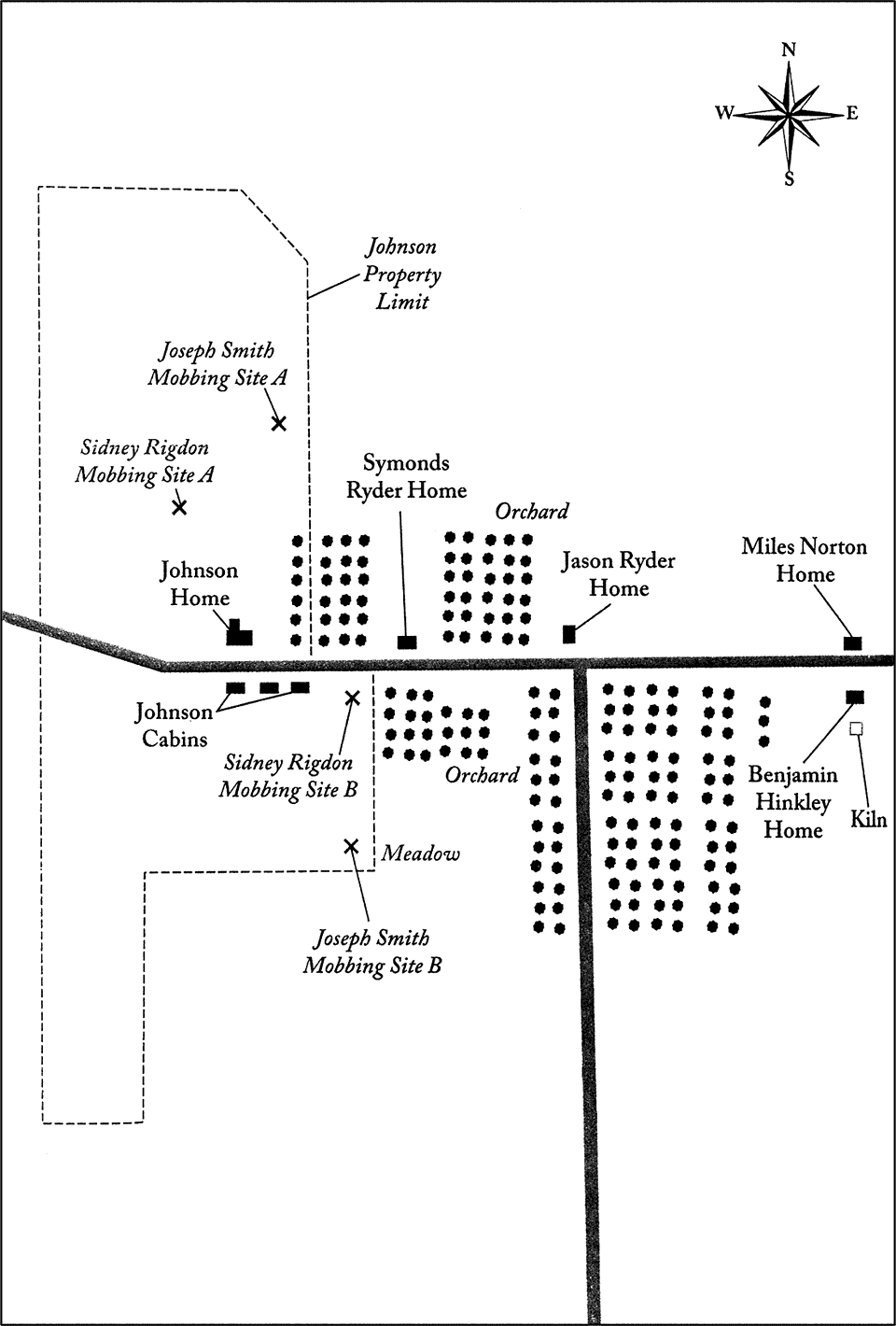
Map 7. Johnson Property Boundaries and Proposed Mobbing Site Locations, March 1832 Cartography by John Hamer
[ 345 ]
Chapter 27 THE MOBBING OF JOSEPH SMITH AND SIDNEY RIGDON "...ripened into open war..." 1 Violence and confrontation flared in Hiram at precisely the moment Joseph received some of his most significant revelations and made preparations to publish them. Despite threats, Joseph boldly pushed forward with his work and continued to receive revelation. On March 1, he received a revelation directing the establishment of a storehouse for the poor (D&C 78). Over the next few weeks Joseph received additional revelations calling Jared Carter to preach (D&C 79, March 12), Jesse Gause to serve as a member of the First Presidency (D&C 81, March 15), Stephen Burnett and Eden Smith to preach (D&C 80, March 17) and clarifying questions about the New Testament book of Revelation (D&C 77, before March 20). 2 On March 20 Joseph received revelation directing details of publication of the Book of Commandments. Joseph asked the Lord if they should carry the paper with them from Ohio when they departed for Missouri, apparently because paper suitable for book publication was in short supply in Independence. He asked a second question: "Shall we finish the translation of the New Testament before we go to Zion [Independence, Missouri] or wait till we return?" The answer came in the same revelation: "It is expedient saith the Lord that there be no delays and thus saith the Lord for the greatest good and benefit of the Church wherefore omit the translation for the present time." 3 Joseph stopped the translation work and the stage was set for him to leave promptly. The local paper noted that the winter had been marked by "extreme and steady cold." Merchants had advertised sleigh bells for sale for some time. A newspaper later reflected back with pleasure on an unexpected warm spell toward the end of March, which instigated a flurry of preparations among Mormons planning to leave for Missouri. 4 This was the same time that community opposition to Joseph and Sidney "ripened into open war," in the words of county historian Robert Brown [sic]. "Someone bored an auger-hole __________ 1 Robert Charles Brown, History of Portage County, Ohio, [sic - Everts] 16 1/2. 2 Robert J. Woodford, "Discoveries from the Joseph Smith Papers Project: The Early Manuscripts," 23-39. 3 "Answers to questions about publication efforts," Unpublished revelation, March 20, 1832, verso, Newel K. Whitney Collection, fd. "18; punctuation added. 4 "Destruction of Fruit Trees," Ohio Star, 3, no 18 (May 3, 1832): 4. 346 Hearken, O Ye People into the house in which Rigdon lived, and filling it with powder, tried to blow up the cabin." 5 Such antagonism threatened the entire Rigdon family. Sidney later related in disjointed notes from a conference discourse in Nauvoo: "There was a gent from Mexico came, spent a number of days with us -- he walked out in a dark night, saw in one place a man armed with a rifle, he found no less than a doz., he run them all more than half a mile -- & he swore he would kill some of those rascals." 6 The "gent from Mexico" may have been a promoter of Texas and an associate of Olmstead Johnson. (See chap. 26.) A half mile east of the Johnson farm lay the Benjamin Hinkley and Miles Norton farms where some of those angry with Joseph lived. Despite several firmly committed Latter-day Saints in the Hinkley household, that farm became the geographic base of opposition. On March 22, Luke Johnson and Seymour Brunson left Shalersville where they had successfully preached and baptized several individuals. Continuing their mission farther south, they "witnessed several instances of the Lord's healing power." 7 The Mob's Preparations On Saturday, March 24, according to Symonds Ryder [sic - L. V. Bierce], the community "raised a company to mob them," specifically meaning Joseph Smith and Sidney Rigdon. 8 The quasi-military term suggests that he helped make the preparations in his role as Hiram's militia captain. 9 Ryder may have used his militia connections in Garrettsville to recruit as well, since the "company" was formed of citizens from Shalersville, Garrettsville, and Hiram. 10 Ryder did not mention that other participants joined in from Nelson, Mantua, and possibly Freedom. Because they came from various communities, the need for organization was obvious.Cecil McGavin, a historian in the early twentieth century, visited Hiram during the summer of 1936, gathering stories from "old-timers." He reported that Miles Norton poisoned the Johnsons' dog to prevent it from barking to warn of trespassers in the night. 11 During the day, Norton also joined Eli Johnson as they entered Eli's brother's house and "spiked the Johnson guns" by inserting some object in the pistol's barrels "so they could not be used against them when they should attack the inmates that evening." 12 Emma Smith would have been busy caring for the eleven-month-old Murdock twins, Julia and Joseph. Both were ill with measles, which was spreading through the community. The Rigdon family was also "then sick with the measles," which doubtless included some, if not all, of their six children. 13 John and Elsa Johnson, whose own twins Edwin and Charlotte had died sometime before the 1830 census, were certainly sympathetic. 14 Parents commonly believed during this period that measles typically struck during the winter and spring. Connecticut natives favored allopathic healing which promoted such strong agents as calomel and nitric acid. Connecticut-born physicians Richard A. Dennison in Nelson and Jason Moore in Mantua were both allopathic healers. 15 In contrast to most of Portage County, Hiram's Vermonters like the Johnsons and Smiths typically favored the gentler Thomsonian healing methods. Allopathic medicine had little to offer the typical sufferer of measles. Dr. Moore's son, who lived a few miles west of the Johnsons and got __________ 5 Brown, History of Portage County, Ohio, [sic - Everts] 16 1/2. A description of this event was later [sic - earlier] published in a series of historical reminiscences in the Portage County Democrat, February 15, 1860, 3 [sic - 1]. 6 Thomas Bullock, Minutes of April Conference, Nauvoo, Illinois, April 6, 1844. 7 Seymour Brunson, Letter, Evening and Morning Star 3 June 1833): 100. 8 Symonds Ryder [sic - Bierce & Everts], Letter to Amos Sutton Hayden, 220-21. 9 Brown, History of Portage County, Ohio, [sic - Everts] 16 1/2; Amos Sutton Hayden, Early History of the Disciples in the Western Reserve, 221. 10 Ryder, Letter to Hayden, 220-21. 11 E. Cecil McGavin, The Historical Background of the Doctrine and Covenants, 194; source courtesy of Larry Carver. McGavin does not reference a source for his information although he made his trip to Kirtland during the summer of 1936. No original participants in the mobbing were living then although some of their children and grandchildren still lived in the area. It appears that McGavin spoke with a yet unidentified member of the Norton family. See also E. Cecil McGavin, "The Kirtland Temple Defiled." 12 McGavin, The Historical Background of the Doctrine and Covenants, 194. 13 History of the Church, 1:265. 14 Although Edwin and Charlotte Johnson, both born on December 1, 1821, are listed in the family Bible in the possession of Vesta Ryder Clark, there is no information about when or how they died. 15 Orrin Harmon, "Historical Facts Appertaining to the Township of Mantua, A.D. 1866," 120. The Mobbing of Joseph Smith and Sidney Rigdon 347 (contents not transcribed, due to copyright restrictions) 348 Hearken, O Ye People 
The Benjamin and Susanna Hinkley Family and Home Benjamin Hinkley was a member of the mob that tarred and feathered Joseph Smith in March 1831. The mob gathered at his home before and after the event. He prevented Susanna from moving to Missouri with the Saints, but she remained a believer in Joseph Smith throughout her life... The Ryder family retained an oral tradition that Symonds Ryder locked himself into a downstairs room alone, telling his family he did not want to be bothered until morning. 26 He slept late the next morning, which his son, Hartwell Ryder, took as evidence he did not participate in the mobbing. 27 Symonds never either confirmed or denied his participation to Hartwell; thus, it is equally likely that he went to bed early in preparation for a late-night expedition and slept in the next morning for the same reason. In fact, Symonds Ryder expressed a great deal of knowledge about the motives of those who attacked Joseph Smith when he wrote in a letter the mobbing was instigated by "some who had been the dupes of this deception," meaning members of the Church, 28 In any case, about twenty-five 29 mob members gathered in Benjamin Hinkley's brickyard a little over half a mile east of the Johnson home before their violent deed and returned there afterward. 30 Benjamin Hinkley was Hiram's schoolteacher. He, his wife, Susannah, and their children were baptized in 1831. Susannah and Sophronia were still ardent members hoping to go to Missouri, 31 but Benjamin's ardor had cooled. He prevented Susannah from ever leaving Hiram, but she "remained... a Mormon to the day of her death... in daily anticipation of the advent of Christ." 32 By gathering at the Hinkley brickyard, the men could avoid going into the house, where they could be seen by Susannah and allow information to get to their Mormon family members, but the kiln allowed them to build a fire for warmth and also to soften the tar. 33 __________ 26 Agnes M. Smith, email to Mark Staker, 2000; see also Agnes M. Smith, "On Oral History and the Stevens Family," n.p. 27 Hartwell Ryder, "A Short History of the Foundation of the Mormon Church," n.p. 28 Symonds Ryder, Letter to Amos Sutton Hayden, 221. 29 Luke Johnson, "History of Luke Johnson," 834, stated that there were about forty or fifty men in the mob. He was not present at the time. "Triumphs of the Mormon Faith," 3, claimed that the group had twenty-five or thirty men. According to Sidney Rigdon, "A mob of 20 or 30 ruffians came damming & roaring against us -- our houses were surrounded." He somewhat confusingly added: At last there got some hundreds of them I was dragged out of my bed." Bullock, Minutes of April Conference, Nauvoo, Illinois, April 6, 1844. Since neighborhood women gathered at the Johnson home and others helped clean the tar from Joseph's body, the "hundreds" may have been onlookers and concerned members. Joseph Smith said that "about a dozen men" carried him out and others were involved in different ways while a group had already taken Rigdon out. History of the Church, 261. None of the onlookers seems to have been in a good position to count accurate numbers in the dark. An approximate number of twenty-five seems plausible. 30 Brown [sic - Everts], History of Portage County, Ohio, 16½, in 1885 recorded that Joseph "had a revelation the Temple was to be located, and the site was pointed out on a hill near the 'Hinkley farm.'" The hill was actually on the Ryder property just west of the Hinkley farm. Abram Garfield, "An Episode of the Thirties," 13, 17, based on conversations with his uncle, Joseph Rudolph, and his grandfather, Zeb Rudolph, claimed that Joseph wanted to build a temple on Symonds Ryder's farm, which was the highest spot in Hiram and one of the highest in Ohio. According to Garfield, Joseph "was often there wandering about the hilltop even when Symonds was at work in some distant field" and reportedly said, "There is here a most magnificent outlook... I believe it to be the most perfect site that I have visited." Garfield implied that Mehetable [sic] Ryder was willing to donate part of her property for a temple site, despite her husband's objections. Although these late accounts are easily dismissed as mistaken because a temple was never built in Hiram, Joseph Smith, Ezra Booth, and others left Ohio in June 1831 to designate a temple site in Missouri, and a temple was started in Kirtland two years later. Obviously, temples had been a topic of discussion in Ohio in early 1831. Brown likely got his information from Sophronia Hinkley, a Latter-day Saint who still lived in Hiram when he wrote his history. Perhaps the Hiram discussions had focused on contributions for the Independence Temple, and later recollections mistakenly placed the temple in Hiram. Or perhaps Hiram really was considered a possible temple site. However, references to a temple in Hiram are sparse and late, making it difficult to determine the exact nature of early perceptions about temple building. 31 Joseph Smith Sr. gave Susanna Hinkley and her daughter Sophronia patriarchal blessings in Kirtland in late 1834. Susannah's blessing acknowledged: "Thy companion has opposed thee." Benjamin died on May 3, 1835. Susanna later gave Eliza R. Snow a milk cow to take with her while crossing the plains. Eliza R. Snow Smith, Biography and Family Record of Lorenzo Snow, 93. 32 Gertrude Van Rensselaer Wickham, Memorial to the Pioneer Women of the Western Reserve, 158. 33 Natural tar was apparently accessible from a local open pit about two miles south of the Johnson home. Sidney Rigdon called the substance "pitch" in his account, and Joseph Smith called it "tar"; but the terms were interchangeable in Webster's 1828 dictionary. Joseph's description of needing to pull the material away from his mouth so he could breath is more consistent with tar. However, Emma mistook the substance for blood; and pine pitch when heated can turn a deep black red. Regardless of the actual substance, removing it required considerable scraping. The Mobbing of Joseph Smith and Sidney Rigdon 349 Local tradition credits both Eli Johnson and Silas Raymond with providing at least one bucket of tar. Raymond also brought along his large "dark lantern" about the size of a gallon can. It had a pointed top to shed rain and a wire handle to carry it. Through a little door cut in the side, a candle could be inserted. Perforations in the shape of diamonds, hearts, and crescents allowed the light to flicker out. An internal cover could be lowered to close off these perforations, making it dark, or be suddenly lifted to let the light flash out. 34 Pelatiah Allyn, the local justice of the peace, had joined the Latter-day Saints the year before. Although he was responsible for enforcing the laws against public drunkenness, he contributed a barrel of whiskey to the gathering. 35 It is not clear how long they huddled near the fire in the kiln, drinking, waiting for everyone to fall asleep, and, according to Marinda Johnson Hyde, disguising themselves as "black men," probably by rubbing soot on their faces, perhaps choosing this disguise because of rising conflict in the county over issues of race. 36 It was either late on Saturday night, March 24, or, more likely, early on Sunday morning, March 25, 1832, when they moved out. 37 The Attacks "Dividing into two parties they quietly marched" west toward the Johnson property. 38 They apparently reached the Rigdon home on the south side of the road first, but launched an attack on both locations simultaneously, since the noise would have awakened the Johnsons sleeping in their front rooms otherwise. They "broke the door" on the Rigdon dwelling, 39 rushed into the cabin, and mistakenly dragged a "Miss Vashti Higley... from her bed" before discovering their mistake and yanking Sidney out of the bed he shared with Phebe. 40 Higley assisted the Rigdons with care of their sick children and eventually married Peter Whitmer Jr. Samuel F. Whitney, writing in 1888, credited Rigdon with confronting the mob as he was pulled from the cabin, stating that he "presumed they were gentlemen." 41 A pause in the action to allow such a conversation was clearly brief if it occurred, however.Sidney was stout, weighing about 225 pounds. In disjointed notes from a sermon in Nauvoo in April 1844, he gave the details of that terrifying night: "I was dragged out of my bed, was put on a large wood pile -- some were putting it on me. My head went thump thump upon the hard frozen ground -- they then threw a quantity of pitch upon me and when they attempted to throw some thing else on me I fell and the next morning when I went to the same place I found it was a quantity of aqua fortis [nitric acid] that they were going to throw on me." 42 Joseph reported, "My wife heard a gentle tapping on the windows," which she ignored. 43 Although Joseph speculated later the men may have tapped to see if Joseph or Emma were awake by getting them to respond, they may have made noise as they pressed up to the window to see where beds were positioned because they acted quickly when they first knocked in the door. Then the attackers "burst open the door" of the work kitchen and crammed into the room. The door was apparently unlocked earlier in the day since George A. Smith added: "a friend of the family was procured to open the door." 44 Joseph's trundle bed was so close __________ 34 A son of mob member Silas Raymond inherited the bucket and lantern used in the mobbing. He described the bucket as "made from a block of wood 8" in diameter and 10 or 12 inches in height, chiseled out to make a bucket, a hole bored through each side at the top and a piece of rope knotted at each end to make the handle." It was a very crude affair. It was covered with hard tar both inside and out and had never been used to for anything after the mobbing. John David Barber, Statement, 1948. 35 The History of the Church, 1:264. This history mentions Felatiah Allen, Esq. as a mob member. However, Joseph Smith, "History of Joseph Smith," 611, gives his name as Pelatiah Allen, Esq. He is obviously the same Pelatiah Allyn who lived in Hiram. The Allyn family was prominent in Hiram for many years. Pelatiah attended a sermon by Joseph the day after he participated in the attack, evidently to hide his involvement; this detail suggests that, although his baptism date is not known, Pelatiah may not yet have formally disaffiliated from Mormonism or he may have sought to placate his still believing wife, Amelia. Pelatiah died in Hiram on December 18, 1856; Amelia died in Hiram on September 13, 1867. Obituaries, Portage County Democrat, December 24, 1856, 3, and October 2, 1867, 3, respectively. 36 Marinda N.J. Hyde, "Autobiography," 403-6; "Triumphs of the Mormon Faith," 3, claimed that the men were "disguised with colored faces;" see also David Grimsted, American Mobbing 1828-1861: Toward Civil War, 85-87. 37 Joseph Smith, "History of Joseph Smith," 611, dates the mobbing at March 25. History of the Church, 1:261, which reprinted this history replaced the March 25 date with March 24 without explaining the change. Presumably the change was made because the date is given before the account mentions "in the evening" suggesting the date described the Saturday evening rather than the actual day of the mobbing. Amasa Lyman, who spent the summer of 1832 working in Hiram, gave the date of March 25. "Amasa Lyman's History," Millennial Star 27 (1865): 473. John Wickliffe Rigdon, "Lecture on the Early History of the Mormon Church," n.p., also suggests that the mobbing happened early on March 25, since he says it happened "one morning before daylight." Joseph Smith said he could see Sidney Rigdon in the moonlight. History of the Church, 1:262. The moon did not rise until after 3:00 A.M. It seems probable that Joseph Smith's original date was correct and the mobbing took place on March 25, 1832. 38 Hartman [sic - Hartwell] Ryder, "A Short History of the Foundation of the Mormon Church," n.p. 39 Bullock, Minutes of April Conference, Nauvoo, Illinois, April 6, 1844; see also Scott G. Kenney, ed., Wilford Woodruff's journal, 1833-1898, 2:276-377. John Wickliffe Rigdon, "Lecture on the Early History of the Mormon Church," n.p., wrote that the ruffians had mishandled his father "till they thought he was dead and then went to get Joseph Smith." Joseph recalled seeing men still grouped around Sidney when he was carried to the same location, suggesting that they had taken Rigdon first. Joseph Smith, Luke Johnson, and Hartwell Ryder all agree there were two bands who mobbed Joseph and Sydney virtually at the same time. The fact that the group carried Joseph near Sidney, then had to carry him south to find a suitable spot for their abuse, suggests that they may have thought the others would be finished with Rigdon when they arrived at the designated spot or, more likely, there was only one agreed -- on spot for taking the men and the Rigdon -- group arrived there first. 40 Wickham, Memorial to the Pioneer Women of the Western Reserve, 157. 41 Samuel F. Whitney, "Statement of Rev. S. E Whitney on Mormonism," 1:4. Whitney, writing in 1888, regularly confused information and combined different events. He somehow thought the Johnson sons were involved in the mobbing, a mistake that has continued to confuse historians ever since. Eli and Edward were brothers of John Johnson Sr., not his sons. However, this statement appears to be confirmed by George A. Smith who noted of the mobbing: "it was said that Sidney was polite ... said gentlemen[,] I am in the hands of gentlemen[,] I consider[.] And I expect to be treated like a gentleman[.]" George A. Smith, November 14, 1864, Sermon, 27, reproduced in Appendix: Sermons. 42 Bullock, Minutes of April Conference, Nauvoo, Illinois, April 6, 1844; capitalization and punctuation added for clarity. 43 History of the Church, 1:261. 44 George A. Smith, Sermon, November 14, 1864, 27, transcribed from shorthand; reproduced in Appendix: Sermons. 350 Hearken, O Ye People 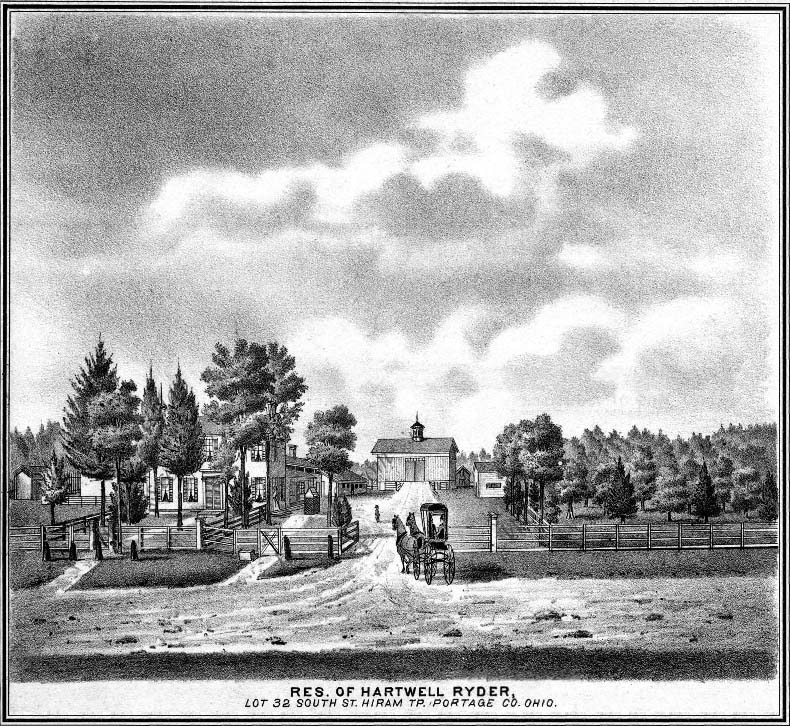
Symonds and Mehetable [sic] Ryder Home Symonds Ryder planted the apple trees, shown here as mature. His son, Hartwell, age ten in March 1832, remembered seeing feathers from the attack on Joseph Smith and Sidney Rigdon in the orchard for much of the summer. Lithograph from L. H. Everts, 1874, Combination Atlas Map of Portage County. to the fireplace that the door could barely swing, but they "surrounded the bed in an instant, and, as I said, the first I knew I was going out of the door in the hands of an infuriated mob." 45 Awakened by Emma "scream[ing] murder" and rough hands grabbing and lifting him, Joseph "made a desperate struggle" as they carried him out of the room. Some held his nightshirt and others his thinly clad, limbs while Carnot Mason and an older McClintock boy dragged him by his hair. 46 Census records locate both Martin McClintock in Nelson and William McClintock in Freedom. 47 Joseph also mentioned that a Streator was a member of the mob. The Alpheus Streator family had helped settle neighboring Windham where he taught school. 48 An M. H. Streator lived in nearby Shalersville. 49 They pulled one handful of hair out by the roots, leaving a permanent bald spot he later covered by the way he combed his hair. 50 Joseph managed to loosen one leg from their grasp and kicked Warren Waste in the face so hard that he knocked Waste off the stoop and "sent him sprawling in the street," according to Luke Johnson. 51 According to Joseph, as the group of men "passed around the house with me, the fellow that I kicked came to me and thrust his hand into my face, all covered with blood, (for I hit him in the nose,) and with an exulting horse laugh, muttered: 'ge, gee, God damn ye, I'll fix ye.'" 52 Threats quieted Joseph down, and he did not continue his struggle as the men carried him around the house to the front road where they stopped and apparently tried to strangle him. He briefly fainted; and when he revived, they had taken him east about five hundred feet along the road where in the rising moonlight Joseph could __________ 45 Ibid [sic - Smith, op. cit.]. 46 Luke Johnson, "History of Luke Johnson," 834-35. Joseph identified a "McClentic," one of the men grabbing his hair, as the son of a Campbellite minister. History of the Church 1:264. This detail has not yet enabled a positive identification of the man involved. 47 U.S. Bureau of Census, 1830, Portage County, Nelson and Freedom. 48 Mrs. Herbert Alford, Windham, Ohio Centennial and Homecoming Celebration, August 9, 1911, n.p. 49 C. Helen Derby, Centennial Homecoming, Shalersville Township, Portage County, Ohio, August 30, 1906, 47. 50 Levi W. Hancock, Autobiography," 50, recorded about 1854: The Prophet Joseph Smith sent for me. I went and saw him again and had a conversation with him. Heard him tell about him being mobbed in Hiram and how they pulled the hair out of his head then he showed me the place where they had pulled the hair out of." 51 Luke Johnson, "History of Luke Johnson, by Himself, " (1864), 835. The unpaved road in front of the Johnson home was almost thirty feet away from the front stoop, but archeology confirms that a cobblestone street ran from the west side of the Johnson home toward the barn and buttressed against the summer kitchen stoop. This stoop, the largest at the home, was three times as wide as the door, making it likely that the mob was holding Joseph on that stoop when he kicked Waste onto the cobblestones where he was injured. Although Luke Johnson was not at home during the mobbing and likely did not understand all of the details of that event fully, he grew up in the home and understood the geography of their farm well. 52 "History of Joseph Smith," August 15, 1844, 611. The Mobbing of Joseph Smith and Sidney Rigdon 351 see Sidney Rigdon "stretched out," and thought he was dead, 53 lying on what Sidney later called a "woodpile" -- probably a pile of branches pruned and left in the field from the apple trees. 54 They were just outside Symonds Ryder's apple orchards on the property line between the Johnson and Ryder farms. Apple trees, unlike many fruit trees, were generally kept in the same orchard for generations. An apple orchard still stands in the same location, and an 1874 lithograph of that orchard depicts trees that have been growing for years. 55 Joseph was then "a tall spare man," 56 and relatively easy to carry, but the mob had dragged the heavier Rigdon by his heels over the rough, frozen ground, cutting his head so extensively that his son later said he lay "insensible" while the mob smeared him with tar. A physician who was present, Richard A. Dennison, had brought at least three vials of nitric acid, a caustic solution that would have wreaked massive damage on the soft tissues of the esophagus, potentially producing a coma in minutes, if not killing outright. It would have also left chemical burns on the skin. 57 Dennison apparently tried but failed to pour the acid into Rigdon's mouth. Rigdon's unconsciousness may have saved him from more extensive physical abuse. The group seems to have spent some time milling around, waiting to tar and feather him. One member of the group had gone back to the Rigdon home to get some pillows for feathers but the women in the Rigdon home shut in the pillow-seeking mob member, courageously delaying him long enough that the mob sent elsewhere for feathers. 58 Perlea Moore, who had Mormon relatives and who may have briefly been a member herself, donated pillows to the mob. 59 Marinda Johnson believed that Joseph was tarred and feathered "with Sidney Rigdon" instead of the two episodes taking place separately. Luke Johnson, who like his sister was not present, apparently reported his sister's perceptions in his own account, and the details he reports should be taken cautiously. Hartwell Ryder identified the site where Sidney Rigdon was tarred and feathered as "up the street where the 'Old Oak' now stands," a spot on the Ryder farm just off the Johnson property east of the Johnson home. 60 According to Joseph's account, the mob carrying him first went to where Rigdon was and then "turned to the right, and went on about thirty rods further; about sixty rods from the house, and thirty from where I saw Elder Rigdon, into the meadow, where they stopped." 61 Aerial photographs show a drainage area 990 feet (sixty rods) southeast of the Johnson home, which could have been a meadow at an earlier date. 62 Someone emerged from the orchard beside the road carrying a plank; the "rail" was a traditional element in tar and feathering. At this point, the mob manifested remarkable confusion. One man Joseph thought it was Symonds Ryder -- was concerned about his being chilled and ordered the group to keep Joseph off the frozen ground. 63 Another argued for killing him. 64 A third proposal was to castrate Joseph. Dennison stood five feet seven inches tall, had blue eyes, light hair, fair skin, and a scar on his upper lip. Though only thirty-eight, he was quite frail with a thin, "very wrinkled" face, a "high forehead," and an "irritable appearance." 65 He was apparently slated to perform the castration, but the murderous Dennison forthrightly had killing on his mind. 66 I hypothesize that the castration was an afterthought by some of the men, perhaps to divert Dennison's plan of murder. __________ 53 History of the Church, 1:262. 54 Bullock, Minutes of April Conference, Nauvoo, Illinois, April 6, 1844. 55 L. H. Everts, Combination Atlas Map of Portage County, n.p. [sic - p. 110]; Newell and Ann's son, Horace Whitney, "Letter to Elizabeth Ann Whitney, February 16, 1870," noted that many of the apple trees that had been planted on their property between 1799 and 1815 were still there. 56 Lucia A. Goldsmith, "Rigdon, the First Mormon Elder," n.p. 57 Luke Johnson, Journal History, December 13, 1846, 2, noted that the third vial was dropped by the Hinkley home and said Dennison prepared these vials of nitric acid. Allopathic doctors of the period often compounded arsenic, mercury, and nitric acid in tonics for patients. In a proportion of 68 percent acid to 32 water, aqua fortis was used to eat damaged skin or flesh away in some treatments. The acid was prepared by heating equal parts of nitrate of potash with sulphuric acid. Information courtesy William Candler, M.D., Ph.D., Command Surgeon, Joint Munitions Command, United States Army, Davenport, Iowa, and Michael L. Staker, M.D., Ph.D., United States Army, Retired, and Medical Director, ALCOA, Davenport Works, Davenport, Iowa. Franklin D. Richards visited Portage County in 1844 and, in company with Brigham Young, Lorenzo Snow, Thomas King, and John King, was "in sight of the House in which br Joseph + Sidney were when they were dragged out by the heels + beaten + left for dead they also tried to pour some Aquafortis into his mouth but failed." Franklin D. Richards, Journal, June 6, 1844. Richards's conclusion that the mob failed to get acid in Joseph's mouth is contradicted by George A. Smith who related how Joseph "choked some very corrosive substance poured into his mouth aquafortis was poured into his mouth." George A. Smith, Sermon, November 14, 1864, 27. 58 History of the Church, 1:262. 59 Perlea Moore, quoted in Adelaide Ling, Mantua Homecoming, June 26, 1909, 25. Mob members probably obtained feathers from a variety of sources including "Mr. Smith's house." Dan Jones, quoted in Ronald D. Dennis, trans. and ed., Prophet of the Jubilee, 121. Moore's account suggests that some of the women hovered on the crowd's outskirts, observing their menfolk. Probably some approved and some disapproved. Since Joseph mentions that neighbor women gathered in the Johnson home after the mobbing, it sounds as if more than the Johnson women were in the area. 60 Hartwell Ryder, "A Short History of the Foundation of the Mormon Church," 1902. 61 History of the Church, 1:262. 62 Aerial photographs taken by Jim Walker, under the direction of T. Michael Smith, Historic Sites Collection, LDS Church History Department. Agnes M. Smith, "The Ryder Family and the Mormons," 1-2, a historian at Youngstown College who lived in the Johnson home for twenty-five years with many Stevens family members, also stated that "Joseph was taken across the road and about thirty rods east and then south into the field." 63 History of the Church, 1:262. Joseph thought Symonds Ryder gave the command, which seems likely since Ryder served as the local militia captain. Silas Raymond's son, F. L. Raymond, claimed that his father, the militia's ensign, led the mob. F. L. Raymond, Letter to J. L. Pitkin, November 6, 1906. George A. Smith, November 15, 1864, Journal of Discourses, 11:5, described Warren Waste directing other mob members. Waste transferred property to Eli Johnson after the mobbing. Portage County, Deed and Mortgage Record, Warren Waste to Eli Johnson, September 15, 1832, 18:510. See also ibid., Rhoda Stanley and Alanson Stanley to Warren Waste, September 20, 1831, 13:565. Waste may have helped arrange for Johnson's role in the event. 64 Since several of Hiram's residents said the group left Joseph for dead, they may have thought they had killed him but were forced to leave without making sure when Father Johnson showed up. Laura Kimball, "Autobiography of Sister Laura L. Kimball," 413; Luke Johnson, "History of Luke Johnson," 834-35. 65 Luke Johnson, "History of Luke Johnson," 835, identified Dennison as a member of the mob and wrote that he was later sentenced for another crime to ten years in the penitentiary where he died. George A. Smith, November 15, 1864, Journal of Discourses 11:6, added that Dennison had been convicted of abortion, evidently causing the mother's death. According to Ohio State Penitentiary, Register of Prisoners, 1834-49, 1:29a-e, Richard A. Dennison was convicted for stealing a promissory note on April 20, 1840, and sentenced; he is identified as a physician originally from Connecticut. The record adds his physical description. It also stated that he was "temperate," without property, but with family in Lorraine County, Ohio. He served most of his three-year sentence, then was pardoned by the governor on September 5, 1842. It is not clear how (or whether) an abortion or death was connected. Dennison had moved away from Portage County by the time of his conviction, suggesting that Luke Johnson's source garbled some details or that Dennison was later incarcerated in a different prison for another crime. History of the Church, 1:264 has an unnumbered footnote by B. H. Roberts stating that Luke Johnson identified Dennison as "a man of considerable influence in the community." This statement is not part of Luke's published accounts. Dennison probably had some status in the community. He had recently married, and had recently moved from Connecticut. U.S. Bureau of the Census, 1830, Ohio, Portage County, Nelson. History of Portage County Ohio, 489, states that, in the 1820s "a well known physician" (unnamed), settled in Nelson, possibly confirming Roberts's assessment of Dennison's prominence or possibly referring to his [sic - Dr. Brown's] later criminal record. 66 According to Luke Johnson, "History of Luke Johnson," 835, the mob tore Joseph's clothing off "for the purpose of emasculating him, and had Dr. Dennison there to perform the operation; but when the Dr. saw the Prophet stripped and stretched on the plank, his heart failed him, and he refused to operate."John Wickliffe Rigdon, "Lecture on the Early History of the Mormon Church," n.p., suggests that the night clothing was torn off as part of the violence. He notes the men also tore off his father's clothing. However, it seems unlikely that a doctor who had prepared his vials of caustic acid that would inflict horrible chemical burns on the flesh of his victims would have been squeamish about castration. 352 Hearken, O Ye People According to Luke Johnson, "The mob became divided, and did not succeed," 67 apparently because a traditional tar and feathering never ended in murder. Finally, those who had planned to tar and feather Joseph fetched a bucket of the warmed tar, softened to make it usable on a very cold night. The bucket-bearer was probably Silas Raymond's [sic - Raymond], since one of his sons, F. L. Raymond, wrote a letter to a distant relative claiming that his father had provided the bucket. He described his father as "a very strong man, about 5 ft. 8" tall, broad shoulders and tapered to his feet, he never boasted of his strength, but [I] have heard him say that he could (or had) taken a 40 gallon barrel of cider on his knees and drank from the bing [bung] hole and that there was not another man in Hiram Township who could do it." 68 The mob forced a paddle of tar into Joseph's mouth with such violence that they broke out one of his upper front teeth. 69 The group scratched, hit, and kicked him, severely injuring his "side" -- certainly bruising him and possibly cracking a rib. 70 Joseph assumed from the few words he overheard that there was a serious argument about whether to kill him. He was justified in his perceptions that some were intent on murder. 71 Joseph began pleading with the mob saying, "You will have mercy and spare my life, I hope." 72 Cursing, they rejected his plea. Dennison now made determined efforts to pour the acid into Joseph's mouth, but Joseph clenched his teeth and resisted so violently that the vial broke and the liquid burned his face. Frederick Kesler, later a bishop in Salt Lake City, argued that, at this point, they actually did kill him. Joseph's spirit, Kesler noted, "left his body, and hovered over it in the air, and returned after it was over. They supposed they had killed him, but he had to come back and take his body." 73 Heber C. Kimball agreed: "Joseph's life was at stake then he had been mobbed and slain I heard him say himself when they killed his body and his spirit was in the heavens looking down upon his body and saw the mob pouring aquafortis down his neck trying to break his neck and calling upon him to call upon his God to help him." 74 Joseph's out-of-body experience ended at this point when his spirit returned. "Joseph is reported by the mob to have said be merciful gentlemen[.] [W]hen they told him to call on his God for mercy they immediately as he began to pray heard [an] alarm which made them think [they were] about to be surprised and they left [.]" 75 The "alarm" they heard was probably noise as the intrepid Father Johnson ran into the middle of the crowd around Sidney Rigdon. Immediately after the break-in, according to Joseph, Father Johnson "had been fastened in his house at the commencement of the assault, by having his door barred by the mob." 76 Someone held the front door shut so that John Johnson could not yank it open. He shouted for Elsa, upstairs in the bedroom, to bring him his gun. 77 "Father Johnson... got his rifle and said he would bore through it [the door] and the person left." 78 Eli had apparently succeeded in making the gun inoperable, but Father Johnson snatched up a club and ran down the road to the site of Sidney's abuse, although the mob had principally finished its work and Rigdon was "treated to a coat of tar and feathers. All that summer after, the boy Hartwell saw feathers on the ground." 79 John Johnson knocked one man down with a club, then turned on another. Outnumbered, he ran back toward his own house as John Poorman, who had raced through the cornfield toward the shouts, __________ 67 Luke Johnson, "The History of Luke Johnson," 835. 68 F. L. Raymond, Letter to J. L. Pitkin, November 6, 1906. Although Silas Raymond never used the bucket and lantern again, he hung onto them for the rest of his life and gave them to his son, who recalled: "Before dying he called his family together and talked with them regarding the mobbing and their future course in life, stating that his days were numbered, but he wanted to tell them that so far as he was concerned they could please themselves which religious denomination they affiliated themselves with, but for his part he was convinced that Joe Smith was all that he ever claimed to be -- a prophet of God." E L. Raymond, quoted in Barber, Statement. 69 Luke Johnson, "The History of Luke Johnson," 834, left the most widespread account that the mob "broke one of his front teeth" in attempting to pour in the "obnoxious drug." However, the damage was more extensive than a chipped or broken tooth that some historians have later read into the use of the word "broke." Benjamin E Johnson, Letter to George E Gibbs, states: "The Prophet's lost tooth... was, as generally understood, broken out by the mob at Hiram while trying to pry open his mouth to strangle him with acid."Johnson adds that, in about 1843, a "dentist neighbor" "replaced the tooth," but until then, "a whistle-like sound" accompanied "all his public speaking" (spelling modernized). The Reverend George Moore recorded that Joseph in Nauvoo had "one or two of his front teeth gone." Quoted in Donald Q Cannon, "Reverend George Moore Comments on Nauvoo, the Mormons, and Joseph Smith," 11. Henry Lewis, a traveling painter, visited Joseph Smith in Nauvoo on April 26, 1844, two months before his death and noted: "teeth white but not regular, and one of the incisors was missing -- a lack which is noticed at once and somewhat mars the expression of the mouth.... [H]is smile would be exceptionally agreeable if his appearance were not marred by the loss of a front tooth as soon as he opens his mouth. We were several times on the point of advising the holy man to put himself for a few hours into the hands of our friend, the dentist Dr. H of St. Louis, and have the lost tooth replaced by a little piece of ivory." Henry Lewis, The Valley of the Mississippi Illustrated, 248-52. Dan Jones reported that the mobbing did not break any bones but "his front teeth were broken." In Dennis, Prophet of the Jubilee, 121. Frederick Kesler in 1894 "related the incident of the mob knocking one of his [Joseph's] front teeth out." In Brian H. Stuy, ed., Collected Discourses Delivered by President Wilford Woodruff, His Two Counselors The Twelve Apostles and Others, 5:35. 70 After a bout of fisticuffs between Joseph and his brother William in Kirtland three years later, Joseph chastised William for getting the jump on him: "Having once fallen into the hands of a mob, and been wounded in my side, and now in to the hands of a brother, my side gave way." He had to be "rescued, from your grasp." Dean C. Jessee, ed., The Papers of Joseph Smith, 2:116; reference courtesy Karl Anderson. 71 Dan Jones, who presumably heard the story from Joseph in Nauvoo, wrote: "They beat him cruelly, until they thought they had killed him; even so, there was life left in him, and he could hear them discussing amongst themselves what to do with him. Some advocated digging a grave there, and burying him. They went to fetch spades to that end, but since the earth was too hard for them to do that, some of them went back to Mr. Smith's house and took a pillow off his bed" for the tar and feathering. Jones, quoted in Dennis, Prophet of the Jubilee, 121. 72 History of the Church, 1:262. 73 Kesler, in Stuy, Collected Discourses, 5:35. 74 Heber C. Kimball, Sermon, October 23, 1853, recorded in shorthand by George D. Watt. 75 George A. Smith, Sermon, November 14, 1864. 76 History of the Church, 1:263. 77 Ibid. 78 George A. Smith, Sermon, November 14, 1864, 27. 79 Francis M. Green, Hiram College and Western Reserve Eclectic Institute: Fifty Years of History, 1850-1900, 407. The Mobbing of Joseph Smith and Sidney Rigdon 353 (contents not transcribed, due to copyright restrictions) 354 Hearken, O Ye People along and got him in the house. She got the tar and feathers off from him the best she could and got him to bed." 87 Joseph's friends spent the night helping clean him off. The sun rose at 5:46 A.M., and people gathered for their usual Sunday worship that morning at the South Schoolhouse. 88 The school, the only heated public space in the community, was near the Hinkley property. In the congregation were some who had participated in the night's events. 89 Symonds Ryder, although he slept in, attended services with his believing Mormon wife, Mehetable [sic]. When they "went past the Johnson house... the Mormons came out like bees from a hive and accused him of being the leader of the mob." 90 Clearly as the family cleaned Joseph up, he told them what little he knew of the night's events. Rigdon apparently stayed in bed. Joseph preached, despite his lost tooth and the injury to his side. He combed his hair forward to cover up the spot on his head where the hair was missing and ignored the chemical burns on his face from the spattered nitric acid. The specific topic of his sermon was not recorded, nor is it known whether he alluded to the mobbing. 91 Charles and Margaret Hulet traveled seven miles from Nelson to be present, bringing their family. They were all preparing to leave for Missouri with the company of Saints. Twelve-year-old Katherine later remembered listening to Joseph "after the mob had tarred and feathered and beaten him... so badly... talk on the principles of the gospel." 92 Three members of the congregation were baptized in the cold brook after the sermon. One of them was Philemon Duzette, who had come by the Johnson home when Joseph's friends were cleaning off the tar and interpreted the mobbing as a sign of his prophetic calling. 93 No record exists of how the children in the South Schoolhouse behaved on Monday. Benjamin Hinkley was apparently still the schoolmaster. Rumors must have been rampant, even though members of the mob kept their role quiet for years. Of the seventy-seven children who attended school in the District One schoolhouse, most had families connected to the previous day's events. Four of John and Elsa Johnson's children attended school along with their grandchild (John Jr.'s) -- and a child of his nephew "Lymin Johnson" (apparently Edward's son). Richard Redding had two children at the school. Symonds Ryder's son Hartwell and his two brothers were there, too, along with three children from Miles Norton's family, two from Silas Raymond's, and seven from Pelatiah Allyn's. 94 Sadly, the violence was fatal for its smallest victim: baby Joseph Murdock. As Joseph III, the child with whom Emma was newly pregnant, learned the family story, "The mob... left the door open when they went out with [Joseph Jr. and] the child [Joseph Murdock] relapsed" 95 in the frosty air. Either he caught a cold in addition to his measles or, from a Thomsonian perspective, the cold itself aggravated the measles. He died on Thursday, March 29. Infant Joseph's maternal grandfather was Judge Benjamin [sic - Orris] Clapp of Mentor, and his maternal aunt was Alicia Clapp, daughter of Disciple founder Thomas Campbell and sister of the Reverend Alexander Campbell. 96 None of them left their views on the baby's death; but no public outrage appears in any surviving records; and when John Murdock visited them after he learned of the death of his son, he noted: "They were unbelieving and hard." 97 According to the custom of the day, family and friends quickly made a small wood coffin for the tiny body. They sat up Sunday night with the dead child in the Johnson formal __________ 87 John Wickliffe Rigdon, "Lecture on the Early History of the Mormon Church," n.p. 88 Hartwell Ryder, [sic] "A Short History of the Foundation of the Mormon Church." 89 History of the Church, 1:264. 90 Hartwell Ryder, "A Short History of the Foundation of the Mormon Church." Ryder reported that a friend visiting in Salt Lake City had seen in the Mormon "Book of Records" that Symonds Ryder had "preached on the following Sunday in the South School-house." There is no record of Symonds preaching at this meeting, although he apparently attended it. 91 After the mobbing, Joseph and his followers believed that self-defense in the face of violence was important. Luke Johnson testified in an 1837 court case, "There has been much excitement prevailing among us in consequence of the attack on Smith and Rigdon, in Portage Co., where they were tarred and feathered, and we have been ordered to arm ourselves for defence, that we might be prepared to resist similar aggressions." Under cross-examination, he repeated, "I believe our only means of safety was to arm ourselves." Quoted in "Much Interest and Anxiety," Painesville Telegraph 3, no. 23 (June 9, 1837): 2. In Missouri in 1838, Joseph announced that the Saints were "determined no longer to bear [mobbing] come life or come death for to be mobed any more without taking vengeance, we will not." [Joseph Smith Jr.] "In This Paper," Elder's Journal 1, no. 4 (August 1838): 54. 92 Katherine Hulet Winget, "Autobiography," 13:489. 93 George A. Smith, November 15, 1864, Journal of Discourses, 11:5-6. 94 Enumeration, Hiram School District No. 1. 95 Joseph Smith [III], "Last Testimony of Sister Emma," 1. 96 Sunny Jane McClellan, "Gone But Not Forgotten': The Life of Julia Murdock Smith," 2-4, 8. 97 John Murdock, Journal, 7. The Mobbing of Joseph Smith and Sidney Rigdon 355 (contents not transcribed, due to copyright restrictions) 356 Hearken, O Ye People
[image - not copied]
The Mobbing of Joseph Smith and Sidney Rigdon 357 travelers took a steamboat below a place along the trail McLellin identified as "Pittsburg" and traveled on the water (perhaps on canal boats although McLellin calls them "ste[a]mboats"), for eight days to St. Louis, purchased oxen, and traveled overland to Independence, reaching their new Zion on June 16, 1832. 111 This company of Saints who physically reaffirmed their testimony of the Prophet Joseph was two to three times larger than the group that attacked him. Other faithful Saints remained in the area, many moving north to Kirtland. Although the perception later developed that Hiram and the surrounding area rejected the Latter-day Saints, many more in the area continued staunch in their testimonies (including members of families who participated in the mobbing) than ever joined in the violence. In fact, during the summer of 1832, probably more Latter-day Saints in Missouri and Ohio hailed from Portage County than from any other place in the world. 112
Appendix
Understanding the geography of the attack on Joseph Smith and Sidney Rigdon by an angry company of men in Hiram, Ohio, on the night of March 24-25, 1832, reconciles apparent contradictions in the statements of various individuals who described those events. Since at least the late 1960s, the traditional interpretation has been that Joseph and Emma were caring for their adopted twins, sick with the measles, and sleeping in the formal parlor in the southwest corner of the John and Elsa Johnson home. (See Floorplan 1.) However, my study of the home suggests that the work kitchen at the rear of the home better fits the accounts of various contemporary witnesses. These second kitchens attached to the rear of nicer nineteenth-century homes became known as summer kitchens in the late nineteenth century. Traditional Understandings of Geography B. H. Roberts visited the Johnson home during a trip to Hiram, Ohio, in 1900 while doing research for A Comprehensive History of the Church of Jesus Christ of Latter-day Saints. Roberts interviewed Hartwell Ryder, the son of Symonds Ryder, and a cousin of John and Elsa Johnson's grandchildren. Age seventy-nine at the time of the interview, Hartwell was a ten-year-old boy, living 600 feet east of the Johnson home, when Joseph was attacked. Roberts also interviewed other individuals in Hiram township but did not identify them. Roberts published a photograph in 1902 of the summer kitchen attached to the rear of the Johnson home with a caption that read, in part: "The room shown in the rear of the__________ 111 Shipps and Welch, The Journals of William E. McLellin, 1831-1836, 83. 112 It is easy to confuse immigrant Mormons to Kirtland with Kirtland residents who joined the Church there, because so many Latter-day Saints eventually gathered in Geauga County, including many from Portage County. However, Saints who had joined the Church in Geauga County were evidently outnumbered by Portage County converts. I base this conclusion on an analysis of records in Susan Easton Black, The Membership of the Church of Jesus Christ of Latter-day Saints, 1830-1848. 358 Hearken, O Ye People Johnson residence (the one where the door stands open) is that occupied by the Prophet and his family in the winter of 1832 and from which he was dragged at midnight March 25, 1832 by a mob." 1 Shortly after Roberts's visit to Hiram, Hartwell Ryder gave a talk in Hiram December 1831 about the mobbing. Francis M. Green, Disciple minister and historian who attended the lecture, recorded some of Hartwell's details, including the perception that Joseph was sleeping in the rear portion of the Johnson home. 2 The following year Hartwell Ryder wrote a brief history of the event where he mentioned that Joseph was sleeping in the "back room" of the Johnson home. 3 After B. H. Roberts's visit to Hiram, interest in the geography of Hiram's Mormon history waned and these early statements were forgotten. A Shift in Perceptions Less than a decade after Roberts' visit to the home, the hearth in the summer kitchen was removed and the bricks were used to line a central heating duct under the floors. This changed the arrangement of the kitchen; the remodeling made the room look as if it belonged to a much later period than the main portion of the home. However the earlier attribution survived when a renewed interest in Hiram's early history rose in the early 1950s. In 1952, Nels Lundwall reprinted B. H. Roberts's photograph with a caption that interpreted the summer kitchen as Smith family sleeping quarters. 4 He did not identify Roberts as the source for the photograph, leaving later readers with the impression that he had taken the photograph himself. Utah businessman Wilford C. Wood acquired the Johnson home in 1956 and, in July 1956, turned the home over to the Church Historic Sites Committee, chaired by Elder George Q Morris. The committee oversaw the interpretation of the home and placed a bed in the back room, presumably the work kitchen, identifying it as the place where Joseph and Emma slept on the night of the mobbing. However, because the room did not look as old as the rest of the home, others surmised that the room was not original to the home. 5 By June 29, 1967, when the Ohio Columbus Mission was organized, President Paul Buehner began assigning missionary couples to live in the home and interpret it. Sister Irene Buehner recalls some discussion at that time about where Joseph and Emma were caring for the twins on the night of the mobbing. However, they had no resources to study the building fabric or documents, and their best guess was the southwest room on the main level. 6 During the late 1960s, the home was "renovated" into a visitors center with velvet drapery hung on the walls accompanied by exhibits. No attempt was made to restore the home, and individuals who interpreted the home consistently described the rear of the home as not original to the building.Between 1977 and 1980, the home was furnished with artifacts. Paul L. Anderson and Donald L. Enders from the LDS Church History Museum did not have the resources to carefully study the building fabric and relied on recent tradition to furnish the southwest parlor to fit standard interpretation at the time. Because Joseph Smith's account of the mobbing stated that the door almost hit the trundle bed when the mob came in, a bed and a trundle bed were placed along the outside wall beneath the large windows that lined both __________ 1 B. H. Roberts, "Figures in Early Church History," 1. 2 Francis M. Green, Hiram College and Western Reserve Eclectic Institute, Fifty Years of History, 1850-1900, 407. 3 Hartwell Ryder, "A Short History of the Foundation of the Mormon Church," n.p. 4 Nels Lundwall, The Fate of the Persecutors of the Prophet Joseph Smith, [what page is the photo on?] [sic] p. 70. 5 Glen M. Leonard, Conversation, July 18, 2005. 6 Irene Buehner, Telephone conversation with Mark Staker, 2000. The Mobbing of Joseph Smith and Sidney Rigdon 359 walls on the opposite end of the large room from the fireplace in a manner suggestive of Joseph's account of the mobbing but not consistent with a family trying to keep warm on a cold night. (See Option A.) Fitting the Historical Accounts into the Physical Data In 1999, structural problems developed in the home. During restoration work, a thorough study of the building indicated that the rear portion of the home was not only original to the structure but it had had running water from a pump attached to a cistern placed underneath the kitchen. The room above the work kitchen was also original to the structure and fitted with windows fairly soon after the home was built, creating a sleeping space that required a fire in the work kitchen during colder months to make it tolerable. 7A careful study of the home conducted by Elwin C. Robison, his associates, and staff from the LDS Church History Museum, indicated that Jude Stevens, who purchased the farm from John Johnson in 1834, and his descendants, who continued to own the property until 1956, were very conservative and made only superficial modifications to the structure. Even the original paint colors were still on the walls covered by a few coats of later paint. The "First-Level Floorplan" captures the main level of the Johnson home as it appeared when Joseph and Emma lived in it. Knowing the room dimensions and locations in the Johnson home allows us to compare the rooms with the historical details in surviving accounts to see how the data fit room location. The most detailed account is the one provided by Joseph Smith. In the night she [Emma] told me I had better lie down on the trundle bed, and I did so, and was soon after awakened by her screaming murder, when I found myself going out of the door, in the hands of about a dozen men; some of whose hands were in my hair, and some had hold of my shirt, drawers and limbs. The foot of the trundle bed was towards the door, leaving only room enough for the door to swing open. My wife heard a gentle tapping on the windows which she then took no particular notice of (but which was unquestionably designed for ascertaining whether or not we were all asleep), and soon after the mob burst open the door and surrounded the bed in an instant, and, as I said, the first I knew I was going out of the door in the hands of an infuriated mob. I made a desperate struggle, as I was forced out, to extricate myself, but only cleared one leg, with which I made a pass at one man, and he fell on the door steps. I was immediately overpowered again .... As they passed around the house with me, the fellow that I kicked came to me.... After I came to, as they passed along with me, about thirty rods from the house, I saw Elder Rigdon stretched out on the ground, whither they had dragged him by his heels.... [O]ne coming from the orchard had a plank: and I expected they would kill me, and carry me off on the plank. They then turned to the right, and went on about thirty rods further; about sixty rods from the house, and thirty from where I saw Elder Rigdon, into the meadow where they stopped.... I began to recover, and raised myself up, whereupon I saw two lights. I made my way towards one of them, and found it was Father Johnson's.... During the affray abroad, the sisters of the neighborhood had collected at my room. I called for a blanket, they threw me one and shut the door; I wrapped it around me and went in.__________ 7 Elwin C. Robison, "Report: John and Elsa Johnson Home, Hiram, Ohio," October 25, 1999. 360 Hearken, O Ye People
Option A
(remainder of page not transcribed, due to copyright restrictions) The Mobbing of Joseph Smith and Sidney Rigdon 361
Option B
(remainder of page not transcribed, due to copyright restrictions) 362 Hearken, O Ye People 4. Joseph wakes up to Emma's scream to find himself already going out the door onto the stoop in the hands of a dozen men, some pulling him by the hair. Option A requires that Joseph remain asleep while a dozen men pull him out of bed by the hair and limbs, carry him through the parlor door, move the crowd down the five-foot hallway, push the six-foot Joseph into a compact bundle to turn the corner, and begin to go out the door before Joseph hears a scream that wakes him up. Option B requires men to lift Joseph out of the trundle bed and move three and a half feet to the stoop, before he hears the scream and wakes up. 5. As Joseph was "forced out" of the door, he kicked a man who fell on the door steps. Luke Johnson, who helped build the home and grew up in it, provides an important additional detail. "At the time they were taking him out of the house, Waste had hold of one foot, Joseph drew up his leg and gave him [Waste] a kick, which sent him sprawling in the street." 9 Option A requires Joseph Smith to kick Warren Waste from "out of the house" -- or from the stoop into the main road, a distance of almost thirty feet. Option B requires that Joseph kick Warren Waste from the stoop off the summer kitchen into the paved road that ran past the house toward the barn in back. 10 6. The mob of twelve men or so "passed around the house" and then "passed along" about thirty rods from the house where Elder Rigdon was stretched out on the ground. Others provided additional details about the location of Rigdon's mobbing. According to Francis Green, Hartwell Ryder said: "Rigdon was taken out, near to an oak tree, now standing on the south side of the road, and treated to a coat of tar and feathers. All that summer after, the boy Hartwell saw feathers on the ground." 11 Hartwell Ryder identified the site of Rigdon's attack in his own account as "up the street where the Old Oak now stands," a spot that was just off the Johnson property. 12 The location of this "Mormon Oak" became well known in Hiram village and was included in early maps and on postcards. 13 Sidney Rigdon adds the detail that, when he was taken to the assault site, he "was put on a large wood pile." 14 Marinda Johnson said the assailants took the men to the "apple orchard." 15 John Wickliffe Rigdon noted in his account that his father stumbled back home "along the road." 16 Option A requires the men to go out the front door and walk "around" the back of the house into the Johnson fields thirty rods north of the home. This description places Sidney in the north field of the Johnson dairy farm with a pile of wood, an orchard, and a road in the field. Option B requires the men to leave by the west door of the summer kitchen, step onto the main road, and "pass along" thirty rods down it to a location immediately adjacent to the Ryder family apple orchard. This location is where the "Mormon Oak" stood for many years, it is where Hartwell Ryder said he saw chicken feathers all summer, and it is thirty rods from the Johnson home, which is where Joseph saw Rigdon. 7. Joseph's assailants, seeing Rigdon and the men clustered around him, "turned to the right" and took Joseph Smith an additional thirty rods to a "meadow" He noted that __________ 9 Luke Johnson, "History of Luke Johnson, by Himself," 835. 10 Archeology conducted by T. Michael Smith during 1999 showed a nine-foot stoop and a paved road running just outside of the west summer kitchen door. T. Michael Smith, Conversation, August 1999. 11 Green, Hiram College and Western Reserve Eclectic Institute, 1850-1900, 407. 12 Hartwell Ryder, "A Short History of the Foundation of the Mormon Church," n.p. Arthur Ryder, Jason Ryder's great-grandson, also identified the oak as the site of the tarring and feathering. Arthur Ryder, Interview, 1977, n.p. 13 Edward Morgan, "Map of Hiram Twp. 1857." "Mormon Oak," ca. 1910, Postcard in possession of Larry Carver, Portage County, Ohio. 14 Thomas Bullock, Minutes of April Conference, Nauvoo, Illinois, April 6, 1844. 15 Marinda Hyde, "Autobiography," 404. 16 John Wickliffe Rigdon, "Lecture on the Early History of the Mormon Church," n.p. The Mobbing of Joseph Smith and Sidney Rigdon 363 (section not transcribed, due to copyright restrictions) Conclusions Selecting Option B, the Johnson work kitchen, as the sleeping quarters for Joseph and Emma Smith the night of the mobbing, places the actual tar and feathering closer to the Benjamin Hinkley home where the mob gathered before the event and where they cleaned up afterward. This location was immediately adjacent to the Ryder apple orchards and on the edge of the Ryder property along the main road. Selecting Option B fits with local traditions about both the sleeping and mobbing locations. It fits with the assessment of early historian B. H. Roberts, and it does not require unusual behavior of the participants such364 Hearken, O Ye People as the ability to kick a man thirty feet, a dairyman placing an apple orchard, a large pile of wood, and a road in the middle of his prime cattle grazing property, or mob members sneaking upstairs to hold two bedroom doors shut. It helps explain why John Johnson ran after the men attacking Sidney Rigdon (his cabin was visible outside the Johnson bedroom window) and not Joseph Smith (who was pulled from the work kitchen in the back of the home where sounds were more muffled rather than out the front door where Johnson left just at approximately the same time). Locating Joseph and Emma in the work kitchen, caring for their twins, on the night of March 24-25, 1832, provides a stronger, more illuminating, and more coherent setting for those violent events. (remainder of pages 364-374 not transcribed, due to copyright restrictions) |
|
[ 375 ]
Chapter 28 LAST DAYS IN HIRAM "...continued to molest and menace Father Johnson's house... " 1 Joseph's Return to Hiram John Johnson Sr. apparently sought justice in the courts for the damage inflicted by the mobbing to his guests and property. Although no records survive of the original trials, Aaron Williams appealed a conviction for trespassing on the Johnson property and lost. 2 The court required that he pay a token fine. For the young boys in town, that night of commotion and violence was a landmark event. Ten-year-old Hartwell Ryder always remembered seeing feathers scattered on the ground during much of that summer under an oak on the south side of the road a short distance from his parents' home. 3 Joseph left Missouri on May 6, 1832, and returned to Kirtland briefly. He, Emma, and Julia took up residence again at the Johnson home about July 1, where he continued his work on the Bible translation. Sidney Rigdon, who returned at the same time as Joseph, went to Kirtland where he moved his family into temporary quarters on "the flats." On Thursday, July 5, 1832, the Saints in Kirtland held a prayer meeting at which Joseph's father invited Rigdon to preach. He did so, declaring: "The keys of the kingdom are rent from the Church" nor would they be returned until the Saints built him a new house. 4 Hyrum Smith, irritated at this "frivolous maneuvering" decided to respond. Philo Dibble recalled: "Brother Hyrum came to my house the next morning [Friday, July 6] and told me all about it, and said it was false, and that the keys of the kingdom were still with us. He wanted my carriage and horses to go to the town of Hiram and bring Joseph. The word went abroad among the people immediately that Sidney was going to expose "Mormonism." 5 Lucy Mack Smith also recorded Hyrum's action. He set out immediately for Hiram Township and: __________ 1 History of the Church, 1:265. 2 Portage County, Clerk of Court, Civil Docket, 1832-34, John Johnson vs. Aaron Williams, F:249. 3 Francis M. Green, Hiram College and Western Reserve Eclectic Institute: Fifty Years of History, 1850-1900, 407. 4 Lucy Mack Smith gives a detailed account of this event in her history. Lavina Fielding Anderson, ed., Lucy's Book: A Critical Edition of Lucy Mack Smith's Family Memoir, 560-63. However, she confuses the chronology. Reynolds Cahoon, Diary, Thursday, July 5, 1832, dates the event precisely: "At the meeting Br. Sidney remarked that he had a revelation from the Lord & said that the kingdom was taken from the Church and left with him fryday Br. Hiram went after Joseph when he came he affirmed that the kingdom was ours & never should be taking from the faithful." 5 Philo Dibble, "Philo Dibble's Narrative," 79. 376 Hearken, O Ye People arrived there in the afterpart of the night. Joseph was in bed. "Come," said Hyrum. "Joseph, get up. We are in great trouble. Sidney is telling the people that we have lost the keys of the kingdom, and they are having a terrible time." Joseph did not know what he meant, but when Hyrum told him what a freak had got into Sidney's head, Joseph said that he would start as soon as he could get his breakfast. Father Johnson offered him a horse, for he was a kind old man and would do anything in his power for Joseph or any of [the Smith] family. 6 When Joseph reached Kirtland, he held a meeting in a large barn. Nearly all the inhabitants of Kirtland turned out to hear him, filling the barn to capacity Those unable to get inside crowded around the doors to listen in. Dibble remembered: "Joseph arose in our midst and spoke in mighty power, saying: 'I can contend with wicked men and devils -- yes with angels. No power can pluck those keys from me, except the power that gave them to me; that was Peter, James and John.'" 7 After resolving these conflicts, Joseph returned to the Johnson home, where he continued his work on the scriptures for "most of the summer." 8 Latter-day Saints in the county continued to leave for Missouri all summer long. When Church leaders chastised the hundred who had left in the spring from Portage County for not first obtaining recommends to go to Zion, Bishop Whitney's counselors, Hyrum Smith and Reynolds Cahoon, visited Joseph in Hiram, then continued on to Shalersville where they issued recommends to King Follett and other Shalersville residents "to go to Zion." 9 One of Joseph's associates that summer was nineteen-year-old Amasa Mason Lyman, who was living and working at the Johnsons. After Lyman Johnson had baptized Amasa Lyman from Lyman, New Hampshire, in April 1832, Amasa stopped for a time in Palmyra, New York, and then traveled to the Johnson home where he was employed as a hired hand, working on John's farm for ten dollars a month beginning June 5. He noted that "Father Johnson... received me kindly and ministered to my wants, in which he was heartily joined by mother and daughters." 10 Joseph Smith returned from Missouri a month after Amasa Lyman's arrival. Amasa recalled his first meeting with the Prophet Joseph Smith: "When he grasped my hand in the cordial way (known to those who have met him in the honest simplicity of truth,) I felt as one of old in the presence of the Lord, my strength seemed to be gone, so that it required an effort on my part to stand on my feet; but in all this there was no fear, but the serenity and peace of heaven pervaded my soul, and the still small voice of the spirit whispered its living testimony in the depths of my soul, where it has ever remained, that he was a Man of God." 11 Amasa remained near Joseph until August 1832. One Sabbath evening after a "social prayer meeting" at the Johnson home, "the Prophet, in his own familiar way, said to me, "Brother Amasa, the Lord requires your labors in the vineyard." 12 Amasa was called and ordained to the ministry with Johnson family friend Zerubbabel Snow on August 23, 1832. The Prophet had been unable to visit a Brother Harrington in Shalersville "who was afflicted with a severe pain in his head." He asked Elders Lyman and Snow to administer to the old man in his stead. They did so, and his "disseas was immediately rebuked thus the Lord began __________ 6 Anderson, Lucy's Book, 562. 7 Philo Dibble, "Philo Dibble's Narrative," 79-80. Dibble provided accurate details but confused the chronology of this event. George A. Smith, November 15, 1864, Journal of Discourses 11:6, also describes this event but is not clear on geography, noting only: "Joseph was absent, when he came home he found Sidney almost like a mad man." 8 History of the Church, 1:273. 9 Cahoon, Diary, July 5, 1832. 10 Amasa Mason Lyman, "Amasa Lyman's History," Deseret News, September 8, 1858, 1. 11 Ibid. 12 Ibid. Last Days in Hiram 377 to manifest himself unto us which gave us reason to rejoize." 13 Amasa Lyman heard only two sermons while he was staying with the Johnson family, only one of which was given by Joseph, suggesting that few formal meetings were being held in Hiram by the summer of 1832. On August 27-28, Joseph visited Brother Harrington in Shalersville and attended meetings of the members. 14 Amasa Lyman and Zerubbabel Snow continued to travel to the southern part of Ohio until the spring of 1833 following the general path taken by Luke Johnson and Seymour Brunson on their mission into Virginia, preaching as they went. 15 In August John Murdock, who had just returned from his mission, visited the Smiths, his little daughter, and baby Joseph's grave. Of those whose brutality was responsible for his son's death, he wrote simply: "They are in the Lord's hands." 16 The Prophet received a revelation calling Murdock on another mission but counseling him: "It is not expedient that you should go until your children are provided for, and sent up kindly unto the bishop of Zion" (D&C 99:6). This direction must have recalled Murdock's earlier experience when his wife died leaving him with five small children (including the six-hour-old twins). He had left his children to serve a mission, only to return and find that some of those asked to care for his children had left the Church and required pay for their care. 17 The Johnson home was no longer an ideal workplace for Joseph. The small group of antagonistic former members "continued to molest and menace Father Johnson's house for a long time." 18 A letter to the Geauga Gazette reprinted a denunciation of the mobbing as "a base transaction, an unlawful act, a work of darkness, a diabolical trick," 19 but other newspapers remained silent. Symonds Ryder responded glibly that, his defection from the Church and apparent participation in the mobbing proved "that sometimes two wrongs make one right." 20 Members emigrated so enthusiastically from Portage County that Joseph had relatively few responsibilities as a shepherd of the flock. The Whitneys had been remodeling their large white store in Kirtland. Although the process would not be complete until November 1832, 21 by September they had arranged a reasonably comfortable home in it for the Smiths and a convenient place for Joseph to translate. In turn, the growing Kirtland congregation of Saints would be nearer to their prophet. On September 12, Joseph, Emma, who was approximately seven months pregnant, and seventeen-month-old Julia left the Johnson home for Kirtland a year from the day they first arrived to live in Hiram. Emma wrote on a scrap of paper in her mother-in-law's historical writings: "We moved to Hiram in Sept 12 1831 and returned to Kirtland Sept 12 1832." 22 They never returned. Later History of the Mob Members The Johnsons' neighbor and good friend, Symonds Ryder, remained distant from them after he left the Church. He never again served as a witness on Johnson family property transactions after the mobbing. Emily Johnson and another Hiram resident took over that function. So many members of the Disciples of Christ had been converted to Mormonism that the remaining Disciples moved their meetings to neighboring Nelson Township. Even for a few years after Joseph left, there were virtually no Disciples in the__________ 13 Amasa Mason Lyman, Missionary Journal, 1832, 1. 14 History of the Church, 1:371. 15 Lyman, "Amasa Lyman's History," 1; Lyman, Missionary Journal, 1832. 16 John Murdock, Journal, 7. 17 Ibid., 2. 18 History of the Church, 1:265. 19 "Triumphs of the Mormon Faith," Geauga Gazette 1, no. 23 (April 17, 1832): 3; rpt. from the Observer and Telegraph. 20 Symonds Ryder, quoted [sic] in Charles Ryder, "History of Hiram," 32. 21 Levi Hancock, Statement, November 1832. 22 Emma Hale Smith, "We Moved to Hiram." Source courtesy of Richard L. Anderson, Sharalyn Howcroft, and Mark Ashurst-McGee. 378 Hearken, O Ye People
Symonds Ryder's congregation built this meetinghouse in 1844, reminiscent in style of the much larger Kirtland Temple but lacking its balance and proportion. It burned in 1856. Drawing by J. E. Dean, 1901. Published in Francis M. Green, Hiram College and Western Reserve Eclectic Institute, illustrations not paginated.area. Darwin Atwater wrote a letter to Walter Scott in January of 1834 mentioning that they were "gradually progressing" with the "occasional additions of numbers"; but even at that date, the Hiram congregation still numbered under a dozen. 23 Ryder began attending the congregation in Nelson again within two years of his separation from Mormonism; and on March 1, 1835, thirteen Disciples of Christ began meeting again in Hiram at the South Schoolhouse and chose Ryder "as elder or bishop of the congregation." 24 Mehetable [sic] Ryder had been a Methodist, like the Johnsons, before she and Symonds joined the Mormonites. Passage through Mormonism brought her and her husband together as Mehetable [sic] left the movement, too. Now she joined her husband in the Disciples of Christ congregation. Between June 1834 and February 1835, eleven members affiliated with the Disciples in Mantua "by making good confession," according to a correspondent. "All of us are young save three[.]" 25 By 1847, membership had crept up to eighty-three members, with most of the converts coming from "the families of the saints" as they called themselves. Only after Hiram College was established in 1850 did the Disciples have a congregation as large as the Mormons had achieved in only one year. 26 Symonds Ryder's congregation frequently sang one of his favorite hymns: "How firm a foundation, / Ye saints of the Lord, / Is laid for your faith / in his excellent word." 27 Ryder also led his congregation in building a church unlike anything erected before or after in the area. It had a tiered pulpit arrangement and an exterior remotely reminiscent of the Latter-day Saint Kirtland Temple. Ryder served faithfully until 1852 as the Disciples gathered __________ 23 Darwin Atwater, "Dearly Beloved Bro. Scott," 46. 24 Eliott I. Osgood, "Centennial History of the Hiram Church, 1835-1935," 7. 25 S.A.E., "Dear Brother Scott," The Evangelist 4, no. 2 (February 2, 1835): 43. 26 Amos Sutton Hayden, "The Church in Hiram, Portage County, Ohio," 168-69 [sic ?], 476 [sic 474?]. 27 Green, Hiram College and Western Reserve Eclectic Institute, 116. Last Days in Hiram 379 several hundred members in the county; by then his congregation decided "the long discourses of a country farmer were not sufficient" and brought in a new elder as their minister. 28 This new pastor, Amos Sutton Hayden, also took over leadership of the local college at Hiram, which had initially been founded with Carnot Mason as president, Zeb Rudolph as secretary, and Symonds Ryder as treasurer. Almeda Booth, the daughter of Ezra and Dorcas, became a prominent teacher at the college. 29 When the Johnsons sold their home to the Jude Stevens family in 1834, Symonds befriended the new owners and witnessed all their legal documents as he had done earlier for the Johnsons. After preaching for twenty-three years, Ryder spent his last days working his farm next to the Johnson property and died, a respected citizen, at age seventy-eight. Dr. Richard Dennison was selected as a Nelson delegate on the Anti-Masonic ticket; and on the same day Joseph left the Johnson home, he was in Ravenna participating in the county Anti-Masonic convention. Convention participants did not put him on the ballot for a county office. 30 In September 1831, Warren and Tauna Waste, who lived in Nelson, had purchased fifty acres from two elderly women for $200 in Freedom when similar acreage was going for $850. Three days after Joseph Smith moved out of the Johnson home, Warren and Tauna Waste sold the property at a loss to Eli Johnson for $150 and moved to Freedom. 31 (section not transcribed, due to copyright restrictions) __________ 28 According to F. M. Green (ibid., 116), Symonds Ryder's preaching style was like that of most other Disciples of Christ leaders. He used brief texts from the Bible as his starting point and spent an hour or more expounding on the texts. He invited all those in the congregation "to confess their sins and the Christ." One day, he invited Isaac Errett to preach to the congregation. Afterward the congregation thronged forward to confess their sins. "Among those who responded to the gospel invitation was Symonds Ryder, Jr. In the excitement Bishop Ryder turned to Mr. Errett and, drawing both hands down over his face, his eyes streaming with tears, cried out: "Brother Errett, there is too much excitement here,' and he was the most excited of them all." 29 Almeda Booth was born in Nelson, Ohio, on August 15, 1823, and would have turned eight a few weeks before her father returned from Missouri in 1831. Green, Hiram College and Western Reserve Eclectic Institute, 40-46, includes a photograph and short summary of her life. See also Adelaide Ling, Mantua Home Coming June 26, 1909, 9. 30 "Portage County Anti-Masonic Convention," Ohio Star 3, no. 37 (September 13, 1832, 3[)]. For his later criminal record, see chap. 27. 31 Portage County, Deed and Mortgage Record, Warren Waste to Eli Johnson, September 15, 1832, 18:510. See also ibid., Rhoda Stanley and Alanson Stanley to Warren Waste, September 20, 1831, 13:565. 380 Hearken, O Ye People (pages 380-382 not transcribed, due to copyright restrictions) |
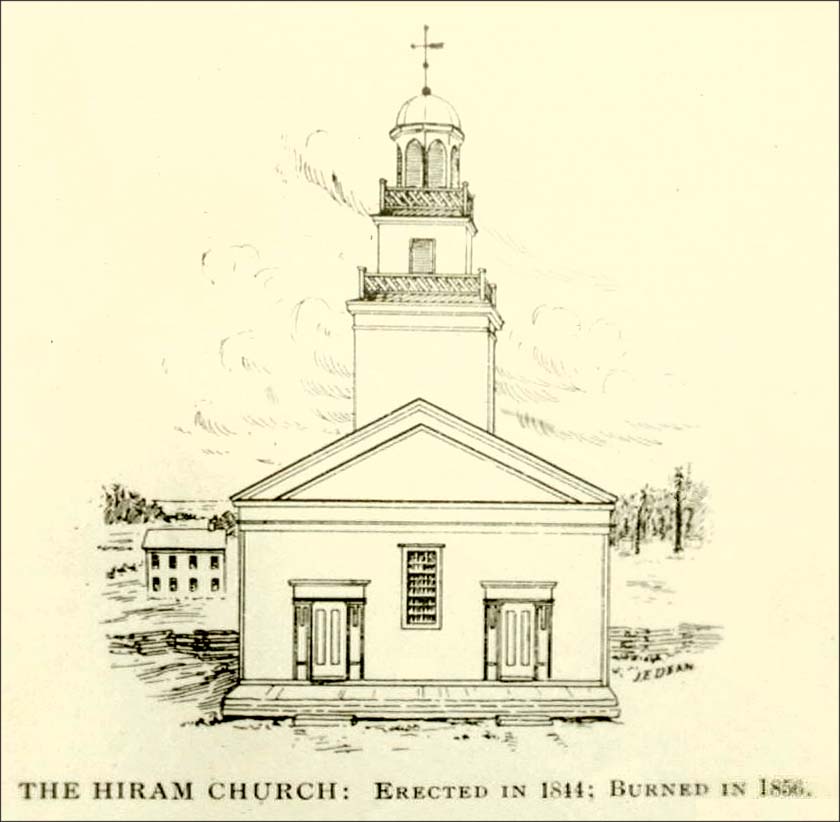
|
[ 383 ]
Chapter 29 THE JOHNSON FAMILY'S EPILOGUE On February 17, 1833, Joseph Smith ordained John Johnson Sr. an elder. 1 Luke returned from his mission a week later, bringing with him his bride, sixteen-year-old Susan Harminda Poteet, whom he had married in Cabell County, Virginia, on November 29, 1832. 2 John and Elsa's unmarried sons were principally off serving missions; and John was in his early fifties, an age when his contemporaries were generally cutting back on hard labor and turning their tasks over to their children. As spring approached, he would need help with the family dairy and farm, a role twenty-five-year-old Luke assumed in the summer of 1833. The Johnsons' daughter Mary, age fourteen, lived in the N. K Whitney & Co. store with Joseph and Emma, helping to care for Julia and baby Joseph III, who had been born on November 6, 1832. She took ill and died on March 30, 1833, "which caused much gloominess at the prophet's house." 3 The family buried her in the graveyard near the future temple site. Most of Portage County's Latter-day Saints moved to either Missouri or to Kirtland during the two years following the attack on Joseph Smith and Sidney Rigdon, drastically reducing membership in the region. The Baptists formally withdrew fellowship from a Brother and Sister Packer after they joined the Latter-day Saints in 1831. The Packers remained staunch members through the Ezra Booth and Symonds Ryder troubles; but as others moved away, they turned back to old friends. On February 9, 1833, Brother Packer applied to be "reinstated with his former standing and fellowship" in the Baptist congregation. 4 Others who remained behind were also slowly reabsorbed into the community. The Johnson family moved to Kirtland and became deeply involved in Kirtland's economy. When the family encountered significant financial troubles in the spring of 1837 (see chaps. 30-34), John Sr., Lyman, Luke, and probably some of the Johnson women separated themselves from the Latter-day Saint community. William McLellin, who married into the family, and John Boynton, a family friend, both left the Church during those same troubles. John Johnson Sr. died in Kirtland July 30, 1843, still estranged from his former religious community. 5 A few years after his death, John Jr. moved with his mother, Elsa, and his wife, Eliza, to Council Bluffs, Iowa, apparently trying to remain close to the Latter-day Saints but always staying a comfortable distance away. All three died of old age in Council __________ 1 Kirtland High Council Minutes, February 17, 1833, 4. 2 Luke Johnson, "History of Luke Johnson," 836, gives the date as November 1, 1833. However, the marriage records indicate an earlier date; Cabell County, West Virginia, Marriage Index, Book 1:44; see also Annie W. B. Bell, Cabell County, West Virginia, Marriages and Wills, 1809-1851, license issued November 27, 1832. Luke and Susan's daughter, Elsa Mary, was born March 8, 1834, at Kirtland. 3 Joseph Holbrook, Autobiography, 26. 4 Garrettsville Baptist Church Records, 1808-33, February 9, 1833. 5 His obituary in the Painesville Telegraph, August 9, 1843, 3, reads: "Died, In Kirtland, Lake county, Ohio, July 30th, 1843, Mr. JOHN JOHNSON, aged sixty-five years. Mr. Johnson emigrated from Pomfret, Vt., more than twenty-five years [ago], since which time he has resided in this State, and for the last ten years in this township. He was a man noted for his characteristic precision in all his dealings with others, always cheerful, and at the same time reserved and very exemplary; always ready to alleviate the necessities of the destitute, his generosity never withheld from doing good to his fellows when required, and from an acquaintance with him, all were his friends. He was very devoted and affectionate in his family, and seemed most happy when seated with them around his domestic fireside. In him, the widow and family have truly lost an affectionate and devoted husband and father. Editors in Vermont and Illinois will please copy." 384 Hearken, O Ye People (contents not transcribed, due to copyright restrictions) The Johnson Family's Epilogue 385 the faith of her husband, Apostle Orson Hyde, occasionally faltered, Marinda's remained unshaken. While Orson was on a mission in England in 1837, she wrote: "Such times in Kirtland you never witnessed as we now have. But I have learned by experience that we must each one watch and pray and know for ourselves, for it seems that all confidence in each other is gone." 13 Marinda died in Salt Lake City on November 28, 1878. 14 Alice Johnson Olney died in Nauvoo. Her husband, Oliver, left the Church and his family. The Olney minor children moved back to Kirtland where Alice's brother and his wife, John Jr. and Eliza, raised them. 15 Justin Johnson taught school in Nauvoo where he died. 16 On May 7, 1838, Kirtland's trustees appointed Luke constable and paid him $7.54 from the town's treasury for his services in that office. John Jr. and Christopher Quinn posted a $1,000 bond to cover Luke's tenure. 17 That summer opponents claimed that the Church had not been organized in agreement with Ohio laws and that every marriage performed by a Mormon elder within the statute of limitations was subject to a $500 fine. Luke, acting as constable, arrested Joseph Smith Sr. for performing a marriage. Lucy Mack Smith dates the arrest as January 13, 1838, the day after Joseph Smith left Kirtland. She recalled Luke arrested her husband ...telling him that no harm was intended, and desired him to go immediately to the office. I begged Johnson not to drag my husband away among our enemies, for I knew, by sad experience the direful consequences of these civil suits. Johnson paid no attention to what I said, but hurried my husband away to the office.... The first opportunity that offered itself, he went to Hyrum, and told him to take his father into a room, which he pointed out to him, and, said Johnson, 'I will manage to get the window out, which will set him at liberty to jump out, and go where he pleases.' 18Apparently because of Luke's role in Father Smith's escape, on August 20, 1838, he was replaced as constable by Jason N. Day. 19 Due to conflicts with Church leaders, Luke Johnson was excommunicated, apparently some time in 1838 in although no record of the event has survived. The only indication of the excommunication is that Luke came to Nauvoo in March 1846 and asked to be rebaptized. Thomas Bullock recorded on March 8, 1846: "O. Hyde ...introduced Luke Johnson to the congregation, who made confession, wished to be, and go with the Saints to the West. A vote was taken when all hands were held up on favor of his return at which he was so affected that he wept in concert with many, many others." 20 Orson Hyde rebaptized Luke in the Mississippi River that same day and confirmed him in the upper rooms of the Nauvoo Temple. Luke was never reinstated as a member of the Quorum of the Twelve, but he entered the Salt Lake Valley in July 1847 with the vanguard company of pioneers and became a bishop in Clover, Tooele County, Utah, in 1858, where he served until his death on December 12, 1861. 21 Out of John and Elsa Johnson's family, only Fanny remained behind in Hiram. She and her husband, Jason Ryder, quietly stayed out of the difficulties between their two families. 22 Jason joined Symonds and Mehetable [sic] Ryder and other local residents, in reestablishing a congregation in 1835 in Hiram of Reformed Baptists and appears during __________ 14 Her obituary reads: "Hyde -- In this city, at 9 am today, Marinda, relict of the late Apostle O. Hyde; born at Pomfret, Windsor, County, Vt., June 28, 1815. The funeral service will be held at the 17th Ward meeting house, on Friday next, commencing at 2 pm. Marinda Nancy Johnson Hyde, Obituary, Deseret News Weekly, March 31, 1886, 176. 15 After Alice (Elsa) Johnson Olney's death, her children were sent back to Qhio and most of them lived with John Johnson Jr. and his wife. A monument in the South Kirtland Cemetery was erected to the Olney family but it did not mention Alice's death. That monument reads in part: "Olney Monument, Newton Albert buried in Ill., Cornelia buried in Mo., Rosetta died in Portage Co., Caroline died in Kirtland, O., Oliver rests in Ia., Justin, Emily, Mary sleeps [sic] in Oregon, Milton died Jan. 13, 1904, Father Mother. Nancy P. Turo, "South Kirtland Cemetery," 29. Turo mentions that some family members were "Mormans," suggesting that they maintained ties with the Church after they returned to Ohio. 16 Speakman, Family History Research Files. 17 Kirtland Township Trustees Minutes, 1817-46, May 7, 1838. 18 Lavina Fielding Anderson, ed., Lucy's Book: A Critical Edition of Lucy Mack Smith's Family Memoir, 616-19. 19 Kirtland Township Trustees Minutes, 1817-46, August 20, 1838. 20 Gregory R. Knight, ed., "Journal of Thomas Bullock (1816-1885) 31 August 1845 to 5 July 1846," 57. 21 Speakman, Family History Research Files. 22 Jason and Fanny Ryder's descendant Vesta Ryder Clark, Telephone conversation with Mark L. Staker, June 12, 2002, commented: "It is well known that Jason and Fanny Ryder did not embrace Mormonism. My ancestors and family have been adamant in this." 386 Hearken, O Ye People the next two decades in Disciples of Christ records. 23 Fanny Johnson Ryder's name never does, and her relationship to the faith of her family remains obscure, leaving her later descendants to believe she was an ardent Disciple. 24 Over time, the contributions and involvement of the John and Elsa Johnson family in the early history of the Church of Jesus Christ of Latter-day Saints have been largely forgotten. But for a brief moment, they and their Hiram home were central to the early Church and its development in Ohio. Although John left high ground when he moved from Hiram to Kirtland, the land descends slowly and then rises slightly going from Stevens's Hill to "Temple Hill" in Kirtland before it sharply descends into the Kirtland Flats. Today, Father Johnson lies buried on the edge of the bluff overlooking the flat lands while next to him stands the Kirtland Temple. Its tower became the highest point in the Western Reserve when it was finished, reaching higher than the second story of the home back on Stevens's Hill, and probably higher than any point in Ohio at the time. On a clear day, those who built it could stand on the tower's platform and see Canada across Lake Erie to the north and into Portage County to the south. But nowhere would they get closer to God than when two men looked into the heavens in the second story room of the Johnson home in Hiram or when they later sought God within the temple's walls. __________ 23 Eliott I. Osgood, "Centennial History of the Hiram Church, 1835-1935," 6. 24 Clark, Telephone conversation, June 12, 2002. (remainder of text not transcribed, due to copyright restrictions) |
|
TRANSCRIBER'S COMMENTS
Note 1: Dr. Staker's stated conclusion -- that Smith and Rigdon's 1832 shared vision "experience led to a violent attack on the two men that culminated in their attempted murder" -- is certain to become a point of controversy in the interpretation of the Mormon past. His deducing the charge, "that nitric acid, intended to kill Joseph Smith, was spilt" by his assailants at Hiram, essentially amounts to a modern prosecutorial case against several of the highly pious founders and stalwarts of Hiram College (a Disciples of Christ educational institution). If community pillars such as Carnot Mason, Symonds Ryder and Pelatiah Allyn were men of secretive, murderous persecution, they must also have been great hypocrites who kept their clandestine crimes hidden from religious associates such as Alexander Campbell. Or, if Staker can present compelling evidence, for noted Campbellites such as Zebulon Rudolph, Alvah Udall and Isaac Errett, having participated in a cover-up of an attempted murder, he will practically arrive at an indictment against the leadership of what (in the 1830s) was becoming the Disciples of Christ denomination. 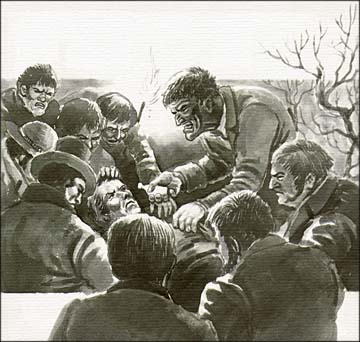
Note 2: A theory relying upon nitric acid as a chosen murder weapon must, of course, provide some reason for the assailants' choice of that highly unusual method of assassination, in lieu of the more immediately reliable knife to the throat, or bullet to the brain. If there truly were up to a dozen attackers interacting with a prone Smith (surrounded by up to fifty sympathetic onlookers), then the question must be asked, "Why was the supposed assassination never carried out according to plan?" Could it possibly be answered, that Dr. Richard A. Dennison alone was at first prepared to shoulder the burden of what amounted to a professional homocide, but was miraculously convinced, by a holy prophet's plea, to halt his crime in mid-act? If he were not acting alone, then certainly the group of hopeful murderers who chose to employ nitric acid as a lethal weapon (rather than as a destructive topical topical reagent), should have known enough to close off their victim's nasal breathing, so as to insure a proper opening of his mouth for a successful deadly administration. It appears that the only logical explanation for a failed "assassination" would be that the primary attacker decided to halt the execution, and his accomplices were not willing to take upon themselves an eternal responsibility for such a mortal sin. However, without accompanying proof, the murder-by-acid hypothesis is likely to remain just that -- one writer's reasoned opinion; but lacking sufficient evidence to be accepted by all, as definite fact. |
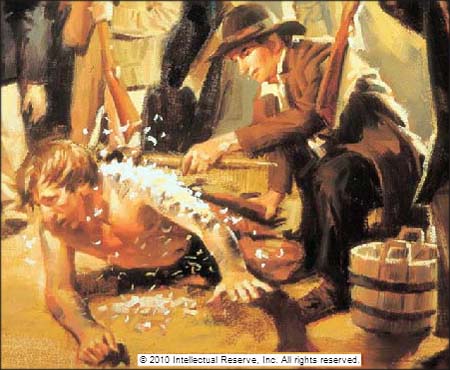
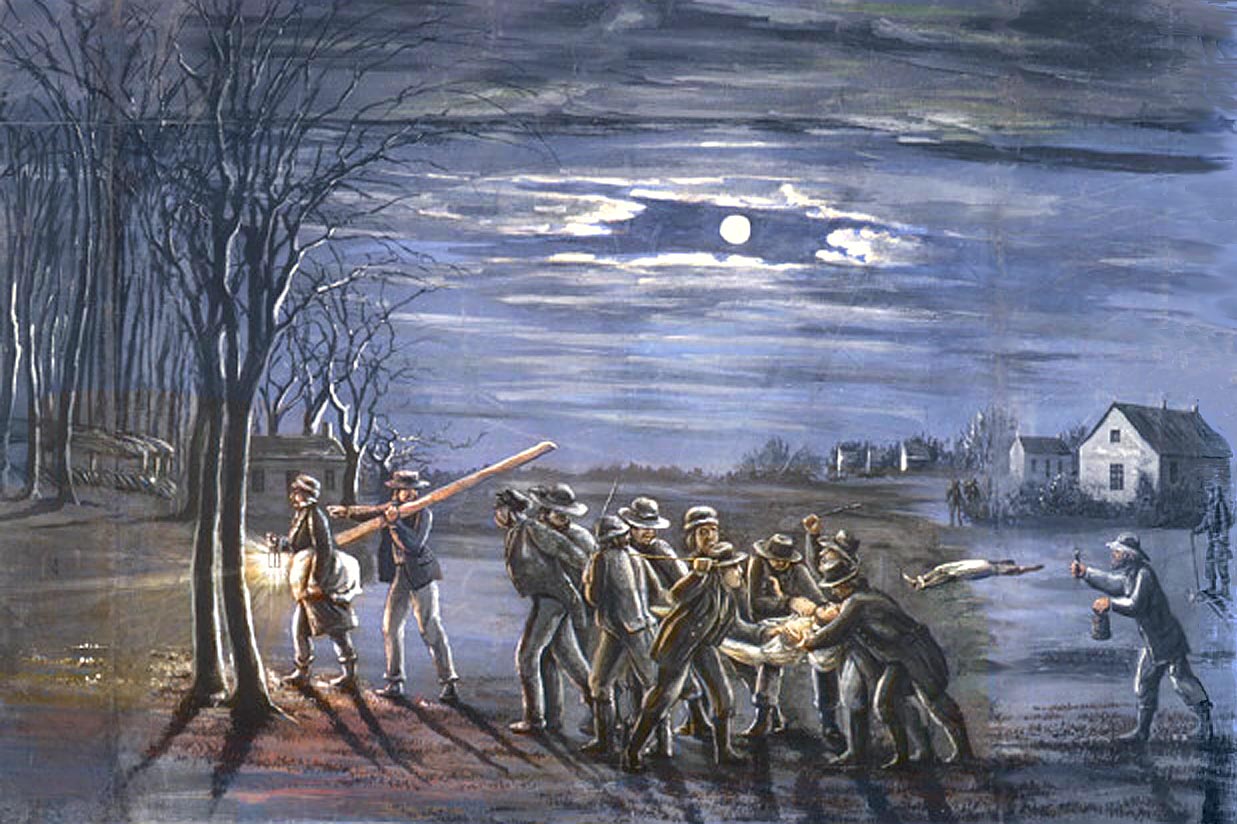
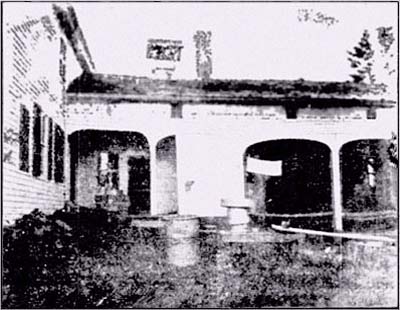
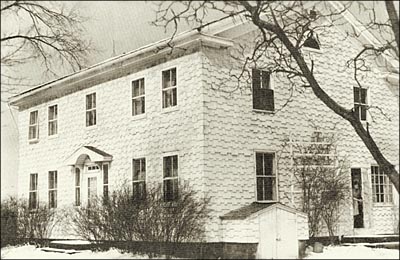

back to top of page
OPENING NEW HORIZONS IN MORMON HISTORY
SidneyRigdonDotCom Rigdon's Writings Rigdon Revealed
last revised Apr. 24, 2010