
Mormon Classics | Spalding Library | Bookshelf | Newspapers | History Vault
|
SIDNEY RIGDON
AMONG THE BAPTISTS HIS EARLY YEARS IN AND AROUND PITTSBURGH Part 1 Part 2 Part 3 |
|
1841 Samuel Williams text | 1886 Samuel Williams letter | 1913 1st Baptist Centenary
1925 1st Baptist Church Hist. | 1939 Hist. Pittsburgh Churches | 1948 Peters Cr. Church Hist.
1998 Peters Cr. Church Hist. | 1882 Washington Co. history | more Washington Co. histories
Rigdon Chronology (extracts) | Allegheny Co. Histories (extracts) | text files | Rigdon in OH
|
Reply to Lectures on Christian Baptism by Rev. Samuel Williams (Cincinnati: Moore & Anderson, 1853) |
|
|
iii
P R E F A C E
To the members of the First Baptist Church of Jesus Christ, of Pittsburgh. DEAR BRETHERN IN THE LORD: Fourteen years ago [May 1827]; I was called in the Providence of God, to the care of your souls. At that time you were few in number, feeble in resources, and like your brethren in the days of Paul, "a sect every where spoken against." Immediately after my connection with you in the pastoral relation, I was called upon to maintain the cause of truth against fearful forms of error. On various occasions, I have opposed through the press, the doctrine of Rantismal Salvation. A doctrine, while it mutilates the scheme of "salvation by grace," utterly sets aside the authority of Christ as Lawgiver in Zion, and wherever it prevails, entirely supercedes the ordinance of Christian Baptism. It also destroys the distinction God has made between the church and the world. Hence, in all countries where the Romish church is established, and in some Protestant provinces, all children are christened by Rantism, -- all of the inhabitants are members of the church, though they may be infidels in sentiment, and more degraded than heathen in morals; and consequently, pure primitive Christianity, both in spirit and form, is almost wholly unknown to them. With what ability I have opposed those errors, I leave you to judge. Of one thing I am certain, that is, that God has unequivocally given us the seal of his approbation, in the fact, that he has increased our number from twenty-seven, to more than four hundred, notwithstanding several churches have been organized of members dismissed from us for that purpose. While we continue to strive together for the faith and practice of the gospel in the strength of the Lord, let us also cultivate those graces which adorn the christian character -- at once the fruits of the Spirit, and a sure pledge of joys to come. Especially, iv would I exhirt you to pray with, and for your children, and instruct them in the knowledge of eternal truth, at home and in the Sabbath School. Not from the consideration that the Jews were circumcised, nor from that of vows made at the shrine of the Man of sin, do I thus exhort you, but from the consideration that they are yours by a Divine constitution, and because the Sporit has expressly commanded you to "Bring up your children in the nurture and admonition of the Lord."... For the author of the "Lectures" to which I reply, I have no other feelings than those of respect and kindness. No considerations, however, can justify the palliation of error, nor apologize for lack of zeal or courage in the maintenance of the "truth as it is in Jesus." To contribute something towards the victories which Christ will achieve over the kingdom of darkness, these pages were prepared, and are now presented to you in token of my affectionate regard for your welfare, accompanied with my fervent prayer, that in the cause of our Master you may prove "faithful even unto death." Respectfully, your Pastor, SAMUEL WILLIAMS. PITTSBURGH, May 1, 1841. Note 1: Elder Samuel Williams' Reply to Lectures on... Christian Baptism provides very little information on the Baptist congregation he was serving in Pittsburgh, but his 1841 Preface does give some indication of his circumstances a year before he published his next, more historically substantial volume, Mormonism Exposed. See the transciber's notes notes appended to that on-line text for more information on Elder Williams Note 2: A series of three letters written by Williams to James T. Cobb in 1878 provide some additional information regarding Sidney Rigdon, the Pittsburgh Baptist church, etc. |
|
Centenary of... Baptist Work in... Pittsburgh (Pittsburgh: Pitts. Baptist Assoc., 1913) Mormons Anti-Mission Baptists |
|
|
[ 56 ]
BAPTIST CONTROVERSIES OF THE
The Century from 1812 to 1912, inclusive, was probably one of the most controversial in the history of Christianity. Through your kindly invitation I am to speak on "The Baptist Controversies" of the last hundred years, a period which signalizes the organic life of the Baptists of Pittsburgh. I am not to speak on this topic controversially, but from the position of history and fact. This subject becomes a very timely one in connection with your Centennial Celebration, because some of these controversies had their beginning right here in this vicinity. It is not a waste of time if we recall, even briefly, these controversies. In some respects they are to be regretted, as they have engendered strife, divisions and some of the worst evils which threaten our country today. In other ways, they have been tributary to a better understanding of truth and of each other. They have illustrated human nature very forcefully, and have shown the great need of Divine Grace, the guidance of the Holy Spirit as well as good common sense and honesty of soul, in order to reach the truth in our religious faith and practice. I. THE CAMPBELLITE, OR DISCIPLE, CONTROVERSARY. It was on June 12, 1812, that Thomas and Alexander Campbell, father and son, of the Presbyterian Church, were immersed on profession of their faith in Christ, in Buffalo Creek, by Elder Luce, and received into the Brush Run Baptist Church. Gradually they came to entertain strenuous views on the subject of baptism, that regeneration is not complete until the[ 57 ] believer obeys Christ in the act of baptism, making baptism essential to the completeness of salvation. Because of these differences, the positive and unyielding character of Alexander Campbell and other causes, the chasm between the parties was broadened, leading up to the separation, after some of the most bitter discussions on either side. The Baptists, in all this region, at that time were hyper-Calvinistic, while our ministers as a rule were not up with Alexander Campbell, in culture and influence. Our churches suffered as a result and, by 1827, the real separation took place, spreading rapidly all over the country. It is not the object of this paper to enter into the discussions connected with and emanating from the establishment of this sister denomination. The differences are not so pronounced as in the earlier years of the century. A better understanding of the Scriptures and of each other, as well as a fuller indwelling of the Holy Spirit, are drawing us closer together, and, in some parts of our country, we are actually getting together. The Disciples, today, number a membership of one and a half millions. The Lord grant the day may soon come when they and we may be one, even as the Father and Christ are one. II. THE MORMON CONTROVERSY. There seems to be sufficient evidence extant to prove that Sidney Rigdon had as much to do in the preparation and palming off of what is now known as "The Book of Mormon" as any other man. He was once the pastor of the First Baptist Church of Pittsburgh. When a young man he was ordained as a Baptist minister. However, in the basis of his character, he lacked moral honesty and principle. He was a sharp and shrewd manipulator for the advancement of selfish ambitious. He soon manifested a flagrant[ 58 ] erroneousness of doctrine, preaching a baptismal regeneration, even more advanced than Alexander Campbell, and advocating a community of ownership in all things belonging to the members of the church, as well as other false dogmas. He was deposed from our ministry and excluded from our denomination. Getting hold of the document by Spaulding, entitled, "The Lost Manuscript," Rigdon conceived the idea of founding a new religion based on pretended revelations. He accordingly set to work to revise this manuscript and so adapt it to his purpose as to warrant its acceptance as the "Bible" of the new faith. Having some knowledge of the art of printing and stereotyping, and having access on the quiet to the Patterson Printing office in Pittsburgh, he was able to complete the collusion. Requiring some one more bold in the art of deception and sin, this excommunicated Baptist imposter repaired to Manchester, N. Y., where he found the desired co-operator, Joseph Smith. Gold plates of this Religious Novel were stereotyped. These were secreted away and then hunted for by the gross deceivers, who professed to have a revelation from heaven. When found they were called the "Golden Bible," or "The Book of Mormon." Thus, based upon this diabolical imposition, originating in the disordered brain of a once Baptist minister in our own Commonwealth of Pennsylvania, has been built up one of the darkest infamies that blackens the escutcheon and endangers the life of our Republic to-day. Mormonism is not, of course, the topic of our paper. In fact it is not a Christian religion, but in view of Sidney Rigdon's connection with it, it certainly has a place in the Baptist Controversies of the century. Said Dwight L. Moody, at the close of his meetings in Salt Lake City, "The Baptists are the only people [ 59 ] who can do anything with the Mormons." In view of this fact it might well become one of the controversies throughout this land in which the Baptists might well take an aggressive and enlightening part III. THE CHRISTIAN CONTROVERSY. With the beginning of the 19th century, the spirit of revival permeated our country. With the formation of the Republic, the separation of Church and State and the prevalence of Religious Liberty, there was a cutting loose from stereotyped creeds and a taking of the Bible as interpreted by all for themselves, as the personal standard of faith and practice. Hence in many parts of the country there were those who set up for themselves independent churches. The New Testament phrase, "The disciples were first called Christians at Antioch," furnished a very convenient Biblical title for these independent bodies to assume. With the progress of years these churches affiliated into an organization whose name was at first pronounced Christ-ians. They were strongly Arminian in doctrine and in some directions Arian, relative to the absolute Deity of Christ. They practise immersion but do not always make it a term of church membership. This movement was not quite so radical as that led by Alexander Campbell, and yet, in many particulars, in some places, there is a striking resemblance between them and the Disciples.Born during the last century, in many communities of our state, the controversy has waged between them and the so-called regulars, yet in reality, when you get right down to the rock bottom of their faith, practice and fellowship, they and the regulars are not so very far apart. In some places they are actually affiliating with us, and our churches are being merged together. After the controversies of the past century [ 60 ] it begins to look as if early in the present one there might be a coming together under the one motto of "one Lord, one faith and one baptism." Their membership at present is about 87,000. IV. FREE-WILL BAPTIST CONTROVERSY. In the great discussion between God's sovereignty and man's free agency, Calvinism and Arminianism, Free and Strict Communion, and, specially among Baptists, Gillism and Fullerism, as it was then called, this branch of the Baptist family had its origin. The term Freewill, was first given derisively from the outside, but soon it was the adopted name, and remained so until a few years ago, when the term "Will" was dropped and the name "Free Baptist" was assumed, but the Spirit of the Lord, education and missions have so far advanced that already the getting together under one banner has made wonderful progress. Identified with this body, as with all the other Baptist bodies of which I have spoken, or am to speak, are a host of noble men and women. As we have had opportunity of mingling with these and getting into their hearts as well as ntinds, all thoughts of the differences and controversies of former years have disappeared, and to my knowledge there has been an interchanging of letters among their churches and our own.Their first General Conference was held in 1827. In 1882 one of their great educational institutions sought a Regular Baptist as the head of the college, actuated by a desire that it might be a step toward the combination of the entire Baptist family. The proposal was not accepted because the party felt inadequate to the presidency, though he had no doubt that his duty was in the pastorate. The acidity of early controversies has passed away. A better understanding [ 61 ] of each other in faith and practice has brought us very near to each other. In fact in some places we are one to all intents and purposes. Free Baptists today number over 70,000, but the time seems to be ripe for a coalition with us without any loss to us but with great gain to them. V. THE DUNKARDS, OR UNITED BRETHREN, CONTROVERSY. In some parts these were called German Baptists. They practice Trine Immersion, Feet-Washing, Love-Feasts, the Kiss of Charity and insist upon the greatest simplicity in dress. While the elder people are resisting any innovation, a strong progressive element is seeking to minimize the peculiarities which have distinguished them. Their young people come into our churches and become much at home with us. The late Dr. George Groff, an honored professor of Bucknell University, was very anxious that a movement be made to get them and the regulars together. He was positive that a little overture, recognition and kindness on our part would meet with good results.Out of the controversies of the centuries have come light, a clearer knowledge of truth and a better apprehension on their real relation to those outside of their limited views. Their membership to-day is over 300,000. VI. THE CHURCH OF GOD, OR WINNEBRENNAMAN, CONTROVERSY. This denomination had its origin with John Winnebrenner in 1830, in and around Harrisburg, our State Capitol. Its people were called, in the early days, "Winnebrennarians," after the founder who was a German Reformed minister. They practice only the immersion of believers. They are very strong on the sufficiency of the Bible without note or interpretation by the commentators. Their members come into connection[ 62 ] with us and are at home in our churches. In many respects the creed of this denomination is the same as a Baptist Confession of Faith. In the early days of our Baptist efforts in Harrisburg, this denomination, which had a good start there and seemed in reality to be Baptistic, was one of the obstacles. Of this I have often heard Rev. David Williams, one of our pioneers in our work there, speak. This organization, the Church of God, has a membership of over 40,000, and I believe they would all make good regular Baptists. At least, that has been my experience with those whom I have known. VII. THE SEVENTH DAY BAPTIST CONTROVERSY. The churches of this order organized into Associations in 1835. They are distinguished from us mainly by their views on the Sabbath. They believe that the seventh day of the week, and not the first, ought to be observed as the Sabbath of the Lord. When, however, members of these churches move into communities where only the Regular Baptist Churches are to be found, letters from the Seventh Day bodies are granted to unite with those observing the first day of the week. In revival efforts, these churches and their ministers heartily unite in service with those who observe the first day of the week. Their type of thought relative to the seventh day is distinctly judaizing. We firmly believe that a little good Baptist controversy, full of the Christ spirit, would go a long way towards bringing them and us together upon a common platform. They have a membership in this country of about 9,000.VIII. THE MENNONITE CONTROVERSY. Mennonites agree with Baptists in rejecting Infant Baptism, but the large majority of them practice pouring as the act of baptism, though they will immerse if[ 63 ] it is insisted on. Menno Simon, their founder, was a decided Ana-Baptist, though probably not an out and out Baptist. They are not really Baptist, yet a little missionary work, prompted and carried on in the spirit of Christian love, would go a long way towards settling this matter and make us of one Lord, one faith and one baptism. When they do become Baptists, they make good ones. Some of them are really that now except in name. Their membership is about 55,000. IX. THE ANTI-MISSION CONTROVERSY. It was in 1814 that our American Baptist Foreign Missionary Society was organized in Philadelphia. At once there was a growing opposition to missionary societies as well as all kinds of human institutions, as they were called. Our people, many of them, were up in arms against these new departures. It was under these conditions that the Redstone Association, in this part of our state, organized in 1776, became an "Old School" body, absorbing into its membership the Baptist Churches hereabout, which were ultra Calvinistic in doctrine and against human agency in service. Their thought was that if God wanted the heathen converted He would do it without our aid.As a counteracting force to this anti-mission spirit, the Monongahela Association was organized as a missionary body in 1832. In this the churches, possessed of the missionary and, therefore, the true Gospel idea, formed congenial fellowship. Seven years afterward, in 1839, the Pittsburgh Association, embracing the churches of this city and vicinity, was organized. This body has always stood four square on the Big Four lines of all true Christian church work and worship, as represented in Bible School endeavor, missionary activity, prayer-meeting service and a preached Gospel. As to the contrast to-day between the "Old [ 64 ] School" position and that of our own obedient churches, comment is unnecessary. Today they call themselves Primitive Baptists and number, throughout the country, white and colored, about 137,000, priding themselves on that passage of Scripture which says "Fear not, little flock, it is your Father's good pleasure to give you the kingdom." X. THE ANTI-SUNDAY SCHOOL CONTROVERSY. It was in 1815 that the First Baptist Sunday School of Philadelphia was organized. Three Christian women conceived the idea of gathering the children on the Lord's day for Bible reading and religious instruction. One brother said to them, whose counsel they sought, "he did not like the idea of congregating children in a mass and exhibiting them on the Lord's day to be gazed at as paupers." At this day such advice seems to be astounding. These sisters, undaunted, then called on their pastor, Henry Holcombe, D. D. His reply to their proposal was, "Well, my sisters, you can but try it, blossoms are sweet and beautiful, even if they produce no fruit." After considerable effort they finally secured deacon Joseph Keen to open the school with prayer. He was the grandparent of our distinguished Wm. W. Keen, M. D., so noted in the medical world. What was true in the beginning of the school referred to could be duplicated in the opposition controversies awakened in the early years of the century past relative to Bible school work. Thank God for the glorious position of this work to-day.XI. THE EDUCATION CONTROVERSY. A hundred years ago in Pennsylvania, we had no regular denominational school for higher education and theological training. A pastor here and there, turned his study into a seminary to help some student[ 65 ] to a better equipment for the Christian ministry. There was discussion and controversy on the subject. This led to the establishment, recognition and help for schools elsewhere. Of the controversy relative to Staughton's Theological School, Haddington College and Germantown Collegiate Institution, all in Philadelphia, early in the century, I need not speak. The great need for an educated ministry became apparent. The help required to aid young men in their preparation for this work was in evidence. This led to the organization, in 1839, of on, Pennsylvania Baptist Education Society, whose grand work in all these years cannot be over-estimated. These all prepared the way for what is now Bucknell University, founded in 1846. Of the cntroversy connected with the discontinuance of the theological department at Lewisburg and the opening of the Croner Theological Seminary at Upland, as well as the discussions leading up to the founding of the other Baptist schools in our Commonwealth, I need not dwell upon it; but to-day these splendidly equipped plants represent a valuation of some four millions of dollars. At the beginning of your century of organized work our Baptist educational institutions numbered about five in the entire country, and they were all exceedingly small affairs. After all the education controversies of the century they number to-day about 200, with an equipment valued at over $100,000,000, and a student attendance of over 60,000. Surely we may well exclaim, through the Baptist education controversies of the century "What hath God wrought?" "This is the Lord's doings and it is marvelous in our eyes". XII. OUR BAPTIST STATE MISSION CONTROVERSY. Organically the date given to the beginning of our State Mission work is 1827, but in reality it is cotemporaneous[ 66 ] with your own Centennial. It even antedates your own organic life. In the Beaver Association there was an early movement for State Mission work. Even Sidney Rigdon and others were employed as missionaries of the "Philadelphia Baptist Domestic Mission Society" in the state of Ohio and along the western bounday of Pennsylvania in 1815 and in former years. The sacrifices and the controversies of those years were great. In 1880 a strong controversy was on, looking to the doing of City Mission work, as a department of the State work. This was a clear conviction of the then president, Rev. Richard H. Austin. He had been successful in business and was ready with a liberal hand for this line Of work. A new Secretary was chosen in fullest sympathy with this movement. Sacred pledges were given him in every prominent city of the state, that if he took up the work there would be this co-operation between these cities and the state. For reasons, which need not be given here he did not accept. Whether he made a mistake or not the Lord knows. With him there would have been unity throughout the Commonwealth on this question, but another one did accept, and at [once] city organizations, separate from the state, began their career. XIII. THE SLAVERY CONTROVERSY. Some may say, O, this was not a Baptist Controversy. O yes, it was. It got into our churches.In 1845 it resulted in the organization of the Southern Baptist Convention. In 1858 it was the moving cause leading up to the formation of the North Philadelphia Association in this state. The controversy in the Central Union Association had become so radical on the abolition question, that the more consemative element felt it was time to withdraw which they did... (pages 67-97 not transcribed) [ 98 ] ... Mr. Wood: -- Dr. A. J. Bonsall, Nestor of our Baptist pastors in Western Pennsylvania, will speak to us on the Baptist ministry in the Centenary. Dr. Bonsall: -- I do not like to read, but I have to read. I suppose you do not like to listen to reading quite so well, but you have a choice whether to listen or not.
THE BAPTIST MINISTRY IN THE CENTENARY.
[ 99 ] them as a peculiar people. The development of religious thought and the growth of ecclesiastical comity have blunted the edge of discussion and softened the asperities of sectarian intercourse. We of this territory cannot boast a monopoly of intellect and eloquence in our Baptist ministry, but we do claim a decent proportion of ability in our pulpits. The withdrawal of Alexander Campbell with a large following, on account of doctrinal differences, made it a serious struggle for our denomination here during a considerable period. War breeds warriors, and these controversies produced men of determination and polemical acuteness. This portion of our state has enjoyed the service and influence of many strong and earnest ministers. It would be a difficult task even to name all the men who have contributed to our history, and quite impossible to present biographical notices of them. Their names are written in the book of remembrance before the throne of God. All that I shall attempt to do is to recall to your attention some of those who labored faithfully and well within the bounds of the present Pittsburgh Association, and whose works do follow them. I am dividing them into groups, loosely and arbitrarily both as to the titles of the groups and their members. For I do not wish to recite a mere directory of names, of bare extracts from a cyclopedia. The first group is that of Pioneers. They explored and broke ground and sowed seed and also had their joy of a partial harvest. They did considerable fighting, too. They carried on a defensive and offensive war on pedobaptism all the time, and a part of the time they contended for their faith against foes of their own household, Of this early group the names that stand out most clearly are those of David Philips, James Estep, John [ 100 ] Winter, Samuel Williams and William Shadrach. To these men the denomination owes a large debt of gratitude. In the vanguard of our forces they marched with intrepid and unfaltering step. They left the impress of their personality upon the societies they gathered and formed. We are far from them in time, and, in many respects, in dogma; but it is to be hoped that we are closely related to them in spirit. David Philips came to America from Wales in 1758, He and three brothers received commissions in Washington's army. They raised a company and officered it. After the war of Independence, probably in 1780, he removed to Library, Pa. He served as judge of an election held in 1799. In the assessment roll for 1784 he is mentioned as "Preacher David Philips" to distinguish him from Colonel David Philips, another resident. He was ordained in May of the year 1781. He became the second pastor of the Peters Creek Church, and gave a lot for the erection of a church building. He discharged his pastoral duties until 1824 when he became disqualified by age, He died of paralysis in 1829. Mr. Philips rendered valuable service to the state at the time of the "whiskey insurrection." Although always a prominent citizen he accepted no political honors. His remains were laid in the burying ground of the Peters Creek Church. Dr. James Estep's name was a household word inmy boyhood's home. I learned to reverence it with that of Adoniram Judson. James Estep was baptized into the fellowship of the Mt. Moriah Church in April, 1802. He pursued the study of medicine foreighteen months, when a sermon preached by the Rev. Morgan J. Rhees, at that time prothronotory of Somerset County, led him to reflection as to his true vocation. In a few days he was preaching. His life was [ 101 ] spent in Southwestern Pennsylvania, and as an instructive teacher, judicious counsellor, and helpful friend he was widely known and as widely loved. His was a gracious spirit, and in the controversies of the early part of the nineteenth century he rendered invaluable service to the Baptist cause by his equipoise and sagacious leadership. To explain the frequent reference in this part of our history to violent and bitter controversies I must introduce as in a parenthesis a man of different temper, though of no less fidelity to his convictions, -- William Brownfield, who became pastor of the Great Bethel Baptist Chuch, Uniontown, Pa., in 1812. Although he does not appear within the geographical boundary I have prescribed for myself, his attitude and conduct helped to produce effects felt very keenly not only here and at the time, but over a vast extent, and still tremendously potent. Though without college training, Brownfield was a diligent student, acquainted with Hebrew, Greek and other languages, well versed in church history, and a migbty debater. There had been much doctrinal strife with Alexander Campbell on account of his interpretations of the Scriptures. The climax came at a meeting of the Redstone Association in the old Redstone Church in 1826. There was a large crowd both inside and outside the building. Many were lending a voice to the discussion, but Brownfield and Campbell were the principal disputants. "Finally," says O. J. Sturgis, in his Historical Sketch of the Great Bethel Church, "Alexander Campbell picked up his hat and walking out of the chach announced that he was going to preach outside. He went down a little way, mounted a stump and began to preach. He soon had a great crowd around him. He proclaimed his views without interruption and soon after ceased his connection with [ 102 ] the Baptists. Dr. James Estep, a venerable father in the Redstone Association, writing his recollection of it in 1856, said, 'From the idea I had of Mr. Campbell, if he had been approached in kindness and Christian affection he would have been induced to modify if not to abandon that sentiment, but he was treated by some of the leading members of the Association in a most impulsive and forbidding manner. Hence the legend in almost every old Baptist family in western Pennsylvania: 'If Alexander Campbell had been treated kindly he never would have separated from the Baptists.' Dr. Estep here plainly refers to William Brownfield, with whom he himself has had many a tilt. But probably the best defense that can be made for Brother Brownfield at this day in answer to Dr. Estep's indictment is that he had no patience with what he regarded as heresy." Mr. Brownfield opposed the organization of the Home and Foreign Missionary Societies as unscriptural and unbaptistic. There were stormy scenes in the Association. This doughty defender of the faith that was in him died at the ripe age of eighty-six years. Another champion of Baptist principles was John Winter. He was bom in England in 1794, and settled in this city in 1822. Here he taught school and preached. He became pastor of the First Baptist Church at a most trying time of disruption and odium caused by the promulgation of erratic opinions by Sidney Rigdon, a former pastor, and who afterwards became an active leader and organize, of the Mormon movement. Dr. Winter's advocacy of pure Baptist doctrine, and his efficient direction of affairs were of great value in the crisis. He had several pastorate in western Pennsylvania and Ohio, and was everywhere a resolute upholder of Andrew Fuller's theology, which he maintained to he the best expression of Baptist truth. [ 103 ] At a much later date he again made his home in Pittsburgh. He supplied for a time the Penn Avenue Church, afterwards called the Shady Avenue Church, and was chosen the first editor of "The Baptist Witness," a religious weekly that lived a few years and was absorbed by "The National Baptist." Samuel Willians was an outstanding man in his day. He was born in Connellsville in 1802, and was ordained in Somerset Co. He becae pastor of the First Church, Pittsburgh, in 1827, when the membership numbered forty-two, and the situation was far from promising. He continued in this relation for twenty-eight years, during which six other churches were organized. He removed in 1856 to Akron, Ohio, where he remained eight years, and then went to Springfield. He returned to western Pennsylvania later. With voice and pen he took his share in the controversies of those fighting days. For some years there was a Baptist church edifice in Pittsburgh, erected as a memorial to Dr. William Shadrach. It is a pity there is not a permanent memorial to keep his memory green among us, for be was a man of the Spirit and of power. He was born in Wales in 1804 and came to this country when fifteen years of age. He received ordination in 1828, and became pastor of the Mt. Pleasant Church. He served with signal success Loyalbanna, Peters Creek, and Sandusky Street, Allegheny. From Sandusky Street, he went to Philadelphia. He was one of the founders of the University at Lewisburg. For three years he was Agent of the Pennsylvania State Convention, and later Corresponding Secretary of the American Baptist Publication Society. In preaching ability and in all the intellectual qualifications of the minister he was the peer of his most gifted contemporaries in our denomination, Cone, Ide, Stow, etc. In personality and character [ 104 ] he was equally distinguished. His public prayers were remarkable, His manner of absolute reverence was itself sufficient to impress and solemnize the hearer, and the petitions were models of simplicity and directness. It is written of Dr. Shadrach, "If fidelity to truth, earnest convictions, impassioned eloquence and active zeal through half a century entitle a clergyman to peculiar prominence among his brethren, such prominence must be awarded this veteran minister." If the scope permitted ygelf had been broader it would have been imperative to dwell on the names of Jesse Thomas and Benjamin H. Thomas who in succession served the Reidsburg and Clarion Churches for a period of seventy years, and who were among the most useful and influential ministers of our denomination in the state. They are buried together behind the pulpit of the Reidsburg Church. The second group I designate the Epigones or successors. A quarter of a centuy had seen the number of churches increased, and of course the number of pastors also. The Baptists had their place established. In December, 1856, David J. Yerkes, "the mountain orator," a preacher of e.ceptional homiletical and retorical talent became the pastor of the First Church, and remained four years when he went to Brooklyn, N. Y. He was succeeded by George D. Chase, and Mr. Chase by James S. Dickerson, who came from Wilmington, Delaware. His pastorate covered five fruitful years. He is remembered for his attractiveness as a preacher, and even more tenderly for his charming personality. He went from this city to Boston, Mass. The Sandusky Street Church, organized in 1835, was served, after Dr. Shadrach, by John E. Thomas, who baptized a large number; by N. G. Collins, during whose pastorate a new church edifice W2S erected, and by several others among them Isaac Sawyer who in after... [ 105 ] (pages 105-145 not transcribed)
[ 146 ]
On the tenth day of November, 1773 (nearly 140
[ 147 ]
From the place of its founding it was, after a time, moved to a point on Peters Creek, near what is now Gastonville. How long it remained at either of these places the present writer has no means of knowing. Late in the last, or early in the present century, the church was moved to what is now Library, Allegheny, Co., Pa. On the first of September, 1780, David Philips was received "into full communion by letter," but where from doth not appear. The same day he was elected, with two others, as a "messenger" to the association, and was also made a deacon. In November, 1780, he was "nominated to act as an elder in the church upon trial." On the 7th of April, 1781, he was "called to the ministry of the church at Peters Creek." He was "ordained May the 1st, of the same year," "at the request of the same church." The Rev. William Wood and the Rev. William Taylor assisted, Mr. Wood preaching the sermon from I Cor. 2; 4th and 5th verses. In April, 1802, he baptized James Estep. These isolated facts are gleaned from memoranda found by the writer among old papers, now in the possession of Brother Jasper Philips and Dr. W. T. Philips, who are his direct descendants, except the baptism referred to, which was found in a pamphlet published by Mr. Estep in 1854, at which time the church celebrated his fiftieth year in the ministry. Among matters of interest found in the old papers referred to is the fact that during the first ten years of
[ 148 ]
Whiskey was in those days a commodity in which the pastor dealt quite extensively, the price being about fifty cents per gallon. On one consignment there was a lamentable wasteage of seven gallons when it was "drawed from the hogshead." In another "it fell short six and a half gallons." Thus it will be seen that even in those days the pastor did not always get his due. That word can be spelled either "due" Or "dew." Elder Philips was a man who had opinions, and was not afraid to express them. In 1828 the Court of Common Pleas of Washington County appointed a commission of three persons to interview the pastor and "find out whether you are non compos mentis." The finding of this commission is not recorded so far as the writer knows, but judging from some of his writings he seemed to be sane enough. At any rate he had sense enough to measure the whiskey he purchased and to discover that some of that which he supposed he had purchased was non est. The records of the church seem to have been imperfectly kept, many of them being entirely lost. The history written by Isaac King, and read 25 years ago, cannot be found. In fact, only in recent years does there seem to have been any kept of a tangible character. This is a lamentable fact and should warn the present history making generation that they ought not to live for themselves alone. The following pastors have served the church, so far as can be discerned, since the times of Elder David Philips: J. Estep, 1839 to 1856; D. Williams, 1859 to 1863; G. Seymour, 1864 to 1865; J. M. Collins, 1866 to 1867;
[ 149 ]
This fragmentary synopsis is not written with the idea that it is an exhaustive history of the church. The pastor has in mind the preparation of a more elaborate record, but the sources of information are so few and far between that he almost despairs of ever completing the task, so that it would be worthy to occupy a place in the archives of the denomination. November 10th, 1898, (at which time the one hundred and twenty-fifth anniversary of the church was observed, the day being very wet and unpleasant.)...
[ 150 ]
(pages 150-213 not transcribed)
[ 214 ]
REV. J. F. MILLER. -- Photographs of Bentleysville and North Ten Mile Baptist church edifices, Program of the 125th Anniversary of the North Ten Mile church, held in 1898, the latter two being loaned by A. H. Bigler, of Bentleysville. MRS. A. H. MERCER. -- Photographs of prominent ministers of a generation ago. REV. A. B. BOWSER. -- Bow and arrows, and a "beheading knife," missioary trophies from Central Africa. MRS. BERLIN. -- Pictures of Morton school, Moulmein, Burma, and of Miss Whitehead, missionary from Pittsburgh. J. S. HUTSON, D. D. -- Photograph of William Codville, D. D., J. S. Wrightnour, D. D., Rev. C. F. Ralston and himself [ 215 ] REV. A. M. GREGG. -- A picture of the John Corbley family burying place in Whiteley cemetery, Greme County, Pa., showing the graves of the members of the Corbley family who were immsacred by Indians. F. J. RUBBECK. -- Files of the Baptist Expositor, charts, etc. REV. J. V. STRATTON. -- Pictures of Rev. David Chandler, missionary to China; A. P. Graves, D. D., a successful evangelist of forty years ago; Jacob Reese, a prominent layman; Mr. and Mrs. Williai Reese, two founders of the Sharpsburgh Church, and others. REV. H. C. GLEISS. -- Album of Rochester Seminary class of 1893, and a large number of photographs illustrating our missionary Work among the foreign speaking peoples of Pittsburgh and vicinity. JOHN A. BROWN. -- A copy of Benedict's History of the Baptist Denomination, dated 1848. MISS AUGUSTA STEWART. -- Pictures of the industrial classes of foreign children, in the Forty-sixth Street Church. REV. M. B. SLOAN. -- A large photograph of Rev. A. K. Bell, D. D., and photograph of Mr. Sloan, taken in his captain's uniform, during the Civil War. GEO. F. MCEWAN. -- Old Song books of 1841. Miss MINNIE EATON. -- Picture of Mrs. Leonard H. Eaton. MISS LILLIAN SAWYER. -- Picture of Italian girls class, etc. MRS. AMALIE PAULINEY. Class picture showing the beginning of foreign work in Rankin by Miss Lyde Jenkins. [ 216 ] REV. A. J. BONSALL. -- Pictures of Rev. John Winter, Rev. David Williams, et. al., and file of the Baptist Witness. MRS. J. L. JONES. -- File of Sunday-school papers from the First church school, 1860, bound by Anna R. Jack. PROF. EMIL HANKE. -- Mounted pictures of the buildings of the Western Pa. Classical and Scientific Institute, Mt. Pleasant, Pa. and of Dr. Bell, the first president. J. L. MCCASKEY, -- A miniature "Microcosm", illustrating "Industrial Conditions." The above list does not contain many of the smaller articles which were of considerable interest to folks in the locality from which they came, but were not of general interest or importance. Many of the articles have been donated for the permanent Exhibit which will be arranged in the near future and will be carefully preserved in a fire-proof room. It is hoped that many other articles of historic value will be added to this collection. |
|
The First Baptist Church of Pittsburgh (Pittsburgh: Baptist Church, 1925) |
|
|
THE FIRST BAPTIST CHURCH OF PITTSBURGH 
PITTSBURGH, PENNSYLVANIA A. D. MDCCCCXXV |
|
THE FIRST BAPTIST CHURCH OF PITTSBURGH _____ Historical
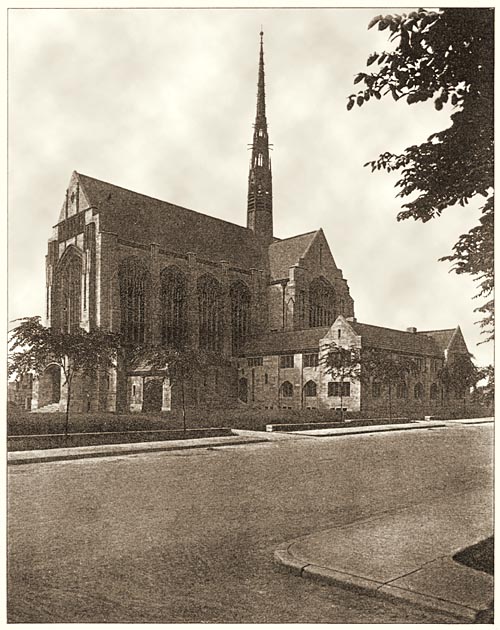
THE FIRST BAPTIST CHURCH OF PITTSBURGH FROM BAYARD STREET 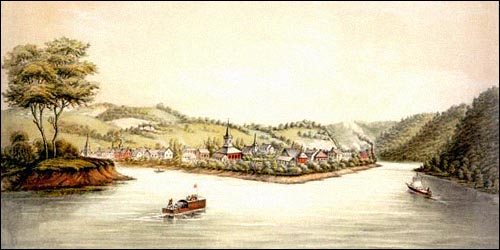
PITTSBURGH IN 1817 Five years after the First Baptist Church was organized. This view is from the Ohio River looking toward the Point with the Allegheny River on the left and the Monongahela on the right. The columns of smoke are probably "Mr. Page's glass-house" at the foot of Grant Street. (By the courtesy of the Historical Society of Western Pennsylvania.) THE FIRST BAPTIST CHURCH OF PITTSBURGH FROM ITS FOUNDATION TO THE BUILDING OF THE NEW CHURCH THE first Baptist Church in Pittsburgh was organized in 1812, probably in the month of April. At that time the town, with less than five thousand inhabitants, and about eight hundred houses, lay in the level tract between Wood Street and the Point, with dwellings and farms higher up along the banks of the Allegheny and Monongahela rivers. Some of the landscape features were Quarry, Grant's and Biyd's Hills, with woods and fields, also four ponds where wild ducks abounded. The streets were dark at night and only a few were paved. Stage-coaches and freight wagons furnished transportation to Philadelphia and Baltimore. The first steamboat made its first trip to New Orleans early in 1811. The First Baptist Church of Pittsburgh began with twelve members, 4 THE FIRST BAPTIST CHURCH OF PITTSBURGH including the first pastor, Edmon Jones, who came from England and was aicensed preacher, and also a glass worker, supporting himself like the apostle Paul by his trade; Richard James, from England, who was also a charter member in 1822; a family named Ensell, probably Edward Ensell, Sr., and Edward Ensell, Jr., glass-blowers living in "Birmingham," i.e., on the south side of the Monongahela River, and probably also the "Encell" of "Trevor & Encell, Glass Warehouse, Water between Market & Wood, as given in the Pittsburgh Directory of 1815; a family named Bruner, or Brenner, from England; William H. Hart and wife from Rhode Island (he was one of the Trustees in 1822, and was for a long time deacon of the church, and toll collector of the Smithfield Street bridge across the Monongahela River); a Mr. Green and his wife from one of the New England States. The pastor and the Ensells, and probably one or more of the other members, worked in "Mr. (Benjamin) Page's flint glass factory," the first of its kind in America. Edward Ensell, Sr., is supposed to have brought the knowledge of the flint glass business from England. In 1887 there were two daughters of Edward Ensell living. The First Church was organized by the ministerial delegates from the Redstone Baptist Association, David Phillips, Henry Spears and James Fry. The list of pastors for the first one hundred years, as carved on the vestibule wall of the present church building, is shown in the illustration on the next page. These names are a veritable roll of men of apostolic type. The one exception is Sidney Rigdon, who in a very brief pastorate almost wrecked the church, and was excluded from its membership and deposed from the Baptist ministry. He afterwards became one of the founders of Mormonism, and he is understood to have stolen Solomon Spaulding's manuscript which became the "Book of Mormon." HISTORICAL 5 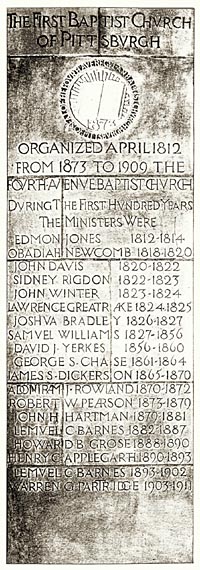
The First Baptist Church of Pittsburgh from 1812 to
1820 met from house to house. The earliest public places of meeting were a "hall-shop" (i.e., a hall over a
shop) on old Fifth Avenue, and a similar room on Second Avenue, said to have been a school-room over a harness shop.
In 1819, during Mr. Newcomb's pastorate, the church conducted a bible school. The first meeting house owned by the
church was at the corner of Third Avenue and Grant Street, on a leased lot. The building was a one-story frame about
thirty by forty feet. This was built in 1820 during the ministry of John Davis, who came from England and was of repute
as an "evangelist," and who baptized sixty-two persons, beinging the membership to one hundred six. While this meeting
house was building the church met in the home of deacon John P. Skelton on the south side of the Monongahela.
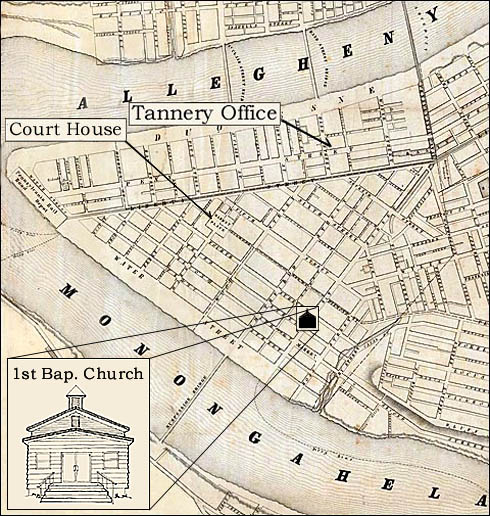
Early map showing location of First Baptist Church on NE corner of 3rd and Grant streets 6 THE FIRST BAPTIST CHURCH OF PITTSBURGH The charter members were as follows:
The first trustees were: James Morford, Zebeon Packard, Benjamin Pyatt, John Robinson, William H. Hart, John P. Skelton, William Sarvey. The membership of the church at this time was approximately one hundred. Washington McEwen, who was baptized in the Allegheny River by pastor John Davis in the year 1819, and who had been deacon, choir leader and bible school superintendent, was present in 1887 at the seventy-fifth anniversary of the church. Zebeon Packard was the first clerk of the Pittsburgh Baptist Association when it was organized in 1839; his widow, who was a member in 1822, was living in the year 1887. Descendants of charter members are to-day to be found in Pittsburgh and vicinity, most of whom are members of the First Church or of other Baptist churches. During the next pastorate, short and diastrous, of Rigdon, the rental HISTORICAL 7 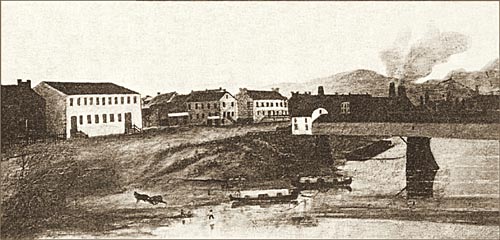
THE SMITHFIELD STREET BRIDGE ABOUT THE YEAR 1825 enlargement From 1812 to 1858 the Monongahela "from the bridge to the glass house" was the church's place of baptism Beginning at the left, the buildings are the home of William Wilkins, the old woolen mill (where the Monongahela House now stands), Irwin's tavern, the Anderson mansion, the Bakewell and Page glass-house, where the first pastor and others of the early members of the church worked. on the lot was unpaid and the building was lost to the church. When Samuel Williams began his long pastorate in 1827 the membership was only forty-two. In a little over a year he succeeded in buying the lot and building with it for one thousand dollars, of which one-half was borrowed "from the bank." In 1833 this little frame building was replaced on the same site by a two-story brick structure costing four thousand dollars. As long ago as 1841, anti-slavery meetings were held in this building which was destroyed in "The Great Fire" of 1845, but in less than two years thereafter, under the indomitable leadership of Samuel Williams, a larger brick building of two stories was completed at a cost of eight thousand dollars. From the organization of the church in 1812 until 1858, a period of forty-six years, the Monongahela River had been the place of baptism. Samuel Williams, in his letter of reminiscences, written in 1886, thirty years after the close of his long pastorate, says: "Between the glass factory and the bridge was our Jordan. I think in nearly every rod from one to the other I have buried candidates 8 THE FIRST BAPTIST CHURCH OF PITTSBURGH 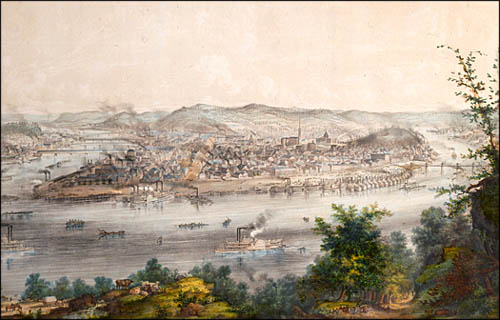
PITTSBURGH IN 1849 From a lithograph, made four years after the great fire when the second meeting house of the First Baptist Church was burned, and two years after a third house was built at the corner of Grant and Third. The court house (burned in 1882), with dome and pillars, was at Grant and Fifth. The First Church building cannot be clearly distibguished, but probably is a small two-story building to the right of a larger building just below the right hand part of the court house. HISTORICAL 9 in the likeness of My Saviour's burial and resurrection." In 1858 a baptistry was installed in the building. There are still with us a few persons who were baptized in this baptistry.... * (remainder of text not transcribed) __________ * 1886 Samuel Williams letter preserved in the Carnegie Library of Pittsburgh: 188 Tompkins Av Brooklyn NY Aug 16th [18]86 Dear Br[others] You almost ask for my memoir. On Page 617 of Benedict's H[ostory] there is a very brief account of the origin of the lst [Baptist Church], but the month is not mentioned. In his older history or in Allen's Register the exact date perhaps might be found. The loss of the old church book was careless and reckless on the part of the Treasurer. As I stated before Edward Jones was their first Pastor who came with several members from Eng who were glass blowers, working in the first flint factory built on the spot occupied now by [the railroad] Depot at the foot of the St. between which and the Bridge was our Jordan. I think on nearly every rod from one to the other, I have buried candidates in the likeness of my Saviour's burial and resurrection. I think the [church] was formed in the month of April. Mr. Jones served them two years, Mr. Newcombe from New Eng[land] about the same time Samuel Davis (not John) was with them 4 or 5 years and many were added to the [church], but he drank liquor and sunk out of sight and died not long afterwards. Several of the ministers of the Redstone Association were present at the constitution. The Pastor, Richard James, a family of Enseleys, and one named Bruner were from Birmingham Eng. Some of these were connected with a window glass factory on the other side of the River and they called the little village after the town in Eng[land] from which they came. Some H. Hart was from Rhode Island, and a Mr. Green from some other part of Eng[land]. These are the constituent members. Along in [eighteen] twenty one, two, and three Sidney Riqdon who was a member at Peters Creek; occasionally preached for them, they called him, he embraced Campbelism first, then his common stock system as he called [it], and getting hold of a "Manuscript Novel" written by Spalding, he garbled it and interspersed passages of scripture so as to make it appear like a revelation favoring his communism. Shortly before this Robert Owen, Fanny Wright, and two or three French Infidels had been lecturing through this country, and no doubt, he indulged the conceit that he could form a community under the guise of Christianity and enrich himself and his fellow elders at the same time. When I came on the [scene] I wrote an Exposure of his rascalities, but I do not know where you could see a copy, except in the [hand?] of Mr. Patterson, one of the editors of the Pres[byterian] paper. A Mr Greatrake supplied the church about five or six months, then Rev. Joshua Bradley from Albany became Pastor, remaining only one year, baptised a few and gathered back a few who had gone with Rigdon or an associate [[Scott]] of the troubles at that time. Then I was called, but did not accept until two or three months. I was 25 and in one year married one of the members, a young widow of my age, who died at 40 and in another year, having one small daughter, married a Methodist lady and gave her the New Testament to study and in about another year baptized her in the river at her request presented to the [church] without my knowledge until the meeting, who is still living with our two children and two grandchildren, through abounding mercy a happy family. When studying at an Academy at Zanesville, [Ohio] I was converted under the preaching of Geo. C. Sedwick who had been a student of Dr. Staughton's of Phila[delphia] and soon after began to speak in public. He put Gill's Divinity and Mosheim's [Church History] in my hands, directing my studies for two years. By too close application, I came near death with typhoid fever. When partially recovered our Dr deacon sent me off to Bedford Springs, PA. I soon began to improve and a [Presbyterian] Church there had lately lost their Pastor and urged me to preach for them, where I received the first little salary for 18 months. Passing through Pittsburgh I preached for them on Wednesday evening, and in a few weeks received their call. Very shortly after I accepted, the Presbyterian Theo[logical] Sem[inary] was organized, and I asked the Professors and Trustees if they would not allow me to enjoy the privileges of the Sem[onary]. They gave me a cordial invitation to do so. The first class numbered about one dozen, only to or three are not living, one died in India. Dr. [Sawyer] the Secretary] of their For[eign] Board in NY was one of them. I kept along with the class and filled my Pulpit. The old church book would show that from about three months after I began to preach there was a baptism every ordinance day for eight years, never more than eight and, often not more than one at a time. The most satisfactory part of the church's history. We had several quite large additions after evangelists came about, but there was always trouble of some sort would arise. I think 36 was the largest number I baptised at one time. The Lot was originally taken on ground rent and when Rigdon came to them, the rent was not paid and it fell back in to the hands of the proprietor with the one storyed house the church had built. After I had been there about fifteen months I bought the property for $1000 in cash. We raised the hall and borrowed the other half for one year. We used that house until 1833 when we built a plain good brick for $4000. This was burned in the great fire 1845 Then I raised money, paying $1100 of my own, to build that house for $8000. We had on hand some insurance money from the old house. The brick only cost $30 per 1000 lumber $6 but several of our brethren thought the house was not as good as it ought to be. They were becoming wealthy and wanted a finer house. I was well pleased with the one the Lord had given us, and on this account they were not pleased with me. The[y] made all the trouble they could, but had I only understood their wishes better I would have left them at first. No one could be better pleased than I to see them spend thousands to build a better house of worship that I had built for them. At length I received a pressing call from Akron, [Ohio], where I remained eight years, but sickness moved us to Springfield, [Ohio] where we were eight years. Having some little property at, or near Pittsburg, we concluded to end our days in a pleasant country home. But our children leaving us and settling in New York, we concluded to follow them, so we are here. I still preach occasionally in City and country pulpits, On the 5th inst the children celebrated my 84 birthday on Glen island, a most delightful resort. In regard to my literary work I may say that I have been forced to write almost everything I have written by stress of circumstances. First Campbelism had to be combatted next Mormonism exposed. Then, simultaneously, the paidobaptist ministers in West Pa and [Ohio] attacked our view of baptism. Millerism came next. Slavery was a huge evil to be fought as a chief work of the devil which Christ was manifested to destroy. I started the 'Christian Witness" on Jan 16th 1836, which did good service. A number of tracts, and a great many articles for newspapers, on temperance and many other matters, but I have but a few copies of only a few of the things I have written. I wish you could have seen my review of Moxom's great discourse published in the Standard of Chicago. We have now the strongest hold of Satan to contend with and christians more reluctant to attack it than to combat any other sin. on election day they seem to think they have no moral responsibility to be on the Lord's side. I would be glad to give you more full and satisfactory answers to some of [y]our questions, but I have done the best I could. I am glad to see that the church you serve is doing her share in the great work of giving the gospel to the world. May the lord prosper and bless your labors there. S. Williams |
|
History of Churches of Pittsburgh Baptist Assoc. by William R. Pankey (Phiiladephia: Judson Press, 1939) |
|
Entire contents copyright © 1939, William R. Pankey
(only limited, "fair use" excerpts are reproduced here)
|
[ vii ]
"RESOLVED, that the Rev. Dr. John Winter be requested to write the history of the Baptists of western Pennsylvania, and to have the same published in the 'National Baptist,' or in some other permanent form." No trace of such a publication has been found, and we therefore conclude that this noble resolution went the way of the majority of resolutions. The most outstanding layman who was zealous in collecting and preserving historical data was the late Francis J. Rebbeck. He served for thirty-two years as Cleark and Assistant Clerk of the Pittsburgh Association. Two historical sketches of the churches were published by him in the Association Annuals of 1889 and 1899. A volume entitled, Centenary of Organized Bpatist Work in and about Pittsburgh, was published by the Pittsburgh Association in 1913. This, however, is not a historical narrative, but merely a compilation [ viii ] of the addresses delivered at the centennial meetings of the First Baptist Church, Pittsburgh, January 30, 31, 1913. At the annual meeting of the Pittsburgh Association, June 3, 4, 1837, a resolution was adopted authorizing the Reverend William R. Pankey and Mr. Lewis C. Walkinshaw to write and publish a complete history of the churches of the Association, the task to be completed prior to the centennial celebration in June of 1939. By mutual consent it was agreed that the first section of the book should deal with the general movement and settlement of Baptists in western Pennsylvania, and the second with the histories of the individual Baptist churches in the Pittsburgh Association. Mr. Walkinshaw accepted the responsibility for the first part, while I was given the responsibility for writing the second section. In the meantime, the sudden and untimely death of Mr. Walkinshaw has made it impossible for his unfinished manuscript to be included in this volume. This is a decided loss. However, it is hoped that the seventy-two historical sketches of the churches contained herein, together with the brief introductory chapter, may be found useful and interesting to all lovers of Baptist history. [ ix ] (pages ix-xii not transcribed due to copyright restrictions) [ xiii ]
BAPTIST BEGINNINGS IN WESTERN
Traders from the East soon followed the Indians across the mountains. In quick succession these trails became highways for the pioneering settlers, and the marching military forces that followed. As the military establishments became stronger, affording more protection to these early settlers, the religious foundations were gradually laid. No substantial religious establishments were attempted until 1768, when the Penns made their purchase of [ xiv ] the area west of Laurel Hill and south of the purchase line between Cherry Tree, and Kittanning. Prior to that date, western Pennsylvania was the scene of bloody combats between the Indians, the English and the French soldiers. In the parlance of historical genealogy, the Pittsburgh Baptist Association is the great-great-grand-daughter of the Philadelphia Baptist Association. The Baptist Associations formed in the were in the following order: Philadelphia (Pennsylvania), 1707; Charlston (South Carolina), 1751; Sandy Creek (North Carolina), 1758; Kehukee, [ xv ] (North Carolina), 1765; Ketoctin (Virginia), 1766; Warren (Connecticut), 1767; Stonington, (Connecticut), 1772; Redstone (Pennsylvania), 1776; Shaftsbury (New York, Massachusetts, Vermont), 1781; New York, 1791; Baltimore, 1792. The Charleston Association became the progenitor of the Associations to the southward, except Ketoctin. The Ketoctin, Warren and New York Associations were forned from the Philadelphia Baptist Association. The Minutes of the Philadelphia Association for 1764 have the following entry: "Concluded to receive the Church at Ketoctin, and the church of Opekon, in Virginia, into flic fellowship with this Association." The Ketoctin Baptist Association was formed in 1766, pursuant to the following action taken by the Philadelphia Baptist Association "Agreed that the Churches in Virginia have our leave to form themselves into an Association, provided [ xvi ] they go on the same plan, and hold union with us." In addition to the Ketoctin Church, Mill Creek Church, Smith's Creek Church and Broad Run Church became constituent members of the Ketoctin Association. By the year 1809, this Association reported thirty-six churches and two thousand members. About the year 1768 there came into the Redstone country, from New Jersey, the Reverend Henry Crosley (Crosbye) and the Reverend Isaac Sutton. With the assistance of others, these New Jersey preachers organized, in 1770, the Great Bethel Baptist Church, at Beesontown, now Uniontown. This is the oldest church west of the Allegheny Mountains. The main stream of Baptist life in western Pennsylvania flowed down the Monongahela valley from Virginia. In subsequent years other Baptist streams flowed from the mountaintop at old Beulah, near Ebensburg, and still others from western New York. All of these streams had their source at Philadelphia. A few years prior to 1770, there began a general movement of pioneer Virginians into the Redstone country. Numbered among these pioneers was the Reverend John Corbly. His missionary activities resulted in the organization of the Goshen, the North [ xvii ] Ten Mile and the Peters Creek Baptist Churches, in 1773. The Turkey Foot Baptist Church was organized in 1775, and many others followed in quick succession. The Redstone Baptist Association was organized October 7, 1776, with the following six cgurches as constitutent members: Great Bethel, Goshen, North Ten Mile, Peters Creek, Pine Run and Turkey Foot. At the annual meeting of the Redstone Baptist Association, August 31, 1832, Forks of the Yough Church (Salem), Turkey Foot Church (Confluence), and Loyalhanna Church (Saltsburg), were dismissed to form the Monongahela Baptist Association, with the National Turnpike as the boundary line, but with the privilege of any church on either side of that line to change its Association affiliation whenever it was deemed desirable. The Pittsburgh Baptist Association was organized in 1839, by a group of churches withdrawing from [ xviii ] the Monongahela Baptist Association for that specific purpose. Included among the charter churches constituting the Pittsburgh Association were, Great Bethel, Peters Creek, and all the then existing churches in the city of Pittsburgh. Today there are seventy-four churches in the Pittsburgh Association, with a total membership of approximately twenty thousand. [ 1 ]
HISTORICAL SKETCHES OF THE CHURCHES
[ 2 ] [blank] [ 3 ]
PETERS CREEK BAPTIST CHURCH
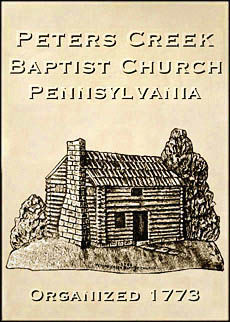
In 1780, David Phillips came from Chester county, where he had been a member of the Grear Valley Baptist Church. He purchased the farm where the Peter's Creek Church is now located, calling it "Nonevah." The organization was at first called "the church upon Peters creek." According to records in the Washington County Court House, "the trustees of Peters Creek Baptist church purchased a building site of John Cox, the transfer being made September 10, 1788." This Cox farm was near the present town of Gastonville. [ 4 ] The records of Washington Ciunty assert that "Rev. David Phillips was called to preach in April 1781, and was ordained the following May, and from that date he preached at Elizabethtown, Gastonville, and Budd's Ferry on the Youghiogheny River, until 1793." Shortly after 1794 the Gastonville and Elizabethtown churches were united in the calling of a pastor, but there is no record of what became of the "Church on the Youghiogheny." In 1797, a part of the lot, now the site of the Peters Creek church, was purchased. The first [ 5 ] edifice was a log chapel, which was replaced in 1832 by a brick edifice, at a cost of twelve hundred and fifty dollars. The theological controversy agitated by Alexander Campbell, following 1825, did much to weaken and divide the congregation. The centennial anniversary of the church was observed November 10, 1873. The third church edifice was erected in 1884, and has been used continuously by the congregation -- until the corner-stone of the present new edifice was laid, in 1938. The following members of the church have entered the Christian ministry: Charles Rigdon, John Rigdon, James Estep, Henry Wade, Joshua Phillips, J. W. Higbee, Sidney Rigdon, Frank Cramer, Frank King, John Erbe, John Lauderbaugh, Kimber Boyer, and Philip B. Boyer. In 1866 Miss Zillah Bunn was baptized in this church, later serving for twenty-five years as a missionary in India. The first Woman's Missionary Society was organized in the church August 11, 1878; it has had a continuous existence to date. Two of the early Sunday school superintendents were William McNary and Isaac King. Among the early deacons were Joseph Phillips, Joseph Higbee, Charles Dailey, Ephriam Estep, Isaac King, William Benson, John King, Joseph Phillips, Jr., John Maits, John Mairs, Jr., Samuel Heath, Peter Boyer, Samuel Boyer, Edward Riggs, and Isaac Phillips. The Peter's Creek church now seems to be on the [ 6 ] verge of another membership boom, due to the increasing number of families moving into the community. The present membership is 155. The following ministers have served the church: Rev. John Whitaker (1775-1780), Rev. David Phillips (1780-1824), Rev. Charles Wheeler (1824), Rev. John Winter (1825), Rev. Joshua Bradley (1826-1827), Rev. Alexander Campbell (1827-1828), Rev. William Shadrach (1829-1835), Rev. William Penny (1836-1837), Rev. Benoni Allen (1837-1838), Rev. James Estep (1838-1857)... (remainder of text through page 9 not transcribed due to copyright restrictions) [ 10 ]
FIRST BAPTIST CHURCH
For the first eight years of its existence the First Church met "from house to house." A Sundat school was started in 1819. The first meeting-house was a wooden chapel, erected in 1820, and located [ 11 ] on the corner of Third Avenue and Grant Street. Services were conducted in the home of Deacon John P. Skelton, on the south side of the Moningahela, while the edifice was in process of construction. The First Church was chartered in 1822, with the following charter members: Sidney Rigdon, James Morford, Benjamin Pyatt, William H. Hart, Zebeon Packard, John Robinson, John P. Skelton, A. Sinclair, John Morford, Thomas Parel, Francis Johnson, William Trimble, John White, Robert Douglas, John Curry, M. Evans, Mark Stackhouse, Robert Warnock, Alfred Lloyd, Washington McEwen [sic - McErwen?], James J. Carpenter, Caleb Lee, Eliot S. Neal, Thomas C. Lee, Robert Shepard, Silas Wickes, Richard James, John Hurrell, John Alexander, Jesse Dewees and Frederick Wendt. In 1833 the original wooden chapel was replaced by a two-story brick edifice costing four thousand dollars. This building was destroyed by fire in 1845. The third edifice was erected on the same site in 1846, at a cost of eight thousand dollars. From 1812 to 1858 the Monongahela River was the place of baptism. In his letter of reminiscences, written in 1886, the Rev. Samuel Williams says: "Between the glass factory and the bridge was our Jordan. I think in nearly every rod from one to the other I have buried candidates in the likeness of my Saviour's burial and resurrection. [ 12 ] The first baptistry was installed in the church in 1858. In 1865 the church building and lot were sold for ten thousand dollars. A new lot was purchased on the corner of Fourth Avenue and Grant Street, on which a cliapel was erected (in 1867), at a cost of forty thousand dollars. In 1876 the main church edifice, fronting on Ross Street, was dedicated. On March 3, 1873, the Fourth Avenue Baptist Church was constituted by the merger of the First and the Union Baptist Church. The spiritual and numerical strength of the congregation increased rapidly. Among some of the outstanding features of the life of the Fourth Avenue Church were an industrial school; outdoor meetings on the street corners; a city missionary and visiting nurse; a fresh air vacation caiiip for children; a school of housekeeping; the toy mission, begun in 1894; a Chinese Bible school; a Vacation Bible school, and the department for the deaf. On September 25, 1909, the Fourth Avenue Baptist Church became by charter the First Baptist Church of Pittsburgh. During the same year the church property was sold to the Commissioners of Allegheny County, for five hundred and sixty thansand dollars. farewell services were held in the church March 6, 1910. A temporary meeting-plaee was rented on Neville Street until the new edifice was constructed at the corner of Bellefield Avenue [ 13 ] and Bayard Street. The new Gothic edifice was dedicated April 28, 1912, one hundred vears after the organization of the church. On April 1, 1929, the Oakland Baptist Church merged ivith the First, and its pastor, the Rev. Lester W. Bumpus, became the associate pastor of the enlarged First. The Oakland church had been organized in 1890. The present membership is 1,136. The following ministers have served the church: Rev. Edmon Jones (1812-1814), Rev. Obadiah Newcomb (1818-1820), Rev. John Davis (1820-1822), Rev. Sidney Rigdon (1822-1823) Rev. John Winter (1823-1824), Rev. Lawrence Greatrake (1824-1825), Rev. Joshua Bradley (1826-1827), Rev. Samuel Williams (1827-1856), Rev. David J. Yerkes (1856-1860), Rev. George S. Chaise (1861-1864), Rev. James S. Dickerson (1865-1870), Rev. Adoniram J. Rowland (1870-1872), Rev. Robert W. Pearson (1873-1879), Rev. John H. Hartman (1879-1881), Rev. Lemuel Call Barnes (1882-1887), Rev. Howard B. Grose, (1888-1890), Rev. Henry C. Applegarth (1890-1893), Rev. Lemuel Call Barnes (1893-1902), Rev. Warren G. Partridge (1903- 1911), Rev. Frederic Tower Galpin (1912-1921), Rev. Carl Wallace Petty (1922-1932), Rev. Bernard C. Clausen (1933- ). The following ministers have been associate pastors: Rev. IV. W. West, Rev. David Boswell, Rev. Theodore Miller and Rev. Lester W. Bumpus. [ 14 ]
FIRST BAPTIST CHURCH
From 1815 to 1834 [sic], the church was a member of the Redstone [sic - and Washington?] Baptist Association. From 1835 to 1857, it was affiliated with the Monongahela Baptist Association. Since 1858 it has been a member of the Pittsburgh Association. In 1902 the First Baptist Church dismissed fifty-six members by letter to form the Broad Street Baptist Church, Washington. Again, in 1903, twenty-three more members were dismissed to form the Allison Avenue Baptist Church, Washington. In [ 15 ] 1904 a missionary chapel was dedicated at Dea Caminos, Cuba, as a memorial to Rev. Stephen Drummond. Later in the same year a second chapel was built at Jiguani, Cuba. The following ministers have served the church: Rev. Charles Wheeler (1814-1838), Rev. B. Davis (1839), Rev. R. Billings (1841-1842), Rev. C. T. Johnson (1842-1843), Rev. J. B. W. Tisdale (1843-1846), Rev. H. Halping (1846), Rev. Thomas Swaim [sic - Swain?] (1846-1850), Rev. George W. Young (1850-1854), Rev. Malachi Taylor (1855-1858), Rev. John Boyd (1858-1859), Rev. H. Adams, Rev. R. Telford (1866-1868), Rev. J. A. Snodgrasss (1871-1874), Rev. Malnor C. Blaine (1875-1878), Rev. I. C. Tuttle (1879-1882), Rev. John Brooks (1884), Rev. Stephen Drummond (1884-1888), Rev. Alexander McArthur (1888-1890), Rev. W. S. Wedemeyer (1890-1891), Rev. Stephen Drummond (1892-1902), Rev. Charles W. Fletcher (1902 1912), Rev. M. A. Graybiel (1912-1916), Rev. F. B. Taber (1917-1930), Rev. William M. Kennedy (1931- ). The present membership is 796. [ 16 ] (pages 16-23 not transcribed due to copyright restrictions) [ 24 ]
CHATHAM STREET WELSH BAPTIST CHURCH
The property of the church has been acquired within recent years by the First Pittsburgh Church, and is to be held perpetually for religious use. The First Church likewise sustains the Chatham Street Welsh Baptist Church financially. The following have been the ministers: Rev. William Owens (1834-1874), Rev. Rhoslyn Davies (1874-1894), Rev. R. C. Morgan (1895-1915). The, present pastor is Rev. Griff Thomas. [ 25 ]
SANDUSKY STREET BAPTIST CHURCH
[ 26 ] Avenue, and with fifteen constituent members who had been dismissed by letter from the First Baptist Church. The original corporate name of the organization was "The First Baptist Church of Allegheny," and it wts locited on Robinson Street. The first edifice was a wooden chapel, erected in 1835. John Wright was the first deacon, the first clerk, the first treasurer, the first chorister and the first Sunday school superintendent! The second church edifice was, erected in 1844, and was located on Sandusky Street. By 1865 all building debts had been paid. In 1857 the church withdrew from the Monongahela Baptist Association and became a member of the Pittsburgh Association. In 1867 the congregation helped orgnize the Nixon Street Baptist Church. In 1871, another mission Sunday school was organized on Howard Street. The third and present church edifice, was dedicated, November 19, 1893. In 1907 the charter name of the church was changed to "The Sandusky Street Baptist Church." Ministers who have gone out from the church include, Rev. J. Smith Gillespie, Rev. B. F. Woodburn, Rev. M. B. Sloan, Rev. J. A. Snodgrass, Rev. Aaron Wilson, Rev. T. H. Chapman and Rev. Henry Gellart. Others who have gone into Christian service include, Miss Zillah A. Bunn and Miss Agnes Whitehead. The following ministers have served the church: [ 27 ] Rev. William Shadrach (1835-1838), Rev. John E. Thomas (1838-1842), Rev. N. G. Collins (1843-1845), Rev. H. Silliman (1845-1846), Rev. Joseph Walker (1847-1849), Rev. Joseph B. Breed (1849-1850), Rev. J. R. Downer (l850-1853), Rev. T. R. Taylor (1853-1857), Rev. Isaac Sawyer (1858-1859), Rev. A. K. Bell (1859-1870), Rev. B. F. Woodburn (1870-1905), Rev. A. J. Bonsall (1906-1925), Rev. Joseph R. Allen (1925-1930), Rev. Charles S. Dayton (1930-1937), Rev. Edwin L. Kautz (1937- ). The present membership is 407. The assistant pastors include Rev. Joseph N. Williams (1900-1901), Rev. William W. Barker (1902-1903), Rev. A. J. Bonsall (1904-1906), Rev. Clarles E. Stanton (1921-1925). [ 28 ] (remainder of text not transcribed due to copyright restrictions) |
|
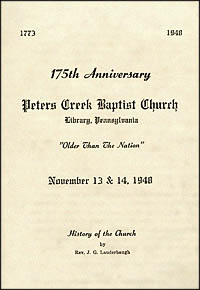
175th Anniversary Peters Cr. Baptist Church by J. G. Lauderbaugh (Peters Creek Baptist Church, Library, PA, 1948) Anti Mission Controversy Campbellite Controversy Mormonism Controversy |
|
Entire contents copyright © 1948, Peters Creek Baptist Church
(only limited, "fair use" excerpts are reproduced here)
|
[ 10 ]
Previous to that event in American history which is known as the French and Indian War the people living east of the Allegheny Mountains had comparatively little knowledge of that vast expanse of territory west of the mountains in the valley of the Ohio River and its tributaries. Some intrepid explorers had penetrated deep into that wilderness but any reports they made received but little publicity owing to the lack of facilities for publicising such reports. For a quarter of a century hardy traders had been crossing the mountains with their trade goods on packhorses to barter with the Indians but they seem to have said little about the country. However, certain events leading up to and during the French and Indian War were destined to bring a comparatively small section of that territory into general knowledge, a section nonv comprising for the most part five counties in the southwest corner of Pennsylvania: Fayette, Westmoreland, Allegheny, Washington and Greene Counties. When that little hand of forty Virginians, sent out by the Ohio Company to erect a "fortified trading-store" at "the forks of the Ohio River," were driven off by the French and returned to their homes, and when three or four hundred Virginia militia-men were forced to return to Virginia after the battle at Fort Necessity they brought word of excellent, well-watered land west of the mountains that would be desirable for settlement. With General Braddock's ill-fated expedition were a number of soldiers from Virginia and Maryland together with one hundred and fifty wagoners from Virginia and from the eastern portion of Pennsylvania. These all confirmed earlier reports of desirable land for settlement when and if the French were driven out. Some of these troops and wagoners were anxious to return when conditions became favorable. The first settler in what is now Jefferson Township in Allegheny County was Zadock Wright, one of Braddock's wagoners. [ 11 ] Another cause of unrest among the people of Virginia was religious persecution. The Episcopal church was the established or State Church in Virginia. All dissenters were treated harshly. They were arrested and fined for not attending the services of the Episcopal churches. While all dissenters were persecuted, the Baptists were the objects of the bitterest persecution. Not only were Baptists arrested and fined but their pastors were imprisoned for "preaching the Gospel contrary to law." Many Baptists wished to get away from this persecution. They were the type of Baptists who could not be shaken from their denominational loyalty by fines and imprisonments. Rather than give up these loyalties they would face the hardships of pioneering in the wilderness and the chance of being scalped by the Indians. Christians of that type will soon organize churches whei-ever they go. That is just what they did in the southwest corner of Pennsylvania. When the French were driven out of the Ohio valley and Fort Pitt was elected at the junction of the Monongahela and Allegheny rivers and Fort Burd at what is now Brownsville; and when the Mason and Dixon line was surveyed and sufficiedtly marked that they could tell when they had crossed from the jurisdiction of the Virginia government these pioneers began their trek over the mountains by the old Braddock road, past the ruins of Fort Necessity and down into the fertile lands of the Monongahela watershed. Immediately at the river the land was too hilly to be desirable so these pioneers built their cabins on the creeks: Redstone Creek, Muddy Creek, Tenmile Creek, Peters Creek, Georges Creek, Simpson Creek, Jacobs Creek, Pigeon Creek, Pattersons Creek and many others. Nearly all of these creeks were destined to give names to Baptist churches. In that day there were no towns, villages or even cross roads to lend names for churches. A creek designated a district and the name of the creek was appropriated as a name for a church in that district. In that day of wilderness isolation any one living even a score of miles away was a neighbor and contacts were established between neighbors. These Baptist pioneers soon found one another. All that was needed was leaders to get their together and organized into churches. Rev. Henry Crosbye (Croslye), a Baptist preacher from New Jersey who was affiliated with the Philadelphia Baptist Association, came into the Redstone district and organized the Great Bethel Baptist Church at what is now known as Uniontown on November 7, 1770. Then Rev. John Whitaker came into the Peters Creek district. Rev. John Corbley, after his release from the Culpepper jail in Virginia, where he was imprisoned for "Preaching the Gospel contrary to law," went to Mill Creej in what is now West Virginia and from there to the Muddy Creek district in Pennsylvania. There he organized the Goshen Church in November 1773. In that same month the Peters Creek and Ten Mile Creek Churches were organized. In rapid succession a numbers of other churches were organized. In those churches there were Baptists from Maryland and New Jersey but they were far outnumbered by Baptists from Virginia. On Wednesday, Nov. 10, 1773, nine persons, six men and three women, namely, Rev. John Whitaker, Thomas Applegate, Isam Barnet, Henry Lemons, Peter Elrod, Christopher Miller, Mary Whitaker, Margaret Garret and Ailsey Lemons met and organized a Baptist [ 12 ] (this page not transcribed due to copyright restrictions) [ 13 ] (this page not transcribed due to copyright restrictions) [ 14 ] (this page not transcribed due to copyright restrictions) [ 15 ] (this page not transcribed due to copyright restrictions) [ 16 ] fifty years, the walls began to give way under the weight. During the pastorate of Rev. James S Williams, a young man of remarkable energy and qualities of leadership, it was decided to begin the construction of a new church building. It was a time of industrial depression and many men were out of employment or were employed only part time. Many of them were skilled workmen and they volunteered their services, when not otherwise employed, to erect the building themselves. Rev. Williams donned overalls and worked with the volunteers. It was a splendid exhibition of cooperation. The first unit of the building has been completed and has been in use for some time. The funds for completing the work are being secured and it is confidently expected ere long the congregation will be adequately housed again. [ 17 ]
PART III.
It does not appear that Rev. Whitaker fled from the Indians when they raided this district in 1774, or if he did, it was probably only to cross to the cast side of the Monongahela River where the settlers were not molested. He would be near to give comfort and aid to any families where some of the members had been murdered by the Indians. In 1774 settlers were not venturing into the district, but the next year some who had fled were returning and new families were coming in. Rev. Whitaker's work would consist of establishing contacts with these folks and interesting them in the church. With the church covenant is found a notation that in 1775 the church met at five places for Communion service, "Laurel Hill, Corse, The Church at The Forks of the Youghiogheny River, Muddy Creek and Tenmile." This does not mean that the church had members in all these places but that Rev. Whitaker, and possibly one of his deacons, visited these places and held Communion services for the Baptist brethren who were living there, and to promote the organization of churches. On a map of the district under date of 1775 the [ 18 ] (this page not transcribed due to copyright restrictions) [ 19 ] (this page not transcribed due to copyright restrictions) [ 20 ] mountain immediately east of places now called Smithfield and Fairchance is named Laurel flill. Baptists from Virginia had settled there. Course may have been in the same district of The Youghiogheny Rivei," was the name sometimes applied to %vhat is now called Confluence, at the junction of the Youghiogheny and Castlemans Rivers with another stream, and also known as Turkey Foot. A Baptist church was organized in 1775 and reported to the Redstone Association the next year as the Turkey Foot Church. Rev. Whitaker's visit there was evidently connected with the organization of that church. Tenmile was the church where the pastor had to flee from the lndians in 1774, and that probably accounts for Rev. Whitaker's presence there for a Communion service in 1775. The order in which the places are named indicates that this missionary tour began on Peters Creek and extended through the Uniontown district to Confluence and back by way of Muddy Creek and Tenmile Creek. Rev. Whitaker evidently made a number of these missionary tours through the district, contacting the new families that were moving in and bringing the ministrations of the church to them when by reason of the distance they could not attend any church service. The covenant, signed when the church was organized, differs in wording and in the order of the articles from others in use at that time and evidently was the work of Rev. Whitaker. It indicates he had considerable education and was a clear thinker. He was soundly and sanely orthodox. Rev. Whitaker closed his work as pastor at some date in 1780 and went to Kentucky to engage in work there among Baptists from Virginia coming into that district. At a meeting of the Redstone Association in October, 1780, the Yough Church reported but there is no mention of Rev. Whitaker. After this date no church reports under the name Yough. In October, 1781, a church named Peters Creek reports for the first time and the membership is 45, evidently the combined membership of both branches. The messengers were Rev. William Taylor and David Philips, but the title "Rev." is not attached to David Phillips' name. This indicates that Rev. Taylor served for a brief time as pastor or as pulpit supply. At this point we may digress to note that there is evidence that for a number of years there was friction and disagreement in the Redstone Association. At some time during this friction the Peters Creek Church either withdrew from the Association or was expelled. Other churches withdrew. At the meeting in 1794 only five churches reported to the Association. The minutes of a number of years are missing and some Minutes recorded without date. This confusion renders it impossible to get information about the church in this period. In 1797 conditions evidently improved with 17 churches reporting and in 1800 there were reports from 18 churches but no report from Peters Creek. In 1801 Peters Creek was represented by David Philips, Henry Hulse, and Charles Daily and there is this significant entry in the minutes, "The minister and messengers from Peters Creek make application for admission to the Association." Another statement is, "One brother, Charles Smith, preaching to a crowd outside while [ 21 ] business goes on inside." That may indicate that the friction was still on. Returning to the Peters Creek Church history we note from the Washington County Court Records that in 1783 a petition was presented to the Court by the Peters Creek Church, requesting that a road be constructed from McKee's Ferry to the Peters Creek meeting house. McKee's Ferry was located at what is now called McKeesport and ran between that town and the west bank of the Monongahela River. This road would extend from a point opposite McKeesport to the Peters Creek meeting house on the property of [Robert] Estep Peters Creek. The petition was granted and the road built. This road would enable members of the church living at the junction of the Monongahela and Youghiogheny Rivers to travel to church with greater ease and shows that distance did not greatly hinder church attendance when distances were great and travel mostly on foot. Deacon Isaac King in his Centennial history of the church relates that an ancient subscription list, at that time in possession of Mr. E. T. Townsend reads as follows, "We, the under-subscribers, do promise to pay, or cause to be paid, the sums annexed to our names for the use of Rev. David Philips for his labor in the Gospel, and that on or before the first day of March insuing. Witness our hands this second day of May, 1789." The amounts subscribed are in pounds, shillings and pence. This list is interesting as indicating a group of interested and probably influential members of the church at that time. The list is William Philips, Lemual Sayer, Joseph Philips, Samuel Foster, John Masters, Peter Sharp, Richard Masters, Daniel Townsend, Peter Rowletter, Abraham Whitaker, Thomas Rigdon, William Rigdon, and John Mallory. The date of this subscription list, 1789, is the year after the purchase of the building lot from John and Mary Cox at Gastonville and about the time of the occupation of a new house of worship on that lot. A new and better place of worship stimulated new financial interest and liberality. As this was at the time the Peters Creek Church was not making any reports to the Association and evidently not a member of the Association we are unable to get any detailed information about membership and other matters of church interest. Deacon Isaac King, citing church records of two business meetings of the congregation in November and December, 1793 and an adjourned meeting January 1, 1794, quotes as follows, "After solemn prayer to Almighty God to direct their choice of a pastor, they unanimously chose David Philips, their former supply, as pastor. And on the same day after an address on The Reciprocal Duties of a pastor and His Church, he accepted the charge of the church." Mr. King adds, "At this period it appears from the record the church owned two houses of worship, one at Elizabeth and another near what is now Finleyville." Mr. King's statement indicates that up to this time Rev. David Philips was the stated supply of the pulpit and at this time became the regular pastor. He further indicates that this call was to be pastor of both branches of the church and that Rev. Philips conducted services in the meeting house at Elizabeth and the other on Peters Creek. At times he also conducted services at Budd's Ferry on the Youghiogheny River. This is the ferry formerly operated by one [ 22 ] of the constituent members of the church, Peter Elrod. Some Baptists lived at that point. In that day travel was not in a comfortable automobile over paved roads, but on horseback over bad roads and woods trails. Rev. Philips covered many miles of uncomfortable travel in all kinds of weather to meet his preaching appointments and carry on his pastoral work. He would marvel today if he could see the automobiles parked on a Sunday morning at the Peters Creek Church. The Anti-Missionary, Anti-Sunday School controversy was the first of three great theological controversies that made trouble for the churches of the district. In the Redstone Baptist Association there were some brethren who held extreme Calvinistic views of the theological doctrine of election. If God had elected any of the heathen or anyone else to be saved, He would save them Himself. This is a lazy and cheap type of theology; just let the Lord do the work and pay the bills. Rev. Philips took no stock in such views and he instructed his congregation in correct views. When the American Baptist Missionary Society was organized in 1815 to care for Adoniram Judson, the missionary, when he arrived in Burma and had become a Baptist, the Peters Creek Church entered into the missionary effort with zeal. The women of the Church organized a Women's Mite Society and in 1817 their offerings for missions surpassed the offerings of all the rest of the Church. The Church has never ceased to be missionary in spirit and has born its full share in all missionary work both on the foreign and the home fields. Following close on this first controversy was another, the Campbellite Controversy. Alexander Campbell, a Presbyterian clergyman, came to Washington County about the year 1800. He was a man of marked loyalty to his convictions and opinions and withal had his full share of the Scotch-Irishman's pugnacity. He was out of harmony with Presbyterian teaching and practice and this soon resulted in friction with his Presbyterian brethren. Refusing to adjust his views, to the accepted tenets, of the Presbyterians, he withdrew from that denomination and founded an independent church with doctrines and practices somewhat like the Baptists, but holding views about Baptismal Regeneration and some other tenets alien to Baptists. After two or three years, and perhaps after solicitation by some Baptists, he and his independent church applied to the Redstone Baptist Association for affiliation as a Baptist church. Mr. Campbell and his church were received. This gave him entree to many Baptist churches where he never failed to use the opportunity to expound his theological views. Some Baptist churches were thus thrown into confusion. Among them the Peters Creek Church. However, the Church was fortunate to have as pastor at that time, Rev. David Philips, a man of mature judgment, wide experience, judicial mind and withal quiet firmness. While the Church lost some members who followed Mr. Campbell in the new denomination he founded, Rev. Philips piloted the Church safely through the storm. Though the storm was not yet fully past when he relinquished the pastorate, the influence of his wise leadership kept the Church on an even keel through the rest of the storm. The third theological controversy, Mormonism, tied on closely to the previous one. but it produced less disturbance. Sidney Rigdon, a member of the Peters Creek Church, is alleged to have been Joseph Smith's "Angel" or revealer of the golden plates from which the [ 23 ] Book of Mormon purports to have been compiled, the plates in fact being a manuscript that was purloined from a printing office in Pittsburgh where Rigdon was employed. Anyone seeking additional information on this subject will find it in a pamphlet by Rev. William A. Stanton, D.D., the subject being, "Three Great Theological Controversies." By reason of the infirmities of age, Rev. Philips resigned the pastorate in 1824, though he preached occasionally thereafter. His death occurred in 1829. He was regarded as the outstanding preacher of the district, loved and respected by all who knew him. His pastorate was the longest in the history of the church. A remnant of the theological storm continued in the period from 1824 to early 1829 and for that reason the Church did not call a regular pastor but was served by pulpit supplies. There were three of these, Revs. Charles Wheeler, John Winter, and Joshua Bradley. This was a wise move, for it gave the Church an opportunity to move slowly and exercise care in the search for a successor to Rev. Philips. While there is no evidence in support of the view, the writer is of the opinion this prudent course resulted from the wise advice of Rev. Philips. In March, 1829, Rev. William A. Shadrack was called as pastor. He was a young man with full academic and theological training and had just been ordained at Saltsburg, Pa. This was his first pastorate. He proved to be a preacher of exceptional ability, a clear thinker and a man possessed of talent for leadership. This leadership was demonstrated in the way he handled the theological controversy. At a business meeting of the congregation in August, 1829, the Church at the pastor's suggestion adopted the "Philadelphia Confession of Faith" as the basis of belief and practice by the Church. Dissenters either conformed to this Confession of Faith or found some other group that was more congenial to their views. The six years of Rev. Shadrack's pastorate was one of the prosperous periods in the history of the Church. The old Church building was inadequate and in 1832 a new meeting house of brick construction was erected. This building was located near the north line of the cemetery. At that time labor and materials were cheap; a comfortable and attractive house of worship was erected for the modest sum of twelve hundred and fifty dollars. Later Rev. Shadrack became Field Agent for the new University at Lewisburg, Pa., now known as Bucknell University. In recognition of his meritorious work and scholarship the University conferred on Rev. Shadrack the honorary degree of Doctor of Divinity. For many years he was an outstanding man in the Baptist denomination. When a church has had for several years as its pastor a man of unusual abilities both as a preacher and as a leader, difficulty is experienced in finding a satisfactory successor. That seems to have been the condition after the pastorate of Rev. Shadrack. In the next three years the Church was served by two pastors, Rev. William Penny and Rev. Benoni Allen. Late in 1838 or early in 1839, Dr. James Estep was called as pastor and served in that capacity for eighteen years, a pastorate second in length of years only to that of Rev. David Philips. Dr. Estep was ordained at the Pigeon Creek Church in October or November of 1805. (the remainder of this text not transcribed due to copyright restrictions) |
|
The History of Peters Cr. Baptist Church by Alan Ciechanowski (Peters Creek Baptist Church, Library, PA, 1998) Anti Mission Debate Campbellite Controversy Mormonism Controversy |
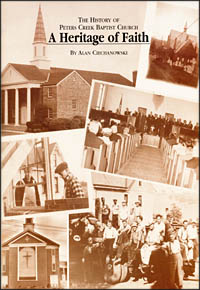
|
Entire contents copyright © 1998, Peters Creek Baptist Church
(only limited, "fair use" excerpts are reproduced here)
|
[ 1 ]
By wisdom a house is built, and through understanding it is established, -- through knowledge its rooms are filled with rare and beautiful treasures. -- Proverbs 24:3-4 With these words, handwritten into an ordinary register book in 1773, what would become the Peters Creek Baptist Church was founded and established. It was a brave and courageous step of faith in what were certainly troubled times. As Settlers and Indians battled and fought in the area all around them, nine people, faithful to the Lord and His Word, began a voyage of faith and fellowship that has so far lasted through more than two centuries, and God willing, will endure through many more. In order to more fully understand the times, it will be necessary to look further backward somewhat to the time of the French and Indian War, which began in 1754 and would last a tumultuous five years. Before this time, most settlers had been living east of the Allegheny mountains and had very little knowledge of the lands to the west, among them the areas of Southwestern Pennsylvania. It wasn't until 1755, when General Braddock made his doomed expedition to Fort Duquesne, that the soldiers and civilians accompanying him got their first glimpse of the land that they later described as well-watered, fertile, and favorable for settlement. In order to make a settlement there, however, the French had to be driven out of the area, and on this particular mission that would not happen. The French and Indians, using the dense forest for cover, laid in wait for General Braddock's forces, and fell on them before they even reached Fort Duquesne, defeating them and ultimately driving them back to the lands of Maryland and Virginia from which they came. At that time, the peoples of Virginia were undergoing what amounted to religious persecution. The Episcopal church was the established, or what was called State Church, in the area, and all those who held differing beliefs were ostracized, even up to imprisonment and fining if they did not attend the services of the Episcopal church. Among those most bitterly persecuted were the Baptists, whose pastors were punished by imprisonment and torture for "preaching the Gospel contrary to law." Many Baptists, [ 2 ] wanting to flee this religious persecution, opted to strike out for unsettled lands, rather than compromise the faith in which they so strongly believed. When the French were finally driven out of Western Pennsylvania by the British, these Virginian Baptists made their way there, risking attacks and scalping by the Indians along the way. With Fort Pitt built where Fort Duquesne once stood, and the Mason-Dixon line drawn up which would mark the line of Virginian influence, the first weary travelers began to settle on the banks of the Monongahela River and its tributaries, including the Youghiogheny, on which the first Peters Creek Baptist Church congregation would eventually meet. These settlers began to build their cabins at the foot of hills and mountains and close to the water sources of the surrounding creeks. They built upon Muddy Creek, Ten Mile Creek, Redstone Creek, Georges Creek, Jacobs Creek, Simpsons Creek, Pigeons Creek, Pattersons Creek, and of course, Peters Creek. All these creeks eventually gave their names to Baptist churches, since there were no towns or crossroads after which they could be named. In the Redstone area in 1770 a church was organized that came to be known as the Great Bethel Baptist Church of Uniontown. In the Muddy Creek area in November 1773 the Goshen church was organized by Rev. John Corbley, who made his way up after being released front prison in Virginia. In that same month, what would become the Peters Creek Baptist Church was born as well. The Covenant, the first paragraph of which appears at the beginning of this chapter (See Appendix A for the complete Covenant) was probably drawn up at the home of Rev. John Whitaker, and was signed by himself and eight other persons, five men and three women, namely, Thomas Applegate, Isam Barret, Henry Lemon, Peter Elrod, Christopher Miller, Mary Whitaker, Margaret Garret, and Ailsey Lemon. It was unusual for that time for the women to be included in the drafting of a document such as this, but since the band of believers was so small, they were included (and rightfully so, since history his since shown that women ire often the stronger of the sexes in matters of faith). The Covenant gives no particular name for the church other than as the "church of Jesus Christ living near the mouth of the Yough river." (This would be near what is now McKeesport.) The absence of the name probably indicates that the pioneers had not yet settled on where they would build their meeting house. Their residences were spread out across a distance of several miles, and they were "near the month of the Yough river" only by the standards of their time, where neighbors were often those within a days ride of each other. Reverend Whitaker and his wife lived on Peters Creek near the Washington-Allegheny County line; Thomas Applegate near what is now Elizabeth on the Monongahela River; Peter Elrod on the Youghiogheny River five miles north of where it met the Monongahela; the Lemons east of the river; the Garrets in what would now be Peters Township in Washington County, and Isam Barret in Rostraver Township. At the time there were at least five Miller families in the district and it is difficult to tell from which of these families Christopher Miller was from. As his is the last male name to be affixed to the document, it can reasonably be assumed that he was a younger man than the others as tradition would dictate that the eldest and those in the leadership positions sign first. [ 3 ] Later on, as more believers united with these initial nine, their names would also be affixed to the Covenant. In fact, two names appear on December 26 of that year, Morris Brady and John Garret. It is not until the years 1775 and 1776 that any other names are recorded. With the members so spread out from one another, it seems only fitting that they would begin to meet in different locations throughout the region. Four places are mentioned in the first of the "meeting minutes" (dated September 30, 1775). They are Laurel Hill, Muddy Creek, Ten Mile Creek, and the Church at the Fords of the Youghiogheny River. It was this river which would give the church its first name, for at a meeting held in the region on October 5, 1778, the name of Rev. John Whitaker appears as a representative of the Yough Church along with the name of Stephen Ashby, whose name was appended to the Covenant on July 7, 1776. It may seem strange to us that no names were appended to the Covenant in the year of 1774, yet an understanding of the times brings the reasons to light. During that year, the Indians began a campaign of savage attacks against the settlers. Those who lived east of the Monongahela River were largely untouched, for they were viewed as Pennsylvanians by the Indians, and for them they held no ill will. It was with the Virginians living on the west banks of the river that they had their problems, seeing them as the enemy during the French and Indian War. These settlers feared for their lives, and they began to leave their settlements in droves and cross to the east side of the Monongahela and to safety. History records that in one day two hundred people crossed that river in order to protect their lives and families. Even the pastors of the churches in the area would flee, though no record of Rev. Whitaker ever having left the area seems to be present. Thus, the opportunities for church meeting and expansion were few, and it wasn't until some time later that the little church that began on a cold November evening in 1773 would begin to meet regularly and begin to draw others into its committed circle of believers. One other event would leave its mark on the church, as well as the rest of the world, at the time. On December 13, 1773, just a little over a month after the signing of the Covenant, a group of Colonists in Boston, tired of the taxation of the Colonies by the British Crown, staged a rebellion known as the Boston Tea Party. This event brought about a slow rolling boil of both the Colonies and the British Empire until on April 18, 1775, the night of Paul Revere's ride in Lexington, the first shots of the American Revolution would be fired. While only eight Americans would die this night, many more would soon follow as the Colonies began to fight for their independence. Men from the region appear as members of the company of Captain William Fife, Second Battalion of the Washington County Militia. Some of those names would later show up on the rolls of the Peters Creek Baptist Church: John Boyer, David Philips, William Philips, Henry Hulse, and William Rigdon among others. These men patrolled the western border between Pittsburgh and Wheeling. Finally, in the year 1776, things began to settle down and the church began to meet regularly. One historian of Westmoreland County notes that in that year there was a log meeting-house on the property of Benjamin Applegate, one of the brothers of Thomas Applegate who signed the original Covenant. As there was no other church in the area at that time, it seems reasonable to assume that this was the first meeting-house of what would become Peters Creek Baptist Church. [ 4 ] It is interesting to take a look at some of the meeting minutes that have survived from that time: April the 6 1776 What the marking of hogs had to do with the business of the church is a mystery from our perspective, but we can be assured that it was of the utmost importance in its day. The little meeting-house on the Applegate property was on the east side of the Monongahela River at Elizabeth. As the settlers began to return to their properties on the West Side of the river (after the Indians had been defeated and moved further westward), getting to church on the opposite side of the unbridged river would prove difficult. In 1778 this dilemma would be solved through the building of a second church on the property of Robert Estep near the present site of Gastonville. It was a log building closer to the home of its pastor, Rev. Whitaker, and situated on the banks of Peters Creek. It was shortly after this, in the year 1780, that Captain David Philips, one of the men listed as part of the Second Battalion of Washington County, was received into the church by letter (meaning a transfer of membership from another church). He rose steadily and fast in the congregation, for on the same day he was received, September 1, 1780, he was chosen as one of the representatives of the church to the meeting of the Redstone Association, the Baptist Association of the district at that time. He also helped to write a letter to that same association (apparently to request the church's membership in it) as well as become a deacon, all on the same clay! In 1781, David Philips was ordained as a minister of the Gospel and served as one of the pulpit supply ministers of the churches within the Redstone Association. Ill the next few years, he would travel on horseback or on foot to churches throughout the Monongahela valley to preach and to serve communion. Also in 1781, the church, known until now as the Yough Church, made what would amount to be a landmark decision in retrospect. In an entry to the minutes dated January 6, 1781, it would be agreed that the transaction of this Church as corresponding with other Churches from abroad is hereafter to bear the title of the Church And so it was that the church founded eight years earlier on November 10, 1773, would finally come to bear the name of the creek on which it now rested. Even though it would move from the creek in later years, it would retain the name as long as its people retained the vision of what the church was and would eventually become -- a place where man could worship the one true God, and serve Him faithfully until their "live's end." [ 5 ]
Chapter Two
But seek first his kingdom and his righteousness, and all these things will be given to you as well. -- Matt 6:33 The exact nature of the Reverend John Whitaker's separation from the Yough Church is largely unknown. Some records indicate that the land titles of many settlers west of the Monongahela River were invalidated because of a Treaty entered into by a George Groghan that basically gave him the right to much of the land in the area. It is possible that the Reverend Whitaker's land was included, and induced him to take the opportunity to move on. What is known is that a party of over 1000 people on 63 flat boats left the Monongahela on April 1, 1781, headed for Kentucky. Included in that party was John Whitaker and much of his family, including spouses of many of his children and several of his grandchildren. It seems quite fortuitous, then, that later that year, this church would be one of the churches at which David Philips began to preach. It seems absolutely providential, however, when we find that he would serve this church as its preacher, leader, and pastor, for the next 43 years. His would be the longest tenure of any subsequent pastor of the church thus far. (See Appendix B for a complete list of pastors.) David Philips was born the son of Joseph Philips in 1742 in Cilcam, Pembrokeshire, in South Wales. He emigrated with his family in 1755 and settled in Chester County, Pennsylvania, near what is now Philadelphia. His family became integral members of the Great Valley Baptist Church, the second oldest Baptist church in Pennsylvania (founded on April 22, 1711). This church spawned a branch in 1737 known as the Vincent Baptist Church, originally built not more than 200 yards from its mother church. In the year 1771, based on requests of the members and after much prayer, many members of the Great Valley Baptist Church were dismissed to become members of the Vincent Baptist Church, which for some years now had been an independent church with its own governing body. Among these members appear seven members of the Philips family: Joseph Philips and his wife Mary, David and his wife Mary, David's brother John and his wife Margaret, and David's other brother Josiah. As mentioned in the previous chapter, David Philips joined in the colonies' effort to free themselves from the tyranny of "taxation without representation" and became a Captain in the Second Company of the Seventh Regiment of Militia during the American Revolution. His brothers Josiah, John and youngest brother Joseph, were also found in this company. In 1780, David headed west with the same pioneer spirit that brought his family to America not many years earlier. With him were his wife and children, Benjamin (14), [ 6 ] John (12), Thomas (6), Josiah (4), and possibly David, who was born on the April 1, 1780. In September of that year, he would join the small band of Baptists known as the Yough Church, and would immediately be accepted as a man of great faith, leadership ability, and strength. David Philips was 38 years old when he came to settle in Washington County. As far as anyone knows, he had no formal education in theology or ministry. What he did have was an excellent command of the English language (having spent some time in his youth teaching the children in the common schools), and a natural leadership ability (evidenced by his promotion to Captain during the Revolutionary War). He was also gifted with an almost instinctive ability to fill the spiritual needs of the people, which may have been a result of his family's strong faith and their experience in the Great Valley and Vincent Baptist Churches they had been a part of. In November of 1780, David Philips was nominated to act as an Elder in the Yough Church upon "trial," a type of probationary period in which his performance in that respect would be tested and finally approved. On January 6 1781, the same day that the name of the church was changed to the Church Upon Peters Creek, the meeting minutes allude to a letter that "Brother Philips" signed then read to "Brother Whitaker." It is believed that this might be the letter which Rev. Whitaker would take with him when he left for Kentucky later that year. Shortly thereafter, in April 1781, David Philips would become known as Reverend David Philips, as he was ordained and began his life as an itinerant preacher in the area served by the Redstone Association. Almost from its inception, the Church Upon Peters Creek seemed to be burdened by division and strife. In the meeting minutes of the time, there is a continuing tale of one James Sparks. He was baptized in November 1780, and in January of the following year, is accused of "great misconduct." The church "proceeded to admonish him, and have suspended him from Communion, until his repentance for his sin appears and satisfaction thereupon given to the Church." In March, the minutes show him as still unrepentant, and in July, he is further accused of drinking and fighting. September still finds that the "fruits of Godly sorrow" are not present with him. It isn't until November of 1781 that "James Sparks upon profession of his repentance was restored to fellowship." Yet, in January of 1782 his name appears again in the minutes, this time accused of "profane and blasphemous expressions and of dancing." In these same minutes, another controversy bolls between Henry and Ailsey Lemon and Brother Hall. 'I'he details here are more vague, but would show up in various places from January 1780 until the same time one year later. It would finally end with all three restored into the church and full communion. If ever a church needed a Godly pastor and leader, it was the Church Upon Peters Creek, and God provided 'ust that in the person of Rev. David Philips. A sketch of David Philips was written by Isaac King, a deacon of the church circa 1875. He paints a picture of a man infused with energy and anointed of God to preach: (He) was a man of peculiar commanding appearance, especially in the pulpit. (He was a) large man of beamitig and pleasing countenance. In the matter of his pulpit production the hearer would involuntarily assent that his heart was deeply impressed with the subject of his message to his audience. Having the doctrine of Man's Lost condition by nature deeply enstampt on his heart and conscience by the Grace of God, he was amply ready to enforce it by the [ 7 ] corresponding testimony of God's Holy Word. When he would dwell upon the solemn theme his hearers would sometimes be brought to tears of deep penitence. He was just as well qualified by (an) experienced and well-versed mind in a knowledge of God's Word to satisfy the craving of the sinsick soul by presenting the Love of God to man in the gift of his dear son as a sacrificial offering for the redemption of souls. Dwelling on that theme of all themes his tongue would dwell on the soul cheering promise of God's Word to the edification and strengthening of the faith of all true believers. The Grace of God in Christ was the anchor that held him hard by the cross of Calvary as his hearers would readily admit whether they had received that grace or no. As a pulpit Orator, Rev. Philips was the equal if not the superior of a sonorous voice quite pleasing and of great compass, being deeply impressed with his subject. Rev. Philips preached not only at the Peters Creek church, but, as previously stated, at churches throughout the region. Some of these churches were private dwellings, some meeting-houses, but all undoubtedly log buildings whose windows opened to the outside. Isaac King remembers sitting in one of these buildings on a cold winter day, and though there was no stove or fire to warm the congregation, they listened to "a warm sermon which seemed to do their souls as much good as if their bodies had been resting on cushioned and luxurious pews in a ceiled house." At the meeting of the Redstone Association in October of 1781, The Church Upon Peters Creek appears for the first time with a membership figure of 45 persons, which wasa combined total of the two meeting houses, at Gastonville and at Elizabeth. The messengers for this meeting are listed as Rev. William Taylor and David Philips. The title of Reverend was not appended to Philips' name here, which may be an indication of his status as an itinerant preacher in the entire area. Rev. Taylor was possibly a more regular pulpit supply minister and was, in fact, one of those instrumental in ordaining David Philips to the ministry. The meeting minutes for the Philips' years do not seem to have survived the passing of time, but from several other records it is possible to reconstruct some of the major events in the life of the church. In the Washington County Court Records in 1783 a petition written by the "Peters Creek Church" appears proposing that a road be constructed from "McKees Ferry to the Peters Creek Meeting House." This would be from what is now McKeesport to the present site of Gastonville on Peters Creek. This petition was granted, a road was built, and from that point on, the small but fervent congregation of the Peters Creek Baptist Church would find it easier to get to services regardless of the great distances they would have to travel. Some years afterward, Rev. Philips made firm his intentions to settle in the Peters Creek area for some time: Know ye that in consideration of the monies paid by Reverend David Philips into the Receiver Generals Office of this commonwealth at the granting of the warrant herein after mentioned and of the further sum of Eleven pounds thirteen shillings and eight pence paid by the said David Philips into the said office, there is granted by the said Commonwealth unto the said David Philips, a certain Tract of Land called "Nineveh" Situate on the waters of Peters Creek in the County of Washington. [ 8 ] Rev. Philips had bought a piece of land which would be marked in the patent (from which the above is taken) as "beginning at a White Oak," heading north so many degrees and perches to a black oak, and so on, being marked by Walnut trees, Hickories and other objects of nature, until the line is drawn back to the beginning. (The complete patent can be found in Appendix C.) It was around this time that deeds and patents were being written up giving formal ownership to the settlers for the land on which they had settled. The property on which both of the Peters Creek churches now stood became the legal property of other people, and the church decided to buy a piece of land that would be owned outright by the church itself. This dream became a reality on September 10, 1788, as recorded in the Deed Book of Washington County, when a little over five acres was sold to Peters Creek Baptist Church by John and Mary Cox. It is described as bordering on Peters Creek a distance of eight rods, and would also be in the vicinity of Gastonville. On this land another log building, larger and more comfortable than the one on the Estep property or in Elizabeth, was built, and served Peters Creek Baptist Church for some 20 years. In 1789 the people of Peters Creek Baptist Church subscribed their names to a document outlining the remuneration David Philips would receive for his service: We the under-subscribers, do promise to pay or cause to be paid the sums annexed to our names for the use of the Rev. David Philips for his labor in the Gospel and that on or before the first day of march ensuing. Witness our hands this second day of May 1789.As a result of this agreement in 1789, Rev. David Philips received the equivalent of only thirty dollars in today's currency as a salary. Many of the prior histories of the church refer to a "revival" at Peters Creek in the year 1793 which extended the membership to 45 persons. As the membership in 1781 was also 45, it is unclear if there was a period of membership drop between the two, or whether this number was just the membership at the Gastonville branch of the church. On January 1, 1794, the church met to select a permanent pastor. Thus far, they had been served by David Philips as well as other pulpit supply ministers. With the [ 9 ] increase in membership, however, the church now considered the election of a full time pastor. Deacon Isaac King records this in his 1875 sketch of Rev. Philips: After several meetings the church appointed the first day of January 1794 to select a pastor; they met accordingly and after Solemn Prayer to Almighty God for Divine Grace accepted, and shortly after the branch at Elizabeth unanimously concurred, and both appear afterwards to have united as one consolidated church with Rev. David Philips as pastor. Rev. Philips became a man of great influence and prestige, not only in the church, but in the political world as well. He often served in public positions and was, at one point, appointed by Washington County as a member of a committee to confer with Congress. He served on this committee with Albert Gallatin, who served as a Secretary of the Treasury for twelve years under Presidents Madison and Jefferson. This influence would be called upon during the very first year of his full-time pastorate at Peters Creek. Three years before, in 1791, Congress adopted Alexander Hamilton's proposal to begin collecting an excise tax on distilled spirits. For the people of this area, that meant some hard times, for the distillation of grain was a staple of the farmers income. They became aggravated and rebellious, and this rebellion seethed until it finally reached its apex in the summer of 1794. General John Neville was at this time the revenue collector for Bedford, Washington, Westmoreland, and Allegheny Counties, and was responsible for collecting the excise tax. On July 15 he issued a warrant ordering a local distiller, William Miller of nearby Mingo Creek, to appear before the district court for refusing to pay the tax. This sparked the uprising that came to be known as the Whiskey Rebellion. On July 16, 500 discontented farmers began to march on General Neville's country estate at Bower Hill. They demanded Neville's resignation, and when they were refused it, they began to shoot. Major James McFarlane, the leader of the rebellion, was killed by a bullet, and, in retaliation, his compatriots set fire to the buildings on Neville's estate. Emotions continued to rise in the area until August 1st, when several thousand men assembled at Braddock's field, all set to destroy the fledgling city of Pittsburgh in a show of solidarity and rebellion. They were stopped only by the eloquence of Hugh Henry Brackenridge, a Pittsburgh lawyer, who persuaded the men that many of them would die in the attempt. The day passed without incident. Throughout this time, the churches in the area tried to keep the peace. Their pastors preached against the evils of alcohol and rebellion, and called for their congregations to submit to the authority of the government, no doubt quoting 1 Peter 2:13 in the process. Rev. Philips was appointed to do more, and he went to Pittsburgh as part of a committee to talk to officials about having the tax repealed. Though this effort failed, the tax was lowered to one-quarter of the original amount and finally, after much struggle and persuasion, the farmers began to uphold the government's tax and peace once again came to Peters Creek and the surrounding area. Some time after this came a truly historic moment for the peoples of Peters Creek Baptist Church. On October 6, 1797, Rev. David Philips sold one acre of his beloved Nineveh to the Peters Creek Baptist Church for the sum of five pounds, stating that the property was to remain in the Baptist denomination or be sold. Although more land has [ 10 ] been added to the original tract since that time, it is on this land that Peters Creek Baptist Church stands today. It took several years, however, before a church building would be built on this land. The church still worshipped at two sites: Peters Creek and Elizabeth. It can be safely assumed that there was some concern and dissension among church members on the proposed location of the new church. Since the roads in those days were barely passable at times, people living in the more outreaching areas found it hard to travel to the land granted by Rev. Philips in the area then known as Loafer's Hollow. It wasn't until 1810 that Peters Creek Baptist Church would finally make its move. In a deed dated April 10, 1810, we find that the property on Peters Creek was sold by the church to James Gaston. The proceeds of this sale were used to erect the first log church on the Philips property. This church was actually a log addition to the home of Rev. Philips and served the church for 22 years. (A pew from this building, hewn and hand-made from black walnut trees, resides in the church museum even today.) In this manner, the Peters Creek Baptist Church could no longer be called the Church Upon Peters Creek, for it no longer sat on the creek for which it was named, but was now closer to one of its tributaries, the Piney Fork creek. In this small, unassuming church, would brew three great controversies that would eventually touch not only the Peters Creek church but the world at large. We turn to these in the following chapter. [ 11 ]
Chapter Three
For the time will come when men will not put up with sound doctrine. Instead, to suit their own desires, they will gather around them a great number of teachers to say what their itching ears want to bear. -- 2 Timothy 4:3 In any church in the world, today, tomorrow, or at any time in the past, there is bound to be disagreement, conflict, and dissolution. It is a sad commentary on our nature as fallen humans that it is so. It is a joyful commentary on the grace of God that these troubles eventually pass and usually leave us stronger and more steadfast in our faith. The ingredients necessary to bring about that resolution are utter faithfulness to the Word of God, prayer, and a humble seeking after God's will. In Rev. Philips later years, he found it necessary to call upon all these techniques to calm the storms that began to rage through Peters Creek Baptist Church and the community that surrounded it. Three great controversies rocked the church during this time and would eventually leave permanent marks on the church as well as the rest of the world. We discuss them here as they appeared. The Anti-Missionary, Anti-Sunday School Debate In the early 1800's, not only Peters Creek, but all the churches of the Redstone Association were shaken by a controversy that today is a non-issue. On May 18, 1814, the General Missionary Convention of the Baptist Denomination in the United States of America for Foreign Missions was organized in Philadelphia, PA. This convention marked the beginning of missions work among Baptist churches. It would take some time, however, for all Baptist churches to come to terms with this new direction for their denomination.At a meeting of the Redstone Association held at Peters Creek in 1815, a debate ensued concerning the doctrine of election. Some pastors argued that support for missionaries was a violation of God's intent for the church. In their extreme views, if God wanted the heathen saved, He would save them Himself. It seems they had forgotten the works of Paul on his missionary journeys, or Christ's commandment to "go into all the world and preach the gospel to all people." Rev. Philips would have none of this, however. A few years earlier, in 1812, he was among the first to establish the First Baptist Church at Fort Pitt in Pittsburgh. In addition, the church at Peters Creek had already begun to support the call of God upon John Mason Peck, who was led to spread the gospel among the Indian populace. [ 12 ] Rev. Philips knew the importance of missionary work and he stood up at the 1815 meeting to help his fellow pastors to understand the same. Some listened, learned, and began to adopt the policy of mission support in their churches. Some, however, would go so far as to withdraw their churches from the Association. In doing so, they missed out on the first opportunities to support Adoniram Judson, who later became legendary in his missionary zeal at his station in Burma, India. The leadership of Rev. Philips inspired the women at Peters Creek Baptist Church to form the Women's Mite Society for the benefit of missions. The Society women walked many miles in their petticoats and bonnets soliciting support for the Baptist missionaries abroad. At times they scarcely collected pocket change, but in 1817 they made a collection that surpassed the entire offering of the church at the time. At some point, the Women's Mite Society seems to disappear from the church records. In 1881, however, a Woman's Missionary Union again appears in the records. It seems as if truly a woman's work is never done. A lesser debate seems to have raged concerning Sunday School as well. This time, the argument was "If the Lord wants them to learn, He will teach." One wonders if the pastors who made these arguments ever attended school as a child, for a reasonable progression of this thinking would be that if the Lord wanted a child to learn reading or arithmetic, He would teach that as well. The Campbellite Controversy The next issue to fall upon the church would leave an even greater mark upon it, ultimately dividing it and causing the loss of some of its members.In 1807 a man by the name of Rev. Thomas Campbell emigrated to the United States from Scotland. He settled in this area and joined the Presbyterian church as a member of the Presbytery of Chartiers. Almost immediately, a whirlwind of controversy encircled him within the denomination as he remonstrated against the creeds, confessions, and catechisms of the church. It was his opinion that man had added too much to the simple Gospel of Christ. In 1809 at a meeting held in Washington County, Campbell was instrumental in forming the Christian Association of Washington "for the sole purpose of promoting simple evangelical Christianity, free from all mixture of human opinions and inventions of men." In 1810 at a meeting of the Synod of the Presbyterian Church, Rev. Campbell applied as a representative of this new association for ministerial standing within the Synod. Rev. Campbell was heard at length but the Synod unanimously resolved that however specious the plan of the Christian Association, and however seducing its professions, as experience of the effects of similar projects in other parts has evinced their baleful tendency and destructive operations on the whole interests of religion by promoting divisions instead of union, by degrading the ministerial character, by providing free admission to any errors in doctrine, and to any corruptions in discipline, whilst a nominal approbation of the Scriptures as the only standard of truth may be professed, the synod are constrained to disapprove the plan and its natural effects. [ 13 ] Rev. Campbell's association, having not met the standards of the Presbyterian church, found itself excluded from it. Consequently, in 1811, the Christian Association of Washington was organized into an independent church with "no other creed but the Bible." Thomas Campbell was appointed elder and his son, Alexander, was licensed by the association to preach the Gospel in that same year. Thomas and Alexander Campbell eventually came to find that their views were closely linked to those of the Baptist church. They saw the Baptist doctrines of baptism by immersion, and the Bible as the only source of all teaching as directly linked with their own beliefs. Alexander Campbell was baptized by a Baptist minister in June of 1812 and it wasn't very long after that, in 1813, that Campbell's church became a member of the Redstone Association of Baptist Churches. This allowed the Campbells to preach in the churches of the Association, and Alexander Campbell frequently did just that. On many occasions he could be found preaching at any of the several churches in the area, among them Peters Creek Baptist Church, and there would expound on his views of spiritual regeneration and baptism. It is at this point that confusion began to be sown, for Campbell's doctrine was that baptism was directly connected with the promise of the remission of sins, and could not thus be separated from the salvation experience of any Christian. Without baptism by immersion, he would argue, a soul cannot be saved unto the kingdom of Christ. Rev. Philips fought this doctrine earnestly, and his powerful speech and careful exegesis of Scripture ultimately saved the Peters Creek church from spiritual destruction. In spite of his best efforts, however, in 1815 some members were lost to the "Campbellite" church. Though the worst of it had passed by this time, ripples of the waves continued to wash up on the shore of Peters Creek for some time to come. In 1824 Rev. Philips was forced to give up the pastorate of Peters Creek Baptist Church. Though it must have grieved his heart to do so, old age had begun to take its toll on his body and he was unable to continue the rigorous schedule of the pastorate. He would preach only a few times thereafter until his death in 1829. Rev. Philips was respected and loved by all who knew him and his loss was a great blow to the still fledgling church. He had had a large family, and today his descendants now number in the thousands. Some would go on to preach the gospel, and many would stay on to worship at Peters Creek. As of this writing, there are still descendants of Rev. Philips attending Peters Creek Baptist Church. After the resignation of Rev. Philips, the church was served by a number of pulpit supplies. Revs. Charles Wheeler, John Winter, and Joshua Walker were among these. J. G. Lauderbaugh, in his 1948 history of the church, suggested that this was a direct result of Rev. Philips' insistence that the church not choose a successor until they could feel comfortable that the candidate held the right views of regeneration and baptism. The Campbellite controversy continued to rage, and so it wasn't until March 1829 that the church finally called William Shadrach to the pastorate. William Shadrach had just been ordained at Saltsburg, PA, when he was called to Peters Creek Baptist Church to serve his first pastorate. Lauderbaugh describes him as a "preacher of exceptional ability, a clear thinker and a man possessed of talent for leadership." That talent would be necessary, for by 1835 Shadrach recognized that the dissension and confusions within the church had reached a boiling point and he called a meeting to clear up the doctrinal misunderstandings. [ 14 ] At the meeting, he suggested they form a committee to draft articles of faith that would exclude the adoption of any of Campbell's heresies. The motion was carried, and Shadrach, along with Enoch Wright, Daniel VanVoorhis, Jacob Boyer, and Edward Riggs, became this committee. Four articles of faith were the result of this committee. Briefly, they were: 1) That salvation comes not just from understanding the word of God, but by its active application, and that no one comes to Christ accept by the will and grace of God; The articles (which appear in their entirety in Appendix E), Were signed by everyone on the committee but Edward Riggs. He did not believe the church had the right to proscribe any article against the teaching of Alexander Campbell, nor did he believe that the articles were in any way a contradiction of Campbell's beliefs. Be that as it may, however, the articles were drafted by the church on February 20, 1836. They were affixed to the original church covenant and signed by a minority of the members of the church. A majority refused to commit themselves to the articles, and were thus requested to seek membership in a church more sympathetic to their views. The signing minority took control of the church, going so far as to remove and replace the locks to the church so that those who had not signed would be barred from fellowship until they did. Edward Riggs, probably because of his very active dissension, was one of the first to be disowned from the church. Soon thereafter, many of the members that had stood on that side of the fence with him were reconciled to the church. Riggs, along with James Boyer, Samuel Blackmore, Henry Bennett, Sarah Moore, and Sarah Philips began to meet as a Disciples of Christ congregation at Riggs home, under the leadership of David Newmyre, and when Campbell visited this church, he set Riggs up as elder. This church became part of what would come to be known as the Disciples of Christ, or Christian, Church. Sometime later, Rev. Shadrach also appended to the original covenant and the four articles a statement of faith which was similar to the Philadelphia Confession of Faith, a Baptist statement of faith drafted in London in 1869. This would ensure that the Peters Creek Baptist Church congregation had no doubt as to what it was they believed, and why they believed it. It would also, for the most part, put to an end the Campbellite controversy's effect on the church. The Mormonism Controversy The next controversy was really not a controversy at the time it was happening, but in retrospect, is so intriguing that we will devote some space to it here, for it seems that the Mormon religion may have been birthed by a member of Peters Creek Baptist Church.Sidney Rigdon was born in Library in 1793 and came to join the Peters Creek church in 1817. In the following years, he studied divinity in Beaver County, and by 1822 [ 15 ] he had become pastor of the First Baptist Church in Pittsburgh. A little more than a year later, he was expelled from the Baptist denomination for preaching "doctrinal errors," and became part of the Campbellite Church. In 1826 he moved to Ohio to join the Mormon Church. This is the account of his life as some believe it, but other theories exist that seem to embellish, and at times contradict, it. Solomon Spaulding, a Presbyterian minister who, for health reasons, was forced into an early retirement, settled in Ashtabula County, Ohio, and began to write a historical romance replete with religious allegories. The story began to grow and take form and he would read each new chapter to his neighbors as it was finished. The characters of his book came alive for the hearers of the story and they would anxiously await each new installment. When it was finally finished, he was encouraged to have it published, and in 1812 he finally moved to Pittsburgh in the hope that in that city his dream would be realized. He took the manuscript to the printing office of H.J. [sic - R. & J.?] Patterson to see if it could be made ready for publication. For some unknown reason, it never was made ready, and was never published. If it had been published, it is quite possible that Mormonism may have never taken form, and become the presence it is today. The theory that many historians support is that Sidney Rigdon came across Spaulding's manuscript and, along with Joseph Smith, used it as a basis for the Book of Mormon. There are a number of reasons that this theory has been proposed, and I refer to the History of Washington County by Boyd Crumrine to touch on a few. John Spaulding, brother of Solomon, and his wife Martha were among the first to hear Solomon's story, which he titled Manuscript Found. They remember that it fictitiously reported to be a manuscript discovered near Conneaut, Ohio, and that its principle characters went by the names of Nephi and Lehi. These characters were eventually divided over quarrels and arguments and their descendants eventually became known as Nephites and Lamanites. These names, and some of the same history appears in the Book of Mormon. The phrase "and it came to pass" was frequently used in Solomon Spaulding's manuscript and was remembered by many people who heard or read the original story. This phrase is also used frequently in the Book of Mormon. A curious error appears in both manuscripts as well. In the First Book of Nephi, Nephi says they "did speak many hard words unto us, their younger brothers, and they did smite us even with a rod." At this point an angel appears and says, "Why do ye smite your younger brother with a rod?" It is interesting that the word brother appears both in its singular form and plural form in this passage, as consistency would suggest use of one or the other. Yet that same inconsistency shows up both in Manuscript Found and the Book of Mormon, and seems proof positive of plagiarism. Many people who heard or read Manuscript Found were immediately reminded of it as they came across the Book of Mormon or the Golden Bible, as it was referred to for some time. They not only remembered the names of principle characters like Nephi, Lehi, Moroni, and others, they even recognized the plot of the book as a whole. Neighbors of Spaulding's remember that the story told of the first settlers of America, long before the time of Columbus. These settlers came from Jerusalem and became known to us as Indians. Their laws, manners, customs, wars, and travels were well documented in Spaulding's book and came to appear, verbatim at times, in the Book of Mormon. Added to it was much Scripture and other material, but it was not enough to hide Spaulding's work within it. [ 16 ] Yet how did Sidney Rigdon come across this manuscript and transform it into the Book of Mormon. Two theories exist here. One is that Rigdon was a printer at Patterson's printing shop when Spaulding brought Manuscript Found there in 1812. Though at a time this theory was the most widely accepted, there are a number of respected citizens who deny that Rigdon ever resided in Pittsburgh prior to his pastorate there in 1822. Among those who make these claims are two past members of Peters Creek Baptist Church, Isaac King and Peter Boyer. The more likely theory is that during the time that Sidney Rigdon pastored the First Baptist Church of Pittsburgh, he came across the manuscript in any one of a number of ways. The most frequently proposed, and most highly substantiated, is that it came into Rigdon's possession through a man named J. Harrison Lambdin, who at one time was a partner at Patterson's print shop, and who eventually was known to be good friends with Sidney Rigdon. If Spaulding's manuscript remained unprinted and unpublished, its unique contention to be an ancient manuscript recounting the history of the American Indian would have made it an intellectual curiosity and one to be salvaged from what may have been many manuscripts lying about the printing office. One piece of evidence in the favor of this theory also has a connection with Peters Creek Baptist Church. Rev. John Winter, who served as a pulpit supply at Peters Creek for a short time recalled being in Rigdon's study in 1822-23. Rigdon pulled a large manuscript from his desk and told Winter that a Presbyterian minister by the name of Spaulding had written it and had taken it to the printer to get it published. He termed it a romance of the Bible. Winter did not read it, but remembered the incident when he heard that Spaulding's wife recognized her husband's writings in the book of Mormon. Mrs. Amos Dunlop wrote in an answer to an inquiry made of her in 1879 that she often visited the Rigdon family when she was a child. She recalls Sidney Rigdon taking a manuscript from a trunk and reading it one time when she was present. His wife, irritated at finding him so compelled, told him she meant to burn the manuscript someday. Rigdon replied that she would not for it would become a great thing some day. It is questionable if even Rigdon knew what great thing it would Eventually become, but it is apparent that he had some sort of a plan for it. It wasn't until Rigdon made the acquaintance of Joseph Smith, however, that the plan began to take form. in the summer of 1827, many neighbors of Joseph Smith began to notice the frequent visits of a "mysterious stranger" to Smith's. It eventually became known that the stranger was Sidney Rigdon, described by one person as a "backsliding clergyman ... a Campbellite preacher in Mentor, Ohio." His neighbors from that town also recalled that Rigdon would spend weeks at a time away from his home in the winter before the publication of the Book of Mormon. A letter was published in Campbell's Millennial Harbinger in 1844 by a brother-in-law of Rigdon's. He claimed that Rigdon had knowledge of a book which had been found engraved on gold plates in New York and was being made ready for publication, long before the book of Mormon came to the public eye. This allegation is echoed by many others who were acquaintances of Rigdon in the late 1820's. It seems strange that one who once professed Christ and was baptized in the church could purposefully lead others astray when it came to the Gospel. Yet a number of quotes respond to that by showing us some of the character of Sidney Rigdon from the beginning: [ 17 ] He professed to experience a change of heart when a young man, and proposed to join the church under the care of Elder David Philips. But there was so much miracle about his conversion, and so much parade about his profession that the pious and discerning pastor entertained serious doubts at the time in regard to the genuineness of the work. He was received, however, by the church and baptized by the pastor, with some fears and doubts upon his mind. Very soon, Diotrephes-like, he began to put himself forward and seek the pre-eminence, and was well- nigh supplanting the tried and faithful minister who had reared and nursed and fed the church a long series of years. So thoroughly convinced was Father Philips by this time that he was not possessed of the spirit of Christ, notwithstanding his miraculous conversion and flippant speech, that he declared his belief 'that as long as he (Sidney) should live, he would be a curse to the church of Christ.' -- Samuel Williams, Mormonism Exposed, 1842 While this chapter barely touches the surface of the Rigdon theory, it is almost impossible not to see that the entire Mormon religion could well be based on fraud and deception. While the opposition for this theory may assert that if we were to produce a copy of Spaulding's manuscript they would believe, we can also assert that if they would produce the golden plates inscribed by the hand of God, we too would believe. It is remarkable, however, that such a thing should touch the church at Peters Creek, and a testimony of the faithfulness of God and of the church that it did not do more to consume and divide them than it did. Today, we stand thankful that it did not. (remainder of text not transcribed due to copyright restrictions) |
|
History of Washington County, PA by Boyd Crumrine (Philadelphia: L. H. Everts, 1882) Rev. David Phillips Peters Creek Bap. Church. |
|
|
SIDNEY RIGDON CHRONOLOGY II (After Rigdon's First Baptism) |
||
| 1817 | Aug | Annual Meeting of the Redstone Association at Peter's Creek; both Sidney Rigdon and Alexander Campbell attended | 1817-18 | SR said to have "coveted the aging David Philips's pastorship." and "began to put himself forward and seek the preeminence" | 1818 | Jan 1 | Partnership of Robert & Joseph Patterson suffered bankruptcy and was replaced by the Partnership of Robert Patterson & J. Harrison Lambdin; Lambdin had been a former employ of Robert Patterson in his previous partnership with Mr. Hopkins; the firm operated a book store on 4th St., a book bindary, and a separate job-office print shop under the name of Butler and Lambdin; Robert & Joseph Patterson appear to have begun or continued only one division of their former firm at this time: the Robert & Joseph Patterson steam paper mill on the Allegheny River | 1818 | Wtr-Spr | Alexander Campbell opened Buffalo Seminary, located near Brush Run in Washington Co.; Alexander lived on his father-in-law's farm (Brown Farm) | 1818 | Obadiah Newcomb became Minister of First Baptist Church of Pittsburgh | 1818 | Aug | Annual Meeting of the Redstone Association (at Peter's Creek?) both Sidney Rigdon and Alexander Campbell attended; Campbell served as association secretary that year | 1818 | SR moved to North Sewickley on the Connoquenessing River, where he studied for the ministry under the Reverend Andrew Clark, minister of the Providence Regular Baptist Church | 1818-19 | Adamson Bentley met Alexander Campbell when his family was traveling across the mountains of Pennsylvania to their new home. | 1819 | Feb. 27 | SR Presented Dismission from the Peters Creek Church and accepted into the Providence Regular Baptist Church of North Sewickley | 1819 | Sum | Thomas Campbell moved to West Middleton, PA; assisted son Alexander at nearby Buffaloe Seminary in VA | 1819 | Mar | SR received preaching license from the Regular Baptists in PA | 1819 | SR may have served as assistant to Rev. Obadiah Newcomb in Pittsburgh; kept membership in Providence Baptist Church | 1819 | Aug 4 | SR received letter of dismission from Providence Baptist Church | 1819 | Fall | Annual meeting of Beaver Association in New Lisbon, OH -- lists Sidney Rigdon as a member -- Andrew Clark, Adamson Bentley, and another minister were appointed to a committee which was to consider the ordination of Sidney Rigdon, provided the church applied for this ordination | 1819-20 | SR occasionally returned briefly to Library area, may have engaged in occasional preaching at First Baptist Church in Pittsburgh and/or Peter's Creek Church | 1819-20? | Mrs. Nancy Rigdon left the farm and went to live with her daughter Lacy Rigdon Boyer (Mrs. Peter Boyer). |
| 1820 | Rev. Andrew Clark ended his ministry at Providence Baptist Church | 1820 | Rev. George Forrester drowned in the Allegheny River | 1820 | Walter Scott becomes Forrester's replacement as Minister of "Sandemanian" or "Haldanean" church in Pittsburgh; also called the "New Light Presbyterian Society" | 1820 | John Davis became Minister of First Baptist Church of Pittsburgh | 1820 | Jan-Feb | SR may have served as assistant to Rev. John Davis in Pittsburgh | 1820 | Mar. 4 | SR presented Aug. 4 letter to Warren Baptist Church | 1820 | Mar-Apr? | SR moved in with Adamson Bentley, an ordained Baptist minister in Warren, OH | 1820 | Apr 1 | SR requested a certificate as a licensed preacher -- licensed to preach by Concord Baptist Church of Warren (later called Warren Central Christian Church under Campbellites) -- served as traveling evangelist in the Warren region -- preached in northern Trumbull Co. (as did "Elder Goff") | 1820 | SR met Phebe Brooks, of Bridgetown, Cumberland Co., NJ; she was the sister of Adamson Bentley's wife | 1820 | bef. Aug 24 | SR ordained a Baptist minister in Warren OH | 1820 | Jun 12 | SR married Phebe Brooks (prob. in Warren by Rev. A. Bentley) | 1820 | Jun 19-20 | Alexander Campbell debated with Seceder Presbyterian Minister John Walker in Mount Pleasant, OH | 1820 | Sum | Sidney Rigdon and Adamson Bentley baptized in Warren and vicinity "upward of ninety persons. | 1820 | ? | SR visited Pittsburgh region; preached four Sundays at First Baptist Church while visiting in Library area; may have been informally invited to apply for the Pastor's position there by some members (this may be the same trip as the one reported for Nov) | 1820 | Aug 24-26 | Last Annual Meeting of the Beaver Baptist Association in Connoquenessing; Rigdon reported to have already been ordained; Sidney was asked with his mentor Bentley and cousin Charles to draft the "Corresponding Letter" for the year. | 1820 | Aug 30 | The "middle division" of the old Beaver Association met at Salem, where Andrew Clark was now minister, and formed the Mahoning Association, covering the counties of Trumbull, Portage, Mahoning, and some of Columbiana County and consisting of the churches of Warren, New Lisbon, Nelson, Youngstown, Salem, Randolph, Liberty, Mount Hope, Bazetta, and Braceville. | 1820 | Oct 4 | Beaver Baptist Association was formally divided and the newly formed Mahoning Association (mostly in OH) would become the future seedbed for Alexander Campbell's views | 1820-21 | Concord Baptist Church of Warren built its first meeting house; Rigdon assisted in the construction and "occasionally delivered a sermon from the church's pulpit" | 1820-21 | Alexander Campbell occasionally visited the First Baptist Church in Pittsburgh and preached there, winning some members over to his reform | 1821 | Alexander Campbell first met Walter Scott (suspect date) | 1821 | Alexander Campbell's Debate with Walker published; read enthusiastically by Adamson Bentley and Sidney Rigdon | 1821 | Jul | While traveling through Virginia, Brothers Bentley and Rigdon visited Alexander Campbell at Buffaloe (the future Bethany, West Virginia) and after a day and a night's stay both men were won over to his reform cause. | 1821 | Sum | Rigdon and Bentley return to Warren, to spread Campbell's reforms among the Baptists of the Western Reserve. | 1821 | Rev. John Davis left the First Baptist Church in Pittsburgh | 1821 | Sept | Sidney was a member in the council of the Mahoning Baptist Association, convening that year at Palmyra, Portage County, Ohio. At the meeting, he was asked to become the Association's messenger to the Grand River Association and to write the "Corresponding Letter" for the next year. | 1821 | Nov | SR took his family to visit his mother and sister in PA; conferred with First Baptist congregation in Pittsburgh and received an invitation to become their full-time to succeed Rev. John Davis as the 4th Pastor there -- the plan behind this invitation was initiated and pushed forward by Alexander Campbell, who in 1821 still had some influence in the Redstone Association, to which the First Baptist Church of Pittsburgh belonged; Campbell also used his influence to get Rigdon to accept the offer. | 1821 | Dec 2 | Phebe Brooks Rigdon baptized into Concord Church at Warren | 1822 | Jan 5 | SR ended his ministry in the Warren region with final sermon at Warren -- Rigdon and Phebe his wife requested letters of dismission to the baptist Church at Pittsburgh which was granted | 1822 | Jan 28 | SR arrived in Pittsburgh to become Minister of the First Baptist Church of Pittsburgh (under the jurisdiction of the Redstone Baptist Association) | 1822 | Feb 6? | SR officially became the Minister of the First Baptist Church | 1822 | John Johnson resigned as Postmaster of Pittsburgh and was replaced by his son-in-law William Eichbaum; John's daughter, R. J. Eichbaum (also William's wife) worked in the Post Office when her husband was absent; she recalled knowing Robert & Joseph Patterson, Silas Engles, J. Harrison Lambdin and Sidney Rigdon during this general time-period | 1823 | Jan 1 | The firm of Patterson & Lambdin (along with their Butler & Lambdin Print Shop) in Pittsburgh went into banckruptcy. If a copy of the Spalding MS had survived in the Print Shop until this date it was probably then disposed of along with the other possessions of the bankrupt firm. | 1823 | Alexander Campbell begins publishing the "Christian Baptist" | 1823 | Spr? | Rev. John Winter later claimed that at this time he saw "a large manuscript" which was "a romance of the Bible" in Sidney Rigdon's study; Winter also claimed that Rigdon told him the MS had been written by "a Presbyterian Minister, Spaulding, whose health had failed, brought this to the printer to see if it would pay to publish it; Winter's daughter, Mary W. Irvine, later said that her father was informed that Rigdon "had gotten it from the printers to read it as a curiousity." | 1823 | Spr | SR worked as an advocate of Alexander Campbell's reforms while serving as Minister the First Baptist Church in Pittsburgh | 1823 | Spr | SR refused to teach the "Philadelphia Confession of Faith" in Pittsburgh; argued against infant damnation with Pittsburgh school teacher and Baptist Minister John Winter; following this Winter soon "formed an opposition coalition of twelve to twenty members" within Rigdon's congregation | 1823 | Jun 28 | SR sold his inherited land near Library to James Means | 1823 | Jul 11 | Winter's group excluded Rigdon and denied him the "liberty of speaking in self defense;" the Rigdon group of "seventy to eighty members and the smaller Winter group each claimed to be the First Baptist Church of Pittsburgh;" declaring "non-fellowship" and expelling each other. | 1823 | Aug | Threatened with expulsion of his Brush Run Church from the Redstone Association, Alexander Campbell and the newly formed Wellsburg Church joined the Mahoning Association (thus avoiding excommunication) | 1823 | Sept | The two Pittsburgh Baptists groups appeared at the Redstone Association annual meetings (held in Pittsburgh) and argued as to which group should be accepted as the official Pittsburgh church. A commission is set up to investigate heresy charges brought against SR by the Winter faction. | 1823 | Oct | SR left Pittsburgh to accompany Alexander Campbell on a trip to KY | 1823 | Oct 11 | SR was "excluded from the Baptist denomination" about the time he arrived in KY; this was meant as an excommunication but was only valid within the Redstone Association | 1823 | Oct 15-21 | SR served as secretary to Alexander Campbell in his debate with Kentucky Presbyterian Rev. William L. McCalla | 1823 | Fall | Rigdon's disfellowshipped faction of the First Baptist Church "lost the meetinghouse "due to non-payment of ground rent." | 1823 | Fall | The Rigdon-led seceders from First Baptist Church and Walter Scott's Independent Church informally united, holding joint-meetings "every Sunday in the Allegheny County Court House;" the united group was loyal to the tenets of Alexander Campbell | 1823-25 | SR took up work as a "journeyman tanner" (and eventually as a "currier") at a Pittsburgh tannery; he worked with his brother-in-law, Richard Brooks and/or William Brooks: SR may have purchased a part of this business with the proceeds of his June land sale to James Means | 1823-25 | According to E. D. Howe, Rigdon "abandoned preaching and all other employment for the purpose of studying the bible" | 1824 | Rev. David Phillips resigned from ministry of Peter's Creek Church | 1824 | May | SR wrote the Preface for the publication of Alexander Campbell's "A Debate on Christian Baptism..." with W. L. McCalla | 1824 | Sum | Campbell published his "A Debate on Christian Baptism..." | 1825 | Aug 1 | J. Harrison Lambdin died at age 27 (probably at Pittsburgh); if Lambdin had loaned or given a Spalding MS to his friend Rigdon, he was no longer alive to tell of that transaction |
| 1825 | Dec? | SR moved out of Pittsburgh and relocated in Bainbridge twp., Geauga Co., OH -- a new tannery had recently opened at that place and Rigdon evidently did piece-work leather finishing at home to pay for groceries. Although SR was reportedly called to Bainbridge by the small Bainbrigge Baptist congregation, he reportedly did no preaching during his first winter there. | 1826 | Aug 24-27 | SR preached a funeral service for deceased Baptist Rev. Warner Goodell in Mentor: he then attended the annual meeting of Mahoning Baptist ministers at Canfield, OH (evidently as an observer representing the adjacent Grand River Assoc.) | 1826 | Nov 2 | SR solemnized the marriage of Julia Giles and John G. Smith at Mentor -- apparently Rigdon became the new presiding elder for the Baptist congregation at Mentor about this time | 1826-27 | SR reportedly was visited in Ohio by the young Joseph Smith, Jr. -- During this period Rigdon carried on periodic preaching for Baptist a congregation in northern Portage Co., Ohio -- he also visited Mentor, in northern Geauga Co. on occasion. | 1827 | Spring | SR apparently split his time between visits to Mentor and preaching obligations in northern Portage Co. Before summer he relocated his family from Bainbridge to Mentor, occupying a cabin on the Orris Clapp farm in that village. | 1827 | Jul 17 | Silas Engles died at age 46 (probably in or near Pittsburgh); if Engles had been aware of Lambdin, or anybody else, having once loaned Rigdon a Spalding MS, he was nolonger alive to tell of that transaction | 1827-28 | Winter | SR brings Baptist "teachers" Darwin Atwater and Zeb Rudolph from northern Portage Co. to Mentor, to attend his instructional classes -- the two students notice that Rigdon is frequently absent from that place (parts of Jan-Mar.) | 1828 | Winter | SR brings Baptist "teachers" Darwin Atwater and Zeb Rudolph from northern Portage Co. to Mentor, to attend his instructional classes -- the two students notice that Rigdon is frequently absent from that place (parts of Jan-Mar.) | 1828 | Mar | SR visits Adamson Bentley and Walter Scott at Warren, OH and accepts Scott's "ancient gospel" method of evangelizing -- it is possible that Rigdon asked for a second baptism (for the remission of sins) during this visit | 1828 | Apr | Adamson Bentley accompanied SR back to Mentor and assisted in implementing the "ancient gospel" within Grand River Associations congregations such as Kirtland and Mentor -- many new converts were brought into the "Reformed Baptist" ranks | 1829 | Peter's Creek Church congregation adopted the Philadelphia Baptist Confession of Faith as a measure against recent inroads by Campbellism | 1829 | Aug | The Beaver (and subsequently Redstone) Baptist Association publishes an anathema against all members of the Mahoning Baptist Association in OH, breaking off fellowship -- some Redstone churches in Pennsylvania object to this action and separate from their parent organization to form the Washington Baptist Assoc. | 1830 | Aug | Dissolution of the Mahoning Baptist Association -- largely because of the disruptions caused by Alexander Campbell's reforms | 1830 | Aug | SR spoke before the annual meeting of the Mahoning Baptist Association, advocating a community of goods be established in the member churches as a major point in the restoration of Apostolic Christianity, similar to the experiment he was then conducting with members of his own congregation in OH; his suggested plan was demolished by Alexander Campbell's speech denouncing communal living for modern congregations | 1830 | Nov 8 | SR and wife baptized into Mormon Church by Oliver Cowdery |
|
Transcriber's Comments
(under construction) |
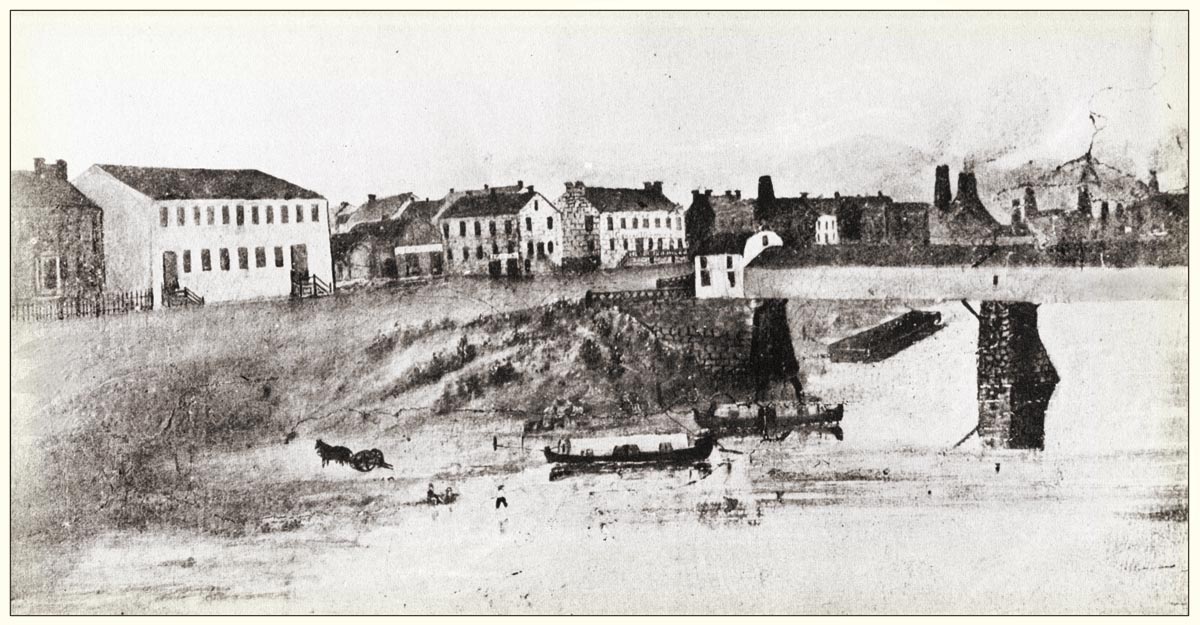
Return to top of the page
Sidney Rigdon Home Page | Rigdon's History | Mormon Classics E-Texts
last revised Mar. 6, 2010