|
[ 424 ]
CHAPTER XLIII.
THE MOUNTAIN MEADOWS MASSACRE. -- The Story of two Emigrant Traina -- The Journey across the Plains --
Arrival in Suit Lake City -- Denied Provisions in the Mormon Settlements -- The Travel to the Mountain
Meadows -- A Militia Regiment follows them -- Indians and Mormon Militia attack the Train -- A Fight
for Four Days -- Mormon Officers betray the Emigrants under a Flag of Truce -- They lay down their
Arms under Promise of Protection -- A Hundred and Twenty Men, Women, and Children butchered -- Seventeen
Children preserved -- The Story of the Massacre confirmed by the Affidavit of Bishop Smith -- The
Author's Letter to Brigham Young -- Superintendent Forney's Report -- Names of the Little Ones saved --
Judge Cradlebaugh's Speech in Congress -- Sale of the Emigrants' Property -- Major Carlton's Story of the
Monument -- "Vengeance is mine, I have repaid" -- "Argus" defines Brigham Young's Responsibility --
Congress deaf to the Demand for Investigation.
A few weeks in advance of the United States Expedition to Utah in 1857, there were two trains of emigrants
crossing the plains with the purpose of going to southern California. The one was from Missouri, the other
from Arkansas. The former was composed chiefly of men who named themselves "Missouri Wild-cats;" the other
train was a company of highly-respectable persons, sober and orderly, and in their associations seemed like
a large gathering of kindred, or very near friends. The first were probably venturous spirits seeking
fortune; the others, citizens seeking new homes.
The latter company was wealthy, and there were around them every indication of comfort, and everything in
abundance for pleasant travelling. In addition to the ordinary transportation wagons of emigrants, they
had several riding carriages, which betokened the social class of life in which some of the emigrants had
moved before setting out on the adventure of western colonization.
THE JOURNEY TOWARDS SALT LAKE.
427
They were in no hurry, but travelled leisurely, with the view of nursing the strength of their cattle, horses,
and mules, in order to accomplish successfully the long and tedious journey which they had undertaken. In that
company there were men, women, and children, of every age, from the venerable patriarch to the baby in arms. It
was a bevy of families related to each other by the ties of consanguinity and marriage, with here and there in
the train a neighbour who desired to share with them the chances of fortune in the proposed new homes on the
golden shores of the Pacific.
One of their number had been a Methodist preacher, and probably most of the adults were members of that
denomination. They were moral in language and conduct, and united regularly in morning and evening prayers.
On Sundays they did not travel, but observed it as a day of sacred rest for man and beast. At the appointed hour
of service, this brother-preacher assembled his fellow-travellers in a large tent, which served as a meeting-house,
within their wagon-circled camp, for the usual religious exercises, and there, on the low, boundless prairies,
or in higher altitudes at the base of snow-capped mountains, he addressed them as fervently, and with as much
soul-inspiring faith, as if his auditory had been seated comfortably within the old church-walls at home, and
they too sang their hymns of praise with grateful, feeling souls, and with hearts impressed with the realization
that man was but a speck in the presence of that grand and limitless nature that surrounded them, and of which
they were but a microscopic part.
Those who passed the company en route, or travelled with them a part of the way, were favourably impressed with
their society, and spoke of them in the kindest terms as an exceedingly fine company of emigrants, such as was
seldom seen on the plains.
Though utterly unlike themselves in character and disposition, the "Wild-cats" contracted for them much respect,
and came as near to them in travelling as was convenient for the grazing of the cattle and the purposes of the
camp at night. Within sight of each other they would form their corrals, but, while the one resounded with vulgar
song, boisterous roaring,
428
THE ROCKY MOUNTAIN SAINTS.
and "tall swearing," in the other there was the peace of domestic bliss and conscious rectitude.
A gentleman, a friend of the Author, travelled with this Arkansas company from Fort Bridger to Salt Lake City,
and speaks of them in the highest terms: he never travelled with more pleasant companions. Hearing the nightly
yells of the "Wild-cats," he advised the Arkansas company to separate from them as much as possible while passing
through the settlements, and in going through the Indian country. At that time it was easy to provoke a
difficulty; the whole country was excited over the news of the "invading army;" and so much was this gentleman
impressed with the necessity of great prudence on the part of the emigrants that, after he had left them on
his arrival at Salt Lake City, he afterwards returned and impressed upon the leading men the urgency of refusing
to travel further with the Missouri company so near to them. The kindly suggestions were appreciated, and they
expressed their desire to act upon them. Up to tin's time the journey of the emigrants had been prosperous, and
everything bade fair for a pleasant termination of their travels. Like all other pilgrims, they had counted
upon replenishing their stock of provisions at Salt Lake City, and to do tins, and to rest their cattle, they
concluded to camp awhile by the Jordan.
In early times of overland travel, the arrival of a Gentile emigrant train was usually a pleasant season for
trade and barter, and those who thought proper to visit the camp could readily exchange the fruits of the garden
and the produce of the dairy or the field for tea, coffee, sugar, and similar useful articles, which the
emigrants had in greater abundance. Many a sister in Salt Lake City has bedecked herself with apparel
advantageously purchased from the passers-by with the eggs and butter she had accumulated for just such an
opportunity. But a change had come over the spirit of the people in 1857. The Federal troops were advancing
upon Zion, and the Saints were preparing for the defence of their homes. The Indian is not the only human being
who fails to discriminate between the innocent and the guilty.
DEATH OF PARLEY P. PRATT.
429
preachers that some of the Missouri company had boasted on the way that they had taken part in driving the
Mormons from that State, and they are also said to have expressed their joy at the approach of the United States
army to "wipe out the Mormons," and adding to that folly that they themselves would willingly assist in such a
pleasant work. The alleged animus against the other company can be briefly told. About twelve months preceding
that time one of the Apostles, Parley P. Pratt, had been arraigned at Fort Smith, Arkansas, on a charge of
abducting the children of one Hector McLean, of New Orleans, and trying to run them off" to Utah. The mother of
the children had years before become converted to the Mormon faith in California, and subsequently became one of
the Mrs. P. P. Pratt in Utah. This apostle had not, at this time, been to New Orleans, and he personally did not
abduct the children: of the act direct he was guiltless, bnt he was to meet with Mrs. McLean Pratt in Arkansas
while she was en route from New Orleans to Utah. Of that Hector McLean became assured, and he started "upon their
trail."
At the examination before a magistrate, Mrs. McLean Pratt assumed all the responsibility for the abduction of the
children, and the apostle was honourably discharged. His friends, however, apprehended danger, and advised him
to escape, if he could, for McLean was a violent man. Those who proffered this advice also offered him a brace
of revolvers for his defence, but the apostle refused the carnal weapons, and preferred, on this occasion, to
leave "his life in the protection of the Lord." In such a sparsely-settled country the escape of the apostle was
impossible. In a few hours McLean was certain to overtake him wherever he went. At length he came within sight of
his enemy, as he regarded the apostle, and hotly pursued him with a thirst for blood. Hoping for some possible
shelter, Mr. Pratt made some detour from the public road, but it served him nothing, for McLean reached him before
he could arrive at the house where he thought to take refuge. Following him closely, he emptied his revolver at
the apostle, bnt failed to touch him. He became much enraged, urged forward his horse, and, as he rode past him,
made a lunge with a bowie-knife, and gave him a fatal thrust in the side. The wounded
430
THE ROCKY MOUNTAIN SAINTS.
man instantly fell from his horse, and McLean, with a Derringer that he obtained from one who accompanied him,
fired again at his victim ns he lay bleeding on the ground. That ball penetrated his breast, and in a few hours
later the apostle Parley P. Pratt was dead. *
McLean returned to Fort Smith, walked through the town with his friends, and in the evening took the passing
steamer for the South. No one seemed to think that he should be arrested; Mormonism and apostles were unpopular.
Whether with justice in this case or not, there is always a feeling of sympathy for the injured when domestic
intrusions are before the public.
A contributor to the Corinne Reporter, a Gentile paper published about sixty miles north of Salt Lake City,
recently published a series of "open letters" addressed to Brigham Young, in which there is much light thrown
upon the terrible fate of the two emigrant companies from Missouri and Arkansas. The writer of the letters signed
himself "Argus," † and, for prudential reasons, has withheld his name from the public.
As this gentleman relates with minuteness of detail the circumstances preceding the massacre, and also gives
a thrilling picture of that dreadful deed, the Author avails himself of the courtesy by which he has been
permitted to make such extracts as were necessary to tell the story of the Mountain Meadows Massacre: only
prefacing these extracts with the statement that the charges as to the author of the order for
__________
* It has often been charged to Parley that he seduced Mrs. McLean from her husband. Mrs. McLean asserts to the
contrary.
† As no statements of such importance as those made by this writer could possibly be cited in a work of this
kind without knowing who he was, and whether he was likely to be in possession of the information that he
claimed to know, for some months the Author sought anxiously, but ineffectually, to discover the writer's name;
the publisher very properly concealed it. At an unlooked-for moment the thread was accidentally found, and
"Argus" frankly avowed that he wrote the "open letters," and assured the Author that before a Federal court of
justice, where he could be protected, he was prepared to give the evidence of all that he had asserted. It need
only be added that "Argus" has probably been for thirty years a Mormon, has resided many years in Utah, has been
a high-priest in the Church, and has held responsible civil positions in the Territory.
THE COMPANY FORBIDDEN TO REST.
431
the massacre, and the deductions of the writer against Brigham Young, have been nearly all left out: first, and
principally, for brevity's sake, and secondly, from the consideration that, on so serious a charge as wholesale
murder, the unconvicted should have, as before expressed, the benefit of whatever uncertainty there is about the
matter. There is, however, sufficient extracted to make it very desirable for Brigham Young to encourage the
investigation of these charges before a competent tribunal, to clear his name of the imputation -- if he is
innocent.
EXTRACTS FROM "OPEN LETTERS FROM 'ARGUS' TO BRIGHAM YOUNG."
"SIR: The company of emigrants slaughtered on the 15th of September, 1857, at the Mountain Meadows, and within
your jurisdiction, was one of the wealthiest, most respectable and peaceable that ever crossed the continent by
the way of Salt Lake City. They were American citizens -- were within the territory of the United States, and
when they encamped by the Jordan river, upon the free, unenclosed and unappropriated public domain, and by the
laws of Utah, their stock were 'free commoners' on that domain. The most of those emigrants had unquestionably
been farmers, all of them rural in their habits of life; and from the fact that you did not charge them with being
thieves, or robbers, or of trespassing upon the rights of others, or disturbing the public peace, or with behaving
themselves unseemly, it is fair to infer that they were as upright and virtuous in their habits of thought, and as
honest and honourable in their intercourse with others as people from country parts generally are. They came from
Arkansas.* "
When they encamped by the Jordan they were weary and foot-sore, their supply of food was well-nigh exhausted, and
their work-cattle nearly 'used up' by the labours of the long and toilsome journey. The necessity rested upon them
of tarrying in Utah sufficiently long to rest and recruit their teams and replenish their store of provisions.
The harvest in Utah that year, then gathering, was abundant, and mountain and valley were covered with rich and
nutritious grasses. What was there to hinder this company from staying as long as they pleased, recruiting their
stock, and pursuing their journey when they got ready? And, besides, what had they done that the protection of
the law, represented in your person, should be worse than withdrawn from them? that they should be ordered to
break up camp and move on? and, worse than all, that a courier should be sent ahead of them bearing your written
instructions to the Mormons on said company's line of travel to have no dealing or intercourse with
__________
* Mrs. McLean Pratt is said to have recognized one or more of the emigrants as being present at the murder of
the apostle.
432
THE ROCKY MOUNTAIN SAINTS.
them; thus compelling them to almost certain death by starvation on the deserts? You were at that time the Governor
of Utah, Commander-in-Chief of the militia, and Superintendent of Indian Affairs, a sworn officer of the United
States and of the Territory, upon whom devolved, and with whom were intrusted grave and important responsibilities,
affecting the liberties of the people, the rights of persons and property, and the welfare and happiness of all
within the pale of your authority without regard to sect, creed, name, or nativity, or differences between
individual opinions. In addition to your magistrature, you were the chief high-priest of almost the entire body
of the people, assuming to yourself extraordinary heavenly powers and an unusual amount of spiritual excellence.
Without any modification of the term, you were professedly the earthly Vicar of the heavenly Saviour -- of Him
who divinely discoursed on earth of mercy and of love, and whose last words were, Father, forgive them!'..."
Not being allowed to remain, this weary, unrested company 'broke camp' and took up their line of travel for Los
Angeles. Their progress was necessarily slow. Arriving at American Fork settlement they essayed to trade off
some of their worn-out stock for the fresh and reliable cattle of the Mormons, offering fine bargains; and also
sought to buy provisions.
What must have been their surprise when they found they could do neither? Notwithstanding that flour, bacon,
vegetables in variety, poultry, butter, cheese, eggs, ete., were in unusual abundance, and plenty of surplus
stock, not the first thing could be bought or sold! They passed on through Battle Creek, Provo, Springville,
Spanish Fork, Payson, Salt Creek and Fillmore, attempting at each settlement to purchase food and to trade for
stock, but without success. It is true that occasionally some Mormon more daring than his fellows would sack up
a few pounds of provisions, and under cover of night smuggle the same into the emigrant camp, taking his chances
of a severed windpipe in satisfaction for zzzsneh unreasonable contempt of orders; but otherwise there was no
food bought by this company thus far. And here it is worthy to remark that up to this time no complaint had been
made against these travellers. They had been accused of no crime known to the laws, and, undeniably, it had been
a point with them to quietly and peaceably pass through Utah, in the hope of reaching some Gentile settlement
where their gold and cattle could buy them something to eat." The query arises here, What caused so strange and
unprecedented a proceeding towards this particular company? The custom of the overland emigration at that time
was well known; which was, to provision their trains for Salt Lake City, and refit at that place for California.
If other trains could rest and recruit, could buy, sell and refit in Utah, why not this?... These people were
from Arkansas, a State in which Parley P. Pratt, one of your fellow-apostles, had been killed... But to return.
This ill-fated company were now at Fillmore. They had left their camp at the Jordan with almost empty wagons,
they had been unable to purchase provisions, as before stated, they had but three or four settlements
THE EMIGRANTS REFUSED ALL SUPPLIES.
433
yet to pass through; and then their way would pass over the most to be dreaded of all the American deserts,
where there would be no possibility of obtaining a pound of food. What their prospects, feelings and forebodings
were at that time, I leave for your consideration; but, sir, I beg to call your attention to the fact that, at
the capture of their train at the Mountain Meadows, their stores were found to be inadequate for the journey in
contemplation. They were, indeed, well-nigh exhausted, with the exception of two purchases which I shall describe
presently, which purchases were made after they had left Fillmore. There cannot be a reasonable doubt that they
were already on short allowance when they reached that settlement.... There have been times, as in late
occurrences in Paris, when men's passions have been aroused and excited, especially upon religious differences,
and still more especially when associated with the idea of caste or race; outrages and wholesale butcheries have
occurred; but here we have in free America a peaceable company of emigrants who were forced untimely into a
journey, then half-starved, and finally slaughtered in cold blood! And this was the result of the apparent action
of an entire people. Do you expect the world to believe that action to have been spontaneous with them?
That the whole people from the Jordan to Fillmore should, of their own free will, uninfluenced, uninstructed,
uncoerced, should all as one unite in denying these strangers the right even of buying food? Impossible! This
company of Arkansas farmers, travelling with their wives and little ones, had now travelled through and by fifteen
different settlements, large and small, peopled by Mormons under your absolute control in all things, and had not
been able to buy food. Oh! what a falling off was there from the words of Him who said, 'If thine enemy hunger,
feed him!'...
"At Fillmore their store of provisions was too scanty to allow of delay; and so soon as they found they could do
no trading there they moved on, and in due course reached Corn Creek. Here they saw the first kindly look and
heard the first friendly word since they left the Jordan. And, strange to say, those friends were Indians! They
sold the emigrants 30 bushels of corn -- all they had to spare -- and sent them away in peace.
"The company passed on from Corn Creek, and, reaching Beaver, they found the same order of non-intercourse, the
same prohibition as to trading as before; and, passing on, they came to Parowan, but were not permitted to enter
the town. Now be it known, and the books will show, that the General Government had paid twenty-five thousand
dollars in gold coin for the surveying and opening of this road which passed directly through the town of Parowan,
and upon which this company was travelling and had travelled all the way from Salt Lake City, passing through
American Fork, and all the principal settlements on the route. They had passed through those settlements without
let or hindrance; but here they were forced to leave the public highway and pass around the west side of the fort
wall. When they reached the stream abreast of the town
434
THE ROCKY MOUNTAIN SAINTS.
they encamped, and tried, as before, to trade for food and fresh cattle, but failed. There was a little
Englishman who was determined to sell them some provisions; but Bishop Lewis's son and Counsellor advanced
before him, and, pressing the edge of a bowie-knife against his throat, compelled him to retreat without
realizing his humane intentions. There was a grist-mill at Parowan, the first the company had 'struck' since
they left Corn Creek. They made application to have the corn ground which they had bought of the Indians, but
were flatly refused.
"Now, sir, why were these emigrants refused permission to enter and pass through Parowan? However unpleasant it
may be to you, this question will probably yet be asked in such form and by such authority that you will feel
constrained to answer. You are quite competent to give the answer, so is your aide-de-camp and Brigadier-General,
George A. So is Wm. H. Dame, the colonel of the regiment forming a part of the militia under your supreme
command -- that same regiment that afterwards fell upon that same unoffending company at Mountain Meadows and
destroyed them. But you will not answer until compelled. Then let me suggest that Parowan was the legitimate
headquarters of that particular regiment; that it was the place of residence of Colonel Dame; that there was a
certain military appearance inside the walls that it would not "be prudent for the emigrants to see or suspect,
for their destruction had been decreed, and they must be taken at a disadvantage. And, further, the emigrants
hitherto had encountered only a passive hostility, now it was to be active; and they must not be permitted to
enter the town where their unoffending manners and quiet deportment might win upon the sympathies of the people.
"The emigrants made their way to Cedar City, at that time the most populous of all the towns in Southern Utah.
Here they were allowed to purchase fifty bushels of tithing wheat, and to get the same, and also the corn,
ground at John D. Lee's mill. No thanks, however, for this seeming favour; for the authorities that pretended to
sell that wheat knew that they would have the most of it back in less than a week; at least they knew that it
would never leave the Territory. But, waiving that, still this company of one hundred and twenty souls, or
thereabouts, had not to exceed forty-nine hundred pounds of provisions, less than forty days' rations, all told,
to take them to San Bernardino, in California.
"Now, sir, I have consulted with one of the old pioneers of the road from Cedar City to the Mojave river, one
whose judgment and experience are worthy of respect; one who saw that company in Utah as they were passing along
on the Territorial road, and knew the condition of their teams. I asked him how long it would have taken them to
go from Cedar to the Mojave? He reflected, then answered, 'Sixty days.' From there to San Bernardino would
have taken six to ten days. Here was a company made up of men, women and children, with at least one child to
be born on the road, whose mother would require a little rest and at least some comfort, forced to undertake this
journey under circumstances beyond
THE MILITIA IN PURSUIT.
435
their control, but altogether under yours, who were obliged to put themselves on short allowance on the start....
"The Arkansas company remained at Cedar City but one day, and then started on that fatal trip which was but too
soon to come to a tragic and sanguinary end. And here I will state a fact well known at Cedar City and Pinto
Creek, to prove that I have not overdrawn the picture when speaking of the jaded and worn-out condition of their
teams. It took them three days to go to Iron Creek, a distance of only twenty miles. The distance from Iron Creek
to the Meadows, about fifteen miles, was made in two days. The morning they left Iron Creek, the fourth after
leaving Cedar, your militia took up their line of march in pursuit of them, intending to make the assault at the
'Clara Crossing' -- your militia! you, Brigham Young, were at that very time Governor of Utah, and Commander-in-Chief
of the military forces of the Territory, and were drawing your salary as such from the treasury of the United
States.
"These soldiers did not come together by chance. Indeed, sir, it is on oath, and witnessed by the seal of the
court, that the calling out of those troops 'was a regular military call from the superior officers to the
subordinate officers and privates of the regiment.' And said sworn testimony further states that 'said regiment
was duly ordered to muster, armed and equipped as the law directs, and prepared for field operations.' I am
fully aware, sir, of the fearful import of these quotations The call to arms was the result reached by a regular
military council, held in the town of Parowan, at which were present, President Isaac C. Haight (the Mormon
High-Priest of Southern Utah), Colonel Dame, Major John D. Lee, and your fat Aide-de-Camp.
"The regiment camped at Cedar City -- was commanded by its major, John D. Lee (who was also your Indian Agent for
Southern Utah), and marched from that place in pursuit of the emigrants. It was accompanied by baggage-wagons,
and, with the exception of artillery, the other necessary ' make-up' of a military force in the field. Lee had
extended an invitation to the Piede Indians to accompany him; and with these auxiliaries he had a force which the
poor, hungry emigrants could not hope to resist.
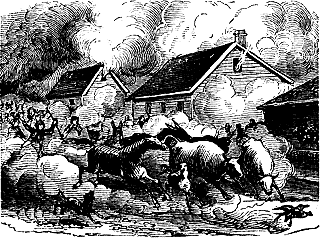
"The emigrants were overtaken at the Mountain Meadows. Being entirely ignorant of the danger so near them, they
'rolled out' from camp in a careless matter-of-course way, on the morning of the 12th of September, and, as soon
as the rear wagon had got a safe distance from the spring, the Indians, unexpectedly to Lee, commenced firing.
The emigrants were taken completely by surprise. It is conclusive beyond a doubt, from the loose and unguarded
manner of their travelling, that they had no idea of the military expedition sent against them until they saw and
felt it. Yet, unguarded as they were at the moment of the attack, they had travelled too far over roads infested
with Indians to become confused. They immediately corralled their wagons and prepared for defence, fortifying as
best they could; but, alas, they were too far from water!
436
THE ROCKY MOUNTAIN SAINTS.
"They fought your troops all that day and all the nest. Major Lee, beginning to think that he had waked up the
wrong passengers, sent to Cedar City and Washington for reinforcements, which were at once raised and forwarded,
forming a junction with the main body on the morning of the fourth day's tight. This call for reinforcements took
every able-bodied man from Washington, and all but two from Cedar City.
"During the third day's battle it became a necessity with the emigrants to get water. They were choking with
thirst, and without water they could hold out but little longer. There it was in abundance, in plain sight, but
covered by the rifles of your troops. They made several desperate but fatal and unsuccessful efforts, and finally,
hoping there might be some little of humanity remaining with the Mormons, they dressed,' two little girls in
white, and started them with a bucket toward the spring. Your soldiers shot theem down!
"On the next morning, the reenforcements having arrived, Major Lee massed his troops at a point about half a
mile from the emigrants' fort, and there made them a speech, during which he informed them that (I quote from a
sworn statement) his orders from headquarters were, 'To kill the entire company except the children.' Now, sir,
as to whether those 'headquarters' were located in your office at Salt Lake City, or at Parowan, is a matter to
be settled between you and Colonel Dame; and, if I am not mistaken, you will yet have to settle it. If Colonel
Dame shall ever confess before a proper tribunal that he issued that extraordinary order on his own responsibility,
and independently of you, I shall be very much mistaken. But, of the fact that such an order was actually made,
there can be no doubt. There had been two military councils held in
THE FLAG OF TRUCE. -- TREACHERY!
437
Parowan -- one before or about the time the emigrants passed that place and one on the day they left Cedar. Haight
and Lee were at both these councils, and from the last returned together to Cedar -- the latter to take command
of the troops, and the former to stand prepared to render him any service which might be needed.
"It is on oath, sir, that it was at Cedar City, two days after the emigrants had left, that President Haight said
to certain parties (who shall be nameless here), 'that he had orders from headquarters to kill all of said
company of emigrants except the little children!' This fixes the fact beyond dispute that Lee and Haight were
professedly acting under orders from headquarters; and to suppose that such profession was false -- that two
subordinates should take upon themselves the responsibility of such a bloody affair, professedly in your name,
and yet without your authority -- is out of the question. It is equally absurd to suppose that said order
originated with Colonel Dame. All the reasons are against such a supposition. Besides, no colonel of a regiment
would have the right or the authority to do anything in such premises, except to promulgate and enforce the order
of his superior officer. To do otherwise would be to subject himself to the eventualities of a military court;
and it is certain that neither Colonel Dame nor Major Lee was ever court-martialled for his action in the military
operations at the Mountain Meadows.
"After Major Lee had announced that fatal order to his troops, and instructed them as to how he intended to carry
it out, 'he sent a flag of truce into the emigrants' fort, offering to them that if they would lay down their
arms he would protect them.' This was on the 15th day of September, and the fourth since the battle, or, rather,
siege had begun. You will not forget that the little band of Arkansans were not 'whipped.' Though well-nigh
exhausted with fatigue and loss of sleep, and burning up with thirst, they were not conquered, they were fighting
for their wives and little ones more than for themselves, else, at any time, under cover of the darkness, they
could have formed in solid column, broke through your lines and escaped. But to their honour, be it said, they
refused life when associated with the condition of deserting their families.
"But the flag of truce came into their little fort -- that white flag held by all civilized nations and peoples,
from time immemorial, as an emblem at once of peace, of truth, of honour. By the message accompanying this flair,
they were promised protection. Alas, that it should prove to be 'such protection as vultures give to lambs!' But
the message was not from Indians, it was from Major Lee, a regularly constituted officer of the military forces
of the Territory of Utah, one of the Territories of the United States. What should they do but believe its promise?
They marched out of their little fort, laid down their arms, marched up to the spring where Lee stood, and placed
themselves under his protection; and his promises of protection were yours.
"But now was to be enacted one of those scenes which the pen is inadequate to describe, and the horrors of which
it is impossible for one not
438
THE ROCKY MOUNTAIN SAINTS.
"Another scene was now to be enacted so utterly revolting to our sense of modesty, so grossly at variance with
all our ideas of propriety, so altogether repulsive to the better qualities of human nature, that it vies even
with the massacre itself in damnable wickedness. This remark is not intended to apply to all of the troops, for
it is just and fair to understand that many a man was mustered in that regiment sorely against his will. But
apparently a majority of them took to the whole work of the campaign with willing earnestness, and finally
returned home seemingly without remorse. And, as good Utah Mormons, why should they not? Why should they not
slay upon the right hand and upon the left, until they could wade in the gore of apostates and Gentiles, and
then return home singing hosannas to God and the Lamb? They had been taught from your pulpits to expect and to
do just such things. The carnage around them was simply a matter of course. It was but an episode in what was
yet to be the gory history of the Kingdom of God. It was but a faint realization of those glorious campaigns
when they should go through the United States 'like a lion among the flocks of sheep, treading down, breaking
in pieces, with none to deliver, leaving the land desolate and without an inhabitant.' It was for these (your)
soldiers, these
FIEND-LIKE TREATMENT OF THE DEAD.
439
demons to commit the last outrage upon their victims. Among the slain there was the nursing babe which the mother
could not forsake, even in death; there were females of all ages, from budding girlhood to the prime of life;
there was also the youth and the strong man. Those females were not abandoned characters; they had not unsexed
themselves by whoredom; they were the chaste, the modest, virtuous and pure-hearted daughters, sisters and wives
of the emigrants. Well, sir, your soldiers, with many a coarse, ribald, vulgar jest, with many an obscene, beastly
remark, stripped them entirely of their clothing, and the whole company were left nude and stark, and without
burial! Even the young maiden, who had implored Lee for her life, was found among the sage-brush with her throat
cut, and stripped naked!
"The order had been given to spare the little children; but in the excitement of the massacre some were killed.
Seventeen, however, were saved. They were taken care of by Bishop Smith, who had been detailed by Major Lee
before the massacre for that purpose. In this labour of mercy he was voluntarily assisted by John Willis and
Samuel Mardy. The hapless orphans were put into two regimental baggage-wagons and taken to Jake Hamlin's ranche,
and the next day to Cedar City, where they were distributed among the Mormon families. Two of these children
afterward made some remarks which were thought dangerous, and they were privately taken out and -- buried! After
the administration in Utah had changed hands, they were gathered up by the Government and sent to St. Louis.
The troops at the Meadows, having stripped the bodies of the dead, gathered the stock, and Lee took possession of
the wagons and their contents, and also the stock."
While these sickening details of this terrible chapter were being sent to the press, unlooked-for confirmation
comes from Salt Lake City in the following affidavit from Bishop Philip Klingon Smith. It is proper to remark
that "Argus" could have no possible knowledge of the Bishop's affidavit, nor could the Bishop know of "Argus's"
letters. The affidavit was made in April, 1871, and was secretly preserved in the hands of a Federal officer:
the "Argus Letters" were written in July and August. It is singularly strange that both writers should give so
harmonious and clear a statement.
"State of Nevada, County of Lincoln, ss.: -- Personally appeared before me, Peter B. Miller, Clerk of Court
of the Seventh Judicial District of the State of Nevada, Philip Klingon Smith, who being duly sworn, on his
oath, says: My name is Philip Klingon Smith; I reside in the County of Lincoln, in the State of Nevada; I
resided at Cedar City, in the County of Iron, in the Territory of Utah, from A. D. 1852 to A. D. 1859; I
was residing at said Cedar City at the time of the massacre at Mountain Meadows,
440
THE ROCKY MOUNTAIN SAINTS.
in said Territory of Utah; I had heard that a company of emigrants was on its way from Salt Lake City, bound
for California; said company arrived at said Cedar City, tarried there one day, and passed on for California;
after said company had left Cedar City, the militia was called out for the purpose of committing acts of
hostility against them; said call was a regular military call from the superior officers to the subordinate
officers and privates of the regiment at Cedar City and vicinity, composing a part of the militia of the Territory
of Utah; 1 do not recollect the number of the regiment; I was at that time the Bishop of the Church of Jesus
Christ of Latter-Day Saints at Cedar City; Isaac C. Haight was President over said church at Cedar City and the
southern settlements in said Territory; my position as Bishop was subordinate to that of said President; W. H.
Dame was President of said Church at Parowan in said Iron County; said W. II. Dame was also colonel of said
regiment; said Isaac C. Haight was lieutenant-colonel of said regiment, and said John D. Lee, of Harmony, in
said Iron County, was major of said regiment; said regiment was duly ordered to muster, armed and equipped as
the law directs, and prepared for field operations; I had no command nor office in said regiment at the time,
neither did I march with said regiment on the expedition which resulted in said company's being massacred in
the Mountain Meadows, in said County of Iron; about four days after said company of emigrants had left Cedar
City, that portion of said regiment then mustered at Cedar City took up its line of march in pursuit of them;
about two days after said company had left said Cedar City, Lieutenant-Colonel I. C. Haight expressed, in my
presence, a desire that said company might be permitted to pass on their way in peace; but afterward he told
me that he had orders from headquarters to kill all of said company of emigrants except the little children; I
do not know whether said headquarters meant the Regimental Headquarters at Parowan, or the Headquarters of the
Commander-in-Chief at Salt Lake City; when the said company had got to Iron Creek, about twenty (20) miles from
Cedar City, Captain Joel White started for Pinto Creek settlement, through which said company would pass, for
the purpose of influencing the people to permit said company to pass on their way in peace; I asked and obtained
permission of said White to go with him and aid him in his endeavours to save life; when said White and myself
got about three miles from Cedar City we met Major John D. Lee, who asked us where we were going; I replied that
we were going to try to prevent the killing of the emigrants; Lee replied, 'I have something to any about that;'
Lee was at that time on his way to Parowan, the Headquarters of Colonel Dame; said White and I went to Pinto
Creek; remained there one night, and the next day returned to Cedar City, meeting said company of emigrants at
Iron Creek; before reaching Cedar City we met one Ira Allen, who told us ' that the decree had passed, devoting
said company to destruction;' after the fight had been going on for three or four days, a messenger from Major
Lee reached Cedar City, who stated that the fight had
BISHOP SMITH'S AFFIDAVIT.
441
not been altogether successful, upon which Lieutenant-Colonel Height ordered out a reinforcement; at this time
I was ordered out by Captain John M. Higbee, who ordered me to muster, ' armed and equipped as the law directs;'
it was a matter of life or death to me to muster or not, and I mustered with the reenforeing troops; it was at
this time that Lieutenant-Colonel Haight said to me that it was the orders from headquarters that all but the
little children of said company were to be killed; said Haight had at that time just returned from headquarters
at Parowan, where a military council had been held; there had been a like council held at Parowan previous to
that, at which were present Colonel Dame, Lieutenant- Colonel I. C. Haight, and Major John D. Lee; the result of
this first council was the calling out of said regiment for the purpose already stated; the reinforcement aforesaid
was marched to the Mountain Meadows, and there formed a junction with the main body; Major Lee massed all the
troops at a spring, and made a speech to them, saying that his orders from headquarters were to kill the entire
company except the small children; I was not in the ranks at that time, but on the side talking to a man named
Slade, and could not have seen a paper in Major Lee's hands; said Lee then sent a flag of truce into the emigrant
camp, offering said emigrants that 'if they lay down their arms, he would protect them;' they accordingly laid
down their arms, came out from their camp, and delivered themselves up to said Lee; the women and children were
then, by the order of said Lee, separated from the men, and were marched ahead of the men; after said emigrants
had marched about a half mile toward Cedar City, the order was given to shoot them down; at that time said Lee
was at the head of the column; I was in the rear; I did not hear Lee give the order to fire, but heard it from
the under officers as it was passed down the column; the emigrants were then and there shot down, except seventeen
little children, which I immediately took into my charge; I do not know the total number of said company, as I
did not stop to count the dead; I immediately put the little children in baggage-wagons belonging to the regiment,
and took them to Hamlin's ranche, and from there to Cedar City, and procured them homes among the people; John
Willis and Samuel Murdy assisted me in taking charge of said children; on the evening of the massacre, Colonel
W. H. Dame and Lieutenant I. C. Haight came to Hamlin's, where I had the said children, and fell into a dispute,
in the course of which said Haight told Colonel Dame that, if he was going to report of the killing of said
emigrants, he should not have ordered it done; I do not know when or where said troops were disbanded; about two
weeks after said massacre occurred, said Major Lee (who was also an Indian Agent), went to Salt Lake City, and
as I believe, reported said fight and its results to the commander-in-chief; I was not present at either of the
before-mentioned councils, nor at any council connected with the aforesaid military operations, or with said
company; I gave no orders except those connected with the saving of the children, and those, after the massacre
had occurred, and said orders were given as bishop and not in a
442
THE ROCKY MOUNTAIN SAINTS.
military sense; at the time of the firing of the first volley I discharged my piece; I did not fire afterward,
though several subsequent volleys were fired; after the first fire was delivered I at once set about saving the
children; I commenced to gather up the children before the firing had ceased. I have made the foregoing statement
before the above-entitled court for the reason that I believe that I would be assassinated should I attempt to
make the same before any court in the Territory of Utah.* After said Lee returned from Salt Lake City, as
aforesaid, said Lee told me that he had reported fully to the President, meaning the commander-in-chief, the
fight at Mountain Meadows, and the killing of said emigrants. Brigham Young f was at that time the
commander-in-chief of the militia of the Territory of Utah; and further deponent saith not.
(Signed) PHILIP KLINGON SMITH."
Subscribed and sworn to before me, this 10th day of April, A. D. 1871.
(Signed) P. B. zzzMrLLEB, County Clerk."
District Court, Seventh Judicial District, Lincoln County, Nevada. (Copy of seal.)"
"Utah Territory, County of Salt Lake, ss.: -- I, 0. F. Strickland, Associate Justice of the Supreme Court
of Utah Territory, hereby certify that I have carefully compared the foregoing copy of affidavit with the
original of the same, and that the foregoing copy is a true literal copy of said original, and that such
comparison was made this 4th day of September, 1872. (Signed) O. F. STEICKLAND."
"Territory of Utah, Salt Lake County, ss.: -- I, James B. McKean, Chief Justice of the Supreme Court of said
Territory, do certify that I have carefully compared the above copy of an affidavit with the original of the
same, and know the same to be in all particulars a true copy thereof.
(Signed) JAMES B. McKEAN, Chief Justiee, etc." Dated September 5, 1872."
The following map throws much additional light upon the statements of both "Argus "and Bishop Smith. The latter
states that while he and Captain Joel White were travelling
__________
* Since this affidavit was made, great changes have
taken place through the influx of Gentiles, and Bishop Smith now expresses his readiness to "return to Utah and
give testimony in person."
** The Mormons, who seek to exonerate Brigham Young from all complicity with the murderers of the emigrants,
relate that, when Lee offered to pay him a tithing of the ill gotten gear, he refused it, and threw it from
him. Be the hitter part of the statement true or false, the acknowledgment of the former shows that Brigham
Young had the opportunity of knowing who were the guilty parties, even if he him self did rot direct them, and
could have brought them to justice. Hut there is no necessity to zzznrgue from any disciple's admissions, for
it is a fact, of which there is evidence, that John D. Lee did make a report of the Mountain Meadows Massacre
to Governor Brigham Young, Superintendent of Indian Affairs, etc, and that report
THE PLAN OF THE MASSACRE.
443
southward from Cedar City to Pinto Creek, they met Lee three miles south of Cedar, who had something to say about
"trying to prevent the killing of the emigrants." The subject of attacking them had evidently been spoken of among
the Mormons; but as yet, not by authority, at least so far as White and Smith knew, or they would not have
undertaken the journey to Pinto Creek to dissuade the people from killing the zzz"emigrants." Lee was then en route
to headquarters at Parowan. On the return of the Bishop and Captain White from Pinto Creek, the next evening,
before they reached Cedar City, he says, "We met Ira Allen, who told us that 'the decree had zzz" ' passed
devoting said company to destruction.'" In a letter dated August 10, 1871, "Argus," without any knowledge of
Bishop Smith's affidavit, incidentally accounts for the information in the possession of Allen, and says:
"Had the original order to assault the emigrants in Santa Clara Canon been carried out, not one of them would
have been living in fifteen minutes after the head teams had been shot down. They would have been
__________
was written in the house of the apostle Ezra T. Benson, in Sail Lake City, within zzztvu hundred yard» of the
official residence of the Governor and Prophet of the Lord!
444
THE ROCKY MOUNTAIN SAINTS.
covered by the rifles of your troops from every possible direction. But ample provision was made to cut off any
that might escape. For this purpose a party, headed by one Allan, was sent to watch the road between the train
and the Muddy, and Ira Hatch and a fellow-missionary (!) were sent to the crossing of the Muddy. These good
brethren were instructed to shoot down any who should chance to escape the attack of Lee. On the night of the
second day of the battle, two men, on horseback, left the emigrants' camp, and started cautiously toward
California. They had, probably, been sent. As they were passing Allen's ambush, one of them was shot -- the
other got away. Word was dispatched to Parowan, and armed parties were immediately sent out to hunt down and kill
him. They did not find him -- he had returned to camp, and was recognized after the massacre."
It is further stated by this writer, that
"...a man named Boyle was sent on a mission to the Mojave Crossing well armed and with a key [mail-sack key], to
prevent any suspicious mail-matter from reaching San Bernardino, and to kill off any one who by any possibility
might have escaped and pot along that far. These particulars are given to show how thoroughly planned and
cold-blooded was everything connected with the war of extermination made upon the Arkansas emigrants,"...
and to further show that some other mind than that of John D. Lee had concocted the plan of the massacre.
It was with the knowledge of these facts that Judge Cradlebaugh delivered that extraordinary charge to the Grand
Jury at Provo.* The Judge had with a Federal escort visited the scene of the massacre within eighteen months of
the perpetration of the deed, and had seen the bones of that Arkansas company bleaching on the Meadows. **
With the actors all
__________
• Ante, p. 404.
** While Judge Cradlebaugh was in Cedar City, on his return from the Meadows, a number of persona made affidavit
against the leading Mormons there who had taken prominent part in the massacre, and several of the actors in it
came to him by night and expressed their readiness to testify to the facts whenever they had the assurance of
protection. On the information obtained from those parties the Judge issued warrants for the arrest of the
following persons:
"Isaac C. Haight, President of the Cedar City Stake; Bishop John M. Higbee and Bishop John D. Lee, Columbus Freeman,
William SlaJe, John Willis, William Riggs, Ingram, Daniel McFarhn, William Stewart, Ira Allen and son,
Thomas Cartwright, E. Welcan, William Halley, Jabez Nornlen, John Mangum, James Price, John W. Adair, Tyler,
Joseph Smith, Samuel Pollock, John McKurlan, Nephi Johnson, Thornton, Jod White, Harrison, Charles Hopkins,
Joseph Elanp, Samuel Lewis, Sims Mathcney, James Mangum, Harrison Pierce, Samuel Adair, F. C. MeDulange,
Wm. Bateman, Ezra Curtis, and Alexander Loveridge." The mimes in italics are specially mentioned in the
reports both by Bishop Smith and "Argus."
While the Judge was BO occupied, the captain commanding the Federal
troops
GOVERNOR CUMMING REPROACHES BRIGHAM.
445
around him, and the people horrified at the enormity of the crime, he would have held his court at Cedar City,
and could have brought to light the truly guilty authors of that atrocious deed, hut for the interference of
Governor Cumming, whose confiding .nature trusted in the promises of his predecessor to make a. full investigation
of the matter "without the presence "of the troops." On that promise Governor Cumming relied, and on his
representation to the Government at Washington that the United States troops were unnecessary to sustain the
Federal Judges, the Government immediately ordered General Johnston to furnish no troops except on the
requisition of the Governor alone.
"Argus," from personal conversation with the Governor, affirms that he felt keenly his failure to investigate
those murders, and relates that before he left the Territory he visited Brigham Young and uphraided him with
"having purposely"zzz lied to and deceived him." Such was no doubt the feeling of the Governor expressed to.
"Argus" -- whether he ever said so to Brigham or not -- for he used about the same language to other persons.
The opportunity and duty of bringing the guilty to justice were those peculiarly belonging to the governorship
of Alfred Cumming: the crime had been committed after he was appointed to Utah, and he was the fitting person
to have made the investigation. But the diplomacy that brought him into collision with the military commander
at Fort Bridger tied him hand and foot, and he afterwards could only move as Brigham moved him.* The strength
of his right arm was gone when he broke with General Johnston, and his left leaned on a bruised reed that was
destined to fail him; and no man saw this more clearly than Cumming did himself.
__________
that had escorted his Honour to the Mountain Meadows informed him that he "had received orders for his entire
command to return to Camp Floyd; the General having received orders from Washington that the military should not
be used in protecting the courts, or in acting as a zzzpotw to aid the marshal in making arrests."
* A day or two before the Governor left the Territory, the Author, in familiar conversation with him about the
then near future, asked: "How will zzzWoottou [the "Secretary in his absence became Acting Governor] get along?"
"Get along?" replied he; "well enough, if he will do nothing. There is nothing to do. Alfred Cumming is Governor
of the Territory, but Brigham Young is Governor of the people. By zzz, I am not fool enough to think otherwise.
Let Wootton learn that, and he will get along, and the sooner he knows that the better. This is a curious place!"
446
THE ROCKY MOUNTAIN SAINTS.
There was no "public opinion" in Utah at that time, nor for years after could any expression of condemnation
be heard; but -among those who could utter free words within their own circle of friends, the Mountain Meadows
Massacre has been branded with a condemnation as burning as was ever expressed by the Gentiles. The dominant
theory among the intelligent Mormons was that Brigham Young had not himself ordered the massacre, but that he
feared its investigation, as the men who did the deed were his brethren in the faith, and were in official
relations with him, and that the massacre being brought before a court it would doubtless lead to the execution
of men who might plead that it was the teachings of the Tabernacle that had rendered them capable of the
perpetration of such a terrible crime. Further, an investigation would have revealed the despotism of a system
that constrained men to imbrue their hands in the blood of unoffending, innocent men, women, and helpless children,
in order only to save themselves from the charge of disobedience and the fatal consequences of rebellion at such
a moment.
Believing, with many others in Utah, that it was possible that Lee and his confederates had been tempted by the
wealth of the passing emigrants, and had availed themselves of the excitement of the people to attack the train,
the Author addressed the following communication to the Prophet, in hopes that he would avail himself of this
opportunity, however insignificant it might be in his estimation, of putting himself right with at least a portion
of the public:
ASTOR HOUSE, NEW YORK, July 10, 1871.
"President Brigham Young --
"SIR: Being engaged in preparing a work for publication that will notice prominent incidents in Utah
history, and desirous of doing no injustice by misstatement, I think it proper to ask information such
as, in the quality of Governor of Utah and Superintendent of Indian Affairs, you probably possessed at
the date referred to, and may not think it improper to impart now.
"What Indians committed what is generally termed the Mountain Meadows Massacre? What number of Indians
were engaged in it? Were any of them ever punished; if so, how, and by whose order? Did any person by
the Governor's order take charge of the property of the emigrants? What became of it?"
It is generally understood that you sent an express to the leading
REMORSE OF THE GUILTY.
447
white men in that neighbourhood to allow the emigrants to pass along unmolested. I should be pleased to publish
such an order if you would furnish a copy. I have heard of the recent excommunication from the Church of
John D. Lee, Isaac C. Haight, and others, for being participators in that horrible crime. If this is correct,
I should be gratified with this and such other information on this point as you might feel disposed to furnish
me. I shall of course make use of the intelligence which I may receive in the book in a manner to place your
statements fairly before the public, recommending at the same time that the guilty be brought to justice.
Very respectfully, etc. T. B. H. STENHOUSE."
To this letter no reply was vouchsafed.
Whatever differences of opinion may exist between former members of the Church and the Prophet, no proper-minded
person among them desires to see any wrong imputed to Brigham Young of which he is innocent; and of the
responsibility of this massacre, above all other things, his bitterest enemy should be pleased to see him
exonerated.
The apostles who have spoken and written upon this painful subject, have endeavoured to fasten the guilt solely
upon the Indians, but this was a grave error, as well as being directly and palpably false.
There is implanted in the human breast an instinctive horror of the act of murder, and a large number of the
Mormons who took part in the massacre were too good men to rest in peace after the commission of a dreadful
deed that was forced upon them. It has unmistakably withered and blasted their happiness, and some of them have
suffered agonizing tortures of conscience, equal to those of Shakespeare's Thane of Cawdor. Two of them are
said to have lost their reason entirely, and others have gone to early graves with a full realization of the
terrible crime upon their souls. To expect silence among the living while such a deed was consuming them was
a great folly, and the exposure in detail now coming to light is what every sensible man might have expected
some time or other.
In his speech to Congress, already referred to, Judge Cradle- baugh thus relates what he had personally and
officially ascertained of the massacre:
"During our stay there [Santa Clara] I was visited by the Indian
448
THE ROCKY MOUNTAIN SAINTS.
chiefs of that section, who gave me their version of the massacre. They admitted that a portion of their men
were engaged in the massacre, but were not there when the attack commenced. One of them told me, in the presence
of the others, that after the attack had been made a white man came to their camp with a piece of paper, which
he said Brigham Young had tent, that directed them to go and help to whip the emigrants.
A portion of the band went but did not assist in the fight. He gave as a reason that the emigrants had long
guns, and were good shots. He said that his brother [this chief's name was Jackson] was shot while running
across the Meadow, at a distance of two hundred yards from the corral where the emigrants were. He said the
Mormons were all painted. He said the Indians got a part of the clothing; and gave the names of John D. Lee,
President Haight, and Bishop Higbee, as the big captains. It might be proper here to remark, that the Indians
in the southern part of the Territory of Utah are not numerous, and are a very low, cowardly, beastly set, very
few of them being armed with guns. They are not formidable.
I believe all in the southern part of the Territory would, under no circumstances, carry on a fight against ten
white men.
"From our camp on the Santa Clara we again went back to the Mountain Meadows, camping near where the massacre
had occurred. The Meadow is about live miles in length and one in width, running to quite a narrow point at the
southwest end. It is the divide between the waters that flow into the Great Basin and those emptying into the
Colorado river. A very large spring rises in the south end of the narrow part. It was on the north side of this
spring that the emigrants camped. The bank rises from the spring eight or ten feet, then extends off to the
north about two hundred yards, on a level. A range of hills is there reached, rising perhaps fifty or sixty feet.
Back of this range is quite a valley, which extends down until it has an outlet, three or four hundred yards
below the spring, into the main meadow.
"The first attack was made by going down this ravine, then following up the bed of the spring to near it, then
at daylight firing upon the men who were about the camp-fires -- in which attack ten or twelve of the emigrants
were killed or wounded; the stock of the emigrants having been previously driven behind the hill and up the ravine.
"The emigrants soon got in condition to repel the attack, shoved their wagons together, sunk the wheels in the
earth, and threw up quite an intrenchment. The fighting after continued as a siege; the assailants occupying
the hill, and firing at any of the emigrants that exposed themselves, having a barricade of stones along the
crest of the hill as a protection.
The siege was continued for five days, the, besiegers appearing in the garb of Indians. The Mormons, seeing that
they could not capture the train without making some sacrifice of life on their part, and getting weary of the
fight, resolved to accomplish by strategy what they were not able to do by force. The fight had been going on
for live days, and no aid was received from any quarter, although the family of Jacob Hamlin,
JUDGE CRADLEBAUGH'S SPEECH.
449
the Indian Agent, were living in tbe upper end of the Meadow, and within hearing of the reports of the guns.
"Who can imagine the feelings of these men, women, and children, surrounded, as they supposed themselves to be,
by savages? Fathers and mothers only can judge what they must have been. Far off in the Rocky Mountains, without
transportation -- for their cattle, horses, and mules, had been run off -- not knowing what their fate was to
be -- we can but poorly realize the gloom that pervaded the camp.
"A wagon is descried far up the Meadows. Upon its nearer approach it is observed to contain armed men. See! now
they raise a white flag I All is joy in the corral. A general shout is raised; and in an instant, a little girl,
dressed in white, is placed at an opening between two of the wagons, as a response to the signal. The wagon
approaches; the occupants are welcomed into the corral -- the emigrants little suspecting that they were
entertaining the fiends that had been besieging them.
"This wagon contained President Haight and Bishop John D. Lee, among others of the Mormon Church. They professed
to be on good terms with the Indians, and represented the Indians as being very mad. Thty also proposed to
intercede and settle the matter with the Indians. After several hours of parley, they, having apparently visited
the Indians, gave the ultimatum of the Indiana; which was, that the emigrants should march out of their camp,
leaving everything behind them, even their guns.* It was promised by the Mormon bishops that they would bring
a force, and guard the emigrants back to the settlements.
"The terms were agreed to -- the emigrants being desirous of saving the lives of their families. The Mormons
retired, and subsequently appeared at the corral with thirty or forty armed men. The emigrants were marched
out, the women and children in front, and the men behind, the Mormon guard being in the rear. When they had
marched in this way about a mile, at a given signal, the slaughter commenced. The men were most all shot down
at the first fire from the guard. Two only escaped, who lied to the desert, and were followed one hundred and
fifty miles before they were overtaken and slaughtered.
"The women and children ran on, two or three hundred yards farther, when they were overtaken, and, with the aid
of the Indians, they were
__________
* At first, it baffled every one in Utah to account for the emigrants giving up their
arms, and to this fact there is but one feasible solution. The Arkansas company was composed of persons of high
moral character, and devotedly religious. They were worshippers of the Christian Deity, and when they saw the
faces of white men they believed themselves secure. They confided in the fidelity of those who professed to
believe in the teachings of "the greatest name given among men," and as those who came to their succour claimed
the direction of a still later revelation of the will of God to man, what else could the honest, truthful,
simple-hearted emigrants do but confide in men of their own race, who assumed to be nearer than themselves to
the guidance of the Supreme Being? What a terrible lesson awaited them!
450
THE ROCKY MOUNTAIN SAINTS.
slaughtered. Seventeen only of the small children were saved, the eldest being only seven years. Thus, on the
10th day of September, 1857, was consummated one of the most cruel, cowardly, and bloody murders known in our
history. Upon the way from the Meadows, a young Indian pointed out to me the place where the Mormons painted and
disguised themselves."
Mr. Jacob Forney, the first Superintendent of Indian Affairs after Brigham Young, gathered up sixteen of the
children, made orphans by that foul, treacherous deed, and gives the names and ages, eighteen months after the
occurrence, as follows:
"John Calvin, now seven or eight years old; does not remember his name; says his family lived at Horse Head,
Johnston Co., Arkansas. Ambrose Moroni, about seven years, and William Taggit, lour and a half years, brothers;
these also lived in Johnston Co. Prudence Angeline, six years, and Annie, about three years; these two are said
to be sisters. Rebecca, nine years; Louisa, five years; and Sarah, three and a half years; from Dunlap. Betsy,
six years, and Anna, three years, said to be sisters; these know nothing of their family or residence. Charles
Francher, seven or eight years, and his sister Annie, three and a half years. Sophronia or Mary Huff, six years,
and Elisha W. Huff, four years. A boy; no account of him; those among whom he lived call him William. Francis
Hawn or Korn, four and a half years old.
"I have come to the conclusion, after different conversations with these children, that most of them come from
Johnston Co., Arkansas. Most of them have told me that they have grandfathers and grandmothers in the States.
Mr. Hamlin has good reasons for believing that a boy about eight years, and belonging to the party in question,
is among the Navajos Indians, at or near the Colorado river."
No human soul can read the list of those helpless, destitute children of such tender years without experiencing
a harrowing fooling of grief for the sad beginning of their lives, and a burning indignation against the "Saints"
who committed the atrocious crime which bereft them of their natural protectors. Superintendent Forney reports
in a letter to the Commissioner of Indian Affairs, dated from Provo City, March, 1859, that --
"Facts in my possession warrant me in estimating that there was distributed a few days after the massacre, among
the leading Church dignitaries, $30,000 worth of property."
In August of the same year, to the same Commissioner, he writes:
SUPERINTENDENT FORNEY'S REPORT.
451
"I am justified in the declaration that this massacre was concocted by white men, and consummated by whites and
Indians The children were sold out to different persons in Cedar City, Harmony, and Painter [Pinto] Creek, and
bills are now in my possession from different individuals, asking payment from the Government, but I cannot
condescend to become the medium of even transmitting such claims to the Department." In his Annual Report,
September, 1859, he continues:
"Mormons have been accused of aiding the Indians in the commission of the crime. I commenced my inquiries
without prejudice or selfish motive, and with the hope that, in the progress of my inquiries, facts would enable
me to exculpate all white men from any participation in this tragedy, and saddle the guilt exclusively on the
Indians; but, unfortunately, every step in my inquiries satisfied me that the Indians acted only a secondary
part.... White men were present and directed the Indians. John D. Lee, of Harmony, told me in his own house,
last April, in presence of two persons, that he was present three successive days during the fight, and was
present during the fatal day. ...I gave several months ago to the Attorney-General, and several of the United
States Judges, the names of those who I believed were not only implicated, but the hell- deserving scoundrels
who concocted and brought to a successful termination the whole affair.
"The following are the names of the persons most guilty: Isaac C. Haight, Cedar City, president of several
settlements south; Bishop Smith, Cedar City; John D. Lee, Harmony; John M. Higbee, Cedar City; Bishop Davis,
David Tullis, Santa Clara; Ira Hatch, Santa Clara. These were the cause of the massacre, aided by others. It
is to be regretted that nothing has yet been accomplished towards bringing these murderers to justice.
"I remain, very respectfully, your obedient servant,
"J. zzzFORNEY, Superintendent of Indian Affairs, Utah Territory.
"Hon. A. B. GREENWOOD, Comr. Indian Affairs, Washington, D. C."
Whatever sympathy one would naturally feel for the men who were forced into the massacre, much of that kindly
sentiment is greatly modified, when the statement is made that after the fathers and mothers of those little
children had been cruelly butchered and all their worldly wealth had been appropriated by their murderers, a
portion of that same people, calling themselves "Saints" did so debase themselves as to claim of the Government
a remuneration for sheltering the helpless innocents! To this should be added that wives and daughters of some
of those murderers wore the apparel of the massacred women and maidens, while their polygamic husbands and fathers
wore the masculine garments of their victims, ploughed
452
THE ROCKY MOUNTAIN SAINTS.
the fields with their cattle, and drove to their religions assemblies with the horses that they had stolen from
the Arkansas train, and no one called them to account!
It has been repeatedly asserted that the best carriage was taken to Salt Lake City and was there seen rolling
through the streets of that place for years after, and the jewelry of the murdered victims is said to have
adorned the persons of some distinguished women; bnt all this seems too incredible. Lee and his marauders could
steal and murder -- that has been demonstrated; but surely no one in fellowship with the Prophet at the chief city
of Zion, could either afford the luxury of such a carriage nor yet the glitter of such gold at so fearful a price.
Of the actual property of the emigrants no definite statement can be made, for those who knew would not tell;
but it is as near the truth as will ever be reached, till a court of justice shall compel a full divulgence of
the facts, that "the train" consisted of 40 wagons, 800 head of cattle, and about 60 "horses and mules." * "The
property," says Mr. Beadle, "was divided, the Indians getting most of the flour and ammunition; but they claim
that the Mormons kept more than their share. Much of it was sold in Cedar City at public auction; it was
there facetiously styled, 'Property taken at the siege of Sevastopol;' and there is legal proof that the "clothing
stripped from the corpses, spotted with blood and flesh and shredded by bullets, was placed in the cellar of the
tithing-office and privately sold. As late as 1862, jewelry taken at Mountain Meadows, was worn in Salt Lake City,
and the source it came from not denied." **
Major [now General] Carlton, in 1859, with a company of United States cavalry, escorted from California to
the southern settlements of Utah the United States paymaster of the troops at Camp Floyd. On his return the
Major passed through the Mountain Meadows and gathered the whitened bones of the emigrants and erected over
them a large cairn of stones.
"It was constructed by raising a large pile of rock, in the centre of which was erected a beam, some twelve
or fifteen feet in height. Upon one of the stones he caused to be engraved, 'Here lie the bones of one hundred
and twenty men, women, and children, from Arkansas, murdered
__________
* The Mormon Prophet, p. 65.
** Life in Utah, p. 184.
THE MONUMENT OVER THE SLAIN.
453
on the 10th day of September, 1857.' Upon a cross-tree, on the beam, he caused to be painted: 'Vengeance is mine,
saith the Lord, and I will repay it.' This monument is said to have been destroyed the first time that Brigham
visited the Territory." *
It is reported by one who stood at Brigham's side as he read aloud the inscription, that the Prophet with
unfaltering voice changed the purport of its language and said to those who were around him that it should
read thus: "Vengeance is mine, saith the Lord, and I have repaid!"
"Argus" closes his series of letters with the following discussion of Brigham's supposed justification:
"That an entire company of peaceful families, as at the Mountain Meadows, should be butchered in cold blood,
anywhere in the United States, upon the public highway, and within the easy reach of the arm of the civil power
created expressly for the protection of life and property, is a mystery which the purely American mind finds
very hard to understand.
And the marvel is only increased by the fact that no inquest was held over the remains of those slaughtered ones --
that no arrests were made of the murderers, although they were well and notoriously known, and that no official
notice was taken of the matter (except as I have heretofore stated) during the remainder of your term as Governor,
and no apparent authoritative notice since, except to gather up, by soldiers of the United States, what bones the
wolves had left, and giving them respectable sepulture. Based upon American ideas, and, indeed, upon the more
general notions of civilization, the whole story becomes incomprehensible.
In order to understand this matter, it will be necessary for the reader, first, to mentally segregate Utah
geographically from the United States -- to consider it as absolutely a foreign State and nation, with a
civilization such as existed thirty-live hundred years ago, and a religion as antagonistic to Christianity as
zzzMoslemism itself, including within its creed a tenet 'more cruel and bloody than the Thuggism of India.
Second, to consider this Dcscrct nation as incensed to the last degree against the Government and people of
the United States, for a series of wrongs committed against them, including exile and the loss of life and
property. Third, to take into the aceount, that the American Government at that time had actually proposed to
extend its jurisdiction over said Deseret (otherwise called Utah), and an army was then on its way to occupy
said Utah for the purpose of maintaining the sovereignty of said Government there, and that a state of war was
apparently existing between said two nations. Fourth, that you were, at the very time of the massacre at the
Mountain Meadows, mustering and putting into the field an army of one thousand two hundred men, which was
known in Utah as 'The Standing Army,' and that said army was designed for active operations against the
forces
__________
* Waite, p. 71.
454
THE ROCKY MOUNTAIN SAINTS.
of the United States, under Colonel Johnston, then en route for Salt Lake. Fifth, that you were the 'Sovereign'
lord of Deseret -- that your rule was an absolute and unmitigated despotism -- that your word was the only
recognized law -- that it was within your imperious nature to rule with a high hand and a stretched-out arm over
all your subjects, and with fury poured out against your enemies. If the reader can grasp the ideas contained
in the above items, and arrange them into one compound proposition, he will be able to form some idea of the
causes which made the aforesaid massacre possible.
"But the misfortune is, that said proposition being based upon falsehood and not upon the truth, affords you no
justification whatever; for, first, Utah was a part of the United States, and not a foreign State; second, your
intense hatred of Americans and their Government was without adequate cause; third, the occupation of Utah as a
Military Department was altogether a friendly act, and in strict accordance with the known military policy of
the Government; fourth, that all your acts in relation to the State of Deseret were and are treasonable in their
intent, and therefore illegal and of no binding force. For these reasons, the American people will refuse to
look upon that massacre from your stand-point. They will and do hold you to your responsibility as a citizen
of the Republic. And as you were at that time the Chief Magistrate of Utah, they have the right to demand why
you took no official steps to inquire into that sanguinary affair which is the shame and damning disgrace of
your administration. They have the right to demand why you took no official action in the case of Dame, Haight,
and Lee; and how it is that you have so far persistently and successfully screened those murderers from the
officers and the action of the law. It is a foul blot upon the workings of the system of American jurisprudence
that the Mountain Meadow Massacre should having been committed nearly sixteen years ago, and to this present
writing you, and Lee, and Dame, and Haight, are at large, and come and go unquestioned by the proper authority.
The blush of shame should mantle the cheeks of the Governor of our Territory so long as that bloody affair
remains uninvestigated, now that such investigation is possible. The judges of our courts should not have the
courage to look a law-abiding man in the face so long as anything remains undone which they can legally do to
bring those murderers to justice.
"It appears to have all along been the opinion that the investigation of the Mountain Meadow Massacre must
originate in the criminal courts. With that view, and the Grand Jury subject to your dictation, and under your
complete control, what could be done? Nothing, absolutely nothing, but to wait. Murder is shielded by no statute
of limitations. But I will here suggest, that such investigation should be made by a military court, for the
reason that the operations of Lee were purely and undeniably of a military character. Such a court would
officially determine the military character of those operations, would collect all necessary facts in the case,
and those facts would fix the responsibility where it justly belongs.
"THE MOUNTAIN MEADOW DOGS."
455
Then such ulterior proceedings could be had as the case would seem to demand. If there are not Gentile officers
enough in the Utah militia to constitute such a court, enough can soon be commissioned. But no Mormon should be
allowed to constitute a part of that court, nor any Gentile who could be allured from duty by your sirens or be
purchased by your ill-gotten gold.
"And now, in conclusion, as a Mormon, I demand of the proper authorities that this long-neglected affair be
investigated, in order that the innocent may no longer suffer that reproach which belongs to Brigham Young and
others only. In this connection it is proper to state that there is a strong and growing feeling in Southern
Utah against Lee and his co-labourers on that bloody mission, and against their confederates, apologists, and
protectors. Even in Cedar City those characters are now known as 'Mountain Meadow Dogs.' As a citizen of the
United States, I demand that the veil of mystery so long covering that butchery be rent asunder, and the foul
deed exposed in all its repulsive hideousness, bringing to the light those latent agencies which superinduced
its commission, in order that justice may be meted out to the guilty parties, thus wiping out a foul blot upon
the American name. In the name of Justice I demand it, that it may no longer be said that in Utah the direst of
felonies may be committed with impunity. In the name of Truth, I demand that the facts concerning the Mountain
Meadow Massacre be ascertained and stated in official form by competent authority, in order that the people of
the United States may know that said massacre, even to its most sickening details, was only too true."
"There are many incidental circumstances in the story of this massacre, and events which have occurred since
its perpetration, that keenly touch the souls of those who are capable of appreciating the facts of that horrible
tragedy.
Judge Cradlebaugh speaks of the joy which he witnessed among the children when they found themselves together
again, and under the protection of American citizens:
"I recollect," he says, "one of them, John Calvin Sorrow, after he found he was safe, and before he was brought
away from Salt Lake City, although not yet nine years of age, sitting in a contemplative mood, no doubt thinking
of the extermination of his family, saying: 'Oh, I wish I was a man; I know what I would do; I would shoot
John D. Lee; I saw him shoot my mother.' I shall never forget how he looked." Poor boy! What terrible anguish
must have been in the reflections that found such expressions in a child of his years! There is represented in
the engraving preceding this chapter a maiden of sixteen summers, cruelly murdered while pleading for life.
The Author's friend, who travelled with
456
THE ROCKY MOUNTAIN SAINTS.
the company from Fort Bridger, speaks of her as a lovely sweet creature, with dark flowing curls, who had been
the life and joy of the camp, and the companion of the venerable patriarch of the company. When the first
volley of rifles had strewn the ground with the dead, she flew into the arms of young Lee, and begged protection
of her life. The manly instinct of the youth was instantly aroused by the supplicating look of that pure and
innocent being, in her defence, and he sheltered her by his person. In an instant his father seized him by the
collar, and by greater force bending his son's head, fired his revolver, and shot the maiden in the forehead.
She fell lifeless at his feet. This incident, and the forced part which he played in the massacre, has blighted
for ever the life of the young man, and to his confidants he has sorrowfully related his poignant grief.
Three of the men who escaped from the massacre were pursued for a long distance. One of them is said to have
perished in the desert, after a flight of one hundred and fifty miles; and of the disposition of the other two,
the band under the captaincy of Ira Hatch could probably tell a thrilling story.
There is, too, a legend that the written order for the massacre of the emigrants has been preserved, and is
to-day in safekeeping. If such a document docs exist, it can only be in the hands of some one who means to use
it at a proper time, but to acknowledge now the personal possession of such property would be dangerous folly.
There are, however, persons in Utah who are fully confident that the document is a reality. Wherever the story
of this treacherous massacre has gone forth, a curse has been muttered by the lips of honest men and women, and
a demand for retribution has lingered on their tongues, while, humiliating as it is to confess, in the
Forty-second Congress there were gentlemen to be found in the Committees of the House, and in the Senate, who
were bold enough to declare their opposition to all investigation of these murders. One who had a national
reputation during the war, from Bunker's Hill to New Orleans, was not ashamed to say to those who sought the
legislation that was necessary to make investigation possible, that it was "too late." To the petitioner he said:
THE HONOUR OF THE REPUBLIC AT STAKE.
457
"Have any murders been committed in Utah during twenty years?"
"Yes."
"Have any been committed during the last fifteen years?"
"Yes."
"Have any been committed within ten years?"
"Yes."
"Have any been committed within five years?"
"Perhaps not."
"Well, then," was the reply, "if there have been none within five years, I am opposed to meddling with the past.
There are murders in New York nearly every day."
To that representative from the proudest State in the Union, the answer of the fatherless should be, that one
single murder resulting from religious hatred, systematically shown, is more damning than ten thousand murders,
the casual offspring of the vile passions of the most debased of men.
Moreover, that a sedate, honourable Senator, also one who has not deemed the Presidency of the United States
beneath his ambition, should make a similar announcement, and ask that the past might be buried in oblivion,
is passing strange. *
To this lengthy statement, and circumstantial detail of facts, the Mormon apostles may
continue, as they have done before, to allege that the emigrants put poison on the body of a dead ox, that some
Indian chiefs partook of the poisoned meat and died, and that the rest of the Indians became enraged, and
"wiped them out." They may, perhaps, also add
__________
* In addition to the labours of the regular delegate from Utah to Congress during the winter of 1871-2, there
was another delegation from Utah, composed of two Gentiles and an apostle who enjoyed the freedom of the House,
and whose business it was to secure the admission of Utah into the Union and thereby end all interference of
Congress with the bloody record of that Territory. The apostle was but doing his duty to "the Lord;" the two
Gentile gentlemen were to be rewarded, the one with senatorial honours and the other with the position of
Representative of the "State of Deseret."
On one occasion the Author visited that assembled body of honoured gentlemen, and was chatting with some of
them on the proposed legislation for Utah which was to bring up and investigate the Utah murders, and expressing
surprise at the evident intention of some parties to prevent all legislation, the answer was made unreservedly by
a number of gentlemen, with ill-disguised contempt: "It is very evident, Mr. Stenhouse, that Brigham Young has a
financial agent in Washington."
458
THE ROCKY MOUNTAIN SAINTS.
that the emigrants poisoned a spring, and that for doing so the Indians attacked them. To those who
can accept such statements, in the light of the facts stated in this chapter, as a solution of the
Mountain Meadows Massacre, they are perfectly welcome; but upon the Government of this great Republic,
that massacre will ever be a stain until the fullest investigation has been made, and the guilty ones
brought to justice.
Fifteen long years have passed away since that dark tragedy was enacted, and yet the nation slumbers,
and the representatives of the Government are deaf to the cries of the slaughtered! How well did
Britain, a few years ago, earn the admiration of the world for the proud march of her army into the
heart of Abyssinia, to demand from the infatuated Theodorus the release of British subjects! Other
nations, too, have disregarded distance, time, and money, when the cries of injured citizens have been
heard calling for protection. But here, in the very heart of "the Great Republic," on the highway
between the seas, the darkest deed of the nineteenth century is passed by in silence! The cries and
prayers of the orphans have been heard in vain in free America!
|